March 2000
The monthly newsletter for people who live, work or play on the Upper Mississippi River
River Studies Center By Mi Ae Lipe-Butterbrodt
U
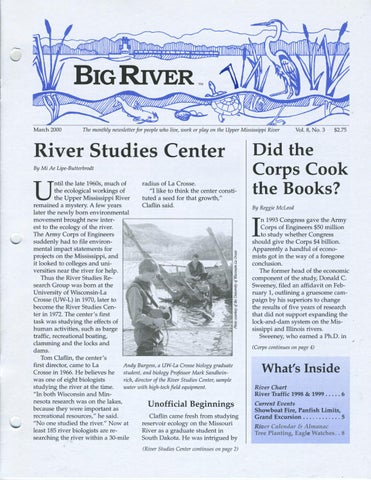
ntil the late 1960s, much of radius of La Crosse. "I like to think the center constithe ecological workings of the Upper Mississippi River tuted a seed for that growth," remained a mystery. A few years Claflin said. later the newly born environmental movement brought new inter- ~ - - - - - - - - - - - - - - - ~ est to the ecology of the river. The Army Corps of Engineers suddenly had to file environmental impact statements for projects on the Mississippi, and it looked to colleges and universities near the river for help. Thus the River Studies Research Group was born at the University of Wisconsin-La Crosse (UW-L) in 1970, later to become the River Studies Center in 1972. The center's first task was studying the effects of human activities, such as barge traffic, recreational boating, clamming and the locks and dams. Tom Claflin, the center's first director, came to La Andy Burgess, a UW-La Crosse biology graduate Crosse in 1966. He believes he student, and biology Professor Mark Sandheinwas one of eight biologists rich, director of the River Studies Center, sample studying the river at the time. water with high-tech field equipment. "In both Wisconsin and Minnesota research was on the lakes, Unofficial Beginnings because they were important as recreational resources," he said. Claflin came fresh from studying "No one studied the river." Now at reservoir ecology on the Missouri least 185 river biologists are reRiver as a graduate student in South Dakota. He was intrigued by searching the river within a 30-mile
--
(River Studies Center continues on page 2)
Vol. 8, No. 3
$2.75
Did the Corps Cook the Books? By Reggie McLeod
I
n 1993 Congress gave the Army Corps of Engineers $50 million to study whether Congress should give the Corps $4 billion. Apparently a handful of economists got in the way of a foregone conclusion. The former head of the economic component of the study, Donald C. Sweeney, filed an affidavit on February 1, outlining a gruesome campaign by his superiors to change the results of five years of research that did not support expanding the lock-and-dam system on the Mississippi and Illinois rivers. Sweeney, who earned a Ph.D. in (Corps continues on page 4)
What's Inside River Chart River Traffic 1998 & 1999 ..... 6 Current Events Showboat Fire, Panfish Limits, Grand Excursion ............ 5 River Calendar & Almanac Tree Planting, Eagle Watches .. 8
(River Studies Center continued from page 1)
the Mississippi River and the abundant lakes and streams of Wisconsin and Minnesota. Soon he was developing courses in aquatic biology at UW-L. "By 1970, government agencies were contracting a lot of research," said Claflin, "and UW-L got into this with a solid footing, since we offered aquatic biology studies and we had a 50-foot research vessel called the Izaak Walton, which we used for 12 years." When Claflin proposed creating a center in 1970, graduate dean James Erickson and business vicepresident Donovan Riley were enthusiastic, but red tape prevented them from making the group a formal center. Two years later, the "center" was formed when, "Riley said to just print some letterhead and go ahead. We did," chuckles Claflin. "The 1970s were a time of a lot of surveys and inventories, especially of aquatic plants and invertebrates," Claflin recalled. "We studied nitrogen and phosphorus cycles in Lake Pepin, which serves as a catch basin for Twin Cities sewage, and we did a lot of work on fish management and populations." The center focused primarily on nearby Pools 7 and 8, but its research reached as far north as Hastings and St. Anthony Falls in Minnesota, and as far south as Pool 18, as well as on the Chippewa River at Durand and the Minnesota River near Shakopee. Claflin credits Ron Rada, who codirected the center with Claflin from 1979 to 1997, with forging its strong partnerships with the U.S. Department of Interior's Environmental Management Technical Center (which later became the Upper Midwest Environmental Science Center (UMESC) under the U.S. Geological Survey (USGS)). Rada's interest in contaminants expanded the center's research scope to include studying mercury effects on fish in the Mississippi and Wisconsin Rivers. And Claflin believes the
2
center's third director, Mark Sandheinrich, who is interested in toxicology, is taking the center into new frontiers.
Lasting Relationships The center now includes 11 faculty members and extensive collaboration by UMESC personnel and both undergraduate and graduate students. About 15 students work directly with the center on projects, while three times that many intern with the USGS. Most of the students major in aquatic sciences,
Tom Claflin, founder and first director of the River Studies Center.
chemistry, microbiology or geographical information systems (GIS). UW-L faculty members obtain grants to support their scholarly pursuits. "The center provides us with an identity and focus, but first, we are faculty," said Sandheinrich, emphasizing the teaching opportunities created at the center. The center is also for the students. "In the classroom, students do get hands-on experience in the field and in data analysis, collection and lab work, but there is a lot of scholarly activity as well, and the lectures are more like comments on the hands-on work," said Sandheinrich. Claflin adds, "At every turn we involved students; they are the
Big River
backbone of the center." Student Andy Bartels collaborated with UMESC staff on a study published in the December 199-9 issue of the Canadian Journal of Fisheries and Aquatic Sciences. A graduate student who works for the Wisconsin Department of Natural Resources, Bartels found that, in Pool 8 of the Mississippi River and the La Grange Pool of the Illinois River, heavy spring flooding boosted the growth of certain fish species, such as largemouth bass and bluegill. The study confirms what biologists have termed the "flood-pulse concept": that such annual floods in temperate rivers provide more food and habitat for species that depend on shoreline areas for reproduction, causing them to grow bigger in those years. There are daily exchanges between UW-L faculty and students and researchers from UMESC offices in La Crosse and Onalaska, Wisconsin; the La Crosse Fish Health Center; the La Crosse Fisheries Resources Center; the U.S. Fish and Wildlife Service; and the Minnesota and Wisconsin Departments of Natural Resources. According to Rada, these studies produce good science with an efficient use of tax dollars. "Most every thing we do is in a partnership with government agencies, and we can do more than we could alone." "I think it is important to have the collegiate relationship," Sandheinrich concurs. With projects coauthored by faculty and federal staff, "we have a very good relationship with the USGS and we can offer things that are not found exclusively in an academic or federal workplace setting." This also provides students with potential employment opportunities when they graduate.
To the Antarctic The center's research has evolved both geographically and in scope. In the 1970s, studies focused on aquatic plants, fish, invertebrates
March 2000
and the effects of shipping on the Upper Mississippi, including silting-in and loss of backwater habitat; in the early 1980s the research expanded to metal analysis; in the mid- to late 1980s, to mercury contamination in northern Wisconsin; and in the 1990s research shifted to the effects of toxins on fish, amphibians and invertebrates and how land use changes affect ecological systems. Currently the center is working on about a dozen projects, including the impact of landscape changes on invertebrates in the Cedar River in Iowa and the Minnesota River; a parasitic worm responsible for "whirling disease", which is affecting rainbow trout in the West but has not yet reached the Mississippi River; effects of agricultural chemicals on frogs; and diatom communities in lakes in the Beartooth Mountains in Montana. One faculty member and two students are in Antarctica, extracting bacteria samples from underground lakes. None of the current projects are on the Mississippi. "We are expanding our horizons," said Sandheinrich, "and not limiting ourselves to any one area," pointing out the Antarctica research and to studies emphasizing how changing landscapes influence the biology and social uses of environment. Rather than just reacting to crises caused by pollution and invasive species, new research attempts to discover ecological time bombs before they cause widespread damage. Since 1990, the center generated more than $5 million in funding for research on the Mississippi watershed, lakes in the Upper Midwest and laboratory studies. Funding comes from sources as diverse as the USGS, the National Sea Grant College Program, the Environmental Protection Agency, the National Science Foundation, the Department of Natural Resources, the
March 2000
Minnesota Pollution Control Agency, the Army Corps, Colorado State University and the National Institutes of Health. In the past 20 years, members of the center authored more than 65 articles in peer-reviewed journals and over 175 presentations at scientific conferences. The center has collaborated with other river studies centers at Winona State University and St. Mary's University in Winona, Minnesota; the University of Wisconsin-Madison; and Luther College in Decorah, Iowa. In addition, three recipients of the Friend of the River Award, designated by the Mississippi River Research Consortium, have ties with the center - Claflin in 1993, Pamela Thiel in 1997 and Rada in 1999. Rada feels the center is a success "by any measure. It is not constrained by looking at why it cannot do something. We take the other approach - that you will never be successful if you don't try something." You can visit the River Studies Center web site at http:/ / perth.uwlax.edu/Biology / RiverCntr / rsc-1.html. A link to the site is on the Big River web site, www.big-river.com. Mi A e Lipe-Butterbrodt is associate editor of Big River.
Correction Author and friend, Kathy Flippo, pointed out an error that I introduced into Dean Gabbert's article in the February issue of Big River. In "When the Northwoods Flowed Downriver" I - an old carpenter who knows better gave an incorrect description of a board foot. A board foot is actually a piece of lumber 12 inches, by 12 inches, by 1 inch. Thank you Kathy. Reggie McLeod, editor
Big River
Campuses on the River Other schools also operate programs devoted to studying the Upper Mississippi River: • The University of Dubuque, in Iowa, maintains a houseboat at the Frentress Lake Marina just downstream of Dubuque on the Illinois side of the Mississippi. The houseboat serves as a base for teaching and is also available for research. • Luther College, in Decorah, Iowa, owns a number of research facilities, including land bordering the Upper Iowa River and five ponds in the Sherman Hoslett Memorial Field Study Area. In recent years, more than 90 Luther College biology majors have participated in funded research projects studying the aquatic ecosystems of northeast Iowa. • The Large Rivers Studies Center at Winona State University, in Winona, Minnesota, provides research opportunities and is a source of information for the general public and scientists. Students have worked on projects since 1994, with a focus on the Mississippi, but also on the Chippewa, Missouri and Ohio Rivers. • The Alice L. Kibbe Life Sciences Field Station was established in the mid-1960s when a professor of botany at Carthage College gave Western Illinois University (WIU) 350 acres of land for a field station on the Illinois shoreline of the Mississippi, just below Lock and Dam 19. Summer courses are taught at the station, where the faculty and students live and conduct research. The university also manages land adjacent to the station through an agreement with the Illinois Department of Natural Resources and The Nature Conservancy. The combined 1,700 acres includes floodplain and upland forest, savannah, prairie, several islands in the Mississippi and about five miles of shoreline.
=
3
(Corps continued from page 1)
economics and worked for the Corps for 22 years, filed the affidavit with the federal Office of Special Counsel, which often defends whistle-blowers - federal employees who report wrongdoings in government agencies. The affidavit is available on the web site of Environmental Defense (www.edf.org). From March 1993 to June 1998 Sweeney served as technical manager of the economics workgroup of the Upper Mississippi River, Illinois Waterway Navigation System Feasibility Study (Navigation Study). The workgroup found that largescale improvements - such as doubling the length of a lock - would not justify the construction costs. The workgroup's assumptions were not pessimistic: It predicted increased barge traffic from 1992 to 1999 that was more than five times the actual growth during that period (see "More Tows, Bigger Locks? Stay Tuned," Big River, January 1999). Higher ups in the Corps, encouraged by MARC 2000, the river shipping lobby group, repeatedly challenged the data and its conclusions. But the work stood up to the review of other economists. So, the Corps resorted to bullying, according to the affidavit: "On September 18, 1998, I was called to a private, one-on-one meeting with the St. Louis District's Deputy for Project Management, Mr. Gerald Barnes. He informed me he had had conversations with MVD [Mississippi Valley Division of the Corps] staff, specifically Dusty Rhodes and Don Herndon. He told me to find a way to justify large-scale measures in the near term for the UMR-IW navigation system or the MVD office would find an economist who would and I would be out of my job as technical manager of the economics work group. As I remember, he asked if I had a family to support or words to that effect." Gerald Barnes did not return calls from Big River. The Corps changed the numbers
4
and conducted closed meetings with representatives from MARC 2000, the National Corn Growers Association, American Commercial Barge Lines and Cargill, to develop a strategy to convince the public that the system needed to be expanded. They replaced Sweeney and assigned an engineer to head the economic workgroup. Eventually they changed four of the economic workgroup's major conclusions. They did not change the traffic growth projections that had proved to be wildly exaggerated. • The economic study gauged "elasticity" of the demand to ship grain on the river. Elasticity measures the likelihood that people will change their behavior because of changing prices and opportunities. In other words, if the cost of shipping by train dropped, then more people would use the trains. An elasticity value of 1 would mean that demand would not change, no matter what the price is. The economists initially came up with a value of 2 for the elasticity of shipping grain on the river. Under pressure, they said it could be as low as 1.5, but no lower. Higher ups in the Corps changed it to 1.2. • The initial cost of extending the locks from 600 feet to 1,200 feet was too high, so engineers came up with a scheme - using some new and unproven techniques - to build them for less. Construction projects often cost more than the estimate, so economists normally add a contingency cost of 25 percent. Because the new estimates relied on unproven techniques, the economists increased the contingency cost to 35 percent. Higher ups in the Corps changed it to 25 percent. • The ·locking time at busy locks can be cut dramatically if towboats help one another. The economists found that making small improvements to the locks and encouraging towboats to help 50 percent of the
Big River
time at crowded locks would save nearly as much as lengthening the locks. Higher ups at the Corps changed it to five percent. • The original study found that extending the locks would have no significant effect on future maintenance costs. Higher ups at the Corps changed the study to show large maintenance savings. Sweeney's affidavit also describes numerous meetings and memos instructing Corps employees to advocate expanding the current lock-and-dam system. One memo said that the Mississippi Valley Division of the Corps had a goal to expand its projects by $100 million per year.
Environment Costs? The manager of the environmental component of the Navigation Study, Ken Barr, told Big River last winter that it was almost completed. He did not return calls to contribute to this story. At public meetings last summer the Corps presented its allegedly doctored figures to the public and (Corps continues on page 8)
Big River™ Big River (ISSN 1070-8340) is published monthly by Riverwise, Inc., 111 Riverfront, Suite
204, Winona, MN 55987; (507) 454-5949; fax: (507) 454-2133; email: editors@big-river.com; web site: www.big-river.com Reggie McLeod editor/publisher Molly McGuire assista/lt editor Mi Ae Lipe-Butterbrodt associate editor Trudy Balcom associate editor Kathy Delano design/marketing office manager Mary Feat/1ergill Subscriptions are $28 for one year, $50 for two years or $2.75 per single issue. Send subscriptions, single copy orders and cltange-ofaddress requests to Big River, PO Box 204, Winona, MN 55987. Second-class postage paid at Wino11a, MN. POSTMASTER: send clta11ge-of-address requests to Big River, PO Box 204, Winona, MN 55987. Big River, Volume 8, Number 3, copyright March 2000. Reprod11ctio11 in whole or in part witho11t written permission of the p11blisher is prohibited. Printed on recycled paper.
March2000
,,
By Mi Ae Lipe-Butterbrodt and Trudy Balcom
)
~
I l
The Show May Go On St. Paul - A devastating fire gutted the University of Minnesota's Centennial Showboat on January 27. The sternwheeler, one of only two showboats in the country, was dry docked in St. Paul near Pig's Eye Lake for a $2 million restoration project. The 100-year-old showboat was to be the centerpiece of the redevelopment of Harriet Island across from downtown St. Paul. A production was scheduled to open this July 4th holiday, according to the St. Paul Pioneer Press (1-28-00). "This has hit us like a ton of bricks," said Sherry Wagner, managing director of the University's theatre programs. Investigators determined that the fire was started by welding sparks from the restoration work (St. Paul Pioneer Press, 212-00). The boat began life as General John Newton and was owned and operated by the Army Corps of Engineers. She plied the waters of the lower Mississippi and Ohio Rivers from 1899 to 1958, serving as a supply ship and a maritime courtroom, according to the Minneapolis StarTribune (1-28-00 and 1-29-00). The state and university bought the boat for $1 in 1958 for the Minnesota Centennial and spent $50,000 to renovate it. The boat toured the river towns of Wabasha, Red Wing and Winona during its early years. From the early 1960s until 1993 it was docked in the Mississippi at the East Bank Campus, hosting summer theatre productions. The boat has been closed since 1993, due to its deteriorating condition. The Theatre Department intends to rebuild or replace the showboat.
Cleanup Barges Quad Cities - A couple of barges
March2000
and a small towboat to push them should help a Quad Cities environmentalist clean up the Mississippi River more efficiently this year. Chad Pregracke will start the fourth year of his Mississippi River Beautification and Restoration Project on March 1 in St. Louis and head north with a 25-by-100-foot barge donated by Moline Consumers Co. and a 25-foot-by-75-foot barge on loan from the Army Corps of Engineers. Until now Pregracke has used two plate boats to collect trash from the river and its shorelines and islands (see Big River, November 1997, "Roll Out the Barrels," and October 1998, "Board Volunteer"). Pregracke hopes to extract up to 150 tons of garbage from the river between March and October (Quad City Times 1-8-00).
Buckets of Panfish Grant County, Wisconsin - More anglers on the Upper Mississippi may soon be counting their blutigills. Some anglers in Grant County, Wisconsin, already believe that the state has imposed a 25-fish bag limit similar to the limit on panfish for inland waterways, according to the Dubuque Telegraph Herald (1-24-00). Currently, there is no limit on panfish taken from Iowa-Wisconsin waters. Wisconsin Department of Natural Resources (DNR) conservation warden Chuck Horn notes that "[anglers] on both sides of the river have been pushing for some sort of bag limit on the Mississippi for several years." Horn has heard complaints of individuals taking home buckets of bluegills or taking home extra fish for pet food. A Minnesota DNR 1997-98 study found that too many panfish are being harvested from the Mississippi.
Big River
Eighty percent of anglers surveyed supported bag limits to improve panfishing. Wisconsin is proposing a limit similar to Minnesota - Wisconsin boundary waters, which is 25 each for white or yellow bass, rock bass, bluegill (including pumpkinseed and sunfish), crappie and yellow perch. Wisconsin residents may vote on the issue at the spring 2000 Conservation Congress Meetings scheduled for 7 p.m. on April 10 in each county.
More Mercury Twin Cities - A draft permit that would allow a wastewater treatment plant to dump more mercury into the Mississippi River on top of already controversial levels is on hold. The Metropolitan Council issued the draft permit, which went on public notice last September. Under the permit, mercury levels in the discharge water from the Cottage Grove/South Washington County Waste Water Treatment Facility would rise over three times the current amount. According to environmental watchdog, Mississippi River Revival, mercury levels in the stretch of the Mississippi affected by the facility's discharge already violate fish consumption and water quality standards. In a letter to the Metropolitan Council and the Minnesota Pollution Control Agency (MPCA), River Revival director Sol Simon contends that the Council has not implemented mercury reduction procedures at its Pig's Eye wastewater treatment facility as well, and that it must lower current levels of mercury before adding more. Kelly Garvey, permit writer for the MPCA, said the issue is complicated by the fact that recently the Environmental Protection Agency
5
Shrubs and Songbirds
approved a testing method that can detect mercury in much smaller amounts than previously possible, and as a result new limits for mercury levels must be established. "We have to now design a policy for the whole state, not just for this permit," said Garvey, who expects the permit to go before the MPCA board later this spring. Rebecca Flood, environmental compliance manager for the Council, says the Council is planning to replace the older incinerators at Pig's Eye with newer technology that has reduced mercury levels in air emissions in Europe. The Council, which helped develop the new, more sensitive mercury testing method with the EPA, is working on ways to further reduce wastewater mercury discharge, said Flood, but it is concerned about meeting new limits because "there is no known current wastewater treatment technology that can control mercury to such low levels."
Illinois - Exotic shrubs may be a booby trap for birds. Christopher Whelan, an avian ecologist for the Illinois Natural History Survey, and Kenneth Schmidt, a researcher at the University of Memphis, found that predators may be destroying eggs of songbirds that nest in exotic shrubs at a higher rate than those who nest in native shrubs. Of the robins and wood thrushes studied over a six-year period in the Morton Arboretum near Chicago, many seemed to prefer the exotic buckthorn and honeysuckle because these leaf out earlier in the spring and have stronger branches that encourage birds to build their nests lower. These branches also support the weight of marauding predators such as raccoons, and are without the protective thorns of the hawthorn, which is being crowded out by the buckthorn. While the results of the study are not conclusive, the broader implications are grim. Aggressive exotic
River Traffic 1998 and 1999: Lockages by Lock and Dam
..•
20,000
//\
18,000 16,000
-:- - ••••••• 1999 Recreational Boats
-.-.
----
•••• -~ .1998 Recreational Boats
14,000 12,000 10,000
... ... ,.. .-.
8,000 6,000 4,000 2 ,000 0 +---+--+----+-+---+---+ Upper & Lower 1 St. Anthony Falls
Twin Cities
2
3
4
5
5a
Red Wing
7
8
Winona La Crosse
Recreational traffic generally declined in 1999 from 1998, while tow traffic increased slightly. Recreational traffic drops below commercial traffic on the lower locks and dams. "Commercial" traffic is mostly tows, but
6
6
9
10
11
12
13
14
15
16
Lock & Dam
Dubuque
Quad Cities
includes passenger boats, dredges, buoy tenders and other large working boats. The information for this chart was compiled from summaries provided by the St. Paul District and the Rock Island District of the Army Corps of Engineers.
Big River
shrubs are displacing native shrubs nationwide, according to the Associated Press (1-23-00).
Lone Eagles, Mussel Ducks La Crosse, Wisconsin - The mild winter has allowed eagles to spread out, taking advantage of more open water. As a result, bird watchers are less likely to see large groups of eagles in one area, according to Pat Manthey, Wisconsin DNR avian ecologist. Mallards, as usual, remain in open water, and some are feasting on zebra mussels. The ducks, which usually feed near the surface, are diving for clumps of mussels to eat on the ice (La Crosse Tribune, 1-27-00 and 2-10-00).
Excursion Repeat St. Paul - The St. Paul Riverfront Corporation wants to re-enact "The Most Notable Event" of 1854 - the Grand Excursion. The original was a promotional event staged by the Rock Island Railroad to celebrate the completion of its line to the Mississippi River, thus connecting the upper river to the East Coast. The Rock Island offered unlimited free passes for the excursion from Chicago to St. Paul. Over a thousand people travelled in 16 first-class rail cars to Rock Island, where they boarded seven luxury steamboats for the trip to St. Paul. Guests included eastern newspaper reporters, and former president Millard Fillmore and his daughter. Crowding on the boats caused some to return to Chicago, and others on the trip may have contracted cholera, according to Ramsey County History (Spring 1995). Nevertheless, the trip proved effective, as settlement and travel to the Upper Mississippi increased dramatically until the Panic of 1857. The Riverfront Corporation is working with other communities to stage a recreation of the Excursion in 2004. Goals are similar to the original - showcase the region to a
March 2000
"
national audience, encourage riverfront redevelopment projects and create a greater sense of cooperation among river communities. For more information, contact Char Mason at the Riverfront Corporation, (651) 293-6871.
Off the Wall Dresbach, Minn. - A popular fishing and sightseeing area on the Mississippi River has closed for repairs for the next year and a half. Lock and Dam 7 just northwest of La Crosse, Wisconsin, closed at the end of January and will reopen September 16, 2001, according to the Army Corps of Engineers. The locks will remain open for recreational boats and commercial vessels, but the dam's fishing site, nicknamed "the Wall," is off limits, as are its visitor platform and adjacent shoreline. The boat landings beneath the Interstate 90 bridge and on the Minnesota side of the river between the dam and the tourist information center will remain open, and you can still fish from your boat in the Dresbach Bay. The information center and its rest area are also open. Lock and Dam 7 will get nearly $7 million worth of renovations, including a new control building, access road, landscaping, well and septic system and resurfaced lock walls.
Rivertown Link Marquette, Iowa - Bicyclists and hikers may soon be able to travel a nine-mile trail that will link two Iowa river cities, Minnesota and Wisconsin trail systems and a national monument. Marquette and McGregor will build the multipurpose trail with the help of two large state grants. Last year the Iowa Department of Transportation awarded a $125,943 grant from its Recreational Trails Fund, and this past January, the Iowa Transportation Commission approved $556,899 in federal funds for the $1.3 million project.
March2000
The trail, which has been called the missing link on the Great River Road, will join Pikes Peak State Park to Effigy Mounds National Monument, with future plans for it to connect with Minnesota's Root River Trail, Wisconsin's systems to the east and the Clayton County Great River Road Trail to Guttenberg and other points south (Dubuque Telegraph-Herald 1-27-00). But the two communities, each with populations of fewer than a thousand, may have to match federal and state grants with $600,000. Local fundraising will start this spring, with a major event called "Big River - Little Treks" in June.
River Research Fairport, Iowa - One of the oldest hydraulics institutions in the United States may soon operate a university-affiliated research station on the Mississippi in the Quad Cities area. The Roy J. Carver Charitable Trust has given more than a million dollars to the University of Iowa Foundation to create the Mississippi Riverside Environmental Research ¡ Station, which the university's Iowa Institute of Hydraulic Research will operate. The university wants to buil°d the station next to the Fairport Fish Hatchery near Muscatine and is discussing the location with the Iowa DNR, which operates the hatchery. The institute is seeking an additional $1 million to equip the station with Global Positioning System and geographical information system capabilities, specialized instruments for measuring water flow and sediment, and boats and vehicles. Construction on the 10,000square-foot facility may begin next summer. Researchers will use the new station to study long-term effects of barge traffic and the lock-and-dam system on the river, ice formation and breakup, and possibly sedimentation, zebra mussels and river bottom contours (Quad City Times, 2-4-00).
Big River
Corps Suit Several environmental agencies may file a suit against the Army Corps of Engineers, contending that its projects and maintanence program on the Upper Mississippi River violate the National Environment Policy Act (NEPA). NEPA stipulates that environmental impact statements (EIS) be updated every five years if conditions change enough to warrant them. The Corps has not updated the EIS for their Mississippi River operations since the early 1970s. A January 4 letter from the Mississippi River Revival, Mississippi River Basin Allianc.e and the Earthjustice Legal Defense Fund states their intent to file suit in 60 days, if the Corps does not address their recommendations, which require it to update its EIS and mitigate for any impacts caused by maintaining the shipping channel (Upper Mississippi
River Conservation Committee Newsletter, Winter 2000).
New Access Minnesota - The Minnesota DNR wants to know what you think about a proposed public boat access just north of Lock and Dam 6 on the Minnesota side of the Mississippi River. Located on a former dredge company storage area and near the Trempealeau lock and dam, the access site would include a double boat launch ramp, 50 vehicle and trailer paved parking stalls and walking paths to shore fishing spots. The DNR is considering transient boat slips for overnight stays. If approved, construction would begin this summer and end this fall. The DNR estimates construction costs at around $400,000. Write to Craig Blommer, DNR Region 5 Headquarters, 2300 Silver Creek Road NE, Rochester, MN 55906, or call (507) 280-5061 for project details. The comment period ends March 30, 2000.
7
Special Events & Festivals March
4-5 Eagle Watch, evening program Saturday, bus trip Sunday, Winona, Minn., 1-800-657-4972. 10-19 Northwest Sportshow, Convention Center, Minneapolis, Minn. 11 Eagles on a e epm, u u mn of Minneapolis, Minn., field trip, (612) 929-1976. 11-12 and 18-19 Maple Syruping, Fort Snelling State Park, St. Paul, Minn., (651) 726-1171. 25-26 Soar with the Eagles, programs, Wabasha, Minn., (651) 565-4989. April
22 March for Parks: Celebrate Earth Day, 1 p.m., Mines of Spain Recreation Area, Dubuque, Iowa, (319) 556-0620. 28 Wisconsin State Parks Centennial Tree Planting, check with individual state parks, (608) 266-2181.
(Corps continued from page 4)
asked for input. Corps employees refused to discuss the environmental costs of the proposed expansion, claiming that the data was not yet available. The Navigation Study has been criticized from _the begi~ng for its narrow focus. It does-not consider whether the existing lock-and-dam system - which is heavily subsidized by taxpayers - is an efficient method of transporting grain. It does not acknowledge deep, systemwide environmental problems that many biologists claim are caused by the current lock-and-dam system.
On February 14 the Pentagon launched an inquiry into the alleged misconduct and promised to seek an independent review of the Navigation Study, according to the Washington Post (Feb. 15, 2000). Sweeney's affidavit refers to several email messages and memos that were offered as supporting evidence. The Washington Post reported that it interviewed several Corps employees who supported Sweeney's allegations. g Reggie McLeod is editor of Big River. His article "Save Taxes &Save the River" (September 1999) provides more information about the Navigation Study.
29 Arbor Day Celebration, Arboretum & Botanical Gardens, Dubuque, Iowa, (319) 556-2100.
Meetings & Hearings March
1 Hiawatha Audubon Society, bluebird houses, 6 p.m., Lake Park Lodge, Winona, Minn., (507) 452-8904. 9 Dubuque Audubon Society, 7 p.m., American Trust & Savings Bank, Dubuque, Iowa. 9 Lower Wisconsin Riverway Board, . 5 p.m., Kratochwill Memorial Building, Muscoda, Wis., 1-800-221-3792. 20-23 Upper and Lower Mississippi River Conservation Committee, 2000 Holiday Inn, Cape Girardeau, Mo., registration required, (573) 334-4491. April
13-14 Mississippi River Research Consortium Annual Meeting, Radisson Hotel, La Crosse, Wis.
Workshops & Conferences March
2 A Natural Approach to Designing Residential Landscapes, 7 p.m. - 9 p.m., Best Western-Drover's Inn, South St. Paul, Minn., (651) 290-4160, ext. 221. 28-30 Watershed Approach to Improving Water Quality: Fact or Fiction?, Convention Center, La Crosse, Wis., (515) 281-3845, (651) 296-1277. g
8
Almanac By Kenny Salwey
March is famous for wind - wild and raw winds that whistle through the naked treetops to stab through our clothes like a driven nail. At times, heavy, wet snowstorms are born of these howling winds. But Old Man Winter is here for one of his last visits, and one of the most lovely of all. We stare in awe at his intricate handiwork. Each twig, every branch of all the trees and shrubs and bushes bend toward the earth, heavily laden by his thick white frosting. The Big River channel, mostly free of its icy bonds, runs dark and deep as it winds its way down the valley. The spring equinox allows more power to the sun. Within days the snow has cascaded from the trees to form great puddles of water upon the black, honeycombed backwater ice. Bald eagles seem to be everywhere as they congregate near good "fishing holes" prior to their migration northward. Great blue herons, woodcock, robins, red-winged blackbirds and wood ducks all begin to appear. By month's end, peregrine falcons will be returning to their lofty nests atop craggy bluffs, tall buildings and smokestacks. The wild, four-legged things enjoy the longer days, too. White-tailed deer, foxes, muskrat, beaver, mink and maybe an early-awakened woodchuck can be seen going about their "work." On warm sunny days, and certainly at night, raccoons, possums, field mice and such can be spotted. Walleyes are "ganging" up below the locks and dams, and so are the anglers. Whether March comes in like a lion, out like a lamb, or vice versa, this is a good month to be living near the Big River. _
Big River
March 2000
,,.