Artwork - The Yarning Circle used within this publication originated from ‘Those Who Came Before Us’ - In 2020 and 2021 over 120 staff and students, Indigenous and non-Indigenous, contributed to this painting. This activity was co-facilitated by artist Allan McKenzie, a WiradjuriGamilaroi man from Griffith NSW.
‘Those Who Came Before Us’ is owned by none, yet owned by all, and is a great example of reconciliation in practice.
Acknowledgement
With respect for Aboriginal cultural protocol and out of recognition that its campuses occupy their traditional lands, Western Sydney University acknowledges the Darug, Dharawal, Gadigal, Gundungurra and Wiradjuri peoples and thanks them for their support of its work on their lands (Greater Western Sydney and beyond).
Disclaimers
The opinions expressed in these articles are those of the authors and contributors, and do not necessarily reflect those of the University or the organisation to which the authors are affiliated. Statements of fact are believed to be true as at the date of publication, and the University accepts no liability for the truth or accuracy of such statements.
Aboriginal and Torres Strait Islander readers are warned that the following publication may contain images or names of deceased persons.
Publication Enquiries
Please contact Division of the Deputy Vice-Chancellor Indigenous Leadership at dvcil@westernsydney.edu.au
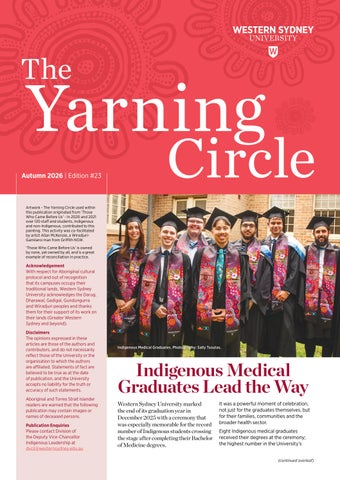
Indigenous Medical Graduates Lead the Way
Western Sydney University marked the end of its graduation year in December 2025 with a ceremony that was especially memorable for the record number of Indigenous students crossing the stage after completing their Bachelor of Medicine degrees.
It was a powerful moment of celebration, not just for the graduates themselves, but for their families, communities and the broader health sector.
Eight Indigenous medical graduates received their degrees at the ceremony; the highest number in the University’s
Autumn 2026 | Edition #23
Indigenous Medical Graduates. Photography: Sally Tsoutas.
history. This milestone reflects years of dedication by the students, and the ongoing commitment of Western to improving Indigenous representation in medicine, strengthening health equity, and supporting culturally safe care for all communities.
Professor Michelle Trudgett, Deputy Vice- Chancellor Indigenous Leadership, spoke proudly of the achievement, noting “it as a testament to the hard work, resilience and determination of the graduates, as well as the strength of the support programs and learning environments that helped them succeed.”
She also highlighted the powerful ripple effect this representation will
have inspiring future generations of Indigenous students to pursue careers in health and contribute meaningfully to community wellbeing.
Graduation day was filled with emotion, families and friends cheering as loved ones completed their medical degrees, staff celebrating alongside the students, and a strong sense of community woven throughout the festivities.
For these graduates, achieving their medical qualifications is not only a personal triumph but a contribution toward better health outcomes for communities that have historically been underserved in the health system.
This milestone also aligns with broader celebrations earlier in the year, when the University saw a record number of Indigenous PhD graduates cross the stage, marking another proud moment for higher degrees among Indigenous scholars.
As Western continues to celebrate the accomplishments of Indigenous graduates, their leadership and dedication are shaping a future in which Indigenous excellence in medicine and research is visible, valued and transformational, locally and across the nation.
MESSAGE FROM THE DEPUTY VICE-CHANCELLOR, INDIGENOUS LEADERSHIP
As we begin a new year at Western Sydney University, I want to warmly welcome our new Indigenous students and extend my best wishes to those returning.
Whether this is your first year or the continuation of your journey with us, I hope you feel a strong sense of belonging, connection and pride as part of our Western community.
I am genuinely excited about what lies ahead in the year to come. Each year brings new opportunities to deepen our impact, strengthen our partnerships and continue to celebrate the excellence, resilience and leadership of Indigenous peoples across our University.
I would also like to take this opportunity to sincerely thank our staff. Your ongoing commitment, care and dedication continue to make a profound difference to the lives of students and to the strength of our Indigenous portfolio.
Your work, often behind the scenes, is central to creating environments that honour and elevate the strength of our communities.
This year, I am particularly excited to progress work on the Indigenous Centre of Excellence. This is an important initiative that reflects our shared ambition to grow Indigenous leadership, teaching, research, cultural knowledge and community engagement at Western. I look forward to working alongside many of you as we continue to bring this vision to life.
I hope you enjoy this edition of The Yarning Circle and the powerful stories it shares. They are a testament to the talent, passion and collective effort that continues to shape our University in meaningful ways. As we move forward together, I am guided by the strength of our community and our shared responsibility to honour Country, culture and connection in all that we do.
Professor Michelle Trudgett (BA, MPS, EdD) Deputy Vice-Chancellor Indigenous Leadership
Professor Michelle Trudgett. Photography: Sally Tsoutas.
Indigenous Medical Graduates with Aunty Fiona Towney, Distinguished Professor George Williams AO, Vice-Chancellor and President, Professor Michelle Trudgett, Chancellor Professor Jennifer Westacott AC and Josh Mason. Photography: Sally Tsoutas.
BOLD conversations with Meg Flavell
The Bold Conservation segment encourages Indigenous staff and students to share their ideas to promote discussions in a culturally safe environment. They reflect the authors personal views and not that of the University.
Meg is a Yorta Yorta bayabiya living in the Blue Mountains on beautiful Darug and Gundungurra lands. Meg is a Graphic Designer in the Office of Future Students, Marketing & Communication at Western.
I grew up in the 1980s (or the 1900s as my 9-year-old would say), a time when identity wasn’t talked about openly and culture wasn’t something I was taught to name or understand as I belted out God Save The Queen during morning assembly (changing to Advance Australia Fair in 1984).
I had extremely blonde hair, a face full of freckles, often sunburnt, growing up in a family full of brown-skinned uncles, aunts and cousins.
I knew I was Aboriginal, but I didn’t really know what that meant.
My Pop was my strongest link to culture, and when he passed away in 1985 that connection quietly faded. To be honest, I’m not even sure how strong his connection to Mob was, I just saw the handsome blackfella looking back at me in the Grand Final footy team photo from 1951. There were no songlines passed down, no language, no clear sense of Mob, just fragments, and a feeling that something important was missing.
As I grew older, that absence was compounded by doubt, not just my own,
but from others. Because of how I look, people openly questioned whether I should claim my Aboriginality at all.
I was asked, directly and indirectly, if it was “right” for me to identify as Aboriginal when I didn’t fit their expectations of what an Aboriginal person SHOULD look like.
I recognise that my white appearance shaped how I moved through the world, even as my Aboriginal identity was questioned.
Those moments stayed with me, reinforcing a sense of uncertainty and making me hesitant to speak up or take up space.
For a long time, I carried that hesitation quietly. Looking like “me” meant I often felt caught between worlds, not visibly Aboriginal enough to be recognised, and not culturally confident enough to feel entitled to belong.
The fear of being questioned, or of being seen as claiming something I didn’t deserve, followed me well into adulthood. That began to change when I came to Western Sydney University.
At Western, I didn’t just find a workplace or a community, I found Mob.
I found people who understood the complexity of identity, who didn’t question my story, and who made space for me to learn at my own pace. For the
first time, I felt safe to reconnect without having to justify who I am.
One of the most meaningful moments in that journey was learning to weave.
Weaving grounded me in a way I didn’t expect. It wasn’t just about learning a skill, it was about connection. To Country. To culture. To the women beside me. To something that had always been there, waiting patiently for me to return.
Each strand felt like a small act of remembering. Of reclaiming what had been lost. Of honouring my Pop and the generations that came before him. Through weaving, I felt connected not only to my heritage, but to myself. My journey hasn’t been linear, and it hasn’t been easy. But it has been real. Western Sydney University gave me more than knowledge; it gave me belonging. It reminded me that there is no single way to be Aboriginal, and that reconnecting later in life doesn’t make your identity any less valid.
I am still learning. Still listening. Still weaving my way back. And for the first time, I know exactly where I belong, because identity isn’t about what you look like, or how others see you, but how deeply you connect to who you’ve always been.
Meg with her cousin, 1978.
Ken Carter (Pop), back row, second from right, Bendigo Football League Grand Final, 1951.
Her Excellency the Hon Ms Sam Mostyn AC and His Excellency Mr Simeon Beckett SC
ANNOUNCED AS JOINT PATRONS OF WESTERN SYDNEY UNIVERSITY’S INDIGENOUS CENTRE OF EXCELLENCE
Western Sydney University is honoured to announce the Governor-General of Australia, Her Excellency the Honourable Ms Sam Mostyn AC, and His Excellency Mr Simeon Beckett SC as joint Patrons of the University’s Indigenous Centre of Excellence.
Located on Darug land at the Parramatta South campus, the Indigenous Centre of Excellence will be a significant gathering place for the community to celebrate both the University’s and the Western Sydney region’s long-standing connection with Indigenous people.
The Centre will be a national benchmark for Indigenous leadership, research, and education. Through its state-ofthe-art facilities, it will honour tens of thousands of years of Indigenous knowledge, culture, and history, creating a transformational space for inquiry, innovation, and community engagement.
The Governor-General welcomed the opportunity to support the Centre, which will be a dynamic space where Indigenous culture, knowledge, and community intersect.
“Simeon and I are pleased to support this nationally-significant initiative which will serve as a hub for celebrating Indigenous heritage, fostering understanding, and promoting resilience. We look forward to amplifying the important work, and sharing the stories as the University community realise its vision for a landmark space that honours the rich traditions and wisdom of our Indigenous peoples.”
Professor Michelle Trudgett, Deputy Vice-Chancellor Indigenous Leadership, at Western Sydney University, said the Centre is a transformative opportunity for Indigenous Australians and the communities of Western Sydney.
“The Indigenous Centre of Excellence is a once-in-a-generation opportunity to reimagine and reshape how Indigenous knowledges and leadership are positioned in higher education and across the Australian landscape,” said Professor Trudgett.
“It builds on the University’s deep and longstanding commitment to serve and empower our communities and be a national leader in Indigenous education, employment and research.
“We are building a significant movement grounded in self-determination – one that will uplift communities, foster future leaders, and deliver lasting social change. We thank Their Excellencies and our Ambassadors for their commitment and collective support of this vision.”
Western Sydney University Chancellor, Professor Jennifer Westacott AC, said the support of the Governor-General and Mr Beckett reflects the importance of the project.
“We are deeply honoured to have Her Excellency Sam Mostyn AC and His Excellency Simeon Beckett SC accept our invitation to be patrons of the Indigenous Centre of Excellence,” said Professor Westacott.
“Their joint patronage is a powerful affirmation of our vision for Indigenousled education, research, and leadership, and aligns with their respective personal and professional commitments to inclusion, equity and social progress. The University community very much looks forward to what we can achieve together.”
Echoing the Chancellor’s sentiment, Western Sydney University ViceChancellor and President, Distinguished Professor George Williams AO, said the patronage announcement reflects a shared vision.
“The Indigenous Centre of Excellence is a world-class space where knowledge, culture, and community will come together. It will have lasting impact across generations,” said Professor Williams.
“As a University, we are committed to increasing Indigenous participation in higher education and empowering the next generation of Indigenous leaders. We are grateful to Their Excellencies for their shared support.”
The Centre is supported by the NSW Government through the Western Sydney Infrastructure Grants Program.
CHANCELLOR’S GOLF DAY drives support for Indigenous Students
At Western Sydney University, celebrating and investing in Indigenous student success isn’t just part of the mission — it’s a lived commitment.
On Sunday, 23 November 2025, community, alumni, and supporters gathered for the annual Chancellor’s Golf Day at the picturesque Lakeside Golf Club, Camden, not merely for a day on the green, but to make a tangible difference in Indigenous education.
The event, proudly presented by Walker Corporation, brought together people from across the Western community to support the Badanami Centre for Indigenous Education, a culturally safe hub that provides tailored academic, mentoring, counselling, and community support for Aboriginal and Torres Strait Islander students at Western.
A highlight of the day was the announcement that an incredible $120,000 was raised for this important cause, a remarkable outcome that will directly support Indigenous students on their educational journeys.
These funds will help remove everyday barriers that can derail a student’s studies, including access to laptops,
textbooks, internet support, and emergency financial assistance delivered with cultural understanding and care.
Professor Michelle Trudgett expressed deep gratitude for the generosity shown throughout the event, noting that the support will go a long way in creating opportunities and ensuring Indigenous students have every chance to thrive.
The success of the golf day reflects the broader community’s belief that when Indigenous students are supported to
stay enrolled and succeed academically, the benefits ripple far beyond individual achievement, strengthening families, communities, and future leaders.
More than just a fundraising event, the Chancellor’s Golf Day has become a tradition of connection and purpose. It unites those who care deeply about access, equity, and excellence in higher education, serving as a reminder that every contribution helps fuel dreams and empowers the next generation.
Chancellor Professor Jennifer Westacott AC with Kari Representatives. Photography: Sally Tsoutas.
Mahalia Murphy, Don Wright, Skye Lampton, and Aunty Fiona Towney. Photography: Sally Tsoutas.
WESTERN SYDNEY UNIVERSITY WINS EDUCATION PROVIDER OF THE YEAR at NRL School to Work Awards
Western Sydney University is proud to announce that its Future Student Engagement Team has been named Education Provider of the Year at the 2025 NRL School to Work Awards.
This prestigious recognition celebrates the University’s ongoing commitment to educational access, equity, and Indigenous engagement, and acknowledges the outstanding work of the team in supporting the aspirations of Aboriginal and Torres Strait Islander students through the NRL School to Work program.
The Future Student Engagement Team; led by Sophie Partridge, Tania Shepherd, Kellie Burke and supported by a broader network of passionate staff—has worked
GENOCIDE
tirelessly to create meaningful pathways for high school students considering higher education. Their efforts have connected students with opportunities across the University, providing culturally safe, empowering experiences that help build confidence and open doors.
“This is the culmination of the work that not only Western Sydney University puts in, but the NRL School to Work program and the magic that this partnership creates,” the University’s Manager of Indigenous Engagement
Tania Shepherd said.
“When these two powerhouses come together, we can achieve transformational change for the young Indigenous people of Greater Western Sydney. We’ve got the
added benefit of not just working with one NRL School to Work team but we work with everyone from St George Illawarra to the West Tigers and out to Penrith.“
“We get to work with a lot of different project offices and that shows the footprint of the impact we have across Greater Western Sydney.”
The award was presented at the NRL School to Work Awards Night, held in November 2025, which brought together students, educators, mentors and industry partners to celebrate success stories from across the program. The Education Provider of the Year Award stood alongside other awards including University Student of the Year, Rising Leader, and Employer of the Year. Since its launch, the School to Work program has supported over 3,500 Indigenous students across Australia in achieving their education and employment goals. Western Sydney University’s partnership with the NRL has played a key role in driving this impact, providing holistic, student-first engagement across Greater Western Sydney and beyond.
The University extends its heartfelt thanks to the NRL School to Work program, community partners, and—most importantly—the students whose stories and successes continue to inspire.
IN THE WILDFLOWER STATE FILM SCREENING
Western Sydney University recently hosted a screening of Genocide in the Wildflower State, marking an important milestone as the Library’s first Thought Leadership event featuring Indigenous academic staff and community members.
The film, independently produced by Yokai Healing Our Spirit and Bringing Them Home WA, documents the powerful testimonies of Stolen Generations survivors, with a focus on the policies and practices that enabled the forced removal of children in Western Australia.
The screening was followed by a Q&A with Palawa Associate Lecturer Lindsay McCabe, which sparked thoughtful discussions among the panellists from Yokai, including Noongar Elder Dr Jim Morrison, Stolen Generations survivor Tony Hansen, and Adjunct Senior Research Fellow Alan Carter.
The conversation created a shared space for learning and reflection, highlighting the importance of centring Indigenous truth-telling in the campaign for justice for Stolen Generations survivors.
Kellie Burke, Tania Shepherd, Aunty Fiona Towney and Sophie Partridge. Photograph supplied.
The Next Generation Project
The Next Generation exhibition opened at Kingswood campus (Darug Country) library in late October 2025 and will run until the end of February 2026.
In keeping with the spirit of the 2025 NAIDOC theme – The Next Generation: Strength, Vision and Legacy – the Next Generation Project brought together the youngest members of our community with Indigenous students and staff to create art that speaks across generations. The resulting artworks invite us to consider Indigenous knowledges as an enduring legacy passed on to those who will shape our future.
The project began with NAIDOC Week Storytime sessions at WSU Early Learning Centres, where children engaged with stories and songs with Indigenous Partnerships and Engagement Librarian Lauren Castino. The children then put their handprints on a large canvas, with many enjoying choosing their favourite colours. Each canvas was then taken to a Badanami centre for a Wellbeing Cafe run by Heidi Duncan, Cultural Inclusion and Wellbeing Specialist, where Indigenous students and staff added contributions that reflected their own stories whilst learning more about available wellbeing and library support.
Following the exhibition, five canvases will be returned to each WSU Early Learning Centre as a gift to the next generation of young leaders who will carry the vision of NAIDOC into the future.
COUNTRY SPEAKS INDIGENOUS PHOTOGRAPHY COMPETITION AND EXHIBITION
On Wednesday 12 November the Library launched the Country Speaks exhibition at Campbelltown campus (Dharawal Country), which featured stunning photographs that represented what Country means to the Indigenous competition entrants.
This special event was a collaboration between the Director of Indigenous Research, Professor Gawaian BodkinAndrews, and the Library, led by Indigenous Partnerships and Engagement Librarian Lauren Castino.
The all-Indigenous judging panel for the photography competition faced a challenging task with so many exceptional entries but ultimately awarded the following winners:
Student Category
→ 1st place: Lisa-Maree Botticelli
→ 2nd place: Kayla Meredith
→ 3rd place: Mirritya Ebbsworth
→ Highly Commended: Jessie Brown
Staff Category
→ 1st place: Melanie Chapman
→ 2nd place: Adrian Atkins
→ 3rd place: Dr Matilda Harry
→ Highly Commended: Heidi Duncan
The full exhibition is now on display at the Campbelltown campus library until 28 February 2026, with the winner of the People’s Choice Award to be announced later this year.
Lauren Castino with Heidi Duncan. Photograph supplied.
WESTERN SYDNEY UNIVERSITY
SHARING
KNOWLEDGE
From 16–20 November 2025, Tāmaki Makaurau (Auckland), Aotearoa/New Zealand, hosted the World Indigenous Peoples’ Conference on Education (WIPCE 2025), the largest international gathering dedicated to Indigenous education, knowledge, leadership, culture, and scholarship.
With more than 3,800 delegates from around the world convening for five days of sharing, learning, and connection, WIPCE 2025 set the stage for global Indigenous voices to be heard and amplified.
AND STRENGTHENING
Western Sydney University made a strong contribution to this event, bringing Indigenous expertise, innovative programs, and community-led scholarship to a global Indigenous forum.
Western’s delegation was large, diverse, and highly engaged. Faculty members, researchers, and Indigenous community partners shared their work on the world stage, contributing to global conversations about Indigenous-led education, pathways to leadership, and community empowerment.
The following spotlights the presentations from our delegates, each reflecting the depth, innovation, and impact of Indigenous scholarship emerging from Western.
Igniting Futures: The Power of Indigenous-Led Traineeships
The Ignite Indigenous Traineeship Program, presented by Gabrielle Talbot-Mundine and Kelsie King, stood out as a shining example of what’s possible when Indigenous leadership, opportunity, and cultural safety come together in a university setting.
In their presentation, the pair shared the evolution of the program since its launch in 2022, offering insights into how it has grown into a robust, supportive, and outcomes-driven pathway for Indigenous trainees at Western Sydney University.
From the early groundwork days to the program’s current form, Talbot-Mundine and King spoke with clarity and pride about the many individuals whose careers and confidence have been transformed through Ignite.
The strength of the presentation lay not just in data or structure, but in the stories — real-life journeys of Indigenous students and emerging professionals whose potential was recognised and nurtured
through culturally responsive mentorship and tailored support.
These narratives brought the program to life and resonated deeply with the audience, reinforcing the importance of Indigenous designed and delivered initiatives within the higher education and employment sectors.
There was a palpable sense of pride in the room. As Professor Michelle Trudgett reflected, “It was inspiring to hear how the program has evolved since its inception in 2022 and many stories of success… they did such an amazing job and I couldn’t be more proud of them.”
Ignite is more than a traineeship program, it’s a model of self-determined success, cultural strength, and institutional accountability. It signals what’s possible when universities commit to walking alongside Indigenous peoples, not just in education, but in leadership, workforce development, and long-term empowerment.
A BEACON ON COUNTRY: BUILDING THE INDIGENOUS CENTRE OF EXCELLENCE
Aunty Fiona Towney delivered a phenomenal presentation on the upcoming Indigenous Centre of Excellence being developed on Darug Country at the Western Sydney University, Parramatta South campus. Speaking with passion, pride, and a clear sense of purpose, Aunty Fiona shared the vision for this landmark building as a place of gathering, cultural strength, and educational transformation.
The presentation offered a glimpse into a future where Indigenous knowledges, leadership, and community are woven into the heart of university life, not as an addition, but as a foundation. The Centre of Excellence is set to become a beacon for Indigenous students, staff, and communities across the region, embodying principles of selfdetermination, place-based design, and cultural continuity.
The room was packed, and the audience deeply engaged, a true testament to the significance of the project and the compelling way it was shared. As Professor Michelle Trudgett described, “The packed room was super enthralled to hear about this important landmark building that will be a beacon for our community.”
More than just bricks and mortar, the Centre represents a living commitment to Country, culture, and future generations, a space where Indigenous excellence will thrive for years to come.
Gabrielle Talbot-Mundine and Kelsie King at WIPCE
Aunty Fiona Towney presenting at WIPCE
AT WIPCE 2025 AOTEAROA:
STRENGTHENING INDIGENOUS FUTURES
(RE)QUEERING INDIGENOUS AUSTRALIAN HIGHER EDUCATION SPACES
Professor Corrinne Sullivan presented on the groundbreaking research project (Re)queering Indigenous Australian Higher Education Spaces, co-led with Dr Madi Day and Ziggy Johnson. This important work critically explores how higher education institutions represent — or overlook — the diverse identities of LGBTQIASB+ Indigenous peoples, particularly through an audit of university websites and student support services across Sydney.
The presentation asked pressing questions: Who feels seen in these spaces? What messages are being communicated — or erased — through digital platforms, signage, and institutional language?
By focusing on visibility, representation, and inclusion, the research revealed the subtle yet powerful ways that educational environments can either affirm or marginalise those at the intersections of Indigeneity, gender, and sexuality. The session attracted strong interest, filling quickly in the lead-up to the conference. Many participants noted that the room felt not only intellectually engaging, but also emotionally safe, a space held with care, rigour, and solidarity. For some, it was the first time seeing this kind of intersectional conversation centred in an Indigenous-led academic context.
The work speaks to a larger challenge within the sector: how to move beyond performative inclusion and into meaningful, community-informed change. It highlights the importance of visibility, affirmation, and belonging for queer Indigenous students and staff, and calls on institutions to critically examine their practices with honesty and accountability.
In a global gathering focused on Indigenous education and futures, this presentation offered both reflection and momentum, a vital reminder that inclusion is not a side conversation, but central to the creation of safe, empowering spaces for all Indigenous peoples.
BLAK OUT:
Lindsay McCabe from Western and Amy Davidson from Sydney University are behind a groundbreaking initiative: the Blak Out journal, an academic publication designed to centre and uplift Indigenous student voices.
Created as a platform for both undergraduate and postgraduate Indigenous students, the journal provides a rare opportunity to publish academic work while receiving high-quality mentorship throughout the editorial process.
INDIGENOUS LEADERSHIP THROUGH RESEARCH AND DESIGN
Dr Matilda Harry and Dr Michelle Locke delivered poster presentations showcasing research that is actively influencing the Australian higher education sector and gaining international recognition.
Their work examines how Indigenous leadership, embedded within institutional frameworks, can shift systems from within, fostering environments grounded in cultural integrity, accountability, and community-defined success.
They spoke to WIPCE attendees on the importance of Indigenousled research in setting new standards for inclusion and transformation across universities.
It offered a clear, practical vision for what institutional change can look like when guided by Indigenous values and voices.
Equally impressive were the research posters that accompanied their session. Beautifully designed and rich in cultural meaning, the visuals captured the attention of delegates across the conference, standing as both artistic statements and powerful reflections of the work itself.
As Professor Michelle Trudgett shared, “The research is having a significant impact on the Australian Higher Education sector and international leadership more broadly… and I have to say, their posters are absolutely stunning!”
ELEVATING THE NEXT GENERATION OF INDIGENOUS SCHOLARS
The significance of Blak Out is already being recognised across the sector. Professor Michelle Trudgett praised the initiative, saying, “This is such an important journal… I’m very impressed and believe it plays an important role in developing the next generation of Indigenous scholars — the sector should do all we can to support this.”
Blak Out isn’t just about getting published, it’s about building confidence, nurturing scholarship, and opening doors to academic futures. With a strong focus on community and guidance, the journal helps students refine their research and writing while connecting with experienced mentors who walk alongside them.
Photography: Sally Tsoutas.
At its heart, Blak Out is an invitation, to listen, to invest in emerging Indigenous voices, and to reimagine what academic publishing can look like when it’s grounded in care, community, and cultural strength.
Dr Matilda Harry
Dr Michelle Locke
Students
2025 INDIGENOUS LEADERSHIP RETREAT Badanami Centre for Indigenous Education
At the back end of 2025, the Badanami Centre for Indigenous Education delivered the 2025 Indigenous Leadership Retreat, a two-day program dedicated to strengthening Indigenous students’ leadership capabilities, cultural confidence, and sense of belonging at Western Sydney University.
Held in a culturally safe and supportive environment, the retreat brought together students to connect, reflect, and grow both personally and collectively.
DAY 1 LEADERSHIP DEVELOPMENT
Leadership Development focused on cultivating contemporary Indigenous leadership by recognising and building upon the strengths students already bring
to their academic journeys, families, and communities.
Through a series of interactive workshops, storytelling sessions, and group discussions, students were encouraged to explore their personal leadership styles, clarify their values, and articulate their long-term aspirations.
These conversations acknowledged the unique perspectives Indigenous students hold and how these perspectives can shape inclusive and impactful leadership.
A highlight of the day was the beginning of conversations around the formation of an Indigenous Student Advisory Group, an initiative designed to ensure students have a strong, ongoing voice within the University’s governance and decisionmaking processes.
DAY 2 CULTURAL CONNECTION
Cultural Connection shifted the focus to identity, belonging, and community.
Students participated in a hands-on cultural workshop that offered the opportunity to deepen connections with culture, Country, and each other.
Through this immersive experience, students reflected on how cultural heritage, lived experience, and the responsibility of carrying cultural knowledge can influence their roles as leaders.
The day reinforced the importance of drawing strength from cultural identity and community support networks in navigating academic and professional pathways.
For the Indigenous students who participated, the retreat provided not only practical leadership skills but also a deeply meaningful space to affirm identity and connect with cultural values. Many expressed feeling empowered, inspired, and more confident in their ability to lead with authenticity and purpose.
For Western Sydney University, the retreat marked a significant step forward in its commitment to fostering Indigenous leadership and ensuring Indigenous student voices are embedded in shaping the future of the institution.
The event underscored the ongoing work of the Badanami Centres in promoting cultural resilience, educational excellence, and self-determination among Aboriginal and Torres Strait Islander students.
WESTERN SYDNEY UNIVERSITY’S INDIGENOUS STUDENTS ACHIEVE GREAT THINGS
Teaching graduate’s love of music sets the tone for future classrooms
For 22-year-old Kortana Cullen-Blissett, graduation day marks a full circle moment as she celebrates her journey to becoming a teacher.
Aspiring to become a school principal at a school with a high Indigenous student population, Kortana wants to lead a school that creates safe, inclusive, and empowering learning environments for all students.
Graduating with a Master of Teaching (Primary), Kortana particularly wants to support Indigenous students to thrive academically, socially, and culturally.
“I chose to study at Western Sydney University because of the strong support it provides for Indigenous students and its commitment to creating a culturally safe and inclusive environment,” said Kortana.
“Being close to home was also important to me - it allowed me to stay connected to my community and family while pursuing my studies. Knowing that there were dedicated programs, staff, and spaces to support Indigenous students made me feel welcomed and confident that I’d be supported every step of the way.”
Kortana first completed a Bachelor of Arts, majoring in Music, and has followed that by completing her Master of Teaching
(Primary) at Western Sydney University.
“Music has always been something I’ve loved, and I wanted to be able to share that passion with others. Teaching gives me the opportunity to inspire students, create meaningful learning experiences, and use something I care deeply about to make a difference.”
Creating meaningful and engaging learning experiences for students is what Kortana is most passionate about, and she aspires to help create spaces where children feel supported, valued, and empowered to achieve their best.
“I love being able to use music as a tool to inspire creativity, build confidence, and bring joy into the classroom. For me, teaching is about more than just academics - it’s about making students feel seen, valued, and capable.
“I’m so passionate about giving back to my community and helping shape the next generation in a positive and empowering way.”
Through her degree, Kortana has gained the knowledge, skills, and confidence to be the kind of teacher who makes a real difference in students’ lives.
“I want to create safe, inclusive classrooms where every child feels supported and inspired to learn. I also hope to use my love of music to bring creativity and joy into education, and to give back to my community by helping shape the next generation of learners and leaders.”
During her studies, Kortana was the proud recipient of the Eucharist Community Scholarship for Indigenous Women, which not only supported her studies, but also allowed her to give back to her community.
As a student ambassador in the University’s Pathways to Dreaming program, Kortana worked with school-aged Indigenous students throughout both of her degrees, connecting with and supporting younger students in their learning journeys, which further developed her personal and professional skills as an aspiring teacher.
“Being a student ambassador allowed me to give back in meaningful ways. I got to work with school-aged Indigenous students through the Pathways to Dreaming program, which I had first participated in back in Year 8, making it feel like coming full circle.”
“Towards the end of my degree, I also had the opportunity to mentor first-year Indigenous students and sit on panels for the School of Education, which was incredibly rewarding.”
Reflecting on her time at University, Kortana says her experiences, alongside the support and connections she has built with other students and staff, are what will always stay with her.
“There is so much support available at Western, and the staff genuinely want you to succeed. Don’t be afraid to reach out, get involved, and make the most of the opportunities around you, it will make your journey more enjoyable and rewarding.”
I am a proud Wiradjuri woman with bloodline connections to the Bonham, Kendall and Squires families, and to Darug mob. I’m a daughter, sister, mum, wife, Western employee and Western student—yet I still feel like I’m figuring out who Tania really is.
Who is your mob?
Wiradjuri with connection to Darug.
What community or cultural events have you been involved in lately or will engage in this year?
It’s probably quicker to name the things I haven’t been involved in! I’m lucky to be both a student and staff member at Western, so I attend and represent Western at many community events.
These include YABUN, the Cooee Festival (rained out in 2025 but planning is underway for 2026 with Western as a sponsor), the NRL School 2 Work Camp at Hawkesbury campus, and the NRL School 2 Work Awards evening.
Internally, I’m involved with Pathways To Dreaming On Campus Events, the Indigenous Entry Program, DVCIL Wellbeing sessions, Western’s NAIDOC Gala Dinner and the Yarramundi Lecture. This year is shaping up to be even bigger, with many of the same events plus more opportunities to spotlight Western and recharge my cultural energy.
Why did you choose to study at Western Sydney University? I started working at Western in May 2022 and felt a bit gammin encouraging young mob to study when I hadn’t completed study myself. So in September 2022, I began the Bachelor of Psychological and Social Sciences through Western Sydney University Online. I chose Western for the same reasons many others do—close to home, great facilities, strong support for mob—and because it was important to show young people that I’m not just recommending Western, I’m studying here too. Have you faced any challenges as an Indigenous student? If so, how did you overcome them?
As a Non Current School Leaver (NCSL), I’m a mature-age student with family, work and social commitments—plus caring for ageing parents and managing life around my jarjums’ schedules.
My biggest challenge was keeping everything running smoothly so no one felt study was causing disruption. I set clear study hours with my husband and jarjums, managed after-school commitments, and called on friends and family for support. I set milestone goals and celebrated each one, because even though I did the coursework, it took a whole team to help me create the space to study.
When you graduate from Western Sydney University what do you hope to achieve?
I’ve recently been advised that I’ve met all requirements for the Bachelor of Psychological and Social Sciences and am waiting on conferral. Once graduated, I hope to commence the Master of Research and continue supporting other mob to begin their study journey at Western.
You are clearly a busy person with lots of commitments, what are your top 5 tips towards success for other Indigenous Western Sydney University students?
Tip 1: You’re a deadly individual who can juggle a lot, but everyone needs support sometimes. Find your person and reach out—even just to share good news. Support isn’t only for tough times.
Tip 2: Apply for scholarships, even if you’re unsure you’re eligible. Western offers $20 million in scholarships each year— you never know unless you apply.
Tip 3: Tutoring For Success is a great resource. Many think of TFS only when they’re struggling, but having a tutor throughout each unit helped me stay on track. Set up a regular catch-up time—it feels just like attending class.
Tip 4: If your job doesn’t fit with your study schedule, ask about becoming a Student Ambassador by yarning with me or a Badanami Student Success Officer. The Future Student Engagement team hires many students, and I’d love to welcome more Mob to help inspire young people.
Tip 5: Connect with your peers—those in your course and on your campus. Build a network, share experiences, and celebrate all wins, big and small. Celebrating along the way makes the journey so much more enjoyable.
Photography: Monica Pronk
WESTERN SYDNEY UNIVERSITY’S INDIGENOUS STUDENTS ACHIEVE GREAT THINGS
Billy Bent-Ngawaka, an Anewan, Ngunnawal and Māori occupational therapy student at Western Sydney University, was invited to speak at the Tertiary Education Quality and Standards Agency (TEQSA) Conference 2025 in Naarm (Melbourne).
The annual conference, a key forum for higher education quality, regulation, and student voice, brought together sector leaders, educators and student representatives from across Australia to discuss trust, transparency and transformation in higher education.
STUDENT VOICE AND LEADERSHIP AT THE HEART OF HIGHER EDUCATION Research
Billy’s session “Trust through our eyes: balancing compliance with care” featured alongside student leaders from universities around the country, offering a student-centred perspective on how the sector can better support learning, wellbeing and engagement. His contribution was warmly received, with many attendees across Australia celebrating the insight and authenticity he brought to the conversation.
Drawing from his own journey, including experiences with Western’s Pathways to Dreaming program during high school and ongoing connection with the Badanami Centre for Indigenous
Education, Billy spoke about what meaningful support looks like from a student lens.
His reflections resonated deeply with colleagues at the conference, highlighting the importance of student voice in shaping policy, practice and institutional culture.
The standing and recognition Billy received from delegates across the sector speaks to his leadership and the value of Indigenous student perspectives in national higher education conversations. His presence affirmed that when students are given a platform, their voices enrich and strengthen the entire sector.
PROFESSOR GAWAIAN BODKIN‑ANDREWS elected to the Australian Academy of the Humanities
Professor Gawaian Bodkin-Andrews has been elected to the Australian Academy of the Humanities, one of the highest honours for scholars in the humanities in Australia.
This prestigious Fellowship recognises exceptional contributions to research, knowledge and learning, and acknowledges Professor Bodkin-Andrews’ outstanding work in Indigenous Knowledges, Indigenous Storywork methodologies, Indigenous Data Sovereignty, and racial equity.
A D’harawal scholar of national distinction, Professor Bodkin-Andrews currently serves as Director of Indigenous Research at Western Sydney University, where leadership in research is deeply rooted in Indigenous cultural frameworks and epistemologies.
Their scholarship spans critical areas including the ethical governance of Indigenous data, environmental justice, Indigenous/D’harawal Storytelling, and decolonial research practices, work that has helped reshape the landscape of humanities research in Australia.
Professor Bodkin-Andrews’ elevation to the Academy is a testament to more than academic achievement, it reflects sustained leadership in advancing Indigenous perspectives and advocating for Indigenous self-determination in research, higher education, and local communities.
As a member of – and advocate for - the D’harawal Traditional Descendants and Knowledge Holders Circle, and a founding member of the Maiam nayri Wingara Indigenous Data Sovereignty Collective, Professor Bodkin-Andrews’ work has attempted to drive national conversations about Indigenous leadership in data creation and governance, Indigenous research ethics, and Indigenous authority in scholarly spaces.
Election to the Academy places Professor Bodkin-Andrews among an esteemed community of humanities scholars recognised for shaping human understanding and enriching intellectual life in Australia.
Their achievement honours the importance of Indigenous knowledge systems, storywork and cultural
leadership within the academic landscape and beyond.
In celebrating this milestone, the Western Sydney University community acknowledges not only a remarkable scholar, but a visionary leader whose work continues to inspire students, researchers, and Indigenous scholars across the country.
Professor Gawaian Bodkin-Andrews Photography: Sally Tsoutas.
Research
CELEBRATING INDIGENOUS RESEARCH AT WESTERN
Jacob Prehn, Michael A. Guerzoni, Maggie Walter, Gawaian Bodkin-Andrews, and Bobby Maher. (2025). Implementing Indigenous Data Sovereignty in Australia: A Five-Phase Framework for Indigenous Data Governance. Australian Journal of Social Issues. 1–13. https://doi.org/10.1002/ajs4.70086.
Bradley Burns, Rebekah Grace, and Scott Avery. (2025). “ Building a Culture of Voice and Agency for Aboriginal Children in Out-of-Home Care: A Review of Policy in New South Wales and Victoria.” Australian Journal of Social Issues 1–12. https:// doi.org/10.1002/ajs4.70081
Georgia Durmush. (2026). Centring Indigenous Student Wellbeing in Australian Universities. In Ryan, T., & Baik, C. (Eds.).University Student Wellbeing in an Uncertain Future: Research, Policy, Practice (1st ed.). Routledge. https://doi. org/10.4324/9781003648673
Yu Gao, Sue Kildea, Rebecca Coddington, Melanie Briggs, Cleone Wellington, Faye Worner, Donna L. Hartz, Juanita Sherwood, & Yvette Roe. (2026). Effect of the implementation of a Birthing on Country service at a rural site, Waminda, compared to standard care for First Nations Australians: a prospective, nonrandomised, interventional trial. The Lancet Regional Health - Western Pacific, 67, 101796. https://doi.org/https://doi.org/10.1016/j.lanwpc.2025.101796
Wimbayi Musodza, Marjan Khajehei, Karen McLaughlin, and Donna Hartz (2025-6). Counselling interventions to reduce domestic violence against women: A systematic review of randomised controlled trials. Journal of Family Violence. (In Press)
Lauren Elizabeth Lines, Tracy Alexis Kakyo, Helen McLaren, Donna Hartz, Nina Sivertsen, Alison Hutton, Megan Cooper, Lana Zannettino, and Julian Grant. (2025). Are we educating the future workforce for interprofessional responses to child maltreatment? An exploratory study. Collegian. https://doi.org/https://doi. org/10.1016/j.colegn.2025.08.007
Donna L. Hartz, Renae Coleman, Stacey Butcher, Leona McGrath, Cherisse Buzzacott, Karel Williams, Angela Coe, and Machelee Kosiak. (2025). What are the experiences of Aboriginal and/or Torres Strait Islander midwifery students and midwives? A scoping review. Women and Birth 2025; 38(1).
Lauren Elizabeth Lines, Tracy Alexis Kakyo, Helen McLaren, Megan Cooper, Nina Sivertsen, Alison Hutton, Lana Zannettino, Donna Hartz, and Julian Grant. (2024). Graduate qualities for preservice health and welfare professionals for collaborative prevention and early intervention for child maltreatment: A qualitative study. Nurse education in practice, 81, 104176.
Penelope Sweeting, Mary Finlayson, and Donna Hartz . (Oct 2024). A Review of Modifiable Health Care Factors Contributing to Inpatient Suicide: An Analysis of Coroners’ Reports Using the Human Factors Analysis and Classification System for Healthcare. The Joint Commission Journal on Quality and Patient Safety, 50(10), 711-718. https://doi.org/https://doi.org/10.1016/j.jcjq.2024.05.008
David Coombs, Shanna Langdon, Zana Jabir, Cathie Burgess, and Rose Amazan. (2025) The impact of Learning from Country on teachers’ understandings of place and community: insights from the Culturally Nourishing Schooling project. Aust. Educ. Res. 52, 665–686. https://doi.org/10.1007/s13384-024-00735-y
Wade Levi, Mark R. Beauchamp, Nicole Nathan, Jordan J. Smith, Angus A. Leahy, Ran Bao, Sarah G. Kennedy, James Boyer, Thierno M.O. Diallo, Sam Beacroft, David R. Lubans. (2026) Effects of a school-based leadership program on student leaders and their peers: The Learning to Lead cluster randomized controlled trial. Contemporary Educational Psychology.
Sarah G. Kennedy, David R. Lubans, Jordan J. Smith, Angeliek Verdonschot, and Rhodri S. Lloyd. (2025) Development of a resistance training curriculum for school-based implementation: Adaptation of the Athletic Motor Skill Competencies curriculum. Strength & Conditioning Journal.
Jordan J. Smith, Sarah G. Kennedy, Narelle Eather, Nicholas Riley, and David R. Lubans. (2025) Feasibility of ‘Muscle Movers’: A teacher-delivered program to support children’s participation in muscle-strengthening physical activity. Pilot & Feasibility Studies.
David R. Lubans, Nora Shields, Narelle Eather, Jordan J. Smith, Michael Noetel, Charles H. Hillman, Chris Lonsdale, Christopher Oldmeadow, Ashleigh Stuart, Sarah G. Kennedy, James Boyer, Pierre Comis, Laura Roche, Taren Sanders, Tara Finn & Angus A. Leahy. (2025) Scalable Physical Activity Intervention for Youth with Disability: Burn 2 Learn Adapted Cluster Randomized Controlled Trial. International Journal of Behavioral Nutrition and Physical Activity.
Sarah G. Kennedy, Murray, S. J., Guagliano, J. M., Lloyd, R. S., Lubans, D. R., Smith, J. J., Eather N. & Andrew Bennie. (2025) Provision of online information and resources for resistance training in Australian youth sports: A scoping review International Journal of Sports Science & Coaching. 20(1), 375-387.
Jadson Marcio da Silva, Géssika Castilho dos Santos, Rodrigo de Oliveira Barbosa, Thais Maria de Souza Silva, Renan Camargo Correa, Bruno Gonçalves Galdino da Costa, Sarah G. Kennedy, and Antonio Stabelini Neto. (2025). Effects of a schoolbased physical activity intervention on mental health indicators in a sample of Brazilian adolescents: a cluster randomized controlled trial. BMC Public Health, 25(1), 539.
Hall, Matthew, Aileen Luo, Navjot Bhullar, Karen Moses, and Bethany M. Wootton. (2025). Cognitive behaviour therapy for social anxiety disorder: a systematic
review and meta-analysis investigating different treatment formats. Australian Psychologist, 60(1), 1-14.
Karen Moses, and Elizabeth Davis. (2025). A clinician’s quick guide to evidencebased approaches: assessment of anxiety disorders. Clinical Psychologist, 1-4.
Siobhan Plunkett, Bethany M. Wootton, and Karen Moses. (2025). Psychometric properties of the DSM-5 Panic Disorder Dimensional Scale in an Australian community sample. Australian Psychologist, 60(2), 152-161.
Cameron Bartlett, Bethany M. Wootton, and Karen Moses. (2025). Psychometric properties of the Specific Phobia Dimensional Scale in an Australian adult community sample. Australian Psychologist, 60(3), 280-289.
Jane Mathews, Bethany M. Wootton, and Karen Moses. (2025). Psychometric validation of the Specific Phobia Questionnaire in an Australian community sample. Australian Journal of Psychology, 77(1), 2464850.
Karen Moses, Craig J. Gonsalvez, Perin Kurt, and Tanya Meade. (2025). Association between therapists’ negative beliefs about exposure therapy and its use in an Australian sample: a brief report. Cognitive Behaviour Therapy, 1-8.
Michael W Otto, Laura J. Long, Santiago Papini, Tara Culver, Charles T. Taylor, Mikael Rubin, Hayley E. Fitzgerald… Karen Moses, …. et al. “Moderating Role of State and Trait Positive Affect in Virtual Reality Exposure for Public Speaking Anxiety: Protocol for a Multisite Experimental Study.” JMIR Research Protocols 14, no. 1 (2025): e80010.
Gavin A. Surjadinata, Sarah Hanley, Navjot Bhullar, Karen Moses, and Bethany M. Wootton. (2025). Psychometric validation of the Appearance Anxiety Inventory in an adolescent and young adult sample. Clinical Psychologist, 1-10
Ric Lovell, Dean Norris, Chelsea Oester, Ben Honig, Cristy Brooks, and Tzlil Shushan. (2025). Development and Validation of W-SAFT90: A Simulation Designed to Elicit the Physical and Physiological Responses of Women’s Football (Soccer) Matches. Women in Sport and Physical Activity Journal, 33(1), Article wspaj.2025-0004, wspaj.2025-0004. Retrieved Jan 27, 2026, from https://doi. org/10.1123/wspaj.2025-0004
Chelsea Oester, Ric Lovell, Charles Pedlar, Georgie Bruinvels, Belinda Wilson, and Dean Norris. (2025). Knowing isn’t enough: Menstrual symptoms drive perceived performance impacts in women’s football. Journal of Science and Medicine in Sport. Advance online publication. https://doi.org/10.1016/j.jsams.2025.11.007
Adriano Arguedas-Soley, Tzlil Shushan, Andrew Murphy, Nicholas Poulos, Ric Lovell, and Dean Norris. (2025). Divergent responses to training load in professional Australian football: Are insights obtained from generic and runningbased assessments complementary or redundant? Sports Medicine - Open, 11, 139. https://doi.org/10.1186/s40798-025-00946-2
Owen M. Munro, Dean J. Norris, Kevin Thomas, Paul Ansdell, Glyn Howatson, Seungbeum D. Lee, James P. Hocken, and Kirsty M. Hicks. (2026). Travel Distance and Direction Negatively Impact Expected Goal Differential: A Retrospective Analysis of 2018–2023 National Women’s Soccer League Data. International Journal of Sports Physiology and Performance (published online ahead of print 2026). Retrieved Jan 27, 2026, from https://doi.org/10.1123/ijspp.2025-0298
Azadeh Dastyari, and Corrinne Sullivan. (2025). ‘I end up buying less food’: Indigenous people should not have to go hungry to use the internet. The Conversation.
Jessica McLean, Laura Hammersley, and Corrinne T. Sullivan. (2025). Connections to Ngayirr Ngurambang (Sacred Country) and art undermining settler colonial power. Environment and Planning D: Society and Space, 02637758251389381.
Lucy Nicholas, Corrinne T. Sullivan, and Sarah Callahan. (2025). ‘An abundance of cakes’: Assigned female at birth queer joy and queer ethics across generations Sexualities, 28(3), 830-846.
Karen Soldatic, Corrinne T. Sullivan, Georgia Coe, John Leha, William Trewlynn, and Kim Spurway. (2025). ‘We never get a space to just have a good time together’: indigenous LGBTIQSB+ young people carving out alternative viable lives. Journal of Youth Studies, 28(6), 902-915.
Karen Soldatić, Corrinne T. Sullivan, and Kim Spurway. (2025). Queering Indigenous and Non-indigenous Research Relations: A Co-authored Pedagogy of Hope?. In Co-authoring Feminist and Queer Geographies (pp. 147-162). Routledge. Corrinne T. Sullivan, Sibyl Diver, Jessica K. Weir, Carolyn Smith, and Beth Piatote. (2025). So You Care About Indigenous Scholars? Claiming the Academy as Indigenous Place by Creating Comic Art Across Difference. Native American and Indigenous Studies, 12(2), 90-115.
Michelle Trudgett, Susan Page, Rhonda Povey & Stacey Kim Coates. (2025). Tour of duty: (re)positioning senior Indigenous leadership roles in the Australian higher education sector. Journal of Higher Education Policy and Management. https://doi. org/10.1080/1360080X.2025.2481643
Rhonda Povey, Michelle Trudgett, Susan Page & Michelle Locke. (2025). Advice from Indigenous early career researchers: Indigenous futurity in Australian universities. The Australian Journal of Indigenous Education, 54(2). DOI10.55146/ ajie.v54i2.1952
WESTERN SYDNEY UNIVERSITY’S PASSIONATE INDIGENOUS STAFF
SAYING YES TO THE FUTURE:
Celebrating the 2025 IGNITE Traineeship Graduates
On Wednesday 3 December 2025, Western Sydney University proudly celebrated the achievements of seven trainees from the 2025 IGNITE Traineeship Program.
Congratulations to Aaliyah Kearney, Ambah Doman, Annabel Fryer, Ashleigh Capper, Jessica Barton, Melanie Chapman, and Victor Simon; each of whom has made a remarkable impact during their time with us.
The graduation ceremony was a wonderful occasion, highlighted by a powerful speech from graduate Jessica Barton, a proud Yorta Yorta woman.
≥
Staff Updates
Speaking on behalf of the cohort, Jessica reflected on the courage it took to step into the unknown and embrace every opportunity with a “year of yes” mindset. “Throughout this year, whether we realised it or not, we all said yes,” she shared. “Yes to learning. Yes to new responsibilities. Yes to opportunities that challenged us, stretched us and shaped us.”
She spoke with pride about the cohort’s contributions, from participating in major projects like The Next Generation Project and Wumarra - Mentoring Program, to representing the University at Indigenous Nationals sporting events.
Western Sydney University would like to congratulate the following Aboriginal and/or Torres Strait Islander staff members on their new appointments:
→ Shaniqua McMiles-Hindmarsh, TraineeCertificate III in Early Childhood Education and Care –Early Learning Services
Most profoundly, she highlighted the connections made with community and culture: “Connecting with Mob gave our year real meaning... It showed us that this journey was not just about learning new skills, but about understanding who we are, where we come from, and the strength we carry from our communities.”
Jessica also gave heartfelt thanks to the teams and mentors who made this journey possible, with special recognition for Catherine Cooper and Gavin Webber from The College support throughout the Certificate III in Business Administration.
The IGNITE Traineeship Program, now in its fourth year, offers Aboriginal and Torres Strait Islander people the opportunity to gain 12 months of professional experience while completing a Certificate III in Business Administration. Under the leadership of Gabrielle TalbotMundine and Sharna McNamara, the program continues to grow, setting the standard for Indigenous employment pathways in higher education.
In 2026, every Division and Faculty at Western Sydney University will host an IGNITE trainee, reflecting our deep, ongoing commitment to inclusion, opportunity, and long-term change.
To the 2025 cohort: we are proud of all you’ve achieved and honoured to have shared in your journey. Your YES has inspired us all.
→ Bianca Groves, SABEL
→ Tiffany Chapman, Faculty Engineering, Computing and Science
→ Danroy Kearney, Division of Indigenous Leadership (Badanami)
→ Aaliyah Dunham, Office of the Vice-Chancellor
→ Courteney Denson, Division Operations
→ Paris Fitzpatrick, Division Research
→ Jeziah Va’aiga Papa, Division Western Sydney & External Engagement
→ Maria Samaniego, Division Provost
→ Lorima Cosgrave, Faculty Health
→ Amy Grifiths, Division Education & Students
→ Ishika Dass, The College
Western Sydney University would also like to thank all the Indigenous staff who continuously demonstrate excellence and support the University’s values, ensuring Western is the place to be.
Staff members and 2025’s Ignite Traineeship graduates. Photograph supplied.
Who are you?
My name is Monique
Tait-Owens
Who is your Mob? I am a proud Gumbaynggirr woman, born and raised on Darug Country. Gumbaynggirr Country extends from the Nambucca Valley in the south to the Clarence River in the north, and out to the Great Dividing Range.
What community/Cultural events have you been involved in lately? I’ve been involved in many community and cultural events across Western Sydney University — if I’m not attending, I’m usually helping behind the scenes. One of my favourites is the WSU NAIDOC Week Gala Dinner; it’s a highlight every year.
Outside the University, I’m strongly connected to community through my work as a KARI Singer. We celebrate and share Indigenous culture through music and performance. Some of my favourite gigs include NRL and AFL events, the Business NSW Awards, and other community celebrations that bring culture to the forefront.
What is your current position at Western Sydney University and how long have you worked here? I’m a Senior Administrative Officer in the Division of the Deputy Vice-Chancellor Indigenous Leadership.
I joined WSU in 2022 as an Ignite Indigenous Trainee in the Office of the Pro Vice-Chancellor (Engagement & Advancement), gaining experience in administration, project coordination and event management. I supported key University events such as Careers Expos, Town & Gown, the Chancellor’s Farewell and The Academy Welcome Day.
After completing my traineeship, I worked in the Office of People as an HR Assistant and later acted as a Recruitment Advisor. In December 2024, I commenced my current role, providing executive support to Professor Susan Page, Professor Gawaian Bodkin-Andrews and Aunty Fiona
Towney. I value working alongside leaders so connected to community and Country — it’s a privilege to support their work. Have you always aspired to work in tertiary education? Not initially. After graduating high school in 2021, I explored several pathways, including a Navy Gap Year Program and early entry to WSU to study Education. When the Ignite Traineeship came up, I committed to it and followed where it led. Working in tertiary education aligns with my values. It allows me to contribute to outcomes that matter to our communities while building a purposeful, meaningful career.
What is your favourite thing about working at Western Sydney University?
I appreciate the people, community, opportunities for growth, and the University’s genuine commitment to Indigenous excellence. I work with colleagues who care deeply about community and Country, which creates a supportive and inspiring environment. I also enjoy being part of a fast-growing, multi-campus university. It keeps the work interesting and highlights how important our role is across the region.
Do you have any advice for Aboriginal and Torres Strait Islander people wanting to work at Western Sydney University? Come along to our events and connect with us! The Division hosts a wide range of cultural, research, learning, teaching and community gatherings — they’re a great way to meet mob and learn more about the University.
If you’re considering working at Western, express your interest through the Deadly Talent Register. Western aims to be a place of choice for Indigenous Australians by fostering careers in a supportive environment.
Joining Western has been one of the best opportunities in my professional journey. If you’re curious, take that first step — it might lead somewhere truly meaningful.