Ali’s Story - “I am exploited, sometimes even by those who claim to be my friends”
Sudanese to enter Libya. They said that payment was to enter Libyan territory, not to enter the capital.
me. It took me 6 months to get to Libya again. I was in the desert for 8 days searching, until the human traffickers brought me to a group of people. I remember we were Sudanese, Somalis, Eritreans in the group. We started our journey together, we were delayed for 7 days to reach Libya, in total we travelled 15 days in the wilderness. It was difficult in the desert, they gave us only two glasses of water for 24 hours and we ate very little food. When we arrive Libya, the Sudanese traffickers turned us over into the hands of the Libyan traffickers. They told us to give them money, but I told them that I had already paid the
I had no money and was told to stay apart from the group. We were asked to pay every time we reached a new place. To go to the capital, the Libyan traffickers were paid $250, in Benghazi $150 and another town on the border with Sudan, another $50. Those who had money paid and left. Those of us who had no money were left behind in the desert overnight. I remember that in 20 hours, they forced us to walk and run until noon the next day. It was about 100 km to reach the city. We were very tired and dirty, our feet were swollen, covered with sores. Some Sudanese saw us and gave us their solidarity by offering
An interview with Alhadi Ali Mohammad, a migrant from Sudan by Diana Cruz, SCM Colombia* First of all my history is very long and complicated, but I will try to summarize. My name is Alhadi Ali Mohammad and I come from Sudan. I came to Italy about 8 years ago. I did my studies in my country, but in Italy, they do not recognize the degree I obtained. In Sudan, I studied Arabic, the language spoken only in my family, so when I came to this country, I studied Italian and enrolled in school to finish my studies. Now I am enrolled at the University of Turin in the Economics Faculty. I am a migrant. I still remember when I left Sudan traveling through the desert to reach Libya. There I stayed for a long time, I was 16 years old then. I had to return to my house, where I spent a month. My country was at war and I decided to run away again because as a young man, I had to perform compulsory military service, they were looking for
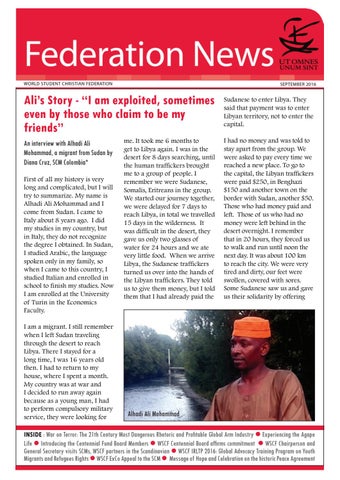
Alhadi Ali Mohammad
INSIDE : War on Terror: The 21th Century Most Dangerous Rhetoric and Profitable Global Arm Industry l Experiencing the Agape Life l Introducing the Centennial Fund Board Members l WSCF Centennial Board affirms commitment l WSCF Chairperson and General Secretary visits SCMs, WSCF partners in the Scandinavian l WSCF IRLTP 2016: Global Advocacy Training Program on Youth Migrants and Refugees Rights l WSCF ExCo Appeal to the SCM l Message of Hope and Celebration on the historic Peace Agreement
federation news food and clothing. The Libyan traffickers asked if we knew someone in town who can pay for us. If there was someone, they will send the driver to take the money and resolved the problem. They will not leave you until they get the money from you, this can take months. I said I had a friend in Benghazi but had no cell phone number. I was told I had to pay 100 dinar, and that if I did not pay, I will be thrown into jail. We left in a taxi, 5 people at the back, the two Libyans in front and 2 in the trunk of the car. We arrived in Benghazi to look for my friend. For 2 hours we went around asking for Aladi my friend. In the end, a Sudanese told us that he knew him but did not work in that market anymore, he was in another place. I told him that if my friend did not pay for us, we were all going to prison. He told me to wait as he will first close his shop and accompany us to look for Aladi.We started asking around with Libyan, Sudanese until I finally met my friend. The Sudanese who accompanied us explained the situation to Aladi. My friend asked permission from his master and came to talk to the Libyan traffickers. He said he had no 700 dinar to pay and
sEptember 2016 I was in Libya for two years. I was in prison also for a month because of a labor law that says we cannot work in business or trade. We can only work in the port, loading and unloading goods, cleaning or welding. asked the Libyans to return tomorrow. The Libyans told him he had to pay immediately or else he will call the police. My friend told them to go to his house and wait for him to come back to collect the money. When Aladi came back he was with a Libyan friend who helped explained the situation. He said that Aladi needed time and will spend the following morning collecting money to pay the traffickers. The Libyan traffickers did not want to accept this gentleman offer, instead we all ended up in prison. I was in Libya for two years. I was in prison also for a month because of a labor law that says we cannot work in business or trade. We can only work in the port, loading and unloading goods, cleaning or welding. I worked in a business and I found out later that my boss paid to free me and made me sign a paper saying I could not do those jobs.
Migrants arriving Lampedusa, Italy. (Alessandro Di Meo/EPA) 2
I worked in the market for 6 months and I decided to stay when Libya was already at war. Later the situation became dangerous, so I left Libya and paid $1,200 to a Libyan trafficker to leave the country. They brought us to where the other Sudanese people were waiting to leave as well, they made us travel with 63 people in a small boat. In the end we all landed in Lampedusa. In Lampedusa, we requested for political asylum and was given document fast. Life here in Italy has been long and hard, I had the document but did not have a job at the beginning. I ended up picking fruits and vegetables. I worked for 5 months and was paid 8 or 10, 20 euros maximum per day. I saved my money and when I had 900 euros in my pocket, I went to Rome to work. But life in Rome was expensive and I could not live with the money I earned which I used to rent to a room and eat. I found friends who advised me to go to Turin. When I arrived Turin, my friends and myself had nowhere to live, with the help of social services, I went to live in a ‘occupied’ house. This house had been a nursing homes abandoned for more than 10 years. It had no light, water, heating, it was old and full of dust. While staying there, I got sick with pneumonia and was in
federation news
sEptember 2016
the hospital for 10 days. My pneumonia was not cured since then,I suffer the consequences of this disease.
children from Africa. They send me to make the appointment and pick up the children who will come for the study.
With my ability and the help of my friends, I studied Italian. In school, I worked doing odd jobs in 6 months. My first job was washing cars, I became assistant to the mechanic, loading and unloading goods in a supermarket, checking expiration dates of products. Then I helped in the school dental clinic, and in the information center, but by then, I already had my diploma of higher studies. I also work for the school by helping migrant
I do not have social security. I am exploited, sometimes even by those who claim to be my friends. In many situations, the immigrant labor is exploited to the maximum and for very little money.
* Diana Cruz is from SCM Colombia, she participated in the Agape Political Camp last August 2016 in Italy, where she met Ali. Alhadi Ali Mohammad
War on Terror: The 21st Century Most Dangerous Rhetoric and Profitable Global Arms Industry By Hadje Cresencia Sadje, Student, Protestant Theological University Groningen
Washington waged its “war on terrorism” by creating an international terror network of unprecedented scale, and employing it worldwide, with lethal and long-lasting effects. Noam Chomsky, Who are the Global Terrorists? (2002) . Globalisation, which is partly synonymous with rising of international arms trade industry, has fostered the rapid production in unprecedented quantities. While it’s difficult to assess the exact impact of arms globalisation, it’s quite obvious in many conflict areas. Since the 9/11 attacks, the United States of America (US) and its western allies declared “global
war on terrorism,” targeting all suspected perpetrators, but also those major non-NATO allies or rogue states. Former US President George Bush deploys the most dangerous rhetoric of the 21th century. According to experts, before it was against communism but now it is against the established religion of the Prophet Muhammad--Islam. Noam Chomsky argues
that the war on terror of US propaganda is a declared rhetoric. Indeed, with this US rhetoric, it is a recipe for disaster, particularly toward Muslim believers around the world. This rhetoric justified and fuelled the New US Exceptionalism. As Robert G. Patman describes: “The idea of United States of America (USA) exceptionalism refers to an informal ideology that endows Americans w ith a pervasive faith in the uniqueness, immutability and superiority of the
Photo by Hadje Cresencio Sadje, 2016 3
federation news
sEptember 2016
(Photo by Hadje Cresencio Sadje, 2016) country’s founding liberal principles, and also with the conviction that the USA has a special destiny among nations (Globalisation, the New US Exceptionalism and the War on Terror, 2006).” This US rhetoric play an important role in the origination of global terrorism and its effects on social phenomenon, particularly the European Union (EU) Refugee Crisis. I was encouraged by the current situation to be more reflective, critical, and to think outside of my religious tradition. To determine how much it was actually worth, on 8 July 2016 I joined the voluntary programme of the Christian Peacemaker Team (CPT) Europe in the Mediterranean, were I volunteered for three weeks. Inspired by the public ministry of our Lord Jesus Christ, the CPT stand for human rights, reclaim human dignity, and witness to the world without war. In response to the sudden influx of refugees in European nations, CPT is answering the call. The CPT Mediterranean project was initiated by CPTers in Europe. In 2014, CPT was invited by Greek local partners and the goal of this project is to work alongside local partners to accompany
4
and to protect refugees in the Island of Lesvos, Greece. I had an opportunity to speak with a number of Syrian and Iraqi refugees on the Island of Lesvos, and the Island of Chios, Greece. Visiting the refugee camps on a daily basis was part of our important task in the Island of Lesvos, Greece. Sitting and listening to refugee’s personal stories validated the profitability of arm industry, particularly in conflict region in the Middle East. One of the Syrian refugees told us that everything is about money. When I heard these stories from Syrian refugees I was reminded by Steven Staples statement, “Globalization denies food to the hungry -- and hands them guns instead”. Needless to say, arm trade is a big business. True, the global arms industry exploits the US rhetoric by expanding the arms sales and export policy. I grieved and I began to question the existence of God. I began to harbor doubts about my religious belief and I almost to salvage my faith. At that point, I was trying to convince myself that God has nothing to do with global refugee crisis. I’m absolutely convinced that the blame for the global migrant and refugee crisis lies squarely
on the shoulders of the global elite corporation, especially the global proliferation of arm industry. Moreover, US considered as a world superpower is also considered the world’s largest military spender. According to Stockholm International Peace Research Institute (SIPRI) 2016 report: “There was no change in the countries that comprised the top 15 military spenders in 2015 compared with 2014, although there were some changes in order. The United States, with total expenditure of $596 billion, remains by far the world’s largest military spender, at nearly three times the level of China, which is ranked second. Nonetheless, US military expenditure continued to decline in 2015 but at its slowest annual rate since 2011 (–2.4 per cent). Projections for 2016 indicate that US military spending will remain roughly constant in real terms.” I feel indignation toward anyone who denies the truth about globalization of the arms industry and terrorism. It is
federation news
sEptember 2016
Needless to say, arm trade is a big business. True, the global arms industry exploits the US rhetoric by expanding the arms sales and export policy. obvious that the current social order cannot provide satisfactory solutions, especially, interstate community seem immobilized and tepid when it comes to the world refugee crisis. As I reflect on the EU refugee crisis and the global arms trade, one can be pessimitic by saying that there no possibility to challenge the current oppressive social order. As Christians however, we are called to offer
various ways to challenge the oppressive and immoral social structure. We, as prophetic communities have been tasked to delegitimize any forms of oppressive system and unmask the myth of war on terror manufactured by US and its allies. As the gospel of Matthew 5:9 reminded us. “Blessed are the peacemakers, for they will be called children of God (NIV).”
Further Readings: Noam Chomsky, Who are the Global Terrorists? Reprinted from Ken Booth and Tim Dunne eds., Worlds in Collision: Terror and the Future of Global Order (Palgrave/Macmillan) (UK, May 2002; US, September 2002).
About the Author: Hadje Cresencio Sadje is an associate member in the Center for Palestine Studies-SOAS University of London UK. He is currently a master student at the Protestant Theological UniversityGroningen and has been working with various professional and faith-based organisation including, PhISO, Peace Builders Community Philippines, and the Foundation University-Amsterdam The Netherlands.
Experiencing the Agape Life By Charles McKinney, SCM USA Tucked away in the bodacious Alps Mountains of Northwest Italy, not far from the French border dwells an ecumenical center by the name of Agape that has existed since 1947 when it was constructed postWorld War II by a dynamic new generation of Protestant youth under the tutelage of a Waldensian pastor. Agape’s foundation and evolution to this day has been rooted in a spirit of volunteer service, communal living and diversity, equity and inclusion to all the people who encounter its atmosphere. Each year folks the world over flock to Agape to partake in the various camps it offers: political, theological, work, family,and women’s (to name a few). This year I attended the
SCMers at Agape: From left...: Diana Cruz, Colombia, Marta Sappe’ Griot, Italy, Maria Kozhinova, Finland and Communication WSCF-E, Yasmina Rishmawi, Palestine, Luwiza Maccosa, Zimbabwe, Alexander Mulet de los Reyes, Cuba, Krista Autio, Finland, From left sitting: Charles McKinney and Kenneth Schoon, USA
international political camp on Migration: Breaking Down Boundaries on a Journey toward a Common Home in Prali, Italy, an hour by car from Turin (the nearest metropolis). Men and women from over 30 countries assembled for this impactful camp that explored the causes and effects of universal migration, the human rights issues associated with migration,
and practical ways that we all can get involved as activists to combat injustices faced by migrants/refugees before, during and after their journeys in search of a new normal, a better way of living. We heard the powerful and heartfelt stories of migrants from Turkish Kurdistan, Somalia and Sudan, putting us up close
5
federation news
sEptember 2016
Agape Political Camp 2016 participants and staff in Prali, Italy. and personal with the bona fide struggles they endure and the victories they work toward as they establish themselves in their new homeland, that being Italy (a Promised Land for many refugees escaping political, religious and/or military conflict or persecution in their native lands). For a whole week I had the privilege of meeting, learning from and enjoying the company of newfound kith that all brought something unique to the table of brotherly love and unity. Community service remained at the forefront of this experience as everyone pitched in to prepare for each meal that we ate collectively and, likewise, to clean up afterward. The multiple interpreters present facilitated everyone’s ability to understand the guest presenters during the camp; English was not necessarily the lingua franca as I had presumed and was challenged in being able to communicate with the non-English speaking campers. Nonetheless, non-verbal communication became all the more important in this context. Not only did the camp stretch
6
our intellectual muscles, but also our physical ones as many of us embarked on an intense daylong hiking adventure in the Alps on the third day. Most of the group persevered until it reached the zenith while the rest of us relished the idea of moving at our own pace, taking frequent breaks and snapshots of the breathtaking landscape before eventually eating lunch and power napping. Then we decided to make the descent down the mountain in an attempt to avoid what appeared to be a potential rainstorm. Gelati and crepes awaited a minority of us on solid ground! One of the highlights for me at this political camp, especially as a Peace Corps volunteer representing both Macedonia and the USA, was when I conversed with Dr. KatalinaTahaafe Williams from Tonga. She sat on the human rights panel, discussing her work and the hardships she has witnessed by migrants in the fight against the dehumanization and discrimination that tries to impede their progress en route to a promising tomorrow. Dr. Williams told me how she was
influenced by a Peace Corps volunteer in Tonga and how her family even named her after the place where the Peace Corps volunteer (who was a nurse) hailed from in the United States of America (Katalina Island). I felt heartened to hear this educated, zealous Tongan woman applaud the Peace Corps for its longstanding grassroots work and to be connected in this way. Now I just need to keep on running, working and acting in conjunction with my convictions that proclaim the inherent dignity and sanctity of every human life, migrant or not. I remember the countless migrants stranded at the Macedonian-Greek border in refugee camps, stagnant yet hopeful they can reach their dreams, never to return to a life or country infused with violence, pollution and despair from the incendiary side effects of war, corruption and the seven lethal vices. Thank you God and Agape for this outstanding opportunity to live in a Utopian milieu for seven days, the prototype for how the whole world should be at its best! “Love never fails.�
IN T E R V Inews EWS federation
sEptember 2016
CF Members with Geneva-based WSCF Senior Friends. From L-R: Salters Sterling, Dinesh Suna, Jean Francois Delteil, Necta Montes, Sondang Hutagalung, Jean Luc dela Soujeole, Bronwyn Claire, Alex Roumi, Sheryl Jonhson, and Ilari Rantakari.
Introducing the Centennial Fund Board Members Chairperson: Salters Sterling 1. Tell about yourself in 3 sentences. I am a 79 years old Irish person with university qualifications in history, politics, education and a life-long interest in the welfare of the marginalised through the ecumenical service of the Church. 2. What is your WSCF and/or SCM background? Student SCMer 1952-1961. Britain and Ireland SCM Staff Member 1961-1970. Have attended WSCF
GA 1964, 1968 and 2008 and 2015 as Senior Friend. Currently accompany ExCo. 3. How do you see the role of Centennial Fund in the future of the Federation? The Centennial Fund will continue to support the work of the Federation with funding within the terms of reference of its Foundation and as Senior Friends by supporting the work of the Officers and Staff of the Federation.
Vice-chairperson: Jannes Hutagalung 1. Tell about yourself in 3 sentences. After spending more than 3 decades in Indonesian civil service including 9 years with the World Bank in Washington, D.C. I retired in 2008. I since then became more active in my church, as an elder and participate in a number of activities beside joining two choirs. I am also doing some part time work as a consultant. I am married to Sondangwhom, who I first met in 1972 at the National Congress of Gerakan Mahasiswa Kristen Indonesia (GMKI). We married in that year, blessed with 3 sons and 7 grandchildren. 2. What is your WSCF and/or SCM background?
Ireland
Indonesia
I became a member of GMKI since 1963 and an active member until 1972 when I started working as a civil servant at the Ministry of Finance of Indonesia. During my active years in GMKI I was once Secretary of Jakarta Chapter and a Chairman of National Committee from 1970-1972. Being member of CF is my first experience with the Federation. 3. How do you see the role of Centennial Fund in the future of the Federation? CF could play a very important role for the future of the Federation when the support from our traditional contributors is declining. CF should become a vehicle for mobilizing
financial supports particularly from among members. One of the challenges faced by CF is how to raise the awareness of as many members as possible about the financial situation being faced by the Federation and to be motivated to help.
7
IN T E R V Inews EWS federation
sEptember 2016
Student Representative: Alexandre Roumi 1. Tell about yourself in 3 sentences. I am currently a Financial Engineering graduate student living in New York after a 6 year career in Electrical Engineering designing airports and traveling around the world. I am Lebanese and member of the Orthodox Youth Movement, an affiliated movement of the WSCF Middle East. I play tennis and judo for fun.
Assembly, the North American and Middle East regional assemblies, and also in European workshops including Syndesmos, AGAPE, and Ecumenical Youth Council in Europe. My involvement in the WSCF has allowed me to form connections and links to different organizations and people active in the ecumenical or local Christian scenes worldwide.
2. What is your WSCF and/or SCM background?
3. How do you see the role of Centennial Fund in the future of the Federation?
My experience with the WSCF started in 2006; throughout the years I have attended, helped organize, and was a guest speaker at several events they held. I have taken part in the last General
In order to grow and continuously help WSCF in the formation of new Christian students and leaders, the Centennial Fund is the backbone for the foundation’s growth and development. The Centennial
Member-at-large :Sheryl Johnson 1. Tell about yourself in 3 sentences Sheryl Johnson was deeply involved in the Canadian SCM and now currently working on a PhD in Theology and Ethics at Graduate Theological Union in Berkeley, California, USA. She has been involved for several years with WSCF-Canada, a body primarily devoted to fundraising for the WSCF Centennial Fund (with a percentage of other funds raised going to the endowments of SCM Canada and WSCF-North America) and sees part of her role as connecting this group more deeply with the Centennial Fund itself. 2. What is your WSCF and/or SCM background?
8
Lebanon
fund needs the “Widow’s cent offerings” (Luke 21:1-4) as well as big donations to let the federation survive its difficulties now and in the future.
Canada
Sheryl has served in a variety of roles from local unit coordinator (at the University of Toronto), to cochair of SCM Canada to a variety of regional and WSCF global roles. She first became involved with SCM in 2005. 3. How do you see the role of Centennial Fund in the future of the Federation? As WSCF, like much of the ecumenical movement, struggles to sustain long-term, stable, funding particularly for its core budget as its traditional funders are experiencing declining resources and changing approaches to funding, I believe the role of the Centennial Fund is to step in to provide that, as much as possible,
to enable WSCF to live into its call to be a bold and prophetic space for the generations to come.
federation news
sEptember 2016
Australia WSCF Treasurer: Bronwyn Claire 1. Tell about yourself in 3 sentences I am originally from a farm in Australia, and now live in Hong Kong with my partner and (soon) our twins. I studied environmental/ agricultural economics, and have since worked in academia, government and business consulting. I enjoy traveling and the outdoors, and often combine the two in hiking around the world. 2. What is your WSCF and/or SCM background? My parents were SCMers while at university in Australia and I grew up in a household with an SCM
ethos. I joined the Australian SCM in 2002 as an undergraduate and have held the position of Australian SCM National Coordinator and Treasurer. I was the Asia Pacific ExCo Representative from 2008, and became the WSCF Vice-Chair in 2012. I am currently the WSCF Treasurer. 3. How do you see the role of Centennial Fund in the future of the Federation? I see the role of the Centennial Fund as a lead partner and supporter of the WSCF, as well as a key link between Senior Friends and WSCF.
Investment Advisory Group (IAG) and WSCF Finance Officer: Jean-Luc De_La_Soujeole 1.Tell about yourself in 3 sentences
2. What is your WSCF and/or SCM background?
Because of my financial background I cannot help from giving you key numbers: - 45 years since I met my wife who is English and Church of England. being myself being French and Roman Catholic... this is my small contribution to promote ecumenism !
Honestly none..! However, starting young with Christian responsibilities as a young Altar Boy in a large church in Paris. Still remember serving the High Mass in Latin, wearing a red and white gown and a Swiss guard in full attire in attendance; unfortunately no selfies those days... so you have to trust me !
- 36 years in Switzerland... I feel more Swiss than French, even enjoying Swiss wine !
3. How do you see the role of Centennial Fund in the future of the Federation?
- 4 grown-up children and 3 grand-children... then you start thinking about your legacy !
Part of a two-pronged approach, with the Give One Be One campaign, to secure funding for
France
the future of WSCF. This is more with a long term perspective, with the challenge, to start with, to attract sizeable donations from Senior Friends.
9
federation news
sEptember 2016
WSCF Centennial Board affirms commitment to support WSCF transition process The WSCF Centennial Fund Board met on May 19 to 22, 2016 at the Bossey Ecumenical Institute in Switzerland. The annual meeting was attended by Salters Sterling, Board Chairperson, Jannes Hutagalung, Vice-chairperson, Alexandre Roumi, Secretary (Student representative), Ilari Rantakari and Sherly Johnson, CF membersat-large, Bronwyn Claire, CF member (WSCF Treasurer), Mr Matthieu Durrleman, Mr. Gunter Schwerdtel, Jean Luc de la Soujeole, Investment Advisory Group members (WSCF Finance Officer), Necta Montes, Observer and Minutestaker (WSCF General Secretary). Bruce Rigdon, Treasurer, who was ill during the meeting, sent his apologies.
The Board members acknowledged the progress in the transition work of WSCF and commended the work done by the Transition Team and the Executive Committee. By January 2016, WSCF was able to pay-back its loan to the WCC, put in place proposals for governance changes and approved changes in the staff model and job descriptions. With a renewed level of confidence in the leadership of WSCF, the Board vowed to accompany and affirm its commitment to support further the transition work of WSCF. With mostly new members joining the meeting for the first time, the Board spent some time orienting themselves with the Centennial Fund
WSCF Chairperson and General Secretary visit SCMs, WSCF partners in the Scandinavian June 20 to July 1st 2016, WSCF Chairperson Georgine Kengne Djuetane and Secretary General Necta Montes visited SCMers, Senior Friends, church partners and friends in the Scandinavian countries. The visit is part of the efforts to build and re-establish networks and relationships with various stakeholders of WSCF as it seeks support in its transition work to secure the future of WSCF. The WSCF team met with 11 representatives from churches and partners in Finland, Norway and Sweden. The visits were organized to coincide with the World Council of Churches (WCC) Executive Committee Meeting that took place from 23 to 29,2016 in Trondheim, Norway, where both Georgine and Necta participated as guest advisers. In Helsinki, the WSCF team met with Rev. Dr. Rolf Steffanson, Deputy Director and Satu Kantalo, Director for Department for Mission and Resources of the
10
Finnish Evangelical Lutheran Mission or FELM. Formerly the Finnish Mission Society of 1859, FELM is one the oldest church mission agency in Finland. With its new 2017-2022 Strategic Plan “Roadmap to Hope”, FELM promotes the “Christian message of hope, faith, and neighbourly love” in its work in 30 countries
and 100 partners. The team also met with Jyri Komulainen and Anna Hyvarinen from the Finnish Ecumenical Council to exchange and learn about the refugees, interfaith and rights to religion initiatives of churches. Rev. Dr. Kimmo Kariaanen, Executive Director of the Department of International Relations of the Evangelical Lutheran Church of Finland or the ELCF shared the priorities and challenges of the biggest denomination in Finland.
Necta, Inger Lise Olsen, WSCF Senior Friend and Church of Sweden, Georgine.
federation news
sEptember 2016
statutes and by-laws in the conduct of the meeting. In its discussion, the Board clarified the purpose of the Named Funds and proposed to expand its scope to allow flexibility in determining the use and proceeds of the funds. It also proposed to revive the Philip Potter Named Fund and explore partnership with the World Council of Churches (WCC) in honor and memory of his contribution in ecumenical leadership. Highlights of the decisions of the Board Meeting included the adoption of the WSCF CF Travel Policy which will guide the use and disbursement of the CF travel funds in the future following the
Swiss Federal Law for non-profit foundations. The Board created a Joint Fundraising Group composed of WSCF ExCo members and CF Board members to plan and increase fundraising efforts for WSCF and the Centennial Fund. It also proposed several strategies. The Board approved the nomination of Gunther Schwerdtel as member of the Investment Advisory Group (IAG) and unanimously reelected Salter Sterling as Chairperson of the Board for another term. The Board’s next meeting is schedule to take place in Ireland in May 2017.
Necta, Eilert Rostrup from Karibu Foundation Norway, Georgine While Mr. Aaro Rytkonen, Head of Secretariat of the Finn Church Aid shared the 3 Rights Perspective as the guiding principle of their work in the developing countries, these are Rights to Livelihood, Rights to Quality Education and Rights to Peace. The team also had a fellowship meetings with leaders and senior friends of SKY-SCM Finland at the SCM Office in Helsinki. The meeting was an opportunity to update the senior friends and SCM on the situation and the transition work of WSCF and learn about the work of SCM Finland. In Norway, the team met with Eilert Rostrup, Director of the Karibu Foundationin Oslo, where they discussed updates on the transition work of the Federation and its advocacy work. At the
WCC Central Committee Meeting in Trondheim, the team met with Christoph Anders, Director of the Association of Protestant Churches ans Missions in Germany (EMW) in Germany, Larry Miller, Secretary of the Global Christian Forum, and Beate Fagerli, WSCF senior friends from the Church of Norway, and Susanna Erlecke of the Evangelical Church in Germany (EKD). In Sweden, WSCF senior friend and Adviser on Gender Issues to
the Church of Sweden, Inger Lise Olsen organized a meeting with Johan Hasselgren, Director for Asia and Karin Axelsson Zaar, Director for Middle East of the Church of Sweden. The Church of Sweden is currently preparing its 2018 to 2021 Strategic Plan. The team was also hosted by Lennart Renofalt of the Uniting Church of Sweden, who shared the church’s work with refugees and migrants. The WSCF team extends its gratitude to senior friends Salters Sterling, Dinesh Suna, Ilari Rantakari, Inger Lise Olsen, Minna Mannert, Torkil Hvidsten, Are, Linn, Magnus of SCM Sweden and Lennart Renofalt for the financial, support, food, accommodation, arranging meetings, accompaniment, kindness, friendship and warm hospitality.
Necta and Georgine with SCM Finland Senior Friends, staff and officers
11
federation news
sEptember 2016
Message of Hope and Celebration on the historic Peace Agreement between Colombian Government and Fuerzas Armadas Revolucionarias de Colombia— Ejército del Pueblo (FARC EP) “We are many, we are one sent out to build God’´s peace”.
T
he Colombian government and the FARC guerrilla have announced the final peace agreement to end more than 50 years of war on Monday, August 29th2016. Closing the negotiations that took place in the last 4 years in Habana, Cuba, giving way to a new historic chapter for all Colombians, a peaceful future. The World Student Christian Federation (WSCF) celebrates the historic Peace Deal reached and express its support to the Colombian Christian movement, churches and organizations that work on building peace with justice every day, especially in the steps that follow. We celebrate this historic Peace Agreement reached by the negotiating teams, as well as all the processes aiming to restore human dignity and promote inclusion and equity. As a Federation, we recognize and congratulate the committed work of the Interchurch Dialog for Peace-DIPAZ, a platform that gathers together churches and faith organizations in Colombia, through processes that offered guarantees,
12
observation, monitoring and advocacy. We reaffirm our commitment of providing a spaceto promote solidarity with Colombian people through our global Student Christian Movements and to work together with building peace organizations and churches in Colombia. We encourage education, reflection and actions of young people and students to promote and build peace according to their contexts. Seeking also the construction of memory and identity to ensure a more just and peaceful future. We believe in the responsibility of the different sectors of society to give viability and implementation to the
reached Peace Agreements. Additionally, we hope that the talks between the National Liberation Army (ELN) and Colombian Government can begin soon, looking for new deals to cease hostility and violence. We offer our prayers for all Colombians, the peacemakers, Colombian students and youth in facing the challenges that lie ahead in the post-agreement. For God´s presence in the constructing process of a complete, comprehensive, just and lasting peace. WSCF remain in solidarity with the churches and people in Colombia. Let us give Peace a chance!
Necta Montes Secretaria General FUMEC Marcelo Leites Ejecutivo Regional FUMEC América Latina y el Caribe. 31 August 2016
federation news
sEptember 2016
WSCF IRLTP 2016: Global Advocacy Training Program on Youth Migrants and Refugees Rights This coming December 1 to 5, 2016, WSCF is planning to organize the Inter-Regional Leadership Training Program (IRLTP) as a Global Advocacy Training focusing on Youth Migrants and Refugees Rights in Dhaka Bangladesh. The Program is expected to have 25 Student Christian Movement (SCM) members participate from WSCF regions in Asia Pacific, Africa, Middle East, Latin America and Caribbean, North America and Europe. The Program aims to achieve the following objectives: To increase the capacity of the SCMers for advocacy and solidarity work through an Advocacy Training Program at the international and local levels on Migrants and Refugees Rights. To develop an Advocacy Campaign that would highlight the situation of the youth migrants and refugees and create an advocacy plan on how their specific issues and concerns, such as education and employment can become key issues in Migrants rights advocacy. To provide a space for sharing of advocacy needs and plans of the national level SCMs. To be exposed, to learn and participate in an actual global advocacy flat form such as the Global Forum on Migration and Development (GFMD).
understanding international instruments and protocols on the rights of Migrants and Refugees, learning from the experiences of campaigners and advocates.
The content of the Program will have three major highlights.
Participation and Exposure advocacy work in the Civil Society Days and GFMD.
Advocacy Skills in working for migrants and refugees rights.
A two-day advocacy training skills, which aims to provide tools for students and youth advocating and organizing campaigns and programs with and for migrants and refugees. The session will include an overview of advocacy spaces in various UN levels, government and non-government spaces,
Developing a Youth Agenda and Campaign Plan for Migrants and Refugees Rights. A one-day Conference which aims to identify key youth issues and agenda in the global discourse on Migration Rights relevant to youth and students and a come-up with a common framework for a Campaign Plan of these key youth issues and agenda. The Conference will be organized jointly with representative of youth groups and organizations participating in the Civil Society Days (CSD) prior to the GFMD.
Participants will have chance to participate and be observers in the various events at the CSD and GFMD in order to have a concrete experience and understanding of how advocacy work is done in this global
platform. Participants will also visit migrants communities and groups in Bangladesh to better understand their issues and concerns. The Program is a follow-up activity of the IRLTP held lastDecember 7 to 15, 2015, on Ecumenical Transformative Diakonia inPalermo, Sicily, Italy. The Program developed an Action Plan on how WSCF, a global movement of youth and students can engage young students from across the world in responding to the issues of forced migration in their different contexts and situation and respond to the call for advocacy and solidarity on specific themes. The program likewise came out with an analysis and common understanding of the root causes of forced migration specifically from the so-called Migrant Crisis in Southern Europe, where the program was held. It also affirmed WSCF theological basis for its engagement on the issue of migrants and refugees. To participate in this event please contact and send the application form to the Preparatory Committee members: Necta Montes: necta@wscfglobal.org , SunitaSunasunita.wscf@gmail. com ; Luciano Kovacs wscfna@ gmail.com
To develop an Advocacy Campaign that would highlight the situation of the youth migrants and refugees and create an advocacy plan on how their specific issues and concerns, such as education and employment can become key issues in Migrants rights advocacy.
13
federation news
sEptember 2016
WSCF ExCo Appeal to the SCM Dear brothers and sisters in Christ I’m writing on behalf of the Executive Committee to update you about the life of the Federation. The Executive Committee of the Federation is currently in the process of implementing decisions taken in outline by the Bogota General Assembly which have been now been given more substantial forms through the processes of the Transition Team, Staff Meetings and a major in-person meeting of the Executive Committee in Palermo last December. A key concern at the General Assembly was for better communication within the whole family of the Federation. This letter forms part of the upgrade of our communication activity. It is addressed to the members of all our national Movements because the National Movements are the Foundation Stones of the entire Federation as is so clearly recognised in the Constitution of the Federation. It is our intention to continue to be in regular communication. This letter gives an outline update on Constitutional, Staffing and Finance matters. We hope everyone will give its contents their close attention. Strategies of addressing medium-term and long-term stability of the Federation are still underway. Actions are taking to address governance and operational structure of the Federation as well as the financial challenges but all still moving slowly and not gently as we have anticipated. Fundamental changes need strong analysis and consultations as we are convinced that during this challenging and Kairos time we need to hold on to an inclusive approach. You will very soon receive more information about the process of the online General Assembly and the proposed Constitutional amendments for votation. At the same time reflection has started on the staff model more appropriate for WSCF ongoing work and you are invited to take part to. The financial situation of the Federation has not yet been stabilized. We have been able to pay WSCF external debt worth US $ 200,000 and substantially reduced the over-all operation cost. You might have noticed from correspondences coming from the IRO, our General Secretary is transitionally based and operating from Manilla.
14
To address the recurrent financial challenges of the Federation, the Fundraising Committee together with the Global Staff have developed different fundraising strategies which include an internal mechanism to generate resources which encompasses the traditional memberships fees and contemplating tapping more senior friends contribution, former WSCF staff, current and former Executive committee members. We are hoping to revive the Give One Be One as much as we are counting on the very unfailing and vital Centenial Fund contribution. In addition to above listed, we have planned other fundraising events and most of all through the global planned activities with global staff team. As SCMs your ongoing support to the mission is deeply appreciated and more so your cash donation. We pray and hope that every member will continue to participate as needed and contribute as much as they can morally, materially, financially and technically to the work aiming at the regaining our stability in the coming months. We are all encouraged with good news from national movements. The revival of some SCMs in Europe and Latin America. Ecumenical peace processes and active participation of movements and offices in Latin America and the Middle East, relevant activities in North America and Canada, in Asia Pacific and in Africa addressing social and economic issues. Saint Paul wrote to the Corinthians : « if one part suffers, every part suffers with it ; if one part is honored, every part rejoices with it » (1 Cor. 12 :26). The task is still immense, as much as the approach of solutions diverse, but we are certain that with God’s grace we will continue to reach new heights due to the commitment, loyalty and personal sacrifices of the Officers, the executive committee members, regional and national leadership and most of all the global staff team. We are deeply indebted to many of you who have financially and morally supported WSCF since the time we started this journey. We will not list all of you here but will reach you individually. May the Almighty God bless you abundantly. in Christ Ms Georgine Kengne Djeutane On behalf of the Executive Committee Members
World Student Christian Federation Office Addresses World Student Christian Federation Inter-Regional Office Ecumenical Centre 5 route des Morillons P.O. Box 2100 CH 1211, Geneva 2 Switzerland. Phone: + 41 22 791 6358 Fax: + 41 22 791 6152 Email: wscf@wscf.ch Web: http://wscfglobal.org General Secretary office World Student Christian Federations (WSCF) 3rd floor, UCCP Building 877 EDSA, Quezon City, Philippines Telephone: +639-154786463 email: necta@wscfglobal.org Skype:nectamontes website: www.wscfglobal.org WSCF Asia-Pacific Office 18/F, Room 1 & 2, 280 Portland Street Commercial Building, Mongkok, Kowloon, Hong Kong Phone: +852 238 52550 Fax: +852 278 23980 E-mail: wscfap@netvigator.com Website: www.wscfap.org WSCF Africa All Africa Conference of Churches (AACC) Sir Francis Ibiam House, 4th Floor Waiyaki Way – Westlands PO. Box 14782 – 00800 Nairobi, Kenya. Email: wscf@wscf-africa.org Website: www.wscf-africa.org
WSCF Europe Office Piazza di Centa 9, 38122 Trento, Italy Phone: +4917634468972 E-mail: wscf@wscf-europe.org Website: www.wscf-europe.org WSCF Latin America and Caribbean Office FUMEC America Latina Camacuá 282 1406 DOF Buenos Aires, Argentina Phone: +54 11 4631 2194 Fax: +54 11 4631 8516 E-mail: fumec@fumec-alc.org Website: www.fumec-alc.org WSCF Middle East Office Sourati Street, Shartouni Blg., 5th Floor Hamra – Beirut – Lebanon P.O. Box 11-1375, Beirut, Lebanon Phone: + 96 11 34 19 03 Fax: + 96 11 34 19 02 E-mail: wscf-me@inco.com.lb Website: www.wscf-me.org WSCF North America Office Inter-Church Centre 475 Riverside Drive Suite 810 New York, NY 10115, USA Phone: +1 212 870 24 70 Fax: +1 212 870 31 12 Mobile: +1 646 246 8936 E-mail: wscfna@gmail.com Website: www.wscfna.org