ISSN 1992-8386
Federation News April 2010
World Student Christian Federation
Students wrestle with blessings and challenges of diversity
S
tudents from Protestant, Roman Catholic, Anglican, Pentecostal and Orthodox traditions gathered in Thailand in December to analyse the WSCF 2009 theme of Identity, Diversity and Dialogue. “This programme has allowed members of the Federation to consider, celebrate and wrestle with the blessings and challenges of our global diversity,” participants said in the report. It also permitted them to exchange experiences, train grassroots leaders and build the Federation’s capacity to dialogue effectively. Students grappled with issues such as religious minorities struggling for identity; ethnic groups persecuted by brutal regimes; the plight of sexual minorities in societies and churches fearful of diversity; and the trafficking and sexual exploitation of women and minors. Ms. Bre Woligroski, a Canadian delegate, expressed gratitude for the conference. “Thank you, WSCF, for this opportunity and for taking seriously the issue of diversity. This experience has changed me and has made my understanding of God’s work in this world more real and our role within that more urgent. WSCF has a very important role in global solidarity and advocacy work.” Participants came from Aotearoa New Zealand, Bangladesh, Canada, Cote D’Ivoire, Ecuador, Georgia, Italy, Jamaica, Jordan, Korea, Philippines, Rwanda, Slovakia, Thailand and the United States. They were welcomed to Thailand by the General Secretary of the Christian Conference of Asia (CCA), Dr. Prawate Khidarn, and hosted by the Thai SCM.
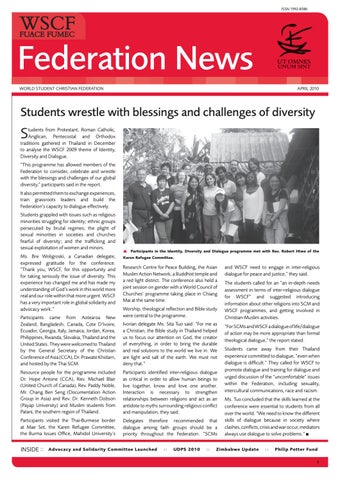
Participants in the Identity, Diversity and Dialogue programme met with Rev. Robert Htwe of the Karen Refugee Committee.
Research Centre for Peace Building, the Asian Muslim Action Network, a Buddhist temple and a red light district. The conference also held a joint session on gender with a World Council of Churches’ programme taking place in Chiang Mai at the same time. Worship, theological reflection and Bible study were central to the programme. Ivorian delegate Ms. Sita Tuo said: “For me as a Christian, the Bible study in Thailand helped us to focus our attention on God, the creator of everything, in order to bring the durable and real solutions to the world we live in. We are light and salt of the earth. We must not deny that.”
Resource people for the programme included Dr. Hope Antone (CCA), Rev. Michael Blair (United Church of Canada), Rev. Paddy Noble, Mr. Chang Ben Seng (Documentation Action Group in Asia) and Rev. Dr. Kenneth Dobson (Payap University) and Muslim students from Patani, the southern region of Thailand.
Participants identified inter-religious dialogue as critical in order to allow human beings to live together, know and love one another. Interaction is necessary to strengthen relationships between religions and act as an antidote to myths surrounding religious conflict and manipulation, they said.
Participants visited the Thai-Burmese border at Mae Sot, the Karen Refugee Committee, the Burma Issues Office, Mahidol University’s
Delegates therefore recommended that dialogue among faith groups should be a priority throughout the Federation. “SCMs
INSIDE ::
Advocacy and Solidarity Committee Launched
::
UDPS 2010
::
and WSCF need to engage in inter-religious dialogue for peace and justice,” they said. The students called for an “an in-depth needs assessment in terms of inter-religious dialogue for WSCF” and suggested introducing information about other religions into SCM and WSCF programmes, and getting involved in Christian-Muslim activities. “For SCMs and WSCF a dialogue of life/dialogue of action may be more appropriate than formal theological dialogue,” the report stated. Students came away from their Thailand experience committed to dialogue, “even when dialogue is difficult.” They called for WSCF to promote dialogue and training for dialogue and urged discussion of the “uncomfortable” issues within the Federation, including sexuality, intercultural communications, race and racism. Ms. Tuo concluded that the skills learned at the conference were essential to students from all over the world. “We need to know the different skills of dialogue because in society where clashes, conflicts, crisis and war occur, mediators always use dialogue to solve problems.”
Zimbabwe Update
::
Philip Potter Fund 1
Kathy Todd hands on UN role
M
s. Kathleen Todd has stepped down from her role as WSCF’s representative to the United Nations in New York after 11 years. Ms. Todd was asked by Ms. Beate Fagerli, WSCF Co-Secretary General (1999-2003), to represent WSCF at the UN. Ms. Todd’s work for WSCF at the UN is just one part of her rich history of service in the ecumenical movement.
Ms. Todd returned to the U.S. in the 1980s and worked at the National Council of Churches (NCC) on relations with the Russian Orthodox Church from 1986-1996. Before retiring she headed the NCC Europe Office and then the International Justice and Human Rights Office. The Human Rights position involved weekly briefings at the UN.
“Some things must be dealt with globally, such as climate change and nuclear arms. It is a false dichotomy to say we must take action only at the local or global levels. You can be more effective at the local level if you know what is happening globally.” Rev. Chris Ferguson, Executive for the WCC United Nations Liaison Office in New York, praised Ms. Todd’s contribution at the UN.
Born in 1929, Ms. Todd became a member of the New England SCM at Wellesley College near Boston in 1947. “Contact with WSCF and the conferences taking place at that time were mind blowing,” she said recently.
“She has faithfully been present in a large cacophony of voices, witnessing to the truth from an ecumenical perspective. The particular voice she brought was of students and the young.”
She married Rev. George Todd, a Presbyterian minister, in 1953 and they had four children. During the 1950s they ministered together in the United States, including at the East Harlem Protestant Parish, an urban ministry experiment, where they led the congregation in addressing housing, health, gang warfare, narcotics, police corruption and public education. They also developed influential innovations in liturgy, drama and music.
Rev. Michael Wallace, WSCF General Secretary, said: “At a time when nobody else was available to represent WSCF at the UN, Kathy brought her considerable UN experience and deep ecumenical commitment to the task. She has challenged the UN to listen to ecumenical student perspectives and challenged WSCF to remember the UN.”
In 1973 they moved to Geneva, where Ms. Todd administered the international office of Frontier Internship in Mission (FIM). Her time in Geneva put her more deeply in touch with WSCF (in whose offices FIM was housed) and with the UN. She was asked by the World YWCA to be a delegate to the UN Commission on Human Rights and in 1981 was asked by the YWCA to go to the UN conference on women refugees in Zimbabwe.
WSCF and WCC delegates met at the UN Commission on the Status of Women in March.
“My WSCF experience and vision enabled me to engage with the UN effectively,” she said. In New York she became active in and became the Co-Chair of the U.S. Trustees of WSCF. “There are huge problems with the UN, but at the same time it is the only thing we’ve got,” she reflected.
WSCF has consultative status at the UN through the Economic and Social Council. WSCF is active in the Human Rights Council in Geneva, the Commission on the Status of Women in New York and at UNESCO in Paris. The 54th meeting of the UN Commission on the Status of Women took place in New York in March. The focus of the meeting was 15 years after the Beijing women’s conference. WSCF’s delegates were: Ms. Monica Bazi (Lebanon), Ms. Rosana Foresti (Argentina), Mr. Joseph Nagel (UK), Ms. Facia Harris (Liberia) and Ms. Christine Housel (staff, Geneva).
WSCF condemns arrest of Philippines health workers
W
SCF joined Christian leaders around the world in condemning the arrest in the Philippines in February of a church official and health workers, saying they were worried about reports of torture being inflicted on those held. The church leaders said they were deeply concerned regarding reports of the arrest by members of Philippines army and police of Dr. Alex Montes, a staff member of the United Churches of Christ in the Philippines (UCCP), and a member of the Community Medicine Development Foundation, plus 42 other health workers. “The World Student Christian Federation has long been aware and concerned about the extra-judicial killings that have been perpetrated by factions of the military in the Philippines against young people, students, 2
trade unionists and people opposing Ms. Arroyo’s government,” said WSCF General Secretary Rev. Michael Wallace. Mr. Wallace and the Chairperson of the WCSF, Mr. Horacio Mesones, said in an 11 February statement they believe the actions in the Philippines are “intimidation tactics to frighten and weaken those who struggle for human rights and to alleviate the sufferings of the marginalised.” They said these tactics are aimed at “the opposition forces engaged in campaigning for the presidential election of May 2010,” which they described as a political threat “to those currently in power.” The General Secretary of the UCCP, Bishop Eliezer M. Pascua, had urged church leaders around the world to write to officials in his country about the arrests. Bishop Pascua
said Montes was “a victim of illegal arrest, disappearance and detention.” The church leader said that Montes had been conducting a training course when he was arrested, and had received reports that, “more than 300 military and police raided the retreat centre at gunpoint.” It was thought those arrested were being held at Camp Capinpin in the province of Rizal about 60 kilometres east of Manila, the Philippines’ capital. “But access has been denied to lawyers, family, colleagues and pastors who have tried to visit them,” said Bishop Pascua. In its statement, which was widely circulated among SCMs, WSCF called for prayers and letters of protest to be sent to Philippines’ authorities. To see the full WSCF statement, go to www.wscfglobal.org/showStoryNews. php?id=188.
New global body is powerful voice for solidarity
S
eventy-five church and ecumenical leaders gathered in New York in November 2009 to launch WSCF’s Advocacy and Solidarity Committee. The committee’s goal is to raise the level of the Federation’s capacity for effective advocacy at the local, national, regional and global levels, engaging with partners as agents of change in the world. “We want to be part of the establishment of a social, economic and political paradigm, different from the one in which we live today,” said Mr. Marcelo Leites of Uruguay. “In order not to be naïve, we have to acknowledge that the work is difficult and sometimes we have to walk the way up like ants, but here we are, with energy and motivation.” The committee met 12 to 21 November 2009 with two intensive days in meetings before taking part in the World Council of Churches’ United Nations Advocacy Week. A report from the meeting called the launch “an important step for the development of our committee, as it was our first opportunity to meet each other in person and develop our vision and work plan.” The United Nations Advocacy Week offered committee members exposure and training on three important issues: Colombia, indigenous human rights and climate displaced peoples. Most committee members have extensive grassroots experience in human rights advocacy but the training exposed them to the international scene “so that they can have the knowledge they need to take a lead
Committee members come from around the globe and bring extensive grassroots experience to the advocacy work.
in identifying WSCF’s global priorities and strategies for international advocacy.” The committee had its genesis at WSCF’s 34th General Assembly held in Montreal in 2008. A document outlining the committee’s vision and methodology has been provisionally accepted by the Executive Committee. More discussion will take place at the next Executive Committee meeting. Advocacy and Solidarity Committee members include: Mr. Edmund Bayisabe (Burundi), Ms. Leni Valeriano (Philippines), Ms. Vaida Krisciunaite (Lithuania), Mr. Leites (Uruguay), Ms. Colette Salem (Lebanon), Mr. Luciano Kovacs (North America Regional Secretary), Ms. Christine Housel (Project Manager, Geneva), Ms. Shantha Ready (Vice-Chair) and
Rev. Chris Ferguson (senior friend). Ms. Salem was unable to attend the November meeting. Even before the official launch of the committee, members had been working through email and telephone, helping the Federation to speak out against the coup in Honduras, the bombing of churches in Iraq, the persecution of Christians in Pakistan and on natural disasters in Asia and the Pacific. Despite the challenges associated with being a committee with representatives around the world, the report said, “New technologies enable us to work collaboratively more quickly, cheaply and effectively than imaginable only a few years before.”
SCMs organise disaster response in Haiti and Chile
W
SCF will be sending money from the Ecumenical Assistance Programme (EAP) and from donations received during the 112th Universal Day of Prayer services around the world to earthquake-ravaged Haiti.
affecting us, our children, and our members,” Mr. Salomon told WSCF.
The EAP emergency assistance amounts to U.S. $2,000. Funds from the Day of Prayer are continuing to arrive in WSCF’s Geneva and Buenos Aires offices.
WSCF appealed to SCMs around the globe. Donations marked “SCM Haiti” can still be forwarded to WSCF in Geneva. WSCF suggests that anyone wishing to contribute to the larger relief efforts on the Haiti earthquake go through the ACT Alliance at www.act-intl.org .
When the earthquake first struck on 12 January, WSCF tried for days to reach Rev. Esdras Salomon, the leader of SCM Haiti. Finally, Mr. Salomon contacted WSCF and while he was safe his home and the SCM Haiti offices were destroyed. “We lost everything we own: our house and our congregation and we are sleeping in a tent in the open air where the cold weather is
“We need your urgent financial help so that we can help our members in the different provinces,” Mr. Salomon added.
On 27 February Chile was struck by an 8.8 magnitude earthquake which killed more than 480 people, caused a tsunami and widespread damage. The hardest hit areas are in the south of country Conceptión and Coronel, where SCM is the strongest.
Chilean SCM leader Mr. Yarkus Pérez Gandara reported: “The people who are in our zone (Coronel) are isolated because the three bridges that connect Concepción and the main route collapsed so we have now an emergency bridge just for non- heavy vehicles and emergency cars. For that reason food is not coming to the supermarkets.” He added, “Our two SCM campuses in Coronel and Concepción have been seriously damaged. The Methodist church is helping to repair the schools but there is not enough money and they have asked us if it is possible to help them.” SCM Chile is working with Act Alliance and WSCF has made an Emergency EAP grant to the Chilean SCM to help repair the two SCM centres. 3
Michael Wallace’s leadership praised on his departure
A
fter six years as General Secretary of WSCF, Rev. Michael Wallace will return to Aotearoa New Zealand in May to be priest at All Saints Anglican parish on the campus of the University of Otago and chaplain to Selwyn College in Dunedin. “I see this call as an opportunity for me to return to my church and country, and to spend more time with my young family,” Mr. Wallace wrote in his letter of resignation.
WSCF Canada and former General Secretary of SCM Canada. “He had the ability, skill and dedication to bring the organisation to the place it is in today – a much better place than it was six years ago.
partners, mobilisation of new partners and senior friends. And historical events for affiliation of national movements…all this happened as the result of his good leadership and efforts.”
“In the face of fiscal uncertainty and waning energy his leadership enabled the Federation to move forward – offering excellent
Former WSCF Chairperson Dr. Kenneth Guest, added, “WSCF has received Michael’s strong leadership with great appreciation over the last six years. He arrived at a time when the Federation needed to renew its vision and programmes; and to think again what it means to be a global federation. Thanks to his guidance WSCF has made important steps in this direction, particularly in the areas of ecumenical formation and global action for social justice.
Mr. Wallace, whose parents and grandparents were active in SCM, joined the movement in 1989 at the University of Otago. First elected as General Secretary by the 33rd General Assembly in 2004, Mr. Wallace was re-elected in 2008. He said it has been a profound privilege to serve WSCF as General Secretary. “I thank God for the opportunity to serve the ecumenical movement and the Student Christian Movement in this role.” Mr. Wallace affirmed that he is not leaving the Federation and remains committed to the movement. “I firmly believe in the crucial role that WSCF has to transform students, the church, the ecumenical movement and society. I firmly believe in the importance of a global community of ecumenically, theologically and politically engaged students,” Mr. Wallace said. “I will continue to pray for the Federation and be a supportive senior friend.” Praise for Mr. Wallace’s leadership came from across the WSCF. “I knew when I first met Michael that the Federation would be in good hands,” said Ms. Sheilagh McGlynn of
Rev. Michael Wallace
programmes, top-notch resources, and encouraging students to challenge themselves as ecumenical world leaders,” Ms. McGlynn said. Mr. Danson Oliver of the SCM of Southern Sudan, said: “As General Secretary, there is no doubt that Michael has made many efforts to put the Federation back on its feet. This includes renewal of relations with ecumenical
“WSCF has re-established global programming, coordinated worldwide themes for action and reflection, invigorated communications and strengthened collaboration and exchange among different parts of the Federation. It has been exciting to see WSCF reasserting its presence in the ecumenical movement. We owe Michael a great debt of gratitude for his leadership, vision and patient advocacy.” Applications for the position of General Secretary were received until 28 February. Dr. Christine Ledger of Australia (former CoSecretary General and Honorary Treasurer) is the chair of the Search Committee. Candidates were shortlisted in March and interviews of the three finalists took place in Geneva in April. The Search Committee’s recommendation is now being considered by the Executive Committee.
WSCF strengthens inter-faith work alongside Religions for Peace
W
SCF representatives joined more than 100 young people from around the world for the launch of the Religions for Peace (RFP) Arms Down campaign in November 2009 in San Jose, Costa Rica. RFP, formerly known as the World Conference on Religion and Peace, is the world’s largest and most representative multi-religious coalition. It advances common action among the world’s religious communities for peace. There has been co-operation nationally, regionally and globally for several years between WSCF and RFP. WSCF was active in the formation of the RFP Global Youth Network, which was established in 2006 in Hiroshima, Japan. The network focuses on multi-religious youth action to build peace, save the earth and reduce poverty. The Arms Down campaign has three goals: 4
abolishing nuclear weapons, stopping the proliferation and misuse of conventional weapons, and redirecting at least 10 percent of military expenditure to achieve the United Nations Millennium Development Goals by 2015. The Global Youth Network of RFP is collecting signatures on the Arms Down disarmament petition with a goal of delivering 50 million signatures to the UN Secretary General, the Security Council and parliamentarians in 2010. WSCF Latin American and Caribbean Regional Secretary Mr. Gustavo Quintero Casadiego led the WSCF delegation to the Costa Rica meeting. WSCF Africa Regional Secretary Ms. Georgine Kengne Djeutane participated in the Religions for Peace Great Lakes meeting and the African launch of the Arms Down campaign. In 2008 WSCF’s 34th General Assembly
mandated a clearer focus for the Federation on inter-religious dialogue. As well as holding the Inter-Regional Programme on Identity, Diversity and Dialogue, the Federation’s interaction with RFP has intensified. WSCF General Secretary Rev. Michael Wallace met with RFP representatives in 2009 and in March. WSCF and RFP have started moves to sign a memorandum of understanding which would bring the existing co-operation to a new level. Ms. Katelyn Macrae, a student at Yale Divinity School and WSCF delegate to the Costa Rica meeting, concluded, “I see the role of SCMs and WSCF continuing the work of the Arms Down campaign, not just in disarming the world of weapons, but by disarming the world of the prejudice and fear that perpetuates these viscous cycles of violence and war.”
Students commit to Climate Justice on Day of Prayer
S
tudents and WSCF senior friends around the world marked the Federation’s 112th Universal Day of Prayer for Students (UDPS) in February by committing themselves to working for Climate Justice, the Federation’s 2010 theme. Resources, including a liturgy and Bible study prepared by Rev. Ejike Oroko of Nigeria (WSCF Chair 1999-2004), were utilised by SCMs, synods and congregations around the world. WSCF asked that offerings at this year’s UDPS celebrations be collected for SCM Haiti. In Ethiopia the University Students Ministry of the Ethiopian Evangelical Church Mekane Yesus sent information on the WSCF Day of Prayer, on climate justice and on the appeal for funds for Haiti, to all synods. The UDPS was used in numerous congregations and on school campuses. Currently the student ministry programme works in 54 campuses equipping Christian students to be agents for transformation in Ethiopian society. The British SCM celebrated the UDPS on 21 February, as part of the closing worship service of its annual conference. The conference, which drew 120 people to The Hayes, Swanwick, was entitled “Living it Out” and gave students the opportunity to reflect on how they live out their faith individually and as a movement. British SCMers prayed for SCMs around the world and lit candles as symbols of hope and solidarity with all who struggle for God’s love and justice. The Orthodox Youth Fellowship of Jordan celebrated the Day of Prayer on 20 February at the Greek Catholic Cathedral in Amman. Twenty-nine youth groups from churches in Amman were invited to join in prayer and study around the theme Climate Justice and 79 participants attended the event. Ms. Hind Farahat, General Secretary of the Orthodox Youth Fellowship, gave a
Ms. Erica Hodji leads prayers at Togo UDPS at Lomé.
presentation on WSCF, including the Day of Prayer. Archimandrite Prof. Qais Sadiq, President of the Orthodox Youth Fellowship, introduced the theme. He explained the Christian obligation and responsibility to preserve and protect creation. Participants joined in prayer for the wellbeing of creation. At the end of the prayer, they took small pebbles from the shore of the Dead Sea on which the abbreviations “WSCF” and “UDPS 2010” were written, committing themselves to: live in peace and harmony with humanity and creation; help those whose lives were destroyed by the effects of climate change and injustices; pray for the salvation of God’s creation and for climate justice. The Lutheran SCM of Finland celebrated UDPS on 18th February. The day started with a morning prayer and at noon the students joined the Lutheran weekly mass, in which there were approximately 70 participants. In part of the prayers in the mass the texts from the UDPS materials were used. In the evening there were UDPS prayers in English with international students participating. The National Executive of SCM Rwanda marked the Day of Prayer by visiting numerous secondary schools and by organising Sunday worship for local churches to be led by students in the congregations. “We challenged students on the fact that it is time to renew our world because of the pollution of the climate as well as the impoverishment of the soil,” said SCM Rwanda President, Mr. Theodomir Niyonsenga.
Rwandan students engaged in discussions during the Day of Prayer.
Students committed themselves to disseminate information on climate change and work to make change on the environment.
“Young people constitute the hope of our country. This is why they were challenged by the messengers of the day to link their efforts in the fight against the degradation and the pollution of the world while protecting the environment,” the SCM Rwanda president said. In Geneva, students and WSCF staff led the Ecumenical Centre in observing the Day of Prayer. Ms. Katherine Gicuku Ireri, Act Alliance Programme Officer for Africa, reminded the congregation of the Christian responsibility to care for God’s creation and people. Mr. Fernando Sihotang, a student from the Indonesian SCM, urged students to protect those made vulnerable by climate change. Mr. Charles Azilan, National President of the Association of Christian Students in Togo, reports that SCM units throughout Togo marked the UDPS, with the national celebration taking place in Lomé at the Agoè Parish of the Evangelical Presbyterian Church of Togo. Catechist Mr. Aziadeke Israel preached about the Garden of Eden and how God gave responsibility to humans to take care of creation, not only for their own wellbeing but also for the future generations. Mr. Israel said egotism, greed and worldly attractions push humanity to abuse the natural resources which have been graciously put at its disposal by God. According to Mr. Israel, it is the poor who pay the most when the environment deteriorates. He urged the faithful to think of others in everything they do, and to show modesty and moderation in their use of natural resources. 5
Hope remains alive amid political tension in Zimbabwe
Z
imbabweans are expressing hope for the future and enthusiasm for democracy, according to the 4th Annual Meeting of the Ecumenical Zimbabwe Network (EZN), which was hosted by WSCF. “We noted the continuing stabilisation of the economy, re-opening of hospitals, clinics, schools, universities, repair work on water and sewage infrastructure,” said a statement from the meeting. However, the statement also noted that after a year of the Inclusive Government that brings together the ZANU PF and the MDC-M parties political tensions remain and there are major contentious issues that are unresolved. “We are concerned by the inability of the regional and international bodies, especially the Southern Africa Development Community and the African Union as guarantors of the Global Political Agreement to deal with violations of the agreement, such as freedom of expression and association,” the statement adds. The EZN annual meeting was held in Geneva in January. Zimbabwean Christian leaders from five umbrella organisations met to analyse the current situation in the country and discuss the role of the ecumenical community in helping to forge a new path for Zimbabwe.
“The Zimbabwean church leaders emphasised that the churches in Zimbabwe are more united than ever before and determined to ensure that the church maintains a proactive and lasting role in national transformation processes,” the meeting noted. The EZN annual meeting discussed the question of international sanctions, concluding that restrictive measures aimed at individual politicians should be allowed to take their course and be tied to the human rights situation in the country. “We also underlined, however, that targeted ‘sanctions’ should not have an impact on the health and livelihoods of ordinary citizens,” the meeting stated. Zimbabwe churches have pledged to do more work with youth in order to curb the violence in the country, including training, mentoring, developing economic opportunities and leadership programmes. Meanwhile WSCF expressed shock at a recent wave of attacks on trade union leaders by police and security forces in Zimbabwe. General Secretary Rev. Michael Wallace and the Coordinator of the Zimbabwe Advocacy Office, Mr. Marlon Zakeyo, said that on 1 March police raided and ransacked offices
of the General Plantation and Agricultural Workers Union of Zimbabwe in Harare. “These senseless attacks, together with the recent upsurge in general violence in the country, indicate clearly that Zimbabwe’s political crisis remains unresolved and that Zimbabwe’s Inclusive Government needs to do much more to deliver change,” the statement said. The statement noted that the police forced the Secretary General of the agricultural workers’ union, Ms. Gertrude Hambira, to flee her home to South Africa, leaving her family behind. The WSCF and the Zimbabwe Advocacy Office said they also received “troubling reports of the arrest of staff of the Zimbabwe Congress of Trade Unions, who were conducting a civic education workshop in the eastern city of Mutare.” They added: “We urge the Inclusive Government in Zimbabwe to protect the rights of workers and students to organize freely and uphold its commitment to restoring human rights and the rule of law in the country.” For further information, go zimbabwegeneva.blogspot.com.
to
www.
Zimbabwean students fail to see fruits of national unity
P
overty is so bad in Zimbabwe students sometimes resort to prostitution to survive, says a new book published by SCM Zimbabwe. A power-sharing government of Zimbabwe’s two main political rival parties and a small splinter group in 2009 brought scant relief for young people who battle to survive economically, said the students documented in “I” Stories: Students’ Experiences in Times of Governance Crisis. Many students say they are yet to enjoy the fruits of the government of national unity brokered by South Africa and other African nations. “The only thing I can say is that there is food on the shelves and we can have our workshops as the Student Christian Movement of Zimbabwe without being intimidated,” says Mr. Matsiliso Moyo, who recently graduated from teacher training college. “But to those students who are still at college, things are not so rosy.
6
They are expected to pay tuition fees which are six times their parents’ salaries.” The book contains descriptions of arrests by state security agents and stories of students struggling through their studies on a meagre budget. Ms. Melissa Green describes how she and her peers turned to sex for money with older men in order to supplement their money. “It’s quite a painful experience to see beautiful girls selling their bodies as a means of survival,” Ms. Green wrote. “That’s the only way we can survive because most of us come from disadvantaged backgrounds. I used to do it myself but thank God for SCMZ and my Christian background, I can’t do that anymore.” Another student describes how she was detained together with her five-monthold son after attending a workshop organised by the SCMZ, while a third tells of her escape from her home after a raid by militant members of Mugabe’s party.
WSCF launches fund to honour Philip Potter
D
r. Philip Potter’s commitment to church unity continues to inspire young people to develop Christian leadership skills 41 years after serving as WSCF’s Chairperson and 25 years after retiring as General Secretary of the World Council of Churches (WCC). More than 60 friends and colleagues of Dr. Potter gathered in Geneva at the end of November 2009 with him to launch WSCF’s Philip Potter Fund. The fund, which is now seeking contributions, aims to give young people ecumenical leadership formation opportunities through the WSCF. Dr. Potter, who has a long history with the Student Christian Movement, was WSCF Chairperson from 1960 to 1968, and President of the Centennial Fund from 1993 to 2002. He started his ecumenical career in the 1940s with the SCM of Jamaica. In 1948, as the recently appointed Overseas Mission Secretary for the Student Christian Movement of Britain and Ireland, Dr. Potter addressed the WCC’s inaugural Assembly in Amsterdam on behalf of the young people present. In conjunction with the launch of the fund, WCC renamed the Ecumenical Library at its
Geneva headquarters in honour of Dr. Potter, described by then General Secretary Dr. Samuel Kobia as an “ecumenical icon.” Dr. Potter led WCC at a time when it took a high profile role in the struggle against apartheid and white minority regimes in southern Africa. Rev. Boudewijn Sjollema, Director of the WCC Programme to Combat Racism (19701981), said, “The event for Philip Potter was an important occasion for his friends to express to him what he had meant to them over all those years of our ecumenical journey together. “We celebrated him as a colleague, a mentor, a friend, a ‘comrade in arms’, a leader with a prophetic vision. What we celebrated above all was Philip’s leadership in trying to relate the agenda of the churches to the agenda of the world. “He was ready to take risks. And we tried to give heed to his call to become ‘truly a house of living stones, built on the rock of faith.’ “His ‘first love’ was and remains the WSCF. And the creation of the Philip Potter Fund is in recognition of his exceptional leadership.
Rev. Dr. Philip Potter
It is meant to ensure that the generation of students today and those who come after share our experience of global ecumenical leadership formation.” To contribute to the Philip Potter Fund, please send cheques to WSCF marked “Philip Potter Fund.” For bank details, see Page 8 of Federation News.
Lenten study explores the causes of violence “Cries of Anguish, Stories of Hope,” an interactive Lenten study focusing on violence against women, was launched this year by WSCF in collaboration with the World Council of Churches (WCC) and the World YWCA. “During Lent, we remember Jesus in the wilderness, wrestling with the temptations to betray his true vocation as the incarnation of God. Sometimes we are tempted to turn a blind eye to the horrors of the world; to feel despair; or to blame the victims themselves,” said Dr. Fulata Mbano-Moyo, Programme Executive for Women in Church and Society for WCC. “We hope that through following this study series, people will reject temptations and explore the underlying causes of violence. This can enable people to act compassionately, even in small ways, for solidarity and liberation.” Rev. Michael Wallace, WSCF General Secretary, said the new Lenten study helps use new technologies to focus on age old problem – violence against women. “WSCF was delighted to participate in this timely and
vital Lenten study,” he said. The study resources offered a weekly film focusing on the lives of women in various parts of the world, including India, Colombia, the Democratic Republic of Congo, Uzbekistan and South Africa. Each film was accompanied by a Bible study, fact sheet, discussion starters and worship resources. The study was followed by individuals and groups around the world. All the resources could be downloaded from the Internet. Discussions took place online. “This is a new style of Lent study,” added Dr. Manoj Kurian, WCC’s Program Executive for Health and Healing. “The impact of violence against women is a major public health issue and we want people to have an idea of the wide range of efforts communities across the world are making to alleviate and prevent this violence. “Although this is harrowing, the stories highlight signs of hope, as God works through individuals and agencies to bring healing.” Reactions to the study, which utilised Facebook to advertise the films and drew
the involvement of people of all ages, was positive. As one New Zealand participant said, “I found [the resources] excellent. I found the issues raised are ones I could relate to.” Online discussions took place on a number of key questions centred on the WCC Decade to Overcome Violence and WSCF’s 2011 theme: Overcoming Violence. The questions included: How can an illiterate Dalit woman in India find the courage to say, “Now we are fearless”? How can a young Colombian woman raised in a shanty town find joy and health? How can a South African man find the courage to repent of his violence against his wife? This study followed the stories, week by week, and illustrated how women are overcoming the violence they face. It used Lent to remember Jesus’ time in the wilderness, his passion and his death. The study offered ways for Christians to make the good news of the resurrection a reality in people’s lives and for them to join the struggle to end violence and bring justice and peace to those who suffer. 7
In Memoriam
World Student Christian Federation Contact information
Charles Birch
P
rofessor Charles Birch, a prominent scientist and religious thinker, whose work greatly influenced the SCM, died in Sydney, Australia, on 23 December 2009, aged 91. “He was an influential figure in the Australian SCM for generations of students,” said Dr. Christine Ledger, a former Co-Secretary General of WSCF. “He addressed issues of theology, science, ecology and social responsibility and so helped students integrate their academic, faith and political journeys.” Born in Melbourne on 8 February 1918, he attended Scotch College, Melbourne, and graduated in agriculture from the University of Melbourne in 1939. Prof. Birch confronted questions such as where humankind was headed with its preoccupation with conflict and pursuit of wealth. “In view of the enormous transformation of the modern world as a result of science and technology, the scientist is responsible for much that has happened, good and bad,” he wrote. “This
understanding is based on the premise that science is not value free.” While studying in the United States, he had his interest in religion enriched by his association with the SCM. When the World Council of Churches (WCC) set up a programme on science, technology and the future, Prof. Birch was invited to become part of it and served for 20 years. In 1975 he addressed the WCC’s Fifth Assembly in Nairobi, suggesting that the goal of the body “must be a just and sustainable society; and this demands a fundamental change of heart and mind about humankind’s relation to nature.” His strong advocacy of social responsibility for WCC earned him the Templeton Prize in 1990 for science and religion. In Australia, Prof. Birch was at the forefront of the opposition to the Vietnam War and the Zero Population Growth movement. He won a host of awards, wrote nine books and published 150 papers.
George Agayby
M
r. George Agayby, staff of WSCF Middle East Region’s Egypt office for more than 10 years, has died, aged 59. Born in Cairo on 15 August 1950, he passed away on 16 January following a courageous battle with liver disease. “For WSCF, George Agayby was a true pastor, thinker and theologian,” said Middle East Regional Secretary Ms. Elsy Wakil. “He tried to build WSCF in the Middle East by shaping a new ecumenical profile where youth and students pioneer the rebuilding of national Arabism. He …wanted to show… the new meaning of ecumenism, saying the ecumenical movement would grow only if heartened by its solidarity with the poor and oppressed.” An engineer by profession, he volunteered as a human rights activist for many years. He founded the movement “Hak Wa Adel,” which
is one of eight SCMs in Egypt. He served as the movement’s president for several years. He was a co-founder of the Ecumenical Youth Committee of Egypt. Mr. Agayby was a thinker and writer who believed in the unity and development of the church. His major goal was to renew church life by focusing on the ecumenical movement in Arab countries and around the world, and he worked to regenerate the spirit of Egyptian and Arab youth. “George Agayby will remain in the conscience of the WSCF as a real leader who tried to join Christian love and deep thought to draw the new profile of Arab Christian youth,” Ms. Wakil added. Mr. Agayby is survived by his wife and two sons.
Subscribe to Federation News To subscribe to Federation News please email wscf@wscf.ch with the subject line Federation News subscribe. Please provide your name and postal address including postal code. Subcriptions to Federation News are free. If you do not have access to email please post the same information to the Inter-Regional Office in Geneva, address below.
Federation News is published twice a year by the WSCF Inter-Regional Office in Geneva. // Editor: The General Secretary, wscf@ wscf.ch // Managing Editor: John P. Asling, jageneva2004@yahoo.ca // Designer: Marcus Thomas, marcust@orcon.net.nz
Inter-Regional Office Ecumenical Centre, 5 Route des Morillons, PO Box 2100, CH-1211 Geneva 2, Switzerland. Tel: +41 22 791 63 58 Fax: + 41 22 791 61 52 Email: wscf@wscf.ch Website: www.wscfglobal.org Africa Regional Office PO Box 14782, Nairobi, Kenya. Tel: +254 20 2730220 Fax: + 254 20 2730223 Email: wscf@wscf-africa.org Asia-Pacific Regional Office 18/F, Room 1&2, 280 Portland Street Commercial Building, Mongkok, Kowloon, Hong Kong. Tel: + 852 238 525 50 Fax: + 852 278 239 80 Email: wscfap@netvigator.com Europe Regional Office Kálvin Tér 8, 1091 Budapest, Hungary. Tel: + 36 1219 5166 Fax: + 36 1216 5115 Email: regionaloffice@wscf-europe.org Latin America and Caribbean Regional Office Camacua 238, 1406 DOF, Capital Federal, Buenos Aires, Argentina. Tel: + 54 11 4631 219 Email: fumec@fumec-alc.org Middle East Regional Office PO Box 11-1375, Beirut, Lebanon. Tel: + 9611 341 903 Fax: + 9611 341 902 Email: wscf-me@inco.com.lb North America Regional Office Inter Church Center 475 Riverside Drive Suite 1370 New York, NY 10115 Tel: + 1 212 870 2470 Fax: + 1 212 870 2528 Email: wscfna@gmail.com
Support WSCF Dear WSCF Supporter, thank you for your interest in, and support for, the Federation and its work! If you would like to support the Federation financially please either: • Send us a cheque made out to the World Student Christian Federation and post it to us at the InterRegional Office address above or; • Make an electronic bank or wire transfer to our bank account in Geneva - Banque Cantonale de Genève, Case Postale 2251, CH-1211 Genève 2, Switzerland (BIC/SWIFT BCGECHGGXXX) as follows: World Student Christian Federation - US Dollars Account # L 0790.08.11 – IBAN CH95 0078 8000 L079 0081 1 World Student Christian Federation - Euros - Account # U 3226.54.80 – IBAN CH86 0078 8000 U322 6548 0 Alternatively, if you would like to contribute towards the longer-term movement building fund of the WSCF, please replace the account name with “WSCF Centennial Fund”. Thank you.
WSCF Inter-Regional Office Ecumenical Centre, 5 Route des Morillons, PO Box 2100, 1211 Geneva 2, Switzerland :: Tel: + 41 22 791 63 58 :: Fax: + 41 22 791 61 52 :: Email: wscf@wscf.ch 8