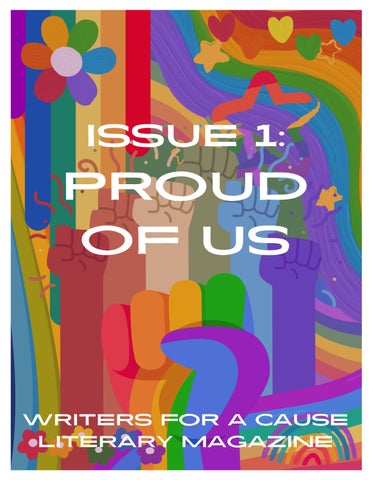
Welcome to the inaugural issue of Writers For A Cause Literary Magazine! We are so excited to present to you this collection of writing by wonderful members and allies of the LGBTQ community presenting their unique perspectives and thoughts via creative writing.
It is undoubtedly a tough time for the community. There are over 70 countries in which being gay is illegal, and even more criminalize transgender identities. In many nations, especially in Europe, there has been a rise in far-right, conservative, and traditional political parties. In the US, many pieces of legislation and executive orders have been passed restricting the rights, identities, and education for members of the LGBTQ community.
In this tough time, the need for pride and protest is more than ever. We need to celebrate our identities and revel in the rights that we fought so hard to get. This brings us to our inaugural issue of WFAC Literary Magazine. We wish to bring awareness to a new political issue with each new issue, and with Issue I, we are fighting to bring awareness to the struggles faced by the LGBTQ community and help demonstrate the pride that we found in ourselves through our identities. With that, I am so excited to present to you Issue I of Writers For A Cause Literary Magazine: “Proud Of Us”.
Claire K. Benedict
Alexander Braverman
River Braverman
Miles Hunter
Avery Key
Claire Kroening
Orla O’Donnell Ramirez
Robin Saunders
Ksenia Veronica
Raine Walton
It's a cyclical argument. Was it ever about faith? Do they find their vicious words loving, or was it always about hate.
I find a way to sleep at night and I have peace of mind. One thing we've always been taught is to look past the outside.
If my seraphic love story looks so wrong to you, how is it fair to then act like you can dictate what I do.
I know myself and I know what's right. And this in itself gives me peace of mind. So you be you and I'll be me, and you can learn to love more honestly. Because in the end we're flesh and bone. So don't hate me for who I call home.
Society mixes us a poison made of dull gray lies and tells us to drink.
They say it’s medicine, that it will dull the pain, that it will quench the fire burning us. We’ve taken their medicine all day, every day, and we’ve turned out great!
Normal and content, wearing the right clothes in the right colors with the right people at our side. No perversion, no chaos, no rainbow fire and the horror of having a say.
The hollow inside feels so wrong, so we drink more poison to fix ourselves.
But what if they’re wrong?
Maybe the hollow feeling comes from the gray and not the sparkles.
Maybe the fire was never burning us. Maybe the poison is... poisoning us? Weird thought, I know.
To tell the truth, I think they’re scared. Pride is a celebration, not a sin, and they know that just as well as we do.
Trying to smother the party just makes us sing louder. The flame flows through our blood like hate streaks through their mind.
It ignites everything around it, until our prisons burn down around us. Fire will burn the lies away.
After the wildfire, the forest will bloom, twice as lush than before.
They say we are like beasts in the night; senseless and wild. Menacing fangs, ready to devour the world.
In truth, we are like wolves; untamed with teeth to rip apart all who dares threaten our packs. With furs to cuddle the biting cold away, sharp ears and eyes to pick up on the first signs of danger.
In truth, we are like cats; finding our home back from the streets, or simply knowing how to get away from the hand that feeds nothing but pain.
In truth, we are like rats; blamed for a disease we do not have, deemed filthy and wretched by all who refuse to know us.
In truth, we are like crows; beloved by the outcasts, flock together into groups, loyal with a love that can bring gods down.
In truth, we are like mint; impossible to rid, no matter how many of us you pluck out of this earth. Persistent and all the more lovely for it.
You say we are like seeds planted in pots; destined to settle down the way the gardeners dictated, all other possible futures disregarded.
In truth, we are like the moon; the phases are nothing but your refusal to see us as a whole.
AVERY KEY, 16, USA THEY/THEM
L is for Labor of sweet nothings
I never get to see
O is for O Romeo O Romeo won't you let me be?
V is for Venus's ideology and the secrets she keeps
E is for Everyone gets it but me.
I exist
I exist in a world that tries to pretend I don't
Deny what they see and what I know
Say it is fake, a joke, a phase
Make a big deal on what they don't understand
So I exist in my head
Where only I can tell who I am
No rules to break or to follow
I can be free to feel how I know I am
No one to make these choices for me
Then I can exist to a few
Few who can see me how I see myself
Who don't doubt my being
Whether online, or in person, these people know the real me
One day maybe everyone can see me too.
ROBIN SAUNDERS, USA
HE/THEY
I am not food, Though I am a little fruity. I am not food, If you find me flavorless, You cannot just add a stick of cinnamon, Stir it in, Expecting my gratitude. I am not food, I can’t be packaged for widespread consumption, No Robin juice for you.
I am not food, I cannot be re-made Until I come out just right. I am not food, I am blood and flesh, And also the best. I am not food, I cannot be consumed, With the expectation of a conformed dish, My flavors are bold and brilliant.
HE/THEY
How can people look at love, And think hate, Ideas of empathy, Slivers of kindness, Left at the junkyard, Drive away leaving decency behind, Newly dubbed trash, Is invaluable, Yet bathed in red, Illuminated in crimson, Hindlights scream wrath.
Worn shoes,
Crusted with mud, Traverse the junkyard, Stumbling through, Radiant sun kisses their face
The only place that fits their ragged shape. Their trapezoid in a crowd of circles.
Metal warps beneath the sun, Plastic creaks upon their tread, Rubber soles on rubber tires, Compelled to explore, Collecting squares, rhombuses, and triangles
Snatching trinkets as they go
Picking up slivers, Picking up ideas, Picking up things left behind
Their pants heavy with cargo, Mouth curved in a satisfied smile, contentment with their new treasures, They radiate acceptance.
RIVER BRAVERMAN, 17, USA
HE/HIM
I came out as transgender when I was 11 years old. The COVID-19 pandemic had just begun, and I was trapped inside my house with nothing better to do but to figure out my identity, which I had been avoiding for years. When I finally realized, it felt as though a huge weight had lifted off my shoulders. I was lucky enough to have accepting family and friends, and knowing that I would finally get to live my true life was incredibly freeing. I felt like myself for the first time. However, I soon happened upon a problem: I couldn’t find anyone in media like me! I loved listening to music, watching YouTube, and reading books, but as a trans and autistic Middle Eastern Jew, I often struggled to find accurate representation for even one of my identities, let alone all of them. A few examples:
In pop culture and media, I could never find someone like me. From TV news anchors (white or white-passing, conventionally attractive) to teachers (almost always straight, white, and allistic) to popular musicians (often queer, rarely trans), I felt out of place wherever I looked. It seemed like I checked one too many “diversity boxes” - that on its own, any of my identities were fine, but I was simply too many of them. I felt incredibly isolated.
I had always been an avid reader, but as I found more and more books featuring trans characters, I noticed a pattern: none of them were happy. It seemed that I could not be trans and be content with my life. According to these books, transness was an inherently painful experience, with none of the relief or love that I felt upon coming out. Trans characters, too, could not just exist – their transness could not be incidental to the plot, it had to be central. Trans
characters could not be anything other than simply trans. After months of increasingly desperate searching, I finally found a book with a main character I related to – Felix Ever After, by Kacen Callendar. Felix is trans, yes, but he is so much more. He is an artist, a friend, a son. At one point, Felix muses about being Black, trans, and queer, thinking “It’s like every identity I have . . . the more different I am from everyone else . . .and the less interested people are.” I was so grateful to read my own feelings put on paper that I created a TikTok account to broadcast it, and books like it, to other people who may also have felt isolated. Five years later, I’m still regularly posting. In movies and shows, too, representation seemed lacking. It was only very recently, with the new Netflix series Heartbreak High, that I’ve seen autistic characters played by autistic people. Before, all the shows were either vaguely patronizing (see Love on the Spectrum) or autistic characters were portrayed by people who have no idea how it feels to be autistic (Extraordinary Attorney Woo, Atypical). I enjoy these shows, sure – they're fun and the representation is well- researched and not harmful – but autistic people can act too, and deserve to play starring roles (side note, I can almost always tell when allistics play autistics – I feel like I’m being made fun of, even when I’m not). Similarly, the main LGBTQ teen show until very recently was Love, Simon, a show that focuses on a privileged white gay boy. His story is worth telling, of course, but many others are too. This has started to change recently with the rise of shows like Heartstopper – a genuinely fantastic show with beautiful, authentic, varied representation – but for many years, multiply marginalized people like myself were erased from media, invisible to the public eye.
The one place I took solace was in American politics. That may seem a little backwards, but in politics, I saw other
multiply marginalized people that were speaking out about issues happening to people like us. Angela Alsobrooks, a neurodivergent Black woman. Tammy Duckworth, a disabled Asian woman. AOC, a working-class Latina. Ilhan Omar, a Somali Muslim woman. They knew what it was like to check too many boxes, and they were standing up and fighting for people like me. This made me realize that my struggles weren't solitary. As much as I might feel alone, people cared about me and my experiences. I mattered. Politics made me feel like my voice was important, and that it should be heard.
Politics was also the first place I realized that people like me had always existed. The existence of representation in popular culture has all been relatively recent, with the subtext being: we wouldn’t have you here if we didn’t have to. But in American politics, I saw diversity going back centuries. Yes, white men have always been platformed, but there were also people like Hiram Revels, the first Black Senator after the Civil War. Ruza Wenclawska, a Polish labor union leader dedicated to women’s suffrage. Sylvia Rivera, a trans Latina activist instrumental to the Stonewall Riots. Shirley Chisholm, a Black woman who ran for President back in the 1970s.
I could name-drop for hours, but you get the idea. Because of them, I want to be a politician. I would be the first trans and autistic politician ever in the US, but why should that stop me? Hiram Revels, Sylvia Rivera, Tammy Duckworth, AOC, were firsts of their own, and they changed history. The unique perspectives arising from their intersectional identities were not a hindrance, but a vital part of this.
As a politician, I will be able to fight for the rights of people like me. I will try to inspire others like I have been inspired, by positive and authentic representation. And someday – not despite my identities, but because of them – I will change the world for the better.
I am not proud of being transgender, nor of the struggles that ensue. I cannot choose who I am, or why I am that way. Maybe it was some gene, slipping in unseen from my parents until it resurfaced in me; maybe it was just chance, a malfunction of nature that created me. Can I be proud of something I did not choose? Claiming to be proud of being trans is claiming to be proud of your hair color, of your eyes. So how can we ever be truly proud? To answer this is to come to terms with being human, and to realize that selfreflection is the epitome of an identity. What are we willing to do to change what cannot be undone? What would we do to keep things that inevitably slip from our grasp? These arbitrary traits—our hair, our eyes, our gender are not who we are, but they shaped us nonetheless. So I am not proud of being transgender, but I am proud of who I am because of it; I am proud not of the struggles I have overcome, but that I have overcome those struggles. I am proud of the person I have become, and I am proud of the person I will be, because I know he will exist because I have striven to become myself. I am not proud of what was never my choice, but I will always be proud of who I am.
ORLA O”DONNELL RAMIREZ, 15, USA SHE/HER
I’m proud of all the people who get help when they need it
Of the people who get the gender-affirming care that they need
I’m proud of All the people who boycott for others’ safety and livelihood
I’m proud of all the people who are mad at the companies who only care about Pride in June.
I’m proud of my mom for giving me a safe space to exist in, a driven sense of self and the idea that I can become anything but set my mind to
I’m proud of my brother for existing as a trans man in today’s world
I’m happy that people are able to resist in all the ways they do And I hope, for everyone’s sake, that they continue
THANK YOU!
I cannot thank you all enough for allowing me to do this project. I am a writer and have been submitting to literary magazines and writing competitions for years, and I am so grateful to be able to give back to my community. I am very passionate about social justice and plan to go into a career in politics, so being able to combine my two interests into this beautiful amalgamation is literally a dream of mine and an idea I have had for years. This started as a project for school but it has grown into a passion project and so much more (seriously, I spent more than twice the time than I was supposed to). I am so incredibly grateful for all of the people who submitted to this magazine and for my friends who enabled me to make this project. I am so excited for this to continue into more and more issues so that we can grow for years to come. Thank you to all of the people who contribute at all, whether that be as small as following our Instagram or even just talking about it, it all helps me and my motivation. Most of all, Thank you to all of the lovely readers who made it this far, this can’t be done without your support. With that, I hope we will see you with Issue 2!
Michael DeLaPlante Founder and Editor-in-Chief of Writers For A Cause Literary Magazine