NATIONAL
HEALTH REFORM AGREEMENT (NHRA)

HEALTH REFORM AGREEMENT (NHRA)
Real outcomes. Lasting impact. Stronger communities.
• Outcomes
• People
• Communities
• Systems
• Value

Rural and remote Australians face poorer health outcomes and inequitable access to care.
Workforce shortages, fragmented services and funding gaps continue to impact communities.
Schedule F enables a place-based, integrated and sustainable approach to rural healthcare.
Long-term, flexible and outcomesfocused investment
Community-led planning and governance
Coordinated services across the care continuum
WORKFORCE STRATEGY
Attract, train and retain rural health professionals
FRAGMENTED FUNDING
FIFO WORKFORCE
EPISODIC CARE
DUPLICATED REPORTING
HOSPITAL DEPENDENCE

WORKFORCE CHURN
“THE CURRENT SYSTEM WAS DESIGNED
Over 2.3 million Australians live in MMM5–7 areas where service access is limited, markets are thin or absent, and need is greatest.
Up to 30–40% of retrievals from remote areas are potentially avoidable with access to the right care, closer to home.
Billions in Commonwealth funding for remote and regional Australians goes unclaimed or under-utilised due to system complexity and capacity gaps.
Markets in many remote areas are too small or unattractive to sustain essential services—leaving communities reliant on fragile, short-term solutions.
THE SYSTEM IS NOT FAILING REMOTE COMMUNITIES IT WAS NEVER DESIGNED TO INCLUDE THEM
The National Health Reform Agreement aligns Commonwealth and State commitments around what matters most for Australians—better health, fairer access and stronger systems.
Mental Health & Suicide Prevention
Better access, earlier support and communitybased care

Workforce
Health Workforce, Training and Innovation
Better Health Equity for Rural and Remote Communities
Integrated Health Services
Better integration of health services
Aboriginal and Torres Strait Islander Health Equity
Implementation, Monitoring and Review
ALIGNING INVESTMENT • REDUCING DUPLICATION • IMPROVING OUTCOMES Through place-based, integrated approaches.
Enables regional stewardship of holistic care across the life course—not just episodic or programspecific services.
• Supports multidisciplinary teams and care coordination
• Allows blending of services to meet community needs
• Reduces fragmentation and duplication
Enables regional areas to commission and adapt services that reflect local priorities and realities.
• Pooled and flexible funding across programs and providers
• Simplified reporting and compliance
• Faster decisions, closer to the community
Supports upstream investment and community-led solutions that build long-term health and resilience.
• Fund what prevents poor health, not just treat it
• Invest in social, cultural and environmental determinants
• Empower communities to design local solutions
DIGITAL AND DATA ENABLERS
Place-based,
Enables flexible, place-based workforce solutions that respond to local need.
• Supports training, retention and local career pathways
• Enables task-sharing and innovative scopes of practice
• Invests in the care economy as a productivity engine
Enables connected systems and data use that improve care and decision making.
• Invests in digital infrastructure and interoperability
• Enables outcomes measurement and data-driven planning
• Supports telehealth and remote service delivery
The pooled funding model shifts from program silos to a unified investment approach. It aligns with NHRA reforms and gives regions the flexibility and accountability to deliver what matters most.
• 42% of WQPHN residents in MMM6–7 have no regular access to Medicare billable services.
• Cash-out arrangements to assure equity of access to Australia’s universal healthcare system.
• Proactive team-based care focused on wellbeing and early engagement support.
• Approaches need to support aged care and disability services.
• Combines activity-based, capitation and outcomes-based payments to balance flexibility with accountability.
• Funds what works: evidence-informed outcomes.
• Builds local capability and innovation.
• Drives equity and improved system performance.
From multiple funding streams with multiple rules, to one investment logic with shared outcomes.
ONE REGION. ONE SET OF OUTCOMES FOR THE OUTBACK FRAMEWORK. ONE INVESTMENT LOGIC.
Moving from fragmented programs to a pooled, place-based investment that funds outcomes and strengthens local systems.
CURRENT STATE Fragmented inputs and reporting
PROGRAM A
Primary Care Initiatives
PROGRAM B
Chronic Disease Programs
FUTURE STATE
Pooled investment for place-based impact
SINGLE POOLED INVESTMENT
Aligned funding streams working together.
PLACE-BASED COMMISSIONING Decisions driven by local needs and evidence.
PROGRAM C Mental Health Programs
PROGRAM D
BETTER OUTCOMES FOR COMMUNITIES
Aged Care & Other Programs $
Improved health, equity and system sustainability.
The impact on individuals, families, friends and the health system

Noticing a change in health or wellbeing.
Contact local clinic, telehealth or health service.
PLAN & PREPARE
Travel, accommodation and time off work arranged.
Long distances, multiple modes, weather dependent.
Consultation, tests and treatment.
Follow-up, recovery and ongoing care (often remote).
EVERY STEP TAKES TIME, MONEY AND ENERGY WITH IMPACTS THAT GO FAR BEYOND THE APPOINTMENT. EVERY STEP ADDS A RISK TO CARE CONTINUITY.
Out-of-pocket and time costs
TRAVEL
Flights, fuel, vehicle wear and tear, public transport.
ACCOMMODATION
Hotels, short-term rentals or staying with others.
FOOD
Meals while away from home.
FUEL
Long distances and multiple trips.
TIME OFF WORK
Lost wages, reduced leave, career impact.
These costs add up. For many, they are a barrier to seeking care.
IMPACT ON FAMILY & FRIENDS
The ripple effect
TRAVEL & ACCOMMODATION
Family/friends travel to support their loved one.
TIME OFF WORK
Lost wages and annual leave.
CARE RESPONSIBILITIES
Finding care for children, elders or others at home.
EMOTIONAL IMPACT
Stress, worry and time away from own wellbeing.
THE BIGGER PICTURE
It’s not just a healthcare issue. It’s a community and societal issue.
Those who care, also pay a cost.
Health and wellbeing impacts
MISSED CARE
Delay or forgo seeking care due to cost, time or access.
POORER OR LATE DIAGNOSIS
Conditions progress, more complex to treat.
MORE COMPLEX TREATMENT
Increased interventions, medications and recovery time.
IMPACT ON WELLBEING
Worry, stress, pain and reduced quality of life.
Delays today can lead to worse outcomes tomorrow.
IMPACT ON THE SYSTEM
Higher costs and pressure
EVACUATION COSTS
Retrievals are expensive and increasing.
LATE TREATMENT COSTS
More complex care, longer stays, more resources.
HIGHER COMPLICATION RATES
More readmissions, ongoing care and chronic disease.
WORKFORCE & CAPACITY PRESSURE
Strain on services, workforce and beds.
Investing earlier in access and prevention saves more later.
People in isolated places deserve the same opportunity for good health.
Equitable access reduces personal hardship and health inequality.
Stronger local services, telehealth and outreach support earlier care and better outcomes.
A sustainable system starts with prevention, access and maintaining wellbeing.
Better access today means a healthier community and a more sustainable system tomorrow.
The workforce model combines:
Built from the community, for the community.
Outreach and fly-in/fly-out models that add, not replace.
Extending reach, improving timeliness and reducing travel.
Lived experience, trusted relationships, better outcomes.
Culturally safe care as a core competency.
THE CHOICE IS OURS, THE FUTURE IS THEIRS.
TWO PATHS. TWO FUTURES. WHICH ONE WILL WE CHOOSE?
THE CURRENT STATE
Too late. Too hard. Too costly.
01 SICK CARE (REACTIVE)
Treating illness, not preventing it.
02 DELAYED & DISCONNECTED
Long waits, travel burden, missed care. 03 HIGHER COSTS, POORER OUTCOMES
More avoidable hospitalisations and worse health. 04 FRAGMENTED & HARD TO NAVIGATE
Confusing systems, lost in the gaps. 05 NOT SUSTAINABLE
Strain on services, workforce and communities.
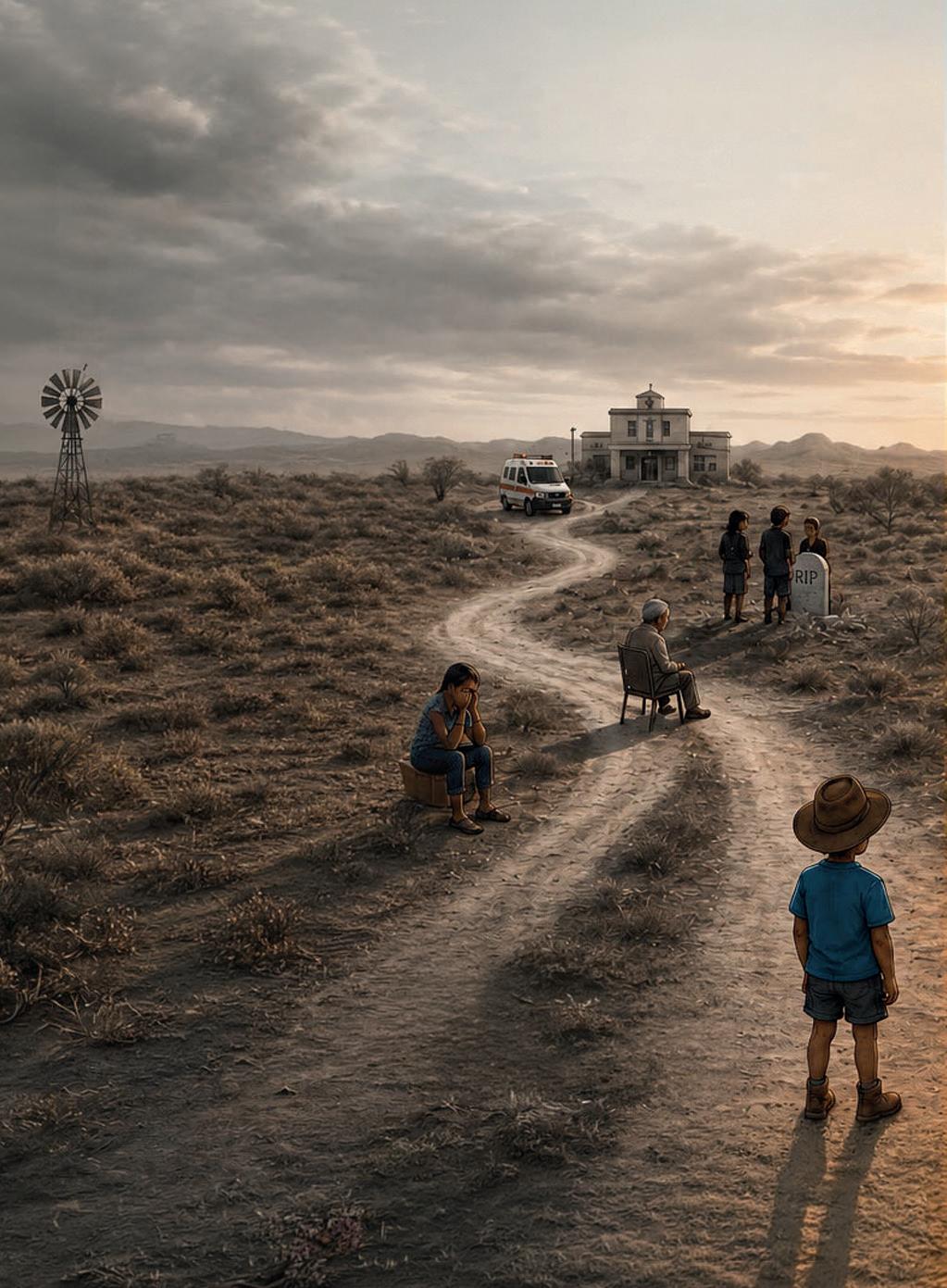
We wait until it’s too late...
01
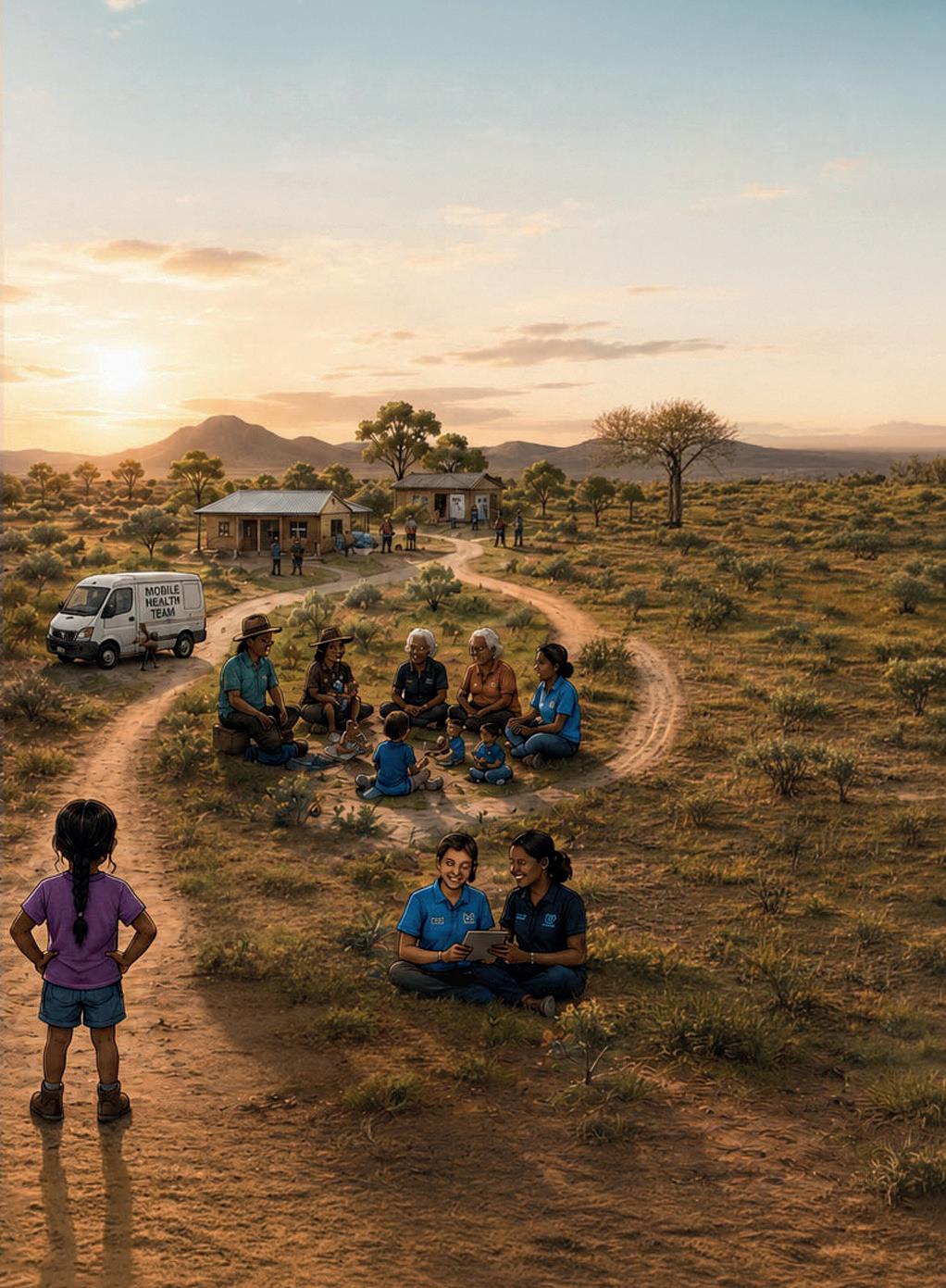
FUTURE STATE
Engaged, accessible and outcome focused.
WELL CARE (PROACTIVE)
Preventing illness, promoting wellbeing.
02 INTEGRATED & PLACE-BASED
Care closer to home, coordinated around local needs.
03
BETTER OUTCOMES, LOWER COSTS
Healthier communities, less avoidable disease and pressure.
04 EASY TO NAVIGATE, BUILT TOGETHER
Local solutions, trusted relationships, one team.
05 SUSTAINABLE & FUTURE READY
Stronger workforce, resilient communities, lasting impact. We act today for a stronger tomorrow.

Policy and funding settings
Holistic Commonwealth
investment strategic stewardship and enablement
LOCALITIES
Place-based planning and collaboration
MICRO SYSTEMS
Local delivery and community solutions
Transparency, learning and impact
Not purchasing episodes. But enabling:
Helping communities and providers find the right support.
Empowering communities to shape priorities and outcomes.
Connecting systems for seamless, coordinated care.
Strengthening teams and retaining local capability.
International evidence confirms that stewardship models improve access, continuity and outcomes.
Source:WHO,2022;CommonwealthFund,2021

ICHOM International standard sets for outcomes
• EQ-5D-5L (quality of life)
• PHQ-9 (mental health)
• Diabetes control (HbA1c)
• Blood pressure control
Measuring
Matters OFtO Outcomes for the Outback
• Community resilience index
• Participation in community life
• Cultural safety and inclusion
• Local workforce retention rate
• Vacancy rate (priority roles)
• Workforce wellbeing score
• Cost per person (risk adjusted)
• Avoidable hospital admissions
• Retrievals (rate per 1,000)
• Access by remoteness
• Closing the Gap indicators
• Service coverage equity
Better health and wellbeing
We measure outcomes that matter to individuals across physical and mental health, and quality of life.
Stronger communities
We measure the strength, connection and resilience of our communities.
A capable, supported workforce
We measure the capacity, stability and wellbeing of our local workforce.
Value and sustainability
We measure the value we deliver for the investment made, focusing on outcomes and efficiency.
Fair access, fair outcomes
We measure equity of access and outcomes, ensuring no one is left behind.
• EQ-5D for quality of life
• PHQ-9 for mental health
• Chronic disease indicators
• Functional independence
• Community resilience index
• Participation and connection
• Cultural safety and inclusion
• Local workforce retention
• Vacancy rates in priority roles
• Workforce wellbeing
• Cost per person (risk adjusted)
• Avoidable hospital admissions
• Retrieval reduction
• Access by remoteness
• Closing the Gap indicators
• Service coverage equity
Outcomes for the Outback
REGIONAL STEWARDSHIP
WQPHN as the trusted convenor and system steward
Build relationships and trust
Deep community partnerships and local voice
Connect across the system
Help people and providers navigate services seamlessly
Enable timely, equitable access to care
Right care, right place, right time

Best start, bright futures for our children and young people
Stronger communities, better health, together
Supporting older people to live well, locally
WQPHN has established the infrastructure, partnerships and capability to steward a connected, outcomes-focused primary health care system for Western Queensland.
We have invested in deep, long-term relationships with communities, Aboriginal and Torres Strait Islander organisations, Local Health Networks, providers and local leaders. This trust is the foundation for meaningful engagement and sustainable change.
Our community connectors and navigators bridge the gap between people and the health system—helping individuals and families understand their options and access the right care, in the right place, at the right time.
We have developed multidisciplinary team (MDT) models and integrated care pathways that bring together GPs, nurses, allied health, mental health, social care and community services around the needs of individuals and communities.
Our commissioning approach is flexible and responsive—using local insight, data and outcomes to adapt services, remove barriers and invest in what works. We are ready to scale outcomes-based commissioning across the region.
WQPHN is ready to move from commissioning to stewardship driving better outcomes for Western Queensland.
Multidisciplinary models active across the region Outcomes-focused commissioning piloted and scaling
Outcomes for the Outback (OFtO) → Healthy Outback Communities (HoC) A place-based, person-centred, outcome-focused system of care for remote Australia.
Why traditional models don’t work in no-market environments
1. NO-MARKET REALITY
• Small populations, vast distances
• Limited providers and services
• Market-based models are unsustainable
2. FRAGMENTED & REACTIVE SYSTEMS
• Siloed funding and programs
• Duplication, gaps and inconsistent access
• Crisis-driven care, not continuous care
3. WORKFORCE CONSTRAINTS
• Shortages, high turnover, reliance on FIFO/DIDO
• Limited local career pathways
• Workforce burnout and reform fatigue
4. LIMITED OUTCOMES FOCUS
• Activity-based funding
• Lack of continuity and closed care loops
• Outcomes for people and communities not improved
5. ENVIRONMENTAL & SOCIAL PRESSURES
• Climate-related disasters disrupt services
• Social isolation and disadvantage
• Complex needs require more than clinical care
6. CHANGE IS HARD
• Resistance to new ways of working
• Weak internal coordination and change management
• Staff churn impacts momentum and continuity
SUSTAINABLE CHANGE
REQUIRES STRONG RELATIONSHIPS, LOCAL LEADERSHIP AND SHARED ACCOUNTABILITY.
People, Place, Culture & Community at the Centre
We listened. We learned. We co-designed. We are building better systems together.
OUR SOLUTION: A SYSTEM BUILT FOR NO-MARKET ENVIRONMENTS
1. PLACE-BASED STEWARDSHIP (OFtO FRAMEWORK)
• Built around Engage, Navigate, Access
• Life-stage approach across the continuum
• Local priorities, local leadership, regional support
2. INTEGRATED SERVICE DELIVERY (CPHC)
• Comprehensive Primary Health Care
• Health + social care + community supports
• Multidisciplinary teams with shared care plans
3. NAVIGATION & CONNECTION
• Connector workforce as the glue
• Single point of connection, closed care loops
• Social prescribing and community linkages
4. OUTCOMES & VALUE FOCUS
• Outcomes-based commissioning (VBHC principles)
• ICHOM-aligned outcomes that matter
• Data for action, learning and continuous improvement
5. RELATIONAL COMMISSIONING & ALLIANCES
• HoC Alliance & Mates of HoC (M8’s)
• Pooled and flexible funding
• Shared accountability for results
6. FIT-FOR-PURPOSE MODELS & TECHNOLOGY
• Blended care: face-to-face, virtual, outreach
• Technology enabled but people led
• Flexible, resilient and community anchored
BETTER OUTCOMES for individuals, families and communities
STRONGER COMMUNITIES connected, resilient and empowered
SMARTER SYSTEMS efficient, integrated and sustainable A FAIRER FUTURE closing the gap for remote Australians

Canberra Commonwealth Government
Region
Western Queensland and Remote Communities
PARTNERSHIP FOR PLACE BASED REFORM
TRUST RESPECT
RECOGNITION OF PLACE SHARED ACCOUNTABILITY BETTER OUTCOMES
1

2
3
4
5
6
7 $
LOCAL AUTHORITY
Enable local planning and commissioning through a pooled funding arrangement.
WORKFORCE FLEXIBILITY
Flexibility to recruit, retain and deploy workforce models that fit remote realities.
REGULATORY ADAPTATION
Adapt regulations and scopes to support innovative, team-based care.
DATA LINKAGE
Enable secure data linkage and interoperability across systems.
INDEPENDENT EVALUATION
Support independent evaluation to demonstrate impact and guide improvement.
COMMUNITY CO-DESIGN
Embed community leadership and codesign in governance and service design.
SUSTAINABLE FUNDING
Provide multi-year funding certainty to enable long-term planning and retention.
CROSS-SECTOR ALIGNMENT
EVIDENCE BASE
64,000+ people across Western Queensland and remote communities
Higher burden of chronic disease and preventable hospitalisations
Workforce shortages severely impact access and continuity
8
Align health, housing, education and social services to address root causes. 9
SCALABLE LEARNING
Invest in learning systems that capture what works and scale across remote Australia.
Place-based models deliver better outcomes and greater value
Building impactful, enabled systems and stewardship to deliver better outcomes and stronger remote communities.

Australia does not suffer from a shortage of reviews. It suffers from a shortage of implementation. Twenty-five years of evidence. One persistent challenge.
NATIONAL INQUIRIES
STATE AND TERRITORY REVIEWS 100+ EVALUATIONS
HUNDREDS OF ACADEMIC STUDIES
4 ROYAL COMMISSIONS
20+ PRODUCTIVITY COMMISSION REPORTS
Different sectors. Different jurisdictions. Remarkably consistent findings.
WE KNOW WHAT WORKS
Place-based approaches
Shared stewardship
Flexible funding
Community and Aboriginal community-controlled leadership
Integrated multidisciplinary teams
Navigation and care coordination
Local capability and workforce investment
Measuring outcomes rather than activity
WE KNOW WHAT WORKS THE COST OF DOING NOTHING FRAGMENTATION
UNMET NEED
CRISIS DEMAND
Move from Program Delivery → System Stewardship Stewardship creates value
INVESTMENT REGIONAL STEWARDSHIP SYSTEM INTEGRATION BETTER OUTCOMES PRODUCTIVITY COMMUNITY WELLBEING PLACE BASED SOLUTIONS
ALL SUSTAINABLE FUTURES
DESIGNED FOR COMMUNITIES • BUILT FOR COUNTRY • INVESTING IN WHAT MATTERS
What multiple reports and policy reviews tell us:
01
One size does not fit all. Centralised systems fail to reflect rural and remote realities.
02 Structural disadvantage persists. Geography, scale and remoteness drive higher costs and poorer outcomes.
03 Communities are under-utilised.
Local knowledge and capability are not being empowered or resourced.
04 Fragmentation drives inefficiency. Duplication, gaps and silos waste resources and weaken impact.
05 Investment must be outcomes-led.
Shift from activity funding to place-based outcomes that last.
WE NOW HAVE AN
To enable pooled investment that delivers outcomes that matter.
Community-led and empowered
Place-based and flexible
Evidence-driven and outcomes focused
Collaborative and aligned
Sustainable and efficient



June 2026