World Leather Feb-Mar 2026

Page 1


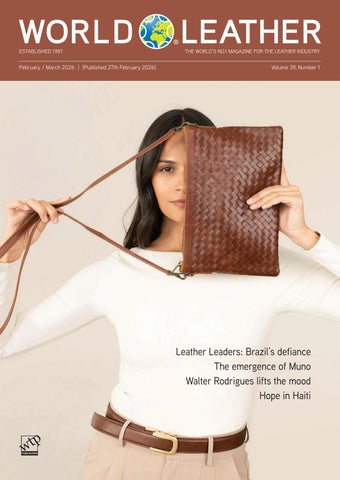
Leather Leaders: Brazil’s defiance

The emergence of Muno Walter Rodrigues lifts the mood Hope in Haiti

News

2 News map News highlights from around the global leather industry.

5 Industry & Innovation New technology, new ideas from leather industry suppliers and service providers.

8 Leatherscene People from around the industry and famous lovers of leather who have made the headlines in recent weeks.

Leather Leaders

11 AI’s promise President of Brazilian tanning industry association CICB, José Fernando Bello, says the leather sector must not be left behind in the move to artificial intelligence.

Special Report

14 Cautious confidence Times are tough, but exhibitors and organisers at the India International Leather Fair in Chennai are looking forward with a degree of optimism.

Technology

16 Creative space A new innovation hub that leather chemicals group GSC opened in Arzignano last year brings laboratories, training, research and technical support facilities under one roof.

18 Social benefits Inescop’s recent involvement in the Sustainable Yak Leather (SYL) project in Mongolia highlighted that a transition to more responsible production can yield social and economic benefits, as well as environmental ones.

21 Independent idea At the start of 2026, the spin-off of Stahl’s wet-end chemicals business came to completion, with new, independent company Muno emerging as a result.

24 Top tips Leather’s applications remain wide-ranging, as its ongoing use in cue sports makes clear.

Leather and the Circular Economy

29 Thought Leadership: Recruitment drive The formal signing of a new agreement between the Italian government and the country’s fashion sector raises hopes of new talent coming into the leathergoods and footwear industries.

32 Thought Leadership: Gain from pain Economics and sustainability seldom mix well, but Euromonitor’s Marguerite Le Rolland argues that a circularity bonus has accrued from recent hard times: consumers are making things last longer.

35 Thought Leadership: Beamhouse benefits JBS Couros’s Kind Leather initiative, launched in 2019, has helped the company find uses for every part of the hides it sources.

38 Circular Stories: Bright spark Brazilian designer Walter Rodrigues insists the leather industry can play an important role in lifting the mood in a troubled world.

44 Circular Stories: Cowboy culture Beyoncé may have helped widen interest in cowboy boots, but there are brands and consumers who have loved western-style footwear for many decades.

Beast to Beauty

48 Fair trade in the face of disaster Leathergoods and footwear brand Deux Mains is providing life-saving job opportunities in Haiti, where the unemployment rate is estimated to be 80%.

52 Essential reading

IBC Advertisers’ index

Cover image: In the face of disaster and adversity, accessories brand Deux Mains has built a successful business in Haiti.

CREDIT: DEUX MAINS

The World Leather team has been publishing a series of original, dynamic podcasts since 2019. The whole series is available on Anchor, Spotify, Apple Podcasts, Google Podcasts, Pocket Casts, Overcast and other podcasting platforms. Just search for the World Leather Podcast on the platform you prefer.

The world’s best leather industry magazine is now available to download on iPad from www.leatherbiz.com

@WTPworldleather

@WTPworldleather

linkedin.com/showcase/wtpworldleather

@WTPworldleather

World Trades Publishing Ltd 2026. Contributions: The editor welcomes news items, articles and photographs for consideration and possible publication but no responsibility can be accepted for the loss or non-publication of such material. Opinions expressed by individual contributors do not necessarily reflect the view of the editor or publisher.

• Whilst every effort is made to ensure accuracy in reproduction, no responsibility can be accepted for the technical content or for claims made by manufacturers for product performance that are published. Publication in World Leather cannot be construed as an endorsement for a claim or product by the publisher.

• World Leather is published 6 times per year by World Trades Publishing, The Old Stone House, Teeton, Northampton NN6 8LH UK. Price UK £90, ROW: £150 per year (six issues).

Graphic origination by WTP. Print by Bishops Printers, Walton Road, Portsmouth, Hampshire PO6 1TR, England. All rights reserved. ISSN 0894-3087

World Trades Publishing 2026: All rights reserved. No part of this publication may be reproduced, stored in a retrieval system or transmitted in any form or by any means mechanical, electronic, recording, photocopying or otherwise, without the written permission of the publisher. World Leather®, Tannery of the Year® and Nothing to Hide® are

The World of News

UK Fashion retail group Next has acquired the Russell & Bromley shoe brand and three of its stores. The family-run firm found itself unable to turn its business around from recent financial difficulties. At the time of the sale, it had 36 stores in the UK and Ireland and. nine concessions.

FRANCE France’s leather-sector exports for January-November 2025 had a value of €184.1 million, down by 3% year on year Bovine hides brought in €113.4, down by 2% compared to the same period in 2024. The decline in the value of calfskins was much steeper, reaching €33.8 million, a fall of 20% year on year. The upward trajectory of the value of sheepskins continued with a figure of €13.8 million for the 11-month period, up by 28%.

PORTUGAL Portuguese

footwear exports rose 1.8% in volume and 0.8% in value in 2025, reaching 68 million pairs and €1.7 billion, APICCAPS reported. Growth was driven mainly by European markets, which increased 3.3% to €1.4 billion, while exports to the US fell 12% to €84 million.

GLOBAL Analysis of global luxury spending shows that the US is now the most important market for high-end brands, taking over from China. Global investment research Bernstein said US consumers accounted for 31% of global luxury spending in 2025. Before the covid-19 pandemic, the US’s share of the market was 22%.

GERMANY The country’s footwear manufacturers achieved combined revenues of €2.3 billion in 2025, an increase of 3.2% compared to 2024, according to the German Footwear and Leathergoods Association, HDSL. In parallel, Germany imported footwear with a combined value of €13.3 billion in 2025, an increase of 14% year on year.

• Germany’s livestock and meat industry is calling for stronger policy measures to meet growing global protein demand while maintaining high animal welfare and climate standards. Dominik Wisser of the Food and Agriculture Organisation of the United Nations told the Association of the Meat Industry (VDF) that global demand for animal protein is expected to rise 20% by 2050.

ITALY Mipel and Micam will be part of a wider event identity called Fashion Link. Events for jewellery, outer wear and wedding collections will also be part of this. From September, Lineapelle and Simac-Tanning Tech will also become components of Fashion Link.

SLOVENIA Italian leather manufacturer Gruppo Dani will close its Slovenian subsidiary Dani AFC, which makes leather kits for car interiors, by the end of March, Slovenian media reported. The company said the move reflects volatile automotive orders, higher energy costs, the impact of the war in Ukraine, and increased labour costs linked to winter holiday pay and higher minimum wages.

TANZANIA A materials scientist who has founded a company to develop tannins from waste from the cashew sector in Tanzania has also set up a nongovernmental organisation to encourage girls to pursue science careers. Dr Cecilia China, founder of AfriTech Organic Leather Company, said: “If we use cashew waste for leather processing, women can earn income by collecting and supplying that waste.”

SAUDI ARABIA Luxury group Kering is once again working with the Saudi Fashion Commission to run the Kering Generation Award, for fashion start-ups in the Middle East. This follows an inaugural edition in 2025, which attracted more than 500 applicants. The themes for this year’s competition is “key challenges in sustainable fashion”.

THAILAND A new leather finishing centre in Thailand, LFC/Thailand, a wholly owned subsidiary of Evolved By Nature, has been awarded Gold certification by the Leather Working Group (LWG). LFC/Thailand operates as a centralised leather finishing facility and uses Evolved By Nature’s L1 biofinishing system.

BRAZIL Brazilian footwear manufacturers sold 219,600 pairs of shoes worth $4.1 million at the Expo Riva Schuh event in Italy in mid-January. When adding total trade anticipated from the show, the figures jump to 862,000 pairs and $5.4 million. Paola Pontin, business coordinator at Abicalçados, said: “The positive signal around the Mercosur–European Union agreement gave negotiations an extra boost.”

• Brazil’s leather industry brought in revenues of $75.5 million from exports of hides and skins in the first month of 2026. Industry body CICB said that, compared to the same month last year, this represents a fall of 23%.

The World of News

US Twelve Brazilian tanneries showcased their leathers at Lineapelle New York in January. The US is the second most important destination for Brazilian leather exports, behind only China, with a predominant share (over 90%) of finished leather. However, sales to the US showed a downward trend during 2025, despite “intense effort” by CICB to reverse the leather surcharge.

INDIA The European Union and India have finalised a free trade agreement that eliminates import duties on Indian leather and footwear exports to the EU. Tariffs on leather and footwear, previously set at 17%, will now be reduced to zero, offering relief to the sector after US tariffs of 50% were imposed last year.

• A programme called Assomac Around the World led to 25 Italian leather and footwear machinery manufacturers travelling to Chennai to take part in the India International Leather Fair (IILF). Assomac’s market analysis put the combined value of India’s leather and footwear sectors at €19.6 billion in 2025, with the expectation that this will grow to more than €40 billion by 2030.

JAPAN Sports group ASICS has opened its first dedicated production facility for its Onitsuka Tiger brand. It will make its formal leather shoe line, The Onitsuka, at the facility and, for the first time, leather bags.

CHINA Leather-industry exports from China in the first 11 months of 2025 had a value of $75 billion, a decrease of 11% compared with the same months in 2024, according to the China Leather Industry Association (CLIA). Revenues for leather-makers reached $6.75 billion, an 11% decline. Tanners imported around 1.3 million tonnes of raw hides and skins, with a total value of just over $1 billion, falls of 4.6% in volume and 16.5% in value.

• Mainland China’s personal luxury goods market contracted by 3-5% in 2025, a slower decline than in 2024, according to Bain & Company. Leathergoods declined by 8-11% in 2025. The consultancy linked weaker leathergoods demand to price increases and limited innovation.

AUSTRALIA Australian lamb prices reached records in 2025. Well-finished lambs achieved premium prices, but fell below average when they lacked finish. “This distinction matters because it can create the impression of a widespread shortage, even when overall lamb availability is reasonable,” said Emiliano Diaz from Meat and Livestock Australia.

A symphony of NATURAL LEATHER SOLUTIONS

Since 1920, NTE Mimosa has used wattle mimosa to create a comprehensive range of sustainable, environmentally-friendly tanning products for the world’s finest leather.

Industry & Innovation

Bureau Veritas buys Spin 360

Milan-based leather-focused consultancy Spin 360 has been bought by Paris-based testing and certification services provider Bureau Veritas.

Bureau Veritas said it wanted to combine Spin 360’s proprietary tools for lifecycle assessment (LCA) with its own certification and supply chain auditing expertise. It said this would help position Bureau Veritas as “a global centre of excellence for premium fashion and luxury”.

Spin 360 was founded in 2009 by Federico Brugnoli, who has played a prominent role for many years in promoting sustainability in the production of leather and leathergoods.

Mr Brugnoli was one of the main architects of European leather’s product environmental footprint category rules, which the industry developed between 2013 and 2018. He has also played a leading role in helping leather manufacturers and fashion companies carry out LCA studies. This data has helped the global leather industry challenge inaccurate information about leather’s environmental footprint in widely used tools such as the Higg Material Materials Sustainability Index (MSI).

“After 15 years as an independent company, we felt the need to partner with a strong, global organisation to further increase our impact,” said Mr Brugnoli. He paid tribute to the rigour and global reach of Bureau Veritas and said he was excited about the journey ahead.

This journey will involve expanding the scale, reach and impact of Spin 360’s sustainability advisory services, digital tools and lifecycle expertise.

No effect on Muno from Henkel deal

The proposed sale of leather chemicals manufacturer Stahl to in Düsseldorfbased group Henkel will have no bearing on Muno.

Majority shareholder Wendel announced on February 4 that it had decided to sell its equity in Stahl to Henkel. It said minority shareholders BASF and Clariant would also sell, and that the deal valued Stahl at €2.1 billion.

But this does not include the wet-end leather chemicals part of the business, which has been operating since the start of January as Muno, a fully independent company.

Henkel’s purchase of Stahl is still subject to regulatory approvals and a consultation process. The companies have not said when they expect the deal to be complete. When it is, though, Wendel’s only remaining interest in the leather industry will be recent spin-off Muno.

APLF 2026 to feature single-floor layout

APLF 2026 will take place 12–14 March at the Hong Kong Convention and Exhibition Centre, bringing the global leather and fashion industries together for three days of sourcing and networking.

For the first time, APLF Leather, Materials+ and Fashion Access will all be located on Level 1 of HKCEC, creating a single-floor exhibition designed to improve circulation and connections across categories.

Around 800 exhibitors and 17 national pavilions are expected, with 9,000 professional visitors, covering tanneries, material innovators, chemical suppliers, component specialists, brands, buyers and product developers. National pavilions include Australia, Brazil, China, France, Germany, India, Italy, Japan, Mexico, Pakistan, Spain, Thailand, Turkey, USA and Uzbekistan.

Wollsdorf Leather goes into administration

Reports from Austria have confirmed that Wollsdorf Leather Group’s future is in the hands of external administrators. Restructuring and insolvency company KSV has confirmed that it is working on a turnaround plan for the leather manufacturing group, with a partner company, Kapp & Partners, handling dayto-day administration.

It has said it may be possible for parts of the business to continue but only if this is in keeping with best interests of creditors.

The corporate structure comprises Wollsdorf Leder Schmidt and Wollsdorf International. Wollsdorf Leder Schmidt operates the company’s leather manufacturing plant in Austria. Wollsdorf International has 90% ownership of Wollsdorf Leder Schmidt. The group also has leather production, leather cutting and sales operations in Mexico, China, Hong Kong, Croatia, Uruguay and the US.

Leatherbiz has asked KSV what the restructuring of the company will mean for these operations. The documents it has published suggest that a sale of assets is likely to be part of the turnaround plan KSV presents to creditors and to the authorities.

Scarpa applies circular leather use in Mojito Re-Shoes

Specialist ski and outdoor footwear group Scarpa has introduced a revised version of its Mojito footwear model incorporating recycled leather, developed within the LIFE Re-Shoes initiative, cofunded by the European Union’s LIFE Programme.

Sciarada Industria Conciaria carried out hydrolysis of used leather and reused the resulting liquid in the retanning of new leather, demonstrating circular leather use in the project.

LIFE Re-Shoes ran for 42 months and was structured around three phases. These included the collection of end-of-life footwear alongside research and testing, the recycling and recovery of materials, and the manufacture of a new shoe incorporating recycled components.

According to the partners, the project was designed to assess a potential model for footwear recycling, covering technical and logistical aspects such as material regeneration, life cycle assessment and design-for-recycling.

Scarpa coordinated the project and led the design and production of the Mojito Re-Shoes. The University of Bologna, operating as Alma Mater Studiorum, carried out testing, life cycle assessment and design-for-recycling activities. Other partners contributed to rubber recycling,

Spin 360 founder, Federico Brugnoli (left), on stage at Lineapelle with the president of Italian leather industry body UNIC, Fabrizio Nuti.
Credit: WTP

Industry & Innovation

sole production using recycled materials, logistics and traceability for used shoe collection, and sector networking.

Hong Kong seminar to address data transparency

Industry organisations the Leather & Hide Council of America (LHCA) and the China Leather Industry Association (CLIA) will jointly host a seminar at the 2026 APLF exhibition in Hong Kong.

From 10am on March 13, CLIA and LHCA will host a seminar on data transparency and consistency in data-collection methods in the global leather industry.

They will argue conflicting lifecycle assessment results are undermining the credibility of the industry’s claims about the environmental performance of leather, and that data integrity can help the industry “build market confidence”.

Adidas rewards leather suppliers

Leather manufacturer Primeasia has received the Courage Award at the 2026 adidas Sourcing Sustainability Supplier Summit in China.

The award recognises the company’s work on finding recycling solutions for hazardous sludge waste, a long-standing challenge for the leather sector, particularly in relation to chromium-containing wastewater sludge.

Separately, Stahl received the 2025 adiFORMULATOR Award from adidas for the second consecutive year. The award recognises progress in advancing ZDHC MRSL, the Manufacturing Restricted Substances List, and conformance across Stahl’s leather finishing and performance coatings portfolios.

SLTC conference to return to Glasgow

The 128th Society of Leather Technologists and Chemists International Conference will bring together leather industry professionals in Glasgow on April 24 and 25.

Dr Dietrich Tegtmeyer, leather industry expert and consultant, will deliver the keynote Procter Memorial Lecture on the value of collagen and its upcycling opportunities, exploring how this protein can be recovered and repurposed from leather side streams to reduce waste and create additional value.

The programme also features Prof Will Wise of Eurofins Sustainability Services on PFAS detection, Tanvi Maniyanghat of Scottish Leather Group and Anke Mondschein of FILK Freiberg Institute on valorising hair waste, Georges Fonseca of Stahl on leather upgrading, and Gustavo Adrián Defeo of Instrumenta SRL on D65

lighting. Adeel Younas of World Wide Fund for Nature will present Pakistan’s first digital leather traceability system, while Rosie Wollacott of Mulberry will outline the brand’s Made to Last strategy and B Corp journey.

New equation powers feedlot decision making

Australia’s Department of Climate Change, Energy, the Environment and Water has adopted a new, Australia specific equation to calculate enteric methane emissions from feedlot cattle, replacing the long used Moe and Tyrell model from 1979.

Developed by the University of New England and funded by Meat & Livestock Australia for the Australian Lot Feeders’ Association, the revised equation suggests methane emissions from feedlot cattle are more than 50% lower than previously estimated.

Consulting nutritionist Dr Rob Lawrence of Integrated Animal Production said the new approach is simpler and based on data feedlots already collect, such as feed intake, ration composition and nutrient values. This allows methane to be reported alongside existing performance measures including average daily gain and feed conversion.

The equation also enables feedlots to assess the cost effectiveness of methane reducing feed additives. While these can deliver mitigation rates of more than 80%, cost, inclusion challenges and product stability remain barriers to wider uptake.

Haelixa introduces anticounterfeit service

Swiss technology company Haelixa has launched a DNA-based Authenticity Service to help luxury brands verify products, including leather accessories and watch straps, and reduce counterfeit infiltration and fraudulent returns.

Haelixa’s system embeds a nanosized, brand-specific DNA marker directly into materials during production. The marker is invisible, permanent and resistant to removal, copying or substitution, remaining with the product throughout its lifecycle.

Authentication is performed using a swab and qPCR test, providing a yes-or-no result within 30 minutes. Compact devices allow on-site verification by retail and service teams without specialist training. The system is intended for high-value products including watches, jewellery and leather accessories, and can complement Digital Product Passports and NFC systems to provide both physical and digital verification.

Brazil study confirms 2021 findings

US-based agricultural economists Dr Gary Brester and Dr Kole Swanser have carried out a new study that confirms findings from work they did in 2021. Their conclusion, then and now, is that the sale of hides and production of leather have practically no bearing on cattle numbers.

In 2021, the two academics found that the value of hides only has a small influence on cattle numbers. They concluded that even if hide prices were to increase by 10%, the increase in cattle numbers in the US would be less than 0.2%.

Their new study, shared by the Leather and Hide Council of America, focused on Brazil. It examined data covering the years between 1980 and 2019. In Brazil’s case, they found that a 10% increase in hide prices would lead to an increase in cattle production of a little over 0.3%.

Leather manufacturer sets up joint-venture

German

leather manufacturer HellerLeder has set up a joint venture with bio-materials developer Modern Meadow.

The new operation, Innovera Europe, will use Heller-Leder’s tanning facilities to produce Innovera, a non-leather product that Modern Meadow has developed using plant-based proteins, biopolymers and recycled rubber.

Heller-Leder chief executive, Frank Fiedler, said this operation would “integrate seamlessly into existing leather workflows”.

Modern Meadow has said it can supply semi-finished material its calls Dry White for tanning partners to process into Innovera.

Freiberg Leather Days 2026 open call for papers

The organisers of the Freiberg Leather Days have opened the call for papers for the 14th edition of the conference, which will take place on July 1–2, in Münster, Germany.

Following the 13th Freiberg Leather Days, which attracted around 180 participants and nearly 30 speakers, the event will again focus on the interaction between tradition and innovation in the tanning and leather industry.

As co-organisers, FILK Freiberg and VGCT are inviting industry representatives, researchers and related disciplines to contribute to the programme.

The submission deadline for abstracts is March 15.

PASSION FOR LEATHER Powerful

chemistry – tailor-made

Follow us on LinkedIn : /showcase/leather-auxiliaries

Please visit us:

Asia Pacific Leather Fair (APLF)

Hong Kong | China

12 – 14 March 2026

Booth 1B-A22-DE

Leather scene

Lear earns Top Employer certification

Automotive seating developer Lear Corporation’s operations in 10 countries have received Top Employer certification from the Top Employers Institute for 2026.

Facilities in Brazil, the Czech Republic, Romania, North Macedonia, Poland, Slovakia, Spain, Italy, Hungary and Morocco were recognised after an assessment of human resources practices, including people strategy, work environment, talent management, learning and development, diversity and inclusion, and employee wellbeing. Lear was also named Top Employer Europe for the fourth consecutive year.

President and CEO Ray Scott said the certification reflects the company’s focus on workplace practices and employee engagement. The company’s “Together We Win – Employee Experience” programme supports these efforts across its global operations.

European TCLF partners report progress

Partners of the Erasmus+ Blueprint METASKILLS4TCLF project for the European Textile, Clothing, Leather and Footwear (TCLF) sectors have convened in Poland as part of their aim of addressing gaps and making the sectors more appealing to young workers.

Partners from Belgium, Germany, France, Greece, Italy, Poland, Portugal, Romania, Sweden, Spain and Ukraine are setting up a network of education providers and regional alliances, such as regional TCLF Pacts for Skills, led by public-private skills partnerships.

The new European Virtual Fashion Campus will offer a range of freely accessible learning resources. The project will establish 12 Metaverse Labs where students can explore practical work filmed in real work environments.

Holiday workshops for children, open days at education centres and national fashion contests are being planned

Leathersellers moves leather up the agenda at JCA

The Leathersellers’ Foundation has awarded a grant to the Jimmy Choo Academy in London to enable the tutors to run leather masterclasses in design, manufacturing and pattern-cutting, beginning later this year.

Industry representatives will be invited to guest lecture, and the students will take part in site visits to learn more about the manufacturing side.

Students have also benefited from the

Industry pioneer Tom Schneider has died

Founder and executive chairman of leather manufacturing group ISA TanTec, Thomas Schneider, has died. The company announced that he died in his country of birth, Germany, on January 18 from complications following a car accident. He was 70 years old.

Tom Schneider completed the leather manufacturing course at the famous Lederinstitut Geberschule in Reutlingen in the early 1980s. His work in the industry soon took him away from Germany, with a spell in tanneries in Australia before a move to China in 1988.

He described himself as a serial entrepreneur and, by 1993, he was ready to launch his own leather manufacturing company, ISA TanTec. In the course of the next 30 years, he grew ISA TanTec into a group with five production plants: one in China, two in Vietnam, one in the US and one in Italy.

As early as 2004, he recognised that it was imperative to reduce the consumption of energy, water and chemicals in leather manufacturing so as to reduce the environmental impact of leather. He used the name LITE (low impact on the environment) to describe the collections that ISA Tan Tec brought to market.

His pioneering attitude came to the fore again in 2020 when he decided to start making a new range of 100% bio-based materials, launching a new division called Creation Of Sustainable Materials (COSM).

Leathersellers’ Surplus Leather Project, which donates material for their designs and experimentation.

HDSL appoints chief executive

The German Federal Association of the Shoe and Leather Goods Industry (HDSL) has named Torben Schütz as its chief executive officer.

He succeeds Manfred Junkert, who is leaving after 19 years in the role.

Since January 1, Mr Schütz has also served as managing director of the German Shoe Institute (DSI) and cads (Cooperation for Secured Defined Standards in Shoe and Leather Goods Products).

Luca de Meo promises leaner, faster Kering

Luxury group Kering has reported fullyear revenues for 2025 of almost €14.7 billion. This is a fall of 13% compared to the previous year.

Its biggest brand, Gucci, contributed €6 billion to the total, down by 22% year on year. Kering pointed out that, in the fourth quarter, the fall in Gucci revenues was 10%. It described this as “a new sequential improvement”.

At Yves Saint Laurent, 2025 revenues amounted to €2.6 billion, down by 8%, while for Bottega Veneta, revenues for the

year were flat at €1.7 billion. Kering said Yves Saint Laurent revenues for the fourth quarter were flat; at Bottega Veneta, there was a fourth-quarter increase of 3%.

Luca de Meo, chief executive, said the group’s performance in 2025 did not reflect its “true potential”. Mr de Meo said Kering was preparing to put in place “a clear roadmap to boost the desirability of our luxury houses and reignite growth”. He insisted that what emerges from this will be “a leaner, faster Kering”.

Six leather manufacturing apprentices

Philanthropic institution The Leathersellers’ Foundation has committed to support six apprentices over two years at three tanneries in the UK.

The foundation, which the Leathersellers’ Company, one of the ancient livery companies of the City of London, established in 1979, said the new apprenticeships will support the leather industry. The programme will follow a government-backed apprenticeship pathway and help safeguard leather manufacturing skills in the UK.

Two tanneries based in England, Charles F Stead and Blenkinsop, will follow the Skills England ‘Leather Craftsperson’ route. Woodland Tannery based in Scotland will follow a Scottish apprenticeship route.

SLG appoints Gareth Scott

Gareth Scott has been appointed group hide procurement and by-products sales director at Scottish Leather Group (SLG).

He has also joined the board of Quality Meat Scotland (QMS), the organisation that supports the development of a sustainable and profitable Scottish red meat industry.

Craft The Leather winner named

Astudent from Chelsea College of Arts in London, Luca Greenway, has won the Craft The Leather student design competition with a footwear collection called Flat Tracker.

Tuscany’s Consorzio Vera Pelle Italiana Conciata al Vegetale, the consortium of leather manufacturers in the region that are committed to Italian veg-tanning traditions, runs the competition.

Mr Greenway has described the collection as an exploration of the aesthetics of motorcycle culture, “reinterpreting its codes” through vegetable-tanned leather. Flat Tracker has a pair of motorcycle boots as its centrepiece, complemented by a roll-top bag and a pair of gloves.

Craft The Leather finalists are invited to spend a week in Tuscany, visiting tanneries and taking part in workshops.

Demand for protein is shaping food market - JBS

JBS CEO Gilberto Tomazoni has said the future of food lies in protein, with demand driven by health and wellness preferences as well as demographic shifts.

Speaking at the Consumer Analyst Group of New York conference, he said a deep understanding of how people eat is the starting point for all of the company’s actions.

“Protein plays a central role in everyday life, and JBS is strategically positioned at the intersection of three major macro trends: convenience, trust and nutrition,” he said.

"Today, demand is driven by the desire for balanced diets, muscle maintenance and healthy longevity, especially among younger consumers such as Generation Z, who demonstrate higher protein consumption intent than previous generations.”

France targets next generation

France’s main tanning industry representative body, la Fédération Française de la Tannerie Mégisserie, has launched a national campaign to recruit young people into leather manufacturing. It said its aim was to introduce people between the ages of 18 and 25 to “meaningful careers at the intersection of heritage, technical expertise and responsible innovation”.

This is a follow-up to a similar campaign the organisation carried out in 2024.

Director appointment at Rolls-Royce

Automotive company Rolls-Royce Motor Cars has appointed John Beckley to the position of regional director for its home market, the UK, for the rest of Europe and for central Asia.

In a 30-year career at parent group BMW and at Rolls-Royce, Mr Beckley started off in technical roles before moving successfully into sales. Rolls-Royce said his appointment reflected the importance of the region he will cover describing it as “a diverse group of established and emerging luxury markets”.

Bottega Veneta CEO heads to Moncler

Bottega Veneta’s CEO, Bartolomeo Rongone, will leave the company at the end of March to take the top role at Moncler from Remo Ruffini Mr Rongone started his career at Fendi, moving to Kering, and has led Bottega Veneta since 2019.

The selection process for the next CEO of Bottega Veneta is under way.

Leather scene

• Turn-key systems for leather cutting

• Powerful nesting for maximum material yield

• Highest level of productivity

• Individually configurable

www.zund.com

Leather Leaders: José Fernando Bello

Brazil’s hides, skins and leather exports increased in volume in 2025, but fell by almost 10% in value. José Fernando Bello, who has been president of national tanning industry body CICB since 2012, believes a rebalancing in the international trade environment and the benefits of AI could bring improvements.

Urgent need to embrace AI

How would you describe the general leather industry situation in Brazil in this first part of 2026?

Activity in the leather industry in Brazil is at quite a high level, in general. Cattle slaughter is high [official figures show almost 32 million head in the first nine months of 2025, an increase of more than 12%] and all of the hides are being semi-processed or finished here. The big problem we face in international markets are the low prices on offer. The valueadd from our material is high, but the prices on offer to us are very low.

Are the low prices a consequence of a change in market activity, with your concentration now on countries in Asia where perhaps the prices are lower, or is it something that is happening across the board?

The fall in price of our material is something that is happening across the whole world. The average price of hides and leather has fallen and we don’t see any sign at the moment of a recovery because the use of finished leather is stagnant. There is low activity at many finished product factories. In many product categories, there is huge growth in the use of alternative materials, including textiles and synthetics that manufacturers claim can imitate leather. This is why prices are low. We achieved an increase of 7.1% in volume in terms of exports of hides and leather in 2025, but in terms of value, there was a fall of nearly 10% because the prices have fallen. And, yes, it has been the same for hide and leather prices everywhere.

Something that has attracted enormous interest in the global industry is the proposed formation of JBS Viva. Of course, this deal is still in the works and we respect all the sensitivities, but what do you think are the important points about this proposal in the context of Brazil’s place and standing in the global leather industry?

Brazil has economically strong groups in many sectors. It is a characteristic of being a big country. So this is not just something that is happening in the leather industry. We already have big groups in aviation, food, textiles, banking and technology. The bigger you are, the better you will be able to take on fixed costs, plus the demands of sustainability, waste management and other challenges. Today, businesses have the opportunity to sell to a global market. To be able to take advantage of this, you have to be

CICB president, José Fernando Bello, hopes for trade and technical barriers to become easier to navigate.
CREDIT: INSPIRAMAIS

strong economically, you have to have volume and you have to have an extensive portfolio of products. For this reason, I think the proposed merger is a positive thing, in general terms. Yes, it will mean the concentration of different companies into one new entity, but the new entity will be a big player. It is often the case that big players are able to make investments in production and in research. Small- and medium-sized companies often lack the resources required to carry out new research. Larger players can create a new way of working for the whole industry. They can invest in more modern machinery, more up-to-date effluent treatment, have greater capacity for incorporating artificial intelligence (AI) into their production set-up and all of this can serve as a reference, a model for whole industry.

What is the current situation regarding tariffs?

The situation has not changed. A tariff of 50% on our exports to the US came into force in August and still applies. Tariffs represent an economic barrier for us, on top of the technical barriers we face. The subject of tariffs comes up all the time these days because of the new position that the US began to adopt in 2025. But the business world has always worked with tariffs. Always. For the last 30 years, companies in Brazil shipping hides, semi-processed leather and finished leather to the European Union have had to pay a tariff of 6%. If we counted up how much that has cost in total, across that timeframe of 30 years, it is an enormous amount of money. As I say, tariffs have always been there. Now, the US has put a new focus on this question, and there are countries that think it has gone too far. This is on top of technical barriers such as REACH for the authorisation and restriction of chemicals, or the new European Union Deforestation Regulation (EUDR), which requires us to trace each hide, from the animal until it reaches the tannery.

What is the role of CICB in helping member companies and the whole manufacturing sector in Brazil understand and manage this situation?

At CICB, we are working intensely with the regional and national governments of Brazil and with our partners to try to find solutions and to eliminate these barriers. It is not an easy process. It is time-consuming and complex, and requires input from a variety of industries, but our people are trying to achieve it. Negotiations continue, but there can be no guarantee of success in bringing about a resolution. The tariffs the US has imposed are outside the usual parameters and we need an adjustment, and for the rates to come back into balance, but no one knows when that might happen.

On the European Union Deforestation Regulation (EUDR), your counterpart in Italy, Fabrizio Nuti, said last year that deforestation had absorbed almost all of his energy since 2021. What has been the effect of the debate about deforestation on your work?

For the last three years, this has taken a lot of work. It has been such an important topic that CICB recruited a specialist from the meat and livestock sector, Ricardo Andrade, to help us manage it. To include leather in the scope of the deforestation regulation is wrong. I don’t know of a single case of a farmer raising cattle for the sake of hides and leather. If anyone can point one out to me a single instance of this, I will offer them my congratulations, but I know no one

will be able to do that. Animals are raised for meat and milk. Today, the hide’s share of the price of the animal is 0.5%. You can see from this that the leather sector can have no economic bearing on the way the livestock and meat sectors work. That is why it is a mistake for the EU to include leather in the scope of EUDR, an expensive and complex mistake, one that is causing unfair harm to the leather sector. It is something the EU needs to resolve with meat and livestock.

The EU and South American trading bloc Mercosur signed a new free trade agreement in January, although ratification of the deal is delayed and subject to a legal challenge. If it goes through, what opportunities will it offer for the Brazilian leather industry?

The big benefit for us concerns the 6% tariff on shipments of hides, semi-processed leather and finished leather from Brazil to the EU that I mentioned earlier. If the Mercosur-EU agreement goes through, that will fall to zero. That will make Brazilian leather more competitive in the European market and we will be able to grow our exports to Europe, especially to Italy.

With all of these important topics provoking discussion everywhere in the world, it is interesting that the main theme at the 2026 CICB Sustainability Forum in Novo Hamburgo on March 4 will be artificial intelligence. Why will AI be such an important focus at that event?

Well, the whole world is moving into an AI era now. The leather sector, which is one of the oldest industries in the world, must not be left behind. It must take on the innovations that AI is making possible. At the forum, what we want is to share with the market and with our member companies news about some of the technological innovations that we believe can help the industry. One example is in hide classification. Most leather manufacturers the world over still seem to rely on the human eye to carry out this task. But AI-enabled solutions already exist that can make this digital. This represents a great opportunity to make improvements in quality and in reducing costs. It is an urgent matter for the sector to take up the opportunities AI offers. It can help us increase productivity, improve our commercial skills, optimise productivity and address labour shortages. Our speakers at the Sustainability Forum will reveal more.

A brighter future awaits the Brazilian leather sector if barriers lift and manufacturers can embrace new technology and the opportunities it promises.

Special Report

Tariffs, trade deals and targets at IILF

Trade realignments, ambitious turnover goals, and evolving market dynamics framed this year’s India International Leather Fair in Chennai. Exhibitor sentiment suggested cautious confidence, but the gap between long-stated ambitions and current export realities continues to shape the sector’s outlook.

Returning to Chennai for the 39th India International Leather Fair, it was clear just how much had changed since the last edition. A year ago, India looked set to benefit from punitive US tariffs on China, but this time the tables had turned: Indian exports to the US were hit with 50% tariffs in response to purchases of Russian oil. Tariffs were not supposed to dominate the conversation, yet with India–US trade under pressure, they naturally came up everywhere. Still, there was a boost in the mood as a result of the recent announcements of free trade agreements with the UK and, on a larger scale, the EU, just days before the fair. These deals are still in the early stages, and they have been talked about for years, but recent shifts have shaken long-held assumptions and tested alliances. By the end of the fair, some sense of relief had arrived: Donald Trump announced a reduction of the tariffs to just 18%. It came a little late to spark deep discussions, but it was a welcome note of positivity that the sector has been missing for some time.

During the international press meeting, co-organiser’s India Trade Promotions Organisation (ITPO) chairman Mr Jawed Ashraf framed his remarks within the broader context of India’s recent trade strategy. He noted that India had signed eight free trade agreements in the past four years, including with the EU, UK, UAE, Australia, and New Zealand, covering trade in manufactured and labour-intensive goods such as leather products and footwear, as well as issues including competition policy, intellectual property, data, environment, and labour.

Mr Ashraf highlighted the EU-India trade agreement that would remove duties on 70% of tariff lines at once, covering 91% of current exports, with full phasing eventually extending to 97% of tariff lines and 99% of exports, currently valued at $72 billion. He pointed out that

European exports to India would also gain duty-free access on an increasing proportion of products, creating opportunities in machinery and materials relevant to the leather sector.

He explained that the agreement fell under the exclusive competence of the European Council and did not require ratification by individual member states, adding that measures had been built in to address sensitivities, particularly in agriculture. He also observed that the EU’s carbon border adjustment mechanism was not expected to have a significant impact on leather and leather goods, as it primarily targeted energyintensive sectors, such as steel, aluminium, and chemicals, and noted that India and the EU were cooperating on carbon accounting and emissions measurement to support the green energy transition.

Looking ahead, Mr Ashraf said that trade projections pointed to increased Indian exports of finished leather products and components, while European countries were likely to benefit

from exports of specialised machinery and high-quality leather. In his view, the agreement would give India access to a growing domestic market while enabling European suppliers to expand in leatherrelated sectors.

Turning to the fair itself, he reported that approximately 362 Indian companies, along with more than 60 from overseas, representing 15 countries, were attending the event, with Italy and Germany present through dedicated national pavilions. Commenting on the wider environment, he said, “This comes at a time of significant global trade turbulence… despite this, the vibrant participation at the fair shows that businesses are adapting to these new realities.”

According to the Council for Leather Exports (CLE), India’s leather and footwear industry is experiencing significant growth, supported by both domestic demand and international investment. The sector includes familyowned businesses, domestic companies, and multinational investors,

The 39th India International Leather Fair officially opened on February 1. CREDIT: WTP

including Taiwanese manufacturers Pou Chen, Feng Tay, and Hong Fu, as well as global brands such as Nike and adidas. Tamil Nadu’s footwear policy, offering land and wage subsidies, has attracted investment, while the central government is preparing a $1 billion support package for the industry, partly in response to the (at the time) 50% tariffs.

CLE has also asked the government to implement a Focus Product Scheme covering the entire footwear and leather sector, including finished goods, critical inputs, and raw materials. The aim is to strengthen the full production ecosystem and attract both domestic and overseas investment. The Council argues that such support is essential to reach its stated turnover target of $50 billion by 2029–30, comprising $36 billion in domestic business and $14 billion in exports. This compares with current turnover of $24.6 billion in 2024–25, including $19 billion domestically and $5.6 billion in exports.

Domestic growth projections are underpinned by consumption trends. Average per capita footwear consumption in India stands at around 1.9 pairs per year, below the global average of approximately 3.2 pairs. Urbanisation, rising middle-class incomes, and increasing interest in sports and premium footwear all indicate potential for expansion in the domestic market. Exports remain a key pillar, with India shipping roughly €2.2–2.4 billion worth of leather and footwear products to the European Union, accounting for nearly 43% of total sector exports. The India–EU trade agreement is expected to support further growth through tariff reductions and improved market access.

With skilled labour, improving infrastructure, and established multinational supply chain networks now operating in the country, the Council maintains that India is well positioned to develop into a major global manufacturing hub in the years ahead.

That said, a degree of caution is understandable. Similar turnover ambitions have been presented for several years, and while the 2030 milestone is drawing nearer, export performance has yet to accelerate in line with projections. External pressures, including the pandemic, shifting trade policies, and tariff disputes, have undoubtedly affected progress. Whether the sector can bridge the remaining gap within the time remains an open question.

Conversations on the ground

Conversations with exhibitors and visitors painted a largely positive picture. The recent free trade agreements and the reduction of tariffs on Indian exports seemed to have lifted spirits, even if the real impact will take time to show. In the machinery sector, which is still largely Italian, there was a sense of cautious optimism. Interest in European tannery machinery appeared stronger than in previous years when Chinese equipment dominated. Many saw this as a sign that buyers are looking beyond just cost, focusing instead on build quality and the potential to improve tannery output.

The EU’s stance at the fair did not go unnoticed either. Many attendees welcomed the bloc’s push to forge new trade agreements, seeing it as a clear line in the sand and a step toward more stable partnerships. Even if some of the optimism is not immediately tangible, the confidence and momentum it brings were generally seen as a positive shift. Hide suppliers were upbeat as well. Since the pandemic,

India has become a key outlet for lighter-weight and lowergrade hides, picking up business that might once have gone to China. But there were also signs of a gradual move toward better quality, reflected in both the machinery sector’s interest and organisers’ comments that India is slowly climbing into the lower- to mid-quality production range.

The conversations were not all upbeat. European mergers, acquisitions, and closures were on people’s minds. The Wollsdorf plant closure in Austria earlier this year was often mentioned, with suggestions that it might not be the last.

There was also a broader undercurrent to many discussions. Despite the genuine innovation now visible in tanning chemistry, the mass roll-out of these newer systems from chemical companies has yet to materialise at scale, and certainly not on this side of the world. Sustainability, for all its prominence in industry debate, still felt more like an aspirational position rather than the absolute benchmark that it has become in Europe and the wider northern hemisphere. That gap in mindset might also help explain why, somewhat frustratingly, “vegan leather” messaging could still be seen on a number of stands, even though such terminology remains problematic and, in many contexts, misleading and even illegal. If Indian exporters target major European markets, they will quickly find out that they will be unable to refer to vegan leather and other alternative materials as leather.

While the leather sector may need to broaden its perspective and engage more constructively with certain alternative materials, there is also a clear responsibility on trade show organisers to be as vigilant and accurate as possible in the way sustainability and material claims are presented. This is not an issue unique to IILF, it will almost certainly be evident at Lineapelle in Italy and at APLF in Hong Kong, but perhaps the industry should focus on getting its own house in order before looking elsewhere.

While many of the familiar exhibitors were present at the show, new entrants were few. Notably, Muno, the wet-end chemicals company carved out from the Stahl business, made a strong impression. With production and application facilities in India, they were well represented on the floor and actively engaging with visitors. Also new to the fair was LWG Assurance Services (LWG AS), the independent arm of the Leather Working Group. With a significant number of LWGaccredited businesses taking part at the show, LWG AS was on hand to hold presentations and engage in discussions. Established in response to past criticism of certification practices, LWG AS is designed to ensure the integrity of audit practice against LWG Standards, providing a credible independent oversight to the growing body of sustainabilitycertified operations.

The designer fair, now in its 9th edition, appeared to have lost some of its earlier appeal. This year only five participants attended, representing Italy, Portugal, and the USA. Having once occupied a small hall of its own in previous years, it now felt much reduced in scale, highlighting the challenges of sustaining a niche segment alongside the broader trade fair.

All in all, the mood at the 39th India International Leather Fair was a mix of cautious optimism and measured reflection. While tangible gains may take time, the renewed energy and forward-looking mindset coming out of the fair offered a welcome contrast.

GSC Group opens new leather innovation hub in Arzignano

GSC Group officially opened its leather innovation hub in Arzignano last September, welcoming guests from Europe, Asia, Africa and the Americas. The 6,500 m² facility brings together wet-end, finishing and milling operations with laboratories, training spaces and technical support areas, providing a single site for collaborative research and development. World Leather took the opportunity to speak to GSC president Adriano Serafini.

According to GSC president Adriano Serafini, the definition of the Hub’s technical priorities followed the company’s usual approach of aligning internal and external expertise. “Defining priorities always begins with an open dialogue between the customer, the technical team and the R&D department,” he said. “We do not reason in terms of ‘more wet-end’ or ‘more finishing’ — every project has its own identity and its own requirements.” He added that investment in laboratory facilities had been distributed evenly across departments, reflecting the company’s aim to position itself as a partner capable of supporting projects from initial wet-end development through to finishing.

GSC’s Hub was designed as a multi-function centre. At the heart of the facility is the wet-end department, organised as a scaled industrial unit. With 22 pilot drums, 30 small laboratory

drums, and three industrial drums, including one with a 250 kg capacity, the department can process up to 1,350 kg of hides per day, around 10,000 square-feet and up to 200,000 square-feet of leather per month. Automated weighing systems and a proprietary recipe-management platform provide controlled conditions while recording process parameters and material use.

Adjacent to this, the finishing department, occupying almost half of the overall space, covers over 3,000m². It includes three industrial finishing lines designed for automotive, upholstery and shoe-upper or leathergoods applications, along with eight manual spray booths for colour matching and rapid prototyping. A digital monitoring system tracks times, recipes and material consumption, and a structured repository supports sample management and quality control.

CREDIT: GSC

The Hub also includes a dedicated milling section with three operational drums and a fourth planned. The company’s Touchmill system allows testing of leather behaviour from single hides up to batches of nearly 100 kg of shaved material, providing precise data for process development.

Collaborative approach

As the Hub entered its first months of operation, GSC reported strong engagement from customers. Mr Serafini said the collaborative format had already encouraged close cooperation on development programmes. “Customers are responding to this collaborative model very positively,” he said. “For the most strategic projects, it has become common practice to sign non-disclosure agreements to safeguard exclusivity.” He added that the company was working on several innovative projects that could not yet be disclosed, but which were expected to influence how leather is presented to the market. He noted that environmental aspects remained a central focus and an area of continuing investment.

The facility houses several laboratories. The suite of physical and application testing laboratories occupies more than 200m² and is set to continue GSC’s heavy testing workload, carrying out more than 10,000 tests per year. They contain equipment for mechanical, physical and applicationbased evaluations alongside the pigment laboratory that manages colour matching and is equipped with spectrophotometers, spray booths and digital links to the internal data systems.

Training and community spaces

Beyond the technical areas, it also offers spaces for training and day-to-day activities. The showroom displays leather articles and material concepts, while the auditorium seats over 100 people for seminars and technical sessions. More than 300 m² of landscaped areas provide places for informal meetings and relaxation, and the GSC Sports Village gives employees a place to stay active on-site.

Mr Serafini said the Hub was intended to contribute directly to the Veneto tanning district’s long-term competitiveness. “Clients within the district are increasingly relying on our expertise, and we respond with constant, targeted support,” he said. He noted that requests relating to traceability, compliance and environmental considerations were now routine and aligned with the sector’s direction. He described this close collaboration as a practical contribution to maintaining the region’s position as a global centre of leather production.

Looking ahead, Mr Serafini said the company expected wider changes in how data and digital tools influence production. “The introduction of artificial intelligence is a transformation that is reaching our sector,” he said. He observed that brands were currently taking varied approaches to LCA, bio-based content and advanced traceability. “We are working across all these areas,” he added, suggesting that the next five years might bring more alignment in industry priorities. He said the Hub had been structured to remain flexible and able to adapt to emerging scenarios.

In Mongolia, yaks commonly go to slaughter after several seasons of milk and fibre production, which means the hides often bear natural life marks such as scratches or scars.

ALL CREDITS: SUSTAINABLE YAK LEATHER PROJECT/INESCOP

Sustainable leather in transition

Esperanza Almodóvar, Project Manager, Inescop

The leather industry is entering a period of change, shaped by regulatory pressure, market expectations and technological developments. Projects that link sustainability to practical applications can provide valuable insights. One recent initiative that has done just this was the Sustainable Yak Leather (SYL) project in Mongolia, to which Spanish research institute Inescop contributed as a technical partner.

Sustainability goals can encourage technological innovation, which in turn can facilitate greater transparency and efficiency across supply chains. A recent example that Inescop has been involved in was the Sustainable Yak Leather (SYL) project, which focused on sustainable raw materials and sustainable production of yak leather in Mongolia.

Yak hides are part of the bovine raw material supply chain, but they show considerable natural variation linked to breed, age, sex and season. In Mongolia, yaks are commonly slaughtered at at least five years of age, after several seasons of milk and fibre production. This means hides often bear natural life marks such as scratches or scars. Processed as full-grain leather, these features do not compromise performance; they contribute to a distinctive appearance and patina.

Compared to domestic cattle, yaks are typically smaller

and stockier. Their hides are heavy and robust for their size, averaging around 20 kilos, or roughly 6.5% of carcass weight, with thickness varying across the hide and between animals. Older animals and males generally yield thicker material. Another feature is that the longhaired skirt around the belly area requires careful handling in beamhouse operations. Internally, the papillary and reticular fibre layers, along with the orientation of fibres, influence cutting yield and the performance of finished leather.

Seasonality and geography also affect quality. Slaughter is concentrated between October and December, with preservation often achieved through chilling or natural freezing, aided by Mongolia’s low winter temperatures. For the SYL project, hides were sourced from four provinces with significant yak populations: Arkhangai, Bayankhongor, Khövsgöl and Övörkhangai.

The SYL project encouraged a move away from heavily pigmented, coated finishes, helping leather manufacturers bring the natural characteristics of yak leather to the fore. The project has helped position vegetable-tanned yak leather as a high-quality, eco-friendly material.

Tanneries and process development within SYL

The SYL project worked with the Mongolian Vegetable Tanned Yak Leather Cluster, bringing together tanneries and other stakeholders to strengthen the value chain from raw hide handling through to tanning, finishing and finished goods production. The participating tanneries were Ikh Ergelt, Buligaar, Buural Gol, Yarmag, Ikh Zam Trans, Mon Ireedui, Mongol Shevro and Arildii, among others. The project combined hands-on technical assistance with structured training, aiming to improve the quality of the raw material, boost efficiency and help companies meet international market expectations.

Technical improvements focused on three areas. Beamhouse operations were improved through better process control and chemical systems such as Easy White Tan and Zeology-based solutions. Easy White Tan, first introduced by Clariant in 2010, is a process based on Granofin Easy F-90, an organic compound free from metal, aldehyde, formaldehyde and phenol. Zeology is a concept that Smit & Zoon launched in 2020. This technology is based on the mineral zeolite and is also heavy metal- and aldehyde-free.

Vegetable tanning and subsequent processing steps were refined to align with sustainability objectives; and finishing operations shifted towards lower-energy, lower-emission approaches. SYL encouraged a move away from heavily pigmented, coated finishes. It helped leather manufacturers to allow the natural characteristics of yak leather to remain visible in the finished product, while reducing chemical usage at the same time.

Project impact

The SYL project delivered tangible results across multiple levels of the value chain. Local tanneries adopted cleaner, more energy-efficient production methods and improved waste management. Over 200 individuals were trained in occupational safety, pre- and peri-slaughter operations, rawmaterial quality, chemical risk management and sustainable tanning and finishing techniques.

“ Responsible production is not only possible but also economically and socially advantageous.”

Traceability systems were developed, and guidance on meeting international market requirements helped position vegetable-tanned yak leather as a high-quality, eco-friendly material. The project also engaged with local authorities and institutions to encourage uptake of sustainable practices and integrate them into national development strategies. By combining technical innovation, capacity building, community engagement and international cooperation, SYL demonstrated that the shift toward sustainability is not only necessary but also economically and socially viable. The project illustrates that sustainability can be a competitive advantage. Sustainable practice can also provide a replicable model for transformation when diverse stakeholders unite around a shared vision.

Conclusion

Responsibly sourced and processed leather will continue to hold a place as a high-value, durable material with cultural and technical significance. Projects such as SYL show that sustainability can be achieved through practical improvements in sourcing, processing and skills development without compromising performance or quality. They illustrate that the transition to more responsible production is not only possible but also economically and socially advantageous. Transformation in the leather industry is already under way, and its long-term success will depend on collaboration across the value chain and on embedding sustainability into the core of business strategy. Leather’s continued relevance will rely on our ability to balance environmental responsibility, technical excellence and market demand, ensuring that sustainability is not treated as an add-on but as a defining feature of the material’s value.

Muno: independent focus on wet-end leather chemistry

Muno has emerged as an independent company in the leather chemicals sector following the demerger of Stahl’s wet end division. The new organisation combines long established technical expertise with a strategy focused specifically on wet end leather chemistry. Its stated priorities include innovation, sustainability, and close collaboration with tanneries worldwide. World Leather spoke to the company to learn more about its direction and development.

Muno is a new name in the leather chemicals sector, but one that carries substantial technical heritage. The company was created through the demerger of Stahl’s Wet End division and now operates as a fully independent organisation with its own structure, strategy, and governance. The separation was intended to give the business a sharper strategic focus on leather and wet-end chemistry, allowing for greater agility, faster decision-making, and closer alignment with customer needs in a rapidly evolving market.

The name Muno is derived from the Latin word munus, meaning gift or service, which the company associates with its aim to deliver meaningful solutions alongside a strong sense of responsibility to customers, partners, and employees. Quality, care, and accountability remain core principles, and sustainability is treated as a long-term commitment rather

than a short-term initiative. The company describes Muno as a brand built on a strong “for others” mindset, extending to customers, partners, and employees alike.

Today, the company employs more than 450 specialists across a global network. Its two main production sites are in Italy and India, supported by 20 application laboratories and 22 sales offices worldwide. This geographic footprint is designed to keep the company close to major leatherproducing regions, enabling local technical support while maintaining a coordinated global strategy.

The company serves customers across Europe, Asia, and the Americas, with key sectors including footwear, automotive, leather goods, and upholstery. Product innovation sits at the core of its business model, particularly in response to growing environmental and regulatory concerns surrounding traditional chrome-based processes. It

ALL CREDITS: MUNO

describes this focus as essential rather than optional, noting that “in today’s leather chemicals industry, sustainability is no longer a differentiator, it is an expectation”.

A central pillar of this innovation strategy is the Syntura platform, which is described as a new generation of retanning chemistry. The range has been developed to combine high technical performance with a more responsible chemical profile and has been formulated with existing and anticipated environmental regulations in mind, including those related to bisphenols and residual monomers. By taking a forwardlooking approach to compliance, it aims to help tanneries avoid future disruptions or the need for reactive reformulation.

Syntura also incorporates renewable and non-fossil-based carbon sources, with several products containing increased biomass content. This is intended to reduce reliance on fossil-derived raw materials and align retanning chemistry more closely with circular economy principles, while still meeting the quality and performance expectations of modern leather manufacturing. The company frames this not as a trade-off, stating that “Syntura demonstrates that environmentally conscious formulation can fully meet the technical and quality expectations of modern leather”.

The company’s technical foundation is rooted in decades of expertise inherited from Stahl’s wet-end operations and combines deep theoretical knowledge of leather chemistry with practical, hands-on application experience. Continued investment in research and development, process optimisation, and application support remains a priority, with the goal of translating advanced chemistry into tangible value for customers.

While Stahl continues to operate across a broader range of chemical solutions, Muno differentiates itself through its exclusive focus on wet-end leather chemistry. Independence, it claims, has allowed the company to adopt a more specialised and customer-centric approach, positioning itself as a chemistry-driven, solution-oriented partner that supports tanneries in improving performance, efficiency, and sustainability.

Sustainability is embedded throughout the operations. More than 70% of its R&D pipeline is reportedly driven by sustainability considerations, spanning product design, manufacturing, and the wider value chain. Approximately 99% of its portfolio is ZDHC-conformant, and over 40% of its top-selling products are supported by Life Cycle Assessments. The company plans to expand LCA coverage further while continuing to develop low-impact and biobased chemistries.

Innovation is closely linked to its global laboratory network and its partnerships with customers. Its application labs and production sites allow new solutions to be developed, tested, and scaled under real industrial conditions. A key element of this model is a team of on-site technical specialists, known internally as the Golden Hands, who work directly with tanneries to optimise processes, improve product performance, and tailor solutions to specific operational needs. As the company describes it, these experts “turn advanced chemistry into practical, reliable solutions that add value across the leather industry”.

Looking at the wider leather industry, fluctuating demand, tightening regulations, and rising sustainability expectations are identified as significant challenges. At the same time, it sees opportunities for companies that can respond quickly, deliver consistent quality, and meet environmental requirements. As such, it positions itself as a supporter of leather as a durable and circular material, while continuing to invest in its supply chain, production capacity, and research capabilities through its Centres of Excellence and laboratory network.

Over the next five years, the company defines success in terms of profitable and sustainable growth. It has already invested in a new Centre of Excellence at its headquarters in Palazzolo, near Milan, expanded its application laboratories worldwide, and modernised production sites to increase capacity, efficiency, and flexibility. These developments are intended to support scalable growth and faster response to customer and market needs.

The newly independent Muno operates globally with production sites in Italy and India.

From tip to ball:

leather’s role in cue sports

Leather is commonly associated with fashion, upholstery, and luxury goods, yet its origins were purely utilitarian, and its applications remain far broader than often recognised. While much attention is given to leather in cars, on fashion runways, in footwear or leathergoods, it continues to play important roles in less visible areas of everyday life. One such example is cue sports, where a small leather cue tip is fundamental to control, spin, and precision, shaping how every shot is played.

In 2016, some 210 million TV viewers in China were captivated by their compatriot, Ding Junhui, aiming to win the final of a World Championship being played in a theatre in Sheffield, England, before an audience of just 980 people. In 2025, one of his admirers, Zhao Xintong, did what Ding failed to do — he won.

The sport in question: snooker, played with a cue, usually made from ash or maple wood, has a small tip at its end. Made from leather, the tip is fundamental to control the movement of a snooker ball, its spin and precision, shaping how every shot is played. Snooker is one of a number of cue sports, which include pool and billiards, and it is estimated that over 200 million people worldwide rely on the tip for their enjoyment.

The cue tip might be small, but the leather used is highly specialised. Water buffalo hide is generally favoured for premium tips because of its density, resilience, and ability to hold chalk without crumbling, although cowhide is also used in some cases. The tanning and finishing processes are carefully controlled to produce a tip that is firm enough to withstand repeated impact yet soft enough to grip the cue ball, allowing players to impart spin with precision. For buffalo

tips, a chrome tannage is usually preferred, combined with minimal oiling and fast drying to compress and compact the fibres. Occasionally, a heavier vegetable retannage is applied for softer tips. In play, the tip can be shaped to the player’s preference, one of the advantages of a single-piece construction. The fibrous structure allows sanding and shaping while maintaining chalk adhesion, enabling subtle control over cue ball behaviour.

In preparing the material, buffalo hides are trimmed to remove more open-fibred belly and neck portions in an effort to achieve as uniform a leather as possible. Natural thickness varies, so hides are selected and supplied in substrates of up to 11 or 12 mm. This allows manufacturers to impregnate and compress the material before punching out tips of the correct thickness and diameter.

Tip hardness varies depending on the type of cue sport. Snooker cues generally use softer tips, providing subtle control over the larger, slower-moving balls, while pool cues often feature harder tips to manage heavier balls and more powerful shots. Even minor differences in tip quality or composition can affect ball behaviour, meaning a high-grade

leather tip can be the difference between an average shot and championship-level play.

Global player numbers

When viewed in isolation, a cue tip seems almost insignificant. Diameters typically range from 8 mm to 14 mm, and each individual piece of leather is tiny. Yet viewed globally, the total use of leather adds up considerably. While no single authoritative count exists for people who play leather-tipped cue sports, estimates provide a useful perspective.

Pool is widely played, with around 75 million regular participants worldwide. Snooker is also popular, played in over 110 countries, with roughly 120 million people engaging in the game. English billiards and carom billiards are smaller disciplines, primarily found in Europe and parts of Asia, adding several million more players. Taken together, a reasonable estimate suggests that around 200 million people actively play cue sports with leather-tipped cues, including casual players in bars, clubs, and homes, as well as those competing in leagues and tournaments. Many more occasional players engage with the sport.

For context, the American Pool Players Association, the world’s largest amateur pool league, counts more than 250,000 members across the United States, Canada, Japan, and Singapore. Even though each tip is small, the sheer number of players worldwide means that the cumulative demand for quality leather tips represents a significant, though often overlooked, global market.

Behind that demand sits an advanced, but largely invisible manufacturing process. Tweeten Fibre Company, one of the oldest-established cue tip manufacturers, produces millions of tips each year. Skip Nemecek, Tweeten president and past vice president of the World Pool-Billiard Association, describes annual output simply as “in the millions,” noting that it varies depending on tip size and brand.

He also makes clear that this level of production bears little resemblance to the company’s early years. “The successes of professional snooker and pool have clearly expanded the market,” he says, pointing to both the globalisation of cue sports and major improvements in leather processing and manufacturing efficiency.

Cue tip hardness shapes every shot—softer tips suit snooker’s finesse, while harder tips deliver pool’s power. Even small differences in tip quality can elevate performance.
CREDIT: SHUTTERSTOCK.COM

Manufacturing process insight

For Tweeten, quality begins long before a tip is punched out of a hide. According to Mr Nemecek, all leather first undergoes multiple stages of inspection and preparation. Bends are checked, scanned with metal detectors, and cut into workable pieces before being sorted by hide location. The leather is then split to a precise thickness and inspected again to ensure uniformity across each piece.

From there, the material may pass through three or four different processes, depending on the brand of tip being produced. These can include dyeing, inking to mark the base for later processing, application of hardening solutions, and a proprietary injection step that Mr Nemecek describes as a trade secret. A light skiving process may also be used to open up and expand the fibres. The exact combination of treatments varies from brand to brand, reflecting the different performance characteristics each product is designed to achieve.

Only after this preparation are tips punched to their required diameters. At this stage, some brands receive additional hardening, ink, dye, or powder tumbling. The tips then move

either to a turning process, which shapes the radius of the striking surface, or to a pressing stage. In some cases, a tip is turned first and then pressed, in others it is pressed first and then turned or given a pressed radius.

Once all pressing and turning steps are complete, the tips are tumbled to clean and smooth the surface. Certain brands are also tumbled in pigment to achieve a consistent colour. Finally, every single tip is visually inspected, sorted, and hand packed into its final packaging.

Mr Nemecek is clear that this combination of craft knowledge and technology sets today’s production apart from the past. The Keickhefer Company, founded by his great grandfather in 1912, and Tweeten, founded in 1917, were combined in the mid-1970s. While little is recorded about the very earliest materials and methods, his own experience stretches back to the late 1960s, a period of some 60 years during which both leather production and cue tip manufacturing have changed dramatically.

Modern plants now use photo eyes, hydraulic presses, and far more precise measuring systems for both liquids and solids. Several phases of automation have replaced processes that were

once entirely manual. At the same time, advances in leather science have introduced a much deeper understanding of how hides behave at a structural level. The result, Mr Nemecek argues, is greater control, more predictable outcomes, and ultimately more consistent cue tips.

He also stresses that leather itself is not uniform. Distinct parts of the hide behave in different ways. Back leather generally requires less manipulation than belly leather, and variations in fat content influence how the material responds to pressure, impregnation, and hardening treatments. Tweeten uses this knowledge to align specific brands of tips with particular areas of the hide, helping to maintain consistent density and performance across product lines.

Hardness remains a particularly sensitive subject for Mr Nemecek. He is openly critical of the way many manufacturers market tips as “soft, medium or hard” without any recognised industry standard. “There is no standardised cue tip hardness scale out there,” he says. In his view, these labels are often more about marketing than measurable performance.

Tweeten instead relies on its own internal hardness scale, developed over decades, to ensure that each brand meets its intended specification. Mr Nemecek argues that comparing hardness across different manufacturers is largely meaningless when materials, tanning processes, compression methods, and even adhesives vary so widely.

Single vs Laminated

In recent years, laminated tips have grown in prominence. Made from layers of thinner leather, often pigskin, they claim to offer greater consistency in density and hardness, reducing the natural variation found in single-piece tips. This consistency also allows for a wider range of customised hardnesses.

Laminated tips are less prone to mushrooming, a common issue where a leather tip flattens and spreads at the edges after repeated impacts, affecting spin and control. While players typically shape or sand tips to maintain a uniform surface, the layered construction of laminated tips helps them retain their shape for longer.

These tips are generally sold at a higher price than singlepiece versions, reflecting their consistency and reduced risk of mushrooming. The layered design also allows manufacturers to use thinner or lower-grade pieces of leather that might otherwise be discarded, which can be seen as an efficient use of material. In practice, most players choose tips based on feel and performance rather than cost.

Tweeten, however, remains committed to traditional single-piece tips. “We only use solid pieces of leather, nothing laminated,” Mr Nemecek states, adding that the company selects premium hides free from hair follicle holes or areas of insufficient thickness. His preference reflects both a belief in the performance of single-piece buffalo leather and a long-standing familiarity with how such material behaves under compression and impact.

While laminated tips have clearly found a market and offer certain advantages, this contrast underlines an ongoing debate within the cue tip sector between traditional singlepiece construction and newer layered designs. Both approaches now coexist, serving different player preferences and playing styles.

From tip to ball: leather’s
After careful selection, trimming, and inspection, the leather is punched into cue tips, each piece ready to provide precision, control, and durability.
CREDITS: TWEETEN FIBRE COMPANY

Once upon a tree, 1854.

Back then we bet everything on chestnut –because even then we felt that nature already held the best formula. Nobody spoke of sustainability, yet leather tanned with its extract became a classic.

Today our plant extracts – chestnut, quebracho, tara –and our signature tanning agents for Ecotan® and Olivenleder® deliver exactly the feel, colour and performance your spec sheet demands, from rugged sole leather to luxurious automotive nappa and refined leather goods. And this portfolio continues to evolve with developments such as light-coloured chestnut extracts and bisphenol-free tanning solutions.

When the job is done, we close the loop: production residues return to the soil as certified organic fertiliser, letting new forests and fields breathe –proof that natural high-performance leather gives back more than it takes.

proudly natural

Which leather idea can we bring to life for you?

Send your brief to our BU Leather Manager China Daniele Biolo – dbiolo@silvateam.com and take the next step with us at APLF Hong Kong Stand No. 1B-B30 | 12–14 March 2026.

Get a first glimpse of what we’ll be sharing at APLF: www.silvateam.com/aplf

Live at our booth

Meet leatherworker Mai Junran and experience vegetable-tanned leather in the making – with the option to receive your own custom-fitted leather insoles.

Leather and the circular economy

Credit: WTP/Flaticon

Government support for training and recruitment

The presidents of Assopellettieri and Assocalzaturifici, Italy’s associations for leathergoods manufacturers and footwear producers, Claudia Sequi and Giovanna Ceolini, have welcomed the formal signing of a new memorandum of understanding between the Italian government and companies in these two sectors. The wider fashion industry is also part of the agreement. Italy’s minister for education, Giuseppe Valditara, was one of the guests of honour at Mipel and Micam in Milan this February. His visit provided the ideal platform for the formal signing of the document, which addresses the need for better links between Italy’s high-school-level technical institutes (ITS) and companies in leather and footwear.

Shoe and leather companies believe this will make it easier for them to bring talented young people with digital skills into the workforce, which currently has an average age of around 55. At the same time, these companies are committing to closer involvement in the education that ITS students receive, including sending technicians and other knowledgeable people into classrooms to contribute to the teaching programmes there.

“This memorandum of understanding is extraordinarily innovative,” Giuseppe Valditara says. “It is almost revolutionary.” It will bring in a programme that the minister

An agreement between the Italian government and the country’s leathergoods and footwear sectors to boost their search for new talent is now in place.

calls ‘Four Plus Two’. Young people will receive four years of high-school education in ITS institutes, with increased input from companies, and then complete their preparation for life in the business world with two further years of study and work experience.

According to Assocalzaturifici president, Giovanna Ceolini, training new generations in the skills and disciplines involved in handcraft is of “vital importance”. She continues: “We have to bring young people into our companies. The work we can offer them is wonderful work; it grabs you from the very first.” She cannot envisage an Italian footwear industry that will cease to need people to do this work. She insists that there

Leather uses renewable raw materials
Use of leather aids the battle against marine pollution, also part of the SDGs
The leather industry opens up pathways into the circular economy for companies of all sizes, including many thousands of small and medium enterprises
Leather content fulfils finished product manufacturers’ desire to use recycled material
Finished products made from leather will meet criteria for green tax relief and for green procurement exercises

are tasks in the production of high-end shoes for which “we cannot not use our hands”. The hands and the head have to work in harmony, she explains.

Involved by association

National business federation Confindustria has been closely involved in drawing the document up. It has a section for the whole of the fashion industry and, underneath that, sections for different parts of the fashion supply chain, including ‘accessories’, which footwear and leathergoods fit into. In addition to their roles at Assocalzaturifici and Assopellettieri, Giovanna Ceolini, is also president of this ‘accessories’ branch of Confindustria; Claudia Sequi is its vice-president. Ms Ceolini joined the minister in signing the new memorandum of understanding in Milan, as did the current president of the main fashion branch of Confindustria, Luca Sburlati.

“One of the good things,” Mr Sburlati tells World Leather, “is that it will now be compulsory for the ITS schools to build connections with businesses and for businesses to do the same in reverse.” He feels that people often overlook the importance to Italy’s economy of the wider fashion sector. “I think it is important for us to be clear about the data,” he says. “Italian fashion, including all the products we make from leather, has a value of €90 billion per year. It is Italy’s second-biggest source of export revenues with almost €70 billion per year. Our sectors are the providers of direct employment for half a million people, and to this we could add another half a million people who work in retail selling our products here in Italy.”

A question Luca Sburlati poses is if Italy wants the fashion sector to continue to be a strategic part of its economy. “If the answer is yes, the measures we are taking with the new memorandum of understanding will be fundamental, because another factor is that the average age of the people working in our industries at the moment, at 55, is high. We need a change in our strategy for education and training, and we need it quickly. Our regional and national governments have an important role to play in this, but so do we as businesses and as Confindustria.”

What is needed in response to this challenge is a mix of technology and people, he says. Technology, including artificial intelligence (AI), which can help

in activities such as making prototypes and product planning, is important, but it cannot do everything. Even in the next 20 years, Mr Sburlati thinks it will be impossible to develop AI that will be able to create and make products. “Robots will simply not be capable of stitching the way we need to stitch our products,” he insists. “We will still need this mix of both, of people and technology.”

The human part

Giovanna Ceolini is in agreement. Part of her conviction stems from an insistence that it would simply be wrong “to abandon our traditions”. She admires “the giant steps” that technology providers have made in developing advanced solutions to help companies make bags, shoes and other products. Further advances will certainly follow, she says, but she insists that it is the other part of the mix, the human part, that sets Italian companies and their products apart. Her point is that if you could install technology to do this work in its entirety, you would be able to install it in lots of places around the world, places with fewer taxes and lower labour and energy costs.

If human hearts, minds, passions and, of course, hands are the differentiating factor, it is all the more important to start making this clear to young people

while they are in school, Ms Ceolini continues, for it to be part of their education in the same way as geography and mathematics are. She believes company representatives sharing their knowledge and passion with students will help young people understand and embrace this culture. “People from our industry, people who know what they are talking about will be there, handing on their knowledge,” she explains. “This will include knowledge of the leather we use, inviting our young people to start building up their knowledge of it too, helping them understand what our work is about. This will be a big step forward.”

Road to revolution

This is in line with the way government minister Giuseppe Valditara talks about the new agreement, albeit without his references to its being “almost revolutionary”. The minister insists that early figures he has seen for ITS establishments across Italy signing up to be part of the new programme are “truly extraordinary”. He welcomes the change. He says it has come after a long period in which technical education in Italy was going down “a regressive path”.

He explains that what he means by this is that this part of the educational offering in Italy had become too theoretical. “Instead of being about producing wonderful workers with extraordinary technical knowledge and skills, it had come to be about culture more than anything else,” he continues. “And in this way, we arrived at the point of our manufacturing companies struggling to find the qualified technical people they need to confront the challenges of the future.”

This is why stronger links from now on between schools and the world of work are fundamental, Mr Valditara says. He even argues that resistance to Four Plus Two among “some political groups and some trade unions” are an indication of the problem. “They think Four Plus Two is a way of allowing businesses to exploit our students and young people,” he says. “Nothing could be further from the truth. We want to bring those young people into the world of work.”

The minister insists that, for too long, there had been a tendency to think that working with your hands was a sign of a lack of intelligence. “This thinking has caused a lot of damage to our schools and to our companies,” he continues. “Handcraft is a wonderful expression of intelligence.”

Italy’s minister for education, Giuseppe Valditara, at Micam and Mipel in Milan in February 2026.
Credit: Micam

As good as new. Dr Martens is working with The Boot Repair Company to offer customers the chance to mend products rather than buy new ones.

Credit: Shutterstock

Economic pain can spur circularity

In spite of wars, tariffs, huge hikes in input prices, labour costs, energy bills and widespread market uncertainty, around 50% of fashion and luxury companies are currently investing in circularity initiatives. This is the estimate of the global insight manager for the fashion sector at market research firm Euromonitor, Marguerite Le Rolland. Her inclination is to take a glass-half-full attitude towards this; “I want to be hopeful,” she says.

Governments in almost all parts of the world are worried about inflation and its effect on consumer confidence. Inflation surged as economies opened up again following the covid-19 pandemic. Interest rates rose, pushing mortgage payments up. Household energy prices also rose steeply. In the consumer confidence index that the Organisation for Economic Co-operation and Development (OECD) publishes, a figure above 100 indicates consumer optimism, while a figure below 100 suggests pessimism. The monthly average was last at or above the optimism threshold in 2021. Since then, the index has told a consistent tale of woe; the figure for October 2025 was 98.46.

This is the same figure as the one the OECD quotes for January 1975. Optimism was in short supply in the global economy at the start of 1975 because oil prices had quadrupled in the course of the previous year. Rising unemployment and high interest rates led the index’s figure to be at almost the same level again in November 1981; it reached 98.49. The OECD consumer confidence index did not go this low again until 2008 (when the global financial crisis

Even in the face of a tough trading environment, some brands have found ways to push ahead with sustainability initiatives, according to Euromonitor’s insight manager for fashion.

began to hit). It went down further to 97.04 in February 2009. This was a record low, but the index went even lower in the high-inflation period after covid-19, reaching a spendnumbing new record of 96.7 in July 2022.

Cost concerns

Things might have been even worse. Alongside the impact on consumers, Marguerite Le Rolland points out the effect that changes in the global economy have imposed on manufacturers. Euromonitor’s tracking of the situation suggests that the cost of goods sold in the troubled first half of this decade increased much more quickly than consumer prices. She insists that many consumer-facing companies, including footwear brands that she tracks, “had to absorb a lot of extra cost and could not pass it on to end consumers, which has been impacting margins”. Euromonitor’s projection is that the economy is not yet at the end of this painful path and that it is going to continue

to be “a challenging market environment”.

Market players are “very aware” that they cannot pass all of their extra costs on to consumers, the Euromonitor insight manager says. The risk of doing so, of course, is that consumers will stop buying their products. Even brands at the highest echelons have had to answer questions about this. Last December, the Wall Street Journal asked the president of fashion at Chanel, Bruno Pavlovsky, about the wisdom of hiking up the price of a popular, quilted classic flap bag. Customers in the US had to pay $5,800 for this bag in 2019. The price now is $11,300. “People who continue to buy Chanel and love Chanel feel comfortable with the level of prices,” Mr Pavlovsky said. Nice work if you can get it.

Circularity steps up

Some buyers of high-end goods are certainly reacting to higher prices, Ms Le Rolland insists. “We are seeing consumers show greater interest in second-hand products,” she explains. “This is good news when it comes to sustainability. Sustainability and economic crises, traditionally, have not gone well together, but in the last two years, we have noticed that many consumers are re-assessing what value means to them. It’s not only about looking for bargains. It is also a question of what brings them most value for their money. For similar reasons, our surveys also show there is also a growing interest in repairing items instead of buying new ones.”

Here, she speaks of Dr Martens as a good example. She likes its partnership with specialist service provider The Boot Repair Company, which offers customisation services as well as repairs. This is a way of offering the extra value consumers are looking for, she says.

Shorter supply chains

More widely, she says all the volatility, following the years of disruption caused by covid-19 and the “all-time high inflation”, has forced manufacturers “to rethink complex supply chains”. Shorter, more diversified supply chains can be a way of avoiding tariffs, she points out, while responding more quickly to market changes and introducing greater transparency.

The arrival of the Aura Blockchain Consortium in 2021, a joint LVMH, Prada and Richemont initiative, has impressed her. “The mix of blockchain technology with artificial intelligence (AI) allows full traceability of these brands’ leathergoods,” she explains. She also admires the work so far of New York-based, AI-powered product-verification solutions provider Entrupy. Its results confirm product authenticity and compliance, and are helping build up the trust of consumers, she says.

But she likes traditional ways of working, too. “Increasingly, in the last year or so, we have seen many international and Italian brands committing to Italian craftsmanship and Italian factories,” she says. “They are investing more in their suppliers there, or in their own factories.” Fendi and Zegna Group are among the companies she has in mind here. She also remarks on Jimmy Choo’s recent decision to open a new global supply chain office in Florence, which she says will include expanding the brand’s production in Italy as well.

Green Deal demands

These changes are taking place alongside a European Union Green Deal that Ms Le Rolland insists is “still going ahead”. Regulations and directives defining how manufacturers and brands must bring products to market are coming.

Among these, she lists extended producer responsibility, through which the companies that make products available in the EU will bear the responsibility of covering the cost of collecting, sorting and recycling them at end of life. Other regulatory measures she mentions are the corporate sustainability reporting directive and the digital product passport directive. Yes, the focus of these initiatives is the market in the European Union, but the insistence at Euromonitor is that they will have an impact on global supply chains.

Compliance, in Ms Le Rolland’s opinion, will become “almost a given”. And at this point, it will be the design of a product that will become “the differentiator”. To return to the present though, with household budgets squeezed as tightly as they are, prices are paramount for families when it comes to many purchases. “When it is all about price, customer loyalty is really low,” she points out.

In her view, though, some of the big shifts that are taking place in the supply chain could help companies address challenges around environmental, cost-control and resilience issues. Shorter supply chains, according to Marguerite Le Rolland, can help reduce emissions at the same time as offering traceability, improved oversight of labour practices and other factors that will help companies achieve and maintain compliance. These “increasingly sustainable practices” converge with economic good sense, she states. This ties in with data from recent Euromonitor surveys that show that almost 75% of global companies mention climate action as being a priority for their businesses, while 60% of consumers claim they are trying to have a positive impact on the environment.

“Even though fashion is caught in a storm of geo-politics, tariffs and many other disruptions at the moment,” Ms Le Rolland concludes, “this can be a turning point. It can bring momentum for sustainability. We are seeing that sustainability is not a lesser priority, but something that is essential for building resilience in the long term and creating value for the future.”

Euromonitor insight manager for fashion, Marguerite Le Rolland. Credit: Micam

QUAKER COLOR A STEP AHEAD IN AUTOMOTIVE FINISHING

Supplying innovative finishes to the automotive industry for over six decades

Quaker Color is a division of McAdoo & Allen, with roots in the leather industry for over a century

Two years ago, all of the JBS Couros tanneries in Brazil shifted production practices to produce only Kind Leather. The process uses less water and fewer chemicals, increases productivity and reduces cutting waste.

All credits: JBS Couros

Beamhouse magic

Business as usual continues at JBS Couros while a deal to combine it with Viva Group and form the largest leather manufacturing company in the world goes through the necessary regulatory protocols. What business as usual at the São Paulo-based group entails is the processing tens of thousands of hides per day by a team of 7,000 people across facilities in Brazil, Argentina, Uruguay, Mexico, the US, Italy and Vietnam. It has 21 tanneries in operation, with 12 of them running beamhouse operations and the others concentrating on crust and finished leather.

Sustainability director, Kim Sena, has worked at JBS Couros for ten years now and attests to the circular-economy credentials of all of these leather manufacturing plants. Where “the magic really happens”, though, is in the beamhouse. “It is mind-blowing to see how circular the leather industry can be,” he says, “and it is in the beamhouse that you can see it.”

Strong supply chains

Brazil has an agri-food sector that generates more than $500 billion per year, according to recent figures from industry body, the Confederação da Agricultura e Pecuária do Brasil (CNA). Its cattle population is 230 million head, it has more than 200 tanneries and 30,000 knowledgeable tannery workers. What this means, Kim Sena says, is that the way supply chains are designed there, it makes it possible for companies in the leather sector “to maximise circularity in the beamhouse”. He explains that this is because of the possibilities that exist for developing co-products and

The benefits that have accrued from the JBS Kind Leather initiative since its launch in 2019 are far-reaching.

minimising waste.

Although it was founded in 1953, the JBS Group only launched its leather division in 2009. The origins of the group are firmly in meat-packing. Because of this, its own supply chain has connections between different companies and divisions. Mr Sena quotes José Saramago, the Portuguese language’s sole winner, so far, of the Nobel Prize in Literature, in explaining the importance of taking a step back sometimes to see the extent to which “optimising streams” from one part of the group to others is possible. “You have to leave the island in order to see the island,” he says. Now, though, plenty of examples have come to light.

Benefits in Kind

An important part of this story is the Kind Leather concept, which JBS Couros introduced in 2019. It presents Kind Leather as a sustainable option for customers because the process uses less water and fewer chemicals. It increases productivity and reduces cutting waste further along the tanning production chain. The whole idea is based on assessing each hide and using only the parts “best suited to making leather”. This mainly

“It is mind-blowing to see how circular the leather industry can be.”
KIM SENA

involves cutting off material from the belly and neck areas as soon as the hides it uses have been limed.

The company said immediately that its intention was to find ways of putting as much of the remaining material as possible to good use. In the course of the last three years, a series of lifecycle analysis (LCA) exercises have shown the benefits of this, so much so that its LCA figures helped earn JBS Couros a name-check and an improved score in the Higg Materials Sustainability Index. “To see the numbers was a way of leaving the island,” Kim Sena says.

He accepts that Kind Leather was “a provocative idea”. He says some people observed it as bringing a high level of disruption because it represented a major change to the paradigm in which tanneries have traditionally worked. “There were doubts at the start, but the solution speaks for itself,” he says. “When customers came to the cutting stage, they found Kind Leather easy to work with and they found that cutting efficiency was better. They were generating more product from the same amount of leather. They also found benefits in their companies’ emissions and other environmental aspects. Customers who began using Kind Leather soon said they did not want to go back.” As a result, two years ago, all of the JBS Couros tanneries in Brazil shifted production practices to produce only Kind Leather.

Circular spin-offs

It is a commitment that is now bearing rich fruit in other ways too. In the early part of this decade, JBS launched a number of “complementary businesses” that are proving its idea can work. These include Genu-in, which specialises in the production of collagen, peptides and gelatines for markets including wellness and nutrition. Another is Novapron+, which focuses on applications for collagen in the food industry. JBS Couros works with these businesses the way it does with all customers, Mr Sena continues. “It is good from a business standpoint,” he adds, “but what makes it even better is that these companies are able to use material that would have been waste for us. We are in continuous dialogue with Genu-in and Novapron+. We help them improve, and they do the same for us. We are effectively part of the same supply chain.”

In addition, an existing part of the JBS group, Biopower, which uses organic waste to make biodiesel, has also begun using tallow extracted during fleshing in the leather division’s beamhouses. More recently, three tanneries in Brazil have begun shipping more than 500 tonnes of chrome shavings every month as raw material for the production of highquality fertiliser in Italy. This is the result of two years’ hard work to make sure the chrome shavings meet European regulations. Part of the benefit of this initiative is that carbon emissions in the tanneries involved have come down by between 15% and 25%. In parallel, there are ongoing studies to see if Campo Forte, a group company, can also use waste in a similar way in the future.

Kind Leather has led to the development of an in-house methodology for assessing the impact and effectiveness of leather chemicals. Any product that would increase the environmental impact of its leather is rejected. Then there is

JBS Couros sustainability director, Kim Sena, says that taking a step back from just processing leather has allowed the company to identify new, circular ways to make the best possible use of every part of every hide.

Savetan, a proprietary tanning technology that enhances deep chrome-fixation during the tanning phase. JBS Couros calculates that Savetan delivers a saving of up to 16 litres of water per hide and a 15% reduction in chemical inputs. There is also a reduction of 42% in salt usage, of 65% in the volume of sludge the process generates and of 65% in the residual chrome in the tanning bath. Energy efficiency gains are another benefit, with a 52% reduction in thermal energy consumption. Savetan is in use in three tanneries in Brazil at the moment, but the company plans to expand this to all the production units it has in its home country by the end of 2026.

Change can happen

Kim Sena says this “recent evolution” of how JBS Couros makes leather make him optimistic about the future. More widely, after a decade of working on the company’s sustainability strategy and observing developments in the global leather value chain, he says he is happy to see that “some things” have changed. At first, he had the impression (one shared by many) that the industry was talking mostly to itself when it tried to address questions on circularity. Again, he mentions the Saramago observation. “We must not hide from these discussions,” he insists. “We have to take a holistic approach. If we stick to a drum-tannery-shaving machine mindset, we are limiting ourselves.”

Speaking up about false claims from competitors, and for the leather industry to do this in a co-ordinated way, is part of this. “Companies work independently of each other, which is natural,” he accepts. “But in other industries you see precompetitive collaboration. In leather, we definitely have the opportunity to organise ourselves better.” In the face of claims from the producers of alternatives that their materials are more sustainable, the market, which is to say designers, brands and consumers, will decide. He says there are pros and cons for leather in having a history that spans millennia. “It has been around for ever because it is amazing,” he observes, “but we can also get into proper, technical discussions with them, with the data in hand,” he insists. “This has to improve our chances of success.”

State of flux

In the year 2000, Poznan-born philosopher Zygmunt Bauman coined the phrase ‘Liquid Modernity’. He wanted to express the idea that aspects of people’s lives that had been stable for a long time, including careers and relationships, were, by the start of the new millennium, changing much more frequently. Because things now seemed not to keep their shape for long, Bauman said they were in a liquid rather than a solid state. This change had unfolded over the course of the whole of the twentieth century, accelerating considerably after World War II.

A quarter of a century on, Brazilian fashion designer Walter Rodrigues says change is now occurring even faster, so much so that he suggests ‘Gaseous Modernity’ would be a better description. He says he has spent time recently wondering what this can mean for the luxury sector and for a material he knows well and loves, leather.

In a world in which nothing stays the same for very long, leather is versatile enough to reflect a huge range of moods, but durable enough to provide beauty and value that last.

Mr Rodrigues has the role of creative consultant for Brazil’s national representative body for footwear and leathergoods components manufacturers, Assintecal. In this capacity, he curates trends presentations at the Inspiramais exhibition,

which took place for the thirty-third time in January, with Porto Alegre as the venue. This time, his focus was trends that will be on display in collections for the second half of 2027.

Essential truths

Anyone following the high-end leathergoods sector closely will have noticed that Gucci, Balenciaga, Bottega Veneta, Dior, Hermès, Loewe, Chanel, Fendi, Balmain, Gaultier and others have something unusual in common: they all made changes to their creative leadership in 2025. Again ‘gaseous’ is the word Walter Rodrigues uses to describe this flow of people and ideas. “I’m not sure how you can win over consumers with this in place,” he says. “We need less noise and more consistency.”

What he refers to as “the first pillar” for his leather trends predictions for the second half of 2027 is ‘Essence’. This, naturally, taps into leather’s inherent ability to last a long time, to be repairable and reusable. It also reminds of us of one of leather’s great superpowers: it is, in essence, a supremely beautiful material and, unlike almost anything else, becomes even more beautiful as time goes by. “Why are some people willing to spend €40,000 on a handbag?” Mr Rodrigues asks. “What is the real value of the bags they buy? What are they really looking for? It has to be something that will remain.”

This makes him remember the late Giorgio Armani, who

“Armani restructured the image of masculinity; the choices he made in his use of leather were impeccable.”
WALTER RODRIGUES

died in September last year at the age of 91. Walter Rodrigues was a big admirer. “Buying Armani products is like buying jewellery,” he says. “With his minimalism and discreet elegance, he restructured the image of masculinity. His final collection, for spring-summer 2026 was so interesting; it was a confirmation of his brilliance. And the choices he made in his use of leather were impeccable.”

Irish designer Jonathan Anderson was among the movers in 2025, heading from Loewe to Dior. Observing from the other side of the Atlantic, Mr Rodrigues describes him as “very intelligent”. He says Dior hired him “to do something different” because the brand “needs a reaction”. In the first Anderson accessories collection for the brand, for springsummer 2026, however, Walter Rodrigues sees tributes to famous Dior designers of the past, including John Galliano and Gianfranco Ferré. Most notably, there were echoes of the first post-Christian Dior collection at the company that bears his name. The founder died in 1957. The whole fashion world was intrigued to see what the company would do in 1958, with some wondering if it would even be able to carry on. In the hands of a very young designer named Yves Saint Laurent, the 1958 collection ended up as a major triumph. Jonathan Anderson is tapping into the essence of Dior, and Walter Rodrigues approves.

Suede parade

He has called the second main theme for his latest trends forecast ‘Purism’. When he thinks about purism, what comes into his mind, the Brazilian designer says, is “leather, leather, leather”. Evidence of it in the recent collections at Ferragamo, Balenciaga, Balmain, Tom Ford and, again, Dior, makes him confident this will come into the collections tanners, finished product manufacturers and brands offer for the second half of 2027.

Purism came across in high-shine and patent finishes, he says, for example in “techy but also sexy” products at Tom Ford, while some of the pieces to have come recently from Hermès had “a shininess that looked innate”. However, Mr Rodrigues also believes there was a purism about many of the soft suedes that have been popular in recent haute-couture collections. He expects these materials and looks to be prevalent in forthcoming mainstream collections too as part of fashion’s democratic flow, which we describe in more detail below.

Craft at scale

His expectation is that this will apply also to deliberately decorative looks, the basis of his third theme, which he calls ‘Adorned’. “This has been a huge force in the big maisons’ latest collections,” he says. At Dries Van Noten, this often manifested itself in embroidered details and the same phenomenon caught Walter Rodrigues’ eye in the early work at Chanel of another Belgian designer, Mathieu Blazy.

Brightness is part of Brazil’s natural character, Walter Rodrigues says. All credits: Inspiramais

At Balmain, Olivier Rousteing stitched seashells and nutshells onto garments as adornments. Mr Rodrigues says he found this “provocative and interesting”, adding that similar decorative elements appeared in the first pieces that Jack McCollough and Lázaro Hernández created at Loewe.

When it comes to leather, the Inspiramais creative consultant says ‘Adornment’ is most in evidence in metallic finishes, including at Michael Kors. For the second half of 2027, he believes Brazilian tanners, in particular, will demonstrate this effectively. He predicts that copper finishes, as well as silver and gold, will be a popular choice.

Leathers that look flashy and decorative have an important role to play in the domestic market, according to Mr Rodrigues. “Brazilian people love brightness,” he explains. “We are, usually, a colourful and joyful people and we like to express that in the way we dress.”

He recently led a project called ‘Local Iconography’, working with craftspeople who live and work in the district of Santarém in the northern state of Pará, in places such as Alter do Chão, on the Tapajós river, around 1,200 kilometres west of Belém. Artisans there use all kinds of materials from their local environment. The project left the designer with the clear impression that exotic and colourful fish leathers, a specialism of Brazilian

tanners such as Nova Kaeru, are an inherently decorative material. “Fish leathers are supremely noble materials,” he comments. The scales that lift and move on the surface of the skins produce a similar decorative effect to the sewn-on add-ons that big-name fashion houses have found so appealing.

River riches

He explains that river fish are an important source of food for many communities in Amazon regions and that, until recently, the skins would

simply go to waste. The large size of many of the fish make the skins interesting to work with, with options for using the finished fish leather in bags, garments and a whole range of footwear, partly because some specialist tanners have become skilled in adjusting the thickness of the finished leather.

“I like it very much,” the designer says. “It looks like exotic leather from a reptile skin, but it’s from a fish.” Brazilian tanners do produce exotic leather from materials such as crocodile skins. Some of those skins, smaller in size, are sourced domestically. Larger ones are imported from Australia. They are carefully controlled, with certification and transparency all along the supply chain, he insists. He uses reptile skins in some of the products he designs, but he says he knows that if he wants to use crocodile or snake in a bag, a garment or a pair of shoes, all the certification must be in place. This is the only way the system can work, he explains, adding that the fiscal authorities would come down hard on any operator who refused to follow the rules.

Mr Rodrigues continues: “Fish leather is also an interesting alternative material. We have so much bovine leather in Brazil. This is a good thing because the cattle population is large [almost 240 million head in 2025] and we eat a lot of beef. If we were unable to turn the hides into leather, we would face a serious pollution problem. In fact, on a smaller scale, this is exactly what was happening in some river communities with fish

Flower power. Shoes with fish leather, in which the scales on the skin play the part of the petals.

Footwear brand Arezzo created a special collection of colourful shoes made from Brazilian leather for Inspiramais.
“Dance is very important to us in Brazil. We are a very musical people. We have lots of rhythm.”
WALTER RODRIGUES

skins. Today, I am pleased to say, more communities are finding ways to put this material to good use. It is a sustainable system and it is helping to improve the lives of people in those communities.”

At Inspiramais, footwear group Arezzo worked with participating tanneries, including Arte da Pele, Mucca Pelli and CR Leather, to put some of these decorative leathers into an eye-catching collection of ankle boots. Applying delicate, artistic hand-finished colouring to fish leather, the overall look was fresh and floral, with the scales on the skin playing the part of petals.

Popular choices

Last year, São Paulo’s Museum of Brazilian Art, presented a Pop-Art retrospective called ‘Andy Warhol: Pop Art!’ Walter Rodrigues loved it. But he says he knows he wasn’t the only one. The exhibition opened on May 1, with an original closing date of June 30. This was extended to August 31 owing to popular acclaim.

At the same time, he points out, there were clear signs of Pop Art in fashion collections, such as Versace’s for springsummer 2026. The collection that creative director, Dario Vitale, put together for the brand included elegant leather pumps with representations reminiscent of Warhol’s portraits of Marilyn Monroe in pop colours printed onto the vamp. Pop Art, then, is the fourth main theme in the Walter Rodrigues leather trends predictions for the season in focus.

Colour and brightness will do the world a world of good, he suggests. Mr Rodrigues’s design studio is in São Paulo, but his home state is Rio Grande do Sul. He says the fatal floods there in the winter of 2024 were a catastrophe that resulted in widespread despair. “It was a great sadness,” he says. “It felt like we were close to the end of the world.” He believes fashion is democratic and is for everyone and can play an important role in helping people recover from events like this. Almost like an economist, he has developed his own model for how this works, a trickledown theory for fashion.

It involves “a pyramid methodology”, in which he calculates that only 10% of the products in the market are by designers or companies that are making their own decisions about the products they will make and how they will make them. Most new ideas or, as we have seen, sensitive rework (at the right time and in the right place) of old ideas, comes from this section of the pyramid. But the 10% is important, which is why Mr Rodrigues believes in keeping a close eye on what happens at the major European fashion houses. Some of their ideas will be picked up and incorporated into more widely manufactured products that will appeal to 30% of the market. And some of those ideas will go beyond that and become easy and affordable enough to produce for brands to adapt further and make available to the remaining 60% of consumers.

Designer Walter Rodrigues believes fashion is for everyone and has an important role to play in lifting people’s mood.

WALTER RODRIGUES

Born: 1959

Career: 1983 - present

Work highlights: Began as an assistant to São Paulobased designer Clô Orozco. He also worked on fashion publications in São Paulo. Launched the Walter Rodrigues label in 1993. He began working as a consultant on the design direction of the Inspiramais exhibition around 2010 and has played a leading role in the leather and footwear industry since 2012 as design consultant for Assintecal.

Almost everyone can take part in this and, he insists, benefit from doing so. “People have to be able to look forward again and think about tomorrow, about their own futures and about the world they will pass on to their grandchildren,” he says.

Bright colours in fashion can help restore hope, he believes, and are also in keeping with Brazil’s national character. “Brightness makes me think of dance,” he says. “It symbolises the way people connect to one another and help one another. Dance is very important to us in Brazil. We are a very musical people. We have lots of rhythm.”

Lasting trend

The western boot trend endures. The influence of singer Beyoncé has no doubt helped. There was certainly a surge in demand for cowboy-themed products after the release of Cowboy Carter in 2024. This album generated 76 million streams on Spotify on the day of its release. Fashion editor of The New York Times, Vanessa Friedman, said that, in her opinion, Beyonce had made Western aesthetics “the look of the moment”.

A few Manhattan blocks away, however, the style news editor of The Wall Street Journal, Sarah Spellings, has a different take. She points to Raf Simons’ debut collection for Calvin Klein in February 2017 as the starting point for this most recent revival, but she describes the cowboy and western look as a trend with a “really long lifespan”. Nine years on from Raf Simons, and almost two years on from Cowboy Carter, there were western boots on every row of every hall at Micam in Milan this February. This means there will still be cowboy-style boots in many brands’ collections until autumn-winter 2026-2027, at least.

Ms Spellings is betting it will last even longer. “All trends peter out eventually,” she says, “but for some, the cowboy boot is a really stable shoe.” She offers the Lucchese Boot Company, based, fittingly, in Texas, as proof of this. The company was founded in San Antonio in 1883, but moved to El Paso in 1986. Now, around 240 footwear artisans work at its factory there, making around 400 pairs of boots per day.

Touch of class

Manufacturing director, Óscar Sánchez, explains that the boots are still made in the same way as when the company’s founder, Sam Lucchese, originally from Sicily, set the business up. To this day, a pair of hands touches each pair boots 180 to 200 times in the course of the construction process. The tasks the skilled workforce have to carry out include structural stitches that attach the vamp to the shaft. There are also ornamental stitches that go around an inlay or a cord to give the boots their distinctive, decorative, western look.

“We pride ourselves on fit,” Mr Sánchez says, “and we use a twisted cone last that is made anatomically like the human foot and, thus, has the best fit possible on a cowboy boot. This last was brought from Italy when the company’s founder first came to the US.” Pegs made from lemonwood are also part of the construction. These small wooden pegs are functional, not decorative. They hold the shank in place and “move with you when you walk”, the manufacturing director says.

Beyond Beyoncé’s influence, the western boot was popular long before her 2024 album Cowboy Carter. An advance look at autumn-winter 2026-2027 collections at Micam in Milan in February suggests the trend will continue for a long time yet.

Vice-president for product, Doug Hogue, says preserving some “old-world manufacturing techniques” is part of Lucchese’s commitment to craftsmanship. There are “opportunities to take short-cuts”, but he insists the company defiantly passes these up out of “respect for the process”. Mr Hogue says a greater source of worry is the maintenance of the machinery the company has in place. His colleague, Óscar Sánchez, agrees. He points out that some of the machines are 80 years old, and others have been in use for 50 or 60 years. If they break down, sourcing parts is a challenge. Mr Sánchez says Lucchese’s own mechanics have become adept at finding ways to keep the machines running. He also shares that the company’s longest-serving boot-making craftswomen and men prefer to work on the older machines.

Materials matter too. Director of design for women’s collections, Holly Mery, names no names, but claims Lucchese sources leather from “the best tanneries around the world”. These include “very carefully curated” exotics, with “no expense spared” for some of the boots in the company’s collections. Ms Mery also claims to have had a pre-Beyoncé influence on the current popularity of cowboy-style. She designed a boot called the Priscilla in early 2020. “There were a lot of over-the-knee boots in contemporary fashion at that time,” she recalls, “but western had not really tapped into that tall-boot trend. Bringing this to life at Lucchese was new for us.” She believes it is thanks to this that tall, white cowboy boots are part of the global trend. “You see them all over now, which is really flattering,” she adds.

Lasting

Naples-based brand Gisèl

added western boots to its product range in 2025.

Moiré
Credit: Gisèl Moiré

Price range

Back at Micam, not all the western boots on offer were in the “no-expense-spared” category. Perhaps one of the indications that the trend has cut through to all market segments is that brands and manufacturers from all over the world are now offering these styles. Most of the time, Eddy Ling manages a sheepskin boot brand, based in Jiangsu Province in China. He sources double-face sheepskin, made from Australian raw material, from Henan Prosper. But in addition to these, he also had western boots on display in Milan. He explains that he has a friend in Jiangsu who has been making boots in this style in a factory there for a number of years and wants to raise the profile of this collection. It includes boots for people to wear to work (not as cowboys), with specialist, technical, anti-slip soles.

Mr Ling says the boots all go for export, 80% to the US, 15% to Europe and 5% to Australia. His friend is using the brand name Palitutu for the boots, which ship to the US for a wholesale price of around $60 per pair. He thinks they will sell in retailers in the US for up to $300 per pair, still around one-third of the price of the cheapest Lucchese boots. Demand is strong: in late 2025, his friend had to open a dedicated warehouse facility in Texas to fulfill orders for Palitutu products.

Global phenomenon

Footwear companies from other parts of the world that also had on-trend western boots on show in Milan included Indian manufacturer Tirubala Group, Brazilian brand Luiza Barcelos, and Efetti (complete with generous helpings of rhinestones), Inuovo and Loie, all from Turkey. Italian brands contributing to the continuation of the trend included Naples-based Gisèl Moiré, part of a company that Gennaro Albergo founded in the 1950s. His daughter, Imma, now runs the company with her brother, Salvatore. She says the brand is serious about preserving its traditions but is also open to trying new ideas. Gisèl Moiré launched its first collection of cowboy boots for women in 2025. “They are proving very popular,” Ms Albergo says.

Other brands appear to have made attempts to advance or at least personalise the trend with their own touches. Examples include Belgian brand Cycleur de Luxe, who had on display a range of cowboy boots with hair-on ponyskin. “You have to try something different,” founder and creative director, Patrick Vanneste, says. “You have to stand out.” A brand from La Rioja in Spain, José Saenz displayed boots that had exotic-looking leather at the top, complementing the rest of the shaft, standing out like a shiny, 10centimetre snakeskin extension. In reality, it is bovine leather with a reptile pattern stamped onto it but it is eyecatching and redolent of the cowboy wave. The Spanish brand insists this was not its intention; the exotic touches are for aesthetic reasons only, it says.

Perhaps the best-named brand for this trend is El Vaquero, the Spanish word for cowboy. It was founded in Florence in 1975, as the spaghetti Western cinema sub-genre was coming to an end. As the brand’s name and 50-year history suggest, it is not among the new arrivals to the cowboy boot trend. It has always devoted itself to this style. But it, too, emphasises elements that differentiate its designs from those of the majority. Its latest collection, on show at Micam, does this most obviously in its extensive use of long fringes on the shaft. The boots’ shape is distinctive as well

because their base is that of a moccasin boot, making them soft, flexible and comfortable, El Vaquero claims. New competition in this category appears not to worry the company; like Lucchese, it is in it for the long haul.

Everyday wear

A former mayor of El Paso, Oscar Leeser, has spoken of his devotion to the style and to the Lucchese Boot Company in particular. In a recent feature in The Wall Street Journal, Mr Leeser, who was mayor of El Paso from 2013-2017 and again from 2021-2025, admits to owning 90 pair of Lucchese boots and to wearing one of the pairs to every public function he attended during his two terms. Since giving up office, Mr Leeser says that he still wears the western-style boots every day, adding that if he were to attend a meeting wearing any other kind of footwear, everyone would think there was something wrong with him. He says: “Without my boots, I wouldn’t feel like me any more.”

The Dallas Cowboys Cheerleaders always wear Lucchese boots.
Credit: Lucchese

Beast to Beauty

“I’ve learnt hurricanes and earthquakes will come and go, but if we create jobs, communities will be better able to protect themselves against these disasters,” says Julie Colombino-Billingham.

F Heroes amid the chaos

rom the rubble of a country where more than 60% live below the poverty line, Julie ColombinoBillingham helped to build a Fairtrade leathergoods brand from a solar-powered factory providing income and a lifeline to employees. Haiti has endured natural disasters, covid shutdowns and economic hardships, but now a new brutal regime is creating conditions that are the toughest yet. Since the assassination of President Jovenel Moïse in 2021, street gangs have joined forces to take control of Haiti’s towns and ports and preside over a culture of lawlessness and violence. Now, more than ever, supporting the business is imperative, as jobs equal life, Julie tells us. “Pay cheques from Deux Mains are the difference between families accessing basic necessities and having nothing, as gangs continue to increase the cost of living while terrorising the streets.”

Haiti-based Deux Mains shows how entrepreneurial spirit and determination can combine to support a community ravaged by disaster and poverty.

Founder Julie Colombino-Billingham tells World Leather about a new mission: producing leather school shoes while navigating the team’s most dangerous working conditions yet.

The comment stuck with Julie.

Shortly after, she became friends with Jolina Auguste, who was looking after children orphaned by the earthquake. Her need was the same: “How can I feed these children without

It was a different kind of disaster that brought her to the country 16 years earlier. As a trained responder, Julie was accustomed to precarious situations and arrived after the deadly earthquake that killed more than 250,000 in January 2010. The conditions on the ground were tough, with people sick, and living in tents, afraid of the aftershocks. While giving out water supplies, a lady tapped her on the shoulder and said, “I don’t need water, I need a job.”

“ Responsible leather is not just about chemistry, but it’s about transparency, longevity, and ensuring the entire supply chain creates dignified work. ”
Julie Colombino-Billingham

income?” she asked. Julie went back to the US briefly to sell her possessions and returned determined to find a longer-term solution to helping the people who were so clearly passionate about rebuilding their lives.

Thinking back to a previous disaster relief trip to Malawi, she remembered sandals made from old tyres; there were plenty of these being burnt in Haiti. Early prototypes of the shoes were ugly and uncomfortable, she recalls – but they had sparked the embers of the idea of working with leather. Deux Mains means “two hands” in French, meaning the products are hand-made with care and that everything is built with what they can make with their hands. Her charity Rebuild Globally was established to run alongside the business and support schools and training programmes.

A few years after launch, the company moved to a factory, “the saving grace”, in the capital, Port-au-Prince. Solar panels supply 100% of the energy, insulating it from the regular energy shortages, and investors and loans enabled the team to buy more machinery to increase product quality and efficiency. To export to international markets, they needed to be competitive on quality and cost, she says; they didn’t want charity purchases.

Deux Mains provides maternity leave, childcare and healthcare insurance: this has already saved three lives, including one worker who contracted malaria and another who was involved in a motorbike accident. Two children supported by Rebuild Globally have risen through

education and training to become operations manager and HR manager at the factory, which is co-owned by Julie, Jolina and two other female managers.

Tannery of the Year finalist

The Deux Mains collection now includes a full range of leathergoods: totes, crossbody styles, shoulder bags, purses and accessories, including keyrings, passport holders and sunglasses cases. A man’s bag has been designed by Julie’s husband, Mark Billingham, former SAS leader and TV personality.

Many of the designs use goat leather, supplied by a Haitian tannery. “By supporting this tannery, we are able to support the local economy and boost the supply chain in a country where an estimated 80% of the population is formally unemployed,” says Julie. The staple leathers are sourced from a tannery in Mexico, where solar power provides a third of the energy and three-quarters of the tannery's waste is recycled. Many of

the vibrant leathers for limited collections are made from surplus leathers that were destined for landfill.

She has also now formed a partnership with Bojos Tanning in the neighbouring Dominican Republic, a regional winner of the Tannery of the Year programme, created by World Leather, in 2014. “Our goal is to source all of our leather from certified, traceable tanneries and reduce material waste in our Haiti production facility to near zero,” Julie tells us. “We believe responsible leather is not just about chemistry, but it’s about transparency, longevity, and ensuring the entire supply chain creates dignified work.”

The business was picking up pace when in 2020, covid shutdowns “changed everything again”. It was only allowed to operate at 30% capacity and many of the boutiques it sold to temporarily closed. But the team used this downtime to reskill, practising leather-weaving techniques that they could later use for the higher-priced bags. The shutdown also meant imports to

Deux Mains Saddle Shoulder Bags are handmade by skilled Haitian artisans from responsibly sourced surplus leather, making no two bags exactly alike.

the country slowed – including footwear. “We spent the next few years designing school shoes and working with NGOs and churches, persuading them to buy from us rather than importing them,” says Julie, and this became the beginnings of the School Shoes Fund. For every Deux Mains handbag sold, a portion goes toward producing these durable, handmade school shoes.

Gang control

On top of the natural disasters it has endured over recent years, Haiti is now facing overlapping humanitarian, political, economic and security crises. The United Nations estimates that since 2022, 16,000 people have been killed, 1.5 million have been displaced and more than half do not have enough food to eat. Without a government, gangs control vast swathes of territory and infrastructure, abetted by trafficked arms and drugs.

Their control of the airports mean Julie has not been able to visit the business for 16 months, and she closed the factory temporarily after the presidential assassination, fearing for the workers’ safety. “After about 10 days, the leadership team called to inform me that I had to reopen,” she explains. “The solarpowered factory provided people with access to electricity, the radio, clean water and, of course, their craft. The influx of gangs only exacerbated the need for stable income generation, and the team pleaded with me to reopen. I decided I did not have the right to solely make decisions for our team from the safety and comfort of my home.” Today, the Haitian leadership team decides daily whether it is safe to be at the factory, based on which areas the gangs target.

But the gang warfare has other consequences. It has dramatically increased the operating cost of the facility. Nearly every other business in the area has shut down and it is the only shoe manufacturer left on its side of the island. A 30% "tax" has been added to the bill to import raw materials from the Dominican Republic as drivers must navigate extremely dangerous areas. “I am grateful I have patient investors who have continued to stick with me as we refuse to leave Haiti,” she says. “It's an impossible and extremely dangerous situation, and only because of the leadership team in Haiti are we still able to operate.”

Thoughtful buying

One of the messages she wants to relay strongly is that purchases matter. Deux Mains bags have been stocked in Nordstrom, and US brand Kenneth Cole has co-created a collection. “We believe in the power of leather craftsmanship to change communities and environments when done with integrity,” she says. “Deux Mains works hard to give each client who wears our goods that peace of mind, as well as the pride that goes along with supporting a business that values these production ethics.”

A big focus will now be on making school shoes, the fastest growing part of the business. The aim is to supply every child in the country. “The pressure to sustain is massive and we can

only pray for peace soon,” concludes Julie. “The heroes of our story are the artisans and leadership team who have defied the odds for years, continuing to make beautiful leathergoods amid such chaos.”

To help tell the story of the business, the workers and the country, Julie has written a book, ‘From Loss to Legacy: How a fashion business rose from Haiti’s rubble’. All proceeds go to support Rebuild Globally and its educational and job creation programmes.

Deux Mains’ factory is in a ‘red zone’, meaning even when the UN and USAID were present in Haiti, the area was off limits. “It is only a miracle that has allowed us to stay operational and safe these past few years,” says Ms Colombino-Billingham.
Deux Mains woven crossbody clutch.

MAGAZINES

World Leather

The world’s leading magazine for the leather industry. (6 issues per year)

World Leather & £270 per year

Leatherbiz (Digital)

World Leather (Print) £300 per year

& Leatherbiz

Footwearbiz

All you need to know to assist you in the global footwear market. (4 issues per year)

Footwearbiz (Digital) £100 per year

Footwearbiz Premium (Print) £140 per year

Sportstextiles

The international technical trade magazine for innovative and responsible materials. (2 issues per year)

Sportstextiles (Digital) £100 per year

Sportstextiles Premium (Print) £120 per year

Inside Denim

Keep up to date with denim developments from raw material to finished product with in-depth coverage of advances at fibre and fabric level. (2 issues per year)

Advertiser’s Index

Head Office

The Old Stone House, Teeton, Northampton NN6 8LH, UK Tel: +44 151 928 9288 E-mail: wl@worldtrades.co.uk

Editor Stephen Tierney

Deputy Editor Clare Grainger

Commercial Manager

/Technical Editor Matthew Abbott

Consultant Editor David Buirski

Graphic Designer Tim Button

Subscriptions John Collins

Administration Lisa Fabian-Smith

Publisher

Yarwood

Worldwide Sales Offices

India: S Sankaran, 106 Vepery High Road, Periamet, Madras 600 003 Tel: 91 44 25386566 Fax: 91 44 28343685

E-mail: indianleather@yahoo.com

Indonesia: Niran Raphi BSc., Gedung Cahaya Palmerah 3rd fl, #307 Jl.Palmerah Utara III No.9 Jakarta Barat 11480 Indonesia Tel: +62 021 5329343 / 5329014 Fax: +62 021 5329344

E-mail: esdekatraco@centrin.net.id

Pakistan: Abdul Rab Siddiqi, Office M – 2, DADA Garden, Jamaluddin Afghani Road, Sharfabad, Karachi 74800 Tel: 021-34893095 Mobile: 0333-2323166 Email: arsidiqi@yahoo.com

Turn static files into dynamic content formats.

Create a flipbook