RETHINKIN G R ESILI E NC E
Adapting to a changing climate
Forhad Shilpi
Matthew E. Kahn
Claudia Berg
Forhad Shilpi
Matthew E. Kahn
Claudia Berg
This book, along with any associated content or subsequent updates, can be accessed at https://hdl.handle.net/10986/43919
Forhad Shilpi
Matthew E. Kahn
Claudia Berg
© 2025 International Bank for Reconstruction and Development / The World Bank 1818 H Street NW, Washington, DC 20433
Telephone: 202-473-1000; Internet: www.worldbank.org
Some rights reserved
1 2 3 4 28 27 26 25
This work is a product of the staff of The World Bank with external contributions. The findings, interpretations, and conclusions expressed in this work do not necessarily reflect the views of The World Bank, its Board of Executive Directors, or the governments they represent.
The World Bank does not guarantee the accuracy, completeness, or currency of the data included in this work and does not assume responsibility for any errors, omissions, or discrepancies in the information, or liability with respect to the use of or failure to use the information, methods, processes, or conclusions set forth. The boundaries, colors, denominations, links/footnotes, and other information shown in this work do not imply any judgment on the part of The World Bank concerning the legal status of any territory or the endorsement or acceptance of such boundaries. The citation of works authored by others does not mean The World Bank endorses the views expressed by those authors or the content of their works.
Nothing herein shall constitute or be construed or considered to be a limitation upon or waiver of the privileges and immunities of The World Bank, all of which are specifically reserved.
Rights and Permissions

This work is available under the Creative Commons Attribution 3.0 IGO license (CC BY 3.0 IGO) http://creativecommons.org/licenses/by/3.0/igo. Under the Creative Commons Attribution license, you are free to copy, distribute, transmit, and adapt this work, including for commercial purposes, under the following conditions:
Attribution—Please cite the work as follows: Shilpi, Forhad, Matthew E. Kahn, and Claudia Berg. 2025. Rethinking Resilience: Adapting to a Changing Climate. Policy Research Report. Washington, DC: World Bank. doi:10.1596/978-1-4648-2158-5. License: Creative Commons Attribution CC BY 3.0 IGO.
Translations—If you create a translation of this work, please add the following disclaimer along with the attribution: This translation was not created by The World Bank and should not be considered an official World Bank translation. The World Bank shall not be liable for any content or error in this translation.
Adaptations—If you create an adaptation of this work, please add the following disclaimer along with the attribution: This is an adaptation of an original work by The World Bank. Views and opinions expressed in the adaptation are the sole responsibility of the author or authors of the adaptation and are not endorsed by The World Bank.
Third-party content—The World Bank does not necessarily own each component of the content contained within the work. The World Bank therefore does not warrant that the use of any third-party-owned individual component or part contained in the work will not infringe on the rights of those third parties. The risk of claims resulting from such infringement rests solely with you. If you wish to re-use a component of the work, it is your responsibility to determine whether permission is needed for that re-use and to obtain permission from the copyright owner. Examples of components can include, but are not limited to, tables, figures, or images.
All queries on rights and licenses should be addressed to World Bank Publications, The World Bank, 1818 H Street NW, Washington, DC 20433, USA; e-mail: pubrights@worldbank.org
ISBN (paper): 978-1-4648-2158-5
ISBN (electronic): 978-1-4648-2303-9
DOI: 10.1596/978-1-4648-2158-5
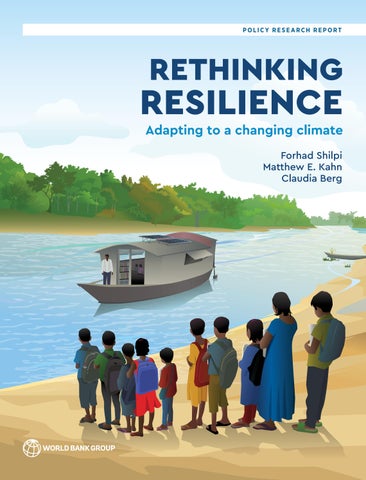
Cover design: Communications Development, Inc. The cover depicts Bangladeshi children waiting for the boat school to arrive. Operated by nongovernmental organizations, the schools have reached more than 100,000 students since their inception. They recruit teachers from local communities, and some have solar panels for working students in night classes. Floating schools now operate in Indonesia, Nigeria, the Philippines, Viet Nam, and Zambia. They prove that people exposed to climate threats find indigenous solutions to their problems but need resources and, in many cases, markets and services, to implement them.
The Library of Congress Control Number has been requested.
5.5
S1.1.2
2.1
2.2
2.3
B3.1.1
3.5
B3.4.1
S3.1.3
S3.1.4
B4.2.1
B4.3.1
B4.3.2
S4.1.1 Social protection programs can mess up climate-induced migration from vulnerable areas
B5.4.1 Flood risk information influences home buyers in the United States
B5.6.1 US farmers can obtain tailored crop insurance products online
Maps
O.1 Poor countries have higher shares of population vulnerable to climate shocks 5
BO.2.1 Monsoon patterns have shifted in India 14
O.2 Sub-Saharan Africa remains an information desert with very few weather stations per capita 15
O.3 Unaffordable housing pushes poor people in Dhaka to settle in climate-vulnerable areas 21
1.1 Poor countries have higher shares of population exposed and vulnerable to climate shocks 33
2.1 With greater expectation of climate events comes a stronger adaptation response
3.1 Sub-Saharan Africa remains an information desert in terms of weather stations
3.2 The speed of mobile internet data is lower in developing countries
4.1 Tenure insecurity is high in poorer countries
4.2 In Dhaka, interventions to reduce flood damage can push up housing prices and displace poor people to areas most at risk of flooding
B5.3.1 Monsoon patterns have shifted in India
Tables
O.1 The 5 I’s strategy income, information, insurance, infrastructure, and interventions to promote climate resilience
O.2 A calibrated 5 I’s strategy: income, information, insurance, infrastructure, and targeted interventions
B2.2.1 Risky versus ambiguous lotteries for the Ellsberg paradox
2.1 Resilience strategies for households, farmers, and firms
2.2 Insurance uptake by small and medium enterprises in Uganda is very low
5.1 The 5 I’s strategy income, information, insurance, infrastructure, and interventions to promote climate resilience
5.2 Individuals, markets, and governments have different roles in responding to different types of shocks
In her fury, Mother Nature is supremely impartial: since 1960, natural disasters have struck high-income countries at roughly the same rate as low- and middle-income countries. The disparity lies simply in the consequences: the wealthiest economies bounce back swiftly, while the poorest suffer acutely. For poorer countries, the death toll of each disaster can be six times as high, and the economic damage can persist for decades.
Climate change has widened the disparity in the ability of countries to recover. Between May 2023 and May 2024, people endured 26 more days of stifling-hot weather on average than would have been the case without climate change. Rising temperatures impede progress on nearly all fronts: they jack up mortality rates, depress children’s math and reading scores, and shrink the productivity of businesses and workers. A reckoning, therefore, awaits many low- and middle-income countries: unless they step up their effort to adapt, studies show, rising global temperatures could slash the economic potential of countries in Africa and Latin America by as much as 15 percent.
This report aims to speed up that effort— by spurring governments in developing countries to choose policies that put individuals, households, farms, and firms in the driver’s seat. That will require a rethink of the current approach, which relies too much on government programs and investment. Governments reflexively prioritize subsidies, cash transfers, and a variety of interventions aimed helping people cope with the aftermath of
disasters. They don’t do nearly enough to prod individuals, firms, and markets to take actions that might reduce the severity of the disaster in the first place.
There’s a good reason for that. It takes wealth to systematically damage-proof an economy. In wealthier economies, people and businesses can afford to protect themselves against extreme temperatures by investing in air-conditioned housing, schools, and office space. They have ready access to information that enables them to take precautionary measures accurate weather reports and public early-warning systems, for example. They benefit from high-functioning markets that enable households and farmers to buy flood or crop insurance. They reap the rewards of modern infrastructure roads, bridges, and public transit systems: emergency relief arrives swiftly, and vital economic links stay mostly intact when disaster strikes.
Developing economies usually lack those privileges. Poverty is the first and biggest hurdle: in an emergency, more than two-thirds of households in Bangladesh, Colombia, Kenya, and Viet Nam would have neither sufficient savings nor assets to sell to cover their basic needs for three months. Low incomes usher in a variety of bad outcomes for climate resilience: in Bangladesh, just 2.3 percent of households own an air conditioner. In developing countries other than China and India in 2020, fewer than 10 percent of farms had any kind of agricultural insurance. Information that people need to assess climate risks is also scarce: Sub-Saharan Africa, for example,
has just 1.6 weather stations for every 1 million people compared with 217 in the United States.
That can and must change. Poor people in poor countries today are disproportionately vulnerable to climate change mainly because they lack the resources necessary to cope. It’s worth noting that they can be exceptionally resourceful. In flood-prone areas of Bangladesh, for example, more than 100,000 children were able to continue their education uninterrupted during the monsoon season because of an ingenious idea by a private citizen: classrooms on a boat. It’s an idea that has traveled: Indonesia, Nigeria, the Philippines, Viet Nam, and Zambia all now provide “floating schools” in flood-prone areas. Policy makers in these countries, therefore, should ask one question above all: how can we mobilize ingenuity of this kind to turbocharge economy-wide adaptation efforts?
This report proposes a five-pronged strategy: the 5 I’s method. The first prong is intuitive: income. Economic development, broad and sustained, is the most reliable predictor of a country’s ability to cope with a climate shock. Analysis by the World Bank suggests that a 10 percent increase in GDP per capita tends to reduce by 100 million the number of people who are most vulnerable to climate shocks. Achieving such a boost will not be easy: in all regions except the Middle East and North Africa, economic growth in the next few years is expected to be slower than the average of the 2010s.
The second prong is information. Information allows people to convert a fog of uncertainty into a concrete set of risks each with discrete probabilities that inform their decisions on mitigating those risks. High uncertainty is often a recipe for paralysis or error: farmers, for example, might opt to forgo the use of a new high-yield crop variety if they
have no quantified information on how it will perform under unusually bad weather. The scope for progress in this category is large. Weather forecasts, for example, have become far more reliable: a four-day forecast today is as accurate as a one-day forecast 30 years ago. Satellite data and analysis powered by artificial intelligence could help lower the cost of delivering risk information to people.
Insurance, the third prong, becomes a more feasible option once risk information becomes widely available. It enables individuals, businesses, and governments to recoup at least some of the financial loss from a disaster. Most developing countries require residents to buy insurance to drive a car but not to protect property against floods, fires, or other climate shocks. That should be reconsidered: mandating insurance in hazard-prone areas will reduce the need for government bailouts. Insurance providers also have much to gain by simplifying insurance products or offering packages that make insurance more enticing for hesitant customers.
The fourth prong is infrastructure. The government plays a crucial role here. Access to safe water, improved sanitation, and electricity are essential for progress in development but they are doubly desirable because they reduce health-related risks from climaterelated disasters. Governments should construct all infrastructure with resilience in mind: dams, for example, should be built to better withstand floods. Roads, drainage systems, water supply, and power-generation systems should be upgraded with climate risks in mind.
Even when executed perfectly, these four steps will not be enough. The fifth prong, government interventions, will remain necessary to protect the most vulnerable households: a prompt rollout of cash transfers and other social protection benefits can prevent
a near- and long-term rise in poverty in the aftermath of a climate disaster. But such benefits should be targeted, temporary, and rule-based. A poorly designed protection program could leave farmers stuck with the crop choices that are wrong for climate resilience. It could drive households and firms to settle in climate-vulnerable areas. Social protection benefits, in other words, should be portable not tied to a specific place.
In the coming decades, economic growth and progress on key development objectives will depend on the ability of countries to adapt
to rising temperatures and to contain them wherever possible. That’s a job too big for governments alone. Success will hinge on private behavior: how all individuals, households, farms, and firms adjust to protect themselves and their communities. Humans are infinitely resourceful: it can be done. But success will require all five prongs of the adaptation strategy outlined here.
Indermit Gill Chief Economist of the World Bank Group and Senior Vice President for Development Economics
The preparation of this report was led by Forhad Shilpi (senior economist, Research Group, World Bank). Matthew E. Kahn (Provost Professor of Economics, University of Southern California) served as academic lead. Overall guidance was provided by Indermit Gill (senior vice president and chief economist). Somik Lall (senior advisor, World Bank) was instrumental in advising the team throughout the preparation of the report. The report was sponsored by the Development Economics Vice Presidency.
The team was comprised of Vittorio Bassi, A. Patrick Behrer, Claudia Berg, Uwe Deichmann, Xavier Giné, Arti Grover, Mohammad Islamul Haque, Ruth Hill, Rajat Kochhar, Megan Lang, Jia Li, Olivier Mahul, and Ruozi Song. Manxuan Gao, Sebastian Gomez Roca, Matias Humberto Harari, Benny Istanto, Siobhan Murray, and Mariana Santi provided research assistance. Bruce RossLarson provided developmental guidance in drafting the report and edited the final version. Ali Shahbaz edited the final version of the overview. Elaine Wylie provided administrative support.
The team sincerely thanks Sarah Bermeo (associate professor, Duke University), Kevin Carey (program manager, Prosperity, World Bank), and Stephane Hallegatte (chief climate economist, Planet, World Bank) for their invaluable comments as peer reviewers. Sebastian Eckardt (practice manager, Prosperity, World Bank), Stephane Hallegatte, Florence Kondylis (research manager,
Research Group, World Bank), Norbert Schady (chief economist, People), and Martien van Nieuwkoop (former global director, Planet) provided comments on the Concept Note.
The team gratefully acknowledges the many World Bank colleagues who sent consolidated written comments during the formal Bank-wide review: Omar Arias, Andrew L. Dabalen, Ousmane Dione, Doerte Doemeland, Jay Heimbach, Soukeyna Kane, William F. Maloney, Sebastian Molineus, Martin Raiser, Julie Rieger, Dena Ringold, and Renaud Seligmann.
The team benefited from discussions with Stephane Hallegatte, Jamele Rigolini, Simon Sølvsten, Stephane Straub, and Peter Zetterli. The team also thanks Deon Filmer and Carolyn Fischer for their comments and support at various stages of this work.
Japan Water Forum contributed to box 5.5.
The initial findings of the report were discussed in forums in Milan, Paris, Rome, and Tokyo. Special thanks go to Romina Cavatassi, Mart Kivine, Nancy Lozano-Gracia, Kerina Wang, and World Bank offices in Paris, Rome, and Tokyo for arranging these consultations.
The team acknowledges generous funding support from the Climate Support Facility Whole-of-Economy program and Climate Support Facility Green Recovery Initiative trust funds.
The team expresses its deep appreciation for boat school photos shared by Mohammed Rezwan, executive director,
Shidhulai Swanirvar Sangstha. The cover was designed by Debra Naylor based on these photos. The team also gratefully acknowledges support from Mehrin Mahbub from the World Bank Bangladesh country office.
The communications and engagement strategy was led by a team comprised of Joseph Rebello and Shane Romig. Ryan
Douglas Hahn and Nonatzin Canche Ramirez provided web and online services. Typesetting services were provided by Communications Development Incorporated. Maps in the report were created by Ryan Francis Kemna. Special thanks are extended to the World Bank’s Formal Publishing Program, including Cindy Fisher, Patricia Katayama, and Mark McClure.
Vittorio Bassi is an assistant professor of economics at the University of Southern California and the lead academic of the Uganda Country Team of the International Growth Center. He is also a faculty research fellow at the National Bureau of Economic Research as well as an affiliate of the Abdul Latif Jameel Poverty Action Lab, Bureau for Research & Economic Analysis of Development, Center for Economic and Policy Research, and the Center for Effective Global Action. His main research interests are in the organization of production and labor markets in low-income countries, with a focus on Uganda. He holds a PhD in economics from University College London.
Patrick Behrer is an economist in the Development Economics Research Group at the World Bank. His research focuses on the economic causes and consequences of air pollution and climate change around the world. His focus is on how to encourage adaptation to climate change and air pollution exposure. Prior to joining the World Bank, he was a postdoctoral student at Stanford University’s Center on Food Security and the Environment and a Fulbright Fellow in New Zealand. He holds a PhD in public policy from Harvard University.
Claudia Berg is an economist in the World Development Report team at the World Bank Most recently, she worked in the Development Research Group (Sustainable Development and Infrastructure), where she has contributed
to this report. Over the years, she has worked in various positions across the World Bank, including in the Poverty and Equity Global Practice and the Sustainable Development Practice Groups, among others. Her primary research interests include assessment of the economic and welfare impacts of policy and investment measures, such as microfinance, road infrastructure, poverty interventions, trade, and climate change. Outside the World Bank, she applied her skills at the International Monetary Fund and Inter-American Development Bank. She holds a PhD in economics from George Washington University.
Uwe Deichmann is a consultant at the World Bank. He was previously a researcher in the World Bank’s Development Research Group, where he co-directed the World Development Report 2016: Digital Dividends and coauthored Natural Disaster Hotspots the World Bank’s first global analysis of natural hazard risks. Prior to joining the World Bank, he worked for the UN Environment Programme and the UN Statistics Division. He holds a PhD in economic geography and regional science from the University of California Santa Barbara.
Xavier Giné is a lead economist in the Finance and Private Sector Development Team of the Development Research Group at the World Bank. His research focuses on access to financial services, financial consumer protection, and smallholder
agriculture. Prior to joining the World Bank, he was a postdoctoral fellow and lecturer at the Economic Growth Center at Yale University. He holds a bachelor’s degree in economics from the Universitat Pompeu Fabra and a master’s degree and PhD in economics from the University of Chicago.
Mohammad Islamul Haque is a development economist with an interest in the economics of climate change adaptation in developing countries. His current research is focused on understanding the frictions that limit climate change adaptation in developing countries, designing solutions to address these challenges, and generating evidence on their effectiveness and scaling complexities. Currently, he is working as a postdoctoral associate at the Yale Research Initiative on Innovation & Scale and a lecturer at the Department of Economics at Yale, where he teaches the course “Economics of Climate Change Adaptation.” He holds a PhD in economics from the University of Southern California.
Ruth Hill is the director of the Markets, Trade, and Institutions Unit in the Food and Nutrition Policy Department at the International Food Policy Research Institute. She was previously a lead economist in the Poverty and Equity Global Practice at the World Bank, where she spent a decade leading work on the distributional impacts of climate change, fiscal policy, markets, and institutions. She also led the development of the World Bank’s Rural Income Diagnostics and conducted Poverty Assessments and Systematic Country Diagnostics in East Africa and South Asia. She has published in the American Journal of Agricultural Economics, Economic Development and Cultural Change, Experimental Economics, Journal of Development Economics, World Bank Economic
Review, and World Development. She holds a doctorate in economics from the University of Oxford.
Rajat Kochhar is a postdoctoral researcher at the University of Chicago’s Energy & Environment Lab. He completed his doctorate in economics in 2023 from the University of Southern California. His primary research interest is in environmental economics, in particular on increasing the efficiency of regulatory enforcement in reducing emissions. To this end, he has been working with the US Environmental Protection Agency since summer 2023 to develop a machine learning algorithm to predict violation risk among regulated entities with the objective of improving enforcement targeting. His other work involves understanding the factors that incentivize adaptation to climate shocks and using field experiments to examine the role of behavioral interventions in promoting resource conservation. Previously, he worked as a research assistant at the National Institute of Public Finance and Policy in New Delhi. He holds a PhD in economics from the University of Southern California.
Matthew E. Kahn is a provost professor of economics at the University of Southern California. He also is a research associate at the National Bureau of Economic Research and a research fellow at Institute of Labor Economics. He is a senior fellow at the Schaeffer Center for Health Policy and Economics at the University of Southern California, as well as a visiting fellow at the Hoover Institution at Stanford University.
Megan Lang is a development economist with the Sustainability and Infrastructure Unit in the Development Research Group at the World Bank. She conducts research on barriers to climate adaptation in the private sector in low-income countries, rural electrification
and energy markets in Africa, and women entrepreneurs in low-income countries. Prior to joining the World Bank, she was a postdoctoral scholar with the King Climate Action Initiative. She holds a PhD in agricultural and resource economics from the University of California Berkeley.
Jia Li is a senior economist with the World Bank Global Department of Climate Change and leads the analytical work on adaptation and resilience, including the economics of resilience, resilience metrics, adaptation policy, and institutions and finance. She recently led publication of the World Bank flagship report Rising to the Challenge: Success Stories and Strategies for Achieving Climate Adaptation and Resilience
Olivier Mahul is a practice manager at the World Bank. His expertise includes climate finance, risk finance and insurance, carbon markets, and financial sector development. He has authored more than 50 publications in international journals and co-authored two books: Catastrophe Risk Financing in Developing Countries: Principles for Public Intervention (with J. David Cummins) and Government Support to Agricultural Insurance: Challenges and Options for Developing Countries (with Charles Stutley). He holds a PhD in econometrics and financial economics from the Toulouse School of Economics
and postdoctorate degrees from the Wharton Business School and University of California Berkeley.
Forhad Shilpi is a senior economist in the Development Research Group (Sustainable Development and Infrastructure, at the World Bank. She is the lead author of this report. Her current research focuses on social mobility in developing countries, microeconomics of climate resilience, and urban and regional economics. Her research has been published in leading development and economics journals, including the American Economic Journal: Applied Economics, Economic Journal, Journal of Development Economics, Journal of Economic Geography, Journal of Human Resources, and others. She holds a PhD in economics from Johns Hopkins University.
Ruozi Song is an economist in the Sustainability and Infrastructure team of the World Bank’s Development Research Group. Her research focuses on sustainable energy, climate change adaptation, and the efficiency and distributional impacts of environmental policies. Her recent work examines how firms and consumers navigate the transition to a greener economy, providing insights to inform policy decisions. She holds a bachelor’s degree in statistics from Fudan University and a PhD in economics from the University of Southern California.
For the world’s poorest people, climate change does not announce itself in parts per million. It arrives as a ruined harvest, a flooded shop front, and lost learning as children are kept out of school. The most consequential climate-policy question for developing economies is not only how much carbon the world emits, but also how quickly people, firms, and governments can prepare for shocks, recover from them, and learn to do better next time.
To ensure that a bad day, week, or season does not become a bad decade, the principal response to climate change for developing economies should be to quickly become more resilient to it.
Climate change is real, and it deserves the attention of policy makers in every country. But the stakes for poor countries are higher than for advanced economies because they are less resilient to the vagaries of nature. Poorer countries experience far more deaths per disaster and more lasting losses than wealthier countries. In the last few decades, natural disasters have killed 1.3 million people and harmed 4.4 billion; since 1960, mortality per event has been six times higher in lowand middle-income settings since 1960. Since 2000, between 250 and 290 million people have been hit by floods. In 2019, 2.3 billion people exposed to extreme weather lived on less than $6.85 a day. By 2050, more than 5 billion people could have to deal with at least a month of water scarcity every year.
The question that policy makers, businesses, and households in developing countries should be trying to answer is not who or what to blame for climate change. The relevant question is how to become more resilient to it. This report shows that the answer is not all that complicated.
People in richer countries are more resilient to climate change because they have more income and savings. Their governments provide timely and reliable information to households and enterprises. Insurance markets are more developed, so household consumption is less vulnerable to unanticipated shocks natural or human-made. Wealthier countries have access to better technologies and more resources to make private homes, public facilities, and factories and essential infrastructure better able to withstand extreme events. And more advanced economies have more capable social insurance programs that can help people manage emergencies.
It stands to reason then that a comprehensive strategy for becoming more resilient to climate change would have five parts: first, raise household incomes through economic growth; second, provide timely and accurate information about climate change to help people convert uncertainty into risk; third, create the conditions for robust insurance markets to better manage climate risk; fourth, make public infrastructure more resilient to extreme events; and, fifth, provide aid to people who have suffered losses in ways
U ncertain about what actions are most beneficial, people may forgo affordable and useful adaptation efforts
that do not inadvertently weaken their incentives and efforts to protect themselves.
These five ingredients higher incomes, better facts, risk-pooling, public investments, and social protection are fundamental for turning climate change from catastrophe into manageable risk. They also point to ways to convert some of these risks into economic gain.
To a lay reader, this might seem so obvious that one might expect this approach to be commonplace, but it is not: strategies for building resilience are seen mostly as consisting of public investment and social protection.
This is in part because of inadequacies in the approach recommended by international institutions. The first one is that resilience and government-led adaptation have been viewed as essentially the same thing. In fact, adaptation is just one component of a comprehensive approach to strengthening resilience. The second one is that adaptation has generally been seen as synonymous with greater public investment to “climate proof” infrastructure, such as canals, roads, and railways, and to provide public assistance to those harmed by climate change. In fact, much of adaptation takes place not in governments but in families, on farms, and in firms. The third one is a consequence of the second misunderstanding: the mission to make economies more resilient is often regarded as the responsibility of government and not of the general citizenry and private enterprise.
Resilience should be rethought. This report was written to advance this rethinking.
Rapid income growth is the single most powerful instrument for making an economy more resilient to climate change. With higher incomes, households can save and smooth consumption and avoid distress sales when hit by shocks. They can invest in risk-reducing measures (such as houses
that are less flood-prone and seeds that are drought-resistant), and they are better able to diversify livelihoods away from climateexposed activities. They can access credit and markets that speed recovery. Estimates suggest that globally a 10 percent increase in per capita output reduces the number of people vulnerable to climate shocks by around 100 million and that higher incomes considerably attenuate the mortality effects of climate hazards.
In Bangladesh, for example, category 4 cyclone Bhola in 1970 killed half a million people, and floods in 1974 submerged half the country and triggered a famine that killed 1.5 million people. In 2019, when category 5 cyclone Sidr brought a 9-foot storm surge, torrential rain, and high winds, Bangladesh’s income was far above its 1970 level and the death toll was 3,500. It is worth noting that between those two years, Bangladesh’s per capita income grew by nearly four times (from $400 in 1974 to $1,564 in 2019), and the death toll was a fraction of that in the 1970s. The single best antidote to climate change may well be broad-based economic growth.
Reliable public information has been underemphasized by government in favor of advocacy about climate action. Uncertainty paralyzes people, firms and governments. People and businesses in poorer, more exposed countries face deep ambiguity about when, where, and how hard climate will hit. The poor tend to be the most averse to ambiguity, often responding in ways that are less than optimal. Poor people are prone to overinsure against minor risks, underinvest in profitable activities, or cling to increasingly precarious ways to make a living just because they are familiar. Governments in poor countries also tend to be ambiguity-averse, simultaneously overbuilding to protect public structures
T his report proposes a 5 I’s strategy of layering income, information, insurance, infrastructure, and targeted interventions to promote resilience
and underinvesting in warning systems. Reliable and accessible information modern weather stations, regularly updated forecasts, accurate flood maps, and timely early warnings converts unknowable peril into manageable risk. It prompts good decisions by people and the emergence of market insurance.
The returns to reliable public information are staggering. Early-warning systems can have benefit-cost ratios of about 9:1. A single day’s notice can cut expected damages by a third. But it is not just about early-warning systems. In India, farmers who received accurate, longer-range monsoon forecasts shifted planting and increased profits. Sadly, the information architecture is weakest where it may be most needed: Sub-Saharan Africa has 1.5 weather stations per million people, India 3, Germany 13, and the United States 217. In some low-income settings, a one-day forecast is less accurate than a seven-day forecast in rich countries. Fixing these gaps observations, modeling, and last-mile dissemination amplifies the effectiveness of other investments in resilience.
Robust insurance markets are a major component of any resilient economy. Even with rising incomes and better information, some risks are too big or too correlated for economic agents to shoulder alone. Marketbased insurance exists to pool such risks across people, places, and states of the world, turning unlikely but high-cost “tail” events into manageable losses. When insurance markets work well, they speed up recovery, prevent poverty traps, and encourage productive risktaking. When they don’t, disasters lead to debt and destitution.
In many developing countries, formal insurance penetration remains spotty. Index products—payouts triggered by rainfall, river
levels, or pasture “greenness”—have spread, helped by satellites and mobile money. These insurance products have promise but face frictions. Load factors—additional costs—are high (typically 50 to 70 percent), and basis risk means payouts may miss actual losses, dampening demand. Markets also tend to shy away from tail events: in India, for example, products have drifted from extreme-event coverage toward higher-frequency, but welldesigned government support programs and public-private partnerships can help, by improving data, cutting costs, and offering catastrophic reinsurance while preserving honest pricing to avoid moral hazard.
About 265 million insurance policies were sold in developing countries in 2020, 95 percent were in China and India where coverage is heavily subsidized and often bundled with credit.
Public policy can help by investing in data and catastrophe models, regulating for transparency and consumer protection, and providing catastrophic backstops without dulling price signals. In the Horn of Africa, for example, satellite images are used to trigger payments to pastoralists before livestock losses mount, shifting behavior from crisis replacement to pre-shock protection.
Investment in infrastructure that can withstand larger variability in climatic conditions and extreme events is necessary, but it is seen by too many policy makers as sufficient. Resilience has been equated with government-led adaptation, and such adaptation has been equated with infrastructure especially the concrete kind—and post-disaster bailouts. The result: a defensive approach that overemphasizes protective works and after-the-fact relief and undermines the economic policies that make economies resilient. This approach can backfire.
Poorer countries and poorer people are more vulnerable to disruptions from a changing climate, mainly because of their inadequate financial and institutional resources
Protective works often entice people and capital into harm’s way Jakarta’s seawall, for instance, would likely concentrate settlement behind it and double its social cost once delayed migration is counted. Climate uncertainty compounds the problem. Fixed assets built for yesterday’s probabilities can become stranded or prohibitively expensive to maintain.
This is not an argument against investing in public infrastructure to make it more durable in the face of a changing climate. It is an argument for putting it in its proper place. Pipes, pylons, and pavements are most effective when embedded in a system that prices risk and informs decisions so that a bridge is built in the right place to the right standard and the neighborhood around it is zoned and insured accordingly.
Social intervention programs are justifiably seen as necessary for resilience. But social protection interventions need to be designed with care so that they complement rather than work against the other components of a comprehensive approach to resilience. Consider northern Kenya, where herders shifted from cattle the first to die in a dry spell to camels, which can go weeks without water and survive steep
weight loss. That pivot wasn’t scripted by a government department or a multilateral agency; it was driven by prices and traders, with Somali intermediaries opening markets for camels and camel milk. As demand deepened, Kenya’s camel herd rose from roughly 800,000 in 1999 to 3.6 million by 2022, a market- led adaptation that fit the new climate reality.
This is a different approach than rushing in to replace lost income or restock dead cattle after every drought. Asset replacement can trap households in fragile livelihoods and drain public budgets. Better policy interventions give people the option to adapt. The World Bank’s De-risking, Inclusion, and Value Enhancement of Pastoral Economies program in the Horn of Africa known as DRIVE—is one such example. DRIVE uses mobile platforms and index insurance to move from protection and liquidity. Such interventions can ensure adequate feed and water for core breeding stock so herds can recover. They can guarantee timely payouts based on pasture indices. And they can reduce frictions in trade and finance so farmers can shift more smoothly to hardier species of seed or leave the place or the profession altogether when that is the wisest option.
Climate change is increasing the frequency and intensity of weather-related disasters—storms, floods, droughts, heat waves, and wildfires. Between 1998 and 2017, natural disasters killed 1.3 million people and affected 4.4 billion (CRED and UNISDR 2018). Greenhouse gas emissions have already driven global temperatures up
by between 1.3 and 1.5 degrees Celsius above pre-industrial levels (NOAA 2024) and the pace of warming is increasing. Since 1970, temperature increases have sped up, and in 2023 sea surface temperatures hit new highs day after day.1 As warming intensifies, damaging weather extremes will become harsher and more frequent.2
Weather shocks raise mortality, slow learning, reduce consumption, and challenge businesses
Impacts from climate change, already large, are becoming more severe. Over the past 50 years, droughts have become more frequent, severe, and widespread (USGS n.d.). By 2050, droughts could affect more than three- quarters of the global population, with an estimated 4.8–5.7 billion people living in water- scarce areas for at least one month each year, up from 3.6 billion today (United Nations 2022). Flooding is also on the rise, with 255–290 million people (3 percent of the global population) exposed to floods since 2000 (Tellman et al. 2021 ).
The poor are hit hardest. Countries have faced similar numbers of disasters since 1960, but low- and middle- income countries suffer over six times more deaths per event. 3 In 2019, 4.5 billion people were exposed to extreme weather; among them, 2.3 billion lived on less than $6.85/day and about 400 million in extreme poverty (below
$2.15/day). Many of the most vulnerable people live in poorer countries in Africa and South and Southeast Asia (map O.1). The capacity to prepare for, cope with, and learn from shocks resilience varies widely.
Climate damages will deepen global inequities. Welfare losses (from reduced consumption and degraded local amenities) are projected to be as large as 15 percent in Africa and Latin America (Cruz Alvarez and Rossi-Hansberg 2024). As temperatures rise, some of today’s cold areas could see net benefits, while poor, hot locations face escalating harm (Carleton et al. 2022 ).
Weather shocks erode economic and human welfare on multiple fronts. Hotter days and drier months raise mortality including infant deaths (Burgess et al. 2017; Banerjee and Maharaj 2020; Geruso and Spears 2018) and the effects in developing countries mirror
Source: World Bank calculations based on Doan et al. 2023.
Note: The gray areas indicate territories for which data are lacking or insufficient.
b. Firms in poorer countries are slow to learn from repeated shocks
Experienced with temperature variability 95% con dence interval
Inexperienced with temperature variability
Source: Lang et al. 2024.
Note: Temperature variability is measured by the coefficient of variation, which is the standard deviation of temperature in a fiscal year divided by the mean temperature in the same fiscal year. The dependent variable is log(revenues), and controls include the coefficient of variation and the number of days with temperatures above 35°C in a given fiscal year and country by Enterprise Survey round fixed effects. The estimated coefficients plotted in the figures show the association between a one unit increase in the coefficient of variation and sales revenues. All standard errors are clustered at the level of Enterprise Survey strata. Low-income countries include all countries classified as low income and lower-middle income, and higher-income countries include all countries classified as upper-middle income and high income using the World Bank income classification. For more detail, see the background paper for this report by Lang et al. (2024).
the United States before widespread air conditioning in the 1930s (Geruso and Spears 2018). Learning suffers, too: in India, temperatures above 21° C and below 15° C depress achievement, with each day above 21° C cutting math scores by 3% and reading by 2% (Behrer and Berg 2024). In Nigeria, droughts and floods slash consumption in poorer, agriculturedependent areas that are vulnerable to both water scarcity and deluge (Shilpi and Berg 2024). Firms in low-income countries are hit harder as well: sales revenues fall much more with temperature variability than in highincome economies (figure O.1a).
Richer countries have steadily learned to adapt to repeated weather shocks; poorer countries, by and large, have not. In Nigeria, farm households exposed to repeated floods see similar consumption losses each
time evidence of little or no adaptation while adaptation to drought is somewhat better, likely because the poorest households are concentrated in flood-prone locations and lack financing to adjust (Lang et al. 2024). Business impacts tell a similar story: in low-income countries the penalty from temperature variability on sales has not diminished over time. In India, weather shocks reduce agricultural yields more over the long run than the short run, again signaling that adaptive responses have not taken hold at scale (Kochhar and Song 2024).
Resilience after weather shocks is also weaker where incomes and safety nets are thin. In high-income countries, firms with greater experience of temperature volatility suffer smaller sales declines when new shocks arrive evidence of learning. Reliable, widely accepted tools for
T here is considerable overlap between policies and practices that are good for climate resilience and those that benefit economic development
In low-income countries, the reverse holds: firms in places with larger long-term temperature swings experience deeper sales drops, pointing to a persistent inability to build resilience (figure O.1b) (Lang et al. 2024). Evidence from Nigerian farm households is consistent with this pattern (Shilpi and Berg 2024). The implication is clear: the principal response to climate change must be to make developing economies more resilient above all by accelerating household income growth, ensuring reliable public information (such as accurate forecasts and early warnings), and expanding robust insurance and risk-transfer markets so households, farms, and firms can prepare for, absorb, and recover from shocks.
Resilience is the principal response to climate change and it is built by layering 5 I’s: income, information, insurance, infrastructure, and interventions. Think of it as a framework people can use to prepare for shocks, recover faster, and learn from experience. This report proposes a “5 I’s” strategy of layering income, plus information, insurance, infrastructure, and interventions to promote resilience (table O.1).
• Income: Income growth is the foundation layer. Higher incomes loosen liquidity constraints, enabling households, farms, and firms to invest in protection before shocks and rebuild after them. A 10 percent rise in GDP per capita can lift roughly 100 million people out of the highest vulnerability to climate shocks. By the end of this century, most of the reduction in heat-related mortality will come from income-enabled investments in resilience.
• Information: Reliable, timely public information converts uncertainty into manageable risk. Credible forecasts and early warnings turn decision makers into pragmatists. Even a day’s notice can cut damages by 30 percent, and early warning systems deliver benefit-cost ratios near 9:1 among the highest-return investments governments can make.
• Insurance: Robust insurance and risktransfer markets let people pool risks and
TABLE O.1 The 5 I’s strategy—income, information, insurance, infrastructure, and interventions—to promote climate resilience
Income To relax liquidity constraints, diversify livelihoods, and access credit—for resilience building Information To promote pragmatic decision-making
Insurance To help manage risk
Infrastructure To protect against and minimize losses
Interventions To aid in coping
Source: Policy Research Report team.
recover quickly when disasters strike. Expanding affordable, well-regulated products while reducing basis risk and leveraging digital finance—helps households and firms diversify exposure and rebound without derailing long-term development.
• Infrastructure: Infrastructure both reduces risks and limits losses. Better transport, drainage, housing, and market connectivity protect lives and livelihoods and diffuse local shocks.
• Interventions: Well-designed, timely, and targeted policies—especially social protection—help people cope without dulling the incentives to adapt in place or relocate when necessary. Benefits should be portable, rules based, and temporary and aligned with behaviors that build resilience.
Income growth is the main way to reduce vulnerability to climate change
Higher incomes enable individuals and businesses to adapt better to climate shocks. Higher incomes can protect poor families from the risk that even a small disruption could threaten their survival or well- being. By the end of this century, about 80% of the ability to withstand rising temperatures measured by lower death rates will result from increased per capita GDP that enables people and governments to invest more in resilience. The other 20% will come from the knowledge gained through long- term exposure to such disruptions (figure O.2) (Carleton et al. 2022 ).
Economic growth and structural transformation reduce exposure to shocks. This is especially the case in agriculture, one of the most climate-sensitive sectors where warming depresses yields, increases pest infestation, and threatens food security. As people diversify incomes and urbanize, they rely less on climate-exposed livelihoods and gain better access to markets and basic services, such as health care, education, water,
and sanitation each a resilience boost. Stronger growth also expands tax revenues, enabling investment in infrastructure and services that cut vulnerability, while public spending on reliable information systems, social protection, and R&D improves preparedness and technology adoption. The payoff is large: a 10% rise in GDP per capita is estimated to lower the number of people most vulnerable to climate shocks by about 100 million (World Bank 2024). But economic development alone cannot solve the resilience problem because resilience also influences economic development. Shocks reverse hard-earned gains in welfare, reduce productivity, and wipe out productive investments (box O.1).
Information turns uncertainty into manageable risk
Climate change creates deep uncertainty that skews decisions. The causes of climate change are well established, but the choices societies will make about future emissions and how a warmer atmosphere will translate into specific local hazards like droughts, storms, and floods remain highly uncertain. The timing and severity of impacts are hard to pin down, and even information that scientists are confident about often fails to reach people effectively. With such deep uncertainty different from standard risk, where probabilities are known— experience is a poor guide for where to live, what to plant, or how to produce essential goods and services.
Source: Carleton et al. 2022.
S elf- insurance and informal insurance can cope with short-term, low- impact events, but neither can deal with larger systemic events or those that are likely to recur
O.1
Climate resilience depends on income growth and economic development, while economic growth depends in turn on climate resilience. Understanding this interdependence is important for three reasons. First, if economic growth could lift people out of poverty fast enough to outpace the negative impacts of climate shocks, countries could depend mainly on economic development to ensure resilience (except in the case of catastrophic events). However, damages from climate shocks are already mounting faster than the rate of economic growth, making active resilience policies necessary and increasingly urgent.
Second, climate resilience is needed not just for humanitarian reasons but also to prevent climate impacts from eroding hard- earned development gains. Severe shocks send households into poverty, cause farmers to lose productive assets, and force firms to close. In Senegal, households affected by natural disasters were 25 percent more likely to fall into poverty. 1 In Nigeria, 15 percent of farm households sold their assets to cope with severe flooding. In India, the average cyclone reduces firms’ sales by 3.1 percent and destroys 2.2 percent of firms’ fixed assets.2 Cyclones can wipe out decades of economic development in a few hours, and economies can struggle many more decades to recover. 3 By the end of the century, per capita GDP in Bangladesh, Thailand, and Viet Nam is projected to be 5–10 percent lower because of sea level rise.4
Third, economic development requires long-term, irreversible investments. Neither domestic nor foreign investors have incentives to make these investments when the potential damages from climate shocks are large and uncertain. So, climate shocks, and even the threat of climate shocks, involve a large growth penalty. Between 1990 and 2014, moderate to extreme droughts reduced GDP per capita growth between a 0.39 and 0.85 percentage point, on average, depending on a country’s level of development and baseline climate conditions. The largest losses were experienced by low- and middle-income countries in arid areas.5 With climate shocks accelerating, losses will become larger over time. Because of this co-dependence between growth and resilience, policies that are simultaneously good for growth and for resilience should get priority.6
Notes
1. Dang, Lanjouw, and Swinkels 2014; Hallegatte et al. 2017.
2. Pelli et al. 2023.
3. Hsiang and Jina 2014.
4. Cruz and Rossi-Hansberg 2024.
5. Zaveri, Damania, and Engle 2023.
6. Hallegatte et al. 2017.
Clear information is a powerful antidote. Reliable, accessible public information can convert uncertainty into risk that households, firms, and governments can form plans to manage, improving their decisions and enabling timely adaptation. How people perceive climate risk has two characteristics:
• Awareness is widespread but uneven. In a 2022 global survey across 107 countries, about 56 percent of respondents said climate change will greatly harm future generations. Awareness is higher in high-income countries (59 percent) than in low-income countries (45 percent).
• Concern is highest where vulnerability is greatest. In poorer and more climate-vulnerable countries, 51 percent are seriously worried about climate change, and 41 percent believe it will harm them personally (figure O.3).
Deep uncertainty about climate events drives widely divergent responses. Depending on people’s experience, the information they receive, and their attitudes toward risk,
reactions can range from overpreparation to neglect (Sunstein 2007) both of which can endanger safety and livelihoods, especially for poor households with little room for error. Compared with standard risk aversion (managing “known unknowns”), deep climate uncertainty (“unknown unknowns”) tends to trigger ambiguity aversion, which can lead individuals to make suboptimal choices (Haushofer and Fehr 2014).
Risk aversion and ambiguity aversion
Risk aversion
Ambiguity aversion
People’s dislike of risk. If offered a choice between a risky lottery with known probabilities and a sure payment equal to the expected value of that lottery, a risk-averse person will choose the sure payment.
People’s dislike of uncertainty. If offered a choice between two risky lotteries, one with known probabilities and another with unknown probabilities, an ambiguity-averse person will choose the one with known probabilities even if that ensures a bad outcome.
Source: Attitude data from Meta 2022 (Facebook surveys); vulnerability data from the Notre Dame Global Adaptation Initiative dataset, https://gain.nd.edu/our-work/country-index/download-data/; and GDP data from World Bank, World Development Indicators database, https://databank.worldbank.org/source/world-development-indicators
Improving information helps convert uncertainty into manageable risk, enabling more pragmatic decisions. As people and firms quantify climate risks, they can target resilience investments based on assessed probabilities and plausible outcomes. Where ambiguity aversion is more common, adaptation responses to better information tend to be stronger implying larger gains from improving information in poorer countries, where ambiguity aversion is higher (figure O.4).
In low-income, climate-vulnerable countries, people tend to be especially averse to uncertainty—and often “play it too safe.” Ambiguity aversion is well documented across contexts and helps explain divergent behaviors.4 Studies distinguish four types of decision-makers: pessimists, optimists, fatalists, and pragmatists. Ambiguity-averse pessimists farmers, firms, or households seek extra protection (for example, more insurance or climate-resilient technologies), weatherproof homes, and avoid high-risk areas. Fatalists,
I
believing their actions cannot change outcomes, take no resilience measures. Without reliable information, both groups can invest in protection at inefficient levels.
Information gaps can cause overinvestment in self-protection in two ways (Snow 2011). First, under uncertainty, ambiguityaverse people may overspend on purely protective measures such as insurance or heavy-duty weatherproofing to guard against regret if a disaster hits. Second, they may avoid productive, income-enhancing opportunities, instead parking resources in low-risk, low-return options large precautionary savings, safe subsistence crops, or retained earnings. Given poor information, these “play-it-too-safe” choices are rational from the individual’s perspective, but they can still be suboptimal for long-term welfare.
Source: Policy Research Report team, using ambiguity aversion data from Rieger, Wang, and Hen 2017; vulnerability data from the ND-GAIN dataset; and GDP data from World Bank, World Development Indicators, database, https://databank .worldbank.org/source/world-development-indicators
C limate uncertainty results in higher insurance premiums because ambiguityaverse managers set premiums higher to cover losses under a worst- cas e scenario
practices perceived as safer. When farmers lack experience with, or data on, how a new technology performs under variable weather, they naturally favor the known option as has been the case in settings as different as the Lao People’s Democratic Republic and Peru (Engle-Warnick, Escobal, and Laszio; Ross, Santos, and Capon 2012). Conversely, when a new crop is actually less variable than the traditional one, better information can spur adoption, especially among more ambiguity-averse farmers (Barham et al. 2014).
Beliefs about weather and trust in forecasts (Cole et al. 2013; Deressa et al. 2009; Rosenzweig et al. 2014; Lybbert et al. 2007) critically shape technology adoption and planting decisions. Planting timing, for instance, is highly sensitive to rainfall. In India, a 1 percent deviation from the optimal planting date can reduce profits by about 3 percent relative to the mean. Lacking information, farmers may optimize against worst-case scenarios: evidence from India shows choices that minimize losses under adverse weather; in Bangladesh, farmers reduce the planted area in places with more frequent rainfall shortfalls (Kala 2019).
Ambiguity aversion also affects the supply of resilience tools. Managers of firms offering products like insurance are often more ambiguity-averse than their customers (Buhren, Meier, and Plessner 2023). Under deep uncertainty, they may raise premiums to cover worst-case losses or even withdraw from markets. When catastrophe probabilities are known and very high, exit can be a standard risk-management response. But when probabilities are unknown, ambiguity can still drive firms and investors to pull back even where insurance would be viable under conventional risk assumptions.
Deep uncertainty distorts government actions. With deep uncertainty, ambiguityaverse policy makers may favor climaterelated interventions, including resilience measures (Chambers and Melkonyan, 2017). Two distortions can result:
• Crowding out development: Resources may be diverted from broader economic development which itself builds resilience toward narrower climate actions.
• Short-termism in priorities: When reelection hinges on electorates divided over climate risks, politicians tend to prioritize visible, short-term results rather than long-term preparedness.
Together, ambiguity aversion and shorttermism help explain why climate resilience policies often skew toward highly visible disaster relief. In the United States, voters reward officials for securing post-disaster aid more than for pre-disaster preparation (Healy and Malhotra 2009). In India, incumbents gain support for relief when losses are seen as bad luck rather than government failure (Cole, Healy, and Werker 2008). People also tend to prefer risk reduction over insurance (Spence, Poortinga, and Pidgeon 2012). As a result, protective infrastructure being tangible and visible—often receives priority, while regulatory reforms and policies that enable privately provided resilience tools receive far less attention.
Available, credible, and accessible information is the bedrock of effective resilience policies. Credible data reduce deep climate uncertainty, turning decision-makers— households, firms, and governments into pragmatists who revise expectations as evidence improves. Information is the foundation of effective resilience policy. Credible data reduce deep uncertainty. Reliable forecasts and projections can convert deep uncertainty into manageable risk, leading to standard, risk-based choices and investments.
H aving more reliable information about expected climate events can transform deep uncertainty into ordinary uncertainty, diminish ambiguity aversion, and enable adaptation
Timely, actionable information saves lives and protects assets during rapidly approaching weather events. Early warning systems provide accurate information about impending storms and enable people to take actions that save lives and protect property (de Perez et al. 2022), which brings economic, social, and environmental benefits (Global Commission on Adaptation 2019). A single day’s notice can cut damage from a hazardous event by 30 percent, and early warning systems yield high economic returns, with an average benefit-cost ratio of 9:1.5
More and more reliable information about future weather reduces ambiguity aversion and improves decisions across sectors.
• Short-term forecasts help farmers manage planting and field operations.
• Medium-term forecasts guide households’ and firms’ investments (for example, in cooling) and inform irrigation planning.
• Long-term climate projections support household migration decisions, firm relocation, and the adoption of new technologies in agriculture.
The payoff can be large, as shown in India (box O.2).
Reliable forecasts require three things: sufficient weather observations, local capacity to process data and generate predictions, and infrastructure that can deliver information to users in real time. Low-income countries lag in all three. For example, the number of weather stations per million people is about 1.6 in Sub-Saharan Africa and 2.7 in India, compared with 13 in Germany and 217 in the United States (map O.2). Forecast accuracy is also lower in low-income settings: in some, a one-day forecast is less accurate than a seven-day forecast in high-income countries (figure O.5) (Linsenmeier and Shrader 2023). And despite
recent progress, communication systems that enable rapid, wide-reaching dissemination of forecasts and warnings remain weak in many low-income countries.
Short-term weather forecasts (e.g., nextday conditions) in low-income countries have become more accurate and widely accessible—often free via smartphones and other devices—but medium- to longterm forecasts remain unreliable. Improving them requires adapting global models to local conditions, validating satellite-derived data with ground observations, and ensuring that all information is easy for users to understand and delivered to them in real time.
Governments should invest in R&D for locally relevant forecasts and expand the density of weather observation and monitoring stations. They should also put in place procedures to ensure information is credible and encourage private firms to translate and communicate weather data. Where private markets have not emerged, communities, public extension services, and nongovernmental organizations can partner to deliver these services to households, farms, and firms—targeting poor people and poor areas to ensure inclusion.
Government has a role in linking climate hazard data to granular geospatial locations and making those data available to all households, farmers, and firms. Such information dissemination, though beneficial for everyone concerned in the long term, faces substantial opposition from people, industry, and politicians alike. Japan, one of the most climate vulnerable and most resilient countries in the world, used a combination of legislation and information campaign to overcome this opposition in its successful water management effort (box O.3).
W here
access to emergency
loans and other credit is expanded, people are less severely affected by weather shocks
Monsoon onsets have shifted in India in recent decades, arriving earlier than normal in most places (map BO.2.1), and detailed, long-term weather forecasts help farmers make more informed decisions about when and what to plant and about what input amounts to apply. Burlig et al. (2024) evaluated the impact of providing farmers (in randomized villages) in India detailed, long-term monsoon forecasts. Novel, long-range forecasts produced by the Potsdam Institute for Climate Impact Research (PIK) now make it possible for farmers to know 40 days in advance when the monsoon will arrive. The forecasts have been accurate to within one week in each of the past 10 years.
Burling et al. (2024) randomized 250 villages in Telangana, India, into three groups: one that received a forecast offer, one that received an index insurance offer, and a control group. Between 5 and 10 farmers were sampled in each village, and all farmers in the village received the same treatment. Comparing the forecast and control groups measures the impact of receiving the forecast information. Comparing the insurance and control groups allows one to benchmark the impact of the forecast relative to another risk-mitigation strategy. Farmers who received a forecast that was “good news,” relative to what they thought previously, increased
Insurance enables risk-pooling and faster recovery
investment in their farms and saw higher agricultural profits. Those who received “bad news” switched from investing in their farms to investing in other businesses. Overall, these forecasts raised farmers’ per capita food consumption by 7 percent. Unlike insurance, forecasts have low cost of delivery and allow farmers to tailor their decisions to the upcoming season.
Source: Based on Burlig et al. 2024.
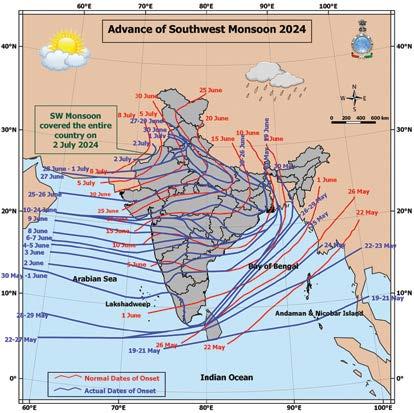
Source: India Meteorological Department, Ministry of Earth Sciences, “Monsoon Information,” 2024, https:// mausam.imd.gov.in/responsive/monsooninformation.php BOX O.2
Access to finance is a critical first line of defense when climate disasters strike and can also help households and firms cope with smaller shocks. Loans and credit lines support emergency needs and long-term investments in self-protection. Access to credit and insurance markets enables people to smooth consumption, invest in education
and health, adopt climate-resilient technologies, and migrate when necessary. Learning itself is sensitive to temperature: performance declines above or below 70° F (21° C).
A global study of 5,000 fifteen-year-olds in 214 countries (2000–2015) found that the negative effect of hot days on learning was substantially smaller where credit access expanded more rapidly, allowing the purchase of cooling equipment, such as fans and air
T he near- universal adoption of mobile phones and their use in banking have dramatically improved financial inclusion among the poor
MAP O.2 Sub-Saharan Africa remains an information desert with very few weather stations per capita
IBRD 48656 | FEBRUARY 2025
Source: National Oceanic and Atmospheric Administration, National Centers for Environmental Information, Global Historical Climatology Network, daily database, https://www.ncei.noaa.gov/products/land-based-station/global -historical-climatology-network-daily
Note: Based on station data downloaded in 2024.
FIGURE O.5 The accuracy of weather forecasts has improved, but gaps persist between richer and poorer countries
Forecast accuracy (correlation of anomalies)
Source: Linsenmeier and Shrader 2023.
conditioners (figure O.6) (Park, Goodman, and Behrer 2021). In Bangladesh, farmers who have access to emergency loans make less costly adaptation choices and are less severely affected when a flood occurs (Lane 2024).
Sizable obstacles remain. Climate uncertainty makes it harder for lenders to assess
repayment capacity, raising risks and costs especially in rural areas with many small, dispersed accounts. Greater credit availability can also encourage riskier behavior. On the other hand, mobile phones and mobile banking have markedly improved financial inclusion among the poor, creating an important, informal insurance mechanism for climate resilience.
Japan, despite its advanced technological capabilities, once faced significant challenges in making flood hazard information publicly available. Initial attempts to publish flood hazard maps encountered resistance from multiple stakeholders politicians, real estate developers, local governments, and private citizens all concerned about potential property devaluation. This resistance temporarily halted progress toward transparency in risk communication.
The Tokai Torrential flood of 2000 served as a watershed moment in Japan’s approach to disaster risk management. This catastrophic event severely impacted the Nagoya metropolitan area, Japan’s third-largest urban center. Approximately 19 square kilometers were inundated due to levee overtopping on the Shonai River and breaches by the Shinkawa River. Over 18,000 homes sustained damage, and authorities evacuated nearly 29,000 residents. Evacuation advisories were issued to approximately 580,000 people, but actual evacuation rates remained critically low.
The inadequate response revealed fundamental flaws in disaster risk communication and evacuation protocols. Most significantly, it demonstrated that public perception of natural threats had significantly underestimated actual risks.
In response to this disaster, Japan enacted significant policy reforms. First came legislative change: the Flood Risk Management Law was revised to mandate the Minister of
Land, Infrastructure, Transport and Tourism to publish hazard maps. This was followed by local implementation, in which local governments utilized these maps to develop disaster management resources, including evacuation routes, shelter locations, and identified hazardous areas. Finally, Japan developed a holistic approach. Over the subsequent two decades, Japan has continuously evolved its strategy, culminating in the River Basin Disaster Resilience and Sustainability by All initiative an integrated approach combining both structural (hard) and non-structural (soft) measures across entire river basins
Japan’s experience offers several critical insights for disaster risk management. Science-based hazard maps provide the necessary evidence-based foundation for landuse regulations that would otherwise face legal challenges as arbitrary restrictions on private property rights. Even the most robust flood protection systems have probabilitybased limits that will eventually be exceeded by extreme events. This revealed a psychological risk: paradoxically, increased structural protection can create a dangerous “safety illusion,” reducing risk awareness and potentially leading to catastrophic consequences when defenses fail. Ultimately, Japan developed a balanced approach, recognizing that effective flood risk management requires complementary hard and soft measures. Physical infrastructure must be supported by robust information systems, evacuation planning, and land-use policies.
Insurance is essential for rapid recovery from damaging climate shocks, but markets face moral hazards and adverse selection. Weather index insurance aims to mitigate these frictions, but premiums are often high. This is due to load factors, typically 50–70 percent above base premiums (Cole, Giné, and Vickery 2024), and the difficulty of pricing in the face of data scarcity and climate change limiting demand especially among liquidity-constrained farmers. Basis risk further depresses uptake because payout triggers (for example, rainfall recorded at a distant gauge) may not align with actual losses at the farm, creating ambiguity and distrust that are amplified by deep climate uncertainty.
Customers value protection against severe shocks, but supply has shifted toward covering moderate events. Climate uncertainty raises demand for extreme-event coverage (Cole, Giné, and Vickery 2024) while simultaneously increasing the cost of supplying it. The resulting equilibrium pushes prices up and availability down, making products for catastrophic risks scarce and often unaffordable. In India, for example, farmers showed higher demand for insurance against extreme rainfall, yet market offerings moved away from such coverage: in 2006, policies paid only for rainfall above the 92nd percentile (figure O.7); by 2010, products were redesigned to pay out more regularly for moderately deficient rainfall. Although farmers preferred the earlier extreme-event coverage, only the 2010-style products were available, leaving households less protected as major climate-related catastrophes intensified (Cole, Giné, and Vickery 2024).
L ayered, bundled approaches—for example, pairing insurance with new crop varieties— work better than easing just one constraint
FIGURE O.6 Hot days are less damaging to learning in countries with better access to credit
Source: Policy Research Report team analysis of data from Park, Goodman, and Behrer (2021).
Note: The blue line and the blue confidence interval are the original estimates from Park, Goodman, and Behrer (2021). The red line and pink confidence interval show the impacts in countries with credit expansion that was one standard deviation above the average in the sample. Test scores are from the Program for International Student Assessment.
O.7 Insurance markets in India have moved away from covering extreme climate events
Payout rank (percentile)
Source: Cole, Giné, and Vickery 2024.
Note: Payouts were based on historical rainfall data for 1963–2009.
Unlike traditional insurance, climateshock insurance must contend with deep uncertainty. Sound decisions require granular climate data, and insurers need to verify crop conditions and whether properties are in climate-vulnerable areas. On-the-ground verification is costly; automating it akin to digital financial services can substantially reduce costs. However, effective rollout depends on universal digital IDs, property IDs (for property insurance), and village IDs
H eavily subsidizing insurance premiums to encourage resilience actions can distort price signals and create disincentives to adopting more resilient technology
The high costs of bank branch networks that serve small accounts, adverse selection, and moral hazard discourage banks from offering credit to small borrowers. Digital financial services have tackled all three problems though not equally using new technology and innovative products. The near-universal adoption of mobile phones and their use in mobile banking have dramatically reduced the fixed costs of financial services. Progress has been slower in providing credit, though several innovative financial products have emerged. Digital financial services have introduced alternative finance to compensate for the lack of liquidity in traditional finance channels. In India, financial technology startups now facilitate peer-to-peer, consumer, and small and medium enterprise loans. Such credit short in duration (a couple of weeks to a year) and smaller in size ($50) can help people cope with weather shocks but is insufficient for building longer-term resilience, for example, by investing in drought-resistant seeds or weatherproofing properties.
Experience in Africa and Asia shows that the development of digital financial services requires a strong set of enabling factors to protect consumers, ensure financial integrity, and create stability. Governments need to invest in modern, robust, accessible, and interoperable digital and financial infrastructure and support systems. Regulations should make it easy for new players and new approaches by incumbents to offer digital financial services, including by promoting competition and establishing a level playing field in access to data, technology, and infrastructure. Regulations also need to protect consumers through data privacy and fee disclosures rules. By using digital financial services for social protection payments, government can also increase demand for these services and help expand markets.
Source: Based on Pazarbasioglu et al. 2020.
(for index and crop insurance; see box O.4 on overcoming these barriers in traditional banking). These unique identifiers enable integration of property registries and village data with information on soil quality, water availability, and other determinants of land productivity.6 Equally important, detailed, real-time climate and crop-health data from satellite imagery can be linked to village IDs to streamline crop-loss verification. In India, for example, public extension services verify crop losses on the ground, and village-level data are available on government platforms.
Governments should invest in industrywide digital infrastructure for insurance markets. Digital land and property registries are foundational for scaling digital insurance. Innovation can be accelerated by opening markets to nontraditional players, such as fintechs, and by fast-tracking approvals for new products while safeguarding consumer protection, data privacy, and the financial soundness of insurers. Many regulatory frameworks for digital financial services can be adapted for digital insurance. Some fintech firms already offer such products; for example,
I nterventions intended to help people adapt can backfire if they are poorly designed or mistimed
ACRE Africa provides crop, livestock, and index insurance to smallholder farmers in Kenya, Rwanda, and Tanzania.
Sensible regulation can increase demand. Most countries mandate auto insurance, but not insurance against floods, fires, or other climate risks for property. In China and India, many farmers are insured because coverage is required to access credit from banks or input suppliers. Such mandates broaden the customer base, spread risk, and lower transaction costs and premiums. Requiring insurance in hazard-prone areas can reduce the need for public bailouts. Simplifying products, speeding up payouts, and allowing innovative bundles and group policies can build trust, counter behavioral biases, and encourage climate-resilient actions.
Because households face multiple constraints, easing just one rarely triggers resilience actions. A layered, bundled approach can be more effective. For example, pairing weather index insurance with drought-resistant seeds expands access to both and is more cost-effective for lenders, since stress-tolerant varieties lower the risk of widespread crop failure. The Syngenta Foundation and Kenya’s Kilimo Salama (meaning “safe farming”) integrate such bundles into value chains, offering index insurance at a 5 percent premium over the seed price.
Infrastructure facilitates risk sharing and risk reduction
Well-integrated, competitive markets enabled by high-quality infrastructure— expand households’ and firms’ adaptation options. When people can reliably reach product, service, and factor markets, they are more likely to invest in self-protection, from adopting new technologies to migrating for
FIGURE O.8 Nigerian households with poor road access suffer more from unexpected droughts and excessive rainfalls
Precipitation Evapotranspiration Index
Source: Shilpi and Berg 2024, using data from the Nigeria Living Standards Measurement Study Integrated Surveys on Agriculture, 2010/11, 2012/13, 2015/16, 2018/19.
Note: n = 16,723 over the four waves of the survey. The dependent variable is the log of household consumption per capita. Controls include age, gender, and highest level of education of the household head; dependency ratio; numbers of adults working in agriculture and in wage work; average temperature; an indicator for urban location; dummy variables for the month of the interview; and fixed effects at the primary sampling unit level. Standard errors are clustered at the primary sampling unit level. The climate damage functions are estimated using restricted spline with three knots. The sample for “close” includes all households within 5 kilometers of a road, and the sample for “far” includes all households located 5 kilometers or more away from a road.
better opportunities. Integrated markets also diffuse localized shocks, acting as a de facto insurance mechanism. In Nigeria, for example, farm households within 5 kilometers of a road smooth consumption and recover more quickly from weather shocks, whereas those farther away suffer significant consumption declines after extreme precipitation (figure O.8). Weak market integration often stemming from underinvestment in physical infrastructure or from regulatory distortions limits such risk sharing.
High transport costs and unreliable infrastructure sharply curtail market access. In Ethiopia and Nigeria, transport distance has four to five times the effect on traded-goods
S ubsidies and social protection programs should not distort incentives to invest in self- protection and insurance. Individuals should bear part of the risk
prices as in the United States (Atkin and Donaldson 2015). Trucking costs are substantially higher in Africa than in developed economies, and median trade costs on the continent are about five times the global average (Teravaninthorn and Raballand 2009). Limited competition compounds these barriers: market power by traders in the absence of effective regulation, or direct policy restrictions on entry, weakens the system’s capacity to absorb climate shocks. In India, farmers selling in more competitive markets (75th percentile of a competition index) achieve 5 percent more output for each additional day of extreme heat than those in far less competitive markets (25th percentile), underscoring how competitive markets facilitate risk sharing among farmers, traders, and consumers.
Targeted infrastructure investment is a critical policy lever for resilience. Welldeveloped transport networks and competitive transport services knit together markets for products, inputs, land, housing, and labor. By enabling the flow of goods and people, integrated systems dissipate the localized impacts of shocks and provide an automatic buffer.
Beware of moral hazard and climate lock-in.
Protective infrastructure and repeated postdisaster bailouts can create moral hazard encouraging settlement and investment in high-risk locations on the expectation of future protection. In Jakarta, an evaluation of a proposed seawall found that concentrating builders and residents near the wall would likely necessitate future bailouts; including the welfare loss from delayed inland migration would double the total cost relative to construction alone (Hsiao 2023). Protective works can thus lock households and firms into vulnerable products and places, amplifying long-run danger (Hsiao 2023).
Regulatory frameworks also shape incentives. Even where protective infrastructure exists, poorly designed regulations can deter private resilience investments. Uncertain property rights and onerous land-use rules suppress incentives to weatherproof homes, plant drought-resistant seeds, improve natural resource management, or migrate investments that must be undertaken well before benefits materialize. Secure property and tenure rights, by contrast, unlock access to credit and encourage longer-horizon investments that flatten climate damage functions. In Madhya Pradesh, India, slum dwellers with land titles spend about twice as much on home maintenance and upgrading as those without titles. Globally, however, roughly 70 percent of land lacks secure tenure, leaving households vulnerable to eviction and unable to sell, collateralize, or improve their homes undermining resilience directly and indirectly by slowing economic development.
Overly strict zoning in cities can choke the supply of safe, affordable housing, pushing the poor into informal settlements the very areas most exposed to floods and other hazards (map O.3).7 Governments are tempted to build protective infrastructure to safeguard these areas, but that leads to increased property prices and gentrification. The poor sell out and move on to next vulnerable place. Nearly 1 billion people live in substandard housing in informal settlements, often without secure tenure and with inadequate water, sanitation, and drainage; many climate migrants simply swap rural risks for urban ones.8
Infrastructure investment should be guided by risk layering and rigorous cost-benefit analysis. In the highest-risk areas, managed retreat may be the leastcost, most humane option. In moderate-risk
Adaptation policies should emphasize individuals’ preferences and judgment, then mobilize markets where possible, and rely on governments where necessary
O.3 Unaffordable housing pushes poor people in Dhaka to settle in climate-vulnerable areas
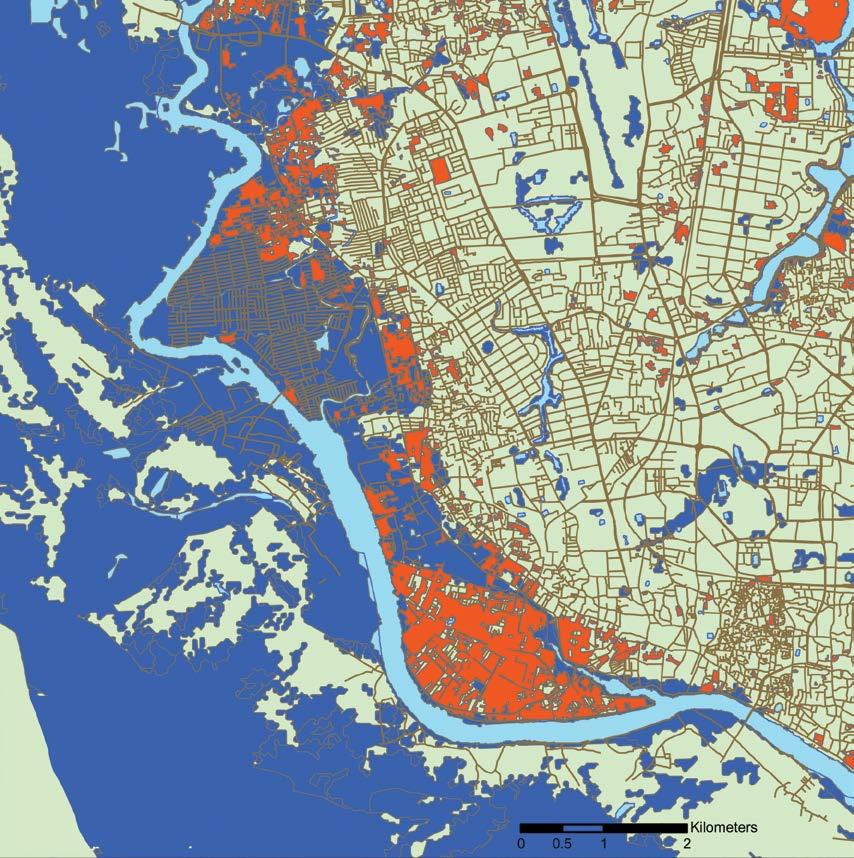
Source: Data on informal settlements are from World Bank Data Catalog informal settlements maps (ESA EO4SDUrban), https://datacatalog.worldbank.org/search/dataset/0041703/Dhaka--Bangladesh----Informal-Settlements-ESA-EO4SD-Urban-. Data on flood extent are from World Bank Data Catalog flood maps (ESA EO4SD-Urban), https://datacatalog.worldbank.org/search/dataset/0042071/Dhaka--Bangladesh----Flood -Maps--ESA-EO4SD -Urban-. Data on roads are from World Bank Data Catalog transport network maps (ESA EO4SD-Urban), https:// datacatalog.worldbank.org/search/dataset/0042062/Dhaka--Bangladesh----Transport-Network--ESA-EO4SD-UrbanNote: Flood extent refers to flooding in 2004, 2007, 2012, or 2016.
areas, combining basic infrastructure (safe water, sanitation) with investments in people (human capital, skills, and mobility) and with strong information and insurance markets can manage risks more efficiently. Where protective infrastructure is warranted when
its returns exceed those from retreat or from managing risk in place9 it should be paired with credible property-rights reforms, procompetition policies, and clear risk information so households and firms also invest in their own protection and insurance.
A
Interventions—when timely, targeted, and temporary—help people adapt and recover faster
Markets for finance, insurance, property, and climate-resilient products will take time to mature and income growth that eases liquidity constraints is gradual. In the interim, governments must help disadvantaged and vulnerable households, farms, and firms relocate to safer places, invest in resilient technologies, and access insurance. Governments also need the capacity to respond quickly after disasters to stabilize incomes and help people prepare and adapt.
Subsidies and bailouts can undermine resilience actions by distorting incentives for effective adaptation. These types of government interventions are often necessary to prepare for climate shocks and offer protection when shocks occur. But when used indiscriminately and repeatedly, they create moral hazard, as individuals make risky decisions in anticipation of bailouts. In many countries, public investments and social protection systems shield individuals, firms, and local governments from the downside of their decisions, such as where to settle or what insurance to buy. Social protection tied to a place can also diminish people’s sense of urgency for moving out of harm’s way.
Subsidized insurance can lock in risk. Heavily subsidizing insurance premiums may blunt price signals and deter a shift to more resilient technologies or products (Collier Skees, and Barnett 2009). In Andhra Pradesh, India, farmers with subsidized insurance were 6 percentage points more likely to plant weather-sensitive cash crops than comparable farmers, increasing exposure rather than reducing it (Giné 2024).
Social protection can slow necessary mobility. Workfare and transfer programs help poor households recover from shocks but, when benefits are generous and place-bound, they can discourage emigration from high-risk areas. In India, seasonal migration in response to heat shocks was almost halted in states providing particularly generous financial support under the National Rural Employment Guarantee Act (2005) (figure O.9) (Kochhar and Song 2024).
FIGURE O.9 Government interventions can distort private incentives in India
Impact of one additional hot day on seasonal migration rate
NREGA star states
Source: Kochhar 2024.
Non-NREGA star states
Note: This figure shows the temperature shock effect on seasonal migration in India in NREGA star and non-star states. NREGA is the Mahatma Gandhi National Rural Employment Guarantee Act (2005). The star states— Andhra Pradesh, Chhattisgarh, Himachal Pradesh, Madhya Pradesh, Rajasthan, Tamil Nadu, and Uttarakhand—are so-called because they provide much more generous payments under the NREGA program than non-star states, which are all the other states. This figure shows that in star states, generous support stifles seasonal migration previously prompted by heat shocks. The model was estimated by a Poisson Pseudo-Maximum Likelihood Estimator and includes origin and destination x year fixed effects. Standard errors are clustered at the origin-district level.
A timely, targeted social protection response can curb short and long-term poverty after climate shocks. Subsidies and social protection, if well designed, can prevent farmers from getting stuck cultivating
Resilience is a matter of proportion and balance: two-thirds development and one-third adaptation
crops that are not climate resilient and can assist households and firms in relocating from climate-vulnerable areas to safer areas. The additional income from social protection programs offsets household income and asset losses due to climate shocks and helps build household savings and increase protective investments that reduce the impact of climate shocks on incomes or assets (often because of the conditions imposed for receiving the transfers) (Bowen et al. 2020). To avoid the unintended consequence of compromising long-term resilience, subsidies and social protection programs should not distort incentives to invest in self-protection and insurance. Individuals should bear part of the risk. And benefits should be contingent on behaviors that contribute to climate resilience, be directed to the poor when feasible, be portable rather than tied to a place, and be rule-based, timely, and temporary.
Many poorer households live in highrisk areas because that is what they can afford. Should governments invest to bolster resilience in place or enable movement to safer areas? Equipping people to move requires:
• Expanding affordable, well-located housing in safer areas, supported by land-use planning, infrastructure, and incentives for builders.
• Complementary investments in people such as skills training and job matching so movers can access better employment in new locations.
By pairing interim, well-designed support with policies that enable mobility and market development, governments can protect livelihoods today without compromising longterm climate resilience.
Resilience efforts should be layered according to the size and frequency of climate shocks, with instruments escalating from household- and market-based measures for frequent, lower-impact events to public “insurance of last resort” for rare, catastrophic events. A practical organizing frame is the “5 I’s” income, information, insurance, infrastructure, and interventions sequenced and combined based on shock severity and local capacity.
Income levels influence how households, farms, and firms manage climate threats. The extremely poor lack savings and rely on
emergency measures to cope with climate damage. The poor have access to informal insurance but cannot afford formal insurance even if it is available. Middle income people can access some formal credit and insurance. The rich face fewer financial constraints and have better access to financial and insurance tools. These differences highlight the importance of tailoring policy tools based on the severity of shocks and income levels. This approach is used in resilience projects, like a World Bank initiative for pastoralists in the Horn of Africa (box O.5).
In addition to incomes, how should policy makers prioritize the other four I’s?
The Horn of Africa, one of the world’s poorest and most fragile regions, experiences severe drought and is home to some 50 million extremely poor pastoralists. Pastoralism and livestock production are the primary livelihoods, accounting for over one-third of agricultural GDP in most countries and around four-fifths in Djibouti and Somalia. Historically, the number of pastoralists engaging with formal financial services has been low. When a drought hits, these vulnerable communities rely on external support, such as government emergency response or humanitarian aid.
The World Bank’s De-risking, Inclusion, and Value Enhancement of Pastoral Economies (DRIVE) project, a collaborative effort in Djibouti, Ethiopia, Kenya, and Somalia, seeks to help pastoralists adapt to the impacts of climate change by providing access to financial services. The project supports commercializing livestock production, investing in pastoralist communities, and including assisting women, marginalized groups, and vulnerable populations. Up to 1.6 million pastoralists stand to benefit.
The project uses mobile phones to improve access to financial services. For DRIVE’s index insurance products, pasture conditions are monitored on the ground through satellite technology. When the quality of pasture falls below a certain threshold, the insurance payout is triggered automatically and paid directly to pastoralists through mobile money transfers. The project helps pastoralists shift from asset replacement to asset protection: the payout allows pastoralists to buy water, fodder, and medicine to keep the core breeding stock alive during a severe drought rather than having to replace the animals lost during a drought. The insurance provides affected households with rapid payouts at the onset of a drought, much faster than the wait for humanitarian assistance.
Smart subsidies have been put in place to reach a sustainable subsidy level at the end of the program. They include partial contributions from pastoralists (10–30 percent of the premium cost except for those covered by social protection), capping subsidies by the number of animals, and calibrating premiums to country conditions (higher in Kenya than Somalia). After one year of implementation, DRIVE is already covering around 1 million people in Ethiopia, Kenya, and Somalia with payment accounts, savings, and insurance.
Source: Based on Mahul 2024.
For frequent, low-impact shocks, the main levers should be income plus information (table O.2). These shocks are manageable with routine risk-reduction and risk-sharing mechanisms that people and markets can provide themselves when enabled by good information and basic financial access.
Rising incomes strengthen household and firm’s self-insurance through savings, diversified livelihoods, reliable access to markets and credit, and prudent production choices. Improved climate and market information, early warning, and advisories enable timely actions that can cut damages substantially
TABLE O.2 A calibrated 5 I’s strategy: income, information, insurance, infrastructure, and targeted interventions
Frequency and severity of climate-related loss
Frequent but low impact event
Individuals
Income (self-insurance or savings)
Less frequent but larger events Income
Rare but extreme events
Source: Policy Research Report team.
and have high benefit-cost ratios. Examples include weather and price information services; savings products and working capital credit; and low-cost, no-regrets measures (e.g., drainage clearing, minor retrofits, crop diversification).
For less frequent, larger (material but not catastrophic) shocks, the levers are income plus information plus insurance plus infrastructure. As shocks get more severe, private self-insurance becomes insufficient; risk-pooling and public goods are needed to avoid deep consumption cuts and long recoveries. Formal risk-pooling (e.g., index or bundled insurance, risk-sharing via cooperatives/value chains) on top of household coping and market access gains importance. Investments in protective and connective infrastructure reduce losses (e.g., flood-proofing critical assets, resilient transport for supply continuity).
For rare and catastrophic events, interventions—with public support as a last resort should be brought to bear, along with income, information, insurance, and infrastructure. Because catastrophic events overwhelm private and market mechanisms, rapid, predictable public support is essential to prevent long-term scarring and enable rebuilding. This includes rule-based, timely, and temporary disaster assistance
Markets Governments
Information
Information and insurance Infrastructure
Information and insurance Insurance and interventions
through adaptive social protection as well as exceptional fiscal risk-financing (e.g., contingent credit, budget reallocations, catastrophe instruments) to fund surge response and early recovery.
Resilience is a matter of proportion and balance: the right balance is two-thirds development and one-third adaptation. The exact ratio will vary by place and peril, but the sequencing is immutable: prioritize income growth, then reliable information, then private insurance, with public infrastructure and social policy interventions rounding out the package. Call it the “5 I’s”: income, information, insurance, infrastructure, and interventions.
• Rapid income growth because it unlocks many other resilience investments and reduces vulnerability everywhere.
• Reliable public information systems because they convert paralyzing uncertainty into actionable risk, improving every decision that follows.
• Robust private insurance markets because they finance recovery and sustain productive risk-taking.
• Resilient infrastructure because it protects lives and sustains economic function (but design and regulate it to avoid moral hazard).
• Rational social policy interventions because they prevent irreversible losses and enable mobility, without dulling risk signals.
These instruments need to be layered by hazard frequency and severity. For frequent, lower-impact events, income and information should carry most of the load. As shocks become rarer but larger, insurance and infrastructure will have to shoulder much of the burden. Even the most effective combination of these four factors will sometimes not be enough, especially in the poorest countries, very poor places, and when climatic shocks affect poor people. For catastrophic extremes, all five will be necessary. Getting the mix right means reassigning roles. Governments should stop trying to
Notes
1. Analysis for this report is based on data from the US National Oceanographic and Atmospheric Administration
2. World Weather Attribution, https://www.worldweatherattribution.org/
3. The ratio seems to be getting worse. Between 1994 and 2013, more than three times as many people died per disaster in low-income countries as in highincome countries (CRED 2015).
4. See Trautmann and van de Kuilen (2015) for a survey.
5. Estimates have a range and can depend on the specific programs, coverage, and components.
6. Digital land registries maintain accurate records on land ownership, plot boundaries, and transactions. These registries are often created and maintained using satellite imagery, GPS, arial imaging, and machine learning. In many countries, population censuses create village IDs, which can change over time. However, to be useful for digital finance and insurance, they must be unique.
7. Goytia, Heikkila, and Pasquini (2023) find evidence of a causal link between restrictive land use regulations and the emergence of informal housing settlements.
8. UN DESA and UN-Habitat 2023.
9. See Lall and Deichmann (2009) for more detail.
be the insurer of first resort for every loss. Instead, they should pay a lot more attention to three things: enabling broad- based growth, building credible information systems; and supporting and regulating insurance markets so that they provide affordable and reliable support to those who suffer losses. International institutions should assess resilience spending less by miles of seawall built and more by whether households and enterprises are being provided the information and insurance instruments to efficiently assess, price, and manage risk. And everyone should invest in learning more about climate change because it is not going to stop any time soon.
Atkin, David, and Dave Donaldson. 2015. “Who’s Getting Globalized? The Size and Implications of Intra-national Trade Costs.” Working Paper 21439. National Bureau of Economic Research, Cambridge, MA.
Banerjee, R., and R. Maharaj. 2020. “Heat, Infant Mortality, and Adaptation: Evidence from India.” Journal of Development Economics 143: 102378.
Barham, Bradford L., Jean-Paul Chavas, Dylan Fitz, Vanessa Ríos Salas, and Laura Schechter. 2014. “The Roles of Risk and Ambiguity in Technology Adoption.” Journal of Economic Behavior & Organization 97: 204–18.
Behrer, A. P., and C. Berg. 2024. “Credit, Climate, and (Human) Capital: Does Access to Credit Alleviate the Negative Human Capital Impacts of Climate Change?” Background paper for this report, World Bank, Washington, DC.
Bowen, T., C. del Ninno, C. Andrews, S. Coll-Black, U. Gentilini, K. Johnson, Y. Kawasoe, A. Kryeziu, B. Maher, and A. Williams. 2020. Adaptive Social Protection: Building Resilience to Shocks. International Development in Focus Washington, DC: World Bank.
Bühren, C., F. Meier, and M. Plessner. 2023. “Ambiguity Aversion: Bibliometric Analysis and Literature Review of the Last 60 Years.” Management Review Quarterly 74: 495–525.
Burgess, R, O. Deschenes, D. Donaldson, and M. Greenstone. 2017. “Weather, Climate Change, and Death in India.” Working Paper. https://www.lse.ac.uk/economics /Assets/Documents/personal-pages/robin-burgess /we ather-climate-change-and-death.pdf
Burlig, Fiona, Amir Jina, Erin M. Kelley, Gregory V. L ane, and Harshil Sahai. 2024. “Long-range Forecasts as Climate Adaptation: Experimental Evidence from Developing-Country Agriculture.” Working Paper 32173, National Bureau of Economic Research, Cambridge, MA.
Carleton, T., A. Jina, M. Delgado, M. Greenstone, T. Houser, S. Hsiang, A. Hultgren, R. Kopp, K. McCusker, I. Nath, J. Rising, A. Rode, H.-K. Seo, A. Viaene, J. Yuan, and A. T. Zhang. 2022. “Valuing the Global Mortality Consequences of Climate Change Accounting for Adaptation Costs and Benefits.” Quarterly Journal of Economics 103 (4): 2037–2105. https://doi.org/10.1093/qje/qjac020
Chambers, Robert G., and Tigran Melkonyan. 2017. “Ambiguity, Reasoned Determination, and ClimateChange Policy.” Journal of Environmental Economics and Management 81: 74–92.
Cole, S. A., A. J. Healy, and E. Werker. 2008. “Do Voters Appreciate Responsive Governments? Evidence from Indian Disaster Relief.” Harvard Business School Finance Working Paper 09-050, Cambridge, MA. http://dx.doi.org /10.2139/ssrn.1276339
Cole, Shawn, Xavier Giné, and James Vickery. 2024. “Designing Index Insurance: Evidence from a Field Experiment.” Background paper for this report, World Bank, Washington, DC.
Cole, Shawn, Xavier Giné, Jeremy Tobacman, Petia Topalova, Robert Townsend, and James Vickery. 2013. “Barriers to Household Risk Management: Evidence from India.” American Economic Journal: Applied Economics 5 (1): 104–35.
Collier, Benjamin, Jerry Skees, and Barry Barnett. 2009. “Weather Index Insurance and Climate Change: Opportunities and Challenges in Lower Income Countries.” Geneva Papers on Risk and Insurance-Issues and Practice 34: 401–24.
CRED (Centre for Research on the Epidemiology of Disasters). 2015. “The Human Cost of Natural Disasters, 2015: A Global Perspective.” https:// www.preventionweb.net/publication/human -cost -natural-disasters-global-perspective
CRED (Centre for Research on the Epidemiology of Disasters) and UNISDR (United Nations Office for Disaster Risk Reduction). 2018. “Economic Losses, Poverty & Disasters 1998–2017.” https://www.preventionweb.net /files/61119_credeconomiclosses.pdf
Cruz Alvarez, J. L., and E. Rossi-Hansberg. 2024. “The Economic Geography of Global Warming.” Review of Economic Studies. 91 (2): 899–939. https://doi.org/10 .1093/restud/rdad042
Dang, Hai-Anh H., Peter F. Lanjouw, and Rob Swinkels. 2014. “Who Remained in Poverty, Who Moved Up, and Who Fell Down? An Investigation of Poverty Dynamics in Senegal in the Late 2000s.” Policy Research Working Paper 7141. World Bank, Washington, DC.
De Perez, E. C., K. B. Berse, L. A. C. Depante, E. Easton-Calabria, E. P. R. Evidente, T. Ezike, D. Heinrich, C. Jack, A. M. F. A. Lagmay, S. Lendelvo, J. Marunye, D. G Maxwell, S. B. Murshed, C. G. Orach, M. Pinto, L. B. Poole, K. Rathod, Shampa, C. van Sant. 2022. “Learning from the Past in Moving to the Future: Invest in Communication and Response to Weather Early Warnings to Reduce Death and Damage.” Climate Risk Management 38: 100461. https://doi.org/10.1016/j.crm.2022.100461
Deressa, T. T., R. M. Hassan, C. Ringler, T. Alemu, and, M. Yesuf. 2009. “Determinants of Farmers’ Choice of Adaptation Methods to Climate Change in the Nile Basin of Ethiopia.” Global Environmental Change 19 (2), 248–55.
Doan, M. K., R. Hill, S. Hallegatte, P. Andres, C. Rodas, B. J. Brunckhorst, M. Nguyen, S. Freije-Rodriguez, and E. G. Naikal. 2023. “Counting People Exposed To, Vulnerable To, or at High Risk from Climate Shocks: A Methodology.” Policy Research Working Paper 10619, World Bank, Washington, DC
Engle-Warnick, Jim, Javier Escobal, and Sonia Laszlo. 2007. “Ambiguity Aversion as a Predictor of Technology Choice: Experimental Evidence from Peru.” CIRANOScientific Publications 2007s-01.
Geruso, M., and D. Spears. 2018. “Heat, Humidity, and Infant Mortality in the Developing World,” Working Paper 24870, National Bureau of Economic Research, Cambridge, MA.
Giné, Xavier. 2024. “Insurance Markets for Small Holder Farmers.” Background paper for this report, World Bank, Washington, DC.
Global Commission on Adaptation. 2019. Adapt Now: A Global Call for Leadership on Climate Resilience. Washington, DC: World Resources Institute.
Goytia, C., E. J. Heikkila, and R. A. Pasquini. 2023. “Do Land Use Regulations Help Give Rise to Informal Settlements? Evidence from Buenos Aires.” Land Use Policy 125. https://doi.org/10.1016/j.landusepol.2022.106484
Hallegatte, S., A. Vogt-Schilb, M. Bangalore, and J. Rozenberg. 2017. Unbreakable: Building the Resilience of the Poor in the Face of Natural Disasters. Climate Change
Development Series. Washington, DC: World Bank. https://doi.org/10.1596/978-1-4648-1003-9
Haushofer, Johannes, and Ernst Fehr. 2014. “On the Psychology of Poverty.” Science 344 (6186): 862–67. https:// doi.org/10.1126/science.1232491
Healy, Andrew, and Neil Malhotra. 2009. “Myopic Voters and Natural Disaster Policy.” American Political Science Review 103 (3): 387–406. https://doi.org/10.1017 /S0003055409990104
Hsiang, S. M., and A. S. Jina. 2014. “The Causal Effect of Environmental Catastrophe on Long-Run Economic Growth: Evidence from 6,700 Cyclones.” Working Paper 20352, National Bureau of Economic Research, Cambridge, MA. http://doi.org/10.3386/w20352
Hsiao, Allan. 2023. “Sea Level Rise and Urban Adaptation in Jakarta.” Princeton University. https://allanhsiao.com /files/Hsiao_jakarta.pdf
Kala, Namrata. 2019. “Learning, Adaptation, and Climate Uncertainty: Evidence from Indian Agriculture.” Unpublished. https://namratakala.com/wp-content/uploads /2020/01/kala_learning_dec2019.pdf
Kochhar, R. 2024. “Climate Change and Migration in India.” Background paper for this report, World Bank, Washington, DC.
Kochhar, R., and R. Song. 2024. “Does Market Power in Agricultural Markets Hinder Farmer Climate Change Adaptation?” Working Paper. https://static1.squarespace. com/static/6334ef03eb02b95245b3c328/t/660b1cf33741e56d3a8c4679/1712004354607/Market+Power+and+Climate+Change+Adaptation.pdf
Lall, Somik V., and Uwe Deichmann. 2009. “Density and Disasters: Economics of Urban Hazard Risk.” Policy Research Working Paper 5161. World Bank, Washington, DC.
Lane, Gregory. 2024. “Adapting to Climate Risk with Guaranteed Credit: Evidence from Bangladesh.” Econometrica 92 (2): 355–86.
Lang, Megan, Claudia Berg, Luca Bettarelli, Davide, Furceri, Michael Ganslmeier, Arti Grover, Matthew Kahn, and Marc Schiffbauer. 2024. “Firm-level Climate Change Adaptation: Micro Evidence from 134 Nations.” Background paper for this report , World Bank, Washington, DC.
Linsenmeier, M., and J. G. Shrader. 2023. “Global Inequalities in Weather Forecasts.” SocArXiv /7e2jf, Center for Open Science. https://osf.io/preprints/socarxiv/7e2jf_v1
Lybbert, Travis J., Christopher B. Barrett, John G. McPeak, and Winnie K. Luseno. 2007. “Bayesian Herders: Updating of Rainfall Beliefs in Response to External Forecasts.” World Development 35 (3): 480–97.
Meta. 2022. “Climate Change Opinion Survey.” https:// data forgood.facebook.com/dfg/tools/climate -change-opinion-survey
NOAA (National Oceanic and Atmospheric Administration). National Centers for Environmental information. 2024. “Climate at a Glance: Global Time Series,” August (accessed August 28, 2024). https:// www.ncei.noaa.gov/access/monitoring/climate -at-a-glance/global/time-series
Park, R. Jisung, Joshua Goodman, and A. Patrick Behrer. 2021. “Learning Is Inhibited by Heat Exposure, both Internationally and within the United States.” Nature Human Behaviour 5 (1): 1–9.
Pazarbasioglu, Ceyla, Alfonso Garcia Mora, Mahesh Uttamchandani, Harish Natarajan, Erik Feyen, and Mathew Saal. 2020. “Digital Financial Services.” World Bank, Washington, DC.
Pelli, M., J. Tschopp, N. Bezmaternykh, and K. M. Eklou. 2023. “In the Eye of the Storm: Firms and Capital Destruction in India.” Journal of Urban Economics 134: 103529. https://doi.org/10.1016/j.jue.2022.103529
Rieger, Marc Oliver, Mei Wang, and Thorsten Hens. 2017. “Estimating Cumulative Prospect Theory Parameters from an International Survey.” Theory and Decision 82 (4): 567–96.
Rosenzweig, C., J. Elliott, D. Deryng, A. C. Ruane, C. Müller, A. Arneth, K. J .Boote, C. Folberth, M. Glotter, N. Khabarov, and K. Neumann. 2014. “Assessing Agricultural Risks of Climate Change in the 21st Century in a Global Gridded Crop Model Intercomparison.” Proceedings of the National Academy of Sciences 111 (9): 3268–73.
Ross, Nicholas, Paulo Santos, and Timothy Capon. 2012. “Risk, Ambiguity, and the Adoption of New Technologies: Experimental Evidence from a Developing Economy.” Paper presented at the International Association of Agricultural Economists Conference, August 18–24, 2012, Foz do Iguaçu, Brazil. https://ageconsearch.umn.edu/record/126492/?v=pdf
Shilpi, F., and C. Berg. 2024. “Climate Resilience of Farmers in Nigeria.” Background paper for this report, World Bank, Washington, DC.
Snow, A. 2011. “Ambiguity Aversion and the Propensities for Self-insurance and Self-protection.” Journal of Risk and Uncertainty 42: 27–43.
Spence, Alexa, Wouter Poortinga, and Nick Pidgeon. 2012. “The Psychological Distance of Climate Change.” Risk Analysis 32 (6): 957–72. https://doi.org/10.1111 /j.1539-6924.2011.01695.x
Sunstein, Cass R. 2007. Worst-Case Scenarios Cambridge, MA: Harvard University Press.
Tellman, B., J. A. Sullivan, C. Kuhn, A. J. Kettner, G. R. Brakenridge, C. S. Doyle, T. A. Erickson, and D. A. Slayback. 2021. “Satellite Imaging Reveals Increased Proportion of Population Exposed to Floods.” Nature 596 (7870): 80–86.
Teravaninthorn, Supee, and Gaël Raballand. 2009. Transport Prices and Costs in Africa: A Review of the Main International Corridors. Washington, DC: World Bank.
Trautmann, Stefan T., and Gijs van de Kuilen. 2015. “Ambiguity Attitudes.” In The Wiley Blackwell Handbook of Judgment and Decisionmaking, edited by G. Keren and G. Wu, 2: 89–116. Chichester: John Whiley & Sons Ltd. https://doi.org/10.1002/9781118468333.ch3
United Nations. 2022. “World ‘At a Crossroads’ as Droughts Increase Nearly a Third in a Generation.” May 12. Accessed July 16, 2024. https://news.un.org/en /story/2022/05/1118142
UN DESA (United Nations Department of Economic and Social Affairs) and UN-Habitat (United Nations Human Settlements Program) 2023. “SDG Indicator 11.1.1: Proportion of Urban Population Living in Slums, Informal Settlements or Inadequate Housing (Methodology and Data Updates 2023).” UN DESA and UN-Habitat, New York and Nairobi.
USGS (United States Geological Survey). n.d. Droughts and Climate Change. Accessed July 16, 2024. https:// www.usgs.gov/science/science-explorer/climate /droughts-and-climate-change
World Bank. 2024. Rising to the Challenge: Success Stories and Strategies for Achieving Climate Adaptation and Resilience: Executive Summary. Washington, DC: World Bank.
Zaveri, E. D., R. Damania, and N. Engle. 2023. Droughts and Deficits: Summary Evidence of the Global Impact on Economic Growth . Washington, DC: World Bank.
The expected rise in global temperature has long been framed as something that policy makers will need to deal with in the future. Yet there is already abundant evidence of frequent, severe, and persistent impacts that can be attributed to a changing climate. Impacts are felt in high-income countries as much as in poorer countries. But the consequences are greater in places that already struggle to provide decent living standards for all. Better adaptation policies that help households, farms, and firms become more resilient are thus an urgent development priority. But the ability to design such policies is hampered by the inability to properly measure and monitor resilience.
A growing body of research summarized in this chapter shows that changes in temperature and the weather events that result can compromise human health, education, farm yields, and business productivity. Slow but persistent changes make it harder to maintain livelihoods, let alone improve them. More catastrophic events like cyclones or major floods reliably attributed to rising temperatures cause direct damage and can have long-lasting welfare effects. Worryingly, warming trends may have accelerated, making it even more pressing to formulate effective resilience policies.
Understanding the effectiveness of policies is essential, but there still is no comprehensive framework to properly measure and monitor resilience. Reliable systems are already
available to monitor changes in greenhouse gas emissions and thus successes in mitigation. But devising a similar system for adaptation is difficult because of the greater diversity in the types of impacts, the entities affected, and the factors that increase or reduce vulnerability. What can be monitored are “adaptation inputs,” such as the investments made or institutions created to promote resilience. Needed now are corresponding methods to also measure outcomes in lives saved, damage avoided, and livelihoods restored.
This chapter presents evidence on the shifting nature of climate change. It discusses evidence of the impact of weather shocks on households, farmers, and firms. It proposes a simple framework to track adaptation and coping progress. And it highlights four stylized facts: climate change is getting worse; poor countries and people are more vulnerable; poor countries and poor areas suffer larger losses from weather shocks; and adaptation progress and recovery rates are slower for poor countries than for richer countries.
Climate shocks are already severe and will only get worse
Global temperatures have already risen to between 1.3º and 1.5º Celsius above preindustrial levels (NOAA 2024), and there are worrying signs that warming is accelerating: from 1850 to 2024, temperatures rose at an average of 0.06º C per decade. But since 1970, temperature rise has accelerated dramatically. Sea surface temperatures posted a new high every day in 2023. These trends
Poorer countries suffer greater losses of life from natural hazards, while richer countries experience greater (and growing) physical damages
suggest that harmful weather events such as extreme storms, droughts, heat waves, and wildfires will become even more frequent and severe as global warming intensifies.1
Impacts from global temperature rise are significant and will become ever harsher. Over the past 50 years, dry episodes have been increasing in frequency and severity and spreading geographically, with substantial subnational variability (USGS n.d.). By 2050, droughts could affect more than three-quarters of the world’s population, and an estimated 4.8–5.7 billion people will live in water-scarce areas for at least one month each year, up from 3.6 billion today (United Nations 2022). Since 2000, 255–290 million people (3 percent of the global population) have been directly exposed to flooding (Tellman et al. 2021). If the current greenhouse gas emissions trajectory continues,2 vulnerability to flood damage along densely populated coastlines will increase fivefold compared with a future without climate change (Climate Impact Lab 2023). With a warmer climate, a once-in-a-100-year storm in the United States is now expected to occur once in about every 56 years (Mendelsohn, Emanuel, and Chonabayashi 2010). In Bangladesh, a once-in-a-600year cyclone can return in a mere 47 years (Qiu, Ravela, and Emanuel 2023). And over time, strong storms will hit the same regions repeatedly, especially near the Caribbean, Gulf of Mexico, and the Philippines. Small island developing states are especially vulnerable to these powerful storms and rising sea levels.
These stark projections may seem like something that will happen in the distant future, but some of the shocks are already happening. In May 2024, southern Brazil experienced devastation from climate-induced severe flooding. This flooding was characterized as an “extremely rare” event with return periods of 100 to 250 years but would be rarer still in the absence of global warming (Clarke et al. 2024; Ledur 2024). Temperatures that
shattered a 122–year record during March–April 2024 brought a brutal heat wave that swept India. Delhi and other cities recorded temperatures above 50º C in May, with New Delhi reaching 52º C (Times of India 2024). The average person on Earth experienced 26 more days of abnormally high temperatures over the period May 2023 through May 2024 than would have been the case without human-induced climate change (Zhong 2024).
Climate shocks hurt poorer countries and poorer people most Poorer countries suffer greater losses of life from natural hazards, while richer countries experience greater (and growing) physical damages.3 Between 1998 and 2017, natural disasters killed 1.3 million people and left 4.4 billion injured (CRED and UNISDR 2018). Since 1960, lower-middle-income countries and high-income countries experienced similar numbers of disasters, yet lower-middleincome countries experienced more than six times as many deaths.4 South Asia and SubSaharan Africa experienced the highest mortality rates from such disasters.
Climate risk is usually defined as a combination of hazard, exposure, and vulnerability (see box 1.1 for definitions of terms used frequently in this report). Hazard is the potential occurrence of an extreme event. Exposure refers to the people subject to such an event. And vulnerability is the predisposition of those people to be adversely affected (Doan et al. 2023). Recent estimates suggest that about 4.5 billion people were exposed to extreme weather events (flood, drought, cyclone, or heat wave) in 2019, up from 4 billion in 2010 (Doan et al. 2023). Of people exposed in 2019, 2.3 billion lived on less than $6.85 a day and about 400 million lived in extreme poverty (on less than $2.15 a day). Many of the most vulnerable people live in poorer countries in Africa and South and Southeast Asia (map 1.1).
Adaptation
Coping
The ex ante process of increasing resilience and reducing vulnerability by altering behaviors, systems, and ways of life
Short-term and ex post responses to a disaster that may not contribute to longterm resilience
Disaster A hazard’s negative effect on society
Disaster risk
Uncertainty about disaster, a function of hazard, exposure, and vulnerability
Exposure People and property subject to hazard
Hazard Natural phenomena (floods, storms, droughts, cyclones) with adverse effects on lives, livelihoods, and living standards
Resilience
Vulnerability
The capacity to prepare for disruptions, recover from shocks, and grow from a disruptive experience—the opposite of vulnerability
The tendency to be more adversely affected by hazards
Source: World Bank calculations based on Doan et al. 2023.
Note: The gray areas indicate territories for which data are lacking or insufficient.
Poorer countries will continue to bear the brunt of the impacts of climate shocks. Estimated welfare effects—welfare constituting utility from consumption of goods and local amenities range from welfare losses as large as 15 percent in Africa and Latin America to
moderate gains in northern regions (Cruz Alvarez and Rossi-Hansberg 2024). Some of today’s poor and hot locations will suffer substantial damage, while today’s cold areas are projected to benefit from rising temperatures (Carleton et al. 2022).
Economic growth is inextricably related to resilience because income growth enables preparing for and responding to climaterelated impacts and thus building resilience,
Income growth makes it easier for individuals and governments to prepare for and respond to disruptions
People are better able to deal with climate shocks when they have higher levels of wealth and income. Higher income provides insurance against the possibility that even a small shock will jeopardize survival, thereby reducing the stakes involved in climate shocks. An increase in income enables households, farms, and firms to adapt better to climate shocks. The effects of higher income on climate resilience apply to governments as well as individuals. Higher tax revenues enable governments to finance infrastructure and services that directly contribute to people’s resilience. Similarly, higher revenues allow governments to invest in risk reduction and disaster preparation and recovery.
People can also adapt by learning from repeated exposure. The relative importance of these two means of adaptation income growth and learning can guide the focus of resilience policies. An influential study predicted the relative importance of these two means of adaptation for the mortality effects of climate change (the climate damage function) (figure 1.2) (Carleton et al. 2022). Without income growth or learning, the climate damage function would be very steep, with the mortality rate rising rapidly over time (red line in figure 1.2). Income growth with no learning lowers the climate damage function (blue line), while income growth plus learning lowers the climate damage function even more (green line). The predictions suggest that nearly fourfifths of resilience to rising temperature by the end of the century will come from a rise in per capita GDP and the other one-fifth from learning associated with long-term exposure (Carleton et al. 2022).
Income growth and development can build resilience in many ways Structural change accompanying development often reduces exposure to shocks.
Source: Carleton et al. 2022.
Agriculture is one of the most climatesensitive sectors, as climate change reduces crop yields, increases pest infestations, and disrupts food security. By diversifying income sources, and moving to urban areas, people can reduce their dependence on agriculture and improve their access to markets and such basic services as health, education, water, and sanitation all increasing their resilience to shocks. Higher tax revenues help the government invest in basic infrastructure and services (such as sanitation, safe water, and health care) that can significantly reduce vulnerability. Public investments in information, social protection, and research and development (providing better technology) can also build resilience.
resilience cannot be separated from economic development
The overlap is considerable between what is good for climate resilience and what is good for economic development because the problem of climate resilience is, in many ways, a problem of economic development. But relying on economic development alone cannot solve the resilience problem since resilience also influences economic development (box 1.2).
Empirical evidence establishes three key ways that poorer countries, areas, and people are falling behind richer countries, areas, and people in climate resilience: the adverse impacts of climate shocks on them are much larger, implying that they are not as well prepared; adaptation to climate shocks is more muted for them, implying that they are unable to invest in adaptation either financially or through learning; and recovery from climate shocks is much slower for them, implying longer exposure to the adverse effects of climate change.
Weather shocks can adversely affect the formation of human capital by dampening its formation and increasing mortality
Poorer countries and poorer people suffer most from climate shocks
Climate shocks can have significant adverse impacts on a wide range of outcomes from mortality to firm and farm productivity, to human capital, household welfare, and overall economic growth. Precipitation shocks and droughts substantially reduce economic growth in poor countries.5 And climate change already affects micro-level economic and broader welfare outcomes for households, farms, and firms. Unsurprisingly, the adverse effects are greater for lower-income groups and small agricultural and nonagricultural operations.
Human capital is a key factor determining economic growth and welfare in the long run, but weather shocks can adversely affect human capital by dampening its formation and increasing mortality. Hotter days and drier months raise overall mortality and infant mortality rates (Burgess et al. 2017; Banerjee and Maharaj 2020; Geruso and Spears 2018). For developing countries, the mortality effects of hotter days are considerable and comparable to those observed for the United States before the widespread adoption of air conditioning between 1930 and 1959 (Geruso and Spears 2018). The larger adverse effects could be due to the greater exposure to shocks and the lack of adaptation responses.
The direct effects of temperature shocks on human capital formation are greater in developing economies than in advanced economies. Both high temperatures (above 21o C) and low temperatures (below 15o C) impair learning outcomes, with hot days having a worse impact on math scores in India (figure 1.2).6 Each additional hot day is associated with a 3 percent drop in math scores and a 2 percent drop in reading scores.7 The adverse effects of hotter temperatures are stronger during agricultural growing seasons, when hotter temperatures
F irms in poorer countries suffer a 12 percent decline in sales revenue due to a unit increase in temperature variability
Just as climate resilience depends on income growth and economic development, economic growth depends on climate resilience—for three reasons. First, if income growth could lift people out of poverty faster than the impacts of climate shocks rise, countries could depend more on economic development to ensure resilience, except in the case of catastrophic events. But the damage from climate shocks are already outpacing the rate of economic growth, so active resilience policies are necessary—and becoming more urgent.
Second, climate resilience is needed not just on humanitarian grounds but also because climate impacts threaten hard-earned development gains. Severe shocks force firms to close, households to slide into poverty, and farmers to lose productive assets. In Senegal, households affected by natural disasters were 25 percent more likely to fall into poverty.1 In Nigeria, 15 percent of farm households sold assets to cope with severe flooding. In India, the average cyclone reduces firms’ sales by 3.1 percent and destroys 2.2 percent of their fixed assets.2 Cyclones can wipe out decades of economic development in a few hours, and economies can struggle many more decades to recover.3 In Bangladesh, Thailand, and Viet Nam, the expected loss in per capita GDP
from sea level rise is 5–10 percent by the end of the century.4
Third, economic development requires long-term, irreversible investments. Neither domestic nor foreign investors have incentives to make those investments when the damages expected from climate shocks are large and frequent amid deep uncertainty. So, climate shocks involve a large growth penalty. From 1990 to 2014, moderate to extreme droughts reduced GDP per capita growth between 0.39 and 0.85 percentage points, on average, depending on baseline climate conditions and a country’s level of development, with low- and middle-income countries in arid areas sustaining the highest relative losses.5 With climate shocks accelerating, these losses will become greater over time. Because of this co-dependence between growth and resilience, policies that are simultaneously good for growth and resilience should get priority.6
Notes
1. Dang, Lanjouw, and Swinkels 2014; Hallegatte et al. 2017.
2. Pelli et al. 2023.
3. Hsiang and Jina 2014.
4. Cruz Alvarez and Rossi-Hansberg 2024.
5. Zaveri, Damania, and Engle 2023.
6. See Hallegatte et al. (2017) for a similar point on the complementarity of poverty reduction and disaster management.
also reduce crop yields and income (Garg, Gagnani, and Taraz 2020). The extent of the estimated effect is much greater in India (Garg, Gagnani, and Taraz 2020) than in higherincome countries, such as the Republic of Korea and the United States (Graff-Zivin, Hsiang, and Neidell 2018; Park 2020). Estimates from the United States suggest that the damage to human capital in reduced lifetime earnings is equivalent to the assessed property losses from large storms (Opper, Park, and Husted 2023).
Flooding is among the costliest climate-related shocks causing fatalities and property damage (Hallegatte et al. 2017). Farm households in poorer areas face a larger reduction in consumption from flooding than those in richer areas.8 In Nigeria, households in poorer communities experienced larger consumption losses from drought and wet shocks than did other households (figure 1.3).9 Poor areas are more reliant on farming, and both drought
Technological solutions to deal with climate events often require expensive investment and so are adopted only sparsely in developing countries
FIGURE 1.2 Students in India learn less on unusually hotter and colder days
Days < 15°C
Days > 21°C
Days < 15°C
Days > 21°C
Source: For math and reading scores, the Annual Status of Education Report (ASER) for India, 2007–14, https://asercentre .org/trends-over-time-reports/; for climate data, Garg, Jagnani, and Tarax 2020.
Note: n = 3,989,587 observations. The bands indicate a 95 percent confidence interval. This figure displays the estimated coefficients of high and low temperature dummy variables during the previous year’s growing season. Low temperatures are those below 15º C and high temperatures are those above 21º C. The regression of normalized math or reading scores on the temperature dummy variable controls for high and low rainfall, high and low humidity, and dummy variables for year, child age, and district.
Weather shocks reduce consumption for households in poorer areas of
Source: Shilpi and Berg 2024, using data from the Nigeria Living Standards Measurement Study Integrated Surveys on Agriculture, 2010/11, 2012/13, 2015/16, 2018/19.
Note: n = 16,723 over the four waves of the surveys. The dependent variable is the log of total per capita consumption by households. Controls include age, gender, and highest level of education of household head; dependency ratio; number of adults working in agriculture and in wage work; average temperature; indicator for urban location; dummy variables for month of interview; and fixed effects at the primary sampling unit (psu) level. Standard errors are clustered at the psu level. Poor areas are defined as those with a psu in the lower 70 percent of the nightlight intensity distribution, and rich areas as those with a psu in the top 30 percent of the distribution. The climate damage functions are estimated using a restricted spline with three knots.
F irms do not adapt to temperature variability in either low- or high-income countries
and excessive precipitation can affect farming adversely. Consumption is not sensitive to weather shocks in nonpoor areas. During the severe flooding in Nigeria in 2012, farmers lost on average around 20 percent of crop production and 40 percent of crop value, but there was considerable variation in losses across areas (Bangalore 2022). The destruction of crops reduced labor demand, spreading income losses among all households in affected areas. The income losses become significant when nonagricultural sectors are not flexible enough to absorb the additional labor supply released from agriculture due to weather shocks (Colmer 2021).
Firms in poorer countries (low- and lowermiddle-income countries) suffer higher losses in sales due to higher temperature variability than those in higher-income countries (uppermiddle- and high-income countries). Firms in poorer countries suffer a 12 percent decline in sales revenue due to a unit increase in temperature variability (figure 1.4). In richer countries, the average decline is about 7 percent.10
The stronger negative association between temperature variability and firm sales in poorer countries is not due to the frequency or magnitude of temperature anomalies. Higher-income countries experienced more heat anomalies than poorer countries during the study period (Lang et al. 2024). Lower labor productivity is usually the main source of the reduction in sales in poorer countries (Tham 2004; Heal and Park 2015; Dunne, Stouffer, and John 2013; Adhvaryu, Kala, and Nyshadham 2020; Masuda et al. 2020; Somanathan et al. 2021; LoPalo 2023). Labor productivity is lower because excessive heat compromises cognitive performance, requires frequent work breaks, and induces higher absenteeism and shirking.11 Very few firms in poorer countries have modern cooling systems in their workplaces (Somanathan et al. 2021).
FIGURE 1.4 Firms in poorer countries experience larger declines in sales revenue due to higher temperature variability
Association between temperature variability and rms’ sales
95% con dence interval
Low-income countries
High-income countries
Source: Lang et al. 2024, using data from World Bank Enterprise Surveys conducted between 2010 and 2023 and covering 135 countries.
Note: Temperature variability is measured by the coefficient of variation, which is the standard deviation of temperature in a fiscal year divided by the mean temperature in the same fiscal year. The dependent variable is log(revenues), and controls include the coefficient of variation and the number of days with temperatures above 35°C in a given fiscal year and country by Enterprise Survey round fixed effects. The estimated coefficients plotted in the figure show the association between a one-unit increase in the coefficient of variation and sales revenues. All standard errors are clustered at the level of Enterprise Survey strata. Low-income countries include all countries classified as low income and lower-middle income, and higher-income countries include all countries classified as upper-middle income and high income countries using the World Bank income classification. For more detail, see the background paper for this report by Lang et al. (2024).
A recent study finds that even in most developed countries, adaptation actions have been largely unsuccessful in meaningfully reducing climate impacts in aggregate (Burke et al. 2024). The larger adverse impacts of weather shocks in poorer countries discussed above might suggest that economic agents in these countries are not
adapting as much as those in rich countries. But are they making some progress over time? Resilience progress in this report is tracked by estimating climate damage globally, nationally, and locally.
Adaptation and recovery efforts in poorer countries fall well short of efforts in richer countries
Economic agents usually adapt better to climate shocks if they have a history of dealing with them. Technological solutions to deal with climate events often require expensive investment and so are adopted only sparsely in developing countries. But people can learn from repeated exposure to the same type of event and may find lower-cost ways to adapt. For instance, while few people can afford air conditioning, houses can be built to have better ventilation, working and learning hours
F irms in poorer countries that have more experience with temperature variability do not necessarily adjust to it
can be adjusted to avoid the hottest hours of the day, and communities can come together to develop self-insurance, protection, and coping mechanisms. There is some evidence of adaptation that can be achieved in poorer countries without incurring high costs. For instance, although high temperatures lower children’s learning outcomes, performance losses are lower in typically hotter regions in Ethiopia (figure 1.5) (Srivastava, Tafere, and Behrer 2024). This adaptation is not due to schools having fans, evaporative air cooling, or air conditioning, but simply becoming used to it, up to a point.
Some adaptation to flooding shocks is also reported at the city level but mostly in developed countries. Cities in high-income countries with a higher frequency of extreme weather events during 1970–2010 saw fewer deaths per disaster during the 2000–2018
Source: Srivastava, Tafere, and Behrer 2024.
Note: Estimates are from linear regressions using year, school, and stream fixed effects. The dependent variable is the standardized 12th grade test scores. Schools are divided into quartiles based on the mean number of days that each school experienced temperatures above 30° C; the subheads represent the subsample of quartile 1–3 (n = 1,813,086 schools) and quartile 4 (n = 319,549). All regressors include the number of days in the temperature bin. All regressions control for the number of days in the precipitation bins. Errors are clustered at the school level.
T he speed of recovery is an important determinant of resilience
period (figure 1.6).12 In contrast, cities in lowincome countries that previously had more extreme events had more deaths per disaster. The difference between rich and poor countries in this case arises from rich countries’ ability to adapt to recurring extreme flooding.
Firms do not adapt to temperature variability in either low- or high-income countries (figure 1.7). If firms learned to adapt to repeated weather shocks, the impact of similar shocks would fall over time, but this appears not to be the case for firms in lowincome countries. The associations between temperature variability and sales are negative for data collected both before and after 2017 in low-income countries, and there is no evidence of the association becoming weaker over time. For high-income countries, the association is insignificant but positive before 2017 and negative and statistically significant after 2017. The higher-income countries experienced greater temperature variability after
2017 than before. This may partly explain the lack of adaptation, but that is not the case for low-income countries, where temperature variability did not differ between the two periods (Lang et al. 2024).
In Nigeria, farm households adapted to drought shocks but not to excessive precipitation (wet) shocks (figure 1.8). The proportion of households affected by drought conditions went up in Nigeria over the first three survey waves (2010/11, 2012/13, and 2015/16.), whereas the impact of drought on consumption diminished and became statistically indistinguishable from 0 (no effect) by 2018/19.13 For wet conditions, little adaptation appears to have occurred. The effect of wet conditions on consumption is higher the higher the proportion of exposed households. More detailed analysis indicates that households in richer areas are less exposed than those in poorer areas to both types of shocks and that their consumption is not affected by them.
Source: Gandhi et al. 2022.
Note: The bars show the estimated coefficients for the vulnerability of a city for its population growth rate (red) and death toll (blue). Black whiskers show the standard deviation. The regression for the population growth rate controls for baseline GDP per capita, built-up areas, city population, and country fixed effects. The regression for the death toll controls for baseline GDP per capita, population, regional fixed effects, and dummy variables for geography and topography (high elevation, capital or coastal city).
I t takes two months for low- income cities to recover from extreme precipitation events twice the time it takes cities in a rich country to recover
Association between temperature variability and rms’ sales
Low-income countries
High-income countries
Source: Lang et al. 2024, using data from World Bank Enterprise Surveys conducted between 2010 and 2023 covering 135 countries.
Note: Temperature variability is measured by the coefficient of variation, which is the standard deviation of temperature in a fiscal year divided by the mean temperature in the same fiscal year. The dependent variable is log(revenues), and controls are the coefficient of variation and the number of days above 35°C in a given fiscal year and country by Enterprise Survey round fixed effects. The estimated coefficients plotted in the figure show the association between a one-unit increase in the coefficient of variation and sales revenues. All standard errors are clustered at the level of Enterprise Survey strata. Low-income countries include all countries classified as low income and lower-middle income, and higher-income countries include all countries classified as upper-middle income and high income using the World Bank income classification.
FIGURE 1.8 Farmers in Nigeria appear to adapt to drought but not to excessive wet conditions
Proportion of households a ected (bars) and magnitude (lines)
b. Wet conditions a. Drought condition
Survey wave
E ects of drought
E ects of wet conditions
Survey wave
Source: Shilpi and Berg 2024, using data from the Nigeria Living Standards Measurement Study Integrated Surveys on Agriculture, 2010/11, 2012/13, 2015/16, and 2018/19.
Note: n = 16,723 observations over the four waves of the survey. The dependent variable is a log of total per capita consumption by households. Controls include age, gender, and highest level of education of household head; dependency ratio; number of adults working in agriculture and in wage work; average temperature indicator for urban location; dummy variables for month of interview; and fixed effects at the primary sampling unit (psu) level. Standard errors are clustered at the psu level. Drought conditions are defined as a psu in the lower 20 percent of the Standardized Precipitation Evapotranspiration Index distribution and wet condition as a psu in the top 20 percent of the distribution. The lightly shaded areas are 95 percent confidence intervals, and the lines represent the estimated coefficients of shocks (drought and wet) on log of per capita consumption. The histograms represent the proportion of households affected by a shock each year.
Resilience to climate change will ultimately depend on the adaptation decisions of millions of individual households, farms, and firms
The pattern for households in poorer areas is similar to that for farm households.
The adaptation response is also negligible for farmers. In India, the percentage of shortrun impacts offset by adaptation in the long run is close to 0 (figure 1.9). In fact, the deleterious impact of weather shocks is higher over the long run than the short run.
More experience does not always translate into more adaptation
Firms in poorer countries that have more experience with temperature variability do not necessarily adjust to it (figure 1.10). A study of firms in a large cross-country dataset divided the firms into two groups: those in the lower half of the long-term coefficient of variation of temperature distribution (less experienced) and those in the upper half of the distribution (more experienced) (Lang et al. 2024).
In low-income countries, firms in areas with greater temperature variability over the long term experienced a higher drop in sales than firms in areas with lower long-term variability.
In high-income countries, in contrast, inexperienced firms suffered greater sales reductions, as would be expected.
For farm households in Nigeria, floodprone areas are low lying and less susceptible to drought, and areas away from flood-prone areas are more drought-prone.
Consumption losses from flood shocks are higher within 2.5 kilometers (km) of an area with a high likelihood of a one-in-five flood,14 while consumption losses from drought are higher for households more than 2.5 km away from flood-prone areas. Greater exposure to a weather shock is not associated with a smaller reduction in consumption, implying that little adaptation takes place (figure 1.11). The densities of the Standardized Precipitation Evapotranspiration Index indicate that poor areas are hit more frequently by shocks than nonpoor areas (Shilpi and Berg 2024). These two pieces of evidence suggest that poor people are more likely to live in more vulnerable areas and to suffer losses from either of the shocks.
Kharif (1970–2015)
Rabi (1970–2015)
Kharif (1990–2015)
Rabi (1990–2015)
Source: Kochhar and Song 2024.
o set
Note: The figure shows the percentage of the short-run impacts of extreme heat on agricultural productivity for Kharif (June–November) and Rabi (November–April) cropping seasons that are mitigated in the long run. Each box plot corresponds to a particular season and time period, as labeled on the left. The light blue line in each distribution is the median, the blue dot the mean, the dark blue box the interquartile range, and the whiskers the 5th to 95th percentiles. The red dashed lines in each box plot represent the two-sided confidence intervals for the test that the impact offset is equal to 0.
T he design of effective policy tools to promote resilience requires understanding how uncertainty shapes the behavior of people, markets, and governments
FIGURE 1.10 Firms in poor countries experience greater declines in sales if they are in areas with more longterm exposure to temperature variability
countries
countries
Experienced with temperature variability
Inexperienced with temperature variability
Source: Lang et al. 2024, using data from World Bank Enterprise Surveys conducted between 2010 and 2023 and covering 135 countries. Note: Temperature variability is measured by the coefficient of variation, which is the standard deviation of temperature in a fiscal year divided by the mean temperature in the same fiscal year. The dependent variable is log(revenues), and controls include the coefficient of variation and the number of days above 35°C in a given fiscal year and country by Enterprise Survey round fixed effects. The estimated coefficients plotted in the figure show the association between a one unit increase in the coefficient of variation and sales revenues. All standard errors are clustered at the level of Enterprise Survey strata. Low-income countries include all countries classified as low income and lower-middle income, and higher-income countries include all countries classified as upper-middle income and high income using the World Bank income classification.
1.11 Farm households in Nigeria suffer large reductions in consumption if they live in areas that are repeatedly exposed to the same shock
Log(consumption)
Source: Shilpi and Berg 2024, using data from the Nigeria Living Standards Measurement Study Integrated Surveys on Agriculture, 2010/11, 2012/13, 2015/16, and 2018/19.
Note: n = 16,723 observations over four waves of the survey. Distances are to a one-in-five flood zone. The dependent variable is log of total per capita consumption by households. Controls include age, gender, and highest level of education of household head; dependency ratio; number of adults working in agriculture and in wage work; average temperature; indicator for urban location; dummy variables for month of interview; and fixed effects at primary sampling unit (psu) level. Standard errors are clustered at the psu level. Drought conditions are defined as a psu in the lower 20 percent of the Standardized Precipitation Evapotranspiration Index distribution and wet condition as a psu in the top 20 percent of the distribution.
T his report focuses on how governments can increase climate resilience by enabling markets and empowering individuals
Richer countries recover more quickly than poorer countries
The speed of recovery is an important determinant of resilience. Because people and countries recover from small shocks quickly, real-time data are needed to detect how long it takes poor people or countries to recover relative to rich ones. Such data are rarely available. The unprecedented real-time monitoring during the Covid-19 pandemic is an exception. Instead, extreme climate events are used to detect differences in recovery rates between poor and rich countries.
Cyclones and hurricanes are extreme climate events that can cause severe physical and economic destruction. Cyclone Bhola in 1970 in today’s Bangladesh and India’s West Bengal region killed 300,000 people. Hurricane Maria in 2017 wiped out 26 years of economic growth in Puerto Rico in just 12 hours (Hsiang and Houser 2017). Developing countries experience natural disasters frequently and have the highest number of people affected by them.
The economic impacts of these catastrophic events are staggering. Per capita income growth in a country experiencing a 1-in-10 cyclone event will be 7 percent poorer on average two decades after the storm (figure 1.12).15
Setting aside the loss of life in a natural disaster, this is on par with losses from an average financial or banking crisis. The loss is doubled for a 1-in-100-year cyclone. Such large reductions in local economic activity are found for typhoons in China (Elliot, Strobl, and Sun 2015). There is also little or no consumption smoothing or adaptation. Indeed, even after two decades, the outcomes are more consistent with a growth path of “no recovery” than with “recovery to trend” (Hsiang and Jina 2014).
The persistence in the impact of large disasters can be traced to the way firms and households respond. In India, hurricanes lead to higher failure rates for less-productive
Source: Hsiang and Jina 2014.
firms and those engaged in industries with lower comparative advantage (Pelli et al. 2023). Children in areas hit by disasters tend to have worse health outcomes and a lower probability of seeking health care when they are ill (Baez and Santos 2007). In Latin America, disasters also reduce educational attainments for affected children.16
Recovery from less-devastating events takes less time, yet rich countries still recover quicker than poor countries, and flood events do not affect the nightlight intensity in cities in developed countries (Gandhi et al. 2022). Recovery from extreme precipitation takes about a month in rich countries. Cities in poorer countries suffer larger declines than those in richer countries. It takes two months for low-income cities to recover from extreme precipitation events twice the time it takes cities in a rich country to recover (figure 1.13).
This report argues that resilience policies require rethinking and rebalancing. Current policies too often focus on government-led,
FIGURE 1.13 Recovery from floods and extreme precipitation in cities takes longer in poorer countries
Estimated coe cients
b. Extreme precipitation, high-income countries a. Floods, high-income countries
Lags and leads
c. Floods, low-income countries 95% con dence
Source: Gandhi et al. 2022.
Lags and leads
Lags and leads
d. Extreme precipitation, low-income countries
Lags and leads
Note: Extreme precipitation is defined as a city having precipitation greater than the 95th percentile of its city-specific distribution of precipitation, using data from 1958–2018. The coefficients are estimated by running a regression of nightlight intensity on six-month lags and two-month leads of the flood dummy variable or extreme precipitation. The shaded ribbons indicate the 95th percentile confidence interval. The regression controls for storm and landslide dummy variables.
collective adaptation measures, such as earlywarning systems, protective infrastructure, and large-scale irrigation. These are supplemented by publicly provided social protection interventions to help people cope when damage occurs. The policies are visible, favored, and rewarded politically by the public. Such top-down approaches are essential elements of a national adaptation strategy. But they will struggle to reach everyone at risk at any reasonable cost given the heterogeneous needs and preferences of individual households, farms, and firms. Indeed, resilience to climate change will ultimately depend on the adaptation decisions of millions of individual households, farms, and firms.
The case for rebalancing adaptation and mitigation policies is strong. Doing so requires
Putting individuals in the driver’s seat of climate resilience is possible only if information costs decline substantially
both clearly defining resilience and tracking resilience progress.
Resilience is the ability to anticipate, prepare for, respond to, and recover from the impacts of climate events. It includes all adaptation measures plus coping actions that lead to recovery after a disaster (see box 1.1 for definitions of key terms). Adaptation is the process of increasing resilience and reducing vulnerability by altering behavior, systems and ways of life. It incorporates all the actions that individuals can take to build resilience before disasters hit, including investment in self-protection and in self and market insurance. Coping actions include short-term and ex post responses to a disaster that may not contribute to longterm resilience.
Resilience policies must be accompanied by some metric to assess their impacts. While reliable systems are available to monitor changes in greenhouse gas emissions and successes in mitigation, no such systems exist for adaptation. That is because of the much greater diversity in the types of impacts, affected entities, and factors that increase or reduce vulnerability. And while “adaptation inputs,” such as investments and institutions that promote resilience, are often monitored, corresponding methods are lacking to measure outcomes and the strategies employed by households, farms, and firms. This report presents a simple step-by-step guide to gauge resilience progress using climate damage functions (spotlight 1.1).
Building developing countries’ resilience is complex, but among the many obstacles, two
have not received enough attention. Policy makers should give closer consideration to:
• Radical uncertainty about climate change and its impacts. People who perceive future economic conditions as unknowable due to unpredictable disruptive weather and disasters see investments as gambles. Unable to assess risk and return with confidence, they err on the side of caution, saving more cash than they may need and forgoing new ventures. Their fear distorts markets, depresses income growth, and perpetuates poverty and vulnerability.
• Slow economic growth at low incomes. Poverty and financial constraints can make it impossible for households, farms, and firms to endure a sudden shock and recover swiftly. Around the world, countries seek ways to limit increases in mortality arising from global warming. Projections show that effective learning will help, but income growth that will allow households, farms, firms, and governments to invest more in resilience building and coping will help much more. Income growth is not costless, however, as it can lead to greater greenhouse gas emissions. What is needed is sustainable and inclusive development that will relieve the financial constraints on poor people without generating levels of climate pollution that will undermine resilience efforts.
Enabling and empowering individuals to act and invest in resilience measures appropriate for their own context require policies based on the best microeconomic evidence. The design of effective policy tools to promote resilience requires a much better understanding of how uncertainty shapes, and often distorts, the behavior of people, markets for private sector–provided solutions, and governments (box 1.3). But understanding
Climate resilience can be viewed as an equilibrium outcome of interactions between what people demand and what markets supply (figure B1.3.1). Consider a resilience tool: market insurance. The demand for insurance comes from individuals (households, farms, and firms) and is determined by their preferences or attitudes about climate uncertainty. The supply of insurance comes, ideally, from private insurance companies. The equilibrium premium (the price of insurance) is shown in the figure as p* and insurance coverage as q*. The higher the coverage, the higher the individual’s climate resilience. Government policies can affect both demand and supply. An insurance subsidy to consumers will shift the demand curve to the right, and restrictive regulations constraining the insurance industry will shift the supply curve to the left.
Equilibrium outcomes—and even whether an equilibrium can be established—depend on people’s uncertainty about the nature and magnitude of climate change impacts. For individuals, their attitudes to unknown levels of risk will determine whether they buy insurance and at what level. For insurers, private providers typically determine
individual behavior is difficult because of massive uncertainty at many levels. This is a major focus and contribution of the report. This report views resilience as an outcome of the interactions among decisions by individuals, markets, and government. Individuals can invest in self-protection and insurance to prepare for an expected climate event. Markets, recognizing climate uncertainty, can offer resilience tools, such as information, insurance, and credit.
premiums based on long-term experience. With future damages due to climate change lying outside past ranges, risk premiums are higher, which may make insurance unaffordable for many. Governments also need to assess policies promoting insurance under deep climate uncertainty. Explaining why adaptation responses are lagging thus requires a better understanding of likely responses by individuals, markets, and governments to climate uncertainty.
B1.3.1 Resilience outcome is determined by demand and supply of resilience tools
Source: Policy Research Report team.
Governments can influence resilience in three ways. They can invest directly in resilience through investments in protective infrastructure (dashed line in figure 1.14). They can enable markets through regulatory reforms and investments in research and development, infrastructure, and services (arrow from “governments” to “markets”). And they can support resilience through subsidies and social protection programs (arrow from “governments” to “individuals”). As many studies
Regulate and invest in R&D, infrastructure, services Invest in self-protection and insurance Supply protection tools (information, climateresistant technology) and insurance (property, crops)
Source: Policy Research Report team.
have already examined governments’ direct role in resilience building through investments in protective infrastructure, this report focuses more on how governments can increase climate resilience by enabling markets and empowering individuals.
This report builds on several World Bank flagship reports of the last decade and a half. World Development Report 2014: Risk and Opportunity Managing Risk for Development considers policy options for managing risks in response to wider economic, health, climate, and other shocks, examining the roles of households, firms, communities, governments, and donors (World Bank 2013). Perhaps the report closest in spirit to this report is Natural Hazards, Un-Natural Disasters: The Economics of Effective Prevention, which also emphasizes the roles of individuals and markets in disaster planning and preparation
(World Bank 2010). The World Bank’s 2020 report on adaptation principles assigned key roles to households and firms and highlighted the importance of economic development (Hallegatte, Rentschler, and Rozenberg 2020). While deep climate uncertainty has been recognized as important in determining climate resilience, none of the previous reports have systematically explored what uncertainty means for resilience actions by individuals, markets, and governments. That exploration is a key contribution of this report.
The policy context for this report is also different from that of earlier reports in at least one important dimension. Putting individuals in the driver’s seat of climate resilience is possible only if information costs decline substantially. The world has made significant advances in climate modeling and information dissemination in recent years. Weather forecasts have become much more accurate for the mid-term (three to seven days out).
A four-day forecast today is as accurate as a one-day forecast 30 years ago (figure 1.15a). The accuracy of granular weather data is improving dramatically with satellite and artificial intelligence–powered analysis.
Countries have also made considerable progress in providing physical and digital infrastructure and improving human capital. In all but low-income countries, mobile phone subscriptions have reached saturation, and more than 90 percent of people have access to electricity.17 In low-income
a. Weather forecasts are more accurate
countries, 60 percent of people have mobile phones, and 45 percent have electricity. Data download costs have also fallen steeply in recent years in all countries, with convergence reached among lower-middle-income and high-income countries (figure 1.15b). This progress can be accelerated in low-income countries and fortified and leveraged around the world to develop markets and empower people to build climate resilience. But for that to happen, the right combinations of policies must be in place.
b. Data download costs have declined sharply
Anomaly correlation (%) Mobile data download cost (constant 2010 PPP US$/GB)
Source: European Centre for Medium-Range Weather Forecasts, https://charts.ecmwf.int/products/plwww_m_hr_ccaf _adrian_ts?single_product=latest
Note: Forecast accuracy is measured in terms of anomaly correlation of the European Centre for Medium-Range Weather Forecasts’ 3-, 5-, 7-, and 10-day forecasts in the Northern and Southern Hemispheres. An anomaly correlation coefficient of 500 hectopascal geopotential height between the forecasts and observations is shown. An anomaly correlation of 100 percent would represent a perfect match between forecasts and observations. GB = gigabite; PPP = purchasing power parity.
Designing and evaluating effective resilience policies require having some metric to measure their effectiveness. The 2015 Paris Agreement on Climate Change aimed to enhance adaptive capacity and resilience and reduce vulnerability to climate change, but progress has been slow. Most adaptation programs are fragmented, incremental, sector specific, and limited in scale. This narrow focus is explained in part by a lack of reliable data and agreed-on indicators. Funding favors programs for which progress can easily be measured.
High-quality and globally recognized data and metrics are required to measure baseline resilience, and a sound methodology is needed to track progress. The summary outcome measures should be comparable across countries, and data requirements should be manageable. To track mitigation progress, information on emissions of greenhouse gases can be collected either in aggregate, through statistics on fossil fuel use, or at finer geographic detail, using satellite data. A joint World Bank–National Aeronautics and Space Administration team used satellite measurement of greenhouse gas emissions to track carbon dioxide concentration accurately and consistently over space and time (Dasgupta, Lall, and Wheeler 2023a). And a collaboration between the World Bank and the European Space Agency is tracking methane emissions (Ordon 2024). Mitigation progress can be measured by changes in emission levels over time at granular geographic levels (Dasgupta, Lall, and Wheeler et al. 2023b). The effectiveness of mitigation policies can then be evaluated by estimating how much they reduce emissions. For example, carbon emissions data were used to test the impact of subways, finding that subways have reduced carbon emissions by 50 percent for 192 cities and about 11 percent globally (Dasgupta, Blankespoor, and Ordon 2024). Unlike for
mitigation where greenhouse gas emission reduction is defined and measurable there is no obvious baseline or performance metric for climate adaptation (Christiansen, Martinez, and Naswa 2018).
Analogous empirical analysis of successful adaptation poses much more challenging data collection and estimation problems, for several reasons. The first is the nature of climate risks and the large diversity of factors that influence the adaptation actions of economic agents. Climate risks can be gradual (temperature rise) or fast-acting, extreme events (cyclones, floods, hurricanes). And economic agents can be subjected to multiple shocks and trends simultaneously. At any time, agents can change their behavior and adjust in many ways depending on their capabilities and the nature and severity of shocks. This makes tracking different adjustment strategies difficult and data intensive.
A second problem is that people’s choices are influenced by their economic means and other factors. For instance, the weather events that economic agents are exposed to depend on where the agents are located. Locations are not a matter of random chance, since economic agents decide where to locate. Location choices are also driven by income: areas with higher risks tend to have lower rents. Richer agents can locate on the best land that faces the least risk, while poorer agents must generally locate on the worst land with greatest risk such as riverbanks exposed to flooding or steep slopes subject to landslides.
A third problem is that adaptation decisions involve trade-offs. For instance, overinvestment in self-insurance (such as precautionary savings) that is meant to strengthen resilience can come at the expense of productive investment (such as drought-resistant seeds) that could boost income. Such complexity makes it difficult for
policy makers to gauge the overall effects of adaptation to climate risks.
In practice, monitoring adaptation has relied largely on measures of inputs rather than outcomes. At the global and national levels, analyses rely on statistics of how much funding has been allocated to adaptation. There has also been progress in collecting useful data on whether countries have taken specific actions to support adaptation goals, such as establishing suitable institutions and regulations, or whether emergency disaster response mechanisms are in place (box S1.1.1). Monitoring and evaluating adaptation projects also focus on easily measurable short-term outputs, such as people supported or assets improved, and fail to assess the outcomes, namely, to what extent beneficiaries have become more resilient
and against what level of climate risk (UNEP 2021). What is missing is an effective methodology that links these policy variables to such outcomes as lives saved and livelihoods preserved or improved.
To develop a framework to track resilience progress, this report presents a simple framework that gauges the resilience of households, farms, and firms (figure S1.1.1). Any long-term climate trend or short-term weather shock (yellow triangle) affects the outcomes of interest (blue circle) through certain mechanisms (green box). For instance, a heat wave may affect a firm’s revenue because workers are less productive in hot conditions, or power
To better monitor adaptation and resilience, the World Bank developed a new methodology for rating and tracking adaptation and resilience in its lending.1 This Resilience Rating System combines corporate commitments on climate adaptation and resilience into one process, building on climate adaptation co-benefits, climate and disaster risk screening, climate adaptation indicators, and alignment with the Paris Agreement. The system awards grades of A, B, or C to World Bank projects and considers the resilience of project design and resilience through project outcomes. Resilience of the project design asks whether project assets and outputs are resilient to risks from climate change and natural disasters, while resilience through project outcomes asks whether the outcomes aim
to build resilience to climate change and natural hazards. The system is being piloted in 21 countries with $2.14 billion in investments in energy, transport, urban, human development, agriculture, water, and environment sectors. What the system lacks is a framework to also evaluate the effectiveness of the projects for designated outcomes, which is necessary because policies must be updated based on their impacts on outcomes. Ineffective policies and projects should be dropped, and effective ones should be scaled up. This is not possible without an evaluation framework built into the rating system.
Note 1. World Bank Group (2021).
Source: Policy Research Report team.
outages may occur more frequently during heat waves. The damaging effect would be dampened if the firm had invested in cooling systems or generators.
To track resilience progress, the first step is to decide on a set of outcome variables. The outcome variables may differ by context and objectives. Global analysis of natural disasters often uses the number of lives lost or estimates of aggregate economic damages (Dilley et al. 2005; Kahn 2005; Deschêne and Greenstone 2011; Carleton et al. 2022). At the local level, measures of such economic activity as employment structure and overall income often proxied by nightlight intensity—are needed. At the individual microeconomic level, suitable outcome indicators include consumption and welfare measures for households or revenues or profits for farmers and firms. At the social and institutional levels, indicators of social cohesion and institutional quality can be designated as outcomes (Adger et al. 2011).
The next step is to examine the impact of climate shocks on outcomes. Much of the literature relies on estimating the climate damage function (CDF), which is a simplified expression of positive or negative impacts (economic or noneconomic) as a function of climate dynamics, such as changes in temperature or flooding.18
Consider a household affected by flooding. The reduction in consumption gives a simple estimate of overall damage, though this measure does not distinguish between the
different types of damage the household might have suffered or the actions it might have taken to avoid damages and rebound quickly. If CDFs can identify statistically robust patterns in the aggregate response across spatial and temporal scales, they can be considered a simpler alternative to the full process-based models that incorporate all the mediators and moderators (in the green box in figure S1.1.1) for each type of shock (Neumann et al. 2020).
A further step is necessary to translate the estimates of climate damages into resilience progress because resilience is defined as the ability to withstand the effects of a negative shock and recover quickly. Figure S1.1.2 depicts a disaster and its impact on consumption/income over many periods. In period zero, the country experiences a negative shock, with three possibilities for recovery. The best-case scenario is when the disaster stimulates innovation, induces replacement of depreciated capital stock, and attracts an inflow of disaster relief. In the “creative destruction” scenario, a country may suffer in the short run due to lost lives and destroyed capital, but replacement of lost assets with more modern equivalents lifts it beyond its pre-disaster trend, though with a time lag. However, most empirical studies focus on the “recovery to trend,” in which affected countries or areas revert to the pre-trend path through reinvestment and reallocation. The “no recovery” is the worst-case scenario, in which various constraints prevent people
FIGURE S1.1.2
Source: Policy Research Report team.
Note: The shock occurs at period 0.
from rebuilding and recovering. The country might still grow, but it does not catch up to the pre-disaster trend even in the long run. People may get stuck in a poverty trap.
The poorest households, farms, and firms may not be able to recover, and the richest may build back better. The area between the pre- and post-shock trends provides an average measure of resilience.19 The periods may correspond to days for smaller shocks and years for severe disasters, such as hurricanes or cyclones. When real-time data are available for each shock, the recovery path can be captured, yielding an even more precise measure of resilience. Of course, most surveys are not done in real time, requiring more generalized ways to measure resilience progress.
The idea behind tracking resilience progress is that if an economic agent is exposed to repeated shocks and has taken adaptation measures as a result, then loss from the shock should diminish over time. In other words, the area between the pre- and post-shock trends shrinks over time. Repeated estimation of climate damage functions thus provides a
simple yet powerful way of measuring progress in resilience due to adaptation and better coping.
There are several advantages to this simple approach. The CDF is flexible in that it can accommodate multiple shocks. It can also allow responses to a shock that vary by the size of the shock. It can be estimated at different geographic granularities. It can be embedded in larger models to predict outcomes many decades in the future under various assumptions of climate change (Carlton et al. 2022; Desmet et al. 2018, 2021). It also can provide the “before” of any policy intervention that triggers private or public actions to prepare for those shocks. And because resilience is the result of ex ante adaptation and ex post coping decisions, analysis could rely on several measures to track progress.
The tracking of overall progress should be accompanied by deeper diagnostics of
adaptation and coping strategies and constraints. This is because economic agents vary greatly in their ability to adapt and in the adaptation options available to them. The obvious source of differences in ability is income and wealth. Consider the longterm consumption (revenue) of households (firms/farmers) in terms of their permanent income (orange line in figure S1.1.3). A large enough weather shock shifts the function down (dashed red line). In response, group 1, the ultra-poor (those with the lowest permanent income) may reduce its consumption, while group 2, the poor, may sell assets to protect their consumption, and therefore their consumption level remains unchanged after the shock. Group 3 relies on informal borrowing and insurance and suffers losses in consumption. Group 4 is richer and able to self-protect and buy market insurance. This group suffers much less loss than the others. Group 5 comprises the rich, who are
fully insured and financially unconstrained. Consumption in this group is unaffected. The green line depicts actual consumption of different groups following the weather shock.
The average effect of the shock is the weighted average of all five household groups, and thus a decline in consumption is likely to be smaller than a decline in income. The changes over time in the area between the two consumption curves (orange and green) provide the measure of adaptation progress. The shrinking of group 1, other things remaining unchanged, will register as an improvement in resilience. Similarly, if expansion of market insurance reduces the area between the curves for groups 3 and 4 during the subsequent shock, this will be registered as resilience progress. However, if the population in group 3 increases at the expense of group 2, then even without any difference in resilience response by each group, the loss will be larger for the subsequent shock, indicating relapse instead
S1.1.3 Economic agents act differently to adapt and to cope with climate shocks depending on their capability (income)
Group 1
2
to distress sale of assets
Source: Policy Research Report team.
Note: The orange line represents the path of permanent income absent a weather shock. The red dashed line represents the permanent income that has been shifted down by a large weather shock. The green line depicts actual consumption of the different groups following the weather shock.
of progress. A combination of increase in population for groups 1, 3, and 4 and a shrinking of population for group 2 can produce the muted progress that was observed earlier. This highlights the need to examine adaptation and coping mechanisms to discern resilience progress and to identify policy constraints.
Deeper analysis of adaptation strategies can also detect whether resilience progress is looking rosier in the short-term because of overinvestment in too-safe but low-return activities hence, coming at the expense of long-term resilience. This report presents evidence on overall resilience progress as well as deeper analysis of adaptation strategies.
Not all climate shocks are the same, nor should their resilience indicators be the same
Climate shocks vary greatly in size. For smaller shocks, the outcome measures at national, local, and individual levels discussed above are sufficient. But are they sufficient for rare catastrophic events? This is particularly relevant when evaluating policy measures to reduce damage from large shocks. Because catastrophic events occur so infrequently, it may take a long time to collect enough observations on outcomes to conduct impact evaluations of these policy measures. Alternatives are available, however. First, instead of focusing on such outcomes as fatalities or welfare, analysis can focus on riskiness measures. For instance, the riskiness of an area that has built a seawall to contain hurricane damage is almost immediately reflected in property prices and insurance premiums. Second, global occurrences of rare events can be used to evaluate the impacts of damage reduction policies. Indeed, impacts of large cyclones are usually examined using such global datasets (Hsiang and Jina 2014).
Measurement of progress should focus not only on the direct impacts of policies but also the indirect impacts
For example, when a program increases the resilience of a farm, there is a direct impact on the farmers, but there can also be cascading effects on well-being in the community and beyond with respect to food security, economic development, and political stability. Similarly, programs that affect migration create spillovers into other areas. The indicators thus should be defined and tracked at different geographic levels.
Global agreement on a set of indicators is needed to provide a consistent framework for tracking and evaluating resilience progress
The UAE Framework for Global Climate Resilience, established at United Nations Climate Change Conference in 2023, aims to develop indicators and methodologies for measuring progress on adaptation and resilience. A recent independent assessment of available indicators concludes that most of the targets under the global goal on adaptation lack existing indicators that are adequate for tracking progress, meaning that substantial investment is necessary to generate data and metrics that are suitable for purpose (Williams et al. 2024). The UAE–Belém work program emphasizes improving data quality, establishing baseline scenarios, and agreeing on methods to measure resilience impacts. These are steps in the right direction, but they require wider consultation in developing countries to develop comparable and acceptable methodologies and indicators to track resilience progress.
1. World Weather Attribution, https://www.world-wea therattribution.org/
2. Based on Climate Model–Surface Temperature Change Shared Socioeconomic Pathways (SSP) scenario 2-4.5 for 2015–2100, the middle of the road scenario. In this intermediate greenhouse gas emissions scenario, carbon dioxide emissions continue around current levels until 2050 and then decrease but do not reach net zero by 2100. SSPs are climate change scenarios of projected socioeconomic global changes up to 2100 as defined in IPCC (2021).
3. Exposure is measured by overlaying global geospatial data for total population, rural classification, and climate hazards (floods, droughts, heat waves, and cyclones) that exceeded a threshold in intensity and return period. Vulnerability is proxied by a set of indicators measuring lack of access to basic infrastructure (water and electricity), low income, lack of education, access to financial services, and social protection. See Doan et al. (2023) for details.
4. The ratio seems to be getting worse. Between 1994 and 2013, more than three times as many people died per disaster in low-income countries than in high income countries (CRED 2015).
5. Dell, Jones, and Olken (2012); Zaveri, Damania, and Engle (2023). On average, a moderate drought reduces GDP growth in a developing country by about 0.39 percentage points and an extreme drought by 0.89 percentage points. For comparison, moderate droughts have no impact in high-income countries, and extreme droughts reduce economic growth by a mere 0.3 percentage point (Zaveri, Damania, and Engle 2023).
6. Behrer and Berg (2024), based on the Annual Status of Education Report in India (ASER), 2007–14 (https://asercentre.org/trends-over-time-reports/), and Garg, Jagnani, and Taraz (2020) data.
7. For evidence from a broader literature, see Park (2020); Park, Pankratz, and Behrer (2021); GraffZivin et al. (2018); Graff-Zivin et al. (2020); Zhang, Chen and Zhang (2022); and Srivastava, Tafere, and Behrer (2024).
8. The analysis is based on four waves of survey data from the Nigeria Living Standards Measurement Study Integrated Surveys on Agriculture, 2010/11, 2012/13, 2015/16, 2018/19. One of these waves
collected data in 2012, when flooding was severe, which led to an estimated $17 billion in damage. For details, see the background paper for this report by Shilpi and Berg (2024).
9. Poorer areas are communities that belong to the lowest 30 percent of income distribution measured by satellite data on nightlight intensity. Drought and severe precipitation are measured by the Standardized Precipitation Evapotranspiration Index.
10. The study is based on firm-level data from 135 countries (146,759 firms); for details, see the background paper for this report by Lang et al. (2024).
11. Somanathan et al. (2021) finds that manufacturing firms experienced reductions of 2 percent of annual output for each degree Celsius of higher temperatures. Adhvaryu, Khala and Nyshadham (2020) report a substantially lowered production-line level productivity for blue-collar (garment factory) workers in India for days with temperatures exceeding about 85 degrees Fahrenheit. See also Grover and Kahn (2024) and Goicoechea and Lang (2023) for literature surveys.
12. Gandhi et al. 2022 used a global dataset of 9,468 cities across 175 countries and territories, complemented with nightlight intensity and flood risk data from 2012 to 2018 and estimated the impact of extreme floods on deaths in cities—where extreme flood events were proxied by the total number of 95th percentile events that struck the city.
13. Shilpi and Berg (2024), with analysis based on the Nigeria Living Standards Measurement Study Integrated Surveys on Agriculture, 2010/11, 2012/13, 2015/16, 2018/19 (n = 16,723 observations over the four waves of the survey).
14. A one-in-five event is a flood in the top 10 percent of flood events for a country.
15. Hsiang and Jina 2014. A 1-in-10 event is a cyclone event in the top 10 percent of cyclone events for a country.
16. Impacts also vary by age at the time of exposure to disaster, the type of disaster, and the place and time of exposure (Caruso 2017).
17. World Bank, World Development Indicators database, https://dat abank.worldbank.org/reports.aspx?source=2&country=ARE
18. The climate damage function was introduced by Nordhaus (1994) and subsequently refined.
19. See Alloush and Carter (2022) for an example.
Adger, W. N., Brown, K., Nelson, D. R., Berkes, F., Eakin, H., Folke, C., Galvin, K., Gunderson, L., Goulden, M., O’Brien, K., Ruitenbeek, J., & Tompkins, E. L. 2011. “Resilience Implications of Policy Responses to Climate Change.” Wiley Interdisciplinary Reviews: Climate Change, 2 (5), 757–66. https://doi.org/10.1002/wcc.133
Adhvaryu, A., N. Kala, and A. Nyshadham. 2020. “The Light and Heat: Productivity Co-Benefits of EnergySaving Technology.” Review of Economics and Statistics 102 (4): 779–92.
Alloush, Mo, and Michael R. Carter. 2022. “On the Definition and Estimation of Economic Resilience Using Well-identified Counterfactuals.” Unpublished.
Baez, J. E., and I. V. Santos. 2007. “Children’s Vulnerability to Weather Shocks: A Natural Disaster as a Natural Experiment.” Institute of Labor Economics (IZA) (April): 1–28. https://conference.iza.org/conference_files/chldc 2007/baez_j3321.pdf
Banerjee, R., and R. Maharaj. 2020. “Heat, Infant Mortality, and Adaptation: Evidence from India.” Journal of Development Economics 143: 102378.
Bangalore, M. 2022. “The Impacts of Nigeria’s 2012 Floods on Agricultural Households.” Working Paper. Pennsylvania State University, School of Public Policy.
Behrer, A. P., and C. Berg. 2024. “Credit, Climate, and (Human) Capital: Does Access to Credit Alleviate the Negative Human Capital Impacts of Climate Change?” Background paper for this report, World Bank, Washington, DC.
Burgess, R, O. Deschenes, D. Donaldson, and M. Greenstone. 2017. “Weather, Climate Change and Death in India.” Working Paper. London School of Economics. https://www.lse.ac.uk/economics/Assets/Documents /personal-pages/robin-burgess/weather-climate-change -and-death.pdf
Burke, Marshall, Mustafa Zahid, Mariana C. M. Martins, Christopher W. Callahan, Richard Lee, Tumenkhusel Avirmed, Sam Heft-Neal, Mathew Kiang, Solomon M. Hsiang, and David Lobell. 2024. Are We Adapting to Climate Change? Working Paper 32985, National Bureau of Economic Research, Cambridge, MA.
Carleton, T., A. Jina, M. Delgado, M. Greenstone, T. Houser, S. Hsiang, A. Hultgren, R. Kopp, K. McCusker, I. Nath, J. Rising, A. Rode, H.-K. Seo, A. Viaene, J. Yuan, and A. T. Zhang. 2022. “Valuing the Global Mortality Consequences of Climate Change Accounting for Adaptation Costs and
Benefits.” Quarterly Journal of Economics 103 (4): 2037–2105. https://doi.org/10.1093/qje/qjac020
Caruso, G. 2017. “The Legacy of Natural Disasters: The Intergenerational Impact of 100 Years of Disasters in Latin America.” Journal of Development Economics 127: 209–33.
Christiansen, L., G. Martinez, and P. Naswa, eds. 2018. Adaptation Metrics: Perspectives on Measuring, Aggregating and Comparing Adaptation Results. Copenhagen: UNEP DTU Partnership.
Clarke, Ben, et al. 2024. “Climate Change, El Niño and Infrastructure Failures behind Massive Floods in Southern Brazil.” https://spiral.imperial.ac.uk/handle/10044 /1/111882
Climate Impact Lab. 2023. “Climate Change’s Impact on Coastal Flooding to Increase Five Times over This Century.” November 28. Accessed July 16, 2024. https:// impactlab.org/news-insights/climate-changes-impact -on-coastal-flooding-to-increase-five-times-over-this -century/
Colmer, J. 2021. “Temperature, Labor Reallocation, and Industrial Production: Evidence from India.” American Economic Journal: Applied Economics 13 (4): 101–24.
CRED (Center for Research on the Epidemiology of Disasters). 2015. “The Human Cost of Natural Disasters: A Global Perspective.” Brussels. https://reliefweb .int/report/world/human-cost-natural-disasters-2015 -global-perspective
CRED (Center for Research on the Epidemiology of Disasters) and UNISDR (United Nations Office for Disaster Risk Reduction). 2018. “Economic Losses, Poverty & Disasters 1998–2017.” https://www.preventionweb.net /files/61119_credeconomiclosses.pdf
Cruz Alvarez, J. L., and E. Rossi-Hansberg. 2024. “The Economic Geography of Global Warming.” Review of Economic Studies. 91 (2): 899–939. https://doi.org/10 .1093/restud/rdad042
Dasgupta, Susmita, Brian Blankespoor, and Karolina Ordon. 2024. “How Is Satellite Data Revolutionizing the Way We Track Greenhouse Gas Emissions around the World?” Data Blog, World Bank. https://blogs.worldbank .org/en/opendata/how-satellite-data-revolutionizing -way-we-track-greenhouse-gas-emissions-around-world
Dasgupta, Susmita, Somik Lall, and David Wheeler. 2023a. “Identifying and Monitoring Priority Areas for Methane Emissions Reduction.” Policy Research Working Paper 10391, World Bank, Washington, DC.
Dasgupta, Susmita, Somik Lall, and David Wheeler. 2023b. “Subways and CO2 Emissions: A Global Analysis with Satellite Data.” Science of the Total Environment 883: 163691.
Dell, M., B. F. Jones, and B. A. Olken. 2012. “Temperature Shocks and Economic Growth: Evidence from the Last Half Century.” American Economic Journal: Macroeconomics 4 (3): 66–95.
Deschênes, Olivier, and Michael Greenstone. 2011. “Climate Change, Mortality, and Adaptation: Evidence from Annual Fluctuations in Weather in the US.” American Economic Journal: Applied Economics 3 (4): 152–85.
Desmet, Klaus, Robert E. Kopp, Scott A. Kulp, Dávid Krisztián Nagy, Michael Oppenheimer, Esteban Rossi-Hansberg, and Benjamin H. Strauss. 2018. “Evaluating the Economic Cost of Coastal Flooding.” Working Paper 24918, National Bureau of Economic Research, Cambridge, MA. http://www.nber.org/papers/w24918
Desmet, Klaus, Robert E. Kopp, Scott A. Kulp, Dávid Krisztián Nagy, Michael Oppenheimer, Esteban Rossi-Hansberg, and Benjamin H. Strauss. 2021. “Evaluating the Economic Cost of Coastal Flooding.” American Economic Journal: Macroeconomics 13 (2): 444–86.
Dilley, Maxx, Robert S. Chen, Uwe Deichmann, Arthur L. Lerner-Lam, Margret Arnold, Jonathan Agwe, Piet Buys, Oddvar Kjekstad, Bradfield Lyon, and Gregory Yetman. 2005. Natural Disaster Hotspots: A Global Risk Analysis Washington, DC: World Bank.
Doan, M. K., R. Hill, S. Hallegatte, P. Andres, C. Rodas, B. J. Brunckhorst, M. Nguyen, S. Freije-Rodriguez, and E. G. Naikal. 2023. “Counting People Exposed to, Vulnerable to, or at High Risk from Climate Shocks: A Methodology.” Policy Research Working Paper 10619, World Bank, Washington, DC.
Dunne, J. P., R. J. Stouffer, and J. G. John. 2013. “Reductions in Labour Capacity from Heat Stress under Climate Warming.” Nature Climate Change 3 (6): 563–66.
Elliott, R. J. R., E. Strobl, and P. Sun. 2015. “The Local Impact of Typhoons on Economic Activity in China: A Review from Outer Space.” Journal of Urban Economics 88: 50–66. https://doi.org/10.1016/j.jue.2015.05.001
Gandhi, S., M. E. Kahn, R. Kochhar, S. Lall, and V. Tandel. 2022. “Adapting to Flood Risk: Evidence from a Panel of Global Cities.” Working Paper 30137, National Bureau of Economic Research, Cambridge, MA.
Garg, T., M. Jagnani, and V. Taraz. 2020. “Temperature and Human Capital in India.” Journal of the Association of Environmental and Resource Economics 7 (6): 1113–50. https://doi.org/10.1086/710066
Geruso, M., and D. Spears. 2018. “Heat, Humidity, and Infant Mortality in the Developing World.” Working Paper 24870, National Bureau of Economic Research, Cambridge, MA.
Goicoechea, A., and M. E. Lang. 2023. “Firms and Climate Change in Low- and Middle-Income Countries.” Policy Research Working Paper 10644, World Bank, Washington, DC.
Graff-Zivin, J., S. M. Hsiang, and M. Neidell. 2018. “Temperature and Human Capital in the Short- and Long-run.” Journal of the Association of Environmental and Resource Economists 5 (1): 77–105.
Graff-Zivin, J., Y. Song, Q. Tang, and P. Zhang. 2020. “Temperature and High Stakes Cognitive Performance: Evidence from the National College Entrance Examination in China.” Journal of Environmental Economics and Management 104: 102365. https://doi.org/10.1016/j .jeem.2020.102365
Grover, A., and M. E. Kahn. 2024. “Firm Adaptation to Climate Risk in the Developing World.” NBER Working Paper 32848 (2024), https://doi.org/10.3386/w32848
Hallegatte, Stephane, Jun Rentschler, and Julie Rozenberg. 2020. The Adaptation Principles: A Guide for Designing Strategies for Climate Change Adaptation and Resilience. Washington, DC: World Bank.
Hallegatte, S., A. Vogt-Schilb, M. Bangalore, and J. Rozenberg. 2017. Unbreakable: Building the Resilience of the Poor in the Face of Natural Disasters. Climate Change Development Series. Washington, DC: World Bank. https://doi.org/10.1596/978-1-4648-1003-9
Heal, G., and J. Park. 2015. “Goldilocks Economics? Temperature Stress and the Direct Impacts of Climate Change.” Working Paper 21119, National Bureau of Economic Research, Cambridge, MA. doi:10.3386/w21119
Hsiang, S. M., and A. S. Jina. 2014. “The Causal Effect of Environmental Catastrophe on Long-Run Economic Growth: Evidence from 6,700 Cyclones.” Working Paper 20352, NBER Working Paper 20352 (2014), https://doi .org/10.3386/w20352
Hsiang, S., and T. Houser. 2017. “Don’t Let Puerto Rico Fall into an Economic Abyss.” The New York Times, September 29.
IPCC (International Panel on Climate Change). 2021. Sixth Assessment Report. Geneva: IPCC.
Kahn, Matthew E. 2005. “The death toll from natural disasters: the role of income, geography, and institutions.” Review of Economics and Statistics 87 (2): 271–84.
Kochhar, R., and R. Song. 2024. “Does Market Power in Agricultural Markets Hinder Farmer Climate Change Adaptation?” Working Paper.
Lang, Megan, Claudia Berg, Luca Bettarelli, Davide, Furceri, Michael Ganslmeier, Arti Grover, Matthew Kahn, and Marc Schiffbauer. 2024. “Firm-level Climate Change Adaptation: Micro Evidence from 134 Nations,” Background paper for this report, World Bank, Washington, DC.
Le Dang, Hoa, Elton Li, Ian Nuberg, and Johan Bruwer. 2014. “Understanding Farmers’ Adaptation Intention to Climate Change: A Structural Equation Modelling Study in the Mekong Delta, Vietnam.” Environmental Science & Policy 41: 11–22.
Ledur, Júlia. 2024. “Visualizing the Scale of the Floods That Left South Brazil Submerged,” Washington Post, May 23, 2024. https://www.washingtonpost.com/world /interactive/2024/visualizing-scale-floods-that-left -south-brazil-submerged/
LoPalo, M. 2023. “Temperature, Worker Productivity.” American Economic Journal: Applied Economics 15 (1): 192–229.
Masuda, Y. J., T. Garg, I. Anggraeni, N. H. Wolff, K. Ebi, E. T. Game, J. Krenz, and J. T. Spector. 2020. “Heat Exposure from Tropical Deforestation Decreases Cognitive Performance of Rural Workers: An Experimental Study.” Environmental Research Letters 15: 124015. https://doi .org/10.1088/1748-9326/abb96c
Mendelsohn, R., K. Emanuel, and S. Chonabayashi. 2010. “The Impact of Climate Change on Global Tropical Storm Damages.” Background paper for Natural Hazards, Unnatural Disasters: The Economics of Effective Prevention, World Bank, Washington, DC.
Neumann, James E., Jacqueline Willwerth, Jeremy Martinich, James McFarland, Marcus C. Sarofim, and Gary Yohe. 2020. “Climate Damage Functions for Estimating the Economic Impacts of Climate Change in the United States.” Review of Environmental Economics and Policy 14 (1): 25–43.
NOAA (National Oceanic and Atmospheric Administration) National Centers for Environmental information. 2024. “Climate at a Glance: Global Time Series.” Retrieved August 28, 2024. https://www.ncei.noaa.gov/access/monitoring/climate-at-a-glance/global/time-series
Nordhaus, W. D. 1994. Managing the Global Commons: The Economics of Climate Change. Cambridge, MA: MIT Press.
Opper, I. M., R. J. Park, and L. Husted. 2023. “The Effect of Natural Disasters on Human Capital in the United States.” Nature Human Behavior 7: 1442–53.
Ordon, Karolina. 2024. “Satellite Data: A Game Changer in GHG Monitoring.” https://thedocs.worldbank.org/en/doc /538e5aa036b5e2c3ece8c56c1473b565-0050022024 /original/Satellite-Data-A-Game-Changer-in-Global-GHG -Monitoring.pdf
Park, R. J. 2020. “Hot Temperature and High Stakes Performance.” Journal of Human Resources 59 (4): 400–434. https://doi.org/10.3368/jhr.57.2.0618-9535R3
Park, J., N. Pankratz, and A. P. Behrer. 2021. “Temperature, Workplace Safety, and Labor Market Inequality.” Discussion Paper 14560, IZA Institute of Labor Economics, Bonn, Germany.
Pelli, M., J. Tschopp, N. Bezmaternykh, and K. M. Eklou. 2023. “In the Eye of the Storm: Firms and Capital Destruction in India.” Journal of Urban Economics 134: 103529.
Qiu, Jiangchao, Sai Ravela, and Kerry Emanuel. 2023. “Bangladesh’s Accelerating Coastal Flood Hazard.” arXiv preprint, https://arxiv.org/abs/2312.06051v2
Shilpi, F., and C. Berg. 2024. “Climate Resilience of Farmers in Nigeria.” Background paper for this report, World Bank, Washington, DC.
Somanathan, E., R. Somanathan, A. Sudarshan, and M. Tewari. 2021. “The Impact of Temperature on Productivity and Labor Supply: Evidence from Indian Manufacturing.” Journal of Political Economy 129 (6). https://doi.org/10.1086/713733
Srivastava, B., K. Tafere, and A. P. Behrer. 2024. “High Temperature and Learning Outcomes: Evidence from Ethiopia.” Policy Research Working Paper 10714, World Bank, Washington DC.
Tellman, B., J. A. Sullivan, C. Kuhn, A. J. Kettner, G. R. Brakenridge, C. S. Doyle, T. A. Erickson, and D. A. Slayback. 2021. “Satellite Imaging Reveals Increased Proportion of Population Exposed to Floods.” Nature 596 (7870): 80–86.
Tham, K. W. 2004. “Effects of Temperature and Outdoor Air Supply Rate on the Performance of Call Center Operators in the Tropics.” Indoor Air 14 (7): 119–25.
Times of India. 2024. “Heatwave Alert: These Indian Cities Surpass 50 Degrees Celsius in 2024.” May 30, 2024. https://timesofindia.indiatimes.com/city/delhi /heatwave-alert-these-indian-cities-surpass-50-degrees -celsius-in-2024/articleshow/110551491.cms
UNEP (United Nations Environment Programme). 2021. Adaptation Gap Report 2021: The Gathering Storm— Adapting to Climate Change in a Post-Pandemic World Nairobi: UNEP. https://www.unep.org/resources/adaptation-gap-report-2021
United Nations. 2022. “World ‘At a Crossroads’ as Droughts Increase Nearly a Third in a Generation.” UN News, May 12, 2022. https://news.un.org/en/story /2022/05/1118142
USGS (United States Geological Survey). n.d. Droughts and Climate Change. Accessed July 16, 2024. https:// www.usgs.gov/science/science-explorer/climate /droughts-and-climate-change
Williams, P. A., L. Zvobgo, T. Leiter, and C. Trisos. 2024. “Guest poPst: How to Track Progress towards the ‘Global Goal on Adaptation’?” Carbon Brief. https://www carbonbrief.org/guest-post-how-to-track -progress-towards-the-global-goal-on-adaptation/
World Bank. 2010. Natural Hazards, Unnatural Disasters: The Economics of Effective Prevention. Washington, DC: World Bank.
World Bank. 2013. World Development Report 2014: Risk and Opportunity—Managing Risk for Development. Washington, DC: World Bank.
World Bank Group. 2021. Resilience Rating System: A Methodology for Building and Tracking Resilience to Climate Change. © World Bank: Washington, DC. http:// hdl.handle.net/10986/35039. License: CC BY 3.0 IGO.
Zaveri, E. D., R. Damania, and N. Engle. 2023. Droughts and Deficits: Summary Evidence of the Global Impact on Economic Growth. Washington, DC: World Bank.
Zhang, X., X. Chen, and X. Zhang. 2022. “Temperature and Low-Stakes Cognitive Performance.” Journal of the Association of Environmental and Resource Economics 11 (1). https://doi.org/10.1086/726007
Zhong, R. 2024. “Climate Change Added a Month’s Worth of Extra-Hot Days in Past Year.” May 28, 2024. New York Times.
Behavior and perception in a changing climate
Resilience to climate change ultimately depends on the adaptation decisions of millions of individual households, farmers, and firms. Public policy can coordinate collective adaptation action, provide incentives, and extend direct support where necessary. But the evidence in chapter 1 suggests that adaptation efforts have fallen short. To be more effective, resilience policies must do better at encouraging and enabling action by individuals. Designing such policies requires a much better grasp of the factors that influence individual decisions under deep climate uncertainty.
Uncertainty about the timing and severity of climate impacts makes adaptation decisions extremely difficult. There may be a strong consensus about the drivers of climate change. But there is considerable uncertainty about human choices that determine future greenhouse gas emissions and thus global warming trajectories. And there is even greater uncertainty about how a much warmer atmosphere translates into more frequent and stronger droughts, storms, and floods. This uncertainty means that experience becomes less useful when deciding where to live, what to plant, or how to produce essential goods and services.
Because of the considerable uncertainty about climate events, economic agents form expectations of those ambiguous probabilities. Depending on their experience, information, and personal attitudes toward risk and uncertainty, their responses can vary “from
excessive overreaction to utter neglect” (Sunstein 2007). They can choose to do nothing or too little to prepare for heightened climate change impacts (optimists or fatalists), or they might overprepare (pessimists). Both can be risky for personal safety or economic well-being, especially for poor people, whose social and economic conditions already leave a low margin for error. But relative to the benchmark of risk aversion (when dealing with “known unknowns”), deep climate uncertainty (“unknown unknowns”) will likely lead to more risk-averse behavior (Haushofer and Fehr 2014).
This chapter explores the implications of climate uncertainty for resilience decisions by individuals. The analysis suggests that under the right conditions, deep uncertainty will induce economic agents to act on the side of caution and actively pursue adaptation. It also shows that people, when able, do pursue adaptation. Why, then, are adaptation responses lagging? Because households, farmers, and firms face many constraints to adapting, discussed in the following chapters.
Farmers have always had to deal with variable weather that determines yields, and long experience and predictions based on historical records provided a reliable frame of reference. But an element of unpredictability always remained, giving rise to the notion of risk (Bernstein 1996). As Gottfried von Leibniz wrote in 1703: “Nature has established
patterns originating in the return of events, but only for the most part.” With climate characterized by a reliable trend and variability, individuals could develop effective response mechanisms, adapting to prevailing climatic conditions. Climate change has shattered such predictability based on known probabilities. Although the accuracy of climate projections has improved, the local occurrence and severity of climate shocks remain wildly unpredictable. This deep uncertainty raises the question of how microeconomic agents, such as households, farmers, and firms, plan and adapt. The challenge for economic agents and policy makers is how to balance investments in two sources of resilience: productive investments that improve livelihoods and make people less susceptible to climate shocks and protective investments that reduce risks and help to recover in the aftermath of those shocks. Designing policies for economic agents to take adaptation action requires understanding the decisionmaking under climate uncertainty. A key factor determining adaptation decisions is ambiguity aversion, defined as preferring known unknowns over unknown unknowns. The following sections review the standard model for describing responses when risk is well understood followed by a new model for decision-making under deep uncertainty. Box 2.1 defines key terms in this chapter.
As geographer Andrew John Herbertson wrote in 1901, “Climate is what you expect, weather is what you get.” Climate can be viewed as a probability distribution of weather events. Weatherrelated risks are determined by the full climate distribution, which is inherently unobservable. At any place and time, we observe only a single draw from the climate distribution (the weather). If the climate distribution is known
to be unchanging over time, a long enough weather record can approximate the probability distribution. The World Meteorological Organization uses 30 years to define “climate normal.” While weather data going back long enough (100 years of records) can be used to estimate the probabilities of frequent events with some confidence, substantial uncertainty surrounds probability estimates for rarer events. Even 100 years of observations contain, in expectation, only five 1-in-20-year events and only one 1-in-100-year event.
Anthropogenic climate change the influence of human activities on the climate system further complicates the matter. Greenhouse gas emissions have altered the planet’s energy, and this has produced clearly detectable changes in global and regional temperatures, rainfall patterns and intensity, and river flows, among other variables (Marvel and Bonfils 2013; Zhang et al. 2007). Anthropogenic climate change renders older records potentially less informative for estimating current probabilities. As a result, unlike the standard risk model, with known probabilities of adverse outcomes, the probabilities of weather events remain unknown, so the assumption of stationary climate distribution function is no longer valid.
There is broad agreement that climate change will intensify the frequency, severity, and coverage of most climate shocks. The global climate models have excellent track records of predicting temperature trends for different emission scenarios, but their ability to generate reliable probabilistic information on extreme distributions at spatial and temporal scales remains limited (Simpson et al. 2024; Sobel et al. 2023). Evidence on the time, place, size, and intensity of these events is still far from informative enough to dispel uncertainty. The deep uncertainty surrounding the occurrence of climate events is real and what the finance literature calls radical.
Climate risk
Deep climate uncertainty
Systemic shocks
Idiosyncratic shocks
Risk aversion
Expected utility
Loss aversion
Ambiguity aversion
Optimists
Pragmatists
Pessimists
Fatalists
D espite the deep uncertainty associated with climate scenarios, people across the world are aware of the potential effects of climate change on future generations
The possibility of loss from natural phenomenon (floods, storms, droughts, cyclones, earthquakes). The loss could be in lives, livelihoods, and living standards. The probabilities of future shocks are known.
The situation of not knowing what will happen from weather shocks. The probabilities of future shocks are unknown.
Climate shocks that affect an entire area, region, country, or groups of people.
Climate shocks that affect fewer individuals.
People’s dislike of risk. If offered a choice between a risky lottery with known probabilities versus a sure payment equal to the expected value of that lottery, a risk-averse person will choose the latter. It is usually measured by the curvature of the utility function: a concave utility function implies a diminishing marginal utility of income/ wealth/consumption and yields a positive risk premium.
The expectation of satisfaction in different states when their respective probability is known. This is the workhorse of risk analysis.
The situation where the dissatisfaction (utility) from a loss weighs much more heavily than the satisfaction from an equal gain. This weights utility in the loss domain higher than that in the gain domain. Loss and gain domains are determined by a subjective reference point.
People’s dislike of uncertainty. If offered a choice between two risky lotteries, one with known probabilities and another with unknown probabilities, an ambiguity-averse person will choose the former.
People who believe climate change to be less serious than projected. They underestimate the probability of damaging weather events.
People who believe climate change to be as serious as projected.
People who believe climate change to be more serious than projected. They overestimate the probability of damaging weather events.
People who believe climate change is serious but cannot be reversed by human actions.
There is considerable uncertainty about climate damage functions (Barnett et al. 2024), most prominently for rarer events, which fall outside the range of typical human experience and whose damages are more difficult to predict. Yet another source of uncertainty is the policy environment. Most adaptation investments are irreversible, and their benefits accrue in the future, influenced by the actions of other individuals and by
A long with awareness, adaptation decisions depend on how expectations of climate events are formed and acted on
government policies. There is also considerable uncertainty about the pace of technological advancements as well as about future government policies.
Finally, the uncertainty at the household, farmer, and firm levels are multiplied because even the information considered reliable by scientists and experts is not transmitted quickly to people.
Given all this uncertainty, how can people decide what protective strategy to pursue? With their expectations about the occurrence and severity of future shocks. These expectations are, in turn, determined by their awareness of climate change, their attitudes toward uncertainty, and their cognitive biases in processing information about climate change. These three factors form the basis of the microeconomics of adaptation decisions.
People are generally aware of climate change
Despite the deep uncertainty associated with climate scenarios, people across the world are aware of the potential effects of climate change on future generations. About 56 percent of the respondents to a Facebook survey conducted in 107 countries in 2022 think climate change will harm future generations a great deal, though this awareness is greater in high-income countries (59 percent) than low-income countries (45 percent) (Meta 2022). However, more people in poorer and climate vulnerable countries are seriously worried about climate change, and a large fraction also think that climate change will harm them personally (figure 2.1). The awareness of climate change impacts on this and future generations, even in poorer countries, implies vigorous adaptation responses in those countries.
Source: Attitude data from Meta 2022; vulnerability data from the Notre Dame Global Adaptation Initiative dataset, https:// gain.nd.edu/our-work/country-index/download-data/; and GDP data from World Bank, World Development Indicators indicators, https://databank.worldbank.org/source/world-development-indicators
People’s attitudes toward deep climate uncertainty determine how they adapt Along with awareness, adaptation decisions depend on how expectations of climate events are formed and acted on. These expectations are, in turn, determined by people’s experience, information, and attitudes grounded in personal traits. The personality trait spectrum used by psychologists ranges from overly optimistic to overly pessimistic and distinguishes four types of economic agents: optimists, pessimists, fatalists, and pragmatists.
Optimists assume that impacts will not be as severe as some scenarios predict or that they will not be exposed to them. They lean toward more benign scenarios. Pessimists,
by contrast, expect the worst-case scenario, and fatalists expect the most severe impacts but assume that nothing can be done about it. Pragmatists recognize the uncertainty about future climate change, seek out information about its occurrence and severity, and determine the most likely scenario.
These different attitudes toward risk and uncertainty relate to a person’s ambiguity aversion: individuals who prefer known risks over unknown risks are ambiguity averse (see box 2.2 for more detail) (Ellsberg 1961). Ambiguity-averse people tend to make decisions to minimize their regret if bad events (such as floods) occur (Hansen and Sargent 2014, 2023). So, a pessimist is more ambiguity averse than an optimist.
Imagine that Harry, Hermione, and Ron arrived at a fork in the forbidden forest. One road goes through an area where the giant spiders live, and Ron is very afraid of them. They do not know what is on the other road. Which road should they take? While confronted with a known unknown versus an unknown unknown, they may choose the road with the giant spiders even though the other road might not have any danger. This illustrates the result from an experiment by Daniel Ellsberg (1961) that led to an interesting literature on ambiguity aversion.
In the experiment, there were two urns, A and B, both containing 100 balls. In urn A, half the balls were red and the other half black. The composition of urn B was unknown to participants. Participants could choose one of two lotteries involving drawing a ball from an urn (table
B2.2.1). The expected value for lottery A was 0.5, whereas expected the value for lottery B was unknown. However, people could use subjective probabilities to form an expected value for lottery B. Considering all potential probabilities (no red balls to all red balls), the expected value of lottery B was also 0.5. But when people were given the option of choosing between the two lotteries, most chose lottery A. In other words, when given a choice between two risky options, people choose the one with a known probability over the one with the unknown probability. This dislike of unknown unknowns is termed ambiguity aversion.
People can be risk averse when probabilities are known. For instance, if offered a chance to play lottery A or a guaranteed payment of $0.50, a risk-averse person prefers the sure bet (the payment) over playing lottery A. A risk-averse BOX 2.2
Table B2.2.1 Risky versus ambiguous lotteries for the
Urn Lottery
Urn A has 50 red balls and 50 black balls
Urn B has 100 balls, but the number of red balls is not known
Win $1 if red ball is drawn from urn A and zero otherwise
Win $1 if red ball is drawn from urn B and zero otherwise
Source: Policy Research Report team.
individual has a concave utility function, which means that marginal satisfaction from additional income decreases with income. As a result, the satisfaction from winning lottery A is less than the pain from losing it. This is why a risk-averse person is willing to pay for a fair insurance premium to guarantee an outcome rather than play a lottery. The risk premium for an investment can be defined as the difference between the risk-free rate (typically the deposit interest rate) and the rate investors demand to compensate them for the risk (e.g., stock).
Ambiguity aversion differs from risk aversion in the sense that a risk-neutral person (with a linear utility function) can be ambiguity averse. Ambiguity aversion arises from uncertainty about probabilities, not from the shape of the utility function. As a result, firms and policy makers, who are typically assumed to be risk neutral, can be ambiguity averse. While risk aversion arises from people’s intrinsic taste or preferences, ambiguity aversion arises from lack of information.
Like risk aversion, the ambiguity premium is the additional returns that investors demand for holding assets with uncertain or ambiguous outcomes, beyond the usual risk premium. While a risk premium compensates for known risks, an ambiguity premium compensates for the uncertainty about the risk itself. Because climate events involve considerable uncertainty due to unknown probabilities, ambiguity aversion describes people’s adaptation decisions better than risk aversion.
The optimization problem for the economic agents under the standard utility model can now be reconsidered. Rather than forming expectations of future climate impacts using probabilities based on experience, agents under deep/radical uncertainty will rely on subjective expectations of climate impacts. For a robust learner, the subjective expectations may consist of a range of probability distributions rather than a unique distribution (Hansen and Sargent 2023). But in many cases, these subjective probabilities can be elicited empirically through surveys and experiments, and they do much to explain the behavior of households, farmers, and firms (Manski 2004). The key point is that these expectations will vary by agents’
characteristics, such as awareness, direct experience, and personal traits, including ambiguity aversion.
Aversion to uncertainty amplifies people’s adaptation responses to climate shocks What would be the adaptation responses of different types of agents? Fatalists might ignore rising risk because they can do nothing about it. Optimists might invest less in adaptation (the lowest demand curve in figure 2.2a). Pessimists might overreact relative to the pragmatists. For instance, ambiguity-averse pessimistic farmers or firms would demand more insurance or invest more in climateresistant technology. Households would not settle in flood-prone areas and would invest more in weatherproofing homes.
With a country’s population comprising all four types of agents, the higher the proportion of ambiguity-averse people, the stronger the expected adaptation responses (figure 2.2b). If a majority of people are aware of projected climate change and plan to prepare for the worst-case climate scenarios (ambiguityaverse pessimists), preventive adaptation responses will be stronger. By contrast, the optimists and fatalists will rely more on coping, and pragmatists will use both prevention and coping. Country adaptation responses can be viewed as a weighted average of responses by different types of agents. The higher the proportion of ambiguity-averse people, the stronger the country’s adaptation responses. In other words, pessimism and higher ambiguity aversion will amplify the adaptation responses because they will prepare for the worst-case scenario.
People in poor and climate-vulnerable countries are more ambiguity averse
Ambiguity is present in virtually all situations, and, following Ellsberg’s 1961 experiment, ambiguity aversion is confirmed in many
contexts.1 Though the proportion of different types of agents is not directly observable, Ellsberg’s experiment has been run in many countries to estimate ambiguity aversion (map 2.1) (Rieger, Wang, and Hens 2017). These experiments ask respondents to indicate their preference for a lottery with a known probability over a lottery with an unknown probability. Ambiguity aversion is the proportion of people who choose the lottery with a known probability. Overall, countries where a high proportion of the population is ambiguity averse are also those that are poorer and more vulnerable to climate change (figure 2.3). For example, the proportion is high in India and Thailand. This is not surprising because adverse shocks can threaten lives and livelihoods in poorer countries, making them more averse to uncertainty. People in more vulnerable countries also have more experience of climate’s devastating effects.
The people most averse to uncertainty play it safe
Ambiguity aversion can lead individuals to “play it too safe” in two ways (Snow 2011).
greater expectation of climate events comes a stronger adaptation response
a. Demand for resilience tools by di erent types of agents
b. Adaptation responses of di erent types of agents
Source: Policy Research Report team.
Note: Different types of people—optimists, pragmatists, pessimists, and fatalists—respond differently to the same information.
C ountries where a high proportion of the population is ambiguity averse are also those that are poorer and more vulnerable to climate change
MAP 2.1 With greater expectation of climate events comes a stronger adaptation response
Source: Ambiguity aversion data from Rieger, Wang, and Hens (2017).
Note: The gray areas indicate territories for which data are lacking or insufficient.
One is by overinvesting resources in purely protective measures in response to climate uncertainty investing more in insurance or in self-protection, such as weatherproofing houses. The other is by becoming overly cautious and forgoing productive, incomeenhancing investments by parking investable funds in low-risk, low-return activities, such as large precautionary savings, safe subsistence crops, or larger retained earnings. The incentive to play it safe is strongest when returns to high-risk, high-return activities, such as drought-resistant seeds, are ambiguous because of the uncertainty associated with climate shocks. Cautious behavior by the ambiguity averse is confirmed in many empirical settings, including investing in stock markets (Dimmock et al. 2016; Dimmock, Kouwenberg, and Wakker 2016; Li, Tiwari, and Tong 2017) and choosing inferior known brands over better unknown brands (Muthukrishnan, Wathieu, and Xu 2009; Hoy, Peter, and Richter 2014).
The ambiguity of climate change arises from the science of climate and from various
socioeconomic and technological drivers of climate adaptation. Though theoretical insights about its implications for adaptation and coping behaviors are clear, empirical evidence is still emerging. For farmers choosing a new technology, the ambiguity arises because they have no experience of its returns under weather variability. For traditional cultivation, farmers already form this expectation based on their experience. So, an ambiguity-averse farmer may lean toward the safer option of traditional cultivation, a conjecture confirmed for farmers in very different country contexts, such as Lao People’s Democratic Republic and Peru (Engle-Warnick, Escobal, and Laszio 2007; Ross, Santos, and Capon 2012). And when new crops involve less uncertainty, ambiguity-averse farmers adopt them faster than other less ambiguityaverse farmers (Barham et al. 2014).
Farmers also lean toward safer farming practices in response to weather variability. The timing of planting is particularly sensitive to rainfall. In India, every 1 percent deviation from the optimal planting time each year
FIGURE 2.3 People in poor and climate-vulnerable countries are more averse to climate uncertainty
Source: Ambiguity aversion data from Rieger, Wang, and Hens 2017, vulnerability data from the Notre Dame Global Adaptation Initiative dataset, and GDP data from World Bank, World Development Indicators database, https://databank .worldbank.org/source/world-development-indicators
causes about 3 percent lower profits relative to mean profits. Farmers’ subjective beliefs in weather forecasts are important determinants of planting and technology adoption decisions in many countries (Brune et al. 2015; Deressa et al. 2009; Rosenzweig et al. 2013; Lybbert et al. 2007). Farmers decide the planting time to minimizes losses in the worst-case weather scenario in India (Kala 2019) and adjust their acreage in Bangladesh (box 2.3). Ambiguity aversion also implies greater demand for insurance (spotlight 2.1) (Cecchi, Lensink, and Slingerland 2022).
How people translate information about expected climate events depends also on cognitive biases. People are, for instance, loss averse in the sense that they dislike loss more than an equivalent gain. While ambiguity itself is not a cognitive bias, responses to it can be influenced by various behavioral biases (box 2.4). Most cognitive biases reinforce ambiguity aversion, thereby eliciting stronger adaptation responses.
The classic paper by Ehrlich and Becker (1972) and its extension by Gill and Ilahi (2000) provide a simple but elegant way to summarize people’s behavior in response to risks. Fundamentally, individuals have two options to prepare for adverse shocks A mbiguity aversion can lead individuals to “play it too safe” by overinvesting in purely protective measures and by forgoing productive, income-enhancing investments
The sharply muted adaptation responses in poorer countries reported in chapter 1 contrast sharply with predictions that climate uncertainty should induce them to respond vigorously. Muted aggregate adaptation responses mean that economic agents are either fatalists waiting for climate shocks to happen but not acting (“it is all in God’s hands”) or that they face multiple constraints that prevent them from adjusting. Resilience policies cannot be designed without knowing which explanation is more relevant and which constraints are most binding.
Bangladesh has been grappling with a sharp increase in rainfall variability in recent years. Between 2017 and 2020, annual rainfall deviated from its five-year moving average by up to 500 millimeters, an increase in volatility of up to 200 millimeters from historical levels.1
Farmers reduced acreage in response to a negative shock in rainfall and continued to cultivate reduced acreage for up to two successive
years (figure B2.3.1). The results from a yield regression show that past rainfall variability has no impact on future farm productivity, as measured by yield per acre. Thus, farmers’ cultivation decisions appear to be consistent with their dislike of rainfall variability.
Note
1. Khandu et al. 2017; Montes et al. 2021.
Cultivated acreage
Rainfall in year T
Rainfall in year T–1
Rainfall in year T–2
Source: Haque and Kahn 2024.
Note: The figure shows the coefficient estimates and the corresponding confidence intervals (95 percent) of contemporaneous and lagged rainfalls, as measured by total precipitation in millimeters during the growing season of that year, on cultivated acreage in the left panel and on yield per acre in the right panel. A positive coefficient for the rainfall variables implies that a negative shock in rainfall results in a decrease in acreage and yield. The regression controls for farm, year, season, and crop fixed effects. Moreover, standard errors are clustered at the administrative union level, the level at which the rainfall measurement varies.
before they occur: insure transfer income from good to bad states and protect lower the likelihood that the bad state occurs (Ehrlich and Becker 1972; Gill and Ilahi 2000). A third option is to take none of the ex ante actions and simply cope when an adverse event occurs. As discussed
above, these strategies apply to economic agents who are ambiguity averse: they will act more strongly than risk- averse agents. Each of the three broad strategies involves substrategies (table 2.1). The evidence suggests that people try to become more resilient when they can.
C onsumption smoothing is widespread in developing countries, where families build up precautionary savings to guard against consumption risks
People’s expectations about the future climate depend on how climate information is translated into actionable knowledge. While ambiguity itself is not a cognitive bias, responses to it can be influenced by various cognitive biases. Among the various sources of biases, the most discussed are loss aversion, probability weighting, and several mental shortcuts, such as status quo bias, availability heuristics, and mental accounting.
Most people are loss averse. The negative value from a loss is perceived as larger (in magnitude) than the positive value from an equal-sized gain.1 Loss-averse individuals use a reference point to define gains and losses and assign values and decision weights to evaluate them. Because climate shocks cause losses, the incentive to adapt is greater under loss aversion. In China, farmers’ loss aversion was found to be positively correlated with adaptation.2
People assign different probability weights even when probabilities are known. Experimental evidence suggests that people tend to overweight small probabilities and underweight medium and high probabilities.3 Catastrophic climate events have a smaller probability of occurring than more frequent but smaller events. If evidence on people’s tendency to overweight small events holds true for climate uncertainty as well, this implies more investment in insurance and self-protection for catastrophic events.
Mental accounting is the human tendency to assign money into subjective categories, which in turn influences the way it is spent. People spend their bonuses more freely than their wages. They also make mental distinctions
between cost and loss. Because people consider premiums as a cost but damage from a shock as a loss, mental accounting often leads to higher demand for insurance.
People often rely on recent experiences or observations to form expectations about different climate events and use mental shortcuts to make decisions. Events with a vivid impact or extensive media coverage lead to overestimations of probabilities.4 After Hurricane Katrina hit New Orleans in 2005, the number of US households with flood risk insurance increased more than three times more rapidly than in previous years. The rise in insurance demand was short-lived, followed by high cancellation rates.5 This tendency to rely on recent experience in decision-making translates into cyclical insurance purchases.
Myopic behavior resulting from narrow framing can mean playing it safe and underinvesting in adaptation strategies that offer more benefits in the longer term. A study of a bundle of drought-tolerant seeds with index insurance found that farmers who experienced drought conditions and other yield losses intensified their use of these technologies the year following losses.6 And those who did not experience losses walked away from the technology the following year.
When confronted with ambiguous options, individuals often stick to the familiar or default choice. They are influenced by status quo bias.7 In a policy setting, many studies find that defaults tend to “stick”—that is, people do not switch to an alternative.8 For instance, when the default option in home insurance includes flood insurance, households and firms may stick with it.
BOX 2.4 (Continued)
Overall, most behavioral biases reinforce the adaptation responses to ambiguity about climate risks.
Notes
1. The gains and losses are defined relative to a reference point in an editing phase of decision-making. At the evaluation stage, gains and losses are assigned values
and decision weights, which are a function of probabilities (Kahneman and Tversky 1979).
2. Jin et al. 2020.
3. Kahneman and Tversky 1992.
4. Barberis 2013.
5. Hung, Shaw, and Kobayashi 2007; Jackson 1981; World Bank 2010.
6. Boucher et al. 2024
7. McKenzie 2024.
8. Anderson 2003; Thaler and Sunstein 2009.
Strategy Timing Actions
Adapt to reduce risk Ex ante Invest to protect against risk
Invest in stronger housing, better education, air conditioning, migration
Improve seeds, pursue sustainable agriculture and irrigation, migrate
Adapt to cope Ex ante Insure to manage risk
Cope Ex post Recover in the aftermath of a shock
Self-insure through savings, credit, or diversification of employment; migrate seasonally; purchase market insurance for home and property
Reduce consumption and education expenses, sell assets, withdraw children from school and encourage them to marry early, push migration
Use savings or credit, diversify income, switch to new crops or other products, purchase weather insurance
Increase labor supply, temporarily or permanently migrate, sell productive assets
Source: Policy Research Report team, based on Ehrlich and Becker 1972 and Gill and Ilahi 2000.
Insurance can help manage risk, and investment in self-protection can reduce climate exposure and risks (see table 2.1).
Self-insurance helps coping in the short term
With a climate shock, the ability of households, farmers, and firms to smooth consumption depends on their ability to borrow and save, deplete and accumulate nonfinancial assets, adjust labor supply, and use informal
Adopt air conditioning, make factory enhancements, relocate
Diversify supply chain, retain higher earnings, change inventory levels, purchase property insurance
Sell assets, close business, relocate
insurance. Consumption smoothing is widespread in developing countries, where families build up precautionary savings to guard against consumption risks. The precautionary savings for households can be monetary savings, buffer stocks, and even livestock (Fafchamps, Udry, and Czukas 1998; Kaboski and Townsend 2011). Households smooth income by making conservative production or employment choices (such as off-farm labor), diversifying economic activities, and migrating (Bryan, Chowdhury, and Mobarak 2014; Morten 2019; Rose 2001; Stark and Bloom 1985).
Farmers reduced the effect of extreme temperature on agricultural output by adjusting the area planted along with the crop mix in Peru (Aragón, Oteiza, and Rud 2019). Facing medium-term drought shocks, they devoted less land to water-intensive crops in India (Taraz 2017). They also adjusted their use of fertilizer and labor (Chen and Gong 2021).
A firm with sufficient scale can create networks with spatially dispersed input suppliers to diversify risks. In Tanzania, firms exposed to climate risk adjusted primarily through their supply chains by holding larger inventories and building larger supplier networks (Rentschler et al. 2021). In Pakistan, firms contracted with a larger number of suppliers and with suppliers in less flood-prone areas (Balboni, Boehm, and Waseem 2025).
Informal insurance helps coping with lowimpact events but not systemic events
Informal insurance networks are communitybased mechanisms in which individuals pool resources to provide mutual assistance during times of need. These networks often comprise families, social groups, or local communities. Households and firms in developing countries routinely rely on these networks to cope with shocks, based on the principle of reciprocity, and the implicit premium built into the informal network is substantial (Banerjee, Breon-Drish, and Smith 2021). Income hidden by network members greatly reduces risk sharing (Chandrashekar, Kinnan, and Lareguy 2018). As a result, informal networks provide only partial insurance and cannot fully smooth income risk (Kaboski and Townsend 2011; Kinnan and Townsend 2012). The extent of insurance coverage depends also on the quality of a network poor people tend to have more poor people in their network and lower insurance coverage as well. When climate shocks are systemic, affecting larger geographic areas, community-based informal insurance
networks face correlated shocks, leaving them unable to cover risks. Informal insurance networks can still be effective in covering smaller and idiosyncratic shocks, but their relevance is limited for larger climate shocks (Fafchamps and Lund 2003; Ligon, Thomas, and Worrall 2002; Townsend 1994).
To the extent that people are ambiguity averse, the demand for insurance would be expected to increase substantially. Yet, the use of insurance among farm households the population that faces the highest income volatility has been quite limited beyond China and India. A survey in 2020 found that about 265 million insurance policies were sold in developing countries, enough to provide about half of all farms with some insurance (Kramer et al. 2022). About 95 percent of the insured farms were in China and India (with 60 percent of all farmers), and fewer than 10 percent of farms had any agricultural insurance in other developing countries.2 Insurance in China and India is heavily subsidized approximately 80 percent of the premium on average in both countries and compulsory for some farmers (Giné, Goldberg, and Yang 2012; Kramer et al. 2022). Many programs in other countries are also subsidized but typically at more modest levels and only for specific targeted groups of farmers. Without strong government support, insurance in most developing countries does not seem to scale up (Cole et al. 2013; Giné and Yang 2009).
Insurance uptake is extremely limited despite climate concerns among small and medium enterprises. In Uganda, small and medium enterprises are concerned about material losses from flooding and fire. Yet, there is little uptake of insurance by these firms (table 2.2). Many have never had insurance coverage, due primarily to their small
size and informal nature. Liquidity constraints, present bias, risk aversion, lack of trust, and poor understanding are potential explanations for the lack of insurance uptake in low-income settings (Casaburi and Willis 2017; Cole et al. 2013; Tarozzi et al. 2014).
Informal insurance mechanisms also seem ineffective, as firms often resort to individual preventive measures instead of relying on
TABLE 2.2 Insurance uptake by small and medium enterprises in Uganda is very low
collective action within their communities. Most firms are on their own when facing these risks (Bassi et al. 2024).
Mostly the rich invest in preventive measures to reduce damage
Households can increase their resilience to extreme heat or cold, outdoor air pollution, and flood risk by investing in higher-quality housing, with better insulation or air conditioning or on stilts in flood-prone areas. But the evidence on these strategies in developing countries is rare.
Temperature shocks (too high or too low) carry substantial mortality risk. Air conditioning weakens the mortality-heat relationship in the United States (Barreca et al. 2013; Carleton et al. 2022; Deschênes, Greenstone, and Guryan 2009), but its use remains limited in developing countries. Bangladesh, Malawi, Nigeria, and Tanzania have similar
Source: Bassi et al. 2024.
Source: Fan and air conditioning ownership data from the Living Standards Measurement Study Integrated Surveys on Agriculture for Malawi for 2019, Nigeria for 2018, and Tanzania for 2020, https://www.worldbank.org/en/programs/lsms /initiatives/lsms-ISA; Bangladeshi fan ownership data from the Bangladesh Integrated Household Survey for 2018, https://dataverse.harvard.edu/dataset.xhtml?persistentId=doi:10.7910/DVN/NXKLZJ. Temperature is average for the year from the World Bank Climate Knowledge Portal, https://climateknowledgeportal.worldbank.org/
Note: The Malawi and Nigeria surveys ask about fan or air conditioner ownership separately, while the Tanzania survey groups them. The Bangladesh survey asks only about fan ownership.
temperature ranges and different ownership rates of cooling technology (figure 2.4). Bangladesh has the highest fan ownership, at 82 percent. Air conditioning ownership remains low but has been increasing with income, from 1.6 percent in 2021 to 2.3 percent in 2024 (Parvez and Chakma 2024). Air conditioning ownership was 1.6 percent in Nigeria in 2018, 0.1 percent in Malawi in 2019, and 5 percent in India in 2016.3
In the United States, property owners (both households and firms) in areas with higher storm risks invest in stilts, seawalls, and other adaptations (Fried 2022). Evidence of houses on stilts in flood-prone areas can be seen from photos, but data on people’s investment in weatherproofing properties are sorely missing in developing countries. The poorest agents may fare better than relatively better-off agents because of their temporary (nonpermanent structure) dwellings. Disaster-resilient bamboo homes in Pakistan survived the historic 2022 flooding that destroyed more than 2 million homes. In Bangladesh, if a flood is coming, homeowners can dismantle the bamboo skeleton of small dwellings and move it to higher ground (Aspinwall 2023).
Under the right conditions, farmers do invest in irrigation and climate-resistant seeds. Returns to irrigation investment are higher in areas prone to droughts, and farmers in these areas adjust their cropping patterns and invest more in irrigation (Taraz 2017). Flood-resistant seeds expand cultivation, increase the uptake of modern cropping practices, boost the use of inputs such as fertilizers and credit, and improve consumption (Dar et al. 2013; Emerick et al. 2016). A new short-duration, high-yielding rice variety has improved yields, consumption, and health outcomes for children under age five in Sierra Leone (Glennerster and Suri 2018). However, the upfront costs of learning and adapting
T he upfront costs of learning and adapting practices for new technologies could limit their widespread adoption
practices for new technologies could limit their widespread adoption: the positive effects of the new rice variety in Sierra Leone were concentrated among farmers who also received high-touch training.
Firms’ self-protection measures are consistent with their financial capabilities. Firms use cooling measures (fans, improved ventilation, air conditioning) selectively. For instance, Indian manufacturers responded to increased temperatures by adopting establishmentlevel climate controls or investing in innovation (Gasbarro and Pinkse 2016; Somanathan et al. 2021). Air conditioning was used selectively by firms in the high value-added diamond industry for labor-intensive processes that contribute most to diamond quality. By contrast, firms in the low value-added cloth weaving industry did not use climate control. In India, manufacturing firms with LED lights producing less ambient heat increase worker productivity on hot days (Adhvaryu, Kala, and Nyshadham 2020). In Bangladesh, modern garment factories make judicious use of natural lights and ventilation through building design to cut electricity consumption and avoid the adverse effects of high temperature on labor productivity (Bach et al. 2023; Hossain et al. 2014).
In Uganda, around half of small and medium enterprises indicating floods or fires as their main environmental concern claim to have implemented individual preventive measures (figure 2.5). Those measures include building conduits for water runoff and clearing drainage pathways. For those worried about fires, measures include not leaving appliances or fire stoves on at night. Such measures can be implemented at a very low or no cost. Similarly, rural workers in Indonesia adapt to heat by changing the timing of their work shifts and breaks, showing the potential for adaptation without costly investments in new technologies (Masuda et al. 2019).
FIGURE 2.5
and medium enterprises in Uganda self-protect against flood and fire
a. Individual adaptation measures against ooding
No adaptation measures
Placed rocks/ vegetation around Elevated the rm Cleared the drainage Built pathways for water runo
No adaptation
We don’t use the grid illegally
We turn o electricity at night
We turn o re stoves at night
We discourage illegal grid use
We service our machines
We train employees on safety
We bought re extinguishers
We have hired security guards
We built walls around our rm We put water and/or sand around Other
We protect timber with sheets
Share of rms
Source: Bassi et al. 2024.
In the long term, firms can in hot parts of the world adapt also by relying more on automation and shifting away from labor-intensive sectors to avoid exposure to rising temperature. Firms with more climate-exposed employees tend to invest more in automation and retain fewer employees when they are not credit constrained (Xiao 2022).
The impacts of climate shocks on migration vary by slow (drought) or rapid onset (flooding) events. Slow onset events, such as temperature shocks, are more likely than natural disasters or rainfall shocks to drive rural to urban migration (Baez et al. 2017; Berlemann and Steinhardt 2017; Bohra-Mishraa, Oppenheimer, and Hsiang 2014; Mueller et al. 2014; Thiede, Gray, and Mueller 2016). While higher temperatures (and drought) in middleincome economies increased migration rates to urban areas and to other countries, the opposite is observed in poor countries (Bocquier, Menasche-Oren, and Nie 2023; Cattaneo and Peri 2016; Defrance, Delesalle, and Gubert 2023; Marchetta et al. 2021). Flooding has modest to insignificant impacts on
b. Individual adaptation measures against res Share of rms
migration (Bohra-Mishraa, Oppenheimer, and Hsiang 2014; Cattaneo et al. 2019; Mueller, Gray, and Kosec 2014; Thiede, Gray, and Mueller 2016). In Madagascar, cyclones appear to have no effect on migration, possibly for the same reason (Marchetta et al. 2021). Natural disasters and fast onset climate shocks trigger large relief efforts, but slow-moving temperature rises do not. Climate-induced migration is more prevalent among richer households (due to their ability to migrate) and among people with better social and kinship networks (Jha 2018; Kubik and Maurel 2016).
Seasonal and short-term migration helps in coping after climate events. In Viet Nam, following a massive drop in income, households cope mainly through labor migration to urban areas, and, in general, migrants find jobs extremely quickly and earn a wage far above rural standards (Gröger and Zylberberg 2016). Short-term migration also helps integrate labor markets spatially. The impacts of climate shocks on the local economy are dissipated across labor markets when labor markets are well integrated through migration (Cadena and Kovak 2016), acting as an additional insurance mechanism. In Bangladesh,
short-term migration during lean seasons has large returns for households in poorer areas, yet migration rates are low, suggesting that they face steep costs as well (Bryan, Chowdhury, and Mobarak 2014).
A geographic relocation of firm activities may become unavoidable in the face of extreme temperatures, droughts, floods, or rising sea levels (Linnenluecke, Stathakis, and Griffiths 2011). With people responding to some extent to climate change by migrating, the available labor supply may influence a firm’s incentive to relocate or vice versa (Goicoechea and Lang 2023). In the United States, abnormal temperature and flooding induce firm entry, exit, and reallocation into less climate-prone areas (Castro Vincenzi 2023; Jia, Ma, and Xie 2022; Jin et al. 2021). In Pakistan, firms affected by major floods relocate to less flood-prone areas, diversify their supplier base, and shift the composition
In Nigeria, the probability of coping by selling assets, reducing consumption, increasing labor supply, sending children to live with others, or withdrawing them from school after drought or wet shocks is higher among households in poorer areas than among those in better-off areas (figure 2.6). The probability of self-insurance, such as savings, borrowing, and getting assistance from social network, is also higher among households in poorer areas. Households in relatively better-off C limate risks and uncertainty could increase economic inequality in the short run and result in higher intergenerational persistence of inequality
of their suppliers toward those located in less flood-prone regions and reachable on less flood-prone roads (Balboni, Boehm, and Waseem 2025). While relocation is feasible is for large firms, most small firms affected by climate shocks just go out of business (Pelli et al. 2023).
Source: Shilpi and Berg 2024, using data from the Nigeria Living Standards Measurement Study Integrated Surveys on Agriculture, 2010/11, 2012/13, 2015/16, 2018/19.
Note: (n = 16,723 observations over ther four waves of the survey. The dependent variable is an indicator for households using at least one of the self-insurance or coping instruments. The controls include the age, gender, and highest level of education of the household head; the dependency ratio; the average temperature; and an indicator for urban location. Standard errors are clustered at the primary sampling unit. Drought condition is defined as having the primary sampling unit (psu) in the lower 20 percent of the Standardized Precipitation and Evapotranspiration Index distribution, and wet condition is defined as having the psu in the top 20 percent of the distribution. The omitted category is the psu with normal weather.
areas rely on these measures only for drought shocks.
The proportion of people too poor to invest in adaptation is large in poorer countries. With a loss of income, more than two-thirds of households in Bangladesh, Colombia, Kenya, and Viet Nam would be unable to cover basic needs for three months using just their savings or sales of assets (Gubbins 2020). Poor people lose a greater share of their wealth in natural disasters because of the nature and vulnerability of their livelihoods and assets (Erman et al. 2020; Hallegatte et al. 2017). While all household members experience hardship from large natural hazards, adult outcomes tend to revert to their long-term trends eventually, whereas children can suffer permanent effects, especially during the critical first two years of life.4 The worrying thing about these short-term survival strategies is that they threaten poor people’s human capital accumulation and economic well-being in the longer run.
Richer households can better adapt to climate risk because higher incomes allow them to purchase more durables, eat better foods, and access better housing and medical care.
Higher incomes also allow families to invest more in children’s human capital, which in turn helps them adapt to uncertain events in the longer run. Richer families are also better placed to send family members to areas that are less vulnerable to shocks and more rewarding in earnings.
The differences in the abilities of poor and rich families to adapt to climate risks imply that climate risks and uncertainty could increase economic inequality in the short run and result in higher intergenerational persistence of inequality. The underinvestment and the potential for higher intergenerational immobility are doubly costly for economic growth and climate resilience.
Overall, poorer economic agents are not able to adapt enough for smooth recovery and bear the risk of falling behind in the medium run. Among agents who can adapt, the poorer ones may overreact by devoting disproportionate resources to precautionary savings and forgoing productive investments. Only the richer and pragmatic agents can avoid both under- and overreactions and pull ahead in the longer term.
Among the many puzzles of insurance demand is evidence that households often pay too much for insurance on small, diversifiable risks. To better understand how willingness to pay for insurance varies with contract features, 1,978 farming households in Mahbubnagar and Anantapur, India, were offered a chance to participate in a bidding game to purchase rainfall insurance policies at a discounted price.
Insurance policies were designed to cover about 12.5 percent of the production costs of the main cash crop in one acre of land against deficient rainfall during the Kharif (monsoon season), which is the main cropping season, running from approximately June to September. Each policy divides the cropping season into three phases of 35 days, roughly corresponding to sowing, podding/flowering, and harvest. Payouts in the first two phases are linked to deficit rainfall, while the last phase is linked to excess rainfall.
At the time of the experiment, farmers were allowed to bid on insurance contracts in a second price auction. The number of policies to purchase and the available discount were randomized across households.
Households were asked to bid on phase 1 or phase 2 (depending on the time of the visit) for each of four insurance policies, one of which would be available at a discount. The four insurance plans included the real insurance plan being sold in the area and three hypothetical variations.
Figure S2.1.1a represents the original insurance policy sold in one of the five areas where the experiment took place. Under this version, policyholders receive the maximum payout of Rs 1,000 if there is zero rainfall during the phase. If rainfall is 0–30 millimeters, farmers receive a decreasing payout along the downward slope (less rain, more payout).
Figure S2.1.1b represents the hypothetical policy with a higher exit. Under this policy, policyholders receive the maximum payout if cumulative rainfall is 0–5 millimeters. If rainfall is 5–30 millimeters, farmers receive a payout that decreases as rainfall increases. Above 30 millimeters of rainfall, there is zero payout. Figure S2.1.1c illustrates the hypothetical policy with a lower payout schedule. Under this version, farmers receive the maximum payout if rainfall is zero but receive less payout between 0 and 30 millimeters.
Source: Cole, Giné, and Vickery 2024.
Source: Cole, Giné, and Vickery 2024.
Note: Modified exit refers to insurance contracts that pay out if an “exit” condition (total crop failure) is reached. Modified mm refers to insurance contracts that pay out if rainfall is below the strike level in millimeters. The vertical axis shows the bid amount divided by the expected value of the insurance policy. The horizontal axis shows the difference between the subjective probability of the catastrophic state 1 (π1) and the actual probability (p1). If the difference is positive (π1 > p1), the farmer is pessimistic. If the difference is negative (π1 < p1), the farmer is optimistic.
There is a fourth hypothetical policy, whereby the payout mimics the original policy, but the basis risk is higher because the rainfall reading would come from a station farther away. Depending on how rainfall in the location farther away compares with rainfall in the area, the fourth option offers a product with higher or lower value.
The results suggest that farmers value the modified payout (figure S2.1.1c) the most, then the original policy (figure S2.1.1a), the higher exit next (figure S2.1.1b), and the modified basis risk the least. When farmers’ bids over expected payouts (vertical axis) are plotted against their own subjective probability (horizontal axis), pessimistic farmers who overestimate the probability of the catastrophic state (subjective probability > actual probability) would value the lower payout policy the most, while optimists would prefer the higher exit policy instead (figure S2.1.2). In other words, that farmers value the lower payout policy the most suggests that farmers are pessimistic. Because such policies pay out less during moderate events, they tend to be cheaper but would still offer coverage for catastrophic events.
1. See Trautmann and van de Kuilen (2015) for a survey.
2. In terms of value, China and India accounted for 96 percent of total insurance coverage, and most of the remaining coverage was in Latin America and the Caribbean (2.1 percent). Just 0.1 percent was in Africa, and 0.5 percent was in the rest of Asia.
3. Based on International Energy Agency data, https:// www.iea.org/data-and-statistics. See also Statistica (2024).
4. For more detail, see Behrer (2023) for a survey. See also Gatti et al. (2023).
Adhvaryu, A., N. Kala, and A. Nyshadham. 2020. “The Light and Heat: Productivity Co-Benefits of EnergySaving Technology.” Review of Economics and Statistics 102 (4): 779–92.
Anderson, Christopher J. 2003. “The Psychology of Doing Nothing: Forms of Decision Avoidance Result from Reason and Emotion,” Psychological Bulletin 129: 139–67. https://doi.org/10.1037/0033-2909.129.1.139.
Aragón, F., F. Oteiza, and J. P. Rud. 2021. “Climate Change and Agriculture: Subsistence Farmers’ Response to Extreme Heat,” American Economic Journal: Economic Policy 13 (1): 1–35.
Aspinwall, Nick. 2023. “An Architect Has Found a Way to Build Food-Proof Homes,” Washington Post, November 28, 2023. https://www.washingtonpost .com/climate-solutions/interactive/2023/flood-resistant -home-bamboo/
Bach, Aaron J. E., Jean P. Palutikof, Fahim N. Tonmoy, James W. Smallcombe, Shannon Rutherford, Ashikur R. Joarder, Monir Hossain, and Ollie Jay. 2023. “Retrofitting Passive Cooling Strategies to Combat Heat Stress in the Face of Climate Change: A Case Study of a ReadyMade Garment Factory in Dhaka, Bangladesh.” Energy and Buildings 286: 112954. https://doi.org/10.1016/j .enbuild.2023.112954.
Baez, Javier, German Caruso, Valerie Mueller, and Chiyu Niu. 2017. “Heat Exposure and Youth Migration in Central America and the Caribbean,” American Economic Review 107 (5): 446–50.
Balboni, Clare, Johannes Boehm, and Mazhar Waseem. 2025. “Firm Adaptation and Production Networks: Evidence from Extreme Weather Events in Pakistan.” https:// jmboehm.github.io/Pakistan_Floods.pdf
Banerjee, Snehal, Bradyn M. Breon-Drish, and Kevin Smith. 2021. “Feedback effects with risk aversion: an application to climate risk.” SSRN 3825025. http://dx.doi .org/10.2139/ssrn.3825025
Barberis, Nicholas. 2013. “Thirty Years of Prospect Theory in Economics: A Review and Assessment.” Journal of Economic Perspectives 27 (1): 173–96.
Barreca, A., K. Clay, O. Deschenes, M. Greenstone, and J. S .Shapiro. 2016. “Adapting to Climate Change: The Remarkable Decline in the US Temperature-Mortality Relationship over the Twentieth Century.” Journal of Political Economy 124 (1): 105–59. https://www.journals .uchicago.edu/doi/10.1086/684582
Barham, Bradford L., Jean-Paul Chavas, Dylan Fitz, Vanessa Ríos Salas, and Laura Schechter. 2014. “The Roles of Risk and Ambiguity in Technology Adoption” Journal of Economic Behavior & Organization 97: 204–18.
Barnett, Michael, William Brock, Hong Zhang, and Lars Peter Hansen. 2024. “Uncertainty, Social Valuation, and Climate Change Policy,” University of Chicago, Becker Friedman Institute for Economics Working Paper Working Paper 2024–75. https://papers.ssrn.com/sol3/papers .cfm?abstract_id=4872679
Bassi, Vittorio, Matthew E. Kahn, Tommaso Porzio, and Elena Spadini. 2024. “Perception of Environmental Risks and Challenges to Adaptation among Ugandan SMEs: Insights from an New Survey,” Background paper for this report, World Bank, Washington, DC.
Behrer, A. Patrick. 2023. “Human Capital, Credit Access, and Adaptation to Climate Change.” Background paper for this report, World Bank, Washington, DC.
Berlemann, Michael, and Max Friedrich Steinhardt. 2017. “Climate Change, Natural Disasters, and Migration—A Survey of the Empirical Evidence” CESifo Economic Studies. 63 (4): 353–85.
Bernstein, Peter L. 1996. “The New Religion of Risk Management.” Harvard business review 74 (2): 47. https://hbr .org/1996/03/the-new-religion-of-risk-management
Bocquier, Philippe, Ashira Menashe-Oren, and Wanli Nie. 2023. “Migration’s Contribution to the Urban Transition.” Demographic Research 48: 681–732.
Bohra-Mishra, Pratikshya, Michael Oppenheimer, and Solomon M. Hsiang. 2014. “Nonlinear Permanent Migration Response to Climateic Variations but Minimal Response to Disasters,” Proceedings of the National Academy of Sciences of the United States. 111 (27) 9780–85. https://doi.org/10.1073/pnas.1317166111
Boucher, S. R., M. R. Carter, J. E. Flatnes, T. J. Lybbert, J. G. Malacarne, P. P. Mareyna, and L. A. Paul. 2024. “Bundling Genetic and Financial Technologies for More Resilient and Productive Small-Scale Farmers in Africa” Economic Journal 134 (662): 2321–50. https://doi.org/10.1093/ej /ueae012
Brune, Lasse, Xavier Giné, Jessica Goldberg, and Dean Yang. 2015. “Facilitating Savings for Agriculture: Field Experimental Evidence from Malawi.” Working Paper 20946, National Bureau of Economic Research, Cambridge, MA.
Bryan, Gharad, Shyamal Chowdhury, and Ahmed Mushfiq Mobarak. 2014. “Underinvestment in a Profitable Technology: The Case of Seasonal Migration in Bangladesh.”
Econometrica 82 (5): 1671–748. https://doi.org/10.3982 /ECTA10489
Cadena, Brian C., and Brian K. Kovak. 2016. “Immigrants Equilibrate Local Labor Markets: Evidence from the Great Recession.” American Economic Journal: Applied Economics. 8 (1): 257–290.
Carleton, T., A. Jina, M. Delgado, M. Greenstone, T. Houser, S. Hsiang, A. Hultgren, R. Kopp, K. McCusker, I. Nath, J. Rising, A. Rode, H.-K. Seo, A. Viaene, J. Yuan, and A. T. Zhang. 2022. “Valuing the Global Mortality Consequences of Climate Change Accounting for Adaptation Costs and Benefits.” Quarterly Journal of Economics 103 (4): 2037–2105. https://doi.org/10.1093/qje/qjac020
Casaburi, Lorenzo, and Jack Willis. 2017. “Increasing Crop Insurance Adoption among Smallholder Farmers with Pay-at-Harvest Premium Payment.” VoxDev https://voxdev.org/topic/agriculture/increasing-crop - i nsurance-adoption-among-smallholder-farmers-pay -harvest-premium
Castro Vincenzi, Juan Manuel. 2023. “Essays on Firms in Global Markets and the Labor Share of Income.” PhD diss., Princeton University. http://arks.princeton.edu/ark: /88435/dsp01dz010t32m
Cattaneo, Cristina, Michel Beine, Christiane J. Fröhlich, Dominic Kniveton, Inmaculada Marinez-Zarzoso, Marina Mastrorillo, Katrin Millock, Etiene Piquet, and Benjamin Schraven. 2019. “Human Migration in the Era of Climate Change.” Review of Environmental Economics and Policy. 13 (2): 189–206. https://doi.org/10.1093/reep/rez008
Cattaneo, Cristina, and Giovanni Peri. 2016. “The Migration Response to Increasing Temperatures.” Journal of Development Economics. 122: 127–46. https://doi .org/10.1016/j.jdeveco.2016.05.004
Cecchi, F., Lensink, R. and Slingerland, E., 2024. “Ambiguity Attitudes and Demand for Weather Index Insurance with and without a Credit Bundle: Experimental Evidence from Kenya.” Journal of Behavioral and Experimental Finance 41:100885. https://doi.org/10.1016/j .jbef.2023.100885
Chandrasekhar, Arun G., Cynthia Kinnan, and Horacio Larreguy. 2018. “Social Networks as Contract Enforcement: Evidence from a Lab Experiment in the Field.” American Economic Journal: Applied Economics 10 (4): 43–78.
Chen, Shuai, and Binlei Gong. 2021 “Response and Adaptation of Agriculture to Climate Change: Evidence from China.” Journal of Development Economics 148. https:// doi.org/10.1016/j.jdeveco.2020.102557
Cole, Shawn, Xavier Giné, Jeremy Tobacman, Petia Topalova, Robert Townsend, and James Vickery. 2013. “Barriers to
Household Risk Management: Evidence from India.” American Economic Journal: Applied Economics 5 (1): 104–35.
Cole, Shawn, Xavier Giné, and James Vickery. 2024. “Designing Index Insurance: Evidence from a Field Experiment.” Background paper for this report, World Bank, Washington, DC.
Dar, Manzoor H., Alain de Janvry, Kyle Emerick, David Raitzer, and Elisabeth Sadoulet. 2013. “Flood-Tolerant Rice Reduces Yield Variability and Raises Expected Yield, Differentially Benefitting Socially Disadvantaged Groups.” Scientific Reports 3 (1): 3315. https://doi.org /10.1038/srep03315
Defrance, Dimitri, Esther Delesalle, and Flore Gubert. 2023. “Migration Response to Drought in Mali: An Analysis Using Panel Data on Malian Localities over the 1987–2009 Period.” Environment and Development Economics 28 (2): 171–90.
Deressa, T. T., R. M. Hassan, C. Ringler, T. Alemu, and M. Yesuf. 2009. “Determinants of Farmers’ Choice of Adaptation Methods to Climate Change in the Nile Basin of Ethiopia.” Global Environmental Change 19 (2), 248–55.
Deschênes, Olivier, Michael Greenstone, and Jonathan Guryan. 2009. “Climate Change and Birth Weight.” American Economic Review 99 (2): 211–17.
Dimmock, Stephen G., Roy Kouwenberg, Olivia S. Mitchell, and Kim Peijnenburg. 2016. “Ambiguity Aversion and Household Portfolio Choice Puzzles: Empirical Evidence.” Journal of Financial Economics 119 (3): 559–77.
Dimmock, S. G., R. Kouwenberg, and P. P. Wakker. 2016. “Ambiguity Attitudes in a Large Representative Sample.” Management Science, 62 (5): 1363–80.
Ehrlich, Isaac, and Gary S. Becker. 1972. “Market Insurance, Self-Insurance, and Self-Protection.” Journal of Political Economy 80 (4): 623–48.
Ellsberg, D. 1961. “Risk, Ambiguity, and the Savage Axioms.” Quarterly Journal of Economics 75 (4): 643–69.
Emerick, Kyle, Alain de Janvry, Elisabeth Sadoulet, and Manzoor H. Dar. 2016. “Technological Innovations, Downside Risk, and the Modernization of Agriculture.” American Economic Review 106 (6): 1537–61.
Engle-Warnick, Jim, Javier Escobal, and Sonia Laszlo. 2007. “Ambiguity Aversion as a Predictor of Technology Choice: Experimental Evidence from Peru.” CIRANOScientific Publications 2007s-01. http://dx.doi.org /10.2139/ssrn.1077656
Erman, Alvina, Elliot Motte, Radhika Goyal, Akosua Asare, Shinya Takamatsu, Xiaomeng Chen, Silvia Malgioglio, Alexander Skinner, Nobuo Yoshida, and Stephane Hallegatte.
2020. “The Road to Recovery: The Role of Poverty in the Exposure, Vulnerability and Resilience to Floods in Accra.” Economics of Disasters and Climate Change 4: 171–93.
Fafchamps, Marcel, and Susan Lund. 2003. “Risk-Sharing Networks in Rural Philippines.” Journal of Development Economics 71 (2): 261–87.
Fafchamps, Marcel, Chrisopher Udry, and Katherine Czukas. 1998. “Drought and Saving in West Africa: Are Livestock a Buffer Stock?” Journal of Development Economics 55 (2): 273–305.
Fried, Stephie. 2022. “Seawalls and Stilts: A Quantitative Macro Study of Climate Adaptation.” Review of Economic Studies 89 (6): 3303–44.
Gasbarro, Federica, and Jonatan Pinkse. 2016. “Corporate Adaptation Behaviour to Deal with Climate Change: The Influence of Firm-Specific Interpretations of Physical Climate Impacts.” Corporate Social Responsibility and Environmental Management 23 (3): 179–92.
Gatti, Roberta, Daniel Lederman, Asif M. Islam, Federico R. Bennett, Bo Pieter Johannes Andree, Hoda Assem, Rana Lotfi, and Mennatallah Emam Mousa. 2023. Altered Destinies: The Long-Term Effects of Rising Prices and Food Insecurity in the Middle East and North Africa. Middle East and North Africa Economic Update (April). Washington, DC: World Bank. https://doi.org/10.1596/978-1-46481974-2. License: Creative Commons Attribution CC BY 3.0 IGO.
Gill, Indermit Singh, and Nadeem Ilahi. 2000. “Economic Insecurity, Individual Behavior, and Social Policy.” Working Paper. World Bank, Washington, DC. http://documents .worldbank.org/curated/en/831261468780573096
Giné, Xavier, Jessica Goldberg, and Dean Yang. 2012. “Credit Market Consequences of Improved Personal Identification: Field Experimental Evidence from Malawi.” American Economic Review 102 (6): 2923–54.
Giné, Xavier, and Dean Yang. 2009. “Insurance, Credit, and Technology Adoption: Field Experimental Evidence from Malawi.” Journal of Development Economics 89 (1): 1–11.
Glennerster, Rachel, and Tavneet Suri. 2018. “Agricultural Technology and Nutrition in Sierra Leone.” Unpublished.
Goicoechea, A., and M. E. Lang. 2023. “Firms and Climate Change in Low- and Middle-Income Countries.” Policy Research Working Paper 10644, World Bank, Washington, DC.
Gröger, André, and Yanos Zylberberg. 2016. “Internal Labor Migration as a Shock Coping Strategy: Evidence from a Typhoon.” American Economic Journal: Applied Economics 8 (2): 123–53.
Gubbins, Paul. 2020. “The Prevalence and Drivers of Financial Resilience among Adults: Evidence from the Global Findex.” FSD Kenya, Nairobi. https://www fsdkenya .org/wp-content /u ploads/2020/11/Report_Global -Financial-Resilience-Paper_Kenya.pdf
Hallegatte, Stephane, Adrien Vogt-Schilb, Mook Bangalore, and Julie Rozenberg. 2017. Unbreakable: Building the Resilience of the Poor in the Face of Natural Disasters. Climate Change and Development Series. Washington, DC: World Bank. https://doi.org/10.1596/978-14648-1003-9. License: Creative Commons Attribution CC BY 3.0 IGO.
Hansen, Lars Peter, and Thomas J. Sargent. 2014. Uncertainty within Economic Models. World Scientific Series in Economic Theory vol. 6. Hackensack, NJ: World Scientific. https://doi.org/10.1142/9028
Hansen, Lars Peter, and Thomas J. Sargent. 2023. “Risk, Ambiguity, and Misspecification: Decision Theory, Robust Control, and Statistics.” University of Chicago, Becker Friedman Institute for Economics Working Paper no. 2022-157. https://ssrn.com/abstract=4287610; http:// dx.doi.org/10.2139/ssrn.4287610
Haque, Islamul, and Matthew Kahn. 2024. “Costly SelfInsurance Strategies to Cope with Rainfall Variability in Bangladesh.” Background paper for this report. World Bank, Washington, DC.
Haushofer, Johannes, and Ernst Fehr. 2014. “On the Psychology of Poverty.” Science 344 (6186): 862–67. https:// doi.org/10.1126/science.1232491
Hossain, Mohataz, Benson Lau, Robin Wilson, and Brian Ford. 2014. “Evaluating Ventilation Performance of Workspaces in Ready-Made Garment Factories: Three Case Studies in Bangladesh.” Paper presented at the 31st International PLEA 2015 Conference, Bologna, Italy. https://www.researchgate.net/publication/282348939 _Evaluating_Ventilation_Performance_of_Work-spaces _in_Ready-made_Garment_Factories_Three_Case_Studies _in_Bangladesh
Hoy, Michael, Richard Peter, and Andreas Richter. 2014. “Take-Up for Genetic Tests and Ambiguity.” Journal of Risk and Uncertainty 48: 111–33.
Hung, H. V., R. Shaw, and M. Kobayashi. 2007. “Flood Risk Management for the Riverside Urban Areas of Hanoi.” Disaster Prevention and Management 16 (2): 245–58.
Jackson, E. L. 1981. “Response to Earthquake Hazard: The West Coast of America.” Environment and Behavior 13 (4): 387–416.
Jha, Chandan Kumar, Vijaya Gupta, Utpal Chattopadhyay, and Binilkumar Amarayil Sreeraman. 2018. “Migration
as Adaptation Strategy to Cope with Climate Change: A Study of Farmers’ Migration in Rural India.” International Journal of Climate Change Strategies and Management 10 (1): 121–41.
Jia, Ruixue, Xiao Ma, and Victoria Wenxin Xie. 2022. “Expecting Floods: Firm Entry, Employment, and Aggregate Implications.” Working Paper 0250. National Bureau of Economic Research, Cambridge, MA.
Jin, Jianjun, Tong Xuhong, Xinyu Wan, Rui He, Foyuan Kuang, and Jing Ning. 2020. “Farmers’ Risk Aversion, Loss Aversion, and Climate Change Adaptation Strategies in Wushen Banner, China.” Journal of Environmental Planning and Management 63 (14): 2593–606.
Jin, Zuben, Frank Weikai Li, Yupeng Lin, and Zilong Zhang. 2021. “How Firms Adapt to Rising Temperatures: Evidence from U.S. Establishments.” https://ssrn .com/abstract=3573260 or http://dx.doi.org/10.2139 /ssrn.3573260
Kaboski, Joseph P., and Robert M. Townsend. 2011. “A Structural Evaluation of a Large-Scale QuasiExperimental Microfinance Initiative.” Econometrica 79 (5): 1357–406.
Kahneman, Daniel, and Amos Tversky. 1979. “Prospect Theory: An Analysis of Decision under Risk.” Econometrica 47 (2): 263–91. https://doi.org/10.2307/1914185
Kahneman, Daniel, and Amos Tversky. 1992. “Advances in Prospect Theory: Cumulative Representation of Uncertainty.” Journal of Risk and Uncertainty 5 (4): 297–323.
Kala, Namrata. 2019. “Learning, Adaptation, and Climate Uncertainty: Evidence from Indian Agriculture.” Unpublished. https://namratakala.com/wp-content/uploads /2020/01/kala_learning_dec2019.pdf
Khandu, J., L. Awange, Michael Kuhn, Richard Anyah, and Ehsan Forootan. 2017. “Changes and Variability of Precipitation and Temperature in the Ganges–Brahmaputra–Meghna River Basin Based on Global High-resolution Reanalyses.” International Journal of Climatology 37 (4): 2141–59.
Kinnan, Cynthia, and Robert Townsend. 2012. “Kinship and Financial Networks, Formal Financial Access, and Risk Reduction.” American Economic Review 102 (3): 289–93.
Kramer, Berber, Peter Hazell, Harold Alderman, Francisco Ceballos, Neha Kumar, Anne G. Timu. 2022. “Is Agricultural Insurance Fulfilling Its Promise for the Developing World? A Review of Recent Evidence” Annual Review of Resource Economics 14 (1): 291–311.
Kubik, Zaneta, and Mathilde Maurel. 2016. “Weather Shocks, Agricultural Production and Migration: Evidence from Tanzania.” Journal of Development Studies 52 (5): 665–80.
Li, C. Wei, Ashish Tiwari, and Lin Tong. 2017. “Investment Decisions under Ambiguity: Evidence from Mutual Fund Investor Behavior.” Management Science 63 (8): 2509–28.
Ligon, Ethan, Jonathan P. Thomas, and Tim Worrall. 2002. “Informal Insurance Arrangements with Limited Commitment: Theory and Evidence from Village Economies.” Review of Economic Studies 69 (1): 209–44.
Linnenluecke, Martina K., Alexander Stathakis, and Andrew Griffiths. 2011. “Firm Relocation as Adaptive Response to Climate Change and Weather Extremes.” Global Environmental Change 21 (1): 123–33.
Lybbert, Travis J., Christopher B. Barrett, John G. McPeak, and Winnie K. Luseno. 2007. “Bayesian Herders: Updating of Rainfall Beliefs in Response to External Forecasts.” World Development 35 (3): 480–97.
Manski, Charles F. 2004. “Measuring Expectations.” Econometrica 72 (5): 1329–76.
Marchetta, Francesca, David E. Sahn, Luca Tiberti, and Johany Dufour. 2021. “Heterogeneity in Migration Responses to Climate Shocks: Evidence from Madagascar.” IZA DP no. 14052, IZA Institue of Labor Economics, Bonn. https://docs.iza.org/dp14052.pdf
Masuda, Yuta J., Brianna Castro, Ike Aggraeni, Nicholas H. Wolff, Kristie Ebi, Teevrat Garg, Edward T. Game, Jennifer Krenz, and June Spector. 2019. “How Are Healthy, Working Populations Affected by Increasing Temperatures in the Tropics? Implications for Climate Change Adaptation Policies.” Global Environmental Change 56: 29–40.
Marvel, Kate, and Céline Bonfils. 2013. “Identifying External Influences on Global Precipitation.” Proceedings of the National Academy of Sciences of the United States of America 110 (48): 19301–306. https://doi.org/10.1073 /pnas.1314382110
McKenzie, D. 2024. “Fears and Tears: Should More People Be Moving within and from Developing Countries, and What Stops This Movement?” World Bank Research Observer 39 (1): 75–96. https://doi.org/10.1093/wbro/lkac009
Meta. 2022. “Climate Change Opinion Survey.” https:// dataforgood.facebook.com/dfg/tools/climate-change -opinion-survey
Montes, Carlo, Nachiketa Acharya, Mathew A. Stiller-Reeve, Colin Kelley, and S. M. Quamrul Hassan. 2021.
“Interannual Variability of Monsoon Onset and Withdrawal in Bangladesh.” Atmospheric Science Letters 22 (11): e1069. https://doi.org/10.1002/asl.1069
Morten, Melanie. 2019. “Temporary Migration and Endogenous Risk Sharing in Village India.” Journal of Political Economy 127 (1): 1–46.
Mueller, Valerie, Clark Gray, and Katrina Kosec. 2014. “Heat Stress Increases Long-Term Human Migration in Rural Pakistan.” Nature Climate Change 4 (3): 182–85.
Muthukrishnan, A. V., Luc Wathieu, and Alison Jing Xu. 2009. “Ambiguity Aversion and the Preference for Established Brands.” Management Science 55 (12): 1933–41.
Parvez, Sohel, and Jagaran Chakma. 2024. “More Households Use Refrigerators, ACs as Income Grows,” March 25, 2024. Daily Star. https://www.thedailystar.net/business /economy/news/more-households-use-refrigerators -acs-income-grows-3574161
Pelli, Martino, Jeanne Tschopp, Natalia Bezmaternykh, and Kodjovi M. Eklou. 2023. “In the Eye of the Storm: Firms and Capital Destruction in India.” Journal of Urban Economics 134: 103529.
Rentschler, Jun, Ella Kim, Stephan Thies, Sophie De Vries Robbe, Alvina Erman, and Stéphane Hallegatte. 2021. “Floods and Their Impacts on Firms: Evidence from Tanzania.” Policy Research Working Paper 9774, World Bank, Washington, DC.
Rieger, Marc Oliver, Mei Wang, and Thorsten Hens. 2017. “Estimating Cumulative Prospect Theory Parameters from an International Survey.” Theory and Decision 82 (4): 567–96.
Rose, Elaina, 2001. “Ex Ante and Ex Post Labor Supply Response to Risk in a Low-Income Area,” Journal of Development Economics 64 (2): 371–88.
Rosenzweig, C., J. Elliott, D. Deryng, A. C. Ruane, C. Müller, A. Arneth, K. J. Boote, C. Folberth, M. Glotter, N. Khabarov, and K. Neumann. 2013. “Assessing Agricultural Risks of Climate Change in the 21st Century in a Global Gridded Crop Model Intercomparison.” Proceedings of the National Academy of Sciences of the United States of America 111 (9): 3268–73. https://doi.org/10.1073/ pnas.122246311
Ross, Nicholas, Paulo Santos, and Timothy Capon. 2012. “Risk, Ambiguity, and the Adoption of New Technologies: Experimental Evidence from a Developing Economy.” Paper presented at the International Association of Agricultural Economists Triennial Conference, August 18–24, 2012, Foz do Iguaçu, Brazil. https://ageconsearch .umn.edu/record/126492/?v=pdf
Shilpi, F., and C. Berg. 2024. “Climate Resilience of Farmers in Nigeria.” Background paper for this report, World Bank, Washington, DC.
Simpson, Isla R., et al. 2024. “Observed Humidity Trends in Dry Regions Contradict Climate Models.” Proceedings of the National Academy of Sciences of the United States of America 121 (1). https://doi.org/10.1073/pnas .2302480120
Snow, A. 2011. Ambiguity Aversion and the Propensities for Self-Insurance and Self-Protection. Journal of Risk and Uncertainty 42: 27–43.
Sobel, A. H., C. Y. Lee, S. G. Bowen, S. J. Camargo, M. A. Cane, A. Clement, B. Fosu, M. Hart, K. A. Reed, R. Seager, and M. K. Tippett. 2023. Near-Term Tropical Cyclone Risk and Coupled Earth System Model Biases. Proceedings of the National Academy of Sciences 120 (33): e2209631120.
Somanathan, E., R. Somanathan, A. Sudarshan, and M. Tewari. 2021. “The Impact of Temperature on Productivity and Labor Supply: Evidence from Indian Manufacturing.” Journal of Political Economy 129 (6): 1797–827. https://doi.org/10.1086/713733
Stark, Oded, and David E. Bloom. 1985. “The New Economics of Labor Migration.” American Economic Review 75 (2): 173–78.
Statistica. 2024. “Share of Households That Have Air Conditioning (AC) Worldwide in 2016, by Country.” https://www.statista.com/statistics/911064/worldwide -air-conditioning-penetration-rate-country/
Sunstein, Cass R. 2007. Worst-Case Scenarios Cambridge, MA: Harvard University Press.
Taraz, Vis. 2017. “Adaptation to Climate Change: Historical Evidence from the Indian Monsoon.” Environment and Development Economics 22 (5): 517–45.
Tarozzi, Alessandro, Aprajit Mahajan, Brian Blackburn, Dan Kopf, Lakshmi Krishnan, Joanne Yoong. 2014. “Microloans, Insecticide-Treated Bednets, and Malaria: Evidence from a Randomized Controlled Trial in Orissa, India,” American Economic Review 104 (7): 1909–41.
Thaler, Richard H., and Cass R. Sunstein. 2009. Nudge: Improving Decisions about Health, Wealth, and Happiness New York: Penguin.
Thiede, Brian, Clark Gray, and Valerie Mueller. 2016. “Climate Variability and Inter-Provincial Migration in South America, 1970–2011.” Global Environmental Change 41 (2016): 228–40.
Townsend, Robert M. 1994. “Risk and Insurance in Village India.” Econometrica 62 (3): 539–91.
Trautmann, Stefan T., and Gijs van de Kuilen. 2015. “Ambiguity Attitudes.” In The Wiley Blackwell Handbook of Judgment and Decisionmaking, edited by G. Keren and G. Wu. Chichester: John Wiley & Sons Ltd. 2: 89–116. https://doi.org/10.1002/9781118468333.ch3
World Bank. 2010. Natural Hazards, Unnatural Disasters: The Economics of Effective Prevention. Washington, DC: World Bank.
Xiao, Rachel J. 2022. “Climate-Induced Labor Risk and Firm Investments in Automation.” https://ssrn.com /abstract=4158049
Zhang, X., F. W. Zwiers, G. C. Hegerl, F. H. Lambert, N. P Gillett, S. Solomon, P. A. Stott, and T. Nozawa. 2007. “Detection of Human Influence on Twentieth-Century Precipitation Trends.” Nature 448 (7152): 461–65.
market and policy gaps
Not all constraints bind equally, and identifying the most binding constraints and focusing on policies to relax them are parts of a sensible and practical adaptation strategy to improve resilience (Rodrik 2007, 2010). Like growth, climate resilience involves multidimensional adaptation and coping, as the preceding chapters describe. It is a product of individual, collective, and public actions to deal with varied climate trends and shocks. Analysis of these actions, or lack thereof, is needed to identify binding constraints and potential policy measures. The main finding from previous chapters is that adaptation is muted not because people are fatalists but because their ability to adapt is often severely constrained due to a lack of financial resources, tools, or options. This chapter focuses on the constraints imposed by a lack of affordable tools and services supplied by markets.
Households, farmers, and firms lack access to affordable resilience tools and services
Preparing for possible negative climateinduced shocks is often a private decision. Under deep climate uncertainty, people have strong incentives to invest in resilience. Being able to do so requires widely available and generally affordable resilience tools and services. Markets play a critical role in providing these tools and services, often very efficiently (box 3.1). Finance and insurance products are usually supplied by markets.
Other product and factor markets are also important for helping people adapt and manage risks. But failures in these markets are common in developing countries. They arise from asymmetric information, weak institutions, and poor infrastructure. These failures drive up the costs for suppliers and result in inadequate resilience tools and products. Even when essential tools and products are offered, they are rarely available at affordable prices or at the scale needed to fully address the resilience task.
Climate uncertainty can increase the cost of supplying resilience tools
Pessimism among households, farmers, and policy makers could lead to stronger adaptation actions, but pessimism among firms could jeopardize provision of adaptation tools by markets. Take insurance firms. First, like households, farmers, and policy makers, insurance firms are ambiguity averse— indeed more so than their customers, perhaps, because, as with poor people, the stakes are higher for them (Cabantous 2007; Hogarth and Kunreuther 1989). Insurance firms know that the risk of climate events cannot be computed from the past incidence of weather events—a fact that induces extra uncertainty. They must account for a possible shift in weather distribution over time due to anthropogenic climate change. The cost of this added uncertainty may be small for some types of risk but could be substantial for natural hazard risks, for which expected losses are driven by events that are very rare, highly uncertain, and much larger
U nstable and unpredictable insurance prices create challenges for property owners since decisions that impact exposure to insurance price volatility are long term
Markets to the rescue: Having confronted repeated droughts, pastoralists in northern Kenya are replacing cattle with droughtresistant camels
The Boran and Gabra people in northern Kenya have been cattle herders and pastoralists for as long as the communities can remember. Cattle provide both milk and meat and are important for cultural rituals and social status. Kenya, like similar regions around the world, has become hotter while rainfall has become less predictable. The 2005–06 drought reduced the pastoralists’ herds of cattle, goats, and sheep by 30 percent in just one year. The 2020–23 drought decimated 80 percent of the cows.
As the local saying goes, the cow is the first animal to die in a drought; the camel is the last. Camels have been the lifelines of pastoralists in the deserts of the Middle East for thousands of years. They can go two weeks without water, as opposed to a day or two for a cow. They can survive even after losing 30 percent of their
body weight. Their body temperatures fluctuate in sync with daily climate patterns. Somali traders first introduced camels to northern Kenya in the 1980s. In the 1990s, livestock markets expanded in the area, and by the mid2000s, the region had demand and a good price for camels and camel milk. From 1999 to 2022, the camel population in Kenya rose from 800,000 to 3.6 million, making the country the largest exporter of camel milk.1 The pastoralists adopted camels mostly on their own, without any direct government interventions. The adoption was made possible by traders seeking arbitrage opportunities in livestock markets.
Note
1. Based on data from the Food and Agriculture Organization, FOSAT, https://www.fao.org/faostat/en/#data/QCL
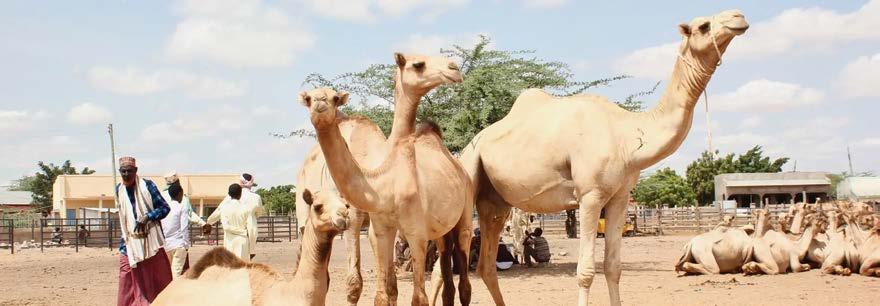
(Moore 2024). (Note that the uncertainty considered here is that of the probability distribution of weather, not that of risk, for which probabilities are known.)
The insurance industry uses quantitative models to estimate and price risk. For instance, catastrophe models usually overlay current maps of property locations and climate
T he costs of extreme climate events can drive firms supplying resilience tools out of markets
vulnerability to estimate expected losses. These models assume the distribution of past weather events is representative of today’s. Adjusting the insurers’ model to include the possibility of a shifting weather distribution due to climate ambiguity will drive up insurance premiums substantially (Moore 2024).
The annual renewal of insurance contracts allows insurers (subject to regulatory approval) to rapidly adjust prices in response to new climatological information, thereby increasing the volatility of premiums. Unstable and unpredictable insurance prices create challenges for property owners since decisions that impact exposure to insurance price volatility are long term.
Second, natural hazards are challenging for private insurers to cover because losses are highly concentrated in space and time. Unlike other insurance lines, where claims are stable from year to year and premiums can be set to closely match, losses due to natural hazards exhibit considerable interannual variability, even when aggregated across all perils at the global level (Swiss Re Institute 2019). The correlated nature of climate shocks across areas limits the possibility of managing risk through diversification. The nature of the losses requires underwriters to maintain access to large amounts of liquid capital to pay claims in the event of a major disaster. This is expensive, because it requires paying fees to reinsurers or premiums to investors in insurance-linked securities. Climate ambiguity thus leads to higher costs of reinsurance and premiums to investors (Moore 2024).
Though the business of insurance companies is a prime example of how climate uncertainty can drive up prices, the argument applies to other firms supplying resilience tools, such as climate-resistant technology and investment products. These costs are passed on to consumers, potentially raising premiums above expected losses.
FIGURE 3.1
uncertainty drives up the price of resilience tools
Source: Policy Research Report team. Note: D = demand curve; S = supply curve.
Climate uncertainty can cause markets to shrink or even disappear
Observed market prices and purchases of resilience tools are equilibrium outcomes. Climate uncertainty means higher demand from consumers (the shift from D to D′ in figure 3.1; see also chapter 2). But higher costs associated with supplying tools mean a leftward shift in the supply curve (from S to S′). As a result, prices will rise. And for extreme events, prices can rise to the extent that in equilibrium, few products are likely to be available, and the products that are available are unaffordable for most people.
Evidence from insurance markets suggests that this is indeed happening. Among farmers in India, demand for insurance is higher for extreme climate events than for more frequent but low-impact events (see spotlight 2.1 in chapter 2). But over time, insurance markets have moved away from covering extreme climate events. In 2006, insurance policies were designed primarily to insure against extreme rainfall events, with payouts only above the 92nd percentile (figure 3.2). By 2010, they were designed to pay out more
I n the presence of climate uncertainty, information on climate trends and events is invaluable for both people and firms
3.2 Insurance markets in India have moved away from covering extreme climate events
Source: Cole, Giné, and Vickery 2024.
Note: Payouts were based on historical rainfall data for 1963–2009.
regularly, providing income during periods of moderately deficient rainfall. The field experiments described in chapter 2 (spotlight 2.1) suggest that in 2010, farmers valued the 2006 policy most, but only the 2010 policy was available. With insurance no longer offered for extreme events, farmers in India are less protected from major catastrophes, which are becoming more intense with climate change. The costs of extreme climate events can drive firms supplying resilience tools out of markets. Large expected losses could cause insurance firms to leave the affected areas (box 3.2). For instance, in the island nations along Hurricane Alley in the Caribbean, the probability of catastrophic hurricanes is so high that even without ambiguity aversion, risk-averse or even risk-neutral insurance companies cannot offer insurance coverage without risking bankruptcy. For these cases, market insurance is not feasible, alternative insurance tools such as risk-pooling by countries, including the Caribbean Catastrophe Risk Insurance Facility and African Risk Capacity program, offer one option. Another
option is catastrophe bonds, which are insurance-linked securities that are traded in capital markets. By spreading risk over multiple geographies, these bonds can bring down the cost of insurance (Barnett et al. 2008). For climate events that are not catastrophic, private insurance markets can offer coverage. However, the presence of climate uncertainty means that products that would have been offered under simple risk aversion would not be offered or would be offered at a much higher cost.
In the presence of climate uncertainty, information on climate trends and events is invaluable for firms’ decisions to supply resilience tools and people’s decision to use them. Most people can check the daily weather forecast on their mobile phone for free, thanks to private companies such as The Weather Company and AccuWeather, which collate meteorological data collected and processed by national and international public agencies.
The frequency and severity of extreme weather events have increased substantially in recent years. In the United States, the number of events with losses of more than $1 billion (in inflation-adjusted terms) rose from an average of 3.3 a year in the 1980s to 20.4 for 2019–23.1 Losses from the unprecedented California wildfires in 2017 and 2018 were more than double the profit from all property insurance in the state for the previous 30 years.2 Greater losses are also due to growth in population density and capital stock in high-risk areas. The growing losses pose challenges to private insurance markets. Most major insurers exited Florida and Louisiana following the large hurricane-related losses since 2005. Those markets are now dominated by small firms with highly concentrated risk, heavily reliant on the
National meteorological agencies also provide information and warnings about flooding, cyclones/hurricanes, and other severe weather phenomenon.
For resilience decisions, people and firms need medium- and long-term forecasts in addition to acute information on impending weather events. Medium-term weather information helps households, farmers, and firms make production and savings decisions (including crops, products, and precautionary savings), whereas long-term forecasts inform their investment decisions. Markets for this information have started to emerge in developed countries but not in developing countries. Creating a (public and private) network to provide this information requires accurate
reinsurance market. As of 2018, over half the value underwritten in Florida is from firms without a credit rating from the major rating agencies. Between 2021 and 2023, nine Florida insurers became insolvent.3 The record losses due to the California wildfires led major insurers to limit underwriting in the state, leading to massive growth in the state’s public last-resort insurance program.4 Price volatility or unavailability of property insurance can quickly spill over to the mortgage market because lenders require insurance on the properties that secure the loan.
Notes
1. Smith 2024.
2. Kousky 2022.
3. Fliegelman 2023; Sastry, Sen, and Tenekedjieva 2024.
4. Insurance Information Institute 2023. See also Kousky (2022).
weather data transmitted to people in real time.
Fewer weather stations in developing countries mean less information for households, farmers, and firms The spatial distribution of weather stations corresponds directly to population density (map 3.1). The density of weather stations per square kilometer is high in the United States and India. But adjusting for population reveals disparities: India has 2.7 stations per million people compared with 217 in the United States, and Sub-Saharan Africa has 1.6 stations per million people compared with 13 in Germany. More important, data collection by stations in developing countries is often sporadic.
Source: National Oceanic and Atmospheric Administration, National Centers for Environmental Information, Global Historical Climatology Network Daily database, https://www.ncei.noaa.gov/products/land-based-station /global-historical-climatology-network-daily, based on station data downloaded in 2024.
Note: The white areas indicate water (lakes, seas, and oceans).
The accuracy of medium- to long-term forecasting is lagging in poorer countries Weather forecasting has greatly improved over the past three decades. Accurate shortterm (next-day) forecasts are widely available, and four-day forecasts today are as accurate as one-day forecasts 30 years ago. But the accuracy of forecasts in low-income countries lags that in richer countries (figure 3.3): a seven-day forecast in a rich country can be more accurate than a one-day forecast in some low-income countries (Linsenmeier and Shrader 2023). The critical challenge is to make accurate weather forecasts available to all at a reasonable cost.
Local research and development capacity to translate raw weather data from weather stations and satellites into usable mediumto long-term forecasts is weak or lacking in developing countries because of inadequate public investment and scarcity of trained professionals. Basic data gathering and translation skills are also preconditions for private
markets to emerge in information. The lack of local capacity in both physical infrastructure and human capital is reflected in how few poorer countries share local data with international agencies, such as the World Meteorological Organization (figure 3.4).
infrastructure
To be useful, information must be communicated to people in real time. The rapid expansion of the mobile phone network and its use have greatly reduced this constraint. Mobile phone subscriptions have reached saturation levels, and more than 90 percent of people have access to electricity—needed for charging and running electronic devices— except in low-income countries, where 60 percent of people have a mobile phone and 45 percent have access to electricity. The cost of mobile internet data has also declined markedly around the world. The remaining constraint is the speed of mobile internet data,
T he near-universal adoption of mobile phones and their use in mobile banking have dramatically reduced the fixed costs of providing financial services
FIGURE 3.3 The accuracy of weather forecasts has improved, but gaps persist between richer and poorer countries
Source: Linsenmeier and Shrader 2023.
3.4 The proportion of countries sharing data with the World Meteorological Organization rises with income
Source: Linsenmeier and Shrader 2023.
which is much higher in developed countries and East Asian countries (map 3.2). The physical digital network remains weak in many poor countries. Similarly, despite great strides in access to electricity, reliability lags in poorer countries in Africa.
Households, farmers, and firms need access to finance first and foremost Access to finance is the first line of defense for households, farmers, and firms facing climate change. Access to finance helps them smooth out smaller shocks through personal savings or, for the poorest, through a social protection program. It provides such instruments as loans and credit lines to manage unexpected emergencies. It also allows for long-term investment in self-protection. Having a bank account helps households, farmers, and firms insure themselves against climate shocks (spotlight 3.1). Access to finance also fuels economic development by relieving saving and investment constraints. Asymmetric information is often the source of high transaction costs in financial markets.
Financial markets for savings and credit are subject to two well-known problems arising from asymmetric information: adverse selection and moral hazard. Adverse selection arises because banks lack information on the riskiness of potential borrowers, and riskier borrowers have a greater incentive to seek bank loans. Banks compensate for being unable to discriminate between safe and risky
T hough insurance is helpful for overall economic development, it carries special relevance for climate resilience as a tool for people to prepare for climate shocks
MAP 3.2 The speed of mobile internet data is lower in developing countries
Source: Data from Ookla, https://www.speedtest.net/
Note: The gray areas indicate territories for which data are lacking or insufficient.
borrowers by charging higher interest rates, which could drive safe borrowers out of the market (Stiglitz and Weiss 1981).
Moral hazard arises because having credit may encourage economic agents to be less vigilant and to engage in riskier behavior. Financial markets respond to this problem by requiring collateral for borrowing. The collateral requirement shuts out from financial markets a large part of the population who lack sufficient assets. The high cost of borrowing generates a negative externality: many safe agents are unable to find affordable products.
The need to serve geographically scattered small accounts adds to banks’ administrative costs. The small customer base in many markets makes it difficult to reduce fixed costs and expand market coverage. This could lead to a familiar coordination failure, whereby a vibrant market does not emerge due to information asymmetry and high fixed costs.
Multiple innovative financial products attempt to tackle adverse selection and
moral hazard. For instance, group liability replaces the collateral requirement in some microfinance products. The near-universal adoption of mobile phones and their use in mobile banking have dramatically reduced the fixed costs of providing financial services— particularly for scattered customers with smaller transaction sizes. But a large part of the population still lacks access to financial services, notably credit.
Transaction accounts have grown, but savings and credit lag
A transaction account allows holders to send and receive payments, save, borrow, and manage cash flow. From 2011 to 2021, transaction account ownership among the adult population rose from 50 percent to 76 percent globally and from 42 percent to 71 percent in developing countries. In developing countries, lack of income limits access to these accounts: the gap in account ownership between the richest 60 percent and the poorest 40 percent of households is 8 percentage points (figure 3.5).
Source: Global Findex Database 2021, https://www .worldbank.org/en/publication/globalfindex
Note: Refers to respondents in developing countries who report having an account (by themselves or with someone else) at a financial institution (bank, bank, credit union, microfinance institution, or post office that falls under regulation by a government body) or report personally using a mobile money service in the past year. Farmers’
The Covid-19 pandemic accelerated the use of digital payments. Expanding mobile money enables financial inclusion and drives account ownership and use. Mobile money accounts contributed to the 16 percentage point increase in account ownership in developing countries between 2014 and 2021 (figure 3.6). The share of adults who made or received a digital payment rose from 35 percent to 57 percent. But credit and savings continued to lag: only half of adults in developing countries borrowed any money, and the share that saved any money fell after 2014.
Globally, 1.4 billion adults remain unbanked, and half of them live in seven economies (Bangladesh, China, Egypt, India, Indonesia, Nigeria, and Pakistan) (Demirgüç-Kunt et al. 2022). In addition to lack of money, other factors constraining account ownership include distance to a financial institution and lack of documentation, such as digital IDs essential for digital accounts. Insurance—an important tool for resilience—faces high risk and thus remains out of reach for many.
Source: Demirgüç-Kunt et al. 2022.
Households, farmers, and firms need access to insurance to smooth risks and recover after a shock Insurance helps households, farmers, and firms plan for a swift recovery from damaging climate shocks. Though insurance is helpful for overall economic development, it carries special relevance for climate resilience as a tool for people to prepare for climate shocks. Adverse selection and moral hazard arising from asymmetric information plague insurance markets as well. To borrow an example from the health insurance literature, individuals with higher risk (sick patients) have a greater incentive to seek insurance coverage. The insurance companies compensate by charging premiums. Having insurance may encourage economic agents to be less vigilant and engage in riskier behavior. Insurance markets solve this moral hazard by offering products that provide partial coverage, such as index insurance for rainfall. Implementing an insurance program also involves high startup costs for design and marketing, as well as education and capacity building among local staff, delivery agents, government officials, and consumers.
Climate uncertainty does not necessarily increase these traditional costs of providing insurance. As noted above, it adds capital and refinance costs: the losses from large catastrophic events are so large that even refinance companies and investors that back insurance products cannot smooth them out spatially or across years. Ambiguity-averse investors thus demand a large uncertainty premium, leading to the disappearance of private providers, even in developed countries. This section discusses the practical implications of these problems for insurance demand, particularly those related to affordability, basis risks, and trust. The discussion focuses on index insurance, the most common insurance product for dealing with climate events in developing countries. Property
insurance is also subject to climate risks and discussed in later subsections.
Insurance products remain unaffordable for most poor farmers
The price of weather index insurance is a major constraint facing farmers. It tends to be high for several reasons. One is the loading factor the additional premium on top of the base premium for a policy which is typically 50–70 percent (Cole, Giné, and Vickery 2024). Another is the difficulty of determining a fair price in the context of data scarcity and climate change. These information imperfections translate into uncertainty loadings, which further boost the price. When few farmers buy insurance, institutions are unable to earn enough profit, and insurance stops being offered (Ahmed, McIntosh, and Sarris; Stoeffler et al. 2022).
Liquidity constraints among small farmers are also responsible for low insurance uptake. For instance, unexpected positive liquidity shocks increase Indian farmers’ purchase of index insurance (Cole et al. 2013). Premiums often must be paid ahead of the cropping cycle, when other spending on inputs (seeds, fertilizer, and the like) is made. One possible fix is deferring payment of premiums until after the harvest, when financial resources are more readily available. Such a deferral increases uptake by 8–72 percentage points (Belissa et al. 2019; Casaburi and Willis 2018; Liu, Chen, and Hill 2020). But it also raises the possibility of default by farmers and may not be feasible when farmers cannot be held accountable due to weak institutions.
Farmers’ willingness to pay for index insurance typically falls short of actuarially fair prices and hence market prices. Demand for index insurance is moderately price elastic and typically collapses before reaching the market price.1 As a result, index insurance products in China and India where uptake is much
S patially and temporally integrated markets act as insurance by dissipating local shocks and flattening the climate damage function
wider involve subsidies equivalent to 70 percent of the premiums (Kramer et al. 2022).
Index insurance carries substantial basis risk, dampening demand
Basis risk is perhaps the largest barrier to insurance adoption (Clarke 2016; Elabed et al. 2013; Jensen, Barrett, and Mude 2016). It arises because the index used to trigger payouts is imperfectly correlated with agricultural income or assets. This low correlation may be due to differences between the index measured in the weather gauge and that measured on a farm (particularly when they are separated by a long distance) or differences between what the index covers and what the farmer cares about. For example, a policy that covers only rainfall shortages will not protect a farmer from yield losses due to pests. Results from index-based livestock insurance programs in Ethiopia and Kenya suggest that index insurance reduces exposure to covariate risk by an average of 63 percent but that 69 percent of the original risk remains due to idiosyncratic risk. Rainfall at rain stations and yields are often poorly correlated when stations are not within villages (Mobarak and Rosenzweig 2012).
Though basis risk is difficult to measure without time series data on yield or household losses, several experimental studies find that demand for insurance is negatively correlated with basis risk (Cole, Giné, and Vickery 2024; Jensen, Barrett, and Mude 2016). For instance, farmers located less than 5 kilometers from a weather station are four times as sensitive to insurance premiums as farmers located more than 12 kilometers from one (Hill, Robles, and Ceballos 2016).
Purchasing index insurance can be seen as a double lottery, with both the weather event and the payout for a given weather outcome being stochastic. Instead of reducing risk, index insurance introduces ambiguity due to basis risks. When insurance involves ambiguity, it
reduces demand for insurance: evidence from field experiments finds a negative relationship between a proxy for ambiguity aversion and insurance uptake (chapter 2).2
will be paid
A third factor limiting farmers’ insurance uptake is a lack of understanding and trust. Financial literacy is typically low among smallholder farmers, limiting adoption of insurance (Cai, de Janvry, and Sadoulet 2015; Cole et al. 2013; Giné and Yang 2009). Farmers may not trust that benefits will be paid out at all. With insurance benefits observed only in bad years, absent a negative shock, farmers do not perceive a tangible benefit from having insurance. Endorsement of insurance products by a trusted third party increases insurance uptake by 40 percent (Cole et al. 2013). When insured farmers received a payout or saw that their insured peers did, they were more likely to trust in the benefits of insurance and purchase it in subsequent years (Cai, de Janvry, and Sadoulet 2020; Cole, Stein, and Tobacman 2014; Karlan et al. 2014). But because insurance is a complex product, these impacts were concentrated among households with higher financial literacy (Gaurav, Cole, and Tobacman 2011).
integrated and uncompetitive markets limit adaptation options
Access to product and factor markets and to essential services can enhance climate resilience directly and indirectly. Access to markets and services plays a critical role in economic development and can facilitate climate resilience through increased productivity and higher income. The direct roles of markets and services in climate resilience are no less important. Better access to markets and services can encourage investment in self-protection, such as technology adoption or migration. Better integrated markets also offer an insurance mechanism by dissipating local shocks.
For instance, a harvest failure due to drought may not lead to rising prices in a local market that is well integrated with national markets. Problems related to market integration can be due to a lack of public investment in physical infrastructure or due to distortions in how markets function—for example, because of poor regulation.
On the effects of poor market integration, take Nigeria, where the climate damage function for farm households that live within 5 kilometers of a road is flat (figure 3.7). This means that households with better market access can smooth consumption and rebound from weather shocks quickly. The negative association between consumption and weather shock is significant for households that live 5 kilometers from a road. The difference in resilience between households close to and far from a road also arises because poorer households are forced to live
in more vulnerable and less accessible areas, where housing is cheaper. These are often areas where households have less access to improved sources of drinking water and sanitation.
Poor transportation infrastructure prevents effective market integration
Lack of access to markets also limits adoption of climate-appropriate technology. Agricultural adaptation to climate change requires adopting new techniques and investments and reallocating farmland according to evolving comparative advantage (Costinot, Donaldson, and Smith 2016). Farmers need access to markets to buy inputs and sell their products before they can think about adopting climate-smart technology. Poor market access makes it difficult for producers to obtain the inputs and equipment they need. High transportation costs and unreliable infrastructure
Source: Shilpi and Berg 2024, using data from the Nigeria Living Standards Measurement Study Integrated Surveys on Agriculture, 2010/11, 2012/13, 2015/16, 2018/19.
Note: (n = 16,723 over the four waves of the survey. The dependent variable is the log of household consumption per capita. Controls include age, gender, and highest level of education of the household head; dependency ratio; numbers of adults working in agriculture and in wage work; average temperature; an indicator for urban location; dummy variables for the month of the interview; and fixed effects at the primary sampling unit level. Standard errors are clustered at the primary sampling unit level. The climate damage functions are estimated using restricted spline with three knots. The sample for “close” includes all households within 5 kilometers of a road, and the sample for “far” includes all households located 5 kilometers or more away from a road.
are the two main sources of poor market access. For instance, the effect of distance on prices of traded goods in Ethiopia and Nigeria is four to five times that in the United States (Atkin and Donaldson 2015). Direct trucking costs are much higher in Africa than in developed countries (Teravaninthorn and Raballand 2009). And median trade costs in Africa are about five times higher than everywhere else in the world (Porteous 2019).
High trading costs can deter adoption of new technology. In Tanzania, doubling transport costs is associated with a 25 percent reduction in fertilizer adoption, whereas halving travel costs doubles adoption (Aggarwal et al. 2022). In Sierra Leone, price differentials are lower in markets that are closer to improved infrastructure (Casaburi, Glennerster, and Suri 2013). Overall, better access to markets increases adoption of new technology in agriculture (Berg et al. 2016; Damania et al. 2017).
Poorly integrated markets amplify local impacts of climate shocks
Spatially and temporally integrated markets act as insurance by dissipating local shocks and flattening the climate damage function. As the cost to trade with other locations falls and market segmentation declines, local prices respond less to local yields and more to yields elsewhere (box 3.3) (Allen and Atkin 2022). With an integrated market, the local negative effect from a climate shock destroying crops is lower because people can access food at more affordable prices from less affected places. An isolated area badly hit by an extreme weather event would suffer greatly from food scarcity and hunger. With an integrated market, the burden is shared. More favorable regions will see prices rise somewhat, while less fortunate areas will benefit from lower prices.
In reality, product markets are often poorly integrated spatially or temporally. This is due to poor infrastructure and the high cost
of gathering information on prices or on the availability of buyers and sellers in distant places. This is slowly changing with the growth in mobile phone adoption and use, even in Africa (Aker and Mbiti 2010). Though direct transmission of information to smallholders by mobile phone is not always effective, mobile phone use by intermediaries increases trade flows, reduces price dispersion, and promotes market integration.3 In Kenya, information on prices and official border costs alters traders’ choices of markets and border crossings and affects local market prices (Wiseman 2023).
Limited market integration also prevents climate migration
When migration is costly, labor markets are also spatially isolated. This deprives households of another source of insurance. The negative relationship between extreme heat and agricultural yields has been well established (IPCC 2022). A negative productivity shock from bad weather, such as extreme heat, depresses wages due to a drop in labor demand. This induces temporary or seasonal migration during droughts or precipitation shocks to areas with higher wages (Feng, Oppenheimer, and Schlenker 2015; Raleigh, Jordan, and Salehyan 2008). In India, there is low permanent migration (Kone et al. 2018; Munshi and Rosenzweig 2016) but high seasonal migration (Imbert and Papp 2020; Morten 2019). Similarly, in Bangladesh, there is high seasonal migration from rural areas to neighboring towns (Berg and Emran 2020). This temporary migration dissipates the adverse effects of local climate shocks.
Migration networks act as conduits for information and protection at destinations. Access to migrant networks enables migration in poor origin districts (Nawrotzki and DeWaard 2018). Youth in households with more connections outside their village are
Source: Based on Allen and Atkin 2022. BOX 3.3
Between 1970 and 2009, India witnessed three major developments:
• Increased use of irrigation and high-yield crop varieties, which raised mean yields and changed their variance.
• Policy-driven expansion of formal banking into rural areas, which helped farmers smooth income shocks, thereby acting as a form of insurance.
• Declining inter- and intra-national trade costs—in particular, the expansion of the Indian interstate highway system known as the Golden Quadrilateral and the North–South and East–West Corridors, connecting Chennai, Kolkata, Mumbai, and New Delhi.1
Together, these changes led to trade liberalization and falling trading costs. In an isolated market, a higher productivity shock (such as an increase in yield due to better rainfall) is associated with lower prices. The decline in trade costs also reduced this negative correlation between local prices and productivity shocks. But it increased the responsiveness of local prices to yields elsewhere. As trade costs
fell, farmers’ gross revenue volatility from the crop production increased (high risk, high return crops), while the volatility of their price index declined, and the volatility of real income rose.
Farmers responded to the decline in trade costs by trading gains on average yield for a drop in yield volatility through crop changes. They reallocated land toward crops for which they had higher productivity and away from riskier crops. Farmers also engaged in hedging and allocated more land to crops whose yields were less correlated with each other to guard against the increased risk due to falling trade costs. Better access to risk mitigation technologies (from the expansion of rural banking) amplified the gains from trade by encouraging farmers to take advantage of higher risk, higher return crop allocation.
Note 1. Asturias et al. 2021; Datta 2012; Ghani, Goswami, and Kerr 2016.
more likely to migrate (Marchetta et al. 2021). In Tanzania, expensive migration to geographically and ethnically distant destinations fell after droughts, while strong network ties offset the negative effects (Bocquier, Menashe-Oren, and Nie 2023).
Policies restricting market competition hinder climate adaptation
Another factor contributing to higher trading costs is the market power of traders. Remote
areas with smaller markets are served by fewer traders, who can exert considerable market power.4 As a result, producers and consumers in remote places may not benefit from lower transport costs (Atkin and Donaldson 2015). Government policies sometimes restrict market competition, as in India (box 3.4), leaving farmers who are near less competitive markets unable to adapt to heat shocks in the short run.
In India, each state has an agriculture produce market committee statute that regulates the first sale and purchase of agricultural commodities. Two provisions in these laws facilitate the generation of market power exercised by intermediaries.1 First, farmers are restricted to selling their produce at government-designated physical markets, known as mandis, in their state. Second, output can be sold only to government-licensed market-specific intermediaries. Having few other mandis nearby where farmers can sell reduces the competition for intermediaries.
To understand how competition affects the loss of agricultural yields from extreme heat exposure, the mandi-level competition measure—the inverse-distance weighted sum of the value of trade at all other markets in the same state—was aggregated at the district level to match district-level yields. A regression discontinuity identification scheme was then used to estimate whether competition moderates the heat-yield relationship. The discontinuity exploits the fact that the competition index varies across states (C versus D in figure B3.4.1) but is the same within the state (B versus D). The comparisons are among markets located within 25 kilometers of state borders. In extreme heat events, the difference in arrivals should not change for Pair 1, because both markets have the same competition and are equally affected, but should increase for Pair 2, because farmers in Market C can attenuate some impacts through higher competition and cannot sell to Market D.
Increased competition substantially mitigates the effect of extreme heat (figure B3.4.2). At no competition benchmark, each additional day of heat above 35°C reduces yields by 1.5 percent. With a one standard deviation increase in market competition, the decrease in yields is about 1.27 percent, thus
enabling farmers to attenuate the impact of extreme heat by 15.3 percent. The difference is statistically significant (at the 5 percent level) for heat above 35°C.
Source: Kochhar and Song 2024.
Figure B3.4.2 Competition reduces heat’s impact on yield reduction in India
Source: Kochhar and Song 2024.
Note 1. Chatterjee 2023.
Source: Based on Kochhar and Song 2024.
Access to credit and insurance can boost resilience directly by enabling individuals to invest in protective measures against climate shocks and to cope with them after they occur without undermining their prospects. Access can also boost resilience indirectly by making people wealthier. Having access to credit and insurance markets enables economic agents to smooth consumption, build human capital, adopt climate-resistant technologies, and migrate.
Access to finance increases the resilience of Nigerian farm households to both negative and positive precipitation shocks (figure S3.1.1).5 An analysis of the association
between consumption and precipitation shock for the households finds that the same weather shock impacted those with a bank account considerably less than those without, even after economic status was controlled for. (Richer households are more likely to have bank accounts and to be able to smooth consumption even without bank accounts.) In Bangladesh, farmers who have access to emergency loans make less costly adaptation choices and are less severely affected when a flood occurs (Lane 2024).
Other sources of finance in addition to bank accounts—including access to remittances, robust social networks, and nonfarm employment—also reduce the impact of climate shocks (Moore et al. 2019). In Chile,
Source: Shilpi and Berg 2024, using data from Nigeria Living Standards Measurement Study Integrated Surveys on Agriculture, 2010/11, 2012/13, 2015/16, 2018/19.
Note: (n = 16,723 over four waves of the survey. The climate damage functions are estimated separately for households that have bank accounts and those that do not. The dependent variable is the log of household consumption per capita. Controls include age, gender, and highest level of education of the household head; dependency ratio; numbers of adults working in agriculture and in wage work; average temperature; an indicator for urban location; dummy variables for the month of the interview; and fixed effects at the primary sampling unit (psu) level. Standard errors are clustered at the psu level. The climate damage functions are estimated using restricted spline with three knots.
low-income women who were members of microfinance institutions that offered free savings accounts reduced their reliance on debt and were better able to make ends meet during an economic emergency (Pomeranz and Kast 2023). Digital financial services, such as mobile money, let users store funds and transfer them quickly and affordably across long distances, leading to higher remittances, consumption, and investments. In Kenya, mobile money users who experienced an unexpected drop in income were able to receive money from a geographically dispersed social network of family and friends who were not affected by the shock and so did not have to reduce their household spending (Jack and Suri 2014). In Bangladesh, very poor rural households with family members who had migrated to the city for work received higher remittance payments when they had a mobile money account and so spent more on food and other items, borrowed less, and were less likely to experience extreme poverty (Lee et al. 2023).
Insurance can also smooth consumption, limit the adverse effects of shocks on income, increase subjective well-being, and avoid having to resort to welfare-reducing coping mechanisms. But the benefits depend on a household’s exposure to catastrophic losses (Gollier, Mahul, and Pelletier 2023). For households exposed to catastrophic losses (for example, when the maximum loss is a very high share of their annual income), access to insurance greatly increases welfare (up to three times initial welfare). But for households exposed to less severe losses (for example, when the maximum loss is just a small fraction of their annual income), the added value of insurance is low, while access to financial services for self-protection
(savings and credit) improves welfare by increasing average consumption and sharply decreasing consumption volatility.
Access to finance helps households avoid the negative effects of climate shocks by enabling them to invest in measures that protect their nutrition, health, mortality, and human capital accumulation (Gollier, Mahul, and Pelletier 2023; Cramer 2021; de Janvry et al. 2006; Dumas 2020; Foster 1995; Jacoby and Skoufias 1997). Temperatures above or below 70° F (21° C) make learning more difficult. A global study of 5,000 15-year-old students in 214 countries between 2000 and 2015 found a substantially smaller impact of hot days on learning in countries that had faster credit access expansion (figure S3.1.2) (Park, Pankratz, and Behrer 2023). The effect was concentrated in less wealthy countries.
Causal evidence from India also confirms the relationship between learning on hot days and access to credit. In 2008, India announced the largest household borrower bailout in history. The program provided unconditional debt relief for more than 40 million households that were in default and whose loans were collateralized by less than 2 hectares of land. After the bailout, banks were more hesitant to lend in areas that had received loan forgiveness, so credit availability grew more slowly in districts with higher bailout exposure (Giné and Kanz 2018). In the subsequent period (2010–14), math and reading test scores were significantly lower during periods of high temperatures for children in districts with above-average bailout exposure (figure S3.1.3) but not for children in districts with below-average bailout exposure and faster growing credit availability.
FIGURE S3.1.2 Hot days are less damaging to learning in countries with better access to credit
Impact of one additional hot day on test scores (hundredths of a standard deviation)
Temperature bin (degrees Fahrenheit)
Source: Policy Research Report team analysis of data from Park, Behrer, and Goodman 2021.
Note: The blue line and the blue confidence interval are the original estimates from Park et al. (2021). The red line and pink confidence interval show the impacts in countries with credit expansion that was one standard deviation faster than the average in the sample. Test scores are from the Program for International Student Assessment (PISA).
FIGURE S3.1.3 Math test scores on hot days are lower in districts with slower expansion of bank credit
Association between hot days (> 21°C) and students’ test scores
Math
90% con dence interval
Reading
Source: Normalized test score data are from the 2007–14 India Annual Status of Education Report, which uses a repeated cross-section of respondents and is representative at the district level. For more info see ASER, https:// asercentre.org/. Weather data (including temperature, humidity, and rainfall) are from Garg, Jagnani, and Taraz 2020. Information on borrower bailout exposure is from Giné and Kanz 2018.
Note: Estimated coefficients are from a regression of normalized test scores on high and low temperature bins (less than 15° C and above 21° C), controlling for rainfall, humidity, and fixed effect for the year and child’s age. The regression is estimated separately for high- and low-bailout exposure districts. Estimated coefficients on the high temperature dummy variable are shown for the high- and low-bailout areas with a 90 percent confidence interval.
Farmers’ investments in self-protection, such as drought-resistant crop varieties and irrigation equipment, can be constrained by a lack of access to finance and insurance. These investments are often lumpy and require upfront financing. Weather uncertainty introduces an additional layer of concern by making the expected returns from self-protection investment ambiguous. An extensive literature documents how alleviating credit constraints increases the use of modern agricultural technology in developing countries.6 However, the overall impacts are context specific and generally not very large. Access to cheap or free index insurance has significant positive effects on the adoption of modern technologies, though not in all situations (Ahmed, McIntosh, and Sarris 2020; Elabed and Carter 2018; Karlan et al. 2014). Overall, index insurance increases productive investment by 0.06–0.12 standard deviation (Castaing and Gazeaud 2025). Insurance products that partially indemnify farmers against low crop prices also encourage the use of modern inputs (Karlan et al. 2014).
Access to credit and insurance makes it easier for firms to invest in self-protection measures, such as adopting technologies to protect workers and climate-proofing factories to protect physical assets. Small and medium firms have less access to external finance and face higher transaction costs and higher risk premiums than large firms because of their unstable revenue, weaker financial structure, and lack of collateral.
Though direct evidence of the role of access to credit and insurance in the climate resilience of firms is not available,
associations have been found across countries between temperature variability and firm sales for firms of various sizes (figure S3.1.4). High temperature variability is associated with significantly lower sales for medium firms (20–99 employees) in both low- and high-income countries. In low-income countries, temperature variability is also negatively associated with sales for small firms (fewer than 20 employees), but the effect is less severe than for medium firms. One reason for the weaker association is that small firms may not survive a climate shock. There is evidence of higher exit rates among small firms than among medium firms in response to climate shocks (Pelli et al. 2023).
Lack of finance constrains climate-driven migration. In Tanzania, a 1 percent reduction in agricultural income induced by weather shocks increased the probability of migration by 13 percent within one year for an average household (Kubik and Maurel 2016). That this effect is significant only for households in the middle of the wealth distribution suggests that migration as an adaptation strategy depends on initial endowment. Climate shocks lead to increased migration in wealthy origin areas and decreased migration in poor origin areas (Jha et al. 2018).
Extreme financial constraints can reverse the effect of drought’s impacts on migration, reducing rather than increasing migration. Higher temperatures increase migration to urban areas and to other countries from middle-income economies but reduce it from poor countries (Cattaneo and Peri 2016). In several African countries, drought exposure lowers long-run migration from rural to urban areas because individuals
Source: Policy Research Report team analysis of data from World Bank Enterprise Surveys between 2010 and 2023 covering 135 countries.
Note: Temperature variability is measured by the coefficient of variation, which is the standard deviation of temperature in a year divided by the mean temperature in the same year. The dependent variable is the log of revenues, and controls include the coefficient of variation, the number of days above 35°C in a given year, and country-by–survey round fixed effects. The estimated coefficients plotted in the figure show the association between a 1 unit increase in the coefficient of variation and sales revenue. All standard errors are clustered at the level of Enterprise Survey strata. Low-income countries are those classified as low income and lower-middle income, and high-income countries are those classified as upper-middle income and high income by the World Bank. Small firms have fewer than 20 employees, medium firms have 20–99 employees, and large firms have more than 99 employees. For more detail, see Lang et al. (2024).
dependent on agricultural income face financial constraints, making migration unaffordable (Bocquier, Menashe-Oren, and Nie 2023; Defrance et al. 2023; Marchetta et al. 2021). Rapid-onset events, such as floods and cyclones, deplete resources quickly and result in weak migration responses. Wet growing seasons—with their positive effect on agricultural income—are associated with higher migration. Climate shocks lead to increased migration in wealthy origin districts and decreased migration in poor origin districts (Jha et al. 2018).
Household assets play a dual role in migration response. By relaxing financing
constraints, assets can increase the probability of migration in response to climate shocks, although the response can depend on the assets being portable. Portable assets, such as education, improve the probability of securing jobs in the destination location and thus boost migration, whereas nonportable assets, such as land, tie even members of richer households to their current location. Gender and age play a role as well. Both men and women migrate in response to temperature shocks, but men move longer distances (Mueller, Gray, and Kosec 2014), and older, more educated male farmers who do not have their own land are more likely to migrate (Jha et al. 2018).
Notes
1. Studies varying premium subsidies have found moderate price elasticities of −0.33 to −0.65 (Giné 2024).
2. See Belissa, Linsink, and van Asseldonk (2020) and Bryan (2019).
3. Bergquist et al. 2022 (for Uganda); Soldani et al. 2023; Nakasone, Torero, and Minten 2014.
4. See Bergquist and Dinerstein (2020), Casaburi, Glennerster, and Suri (2013), and Jensen and Miller (2018).
Aggarwal, Shilpa, Brian Giera, Dahyeon Jeong, Jonathan Robinson, and Alan Spearot. 2022. “Market Access, Trade Costs, and Technology Adoption: Evidence from Northern Tanzania.” Review of Economics and Statistics 106 (6): 1511–28. https://doi.org/10.1162/rest_a_01263
Ahmed, Shukri, Craig McIntosh, and Alexandros Sarris. 2020. “The Impact of Commercial Rainfall Index Insurance: Experimental Evidence from Ethiopia.” American Journal of Agricultural Economics 102 (4): 1154–76.
Allen, Treb, and David Atkin. 2022. “Volatility and the Gains from Trade.” Econometrica 90 (5): 2053–92.
Asturias, Jose, Sewon Hur, Timothy J. Kehoe, and Kim J. Ruhl. 2021. “Firm Entry and Exit and Aggregate Growth.” Working Paper 23202, National Bureau of Economic Research, Cambridge, MA. http://www.nber.org/papers /w23202
Atkin, David, and Dave Donaldson. 2015. “Who’s Getting Globalized? The Size and Implications of Intra-National Trade Costs.” Working Paper 21439, National Bureau of Economic Research, Cambridge, MA.
Barnett, Barry J., Christopher B. Barrett, and Jerry R. Skees. 2008. “Poverty Traps and Index-Based Risk Transfer Products.” World Development 36 (10): 1766–85.
Belissa, Temesgen Keno, Robert Lensink, and Marcel van Asseldonk. 2020. “Risk and Ambiguity Aversion Behavior in Index-based Insurance Uptake Decisions: Experimental Evidence from Ethiopia.” Journal of Economic Behavior & Organization 180: 718–30.
Belissa, Temesgen, Erwin Bulte, Francesco Cecchi, Shubhashis Gangopadhyay, and Robert Lensink. 2019. “Liquidity Constraints, Informal Institutions, and the Adoption of Weather Insurance: A Randomized Controlled Trial in Ethiopia.” Journal of Development Economics 140: 269–78.
5. Precipitation shocks are measured with the Standardized Precipitation Evapotranspiration Index, an index of precipitation net of evaporation relative to the long-term average, with extreme high or low values indicating a positive or negative precipitation shock.
6. See Suri et al. (2024) for a survey of evidence from many experimental studies in African countries.
Berg, Claudia, and M. Shahe Emran. 2020. “Microfinance and Vulnerability to Seasonal Famine in a Rural Economy: Evidence from Monga in Bangladesh.” BE Journal of Economic Analysis & Policy 20 (3): 1–36.
Berg, Claudia N., Uwe Deichmann, Yishen Liu, and Harris Selod. 2016. “Transport Policies and Development.” Journal of Development Studies 53 (4): 465–48. https:// doi.org/10.1080/00220388.2016.1199857
Bergquist, Lauren F., Benjamin Faber, Thibault Fally, Matthias Hoelzlein, Edward Miguel, and Andrés Rodríguez-Clare. 2022. “Scaling Agricultural Policy Interventions.” Working Paper 30704, National Bureau of Economic Research, Cambridge, MA.
Bergquist, Lauren Falcao, and Michael Dinerstein. 2020. “Competition and Entry in Agricultural Markets: Experimental Evidence from Kenya.” American Economic Review 110 (12): 3705–47.
Bocquier, Philippe, Ashira Menashe-Oren, and Wanli Nie. 2023. “Migration’s Contribution to the Urban Transition: Direct Census Estimates from Africa and Asia.” Demographic Research 48 (24): 681–732.
Bryan, Gharad. 2019. “Ambiguity Aversion Decreases the Impact of Partial Insurance: Evidence from African Farmers.” Journal of the European Economic Association 17 (5): 1428–69.
Burgess, R, O. Deschenes, D. Donaldson, and M. Greenstone. 2017. “Weather, Climate Change, and Death in India.” Working Paper, London School of Economics. https://www.lse.ac.uk/economics/Assets/Documents /personal-pages/robin-burgess/weather-climate-change -and-death.pdf
Cabantous, Laure. 2007. “Ambiguity Aversion in the Field of Insurance: Insurers’ Attitude to Imprecise and Conflicting Probability Estimates.” Theory and Decision 62 (3): 219–40.
Cai, Jing, Alain de Janvry, and Elisabeth Sadoulet. 2015. “Social Networks and the Decision to Insure.” American Economic Journal: Applied Economics 7 (2): 81–108.
Cai, Jing, Alain de Janvry, and Elisabeth Sadoulet. 2020. “Subsidy Policies and Insurance Demand.” American Economic Review 110 (8): 2422–53.
Casaburi, Lorenzo, and Jack Willis. 2018. “Time versus State in Insurance: Experimental Evidence from Contract Farming in Kenya.” American Economic Review 108 (12): 3778–813.
Casaburi, Lorenzo, Rachel Glennerster, and Tavneet Suri. 2013. “Rural Roads and Intermediated Trade: Regression Discontinuity Evidence from Sierra Leone.” SSRN 2161643. http://dx.doi.org/10.2139/ssrn.2161643
Castaing, Pauline, and Jules Gazeaud. 2025. “Do Index Insurance Programs Live Up To Their Promises? Aggregating Evidence from Multiple Experiments.” Journal of Development Economics 175 (103501): 1–16.
Cattaneo, Cristina, and Giovanni Peri. 2016. “The Migration Response to Increasing Temperatures.” Journal of Development Economics 122: 127–46. https://doi.org /10.1016/j.jdeveco.2016.05.004
Chatterjee, Shoumitro. 2023. “Market Power and Spatial Competition in Rural India.” Quarterly Journal of Economics 138 (3): 1649–711.
Clarke, Daniel J. 2016. “A Theory of Rational Demand for Index Insurance.” American Economic Journal: Microeconomics 8 (1): 283–306.
Cole, Shawn, Daniel Stein, and Jeremy Tobacman. 2014. “Dynamics of Demand for Index Insurance: Evidence from a Long-Run Field Experiment.” American Economic Review 104 (5): 284–90.
Cole, Shawn, Xavier Giné, and James Vickery. 2024. “Designing Index Insurance: Evidence from a Field Experiment.” Background paper for this report, World Bank, Washington, DC.
Cole, Shawn, Xavier Giné, Jeremy Tobacman, Petia Topalova, Robert Townsend, and James Vickery. 2013. “Barriers to Household Risk Management: Evidence from India.” American Economic Journal: Applied Economics 5 (1): 104–35.
Costinot, Arnaud, Dave Donaldson, and Cory Smith. 2016. “Evolving Comparative Advantage and the Impact of Climate Change in Agricultural Markets: Evidence from 1.7 Million Fields around the World.” Journal of Political Economy 124 (1): 205–48.
Cramer, K. F. 2021. “Bank Presence and Health.” SSRN 3917526. http://dx.doi.org/10.2139/ssrn.3917526
Damania, Richard, Claudia Berg, Jason Russ, A. Federico Barra, John Nash, and Rubaba Ali. 2017. “Agricultural Technology Choice and Transport.” American Journal of Agricultural Economics 99 (1): 265–84.
Datta, Saugato. 2012. “The Impact of Improved Highways on Indian Firms.” Journal of Development Economics 99 (1): 46–57.
Defrance, Dimitri, Esther Delesalle, and Flore Gubert. 2023. “Migration Response to Drought in Mali: An Analysis Using Panel Data on Malian Localities over the 1987–2009 Period.” Environment and Development Economics 28 (2): 171–90.
De Janvry, Alain, Frederico Finan, Elisabeth Sadoulet, and Renos Vakis. 2006. “Can Conditional Cash Transfer Programs Serve as Safety Nets in Keeping Children at School and from Working When Exposed to Shocks?” Journal of Development Economics 79 (2): 349–73. https://doi .org/10.1016/j.jdeveco.2006.01.013
Demirgüç-Kunt, Asli, Leora Klapper, Dorothe Singer, Saniya Ansar. 2022. The Global Findex Database 2021: Financial Inclusion, Digital Payments, and Resilience in the Age of COVID-19. Washington, DC: World Bank.
Dumas. Christelle. 2020. “Productivity Shocks and Child Labor: The Role of Credit and Agricultural Labor Markets.” Economic Development and Cultural Change 68 (3): 763–813. https://doi.org/10.1086/701828
Elabed, Ghada, Marc F. Bellemare, Michael R. Carter, and Catherine Guirkinger. 2013. “Managing Basis Risk with Multiscale Index Insurance.” Agricultural Economics 44 (4–5): 419–31.
Elabed, Ghada, and Michael R. Carter. 2018. “Ex-ante Impacts of Agricultural Insurance: Evidence from a Field Experiment in Mali.” UC Davis Working Paper. https://arefiles.ucdavis.edu/uploads/filer_public/2c/e8 /2ce82578-e1d3-4aeb-9ca1-62b8bec093eb/impact evaluation_nov_2018.pdf
Feng, S., M. Oppenheimer, and W. Schlenker 2015. “Weather Anomalies, Crop Yields, and Migration in the US Corn Belt.” Working Paper 17734, National Bureau of Economic Research, Cambridge, MA.
Ferdinand, Tyler. 2019. “Kenyan Herders Are Switching from Cattle to Camels to Adapt to Climate Change.” World Research Institute, July 9. https://www.wri.org /insights/kenyan-herders-are-switching-cattle-camels -adapt-climate-change
Fliegelman, Arthur. 2023. “Wind, Fire, Water, Hail: What Is Going on in the Property Insurance Market, and Why Does It Matter?” December 14. Office of Financial Research, Washington, DC. https://www.financialresearch.gov/the -ofr-blog/2023/12/14/property-insurance-market/
Foster, Andrew. 1995. “Prices, Credit Markets, and Child Growth in Low-Income Rural Areas.” Economic Journal 105 (430): 551–70.
Garg, T., M. Jagnani, and V. Taraz. 2020. “Temperature and Human Capital in India.” Journal of the Association of Environmental and Resource Economics 7 (6): 1113–50. https://doi.org/10.1086/710066
Gaurav, Sarthak, Shawn Cole, and Jeremy Tobacman. 2011. “The Randomized Evaluation of Financial Literacy on Rainfall Insurance Take-up in Gujarat.” ILO Microinsurance Innovation Facility, Research Paper 1: 539–66.
Ghani, Ejaz, Arti Grover Goswami, and William R. Kerr. 2016. “Highway to Success: The Impact of the Golden Quadrilateral Project for the Location and Performance of Indian Manufacturing.” Economic Journal 126 (591): 317–57.
Giné, Xavier. 2024. “Insurance Markets for Small Holder Farmers.” Background paper for this report. World Bank, Washington, DC.
Giné, Xavier, and Martin Kanz. 2018. “The Economic Effects of a Borrower Bailout: Evidence from an Emerging Market.” Review of Financial Studies 31 (5): 1752–83. https://doi.org/10.1093/rfs/hhx073
Gollier, Christian, Olivier Mahul, and Bertrand Pelletier. 2023. “Access to Finance for Climate Resilience: A Dynamic Financial Model of the Demand for Insurance and Self-Insurance.” Background paper for this report, World Bank, Washington, DC.
Harlan, Chico, and Rael Ombuor. 2024. “The Survivor Species.” Washington Post, April 17, 2024.
Hill, R. V., M. Robles, and F. Ceballos. 2016. “Demand for a Simple Weather Insurance Product in India: Theory and Evidence.” American Journal of Agricultural Economics 98 (4): 1250–70.
Hogarth, Robin M., and Howard Kunreuther. 1989. “Risk, Ambiguity, and Insurance.” Journal of Risk and Uncertainty 2: 5–35.
Imbert, Clément, and John Papp. 2020. “Costs and Benefits of Seasonal Migration: Evidence from India.” Journal of Development Economics 146: 102473. https://doi .org/10.1016/j.jdeveco.2020.102473
Insurance Information Institute. 2023. “Residual Markets.” https://www.iii.org/publications/a-firm-foundation -how-insurance-supports-the-economy/a-50-state -commitment/residual-markets
Jack, William, and Tavneet Suri. 2014. “Risk Sharing and Transactions Costs: Evidence from Kenya’s Mobile Money Revolution.” American Economic Review 104 (1): 183–223.
Jacoby, Hanan G., and Emmanuel Skoufias, 1997. “Risk, Financial Markets, and Human Capital in a Developing Country.” Review of Economic Studies 64 (3): 311–35.
Jensen, Nathaniel, Christopher B. Barrett, and Andrew Mude. 2016. “Index Insurance Quality and Basis Risk: Evidence from Northern Kenya.” American Journal of Agricultural Economics 98 (5): 1450–69. https:// doi.org/10.1093/ajae/aaw046
Jensen, Nathaniel, Christopher B. Barrett, and Andrew Mude. 2017. “Cash Transfers and Index Insurance: A Comparative Impact Analysis from Northern Kenya.” Journal of Development Economics 129: 14–28. https:// doi.org/10.1016/j.jdeveco.2017.08.002
Jensen, Robert, and Nolan H. Miller. 2018. “Market Integration, Demand, and the Growth of Firms: Evidence from a Natural Experiment in India.” American Economic Review 108 (12): 3583–625.
Jha, Chandan Kumar, Vijaya Gupta, Utpal Chattopadhyay, and Binilkumar Amarayil Sreeraman. 2018. “Migration as Adaptation Strategy to Cope with Climate Change: A Study of Farmers’ Migration in Rural India.” International Journal of Climate Change Strategies and Management 10 (1): 121–43.
Karlan, Dean, Robert Osei, Isaac Osei-Akoto, and Christopher Udry. 2014. “Agricultural Decisions after Relaxing Credit and Risk Constraints.” Quarterly Journal of Economics 129 (2): 597–652.
Kochhar, R., and R. Song. 2024. “Does Market Power in Agricultural Markets Hinder Farmer Climate Change Adaptation?” Working paper.
Kone, Zovanga L., Maggie Y. Liu, Aaditya Mattoo, Caglar Ozden, and Siddharth Sharma. 2018. “Internal Borders and Migration in India.” Journal of Economic Geography 18 (4): 729–59.
Kousky, Carolyn. 2022. Understanding Disaster Insurance: New Tools for a More Resilient Future. Washington, DC: Island Press.
Kramer, Berber, Peter Hazell, Harold Alderman, Francisco Ceballos, Neha Kumar, Anne G. Timu. 2022. “Is Agricultural Insurance Fulfilling Its Promise for the Developing World? A Review of Recent Evidence” Annual Review of Resource Economics 14 (1): 291–311.
Kubik, Zaneta, and Mathilde Maurel. 2016. “Weather Shocks, Agricultural Production, and Migration: Evidence from Tanzania.” Journal of Development Studies 52 (5): 665–80. https://doi.org/10.1080/00220388.2015.1107049
Lane, Gregory. 2024. “Adapting to Climate Risk with Guaranteed Credit: Evidence from Bangladesh.” Econometrica 92 (2): 355–86.
Lang, Megan, Claudia Berg, Luca Bettarelli, Davide, Furceri, Michael Ganslmeier, Arti Grover, Matthew Kahn, and Marc Schiffbauer. 2024. “Firm-Level Climate Change Adaptation: Micro Evidence from 134 Nations.” Background paper for this report, World Bank, Washington, DC.
Lee, Jean N., Jonathan Morduch, Saravaana Ravindran, Abu Shonchoy, and Hassan Zaman. 2023. “Poverty and Migration in the Digital Age: Experimental Evidence on Mobile Banking in Bangladesh.” American Economic Journal: Applied Economics 13 (1): 38–73. https://doi .org/10.1257/app.20190067
Linsenmeier, Manuel, and Jeffrey G. Shrader. 2023. “Global Inequalities in Weather Forecasts.” SocArXiv /7e2jf, Center for Open Science. https://osf.io/preprints /socarxiv/7e2jf_v1
Liu, Yanyan, Kevin Chen, and Ruth V. Hill. 2020. “Delayed Premium Payment, Insurance Adoption, and Household Investment in Rural China,” American Journal of Agricultural Economics 102 (4): 1177–97. https://doi.org /10.1002/ajae.12038
Marchetta, Francesca, David E. Sahn, Luca Tiberti, and Johany Dufour. 2021. “Heterogeneity in Migration Responses to Climate Shocks: Evidence from Madagascar.” IZA Discussion Paper 14052, IZA Institute of Labor Economics, Bonn, Germany. https://ssrn.com /abstract=3771735
Mobarak, Ahmed Mushfiq, and Mark Richard Rosenzweig. 2012. “Selling Formal Insurance to the Informally Insured.” Yale University Economic Growth Center Discussion Paper. 1007. http://dx.doi.org/10.2139/ssrn.2009528
Moore, Danielle, Zahra Niazi, Rebecca Rouse, and Berber Kramer. 2019. “Building Resilience through Financial Inclusion: A Review of Existing Evidence and Knowledge Gaps.” Financial Inclusion Program, Innovations for Poverty Action, Washington, DC. https://poverty-action .org/publication/building-resilience-through-financial -inclusion-review-existing-evidence-and-knowledge
Moore, Frances C. 2024. “Learning, Catastrophic Risk, and Ambiguity in the Climate Change Era.” Working Paper 32684, National Bureau of Economic Statistics, Cambridge, MA.
Morten, Melanie. 2019. “Temporary Migration and Endogenous Risk Sharing in Village India.” Journal of Political Economy 127 (1): 1–46.
Mueller, Valerie, Clark Gray, and Katrina Kosec. 2014. “Heat Stress Increases Long-Term Human Migration in Rural Pakistan.” Nature Climate Change 4 (3): 182–85.
Munshi, Kaivan, and Mark Rosenzweig. 2016. “Networks and Misallocation: Insurance, Migration, and the Rural–Urban Wage Gap.” American Economic Review 106 (1): 46–98.
Nakasone, Eduardo, Maximo Torero, and Bart Minten. 2014. “The Power of Information: The ICT Revolution in Agricultural Development.” Annual Review of Resource Economics 6 (1): 533–50.
Nawrotzki, Raphael J., and Jack DeWaard. 2018. “Putting Trapped Populations into Place: Climate Change and Inter-District Migration Flows in Zambia.” Regional Environmental Change 18 (2): 533–46.
Park, Jisung, A. Patrick Behrer, and Joshua Goodman. 2021. “Learning Is Inhibited by Heat Exposure, Both Internationally and within the United States, Nature Human Behaviour 5: 19–27. https://www.nature.com/articles /s41562-020-00959-9
Park, J., N. Pankratz, and A. P. Behrer. 2023. “Temperature, Workplace Safety, and Labor Market Inequality.” Discussion Paper 14560, IZA Institute of Labor Economics, Bonn, Germany.
Pelli, Martino, Jeanne Tschopp, Natalia Bezmaternykh, and Kodjovi M. Eklou. 2023. “In the Eye of the Storm: Firms and Capital Destruction in India.” Journal of Urban Economics 134: 103529. https://www.sciencedirect.com /science/article/pii/S009411902200105X
Pomeranz, Dina, and Felipe Kast. 2023. “Savings Accounts to Borrow Less: Experimental Evidence from Chile.” Journal of Human Resources 59 (1): 70–108. https://doi.org/10.3368/jhr.0619-10264R3
Porteous, Obie. 2019. “High Trade Costs and Their Consequences: An Estimated Dynamic Model of African Agricultural Storage and Trade.” American Economic Journal: Applied Economics 11 (4): 327–66.
Raleigh, Clionadh, Lisa Jordan, and Idean Salehyan. 2008. “Assessing the Impact of Climate Change on Migration and Conflict.” Paper commissioned by the World Bank Group for the Social Dimensions of Climate Change workshop, Washington, DC.
Rodrik, D. 2007. One Economics, Many Recipes: Globalization, Institutions, and Economic Growth. Princeton, NJ: Princeton University Press.
Rodrik D., and M. Rosenzweig, eds. 2010. Handbook of Development Economics. Vol.5. Amsterdam: North-Holland; 2010. http://www.elsevier.com /books/handbook-of-development-economics/rodrick /978-0-444-52944-2
Sastry, Parinitha, Ishita Sen, and Ana-Maria Tenekedjieva. 2023. “When Insurers Exit: Climate Losses, Fragile Insurers, and Mortgage Markets.” December 23. http://dx.doi .org/10.2139/ssrn.4674279
Smith, Adam, 2024. “2023: A Historic Year of US Billion-Dollar Weather and Climate Disasters.” NOAA Climate.gov. Blog post. https://www.climate.gov/news -features/blogs/beyond-data/2023-historic-year-us -billion-dollar-weather-and-climate-disasters
Soldani, Emilia, Nicole Hildebrandt, Yaw Nyarko, and Giorgia Romagnoli. 2023. “Price Information, Inter-village Networks, and ‘Bargaining Spillovers’: Experimental Evidence from Ghana,” Journal of Development Economics 164: 103100. https://doi.org/10.1016/j.jdeveco .2023.103100
Stiglitz, Joseph E., and Andrew Weiss. 1981. “Credit Rationing in Markets with Imperfect Information.” American Economic Review 71 (3): 393–410.
Stoeffler, Quentin, Michael Carter, Catherine Guirkinger, and Wouter Gelade. 2022. “The Spillover Impact of Index
Insurance on Agricultural Investment by Cotton Farmers in Burkina Faso.” World Bank Economic Review 36 (1): 114–40.
Suri T., C. Udry, J. C. Aker, C. B. Barrett, L. Falcao Bergquist, M. Carter, L. Casaburi, R. Darko Osei, D. Gollin, V. Hoffmann, T. Jayne, N. Karachiwalla, H. Kazianga, J. Magruder, H. Michelson, M. Startz, and E. Tjernstrom. 2024. “Agricultural Technology in Africa” VoxDevLit 5.3. https:// voxdev org/voxdevlit/agricultural-technology-africa -issue-2/why-reasons-africas-technological-stagnation
Swiss Re Institute. 2019. “Insurance in a World of Climate Extremes: What Latest Science Tells Us.” https:// www.swissre.com/dam/jcr:f2ec0485-5732-4204-9a67 -e754978fedbc/Insurance_climate_extremes_expertise _publication.pdf
Teravaninthorn, Supee, and Gaël Raballand. 2009. Transport Prices and Costs in Africa: A Review of the Main International Corridors. Washington, DC: World Bank.
Wiseman, Eleanor. 2023. “Border Trade and Information Frictions: Evidence from Informal Traders in Kenya.” Job Market Paper, University of California, Berkeley.
Governments have a compelling role in reducing and preventing the impacts of climaterelated events. Their actions should increase resilience where individuals are unable to do so and market solutions are not feasible. And when done right, their policies can and do promote resilience. But more visible policy actions are more politically rewarding, tilting toward risk reduction in large infrastructure projects and toward relief when disasters strike. And governments frequently choose policy instruments with unintended, resiliencereducing consequences. They distort incentives for individuals and markets, sometimes through overly restrictive regulations and investments and sometimes through inaction. Transfers and subsidies ostensibly well intended to support short-term resilience end up creating moral hazards and inviting dangers in the long term. Subsidies and regulations can also lock people into climate-vulnerable products, activities, and places. So, policies can produce short-term gains but compromise long-term resilience.
Climate uncertainty can induce policy makers to invest heavily in resilience building
In popular views and most economic modeling, policy makers are often treated as rational and risk neutral actors. An experimental survey among high-level policy negotiators at the 2015 United Nations Climate Change Conference found that, like other people, policy
makers are also averse to ambiguity (box 4.1). And considering the effect of ambiguity aversion on demand for resilience tools, its existence among policy makers is good news for resilience policies: policy makers will strongly favor policies that tackle climate change, including resilience. Indeed, the greater the ambiguity aversion among policy makers, the greater the public investment in resilience building (box 4.2). But there is a trade-off. The higher investment in climate resilience can come at the expense of other productive public investments (such as in human capital).
Ambiguity aversion and political shorttermism tilt resilience policies toward visible actions
Policy makers and national leaders are not only ambiguity averse but also have a short perspective on what they can gain during their time in power. In the United States, voters rewarded officials for attracting relief after disasters but not for preparing for them (Healy and Malhotra 2009). In India, voters reward incumbents for relief when they perceive losses to be from bad luck rather than government neglect (Cole, Healy, and Werker 2008).
Nearly half of all US Federal Emergency Management Agency disaster relief payments are motivated by politics rather than need (Garrett and Sobel 2003; World Bank 2010). A prerequisite for federal aid is a presidential disaster declaration, which is more frequent during election cycles but less so when the
T he economic return of early-warning systems is estimated to be very high, with an average benefit- co st ratio of 9:1
4.1
Policy makers represent the broader interests of their constituents, so their behavioral traits and preferences should not matter. But in practice, their preferences may affect policy choices and, therefore, may have an impact on entire social groups.1 A study ran an experiment at the 2015 United Nations Climate Change Conference with a unique sample of 80 policy makers directly involved in climate negotiations, most of whom were elite bureaucrats with substantial influence over what their governments agree to in international negotiations.2 They sit at the negotiation table and have substantial autonomy, as well as formal or informal permissions.
Three main findings emerged from the analysis: policy makers are generally ambiguity averse; this attitude is not necessarily associated with cognitive bias, such as their inability to deal with compound lotteries; and policy makers’ country of origin and quantitative sophistication
significantly affect how they deal with compound lotteries but not their attitude toward ambiguity. These results suggest that policy makers are ambiguity averse for a reason that is not necessarily related to irrational cautiousness. Policy makers’ ambiguity aversion is a boost for climate policies: they will favor policies that tackle climate change urgently.3 For example, taking ambiguity attitudes into account would lead to larger reductions in greenhouse gas emissions when the probability distribution of important climate parameters such as climate sensitivity is unknown4 or when experts disagree about the probability of a potential climate catastrophe.5
Notes
1. Hafner-Burton et al. 2015.
2. Berger and Bosetti 2020.
3. Chambers and Melkonyan 2017.
4. Millner Dietz, and Heal 2013.
5. Berger, Emmerling, and Tavoni 2017.
crisis is overshadowed in the media, as during the Olympic Games (Eisensee and Strömberg 2007; Leeson and Sobel 2008; World Bank 2010). Experimental evidence also suggests that people prefer risk reduction over insurance (Spence, Poortinga, and Pidgeon 2012). The combination of ambiguity aversion, political visibility, and preference for risk reduction can explain why climate resilience policies are often tilted toward highly visible subsidies, disaster relief, and protective infrastructure. Subsidies and disaster relief get top priority, followed by investment in protective infrastructure. Policies that can support development of privately provided resilience tools, such as regulatory reforms, receive much less prominence.
A 2019 report by the Global Commission on Adaptation estimated net benefits from investment in different resilience activities (Global Commission on Adaptation 2019). The overall rate of return on investments in improved resilience is very high (4:1), with benefit-cost ratios ranging from 2:1 to 10:1 — and in some cases even higher. Such high returns justify focusing on these collective action problems. When these policies are implemented effectively, they can promote resilience.
S ocial protection relaxes the finance constraints of the poorest households and helps them respond to natural disasters
A recent paper modeled the ambiguity aversion of a policy maker and social planner contemplating research and development (R&D) investment in green technology.1 There are four sources of uncertainty for the social planner: the carbon–climate dynamic that maps carbon emissions to temperature changes, the climate damage function that captures reductions in output because of changes in atmospheric temperature, the technological innovation that results from R&D investment in green technology, and the macroeconomic uncertainty regarding the productivity of investment. A priori, the influence of deep uncertainty on R&D investment in green technology is unclear. When clean technology will fully replace fossil fuels is unknown, making investment less attractive, but the rewards to an R&D success are greater, making investment more attractive. The model computed the equilibrium investment in R&D for different levels of ambiguity aversion by the social planner (figure B4.2.1). The equilibrium investment paths confirm that the greater the ambiguity aversion, the greater the R&D investment in green technology. This result applies equally to investment in climate resilience.
Early-warning systems save lives and limit storm damage
Early-warning systems enable individuals to receive accurate information about impending storms, hurricanes, and cyclones and take appropriate actions (de Perez et al. 2022). Early warnings are effective and costeffective: spending $800 million on early warning in developing countries could prevent $3–$16 billion in losses a year (WMO 2023).
Figure B4.2.1 Simulated expected pathway of research and development investment as a share of gross domestic product
Source: Barnett et al. 2024.
Note: The figure compares the outcomes of research and development investment for three values of the ambiguity aversion parameter: more aversion, less aversion, and neutrality. The trajectories are simulated under the baseline transition dynamics averaging over Brownian and jump shocks.
Note
1. Barnett et al. 2024
Source: Based on Barnett et al. 2024.
Twenty-four-hour notice can reduce the damage from a hazardous event by 30 percent. Early-warning systems include hazard monitoring, forecasting and prediction, disaster risk assessment, communication, and preparedness activities of individuals, communities, businesses, and governments. They are seen as an effective climate risk management tool that saves lives and reduces damages while providing social, economic, and
environmental benefits (Global Commission on Adaptation 2019). The economic return of early-warning systems is estimated to be very high, with an average benefit-cost ratio of 9:1.1
Social protection can attenuate climate damage
Social protection relaxes the finance constraints of the poorest households and helps them respond to natural disasters. Broadly speaking, social protection schemes come in the form of four types of cash transfers:
• Regular transfers provide a steady source of income even when natural disasters hit and help protect consumption and assets.2 To the extent that they increase savings, they build household assets, which allows them to better cope when a shock hits.
• Responsive transfers are provided to poor and vulnerable people who are affected by a crisis, in its aftermath, to help speed recovery and avoid short- and long-term increases in negative coping strategies that lead to higher poverty.3 These transfers may increase the number of people covered or the size of regular beneficiaries’ transfers.
• Anticipatory transfers provide cash before an anticipated shock, such as a flood, and thus provide beneficiaries with the financial resources to make the choices needed to protect their lives and livelihoods.4 These transfers are usually provided to new beneficiaries.
• Adaptive transfers integrate the above types of cash transfers with dedicated support to poor households to build their assets and diversify their income so that they are less vulnerable to climate (World Bank n.d.).
The additional income offsets household income and asset losses (Bowen et al. 2020). Social protection programs have also been
shown in some cases to increase household savings and in other cases to increase protective investment that reduces the impact of climate shocks on income or assets (often because of the conditions for receiving the transfers).
The effectiveness of social protection schemes to enhance resilience depends on their design and, critically, their reach. One example of the potential and limits of social protection is the adaptative social protection scheme in the Karonga District in Malawi. The change in the poverty gap5 in the district due to varying rainfall conditions can be estimated using measures of the impact of rainfall on household consumption (orange lines in figure 4.1, which orders the years from good rainfall on the left to bad rainfall on the right).6 A social protection program provides transfers to beneficiaries in this district. When rainfall drops below a pre-agreed level, $25 is delivered to these beneficiaries for three months to help them smooth consumption. Adding this amount to estimated consumption shows how the transfer can eliminate the increase in the poverty gap for beneficiaries (blue line in figure 4.1a). However, though the impact of the scheme is powerful for beneficiaries, the overall impact on Karonga is limited because many households are not beneficiaries of the program (figure 4.1b), which is constrained given available resources, leaving many poor households uncovered.
Public policies and institutions shape the environment in which individuals make decisions to prepare and protect themselves from climate shocks. As in any other policy area, governments can use price instruments, make investments, or issue laws and binding rules to
G overnment failure to secure property rights can severely compromise resilience
FIGURE 4.1 Adaptive social protection in the Karonga district of Malawi helps beneficiaries protect consumption, but program coverage is limited
Source: Gascoigne et al. 2024.
Note: The orange lines in the figure panels show the impact of rainfall on household consumption, ordered from good rainfall years on the left toward bad rainfall years on the right. The blue lines show how transfer in bad rainfall years can eliminate the increase in the poverty gap for beneficiaries.
influence household, farmer, or firm decisionmaking. In other words, they can invest, regulate, or transfer money to incentivize resilient behavior. Frequently, however, governments choose specific policies that have unintended, resilience-reducing consequences.
Consider the location decisions by households and firms. Regulations that restrict housing supply in climate-safe neighborhoods will shift the supply curve to the left (figure 4.2), raising housing prices and forcing poor people to move into climate-vulnerable areas. And subsidies provided to homeowners (say, for insurance) can shift demand to the right, leading to even higher prices.
Property rights and land market regulations distort incentives for resilience actions
Government failure to secure property rights can severely compromise resilience. Secured
designed policies drive up the price of resilience tools
Source: Policy Research Report team.
Note: The figure shows that regulations that restrict housing supply (S) in climate-safe neighborhoods shift the supply curve to the left, raising housing prices and forcing poor people to move into climate-vulnerable areas. Household subsidies shift demand (D) to the right, leading to even higher prices.
S trict zoning and building regulations discourage private investment in affordable housing in safe areas, forcing poor people into informal slums in urban areas
properties can unlock access to credit, which has an important role in flattening climate damage functions. More important, secured property and tenure rights influence people’s investment decisions. Investment in selfprotection measures—such as weatherproofing homes, adopting drought-resistant seeds, migrating, or improving natural resources management—is made well ahead of reaping the returns of these actions. People have little or no incentive to make these irreversible investments without secure, long-term property rights. Though direct evidence of property rights moderating climate resilience remains scant, their role in investment decisions is well documented. In Peru, distribution of land titles in 1996 was associated with a 68 percent increase in housing renovation within four years (Field 2005; World Bank 2010). Stronger tenure security leads to greater investment in land improvement.7 Secure property rights provide the foundation for farmers to adopt technology. They empower farmers to invest, improve
efficiency, and contribute to sustainable agricultural practices. Insecure property rights in Ghana are responsible for suboptimal fallowing length, resulting in much lower crop production (Goldstein and Udry 2008). Land tenure security increases agricultural investment, boosts soil conservation, and reduces forest loss because farmers are more invested in their existing land and have less need to clear new land.8 The positive effects of secure property rights are greater for women, who tend to have low tenure rights to begin with. Property rights and their enforcement influence migration decision as well. A working and efficient land market is needed for migration to become a robust resilience strategy. Migrants should be able to sell their land at their origin and buy at their destination. Insecure property rights prevent efficient markets by forcing people to stay behind to keep possession of their land due to land sales restrictions and eviction threats from government or private groups. To avoid losing their most valuable assets, men in China
Source: Prindex global dataset, https://www.prindex.net/data/, based on surveys conducted during 2018–20. Note: The light gray areas indicate territories for which data are lacking or insufficient.
and Sri Lanka migrate, while women stay back, leaving them more vulnerable to climate shocks (Emran and Shilpi 2017).
Some 70 percent of global land lacks secure tenure (map 4.1). This leaves households at risk of eviction and unable to benefit from their property, whether by selling it, using it as collateral to access a loan, or improving their housing situation. In Madhya Pradesh, India, slum dwellers with a land title spent about twice as much on home maintenance and upgrading housing quality as other slum dwellers (Lall, Suri, and Deichmann 2006). Property rights are also associated with greater community participation (Lall, Shalizi and Deichmann 2004; Lanjouw and Levy 2002). So, community-based strategies for reducing hazard risk may be more likely to succeed in neighborhoods with high tenure security.
Land-use regulations expose economically vulnerable people to climate shocks
When land markets work, the price gradient for properties should reflect climate vulnerability. Property will be cheaper in riskier areas (Lall and Deichmann 2009; World Bank 2010). Land and housing prices are higher, for instance, in less flood-prone areas. Because poor people can afford only cheaper land and housing, they are sorted into areas vulnerable to natural disasters. Zoning regulations exacerbate this sorting. Strict zoning and building regulations discourage private investment in affordable housing in safe areas, forcing poor people into informal slums in urban areas.
Nearly 1 billion people worldwide live in slums and informal settlements, where they lack security of tenure and live in substandard housing with poor or missing infrastructure for water, sanitation, and stormwater drainage. From Dharavi, in Mumbai, India, to Orangi Town, in Karachi, Pakistan, many of
W ithout public or private investment in shelter and infrastructure, informal settlements remain overcrowded and vulnerable to climate change impacts
these slums are in the most vulnerable areas. In Dhaka, slums are located in the areas most at risk of flooding (map 4.2). In Bogota, poor people are sorted into high-density, low-rent properties in locations with twice the risk of earthquake damage as the locations where rich households are located (Lall and Deichmann 2009).
Lack of land-use planning, zoning restrictions, and restrictions on floor to area ratios also constrain housing supply, forcing economically vulnerable populations to settle in climate-vulnerable areas. Construction in flood-prone areas can be barred through such restrictions but could be difficult to enforce in developing countries. And even developed countries such as the United States have fallen behind in this effort, with residential and business areas that are exposed to hurricanes, floods, and wildfires receiving repeated federal assistance to rebuild (Frank, Gesick, and Victor 2021). Desire to be physically integrated in the urban labor market is another major reason that poor households live in slums and informal settlements. Evidence from Pune, India, shows that poor households prefer to live close to their workplace in centrally located slums rather than in better quality housing in a city’s outskirts (Lall, Lundberg, and Shalizi 2008).
Governments typically do not extend infrastructure and services to informal or illegally developed settlements, compounding the problem of weak property rights. Without public or private investment in shelter and infrastructure, slums and informal settlements remain overcrowded, at high risk of disease contagion, and vulnerable to climate change impacts. The adverse impacts of climate shocks are greatly amplified by the disease burden resulting from inadequate access to sources of safe drinking water and improved sanitation.
Weather index insurance can have perverse impacts on climate change adaptation, so policies must be tailored to minimize these effects
MAP 4.2 In Dhaka, interventions to reduce flood damage can push up housing prices and displace poor people to areas most at risk of flooding
Informal settlement
Flood extent Water body
Source: Data on informal settlements are from World Bank Data Catalog informal settlements maps (ESA EO4SDUrban), https://datacatalog.worldbank.org/search/dataset/0041703/Dhaka--Bangladesh----Informal-Settlements --ESA-EO4SD-Urban-. Data on flood extent are from World Bank Data Catalog flood maps (ESA EO4SD-Urban), https://datacatalog.worldbank.org/search/dataset/0042071/Dhaka--Bangladesh----Flood -Maps--ESA-EO4SDUrban-. Data on roads are from World Bank Data Catalog transport network maps (ESA EO4SD-Urban), https:// datacatalog.worldbank.org/search/dataset/0042062/Dhaka--Bangladesh----Transport-Network--ESA-EO4SD-UrbanNote: Flood extent refers to flooding in 2004, 2007, 2012, or 2016.
The risk of flooding is higher in cities in developing countries due to insufficient maintenance of drainage systems. In South Asia, drainage ditches are often used as garbage dumps, because regular refuse collection is insufficient. This reduces their capacity to transport monsoon runoff from settlements. Mumbai spends about 1 billion rupees ($25 million) a year on preparing for monsoon rains. Yet it regularly experiences death and destruction during monsoon season. Unchecked urban development that leaves too little porous green space further increases runoff and flood risk.
In many countries, public investment and subsidies shield individuals, firms, and local governments from the downsides created by their decisions for example, where to settle or what insurance coverage to buy. These policies are often necessary to reduce climate risks and prepare for climate shocks, and they offer protection when shocks occur. But when used indiscriminately and repeatedly, the policies create a moral hazard: individuals making risky decisions with the expectation of a bailout. The possibility of compensation from the government in the face of losses blunts market forces that are normally powerful arbiters of risk. Worse, where these policies amplify danger, the effect is likely to be even more severe due to the impacts of climate change (Frank, Gesick, and Victor 2021).
Three common instruments insurance subsidies, infrastructure investment, and social protection if poorly designed, all risk undermining the development of markets and climate resilience. They may cause farmers to get stuck cultivating the wrong crops, households and firms to settle in vulnerable areas, and potential migrants from vulnerable areas to stay put.
Subsidized insurance can lock households, farms, and firms into climate-vulnerable products Weather index insurance can have perverse impacts on climate change adaptation, so policies must be tailored to minimize these effects. If insurance products are not carefully designed to induce adoption of climate-smart technology, heavily subsidized premiums can distort price signals and create disincentives to adopting more resilient products or technology. They could ultimately increase vulnerability (Collier et al. 2009). When insurance is subsidized, farmers purchase it more often, but it also encourages them to invest in riskier crops or methods (Giné 2024). Subsidized insurance can encourage moral hazards, as observed in federally subsidized crop insurance in the United States (Annan and Schlenker 2015). US farmers do not engage in the optimal protection against harmful extreme heat since the insurance program covers crop losses caused by droughts.
The goal of adaptation is to switch production methods toward strategies to reduce farmers’ exposure to weather risks and increase their climate resilience. But insurance can make it attractive for farmers to plant certain crops or varieties that involve higher expected returns in addition to greater risk exposure (box 4.3). For instance, farmers in Africa (Ghana, Mozambique, and Tanzania) who took up subsidized insurance cultivated crops that were more sensitive to weather (maize, cotton, tobacco) but more profitable than staple crops (sorghum) (Boucher et al. 2024; Karlan et al. 2014). And farmers in Andhra Pradesh, India, who took up insurance were 6 percentage points more likely to plant weather-sensitive cash crops than the comparison group (45 percent) (Giné 2024).
L ike subsidies and bailouts, social protection programs that are designed with only shortterm benefits in mind can prevent migration away from climate- vulnerable areas
BOX 4.3
India’s heavily subsidized insurance programs benefit the rich and risky areas most
India’s Pradhan Mantri Fasal Bima Yojana insurance program caps farmers’ contribution to the premium at 2 percent during kharif (fall) sowing, 1.5 percent during rabi (winter) sowing, and 5 percent for annual commercial crops. The cost of the difference between the actuarial premium rates and the farmers’ rates is shared equally between the central and state governments. On average, the subsidy amounts to nearly 80 percent of the premium.
The indemnity insurance under the program leads to the familiar adverse selection and moral hazard problems. Farmers in less
risky areas are more likely to opt out of the insurance product. Farmers in riskier areas may insure the same plot multiple times. The flat (subsidized) farmer premium encourages insurance and production in states and for crops that are very risky. Of the three riskiest states (Madhya Pradesh, Maharashtra, and Rajasthan), two account for half of claims. The subsidies are skewed toward districts with riskier growing conditions. And enrollment is lower in poorer districts (figure B4.3.1), while subsidies are larger in richer districts (figure B4.3.2).
Yojana
Subsidy per rupee of liability
Source: Data on enrollment are from administrative data from the Pradhan Mantri Fasal Bima Yojana program, https://www.data.gov.in/. Data on poverty rates are from the 2011 National Sample Survey.
Note: Enrollment data cover Maharashtra, Odisha, and Uttar Pradesh for kharif 2017 and Gujarat for kharif 2016. Districts with an urban population share of more than 65 percent are excluded, leaving 150 districts across the four states.
Deciles of district poverty rates from least (1) to most (10) poor
Source: Data on enrollment are from administrative data from the Pradhan Mantri Fasal Bima Yojana program. Data on poverty rates are from the 2011 National Sample Survey, https://catalog.ihsn.org/index.php/catalog/3281
Note: Data cover Maharashtra, Odisha, and Uttar Pradesh for kharif 2017 and Gujarat for kharif 2016. Districts with an urban population share of more than 65 percent are excluded, leaving 150 districts across the four states.
Subsidies and bailouts encourage settlements in highly climatevulnerable areas
Protective infrastructure, subsidized insurance, and generous bailouts invite individuals and firms to settle in areas that are highly vulnerable to climate change. The risk of damage from climate shocks can be reduced by investing in protective infrastructure. For instance, cities that are along the coastline construct seawalls to protect against storm surges and sea level rise. In Indonesia, the city of Jakarta experiences frequent flooding and extensive damages. Seawalls built there in the past encouraged dense buildup in protected areas. An ex ante evaluation of a proposed seawall construction project in Jakarta finds that it would create a moral hazard where residents and builders concentrate in areas near the seawall and make it highly likely that future bailout will be necessary (Hsiao 2023). This would delay inland migration and be doubly costly for the country: cost of construction plus the welfare loss.
Frequent bailouts also discourage property owners from undertaking adaptive actions. In the United States, the Federal Emergency Management Agency steps in with assistance when natural disasters strike. The expectation of government emergency support after a disaster creates little incentive to invest in market insurance policies or physical upgrading. Subsidies for home insurance programs can also trap people in high-risk areas, particularly when they are not portable. The US
Congress created the National Flood Insurance Program in 1968 to provide flood insurance to property owners, renters, and businesses to speed recovery. While homeowners may prefer to relocate after a flood, which would save taxpayers money, the program design does little to incentivize that outcome. Payouts are tied to rebuilding properties in their original location rather than helping homeowners move so that flood-prone areas can be turned into green space (NRDC 2017). The program encourages households to locate in flood-prone areas (Peralta and Scott 2024).
Social protection policies can slow relocation from climate-vulnerable areas Social protection programs can help poor people survive and, when designed to respond to climate shocks, assist poor people in recovering from climate damage. But like subsidies and bailouts, social protection programs that are designed with only shortterm benefits in mind can prevent migration away from climate-vulnerable areas. A large workfare program that hired rural adults during the agricultural off-season in India significantly reduced permanent migration to cities (Imbert and Papp 2020). And employment guarantee programs can completely reverse seasonal climate migration out of vulnerable areas (spotlight 4.1). And in addition to possibly improving welfare in the short run, they can reduce climate resilience in the long run.
Seasonal migration can be an important way to cope with agricultural slumps due to weather shocks but can pose risks to the migrants, who incur costs associated with travel, poor housing conditions, and the like. But reliable data on seasonal migration are difficult to find. A background paper for this report assessed the extent to which climate shocks push seasonal migration in rural India. It used the sum of positive deviations of unreserved passenger train tickets from the annual average as a proxy for seasonal migration, based on the idea that travelers with planned business trips or vacations reserve their tickets in advance and that seasonal workers are more likely to account for unreserved passenger travel. Evidence from India shows that seasonal migration peaks during the lean seasons in agriculture. While climate shocks push seasonal migration, government policies may blunt the relationship. India has a long history of providing public work programs, such as the Mahatma Gandhi National Rural Employment Guarantee Act (NREGA). Launched in 2005 to enhance livelihood security in rural areas, it guarantees manual jobs to rural workers for minimum wage. If the government fails to provide a job within 15 days, the worker will receive an allowance. NREGA “star states”— Andhra Pradesh, Chattisgarh, Himachal Pradesh, Madhya Pradesh, Rajasthan, Tamil Nadu, and Uttarakhand—are so-called because they provided substantially more employment than others. While a one standard deviation increase in the number of hot days led to a 12 percent increase in seasonal migration in non–NREGA star states, there was a negligible impact on migration in the NREGA star states (see figure S4.1.1).
This suggests that the work guarantee changed people’s incentives, making migration a less appealing option. While the program may benefit the rural population in climate-vulnerable areas in the short term, by restricting migration, it runs the risk of affecting population numbers in those areas in the long term.
Social protection programs can mess up climate-induced migration from vulnerable areas
Impact of one additional hot day on seasonal migration rate
95% con dence interval
NREGA star states
Source: Kochhar 2024.
Non-NREGA star states
Note: This figure shows the temperature shock effect on seasonal migration in India in NREGA star and nonstar states. NREGA is the Rural Employment Guarantee Act (2005). NREGA star states—Andhra Pradesh, Chhattisgarh, Himachal Pradesh, Madhya Pradesh, Rajasthan, Tamil Nadu, and Uttarakhand—are so-called because they provide much more generous payments under the NREGA program than non-star states, which are all the other states. This figure shows that in star states, generous support stifles seasonal migration previously prompted by heat shocks. The model was generated by a Poisson Pseudo-Maximum Likelihood Estimator and includes origin and destination x year fixed effects. Standard errors are clustered at the origindistrict level.
Notes
1. The estimates have a range and depend on the specific programs, coverage, and components.
2. See Knippenberg and Hoddinott (2017) for evidence from Ethiopia and Stoeffler, Mills and Premand (2020) for evidence from Niger.
3. For evidence on responsive social protection, see Del Carpio and Macours (2009) and Macours, Schady, and Vakis (2012) for Nicaragua and Aker et al. (2016) for Niger.
4. Gros et al. (2022) and Pople et al. (2021) for Bangladesh and Gros et al. (2022) for Mongolia.
Aker, Jenny C., Rachid Boumnijel, Amanda McClelland, and Niall Tierney. 2016. “Payment Mechanisms and Antipoverty Programs: Evidence from a Mobile Money Cash Transfer Experiment in Niger.” Economic Development and Cultural Change 65 (1): 1–37. https://doi.org/10.1086/687578
Ali, Daniel Ayalew, Klaus Deininger, and Markus Goldstein. 2014. “Environmental and Gender Impacts of Land Tenure Regularization in Africa: Pilot Evidence from Rwanda.” Journal of Development Economics 110: 262–75. https:// doi.org/10.1016/j.jdeveco.2013.12.009
Annan, Francis, and Wolfram Schlenker. 2015. “Federal Crop Insurance and the Disincentive to Adapt to Extreme Heat.” American Economic Review 105 (5): 262–66. https://doi.org/10.1257/aer.p20151031
Barnett, Michael, William Brock, Hong Zhang, and Lars Peter Hansen. 2024. “Uncertainty, Social Valuation, and Climate Change Policy,” University of Chicago, Becker Friedman Institute for Economics Working Paper Working Paper 2024–75.
Berger, Loïc, and Valentina Bosetti. 2020.“Are Policymakers Ambiguity Averse?” Economic Journal 130 (626): 331–55. https://doi.org/10.1093/ej/uez051
Berger, Loïc, Johannes Emmerling, and Massimo Tavoni. 2017. “Managing Catastrophic Climate Risks Under Model Uncertainty Aversion.” Management Science 63 (3): 749–65.
Besley, Timothy, and Maitreesh Ghatak. 2010. “Property Rights and Economic Development.” Chapter 68 in Handbook of Development Economics 5: 4525–95. https://doi .org/10.1016/B978-0-444-52944-2.00006-9
Boucher, S. R., M. R. Carter, J. E. Flatnes, T. J. Lybbert, J. G. Malacarne, P. P. Mareyna, and L. A. Paul. 2024. “Bundling Genetic and Financial Technologies for More Resilient
5. The poverty gap is the difference between the average income of the poor and the poverty line.
6. See Gascoigne et al. (2024) for details.
7. Deininger and Jin 2006. For a survey, see Besley and Ghatak (2010).
8. See Goldstein et al. (2018) and Wren-Lewis, BecerraValbuena, and Houngbedji (2020) for evidence from Benin and Ali, Deininger, and Goldstein (2014) for evidence from Rwanda.
and Productive Small-Scale Farmers in Africa.” Economic Journal 134 (662): 2321–50.
Bowen, T., C. del Ninno, C. Andrews, S. Coll-Black, U. Gentilini, K. Johnson, Y. Kawasoe, A. Kryeziu, B. Maher, and A. Williams. 2020. Adaptive Social Protection: Building Resilience to Shocks. International Development in Focus Washington, DC: World Bank.
Chambers, Robert G., and Tigran Melkonyan. 2017. “Ambiguity, Reasoned Determination, and Climate-Change Policy” Journal of Environmental Economics and Management 81: 74–92.
Cole, S. A., A. J. Healy, and E. Werker. 2008. “Do Voters Appreciate Responsive Governments? Evidence from Indian Disaster Relief.” Harvard Business School Finance Working Paper no. 09-050, Cambridge, MA. http://dx .doi.org/10.2139/ssrn.1276339
Collier, Benjamin, Jerry Skees, and Barry Barnett. 2009. “Weather Index Insurance and Climate Change: Opportunities and Challenges in Lower Income Countries.” Geneva Papers on Risk and Insurance-Issues and Practice 34: 401–24.
De Perez, E. C., K. B. Berse, L. A. C. Depante, E. EastonCalabria, E. P. R. Evidente, T. Ezike, D. Heinrich, C. Jack, A. M. F. A. Lagmay, S. Lendelvo, and J. Marunye. 2022. “Learning from the Past in Moving to the Future: Invest in Communication and Response to Weather Early Warnings to Reduce Death and Damage” Climate Risk Management 38: 100461. https://doi.org/10.1016/j .crm.2022.100461
Deininger, Klaus, and Songqing Jin. 2006. “Tenure Security and Land-Related Investment: Evidence from Ethiopia.” European Economic Review 50 (5): 1245–77. https:// doi.org/10.1016/j.euroecorev.2005.02.001
Del Carpio, Ximena V., and Karen Macours. 2009. “Leveling the Intra-Household Playing Field: Compensation and Specialization in Child Labor Allocation.” Policy Research Working Paper 4822, World Bank, Washington, DC.
Eisensee, Thomas, and David Strömberg. 2007. “News Droughts, News Floods, and U.S. Disaster Relief.” Quarterly Journal of Economics 122 (2): 693–728. https:// doi.org/10.1162/qjec.122.2.693
Emran, M. Shahe, and Forhad Shilpi. 2017. “Land Market Restrictions, Women’s Labor Force Participation and Wages.” Oxford Bulletin of Economics and Statistics 79 (5): 747–68.
Field, Erica. 2005. “Property Rights and Investment in Urban Slums.” Journal of the European Economic Association 3 (2/3): 279–90. https://www.jstor.org/stable/40004971
Frank, Sadie, Eric Gesick, and David G. Victor. 2021. Inviting Danger: How Federal Disaster, Insurance and Infrastructure Policies Are Magnifying the Harm of Climate Change. Washington, DC: Brookings Institution.
Garett, Thomas A., and Russell S. Sobel. 2003. “The Political Economy of FEMA Disaster Payments.” Economic Inquiry 41 (3): 496–509.
Gascoigne, Jon, Sandra Baquie, Katja Vinha, Emmanuel Skoufias, Evie Calcutt, Varun Kshirsagar, Conor Meenan, and Ruth Vargas Hill. 2024. “The Welfare Cost of Drought in Sub-Saharan Africa.” SSRN 4839472. http://dx.doi .org/10.2139/ssrn.4839472
Giné, Xavier. 2024. “Insurance Markets for Small Holder Farmers.” Background paper for this report, World Bank, Washington, DC.
Global Commission on Adaptation. 2019. Adapt Now: A Global Call for Leadership on Climate Resilience. Global Commission on Adaptation. http://hdl.handle .net/10986/32362 https://gca.org/reports/adapt-now -a-global-call-for-leadership-on-climate-resilience/
Goldstein, Markus, and Christopher Udry. 2008. “The Profits of Power: Land Rights and Agricultural Investment in Ghana.” Journal of Political Economy 116 (6): 981–1022. https://doi.org/10.1086/595561
Goldstein, Markus, Kenneth Houngbedji, Florence Kondylis, Michael O’Sullivan, and Harris Selod. 2018. “Formalization without Certification? Experimental Evidence on Property Rights and Investment.” Journal of Development Economics 132: 57–74.
Gros, Clemens, Evan Easton-Calabria, Meghan Bailey, Kadirbyek Dagys, Erin Coughlan de Perez, Munguntuya Sharavnyambuu, and Andrew Kruczkiewicz. 2022. “The Effectiveness of Forecast-Based Humanitarian Assistance in Anticipation of Extreme Winters: A Case Study of Vulnerable Herders in Mongolia.” Disasters 46 (1): 95–118.
Hafner-Burton, E. M., B. L. LeVeck, D.G Victor, and J. H. Fowler. 2015. “A Behavioral Approach to International Cooperation.” International Organization 53 (4): 699–732.
Healy, Andrew, and Neil Malhotra. 2009. “Myopic Voters and Natural Disaster Policy.” American Political Science Review 103 (3): 387–406. https://doi.org/10.1017 /S0003055409990104
Hsiao, Allan. 2023. “Sea Level Rise and Urban Adaptation in Jakarta.” Princeton University. https://cre.mit.edu /wp-content/uploads/2023/06/Abstract-from-Hsiao _jakarta-Allan-Hsiao.pdf
Imbert, Clément, and John Papp. 2020. “Costs and Benefits of Rural-Urban Migration: Evidence from India.” Journal of Development Economics 146: 102473. https://doi .org/10.1016/j.jdeveco.2020.102473
Karlan, Dean, Robert Osei, Isaac Osei-Akoto, and Christopher Udry. 2014. “Agricultural Decisions after Relaxing Credit and Risk Constraints.” Quarterly Journal of Economics 129 (2): 597–652.
Knippenberg, Erwin, and John Hoddinott. 2017. “Shocks, Social Protection, and Resilience: Evidence from Ethiopia,” Strategy Support Program, Working Paper 109, International Food Policy Research Institute, Washington, DC.
Kochhar, R. 2024. “Climate Change and Migration in India.” Background paper for this report, World Bank, Washington, DC.
Lall, Somik V., Ajay Suri, and Uwe Deichmann. 2006. “Household Savings and Residential Mobility in Informal Settlements in Bhopal, India.” Urban Studies 43 (7): 1025–39. https://doi.org/10.1080/00420980500406744
Lall, Somik V., and Uwe Deichmann. 2009. “Density and Disasters: Economics of Urban Hazard Risk.” Policy Research Working Paper 5161, World Bank, Washington, DC.
Lall, Somik V., Mattias K.A. Lundberg, and Zmarak Shalizi. 2008. “Implications of Alternative Policies on Welfare of Slum Dwellers: Evidence from Pune, India.” Journal of Urban Economics 63 (1): 56–73. https://doi.org/10.1016 /j.jue.2006.12.001
Lall, Somik V., Zmarak Shalizi, and Uwe Deichmann. 2004. “Agglomeration Economies and Productivity in Indian Industry.” Journal of Development Economics 73 (2): 643–73. https://ideas.repec.org/a/eee/deveco /v73y2004i2p643-673.html
Lanjouw, Jean O., and Philip I. Levy. 2002. “Untitled: A Study of Formal and Informal Property Rights in Urban Ecuador.” Economic Journal 112 (482): 986–1019. https:// doi.org/10.1111/1468-0297.00067
Leeson, Peter T., and Russell S. Sobel. 2008. “Weathering Corruption.” Journal of Law and Economics 51 (4): 667–81. https://doi.org/10.1086/590129
Marcours, Karen, Norbert Schady, and Renos Vakis. 2012. “Cash Transfers, Behavioral Changes, and Cognitive Development in Early Childhood: Evidence from a Randomized Experiment.” American Economic Journal: Applied Economics 4 (2): 247–73.
Millner, Antony, Simon Dietz, and Geoffrey Heal. 2013. “Scientific Ambiguity and Climate Policy.” Environ Resource Economics 55: 21–46. https://doi.org/10.1007 /s10640-012-9612-0
NRDC (Natural Resources Defense Council). 2017. “Seeking Higher Ground: How to Break the Cycle of Repeated Flooding with Climate-Smart Flood Insurance Reforms.” Issue Brief IB: 17-07-A. July. https://www.nrdc.org/sites /default/files/climate-smart-flood-insurance-ib.pdf
Peralta, Abigail, and Jonathan B. Scott. 2024. “Does the National Flood Insurance Program Drive Migration to Higher Risk Areas?” Journal of the Association of Environmental and Resource Economists 11 (2).
Pople, Ashley, Ruth Hill, Stefan Dercon, and Ben Brunckhorst. 2021. “Anticipatory Cash Transfers in Climate Disaster Response.” Working Paper 6, Centre for Disaster Protection, London.
Spence, Alexa, Wouter Poortinga, and Nick Pidgeon. 2012. “The Psychological Distance of Climate Change.” Risk Analysis 32 (6): 957–72. https://doi.org/10.1111 /j.1539-6924.2011.01695.x
Stoeffler, Quentin, Bradford Mills, and Patrick Premand. 2020. “Poor Households’ Productive Investments of Cash Transfers: Quasi-Experimental Evidence from Niger.” Journal of African Economics 29 (1): 63–89. https://doi .org/10.1093/jae/ejz017
WMO (World Meteorological Organization). 2023. “WMO and the Early Warnings for All Initiative.” Geneva. https:// wmo.int /activities/early-warnings-all/wmo-and-early -warnings-all-initiative
World Bank. 2010. Natural Hazards, Unnatural Disasters: The Economics of Effective Prevention. Washington, DC: World Bank.
World Bank. n.d. “Sahel Adaptive Social Protection Program: About.” https://www.worldbank.org/en/programs /sahel-adaptive-social-protection-program-trust-fund /overview
Wren-Lewis, Liam, Luis Becerra-Valbuena, and Kenneth Houngbedji. 2020. “Formalizing Land Rights Can Reduce Forest Loss: Experimental Evidence from Benin.” Science Advances 6 (26). https://doi.org/10.1126/sciadv .abb6914
Climate change is real, and it deserves the attention of policy makers in every country. Harmful weather events such as extreme storms, droughts, heat waves, and wildfires are becoming more frequent and severe. The stakes for poor countries are higher than for advanced economies because they are less resilient to the vagaries of nature. Thus, the most consequential climate policy question for developing economies is not only how much carbon the world emits, but how quickly firms, people, and governments can prepare for shocks, recover from them, and learn to do better next time. To ensure that a bad day, week, or season does not become a bad decade, the principal response to climate change for developing economies should be quickly to become more resilient to it. This chapter shows that the answer is not all that complicated.
But government policies are often distortive, markets are imperfect, and individuals typically lack the information to make adaptation decisions and the tools and resources to implement them.
There is a compelling reason for policy intervention to empower economic agents and strengthen an enabling environment (box 5.1). This chapter shows how governments can follow a 5 I’s strategy income, information, insurance, infrastructure, and interventions to build resilience. It is not enough to intervene in a piecemeal fashion. Policy makers need a more systemic view of the problems and solutions to take advantage of the complementarities and weigh the trade-offs. A layered approach stacks policy instruments in their order of importance to overcome specific failures or address specific risks. This approach builds on complementary actions and helps avoid the perverse and unintended consequences of narrow, standalone policies.
Why resilience policy matters
The burden of climate disasters is, and will continue to be, borne disproportionately by poor people and poor countries. For poor countries, climate resilience has become indistinguishable from their quest for development. Given the ambiguity associated with climate events, households, farmers, and firms will adapt quickly on their own only if they have the means and tools. They are not willing bystanders or helpless victims of climate shocks, nor are they fatalists.
Government has a complementary role in ensuring climate resilience
Empowering people for climate resilience requires the development of markets for finance, insurance, factors, and products— that are linked to economic development. No economy has developed without those markets. And no market development is possible without some basic institutions and infrastructure to support economic
T he cost of providing insurance is high because of a small client base, and the client base is small because insurance is not affordable
When Bangladeshi children cannot get to school due to flooding, bring floating schools to them
Bangladesh is known for its ready-made garments; there is a good chance that the average consumer in the West owns a T-shirt stitched there. It is also a success story for building resilience to cyclones through public investment in early-warning systems, shelters, and protective infrastructure and through active private engagement in information collection and dissemination. Private citizens in Bangladesh have played a vital role in coming up with indigenous solutions to climate resilience problems. One such innovative idea is floating schools, originally proposed by the architect Mohammad Rezwan. He grew up in a region prone to flooding and was able to get to school during the monsoon season only by using a boat his family owned. Many of his childhood friends were not as fortunate.
A large part of Bangladesh is located in a low-lying delta, only one meter above sea level. The wetlands in the northeast, known locally as haor, become submerged in water during the monsoon season and remain flooded for seven to eight months a year. During this season, roads are flooded, leaving students from poor families without access to traditional schools. But then came the boat schools—first
in 2002 with financial help from the Bill & Melinda Gates Foundation, the Global Fund for Children, and the Levi Strauss Foundation.
Floating schools by nongovernment organizations such as Shidhulai Swanirvar Sangstha and BRAC have reached more than 100,000 students since their inception. They recruit teachers from local communities, and some have solar panels to cater to working students during night shifts. The boats serve as a water bus that picks up students directly from their homes.1 The students have outperformed their peers in national standardized tests.2
Floating schools are now in Indonesia, Nigeria, the Philippines, Viet Nam, and Zambia. As these schools demonstrate, people under climate threats can find indigenous solutions to their problems, but they need resources and, in many cases, markets and services to implement them. Both national governments and international donors can help empower people to build resilience.
Source: Based on Anjum 2020 and Alam and Zhu 2023.
Notes
1. Beaubien 2018.
2. Alam and Zhu 2023.
C onsidering the complexity and uncertainty of climate change, this report proposes a
“5 I’s”
strategy: income, information, insurance, infrastructure, and interventions
development. In addition, many short- to medium-term policy measures must focus on building climate resilience.
The role of government arises from the familiar problems of market failures, complementarities, and coordination issues and extends beyond disaster management. Various market failures arising from poor and asymmetric information hinder the development of finance and insurance markets (chapter 3). Property insurance provided by the market depends on legal titles issued by the government. And providing information without access to markets will not induce farmers to invest in seeds resistant to drought or flood.
Such market failures and complementarities lead to coordination failures. The cost of providing insurance is high because of a small client base, and the client base is small because insurance is not affordable. Only governments can solve these coordination problems. When markets do not emerge, public intervention can create demand during the transition period, facilitating their emergence. For example, expanding credit access is unlikely to improve investment in cooling technologies in classrooms in the short run. As households get richer, they will demand more schools with air conditioners, and with adequate demand the private market will emerge in the long run. Public investment in cooling systems in the classroom during the transition period can expedite the entire process. Information is critical to solve market failures and aid individuals’ investment decisions. But that information must be credible and governments have a role in ensuring that. Coordination in designing policy packages is also required because individuals face multiple perils drought combined with pest attacks, for example and addressing only one through insurance will be ineffective.
Government actions can also substitute for private or market actions (chapter 4). Bailouts can distort individuals’ incentive to invest in resilience, substituting for private actions. Public provision of insurance can directly substitute for market insurance. Both subsidies and bailouts stymie the development of insurance markets and incentivize settlements in environmentally precarious areas. Governments thus have to enact and coordinate policies for climate resilience, and care must be taken to ensure that government action complements both market and private actions.
Good policies can encourage adaptation by individuals, enable markets, and focus government actions
To develop resilience, individuals, markets, and governments must act in unison, each playing its respective role. Individuals can build resilience by making informed decisions based on credible and timely information; they can act as pragmatists. They can become more resilient by using all available resources their own or those procured through formal and informal sources to insure against climate uncertainty and invest in reducing potential damages from climate shocks. Climate uncertainty induces individuals to pursue these actions more vigorously than they would with known risks. But they face three binding constraints to managing and protecting against uncertainty. First, they lack income. Second, they lack information, compromising expectation formation and perpetuating behavioral biases. Third, they lack tools that markets can provide. Without relaxing these constraints, individuals cannot do their parts to build resilience. Markets can help relieve most of the constraints. Information about expected climate vulnerability is reflected in prices when markets function well. Private firms can also
T hough countries can rely on economic growth to address shortcomings in resilience in the long run, active resilience policies are still needed at all income levels
supply weather information directly to individuals when markets for information provision are well developed. Finance markets can facilitate savings and extend credit to relieve liquidity constraints. Insurance markets can allow income smoothing across good and bad states. Spatially integrated markets can supply climate-resistant technology at affordable costs (input markets), encourage adoption of technology (product markets), and allow relocation of individuals across activities and areas (land and labor markets). They can also provide an additional layer of insurance by dissipating the local effects of shocks. But markets cannot do their part in building resilience without an enabling environment. Good policies can enable the development of well-functioning markets and empower individuals to take climate resilience actions. So, governments should focus on the right set of policies and instruments and remove or reform ones that restrict and distort people’s incentive to become resilient. A clear analysis of policy options that considers binding constraints can help government focus on actions in the right places.
Governments can pursue a 5 I’s strategy income, information, insurance, infrastructure, and interventions—to build resilience
Considering the complexity and uncertainty of climate change, this report proposes a 5 I’s strategy of layering income, information, insurance, infrastructure, and interventions to promote resilience (table 5.1). Income growth is the foundation of resilience building because it is the best way to relieve liquidity constraints and moderate the safety-first instinct of people who are ambiguity averse. After income growth, information is a fundamental prerequisite for rational and robust decision-making. Insurance allows individuals to diversify risks, and infrastructure
TABLE 5.1 The 5 I’s strategy income, information, insurance, infrastructure, and interventions to promote climate resilience
Income To relax liquidity constraints, diversify livelihoods, and access credit, for resilience building
Information To promote pragmatic decision-making
Insurance To help manage risk
Infrastructure To protect against and minimize losses
Interventions To aid in coping
Source: Policy Research Report team.
allows them to both insure against and limit the losses from climate events. Well-designed interventions, such as social protection, support coping without creating moral hazard.
To see how the strategy works in practice, consider a farmer contemplating planting climate-resistant seeds. First, the farmer needs income to make the necessary investment. Then she needs information about the probable severity of climate events (such as drought) and about the costs and benefits of drought-resistant seeds to compute the expected returns. She may need credit to purchase seeds, fertilizer, and other inputs and insurance to guard against potential crop failure. Infrastructure is needed to ensure integrated output markets so that she can earn reasonable returns. Poorer individuals may not be able to afford enough investment and insurance to recover sufficiently from climate damages. Governments can use social protection systems to provide resources to poor people to avoid greater harm and help them bounce back after climate damage.
The layers can be adapted for different types of decision-making by individuals. For a firm considering cooling technology for its workers, the same 5 I’s apply. For households, farmers, and firms making smaller
investments, such as buying air-conditioning, insurance may not be relevant. For all three agents that are acquiring properties, the relevant layers are the first four I’s: income, information, insurance (and finance), and infrastructure. The first four I’s are helpful even if no damage occurs and are relevant for productive investments and thus economic development. So, households, farmers, and firms can adopt strategies in these areas without experiencing regrets. While information is also relevant for economic development, it carries special weight in climate resilience for its role in pragmatic decisionmaking. Similarly, insurance is more relevant for climate resilience since it helps individuals hedge against climate damages.
Resilience, the capacity to withstand damages and the ability to bounce back from climateinduced disasters, tends to increase with rising income, as discussed in more detail in chapter 1. Richer countries have better information and communication infrastructure, greater emergency response capacity, higher quality infrastructure and housing, and more fiscal space to fund assistance and rebuilding. People with more wealth and higher incomes are better able to deal with climate shocks. Higher income provides insurance against the possibility that even a small shock can jeopardize the survival of a poor family, thereby reducing the stakes involved in climate shocks and hence ambiguity aversion. An increase in income enables households, farmers, and firms to better adapt to climate shocks and to adapt by learning from repeated exposures. Economic growth will therefore strengthen the resilience of households, farmers, and firms.
Achieving resilience depends on making economic growth sustainable
But growth, in turn, also depends on resilience. One requires the other because a lack of resilience at any level of development can hold back or even set back economic growth and welfare, as discussed in chapter 1. While economic growth can help improve resilience over time, all countries still need active resilience policies to adapt to and recover from climate shocks. Wealthier countries are more resilient, but they are by no means immune to growing climate impacts, because the nature of risk changes as incomes rise. Vulnerability in richer countries typically goes down, but asset exposure goes up. Asset loss as a share of income or GDP may still be relatively low, but absolute damages from storms or floods, for example, can be very high so high that private insurance for such events becomes increasingly unsustainable. And even if human losses from climate disasters are lower in richer countries, they can still be considerable, as recent floods in Germany, Spain, and the United States have demonstrated. All high-income countries therefore continue to pursue strong resilience policies.
Another concern is that even with adequate growth, there is no guarantee that the resilience benefits of growth will reach everyone. Growth turns into development only if it is widely shared and sustainable, and the same goes for the relationship between growth and resilience. Since growth often leads to at least temporary increases in inequality, purely growth-driven resilience could fall severely short for many.
Finally, adaptation depends on mitigation, which aims to reduce the drivers of climate risk. Growth almost certainly requires greater resource consumption, especially energy resources. Because for at least some time, energy will not be renewable, the additional climate risk from greater fossil fuel burning may outrun the resilience benefits
A “preparedness paradox” arises when actions to minimize the impacts of a catastrophe are successful, giving people the impression that the threat was less serious
from growth. Achieving resilience therefore depends on making economic growth sustainable.
What are the implications for policy? One is that the experience over the last half century or so shows how difficult it is to achieve meaningful growth. Success stories, such as China and the Republic of Korea, contrast with persistent underperformance, especially in parts of Africa and South Asia. Though income growth in developing countries has recovered to some extent from its Covid-19 pandemic dips, it is slowing around the world (World Bank 2024). Output growth is projected to remain below its 2010–19 average in all regions except the Middle East and North Africa and Sub- Saharan Africa. A large part of this slowdown reflects moderating growth prospects in many large middle-income countries. Climate resilience will require stronger growth prospects in both low- and middleincome countries.
Growth itself may not address the resilience problem for low-income populations in the short or medium term. Specific resilience policies remain necessary. More generally, such policies are also required at any given income level because of the persistent externalities and market failure discussed in this report. What can and needs to be done will change as countries get richer.
Finally, and most importantly, policies that benefit both growth and resilience will, all else equal, always be preferable. For instance, if financial inclusion improves risk management for small-scale farmers as effectively as insurance, the former will be preferable because it can also promote productivity. But there will always be instances where resilience measures are a pure cost and help growth only indirectly by avoiding or reducing future losses.
Information is vital for decision-making amid deep climate uncertainty. Investments in selfprotection and long-term productivity enhancements suffer when people are ambiguity averse and subject to behavioral biases. Similarly, information’s high cost is a prime reason for failures in the insurance and credit markets. Governments also need information about climate vulnerability for their planning and investment decisions. The need for climate-related information extends well beyond acute information, such as that provided by early-warning systems. Spatially and temporally granular climate data long-term trends, short-term deviations, extreme climate events, and their respective probabilities are needed to turn people from pessimists or optimists into pragmatic decision-makers.
Amid deep climate uncertainty, most people’s adaptation decisions are influenced by their expectations of worst-case scenarios. But expectations are not static. As new information arrives, people learn from it and update their expectations. With more reliable information about expected climate events, deep uncertainty can be transformed into ordinary uncertainty, ambiguity aversion can be rectified, and adaptation behaviors can resemble those of pragmatic agents.
Early-warning systems have very high benefit-cost ratios, but their effectiveness varies across settings. In Uganda, early-warning systems are poorly connected to vulnerable communities and do not communicate hazards well (Lumbroso 2018; Lumbroso et al. 2016). In Bangladesh, despite information from the Flood Forecasting and Warning Center, people prefer locally available and
I nadequate information often limits technology adoption more than a lack of liquidity
easily understood early-warning information that connects with indigenous knowledge (Fakhruddin, Kawasaka, and Babel 2015; Howell 2003). Barriers to effective early-warning systems include insufficient funding, low priority by governments, and insufficient institutional and legal frameworks for disaster risk management and preparedness. It can also be tricky to decide when to issue warnings. Even with the best data and modeling, disasters sometimes do not strike. Sometimes there are false alarms, and when there are too many of them over time, people tend to disregard warnings (Ripberger et al. 2015). People also mistrust warning messages and fail to undertake protective measures during cyclones (Roy et al. 2015).
A “preparedness paradox” arises when actions to minimize the impacts of a catastrophe are successful enough to give people the impression that the threat was less than it actually was. In recent Brazilian floods, people defied evacuation messages simply because serious flooding is rare, and they did not think it could happen. To avoid the paradox, news after a disaster should focus not just on the actual damages from the event but also on the damages avoided due to preparedness by providing information on damages from past similar events. To overcome mistrust and tackle inattention and preparedness paradoxes, communities can be tapped to gather information about local conditions, disseminating warnings from early-warning systems, and assisting with evacuation plans and post-disaster damage assessments (box 5.2).
Medium-term weather information is required to undertake self-insurance and protection measures, such as savings, crop management, employment diversification, and insurance purchase. One example is how information on weather variability can improve planting decisions by farmers. Farmers experiencing greater weather fluctuations display
greater ambiguity aversion: they decide their planting time as if the worst weather will materialize. Better and reliable information about future weather around the planting season can reduce this ambiguity aversion, allowing for better decisions (box 5.3).
Better weather forecasts improve allocations of labor across activities and areas. In India, a forecast of good rainfall reduces seasonal outmigration and agricultural wages during planting (Rosenzweig and Udry 2014). Improved forecasts also reduce mortality and increase people’s willingness to pay for the
Bangladesh uses community volunteers to make its earlywarning systems more effective
Bangladesh has a multilayered early-warning system of weather monitoring equipment, communication systems, designated shelters, and a comprehensive network of volunteers. Despite the rapid increase in shelters, they still accommodate less than 10 percent of the coastal population.1
Bangladesh’s early-warning systems use television and radio broadcasts, push messages over mobile phone networks, targeted SMS notifications, and a helpline that people can call for prerecorded voice messages. It has more than 76,000 volunteers in villages along the coast who broadcast the severity of impending natural disasters, use door-to-door visits to persuade people to evacuate when needed, and educate people about disaster preparedness in normal times. This last-mile effort by volunteers has limited the deaths and damages from cyclones.
Note
1. Hadi et al. 2021.
Source: Based on Hadi et al. 2021 and Davison 2022.
Monsoon onsets have shifted in India in recent decades, arriving earlier than normal in most places (map B5.3.1) and detailed, long-term weather forecasts help farmers make more informed decisions about when and what to plant and about what input amounts to apply. Burlig et al. (2024) evaluated the impact of providing farmers (in randomized villages) in India detailed, long-term monsoon forecasts. Novel, long-range forecasts produced by the Potsdam Institute for Climate Impact Research (PIK) now make it possible for farmers to know 40 days in advance when the monsoon will arrive. The forecasts have been accurate to one week in each of the past 10 years.
A study randomized 250 villages in Telangana, India, into three groups: one that received a forecast offer, one that received an index insurance offer, and a control group. Between 5 and 10 farmers were sampled in each village, and all farmers in the village received the same treatment. Comparing the forecast and control groups measures the impact of receiving the forecast information. Comparing the insurance and control groups allows one to benchmark the impact of the forecast relative to another risk-mitigation strategy. Farmers who received a forecast that was “good news” relative to what they thought previously increased
Source: Based on Burlig et al. 2024.
investment in their farms and saw higher agricultural profits. Those who received “bad news” switched from investing in their farms to investing in other businesses. Overall, these forecasts raised farmers’ per capita food consumption by 7 percent. Unlike insurance, forecasts have low cost of delivery and allow farmers to tailor their decisions to the upcoming season.
Source: India Meteorological Department, Ministry of Earth Sciences, “Monsoon Information,” 2024, https:// mausam .imd.gov.in/responsive/monsooninformation.php
forecasts (Shrader, Bakkensen, and Lemoine 2023). Short- to medium-term weather information involves forecasting weather patterns for one day to five weeks in advance.
The benefits from some investment in selfprotection are reaped over a longer period, and people need longer-term climate information to make those investment decisions. Credible
information on climate risks allows residents to make informed location choices, enables markets to price risk appropriately, encourages the emergence of private insurance markets, and provides a sound basis for transparent landuse regulations. Evidence from US homebuyers highlights the value of such information in property markets (box 5.4).
I n low- income countries, mediumto long- term forecasts are either unavailable or involve forecast errors
BOX 5.4
Internet real-estate platforms such as Redfin incorporate pinpoint climate risk maps in their platform to educate homebuyers. If homebuyers respond to this information by becoming more discerning about how they search and buy, the information can accelerate the pace of climate change adaptation. Due to the high cost and sometimes unavailability of location-specific property risk data, homebuyers can greatly benefit from acquiring knowledge about these risks.
To explore this, a large-scale nationwide natural field experiment was conducted through Redfin to estimate the causal impact of providing home-specific flood risk information on the behavior of homebuyers in their searching, bidding, and purchasing decisions.
Redfin randomly assigned 17.5 million users to receive information detailing the flood risk
associated with the properties they searched for on the platform (figure B5.4.1a). The remaining users served as a control and saw generic information (figure B5.4.1b). Flood risk information influences every stage of the house-buying process, including the initial search, bidding activities, and final purchase.1 And individuals are willing to trade property amenities for a property with lower flood risk, especially those searching in high flood risk areas: the information lowered property prices in risky areas.
Poor people in developing countries are often forced to settle in climate-vulnerable areas due to lower housing costs, and easily accessible information could help them avoid the riskiest areas.
B5.4.1 Flood risk information influences home buyers in the United States
a. Treatment group
b. Control group (received (received flood risk information) only general information)
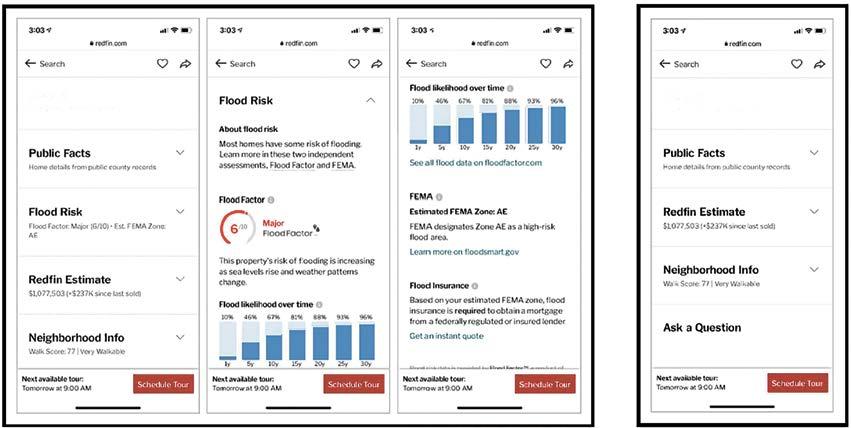
Source: Based on Fairweather et al. 2023.
M obile money has leveraged high mobile phone penetration in many developing countries to deliver a first wave of digital financial services
Inadequate information often limits technology adoption more than a lack of liquidity, as with rainwater harvesting techniques (which capture rainfall, reduce runoff, and enable irrigation) in Niger (Aker and Jack 2025). Training was offered that explained how demi-lunes, half-moon shaped berms, can collect rainfall and runoff and outlined the steps and technical norms for constructing them. And various cash transfers were offered to relieve liquidity constraints. But there was little evidence of liquidity or credit constraints deterring adoption of rainwater harvesting. Instead, training increased the share of adopters by more than 90 percentage points, while cash transfers had no additional effect.
Climate-resistant seeds and farming practices require information about expected weather conditions as well as technology. Most countries’ agricultural extension services oversee dissemination of information about new technologies, crops, cultivation methods, input requirements, and so on. They can be tapped to provide longer-term weather forecasts, especially when the technologies or the crops are truly new.1 As noted above, social networks matter a lot, and effective information interventions should take advantage of them. Smartphones and video messaging have opened another avenue for information provision at scale, because showing videos about input use and farming practices and sending SMS and voice messages all increase the uptake of modern agricultural technology (Dzanku and Osei 2023; van Campenhout, Spielman, and Lecoutere 2021).
Climate risk varies across space, so information on event probabilities, exposure, and vulnerability over the longer horizon must be collected and disseminated spatially. Government has a role in linking climate hazard data to granular geospatial locations and making those data available to all households, farmers, and firms. Such information dissemination, though beneficial for everyone
concerned in the long term, faces substantial opposition from people, industry, and politicians alike. Japan, one of the most climate vulnerable and most resilient countries in the world, used a combination of legislation and information campaign to overcome this opposition in its successful water management effort (box 5.5).
Making climate information available, credible, and affordable
Next-day weather forecasts have become more accurate and are often available on smartphones and other electronic devices without cost. But in low-income countries, medium- to long-term forecasts are either unavailable or involve forecast errors. Forecast data are available from two global sources: the US National Oceanic and Atmospheric Administration (NOAA) and the European Centre for Medium-Range Weather Forecasts (ECMWF).2 Worldwide weather forecasts for up to 16 days at a spatial resolution of 28 kilometers are available for free from NOAA through a web portal and an app. Forecast data from ECMWF for up to 16 days are at a spatial resolution of 14 kilometers and are available to ECMWF and World Meteorological Organization (WMO) members for free and to commercial users for a fee.
Private commercial firms in developed countries collate data from multiple public and semi-public sources and their own satellites and use proprietary forecasting models to provide spatially finer and longer-term forecasting. Examples include Tomorrow.io and Meteomatics. Various artificial intelligence systems are also improving the accuracy and timeliness of forecasts. For instance, Pangu-Weather can perform forecasts as accurately as (or better than) leading meteorological agencies and up to 10,000 times faster (Bi et al. 2023). The speed of these forecasts makes them much cheaper to run and could provide much better results for countries with limited budgets.
Japan’s journey from resistance to integrated flood risk management demonstrates how societies can transform disaster uncertainty into manageable risk through transparency and comprehensive planning. The experience underscores that when facing natural forces, even advanced technological solutions have limitations, necessitating holistic approaches that acknowledge human vulnerability and nature’s power.
Japan, despite its advanced technological capabilities, faced significant challenges in making flood hazard information publicly available. Initial attempts to publish flood hazard maps encountered resistance from multiple stakeholders—politicians, real estate developers, local governments, and private citizens—all concerned about potential property devaluation. This resistance temporarily halted progress toward transparency in risk communication.
The Tokai torrential flood of 2000 served as a watershed moment in Japan’s approach to disaster risk management. This catastrophic event severely impacted the Nagoya metropolitan area, Japan’s third-largest urban center. Approximately 19 square kilometers were inundated due to overtopped levees on the Shonai River and breaches in the Shinkawa River. Over 18,000 homes sustained damage while authorities evacuated nearly 29,000 residents. Evacuation advisories were issued to approximately 580,000 people, but actual evacuation rates remained critically low.
The inadequate response revealed fundamental flaws in disaster risk communication and evacuation protocols. Most significantly, it demonstrated that public perception of natural threats had significantly underestimated actual risks.
In response to this disaster, Japan enacted significant policy reforms. First came legislative change: the Flood Risk Management Law was revised in 2016 to mandate the minister of land, infrastructure, transport, and tourism to publish hazard maps. This was followed by local implementation, by which local governments utilized these maps to develop disaster management resources, including evacuation routes, shelter locations, and identified hazardous areas. Finally, Japan developed a holistic approach. Over the subsequent two decades, Japan has continuously evolved its strategy, culminating in the River Basin Disaster Resilience and Sustainability by All initiative—an integrated approach combining both structural (hard) and non-structural (soft) measures across entire river basins.
Japan’s experience offers several critical insights for disaster risk management. Science-based hazard maps provide the necessary evidence-based foundation for landuse regulations that would otherwise face legal challenges as arbitrary restrictions on private property rights. Even the most robust flood protection systems have probability-based limits that will eventually be exceeded by extreme events. This revealed a psychological risk: paradoxically, increased structural protection can create a dangerous “safety illusion,” reducing risk awareness and potentially leading to catastrophic consequences when defenses fail. Ultimately, Japan developed a balanced approach, recognizing that effective flood risk management requires complementary hard and soft measures—physical infrastructure must be supported by robust information systems, evacuation planning, and land-use policies.
Source: Based on Japan Water Forum, https://www.waterforum .jp/en
But making these forecasts available to small firms or farmers in low-income countries is not easy. Global forecasting models must be adapted to reflect local conditions, satellite-based weather data have to be validated with field weather observations, and all the information has to be transformed into forms easily understood by consumers and communicated to them in real time. Weather data must be shared across stations and communicated to national and international meteorological agencies. The weak information collection and sharing are reflected in considerable spatial gaps in information coverage of the Global Basic Observing Network. Germany has more observation stations compliant with the network than all of Africa (WMO 2024). The two-way exchange of weather data can help in disseminating climate information in low-income countries.
Developing research and development capabilities for locally relevant forecasting and increasing the density of weather observation and monitoring stations are thus a priority. Meteorological observations are particularly valuable in locations with lower observation density (Linsenmeier and Shrader 2023). Improvements in the coverage and exchange of surface-based observations to meet the WMO’s Global Basic Observing Network specification can deliver additional global socioeconomic benefits of more than $5 billion a year (Kull et al. 2021) a conservative estimate that does not account for the socioeconomic and poverty benefits of better weather data. Investing in improving surface-based observations in data-sparse regions is also highly economically efficient, yielding a global benefit-tocost ratio of more than 25:1.
So, governments need to regulate to ensure the credibility of information and encourage private firms to assist in translating and communicating weather information
in real time. Where private markets have not emerged for these services, communities, nongovernmental organizations, and public service providers, such as extension services, can form partnerships to deliver them. These partnerships may also need direct assistance from the government, particularly to serve poor people.
The benefits of better observations include more valuable disaster early-warning systems (Hallegatte et al. 2017; Tzachor et al. 2023), more accurate locally downscaled seasonal and decadal climate predictions (Bruno Soares, Daly, and Dessai 2018), and more generally a better scientific understanding of the status quo and changes in weather and climate. International data exchanges can multiply the value of additional observations (Kull et al. 2021). The WMO now coordinates weather data across the world and runs training programs for local meteorological agencies. Its role can be expanded in the tradition of CGIAR, which made a major contribution to improving crop technology and training local research agencies in adapting it to local conditions.
Formal insurance consists of access to finance and insurance markets in times of need, both before and after climate shocks.
Financial inclusion here means that households, farmers, and firms have access to affordable and useful financial products and services that meet their resilience needs transactions, payments, savings, credit, and insurance and are delivered safely and sustainably. Access to financial resources is the first line of defense for households, farmers, and firms against damaging shocks. Climate resilience requires To
expanding financial inclusion to underserved populations, making credit lines available to farmers and firms, and devising a common savings, credit, and insurance platform for everyone.
The barriers to using the traditional banking sector include high costs of branch networks serving small accounts for saving and well-known adverse selection and moral hazard problems for credit (see chapter 3). With the emergence of digital financing, all three problems have been tackled though not equally using new technology and innovative products. The near-universal adoption of mobile phones and their use in mobile banking have dramatically reduced the fixed costs of providing financial services.
Mobile money has leveraged high mobile phone penetration in many developing countries to deliver a first wave of digital financial services. There are more than 850 million registered mobile money accounts across 90 countries, with $1.3 billion transacted through these accounts each day. SubSaharan Africa is a leader in mobile money, with 21 percent of the adult population having an account. The number of poor households with access to formal financial services, such as bank accounts or digital wallets, has reached 71 percent in developing economies (Demirgüç-Kunt et al. 2022). Digital financial services offer the opportunity to expand financial inclusion to unserved and underserved populations and to improve access to credit and insurance for climate resilience.
Mobile money accounts are used primarily to send and receive payments. They deliver social protection payments, and they have made households more resilient to shocks by allowing them to receive financial support from distant friends and relatives, as in Bangladesh, Kenya, and Uganda (Jack and Suri 2014; Lee et al. 2019; Wieser et al. 2019). Digital financial services–enabled firms can
interact with financial service providers, even when physical visits are not possible (as during the Covid-19 pandemic), and draw on existing lines of credit without delay or disruption. And digital payments, once approved, can be applied quickly to firms’ accounts, allowing smooth functioning of markets during disasters.
Mobile accounts have started to boost savings as well. In 2021, for the first time, more than half of adults who chose to save did so through a formal account, whether provided by a bank or similar institution or a mobile money provider (Demirgüç-Kunt et al. 2022).
Progress has been slower in providing credit, though several innovative financial products have emerged recently. Digital financial services have introduced forms of alternative finance that can compensate for a lack of liquidity in traditional financial channels. For instance, fintech startups in India facilitate person-to-person, consumer, and small and medium enterprise loans. Credit can be disbursed within hours of application, compared with weeks for a bank. Branch International, which operates in India, Kenya, Mexico, Nigeria, and Tanzania, offers similar services. The credit extended by these fintech companies is short in duration (several weeks to a year) and of smaller size ($50), yet it can help in coping with weather shocks. And smaller enterprises can use account receivables as collateral for working capital loans.
The development of digital financial services requires strong enabling factors to ensure consumer protection, financial integrity, and stability. To foster responsible innovation in digital financial services, governments must ensure modern, robust, accessible, and interoperable financial infrastructure and support systems.3 Regulators should encourage new players and new approaches by incumbents to offer digital financial services. They should also promote competition and a level playing field in M
For many countries, the risk of catastrophic events is so high that no insurance company can offer affordable coverage
access to data, technology, and infrastructure. And they should safeguard consumer protection through data privacy and fee disclosures. Using digital financial services for social protection payments also increases its demand.
Households, farmers, and firms obtain insurance against weather shocks from different sources. For low-impact but frequent shocks, they rely on informal insurance networks based on families, friends, and communities. This type of informal insurance is useful for small shocks and tends to disappear for large systemic shocks or with formal insurance. The formal insurance available depends on the types of shocks and economic agents. In developing countries, parametric index insurance dominates for crops, while indemnitybased insurance dominates for properties. Meso-level insurance products are also available for local, state, and central governments. Some formal insurance products are publicly provided, as with crop insurance in the United States. And some are provided through public-private partnerships and partly subsidized, as with flood insurance in developed countries and crop insurance in developing countries.
But insurance markets are subject to high transaction and capital costs. Government subsidies have been the main tool used to reduce these transaction costs. For example, in China and India, index insurance for farmers is heavily subsidized in the range of 60–90 percent of insurance premiums (Kramer et al. 2022). Flood, fire, and other disaster insurance for properties and indemnity crop insurance for farmers are subsidized in developed countries as well. The arguments for these subsidies are that, without them, insurance markets would not emerge and that subsidies allow insurance companies to learn about delivering these products more efficiently, lowering loading and thus
premiums. But even with heavily subsidized premiums, demand for insurance has been low due to bailouts, basis risks for index insurance, and a lack of trust and understanding by potential consumers.
The insurance industry needs new and easily scalable ideas and policies to substantially reduce transaction and capital costs. For digital financial services, this has come from wide adoption of mobile phones, a flexible regulatory framework that allowed entry of nontraditional actors into traditional finance and encouraged product innovation, and public investment in interoperable digital and financial infrastructure. The same broad approach adapted to insurance can help better manage climate risks and uncertainty. Indeed, some digital financial service companies now offer insurance products as well; ACRE Africa, a fintech company, offers crop, livestock, and index insurance products to smallholder farmers in Kenya, Rwanda, and Tanzania.
Unlike traditional insurance or financial products that deal mostly with manageable risks, insurance products for climate shocks need to deal with deep uncertainty and ambiguity. Informed decisions require granular and fine climate data, and governments can help in converting these data into easily accessible and usable forms for users, including insurance providers.
Insurance providers need to verify how a crop is faring or whether a property is in a climate-vulnerable area. Automating the verification process using digital technology requires universal digital IDs: property IDs for property insurance and village IDs for index and crop insurance. Unique IDs enable merging of digital property registries and village data with data on soil quality and water availability and other physical data relevant to land productivity.4 Equally important, detailed and real-time climate data as well as crop health
The US Department of Agriculture and the Federal Crop Insurance Corporation offer the Annual Forage Insurance Plan for farmers. This plan provides index insurance for below-average precipitation. To supply a menu of insurance options to farmers, the plan uses digital information from different sources:
• The base land value is a measure of the land’s productivity computed by the US Department of Agriculture.
• To compute a rainfall index, the entire land area of the country is divided into 0.25 degree by 0.25 degree grids. Farmers buy insurance for their corresponding grids and for a specific two-month index interval within a year. The rainfall index is actual precipitation during the index interval divided by average long-run precipitation, multiplied by 100. An index below 100 represents below-average precipitation and so on. The insurance covers only a decline from the long-term historical normal interpolated precipitation for a grid and index interval. Indemnity payments are earned by eligible insureds only when the final grid index is less than the trigger grid index.
The insured chooses the percentage coverage value (trigger threshold) and a percent productivity factor,
which could be above or below the base land productivity. Once the insured has chosen the percentage coverage value and the total productivity factor, the dollar amount of protection per acre equals the county base value per acre multiplied by the coverage level selected multiplied by the productivity factor selected. The total policy protection then is the dollar amount of protection per acre times the total number of acres being insured. The insurance premium amount per acre depends on the percentage coverage level, on the intended use of the land, and on the index interval chosen. A web-based tool helps farmers identify their grid and displays all relevant information.
B5.6.1 US farmers can obtain tailored crop insurance products online
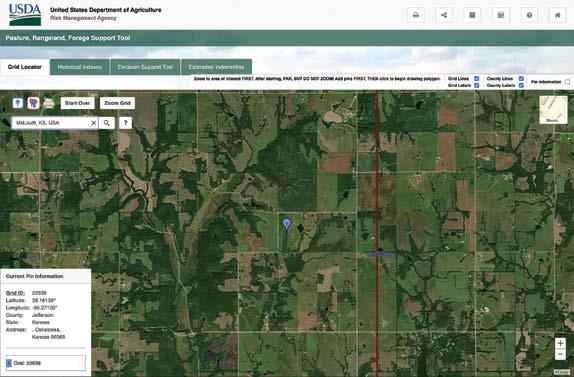
Source: The image is from US Department of Agriculture 2024.
Source: Based on US Department of Agriculture 2016 and 2024.
data from satellite imagery can be linked to village IDs to make verifying crop losses easier. A similar process is used to offer tailored index insurance products to farmers in the United States (box 5.6). And accurate verification of losses without feet on the ground will greatly reduce transaction costs for insurance companies.
Picture-based insurance using smartphone images of insured crops for claim settlement can reduce basis risk for farmers by detecting severe crop losses remotely and at a relatively
I
markets facilitate flows of goods and people, which in turn helps dissipate the local effects of a shock, providing an automatic insurance mechanism
low cost from a stream of ground images that farmers provide throughout the growing season (Ceballos, Kramer, and Robles 2019). The stream of images can help deliver personalized risk-reducing advice and strengthen monitoring that, together with crop modeling, can improve yield predictions for the village or even individual plots (Afshar et al. 2021; Ceballos, Kramer, and Robles 2019; Hufkens et al. 2019). Crop growth models can be combined with satellite data to make granular yield predictions to trigger insurance payments (Lobell et al. 2015). But insurance providers have been reluctant to use these alternative data sources. Digital ID–based information provision offers better solutions because it can gather much more information than just weather. Many of these regulatory frameworks are already in place for facilitating digital financial services and can be adapted for the digital insurance market as well.
Making information available to insurance providers through digital platforms and to farmers and property owners through mobile phone applications can reduce ambiguity in insurance products and boost demand for them. In India, mortgage insurance is not legally mandated, though lenders are increasingly demanding insurance for mortgaged property. In China and India, the proportion of farmers with some type of insurance is high because farmers are required to buy insurance when they receive credit from banks or input suppliers. Legal requirements expand the customer base and allow better spreading of risk, helping insurance companies reduce transaction costs. Insurance companies also use “risk layering,” where the loading in each layer is determined by underlying risks. For instance, risk layering would mean lower premiums for properties in areas less vulnerable to flood or fire and for crops
that are drought resistant. If premiums are allowed to reflect risks, they can serve as price signals to encourage settlement in less vulnerable areas.
Farmers’ doubt about actually receiving an insurance payout is grounded in the reality of payment delays. For instance, under India’s Pradhan Mantri Fasal Bima Yojana crop insurance program, both the state and central government pay subsidies to insurance companies to cover payouts triggered by weather shocks. Delays in receiving payments from the government translate into delays in insurance companies paying the farmers. Insurance companies can use digital payment platforms to transfer payouts to beneficiary accounts, and governments can quickly release the subsidy amounts and use regulation to reduce delays. Having federal and state governments purchase or subsidize insurance coverage for municipalities may be a better option (box 5.7).
For many countries, the risk of catastrophic events is so high that even a risk- and ambiguity-neutral insurance company with national coverage cannot offer affordable coverage without the possibility of quickly going bankrupt. When typical insurance markets are unable to operate, countries have two options: they can join in a multicountry riskpooling facility to access affordable insurance or rely on catastrophe bonds. These options are being used by Caribbean islands (box 5.8).
The fourth layer of policy for promoting resilience actions is investment in infrastructure to limit losses from climate events, diversify risk, and increase access to markets for products, inputs, land, housing, and labor.
Having well-developed transport infrastructure and competitive transport services helps
I nvestment in protective infrastructure should be based on the costs and benefits of each option. Risk layering is useful here
Insurance purchased by federal and state governments in Mexico protects against climate disasters
Index insurance can also be marketed to governments, which can in turn provide relief to farmers affected by extreme weather events. In Mexico’s Component for the Attention of Natural Disasters (CADENA) program, the federal government and states jointly purchase insurance to protect municipalities in the case of natural disasters. Every year, states determine the municipalities they want to insure and the type of insurance coverage they want—area-based yield insurance, traditional livestock insurance, weather-based index crop insurance, or livestock index insurance. The premiums paid by states (the policyholders) are highly subsidized and depend on the poverty rate of the municipalities covered. For an average municipality, the federal government shares at least 70 percent of the premium. For a high-poverty municipality, the federal government pays up to 90 percent. In case of a payout, the state governor decides its allocation,
integrate all types of markets and can reduce the climate vulnerability of households, farmers, and firms. And integrated markets facilitate flows of goods and people, which in turn helps dissipate the local effects of a shock, providing an automatic insurance mechanism. Access to safe water, improved sanitation, and electricity can reduce vulnerability by reducing health and livelihood exposures from climate shocks. These types of basic infrastructure are also needed to ensure inclusive economic growth, and are thus doubly desirable, and should be prioritized in resilience policies. But such infrastructure should be constructed with climate resilience in mind. Governments
from lump-sum payments to affected farmers to spending on other programs.
For a natural disaster, CADENA also provides direct assistance (apoyos directos) to municipalities not covered under the insurance program, but ex post disaster relief is subsidized only 50 percent by the federal government. In addition, the governor does not control how apoyos directos funds are spent in the municipalities. So, states have an incentive to purchase municipality-level insurance through CADENA because it is more heavily subsidized, and they control the payout allocation. Transfers from CADENA have reduced post-disaster mortality and accelerated local economic recovery.1
Source: Based on Giné
can invest in protective infrastructure, such as embankments and seawalls, that reduce exposure to climate shocks. Optimizing urban upgrading, reducing heat island effects, and ensuring infrastructure is resilient to natural hazards can also greatly reduce economic losses and enhance community prosperity (World Bank 2023). Similarly, critical hubs and spokes of the existing transport network, as well power generation and distribution systems, need to be identified to properly investment in their resilience. Information about climate-vulnerable infrastructure and analytical capacity to conduct advanced risk assessments are necessary for these tasks.
To discourage moral hazard, subsidies and social protection should not be large enough to cover all the damage from a shock or too little to be of any help
BOX 5.8
The Caribbean islands sit in Hurricane Alley,1 the area of water where hurricanes form and travel from northern Africa’s west coast to Central America’s east coast. During 1991–2020, the average Atlantic hurricane season (June 1–November 30) had 14 named storms, including 7 hurricanes, 3 of them major (category 3 or higher). With climate change, sea temperatures in the Atlantic Ocean are climbing, and evidence suggests that this is contributing to the rising intensity of hurricanes.2
The Caribbean includes numerous small island developing states, which have difficulty absorbing the financial impacts of disasters due to limited budgets, economic size, diversification, and access to credit. Their small geographic size prevents diversification of risk, as disasters can easily cover entire countries lacking access to affordable, effective insurance coverage against natural disasters. To help address these issues, the first multicountry risk pool—the Caribbean Catastrophe Risk Insurance Facility (CCRIF)—was established in 2007.3 Today, the CCRIF has 19 members and offers six parametric index insurance products for tropical cyclones, earthquakes, excess rainfall, electric and water utilities, and the fisheries sector. Since its establishment, it has made 78 payouts to 22 members totaling about $390 million.4
The CCRIF is a risk-pooling facility through which multiple countries pool their risks and purchase parametric insurance. Payouts are triggered based on the intensity of an event, providing immediate liquidity to member
countries. The facility transfers risk to reinsurance and capital markets. It provides cost-effective coverage by pooling risks and leveraging donor contributions, making it more affordable for members.
Another alternative instrument is catastrophe bonds, which are insurance-linked securities in which the risk is transferred to bond investors. If a specified disaster occurs, the bond’s principal is used to pay the sponsor (for example, the government or the insurer). Investors receive periodic coupons and risk losing their principal if a disaster occurs. Catastrophe bonds are more expensive than risk-pooling facilities due to their need to attract investors. The World Bank has issued catastrophe bonds that have transferred $3.3 billion of risk to capital market investors through 19 catastrophe bonds.5 It issued a catastrophe bond for Jamaica to increase financial resilience to natural disasters and climate shocks. In July 2024, Hurricane Beryl, a record-breaking category 5 storm hit, leaving a trail of destruction along Jamaica’s southern coast.6 But despite the level of destruction, it failed to trigger Jamaica’s catastrophe bonds because its wind speed was not high enough.
Notes
1. World Atlas, “Where Is Hurricane Alley,” https:// www.worldatlas.com/articles/where-is-hurricane -alley.html
2. NOAA n.d.
3. World Bank 2012.
4. Catastrophe Risk Insurance Facilty, “Company Overview,” https://www.ccrif.org/about-us
5. Cooney et al. 2023.
6. Davis et al. 2024.
S ubsidies and social protection should be portable and not tied to places or properties
Investment in protective infrastructure should be based on the costs and benefits of each option. Risk layering is useful here. For the riskiest areas, retreat may be the least costly. To encourage people to shift away from risky sectors and risky areas, governments should invest in people in human capital, skill formation, and connecting people to jobs and opportunities in potential destinations. For less risky areas, risks can be managed by combining investment in people with incentives to invest in self-protection and insurance through information and market development. Protective infrastructure is justified when cost-benefit analysis indicates positive returns relative to that for retreating or managing.5 The case for building resilient infrastructure, the challenges to doing so, and ways to overcome them are discussed in more detail elsewhere and are not repeated here (Hallegatte et al. 2019).
Markets for finance, insurance, property, and products take time to develop, and so does the income growth that can relieve liquidity constraints. During the transition, governments have to step in to assist poorer and disadvantaged households, farmers, and firms with buying insurance, moving to a property in a safer place, or investing in climateresistant technology. There is also a role for public support to respond quickly to help these households cope with income losses from the immediate impact of a disaster. Disadvantaged people include women and members of ethnic and racial groups that may face additional constraints to resilience beyond lower income.
A timely, targeted social protection response can prevent higher poverty in the short and
long term. Cash transfers, in response to a natural disaster, have considerable long-run welfare benefits for poor households. But if poorly designed, subsidies leave farmers stuck with crop choices that are wrong for climate resilience and encourage households and firms to settle in climate-vulnerable areas. To avoid such unintended consequences, social protection programs should have individuals and firms bear part of the risk. Programs should be contingent on behaviors amenable to climate resilience. They should, when feasible, be targeted. Social protection benefits, which tend to be small, should be portable not tied to a place. And they should be timely, temporary, and rule based.
To discourage moral hazard, subsidies and social protection should not be large enough to cover all the damage from a shock or too little to be of any help. For example, public subsidies for financial services should be comprehensive, because of their direct and indirect impact on the optimal combination of insurance and self-insurance (Gollier, Mahul, and Pelletier 2023). Subsidies for public insurance premiums alone may not be the best value for money. Instead, to be cost-effective, public subsidy programs should combine subsidies for savings and credit and subsidies for insurance to encourage vulnerable households to absorb small losses by subsidizing interest rates and to transfer excess losses by subsidizing the insurance protection against large and catastrophic risks. The optimal mix will depend on the cost of each financial instrument and on the risk profile and preferences of vulnerable households. Public subsidy programs for resilience should be assessed through a transparent value-formoney analysis that compares their cost with the increased welfare of the targeted population (box 5.9). In contrast, social protection programs should provide a meaningful level of protection to poor households.
M
BOX 5.9
Designing catastrophic risk insurance subsidies using a value-for-money approach
Public subsidies for insurance premiums can help vulnerable countries and people protect against catastrophic disasters. For example, countries of the Group of Seven and the Vulnerable 20, an association of states particularly threatened by climate change, launched the Global Shield against Climate Risks at the 2022 United Nations Climate Change Conference to help poor and vulnerable people and countries better protect themselves against climate-related risks. This facility offers premium subsidies for catastrophe risk insurance programs. The Global Shield developed five SMART (specific, measurable, achievable, relevant, and time-bound) principles to guide the design and implementation of appropriate premium and capital support that could help scale up climate and disaster risk finance and insurance. One of those principles, value for money, describes the impact of each dollar of premium and capital support on the resilience of poor and vulnerable countries and people.
The value-for-money approach compares the costs and benefits of alternative public interventions to guide the policy dialogue between governments and donor partners on the optimal forms of public intervention for improved financial resilience against climate shocks. The dynamic model developed in
Gollier, Mahul, and Pelletier (2023) compares two options: partial premium subsidies for insurance coverage (above a deductible) and full premium subsidies (free coverage) only for the top risk (large and catastrophic climate events) layer (above a higher deductible). Vulnerable households are better off with an insurance policy for which the household pays the full cost of the middle insurance layer (intermediate climate events) and government pays the full cost of the catastrophic layer, not where the government pays a proportion of both the middle and catastrophic insurance layers.
Five key principles should be followed for public intervention in catastrophe insurance markets: promote catastrophe risk financing in the broader dialogue on disaster risk management and climate adaptation, enhance competitive catastrophic risk markets, use risk-based price signals to encourage catastrophe risk management, limit public subsidy programs to those that minimize distortions of market price signals, and develop customized catastrophic insurance solutions.1
Note
1. Mahul and Cummins 2008.
Source: Based on Mahul 2024.
To encourage behaviors that contribute to climate resilience, subsidies should be contingent on resilience-boosting behavior, and social protection conditional on building resilience-promoting skills and assets. For farmers, this means bundling subsidized index insurance with climate-resistant improved seeds and climate-smart farming techniques and conservation practices. For poorer households and firms moving into safer areas, housing subsidies can be linked to investment in weatherproofing structures. Social protection for coping can be combined with job training and asset transfers to boost resilience to the next climate shock. For the poorest households, governments can
H ouseholds, farmers, and firms face multiple constraints, and relaxing one of them may not be sufficient for inducing resilience actions
purchase parametric index insurance that, when triggered, is disbursed through established social protection programs.
In most countries, subsidies for index insurance are not targeted to the poor but are available for everyone. To kick-start insurance markets, such blanket subsidies may be the starting point. But when incorporated into social protection programs, insurance subsidies can be better targeted to the poor, and can allow for gradual reduction of blanket subsidies and the associated moral hazard as a market develops.
Subsidies and social protection should be portable and not tied to places or properties. Both should also be calibrated to the severity of weather shocks: smaller damages can be covered by insurance companies, and larger and correlated shocks can trigger subsidies, a form of social protection. Public financing for regular transfers and smaller anticipatory support can be complemented by insurance products for larger events, with a humanitarian response for rare, catastrophic events. Payment triggers should be well defined, and payments should be automatic and without delays. A well-defined subsidy or social protection scheme can consolidate private and public payments to assist households, farmers, and firms in planning and recovering from weather shocks efficiently. In France, flood insurance is not tied to places.
Discouraging poor and disadvantaged people from locating in climatevulnerable areas
Poorer households in developing countries often locate in vulnerable areas because that is what they can afford and because alternative locations in safe but distant neighborhoods involve higher commuting costs. This is true for climate migrants from rural to urban areas, who often end up in areas that are nearly as risky as the ones they migrated
from. This presents a policy dilemma for governments: should they promote the climate resilience of poor people at their current vulnerable locations (such as urban slums and rural areas), or should they equip people to move to safer areas?
Providing property rights, public services, and protective infrastructure in illegal squatter areas will encourage more such behavior, and the associated rise in property values will again push very poor people out of protected neighborhoods into precarious situations. This cycle of dangerous household behavior backstopped by government policies can be costly for taxpayers without delivering resilience.
Equipping people for a move is predicated on several policy steps. Cities can use a combination of regulations, incentives to builders, and land use planning and infrastructure development to increase the supply of affordable housing. Zoning restrictions must be enforced to prevent settlement in the riskiest areas. To absorb a growing population while excluding risk-prone areas, cities may need to adjust their building codes to allow for taller units and more density. And because these areas will be farther from economic opportunities, land development must be accompanied by affordable transport services. Cities may also plan mixed housing units both affordable and expensive houses in the same neighborhood to address commuting concerns. The measures to relax affordable housing constraints should be accompanied by investment in people such as skill-training and job-matching programs so that they can seek better employment.
Finally, for climate migrants, locating in equally vulnerable areas in cities can still reduce their overall vulnerability because they will move out of climate-sensitive agriculture to safer nonagricultural activities. In addition, providing services that reduce people’s
Policy packages can address each layer of shock, building on a hierarchy of resilience instruments
vulnerability, such as basic health and physical infrastructure, is cheaper in more densely populated areas than in sparsely populated rural areas. Migration and potential cascading effects are why climate resilience policies should be coordinated at the national level.
The resilience challenges of households, farmers, and firms vary based on the shocks they face and their financial ability to manage them. And different challenges require different markets and instruments. A layering approach to responding to these challenges starts with describing how different products can be bundled to take advantage of complementarities, tackle cognitive biases, and promote resilient behavior.
Households, farmers, and firms face multiple constraints, and relaxing one of them may not be sufficient for inducing resilience actions. Subsidized stand-alone index insurance may prevent households from adapting to weather shocks by encouraging unsustainable livelihoods. Weather index insurance could encourage adaptation when bundled with climateadaptive technologies. Bundling weather index insurance with drought-resistant seed, for example, may increase access to seeds and insurance with the added advantage of being more cost-effective for lenders because stress-tolerant varieties reduce the likelihood of more widespread crop failures that insurers have to cover with a full payout.
Bundles of insurance with specific agricultural inputs, such as seeds or fertilizer, are integrated as interlinked transactions in value chains and designed to ensure that farmers adopt certain desirable inputs. The Syngenta Foundation (interlinking seed and fertilizer sales with index insurance) and Kenya’s
Kilimo Salama (offering index insurance at a 5 percent premium over the seed price) integrate bundled products in value chains.
Bundling insurance with credit is typically done by a financial institution to address liquidity constraints. Instead of insuring the loan portfolio, banks bundle individual loans with insurance that covers the amount of the loan. Borrowers typically cannot opt out of the insurance contract because it is compulsory. This product design reflects banks’ desire to avoid losses due to large shocks. The bundle can also include some flexibility in the timing of payments (preharvest or postharvest).
The success of bundling credit and insurance for farmers depends on how the product is designed and the context in which it is offered. Field experiments reveal considerable demand for bundled products in many countries (Ahmed, McIntosh, and Sarris 2020; Mishra et al. 2021). One such experiment in Ethiopia found high uptake for the bundled loan, but agricultural cooperatives offering the bundled product were hesitant to use their own assets to back it due to the risk of default (McIntosh, Ahmed, and Sarris 2020). Borrowers of bundled products need to make a higher payment that includes interest and the insurance premium. As a result, uptake was lower in Malawi relative to standalone loans (Giné and Yang 2009). Uptake might also be low because farmers still bear the idiosyncratic risks, which could be large. When there is a history of government pressuring lenders to not collect repayment of agricultural loans in years with poor rains, farmers simply defaulted on their loan payments even when a payout was not triggered by low rainfall. Such bundled products could undermine the culture of repayment if there is ambiguity about how much of the amount due farmers should repay.
When weather index insurance was bundled with a stress-tolerant seed variety, demand
for bundled products was higher, and adoption of drought-resistant seeds was greater (Boucher et al. 2024; War, Makhija, and Spielman 2020). Farmers were more willing to make risky production decisions when the seed variety was combined with weather index insurance to cover losses from more extreme weather events. Subsequent demand for the bundle was higher among farmers who had received a payout, indicating learning over time. Bundled loan contracts are expected to induce farmers to adopt technological change only in environments with low collateral requirements and modest idiosyncratic risks as a share of total farmer risk (Carter et al. 2017).
The resilience strategies of households, farmers, and firms vary by the types of shocks they face. The downside risk of a shock can be categorized by the magnitude of losses and is usually segmented into three layers. Idiosyncratic shocks inflict frequent but typically low-impact and mostly idiosyncratic losses. Intermediate shocks inflict less frequent but larger losses
that may be correlated within groups of people. Large and catastrophic events comprise tail-end risks that are infrequent but have high, systemic impacts, such as a severe flood or drought, affecting many people in a region and causing widespread losses.
Policy packages can address each layer of shock, building on a hierarchy of resilience instruments (see table 5.1). Higher incomes and improved knowledge and information are universally needed as a solid base and apply to all types of shocks. Better access to markets, savings, and credit to improve welfare overall and as self-insurance can help in dealing with smaller shocks. More formal insurance is needed to spread risk and speed up recovery during intermediate shocks. And social protection plays a role as public insurance of last resort to speed recovery following severe shocks when other measures are insufficient.
The simple layering approach can be used to understand the roles of individuals, markets, and governments in responding to shocks of different magnitudes (table 5.2). To navigate small but frequent shocks,
TABLE 5.2 Individuals, markets, and governments have different roles in responding to different types of shocks
Frequency and severity of shocks Individuals Markets Governments
Frequent but low impact events Incomes and Information
Less frequent but larger impact events
Incomes, Information, and Insurance Incomes (functioning factor and product markets), Information, and Insurance
Incomes, Information, Insurance, Infrastructure, and Interventions (social protection)
Rare but extreme events Incomes, Information, Insurance, and Interventions Interventions (particularly disaster assistance), building on the other Is
Source: Policy Research Report team.
Note: The highlighted cells represent the main actor for each type of shock.
individuals can rely on self-insurance (precautionary savings), here individuals playing the most important role. For large but infrequent shocks (intermediate events), markets can provide insurance by pooling to spread risk across individuals so that information, insurance, and connective infrastructure will be relevant. However, for the largest calamities affecting wider areas, market insurance may not be available at affordable premiums, requiring governments to step in to provide emergency protection. Governments have different roles in tackling different size events. Clarifying the role of governments is important. Like individuals, governments face trade-offs. Investing more in resilience may come at the expense of investing in other priority areas, such as human capital. Their role in promoting growth and providing information are relevant for all events. For events of intermediate size, their main role is to enable market development through insurance and infrastructure. But they take a leading role in providing financial and other assistance in recovering from extreme events.
Households, farmers, and firms differ in their ability to manage climate threats. Very poor people lack savings and rely on distress activities to cope with climate damage. Poor people have access to informal insurance mechanism but are not well enough off to purchase formal insurance. The middle class have access to some formal credit and insurance. Rich people face no financial constraints and have access to financial and insurance tools. Information applies to all agents and all events. The same layering approach can be used to cater to their needs.6 This layering of policy instruments by severity of shocks and income status is being adopted in the design of resilience projects (box 5.10).
In sum: following four principles for policy packages
• Focus on helping individuals invest in resilience. Households, farmers, and firms are not passive bystanders or irrational decisionmakers, and policy makers should not treat them as such. Instead, policy makers should trust that individuals will actively engage in adaptation and coping when they have proper information and access to the required tools and resources. In this context, the role of markets and government is to enable and empower individuals to make informed adaptation decisions. More broadly, this report argues that adaptation policies should put a greater emphasis on individuals’ own preferences and judgment, then mobilize markets where possible and rely on governments where necessary.
• Prioritize the 5 I’s, according to the context. Each of the 5 I’s addresses a different aspect of the resilience challenge. An important characteristic of each is the degree to which it also serves broader development objectives. Income growth is a powerful driver of resilience, in large part because it generates resources that individuals can use to invest in adaptation. Any policies that promote inclusive growth are therefore also effective resilience policies. Likewise, better information improves decision-making and helps boost productivity, as does better infrastructure, which also increases individuals’ resilience options. For these instruments, the downside risk is more limited, and resilience benefits can often just be a bonus. Insurance and targeted interventions, by contrast, aim primarily to reduce the impact of climate-induced damages, usually at a net cost. These instruments are often
The Horn of Africa one of the world’s poorest and most fragile regions and home to about 50 million extremely poor pastoralists faces severe drought. Pastoralism and livestock production are the primary livelihoods, accounting for more than a third of agricultural GDP in most countries and around 80 percent in Djibouti and Somalia. Due to their vulnerability to drought, these communities accumulate large herds as a risk management strategy against droughts. But during droughts, they hold on to their herds for too long, so their animals die or are sold at very low prices.
The World Bank’s De-risking, Inclusion, and Value Enhancement of Pastoral Economies in the Horn of Africa (DRIVE) project is a collaborative effort involving Djibouti, Ethiopia, Kenya, and Somalia. Its goal is to help pastoralists adapt to the impacts of climate change by providing access to financial services. The project also supports commercializing livestock production, investing in pastoralist communities, and including women, marginalized groups, and vulnerable populations. Up to 1.6 million pastoralists stand to benefit. Historically, the number of pastoralists engaging with formal financial services has been low. When a drought hits, these vulnerable communities rely on government emergency response or humanitarian aid.
Digital technology helps financial services reach pastoralists. In Ethiopia, Kenya, and Somalia,
financial laws support mobile payments and mobile money. In Kenya, about 40 percent of pastoralists own a mobile phone, and 44 percent of women-headed households save through mobile money systems. The DRIVE index insurance products monitor pasture conditions through satellite technology. When the pasture falls below a certain level, an insurance payout is triggered automatically and paid directly to pastoralists through mobile money systems. The benefit of this technology is that it shifts from asset replacement to asset protection: the payout allows pastoralists to buy water, fodder, and medicine to keep the core breeding stock alive during a severe drought rather than replacing the lost animals. Affected households receive rapid payouts at the onset of a drought, much faster than they would receive humanitarian assistance. Smart subsidies have been put in place to reach a sustainable level at the end of this program. This includes partial contributions from pastoralists (10–30 percent of the premium cost, except for those covered by social protection), capping subsidies by the number of animals, and calibrating premiums to country conditions (higher in Kenya than in Somalia). After one year of implementation, the DRIVE project is already covering around 1 million people in Ethiopia, Kenya, and Somalia with payment accounts, savings, and insurance (Mahul 2024). About 60 percent of those covered are women.
necessary, but their design is more complex, and they should be considered once other instruments prove insufficient. The sequencing of these policy instruments will also depend on country context and the size of climate shocks.
• Use layering and bundling to build effective resilience policy packages. Resilience challenges are varied, and layering instruments helps address heterogeneous needs and conditions among individuals, markets, and governments. There is considerable complementarity among different policy instruments. Product-bundling products and policy layering take advantage of complementarities and address cognitive biases to incentivize resilience behaviors.
• Invest in data, policy experiments, research, and evaluation for evidence-based policymaking. Resilience policies cannot be made without some metric to measure their effectiveness. More data on households, farmers, and firms are needed to track resilience progress and to evaluate the effectiveness of resilience policies. Policy actions require
Notes
1. See Suri et al. (2024) for a survey.
2. See National Center for Environmental Information, “Global Forecast System (GFS),” https://www .ncei.noaa.gov/products/weather-climate-models /global-forecast and ECMWF, “Access to Forecasts,” https://www.ecmwf.int/en/forecasts/accessing -forecasts
3. For details, see Pazarbasioglu et al. (2020).
Afshar, Mehdi H., Timothy Foster, Thomas P. Higginbottom, Ben Parkes, Koen Hufkens, Sanjay Mansabdar, Francisco Ceballos, and Berber Kramer. 2021. “Improving the Performance of Index Insurance Using Crop Models and Phenological Monitoring.” Remote Sensing 13 (5): 924.
experimentation to adapt them to local conditions and a framework to evaluate their impacts on resilience outcomes. Policies must be updated based on their impacts on outcomes, and ineffective policies and projects should be dropped as effective ones are scaled up. A recent independent assessment concluded that most of the targets under the global goal on adaptation lack indicators sufficient for tracking resilience progress, meaning that substantial investment is needed to generate data and metrics for this purpose (Williams et al. 2024). The UAE–Belém work program tasked with identifying resilience metrics emphasizes increasing the quality and availability of data for local, national, and global planning and assessment, especially where current investment in data collection and dissemination of climate risks and outcome measures lags behind existing capabilities. There is also a need for mechanisms to assess the appropriateness and reliability of metrics over time and to update or change them, as indicated by evidence of their usefulness.
4. Digital land registries maintain accurate records on land ownership, plot boundaries, and transactions. These registries are often created and maintained using satellite imagery, GPS, aerial imaging, and machine learning. In many countries, population censuses often create village IDs, which may change over time. However, to be useful for digital finance and insurance, they should be unique.
5. See Lall and Deichmann (2012) for more detail.
6. See Hallegatte et al. (2018) for details.
Ahmed, Shukri, Craig McIntosh, and Alexandros Sarris. 2020. “The Impact of Commercial Rainfall Index Insurance: Experimental Evidence from Ethiopia.” American Journal of Agricultural Economics 102 (4): 1154–76.
Aker, Jenny C., and B. Kelsey Jack. 2025. “Harvesting the Rain: The Adoption of Environmental Technologies
in the Sahel.” Review of Economics and Statistics 107 (5): 1197–214. https://doi.org/10.1162/rest_a_01404
Alam, B., and Z. Zhu. 2023. “The Floating Schools of Bangladesh: An Indigenous Solution for the Lack of Access to Primary Education in Flood-Prone Areas.” ECNU Review of Education https://doi.org/10.1177/20965311231189521
Anjum, Samaya. 2020. “Floating Classrooms Bring Education to Flooded Communities in Bangladesh.” Global Voices https://globalvoices.org/2020/02/14 /floating - c lassrooms -b ring - e ducation-to- f looded -communities-in-bangladesh/ Beaubien, Jason. 2018. “‘Floating Schools’ Make Sure Kids Get to Class When the Water Rises.” NPR, September 12, 2018. https://www.npr.org/sections/goatsandsoda /2018/09/12/646378073/floating-schools-makesure-kids-get-to-class-when-the-water-rises
Bi, Kaifeng, Lingxi Xie, Hengheng Zhang, Xin Chen, Xiaotao Gu, and Qi Tian. 2023. “Accurate Medium-Range Global Weather Forecasting with 3D Neural Networks.” Nature 619: 533–38.
Boucher, S. R., M. R. Carter, J. E. Flatnes, T. J. Lybbert, J. G. Malacarne, P. P. Mareyna, and L. A. Paul. 2024. “Bundling Genetic and Financial Technologies for More Resilient and Productive Small-Scale Farmers in Africa.” Economic Journal 134 (662): 2321–50. https://doi.org/10.1093/ej /ueae012
Bruno Soares, Marta, Meaghan Daly, and Suraje Dessai. 2018. “Assessing the Value of Seasonal Climate Forecasts for Decision-Making.” Wiley Interdisciplinary Reviews: Climate Change 9 (4): e523. https://doi.org/10.1002 /wcc.523
Burlig, Fiona, Amir Jina, Erin M. Kelley, Gregory V. Lane, and Harshil Sahai. 2024. “Long-Range Forecasts as Climate Adaptation: Experimental Evidence from Developing-Country Agriculture.” Working Paper 32173, National Bureau of Economic Research, Cambridge, MA.
Carter, Michael, Alain de Janvry, Elisabeth Sadoulet, and Alexandros Sarris. 2017. “Index Insurance for Developing Country Agriculture: A Reassessment.” Annual Review of Resource Economics 9: 421–38.
Ceballos, Francisco, Berber Kramer, and Miguel Robles. 2019. “The Feasibility of Picture-Based Insurance (PBI): Smartphone Pictures for Affordable Crop Insurance.” Development Engineering 4: 100042. https://doi .org/10.1016/j.deveng.2019.100042
Cooney, Naomi, Daniel McGree, Martin Melecky, and Tatiana Skalon. 2023.“Mobilizing Private Capital To Help Central Asia Cope with Extremely Severe Climate and Geophysical Disasters.” World Bank Blogs, May 11,
2023. https://blogs.worldbank.org/en/psd/mobilizing -private-capital-help-central-asia-cope-extremely-severe -climate-and-geophysical
Davis, Nick, Vincent Acovino, Patrick Jarenwattananon, and Ailsa Chang. 2024. “Hurricane Beryl Has Left a Trail of Destruction along Jamaica’s Southern Coast.” NPR, July 4, 2024. https://www.npr.org/2024/07/04/nx-s1 -5029368/hurricane-beryl-has-left-a-trail-of-destruction -along-jamaicas-southern-coast
Davison, Catherine. 2022. “The Country Trailblazing the Fight against Disasters.” BBC, July 19, 2022. https://www.bbc com/future/article/20220719-how -bangladesh-system-fights-cyclones-climate-disasters
Del Valle, Alejandro, Alain de Janvry, and Elisabeth Sadoulet. 2020. “Rules for Recovery: Impact of Indexed Disaster Funds on Shock Coping in Mexico.” American Economic Journal: Applied Economics 12 (4): 164–95.
Demirgüç-Kunt, Asli, Leora Klapper, Dorothe Singer, and Saniya Ansar. 2022. The Global Findex Database 2021: Financial Inclusion, Digital Payments, and Resilience in the Age of COVID-19. Washington, DC: World Bank.
Dzanku, Fred Mawunyo, and Robert Darko Osei. 2023. “Does Combining Traditional and Information and Communications Technology–Based Extension Methods Improve Agricultural Outcomes? Evidence from Field Experiments in Mali.” Review of Development Economics 27 (1): 450–75.
Fairweather, Daryl, Matthew E. Kahn, Robert D. Metcalfe, and Sebastian Sandoval-Olascoaga. 2023. “PRELIIMINARY: The Impact of Climate Risk Disclosure on Housing Search and Buying Dynamics: Evidence from a Nationwide Field Experiment with Redfin.” https://www .semanticscholar.org/paper/PRELIMINARY%3A-The -Impact-of-Climate-Risk-Disclosure-Fairweather-Kahn /35c24b17d2182833cefe68b7e420f57463cff5a2
Fakhruddin, S. H. M., Akiyuki Kawasaki, and Mukand S. Babel. 2015. “Community Responses to Flood Early Warning System: Case Study in Kaijuri Union, Bangladesh.” International Journal of Disaster Risk Reduction 14: 323–31.
Giné, Xavier. 2024. “Insurance Markets for Small Holder Farmers.” Background paper for this report, World Bank, Washington, DC.
Giné, Xavier, and Dean Yang. 2009. “Insurance, Credit, and Technology Adoption: Field Experimental Evidence from Malawi.” Journal of Development Economics 89 (1): 1–11.
Gollier, Christian, Olivier Mahul, and Bertrand Pelletier. 2023. “Access to Finance for Climate Resilience: A Dynamic Financial Model of the Demand for Insurance and Self-Insurance.” Background paper for this report, World Bank, Washington, DC.
Hadi, T., M. S. Islam, D. Richter, and S. H. M. Fakhruddin. 2021. “Seeking Shelter: The Factors That Influence Refuge Since Cyclone Gorky in the Coastal Area of Bangladesh.” Progress in Disaster Science 11: 100179. https:// doi.org/10.1016/j.pdisas.2021.100179
Hallegatte, Stephane, Adrien Vogt-Schilb, Mook Bangalore, and Julie Rozenberg. 2017. Unbreakable: Building the Resilience of the Poor in the Face of Natural Disasters. Climate Change and Development Series. Washington, DC: World Bank.
Hallegatte, Stephane, Carter Brandon, Richard Damania, Yunziyi Lang, John Roome, Julie Rozenberg, and Arame Tall. 2018. “The Economics of (and Obstacles to) Aligning Development and Climate Change Adaptation: A World Bank Group Contribution to the Global Commission on Adaptation.” Rotterdam and Washington, DC. https://gca .org/wp-content/uploads/2018/10/18_WP_GCA_Economics_1001_final.pdf
Hallegatte, Stéphane, Jun Rentschler, and Julie Rozenberg. 2019. “Lifelines: The Resilient Infrastructure Opportunity. Sustainable Infrastructure.” World Bank, Washington, DC.
Howell, Philippa. 2003. Indigenous Early Warning Indicators of Cyclones: Potential Application in Coastal Bangladesh. London: Benfield Greig Hazard Research Centre.
Hufkens, Koen, Eli K. Melaas, Michael L. Mann, Timothy Foster, Francisco Ceballos, Miguel Robles, and Berber Kramer. 2019. “Monitoring Crop Phenology Using a Smartphone Based Near-Surface Remote Sensing Approach.” Agricultural and Forest Meteorology 265: 327–37.
Jack, William, and Tavneet Suri. 2014. “Risk Sharing and Transactions Costs: Evidence from Kenya’s Mobile Money Revolution.” American Economic Review 104 (1): 183–223.
Kramer, Berber, Peter Hazell, Harold Alderman, Francisco Ceballos, Neha Kumar, and Anne G. Timu. 2022. “Is Agricultural Insurance Fulfilling Its Promise for the Developing World? A Review of Recent Evidence” Annual Review of Resource Economics 14 (1): 291–311.
Kull, Daniel, Lars Peter Riishojgaard, John Eyre, and Robert A. Varley. 2021. The Value of Surface-Based Meteorological Observation Data. Washington, DC: World Bank. Lall, Somik V., and Uwe Deichmann. 2012. “Density and Disasters: Economics of Urban Hazard Risk.” World Bank Research Observer 27 (1): 74–105. https://doi.org/10.1093 /wbro/lkr006
Lee, Jean N., Jonathan Morduch, Saravana Ravindran, Abu Shonchoy, and Hassan Zaman. 2019. “Poverty and Migration in the Digital Age: Experimental Evidence on
Mobile Banking in Bangladesh.” American Economic Journal: Applied Economics 13 (1): 38–71.
Linsenmeier, Manuel, and Jeffrey G. Shrader. 2023. “The Unequal Global Distribution of Weather Forecast Accuracy and the Value of Ground-Based Observations.” EGU23–8960. Copernicus Meetings.
Lobell, David B., David Thau, Christopher Seifert, Eric Engle, and Bertis Little. 2015. “A Scalable Satellite-Based Crop Yield Mapper.” Remote Sensing of Environment 164: 324–33.
Lumbroso, D. 2018. “How Can Policy Makers in SubSaharan Africa Make Early Warning Systems More Effective? The Case of Uganda.” International Journal of Disaster Risk Reduction 27: 530–40.
Lumbroso, D., Brown, E., and Ranger, N. 2016. “Stakeholders’ Perceptions of the Overall Effectiveness of Early Warning Systems and Risk Assessments for Weatherrelated Hazards in Africa, the Caribbean and South Asia.” Natural Hazards 84: 2121–44.
Mahul, Olivier. 2024. “Improving Financial Resilience of Vulnerable Households through Access to Finance.” Background paper for this report, World Bank, Washington, DC.
Mahul, Olivier, and J. David Cummins. 2008. “Hedging under Counterparty Credit Uncertainty.” Journal of Futures Markets: Futures, Options, and Other Derivative Products 28 (3): 248–63. https://doi.org/10.1002 /fut.20287
McIntosh, Craig, Shukri Ahmed, and Alexandros Sarris. 2020. “The Impact of Commercial Rainfall Index Insurance: Experimental Evidence from Ethiopia.” American Journal of Agricultural Economics 102 (4): 1154–76.
Mishra, Khushbu, Richard A. Gallenstein, Mario J. Miranda, Abdoul G. Sam, Patricia Toledo, and Francis Mulangu. 2021. “Insured Loans and Credit Access: Evidence from a Randomized Field Experiment in Northern Ghana.” American Journal of Agricultural Economics 103 (3): 923–43.
NOAA (US National Oceanic and Atmospheric Administration). n.d. “Tropical Cyclone Climatology.” https://www .nhc.noaa.gov/climo/
Pazarbasioglu, Ceyla, Alfonso Garcia Mora, Mahesh Uttamchandani, Harish Natarajan, Erik Feyen, and Mathew Saal. 2020. “Digital Financial Services.” World Bank, Washington, DC.
Ripberger, J. T., C. L. Silva, H. C. Jenkins-Smith, D. E. Carlson, M. James, and K. G. Herron. 2015. “False Alarms and Missed Events: The Impact and Origins of Perceived
Inaccuracy in Tornado Warning Systems.” Risk Analysis 35: 44–56. https://doi.org/10.1111/risa.12262
Rosenzweig, Mark R., and Christopher Udry. 2014. “Rainfall Forecasts, Weather, and Wages over the Agricultural Production Cycle.” American Economic Review 104 (5): 278–83.
Roy, Chandan, Saroje Kumar Sarkar, Johan Åberg, and Rita Kovordanyi. 2015. “The Current Cyclone Early Warning System in Bangladesh: Providers’ and Receivers’ Views.” International Journal of Disaster Risk Reduction 12: 285–99.
Shrader, Jeffrey G., Laura Bakkensen, and Derek Lemoine. 2023. “Fatal Errors: The Mortality Value of Accurate Weather Forecasts.” Working Paper 31361, National Bureau of Economic Research, Cambridge, MA.
Suri, T., C. Udry, J. C. Aker, C. B. Barrett, L. Falcao Bergquist, M. Carter, L. Casaburi, R. Darko Osei, D. Gollin, V. Hoffmann, T. Jayne, N. Karachiwalla, H. Kazianga, J. Magruder, H. Michelson, M. Startz, E. Tjernstrom. 2024. “Agricultural Technology in Africa” VoxDevLit 5.2. https:// v oxdev.org/sites/default/files/2024-04 /Agricultural_Technology_Africa_Issue_2.pdf
Tall, Arame, Sarah Lynagh, Candela Blanco Vecchi, Pepukaye Bardouille, Felipe Pino Montoya, Elham Shabahat, Vladimir Stenek, Fiona Stewart; Samantha Power, Cindy Paladines, Philippe Neves, and Lori Kerr. 2021. “Enabling Private Investment in Climate Adaptation and Resilience: Current Status, Barriers to Investment and Blueprint for Action.” © World Bank Group, Washington, DC. http://hdl.handle.net/10986/35203 License: CC BY 3.0 IGO.
Tzachor, Asaf, Catherine E. Richards, Masilin Gudoshava, Patricia Nying’uro, Herbert Misiani, Jemimah G. Ongoma, Yoav Yair, Yacob Mulugetta, and Amadou T. Gaye. 2023. “How to Reduce Africa’s Undue Exposure to Climate Risks.” Nature 620 (7974): 488–91.
US Department of Agriculture. 2024. “Rainfall Index Insurance Standards Handbook: 2024 and Succeeding Crop Years.” Federal Crop Insurance Corporation. FCIC-18150-1 (11-2023). https://www.rma.usda.gov/sites/default/files /2024-05/2024-18150-1-Rainfall-Index-Handbook.pdf
US Department of Agriculture. 2016. “PRF Decision Support Tool.” https://public-rma.fpac.usda.gov/apps/PRF /Content/PDFs/User%20Tutorial%20-%20PRF%20 Decision%20Support%20Tool.pdf
Van Campenhout, Bjorn, David J. Spielman, and Els Lecoutere. 2021. “Information and Communication Technologies to Provide Agricultural Advice to Smallholder Farmers: Experimental Evidence from Uganda.” American Journal of Agricultural Economics 103 (1): 317–37.
Ward, Patrick S., Simrin Makhija, and David J. Spielman. 2020. “Drought-Tolerant Rice, Weather Index Insurance, and Comprehensive Risk Management for Smallholders: Evidence from a Multi-Year Field Experiment in India.” Australian Journal of Agricultural and Resource Economics 64 (2): 421–54.
Wieser, Christina, Miriam Bruhn, Johannes Kinzinger, Christian Ruckteschler, and Soren Heitmann. 2019. “The Impact of Mobile Money on Poor Rural Households: Experimental Evidence from Uganda.” Policy Research Working Paper 8913, World Bank, Washington, DC. Williams, Portia Adade, Luckson Zvobgo, Timo Leiter, and Christopher Trisos. 2024. “Guest Post: How to Track Progress towards the ‘Global Goal on Adaptation’?” Carbon Brief, October 7. http://documents.worldbank.org /curated/en/099441301272313615
WMO (World Meteorological Organization). 2024. “Closing the Gaps in the Observing Network.” April 18, 2024. https://wmo.int/media/news/closing- gaps-observing -network
World Bank. 2012. “Caribbean Catastrophe Risk Insurance Facility (CCRIF): Pooling Risk to Protect against Natural Disasters.” World Bank, Washington, DC. http://documents .worldbank.org/curated/en/319251467999348409
World Bank. 2023. Quality Infrastructure Investment Partnership: 2022 QII Annual Report Washington, DC: World Bank. http://documents.worldbank.org/curated /en/099441301272313615
World Bank. 2024. Global Economic Prospects Washington, DC: World Bank Group. http://documents .worldbank.org/curated/en/099003106112426991
Adaptation: The ex ante process of increasing resilience and reducing vulnerability by altering behaviors, systems, and ways of life.
Ambiguity aversion: People’s dislike of uncertainty. If offered a choice between two risky lotteries, one with known probabilities and another with unknown probabilities, an ambiguity-averse person will choose the former.
Climate risk: The possibility of loss from natural phenomenon (floods, storms, droughts, cyclones, earthquakes). The loss could be in lives, livelihoods, and living standards. The probabilities of future shocks are known.
Coping: Short-term and ex post responses to a disaster that may not contribute to long-term resilience.
Deep climate uncertainty: The situation of not knowing what will happen from weather shocks. The probabilities of future shocks are unknown.
Disaster: A hazard’s negative effect on society.
Disaster risk: Uncertainty about disaster, a function of hazard, exposure, and vulnerability.
Expected utility: The expectation of satisfaction in different states when their respective probability is known. This is the workhorse of risk analysis.
Exposure: People and property subject to hazard.
Fatalists: People who believe climate change is serious but cannot be reversed by human actions.
Hazard: Natural phenomena (floods, storms, droughts, cyclones) with adverse effects on lives, livelihoods, and living standards.
Idiosyncratic shocks: Climate shocks that affect fewer individuals.
Loss aversion: The situation in which the dissatisfaction (utility) from a loss weighs much more heavily than the satisfaction from an equal gain. This weights utility in the loss domain higher than that in the gain domain. Loss and gain domains are determined by a subjective reference point.
Optimists: People who believe climate change to be less serious than projected. They underestimate the probability of damaging weather events.
Pessimists: People who believe climate change to be more serious than projected. They overestimate the probability of damaging weather events.
Pragmatists: People who believe climate change to be as serious as projected.
Resilience: The capacity to prepare for disruptions, recover from shocks, and grow from a disruptive experience—the opposite of vulnerability.
Risk aversion: People’s dislike of risk. If offered a choice between a risky lottery with known probabilities versus a sure payment equal to the expected value of that lottery, a risk-averse person will choose the latter. It is usually measured by the curvature of the utility function: a concave utility function implies a diminishing marginal utility of income/wealth/consumption and yields a positive risk premium.
Systemic shocks: Climate shocks that affect an entire area, region, country, or groups of people.
Vulnerability: The tendency to be more adversely affected by hazards.
Climate change is accelerating, and harmful weather events—such as extreme storms, droughts, heat waves, and wildfires—are becoming more frequent and severe. Lower-income countries suffer more deaths and lasting losses from disasters than richer countries. Climate shocks push vulnerable households into poverty and cause small businesses to fail, reversing development gains.
Rethinking Resilience urges developing countries to adopt policies that empower individuals, households, farms, and firms to take proactive measures. Current approaches rely too heavily on government programs and investments, such as subsidies and cash transfers, which are reactive rather than preventive. Developing economies lack the resources of high-income countries, making them more vulnerable.
To build resilience, developing countries should focus on raising household incomes, delivering reliable public information, and developing robust insurance markets. Resilience measures should prioritize income growth, reliable information, and private insurance, with infrastructure and public interventions rounding out the package. Utilizing this five-pronged strategy, governments can empower households, farms, and firms to build resilience successfully.