
Quarterly Newsletter | Winter 2025

Page 1


The Works of Robert Crouse d

QUARTERLY

VOLUME I: ISSUE II, WINTER 2025

Memory and Hope for the 21st century.
The editors sincerely hope that you appreciated and enjoyed the first Robert Crouse Newsletter. Here in our second issue, we are still struggling to find the right balance to best present Father Crouse’s scholarship and preaching, convinced that they remain urgently relevant both for the healing of souls in our contemporary culture and for the healing of the culture itself. In addition to his essay, “Many Paths – One God”, we have included a previously unpublished sermon for the Sunday next before Ash Wednesday (Quinquagesima Sunday). We are hopeful that Roberta Bayer’s article will prompt others to contribute original papers inspired by his work. The Book Review by Father Tom Plant highlights exactly why we are committed to sharing Crouse’s legacy with our generation. The reflection by a current Halifax student illustrates how Father Crouse’s legacy is received by young people today. We thank two former students, Jane Reagh and Father Tony Bassett for their anecdotes, and Garth MacPhee for telling the tale of the oldest baroque organ in Nova Scotia.

Call for papers!

Fr Thorne and Dr Susan Dodd are eager to prepare the third volume of sermons on Trinity Season. But they hesitate to do so until they are sure that there is not a sermon in somebody’s desk drawer that they do not have. In particular, they are looking for sermons for the following Sundays of Trinity Season: Trinity IV, Trinity VII, Trinity X, Trinity XI, Trinity XVI, Trinity XXV.

Please visit our website www.worksofrobertcrouse.com

Comments on this Newsletter?

Write to Gary Thorne: gthorne.worksofrobertcrouse@gmail.com

Trouble Ordering Crouse Books?

The re-stocking of our current three publications through our publisher to popular retailers like Amazon and Indigo Chapters can be unpredictable. If you would like to order multiple copies for a study group, or if you are having real trouble ordering an individual book, please arrange your purchase directly through Erin Wagner at ewagner.worksofrobertcrouse@gmail.com.

How to donate to The Works of Robert Crouse Project

We gratefully receive donations to support our ongoing work of publishing Robert Crouse’s writings. To donate, please visit our website and click on the donate tab. Gifts made by Canadian donors are tax deductible. If you have questions, please email us for more information.

The organizers of the Works of Robert Crouse Project are very grateful to the Corpus Christi Foundation in Toronto, which has agreed to receive and receipt donations for this cause, consistent with its objectives: to preach and advance the teachings of the traditional Anglican faith and the beliefs and observances associated with that faith by maintaining a fund to apply all or part of the principal and income therefrom to other registered charities in Canada.

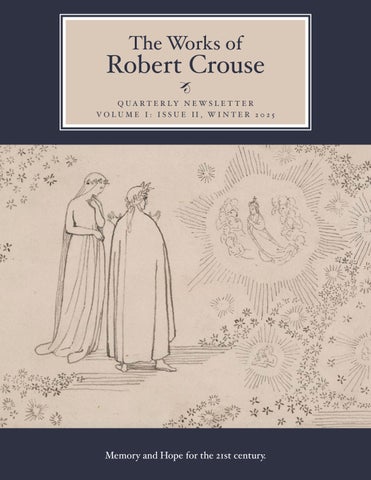
Front cover image: John Flaxman. One of the preliminary sketches for “compositions from The Hell, Purgatory and Paradise of Dante Alighieri”, illustration to Dante Dante’s “Paradiso”, Canto III; Dante and Beatrice standing amid a world of stars and looking on that of the Empress Constanza who appears in the midst of its light kneeling. 1792-1807. Pen and grey ink. British Museum.

Co.

Many Paths – One God

There is one true and living God, in knowledge of whom is eternal life, in whose service is perfect freedom. It is the thirst for that knowledge and that freedom, it is that desire for God which – whether acknowledged or merely implicit – underlies and impels every quest of the human spirit.

“All men by nature desire to know,” says Aristotle, in the first line of his Metaphysics. But what it is that they desire to know? They long to know the reasons of things, the causes, the truth of things; finally, to know that truth by which and in which all truths are true. What are all our sciences, what are all our fragments of knowledge but droplets from that fountain of which we long to drink in its fulness? “My soul is athirst for God,” cries the Psalmist, “yea, even for the living God.” (Ps. 42:2). Thus, Aristotle’s Metaphysics finds its culmination in the magnificent theology of Book Lambda.

What is our quest for happiness, but a desire for the good? And what is that good we seek - whether knowledge or not - but some participation in that pure and perfect good which is God himself? What is our quest for liberty, but our longing for God’s own city, the heavenly Jerusalem, which is above, and is free, and is the mother of us all? “My soul hath a desire and longing to enter into the courts of the Lord: my heart and my flesh rejoice in the living God.” (Ps. 42:2)

What is our quest for beauty, but a longing for that pure and perfect beauty which belongs to Sion? And what are all our fragmentary images of beauty, whether in painting or sculpture or poetry or music, or whatever human arts, but pallid reflections of the unimaginable beauty of the countenance of God? “My heart hath talked of thee, Seek ye my face: thy face Lord, will I seek.” (Ps. 27:9)

All human desire, all human longing and aspiration, expressed in a thousand different forms, at a thousand different levels, is ultimately desire for God. St. Augustine makes that point at the outset of his Confessions: “It is thou, O God, who dost rouse mankind to delight in praising thee, for thou has

made us for thyself, and our hearts are restless, until they find their rest in thee” (Confessions I, 1.) It is the restless heart, “the concreated and everlasting thirst for God’s own realm,” (Dante, Paradiso, II, 19–20) that is the impulse of every quest.

In the history of literature and religious life, the universal metaphor of that quest is the path, the way, the road. At the beginning of Greek literature, for instance, there is the figure of Odysseus, whose very name means “wayfarer”. He is one who takes the road: the odos, which leads him from the ruined city, through horrendous strife and perils, to his home. Plato, in the Republic, explicates the inner meaning of that journey in his image of the upward path from the darkness of the cave to the clear illumination of the sun.

For the Hebrew people, the definitive image is the road which leads from Egypt, through the Red Sea, through the trials of the wilderness, to the Promised land of peace and liberty: an image, in turn, of the inner journey of the human spirit. For the medieval Christian, likewise, a central metaphor of religious life is the road of pilgrimage: to Jerusalem, or Rome, or Compostella - a symbol of the mind’s journey into God. Dante, coming to himself “nel mezzo del cammin di nostra vita” (Inferno I, 1), “in the middle of the road of our life,” is instructed that he must take a different road (“altro viaggio”: 1, 90) if he is ever to escape from the wasteland in which he finds himself.

Many paths – one God. But are all paths equally viable or efficacious? Dante, in the Convivio (IV, 12) after an eloquent account of the many forms and levels of the quest for God, continues:

Truly, this road is lost by error, just as earthly roads are lost. For just as from one city to another there is necessarily one best and most direct way, and another which always detours and goes in the wrong direction, and many others which more or

“We could put a pull quote or another photo here”

less divert, or more or less head towards the goal, just so in human life there are diverse roads, of which one is most true, another most false, and others more or less true or false. And as we see that the most direct road leads to the city, fulfils desire, and gives rest after toil, and that which goes the opposite way can never satisfy or give rest, just so it happens in our life: the good wayfarer reaches the goal and has rest, he who mistakes the way never arrives, but with much striving of soul gazes ever onwards with longing eyes.

It is possible that some paths are simply false, or lead only to tragic conclusions? Might the journey be only (as Arthur Rimbaud put it) the path of a drunken boat tossed upon waters of chaos? (“Le Bateau Ivre”) Is it possible that, as Franz Kafka decided, “there is a goal, but no way; what we call wayfaring is only wavering”? (The Great Wall of China). As if, as St. Augustine says of the noblest Platonists, that they see the land of peace, as if they were upon a hilltop beyond a wooded valley and can find no road of access (Confessions VII: 21)?

The claim of Jesus to be “the way (odos), the truth, and the life” is undoubtedly an exclusive claim: “No one cometh to the Father but by me” (Jn 14:6). Yet his claim is also inclusive,

for he is the divine logos, “the light who illumines everyone who comes into the world” (Jn. 1:9), and he does not deny the truth implicit in the ancient Law, or in the wisdom of the Greeks. There are many false paths, many perversions of human desire and aspiration which lead to hell; but there are also relatively true paths, whose implicit truth is fulfilled or completed as they converge in that one path of mediation between God and man, that “new and living path (odos: Heb 10:20) which is Christ Jesus (c.f. St. Thomas’ account of the salvific significance of fides implicita: St. Thomas II, II, 2, 7)

Many paths – one God. There are many paths which lead to Christ, the living way. There are also many paths which lead to false gods and perdition, and the Articles of Religion (Article XVIII) sharply warn us against the perilous presumption of a sophistic relativism which refuses to discriminate:

They also are to be had accursed that presume to say that every man shall be saved by the Law or Sect which he professeth, to that he be diligent to frame his life according to that Law and the light of Nature. For holy Scripture doth set out unto us only the Name of Jesus Christ, whereby men must be saved.

Anecdotally…

As a first year student at Kings in 1980, I experienced Robert Crouse's lectures on the three books of the Divine Comedy. I found these books gripping and meaningful until we got to the part about the celestial rose. The vision of sitting around singing hymns and taking part in the order of the universe held no attraction for me. When Dante left Virgil behind to follow Beatrice, I guess he left me behind too. Not long after that, Fr. Crouse preached a sermon in which he explained that love was “the rational willing of the good”. I took great exception to this definition, sure to the bottom of my feet and to the roots of my hair that love was MUCH more than any “rational willing" of anything! This argument between us continued for many years, if primarily in my own mind. Looking back now, I see that this was all part of the same blindness on my part. As I aged and had more experience of life, I came to understand that rationally willing the good of

another human may actually be something more than I could imagine at the age of 17.

While I am still a 21st century human who thinks that emotion must play some part in love, I have come to accept that humans must be loved even when warm and comforting emotions are absent. And perhaps this is the hardest and most important way to love. I often think of Robert Crouse. What would he make of the unleashed negativity and emotion that we live with these days in a world where everything is politics? Probably he would smile and tell me that this is how it has always been. Perhaps he would quote Dante. Perhaps he would point out that a little more rational willing of the good is precisely what we need.

Photo caption TK

Canadian Gold

Images of Pilgrimage

The Soul’s Pilgrimage

Volume I: From Advent to Pentecost

Volume II: The Descent of the Dove and the Spiritual Life

Reviewed by Thomas Plant

To paraphrase Nathaniel, good things can come out of Canada, even in today’s political climate and even from the Anglican Church. Though not as well known to the outside world as a Radner, Peterson, or Pageau, a hardy band of traditional Anglo-Catholic Canadians lives on, including the principal of Pusey House in Oxford and the president of the new Ralston College in Georgia. Their spiritual home is King’s College, Halifax, where they were formed under a common spiritual and intellectual mentor, Fr. Robert Darwin Crouse (d. 2011).

Fr. Crouse’s name deserves to be better known, and the reader need not take my word for this. Rowan Williams describes him as “a touchstone of spiritual and intellectual integrity”; Professor Douglas Hedley of Cambridge recounts the “magnificent and serene simplicity” of his writings, and he was hailed in the citation for his Doctor of Divinity as “the conscience of the Canadian church.” A classicist and mediaevalist, he brought his love of ancient philosophy and, particularly, of Dante into his preaching, recently published in three volumes, which confirms his reputation not only as a scholar but also as a beloved spiritual director.

Re-membered into God

The first and smallest tome, Images of Pilgrimage, comprises a series of addresses given at a retreat in St. Augustine’s Monastery, Nova Scotia. These could easily be read in a day and would make a good companion to an individual on retreat or as reflections for a group. In the spirit of the locale, these writings convey Crouse’s own Augustinian and more broadly Platonic sensibilities. As the title suggests, they take the form of a pilgrimage, leading the retreatant from Eden to the New Jerusalem through images both biblical and pagan.

Pilgrimage, Crouse maintains, is a universal and not only Christian symbol for the spiritual life. Homer’s Odyssey conveys this life as a journey of procession and return home, with struggles on the way. Yet Dante shows the ultimate futility of the merely pagan route, a cycle doomed by human hubris to unending repetition.

Taking the reader through biblical symbols and the Confessions of St. Augustine, with occasional refreshment en route from the likes of St. Bonaventure and George Herbert, Crouse reveals the remedy for the waters of Lethe: the manna in the wilderness and the water from Meribah, the sacramental body and blood of Christ, by which amnesia yields to anamnesis and the faithful are re-membered into God. The key to Christian pilgrimage is that fruits of friendship and charity invite paradise into the very wilderness in which we live, yet, crucially, draw us beyond this world to our eternal home.

The West’s Spiritual Imagination

Similar peregrinations continue in the two volumes of The Soul’s Pilgrimage, an anthology of Fr. Crouse’s sermons for the Sundays and other feast days of the church year, arranged according to the church calendar. Plenty of such collections exist, and homilists may wonder why they need another set on their shelf. The most obvious distinguishing feature of Fr. Crouse’s collection is the lectionary it follows. Crouse was an ardent apologist for the old Western lectionary based on the “Comes” of St. Jerome, preserved even now in the Tridentine rite and, with very minor variations, in the Church of England’s 1662 Book of Common Prayer

This one-year cycle of Epistle and Gospel readings was, until the 1960s, the common lectionary of almost all the West-

ern Church, Catholic and Protestant, and, Crouse avers, it formed the collective spiritual imagination of the West. He makes a convincing case for the logic of its ordering, referring back and forth in his sermons to what is about to come and what has just been read before. This contributes to the sense of being guided, week by week, on a pilgrimage through the church year and so the life of Christ.

The familiarity Crouse evinces with the weekly lessons was formed by many years of annual repetition, which tacitly buttresses his convictions: today’s more common three-year cycle of readings is beyond the natural reach of the human memory and eludes such familiarity as the older order imparts. Crouse also makes clear the relationship between the Epistle and Gospel for each Sunday: each Gospel shows something Christ has done for us, while its concomitant Epistle shows how Christ effects this within us.

This distinction is echoed in the division of the two vol-

umes. The first half of the old lectionary, ranging from Advent to Pentecost and latterly Trinity Sunday, elaborates in time the procession of Christ from heaven to the Virgin’s womb and his return via cross and tomb. The latter half shows his works continued by the Holy Spirit in the Church, culminating in the Michaelmas feasts of angels and, set above them, all the saints of heaven.

Thomas Plant is a priest of the Anglican Church in Japan, chaplain at Rikkyo (St Paul’s) University in Tokyo, and a fellow of the Cambridge Centre for the Study of Platonism. He is the author of The Lost Way to the Good (Angelico, 2021).

This review first appeared in the July/August 2024 issue of Touchstone.

Dante and Anglicanism d

It is my memories of the deep learning shown by the Reverend Dr. Robert Crouse in his lectures on Dante, and my own study of Dante over the years, that account for why I am still an Anglican. Teaching Dante with the help of Dorothy Sayers’ magisterial commentaries upon the Divine Comedy has led me to see a complex and impenetrable interrelation between Dante’s great work and my own attachment to the church. Some might say that the interrelation is seen in English metaphysical poetry. From George Herbert and John Donne to T. S. Eliot one sees, as in Dante, a metaphysical expression of faith. But I would like to think that it is not just his poetry, but Dante’s theology itself, that appeals to the Anglican imagination. The wealth of English translations of the Divine Comedy made from the 18th century onwards, by prominent churchmen as well as laymen, suggests that the appeal lies in not just the poetry, but the theology.

Possibly Dante’s Augustinian treatment of memory resonates with Anglican theology, but I contend that it is his treatment of the nature of Faith itself. Dante, following Peter Abelard, defined faith as “the substance of things hoped for, the evidence of things unseen”. (Hebrews xi.i). Contemporary Christians find this definition surprising because it presumes faith gives ‘evidence’, in the Vulgate of Dante’s day ‘arguments’, for things unseen. Following the ‘scientific revolution’ which brought in its wake not only a revolution in our knowledge of nature, but also of ourselves, educated people lost the connection between intellect and faith. We have explored the universe it is said, and there is no God. It is said that there are no ‘arguments’ for faith, only a preference – possibly faith is a psychological crutch. However, the Book of Hebrews does not suggest that – rather faith is a knowledge. In the Heaven of the Fixed Stars of the Paradiso, Dante remarked that his faith was based upon Holy Writ, which was the foundation for his hope in eternal life, and that faith was proven by arguments in the Creeds and from philosophy. Not all evidence comes from the senses, there is also proof of unseen truths.

The ancient philosophers said that there is a natural desire to know God that lies deep within human nature. In Augustinian terms, this is a reality hidden in memory. Knowledge given in Scripture of the revealed nature of God is a learned thing which is a kind of remembering. Assent is prompted by grace, but nonetheless it is assent to a thing known.

The study of philosophy, the pursuit of that desire to know, was said to be a preparation for the study of theology. Augustine’s study of Neo-platonic works demonstrated to him the existence of God, and for the Scholastic philosophers

known to Dante, Aristotle provided more arguments. For well over a millennium and a half Christians held that the study of philosophy and theology formed a continuum, upholding the faith in different ways. The Book of God’s Works, natural revelation, and the Book of God’s Word, special revelation, are different means by which God reveals himself in the world.

In the century following Dante’s death, however, universities first divided philosophy and theology into separate intellectual disciplines. Knowledge became specialized. For Dante, however, in the heaven of the sun there is unity; the theologians and historians and grammarians and logicians and natural philosophers dance and circle each other in friendship. Plato and Aristotle are in Limbo, yet all human learning which contributes to faith is redeemed. To Dante the intellect sought but one reality, God.

Faith is an assent to reality, both supernatural and natural, to God’s Word and God’s Works, as Protestants say. The fact that clergy, learned in the natural sciences, within the Church of England, still seek to show the unity of God’s Word with God’s Work by reconciling the latest discoveries in science with the faith is a mark of that medieval desire to see God as the source of all reality. This was the very essence of the Anglican Reformation; to hold a unified vision of all creation, all aspects of human intellectual and political life, within the Christian faith. The Book of Common Prayer and the Formularies give us knowledge of reality. Dante held that the two Testaments, Old and New, are the very substance of faith, and Anglicans hold the same. The Book of Common Prayer makes Scripture central to the rule of faith, and the Creeds give that substance. And we like Dante still hold that in heaven all truth is one, however limited our earthly perspectives. We may explore the universe and draw our conclusions, but that is just the first task, the second is to show how that knowledge gives evidence of things unseen, as did Plato and Aristotle, and that is the essence of the life lived in the knowledge of the Christian faith.

Dr. Roberta Bayer is Associate Professor of Government at Patrick Henry College in Purcellville, Virginia. Dr. Bayer has edited a book entitled Reformed and Catholic: Essays in Honor of Peter Toon, the magazine, Anglican Way for the Prayer Society of the USA, and published numerous articles, most recently on the thought of theologian Eric Mascall.

A Pilgrim’s Visit to St Mary’s, Crousetown d

And therefore, if we have charity at all, we have it in friendship and reciprocity.
R.D. Crouse, ‘Reconciliation’, from Images of Pilgrimage, p. 83).

November 23rd, 2024. St Mary’s, Crousetown, NS — 09h18am Saturday after Trinity XXV || Psalms 110 – 113|| Eccles. 22:27-23:15|| Acts 20 :17-end

The torrential downpour and the distinct chill of a Saturday morning in late November kept me and the photographer, Lokwing patiently in the car. Anticipating with us the arrival of Doris House—with the keys to an inner world—was a group of ten others. Today was the day of the Chapel’s Christmas tree hunt. Most of us had been on the road since the afternoon prior, spending the evening at Cecelia von Bredow’s baptism and the night in the parish hall of Christ Church Shelburne. Our Chaplain, Fr. Ingalls, had shrewdly proposed we say Morning Prayer at St. Mary’s, Crousetown, and to many of us—having only met the late Fr. Crouse in memory through beloved professors and spiritual mentors, friends, a book launch weekend, hand-me-down traditions, and scattered sermons lingering in corners of a humble university chapel—this sounded like the right idea. The grey skies, tall trees, and unrelenting rain seemed to insist upon the wilderness we found ourselves in...

There was an absence of being in any sort of rush as raindrops and the anticipation of prayer began to melt away rigid time. The proud little church is firmly rooted on the side of Italy Cross road. Beautiful yet irregular stained-glass windows, each differing from the next, are the only instances of colour that can be seen when standing outside of the white and black structure. Doris let us in through the back sacristy door. What I had observed from the exterior was immediately confirmed upon my first step through this door; this is one of them good ol’ wooden churches. Perhaps you’ve driven past

ones just like it on a country road. Maybe even walked inside or worshipped in one. The sudden scent of earthiness mingled with lingering incense entertains the senses. The lights dim or nonexistent. Lumber holds ancient memories of the building’s foundation. Old carpet floors, an eccentric collection of art posters, iconography, and other religious tchotchkes that fill the back room only foreshadow their expansion in the sanctuary and main part of the church.

There is something, perhaps a feeling, that is vaguely familiar upon entering the sanctuary for the first time. St. Mary’s, Crousetown is a church steeped in generations of memory and worship. I think its importance for us lies in the significant impact Fr. Crouse has had on our lives. Fr. Crouse’s influence continues to shine on a new generation who never got to meet him in the flesh. Perhaps there are different reasons why each of us came to study at King’s or live on this coast. Yet regardless of motive, I think maybe everyone who has stepped through the threshold of the humble Chapel doors comes seeking something. Fr. Crouse seems to have known and perhaps was seeking something similar as he writes:

In that working out, the trials of the wilderness have a necessary place. Trial and temptations, the dark night of doubt, confusion, and uncertainty, are not just unfortunate accidents. In God’s good providence they belong to the very life of faith… Perhaps those trials take different forms in one age

or another, and different forms for each of us; but always they are, and must be there.” (p. 79-80).

Maybe what we are seeking is a way of life within this present, secular age, something that feels all the more urgent as a young person beginning to figure out how to create their life. But I don’t see it as a question any less important to people of any age or generation. “The confusions of the world in which live, uncertainties within the Church, confusions with our own souls” are common struggles for us all, “and it is surely not very easy to ‘count it all joy’, and discern and celebrate the lineaments of paradise within it.” One of the life-giving lessons Fr. Crouse passes on to us is a reminder “that this is precisely the nature of our calling, and, by the grace of God, who gives the Bread of Life in the wilderness, we are not without resources to do just that.” (p. 80-81).

There are so many things in this world that scare us. So often we desire to have it all together; to be able to face the

trials and temptations of life as a strong skipper sails their boat through the unpredictable winds and waves of the open sea. “The fact is that we do not have it all together,” Fr. Ingalls read to us from the final chapter of Fr. Crouse’s Images of Pilgrimage during our office of morning prayer that day, “We have it in all the manifold diversity of the Spirit’s gifts; not as just one point of light, but spread out among us, diversified.” Perhaps one could sum up Fr. Crouse’s gifts to us as one does the Christian virtues which he extols us to cultivate steadily. We seem to have inherited what can be encapsulated as a humble seeking of a life of charity; “holding on to the centuries of Christian wisdom, holding fast to our road of pilgrimage…All depends, really, upon the prayerful life.” (p. 84) And it is our engagement to this prayerful life that brought our rag tag collection of friends along the pilgrim’s road to little St. Mary’s that chilly, wet Saturday morning. Because, deep in our hearts we know, “if we have charity at all, we have it in friendship and reciprocity.”

The St Mary’s Crousetown Organ d

Nestled in the jewel box that is St Mary’s Church, Crousetown is the oldest tracker action organ in Eastern Canada. Though to all appearances it looks to have been there since the church was built in 1914, it predates the building by nearly one hundred years.

The organ, originally located in a church in nearby Liverpool and later, the village of Western Head, was jettisoned in favour of an electronic organ. In the fall of 1962, life-long parishioner of the Crousetown church, Nellie Snyder, then a nurse working at the Liverpool hospital, learned of the orphaned instrument, and shortly thereafter, it was purchased for the sum of $100, paid for by Fr Crouse as a gift to St Mary’s. Twenty years later, it was carefully restored by an 18-yr old David Storey in his parents’ cottage in the summer of 1981, along with organ builder Lynn Dobson, from Baltimore.

Built by James Wilson, London UK in 1823, the 217-pipe organ has 1 manual with 4 stops. Its tone is sweet and clear, so long as the bellows are expertly pumped, either by the organist with his left leg at a jaunty, if rather uncomfortable angle, or by a kindly disposed assistant operating a second lever on the side of the instrument. I can speak personally of the curious experience of playing, say a piece by Buxtehude, at one tempo, whilst pumping at a separate, unrelated speed. As David notes in a Facebook post on the organ, ‘The way this little organ speaks is so amazing. You hear sounds that people heard almost 200 years ago when the ambient soundscape was very different from the background noise we put up with today’.

Thus, it remains in use to this day, both in services and occasional concerts. In the days when Fr Crouse was the organist, he wryly boasted of having ‘the largest collection of

Buxtehude organ works in Crousetown’. Indeed, Fr Crouse had a passion for baroque music, especially that of Buxtehude. In the summer of 1963, the first Crousetown Baroque Concert was held in St Mary’s, a tradition that carried on for nearly 50 years.

Longtime friend of Robert, Janet Ross was 16 when she first participated in a Crousetown concert, not long after they began. Over many years, Janet recalls with affection the meals he provided for performers in his nearby home: delicious homemade soup, salads culled from his marvellous gardens, a refreshing punch. Tallis’s Canon was sung in three parts as a Grace before the repast. Then they’d walk over to the church for the concert, which always concluded with the hymn, Ein’ fest burg, sung by all. Then everyone repaired back to his home for refreshments, contributed by parishioners. Janet remembers that some performers would camp overnight on the property, and in the morning be greeted with fresh coffee and leftovers from the night before. He then went off to church, leaving his guests to pack up and go home. Sweet memories to last a lifetime!

As a postscript, David Storey continues to care for the organ whenever he returns to Nova Scotia. Parishioner Jan House spoke warmly of David’s stewardship of the instrument, and what a blessing it is.

This summer we hope to have an old fashioned Crousetown concert, where you can see and hear this tracker action organ and sing Ein feste Burg.

Words of Robert Crouse for Pre-Lent

As highlighted in the first published volume of sermons, The Soul’s Pilgrimage: from Advent to Pentecost, each of the three Sundays before Ash Wednesday in the ancient Eucharistic Lectionary (this lectionary is still accessible for study in the Book of Common Prayer) was once the beginning of Lent, before Gregory the Great in the seventh century settled upon Ash Wednesday as the beginning of Lent, omitting only Sundays in the count of the forty days before Easter. Thus, Father Crouse reminds us how the three Sundays of Septuagesima, Sexagesima, and Quinquagesima providentially provide a rich spiritual preparation for the beginning of Lent proper, a preparation that was dear to all Christians in the West for 1500 years. Today, parishioners who are not in Anglican Churches that follow the ancient one-year Eucharistic Lectionary can spiritually profit by reading these Epistles and Gospels found in your Prayer Books and reflect upon the themes for those Sundays. The following words are from a sermon delivered by Father Crouse on Quinquagesima, the Sunday before Ash Wednesday.

”Behold we go up to Jerusalem"

Those words of Jesus, from today’s Gospel lesson, set before us the spiritual challenge of the Lenten season: "Behold, we go up to Jerusalem". We are called to undertake a pilgrimage with Jesus, to go with him to Jerusalem, to share in mind and heart - in our minds, and our hearts - his death and resurrection. Like the twelve disciples in the Gospel story, we scarcely know what that will mean for us: ‘They understood none of these things", says St. Luke. Like the blind man begging by the wayside, we must pray insistently that the Lord himself may open our eyes, that we may receive our sight, and come to see and understand the glory of salvation. The Scripture lessons appointed for the three Sundays of this Pre-Lenten season are all designed to prepare us to undertake that journey to Jerusalem. Remember how, on Septuagesima Sunday (the Sunday before last), St. Paul, in the Epistle lesson, compares the Christian life to an athletic contest: "Know ye not that they which run in a race run all, but one receiveth the prize? So run that ye may obtain”. He reminds us that the serious contestant must put aside distractions and concentrate his efforts: "I therefore so run, not as uncertainly; so fight I, not as one that beateth the air." And the Gospel lesson

for that Sunday likens our vocation to the labours of workers in a vineyard. Called early in the morning, or late in the day, we labour for the Lord's purposes, and receive the one eternal reward, which we cannot really earn, but which God's free grace provides.

Sexagesima Sunday (last Sunday) reminds us, in the Gospel lesson, that the word of God is as a precious seed, planted in the soil of our hearts, and that the young seedling must be nurtured, and preserved from the drought of our neglect, the thorns of our worldly preoccupations, and all the insidious assaults of the devil. And the Epistle lesson tells us, in the words of St. Paul, something of the labours and the perils among which the word of God must be matured in us.

All of that has been preparation for the spiritual labours of

Laurent Girardin, The Throne of Grace. French, c. 1460. Cleveland, Museum of Art

Lent, and now today's lessons give us our final instructions for the journey. "Behold, we go up to Jerusalem". We are to go to Jerusalem with Jesus, to witness there the fulfilment of the ancient prophecies, to witness there the dying and the rising of the Son of God, for us and for our salvation. That is something God has done for us, once and for all: God the Son has borne our sins, in his own body, on the Tree, and has won for us forgiveness and new life.

That is what God has done for us. It is something finished, sufficient and complete, never to be done again. It is God’s own perfect satisfaction, for the sins of the whole world, of all times and all places. God’s infinite charity has done for us what we could never do. He has given us, each one, a new life, a new beginning. That is something which we could not do; it is the free gift of God's charity, which we can only thankfully receive. That is what we call "justification".

But what we witness in Jerusalem is not only what God, in Christ, has done for us. It is also something that must be done in us, day by day, and that is what the spiritual labour of Lent is all about. Looking upon the Crucified, we must learn to die and rise again, day by day, to die to all the corruptions of our old nature, to live again in the charity of God. That is the point which today’s Epistle lesson makes so forcefully. Without charity, all else is nothing worth. Without charity, prophecy and knowledge, and even faith, are useless. Without charity, good works and self-sacrifice are ultimately useless: "it profiteth me nothing", says St. Paul.

What then is this charity which must be the character and substance of our Lenten journey? First of all, it is, of course, God’s charity for us, that charity whereby he gave his only begotten Son. It is, first of all, our thankful recognition of the charity of God for us, but secondly, it is the working of that charity in us, transforming our own lives.

But just what is charity? It is not sentiment, it is not emotion, it is not good works, though all those things may sometimes be associated with it. Fundamentally, it is sheer good will: it is God's good will, manifest in Christ; it is our good will, God's gift of grace in us, when we genuinely and steadfastly will the good of one another for God's sake. Charity is a matter of clarity and purity of motive in all we are and do. Charity is our sanctification, as individuals, and as a community - and no doubt charity embraces and includes those more homely virtues of generosity and kindness and friendship.

That is the practical message of Lent for us, that is what our spiritual to Jerusalem is all about. It is our growing up in charity, putting off our own inclinations, desires and predilections. In the words of a beautiful hymn: “Let holy charity mine outward vesture be, And lowliness become mine inner clothing".

We are all, no doubt, busy about many things, a mixture of things, some of them good and some of them wicked. Lent should be a time when we put aside a bit our manifold distractions and look at what we are and what we do and realize afresh that the charity of God for us, and within us, is all that finally counts, and that without that, all else is sounding brass and tinkling cymbal.

The Scripture lessons of this Pre-Lenten season have set before us the meaning and the motive of our journey. It remains now to undertake it.

"Behold, we go up to Jerusalem".

“And now abideth faith, hope, charity, these three: but the greatest of these three is charity” 1 Corinthians 13. 1.
Doré, Gustave, The Three Theological Virtues. c.1868. The vision of Purgatory and Paradise by Dante Alighieri (London and New York: Cassell, Petter, and Galpin [1868?].

Father Robert Crouse stressed the importance of understanding why the ‘soul’ is the inner source and ground of human life for the ancient and medieval authors we studied, and for ourselves. One day after lecturing about the soul in Plato’s Republic, he looked out the window of the old Classics House and saw a colleague visibly upset because he was having yet another problem with his car. Father Crouse turned to a group of us and with a twinkle in his eye said: “All car problems are psychological.”

—from a former student of Robert Crouse

Please visit our website www.worksofrobertcrouse.com

Et erit ibi semita et via, et via sancta vocabitur (Isaiah 35:8)

Turn static files into dynamic content formats.

Create a flipbook