The Works of Robert Crouse d
QUARTERLY NEWSLETTER
VOLUME I: ISSUES III & IV, SPRING & SUMMER 2025

Memory and Hope for the 21st century.
![]()
QUARTERLY NEWSLETTER
VOLUME I: ISSUES III & IV, SPRING & SUMMER 2025

Memory and Hope for the 21st century.
The Essence of Anglicanism by Robert Crouse
This article articulates wonderfully what many call 'Classical Anglicanism': Anglicanism as a way of reading, understanding, and living the whole of the Christian Tradition (the consensus fidelium) in obedience to the Word of God.
Anecdotally… by Susan Harris
A life-long friend of Fr Crouse helps us to understand what those most close to Crouse insist to be true: that Robert considered himself nothing more than a simple, faithful Anglican Christian.
A Theology of Pilgrimage: Robert Crouse’s Atlantic Theological Conference Papers by Neil G Robertson
A most welcome concise summary of the Augustinian theology of the pilgrimage of amor or love that is the joy of every Christian, and our path through the confusions of our present culture.
Augustine’s Trinitarian Platonism and Anglican Renewal by Walter Hannam
An autobiographical piece from a parish priest who tells of the discovery of the nature and depth of his own personal conversion to Christ as nothing other than the ongoing conversion of the entire cosmos, and how his vocation to the priesthood was nourished by the teaching of Fr Crouse.
Family Life & The Anglican Way: Penny in the Dust Family Camp by Karis Tees & Hannah Griffin
Description of a gathering of families who are committed to following the spiritual pilgrimage of classical Anglicanism, sharing with one another the struggles and joys of the threefold Regula of private prayer, the Offices, and the Eucharist in nourishing family life. We asked Hannah and Karis to describe the details of the 'Penny in the Dust' camp so that it might inspire similar camps and gatherings in other places throughout the world where Classical Anglicanism is being re-discovered.
1
6
7
8
Dear friend of the WORC project, This third combined issue of our Newsletter features one of Robert Crouse’s clearest and hopeful descriptions of the way forward for Anglicans as we enter the second quarter of the 21st century. The articles of Walter Hannam and Neil Robertson complement Crouse’s argument. His understanding of our Christian Tradition as the consensus fidelium of the entire Church, both East and West, gives to Anglicanism a comprehensiveness rooted in Scripture, Creeds and Councils not to be found elsewhere. The present need of the Church is to recognize in the human personality the very image of God: thus in the human condition itself there is a capacity today in the 21st century to recover the spiritual pilgrimage that belongs to Christianity and specifically to the Augustinian tradition that has shaped the Anglicanism as found in its Prayer Book Tradition. Crouse was legend for encouraging all Anglicans, clergy and lay, regardless of academic credentials, to advance the renewal of the Church by becoming better theologians, by which he meant immersing ourselves more fully in the Scriptures and the theological tradition of the Church. It is to help us all become better theologians that this Newsletter, and the whole of the WORC project, is devoted.
Please visit our website www.worksofrobertcrouse.com
Comments on this Newsletter?
Write to Gary Thorne: gthorne.worksofrobertcrouse@gmail.com
Trouble Ordering Crouse Books?
The re-stocking of our current three publications through our publisher to popular retailers like Amazon and Indigo Chapters can be unpredictable. If you would like to order multiple copies for a study group, or if you are having real trouble ordering an individual book, please arrange your purchase directly through Erin Wagner at ewagner.worksofrobertcrouse@gmail.com..
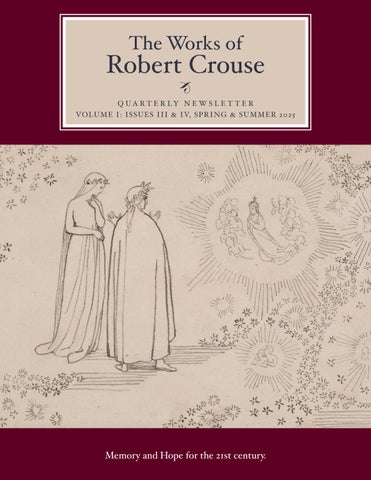
Front cover image: John Flaxman. One of the preliminary sketches for “compositions from The Hell, Purgatory and Paradise of Dante Alighieri”, illustration to Dante Dante’s “Paradiso”, Canto III; Dante and Beatrice standing amid a world of stars and looking on that of the Empress Constanza who appears in the midst of its light kneeling. 1792-1807. Pen and grey ink. British Museum.
Newsletter design by Co & Co.
By Robert Crouse
The Anglican Communion, the fellowship of Anglican churches throughout the world, exists by virtue of a voluntary allegiance to a common tradition of Christian faith and worship. Faithfulness to that tradition, and that alone, constitutes the definition of Anglicanism, and that tradition provides its principle of cohesion. The Anglican Communion has, after all, no racial unity, and the people of Anglo-Saxon origin who once dominated its membership now form a small proportion of it. It has little linguistic unity; its liturgies have been translated into many languages and most of the world’s Anglicans nowadays are not English speakers. It does not possess an organizational unity, not really. The Archbishop of Canterbury has a primacy of honour, and the Lambeth Conferences bring together bishops for consultation from all over the world, and so on. But no Primate, no Conference, no Council has any legislative authority over the Anglican Communion. So the Communion coheres only by faithfulness to a common tradition, and if that faithfulness falters, it moves toward disintegration. No one can legislate for the Anglican Communion; insofar as its member churches fail in their allegiance to the common tradition, the communion dissolves.
And that, I think, is the nature of the current crisis in global Anglicanism. Signs of fragmentation are, as you well know, manifold. The Primates, at their meeting in Portugal several years ago, deplored the fact that repudiations of the resolutions of Lambeth Conferences have, as they said, come to threaten the unity of the Communion in a profound way. And they strongly urged those repudiating Lambeth “to weigh the effects of their actions and to listen to the expressions of pain, anger and perplexity from other parts of the Communion”. Another sign of the times was, of course, the consecration of bishops to be missionaries to the Episcopal Church in the United States. And of course we’ve all become familiar with the phenomenon of separated or “Continuing Anglican” churches in our own country and elsewhere, and
we’ve learned to live, somehow, with the condition of what is somewhat euphemistically called “impaired communion”, a condition brought about by unilateral decisions on the part of some provinces of our Communion.
But these and other disquieting phenomena are merely symptoms of a malaise which threatens the continued existence of the Anglican way. The fundamental issue, I would insist, is faithfulness to a tradition of Christian faith and worship. But just what is that common tradition and what precisely are its elements? What is the essence of Anglicanism?
As an answer to that question, I think we could hardly do better than to consult the Solemn Declaration of 1893, whereby the General Synod of the Anglican Church of Canada was established. That declaration, which you can find on page viii of our 1962 Canadian Prayer Book, seems to me such a complete and accurate statement of the essence of Anglicanism that I am going to begin by simply reading what it says:
WE, the Bishops, together with the Delegates from the Clergy and Laity of the Church of England in the Dominion of Canada, now assembled in the first General Synod, hereby make the following Solemn Declaration:
WE declare this Church to be, and desire that it shall continue, in full communion with the Church of England throughout the world, as an integral portion of the One Body of Christ composed of the Churches which, united under the One Divine Head and in the fellowship of the One Holy Catholic and Apostolic Church, hold the One Faith revealed in Holy Writ, and defined in the Creeds as maintained by the undivided primitive Church in the undisputed Ecumenical Councils; receive the same Canonical Scriptures of the Old and New Testaments, as con-
taining all things necessary to salvation; teach the same Word of God; partake of the same Divinely ordained Sacraments, through the ministry of the same Apostolic Orders; and worship One God and Father through the same Lord Jesus Christ, by the same Holy and Divine Spirit who is given to them that believe to guide them into all truth.
Well, there you have the essential elements: the Scriptures as the word of God written, as the foundation; the ancient ecumenical Creeds and Councils; the ministry and apostolic succession; and the divinely ordained sacraments of Holy Baptism and the supper of the Lord. Scriptures, creeds, apostolic ministry and sacraments; the framework of the so-called Chicago/Lambeth Quadrilateral, which served Anglicans as the basis for ecumenical discussion all through the twentieth century.
Now, all these elements are held together in the life of a worshipping community, and thus the Solemn Declaration adds in its final paragraph:
And we are determined by the help of God to hold and maintain the Doctrine, Sacraments, and Discipline of Christ as the Lord hath commanded in his Holy Word, and as the Church of England hath received and set forth the same in ‘The Book of Common Prayer and Administration of the Sacraments and other Rites and Ceremonies of the Church according to the use of the Church of England; together with the Psalter or Psalms of David, pointed as they are to be sung or said in Churches; und the Form and Manner of Making, Ordaining and Consecrating of Bishops, Priests and Deacons’, and in the Thirty-nine Articles of Religion; and to transmit the same unimpaired to our posterity.
Now there are certainly other ways of being Christian, and we should never presume to say otherwise; but that is the Anglican way. And in no other church in Christendom, I think, at least in Western Christendom, does the church’s liturgy have such a determinative role. And because for us the official liturgy constitutes our standard for maintaining the doctrine, sacraments and discipline of Christ, liturgical innovation has a degree of importance that is peculiar to Anglicanism, and it also has great potential for destruction if undertaken unwisely. In abandoning or eroding that tradition, you see, Anglicanism loses shape, definition; all things become possible theologically, morally, liturgically, and the institution, as an institution, moves rapidly towards dissolution. Or perhaps continues only as a bureaucratic arrangement without any genuine religious significance.
The Anglican way, as a particular form of the Catholic and Apostolic Church, exists authentically only under that principle of authority which governs and authenticates the universal Church. The Word of God has been revealed, the truth of God has been proclaimed and the authority of that truth is universal and absolute and, of course, not peculiarly

Anglican. “God, who at sundry times and in diverse manners, spake in time past unto the Fathers by the Prophets, hath in these last days spoken unto us by his Son, whom he hath appointed heir of all things, by whom also he made the worlds” (Heb. 1:1-2). The divine Word, the divine authority, was made flesh and dwelt among us. And in his presence, as St. John says, we have touched and handled of the Word of life. And yet, none of us has grasped the truth of God in all its purity, completeness and simplicity. We grasp it haltingly, in our divided human passions; we see through a glass darkly, we know in part and we prophesy in part; and thus, within the universal Church we have particular traditions and distinctive differences. We are granted spiritual discernment, to be sure, and yet the Spirit’s gifts also are divided. “For to one is given by the Spirit the word of wisdom, to another the word of knowledge by the same Spirit … dividing to every man severally as he will” (1 Cor. 12:8, 11). Therefore, it is not just the individual and not just the particular church but the whole body unified by the good will of charity that approaches the truth of God, each one making its partial contribution with due humility. “Till we all come in the unity of the faith, and of the knowledge of the Son of God, unto a perfect man, unto the measure of the stature of the fulness of Christ” (Eph. 4:13). We come to the unity of God’s truth only in and through the

diversity of community and communities.
That means, I think, that we must not expect to find in the universal Church any very specific human locus of authority. What we must look for, rather, is the Church’s common mind, what is technically referred to as the Consensus Fidelium, the common mind of the faithful in relation to the word of God revealed. It was the Church’s common mind which, over a period of several centuries, and not without dispute, established the canon of Holy Scripture. It was the Church’s common mind which promulgated credal affirmations and conciliar formulations. It was the Church’s common mind which defined the Church’s position on the forms of apostolic ministry and sacramental practice and established the norms of moral and aesthetical life.
By “common mind”, the Consensus Fidelium, we do not mean current, popular Christian opinion. It’s not a matter of counting heads or taking plebiscites. Truth is not established that way. If that method had been tried, say, in the middle of the fourth century, the result would probably have been Arian. If it had been tried in any later century the result would almost certainly have been a kind of unwitting Pelagianism. No, the Consensus Fidelium is the mind formed, by no means always popularly, by the Church’s ongoing, serious and devout attention to and submission to the Word of God, unconformed to
the wisdom of this present age; and expressed with greater or lesser precision and in varying degrees of authority through credal and conciliar pronouncements, in liturgies, canon law and in the theological tradition as a whole.
By the Consensus Fidelium of the faithful we do not mean the opinion in one diocese or one province of the Church but the mind of the whole Church. We do not mean the mind of the Church as it might exist isolated in this particular moment as a kind of chronological provincialism, but in the coherent development of Christian thought and life from the very beginning. What we are speaking of, then, is the living, developing tradition of the universal Church, as it is guided by the Spirit, in relation to the revealed Word of God. That traditional consensus is really the only fundamental authority in the Church of God. Bishops, in their magisterium, as their teaching office is called, have true authority only insofar as they are faithful guardians and interpreters of that traditional consensus. They have the particular duties of discerning and defending it. And all of us, of course, have the duty of shaping our thinking and our lives in accord with it in humility and obedience.
So, the Church’s authority resides in the Consensus Fidelium. But grave problems arise inevitably as to the authoritative interpretation of that consensus and the practical applications
of its demands in the life of the believing community. Christian emperors, kings, parliaments, popes, ecclesiastical hierarchies, councils, synods, canon laws, charismatic leaders, and so on, have all made their claims in various ages and contexts. In the nineteenth century, for instance, the rapid secularising of Christian states tended to isolate the authority of the episcopate. And I think twentieth-century Anglicans are still inclined to have a very exaggerated notion of the authority of bishops. Among more radical Protestants much is made of the interpretative authority of the saved individual, the spiritual man who judges all things and is judged of no man. And the same tendency, of course, in another form, underlay the promulgation of the dogma of papal infallibility in 1870. Modern democratic tendencies, on the other hand, have been inclined to exalt the authority of synods; sometimes in violation of their own constitutions. And even in this regard for the traditional consensus, from which derives whatever real authority they legitimately possess, the authority of consensus is not easy to live with. It involves learning and deliberation, debate and controversy when we would rather, perhaps, settle for the peace of easy compromise. It involves the patience which must sometimes think in terms of centuries instead of months or years. It involves reverent, careful and humble attention to the past when we are, perhaps, inclined to be preoccupied with the latest findings of biblical criticism or the social sciences or with the latest popular causes. And in the divided state of Christendom, the divided state even of our own Communion, it involves or should involve the frustration and self-discipline of refraining from local decisions which are not clearly justified by the Consensus Fidelium, more universally conceived in time and space.
Well, so far we’ve been speaking of the authority of the universal Church. But how does all this apply more directly to particular traditions within the Church, especially our Anglican tradition? In recent centuries, with the fragmentation of Christian tradition, particularly in western Christendom, the problem of authority has inevitably become acute as one looks for a consensus from the standpoint of a national church, or a denomination, or even from the standpoint of provincial or diocesan groupings within denominations. So far as Anglicans are concerned, the problem was poignantly stated at Lambeth in 1978 by the Archbishop of Canterbury, who remarked at that time: “We have been searching, somewhat uneasily, to find out where the centre of authority is.”
For three centuries, more or less, the Crown served as a kind of locus of authority for the Church of England. But even more important in a practical sense as the locus of authority was the Book of Common Prayer, which played an incomparably greater part in fashioning Anglican unity, shaping our religious outlook and giving us a lex orandi, a rule of prayer, wherein our lex credendi, our rule of belief, could be defined and expressed. For Anglicans of all persuasions the Prayer Book served as the common authority in matters of doctrine, worship, and pastoral practice. And whatever we might mean by Anglican spirituality, whether one thinks of John Donne, or George Herbert, or William Law, or John and Charles Wesley, or Edward Pusey, or William Temple, always it is fundamentally a spirituality fostered under the guidance of the system of Common Prayer.
Thus, in the very essence of Anglicanism, there is fundamentally the authority of a tradition, an Anglican Consensus Fidelium, fostered and expressed by the liturgy, by the Book


of Common Prayer. And really, everything distinctively Anglican is, in fact, embodied in that tradition. It’s a tradition at the same time firm and yet flexible, keeping the mean, as the Preface of 1662 puts it, “… between the two extremes of too much stiffness in refusing, and of too much easiness in admitting any variation from it” (BCP p. 719). The Church must indeed respond to the intellectual and moral revolutions of recent times; but there are different ways of responding. Response, surely, should not be that we should simply undertake to conform ourselves to the fashions and conventions of the present age. One hopes that our response could be more constructive than that. Liberated from a merely dogmatic attachment to the past, we must now recognise ourselves, I think, as free to approach that same past with a new understanding and appreciation of it. That doesn’t mean, you see, a rejection of our past; it means learning for ourselves the meaning of that past. It does not mean wholesale and radical revision of the forms of our tradition; it means, rather, a thoughtful reappropriation of the faith once for all delivered to the saints as that faith has been received and lived in the ongoing Consensus Fidelium of the Church. And for Anglicans that includes the specifically Anglican consensus expressed in the living tradition of common prayer.
Now, I’ve said a good deal about faithfulness to a tradition and about the authority of a tradition as the essence of Anglicanism, and I’m concerned not to be misunderstood in that regard. There are many Anglicans, you know, who would speak of the essence of Anglicanism using the curious analogy of a “three-legged stool” – the image being of three parallel authorities: Scripture, the authority of the Church, and reason (to which some commentators would wish to add a fourth leg, experience). I think that this analogy involves quite extraordinary folly and nothing of it should be attributed, as is sometimes done, to Richard Hooker, who thought quite otherwise. For Anglicans, as for Christians generally, the ultimate authority is the word of God: God’s gracious self-revelation in Jesus Christ as witnessed in Holy Scripture. What constitutes Anglicanism as a distinctive form of Christianity is a certain way of reading, understanding, and living in obedience to that word. And that particular way is embodied in and explicated by the tradition of common prayer. Tradition so regarded is nothing other than faithful obedience to God’s holy Word. That is something the English reformers and Richard Hooker knew perfectly well, and it has nothing to do with three-legged or four-legged stools.
Anglicans nowadays are much concerned about questions of authority and church government, concerned about the character and structures of the institution and the future of the Anglican Communion. But the cohesion of Anglicanism will not be recovered by bureaucratic structures, by councils and conventions and committees; such is surely not the way of renewal. Genuine renewal, instead, requires an understanding of the tradition in all its fullness and its unity and a certain humility of spirit in relation to that tradition.
And this is the way I think about the wholeness and unity of Christian tradition. I don’t mean, really, to gloss over what
is obviously in historical and present practice a very fragmented tradition, with many conflicting and opposing currents. The fact is that all our traditions, all our recollections, all our representations of the primary and essential tradition are imperfect and incomplete. “We have this treasure in earthen vessels” (2 Cor. 4:7). It is only in and through all the imperfect recollections that we approach the wholeness and the unity. I’m not suggesting, therefore, a narrow traditionalism which would hold to selected fragments thoughtlessly and stubbornly – (although I do think that stubbornness has something to recommend it in the current ecclesiastical climate!) But to fix upon individual fragments in a narrow way is to fail to understand even that part of tradition which we claim to embrace. For the past will not rightly be received in that way. I’m suggesting, rather, that genuine renewal depends upon a more profound and generous traditionalism which seeks to find the wholeness of divine tradition in and through and behind all the fragmentary and imperfect representations and apprise those interpretations, those recollections accordingly.
In the first scene of Goethe’s Faust, the character Wagner claims that he already knows much and he desires to know everything; to which Faust replies, “What you have received from your fathers you must earn in order to make it your own.” To endeavour to understand tradition, to earn our tradition in its wholeness and thus to make it our own, is a tremendous and daunting undertaking, because it requires a radical liberation of the mind. What I mean is, if we would ever really understand and embrace Christian tradition and be renewed thereby, we must acquire a critical and self-critical grasp of what constitutes our own standpoint as “moderns”. Only as we understand our modernity and are thus enabled to transcend its limits can we really enter into the rich legacy and spiritual insight which belongs to the Christian centuries and is our rightful inheritance. We must earn it to make it our own. And that is an undertaking which demands great labour and not only labour, it demands much courage and deep humility.
In our present predicament, and I think we all have a sense of predicament, we naturally cast about for solutions, for shortcuts, or at least for clear and feasible and practical solutions. But I’m afraid our situation admits of no easy answers. I tell you this not for your comfort, nor for your desires, save that the sky grows darker yet, and the sea rises higher. But let us be assured that, whatever our confusions and conflicts, whatever our tribulations, nothing can ever, ever, for the least instant, fall outside the all-knowing and all-loving providence of God. Not a sparrow falls to the ground without our Father knowing, and every hair of your head is numbered. “The trying of your faith worketh patience”, says St. James. “Let patience have her perfect work, that ye may be perfect and entire” (Jas. 1:3-4).
“Therefore, my beloved brethren” says St. Paul, “be ye steadfast, unmovable, always abounding in the work of the Lord, forasmuch as ye know that your labour is not in vain in the Lord” (1 Cor. 15:58). d

By Susan Harris
When my father, The Rev'd Walter Harris, was Rector of the Parish of Petite Riviere in Lunenburg County, Nova Scotia in the 1940s, one of the churches in this six-point parish was St. Mary’s in Crousetown and one of the children attending St. Mary’s was the young Robert Crouse. At that time, when children of the parish reached the age of 12 or older, the Rector would go from house to house (there being only one telephone in Petite in that era — at the local doctor’s house — let alone any online means of communication!) to invite those he knew to be of the appropriate age to prepare for confirmation. Most responded with indifference and/or their parents spoke for them. When he got to Robert’s home, however, apparently this young person responded by saying “Oh good! That’s what I’ve been waiting for!” Very much NOT the usual response!! The confirmation classes were conducted separately at the home of each child and my father reported how impressed he was, not only by Robert's interest, but also by the interest of his United Church grandmother with whom Robert lived (and who largely brought him up). She sat in on the classes along with Robert and apparently both grandson and grandmother seemed deeply engaged.
This second photo is of his grandmother, whom our father always called Mrs. Beech. Doesn't she have a lovely twinkle in her eye?! d

Susan Harris spent all the summers of her childhood — and most summers since then — just a small distance down the road from the home of Robert Crouse. In addition to the recollection of time spent sitting at his feet listening to his preaching and teaching, she has wonderful memories of interesting and humorous dinner table conversations over the years.
By Neil G. Robertson
“You have made us for yourself, and our heart is restless until it rests in you.” Augustine addresses these words to God in the opening of his Confessions, trying to articulate the most basic motivation of his life. And this Augustinian insight into the human condition is at the centre of Robert Crouse’s theological vision. In these terms — restlessness seeking rest in God — the human condition is seen as pilgrimage. And the pilgrimage that is at the centre of Fr. Crouse’s theology and spirituality is the pilgrimage of love — amor — in the Latin that Fr. Crouse so often used. The pilgrimage of amor is an image of God’s relation to all of creation, and an image of God’s own inner life as the life of the Trinity of Father, Son and Holy Spirit.
The Works of Robert Crouse publication project has already drawn this central theme to our attention by making available a series of clergy retreat addresses, Images of Pilgrimage, and also a number of his sermons arranged according to the Prayer Book lectionary as The Soul’s Pilgrimage. I, together with my co-editors Lawrence Bruce-Robertson and Susan Dodd, are at work on a further volume in this series, A Theology of Pilgrimage. This new volume gathers together the papers that Fr. Crouse gave at the Atlantic Theological Conference from its inception in 1981 until 2007, the last year he was able to make a contribution to that still active annual gathering in the Maritime Provinces. Together these papers provide a wonderful adumbration of the theological vision of Robert Crouse in all its depth and richness, addressed not to academics or professional theologians, but rather to an educated general audience — both clergy and laity.
Robert Crouse’s theological vision is at once perfectly simple — a theology of the pilgrimage of amor — and yet it is also multifaceted and profound. For Fr. Crouse, theological vision inherently involves the history of theology and indeed the history of the Church and of Christian culture broadly considered. In this sense, Fr. Crouse saw memory or recollection as integral to the work of theology today, and indeed basic to living the life of Christian faith with hope in the contemporary world.
At the heart of Fr. Crouse’s theology of pilgrimage, stands the theological standpoint of Augustine, for it is really Augustine who crucially explicates the theology of pilgrimage
as a pilgrimage of amor. Key to this account is that amor or love is not just in the desire and longing of the restlessness of the human heart but amor is itself also the rest, the peace and fulfillment of that heart. Augustine portrays this as the sabbath rest of the City of God, humanity reconciled in and through the love of God, and with this he concludes the Confessions Pilgrimage is thus not only the way to unity with God, but it is also our life in God and God’s very own life. For Fr. Crouse, to understand the pilgrimage of amor is to understand both who we are, the nature of our soul as love, and to understand God in in his divinity as love. In this we come to see our souls, our selves, as reflections of God as Trinity, and we understand that our fulfillment is finding our trinitarian life in God’s life mirroring the eternal inner self-giving pilgrimage of Father, Son and Holy Spirit.
For Fr. Crouse, Augustine's account of the pilgrimage of amor is the fullest theological reflection of the Early Church’s reception of what was revealed in the life, death and resurrection of Jesus, but it is at the same time the foundation for the theological and spiritual development of the Middle Ages culminating in the high medieval synthesis, expressed poetically in Dante’s Divine Comedy. But, as readers will see, there is a further culmination of what Fr. Crouse called “the Augustinian Tradition” in the spirituality of Classical Anglicanism, above all in the Book of Common Prayer
There is so much that could and should be said of how Fr. Crouse develops the theology of pilgrimage, but that is why reading these papers can be so helpful and reading them collected together can provide wonderful opportunities to see connections and interrelations among those contributions. I would suggest that Fr. Crouse’s theological writings might allow us each to find the road of pilgrimage and our way out of the dark wood in which we have become lost. d
Neil G. Robertson is an associate professor in the Foundation Year, Early Modern Studies and Contemporary Studies programs at the University of King’s College, Halifax. Dr Robertson graduated from King’s in 1985 with a B.A. in Political Science. He went on to take an M.A. in Classics at Dalhousie University, and in 1995 completed his PhD at Cambridge in Social and Political Science. He is a past director of the Foundation Year Program at King's and helped to found its Early Modern Studies Program.
By Walter Hannam
I arrived at the University of King’s College in the fall of 1990 to begin the studies that I hoped would lead to my ordination as a parish priest of the Anglican Church of Canada. Two degrees later, I left Halifax, in the fall of 1997, bound for doctoral studies in theology at Boston College. What had changed in those seven years was not my sense of vocation to the priesthood — if anything, that sense of call had deepened and intensified; what had changed was my sense of what I thought my preparation for that ministry ought to be. My time in Halifax had broadened my understanding of the Church — ancient, mediaeval, modern; Catholic and Reformed — beyond anything I might have imagined on my arrival. More specifically, I had grown to love the Church’s theological tradition, grounded alike in the study of Sacred Scripture and Greek philosophical speculation. It was a vision of the Church of compelling beauty, truly universal in its scope of interest and in its comprehension of all that can be called true or worthy of human aspiration. That vision was embodied for me and for my fellow students in the teaching and example of Father Robert Crouse.
Perhaps the most compelling aspect of Father Crouse’s teaching about the Church and her speculation was his account of the Augustinian tradition, to which Anglicans, together with the rest of the Western Church (both the Roman Catholic Church and the Churches of the Magisterial Reformations), stand as heirs. As Father Crouse explained it, Augustine’s theology was a Christian ‘conversion in principle’ of Platonic philosophy, which had sought to explain the existence and significance of the sensible, particular world in relation to a unitary first principle understood as the ground of existence and thought. In his Confessions, St Augustine tells us that his Christian conversion had been mediated by a prior conversion to (or turning towards) God, the principle or cause of his being, life, and thought, through the reading of certain books of unnamed pagan Platonists. In these books, he says, he discovered two things of immense importance. In he first place, he learned that God has a logos — an intelligible expression or Word — which is the determining principle of all
existent things. Just as importantly, however, these books also prompted Augustine to examine the nature and form of his own consciousness in light of this principle. What Augustine discovered was that his own thinking was literally unthinkable apart from such a principle as the Platonic books had described; the divine logos, he realised, was the indubitable axiom without which his own thinking could neither be explained or thought.
Yet Augustine did not accept the doctrines of Platonism uncritically, as Father Crouse was at pains to show. Rather, Augustine’s specifically Christian Platonism was in a constant state of revision and correction throughout his life. Specifically, Augustine discovered in the Christian Scriptures a self-disclosure by this same divine logos, now become human, which became a new and more adequate starting point for his investigation of creation’s first principle. In Scripture, God’s Word-made-flesh revealed himself not, as in pagan Platonism, a principle subordinate to God, but rather as God’s own immanent knowledge of himself. Through rational reflection upon the Scriptural witness to this revelation, the Church had come to understand the Persons or hypostases of the Trinity — Father, Son, and Holy Spirit — as specific relations within the one activity that is the divine life.
Yet Scripture also disclosed to Augustine his own human consciousness — itself a triformal activity of self-conscious being (or memory), knowing, and willing (or love). As such, this conscious activity stands as the created image of the triune God, which can be perfected only insofar as it attains the vision of its uncreated architype and of all creation in that archetype.
Augustine’s ongoing Christian conversion, which was itself the ongoing conversion of Platonic philosophy in Augustine’s thinking, consisted in a deepening of his understanding of the first principle, and of himself as the created image of that eternal triune life, in an ever-deepening consciousness of himself as memoria dei, intellectus dei, voluntas dei. Augustine’s initial Platonic conversion had disclosed to him a creative divine logos, apart from which both his thinking and being were unthinkable; his ongoing rational engagement with that
same logos — now speaking to him in the Scriptures and in the Church’s dogmatic pronouncements —resulted in a rational demonstration that the Trinity is the only principle adequate to explain the triformal activity that is human consciousness.
This specifically Augustinian Christian Platonism, as received in the late-Roman and mediaeval periods, issued in two distinct, though complementary and often interpenetrating, forms of spirituality or mysticism. The first form is ‘immediate’ and entirely ‘interior’, consisting simply in the mind’s turning away from sensible particularity to the examination of its own inner life, which it judges unthinkable apart from an immutable grounding principle that is itself the identity of truth and existence.
The second form of Augustinian spirituality develops from the discovery of the full divinity of God’s Word. If the creative logos is God’s consubstantial (and therefore complete) expression of his own ‘interior’ or immanent life, then the whole created universe must be recognised to be revelatory or ‘theophanic’. The ninth-century philosopher John Scotus Eriugena drew this form of Augustinian spirituality into a creative synthesis with the Christian Neoplatonism of the fifth century Syrian author, Dionysius the Areopagite. This ‘Eriugenian synthesis’ was immensely influential in the intellectual development of the West.
In this second, Eriugenian form of Augustinian spirituality the soul’s ascent to contemplation of its divine ground is mediated by prior operations of human consciousness. This mediation begins as the soul examines the data of sense perception as received by imagination. The primary sensible forms to which attention turns are the given words and images of holy scripture, which must be accepted in faith, on the authority of the Church. Since the sensible and intelligible universe — which Augustine calls variously the ‘universe of things’ (universitas rerum) or ‘God’s republic’ (res publica Dei) — has been shown to be the theophanic expression of God’s consubstantial, coeternal Word, however, the soul’s ascent to its divine principle can also begin with the contemplation of it.
For Augustine, true belief, in the sense of right opinion (and chiefly right opinion authoritatively given by the divine Word in Scripture through his Church), is simply knowledge in its undemonstrated form. The appropriation of the words and images of Scripture (or of the created cosmos understood in relation to its cause) by imagination and faith, therefore, gives way to a new and more adequate knowledge or science (scientia), as reason (ratio), examining the authoritatively-given words and images of Scripture (or created beings in relation to their cause) in light of its own universal categories, discovers the universal truths that these words and images mediate. It is on the basis of this renewed science that mind ascends beyond the discursive activity of reason (ratio) to the intuitive grasp of its principle in wisdom (sapientia) by understanding (intellectus or intelligentia).
Of course, these forms of spirituality should never be understood as standing in isolation from one another. As Augustine explained in his Confessions, the immediacy of his Neoplatonic vision of the truth was inadequate to human aspiration apart from the discovery that the incarnate logos,

grounded in the triune activity that is God, is not only our end or homeland (patria), but is also itself our way to that homeland. The vision attained in immediacy is certainly true, yet in its immediate form it is fleeting and transitory; God and his logos are seen as the essential presuppositions of human consciousness, but the essential mutability of that consciousness renders impossible the sustained continuation of the vision. Only the renewed science of creation and of the triformal unity of human activity — memoria, intellectus, voluntas — as “a certain portion of that creation” (Confessions, 1.1) is adequate to the renewal of human rational appetite or will, which alone can draw the human person concretely to the vision and enjoyment of our first principle. And only the renewal of our memory through our ongoing engagement with the incarnate Word speaking outwardly in Scripture and proclamation renders possible this conversion of the interrelated and interpenetrating powers of understanding and will. It is this Augustinian theology of conversion, that stood behind the whole mediaeval liturgical tradition, the essentials of which have been preserved in the rites of the classical Books of Common Prayer. Father Crouse clearly demonstrated and defended the centrality of the Prayer-Book to Anglican spirituality in countless presentations, articles, and sermons. In that “spiritual system,” for example, the Church’s ancient eucharistic lectionary presents the saving knowledge of Christian
revelation to our memory in what Father Crouse described as a “supremely logical form,” which aids the reason in its meditation or rational reflection. The logic of this presentation is itself governed by the Church’s doctrinal tradition, which is also the very logic of Scripture itself, when read according to its own principles. Reflection on the Scriptural images according to that logic leads the mind to an ever-deepening knowledge of spiritual reality. That science, which tends under the influence of God’s grace to the acquisition of wisdom, is itself the ground of the renewal of our wills, as our many disordered loves are redirected to the enjoyment of God in himself and of creation as found in God and ordered to God.
There is much more that might be said about the Augustinian tradition and its influence on Classical Anglican liturgy and theology which cannot be dealt with in a short article. This digest of insights drawn from Father Crouse’s writings only begins to scratch the surface of the remarkable treasure-house of scholarship and spirituality that he has left to us. I will simply conclude by saying that after just over two decades of parish ministry and seminary and university teaching, I am more convinced than ever that a recovery of the Augustinian intellectual and spiritual tradition must stand at the centre of any genuine renewal of the Western Church,
and I am also convinced that, for Anglicans, this must involve first and foremost a rediscovery of the classical Prayer-Books. In all of this, we could ask for no more faithful interpreter and guide than Father Crouse, and it brings me great joy to know that his writings are now being published in a form that will both continue to nourish those who are already his students and allow his thought to be introduced to those who might otherwise never have known of this remarkable priest, teacher, and friend. d
Born and raised in the Annapolis Valley, NS, Fr Hannam is Vicar of S. Bartholomew’s Parish in Regent Park, Toronto and Associate Priest of S. James Cathedral. He holds degrees from the University of King’s College and Dalhousie University, where Father Crouse was his teacher and thesis director. His doctoral dissertation for Boston College was a study of the Inevitabile of Honorius Augustodunensis, a topic worked out in conversation with Father Crouse. He held the chair of Theology and Anglican Studies at the College of Emmanuel and S. Chad in Saskatoon, Saskatchewan for seven years and is currently Associate Professor (status only) of the Centre for Medieval Studies of the University of Toronto and Adjunct Professor of St Augustine’s Seminary, where he teaches seminars on the philosophy of St Augustine.
By Karis Tees & Hannah Griffin
“Be ye not conformed to this world, but be ye transformed by the renewing of your mind.” Romans 12:2.
‘The Penny in the Dust Family Camp’ is a living and lively branch of the Works of Robert Crouse project. Our family camp invites parents, children, and friends into the backcountry woods of West Dalhousie to pray the threefold Regula of Private Prayer, the Daily Offices, and the Eucharist, inviting the renewal of our minds, setting our sights on the vision of heavenly glory that overflows in the created order, and drawing us in to a contemplative adoration of its Creator.
Holy Communion is offered each day before breakfast, just a short walk or paddle from the cabins (the loon and hermit thrush are our alarm clocks). Families gather daily to pray the offices of Morning, Noonday, and Evening Prayer together (at least, we begin to pray all together, before the littlest wander out to dig or draw, and a few grown-ups follow their lead).
Also at the daily offices, camp organizers and participants give personal meditations on the scripture lessons. In this way,
family members make it possible for each other’s individual members to receive the spiritual gifts that sustain us.
Last year, in August 2024, more than a dozen families gathered at St. Anne’s Camp on Gibsons Lake, West Dalhousie, Nova Scotia for the first ‘Penny in the Dust’ camp. This was a gathering born out of a mutual need for friendship, especially among families seeking to be true to their own conversions by Goodness, Truth and Beauty, determined to nurture our children in a home life sustained by a pattern of daily prayer in tune with the Wisdom of the Ancient church and adequate to guide our children into adulthood in our harsh, confused and broken world.
Well, that is rather easier to say than to do! The way of the world is to insist that family life is ‘too busy’ – we do not have time to write that needful letter to a friend or have that phone conversation we’ve been putting
(continued on p. 12)


Top row:
Families and friends of Penny-in-the Dust Family Camp gather for a group photo after Choral Eucharist on the Feast of the Transfiguration at All Saints Church, Gibson’s Lake, NS, August 6, 2025. Penny In The Dust Family Camp is a living branch of the Works of Robert Crouse project.
Families enjoy a communal, home-cooked camp dinner.
Middle row:
Sung Compline at the close of day in canoes under the stars, with prayers for the whole world.
Fr Gary Thorne reads Ernest Buckler’s short story ‘Penny in the Dust’ at Buckler’s graveside. The St George Banner keeps the dragons away.
Botttom row:
Chris Tidd, a Candidate for Ordination in the Diocese of NS & PEI, paddles a canoe with his family on Gibson’s Lake.
Fr Gary Thorne preaches at the Choral Eucharist on the Feast of the Transfiguration
off. Certainly we do not have time or energy to pray daily with our children (we are so tired!). But Fr Crouse reminds us, with St Paul: ‘Be ye not conformed to this world, but be ye transformed by the renewing of your mind.’
In addition to the daily rhythm of prayer, we have embraced guest teachers and preachers, including: evening talks on the correspondence of the writings of Ernest Buckler and Robert Crouse by Fr Walter Hannam (Vicar of St Bartholomew’s Toronto) and afternoon meditations on the poetry of Thomas Traherne, George Herbert, and R.S. Thomas by local scholar-priests Fr David Curry, Fr Ranall Ingalls, and Fr Peter Young.
Beyond this, as the camp’s web description reads, ‘There is a whole lot of free time for canoeing, campfires, activity, conversation, and friendship. Caught lake trout are to be grilled and shared by all!’
We practice a ‘generous Anglicanism,’ following the ascetic discipline of the ancient and contemporary prayer book tradition, described faithfully in the writings of Fr Robert Crouse. Holy Communion and the Daily Offices lay out for us a Way of salvation that works in us day by day in reading and meditating on Holy Scriptures.
Ah, but surely family life (human life) is too materially messy to be part of this way of sanctification! Can it be true that our day-to-day household life, with its anguish, doubt, discovery, conflict, fatigue, demands, and tenderness so sweet it hurts, can itself be the road to the Cross, the way of humility and sanctification?
In a meditation on the Evening Prayer lessons during the first year of Penny in the Dust, Duncan Neish answered this question with a hearty, good-humoured ‘Yes!’, reminding those of us that are tempted to bitterness and hardness of heart that parenthood is surely a road to humility, a golden opportunity to ‘die daily’ in the giving up of self for others, our spouses and children.
Each year we are nourished with readings from sermons and texts from the entire tradition. In year two, family campers were reminded by St Andrew of Crete (7th century) that worldly busy-ness is not a new problem: ‘Often we are not permitted to form even a vague image of those blessed intelligible visions, since our intelligence is dominated by its attraction towards sensible things, and therefore our hearts find it difficult to desire what is ultimately desirable’ (On The Transfiguration of Christ our Lord). At Penny in the Dust Camp,
“There were many times during each day of the camp that people would just gather by the lake or at a table or even on the field and just relate to one another about everything, the good and the bad, the pain and the relief of living in this world while being Christian. I describe Penny in the Dust as a key that unlocks a whole new feeling. I do not mean a feeling of happiness or a feeling of love, I mean a feeling of God’s hand resting in my shoulder and filling me with his compassion.”
– Mary Neish, age 14
The first year of Penny in the Dust, Andrew Neish catches a big fish straight off the dock on his first try with just a stick, some fishing line, and a hook. Fr Benjamin Lee cooks it up with foraged chanterelles to share, as he does when Brendan Lee’s patience is rewarded with three small trout. The second year, Andrew catches a bullfrog and he and his companions parade ‘Bully’ around the camp in the net, and Molly and Mary host a multi-day slumber party for the littles on the shady grass. Each morning at breakfast the children mix their own (very chocolatey) cups of hot chocolate, and again after Compline, for those who are still awake. The teens and tweens spend most of their time in the lake, defying fears of a snapping turtle si ghted near the dock, floating for hours on a swamped canoe. At night, one of them dreams of the answer to the most important question in the world – only to find that both question and answer disappear upon waking. The icon banner of St George comes with us wherever we go, carried by an Angel: to All Saints Church across the lake, to the outdoor chapel, to daily prayers in the Kaulback building, to the meal hall, and to the graveside of beloved writer Ernest Buckler, author of the ‘Penny in the Dust’ story for which our family camp is named.
in worship and in conversation, families seek to remind one another of our heart’s true desires, even as we share many aspects of the sensible realities of everyday life.
If the initial idea for a family camp was born of the mutual desire for friendship among Anglican families and households feeling lost in this world, the revelation of Penny in the Dust Camp is that the friendship we desire is Divine Friendship, and that this friendship has found us. It remains for us to encourage one another to live by the vision of heavenly glory that once hailed each of us, and hails us still. Indeed, Penny in the Dust Camp is grounded in memory and in hope for the 21st century. Mark your calendars! Next year’s camp will take place August 2 – 8, 2026. d
Karis Tees lives in Halifax with her husband Will and two children, Everett and Madelaine. She serves as Director of Music at Trinity Anglican Church and is a singer-songwriter (karisteesmusic.com).
Hannah Griffin is an arts administrator for Capella Regalis Choirs and a graduate of the University of King’s College. She holds St Anne’s Camp dear to her heart as the place of many an experience of theophany over the years — both as a university student attending Chapel retreats, and now as a wife and mother attending Penny In The Dust Family Camp.


...that a little parish church in Halifax, Nova Scotia is trying to establish a most peculiar library named for Robert Crouse? Its collection policy is a strange one: it seeks to represent ‘Anglicanism without gaps’.
top:
The kids canoe, swim, and hang out on the dock, looking towards All Saints Church across the lake.
The children rake gravel over the grave of Ernest Buckler, celebrated Canadian author buried in All Saints Cemetery, as per Buckler’s directions in his writings for grave upkeep.
David Sheppard offers a noontime meditation on a Transfiguration sermon by St John of Damascus, as the children play in the outdoor chapel.
Andrew Neish with his catch of the day!
Well … perhaps in the feature article of this newsletter, Father Crouse makes sense of it all. Clearly to build a library of ‘Anglican theology’ is impossible because it would include the entire tradition of Christian thinking, worship, and prayer from the earliest Church through the Middle Ages, and all the way to the present. As Crouse makes clear, Anglicanism doesn’t stand for ‘this’ or ‘that’, but gathers up the whole of the Christian tradition, both East and West. So the proposed Robert Crouse Memorial Library of Saint George’s Anglican Parish simply seeks to be a well-curated selection of books that symbolizes or represents true Anglicanism that is ‘Anglicanism without gaps’: the common mind of the Church over the centuries. In Crouse’s words, “the living developing tradition of the universal church as it is guided by the spirit in relation to the revealed word of God”. A Reformed and Catholic Anglicanism insists that the universal consensus fidelium is the only fundamental authority in the Church of God. Indeed, the renewal of the Anglican Church today, says Crouse, “requires an understanding of the tradition in all its fullness and unity and a certain humility of spirit in relation to that tradition.”
So help us! Given our limited shelf space, send us your suggestions of the books that you think should be included in our select curated collection representing the essentials of the Christian tradition, both East and West. ‘Anglicanism without gaps’ is simply our Anglican tradition. d
By Robert Crouse
Jesus said unto Simon, Fear not, from henceforth thou shalt catch men. And when they had brought their ships to land, they forsook all, and followed him.
Luke 5:10
Much of modern Christianity seems to be very world-affirming. Popular preachers often recommend religion as though it were some sort of pharmaceutical preparation designed to produce health and happiness, and maybe even social and financial success. And if it doesn't produce these obvious rewards, at the very least, it should provide us with something called “peace of mind.” And on a slightly more sophisticated level, some of our leaders, and the Church press in general, speak as though the real end and purpose of Christianity were the improvement of social and economic conditions: making the world a better place. For many, that is the main justification of the Church.
That is a view of things which sometimes seems to find support in the Scriptures. In the Epistle for today, for instance, St. Peter quotes from the Psalms:
He that will love life, And see good days, Let him refrain his tongue from evil, And his lips that they speak no guile: Let him eschew evil, and do good; Let him seek peace, and ensue it.
For the eyes of the Lord are over the righteous, And his ears are open unto their prayers . . .
And in today's Gospel lesson, we hear the story of the miraculous catch of fish. Peter, James and John had had a discouraging night's work: “Master, we have toiled all the night
and have taken nothing.” But the presence of Jesus changes all that: “They enclosed a great multitude of fishes, and their net brake.” Belief in Jesus seems to have been an astonishing boon to the Gennesaret fisheries.
So the conclusion would appear to be that our Christian belief should reward us with a long and happy life, with all the joys of prosperity, and our world should become a utopia of peace and plenty.
But consider these lessons more closely: it's a strange kind of happiness they describe, and a strange kind of prosperity they promise. “Happy are ye,” says St. Peter, “if ye suffer for righteousness' sake”—happiness in suffering. And consider the conclusion of the Gospel lesson: it appears that the miraculous draught of fishes was simply a teaching device: sort of a parable in action. The point of it was not the astonishing catch of fish—that was rather incidental. “From henceforth thou shalt catch men.” And immediately convinced of the sinful futility of their lives, they forsook their occupation, and followed Jesus.
In the end, these lessons turn out to be very anti-worldly. And I think it must be said that the Gospel is not, on the whole, very world-affirming. Certainly, the world is God's Creation; and more than that, it is the sphere of his redeeming love in Christ: “God so loved the world . . .” But the end and object of God's creative and redemptive power—the salvation of the world—is somehow beyond this world. We are solemnly warned again and again not to set our affections on earthly things; and we are certainly not promised rewards of earthly

happiness and prosperity. Rather we are promised tribulation. “Happy are ye if ye suffer for righteousness’ sake.”
We are bidden to pray for our daily bread, and we are urged to give thanks for all the good and useful things which sustain our earthly life. But we must never forget that these things are not the final object of our prayers and thanks; our daily bread is like the daily rations of a pilgrim or a soldier: it's like the manna in the wilderness, which was just enough for each day. It's not the end of our aspiration. No earthly utopia of plenty—however astonishing the catch may be—can be our promised land; the object of our journey lies beyond these things, we are strangers and pilgrims seeking a kingdom which is “not from hence.”
Thus it is that Jesus, in today's Gospel, uses the miraculous harvest of the waters to point us towards a different harvest:

the harvest of the spirit: the harvest of souls brought to maturity in him. “Henceforth thou shalt catch men”—souls delivered from the barren and bitter waters of sinfulness and futility.
What we are really concerned with here is the everlasting life of the spirit, and our earthly goods are really goods only insofar as they serve that higher end. In worldly terms, their end is destruction: “moth and rust corrupt, and thieves break through and steal.” Even this planet of ours must surely have an end, and our sun is, after all, a dying star. “Here we have no continuing city,” “but our homeland is in heaven, and from it we await a saviour.” What is saved is the harvest of the spirit—spirits made perfect in the knowledge and love of God.
Heaven is the everlasting life of the spirit, and that life consists in knowing and loving God. And that life is ours: it begins in us even now. One of our lovely 17th century hymns, speaking of the angels, says it beautifully:
Thy brightness unto them appears,
Whilst I thy footsteps trace;
A sound of God comes to my ears,
But they behold thy face.
They sing because thou art their Sun; Lord, send a beam on me;
For where heaven is but once begun
There alleluias be.
As we know and love the majesty of God, heaven with its alleluias has a beginning in us, even now. It is a new beginning, a new birth into a higher life.
“From henceforth, thou shalt catch men.” The Church is not a world-improvement society—rather it is dedicated to a new and heavenly life—fishing us out of the sea of our worldliness, and bringing us safe to land. It is the calling of the apostles to be fishers of men—and that is the calling of every parish, and of every Christian: to gather the harvest of the spirit, and bring it safe to that homeland which is nothing short of God himself. That is the vocation of the Church; and the visible Church—the institution, and even the buildings in which we worship, are the means and reminders of that high calling, for which we must be happy to forsake all else.
We thank God for the harvest of the waters; we thank God for our daily bread; but above all, we thank God for that eternal salvation, without which our labours are in vain. We thank God for the Church, and for this fine old parish which has been for more than two centuries a fisher of men. And we thank God for our consecrated bread which is the substance of him who has fished us out of darkness into his own marvellous light. d
St Cross Freshers’ Evensong, 6 October 2024 d
By George Westhaver
Jesus answered and said unto him ...Verily, verily, I say unto you, Hereafter ye shall see heaven open, and the angels of God ascending and descending upon the Son of man. John 1:50, 51
In the passage from the book of Genesis, the patriarch Jacob sees a ladder which connects heaven and earth. God speaks to him from the top of the ladder, promising to bless Jacob and his family, and promising that Jacob’s descendants will be a blessing to all the families of the earth. When Jacob wakes up he says, ‘Surely the Lord is in this place; and I knew it not’. This passage is often read when churches celebrate their dedication, the anniversary of becoming a place of worship. It is a passage which invites us to see the physical space of the Church as a spiritual ladder connecting heaven and earth. It is a kind of warning also. It’s possible for God to be very near, speaking to us, addressing us even with words of promise, and somehow we do not notice.
This year, is the 140th year since the founding of Pusey House. With the image of the ladder connecting heaven and earth before us, a ladder which is alive with angels ascending and descending, I would like to consider some words of Dr Pusey about angels. What Pusey has to say about angels explains why it is so appropriate that the first term of the academic year to be named for the Angels, Michaelmas. Michaelmas term is named for St Michael and all the Angels. The way Oxford is organized also emphasizes that we grow in knowledge as we live together in community – to be a student in Oxford is to belong to a college. What Dr Pusey says about the angels, and how he lived, can help us to see both what it means to grow in knowledge, and why we learn and work in community.
Toward the end of his life, in 1881, Dr Pusey wrote to a young girl named Beatrice to thank her for a painting she made for him of some flowers.
[Dear Beatrice] Your loving little painting reached me this morning. I love flowers very much. They tell one such histories of the love of God. [God] seems to have given [flowers] all that varied beauty for no other end than to give His creatures pleasure … I have often thought that they must be for the Blessed
Angels to gaze upon and thank God for. The Daisy, as it spreads itself out as wide as it can, seems to be drinking in the love of Heaven; and the Rose, which opens itself to that glow from above and gives out all its fragrance, seems to be giving back love for love.1
This passage wonderful illustration of what the Church has often called natural contemplation. Everything that exists is stamped with the life of God, and everything that exists shines with the life of God: ‘The Daisy seems to drink in the love of Heaven’. Gardens attract us because they shine and shimmer with divine beauty and goodness.
‘I have often thought that [these flowers] must be for the Blessed Angels to gaze upon and thank God for.’
Here Dr Pusey may be inspired by his great teacher from North Africa, St Augustine of Hippo. St Augustine returned over and over again to Genesis Chapter 1, the very first book of the Bible, and to the description of the different days of creation. God creates light on the First Day, ‘And God said, let there be light’. But God only creates the Sun and the Moon on the Fourth Day.
What then was this light which God created on Day 1? For St Augustine and many teachers in the early Church, the light created on day one is the angels. The angels are creatures of light who know and who love. Perhaps the power of the most advanced microprocessor might point toward the knowledge of the angels, but these angels are more than
1 Liddon, Life of Pusey, iv, p 374. It gives back all which it has in return for the warmth which opens it. ‘…You, my very dear Beatrice, are the rosebud which no force could open (as children sometimes try to force an opening rose with their little fingers and only spoil it) but which the glow of God's love will open as time goes on, more and more. And the white of the lily of the valley tells of purity, and its low-hanging head of tenderness and humility. And then by the name of that lovely flower the Forget-me-not God tells you Forget not Me ….For God will be as much your own as if He had never made Angel or Archangel, or Cherubim or Seraphim: quite your own; quite belonging to your own individual tiny self: for St. Paul says, ‘Who loved me and gave Himself for me,’ as if there had been no other….’
processors. Angels are the knowledge the process, and the knowledge angels have is living knowledge, knowledge alive with divine love.
For St Augustine, the description in Genesis chapter 1 of a cycle of days, evenings, and mornings, correspond to different forms of the knowledge which the angels receive and communicate.
First, the angel knows things before they happen. The angels see God’s plan before it happens, this is ‘daytime knowledge’.
Second, angels see what God does in the world. Over millions and billions of years, the angels see the coming to be of the world as we know it, and all the different kinds of creatures that fill the world. The angels are like journalists or scientist who see what God does — this is evening knowledge.
Third and finally, the angels don’t just look at things in the world, but since the beginning of time, over billions of years, they turn back to God, and they praise God for all the wonderful things which God has done — this is ‘morning knowledge’.
Some of the hymns of the Church invite us to share in this morning knowledge of the angels. We joined already this evening in the morning knowledge of the angels in the first hymn:
Angels, help us to adore him — Sun and moon bow down before him, / Dwellers all in time and space. ... Praise him! Praise him! /Praise with us the God of grace!
What the physicist discovers about the smallest particles, what the archaeologists reveals by careful investigation, what the historian discerns, what the medical researcher learns about how diseases spread or how to prevent them, what we see and learn in all our studies, none of this is a surprise to God and to the angels. All our human studies are a kind of participation in a much richer and fuller divine knowledge. In the words of one modern divine:
What are all our sciences, what are all our fragments of knowledge but droplets from that fountain of which we long to drink in all its fulness? “My soul is athirst for God, yea, even for the living God.” What is our quest for happiness, but a desire for the good; and what is that good we seek – whether knowingly or not – but some participation in the pure and perfect good which is God himself? 2
In all our studies, we are invited not just to enjoy what we learn, but to see all that we learn as a kind of revelation of the wisdom of God. All our knowing has a kind of divine origin and divine destination, whether or not we know it. We are invited to let our knowing and learning be part of the praise of God which is always going on. Whenever we give thanks, or whenever delight in what is good, we
2 Robert Crouse, ‘Heavenly Avarice’.

join the praise of the angels, the living spiritual beings who know and who love.
Dr Pusey was so influential not just because of what he taught, but because of how he lived. The Bible and the Church teach that the angels can protect and help us. This is the foundation of the belief that each one of us has a guardian angel who watches over us. The work of the guardian angels also describes how we are called to help and support each other.
During the summer of 1866 there was a terrible cholera epidemic in London. More than 5000 people died in 1866 in London because of cholera. The natural response most people make is to get away from disease or sickness. Instead, Pusey left Oxford and went to Bethnal Green, the centre of the epidemic. There, he worked with the local priest. Pusey visited the sick and dying. He also helped to set up a temporary hospital, and he helped to find staff for the hospital.
This is a dramatic kind of ministry, but each of us is invited to have a kind of guardian-angel ministry. We may do this in dramatic ways, but we may do it in quite simple ways. We can be the person to offers a word of encouragement, the person who helps a friend or someone who is not a friend when they are lonely, we can replace bitterness with good-will, we can try to build up community, not tear it down. These can seem like little things, but they can be life changing, and they are part of what makes community life-giving.
Here at the beginning of Michaelmas term, we are invited to prepare for a year of growing in knowledge. The example of the angels invites us to connect growing in knowledge with growing in love.
We are invited to see in all our studying and knowing as a share in the divine knowing and in the praise of the angels, and we are invited to by guardian angels for one another, we are invited to be living signs of the love and goodness of God. d
"The first theological lecture I ever attended was one where Fr Crouse spoke about the doctrine and person of the Holy Spirit. Father Crouse seemed to display a way of investigating or presenting a theological subject which invited one to see what he was seeing. He showed what it means to say that doing theology is a kind of prayer and adoration." Fr Westhaver is Principal of Pusey House and a Fellow of St Cross College in Oxford.

Please visit our website www.worksofrobertcrouse.com