
Quarterly Newsletter | Fall 2025

Page 1


The Works of Robert Crouse d

QUARTERLY NEWSLETTER

VOLUME I: ISSUE I, FALL 2024

Memory and Hope for the 21st century.
Call for papers!

We are looking for missing sermons by Robert Crouse for our eventual publication of The Soul’s Pilgrimage Volume III. If you have any RDC sermons for Trinity season, please contact Fr. Thorne directly at gthorne.worksofrobertcrouse@gmail.com

Please visit our Website www.worksofrobertcrouse.com

Comments on this Newsletter?

Write to Gary Thorne: gthorne.worksofrobertcrouse@gmail.com

Trouble ordering Crouse books?

The re-stocking of our current three publications through our publisher to popular retailers like ‘Amazon’ and ‘Indigo Chapters’ can be unpredictable. If you would like to order multiple copies for a study group, or if you are having real trouble ordering an individual book, please arrange your purchase directly through Erin Wagner at ewagner. worksofrobertcrouse@gmail.com.

How to donate to The Works of Robert Crouse Project

We gratefully receive donations to support our ongoing work of publishing Robert Crouse’s writings. To donate, please visit our website and click on the donate tab. Gifts made by Canadian donors are tax deductible. If you have questions, please email us for more information.

The organizers of the Works of Robert Crouse Project are very grateful to the Corpus Christi Foundation in Toronto, which has agreed to receive and receipt donations for this cause, consistent with its objectives: to preach and advance the teachings of the traditional Anglican faith and the beliefs and observances associated with that faith by maintaining a fund to apply all or part of the principal and income therefrom to other registered charities in Canada.

The editors of The Works of Robert Crouse (WORC) are happy to share with you this frst quarterly Newsletter in which we shall keep you, the reader, abreast of our publication activity that celebrates the scholarship, teaching and preaching of Robert Crouse that we believe is urgently needed for our world today and for the renewal of the Church. If you would rather not receive this Newsletter four times a year, please tell us and we will remove you from our list.

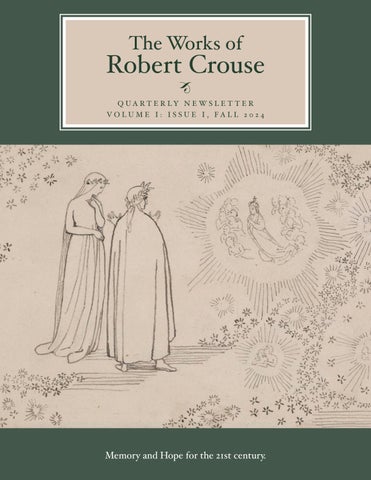
Front cover image: John Flaxman. One of the preliminary sketches for “compositions from The Hell, Purgatory and Paradise of Dante Alighieri”, illustration to Dante Dante’s “Paradiso”, Canto III; Dante and Beatrice standing amid a world of stars and looking on that of the Empress Constanza who appears in the midst of its light kneeling. 1792-1807. Pen and grey ink. British Museum.

A Convocation Address by Robert Crouse d

As Encaenia Speaker, I think it is my frst duty and privilege to congratulate this year’s graduating class. At King’s we call this graduation day “Encaenia” – a Greek word, meaning “commencement”, the beginning of something new. Today, your alma mater – the “fair mother” of your education, sends you forth into a wider world, to begin a new chapter of your life. Congratulations on your many achievements! May the grace of God go with you!

It is also my privilege to thank Convocation for the honour bestowed upon me and the other honorary doctors and honorary Fellow. We thus perpetuate a tradition which goes back at least as far as the XIIth century, when Lothair, the Holy Roman Emperor, is said to have bestowed the title of “doctor” upon Peter Lombard.

Dean Willard Sperry, of Harvard, used to speak of the University as “the beloved community of memory and hope”, and I’m going to make that the theme of my few remarks this afternoon. Not my personal memories of King’s – although my sixty years of association with the College, as student, alumnus and professor, might seem to entitle me to some reminiscing – I want rather to speak more generally of memory, of recollection, as the foundation of education, and the matrix of hope and renewal.

The past is past, no doubt; yet, paradoxically, the past is also present and becomes more contemporary in our recollection of it. Indeed, it is that presence of the past which constitutes the basis of our very recognition of the present, and establishes the horizon of our expectation. Without recollection of the past, the present moment would be as abstract and dimensionless as the mathematical point, which has position, but no size. The concreteness and sanity of our understanding of the present, therefore, will depend quite radically upon, and will be in direct proportion to, the clarity and integrity of our awareness of the past. Without that dimension, we would be as those who sufer a crippling amnesia, which renders them disoriented, and (in the etymological sense of the word) idiotic. As Lady Philosophy informs a sick Boethius, as he wallows in a dismal fog of confusion and despair, the essence of the problem is forgetfulness. The healing of this malady demands a course of recollection.

Recollection is the fundamental task of education. It must make what is sensibly past, or hidden, clear and contemporary

for intellect; it must evoke the past, recent and remote, so far as possible in all its fulness and coherence, so as to make of it the nutriment of present memory; to establish thus the perspective, the substantial dimension of the present, feeting moment.

St. Thomas Aquinas, in his Quaestiones de potentia, ofers a marvelous account of the history of thought, from the PreSocratics on, and parallels that historical development with the development of our own processes of knowledge, from sensible perception to understanding. Precisely because that development has been achieved historically, in the past, it can become our own possession in the present. It is as that past is present to our recollection, that we share its intellectual achievement. Therefore, the past must become contemporary to us; its sages must be made to speak, here and now, to us; and, as Homer already knew, those blurred and breathless shades will consent to be contemporary only if we entice them with a sacrifce of living blood. That is the meaning of our academic labours.

In the academic world, we reclaim the past mainly through the medium of books; but there are, of course, many other potent ways in which the past is made contemporary in forms of recollection, and those ways also are important for the nutriment of memory. To cite just a few examples: the ancient Praxiteles and the medieval Ghiselbertus, great sculptors, whose names were for centuries more or less forgotten, are still present and articulate in their works of sculpture. The reputation of Cimabue, the painter, was, as Dante tells us, pretty much eclipsed by the rise to fame of Giotto; yet the paintings of Cimabue, as well as those of Giotto, are gazed upon with admiration by untold multitudes of our contemporaries. The music of Bach went quickly out of fashion, and was virtually forgotten until it was revived by Mendelssohn and others in the 19th century; yet few voices speak so powerfully as that of Bach to our present age. The lovely twelfth-century Church of San Clemente, in Rome, hid for seven centuries beneath its foor an early Christian basilica, and beneath that again, it hid an ancient Roman Mithraeum, and domestic apartments belonging to the frst century of our era. Archeologists have unveiled all that, and there it all lies open to contemporary eyes.

All these old monuments of divers kinds are part of our

contemporary world. They belong to our shared contemporary experience, and they speak to us in the present, in so far as we can learn their language. For instance, Giovanni Pisano’s statues of Plato and Aristotle, which he carved to stand among his fgures of the prophets on the thirteenth-century façade of the Cathedral of Siena, bear witness still; not only to that great sculptor’s impassioned genius, but also to the way in which medieval thinkers might interpret and esteem the pagan Greek philosophers – a witness which may also challenge us with new possibilities of interpretation.

The great Romanesque imperial cathedrals of Germanic lands, by their peculiar architectural arrangements, with the Emperor’s choir at the West balancing the sacerdotal choir at the East, and their symmetry of eastern and western towers, bear mute, but nonetheless eloquent testimony to the balance and tension between temporal and spiritual powers in the political life of the Holy Roman Empire. That conception of divided powers is fundamental in the past history of Europe, of course; but it also has much to do with characteristic current policies and attitudes, and tensions between Western policies and those of diferent cultures, where no such division can be recognized.

By way of contrast, the Byzantine basilica, with its very diferent, unitary conception of sacred space, bespeaks a very diferent conception of political life, a very diferent vision of the meaning of Holy Rome. That diferent mythology of empire, with the eventual identifcation of Moscow as the third and fnal Rome (after Rome itself and Constantinople), is perhaps, with certain transmutations, at least as signifcant in the life of modern Russia as the works of Marx and Engels and Lenin.

Often these ancient monuments can tell us things which

lie quite outside their own original intentions. The glorious Charlemagne window of Chartres Cathedral, for instance, tells us something, certainly, about the heroic feats of that great monarch; but those radiant pictures tell us even more about the mythic stature which had accrued to him in the imagination and esteem of the thirteenth-century French.

We cherish these monuments, we pamper and restore them, not just because they are beautiful, or graceful, or entertaining; certainly not because they are proftable or convenient – which most of them are not; not just because the loss of them would reduce our store of information; but because they belong to the integrity of common memory, constitute the depth of our perspective in the present, and shape and extend the horizons of contemporary perception. Therefore, we cherish and commemorate them. The basic term here is precisely that: “commemoration”, which means not merely a recalling of the past as past, but rather a uniting of past and present, the celebration of the past as present in the present life of memory, personal and shared, here and now, in the contemporary world.

I suppose this idea of commemoration belongs especially, and paradigmatically, to the realm of ritual and liturgy, and it is certainly in that sphere that one fnds the most striking examples of its meaning. The sense of commemoration pervades, of course, the whole of the liturgical year; but it becomes especially intense in this season of Easter and Ascension, when the sense of past events as contemporary experience can be quite overwhelming. In the liturgy of the Easter Vigil, for instance, the deacon sings an ancient chant, probably composed by Ambrose of Milan, in the fourth century, in which he proclaims Haec igitur nox est: “This is the night”. This is the night of Israel’s deliverance from Egyptian

slavery, this is the night of the pillar of fre in the wilderness, this is the night in which the chains of death are loosed, and darkness is turned to day. “This is night”: all is in the present tense. And, indeed, that sense of vital presence of the past is at the very heart of liturgy. Anamnesis is the technical term: the presence of the past in all its virtue; the historical past as present reality for present understanding.

Liturgy efects that dramatic confation of temporal divisions in a special way, because it has an explicit point of reference in the “Eternal Now”, in which all moments are contemporary; in which, as Eliot puts it, “all is always one”. It has its focus in the still point on which the dance of time depends, “that point from which depend the heavens and the whole of nature”, as Aristotle says in his Metaphysics. Liturgy has, therefore, a deep and special sense of the contemporary, but I think that its perspective may also well serve as the ideal paradigm of all commemoration.

The integrity and sanity of our sense of the contemporary are functions of our present memory, our whole commemoration of the past, personal and historical, in a continuum of consciousness. To forget that past, to consign it to oblivion, or to “deconstruct” it, is not to be historically pristine. No draught of Lethe can truly liberate our contemporary feelings, beliefs and judgements. The past is always and inevitably here, and our choice is only whether to possess it consciously in recollection, or to possess it in the form of unrefective prejudice, devoid of understanding. The implication of the latter choice, as Dante shows us, in Canto X of the “Inferno” in the shocking fgure of Farinata, is imprisonment in an insubstantial present, in which dissociated past and future can appear only as fragmentary, totally abstract, and essentially irrelevant information. Dante paints for us a picture of an

Anecdotally…

Colin Starnes was a student of Robert Crouse at Bishop's University, Crouse's frst teaching position. Dr. Starnes followed Crouse to teach himself at the Classics Department at Dal until his retirement, but recollects those years at Bishops as a student of Dr. Crouse: "The streak of Darwin in RDC was then much closer to the surface. For example, he drove from Harvard to Bishop’s in a DKW (Dampf-Kraft-Wagen = “steam powered car” – yes - which didn’t work but eventually joined with other small companies in the Auto Union and then became Audi. I think he may have bought it the year he was at Tübingen and had it shipped back? – or maybe he just bought it in Boston? It either had a rotary Wankel engine or the company was working to produce one. He was always very well informed on what was going on in science, technology, and industry though I don’t know how he did it: there was nothing like Scientifc American in his house, but he was always up to date on the latest. Perhaps it was just from reading the newspaper ? But that would not explain how he was also deeply dyed in Marx and knew it all. Driving a DKW Meister Klasse in Boston in 1960 would have been a potent, but typically wordless, comment on the

empty present, which, he says will be the death of all our knowledge; and that is, in Dante’s judgement, a virulent form of hell.

Recollection is the fundamental business of the University – not recollection as dwelling in the past, but recollection as basis of renewal in the present, and hope and expectation for the future. Thus, King’s College, “beloved community of memory and hope”, among the most traditional of universities, has been able to be most fruitfully innovative. May it long continue on that path; and long may it be commemorated in the minds and hearts of its Bachelors, Doctors and Fellows.

Delivered by the Rev’d Dr. Robert Darwin Crouse to the University of King’s College, Halifax graduating class at the Encaenia ceremony on May 17, 2007.

paths-not-taken by the American automobile industry. He traded it for a Peugeot station wagon when the harpsichord arrived. I am not sure of any of this except for the fact that he was deeply, but invisibly, attuned to developments in science and engineering which went hand in hand with a home life untouched by radios, telephones, and televisions. There was never any talk of them – he was not interested in preaching this stuf or even talking about it – but he was not ignorant about it either. These mod-cons simply were not there – not even when they were, as was the case when he caved and got a phone in Crousetown to phone Mrs. Cooley (secretary of the Classics Dept) to say he was snowbound, and would she please cancel his classes for the day? But would not take calls which nearly drove Doris round the bend, who helped him greatly after he retired."

If you have any RDC anecdotes and wish to share them with us, please send an email to Gary Thorne at gthorne.worksofrobertcrouse@gmail.com

Pilgrim’s Paradise: The Works of Robert Crouse d

The late Anglican theologian Robert Crouse (1930–2011) may be one of Canada’s best kept secrets. An Anglican priest, teacher, gardener, musician, and, above all, contemplative, Crouse was a leading expert in patristic and medieval spiritual theology, especially Augustine and Dante. He taught and wrote with a humble, simple style that belied an extortionary spiritual depth, calling the reader to pause and ponder, to look again at what you thought you knew.

Crouse is not a widely known name outside of Canadian Anglican (and mostly Anglo-Catholic) circles. Crouse lived most of his career in the small Canadian town — his ancestral home — of Crousetown, Nova Scotia. From 1963 until 1996, he taught Classics at Dalhousie University in Nova Scotia, while lecturing widely across Canada, the US, and Europe. He was the frst non-Catholic to hold a position at the Institute Patristicum Augustinianum in Rome.

Those who did know him, though, can’t seem to speak enough good about him. David Lyle Jefrey describes him as “one of the great spiritual masters of the twentieth century” who “gracefully and perceptively brings the spiritual depth and intellectual brilliance of pre-Christian classical and biblical traditions into high relief.” Rowan Williams praises the wide range of his learning and writings that are “quietly authoritative in tone, unfussy and measured in style.” Carol Harrison, Anthony Esolen, Douglas Hedley, and others provide similarly radiant praise.

Thankfully, though, the secret’s out. A new collection of his writings is being edited by a cohort of his former students: primarily Gary Thorne, Stephen Blackwood, and Neil Robertson. The collection will comprise, in toto, a short introductory volume on the theme of pilgrimage; a three-volume series of sermons on the church year, the Christian life, and the Holy Trinity; a book of theological essays; and commentarial works on the writings of Boethius and Dante. The frst volume and two volumes of sermons have been published, with the others forthcoming.

What emerges is an extraordinary spiritual vision of the Christian life as a pilgrimage — well-trod terrain, you might think, especially for those of an Augustinian bent. But on Crouse’s itinerary, every bend in the road pulsates with life and light. I’ll try to show some of this richness in the short

initial volume of the collection, Images of Pilgrimage: Paradise and Wilderness in Christian Spirituality

In the philosophical and literary canon of the Greeks and Romans — from Homer Aristotle to Virgil and Cicero — Crouse discerns the deep paradox of dignity and tragedy that textures the pagan vision of pilgrimage. The human telos is beyond human nature, but, at the same time, it is ever out of reach. “The divine good,” as Crouse quotes Aristotle, “is a lift too high for man.” The divine is beyond the limit of our nature, and it’s our only true hope of happiness.

The kind of pilgrimage entailed in such a vision is an inexorably cyclical one, in which humanity is caught and from which it cannot escape. Pilgrimage and struggle remain locked in arms, an unbridgeable gulf between the wilderness of the pilgrim’s journey and the paradise that is his destination. “Heroic virtue, heroic aspiration, is heroic hubris, and is destined for defeat. That is the worm at the heart of pagan spirituality: the endless cycles of aspiration and despair” (Images of Pilgrimage, 20; emphasis original).

In Christianity, however, especially in its Augustinian and Dantean infections, the impasse depicted in pagan pilgrimage fnds its truest expression and resolution.

In the Christian spiritual vision, pilgrimage is also textured by paradise and wilderness. Paradise is at once the garden of our origin, the city to which we aspire, and — if our eyes are trained to see — the moments of divine in-breaking that, however subtly, reorient our lives in the present.

Most signifcantly, Christ provides a way out of the pagan impasse of cyclicality and despair. In melius renovabimur, as Augustine puts it. “We shall be changed into something better.” Christ, as both way and goal, via and patria, grants full weight to the plight of human longing for God, but, in the Incarnation, Christ not only illumines the path but becomes the way itself. Where paganism could only end in despair, however heroic, Christ afrms the vision and provides a real possibility of reaching it. Plato could see the patria, but “without the via, the blessed homeland must remain only a vision, never an habitation” (Images of Pilgrimage, 57; see conf 7.9.13–15).

Wilderness and paradise remain central to Christian pilgrimage, but their meaning is almost entirely reformulated

‘ These meditations – quietly authoritative n tone, unfussy and measured in style – show why Robert Crouse was such an important igure for so many, a touchstone of spiritual and intellectual integrity.’

R O W A N W I L L I A M S

‘A beautiful book.’

M A R K D O O L E Y

‘ There is a magnificent and serene simplicity in these pages. ’

D O U G L A S H E D L E Y

Crouse’s meditations convey the wisdom that mes from dwelling with great souls – pagan, and Christian. He appreciates the nobility and confidence of Homer and the philosohers; but is utterly persuaded that they lack the one thing necessar y: the love of God which breathes through Christian authors.’

C A R O L H A R R I S O N

small sampling here — provide the very thing he describes as central to pilgrimage: neither otherworldly nor this-world, they are paradise in wilderness, the bread of patria for pilgrims on the way.

Alex Fogleman (PhD, Baylor University) is an Assistant Research Professor of Theology at Baylor University’s Institute for Studies of Religion and director of the Catechesis Institute. He is the author of Knowledge, Faith, and Early Christian Initiation (Cambridge University Press, 2023). This review originally appeared in The North American Anglican. www.northamericananglican.com

The Halifax Book Launch of the Works of Robert Crouse

d

Gathering Sibyl’s scattered leaves by David Curry

The Halifax Book Launch (14/15 January 2024) ofered an intriguing and at times poignant set of testimonials to the infuence of the Rev’d Dr. Robert Crouse ’s scholarship upon the more than one hundred persons who gathered to celebrate the enduring legacy of his teaching and preaching.

Clockwise, from top left: St George’s Round Church, Dr. Matthew Vanderkwaak and son Robert, Dr. Paige Hochschild, Fr. Gary Thorne, Christopher Snook, Dr. Jody Clark, Fr. Gary Thorne, Fr. Jim Purchase, Dr. Susan Dodd, Dr. Daniel Watson, Dr. Susan Dodd, Fr. Gavin Dunbar, Nancy Carr, Anna Paton.

The Rt. Rev’d Victoria Matthews, Bishop of Christchurch, New Zealand (ret’d) preached at St. George’s Round Church commenting on Crouse’s unique and valued contributions to the global church. The Rev’d Gavin Dunbar from Savannah, Georgia gave an address on Crouse’s treatment of the classical Eucharistic lectionary of the Western Church and its continuing signifcance. He drew upon the artistic and geometric imagery of Raphael’s School of Athens and La Disputa in the Vatican Stanza della Segnatura which suggest the interplay of philosophy and theology so dear to Crouse’s teaching. He also gave a paper on the relation of the Christian Sacred and Secular in relation to the art of Michelangelo. Dr. Daniel Watson, having journeyed from Denmark, commented on Fr. Crouse as pastor and mentor. Dr. Paige Hochschild of Mount St. Mary’s, Maryland ofered a thoughtful treatment of the signifcance of memoria for the understanding of the integrity of human personality as developed by Crouse’s studies of Augustine, reminding us how Crouse's teaching of Dante gave so many students hope by his poetic exploration of that Augustinian personality.

The Rev’d Dr. Thomas Curran gave the sixth annual Robert Crouse Memorial lecture in the King's College Chapel following Evensong. His address drew on the imagery of la doppia danza, the double circle of the doctors emblematic of the reconciliation of opposites in Dante’s Paradiso (Canto XIII), and extended that imagery into the enlightenment and post-enlightenment world of Hegel, Schleiermacher, et alia. He told an amusing and revealing anecdote about Fr. Crouse attending an Anglican church in Europe only to hear the preacher preach one of his own sermons! He spoke to the preacher afterwards with four simple but devastating words: “I am Robert Crouse.” Imitation is, as they say, the highest form of fattery. Earlier in the day, Chris Snook showed how Crouse’s teaching understood and addressed many aspects of the existential angst of modernity, such as in Kafka’s “knowing the goal but not the way,” by allowing the voices of the past to speak to our present confusions without collapsing them into one other. Rhea Bright commented on her Guide to the Images of Pilgrimage that complements Images itself. Musical oferings by Janet Ross et ensemble celebrated Fr. Crouse’s love and interest in the music of the Baroque.

The Rev'd Dr. Ross Hebb, a former student of Dr. Crouse, gave a lovely homily at Choral Evensong at Trinity Church, an evangelical fagship of the diocese of NSPEI, honoring Fr. Crouse’s infuence as theologian, pastor, preacher and organist. Many former choristers who sang in the choirs at King's College and St George's returned to give praise, recollecting Fr. Crouse's musical legacy. Before Evensong, at the Dalhousie Classics Department Dr Bruce Gordon, Titus Street Professor of Ecclesiastical History at Yale, gave a thoughtful address on Crouse’s teaching and understanding of Augustine, developing Crouse’s view of the many “Augustinianisms” from the medieval world to the reformation period. The banquet which followed was enjoyed by more than 100 guests, hosted admirably by the parishioners of Trinity Church and King's students. The splendid meal was framed by toasts and testimonials to the infuence that Robert Darwin Crouse had on a generation of students in the Foundation Year Programme at King's and in the Classics Department at Dalhousie. Michelle Wilband and Dr. Roberta Barker thanked the speakers and ofered their own insightful summaries of the twoday Halifax Book Launch.

Thus was the beginning of the promised ongoing gathering together of the writings and legacy of the Rev’d Dr. Robert Crouse, a gathering like that of the scattered leaves of Sibyl’s oracles.

Did you know ...

The Icon-Banner of Saint George in the King’s College Chapel was commissioned in 2011 in blessed memory of Robert Darwin Crouse. It replaces the damaged banner of Saint George and the Dragon that was presented to the University of King’s College in 1907 by Earl Grey, Governor-General of Canada, 1904-1911. The original banner was one of nine embroidered and appliquéd fags commissioned by Lord Grey presented to distinguished Canadian universities. According to L. A. M. Lovekin, c.1910,

It is the intention of the Governor General to give these banners to diferent educational institutions, where, it is hoped, they will unconsciously help to infuse into the rising generation a sentiment for idealism, teaching young Canadians that it is the duty of every individual, after the fashion of St. George, to kill the Dragon of evil wherever it may be found.”

Produced by aristocratic English women with connections to Lord Grey, he wrote to his aunt, Lady Wantage:

If these banners, hanging like silent sermons on the wall of colleges, make their message felt here and there, and convert one out of 10,000 into a Hero, they will more than justify their cost and all the heart and labour put into them.”

The current banner in memory of Robert Crouse is a close copy of the original banner and was created by Taras Lesiv, an icon-writer at the Lviv Academy of Fine Arts in Western Ukraine. The icon-writer has made slight changes in the representation of the image in keeping with traditional icon writing, but he has highlighted the roses to call to mind the magnifcent rose garden of Father Crouse that delighted all visitors to his ancestral home.

Students canoeing the Crouse Banner across Gibson's Lake at Saint Anne's Camp, West Dalhousie, NS

Words of Robert Crouse for All Saints’ d

There are many diferent kinds of heroes. Mostly, I suppose, we fnd ourselves inclined to admire those who seem most successful in this world’s terms: the clever, the efcient, the entertaining, the beautiful, those who achieve spectacular success in one feld or another, those who “get ahead.” But the saints are not like that. Christian heroism seems to be of a different sort than that. No Christian saint is celebrated because of his success in such terms as those. In fact, in such terms, I suppose most Christian saints were appalling failures. Their heroism was something very diferent — something far more inward. Theirs was a heroism of faith, and hope, and love — a heroism more perhaps of desire than of achievement. Their heroism consisted in a certain inner struggle — the struggle to perfect the will — the struggle for a perfecting of love — a love which counts the world well lost for God’s sake. The saints are those made perfect in the love of God. As the Epistle to the Hebrews puts it, “they embraced the promises of God, and confessed that they were strangers and pilgrims on this earth. They desire a better country, that is, an heavenly one.”

“Strangers and pilgrims”— these saints, these aliens, surely present us with a challenge. Their heroism is a problem, perhaps even an embarrassment to our Christianity. Most of us, surely, fnd ourselves very much at home in this world, and seek to work out our salvation very much in this world’s terms. Our Christianity tends to be of a worldly sort, measured in terms of efciency and productivity, and success in making this world more comfortable, as though this world

Back cover image: Robert walking in his garden.

were the end of all our striving. The great temptation of the contemporary Church — our great temptation as contemporary Christians — is to try to use the Gospel for essentially worldly ends.

The witness of the saints is rather that this world is not, and can never be, enough for the human spirit: that the only adequate focus of human aspiration is God himself — that any lesser end is a distortion of love, and ultimately destructive. The world is to be loved, and we are commanded to love and serve our neighbour. But it matters profoundly how they are loved. They must be loved for God’s sake, and for God’s glory. That is the heart of sanctity; that perfectness of love is the heroism of the saints.

As we celebrate this festival, we recall our own vocation to be saints — to follow them in virtuous and godly living. We celebrate the triumphs of God’s grace in them, and seek to share their holy fellowship. In this sacrament we celebrate, the veil is parted which divides their life from ours, and our worship and intercession become one with theirs. We are one Church, they in heaven and we on earth; one in our common life in Christ. Our imperfect prayers are aided by the more perfect intercessions of those spirits, pure in heart, who stand before the throne of God and serve him day and night.

(from an unpublished sermon preached in 1986)

The Last Judgment (detail).
Fra Angelico, c1425.

Since the publication of Images of Pilgrimage and Vol I, Sermons, parish groups in Canada, USA, and Britain have studied these books during Lent and on other liturgical seasons. A longstanding women's Bible Study group in a parish in London Ontario began to read the sermons week by week. Here are comments from two members of the group:

I was amazed and excited when I started reading these sermons. His writing is beautiful, profound, and yet simple and clear. It has been a wonderful journey! I feel the deepest meaning of the church year has become so much more important to me. I believe that I understand God's cosmos and my part in it so much more clearly. My faith is stronger for this experience. I am so much looking forward to studying volume two when it is released!”

Father Crouse's sermons have given me a deeper and clearer understanding of all that God has done for us. The cyclical nature of the church year lays out the path which leads a true believer closer, year-by-year, to living a Christian life through God's grace and mercy. After our discussions, I have found myself in prayerful self examination to ask God's help in living in his image. I know that I will continue to go back and re-read these sermons as they fall on the Sundays in the coming year. I look forward to the next book of sermons!”

Et erit ibi semita et via, et via sancta vocabitur (Isaiah 35:8)
The Bible study group at St George’s Anglican Church, London ON will continue with the newly released Vol II Sermons this Advent Season.

Turn static files into dynamic content formats.

Create a flipbook