Here’s to the Entrepreneurs. You’ve Worked Hard to Build Your Business...
Editor’s Note by Kendra Budd, Editor
Contributors
How an Investigator Should Handle a Subpoena by Kelly E. Riddle, Kelmar Global
Cyber Insurance: Why It’s Time for Investigators to Protect Themselves by Isaac Peck, Senior Broker at OREP.org
2026 Investigator Survey Results by Kendra Budd, Editor
Bigger Isn’t Always Better: Rethinking “Growth” in the PI Business by Jim Nanos, VSM, BS, LPI / Owner, ThePICoach.com
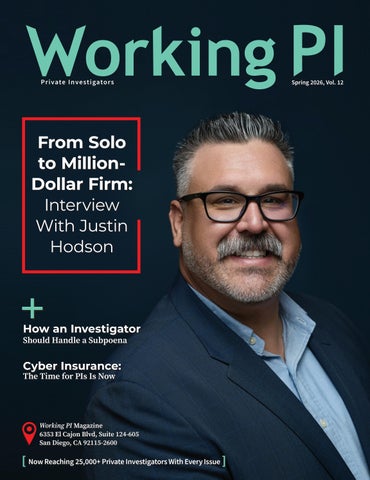
COVER STORY: From Solo to Million-Dollar Firm: Interview With Justin Hodson by Isaac Peck, Publisher
From For-Cause to No-Fault: How Divorce Law Shapes PI Work by Isaac Peck, Publisher
Trackergate: John Doe Finally Unmasked by Kendra Budd, Editor
Digital Footprint Tracking: A Primer by Bryan L. Williams, PhD
How Preventive Investigations Can Grow Your Business by Robert “Jerry” DeFatta, CFE, BAI, CRT
Mission
Working PI is published to help readers build their businesses, reduce their risk of liability and stay informed on important technology and industry issues.
Write Us at Working PI Comments and letters are welcome. All stories without attribution are written by the Editor.
Working PI 6353 El Cajon Blvd., Suite 124-605 San Diego, CA 92115-2600 (888) 347-5273 subscription@workingpimag.com WorkingPIMag.com LinkedIn.com/company/working-pi Facebook.com/workingpi
Working PI is published by OREP Insurance Services, LLC (Calif. Lic. #0K99465) and mailed to 25,000+ private investigators nationwide. The ads and specific mention of any proprietary product contained within are a service to readers and do not imply endorsement by Working PI. No claims, representations or guarantees are made or implied by their publication. The contents of this publication may not be reproduced either in whole or in part without written consent.
The Growth and Protection of a PI Business
Growing a private investigation business means navigating the highs and weathering the lows, sometimes in the same week. But tenacity is your biggest ally. How you problem-solve obstacles, learn from your mistakes, and take steps to protect your business will define your career over the long haul. In this issue, we cover all three: success stories, hard-learned lessons, and the coverage that keeps your business standing when things go sideways.
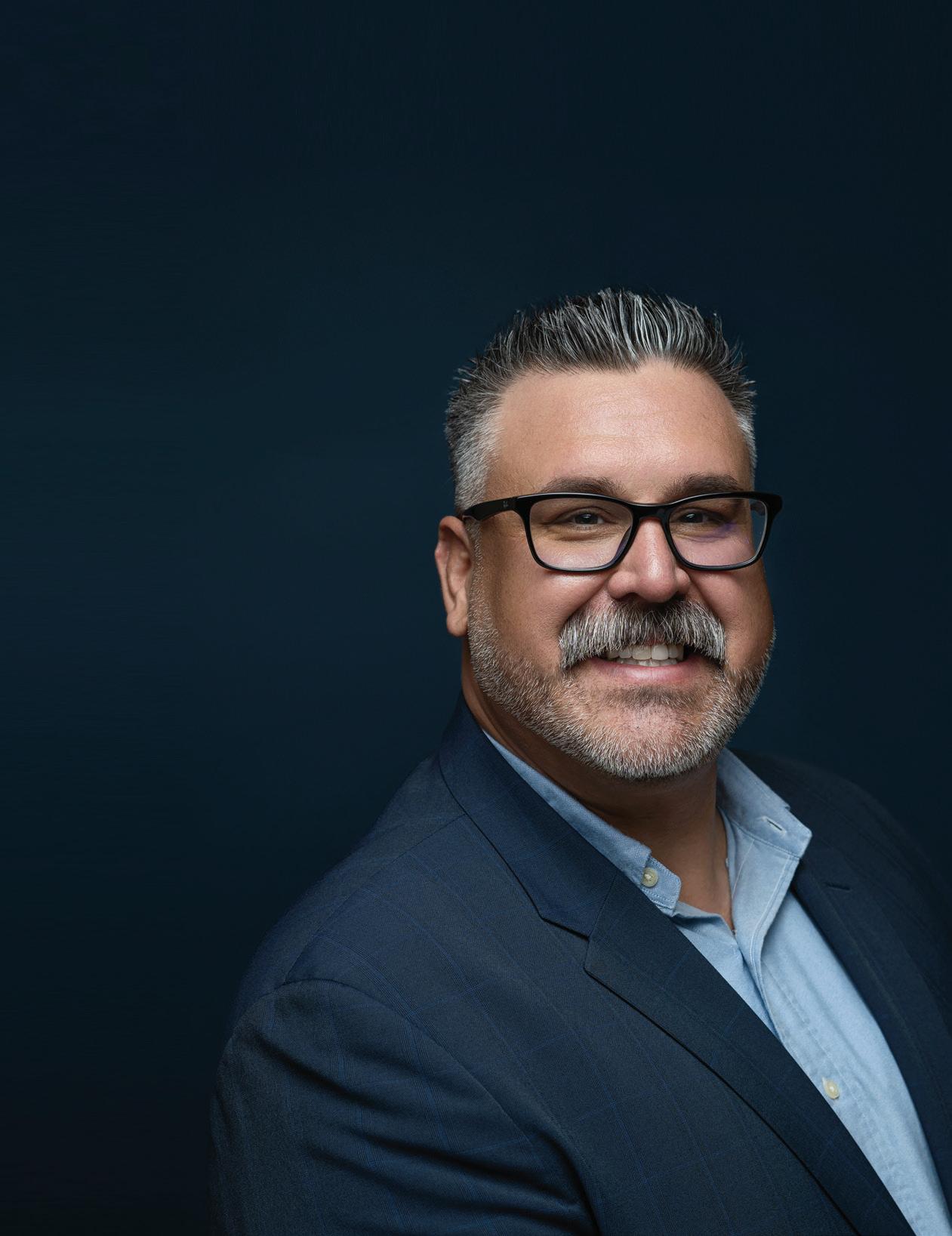
Starting with a success story, we explore the incredible rise of Justin Hodson, a private investigator who has built a firm from the ground up on a scale that’s hard to believe. Starting as a solo investigator, Hodson is now the CEO of Hodson P.I., a multi-million-dollar firm with more than 80 employees and over 150 contracts with independent service providers. His growth, however, was anything but easy. Hodson details how he focused on building relationships to foster trust, even with those considered competition, and made several mistakes along the way. But those mistakes only sharpened his approach. To read about Hodson’s journey, turn to page 20.
Of course, not every story ends with the PI coming out on top. Over the past year, we’ve been covering the wild saga of “Trackergate,” in which a PI was accused of trespassing after placing a tracking device on Reno, Nevada Mayor Hillary Schieve’s car. What followed was a lawsuit against the PI and his client, a client who exhausted every legal avenue to stay anonymous. After a yearlong battle, the client’s true identity has finally been revealed. To find out who “John Doe” really is, read on at page 30.
Whether you’re on a winning streak or digging out of trouble, having the right coverage to protect your business is non-negotiable, especially in the digital age. E&O remains the gold standard for PIs, but cyber insurance is a whole new beast. In the age of social media, cyberattacks and phishing scams have ramped up considerably. One wrong click and your client files, case data, and business operations are all in jeopardy. On page 8, Isaac Peck details the importance of cyber coverage and how it can shield your business from a dangerous disruption.
Success is rarely a straight line, and this profession will test you. But the investigators who learn from what goes right, grow from what goes wrong, and protect themselves along the way are the ones who last.
Stay safe out there!
Kendra Budd
Kendra Budd Editor of Working PI
Kelly E. Riddle
Kelly E. Riddle is the President of Kelmar Global Investigations and has more than 40 years of investigative experience. He earned a Bachelor of Science degree in Criminal Justice from the University of North Alabama. He was chosen as the “PI of the Year” by the National Association of Investigative Specialists, while PI Magazine named Mr. Riddle the #1 PI in the U.S. Kelly is the past President of the Texas Association of Licensed Investigators and is on the Florida Association of Private Investigators Advisory Board. He founded the PI Institute of Education in 1989, which provides online learning. Kelly has published 14 books, over 40 articles, and spoken at over 650 events.
Jim Nanos
Jim Nanos is a licensed private investigator in New Jersey and a Senior Contributor to Working PI magazine. He offers training on ChatGPT and AI assistance in 2-, 4-, and 8-hour classes, including live use of the tool. Nanos can be contacted for conferences and speaking engagements by visiting The PI Coach website, www.ThePICoach. com, or through his New Jersey private investigations firm, Apple Investigations, www.AppleInvestigations.com.
Robert DeFatta
Robert “Jerry“ DeFatta, CFE, BAI, CRT, has over thirty years of experience in corporate security and investigations. He is a Certified Fraud Examiner and Board Accredited Investigator, certified in the Reid Technique of Interview and Interrogation. He founded DeFatta & Associates, LLC in 1997, specializing in internal theft and fraud investigations for corporate clients. He is an active member of the Association of Certified Fraud Examiners (ACFE), ASIS International, the International Intelligence Network (Intellenet), and several other professional organizations. He can be reached at jerry@defattapi.com.
Isaac Peck
Isaac Peck is the Publisher of Working PI magazine and the President and Senior Broker of OREP.org, a leading provider of E&O insurance for the PI profession. Working PI is the most widely read print magazine for investigators nationwide, reaching over 25,000 PIs. PIs who become OREP Members enjoy two CE courses (15 hours) at no charge (Visit OREP.org/PI-Members for details). Email Isaac at isaac@orep.org or call toll-free (888) 347-5273. CA License #4116465.
Bryan Williams
Bryan is a senior researcher with extensive cross-sector experience in clinical, public health, and higher education settings. He has a PhD in Public Health and Psychometrics from Penn State University. Bryan has an extensive background in integrating, analyzing, and visualizing “real-world evidence” for population-based studies. He also has unique expertise in AI prompt generation and bot development. As a published author, Bryan is featured in over 75 refereed articles and abstracts in high-impact journals. Bryan is also a principal investigator for several federal, state, and private agency-funded studies. Visit systemicsai.pro for more information.
Kendra Budd
Kendra Budd is the Editor of Working PI magazine and the Marketing Coordinator for OREP Insurance. Kendra also assists the Education Division at OREP as Education Coordinator. In her spare time, Kendra operates as an independent photographer in Bellingham, Washington. She graduated with a BA in Theatre and English from Western Washington University, and an MFA in Creative Writing from Full Sail University.
How an Investigator Should Handle a Subpoena
by Kelly E. Riddle, Kelmar Global
“T he investigator has a duty and a legal responsibility to answer subpoenas and to notify the client before doing so.”
If you have been a private investigator for very long, chances are you have received a subpoena to produce “any and all” documents, video, notes, invoices, communications, and emails, including everything but the kitchen sink. So, what is your duty to your client without violating the subpoena?
The initial question relates back to the beginning of your relationship with the client as well as licensing regulations. The very essence of our profession, being private investigators, means we have a duty to protect our clients and the information we develop on their behalf. Confidentiality is at the very core of what we do. This duty usually extends to third-party information received during the investigation on behalf of your client. A good contract should spell out the client’s duty not to interfere with or intentionally mislead
the investigator. Likewise, the contract should specify the investigator’s duties related to client confidentiality. In many states, the licensing regulations, as well as the code of ethics, specify the duty to maintain confidentiality.
Documents created during the investigation and especially any correspondence with the client or final reports should include “Privileged and Confidential” or “Privileged and Confidential, Prepared at the Direction of Counsel.” This should also be in the subject line of emails. It should be noted that just because you post this assertion doesn’t mean that it fits into the confidentiality interpretations. Confidential information includes all recorded information that is non-public, including notes and copies in both digital and printed form. Anything that could adversely affect the client or should require legal analysis would be deemed
confidential. In a high-profile case or one you know is destined for depositions and trial, even communications between your staff should be marked privileged and confidential. The adage, “better to have it and not need it than to need it and not have it,” certainly applies in this scenario.
Once an investigator receives a subpoena, the client should immediately be notified. This provides them with an ample opportunity to file an objection. A good tactic when issuing final reports can be the use of the investigator’s initials instead of their names. In doing so, the investigation agency will have to be contacted ahead of time to determine who the investigators are so they can be issued a subpoena. This provides an opportunity to determine that a subpoena is in the making.
Regarding the argument of work-product, in the case John Gross and Company,
Inc., et al. v. Agri Stats, Inc., et al (U.S. District Court - Northern District of Illinois Eastern Division), the court ruled on whether the work-product doctrine, or other limits on civil discovery, applies to protect investigative work. The investigation was conducted through a third-party who retained investi gators shortly before the filing of this action and apparently before a named plaintiff engaged a law firm to file the lawsuit. The court ruled that it did not matter if the investigators were hired prior to the client hiring legal counsel as long as it was done “in anticipation of litigation.” The work-product doctrine therefore extended to the investigators’ work on behalf of the client according to the ruling.
In situations where you suspect you may have to provide a deposition, you should discuss the fees associated with this, as
well as the client paying for an attorney to represent you. An attorney hired by your client has the legal and ethical duty to watch out for their good. The attorney can “assist” you but if an issue arose requiring them to choose between you and their client, their duty is clear. Some opposing attorneys are very aggressive and having an attorney present to represent your interest may be money well spent, regardless of who pays for the representation.
Finally, at some point you must respond to the subpoena. If you supply documents such as emails, invoices or similar documents, these may be confidential and in violation of your contract, regulations and ethical responsibilities if provided. Responding to the subpoena by providing a copy of your final report and video obtained during surveillance is pretty standard. You should also make
sure that what you give them is the same as what was given to your client.
Speaking of video, it is becoming way too common for investigators to shoot video with their cellphones. Understand that you may be required to turn over the camera used for taking video so a forensic analysis can verify the authenticity of the video.
Turning over your personal cellphone would be detrimental. If you are going to shoot video with a cellphone, make sure it is an old one that has been reset to factory settings and cleaned up.
The investigator has a duty and a legal responsibility to answer subpoenas and to notify the client before doing so. It is important to understand how to ensure you maintain client confidentiality while abiding by the subpoena.
Cyber Insurance: Why It’s Time for Investigators to Protect Themselves
by Isaac Peck, Senior Broker at OREP.org
“More than half of U.S. cyberattacks now target small businesses —not large corporations.”
You log in, expecting to finalize a report and send it off to one of your larger clients, only to find your system locked, case files gone, and a message blinking on the screen:
“YOUR FILES ARE ENCRYPTED. To regain access, you must pay a ransom. Do not attempt to decrypt or modify the files yourself. Any unauthorized action will result in permanent data loss. Payment instructions are below. You have 72 hours.”
Directly below the words, a clock begins counting down.
You feel panic setting in. To make matters worse, you had committed to delivering a rush investigation report to your client this morning in a time-sensitive litigation case. You can’t access reports, contact clients, or meet dead-
lines. You’re losing money, time, and worst of all, your clients’ trust.
You thought your investigation business was too small to be a target. But here you are.
In fact, small business owners like me (and you) frequently think: “My business is too small for me to have to worry about cyberattacks.”
This type of mentality only compounds the problem. According to recent national data, more than half of U.S. cyberattacks now target small businesses, not large corporations. Firms with fewer than 100 employees are significantly more likely to be targeted than larger companies, largely because they lack dedicated IT staff, formal security protocols, and incident-response plans. In other words, they’re easier targets.
The financial fallout doesn’t have to be catastrophic to be devastating. Industry reports estimate that even modest cyber incidents routinely cost small businesses tens of thousands of dollars once downtime, data recovery, legal obligations, and lost business are factored in. For a solo investigator or small PI firm, that kind of disruption can halt operations entirely.
And unlike large companies, investigators usually don’t have layers of redundancy. One compromised laptop, one hijacked email account, or one ransomware event can shut down your ability to deliver reports, communicate with clients, or access case files—right in the middle of pressing deadlines. The reputational hit an investigator takes when they tell their clients they can’t assist on a case because they’ve been hacked can be heavy.
Cyber Threats Grow
Many small business owners—including PIs—assume cyberattacks are a problem for big companies with big budgets. That assumption is increasingly wrong.
In 2025, more than 60 percent of U.S. small businesses reported a cyberattack, and firms with under 100 employees were 2.5 times as likely to be targeted as companies with 500 or more staff.
Why the shift? Cybercriminals have now learned that small businesses are often easier targets. Large organizations may offer larger payouts, but they also invest heavily in cybersecurity infrastructure, monitoring, and response teams.
Small firms rarely have those layers of defense. With automated tools, ransomware-as-a-service kits, and AI-generated phishing campaigns, attackers can efficiently target thousands of smaller businesses at once, knowing that even modest ransom payments add up quickly.
The financial consequences are not theoretical. According to Verizon’s 2024 Data Breach Investigations Report, small business data breaches can cost anywhere from $120,000 to over $1.2 million, depending on the severity. Other industry studies released last summer put the average cost of a single cyber incident at roughly $25,000—far more than most investigation businesses can absorb without serious disruption.
And cost is only part of the damage. Ransomware attacks now dominate the small-business threat landscape, often using double-extortion tactics: encrypting files while simultaneously threatening to release sensitive client data. Phishing emails have become more convincing, mimicking attorneys, insurance adjusters, and corporate clients that investigators work with every day. In some cases, attackers even use deepfake audio or video to impersonate trusted contacts.
Software tools, mobile technology, cloud storage, and third-party platforms have expanded the attack surface even further. Each login, shared file, or connected vendor introduces another potential point of entry. For businesses without IT monitoring or incident-response plans, attacks can go undetected until systems are locked—or client data has already been compromised.
This isn’t a call to panic. It is a call to acknowledge reality. Cyberattacks today are aggressive, targeted, and financially motivated. Even when a business survives the initial hit, the operational disruption and reputational damage can linger long after systems are restored.
That’s because economic damage isn’t the only kind of damage you’re going to worry about when running your firm. Compromised databases, stolen client data, and prolonged communication interruptions all disrupt operations, expose you to legal and financial fallout, and worst of all, directly threaten your trusting relationship with your clients.
As one cybersecurity expert put it: it only takes one successful attack. The question isn’t whether investigators are too small to be targeted—it’s whether they’re prepared when it happens.
Unique Risks for Investigators
Private investigators face unique cyber risks that make them especially vulnerable to digital attacks. Unlike larger firms with dedicated IT teams, most investigators operate as solo practitioners or small businesses.
Nevertheless, even the smallest investigation offices handle highly sensitive data every day: case details, witness information, surveillance footage, background check results, confidential details, and access credentials all flow through their systems, often via unsecured emails or cloud-based platforms.
Cybercriminals know that investigators are deeply embedded in legal cases,
insurance claims, and corporate investigations, often under tight deadlines and with limited tech support. A welltimed phishing email or ransomware attack can severely compromise ongoing cases, damage attorney relationships, jeopardize evidence chains, and quickly spread malware to the investigator’s email contacts.
Private investigators rely heavily on mobile devices, remote access, and thirdparty software to stay efficient and responsive. Each of these tools introduces vulnerabilities. Tablets and smartphones used in the field lack robust endpoint protection, making them easy targets for malware or unauthorized access. A single compromised login (especially one reused across platforms) can expose sensitive client files, investigation reports, surveillance video, and even financial data.
Third-party software adds another layer of risk. That vendor platform you rely on for case management, background searches, or database access is a target. If one of your vendors suffers a breach, you could be held responsible for any client data exposed, particularly under strict privacy laws or attorney-client privilege requirements.
Email remains a major threat vector. Investigators routinely communicate with attorneys, insurance adjusters, clients, witnesses, and law enforcement, often exchanging documents and links. A hacked email account can be used to send malware to dozens of contacts, triggering reputational damage, regulatory scrutiny, and potential lawsuits.
What's even scarier is that because private investigators often work solo or in small teams, cyberattacks may go undetected until serious damage has already occurred. You probably haven’t scaled up to the point of having a dedicated IT team. That means malware can spread, or additional data can be stolen before an issue is even discovered.
Unlike other professions, PIs rarely have the luxury of pausing operations to investigate a breach. Every day you’re closed means missed deadlines, frustrated clients, and loss of potential business.
The Role of Insurance
When a cyber incident hits, speed matters. For investigators, the real damage often isn't just the ransom demand or the technical cleanup—it’s the downtime, the missed deadlines, and the loss of client confidence that follows. Cyber insurance exists to help businesses recover quickly and responsibly. For PIs that means having access to technical experts who can investigate what happened, contain the breach, and restore systems so work can resume. It also means guidance on how to communicate with attorneys, clients, and other parties if sensitive information is compromised.
Notification Costs: If your case files or client data are compromised, you may be legally required to notify affected parties. OREP's cyber policy covers the cost of sending notification letters or emails, setting up a call center, and offering credit or identity monitoring. These steps help preserve client trust and meet compliance obligations.
Crisis Management Costs: A cyberattack can damage your reputation with law firms, insurance companies, corporate clients, and individuals overnight. This coverage helps you respond strategically, from hiring PR professionals and obtaining legal guidance to managing communications with clients, regulators, and industry partners.
Forensic Investigation Costs: After a breach, you'll need to understand how it happened and what was affected. OREP’s policy pays for cybersecurity experts to investigate the incident, assess your systems, and identify vulnerabilities.
Extortion Costs: Ransomware attacks are on the rise, and investigators are not immune. If cybercriminals lock your files and demand payment, OREP’s policy includes support for negotiators, ap-
“Whether a firm is large or small, client data is still client data —and protecting it is an essential part of maintaining professional standards.”
proved ransom payments, and technical assistance to help restore access and minimize downtime.
Technology Fraud and Theft Losses:
Investigators are frequently targeted by phishing scams and fraudulent payment schemes. This coverage protects against financial losses from fake wire transfers, spoofed emails, and other forms of digital deception that can drain your business accounts.
Third-Party Liability:
If your email or case management software is compromised and spreads malware to clients or industry contacts, you could be held liable. OREP’s policy includes third-party coverage to help manage legal exposure and repair professional relationships.
OREP’s starter cyber policy is only $125 per year and includes up to $100,000 for cyber and technology security incidents, along with coverage for privacy fines or penalties that can arise even when the investigator is the victim of an attack.
It also addresses the real-world costs that follow a breach, including notification expenses, crisis management, forensic investigation, ransomware extortion, and technology fraud losses. (Sublimits apply. Higher limits are available for additional premium.)
For You, For Your Clients
Cyber risk is no longer a theoretical problem reserved for large corporations or tech companies. It’s an operational reality for investigators who rely on email, cloud storage, mobile devices, and third-party platforms to do their work.
Whether a firm is large or small, client data is still client data—and protecting it is an essential part of maintaining professional standards.
Cyber insurance doesn’t replace good practices or sound judgment, just as E&O insurance doesn’t replace competent investigative work. What it does provide is a backstop when prevention fails. When systems go down, data is compromised, or communication with clients is disrupted, the ability to respond quickly and professionally matters In those moments, the question isn’t whether a breach should have happened—it’s how well the investigator is prepared to deal with it.
Private investigators spend their careers helping their clients manage risk—protecting their own businesses is no different. Cyber insurance is simply another tool for doing that thoughtfully, deliberately, and with an eye toward long-term stability.
Working PI is the only magazine available to all PIs at no charge in print and online!
Receive every print issue AND get the latest PI news via email.
for the Digital News at
The latest news—delivered right to your inbox twice a month.
2026 Investigator Survey Results
by Kendra Budd, Editor
Over the past few years, the private investigation profession has been abuzz with conversations surrounding the use of technology, fees for services, continuing education, licensing requirements and more. With hot-button issues surrounding the use of Artificial Intelligence (AI) and the challenges of being a business owner, PIs’ voices matter now more than ever.
The 2026 Nationwide Survey for Private Investigators collects feedback from in-
vestigators across the country, spearheaded by industry leaders Kelly E. Riddle of PI Institute of Education, Matt Spaier of “PI Perspectives” podcast, and Isaac Peck of OREP Insurance. The survey concluded on January 31, 2026.
The survey results reveal varying levels of technology adoption among private investigators. In fact, according to the data, many don’t even use online case management systems in their businesses. The survey also revealed not-
1. Are you licensed in more than one state?
2. Do you operate in a state that requires continuing education?
able findings regarding how much private investigators charged for services and the challenges that most significantly impacted their business model.
The survey data is provided free to private investigators and all industry stakeholders to help them benchmark their businesses. With more than 360 responses recorded, view the survey results below. The rest of the survey results are online at WorkingPIMag.com/ 2026Survey
3. Are you in a state that requires licensing? 4. What percent of work is desktop investigations (research)? 5. What percent of work is field investigations?
Learn from the Best + Develop Your Skills
•Website
•New
•More
•
•Download Certificate Upon Completion
Are you the owner of the PI company you work for?
How many cases do you typically work per month?
Do you have a dedicated sales team?
10. How many licensed PIs are there in your company?
Do you belong to your state association? 12. What is your yearly level of income from PI employment? 13. What is your biggest challenge as a business owner?
14. If you do subcontract work for other PIs, do you offer a discounted rate?
Bigger Isn’t Always Better: Rethinking “Growth” in the PI Business
by Jim Nanos, VSM, BS, LPI / Owner, ThePICoach.com
“I could choose my cases again. I could protect my time. I could keep the work aligned with the type of investigations I do best.”
Statistically—and based on years of watching how this profession actually operates in the wild—I believe the overwhelming majority of private investigation firms nationwide are what I’d call “mom & pop” operations.
You know the model. One primary licensed investigator doing the investigative work, supported by a spouse or partner handling the administrative side: calls, billing, scheduling, intake, mail, and the hundreds of little tasks that keep the wheels turning. It’s essentially a one-investigator shop with crucial back-office support.
If I had to guess, I’d say as many as 90 percent of PI businesses fall into that category—I do now.
Of course, there are exceptions: large investigative firms with dozens of in-
vestigators, analysts, technicians, and administrative staff. Some are regional powerhouses. Some are national brands. But in my experience, those are the exceptions—not the general rule.
And yet, human nature being what it is, most of us still have that voice in our head that says: Grow it bigger. Add staff. Take more cases. Increase revenue!
It sounds logical, and “on paper,” it looks good.
Add another investigator, double your workload and billable hours. Add three investigators, triple it. Keep going and— if you listen closely—you can practically hear the cash register ringing with every additional investigator!
But here’s the uncomfortable truth: In the private investigation business, that
formula doesn’t always work. In fact, for many of us, it can be a straight road to less profit, more stress, and—if you are not careful—closing your doors.
Why the PI Business Doesn’t Scale Like Other Trades
A lot of people compare business growth to industries like landscaping or cleaning services. The logic goes like this: Duplicate the truck, trailer, and equipment. Hire another crew. Add customers. Repeat and make more money!
But private investigation work isn’t a “duplicate the truck” type of business.
We don’t sell a standardized product. Our work is highly variable. Our liability can be real. The quality of our results depends heavily on judgment,
page 18
$100,000 CYBER COVERAGE
Why Private Investigators Need Cyber Coverage: For Only $125 Example
Scenarios
1. Hacked Emails ($100K) - Scenario: Your email account is compromised and then sends malware to your contacts. Up to $100K Third-Party Liability coverage applies.
2. Payment Data Breach ($100K) - Scenario: If you require a retainer fee for an upfront payment from clients, this protects from payment data breaches. Get coverage for investigation, notification, and damages.
3. Lost/Stolen Device ($100K) - Scenario: Did you know that if your laptop/phone with client data is stolen, you could be required by law to notify clients, provide credit monitoring, and you could face fines ($500-$5,000 per record)? This coverage pays for notification and legal costs.
• $100,000 Cyber / Technology Security Coverage
• $100,000 Aggregate Privacy Fines / Penalties
• $25,000 for Cyber Breach Forensic Expenses Shop OREP PI Insurance + $125 Cyber (Get a Quote for PI Insurance + $100K in Cyber Coverage at OREP.org/PI)
experience, discretion, professionalism, and personal service. And unlike many service businesses, one bad hire, or case, can cost you more than money. It can cost your reputation, client relationships, legal exposure, or worse yet, your license.
Most importantly: when you expand a PI firm, you often stop being an investigator and become a manager. Nothing wrong with management if that’s the life you want. But many investigators expand because they want more income, but they end up with … less income and more and more expenses!
That isn’t a paradox. It’s a pattern. And I know it’s a pattern because I lived it.
My “Bigger Firm” Era (and Why I Was Miserable)
Turn the clock back to pre-COVID.
Pre-COVID, I had five full-time investigators plus a dedicated office manager—along with myself as the primary license holder. We operated out of a company-owned office of roughly 1,500 square feet: modern, well-equipped, a conference room, and a dedicated “tech room” for gear and case support. We were booking cases regularly. We were also doing subcontract work for other investigators. From the outside, it looked like a success story, and a profitable one! Instead, it was the least happy—and least profitable time—I’ve ever had.
Let me say that again, because this is the part that makes people blink: my gross revenue went up dramatically. My net income went down.
That’s not a typo. That’s the PI business reality when scaling goes sideways.
The “Net” Is the Only Number That Matters
It’s easy to get excited about gross revenue. Gross makes you feel like you’re winning. Gross sounds good in conversation and makes you “look” successful at the PI conferences and association
meetings. But gross doesn’t pay your bills. Net pays your bills.
Net is what you take home. Net is what you put in your pocket. Net is the number that tells the truth—Net is what matters! Remember, we are operating “for profit” businesses.
When I expanded, the expenses multiplied in ways that seemed manageable individually—but stacked up fast. Let’s set aside the big-ticket stuff for a moment: mortgage or rent, utilities, office buildout, alarm systems, furniture, and the basic cost of maintaining a professional workspace.
Now add the daily death-by-a-thousandcuts expenses like computer equipment and replacements, network services, printers and ink, paper, software subscriptions, phones, insurance adjustments, office supplies, coffee, and yes ... even toilet paper!
(If you’ve never had a large office staff, you might not realize toilet paper becomes a budget line item that somehow feels personal.)
The bigger the operation, the bigger the fixed overhead. That overhead doesn’t care if it’s a slow month. It doesn’t care if a client doesn’t pay on time. It doesn’t care if a case gets canceled. And once you build a machine that large, you have to feed it and often, the machine gets very hungry!
“Feeding
the Machine” Changes the Type of Work You Take
One of the biggest surprises for PIs who expand is this: Your case selection changes—whether you want it to or not.
When it was just me (with administrative support), I could be selective. I could pass on cases that didn’t feel right. I could refer out work that wasn’t profitable, wasn’t a good fit, or simply wasn’t worth the headaches.
But when you have payroll and overhead, the business becomes a different
creature. You start taking work you’d normally decline because you need the billable hours.
Stop asking: “Is this a good case?” Start asking: “How many billable hours?”
And that’s where the problems creep in. Not every case is worth taking. Not every client is worth having. And not every dollar of revenue is a good dollar.
In a larger operation, you can end up accepting lower-quality work just to keep the wheels moving, for cash flow, which can dilute your standards, drain your energy, and increase risk—while not actually improving profitability.
My Post-COVID Reset: Downsizing Back to “Mom & Pop”
After COVID, I made a major decision: I downsized and returned to the “mom & pop” model. I released all of the staff. Thankfully, they were all retired LEOs and had good pensions.
I sold the office—thankfully for a nice profit—and moved the operation to my home, setting up a very functional home office. I built a dedicated tech space (a garage) to store and manage equipment (cameras, accessories, and other gear) and support my content creation and training work.
If I have a case and need a second investigator—I bring in a 1099 and when it’s over—they go home (and so does their payroll cost!)
And I can say this without hesitation: I have never been happier!
Yes, gross revenue dropped. It had to— because I intentionally reduced capacity.
But my net income—the number that matters—went way up.
In fact, what I was able to “put in my pocket” was substantially higher than when I had five investigators on staff. I also regained something that’s hard to price: control.
I could choose my cases again. I could protect my time. I could keep the work aligned with the type of investigations I do best. I wasn’t feeding the machine anymore. I was running a business.
So What’s the Point?
The point isn’t that growing your firm is bad. The point is that growth has to be intentional—and the traditional “add investigators, add revenue” model does not automatically translate into more profit or a better life. Bigger isn’t always better. Bigger is just bigger.
I personally know investigators who run large firms successfully. They have systems, management structure, strong recruiting pipelines, tight financial controls, and clear operational roles. They built a company, not just a bigger version of themselves.
But I can also name many investigators who expanded and later shut down. And if they were being honest, they’d tell you growth was a contributing factor—not the solution they thought it would be and not what most of us would think would have been the case.
Before You Expand, Ask Yourself These Questions
If you’re contemplating adding staff or “scaling up,” take your time and run the numbers like your future depends on it—because it might.
Here are a few questions worth answering before you hire your first (or next) private investigator:
1. Are you growing gross—or growing profit? More revenue does not automatically equal more money in your pocket.
2. What will your new fixed overhead be? If you add staff, you’ll face payroll obligations, insurance, equipment, and likely more infrastructure.
3. Do you want to be a manager? If you don’t enjoy management, scaling can turn your business into a job you hate.
4. Will business expansion force you to accept lower-quality cases? If the answer is yes, you may be trading stability for stress.
5. Do you have systems—not just people? Hiring without strong systems is like adding horsepower to a car with bald tires.
A Smarter Definition of Growth
Sometimes the best “growth” move isn’t hiring another investigator.
Sometimes it’s refining your intake process so you take better cases.
Sometimes it’s raising rates and improving collections.
Sometimes it’s narrowing your niche and owning your lane.
Sometimes it’s reducing overhead so your profit margin rises dramatically.
In other words, maybe business growth isn’t about becoming bigger. Maybe it’s about becoming better.
Final Thoughts
If you’re in the mom & pop category— and most of us are—don’t let anyone make you feel like that’s a “small” business.
A lean PI operation with low overhead, strong client relationships, good pricing, and selective case acceptance can be an incredibly profitable and satisfying business model—mine is!
So if you’re contemplating expansion, think it through carefully. Run the numbers. Stress-test the plan. Talk to people who have done it successfully—and people who tried and regretted it. Make sure you’re building the business you actually want … not the business you think you’re “supposed” to want.
I provide consulting on this subject through my PI Coaching business, The PI Coach. If you’d like to discuss sustainable growth strategies for your firm— whether that means scaling up or optimizing a lean model—you can find me online at ThePICoach.com or email me at NanosJ@AppleInvestigations.com or email Jim@ThePICoach.com. My direct phone number is 609-780-3817.
From Solo to MillionDollar Firm: Interview With Justin Hodson
by Isaac Peck, Publisher
“Even as a company with 80 employees, I still get a fear around not making the right decision. There’s a saying that I like: ‘Scared money doesn’t make money.’”
Most private investigation firms never grow past the founder.
Private investigation remains one of the most fragmented professional services industries in the U.S. The overwhelming majority of PIs operate as solo practitioners or very small shops—often by design. Building a firm means taking on risk: hiring staff, managing compliance, carrying overhead, and stepping away from billable investigative work to focus on leadership and operations. For many investigators, that leap never makes sense or never feels worth it.
In this regard, Justin Hodson is among a select few PIs who have built a firm at a scale rarely seen in the profession.
Hodson started exactly where most private investigators do: as a solo operator, working cases himself and building
relationships one client at a time. Today, he is the founder and CEO of Hodson P.I., a fast-growing, multi-million-dollar investigative firm with more than 80 employees and contracts with nearly 150 independent service providers. The firm serves law firms, insurance carriers, municipalities, and corporations nationwide.
Very few privately owned PI firms ever reach this scale, let alone do so without losing control of quality, ethics, or culture along the way. Hodson hasn’t gotten here through shortcuts, acquisitions, or outside capital. He built the business deliberately—by learning from mistakes, reinvesting in people, developing systems, and making the transition from investigator to leader.
“You’re going to make mistakes,” Hodson says. “You’re going to screw up.
That’s the best education. The question is what you learn from it.”
Hodson’s journey is especially relevant today. The private investigation profession is evolving rapidly, driven by technology, specialization, digital intelligence, and rising demand from insurance carriers and litigation teams. Opportunities are expanding, but so are the operational and liability challenges that come with growth. Scaling a PI firm now requires more than investigative skill; it requires vision, discipline, and a willingness to build something larger than yourself.
This is the story of how Justin Hodson made that transition from solo PI to CEO, and what other investigators can learn from the process—whether their goal is to scale a firm or simply run
page 22
a stronger, more profitable, and more resilient business.
For most investigators, growth doesn’t mean 80 employees. It means landing more clients, increasing revenue, making a first hire, reducing liability exposure, or finally stepping back from being the bottleneck in every case. The lessons in Hodson’s story apply just as much at that level. In fact, that’s where many of them matter most.
Introducing Justin Hodson
Meeting Justin Hodson, it’s immediately clear that his success isn’t built on bravado or ego. He’s direct, approachable, and comfortable talking about what he knows—and just as comfortable acknowledging what he’s still learning. That mix of confidence and humility has shaped both his leadership style and the culture of the firm he’s built, and it’s a theme that comes up repeatedly when he talks about growth, hiring, and decision-making.
With over two decades of investigative experience, Hodson has built one of the most respected PI firms in the country. Licensed as a PI in 2003, Hodson began his career in corporate loss prevention and fraud detection. While in those fields, he quickly earned recognition for his strong skills in undercover surveillance and internal investigations.
In 2012, he launched Hodson P.I. and by 2016 hired his first employee. That hire marked the beginning of Hodson P.I.’s transformation from a solo practice into a powerhouse investigative agency and a multi-million-dollar enterprise today. Serving law firms, insurance companies, municipalities, and corporations, Hodson P.I.’s reputation for precision, discretion, and ethical rigor has made it a go-to resource for complex legal cases and high-stakes investigations.
Hodson contracts with nearly 150 independent service providers and recently hired his 80th employee. Hodson believes strongly that it takes a village to find success, even individually, and that
bosses should absolutely admit that they rely on their employees.
It’s a work ethos that’s paid off. In 2024, Hodson was honored as Investigator of the Year by the California Association of Licensed Investigators (CALI), recognizing his leadership, mentorship, and contributions to the profession. He was also a nominee for EY Entrepreneur of the Year™ 2025, a testament to his business acumen and commitment to innovation in investigative services.
Hodson recommended a few books, including: CEO Excellence: The Six Mindsets That Distinguish the Best Leaders from the Rest, by Carolyn Dewar, Scott Keller, and Vikram Malhotra, which breaks down the different mindsets that a leader should have; and Rocket Fuel: The One Essential Combination That Will Get You More of What You Want from Your Business , by Gino Wickman and Mark C. Winters. But he also listed an old classic: How to Talk to Anyone: 92 Little Tricks for Big Success in Relationships, by Leil Lowndes. “It will help you,” he said. “Investigators are extremely intelligent, and want to solve problems, but being able to establish communication skills allows you to introduce yourself to new clients.”
Building Blocks
Hodson’s growth as a business owner mirrors his development as an investigator. “Everything before age 40 was practice,” Hodson said, reflecting on the long arc of his professional development.
The turning point came in 2012 with the birth of his daughter, Aubrey. “She served as inspiration to try to build a bigger and better company focusing on insurance defense and civil defense,” he explained. Starting the business was one thing—hiring his first employee took another four years.
To get there, Hodson focused on building relationships. He found that working alongside clients as partners or “counterparts in a mission” helped foster trust. “We were working together to collect the information they needed to
close out their claim,” he said. That reliability built his reputation, one case at a time.
“In that time, I was able to develop a growth mindset,” Hodson said. “Continuous learning. Improving myself. Making myself a better investigator, a better employer. Embracing challenges. Learning that your mistakes are valuable.”
He made a habit of attending networking events with adjusters and attorneys, asking what associations they belonged to, how they stayed sharp, and how he could get involved. “I built those relationships by meeting new people,” he said.
Hodson believes that everything worthwhile requires a leap of faith. “They have to take that first step; it’s not just going to come to them.” Whether it’s pursuing a new client or hiring your first employee, each move can feel like crossing a chasm—but it’s necessary and worth it.
He also emphasizes the importance of educating clients. “A lot of clients don’t understand the hours that go into surveillance, so you have to be more specific with them,” he said. Timing matters too. “It’s seven o’clock at night—it’s not feasible to call the adjuster.”
Budget expectations can be another hurdle. “A client will give you a four-hour budget for surveillance. Here’s your four hours, pre-surveillance. Our standard rate is $125 per hour. You’re billing for pre-surveillance, travel time. If you tell us four hours, you can’t do much for that. You have to educate your client.”
Over time, Hodson found that this kind of upfront education didn’t just prevent misunderstandings. It led to better client relationships, clearer expectations, and more sustainable, profitable work. When clients understand what goes into the assignment, they’re far more likely to value the work and the fee that comes with it.
24
(1) Key Information: Specific and credible evidence of violation of the South Korea tax laws.
(2) Rewards: 5%-20% of the recovered taxes, up to 4 billion KRW (USD 2.8M), based on your contribution. v Foreign Financial Account Information Reward Program
(1) Key Information: All available documents, including account holder names, account numbers, and account balances.
(2) Rewards: 5%-15% of the recovered penalties, up to 2 billion KRW (USD 1.4M) For more details, contact: taxkorea@protonmail.com
page 22
Looking ahead, Hodson has ambitious plans. “My growth plan is to be nationwide in the next five years,” he said. “We have a good base on that. We’re working on developing strategies that we can grow with or without outside investment.” That growth could come through strategic partnerships, additional investigators, or collaborations with other providers in the insurance and civil defense space.
The Keys
Taken together, Hodson’s experience reveals a set of recurring habits and mindsets that made this kind of growth possible. These aren’t abstract business theories. They’re practical decisions that can be applied incrementally, whether you’re running a solo practice or managing a growing team.
Learn from mistakes. “You’re going to make mistakes, screw up, screw up business ideas. Take those mistakes and you focus on them. It’s your best education,” said Hodson.
Learn from criticism. This one is harder than learning from mistakes, because mistakes can be made and learned from in private, whereas criticism always involves other people. Hodson admits that leaders in his profession don’t always accept criticism gracefully. “It’s fair to say in our profession, we have some egos. When people give us feedback, we need to embrace that.” He recalled when a client told him he needed to work on his grammar. That kind of criticism might sting, but Hodson responded by hiring someone to grammar-edit his reports, making sure they read professionally.
Take it to the next level. It’s a little out of fashion, but Hodson is the guy who will tell you to spend an extra hour at work. “Extra effort is the only way you’re going to be able to grow,” he said. He also emphasized the difference between working “in the business” (doing actual PI work) and working “on the business” (keeping the firm’s business operations running). “You’ve got to section time for building a business, and section time for doing the work,” he said.
Go for it even when you’re scared. “Even as a company with 80 employees, I still get a fear around not making the right decision,” Hodson said. “There’s a saying that I like: Scared money doesn’t make money.”
Be client-centric. Do everything you can legally and ethically for your client. Hodson’s two Cs are “candor” and “compliance.” Candor starts with honesty: “I tell them about my team, and it’ll be up to them to decide if I’m the right fit.” If a client asks for something outside the firm’s scope, Hodson says they’re upfront about it and willing to offer referrals. Compliance, the second of the two Cs, means “making sure that when you’re building your business, you’re aware of the different laws and regulations that exist for all sorts of different-sized companies,” Hodson says. He recommended having an attorney and staying current on federal and state laws.
Let yourself be inspired by other people’s success. “If you see somebody who’s very successful, embrace them, talk to them, and if they are a decent person, they’re going to inspire you,” Hodson explained. “I’m an open book. I want everybody to be successful. One of the biggest things hurting our profession is rough competition, including people talking badly about each other.”
Reinvest your profits into the business.
“We reinvest into labor,” Hodson said. “That’s going to easily be 50 percent of your cost.” Training staff, getting them up to speed on databases and case management systems, can cost $15,000 to $20,000. “Give yourself a little raise if it’s doing well. Everything else is reinvested into the company. If you don’t reinvest, it’s not going to grow.”
Ask for help. “The only way you can grow is by having help. You can’t grow and make tons of money without help,” Hodson said. He also volunteers regu-
larly, believing in keeping the karmic wheel spinning.
Delegate to the point of replacing yourself. “You have to delegate tasks,” Hodson said, explaining this unique principle. “You have to trust in the training you’ve given your hires. That they’re going to do a good job.” He explained that his goal is to put himself “out of a job” because there’s always a new job to do, something new to build. “Find somebody else, delegate that work to your team. Put yourself out of a job so you can find a new one.”
Taken together, these lessons reflect Hodson’s belief that growth isn’t just about hustle, but committed, responsible, and ethical hustle.
Handling Growth Once You Get It Hodson knows that growth, while exciting, can be dangerous if not managed deliberately. “You don’t want to grow too fast,” he said. “We’re always analyzing our processes, auditing our work.” At Hodson P.I., several department leads have helped build a system where training is standardized and quality control is embedded. “When we do get new people, we know what we need to do. We know how to train them. And we’ve got fail-safes in place like audits and periodic reviews to make sure that training is actually applied.”
“Maintaining case quality has always been important to us, especially as the team expands,” Hodson said. Hodson pointed out that hiring a new investigator isn’t just about salary, but also a reinvestment. “You’re putting $15,000 to $20,000 into labor and training before they’re generating income. They’re shadowing, learning how to do investigations. That’s a real cost,” Hodson explained.
Hodson credited strong leadership for helping him develop effective onboarding systems, including documentation, videos, and online programs that give new hires a solid foundation. “They shadow investigators, they shadow depart-
ment leads. They get a real understanding of how we operate,” he said.
Risk management is another area Hodson doesn’t take lightly. “It’s a litigious world,” Hodson pointed out. “Clients ask about our insurance all the time, E&O, General Liability. You’ve got to have multiple levels of protection. Not just for your company, but for your employees, your future, your family.” He emphasized the importance of carrying Directors & Officers insurance, cyber coverage, and other safeguards that protect the business from emerging risks. “It’s vital. You’ve got to protect the business.”
When asked what advice he’d give to other private investigators, Hodson did not hesitate: “Figure out what you want to specialize in,” he insisted. “It took me years to find my niche. That’s okay. But once you do, it makes you more valuable to clients.” He encouraged new private investigators to think strategically
about their focus and to build relationships across the investigator profession. “Network with other investigators. Be friends with your competitors. Join associations. Things change all the time, and you’ve got to stay sharp.”
Hodson also explained that he truly values critique, especially from within his own team. “I tell my leaders the last thing I want is for you to agree with everything I’m doing. I want dissenting voices. That’s how we grow,” he said. Outside perspectives are essential to entrepreneurial thinking. “It stimulates how we think. Sometimes I hear something and think, ‘I don’t know why I haven’t thought of that before.’ That’s what makes you a better investigator,” Hodson added.
The results speak for themselves. Hodson P.I. generated $8 million worth of business in 2024 and $11 million in 2025. Growth is happening, but it’s happening on Hodson’s terms, with strong
systems in place to protect work, people, and the future.
That future, like all futures, is uncertain and unpredictable. What is predictable, Hodson knows, is that private investigators make mistakes, depend on others more than they often admit, and eventually face decisions that force them to think beyond themselves. He’s built a business by acknowledging those realities, while remaining committed to hard work, ethical decision-making, and continual improvement.
With no shortage of opportunity ahead in insurance investigations, litigation support, and business intelligence, Hodson P.I. offers a clear example of what’s possible when growth is pursued deliberately.
Not every private investigator will choose that path, but the lessons from it apply far more broadly than the scale alone might suggest.
From For-Cause to No-Fault: How Divorce Law Shapes PI Work
by Isaac Peck, Publisher
“That evidentiary burden put PIs at the center of high-stakes legal battles, making their ability to collect actionable proof invaluable.”
For more than a century, some private investigators have made their living in the wreckage of failing marriages. It’s not a glamorous corner of the profession, but it’s been a reliable one.
In the early 20th century, things were quite a bit different from how they are today. Namely, without proof of adultery, cruelty, or abandonment, courts wouldn't grant a divorce. That evidentiary burden made private investigators essential players in family law, especially for spouses who wanted out.
The relationship between divorce and PI work could fill a book. What follows is an attempt to trace some of the key turning points—how the legal rules changed, how investigators adapted,
and what it all means for PIs working these cases today.
While it would be inaccurate to claim that divorce cases alone birthed private investigation, they have undeniably played a foundational role in its expansion. Family law and investigative work have been intertwined for more than a century, with challenging cases, and even routine ones, frequently calling for skilled investigators to uncover hidden truths.
Under the old fault-based system, a party in the marriage had to prove misconduct (commonly adultery, abandonment, or cruelty) for a court to grant a divorce. That evidentiary burden put PIs at the center of high-stakes legal
battles, making their ability to collect actionable proof invaluable. When you couldn’t end a marriage on personal dissatisfaction alone, concrete evidence of wrongdoing was everything.
It was in finding that evidence that early 20th century PIs developed specializations in discreet surveillance, document retrieval, and witness testimony. They developed shadowing techniques to track suspect spouses, honed their photographic skills to obtain proof of extramarital affairs, and became finance specialists, following the money trails to hidden assets or incriminating transactions. In court, a well-documented case could mean the difference between a successful separation and an expensive legal mess—or severe dissatis-
faction for one or both parties if the marriage failed to dissolve.
Most of this changed, abruptly, in the mid-20th century, when states began to liberalize their divorce laws. But that wasn't the end of divorceinspired PI innovation. The breakup of marriages continues to create opportunities and challenges for investigative work.
When Divorce Required Proof
For much of history, society and the law viewed divorce as an “exceptional remedy,” often governed by religious, cultural, and legal conditions. Most major religions forbade divorce in almost any circumstances, while others strongly discouraged it even when it was considered an option. Early American courts reflected this. Following traditions from British common law, spouses seeking divorce were required to prove fault beyond doubt, with adultery, abandonment, or cruelty serving as the primary grounds.
All three are fact-determined events, meaning that a petitioner had to provide evidence for their claims. This strict legal requirement created challenges for petitioners who lacked the means to investigate their spouse’s actions on their own. Courts would simply dismiss claims that lacked proof. Petitioners who could afford private detectives hired them to collect admissible evidence to meet these burdens.
Before this market opened, private investigators had mostly been associ ated with corporate civil cases like espionage and fraud, as well as criminal investigations. With divorce cases, the PI profession found a lucrative niche that seemed to have a never-ending source of clientele, even back in the “good old days” when marriages were expected to last. Investigators developed sophisticated methods of stakeout, covert photography, and information retrieval, all the while ensuring that the evidence they gathered would withstand judicial scrutiny.
“The work shifted away from proving misconduct per se, and instead toward financial, custodial, and reputational concerns...”
While investigators played a pivotal role in divorce litigation, their methods often attracted legal and ethical scrutiny. Some PIs blurred the line between legitimate surveillance and privacy violations, leading courts to question whether secret recordings, GPS tracking, or manipulated witness statements could be legally upheld.
The ethical dimensions were also debated. While attorneys sought undeniable proof, some investigative techniques involved deception, such as posing as potential love interests, accessing protected records, or utilizing questionable techniques.
These concerns spurred legal reforms, forcing investigators to operate within stricter boundaries. By the mid-20th century, privacy regulations curtailed certain forms of surveillance, pushing the profession toward more legally sound methods of evidence collection. The tension between effective investigation and staying on the right side of the law, a tension every working PI knows well, was already taking shape.
No-Fault: Challenge & Reinvention
As industrialization and wage labor eroded the economic necessity of marriage, divorce transitioned from a difficult, stigmatized process to a more individualized legal right. California's 1969 no-fault divorce law, signed by Governor Ronald Reagan, eliminated the requirement to prove wrongdoing to dissolve a marriage. Couples could now cite irreconcilable differences—a phrase that rendered traditional divorce investigations largely unnecessary. Other states followed. Today, all 50 states offer no-fault divorce options, and in 16 states no-fault is the only path.
This looked like an existential threat. If proving fault no longer mattered, why hire an investigator?
The answer came quickly: plenty of other questions still needed answering. The question was no longer “will the court grant the divorce at all?” New questions took center stage: Who gets the kids? What are the support obligations? Where did all the money go? The work shifted away from proving misconduct per se, and instead toward financial, custodial, and reputational concerns—opening new avenues for PIs willing to adapt.
Smart investigators shifted gears. It was no longer necessary, in most instances, to prove adultery or cruelty, although they sometimes mattered as facts in the case. But investigating financial deception, custody disputes, and reputational damage all became central to divorce law. Those who learned new skills thrived. Those who didn't got left behind.
The decline of fault-based divorces did not mean the end of investigative work—it simply meant a redirection. With spouses no longer required to prove misconduct, the battleground shifted to hidden assets, parental fitness, and credibility attacks.
On the financial front, spouses continued to hide wealth to manipulate settlements. Investigators expanded into forensic accounting, offshore asset tracing, and corporate financial audits—exposing deception that could tilt divorce negotiations. Custody battles remained fertile ground as well; the absence of fault didn’t eliminate concerns over parental behavior. PIs transitioned into documenting neglect, drug abuse, or other endangering behaviors, ensuring courts received fact-based custody recommendations. And the rise of cyber evidence— emails, financial transactions, social media activity—introduced an entirely new era, where digital forensics helped
page 27
uncover concealed relationships and financial fraud.
Here’s the bottom line: Even in a nofault world, evidence still shapes outcomes. High-profile divorce cases prove that PI work remains indispensable in shaping financial settlements, reputations, and legal strategy.
Consider a few well-known examples. In Paul McCartney’s combative divorce from Heather Mills, investigators dug into Mills’ financial history and past conduct, giving McCartney’s legal team leverage. When Elin Nordegren divorced Tiger Woods, private investigators played a crucial role in tracking Woods’ extramarital affairs—a factor that impacted financial negotiations. And even in the seemingly amicable divorce of Jeff Bezos and MacKenzie Scott, PIs uncovered Bezos’ affair with Lauren Sánchez, influencing settlement discussions and media narratives.
Fault or no fault, the facts still matter.
Gathering Evidence: Methods and Minefields
Divorce investigations have always required discretion and laser-sharp focus, and PIs have had to exercise a wide range of skills to secure the evidence they've sought. Under fault-based divorce laws that required spouses to prove wrongdoing, investigators played a pivotal role in gathering proof of adultery, cruelty, or abandonment. Even though modern no-fault divorce laws have changed the legal landscape, many of these investigative methods remain relevant in securing financial and custodial advantages. Yet, as effective as these strategies can be, they are fraught with potential pitfalls. A single misstep can render evidence inadmissible, damage a client’s legal position, or even result in legal consequences for the investigator.
Surveillance remains a key method in divorce investigations, helping to document potential infidelity or misconduct. Investigators discreetly observe subjects in public settings, capturing photos or
videos that may be used in legal proceedings. However, crossing legal boundaries—such as trespassing, unauthorized tracking, or hidden cameras in private spaces—can render evidence inadmissible or lead to legal repercussions.
Undercover work involves infiltrating social circles or posing as acquaintances to elicit admissions. While effective, deception raises ethical concerns. If an investigator pressures a subject into revealing damaging details, the evidence may be challenged as entrapment or coercion, with serious legal consequences.
Financial investigation has become increasingly central as no-fault divorce cases shift the emphasis toward equitable distribution. A spouse attempting to conceal wealth may transfer money to offshore accounts or create hidden business ventures, hoping to avoid a fair split. PIs work alongside forensic accountants to identify discrepancies, trace financial transactions, and uncover concealed holdings. But here, too, the lines matter. Accessing financial records without proper authorization—whether by hacking into bank systems or retrieving confidential documents through illicit means—can invalidate findings, exposing the investigator and their client to serious penalties. An investigator who unlawfully breaches financial databases may find their work dismissed outright, leaving their client at a disadvantage in negotiations.
As digital communication grows more central to personal and financial interactions, digital forensic analysis has become a powerful tool in divorce investigations. Social media posts, emails, phone logs, and text messages may reveal undisclosed relationships or financial deception. A careless Instagram post or an ill-advised text message can be just as damning as a photograph from a stakeout. Yet, unauthorized access to digital communications presents significant risks. The Electronic Communications Privacy Act (ECPA) and similar laws impose strict limits on the retrieval of electronic data. If an investiga-
tor illegally accesses private messages or breaches protected accounts, their findings will likely be deemed inadmissible, and they may face legal consequences themselves.
PIs are the unsung experts in uncovering the truth during divorce cases, but their work comes with serious ethical and legal responsibilities. A single mistake—whether in surveillance, undercover operations, financial tracking, or digital forensics—can do more than cost a client their case. It can jeopardize an investigator's professional reputation and credibility. Divorce law isn't static, and as it continues to shift, seasoned investigators must stay sharp, adjusting their approach to ensure solid results while avoiding the traps of legal and ethical missteps. In this line of work, knowing where the line is—and never crossing it—is just as crucial as finding the facts.
When Divorce Crosses Borders
International divorce cases present unique challenges that require specialized investigative expertise. PIs play a crucial role in navigating the complexities of cross-border legal disputes, helping ensure that clients receive fair settlements and accurate information.
One of the most significant challenges is jurisdictional differences. Divorce laws vary widely across countries, with some requiring extensive proof of misconduct while others follow no-fault principles. Investigators must understand the legal landscape of multiple jurisdictions to ensure that their findings are admissible in court. A spouse attempting to hide assets in a foreign country may exploit differences in financial disclosure laws—making asset tracing a critical service for investigators who know how to navigate this terrain.
Hidden assets are a major concern in international divorces, particularly with high-net-worth individuals. PIs use forensic accounting techniques to uncover offshore accounts, shell companies, and concealed investments.
In some cases, investigators collaborate with international financial institutions to track suspicious transactions.
Child custody disputes in international divorces often involve parental abduction or relocation attempts. Private investigators gather evidence to support custody claims, ensuring that courts have accurate information about a parent's living conditions, financial stability, and ability to provide for the child. Surveillance and background checks help establish whether a parent is fit for custody under the law.
Cultural and language barriers add another layer of complexity. Private investigators working internationally must navigate unfamiliar legal systems, cultivate local contacts, and interpret for-
eign documents. Miscommunication or legal missteps can jeopardize a case.
Despite these challenges, private investigators remain indispensable in international divorce cases, providing critical evidence that directly influences financial settlements, custody decisions, and legal strategies. The ability to operate across borders is increasingly valuable in today’s legal landscape—and for investigators with the right expertise and networks, it represents real opportunity.
What Comes Next
For PIs, the evolving world of family law and divorce requires adaptability. Simple surveillance alone no longer makes or breaks a case. The more investigators know about forensic accounting, cyber intelligence, and AI, the better
positioned they'll be in effectively handling marital disputes.
While the fault-based divorce ship has sailed, international cases, prenuptial agreement challenges, and custody battles ensure that investigative professionals will always be a necessary force in family law. Those who adapt—embracing digital forensics, financial tracking, and reputational protection—will thrive in a world where truth always holds weight, even in no-fault divorces.
Divorce work isn’t for every investigator. It’s messy, emotional, and the clients are often at the worst moments of their lives. But for PIs who do it well, there’s steady work and real impact. Settlements that are fair. Kids who end up protected. Fraud that gets exposed. Not a bad way to make a living.
Trackergate: John Doe Finally Unmasked
by Kendra Budd, Editor
“District Court Judge David Hardy sided with Schieve and Hartung, ordering McNeely to reveal his client's identity.”
Following a long, three-year saga, Trackergate has finally come to a close with John Doe’s unmasking as none other than Robert Beadles—whom Hillary Schieve had long suspected.
Working PI first covered this case in our Spring 2023 issue, delving into the specifics surrounding Schieve v. McNeely et al. Schieve, the then and current mayor of Reno, Nevada, had sued private investigator David McNeely after a GPS tracker was found on her car, just a week before the city's general election on Nov. 8, 2022.
When Working PI first followed up in our Fall 2023 issue, we reported that Vaughn Hartung, the former Washoe County Commissioner, added his name to the lawsuit after it was discovered that John Doe had also hired McNeely to surveil him using the same GPS tracking device. District Court Judge David Hardy sided with Schieve and Hartung, ordering McNeely to reveal his client's identity. McNeely appealed the case to the Nevada Supreme Court, arguing that revealing his client's identity would violate the attorney-client privilege.
on another person’s car without the owner's consent, while the Nevada Supreme Court unanimously dismissed McNeely’s appeal in April of 2024. In response, McNeely sued the Sparks, Nevada, Police Department (SPD) for unlawful search and seizure—but the case was quickly dismissed.
Meanwhile, John Doe exhausted every avenue to keep his identity under wraps —from filing a motion of summary judgment (which was denied) and a protection-order motion (which was also denied), to potentially appealing to the Supreme Court. We also covered Beadles’s relationships with Schieve and Hartung—Schieve had long suspected Beadles was the man behind the John Doe mask. Turns out she was right.
In her lawsuit, she accused McNeely and his client, the then John Doe (Robert Beadles), of invasion of privacy, violating Nevada's anti-dox laws, trespassing, and civil conspiracy. page 32
The second follow-up, published in our Spring 2024 issue, got even messier. Governor Joe Lombardo signed Assembly Bill 356 into law, which makes it a crime to put mobile tracking devices
Take Your Business to the Next Level Toolkit for Professional Investigators
Hone New Skills Expand Your Business Increase Your Income 1 2 3
OREP is more than just another Insurance Agency As an OREP Member, you get access to an unrivaled training suite of products to help you build your skills and grow your business (at no additional cost).
Learn from the Best Training, eBooks, and Contracts from experienced attorneys and industry-leading private investigators (Kelly Riddle and Mark and Wendy Murnan).
The Art of Surveillance
Conducting surveillance correctly is truly an art. This eBook shows you how to avoid common mistakes, use proper equipment and different concealment techniques; includes a section on international investigations.
Secrets of a PI Agency:
Marketing and Management
Good investigation techniques will only get you so far. Learn from one of the leading investigators in the nation on how to grow your agency like any other business by utilizing savvy marketing techniques and business skills.
Marketing to Plaintiff Attorneys
Learn valuable strategies and techniques for marketing your agency to plaintiff attorneys! Many PIs ignore this high-value niche that pays higher hourly rates.
Subcontractor Manual
Step up your game when it comes to dealing with subcontractors. Set clear expectations on how subcontractors should handle confidential information, interact with clients, and navigate insurance requirements.
Things They Didn’t Tell You (About Starting a PI Business)
Why struggle to get your business up and running when you can rely on the experience of someone who has been in business for more than 40 years? This book is a road map for anyone serious about starting a PI business.
Investigator Procedures Manual
Shorten the learning curve and increase your own (or your new hire’s) productivity, as well as your agency’s profits! This pre-formatted procedure template helps you build business processes for success.
Business Plan Template
Use this as a template for the growth of your PI business. Kelly E. Riddle shows you how to set your services apart from others, define what market you serve, the types of services you provide, how you will market the business, its financial history, business expansion, and more.
8 Hour CE Class: “Surveillance Strategies for Success”
Learn key strategies and tips to successfully execute surveillance operations as a private investigator.
Engagement Letter
Enjoy a templated Engagement Contract prepared by an attorney and former FBI agent.
Subcontractor Agreement
Prepared by an attorney and former FBI agent.
Taking Things Further
After Judge Hardy denied John Doe’s protection-order motion in May 2025, he decided to take his fight to the Supreme Court. John Doe was doing everything in his power to keep his identity a secret, and by appealing to the Supreme Court of the United States (SCOTUS), he managed to delay his reveal until November 2025.
John Doe had hired new legal counsel for this latest battle—bringing on Michael Francisco, a Washington, D.C. attorney who once served as a law clerk for Supreme Court Justice Neil Gorsuch. Francisco’s first order of business was to file an emergency motion, since John Doe was ordered to reveal his identity by May 1st and had yet to do so. In his motion, Francisco promised that an appeal would be submitted to SCOTUS no later than May 19, 2025.
On May 16, 2025, Francisco submitted a 104-page writ of certiorari against respondents: The Second Judicial District Court of the State of Nevada, County of Washoe, and Judge Hardy, as well as Real Parties of Interest: Schieve, Hartung and McNeely and his company 5 Alpha Industries, LLC.
The core argument? That John Doe was essentially a citizen-journalist investigating political corruption, and that forcing him to reveal his identity violated his First Amendment right to anonymous speech. Francisco’s writ claimed that the Nevada Supreme Court had failed to properly balance free speech protections against the plaintiffs’ interest in unmasking their accuser.
The writ went further, warning that refusing to protect John Doe’s anonymity would have a chilling effect on investigative journalism everywhere. “The consequences are predictable and severe,” Francisco argued. “Reporters investigating politically sensitive matters will be forced to choose between abandoning effective investigative techniques or exposing themselves to retaliation before their reporting reaches the public.”
Francisco also raised a 14th Amendment due process claim, arguing that the Nevada Supreme Court had stripped away John Doe’s constitutional protections in “a one-paragraph order” without proper consideration. He warned that unmasking John Doe would “subject him to potential retaliation and reputational harm,” particularly given that both plaintiffs were politicians who had already taken their grievances to the press.
For John Doe and his legal team, this was a last stand. Unfortunately for them, SCOTUS wasn’t interested.
John Doe Unmasked
In October 2025, all seven SCOTUS justices denied John Doe’s writ of certiorari—and they did so without even providing a comment. The court’s silence spoke volumes: this case didn’t warrant their attention.
Schieve responded to her victory in a statement to News 4 & Fox 11: This has been a long and emotional process, and I’m grateful the Supreme Court has chosen not to hear the case. I’m relieved to move forward so I can remain focused on serving the people of Reno. I want to sincerely thank our community for the overwhelming support throughout this process, which has meant more to me than words can express!
It wouldn’t be for another month that Beadles would reveal himself as the mysterious John Doe.
On November 3, 2025, Beadles officially took credit for hiring McNeely to track Schieve and Hartung, despite all attempts to remain anonymous after McNeely was forced to give up his identity in court documents. Beadles released a statement to The Nevada Independent to tell his side of the story once and for all.
In his statement to the outlet, Beadles claimed that he never told McNeely to track or follow either Schieve or Hartung and that he “… didn’t direct the investiga-
tor’s methods.” He did, however, defend McNeely by reiterating that he didn’t break any laws—which is true, considering at the time Nevada did not forbid the use of GPS trackers. Beadles continued to defend his actions, stating: “I’m being painted as the villain for believing public officials should be accountable to the people they serve. I stand by that principle, and I won’t apologize for seeking the truth.”
Beadles is well known in Northern Nevada as a politically prominent GOP activist and donor. As we stated in our previous story on the matter, Beadles has claimed election fraud and even used his own money to campaign against Nevada's election system, including paying to recount an election for a candidate who lost their race by 10,000 votes. He has even gone as far as funding attempts to remove those in power who disagree with him politically, suggesting his own hand-picked candidates in their stead—many of whom openly questioned the results of the infamous 2020 presidential election.
In an exclusive interview with KOLO 8 News Now, Schieve said that despite suspecting Beadles of being John Doe, she had never met him. “I don’t know if I’d been in the same room with him. He knows nothing about me. We’ve never spoken to one another. So, it causes you to have a lot of concern,” she said. Schieve went on to say that activities like those of Beadles can result in violence against political figures, such as herself, which is why she fought so hard to learn his identity.
When asked how she is doing now, Schieve said, “I am just trying to stay positive and focus on the job that I have, and the job that I love.” She continues, “I love this community and I’m a very positive person. So, I am going to stay that way for the city of Reno and everyone that lives here.” As for Beadles, he says that he is excited for what is yet to come from his unmasking, “I look forward to what the witnesses, victims, and full discovery will reveal so everyone can under-
stand exactly why a PI was hired in the first place.” Only time will tell if that full discovery works in his favor or against him further.
Case Closed
For all his efforts, Beadles has been unmasked and there is no way of knowing what the next chapter of the Trackergate story will be. There is a very real possibility that Schieve and Hartung will go on as planned to sue Beadles directly, but nothing has been filed against him as of writing this update.
It will also be interesting to learn over the upcoming months what Beadles was able to uncover from McNeely and if he will continue in his efforts to politically dethrone Schieve and Hartung. As for the PI in question, McNeely’s website for 5 Alpha Industries is still down as of press time, however it seems the business is still registered as “active”.
The Changing Landscape for Private Investigators
Trackergate isn’t happening in a vacuum. The regulatory and legal environment for private investigators is shifting rapidly, and not just in Nevada. GPS tracking restrictions are spreading across the country like wildfire.
Nevada’s Assembly Bill 356, the direct result of this case, criminalized unauthorized GPS tracking in 2023. But they are hardly alone. California just enacted SB 1454 last July, fundamentally changing how PIs document their work. Written contracts are now mandatory for every investigation. Confidentiality protections that investigators relied on for decades? Many of them are gone. Meanwhile, states like Minnesota, Oregon, and New Hampshire have enacted strict warrant requirements for GPS tracking, and others continue tightening consent laws for recordings and surveillance.
It’s not just GPS tracking, either. As Matt Spaier, founder of InvestigatorsToolbox.com , detailed in Working PI’s Fall 2025 issue (“5 Bills That Can Kill”), legislators are eyeing national data privacy laws, restrictions on public records access, and tighter regulations on surveillance technologies. “If data retention periods are extended too long or access to this data becomes restricted, private investigators may face delays in obtaining essential digital records,” Spaier warned. The tools investigators have relied on for years are increasingly under scrutiny.
Here’s what makes Trackergate so instructive: McNeely operated within Nevada law at the time. He didn’t break the
rules. But that didn’t stop him from becoming the center of a multi-year legal battle that disrupted his business and put his methods under intense public scrutiny. Even when you’re technically in the right, the professional and reputational costs can be devastating. The law changed around him, and suddenly what had been standard practice became a political lightning rod.
That’s why staying connected matters. Organizations like NCISS and your state PI association aren’t just networking groups—they’re your early warning system. They track legislative developments, advocate when bad bills surface, and help you navigate this increasingly complex landscape. And frankly, that’s why Working PI exists: to keep you informed before they show up at your door with a lawsuit attached.
The bottom line? What’s legal in your state today might not be legal tomorrow. Before you use any surveillance technology, verify it’s legal. Document your methods carefully. Get proper consent when required. Carry adequate insurance. And most importantly, stay informed. The rules of the game are changing faster than they ever have, and ignorance won’t be a defense. Stay safe out there!
CRIMINAL DEFENSE INVESTIGATIONS—
on Why and How to Conduct Criminal Defense Investigations
Digital Footprint Tracking: A Primer
by Bryan L. Williams, PhD
“OSINT entails collecting and analyzing publicly available information to generate actionable insights.”
You do not have to be a private investigator to know that we are constantly being tracked on the internet.
Background
Nearly all individuals have a digital footprint, the trail of data generated by their online activity. This footprint encompasses both information intentionally shared, such as posts, comments, and photos, as well as data collected without the user’s explicit awareness or consent, including IP addresses logged during website visits and metadata embedded in images. The purpose of this article is to provide private investigators with a guide for tracking a subject’s digital footprint ethically and efficiently.
Types of Digital Footprints
Active digital footprints consist of, but are not limited to, the following:
• Social Media: Posting photos, status updates, or comments on platforms such as Facebook, LinkedIn, or X (formerly Twitter).
• Communication: Sending emails or text messages.
• Accounts: Filling out online forms to sign up for newsletters, banking services, or shopping accounts.
• Publishing: Writing blog posts or uploading videos to YouTube.
Passive digital footprints include, but are not limited to:
• Website Tracking: Websites utilize cookies to monitor visit frequency, record IP addresses, and determine user locations.
• Device Data: Apps gather data on your device type, operating system, and battery level.
• Search History: Search engines record user queries to build profiles for targeted advertising.
• Geotagging: Photos automatically record the exact GPS location where they were taken.
Tracking an individual’s digital footprint is not inherently malicious. Journalists,
law enforcement personnel, cybersecurity professionals, and investigators employ open-source intelligence (OSINT) to verify facts, identify vulnerabilities, and safeguard individuals. OSINT entails collecting and analyzing publicly available information to generate actionable insights. This approach can reveal exposed assets and potential threats before malicious actors exploit them.
How to Track Digital Footprints
1. Define the target and scope: Clearly specify the objectives of the investigation, such as verifying a job candidate, investigating cyber harassment, or assessing executive exposure. Establish boundaries to prevent unauthorized access to unrelated or protected data.
2. Collect publicly available information: Identify and examine social media profiles, domain and IP records, public databases, professional networks, forums, messaging applications, and news archives.
page 36
Do you struggle with the “cash flow” part of your business?
Are you ready to grow your business but don’t know the mechanics of working with subcontractors or employees?
Want to develop a more consistent work product?
Want to market your business to attorneys but not sure how to go about it?
3. Analyze and correlate: Compare usernames, photos, and writing styles across multiple platforms to identify linked identities.
4. Geofencing and geolocation: Establish virtual boundaries around physical locations to collect data from application notifications or advertising networks, map Wi-Fi hotspots, and correlate findings with social media check-ins.
5. AI-driven pattern detection: Employ machine learning algorithms to detect sentiment, facial matches, or behavioral anomalies. Artificial intelligence automates the analysis of large datasets, transforming raw OSINT into actionable intelligence.
Step by Step
1. Collect initial identifiers: Begin with an individual’s known usernames, email addresses, phone numbers, or facial images.
2. Enumerate accounts: Utilize the collected identifiers to locate associated accounts.
3. Check for breaches: Assess whether any identifiers have been compromised or involved in data breaches.
4. Analyze related media: Examine images, videos, documents, or text posted by or associated with the subject.
5. Document the process: Provide a comprehensive description, such as a timeline, of the subject’s digital footprint investigation.
Digital Footprint Tracking Tools
Numerous commercial and open-source digital footprinting tools are available. Detailing each tool is beyond the scope of this article. For example, DIGITRACE (Bit.ly/pi-digitrace) is an application that enables private investigators to track and analyze the digital footprinting process. Despite their potential, such tools are not without their limitations. Limitations include:
• Inaccurate Profiling: Algorithms may misinterpret data. For instance, researching a stigmatized medical condition (i.e., depression) on behalf
“Erasing one’s online presence is not easy. Something is always left behind somewhere.”
of a family member could result in the user being profiled as having that condition. Such misinterpretations may lead to irrelevant advertisements or, more concerningly, incorrect assumptions by organizations.
• Fragmented Data: Information is frequently distributed across numerous platforms and data brokers. Reconstructing a comprehensive, accurate profile of an individual from these fragmented sources is challenging and error-prone.
• Missing Context: Tracking tools can record user actions, such as website visits, but cannot infer a user’s underlying motivations. Without contextual information, these actions are easily misinterpreted.
Hidden or Deleted Profiles
Sometimes, private investigators can’t find social media profiles for a given subject. They have searched Facebook, X, LinkedIn, and Instagram—nada. Although the investigator may find the subject on less conspicuous platforms (e.g., Twitch), they should first consider the possibility that the subject has attempted to erase their footprint by deleting profiles.
Erasing one’s online presence is not easy. Something is always left behind somewhere. Archives, crawlers, and caches frequently store snapshots of what once existed. Private investigators can find these “digital ghosts” using a variety of approaches. The following is a workflow for finding deleted social media profiles.
1. The Time Machine Method: Web Archives
Consulting digital archivists is the first and most effective step. These non-profit services constantly crawl the web, taking “snapshots” of pages at specific points in time.
• The Wayback Machine (Internet Archive): Enter the specific URL of the deleted profile (e.g., twitter.com/ username). Public and relatively popular profiles are available in a calendar view. Click on a circled date to view the profile exactly as it appeared on that day.
• Archive.today: This tool is excellent for text-heavy sites like X. It often captures snapshots that the Wayback Machine misses. You can search for the URL to see if a manual capture exists.
2. The Echo Effect: Search Engine Caches
When a page is taken down, search engines such as Google, Bing, and Yandex don’t update their listings right away. They keep a cached copy of the page for days or weeks.
• Search for the username on Bing or Yandex. You’ll see either a dropdown arrow or three dots next to the URL. Click it and choose ‘Cached’.
• Why use Yandex? The Russian search engine Yandex is known for aggressively indexing pages. It tends to retain data, primarily images and social media bios, longer than search engines commonly used in the West.
3. Google Dorking: Advanced Search Operators
“Google Dorks” use specialized searches to filter out noise and find specific fragments of data left behind, such as replies, mentions, or third-party aggregators that scraped the profile.
Try entering these specialized search strings into Google:
• Search for Specific Text in Files: intext:“username” -site:twitter.com (Finds mentions of the user outside of the leading platform).
• To find specific text within URL traces: inurl:“username” (Finds any URL containing the user's handle).
• To search a specific site and handle: site:instagram.com “username” (Forces Google to show indexed pages from that domain specifically).
4 . Username Enumeration
Humans are creatures of habit. Even if a target deletes their Instagram, they rarely delete their Spotify, Pinterest, or Reddit accounts simultaneously. Since most people reuse handles, finding a surviving account can provide clues about the deleted one.
• Services like WhatsMyName.app or Sherlock let you enter a single username and scan hundreds of platforms instantly. A match on a dif-
ferent site might contain a bio, a link, or a profile picture that helps reconstruct the deleted identity.
5 . Visual Forensics
If you have a saved profile picture (avatar), you can perform a reverse image search using Google Images, TinEye, or Yandex Images. Upload a profile image and these sites can locate other instances of that photo on the web, often leading to third-party scraping sites (such as “Insta-stalker” type websites) that host archived copies of social media profiles.
Recovering a deleted profile is rarely about “hacking” and almost always about persistence. By combining histor ical archives, search engine caches, and cross-platform analysis, you can
often piece together a digital presence that the user thought was gone forever.
Summary
Investigators should be able to distinguish between active footprints (such as social media posts and online accounts) and passive footprints (such as cookies, metadata, geolocation, and device data). Investigators must acknowledge the limitations of current tools, such as data fragmentation, profiling errors, and a lack of contextual insight. Investigators need to know how to uncover hidden or deleted online profiles through web archives, search engine caches, advanced search techniques, username enumeration, and visual forensics. Remember, persistence rather than hacking is key to reconstructing a digital presence.
How Preventive Investigations Can Grow Your Business
by Robert “Jerry” DeFatta, CFE, BAI, CRT
“Investigative shops at casinos, hotels and resorts can involve rooms equipped with hidden cameras to observe housekeeping or maintenance employees when thefts are suspected.”
When I first got involved in law enforcement as a reserve officer in the 1980s, the practice of “preventive patrolling” was standard operating procedure. The concept was straightforward: stop crime before it happened by identifying suspicious behavior and activity.
Today, most police departments are understaffed, and officers go from one call to the next with little time to cruise their beat and prevent crimes. Policing has become more about reacting to crime rather than preventing it. I'm sure this isn’t the case everywhere, but from talking with friends who still work in law enforcement, preventive patrol isn't as common as it once was. PIs can apply this same tactic through what I refer to as preventive investigations.
Preventing problems can boost an agency's income and build a solid reputation in the community. As private investigators, many of us spend our time reacting to problems and investigative requests from our clients. Depending on the types of investigations you offer, this may be your only option, and it may be all that you want to do.
However, as investigators we shouldn't overlook the business growth potential of providing preventive investigative services to clients who need and benefit from them. This additional work can fill in the void when other investigations are slow or allow you to hire additional investigators. It also provides a steady income that you can predict more easily than traditional cases.
Preventive work can be scheduled in advance and changed as needed so that you maintain a steady workload. Some clients buy these services on a monthly or quarterly basis, and when they need additional investigative work, they naturally call the investigator they know and who knows their business. Obviously, I'm not talking about domestic surveillance or even, in most cases, personal injury or workers’ compensation cases, but there are many other services that can work as preventive measures for a business or organization.
Investigative Shopping in Action
The most common preventive service my firm offers is what I call “Investigative Shopping”. It’s somewhat like the secret shopper services offered by
other companies, but our shops go into much more detail and often include integrity testing of employees.
Many secret shopper companies use untrained and non-licensed shoppers who simply complete a questionnaire about the service they received. We always use trained professional investigators and provide a detailed report covering all aspects of the investigation.
One example involves businesses with valet parking services. Our investigators arrive in a vehicle equipped with a hidden camera system. Before arrival, we inventory and photograph any items of value in the vehicle and engage the record feature. The items we leave vary and often depend on reports the client has received from customers about missing items.
We often use small electronics or cash as bait. I’ve also found that gift cards to popular stores or prepaid credit cards work well for tempting employees looking to steal. We visit the business and valet park like any other customer. Once valet has parked our vehicle and we complete whatever activity we came to do—such as conducting an investigative shop in another area of the business—we request our vehicle back.
After retrieving our vehicle and leaving the property, we check if anything’s missing. Then we review the video of the employee's activity while in our vehicle. We write a detailed report even if no thefts or company policy violations occur.
Even when items aren’t stolen, we often identify other issues the client needs to address, such as employees talking on a cellphone while driving a customer’s vehicle or taking a customer’s car for a joy ride. If joy riding or using customers’ cars for personal errands is suspected, we'll also place a GPS tracker in our test vehicle. If a business accepts cash payments, we'll make a purchase, or several purchases, using cash and then obtain a cash sales report to see if our transaction was properly handled. This is just one example of preventive services an inves-
“The reality is that many businesses can benefit from preventive investigative services that help them identify problem employees before they lose good
tigative agency can offer. Other preventive services include surveillance of a retail business at closing time, or surveillance of delivery drivers to watch for suspicious activity associated with internal theft. We might also follow employees who drive company vehicles to watch for unsafe or unauthorized activity.
Investigative shops at casinos, hotels and resorts can involve rooms equipped with hidden cameras to observe housekeeping or maintenance employees when thefts are suspected. In other businesses, maybe employees are required to provide certain information—such as details about other services the business offers—or suggest other items for the customer to buy. Conducting investigative shops ensures this information is being provided.
When documenting an investigative shop, we often use covert or handheld cameras and/or audio recorders to show the client exactly what a customer experiences. Obviously, using covert audio recordings is not legal in all areas, so make sure you follow the laws governing your area.
Surprise inventory audits or cash register counts are also good examples of preventive services you might offer. In businesses where customer service or employee integrity aren't the main concern, an investigator might conduct safety and security audits or inspections.
Preventive Interviewing
Another service we provide to help businesses identify and prevent internal fraud is what I refer to as “preventive interviewing”. We go into a business and conduct short general interviews with employees at all levels. During the interview, we ask questions about any company policy violations, any type of fraud
or theft they suspect, drug use, and other topics specific to the business. I’ve used this approach in fast food restaurants, car dealerships, retail stores, and others.
I firmly believe, based on my experience, that some employees will only report their suspicions when someone actually asks them. I’m often amazed by how many employees confess to small thefts or policy violations during these interviews. This service obviously takes a skilled interviewer who understands the business they're investigating. The trick is keeping the interview short and setting the stage at the beginning so the employee understands they can speak openly and honestly without fear of retaliation. I’ve conducted as many as 80 interviews in one week. It’s best to interview as many employees as possible and include every possible position. These interviews often identify problems that upper management didn't know existed and can also give lowerlevel employees a chance to be heard by senior management.
Selling Preventive Services
When talking with potential clients and selling our services, it’s our job to point out the benefits of preventive investigative services and help them understand the return on their investment. Research the business and look for ways employees could steal or other potential losses you could help resolve. The reality is that many businesses can benefit from preventive investigative services that help them identify problem employees before they lose good customers or assets. Regularly testing employees provides the best opportunity to catch a problem early and deters other employees from getting involved, which, after all, is the point.
customers or assets.” page 40
Another selling point is the peace of mind that comes from knowing their employees are being tested on a regular basis. This not only gives the business peace of mind, but it allows them to honestly tell new employees that they will be tested and that they will hold employees to a high standard of ethics.
Finding Your Clients
There are many types of businesses that can benefit from preventive investigative services. Bars, restaurants, retail shops, casinos, and car dealerships are just a few examples, but don’t limit yourself. Look at car washes or oil change services, hotels, specialty retail shops, and regional chains or supply businesses. Any business that offers products in a retail setting where customers visit the location is a potential target.
If you have far-reaching resources— such as access to investigators in oth-
er areas through membership in a national or international investigative association—don’t limit your search for new clients to your immediate area. You could offer preventive services to larger companies that have multiple locations or to franchise locations to ensure they meet the company standards they're required to follow.
Another approach I’ve found helpful is offering training in areas of customer service, fraud awareness, theft prevention, and security procedures. Obviously not every investigator is comfortable speaking to groups, and not everyone is good at teaching. However, if you can conduct training classes or help with developing policies, this is another great opportunity to gain new business.
By providing training to business owners, managers, and employees, you become the go-to company when an inves-
tigation is needed. I often speak at business meetings or to social groups on topics related to investigations and fraud prevention. It's a good source for meeting business leaders who may need investigative services now or later.
My goal for this article has been to provide examples of investigative services a private investigative firm can add to their offerings, leading to additional income and business. I’m sure there are many other areas and industries that could benefit from preventive investigations that I haven’t mentioned or may not be aware of.
As a business owner, we need to look for new ways to stay ahead of our competition and seek out new business opportunities. While reactive investigations will always be part of the profession, offering preventive investigations allows investigators to assist clients before losses occur.
We Make Digital Signatures Easy.
Frictionless Client Experience
Keep business flowing with click and sign technology for a seamless experience.
Unlimited Documents, Unlimited Signatures
ICE BLUE
No preset limits on the number of signatures or documents you can use.
Name: Ice Blue
HEX: #E1E9F5
Worry-Free Compliance With Legal Regulations
RGB: (204, 255, 255)
• Email Verification and IP Address Tracking for Verification
CMYK: C=9, M=4, Y=4, K=0
• Audit Trail Log PDF with Time Tracking Included
• Multi-factor validation and E-SIGN Act Compliance
LIGHT BRONZE
Name: Light Bronze
HEX: #EACFA4
RGB: (234, 207, 164)
CMYK: C=8, M=17, Y=38, K=0
EXECUTIVE TEAL
Name: Executive Teal
HEX: #3B8097
RGB: (59, 128, 151)
CMYK: C=76, M=34, Y=28, K=10
Professional Investigators
Industry-Leading Insurance for
Few Programs truly specialize in Investigator Insurance.
We Do. It Matters.
Whether you’re out in the field, or doing background research from your office, OREP’s got you covered.
General Liability and E&O Coverage in a Single Policy
Includes $25K in Business Personal Property Coverage
Includes Independent Contractors at no extra cost
Comes with Blanket Additional Insured
Includes Security Consulting and Executive Protection
Over 14,000 Professionals Trust OREP with Their Insurance