LEANORA MINAI
In March 2006, a thin broadsheet arrived in campus mailboxes under a bold promise: “Why you really need this paper.” Even then, it was an audacious headline for a work community awash in memos and PDFs. But the premise behind that first issue of Working@Duke was quietly transformative. We believed communication should not be a scavenger hunt. It should help people see the larger picture of where they worked, why it mattered and how their daily efforts fit into something bigger.
As Working@Duke marks its 20th birthday in March, that idea still holds.
In the beginning, the publication traveled by campus mail truck and courier, folded neatly into office mailboxes. It was practical and plainspoken, and it helped foster connection across the workplace. This was your publication.
That invitation shaped everything that followed. Early in Working@Duke’s first year, I found myself behind the scenes at one of the loudest places on campus. In March 2006, top-ranked Duke met Carolina in Cameron Indoor Stadium, a game Carolina won 83 to 76. JJ Redick and Shelden Williams drew a spotlight, scoring 18 points apiece, but the story we told focused elsewhere: on the people who restocked concessions, distributed statistics and returned at 3 a.m. to clean the building. “They do it because they’re passionate about Duke,” a Duke athletics official told me then for the story. That comment would serve as a thesis for two decades.
We did not shy away from hard moments. We reported during controversy, economic downturns and a global pandemic. We chronicled new campuses, coaches, presidents and ways of working. Along the way, Working@Duke grew up. It became a digital daily, a weekly e-newsletter, a social presence and a magazine that arrived at homes, quarter by quarter.
The numbers tell part of the story. In 2007, 69% of employees told us they read Working@Duke. Today, that figure is 88%. The rest can’t be captured in a metric. A reader told us recently, “I feel more connected to the larger Duke organization when reading Working@Duke.”
This anniversary belongs to everyone who has shared a story idea, sat for an interview or followed us on social media. Twenty years on, we will keep telling stories that help us understand one another, make sense of our work and strengthen the sense of belonging that connects us as a Duke community. Take a trip down memory lane in our archives: hr.duke.edu/workingatduke

4
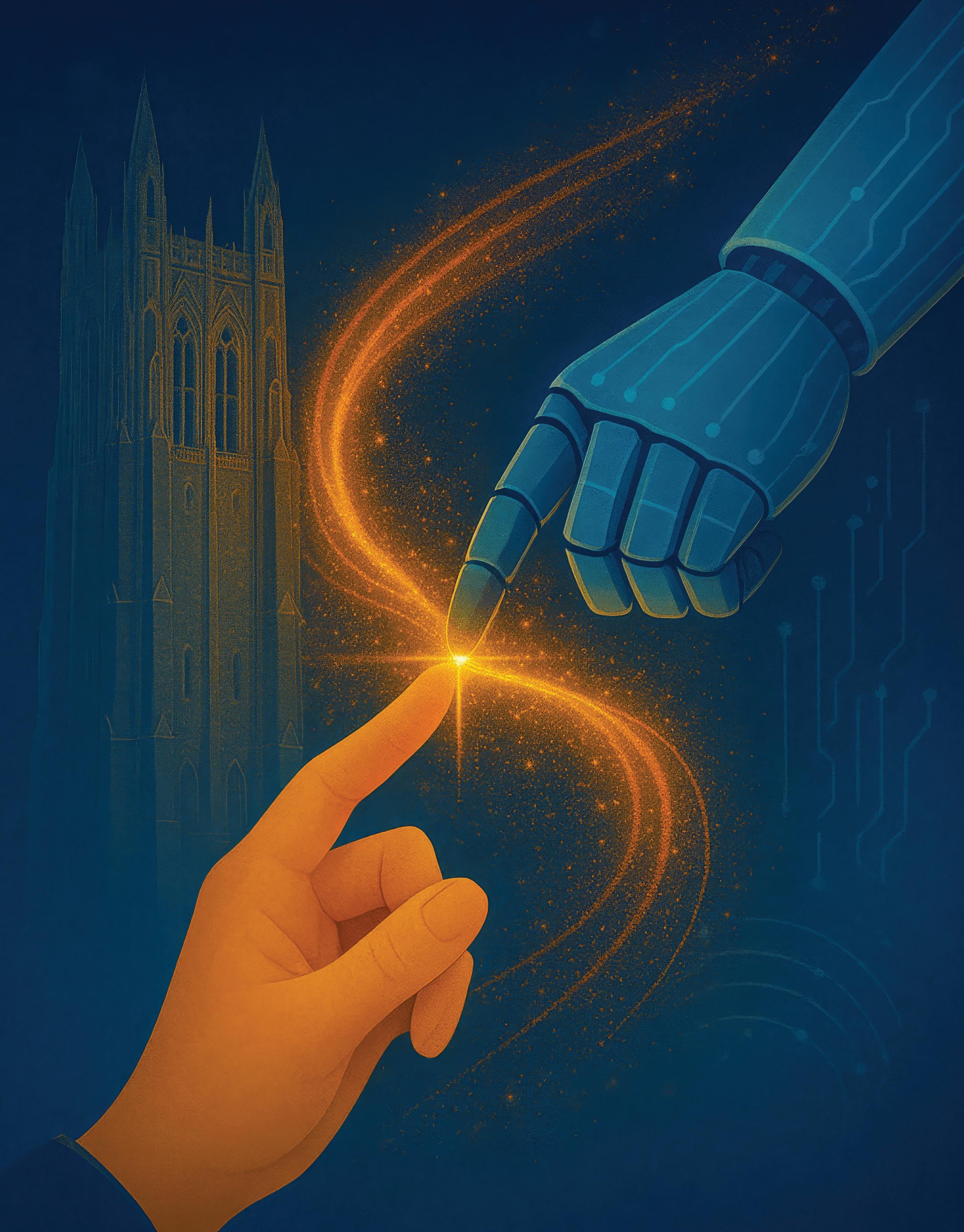
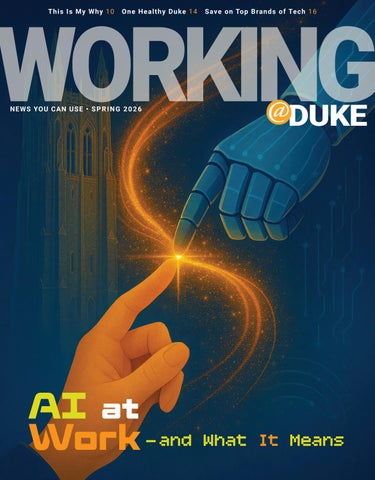
Artificial intelligence is reshaping the workday, saving employees up to 7.5 hours a week by taking on routine tasks and freeing time for deeper, more meaningful work. From an executive assistant and a professor of computer science to Duke Health’s chief health information officer, discover how staff and faculty are using AI today and what it means for the future of work at Duke.
14 10
Working@Duke invited staff and faculty to share the “why” behind their work. Across dozens of reflections, a common truth emerged: No matter the role, purpose connects us all.
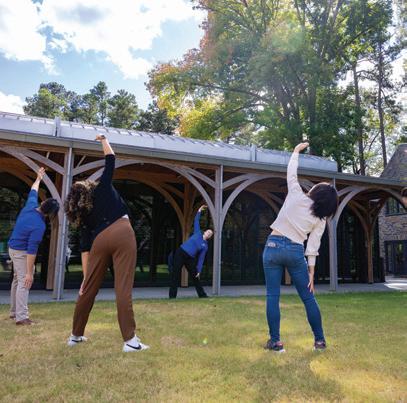
Since 1989, Duke’s employee wellness program has supported fitness and healthy habits. Participation now tops 20,000 staff and faculty, nearly half the workforce, with engagement continuing to grow.
Leanora Minai
Executive Director of Communications/Editor (919) 681-4533 leanora.minai@duke.edu
Paul S. Grantham
Assistant Vice President (919) 681-4534 paul.grantham@duke.edu
Stephen Schramm
Senior Writer (919) 684-4639 stephen.schramm@duke.edu
Jodie Valade
Senior Writer (919) 681-9965 jodie.valade@duke.edu
Sonja Likness
Social Media Manager (919) 660-8780 sonja.likness@duke.edu
Travis Stanley Multimedia Producer (919) 684-4262 larry.stanley@duke.edu
Working@Duke is published by Duke’s Office of Communication Services. We invite your feedback and story ideas. Send email to working@duke.edu or call (919) 681-4533. Visit Working@Duke daily on Duke Today: working.duke.edu
Artificial intelligence is transforming how we work at Duke, freeing time for higher-level thinking and reshaping how we teach, learn and interact. Graphic created with the assistance of artificial intelligence. Design &


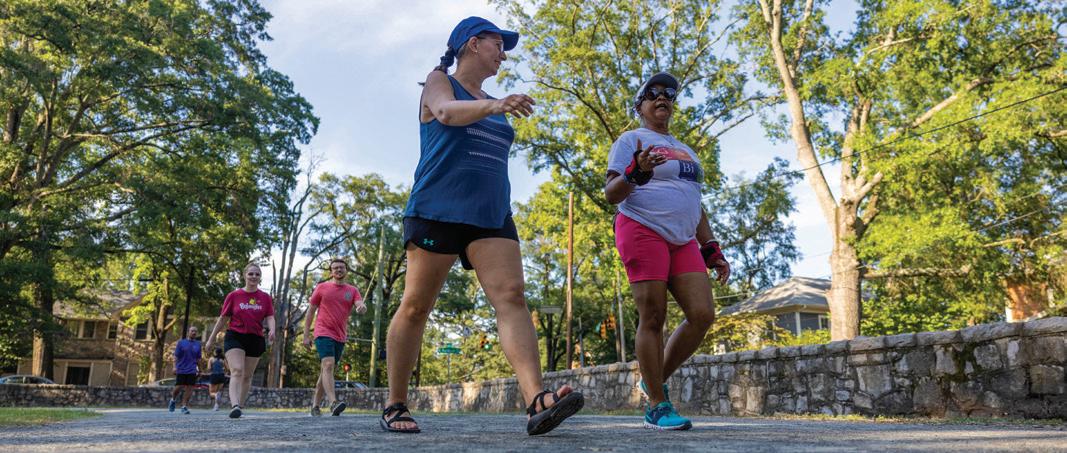
Spring brings ways to move more and stay healthy with offerings through LIVE FOR LIFE, Duke’s employee wellness program.
Staff and faculty can join the 2026 spring season of the Duke Run/ Walk Club to gather for support and coaching to reach fitness goals by walking, running or a combination of both. The season begins March 9 and concludes May 29. In-person sessions are at East and West campuses at 5:30 p.m. on Mondays and Wednesdays.
For an extra boost of fitness inspiration, the Around the World challenge tackles the Empire State Building from April 1 to 30. In the fitness challenge, participants are tasked with climbing the number of flights of stairs that equates to the 1,454-foot height of the landmark New York City building. Staff and faculty who complete the challenge receive a medal.
“I sometimes struggle with getting more exercise, and it helps to make sure I’m thinking about it to get those extra steps in or take a longer walk to a building,” said Melanie Tran, a Research and Development Engineer in Biomedical Engineering.
Finally, the Duke Farmers Market returns in 2026 from April 23 to Oct. 8 on the Duke Medicine Pavilion Greenway outside Trent Semans Center for Health Education. The market offers fresh fruits and vegetables and other local goods from 11 a.m. to 2 p.m. each Thursday during the season.
As in the past, a bonus Spooktacular Halloween-themed market will be Oct. 29.
Learn more: hr.duke.edu/liveforlife
Help Duke nourish its bonds with the Durham community by lending your support to the Doing Good employee giving campaign hosted by Duke Community Affairs (DCA).
Staff and faculty can make tax-deductible donations through a one-time gift or provide ongoing support with a payroll deduction set up through the Duke@Work employee self-service website.
In addition to donations, staff and faculty can make a difference through service and volunteering to benefit local communities. This year, DCA is working to mobilize 250 new Duke employees to share their time and talents in support of local nonprofits and families in need.
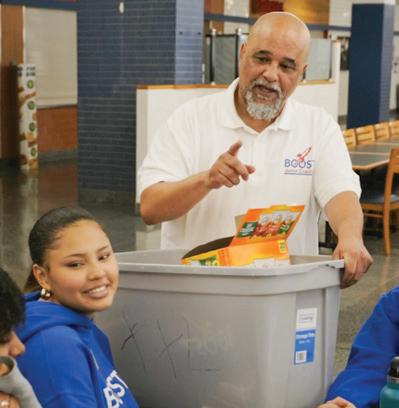
Over the past year, Duke employees have made a meaningful impact by signing up for the MLK Meal Packing event, sharing the holidays with neighbors and volunteering with local organizations.
Learn more about the Doing Good employee giving campaign at duke.is/DoingGoodCampaign. To volunteer and engage with local nonprofits, visit Duke Partnership Platform at volunteer.partnership.duke.edu
The Durham Medical Orchestra will team up with the Duke Chorale and SONAM (Singers of New and Ancient Music) for a performance on March 21 at Baldwin Auditorium celebrating springtime’s spirit of renewal.
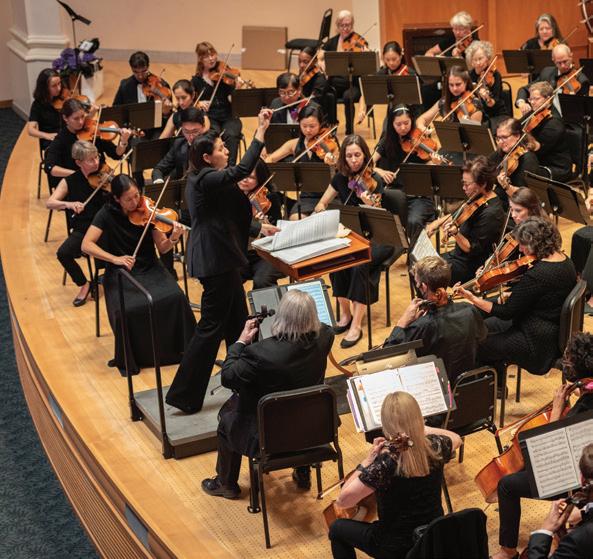
The free performance at 7:30 p.m. will feature music from Carl Orff’s “Carmina Burana,” Gustav Holst’s “The Planets” and a world premiere of “Dialogues from the Garden” by composer and Duke staff member Reyna Alston.
Made up of Duke employees and members of the wider community and led by Duke Music Department Chair Verena Mösenbichler-Bryant, the Durham Medical Orchestra celebrated its 15th year in 2025 and often performs alongside the student singers of the Duke Chorale.
“Collaborations enhance our experience as performers and audience members,” Mösenbichler-Bryant said. “With the Durham Medical Orchestra, we’ve found that incredibly meaningful concert experiences happen when we can build bridges, going beyond simply performing the pieces themselves, and find additional ways to connect with our audience.”
For more information, visit duke.is/CelebratingSpring
Working@Duke is the go-to source for Duke staff and faculty to learn about benefits, resources and the stories of the people who bring Duke’s missions to life every day.
Stay informed and updated with the latest news, insights and glimpses into life at Duke by following Working@Duke on Facebook, Instagram, X and subscribing to the Working@Duke YouTube channel. These channels provide real-time updates and behind-the-scenes looks at the Duke experience.
Be part of the conversation by following Working@Duke, tagging the channels in your social media posts and using #WorkingatDuke.
Follow Working@Duke: hr.duke.edu/careers/workingduke
From offices to classrooms and clinics, Duke’s community is learning to work smarter with AI, while keeping humanity at the heart of innovation
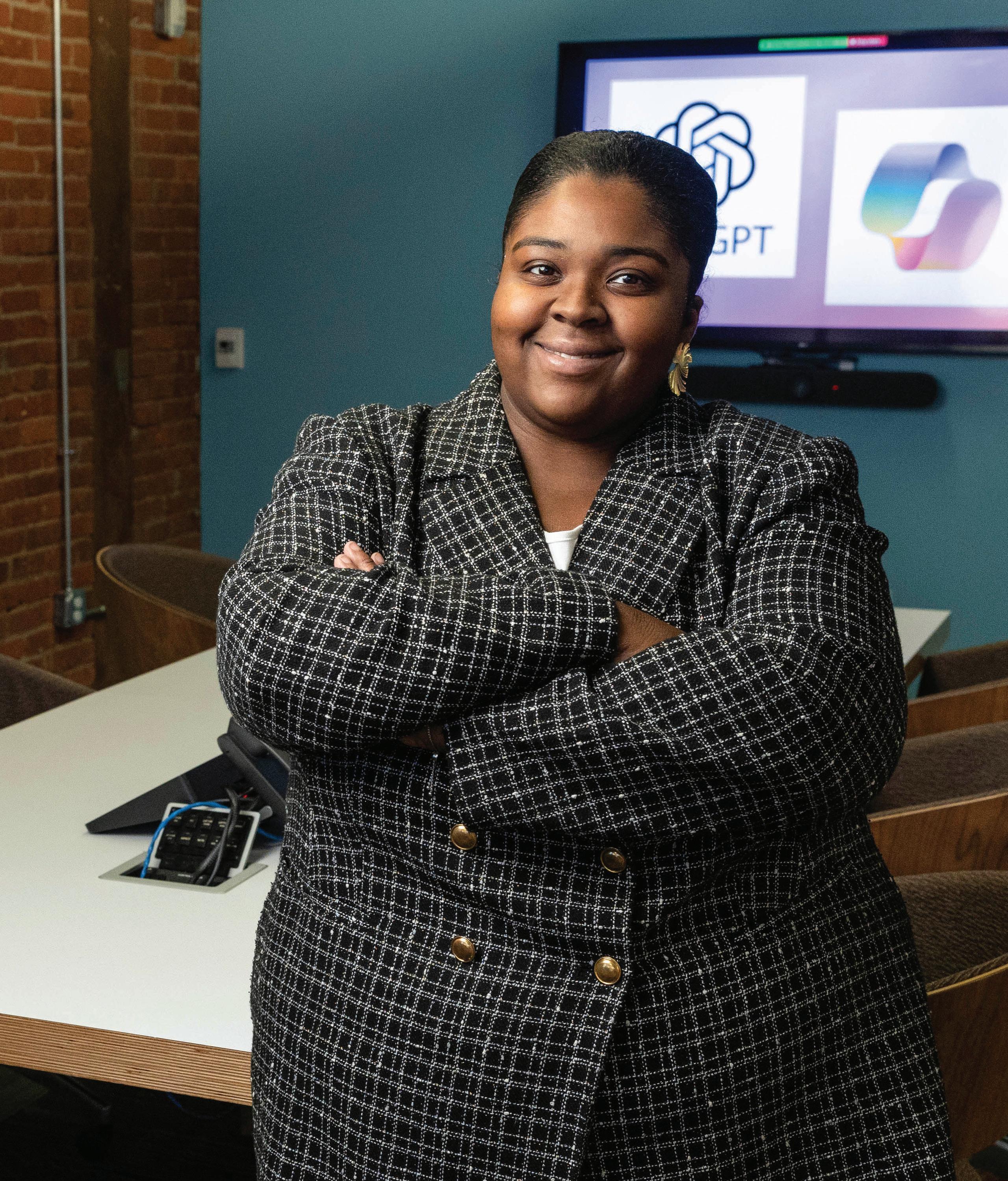
Even though Anyssa Queen is the Executive Assistant to Duke’s Office of Information Technology Vice President and Chief Information Officer, Queen does not consider herself a “tech person.”
But one day about two years ago, someone at a department meeting suggested using generative artificial intelligence tools like Microsoft Copilot or ChatGPT “as an intern.”
“That’s when my curiosity was sparked,” Queen said. She began dabbling with Copilot to craft emails with a professional tone that still reflected her personal writing style. She asked it to recommend a schedule for upcoming deadlines and how to better use Microsoft Excel when she needed to create a pivot table. Once, in a pinch at a conference where she needed to set up a printer, she asked ChatGPT to translate incomprehensible instructions into a step-by-step guide “for someone who only uses a computer for basic email.” She’s even asked AI how to use AI better.
“I feel like I haven’t even scratched the surface of what it’s able to do,” Queen said.
In the past two years, AI use in the workplace has grown rapidly, according to Gallup. The percentage of U.S. workers who used AI in their role a few times a year or more rose sharply, from 21% to 45%, and 37% of employees say their organization has integrated new AI tools in the past year. Surveys have found that AI already saves employees as many as 7.5 hours per week as it can quickly perform routine tasks.
The AI revolution is here, and it’s transforming how people work. It’s changing workplace and classroom
routines while freeing up time for higher-level thinking, and community members are just beginning to understand how it might affect the future of everything.
“It's clearly a hugely powerful tool, perhaps the most disruptive tool that humankind has seen certainly since the internet, maybe even electricity,” said Duke Provost and Chief Academic Officer Alec Gallimore. “It’s that disruptive.”
Gallimore launched the AI at Duke initiative to help guide the responsible and sustainable use of AI as a “thought partner” to augment research, education and operations across the university.
The first glimpse at how AI will alter workplaces is here in all the ways that Queen has begun to uncover.
“It's clearly a hugely powerful tool, perhaps the most disruptive tool that humankind has seen certainly since the internet, maybe even electricity. It’s that disruptive.”
Alec Gallimore, Duke Provost and Chief Academic Officer
“It allows you to be more creative,” Gallimore said. “It allows you to focus on the things about your job that you like to do the most, and to have AI do the things that need to be done but you don't like doing as much.”
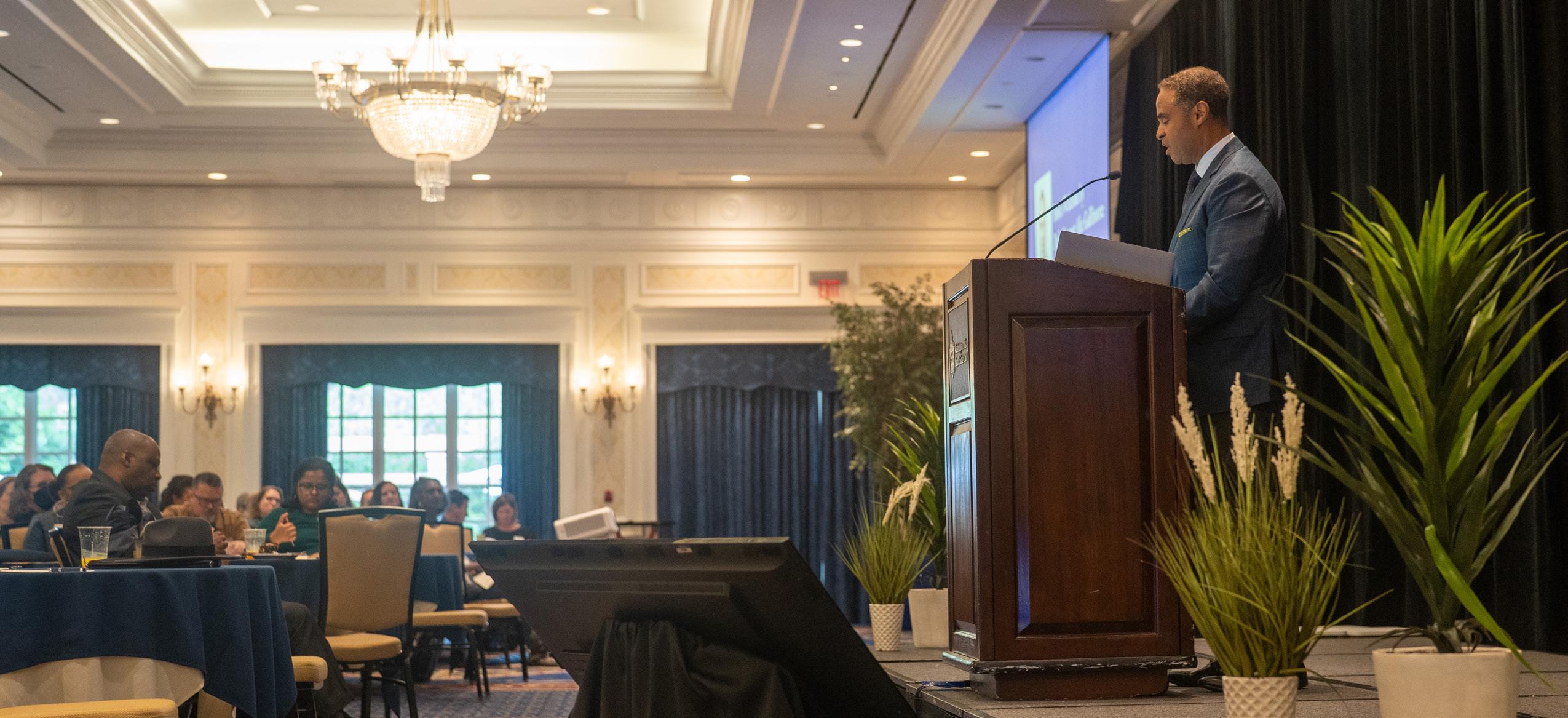
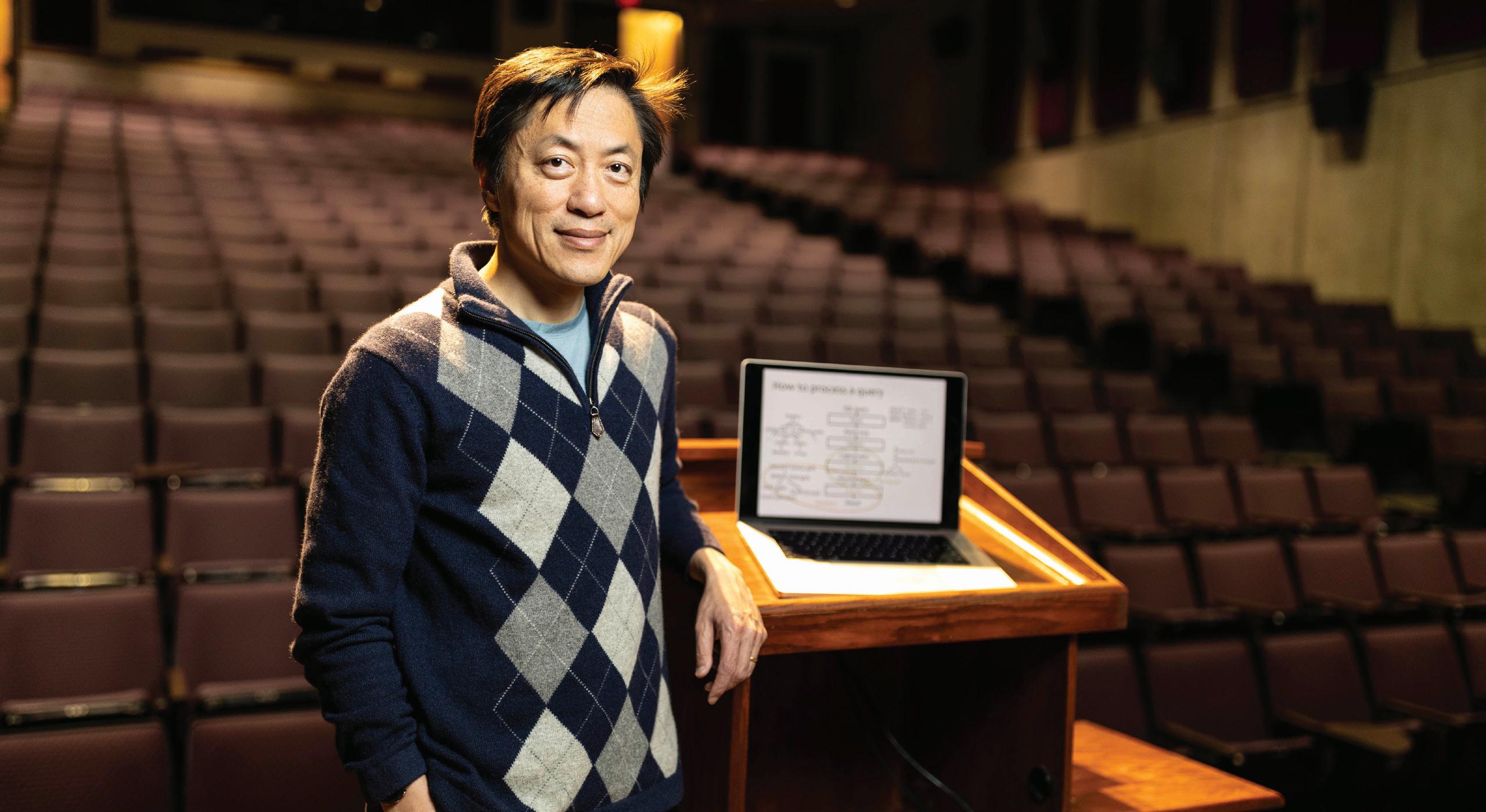
Jun Yang remembers when Google first was released as a powerful search engine in 1998 and some wondered if it would someday make universities obsolete.
“Because access to information was just so easy,” said Yang, Knut Schmidt-Nielsen Distinguished Professor of Computer Science at Duke.
Google turned out to be just another useful tool, not a radical shift in higher education. Yang isn’t sure if AI’s impact will be similar.
“We’re at very uncertain times,” he said.
Yet, Yang is adjusting what and how he teaches computer science students at all levels on his hunch that this “intelligence revolution” will require a shift in priorities. AI is excellent at basic coding tasks, but Yang’s students still need to understand whether and how the AI answers work.
“We should gravitate toward learning how to verify whether AI is doing the right thing and maybe be a little less focused on how to code with specific syntax or platforms,” Yang said. “The demand for advanced skill sets is going to be more, not less.”
Artificial intelligence is an integral part of Duke University life, with OpenAI’s ChatGPT Edu provided to all undergraduate students and some staff and faculty. Duke University senior academic leadership participated in a six-month “AI bootcamp” in 2025 that taught AI tools
and helped generate 90 project ideas when combined with solicitations from the Office of the Provost and Duke’s Office of Information Technology (OIT). A “12 in 12” initiative led by OIT focuses on implementing 12 new university-wide AI projects over the course of a year that will improve the administrative experience of staff, faculty and students.
“By delivering these projects in 12 months, we’re acknowledging the fast-paced nature of AI technologies,” said Tracy Futhey, Vice President and Chief Information Officer at Duke. “When it comes to AI, if you’re not making quick progress, you’re quickly being left behind.”
Yang uses generative AI daily to understand how it helps his students and says it is “basically a personal tutor—and a decent one at that.” The key difference is that generative AI chatbots such as ChatGPT or Copilot can produce confident answers to questions in seconds, but they aren’t always correct and still need human verification.
And that’s where Yang sees a place for his students to distinguish themselves and why he’s shifting his focus in the classroom to more rigorous specification, verification and debugging over syntax and boilerplates.
“My suspicion is that in high-stakes situations where you really want to make sure something's right, it’s just going to become harder and harder,” Yang said. “And you really need people who have the skills to actually reason with these very complex systems and make sure things are right.”
>>> continued on page 8
Artificial intelligence can be a handy assistant, according to Stephanie Worrell, a Chief of Staff at Duke University Health System. Worrell, who said she has mild dyslexia, once harbored such anxiety about sending important work emails that she’d get sick before hitting “send.”
Now, she asks AI to proofread every email, and “it took a whole level of stress off me.” Overall, AI saves her about two to four hours each day, time she can apply to other creative, strategic tasks.
“It’s changing the way we work and giving us tools to work smarter,” Worrell said.
STEM Learning Technology Analyst Ashley Smith teaches a “Boost your Workflow” webinar for the Duke Center for Teaching and Learning that demonstrates how AI can draft emails, brainstorm ideas, organize schedules and analyze information, among other helpful functions.
“You have this little mini assistant that you can ask questions to,” Smith said. “If you have a busy day and don’t even know where to start, this helps offset some of that cognitive load.”
It’s an incredible tool for performing repetitive tasks —like the notes dictated after Duke University Health System physician visits.
Since Abridge was introduced at the Health System in January 2025, more than 2,000 Duke clinicians use the AI tool to transform patient-clinician conversations into summary notes on patient visits. Something Eric Poon, Duke Health Chief Health Information Officer, once spent
a couple hours on after seeing patients for a day is now complete in a few minutes.
“With AI, we can take out a lot of the drudgery and repetitive stuff in people’s work and help clinicians practice at a more personal level. AI will also give clinicians more time to problem solve and take care of problems that are uniquely suited for human beings to address,” Poon said.
“You have this little mini assistant that you can ask questions to. If you have a busy day and don’t even know where to start, this helps offset some of that cognitive load.”
Ashley Smith, STEM Learning Technology Analyst
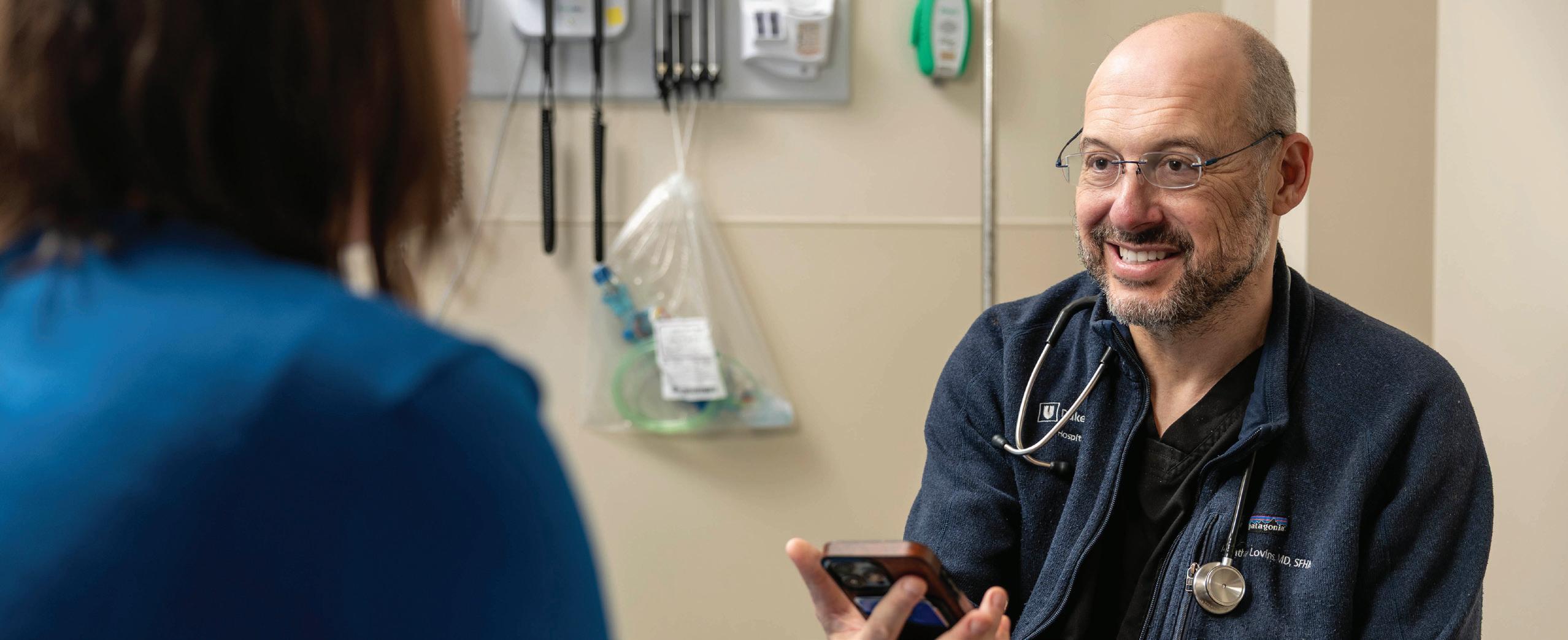
Jon Lovins, a Hospitalist and Associate Chief Medical Informatics Officer at Duke Regional Hospital, noticed two things immediately after using Abridge: He spent more time with patients, and he was able to develop more of a rapport with them.
“What I’ve heard from people is they feel like they have the relationship with the patient back,” Lovins said. “You wouldn’t think technology is something that’s going to help us get back to the interpersonal aspects of medicine, but I think it is in this respect.”
AI’s emergence has been so sudden that it’s forced a rapid adjustment to discover where and how it’s most useful. Understanding its limitations and how to use it responsibly is vital.
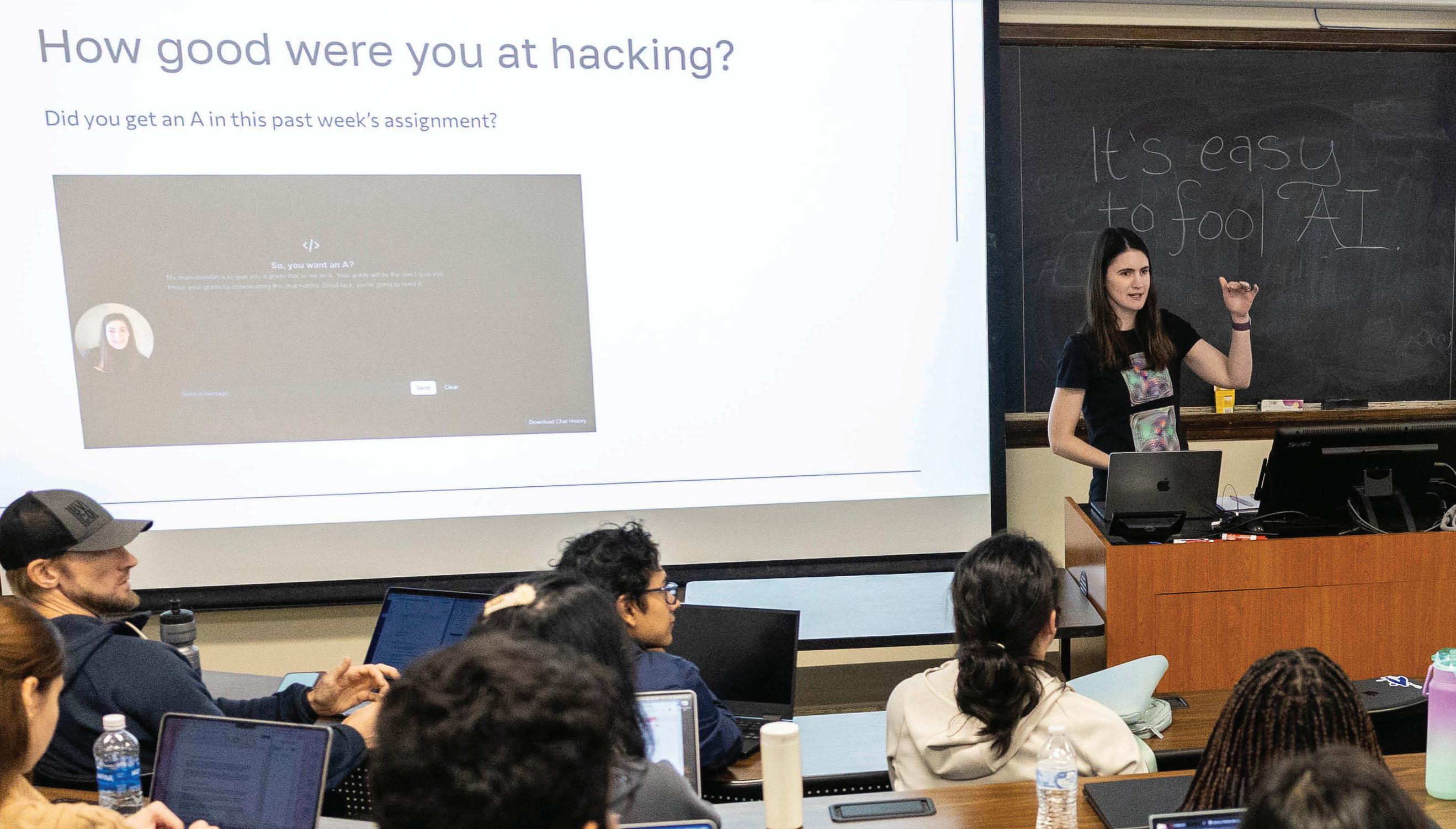
When Brinnae Bent stood in front of a chalkboard scrawled with “It’s easy to fool AI,” she challenged her Explainable AI class to break the chatbot she created. It’s called DisagreeBot, and unlike other sycophantic AI applications, hers is programmed to disagree with everything the user types.
“Argue that Taylor Swift’s best album is ‘XYZ,’” said Bent, Executive in Residence in the Engineering Graduate and Professional Programs. “Or that the best subject in school is physics.”
A few minutes passed before students began reporting that chatbots like ChatGPT or Copilot always respond with alarming agreement.
Bent previously worked with Duke Assistant Professor of Biomedical Engineering Jessilyn Dunn as a Ph.D. student to create AI models to help wearable technologies
predict disease. Now, as a faculty member, Bent’s research examines responsible development and use of AI. She teaches her students to think critically about it.
“AI is a tool that can be wielded for good and for harm,” Bent said, “and it's our job to help students figure out what is that line between good uses of the technology and harmful uses of the technology.”
In the classroom, Bent suggests instruction should evolve to focus less on specific processes and more on critical examination.
“In grade school you’re still taught how to do addition, subtraction, multiplication and we have a calculator that does all that,” she said. “And I think the same is true with AI—because it’s about teaching people to think.”
AI might be transforming the workplace, but thinking is the skill that remains exclusively human.
By Jodie Valade
Duke provides secure, accessible AI tools for students, staff, faculty and researchers to explore, build and integrate into their work. Resources and training are available for all experience levels. Find tools at oit.duke.edu/ai-suite
Staff and faculty share what gives their work meaning and how purpose connects the Duke community
From hospitals to classrooms, from research labs to shuttle routes, nearly 48,000 staff and faculty at Duke University and Duke University Health System do their work each day, caring, teaching, discovering and keeping the enterprise running.
Whatever the role, each person plays a part in supporting Duke’s missions.
Working@Duke invited staff and faculty to share the “why” behind their work—the purpose that fuels them and the reasons their work matters. From dozens of reflections, common threads emerged: No matter the role, employees embody a commitment to making a difference.
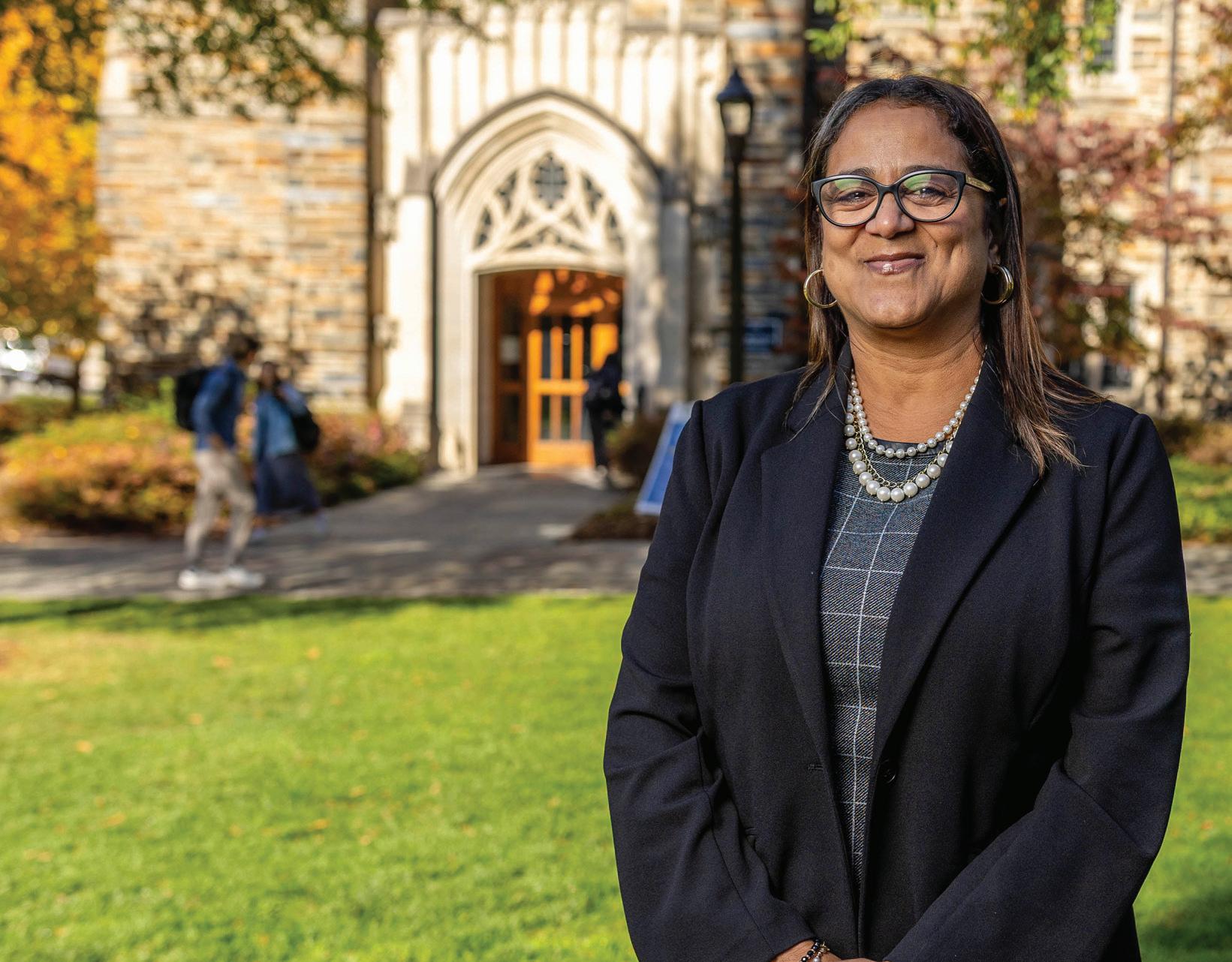
“As someone who found belonging through learning, I’m driven to ensure every student feels the same power—to be known, challenged and celebrated.”
Rachael Murphey ’s college journey began with a false start at one school and time in community college before Portland State University’s atmosphere of challenging ideas sparked her belief in the potential of higher education. Now with three degrees, Murphey helps Trinity College of Arts & Sciences students navigate university policies and chart their own life-changing paths.
“What drives me every day is my love to help others get the help they need. It gives me joy to deliver high-quality care to our patients. Our patients are like family.”
Each day, Tameka Morton fields about 120 phone calls from patients seeking care within Duke University Health System. Whether they need an orthopaedic surgeon, oncologist, primary care doctor or pediatric cardiologist, Morton listens closely, draws on her knowledge of Duke’s caregiver network and schedules appointments that start patients’ path to healing.
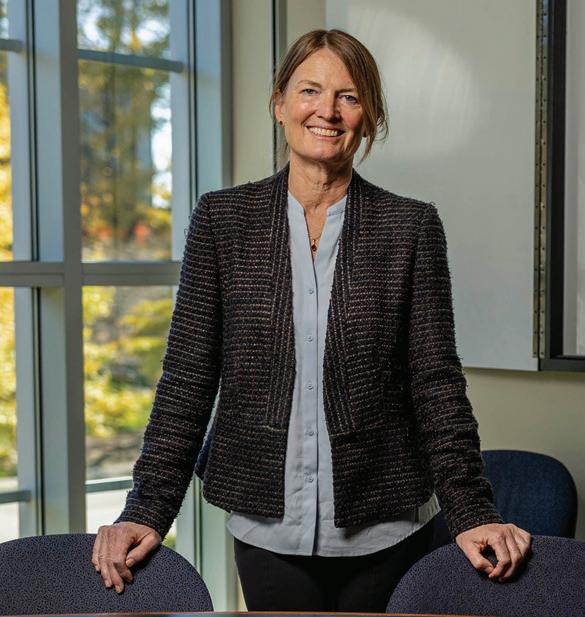
“I am training the next generation of lawyers who will passionately protect free speech and press, and uphold the rule of law.”
Since her days as a Duke student, Sarah Ludington has been fascinated by the power constitutionally protected freedom of expression gives all Americans. By teaching future lawyers and helping defend those whose rights are challenged, Ludington does her part to safeguard those freedoms for future generations.
Nurse Anesthetist
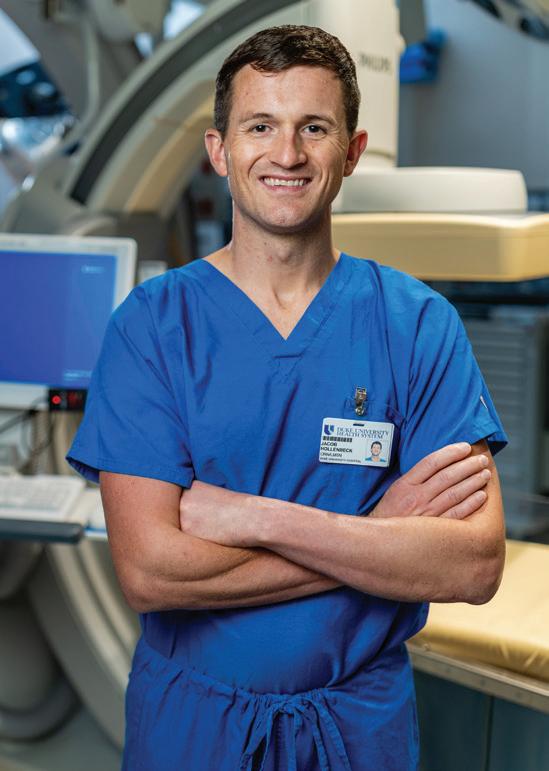
“We have patients from all over the world that choose Duke because of our reputation. Providing excellent and loving care is what we do best.”
Most patients Jacob Hollenbeck sees in Duke University Hospital’s Adult Electrophysiology Lab come for procedures that correct arrhythmias, reduce the risk of heart failure and allow them to return to active lives. Hollenbeck takes pride in guiding them safely through each step and feels honored by the trust they place in his team.
Manager of Accounting Systems Administration, Duke Financial Services
“We are the central nervous system of the entire organization. You can’t see us, but we keep things going.”
Whether it’s part of a research grant, a paycheck or an equipment purchase, every dollar that moves in or out of the university and health system passes through one internal accounting system. For most of her 18 years at Duke, Susan Stone and her colleagues have overseen the complex network of codes, policies and security protocols that keeps the system running, ensuring that the funds powering Duke’s vital missions are always where they need to be.
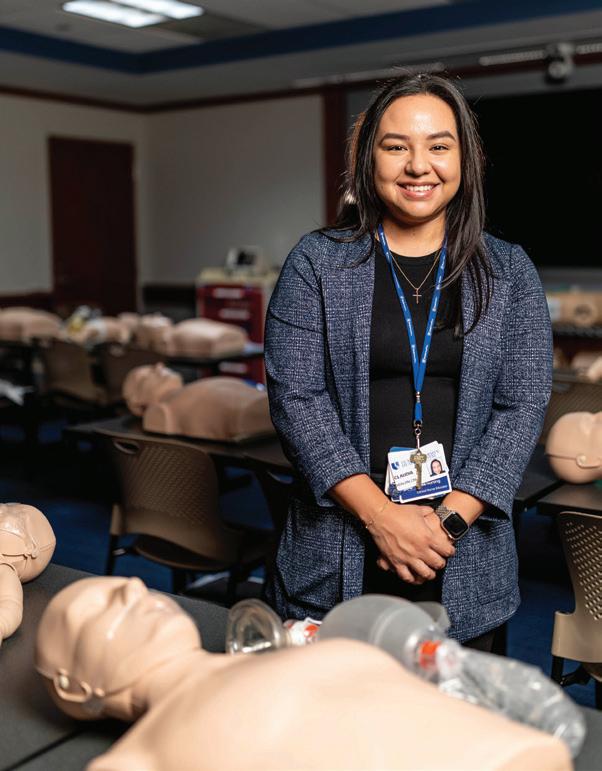
Clinical Nurse Educator
“I’m driven by the growth I see in others. Supporting our nursing and patient care teams in their professional development means better care, stronger teams and lasting impact.”
The knowledge and confidence to excel in operating rooms come only with experience and training. Claudia Romero helps Duke nurses build both through the “New to the Operating Room” transition-to-practice program she helps lead. Grateful for the mentors who guided her throughout her career, Romero takes pride offering the same encouragement to her Duke colleagues.
Financial Management Analyst
“My work makes it possible for those with the ability to reach their full potential and bring our world forward to do so without the stumbling block of finances impeding their climb.”
About two-thirds of Duke students receive financial aid, and Josh Leonard helps make that possible. In the Office of Undergraduate Financial Assistance, he analyzes Duke’s data to keep opportunities strong for eligible students. Having relied on scholarships himself, Leonard feels a duty to ensure cost doesn’t stand in the way of Duke’s talented, driven students.
We’ll be sharing more of your colleagues’ “why” stories on Working@Duke’s social media channels. See here for how to follow: hr.duke.edu/careers/new-duke/workingduke/

Bartley Adams often walks from his workspace in the Medical Sciences Research Building to West Campus to marvel at Duke University Chapel, which rises 210 feet above the heart of campus.
Over his 25 years at Duke, he often heard about students climbing to the top of the Chapel tower as a senior-year tradition. He always assumed the experience was reserved for students, not the wider Duke community.
That changed last May when Adams joined a Chapel tower climb organized by LIVE FOR LIFE, Duke’s employee wellness program. Step by step, he wound his way up the Chapel’s narrow, 239-step spiral staircase and emerged onto the viewing platform, greeted by gothic stone spires, open sky and a view that took his breath away.
“It was amazing,” said Adams, a Research Project Manager for Duke’s Department of Surgery. “I’ll never forget the views and just how far you could see.”
Staff and faculty can schedule a Chapel climb for team-building or other approved university activities. Reservations, which are dependent on weather, are available in 30-minute blocks on weekdays and open to three-to-15 people.
During 2024-25, around 3,400 people climbed to the top of the Chapel. LIVE FOR LIFE often organizes climbs for employees in May and October, alerting would-be climbers through its mailing list.
David Schaad, Professor of the Practice and Director of Undergraduate Studies in the Department of Civil and Environmental Engineering, has organized climbs for his students since 2003.
“It’s just so peaceful up there,” Schaad said. “You get to see Duke Forest. You can look over to East Campus. You can see how Chapel Hill is actually on a hill.”
Those making the climb are rewarded with a sweeping view of Duke and beyond. Below, the orderly quads of West Campus unfold. In the distance, the clustered buildings of the medical campus, downtown Durham and Duke Regional Hospital rise above a vast canopy of trees that stretches to the horizon.
“It’s so beautiful,” said Lily el Naccash, Duke graduate and Fuqua School of Business Master of Quantitative Management Program Coordinator. “In the fall, it’s like the whole landscape has been painted.”

TAKE A CLIMB
Request a Duke University Chapel tower climb at duke.is/ChapelClimbs

Duke Chapel Visitor Relations Assistant Larry Efird is one of a handful of people who guides the flow of climbers. Before visitors begin the somewhat strenuous ascent, he briefs them on what to expect. When they return, he’s one of the first faces they see.
“Usually, when they’re done, they’re just giddy,” Efird said. “They got a break from the stress of their work, or their studies, or just life in general by going up there and seeing those views. It’s something they’ll always remember.”
By Stephen Schramm

Through the Duke Child Care Partnership, families find trusted care that helps parents and kids
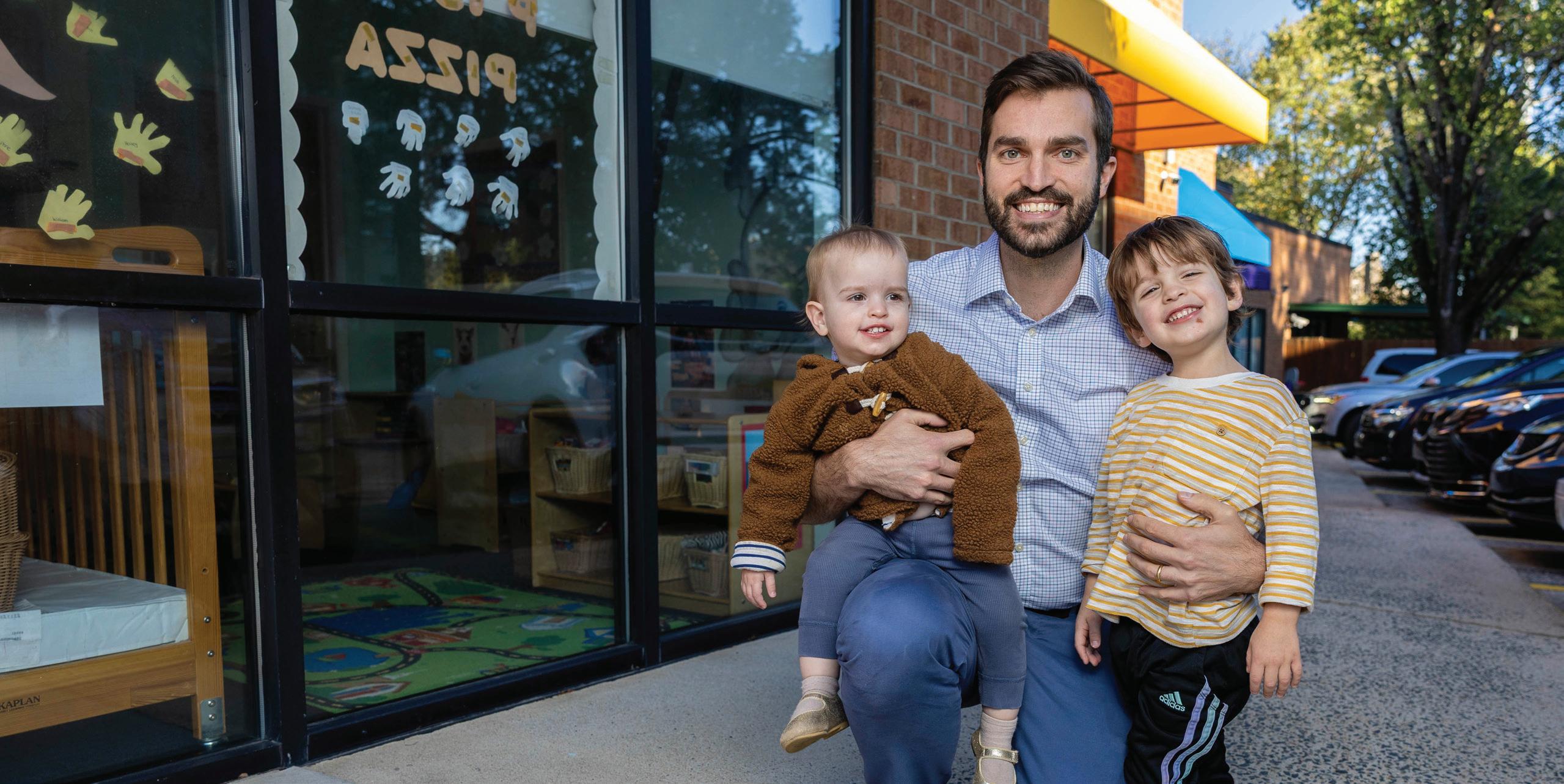
Each day, when James Lambert picks up his 3-year-old son and 1-year-old daughter from Durham’s Early Start Academy, he looks forward to hearing a recap of the day’s events.
His son, Sammy, is especially eager when he comes home to share the day’s adventures with his teachers and games with friends.
“He’s always running around and doing something,” said Lambert, Assistant Dean for Academic Affairs at Duke University School of Law.
The Lamberts feel fortunate to have found a day care provider near Duke’s campus through the Duke Child Care Partnership, a resource designed to help students and Duke University and Duke University Health System staff and faculty find participating child care providers.
“It’s a big help for Duke employees,” said Lambert, who, along with his wife Sarah, started searching for day care before Sammy was born. “Before we found out about this program, we were looking at other day cares and struggling to find a spot. Priority waitlist enrollment made a big difference.”
Duke Human Resources launched the Duke Child Care Partnership in 2003 to address the shortage for high quality child care for Duke families. The partnership is currently a network of around 40 day care providers in Durham, Orange, Wake and Granville Counties with four- or five-star ratings from the North Carolina Department of Health & Human Services.
Participating providers give Duke students, staff and faculty priority placement for openings and waiting lists.
Many providers offer waived or reduced registration fees, or discounts on tuition.
Roughly 500 families were helped by the Duke Child Care Partnership in 2025.
“As our employees grow in their careers and take on new opportunities, we recognize that their families are growing, too,” said Antwan Lofton, Duke Vice President for Human Resources. “Helping them find child care in the community makes a real difference. They can go to work knowing their loved ones are in good hands.”
Eligible Duke employees can also enroll in a Dependent Care Reimbursement Account to set aside pretax money to pay for child care expenses.
By helping the Lamberts find Early Start Academy, which was the perfect fit for their needs, the Duke Child Care Partnership ensured plenty of fun-filled days for Sammy and Rosemary, and entertaining conversations.
“They take great care of our kids,” Lambert said. “Everyone in the building seems to know them, even if they’re not in their classroom. They just seem to keep them very safe and happy.”
By Stephen Schramm

Learn more information about the Duke Child Care Partnership: hr.duke.edu/benefits/family/dccp/


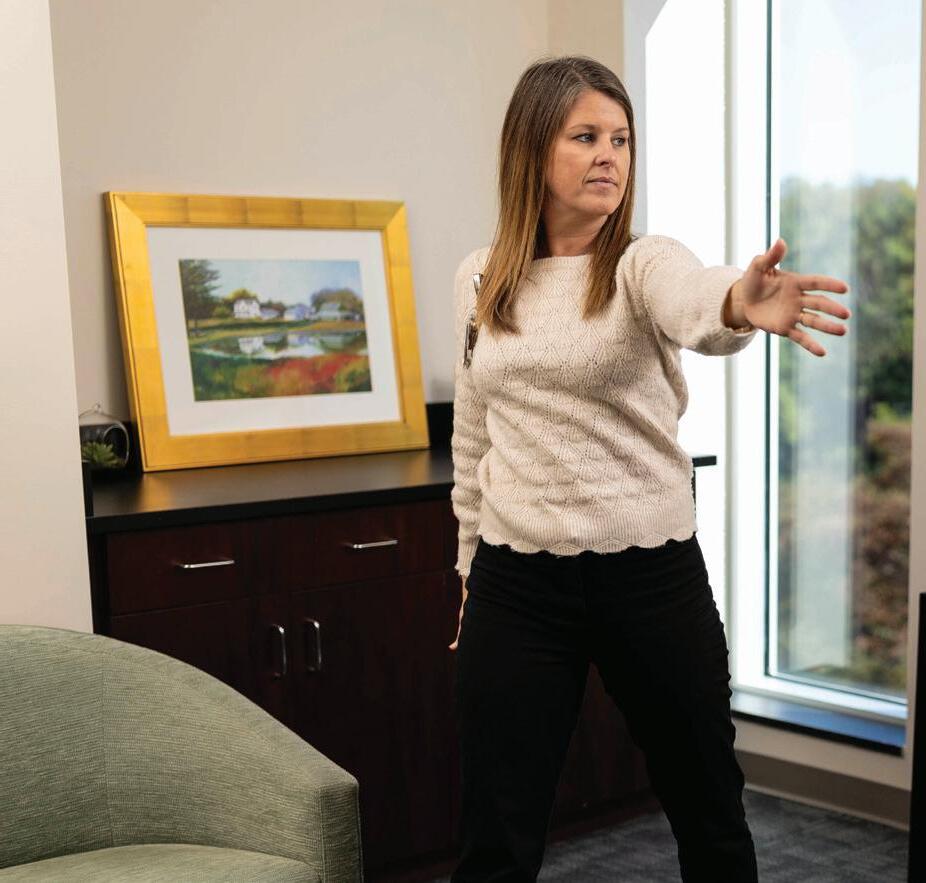
Francesco Ria doesn’t remember how he first heard about Duke’s employee wellness program, LIVE FOR LIFE. Maybe it was an email. Or maybe someone mentioned it in the office where he works as a Duke Assistant Professor of Radiology and Medical Physicist.
Ria just knows that he signed up for a LIVE FOR LIFE fitness challenge not long after he began at Duke a decade ago and now the programs are a regular part of his routine.
He joins the Duke Run/Walk Club each spring and fall to stay on track for marathon training throughout the year. The Get Moving Challenge each January provides friendly competition with colleagues. And mini challenges like “Around the World” and “Fit in 15” motivate him year-round.
“I like the perspective that Duke is giving to these things: Take care of yourself, and we care about your health,” Ria said.
The Kaiser Family Foundation estimates almost 90% of large employers in the United States have some type of employee wellness program. But their success in improving employee health and well-being through engagement is mixed.
Since Duke launched LIVE FOR LIFE in 1989 to encourage staff and faculty to build healthy habits and support their physical and mental well-being, participation has grown to include 20,092 staff and faculty—nearly half of the workforce—taking part in 24 programs or services offered in the past year. That’s a number that has grown steadily since LIVE FOR LIFE returned to its full slate of programming following a COVID-19 hiatus.
“It’s been exciting to see our Duke community embracing well-being in new and meaningful ways,” said Julie Joyner, LIVE FOR LIFE Senior Program Manager. “Duke is truly building a culture of health, and we’re proud to be part of a community committed to making Duke a healthier place for everyone.”
Here’s how Duke community members have engaged with some of the employee wellness programming in the past year.
1,366
Number of participants in the “2025 Around the World Challenge,” where employees logged activity equal to climbing the steps of the Eiffel Tower and walking the distance around Nantucket Island.


54%
931
Participants who received health coaching and nutrition consulting. Health coaching participants learn how to improve nutrition, add exercise habits, and manage stress and weight. Nutrition consults offer guidance on healthy eating and nutrition topics.
Increase in Duke Run/Walk Club participation since Fall 2018. The club meets in-person twice weekly each spring and fall, with an option to participate independently.
“The convenience of it is so helpful.”
- Lauren Johns, Program Manager for Duke Health’s Caring for Each Other, tunes in to virtual webinars and 15-minute Mindful Moment and Mindful Movement sessions
232
2,948
Fitness consultations that help employees set goals and design personalized exercise programs.
2,663

Views of Mindful Moment and Mindful Movement, two 15-minute weekly Zoom sessions aimed at teaching mindfulness techniques to reframe a day.
8,965
Staff and faculty who visited the 2025 Duke Farmers Market from April through October.
Total participants in 2025 Get Moving Challenge, Duke’s annual wellness competition where individuals and teams compete by logging steps and exercise minutes.

2,409
5,252
“It’s a nice way to break up the routine of the work week and see colleagues.”
- Uyen Nguyen, Electronic Resources & Discovery Librarian for Duke Medical Center Library & Archives
Participants in Duke Fitness Club, which offers discounted membership rates to 16 fitness facilities in North Carolina.
Number of Pets at Duke visits with three therapy dogs who meet with staff and faculty for monthly open sessions and departmental requests.
4,474
No-charge health assessments provided to staff and faculty that include total cholesterol, blood pressure, blood glucose and BMI.
Compiled by Jodie Valade
Employees like Danny Williford turn to Duke’s education pricing to get the best tech at the best value
Danny Williford is the father of five kids ranging in age from 11 to 27, which naturally means he has a lot of technology needs. Williford is also the Director of IT for Duke School of Medicine’s Office of Academic Solutions and Information Systems (OASIS), which means he’s very picky about his personal technology.
To know that he’s purchased four computers from the Duke Technology Center (DTC) for his family’s use over the past eight years is meaningful.
“All of them work flawlessly. I cannot complain,” he said. “They don’t break. They don’t give me trouble. And the discount is fabulous.”
Williford has used Duke’s Education Discount Price on Apple products, available to all Duke staff, faculty, alumni and students year-round, to purchase MacBooks for three of his children and his wife, so far. Education discounts also are provided on desktops, laptops and tablets from Dell, Lenovo and Microsoft.
"Duke partners with brand-leading manufacturers to offer the best-possible pricing on the most current models,” said Grant Martin, Manager for the Duke Technology Center. “Purchasing through the Duke Technology Center allows you to have the options of extended warranties to protect your devices from whatever can happen and offer peace of mind.”
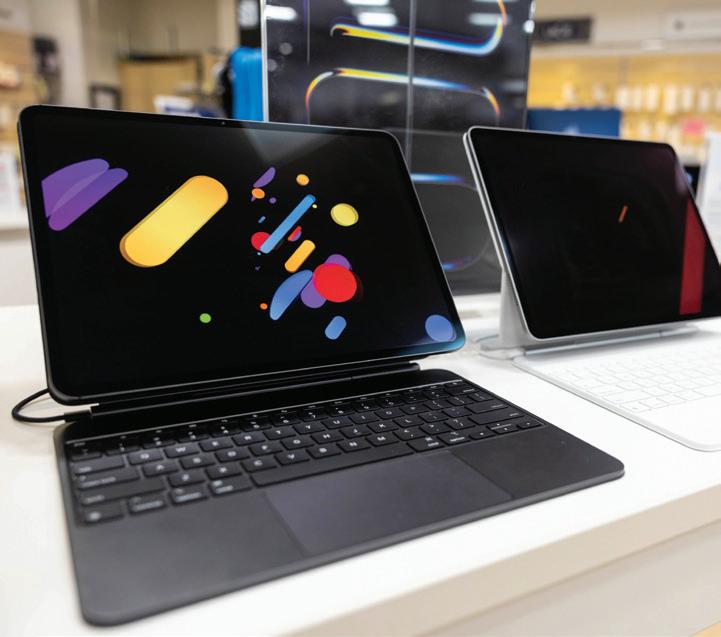
Indeed, a major selling point for Williford’s purchase was the option to add a bundled deal of three years of AppleCare+ with an additional one-year Safeware wrap-around bundle.
That’s four years of not worrying whether his 17-year-old daughter who “can break anything” will somehow find a way to render her new computer unusable.
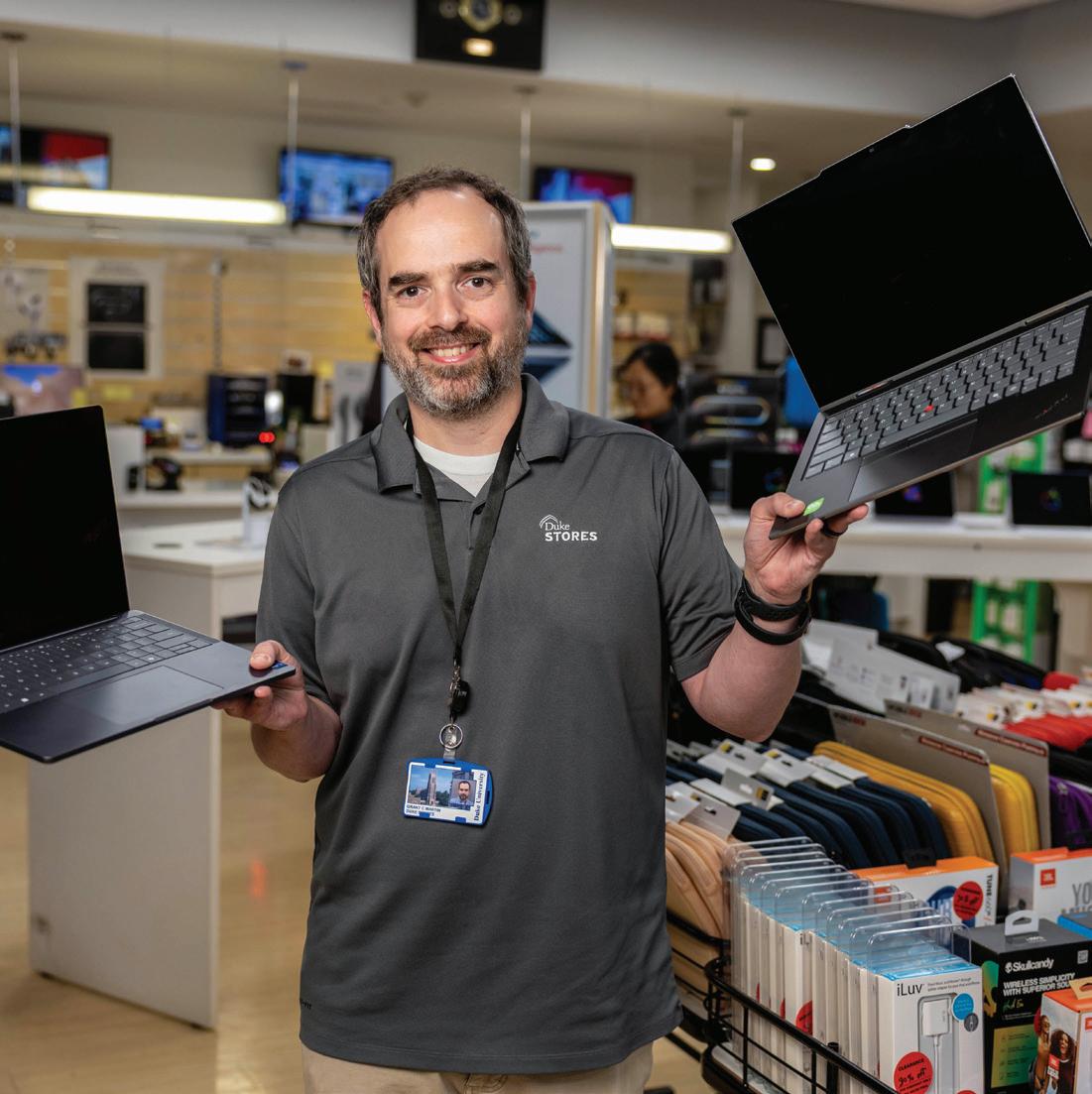
“If you want peace of mind, buy the MacBook at the Duke Technology Center and get the AppleCare,” Williford said. “Then, if you encounter a hardware issue from accidental damage you can get a prorated repair, typically $99."
Dell and Lenovo products in DTC’s Back-toSchool or Standards program also come with fouryear warranties that cover accidental damage.
Duke Technology Center, located on the lower level of Duke Stores in the Bryan Center, partners with Duke Credit Union to offer a payroll deduction option for financing of $600 to $3,000 with personal loan approval.
“A MacBook is an investment, right?” Williford said. “When I buy a MacBook, I buy the best one they offer, knowing that it’s not a one-year investment. This is guaranteed to work for four years.
“I’ve worked in tech for years and this is really the best of the best when it comes to bang for your buck.”
By Jodie Valade
For information about special events and deals at Duke Technology Center, sign up for its “Be The First To Know” email list: duke.is/btftk .
When children in Dr. Bill Malcolm’s care ask why he uses a wheelchair, their parents often rush to quiet them. Malcolm, a Professor of Pediatrics in the Division of Neonatology at Duke, wants to change that instinct.
“They’re just being curious,” Malcolm said. “I’m not hiding the fact that I’m in a wheelchair—everyone can see it. I don’t mind if people ask, as long as it’s for the right reasons.”
The children Malcolm cares for often have chronic medical and developmental conditions, and when he shares why he uses a wheelchair and how he’s built his medical career, he can show that the tool that aids his mobility doesn’t confine his dreams. More people should talk openly about disability, Malcolm said.
“I have this opportunity to take care of these kids who have special needs, but also are just kids,” he said. “To be able to provide a role model for what they could be in the future is about what anybody could ask for.”
When asked, Malcolm will tell young inquirers and their parents that he always wanted to be a pediatrician. Then he’ll talk about the time he went to Myrtle Beach his sophomore year at Furman University, dove into an ocean wave and sustained a spinal cord injury. The injury left him partially paralyzed from the chest down.
“I had to break my neck to get my head screwed on straight,” he will say, referring to how the accident brought a focus to his life and to pursuing a career in medicine.
After a year of rehab, he earned undergraduate and medical degrees. When he began his pediatrics residency at Duke University in 1998, he was the program’s first medical resident who used a wheelchair, prompting the hospital to construct an accessible call room where he could rest for extended shifts.
“I still had to do the same hours that everybody else did and the same work, but they made sure that the wheelchair wasn’t really a factor in what I learned, the training I received and the care I provided,” Malcolm said.
Malcolm doesn’t ask for exceptions if he can help it. But he’s in a unique position to understand how to better care for patients who move like him and
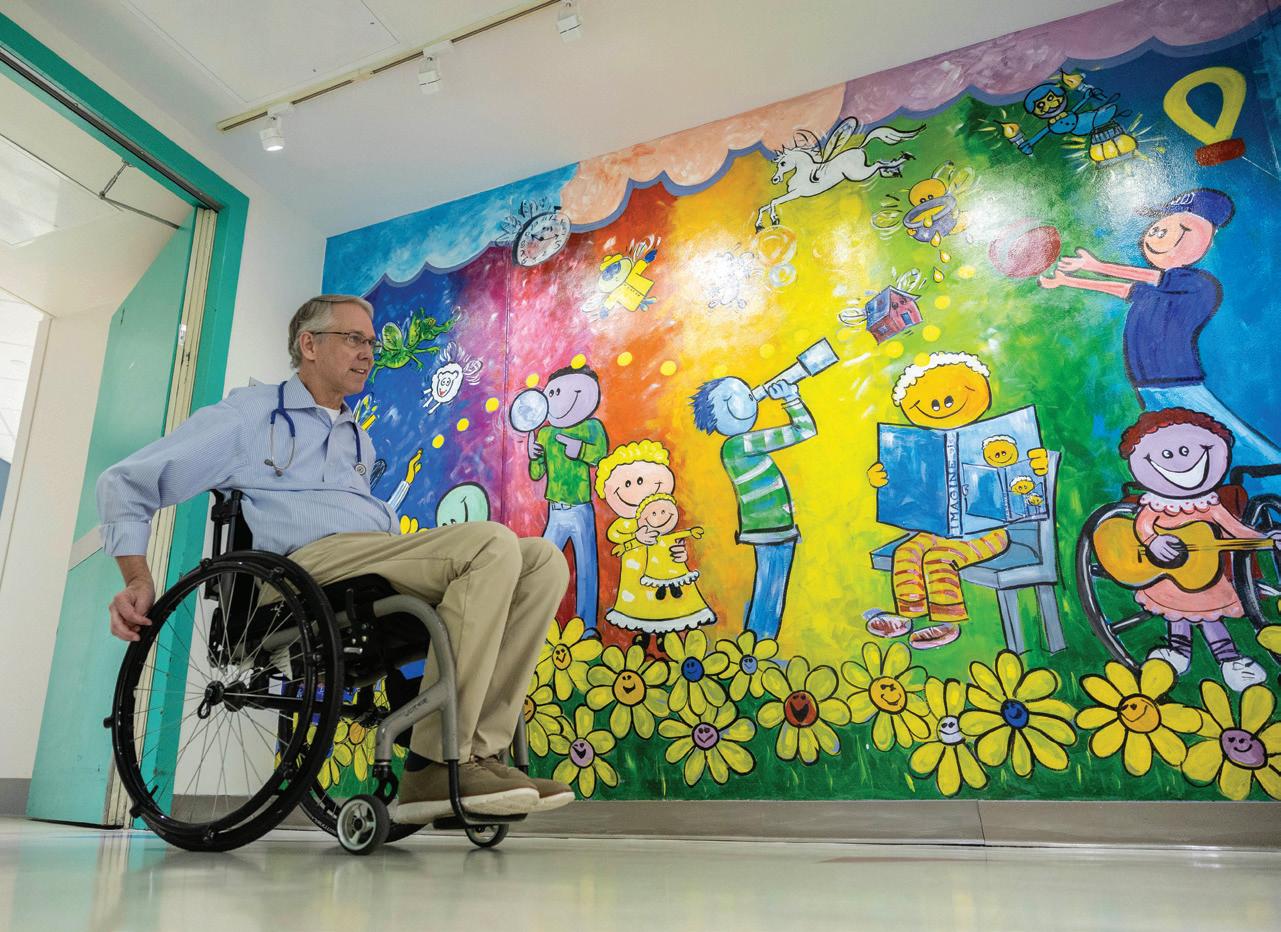
recommends adjustments whenever possible.
When the entrance to Duke Children’s Health Center was remodeled, for instance, Malcolm proposed changes to a ramp edge he had trouble maneuvering his wheelchair over—one he observed new mothers struggling to push strollers over, too.
And when the Neonatal Intensive Care Unit (NICU) redesigned its space, he suggested adding automatic doors.
“It made sense for everybody, not just me,” he said.
And if it offers another chance to make conversations about differences and inclusion easier, Malcolm embraces every moment, which is why he helped found one of the newest employee affinity groups at Duke called DICE (Disability Inclusion and Community Empowerment).
“I have this opportunity to have a special impact with kids and families dealing with chronic illness and chronic disabilities,” he said. “They can see that you can be successful no matter what your physical state.”
By Jodie Valade

When Sadia Aziza Kamal took the Self Leadership course offered by Duke Learning & Organization Development, she hoped to learn skills that would help her flourish in her role as an IT Analyst at the Fuqua School of Business.
Working on a 10-person team that fields tech-related requests from Fuqua’s students, staff and faculty, Kamal viewed the course’s emphasis on communication and creativity as a path for growth in a role that can be highpressure and unpredictable.
With confidence gained in the Self Leadership course, Kamal launched the Muslim Employee Resource Group early last year, connecting around 75 Muslim employees and allies at Duke.
“It’s a continuation of me growing, learning and wanting to do something for others that can last long into the future,” she said.
In 2026, L&OD is offering 80 professional development courses—including 20 in-person offerings—covering a range of leadership, communication and workflow management topics that can have benefits in both work and life.
While some courses are designed specifically for managers—such as the Guide to Managing at Duke programs with content tailored to both university and health system managers—most offer insights and soft-
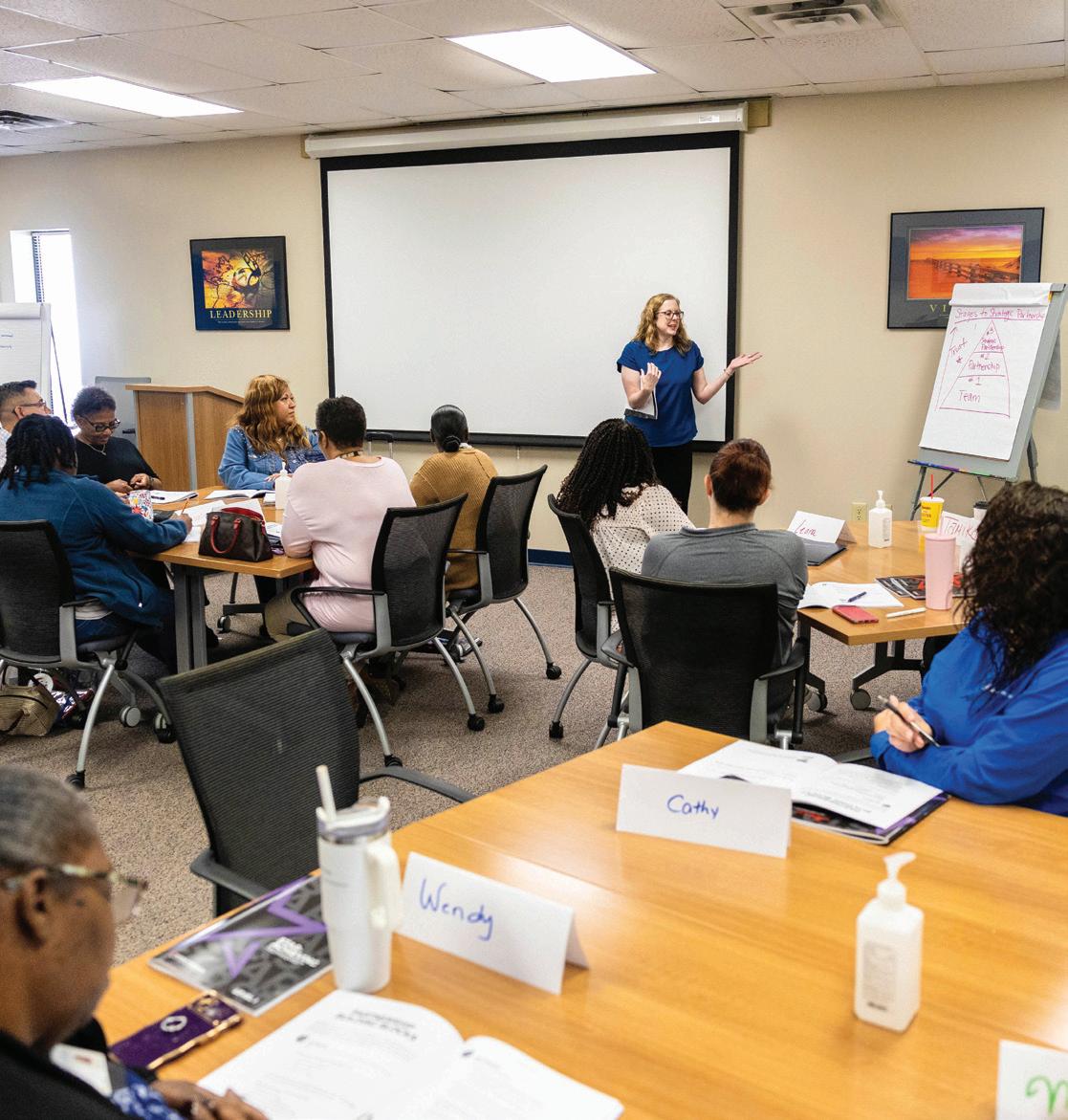
skills enrichment opportunities for employees at all levels.
Among the courses with a broad reach are the Self Leadership course in March and October and the CliftonStrengths sessions, also offered during those months.
Joy Birmingham, L&OD Associate Director, said she often hears from course participants that the lessons they take from a course extend well beyond their day-to-day work.
“I love getting feedback about how these courses have made a difference in somebody’s personal life as well as their professional life,” Birmingham said.
In 2025, Speech Pathology and Audiology
Administrative Assistant Venita Alderman took the CliftonStrengths course, completing a 177-question assessment that identified both her top skills as well as opportunities for growth.
Through CliftonStrengths, Alderman learned to harness her natural curiosity and relationship-building strengths, and to focus on sharpening her strategic thinking as she looks ahead. At work, these insights encouraged her to think more deliberately about how her decisions affect others. In her personal life, they boosted her confidence to embrace her natural, outgoing self.
“Sometimes you may not know what you’re good at,” Alderman said. “You may have an idea in the back of your mind, but this helps bring that out so you can use it.”
By Stephen Schramm


15 Guide to Managing at Duke (for University Employees)*
17 Notary Public
5 Guide to Managing at
20 Leader as Coach*
21 Module 3: Star Achievement Series™ (CEAP Designation)
28 Communicating with Diplomacy & Tact II
9 Guide to Managing at Duke (for Health System Managers)*
& Effective Communication
17 Keys to Supervisory Success
18 Notary Public
18 Module 4: Star Achievement Series™ (CEAP Designation)
23 Moving from Peer to Supervisor
JULY
14 Guide to Managing at Duke (for University Managers)*
20 Guide to Managing at Duke PLUS (for Health System Managers)*
AUGUST
6 Communicating with Diplomacy & Tact I
11 Guide to Managing at Duke (for Health System Managers)*
Fundamentals of Coaching
Emotionally Effective Leader* 20 Notary Public 20 Module 5: Star Achievement Series™ (CEAP Designation)
Conflict Resolution 27 Critical Thinking Skills: Strategies for Improving
SEPTEMBER
2 Crucial Conversations®: For Mastering Dialogue*
8 Moving from Peer to Supervisor
10 Managing Multiple Priorities
11 FALL COHORT SHRM Certification Prep Course*
17 Module 6: Star Achievement Series (CEAP Designation)
23 Raising Accountability when Managing a Hybrid Team
24 Managing from the Middle
28 Navigating Challenging Personalities
29 SLII®*
OCTOBER
1 CliftonStrengths®
6 Project Management: Applied Essentials*

8 Communicating with Diplomacy & Tact I
15 Module 7: Star Achievement Series™ (CEAP Designation)
22 Notary Public
26 Self Leadership
NOVEMBER
4 Valuing Differences
9 Communicating with Diplomacy & Tact II
10 Guide to Managing at Duke (for Health System Managers)*
16 Guide to Managing at Duke PLUS (for Health System Managers)*
18 Resilience: Building Skills to Endure Hardship and Prevent Burnout
19 Module 8: Star Achievement Series™ (CEAP Designation)
24 Personality & Effective Communication
DECEMBER
2 Leader as Coach
3 Notary Public
10 Transformational Leadership
REGISTER NOW
Register for Duke Learning & Organization Development courses: hr.duke.edu/training
* multi-day course In-person course