
Truth in Crisis Symposium

Page 1


In conjunction with the Wolf Humanities Center’s 2025–2026 Forum on Truth, this interdisciplinary symposium engages experts in an exploration of truth(s) contested or revealed in crises across panels on Institutions of Learning, Land and its Technologies, and Borders. In the framing, we take our cue from Sara Ahmed (2010), who understands crisis, perceived and described, as constructed; a crisis necessitates the identification and defense of shared norms and values, a world and its inhabitants, against that which threatens. The articulation of crisis thus reveals and contests truth(s) that are, by presentation, matters of survival.

Held at the University of Pennsylvania’s Kislak Center for Special Collections, Rare Books and Manuscripts, this one-day symposium will begin with a highly anticipated keynote featuring Althea Wasow from University of California, Santa Barbara. The day's discussions will bring together scholars from various disciplines to expand upon questions of crisis, its meanings and manifestations in the modern and contemporary world, and the role of truth in surviving.

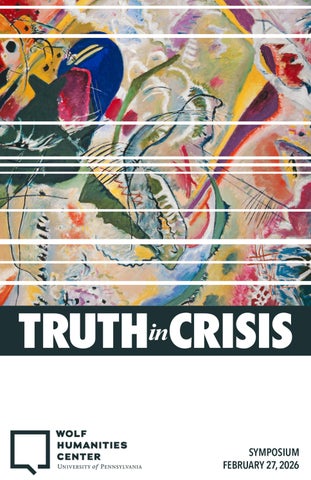
Cover image adapted from Improvisation 35 by Wassily Kandinsky. 1914. Oil on canvas. 43.3 ×

47.2" (110.0 × 120.0 cm).

A symposium of the Wolf Humanities Center's 2025–2026 Forum on Truth

Friday, February 27, 2026

Kislak Center for Special Collections, Rare Books and Manuscripts Van Pelt Library University of Pennsylvania

Symposium organized by the Wolf Humanities Center's 2025–2026 Research Associate Caitlin Adkins; Doctoral Fellows Priyamvada Nambrath, Tiffany Nguyen, Austin Svedjan, and Eleanor Webb; and Mellon Postdoctoral Fellows Chris Halsted, Delbar Khakzad, Ana Lolua, Jennifer Sierra, and Spencer Small.

Symposium cosponsored by Penn's Departments of Anthropology, English, History, History and Sociology of Science, Philosophy, Russian and East European Studies; Andrea Mitchell Center for the Study of Democracy; Center for East Asian Studies; and Program in Gender, Sexuality, and Women's Studies.

AGENDA

9:20–9:30 am

WELCOME REMARKS

Ayako Kano, Director, Wolf Humanities Center; Professor, Department of East Asian Languages & Civilizations, University of Pennsylvania

Julia Verkholantsev, Topic Director, Forum on Truth, Wolf Humanities Center; Associate Professor, Department of Russian and East European Studies, University of Pennsylvania

9:30–10:45 am KEYNOTE

The Prison and Moving Images: The Aesthetics and Politics of Truth-Making

Althea Wasow, Assistant Professor, Department of Film and Media Studies, University of California, Santa Barbara

Moderator: Jennifer Sierra, Andrew W. Mellon Postdoctoral Fellow, Wolf Humanities Center, University of Pennsylvania

11:00 am–12:30 pm INSTITUTIONS OF LEARNING

Julia Alekseyeva, Assistant Professor, Departments of English and Cinema and Media Studies, University of Pennsylvania Towards a Critique of Cinema-Truth

Emily Ng, Assistant Professor, Department of Anthropology, University of Pennsylvania

Beyond Certitude: Devotion and Negation in Charismatic Pedagogy *

Ege Yumusak, Assistant Professor, Department of Philosophy, University of Pennsylvania

Collective Distraction at the University

Moderator: Chris Halsted, Andrew W. Mellon Postdoctoral Fellow, Wolf Humanities Center, University of Pennsylvania

1:45–3:15 pm LAND AND ITS TECHNOLOGIES

Nikhil Anand, Daniel Braun Silvers and Robert Peter Silvers Family Presidential Professor of Anthropology, University of Pennsylvania

Desiccation: Dry Land Technologies and the Making of the Urban Climate *

Samuel Driver, Visiting Assistant Professor of Russian, Dickinson College Present, Looming, and Enduring: Temporalities of Environmental Crisis in the Work of Rodchenko, Nigaryan, and Mikhailov

M. Susan Lindee, Janice and Julian Bers Professor of the History and Sociology of Science, University of Pennsylvania

Rivers in Exact Miniature: Modeling Truth in the Mississippi Basin

Moderator: Delbar Khakzad, Andrew W. Mellon Postdoctoral Fellow, Wolf Humanities Center, University of Pennsylvania

3:30–5:00 pm BORDERS

Alex Brostoff, Assistant Professor of English and Women’s and Gender Studies, Georgetown University

Thirteen Truths in Thirteen Titles; or, Cuíer Clarice, Queer Migrations

Hardeep Dhillon, Assistant Professor, Department of History, University of Pennsylvania

The Battle for Birthright Citizenship and the Children of Immigrants Ineligible to Naturalize *

Ana Lolua, Andrew W. Mellon Postdoctoral Fellow, Wolf Humanities Center, University of Pennsylvania

Negotiating the Empire in Georgia under Stalin: The Case of the Georgian State Museum *

Spencer Small, Andrew W. Mellon Postdoctoral Fellow, Wolf Humanities Center, University of Pennsylvania

The Ethical Pact and Soviet Holocaust Writing: Between the Novel and the Document

Moderator: Tiffany Nguyen, Ph.D. Candidate, Classical Studies; Doctoral Fellow, Wolf Humanities Center, University of Pennsylvania

5:00 pm CLOSING REMARKS

Caitlin Adkins, Research Associate, Wolf Humanities Center; Ph.D. Candidate, Department of East Asian Civilizations and Languages, University of Pennsylvania

5:10 – 6:30 pm RECEPTION

* Livestream not available

WELCOME REMARKS , 9:20 am

Ayako Kano is a cultural historian specializing in the history of gender and performance in Japan, with broad interests in all aspects of the humanities and arts in the world. Her early education includes a German kindergarten, Japanese elementary school, and public high school in suburban New York. With an undergraduate degree in English literature from Keio University, and M.A. and Ph.D. in Comparative Literature from Cornell University, she has been teaching at the University of Pennsylvania since 1995. Her affiliations at Penn include the Graduate Groups in Comparative Literature, History, History of Art, and she is a core faculty member in the Gender, Sexuality and Women’s Studies Program. She is currently working on a book on fiction to film adaptations in modern Japan. She is the author of Japanese Feminist Debates: A Century of Contention on Sex, Love, and Labor (2016) and Acting Like a Woman in Modern Japan: Theater, Gender, and Nationalism (2001), and the co-editor of Rethinking Japanese Feminisms (2018) as well as articles and translations on related topics.

Julia Verkholantsev is a scholar of medieval and early modern literature, linguistic culture, religion, and intellectual history. Her publications and research focus on the cultural space of Central, Southeastern, and Eastern Europe. She is the author of award-winning books The Slavic Letters of St. Jerome: The History of the Legend and its Legacy or, How the Translator of the Vulgate Became an Apostle of the Slavs (2014) and Ruthenica Bohemica: Ruthenian Translations from Czech in the Grand Duchy of Lithuania and Poland (2008). She is currently completing a book on the role of etymological commentary and storytelling in historical discourse, provisionally titled The Etymological Method and Historical Writing in Medieval and Early Modern Europe. At Penn, she founded and directed the interdisciplinary program in Global Medieval and Renaissance Studies (2017–2024) and served as Director of the Undergraduate Humanities Forum at the Wolf Humanities Center in 2022–2023 and 2024–2025. She serves as the Wolf Humanities Center's Topic Director for 2025–2026, leading the exploration of the theme Truth.

KEYNOTE , 9:30 am

Althea Wasow is Assistant Professor and Director of Undergraduate Studies in Film and Media Studies at UC Santa Barbara. She is revising her monograph, Moving Images/Modern Policing: Silent Cinema and Its Afterlives, which analyzes the complicity and resistance between police power and motion pictures in early cinema. She is also developing an essay film on Bert Williams entitled, Nobody. Her films— including the wannabe (featuring Ramón Rodríguez) and The Whole World Revolved Around Her (featuring Wangechi Mutu)—have screened at film festivals and cultural institutions such as Institute of Contemporary Art/Boston, Schomburg Center for

Research in Black Culture, and Queens Museum of Art. Wasow is co-PI of “The Satellite Coast” (PI Lisa Parks & co-PI Carlos Jimenez, Jr.), an NSF-funded Science and Technology Studies project that examines impacts of increased commercial satellite launching. She is a co-founder of the Center for Urban Pedagogy (CUP) and has taught in jails and prisons in New York and California.

Jennifer Sierra’s research explores human-machine relationships among ShipiboKonibo people (who refer to themselves as “Shipibo”), an Indigenous community in the Peruvian Amazon rainforest. Drawing on insights from linguistic anthropology, Indigenous studies, critical digital media studies, and science and technology studies (STS), her work offers a nuanced cultural analysis of digital technology use and media infrastructure access in the Amazon region. Jennifer earned her Ph.D. in linguistic anthropology from the University of Michigan, where she also completed a graduate certificate in digital studies.

INSTITUTIONS OF LEARNING

, 11:00 am

Julia Alekseyeva is an Assistant Professor of English and Cinema & Media Studies at the University of Pennsylvania. She researches interactions between global media and radical leftist politics, with a particular focus on Japan, France, and the former Soviet Union. Prof. Alekseyeva's first academic book, Antifascism and the AvantGarde: Radical Documentary in the 1960s (UC Press), was published in February 2025. Prof. Alekseyeva is also author-illustrator of the award-winning graphic memoir Soviet Daughter (Microcosm, 2017). She has published several articles on film, art, and politics in Film History, The Journal of Japanese and Korean Cinema, ARTMargins, The Nib, The Sixties, Jewish Currents, and elsewhere. Most recently, she published a translation of an article by antifascist documentary filmmaker Matsumoto Toshio in the Journal of Cinema and Media Studies (JCMS). Prof. Alekseyeva is also the guest editor of three forthcoming issues for Arts, JCMS, and The Journal of Japanese and Korean Studies.

Emily Ng is Assistant Professor in the Department of Anthropology at the University of Pennsylvania. She is also an affiliated faculty member of the Center for East Asian Studies and the Asian American Studies Program, and a member of the graduate groups in the Department of Religious Studies and the Department of East Asian Languages and Civilizations. Her research centers on madness and mental health, cosmic and spectral politics, post/socialist worlds, and political-aesthetic imaginations of rurality, with a geographic focus on China. She is the author of A Time of Lost Gods: Mediumship, Madness, and the Ghost after Mao (University of California Press, 2020).

Ege Yumusak is an Assistant Professor of Philosophy at the University of Pennsylvania. Her research focuses on how the social interacts with the psychological. Her current project concerns political disagreement—its material foundations, psychological and social manifestations, and epistemic properties. As a faculty fellow

at the Wolf Humanities Center, she works on a theory of everyday political conflict. She has also examined questions concerning political language, social movements (e.g., the labor movement and feminism), and ideology. Her public writing has appeared in Boston Review, The Drift magazine, and The Point magazine.

Chris Halsted is a historian of early medieval Europe, focusing on borders, boundaries, and the creation of ethnic identity in the ninth and tenth centuries. His research explores subjects including connectivity and trade in eastern Europe and Eurasia, witchcraft, and the intersecting construction of gender and ethnicity. His work has been published in venues including Viator, Early Medieval Europe, and Medium Ævum, and is forthcoming in Speculum and The Haskins Society Journal. He has received support from the University of Virginia’s Jefferson Scholars Foundation, the Gerda Henkel Stiftung, the Kluge Center at the Library of Congress, and Yale’s Gilder Lehrman Center for the Study of Slavery, Resistance, and Abolition. His first book, The Silver Age: Globality, Society, and the Slave Trade among the Baltic Slavs, 750-1050, is currently in process.

LAND AND ITS TECHNOLOGIES , 1:45 pm

Nikhil Anand is the Silvers Family Presidential Professor of Anthropology, and Interim Director of the Center for the Advanced Study of India at the University of Pennsylvania. He is an environmental anthropologist whose research focuses on cities, infrastructure, state power and climate change, and addresses their relations by researching the political ecology of cities, read through the different lives of water. His award-winning first book, Hydraulic City: Water and the Infrastructures of Politics in Mumbai (Duke University Press, 2017), examines the everyday ways in which cities and citizens are made through the everyday management of water infrastructure. In 2018, Nikhil published a coedited volume (with Hannah Appel and Akhil Gupta) The Promise of Infrastructure (Duke University Press, 2018). The book shows how infrastructure provides a generative analytic and site to rethink questions of time, development and politics in different parts of the world. His forthcoming book Amphibious City (under contract with Duke University Press), is supported by grants from the National Science Foundation, the Wenner-Gren Foundation, and the Penn Global Inquiries Fellowship. The book provincializes the historical and ongoing worlds made by urban planning to show how its infrastructures have produced and intensify an unequally borne climate crisis.

Samuel Profitt Driver is Visiting Assistant Professor of Russian at Dickinson College, having completed his Ph.D. in Slavic Studies at Brown University in 2024. His research examines the intersection of photography, truth, and identity formation in Soviet and post-Soviet visual culture. He has held numerous prestigious fellowships, including a Fulbright-Hays Doctoral Dissertation Research Abroad Fellowship, and has served as a Visiting Scholar at Charles University (Prague), the Open Society Archives (Budapest), the Museum of Modern Art (Thessaloniki), and the Museum

of Fine Arts (Houston). Beyond academia, Samuel works with organizations focused on nuclear nonproliferation and Euro-Atlantic security, connecting his scholarly research with policy engagement.

M. Susan Lindee is Professor of the History and Sociology of Science at the University of Pennsylvania. Her work explores the history of genetics, the study of radiation and nuclear risk, and the broader history of militarized science and technology in the twentieth century. Her books include Rational Fog: Science and Technology in Modern War (Harvard, 2020), Suffering Made Real: American Science and the Survivors at Hiroshima (Chicago, 1994), The DNA Mystique (Freeman, 1995), and Moments of Truth in Genetic Medicine (Hopkins, 2005). Honors include the Schuman Prize of the History of Science Society, a Guggenheim Fellowship, and support from the National Science Foundation, the Social Science Research Foundation, the Wenner-Gren Foundation, and the National Institutes of Health. She is working now on the history of the complex roles of the Army Corps of Engineers in the management of the Atchafalaya Bain, a Louisiana swamp where she has family origins.

Delbar Khakzad is a social historian of science and religion in the Indo-Persianate world and modern Iran, focusing on how the entanglement of science and religion, particularly Shi’i Islam and Zoroastrianism, shaped the discourse of nationalism in nineteenth- and twentieth-century Iran. She earned her Ph.D. from the Department for the Study of Religion at the University of Toronto. During her fellowship year at the Wolf Humanities Center, she is affiliated with Penn's Department of History and Sociology of Science. She is currently working on her first monograph, Reordering Time: Calendars, Science, and Nationalism in Modern Iran, which explores the social history of time and temporality as well as the relationship between science and the discourse of nationalism from the early modern Indo-Persianate world to modern Iran. Her dissertation, which forms the basis of this book project, received an Honourable Mention for the Best Dissertation Award from the Association for Iranian Studies (AIS). Part of her research, “The Time of Nationalism in Nineteenth-Century Iran,” was published in Comparative Studies of South Asia, Africa, and the Middle East.

BORDERS , 3:30 pm

Alex Brostoff is Assistant Professor of English and Women’s and Gender Studies at Georgetown University, where they are affiliated faculty in Global and Comparative Literature and the Center for Latin American Studies. Their first book, a critical reframing of autotheory’s place in the political history of trans and queer literature of the Américas, is under advance contract with Columbia University Press. They are coeditor of Autotheories (The MIT Press, 2025) and have also guest edited special issues of ASAP/Journal on autotheory (2021) and College Literature on trans literatures (2025). Their scholarship and translations have appeared or are forthcoming in Diacritics, Representations, TSQ, Critical Times, and South Atlantic Quarterly, as well as at the Museum of Modern Art and elsewhere.

Hardeep Dhillon is currently an Assistant Professor in Asian American History and core faculty in the Asian American Studies Program at the University of Pennsylvania. Her research largely investigates how legal status can serve as an analytical tool to study the distribution of rights, resources, and privileges in society. She is particularly interested in how legal status has been historically used as a proxy for race in structuring inequality in the United States. Her research is published in several leading historical journals and public forums, including the Journal of American History, The Historical Journal, and, most recently, Modern American History. In her first year at Penn, Professor Dhillon was awarded The Richard S. Dunn Award for Distinguished Teaching by the Standing Faculty at Penn. Prior to arriving at Penn, Professor Dhillon completed a postdoctoral fellowship at the American Bar Foundation. She earned her doctorate at Harvard University in History with a secondary field of study in Gender, Women, and Sexuality Studies. At Harvard, her teaching also earned her the Faculty of the Year Award.

Ana Lolua is a postdoctoral fellow at Wolf Humanities Center. She completed her Ph.D. within a cotutelle program jointly run by Ilia State University (Tbilisi) and Georg-August University of Göttingen (Göttingen) in the field of Eastern European History. Her dissertation project, titled Between Imperial and Anti-Imperial: The Case of the Georgian State Museum from the Early Bolshevik Period up until the Perestroika, examines how imperial policies were negotiated by local actors in communist Georgia through the lens of the museum. On the one hand, it demonstrates how historical knowledge produced under Soviet rule remained embedded in the Tsarist past; on the other hand, it foregrounds contested objects as key elements in shaping this knowledge. Ana Lolua holds an M.A. in European Interdisciplinary Studies from the College of Europe (Warsaw, Natolin) and a second M.A. in Nationalism Studies from Central European University (Budapest). Her latest publication, Exhibiting Peoples’ Friendship: Curatorial Imaginations and Practices in Late Soviet Georgia, appeared in the edited volume EDITION MUSEUM | Band 78 (Transcript Publishing, 2025).

Spencer Small is a scholar of Soviet and Post-Soviet literature, culture, and digital media. He earned his Ph.D. from Yale University in Slavic Languages and Literatures. His research investigates the relationships between narrative, art, and politics. Spencer is affiliated with Penn’s Department of Russian and East European Studies and is working on his book manuscript, The Ethical Pact in Russophone Wartime Writing. His project combines literary analysis with narrative ethics to develop the ethical pact as an original theoretical tool of narratology to study the intersections of ethics and cultural expression through first-person Russophone wartime narratives of the 20th and 21st centuries. Before joining the Wolf Humanities Center, Spencer was a lecturer of Slavic Languages and Literatures at Yale.

Tiffany Nguyen is a Ph.D. candidate in Classical Studies at the University of Pennsylvania. She specializes in Latin literature, particularly in the early Roman Empire. Her research interest revolves around exploring constructions of identity and selfhood within Latin texts. Her dissertation project is a comparative study of four important decision-making moments across different prose and poetry works

of Seneca the Younger as a way of better understanding how choice is conceived of in his works. By comparing choices in literary, historical, and socio-political contexts across different genres, she aims for a holistic understanding of how choice features in Seneca’s works. One thread her project examines is how, while the concept of choice holds different cultural weight in ancient times, there are ways in which Seneca’s conception of choice resonates within our own definition of it. She holds a B.A. in Classical Languages and English from Trinity University.

CLOSING REMARKS , 5:00 pm

Caitlin Adkins is a Ph.D. candidate in the Department of East Asian Languages and Civilizations at Penn. She specializes in topics of gender, labor, and media, specifically in Japan, with broad interests in feminist and queer theory, law and society, and film and literature. Her dissertation examines figurations of female criminality in Japanese contexts, clarifying connections between media representation and legal processes that are critical for understanding 21st century social movements. Her research has been awarded generous support, including the Phyllis Rackin Graduate Award and the E. Dale Saunders Council on Buddhism Prize for Excellence in Japanese Studies. She has served in various roles at Penn, most recently as Teaching Fellow (EALC/ RELS) and Graduate Associate (GSWS). She holds an M.A. from the University of Michigan’s Center for Japanese Studies and a B.A. in Japanese Studies summa cum laude from the University of Findlay.

The WOL F HUMANITIE S CENTER is the University of Pennsylvania's main hub for interdisciplinary humanities research and public programming. Our mission is to show how vital the humanities are to the life of the mind and the health of society, and how deeply they connect to urgent questions in all fields of knowledge. The Center organizes annual theme-based fellowship programs as well as public event and research-related activities. With these and other efforts, such as our Humanities at Large collaborations, we invite people of all ages and places to join us in exploring both timely and timeless questions through the "thinking arts."

Turn static files into dynamic content formats.
Create a flipbook