Working Out in Cold Weather Experts recommend plenty of ways to get active in wintertime By Deborah Jeanne Sergeant
T
he weather may be frightful, but don’t let this winter “go to waist.” Area experts recommend plenty of ways to get active and stay fit. Tips from physician Joanne Wu, board-certified integrative and holistic medicine and rehabilitation doctor: • “I’m a big outdoorsy person, so I always coach people about getting outside. If it is a nice day, I tell people to ski, take hikes and snowshoe. • “Ice skating is somewhat accessible. • “Curling is something I talk with people about. Some are shy about it, but it’s a winter sport. You don’t have to be out in the elements — you can do it in an indoor ice skating rink — but it is a winter sport and it gets people active and together. • “But if there’s a blizzard, you can stay active without going out. Indoors, try new things I don’t normally do when the weather is nice. Look up things exciting things
like maybe rock climbing or indoor volleyball that are one-off of what you’d normally do. • “Try indoor leagues for soccer.” Tips from Mary Shaw, active older adult coordinator at Ken-Ton Family YMCA in Kenmore: • “Indoor cycling is a really great cardiovascular workout. The music is very motivating. It’s a super way to maintain fitness, especially for people who ride in warmer months — but even for those who don’t. • “Try a treadmill or indoor track. Join a gym where you have access to that equipment or where you can do strength training with free weights. Or you can try any group classes or aquatics classes. Getting out of the house where you’re seeing other people you know can make a huge difference with seasonal affective disorder when we’re stuck in the house in the winter. • “If you prefer things at home, there’s a wealth of DVDs to purchase to workout with or YouTube videos. • “If you don’t mind being in the
outdoors, cross-country or downhill skiing or snowshoeing is great cardiovascular exercise.” Tips from Andy Cowan, fitness director and certified personal trainer at LeRoy Physical Therapy and Village Fitness in LeRoy, Macedon and Batavia: • “Join a fitness facility. That way you’re inside. • “Join a fitness class that keeps you interested and motivated. • “We do a few different ‘boot camps’ like a cardio boot camp and a strength boot camp. People at first seem intimidated, but there’s times where you can choose your weights like a 5-pound weight instead of a 10. Or you can reduce the amount of reps. You can push yourself a little without overdoing it. Boot camps can be motivating as you see someone around your age doing or lifting more.” Tips from Joe Fox, certified personal trainer and founder and owner of Train Smart, Buffalo: • “It’s important to try to get out in winter, as long as you have
the right outerwear. If the weather is really, really bad, maybe go to the mall and walk laps. • “You may need to do short workouts where you do them at home with little equipment in little space. These can make a huge difference. • “When it’s really cold out, try racquetball, indoor tennis or get to a gym and do some walking or wall climbing. I’m not a huge fan of stationary cardio equipment, but elliptical or treadmills are better than nothing.
Cold Hands or Toes? You May Have Raynaud’s Up to 10 percent of the population experience extreme sensitivity to cold, according to organization By Kyra Mancine
A
s winter weather rushes in, we often we feel the chill in our fingers and in our toes. People pass this off as a sign of the season. However, for some, it can be a symptom of a more serious condition known as Raynaud’s. Raynaud’s is a little known, yet relatively common disorder that causes poor blood flow to the hands and the feet as a result of dropping temperatures. People with this condition experience “attacks” when the smaller arteries that supply blood flow are disrupted. These vasospasms (narrowing of the blood vessels) result in fingers and toes turning white or blue as blood flow is lost. This is accompanied by pain and numbness, often described as a throbbing, tingling or burning feeling. After an attack, skin color changes to red (or becomes blotchy) and, eventually, back to normal. Attacks can last for a few minutes to much longer. The disorder impacts fingers more than toes, women more than men, and is more common in colder climates. Primary vs. Secondary
If you have primary Raynaud’s disease, you experience attacks described as above, but do not have underlying medical issues. This is the more common disorder. Secondary Raynaud’s disease is less
common and can be the result of an underlying medical condition, such as lupus, scleroderma or rheumatoid arthritis — even frostbite. Workers who work with vibrating power tools can also develop Raynaud’s. There is no cure for the disorder, although for secondary Raynaud’s, doctors can prescribe calcium blockers that help alleviate some of the symptoms. This type of medication is often prescribed for people with high blood pressure. The most severe Raynaud’s cases, while relatively rare, can result in skin sores or gangrene. However, according to the National Heart, Lung and Blood Institute, a majority of people who have Raynaud’s will not suffer from long-term tissue damage or disability. Preventing an attack If you have Raynaud’s, prevention of attacks is key. Stock up on hand warmers (hint – Dollar Stores have the best deal on them), get one of those pillows you can microwave and place on your hands, wear layers to keep the rest of your body warm, get into dry clothes as soon as possible after any outdoor activity where you might get wet (skiing, snow shoeing, ice skating, etc) and try to keep your stress level low. Mittens are recommended instead of gloves, as they trap air and can keep you warmer. You need to be very mindful of
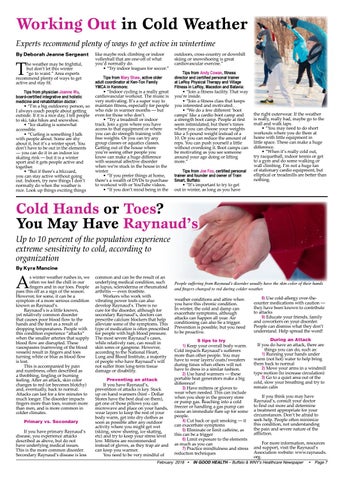
People suffering from Raynaud’s disorder usually have the skin color of their hands and fingers changed to red during colder weather. weather conditions and attire when you have this chronic condition. In winter, the cold and damp can exacerbate symptoms, although attacks can happen all year. Air conditioning can also be a trigger. Prevention is possible, but you need to be proactive.
8) Use cold-allergy over-thecounter medications with caution — they have been known to contribute to attacks 9) Educate your friends, family and coworkers on your disorder. People can dismiss what they don’t understand. Help spread the word!
9 tips to try 1) Keep your overall body warm. Cold impacts Raynaud’s sufferers more than other people. You may have to wear layers/coats/sweaters during times when others will not have to dress in a similar fashion. 2) Use hand warmers — these portable heat generators make a big difference! 3) Have mittens or gloves to wear when needed. This can include when you shop in the grocery store or pump gas. Reaching into a cold freezer or handling a gas pump can cause an immediate flare up for some people. 4) Cut back or quit smoking — it can exacerbate symptoms 5) Eliminate or limit caffeine, as this can be a trigger 6) Limit exposure to the elements as much as you can 7) Practice mindfulness and stress reduction techniques
During an Attack If you do have an attack, there are things you can do, such as: 1) Running your hands under warm (not hot) water to help bring them back to normal 2) Move your arms in a windmill type motion (to increase circulation) 3) Go to a quiet area out of the cold, slow your breathing and try to remain calm
February 2018 •
If you think you may have Raynaud’s, consult your doctor to find out more and determine a treatment appropriate for your circumstances. Don’t be afraid to seek help. People often minimize this condition, not understanding the pain and severe nature of the affliction. For more information, resources and support, visit the Raynaud’s Association website: www.raynauds. org.
IN GOOD HEALTH – Buffalo & WNY’s Healthcare Newspaper
•
Page 7