Tracy Richter Vice President of Planning Services, HPM
Mark Schoeman Design Principal, Anderson Brulé Architects
David Schrader Managing Partner, SCHRADERGROUP
Michelle Smyth Principal Architect, McMillan Pazdan Smith
Susan Tully K-12 Center of Excellence Leader, Gilbane Building Company
STAFF CONTACT
Sales Sarah Clow, Vice President of Sales and Marketing sarah@wmhmedia.com
CALENDAR
Isabel Corsino Lee, AIA, NCARB, IIDA, ALEP, recently joined PBK as Senior Principal, Area Leader – Dallas/ Fort Worth, bringing more than 20 years of architectural leadership across K–12, civic, municipal, multifamily, commercial and public-sector work. A licensed architect and interior designer in Texas, Florida, and Puerto Rico, Corsino is known for her collaborative approach, strong client relationships and commitment to delivering environments that make a lasting impact on the communities they serve. Corsino has led multidisciplinary teams, guided major bond programs, and partnered closely with superintendents, district leaders, civic officials and community stakeholders to deliver thoughtful, forward-looking facilities. In her new role, she will lead PBK’s efforts across the DFW region — supporting K–12 and civic clients, strengthening project delivery, and championing design excellence that reflects the needs and aspirations of students, educators, public teams and communities.
DLR Group has announced Principal Shawn Gaither, AIA, LEED AP, as national higher education business development leader. After years of working across key higher education markets, Gaither returns home to Tennessee to expand the firm’s higher education footprint by driving client engagement and portfolio growth. Gaither is currently responsible for more than $300 million in construction involving higher education projects. His diverse portfolio spans higher education, workplace, hospitality and sports, celebrating the intersection on campuses. Gaither’s appointment supports DLR Group’s continued investment in higher education, reaffirming the firm’s commitment to designing spaces that foster innovation, inclusion and student success.
Punit Jain, AIA, LEED Fellow, Principal and Science & Technology Practice Leader with CannonDesign, received the 2025 Phil Wirdzek Leadership Award from the International Institute for Sustainable Laboratories (I2SL). This distinguished honor recognizes individuals who embody the late Phil Wirdzek’s visionary leadership — advancing sustainability, efficiency and collaboration in the design and operation of laboratories worldwide. For more than three decades, Jain has championed the integration of energy-efficient systems, water conservation, renewable energy and human-centered design into laboratory environments that push the boundaries of sustainability and performance. His leadership has shaped more than 50 science facilities for institutions and companies, including Oak Ridge National Laboratory, Caltech, Yale University, Washington University in St. Louis, Eckerd College and Novartis — each demonstrating how technical innovation can align with environmental responsibility and occupant wellbeing.
DLR Group has welcomed Alissa Moe, who will lead business development efforts for the firm’s K-12 Education studio. Moe will specialize in meeting the educational design needs for communities in Minnesota, North Dakota and Wisconsin. She brings more than seven years of experience in the design and construction industry. Her passion for education design is fueled by a recognition that her work positively impacts the success, safety and happiness of students. Moe is personally invested in her local community as well as in industry organizations. She is the past president of the Rochester Area Builder’s Association, an organization that recognized her as a Rising Star within the first two years of membership. Additionally, Moe was recently appointed to serve on the Rochester Planning and Zoning Commission.
Dr. David J. Dausey was recently appointed as the 14th president of Duquesne University. Currently Executive Vice President and Provost at Duquesne, Dausey brings a distinguished record of academic leadership and innovation, having served in senior roles that advanced academic excellence, student success, research strength and community engagement. An internationally recognized epidemiologist, Dausey is an elected fellow of the American College of Epidemiology. Before joining Duquesne, Dausey served as the Executive Vice President and Provost of Mercyhurst University. He also worked as a full-time researcher with the RAND Corporation and as an analyst at the U.S. Department of Veterans Affairs. He earned a bachelor’s degree in psychology from Mercyhurst University and later earned a master’s and a doctoral degree in epidemiology from Yale University as well as a second doctoral degree in higher education management from the University of Pennsylvania. Dausey will officially assume the presidency on July 1, 2026.
The Seattle Public Schools Board of Directors has named Ben Shuldiner as the finalist for the district’s new Superintendent. Shuldiner has served as Superintendent of the Lansing School District in Michigan since 2021, leading the district to significant gains in graduation, attendance and enrollment. He also increased the district’s financial sustainability, helping grow the fund balance by more than $40 million. In 2003, he founded the High School for Public Service in Brooklyn, N.Y. Shuldiner served as principal there for a decade, after which he became the Distinguished Lecturer of Education Leadership at Hunter College, CUNY, where he led one of the largest principal and superintendent certification programs in the Northeast. He earned a Master of Science in education at Baruch College in New York and graduated Magna Cum Laude from Harvard University, with undergraduate degrees in history and science. Once a contract, including salary and start date, is finalized, the Board will vote once more to complete the hire.
The Metropolitan School District of Wayne Township announced the appointment of Shenia Suggs, Ed.D., as its next Superintendent, effective Jan. 5, 2026. With more than 30 years of experience in public education, Suggs brings a proven record of leadership, innovation and commitment to student success. Suggs has served MSD Wayne Township as Assistant Superintendent for Human Resources, leading more than 2,300 employees and establishing systems that attract and retain outstanding educators, support professional growth and foster a culture of collaboration. Beginning as a high school English teacher at Ben Davis High School, Suggs went on to serve as a school administrator at South Wayne Junior High School and district-level leader in Student Services and Human Relations. Suggs was honored with the 2024 Distinguished Administrator Award from the Indiana Association of Public-School Superintendents and the 2021 School Support Professional of the Year from the Indiana Association of School Business Officials. Suggs earned a doctorate in Educational Leadership from Indiana University, with a focus on curriculum and instruction and holds degrees from Butler University and DePauw University.
Wells has announced the appointment of Kelly Henry as Director of Architectural Systems. Henry leads the strategic growth and development of DEX, Wells’ national Ultra High-Performance Concrete (UHPC) building solution. Leveraging a seasoned career in high-performance concrete for distinct and memorable architectural facades. In this new role she will support the delivery of innovative, sustainable, design-forward solutions, setting new performance and aesthetic standards in the built environment across the U.S. Henry has more than 16 years of experience in the UHPC and precast facade industry. Prior to joining Wells, she worked at the international building materials company, Lafarge, where she played a key role in bringing complex architectural concepts to life through collaborative facade development. She also served as an adjunct professor at the Georgia Institute of Technology, where she taught Building Information Modeling (BIM) Theory. Henry holds a Bachelor of Science in Microbiology from the University of Florida and Master of Architecture and MBA degrees from Georgia Tech. She is also a LEED-accredited professional.
COMPANY NEWS
Lee
Shuldiner
Suggs
Henry
Dausey
Gaither
Jain
Moe
Planning Performing Arts Centers That Teach on Day One
By Michelle Smyth, AIA, ALEP, LEED AP, NCARB
Performing arts centers are more than performance halls. In the right hands, they become daily learning environments that spark creativity, collaboration and critical thinking. Across the country, school leaders are recognizing that arts education plays a pivotal role in preparing students for the future. In fact, students involved in the arts are four times more likely to earn academic recognition, and arts participation strengthens the skills students will use in every career.
Richland 2 School District in Richland County, S.C., is putting that belief into practice. With more than 27,000 students, 81% of whom are already engaged in arts programs, the district created a campus anchored by a new performing arts center that blends STEM (Science, Technology, Engineering, Math) and the arts into a STEAM (Science, Technology, Engineering, Arts, Math) learning environment.
The 1,175-seat theater hosts events of all types from classical music concerts to
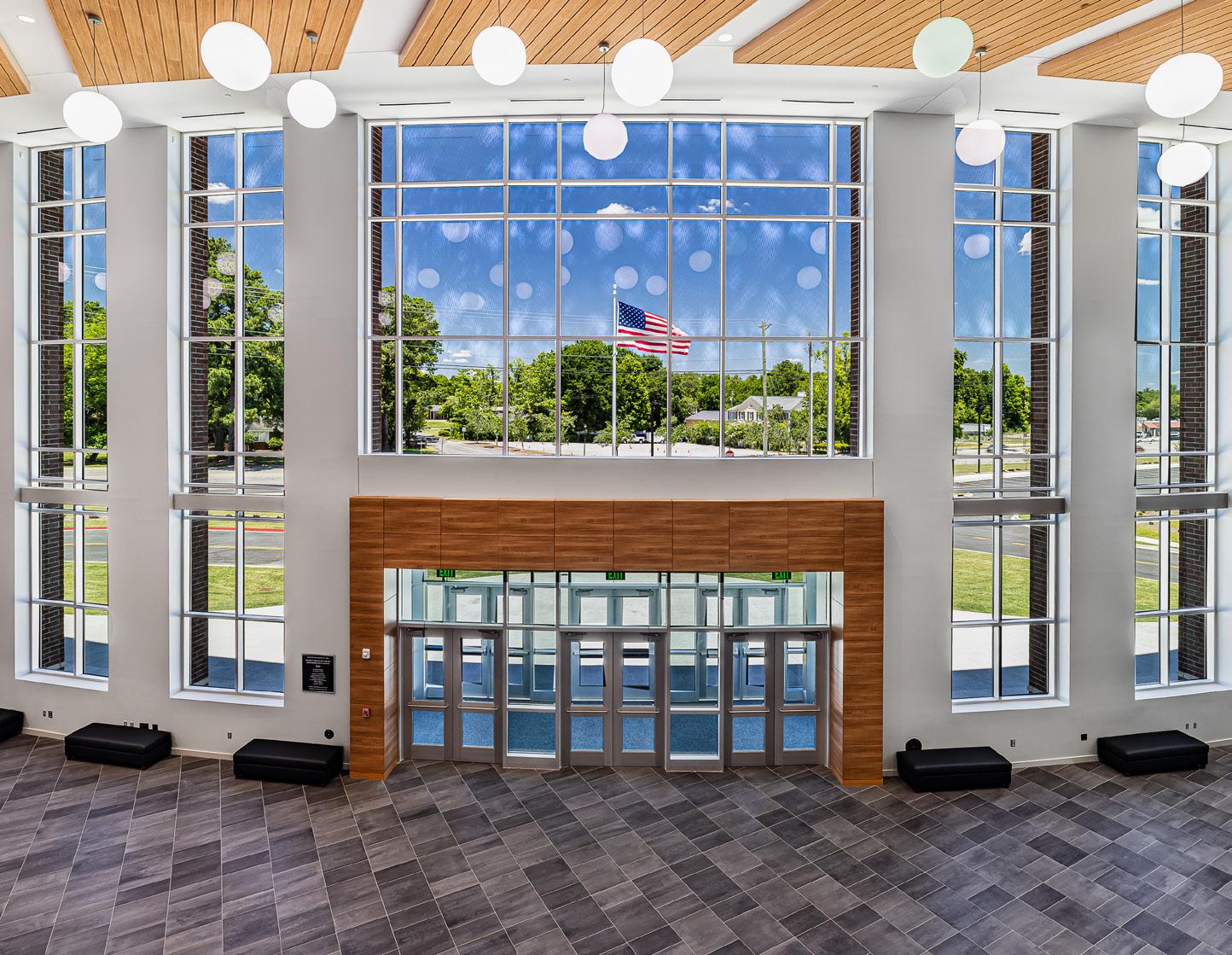
modern drama, while black box and dance studios double as instructional spaces. A welcoming, spacious lobby and outdoor performance areas extend the building’s reach into the community, ensuring it stays active well beyond the school day. These spaces may also be used for performances or displays and celebrations of student artwork.
The Richland 2 School District’s approach shows that a performing arts center can be both an academic tool and a civic gathering place — but achieving that balance starts long before design development. The decisions made early in the process determine whether a facility can support student learning while remaining a destination for the community over its lifetime.
Early Decisions That Shape Success
The most successful performing arts centers start with careful planning long before construction begins. Creating a vision for the building that speaks to its action and service to students and the community may be fostered from stakeholder engagement at the beginning of the planning process.
Site placement, adjacencies, circulation, and phasing all influence how well a building will serve students and the public over time. Some of the best
designs consider how the space functions during the school day, supports after-hours use and adapts as programs grow.
Schools with strong arts programs typically have higher attendance rates for both students and teachers, a benefit Lexington County, S.C., School District One sought in its White Knoll High School expansion. Initially, the plan was to build the performing arts center beside an existing classroom wing. Early in the process, however, the design team recommended a different approach: placing the facility in the center of campus.
This single decision allowed the performing arts center and a two-story classroom wing to be built simultaneously. The approach collapsed a phased construction plan, saved a full year on the schedule and avoided the cost of relocating portables. The 1,000-seat theater now offers professional-quality performance space, while the adjacent classrooms house science labs, CTE programs and collaboration areas.
Locating the performing arts center at the center of campus shortened travel times for students, improved safety by consolidating access points and kept construction on schedule while adding new academic facilities. It also showcased their new performing arts program in the heart of their campus.
Designing for Flexibility and Community Impact
Location is only one part of the equation. Designing for flexibility ensures the facility serves not just the school but also the wider community. That means creating spaces that can shift between school assemblies, professional productions, conferences and public events. It also means providing students with opportunities to learn both on stage and behind the scenes.
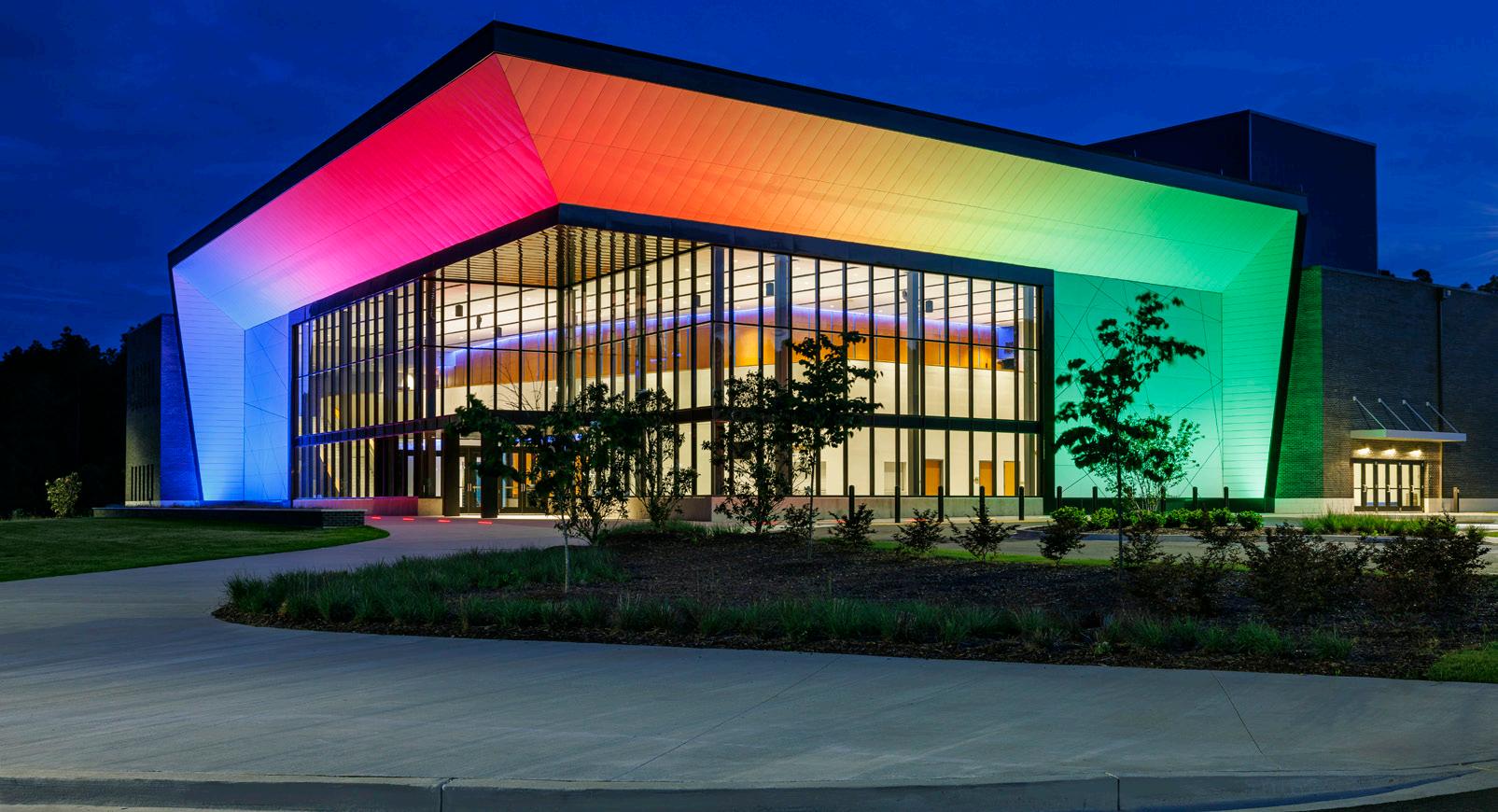
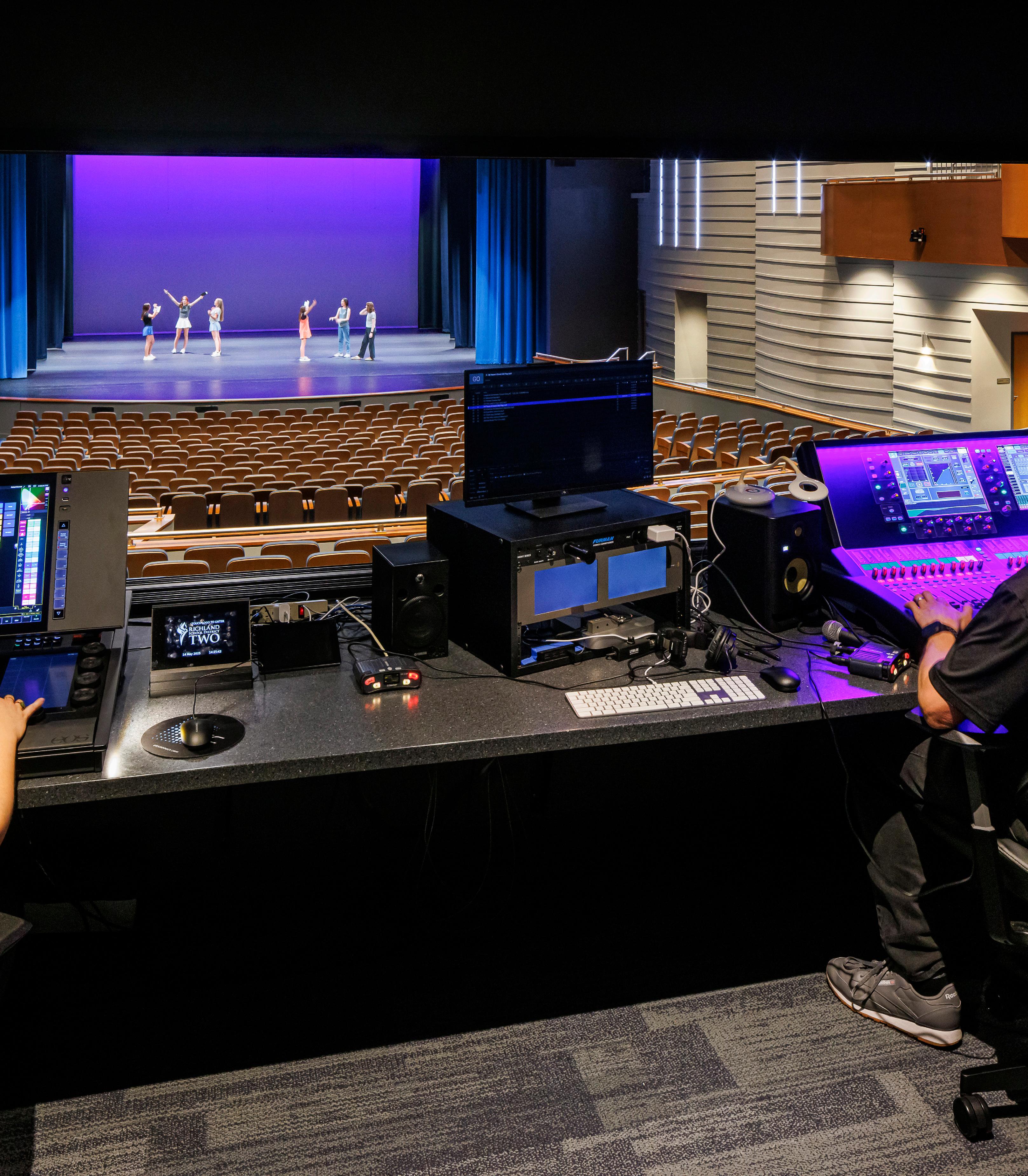
Lexington 2 School District’s new performing arts center builds skills through both performance and technical training. The 1,500-seat theater features a full orchestra pit, manual rigging, overhead catwalks, and backstage support spaces from dressing rooms to a catering kitchen. Students gain practical experience in lighting, rigging and stage management that can carry into college or career pathways.
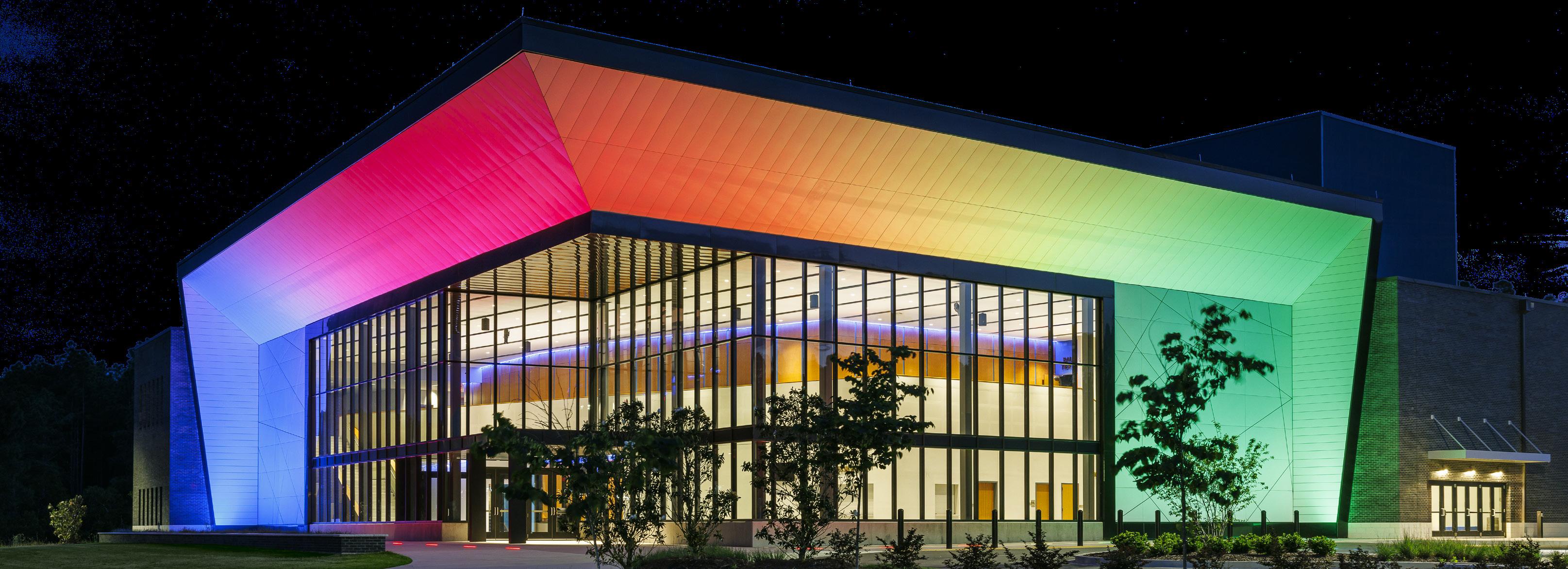
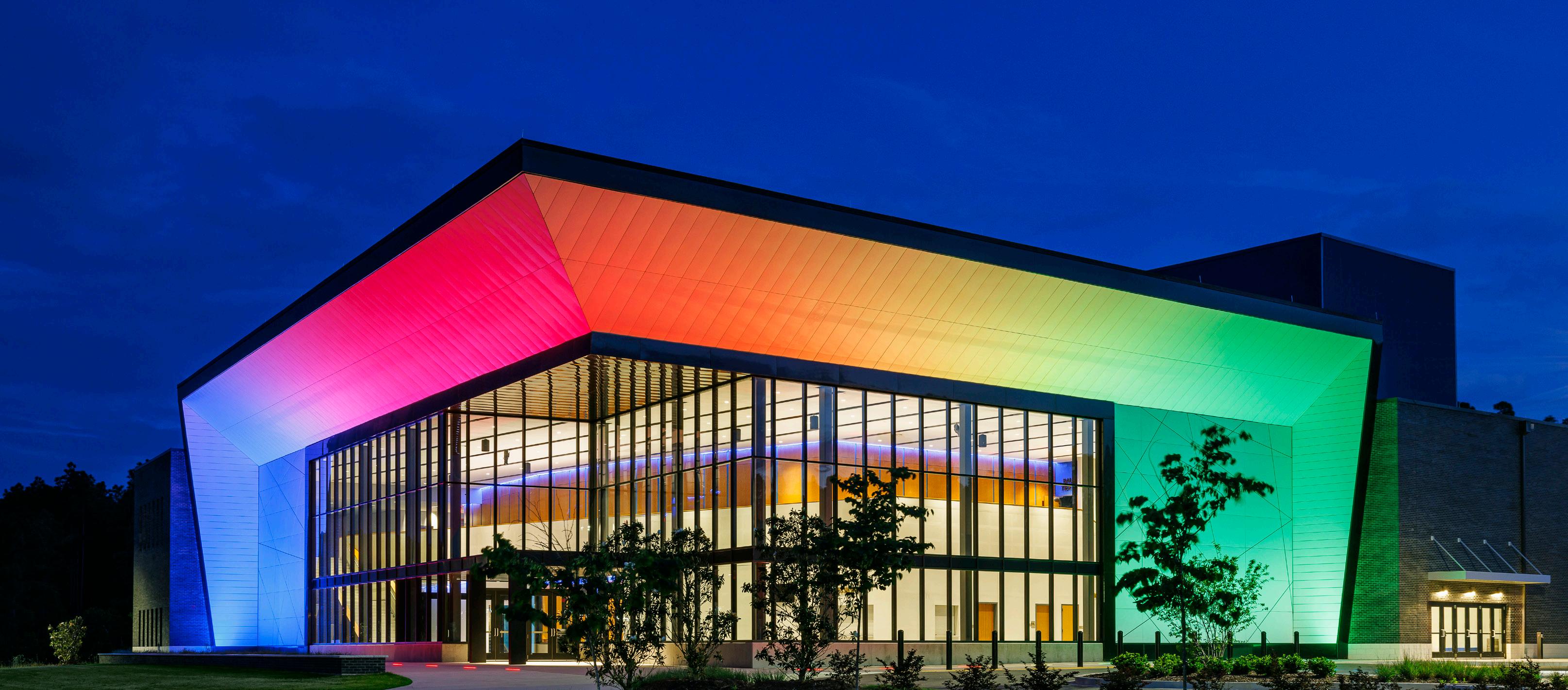
The two-story grand lobby, lit by customizable color-changing fixtures, welcomes audiences for both school and community events. With spaces designed to host everything from district assemblies to regional performances, the center reinforces the idea that a performing arts center can be both a teaching tool and a cultural anchor.
From Vision to Long-Term Value
Well-designed performing arts centers elevate student learning, strengthen community connections and adapt to changing needs over time. Achieving that requires early, intentional planning that considers both the academic and cultural roles these facilities play. While every district’s priorities are unique, several principles consistently apply regardless of size or scope:
· Choose a location that supports both daily school use and after-hours access
· Consider inclusion of community stakeholders to create support for the project and foster cross-collaboration of facility use
· Involve educators early to align facilities with curriculum goals
· Design for adaptability so spaces can evolve with programs
· Plan for community use from the outset to maximize value and support
A strong strategic plan that defines goals, tracks progress and includes funding strategies can keep these priorities on track from concept through operation.
The most successful performing arts centers teach every day, not just on performance nights. They help students share their voices, bring communities together, and provide districts with lasting returns in both education and culture. When designed with purpose, they become stages where future-ready skills take shape under the lights.
Michelle Smyth, AIA, ALEP, LEED AP, NCARB, is a Principal at McMillan Pazdan Smith Architecture and a member of the School Construction News Editorial Advisory Board.
Lexington 2 School District’s new performing arts center builds skills through both performance and technical training.|Photo Credit: Benton Henry Photography
A performing arts center that blends STEM and STEAM education anchors a new campus in the Richland 2 School District.
Photo Credit: Kris Decker, Firewater Photography
Insights for Designing Future-Ready CTE Spaces
By Scott Dangel and CarrieBeth Ruzicka
The demand for Career and Technical Education (CTE) programs continues to rise in secondary schools across the country. The shift toward career-focused instruction is also leading to an evolution in school design and construction. The long-time model of traditional classrooms with segregated labs is not conducive to the highly integrated and cooperative nature of CTE learning. Instead, schools must create flexible, future-ready environments where innovation can flourish.
For schools in the early conceptual stages of development, it will help to understand the concepts that will inform decisions later in the design process and during construction. The following insights and strategies will aid in developing a shared understanding of the task, ensuring school leaders arrive at a solution that is optimal for today and adaptable to future demands.
designed to accommodate diverse needs within the constraints of a limited footprint and budget. To maximize flexibility and adaptability, classrooms, labs and workshops can be designed with reconfigurable layouts and include movable furnishings and partitions. Likewise, HVAC and plumbing systems can be installed with easily accessible connections to electricity and water.
In light of transformative advancements in technology, the way people work, and the goods and services they will be asked to provide, it’s equally important to prepare for the future. One proven way to future-proof a building is to utilize modular construction that allows for exterior walls and windows to be reassembled. This will significantly reduce the costs of build-outs and renovations when the need arises.
Proactive Pursuit of Funding
A Community-Wide Venture
Because the goal of CTE programs is to prepare students for careers — and upwards of 60% of students can be expected to remain in or near their hometown after completing their secondary education — it is important that the curriculum reflects the needs of the local job market. Developing industry partnerships and engaging local business leaders is critical to establishing a program that will serve both employers and future employees. Having project team stakeholders conversant in this type of collaboration will help in building consensus and buy-in.
Replicating the Real World
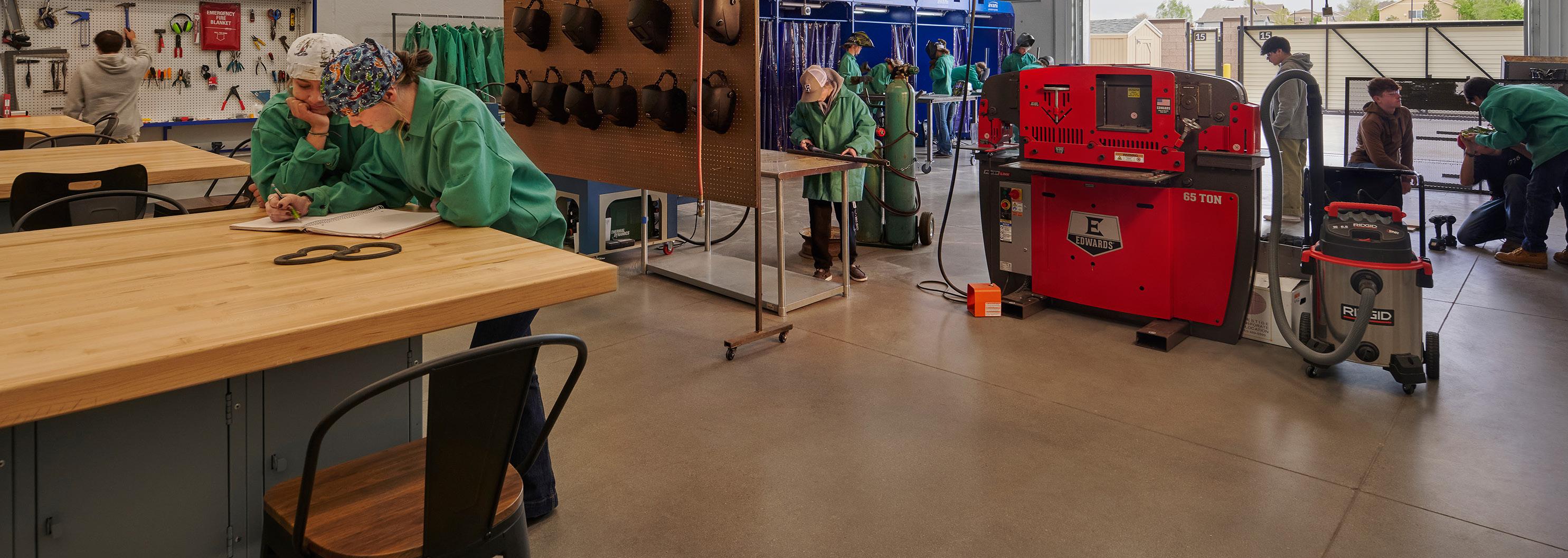
To fully engage students and provide a higher level of instruction, instructional spaces should mimic real-world work environments and provide real-world experience. This can be achieved in part by selecting building materials similar to what would be found in professional workshops, labs and other working environments.
In addition, a robust IT infrastructure and the ability to implement and maintain the latest technology should be weighed heavily in every decision. Nothing can stunt a student’s progress more than learning on outdated software, hardware or connectivity.
Visibility and Engagement
CTE courses are generally more hands-on, interactive and collaborative than traditional academic classes. A great way to expose students to exciting CTE opportunities is to strategically locate the facilities in high-traffic areas and include large windows or glass walls, allowing those passing in the hallway to witness the work going on inside.
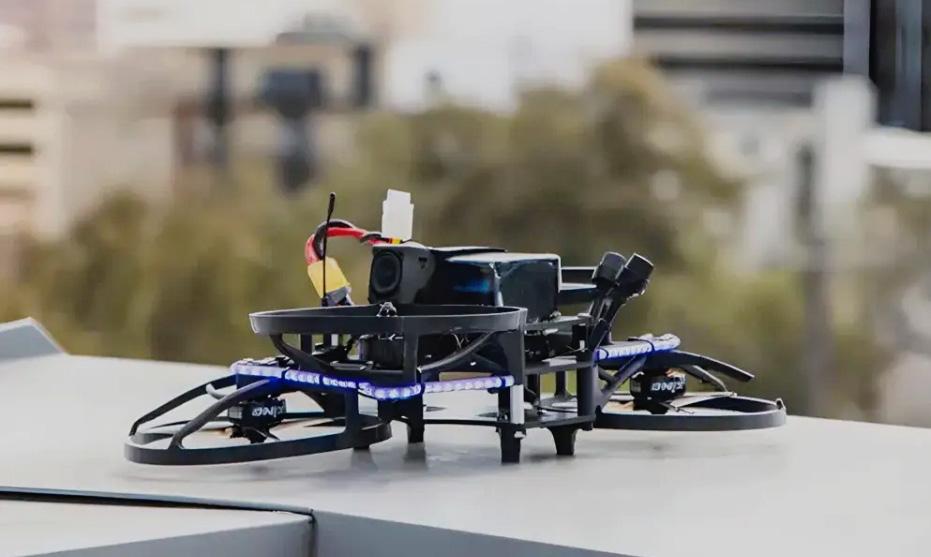
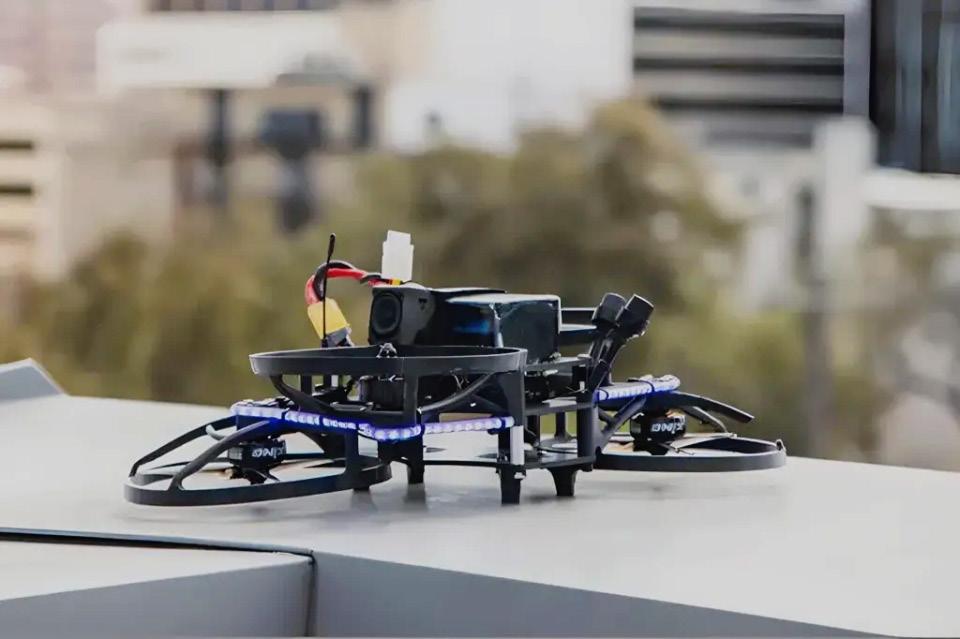
This same objective can be achieved by utilizing outdoor spaces. In addition accommodating larger-scale projects, such as construction, or for instruction in such tasks as operating drones, students will experience the wellness advantages that come from being outdoors, where sunshine and exposure to natural elements have proven to reduce anxiety and boost motivation. To provide flexibility between indoors and outdoors, large, overhead doors can be included to open up spaces when needed.
Educator Support
A well-designed CTE facility can take the teachers’ lounge to a new level, promoting growth and camaraderie. Often referred to as “teacher neighborhoods,” these dedicated
spaces are designed to encourage interaction between teachers. Zones are created for specific areas of study, along with a commons area where all teachers can share ideas, socialize and align curriculum. For example, if a construction CTE pathway is building a small home, a math teacher can bring students in to make measurements and calculations, and an English teacher can give students direct exposure to architectural elements that are referenced in a reading assignment.
Flexibility, Adaptability and Future-Readiness
A CTE program will most likely cover a wide range of jobs from food preparation and construction to digital editing and high-tech manufacturing. Spaces must be
Whether a school is taxpayer funded or reliant on tuition and donations, aligning the program vision with the available budget is perhaps the most challenging aspect of CTE facility design and construction. In addition to governmental or private-industry grants,
many schools have been successful in passing a referendum for a temporary tax or rate increase. Because local businesses and organizations will directly benefit from having a pipeline of trained employees, opportunities are often available to form partnerships and/or seek donations. An experienced design consultant can be instrumental in exploring alternative funding sources.
The Next Step
These strategies provide a framework to help ensure that everyone involved in planning understands how design and construction play a prominent role in the success of a CTE program. The next step is to partner with an architectural consultant with experience in developing these unique projects. Once the program is up and running in a new or renovated facility, the value to students, teachers and the community will be immeasurable.
Case Study: Roosevelt High School
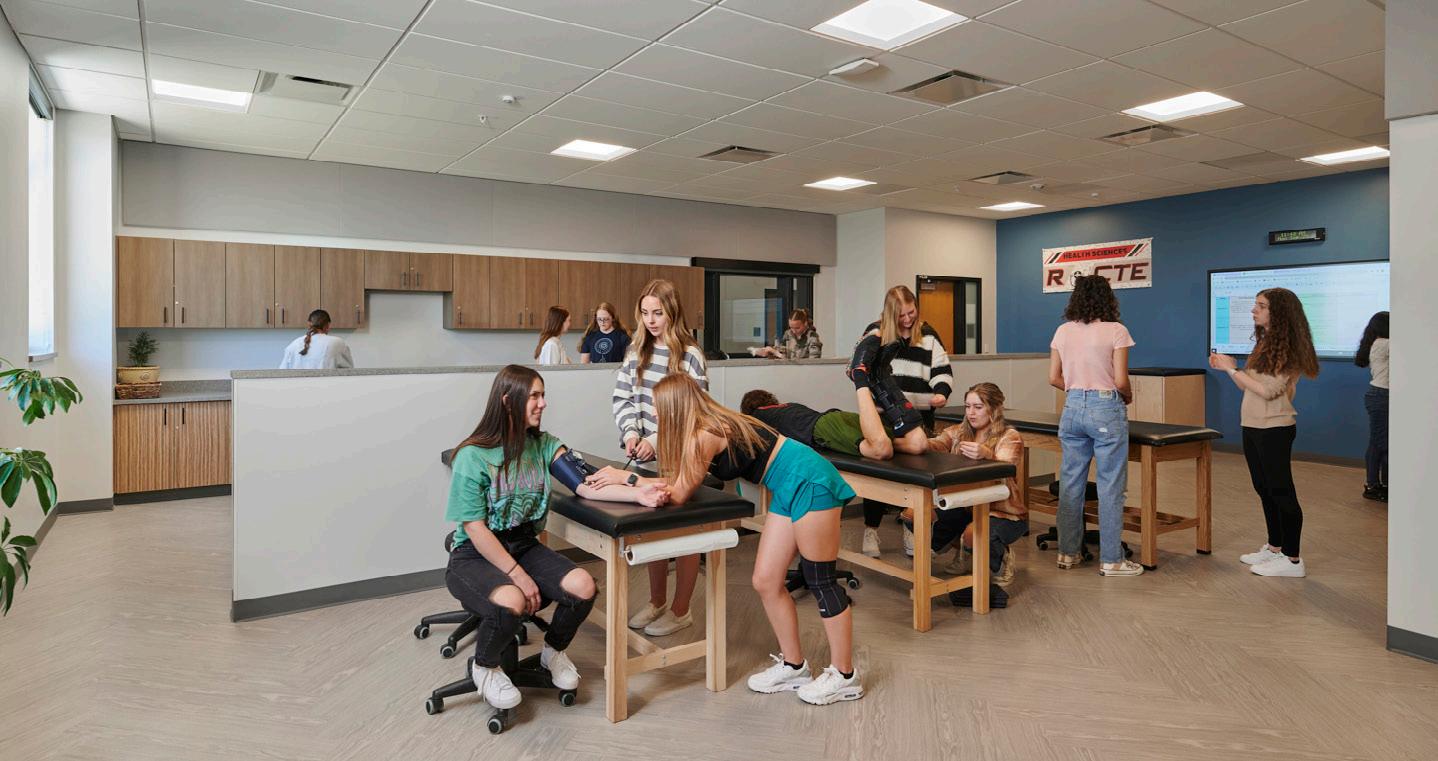
The new Roosevelt High School in Johnston, Colo., opened in 2023 and introduced students to a CTE curriculum that reflects the needs of businesses and the economy in the region. The design and construction of the award-winning educational facility came together by incorporating many of the concepts and strategies introduced in this article.
An Occupational Advisory Committee (OAC) was established at the onset to develop goals and core values. This committee included administration, teachers, students, and local business owners and leaders. Their work ensured that the curriculum (and facility design) would align with the needs of the community.
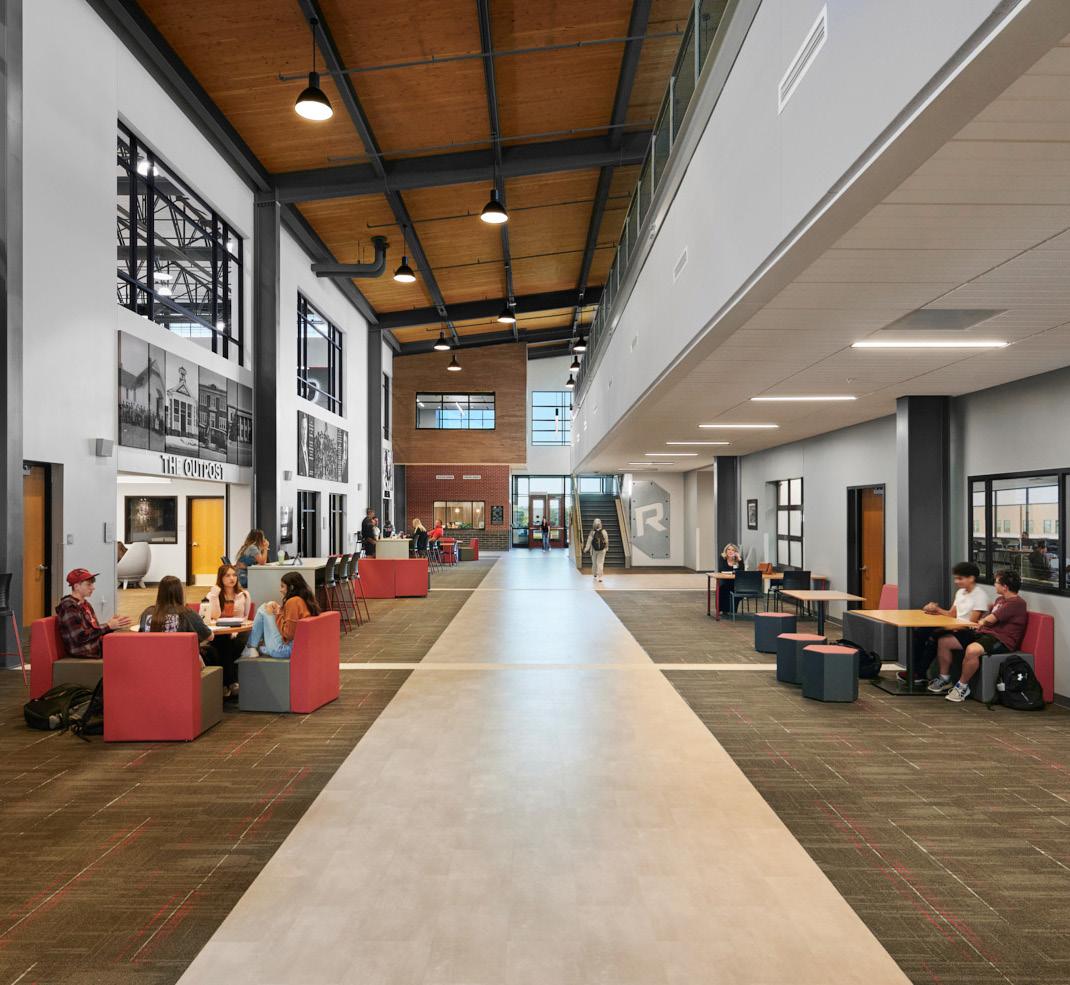
Based on the OAC’s findings, the building’s layout includes career pathway clusters: Heath + Justice, Skilled Trades + Agriculture, Engineering + Technology, and Hospitality + Business. These clusters surround a community commons area called “The Heart” where students and teachers can communicate, collaborate and socialize outside of the classroom/laboratory setting.
The layout was designed to facilitate flow within and between the clusters and into the outdoor and community areas. By making activities in the studios, labs and classrooms visible from hallways and common areas, students are encouraged to investigate and discover new areas of study.
The new high school occupies 65 acres of a 240-acre site that the school district obtained in cooperation with a local farming family. A complete master plan stakes out future initiatives that will support the school’s CTE pathways. Possible developments include an urgent-care facility where students would gain experience in a working clinic, located within walking distance of the school.
Scott Dangel, AIA, LEED AP, is Principal with Treanor. He can be reached at sdangel@treanor.design. CarrieBeth Ruzicka, NCIDQ, IIDA, is an Associate Principal and Registered Interior Designer with Treanor and can be reached at cruzicka@treanor.design.
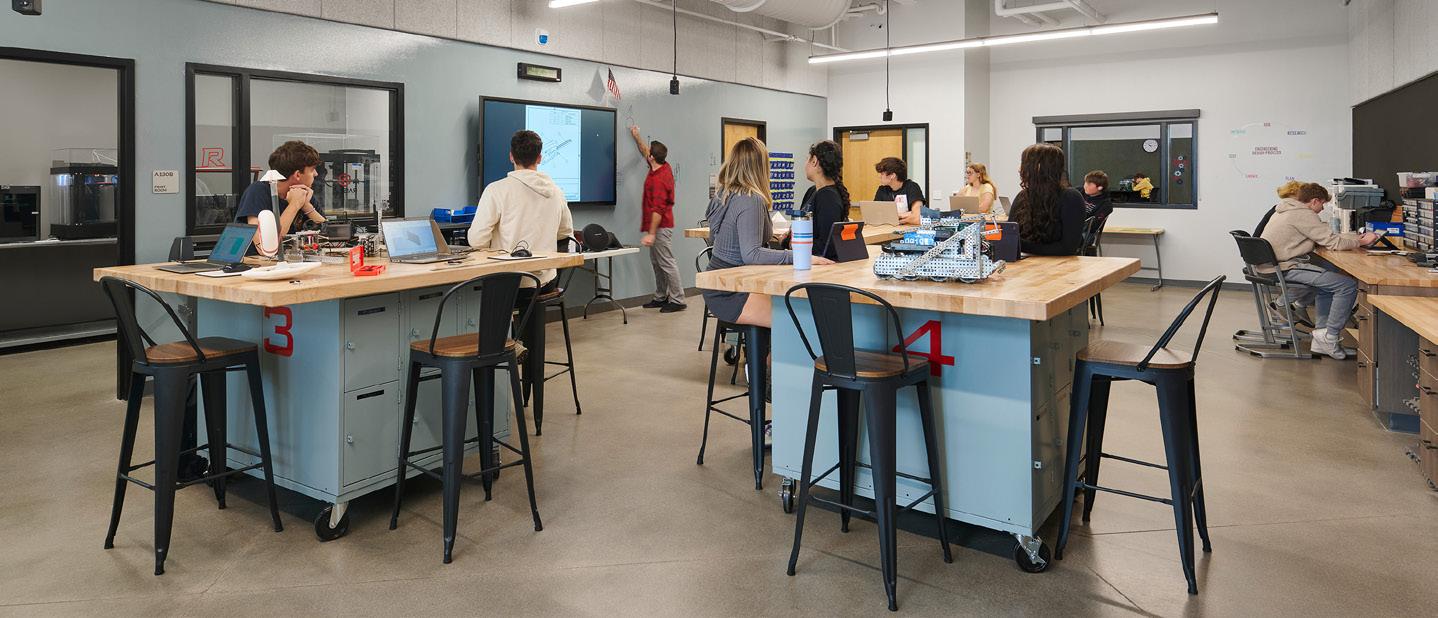
Roosevelt High School in Johnston, Colo., includes a Career and Technical curriculum that reflects the needs of local businesses.
Photo Credit (all): Courtesy of Treanor
The Roosevelt High School CTE was developed by an Occupational Advisory Committee composed of administrators, teachers, students and local business owners.
The Roosevelt High School CTE facility includes career pathway clusters such as Health + Justice, Skilled Trades + Agriculture, and Engineering and Technology + Business.
AI Meets Building Safety Security and safety trends to watch in 2026
By Eric Benson
Commercial buildings are entering a new era in which safety systems can’t afford to operate separately. Security, fire and life safety, and building automation are increasingly merging into one connected ecosystem. Owners want fewer platforms to manage, faster response times, and clearer proof of compliance — especially in schools, healthcare and multi-site enterprises.
What’s new is how quickly AI is accelerating integration, and how much smarter building safety is about to get.
Watch for these trends that are already shaping what smart, secure buildings will look like in 2026.
One Integrated Safety Platform Becomes the Standard
Buildings used to run video, access control, intrusion detection and fire alarms on separate systems. That model is disappearing. By 2026, owners will expect a unified platform; a single dashboard where all safety data lives together and can connect to Building Automation System and Internet of Things (BAS/IoT) networks when needed.
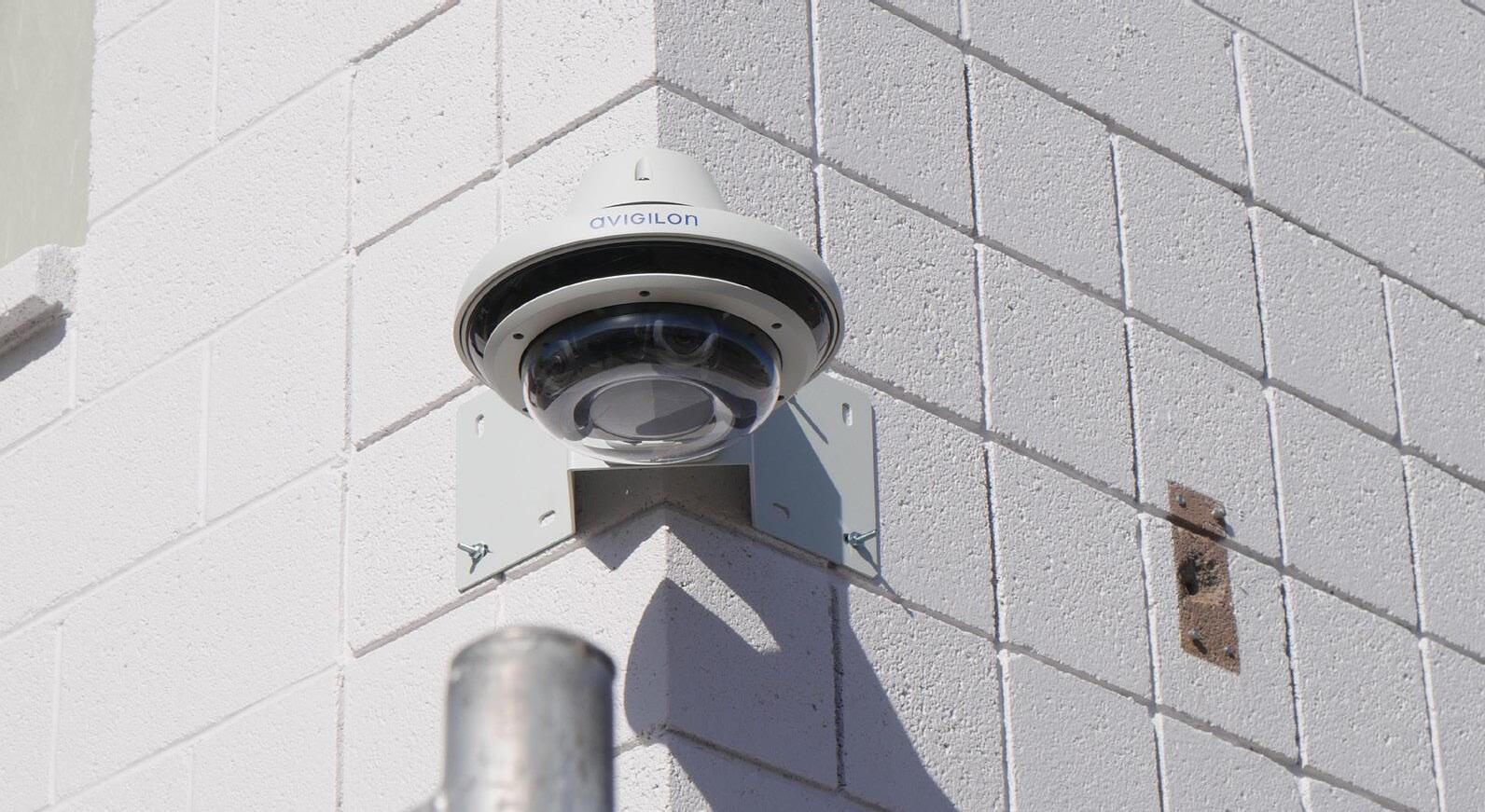
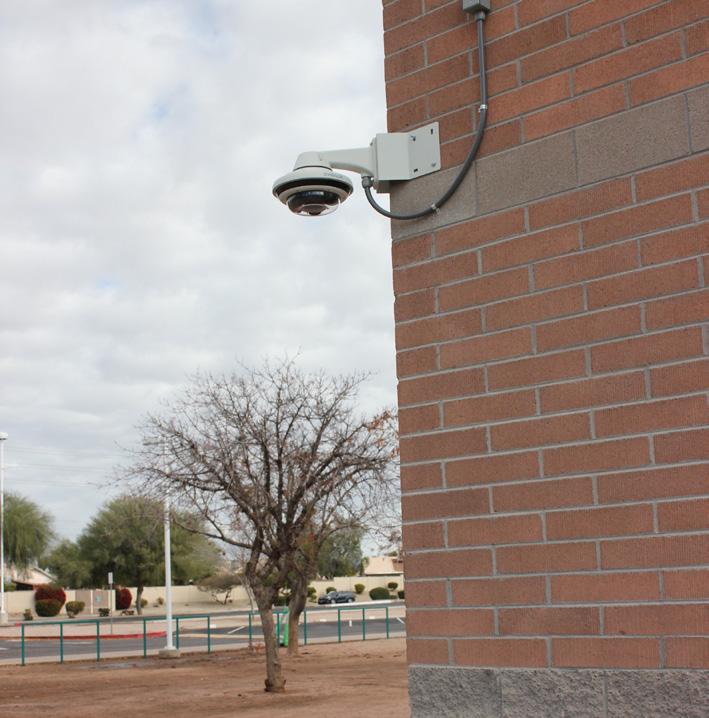
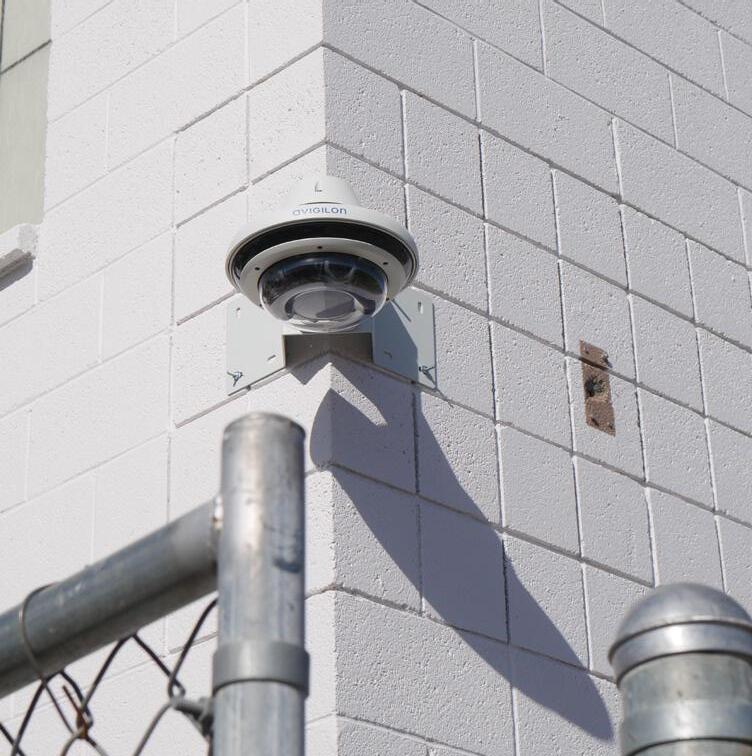
Why does it matter? Faster decisions can be made because operators see everything in one place, and consistent standards can be enforced and applied across multiple sites. This approach also requires less training and creates fewer “blind spots” between systems In education facilities, this is already happening at scale. Benson Systems recently delivered a five-year rollout of Avigilon cameras across 40 Gilbert Public Schools campuses in Gilbert, Ariz. One consistent system means the district can apply the same workflow everywhere, instead of treating each school like a separate project.
AI “At the Edge” Becomes the Practical Win
By 2026, the most valuable AI won’t live in the cloud; it will live on the devices themselves. On-camera analytics and controller-level machines will spot unusual activity in real time, cut down false alarms, and automatically label events so teams know what matters first.
This will show up fastest in K-12 schools through detecting entry violations, restrictedarea movement or unusual crowding. It will also become prevalent in healthcare with the monitoring of sensitive zones and reducing alarm fatigue. In logistics and industrial sites, it will help in quickly identifying perimeter issues or unsafe patterns.
The key to doing it right by pairing edge AI with privacy-by-design, clear data-retention rules and transparent policies so customers stay compliant while getting the safety benefits.
Zero-Trust Identity Reaches the Front Door
Zero-trust isn’t staying in cybersecurity. It’s showing up at doors. Expect mobile credentials, multi-factor authentication for sensitive spaces, and automated provisioning ties to HR or identity systems to become the standard for new builds or major retrofits.
The reason is simple: physical access is part of overall risk management now. When a badge is lost, a contractor’s assignment ends, or a staff member changes roles, access needs to update automatically, without manual reprogramming.
Benson Systems has already seen clients gravitate to unified workflows that cover visitors, employees and vendors in one system. At NextCare Urgent Care, for example, video analytics and access control are being installed together and fully integrated, so staff gain both security and operational simplicity across multiple doors and clinical zones.
Compliance Goes Digital — and Remote Service Grows
Compliance is moving from clipboards to dashboards. National Fire Protection Association (NFPA) and the International Code Council (ICC) testing will increasingly use sensorverified inspections, digital certificates and remote diagnostics tied to central monitoring.
For building owners, the upside is huge: cleaner audit trails, faster proof of compliance, and fewer emergency calls. For integrators, it means higher uptime expectations and more proactive maintenance contracts.
At Rio Rico High School in Arizona’s Santa Cruz Valley Unified School District, Benson Systems upgraded the school’s legacy fire alarms to a modern Gamewell voice-eacuation system; exactly the kind of platform designed for digital testing and clean reporting. By 2026, closeout won’t be a binder; it will be living compliance data.
Global Security Operations Centers and Safety Data Ops Mature
Enterprises are centralizing safety operations into Global Security Operations Centers (GSOCs). These aren’t just video walls; they’re playbook-driven environments that coordinate alarms, video verification, access events and service tickets in one operational chain. The next evolution is measurement. Owners want key performance indicators that prove risk reduction: response times, false-alarm trends, incident frequencies and maintenance performance. When convergence and AI are in place, those metrics become easier to collect and more trustworthy, turning safety from a cost center into a measurable operational advantage.
What This Means for 2026 ReadyBuildings
AI isn’t replacing fundamentals like clear egress, reliable detection and properly configured access. It’s enhancing them, connecting systems, shrinking response windows and giving owners defensible documentation.
For facility owners and project teams planning now, the play is simple: design safety systems as an integrated ecosystem from the start. When security, fire and life safety, and automation are coordinated early, and supported by a long-term service partner, you don’t just get a compliant building. You get a building that stays safer, smarter and easier to operate for years to come.
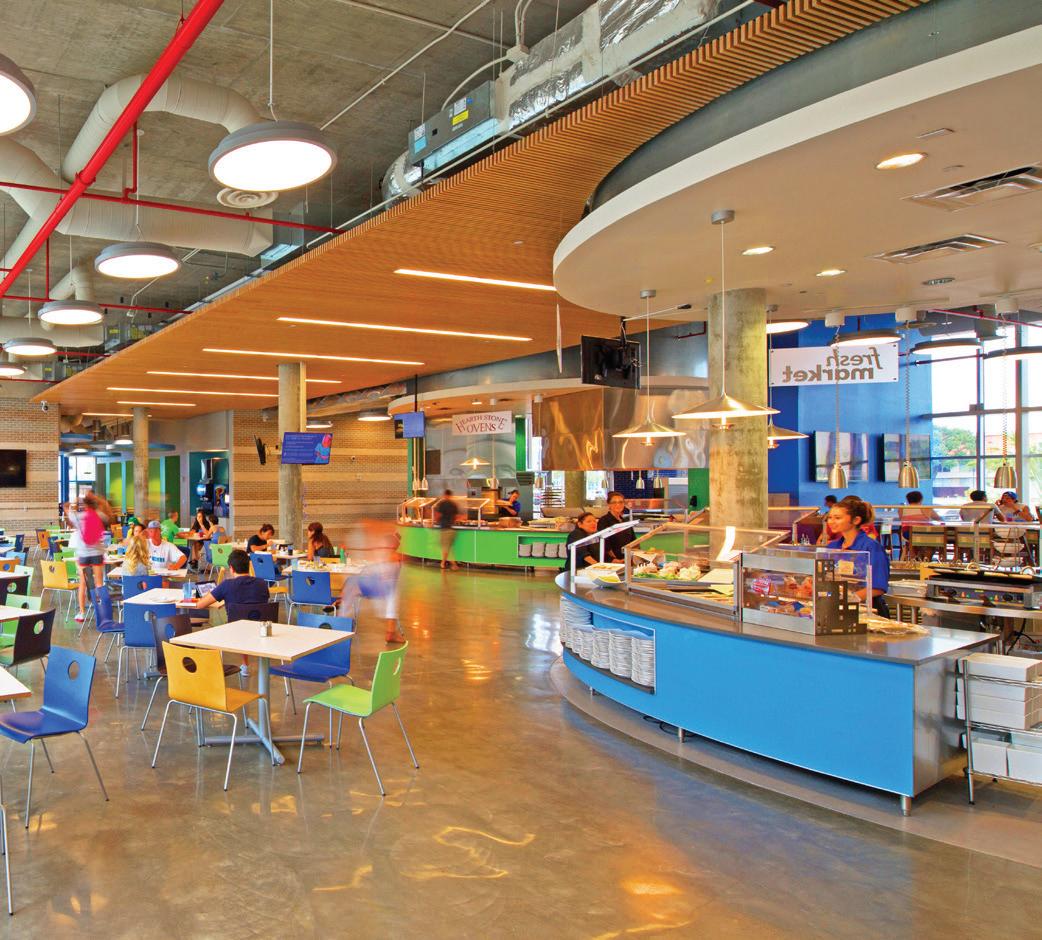
Kirksey Architecture selected LIGHTBLOCKS
Palette Class A Fire-rated Polycarbonate for service station cladding in the Texas A&M University dining hall. Provided in multiple colors and sheet sizes, the material was easily cut, cold-formed to radius, and applied directly to fixtures. With a wide range of fire-rated resin options and a durable, non-porous, fingerprint- and scratch-resistant surface, LIGHTBLOCKS products are well-suited for high-traffic environments.
Eric Benson is the Chief Executive Officer of security and fire protection solutions company Benson Systems. Learn more at www.benson-inc. com.
Benson Systems recently delivered a five-year rollout of Avigilon cameras across 40 Gilbert Public Schools campuses in Gilbert, Ariz.
A single system means consistent workflows across every school.
Photo Credit (all): Courtesy of Benson Systems
Beyond the Bid
How Butler Cohen delivers solutions, improves outcomes and transforms school projects through design-bid-build
By Jason Permenter
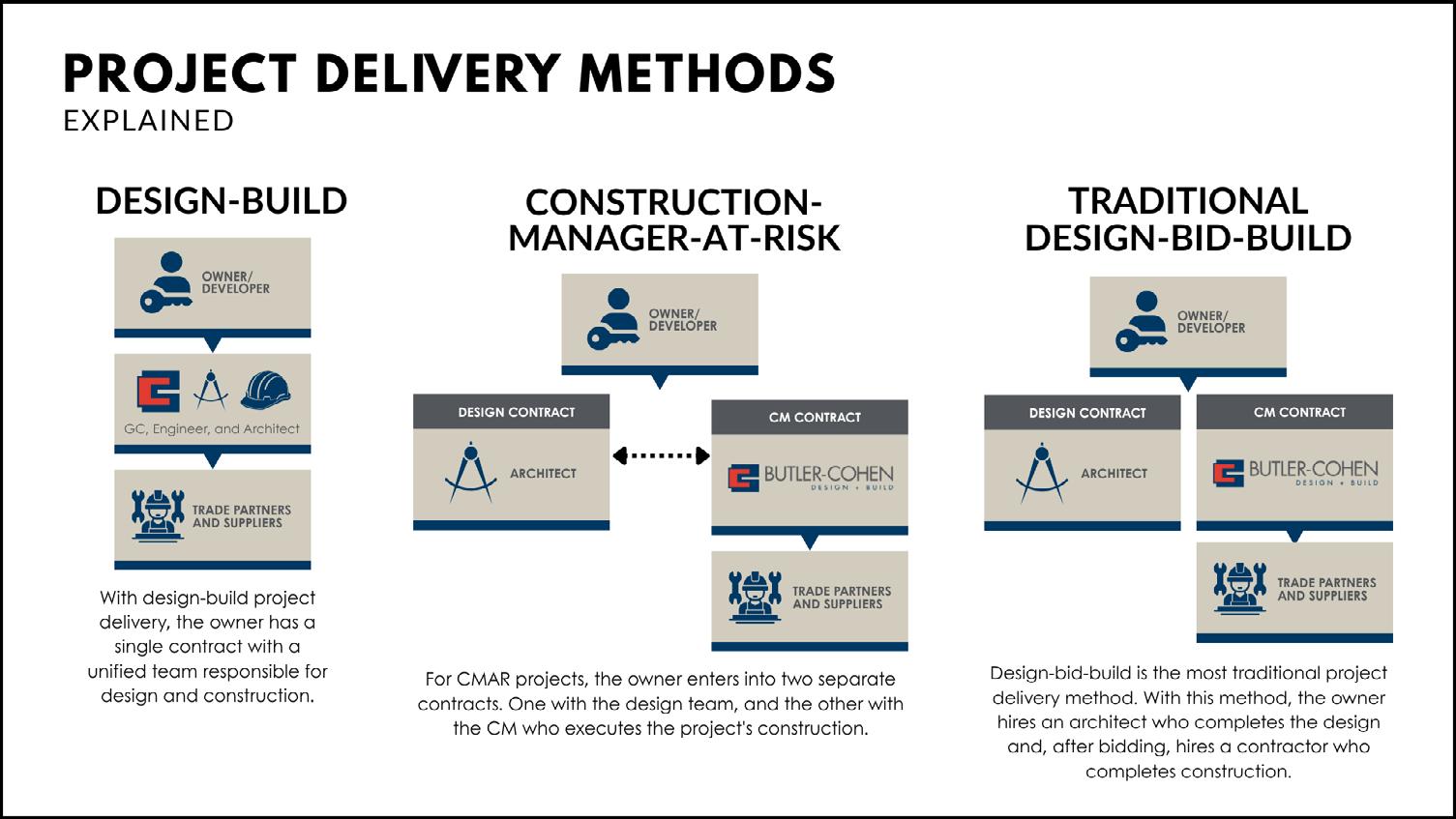
Design-Bid-Build, commonly referred to in the construction industry as a “hard bid” project, refers to the construction delivery method commonly utilized by school districts and other education providers, in which the design team is hired directly the owner.
The common perception is that once this delivery method is chosen, that’s it. The project’s fate is sealed, and once design and bidding are complete, the owner is stuck with the bids they receive, irrespective of their project budget, and with a limited ability at that point to cut cost overruns or meet aggressive schedule expectations. However, for owners that have already chosen this delivery method for a project, all is not lost. The careful selection of a general contractor that will work collaboratively with the owner and design team can help rescue the project, delivering effective solutions to improve budget and schedule outcomes.
Understanding the Design-Bid-Bid Process
Owners commonly choose the Design-Bid-Build process for a number of reasons. The attractiveness of competitive pricing is perhaps the biggest driver, along
Common Challenges with Hard-Bid Projects
The primary challenge with a hard-bid project is that the bid only applies to exactly what is included in the plans and specifications. Items not captured can include scope gaps or missing scope, unforeseen conditions or additional scope not captured in the original design. These items will lead to the dreaded change order, typically increasing the total contract. This can create an adversarial relationship between the owner, architect, and contractor, and also create risk for significant schedule delay and cost overrun.
Compounding this challenge, owners may find that, once all bids are received, they are already significantly beyond the planned project budget. At this stage, they may feel like there is limited ability to get the project back on budget now that they are “locked in” to a completed set of plans they can’t afford.
Owners may also have concerns with quality, safety, and financial capability of a “low-bid” contractor, which may add additional risk to the project they are uncomfortable with.
How Butler Cohen Resolves Hard-Bid Challenges/ Value Engineering
with a perception of budget certainty; or, maybe that is simply how a school district or education provider has always done things.
In the Design-Bid-Build process, the design team, typically consisting of a lead architect and a team of design consultants and engineers, works with the owner to program and develop a detailed set of plans and specifications for the project through a series of design phases. Typical phases include programming, schematic design, design development, and finally, construction documents.
Upon completion of detailed design, the architect or owner’s representative will solicit competitive sealed proposals from general contractors leading to “hard bid” lump-sum responses from general contractors. These responses are typically ranked by fee, with the qualified bidder that submits the lowest number winning the project. The process seems simple enough, but there are a number of challenges and pitfalls for the savvy owner to be aware of.
As a Texas-based general contractor, Butler Cohen faces this challenge frequently: the firm has been awarded the project, but the owner’s budget is significantly below our winning bid. Due to our firm’s deep experience with alternative delivery methods, including Design-Build, we are able to rapidly integrate our preconstruction team and other in-house resources into the existing project team, establishing open lines of communication between the owner, architect and contractor.
We utilize proactive problem-solving and change management strategies, leveraging our expertise in value engineering and cost control to trim the fat while still delivering a high-quality and functional facility that meets the owner’s project vision. At the same time, we exercise our subcontractor network to identify potential cost savings strategies and alternatives.
Case Study: Successful Intervention for Private School Expansion
Delivery Method: Design-Bid-Build
Original Budget: $7 million
Original Bid: $7.8 million
Final contract amount: $7.1 million
Location: Houston
Scope of Work: The expansion of the existing campus consisting of a 32,000-square-foot, two-story tilt-wall structure housing new classrooms, cafeteria, kitchen, library and social spaces on a tight, existing urban site.
Challenges:
· Overdesign: Fit and finishes went far beyond the owner’s original intent due to their limited involvement in and understanding of the design process. This resulted in a budget significantly higher than anticipated.
· Schedule: The expansion had a hard deadline to open for the 2025 school year, leaving a limited schedule of 11 months.
Solutions:
· Working with subcontractors and vendors to identify budget-friendly alternatives to specified products and right-sizing building systems to deliver a functional facility with fewer bells and whistles than originally designed.
· Selective value engineering of less-critical project elements from the scope including partial deletion of exterior canopies, removal of high-end ceiling systems and wall coverings, and reduction of mechanical and lighting controls systems.
· Creative phasing strategies ensure that, while the permit was not yet approved by the City of Houston, Butler Cohen was able to obtain a demolition permit and mobilize six weeks ahead of schedule in order to deliver the facility in time for opening.
In this and many other cases, we were able to deliver the owner’s project vision, on time and within their original budget, utilizing a collaborative, team-oriented approach rather than the adversarial dynamic common in the Design-Bid-Build delivery method, leading to a better end result and a superior client experience.
Even when hard-bid projects start with budget gaps, schedule pressures, and design challenges, our team turns them around through collaboration, value engineering, and creative solutions that reduce change orders, improve timelines and increase client satisfaction. These experiences provide lessons and best practices for school administrators, facilities managers and contractors: engage early, prioritize transparency and select a contractor who acts as a partner.
For owners considering hard-bid procurement, the key takeaway is simple: even if you chose hard bid, we can still fix it. Challenges can become opportunities with the right approach. Contact our team today to learn more, explore case studies and videos, and share your experiences so we can help make your next school construction project a success.
Jason Permenter is Pre-Development Manager for Butler Cohen.
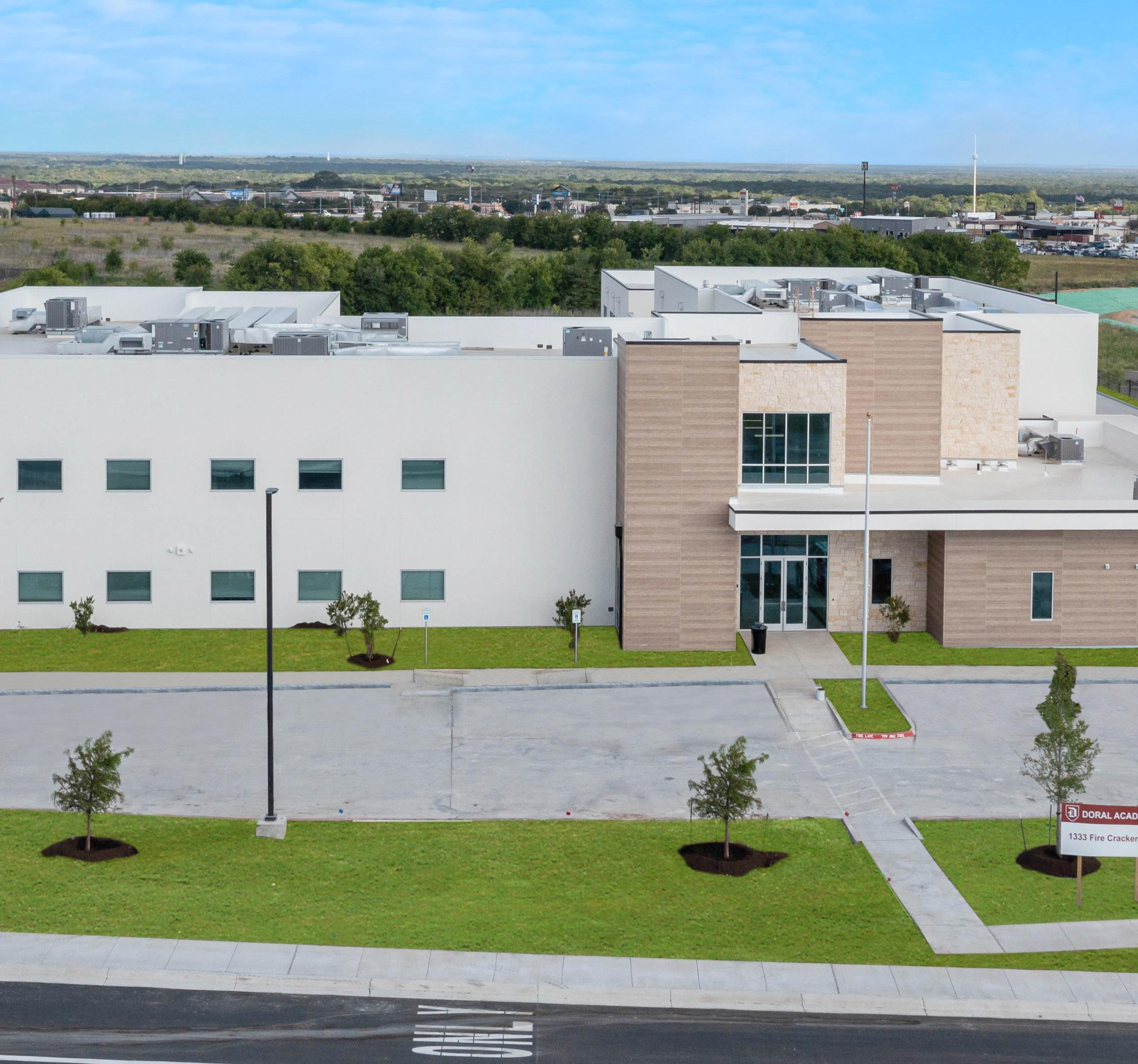
Butler Cohen served as Construction Manager-at-Risk to construct a new, ground-up K-8 campus for charter school operator Academica in Austin, Texas.
Photo Credit (all): Courtesy of Butler Cohen
How to Design Walls and Floors as Interactive Educational Surfaces Without Screen Fatigue
By Evelyn Long
Modern educational institutions require engaging digital learning tools to meet the growing needs of students. However, there’s also the challenge of combating screen fatigue — a common occurrence in the age of electronic devices. Integrating interactive, projection-based surfaces offers a smart solution that promotes digital learning while reducing the risk of technology overload.
The Rising Cases of Screen Fatigue
Gadgets are indispensable in a modern student’s life. The increasing dependency on electronics is leading to high levels of screen time, with teenagers aged 15-17 being more likely than those aged 12-14 to spend four hours or more on devices daily. This phenomenon can cause computer vision syndrome or screen fatigue, which may lead to eye discomfort, blurred eyesight, trouble keeping eyes open and headaches.
Aside from smartphones, computers and TVs, traditional screen-based technologies, such as tablets and smartboards, can contribute to this issue.
How to Transform Surfaces into Interactive Learning Devices
The prevalence of screen fatigue necessitates the development of more advanced technologies, such as interactive walls and floor-based activities. Here’s how designers and engineers can collaborate to build a space that fosters sustained student engagement and well-being.
Use Softer, Ambient Color Schemes
Studies have shown that text colors and ambient light conditions can contribute to visual fatigue and impair cognitive performance. Calming colors, such as muted greens, blues or light grays, are excellent choices for interactive surfaces. This approach can help reduce overstimulation from bright hues.
Warm tones like yellow and orange must be used sparingly for interactive elements that need to stand out. A touch of red is enough to draw attention to a specific area or button, while yellow can be used to evoke excitement among students.
Prioritize Projection Over Direct Screens
Projectors offer more flexibility than direct screens, providing more visibility in large spaces. When the whole class can see it, they are more likely to engage in lessons, making it easier to learn and collaborate in rooms of various sizes.
Some projectors emit blue-enriched white light, which contains blue light wavelengths. Institutions and experts recommend using orange text on a black background, rather than the standard black text on white, to help boost viewing clarity.
Select the Right Surface Material
Professionals should opt for durable, nonreflective and light-colored matte finishes for floors and walls to ensure the projected image is clear and to prevent distracting reflections.
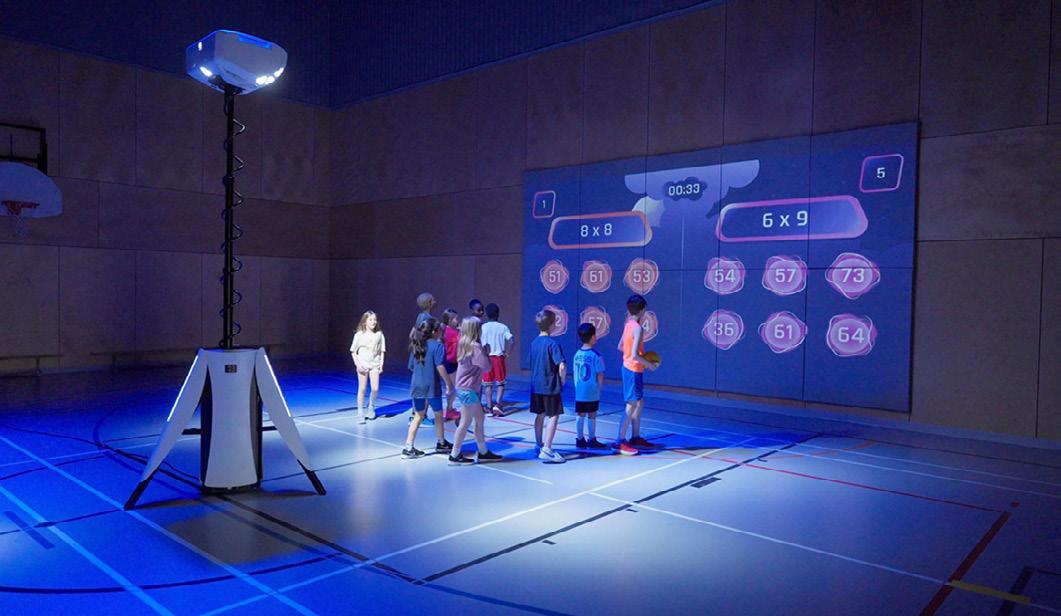
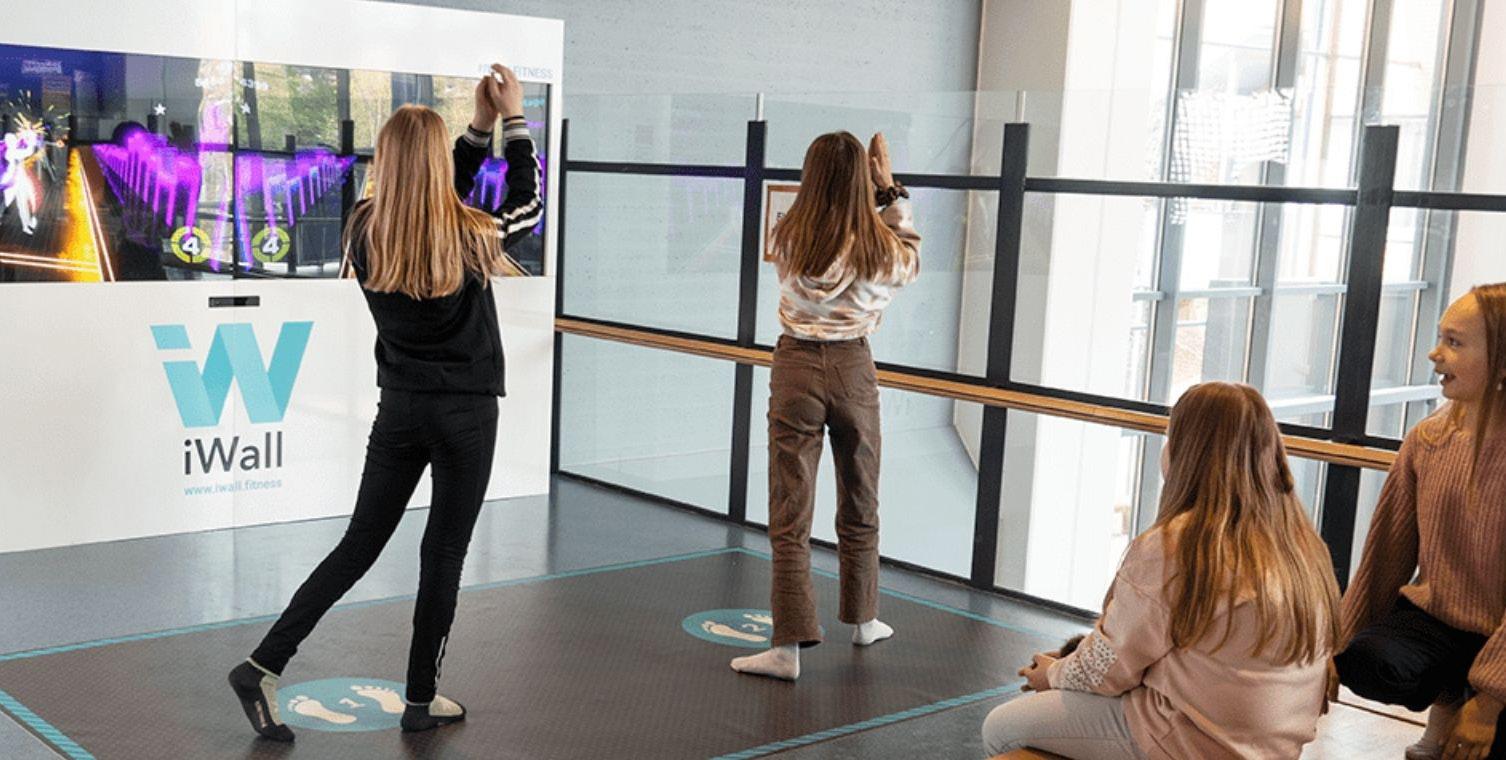
For instance, Viherlaakso School in Finland introduced iWall — an exercise gaming solution designed to enhance students’ learning experience. It utilizes smart floors that are nonreflective, nonglossy, and free of any dark or busy patterns that could interfere with projection and motion tracking.
Conduct a Thorough Site Assessment
Ensure Inclusive Access
Interactive walls and floors encourage physical movement. A study suggests that whole-body play activities can help autistic children boost self-control and reduce negative behaviors. Research author and University of Delaware professor Anjana Bhat stresses the importance of gross-motor activities.
“Such regular physical activity has the potential to improve their child’s attentional
focus, executive functioning, socialization, and would give them a sense of belonging/ achievement, when done solo at home or in a small group format in the community,” Bhat said.
Designers and engineers must develop the system to be usable by students with physical and cognitive disabilities. This includes ensuring gesture controls that are not overly dependent on precise fine-motor skills.
The Benefits of Interactive Technology in Schools
Implementing interactive technology that addresses the challenges of screen fatigue can also improve student academic performance. Dublin School District in Dublin, Ga., introduced PowerUp EDU — an interactive play environment where students engage in games for various subjects. Physical education teacher Matt Starley aims to incorporate technology into his classes once a week, noting its benefits.
“I feel like the interactive playground provides an excellent source of kind of changing up the monotony of traditional instruction,” Starley said.
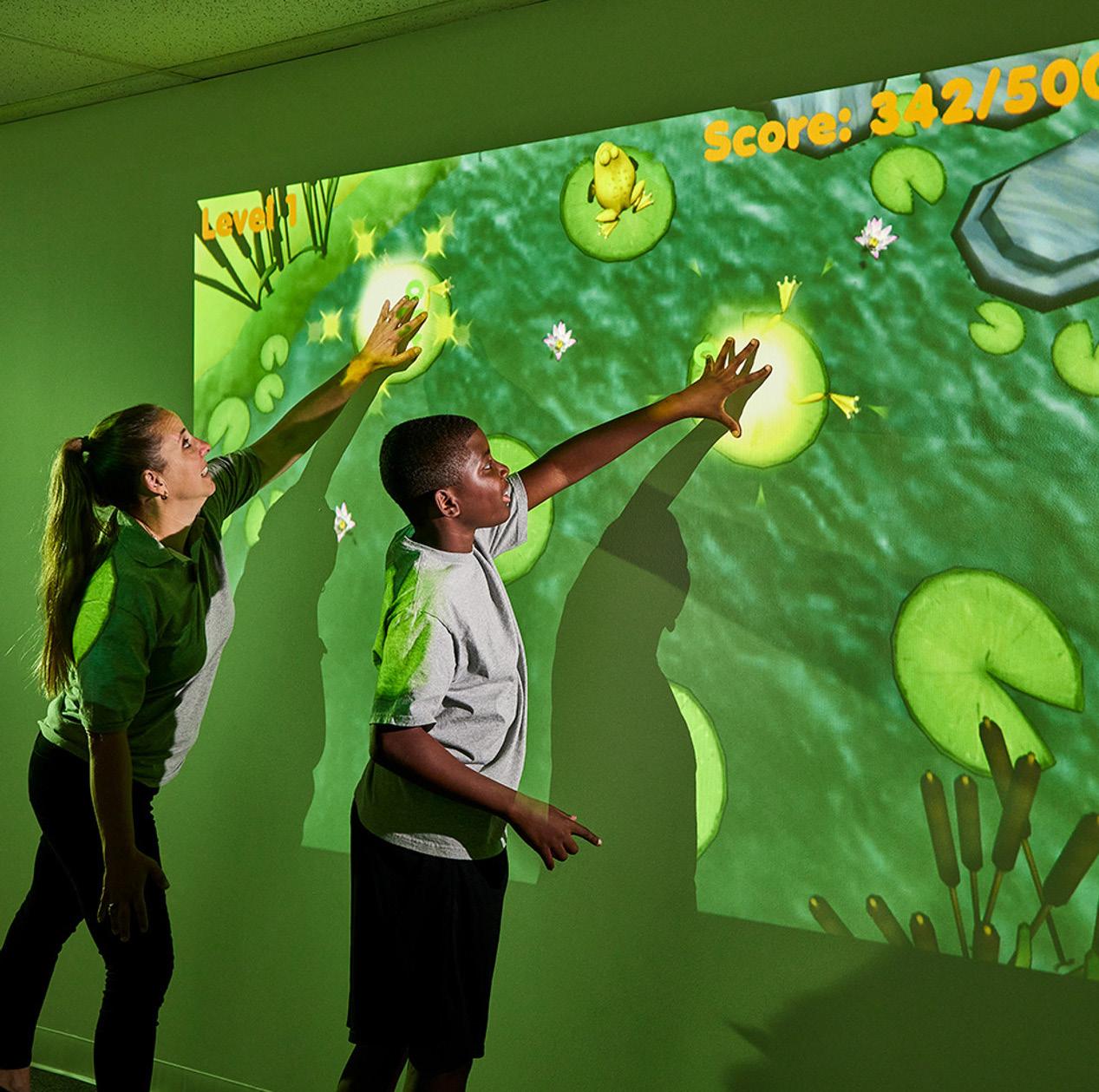
Meanwhile, the Phoenix Center in Nutley, N.J., introduced the Obie Mobile Pro — a motion-activated gaming system portable enough to be projected onto the walls, floors and tables. Occupational therapist Gershon Kravetz noted that this multisensory approach can promote better collaboration among therapists.
“It also increases collaboration between the therapists, between [occupational therapists] physical therapists and speech therapists. We can all sit there together while the speech therapist can work on their goals and the other physical therapists can work on their goals as well,” Kravetz said.
Interactive Learning Is the Future
A thorough site evaluation is essential for renovating existing spaces. This is especially important in older school buildings because hazardous materials may be present. For instance, asbestos can trigger lung disease, which is why the demolition or renovation of an asbestos-containing structure must follow the National Emission Standards for Hazardous Air Pollutants.
Project leaders must implement safety training to prevent exposure to hazardous materials during installation. They must also confirm if the rooms have adequate ventilation to dissipate the heat generated by projectors, sound systems and other electronic devices.
Educational facility design must move beyond merely adding more screens and focus on integrating technology that promotes engagement and well-being. Creating these advanced spaces requires careful planning, from selecting the right colors to adhering to regulatory-compliant renovation standards. Schools can expect stronger academic results as these innovations become the norm.
Evelyn Long is a commercial interior design writer with specialized expertise in accessible, ADA-friendly spaces and designing environments that support mental health and inclusivity.
The Phoenix Center in Nutley, N.J., introduced the Obie Mobile Pro — a motion-activated gaming system portable enough to be projected onto the walls, floors and tables. | Photo Credit: PowerUP
Viherlaakso School in Finland introduced iWall — an exercise gaming solution that utilizes smart floors that are nonreflective, nonglossy, and free of any dark or busy patterns that could interfere with projection and motion tracking. | Photo Credit: CSE
Vernier Science Center Transforming a brutalist landmark into an inclusive STEM Hub
By Lindsey Coulter
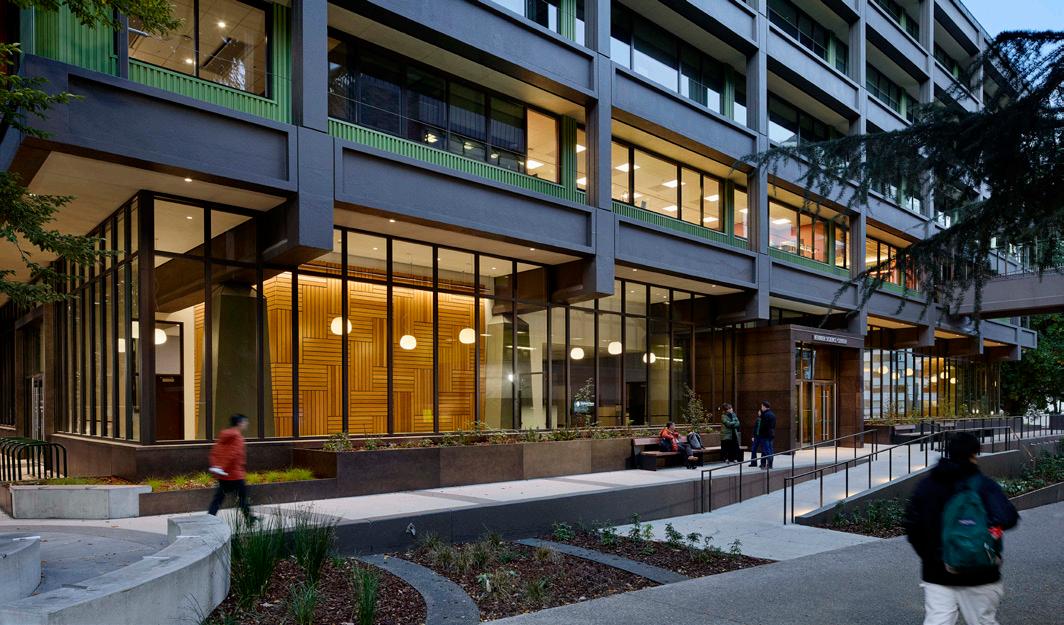
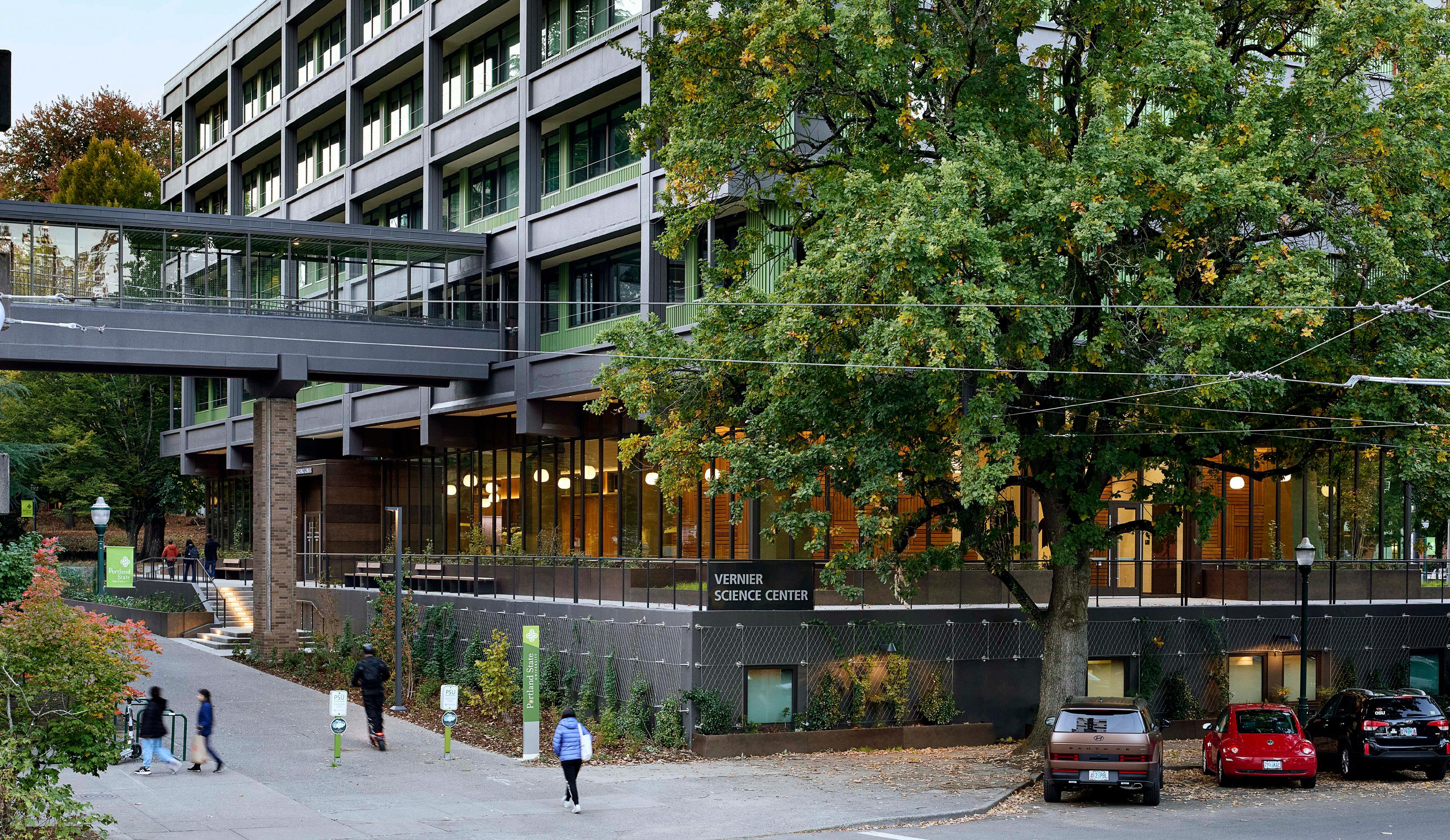
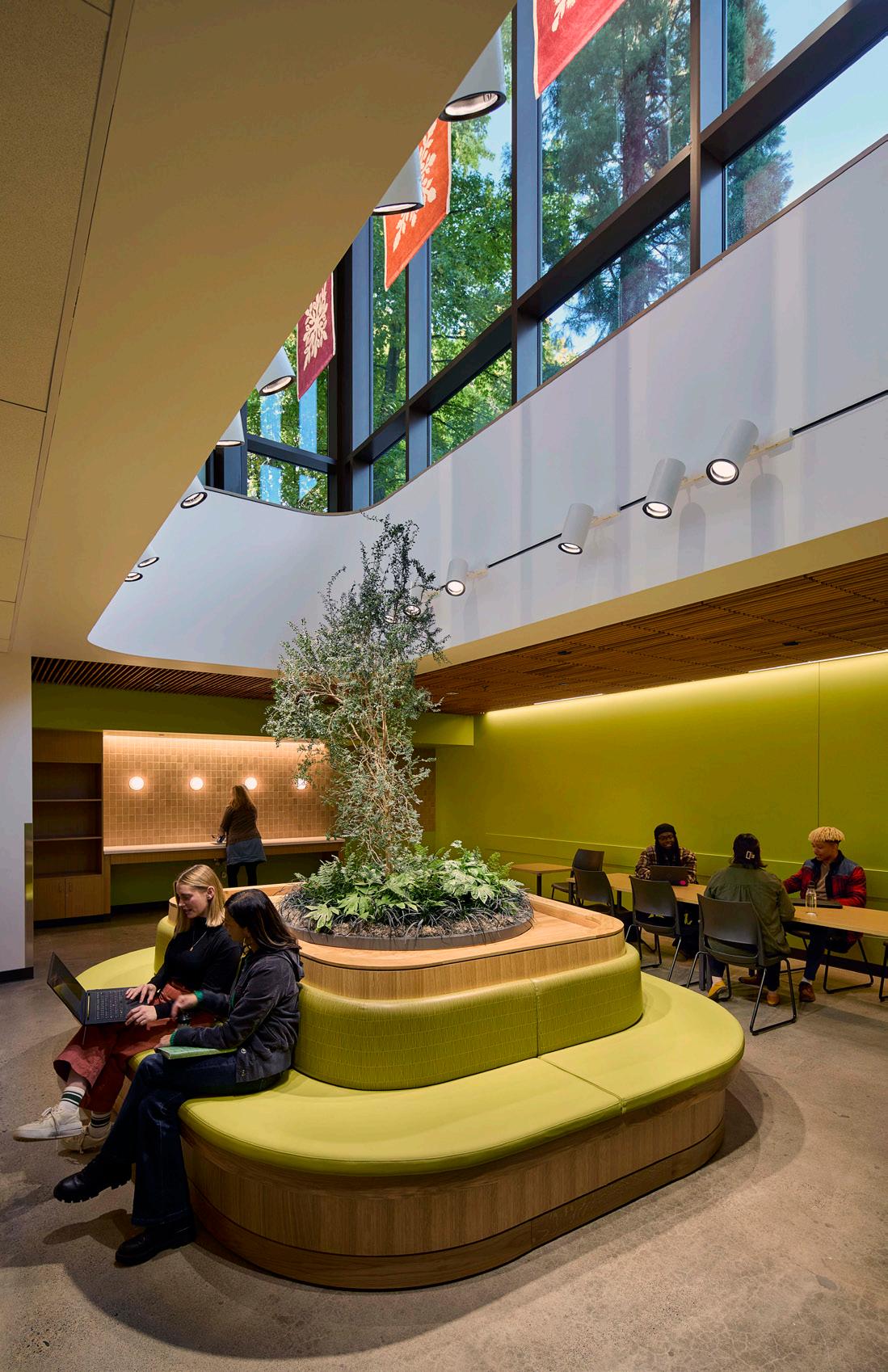
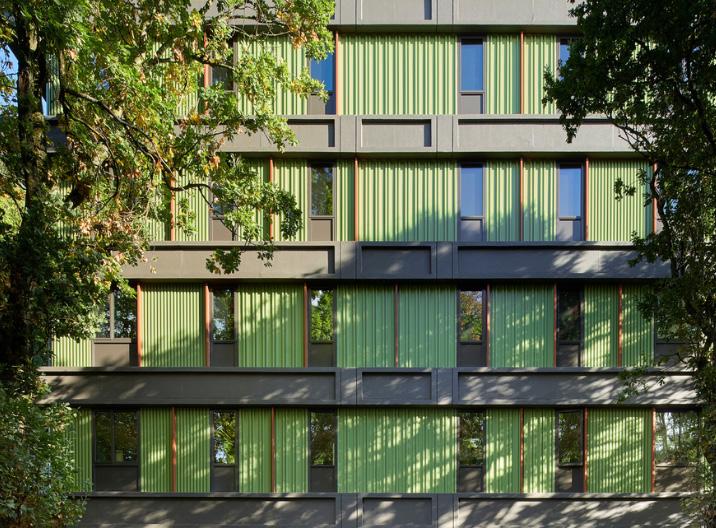
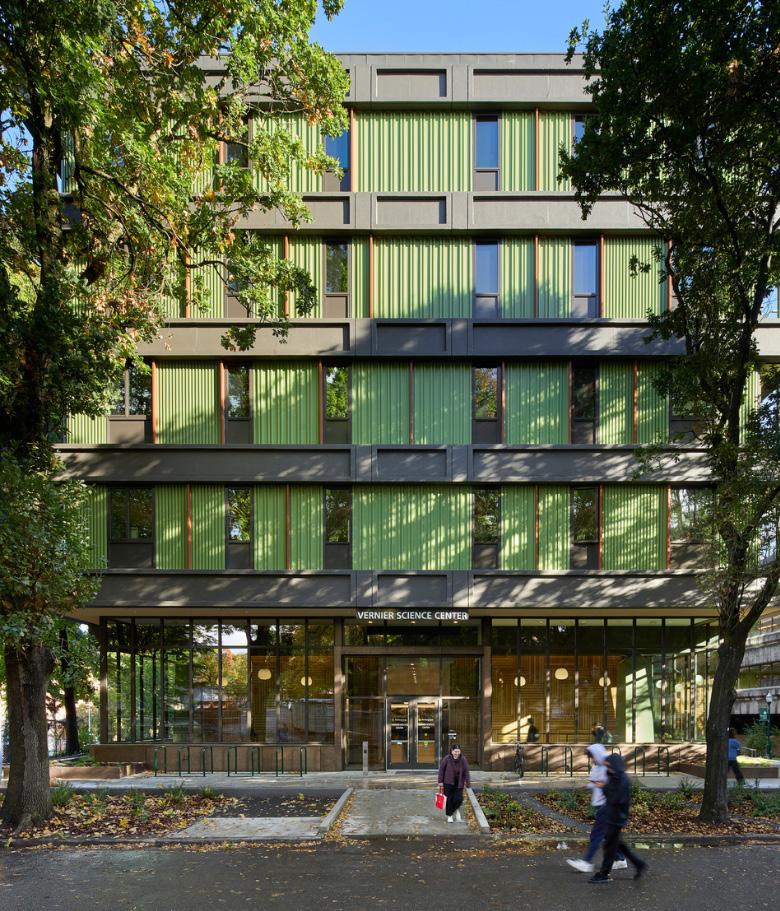
In the heart of downtown Portland, a once-stark Brutalist building is now alive with light, greenery, and the energy of nearly 2,000 students. The Vernier Science Center, previously named Science Building One, has been completely reimagined to foster collaboration, curiosity and cultural inclusivity. Glass-wrapped entryways, climbing vines, and oversized planters frame a human-scaled entrance, signaling that science education at Portland State University (PSU) is no longer just about labs and lectures — it’s about people, community and the stories they bring.
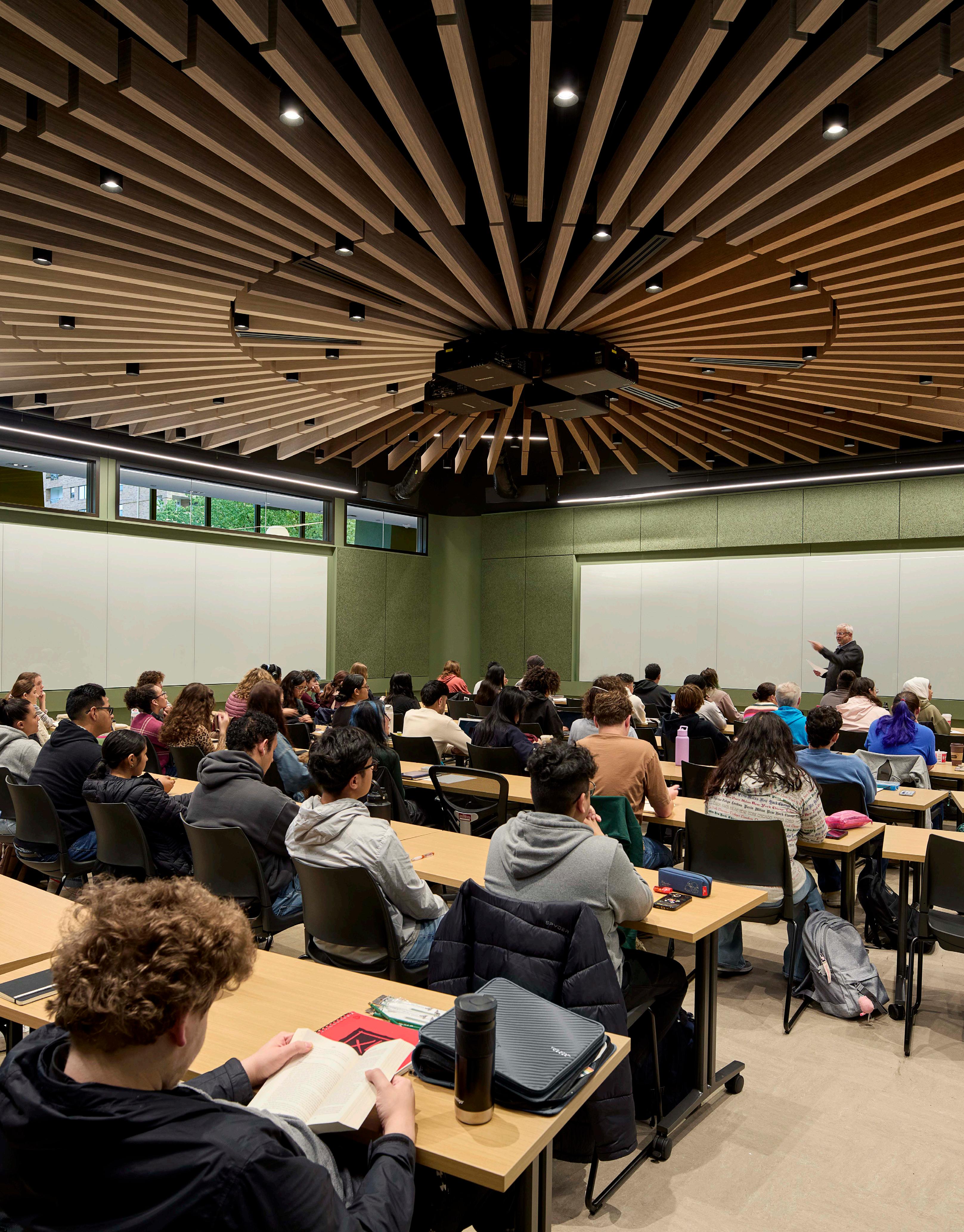
The original 1967 structure, designed by Skidmore, Owings & Merrill, was constructed for $2.9 million. The new iteration of the six-story, 88,795-square-foot building, completed in 2024 by Bora Architecture and Skanska, reimagines the structure as an inclusive hub for STEM education, combining advanced laboratories, collaborative classrooms and community-centered spaces.
The renovation not only updated the facility for contemporary education, but it also created a new campus landmark. From the expanded entry level to the striking glass facades, every element reflects a thoughtful balance of accessibility, cultural responsiveness and technical performance.
Inclusive Design Process
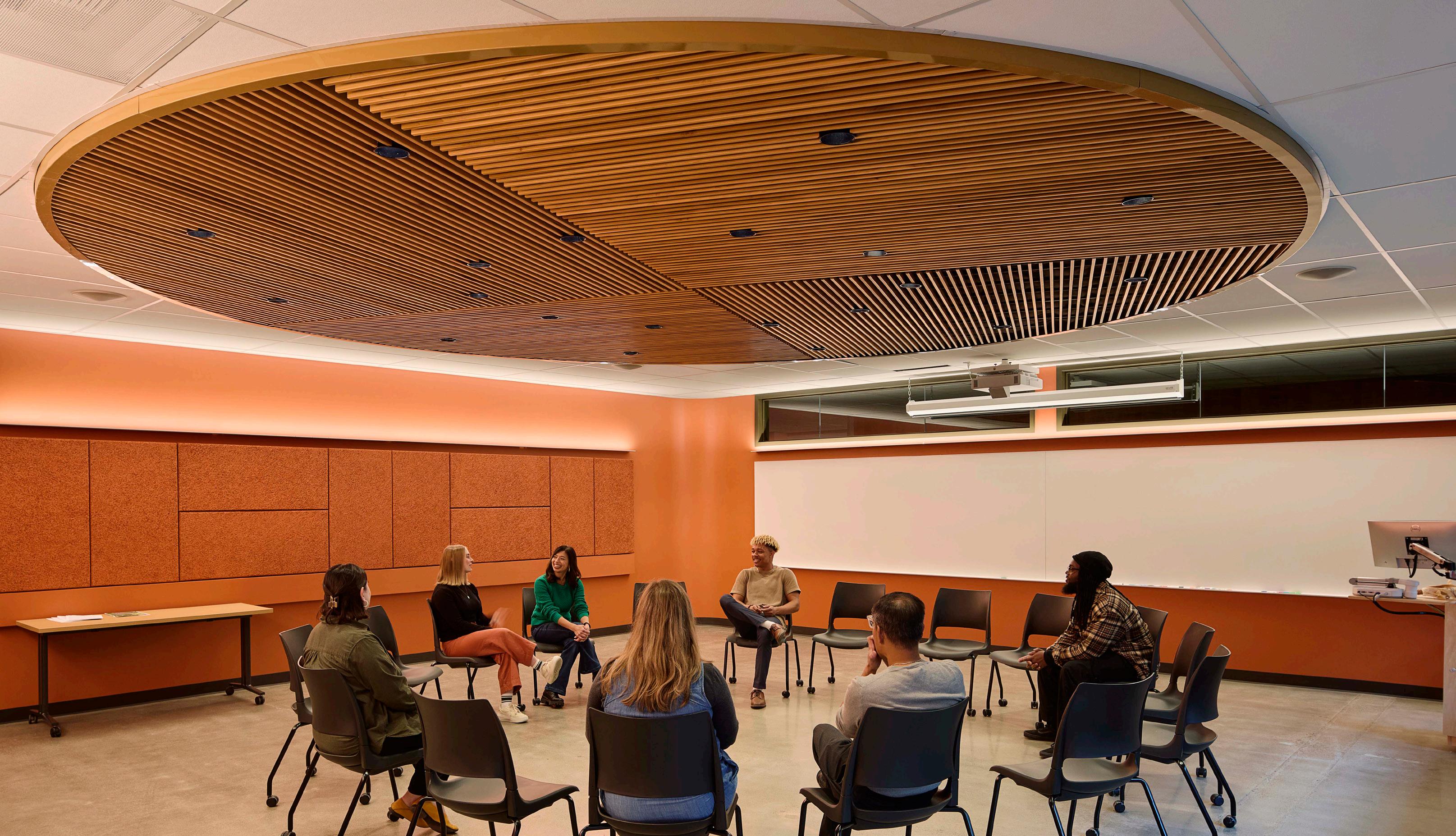
Engaging PSU’s diverse student body was critical to the project’s success. The team intentionally sought input from Black, Indigenous, and students of color to ensure the building met teaching and learning needs while celebrating the university’s diverse cultural backgrounds. Student voices informed everything from room programming to circulation patterns, lighting and informal learning areas.
“Creating inclusive, collaborative spaces was a priority in our new building’s design,” said former Todd Rosenstiel, Dean of PSU’s College of Liberal Arts and Sciences. “In building this transformative and Indigenous-focused space, we brought to life Sa place of science and discovery created by and for Portland State University’s diverse population. We built an entire building based on stories of people.”
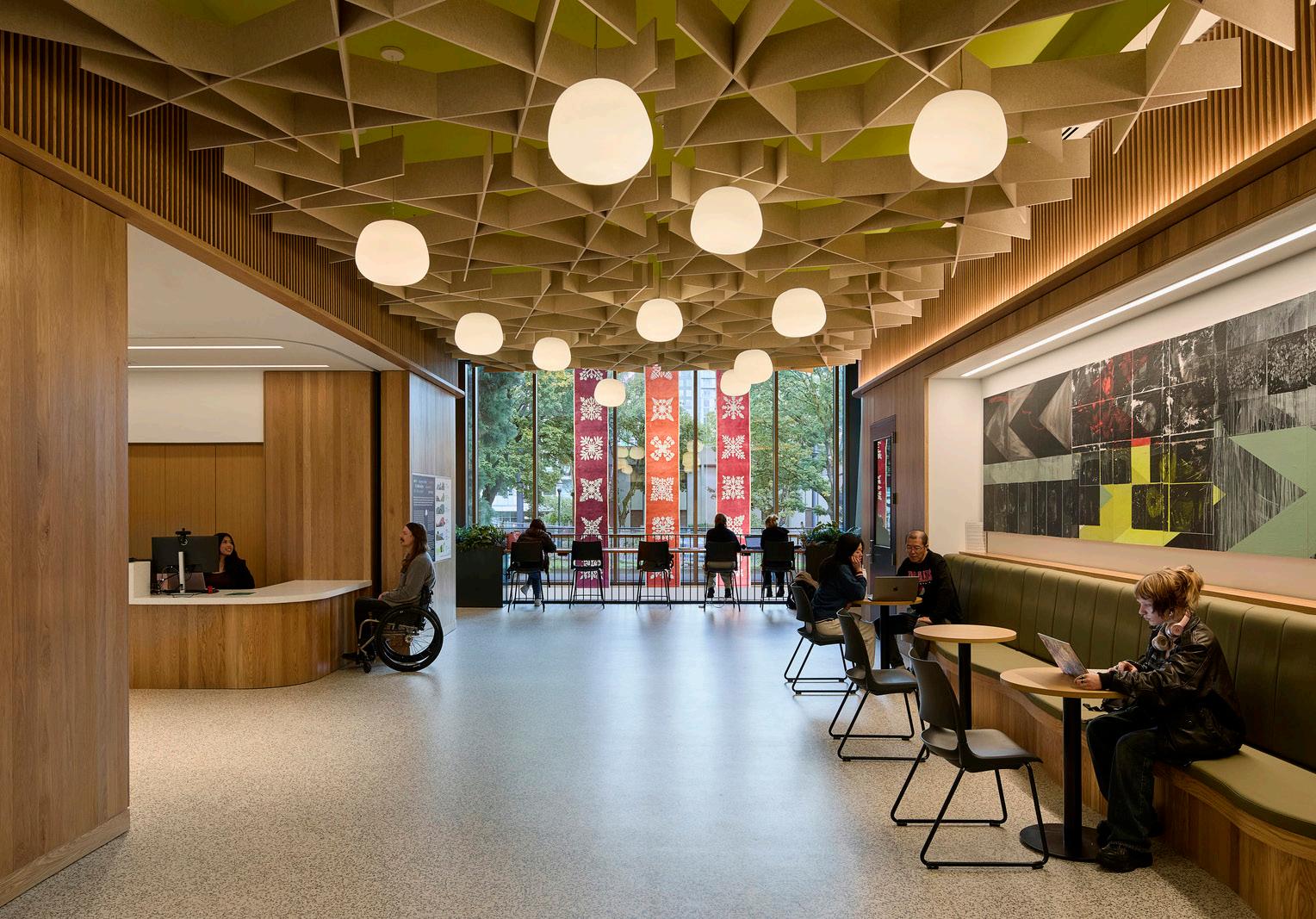
The renovation also leveraged a Critical Race spatial lens to address historic inequities in science education. Engagement with BIPOC and Indigenous students guided a variety of project elements including programming, the integration of open and informal learning areas, artwork selection and even lighting design. Spaces such as a community gathering room, a decolonized library, and a food/plant teaching kitchen expand the typical lab offerings, allowing Indigenous communities to explore science in culturally meaningful ways. A “science on display” concept permeates the building,
the Columbia Gorge, east toward the Cascade Mountain Range, south toward the Willamette Valley and west toward the mountainous Coastal Range, which honors the Indigenous journeys to get here,” said Skanska Senior Superintendent Troy Boardman. “Each design and construction consideration points to access in multi-disciplinary, collaborative spaces that promote engagement and co-creation.”
This intentional inclusivity translated into a design that balances transparency and privacy, ensures accessibility, and incorporates material finishes that reflect local
ecosystems and Indigenous culture. Human-scaled entryways and communal spaces further embody PSU’s commitment to equitable access to STEM education.
Engineering Excellence
From an engineering perspective, the project posed significant technical challenges. Integrating seismic upgrades into an active campus environment required meticulous planning, careful sequencing, and constant coordination with faculty and staff.
“This project brought together sustainability, inclusivity, innovation and deep community engagement in a dense urban academic setting.” – Joe Schneider, Senior Vice President, Account Manager, Skanska USA Building, Oregon
giving students opportunities to showcase their work collaboratively.
This level of thoughtfulness even continued into the building’s facades.
“Each of the four facing external facades has a unique theme including north toward
“Science buildings are inherently complex, and going vertical adds layers of coordination, especially when integrating dense mechanical, electrical and plumbing systems to support advanced lab environments,” said Joe Schneider, Senior Vice
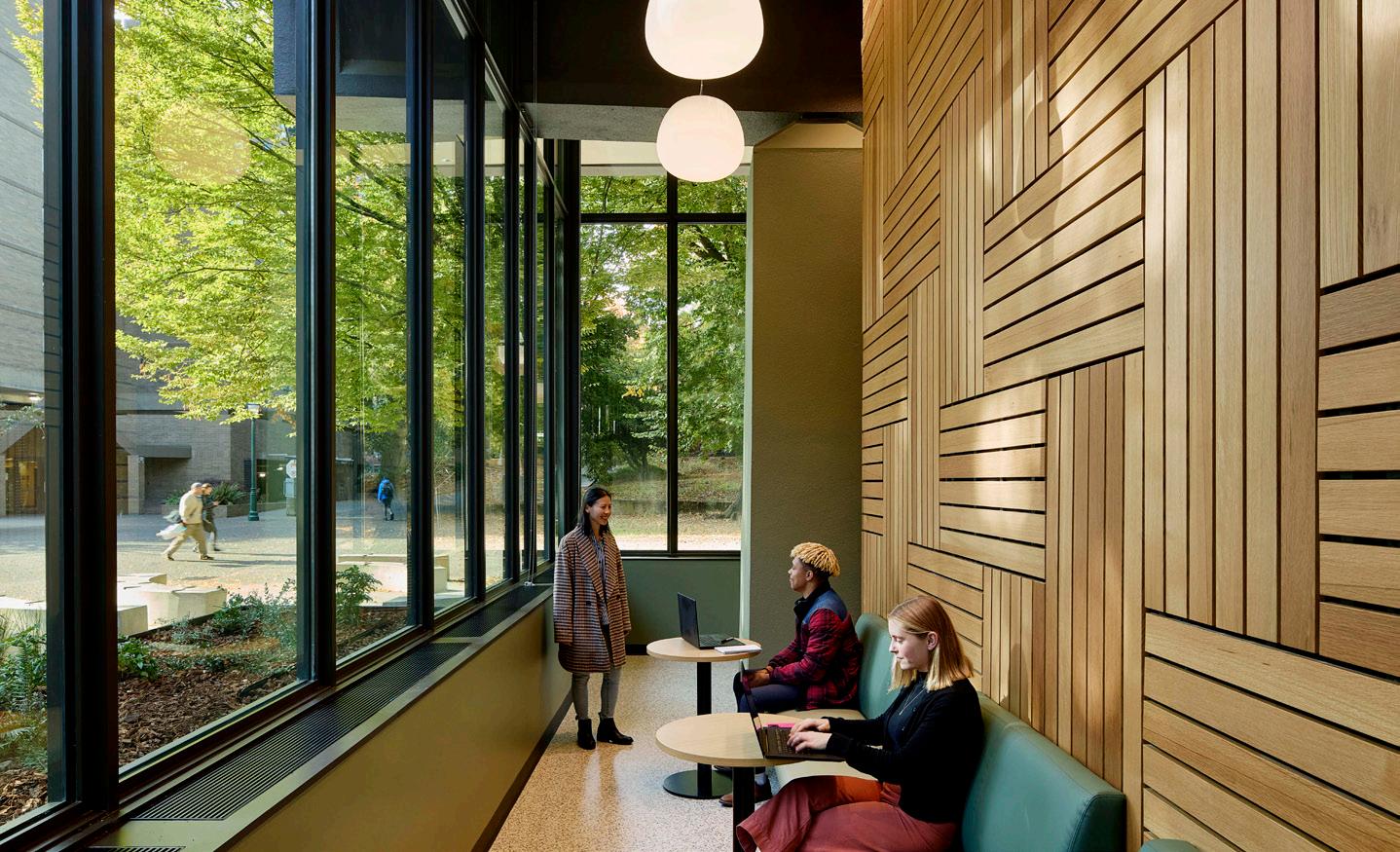
By pushing the main floor outward and integrating glass facades, the design maximizes daylighting and visual connection to the outdoors while honoring the original Brutalist aesthetic.
Photo Credit (all): Jeremy Bitterman
Smart energy practices, including LED lighting, controllable systems, low-emitting materials and forestry-conscious wood products supported the building’s pursuit of LEED Gold certification.
President – Account Manager, Skanska USA Building, Oregon.
The team employed laser scanning and Building Information Modeling (BIM) to capture precise conditions from the original 1967 structure. By consolidating MEP-intensive labs on upper floors, constructability was optimized, and classroom construction could progress in parallel. The vertical layout also enhances interdisciplinary collaboration by stacking STEM disciplines within a compact footprint, improving connectivity between students and faculty.
Additionally, the main floor was pushed outward by eight feet and wrapped in glass to strengthen connections to greenery and natural light. The resulting transparency creates visual access and encourages interaction, reflecting the building’s community-centered mission.
Construction Strategy and Phasing
Skanska developed the facility through a $62.8 million, three-phase plan to accommodate the active campus and research labs. Phase I involved demolition of Stratford Hall and relocation of research and lab services into nearby buildings. During demolition, concrete shears and real-time vibration monitoring minimized disruption to sensitive labs nearby.
Phase II focused on the renovation of 48 rooms in the Science Research and Teaching Center while the building remained operational. Work was scheduled around class times, with noisy activities starting as early as 5 a.m., ensuring faculty and students moved only once during the transition.
The final phase transformed Science Building One into the Vernier Science Center. Adjacent buildings were protected through air-quality monitoring and safe pedestrian access management. Schneider emphasized the importance of combining technical precision with human-centered planning.
“Our approach blended technical expertise with human-centered planning,” he said.
The downtown campus location also posed logistical challenges, including high pedestrian traffic, narrow one-way streets and proximity to the Portland Streetcar. Just-in-time deliveries and real-time updates via QR codes along the fence line enabled uninterrupted material flow while keeping the campus community informed.
Sustainability and Resilience
Sustainability was a core principle throughout the project. Reuse of the original structure minimized embodied carbon, while mechanical upgrades and new double-glazed windows significantly improved energy efficiency. Smart energy practices, including LED lighting, controllable systems, low-emitting materials, and forestry-conscious wood products, supported the building’s pursuit of LEED Gold certification.
Waste diversion exceeded 90%, achieved by rigorously sorting materials and prioritizing recycling and reuse. The demolition of Stratford Hall also created opportunities for regeneration, as the site now hosts a campus park with meandering paths, log seating and native grasses, extending the building’s focus on wellness, gathering and reflection.
Indoor environmental quality was improved through increased natural light, outdoor views and access to nature — a rare feature in laboratory buildings. Lab separation reduces student exposure to chemicals, while food and plant teaching labs reinforce experiential learning and allow students to directly connect theory to practice.
“Inclusivity was also a guiding principle throughout construction,” Schneider noted. “Our team worked closely with PSU to preserve culturally affirming design elements during value management and prioritized diverse subcontractor participation through targeted outreach and mentorship. Every worker on site completed Green Dot bystander intervention training, reinforcing a respectful and inclusive jobsite culture.”
Materiality and Technical Highlights
Structural upgrades included heavy reinforcement of shear walls to meet seismic requirements, stronger fire suppression systems and high-performance wet labs. Nature imagery enhances wayfinding and contributes to a welcoming environment.
Advanced MEP systems were integrated into tight ceiling spaces. Laser scanning allowed millimeter-level coordination of new systems, enabling adaptive reuse of the existing building. Phased construction ensured continuity of campus operations, demonstrating a model approach for renovating high-traffic urban university buildings.
From a technical standpoint, the building represents a careful balancing of modern engineering and historic preservation. By pushing the main floor outward and integrating glass facades, the design maximizes daylighting and visual connection to the outdoors while honoring the original Brutalist aesthetic.
Technology and Smart Systems
Technology supported the building’s redevelopment at every stage. To accommodate dense MEP systems, Skanska and Bora Architects employed laser scanning and BIM to capture the precise conditions of the original 1967 structure, allowing seamless integration of new systems.
Smart building systems enhance both energy performance and occupant experience. High-performance lighting controls and smart LED fixtures adjust
Project Data
Project Name: Vernier Science Center
Location: Portland, Ore.
Area: 89,500 square feet
Construction Cost: $64.7 million
Architect: Bora Architecture & Interiors, Studio Petretti Architecture, Woofter Bolch Architecture
Sensors track temperature, humidity and CO2 levels, feeding data into the building management system to optimize ventilation and minimize energy use.
automatically to daylight levels and occupancy, reducing energy consumption while maintaining ideal illumination for research and teaching. Advanced HVAC systems monitor air quality in labs and common spaces, protecting students and staff from chemical exposure while providing real-time environmental data to facilities managers.
Human-scaled entryways and communal spaces further embody PSU’s commitment to equitable access to STEM education.
The project incorporated energy-efficient glazing and automated shading to balance daylighting with thermal comfort. Sensors track temperature, humidity and CO2 levels, feeding data into the building management system to optimize ventilation and minimize energy use. Digital wayfinding, nature-inspired imagery, and interactive signage help students navigate the six-story layout while reinforcing the building’s educational mission.
From construction to operation, technology supported both efficiency and inclusivity. Laserscanned coordination reduced conflicts during the tight vertical build, just-in-time deliveries minimized disruption to campus life, and digital platforms kept students and staff informed about construction phases. Postoccupancy, smart systems contribute to sustainability goals, occupant health, and an adaptable environment capable of evolving with future STEM innovations.
STEM in Education and Practice
Vernier Science Center has transformed PSU’s STEM education environment. Originally serving 200 students per day, the facility now accommodates nearly 2,000.
“This project brought together sustainability, inclusivity, innovation, and deep community engagement in a dense urban academic setting,” Schneider reflected. “We drastically transformed a space that students once avoided into a vibrant STEM center shaped by student voices. Seeing our client’s values reflected in every detail
and watching the energy of the project ripple through the craft workforce made this experience rewarding.”
The building serves as a benchmark for adaptive reuse, cultural responsiveness, and urban campus transformation. LEED Gold® certification, smart energy systems, and seismic upgrades illustrate a commitment to environmental stewardship. Equally important, the design elevates Indigenous learning alongside Western science, reflecting a holistic approach to contemporary STEM education.
Key contributors across design, engineering, and construction collaborated to merge technical performance, sustainability, and cultural inclusivity. The project achieved 25.5% diverse contracting participation and employed innovative strategies for material reuse, energy efficiency, and human-centered planning.
“This project stands as a living expression of environmental stewardship, cultural respect, and inclusive education,” Schneider said. “It reflects Portland State University’s values, elevates Indigenous learning, and sets a new standard for transformative campus projects.”
Product Data
HVAC: Total Mechanical
Mechanical Insulation: Boyter Brothers
Mechanical, Electrical and Plumbing: Southland Industries
Electrical: Inland Electric
Firestopping and Containment: Specialty Firestop Systems, Cosco Fire Protection
Glass and Partitions: Interior Tech, Encore Glass, Western Partitions
Concrete Coatings and Repair: Consurco
Carpet: Rubenstein’s Contract Carpet
Flooring: Linear Floor Installers
Paint: Williamsen & Bleid
Doors, Frames, Hardware: Building Material Specialties
Custom Signage: Sign Wizards
Elevators: TK Elevator
Janitorial: WFJ Janitorial
Window Coverings: Mt. Hood Window Coverings
Flooring: Stonhard
Fencing: Town & Country Fence
Glazing: Culver Glass
Engagement with BIPOC and Indigenous students guided a variety of project elements including programming, the integration of open and informal learning areas, artwork selection and even lighting design.
Powering Learning Environments Through On-Site Solar Solutions
By Jeff Haidle
Educational institutions must fully capitalize on what are often tight budgets. Administrators must make decisions that balance operational and educational goals to ensure they can support both high-performance buildings and high-quality education. But what if there was a way to simultaneously lower energy costs, enhance education and be part of a more sustainable built environment? One of the design solutions for educational clients is on-site solar to offset energy costs and serve as a learning tool.
A Bright Future in Higher Education
Montana State University (MSU) has long been a champion of sustainability. Through MSU’s Office of Sustainability, formed in 2012, the university has led the installation and utilization of alternative energy systems, highly efficient LED lighting, water conservation systems, HVAC enhancements and more. In water, lighting, and heating and cooling alone, MSU saves about $410,000 per year.
In 2023, MSU earned a prestigious STARS Gold rating from the Association for the Advancement of Sustainability in Higher Education — an honor that recognizes MSU’s comprehensive achievements.
As a design partner for MSU, Cushing Terrell has supported the university with many of its energy-related projects over the past decade, including the design of solar systems in buildings and planning for the installation of solar at a future date, making
them “solar ready.”
The Cushing Terrell team has worked on an ongoing, campus-wide master plan to increase MSU’s overall energy efficiency via the design, construction and maintenance of buildings on campus to an exponential degree of sustainability. This effort will aid in the university’s goal of achieving STARS Platinum by 2035 and carbon neutrality by 2040.
For example, solar wall technology utilized for MSU’s Romney Hall improved the building’s energy performance by more than 40%. Designed into a new elevator core clad in dark-colored perforated metal panel, the system captures solar-heated air that is incorporated into the HVAC system and circulated via heat pumps throughout the building. The heat is transferred to and from the campus’ geothermal system, providing most of the heating for the building. The historic renovation of Romney Hall earned LEED Gold and is one of the projects that helped MSU earn its STARS Gold rating.
“Solar Ready” High Schools
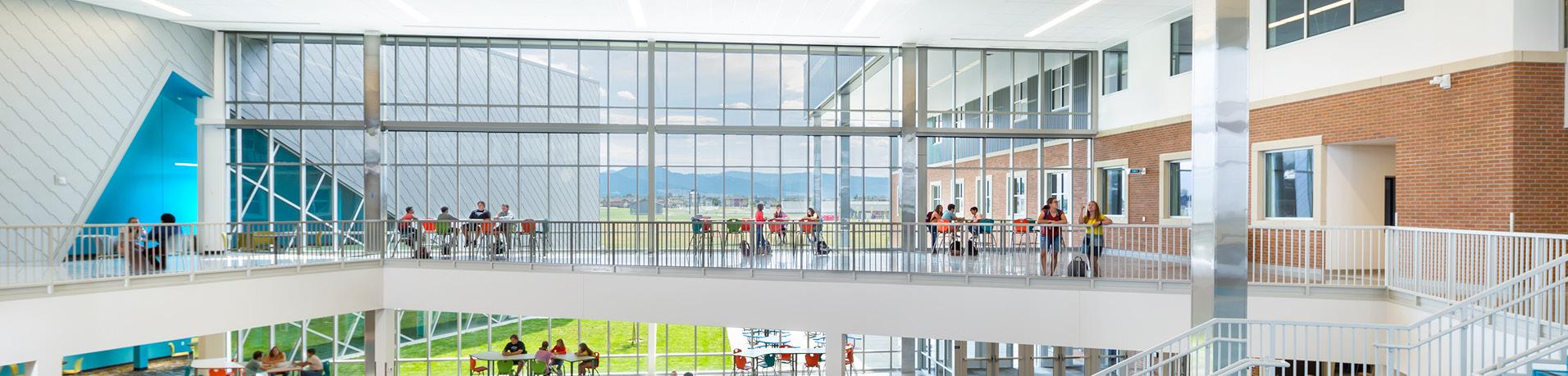
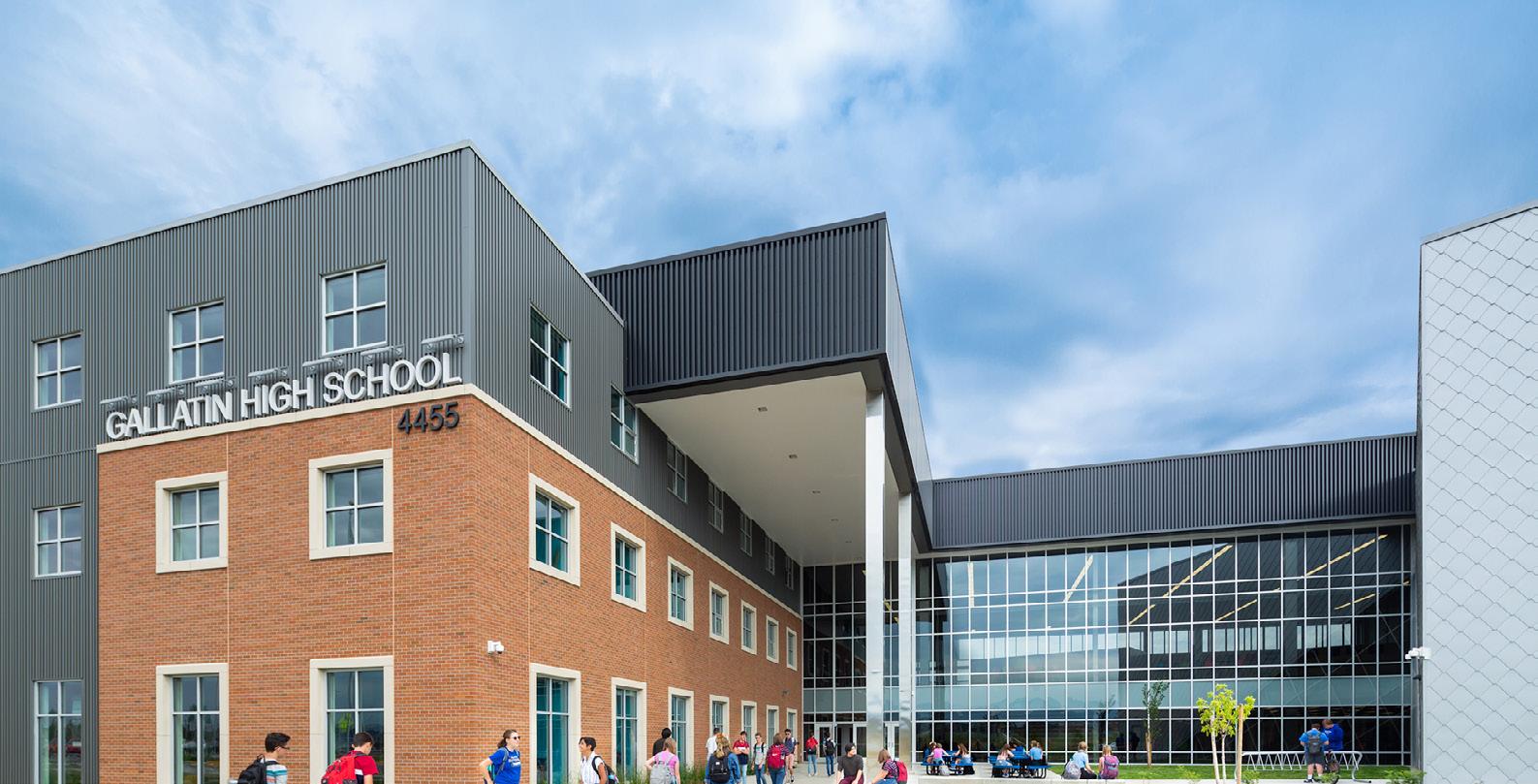
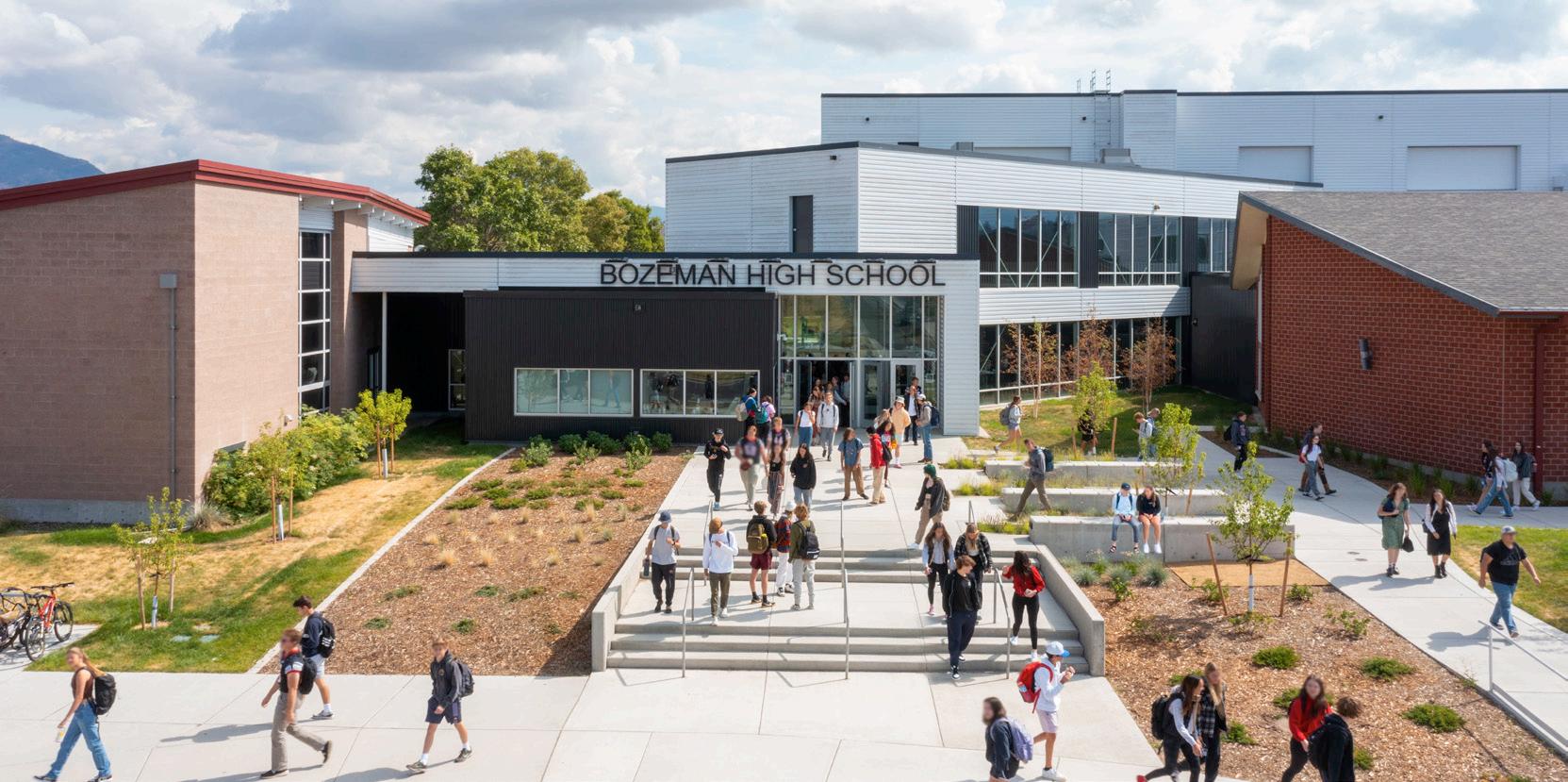
Other examples of schools that have implemented multi-phase solar programs — a good option when clients need to meet budgets and align with current funding levels — are Bozeman High School and Gallatin High School in Bozeman, Mont.
School, the Cushing Terrell team ensured the schools would be solar ready, meaning space, structures and connections all in place for the future installation of photovoltaic (PV) arrays. Now, three years later, the schools are realizing their solar dreams with the design and layout of these systems.
The 50-kilowatt systems are estimated to generate approximately 65,000 kilowatt hours per year, which is equivalent to the average consumption of six, single-family homes in the United States. The arrays will power shop equipment, lighting, cooling and other general electrical loads.
Likewise, the Billings School District has followed this model, starting with high schools, then middle and elementary schools. Each location and potential future utility has been considered with arrays installed in fields, on rooftops and space-efficient areas such as covered parking structures. The Billings School District utilized NorthWestern Energy’s grant program for their projects, and with the grant, the schools should see a payback at around 12–13 years.
Students Learn the Impact of Solar Systems
In partnership with Missoula County Public Schools, Cushing Terrell provided
See Green Technology, page 20→
When designing the new Gallatin High School and the renovation of Bozeman High
Bozeman High School in Bozeman, Mont., implemented multi-phase solar programs — a good option when clients need to meet budgets and align with current funding levels.
Bozeman High School in Bozeman, Mont., implemented multi-phase solar programs — a good option when clients need to meet budgets and align with current funding levels.
Photo Credit (all): Courtesy of Cushing Terrell
Treasure Valley Community College in Ontario, Ore., includes a PV array that provides the building with renewable energy and serves as a demonstration tool for educators and students.
STANDOUTPRODUCTS
Put your product in the spotlight by contacting SCN at sales@wmhmedia.com
Smart Display Screens
Easy to use, deploy and support, SMART Board® interactive displays support dynamic, collaborative learning. Clients can choose from different models engineered to fit every teacher, student, learning environment and budget. Easy to use from day one, with plentiful options for student engagement and unique upgradability options, SMART displays are durable and built to evolve with the needs of the classroom. The displays include up to 40 unique touch points with full multi-user interactivity. They include features such as Continuous Pen, Touch and Eraser differentiation from all users across platforms. The displays also automatically recognize and switch between pens, tools, touch, multi-finger gestures and erasing. The designed-foreducation whiteboard application includes built-in content and activities that make it easy for teachers to add interactivity and engagement on the fly; no training required.
SMART Education www.smarttech.com
Campus Audio System
Boxlight’s ezRoom combines FrontRow audio, displays, and other media sources into a nearly invisible package that can be paired with FrontRow Conductor to create the ultimate endpoint, connecting each classroom, the front office and the entire campus. Additionally, Link Conductor™ can be integrated for everyday schoolwide communications and reliable safety and emergency communications during critical situations. Clients can remotely control all IP-based devices throughout the school and make quick adjustments without interrupting instructional time. The system allows users to respond swiftly in critical moments with one-button safety protocols that quickly notify staff or first responders. All students — including language learners, special education students and those using assistive listening devices — have equitable access to content, information and alerts. Expand with Conductor for IP-based bells, paging, intercom, and campus-wide alerts and messages.
Boxlight www.boxlight.com
Laminated Glass
Science-Based Lighting System
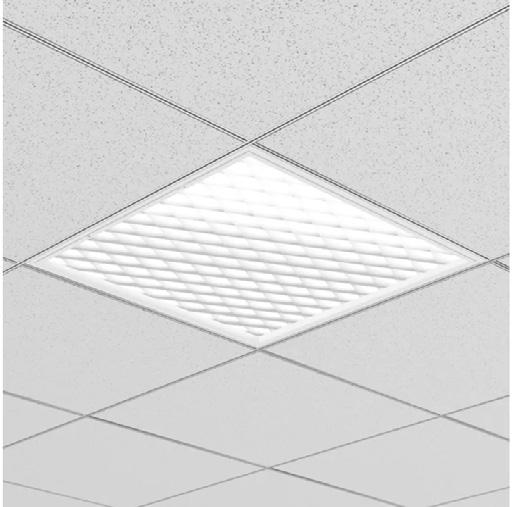
The Corelite Perceive PT series by Cooper Lighting blends subtle styling with a proprietary optical system to provide comfortable illumination with a distinctive touch, featuring high-lumen output options in a compact, shallow housing. Offered in 2x2, 2x4 and 1x4 sizes, the Perceive PT series is a patented design based on cognitive science. It includes unique geometric and organic optical patterns to add dimensionality, visual interest and glare reduction. Options with reduced maximum luminance below 6,000 candelas per square meter align with WELL v2 L04 Standards. High-lumen packages offer up to 10,000 lumens. The bottom surface of the lighting can be wiped down for easy cleaning and maintenance. The shallow housing does not include a door frame. Perceive PT lighting also offers flexible installation options, including recessed, drywall and surface mount. Integrated controls are available, such as WaveLinx Pro and WaveLinx Lite.
Cooper Lighting www.cooperlighting.com
Interactive Flooring
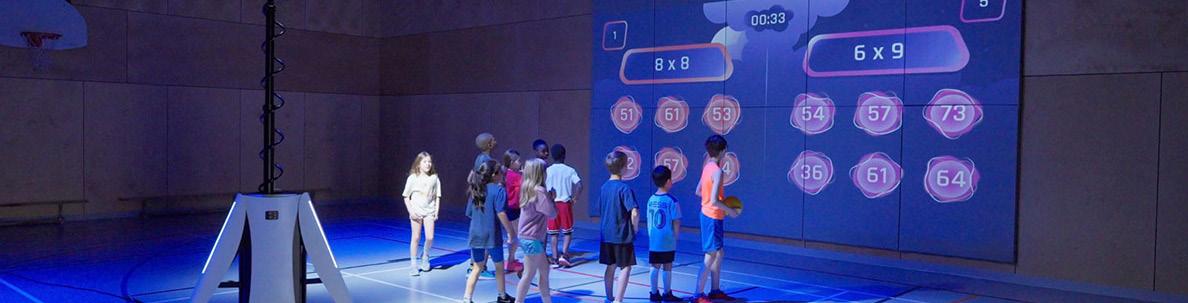
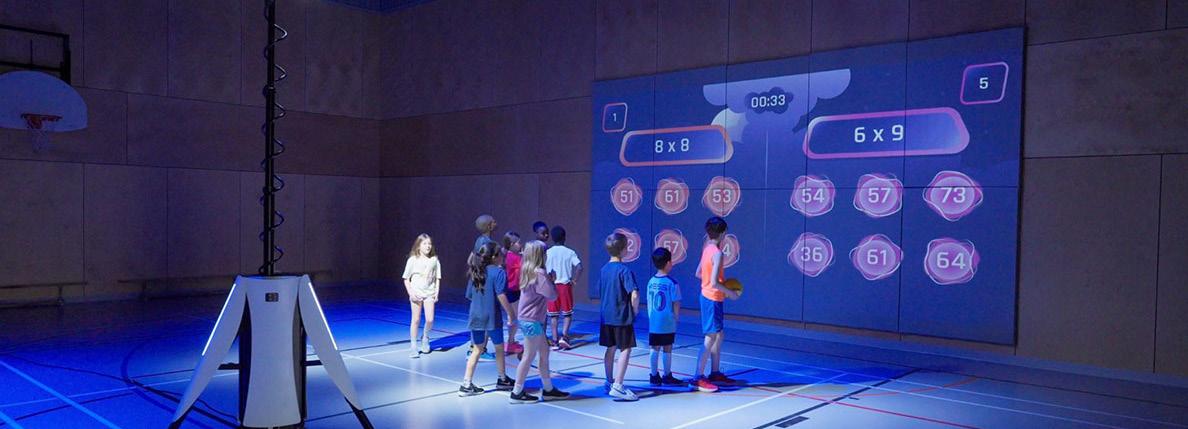
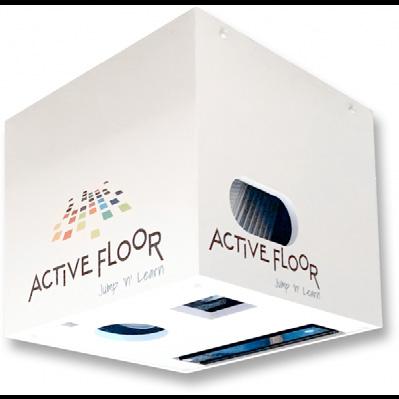
ActiveFloor has developed various types of interactive floor solutions that encourage movement and allow students to participate in new methods of learning. ActiveFloor’s interactive floor consists of a ceiling-mounted installation box with a projector and a computer, a camera that tracks movement and a white vinyl floor that makes up the foundation of the interactive playing area. The interactive floor system can be installed in a room or hallway. The ActiveFloor ONE option creates a smaller floor for young children to navigate more easily, and is an ideal solution for smaller spaces, daycares and preschools. The company also offers the SportsWall interactive wall that responds to balls as well as the MobileMax portable interactive floor, which can be used on both tables and floors and easily adjusted in size.
ActiveFloor www.activefloor.com
Emergency Response System
McGrory offers a wide range of solutions that give K-12 and higher education clients endless glazing design options. With products ideal for both exterior and interior applications (including structural), schools and universities can easily create a cohesive look from the inside out — no matter the project size. McGrory offers laminated colored glass with interlayers in a comprehensive range of opacities, helping create a cohesive look. The range of options allows clients to control the level of opacity for a strong or subtle effect. Glass can be seamlessly matched throughout projects — no matter the size or complexity — where varying degrees of privacy are needed. The product is ideal for facades, curtain walls, doors, canopies, railings, office entrances, decorative surfaces, walls and partitions. It can be combined with additional glass types and custom printed film interlayers to create special effects, including laminated, translucent, textured, back painted and more.
McGrory Glass www.mcgrory.com
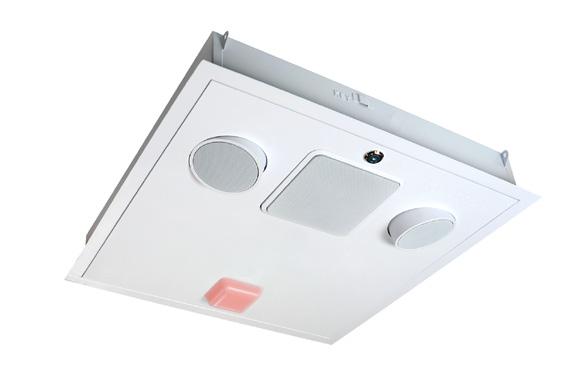
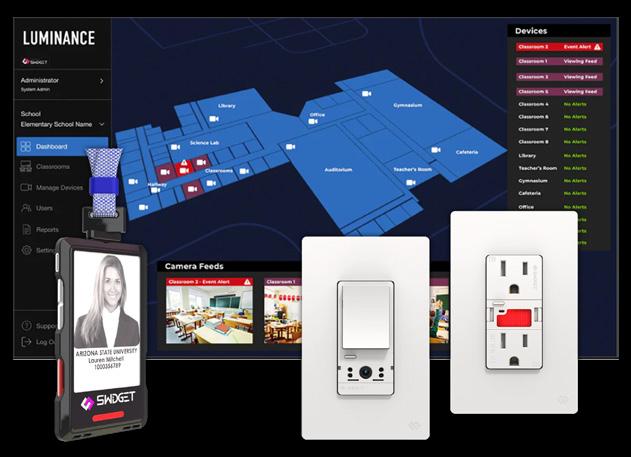
Luminance™ Emergency Activation & Response Solutions by Swidget provide situational awareness during a crisis, enabling a faster, more coordinated response by teachers and first responders. The wearable activation and communication devices instantly alert administrators and/or law enforcement of an emergency situation, enable live video feeds from discreetly installed cameras for first responders, transmit on-site staff instructions, and activate status lighting throughout the school. Schools can easily install Luminance using the existing wiring infrastructure and seamlessly connect it with other smart security systems. Teachers can instantly activate emergency alerts to school staff and leadership or law enforcement while keeping communication lines open through a multipurpose ID badge. Law enforcement can view live video of the emergency area and send clear, real-time instructions to teachers. Key features include secure live video stream, multipurpose ID and communication badges, an emergency-response dashboard, a mobile app for law enforcement and emergency status lighting. Swidget www.swidget.com
New Mayo Clinic Building Is a Phoenix Oasis Integrated Education & Research Building artfully blends training and academics
By Arnold Swanborn, AIA
Mayo Clinic — renowned for its world-class, ground-breaking care — attracts industry-leading academics, clinical caregivers and researchers. Organized around “three shields” of medical care (practice, research, education), Mayo believes that all three tenets must be integrated to create an environment that culminates in superior bedside delivery.
At Mayo Clinic’s Phoenix campus, however, medical-education programs were spread among several locations and lacked appropriate research space. Thus, Mayo upgraded its campus with the new $90-million Integrated Education & Research Building (IERB), which centralizes its six education programs with much-needed research space into one high-tech, interdisciplinary 150,000-square-foot facility.
A Space for Learning, Discovery and Sharing
The IERB serves as the new hub for Mayo’s Alix School of Medicine and provides space for up to 30 full-time researchers, clinicians and investigators. To support all these programs, the building provides technology-enabled classrooms of various sizes, simulation and exam rooms, and a virtual-reality room. Research spaces include flexible wet labs, the Center for Procedural Innovation lab, and a core lab equipped for flow cytometry, two-photon microscopy for deep tissue visualization and genomic analysis. The IERB project’s mission is to connect education and research programs through myriad collaboration spaces.
One IERB highlight is a 220-person event center accessed by two combinable 60-person classrooms, a café and a student lounge. Vertically, the programs connect through the lobby’s central staircase and a second-floor lounge and library that are integrated into public circulation. This design blends tradition with innovation, offering individual and group study rooms, a Sectra anatomy table (a digital 3D dissection and visualization system), anatomical models and hardcopy books. The second floor “necklace” of collaborative/public spaces defines the building’s core mission of integration.
A Vision Rooted in Mayo’s ‘Three Shields’
The IERB draws its inspiration from Mayo Clinic’s “three shields” mission. While clinical-care services are located elsewhere on the campus, the IERB embodies the synergy of education and research. The facility consists of two distinct wings, one for education and one for research, each staggered to embrace and optimize sunlight. The wings are connected by a bridge that serves as the entry point and the collaborative hub between the programs.
The Oasis: A Desert Gem
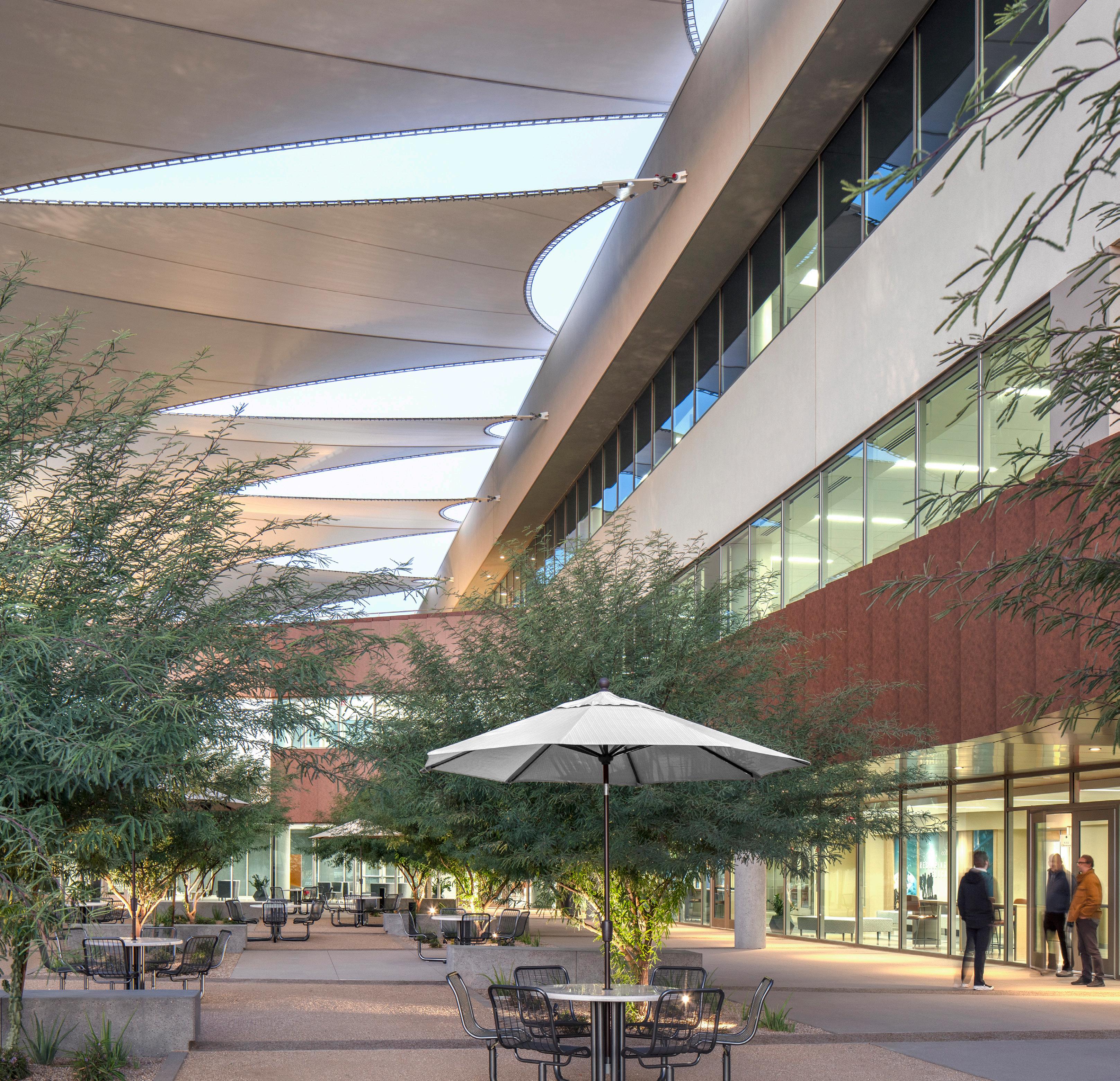
A woven fabric infiltrates the two wings. This functional and metaphorical element laces the disparate programs together, fostering interaction among students, faculty, researchers, and clinicians for the shared pursuit of knowledge and innovation. Known as the “oasis,” this self-shaded central courtyard brings in the desert landscape, grounds the building to place — and provides for respite from stress-laden academic programs. Finding ways to connect to the environment are paramount to creating lasting and impactful spatial and sustainable architecture. The edge-of-campus site is bounded by a natural flood channel. Thus, the desert beauty, especially in the spring, comes with inherent risks that require mitigation. The design team of CO Architects and DFDG Architecture addressed the issue and harnessed the innate desert beauty, raising the building on an earthen base. The land flows between the masses, allowing the natural desertscape into the IERB, defining the spirit of the oasis while mitigating flood risk. This courtyard space provides respite and contemplation between the two wings. The oasis also hosts events. Durable, weather-resilient polytetrafluoroethylene (PTFE) sails soar overhead, stretched between the building’s wings. This canopy provides shade from the intense Phoenix sun, emits light, and allows for natural ventilation — resulting in a peaceful, thriving and native desert oasis. The canopy extends to cover a terrace atop the bridge between the wings and entry at the west.
A destination, the oasis is immediately visible upon entry from, and accessed through, a glass-encased lobby. This double-height foyer welcomes visitors with a sense of transparency and physically embodies the intersection of the IERB’s dual purposes: education and research.
Breaking From Tradition
Mayo Clinic has an established design language that includes regionally sensitive materials as well as simple and bold volumes punctuated by windows. Given the IERB’s siting and prominence, Mayo challenged the design team to push the boundaries, creating a structure that is striking from the street, regionally appropriate and sympathetic to the Phoenix campus architecture.
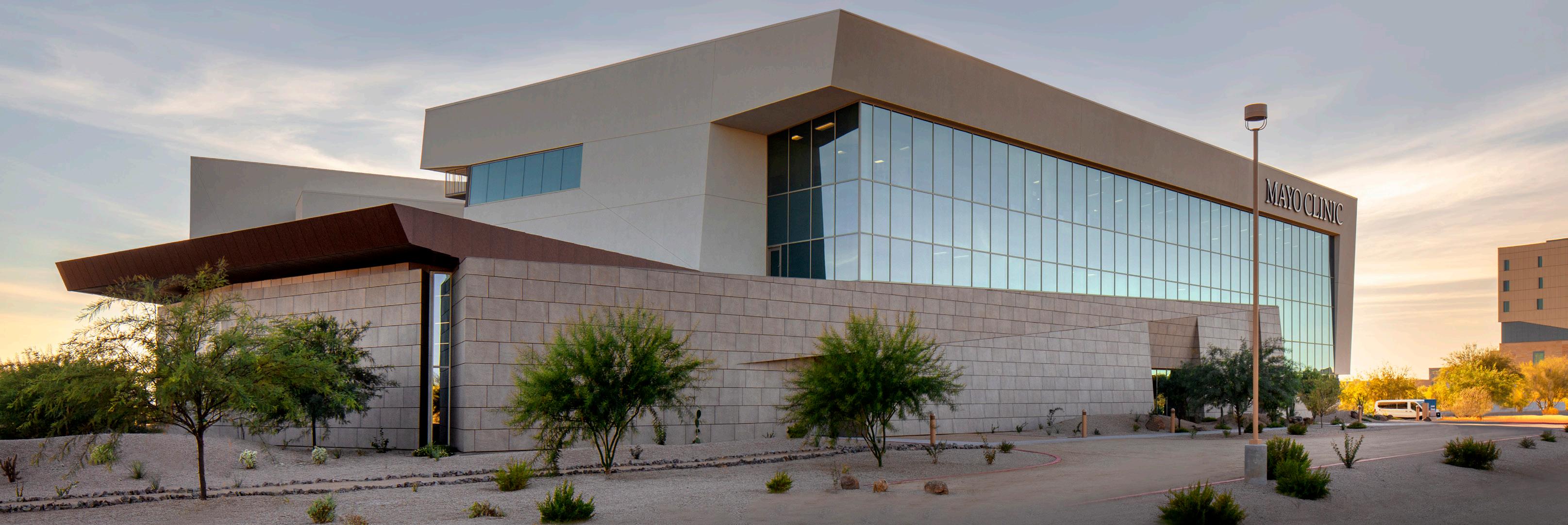
The arrival experience was a high priority. As many of the campus buildings have limited glazing, Mayo’s administration wanted the IERB to be open and welcoming. Using solar orientation as a primary driver, the massing resulted in breaking the project into two wings, positioned with long elevations facing north-south to simplify solar mitigation. Further, since the wings have different mechanical-use profiles, the academic wing was positioned as the north wing with a generous north-facing glass façade that creates an inviting presence along the main street.
In contrast, the research wing’s south-facing wall is largely solid for solar control, with narrow slit windows. East and west elevations are minimally articulated with windows, depending on shadow, shade and subtle geometric faceting to create an intriguing profile. From inside, these windows poetically frame the desert landscape, encouraging occupants to pause and engage with the environment. A two-story glassencased main entry doubles as a bridge that unifies the wings.
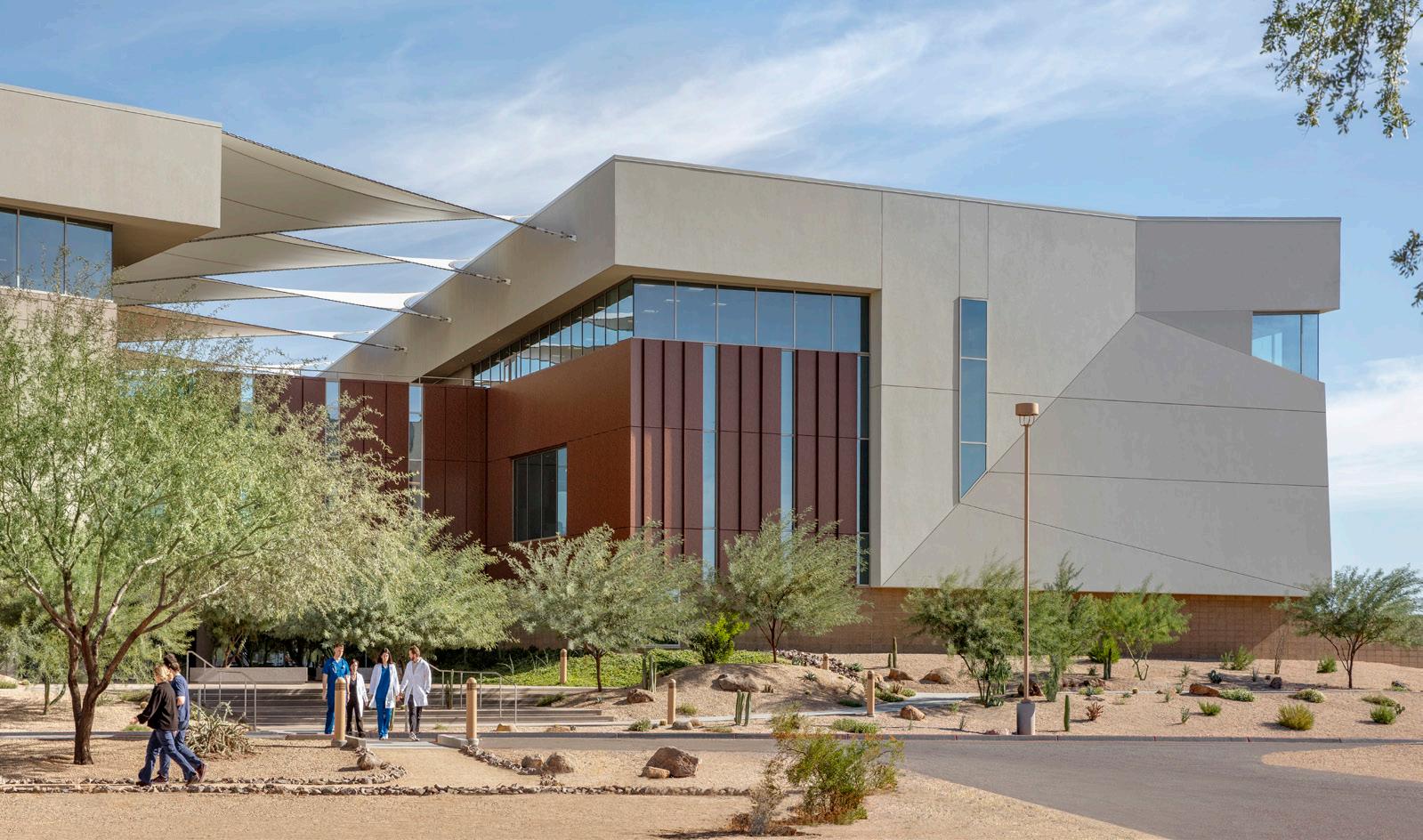
The design approach was to create a legible, understated, program-responsive architecture that is symbiotic with place and heritage. The two wings, gently angled away from each other, embrace the desert landscape to the east. Light-colored to reflect heat, the masses are subtly shaped using light to obviate the rectilinear masses and create a dynamic profile that changes in the light.
The wings are cohesive in size and shape, using exterior accents to further relax their rectilinear forms. Southwestern pottery inspired the porcelain-tile accents that define the base of the education wing while Corten metal exterior panels evoke the temporal desert landscape. The latter is used to delineate the collaborative network of interior spaces that laces through the building, the glue that bonds Mayo’s disparate shields into a unified whole. The stone and metal surfaces combine to define the west-facing entry court and anticipate the rich warm interior. The result is a facility that feels alive and responsive to its surroundings.
The IERB encapsulates the essence of architectural problem-solving. It’s a space where education and research converge and where the desert inspires design. As Mayo Clinic’s Phoenix campus continues to grow, this building will remain a hub of innovation, reflecting the organization’s commitment to education and biomedical innovation.
Arnold Swanborn, AIA, is a Principal at CO Architects.
For its new Integrated Education & Research Building (IERB), Mayo Clinic requested a street-facing façade that is inviting and conveyed transparency.
Photo Credit (all): Bill Timmerman Photo/Courtesy of CO Architects
For solar control, the IERB’s south-facing research wing’s façade is primarily EIFS stucco. Angular lines and slit windows animate this wing, with Corten panels functioning as a unifying design cue.
Top Pre-K-12 School Design Trends for 2026
By Jennette La Quire, AIA, LEED AP ID+C
Across all grade levels, hands-on learning is gaining renewed momentum. As teachers and administrators increasingly embrace experiential approaches, education
is transforming into a more active, collaborative and dynamic process for students. This shift is fueling a demand to creatively and effectively connect theoretical knowledge and practical application — and is set to define 2026 and beyond.
Nurturing Wellbeing with (and without) Technology
Safety is the priority for all school design stakeholders. Creating a single point-of-entry, while allowing for emergency egress from various parts of the campus, is a strategic way to enhance security without installing overbearing fencing. Windows enable passive supervision and enhance the overall atmosphere. While light and healthy learning spaces are ideal, they must also be designed with potential threats in mind. Aside from window treatments, interior locks, places to take cover, and screening via shrubbery, schools are starting to install call buttons (also known as panic buttons), which can instantly alert the entire campus to an emergency. This style of broadcast system is an additional tool to make students feel safe without making them feel confined.
High-resolution security cameras are becoming increasingly common, and not just on the exterior. High schools are experiencing an uptick of students vaping in bathrooms, setting off smoke detectors, and flushing vapes down the toilet, often leading to plumbing issues. One trending solution involves placing a high-resolution camera at the bathroom’s exterior entrance as a deterrent, since they’ll be seen entering or exiting the restroom where these incidents occur.
Adapting to Pre-K (or TK) Inclusion
At the elementary level, school districts are following funding and policy shifts to incorporate transitional kindergarten (TK), also known as pre-K, into both new and existing buildings. The challenge for planners and designers is that state policies often require preschools to meet lower teacher-to-student ratios than the rest of the school, along with in-class restrooms that are easy to supervise.
In HED’s various TK integration projects across the San Francisco Bay Area, cost-effective use of existing infrastructure has been central to successful modernization efforts. For new construction, districts that have not yet received funding or mandates are proactively
planning for future TK integration by including stubbing in plumbing and allocating additional classroom space.
Fine-Tuning Food Service
For school districts in California (and elsewhere), the free-lunch policy instituted during the COVID-19 era has continued. As a result, the number of students taking advantage of accessible food has ballooned. To adapt to the increased strain on the cafeteria space and staff, food service is shifting away from long queues of counter service to “speed lines.” At Palo Alto’s Gunn High School, HED instituted lines that move along both sides of grab-and-go center islands. Minimal staff members are required to scan items at the end of the two lines, ensuring each student receives a well-rounded meal and the food service director can track the volume of items consumed. The trend to streamline food service helps minimize queues, allowing more time for children to eat, and measures the impact on kitchen capacity.
Reimagining CTE
Career Technical Education (CTE) spaces have become drivers for design innovation. Gone are the days of tucking woodshop or auto mechanics in a back room. Practical, hands-on learning environments are taking center stage alongside technology, math, science and art instruction.
In some cases, schools are proactively linking the contemplative and kinetic aspects of CTE, facilitating connectivity through all aspects of a particular career pathway. HED’s project at Santana High School in San Diego County, Calif., involved converting a formerly HVAC equipment-filled mezzanine into a viewing corridor linking the computer lab to the fabrication lab. Given this easy connection, students can work on architectural and engineering project calculations and drawings; then, they can easily move to the neighboring auto shop, fabrication lab or electronics lab to bring their creation to life. Incorporating both the technical and hands-on aspects of that learning experience helps students get a feel for different careers, such as engineering versus construction, and gain insight into
with immediately transferable skills. The auto body shop will provide separate work areas for different stages of the repair process — one space for cutting, buffing, and sanding, and another for spraying finish coats on car parts.
At the younger grade levels, hands-on learning often involves creating outdoor spaces that encourage movement and active engagement. To support this, features like garage doors or large windows are used to maintain clear visual supervision between indoor and outdoor learning areas. For example, HED’s design of Solana Ranch Elementary School incorporates sliding doors that extend the learning space outdoors, creating a welcoming environment for noisier, messier, and more active small-group learning in subjects such as art, science and music.
Supporting Flexibility
In 21st century learning, teachers often serve as facilitators, guiding students in a collaborative and dynamic learning environment. Therefore, creating adaptable spaces continues to influence school remodels as well as new builds. Classrooms need to flex to meet a variety of learning styles. To that end, loading-bearing walls may be removed or partitions installed, modular furniture can be clustered (or not), contemplative nooks may be added for quiet, and outdoor or adjacent communal space will be made accessible and visible.
Technology plays a significant role in these flexible spaces. HED’s “Classrooms of the Future” project with Los Angeles Unified School District includes futureforward upgrades to classrooms across six middle schools that are designed to cultivate collaboration. In addition to a four-sided approach to flexible classroom design, these schools now showcase tech upgrades, most notably in the form of interactive displays, allowing every student to share their computer screens.
Flexibility also translates into sustainability. Modernization of an existing school, rather than a ground-up build, allows a typically less costly evolution of classrooms. Reusing a building whose structure, roof and envelope are in strong shape is also eco-friendlier and more conducive to future renovation.
potential pathways after graduation.
Embracing the “if you can see it, you can be it” philosophy, the Grossmont Union High School District integrated a health occupation center into its campus. The facility delivers professional training and certifications for in-demand careers, such as dental assistant, vet tech, phlebotomist, EMT and nursing assistant. For younger students, it creates a sense of access and possibility.
State-of-the-art spaces, such as HED’s soon-to-becompleted auto body shop at Santana High School, provide experiences that prepare high school students
As architects and educators will continue to be tasked with shaping classrooms and communal spaces that adapt to the trends of the moment but also inspire for decades to come. Whether integrating the youngest learners into a campus or imagining the coolest auto body shop, the job is to listen, collaborate and welcome change as an opportunity to spark learning in all its forms.
Jennette La Quire, AIA, LEED AP ID+C, is the Pre-K-12 Sector Leader at HED and a member of the School Construction News Editorial Advisory Board.
Features such as garage doors or large windows are used to maintain clear visual supervision between indoor and outdoor learning areas. | Photo Credit (all): Courtesy of HED
School districts are following funding and policy shifts to incorporate transitional kindergarten, also known as pre-K, into new and existing buildings.
For Higher Education, Libraries with Higher Purpose — By Design
Whether for new or renovated libraries, conceive a more holistic investment in community
By Tobias Keyl
Libraries bridge a wide spectrum of functions, from preserving valuable books and cultural heritage to creating dynamic spaces that integrate digital knowledge in a fast-changing world. While safeguarding irreplaceable texts for future generations, libraries also evolve into hubs where technology and physical
“Biophilic
skepticism about this trend toward the sensational in public spaces, and they counsel educational leaders to avoid it. Like many other design fashions of the last 50 years, this current fixation has come — and will eventually go.
Architecture must be conceived, calculated and designed for the long term, as experienced campus and library leaders know. Campus planners, for example,
range of diverse users of libraries today. Almost eight out of 10 public university academic libraries reported accessibility errors, according to a group of researchers at Southern Connecticut State University last year.
“Accessibility and inclusivity are paramount, ensuring all users can fully engage as we inspire exploration, foster research and strengthen community connections,” added Schütz.
design that uses daylight, plants, and natural materials reduces stress and inspires creative thinking, Different textures and colors provide sensory stimuli that can trigger new associations. Unexpected elements like art installations or unconventional circulation patterns awaken the playfulness of our intellect.” – Gabriela Beck, Architectural Engineer
environments converge. Today, more than 47% of library collection holdings are digital, on average, according to the Association of College and Research Libraries (ACRL). To meet these unique needs, university and college libraries must be more adaptable than ever.
The inherent challenge in conceiving and designing modern libraries is the merging of quiet spaces for individual study and research, alongside supports for hybrid learning and ways to accommodate areas for group collaboration. For example, ACRL reports that a typical college library averages more than 4,000 people attending more than 280 presentations annually.
The most successful libraries are designed with intuitive spatial hierarchies, offering a balance between reflective zones and lively hubs for teamwork and interaction. The resulting highly effective architectural solutions also embrace the concept of “third spaces,” where the physical and digital worlds converge. Accessibility and inclusivity are paramount, ensuring that all users can fully engage with these environments. In this way, educational institutions around the country create libraries that inspire exploration, foster research and strengthen community connections.
“Whether designing whole new campuses, revitalizing historic venues, or integrating new elements in existing environments, the best projects establish a unique identity while also generating a sense of pride and belonging in everyone who frequents them, from students and teachers to visitors and alumni,” according to Gabriela Beck, an author and architectural engineer specialized in urban planning. “Well-designed educational buildings and campuses function like living ecosystems in which knowledge is cultivated, ideas are exchanged and the future is shaped.”
Yet, campus library buildings are too often situated in an area of conflict between educational mission and event spectacle, Beck also observed. Architects von Gerkan, Marg und Partner, among others, express a fundamental
increasingly call for strategies employing adaptive reuse to cost-effectively and wisely create lasting library solutions. These projects, seen around the country, include anchors for cultural districts that range from high-tech archives and reinvented icons to libraries created in unexpected contexts and places.
Based on gmp Architects’ project work around the world, a few global trends are illuminated that show
additional ways that libraries succeed today.
“Most important, libraries in the 21st century are more than just book racks and places where information can be obtained and communicated,” said Stephan Schütz, Executive Partner with gmp Architects. “Increasingly, they form public spaces for campus interactions ... functioning as addresses for exchange and socially relevant debates.”
Another key challenge is ensuring access for the full
The core lesson: For libraries to serve as third places, they need to deliver “inclusive communal environments.”
Most important, library planning and design is about supporting the creative and intellectual process for all students, faculty, researchers and — increasingly — the community at large.
Architecture can undergird what Beck describes as “serendipity and creative ideas” through the implementation of spaces fostering interaction, inspiration and unanticipated connections with others. Openness of interiors and public zones contributes to these benefits, while intentionally designed multifunctional areas allow varied uses and multiple perspectives. Some libraries effectively employ glass partitions and visual corridors to make visible the many activities and people simultaneously occupying the buildings.
“Biophilic design that uses daylight, plants, and natural materials reduces stress and inspires creative thinking,” added Beck. “Different textures and colors provide sensory stimuli that can trigger new associations. Unexpected elements like art installations or unconventional circulation patterns awaken the playfulness of our intellect.”
Other key design focuses include strategically placed meeting points, such as central staircases, coffee bars and lounge areas. Even corridors can be designed with welcoming elements such as furnishings and amenities. These are more than spaces for interaction, says Schütz — they are orienting elements for infrequent library visitors and students with hesitations of varied kinds. Inviting them inside, and inviting them to linger, is a calling card for the best libraries at schools and universities worldwide.
Tobias Keyl is an Associate Partner with gmp Architects in Berlin and the United States.
The most successful libraries balance reflective zones and hubs for teamwork. | Photo Credit (all): Christian Gahl
Suzhou No. 2 Library in Suzhou, China, designed by gmp Architects.
First-in-the-Nation Drone Pilot Program Launches in Three Florida School Districts
By Lindsey Coulter
AUSTIN, Texas — The Florida Department of Education recently announced that the Broward, Leon and Volusia School Districts will participate in a first-in-the-
nation pilot program that uses remotely operated drones to confront and degrade active shooter threats within seconds.
The program, Campus Guardian Angel, will provide drones equipped with sirens,
pepper spray, and other distraction devices designed to prevent a shooter from harming anyone while providing a critical advantage to law enforcement and first responders to save lives.
Earlier this year, the Florida Legislature and Gov. Ron DeSantis approved $557,000 in funding as part of the state’s 2025-26 budget for the pilot program, which Florida Education Commissioner Anastasios Kamoutsas called “an important step in expanding the safety tools available to our districts.”
Campus Guardian Angel will work with each participating district to install the drone service and associated infrastructure. In a statement, the company said it anticipates the service will be operational on each designated campus by the beginning of 2026.
“Ensuring students and teachers have a safe and secure learning environment is one of my top priorities as Commissioner. Florida remains the national leader in school safety because we continue to invest in solutions that protect students and support a rapid, coordinated response,” said Commissioner of Education Anastasios Kamoutsas said. “The Guardian Angel Program is an important step in expanding the safety tools available to our districts.”
“Every child deserves to learn in an environment where they feel safe and protected. At Volusia County Schools, safety is our highest priority, and we embrace innovative solutions that help us achieve that goal,” added Volusia County Schools Superintendent Dr. Carmen Balgobin. “Being selected for this pilot program is an incredible honor, and we are grateful for the opportunity to lead the way in using cutting-edge technology to safeguard our students and staff. This initiative reflects our commitment to proactive security measures and to ensuring that our schools remain places of learning, not fear.”
The pilot program will begin implementation in early 2026, with Campus Guardian Angel working closely with Volusia County Schools and local law enforcement to integrate the system into existing safety protocols. The results of this pilot will help determine whether the technology is expanded statewide.
Bullard-Havens Technical High School Opens as Most Sustainable Technical High School in Connecticut
By Lindsey Coulter BRIDGEPORT,
Conn. — The new Bullard-Havens Technical High School, a state-of-the-art, 214,508-squarefoot educational facility designed to prepare students for careers across 13 in-demand technical fields, officially opened in late November. As the most sustainable technical high school ever constructed in the state of Connecticut, Bullard-Havens Technical High School represents a major investment in Bridgeport, the Connecticut Technical Education and Career System (CTECS), and the state’s future workforce.
The new $199 million school facility, which was entirely funded by the state and project managed by the Connecticut Department of Administrative Service (DAS), includes a three-story main academic and trades building, a 12,291-square-foot maintenance garage, a new field house, guard house, ticket booth and fully redeveloped athletic facilities. Built to meet Connecticut High Performance Building Standards, it features one of the state’s largest geothermal well fields, advanced HVAC and lighting systems, energy-recovery ventilation and a design that is solar-ready — making it one of the most energy-efficient schools in the country.
Gov. Ned Lamont celebrated the project as a major step forward for Bridgeport and the state.
“This school represents exactly the kind of investment Connecticut needs to remain competitive and support the next generation of skilled workers,” Lamont said. “Bullard-Havens students will learn in modern, industryaligned labs and classrooms that match the workplaces they will enter after graduation. This project shows what is possible when state agencies, educators, industry partners, and labor all work toward a common goal.”
“This new building represents a major investment in both CTECS and the greater Bridgeport community,” added Dr. Alice Pritchard, Executive Director of CTECS, at the grand opening event. “It will give our
students access to state-of-the-art learning environments that help prepare them for in-demand, middle-class careers. What makes me most proud is knowing that this school has the power to change the trajectory of a young person’s life.”
The project was built under a project labor agreement
shops, flexible classrooms, advanced mechanical and electrical systems, and expanded gathering spaces were all delivered through close collaboration among DAS, CTECS, contractors, local officials and labor partners.
DAS Commissioner Michelle Gilman highlighted her department’s commitment and the project team’s
(PLA) with Gilbane Building Company, the Fairfield County Building and Construction Trades Council and the North Atlantic States Regional Council of Carpenters. The PLA helped ensure a reliable supply of skilled labor, consistent work rules, and strong coordination across trades — contributing to an on-time, on-budget delivery.
The project was designed by JCJ Architecture and constructed by Gilbane Building Company, with Arcadis serving as construction administrator. Specialized trade
dedication to the construction of the school.
“This project has been a priority for our agency from day one,” Gilman said. “I am incredibly grateful for the DAS Construction Services project management team and their extraordinary commitment. Their persistence is a major reason we are opening this building on time, on budget and ready to serve generations of students.”
The school, maintenance garage and security facilities opened Dec. 1, with the athletic fields, field house and ticket booth scheduled for completion in May 2027.
The pilot program will begin implementation in early 2026. Photo Credit: Campus Guardian Angel
To meet Connecticut High Performance Building Standards, the school features geothermal wells, advanced HVAC and lighting systems, and energy-recovery ventilation. | Photo Credit: Bullard-Havens Technical High School
Restoring Identity
Gateway Hall’s blend of heritage, craft and modern campus design
By Lindsey Coulter
For years, the California State University Channel Islands campus lacked a true front door. The renovation of the university’s historic Gateway Hall, however, provided a unique opportunity to establish a defined point of arrival that also communicated the institution’s mission, history and architectural character.
The campus, an inherited collection of mission-style buildings, had grown organically but without a clear point of entry. University administrators envisioned a welcoming center that would also serve as a campus anchor: a place where prospective students begin their journey, where families orient themselves and where returning alumni instantly recognize the heart of the institution. To bring this vision into reality, the university enlisted the architecture team of AC Martin and Swinerton Building Company to design and build approximately 80,000 square feet of renovated existing facilities and new construction.
“First impressions mean everything,” said Kevin Urban, Project Executive at Swinerton. “The need was to really develop an iconic entry point to welcome new students and allow them to really have a focal point when they first entered the campus.”
The project’s purpose extended far beyond the metaphorical welcome mat. It was an opportunity to establish a new identity for the university — one rooted in heritage, communicated through architecture and realized through construction that balanced modernization with preservation.
Honoring Heritage Through Modern Craft
The reimagined Gateway Hall was completed in August 2025 at a total cost of $90 million and now serves as a “one-stop-shop” for student services, including financial aid, registrar and advising as well as general classrooms and departmental labs for math, computer sciences and mechatronics.
Designing this new character and purpose, however, required architects and builders to respect the campus’s historic mission-style architecture, which is essential to the university’s character. The new structure needed to advance the campus’s long-term vision while aligning with iconic elements: rooflines, plaster finishes, masonry detailing, window proportions and warm earth-tone palettes.
“With the new building … there was a lot of matching to exterior finishes, roof tiles, windows,” Urban said. “It’s a little bit more modern in a sense of technology, but essentially we had to deliver that same look, color and feel.”
Some of the most delicate work occurred on the existing adjacent structures, where aged clay roof tiles were removed piece by piece. Their moss-covered patina, uneven coloration and natural wear were critical to preserving the historic texture of the campus.
“We had to carefully take all of those tiles off the existing roof, crate them up and store them on site,” Urban said. “Then we went in and did what we needed to do … replacing underlayments and substrates to prevent where they were experiencing roof leaks.”
Once repairs were complete, the team reinstalled the original tiles — a slow but meaningful gesture that respected the campus’s architectural lineage.
“It was a very methodical, lengthy process,” Urban recalls. “It proved to serve a few benefits, not just from providing that historical look, but from a sustainability standpoint. You’re reusing materials, you’re reusing existing structure where you can.”
Complex Existing Conditions
While Gateway is a new ground-up structure, the broader program included significant renovation work on adjacent buildings dating back to the 1940s and 1950s — including former hospital facilities with unpredictable conditions.
“Modifying and remodeling existing spaces, we had to deal with a lot,” Urban says. “Uneven floors, inconsistencies in wall structures, many unforeseen conditions.”
Integrating new MEP systems into the old concrete structures required precise coordination through BIM and VDC.
“You’re trying to put in all new mechanical systems that don’t quite work with existing concrete structures or beams,” Urban explained. “Things had to be removed, drilled, coordinated around and replaced.”
Many of these existing buildings were physically connected, requiring careful separation and structural adjustments. The challenge wasn’t just construction — it was interpretation. Every connection and corridor told part of the site’s history, and the project team had to decode and adapt it.
The project followed a design-bid-build approach, and Swinerton served in a CMAR capacity, providing constructability insights and cost guidance throughout the process. This role allowed the contractor to bridge the gap between design intent and practical execution — essential on a campus where historic fabric and modern systems had to coexist.
Planning and Construction Strategy
Beyond its symbolic role, Gateway Hall provides new instructional spaces that
Prefabricated assemblies included windows, stairs, doors and door frames, electrical components and MEP elements that were prepared off site.
By blending preservation and modernization, Gateway Hall delivers a clear, inviting point of entry to the campus. | Photo Credit (all): Eric Staudenmaier
support emerging technology programs. The mechatronics lab, for example, introduced specialized equipment, power needs and vendor coordination. Swinerton emphasized early communication with manufacturers and consultants to keep submittals on schedule and ensure system integrations aligned with the design.
“In essence, it’s really following the design, asking the right questions, ensuring we have the right vendors involved early on,” Urban said.
Although the concrete structure limited large-scale prefabrication, the team used targeted prefab solutions to reduce installation time and improve quality consistency.
“We could start with performance mockups,” Urban says. “Those are important to ensure understanding of constructability and that we’re hitting what has been designed.”
Prefabricated assemblies included windows, stairs, doors and door frames, electrical components and MEP elements that were prepared off site.
“Prefab is generally desired from a sense of quality control,” Urban notes. “Our electricians will prefab as much as possible offsite, such as plumbing manifolds, electrical feeders, conduits and tags.”
These measures streamlined the construction schedule and reduced disruption on an active campus.
Sustainability Through Material Management
While California’s code baseline requires robust sustainable practices, the Gateway Hall project incorporated additional strategies that aligned with both campus values and construction realities.
“Existing concrete was crushed on site and reused as base material,” Urban said. “Modernization of existing buildings, utilizing existing structure where you can just to minimize environmental impact overall.”
The project’s top sustainability drivers included reinstating the original clay roof tiles to preserve material identity, crushing and reusing existing concrete on site, and maintaining structural elements whenever feasible. These approaches supported both environmental goals and architectural continuity. For Urban, it was a rare opportunity to help shape the future of a place with deep significance to the region.
“This project had a unique purpose,” he says. “It was definitely amazing to be a part of.”
By blending preservation and modernization, the Gateway project delivers a clear, inviting and authentic identity for generations of students to come — finally giving the campus the front door it has long deserved.
design services for a variety of array types for a program with NorthWestern Energy. The goals of the program were to provide an opportunity for students to learn about renewable energy and to give NorthWestern Energy the ability to see how different system designs can tie into the electric grid. The four PV arrays, one installed at each of the local high schools, feature designs adapted to their surroundings.
At Big Sky High School, the system consists of a PV array that covers a patio area as a source of shading and protection from the elements. This site has a planned battery energy storage system, which will make it possible to store excess energy generated from the array.
The Hellgate High School system design centered on the challenge of integrating solar into a densely populated urban setting. This array features PV panels installed on an 18-foot-high carport canopy, which kept the array out of the shadow of adjacent buildings.
Sentinel High School’s array supports the study of different orientations and times of day that
would create peak output. The various orientations allow NorthWestern Energy to evaluate the feasibility of offering incentives to customers to place arrays in directions other than the traditional southern orientation. The varied directional options could help create more evenly distributed solar energy throughout the day.
For the array at Willard Alternative High School, the team integrated PV panels vertically into a fence. This design helps increase solar production in high latitude climates that experience large amounts of snowfall and low sun angles during the winter.
Hands-On Learning for CTE Students
Treasure Valley Community College in Ontario, Ore., also worked with Cushing Terrell for their Career and Technical Education Center, which is an immersive, hands-on learning environment focused on offering students the skills needed to excel in the region’s high-demand industries such as agriculture, natural resources, automated systems, welding and fabrication.
Cushing Terrell provided architecture, interior design, electrical, mechanical, and structural engineering services for the renovation and addition, including design of a PV array that provides the building with renewable energy and serves as a demonstration tool for educators and students.
Environmental Readiness and Learning
What stands out in these examples is the beneficial partnerships that can develop between systems designers, educational organizations and local utility companies.
Ultimately, solar energy systems are a smart way to meld real-world engineering solutions, enhance hands-on learning, and support the use of alternative energy, resulting in multifunctional, resilient spaces that both empower and inspire the next generation.
Jeff Haidle is Director of Electrical Engineering with Cushing Terrell.
The renovation of Bozeman High School ensured the school was solar ready, meaning space, structures, and connections all in place for the future installation of photovoltaic (PV) arrays.
The team used targed prefab solutions to reduce installation time and improve quality and quality consistency.
Step inside the spaces that are redefining how students learn and educators teach. At EDspaces 2026, the ideas, designs, and innovations that transform education aren’t just discussed—they’re built, experienced, and lived.
Why Kansas City?
A city of culture, creativity, and collaboration—where legendary barbecue meets vibrant arts and inspiring public spaces, all just steps from the convention center.