The Reves Center for International Studies advances the internationalization of teaching, learning and research at William & Mary, ensuring an international dimension is present in the university's priorities. Global education, support for international students and scholars, and the enrichment of our global community are at the heart of the Reves Center’s work. Established in 1989, the Reves Center is today one of the premier international centers in higher education.
Ike Adams '01 Washington, DC
Kem Alily '11 New York, NY
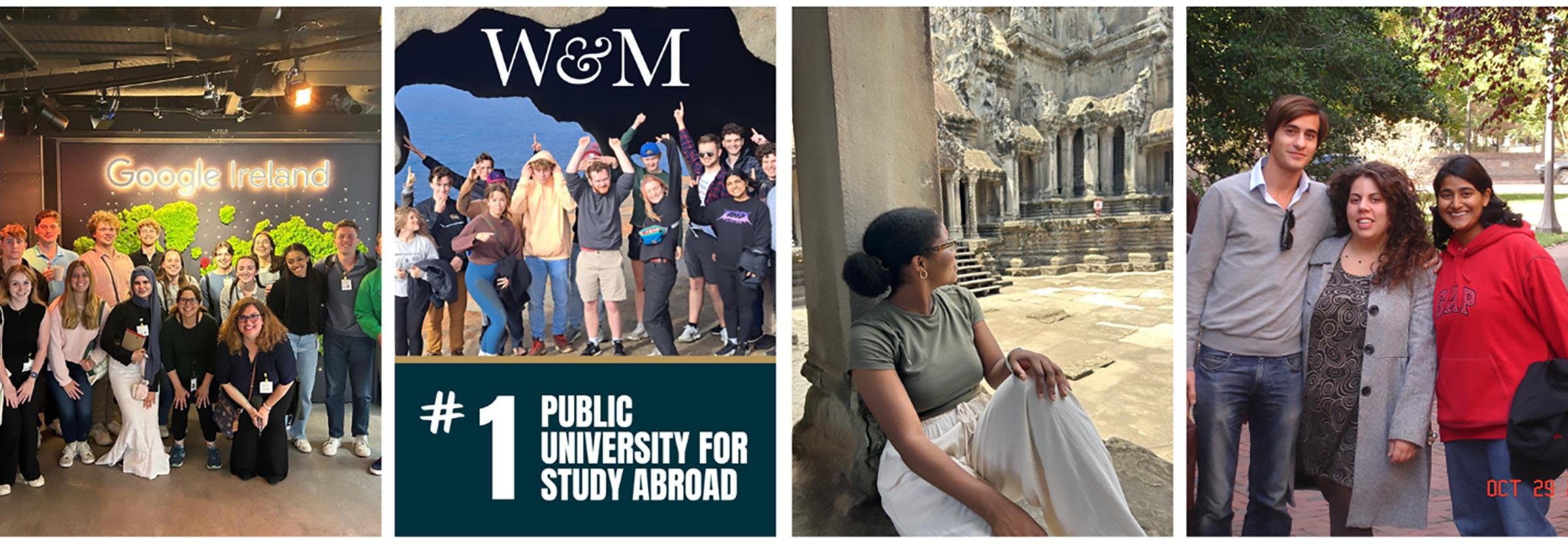
William & Mary is the number one public university for undergraduate study abroad participation, with more than half of the university’s undergraduates studying outside the U.S. before graduation. Approximately 500 international students, scholars, and their families from 65 places of origin come to William & Mary each year. The Reves global engagement team builds and supports international initiatives across the university.
THE REVES GLOBAL ENGAGEMENT BOARD
Nancy Hill ’89 Yorktown, VA
Valerie Hopkins ’09 Moscow, Russia
Julianna Valeska Benedick ’87 Palm Coast, FL
Susan Corke ’97 Washington, DC
John S. Dennis ’78 Geneva, Switzerland
Scott R. Ebner ’96, Chair Emeritus Boston, MA
Denzel Hankinson '94 Leverett, MA
Bennett Hawley '23 Washington, DC
Jen Volpe Herink ’95, Vice Chair Bellevue, WA
Reggie Jones ’91 Hamilton, VA
Ducie Le ’94 Arlington, VA
David Link ’89 Melbourne, Australia
Matthew Morrison ’84 Vienna, Austria
Sue Snediker Newman ‘79, P ‘12 Falls Church, VA
Stafford Nichols MPP & MBA ‘10, PhD(c) Porter Ranch, CA
David Nowland '89 Richmond, VA
Connie O'Hare '84, P' 22, P '24 Natick, MA
Alexa Poletto ’02 New York, NY
Ben Pratt ’95 Minato-ku, Japan
Scott D. Rhodes '89 Winston-Salem, NC
Susan Rutherford ’89, Chair Delray Beach, FL
Maya Sapiurka ’10 Arlington, VA
Jon Stauff '86 Brookings, SD
Madeline Wagoner ’20 Washington, DC
Kirsten Schmidt Weick ´88 Munich, Germany
A PUBLICATION OF THE REVES CENTER FOR INTERNATIONAL STUDIES AT WILLIAM & MARY
VOL. 18, NO. 1, WINTER 2026
WORLD MINDED in this issue
“Vision is not enough, it must be combined with venture. It is not enough to stare up the steps, we must step up the stairs.”
- Václav Havel
4 FROM THE DIRECTOR
REVES COLLABORATIONS
5 William & Mary to be the U.S. academic home of submarine production
APPLIED LEARNING & CAREER OUTCOMES
8 Neil Boyden Tanner ‘93: A habit of excellence
12 Bert Mueller ‘11: Study abroad experience inspired a multimillion-dollar business
STUDENT ACHIEVEMENTS & OPPORTUNITIES
16 Legendary Ilê Aiyê inspires in immersive arts masterclass
20 Building trust through diplomacy: ultimately a human activity
22 W&M’s iGEM team brings back gold
IN THEIR OWN WORDS
25 Sylvia Mitterndorfer ‘96
FACULTY ACHIEVEMENTS
27 New in Print: Recent Publications by Faculty
STUDENT RECOLLECTIONS
28 Study Abroad in Denmark: Sustainability
ALUMNA ABROAD
32 Q&A with Rebecca Shkeyrov ‘20
WORLD MINDED STAFF
E ditor: Kate Hoving, Associate Director for International Communications, Reves Center for International Studies Contributing Writers: Sophia Bretas Kaisermann ‘27; Randy Ready, Director of Communications and Marketing, School of Computing, Data Sciences & Physics; Naomi Teferra ‘26; and Nicholas Valyayev ‘27
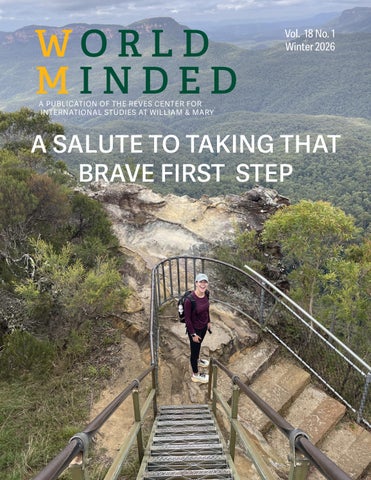
ON THE COVER
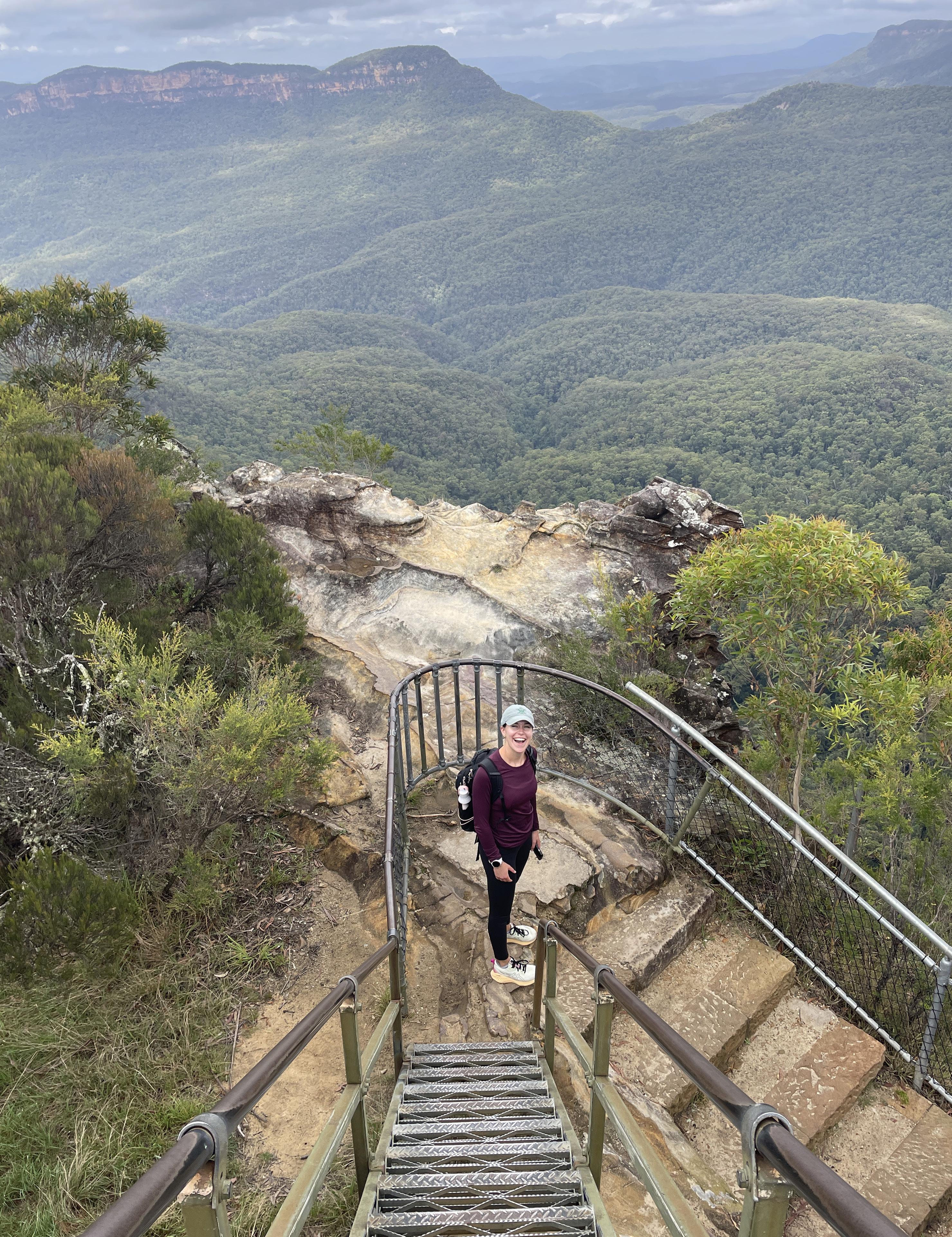
“Blissful Blue Mountains,” by Kendyl George ‘26. Only a 2-hour train ride from downtown Sydney, the Blue Mountains are the perfect day-trip for a serene getaway. When the visibility is good as it was on this day, you will be able to see for miles into the distance and every outlook offers a breathtaking view. Program: Discover with WorldStrides—Semester at University of New South Wales (Spring 2025)
FROM THE DIRECTOR
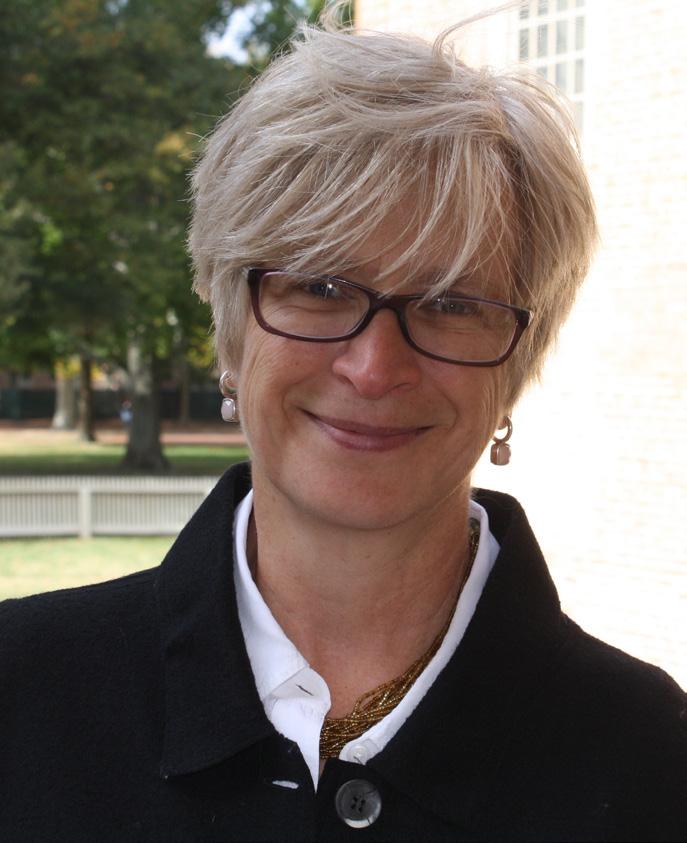
Teresa Longo
Associate Provost for International Affairs, Senior International Officer and Executive Director of the Center for International Studies
World Minded 18-1 chronicles the first brave steps taken by members of the William & Mary community-students, faculty, staff and alumnae. The articles in this edition trace pathways to lives of meaning and distinction. They point to the fact that somewhere along the path, the Reves Center for International Studies has been key.
Many first steps happen on a small scale, yet the potential impact is anything but small. Sophia Kaisermann ‘27 studies environmental policy at William & Mary. During her study abroad experience she visited sites across Denmark where she met farmers, picked fruit, and learned about sustainable agriculture from a community devoted to sustainability since the 1980s. One of Sophia’s big takeaways from the program is that there are no wizards or prophets in this field. Rather, sustainability depends on science, nature and technology. It depends on high yield organic farms and carbon-neutral permacultures. Sophia’s insights from study abroad may well lay the groundwork for global impact today and for years to come.
Through the Reves Center, at least 55% of William & Mary undergraduates study abroad in fifty different countries; and study abroad exemplifies William & Mary’s strong commitment to applied learning. Along with Sophia Kaisermann, this edition of the magazine features the accomplishments of a former student, Neil Boyden Tanner ‘93. For Neil, study abroad in Japan years ago launched a brilliant career. I urge you to get to know not only Sophia and Neil, but also our Global Education Director, Sylvia Mitterndorfer,
interviewed here. As a leader in William & Mary’s Applied Learning Initiative, Sylvia is working to build on the recent success of our winter study abroad programming (from three programs to 11 in just a few years) and to further extend study abroad across campus.
The Reves Center is the hub for international affairs at William & Mary. Sometimes this means working behind the scenes: Reves supports the faculty who serve as study abroad directors, travel with students to the United Nations, prepare student research teams for global competitions, and write books on topics ranging from the Spanish Inquisition to Vector Borne Disease, or the Challenge of Democracy.
The Reves Center also guides and collaborates on new and emerging initiatives, the kind with global impact. William & Mary is now in the first phase of our involvement in the Australia, United Kingdom and United States Security Alliance (AUKUS). As AUKUS drives greater cohesion among allies, William & Mary will serve as the academic home in the United States. Within William & Mary, this initiative is led by the Reves Center’s colleagues at the Whole of Government Center of Excellence, with support from various campus partners. The Reves Center will provide the expertise in international affairs in this next bold step for the university.
May this edition remind you of your own first steps, big, small and globally informed. Please read on.
WILLIAM & MARY TO BE THE US ACADEMIC HOME OF SUBMARINE PRODUCTION
The creation of three AUKUS Centers will span Hampton Roads, Sheffield, United Kingdom, and Adelaide, Australia
BY W&M NEWS STAFF
William & Mary will soon host one of just three centers in the world to support submarine production through the Australia, United Kingdom and United States (AUKUS) security alliance.
Drawing on the region’s resources, the university will be the only U.S.-based AUKUS Center of Excellence, the Hampton Roads Alliance (HRA) announced last week. The selection was announced as part of the Hampton Roads Playbook, a plan to grow the region’s defense and shipbuilding industry.
Alongside inter-regional collaboration centers conceptualized in Sheffield, United Kingdom, and Adelaide, Australia, William & Mary will harness academic expertise to strengthen international efforts to design, build and support the next generation of nuclear-powered submarines.
HRA envisions each center tackling key areas of submarine production, including growing a skilled workforce, strengthening supplier networks, developing new technologies and crafting sustainable infrastructure and energy. Efforts to address some of these challenges align with William & Mary’s Vision 2026 strategic plan.
free, open and stable Indo-Pacific,” said Kathryn H. Floyd, director of the Whole of Government Center of Excellence. “Against a backdrop of evolving military technologies, expanding maritime threats and the strategic imperative to deter coercion, AUKUS brings together allied innovation, industrial strength and shared values to uphold international order and security.”
At this critical juncture, William & Mary steps forward as the academic leader, harnessing the power of education and collaboration to ensure the next generation is prepared to meet the most urgent challenges for Hampton Roads, the United States and Allied partners.
As America celebrates its 250th birthday, we are excited to be part of a whole-of-nation effort to strengthen and grow the nation’s strategic maritime advantage.
The initiative will be led at William & Mary by the Whole of Government Center of Excellence (WGC), which serves as a national security hub for campus and the broader defense community.
“The AUKUS trilateral security partnership stands as a pivotal commitment by Australia, the United Kingdom and the United States to defend the vision of a
“William & Mary’s designation as the U.S. academic home for the AUKUS initiative underscores the vital role of higher education in advancing innovation and security,” said Provost Peggy Agouris. “This Center of Excellence brings together dedicated expertise to address complex global challenges and prepare the next generation of leaders who will shape the future of maritime defense and technology.”
DRIVING INNOVATION
Established in 2021, AUKUS is a security alliance uniting Australia, the United Kingdom and the United States to create greater cohesion and strategic capacity among the allies. Initially focused on nuclear-powered submarines for Australia, AUKUS also emphasizes the ability to deliver tangible military capabilities and enhance joint innovation across domains.
The center at William & Mary, with anticipated partners in Sheffield and Adelaide, envisions focusing on four collaborative functions. First, the centers will act as a joint research and development hub for emerging technologies and supply chains to accelerate new operational processes.
Second, the centers will collaborate together and with national partners to attract private investment and support new ventures. Additionally, they’ll exchange expertise and best practices to advance submarine production, workforce training, supplier growth and innovation.
Finally, the combined force will focus on process innovation and acceleration to ideate, test and propose reforms with partners.
“Our efforts to build the U.S. AUKUS Centers of Excellence will involve a myriad of key players,” said Floyd. “Rather intentionally, we do not know exactly what this will evolve into, but we know we are creating the model for how to integrate shared expertise to transform regions in support of vital national security interests. As the nation’s oldest public university, we look forward to designing and adapting this with our campus partners and external collaborators over the next decade.”
WGC is a powerful convener on matters of security, including most recently the June 2025 workshop funded by the U.S. Mission to NATO on “The Implications of Military R&D in
Key Emerging and Disruptive Technologies for Transatlantic Cooperation.” For this next chapter, WGC will be primarily supported by the vice provost for research and the Military & Veteran Affairs team, with whole-of-university expertise coming from the Reves Center for International Studies, the College of Arts & Sciences’ Public Policy Program and two schools at the university: William & Mary’s Batten School of Coastal & Marine Sciences & VIMS and the School of Computing, Data Sciences & Physics, among others.
“This new Center of Excellence reflects William & Mary’s commitment to research that serves the world around us,” said Vice Provost for Research Alyson Wilson. “By linking our academic strengths with the region’s industrial and defense expertise, W&M will accelerate innovation in naval technology and expand opportunities for our students and faculty to make a lasting global impact.”
HAMPTON ROADS’ ROBUST ECOSYSTEM
Already a leader in next-generation maritime and undersea industries, Hampton Roads was a natural choice for the U.S. Center of Excellence.
“The Hampton Roads Playbook is a unifying economic development strategy which calls on the region to grow the economy by building upon its strengths,” said Douglas L. Smith, president & CEO of the Hampton Roads Alliance. “William & Mary, with its global reputation for excellence and deep ties to international partners, is the perfect home for the U.S.
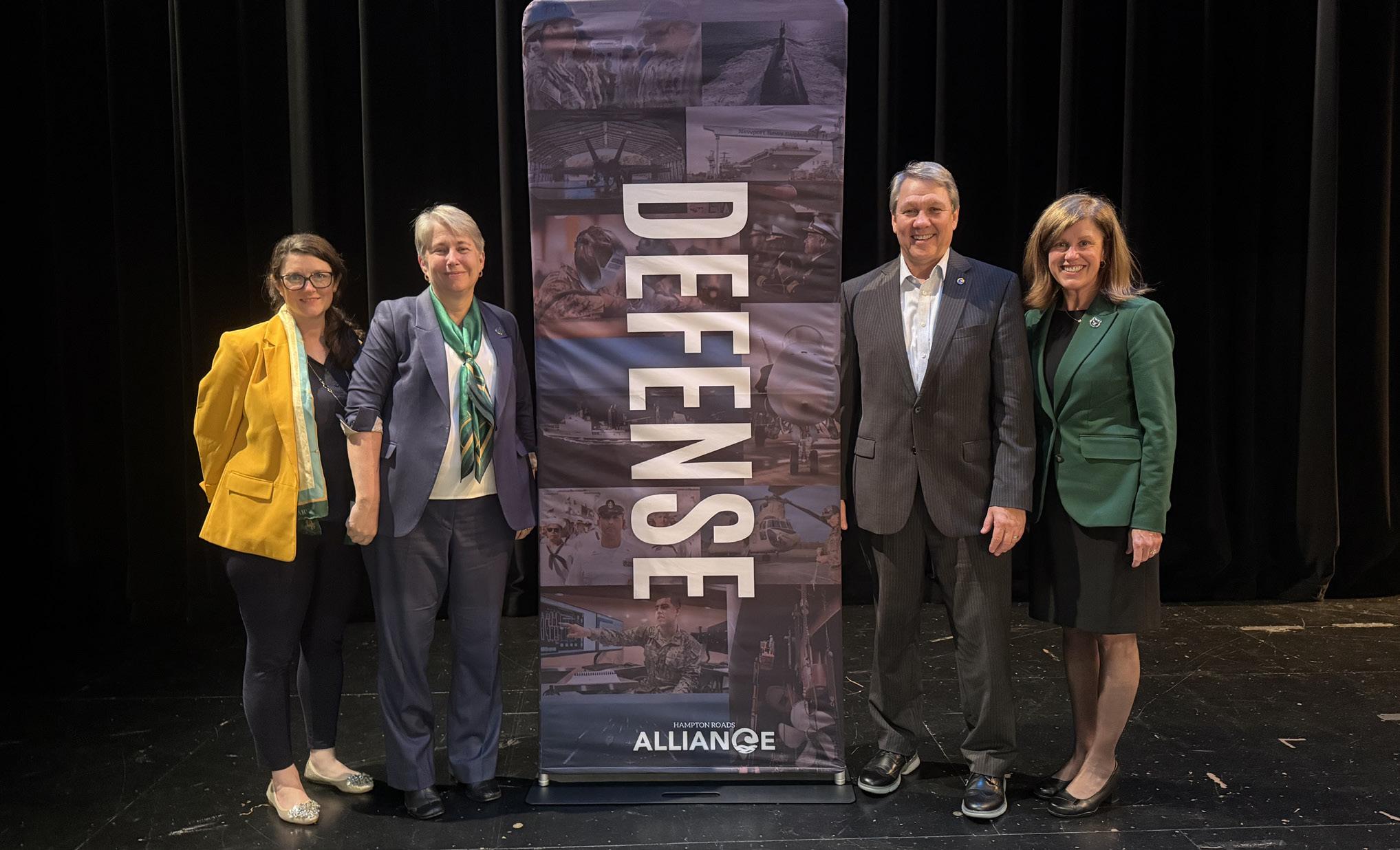
From left: Kathryn H. Floyd, director of the Whole of Government Center of Excellence; Vice Provost for Research Alyson Wilson; Doug Smith, president & CEO of the Hampton Roads Alliance; and Kathleen Jabs, special assistant to the president for military & veteran affairs, at the launch event. (Photo by retired Navy Rear Admiral Charles “Chip” Rock)
AUKUS Center of Excellence. Hampton Roads is at the forefront of shaping global security, and this partnership brings together the intellectual power and connections of one of the world’s great universities with the industrial strength of America’s military metro.”
The region has a long history as the nation’s premier maritime industrial base and is home to the world’s largest naval base and Newport News Shipbuilding, the only U.S. shipyard designing, building and refueling nuclear-powered aircraft carriers. Hampton Roads is a military metro and innovation hub with geographic advantages, a vast talent pool of educated workers, and strong military and civic leadership.
The new Center of Excellence will tap into Hampton Roads’ powerful ecosystem, connecting areas of government, industry and academia to fortify the region as the central engine for sustained growth and resilience in national security and across the submarine supply chain, as outlined in the playbook.
“William & Mary has a deep and longstanding commitment to our nation’s security and to public service,” said Kathleen Jabs, special assistant to the president for military & veteran affairs. “Beginning with the Battle of Yorktown where our students fought to establish this country, William & Mary has continued to educate, research and contribute to our nation’s security and strategy.
“The AUKUS Center of Excellence will foster collaboration and connection to map and link military commands, military and veteran entrepreneurs, defense suppliers, service providers, industry, government and academia to meet the demands of our future at local, regional, national and international levels. As America celebrates its 250th birthday, we are excited to be part of a whole-of-nation effort to strengthen and grow the nation’s strategic maritime advantage.”
William & Mary steps forward as the academic leader, harnessing the power of education and collaboration to ensure the next generation is prepared to meet the most urgent challenges for Hampton Roads, the United States and Allied partners.
A HABIT OF EXCELLENCE NEIL BOYDEN TANNER ‘93
EXCELLENCE: We aim for the extraordinary, recognizing that personal growth and meaningful accomplishment require bold and innovative aspirations, courageous risk-taking, and focused effort.
[William & Mary Statement of Values]
BY KATE HOVING
Wendy Reves endowed the Reves Center for International Studies at William & Mary in memory of her husband, Emery Reves, whose 1945 book The Anatomy of Peace opens with a timeless reminder: “Nothing can distort the true picture of conditions and events in this world more than to regard one’s own country as the center of the universe, and to view all things solely in their relationship to this fixed point.”
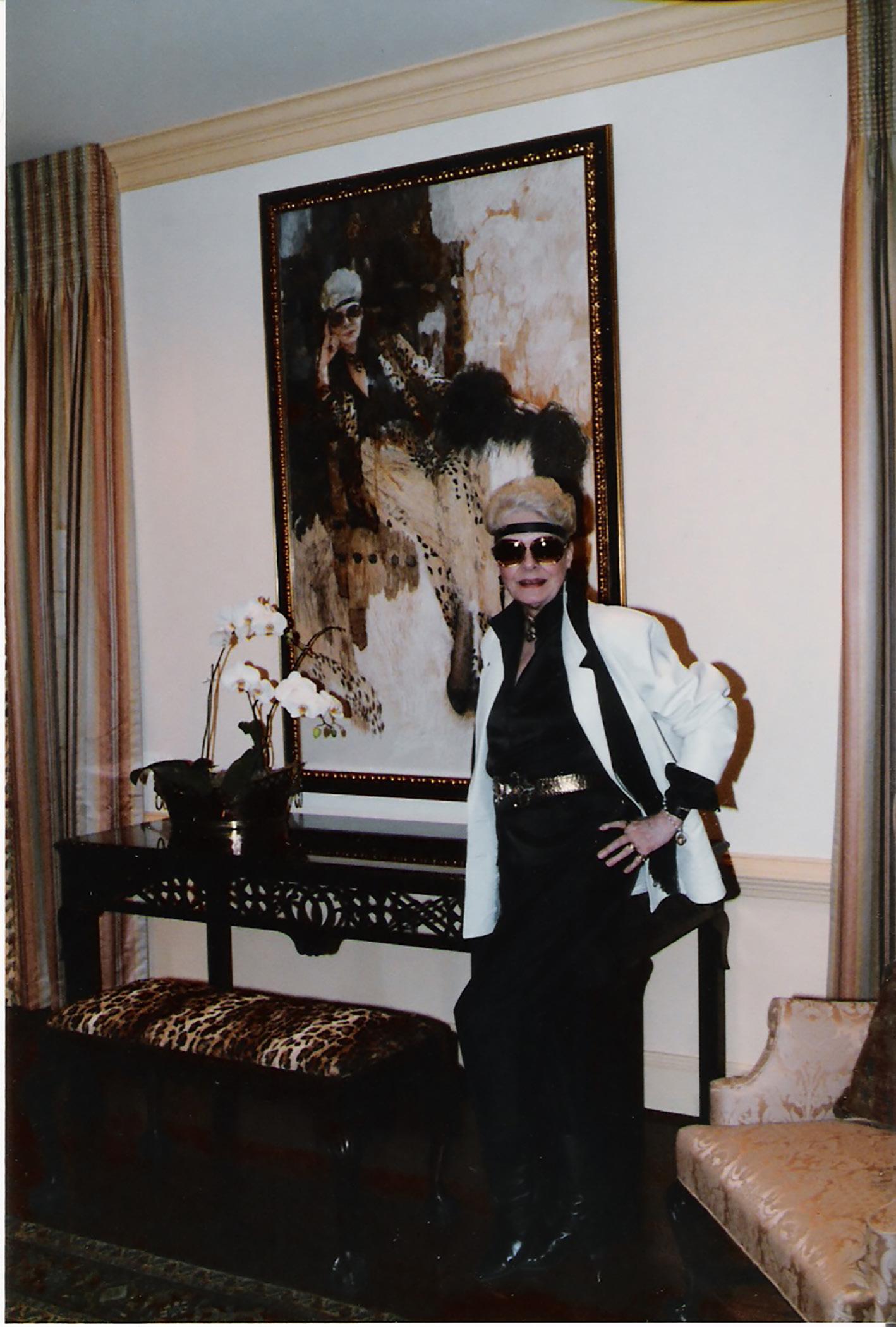
Guided by this philosophy, Wendy sought not a static memorial, but a dynamic academic center dedicated to advancing global understanding through the academic study and exposure to people, languages, cultures, economies, and political systems from around the world. Although Wendy passed away in 2007, her presence endures in the Reves Room, where striking portraits of Wendy and Emery overlook the students, scholars, and global leaders who continue to shape the center’s legacy.
Among the few who witnessed the early years of the Reves Center is Neil Boyden Tanner ’93, a member of its first cohort. For Tanner, Wendy Reves is not merely a figure in a portrait but a vivid memory. “When she visited campus, we would meet with her. I remember one time she arrived dressed in leopard print with a large feather boa. She was energetic, engaging, and full of life.”
Tanner’s experiences at William & Mary—and his distinguished international career that followed—illustrate the profound impact the Reves Center can have on a student’s academic direction and professional trajectory.
A “NOTHING VENTURED, NOTHING GAINED” STORY
In March 1989, Tanner was fully prepared to attend Middlebury College. As a native Philadelphian with strong interests in international relations and languages, it appeared the natural choice. He had visited William & Mary several times but felt its international offerings lacked the depth he sought.
Everything changed when Tanner read of Wendy Reves’s transformative gift establishing the Reves Center. Men-
tioning it to his high school advisor, he remarked that he might have applied to William & Mary had he known such a program was forthcoming. His advisor encouraged him to write to the admissions office explaining the situation.
Tanner did—and William & Mary responded enthusiastically, inviting him to apply despite the late date. He was admitted, altering the course of his academic, professional and even his personal life. It was at William & Mary that Tanner met his future wife, Lee James Tanner ’94.
As a student, Tanner served as one of two representatives on the Reves International Studies Committee, contributing directly to the development of a comprehensive international relations curriculum. He majored in International Relations with a concentration in Political Economy and minored in East Asian Studies, a path he approached with deliberate analysis.
Determined to learn a challenging language with long term utility, he considered Japanese, Chinese, and Russian. With China and Russia still largely closed to Western business, he chose Japanese for its applicability to business and law. As he studied the language, he developed a deeper interest in the region’s history and culture, making East Asian Studies a natural complement.
A pivotal class that shaped his early studies was Professor Craig Canning’s introduction to East Asian history. [Professor Craig N. Canning, Professor of East Asian History at William & Mary from 1973 to 2012, was also interim director of the Reves Center in 1998-89.]. “Within the first week, we had to take a quiz on East Asian geography. It felt unusual at the time, but it turned out to be invaluable. It deepened my understanding of the region’s history, culture, and people. I enjoyed it so much, I asked Dr. Canning to become my advisor.”
INTERNSHIP AND STUDY ABROAD
During his sophomore year, Tanner learned of summer internships offered by three Japanese companies. “You
had to have had at least two years of Japanese, and I will readily admit I was not a good Japanese student at that point. It was my lowest grade in my GPA. I struggled. I thought, ‘I’m never going to win this thing.’”
But he did win.
Tanner and fellow student Louis Ormond ’92 interned at Arai Seisakusho in Tokyo and Chiba ken. Founded by Yoshio Arai in 1951, Arai Seisakusho is Japan’s leading manufacturer of oil seals and automotive parts and serves all the major Japanese auto companies.
He and Ormond lived in an all-Japanese dorm called the Men’s Celibacy Dorm (“One of the things I told them, was, ‘I think you mean ‘single men’s dorm’ in English’”). They spoke Japanese all day, and each week worked in a different department--from quality control to accounting, to making things on the factory floor. “It was an amazing experience.”
Living in an all Japanese dormitory and speaking Japanese daily, he experienced total immersion. The result was transformational: “I used to say it broke my brain on Japanese— whatever block I had was gone.”
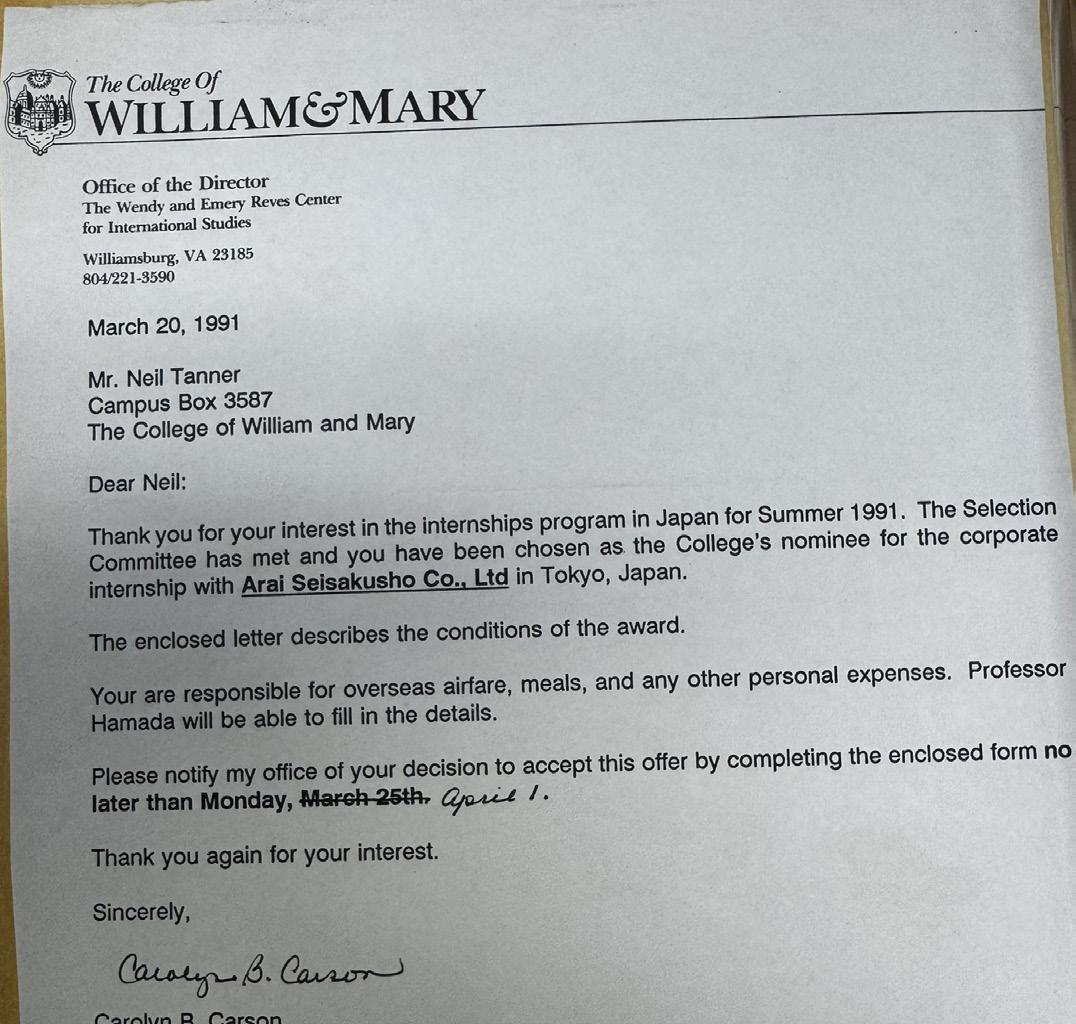
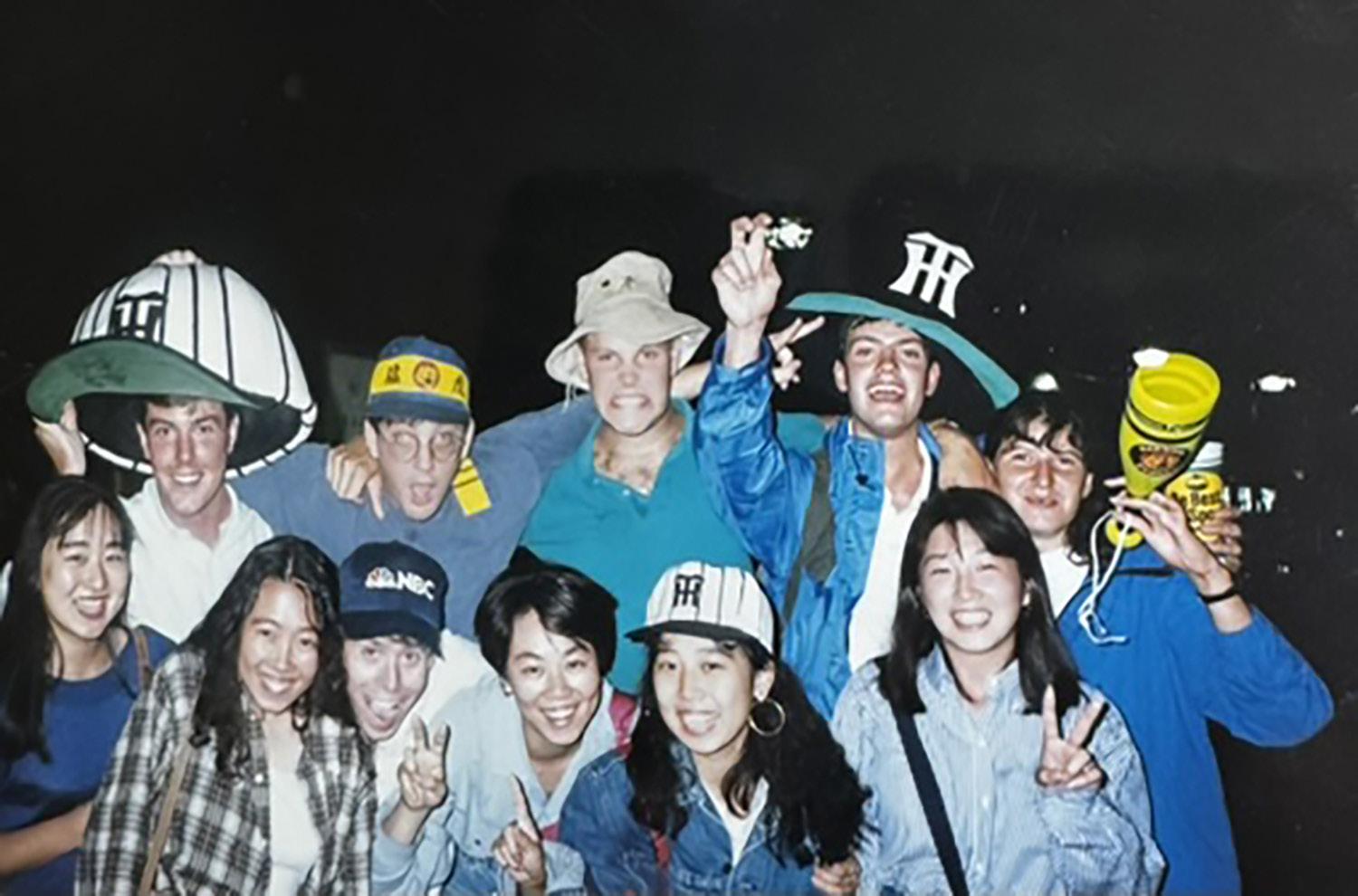
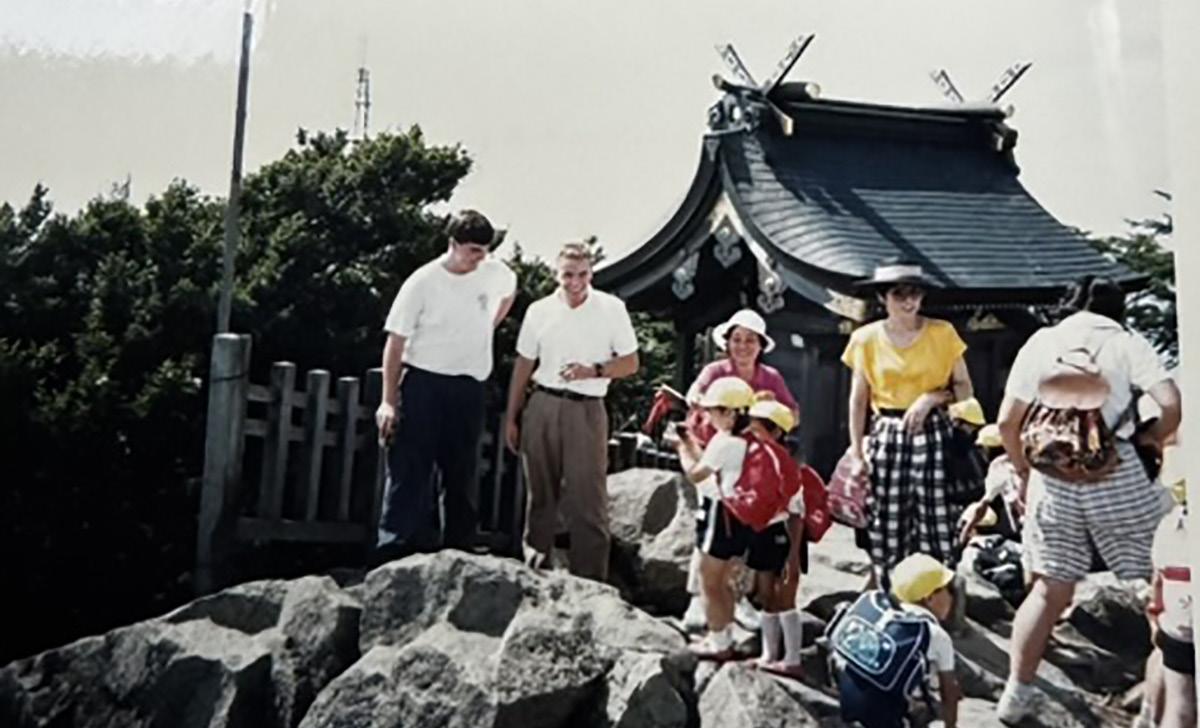
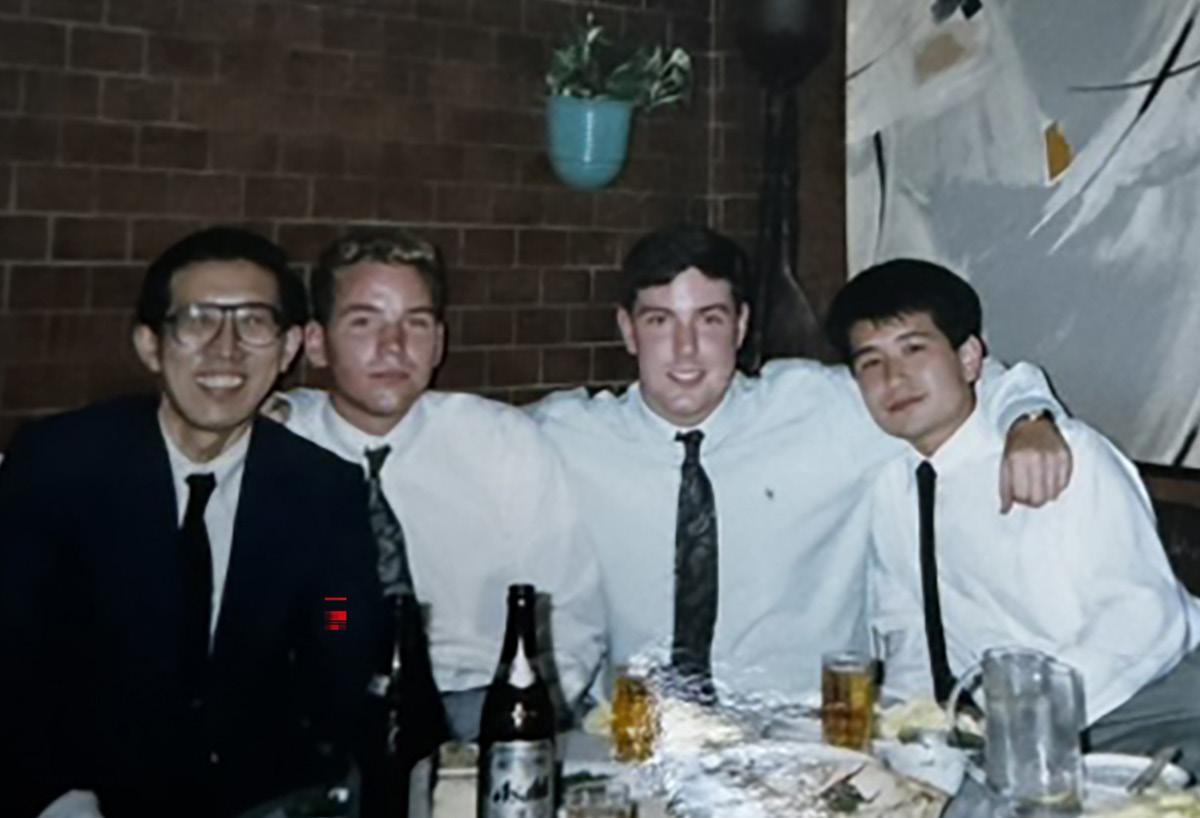
Clockwise from top left: Tanner saved the letter informing him of his Arai Seisakusho Scholarship ; Wendy Reves in front of her portrait in the Reves Room (archival photo); Tanner and Lou Ormond visiting a temple in Chiba-ken surrounded by school children; Tanner and Ormand with two of their Japanese colleagues after work at a karaoke bar; Tanner wth Shoin classmates at a Hanshin Tigers baseball game in Nishinomiya, Japan (Courtesy photos)
Tanner later backpacked across Japan before attending Shoin University in Kobe for a semester, earning a Certificate in Japanese Studies as the only William & Mary student in a cohort of twenty three international students.
Tanner continued his global academic journey after graduation, earning a Master of Government Administration from the University of Pennsylvania while continuing Japanese language studies at Wharton. He completed his law degree and a graduate certificate in East Asian Studies at the University of Pittsburgh, eventually winning the Excellence for the Future Award in Transnational Litigation Award. While there, Tanner studied Japanese law—in Japanese—at Temple University’s law program in Tokyo, from where he recently received the Distinguished Alumni Award. Tanner has since continued his graduate studies in international business at INSEAD, in both France and Dubai.
One unexpected opportunity arose while in Pittsburgh when he applied for a study abroad scholarship through the University of Pittsburgh’s Nationality Rooms program. Although he had applied primarily for a Japan program, he added a secondary application to study maritime law in Greece and ultimately received the latter. The maritime law training would later prove surprisingly relevant in his global insurance work.
INTERNATIONAL CAREER: A PERFECT FIT
Although he doesn’t consider his career path as foreordained —“I’ve always been someone who does lots of different things that may not always be obvious how they string together”— as with his educational path, Tanner has been consistent in two areas: his interests are global; and he chooses opportunities that present challenges and opportunities to learn.
I’VE DONE THREE STUDY ABROAD PROGRAMS, AND I THINK THERE’S SO MUCH VALUE IN FINDING A PROGRAM THAT GETS YOU OUT OF YOUR COMFORT ZONE, OUT OF WHAT YOU’RE USED TO, AND DROPS YOU SOMEWHERE, AND YOU HAVE TO FIGURE OUT HOW TO LIVE IN A NEW CULTURE FOR YOURSELF.
He began his legal career at Pepper Hamilton & Sheetz (now Troutman Pepper Locke). When the firm closed its international offices, an unintended benefit emerged: colleagues abroad began referring work to him. He became active in international legal networks and served on the board of the Association Internationale des Jeunes Avocats (AIJA). He was later sent to the United Kingdom to work with the firm’s affiliate in England, Scotland, and Northern Ireland.
As he was being considered for partner, Tanner was recruited by Aramark to serve as Associate General Counsel – International. The role allowed him to work exclusively on global matters while remaining in Philadelphia—“a once in a lifetime opportunity.”
After five years, he was recruited by The Cigna Group, a FORTUNE 15 company, into an even larger and more complex environment. During fourteen years at Cigna, he held roles including Head of International for Legal, Head of U.S. for Legal, Secretary of the Board of Directors, and ultimately General Counsel for Strategy, Finance, and International.
And interestingly it was at Cigna that his maritime law study in Greece came in handy. “Principles of international maritime law are the premise for many rules related to international jurisdiction. Those principles carried through to my work at Cigna, because of the jurisdictional questions around insurance for internationally mobile individuals and businesses. For instance, if you’re a Japanese person sitting in Germany, but you want to buy insurance for when you’re in the U.S. next year, as lawyers we need to determine under which country’s law the insurance policy should be issued in that scenario, especially if you want worldwide coverage. Or, maybe the policy was issued in Japan, but you’re on vacation
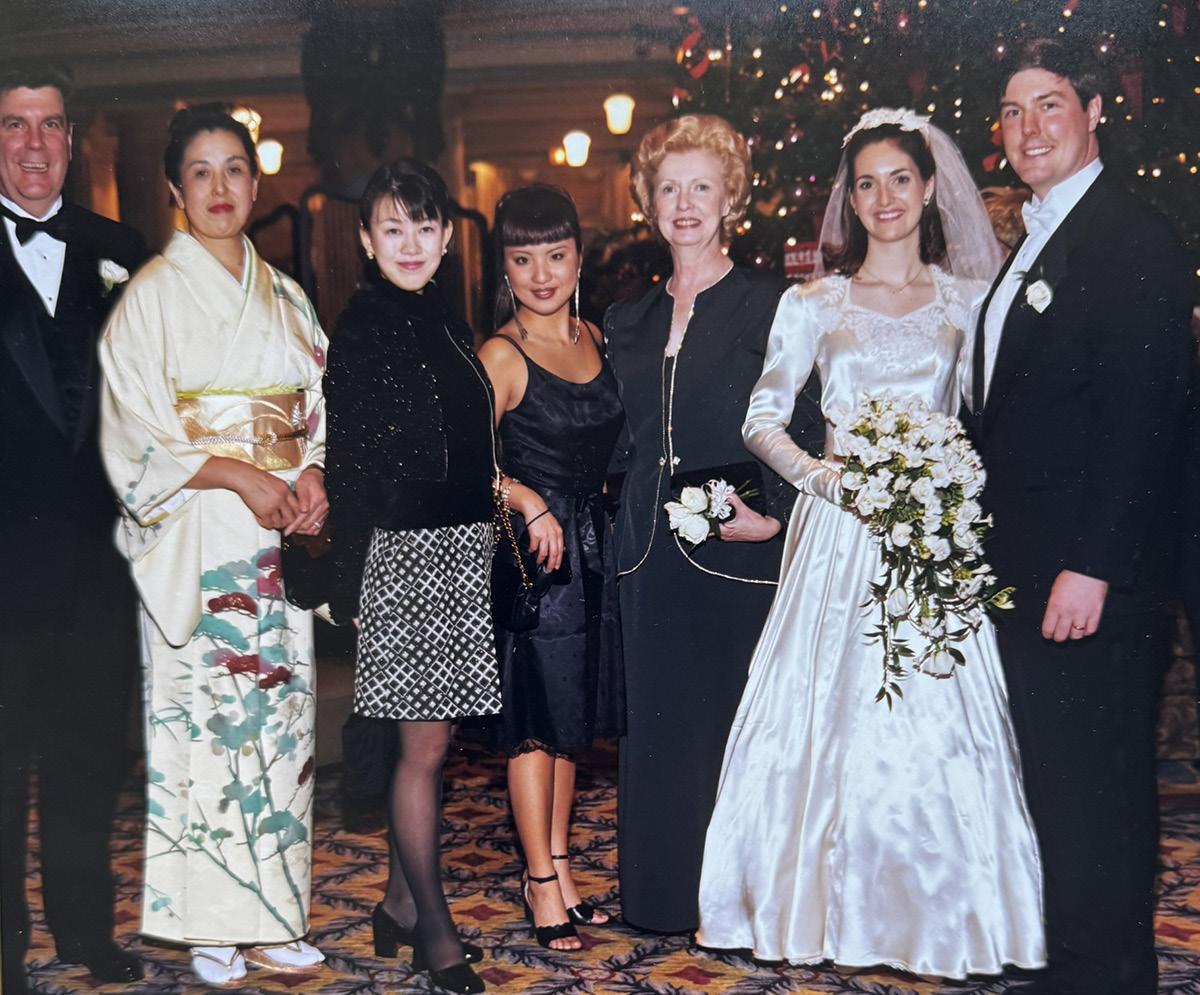
Tanner’s wedding. L-R: Tanner’s father, William; a homestay mother (Rika Usui), a homestay sister (Yuki Watanabe Morimoto) and a friend (Aska Wada); his mother, Anne; Lee and Tanner. (Courtesy photo)
in Switzerland. Can that Japanese policy apply or not? All those legal questions really go back to the same jurisdictional questions around maritime law.”
After fourteen successful years at Cigna, once again, another opportunity came calling – this time at a company where he would need to call on all he had learned about Japanese culture, law and business: Olympus Corporation, a global MedTech company headquartered in Tokyo, Japan and a member of the prestigious Tokyo Stock Exchange (TSE) Prime Market.
When Olympus announced Tanner’s appointment as their new Global General Counsel beginning April 2024, his predecessor Donna Miller remarked, “From his deep interest in and knowledge of the Japanese culture, to his expertise in international law and the healthcare industry, Neil is the perfect fit for Olympus.”
And it is a perfect fit. Today Tanner is one of the few non-Japanese General Counsel of a major Japanese Company and one of the few western Executive Officers of a Tokyo Stock Exchange Prime company.
LIFELONG LEARNING & CIVIC ENGAGEMENT
Wendy Reves might not have been able to predict exactly how Tanner’s life would unfold, but she would have to have been proud to see how her decision to create the Reves Center first attracted, inspired and then provided opportunities for a decisive and determined young man from Philadelphia.
He jumped at the opportunity to come to William & Mary and be part of this new adventure she set in motion. And he has dedicated his life to the goals she set out for the Reves Center.
Tanner’s interest in international education does not stop at the end of a workday. He continues to seek out and find leadership opportunities that take him around the world. Tanner is an enthusiastic proponent of international education, which had such an impact on his own life. “I served as Scholarship Committee Chair for the American Airlines Foundation (formerly the USAIRWAYS Foundation) and I’m currently Vice Chairman of the Board of Trustees of the American University of Rome, which is about 50% study abroad students. “I’ve done three study abroad programs, and I think there’s so much value in finding a program that gets you out of your comfort zone, out of what you’re used to, and drops you somewhere, and you have to figure out how to live in a new culture for yourself.”
Tanner also carries his global interests into civic engagement. He has previously served as a Board member and Secretary of the Japan America Society of Philadelphia and is
a founder of the Philadelphia Cherry Blossom Festival, an event that today draws more than 100,000 people to Philadelphia’s Fairmont Park. In 2013 he received a prestigious Eisenhower Fellowship, where he went to Singapore, Vietnam and Brazil to look into ways to better attract foreign direct investment to the United States. He has also served for more than twenty years on the board of the British American Business Council of Greater Philadelphia, including as President, and previously served as a Non-Executive Director of United Kingdom Trade and Investment, continuing to champion transatlantic business ties. In recognition of his work building economic, political and social connections between the United Kingdom and Pennsylvania, in December 2025, he was appointed His Majesty’s Honorary Consul to the Commonwealth of Pennsylvania for the United Kingdom, a role of particular significance as the United States approaches the 250th anniversary of the Declaration of Independence.
Throughout his career, Tanner has lived Emery Reves’ philosophy by seeking a global education so as not to look at his own country as the center of the universe. Reflecting on the Reves Center, Tanner says: “Since the beginning, the Reves Center, and the philosophies of Wendy and Emery Reves, have been near and dear to my heart.”
The feeling is mutual.
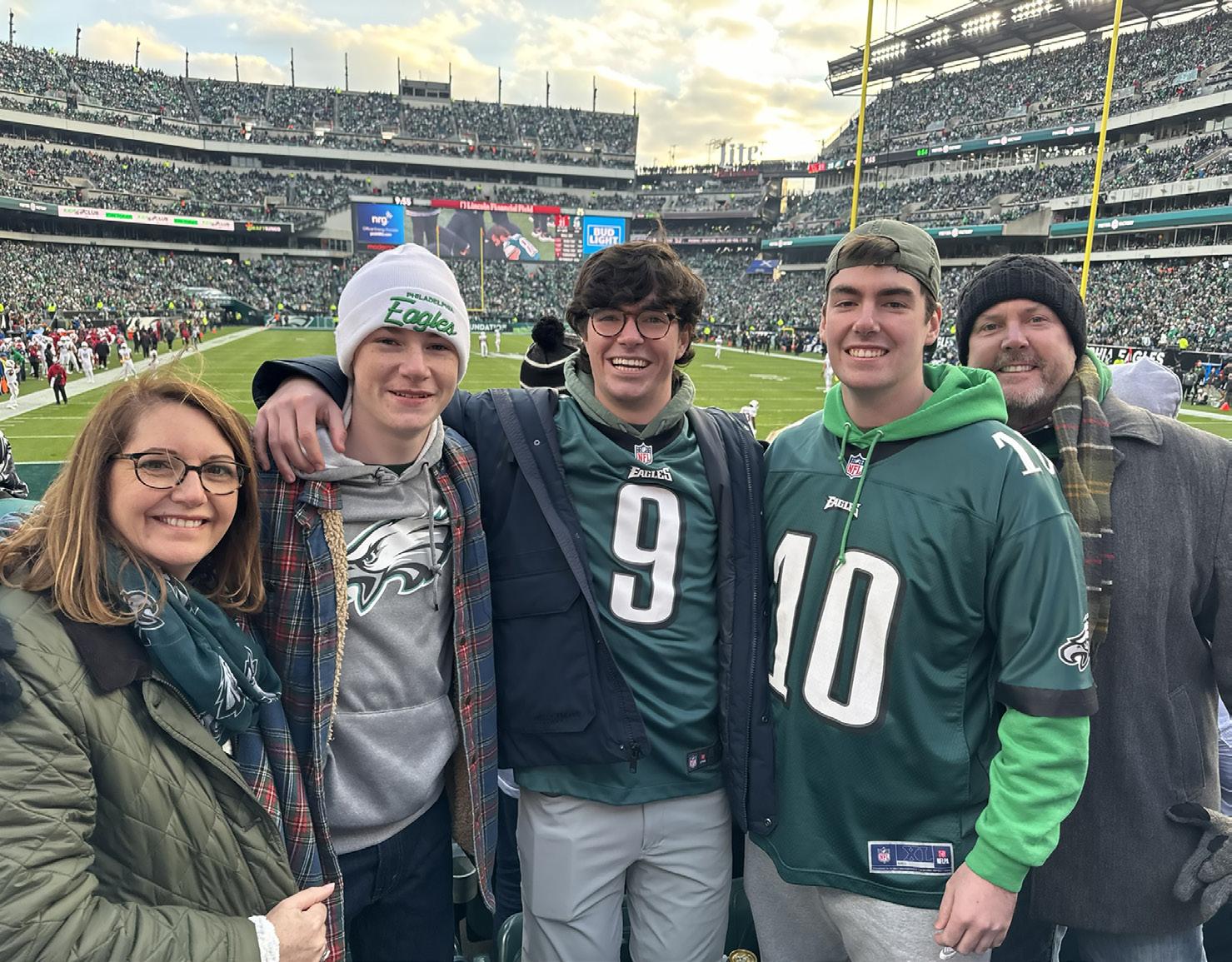
Above: The Tanner family at a Philadelphia Eagles football game: His wife, Lee; sons Andrew, James and William; and Neil. (Courtesy photo)
FROM STUDENT TO ENTREPRENEUR
HOW A STUDY ABROAD EXPERIENCE INSPIRED A MULTIMILLION-DOLLAR BUSINESS
BY KATE HOVING
The headline for the CNBC “Make It” video about Bert Mueller ’11, posted on April 26, 2025, was irresistible: “I left the U.S. for India and built a $23M burrito business.”
It’s no surprise the story was picked up around the world. It had a charismatic hero, a journey to India and almost fairytale-like success. And to add to the magic, as he was building this burrito empire, he was also managing a solid career as a film composer, with credits including “Blood, Sand and Gold,” “Bandslam” and “Nova Roma,” among others.
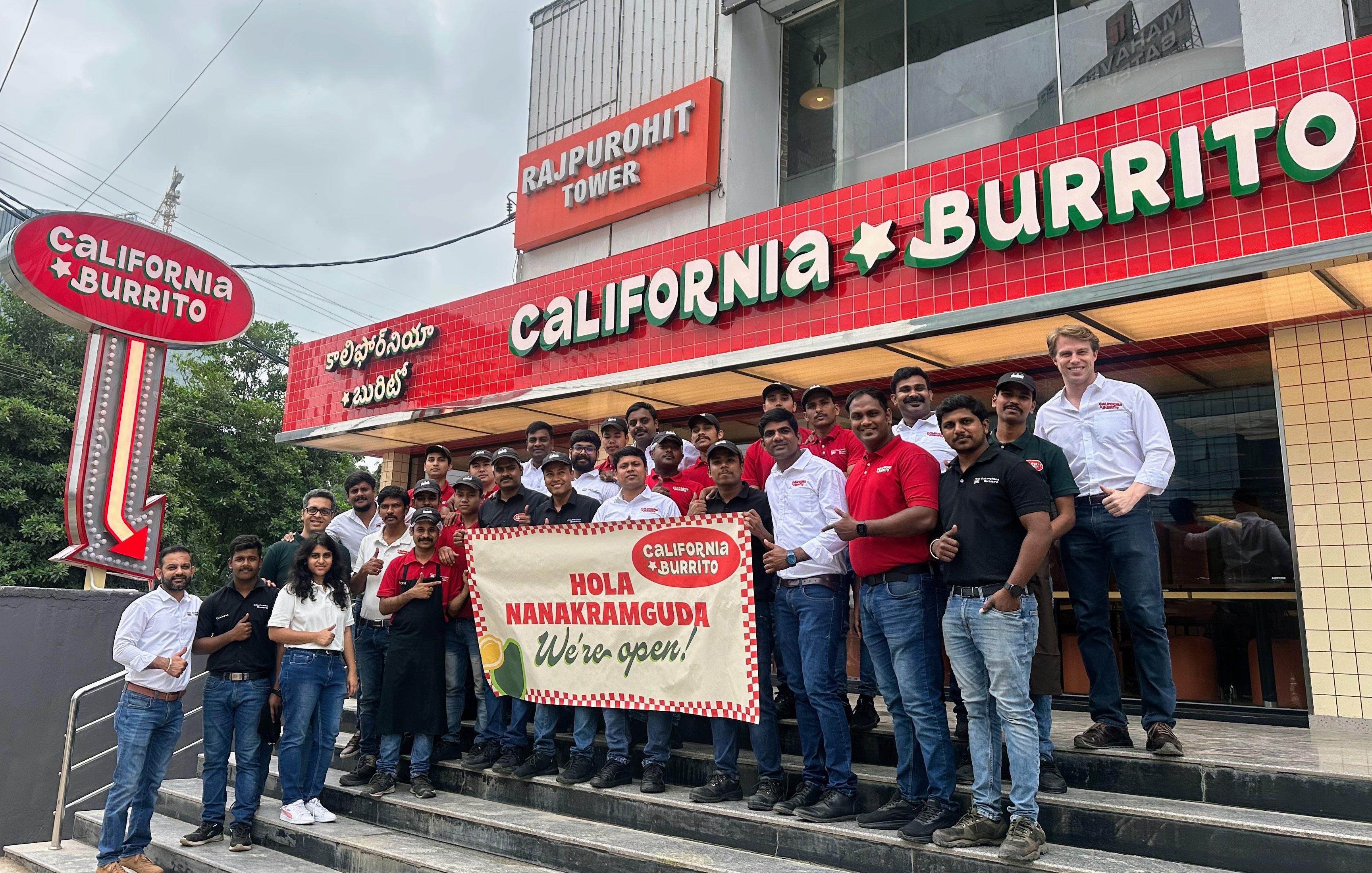
The numbers are even more impressive now since that story broke: Mueller began with one restaurant in Bengaluru, and today California Burrito has 125 locations and last financial year (April 2024-March 2025) made $38 million dollars in revenue.
The details behind the story are just as intriguing, as they tell us a lot about study abroad, Bert Mueller and the William & Mary difference.
Study abroad experiences are known to be transformational and often life changing. They can lead to greater confidence, increased cultural competency, flexibility
and adaptability. Interestingly, these are many of the qualities of successful entrepreneurs: curiosity, willingness to experiment, adaptability and risk tolerance.
But does study abroad always result in a new career trajectory and entrepreneurial mega success?
Well, it’s not as uncommon as one might think. Research into the effect of study abroad participation on career decisions shows that “Students who studied abroad developed a clear understanding about themselves, their goals and interests for further education and future careers. This helped them choose the work environment that they want and believe fits best for them.” 1
Mueller’s success is the result of a lot of factors, not the least of which are his tremendous talent and determination and his superb instincts for business--but the study abroad in India was a catalyst.
And it was a catalyst that motivated him to get the most out of the opportunities available as a student at William & Mary.
1 Jon, Jae-Eun & Shin, Yun-Jeong & Fry, Gerald. (2018). Understanding study abroad participants’ career decisions and perspectives in U S higher education. Compare. 50. 10.1080/03057925.2018.1502608.
CURIOSITY
“I’m somebody who was a good student. I like learning.”
Mueller was a music and public policy double major at William & Mary. In fact, except for a love of Indian food, up until his study abroad in India, there weren’t road signs pointing to a future in Bangaluru.
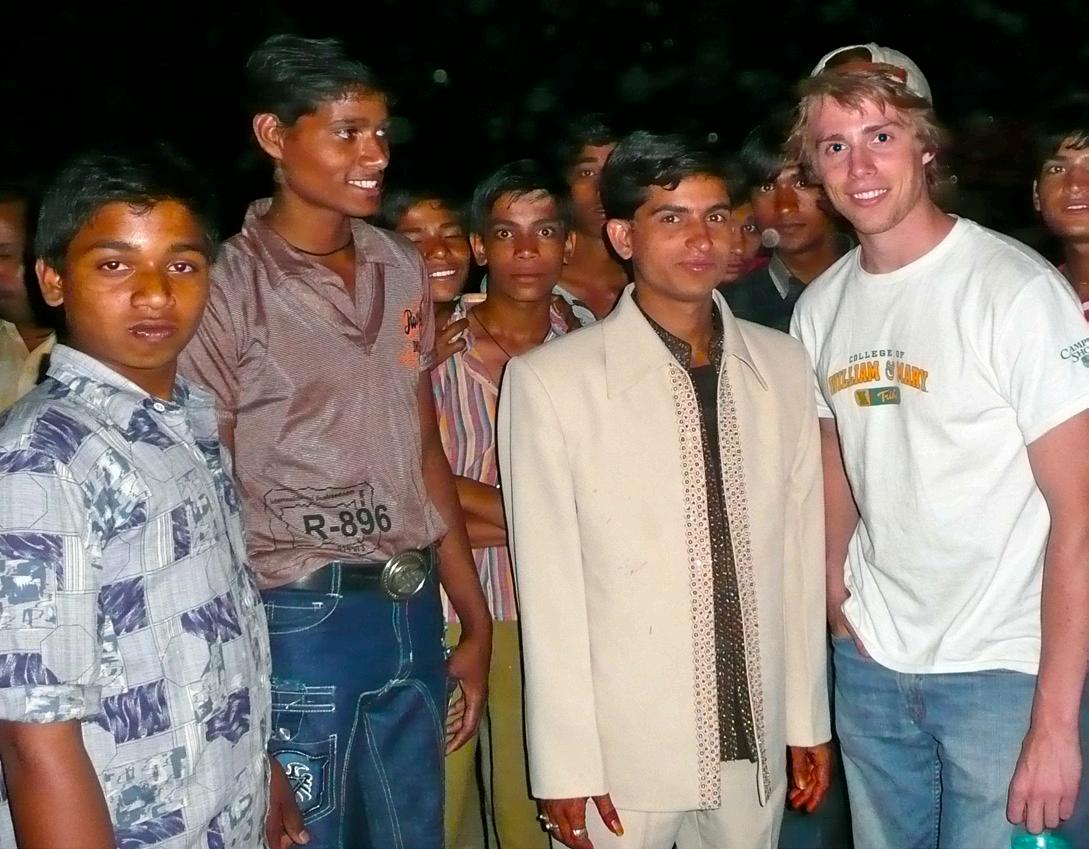
But his second semester junior year, he decided to study abroad in India. “I wanted to do something very different, so India fit that bill.”
Although W&M has a longstanding program to Bangaluru and Goa, it didn’t exist when Mueller was a student. He consulted with a Reves staff member, who told him about a program through the University of Minnesota to Hyderabad and Jaipur, and he was on his way.
“There were probably 20 students in the program. I was the only one from William & Mary. [The program] rented a house in Jaipur, which was the school, and hired teachers. Students stayed with family members, so it was almost like a homeschooling experience.”
Classes covered a range of subjects, such as language, history and architecture. Mueller thinks he didn’t come back with a lot of credits, but that was secondary to what mattered most to him.
“The experience of being in India was the ultimate education. We spend so much time in school learning things, but I think going to another country, you really learn a lot. For me, that was the most important outcome I wanted: that by living in India, I would learn a lot.”
He was there four or five months, living with a family of four—husband, wife, young son and grandmother. “The food was excellent.”
He traveled as much as he could during his time in India. “I was the person who organized all of our traveling. We went to Rishikesh, Agra and Vrindavan and Jaisalmer. Many places in the north.”
He fell in love with Kashmir. “It’s still one of my favorite places. It’s very beautiful but has somewhat languished due to years of conflict. A lot of the tourism structure was built probably in the sixties, so it has an old-world feel, almost like you’re going back in time. But you’re also in the middle of the Himalayas, so the scenery is incredibly dramatic. It is just stunning.”
Oh… and another thing: “There’s great food.”
Any story of international travel invariably involves some amazing dining experience, a memorable exposure to the unfamiliar. And so it is not unusual that
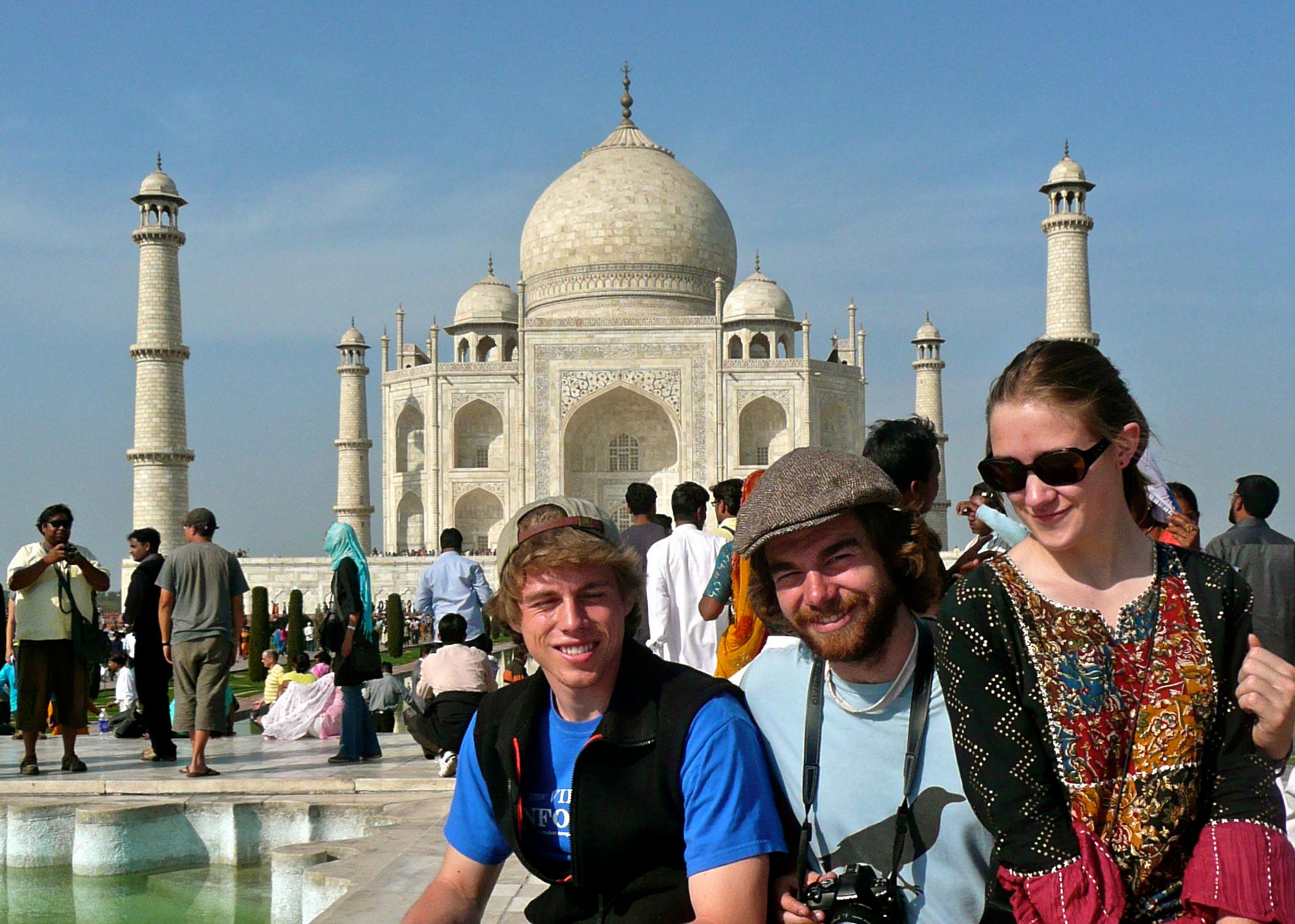
At Taj Mahal for the first time in 2010 with Scott Collison and Emily Garrick, friends from his study abroad program. (Courtesy photo)
Mueller, who enjoys food and all kinds of cuisine, would include food in his important memories. Mueller wanted to return to India and open a business, but seeing how much his Indian hosts enjoyed the Mexican snacks a classmate shared, he decided to return and open a restaurant that served California-style burritos. It was a risk, but he saw an opportunity and was willing to try – but with sound preparation.
LEARNING THE BUSINESS OF FOOD
He returned to Williamsburg to begin his plan of action. First step: Learn about the restaurant business. Still an undergraduate, he got a part-time job at Moe’s Southwest Grill. “I wanted to see if I liked the work before I went and started a company.” He learned two main things: “I learned that the restaurant business is not rocket science, and it’s very people dependent.”
Working at Moe’s may have demystified elements of the food and beverage industry, but the experience was not going to be a road map for India. Processes and infrastructure required a new approach and a slightly steeper -- but still manageable -- learning curve.
THE EXPERIENCE OF BEING
IN INDIA WAS THE ULTIMATE EDUCATION. WE SPEND SO MUCH TIME IN SCHOOL FOR ME, THAT WAS THE MOST IMPORTANT OUTCOME I WANTED: THAT BY LIVING IN INDIA, I WOULD LEARN A LOT.
“At Moe’s we would buy all the ingredients from one vendor. India is very different, because for one ingredient we could have five vendors. I remember at Moe’s, we went through a phase where we bought whole onions and chopped them. And then we decided to get pre-chopped onions. And then we changed back to whole onions. Each time, we could just call the supplier, and they’d get those things for us. But in India, the infrastructure is at a very different place. So even if that were possible, it would be prohibitively expensive. I think everything is generally much more unreliable, so you need many more backup plans.”
Another difference is that Moe’s restaurants are franchises. Mueller did not go that route with his business strategy.
“In India, if you have a franchisee that decides to run awry, there’s no mechanism to enforce your will on them. So, generally speaking, franchising is a very tough business to control. If you’re making lots of money, then they’ll convert it to their own brand. If you’re not making any money, they’ll also convert it to their own brand,” he says with a laugh.
LEARNING THE BUSINESS OF BUSINESS
In addition to his work at Moe’s, Mueller found classes at William & Mary to complement his education.
“I took one class on entrepreneurship at the business school in my final semester. I think I had to petition to get into it. It was a great class, taught by Professor Richard (Dick) Ash.” [Ash founded the Alan B. Miller Entrepreneurship Center, now called the Entrepreneurship Hub.]
Bob Crawford, then CEO of Bigelow Teas, was was an executive partner at the Raymond A. Mason School of Businessand Mueller’s mentor in the class, and not the only important connection he made.
“They put you in a group of maybe five students to do a business case,” Mueller recalls. “I got lucky, because I got to do a case for Red Lobster, and Kim Lopdrup BBA ‘80, who was the CEO of Red Lobster, came to campus, and we presented to him.”
The personal connections and building a network were pivotal. “Any time you’re able to speak with people who’ve been very successful at whatever they’ve done is so important.”
Although he never changed his major, Mueller was able to take additional classes to help prepare him for the business world, such as economics and statistics. “As the business gets larger and data comes into the picture, these things become more relevant, and having some grasp of the concepts has been useful.”
THE “IT” FACTOR
Clearly Mueller has a gift for business. He parlayed an initial investment of $250,000, cobbled together from partners and family, into thriving business and is now expanding into managing its own sustainable supply chain. And there’s no sign of its stopping.
And, in spite of the challenges of running his own business, Mueller enjoys it. “For me, it’s a fun challenge, not a case of, ‘I’m okay with the headache of it.’”
He also matter-of-factly states what we can all see: “I’m doing well, so something’s working.”
And perhaps “what’s working” goes back to his study abroad experience, where for him it was more than just exposure to another culture and country. India grabbed hold of him, and that has made the difference and has made it a long-term investment for him.
“There was a wave of people who came [to India] in the early 2010s, when I came, and almost all of them washed out. There are very few Americans here now, and the expat situation
has changed a lot. Earlier, people were setting up businesses, and now they might spend six months out of twelve here.”
What does Mueller see as his “it” factor that has brought his success?
“I think I like India more than most people. I think a lot of people get fatigued here, and that probably shows up in the way that their business operates, he says. “For some reason, I get along well with India.”
And it could also be that although he is a great businessman, Mueller is at heart a musician and artist.
“There’s a lot of art in life in India.”
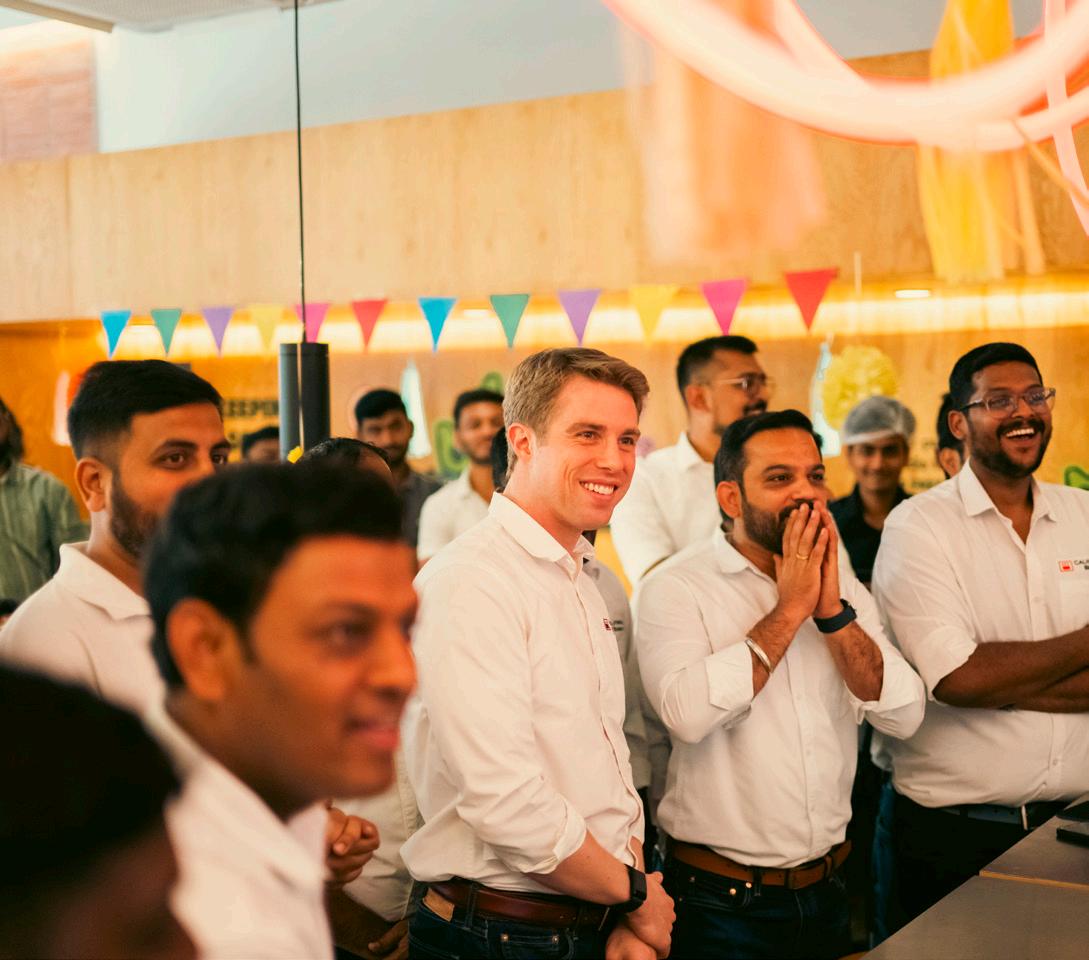
New store launch in Hyderabad, 2025 (courtesy Photo)
LEGENDARY ILÊ AIYÊ INSPIRES IN IMMERSIVE ARTS MASTERCLASS
BY NAOMI TEFERRA ‘26
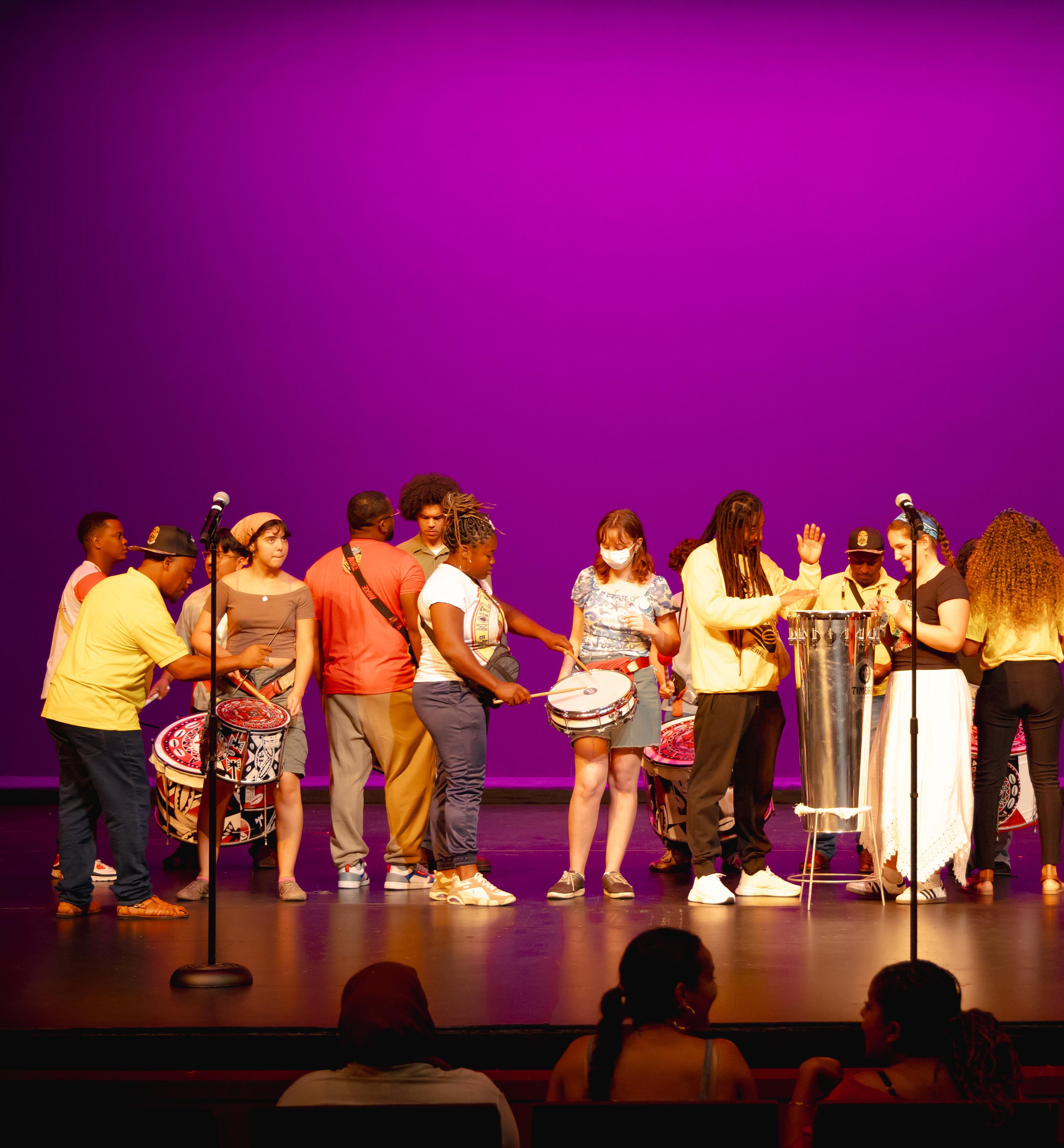
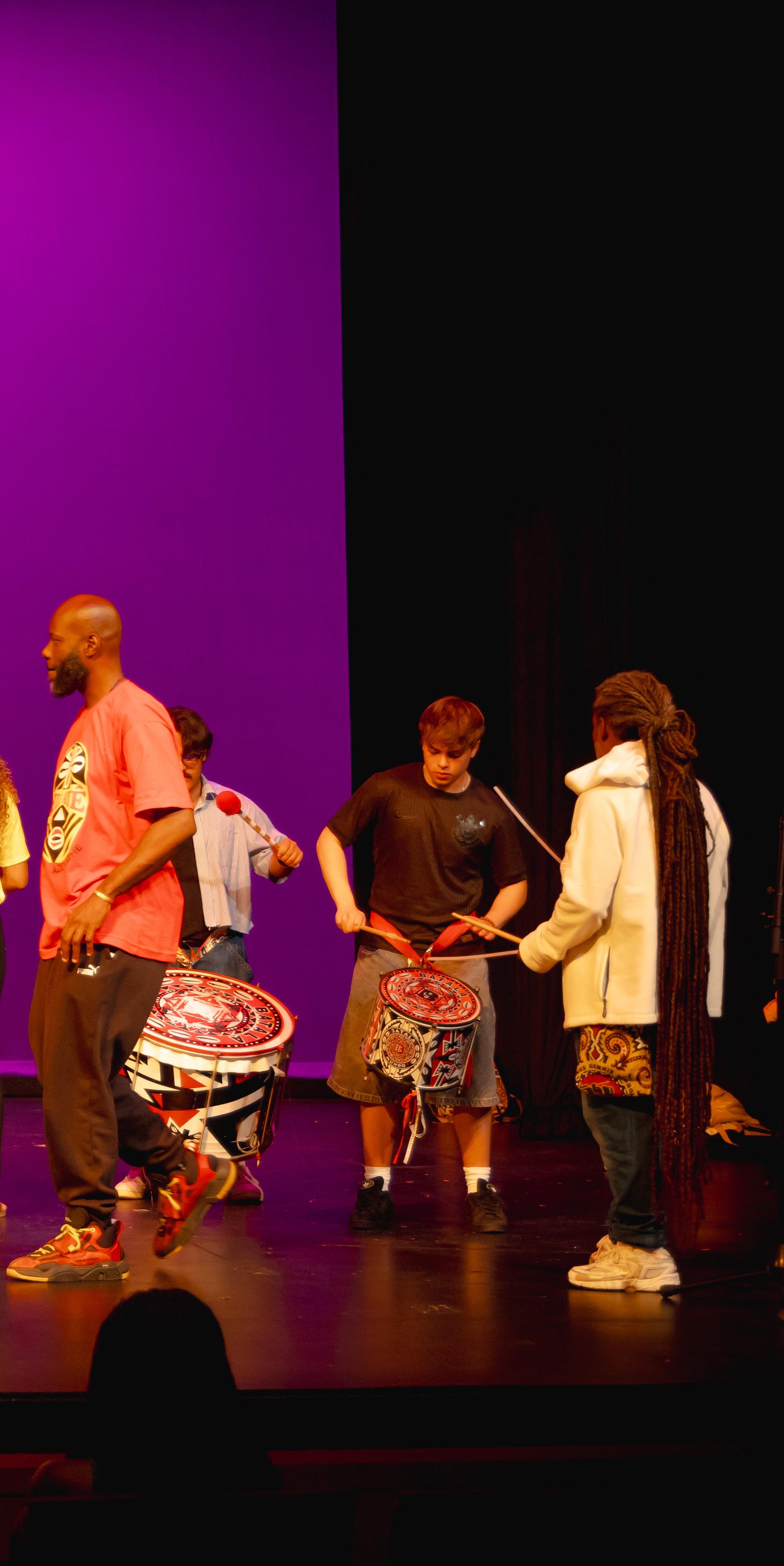
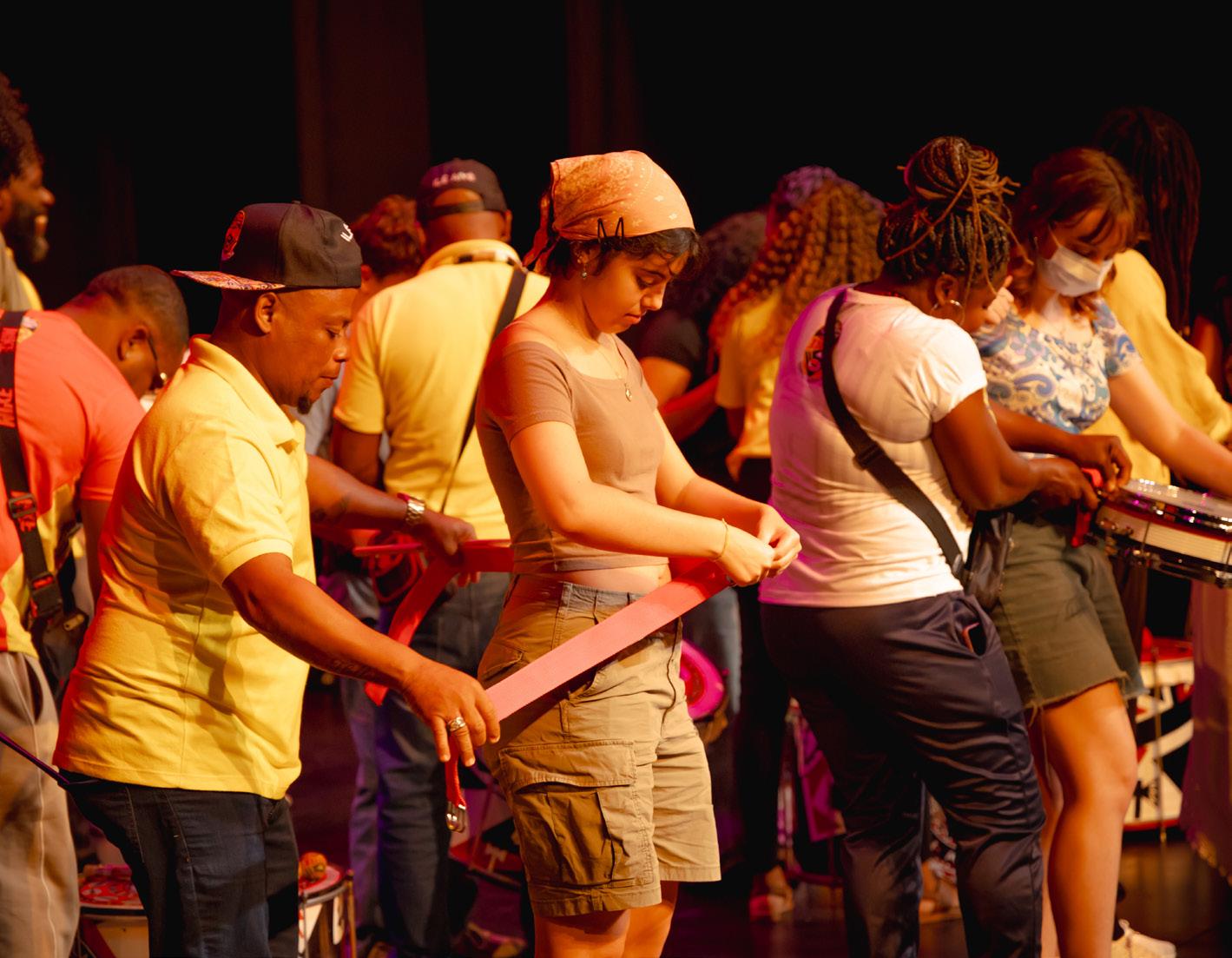
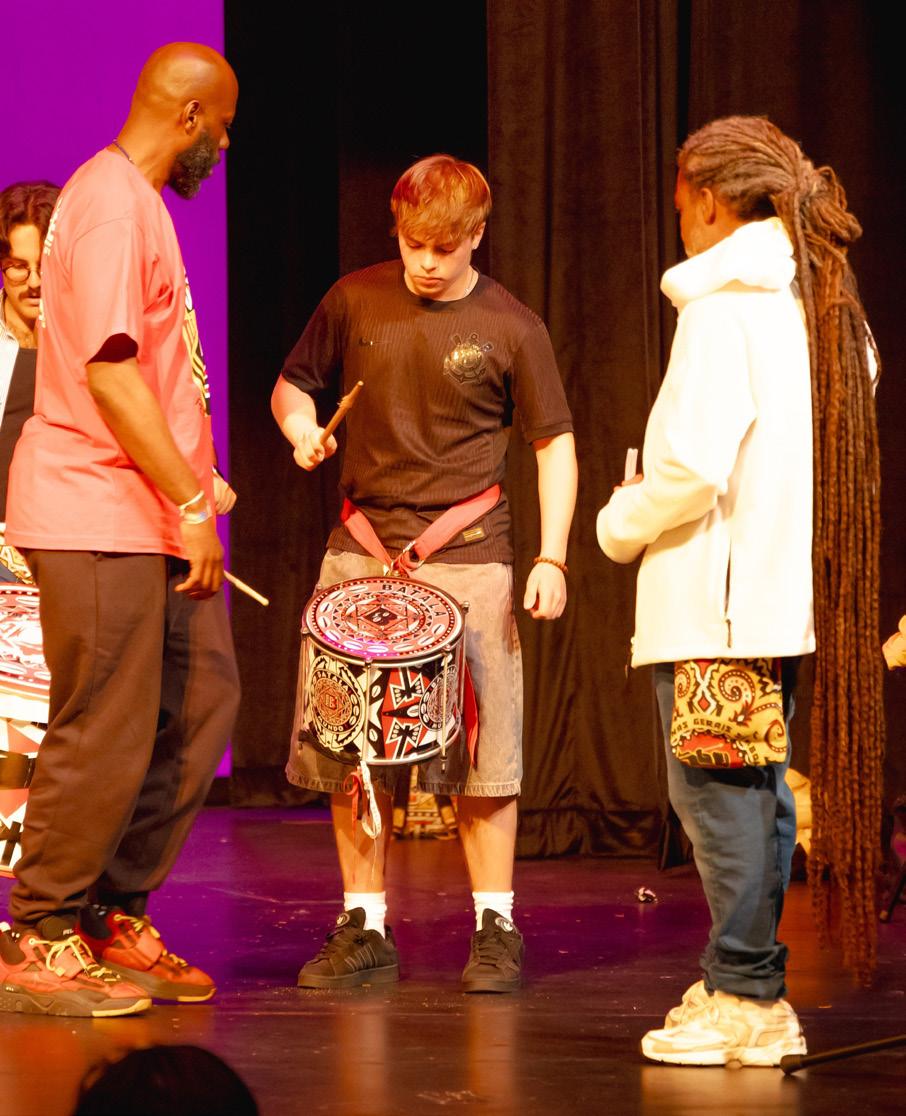
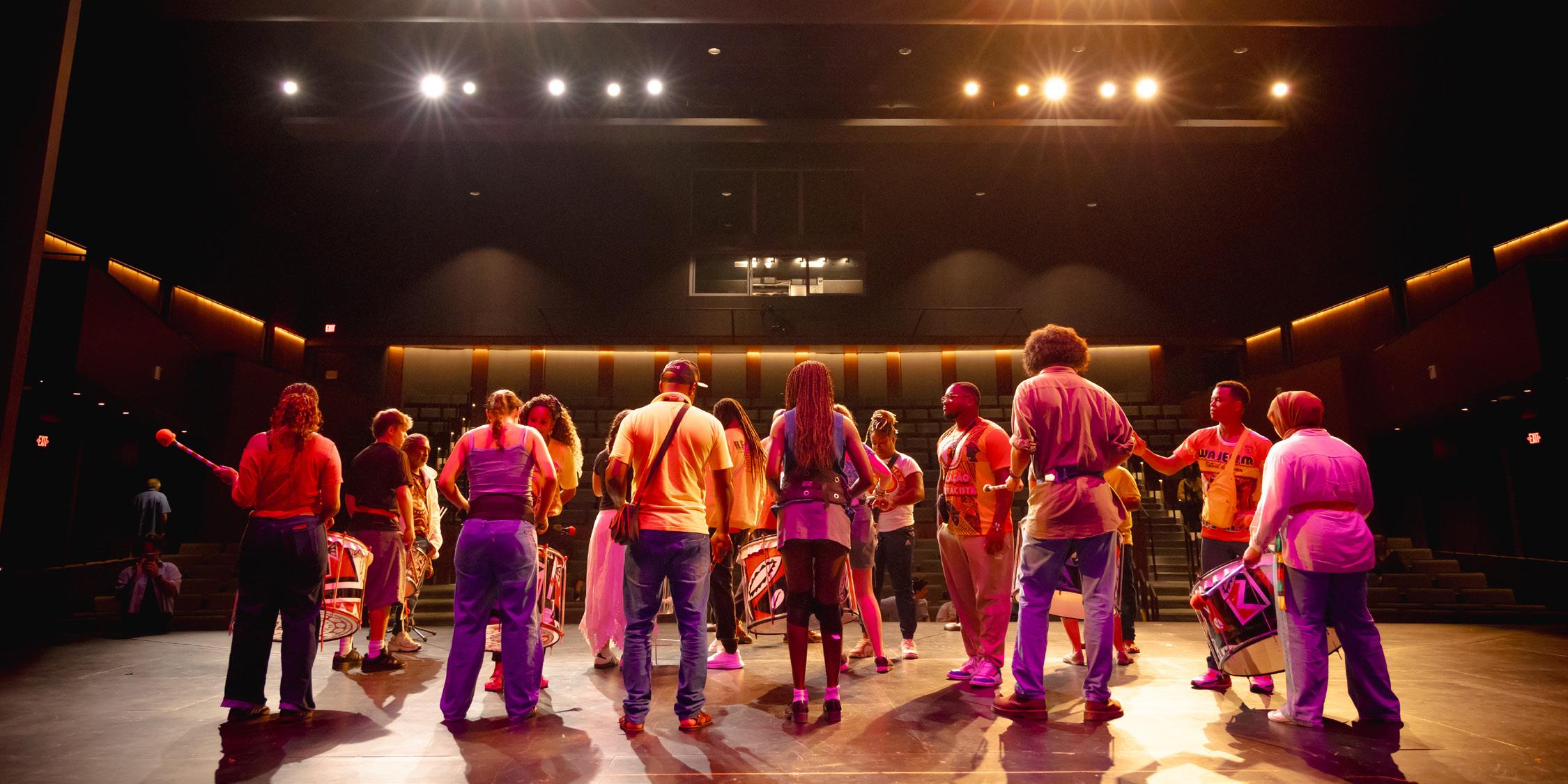
William & Mary students learn from members of the legendary Brazilian street band Ilê Aiyê during a Charles Center Arts Masterclass hosted by William & Mary’s Office of the Arts in Glenn Close Theatre Sept. 3. (Photos by Samuel Li ‘26)
The following story originally appeared on the website for the Charles Center. – Ed.
Apicture may capture a thousand words, but Brazilian percussion group Ilê Aiyê demonstrates how a melody embraced in polyrhythmic harmonies can convey meaning beyond what can be spoken or seen.
On the evening of Sept. 3, under the warm lighting of the Glenn Close Theatre, bright percussive beats poured from the stage as the legendary Afro-Brazilian street band Ilê Aiyê held the first of several Charles Center-sponsored Arts Masterclasses hosted by William & Mary’s Office of the Arts this academic year.
Founded in 1975, Ilê Aiyê is a world-famous group from Salvador, Bahia, Brazil, renowned for its unique combination of spirited drumming, intricate costumes, and inspired dance that reflects and transcends the history of an interconnected Atlantic world.
Students and community members in attendance were invited “to explore and experience” art of the highest level, said Executive & Artistic Director of the Arts Eric Despard, who invited the pioneering group to campus for a multiday residency that included a public concert in Phi Beta Kappa Memorial Hall’s Glenn Close Theatre Sept. 2.
The masterclass, taught in Portuguese with the aid of an interpreter, was an immersive experience linguistically and musically, as the lilting syllables and percussive beats wove together to engage participants as one.
Students joined the group on stage to begin their instruction with fundamentals – the natural percussion of their bodies.
Once students mastered the basics, each member of the group paired with a pupil, demonstrating how to catch the rhythm, working to build a melody together.
Brazilian music ensemble student Isabella Sasso ’25, a junior majoring in computer science, expressed excitement at this unique opportunity to explore her passion.
“I liked how interactive the masterclass was,” Sasso said. “It reminded me of the kinds of workshops we did when I studied abroad in Brazil.” Sasso recalled her interactions with her companion band member with a smile, saying that though she does not speak Portuguese, they were able to share laughs at her mishaps.
Sasso’s passion for Brazilian music drove her to attend the masterclass, and this past winter, it took her to Brazil, where she studied the Brazilian musical tradition as a part of the Salvador Winter Study Abroad Program through W&M’s Reves Center for International Studies.
Julia Beverley ’26, a data science major and fellow Brazilian music ensemble player, shared her own connection to the masterclass, which stemmed from her Brazilian heritage and her cultural connection to Brazilian music. For Beverley, the masterclass was the perfect opportunity to explore a new genre and practice her Portuguese.
“It was so cool. I had such an amazing time. I think their music is so amazing, and it’s so impressive how intricate the beats are,” Beverley said. “Learning that style was so different from what I’ve ever learned because I also do percussion in the musical ensemble, and this was just another level.” Learning how to play the Brazilian drum called the timbau from Ilê Aiyê drummer Vincius Silva, Beverley shared that her favorite part of the masterclass was coming to understand the beat of her own drum and its rhythms when the band came together to play.
“I think doing the beat on my own was probably one of my favorite parts,” Beverley said. “Once he finished teaching me the rhythm, he let me explore on my own and figure out how to get back on beat on my own.”
The masterclass is not the end for Beverley, a current data science major with a minor in math, who dreams of being a part of a Brazilian music band in the future.
“My mom has a few friends that play Brazilian music in concerts, and I think that would be so cool – to continue my experience learning and playing percussion with Brazilian music in the future.”
New to campus and Brazilian percussive instruments, Lucas Bickham, a first-year student intending to double major in economics and international relations, explained that he cherished the chance to connect with fellow Brazilians in his new environment.
“It was a great opportunity for me, especially with my Brazilian identity. It was an opportunity to establish a connection with them, because they also aren’t familiar with things in the US, you know, because they came straight from Salvador, Brazil,” Bickham said. “It was awesome getting to know them and having that connection to a home away from home.”
Bickham was drawn to the masterclass by this call to his culture, but he had a previous connection with the group, as well. The day before the masterclass, Bickham happened upon them on campus when he heard Portuguese being spoken outside his dorm.
“The whole band was outside playing soccer. So, me and my roommate, we ran down there and started playing soccer with them,” Bickham said. “That was really cool – it was a bonding moment, you know, and so that’s how I built up some proximity to them before the masterclass.”
Even outside his closeness with the band, Bickham said the masterclass was enjoyable because of the mentorship it offered, its engagement with the instruments, and the opportunity it provided to learn about a new genre of music.
Everyone was able to engage in the experience regardless of Portuguese proficiency, Bickham said, as “music portrays a message without words.”
Prioritizing such transformative experiences through community outreach and meaningful mentorship is a priority for Despard and Office of the Arts. Last year Arts at W&M presented 275 events for the community, ranging from lec-
Lucas Bickham
tures and exhibitions to concerts and masterclasses, all designed to serve as a bridge between the campus community and the world.
“There hasn’t been a presented season in 20 years on campus—until now,” Despard said. “What that really means is bringing in world-class artists, Grammy-winning artists, and
working with the Charles Center as a way to really support the student interaction with these artists.”
Charles Center Arts Masterclass tickets are available free of charge thanks to the generous support of the Elliot E. and Helen Y. Cohen Forum Endowment.
William & Mary’s Brazilian Music Ensemble, established in 2015 to expand and diversify the approach to Latin American studies at the university, is directed by John & Audrey Leslie Associate Professor of Music and Latin American Studies Michael Iyanaga.
(Photo by Julia Beverley)
BUILDING TRUST THROUGH DIPLOMACY: ULTIMATELY A HUMAN ACTIVITY
BY NICHOLAS VALYAYEV ‘27
This January, students in Professor Marcus Holmes’s seminar, Building Trust Through Diplomacy, took their classroom well beyond William & Mary’s Washington Center, engaging directly with the people and institutions that shape contemporary international affairs. With programming in both Washington, D.C. and New York City, the course emphasized experiential learning and faceto-face engagement as central components of diplomatic practice.
A highlight of the seminar was a day trip to New York City, made possible through the support of the Reves Center for International Studies, the Charles Center, and the William & Mary Washington Center. In New York, students visited the United Nations Headquarters and the Danish Mission to the United Nations, where they examined how multilateral diplomacy works in practice and how smaller and middle powers operate within the UN system.
“Diplomacy is ultimately a human activity,” said Holmes. “You can read about it in books, but there is no substitute for seeing how it actually works and for talking directly with the people who do this work every day. These trips are de -
signed to help students understand diplomacy as something lived and practiced, not just theorized.”
In Washington, D.C., the class engaged with a wide range of diplomatic and policy institutions. Students visited the Carnegie Endowment for International Peace and the Council on Foreign Relations, gaining insight into how research organizations and policy communities shape debates on international security and global governance. Embassy visits included meetings at the Japanese Embassy, the Embassy of Estonia, and the German Embassy, where students learned how diplomats represent national interests, manage alliances, and navigate contemporary geopolitical challenges.
The seminar also included a hands-on diplomacy simulation at the U.S. State Department, conducted in partnership with the National Museum of American Diplomacy. Guided by Ciara Koepke, students assumed the roles of states and international organizations tasked with resolving a nuclear proliferation crisis, giving them firsthand experience with the pressures, uncertainty, and tradeoffs inherent in high-stakes diplomatic negotiations.
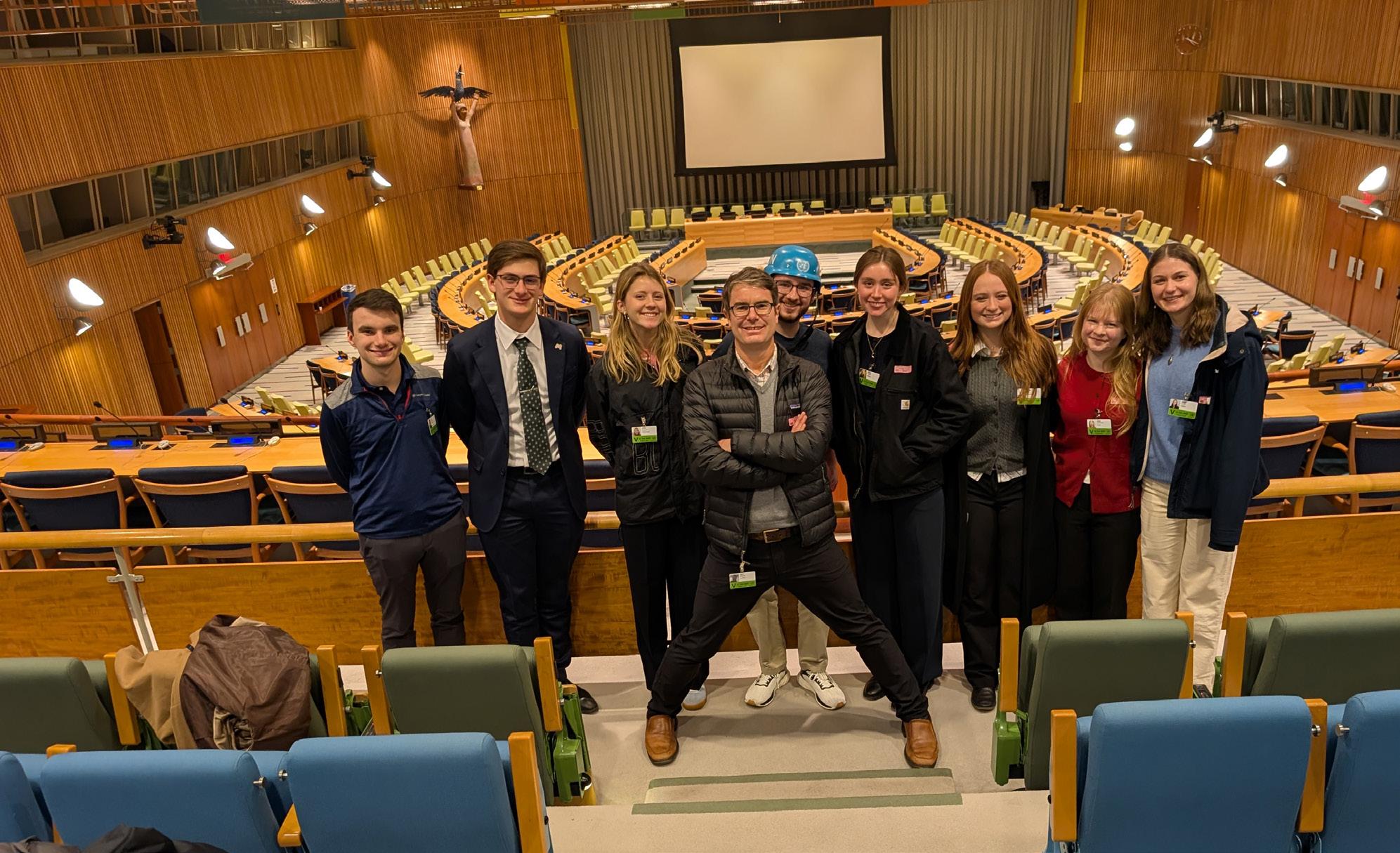
A view of the UN Economic and Social Council Room (Courtesy photo)
“I took this course as a student in the D.C. program last winter,” said Sarah Schulte, the course’s TA, “and I was absolutely fascinated about how different people in the diplomatic world conceptualized their work. What was exciting about being the Teaching Assistant for the 2026 Building Trust Through Diplomacy course was being able to witness how diplomacy has evolved within the last year. Just as the global order has completely flipped, so has diplomacy. Being able to reattend our site visits gave me so much insight into how diplomats adapt to a changing international system, teaching me lessons I will take with me long after I graduate William & Mary.”
Together, these experiences underscored the distinctive value of the Washington Center and its ability to connect William & Mary students with the institutions and practitioners at the heart of global politics. By combining coursework with site visits in both Washington and New York, the seminar demonstrated how diplomacy is learned not only through texts and theories, but also through direct exposure to the people and places where international decisions are made.
THESE TRIPS ARE DESIGNED TO HELP STUDENTS UNDERSTAND DIPLOMACY AS SOMETHING LIVED AND PRACTICED, NOT JUST THEORIZED.
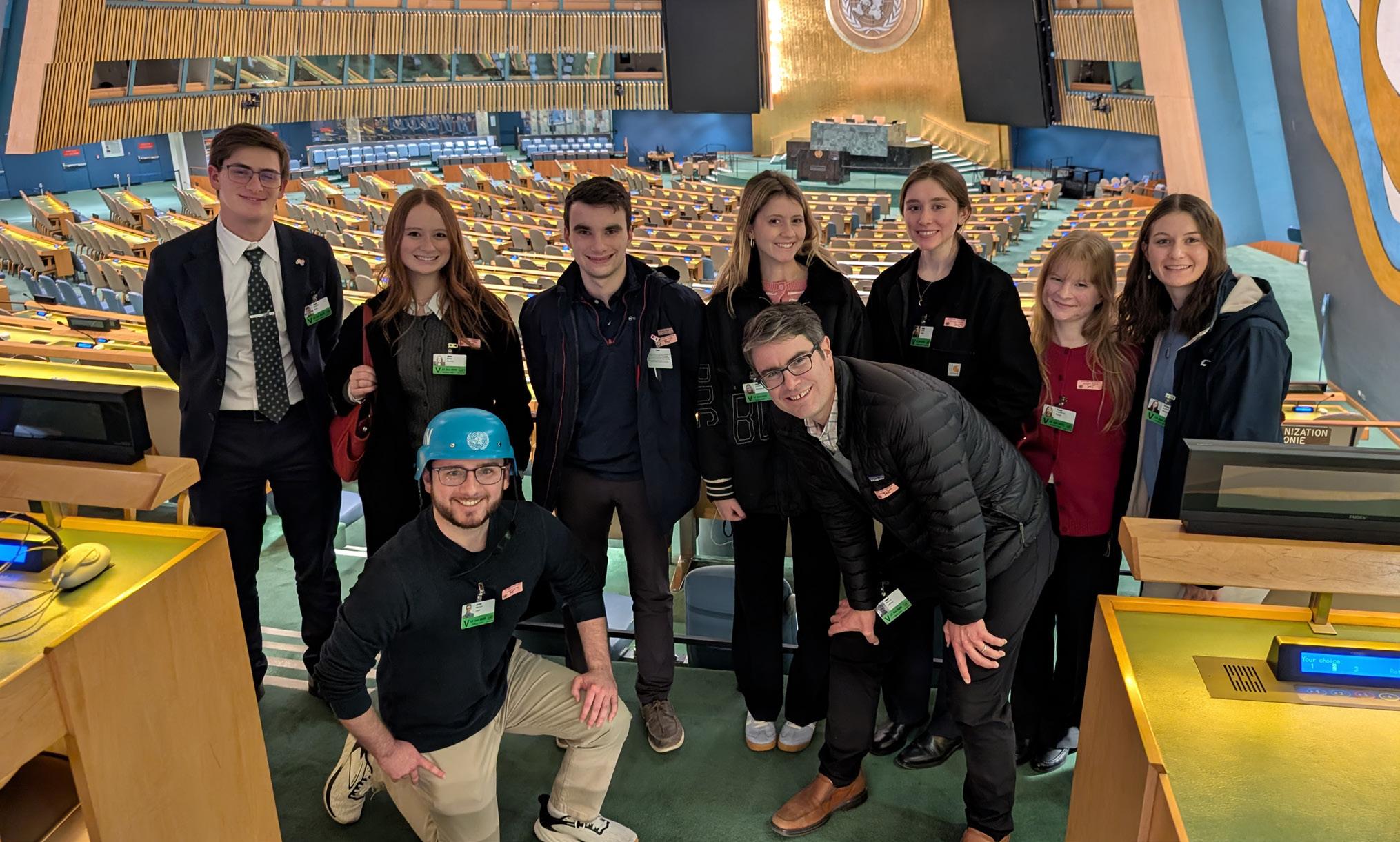
Professor Holmes and students at the United Nations General Assembly (Courtesy photo)
W&M’S i GEM TEAM BRINGS BACK GOLD
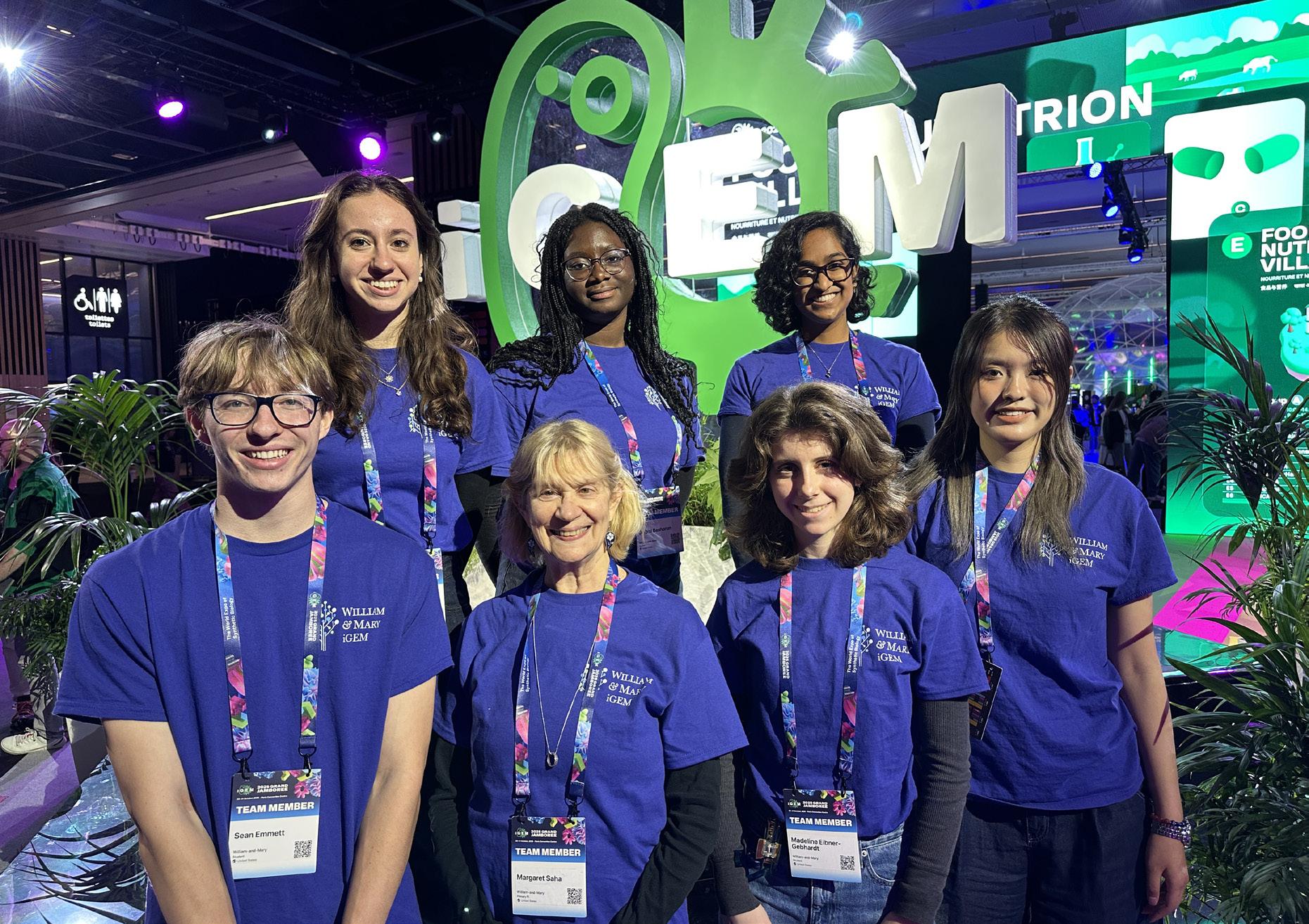
Six undergraduates represented William & Mary at the International Genetically Engineered Machine (iGEM) competition in Paris, earning a gold medal
BY RANDY READY, SCHOOL OF COMPUTING, DATA SCIENCES & PHYSICS
The following story originally appeared on the website for W&M’s School of Computing, Data Sciences & Physics. – Ed.
At William & Mary, innovation often springs from collaboration, and nowhere is that more evident than with the iGEM team.
This year, a small but determined group of six undergraduates represented W&M at the International Genetically Engineered Machine (iGEM) competition in Paris, earning a gold medal for their project “Aquarius,” which harnessed the power of synthetic biology to tackle pressing water-related environmental challenges.
WHAT IS IGEM?
iGEM is the world’s largest synthetic biology organization and student competition. Each year, collegiate and high school teams design, build, and test biological systems using DNA-based
“parts” to solve real-world problems. Teams then present their work to international judges and peers at the annual Jamboree held in Paris.
Almost 7,000 students from over 50 countries competed this year.
A SMALL BUT MIGHTY TEAM
This year’s W&M team was made up of seniors Rebecca Zheleznyak, Xinyu Hu and Vandana Kalithkar, juniors Olabisi Bashorun and Sean Emmett and sophomore Madeline EibnerGebhardt. The team of six (and one student advisor) was the smallest in the 10 years W&M has competed in iGEM and the smallest of the 421 high school and undergraduate teams in this year’s competition.
Faculty advisor Margaret Saha, a Chancellor Professor in Applied Science, said a small team meant the students had to produce not only lab research, but also software, mathematical models, public education materials, safety documentation, and web-based project wikis that detail every stage of their work.
“There were no benefits to being small,” Saha said with a laugh. “It was an extraordinary challenge, but the students were beyond fantastic — they worked longer, harder, more efficiently and above all, smarter than ever before.”
Zheleznyak was on last year’s iGEM team that had ten students. She said less people meant more responsibilities, particularly on meeting tight submission deadlines for deliverables like the videos and wiki.
“Some teams have people who are dedicated to doing those deliverables and then other people on the team who do the science, but for us we each had to do everything and help however we could,” said Zheleznyak. “We were all just working so closely together in such a small group that each person put everything into it, and that was really incredible to watch.”
PROJECT AQUARIUS:
ENGINEERING SOLUTIONS FOR WATER
Adding to the difficulty was the ambitious project the team decided to take on this year, “Aquarius,” which focused on using synthetic biology to address water-related environmental issues like harmful algal blooms and corrosion to bacterial contamination in aging infrastructure.
“We wanted to incorporate something that is personal to William & Mary and to us, and since this year was the ‘Year of the Environment,’ we started thinking about it and realized that one of the four pillars of William & Mary’s (Vision 2026) is water,” explained Zheleznyak. “We wanted to center our project around how we can implement some bioengineered constructs in real-world aquatic environments.”
The students and Saha all mentioned how important the Charles Center was in providing each student with a summer stipend, either for honors thesis research for the seniors or summer research support for the other students.
“We could not have done this without the Charles Center,” stated Saha. “Their support was absolutely vital, and what’s more exciting about this is that each of these students have a project going forward.”
Zheleznyak said she is integrating iGEM into her honors thesis, which is an opportunity to build off their work with the eventual goal of getting published.
“(iGEM) provides such a big opportunity for undergraduates to experience research firsthand, to think of a project, execute it, and then present it in front of so many people at the Jamboree,” said Zheleznyak. “To be able to create something from scratch that can actually contribute to the field as an undergraduate is an incredible opportunity upon itself, and I’m so glad that we have that at the school.”
IT SOLVES PROBLEMS IN A COMPLETELY NOVEL WAY, INTEGRATING WET LAB, AI, MODELING AND ENGINEERING, AND TO ME IT IS AT THE CUTTINGEDGE OF SCIENCE .... IT IS THE MOST CREATIVE OF ALL HUMAN ACTIVITIES – MAKING THINGS TO IMPROVE PEOPLE’S LIVES.
Emmett emphasized the importance of doing a project that had real-world implications.
“We wanted to make a project that we could see actually being implemented in the future or contributing to a better world in terms of safety or the economy or just public health.”
While the team started meeting in January, they didn’t start the wet lab portion of the project until the summer.
While just a sophomore, Eibner-Gebhardt doesn’t think she will try to compete on next year’s team as she is eager to see her iGEM work to completion and publication.
“I have so much data I’d like to analyze from this year’s project,” explained Eibner-Gebhardt. “I don’t want drop that, I want to keep going with what I have because I think there are so many cool topics that we can follow up on.”
INTERDISCIPLINARY AT ITS CORE
Perhaps the most defining feature of W&M’s iGEM program is its interdisciplinary nature. The team draws on students from across fields, which this year included biology, computer science, data science, physics, neuroscience, and applied mathematics.
“I’ve always seen that iGEM has so many different majors in their members, so I joined because I love the interdisciplinary aspect of it,” said Bashorun. “It’s just great that (iGEM) is right here in William & Mary, which was a reason I came here, opportunities like this for undergraduates to actually do research and science.”
GROWING REPUTATION
W&M has earned an impressive track record since first competing in iGEM in 2014.
By Saha’s tally, based on how many times they have won, top 10 finishes and gold medals, William & Mary has been among the most successful iGEM teams from the U.S. over the past decade.
That reputation precedes them — even abroad.
“One woman approached us and said, ‘Oh you’re William & Mary,’ like she expected a lot from us, so yeah I think we do have a bit of a reputation now after the past few years, but I think that’s a good thing,” said Eibner-Gebhardt.
“We had people come up to us in Paris saying they modeled their website on ours from last year,” added Zheleznyak. “It was surreal to see how well-known the William & Mary iGEM team is internationally.”
So what makes William & Mary students so successful at iGEM?
Saha points to a combination of things.
“Students who are creative and who are able to look beyond the boundary of a narrow discipline,” said Saha. “They want to make things and really solve local problems that have global implications.”
LOOKING AHEAD
With this year’s competition complete, Saha is now looking to form a team to compete in 2026. Why should students consider iGEM?
“It’s risky. It solves problems in a completely novel way, integrating wet lab, AI, modeling and engineering, and to me it is at the cutting-edge of science and really pushes boundaries in ways that no other field that I’ve been associated with does,” answered Saha. “It is the most creative of all human activities – making things to improve people’s lives.”
Editor’s note: iGEM team member Xinyu Hu ‘26 is an international student from China. She received an International Student Opportunity Scholarship from the Reves Center’s International Students & Scholars Program (ISSP) Office to help fund her travel to Paris. The particular scholarship she received was funded by the Thomas C.P Lillelund & Family Scholarship. Thomas C. Lillelund ‘95 is a former Reves Center advisory board member.
Please support the work of the Reves Center
At the Reves Center we develop, promote and sustain global initiatives involving students, alumni, faculty and staff at William & Mary, by:
• Forging robust international partnerships and financing faculty-student research around the world; and,
• Awarding scholarships to help alleviate financial need, make educational opportunities possible, recognize achievement and attract and engage top students from around the world.
• Sponsoring and funding internationally-themed lectures, conferences, and forums;
Our work is personal and life-changing — but we can't do it without you.
Learn how you can support this important work:
In Their Own Words
Sylvia Mitterndorfer
Director, Global Education Office and Director of Global Partnerships
Sylvia Mitterndorfer ’96 returned to W&M in 2010 to lead the Global Education Office at the Reves Center.
Q: You’re an alumna of W&M. Did you study abroad as an undergraduate?
Not as an undergraduate through W&M. I graduated in 3 years to craft my own global experiences. My graduate program involved multiple study abroad portions and locations for research and study.
Q: How did you get into the field of international education?
After working in DC for an internationally-focused foundation on various global policy programs and research, and having had the benefit of a global education myself, international education was a natural transition from policy analysis to supporting students to add an international element to their education.
Q: Have you seen changes in the field over your career?
The field has changed significantly in many ways. Although W&M has a long history of international opportunities even when I was here, students have many more choices now in destinations, timing, program models, fields of study and levels of support. We have focused much more intentionally on individual reflection connected to rigorous academic studies along with personal and career development.
Q: You are the director of the Global Education Office (GEO) and also director of Global Partnerships. What does your job entail?
I have the privilege of working with an exceptional team of colleagues who work each day to create global opportunities for students, faculty, and others all around the world and here at W&M. Each day is different and involves lots of collaboration with colleagues and students here at W&M and partners in other parts of the world. For global partnerships, we are building out more resources and support to help faculty connect with partners around the world, deepen existing ties and support new collaborations.
Q: How does the Global Education Office support the larger mission of the Reves Center in cultivating a globally minded student body?
GEO works with more than 2,000 undergraduate (and grad-
uate) students each year to provide global opportunities to the W&M student body. The fact that more than half of W&M study abroad and earn COLL300 is another measurable contribution to W&M’s overall learning goals for all undergraduate students. We also contribute to the Reves Center’s goals of internationalizing the W&M community by supporting visiting exchange students here and facilitating international teaching for more than 30 faculty members each year.
Q: Can you tell us a little more about the kinds of activities your staff are engaged in?
The Global Education Office team is a talented, dedicated group of educators who center student and faculty collaboration in their work. This is evident in the advising, mentoring, and coaching which happens, pre-departure preparation and ongoing support while abroad, re-entry programming, and collaborations with academic and student affairs colleagues. We all work together to address barriers to study abroad and develop programs which meet W&M standards. At the same time, the team develops and manages programs around the world and here on campus. This involves everything from budgeting and exchange rate monitoring, logistics, collaborations with faculty and overseas partners to design programs, risk management, and so much more! While we work primarily with study abroad, we are also the academic home for incoming undergraduates exchange students, coordinator of English-language training courses, as well as specialized training and study abroad programs at W&M for students and professionals around the world.
Q: I think people are surprised to see how few staff members you have – only 10. How does your team manage those 2,000+ students each year as well as the design and administration of the W&M programs?
First, their level of expertise is extraordinary, with colleagues having served abroad in numerous functions including Peace Corps, former military, and Fulbright as just examples. Above all, they are caring and dedicated professionals, all working hard to open doors for international studies to students and faculty.
Those 2,000+ students we work with annually are all at different phases of the study abroad process, from preliminary consideration, application, preparation, support while abroad,
I AM VERY EXCITED FOR THE APPLIED LEARNING FOR ALL (ALFA) INITIATIVE AS WE CONTINUE TO SEEK TO SUPPORT ALL STUDENTS AND ADDRESS BARRIERS FOR APPLIED LEARNING, INCLUDING STUDY ABROAD. I HOPE WE CAN BUILD ON THE SUCCESS OF WINTER PROGRAMMING AND OFFER PROGRAMS ACROSS ALL SCHOOLS AND FIELDS.
and reentry programming and transfer credit. It takes a dedicated team to both support individual student advising and also manage processes as efficiently as possible. We couldn’t do this work without the whole-university support and colleagues in the Reves Center and across campus to ensure that study abroad fits in seamlessly with the overall university experience and operations. I’m also very grateful for the work of the Advancement team as we continue to scholarships to address financial barriers.
Q: W&M has great faculty support and faculty-led programs. Do you think that is a strength of W&M, something W&M does exceptionally well?
Yes, faculty-led study abroad programs mirror the strength of faculty’s student-oriented approach here on campus. This student-focused approach was evident to me as a student decades earlier and has now extended in significant ways in recent years. The number of faculty-led programs has exploded in recent years, thanks in part to more time over winter break.
Q: W&M has several longstanding partnerships and exchange partners. Which ones come to mind?
The collaborations with St Andrews University and Keio University are great examples of transformational, multi-dimensional partnerships. After a lengthy student tuition exchange partnership, which continues until today, the idea for an undergraduate joint degree program was born. Since the successful launch of the JDP, additional collaborations from faculty exchanges, the First Abroad study abroad spring break exchange, the W&M-St Andrews summer program, and other initiatives has been developed. When you have such close collaborations and institutions know each other so well, it lends itself to trying new things and creating new opportunities built on trust and previous collaboration.
Similarly, W&M has had a strong partnership with Keio University in Tokyo, Japan, which includes a student tuition exchange program and the Keio-W&M Cross-Cultural Collaborations program. This program has been active for over thirty years and involves Keio University students coming to W&M’s campus in the summer to learn alongside W&M students in a customized academic program. We think more than 1,000 students have benefited from the study abroad program at W&M. These are just two examples of the many collaborations for which we are grateful around the world.
Q: Our world is so interconnected virtually now, is a real-life international experience as important as it used to be?
I would argue that it is as important as ever for our students to be able to study abroad and have these first-hand experiences. As the COLL300 description says it so well: “The purpose of COLL 300 is to connect you with people, places, and ideas that take you out of familiar surroundings and deepen the way you see yourself in the world. To introduce you to people and ideas that are outside your sphere of direct experience. To challenge your ways of thinking. To make you a little uncomfortable.”
Q: Is there something new that you’re excited about?
I am very excited for the Applied Learning for All (ALFA) initiative as we continue to seek to support all students and address barriers for applied learning, including study abroad. I hope we can build on the success of winter programming and offer programs across all schools and fields.
DID YOU KNOW?
#1
W&M is #1 in study abroad programs at a public university*
$700,000
The Reves Center provides more than $700,000 in scholarships for study abroad and international internships,
*Ranking is based on the percentage age of undergraduates in study abroad programs compared to other public universities in the U.S.
Recently Published Books by W&M Faculty
THE CAMBRIDGE COMPANION TO THE SPANISH INQUISITION
Edited by Lu Ann Homza, Professor of History
In this volume, leading international scholars assess the origins, legal practices, victims, reach and failures of Spanish inquisitors across centuries and geographies. Grounded in recent scholarship and archival research, the chapters explore the Inquisition’s medieval precedents as well as its turbulent foundation and eradication. The collection offers a nuanced, contextual understanding of the Spanish Inquisition as a historical phenomenon. Published by Cambridge University Press
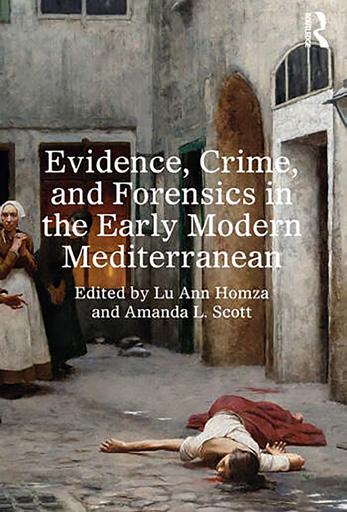
EVIDENCE, CRIME, AND FORENSICS IN THE EARLY MODERN MEDITERRANEAN
By
Lu Ann Homza, Professor of History, with Amanda L. Scott M.A. ’10 as co-editor
This volume of 13 essays explores the ways in which a wide range of historical actors — including the illiterate, women and children — deployed the multiple legal systems at their disposal in Spain, Italy and the Balkans. Published by Routledge
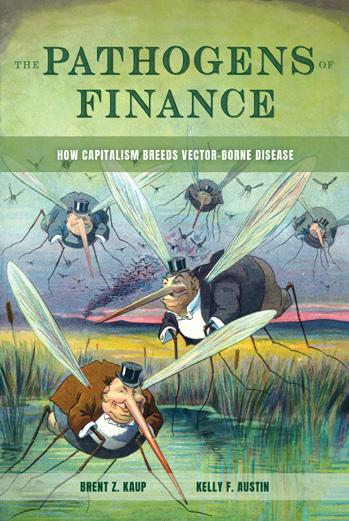
THE PATHOGENS OF FINANCE: HOW CAPITALISM BREEDS VECTORBORNE DISEASE
By
Brent Z. Kaup, W&M Professor of Sociology, and Kelly F. Austin
“The Pathogens of Finance” is an exploration of how the rising power and profits of Wall Street underpin the contemporary increases in and inadequate responses to vector-borne disease. To examine this phenomenon, Brent Z. Kaup and Kelly F. Austin take readers to the exurban homes of northern Virginia; the burgeoning agricultural outposts of Mato Grosso, Brazil; and the smallholder coffee farms of the Bududa District of eastern Uganda. Through these case studies, the authors illuminate how the broader financialization of society is intimately intertwined with both the creation of landscapes more conducive to vector-borne disease and the failure to prevent and cure such diseases throughout the world. Published by University of California Press
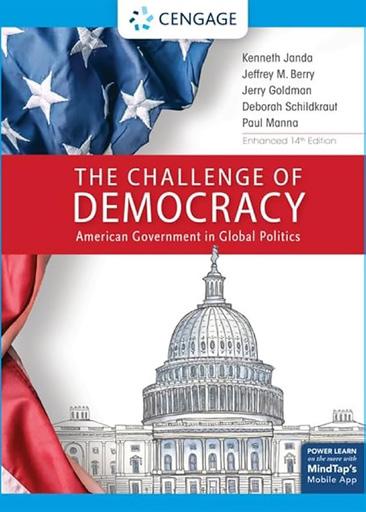
THE CHALLENGE OF DEMOCRACY: AMERICAN GOVERNMENT IN GLOBAL POLITICS, 16TH EDITION
Co-authored by Kenneth Janda, Jeffrey M. Berry, Jerry Goldman, Deborah Schildkraut and Paul Manna, the Isabelle and Jerome E. Hyman Distinguished University Professor of Government and faculty affiliate in the W&M Public Policy Program
“The Challenge of Democracy” is an American government textbook organized around the key values of freedom, order and equality, as well as major models of democratic decision-making embodied in majoritarianism and pluralism. The book puts the U.S. in a global context by juxtaposing American governing institutions and political processes with examples from around the world. Published by Cengage
THE MANY APPROACHES TO SUSTAINABLE AGRICULTURE:
Reflections
from core course week
BY SOPHIA BRETAS KAISERMANN ‘27
Sophia studied abroad fall 2025 in Copenhagen on a program run by DIS, a non-profit study abroad foundation established in Denmark in 1959 that offers semester, academic year and summer programs taught in English in Copenhagen and Stockholm. One of her courses was the DIS Core Course, Sustainable Food: Production and Consumption. She wrote a blog describing her experiences This was one of her entries.-- Editor
September 16, 2025
One of the educational aspects of DIS that most led me to apply were the opportunities for hands-on, place-based learning. The bread and butter of experiences outside of the classroom are the study tours. Last week was Core Course Week, five days in which students only attend their Core Course and visit sites and meet professionals relevant to our areas of study. Core Course week includes the three-day Short Study Tour, where your class travels around Denmark, to Southern Sweden or to Northern Germany.
My Core Course, Sustainable Food: Production and Consumption, left bright and early at 7:15 AM to head to our first academic visit, as we had an ambitious itinerary that spanned the entirety of Denmark. We had two academic visits and a dinner in Jutland, Denmark’s peninsula, and four visits in Zealand, Copenhagen’s island home. Despite the early departure, I didn’t allow myself a nap on the bus as to not miss out on the beautiful views of the Danish countryside. One of the things I was most excited about was the chance to see parts of Denmark that I don’t know that I would have seen otherwise.
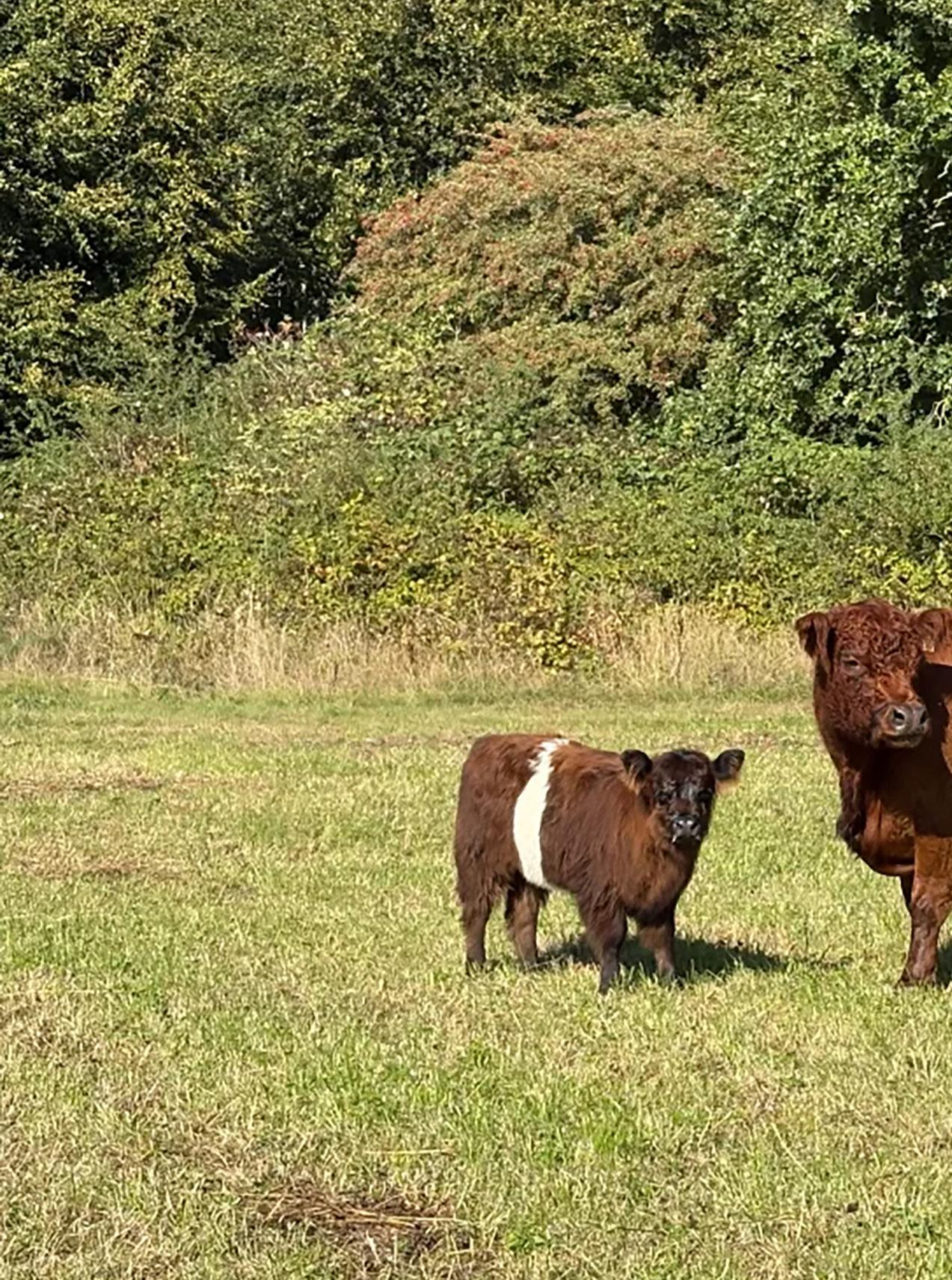
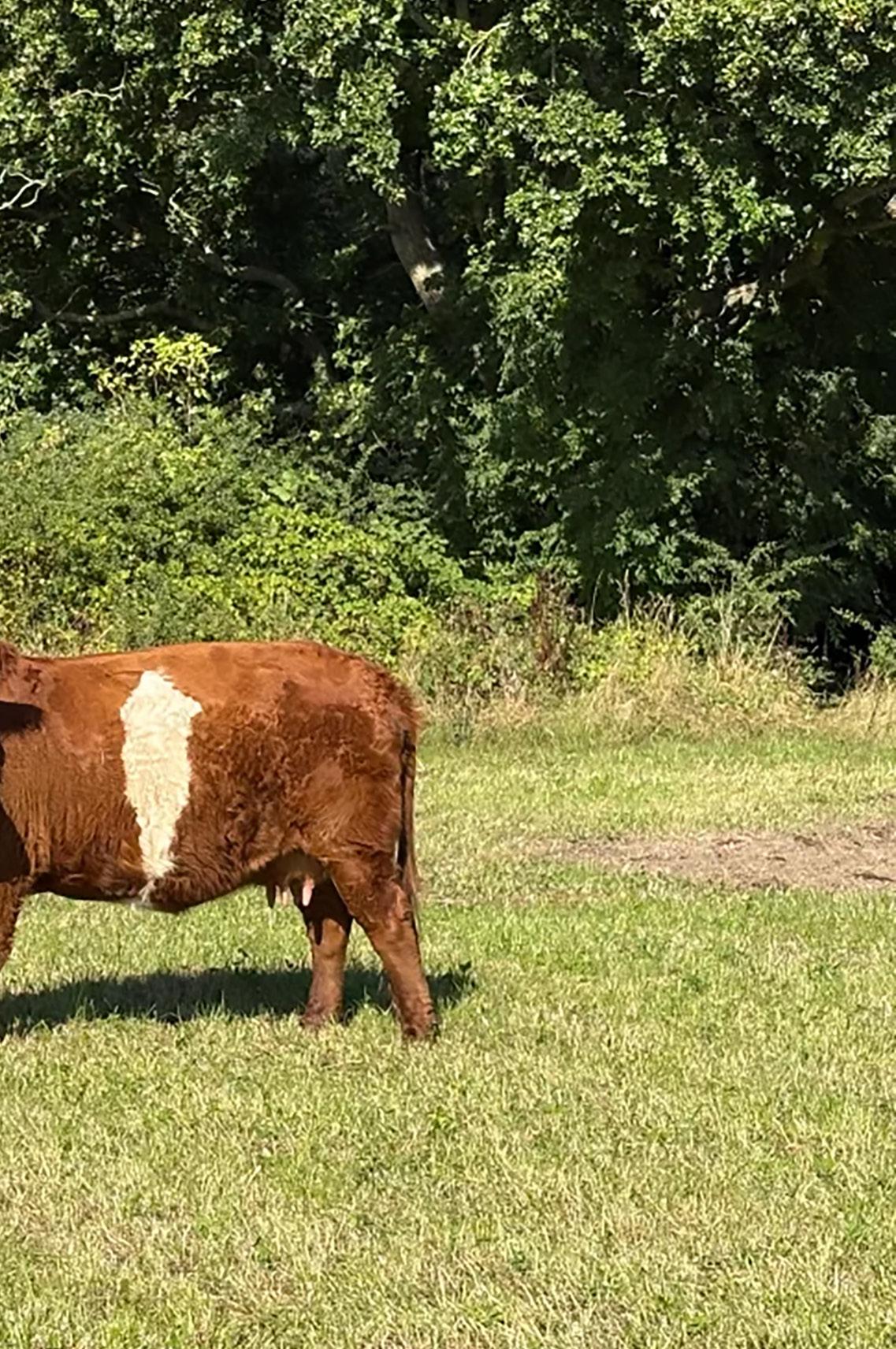
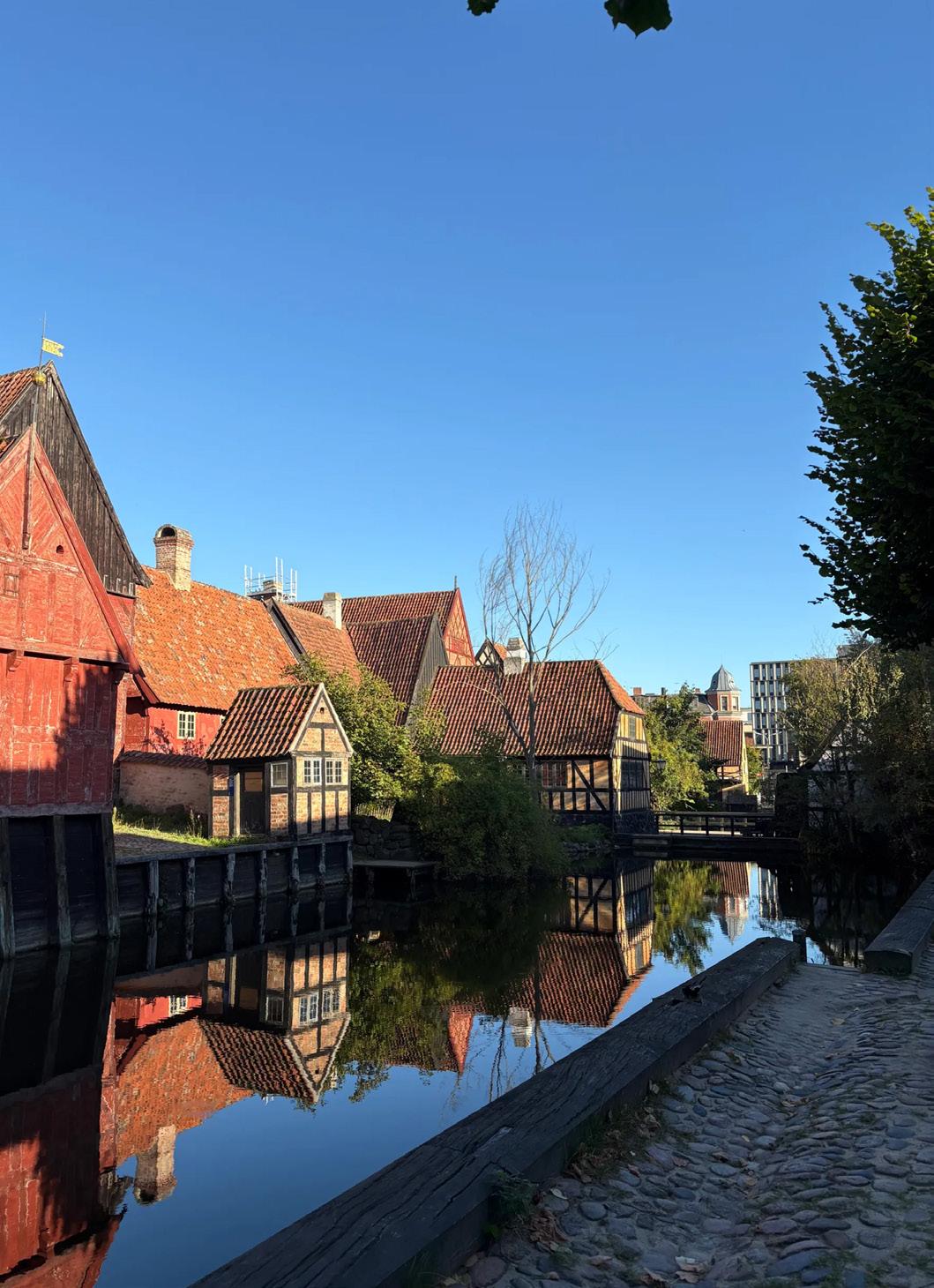
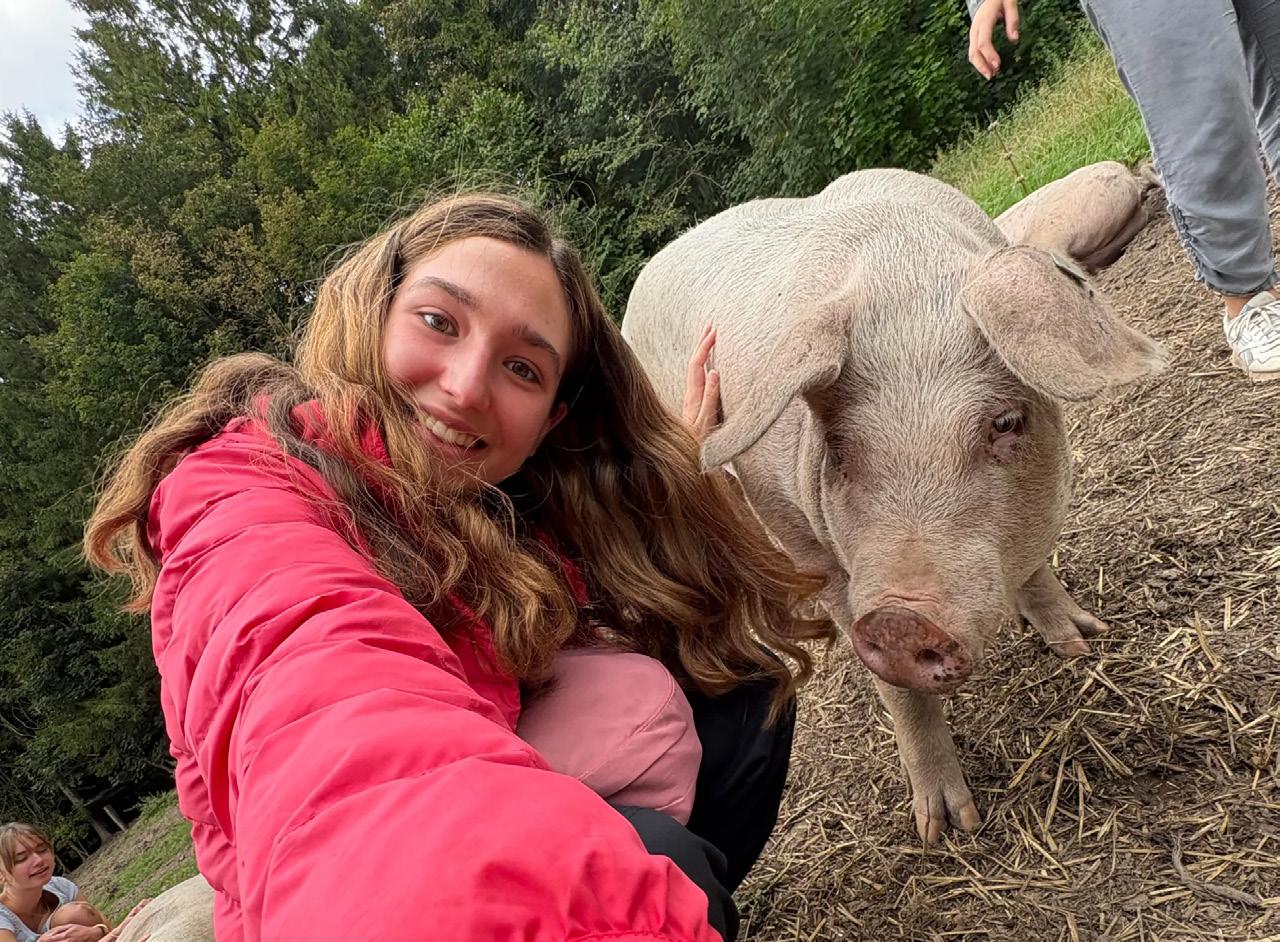
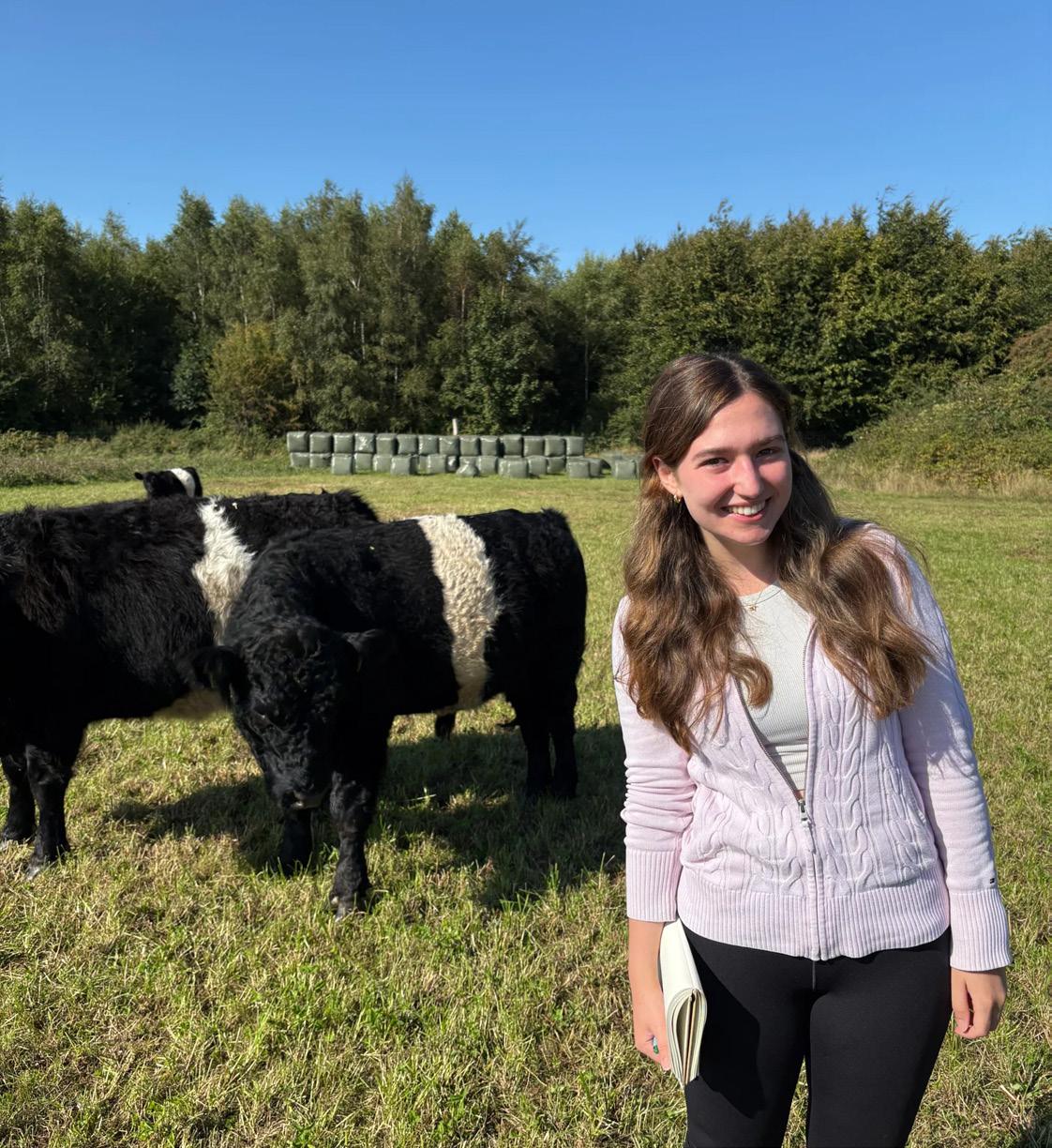
Clockwise from top left: A cow and her calf at Peters Gartneri; Sophia and a
IT WAS SO INSPIRING TO MEET THESE FARMERS WHO ARE CREATING THEIR OWN DEFINITIONS OF SUSTAINABILITY.
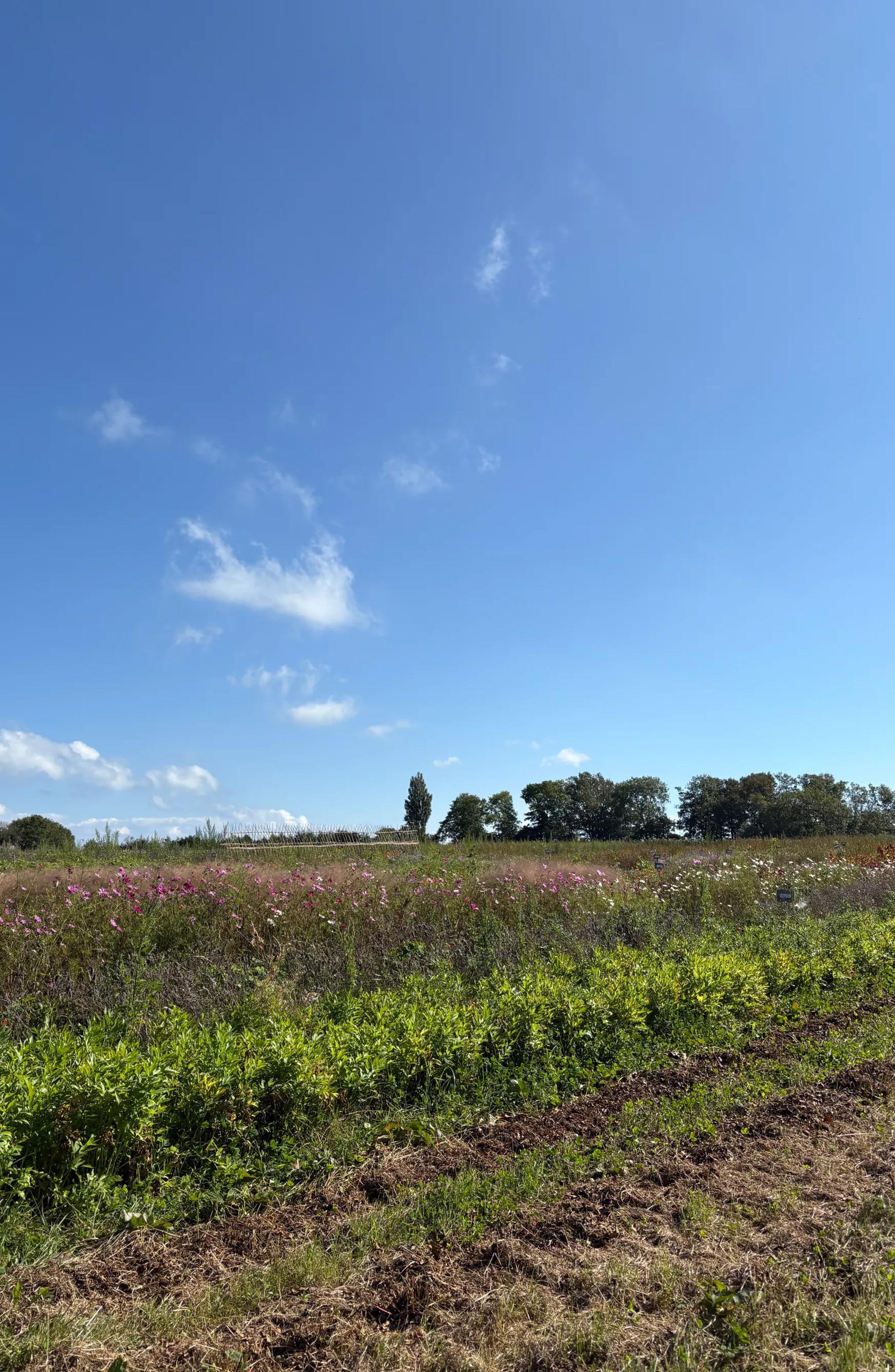
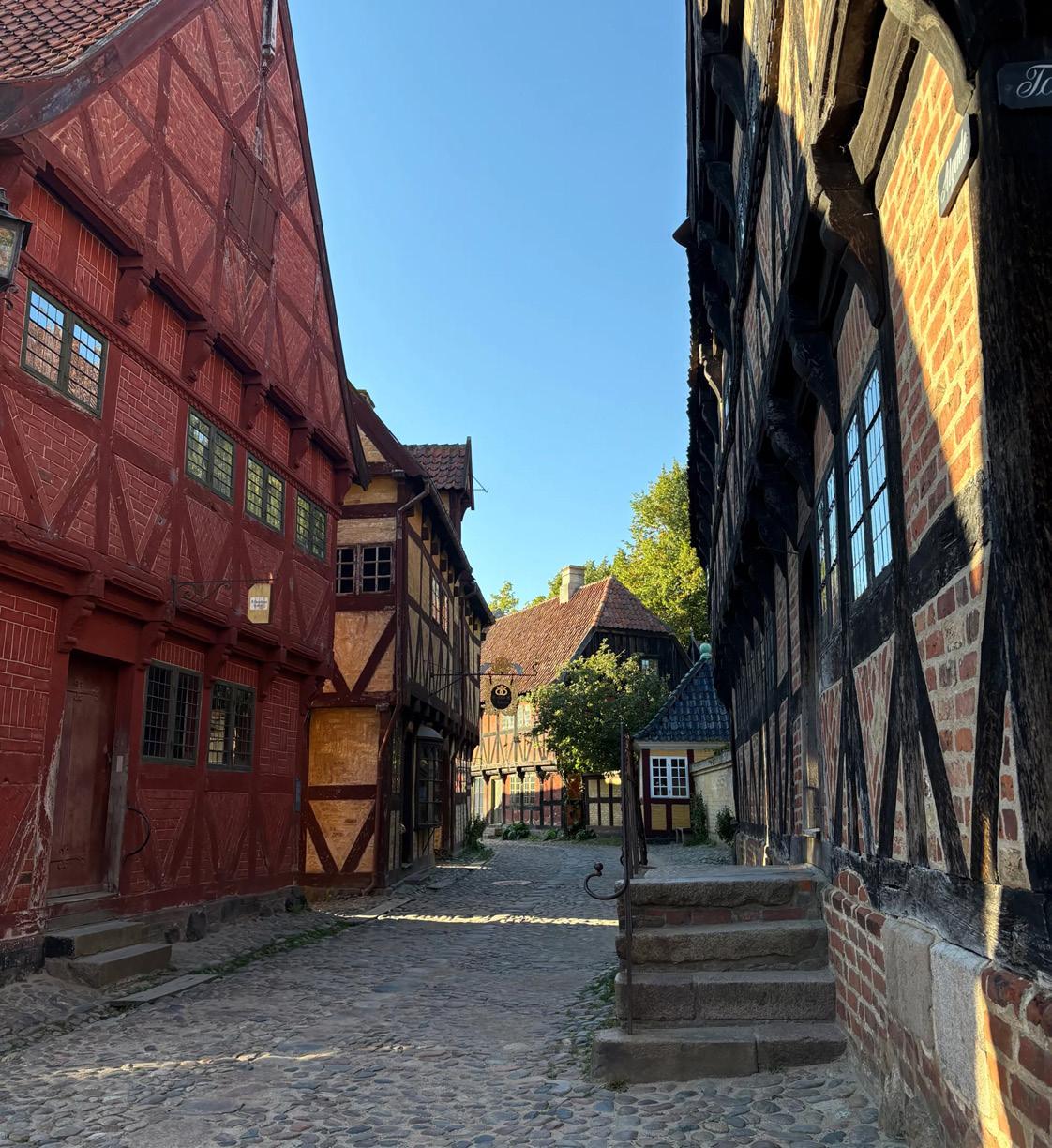
a porcine friend; Peters Gartneri; Old Town Aarhus; Permaculture! (Courtesy photos)
On day 1, we visited Peters Gartneri, a beautiful regenerative farm. I am fascinated by regenerative agriculture, so this was the visit I was most looking forward to. Peter, the farmer, explained to us his system for crop rotation, the benefits he has seen it has on soil health, and the increase in his yield. The visit was made even better by an encounter with some fourteen cows–yes, including calves!–who help with the grazing and maintaining healthy soil.
After leaving the farm, we headed to Aarhus, the second largest city in Denmark. Upon arriving, we had two hours to explore the city before our group dinner. I loved visiting Den Gamle By, a free outdoor museum that takes you through Aarhus throughout the years. My favorite was definitely the old town. It was so beautiful and reminded me of my dear Colonial Williamsburg.
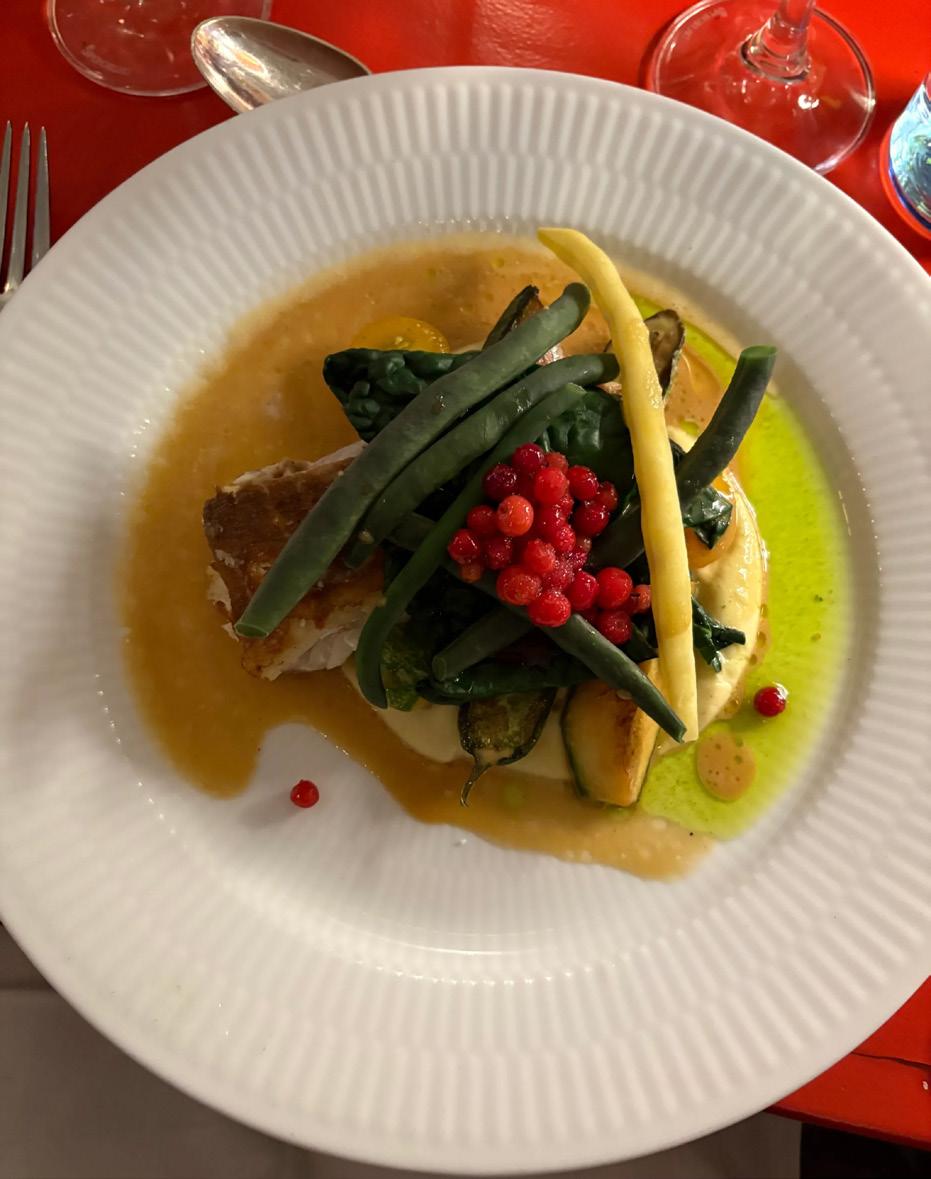
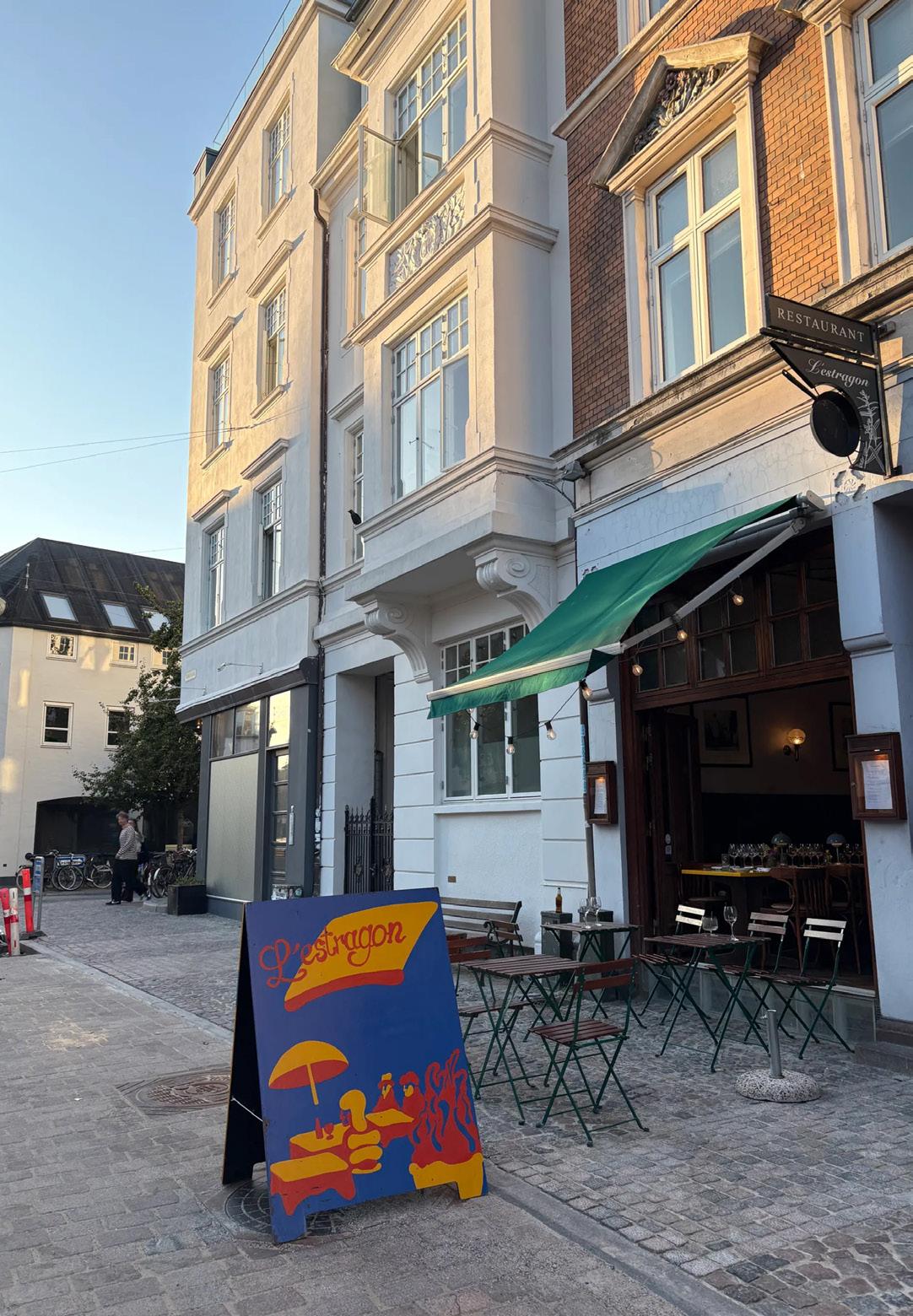
Dinner was at L’Estragon, an intimate, beautiful restaurant in the Latin Quarter of town that prides itself on local sourcing of ingredients and sustainable practices. Each course was introduced with detailed explanations of where each piece came from and their ties to Danish culture. The meal was incredible and served as a great way for us students to get to know each other better.
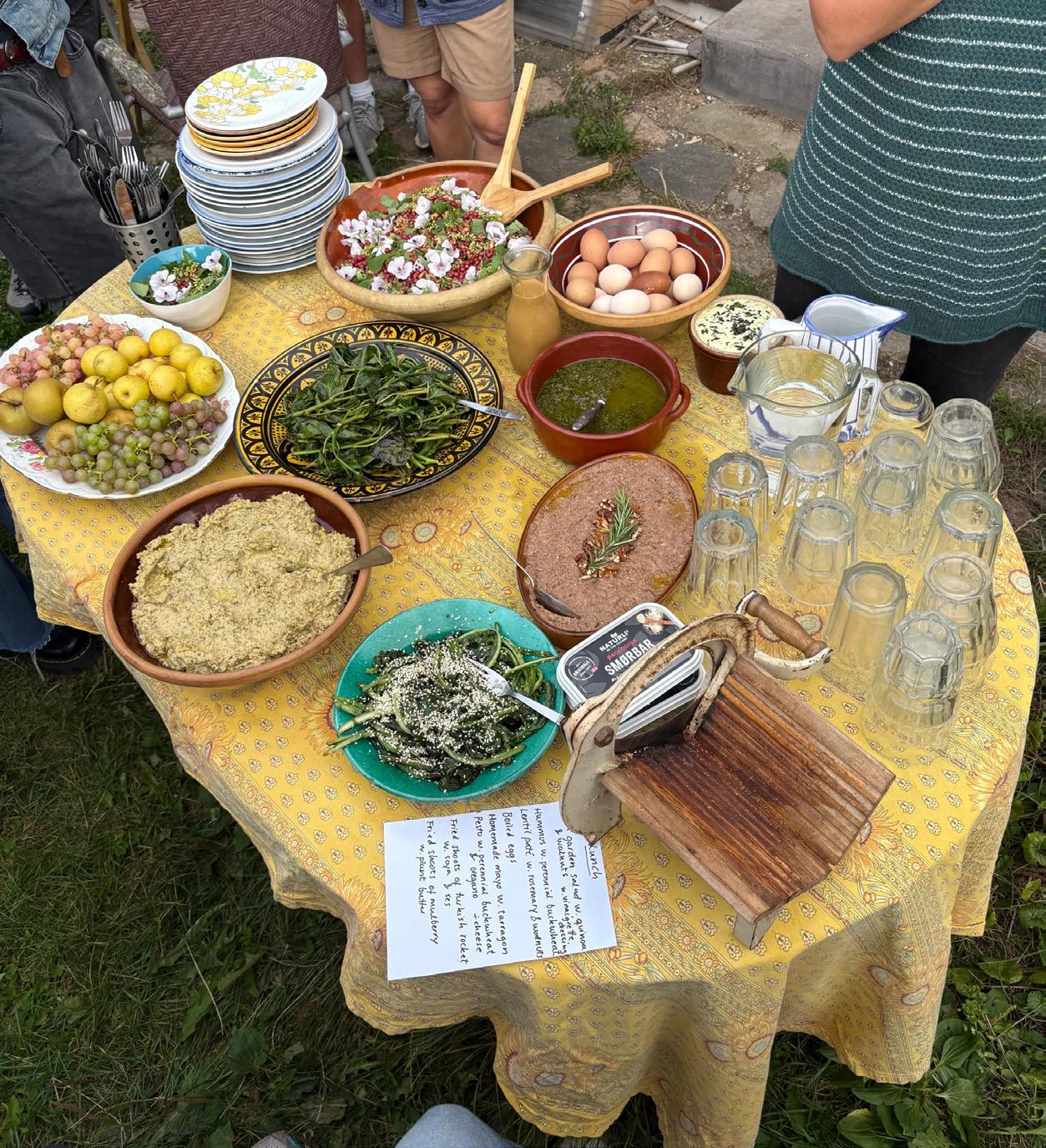
On the last day of our study tour, we visited a permaculture and an organic eco village. Permacultures are farms that imitate nature, so instead of classic fields of crops, this village had a food forest. It felt like that scene in Charlie and the Chocolate Factory when the kids first go in and eat chocolate off of trees. As we followed the narrow, winding path through the forest, we picked the freshest fruits off the trees and bushes and explored the wonders of the permaculture. At the end of the tour was lunch waiting for us. Hummus, pesto, greens, eggs, and a flowery salad, all made by a com-
munity member from ingredients in the food forest. I had never heard of a permaculture before, so this was an incredible opportunity to learn about such an interesting agricultural approach where we saw the fruits of the labor.
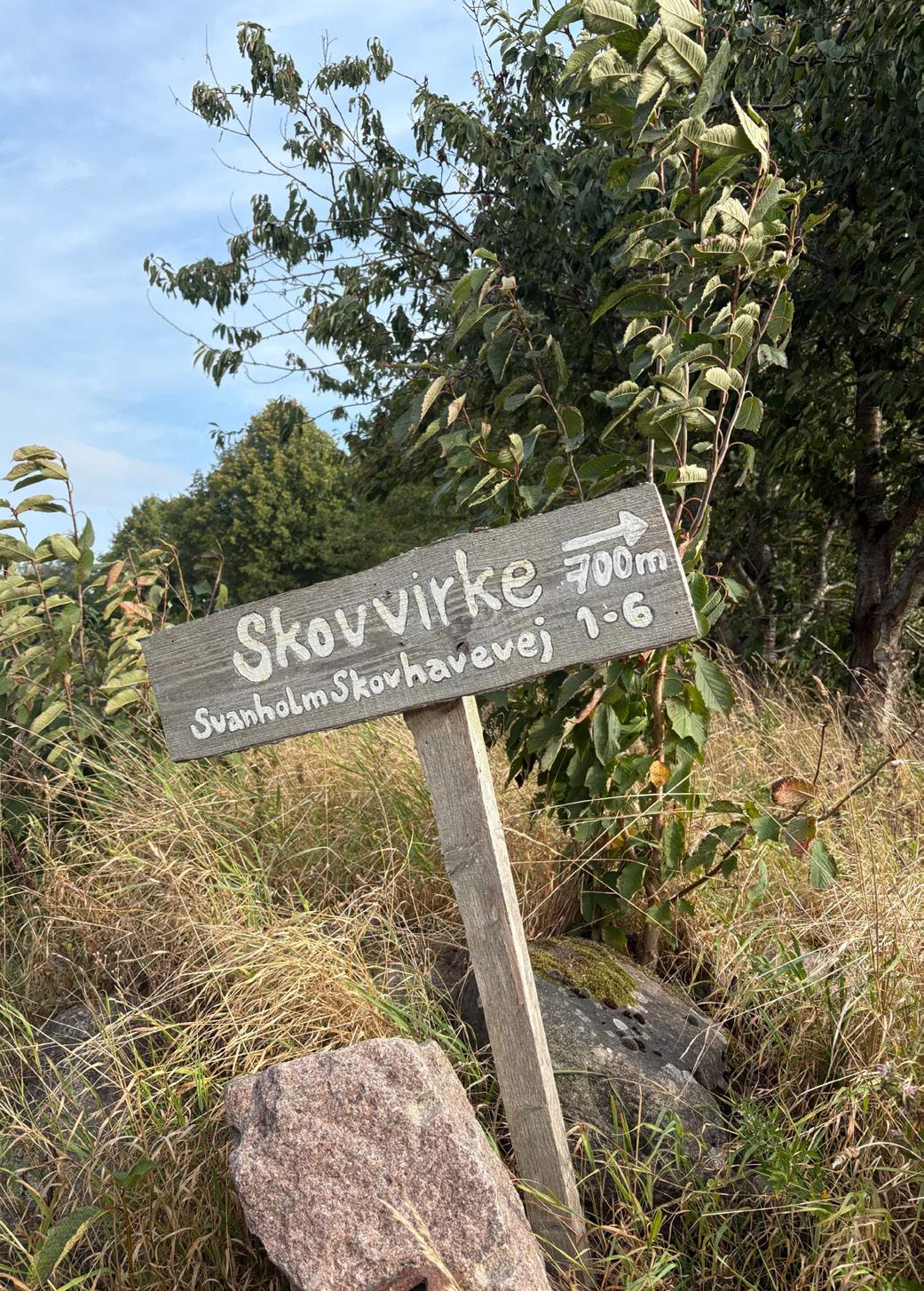
The organic eco village was equally fascinating. Svanholm is a community of 80 members who pool most of their incomes to run the farm, which has been an organic operation since the 80s. The community is very tight knit and they have communal dinners every night in their beautiful dining room, cooked in their enormous professional kitchen. Their way of life was so interesting, as they are connected to their food grown organically in the farm, the nature around them, and each other.
A major theme in our class so far has been the idea of the wizard-who uses technology in their agriculture-and the prophet-who looks to nature for sustainable inspiration. Throughout the week, we were encouraged to consider each of our visits and decide which of the producers were wizards and prophets.
As an environmental policy major, I’m constantly throwing around the word “sustainability” in my classes. But the word encompasses so much that it can sometimes feel like an umbrella term and meaningless simultaneously. It was so inspiring to meet these farmers who are creating their own definitions of sustainability. In the end, my class agreed that there were no set wizards and prophets, but each used scientific and natural theory, as well as the newest technology to make sustainable advances. At the end of the day, it takes a mixture of high yielding organic farms and carbon-neutral permacultures to strive for a more sustainable future.
Opposite page: Top left, Sophia Kaisermann and the cows at Peters Gartneri’ another view of Old Town.
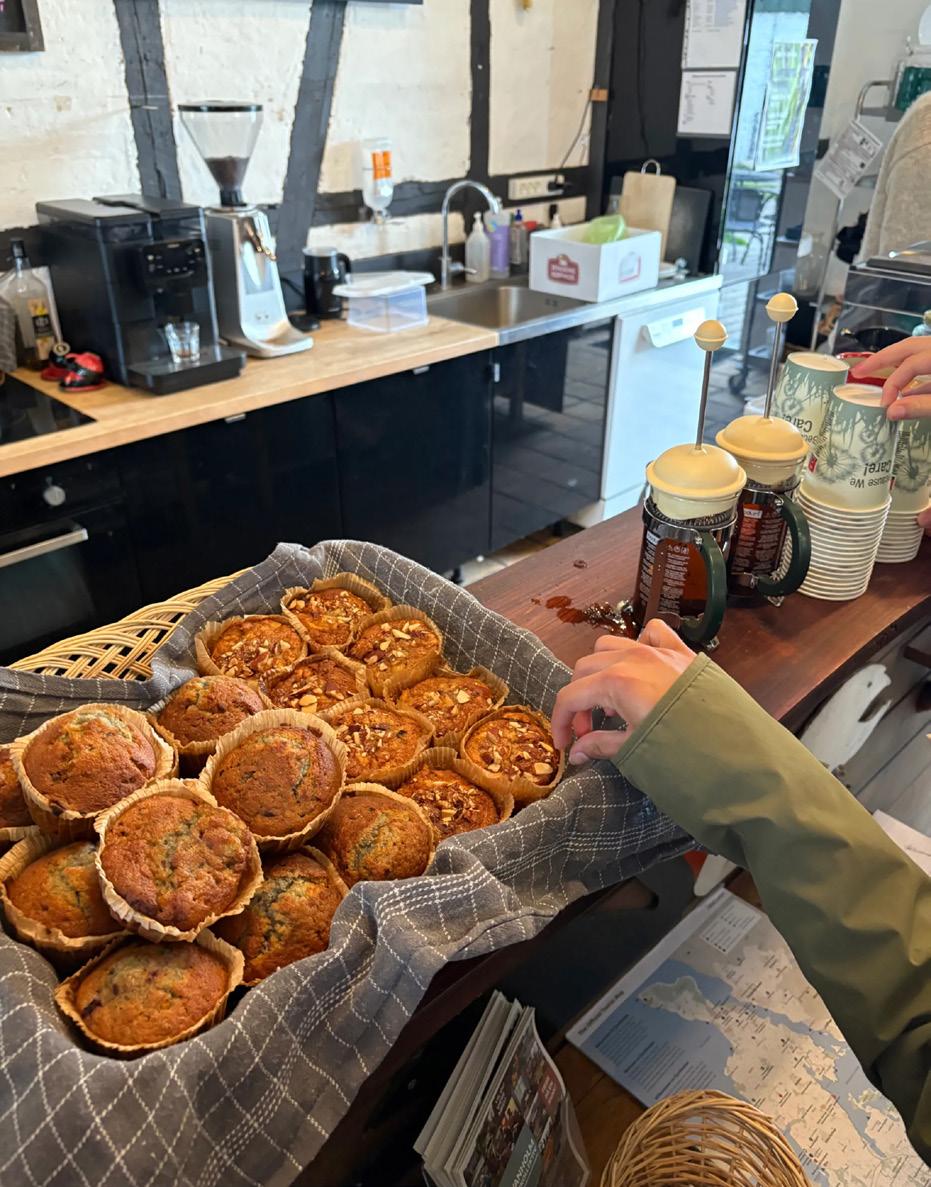
Clockwise from top left: Lunch at the permaculture fresh from the food forest;; Muffins at the organic eco village; Restaurant L’Estagron in Aarhus; Entree fish dish at L’Estagron, restaurant (Courtesy photos)
Alumna Abroad
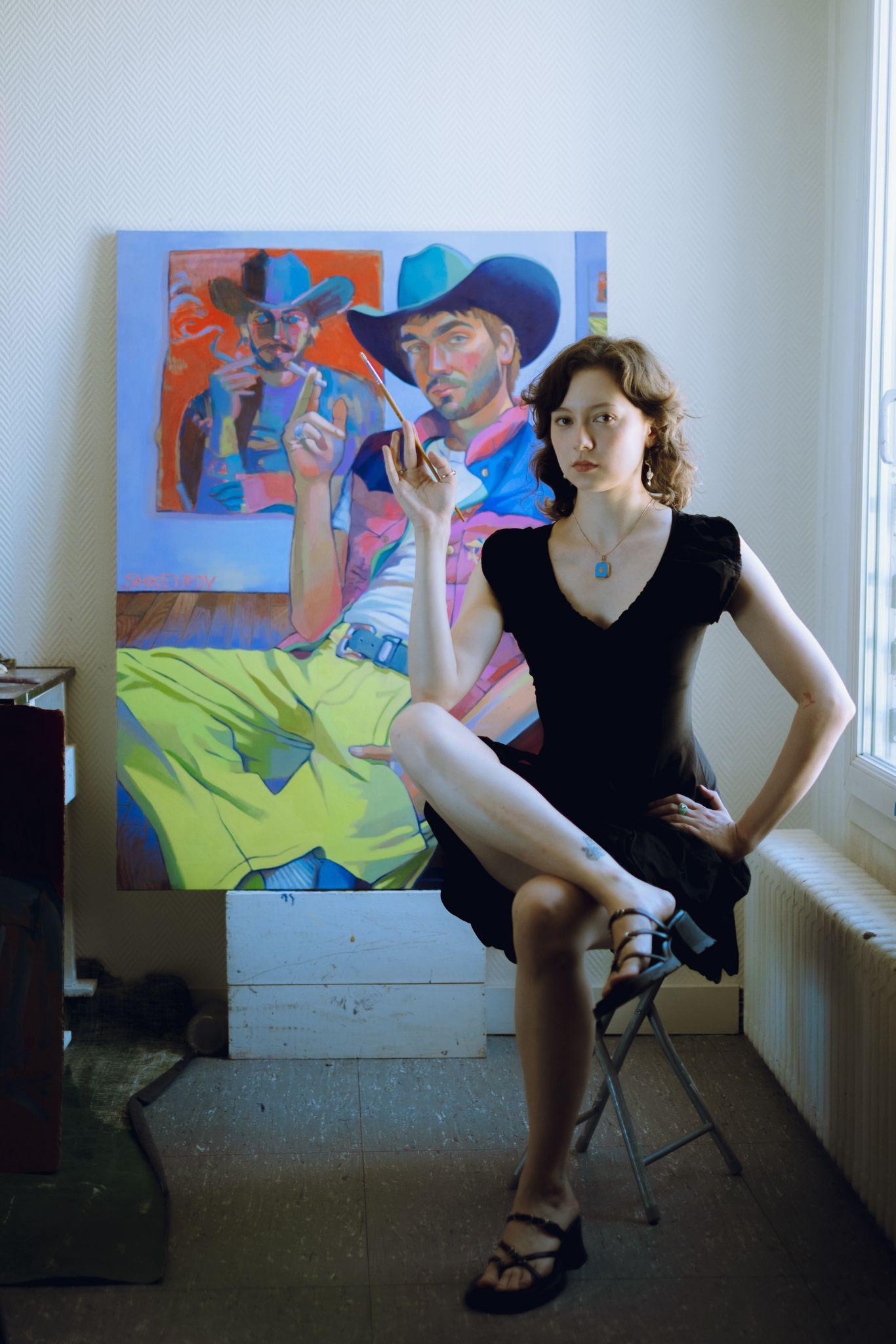
REBECCA SHKEYROV ’20
Q: Where were you born? What do you consider your hometown?
I was born in Fairfax, Virginia. I lived in the same townhouse my whole life until coming to WM. Although it’s technically my hometown, I don’t feel any nostalgia or connection to that place. My parents moved to Illinois a couple years ago and I’m not sure if or when I will set foot in Fairfax again.
Q: Why did you choose to attend William & Mary?
For me, it was a no-brainer. I remember applying Early Decision and not looking into any other schools. I wanted to be in-state for the lower tuition, and WM was the best for the humanities and had the smallest student body compared to UVA and Tech. When I applied, I had never once set foot on campus, but I knew it was the right choice. Boom, Easy Decision.
Q: What was your major? Any particular reasons you chose it?
I came in with the intention of double majoring in French and Psychology. When I realized that the French major required a ton of writing, I dropped that and switched to art. I’m so glad I did because our art program is truly wonderful.
Q: Did you have a favorite course or courses while you were at W&M?
Besides the obvious painting and printmaking courses that were so important for my growth and development, I really loved the random courses I took like the one-credit Chinese calligraphy class, or the Jewish theology class.
Q: Did you study abroad while you were a student? Is so, where and why?
I was able to make up for all the French classes I missed by dropping that major by studying in Paris for a semester my junior year. I took French language classes every single day and stayed with the kindest host family, with whom I am still very close. Anne, my host mom, is the best cook on earth and I have spent the last few Christmases with them.
Q: Have you been able to combine your two passions – art and psychology – since graduation?
My psychology major actually played a part in finding my way into a second career alongside my art career -- hypnotherapy. I definitely think the creativity and abstract problem-solving required of a painter comes in handy in this field. For me personally, it is important to have multiple income streams. I don’t like being too dependent on one thing, and it’s a bonus that both hypnotherapy and art both nourish the soul and mind.
Q: You are based in Paris. For an artist, that must be a dream come true. How did you get to Paris, and what is life there like for you?
Interestingly, after my study abroad program, I was quite disillusioned with France. I had some unpleasant experiences with the culture and other than my host family did not develop any meaningful connections with French people. That all changed when I met one friend named Camille, who introduced me to all her friends and really made me feel part of a wild community of artists and dreamers around my age. They’ve inspired me so much that I have started a series of large-scale portraits depicting people from that group, as well as other artists I have met serendipitously along the way.
I just moved into a big house with a garden on the outskirts of the city, and my housemates are Peruvian, American and French. So now my life is even more colorful as we are always cooking giant meals for guests, and making art at the house. If I’m not there, I’m taking the train to the opposite end of the city (giving me plenty of time to read every day) to work in the studio. There, I’ve started collaborating with a multidisciplinary group of Tunisian and French filmmakers and musicians on a project called Azrak (Blue). And I carve out as much time as I can to rest; I am unable to live and work at a very fast pace.
Q: Have you come across any other W&M alumni in Paris?
One time I was on the metro in Paris on my way to meet some friends for drinks. A young man sits down across from me, and I notice he’s wearing a green scarf with what looks like the W&M cypher. I say hello and ask him about the scarf, and lo and behold he is a W&M student visiting Paris during his winter break. He wasn’t going anywhere in particular so I invited him to join my friends and me at the bar!
Being so far from campus, I don’t get to interact with current students often. It was sweet to see my younger self in that student and hear about all of the amazing projects he was working on. I love that William & Mary is an immediate connector; I feel part of a lifelong community of smart, kindhearted people.
I have also had the pleasure of meeting up with several W&M connections who happened to be traveling to Paris for vacation or work: people who would not have reached out to me if I were living anywhere in the States, but saw me as a point of contact in a place where they knew nobody else. I love showing them my life here and giving them recommendations. So here is where I say, even if you don’t know me personally, do reach out if you find yourself here!
Q: You are affiliated with the Matney Gallery & Art Advisory in Williamsburg. How did that connection happen?
I think it happened quite naturally as John Lee Matney is a wellknown figure in the Williamsburg art scene, and he is well-connected with the art faculty that has supported me, particularly John Lee, Elizabeth Mead, Steve Prince, and Bryan Kreydatus. Working with the Matney Gallery has been a wonderful way to stay anchored to Virginia, and John has been extremely supportive of my move to Paris!
MY LIFE HERE, AS WELL AS EVERY OTHER TRAVEL EXPERIENCE I HAVE HAD THE PRIVILEGE OF HAVING, HAS HELPED ME GROW IMMENSELY AS A PERSON.
Q: As an artist who has what appears to be a very international life, where does home mean to you – is it a place or a state of being or something else?
I feel like home can be more of a present-moment feeling of security and coziness, than a physical structure around you. I’ve bounced around so many different cities and apartments in the past few years, that I have had to learn to have that mentality. In my paintings I often depict a simplistic silhouette of a home, which to me encapsulates the grounding rituals that make you feel whole, the tiny souvenirs you carry with you on every trip, and the people that make you feel comfortable and warm.
Q: Three pieces of yours -- ㅁ(M), 엄마 (Mom), and 엄마의 엄마 (Mom’s Mom) – are especially powerful and tell the story of your mother and grandmother. Would you mind sharing a little about those pieces and why you did them?
It all started with a giant cyanotype bedsheet from Professor Dudik’s Intro to Photography class that he donated to me. I cut it up into small squares and reconfigured them to create a new abstract design. Sewing them together made me reflect on my mother’s mom, whom I never met because she passed away when my mother was only 20 years old. She earned pennies by sewing traditional Korean dresses, called hanbok, which helped put a tiny bit of food on the table. My mother grew up poor and malnourished, but put herself through school and made her way to America a few years after her mother’s passing.
I put the bedsheet collage behind me and posed for a self-portrait in front of a giant mirror I picked up off the street in Richmond, while holding a baby angel sculpture that I thrifted in Williamsburg. I then created a sculpture of my mother, and a sculpture of my grandmother. I presented the self-portrait painting flanked by these two sculptures, showing three generations of women, as well as the angel in my hand representing the fallen first generation and a potential fourth generation, thus connecting all of us in a beautiful loop.
Q: How do you think your experience at W&M has affected your life and decisions you have made?
Being 28 years old now, I better understand how childlike the 18-22 year old bracket really is. So I think W&M was a really great place to “grow up”. It was my home before I was thrust into the adult world. I met my soulmates there (my closest friends who are my forever family). Each year one of them gets married and I get to celebrate more love coming into our circle and I cry my eyes out. I really believe in the butterfly effect, and while I’m not
sure if there’s a specific thing about WM that got me in Paris, I can’t guarantee that I would be here if W&M hadn’t been part of my journey.
Q: Do you have any advice for current students?
Have fun. Be silly. The people that you think are judging you are just judging themselves. Listen and stay open-minded. Set boundaries, and kindly let go of the people who don’t respect them. Go out often and thoroughly, because when you will get older you really will not want to do it as much. Make friends with someone with a car, and go thrifting outside of campus. My favorite pieces of clothing that I still wear to this day are from my college days. Sacrifice what you can to study abroad; there is nothing like it. Oh, and go to the improv shows! In the real world, improv shows cost $20 and are not as funny.
Q: Your style is distinctive and unique – with such vibrancy and color – and you tell compelling stories in your art, in every medium. Has your style developed over the years or has there been this powerful voice from the beginning?
A lot of things have stayed the same, such as my interest in color, and joining imagined surreal elements with the observed. Now, I think there is perhaps more clarity in my voice. I have bigger ideas that necessitate bigger work, often in a series format. I remember wondering, as a student at W&M, when I would make an actual cohesive series of work, but not wanting or feeling able to force it out. It just happened naturally, in 2023. I try to keep that mindset with the next steps I hope to have in my art career.
Q: Do you think international experience as a student is helpful in future life and career?
Firstly, you never know what connection is going to lead where. People I’ve met in hostels around Europe have become clients of mine. And I know for a fact that my entry in France would have been significantly harder without the help of my Parisian host family from 2019.
Secondly, I think international experience, even as little as a week abroad, can be greatly eye-opening. As Americans, we are so accustomed to being understood everywhere, and feeling like we own the world. As a child of immigrants, I thought I understood the immigrant experience pretty well. When I moved to France, I realized that I did not. So now I’m a bit more aware of of that which I am unaware -- the Socratic ideal of wisdom! My life here, as well as every other travel experience I have had the privilege of having, has helped me grow immensely as a person.
ㅁ(M) Oil on canvas 2022
Opposite page: ㅁ(M), 엄마 (Mom), and 엄마의 엄마 (Mom’s Mom) in gallery
Learn more about Rebecca and her work:
https://www.rebeccarov.com/home
http://instagram.com/rebecca_rov
r.shkeyrov@gmail.com
https://www.lindamatneygallery.com/
200 South Boundary Street
Williamsburg, VA, 23185
Telephone: 757-221-3590
STUDY ABROAD PROGRAMS offered by the REVES CENTER
Program offerings vary each year and this list may be updated.
Anticipated Summer Faculty-Led Programs
(Summer '27 unless noted otherwise)
Australia: Adelaide
China: Beijing
Czech Republic: Prague
England: Cambridge
France: Montpellier
Germany: Berlin
Greece: Athens/Nafplio
Iceland: Reykjavik and Westfjords
India: Bengaluru/Goa
Italy: Florence
Italy: Rome/Pompeii (Summer 2028)
Lithuania: Vilnius
Scotland: St Andrews
South Africa: Cape Town
Spain: Cádiz
Spain: Santiago de Compostela
Winter Break Programs (2026-27)
Argentina: La Plata
Brazil: Salvador
England: London
Germany: Heidelberg
Japan: Osaka
New Zealand: Auckland
South Korea: Incheon
Switzerland: Geneva
Rwanda: Kigali
Southeast Asia Business: Cambodia, Thailand, Vietnam
Embedded Programs (2026-27)
Belgium & France: Brussels and Paris (Spring '27)
India: Delhi (Winter 2026-27)
W&M-Sponsored Semester Programs
Argentina: La Plata
England: Oxford
France: Montpellier
Spain: Sevilla
Undergraduate Exchange Programs
Austria: Vienna University of Economics & Business