First Friday Letter
The World Methodist Council
Greetings from the General Secretary
Greetings in this Advent Season,
December 2025
Churches, in particular, those with a Methodist/Wesleyan heritage, across the world, will be singing: “Lo! He comes with Clouds Descending”, Charles Wesley’s advent hymn par excellence. In this way, we will renew our faith in the promise delivered by the Angel Gabriel to Mary: ‘Do not be afraid, Mary, for you have found favour with God. And now, you will conceive in your womb and bear a son, and you will name him Jesus… The Holy Spirit will come upon you, and the power of the Most High will overshadow you, therefore the child to be born will be holy; he will be called Son of God” (Luke 1:30; 34-35). In this way, God promises to burst into our lives, our struggles and joys as Emmanuel, God is with us. Thus Mary sang, “he will lift up the lowly, and fill the hungry with good things”. I commend to you the further reflection on this season of Advent by the WMC President inside this First Friday Letter.
Advent leads to Christmas when we will celebrate the extraordinary cosmic event that “for us and for our salvation, he came down from heaven and was incarnate of the Holy Ghost and the Virgin Mary”. God did not leave us alone but sent his only begotten son, in him, the gift of our salvation. Christmas is a celebration of that very mystery which is declared in the Nicene Creed. The 1700th anniversary of the Council of Nicaea has been celebrated this year in various ways. One of these celebrations was convened by Pope Leo XIVth and Patriarch Bartholomew 1st with representatives of Christianity’s East and West traditions, Methodists were included. We marked together the anniversary of the Council of Nicaea in this event that took place at the end of November in Iznik, former Nicaea, Turkey. There was a service of prayers next to the excavations where the Council happened. The next day there was a roundtable meeting to reflect on the Creed’s message for today. In that roundtable with no special chair or elevated throne, we shared how the Creed is received by our different traditions today.
This FFL goes also to Bethlehem itself, the place of the birth of Jesus where there was an important meeting of the Kairos Palestine movement. David Hardman, the Methodist liaison officer in Jerusalem attended the first part of the Conference, visiting Palestinian people and organisations. I was able to attend the second part of the meeting, the Global Kairos Palestine network. In the midst of great strife, the Palestinian people gathered together to denounce any political use of the bible to oppress them, to call for change in their circumstances, to seek strength and to say that they will persevere. David Haslam, writes a testimony about the visits. You can also find the link to the Kairos Palestine Document in his article.
Furthermore, you can find in this FFL Bishop Rosemarie’s reflections on leadership in the way of Jesus. And more, there is an article from Magali Cunha, a Brazilian journalist, about the ‘Movemento de Consciênce Negra’ in the Methodist Church in Brasil. Some interviews in the link are in Portuguese.
In faithfulness, let us observe this most holy season, in prayer, fasting and fellowship until the day of the great feast of our salvation: Christmas Day.
Yours in Christ, the son of Mary, fully God and fully human,
Reynaldo Ferreira Leão Neto (Léo) General Secretary

1700th anniversary of the First Ecumenical Council, faith leaders gathered in Nicaea. Photo: Vatican News
From the General Secretary’s Diary
From the Pope to the left there were eleven people, and from the Patriarch of Constantinople to the right another eleven, including me sitting exactly opposite to Pope Leo XIVth. It was a round table, set on the middle of the Syriac Orthodox Church of Mor Ephrem, Istanbul. In the centre of the table there was a cross made of flowers. White dominated. It was placed immediately under a massive chandelier. There were no special chairs or elevated thrones. Simply a round table with the names of each participant already set. Each one had water and a microphone and 4 minutes to deliver a speech considering: what the Nicene Creed means for us today.
A small but perfect choir chanted some prayers from the gallery. The press took photos and very soon, the whole church was emptied of all but those around the table and two interpreters, for Arabic and Greek. They spoke and there was history, geography, dogma and politics. There was a recognition that around that table we all shared a common confession in the Nicene Creed. All our traditions went back to it. Even the world Communion of churches that do not necessarily include it in their dominical liturgy, but rather on rare very special occasions. Representatives from East and West, Protestant and Reformed spoke from their own traditions. The Methodist/Wesleyan contribution had to be much more prayerful, and musical than the others, given that Methodism was born in song.
There was one dissenting tone of voice amongst the contributors. Only one. It was belligerent against heresy. It focused on denouncing Nestorians and the danger they still represent to the faith. Unhappy, and asking, how it is that they are sitting around the table. When the 2 hour event was over, I went straight away to apologise to his Grace, the Archbishop whom the belligerent voice referred to. His Grace was indeed very gracious and explained that it was and still is a matter of translation that leads to the misunderstanding, that some still believe that they are heretics. He was talking about the two natures, how the two substances interact in Christ. I said that the belligerent remarks did not represent me and neither the spirit of the meeting. There is much more that unites us than that which separates us. And that it is all a matter of faith and mystery, anyway.
In a while, I noticed out of the corner of my eye, how his Grace sat beside the accuser and was being nice to him. Later I asked why he had done that, in particular, when the other had basically asked for the proclamation of some anathema afresh. His Grace said, it was because he saw the older man sitting on his own and he felt compassion and love towards him. This in a nutshell contained for me the whole spirit of the two day celebrations: encounter, joy, humility, openness, unity in faith and diversity in emphasis. All accompanied by us saying the prayer of Jesus, that they/ we maybe one. If that is where ecumenism is, it is a good place to be.
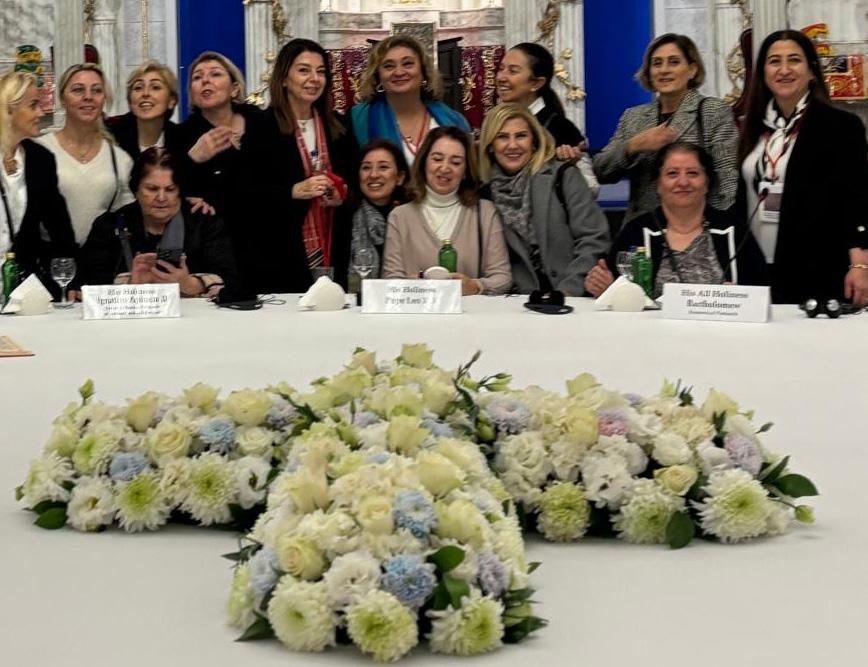

When the men left, the women took over and even drank their water with great sense of humor.
Pictured Left to Right: Patriarch Bartholomew 1st of Constantinople, General Secretary Reynaldo Ferreira Leão Neto (Léo)
What Nicaea Means to Us Today
Your Holiness, Your All-Holiness, Your Beatitudes, Your Eminences and Your Graces, Reverends and Professor,
Stop, and gaze, and fall, and own … Was never love like thine!
Never love nor sorrow was Like that my Saviour showed; See him stretched on yonder cross, And crushed beneath our load!
Now discern the Deity, Now his heavenly birth declare; Faith cries out: ’Tis he, ’tis he, My God, that suffers there! (Charles Wesley)
1) The Nicene Creed and the Methodists - “For all, for all my Saviour died!”
The Methodists and Wesleyans confess and pray with the whole universal church the Nicene Creed in our services of divine worship today because the faith it declares is the faith that each Methodist seeks to proclaim: it is he, it is he, my God that suffers on the Cross.
“Crucified before our eyes,” we see God there. Not that one fully understands the depth of love divine. “Jesus, Lord, what hast thou done?” For me and for all sinners with no exception, you loved us all to the end. “Thee, the friend of sinners”, your love is ever new and never comes to an end.
That is to say today and afresh, that in Jesus Christ the love of God was fully manifest and through his sacrifice on the Cross, grace and salvation was offered to all humankind. Only Christ, being fully human and fully divine, could offer the perfect, eternal and sufficient sacrifice of love for our salvation, the salvation of all, in which no-one is excluded, no-one is left out. “For us and for our salvation, he came down from heaven, was incarnate of the Holy Spirit and the Virgin Mary and became truly human.” Methodists proclaim: “For all, for all, my Saviour died”.
2) Theosis/Holiness - “He became human, so that we may become divine” (St. Athanasius)
Furthermore, the Methodist, Wesleyan and related United and Uniting Churches world-wide Communion (A Connexion of Connexions) inherited a calling, through the charism bestowed on the Rev John Wesley to live out and proclaim holiness throughout the world. “You must be perfect as
your Father in heaven is perfect”, (Matthew 5:48). Methodists heard that command of Jesus, in the Sermon on the Mount, not to be understood as though Jesus’ disciples should become like gods. That would be an absurd thought. But for them to take the path to Christian Perfection, in terms of achieving a state of conformity to the will of God, and, to carry the mind of Christ, to love as God loves. Holiness understood as loving with love divine.
To this day, Methodists profess the Nicene Creed in the spirit found in Athanasius’ words, “He became human, so that we may become divine”. God in Christ’s act of becoming human, - homoousios with the Father, - “eternally begotten of the Father, God from God, Light from Light, true God from true God, begotten not made, of one Being with the Father” - sets the pattern of living: self-denial; growing in love to perfection in this life and for eternity.
3) A common date for celebrating Easter
There will be great joy amongst the member churches of the World Methodist Council when Easter can be celebrated on the same date. They wait on the historic and ancient Great Sees of the Christian Church for that agreement. On that Easter day the resurrection of Christ will be jointly witnessed, to the Glory of God.
Speech by General Secretary Revd Dr Reynaldo Ferreira Leão Neto at the Ecumenical Event Celebrating 1700th Anniversary of the Nicaea Council.
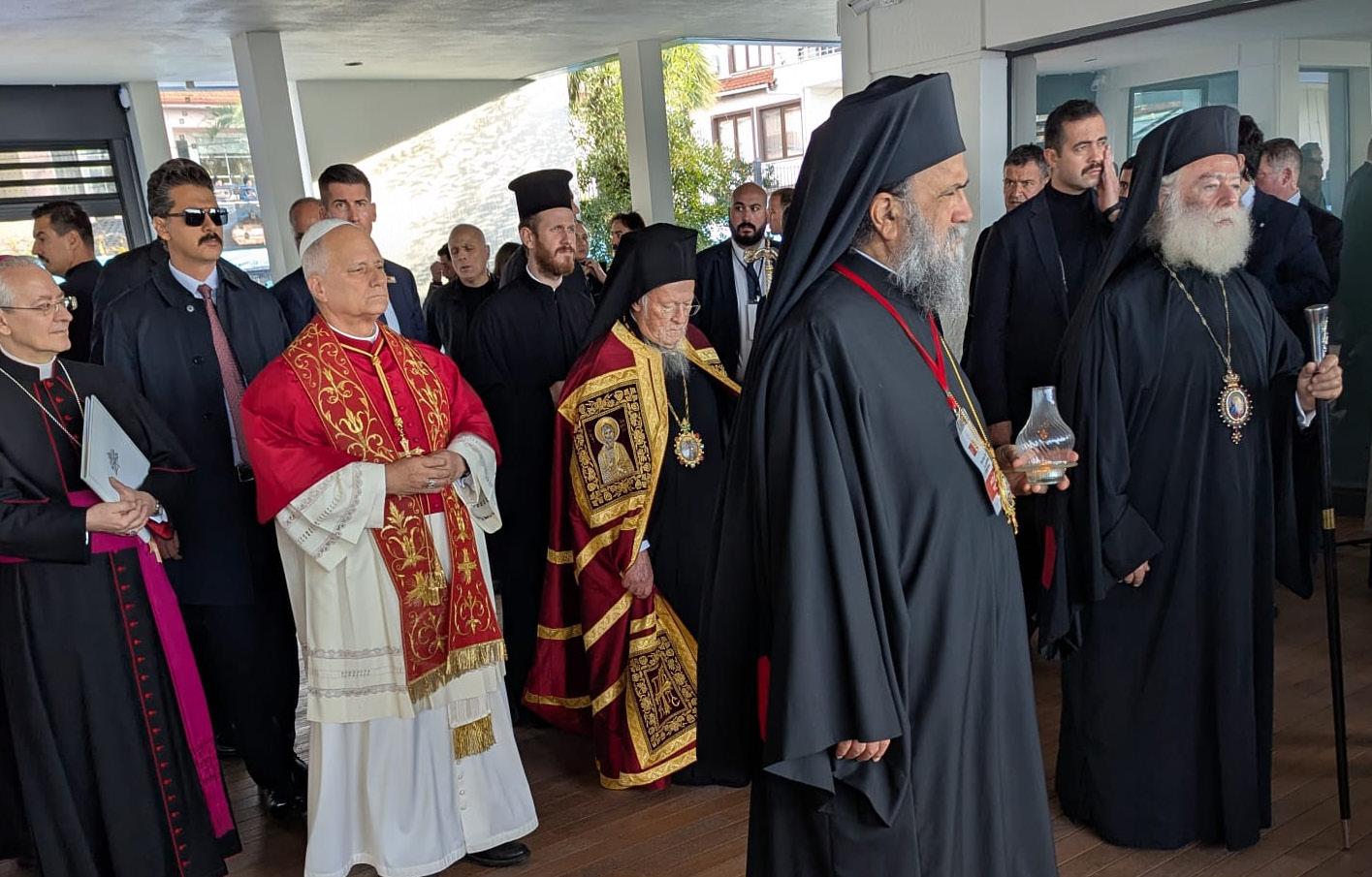
Pope and Patriarch arriving in Iznik. Soon a procession will take place for the service of prayer in commemoration of 1700th anniversary of the Council of Nicaea.
Winning Christmas and Beyond During Advent Days
Perhaps you have heard the statement, “We win the day the evening before.” This references how the previous evening’s preparations for morning help us start the day well!
This concept is also true with Advent in relationship to Christmas Day and beyond. Advent preparations enhance the depth of the hope, peace, joy and love we experience, not only in the present but also into the future. How we live our Advent days makes a difference during this holy season as well as Christmas, the New Year and more!
What is Advent? The season of Advent is a time of preparation and anticipation of the celebration of the Christ Child’s birth as well as the return of Jesus at the Second Coming. It consists of the four weeks leading up to Christmas Day, beginning on the fourth Sunday before Christmas and extending until December 24th. This year Advent launched on November 30 and will continues for 25 days.
What is the ideal posture in Advent? We do well to approach this season in a spirit of prayer and reflection, particularly focusing on Advent themes of hope, peace, joy and love. Prayerfully reflecting on these attributes as well as our life situations and discipleship can help us discern changes God is calling us to make.
How do people observe Advent? It is common to observe Advent with wreaths, devotionals, extra spiritual formation time, special worship services, calendars and more. The point is not specific Advent practices but rather that we live the season with intentionality, thus heightening our awareness of God’s presence and love.
How will you celebrate Advent this year?
Possibilities include:
• Read a daily Advent devotional resource such as the one provided by the West Virginia Conference at https://www.wvumc.org/.
• Share age-level appropriate Advent books with the children in your life.
• Display an Advent wreath as a reminder that we are waiting and preparing for the Christ Child.
• Add an additional spiritual formation practice to your daily or weekly routine during the month of December.
• Offer a prayer for each sender and recipient of your Christmas cards.
• Attend a Hanging of the Greens, Christmas Eve or other special worship service.
• Give food and/or money to a local food pantry.
• Participate in a service opportunity through your local church.
• Do a thoughtful act for someone each day.
• Pray for hope, peace, joy and love in the world, our nation and your personal life.
I encourage each of us, including myself, to show great intentionality this Advent season. Doing so will help us “win” not only today, but Christmas Day and beyond.
Advent Blessings,
Bishop Debra Wallace-Padgett President World Methodist Council
The Launch of the Kairos Palestine 2 Declaration
Rev David Haslam (who writes the article below) and the WMC General Secretary were present in Bethlehem this November for the Launch of the Kairos Palestine 2 Declaration. Follow the links in the article below for the document itself and the website:
The Kairos Conference issued the movement’s second Declaration – after the first in 2009, which was modelled on that issued by South African Christians in the apartheid era. It is entitled ‘A Moment of Truth - Faith in a Time of Genocide’ https://www.kairospalestine.ps/index.php/about-kairos/kairos-palestine-document found in www.kairospalestine.ps
The launch brought together over a hundred activists, it would have been more but several were refused visas and some even refused at the airport, including from the US and the Netherlands. Kairos had not realised it was such a threat.
So the drive to ethnic cleansing and forced removal continues. Even the Archbishop of York experienced the strength of that movement in his November visit. He was made aware also of the shooting of Christian community leader Awda Hathaleen, unarmed but shot by a settler seeking to destroy the village of Umm Al-Khair. The settler has been released on bail, it is unclear whether he will ever face serious charges. Overall the situation can only be described as systemic evil, in which the Palestinians are regarded as second (or third) class human beings who have no rights to the land of Palestine. This is in spite of being among the original inhabitants, unlike many of the settlers who were not born there but are arrivals from other countries over the past fifty years.
Only serious Western sanctions involving an end to arms exports, trade and financing will have any effect in ending the genocide of Gaza and the creeping genocide taking place on the West Bank. Until then we are all complicit in the demolition of international law and its catastrophic results.
Exposure to the West Bank,
Wherever you go on the Palestinian West Bank the presence of Israel looms over you. From the check-points on the Borders, along the highways, to the furthest point of desert tracks, the Israeli flag, the Star of David, is everpresent. The Palestinian flag invites immediate confiscation and arrest. The concept of Palestinian authority or control is a myth. The expectation that Palestinians might have the right to move freely where they wish, in their own country, is simply laughable.
I travelled with representatives of 24 countries attending the 2025 Global Kairos Network Conference, held in Bethlehem, Kairos facilitated the visits. In the Jordan Valley, off the highway not far from Nablus, there is a small village of Bedouin people, up what was described to us as ‘one of the most dangerous roads in Palestine’. Huts and animal shelters were scattered across a desert hillside, some already deserted. One of the main aquifers of the Jordan Valley lies beneath but the water is not available to the inhabitants. A pipeline protected
with a concrete channel runs through the heart of the village, the words ‘Israeli Water’ in Hebrew on its sides. And at sunrise or sunset the settlers arrive, sometimes on horseback, to shout, threaten or attack. It is a lonely and terrifying existence, only slightly ameliorated by brave Israeli activists who stand up to the settlers and urge them to leave. (See Andrey X on YouTube)
Then there are the families driven from their homes in the refugee camp in Jenin, 19,000 people given minutes to get out on the 21st of January 2025, a date seared into their souls. They are now billeted out into local villages, have gone to stay with relatives, or are housed in the halls of residence in the nearby Arab American University. In one we were told, there are 500 people, one family each in 77 small student rooms. The women tell of the psychological pressure and pain of trying to create a life for their children. The teenagers express their rage and frustration at being denied their education. There is no reason why they could not return, even to demolished homes and even in a monitored fashion. Their situation is shameful punishment, simply because they are Palestinian.
The olive harvest is a particular magnet for settler violence. Olives are a crucial part of the Palestinian economy, the trees are a fundamental element of their culture and their relationship to the land. The experience of being under attack as they seek to harvest, is widespread. Visiting one village of about 3,000 people we heard that an Israeli family had settled at one edge of their land, and they did not now dare harvest olives in that area or the settlers would attack, calling on police or the military to ‘defend’ them were there any resistance.
The nearby state school had been closed, for ‘security reasons’, so the children were trying to continue their education online, with a plan to open a do-it-yourself school within the village. Settler attacks were constant, one man who had been kidnapped for 24 hours showed us his broken hand, preventing him from working. Three of the community were in hospital. They could see no end to the ongoing attempts to force them to leave the land where they had lived for generations.
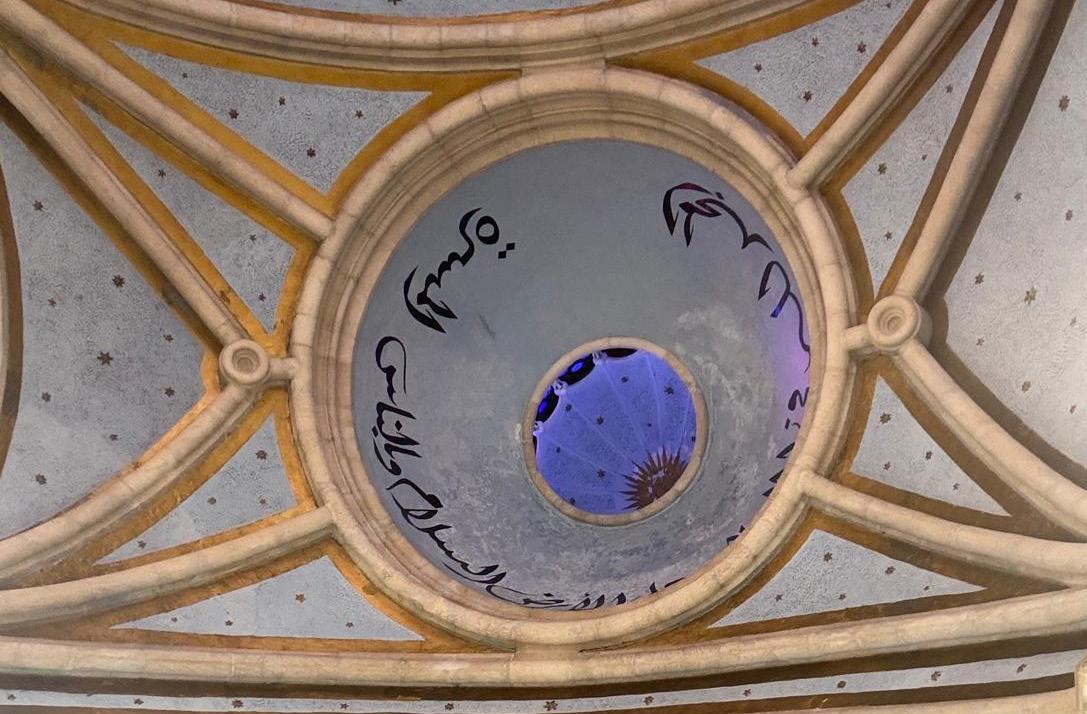
Dome of the Lutheran church in Bethlehem reads Glory to God in the highest and on Earth Peace in Arabic.
The Launch of the Kairos Palestine 2 Declaration continued...
We visited a restaurant where a Palestinian family had been farming and serving their food for over 100 years. They grew all their own produce, cooked in the traditional way, a charcoal ‘oven’ sunk six feet into the ground, to keep in the heat and the flavour, and the food spread on racks, lowered into the oven and covered with damp earth. After the allotted time the earth is removed and the racks hauled up, spreading the smells of spiced meat and vegetables, and whetting the appetite for an excellent meal.
However, mysterious caravans had recently appeared a few hundred yards away, and the newcomers had begun their own planting. From the most recent, a mere hundred metres distant, an Israeli flag flew above the surrounding trees. The army patrol from time to time, just to make clear that the illegal invaders were protected by the occupying State. Although the restaurant owner emphasised they wanted to live in peace and harmony with any neighbours, how much longer before violence begins, aiming to drive the family from their restaurant and their farm?
A tour around Jerusalem reminds of the power of architecture to emphasise domination. The capture of the highest ground on routes around the Old City of East Jerusalem means it is now overshadowed by illegal settlements, deliberately built on hills. This creates an intimidating presence, aiming to make the thought of East Jerusalem as a capital of the West Bank absurd. The contrast between the single storey homes of the Palestinian enclave of Sheikh Jarrah and the large town – or small city – of Ma’ale Adumim is the clearest example.
Entering the Shopping Mall at the centre of Ma’ale Adumim is to be introduced to a self-sufficient community which could as easily be found in any Western city. Every consumer good is available, although of course Palestinians are not allowed to shop there. Buses leave
regularly for all the suburbs of West Jerusalem and indeed to Tel Aviv. Alongside this, it is unclear how long the families of a neighbourhood like Sheikh Jarrah can remain.
Just as Western Governments get round to recognising the idea of an independent Palestinian state it has become almost impossible. And deliberately so. The Zionist project has always been to take the whole of the land, only kept in check by Palestinian resistance and external solidarity movements.
The Israelis have played a long game, gradually establishing their right to a Jewish state, after the cynicism of the Balfour Declaration, the repression of the Palestinians in the 1930s - and then the horror of the Holocaust. The guilt of the West and the disinterest of fellow Arabs have combined to ensure continued marginalisation and desperation of the Palestinian people. The continuation of division by Israel’s control of the funding of Hamas and the Palestinian Authority has ensured a fragmented Palestinian response.
The Hamas attack of 7th October 2023, which many Palestinians believe was not entirely a surprise to the Israeli political establishment, has opened the way to the destruction of Gaza and the dehumanisation of its people. It has provided an excuse for the drive to empty the West Bank of Palestinians or at least to corral them into mini-Bantustans, while destroying their culture and sense of nationhood. What is going on in the West Bank is not yet as stark as Gaza but it is as damaging, clearly intended to lead to ethnic cleansing and forced removal, and to Israeli hegemony over the whole of ‘Judaea and Samaria’.
Article by Rev David Haslam MA MBE

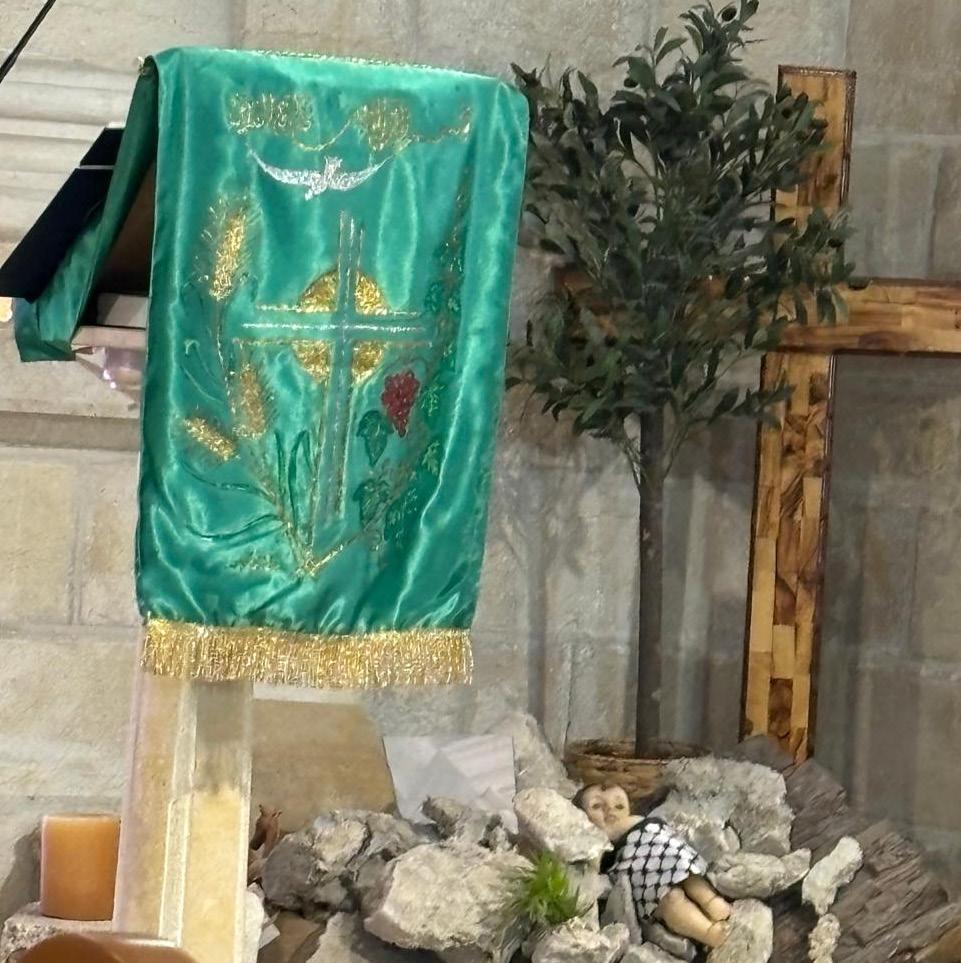
Lutheran church in Bethlehem: Christ Child born under the rubble.
A Pioneering Protestant Initiative: The 40 Years of the Methodist Church’s Ministry to Combat Racism in Brazil – Three Interviews
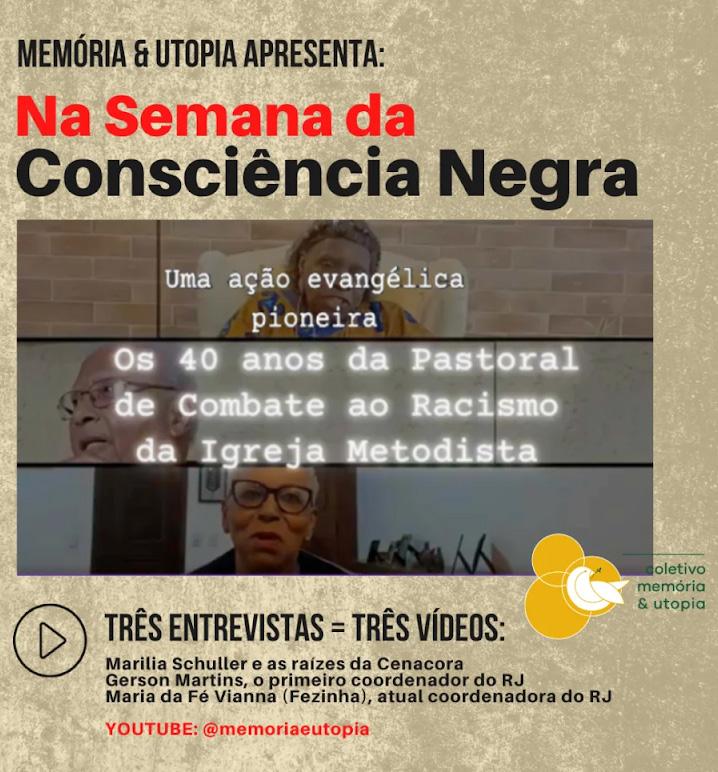
Memory & Utopia Project released, during the Brazilian Black Consciousness Week 2025 (17–22 November), the video interviews A Pioneering Protestant Initiative: The 40 Years of the Methodist Church’s Ministry to Combat Racism. The videos are available on the YouTube channel @memoriaeutopia (watch here).
Three key interviews
The memory of the 40 years of the Methodist Church’s Ministry to Combat Racism is recovered by Memory & Utopia through the testimonies of three significant leaders in this pioneering Protestant initiative in Brazil, undertaken in the 1980s: theologian Marilia Schuller, professor Gerson Martins, and theologian and activist Maria da Fé Viana, affectionately known as Fezinha.
These are moving, thought-provoking interviews filled with important reflections that highlight the remarkable role of the tireless the Rev. Antonio Olimpio Sant’Ana (in memoriam). The National Commission for Combating Racism (CENACORA), created by him, encouraged Methodists, later other Protestants, and the ecumenical movement to join this important journey for racial justice in Brazil, both within and beyond church structures.
Memory of value!
To learn about the history of Protestant initiatives against racism in Brazil, through these interviews given to Memory & Utopia, is to draw inspiration from the stories of Black women and men who, for decades, have denounced the perverse face of racism – this socially constructed structure which is also present within churches, often veiled yet deeply ingrained. These Christian individuals have dedicated themselves to proclaiming that this must be an agenda not only for Black people, but for all those who work for justice and peace, embodying an anti-racist perspective.
The Week of Black Consciousness
Black Consciousness Day, established by law and celebrated on 20 November in Brazil as a national holiday, is a date dedicated to reflecting on the history, culture and struggle of the Black population in the country. The date was chosen in honour of Zumbi, leader of the Quilombo dos Palmares, a place of refuge for slaves in search for freedom, a symbol of Black resistance to slavery. Zumbi was killed by Portuguese colonisers on 20 November 1695.
The commemorations, which unfold throughout an entire week, aim to promote debates across
Brazil on structural racism, racial inequalities, the violence experienced by the Black population, historical reparation and the valuing of Afro-Brazilian culture. Schools, social movements, churches, universities and community groups are called upon to carry out activities that recognise the cultural, political and social contributions of Black people, celebrate African heritage and promote anti-racist policies.
Black Consciousness Week is a landmark in recognising the importance of the Black population in the formation of Brazil and in reaffirming the commitment to the struggle for racial equality and social justice.
Continued on next page...
A Pioneering Protestant Initiative: The 40 Years of the Methodist Church’s Ministry to Combat Racism in Brazil – Three Interviews continued...
About Memory & Utopia
Memory & Utopia is a group with formal or historical ties with the Methodist Church in Brazil and to other different Christian churches. M&U bear witness to and have experienced the humanising actions in pursuit of democracy, citizenship, social justice and peace, together with the processes of renewal and transformation within Christian churches, specially the Methodist Church during the 1980s, the period that marked the beginning of Brazil’s democratic opening after 21 years of dictatorship.
The collective was formed in Rio de Janeiro in 2019, at a moment when socio-economic exclusion and the environmental crisis had taken on the character of a global emergency. At the same time, M&U witnessed the clear advance of more conservative, authoritarian and obscurantist sociopolitical positions, alongside the intensification of exclusionary economic models, the precarisation of labour, and the deterioration of public health-
care and education services; as well as the rise of xenophobia, sexism, racism, religious intolerance and so many other forms of prejudice — all accompanied by the alignment of a significant portion of Christians. In this context, the group felt called to meditate, to discuss and to propose!
M&U is organized and committed to reflecting on a range of issues and situations that currently afflict society, thereby creating spaces for dialogue, coordination and encouragement among interested individuals and groups. All of this aims to confront the challenges of the present moment through processes of critical renewal in the relationship between religion and society, as well as in the cultural and political dynamics that shape the social landscape.
There is a rich collection of materials organized and promoted by M&U in different formats available at www.memoriaeutopia.com.br
Article by Magali Cunha
WMC Treasurer, Norwegian Methodist Bishop Meet Pope Leo

Pope Leo XIV met Bishop Knut Refsdal (second left), bishop of the Nordic-Baltic-Ukraine Area of The United Methodist Church, and Rev. Myron Howie (center), treasurer of the World Methodist Council, following the General Audience on Wednesday morning, 26 November. They were accompanied by Rev. Howie’s spouse Rev. Jules Dunham Howie (second right) and daughter Ms. Grace Howie (third left), as well as Rev. Matthew A. Laferty of the Methodist Ecumenical Office and Fr. Martin Browne OSB of the Vatican’s Dicastery for Promoting Christian Unity (far right). Rev. Myron Howie and Rev. Jules Dunham Howie are ordained ministers of the African Methodist Episcopal Church. Photo © Vatican Media.
Nominations for 2026 Peace Award Open Now!
Nominations for the 2026 Peace Award are now open! Nominate someone who exemplifies Courage, Creativity, and Consistency for the World Methodist Peace Award. Applications must be submitted by April 15, 2026!
The nominee should show courage in regard to physical danger or putting personal interest at risk. Creativity should include opening new initiatives and attracting others in working for the cause of peace. Consistency is judged by effort over a period of time and intensity, despite setbacks.
Here is the link to read the full criteria: http://worldmethodistcouncil.org/whatwedo/world-methodist-peace-award/
The recipient receives a medallion, citation and US $1000 which is symbolic of
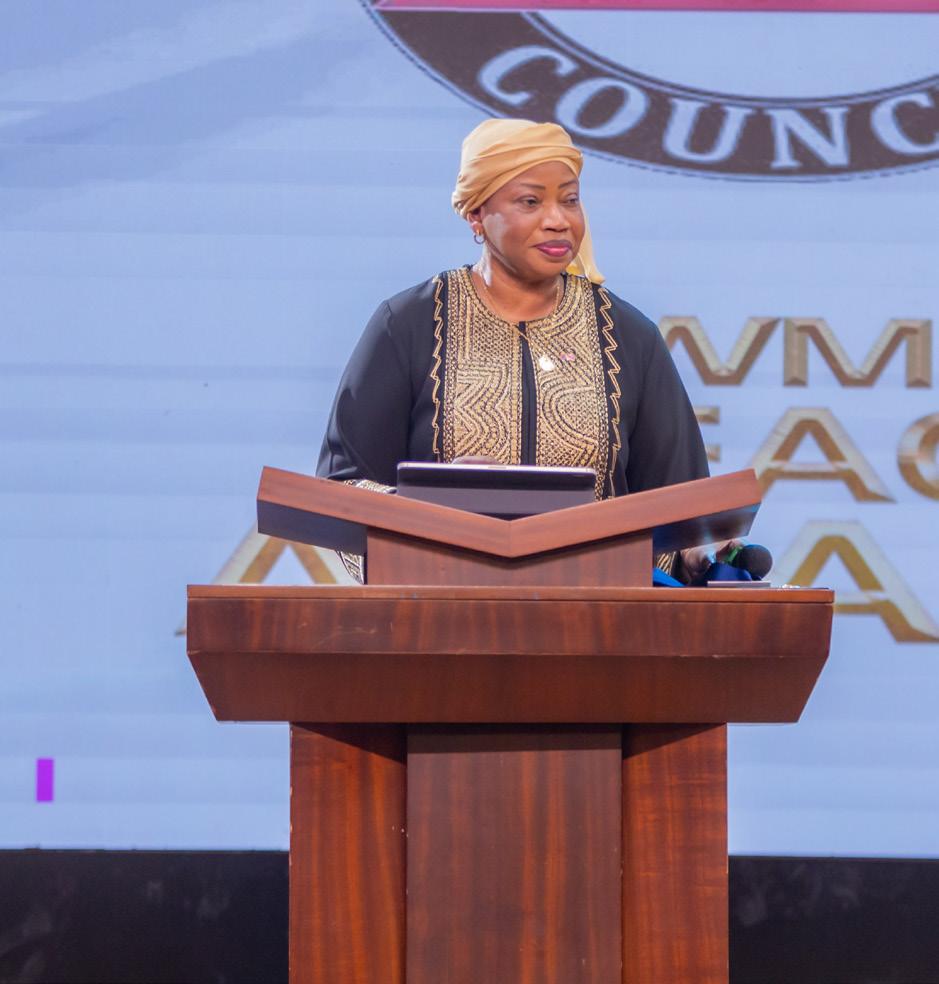
the larger recognition achieved in working for peace, justice and reconciliation. The awardee is included in the World Methodist Council Peace award booklet and their photo is hung on the wall of the World Methodist Council Headquarters with other recipients who have received this high honor award.
Go to www.worldmethodistcouncil.org and click on the “About the WM Peace Award” tab on the left side of the homepage and complete the online application. Please send all nomination forms to General Secretary Leo at communications@worldmethodistcouncil. org today!
The 2026 Peace Award Ceremony will be held during the Council Meeting in San Salvador August 14, 2026. We look forward to receiving nominations for this prestigious award.
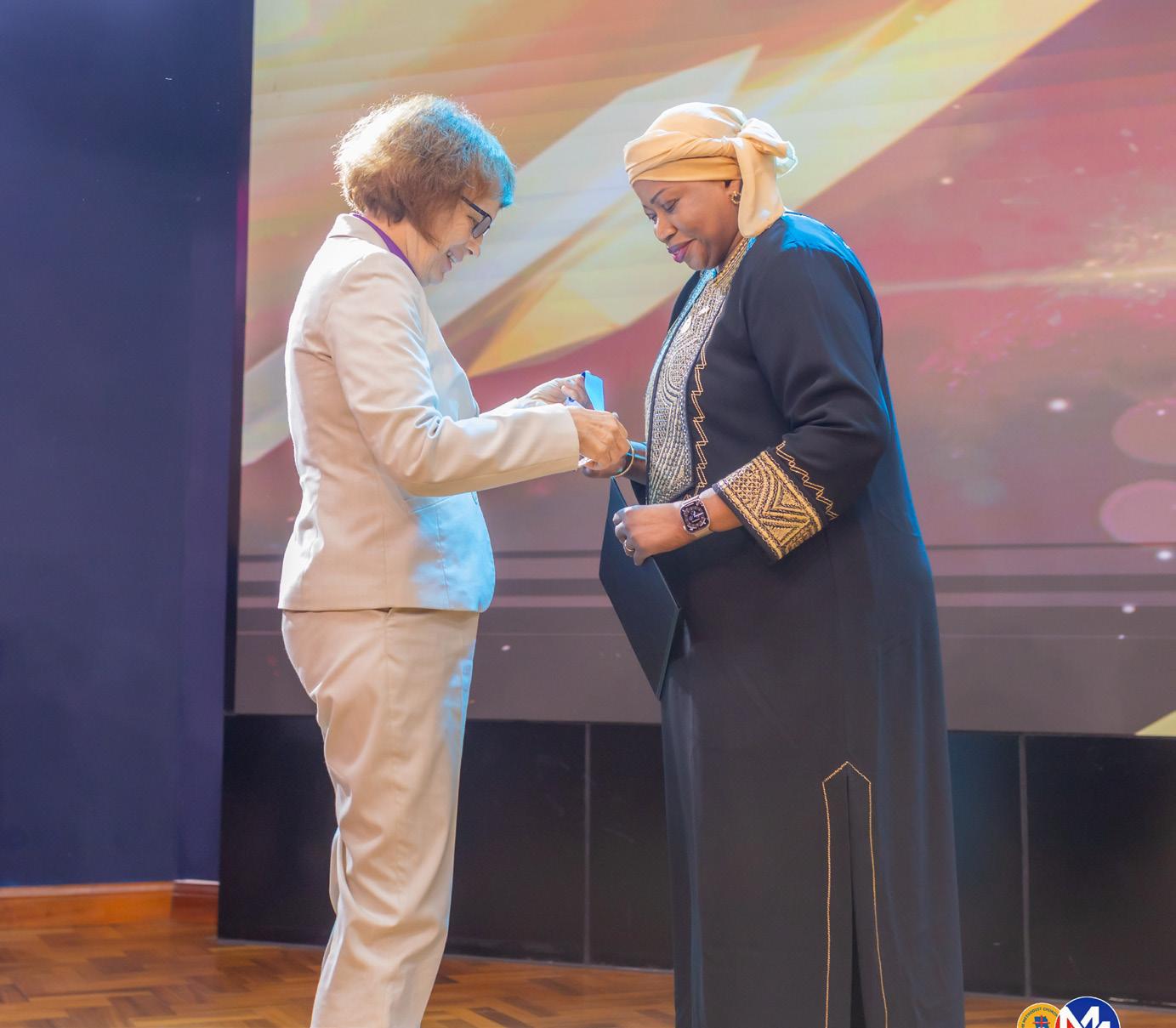
H.E. Dr. Bensouda Receiving the 2025 Peace Award from President Debra Wallace-Padgett in Accra, Ghana.
2025 Peace Award Recipient
H.E. Dr. Fatou Bensouda
Invitation to Apply for GEM School
To strengthen the collective voice of churches on global economic issues, a group of 20-25 current and emerging church leaders are invited to attend the Ecumenical School on Governance, Economics, and Management for an Economy of Life (GEM School) in Panama City, Panama (location to be confirmed), from 17-28 August 2026.
GEM School is co-organised by the World Council of Churches, World Communion of Reformed Churches, Lutheran World Federation, World Methodist Council, Council for World Mission, and United Society Partners in the Gospel. It responds directly to recommendations from the Sao Paulo Statement: International Financial Transformation for an Economy of Life and the policy framework Economy of Life for All Now: An Ecumenical Action Plan for a New International Financial and Economic Architecture. Both documents emphasised the need to build economic expertise within churches and identified economic competency development as a strategic priority.
Churches offer important ethical, moral, and theological perspectives on the global economy, yet these voices have limited influence on financial and economic policymaking, business practices, and dominant economic thinking. In response, the GEM School seeks to close this gap by strengthening economic literacy within faith communities and equipping participants with the concepts, language, and analytical tools needed to advocate more powerfully for urgent transformations in the global financial and economic system.
Learning objectives
The 10-day curriculum addresses the following objectives:
• Identify theological starting points for economic justice (i.e. why and how theology and ethics are intertwined with economics)
• Provide a basic understanding of mainstream economic thinking
• Identify, relativise and contextualise methodologies and normative fundamentals of economics
• Widen the horizon of economics by introducing ecological, feminist and other alternative approaches
• Develop the interdisciplinary structure and ethical implications of combining theological dimensions with economics
• Lay out the political and strategic implications for churches and their advocacy for an Economy of Life
Nomination criteria
• MA or BA preferably in theology, economics/ finance/business management or anynsocial science; or demonstration of competence in the aforementioned fields by engagement in issues of socio-economic and ecological justice through, for example, programmes or processes connected to sponsoring and other partner organisations
• Five years of leadership experience (waived for youth until the age of 30)
• Sound insights into practices of public policy and passion for justice (assessed through an essay)
• Endorsement from a church or ecumenical organisation
Among candidates who meet the nomination criteria, participants will be selected with a view to achieving regional, gender and denominational balance.
Participants are granted full scholarship, including flights, accommodation and full board. A contribution of 100 US dollars is expected from each participant.
Application
Apply through this [link].
The final date of receiving applications is on 1 March 2026. Selected participants will be informed by 31 March 2026.
Further inquiries may be directed to: Athena.Peralta@wcc-coe.org, Muna.Nassar@wcrc.ch, Anupama. Hial@lutheranworld.org, Rosemarie.Wenner@emk. de, Daimon.Mkandawire@cwmission.org, or Peniel. Rajkumar@uspg.org.

Leadership in Jesus’ Style – Servant Leadership
Read John 13:1-17
In the first months of my service as bishop of the Germany area of The United Methodist Church, a youth group in a congregation invited me to be the “special guest” in one of their meetings. I accepted the invitation, praying that I would make a difference in the life of these young people. I do not know whether that was the case. What I know for sure is that the young people made a difference in my life. Towards the end of that meeting, the leader of the youth group offered words of appreciation for my visit, saying: “We are glad that you came to us. And we have a small gift for you.” The gift was a shirt; on its back it was marked with a big “2”. The youth leader explained: “You are now our bishop. Many will look up to you, as if you were the number one leader in our church. Yet we wish to remind you: Jesus is number one. You are number two!”
We are called to lead and leadership has many faces. We need committee leaders, leaders in mission projects, leaders in congregations and churches and in the various services that we offer to the world. Often, we are competing: Who is the most important leader? The gospel tells us: We all are followers first. Followers of Jesus. Jesus is the number one leader. All of us are called, all of us are gifted, all of us important, all of us are sent to share God’s love in words and deeds in the world God so loves. AND all of us are number two leaders, following Jesus’ example.
In John 13 we read how Jesus sets an example for Christian leadership. Jesus – our number one leader – serves us! Shortly before he was nailed to the cross, he humbled himself to wash the feet of his disciples. This was the task of slaves, and it was not only a symbolic act, although it can be difficult enough to do this symbolic act. Kneeling down before someone else, touching someone’s feet, gently washing them and drying them, this is intimate and challenging. Yet in Jesus’ lifetime, people came with dirty feet, after long walks on dusty roads. Feet-washing meant cleaning and refreshing the others. Jesus offered this service. And he did not stop with that expression of love. He went on, carried the cross, was beaten and crucified – love, higher and deeper than one can imagine. We are here because Christ served us that way – Christ gave himself to us. Grace – unmeasurable, amazing grace… Do we accept Jesus’ gift? Receiving Christ’s transforming and renewing love is the first and foremost thing for us, as we agree to offer leadership in Christ’s church.
Yet that’s not all – we, the number twos following Jesus – we are called to live and act like Christ. Are we willing to serve one another, and most of all, to serve God’s favorites: children, poor people,
the least and the last? Are we willing to do unseen, unpaid and sometimes dangerous services? Jesus’ style leadership is not about being admired and honored by those whom one leads, it is not about power and privileges… It is about kneeling down and uplifting others, making the hands dirty and taking risks because of our stand for justice. In several places of the world, those who serve so called “illegal” migrants are targeted as well. Challenging those in power to put people and the planet over profit might cause disadvantages for the advocates. Yet Christ reminds us: “ For I have set you an example, that you also should do as I have done to you. Very truly, I tell you, slaves are not greater than their master, nor are messengers greater than the one who sent them. If you know these things, you are blessed if you do them.”
(John 13:15)
And there is one more challenge. We are not only called to follow Christ and to serve one another and the world, we are also called to receive the service of others. Accepting the dependency of others serving me can be more challenging than me serving them. Yet we together are Christ’s body. And everyone has a part in this body, only together we can embody Christ in the world. Everyone has a certain task to do. Our roles might change. Today, I need your service. Tomorrow, I will serve you. It is not about power over one another. It is not about hierarchy: Christ number 1, and we all are number 2’s – Christ followers, called to be one in ministry to the world. I love this Charles Wesley hymn:
Help us to help each other, Lord, each other’s cross to bear; let each his friendly aid afford and feel another’s care.
Up into thee, our living head, let us in all things grow, and by thy sacrifice be led the fruits of love to show.
Touched by the lodestone of thy love let all our hearts agree; and ever towards each other move and ever move towards thee.
This is the bond of perfectness, thy spotless charity. O let us still, we pray, possess the mind that was in thee.
I read this hymn as a lesson for servant leadership. It is not about me. It is about Jesus who leads us to show fruits of love. And it is about us, the community of our-days disciples. We are not more than our master. We depend on Christ’s service. In him, God became human. Now it is on us to be human and to lead by serving humanity and creation in Jesus’ style.
Article by Bishop Rosemarie Wenner

Please send press releases, articles and resources! Submissions should be a page or less (450-500 words), edited and ready to publish. Contact us by Friday, 19 December at communications@worldmethodistcouncil.org if you would like your story to be included in the January edition of the First Friday Letter.
On the Web
This and past First Friday Letters can be found online at FirstFridayLetter.worldmethodistcouncil.org.
The World Methodist Council’s website may be found at worldmethodistcouncil.org
To subscribe to this newsletter, please email communications@worldmethodistcouncil.org
About the First Friday Letter
The First Friday Newsletter is a monthly publication of the World Methodist Council.
Publisher: Rev. Dr. Reynaldo F. Leão Neto, General Secretary Communications: Michaela Bryson
All stories and photos, unless otherwise stated, are protected by their respective copyrights. Please do not copy without expressed written permission from the Council.
Methodist Council