

Introduction
Welcome to the second edition of ‘REconnect’. The first edition was warmly received by Religious Studies teachers and we hope this edition will be just as useful. Our magazine aims to provide suggestions for teaching the reformed specifications and key information relating to our WJEC/ Eduqas Religious Studies qualifications. This includes dates for CPD events, 2019 examinations and standardisation conferences for Examiners. It is difficult to believe that we have had two years of teaching the new A Level and a year of teaching the new GCSE specifications. Many congratulations to those centres that successfully supported their candidates with the examinations.
We would also recommend you read the relevant Examiners' Reports in order to further support your delivery of the specification. They can be found here:
GCSE WJEC CHRISTIANITY AND HINDUISM - https://bit.ly/2PxXHlY
GCSE WJEC CHRISTIANITY AND ISLAM - https://bit.ly/2Ca1xQz
GCSE WJEC CATHOLIC CHRISTIANITY AND JUDAISM - https://bit.ly/2MIIzFf
GCSE WJEC CHRISTIANITY AND JUDAISM - https://bit.ly/2NFM2Ru
GCSE WJEC CHRISTIANITY AND BUDDHISM - https://bit.ly/2wDFZ9P
GCE WJEC AS/A LEVEL - https://bit.ly/2LLZbH3
Whilst the overall entry picture for R.S. at GCSE and A level nationally is without doubt concerning, (see https://bit.ly/2NITqf3 (GCSE) and https://bit.ly/2oBSU7E (GCE)) the entries for WJEC and Eduqas appear to have 'bucked' this trend. This no doubt, is in part down to the commitment and professionalism of the Religious Studies teachers who have delivered our specifications and passed on their enthusiasm for the subject to their pupils/students. There is also a very positive article on the value of R.S. written by Tarek Ahmed, a GCSE Student, which can be found on the NATRE website (https://bit.ly/2wA8QLe).
We hope you find the information contained in the articles useful and that the articles serve to engage your learners and support your preparation for these courses. Certain articles appear in both the A Level and GCSE sections as we felt they might be useful for both. Many thanks go to those who contributed their ideas to this second edition. If you would like to contribute an article, or share a few top teaching tips, please get in touch via e-mail.
We look forward to working with you in the months ahead.
Best wishes
Lynda Maddock & Andrew Pearce
Andrew Pearce
Subject Officer (AS/A level)
Telephone: 029 2026 5387
Email: andrew.pearce@wjec.co.uk


Lynda Maddock
Subject Officer (GCSE)
Telephone: 029 2026 5122
Email: lynda.maddock@wjec.co.uk
Eira Morgan
Subject Support Officer (AS/A level)
Telephone: 029 2026 5183
Email: eira.morgan@wjec.co.uk


Christopher Barfoot
Subject Support Officer (GCSE)
Telephone: 029 2026 5094
Email: christopher.barfoot@wjec.co.uk



Broadening Our Perspectives on Religion
Damien Lane
Can a religious believer who does not follow all the teachings of his or her faith ever have a legitimate reason to do so? Are orthodox religious views the only views a believer should follow? This question struck me as going right to the heart of the issue of how we should be approaching the teaching of RS as the twenty first century progresses. There are so many variations within each faith group that we need to constantly remind ourselves that people may claim adherence to a faith whilst not cleaving literally, or even closely for that matter, to that group’s entire body of teaching. An example of this phenomenon surely has to be the referendum on same-sex marriage in the Republic of Ireland in 2015. A country often recognised as being one of the most Catholic in Europe voted 62% in favour of same-sex marriage and, more recently, also voted to legalise abortion.
When I worked at a Catholic college in Bristol, I taught students from diverse backgrounds. But the common theme was the acceptance of the same-sex marriage legislation. Other examples could be talked about here as same-sex marriage is simply one example. The students were working out their own beliefs in an ever-changing world. It struck me as a good British compromise and evidence of integration. Of course, not everyone (of any faith or none) is in favour of same-sex marriage and they are entitled to their opinions. It is this diversity of views that can make the teaching of Religious Studies so rewarding. The attitude to women is another such example of diverse opinions within a faith. I often tell my students that the first Muslim was Muhammad’s first wife, Khadijah. Then I tell them she was his boss and fifteen years his senior! We must try and produce a balanced view of everything we teach. With Islam that is probably even more the case in the current climate. In Oxford, the Muslim cleric, Taj Hargey, might be described as 'radical' by some (and perhaps even by himself). However, he really is not the stereotypical radical. It is a shame that the word radical, in connection with Islam, has come to mean extremist. (http://www.meco.org.uk)
Look at the images and text below to see some of the 'radical' changes being proposed by this British Muslim group.
OXFORD MUSLIMS LAUNCH ANTI-VEIL CAMPAIGN
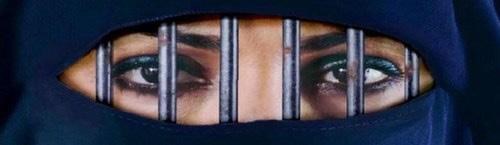
BRITISH MUSLIMS LAUNCH NATIONAL CAMPAIGN TO PROHIBIT ALL PUBLIC FACE-MASKING IN UK (INCLUDING BURQA/NIQAB)


Teaching is the core of what we do. Assessments and examinations are important. But we need our young people to have qualifications and skill-sets that will help them navigate an ever-changing world.
It is our job to teach about religion and the good and bad that go with it. However, perceptions about religious teachings and traditions change with time and circumstance and surely, as teachers, we should seek to acknowledge this.
Meco Holds Anti-ISIS Rally

AS (WJEC) A1 (Eduqas) Religious Ethics
Situation Ethics
Mark Lambe
Every muscle in my body aches – I’ve got aching muscles I never knew I had. The reason for this outburst of self-pity (as my wife puts it) is because I’ve been helping with a charity car wash all day. Some of my students and I decided it would be a really good idea to raise money for a charity called the ‘Potter's Village’. The ‘Potter's Village’ is a little charity set up by an amazing lady called Jenny Green who decided one day to sell everything she had in England, and move to Kisoro, in Uganda (as you do!!), with the aim of setting up a help centre for Ugandan orphans. After many years the ‘Potter's Village’ now exists and it currently supports 20 orphaned babies plus has a fully functioning medical centre, the first for this very poor region. However, money is always tight and the economic situation in Uganda means there are always more babies/children/people in need of help - hence the charity car wash. We raised a brilliant £300 and amazingly didn’t (seriously) scratch anyone’s car. However, as I sit here I’m feeling a bit under-whelmed; this is because in the great scheme of things £300 is not going to make a great deal of difference to how many babies the Potter's Village is going to be able to help. However, a plan is forming in my head; what if I were to buy 150 National Lottery tickets (£2 a go) with the money we have raised. Then, if I were to win the jackpot, we would have several million pounds to give to the Potter's Village and that really would make a big difference. So, I’m faced with a moral dilemma: give the £300 to the Potter's Village or gamble it on the Lottery in the hope of winning a lot more money to give them. What shall I do?
I’ll use my favourite ethical theory to help me decide what to do: Situation Ethics. Joseph Fletcher founded the theory of Situation Ethics in his 1966 book: ‘Situation Ethics: The New Morality.’ I’ll be honest, I really like Situation Ethics because I am a bit of a rebel at heart. Therefore, I strongly agree with Fletcher, that Ethics should not be based on legalist principles (the belief that all human actions should be governed by rules). Rules stop you being able to think about ethics for yourself
and, perhaps more fundamentally, there are times when legalistic rules just don’t work when trying to apply them in the real world. Take my moral dilemma; I know the religious rule would be don’t gamble the money on the lottery because, in essence, I am stealing the money from those who donated it and Exodus 20 makes it clear that we should not steal. However, I am not thinking of gambling the money for any personal gain, all I am trying to do is raise more money for a worthwhile charity. Therefore, sometimes the situation demands the religious legalistic rule be rejected. However, I also agree that ethical dilemmas should not be decided just on a whim i.e. in an antinomianistic way (where people do not use an ethical system at all when faced with a moral dilemma). I agree with Fletcher that people still need some form of ethical guidance, otherwise they could do unethical things without realising that what they have done is wrong e.g. steal charity money that isn’t theirs.
Situation Ethics it is then; therefore, I’m going to take the middle ground between the two extremes of legalism and antinomianism (Fletcher referred to it as ‘principled relativism’). What this means is that I am going to base my ethical decision on one guiding principle which Fletcher believed should be the law of love. However, Fletcher had a specific type of love in mind for his Situation Ethics. His idea of love is defined by the Christian idea of love known by the Greek term ‘agape’. I think, all in all, this is my alltime favourite word because of what it means: ‘selfless love’. Academically it means love that is directed outwards towards others and is given unconditionally and constantly – best summed up by the Bible verses in 1 Corinthians 13. More practically, think about the film ‘Titanic’ and the way Jack gives up his life so that Rose can survive, or in Casablanca (great film, watch it!) where Rick gives up the love of his life (Ilsa) for the greater good of humanity.
So how would Situation Ethics judge my moral dilemma? Well firstly because it’s relativist it would believe that no action is right or wrong in itself i.e. there are no universal moral norms. Therefore, it wouldn’t just look at my potential action and say, ‘it’s wrong because it’s stealing’. According to Situation Ethics stealing can either be wrong or right – it depends on the goal i.e. Situation Ethics is consequentialist/ teleological. More specifically it depends on whether the goal is selflessly loving/agape (this is known as the Boss Principle of Situation Ethics). Therefore, Situation Ethics may potentially state that the best course of action, in my particular moral dilemma, would be to take the money and buy the 150 lottery tickets. This is because this would potentially create the most loving outcome: if I won I would have millions of pounds to give to the Potters' Village and they would be able to rescue thousands more children.
However, Situation Ethics is not quite that straight forward. Fletcher realised that the world is a complex place and that sometimes one simple principle (no matter how good) may not always clearly illustrate the best course of action in a given situation. Therefore, he also developed the Six Fundamental Principles and Four Working Principles. These principles don’t outrank the ‘Boss Principle’ but they are used to clarify it in certain situations. They are not all relevant to every situation. Therefore, I will consider some of those with reference to my specific moral dilemma:
• Fundamental Principle of ‘love is the ruling Norm of Christianity’ (love overrules religious moral rules, such as the 613 commandments; Fletcher believed that through the example of Jesus, love was the new agreement between God and all people, replacing the old religious laws). This fundamental principle seems to support the idea that I should gamble the money on the lottery. This is because the selfless love I’m showing by gambling the money on the lottery to try to get millions of pounds for a worthy cause, overrules the religious commandment of ‘do not steal’.
• Fundamental Principle of ‘loving ends justify the means’ (loving consequences can justify breaking a traditional religious rule, as long as the goal is not accidental). This fundamental principle would also seem to support the idea that I should gamble the charity money on the lottery. This is because the goal of what I want to achieve (raising lots of money for
orphaned children) is selflessly loving; therefore, my means (stealing charity money) is justified.
• Working Principle of ‘Personalism’ (people are more important than religious rules). This working principle also seems to support me gambling the money on the lottery, because I am putting the needs of people (the orphans) before the religious rule (Do Not Steal).
Therefore, it looks like Situation Ethics is guiding me to gamble the money on the lottery. HOWEVER, we then have the Working Principle of ‘Pragmatism’:
• Working Principle of ‘Pragmatism’ (means Situation Ethics needs to work in practice i.e. breaking a religious rule can only be justified if the loving consequences are realistically and practically going to occur). This is clearly where my idea of gambling the £300 car wash money on the lottery falls down. This is because although my idea is selflessly loving (agape) the likelihood of my 150 tickets winning the National Lottery are extremely unlikely e.g. the chances of winning the National Lottery are 45,000,000 to 150. Therefore, Fletcher's ‘Pragmatism Principle’ would say my action of buying 150 lottery tickets is actually a wrong action, despite the intention of creating loving outcomes.
Thanks for that, Fletcher, I now know what I need to do – get on to the Potters' Village website and donate the £300.
It currently costs £85,000 per year to run the Potter's Village. If you would like to help, or find out more, please go to their website: www.pottersvillage.org.uk
Mark Lambe is an experienced Religious Studies course leader and examiner, who now writes revision guides for both GCSE and A-level RS and offers centre visits to offer guidance on any aspect of the course content, along with question/essay structure and revision sessions for both teachers and students across England and Wales. mark.lambe1972@ntlworld.com

Teaching "A" Level RS For Learning and Assessment
Damien Lane
There is much debate about teaching and learning and the quality of what we do in schools. Ultimately, our duty is to teach in a manner that challenges learners as well as ensuring they are prepared for their exams. These aims are not mutually exclusive.
If anything they are closely intertwined. The "A" Level programme encourages teaching that is engaging and that uses relevant examples that are up to date. Religious Studies can be at the forefront of that debate for whilst it is clear that we must teach about ancient aspects of world religions (think Hinduism in the East or Judaism in the West) we can also challenge students on issues that are of concern today.
Anti-Semitism unfortunately raises its ugly head all too often and it means we must deal with it in a twenty-first century context. Another example, more benign yet still intriguing, is how the religions of the East have been adopted in the West. The idea of yoga is one such example. How much can a Westerner get out of yoga when they do not buy into the whole way of life that yoga forms a part of? How is that some Christians see more in common with Sunni Islam and its almost ascetic view on art (especially regarding the portrayal of human and animal images) than they do with, say, Roman Catholicism? This is not a new argument as Elizabeth I famously tried to do a trade deal with the Moroccan Sultan Al-Mansur. This was in an effort to get at Catholic Spain. Today’s interactions are no less complicated and no less interesting.
So, whilst we are clearly bound by the limits of the specification and our first duty is to ensure that the whole course is taught, we can be imaginative in how we do that. For example, if referring to Jewish
reactions to the Holocaust the legal case between Deborah Lipstadt and David Irving is a really good twenty-first century example. See:
https://www.theguardian.com/books/2000/apr/11/irving.uk
https://www.telegraph.co.uk/films/denial/why-the-holocaust-went-on-trial/ https://www.jewishvirtuallibrary.org/irving-v-lipstadt
Recent discussions on examples of anti-Muslim or anti-Jewish sentiment in the UK can be put into a broader context. This is a negative view that must be addressed, but we can also show positives such as London’s first Muslim mayor in Sadiq Khan (https://www.reuters.com/article/us-britain-politics-electionlondon-idUSKCN0XX1W4 )
It is very much up to us how we deliver the course. Courses are often designed with a view to encouraging debate, and not stifling it by having recourse to being offended by this or that. Getting the brain working on challenging issues that are grounded in a sound understanding of the religious tradition(s) being taught will only lead to better results and more rounded individuals. It is also the ideal platform for going onto university with the right skills set.
Recently added Digital Resources for A Level RS

Unit 6 Textual Studies (New Testament)
https://bit.ly/2Oj3Vp9

Unit 3 Sikhism - supporting AO2 resources
https://bit.ly/2s12K4Z

Units 1B & 3B Islam - Schemes of Learning
https://bit.ly/2pjt60w

Unit 3 Judaism - supporting AO2 resources
https://bit.ly/2PJsQTK

Unit 4, Theme 1, 2 and 3: Religion and Ethics
https://bit.ly/2KdtEld
Unit 3b Islam - further AO1 resources list
https://bit.ly/2NjL0yp

Unit 5 Philosophy of Religionsupporting AO2 resources
https://bit.ly/2NU4xow

Unit 3 Hinduism - supporting AO2 resources
https://bit.ly/2PKpVtL
Unit 3b Islam - supporting AO2 resources
https://bit.ly/2JZpsRS

Unit 5 Philosophy of Religionfurther AO1 resources list
https://bit.ly/2PMFmBB

Unit 3 Buddhism - Scheme of Learning
https://bit.ly/2I6quve

Units 1 & 3 Judaism - Schemes of Learning
https://bit.ly/2qmvXXm

Unit 3 Buddhism - supporting AO2 resources
https://bit.ly/2pIXeD9

Unit 3 Judaism - further AO1 resources list
https://bit.ly/2QCYu6x


Unit 3 Buddhism - further AO1 resources list
https://bit.ly/2D9DuBM

Further support for A level RS Unit 4 Religion and Ethics
https://bit.ly/2QEUl1S

REconnect Magazine - Issue 1 Unit 3C Judaism
https://bit.ly/2OwpDqh

Buddhism Yr 2 Scheme of Learning A level Islam
https://bit.ly/2OwkE8X
https://bit.ly/2nCM3uG
https://bit.ly/2MQ26yU
Additional RS resources might be added in future, please visit :
http://resources.wjec.co.uk/Pages/SearchResources.aspx
Important Exam Dates – GCE
New Wales
Unit 1 – An Introduction to the Study of Religion (Options A, B, D) Thursday 16th May
Unit 2 - An Introduction to Religion and Ethics and the Philosophy of Religion
Unit 3 – A Study of Religion (Options A to F)
6 – Textual Studies (New Testament)
23rd May
25th May (Except Hinduism + Judaism options –Wednesday 29th May)
1st June
CPD Dates – GCE
GCE RS – Wales
05/11/2018 Wales Llandudno GCE WJEC GCE Religious StudiesAssessment > Classroom Practice St Georges - Llandudno
06/11/2018 Wales Carmarthen GCE WJEC GCE Religious StudiesAssessment > Classroom Practice Ivy Bush - Carmarthen
07/11/2018 Wales Cardiff GCE WJEC GCE Religious StudiesAssessment > Classroom Practice
Future Inn - Cardiff

Other useful links - GCE
WJEC RS Summer Series 2018 data feedback for AS a A level.
Two powerpoints are available which take you through the main data available from the www. wjecservices.co.uk site on candidate performance for AS and A level RS - Summer 2018.
Once logged in to the site
• Click on Resources (Top Right of screen)
• then Subject Specific Support Material (including CPD)
• select Religious Studies from the Subject Dropdown
• choose WJEC for Brand
• select GCE for level
• CPD for type of resources
• 2018 for Publication Year
Download the zip file listed.
Relaunched WJEC GCE RS Google map
Due to the new GDPR regulations our previous very successful map had to be removed. Please complete the questionnaire here if you would be interested in setting up a new map which will allow you to contact other centres to share teaching and learning ideas and resources.
https://bit.ly/2P89nfh
WJEC GCE RS future Resource planning:
In order to help us and other providers identify areas of ‘greatest need’ in terms of resources, please complete the following support request questionnaire:
https://bit.ly/2DPo6e5
Are you constantly called upon to justify the existence of Religious Studies to learners, parents and even SLT? See below a recent article that explains why RS fully deserves its rightful place on the school curriculum:

Is Religious Studies still relevant to the classroom?
Andrew Pearce and Lynda Maddock, Religious Studies Subject Officers at WJEC discuss why the study of religion should remain a staple part of the curriculum, and that neglecting this subject may lead to fear, ignorance and prejudice.
There appears to be a growing perception that due to increasing secularisation within society and the rapid growth of New Atheism, that Religious Studies is an irrelevant and even outdated subject. Sceptics may argue that it is a subject full of myths such as elephant headed gods saving princesses and should be consigned to history. However, this does the subject, those who teach it and those who study it, a great disservice. Such a narrow approach in a multi-cultural, but also increasingly secular society is dangerous, because a lack of knowledge and understanding about religion can lead to ignorance and prejudice.
The view that Religious Studies is of less importance than other subjects appears to be borne out in a recent report from the National Association of Teacher for Religious Education (NATRE) which suggests that many schools are not recognising the importance of the subject or meeting the legal requirement in terms of curriculum time. Schools at present place a heavy emphasis on STEM subjects (Science, Technology, Engineering and Maths), whilst marginalising other subjects, including Religious Studies. So in the words of those brilliant comics, Monty Python:
"What can Religious Studies do for us?"
The academic benefits of students following Religious Studies courses have been well documented. A Level Religious Studies is recognised as a 'Facilitating Subject' by Russell Group universities, as it develops critical thinking skills amongst students. Through the study of religion, students are encouraged to think critically and it provides them with the skills to develop, analyse and evaluate logical arguments and present these in a variety of formats.
However, the benefits of studying Religious Studies aren't limited to the confines of the classroom; it also encourages students to develop as individuals. It gives students the opportunity to work out what they believe in and question why they do. It allows them to discuss their views on a range of ethical issues, from genetics to warfare. Importantly, it encourages students to empathise with those who hold opposing to different views to their own. According to a GCSE Religious Studies student at Cardiff High School, "Religious Studies allowed me to gain knowledge of other cultures and an understanding and appreciation of many religions that I would not have known about otherwise. It was very interesting to see many people’s viewpoints on life and how we should live it."
Furthermore, a careful distinction needs to be drawn between an increase in secularism in certain societies and an increase generally. The fact remains that two thirds of the world's population adhere
to a religious faith. Indeed, even in the UK, over half of the population claim to hold religious beliefs. To ignore this fact is to ignore a fundamental principle of human existence and the foundation stone on which many people build their lives.
Religion can promote compassion, respect, tolerance, charity and a fairer society. It can offer hope, fellowship and comfort. It can inspire and offer guidance for living life well. Equally though, it can be the cause of profound misery and destruction. It can oppress, marginalise and brutalise. It can justify acts of extreme violence and destroy hope and dignity. A force as powerful as this is ignored at our peril. Pretending it doesn’t exist, or wishing it didn’t, is, at best, naive. A quick glance at a newspaper will convince you of its power and influence.
Students need to fully engage with this subject and understand its complexities and its influence on people’s beliefs, practices, views and attitudes. This is what Religious Studies aims to do - never has it been more important - and it should be given its fair share of curriculum time and resources to deliver it properly. Lack of knowledge of others' beliefs, as history has shown us, can lead to fear and discrimination. Religious Studies is a crucial weapon against this self-fulfilling prophecy. As Lord Evans, a former Head of MI5 recently noted, 'Understanding different religions and world views, and therefore being able to understand the world you’re living in, has got to be helpful in giving people the power to reflect on their own beliefs.'
It is just Religious Instruction isn't it?
Religious Studies is not the same as the Religious Education or even Religious Instruction from years ago. It is not about converting students to a particular religion or getting people to believe this or that. It helps students to develop an understanding that, even if they are not religious themselves, religion has had, and continues to have, a tremendous impact upon the society in which they live. You cannot fully understand history, art, politics, literature, the legal system, music, sport or science, without an appreciation of the role religion plays in each of these areas.
Religious Studies has for many years, encouraged non-religious world views from groups such as secularists, humanists and atheists, to be both heard and evaluated. Wherever you work or live, religion plays a part in people's lives. Surely by giving students the opportunity to study the subject, we empower them to make up their own minds about whether religion is important or not? In the words of a former A level student, Halima Sadia, "In a multicultural society Religious Studies is more important than ever. I believe it can make us better students, better thinkers and ultimately better people."

The Bishop’s Life: Unit 2 Part B - Religious Responses to Ethical Themes (Issues of Equality).
The Religion and Philosophy Department at Cardiff High School recently had the honour of welcoming the first ever female Bishop in Wales, The Right Reverend Joanna Penberthy, who is also a former Head Girl. Bishop Joanna addressed many of our GCSE Religious Studies classes, as well as many pupils in years 7, 8 and 9, telling them about her journey of faith which began as a teenager studying at Cardiff High.
Pupils heard how, at a time when women were unable to become priests in the Anglican Church, Bishop Joanna felt sure that God had called her to this vocation and how, eventually, women were able to be ordained as priests and now can even become bishops! It was fascinating to learn of the challenges that Bishop Joanna has faced as Wales’ first female bishop, as well as her views about gender and equality in the Church and society as a whole. This provided a great pre-cursor to the GCSE Unit 2 'Issues of Equality', where in the 'Gender Prejudice and Discrimination' area of study, students will consider diverse attitudes within Christianity toward the roles of women and men in worship and authority.
Our students reflected together that:
"Bishop Joanna shows that it is possible for women to achieve a high position in the Church. Since for so long it was not possible, her journey and story was inspiring. She shows religion in real life and is very insightful."
Year 10 students, Cardiff High School
Bishop Joanna had lunch with staff and students in the Philosophy Café at the school, where the question ‘Is religion good for women?’ was insightfully discussed.
The day even ended in song, with Year 7 insisting that Bishop Joanna give them a few verses from a favourite hymn, so that they could sing along, too! Sadly, our GCSE students decided that they’re a little too cool for singing!
Check out some background information here: https://stdavids.churchinwales.org.uk/bishopjoanna/
"Bishop Joanna shows that it is possible for women to achieve a high position in the Church. Since for so long it was not possible, her journey and story was inspiring. She shows religion in real life and is very insightful." [Year 10 students]
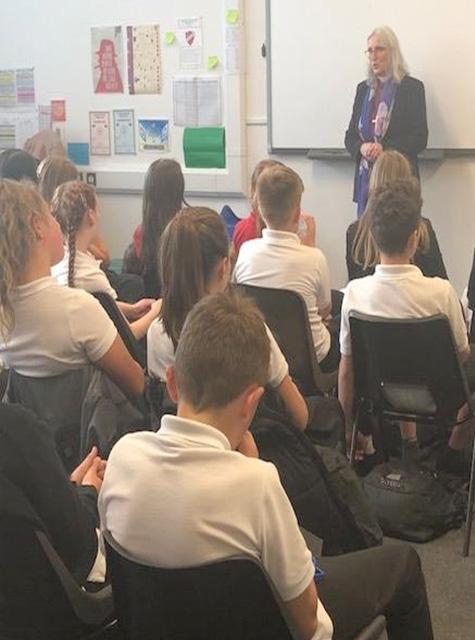
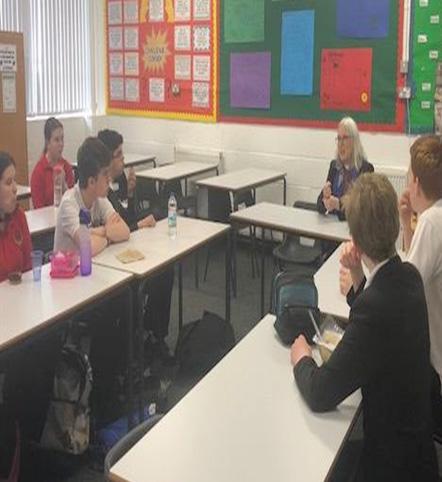
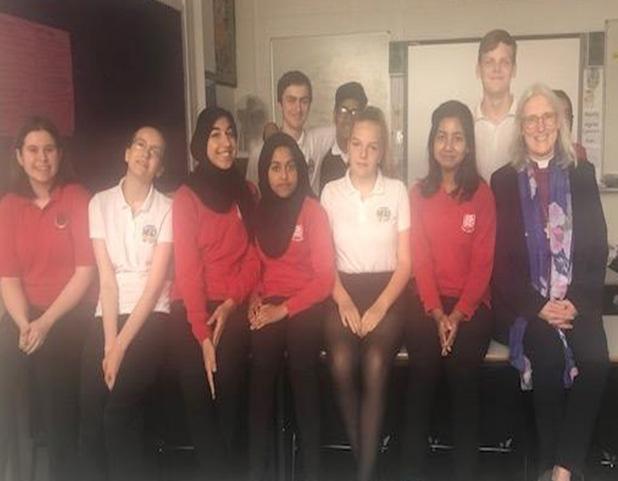
Year 7
Philosophy Café
Year 10, some of our GCSE Group
Broadening Our Perspectives on Religion
Damien Lane
Can a religious believer who does not follow all the teachings of his or her faith ever have a legitimate reason to do so? Are orthodox religious views the only views a believer should follow?
This question struck me as going right to the heart of the issue of how we should be approaching the teaching of RS as the twenty first century progresses. There are so many variations within each faith group that we need to constantly remind ourselves that people may claim adherence to a faith whilst not cleaving literally or even closely for that matter, to that group’s entire body of teaching. An example of this phenomenon surely has to be the referendum on same-sex marriage in the Republic of Ireland in 2015. A country often recognised as being one of the most Catholic in Europe voted 62% in favour of same-sex marriage and, more recently, also voted to legalise abortion.
When I worked at a Catholic college in Bristol, I taught students from diverse backgrounds. But the common theme was the acceptance of the same-sex marriage legislation. Other examples could be talked about here as same-sex marriage is simply one example. The students were working out their own beliefs in an ever-changing world. It struck me as a good British compromise and evidence of integration. Of course, not everyone (of any faith or none) is in favour of same-sex marriage and they are entitled to their opinions. It is this diversity of views that can make the teaching of Religious Studies so rewarding. The attitude to women is another such example of diverse opinions within a faith. I often tell my students that the first Muslim was Muhammad’s first wife, Khadijah. Then I tell them she was his boss and fifteen years his senior! We must try and produce a balanced view of everything we teach. With Islam that is probably even more the case in the current climate. In Oxford, the Muslim cleric, Taj Hargey, might be described as 'radical' by some (and perhaps even by himself). However, he really is not the stereotypical radical. It is a shame that the word radical, in connection with Islam, has come to mean extremist. (http://www.meco.org.uk)
Look at the images and text below to see some of the 'radical' changes being proposed by this British Muslim group.
OXFORD MUSLIMS LAUNCH ANTI-VEIL CAMPAIGN
BRITISH MUSLIMS LAUNCH NATIONAL CAMPAIGN TO PROHIBIT ALL PUBLIC FACE-MASKING IN UK (INCLUDING BURQA/NIQAB)
Teaching is the core of what we do. Assessments and examinations are important. But we need our young people to have qualifications and skill-sets that will help them navigate an ever-changing world.
It is our job to teach about religion and the good and bad that go with it. However, perceptions about religious teachings and traditions change with time and circumstance and surely, as teachers, we should seek to acknowledge this.
Meco Holds Anti-ISIS Rally

GCSE – Component 1 (Eduqas) and Unit 1 (Wales)
Origins of the Universe
Mark
Lambe
What a great day - the sun had shone, the BBQ had, for once, cooked the food properly (no one was sick!), friends had laughed, children had (mostly) played nicely together and most amazing of all: England had won a game of football by playing well (sorry at this point to Welsh football fans). Days don’t often get better than this. However, when everyone has gone home, the inevitable tidy up of the garden is needed. So here I am, as night draws in, with a bin bag in one hand, slowly tidying the garden. However, I have to admit I secretly love being out at night, on my own, when there is a clear sky. I love looking up at the stars and trying to take in the vastness of the universe.
My mind switches back to the Sunday School classes at my local church that my Mum used to drag me to when I was a child. I remember being taught about the creation of the universe, from Genesis 1 i.e. that God had created the universe in six days and rested on the seventh. I remember once trying to question our Sunday School leader about alternative, scientific ideas on the creation of the universe – but she was a literalist; someone who thought the stories in the Bible were literal, historical and factual accounts of what had taken place. For her, God had made the universe in six days, because that’s what the Bible says, and that was the end of it. She dismissed my questions as non-Biblical. Thinking about it now, it’s easy to dismiss her reaction as overly zealous and far too simplistic. However, I now realise that her point of view is not without support.
For example, in the Western religious tradition (Christianity, Islam and Judaism) God is credited with the attribute of omnipotence i.e. God is all-powerful. It is tricky for human minds to grasp the concept of omnipotence; however on a basic level it means God can do anything e.g. make an
elephant fly, clean up my garden with a click of His fingers (watch the end of the excellent film ‘Dogma’ (15) to see a really good example of this), score better goals than Gareth Bale (one for you Welsh football fans!) or create the universe in six days – nothing is beyond the power of God. So, it is obvious that an omnipotent God would have no problem at all creating a universe. Many Christians believe this and are Creationists. They think that you should not question the Bible because that is casting doubt on it being the Word of God. If you cast doubt on the Genesis accounts, what's stopping you from doubting lots of other parts of it as well?
However, these arguments are unlikely to work on anyone who is already sceptical about what the Bible states. What we really need is a bit of scientific evidence to support the idea that God created the world in six days. Step forward the ‘Young Earth Theory’ because this is exactly what this theory attempts to do. Supporters of the Young Earth Theory believe that the earth is actually only between 6,000 and 10,000 years old. In fact, in the 17th century Archbishop Ussher tried to calculate the exact moment of creation by adding up the ages of the people as reported in the Bible, he concluded that creation occurred at 9pm on Sunday the 23rd October 4004 BCE – to be precise! The Young Earth Theory, therefore, denies that the Big Bang could have created the universe, as many people now believe, because the Earth is not old enough to have come from this cosmic event. 'Where is the proof of this argument?' I hear you ask. Well Young Earth Theorists did offer some - one such argument considers the moon. George Darwin (Charles Darwin’s son – the irony!) discovered that the moon is moving away from the Earth at 4cm per year. This does not seem much but if the Earth is 2 billion years old (as per the Big Bang Theory); the moon would be nearer Mars than Earth. If, however, the Earth is only 10,000 years old then the moon's current orbit is about right. Therefore, illustrating the Earth/universe is only a maximum of 10,000 years old. Therefore, the universe cannot have come from the Big Bang (or, for that matter, humanity from evolution – but that’s another article). Therefore, for Young Earth Theorists the above is scientific proof that the origins of the universe must instead lie with the Genesis creation stories because of the age of the universe.
But really! As I look up at the sky from my garden, are all those stars just 10,000 years old? Many contemporary scientists would be choking on their metaphorical BBQ burgers at that thought. For them the ‘Big Bang Theory’ is a scientific certainty. The Big Bang is a scientific theory, favoured by many scientists, which argues that the universe originated approximately 13.7 billion years ago from the violent explosion of a very small jumble of matter of extreme high density and temperature. From this explosion the universe, with its billions of galaxies, very gradually formed. One planet - the Earthformed about 2 billion years ago. The universe continues to expand, even today. There are many scientific theories and theorists to support this. However, perhaps the most important comes from Stephen Hawking in his 2010 book the ‘Grand Design’. Here he gives a purely mathematical explanation for the entire universe coming into existence at the beginning of time as the result of a random Big Bang. He stated it brilliantly when he said: “The Big Bang was an inevitable consequence of the laws of physics, it is not necessary to create a God.” Hawking and those who agree with him, believe that the universe does not need a creator God to explain its existence.
Hawking’s theories seem fairly damning for any idea that God created the universe, but is it? There are a group of religious philosophers and also many scientists who are accepting of the Big Bang as the origin of the universe; however, they believe that all the Big Bang illustrates is how God created the universe. They are generally known as Progressive Creationists. They believe that an ‘Intelligent Designer’ (God) had His guiding hand over the whole ‘Big Bang’ (and evolutionary) process. They would take a non-literal, symbolic view of the Genesis stories and see them more as myth than fact. They would say that these stories contain great truths without being literally true. There are several supporters of Progressive Creationism but I will consider the contribution of Paul Davies. Davies offers an analogy to support Progressive Creationism, based on the scientific research of an eminent scientist called Martin Rees. Rees calculated the probability of a stable universe such as ours (where, for
example, physical laws such as gravity always work and the sun always rises in the East and sets in the West - check out the Design Argument), arising from a random Big Bang were 10 to the power of 60: basically 10 with 60 zeros at the end. This is a big number – just to put it into context, you would have more chance of winning The National Lottery a 1,000,000 times plus in a row! However, to make it easier to understand, Davies converted Rees’ probability calculation into an analogy. Davies stated that the chances of the ‘Big Bang’ producing the right conditions for a stable universe, without the aid of an Intelligent Designer (God), was the equivalent of a marksman hitting a one-inch target from a distance of twenty billion light years away (I can’t even hit an open bin bag with a screwed up crisp packet from five metres away!) Davies finishes his theory by stating that the sheer improbability of the above is proof that a deeper explanation than just the Big Bang is needed for the creation of the universe i.e. an Intelligent Designer (God). Therefore, Davies is suggesting that both the Big Bang and God are needed to give a coherent explanation of the origins of the universe.
So, what’s my conclusion for the above? Well for me it’s two things:
Firstly, I don’t think I’ll ever truly know the origin of the universe but perhaps science doesn’t quite (at least yet) have a monopoly on the answer. I suspect that Science (and particularly Hawking) knows that. Hawking famously had a wicked sense of humour and he enjoyed nothing more than winding people up, so when he dismissed an omnipotent God, I’m not so sure he completely meant it. Secondly, I wish I was omnipotent – it would make it so much easier to clean this garden!!
Mark Lambe is an experienced Religious Studies course leader and examiner, who now writes revision guides for both GCSE and A-level RS and offers centre visits to offer guidance on any aspect of the course content, along with question/essay structure and revision sessions for both teachers and students across England and Wales. mark.lambe1972@ntlworld.com

'Love Island', Swimwear, Sex, Money and.....
God!
'Harness trash TV for teaching GCSE material' says Dr. Gregory Barker
My daughter delivered the bad news during her first week back at home after university: she is a fan of Love Island. I gripped my heart in angst, hung my head low and asked, ‘Why?!’
I just couldn’t believe it: ‘Why, after studying Philosophy for a year would you fall so low as to indulge in the lives of those who have nothing to say - and are encouraged to work against Aristotle’s virtue ethics (indeed, any ethic!) on a daily basis? Is this not a sad celebration of trivia and meaninglessness?’
I have to confess that I have not seen a single episode of the show. I am vaguely aware that it is about young people wearing bathing costumes and microphones, as the world gazes at a series of melodramatic mating rituals.
Of course, you are an RE teacher, and therefore too busy thinking lofty thoughts to watch this...stuff. So, you must know as little about the show as I do (though I have heard confessions to the opposite).
Your GCSE students, however, may possess extensive Love Island knowledge and understanding – and may even be thinking about its plot lines during your lessons. Is there any relationship between their enthrallment and what you have to teach them this year?
Yes.
As my daughter and I explored the reasons why she is drawn to the show, we stumbled into the
source of the addiction:
Omniscience.
Love Island gives one a ‘God-like’ experience. The world is reduced to the size of an island and you, the viewer, can hear every conversation, with special access to information that no one on the island possesses.
We long for experiences like this – especially when we face confusion and uncertainty in our lives. Love Island to the rescue! We become gods. Our feeling of omniscience watching the show can be used to teach this attribute which some believers ascribe only to God.
Omnipotence.
Love Island also gives one a sense of power and control! You can sit in judgment on the dramas unfolding (as when Idris told Laura that Jack kissed Georgia [...I learned this through a headline in the BBC news. I didn’t read any of the juicy details, mind you! No, no, I say again, no, I did not...])
If you do not like a character you can vote them off the island! (Out of the Garden of Eden?) Sitting in judgement over people, their appearances, behaviour, relationships, and intelligence gives us a sense of power - we are on the moral high ground. This is especially seductive when we may not feel we possess these qualities in our mundane existence.
Omnibenevolence.
Despite its name, there doesn’t seem to be much of this in the show – or in our world. Maybe Love Island needs a dose of this? In Christianity love is defined most frequently as agape – selfless actions of sacrifice for the good of others. Are there examples of this on Love Island? If not, what values are evident instead - vanity, greed, lust, self-centredness….?
Oh, and if you want a good definition of omnibenevolence, why not listen to Bishop Michael Curry’s 13-minute sermon on love from the royal wedding of Prince Harry and Meghan Markle - https://www. youtube.com/watch?v=OhV0PL49d3Y&t=9s
Wouldn’t it be great if Love Islanders experienced the ‘fire’ of omnibenevolence as he described it?
Well, I suppose we can always pray...
Gregory A Barker, a Fellow at the University of Winchester is a CPD presenter who hosts revision events for students and teachers at schools across the United Kingdom. Among his publications is Jesus Beyond Christianity: The Classic Texts from Oxford University Press. greg@gregbarker.education
Important Exam Dates – GCSE
Legacy – Specification A
Legacy – Specification B
New Wales
Unit 1 – Religion and Philosophical Themes
Unit 2 – Religion and Ethical Themes
Unit 3 – Catholic Christianity and Ethical Themes
Monday 13th May
Monday 20th May
Thursday 23rd May
Saturday 25th May
Friday 7th June
Tuesday 18th June
Get set for success in WJEC GCSE Religious Studies
In your exams you must demonstrate your ability to:
DEFINE
the a. questions 2 marks
This question is asking you to define one of the key concepts and add an example to show that you really understand what the word means.
Find out more about the assessment requirements overleaf
DESCRIBE
the b. questions 5 marks
For these questions, you will need to describe an event, belief, teaching, attitude or practice. Remember to include good religious language and sources of wisdom and authority in your description. If appropriate to the question, you should also consider how religious belief affects or influences believers
Top Tip
Supporting your answers with relevant sources of wisdom or sacred texts will help to improve your marks. You don’t need to remember the exact words or references, but state in your own words what these sources say and how believers interpret them.
EXPLAIN
the c. questions 8 marks
This time the question is asking you to explain an event, belief, teaching, attitude or practice. ‘Explain’ questions require you to provide a detailed explanation of not just ‘what’ but also ‘why’. Using the word ‘because’ is a good way to do this. Again, you must include good religious language and sources of wisdom and authority in your answer and you should also consider how religious belief affects or influences believers, if appropriate to the question.
Don’t Forget
In the Part B (Philosophical & Ethical Issues) c. questions you must remember to explain the views of two different religions: Christianity plus the second religion you have studied. Don’t include non-religious beliefs here.
DISCUSS
the d. questions 15 marks
These questions ask you to discuss the given statement. Read the statement carefully, analyse it and consider it from more than one viewpoint. You need to evaluate how true or valid the statement is according to different viewpoints and then reach a judgement on how true or valid it is.
You must use good religious language and sources of wisdom and authority in your answer and, if appropriate to the question, you should also consider how religious belief affects or influences believers.
Don’t Forget
Remember to include the views of non-religious believers in the ‘Life and Death’ d. question.
Top Tip
Master the content and perfect your exam technique with resources from Hodder Education
With clear, detailed coverage of the key information and concepts, our textbooks and revision guides will guide you through the content you need to know for your exams.
Find out more and buy your copies online at www.hoddereducation.co.uk/WJEC-GCSE-RS
You can pick up extra marks for spelling, punctuation and grammar in the first d. questions of Units 1 and 2/3, so try to use your best written Welsh or English when answering these questions.
The Keys Successto
K = Knowledge and understanding
= Influence of belief (if appropriate to the question)
= Sources of wisdom and authority
= Specialist religious language
= Judgements/evaluation
= Other views
Get set for success in WJEC GCSE Religious Studies
The assessment requirements: What you need to know
ü The a. questions will relate only to the eight or twelve key concepts
ü Part B c. questions must include views from two religions, i.e. Christianity and the second religion. No more than two are needed and non-religious views are not appropriate for this question
ü Question d. is the only question that targets Assessment Objective 2 (analyse and evaluate)
ü You must include non-religious beliefs in Unit 1 Part B Question 1d. (‘Life and Death’)
ü All d. questions can include non-religious beliefs if it is appropriate to the question asked
ü Responses to d. questions can, but do not have to, include arguments for and against the statement, but there must be clear evaluation of the issue or the arguments surrounding the issuees
ü Personal responses that also fulfil one or more of the criteria in the marking bands will be credited
ü Responses that offer no personal opinion will be credited as long as the response still shows clear evaluation
ü Sources of wisdom and authority include figures of authority as well as sacred and important texts. Relevant and accurate references to sources of wisdom and authority not in the specification content will also be credited
ü References to specific passages (e.g. John 1:14) are not necessary and will not gain extra credit
ü Teachings and texts do not need to be quoted directly; an accurate paraphrase, used appropriately, will be equally credit-worthy
ü The lines do not have to be filled; quality always matters more than quantity or including a prescribed number of points. Black pen should be used, but blue will also be accepted
ü Positive marking will be employed: incorrect or irrelevant content in responses will be ignored rather than penalised
ü Spelling, punctuation and grammar (SPaG) marks will be applied to the first d. questions of Units 1 and 2/3, (i.e. Part A – Christian/Catholic Beliefs or Practices) only.
Units 1 and 2 (or 3): • Part A = Beliefs, Teachings and Practices
Part B = Philosophical/Ethical Themes
Resources from Hodder Education
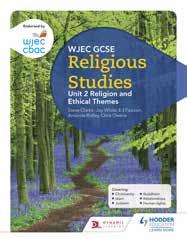
Master the content and understand the assessment requirements with our textbooks for Unit 1 and Unit 2. With clear, detailed coverage of the content and guidance on how to tackle different exam questions, these textbooks will help you to develop and consolidate your knowledge so you can approach your exams with confidence.
Our Unit 1 and Unit 2 Student Books are also available in eTextbook formats and Welsh-language editions.
My Revision Notes Student Books
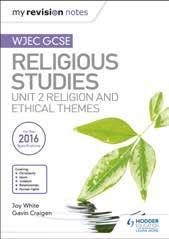
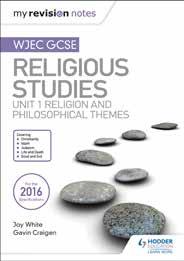
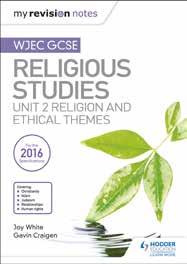
Target success in WJEC GCSE Religious Studies with this proven formula for effective, structured revision; key content coverage is combined with exam-style tasks and practical tips to create revision guides that you can rely on to review, strengthen and test your knowledge.
Unit 1 revision guide
Content covered:
Christianity
Islam
Unit 2 revision guide
Content covered:
Latest Digital Resources for GCSE RS



https://bit.ly/2xRMCG2

Application of Christian Beliefs to Philosophical and Ethical Themes
https://bit.ly/2MSOAvo
https://bit.ly/2I5B4BW
https://bit.ly/2OwpDqh
Additional RS resources might be added in future, please visit :
http://resources.wjec.co.uk/Pages/SearchResources.aspx
Other useful links - GCSE
Relaunched WJEC GCSE RS Google map. Due to the new GDPR regulations our previous very successful map had to be removed. Please complete the questionnaire here if you would be interested in setting up a new map which will allow you to contact other centres to share teaching and learning ideas and resources. - https://docs.google.com/forms/d/e/1FAIpQLSf-B_dwPuiekojBgcQitwfwcR9lWmYsIgI2zdZ0dhBzwc-wQ/viewform
Are you constantly called upon to justify the existence of Religious Studies to learners, parents and even SLT? See below a recent article that explains why RS fully deserves its rightful place on the school curriculum:
Is Religious Studies still relevant to the classroom?
Andrew Pearce and Lynda Maddock, Religious Studies Subject Officers at WJEC discuss why the study of religion should remain a staple part of the curriculum, and that neglecting this subject may lead to fear, ignorance and prejudice.
There appears to be a growing perception that due to increasing secularisation within society and the rapid growth of New Atheism, that Religious Studies is an irrelevant and even outdated subject. Sceptics may argue that it is a subject full of myths such as elephant headed gods saving princesses and should be consigned to history. However, this does the subject, those who teach it and those who study it, a great disservice. Such a narrow approach in a multi-cultural, but also increasingly secular society is dangerous, because a lack of knowledge and understanding about religion can lead to ignorance and prejudice.
The view that Religious Studies is of less importance than other subjects appears to be borne out in a recent report from the National Association of Teacher for Religious Education (NATRE) which suggests that many schools are not recognising the importance of the subject or meeting the legal requirement in terms of curriculum time. Schools at present place a heavy emphasis on STEM subjects (Science, Technology, Engineering and Maths), whilst marginalising other subjects, including Religious Studies. So in the words of those brilliant comics, Monty Python:
"What can Religious Studies do for us?"
The academic benefits of students following Religious Studies courses have been well documented. A Level Religious Studies is recognised as a 'Facilitating Subject' by Russell Group universities, as it develops critical thinking skills amongst students. Through the study of religion, students are encouraged to think critically and it provides them with the skills to develop, analyse and evaluate logical arguments and present these in a variety of formats.
However, the benefits of studying Religious Studies aren't limited to the confines of the classroom; it also encourages students to develop as individuals. It gives students the opportunity to work out what they believe in and question why they do. It allows them to discuss their views on a range of ethical issues, from genetics to warfare. Importantly, it encourages students to empathise with those who hold opposing to different views to their own. According to a GCSE Religious Studies student at Cardiff High School, "Religious Studies allowed me to gain knowledge of other cultures and an understanding and appreciation of many religions that I would not have known about otherwise. It was very interesting to see many people’s viewpoints on life and how we should live it."
Furthermore, a careful distinction needs to be drawn between an increase in secularism in certain societies and an increase generally. The fact remains that two thirds of the world's population adhere
to a religious faith. Indeed, even in the UK, over half of the population claim to hold religious beliefs. To ignore this fact is to ignore a fundamental principle of human existence and the foundation stone on which many people build their lives.
Religion can promote compassion, respect, tolerance, charity and a fairer society. It can offer hope, fellowship and comfort. It can inspire and offer guidance for living life well. Equally though, it can be the cause of profound misery and destruction. It can oppress, marginalise and brutalise. It can justify acts of extreme violence and destroy hope and dignity. A force as powerful as this is ignored at our peril. Pretending it doesn’t exist, or wishing it didn’t, is, at best, naive. A quick glance at a newspaper will convince you of its power and influence.
Students need to fully engage with this subject and understand its complexities and its influence on people’s beliefs, practices, views and attitudes. This is what Religious Studies aims to do - never has it been more important - and it should be given its fair share of curriculum time and resources to deliver it properly. Lack of knowledge of others' beliefs, as history has shown us, can lead to fear and discrimination. Religious Studies is a crucial weapon against this self-fulfilling prophecy. As Lord Evans, a former Head of MI5 recently noted, 'Understanding different religions and world views, and therefore being able to understand the world you’re living in, has got to be helpful in giving people the power to reflect on their own beliefs.'
It is just Religious Instruction isn't it?
Religious Studies is not the same as the Religious Education or even Religious Instruction from years ago. It is not about converting students to a particular religion or getting people to believe this or that. It helps students to develop an understanding that, even if they are not religious themselves, religion has had, and continues to have, a tremendous impact upon the society in which they live. You cannot fully understand history, art, politics, literature, the legal system, music, sport or science, without an appreciation of the role religion plays in each of these areas.
Religious Studies has for many years, encouraged non-religious world views from groups such as secularists, humanists and atheists, to be both heard and evaluated. Wherever you work or live, religion plays a part in people's lives. Surely by giving students the opportunity to study the subject, we empower them to make up their own minds about whether religion is important or not? In the words of a former A level student, Halima Sadia, "In a multicultural society Religious Studies is more important than ever. I believe it can make us better students, better thinkers and ultimately better people."
Image Credits
Cover + Contents pages - Kaaba Mecca - prmustafa / getty images
Cover Logo - Religious Symbols - pop_jop / getty image
Page 5 + 23 - Bible study - Pureradiancephoto / Getty images
Page 6 + 24 - Muslim/MECO images / © Meco (Muslim Education Centre of Oxford) http://www.meco.org.uk/
Page 7 - Lottery Ticket - payphoto / getty images
Page 10 - Female teacher - skynesher / getty images
Page 16 + 35 - Connected technology - Vijay Kumar / getty images
Page 18 + 36 - Religious Symbols - pop_jop / getty image
Page 21 - St.Vitus Cathedral - NiseriN / getty images
Page 25 - Space - pixelparticle / getty images
Page 28 - Heart Love Island - 4FT / getty images