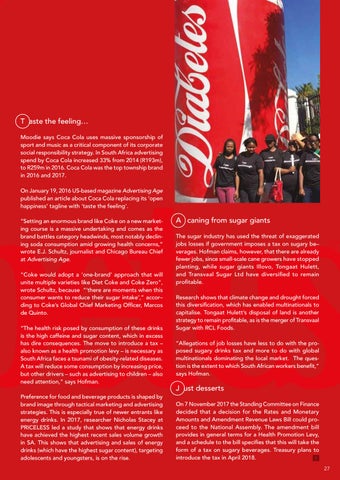
T aste the feeling… Moodie says Coca Cola uses massive sponsorship of sport and music as a critical component of its corporate social responsibility strategy. In South Africa advertising spend by Coca Cola increased 33% from 2014 (R193m), to R259m in 2016. Coca Cola was the top township brand in 2016 and 2017.
betes On January 19, 2016 US-based magazine Advertising Age published an article about Coca Cola replacing its ‘open happiness’ tagline with ‘taste the feeling’.
“Setting an enormous brand like Coke on a new marketing course is a massive undertaking and comes as the brand battles category headwinds, most notably declining soda consumption amid growing health concerns,” wrote E.J. Schultz, journalist and Chicago Bureau Chief at Advertising Age.
“Coke would adopt a ‘one-brand’ approach that will unite multiple varieties like Diet Coke and Coke Zero”, wrote Schultz, because “‘there are moments when this consumer wants to reduce their sugar intake’,” accor– ding to Coke’s Global Chief Marketing Officer, Marcos de Quinto.
“The health risk posed by consumption of these drinks is the high caffeine and sugar content, which in excess has dire consequences. The move to introduce a tax – also known as a health promotion levy – is necessary as South Africa faces a tsunami of obesity-related diseases. A tax will reduce some consumption by increasing price, but other drivers – such as advertising to children – also need attention,” says Hofman. Preference for food and beverage products is shaped by brand image through tactical marketing and advertising strategies. This is especially true of newer entrants like energy drinks. In 2017, researcher Nicholas Stacey at PRICELESS led a study that shows that energy drinks have achieved the highest recent sales volume growth in SA. This shows that advertising and sales of energy drinks (which have the highest sugar content), targeting adolescents and youngsters, is on the rise.
A caning from sugar giants
The sugar industry has used the threat of exaggerated jobs losses if government imposes a tax on sugary be– verages. Hofman claims, however, that there are already fewer jobs, since small-scale cane growers have stopped planting, while sugar giants Illovo, Tongaat Hulett, and Transvaal Sugar Ltd have diversified to remain profitable. Research shows that climate change and drought forced this diversification, which has enabled multinationals to capitalise. Tongaat Hulett’s disposal of land is another strategy to remain profitable, as is the merger of Transvaal Sugar with RCL Foods.
“Allegations of job losses have less to do with the proposed sugary drinks tax and more to do with global multinationals dominating the local market. The question is the extent to which South African workers benefit,” says Hofman.
J ust desserts
On 7 November 2017 the Standing Committee on Finance decided that a decision for the Rates and Monetary Amounts and Amendment Revenue Laws Bill could proceed to the National Assembly. The amendment bill provides in general terms for a Health Promotion Levy, and a schedule to the bill specifies that this will take the form of a tax on sugary beverages. Treasury plans to introduce the tax in April 2018.
27