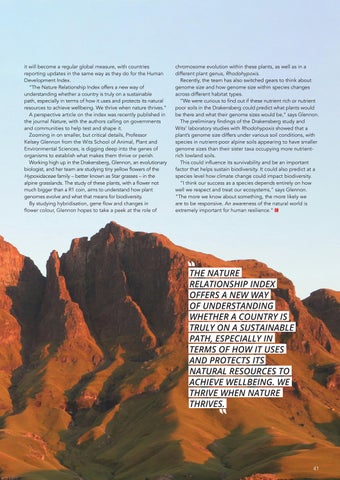
it will become a regular global measure, with countries reporting updates in the same way as they do for the Human Development Index. “The Nature Relationship Index offers a new way of understanding whether a country is truly on a sustainable path, especially in terms of how it uses and protects its natural resources to achieve wellbeing. We thrive when nature thrives.” A perspective article on the index was recently published in the journal Nature, with the authors calling on governments and communities to help test and shape it. Zooming in on smaller, but critical details, Professor Kelsey Glennon from the Wits School of Animal, Plant and Environmental Sciences, is digging deep into the genes of organisms to establish what makes them thrive or perish. Working high up in the Drakensberg, Glennon, an evolutionary biologist, and her team are studying tiny yellow flowers of the Hypoxidaceae family – better known as Star grasses – in the alpine grasslands. The study of these plants, with a flower not much bigger than a R1 coin, aims to understand how plant genomes evolve and what that means for biodiversity. By studying hybridisation, gene flow and changes in flower colour, Glennon hopes to take a peek at the role of
chromosome evolution within these plants, as well as in a different plant genus, Rhodohypoxis. Recently, the team has also switched gears to think about genome size and how genome size within species changes across different habitat types. “We were curious to find out if these nutrient rich or nutrient poor soils in the Drakensberg could predict what plants would be there and what their genome sizes would be,” says Glennon. The preliminary findings of the Drakensberg study and Wits’ laboratory studies with Rhodohypoxis showed that a plant’s genome size differs under various soil conditions, with species in nutrient-poor alpine soils appearing to have smaller genome sizes than their sister taxa occupying more nutrientrich lowland soils. This could influence its survivability and be an important factor that helps sustain biodiversity. It could also predict at a species level how climate change could impact biodiversity. “I think our success as a species depends entirely on how well we respect and treat our ecosystems,” says Glennon. “The more we know about something, the more likely we are to be responsive. An awareness of the natural world is extremely important for human resilience.” C
THE NATURE RELATIONSHIP INDEX OFFERS A NEW WAY OF UNDERSTANDING WHETHER A COUNTRY IS TRULY ON A SUSTAINABLE PATH, ESPECIALLY IN TERMS OF HOW IT USES AND PROTECTS ITS NATURAL RESOURCES TO ACHIEVE WELLBEING. WE THRIVE WHEN NATURE THRIVES.
41