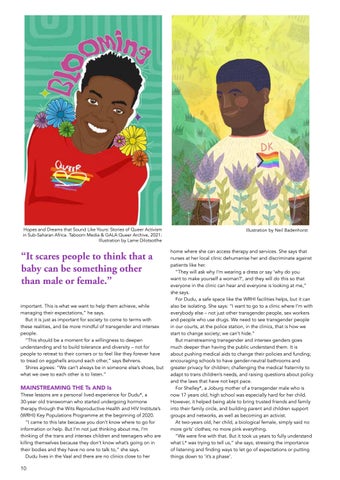
Hopes and Dreams that Sound Like Yours: Stories of Queer Activism in Sub-Saharan Africa. Taboom Media & GALA Queer Archive, 2021: Illustration by Lame Dilotsotlhe
“It scares people to think that a baby can be something other than male or female.” important. This is what we want to help them achieve, while managing their expectations,” he says. But it is just as important for society to come to terms with these realities, and be more mindful of transgender and intersex people. “This should be a moment for a willingness to deepen understanding and to build tolerance and diversity – not for people to retreat to their corners or to feel like they forever have to tread on eggshells around each other,” says Behrens. Shires agrees: “We can’t always be in someone else’s shoes, but what we owe to each other is to listen.”
MAINSTREAMING THE Ts AND Is
These lessons are a personal lived experience for Dudu*, a 30-year old transwoman who started undergoing hormone therapy through the Wits Reproductive Health and HIV Institute’s (WRHI) Key Populations Programme at the beginning of 2020. “I came to this late because you don’t know where to go for information or help. But I’m not just thinking about me, I’m thinking of the trans and intersex children and teenagers who are killing themselves because they don’t know what’s going on in their bodies and they have no one to talk to,” she says. Dudu lives in the Vaal and there are no clinics close to her
10
Illustration by Neil Badenhorst
home where she can access therapy and services. She says that nurses at her local clinic dehumanise her and discriminate against patients like her. “They will ask why I’m wearing a dress or say ‘why do you want to make yourself a woman?’, and they will do this so that everyone in the clinic can hear and everyone is looking at me,” she says. For Dudu, a safe space like the WRHI facilities helps, but it can also be isolating. She says: “I want to go to a clinic where I’m with everybody else – not just other transgender people, sex workers and people who use drugs. We need to see transgender people in our courts, at the police station, in the clinics, that is how we start to change society; we can’t hide.” But mainstreaming transgender and intersex genders goes much deeper than having the public understand them. It is about pushing medical aids to change their policies and funding; encouraging schools to have gender-neutral bathrooms and greater privacy for children; challenging the medical fraternity to adapt to trans children’s needs, and raising questions about policy and the laws that have not kept pace. For Shelley*, a Joburg mother of a transgender male who is now 17 years old, high school was especially hard for her child. However, it helped being able to bring trusted friends and family into their family circle, and building parent and children support groups and networks, as well as becoming an activist. At two-years old, her child, a biological female, simply said no more girls’ clothes; no more pink everything. “We were fine with that. But it took us years to fully understand what L* was trying to tell us,” she says, stressing the importance of listening and finding ways to let go of expectations or putting things down to ‘it’s a phase’.