TECHNICAL PAPERS
TECHNICAL PAPER Wire alloys and their use in electrical resistance furnaces This article reviews a variety of wire alloys that can be used as heating elements for electrical-resistance furnaces, noting which ones make most sense for a given application and why. By James Brocklehurst
This presentation looks at the use of wire alloys in electrical resistance furnaces, but it is fitting to begin by noting that wire-wound electric furnaces have been in commercial use for more than a century and as a concept for nearly two centuries. An article by R.C. Mackenzie in the October 1982 issue of Platinum Metals Review, “The Story of the PlatinumWound Electrical Resistance Furnace,” notes that circa 1815, an Englishman, William Pepys, used soft iron wire powered by a large battery to heat iron and diamond powder to see if he could create steel. Mackenzie also cited Frenchman Georges Charpy, who in 1893 constructed a platinum-wound furnace that was used in studies of annealing and physical properties of brass. By 1894 he had developed a unit that was capable of operating between 500°C and 1300°C. The article also lists William Candler Roberts-Austin as using an iron wire furnace for thermocouple calibration in 1897. In 1899, the team of Holburn and Day were using a unit for the same application that employed nickel wire. Mackenzie attributes the first com-
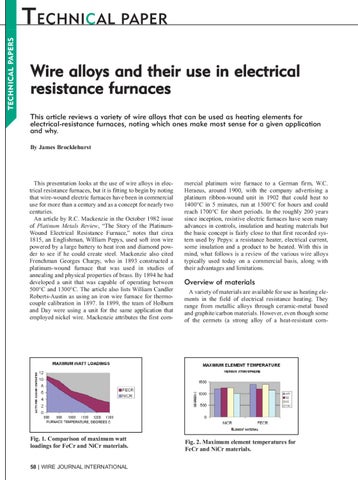
Fig. 1. Comparison of maximum watt loadings for FeCr and NiCr materials.
58 | WIRE JOURNAL INTERNATIONAL
mercial platinum wire furnace to a German firm, W.C. Heraeus, around 1900, with the company advertising a platinum ribbon-wound unit in 1902 that could heat to 1400°C in 5 minutes, run at 1500°C for hours and could reach 1700°C for short periods. In the roughly 200 years since inception, resistive electric furnaces have seen many advances in controls, insulation and heating materials but the basic concept is fairly close to that first recorded system used by Pepys: a resistance heater, electrical current, some insulation and a product to be heated. With this in mind, what follows is a review of the various wire alloys typically used today on a commercial basis, along with their advantages and limitations.
Overview of materials A variety of materials are available for use as heating elements in the field of electrical resistance heating. They range from metallic alloys through ceramic-metal based and graphite/carbon materials. However, even though some of the cermets (a strong alloy of a heat-resistant com-
Fig. 2. Maximum element temperatures for FeCr and NiCr materials.