




Some of the key results contained within this report are set out below:
1. Funding position
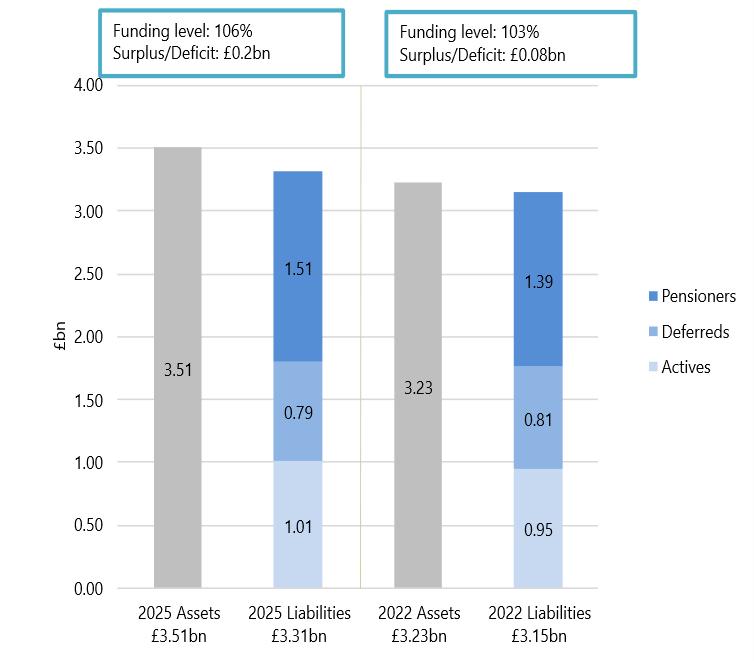
• Using the agreed assumptions, the Fund had a funding position of 106% as at 31 March 2025, which has increased from 103% at the 2022 valuation.
2. Contributions
• Individual employer contributions are set out in Appendix 8 in the Rates and Adjustments Certificate to cover the period from 1 April 2026 to 31 March 2029.
3. Methods and assumptions
• The assumptions are set out in Appendix 2 and we believe they are appropriate for the 31 March 2025 valuation. The key assumptions used are a discount rate assumption of 5.0% p.a. and a CPI inflation assumption of 2.7% p.a.
•Inflation experience has been significant since the 2022 valuation, with pension increases of 10.1% in 2023 and 6.7% in 2024, increasing the liabilities.
4. Investment performance
• Investment returns have been volatile since the previous valuation. Overall, Fund returns were lower than the discount rate set at 2022, resulting in a lower funding level at 2025. An increase in future anticipated investment returns net of inflation (i.e. an increase in the real discount rate) has improved the funding level.
5. Regulatory developments
• There have been a number of important regulatory developments since the 2022 valuation which have impacted the valuation including McCloud, Climate risk and the additional reporting requirements on Gender Pensions Gap.
• Details of how we have approached each development, as well as any relevant outcomes, is detailed in this report.
The funding position and resulting contributions are based on assumptions about future factors such as investment returns, inflation and life expectancy. As these are uncertain, different assumptions and funding parameters are used by each LGPS fund to reflect their own views, circumstances and strategic objectives. These differences (amongst other factors including crucially the previous funding level and employer short and long-term affordability) will lead to differences in funding positions and contributions across LGPS funds.
To support comparison, LGPS funds are required to report a funding position on a consistent set of assumptions (called the “SAB funding level”). The Fund’s SAB funding level at 31 March 2025 is 107%
IMPORTANT NOTE: the SAB assumptions are to allow comparison only, they are not intended to be appropriate for funding purposes or setting contribution rates.

We have been asked by Wiltshire Council, the administering authority for the Wiltshire Pension Fund (the Fund), to carry out an actuarial valuation of the Fund as at 31 March 2025. The Fund is part of the Local Government Pension Scheme (LGPS), a defined benefit statutory scheme administered in accordance with the Local Government Pension Scheme Regulations 2013 (the Regulations) as amended.
The purpose of the valuation is to review the financial position of the Fund and to set appropriate contribution rates for each employer in the Fund for the period from 1 April 2026 to 31 March 2029 as required under Regulation 62 of the Regulations.
This report is provided further to earlier advice dated 6 October 2025 which sets out the background to the valuation and explained the underlying methods and assumptions derivation.
We would be pleased to discuss any aspect of this report in more detail.
This advice is provided in our capacity as Fund Actuary.
This report summarises the results of the valuation and is addressed to the administering authority of the Fund. It is not intended to assist any user other than the administering authority in making decisions or for any other purpose and neither we nor Barnett Waddingham LLP accept liability to third parties in relation to this advice.
This advice complies with Technical Actuarial Standards (TASs) issued by the Financial Reporting Council – in particular TAS 100: General Actuarial Standards and TAS 300: Pensions.
The contribution rates consist of two elements, the primary rate and the secondary rate:
• The primary rate for each employer is the employer’s future service contribution rate (i.e. the rate required to meet the cost of future accrual of benefits) expressed as a percentage of pay.
• The secondary rate is an adjustment to the primary rate to arrive at the total rate each employer is required to pay (for example, to allow for deficit recovery) over a specified “recovery period”. The secondary rate may be expressed as a percentage of pay or a monetary amount.
Regulation 62 specifies four requirements that the actuary “must have regard” to:
1 The existing and prospective liabilities arising from circumstances common to all those bodies
2 The desirability of maintaining as nearly a constant a primary rate as possible
3 The current version of the administering authority’s Funding Strategy Statement (FSS)
4 The requirement to secure the “solvency” of the pension fund and the “longterm cost efficiency” of the Scheme, so far as relating to the pension fund
The wording of the second objective is not ideal in that it appears to be aimed towards the primary rate rather than taking into account the surplus or deficit of the employer. We believe that if we achieve reasonably stable total individual employer rates (which seems like a preferable objective) then we will also meet the regulatory aim.
The FSS guidance includes further details in the glossary, as follows:
• “solvency” means contributions should be set at “such a level as to ensure that the scheme’s liabilities can be met as they arise”. It is not regarded that this means that the pension fund should be 100% funded at all times, and
• “long-term cost efficiency” means that contributions must not be set at a level that gives rise to additional costs. The contributions set will be deemed to ensure long-term cost efficiency if the rate of employer contributions is sufficient to make provision for the cost of current benefit accrual, with an appropriate adjustment to that rate for any surplus or deficit in the fund.
The recovery period for individual employers varies across the Fund. The administering authority’s approach to setting recovery periods is set out in the FSS. Where there is a surplus, this may also be reflected in contribution rates in line with the Fund’s FSS.
• The follow up assumptions paper dated 25 November 2025 confirming the agreed actuarial assumptions following the meeting of 9 October 2025.
• The climate analysis report dated 6 October 2025 which considers climate risk in the context of the Fund’s 2025 actuarial valuation. It considers whether the 2025 valuation funding strategy is sufficiently robust in the context of this climate scenario analysis and any potential contribution impacts.
• The FSS which will confirm the approach in setting employer contributions.
Note that not all of these documents may be in the public domain and may be restricted to the administering authority which has no obligation to share them with any third parties.
The primary and secondary rate of the individual employer contributions payable are set out in the Rates and Adjustments Certificate in Appendix 8. These will differ from the whole Fund primary rate and differ from each other, as they are either based on the employer’s own membership and experience or they are the employer’s share of the contributions payable within a pool of employers.
We have considered these four requirements when providing our advice and choosing the method and assumptions used.
A number of reports and discussions have taken place with the administering authority and, where required, its investment advisors before agreeing the assumptions to calculate the results and set contribution rates. In particular:
• The indicative assumptions report dated 7 April 2025 provides information on the background to the method and derivation of the assumptions
• The initial results report dated 6 October 2025 provides information and results on a whole fund basis as well as background to the method and derivation of the agreed assumptions.
• The longevity assumptions advice paper dated 6 October 2025.
The Fund’s FSS has been reviewed in collaboration with the administering authority to ensure that it is consistent with this approach. The FSS complies with the updated FSS guidance published in January 2025 by the Scheme Advisory Board’s Compliance and Reporting Committee, the Chartered Institute of Public Finance and Accountancy (CIPFA) and the Ministry of Housing, Communities and Local Government (MHCLG).
We confirm that in our opinion the agreed assumptions are appropriate for the purpose of the valuation. The assumptions in full are set out in Appendix 2.
To calculate the value of the liabilities, we estimate the future cashflows which will be made to and from the Fund throughout the future lifetime of existing active members, deferred benefit members, pensioners and their dependants.
We estimate the total value of these projected benefit cashflows as at 31 March 2025, using the membership data and past service at 31 March 2025 and the assumptions set out in Appendix 2, to be c.£9.5bn.
We then discount these projected cashflows using the discount rate assumption which is essentially a calculation of the amount of money which, if invested now, would be sufficient together with the income and growth in the accumulating assets to make these payments in future, using our assumption about investment returns adjusted by the administering authority’s chosen level of prudence (as measured by the chosen success probability).
This amount is called the present value (or, more simply, the value) of members’ benefits. Separate calculations are made in respect of benefits arising in relation to membership before the valuation date (past service) and for membership after the valuation date (future service).
To produce the future cashflows or liabilities and their present value we need to formulate assumptions about the factors affecting the Fund's future finances such as inflation, salary increases, investment returns, rates of mortality and staff
We have been provided with Fund accounts for each of the three years to 31 March 2025.
The market asset valuation as at 31 March 2025 was £3.46bn. Please note that this excludes members’ additional voluntary contributions (AVCs).
For the purposes of the valuation, we use a smoothed value of the assets rather than the market value. The financial assumptions that we use in valuing the liabilities are smoothed around the valuation date so that the market conditions used are the average of the daily observations over the period 1 January 2025 to 30 June 2025. Therefore, we value the assets in a consistent way and apply the same smoothing adjustment to the market value of the assets.
The smoothed asset valuation as at 31 March 2025 was £3.51bn. This was based on a smoothing adjustment of 101.6%,

The Fund’s long-term investment strategy has been taken into consideration in the derivation of the discount rate assumption. The investment strategy is set out in the Fund’s Investment Strategy Statement (ISS) that is available on the Fund’s
A comparison is made of the value of the existing assets with the value of the accrued liabilities. If there are more assets than liabilities, then there is a surplus. If the converse applies there is a deficit.
Using the assumptions summarised in Appendix 2, the funding position is set out in the graph to the right. This shows the funding position of the Fund at the current and previous valuation dates.
There was a surplus of £199m in the Fund at the valuation date, corresponding to a funding level of 106%.
Previous valuation results
The previous valuation was carried out as at 31 March 2022 by Hymans Robertson. The results are summarised in the valuation report dated 31 March 2023 and reported a surplus of £81.4m and a funding position of 103%.
Using the assumptions summarised in Appendix 2, the resulting average primary rate across the whole Fund is set out in the table below (after allowing for member contributions). This includes a comparison to the primary rate at the previous valuation.
The primary rate for the whole Fund is the weighted average (by Pensionable Pay) of the individual employers’ primary rates.

Active members pay contributions to the Fund in line with the rates required under the Regulations.
Please note that expenses are allowed for in the derivation of the discount rate and therefore we make no explicit allowance in the primary rate for expenses.
In Appendix 8 we also disclose the sum of the secondary rates for the whole Fund for each of the three years beginning 1 April 2026.
Based on the assumptions as set out in Appendix 2 and the contributions certified and set out in Appendix 8, we estimate that the funding position of the whole Fund will be 107% by 31 March 2028, the next valuation date. This projection is based on the assumptions made for this valuation and contributions being paid at the agreed amounts. This projection does not allow for any actual experience since 31 March 2025 nor any other risks or uncertainties. Some of these additional risks are set out later in this report and in Appendix 3.
Following the funding valuation, a “Section 13” report (prepared under Section 13 of the Public Service Pensions Act 2013) will be prepared to report on whether the following aims are achieved: compliance, consistency, solvency and long-term cost efficiency, and to identify any funds that cause concerns.
As part of our calculations we have considered the results on a standardised basis as set by the Scheme Advisory Board (SAB). We are required to provide the SAB with the results for the Fund for comparison purposes.
The standardised basis is set using assumptions advice from the Government Actuary’s Department (GAD) with some of the assumptions used being set locally (such as mortality) and some are set at Scheme level (including all the financial assumptions). It is not used to set contributions as it does not reflect the Fund’s investment strategy or the administering authority’s attitude to risk; contributions are set using the funding basis.
For the Wiltshire Pension Fund, the funding level on the local funding basis is 106% and the funding level on the SAB basis is 107%. We want to note that, as requested by the Government Actuary’s Department, the SAB funding level includes the 2026 pension increase award (i.e. includes an allowance for known CPI inflation to September 2025), whereas the local basis includes known CPI inflation to 31 March 2025 only. The funding position on the SAB basis would be around 1% lower if we did not make allowance for the additional CPI inflation.
The results on the standardised basis as at 31 March 2025 are set out in the dashboard in Appendix 7. The dashboard should assist readers in comparing LGPS valuation reports and the information will be used by GAD in their “Section 13” report.
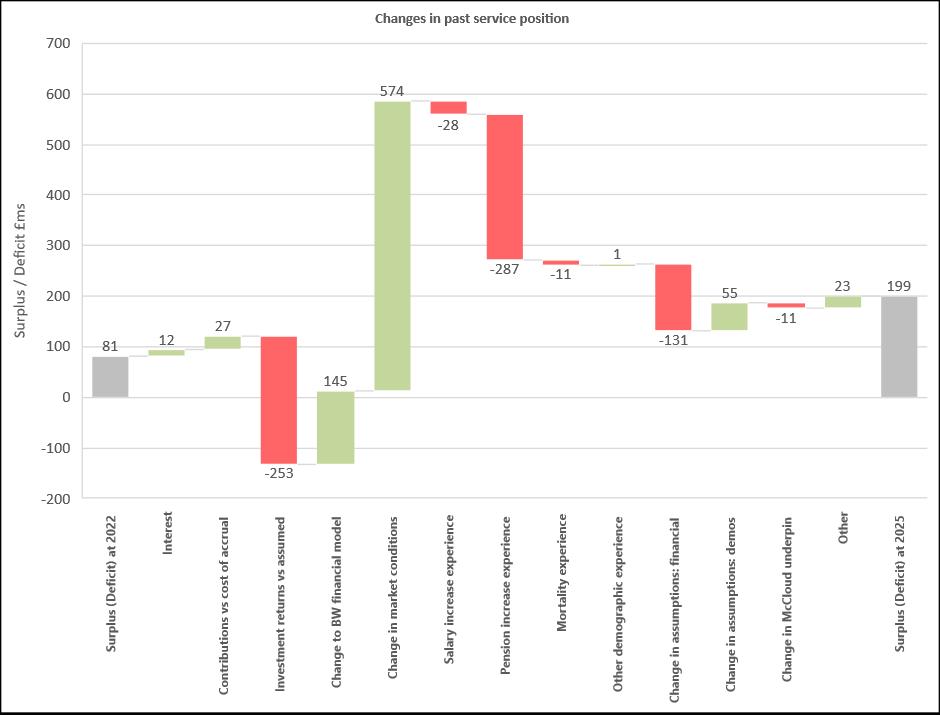
The previous valuation revealed a surplus of £81.4m compared to the surplus of £199m at the 2025 valuation. The key factors that have influenced the funding level of the Fund over the period are illustrated in the chart below.
We have the following comments on the Fund results:
• Changes in market conditions has increased the Fund surplus by approximately £574m
• Lower than expected investment returns has reduced the Fund surplus by approximately £253m
• Higher inflation than assumed has reduced the surplus by approximately £287m
• The increase in Fund liability on the ongoing basis due to allowing for the McCloud ruling is £11m
The previous valuation resulted in a whole Fund primary rate of 22.2% of pensionable pay compared to the whole Fund primary rate of 16.5% of pensionable pay at the 2025 valuation. The reasons for the change in the primary rate are set out in the reconciliation chart below.
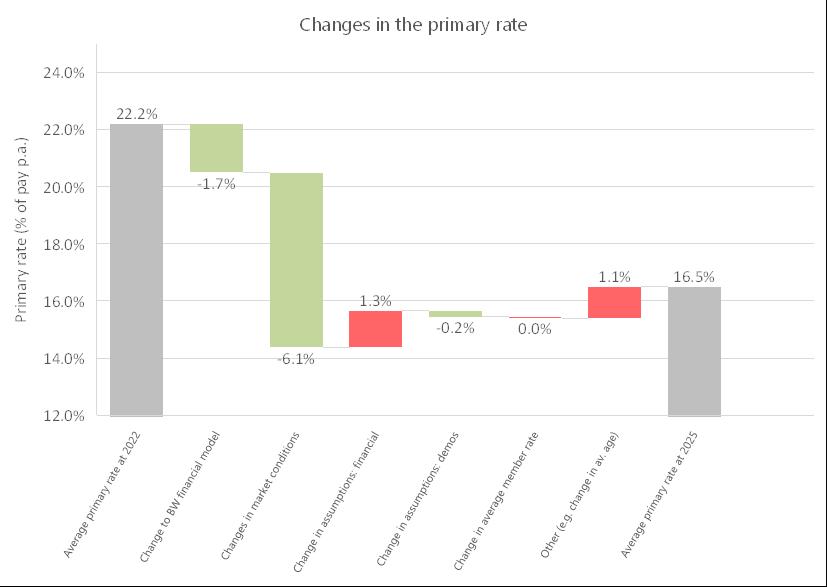
Please note, 16.5% is the primary rate for the whole fund using the 2025 ongoing funding basis. The weighted average of the primary rates for all employers that participate in the Fund is 16.6%. This is due to a different discount rate assumption being used for contractors and tier 3 employers who do not have a guarantor. Information on the discount rates used is provided in Appendix 2 and a full list of the primary rates by employer is provided in Appendix 8. More information on how contribution rates are calculated can be found in the Fund’s Funding Strategy Statement.
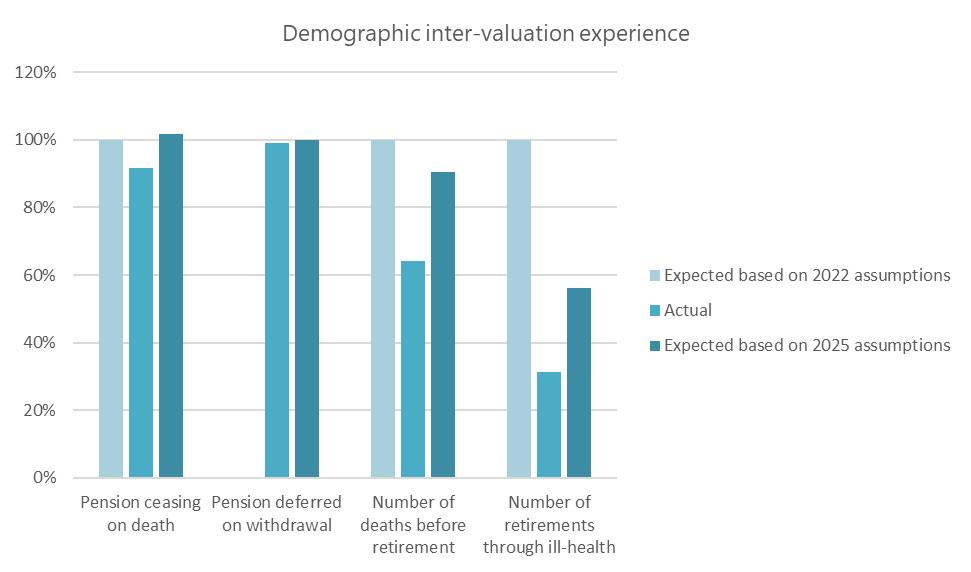
A comparison of the actual demographic experience of members of the Fund over the intervaluation period, with that assumed by the assumptions adopted at the last valuation in 2022 is shown in the graph below. The graph also shows how the assumptions adopted for this valuation would have compared with those adopted at 2022
We have not been able to compare the 2022 withdrawal assumption with the 2025 assumption because the withdrawal rates for 2022 were incidence rates expressed as a proportion of membership, whereas the 2025 assumption is based on liability-weighted incidence rates. As a result, the resulting expected withdrawal patterns are not directly comparable. For the purposes of the illustrations below, the actual withdrawal experience of members of the Fund over the intervaluation period, have been compared with the assumptions adopted at the 2025 valuation.
Please note that the 2022 assumptions were set by the previous Fund Actuary, Hymans Robertson.
The results set out in this report are based on a particular set of assumptions. The actual cost of providing the benefits will depend on the actual experience, which could be significantly better or worse than assumed. The sensitivity of the results to some of the key assumptions is set out in the table below.
The figures in the table are shown relative to the surplus of £199m and funding level of 106% on the agreed funding basis as at 31 March 2025.
The calculated primary rate required to fund benefits as they are earned from year to year will also be affected by the particular set of assumptions chosen. The sensitivity of the primary rate to changes in some key assumptions is shown below. Please note that the primary rate set out below does not include any adjustment via the secondary rate. The total contribution rate payable by employers will be a combination of the primary rate and a secondary rate adjustment, further details can be found in Appendix 8.
The figures in the table are shown relative to the whole Fund primary rate of 16.5% of Pensionable Pay on the agreed funding basis as at 31 March 2025.
2025 sensitivity analysis of primary rate
The assumptions used for the valuation have been documented in a revised Funding Strategy Statement agreed between the Fund Actuary and the administering authority.
There are many factors that affect the Fund’s funding position and could lead to the Fund’s funding objectives not being met within the timescales expected. Some of the key risks that could have a material impact on the Fund are:
• Employer covenant risk
• Investment risk
• Inflation risk
• Mortality risk
• Member options risk
• Regulatory risk
• Climate risk
The sensitivity of the funding results to some of these risks was set out in the sensitivities section of this report. Please note that this is not an exhaustive list. Further information on these risks and more can be found in our initial results report and will be set out in greater detail in the FSS.
Our funding model is designed to help withstand short-term volatility in markets as it is a longer-term model. We use smoothed assumptions over a six-month period with the ultimate aim of setting stable contributions for employers. The valuation approach and assumptions are not based on gilt yields and the discount rate is derived from the long-term future expected returns on each asset class with a deduction for uncertainty and risk (our prudence adjustment).
We have considered whether there are any developments since 31 March 2025 that are significant enough to review our approach. At this stage, we do not feel that the anticipated effect on the long-term funding position of any market movements is significant enough to revise our approach.
Nevertheless, due to the ongoing uncertainty around the shorter-term impact of these issues, we have considered these issues with the administering authority in setting the employer contribution rates to ensure that contributions into the Fund remain appropriate.
We will continue to monitor the Fund’s funding position and raise any individual employer cases with the Fund that we consider need any special attention. The impact of these events will be fully considered as part of the 2028 valuation when we revisit employer contributions.
The next formal valuation is due to be carried out as at 31 March 2028 however we would recommend that the financial position of the Fund is monitored regularly during the period leading up to the next formal valuation.
The primary and secondary contributions payable by each employer have been set out in Appendix 8 in the Rates and Adjustments Certificate in accordance with Regulation 62 of the Regulations and cover the period from 1 April 2026 to 31 March 2029. In this certificate no allowance will be made for additional costs arising which need to be met by additional contributions by the employer such as non-ill health early retirements.
The contributions in the Rates and Adjustments Certificate are set so that each employer’s assets (including future contributions) are projected to be sufficient to cover the benefit payments for their members, on the assumptions set out in this report. Where there is currently a deficit for an individual employer, recovery of this deficit is targeted in line with the Fund’s FSS and all employers are projected to be fully funded after a recovery period length of no more than 11 years from 1 April 2026.
This document has been agreed between the administering authority and the Fund Actuary. Contributions have been set which in our opinion meet the regulatory requirements and the funding objectives set out in the Fund’s FSS.
This report must be made available to members on request.
Lucy Byrne FIA Partner
Senior Consulting Actuary

The membership data has been provided to us by the administrators of the Fund. We have relied on information supplied by the administrator and the administering authority being accurate. The membership data has been checked for reasonableness and we have compared the membership data with information in the Fund’s accounts. The numbers in the tables below relate to the number of records and so will include members in receipt of, or potentially in receipt of, more than one benefit.
Any missing or inconsistent data has been queried with the Fund and estimated where necessary. Whilst this should not be seen as a full audit of the data, we are happy that the data is sufficiently accurate for the purposes of the valuation.
Changes to the data were summarised in the 2025 valuation member data processing and estimating report dated 1 October 2025 which was provided to the Fund. Whilst this should not be seen as a full audit of the data, we are happy that the data is sufficiently accurate for the purposes of the valuation.
Full details of the benefits being valued are set out in the Regulations as amended and summarised on the LGPS website (https://www.lgpsmember.org/). We have made no allowance for discretionary benefits.
A summary of the membership data used in the valuation is as follows. The membership data from the previous valuation is also shown for comparison. Please note that the average ages shown for 2025 are weighted by salary for active members and by pension for deferred and pensioner/dependant members. The comparative average ages shown for 2022 are weighted by liability. The change in approach to show average ages weighted by salary/pension was made so to remove the dependency on the basis used for the liability calculation. Liability weighted average ages available on request.
In the table below we have set out the number of members who are assumed to reach retirement age over the period from 1 April 2025 to 31 March 2029 as required under the Regulations.
Members may retire for a number of reasons including reaching normal retirement age, retiring through ill-health or redundancy. The amounts set out in the table below are the new retirement benefit amounts, as at the current valuation date that are assumed to come into payment in each of the intervaluation years.
Projected new benefits
The projected retirements set out above assume that all members above the age of 75, or older than the latest tranche normal retirement age will immediately retire, and therefore there is a greater number of retirements expected in year 1 compared to subsequent years.
As with the previous valuation, we have assumed that the Fund will pay limited increases for members that have reached State Pension Age (SPA) by 6 April 2016, with the Government providing the remainder of the inflationary increase. For members that reach SPA after this date, we have assumed that the Fund will be required to pay the entire inflationary increase. We are comfortable that our approach is consistent with the consultation outcome.
A summary of the assumptions adopted for the valuation at 31 March 2025 and as at 31 March 2022 is set out below. Assumptions
(p.a.)
Pension increases on GMP Funds will pay limited increases for members reaching SPA by 6 April 2016, and full increases for others
Demographic assumptions
Post-retirement mortality
Actives and deferreds (pre-retirement mortality)
of GAD for males/females
Actives and deferreds (post-retirement mortality) As for current pensioner assumptions As for current pensioner assumptions
Future improvements
Retirement assumption Weighted average
Pre-retirement decrements
Weighted average
GAD 2020 scheme val: no salary scale, 50% multiplier to illhealth rates Rates as set out in the 2022 valuation report
50:50 assumption Member data
Commutation
Family statistics
% with qualifying dependant
of max
(M) / 65% (F)
1.0% of members (uniformly distributed across the age, service and salary range)
of max
A varying proportion of members are assumed to have a dependant at retirement or on earlier death
The following tables set out some sample rates of the demographic assumptions used in the calculations. These sample rates are based on those set by the Government Actuary’s Department (GAD) based on analysis of the Local Government Pension Scheme (LGPS) in England and Wales.
A small proportion of members are assumed to retire early due to ill health. In the table below we set out an extract of some sample rates from the GAD tables used:
The proportion of ill-health early retirements falling into each tier category has been assumed to be as follows for both males and females:
Please note the above rates are the raw decrements as set by GAD. Our assumption is that there will be 50% of the number of ill-health retirements assumed by GAD.
A small number of members are assumed to die before reaching retirement age. In the table below we set out an extract of some sample rates from the GAD tables used:
This assumption is regarding active members who leave service to move to deferred member status. Active members are assumed to leave service at the following sample rates:
Please note the above rates are the raw decrements as set by GAD. We have applied a 115%/120% multiplier to the rates assumed by GAD.
There are currently a few important regulatory uncertainties surrounding the 2025 valuation as follows:
• Long-term impact of the McCloud and Sargeant cases;
• Cost management reviews which could affect future and historic LGPS benefits;
• Virgin Media case;
• Gender Pensions Gap reporting; and
• Climate change risks and opportunities;
Although it is unclear what impact these uncertainties will have on the future benefits of individual members, we have considered these issues in the assumptions used to set the contribution rates for employers.
At the 2022 valuation we estimated the impact of the McCloud ruling for each active member based on the membership data available. This included looking back at historic valuation data to estimate a payroll history for each member which was then used to determine the equivalent service accrued in the final salary scheme had it not been discontinued. Due to the lack of sufficient data as well as direction from the Ministry of Housing, Communities and Local Government (MHCLG), no estimates were made for deferred and pensioner members.
The LGPS McCloud remedy regulations became law on 1 October 2023. Since the 2022 valuation Funds have been collecting additional data for each member to allow for a more data-driven approach at the 2025 valuation which relies less on actuarial and data estimates.
As part of the 2025 valuation, we calculated each member’s liabilities which includes an allowance for the McCloud underpin for eligible members as determined by the remedy regulations. The liabilities calculated as part of the 2025 valuation reflects the fact that eligible members may receive a pension uplift at retirement if their benefits would have been higher had they continued to accrue service in the discontinued final salary scheme until 31 March 2022.
There still remains uncertainty over the long-term effects of the McCloud judgment but where data has been available, we have been able to estimate the impact of McCloud on individual employers and funding positions and contributions have been set accordingly.
Further cost control and cost management reviews will be carried out and may lead to future benefit changes. However, as the aim of this monitoring is to keep the cost of benefits within an affordable range, we can be relatively comfortable that future reviews will not have a significant impact on the value we placed on the liabilities and so did not make any explicit allowance for these.
This issue relates to a case where missing actuarial certification resulted in historic benefit changes being void. The Department for Work and Pensions (DWP) published an announcement on 5 June 2025 noting the plan to introduce new legislation in response to the Virgin Media vs NTL Trustees ruling. The legislation will allow affected pension schemes to retrospectively obtain written actuarial confirmation that historic changes to scheme rules met the required standards.
The new legislation is hoped to provide clarity to affected schemes, we have therefore assumed that there will be no impact on the LGPS as a result of the ruling.
On 15 May 2025, Government launched a consultation on changes to the Local Government Pension Scheme (LGPS) in England and Wales. The proposed changes are intended to improve fairness in and access to the LGPS. The proposals include addressing survivor pensions and deaths grants and addressing the Gender Pension Gap in the LGPS
As required under the LGPS Regulations 2013, we have reported on the gender pensions gap within the fund. The reporting approach, including derivation of statistics, is consistent with the guidance ‘2025 Fund Valuations: Guidance for Gender Pension Gap reporting’ dated 2 February 2026 except for:
For the purpose of this analysis, we have relied upon the membership data provided by the Fund for the purpose of the 2025 actuarial valuation
The Gender Pensions Gap (GPG) is calculated as:
The GPG is expressed as a percentage. For example, a GPG of 10% indicates that, on average within the population analysed, for every £1 of pension accrued by males, females will have accrued £0.90.
The results in this section set out the analysis for members who were active at 31 March 2025.
Please note that the number of active members in the table below will differ from the total number of active records as set out in Appendix 1, as in the Gender pension gap (GPG) analysis we have treated members with multiple records as a single member.
At overall fund level, the gender pensions gap (GPG) for active members of the Fund is 35%. Further detail is set out in the table below.
Gender pension gap for active members
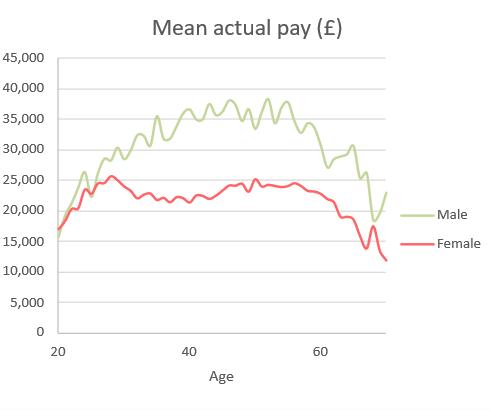
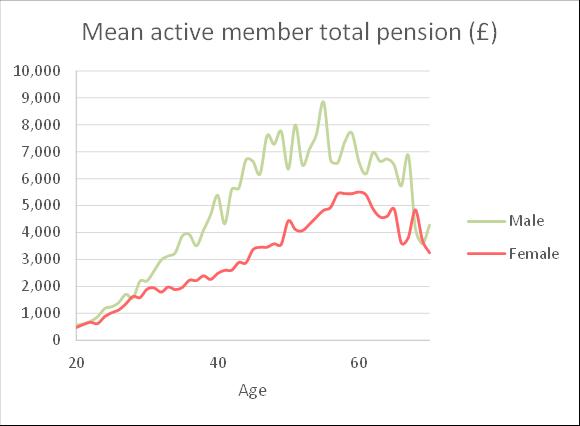
A chart of mean pensionable pay for males and females by age and a chart of mean total pension by age is shown below
In line with the Guidance, analysis at employer category level is set out below.
Local authorities and connected bodies (SF3 number 1)
GPG for local authorities and connected bodies
All local authority maintained schools have been aggregated with their corresponding local authority for the purposes of this analysis.
Centrally funded public sector bodies excluding academies (SF3 number 2, local authority indicator 1)
GPG for centrally funded public sector bodies (exc. academies)
Academies (SF3 number 2, local authority indicator 2)
GPG for academies
Other public sector bodies (SF3 number 3)
The Fund has a single employer in this category, represented by only one member. As a result, the figures have been excluded from the GPG reporting.
Private/voluntary/other bodies (SF3 number 4)
GPG for other private/voluntary/other bodies
The GPG for pensioner members of the Fund is 54%. Further detail is set out in the table below.
Gender pension gap for pensioner members
A chart of mean total pension for males and females by age is shown below.
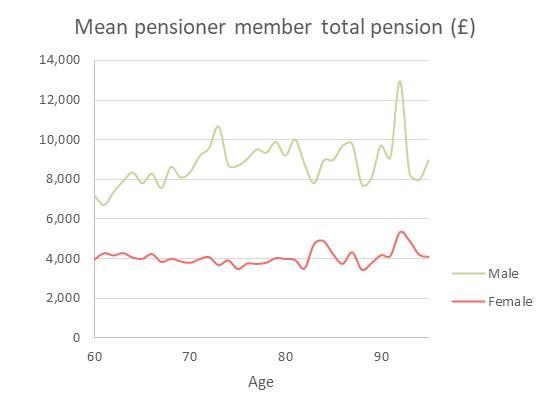
Please note that the number of members in the table above will differ from the total number of records as set out in Appendix 1, as in the analysis we have treated members with multiple records as a single member.
Climate risk is an important consideration for the 2025 valuation. We have carried out scenario analysis on the assets and liabilities of the Fund in-line with the Key Principles drafted by the four actuarial firms who advise the LGPS funds and agreed with the Government Actuary’s Department (GAD) for the purpose of the 2025 LGPS valuations in England and Wales. Further information can be found on the climate scenario analysis report dated 6 October 2025.
We have also considered the requirements under the Occupational Pension Schemes (Climate Change Governance and Reporting) Regulations 2021 although these regulations do not apply to the LGPS. This is because we anticipate that the equivalent regulations that could ultimately apply to the LGPS will contain similar requirements.
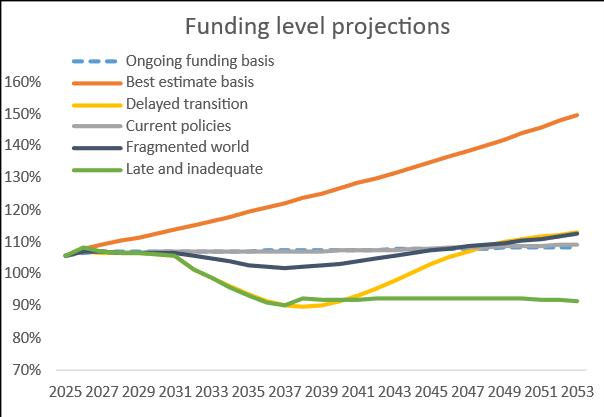
The analysis considered the projected funding level under various climate-related scenarios, alongside the agreed 2025 valuation basis for the Fund. The results thereby allow the administering authority to consider whether the 2025 valuation funding strategy is sufficiently robust in the context of this climate scenario analysis and any potential contribution impacts.
The climate scenarios within Barnett Waddingham’s in-house climate scenario framework include three climate scenarios which have been provided by Moody’s Analytics and are broadly based on scenarios from the Network for Greening the Financial System (NGFS). A brief description of these scenarios is set out below:
1 Base case – we have assumed the Fund’s best estimate funding basis as the base case scenario. All other scenarios are considered relative to this base case, using the relative difference in returns and financial assumptions between Moody’s own base case, and each climate scenario.
2 Delayed transition – additional policy implementation is delayed until 2030. Stronger policies are required (versus a scenario whereby policy implementation is not delayed), such as a higher effective carbon price, in
order to limit global temperature rises to below 2.0oc.
3 Current policies – no new climate policies are introduced beyond the current policies in place, resulting in a lower effective carbon price, but also a growing concentration of greenhouse gas emissions and a larger increase in global temperatures, relative to a transition scenario.
4 Fragmented world – additional policy implementation is delayed and diverges globally. Those countries with net-zero targets are assumed to meet c.80% of their target, whilst those without follow current policies.
5 Late and inadequate action – this scenario has been created by Barnett Waddingham, and takes the highest negative return impact, on an annual basis, across the other three scenarios. The scenario is assumed to exhibit a mixture of characteristics from the above scenarios (i.e. delayed transition and high temperature rises).
The impact on the funding position of each scenario is considered in the graph below.
Our quantitative analysis does not consider the impact of many risks associated with climate change due to the current lack of robust data. Examples include certain investment risks and a degree of inflation risk (we believe these are quantified within the model to some extent, but not fully), litigation risk, political risk and geopolitical risk. Furthermore, it is widely believed that climate scenarios fail to exhaustively model transition and physical risks and the impact of tipping points is not included in the data.
Climate scenario modelling is in its infancy and is expected to undergo significant development over time and data quality is generally considered spurious. We intend to develop and build upon this analysis over time as data quality and availability improves. Our analysis recognises these limitations and has addressed them by combining the quantitative and qualitative analyses in the comprehensive report dated 6 October 2025
The triennial actuarial valuation is a significant exercise carried out by the Fund. This report is a summary of the main outputs from the triennial actuarial valuation. The outputs are the result of funding strategy analysis, discussions and Fund decisions throughout the valuation process. A high-level audit trail of the key funding strategy decisions is set out below.
The actuarial assumptions were reviewed by the Fund in Summer 2025, supported by analytics and other information from the Fund Actuary. The assumptions, including the level of prudence, were set out in a paper dated 6 October 2025 and agreed by the Fund at the Pension Committee meeting in 9 October 2025
The funding strategy parameters, including management of surpluses (where present) and prudence levels, which feed into the setting of employer contribution rates, were reviewed by the Fund and agreed in November 2025.
Other aspects of the funding strategy, including the approach to cessation valuations, exit credits, bulk transfers and new employers, were reviewed in November/December 2025
The outcomes of these decisions were collated and documented in an updated copy of the Funding Strategy Statement. The draft FSS was discussed at the 18 December 2025 Pension Committee meeting. The final version was agreed at the 26 February 2026 Pension Committee meeting.
In addition, the Fund has engaged with employers and the Local Pension Board throughout the valuation exercise. A summary of the engagement is detailed below.
• Employers newsletters which were issued in February 2025, April 2025, July 2025, October 2025 and January 2026 providing updates on the progress of the valuation.
• A dedicated webpage on the employer site, regularly updated throughout the process with the latest developments.
• Employer forum: the employers forum on 27 November 2025 discussed the key themes of the 2025 valuation and gave employers the opportunity to discuss their results with the Fund and Fund Actuary.
• Employer results: a results schedule setting out their 2025 valuation funding position and proposed contribution rate was issued to relevant employers in November 2025. Employers were then offered the opportunity to engage with the Fund to discuss their results The Fund Actuary also held pre‑result meetings and follow‑up discussions with a range of employers.
• Funding Strategy Statement (FSS) consultation: a draft version of the FSS was issued to employers in November 2025 with the opportunity to feed back comments or ask questions to the Fund by 14 December 2025
• FSS webinar shared with employers in November 2025 to aid their understanding of the FSS consultation and considerations when responding. A separate consultation process was held specifically with the academies to focus on the proposal to form a single academy pool at the 2025 valuation. This included a webinar and newsletters explaining the proposals, with the opportunity to ask questions of the Fund Actuary.
Surplus Methodology (Explicit contribution stabilisation mechanism; surplus spreading period; surplus buffer and surplus spreading period; Volatility asset reserve and surplus spreading period; other; or N/A) Drop down
methodology & parameters explanation (including changes since previous valuation)
Less than 110% funded –stepping down to new primary rate over intervaluation period More than 110% funded –stepping down to new total contribution rate below primary rate allowing for excess surplus (above the funding target) to be paid back over a period which mirrors the length of
period
In accordance with Regulation 62 of the Local Government Pension Scheme Regulations we have made an assessment of the contributions that should be paid into the Fund by participating employers for the period 1 April 2026 to 31 March 2029.
The method and assumptions used to calculate the contributions set out in the Rates and Adjustments Certificate are detailed in the Funding Strategy Statement and in Appendix 2 of this report.
The primary rate of contribution as defined by Regulation 62(5) for each employer for the period 1 April 2026 to 31 March 2029 is set out in the table overleaf. The primary rate is the employer’s contribution towards the cost of benefits accruing in each of the three years beginning 1 April 2026. In addition, each employer pays a secondary contribution as required under Regulation 62(7) that when combined with the primary rate results in the minimum total contributions as set out below. This secondary rate is based on their particular circumstances and so individual adjustments are made for each employer.
The primary rate for the Fund is the weighted average (by payroll) of the individual employers’ primary rates and is 16.6% p.a. of payroll.
The secondary rates across the entire Fund (as a percentage of projected Pensionable Pay and as a monetary amount) in each of the three years in the period 1 April 2026 to 31 March 2029 is set out in the table below.
Secondary contributions
2026/27 2027/28 2028/29
These amounts reflect the individual employers’ recovery plans.
Employers may pay further amounts at any time and future periodic contributions, or the timing of contributions, may be adjusted on a basis approved by us as the Fund Actuary. The administering authority, with the advice from us as the Fund Actuary may allow some or all of these contributions to be treated as a prepayment and offset against future certified contributions.
The certified contributions include an allowance for expenses and the expected cost of lump sum death benefits but exclude early retirement strain and augmentation costs which are payable by participating employers in addition.
The monetary amounts are payable in 12 monthly instalments throughout the relevant year unless agreed by the administering authority and an individual employer.
The notes below relate to particular employers and correspond to the letters shown in the employer name column in the table below.
A. The employer has agreed to prepay their total contributions at the start of each year (i.e. in April 2026, April 2027 and April 2028). This lump sum payment will receive an actuarially equivalent discount and the employer will be notified of the required amount separately prior to the payment date each year. The upfront payment of the total contributions will be calculated using the estimated pensionable payroll for the upcoming year. In addition to the upfront payment being calculated, a true‑up calculation will be performed each year to determine whether an additional payment is required or a refund is due, based on the difference between actual and estimated pensionable payroll for the prior year. If the employer does not make the lump sum payments by 31 May in the period they are due, the contributions in the table will apply as normal.
Individual Employers
Town & Parish Councils
Pass-through employers