SPORTS P. 12
FEATURES P. 6 Local area offers geocaching fun
VOL. CXXXI, NO. 22
Softball wins 2nd straight NESCAC title
WEDNESDAY, MAY 10, 2017
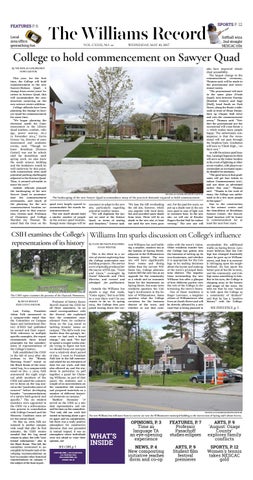
College to hold commencement on Sawyer Quad By NICHOLAS GOLDROSEN NEWS EDITOR This year, for the first time, the College will hold commencement in the new Sawyer-Stetson Quad. A change from recent years' location in Science Quad, this will accommodate the construction occurring on the new science center addition. College officials have been planning the change to Sawyer Quad for commencement for some time. “We began planning the electrical needs for Commencement in the Library Quad (outlets, conduit, voltage, power sources, etc.) in November 2014,” Carrie Greene ’02, director of commencement and academic events, said. “Though we knew Bronfman [Science Center] was not be scheduled for demolition until spring 2018, we also knew the south science building and the bookstore would be well underway by this point, with construction sites (and potential parking challenges) adjacent to the Science Quad. Thus, it seemed advisable to move for 2017.” Indeed, officials planned the landscaping of the new Sawyer Quad to accommodate the commencement ceremonies, and much of the planning for the new commencement location occurred prior to that renovation, Greene said. Professor of Chemistry and College Marshal Jay Thoman ’82 noted that the trees on the
NICHOLAS GOLDROSEN/NEWS EDITOR
The landscaping of the new Sawyer Quad accommodates many of the practical demands required to hold commencement. quad were largely spaced to accommodate the stands for commencement. The site itself should hold a similar number of people as the science quad location, though some changes will be
necessary to adapt to the new site, particularly regarding potential weather issues. “We will duplicate the layout we used at the Science Quad, in terms of seating and bleachers,” Greene said.
“We lose the hill overlooking the old site, however, which was popular with local families and provided some shade from trees. There will be no shade in the new site, at least not until the new trees grow
out. For the past few years, we put up a shade tent in the science quad in case of light rain or excessive heat. In the new site, we will use of BrooksRogers Recital Hall for indoor viewing.” The new site will
also have improved wheelchair accessibility. The largest change to the commencement ceremony, Thoman said, will be made to the processional and recessional routes. “The processional will start in the same place (Frosh Quad), turn between Paresky [Student Center] and Sage [Hall], head South on Park Street, along the Route 2 sidewalk in front of Sloan House, then up Chapin Hall drive and into the commencement arena,” Thoman said. “Neither the processional nor the recessional will cross Route 2 — which makes many people happy. The unfortunate consequence is that the recessional will not pass through the Hopkins Gate. Graduates will have to 'Climb High…' on their own.” As with the science quad location, Lansing-Chapman Ice Rink will serve as the indoor location in the event of lightning or other severe weather, with plans to accommodate an increased capacity should it be necessary. “The good news is that graduates will get four tickets to indoor Commencement 2017, and not three as advertised earlier this year,” Thoman said. “Thanks to the work of many, the College was authorized to fit a few more people in the space.” Due to the construction in the science center and the demolition of Bronfman Science Center, the Sawyer Quad location will be home to commencement for at least the next four years.
CSIH examines the College's Williams Inn sparks discussion on College's influence representations of its history By NATE MUNSON-PALOMBA STAFF WRITER
This is the third in a series of stories exploring how the College undertakes new building projects. The stories were originally produced for the course ANTH 232, "Town and Gown," co-taught by David Edwards and Chris Marcisz, and revised and abridged for publication.
NICHOLAS GOLDROSEN/NEWS EDITOR
The CSIH report examines the presence of the Haystack Monument. By RYAN KELLEY EXECUTIVE EDITOR Last Friday, President Adam Falk announced in a campus-wide email that the Committee on Campus Space and Institutional History (CSIH) had published its second and final report. With reference to multiple specific examples, the report recommends three broad principles for the consideration of representations of the College’s history. Falk established the CSIH in the fall of 2015 after objections to the “Bloody Morning Scout” mural in the Black Room of the renovated Log. In a campus-wide email on Dec. 1, 2015, Falk announced the eight original adult members of the CSIH and asked the committee to focus on the Log mural as the “particular piece of concern” before developing broader “recommendations of a nature both general and specific.” The six student members were appointed to the CSIH via a self-nomination process in consultation with College Council and the Minority Coalition soon after the initial email. On May 25, 2016, Falk announced in another campuswide email that after its first semester, the CSIH recommended that the Log mural remain in place, but with “contextual information,” also in the Black Room. This fall, the committee reconvened to accomplish its broader task of developing recommendations on how to consider other historical representations on campus — the subject of the final report.
Professor of history Karen Merrill chaired the CSIH for all three semesters. In an email correspondence with the Record, she explained how the committee transitioned from its exclusive focus on the Log mural to tackling broader issues on campus. “The fall's work was harder than the spring's, because we had such a broad charge,” she said. “We had to spend a couple weeks simply trying to figure out how we should focus our energies over a relatively short period of time. I went to President Falk late in the fall semester and asked for an extension of time for our work, and that also allowed us, and the students in particular, to pull together a panel for Claiming Williams. As part of that panel, the students and a couple of us non-students on the committee did research and prepared materials on a number of different historical elements on campus.” Matthew Hennessy ’17 served on the CSIH as a student representative and valued his time on the committee. “Not only did our work feel rooted in learning about a given space and its complexities, but there was a really positive atmosphere for constructive discourse that was grounded in mutual respect; it was an atmosphere where individuals were not afraid to voice their opinion, not
SEE CSIH, p. 5 USPS 684-6801 | 1ST CLASS MAIL U.S. POSTAGE PAID WILLIAMSTOWN, MA PERMIT NO. 25
Outside the Williams Inn stands a sign that reads, “Come Again,” but in as little as a year there won’t be any reason to do so. In spring 2015, the College first proposed tearing down the cur-
rent Williams Inn and building a smaller, modern inn at the bottom of Spring Street, adjacent to the Williamstown business district. The new inn will have significantly fewer rooms and dining tables than the current Williams Inn. College administrators bill the new Inn as an upgrade for the community as a whole and an economic boost for the businesses on Spring Street, but some town residents question the College’s involvement in the future of Williamstown. Some question what the College envisions for the business district of the town, and whether or not that coin-
cides with the town’s vision. Other residents wonder how the College has gotten into the business of setting up its own businesses, and whether it is appropriate for the College to be making decisions about the layout and makeup of the town’s principal business district. The negotiations surrounding the new Williams Inn offer a glimpse of how different parties view the role of the College in determining the town’s future. One of those residents is Roger Lawrence, a longtime citizen of Williamstown who lives on South Street and will be directly affected by a new road that is being planned to
accomodate the additional traffic on Spring Street. Lawrence believes that the College has changed drastically since he grew up in Williamstown, and that it is currently infringing upon his neighborhood. He has spent the better part of his life in town, and the community and College mean something to him. But in his eyes, the College is chipping away at the beauty and magic of the town. He tells me that he was “raised to look upon the College as a community of thinkers” and that he has a “positive history” with the College.
SEE INFLUENCE, p. 5
NICHOLAS GOLDROSEN/NEWS EDITOR
The new Williams Inn will move from its current site near the Williamstown municipal building to the intersection of Spring and Latham Streets.
WHAT’S INSIDE
OPINIONS, P. 3 Time as language TA an eye-opening experience
FEATURES, P. 7 Professor Pasachoff studies eclipses
ARTS, P. 9 'August: Osage County' explores family conflicts
NEWS, P. 4 New composting initiative reaches dorm and co-op
ARTS, P. 9 Student film festival premieres
SPORTS, P. 12 Women's tennis takes NESCAC gold
2 OPINIONS
The Williams Record
Editor-in-Chief Jack Brent Greenberg
Arts Editors Shaheen Currimjee and Li Yu
Managing Editors Michael Green and Emilia Maluf
Sports Editors Brooke Horowitch and Danny Jin
Communications Director Francesca Paris Executive Editors Marit Björnlund, Reed Jenkins, Ryan Kelley, Rachel Levin, Maddy McFarland, Neena Patel, Lucy Putnam, Rachel Scharf, Skylar Smith and Tesnim Zekeria
Photo Editors June Han and Janeth Rodriguez Business Manager Scatt Macdonald Financial Manager Mark Tolomeo Director of Outreach Hayley Tartell
News Editors Nicholas Goldrosen and William Newton
Head of Advertising Isabella Wang
Opinions Editor Alexandra Medeiros Features Editors Jane Petersen and RB Smith
Subscriptions Manager Greg Andreou
THE INDEPENDENT STUDENT NEWSPAPER OF WILLIAMS COLLEGE SINCE 1887 WILLIAMSRECORD.COM
THE WILLIAMS RECORD BOARD A recent College Council (CC) meeting raised the issue of faculty’s open access to student and alumni transcripts. CC and the Committee on Educational Affairs discussed the issue, and we commend their efforts to engage the community in dialogue around open access. We propose that the policy should change from all faculty having unfiltered access to student and alumni transcripts to faculty having access specifically for advising or recommending purposes. As it stands, the registrar allows faculty open access for “legitimate use to discharge [a professor’s] responsibilities as a College employee.” Students are left wondering what qualifies as legitimate use, how often their transcripts are being accessed and who exactly is accessing them. We do not have reason to suspect that this access is abused but are concerned given the lack of data on the frequency of access. We are worried that open access to student transcripts may lead professors to make subconscious judgements or unintentionally set expectations for students before they have met them. While we do not think faculty access tran-
Senior on the Quad What's one more thing you want to do before you graduate?
May 10, 2017
Revising transcript access
A plan to prevent prejudging students while not hindering professors' work scripts with ill intent, viewing past grades before meeting students may lead to the formation of implicit biases, a theory demonstrated in Robert Rosenthal and Lenore Jacobson’s study “Pygmalion in the Classroom.” This study revealed empirically that when teachers expect certain students to perform better, even if those expectations have been randomly assigned, those students will, in fact, improve in performance. Conversely, those with randomly-assigned lower expectations performed worse. We therefore recommend that faculty do not have open access to student transcripts to mitigate the creation of such biases. As it stands, professors may access transcripts when advising students, matching tutorial partners and dropping students from over-enrolled courses. We believe that using a student’s past grades or GPA to determine tutorial pairings is unfair, as GPA may not always be an indication of a student’s potential to contribute to a particular tutorial. A tutorial setting is unlike a seminar or lecture, and therefore a student’s grades in other classes may not reflect their future performance in a tutorial. Furthermore, we believe
that professors using past grades to determine whom to drop from over-enrolled classes goes against the liberal arts mission and possibly discourages students from exploring new interests and disciplines for fear of doing poorly and being excluded from a future class. We recognize, however, that it may make sense to consider which classes students have taken when forming tutorial pairs or determining whether they would succeed in an over-enrolled class. Instead of acquiring this information from transcripts, though, we propose that professors use course interest questionnaires. Many professors already use these forms to get a holistic view of a student’s interest when deciding whom to drop from a class. A questionnaire that asks students directly about past classes would eliminate the need for faculty access to transcripts while increasing awareness about what information faculty use to make course drop selections. We agree that advisors should retain access to their advisees’ transcripts in order to help these students choose courses, but we recommend that this access be limited to advisor-advisee pairings. In majors that do not assign advisors,
the student would be responsible for giving their transcript to a professor prior to meeting with them. Furthermore, we recognize that there are times when faculty access to a non-advisee transcript is necessary, such as when a student or alum asks a professor for a recommendation. We suggest that requests to view transcripts be filtered through an administrative office, such as the registrar’s, that could approve or deny the request based on the validity of the given reason. A list of what qualifies as valid reasons should be clearly outlined and available to students and faculty, increasing transparency regarding why a faculty member might access a student’s transcript. Alternatively, professors could ask students directly for their transcripts if they felt it necessary, such as when writing recommendations or making tutorial partners. Ultimately, we trust professors to access transcripts in good faith but are concerned that implicit biases develop from open access. We believe that limiting access will not place an unnecessary burden on professors and will bolster the relationship between faculty and students, founded upon mutual trust.
CONVENTIONAL WISDOM MEME WARS
It's all fun and games until the moderator deletes your posts.
SAMANTHA POLSKY '17
CLASS EVALUATIONS
It's nice to grade our professors for a change.
"Stargaze on Stone Hill (preferably with some Lickety)."
LAST WEEK OF CLASSES
Celebrating the last week of spring semester with tears because next week is finals.
By JANETH RODRIGUEZ PHOTO EDITOR
WILLIAMS CARNIVAL
CESAR DOMINGUEZ '17
"Say farewell to and encourage all the Summer Science Program students I tutored last summer." JANE DAI '17
"To finish all the routes on Willipedia's running page."
SCOTT SHELTON '17
"Go on a hike to Pine Cobble."
LETTER TO THE EDITOR To the editor: We would like to correct a statement in the article “Not set in stone: Unclear vision for marble project” in the Record last week. The article states that the Design Review Committee (DRC) “approved" the design for the quadrangle renovation. This is incorrect: at the time, the DRC was not involved in the design, assessment or approval of the quadrangle designs. The final designs were presented, for the first time, to the DRC a month or so before shovels hit the ground, but this was for information only, not approval. Marc Gotlieb Michael Lewis E.J. Johnson Members of the Design Review Committee
Two instances of people being hit in the face with food by the wind reported.
ON THE RECORD
“Neither the processional nor the recessional will cross Route 2 – which makes people unhappy ... Graduates will have to 'Climb High…' on their own.” Jay Thoman '82, professor of chemistry and College marshal, regarding the new Sawyer Quad location for commencement, page 5. “Zoe Harvan '17: Well now I’m crying. Put in that I’m crying. Matthew Borin '17: We don’t print stuff like that. Harvan: Editor ’til he dies.” Zoe Harvan '17 and Matthew Borin '17, this week's Two in Two Thousand, page 6. “It’s the kind of song you’d play with the wind in your face and a rainbow flag unfurling behind you.” Camryn Henderson '19, on
PWR BTTM's new album, page 8. “The future is bright. This team is going to be a force to be reckoned with in the NESCAC.” Luke Rodino '17, baseball tricaptain, on the future of the team, page 12.
GOOD LUCK ON FINALS AND HAVE A RELAXING SUMMER BREAK! FROM ALL OF US AT THE RECORD
The opinions expressed in signed columns are not necessarily those of the Williams Record editorial board.
Op-Ed and Letter Submission The Record welcomes op-eds and letters from all members of the Williams community. The Opinions section is designed to reflect the varied views and ideas of the Williams community, and the publication of any letter or op-ed does not indicate an endorsement of the views contained therein. Submissions should be sent to amm16@williams. edu by Sunday at 5 p.m. for inclusion in the next Wednesday issue. Op-eds range in length from 650850 words and letters are 500 words or fewer. The Record will not publish pieces that have appeared in other publications. Pieces submitted to the Record are not guaranteed a spot in the upcoming issue. For Record Policy information, please see our website, williamsrecord.com.
BREELYN KARNO '20
Disappointing donations
An eye-opening experience The las i
OPINIONS 3
The Williams Record
May 10, 2017
im ac s o
yR
e olle e o a la
R
I came to the College not long ago, to teach my native language, with a certain mindset, and I am leaving with a different one. How has it changed? Why has it changed? The first, and probably most important aspect, is the perception of Russia, my home country. As a language teaching assistant (TA), I have spent an enormous amount of time with my colleagues. We are a temporary family of 13, and our baker’s dozen has spent a lot of time together over the last nine months that we have been here. That implies countless conversations about all sorts of things between people of completely different mindsets and opinions. This may sound like a recipe for many personal discoveries (or fights, but fortunately, not in our case). For instance, the Russian, predominantly pro-Kremlin media keeps feeding its audience (which is, sadly, the majority of the population) tales about the Russian troops in Syria as purely good guys fighting the Islamic State of Iraq and Syria. The rhetoric surrounding Russian involvement is very positive, portraying it in a favorable light. I have been exposed to the oppositional media for more than three years now, reading a newspaper that is based in Latvia because it avoids any control from Moscow. However, it never really changed the general Russian outlook on the Syrian conflict that I had in my head. Then, one day, when we – the TAs – were having dinner in Paresky, the conversation drifted into politics and someone very casually dished out, “Putin simply invaded Syria.” The sheer confidence with which it was uttered! I remember the surge of indignation firing up inside me. But instead of ardently parrying that, I swallowed my pride and the thoughts I had of me being a representative of my home country that has to defend it in such an international dialogue and took it in for an internal questioning.. This was followed by a couple of hours of Googling and reading various sources on the matter, the result of which was, indeed, becoming even more critical of Putin’s policies. The second major thing is my attitude towards LGBTQ people. I have always stuck to the “live and let live” rule, but
ae
even such a principle could not erase a very subtle, subconscious, almost imperceptible intolerance of gay people which is, sadly, a product of living in a very conservative and deeply homophobic society. I can admit to having these notions because now they are simply gone. It feels like getting rid of those toxic feelings has opened up space inside me for things far more positive. Interacting with people of the LGBTQ community (my best friend here at the College is gay) has really changed the inherent bias that I had coming from a conservative country that still has ways to go to finally let go of all the outdated, hateful conceptions that fill the minds of millions. Thirdly, aside from the skepticism and criticism that I have developed towards my country after being in the U.S, I have found that I appreciate Russian culture even more than before. I genuinely love my mother tongue and, despite the enjoyment that I get from knowing and speaking English, I just crave Russian. On top of that, Russian music has become a major addition to my tastes. It is not my first time living abroad, which makes me aware of the fact that it is not just a typical surge of patriotism that people develop when they leave their country for a while. Instead, it is a very sober appreciation. Reflecting on all of this makes me think of Russia’s past. In particular, I think of December 1825, which was a precursor of the revolutions and the civil war that ravaged the country and conceived the Soviet Union a century later. It all would not have happened if some people had not gone abroad and soaked in all that it had in store for them. I realize that I definitely fit that narrative. I am just yet another Russian who lived elsewhere, had his eyes opened on many things and now wants to go back home, enjoy all the good that it has and make a difference in the bad. Yes, an eye-opener – that is what these nine months have been for me and I am forever grateful for all the things that this experience has given me. It was certainly broader than what I have described in this text, but this leap in personal growth is what I probably value most.
W y yo s o ld
y
do a e o
e
R
Fortunately, the Alumni Fund offers the option to designate your donation The next time your class agent asks to one of eight categories. Leaving aside if you’d like to make a “fun” donation the fact that the Alumni Fund likely has of $20.17 to celebrate your impending more than enough undesignated funds graduation, take the time to consider to allocate its money however it wishes, if that $20.17 could be best served some of these designations, like finanelsewhere. A donation of $20.17 to cial aid, seem like causes worthy of phithe Against Malaria Foundation, for lanthropy. However, even the College’s example, would provide at least 7 allocation of financial aid funds seems mosquito nets, protecting two people disappointing after a closer look. Following the lead of Amherst in from Malaria exposure for three to four years. A donation of $20.17 to 2007, the College, with an endowment the Williams Alumni Fund, besides of less than $1.9 billion, introduced a being a cute symbolic gesture, would “no loan policy,” which committed the pay for about .003% of the marble school to meeting the full financial need now scattered around Sawyer-Stetson of all students with grants rather than Quad, by comparison. It doesn’t take loans. Former President Morty Schapiro a meeting with the Effective Altruism explained that “this move [...] is based on our growing sense @ Williams club to that loans, even small see that more good would be done with The College introduced the ones, affect a range of student decisions, your donation to from which colleges combat malaria. no-loan policy, ditched they consider attendOf course, not all it when it prohibited ing to which postdonations to the College go to frivospending on areas it cares college careers they pursue.” In the wake lous causes like of the financial crisis, marble slabs, and more about, and then with a shrunken enthere may well be never looked back. dowment, the College a place for donatannounced the reining to an institution statement of loans like Williams, even if it’s not the most effective or effi- into financial aid packages to cut costs in cient way to help the world. Howev- 2010. Meanwhile, colleges like Bowdoin er, the Development Office has done with significantly smaller endowments too little to allay concerns, even de- per student retained their commitments clining an invitation to debate the to the no-loan policy. That the school chose this area to question of “Should you donate to Williams?” with Effective Altruism make their cuts should be warning @ Williams. Nevertheless, the Col- enough, but what is truly disheartenlege continues to shamelessly im- ing is that seven years removed from plore students, who have not even the depths of the financial crisis with a had the chance to make any money larger than ever endowment of at least with their college degrees, to donate. $2.3 billion, the College has made no They receive email subjects such as moves to reinstate the no-loan policy. “The Alumni Fund needs YOU!” or Meanwhile, it has found the funds in “Give to Williams!,” sometimes even recent years to begin several large-scale trying to capitalize on our relation- construction projects. In the realm of ships with staff and faculty by sug- financial aid, it has instead hired a dean gesting we donate in honor of them to oversee the Offices of Financial Aid and Admission. By all appearances, the as a show of appreciation.
olle e
history of the no-loan policy at the College is rather straightforward: the College introduced the no-loan policy to compete with peer institutions, ditched it when it prohibited it from spending on areas it cares about more than allowing students from lower incomes the freedom to pursue post-graduate options without debt and then, after finding its prestige relatively unaffected by the whole ordeal, never looked back. As can be seen in the example of the no-loan policy, the school’s resource allocation seems to fall short of its rhetoric. And, as we’ve seen by the debate surrounding the Board of Trustees in recent years, there is a frightening lack of transparency and accountability in the way that the school conducts its financial business. With all of this in mind, the College has done very little to show that it is deserving of philanthropy and that it intends to use the donations it receives in a manner beneficial to either its students or society as a whole. Yet the College continues to ask its current students for donations. And why wouldn’t it? As an institution that has shown itself to be most reactive to financial pressures, a strategy that continues to garner donations from students and alumni year after year is a strategy that doesn’t need changing. The issue of donating to the College is then twofold. If you truly care about using philanthropy to make a positive impact on the world, then donating to an institution that might use your donation to buy another set of marble slabs is depriving worthy organizations like the Against Malaria Foundation of that donation. Even if all you care about impacting is the College, donating to it, in spite of its apparent disregard for its stated principles and priorities, merely rewards an administration growing further out of touch with its values and its students. Derrick Bonafilia ’17 is a computer science major from Silverdale, Wash. He lives in Susie Hopkins.
Red Bushetara is a teaching assistant in the Russian department from Moscow, Russia.
Redefining accountability e reaso s or re ami y a dM
M R
R
Me
or o se
ensure that perpetrators change their behavior. As a group, we are committed to leveraging male privilege to deMen for Consent (MFC) was started construct toxic masculinity and other fewer than 10 years ago as a club exclu- root causes of sexual violence on camsively for men to help combat rape cul- pus. In general, we believe that men ture and sexual violence. The club has must ask themselves: how can we come a long way since then; it began as leverage our privilege to deconstruct an exclusively male, application-based the systems that give us that privilege club and now is open to all genders. in the first place? Past iterations of MFC have rightfully In order to signal this shift in mindbeen criticized for their complacency set and priorities, MFC is changing its and for holding a transphobic and het- name. After multiple discussions and an eronormative definition of masculinity. open forum to discuss the name change, The club has also been critiqued for we have decided to change our name to engaging in misguided, narrow and in- MASC, which stands for Masculinity, effective preventative work. These criti- Accountability, Sexual violence and Concisms were often spot-on, and this is sent. We hope that MASC will provide an not and has never been acceptable. accessible, accountable space as we conThat being said, the current mem- tinue to work towards ending sexual viobers of the club’s board have recognized lence through prevention-based efforts. these problems and have engaged in Our name change is an acknowledgwork over the past few months to make ment that organizations that present some necessary changes. This work themselves as exclusively male canbegan by establishing connections not productively work against sexual with other groups on violence. In fact, they campus, as MFC’s recreate the very hiisolation has been erarchies that enact Our name change detrimental to the violence in the first acknowledges that or- place. MASC must be club’s goals. We have also separated board ganizations that present an organization that is and discussion meetaccountable, not just ings and made those to survivors of sexual themselves as excludiscussion meetings violence, but to queer open to all students. sively male cannot work people, people of color, However, MFC has not and non-binary against sexual violence. trans just made structural people and the comchanges. Rather than munity at large. To continuing to work clarify, we are not askwithin a problematic men’s-violence- ing people to engage in the emotional against-women framework, we have labor of “teaching” their own lived expebegun to focus on toxic masculinity as riences to MASC. Rather, we are redefina root cause of sexual violence. This ing ourselves as an accessible, accounthas meant rethinking our definitions of able club that engages in preventative masculinity, consent and hook-up cul- work against sexual violence. While the ture in order to make them more inter- privileges afforded to men should mean sectional and trans-inclusive. that men bear the burden of deconBut this is still not enough. We need structing toxic masculinity, the group to have a clear vision of what the club that makes those decisions cannot and can and should be. As we think more should not be exclusively male. about the kind of framework we want We hope that you’ll consider joining to operate within, we cannot forget us in defining and enacting the values of about the privileges that men have MASC. For too long, MFC has not lived in sexual violence prevention work. up to the needs of our community, and Borrowing heavily from a racial jus- we believe that this is a good step towards tice and feminist framework, we be- beginning to live up to those needs. lieve that it’s important for men to do the physical and emotional labor Ben Metrikin ’18 is an English maof talking to other men about toxic jor from New York, N.Y. He lives in masculinity and sexual violence. It is Mills. Morris Kolman ’18 is a political also important for men to engage in science major from New York, N.Y. restorative justice work in order to He lives in Prospect.
M
MERUDJINA NORMIL ’19
Outlining the mission of the Gargoyles Welcomi y R a d
,R
e 12 rd R
As the Gargoyle Society prepares to confirm the new members of its 123rd delegation, we would like to take the opportunity to discuss the incoming delegation and the reasons for which these members have been chosen. Due to the semi-secretive nature of Gargoyle, rumors about what exactly the group does and how members are chosen do arise. By writing this piece, we would like to simultaneously address certain notions of what the Gargoyle selection process entails and celebrate the outstanding new members who will soon join. The members of the incoming delegation have been chosen based on strength of their applications, personal character and previous work in the aim of bettering the College. Current members of the 122nd delegation were impressed with the overall quality of the applicant pool and the many parts of campus represented by the applicants. As a result, the incoming delegation will incorporate diverse perspectives and will provide members with new networks for both individual and group undertakings. The selection format includes one blind screening of applications and a second, non-blind round to finalize the delegation. Rankings in the first round are heavily weighted, and the second round is used to ensure a diverse and representative body. While we do encourage certain individuals to apply, those applicants are given no more weight than any other when choosing the new delegation. We strive to create a group that represents the College as fully as possible, and the open application process is important in our efforts to obtain campus-wide representation. Gargoyle, as a group working to improve campus life, functions best when
ele a io o
e
as many campus interests as possible are represented in its members. This system, of course, does have its flaws, which have become especially apparent in the past year. We understand that perceptions of Gargoyle may influence those who choose or choose not to apply, thus creating a biased selection pool that may not represent the entirety of campus. Oftentimes, these perceptions stem from confusion over Gargoyle’s core values and mission, and we hope that this piece provides some clarification. We are working hard to remedy these issues and hope to eliminate the inherent biases in our application process. Because the success of the group is so fundamentally based on its membership, identifying issues in our application process has become a top priority this spring and will continue to be an active topic in the coming year. Gargoyle is driven by a desire to promote the best interests of the College, a goal that has led to previous work on ending the fraternity system and starting the Junior Adviser system. More recent projects include rethinking the College alcohol policy, creating the foundation for a Winter Study course on life goals and inspiring conversation about academic honesty on campus. We hope that, by bringing together a highly diverse group of students, we are better able to engage in meaningful conversations and implement collaborative solutions. We are therefore inviting what we see as a collection of motivated individuals who will discuss issues pertinent to the College campus and drive solutions backed by a broad range of campus experiences. The outgoing delegation has full confidence in its new members and is excited to see what lies ahead. During its first few meetings, the new delegation will dedicate most of its time
ar oyle ocie y to discussing potential topics for the new academic year. After identifying a topic, the rest of the year will be spent working on quality approaches to improving campus life within that aspect of our community. For the current delegation, this process led us to engage the topic of mental health at the College. In implementing potential solutions, we collaborated with various groups on campus, including the dean’s office, the chaplain’s office, and psychological counseling Services. The year’s efforts resulted in contributions to proposed syllabi language regarding mental health (in conjunction with the Mental Health Committee), a new “Thriving at Williams” initiative, an expansion of support networks at the Career Center, close work with the administration in crafting future mentawl health goals and the “Quitting at Williams” event on Claiming Williams Day. We realize that mental health is an ongoing priority for students and hope that these projects have made a positive and tangible impact. However, this approach is simply one of many that the new delegation can choose to take. Ultimately, what the new delegation chooses to accomplish will be up to its members; they may continue with mental health as their topic or select an entirely new one. Regardless, we are very excited to see what the newest members will accomplish during the next academic year. Eric Davis ’17 is an economics and history double major from Princeton Junction, N.J. He lives in Perry. Roya Huang ’17 is a biology and chemistry double major from Palo Alto, Calif. She lives in Prospect. Jonathon Burne ’17 is a political science and Arabic studies double major from San Pedro, Calif. He lives in Fitch.
4 NEWS
The Williams Record
May 10, 2017
Olikara addresses millennial participation in politics By JACK BRENT GREENBERG EDITOR-IN-CHIEF Last Thursday, Founder and President of the Millennial Action Project (MAP) Steven Olikara visited the College at the invitation of Rep. Chris Gibson, visiting professor of leadership studies. Olikara visited Gibson’s “Leadership and Political Change” course and participated in a lunch hosted by the Career Center, encouraging students at the College to overcome the cynicism of contemporary politics and find ways to involve themselves in the political process. Olikara entered political work with an extensive background in music. “Music was the vehicle for becoming a coalition builder,” Olikara said. “I was the type of musician who really enjoyed bringing jazz musicians together with rock musicians with funk, R&B and hip-hop. In the absence of that, normally those groups would be isolated and playing by themselves. I thought the best music was when you brought those different stylistic backgrounds together. So that was really how, in my DNA, I discovered my calling for being a coalition builder.” What prompted Olikara to apply that impulse to politics was the ascent of a charismatic young senator from Illinois who spoke of bringing the country together. “Back in 2004, I heard then-Senator [Barack] Obama say that we are not just blue states or red states; we are the United States,” Olikara said. “Once I found a political expression for what I was doing in music, I wanted to get involved politically.” He then got involved volunteering for Obama’s presidential campaigns and ultimately served as senior class president at University of Wisconsin–Madison. After college, Olikara served as the Harry Ott Fellow on Coca-Cola’s Environmental Team, working with the United Stated Agency for International Development (USAID) on public-private water projects in Africa, and later as a Truman Fellow at the World Bank working on sustainable energy development. Olikara ultimately left the World Bank to launch MAP, where he remains today. “A
JACK BRENT GREENBERG/EDITOR-IN-CHIEF
Last Thursday, Steven Olikara visited a political science course on leadership to discuss his organization, Millennial Action Project (MAP). big part of our theory of change is to demonstrate how you get things, and then amplify that narrative across the country so millennials, in particular, can see public service as a vehicle for change.” MAP inspired the creation of the Congressional Future Caucus, a bipartisan caucus for members of Congress under the age of 40, and is attempting to launch state-level equivalents in every state
by 2020. Moreover, MAP oversees the James Madison Fellowship to support bipartisan policy proposals put forward by young public service leaders and manages the Millennial Policy Project, which provides nonpartisan analysis on issues that specifically impact millennials. In the hyperpolarized, hyperpartisan political environment of contemporary America, Olikara remains
optimistic that millennials can achieve results in the public sector. “We know that there is no substitute for good public policy,” Olikara said. “There are a lot of issues … that speak to a generational experience where the dividing line isn’t so much left versus right, but it’s really about new versus old, so we get to embrace those issues.” Olikara points toward certain policy initiatives, such as passing
ridesharing legislation and addressing student loan debt, as areas in which younger politicians have worked across party lines in the service of millennial interests. Olikara, however, does not seek to unify millennials solely on the basis of their shared policy interests. “A plurality of millennials now identify as independent. Millennials are now the most politically independent generation in
America. We do not want to be boxed into the Democratic Party or the Republican Party. We want to be boxed into solutions that will help our generation,” he said. “You have this mentality of innovation that younger [leaders] embrace. For them, partisanship is the last thing they want to deal with.” Nevertheless, Olikara understands why public service may remain unattractive to millennials, including students at the College. “For elite schools, like Williams College, where you have some of the best and the brightest students, the recruitment for private sector organizations is much stronger than it is for public service,” Olikara explained. “I would not be surprised if there is a very high visibility on campus for some of the top consulting firms and financial services companies. Often what happens is that the public service or civic service organizations begin recruiting in the spring and, by then, plenty of people already have their jobs. I would encourage students, if they are interested in a particular issue … [to] peel the layers back and understand why we are not making more progress on that issue and start working on its root causes.” According to Olikara, however, contemporary political developments may have activated some into service who would have otherwise ventured into other fields. “I would say the election of President Donald Trump, for [MAP,] really made people realize the importance of what we are doing … The response from millennials has been really inspiring,” he said. “There has been a 25 percent increase in civic engagement amongst millennials since the election and that may end up being the most important takeaway… If millennials now see the importance of engaging in our democracy, and there’s a sustained increase in our civil and political engagement in a time where our political culture has been declining gradually for decades, I think that will be a huge result from this election.”
College tests composting program in residences Vega, Leonard perform in By TARAN DUGAL STAFF WRITER Last Monday, the College put a special composting pilot program into effect at select dorms on campus as part of a unique composting initiative meant to advance the sustainability goals of the College. “Since Dining [Services] made the shift over to compostable to-go ware, it makes sense to have composting locations in other places around campus,” said Mike Evans, assistant director of the Zilkha Center. “Abby Rampone [’17] did an interesting project in her fall course ‘Renewable Energy and the Sustainable Campus’ that surveyed students
as to their behavior when it came to food waste outside of the dining halls and their willingness to go out of their way to properly dispose of compost. She also looked at various options to expand the compost program.” The composting pilot program will be present, at least in its inception, in Dodd House and Poker Flats. Although all College dining halls are equipped with post-consumer compost, no composting stations exist outside of these locations. The compost bins in Dodd and Poker can process food and compostable to-go ware. These bins are in each dorm’s kitchens and are available for all students to
use and not just those cooking in the kitchens. Compost inside the bins will be picked up and layered with sawdust until it is transported to T.A.M. Organics in Bennington, Vt., where it will be added to other compostable material and will eventually break down into a compost that can be supplemented to soil as an enriching agent. “Diverting food waste and other compostables from the trash returns valuable nutrients to the soil. It means that more organic matter will be created from our waste and less will go with the rest of the trash to the incinerator,” Evans said. “Ideally, as a cam-
pus we will take bolder strides to reduce waste in general.” In a few weeks, the Zilkha Center will send out a survey to residents of Dodd and Poker Flats asking for feedback on how dorm composting can improve. Evans asks students to “please help us reduce food waste by not taking more than you will eat and by properly disposing of food waste and other compostables in the compost bins.” As for those students wondering whether or not the pilot composting program will be expanded to their dorm in the near future, Evans reccomended reaching out to the Zilkha Center to ask about composting in a specific dorm.
course on popular music By WILLIAM NEWTON NEWS EDITOR
Last Thursday, Professor of music W. Anthony Sheppard invited two guest musicians, Suzanne Vega, an American singer-songwriter and mother of Ruby Froom ’17, and Gerry Leonard, an Irish lead guitarist who has worked extensively with David Bowie, to his “History of Rock” class. In teaching this course, which follows rock music from its roots and examines events and artists that helped revolutionize the genre, Sheppard hoped to find a guest musician for his students as he had in many of his other music courses. “In my two decades here, I’ve often tried to bring relevant musicians and composers to speak with my students,” Sheppard said. “In the last three semesters alone, we had the [Metropolitan] Opera composer Nico Muhly in my new opera course, the “King of Chinese Pop” Leehom Wang ’98 visit a course on cross-cultural influence and globalization, and today Suzanne Vega and Gerry Leonard in the popular music course.” Sheppard formalized his plans for the special guest shortly before the semester began and was thrilled to end up with two separate artists with distinct styles and experiences. “I cautiously approached senior music major Ruby Froom back in January about inviting her mother, and Suzanne immediately accepted the invitation,” Sheppard said. “Having the amazing guitarist Gerry Leonard, who has worked with Vega and David Bowie, agree to join us as well was just fantastic.” Vega, who has two certified platinum albums and is most
Jonathan X. Meng ’18 wins prestigious Goldwater Scholarship for chemistry, math
PHOTO COURTESY OF THE ZILKHA CENTER
In attempt to find new ways to minimize campus waste, the Zilkha Center recently began testing a new composting program in select dorms across campus.
famous for her two top-10 hits “Luka” and “Tom’s Diner,” answered questions from Sheppard in front of the class, focusing mainly on the songwriting process. She spoke to students about her folk background and other musical influences and explained the process of how her songs go from their early composition stages through production. Vega also discussed the importance of the lyrics and musical style in popular music, expanding on the theme that students had already studied and discussed in great detail throughout the course, and sang some of her work in front of the class. Next, Leonard demonstrated several guitar-playing techniques before the class. Drawing from his experience collaborating with Bowie on his Heathen, Reality and The Next Day albums and touring with Bowie twice, Leonard used an array of pedals and other soundmanipulation techniques to demonstrate the versatility of the electric guitar across numerous musical styles and explain how he developed his distinct sound while creating guitar arrangements for Bowie. The event, which took place in Brooks-Rogers Recital Hall during the usual Thursday morning class time, was open to all of the roughly eighty students enrolled in the class. Sheppard also invited music majors, several music faculty, guitar students of Rob Phelps and songwriting students of Bernice Lewis to the event, but due to concerns over the capacity of the classroom, he could not allow any students to bring family or friends. “Today was one of my alltime favorite teaching experiences,” Sheppard said.
May 10, 2017
NEWS 5
The Williams Record
Williamstown residents weigh the College’s influence on town FROM INFLUENCE, PAGE 1 But for Lawrence, all that has changed. He describes a “shift in the community of thinkers,” saying that the trustees brought in by Adam Falk, the current president, have embarked on a round of unnecessary building projects that include the Inn. For him, the relatively new administrators at the College tasked with managing the building projects are outsiders. They have neither an investment in the community they are developing nor a full understanding of how they are changing the place for lifelong residents. And most importantly, they do not share his vision of a quiet, largely undeveloped, New England town. This change in the College’s mindset affects Lawrence personally. In the past year, the College has bought out his neighbor to the north after a dispute, a wealthy trustee of the College has bought the property across the street from his house and the College has proposed to run a road through his neighborhood that abuts his property line. Lawrence mentioned that the College has already put in 19 new streetlights that illuminate the whole neighborhood throughout the night, disrupting the calm he has experienced for years in his house. Each of these complaints may seem trivial, but for Lawrence, they add up to the feeling that the College is running over his home. Lawrence has petitioned at town meetings, and repeatedly talked to Jamie Art, a new administrator at the College in charge of real estate development, asking that the road not be built in exactly that location and in-
stead that traffic be diverted to a different street. The road would connect the Clark Art Institute on South Street to the new Inn, though there already exists another route that connects the two buildings just 240 yards away. In his eyes, this plan is a case of the College not respecting or caring about the residents of Williamstown. He thinks that the College, in the past, would have understood how negatively a new road would affect the atmosphere of the town. Art, however, views the Inn from the other end of the spectrum. In his mind, the College is doing a major service for the town; the Inn is an improvement that will benefit both the College community and the town. Art says that the Inn will bring life to Spring Street and that it will increase foot traffic, therefore increasing revenue for businesses on the street. He mentioned that tourists who come to see the Clark or spend some time in the “Village Beautiful” only spend the day or afternoon in town, opting to drive back to a hotel in Lenox or North Adams instead of spending the night in Williamstown. Art believes that by adding a premier hotel in the center of town that is also situated between the business district and the Clark, more guests will stay over in Williamstown and the economy will reap the benefits. At one point, the town rejected the proposal for the new Inn, and Art mentioned that the College has had to jump through a number of hoops to get the project off the ground. For him, it does not make sense for townspeople and the town government to push back on new
buildings like this one. Residents have asked for a vibrant downtown district and that requires investments in the area that bring in revenue. Art says that he thinks the College is held to a “higher standard” than other institutions in town, and “any private business would be immediately approved, but for the college there’s a lot more scrutiny.” Art believes that the College is being a successful “steward” of the town. He acknowledges that because the town significantly relies on the College economically, there is an imbalance of power. He openly describes the College as an “800 pound gorilla,” with enough influence to do as it pleases, within reason. Art makes it clear that there is a model in which the College is not as involved or economically invested in the community, but in that one, “this town looks like Lanesborough.” He thinks that the College continues to do a good job in managing this power and that it takes the opinions of the town and its residents into account. He posits that “[the College] asks more permission than [it has] to” and tries to keep residents informed about what plans the College has. The College has held community meetings to clarify plans, cultivated a strong working relationship with town officials (a significant improvement over previous years) and contributed financially to projects like the new Mount Greylock Regional High School building and a solar energy project in town. Art says the College tries “not to be the 800 pound gorilla” and that they do their best to tread lightly in the town and to respect the town’s needs.
According to Art, the Col- we do a lot.” But at the same lege has a set of responsibili- time, he understands that ties to which it must attend. the College is more powerful In order to attract faculty than the town, even going as and students, the College far as to say that “[the Colneeds a hotel that is modern lege has] to work within the and comparable to those at [Town bylaws], but they’re other premier institutions. only guidelines.” In the same vein, it must Mike Goodman, another cultivate a town that is pre- resident of Williamstown, feels sentable enough to appeal to that the College is exerting its faculty who would raise their influence where it does not befamilies in Williamstown. long; that it holds too much of “We’re goa stake in the ing to do it, future of Wilwe can do liamstown. it,” Art said. He worries He wants about putto fit the ting a collegeneeds of owned Inn the town in the center into that of the town’s framework business disof those trict: will it objectives, take busiadding that ness away Jamie Art “we want other Director of Real Estate from to work for hotels? Will and Legal Affairs the commuit raise the nity too.” As price point of long as the stores around goals of the it? What town and about the the College coincide, as they increase in traffic? He is hesido in regards to creating a tant to voice his approval for vibrant street, a high school, another building project that or solar power, the two work increases the College’s influin near lockstep. The natu- ence and decreases the town’s ral question is: how does the inherent agency. College react when the two Besides the resentment, institution’s objectives do not Goodman laments how much line up, when their visions do things have changed. He missnot match, especially now es the Williams Newsroom, an when the College is in the old newsstand on the street middle of a massive building that went out of business a campaign that includes, in while back. He also misses addition to the Inn, a new sci- the old gas station where the ence building, dormitory and B&L Building is now, the rebookstore, all of which some cord shop that used to be on community members believe the street, and even the old, intrude upon the public space funky Purple Pub. He knows of the town? Williamstown cannot go backHe argues that the College ward, but like a lot of other is very generous in compari- community members, he really son to other colleges with wishes that it could. similar town-gown situaBut he also said that he tions, saying, “in comparison has “faith in the College,”
“The College has to work within the bylaws, but they’re only guidelines.”
and that as a top educational institution, it can be trusted to make choices that benefit both the town and College alike. He added that his wife recently opened a print shop on Spring Street in a Collegeowned unit and for that reason he’s hesitant to criticize the College. But he also feels some gratitude. The College controls the rent for the properties it owns on Spring Street, allowing businesses that otherwise might not be able to turn a profit to remain open. Goodman notices when the College bails out the town or its residents and understands that without the College, this place would look much different. On one hand, Goodman has seen his town turned on its head in the last 20 years, and there’s a certain level of resentment that comes along with that. Conversely, he understands what the College has given this town. He sees the surrounding communities and their struggling economic situations and is grateful that the College is here to support the town economically and socially. He is grateful that his wife can run a business in town, and that there will be a new Inn for visitors to stay at. The tensions between Goodman’s two visions for the town and in town-gown relations are indicative of the different viewpoints throughout the community. Residents understand that progress must be made and that progress often means development, but many resent the way the Williamstown of their childhood continues to wither away before their eyes, replaced by a new College-conceived Williamstown they did not ask for.
CSIH committee releases report on the role, context of historical spaces on campus FROM CSIH, PAGE 1 afraid to be wrong and not afraid to debate perspectives in a thorough manner that was a testament to what a liberal arts education should enable,” Hennessy said. Merrill emphasized the role of students on the committee. “I think having a critical mass of students on the committee helped give our work a kind of energy that isn’t always the case on college committees,” Merrill said. “What was great was that all six students stayed with the committee to the very end, and they were incredibly committed.” The report itself focuses on three principles that the CSIH recommends the College consider when examining questions “about the historical elements to be found in decorations, memorials, monuments and buildings,” in the words of the report. “We recommend that the College attends to discussions about these objects with three principles in mind: that open inquiry should form the foundation of any discussion; that the College seek to understand the different constituencies attached to any given space on campus; and that we should approach this history in our
built environment as more or less public space.” Building off the educational mission of the College, the first principle emphasizes inquiry and discussion as the starting point. The report offers Thompson Memorial Chapel, which memorializes generations of College students who have served and died in battle, as an example in which questions must be asked to understand how community members engage with spaces today. The report asks: “Does its history and the ways it recalls an earlier time in the College’s history contribute to its feeling like an unwelcoming space to some in our community?” To describe the second principle — that the constituencies of a given space be consulted when questions of historical representations arise — the report offers the Faculty House and the Herman Rosse painting, “The Carnival of Life,” in the ’62 Center for Theatre and Dance as two examples. The report describes how the Faculty House, which initially just served faculty members, is now used by multiple groups as the largest event venue at the College. For example, many students on campus during the summer eat dinner in the Faculty House. Given the vari-
ous groups that now use the space, the report asks: “Do these changes mean that the décor of the Faculty House should be adjusted to reflect more contemporary constituencies?” Falk announced in his email that an ad-hoc committee will convene in the fall to consider décor changes in the Faculty House. The report also references “The Carnival of Life” painting as a controversial art installation in the ’62 Center. In 2005, 43 students signed a petition to remove the painting, objecting to its portrayal of an African American figure and the woman in the painting. The petition argued that the painting’s “portrayal of African Americans is highly offensive [as] the only African American in the painting is a servile woman” (see “Students object to painting in ’62 Center,” Nov. 9, 2005). The CSIH suggests that the faculty members and students who use the ’62 Center daily be involved in any conversation regarding the Herman Rosse painting. Finally, the report recommends that the College consider its built environment “as more or less public space.” As the primary example, the CSIH offers the Haystack
Monument, which commemorates the Haystack Prayer Meeting in 1806, as a space that Christian tourists from around the world come to visit. However, as Falk noted in his email, the values of the Christian missionary organization are often perceived as connected to colonialism and racism. Given the complexities of having such a monument near student dormitories and spaces, the committee asks: “What are the ways that the College might provide more and different kinds of information about the Haystack Monument?” At the end of the report, the CSIH acknowledges the lack of specific recommendations, and instead the emphasis on principles and related questions. “If we were to make specific recommendations of action, we ran the risk of contradicting the very principles we were setting out,” Merrill said. “I’d like to see a very sustained effort to explore the history and meaning of the Haystack Monument and to really be creative in thinking about how to do that. But that can’t be just one temporary committee’s recommendation: that kind of thing has to involve the engagement of at
least some portion of the College community and the commitment of the College and some resources.” Merrill believes an ongoing discussion among the community will be instrumental in this process. “There has to be a real process for that; people have to take the time to talk about it, disagree with each other and listen to each other. We could have made specific recommendations of what we thought should happen with Haystack Monument, but it’s going to be a much better process if more people are brought into it,” Merrill said. Rather than specific recom- mendations, the CSIH hopes that their three principles will “help ensure that the College render its past visible to the community while also creating an inclusive environment of learnersbothnowandinthefuture,” as described in the report. Merrill also hopes that the work of the CSIH will spark further inquiries into the history of the College. “I hope that both the College institutionally and the College as a community of people will become more engaged with its history generally and then will see in the built environment
an opportunity to explore that history,” Merrill said. “I was really struck by how that history ... and I should really say those histories, plural ... always lead outward; they connect Williams always to what’s going on outside the College.” “We kid ourselves all the time about being in the Purple Bubble, but this history tells us there isn’t a bubble! Williams has always been and will always be intimately tied to what’s going on in the rest of the world,” Merrill said. At the end of his email, Falk thanked Merrill and the other members of the committee for their work. “This is an important and complicated endeavor. It has at its heart the very question of the community we aspire to be. We’ll never seek to erase Williams’ history, nor to rewrite it. But we must continue to evolve as a community, and that evolution has to include the voices and perspectives of all those whom we’ve invited here as full members.” The report will remain on the office of the president’s website until the launch of a new website next fall to store the complete work of the CSIH, including its final report.
RecoRd commencement Ads!
Now on sale at bit.ly/2qPdhky
May 10, 2017
FEATURES 6
The Williams Record
Two in Two Thousand By JACK BRENT GREENBERG & EMILIA MALUF RECORD STAFF We met Matthew Borin and Zoe Harvan when we were brandnew section editors. Throughout our time on Record, we have had the pleasure of working with them as executive editors and editors-in-chief (EICs) and, more importantly, of becoming their friends. We sat down with them to talk about their experiences leading the paper. Okay, guys, what were your first impressions of each other? ZH: Well, we were entrymates, so… [Laughs.] We were like the only people in our entry who were going to the writers’ meetings for the Record – but we didn’t, like, go to them together... MB: Well, we sort of did sometimes. ZH: Yeah, we started to. So, this one time we didn’t go to together, and I went upstairs and all the cool section editors were talking – they might’ve been taking a group photo – and they were all in pajamas and they had cans of coke and it was some sort of inside joke, and I’m pretty sure I could’ve still gotten an article, but I just poked my head in and then ran away and didn’t take an article. And then I saw Matt and I told him about it – and then we became EICs! Yeah, like the next day! MB: Now Record’s not scary anymore either! Everyone should come to writers’ meetings. ZH: Plug! I don’t know. I think I thought Matt was kind of aloof. MB: You seemed friendly and Midwestern. ZH: [Laughs.] Opposites!
you had to say which item of food you’d bring to a picnic, that started with the first letter of your name. Was that on the first day of college?
What were some highlights of your partnership as EICs? ZH: I thought hiring was great. Shout-out to the sophomores and two juniors! [Laughs.] I don’t know; hiring did feel like a highlight. It was just fun. You, me and Evan [Wahl ’17] just powering through those few days. And they were really cute and nice and good at their jobs. And [our editorial on John] Derbyshire was a whole thing. Was that editorial a higlight or a lowlight? ZH: I think our editorial was good … I mean, that felt like a highlight in terms of working together, because when we had to editorialize on Suzanne Venker [the semester before] it just felt like it was a pretty heated editorial conversation. MB: We kind of just went in circles in the meeting. ZH: So, with Derbyshire, we sat down ahead of time and came up with questions for how we wanted to structure it. And the Board wrote a really good editorial, I think, and I thought the conversation was very civil. And what were some challenges you encountered as EICs that you did not anticipate? ZH: I think … editing. [Laughs.] I knew it would be really time-
people say as the day goes on. ZH: Yeah. I think there aren’t many other experiences like that, in terms of getting to know a group of people. MB: I second that. What do you think you got most out of Record?
ZH: Yup, first day of college. [Laughs.] And I said zucchini, because it’s the only thing that starts with the letter of my name! And Matt said … MB: Marmalade.
How did you first meet? ZH: We played a game where
MATTHEW BORIN ’17 & ZOE HARVAN ’17
JUNE HAN/PHOTO EDITOR
MATTHEW’S HOMETOWN MANHATTAN, N.Y.
ZOE’S HOMETOWN VALLEY VIEW, OHIO
consuming, but I think I didn’t expect how brutal that first Tuesday was going to be. Oh! The first Tuesday during classes, I woke up the next morning and our delivery-person had quit, so the paper hadn’t been picked up! MB: That you could’ve anticipated, because it happened all the time. ZH: [Laughs.] It hadn’t been delivered, so Evan and I had to drive to Pittsfield and pick it up, but before that I did cry in the bathroom in Paresky. [Laughs.] I think after the first two issues it got a little bit better, just knowing what you were in for ... We had some late nights. MB: Yeah, I’d agree that I thought the editing was going to be a lot. But you sort of just get it done. ZH: I think we worked together well! I mean, I figured we would. MB: Yeah, we did disagree, but we disagreed infrequently. ZH: I was kind of an “anything
FAVORITE ACTIVITY EDITING
goes” sort of editor, and Matt had standards for the paper. [Laughs.] But I think with that it was helpful to know that we each had our own semester to make calls. So, if I wanted to publish television reviews and Matt didn’t, I did that during mine and we didn’t do that when he was EIC. MB: Yeah, I mean you have to compromise more than I thought going in. ZH: Yeah, it was figuring out a balance, and making sure everyone felt like their section was their own. What do you each miss most about Record? ZH: The people! [Laughs.] I miss Tuesdays, where you’re just kind of hanging out in the board room and everyone’s going a little stircrazy. So maybe like crazy Tuesday nights specifically. MB: Just the weird things that
ZH: Well now I’m crying. Put in that I’m crying. MB: We don’t print stuff like that. ZH: Editor ’til he dies. MB: [Laughs.] Well, I think writing for a newspaper is a good experience for anyone. ZH: I don’t want to give a resume-ish answer, but I think it really does teach you how to work as a team, and how to balance a bunch of different things at once. I don’t know, I think it really helped me figure out what I want the rest of my life to be like in some ways, just because I really loved getting to put something together every week with people I really cared about. Plus, it was cool to see that Matt and I could work together in that capacity. MB: And I feel like now I have pretty good knowledge of the inner workings of a small liberal arts college. [Laughs.] Not sure when that’ll come in handy. ZH: And you have Frankie [Paris ’18] and Michael [Green ’18] and Neena [Patel ’19] and Ryan [Kelley ’19]! MB: Oh yeah, my news family! ZH: [Laughs.] “Team News” has really never been stronger. They had a spaghetti dinner a couple weeks ago. What’s your favorite article each of you wrote while you were on Record? ZH: Well, as a features editor I think I wrote a lot of silly articles. Oh, I did a co-op ranking! That was sort of fun to write, but it’s kind of hard to write reviews of co-ops as an underclassman because you can’t swipe into any of the buildings. But I did my best
and just didn’t see the insides of some of them! [Laughs.] But the first or second article I ever wrote for Record was about things to do in the Berkshires, and that spawned our nudist resort article, so. That’s what really cemented my passion for features. [Laughs.] And I learned a lot about the Berkshires as a wee freshman! What about you, Matt? You wrote about actually substantial things. MB: And fun things sometimes, when I was pressed into service for features. [Laughs.] I don’t know, I liked an article I did where I got to interview a lot of the student activists. I don’t know if it ended up being that great of an article – it was probably too broad – but it was just interesting to get to talk to a ton of people and sort of get to understand where they were coming from. Probably one of the best things about doing journalism is getting to talk to people and hear their perspectives. Yeah, how did you guys balance the personal and the professional? ZH: I think that was the weird thing about when I was EIC. Since a lot of our friends were abroad, it felt like the bulk of our lives was Record for a little bit. MB: Yeah, we also talked about Record outside meetings all the time. Like we’d always leave the editorial meeting talking about whatever the issue was. ZH: Sometimes we’d have to ban Record as a topic of conversation. MB: [Laughs.] Yeah, but whenever there are Record people together somewhere they talk about Record. If you have more than two … ZH: Oh, this is what I wanted to say! [Laughs.] It’s not good. It’s just because I used to be features editor so I’m really excited to be doing this. Because I used to always do the 1 in 2k interview, and now I’m in it!
Behind the uniform: Nancy Macauley By JANE PETERSEN FEATURES EDITOR
RB SMITH/FEATURES EDITOR
Geocaching provides a fun opportunity to search for hidden treasures, pictured here, in the local area.
Geocaching brings treasure hunting to Williamstown By RB SMITH FEATURES EDITOR When different people hear the word “geocaching” (pronounced JEE-oh-cashing), different things immediately come to mind: some may imagine a mineralogist’s research tool, while others envision a get-richquick scheme. In reality, however, geocaching is worldwide treasure-hunting game that involves using a set of GPS coordinates to find hidden objects, called caches, in the real world. While many at the College are totally unfamiliar with the activity, communities of “cachers” are active all over the world, including in Williamstown, and although free-to-find “beginner” caches are fairly sparse, they can offer a fun afternoon of exploring and give potential cachers a taste of what the hobby has to offer. To get started geocaching, would-be adventurers first need to download the Geocaching app, which is free on both iOS and Android app stores. After making an account, users are brought to a map of their local area overlaid with the approximate locations of nearby geocaches. Some caches, identified in green on the app, are accessible to anyone; when cachers move within the geocache’s radius (about 30 feet), they can access a handful of basic clues, and must begin scouring the area – turning over rocks, poking around in trees – for the cache itself, which usually takes the form of a small box or vial. Inside is a list of all the people who have found the geocache and often a handful of trinkets
left by previous cachers. Those who find the cache are encouraged to take one of the knickknacks (objects of all shapes, just about anything that could fit in a pocket) and replace it with something of their own. In this way, cachers can keep a pocketful of memories of the caches they have most recently found, and objects can circulate around the community as people move them from cache to cache. Some even have objectives on them, like one plastic coin, originally deposited in a cache near the East coast, that read “Take me to the Pacific!” As cachers pocket these trinkets and leave them in different geocaches, they help solidify the inexplicable bond that members of the geocaching community feel, despite rarely meeting each other in person. While this community certainly exists for those who seek it out, geocaching, especially in Williamstown, can make an excellent one-time afternoon excursion as well. Chris Kim ’20 and Emily Elder ’20, despite having no experience in or knowledge of the hobby, still found geocaching to be a great way to spend a warm Sunday. “The idea of little capsules being hidden around otherwise inconspicuous areas is like mini treasure hunt … it’s cool to see these hidden geocaches around such a small town,” Kim said. “It was a fun opportunity to relive my childhood scavenger-hunting glory days and go adventuring with friends,” Elder added. “My favorite part was the thrill of discovery upon finding the geocache and seeing all the little
trinkets that people had left over the years.” They both agreed that next time, they would like to bring along more knickknacks for trading, and even some larger items for the handful of bigger, shoebox-sized caches. After the first few excursions, however, fledgling treasure hunters will soon begin to exhaust the free, “green” caches within walking distance of the College. The more exclusive caches tend to have higher difficulty ratings – they are better hidden, tougher to get to and sometimes even involve solving riddles or visiting different locations to find. While users on normal accounts can see generally where the more advanced caches are, however, they are frustratingly unable to see any of the more specific details needed to seek them out. To fully access these caches, users must upgrade to a Premium account.For those who are particularly fascinated and willing to shoulder the subscription fee, Williamstown does offer a good number of these more intense caches. Despite the annoying subscription barrier, just sticking to the free caches can still be a rewarding experience. “Geocaching is a spectacular opportunity to get outdoors and explore the community,” cacher Rainer Wasinger ’19 said. “There’s not all that much in Williamstown, but it is definitely a great oneday excursion to find a few caches scattered around town.” Any details about specific caches have been intentionally omitted from this article – that’s for the cachers themselves to discover!
Last Tuesday, Campus Safety and Security (CSS) hosted a dinner honoring those celebrating their five, 10 and 20 year anniversaries working at the College. Among those honored was Nancy Macauley, a dispatcher for CSS who has already established a lasting legacy for herself through her continued work in the Williamstown community beyond her 5-year tenure working for CSS. A graduate of Mt. Greylock Regional High School and the University of Massachusetts – Amherst, Macauley has spent much of her life in Berkshire County. She spent 15 years as an adolescent social worker in Pittsfield and Salem until 1997, when she became a juvenile probation officer for the Commonwealth of Massachusetts. She retired from this position last June but still works at the College. While Macauley began working for CSS five years ago, her involvement with the College actually began years earlier. “Eight years ago a student, Alexa Lutchen [’11], came to me and wanted to do a program with Williams because she was really concerned about kids who are on probation that weren’t doing well in school,” Macauley said. Macauley explained that Lutchen discovered this during a Winter Study she did with a juvenile court judge. From there, Learning Interventions for Teens (LIFT) was born. “The program continues on and it’s been great, and it probably will always continue because it’s run by Williams students.” LIFT empowers teens that have been involved in the juvenile court system. “A probation officer … identifies kids who could benefit from an intense mentoring experiece during January. They meet with a Williams student two or three times a week and work on something that they’re interested in,” Macauley said. The student then brings their mentee around campus and does
activities with them based on their interests. “One of the girls last time really loved fashion, so her mentor brought her over to the theater and introduced her to the seamstress … and she really got a good experience.” The program’s beneficiaries are twofold: the teens involved get to work on a college campus and pursue their passion and the students at the College gain from the experience as well. “It’s a great way for the Williams student, who comes already very much involved in their education … to be with a student who struggles,” Macauley said. LIFT also provides an opportunity for teens and college student to collaborate. “At the end [of Winter Study], the Williams student and the youth present their work together in front of family, friends, judges, people in the political arena, everyone comes to Griffin for the presentations … It’s a really great program.” Macauley stated that the long-term goal for the youths on probation is for them to “have a positive relationship with someone that is excited about education and someone that’s not like them, and to get a look into what the possibilities could be ... and also to give the Williams students an opportunity to step out of their comfort zones and to establish a relationship with someone who comes from a place where they might not ever have known about.” Marissa Shapiro ’18 was involved in LIFT her freshman year, and has helped coordinate the program the last two years. “Working and learning from Nancy has been one of the highlights of my experience working on Learning Interventions for Teens,” Shapiro said. “Nancy has an incredible talent for working with kids, brings never-ending energy to the program, and has taught me so much about working as a mentor and educator.” After dedicating her career to juvenile justice, Macauley emphasized the need for more alternative sentencing
in the in the juvenile justice system. “I don’t believe that kids benefit from lockup. You have to look at the resources within your community and try to create programming so that you can address the issue differently,” Macauley said. “Especially with kids, it can’t all be about concrete. You have to find the one thing, or a few things, that could maybe change a path.” Her experience in juvenile justice has not only impacted the community but the way she views her job as a CSS dispatcher. “I also have a 23-year-old daughter who just graduated from Trinity two years ago, so I am aware of the … whole college scene,” Macauley said. “This [job] was a perfect fit. I love the students, I believe that I understand them, and I believe that I bring something to the table for them … I’m not naive, and I feel like being here really is a good thing because I get that it’s all about growth.” As a student at the College, it may be difficult to see CSS dispatchers in a non-punitive light, but Macauley reiterated her top priority: “Although some might not think so, we spend a lot of time trying to keep you guys safe and [from] making bad choices. And if you do, to try to correct yourselves, because this is a time where you want to make sure that you don’t do something that’s going to affect the rest of your life.” Despite her serious commitment to her work, I was also curious about what Macauley likes to do for fun. Her answer did not disappoint. “I travel, I love the beach, I love theater. I look forward to the Williamstown Theatre Festival in the summer; I try to see three plays,” she elaborated. But Macauley mostly finds enjoyment in her job with CSS since retiring from her career as a juvenile probation officer. “This is retirement … It has its difficulties, but it’s my fun job. This is where I like to be.”
May 10, 2017
FEATURES 7
The Williams Record
Spotlight on research: Professor Pasachoff organizes trip to view solar eclipse By SARA HETHERINGTON CONTRIBUTNG WRITER This summer, assorted faculty members and 16 alumni of the College will join Professor Jay Pasachoff and his research students in Oregon to view a total solar eclipse. “We’ll be spending the first two months of the summer [on campus] learning about the sun and the equipment we’re going to be using,” Pasachoff said. The preparation will culminate in a trip to Oregon where, on Aug. 21, the moon will pass directly in front of the Sun, completely blocking, or “occulting” the sunlight. “During the two minutes of totality, we get to see the structure of the everyday halo of the sun that is normally hidden behind the blue sky,” Pasachoff explained. He and his research team will be studying the sun’s inner corona with spectrographs. “It was discovered some decades ago that there are certain emissions at specific colors that come from iron atoms that are so hot they’ve lost about half of their electrons.” For that to happen, the atoms must be heated to at least 1,000,000 degrees Celsius. The eclipse thus offers a unique opportunity for researchers to measure the temperature of the sun’s corona. “No spacecraft can study this part of the sun,” he said. Pasachoff hopes the eclipse viewing will inspire others to pursue astronomy as it did for him. His appreciation for the phenomenon developed when he was a first-year student at Harvard. “There happened to be an eclipse that was visible from an airplane in Marble Head, Mass. just two weeks after
PHOTO COURTESY OF GREATAMERICANECLIPSE.COM
Professor Jay Pasaschoff plans on travelling to Oregon with students and alumni to observe the first solar eclipse to occur in the U.S. in 99 years. school began. My professor took 11 of us up in a borrowed airplane and the view of the eclipse was wonderful,” he recalled. “The others and I were hooked.” Pasachoff has been chasing solar eclipses ever since. His field work has taken him all over the world, from neighboring Canada and Mexico to more far-flung countries like Chile, Iceland and Spain, to name just
a few. “I have colleagues from all over the world,” Pasachoff reflected. Of the 65 expeditions he has made, over half have been to view total eclipses — but these were all outside of the United States. He has ventured to Hawaii, California and Washington, but these have all been for annular and partial eclipses. “There’s a total eclipse somewhere in the world about every
SPLASHING INTO SUMMER As the weather warms and finals loom, students seek out superb spots for satisfying summer swimming. Here are a handful of the hottest hidden hollows to hop out of the heat!
Green River: Linear Park Just a short walk from the bottom of Water Street, the Linear Park put-in is the most popular plunge spot just off campus, with calm waters, a sandy bottom and a convenient picnic table and grill.
Green River: Eastlawn Cemetary More adventurous swimmers willing to walk a little farther can also hop into the Green River near Eastlawn cemetary, where crumbling stone facades and swift waters create a wilder atmosphere.
Hoosic River
18 months,” Pasachoff explained, “but rarely in the United States.” The eclipse this year will be the first total eclipse to cross the U.S. in 99 years, and is expected to draw both domestic and foreign spectators. Throughout the course of his career, Pasachoff has received so much hospitality from people in different countries and was adamant that “it’s our
turn to welcome them here.” In addition to his artistic and educational preparations for the events, he is also been hard at work making sure the entire scientific community can witness the event. “I’ve been writing letters for some of my colleagues to get their American visas,” he said, “to people in China, in Japan and in Bulgaria.” The invitation extends to U.S. residents as well. “I’m
working with a task force from the American Astronomical Society to persuade 300,000 Americans to travel to that path,” Pasachoff said. Students are encouraged to participate, too, of course. “We don’t want Williams students to miss this one.” While Oregon might seem like a long way to travel, Pasachoff emphasized the rarity of this opportunity to see a solar eclipse so close our doorsteps. The path of totality is only 70 miles wide, but it stretches over 3,000 miles from Oregon to South Carolina. “For [people in the path of totality], it’s a matter of just going outside to see it,” Pasachoff said. Those who don’t live in this narrow corridor can get a map of the affected areas on websites like totalsolareclipse.org, or eclipses.info, a website which Pasachoff himself helped to coordinate with the International Astronomical Union. But for the best view, those able to travel should visit Oregon with the researchers. “Twenty years of satellite images have shown the western part of the track to be clearer than the eastern track,” he said. I asked Pasachoff about what advice he would give to first-time viewers. “Don’t spend all the time looking at [your] camera’s viewfinder,” he recommended. Though it may be tempting to record the moment, Pasachoff spoke so rapturously of the event that it’s hard to imagine a Snapchat video could do the eclipse justice. So, if the tailend of your summer is free and you can make it into the slim path of totality, heed the expert’s advice: “Just enjoy it.”
Coyote Flaco serves yummy finals fuel By MINWEI CAO STAFF WRITER It’s my last week of college and my last food review: Coyote Flaco! I’ve been meaning to eat at Coyote Flaco since my first year but never got the chance. Finally, this past Sunday, I had the opportunity to try a scrumptious dinner there and was not disappointed. The restaurant serves huge portions of everything so make sure you go when you are hungry! We started the dinner with chips, salsa and guacamole. The chips and salsa were complimentary, but the guacamole was on the more expensive side: $10 for about one and a half avocadoes worth. It was very fresh and chunky, full of cilantro, onions and occasionally some tomatoes. The guacamole was served on top of avocado shells: no frill, just good old comforting guacamole. The chips were very crunchy and still warm, so I knew they were freshly made. For my entree I got the carne a la tampiqueña, which is a traditional Mexican meal full of everything you’ve ever wanted for dinner. It was first created in the border region of Tampico, Tamaulipas, Mexico and derives its name from the Tampico citizens, nicknamed “tampiqueños.”
Tamaulipas is included in the region of La Huasteca, a geographical and cultural region bordering the Gulf of Mexico. The grilled skirt steak is the main part of the meal, but there is much more to the dish. A green enchilada filled with cheese and chicken, topped with bechamel sauce called enchilada suiza, a Spanish sausage grilled to juicy perfection, a bed of rice and a side of black beans and guacamole served in giant tortilla chips. I could have been full on just the enchilada alone! Not to mention before the steak arrived, there was the house salad. The steak was juicy and perfectly medium rare. Skirt steak is a fairly lean cut of meat from the diaphragm muscles of the cow. Often used in Mexican cuisine for fajitas, it’s not the most tender but is full of flavor. The marinade the steak was cooked in was full of smoky umami and made the steak more enjoyable bite after bite. The meat was tougher than some other cuts I’ve had but not because it was overcooked – that’s just the nature of the skirt steak. I really enjoyed the enchilada suiza with the sausage. The chicken and the cheese went well together, but the sausage added some extra salt that I thought the enchilada lacked. The
béchamel sauce was creamy but not overpowering. The rice was well seasoned and filled me up even more. I also tried some of my friend’s entree: flautas con pollo. You may wonder: flautas (literally “flutes,” because they are rolled up flour tortillas stuffed with a meat filling and then deep fried) and taquitos, what’s the difference? I really don’t know and would love to do more research on this! Some people have said the difference is in what kind of tortilla is used: flour versus corn. And some have said it’s in the way the tortilla is rolled. These chicken flautas from Coyote Flaco were fried but not too oily. The cheese topping had a hint of agave nectar because it was lightly sweet. They were very delicious but seemed more like an appetizer than an entree to me. I left Coyote Flaco very happy after eating way too much, but I was disappointed in my Spanish skills after the waiter tried to converse with me in Spanish. After all, I did take Spanish 103 my first semester of college and even forgot how to say “claro” when the waiter asked if he could check my ID. While I brush up on some Spanish vocabulary, you should go treat yourself before finals period starts and have a meal at Coyote Flaco.
The Hoosic, located beyond Cole Field, offers an easy alternative for students on the north side of campus – the beach is pebbly, but the water is smooth and the mountain views are unparalleled.
Dorset Quarry Students looking to make a day-long swimming excursion can drive to Dorest Quarry in Vermont – featuring huge cliffs and interesting marble statues, a visit to the quarry makes for an excellent afternoon picnic. PHOTO COURTESY OF SWIMMINGHOLES.ORG
MINWEI CAO/STAFF WRITER
Coyote Flaco cooks up delicious Mexican dishes such as carne a la tampiqueña, featuring unique skirt steak.
8 ARTS
The Williams Record
May 10, 2017
Images Cinema offers offbeat assortment of student films By OLIVER YANG STAFF WRITER On May 7, Images Cinema hosted the Student Film Festival showcasing films made by various students from Williams and Bennington College. The films ran the gamut of genres, from light-hearted comedies to heart-pounding horrors, from experimental art films to powerful political documentaries. Simple, shorter works included Smile, a five minutelong film in which slow motion videos of smiling students, staff and faculty are set to captions about what makes the smilers smile. It was interesting to see the different ways people smiled and the funny things they said about what made them smile. Another short film, Slurs, projected racial slurs typically aimed at Latin-Americans in white text while a narrating voice read them aloud. As the film went on, the slurs were cycled through and overlapped until the end was a massive word soup of slurs. The film documented different historical events and, when presenting them as one in the end, showed us the evolution of racial slurs aimed towards Latin-Americans in the English language. More programmatic, longer works included American Gothic, a longer, dialogue-free production about fifteen minutes long that sets footage of a couple riding in a car to dissonant, screeching white noise. The couple’s relationship was tense, and the film’s ending depicted them fighting each other while they buried a baby, presumably their newborn child. Unsurprisingly, this film had its roots in American Gothic literature, with the film taking place
PHOTO COURTESY OF IMAGES CINEMA
Last Sunday, students from both Williams and Bennington College showcased their short film projects at Images Cinema. in a dark forest at night on an off-beat dirt path. The jarring white noise background made the whole scene incredibly uncomfortable to focus on for more than a few minutes at a time, most likely the producer’s intended effect. In Simon Says, another psychological short film, the protagonist Simon flips between two realities, one in which he is alone and despairing, the other in which he is with friends and watching television. During the high exposure, brighter reality, Simon’s friends and the television show, Blue’s Clues, very quickly feel artificial to the audience. Through
the rest of the film, we see Simon struggle to grasp the actual reality he lives in while his sock puppet tries to bring him to his senses. The interplay between the two realities manifested itself in some well shot scenes, like when the screen split Simon’s face, or when his image on the mirror wasn’t the same as his actual image. A very well produced film, Simon Says tries to grasp at the true reality of living as a first-year college student by alternating between the reality we think we are living and the reality we actually live in. Keep Painting Until You Have a Job, on the other
hand, chronicles the incredible extents to which a group of artists would go in order to continue churning out work. From rubbing food on paper to suffering injuries in order to continue painting, the film shows both the cutthroat competition amongst fellow artists and the relentless struggle many budding artists have in the modern world, continuously painting and never being able to sustain a happy living. Well shot with great classical orchestral music, the audience comes to sympathize with the artists’ tragic circumstances. The film festival also showcased a number of light-
hearted comedies; Modern Liberal Arts Student was a short satirical film about the modern liberal arts college student with a Bear Grylls Man vs. Wild style of narration. The film expressed that, in spite of the increasing diversity of students at the liberal arts college, most students end up finding careers in consulting. Another satire, Bic for Her, reacts to BIC’s new pen called the “BIC Cristal For Her Ball Pen.” The narrator satirizes the voices of the designers of this pen, commenting on the new color meant to be easier on the female eyes,
the retractable nature being easier on the feminine finger strength and the new pen’s body shape being easier for women to grip. Through sharp critical commentary, Bic for Her satirizes the company’s guileless and out-of-touch attempt to pander towards a female market and encourages us to step back and recognize other unnecessarily gendered objects in our world that only exist because of antiquated gender roles. And finally, Kick People in the Face, perhaps my favorite out of the comedic short films, takes an outrageous opinion and brings it into the discourse of “politically correct culture.” In the film, three students discuss their right to the opinion that they should be able to kick people in the face. The students deny the violence caused by their opinion, disregarding the feelings others may have about this opinion. This discussion flips between individual shots and videos of each of the three students kicking other students in the face. By taking such a ridiculous opinion and using ideas like “everyone is entitled to their own opinion,” the film tries to make the audience see the value in judging both the consequences holding a certain opinion has on others and the skeptical mindset one must have when evaluating these opinions. Although some films shown at the festival suffered from the usual symptoms of lowbudget college student films – shaky cameras, poor lighting, awkward transitions and title screens – they all left strong messages and impressions on the viewers.
Students independently present ‘A Midsummer Night’s Dream’ By MEKLIT TESFAYE STAFF WRITER
PHOTO COURTESY OF UPSETMAGAZINE.COM
PWR BTTM’s second album, ‘Pageant,’ is a nod to the band’s love of gender performance and drag.
Queer punk duo, PWR BTTM, challenges gender binary on album By CAMRYN HENDERSON CONTRIBUTING WRITER With their sophomore album, Pageant, Ben Hopkins and Liv Bruce of PWR BTTM explore the power and vulnerability of queerness through their signature brand of angsty garage punk. I say “angsty” in the most positive sense; as Hopkins sings in the slow-jam “LOL,” “When you are queer you are always nineteen.” The album opens with “Silly,” a romantic, anxiety-filled anthem featuring a Thunderstruckesque hammer-on riff by shredder-in-residence Hopkins. It is the kind of song you’d play with the wind in your face and a rainbow flag unfurling behind you. On the heels of the fiery opener is “Answer My Text,” an addictive, pop-infused venting session on the frustrations of Tinder-era dating. At this point, the album moves into slower territory, following the blueprint of “Nu1” and “C u Around” from their last album. “LOL” balances soft verse with hardhitting hook, offering a heartfelt meditation on shame and being made to feel like a fool as a queer person. “Now Now” stands out as one of the most playful tracks, bouncing joyously between Bruce and Hopkins comically berating themselves for their lack of self-care. “Sissy” delves directly into Bruce’s transfemininity – a topic that was dealt with only in passing on
their last record. The slur is beautifully reclaimed here. Bruce deflects transphobic street harassment with the sharp tongue I only wish I had in the face of adversity. The song closes out with a spoken-word verse delivered in valley girl-esque monotone: “I forgot how to shut up, so I shouted back into the window of a passing car.” It is followed by the title track - an acoustic ballad featuring soft, strained vocals by Hopkins. It is the closest they come to a Neutral Milk Hotel impression, and it is one of their most nuanced performances. “New Trick” puts music to the tiresome and often exhausting labor of teaching cis people about transness. While the result feels a touch on the didactic side, that is probably unavoidable. “Kids’ Table” continues the thread established by “Sissy” and “New Trick,” with a level of autobiographical specificity that feels new for Bruce. The two microverses describe a facial hair removal appointment followed by an encounter with God. It is frustratingly short, clocking in at 2:20, but still leaves a strong impression. The chorus lyric, “I’m starting to move more like a fish in the sea than a train on the tracks,” gives us a lovely triple entendre. Superficially, Bruce is describing a newfound freedom and self-direction.
This is compounded by the colloquial use of “fish” to refer to femininity (in drag culture) and the amusing coincidence that Bruce is a Pisces. “Big Beautiful Day” is the hardest-hitting anthem on the album, condensing a lifetime of queer angst into three minutes of unhinged self-celebration. It’s everything we’ve come to expect from PWR BTTM, complete with Hopkins’ signature hammer-ons. The album closes on its most introspective note with “Styrofoam.” This feels like Bruce’s most genuine moment, where her wit has been stripped away to reveal raw vulnerability. Pageant is not without its faults, though. Most glaring is the uniformity in song length; all are under three minutes, and most are almost exactly 2 and a half. In terms of composition, Bruce and Hopkins remain disappointingly unadventurous on their sophomore record. The track list also feels bloated, with songs like “Won’t,” “Oh Boy” and “Wash” struggling to stand out. PWR BTTM has been excellent since the first guitar chord of Ugly Cherries, so it is no surprise that Pageant is also an excellent record. While the band’s lyrical performance has grown immensely, Hopkins and Bruce have remained formally cautious, generally following the blueprint set forth by their new album release.
As one of Shakespeare’s most famous plays, A Midsummer Night’s Dream tells a comedic tale of love and magic. Through an intricately creative mixture of Ancient Greek mythology and British folklore, A Midsummer Night’s Dream is limitless with imaginative possibilities. The comedy follows the adventures of four young Athenian lovers and a group of six Mechanicals, all of whom are controlled by the fairies that live in the forest. The Mechanicals, named after their job as skilled manual laborers, who contribute to the comedy’s unique “play-within-a-play” plot structure. A student-led performance of A Midsummer Night’s Dream will take place on Saturday at 7 p.m. in Sawyer Quad. Evelyn Elgart ’19 is the director, while Jordan Davis ’17 and Cat Dickinson ’17 are producer and stage manager, respectively. No overhead organization is presenting this production of Shakespeare’s comedy. Instead, Elgart, Davis and Dickinson have worked together to put on this independent performance, whose location outside of the library is fitting for reading period. “We’ve set the play outside of Sawyer [Library] to give Williams students a break from the tension of finals and to provide an opportunity for the fun and celebration that the characters in the play are able to find in their journey,” Dickinson said. A Midsummer Night’s Dream is also refreshing because it includes many cast members who have never acted in a play before. “The play is hilarious ... I’m excited for people to see an unconventional showing of A Midsummer Night’s Dream with an unconventional cast,” Ben Stanley ’19, who plays the director of the mechanicals Peter Quince and a fairy, said. Julia Cochran ’19, playing Titania, the fairy queen, agreed with his sentiment. “I don’t do theater, but I did do this and this was pretty good,” she said.
Moreover, one aspect, which is often overlooked is that Shakespeare is funny. “It can be easy to miss his (often obscene) humor when studying his plays in the classroom, and it has been a joy to find new jokes during every rehearsal,” Dickinson said. Oliva Larsen ’17, who plays the lover Hermia, agreed. “This version of Midsummer is, above all, playful! In romping around the marble blocks, chasing one another and heighting the wit and humor of Shakespeare’s words, we allow the aburdity of the play to come through,” she said. Since, as Dickinson explained, “Shakespeare plays have been done in every time period and in every setting,” the trio decided to set their version of A Midsummer Night’s Dream on a 1970s college campus. To this effect, audience members are given both a familiar experience and also “the unfamiliarity, magic and nostalgia that comes from setting a play in the past,” Dickinson said. This production is original in that it incorporates a jazz band that will play live during the show. “The musicians are so talented, and their energy bolsters the fun and spontaneity inherent to the play,” Dickinson said. With Caley Dickinson ’19, who plays the Mechanical Snug and the fairy Cobweb, as music director, Christina Cleroux ’18 will be on the drums, Jeff Pearson ’20 on guitar, Jack Ferguson ’18 on bass, David Azzara ’19 on the saxophone, Mariama Ndiaye ’17 as the lead vocalist and Will Doyle ’19, band leader, on the trombone. A Midsummer Night’s Dream celebrates youthfulness and finding freedom outside of society’s restrictive rules, which we must certainly embrace as exams approach us. Dickinson promises that you will certainly enjoy this “laugh-out-loud” comedy, as the directors have “milked Shakespeare for all of his comedic genius” in order to present this spectacular play. “Expect laughs, magic, love and jazz.”
PHOTO COURTESY OF JORDAN DAVIS.
‘A Midsummer Night’s Dream’ will take place this Saturday at 7 p.m. in front of Sawyer Library.
May 10, 2017
ARTS 9
The Williams Record
‘August: Osage County’ unconvers the American matriarch By CARLOS CABRERA-LOMELI STAFF WRITER A single slap from the hand of Barbara Weston-Fordham (Caroline Fairweather ’19) unto her teen-age daughter Jean Fordham (Sophie Gaddes ’20) muted the entire audience of the theatre department’s production of Tracy Letts’s August: Osage County. The essence of this moment - what gives it the ability to not just stun but to fascinate - is that only a few moments ago did the character of Barbara also engage in a physical conflict with her own mother, Violet Weston (Evelyn Mahon ’19). A sense of repetition, of a generation committing the same mistakes as the past one, finds itself stretched out upon a stage framed by a simple and welcoming wooden design. Although almost all scenes take place within the Weston home, the only piece of construction on stage is a large ominous tree, reminiscent of the solace found in the empty plains of Lett’s Oklahoma. It is within that quiet expanse that the play begins, actors quietly moving props in under the gaze of Johnna Monevata (Gabz Amos-Grosser ’17) a young Cheyenne woman hired by Beverly Weston (T.L. Guest ’17), husband of Violet. This extended introduction successfully plays with what other adaptations of August struggle with: the importance of silence.
PHOTO COURTESY OF KEITH FOREMAN
Tracy Lett's 'August: Osage County,' directed by Omar Sangare of the theatre department, ran at the Centerstage from April 27 to May 6. Violet and Beverly treat us to a slow dance and embrace in complete silence, with their shadows projected on stage right implying the complexity of their forty years of marriage. However, when the first scene begins, it is with Beverly interviewing Johnna for the position of Violet’s caretaker. The serenity and power in the character of Beverly is contrasted with a loud and rude Violet,
struggling to manage all her pills. The last time the audience ever sees Beverly is as he gazes at his wife, covered up by the smoke of her cigarette, and leaves. His exit becomes the call of the rest of the characters, the three Weston daughters: Barbara, Karen (Jacqueline Simeone ’18) and Ivy (Brigid Bruno ’17) and their respective families as well as Violet’s younger sister, Mattie
Fae Aiken (Victoria Jasuta ’17) and her family. They arrive to help Violet respond to Beverly’s disappearance, now weeks long, which soon becomes a response to Beverly’s apparent suicide. The family rallies together for a funeral service and a dinner that quickly descends into insults, accusations and revelations. Violet incites her daughters, mocking their beauty and ways of life, especially nee-
dling at how Barbara has separated from her husband, Bill Fordham (Jackson Zerkle ’17) due to Bill now being in a relationship with one of his university students. That, and Violet professing her addiction to painkiller pills, leads Barbara to assault Violet and claim leadership of the Weston family. A hidden affair between cousins, a creeping fiancé and the legacy of a decades-
long affair all add up to the family leaving Violet and Barbara alone in the Weston home. What could have easily spiraled into a series of arguments and yelling becomes a well-thought out sequence of silences, which speak to the level of tension, hatred and love between mother and daughter. August: Osage County is not a play about extraordinary people or circumstances but about how mundane circumstances of a mundane Oklahoma family can force individuals to, in extraordinary ways, understand themselves and their family. The play, endowed with a very talented cast, forces to the forefront issues that so many of us are afraid of facing within our own families. The conflict between Violet and Barbara becomes the conflict between Barbara and daughter, Jean. The play undoubtely focuses on the resilience of these women, specifically after the suggested leader of the family, Beverly, disappears. The strength in character of all the Weston women does more than lead and sustain a family through the ups and downs of Oklahoma for more than forty years. The power that these characters have is enough to drive each other crazy. But as the title suggests, the agony and joy of the Westons is just something normal happening in any regular month and any regular county.
ADVERTISEMENT
MIDWEEKMUSIC May 10 Chapin Hall 12:15 PM PHOTO COURTESY OF THE CHINESE MUSIC ENSEMBLE
The Chinese Music Ensemble's spring show, 'Starry Night,' was performed in Brooks Rogers.
Chinese Music Ensemble explores instrumental diversity By MINWEI CAO STAFF WRITER On May 3, the Chinese Music Ensemble gave a rare performance in Brooks Rogers Recital Hall. The ensemble was formed two years ago by Wang Guowei, a professional erhu player and music director from New York City. Wang and his teaching partner, Susan Cheng, have been teaching students interested in learning traditional Chinese instruments at the College for three years now. The instruments that make up the Chinese Music Ensemble include: the erhu, played by Fi van Wingerden ’20 and Ting Da Wang ’20; the zhongruan, played by Gef Fisher ’18; the pipa, played by Angela Chan ’19; the dizi and the hulusi, played by Ziqi Lu ’18. The group played a wide variety of traditional folksongs from various regions of China. In addition, Chan played a solo on the pipa and Fisher played a solo on the traditional Chinese instrument of the qin, which is a seven-stringed plucked zither more than 3000 years old, and Chan and Fisher collaborated on a pipa/zhongruan duet. These songs were played on a variety of instruments. The erhu is a 2-stringed fiddle with a hexagonal shaped body. The erhu has a very dy-
namic character to it, at times very somber and at times very lively, its execution is perhaps the most difficult amongst all traditional Chinese instruments. If the position of the left hand fingers is not precisely where it should be, the instrument can fluctuate in and out of tune very quickly. The zhongruan is a round, mandolin-like, four-stringed plucked instrument. With a medium-deep timbre, the zhongruan provides a smooth, surreal quality to the music. The pipa is another four-stringed instrument that is plucked outwardly instead of inwardly, like the guitar. Sometimes called the “Chinese lute,” it is held vertically when played and produces a higher pitched sound than most other plucked instruments in the ensemble. For this reason, many melodies of the songs were played on the pipa. The dizi is the traditional Chinese wooden flute. The finger holes are carved right into the instrument and have no raised keys on top, unlike the Western flute. The dizi uses a lot of breath to play and has an airy, wind-like quality to it, as if it can appear and disappear any second. The hulusi is another wind instrument; it has three bamboo pipes and requires a lot
of air support but sounds less airy than the dizi. The sound of the hulusi stands out against all the other stringed instruments - the closest comparison to a Western instrument is perhaps the oboe. Finally, the zheng is a traditional Chinese zither with sixteen or more strings held by movable bridges. The right hand plucks the zheng strings, while the left hand embellishes the notes by pressing the strings in different fashions. The zheng has very versatile sounds, and its range is large. Sometimes it can sound like water, sometimes like bass guitar or cello, and its high notes resemble the timbre of the pipa. At the concert, together these instruments formed a fluid entity that executed music in a way perhaps unfamiliar to ears trained to listen to Western classical music. Traditional Chinese music uses the major pentatonic scale (if you look at the strings of the zheng, you can see how there are only 5 strings per octave; the fourth and seventh notes of the heptatonic scale are skipped). Traditional Chinese folk music is something to be experienced personally, so be sure to catch the Chinese Music Ensemble's performance next fall.
Free Small Jazz Ensembles May 10 Brooks-Rogers Recital Hall 7PM/Free Williams Jazz Repertory Ensemble May 11
Senior Studio Exhibition Opening May 12 - 7 PM Free On View Lex and Love: Meleko Mokgosi Through Sept 17, 2017 Robert Rauschenberg: Autobiography Through Aug 20, 2017 Accession Number Through Aug 20, 2017
Brooks-Rogers Recital Hall 7 PM/Free Wind Ensemble May 12 Chapin Hall 8PM/Free
413.597.3146 music.williams.edu
413.597.2429 wcma.williams.edu
10 SPORTS
The Williams Record
May 10, 2017
Men’s crew rallies at New England Championships By NOAH KRAWITZ and CHARLES IDE TEAM CORRESPONDENTS
PHOTO COURTESY OF SPORTS INFORMATION
Helene Hall ’18 leaped 1.70 meters to win the high jump at the Div. III New England Championship. The Ephs finished second with 135.50 points.
Women’s track takes second at Div. III New Englands By MITCH MORRIS CONTRIBUTING WRITER After two days of tough competition, women’s track and field finished second at Div. III New Englands last weekend with 153.50 points. MIT won the meet with 167 points. On Friday, Summer-Solstice Thomas ’20 and Caitlin Ubl ’19 competed in the first event of the meet, the heptathlon. Despite the inclement weather and some timing issues, both women came away with personal bests in the 100m hurdles. Thomas was fourth overall with a time of 15.83 seconds, and Ubl was 10th in 16.45. They then moved inside to the Towne Field House for the high jump. Thomas shook off the rain and cruised to a first-place finish with a mark of 1.69 meters. Ubl leaped 1.45 meters for 11th, nearly reaching a personal best. Alejandra Moran ’17 represented Ephs in the hammer throw but did not manage to score points. Ubl and Thomas then continued their efforts in the shot put. They went 10th and 11th, respectively. The duo wrapped up their heptathlon events for the day in the 200m as Thomas ran a personal-best 27.50 seconds, and Ubl ran a seasonbest 28.07. Chloe Rogers ’17 and cocaptain Candice Dyce ’17 were a power duo for the Ephs in the long jump; Rogers crushed her seed mark to take second with a 5.72-meter effort, and Dyce snagged fourth with a 5.62-meter jump. Sierra Diaz ’20 rounded out the women’s efforts with a 4.83-meter jump. Kennedy Green ’19 and Ally Isley ’20 competed in the 100m preliminary races. Green flew out of the blocks
and won her heat in 12.34, advancing to the final. Isley finished her race in 12.91. To conclude the day, Emily Sundquist ’18 battled with a NESCAC competitor for the grueling 25-lap 10k. Sundquist earned a point with her 39:09.19 finish. After Day One, the Ephs stood in second with 14 points, while MIT led with a score of 47. On Day Two, Carmen Bango ’20 improved her personal best in the 3000m steeplechase by 13 seconds to take second place. Elowyn Pfeiffer ’18 also got on the scoreboard with a sixth-place finish. Closing out the event for the Ephs were Emily Harris ’19 and Hannah Cole ’17, who placed 11th and 12th, respectively. Maggie Peard ’17 and Stella Worters ’17 competed in the 1500m. Peard finished strong in 4:44.39 for 11th overall while Worters took 15th in 4:53.04. In the sprints, the Ephs battled intermittent gusts of wind to deliver solid performances. Megan Powell ’20 won the 400m in 56.75. Denver Williams ’19 and Laura Lee ’17 crossed the line in 58.54 and 1:02.17, respectively. Green ’19 held down the short sprints for the Ephs, taking fourth in the 100m final with a time of 12.05 and fifth in the 200m in 25.23. Five women competed in the 800m and scored some valuable points. They were led by Yvonne Bungei ’17, who finished fourth in a personal-best 2:12.17. Anna Passannante ’20 ran 2:12.78 in a hard-fought battle for sixth. She was followed by cocaptain Laney Teaford ’17 in 2:14.01 for eighth place, Anna Harleen ’18 in 2:20.54 for 18th and Katie Spence ’18 in 2:32.73 for 24th.
All the while, heptathletes were hard at work. Thomas finished fifth overall after a second-place 5.31 meters in the long jump and a thirdplace 2:25.75 in the 800m. Ubl placed eighth on the back of a stellar performance in the 800m, where she ran 2:25.41, the second-best time among competitors. In the field events, the Ephs’ exceptional jumping squad continued to show its strength and depth. In the high jump, the women swept the top three places, with Helene Hall ’18 and Thomas leading the way at 1.70 meters and Emma Egan ’20 next at 1.65 meters. Rogers, Dyce and Diaz were joined by teammate Kene Odenigbo ’19 in the triple jump. Rogers won the event with a 12.26-meter effort, a huge personal best that ties for the second-furthest jump in Div. III this year. Dyce and Diaz also contributed points, jumping 12.04 meters and 11.33 meters, respectively. Odenigbo finished eleventh with an 11.12-meter effort. In the throws, Moran helped to keep the Ephs in the competition, throwing 36.41 meters for seventh and scoring a much-needed two points. Lauren Crist ’20 threw 33.22 meters for 14th. In the 400m hurdles, Kayley McGonagle ’18 combined flawless form and a big kick to race to a big personal best. She crossed the line in 1:02.59 for second place, with teammate and co-captain Alyza Ngbokoli ’17 close behind in 1:02.86 for third. Three long-distance Ephs competed in a gutsy 5k. Emma Zehner ’17 shattered the facility record, leading from the gun to win the race in 17:09.11. Emma Herrmann ’20 dueled an Amherst rival for much of the last mile, ultimately fin-
ishing in third place with a time of 17:41.41. Nina Pande ’17 took 14th in 19:01.67. In the relays, the depth of the team was on full display. In the 4x800, the team of Leah Rosenfeld ’20, Bungei, Harleen and Teaford dominated, taking first place in a time of 9:07.24. In the 4x400, Ngbokoli, Passannante, Williams and Powell were up against competitive teams from Bates and MIT, but exceptional performances from all four legs kept the Engineers at bay, and the Ephs took second. Due to the windy conditions, the pole vault, the final scored event, was contested indoors. And with Williams and MIT separated by only a point, it would be the decisive competition. Maggie Murphy ’19 jumped 3.22 meters, and and Stephanie Boulger ’18 reached 2.92 meters, but it was Katie Loftus ’19 who shined brightest under pressure, reaching 3.67 meters in a huge personal record for sixth place. The finish was not quite enough to seal the win to the Ephs but was one of many performances that bode well for the team as they look forward to future competitions. Ngbokoli said she was proud of how the women worked together at the meet. “There was a lot of positive energy throughout the weekend,” she said. “The support encouraged some amazing performances – most notably, Katie in the pole vault, Chloe in the triple jump and Leah, Yvonne, Anna and Laney in the 4x800.” The Ephs host All New Englands this weekend. The meet will begin with the heptathlon at 12 p.m. on Friday and will continue the following day. The women graduate Bungei, Cole, Dyce, Lee, Moran, Ngbokoli, Pande, Peard, Teaford, Zehner, Michelle Buncke ’17 and Kayla Servin ’17.
Men’s crew spent the weekend at Lake Quinsigamond in Worcester, Mass., for the annual New England Rowing Championships (NERC), its penultimate race of the year. NERC is the first of two championship races the men are competing in this year; the other is the National Invitational Rowing Championship, held next weekend at Lake Quinsigamond. In a day marred by heavy winds and race cancellations, the Ephs strung together some strong performances. The first event of the day was the men’s novice 8. The novice 8 raced a time trial in the morning to determine seeding for the final in the afternoon. The time trial took the form of a 1650-meter run of the course with a rolling start. In the time trial, the Ephs found their rhythm early and maintained a strong and smooth pace through the base of the piece, before winding it up and unleashing a vicious sprint to the finish line. In what was the strongest race of the year for the novice 8, it finished with the top time of 5:03.8. The men were followed by Tufts in 5:05.4 and Boston College in 5:06.9. Due to wind, the afternoon’s final was canceled, and the Ephs were unable to test their strength against their opponents in a true race. However, medals were awarded based on time trial results, so Williams took home the gold by decision. Associate Head Coach Nate Clark said he was excited for the opportunity for the men to test themselves against many of the same crews next week. “It would have been nice to have actually raced a final in the novice 8,” Clark said, “but we take joy in knowing that the competition won’t make it easy this weekend when we see many of the same crews again.” “It was nice to see the frosh get that result Saturday,” tricaptain Michael Polson ’17 said. Next up was the men’s novice 4. Going up against a stiff headwind and top novice 4 boats from other schools, the Ephs finished fourth in 8:53. WPI won the race in 7:56. The 2v had an excellent day of racing in which it began to meet some of the lofty expectations it set at the beginning of the year. The goal for the morning was to advance to the afternoon’s grand final by placing at least second in their heat. As the race came down to the final stretch, Tufts was pulling away with the lead, and Williams trailed Trinity by several seats.
In the final 300 meters, coxswain Jamie Sullivan ’18 gave the call to attack. The Ephs wound it up and passed the Bantams right before the finish line. The men placed second to Tufts but edged Trinity by 0.7 seconds. The Ephs qualified for the grand final and lined up against New England’s best. The men showed great poise in their race, Clark said. They placed fifth in 7:03, while Bates won in 6:46. Last up was the 1v. The Ephs pulled off one of the largest upsets of the day, winning their heat in 6:38, three seconds ahead of top overall seed WPI. Both crews advanced to the afternoon’s grand final. In the final race of the day, the Ephs waged a backand-forth battle in a close final race. WPI took the lead through the midsection of the course, but other boats followed in hot pursuit. WPI, however, began to stretch its lead, and the field spaced out. Coming into the final stretch, the men battled bow-to-bow with rival Wesleyan, but the Ephs fell short at the line. They finished fifth in 6:34. Associate Head Coach Edward Slater viewed NERC as a chance for the 1v to demonstrate its hard work and progress over the year. “After a regular season of tremendous growth, [the 1v] ventured into New Englands prepared to prove what it was truly capable of.” Slater said he was pleased with the day’s results. “NERC provided the opportunity [for us] to realize our true capabilities, bringing our practice to the race course, and each of our boats seized [the opportunity],” he said. “I am proud of the 2v’s placement in the grand final,” tri-captain Andrew Rondeau ’17 said. “The boat was not seeded to qualify and came out to get second in its heat. That’s an accomplish of sheer toughness and will, especially given the challenges they have faced since the start of the season. “The 1v is frustrated by its grand final result but beat WPI definitively in the heat. The speed needed to win is already in the boat, and we just need to find it in time for Friday.” “It’s been a bit of a frustrating season on the varsity side for numerous reasons,” Polson said, “but things are starting to come together.” The men return to Lake Quinsigamond Friday for the NESCAC Rowing Championships. Both the 1v and 2v boats won the race last year. The Ephs graduate Polson, Rondeau, tri-captain Graham Buchan ’17, Aaron Finder ’17, Erik Kessler ’17, Noah Krawitz ’17, Alex Ruberto ’17 and Charlie Sheils ’17.
ATHLETES OF THE SPRING
MICHAEL FAHEY ’17 MEN’S LACROSSE MANHASSET, N.Y.
LEXI CURT ’18 SOFTBALL MOORPARK, CALIF.
A First Team All-NESCAC selection on attack, Fahey paced men’s lacrosse with his team-leading 47 goals, 27 assists and 74 points. The senior tri-captain led all NESCAC players with 54 points in conference play, and he ranked third in goals with 37. In the Ephs’ March 5 season opener versus the Trinity Bantams, Fahey scored two goals, including the game-winner, and provided four assists. Three of his six points came in the fourth quarter, as he led the men to a 15-12 win. He earned NESCAC Player of the Week honors for his performance. Fahey also netted seven goals in a March 26 loss to Bowdoin and scored six in an April 11 win over Hamilton. In his 65 games as an Eph, he accumulated 122 goals and 60 assists for 182 points, while picking up 101 ground balls.
The NESCAC Player of the Year, Curt was a key cog in an Eph lineup that broke the school record for home runs. The junior catcher recorded team-highs of 55 hits, 15 doubles, 10 home runs and 36 RBIs, while hitting at a .417 clip with an OPS of 1.253. She had a 15-game hitting streak from March 24 to April 9 and homered in four straight games from April 5-9. Curt was NESCAC Player of the Week for the week ending April 10, during which she batted .563 (9-for-16) with seven runs scored, four homers and nine RBIs. In an April 13 win over RPI, she hit a second-inning grand slam to left, her record-setting 20th home run as an Eph. She went 6-for-11 with two runs, two doubles, a homer and three RBIs in the NESCAC tournament, as the Ephs won their second straight conference title.
CORDELIA CHAN ’19 WOMEN’S GOLF WINDSOR, ONTARIO, CANADA
JOHNNY LAMONT ’20 BASEBALL GROTON, MASS.
Chan led women’s golf to a victory at the Vassar Invitational, as well as second-place finishes at Amherst’s Jack Leaman Invitational and the Williams Spring Invitational. A Second Team All-NESCAC honoree in the fall, she shot a 73 (par-72) on Day Two of the Vassar tournament, as the Ephs came back from a 14-stroke Day One deficit to win the team title. After finishing T-2 individually at Vassar, Chan shot a 75 (par-74) and a 72 at Amherst en route to a solo second-place finish. She had her strongest showing at the Williams Spring Invitational. After a Day One 75 (par-71), she won the individual title with a 73 on Day Two. She eagled the 18th hole from the right-side bunker, as the women finished second in the team standings.
In his rookie season, Lamont posted a 1.80 ERA, the second-best mark in the NESCAC among qualifying pitchers. The left-hander garnered a 4-1 record, throwing a conference-leading four complete games while striking out 37 batters in 40 innings. In Lamont’s first start on Bobby Coombs Field, an April 9 game versus Wesleyan, he struck out 15 in a nine-inning complete game. He yielded five hits, two walks and one unearned run as the Ephs prevailed 4-1. Lamont was named NESCAC Pitcher of the Week for his start against Wesleyan, and his 15 strikeouts were the most recorded by a NESCAC pitcher in a game this season. He earned Pitcher of the Week honors for a second time after throwing a one-hitter in a 1-0 win at Hamilton on April 29, striking out seven in a seven-inning complete game.
May 10, 2017
SPORTS 11
The Williams Record
Men’s track and field places fourth at Div. III New Englands By JAY HABIB STAFF WRITER
meanwhile, threw for a personalbest 29.01 meters for fourth. The decathletes then moved indoors to pole vault. Riley shattered his previous personal best and moved up several heights before bowing out in third at 3.75 meters. Edwards also put on a show and set a personal best of 2.95 meters. Riley and Edwards closed out the decathlon with the javelin and 1500m. Riley crushed his personal best to take second in the javelin with a 47.48-meter throw. Meanwhile, Edwards threw 36.81 meters for eighth. Riley beat another personal best in the 1500m with a time of 4:55.45 for second. Not long after, Edwards secured his eighth-place overall finish, running a personal-best 5:19.41. At the end of 10 events, Riley’s final decathlon score was 6363, a personal record that places 15th on the Div. III national list, and Edwards’ was 4892. In the long jump, co-captain Tobias Muellers ’18 leapt 6.49m for eighth. James Heinl ’19 snagged a point by throwing the hammer for 47.68 meters. The second day of competition concluded with the 10k. The three Eph runners – Mitch Morris ’19, Ryan Cox ’20 and Will McGovern ’20 – broke 32 minutes, an impressive feat given the cold and wind. Morris was fifth in 31:50.00, Cox took sixth with a time of 31:57.23 and McGovern finished in 31:57.71. At the end of the day, the men were tied with Bates for second with 22 points, and MIT led with 34.
Men’s track and field hosted the Div. III New England Championships last weekend, finishing fourth with 76.50 points. MIT won 123 points, followed by Tufts and Bates with 96 and 84.5 points, respectively. Day One opened with the first five events of the decathlon. In the 100m, Tom Riley ’18 ran the top time of 11.07 seconds (845 points), a personal best. Kyrien Edwards ’17 earned sixth overall, with a personal best of 11.93. Next up was the long jump, and Riley again recorded a personal best, leaping for 6.52 meters, while Edwards jumped for 5.64 meters. Riley threw for an outdoor personal best of 11.16 meters in the shot put, and Edwards also walked away with a personal best of 9.49 meters for ninth place. In the high jump, Edwards tied his season-best mark of 1.59 meters, which was good enough for 10th. Riley finished in seventh after leaping 1.68 meters. To conclude the day, Riley dominated in the 400m in a personal best of 51.10, and Edwards followed in a personal-best 56.39 for sixth. On Day Two, the athletes powered through wet and dreary conditions. The decathlon resumed with the 110m hurdles, which Riley won with a personal best of 15.42. Edwards battled his way back into scoring position with a personal-best 17.02 for sixth. In the discus, Riley shook off a slow start and threw 30.92 meters for second place. Edwards,
Day Three opened with the shot put. Magnus Herweyer ’20 threw 15.28 meters for fourth place, and co-captain Chris Lyons ’17 and Liam Pembroke ’18 threw 13.53 meters and 13.41 meters, respectively. Kenneth Marshall ’20 represented the Ephs in the 3000m steeplechase. He finished the race in 9:40.68 and placed ninth. In the 1500m heats, Austin Anderson ’19 ran tactically for most of the race before surging in the final 200 meters to capture second with a personal best of 3:57.35. The next Ephs to finish were Tristan Colaizzi ’20 in 4:00.89, Ben Hearon ’20 in 4:13.16 and Lucas Estrada ’19 in 4:17.33. In the second heat, cocaptain David Folsom ’17 ran a gutsy race and took second overall in a time of 3:52.10. Peter Kirgis ’20 was also in the heat and used the fast field to propel himself to a personal best of 3:55.96. In the 400m, the Ephs snagged another 10 points behind the power of Muellers, who ran a personal best of 48.33 to secure the win. The pole vault was contested in difficult conditions, but Pierceson Brown ’18 battled hard and shook off a few rough jumps to snag a point with a 4.32-meter mark. Ephs participated in each of the three 800m heats. In the first, Nick Gannon ’20 came away with a 1:58.93 mark. In the second, Kevin LaFleche ’20 and Alex Cowen ’18 finished in 1:55.35 and 1:57.10, respectively. Finally, in the third heat, cocaptain Steve Yannacone ’17 ran a season-best 1:53.84.
PHOTO COURTESY OF SPORTS INFORMATION
At Div. III New Englands, co-captain Tobias Muellers ’18 won the 400m in 48.33 seconds, a personal best. Ian Mook ’18 threw 52.58 meters in the javelin and set a season best of 56.29 seconds in the 400m hurdles. Herweyer also returned to the field for the discus. He snagged three points with his sixth-place throw of 43.58 meters. Ian Outhwaite ’17 and Ian Kagame ’19 competed hard in the high jump despite challenging conditions. They cleared 1.91 meters and 1.86 meters, respectively. Co-captain Peter Hale ’17 dominated the 5k. He spent the first few laps drafting off the leader before seizing the lead and never looking back. He finished in a personal-best 14:16.22,
a stadium and meet record. He missed the outdoor school record by 1.05 seconds. Noah Williams ’17 pushed himself to his own outdoor personal best of 15:00.58 for fourth. Zeke Cohen ’19 also ran a personal best, crossing the line in 15:10.93. The meet concluded with relays. In the 4x800, the relay team of Kirgis, Anderson, Colaizzi and Folsom finished third in 7:43.87. The 4x400 team of Elliott Fong ’19, LaFleche, Yannacone and Muellers turned in a fifth-place finish in 3:19.37. “There were a number of standout performances from the team this week,” Head Coach
Ethan Barron said. “Friday was a great start. The two decathletes and the three 10k runners all had tremendous efforts and posted huge [personal records]. Not only did they compete tenaciously, but each of them executed their plan brilliantly.” The men will compete at home this weekend at the New England Outdoor Championships. The meet will begin at 10 a.m. on Friday and continue through Saturday. The Ephs graduate Edwards, Folsom, Hale, Lyons, Outhwaite, Williams Yannacone, Nigel Bates ’17, Lucas Elek ’17, Luke Hinz ’17 and Keith Owiti ’17.
Ephs upset Mammoths, fall to Panthers at NESCACs Women’s crew competes at New England regatta viously met on April 29, when the Mammoths prevailed 7-2. Amherst had swept the doubles matches a week prior, but the men won two of the three doubles points on Friday. Rohan Shastri ’17 and Jordan Sadowsky ’18 defeated Oscar Burney and Josh Marchalik 8-5. Brian Grodecki ’18 and Alex Taylor ’20 fended off Zach Bessette and Jayson Fung 8-6, but the Amherst duo of Andrew Arnaboldi
By KEVIN COAKLEY STAFF WRITER
Men’s tennis (13–7, 4–4 in the NESCAC) upset Amherst in the first round of the NESCAC tournament before falling to Middlebury in the semifinals. No. 6 seed Williams squared off against No. 3 seed Amherst on Friday at the Bennington Tennis Center in nearby Bennington, Vt. The rivals had pre-
PHOTO COURTESY OF SPORTS INFORMATION
Deepak Indrakanti ’19 fell to Middlebury’s Kyle Schlanger 6-2, 6-2.
The Office of Communications recommends ...
Senior Studio Exhibition Reception Senior studio art students design and produce an exhibition of their work in the final semester of their college careers
Friday, May 12 7p.m. Williams College Museum of Art
and Nathan Kapler won a close match despite a late surge from Sachin Raghavan ’18 and Ben Lebowitz ’20. Shastri gave the Ephs a big lift when he defeated Bessette 7-5, 3-6, 6-1 at No. 1 singles. Grodecki dispatched Marchalik at No. 2 in straight sets, 6-1, 6-4. Amherst’s Jesse Levitin, however, won 6-2, 6-1 over Lebowitz at No. 6, and Burney defeated Deepak Indrakanti ’19 1-6, 6-4, 6-4. The Williams lead stood at 4-3 with two matches to play. S. Raghavan closed out the Eph victory when he won 6-3, 6-3 over Fung at No. 3 singles. The match finished 5-3 Williams. Head Coach Dan Greenberg ’08 said he was proud of the win over the team’s archrival. “It showed that we made a big leap in the last week,” he said. The men moved onto the semifinal round, in which they took on No. 2 seed Middlebury. They had lost to the Panthers 5-4 on April 8. In doubles, Lubomir Cuba and William de Quant won 8-4 over the Eph duo of Grodecki and Taylor. Shastri and Sadowsky prevailed 8-2 over Hamid Derbani and Kyle Schlanger to tie the match 1-1. Panthers Timo van der Geest and Peter Martin took the lead back with an 8-4 victory over S. Raghavan and Lebowitz. S. Raghavan beat Hamid Derbani at No. 3 singles, winning
6-2, 6-2 to tie the match again, but at No. 2, de Quant defeated Grodecki 6-2, 7-6. Ananth Raghavan ’20, however, notched a three-set win at No. 5, downing van de Geest 6-1, 2-6, 6-1 to even the match at three. At No. 1, Cuba, defeated Shastri 6-1, 6-1 to put the Panthers on the doorstep of victory. Schlanger delivered the fifth and final point for the Panthers, beating Indrakanti 6-2, 6-2 at No. 4. “It was great to see us playing solid doubles and singles at NESCACs,” Greenberg said. “In the regular season, we often played well in one and not the other, but this past weekend we put them together.” The Ephs received an atlarge bid to the NCAA tournament on Monday. They have a first-round bye and will face the winner of Wilkes and Messiah in the second round at Amherst this weekend. “We’re thrilled to be back in the NCAAs,” Greenberg said. “It’s so hard to make it from this conference, so I know the guys won’t take it for granted.” The Ephs graduate Shastri and Alex White ’17 at the season’s end. “Our seniors have been awesome,” Greenberg said. “Rohan has fought at the top spot against the best players, notching some huge wins. Alex White has been my righthand man, coaching on-court and figuring out logistics.”
By MOLLY BORROUGHS and GEMMA HOLT TEAM CORRESPONDENTS At Lake Quinsigamond, in Worcester, Mass., women’s crew battled challenging conditions at the New England Rowing Championships on Saturday. In the morning, the crews of all five boats went into their heats with the intention to place in the grand finals. The two fours and the 3v competed in 1650m time trials. The varsity four+ placed fifth and the 2v four+ earned first in their respective trials. The 3v eight won the trial with a time of 5:36.49, one second ahead of secondplace Bates. Despite headwinds, the 2v and 1v won their heats. The grand finals got off to a strong start with the 2v four+. The rowers faced tough competition from schools that specialize in fours, but they fought hard and won with a time of 10:02.07, six seconds ahead of second-place Merrimack. The wind continued to pick up throughout the afternoon, and racing was delayed for over two hours. When the course reopened, race officials cancelled all events except for the 1v and 2v eight finals, which meant that heat times for the varsity four+ and the 3v eight stood in the place of final results.
Racing resumed with the 2v eight, which was coming off of a strong performance in the morning heat. The rowers competed hard, but challenging conditions got the better of them, and they finished fifth overall. The grand final for the women’s 1v was the last race of the day. The Ephs had the fastest time of the heats and were excited to find a new level of intensity, but Bates had an open water lead by the 500m mark, leaving the race for second between Williams, Wesleyan, Wellesley and Tufts. During the final sprint, Wesleyan edged out in front, and the women took third in 7:28.25. “It was good to see that the 3v and our 2v four were able to put down the fastest times in the morning,” co-captain Gabby Markel ’17 said. “As far as the final results of the 2v and 1v, there were things we did well, but we definitely have more speed to find and are excited to have another opportunity to line up with our competitors. ” This weekend, the women will return to Worcester to compete in the National Invitational Rowing Championship. They graduate Markel, cocaptain Molly Borroughs ’17, Sarah Cooperman ’17, Rebecca Dunwoody ’17, Gemma Holt ’17, Emory Strawn ’17 and Katie Swoap ’17.
ATHLETES OF THE WEEK “Each day, Peter sets himself up to take a small step forward and makes it happen. String together weeks and months of that, and the progress is staggering. So when you see Peter’s work on a daily basis, somehow the mystique of his races is removed. ” – Head Coach Ethan Barron
“Hannah has done a fantastic job this year putting in the work both on the court and with her fitness to be at her best. It’s been fantastic to see her improvement. I know it means everything to her to be able to contribute to our team goals, and her role has led us to great success.” – Head Coach Alison Swain ’01
PETER HALE ’17
HANNAH ATKINSON ’17
MEN’S TRACK AND FIELD SWAMPSCOTT, MASS.
WOMEN’S TENNIS TORONTO, ONTARIO, CANADA
Hale, a co-captain, crushed a 21-year-old meet record in the 5k at the Div. III New England Championships on Saturday, winning the race in a personal-best 14:16.22. His time qualified for NCAAs and was 1.05 seconds off the school record. He scored 10 points for the Ephs, as they finished fourth in the team standings.
Co-captain Atkinson went undefeated in two doubles and two singles matches last weekend, leading the Ephs to a third consecutive NESCAC title. Her 6-2, 6-1 victory over Katherine Wiley of Tufts sealed the women’s semifinal win, and her 6-0, 6-3 triumph over Middlebury’s Heather Boehm helped Williams win the championship match.
12 SPORTS
The Williams Record
May 10, 2017
Softball wins NESCAC tournament for second straight season By SPORTS INFORMATION Softball (31–10, 11–1 in the NESCAC West) won three games at the NESCAC Championship last weekend, winning its second straight conference title. The women defeated Trinity 3-2 in extra innings in their first game, before defeating Amherst 8-2 and 9-1 to clinch the tournament win. In Friday’s game, the Bantams grabbed a 1-0 lead in the second inning. The Ephs, however, struck back in the bottom of the fifth, when Brenna Martinez ’18 and Jessica Kim ’19 hit solo home runs to give the Ephs a 2-1 lead. Martinez’s homer was the team’s 37th of the season, breaking the school record that was set last year. Trinity responded with a solo shot from Nicole Towner to tie the game in the sixth. Neither team scored in the seventh, so the game went to extra innings. The Bantams got runners to second and third with two outs in the eighth, but Rebecca Duncan ’20 pitched out of the jam without allowing a run. With two outs in the ninth, the Ephs staged the gamewinning rally. Kristina Alvarado ’19 walked, and Kim, the next batter, ripped a pitch to the gap in right-center. Alvarado scored from first with the winning run, and Kim had a walk-off triple. Duncan (13-4) earned the win in relief, tossing 7 2/3 innings, striking out seven and allowing just two hits. With the win, the women advanced to the winners’ bracket of the tournament. Amherst de-
feated Bowdoin to earn a meeting with Williams on Saturday. Brooke Bovier ’17 pitched a complete-game six-hitter against the Mammoths, and her teammates backed her with a 12-hit attack. Kim opened the game with a double to center and scored on an RBI bunt single by Mackenzie Murphy ’19. In the second, Casey Pelz ’19 doubled to left and scored on Alvarado’s RBI single. Murphy homered to left in the third to give the women a 3-0 lead. The Mammoths fought back with two runs in their half of the third, but the Ephs broke the game open in the fifth, scoring five runs. Kim doubled to center, and Lexi Curt ’18 drove her in with an RBI double to left. Duncan lined a single to leftcenter to score Curt. After a Margo Beck ’18 single, Martinez doubled to center, scoring Duncan. Riley Salvo ’20 drove in Beck with a sacrifice fly, and Martinez reached home on an Amherst error. In the circle, Bovier (4-0) scattered six hits and walked two over her seven innings while striking out three. After Amherst defeated Bates in an elimination game, the Mammoths and Ephs squared off once again on Sunday. The Ephs jumped on Mammoths starter Lauren Tulskula for a run in the bottom of the first when Kim led off with a double and scored two batters later on an RBI single from Murphy. A four-run second for Williams put the pressure on the Amherst. With one out, Pelz ripped a double and Salvo drew a walk. Alvarado cleared
PHOTO COURTESY OF SPORTS INFORMATION
Softball went undefeated in three games at the NESCAC Championship last weekend, winning the tournament for the second consecutive year. the bases with her first home run of the season, a three-run blast to left that gave the Ephs a 4-0 lead. Kim followed with a double to right and scored when Curt drilled an RBI single to center. Down 6-0 in the fourth, Amherst got on the board with a sacrifice fly by Katie Kopatic, but the Ephs answered immediately when Curt blasted her 10th home run of the season, a solo shot to center that made it 7-1. After a double by Duncan and a single by Beck, Pelz hit a two-run single to left to make it 9-1. Murphy (10-4) pitched all five innings for the Ephs, giving up only three hits without walking a batter. She quietly closed the door on Amherst in the
fifth, allowing a harmless oneout single before inducing a pop out to short and a comebacker to the circle to end the game by the eight-run mercy rule. The Ephs won their second consecutive NESCAC title and their fifth in school history. They also earned an automatic qualification for the NCAA tournament, which be hosted by Williams on Cole Field. Curt was 6-for-11 in the tournament with two doubles, a home run, two runs and three RBIs. Murphy went 5-for-11, and Pelz went 4-for-8. Kim was 6-for-11 with four doubles, a triple and a home run in the tournament. She scored five runs and drove in two, winning NESCAC Player of the
Week honors. Bovier was NESCAC Pitcher of the Week. Head Coach Kris Herman said she was very impressed with the team’s performance. “We played well all weekend in all facets of the game,” Herman said. “All three pitchers were great, and we are fortunate to have a tremendous pitching staff. The offense was also on, even though we didn’t put up a lot of runs on Friday. “I want to commend all of our seniors for important contributions this weekend. Their leadership has been important all year. We hope to keep up the strong play and clutch hitting going all the way through Memorial Day weekend.”
Curt was named the NESCAC Player of the Year yesterday. She, Duncan and Murphy were First Team All-NESCAC selections, while Kim was a Second Team choice. The Ephs are now 24-1 since returning from their spring break trip to California and will look to continue their success in the NCAA tournament. Williams hosts Thomas, RPI and College of Staten Island in the Regional rounds this weekend. The women open their tournament versus Thomas at 3:30 p.m. on Friday and will play additional games on Saturday and Sunday. The Ephs graduate Bovier, Ashley Wirth ’17 and co-captains Alison Michalik ’17 and Dana Cohen ’17 at the season’s end.
Women’s tennis outlasts Middlebury, Baseball beats Bates in both bouts takes third consecutive NESCAC title By JACKSON MYERS STAFF WRITER
By SCOTT SHELTON STAFF WRITER Women’s tennis (15–4, 7–1 in the NESCAC) won its third straight NESCAC title last weekend. After earning a first round bye, the women, who hosted the tournament, defeated Tufts in the semifinals and beat Middlebury in the championship match. On Saturday, No. 2 seed Williams took on No. 3 seed Tufts to determine which team would advance to play No. 1 Middlebury in the final. Middlebury punched its ticket to the championship with a 5-2 win over Bowdoin. The Jumbos looked to avenge their 7-2 loss to the Ephs from the week before, but the women had other ideas, gaining an early advantage. The Ephs came out of the gates on fire in doubles, with Julia Cancio ’18 and Emily Zheng ’20 claiming the first point of the dual on with an 8-1 win over Alexa Meltzer and Conner Calabro at No. 3. At No. 2, co-captain Hannah Atkinson ’17 and Chloe Henderson ’20 followed suit shortly thereafter, notching a narrow 8-6 victory over Otilia Popa and Tomo Iwasaki. Juli Raventos ’18 and cocaptain Linda Shin ’17 completed the Ephs’ sweep of doubles, as they finished off Mina Karamercan and Lauren Louks by an 8-3 margin to give the Ephs breathing room heading into the singles portion. Leah Bush ’19 played at No. 2 singles and was the first off the court after downing Lauren Louks 6-0, 6-0 to earn the Ephs’ fourth point of the match.
Atkinson provided the fifth and final point when she defeated Katherine Wiley in straight sets 6-2, 6-1. Having comfortably overcome Tufts, the women booked their spot in their 13th straight NESCAC tournament final, a rematch of last year’s championship dual against Middlebury. While the Ephs claimed last year’s NESCAC title with a 5-0 win over the Panthers, they lost the regular-season encounter 6-3. Middlebury was No. 2 in the April 27 ITA poll, while the women were ranked No. 4. The Ephs propelled themselves to a strong start in the doubles portion by tallying points on two of the three courts. The top pairing of Shin and Raventos defeated Skylar Schossberger and Katherine Hughes 8-4 just moments before Atkinson and Henderson doubled the Ephs’ advantage on court two against Kaysee Orozco and Catherine Blazye by the same margin of victory. Facing the prospect of heading into singles down 3-0, the Panther duo of Alexandra Fields and Christina Puccinelli ensured that the Panthers remained within striking distance by defeating Cancio and Zheng, 8-5. However, the Ephs wasted little time in the singles portion to reassert their superiority in the dual. Atkinson jumped out to a huge lead over Heather Boehm on court three, taking the first set 6-0. She won the second 6-3 reestablish the Ephs’ two-point advantage. Blazye then overcame Shin at No. 4 with a 6-4, 6-2 per-
formance to narrow the margin to 3-2. With the end in sight after first set victories on courts five and six, the Ephs dominated at the end of the dual. Motivated after her loss in doubles, Cancio quickly dismissed Maddi Stow 6-3, 6-2, bringing the Ephs to within one point of claiming their third straight and eighth overall NESCAC title. Mia Gancayco ’18 delivered the finishing blow, as she bested Molly Paradies 6-1, 6-4, and gave the home crowd license to celebrate. “The team and I were very pleased with how we competed this weekend,” Head Coach Alison Swain ’01 said. “We have been focused all of April on continuing to improve and focus on areas where we know we can continue to develop both as a team and individually. That improvement showed up on court this weekend, and I am extremely proud of this group and how they have prepared up to this point for the postseason.” With the victories, the Ephs claimed an automatic bid to the NCAA tournament, making their 24th consecutive appearance. They host the Regional round of the tournament this weekend. After a first-round bye, the women face the winner of Johnson and Wales and Wilkes at 9 a.m. on Saturday at the on the Torrence M. Hunt ’44 Tournament Courts. The Ephs graduate Atkinson and Shin at the end of the season. Shin has been an AllAmerican in each of the past two seasons as part of a doubles pairing with Raventos, and she was an All-American in singles in 2014.
PHOTO COURTESY OF SPORTS INFORMATION
Women’s tennis defeated Tufts and Middlebury to win its third straight NESCAC Championship.
Baseball (19–11, 6–6 in the NESCAC West) swept a doubleheader versus Bates on Saturday to close its regular season. Both games were tight, low-scoring affairs, and the Ephs prevailed over the Bobcats 2-1 in the opener and 3-2 in the nightcap. On Bobby Coombs Field in Williamstown, the men played two shortened seveninning games due to rain in the forecast. The first game finished in under 90 minutes as tri-captain Luke Rodino ’17 battled on the mound with Bates ace Connor Speed. The Ephs started the scoring in the bottom of the second. Adam Dulsky ’18 led off with a walk, and tri-captain Adam Regensburg ’18 followed with double to leftcenter, scoring Dulsky from first. The RBI was the 28th of the season for Regensburg, a total that leads the team. In the next frame, tri-captain Jack Cloud ’17 walked and advanced to third when Kellen Hatheway ’19 smacked a one-out double down the right-field line, his 12th of the season. Cloud then scored on a sacrifice fly by Jack Roberts ’18 to give the Ephs a 2-1 lead. The men did not score for the rest of the game, although they had opportunities. In four out of their six innings at bat, the Ephs left a runner stranded on third base. Nevertheless, Rodino kept the Bobcats’ bats at bay in his final start as an Eph. He faced the minimum through four innings and held a shutout until Bates centerfielder Ryan McCarthy homered to left in the top of the seventh. In seven innings pitched, he gave up six hits, walked one and struck out six. Bates managed to get the tying run in scoring position with two outs, but Rodino (3-1) struck out Leo Watson to end the game. Rodino was greeted by his teammates on the mound after throwing the final pitch. “It was pretty overwhelming,” he said. “I heard the clapping from the stands and my teammates cheering. I threw my last pitch as hard as I could, and luckily I snuck it by him.” “Luke stepped up in a in a big way in the first game,”
Cloud said. “It was a dominant performance.” For Bates, submariner Speed (1-5) went the distance as well, giving up four hits and four walks while striking out four. The Ephs took a 2-0 lead in the first inning of the nightcap. Leading off the bottom of the first, Cloud singled to left and stole second. The next batter, Hatheway, crushed a two-run homer to left, his second of the season. Bates, however, worked its way back to tie the game. In the fourth, the Bobcats had runners on the corners with two outs and sent Jack Arend to steal second base. Caught in a rundown between first and second, he allowed Dan Trulli to score from third. The following inning, the wind took a fly ball over the head of Michael Stamas ’20, permitting Bates designated hitter Pat Beaton to score from first. The game remained knotted until the Ephs came to bat in the bottom of the seventh. Jake Shapiro came in to pitch for Bates in relief, but Shapiro could not find the strike zone. He walked Cloud, hit Hatheway and walked Roberts to load the bases with one out. Dulsky chopped a grounder to second base, but the throw home was inaccurate. Cloud slid in safely, and the Ephs walked off with the 3-2 victory. Cloud was 3-for-3 in the game and scored two runs in his final collegiate game. Trulli had a 3-for-3 game for Bates with a run scored. Sean Hager ’20 (5-1) was the winning pitcher, throwing a seven-inning complete game while giving up one earned run, walking two and striking out five. A scheduled doubleheader between the two teams on Sunday was canceled due to inclement weather. Cloud, who scored the winning run in his final game for Williams, said he was proud of how the team finished the season against Bates, a NESCAC playoff team. “We benefited from some timely hitting and approached the games with great confidence,” he said. “There was not a second I felt like we might lose either of the games.” Rodino echoed those sentiments. “It was great to get to go out on top with a win,”
Rodino said, “but more importantly it was amazing to be able to do it with these guys in particular. We have an amazing group that loves playing for and with one another.” The Ephs finished the season 19-11, their first winning record since 2011. “We had an incredibly successful year but we didn’t reach a few of our major goals,” Rodino said. Head Coach Bill Barrale said he was pleased with the way the team played, though close division losses prevented the men from reaching the postseason. “We finished 10-5 in onerun games, but three of the five loses were in division play,” he said. “We are all excited for the future with the talented young pitching staff and a solid core of our lineup returning.” Cloud said he is expects the Ephs to contend in the playoffs in the near future, in large part due to their freshman pitching trio of Hager (5-1, 2.98 ERA), Johnny Lamont ’20 (4-1, 1.80 ERA) and Kyle Dean ’20 (2-1, 1.38 ERA). He also tagged Roberts, Hatheway, Regensburg and Doug Schaffer ’19 as important contributors for the team going forward. “I am excited about the young pitching that we saw dominate in conference play,” Cloud said. “Johnny is one of the most impressive NESCAC pitchers I have seen.” “The future is bright,” Rodino added. “This team is going to be a force to be reckoned with in the NESCAC, and I can’t wait to come back to cheer them on. The senior class has worked hard to leave the program better than we found it, and I think on the whole we have accomplished that. “The young guys are committed, talented and driven to succeed. It’s going to be fun to watch Williams baseball grow and win in the future.” The men graduate Cloud, Rodino, Jackson Parese ’17, Marcus Colella ’17, Cole Futterman ’17, Nate Michalski ’17 and Tyler Duff ’17. Rodino was a Second Team All-NESCAC selection last year, and Cloud was a Second Team pick in 2014. “The seniors will be missed,” Barrale said. “They are a talented class, and they set the tone for what the offseason should look like: hard work.”