ARTS P. 10
SPORTS P. 12
Mokgosi Exhibition review
Softball extends winning streak to 15 games
VOL. CXXXI, NO. 19
WEDNESDAY, APRIL 19, 2017
CC passes free speech resolution 16-3-1
Students receive fellowships By RYAN KELLEY EXECUTIVE EDITOR
NICHOLAS GOLDROSEN / NEWS EDITOR
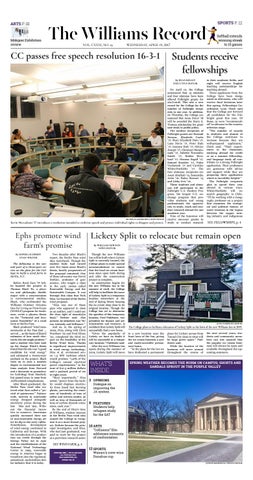
Kevin Mercadante '17 introduces a resolution intended to enshrine speech and protect individual rights to disagree and protest.
Ephs promote wind farm's promise By SOPHIA SCHMIDT STAFF WRITER The following is the second part of a three-part series on the plan for the College to build a wind farm in Berlin, N.Y. Before Reed Zars ’77 left, he handed the project to Thomas Black ’81, a physics and philosophy double major with a concentration in environmental studies. Black, who co-founded the Williams Outdoor Orientation for Living as First-Years (WOOLF) program for freshmen, wrote a physics thesis on the “Technical and Economic Feasibility” of a wind farm at Berlin Pass. Black produced “wind measurements at the Pass that ... served ... as the basis of [later] estimates of how much electricity the site might produce,” said a student who later took up the charge. Black’s thesis found that the site was “a good candidate for wind energy” and estimated a twenty-year payback on the project. Black went on to earn a masters degree in environmental systems analysis from Harvard and a doctorate in groundwater hydrology from Stanford, but passed away in 1990 from AIDS-related complications. After Black graduated, the Berlin Pass wind idea entered what Zars called a “period of quiescence.” Nationwide, interest in renewable energy dropped alongside electricity prices during the late '80s and '90s. Without the financial incentive to conserve, Americans quickly increased their use of non-renewable energy after its dip in the early 1980s. Nonetheless, development of wind energy continued in California and Europe. With the introduction of a production tax credit through the Energy Policy Act in 1992 and the establishment of the National Wind Technology Center in 1993, renewable energy in America began to transform into the regulated, subsidized, multi-billion dollar industry that it is today.
Two decades after Black’s report, the Berlin Pass wind idea resurfaced. Though the student body had turned over five times since Black’s thesis, faculty proponents of the proposal remained. One of these advocates was David Dethier, professor of geoscience, who taught a class in the early 2000s called Renewable Energy and the Sustainable Campus. It was through this class that Nick Hiza ’02 learned of the Berlin wind proposal. “Hiza was one of these guys who appeared in class as an auditor, and I could see the clear light of insanity[in him],” Dethier said. Also present, he admitted, was “focus, intensity and brilliance.” And so, in the spring of 2003, Hiza, along with Chris Warshaw ’02 and Fred Hines ’02, completed the third report on the feasibility of the Berlin Wind farm. Thanks to significant improvements in wind energy technology, Hiza et al. envisioned seven 1.5 MW turbines which would produce “140% of the College’s annual electrical power requirements,” to the tune of $10.3 million dollars and a payback period of six to eight years. “More importantly,” Hiza noted, “power from the facility would displace electricity from fossil fuel burning plants, preventing the emission of hundreds of tons of sulfur and nitrous oxides, as well as tens of thousands of tons of carbon dioxide emissions, each year.” By the end of Hiza’s time at Williams, student interest in the Berlin Pass wind idea caused the College to recognize it as a more formal project. Dethier became the principal investigator, and Hiza, who had just graduated, was paid to work for the project as a part-time research assis-
On April 10, the College announced that 15 students and four alumnae have been offered Fulbright grants for 2017-2018. This sets a new record for the College for the number of Fulbright recipients in one year. In addition, on Thursday, the College announced that Anna DeLoi ’18 will be awarded the Harry S. Truman scholarship for graduate study in public policy. The student recipients of Fulbright grants are Hannah Benson, Elizabeth Curtis ’17, Mary Elizabeth Dato ’17, Lane Davis ’17, Peter Hale ’17, Gemma Holt ’17, Olivier Joseph ’17, Chinmayi Manjunath ’17, Juliette NorrménSmith ’17, Reidar Riveland ’17, Deanna Segall ’17, Samuel Steakley ’17, Vidya Venkatesh ’17 and Caroline White-Nockleby ’17. The four alumnae recipients are Aseel Abulhab ’15, Samantha Avila ’16, Haley Stewart ’15 and Libby Dvir ’16. These students and alumnae will participate in the Fulbright U.S. Student Program, the largest U.S. exchange program that provides students and young professionals the opportunity to study, teach and conduct research abroad for one academic year. Nine of the honorees will receive one-year grants to study or conduct research
in their academic fields, and eight will receive English teaching assistantships for teaching abroad. Three applicants from the College have been designated as alternates, who will receive final decisions later this spring. Fellowships Coordinator Lynn Chick said that the College put forward 48 candidates for the Fulbright grant this year. Of those. 31 were “recommended” to advance to the country selection stage. “The number of awards to students and alumni of the College continues to increase because they are well-prepared applicants,” Chick said. “Their experiences in the classroom, studying abroad for credit or on a summer fellowship, and language study all contribute to a strong Fulbright application. Their professors are generous with advice and support while they are preparing their application which is incredibly helpful.” The Fulbright recipients plan to spend their year abroad in various ways. White-Nockleby will research geography in Chile. “I’ll be working with a Geography professor on a project that examines the ecological and political history of water tensions in the region between the copper mining industry and indigenous
SEE FELLOWSHIPS, p. 4
Lickety Split to relocate but remain open By WILLIAM NEWTON NEWS EDITOR Though the new Williams Inn will be built where Lickety Split is currently located, the College plans to make special accommodations to ensure that the local ice cream business stays open both during and after the construction project is complete. As construction begins for the new Williams Inn in the summer of 2018, the College will help to facillitate the move of Lickety Split to a temporary location somewhere at the end of Spring Street, keeping the ice cream shop close to its original location. Though the College has yet to determine the specifics of this temporary location, Fred Puddester, vice president for finance and administration and treasurer, is confident that Lickety Split will successfully find a new home. “Given the popularity of Lickety we have no doubt it will be successful in a temporary location,” Puddester said. After the new Williams Inn opens during the summer of 2019, Lickety Split will move
WHAT’S INSIDE
JUNE HAN/PHOTO EDITOR.
The College plans to facilitate relocation of Lickety Split to the lawn of the new Williams Inn in 2019. to a new location near the front lawn of the Inn, giving the ice cream business a new and easily-accesible permanent home. “In the plans for the Inn we have dedicated a permanent
place for Lickety across from Tunnel City close to what will be large green space,” Puddester said. While the location of the business will move around throughout the course of
the next several years, students and community members can rest assured that the popular ice cream business will always be open and available throughout the upcoming summers.
SPRING WEATHER BECOMES THE NORM ON CAMPUS; SHORTS AND SANDALS SPROUT IN THE PURPLE VALLEY
3 OPINIONS
Dialogue on improving the JA system
9 FEATURES
Students help refugees study for the SAT
10 ARTS
"Collisions" film addresses moments of confrontation
SEE WIND FARM, p. 4 12 SPORTS USPS 684-6801 | 1ST CLASS MAIL U.S. POSTAGE PAID WILLIAMSTOWN, MA PERMIT NO. 25
Women's crew wins Donahue cup JANETH RODRIGUEZ / PHOTO EDITOR
2 OPINIONS
The Williams Record
Editor-in-Chief Jack Brent Greenberg
April 19, 2017
Arts Editors Shaheen Currimjee and Li Yu
Managing Editors Michael Green and Emilia Maluf
Sports Editors Brooke Horowitch and Danny Jin
Communications Director Francesca Paris Executive Editors Marit Björnlund, Reed Jenkins, Ryan Kelley, Rachel Levin, Maddy McFarland, Neena Patel, Lucy Putnam, Rachel Scharf, Skylar Smith and Tesnim Zekeria
Photo Editors June Han and Janeth Rodriguez Production Manager Michael Rubel Business Manager Scatt Macdonald Financial Manager Mark Tolomeo
News Editors Nicholas Goldrosen and William Newton
Director of Outreach Hayley Tartell
Opinions Editor Alexandra Medeiros Features Editors Jane Petersen and RB Smith
Head of Advertising Isabella Wang
THE INDEPENDENT STUDENT NEWSPAPER OF WILLIAMS COLLEGE SINCE 1887 WILLIAMSRECORD.COM
BREELYN KARNO '20
Word on the Quad How do you plan on celebrating 4/20 this Thursday? By JANETH RODRIGUEZ PHOTO EDITOR
EMAN ALI ’20
"Hanging out with my gummy bear friends."
ANTHONY SIMPSON ’19
"I have class."
DELANEY SMITH ’18
CONVENTIONAL WISDOM ONLY FOUR MORE WEEKS
We're so close to the end, I can test it – I mean taste it!
INTERNATIONAL FOOD FAIR
Good food and insightful conversation. What a great Friday night!
SILENT DISCO
Silent is a generous term, but the spectacle was amusing.
REGISTRATION FOR FALL 2017
Trying to decide what courses to take next year while simaultaneously trying to salvage my GPA.
LETTER TO THE EDITOR To the Record,
"I will be consuming abundant amounts of brownies (with chocolate chips)." AARON FINDER ’17
"Probaby rowing."
I would like to respond briefly to the letter from Peter Koenig and David Tobis regarding the Board of Trustees (“On conflicts of interest," April 12, 2017). Much of Koenig and Tobis’ piece is devoted to re-visiting issues that the board addressed in detail back in 2015, as described in our published statement from that time, which explains among many other things the decision not to divest as part of our response to climate change. I encourage anyone who is interested to read that statement and understand the many elements of our thinking, which developed after
much consideration over a year of study and discussion. As to Koenig and Tobis’ critique of trustees O. Andreas Halvorsen ’86 and Mark Tercek ’79, it betrays a serious misunderstanding of the capital markets to suggest that Mr. Halvorsen’s investment portfolio would be affected one way or another by a decision to divest the endowment from the list of stocks targeted in the divestment proposal. Odder still is the notion that Mr. Tercek has a disqualifying conflict because the very prestigious partnership he left, in order to dedicate his career to protecting the environment, had made a profit investing in energy. The letter concludes by suggesting that Williams should “clean up… our own backyard.” In my personal view, Williams’ backyard is in very good order. The trustees each volunteer hundreds of hours every year to keeping it so – work for which I and, I believe, most members
of the Williams community are deeply grateful. Michael Eisenson '77, chair of the Board of Trustees
WRITE FOR THE RECORD. MEETINGS: PARESKY 209 | 7 PM WEDNESDAYS OR EMAIL JBG3@ WILLIAMS.EDU
FROM THE ARCHIVES The opinions expressed in signed columns are not necessarily those of the Williams Record editorial board.
Op-Ed and Letter Submission The Record welcomes op-eds and letters from all members of the Williams community. The Opinions section is designed to reflect the varied views and ideas of the Williams community, and the publication of any letter or op-ed does not indicate an endorsement of the views contained therein. Submissions should be sent to amm16@williams. edu by Sunday at 5 p.m. for inclusion in the next Wednesday issue. Op-eds range in length from 700900 words and letters are 500 words or fewer. The Record will not publish pieces that have appeared in other publications. Pieces submitted to the Record are not guaranteed a spot in the upcoming issue. For Record Policy information, please see our website, williamsrecord.com.
JANE MCCAMANT '05
Bleaching our shirts ei i A A R A R R
a dialo e o
R R AR A R a d A
Today, over 45 Junior Advisors (JAs) from two different JA classes are wearing bleached JA shirts to initiate a dialogue about how the JA system can provide support for JAs and first-year students of color. We write this on behalf of all the JAs who bleached their JA shirts. This action is one of unity; it represents the need to talk about race, socioeconomic class, first-generation status, immigration status and other intersectional identities as barriers to full participation in one of the most central institutions to life at the College. The action was born from a group of low-income minority JAs seeking a way to resist the problematic practices of the JA system and inspire conversation about these issues. The JA system has been inherently white. It is a system that helps those who need it the least and abandons those who need the most support. We are bleaching our shirts to acknowledge the historic and present whiteness of the JA system. Every single student at the College is affected by the JA system but, unfortunately, it is one that often leaves students of color feeling tokenized and used. Although progress has been made, the JA system was created during a period when the institution existed exclusively for wealthy, white, male students. For JAs of color, this concern is nothing new. The entry has, and always has been, a space for the majority; a space for those who can “learn” from diversity put around them and crawl back to their own privileged worlds at the end of the night. When we who are marginalized by socioeconomic status, race, religion, nationality, sexuality and sex are quota-ed up into “wholesome” entry units, it is not for our own benefit. There exists great value in the JA system, but to become one that will support all students, these foundational issues must be explicitly addressed. As one current JA of color shared with us, “I believe it’s time for the JA system to take on a new form – stop being proud of purple. Purple is just yet another coded way of saying white. The whitewashed JA shirts are simply a message for those of you who have not been following along.” White JAs are no stranger to this dynamic either. “As a white JA, there are so many ways in which I’m privileged [...] When I have a chance to
stand in solidarity with my fellow JAs and start a conversation [...] I want to do so.” JAs are well-respected on this campus and in this community; this action allows us to flex our privilege a bit in order to draw attention to an issue that many of us care deeply about. Today, we are unified in our commitment to continue to improve the JA and entry system. A study conducted by the Record (“JAs more likely to be white, varsity athletes,” April 20, 2016) about the JAs to the Classes of 2018, 2019 and 2020 found that “students who were not on financial aid, who were varsity athletes and were white were significantly overrepresented in the JA classes relative to the student body.” We are excited that the JAs to the Class of 2021 are more representative of the student body. We want our action today to celebrate this progress while also acknowledging that this is not just about statistics or numbers. It’s about changing a system that hasn’t really changed since this school was entirely white men. We need to think about how the role of a JA has shifted while our school’s definition hasn’t and how that puts a huge burden on marginalized JAs. One example is that minority JAs disproportionately provide emotional support to minority first-year students who are not in their own entry because these students are not able to seek this support from their own JAs who do not understand the complexities of their identity politics. Furthermore, as Brian Benitez ’18, co-president of the current JA class, shares, “Diversity and representation within the JA system, without comprehensive support for JAs and first-years from minority backgrounds, is not enough.” There is no institutionalized support for low-income and minority JAs for the unique challenges they will face due to their identities. This action is in no way an attack on the College, the JA system or other JAs. Rather, it reflects the deep commitment and care that we, as JAs, have for the Williams community and our fellow JAs. It is because we care about this system, and the people within it, that we want it to support and represent every member of the student body. It is because we care about this system, and its people, that we want to improve it.
R
My original draft of this op-ed read something like this: Stop softcore denying the Holocaust. Stop softcore denying the Holocaust. To conclude, stop softcore denying the Holocaust. The staff of the Record, unfortunately, told me that I would need to include some other words in this article, not least of all because I borrowed the concept of “softcore Holocaust denial” from Holocaust historian Deborah Lipstadt. She is a leader in her field, a pioneer in the fight against Holocaust denial, and the inspiration for the 2016 film Denial. There is always good reason to talk about the Holocaust and Holocaust denial, but recent comments by Press Secretary and douche potato Sean Spicer give added urgency to the topic. In describing the atrocities of the Assad regime in Syria, Spicer suggested that Adolf Hitler, unlike Assad, “didn’t even sink to using chemical weapons” and that Jewish prisoners were interned in “Holocaust centers.” Spicer’s flawed memory is disturbing, but he does not sound like an outright Holocaust denier: like many of the skim-milk fascistic aspects of our time – such as the “alt- right” and their pussyfooting bigotry – the banal quality of Spicer’s comments conceals something very dangerous. Writing for the Atlantic, Lipstadt defined softcore denial, in part, as the “de-Judaization of the Holocaust,” or the omission of Jews from the history of World War II. Expunging the explicit role of anti-Semitism from Nazi ideology is one form of de-Judaization. Nazis are not just racists, much less literary villains against which American heroism can stand in shining contrast. Yes, the Nazis targeted many groups – including gays, the disabled, Roma, communists and the otherwise “undesirable” – and the experience of those populations can and should receive more popular attention. But to cast the Jews as just one among many victims overlooks key facts. First, the Jews were central to the civilizational clash at the heart of Nazi ideology. Second, and most importantly, the system-
si A
A
rom
R A
Sitting in bed, I have a bag of ice on top of my left ankle: the new center of life. For someone like me, studying abroad is an opportunity to live the life. I started learning French in seventh grade so that one day I would be able to live in Paris. The language, the people, the food, the history and the energy of this city is like nothing else. There is always something to do and as my program told me at the beginning on doit profiter; you have to take advantage of it. But what happens when suddenly you have to start looking for the disability sign everywhere you go? During my school break, I went to visit my friend in Germany and he asked me if I wanted to go on a one-hour hike up the Austrian Alps: TOTALLY! Though I hated hiking, the study abroad mentality motivates us to try new things and get out of our comfort zone. I got to the peak of the mountain and felt like I was on top of the world: I had started to feel more comfortable in the old continent, my French was improving, I was visiting friends from all over the world and, apparently, this Costa Rican was strong enough to hike for an hour in the wintered Alps. To finish, my friend suggested we take the sled to go down. On one curve, my left foot slipped out of the sled and I heard a crack. At the emergency room, the doctor said my ankle was broken. “Ok, I kind of figured that.” He then said I also needed surgery. “WHAT?!” Back in Paris, I was awake to hear the surgery that would put a 20-centimeter pin in my leg so that I could start restoring my ankle’s mobility. The entire time I was crying and could not stop. The doctors asked me constantly what was wrong but I
e ac e d o a ro e a couldn’t find the words in French to express how lonely I felt. I couldn’t stop thinking about my mom and my family in lovely Costa Rica. I would come back to the hospital room after this traumatic experience and there would be no one there to hug me or to talk to. Past experiences had trained me how to stay mentally healthy, but when unsympathetic doctors offered little guidance and my family was far away, things became much harder. Needless to say, there was a lot of Googling on what happens when you have a cast. WebMD started to show up in my favorites page, and my saint of a mother heard my fear every single day on the phone. If I do nothing for too long, my mind gets troubling thoughts, so only three days after the surgery, I went back to class. Moving required crutches, and every 10 steps left me sweating and without breath. I spent endless hours in my homestay where they made me feel like I took up way too much space. I couldn’t go out with friends because I got tired so fast. I couldn’t make the photographs for my class. Most importantly, my body was changing so fast that every morning I feared waking up because I didn’t know what it was going to feel and look like. I was physically and mentally weak. Nonetheless, I tried to stay positive in order to make the most out of the situation. I went to the movies, the opera and cafés. I watched all of the series I always felt too guilty to watch, and my lovely friends were incredibly patient and came
Sarah Weiser ’17 is a history and Russian double major. She lives in West.
r
to visit me often. Even though I would have never imagined my time in Paris to be like this, to some degree I am somehow glad it happened. With my version of therapy – talking to my mom every single day on the phone – I learned a lot about how important patience is, how amazing bodies are, how helpful strangers can be, how much God loves us and how grateful I am to be where I am, who I am and with the body I have. Although I still limp a little when I walk and have to rest for several hours with a bag of ice, I have never been prouder to take a step. My experience is nothing compared to those of people with more serious and/or more permanent disabilities. But as a result, my most sincere admiration goes out to every single one of you, for the strength that it takes to wake up every day in a world that constantly puts you at a disadvantage. This is what study abroad means to me now: a time when, for once, I was forced to take a couple of deep breaths, think about nothing else but this one bone in my body and experience the world with a disability. I didn’t expect to learn this; it certainly wasn’t advertised in the programs’ brochures. However, I now have a scar on my leg that will remind me everyday about the time, in Paris, when the most important phrase became j’ai une cheville cassée; I have a broken ankle. Daniela Hernandez ’18 is a political economy major from Heredia, Costa Rica. She is currently studying away in Paris, France.
FROM THE ARCHIVES
JENNIFER OSWALD '11
Out of the dorms, beyond our values The mal e ec s o o camp s o si
oloca s de ial
atic extermination of the Jews is so integral to the definition of the Holocaust that it would be ludicrous to talk about one without mentioning the other. For Sean Spicer to forget that Hitler gassed the Jews is a form of denial. Not only is it mind-blowingly asinine to forget Hitler’s gas chambers, but this omission does real harm to a world still grappling with the waves of xenophobia and disgust that caused the Holocaust in the first place. Spicer’s reference to “Holocaust centers,” furthermore, makes the annihilation of an entire people sound like a luxury vacation. Comparing things to the Holocaust that should not be compared to the Holocaust is a form of softcore denial. These false analogies drain the event of its meaning and undermine its potential to teach and heal. Assad needs no comparison, and the tragedies in Syria are horrifying in their own right. Do your research, and don’t bury Assad’s victims under an added layer of historical inaccuracy. Labeling people who are not actually Nazis as Nazis is a form of softcore denial. Don’t get me wrong – racists and the so-called “alt-right” are absolutely assholes – but the meaning of Nazism is fixed in a place and time, even if its legacy has far-reaching implications. And I can understand the impulse to label the alt-right as Nazis, but “feminazi?” “Grammar Nazi?” Stop. Tempted to describe your strict professor as a “total Nazi?” Don’t. This last Passover, as is the case on every Passover, we Jews remembered slavery and oppression. We choose to remember because it is the right thing to do. Even though I am discouraged when I hear the Holocaust being thrown around as a rhetorical device, or catch news of another moral degenerate from the Trump White House blowing disingenuous and historically inaccurate “platitudes” out of his ass, I still hope that that one day our society will not only remember but remember properly.
le i
I couldn’t find the words in French to express how lonely I felt.
All of the authors currently serve as JAs to the Class of 2020. Darla Torres ’18 serves as co-president of the JA class this year.
or a e d o so core ARA W
J’ai une cheville cassée
e A s s em
Continued remembrance alli
OPINIONS 3
The Williams Record
April 19, 2017
R
R
A
Most parties at the College feel like a reenactment of Groundhog Day. Same people. Same places. Same stories. I don’t drink any less than I used to when I was a freshman, yet on the weekends I have traded in drinking games on Hoxsey Street for games of Monopoly in my apartment. But this is not a witty satirical piece about the underwhelming party scene at the College. It’s about the off-campus housing climate and its pernicious influence on our community. I was a member of the men’s hockey team my first three years on campus, and most of my best friends are still on the team. Hockey always lived in Goff’s. This year, I live in Sushi Thai with a former teammate while eight other members of the team occupy all the available apartments in Goff’s. Sophomore year, the guys at Goff’s threw so many parties that, once our season started, strangers rolled in at 11:00 p.m. the night before our games expecting a party. We might go to a small school, but we were going to party like a “real” school. So, when the members of the team from the class of 2016 failed to secure upstairs Goff’s apartments and instead ended up in the much smaller Tony’s Sombrero apartment, they became the subject of ridicule because they had, from our perspective, let us down – as if there was some unwritten rule that Goff’s was ours. Off-campus housing at the College pretty much goes to the same people every year. Goff’s is usually the hockey house. Meadow is usually football. The apartments above Blue Mango are by far the nicest of the bunch. They are not dominated by sports teams, but you (or
a d i s radi io s
your parents) have to be able to put down a hefty down-payment when you sign for it, on top of $3000 per month split between you and your roommate. 66 Hoxsey is the men’s soccer house, and 71 Hoxsey has been mostly guy’s lacrosse, although some people got upset last year when a group of women decided to live in 71, not host enough events and throw off the school’s fragile party ecosystem. If this sounds a little appalling, unfair or atavistic to the days of fraternities at the College, that’s because it is. And here’s the kicker: you have to sign a lease for these places in either your freshman or early sophomore year. The Record recently ran an article on offcampus housing at the College. (“A comprehensive guide to offcampus housing,” March 15, 2017). It gave the basic features of each house, how good the parties historically were on a scale of 1-10 and when you had to sign for the house. The Record reported that, for 14 of the 18 houses, you would need to sign a lease before junior year. Even this information is a little off, as I know that one of those four houses that was reported to allow you to sign junior year was unavailable for the 2018-19 year by this fall. Of the three remaining houses, none of them had a party rating above a 3 on the 10-point party scale. This is certainly unfair and extremely harmful to our school community. Williamstown doesn’t have a good bar scene. The Purple Pub does not cater towards students, the Log can’t serve hard alcohol, and the Red Herring is essentially a glorified hallway. As the school’s alcohol policy has gotten a bit stricter over the years, there are fewer par-
When one large group controls nearly all the spaces available for big parties, they become the priviledged group.
ties in the dorms. This leaves the off-campus houses controlled by athletes as the hub of the “going out” scene. While parties are not the only way to socialize here, such a homogenous group controlling all the potential party locations in a college is redolent of the effects fraternities have on the community. When one large group controls nearly all the spaces available for big parties, they become the privileged group. The reason why athletes control the off-campus party scene is because of how early we have to sign for housing. If you are not on a sports team, chances are your friend group will shuffle a bit from freshman winter to senior fall. But for a lot of athletes, this isn’t always the case; their milieu stays pretty consistent and thus finding someone to sign a lease isn’t a problem. Now, factor in the advisory role that older teammates provide their underclassmen about the ins and outs of the school, the fact that teams tend to have a bit of a collective drinking culture, and the high rent costs (keeping in mind that athletes at small elite liberal arts schools tend to be, according to a recent Amherst study, a bit more affluent than non-athletes). It all tastes like a recipe for an (often white) athlete-dominated social scene.Things have gotten so ridiculous in the off-campus housing scene that one student in the class of 2018 signed for all eight Goffs apartments back when they were a freshman. At that point, it might not be about monetary gain, but rather about being able to select who else is in the building. But, you shouldn’t have to propitiate a kid in your class because you want a place to live senior year. The status quo is firmly entrenched, and I don’t think it reflects values that the College wishes to have. Gregory P. Zaffino ’17 is an economics major from Darien, Conn. He lives on Spring Street.
4 NEWS
The Williams Record
April 19, 2017
Students, alumnae earn fellowships Berlin wind farm efforts fall short for post-grad opportunities CONTINUED FROM PAGE 1
CONTINUED FROM PAGE 1 communities – tensions that are due in part to state distribution policies, but which have been further stressed by climate change,” she said. Curtis received a grant to research public health in India. “‘The year after graduation seemed the perfect time in my life to step out of my comfort zone, take a break from the constant cycle of schooling I’ve been in for the past 17 years, and work towards a more nuanced understanding of the field to which I plan on devoting my life,” Curtis said. “Next year, I will be researching community-based reproductive health programs across rural India with the hopes of better understanding the process of creating sustainable and culturally-appropriate reproductive health care initiatives.” Holt will continue to research how Arctic institutions can evolve to create sustainable futures, which she starting investigation at for her senior thesis. “I am going to be studying climate change policy at the University of Lapland in Rovaniemi, Finland,” Holt said. “The Fulbright is an amazing opportunity to continue research I’m passionate about while immersing myself in Finnish culture.” Dato will work as an English teaching assistant in Spain. “After studying abroad in Córdoba, Spain during my junior spring, I wanted to return to continue improving my Spanish and engaging with the vibrant culture,” Dato said. “I am also interested in working in education policy so having an understanding of another country’s education system will be incredibly useful going forward.”
Norrmén-Smith will teach English in Andorra. “A linguistic amalgamation of Catalan, Spanish, Portuguese and French, Andorra is the perfect place for me to expand my language skills, learn to ski, finally finish writing songs I’ve neglected during college and become comfortable leading a classroom of teenagers,” Norrmén-Smith said. “Upon my return from Fulbright, I will be joining the 2018 Teach For America Corps in New Orleans to teach middle school English, so the Fulbright year will give me valuable teaching experience.” Hale will spend his year abroad conducting research and teaching English in Germany. “I wanted to take a closer look at the political movements within East Germany and learn what I can about Germany’s role in the European Union,” Hale said. “These are exciting and terrifying times for the EU and Germany’s position at its center. I’m also excited to teach English and speak with Germans about their views on the US and the world.” Finally, Davis will conduct ecology research in Ecuador. “I am interested in the role of human management in helping ecosystems adapt to climate change, and I ultimately hope to use my data to assess potential management actions to protect the biodiversity of the reserve,” Davis said. With the Truman Scholarship, DeLoi plans to pursue a joint degree through the Stanford Graduate School of Education’s Master of Arts/Master of Public Policy (MA/MPP) program to prepare for running a community music education organization in an under-resourced, rural community. She will receive $30,000 in support for graduate
study, in addition to leadership training, graduate school and career counseling, and access to special internship opportunities within the federal government. “I hope to use the Truman money to expand my knowledge and skills in graduate school so that I can be as effective as possible in creating change in struggling communities,” DeLoi said. “I especially want to get more training in economics and public policy, which I didn’t really do too much at Williams. My ultimate goal is to run one or more community centers that focus on using the arts to bring people together and revitalize rural areas.” DeLoi is one of 62 recipients chosen from an applicant pool of 768 from 315 colleges and universities. She is the 18th Truman Scholar from the College and was in class when she found out that she had received the prestigious scholarship. “Lynn Chick and Katya King from the Fellowships Office actually came into my psychology class to announce that I won, which was super embarrassing but also really sweet of them. I hadn’t expected to hear anything for a few more days, so it was extra exciting,” DeLoi said. DeLoi credits her family and mentors for helping her. “My biggest inspirations have been my mom, who brought me up on the arts and allowed me to see how powerful they could be, and my mentor in high school, Linda Gerstle, who directed the education department at the arts non-profit From the Top and is always just tireless in her vision and dedication to everything she does,” DeLoi said. She will receive her award at a ceremony May 28 at the Harry S. Truman Presidential Library and Museum.
THE RECORD CROSSWORD
tant. During the summer of 2003, Sam Arons ’04 joined the project as an intern. Because Arons was “a physics major who could actually walk and talk at the same time,” recalled Dethier, he was able to gather people around him to work on the project. That summer, Arons decided he wanted to pursue a thesis on the Berlin wind topic, and he hoped to erect an anemometer on Berlin Pass to measure wind speeds more precisely than previous student work, which used data from nearby Mt. Rainer extrapolated against meteorological data from Albany, had been able to. Hiza, Dethier and Jamie Art, acting as attorney for the College (now Director of Real Estate and Legal Affairs), appeared before the Berlin Zoning Board of Appeals (ZBA) in the spring of 2004 to ask for a height variance and special use permit to construct a temporary 164-foot anemometer tower on Berlin Pass. “The zoning board just tarred and feathered us and ran us out,” Dethier said. Actually, the Berlin ZBA insisted that, in order for the anemometer to be approved, the College needed to present a complete environmental impact statement for the entire wind farm. The ZBA was “probably...not at all within their rights for what they asked for,” Dethier said. Perhaps, in the previous year, word had gotten out to the town of Berlin about the wind farm idea through a group of students in an environmental planning course at the College. This group, which consisted of Collins Canada ’03, Lindi von Mutius ’03, Sarah Wu ’03 and
Vivian Schoung ’05, began to assess, yet again, the feasibility of a wind power project on Berlin Pass. This time, they focused on the legal and public opinion aspects of the project. Students set out on foot to interview residents they met on the street. Amy Johns ’98, director of the Zilkha Center, claimed that rumors could kill a project before it begins. She reflected that in order to prevent a town from feeling that the College is going behind its back or shirking due process, the College must proceed “very carefully and deliberately,” which means not “talk[ing] about it until it’s time to talk about it.” However, the students found that public attitudes were favorable. A strong majority of those surveyed said they would support a wind project either in their community, on Berlin Pass or in another community. To gauge the public’s aesthetic sensibility toward windmills, the group showed photoshopped images of local views with and without windmills and asked respondents to rate the attractiveness of the images. Though turbines negatively impacted ratings, the majority of respondents still rated images with turbines as “attractive” or “very attractive.” Moreover, the environmental planning group found that a wind project on the Pass would increase the Berlin tax base – ikely through a payment in lieu of taxes – by roughly $130,000 per year. This 2008 estimate is nearly a tenth of the town’s total budget in 2016 ($1,345,973). During the 2004 ZBA meeting, Hiza told the Board that, though the project would be exempt from taxation, payments in lieu of taxes “could be negotiated ” and would be roughly
$55,000. These numbers are important to public opinion; as Nick Adams, current chair of the Berlin ZBA, said, the town is always “going to go ‘what’s in it for us?’” Because the sole purpose of the anemometer tower was to gauge feasibility of a wind farm, it made little sense for the College to conduct an environmental impact analysis — a significant undertaking in itself — for an entire project that may or may not be financially or logistically feasible. Therefore, the anemometer was erected on the Taconic ridge crest in nearby Hopkins Memorial Forest (HMF) instead. Arons forged ahead with his thesis — “Energy Yield and Visual Impact Studies of the Berlin Wind Project” — using the wind speed data from Hopkins Forest. Arons calculated that a seven-turbine wind farm at Berlin Pass would produce roughly 35.0 million kilowatt hours annually — 140-180% of the college’s electricity use in 20022003. Arons found that, although the turbines would technically be visible from heavily populated areas, they would appear so small “they might go unnoticed by all but the most careful observers.” Using ESRI ArcScene and Adobe Photoshop, Arons created static visualizations and animated GIFs of the proposed turbines from different viewpoints. These visualizations, which were posted to a webpage, were all too convincing. “Some outraged citizens of Berlin called the college saying, ‘How could you build this without asking us?’” Dethier recalled. “It was amazing.”
SPRING STREET BLUES Monday 4-10-17 5:24 p.m. Hopkins Hall: Officers took a stolen article report for a student who reported a stolen laptop. The last time the student saw the laptop was in Chicago O’Hare Airport on April 2. Officers sent a stolen article report to the Williamstown Police Department and notified the Office of Information Technology.
911 call from that location regarding an intoxicated person. Village Ambulance arrived on scene and transported a non-Williams student to Berkshire Health – North for treatment. Dispatch also called custodians for cleanup.
Wednesday 4-12-17
12:40 p.m. Fitch House: An officer noticed an inflatable pool set up on the east side of the building. The officer emptied the pool and told the students that if they wanted to continue to use the pool they would have to do so off-campus.
12:31 a.m. West College: Officers responded to a noise complaint on the east side of the building. There were a few students talking while waiting for friend. Upon arrival, they were not being loud, although most of the students in West had their windows open.
12:50 p.m. Cole Field: Officers responded to a 911 medical emergency activation requested by a Williams College athletics trainer at the rugby match. Village Ambulance transported an injured UMass-Amherst player to Southern Vermont Medical Center in Bennington, Vt.
1:05 a.m. Mark Hopkins House: Officers responded to a noise complaint on the fourth floor. They identified the room with the source of music. They also cited the student for smoking and tampering with a smoke detector.
3:44 p.m. Cole Field: Officers responded to a report of a vehicle with damage near the baseball field. A player had hit a foul ball and cracked the windshield of a vehicle. The Williamstown Police Department (WPD) responded and took a vehicle damage report.
9:50 p.m. Dodd House: Officers performed a welfare check on a student for a concerned parent. They found the student, she said she was alright and talked to her mother at that time. The officer took no further action.
11:04 p.m. Wood House: Officers responded to a noise complaint regarding a group of people yelling in the Wood House parking lot. Upon arrival there was nobody there and everything was quiet.
Saturday 4-15-17 Across 1 6 10 14 15 16 17 18 19 20 21 23 25 26 28 32 36 38 39 42 43 44 45 47 49 51 56 60 61 62 63 64 65 66 67 68 69
Ottoman Empire founder Marking on 22-down Cry to the Chief Jack & Jill’s medieval toole Bigger than a gigaOr’s partner oftentimes Mannerism What you give a dog’s head (2-wds) White and Red Sox pitcher Chris Fido’s meal Mountain Day treat Ells’ fast-casual chain Problem for Facilities Settlers of eastern South Africa “It ___ Me” (2000) Spring Fling anthem Grocery delivery service NV Casino Owner Directors Cup gifter, briefly The Master of Suspense Alternative to well-done Boy to his dad Volkswagen Bug Cathode’s partner Keep ___ (fend off; 2 wds) Nickname abbr. Oz character for example Sturdy vehicles Thanksgiving course in Spanish Playful stick Consumes Gave power to Billy Bean’s Metrics Poker offering 2011 hurricane Village Amb. employees Owns clouds and birds perhaps Italian designer Franco
Down 1 2 3 4 5 6 7 8 9 10 11 12 13 21 22 24 27 29 30 31 32 33 34 35 37 40 41 46 48 50 52 53 54 55 56 57 58 59 63
Nerve attached to the eye Silverman or McLaughlin Dolphins and Marlins home Singular speech impediment (2 wds) Williamstown TV Willi____ Attach an assignment Freckled Peanuts character (2 wds) Homer’s tradition for example Tasty tot Tentativeness “When I was ___” H.M.S. Pinafore starter (2 wds) Where Gilligan was stranded “To read” in Bell-Villada’s class ___ with; opposing (2 wds) Ephelia for one Bassoon’s cousin Cpl superior Ewan McGregor or Gerard Butler Driscoll chem. compound 1980’s hit “___ on me” Por’s cousin Style, energy, and enthusiasm Michael Jackson’s hair in the ‘70s Lions and Tigers and Bears Simpsons fictional action hero Org. for a town’s perm. residents Casual greetings ___ out; Scrape by Jewish baby ceremonies 51 or l x w Williams ___ Workshop 2000’s Johnson or Stein Discus or Javelin State sport of Texas Domed or vaulted recess Rich agricultural base Pride shorthand File’s partner Gender prefix in 58-down discourse
2:28 a.m. Bryant House: Officers responded to the fourth floor after the dispatcher heard a
1:10 a.m. Dodd House: An officer responded to a noise complaint. Upon arrival, the area was very quiet.
K O O E B AL S
6 :30 a.m 9 , g at 7 1 2 il le startin 9-4 r p A vailab 2, rday , y a bers a ril 2 . Satu d i r F ry num y Ap t 2 p.m School s. a nt a ry , Mas e g a d t n y i t r n a u LE star Eleme mstown t Frid a S SA own illia
.
t BAG illiams h St. W W hurc C Quality Books from 50¢ 115 Silent Auction, Bake Sale
Info: milnelibraryfriends.org
April 19, 2017
FEATURES 9
The Williams Record
One in Two Thousand By RACHEL SCHARF EXECUTIVE EDITOR I met Grace Mabie ’19 during my first year at the College when I had the pleasure of being entrymates with her. She is one of the funniest and most optimistic people I’ve ever met. A passionate mathematics major with unique aspirations towards becoming a cowgirl, Grace never fails to make the most of any and every situation. You like math the most out of any person I know. I’m so obsessed with math. I really frickin’ love math. It’s weird because I never thought that I was good at math, and my parents and teachers always told me that I was, but I never processed that. And then I got to college and did [multivariable calculus] and stuff and really liked it but also didn’t realize that I was good at it. And then, Colin Adams, my professor, told me to be a math major in office hours, so I did. I still didn’t really get that I was actually good at it, and I kind of just kept doing math classes, and people kept telling me to do others, and I just did what they said. And then I ended up at a math conference, and now I’m publishing research, which is weird. Tell me about the math conference. The math conference was hilarious. I went to a math conference over spring break at Amherst College. It was a conference for underrepresented minorities in math research, so it was a lot of women and people of color, which was really cool to see. But also, I thought it was supposed to be undergraduates, and then everyone there was a Ph.D. or in the process of getting a Ph.D., and they all thought that I was in grad school, and I was just really freaked out and intimidated.
I went to probably 12 hours of math talks and didn’t understand anything and that rocked. Didn’t you consider going to engineering school? I don’t think I’d want to be an engineer. I want one of those careers where you talk to people and interact with people, and I haven’t quite figured out how to do that with math. Could you see yourself being a math teacher? I don’t really know. I like kids, so if I were a teacher, I’d be at the elementary school level probably, where you can’t really specialize in math. But, I think it’s important to have elementary school teachers that are also familiar with and comfortable with math because that makes more students become more comfortable with math. If you have an elementary school teacher who’s not great with math, they kind of avoid it, and then that’s the part of your education that gets pushed to the side or becomes less important, and that’s how people get less comfortable with math, or less good at it, or anxious about it. What are your plans for this summer? I actually just got an internship, so I’m going to move to Bozeman, Mont. and be interning for an environmental conservation consulting company. So they basically try to fix environmental problems by using weird problem solving strategies. The reason that I looked into them and thought they were interesting is that they have a project that they’ve been doing the last year or so. They map the migration patterns of herds of animals and project those forward and see where those animals are most likely to cross major roads. And then from that they petition the
The storefronts of Spring Street tend to remain fairly static. While that “new place on Spring Street” always exists in the back of students’ minds, the iconic fixtures of “downtown” Williamstown usually remain the same for a student’s entire college career, and often beyond. As spring break drew to a close, however, and the campus reawakened for the final months of the academic year, a new store emerged that stands to become one of Spring Street’s defining locales. Purple Dragon Games is the brainchild of Williamstown native Niko White ’04, who hopes to nurture and provide a nexus for Williamstown’s tabletop gaming community. Anyone — student, Williamstown resident, or passerby — is welcome to sit down in Purple Dragon and try out a game, free of charge. While some games are already conveniently set up, visitors can request to play any game in the store’s repertoire, and White is more than happy to oblige. The idea behind Purple Dragon is not just to make money selling board games, but to create
an open and inviting space for game enthusiasts from all parts of the Williamstown community to enjoy their shared hobby. While many students may be unfamiliar with tabletop gaming in Williamstown, it is a community with which White is very familiar. “I grew up out here,” he said. “I grew up playing these kinds of games, I had a lot of friends who did, and we all would have just loved having a place like this.” As a student at the College, he founded the Magic club (as in “Magic: The Gathering,” the mostplayed trading card game in the market), and went on to become an events manager at a board game store in Boston after graduation. After a while, he decided to come back to his hometown and start up his own store. Purple Dragon’s first two weeks of operation have so far proved White right. His events for Magic and other games have been well-attended, and he hopes to expand his programming to have an event every day of the week. White has had plenty of visitors who come just to play, which is ultimately the whole idea behind the store. “You know, you don’t get into this industry because you’re
JANETH RODRIGUEZ/PHOTO EDITOR
HOMETOWN WINNETKA, ILL.
RESIDENCE DODD HOUSE
government to build bridges for the animals to walk over so that there are fewer collisions. So they use math to end road kill, which is pretty sick. That’s the goal. I like math and the planet, so… But you considered doing something a bit more off the map this summer. I just knew that I wanted to live in Montana and wanted to see what it was like to be a cowgirl, so I applied to a bunch of dude ranches to work as – they call it a wrangler – but basically you get up, and you round up all the horses, and you take people out on horseback rides, and you basically do that for the entire summer, and it sounded awesome. Anything on the application that said, “you must wear a cowboy hat,” I was like, “sold.” The other job that I was considering was being a zip line tour guide for the summer. That was actually a
like, ‘yes, this will make me my first million in ten years!’ or whatever – that’s not where you’re going,” White said. “Instead you’re like, ‘I really like doing this, and maybe I can pay my bills while doing this, in a place I really like.’ And that sounded really good to me.” It has evidently sounded good for members of the community, as well. The Williams Magic club and the Williams Association of Role-Players (WARP) have been huge supporters of Purple Dragon, as well as other students interested in tabletop gaming who might not have been part of an existing community. “One of the things that made me really happy to be able to do this was, it feels really good to be like, ‘I can go back and put this thing in my hometown that’s something I wished had been in my hometown when I was growing up,’” White said. Although the store has only been open for two weeks, White is confident about the future of Purple Dragon Games. Purple Dragon Games may soon become another fixture of the Spring Street landscape and serve to provide an outlet for tabletop gamers from all over the Williamstown community.
conscious
consumption
ways psyched about math – that I just love it. Also in general, with social things, I’m always excited no matter what. Some people say it’s always the same at the College, some people think it gets old – I do not think that. I’m so excited for every possible thing that we can do here, and I just love the opportunity to make friends. How do you find ways to make everything at the College so exciting and fun?
So that’s on your resume?
Purple Dragon fills board game niche By RB SMITH FEATURES EDITOR
against the clock, so whoever gets the hog into the bucket the fastest wins. And before it starts the whole crowd at the rodeo bids on who’s going to win. No one bet on us because we were totally random not well known hogwrestlers in the area, and then we actually ended up winning, and we got the hog into the bucket in 29 seconds, which was the fastest that day. So we got $500 to split between the four of us.
GRACE MABIE ’19
shop local
Williamstown, Mass. wildoats.coop
FORMER JOB ELEVATOR ATTENDANT
funny interview because I got the call for that interview when I was at the airport on my way to the math conference … Then I had to get into a shared ride to the math conference, and so I had to explain to all of these people that I was midway through a phone interview to be a zip line tour guide. And then I did the rest of the interview in front of all of them, and it started getting into weird questions … They asked me about this rodeo event that I won that I put on my resume. You won a rodeo event? Yeah, so that’s another thing. I entered with my family into a hog-wrestling tournament at a county fair. This was 2012 – good year. And we won! Basically the premise of that is you get into a gigantic pit of mud, and you have to pick up a hog and put it into a bucket. You have four people on your team, and you’re racing
That’s on my resume, yes, to the funny jobs I apply to, but also to every job – that’s on my real resume. All of the things that I’ve interviewed for, they bring that up. And I think that’s a good thing because it’s funny, and then people are like, “Huh. This girl’s kind of interesting. She does math, but also she wrestled a hog.” Is there anything else odd on your resume? Well, another thing that came up in that zip line interview was that I worked as an elevator attendant in high school. That was pretty hilarious. I was just constantly put into an uncomfortable social situation. I didn’t even realize how weird elevators are until then, but people will walk into the elevator having a conversation and go dead silent the second they get there, and then they turn around, face forward and wait until they get to their floor, and then they start talking again. I found ways to entertain myself and came up with a bunch of elevator jokes. So, when people would ask if the job was terrible and boring, because it seems like it is, I’d be like, “Oh you know, it has its ups and downs.” If you could describe yourself in one word, what would it be? Hyped. I get pretty psyched all the time about stuff. Like I’m al-
I feel like the way that you experience everything is based on your attitude and outlook toward it. So if people expect to be disappointed, they’re going to be disappointed. I just think that if you’re smiling, everything is better, so I just like to smile all the time. If you go into any event here and you’re like, “this is awesome. I love the people that I’m with. I’m happy with my friends. I would like the opportunity to meet other people,” then your night is going to be interesting and fun, and if it’s not then you can find funny stuff to do to make it interesting and fun. Is there anything about you that people might not know? I’m dyslexic. I just don’t really do classes where I have to read – I take at least two math classes a semester. I don’t read any textbooks – I have to get every single book of mine on tape. All my textbooks and books I get on tape through the College, which is really nice. Basically I wouldn’t have been able to go to this school without that. A big reason that I put so much effort into math is that, no matter how hard it is, it’s so much easier than reading. There’s the whole thing that girls are supposed to be really good at reading and boys are supposed to be really good at math – that’s the stereotype. But because I just could not get the reading thing, I was like, “Fine! Whatever. I’ll do the opposite.”
College students teach Syrian refugees English over Skype By HANNAH LEBOWITZ STAFF WRITER
public policy institute. Ulbricht founded Paper Airplanes in 2014 before graduating from Many students at the College Carleton in 2015. Holle was are familiar with the stress- studying Syrian refugee educaful scramble that is involved tion, and from there “it all came with preparing for the SAT. together,” she said. Kostas then However, for some students learned of the program from across the globe, preparation is Holle and got involved as well. met with a series of significant Proficiency in English is an roadblocks. When I contacted invaluable asset for Syrian refuJulianna Kostas ’18 and Allie gees. Knowing English aids in Holle ’17 about discussing their the resettlement process, creparticipation ates employin the Paper ment opporAirplanes tunities and is “Connecting with these program, increasingly which helps students who are our peers important for alleviate gaining an some of these is incredibly important for education in obstacles, Eastboth unerstanding what’s Middle they were eaern countries going on and trying to be that teach ger to spread the word. predominanta part of the solution.” The Paper ly in French Airplanes and English. program By providing pairs Syrfree English ian students tutors to Syrwith tutors ians, “the who help them learn English. Paper Airplanes program does These tutors are primarily col- amazing things,” Kostas said. lege students from around the Tutees are assessed by how world. Participation in the pro- much English they know and gram entails a one hour Skype are paired with tutors and a meeting per week. The Syrian weekly curriculum accordCivil War has disrupted most ingly. Every week the tutor students’ education since the checks in with a manager to beginning of the Syrian Civil update them on their stuWar in 2011, so it is difficult dent’s progress, but there is to assess the age of the tutees flexibility within the program by their level of learning; Kos- for tutors and tutees to dictas and Holle said their tutees tate what each lesson consists were most likely around the of. Each tutee has an individsame age as themselves. Paper ual end goal in mind, and it is Airplanes has provided ser- the tutor’s obligation to help vices for over 1000 students them achieve this goal. The and has expanded to offer les- program is unique because sons in Turkish and a coding “it isn’t just teaching English, program for women. Its web- but teaching with a concrete site states that there is over goal, with a purpose in mind,” an 80 percent satisfaction rate Holle said. among students. Kostas was helping her tutee Paper Airplanes is a global prepare for the SATs in the fall outreach non-governmental or- for enrolling in an American ganization, but it is not widely school for civil engineering. advertised on our campus. Kostas asked what he liked to Holle met Bailey Ulbricht, the do in his spare time, and he founder of the program, in Leb- told her he loved to play soccer. anon over the summer when His conversational English was they were interning at the same not very strong, but they spent
Julianna Kostas ’18
around ten minutes discussing soccer, and she taught him soccer vocabulary. “Being able to find something that we could both connect with and that he could get excited about really facilitated that week’s lesson,” Kostas said. Kostas does not know any Arabic, and until being paired with a student, she had never met someone from Syria. “I was really nervous coming into it because I didn’t think we’d be able to connect over anything. I had perceived that there were going to be big cultural differences,” she said. As she learned, it is easy to conduct the whole lesson in English, and she came out of the experience thinking “it was really fun, and you can immediately find connections about most things.” Kostas and Holle both believe that volunteering for Paper Airplanes is one of the most accessible ways to help Syrians. “I think in the Williams context people are educated enough about global events and are concerned about Syria but feel very helpless. This is an opportunity for people to connect with students living in Syria, and it only takes an hour a week,” Holle said. “Connecting with these students who are our peers is incredibly important for both understanding what’s going on, and trying to be a part of the solution,” Kostas added. Neither Kostas nor Holle are currently tutoring students. Kostas’ student, who was living in Turkey, informed her that he would be discontinuing lessons because he is moving back to Syria following the death of his best friend. Tutors can continue lessons with students in Syria, but oftentimes Wi-Fi and electricity are simply not available, making tutoring from a distance impossible. Holle lost contact with her tutee after a few weeks of tutoring. Her best guess is that he is receiving English lessons elsewhere and does not have
10 ARTS
The Williams Record
April 19, 2017
Meleko Mokgosi discusses democracy, diverse populations By ALEX JEN STAFF WRITER Lex and Love, an exhibition of new work by Meleko Mokgosi ’07, fits the upstairs 1954 Gallery at the Williams College Museum of Art perfectly – the multi-panel paintings of democracy, or what it strives to be, in Southern Africa are striking. They project into the viewers’ space, confidently aware of their visual presence. Lex and Love are the two latest chapters in Mokgosi’s Democratic Intuition project, which he began in 2014 and exhibited at the Institute of Contemporary Art, Boston and Jack Shainman Gallery in New York. Subtly but effectively curated by Lisa Dorin, each work is given ample room to breathe. The exhibition thus asks: how does a Western art history represent a specific, Southern African culture? Walking into the gallery, viewers are led directly into Mokgosi’s “Democratic Intuition, Lex I.” They meet the various figures’ gazes at just a bit above eye level and are brought to engage with them. The work, made up of seven panels positioned next to and stacked on top of each other, begins on the left with what seems like a graduation portrait, then moves into a depiction – no, portrait – of a beautiful, striking cow. It brings to mind Dürer’s hulking, stolid rhinoceros, except Mokgosi’s creature lurches with a full, commanding presence. The muscles in its abdomen, rendered in cloudy swirls of gray and black paint, are so thick they ripple and appear blurred. But it is in the details that Mokgosi displays his absolute skill in handling color to tread
PHOTO COURTESY OF WCMA
In 'Lex and Love,' Mokgosi challenges Western representations of Africa and investigates the irresolvable contradiction that is democracy. between the figurative and the abstract. He offsets the dark colors of the cow with fast, vibrant brushstrokes in the accompanying details that pop out and play with perspective. The bright red rope pulled through the cow’s nose ring, and the grass, painted in quick passes with shades of varying green, both contrast with the cow’s very real presence and add to its tense resilience. At the center of “Lex I” is a family dressed in standard formal attire – suits and ties for the men, dresses for the women – but the scene is bookended by two children standing behind elephant feet, and the men are wearing leopard pelts over their suits. There’s something seductive and regal about the scene. Directly above the group, flipped upside-down, are two panels depicting a military gathering, with flags, men
in uniform and the same cow, this time obediently leashed. The figures in “Lex I,” as in Mokgosi’s other paintings, are culled from a personal archive of images of friends, family and strangers – both found in books and other media and taken himself. Their identities are not so important as their representations – Mokgosi uses and reuses figures in multiple panels and across paintings. Looking at the edges of both scenes, Mokgosi has painted a few rough strokes, tearing at the fabric of his smooth, uninflected backgrounds. He does this in several other paintings in the exhibition as well – perhaps it suggests that certain scenes are mirages, that these triumphant celebrations of Mokgosi’s Botswanan culture can only be imagined, and not presented, in Western art history.
Previously, Mokgosi refreshingly criticized art history’s propensity to exclude in “Modern Art: The Root of African Savages, Addendum,” an installation of 22 linen panels onto which museum wall labels have been printed and subsequently edited by Mokgosi. Subjects include an Alfred Stieglitz photograph of Georgia O’Keeffe with an “African-inspired” Matisse sculpture and installation photographs of an exhibition titled “Recent Paintings by Pablo Picasso and Negro Sculpture.” Densely filled and scribbled over with Mokgosi’s edits, the wall labels regrettably showcase art history’s ignorance and glaringly point out the tendency for it to treat African art as no more than fetishized props. One wall text quotes from an essay: “There is something talismanic in the influence which
Negro Sculpture has wielded in Modern Art. The fetish has resumed its commanding position. It has pointed to our artists a new road to follow, inspired new creations…” Art history is not interested in the people or the culture behind African art – only in its sculptural forms, seen as erotic and able to be appropriated. In the adjacent gallery are Mokgosi’s works from his Lerato series. “Democratic Intuition, Lerato III” is made up of two square paintings diagonally rotated and centered on the wall. On the left are two dignified, divine Africans – a man holding a winged woman that partially sits on his shoulders. The work is painted on a black background so that the figures hide in their shadows and fade in and out of focus. This makes them all the more striking when you fully see them. The lighting
is dim, not directed onto the painting but just to the left and right of it. This allows the subjects to glow, but not be bathed in light. Just to the right and below this panel is a smaller, cream-colored panel overlaid with a folk tale in Setswana – but the tale can only be recounted verbally, not specifically transcribed or translated. “Democratic Intuition, Lerato IV” shows a man overseeing a wrestling match between another man and a winged figure, their arms locked and muscles flexed. Each figure is poised to push the other over. But there’s one detail that’s off – the wrestlers’ feet almost seem to disappear into the sand, rendered with hardly as much detail as the rest of their bodies. The sand on which the wrestlers stand, the foundation of the entire work, is painted like the grass in “Lex I,” ready to blow away. Mokgosi references a Western painting that celebrates the nude and the beauty of the human body – but the black body instead of the white body. He shows us that there’s a history here, in Southern African culture, but asks why it refuses to stick and why it’s unsteadily planted in the grass or sand. His depictions of democratic life are clear and spectacular, but at the same time his nimble, visceral strokes are tense, suggesting that the subjects are this close to unraveling. Mokgosi asks a bigger question with his work, partially answering it with his paintings, rife with narrative, that demand repeat visits. Who decides the structure of art history – who decides who is represented, and who is ignored?
ADVERTISEMENT
Williams Dance Department PHOTO COURTESY OF VIMEO.COM
'Collisions' reflects on connections between people and the natural world through immersive installations.
Wallworth considers moments of confrontation through virtual reality By LI YU ARTS EDITOR On April 11 at the ’62 Center for Theatre and Dance, Australian artist Lynette Wallworth came to the College to speak on her virtual reality (VR) film, Collisions. Set in the West Australian desert, Collisions puts viewers into the reality of Nyarri, an indigenous elder, who witnessed the effects of nuclear testing in Maralinga during the 1950s. Wallworth has a history of working with new technologies in immersive, large scale installations with “presence-activated components” in which the audience plays a critical role in the work. In Evolution of Fearlessness, an interactive installation, viewers came face-to-face with the life-sized portraits of 11 refugee women whose stories of war and trauma were relayed through brief, paper bound biographies. After learning about the history of one of the women, they approached the digital installation, at which point a digital image of the woman would appear. “How do you get people to look at the thing that’s hard to focus on?” Wallworth asked at the beginning of her talk. In Evolution of Fearlessness, she said, she addresses this question by making “a work [that] would provide an opportunity for the viewer to come face-to-face [with these women].” Collisions, as its name suggests, is a work about similar
moments of confrontation. Positioning the audience within the work rather than outside of it, the film brings viewers into Nyarri’s world and reality from inside of it. Wallworth acts as a storyteller, a mediator between Nyarri and the audience. “I found out Nyarri had regularly stood up in his community and said that he would one day tell that story of seeing the atomic test to the world. In particular, he wanted to tell that story to politicians," she said. This is a moment that Collisions realizes in a deeply disturbing scene: Wallworth digitally reconstructs the moment when Nyarri comes face-to-face with the debris cloud produced by the bomb. Viewers are placed into his perspective as the impact from the explosion knocks over wildlife and pours ash over the landscape. VR is still a fledgling medium, its full representational potential yet unrealized. While its deeply immersive experience has made VR an adept tool of documentary, it has also made it one which positions viewers at a privileged vantage point. In her essay "Voyeur Reality," Kathryn Hamilton explains, “the [VR] user is propelled through a reality that they have the sensation of occupying physically, while their physical body remains apart from the consequences of being present in that space.” Having been absolved of personhood, the viewer is also absolved of personal responsibility. Wallworth
mitigates this risk in Collisions by means of introductory rituals embedded into her filming process; the viewers are placed onto the back of a car as the narrator reveals that they are entering the Martu’s land. Upon their arrival, viewers are greeted and invited by Nyarri and Nola, his wife. Nyarri and the Martu community also played a large part in the filming process. “Nyarri and the other elders began instructing [that] if the drone flew too high and showed something secret or sacred they shouldn’t show ... everything [Nyarri] wants you to see is what you are seeing,” Wallworth said. In one scene, Wallworth places us in the middle of a burning field, explaining that the act is a technique of forest management known as control burning. Control burning reduces the amount of brush and thus limits the range that a fire can spread. It’s a small act of destruction, but one that mitigates tremendous devastation, one which can be seen as a metaphor for the goal of Wallworth’s film. In 2016, Collisions was screened by the Preparatory Commission of the Comprehensive Nuclear-Test-Ban Treaty Organization in Vienna at an event in which multiple world leaders were present. More importantly, Wallworth’s work suggests a hopeful image of the future, in which technology and social progress work hand-in-hand.
Kusika and The Zambezi Marimba Band Kutambarara Sandra L. Burton & Tendai Muparutsa Artistic Directors
Lakou Mizik Apr 19 - 8 PM Chapin Hall Free Berkshire Symphony Student Soloist Gala Apr 21 - 8 PM Chapin Hall Free
Apr 20 & 21 8 PM
Gospel Choir
MAINSTAGE
Apr 22 - 4 PM
$3
Chapin Hall Free
Gallery Talk: Object Lab Apr 20 - 4 PM Free Public/Publish A Conversation Series on Radical & Alternative Publishing Apr 20 - 7 pm WCMA Reading Room Free Student Choice Tour: Wanna Know a Secret? Apr 22 - 11 AM Free
413.597.2425 62center.williams.edu
413.597.3146 music.williams.edu
413.597.2429 wcma.williams.edu
April 19, 2017
SPORTS 11
The Williams Record
Sports Information honors exceptional assistants, broadcasters sion,” Quinn said. “He has not been forgotten.” “When you talked to Aaron, you felt like you were talking to someone you had known your entire life,” Kuntz said. “Aaron lives on with everybody in the class of 2006.” Both awards are believed to be unique in collegiate athletics. For the first time in history, Sports Information presented two Outstanding Achievement Awards. As students cannot win the Pinsky or Deford awards more than once, the Outstanding Achievement Award was created to recognize continued excellence, Quinn said. Previously, only one Deford or Pinsky winner, Jacob Cerny ’10, had won an Outstanding Achievement Award. Justin Edwards ’17, a 2015 Pinsky Award winner, and Scott Shelton ’17, a 2016 Deford Award winner, were recognized this year. Edwards’ first broadcasting assignment was a 2013 field hockey game. “I had never seen a field hockey game before, let alone done a broadcast, so I spent a lot of time just trying to learn what field hockey was all about,” he said. On Saturday, Edwards served as the color commentator for the Dick Farley Invitational, becoming the first student to broadcast all 18 Williams sports that the
By DANNY JIN SPORTS EDITOR Last Thursday, Sports Information recognized six seniors for their contributions to the College’s Sports Information department. Held in Griffin Hall, the awards ceremony began with an introduction by Sports Information Director Dick Quinn and featured speaker Will Kuntz ’06, vice president of soccer operations and assistant general manager for the Los Angeles Football Club (LAFC). Grant Raffel ’17 won the eighth Aaron Pinsky ’06 Student Broadcasting Award, and Hannah Atkinson ’17, Jackson Myers ’17 and Anna Spellman ’17 received the 28th Frank Deford Award. Created in 1990 in the name of acclaimed sportswriter Frank Deford, the Deford Award honors outstanding Sports Information assistants, students who write game stories and compile statistics for Williams teams. The Pinsky Award was established in 2010 to commemorate Aaron Pinsky ’06, who passed away from brain cancer earlier that year. While at the College, Pinsky was a play-by-play broadcaster for football, men’s basketball and women’s basketball. “Aaron Pinsky did everything with great joy and pas-
Northeast Sports Network covers in its webcasts. “I’ve loved being invested in all the teams,” he said. “The more I have covered the sports, the better my experience has gotten as I have learned more about the teams, experienced rivalries as they developed and followed the athletes’ careers.” Shelton has written game stories for women’s soccer, men’s tennis and women’s tennis and recorded statistics for men’s and women’s ice hockey. He has traveled twice to the women’s soccer NCAA Div. III Final Four in Kansas City, Mo., creating a Twitter feed to provide in-game updates. After presenting the awards, Quinn gave way to Kuntz. As a first-year at the College, Kuntz secured an internship in the New York Yankees’ front office from then-owner George Steinbrenner ’53. He remained with the team after graduating and eventually became manager of pro scouting. Kuntz earned a World Series ring in 2009 but left the Yankees in 2014 to become director of player relations for Major League Soccer (MLS). In January, he joined former basketball teammate Tucker Kain ’05 at LAFC, an expansion team that will join the MLS in 2018. Kuntz played on the men’s basketball team at the College and was a member of the 2003
PHOTO COURTESY OF SPORTS INFORMATION
Will Kuntz ’06 (second from left) spoke at a ceremony that honored Deford Award winners Anna Spellman’ 17 (left), Hannah Atkinson ’17 (second from right) and Jackson Myers ’17 (right). squad that won the NCAA Div. III Championship. Over Kuntz’s four years on the team, the Ephs went 93-24. Kuntz’s speech addressed connections between professional sports and American society. “Sports journalism is not just writing about sports but writing about the very fabric of American values and society,” he said in his speech. “The distinguished honorees are part of this endeavor.” He emphasized that sports journalism, as well as all objective writing, “matters now more than ever” given the recent phenomenon of alternative facts. “Facts in the news have become arbitrary,” Kuntz said.
“Depending on whether you go to one website or another, the information you get is going to be wildly different. There are no alternative facts in sports. No press secretary can stand in front of a room of reporters and say that a team won when it lost. “Many of you will not go on to cover sports, but you have been involved in Williams athletics, either by playing a sport, following a sport or managing a team. Whether you know it or not, you’re already dealing in objective facts. The generation before you lost sight of that, and we need you to go out in the world and get us back on track. Drag us by the ear if you have to.”
Later in his speech, Kuntz reflected on his experience at the College. He credited Williams with helping him adopt a standard of excellence and with teaching him the work ethic that has allowed him to succeed. “Coming out of high school, I thought I was a great student and a great basketball player,” he said. “When I got to [the College], I was at best average in both respects. The only thing I could do was work.” It is the relentless pursuit of excellence, Kuntz said, that defines the College. “Excellence is average here,” he said. “No one is willing to settle for less.”
Women’s track and field downs MIT at Farley Meet Women’s tennis wins third straight Little Three crown By CAITLIN UBL TEAM CORRESPONDENT
in third with a 37.48-meter toss in the discus and earned fourth in the shot put with a mark of 10.51 meters. Co-captain Candice Dyce ’17, an All-American triple jumper, threw 11.13 meters in the shot put for third place. In the triple jump, Dyce led a Williams sweep, tying with Chloe Rogers ’17 for first with identical marks of 12.01 meters. Kene Odenigbo ’19, jumping off a longer board for the first time, finished third with a mark of 10.96 meters, and Sierra Diaz ’20 leaped 10.94 meters for fourth. Dyce and Rogers also secured second and third in the long jump, with respective marks of 5.69 and 5.53 meters. Maggie Murphy ’19 prevailed over a strong crosswind in pole vault, jumping 3.25 meters for third against a talented cadre of MIT vaulters. The Ephs closed
Women’s track and field went back and forth with regional rival MIT on Saturday at Lee Track. The No. 4 Engineers got out to an early lead but the No. 3 Ephs stormed back late. At the end of the day, the women edged MIT 102.50-98.50. The meet began in the field, and Stella Worters ’18 started off strong for the Ephs on the javelin runway. She completed an uncommon feat: she finished third in the javelin and third in the 800m and ran the leadoff leg on the first-place 4x800 relay. Alejandra Moran ’17 threw a personal-best 43.83 meters in hammer for a third-place finish, and Katie Loftus ’19 threw 36.60 meters for fourth and a crucial point for the Ephs. Moran came
PHOTO COURTESY OF SPORTS INFORMATION
Kennedy Green ’19 won both the 100m and the 200m on Saturday.
The Office of Communications recommends ...
Bill McKibben
"Outside the Comfort Zone: Working for Change on an Overheated Planet" The Office of Communications recommends ...
Bill McKibben "Outside the Comfort Zone: Working for Change on an Overheated Planet" Entrance limited to those with Williams ID. Talk also will be live-streamed in Paresky Auditorium and Wege Auditorium
Thursday, April 20 8 p.m.
Bronfman Auditorium
Entrance limited to those with Williams ID. Talk also will be live-streamed in Paresky
out the field events with a onetwo-three finish in the high jump. Helene Hall ’18 won the event, clearing 1.70 meters on her first attempt. Emma Egan ’20 and Summer-Solstice Thomas ’20 followed close behind in second and third, respectively. The Ephs capitalized on the momentum from the field and channeled their efforts into gritty performances on the track in the second half of the meet. Kennedy Green ’19 set a personal best with her victory in the 100m, storming across the line in 12.22 seconds. Denver Williams ’19 also had a personal best in the event, running 12.49 for fourth. Both returned for the 200m and set additional personal bests. Green won in 25.06, and Williams held off a surging MIT competitor to cross the line second in 25.12. Megan Powell ’20 followed in a personal best of 25.32 for fourth; she also won the 400m in 57.19. Sierra Loomis ’20 and co-captain Laura Lee ’17 placed third and fourth, respectively. The women worked together to run strategic races and fast times in middle-distance events. In the 800m, Yvonne Bungei ’17, Worters and Katie Spence ’18 went two-threefour. Bungei led the group in two minutes, 17.72 seconds, and Worters followed with in 2:19.31. Spence, in her first 800m of the season, went out strong and finished in 2:21.36. The 1500m went out slowly, but Anna Harleen ’18 and Anna Passannante ’20 drew on their speed training and pulled away in the last lap to earn first and second. Harleen finished in 4:41.62, and Passannante crossed the line 4:43.51. Similarly, Emma Herrmann ’20 and Emma Zehner
’17 had strong last laps in the 5k. Both set season bests in the event, running 17:35.29 and 17:36.53, respectively. Victoria Kingham ’18 ran a gutsy race mostly alone in 18:11.37 for a fourth-place finish and a valuable point for the Ephs. The women also performed strongly in the hurdling events. Thomas ran 16.15 in the 100m hurdles for third. Co-captain Alyza Ngbokoli ’17 finished in 15.59 for second and also ran 1:03.67 in the 400-meter hurdles for third. Kayley McGonagle ’18 secured silver in the same event, crossing the line in 1:03.51. Carmen Bango ’20 ran a strong, consistent 3000m steeplechase, catching a competitor in the last lap to clinch a crucial second-place finish in 11:14.18, a personal best. The Ephs were down by one point going into the 4x800 relay, and the team lined the track to cheer for the four women in the final event. Worters opened a gap with a strong leadoff leg and handed off to Bungei, who held the distance. Harleen ran a solid third leg and put Passannante in position to anchor the Ephs to victory. When Passannante crossed the line, the clock read 9:18.91, and the Ephs secured the final few points they needed clinch the narrow victory. “It’s always fun to come together with MIT for a dual,” Head Coach Nate Hoey said. “We faced our share of adversity, but we focused on one event at a time, competing with positive energy throughout. I am excited to see what’s ahead.” The women will compete at the Princeton and Springfield Invitationals this weekend, as they prepare for NESCACs at Bowdoin on April 29.
By SCOTT SHELTON STAFF WRITER Women’s tennis (9–4, 3–1 in the NESCAC) returned to action Saturday afternoon, winning its first home dual of the season over the recently-christened Amherst Mammoths. The Ephs’ 8-1 victory was their eighth straight over Amherst and tied the all-time series between the archrivals at 39. Uncharacteristically for the Ephs, none of their three doubles matches went down to the wire, but they still came away with two of three possible points. Juli Raventos ’18 and cocaptain Linda Shin ’17 defeated Anya Ivenitsky and Avery Wagman in only 10 games to give the Ephs an early 1-0 lead. Julia Cancio ’18 and Emily Zheng ’20 took the court against Megan Adamo and Claire Carpenter with the chance to double the Ephs’ lead and cement their advantage. The pairing managed just that with an 8-4 win. The top Mammoth pairing of Camille Smukler and Kelsey Chen took a crucial point off the Eph partnership of co-captain Hannah Atkinson ’17 and Chloe Henderson ’20 to reduce the deficit in an 8-5 win. The Ephs dominated in singles, however, and locked down first-set wins on all six courts. Atkinson earned a straightsets win over Camilla Trapness, conceding only one game en route to a 6-1, 6-0 victory. Leah Bush ’19 was the next Eph off the court. Her match
against Chen on Court Two was lopsided in the opening set, as Bush recorded a 6-1 win. The second set was more even, but she came out victorious in a 6-4 scoreline. The Ephs then needed one more point to secure the victory, and Raventos delivered the finishing blow in her return to the No. 1 singles spot. She dismissed Smukler 6-3, 6-2. Even with the win already guaranteed, Mia Gancayco ’18, Shin and Cancio completed the singles sweep. Gancayco fought hard to earn her 6-2, 6-1 victory over Adamo on Court Five. On neighboring Court Six, Cancio secured a 6-3, 6-2 win over Wagman. In the final match of the dual on Court Three, Shin cruised to a comfortable 6-1 opening set, but Ivenitsky came from behind to win 7-5 in the second. The deadlock forced a third-set match tiebreaker, played instead of a full third set since the outcome had already been determined. Shin saw off her opponent 10-3. “We really played as a team this weekend,” Atkinson said. “In particular, we carried our momentum from doubles into singles, with all six of us winning our first sets to keep the pressure on.” With the victory, the Ephs secured their third straight Little Three title and their 13th overall since 1990. “Winning the Little Three was special,” Atkinson added. The women face Bowdoin at home on Saturday, beginning at 2 p.m.
ATHLETES OF THE WEEK “David knew that if he went out in the 1500m and ran the race that he was capable of, no one could run with him. Not only was it a great [personal record] for him, but it was also a catalyst for the team.”
“Emma is an outstanding player with a strong competitive drive. Her quickness, agility and stick skills are incredible, making her a key player in all areas of the field.” –Head Coach Chris Mason
–Head Coach Ethan Barron
Auditorium and Wege Auditorium
DAVID FOLSOM ’17
EMMA TENBARGE ’19
Thursday, April 20
MEN’S TRACK AND FIELD
WOMEN’S LACROSSE
8 p.m.
HAMPTON, N.J.
PEAPACK, N.J.
Bronfman Auditorium
Folsom, a co-captain, won the 1500m on Saturday in three minutes, 53.08 seconds. He also ran the third leg in the meet-clinching 4x800 relay, as No. 22 men’s track and field earned a 100-94 win over No. 6 MIT in the Dick Farley Invitational.
Tenbarge, a midfielder, netted a season-best six goals in Saturday’s loss to Colby. Her 34 goals, 37 points, 53 defensive clearances and 22 caused turnovers lead the team. She ranks second in the NESCAC in goals, first in defensive clearances and second in caused turnovers.
12 SPORTS
The Williams Record
April 19, 2017
Lexi Curt ’18 breaks HR record as softball takes 15th straight By SPORTS INFORMATION Lexi Curt ’18 set the Ephs’ all-time home-run record, and softball (20–9, 5–0 in the NESCAC West) went 8-0 against RPI, MCLA, Tufts and Smith. The women have now won 15 straight games, outscoring opponents 128-40 over that span. On Cole Field, the Ephs swept a doubleheader yesterday over the Smith Pioneers. In the first game, Smith got on the board in the top of the first on a two-run home run. Starting pitcher Emma Corbett ’20 helped her own cause with an RBI single in the second to cut the Pioneer lead to 2-1. The Ephs tagged on five runs in the third, and a two-run homer from Casey Pelz ’19 in the sixth made the score 8-2, where it stood for the rest of the game. Corbett recorded her third win of the year, giving up two runs in four innings pitched. A seven-run third in the nightcap led the women to another comfortable victory. Mackenzie Murphy ’19 earned the win in relief, moving to 7-4 on the year. An RBI single by Ashley Conroy ’20 ended the game by the eightrun mercy rule after six innings, with a final score of 9-1. Last year, the Ephs defeated the Tufts Jumbos in the NESCAC tournament to win their first-ever championship. Tufts had won the title the previous four years. On Monday, the teams met for the first time this season in a doubleheader on Cole Field. The opener was a tightly contested pitcher’s duel between Rebecca Duncan ’20 and
Tufts’ Raina Galbiati. The Ephs opened the scoring in the bottom of the third. On a double steal, Jessica Kim ’19 took second, and Pelz came home when the catcher’s throw to second bounced into the outfield. Margo Beck ’18 made it 2-0 with a solo shot to left-center in the fourth, but Tufts’ Cassie Rucsz tied the game at two when she launched a two-run home run in the top of the fifth. However, in the bottom of the fifth, it was Kim who broke the tie with a laser shot over the fence in left center field for 3-2 lead. Duncan earned a complete-game win, improving to 9-3. She gave up five hits and walked two while striking out a career-high 11 batters. The women grabbed an early lead in the nightcap, when Kim led off the bottom of the first with a home run to left. The Ephs added five in the second and three in the bottom of the fourth to take a 9-0 lead. Starter Brooke Bovier ’17 went the distance, and the game ended after five by mercy rule. In the doubleheader, Kim went 4-for-6, hitting two homers, scoring four runs and batting in three. The women posted 9-0 and 9-2 wins over MCLA on Saturday in North Adams, Mass. All nine starters had at least one hit. In the opener, Williams took a 1-0 lead in the top of the second and never looked back. The Ephs added two in the third and one in the fourth before breaking open the contest with a five-run fifth. Bovier came within an out of a five-inning no-hitter but gave up back-to-back singles with
PHOTO COURTESY OF SPORTS INFORMATION
Lexi Curt ’18 homered in Thursday’s win over RPI, becoming the Ephs’ all-time home run leader. She has 21 in her career and eight this year alone. two outs in the fifth. Bovier earned the victory, allowing the two hits and two walks while fanning three. In the nightcap, the Ephs put together a four-run second and scored three in the fifth and two in the seventh to pull away. Murphy earned the win, allowing just one hit over the final 3 2/3 innings. She did not issue a walk and fanned five. Last Thursday, the women swept a doubleheader at RPI. Riley Salvo ’20 got the scoring started in the top of the first, singling home Kim for a 1-0 lead. RPI knotted the score in the bottom of the second, but the Ephs took the lead for good in the top
of the third, as Kim homered for a 2-1 advantage. Two runs in the fourth made it 4-1 Ephs, but the Engineers mounted a rally in the bottom of the sixth, cutting the lead to 4-3. Duncan, however, preserved the victory on the mound. She finished with seven strikeouts and one walk over seven innings, allowing three runs on five hits. In the nightcap, the Ephs jumped out to an early lead, scoring eight runs in the second. Pelz and Ashley Wirth ’17 had RBI singles to start the uprising. Curt then highlighted the outburst with a grand slam to left. Three batters later, Duncan crushed a two-run homer to make it 8-0.
The grand slam was Curt’s 20th home run as an Eph and broke a tie with Katelyn Knox ’07 for the all-time school record. The women continued to hit, and the final scoreline stood at 14-2. Murphy earned the complete game win, allowing two runs on six hits over five innings. Brenna Martinez ’18 was 6-for-6 over the two games, with two doubles, three runs and two RBI. Kim finished 6-for-8 with a homer, four runs and an RBI. Head Coach Kris Herman said the Tufts wins were heartening. “We work to play our best game every time out, regardless of the opponent,” she said, “but Tufts has a great history of suc-
cess and has been a worthy rival in recent years, so it’s great to play well and beat them.” She added that the team has improved significantly over the course of the season. “Our defense is better, our pitching keeps improving and we are getting timely hitting,” she said. “Those are three keys to success for any team. This weekend’s test versus Amherst for the NESCAC West lead will be fun.” The Ephs will face the Amherst Mammoths in Amherst, Mass., on Friday at 5 p.m., and the teams will play again in a doubleheader on Cole Field the following day, with the first game beginning at noon.
Ephs defeat Engineers at Dick Farley Invitational Women’s crew wins all four boats, earning 13th straight Donahue Cup By JAY HABIB STAFF WRITER
No. 22 men’s track and field defeated No. 6 MIT 100-94 at the Dick Farley Meet on Saturday. Competing at Lee Track, the Ephs and the Engineers traded blows before two late relay performances allowed Williams to pull away. The dual meet is held annually between Williams and MIT, and it honors Dick Farley, one of the most decorated figures in Williams sports history. Farley is a former football head coach and track and field assistant coach. The meet began with an unscored 10k race, which Zachary Dulabon ’18 won with a personal-best time of 32 minutes, 30.4 seconds, qualifying him for Div. III New Englands and All-New Englands. Ryan Cox ’20, Nigel Bates ’17 and Eli Cytrynbaum ’20 followed in 32:36.8, 33:02.8 and 34:53.2, respectively. Cox and Bates qualified for Div. III New Englands, as well. The trio of James Heinl ’19 (47.23 meters), co-captain Chris Lyons ’17 (45.64 meters) and Liam Pembroke ’18 (40.46 meters) finished second, third and fourth, respectively, in the hammer throw. Heinl doubled back to win the javelin with a seasonbest 52.70 meters on his final throw, qualifying for Div. III New Englands. Ian Mook ’18 took second with a 46.39-meter throw. Ian Outhwaite ’17 kicked off the jumping events, going perfect from 1.78 meters through 1.98 meters in the high jump. He won the event, with his perfect record through the mark serving as a tiebreaker.
The running events resumed with the 3000m steeplechase, in which Jacob Kahrs ’19, Zeke Cohen ’19, Kenneth Marshall ’20 and Will McGovern ’20 were together for most of the race. Kahrs kept his composure through a nail-biter of a finish and ran a personal-best 9:40.92, good enough to make All-New Englands. Cohen also posted a season best of 9:46.93. Marshall and McGovern made the Div. III New Englands standard for the first time, coming through the line in 9:49.47 and 9:58.64 respectively. Peter Kirgis ’20 and cocaptain David Folsom ’17 put on a show in the 1500m. The duo went out in front early and looked smooth throughout. They were overtaken on the final lap, but Folsom stormed back to earn the win and an All-New Englands qualification, finishing in 3:53.08. Kirgis finished third in 3:57.37. Lucas Estrada ’19 made Div. III New Englands with a 4:00.84, and Isaac Goodman ’20 (4:04.43) and Ben Hearon ’20 (4:04.60) narrowly missed the cut. Austin Thomas ’20 shaved over 1.5 seconds off his season opener in the 110m hurdles. He finished second in 17.36, just behind an MIT runner. The Ephs entered three runners in the 400m. They were led by Elliot Fong ’19, who took third and narrowly missed his season best in 50.89. Not far behind was teammate Dysron Marshall ’20, who took fourth in a personal-best 51.08 seconds (Div. III New Englands). Robert Delfeld ’20 rounded out the Ephs’ efforts, finishing in 53.45.
Co-captain Tobias Muellers ’18 won the long jump with a personal-best 6.86 meters. Connor Harris ’18 was second with 6.69 meters. The throwers continued to score key points in the shot put. Magnus Herweyer ’20 led the way, winning the event with a 16.21-meter throw. Lyons and Pembroke finished third and fourth, respectively, with marks of 13.74 meters and 13.37 meters. Herweyer also scored with a second-place 44.41 meters in the discus throw. The Ephs took the first five places in the 800m. The race went out at a blistering pace, led by co-captain Steve Yannacone ’17. Tristan Colaizzi ’20 ended up breaking away from the pack at the finish line, winning in 1:53.25, qualifying for All-New Englands. Kevin LaFleche ’20 used a powerful finishing kick to edge Alex Cowen ’18 for second. LaFleche, Cowen, Yannacone and Nick Gannon ’20 all qualified for Div. III New Englands. Ian Mook ’18 and Ian Kagame ’19 took second and third in the 400m hurdles, finishing in 58.90 and 65.82, respectively. Muellers doubled back from his long jump win to score two points with a third-place finish in the 200m. His personal best of 22.55 qualifies for Div. III New Englands. Muellers also took fourth in the pole vault with a mark of 4.25 meters. Pierceson Brown ’18 finished with 4.55 meters, placing third. Going into the 5k, the Ephs trailed by nine points. Ben Decker ’18 went out and ran much of the race clear of the field. His 15:15.84 won the race and scored five points, also qual-
ifying for Div. III New Englands. Mitch Morris ’19 took second and posted another qualifying time of 15:20.82. Going into the final two relays, in which the winner took all five points, the Ephs trailed 94-90. First on the track was the 4x400m team, comprised of Cowen, Yannacone, LaFleche and Muellers. Heading into the final lap, the Ephs clung to a small lead. Muellers started fast and kept a two-stride lead most of the way. He crossed the line with his teammates cheering frantically. The Ephs’ time of 3:22.65 edged the Engineers’ by 0.53. With just the 4x800 remaining, the men led 95-94. Estrada led off and created a sizeable gap between the first MIT runner. Gannon and Folsom went second and third and maintained a comfortable lead going into the final leg. Colaizzi closed out the win, bringing the team in at 7:58.18. The Ephs won the dual meet by a final score of 100-94. “This team is doing a great job making things happen,” Head Coach Ethan Barron said. “We’re no longer passively waiting for things to happen for us, we’re actively out there making our own path. It seems like a small aspect on paper, but it’s critical if you’re chasing a goal like we are.” The Ephs now turn their attention toward the Princeton Invitational and the Springfield Invitational, which will take place on Saturday and Sunday, respectively. They have one more weekend of securing qualifying marks before competing at NESCACs the following weekend.
PHOTO COURTESY OF SPORTS INFORMATION
At the Dick Farley Invitational on Saturday, Jacob Kahrs ’19 earned a personal-best time of 9:40.92 in the 3000m steeplechase.
By MOLLY BORROUGHS AND GEMMA HOLT TEAM CORRESPONDENTS Last Saturday, women’s crew took home the Donahue Cup for the 13th straight year with all boats winning their races for the second time this season. Despite racing into a direct headwind, the women felt at home in familiar conditions on a course at Lake Quinsigamond in Worchester, Mass., where they will row twice more this spring. The 1v boat lined up first against host WPI, Conn. College, Rochester and Simmons. Taking advantage of a quick start to move immediately to the lead, the women then attempted to distance themselves from WPI. The Ephs held open water on the field by 600 meters and continued to move throughout the middle 1000 meters. Never complacent, the women kept their blades down and sprinted to a 7:25.16 finish, almost 14 seconds ahead of second-place WPI. Rochester, Simmons and Conn. College rounded out the field and placed third, fourth and fifth, respectively. The 2v posted a similarly resounding victory over competitors from the same four schools. Leaping to the front of the pack from the start, the boat channeled its scrappy energy to claim open water on the field by 350 meters. All athletes stayed committed to their race plan and cruised across the finish line in 7:34.09, well ahead of WPI (7:46.25), Conn. College (8:14.06), Rochester (8:15.47) and Simmons (8:31.32). The 3v had an exciting beginning to its morning with a delayed start due to boat misalignment. Fortunately, the Ephs steered clear of most of the scramble and quickly separated themselves from the chaos during their start sequence. In the far lane, WPI challenged the Ephs in the first 500 meters, but the women took a move and held open water for the remainder of the course. The last 500 meters offered a little more shelter and helped the women execute a solid sprint, stopping the clock at 8:03.81. WPI finished second in 8:19.78, followed by Simmons in 9:14.79 and Conn. College in 9:32.87.
Wrapping up the morning, the 4v posted the largest winning margin of all boats. After a false start by sole competitor WPI, the boats realigned, and Williams took the lead in the second attempt. WPI maintained contact for the first 1000 meters, at which point the women took a move and continued to step away for the rest of the race. Williams won in 8:26.80 with WPI nearly 25 seconds behind in 8:51.28. “Each boat executed a race that allowed them to get a lead early and extend through the body of the piece while working on technical elements of the stroke and rhythm,” Head Coach Kate Maloney said. “It was a good chance to race on a buoyed course, where we will be back in three weeks.” Co-captain Gabrielle Markel ’17 echoed those sentiments. “We are excited to have a strong start to our season and in particular about the depth on our team right now,” she said. “Everyone performed well on Saturday, but it was the 4v that had the biggest margin, which was really cool to see. While it is super exciting, I’m not surprised as to the team wide performance, simply because everyone has been putting in the work all winter. It is awesome to start to see it payoff and where we can take it through the championship season.” The women will rely on a large senior class led by Markel and co-captain Molly Burroughs ’17 as well as Sarah Cooperman ’17, Becca Dunwoody ’17, Gemma Holt ’17, Emory Strawn ’17, Katie Swoap ’17 and Ellie Wachtel ’17. Though the team graduated five rowers last year from the top two boats, several underclassmen and juniors returning from abroad have stepped up. The women aim to carry their momentum and focus through another week of practice on Lake Onota in preparation for Saturday’s Little Three Regatta. The women will row at Wesleyan, as Amherst historically does not compete. “This upcoming weekend will be a good test of our ability to race stroke for stroke over the complete distance,” Maloney said. “Wesleyan brings a formidable group and we are looking forward to the challenge.”