SETTING NEW STANDARDS IN WARMTH AND LIGHTWEIGHT PACKABILITY.
A RIPSTOP FACE FABRIC PROVIDES ADDED PROTECTION FROM RUGGED GLASSING TERRAIN.

On the Cover:
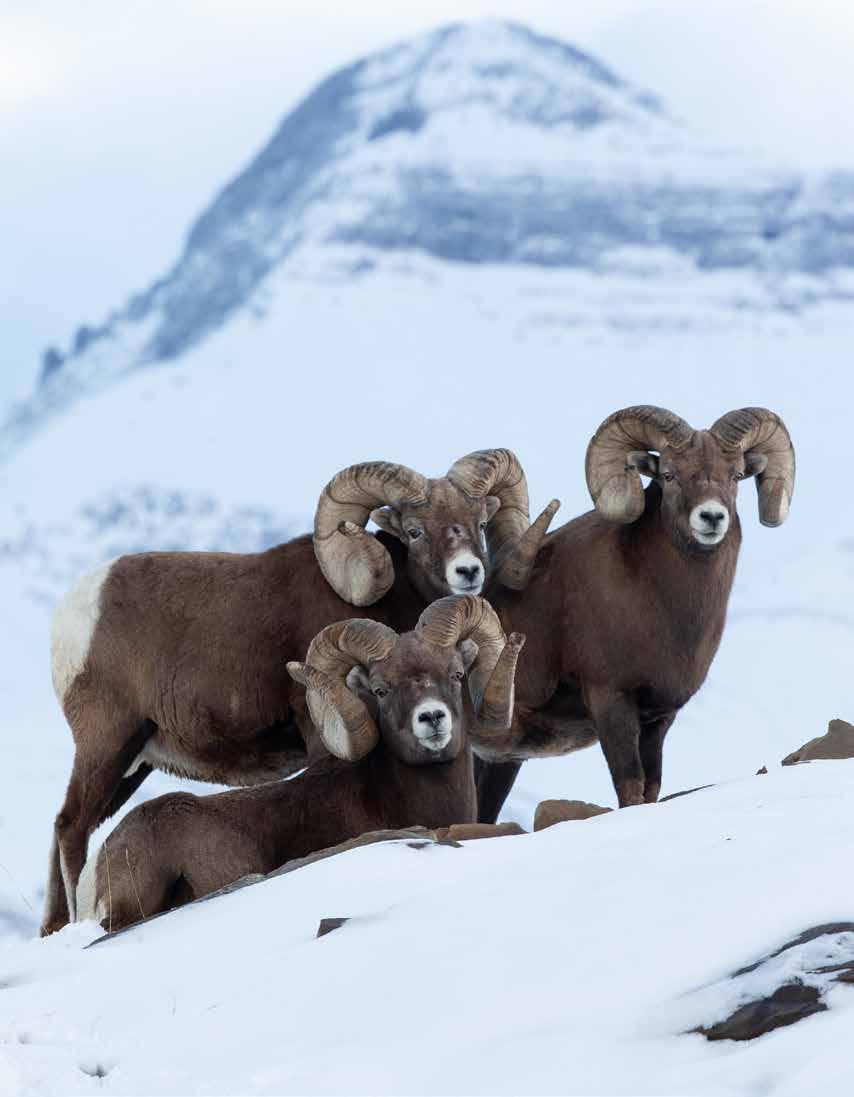
Photo: Joey Olivieri
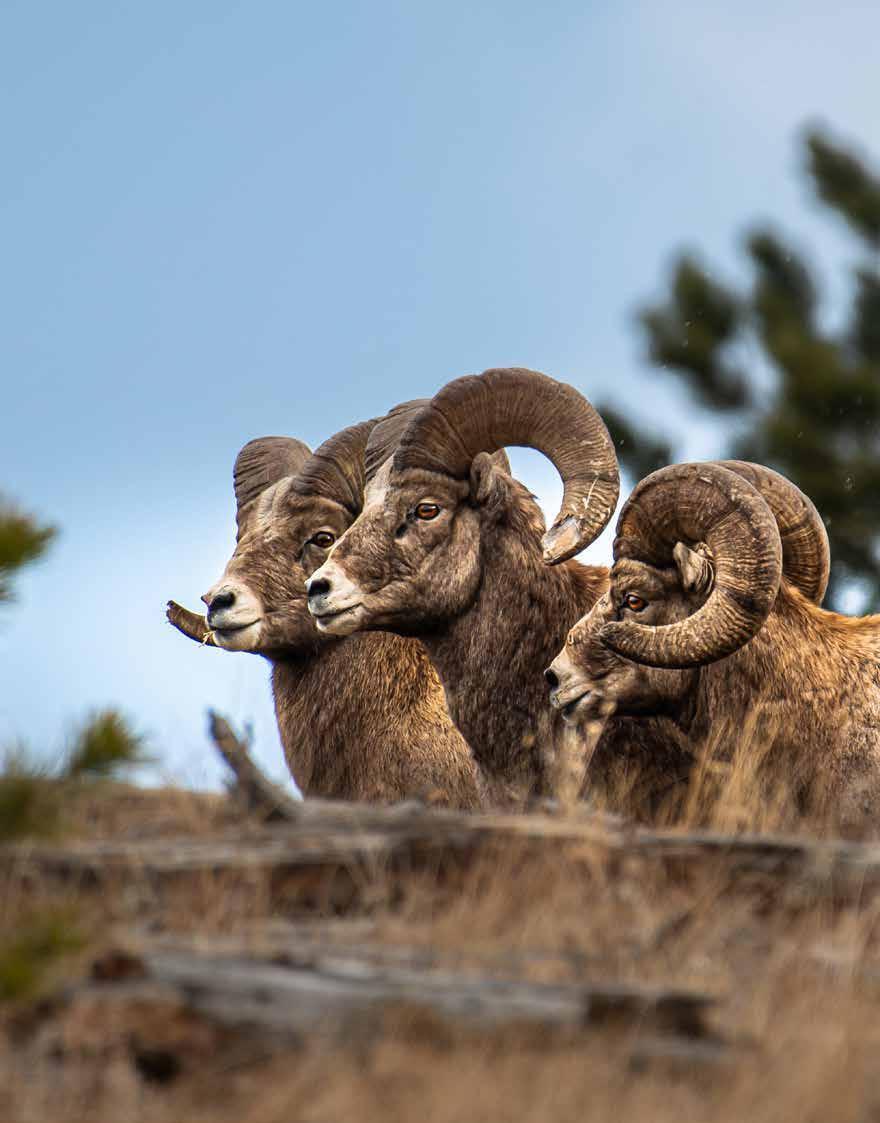
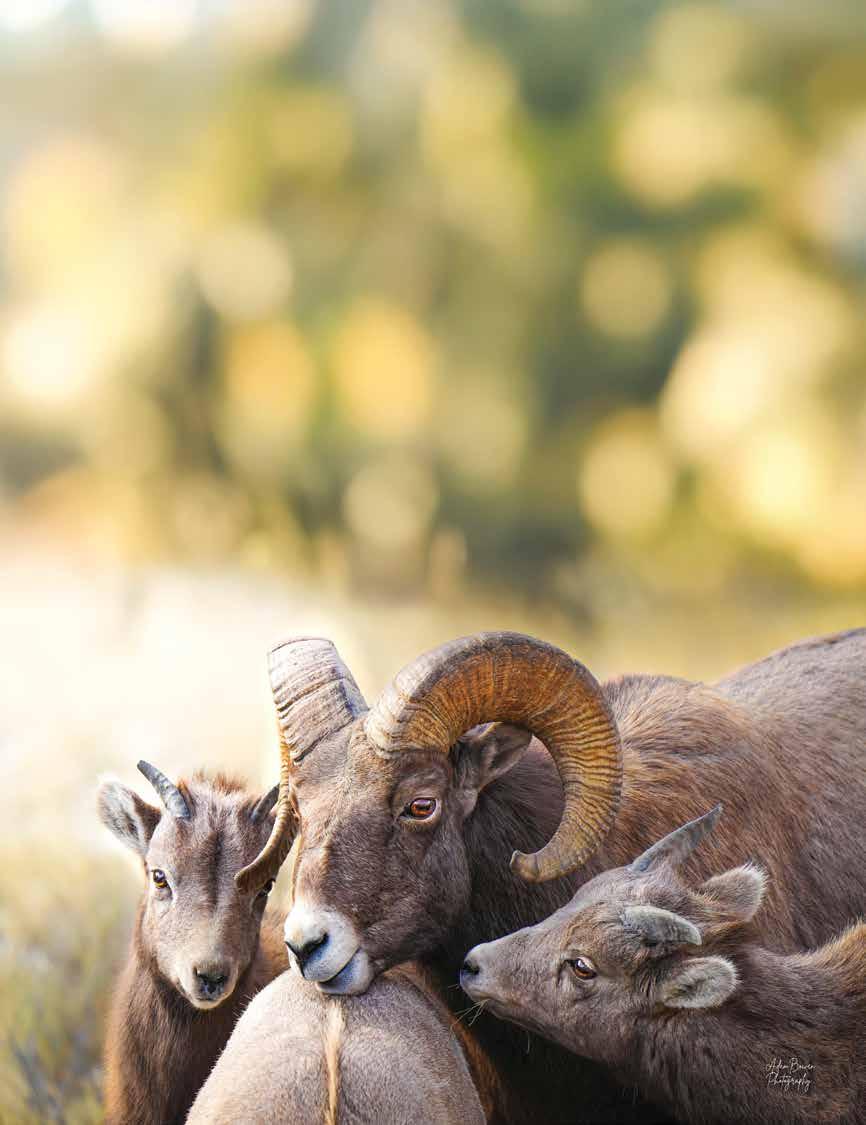
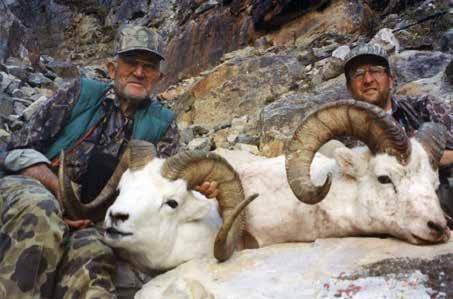
This photo was taken on October 31, 2012, with my son Aaron by my side. It was the last time we saw and photographed these rams, having been fortunate to watch and capture them over several years. The location is Cadomin, Alberta—famous for its giant rams. The bedded ram in the image was harvested the following month by a local hunter, scoring 189 5/8 with curls measuring 44 3/8 and 41 6/8 inches. The ram in the top left was found dead by Fish & Wildlife in spring 2014; it had green-scored over 209 inches, surpassing the world record at the time. After the 60-day drying period, it scored 205 7/8 and now ranks No. 11 with the Boone and Crockett Club.
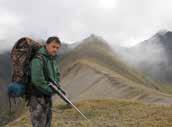
Hard country, heavy packs, and a grandfather’s ghost. 54
Vanishing Ghosts Of The North by Bill Jex
Tracking the changing fortunes of thinhorn sheep.
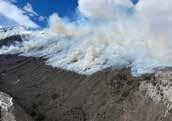
Fire On The Mountain by Chester Moore
The power of prescribed burns for wild sheep.
The Allure Of Mountain Hunting by Alexander Sharif
The mountains always give back more than they take.
Slings And Straps, Bipods And ARCA by Wayne Van Zwoll
An accurate barrel and flat-flying bullet avail nothing until you’re stable, the rifle settled on the mark.
Official publication of The Wild Sheep Foundation
WSF World Headquarters: 412 Pronghorn Trail • Bozeman, MT 59718 • 406-404-8750
Cody Office: 1285 Sheridan Avenue, Suites 260/275 • Cody, WY 82414 • 406-404-8750
CHAIRMAN: Charlie Kelly • ckelly@wildsheepfoundation.org ..............................
VICE CHAIR: Kyle Stelter • kstelter@wildsheepfoundation.org ..............................
SECRETARY: Jann Demaske • demaskes@msn.com .............................................
TREASURER: Larry Jacobs • lljacobs4@aol.com ...................................................
Clint Bentley • sheepspotr@aol.com
Bralli Clifford • bclifford@wildsheepfoundation.org
Sam Cunningham • scunningham@wildsheepfoundation.org
Kevin Kehoe • kkehoe@wildsheepfoundation.org
Larry Johns • ljohns@wildsheepfoundation.org
Emilio Rangel W. • emiliorw@me.com • rangel@wildsheepfoundation.org
Logan Richard Young • loganyoung270@gmail.com
Term Expires 2026
Term Expires 2028
Term Expires 2026
Term Expires 2027
Term Expires 2027
Term Expires 2028
Term Expires 2027
Term Expires 2028
Term Expires 2028
Term Expires 2027
Term Expires 2026
PRESIDENT & CEO Gray N. Thornton • gthornton@wildsheepfoundation.org
PRESIDENT & CEO - EDITOR IN CHIEF, WILD SHEEP ® MAGAZINE: Gray N. Thornton • gthornton@wildsheepfoundation.org • Bozeman HQ
Corey Mason, Chief Operating Officer & Executive Vice President of Conservation Certified Wildlife Biologist® cmason@WildSheepFoundation.org Carrollton, TX
Kim Nieters, VP of Operations - Auction Director knieters@WildSheepFoundation.org Cody, WY
Terry Ziehl, Finance Director tziehl@WildSheepFoundation.org Cody, WY
Keith Balfourd, Director of Marketing & Communications keith@WildSheepFoundation.org Bozeman, MT
Julie Tripp, Awards & Publications Director jtripp@wildsheepfoundation.org Lolo, MT
Paige Culver, Development Manager pculver@WildSheepFoundation.org Bozeman, MT
Maddie Richards, Membership Manager/ <1 Clubs Manager mrichards@WildSheepFoundation.org Bozeman, MT
Justin Phillips, Graphic Arts & Design Jphillips@wildsheepfoundation.org Cody, WY
Megan Costanza, Banquets & Events Manager mcostanza@WildSheepFoundation.org Reno, NV
Mike Aiazzi, Expo & Exhibits Manager maiazzi@wildsheepfoundation.org Reno, NV
Gray N. Thornton, Editor in Chief
Julie Tripp, Editor
Scott Morrison, Art/Design Director
Justin Phillips, Graphics/Design
Jaime Teigen, E-Commerce & Office Administrator jteigen@wildsheepfoundation.org Bozeman, MT
Matt Dwonch, Marketing and Content Strategist mdwonch@wildsheepfoundation.org Bozeman, MT
Rebecca Anne Tuthill, Assistant (PT) rrebrovich@wildsheepfoundation.org Bozeman, MT
Margie Forster, Registration Assistant (PT) mforster@wildsheepfoundation.org Reno, NV
Morgan Stuart, Development Asst. & Program Coordinator (PT) mstuart@wildsheepfoundation.org Bozeman, MT
Sterling Elliott, Accounting Assistant (PT) selliott@wildsheepfoundation.org Bozeman, MT
Kevin Hurley, Vice President of Conservation—Emeritus Certified Wildlife Biologist® khurley@WildSheepFoundation.org Boise, ID
Dr. Ryan Brock, Youth Education Coordinator rbrock@wildsheepfoundation.org Reno, NV
Greg Schildwachter, Lobbyist greg@watershedresults.com Washington, DC
Charlie Booher, Lobbyist Associate Wildlife Biologist® charlie@watershedresults.com Missoula, MT
Ken Nowicki, Field Editor
Chester Moore, Writer
Ashley McEnroe, Writer
Wayne van Zwoll, Contributor
Contributing photos, articles, stories, and research pertaining to wild sheep or the interests of the members of WSF are always welcome. Contributed material will be published at the editor’s discretion. Please include a selfaddressed stamped envelope if you wish materials to be returned.
Kurt Alt, Conservation Director—International Programs altwildlife@yahoo.com kalt@wildsheepfoundation.org Bozeman, MT & Brussels, Belgium
Pat Cummings, DNWR—NTTR Project Lead Patrickcummings1002@gmail.com Las Vegas, NV
Maureen Jefferson, Conservation Permits Jm_hullinger@sbcglobal.net Las Vegas, NV
Bill Jex, Thinhorn Sheep Program Lead RPBio BC bjex@wildsheepfoundation.org Smithers, BC
Kevin Martin, USFS & BLM Planning Kevindmartin63@gmail.com Pendleton, OR
Ashley McEnroe, Staff Writer aoliverio@gmail.com
Big Sky, MT
Shane Mahoney, Special Conservation Consultant shane@conservationvisions.com
St. John’s, Newfoundland
Chester Moore, Staff Writer chester@chestermoore.com Orange, TX
Scott Morrison, Editor & Designer, Wild Sheep® magazine scott@morrisioncreative.com Livingston, MT
Steve Rosenstock, Grant Writer Certified Wildlife Biologist® steve@wildsheepfoundation.org Flagstaff, AZ
Greg Schildwachter, Columnist
Morrison Creative Company, Inc.
Magazine Design/Production
Advertising & Editorial Submissions
Wild Sheep Foundation Headquarters
412 Pronghorn Trail, Bozeman, MT 59718
ATTN: Editor

For more information on submission guidelines, meetings and convention information, and service, conservation and hunting award criteria, please visit our website at www.wildsheepfoundation.org. All membership dues include $28/year for a subscription to Wild Sheep® magazine.
The Wild Sheep Foundation’s mission is to enhance wild sheep populations, promote scientific wildlife management, and educate the public and youth on sustainable use and the conservation benefits of hunting while promoting the interests of the hunter. The tradition began on a November weekend at Mt. Horeb, Wisconsin, in 1974. Thirteen wild sheep enthusiasts passed the time by sharing stories about their encounters with the majestic mountain creatures. After realizing how fortunate they were to have all shared such incredible experiences, they decided it was time to give something back. They forged FNAWS so men and women everywhere could get more involved in the positive management of wild sheep. It was incorporated as a non-profit corporation in Iowa on September 14, 1977, and began accepting paid memberships in 1978 as more people joined the cause. The commitment and noble spirit of FNAWS quickly helped the foundation become the fastestgrowing wildlife conservation organization of its kind.
DISCLAIMER While Wild Sheep Foundation strives to attract quality advertisers and donors, it cannot be responsible for the ultimate quality of the products which they may present to our members and buyers. Neither the Wild Sheep Foundation nor its Officers or Directors is a guarantor of your satisfaction with the products it makes available to you. Our dedication is to the wild sheep of the world and not to policing our advertisers or donors. We cannot, under the law, reject an advertiser or donation simply because of a prior complaint from a dissatisfied consumer. We will strive to make available quality merchandise and hunts, but without warranty or guarantee.
WILD SHEEP FOUNDATION®, WSF, FOUNDATION FOR NORTH AMERICAN WILD SHEEP®, <1 CLUB®, <1ICLUB, CHADWICK RAM SOCIETY®, MARCO POLO SOCIETY®, MOUNTAIN ROYALTY SOCIETY, LEGENDS SOCIETY, PINNACLE SOCIETY, TODAY, TOMORROW, & FOREVER FOR WILD SHEEP, FNAWS, CHRIS KLINEBURGER MOUNTAIN HUNTER HALL OF FAME AWARD®, PUTTING AND KEEPING WILD SHEEP ON THE MOUNTAIN®, SHEEP SHOW®, SHEEP WEEK®, SHEEP FEVER®, TAKE ONE PUT ONE BACK®, THE SHEEP SHOW®, RAM LAY-AWAY PROGRAM®, WILD SHEEP® MAGAZINE, COME FOR THE SHEEP, STAY FOR THE PARTY®, FULL CURL®, WIHI®, WOMEN HUNT®, WH®, WOMEN IN HUNTING®, WOMEN IN HUNTING INITIATIVE® and their respective logos are Registered trademarks and cannot be used, commissioned, or otherwise displayed without permission of the Wild Sheep Foundation.
GRAND SLAM® is a registered trademark of Grand Slam Club/Ovis. Used with permission.
Wild Sheep® (ISSN: 2329-7891), USPS Publication #009-460, is published quarterly for $28 a year by Wild Sheep Foundation, 412 Pronghorn Trail, Bozeman, MT 59718. Periodical Postage Paid at Bozeman, MT and at additional mailing offices.
POSTMASTER: Send address correction to Wild Sheep Foundation, 412 Pronghorn Trail, Bozeman, MT 59718.


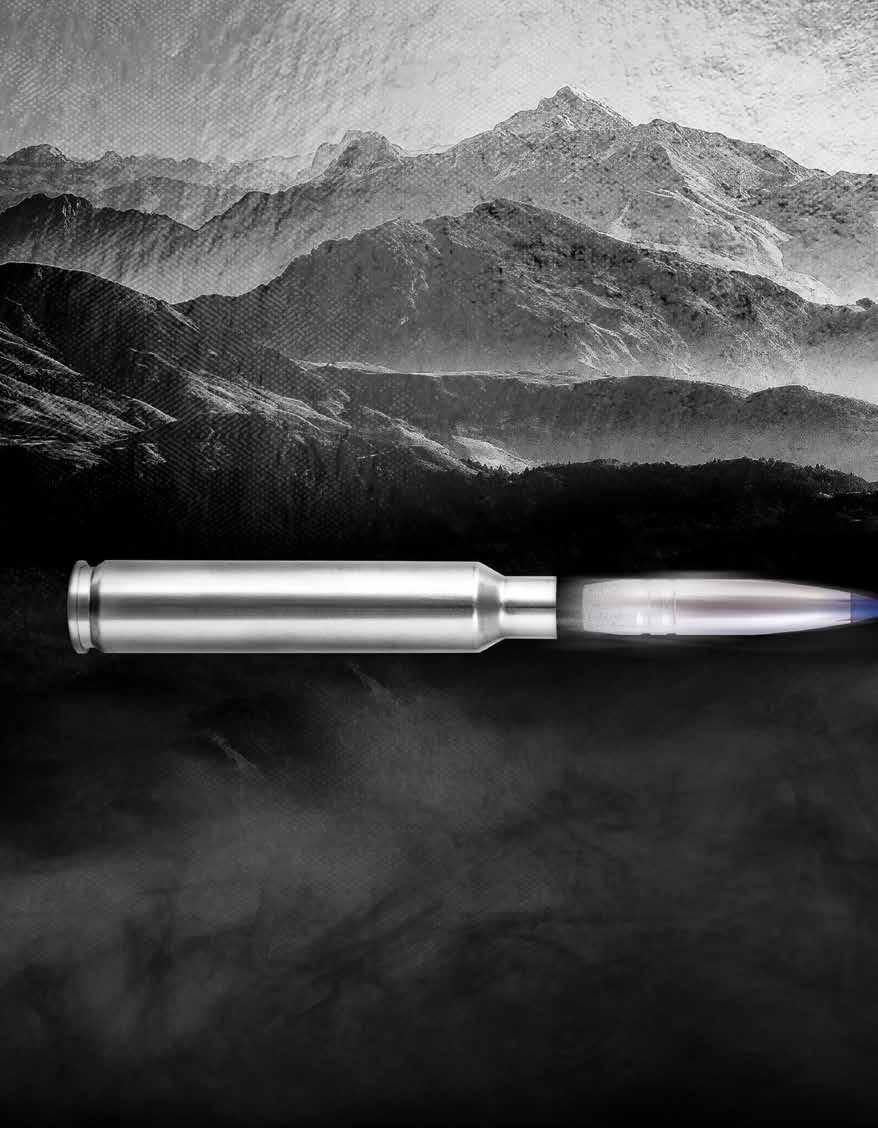
Advancement only comes when you break from the ordinary. When you see what’s possible. Federal’s 7mm Backcountry isn’t just a new cartridge–it’s an ammunition revolution. Its exclusive, patented Peak Alloy ™ case technology safely increases chamber pressures, delivering extreme longrange accuracy and magnum performance in light, compact, shorterbarreled rifles. The most rugged places, toughest game and longest shots are now within reach, and ammunition will never be the same.

To be the best managed, most respected, influential, and relevant conservation organization benefitting wild sheep worldwide.
To Put and Keep Wild Sheep on the Mountain.
We enhance wild sheep populations and their habitats, promote scientific wildlife management, and educate the public and youth on sustainable use and the conservation benefits of hunting while promoting the interests of the hunter.
Honesty Teamwork Accountability Integrity Positive Attitude Stewardship Respect for Others Respect for Wildlife Loyalty Hunting Ethics

The Briksdal MTN SF. A Pure Mountain Hunting Boot.

by Gray N. Thornton President & CEO
This fall, WSF launched an annual process to update our Strategic Plans. I noted plural as there are several. We have conservation plans, organizational plans, development plans, convention plans, staffing and succession plans, and others.
An initial part of this process includes identifying our business components or “major focus areas.” So what are Wild Sheep Foundation’s?
First and foremost, we are in the conservation business and that is succinctly identified in both our Vision as well as our Purpose “To Put and Keep Wild Sheep on the Mountain®.”
I’ve been in this industry professionally for more than 35 years with three fine organizations, and while they each have a primary focus area, one area I’ve noted for all of those years in all three is “we are in the hospitality business.” Of course, there are others.
In my view our major focus areas are as follows:
1. Conservation
2. Hunting & Sustainable Use Outreach & Advocacy
3. Fundraising/Development
4. Hospitality
5. Operations
I’ve placed these in my personal order of importance. Admittedly, we could place Fundraising/ Development as well as Hospitality
under Operations so it would look like this:
1. Conservation
2. Hunting (& Sustainable Use) Outreach & Advocacy
3. Operations
a. Fundraising/Development b. Hospitality
To drill down further, let’s look at our Mission Statement which is printed and framed in every WSF office and public space in our headquarters, and is included in every issue of Wild Sheep® magazine (see page 6.) We all take this Mission Statement seriously. In the spring of 2013, we embarked on a rewrite of the FNAWS mission statement and used our good friend and Marco Polo Society® member Larry Potterfield’s MidwayUSA format as a baseline. We’ve reviewed this statement every spring since, and update it when appropriate.
It is as follows:
What we do...
“We enhance wild sheep populations and their habitats, promote scientific wildlife management, and educate the public and youth on sustainable use and the conservation benefits of hunting while promoting the interests of the hunter.”
We speak and tell our story often on the conservation focus of WSF. In fact, you should have recently received our fiscal year 2024-25
Conservation Impact Summary, our third such report, in the mail.
I’ve also opined in this President & CEO letter often about our fundraising and development activities, as well as our convention, a major component of our hospitality focus.
However, in this letter, I’ll focus on WSF’s second major focus area: Hunting Outreach and Advocacy. This area is articulated in our mission statement as:
“...educate the public and youth on sustainable use and the conservation benefits of hunting while promoting the interests of the hunter.”
WSF executes this component of our Mission and major focus area in three primary ways: Education, Outreach, and Advocacy.
–
WSF conducts a Youth Wildlife Conservation Experience (YWCE) annually at our convention, as well as regional youth education events under our Shooting Hunting Ethics Education Program (S.H.E.E.P.)
The YWCE brings youth from Reno/Sparks area schools to the Sheep Show® to experience shooting and archery, outdoors skills, fly casting, kayaking, rock climbing, and other events to get kids off their digital device and outdoors and “on the mountain.” To date, WSF youth education programs have touched the lives of more 149,000 young

men and women in 14 years of YWCE and 912 S.H.E.E.P. events.
Women Hunt®, Women In Hunting®, and Rubye Mayflower Blake Legacy Fund – Women are one of the fastest growing segments of the hunting and shooting sports, and arguably as an influential voting block, can make or break hunting. Women also bring their families to our family. Our Women Hunt program which includes the marque SAAM™ Field to Fork shooting, hunting, ethics, and culinary skills course at FTW Ranch in Texas, expanded to women in industry education programs two years go, and this year, includes a mother and daughter program, Momma Bear Field Camp at Legends Ranch in Michigan, and a high level skills course and hunt at Hudson Farms in New Jersey next fall. The Women in Hunting programs brings together women of all skills in a WSF family community, and the Rubye Mayflower Blake Legacy Fund launched in 2024 provides healing outdoor hunts and experiences for women who have faced abuse or trauma.
WSF annually budgets for and expends hundreds of thousands of dollars to support the Wild Harvest Initiative®, 1Campfire, and Who Cares BC which are public outreach and education programs targeted at the non-hunting majority to not turn them into hunters, but rather, educate them on the “...conservation benefits of hunting...”
Finally, our advocacy programs include legislative actions at the state, federal, and international levels. WSF has two exceptional lobbyists on contract who execute our advocacy programs under the guidance of our Legislative Affairs Committee. This committee meets via zoom twice a month and engages WSF Chapters and Affiliates in our legislative actions and initiatives.
On the international front, WSF was accepted four years ago into membership in the International Union for the Conservation of Nature (IUCN), and just this fall attended and participated in our first IUCN World Conservation Congress in Abu Dhabi, UAE. The congress is held every four years and brings together nearly 10,000 conservation leaders and policy makers from around the globe. Why would WSF engage in this congress? Simple, decisions made by the IUCN membership, which we are a voting member, determine CITES regulations for trophy import and conservation policy worldwide—including in North America. WSF went to IUCN to educate and advocate, not watch on the sidelines. We partnered with Jamma Conservation and Communities from the UK, and Conservation Visions from Newfoundland, and hosted a pavilion with a theme of Human Centered Conservation where our diverse WSF delegation gave 20 presentations and participated
on six panel discussions to those in attendance. And while much discussed at IUCN is theoretical, especially from those opposed to hunting, WSF, Jamma, and Conservation Visions presented real-life conservation success stories, and WSF demonstrated how hunting, and specifically, sheep hunting, was and is, central to wild sheep conservation.
Yes, WSF is first and foremost a conservation organization and we fund on-the-ground projects for wild sheep and wildlife like no other organization or commercial entity in our space. We are also a hunting organization, unapologetically so, and we put our time, talent, and treasure to ensure that hunting and sustainable use of wildlife not only endures, but thrives, for generations to come.
Enjoy this winter issue of Wild Sheep®. I’ll see you at the Sheep Show® in Reno! WS
Gray N. Thornton
President & CEO, Wild Sheep Foundation
Editor-in-Chief, Wild Sheep® magazine
Marco Polo Society® Member
Summit Life Member
Chadwick Ram Society® Member
Legacy Society Member
Summit Life Member


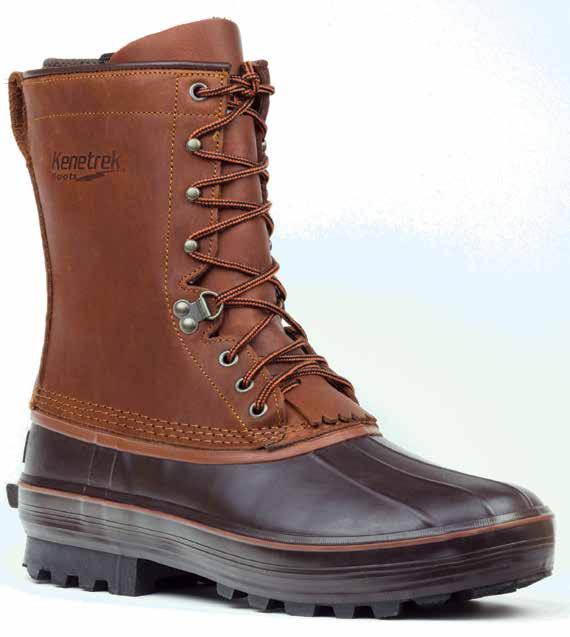
From the morning sits in the late season Whitetail stand to chasing after hounds hot on the trail of a Colorado Cougar, your boots are arguably the most important piece of gear you will use. Stay out longer, hike further, and perform better with Kenetrek Pac Boots. Built with the mountains in mind, our supportive leather uppers and high traction K-Talon™ outsole will keep you upright, while wool felt liners and extra insulation in the bottoms will keep you toasty warm in temperatures down to 0°F.

by Corey Mason Chief Operating Officer & Executive VP of Conservation Certified Wildlife Biologist®
My last few weeks have largely been spent in airports and meeting rooms, from Arizona to Alaska, to Alberta. And all have been strategic to Move the Needle for Wild Sheep.
As you know, WSF engages stakeholders and partners in many arenas and in many places around the world. What you may not know is exactly what these partners and conservation forums accomplish, so I wanted to touch on a few of the North America opportunities, while on the following pages, my colleague Kurt Alt details an international forum, the IUCN World Congress, in the Biologist’s Corner – International.
WSF President and CEO, Gray Thornton, and I recently attended the Association of Fish and Wildlife Agencies (AFWA) Annual Meeting in Tucson, Arizona. AFWA represents all 50-state fish and wildlife agencies, plus many provinces of Canada and Mexico. Thus, this meeting is attended by all agency leadership, some agency commissioners, along with representatives from the U.S. Fish & Wildlife Service, U.S. Forest Service, Bureau of Land Management, and several fellow conservation organizations.
WSF is a significant sponsor of the event, and we engage in the sessions and meetings that occur, plus we host a directors’ luncheon. The luncheon is by invitation
only for select agency leadership, commissioners, key positions within agencies, and strategic partners (Boone & Crockett Club, Wildlife Management Institute, Rocky Mountain Elk Foundation, Mule Deer Foundation, Conservation Visions, etc.). The directors’ luncheon gives us a unique and personal opportunity to engage with agency leaders on pressing conservation matters and how we can support them. It is an incredibly effective event for WSF.
We will hold a similar luncheon at the Western Association of Fish and Wildlife Agencies (WAFWA) meeting that will be held in Idaho in June.
In a different but similar capacity, WSF supports and engages with The Wildlife Society (TWS) at its annual conference. TWS is an international organization committed to addressing national and international issues that affect the current and future status of wildlife in North America and
throughout the world. With over 10,000 members worldwide, membership is largely comprised of scientists, managers, educators, and others who manage, conserve, and study wildlife populations and habitats.
TWS’ 32nd Annual Conference was recently held in Edmonton, Alberta. The event was attended by 1,500+ participants, representing a wide range of career stages and 16 countries. Attendees came from all 50 U.S. states plus Washington D.C., nine Canadian provinces, and three Canadian territories. Of particular interest is the attendee
composition—roughly half being wildlife professionals and the remainder being aspiring collegiate wildlife students and early-career professionals.
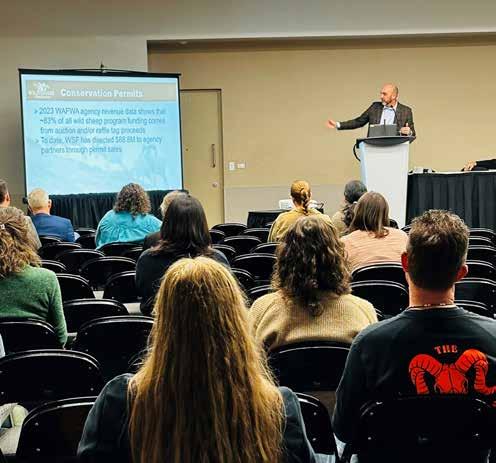
The wild sheep community was well represented at the event, with WSF, Wild Sheep Foundation Alberta, and the Wild Sheep Society of British Columbia all exhibiting and sponsoring the event. Attendees learned about wild sheep conservation, challenges and opportunities. Further, I participated in a speaking panel titled “NonProfit Organization Contributions to Conservation” and spoke to
WSF’s conservation impact across North America and beyond. From the session, attended by many students, the role of our community in delivering conservation and supporting our partner agencies was well detailed, so all left with a greater understanding of what WSF, and our Chapter and Affiliates accomplish.
Wild sheep enthusiasts are passionate and dedicated, and we are completely committed to ensuring that we do everything possible to conserve the resource that we so dearly cherish. Thank you for all you do for WSF! WS
WSF’s Legacy Society recognizes individuals, families and foundations making testamentary bequests or contributions of major gifts, gift annuities or other charitable-giving instruments. Since inception of the Ensuring the Future of Wild Sheep (ETFOWS) campaign, 51 Legacy Society members have been recognized through WSF’s Legacy Society for contributions or pledges of future gifts.
Bequests made through the New Beginnings Campaign* or other bequests may be recognized through the Legacy Society by contacting WSF. For more information on the Legacy Society or Estate Planning resources available through WSF, please contact Paige Culver at 406.404.8758 or PCulver@WildSheepFoundation.org.
Anonymous
Anonymous
Lee & Penny Anderson
Jack, Jr. & Cindy Atcheson
Derek Blake
Derek W.O. Berry
Mike Borel
Cabela’s Outdoor Fund
David W. Campbell
Rick & Heather Carosone
Dr. Robert W. & Cynthia Cassell
David & Sona Combs
Monty & Becky Davis
Howard & Mary Deters
Doug & Patty Dreeszen
Buddy DuVall
Tom Grimes
Eric & Sue Hansen
Robert & Arlene Hanson
Dr. Paul F. & Kathy J. Havey
Zach & Amber Higgins
John R. & Mary Ann Justus
Kevin & Eileen Kehoe Blair A. &
Victoria M. Kenewell
Robert M. Martin, Jr.
Robert and Lisa Mays
Roger McCosker
Kyle & Joanne Meintzer
Chuck Middleton
David Mode
Gordon Nelson
John & Leslie Pearson
Brad R. Plaga
Robert L. & J.P. Puette
Kevin & Janine Rinke
Lanny Rominger
Louis & Pauline Rupp
SCI Foundation - Hunter Legacy Fund (HLF-100)
Roger Segebrecht
Kasie and Jason Sheridan
Tim & Roxane Shinabarger
Steve & Sue Skold
Curt & Marcia Thompson
Gray & Renée Thornton
Steve & Carrie Thompson
Jim Travis
Tim & Ruth Van Der Weide
The Estate of Robert B. Johnson
Zachary Walton
Wayne W. Webber
The William H. Donner Foundation, Inc
*New Beginnings Campaign was the FNAWS Capital Endowment Campaign conducted 1998-2003.
by Kurt Alt Conservation Director, International Programs, WSF
The Wild Sheep Foundation (WSF) took a major step onto the global conservation stage this October by participating in its first International Union for Conservation of Nature (IUCN) World Conservation Congress, held in Abu Dhabi, UAE, from October 9–15, 2025.
Although WSF has been an IUCN member since February 2018, this was our inaugural appearance at the organization’s flagship global event, held every four years. The 2025 congress gathered nearly 10,000 participants—both in person and online—from over 140 countries, representing IUCN’s 1,500 member organizations. During the weeklong event, attendees acted on 148 motions shaping global conservation priorities.
WSF joined forces with Conservation Visions/Wild Harvest Initiative, Jamma International, and Oppenheimer Generations Research and Conservation to host a shared pavilion in the Congress Exhibition Hall. The pavilion showcased our collective work around the theme of Human-Centered Conservation (HCC)—an approach best summarized by one of Jamma International’s key messages:
Lynn Mortenson
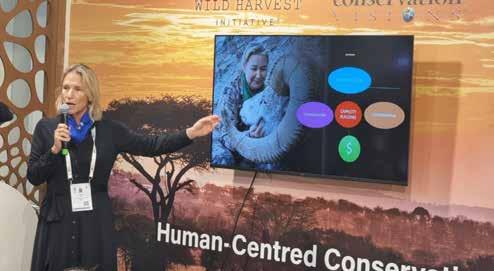
Dr. Peregrine Wolff
“By placing people within conservation systems, HCC reframes the relationship between nature and society, showing that landscapes can only be sustained when they continue to feed, support, and provide for the communities who steward them.”
The WSF delegation reflected our worldwide reach and diverse partnerships, bringing together representatives from across cultures and continents:
• Gray Thornton, President & CEO, WSF
• Kurt Alt, Conservation Director, International Programs, WSF
• Austin Smith, General Manager, Natural Resources Branch,
Confederated Tribes of Warm Springs
• Jacobo Artee, Fundación de Vida Silvestre en Sonora, A.C. / Mexico Council, Sonora, Mexico
• Aibat Muzbay, Vice-Chair, WHISPA-CA & Executive Director, Arlan Foundation, Kazakhstan
• Peregrine Wolff, DVM , Wildlife Disease Association & WSF Professional Resource Advisory Board
Collectively, WSF and Conservation Visions delivered 20 presentations and participated in six panel discussions, emphasizing how sustainable use drives conservation success in landscapes where people live and work.
Stories from the Ground Up
Our pavilion was the only

one at the congress dedicated to Human-Centered Conservation and sustainable use. WSF and our partners shared compelling on-theground examples, including:
• Restoration efforts in the Franklin Mountains, Texas, and Sierra El Álamo, Sonora, Mexico
• The Wild Sheep Economy: How Conservation Permits & hunting fund wild sheep conservation
• Developing water sources across arid landscapes
• One Health initiatives and Testand-Remove programs to restore herd health
• Integrating Indigenous knowledge with science-based wildlife management
• Establishing the Central Asia Wild Sheep Working Group (WHISPA-CA)
• Supporting saiga antelope recovery in Kazakhstan
• Working Dogs for Conservation initiatives using scentdetection dogs for Mycoplasma ovipneumoniae and to reduce contact between domestic and wild sheep
• Collaborative disease management efforts by Montana WSF and the Montana Wool Growers Association
• Broad-scale landscape and habitat conservation programs Shane Mahoney of Conservation Visions/Wild Harvest Initiative expanded on North American conservation principles, highlighting the North American Model of Wildlife Conservation, the Wild Harvest Initiative, and the importance of wild harvest in Alaska for provisioning food and medicine from public lands.
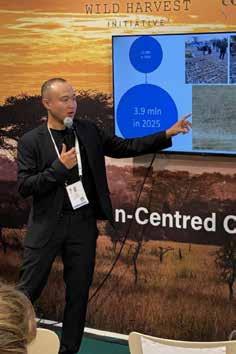
Presenters from Africa, the UK, and other regions shared stories of species recovery, habitat restoration, and human-wildlife coexistence, all underscoring the role of community involvement and the benefits of wildlife economies.
Together with the IUCN Sustainable Use and Livelihoods Specialist Group, WSF and our partners presented a powerful collective vision: that sustainable use and Human-Centered Conservation are vital to the future of both people and wildlife. Every story we shared was rooted in real-world, results-driven conservation—demonstrating that when communities thrive, wildlife does too. WS

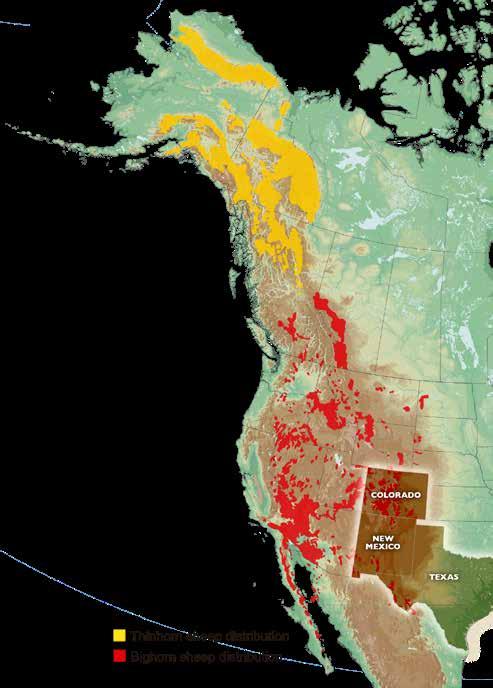
In this installment of Sheep Stats, we’ll be covering some of the southeastern reaches of bighorn and desert bighorn sheep—Colorado, New Mexico, and Texas. This geographic area has both Rocky Mountain bighorn and desert bighorn populations. To accommodate magazine page counts some charts and graphs are not shown. Click on the QR code at left to download the complete 2025 Range-wide Status of Bighorn and Thinhorn Sheep in North America PDF.
Rocky Mountain Bighorn Sheep Populations
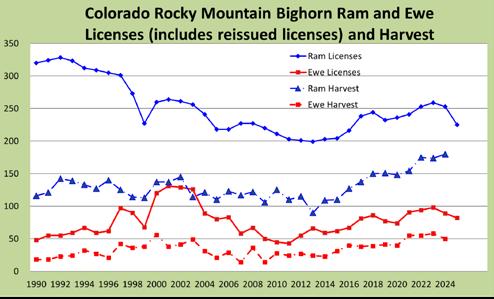
The 2024 Colorado statewide post-hunt Rocky Mountain bighorn sheep (RMBHS) population estimate is 7,060. This is down from our contemporary peak population size of 7,500, which was reached in 2001 and 2022. The statewide population has averaged 7,100 over the last 30 years. Approximately 6,470 RMBH occur in hunted populations and 590 in unhunted populations which are primarily in Rocky Mountain National Park. In 2024, we had 23 Game Management Units where population estimates went up and 15 went down.
From 1945 to present, Colorado conducted approximately 150 translocations of 2,500 RMBHS. Most of these occurred during the 1980’s and 1990’s. Approximately 55% of current herds resulting from reintroductions. These transplants continue to this day but at a much lower rate because there are very few locations remaining that have both suitable habitat for bighorn sheep and that do not have domestic sheep or goats nearby.
Licenses and Harvest
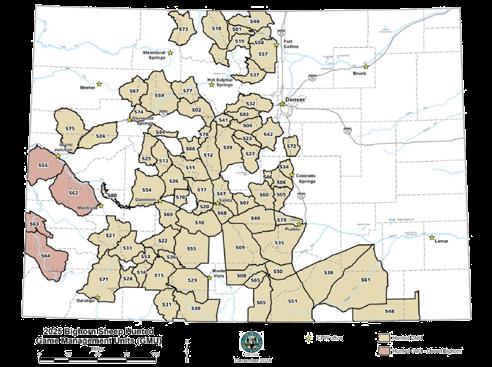
Colorado has 39 designated RMBHS populations with 71

This year was another poor year for bighorn sheep herd health. In 2024, CPW documented allage mortality events in 4 herds and confirmed lamb mortality in 4 additional herds. In S32 (Georgetown), S37 (Saint Vrain), S57 (Big Thompson Canyon), and S58 (Lower Poudre Canyon) we are observing an all-age mortality event (mortality in lambs, ewes, and rams) with no lambs surviving to 1 year old in the entire Northern Front Range of Colorado. Currently coinfection of 3 pathogens, including the same strain of Mycoplasm ovipneumoniae (MOVI) that has been present since 2021 in these herds. The same strain of MOVI is operating in all 4 herds with all age die-offs.
hunted Game Management Units (GMUs) shown in red in Figure 2. For 2025, we reduced total licenses from 321 to 307 (-14) RMBHS statewide. Ram and either-sex licenses recommendations are reduced by 10, from 235 to 225 and ewe licenses are reduced by 4, from 86 to 82. Ram harvest rate averages about 2.3% of hunted population size while female harvest rate is much less than 1%. See licenses and harvest from 1990 to present in Figure 3.
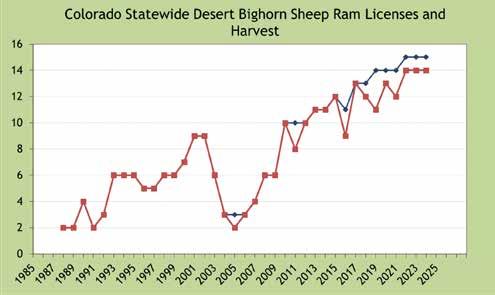
Between 1979 and 2001, Colorado conducted 12 transplant operations and translocated 218 desert bighorn sheep from Arizona, Nevada, and Utah. As a result of these significant and expensive transplant efforts, Colorado has 2 desert bighorn sheep herds, in 4 game management units (GMUs)
Throughout the state we performed specific (PCR) testing
shown in tan in Figure 2.
The 2024 DBHS population estimate is again 500. Ram licenses for 2025 will be the same as 2024 at 15. No ewe licenses have been offered yet for DBHS (Figure 5).
for pathogens including MOVI, leukotoxigenic Pasteurellaceae, and Pasteurella multocida. Necropsy of deceased bighorn sheep demonstrated bronchopneumonia, with variable concurrence of upper
respiratory disease (including sinus tumor) and detection of leukotoxigenic Pasteurellaceae, Mycoplasma ovipneumoniae, and
Historically, both Rocky Mountain bighorn sheep (Ovis canadensis canadensis) and Mexican desert bighorn sheep (O.c. mexicana) occurred in New Mexico. Rocky Mountain bighorn sheep occupied the mountainous northern regions of the state, while desert bighorn sheep ranged in the arid mountains of central and southern New Mexico. Both subspecies rapidly declined in the 20th century primarily due to unregulated harvest, disease exposure from and competition with domestic livestock, and loss of habitat. Recovery of Rocky Mountain bighorn sheep began in the 1940s, while intensive restoration of the desert variety began in earnest in the 1970s. Rocky Mountain bighorn sheep now exist in 11 discrete populations
Pasteurella multocida. Chronic upper respiratory disease (sinus tumor) was detected in several Colorado bighorn herds. Sampling
in the northern and southwestern portions of the state, while desert bighorn sheep persist in nine discrete populations plus one captive herd at the Red Rock Wildlife Area in the south central and southwestern portions of the state. As of 2024, Rocky Mountain bighorn sheep abundance is now estimated at 1,675 (1,5051,845) while desert bighorn sheep abundance is estimated to be 1,088 (9501,225). Population performance of both subspecies is considered stable. Both subspecies continue to be surveyed and monitored annually, with collaring efforts, translocations, disease surveillance, mountain lion management, regulated harvest, and habitat protection and enhancement being key elements to their conservation and management in New Mexico.
approaches were tailored to the individual project and included both serology and swabbased diagnostics. Mycoplasma ovipneumoniae, leukotoxigenic Pasteurellaceae, and Pasteurella multocida were detected in various combinations among the sampled populations. No new pathogens were documented through sampling efforts, but new strain types were discovered.
Test and Remove
No current test and removal programs were conducted in Colorado in 2024.
Andy Holland, Colorado Parks and Wildlife
Rocky Mountain Bighorn Sheep Population
Prior to the last two years, New Mexico’s Rocky Mountain bighorn sheep population experienced a decline, primarily following management intervention to reduce abundance in the Rio Grande Gorge population (Game Management Units [GMUs] 49, 50, and 53) following MOVI exposure. The population is now considered stable, with an estimated abundance of 1,675 (1,505-1,845) (Fig. 1) in 2024 ranging across 11 discrete populations. The Jemez Rocky Mountain bighorn sheep population (GMUs 6A and 6C) has increased in abundance since its reestablishment in 2014 when 45 bighorn sheep were released; the 2024 aerial survey yielded 134 animals, the highest total minimum count to date, resulting

The Conklin Foundation board is pleased to announce the 2026 winner of the Conklin Award. Jeff Demaske is the 24th winner of the “Tough Man” award, named after the late Dr. James Conklin, a Weatherby Award winner, who liked to pursue difficult animals throughout the world.
Jeff began hunting in Wisconsin as a young boy. He went to the University of Illinois on a football scholarship. After college he moved to Colorado where he met his wife, Jann. They started construction, excavating, and property management companies and together raised two daughters, Madeline and Elizabeth.
Jeff has shot 13 FNAWS/Grand Slams, as well as most of the mountain animals of the world. He was nominated amongst these other great hunters: Barbara Sackman, Lee Anderson, Jan Dams, Wayne Farnsworth, and Gervasio Negrete.
The Conklin Foundation would like to gratefully acknowledge and thank the following businesses and individuals for their generous donations. The support of donors makes it possible for the Conklin Foundation to continue its efforts to educate youth about hunting.
• Go with Bo
• Canada North Outfitting
• Brilliant Stars
• Mexico Hunting Specialists
• Giuseppe Carrizosa
• Spanish Mountain Hunts
• Fernando Saiz
• Vidale Safaris
• Aland & Barbara Sackman
• Baranoff Jewelers
• Lake Albert Safaris LTD.
• Herederos Hunting
• Iberian Hunters
• Kevin Downer Sporting
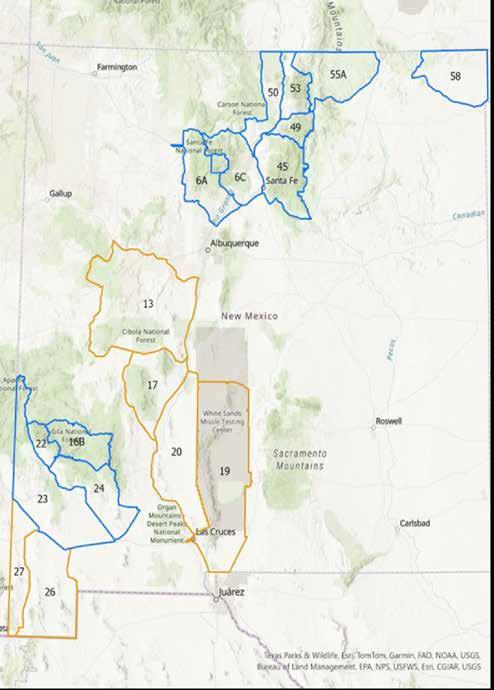
2. New Mexico bighorn sheep hunts occur in the outlined GMUs, with blue boundaries indicating Rocky Mountain bighorn hunt units and orange boundaries indicating desert bighorn hunt units.
in an estimate of 225-300 bighorn sheep. The Rio Grande Gorge Rocky Mountain bighorn sheep population appears to have stabilized between 225-275 animals following the reduction efforts and subsequent recovery from MOVI.
exposure in 2020. Similarly, the Wheeler Rocky Mountain bighorn sheep population (GMU 53) has also stabilized after MOVI exposure in 2022, numbering between 55-75 animals. All other Rocky Mountain bighorn sheep
populations appear stable. Rocky mountain bighorn sheep have been restored to almost all known historic habitat since their extirpation in the early 20th century. With the last translocation occurring in 2017, recent management has focused on optimizing hunter opportunity and tracking the spillover of MOVI into several naïve populations. However, additional habitat is being considered as potential future release site(s) to establish a new freeranging, MOVI-free population; for this to become reality, habitat assessment and enhancement will need to take place prior to any capture and relocation event.
Rocky Mountain bighorn sheep hunts occur across 12 GMUs (Figure 2). Twenty-eight ram licenses were issued in 2024 (Figure 3). The 2024 hunt season included the inaugural hunt of GMUs 6A and 6C (Jemez). Two public licenses were issued for this GMU and another license holder, authorized under the state’s Rocky Mountain auction tag, also chose to hunt this GMU. All three hunters were successful, with two harvested rams exceeding 200”. The first ram recorded an official Boone and Crockett (B&C) score of 208 1/8”, while the second ram produced an official B&C score of 202”. These rams are now the 1st and 2nd largest Rocky Mountain bighorn sheep harvested in New Mexico, respectively. Notably, the official B&C score of 208 1/8” places New Mexico’s top ram in the top five for Rocky Mountain bighorn sheep (including “deadhead” pickups) and top three for harvested Rocky Mountain bighorn sheep in North America.
One public tag was added into the Jemez unit for the 2025-2026 hunt season. One additional ram tag was also added into the Pecos (GMU 45) unit for the 2025-2026 hunt season. With the addition of the Jemez hunt, 10 of the 11 discrete populations now offer hunt opportunities annually (the Manzanos population being the only population not currently hunted). Harvest success was 100% in 2024-2025 (excluding three tagholders who did not hunt).
A suite of metrics is used to inform ram harvest decision making throughout the state. To prescribe appropriate harvest levels in areas where bighorn sheep populations occupy both tribal and public land, NMDGF collaborates with tribal partners in setting tag allocations. The metrics that guide license determination for rams are 2.5% of local population size, 10% of total rams, and 25% of CIII and CIV rams. Success on ram hunts has been nearly perfect and averaged >96% from 2020-2024. Horn restrictions do not apply, and the bag limit is defined as any ram. The average age at harvest of Rocky Mountain bighorn sheep rams in 2024-2025 was nine.
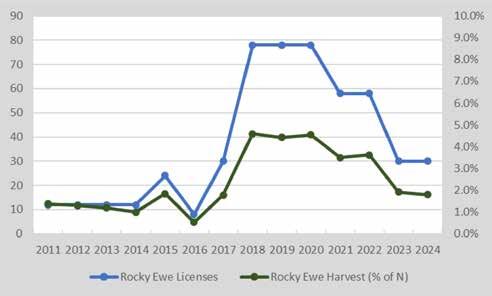
Management ewe hunts have been prescribed in several populations primarily to maintain a stable population where capture and translocation is not feasible and to prevent the spread of MOVI to adjacent herds. These ewe hunts were initiated in 2011 in the Latir Mountain herd. The number of ewe hunting licenses issued varies with population size and herd objective but has averaged around 21% of the estimated ewe segment (Figure 4) resulting in a harvest rate averaging ~11% annually. Ewe hunting has
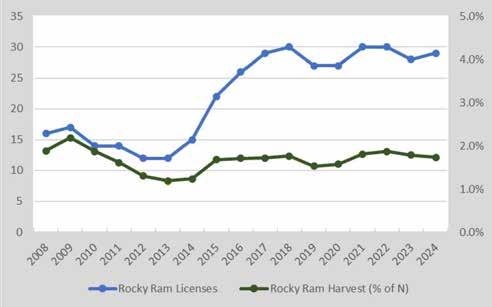
been limited to the Pecos and Rio Grande Gorge populations in recent years with 58 licenses issued in 2022. The management ewe hunt in the Rio Grande Gorge was suspended for the 2023-2024 season in response to decreased lamb:ewe ratios following an MOVI spillover in 2020; the suspension of ewe hunts in this population continues.
Thirty ewe licenses were issued for the Pecos population in 2024.
Disease and herd health
In 2022 MOVI was discovered for the first time in the Wheeler Peak herd, coinciding with the observation of 10-15 overwinter carcasses and symptomatic bighorn sheep observed in July 2022, yet
that July aerial survey resulted in one of the highest counts in recent years with a minimum of 200 bighorn sheep observed. The population slightly declined following that aerial survey. Minimum counts of the Wheeler population have been similar the last two years (153 in 2023 and 152 in 2024) while the lamb:ewe ratio has improved from 14 ll:100 ee in 2023 to 28 ll:100 ee in 2024. Darting and collaring efforts began in 2023 to increase monitoring in Wheeler, however darting in the area is slowgoing and limited by season. Deploying collars in the region remains a high priority for management.
The status of desert bighorn sheep has improved since their state endangered delisting in 2011 and the statewide population remained relatively stable following a slight decline in 2019. As of 2024, the estimated abundance of desert bighorn sheep in New Mexico is 1,088 (950-1,225) animals distributed across nine discrete free-ranging populations. Most populations are stable, with the Little Hatchets (GMU 26 West of NM 81) slightly increasing. However, two populations are experiencing difficulties related to population abundance: the Peloncillo (GMU 27) near the southwestern border with Arizona and the Sacramentos near Alamogordo. The Peloncillos, once one of the largest populations ranging from 210-240 bighorn sheep, has experienced a rapid decline in the last 5+ years and are now estimated to range between only 40-60 bighorn sheep. Several potential factors likely
have contributed to this decline, including potential unidirectional movement of bighorn sheep into Arizona, elevated mountain lion predation (lion management is complicated in this range as it occurs in critical jaguar habitat as described by the Federal government), prolonged drought, and decay in habitat quality likely resulting in consequences for diet and nutrition. NMDGF staff are initiating a project to assess these factors more thoroughly to guide future management intervention. The Sacramentos population was established in 2018 but has experienced little to no growth since that release, with a stable estimate of 40-45 bighorn sheep annually. It was initially hypothesized that traditional helicopter surveys were not fully representing the population’s distribution, complicated by complex, visually obstructive terrain and restricted airspace related to military activity. Exotic aoudad (Ammotragus lervia) also occur in this range and may be a limiting competitor. These
notions prompted NMDGF staff to partner with Owyhee Air Research to conduct fixed-wing flights along predetermined transects using forward-looking infrared (FLIR) equipment in the entirety of the range, which included authorization to access restricted airspace. The FLIR results were similar to the traditional helicopter surveys, which yielded a total of 34 and 29 detected bighorn sheep, respectively. Only 14 aoudad were observed during the FLIR effort. These results suggest other factors are preventing the Sacramento bighorn sheep population from increasing in abundance; efforts are underway to better understand lamb survival, diet and nutrition, and predation as limiting factors to inform future management actions.
As of 2024, lion predation continues to be a leading cause of mortality in desert bighorn sheep despite ongoing removal efforts within seven of the nine discrete desert bighorn sheep ranges. The contract authorizing third-party houndsmen and trappers to remove
lions in bighorn sheep range was renewed this year. Increased lion removal efforts are planned to promote desert bighorn sheep population growth, particularly in the Peloncillos range.
New Mexico has maintained a captive desert bighorn sheep breeding facility at the Red Rock Wildlife Area, north of Lordsburg, since 1972. The population housed within this 1,500-acre high fence area serves as a source population to periodically augment demographics and genetics of existing free-ranging populations and to establish new herds. These captures and relocation events continue today. Annual ground surveys are conducted every May to determine whether and how many surplus desert bighorn sheep are available for capture and release (note that this number is not included in the rangewide estimated abundance of free-ranging populations). Most recently, desert bighorn sheep were restored to the Alamo Hueco mountains in the “Bootheel” region of southwestern New Mexico in 2021. After 94 bighorn sheep were counted in 2023, a second release of 28 individuals took place in the Alamo Huecos in October of that year. The 2024 count yielded 75 bighorn sheep, while the most recent count in May 2025 resulted in a count of 102 animals. Thus, surplus animals are available
Desert Bighorn Sheep
Population
Historically, desert bighorn sheep occupied 15-16 mountain ranges in the Trans-Pecos Region of Texas and numbered around 1,500-2,000 animals. However, by the early 1960s the native Texas desert
for capture and release, tentatively planned for fall/winter 2025. These bighorn sheep will likely be released into the Peloncillos to help bolster the struggling population. Suitable unoccupied desert bighorn sheep habitat remains on the landscape and continues to be considered for release sites/population restoration. Because suitable unoccupied habitat remains, harvest of desert bighorn sheep ewes has not and is not being considered.
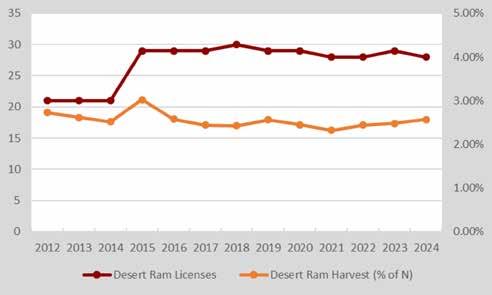
Desert bighorn sheep hunts occur in the GMUs shown in orange in Figure 2. These areas include 8 of the 9 desert bighorn sheep populations, with one (Sacramentos) not hunted. Twenty-seven ram licenses were issued in 2024 (Figure 6). Harvest success was 96% in 20242025 (excluding one tagholder who did not hunt). Due to population performance, an additional tag was added into the Little Hatchets and one tag removed from the Peloncillos for the 2025-2026 hunt season. As with the Rocky Mountain subspecies, the metrics that guide license determination for desert rams are 2.5% of population size, 10% of total rams, and 25% of CIII and CIV rams. Success on ram hunts has averaged 100% from 2020-2024. The largest desert bighorn sheep harvested during the
2024-2025 hunt season hailed from the Ladrones (GMUs 13 and 17) and produced a green score of 178 3/4”. Horn restrictions do not apply, and the bag limit is defined as any ram. The average age at harvest of desert bighorn sheep rams in 2024-2025 was eight.
Disease surveillance continues to be an integral part of New Mexico’s desert bighorn sheep management. Prior to 2017, MOVI had only been documented in the San Andres desert bighorn sheep population. In 2022, MOVI was documented in four additional herds, including those adjacent to the San Andres and those in the central geographic region of New Mexico, including the Fra Cristobals. In 2024 MOVI was again detected in a harvested ram from the Fra Cristobals. Of the populations surveyed, average spring lamb:ewe ratios were greater in the Bootheel herds (58 ll:100 ee) compared survey results gathered in the fall for the interior populations (25 ll:100 ee). This may be a result of MOVI exposure status in the interior herds, an artifact of the survey timing being more representative of production (Bootheel) or of recruitment (Interior), or both.
—Tom Batter, New Mexico Department of Game & Fish
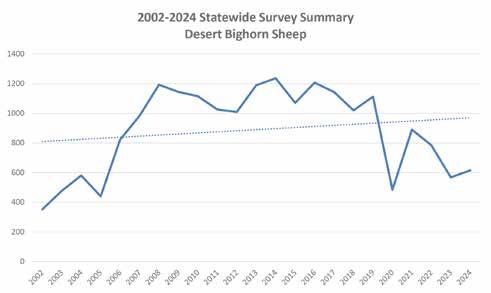
bighorn sheep had been extirpated. Desert bighorn sheep from various states, including Nevada, Arizona, Utah and Baja California (Mexico), were brought into Texas to help with captive propagation and restoration efforts. These efforts resulted in population growth to approximately
1,500 animals in 11 of their historic mountain ranges, where the population estimate remained for several years. In the last five years, the Texas population has been in decline and the statewide estimate is approximately 700 animals (Figure 1). This decline is largely attributed to disease impacts.
There have been at least three known disease events in Texas. The first event was detected in the fall 2019 in the Van Horn Mountains, followed by another in the spring 2020 in the Black Gap Wildlife Management Area). More recently, in the summer of 2023, a disease event was detected in the Sierra Diablo Mountains population. MOVI was found in all three disease events.
The Black Gap population appears to have stabilized since the 2020 disease event with counts of 126, 117, 127 and 148 in 2021, 2022, 2023, and 2024 respectively. The Van Horn Mountains’ population is still struggling, and even though no animals were observed during the 2024 surveys, there have been a few animals (approximately 15) observed since the survey. The 2022 count in the Sierra Diablo Mountains, and prior to the 2023 disease event, was 339 animals. Though the 2023 and 2024 counts are down from 2022, it appears the population is holding steady with counts of 172 and 175 in 2023 and
2024, respectively. Close monitoring continues in all three populations. There have been population declines in at least five other populations including the Beach Mountains, Baylor Mountains, Sierra Vieja Mountains, 9 Point Mesa, and Big Bend Ranch State Park. Though the cause is unknown, disease is suspected. Investigations into possible causes are planned for the near future.
An immerging disease threat on the West TX landscape has been identified. Barbary sheep, also known as aoudad, are an exotic ungulate from the Barbary Coast of Africa. Aoudad are found in most of the West TX mountains, including the mountains considered prime bighorn habitat. Not only do they occur in extremely high densities (approximately 20,000 in the Trans-Pecos Ecoregion of TX) posing a competition threat, but they also present a disease transmission risk. Current disease monitoring and surveillance activities identified the aoudad as carriers of the MOVI bacteria.
In 2022 and 2023 aoudad tissue
samples (i.e. serum and nasal swabs) were collected in 13 distinct West Texas mountain ranges. MOVI was detected in all 13 mountain ranges. Out of 278 aoudad tested throughout the 13 mountain ranges, ELISA and PCR tests resulted in an overall average of 47% and 6%, respectively (Figures 2 and 3).
Aoudad tissue sampling for disease monitoring and surveillance purposes will continue throughout other West Texas mountain ranges. Efforts will be expanded to the Texas Panhandle soon.
In 2018, the permit issuance and allocation system was changed from the system that had been in place since the late 1980s after desert bighorn hunting was reinstated in Texas. This change, which issues no more than 20% of the standing Class IV rams observed at time of survey, promoted the increase in permits and maximized hunting opportunities.
The permit issuance and allocation change increased permit numbers from 15 per permit year up to 25. Due to the disease events that began in the fall 2019 and subsequent population decline, however, permit issuance has steadily decreased. Only four permits were issued in the 20232024 hunt season and five permits in 2024-2025.
Though Texas has not conducted Test and Remove operations, the department is considering implementing this along with other disease management strategies.
—Froylán Hernández, Texas Parks and Wildlife Department


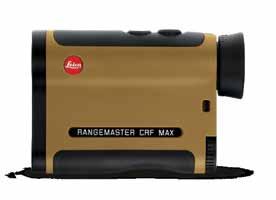
Know Where You Stand And Where to Go. Integrates With
Meet Leica CRF MAX—the compact rangefinder that changes the game. With pro-grade ballistics, GPS target marking, the brightest, fastest display, unrivaled optics, and onX integration all packed into one product.


In 2013 the Wild Sheep Foundation (WSF) launched a legacy campaign, Ensuring the Future of Wild Sheep, that includes tax and estate planning opportunities, counsel and advice, major gifts, and giving societies to raise the funds required to ensure the future of the wild sheep resource by directing even more dollars to wild sheep restoration, repatriation and conservation. Our vision is to build a series of funds from which a targeted annual offtake of ~4% will allow WSF to direct 100% of our convention fundraising to mission programs. Our goal is $5 to $6 million annually in mission focused Grant-In-Aid and other funding to “Put and Keep Wild Sheep on the Mountain.” With your help we can achieve this vision and goal.
The Marco Polo Society was established in 2008 as WSF’s premier giving society. To compliment the Marco Polo Society and expand this giving concept to ALL WSF members and wild sheep advocates, WSF created a new giving society in the fall of 2013 – the Chadwick Ram Society with five benefactor
levels enabling tax-deductible, donor directed gifts from $250 to $5,000 per year to mission areas of the donor’s desire. Donations can be made to the WSLF Endowment Fund, WSF Conservation Fund, our annual Convention and/or Area of Greatest Need to fund specific programs and initiatives. Chadwick Ram Society members are recognized with a lapel pin displaying their Copper, Bronze, Silver, Gold or Platinum benefactor level. Members may also “upgrade” their benefactor levels within the Chadwick Ram Society as well as to the Marco Polo Society.
For more information on the Chadwick Ram Society, Ensuring the Future of Wild Sheep campaign, or the Keep Climbing Campaign contact WSF President & CEO, Gray N. Thornton, Development Manager, Paige Culver, or visit our website.
We cordially invite you to join the Chadwick Ram Society and help Ensure the Future of Wild Sheep!

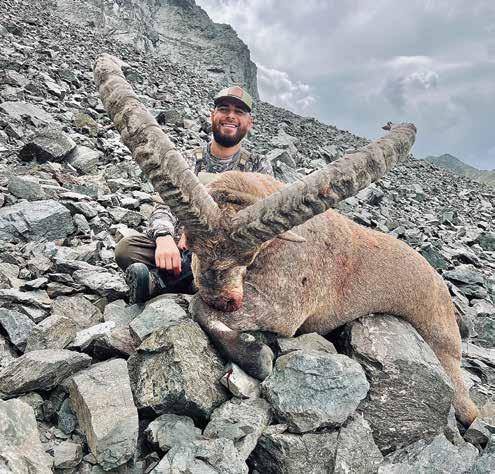
I chose to support the Wild Sheep Foundation through my membership in the Chadwick Ram Society because of the deep respect I’ve developed for Wild Sheep and the places they live. My first encounter in 2019 with Wild Sheep in the wild left a lasting impression, watching a band of Rams navigating steep mountains of Alaska with power and grace reminded me of how fragile yet resilient these animals are. That moment made me realize how important it is to give back and ensure they remain on the landscape for generations to come.
For me, joining the Chadwick Ram Society wasn’t just about being part of a group, it was about taking action. This commitment is a way to support the conservation work that truly makes a difference: habitat protection, disease research, and programs that introduce youth to the outdoors. Knowing that my contribution helps keep sheep on the mountain motivates me to stay involved. Hunting has always been about more than the harvest; it’s about stewardship, connection, and respect for the wild. Through the Chadwick Ram Society, I can help preserve those values while supporting the animals and traditions I care so deeply about.
- Marcus Gores
(January 1, 2025 - Press Time)
PLATINUM - $50,000
GOLD - $25,000
Aubrey Beacham (MS)
JC Spies (SD)
Nicholas Vakay (PA)
SILVER - $10,000
Jeff & Kris Brant (WA)
Ed Checque (AK)
Jason & Julie Childs (WA)
William & Corinne Duryea (IL)
Douglas & Jacky Johnson (AK)
Cam Rader & Beth Kaplan (AK)
Loren Keisling (AK)
Robert Manger (CA)
Richard & Megan Novotny (AK)
Thomas Rea (CO)
BRONZE - $5,000
Jim & Sonja Bonanno (CO)
Tucker & Carrie Drury (AK)
Janet Amos Holcomb (IN)
Cory & Rebecca Jackson (AK)
Charles & Hannah Kahahawai (AK)
Brian Magendie (LA)
Jeff McMinn (KY)
Joel Tavera (FL)
Robert Wallock (WI)
Dilan Worthley (AK)
COPPER - $2,500
Doug Beattie (AK)
Nick Brigley (AB)
Richard Cousineau (MI)
Cameron Crivelli (CA)
Tyler Donahue (SD)
Lee Downing (CO)
Spencer Jacobs (AK)
Craig Johns (NV)
Ken Jones (AK)
Delaney & Ashlyn Kavanagh (AK)
John King (IL)
Cody McLaughlin (AK)
Henry & Amy Noss (PA)
Clark Olsen (AK)
Sasha Pais (NT)
Chad & Julie Ramsey (TX)
Jakobee Reviglio (NV)
Chase Sheehan (AB)
Nick & Ashley Staller (AK)
Paco Velez (DE)
Harper Walton (AK)
by Paige Culver WSF Development Manager
The Wild Sheep Foundation is gearing up for another incredible Sheep Show® in Reno, and this year promises to be one of the best yet. From world-class exhibits and auctions to fellowship among conservation-minded sportsmen and women, Sheep Show® 2026 will once again celebrate the spirit of the mountain hunter and our shared mission to ensure the future of wild sheep.
A beloved tradition at Sheep Show®, the Society Lounge will once again welcome our Chadwick Ram, Marco Polo, Mountain Royalty, Legends, Pinnacle, and Legacy Society members in Hall 3 at the Reno-Sparks Convention Center.
for wild sheep conservation. The lounge offers a hosted bar and a comfortable place to relax, recharge, and connect with fellow members and special guests throughout the show.
Hosting this year’s lounge
This dedicated space serves as our way of saying thank you to our valued society members for their continued support and commitment to Keep Climbing Morgan Stuart
batch, high-end Weatherby® shotgun, including a hand-polished engraving and real 24k gold inlay accents. The stock is Exhibition unique to each and every shotgun. Built on Weatherby’s proven inertia reliability and quality come standard with every shotgun. Tested and and crafted by some of the best Italian gunmakers in the world.
is Morgan Stuart, our new Development Assistant and Program Coordinator. While new to her current role, Morgan has been a familiar face at Sheep Show® for the past five years. Her enthusiasm for WSF’s development programs and her genuine care for our members makes her the perfect host for this special space.
For our Marco Polo, Mountain Royalty, Legends, and Pinnacle Society members, we’ll once again host a beautiful gathering space on the Mezzanine, Floor 2 of the convention center. Enjoy a hosted bar and snacks throughout the show to keep you energized and connected. (Only for Marco Polo Society donors and up.)
To kick off the new year, Chadwick Ram Society (CRS)



members should keep an eye out for our new quarterly promotion launching in January. We’re giving away a Weatherby Mark V Backcountry Guide 7 PRC, and there are multiple ways to win:
• New and upgraded CRS members will automatically be entered.
• Existing members who refer a new CRS member will also receive entries to win!
If you’ve got a friend who’s been thinking about joining, now’s the perfect time! Have them call headquarters, visit our website, or better yet—bring them to the Society Lounge in Hall 3 during Sheep Show® to sign up in person. This promotion ends March 31st, so don’t wait!
Also, CRS members—don’t forget to send Morgan (mstuart@ wildsheepfoundation.org) your favorite field or hunting photo by 12/10/2025 for a chance to win a Revic scope! We want to fill the Society Lounge walls with member photos that showcase your passion for the hunt and the wild places we love. (Limit one photo and one entry per member.)
As tradition holds, we’ll honor our Foundation’s history and future at the “Today, Tomorrow, and Forever for Wild Sheep” cocktail reception on Thursday evening from 4:30 p.m. - 6:00 p.m. at The Edge in the Peppermill Hotel & Casino. This celebration
will spotlight our Past Presidents and recognize our newest Legacy Society members—those who have made the profound decision to include the Wild Sheep Foundation in their charitable gift planning.
Through foresight and generosity, these individuals are helping safeguard the future of wild sheep and the work we all cherish. This reception is open to all Giving Society members—from Chadwick Ram to Pinnacle—so grab a friend, enjoy a drink and a snack, and celebrate with us!
We’ll also have incredible giveaways, including premium optics from our incredible sponsor, Leica, and top shelf spirits from our long-time partner, Full Curl Spirits. You won’t want to miss it!
(By Invitation Only)
We’ll close out Sheep Show® 2026 with a powerful celebration— the “Keep Climbing” Cocktail Reception, held on Saturday evening from 4:30–6:00 p.m. at The Edge Lounge in the Peppermill Hotel & Casino, just prior to the Grand Finale Banquet.
This special event will honor our founding premier giving society members who make up our treasured Marco Polo Society, as well as recognize those members who have made the choice to “Keep Climbing” in their giving. These visionary members are helping the Wild Sheep
Foundation reach new heights— both in our Grant-in-Aid funding and in our efforts to build a secure and sustainable endowment that ensures our conservation work continues for generations to come.
As we look ahead to our 50th Anniversary in 2027, this milestone year serves as a rallying point for our bold goal: to grow the Wild Sheep Foundation’s Endowment Fund to $25 million.
This enduring investment will allow us to cap off a half-century of conservation success by ensuring the future of wild sheep and the wild places they call home. Join us as we celebrate our remarkable supporters, toast to progress, and continue climbing—together—for wild sheep.
See You in Reno!
Sheep Show® 2026 promises to be a celebration of conservation, camaraderie, and commitment to the mountain monarchs we all cherish. Whether you’re catching up with friends, joining a new giving society, or raising a glass in one of our member lounges, we can’t wait to see you in Reno as we Keep Climbing for Wild Sheep! WS
For more information or to join today— contact Paige Culver, WSF Development Manager. Ph: 406-4048748 Email: pculver@ wildsheepfoundation.org
• Lee & Penny Anderson (FL)
• G. Thomas & Patricia Lang (FL)
• Kevin & Janine Rinke (MI)
• Tim & Ruth Van Der Weide (IA)
• Gary Romain & Jude Siddall (WA)
• Kip & Sue Slaugh (UT)
• Matt Tomseth (OR)
Keep Climbing campaign society members may direct gifts to where they feel it is needed most, consistent with our Today, Tomorrow, and Forever for Wild Sheep conservation focus. However, to ensure wild sheep conservation and the Wild Sheep Foundation succeeds in perpetuity, 33% of all Keep Climbing Society gifts will be directed to the Wild Sheep Legacy Foundation Endowment Fund.
Terry Rathert (TX)
Mike Snider (MI)
Matt Tomseth (OR) EMERALD
Mike J. Borel (CA)
Peter & Wendy Burchfield (PA)
Wayne & Denise Lennington (TN)
RUBY
Derek & Harbor Blake (AK)
Zach & Amber Higgins (ID)
Hank Raats (NV)
David Reed (TX)
Jason Soulliere (MI)
by Greg Schildwachter WSF Lobbyist
With the U.S. government shut down, and as state governments struggle with conservation, it may be time to step back to a longer view on where conservation stands as we approach the 250th anniversary of U.S. independence.
Conservation has come a long way. Its origin featuring Theodore Roosevelt is well known but not always appreciated as a waypoint, not the beginning. The first naturalists and hunting and fishing clubs, and others, had started to form the concept earlier. TR institutionalized it. Several phases followed.
By the time TR’s cousin FDR was president, the federal government had expanded its hold on conservation with soil policies to address the Dust Bowl and with crews of Civilian Conservation Corps to build access and restore land. In this phase, the voice of Aldo Leopold’s skepticism of how much government could accomplish, and his counter suggestion that private landowners are central to conservation, was heard but not heeded as strongly.
The rapid growth of recreation, real estate development, and industrial innovation After World War II led to a phase of environmental policy. Conservation grew beyond forests and wildlife to chemicals and pollution.
Policy became precautious, with some good reason (controlling pollution), but also with some less good reason. By the 1970s, precaution was getting in the way of necessary action. The premise of the
Endangered Species Act of 1973, for example, is to stop things that harm declining species without necessarily doing anything to reverse the decline. Things were done in a few cases that resembled what hunters had been doing to restore game species for at least 30 years by that time. But precaution dominated.
Most of what happened in conservation since then—50 years ago—has been a gain or loss within the same boundaries. The 1985 Farm Bill—the first one to include a conservation title—is an example. It was a gain for conservation in the same basic form of policies dating to the 1930s. The rising crisis of wildfires during the 1990s, which ran parallel to tighter constraints on forest management is another example. It was a loss for conservation in the same form as timber and fire debates in the 1910s.
There is no way to go but straight ahead to get more gains and give up fewer losses, but there may be a different way to go about it. There may need to be. The U.S. government shutdown is not specifically about conservation, but the frustrations over conservation are part of the stalemate. Wildlife policy in state governments is diluting the voice of the hunting conservationists that supported state agencies’ original strength.
The better way may be to Disagree Better, as Utah Governor Cox has said. To get better debates we may need better rules for debate. We have seen at the state level that the scientific expertise
of agencies can be overrun by the passions of state legislatures and ballot initiatives—and expertise can be questioned by the courts. At the federal level, we have seen scientific analysis change with the changes in policy direction.
There may be a simple place to start. State wildlife commissions play a role that does not exist in federal conservation—maybe it should.
Commissions are useful because many conservation decisions are choices between different ways to achieve the same general goal. The differences are over values not goals. There are many ways to run a wild sheep program; they all help sheep. A scientist can’t reconcile values, but a politically appointed commission can. Other than special-purpose federal commissions —e.g., for migratory birds—federal conservation agencies have no such thing. The same people analyzing the options also make the values judgment. There are federal commissions for energy, elections, stocks and bonds, and so on; perhaps, conservation agencies should have them too.
Commissions are not magic; in fact, there are problems with state wildlife commissions. Commission votes can be swayed by party loyalty over the merits of issue. Commissions can be constrained by legislative overreach.
But if we are asking where to go from here and looking outside the boundaries of the last 50 years, the federal system may have something to learn from the states.WS


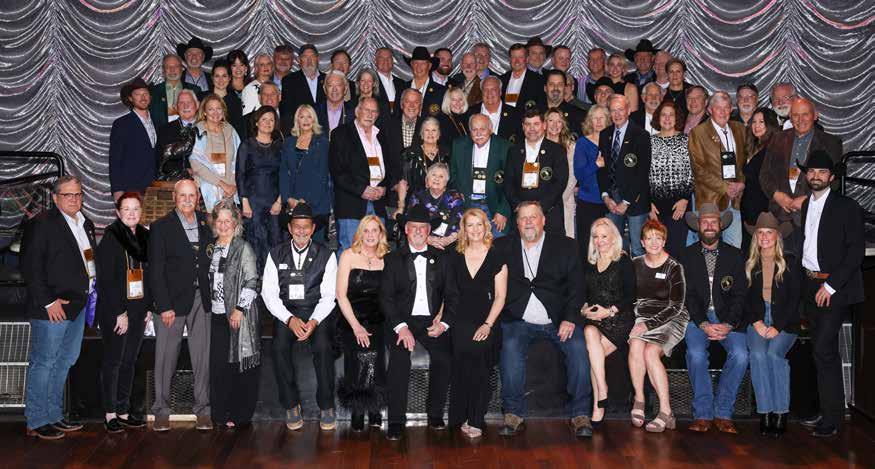
The Marco Polo Society® (MPS) is the Wild Sheep Foundation’s premier major giving “society” whose members have given and/or pledged a minimum of $100,000 to the Foundation. These donors have played a key role in the Wild Sheep Foundation’s success over the last 16 years. Quite frankly, this special group of donors has led the way in achieving our purpose of “putting and keeping wild sheep on the mountain”.
WSF SALUTES OUR MARCO POLO SOCIETY® MEMBERS TO DATE - Alphabetical Order
Shane & Angela Alexander (TN)
Lee & Penny Anderson (FL)
Anonymous
Anonymous
Stanford & Pamela Atwood (CA)
John & Jane Babler (MN)
Bryan & Barbara Bartlett (NM)
Scott & Erica Barry (MI)
Brian & Debbie Benyo (OH)
Gary Bogner (MI)
Dan & Kathy Boone (TX)
Louis & Patti Breland (AL)
Jerry & Amy Brenner (NC)
Steve & Jackie Bruggeman (MN)
Peter & Wendy Burchfield (PA)
Tony & Virginia Caligiuri (IA)
Ron & Billi Carey (AB)
Oscar & Valerie Carlson (MN)
Michael Carpinito (WA)
Walt & Joan Coram (TX)
Guinn & Betsy Crousen (TX)
Sam & Tracy Cunningham (TX)
Denis & Diane Dale (AB)
Dean & Paige Darby (MI)
Monty & Becky Davis (TX)
Since its inception in 2008, $11 million in MPS gifts/pledges have been directed to WSF and mission programs. We are so proud to announce that the Marco Polo 100 member goal was achieved at the 2024 Sheep Show when a group of generous Marco Polo members purchased the #100 member spot for a whopping $1 Million Dollars to be directed to the Wild Sheep Legacy Foundation’s Endowment Fund. We are so humbled and proud to witness the Wild Sheep Family come together to create history and we have never been more excited and hopeful for the future of wild sheep worldwide.
Jeff & Jann Demaske (CO)
Chris & Jaimie Dianda (NV)
Mike & Julie Dianda (NV)
Mark & Janice Dickson (CA)
Billy Dunbar (AK)
The Fiedeldey Family (OH)
Tom Foss (AB)
Ronald S. Gabriel, MD (CA)
Kevin Gilbert (MT)
Paul Greene (CO)
Brian and Susan Ham (AZ)
Marc & Cheryl Hansen (PA)
Jim & Sue Hens (NY)
Charles Herron (AL)
Tom & Denise Hoffman (NY)
Steve & Jill Hornady (NE)
Larry & Jane Hunts (OR)
Kevin Hurley (ID)
Ross & Nicole Jackson (CO)
Scott Jesseman (IL)
Kaan & Nurgul Karakaya (TUR)
Roger Kenner (ND)
G. Thomas & Patricia Lang (FL)
George & Kelly Lawrence (WA)
Doug & Dana Leech (WV)
Thomas Lemmerholz (GER)
Wayne & Denise Lennington (TN)
Jeff Lindgren (MN)
Robert Hall & Jane Link (FL)
Paul Mattes (MI)
Kyle & Joanne Meintzer (NV)
Joe & Christine Michaletz (MN)
Craig & Therese Mueller (ID)
Richard & Linda Murphy (NM)
The Olmstead Family (BC)
Mark & Gabriela Peterson (MI)
Ron & Vicki Pomeroy (WY)
Larry & Brenda Potterfield (MO)
Rancho La Palmosa (MEX)
Joni & Gary W. Raba (TX)
Terry Rathert (TX)
Gary & Yvonne Rigotti (OR)
Christopher Ring (TX)
Kevin & Janine Rinke (MI)
Alan & Barbara Sackman (NY)
Doug & Shelly Sayer (ID)
Roger Segebrecht (WI)
Steve & Sue Skold (IA)
Kip & Sue Slaugh (UT)
Kevin & Tuesdy Small (CA)
Dan Smith Jr. (CA)
Dan Smith III (CA)
J. Alain Smith (WA)
Mike Snider (MI)
Jeff Sorg (MT)
Daryll & Shauna Southwick (CO)
Brandon & Kristi Stokes (OR)
Rick Taylor & Carole Danyluk (BC)
Jelindo & Sandee Tiberti (NV)
Gray & Renée Thornton (MT)
Matt Tomseth (OR)
Mark Watkins (MN)
Tim & Ruth Van Der Weide (IA)
Ken & Anna Vorisek (AK)
Neal & Jody Wanless (AZ)
Mark Watkins (MN)
Jay & Martha Webster (TX)
Craig West (NC)
Steven & Ardyce Whisler (MT)
Clayton & Modesta Williams (TX)
Lyle & Jennifer Wood (AB)
Russ & Debi Young (TX)
Gary & Penny Young (WV)
Alan Young (YT)
#100 - $1M to the Endowment

by Dave Turchanski Chair, Ram Awards Committee
WOW, it seems that I just sat down to write my article for the fall issue of Wild Sheep® magazine and here we are doing the winter issue already. Congratulations to all who got to spend time in the mountains this fall and were able to harvest trophies of a lifetime—and to those that did not, there is always next year! To those that are still hunting or have future trips planned in the New Year, good luck and we look forward to seeing your trophies in the awards next year.
We have received numerous entries for both the International Awards and North American Sheep Awards and are looking forward to seeing award recipients in Reno on January 22nd during the luncheon for the awards presentations. That is your opportunity to share your stories with fellow friends and hunters. Last year we had nearly 700 people in attendance for the awards presentations, and this year we are hoping to even better that number. Once again, we will be holding raffles during the luncheon for floor credit drawings along with some hunt giveaways, so please make sure you bring family and friends (both old and new members) to this exciting event.
Once again, I would like to recognise my committee, as without these volunteers the awards would not be possible. The lady that steers us in the right direction and spends numerous hours behind the scenes putting everything together—our Awards and Publication Director Julie Tripp (MT) , our North
American Committee Sub Chair Mike Opitz (WA), Marcus Gores (OR), Charles Hartford (CA), Kyle Lehr (MT) and our International Committee members Mike Borel (CA), Alex Shariff (AB), Steve Skold (IA), Ludo Wurfbain (CA), as well as industry sponsors Buck Buckner (OR) B&C Representative, Justin Spring (MT) and P&Y Representative and Steve Skold (IA) SCI Representative.
A huge thank you to these folks
for making the awards possible. Please do not hesitate to reach out to these people for a quick chat or even to share ideas for future awards events as we are always looking for new ideas.
I look forward to a successful awards event in 2026 seeing everyone and meeting old and new friends in Reno. I would like to take this opportunity to wish everyone a very Merry Christmas and a Happy New year in 2026. WS



Thursday, January 22 | Noon – 2:00 p.m. Mt. Rose Ballroom | Reno-Sparks Convention Center
FREE Admission for Sheep Show Registered Attendees Includes FREE Lunch & Cash Bar OVER $7,000 IN DOOR PRIZES Two – $2,500 Floor Credit Drawings Christensen Arms Mesa FFT 6.5 PRC Tungsten Cerakote Rifle ($1,349 value) Montana Knife Company Boning & Breaking Combo Set ($895 value) —
EXCLUSIVE HUNT RAFFLE! Balkan Chamois Hunt in Macedonia with Safaris International Macedonia
Fantastic Odds!!! Tickets only sold during the luncheon — $20 a ticket or 6 tickets for $100. Includes $1,000 travel voucher.
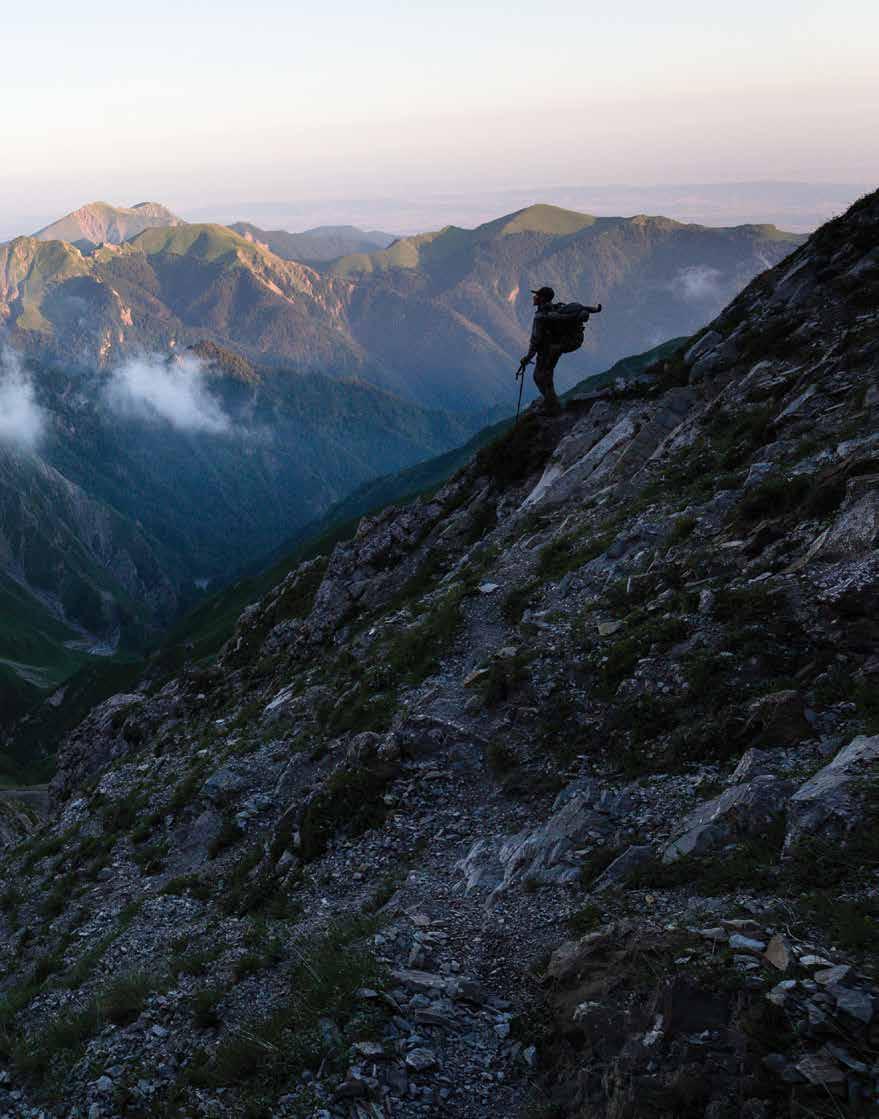
HARD COUNTRY, HEAVY PACKS, AND A GRANDFATHER’S GHOST
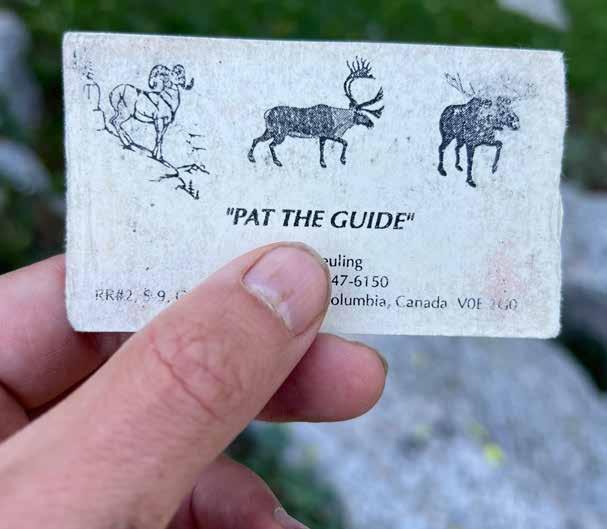
Ilooked down and handled my beat up “Pat the Guide” business card in my fingers. The wear and tear was in rolled edges and faded print. My family’s hunting legacy was also evident in this card. My grandfather had handed me the card in 2000, proclaiming, “Evan, if you work really hard, you can go sheep hunting someday.”

Pat had been his first guide for Dall’s sheep when he went in 1997 with Arctic Red River Outfitters. He asked for a few cards to share,
In 1967, as an almost exclusive deer and pheasant hunter (many coyotes aside), he had the idea to apply for Utah desert sheep in one of the first years sportsmen could hunt them. He drew the
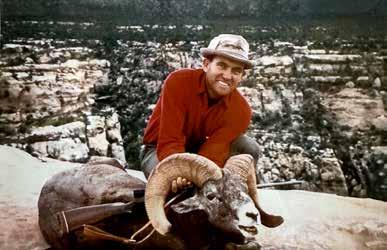
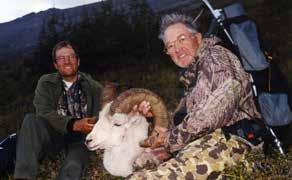
tag and that began a lifetime of sheep hunting. His bighorn came in 1982, and his Dall’s in 1997. He completed his FNAWS in 2000 by harvesting a 38” Stone’s sheep with Kiniskan Lake Outfitters.
I had the opportunity to tag along with him and dad on that Stone’s sheep hunt and my dad also shot a giant 43” ram. That same year, dad had also been amazingly fortunate to draw a Wyoming Rocky Mountain bighorn tag. So, we headed home, threw our clothes in the washer and were out the door two days later on the road for Wyoming.
A few days later, he had a ram down at 12,000+ feet. I was hooked and hunting a sheep was now my dream hunt.
My grandpa was lucky enough to harvest two more Rocky Mountain bighorns, one in Wyoming and one in his home state of Utah. He also went to the Mackenzie Mountains three more times and harvested two more Dall’s, the last being on a backpack hunt at age 78. This was part of the hunting legacy that had been gifted to me. No business card could embody that legacy in total,
but it was a reminder of him and his love of sheep.
True to my grandfather’s admonition, I worked hard and booked my first sheep hunt in 2019 with Jerry and our friends at Kiniskan Lake Outfitters. The card traveled with me to British Columbia in place of my grandpa, and I took my first sheep. The card went again in 2021, when I went with Arctic Red River outfitters and took my first Dall’s. Both times, I was excited to get back to cell service and relive every detail over the phone with Grandpa. We would try and talk him into coming with us and hanging out in the cook shack in base camp, but he would just smile and make a comment about not wanting to be a burden if he died up there!
In 2024, almost six months since his passing and 13 years since his last sheep hunt, the “Pat the Guide” card would go again, but I was hoping Grandpa would also be there looking out for us as he got to go on another sheep hunt with me, my dad, and my brothers.
I clutched my rifle between my knees, my knuckles white, as the Super Cub rocked and tipped in the turbulence. This was my least favorite part of the journey, yet I had climbed in willingly just minutes before. Even though I always try to control my circumstances, I’m willing to let go—at least a little—in the pursuit of hunting.
The wind had been too strong the night before to get me out to meet my guide, Colin. It was still blowing that morning, and I started to wonder if I was going to lose a hunting day to the weather. But soon enough, I found myself floating in the sky, holding my breath with each not-so-smooth movement of the plane.
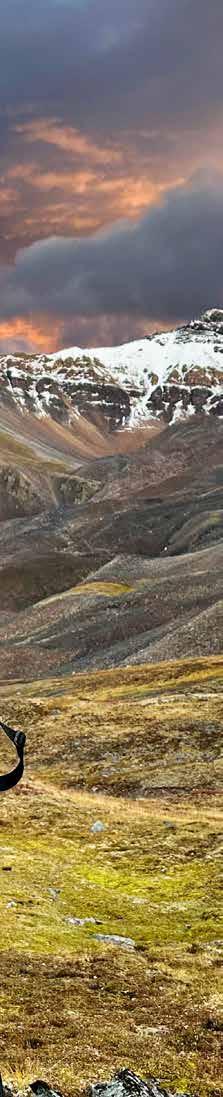
I knew the pilot was comfortable with the situation—otherwise, we wouldn’t be airborne, but even so, I struggled to relax and just be in the moment. Still, I watched the landscape go by and even recognized some familiar landing strips from previous trips. When we finally swung around into the drainage I would be hunting, I gasped—it was beautiful. The amazing vista was green valley floors surrounded by towering
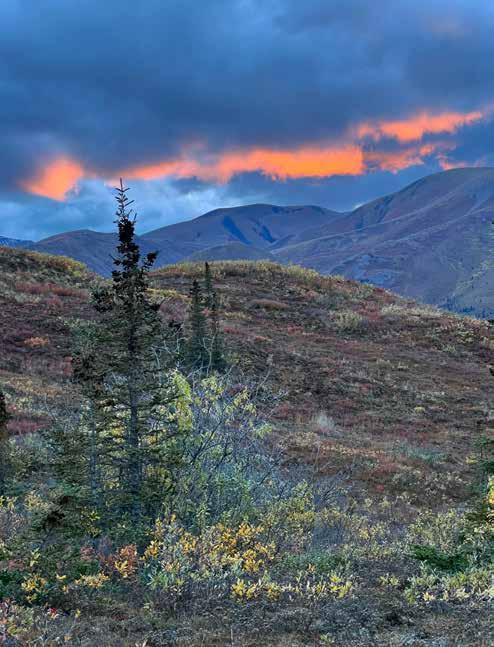
mountains. The terraced peaks had a layer of snow that accentuated the rocks as they stair-stepped down the cliffs. This was to be my hunting ground for the next 10 days and the spiritual connection I already had with my past—sheep hunting—hunting in general, made the plane ride worth it. The thought crossed my mind of my grandpa scolding us when we tried to travel by car in the snow, but I smile because I knew he would hop into super cub in an instant if it meant a chance at a sheep. I guess I have that in common with him. Now, it was my turn again and I couldn’t wait to get out and explore!
“Bear!” I was holding the guide’s shotgun and he was standing in front of me trying to get the spotter set up on a ram up the canyon. The bear was walking down the river about 10 yards in front of us. He looked at us askance out of the corner of his eye, knowing we were there but not willing to face us. He was a younger bear, about a fivefoot griz.
Collin grabbed the gun from me and readied himself. My heart was racing as I studied the bear’s movement. Would I see muscles bunch up as he prepared for a charge? He stayed very calm as he continued to saunter down the stream bed, searching for our wind to determine what was invading his domain. Soon, he caught the scent and began to lope away from us.
I sighed as relief flooded over me. Thats exactly what he was supposed to do. We hurried back to
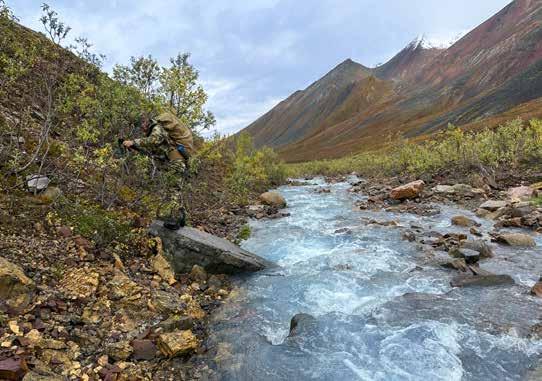
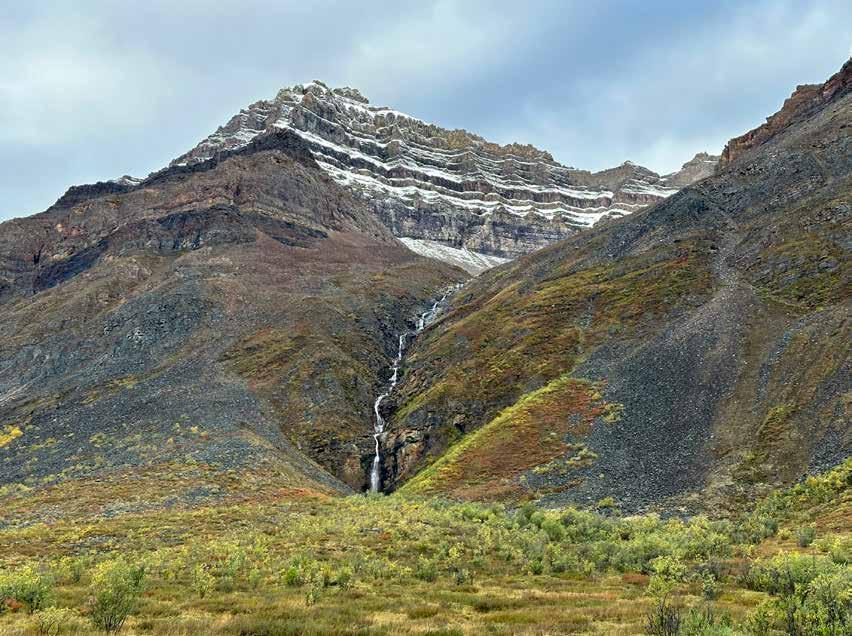
camp 20 yards away and I grabbed my rifle and looked up, only to see the bear circling back in, perfectly downwind from us and coming in towards camp on a line as if being reeled in by our scent.
“What is he doing?” I exclaimed. I chambered a round. Now my heart was jumping out of my chest. The bear stopped at 30 yards and stood up on his hind feet and stared us down—no jaw snapping or any aggressive moves but still too close for comfort.
Then he dropped down on all fours and began making the berry bush in front of him a feast. Every few minutes he would stand up and look at us and sniff the air. He wasn’t wanting to threaten us but his brazen curiosity was still unnerving.
“Send a bullet past his nose,” Colin said. “We need to get him out of camp.” At the report of the rifle, he slowly jogged out of camp and across the river. He seemed more puzzled that we had disturbed his meal rather than scared. Definitely not the reaction I had hoped for, but I could see my grandpa in my mind’s eye chuckling to himself with eyebrows raised. It hadn’t been as hairy a situation as the time he and my dad had walked in to a sow griz with two football-sized cubs at 25 yards. Fortunately, the wind had been in their favor that day.
Luckily, even though we saw our bear several more times, including one more time at the berry bush in camp, he wasn’t interested in trouble—it was a good berry year
and we didn’t make him curious enough to leave his current choice of sustenance.
I lay on the hillside watching the incoming snow squall. It had been quite the afternoon as it had gone from sunny to partly cloudy to snowing and round again. The clouds quickly approached on the upper winds, which had prevented me from taking a 500-yard shot on a really heavy ram. It was just too far for me to feel comfortable in the gusty conditions.
I had all my clothes on as I tried to stay warm and stave off the shivering. Although we had what we believed to be a shooter ram bedded at about 500 yards, we were
Then we saw him. We could instantly tell this was a different sort of ram…a no question shooter even on hunting day 2.
stuck. About three hours earlier, we had been searching for a band of rams we had spotted the night before. They weren’t in the same pocket as the previous evening and we were climbing to a vantage point overlooking the next basin when Colin suddenly flattened himself against the ground. He mouthed and motioned with his hand, “40 yards!” He had seen the top of a horn when he looked up and now was motioning for us to back out and drop back down. Once we had backed out, we had circled under the rams and come around above them. The first time we circled above them we came out at 40 yards again and fortunately the ram was sleeping. He was full curl and eight years old. This early in the hunt, the outfitter was still wanting us to look for a 10-yearold, so we backed out and circled higher still on the mountain. This time we were about 150 yards above him and his sentinel buddy. We strategically placed a large rock in between us and them and laid
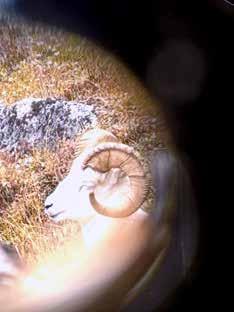
down on the mountain.
We started glassing the basin and located another full curl, 8-year-old and four other younger rams. Then we saw him. We could instantly tell this was a different sort of ram…a no-question shooter even on hunting day two. His mass dwarfed the others, and he had a sway back
and big potbelly, all signs of an older ram. We watched him feed and I was itching to put the hammer down, but between the wind being too strong for a shot at that distance, and the two sentinel rams that would have spotted any drastic moves, we were stuck—at least for now. We began the waiting game.
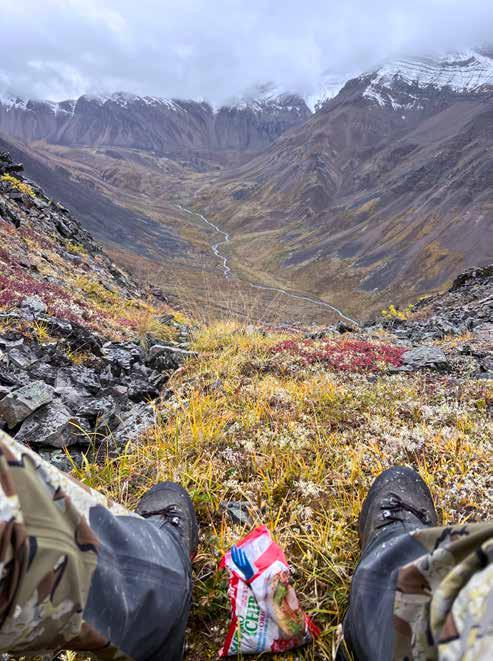
Feelings of exhilaration, to relief, to gratitude, to a longing to know my grandpa was watching all came in sequence.
So now here we were, three hours later, watching the clouds, snow, and sun take turns dancing across the snowy cliffs. The snow squall had passed and it was easier to stay warm for the time being. The two sentinel rams were up feeding at 200 yards, and every once in a while, they would glance up at us. Luckily, we were holding still enough, even with the wind flapping our rain covers on our packs. They knew we were not part of the natural beauty surrounding
us, but didn’t mind enough to raise the alarm. This was familiar as I’ve been able to get away with more aggressive moves coming around above rams. However, I wondered if this would play out the way we wanted or if we would get busted. We continued our game of patience and I closed my eyes and let the warmth sink into my bones. I couldn’t imagine a more beautiful spot to sit for three hours—here among the snow covered cliffs towering over the soft green
basins. We peeked at the two rams occasionally as they fed, trying to hold as still as possible. They finally fed out of sight into the bowl in front of us. It was time.
Colin crept forward, and after a few minutes, motioned for me to come up using his fingers to signal a gun. My heart began to race—a familiar and welcome feeling. I slid forward carefully and got my gun in shooting position. I could see the big ram feeding below me at 200 yards and I was instantly
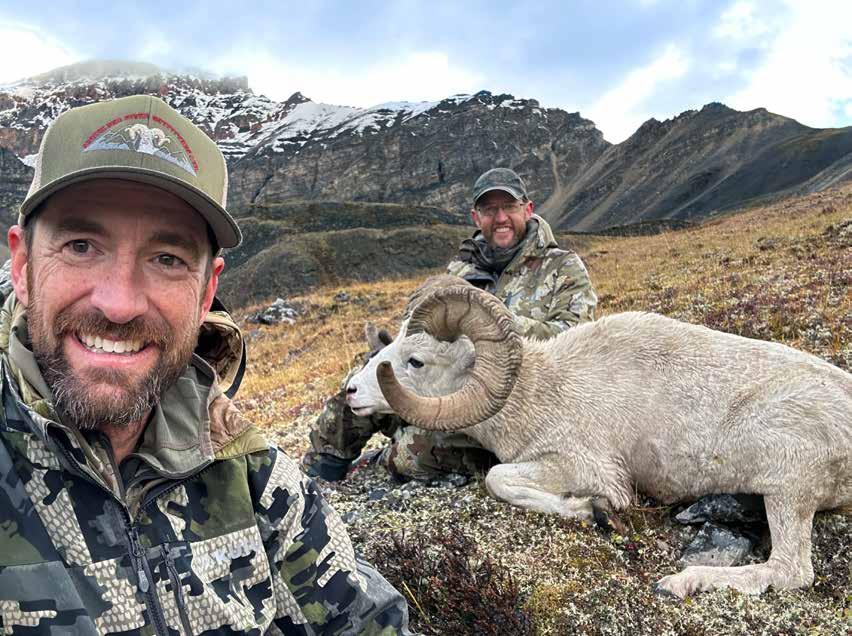
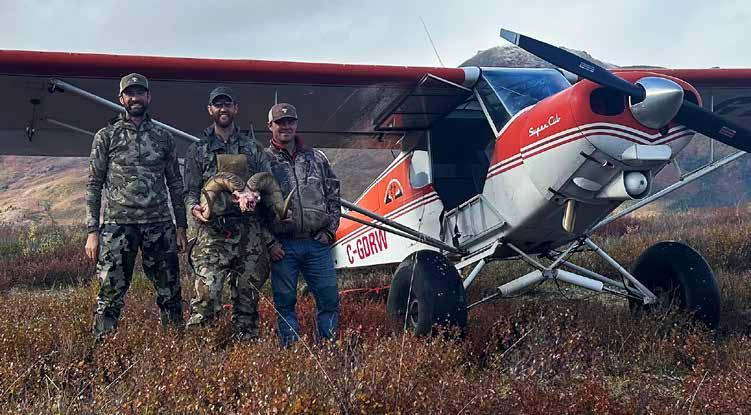
on him. Instinct took over and as I squeezed the trigger, I could hear Colin beginning to say, “Take your time.” Before he finished the sentence, the ram lay on the ground dead.
A wave of euphoria overcame me as another cloudburst opened above us; this time it was heavy rain. It seemed a sign from the heavens—a symbolic cleansing as all my emotions from the previous several days were reset. Feelings of exhilaration, to relief, to gratitude, to a longing to know my grandpa was watching, all came in sequence. We sat for a while just absorbing the surroundings and our emotions. The other rams hadn’t run very far and stood looking around in confusion. It was a scene I won’t forget soon, and as I frequently glanced back at my ram, I was pleased each time to see him lying still on the green valley bench.
Finally it was time. We walked down the hill as the other rams ran out of view; we were all grins as we touched the ram for the first time. He was heavy and full curl—a magnificent specimen. In my heart, I felt close to my grandpa as we admired him.
It was now almost 6:30 p.m. and still raining, but we weren’t ready for this to be over. So we ate our first meal since lunch, and as we ate, we relived every moment of the hunt so far—spotting these rams the night before, the hike in, the climb up through one set of terraces, almost walking right on to the rams, the game of patience, the weather and scenery, and the shot. All of it was coursing through our veins and we didn’t want it to end.
As we eased into the photo session, it was still raining, and by the end, the sun was out, highlighting the green against white-encrusted cliffs as the sunset cast a pinkish hue on the clouds. It was finally time to break the ram down and hike back to camp. As we peeled back the hide, we could see the delicious meat shrouded in a thick layer of fat. My mouth began to water—but tasting that meat would have to wait. It was time for the good kind of heavy pack out. If we didn’t think the day could be more special, the clouds cleared just enough to give us several green glimpses of the northern lights as we packed back to camp.
Since we had only hunted two
days, we had a week to enjoy. And that’s exactly what we did. The rest of the hunt was spent caping, fleshing, and packing camp back to the airstrip. Colin and I ate sheep steaks and told stories all week as we glassed for caribou or moose. We stalked one caribou and decided to pass on it. I can’t imagine a more enjoyable way to spend time. When it was finally time to head back to base camp, I knew I was going to miss the Mackenzies. I remembered what my grandpa always said about them. Every time we relived his hunts up there, he would simply remark, “That’s a special place.” What a true statement.
I am certain grandpa enjoyed his first sheep hunt in 13 years. WS
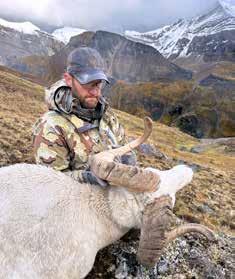
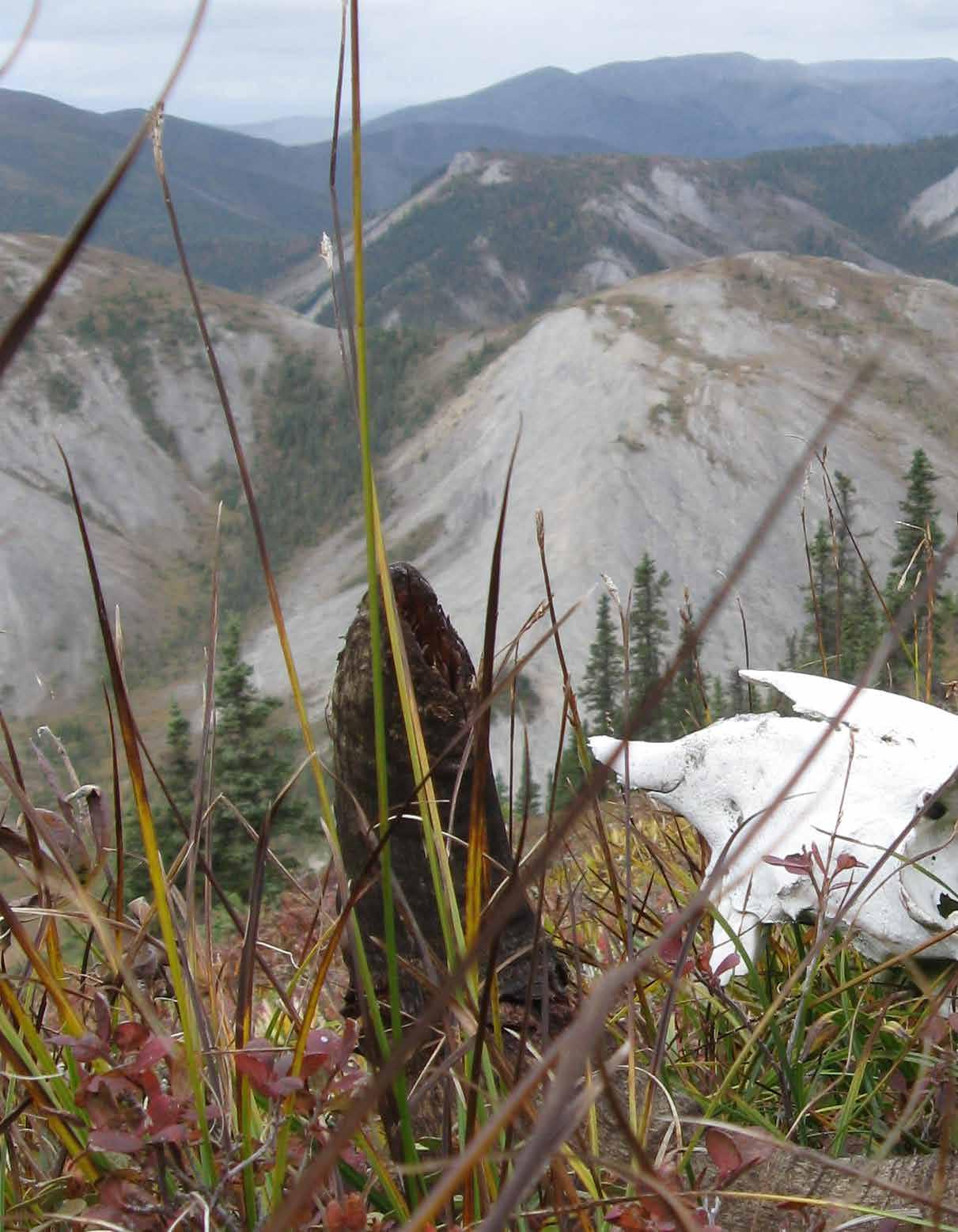
BY BILL JEX
High in the windswept alpine of the North, where the tundra meets jagged peaks and winter often overstays its welcome, Dall’s and Stone’s sheep have thrived for millennia.
Known collectively as thinhorn sheep, these striking animals sport white and smoke-grey coats that blend seamlessly into their mountain landscapes and are considered the most prestigious game animals on the continent.
But in recent years, biologists, guides, hunters, and indigenous peoples have noticed troubling signs; fewer ewes and lambs on ridgelines, smaller bands in once-
bustling valleys, poorer body condition in some years, and longer population recovery times following severe winters, during which winter has taken its own toll.
The cost of living in such remote and wild places is changing as winter weather patterns shift today. But what was once dismissed as local population fluctuations from a few bad winters has grown into a broader conservation concern, spanning from British Columbia’s remote northern ranges to the vast wilderness of Alaska, Yukon, and the Northwest Territories.
In response, members of the
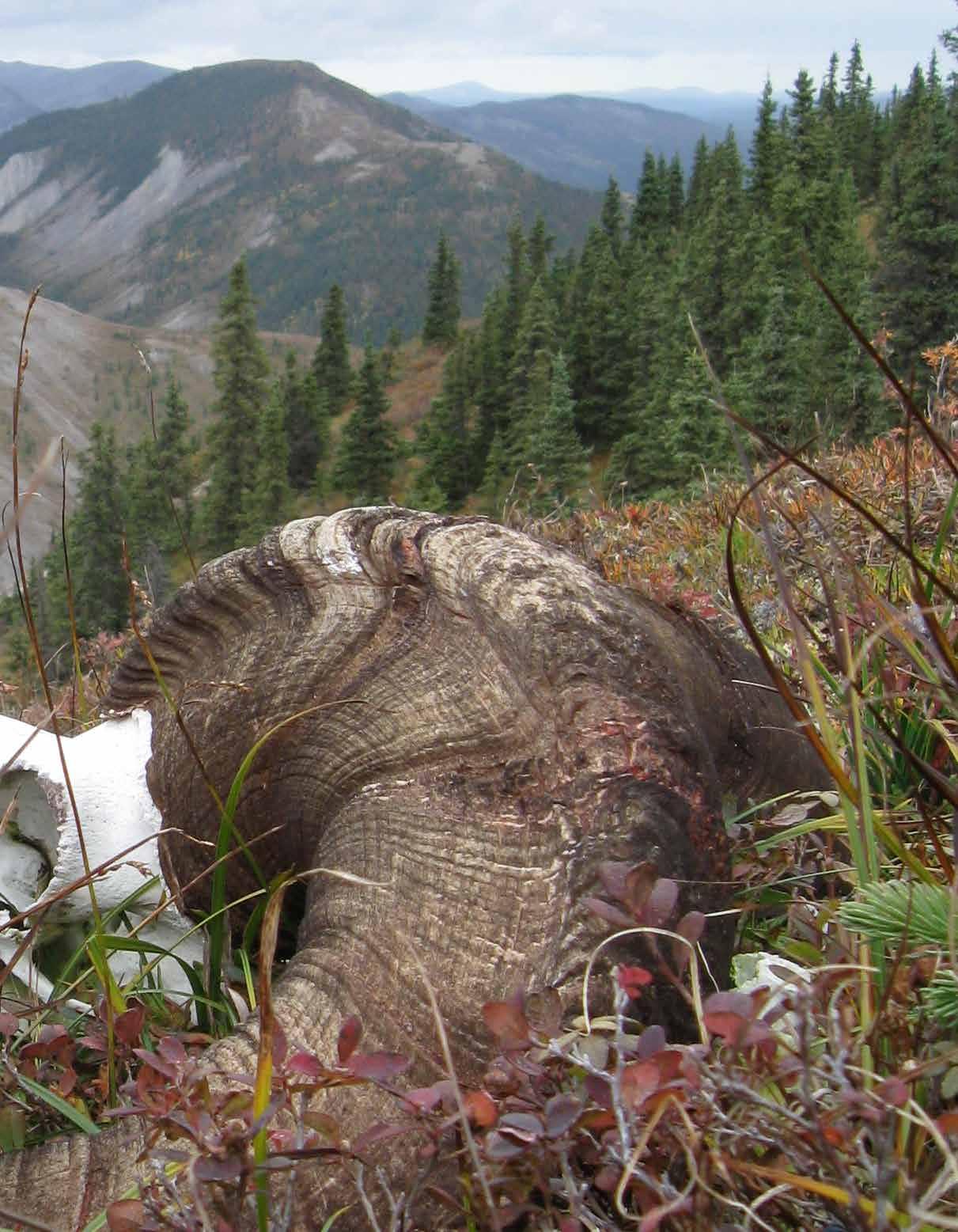
Western Association of Fish and Wildlife Agencies’ (WAFWA) Wild Sheep Initiative came together to take a closer look. Their newly published White Paper, Observed Changes in Populations of Thinhorn Sheep in Western Canada and Alaska, provides the most up-todate snapshot yet of how these northern icons are faring.
This report builds upon a foundation laid nearly a decade earlier, when WAFWA first released Thinhorn Sheep: Conservation Challenges & Management Strategies for the 21st Century. The new analysis updates the science, integrates
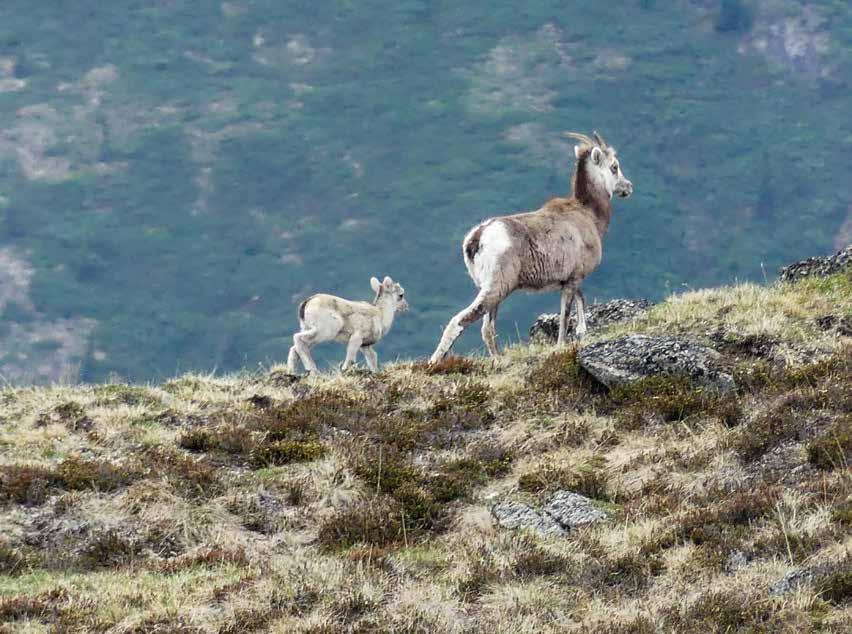
field observations, and paints a sobering but nuanced picture of shifting population dynamics across thinhorn sheep range.
Across the North, thinhorn sheep populations have been trending downward since the early 2000s. The pattern is gradual in some places and sudden in others, but the overall direction is clear. In Alaska, long-term monitoring across eight major mountain ranges shows declines of up to 70 percent compared with counts from the late 2000s. These losses are just as severe in nonhunted areas, showing that regulated harvest is not the primary driver. Researchers point instead to a combination of weather extremes such as record snow depths, rain on
snow events that seal forage beneath ice, and long spring thaws that have caused consecutive years of poor lamb survival and recruitment.
From 2019 to 2022, adult survival rates in several monitored herds dropped by 60 to 70 percent compared with 2007 to 2011, with heavy snowfall and delayed green-up further reducing lamb production. Back-to-back winters coated mountain slopes in thick ice, forcing sheep to burn precious energy moving across dangerous ground or go hungry when forage became unreachable. Ewes entering spring in poor condition gave birth to weaker lambs, extending the population decline and slowing recovery even after milder seasons returned.
The same pattern is playing out across the range. In the Yukon,
once-robust herds in accessible hunting areas have fallen by about half since 2015, while reports from remote, protected regions show comparable drops. That pattern reinforces the finding that hunting restrictions alone cannot explain the losses.
In the Northwest Territories, limited but consistent monitoring shows populations in the Mackenzie and Richardson mountains have declined 60 to 85 percent since the late 1990s and early 2000s. Numbers there have recently stabilized but remain far below historic levels. Even farther south, British Columbia’s Dall’s sheep have declined 15 to 50 percent over the past two decades, and Stone’s sheep, which inhabit the southern part of the thinhorn
Once considered secure in their remote ranges, thinhorn sheep now face a future defined by instability.
range, have seen similar losses of up to 50 percent. Only a few localized herds in the province’s eastern ranges appear stable, highlighting how uneven and complex these changes are across the species’ range.
Few forces have shaped the fate of thinhorn sheep more deeply than climate.
These alpine specialists live at the edge of what their ecosystems can sustain, relying on predictable seasonal rhythms for survival. When those rhythms fail, the consequences ripple across generations. Northern latitudes are warming two to three times faster than the global average, disrupting snowpack and triggering freeze and thaw cycles that crust over vegetation. Frequent rain on snow events during winter months can turn entire slopes into icy traps, while prolonged winters and late green-ups drain the nutrition that supports lambing ewes.
The 2019 to 2022 winters show how weather volatility can accelerate long-term decline. Consecutive severe seasons mirrored crashes recorded a decade earlier under similar conditions, but with only about ten years between them, herds had little time to recover. Climate cycles such as the Pacific Decadal Oscillation and El Niño and La Niña still shape regional weather, yet recent anomalies fall outside historic norms, signaling that the baseline itself is changing.
As warming continues, scientists expect shrub growth to expand into higher alpine zones, reducing the open grassy slopes thinhorn sheep depend on for visibility and
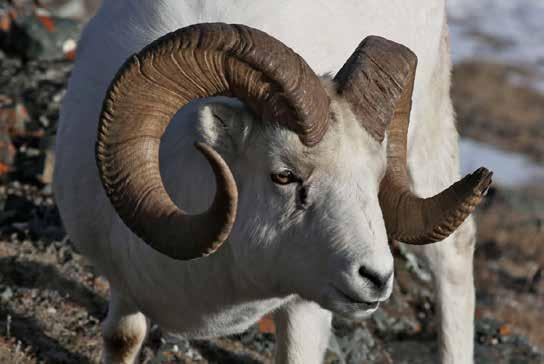
forage. Combined with erratic snow and ice patterns, these shifts are likely to worsen lamb survival, slow recovery after population crashes, and weaken resilience. The evidence from both hunted and nonhunted regions points to one conclusion: Climate and weather extremes, not human harvest, are now the dominant forces shaping the fortunes of most populations of the North’s most iconic mountain dwellers.
Once considered secure in their remote ranges, thinhorn sheep now face a future defined by instability. Their story is not just about numbers on a survey sheet or a few harsh winters. It is about a changing climate that challenges even the toughest survivors of the alpine North.
Golden eagles, wolverines, coyotes, bears, wolves, and lynx are
all natural parts of the ecosystem. Yet shifts in their numbers, partly the result of human actions and changes in the abundance of other ungulate species, have altered the timing, conditions, and effectiveness of their hunting, thereby amplifying their impact on sheep mortality.
In some regions, predator control efforts targeting wolves shifted these terrestrial hunter assemblages to favor species such as coyotes and wolverines, two species that tend to target lambs, juveniles, and ewes directly affecting population recruitment. Studies in Alaska show striking regional differences— golden eagles dominate lamb predation in the Brooks Range, while coyotes and wolves play larger roles elsewhere—each area seemingly with its own recipe for predation effect.
In some regions, predators bounced back quickly after control
Across the North, biologists are documenting a wider range of pathogens and parasites than ever before.
programs stopped. With more moose and deer on the landscape, predator numbers rose too— setting up a chain reaction known as apparent competition, where growing prey populations draw in more predators that also prey on thinhorn sheep.
In some areas, warmer conditions have allowed deer and cougars to move north into thinhorn range, introducing new predators and potential disease risks. Predation can be especially hard on weakened ewes and lambs after harsh winters and delayed green-up, but also, new predators who are ‘unknown’ to thinhorns such as cougar, can capitalize on that naivety with alarming success. A case in point, a series of trail camera images from a research project focused on the most northern population of Rocky Mountain bighorns in
British Columbia, recorded a male cougar killing a ewe, with the rest of the herd who may have never interacted with a cougar before, seemingly puzzled about what had just happened.
Predator management remains a contentious issue. Broad control efforts rarely guarantee more sheep and can even worsen predation by upsetting natural balances. Biologists emphasize that real progress depends on local data, adaptive management, and collaboration among agencies, Indigenous communities, and conservation partners. Where programs are implemented, rebalancing predator densities is likely more beneficial in the long run than trying to achieve total eradication.
Historically, thinhorn sheep were
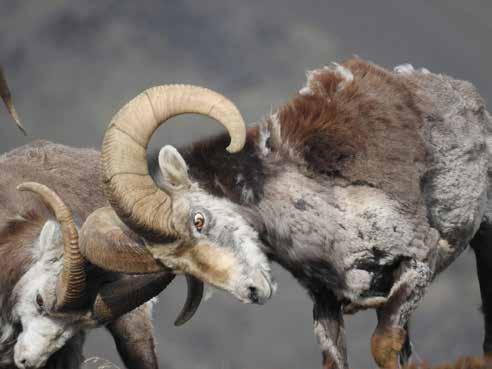
thought to be relatively free of most parasites typically associated with livestock and other wildlife species, or the various pathogens and devastating respiratory diseases that have plagued their southern cousins, the bighorn sheep. But emerging research suggests that assumption may no longer hold.
Across the North, biologists are documenting a wider range of pathogens and parasites than ever before. Historical documentation often reported critters like lungworm and gastrointestinal parasites such as Marshallagia, Eimeria, Trichuris, and Nematodirinae; these species appear to have a natural relationship with thinhorns, but changing climates may be altering those somewhat traditional parasite-host relationships.
In northeast British Columbia, researchers discovered Stone’s sheep hosting heavy winter tick infestations, a parasite more often found on moose and elk. The rise and spread of those game species, shaped in part by decades of widespread prescribed burning may have brought the ticks into sheep range; certainly, it appears as though the introduction of elk into the Yukon territory decades ago, may be at least partially responsible for winter tick abundance there.
Tick burden, which can be severe in some years, can cause significant hair loss (ticks are itchy and cause sheep to scratch and groom, wearing away their temperature-protective hair coats). And ticks feed on body fluids, literally sucking nutrients
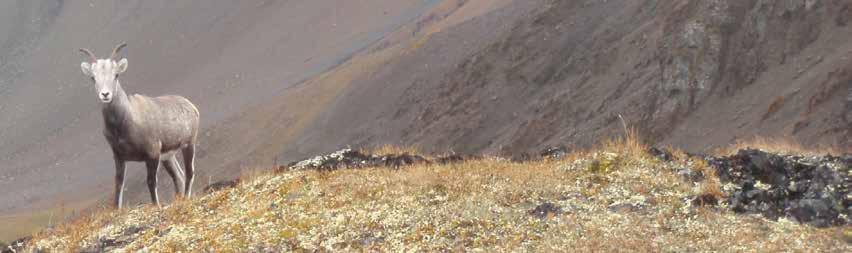
from an individual’s body. The implications of a severe tick load for a ewe nearing spring when she is about to produce a lamb remain unanswered but are highly unlikely to be beneficial or benign.
Another potentially significant finding is the presence of Toxoplasma gondii (Toxo) in some populations of thinhorns. Thinhorn sheep serve as intermediate hosts, becoming infected through environmental contamination with Toxo oocysts (an ‘egg-like’ structure that contains a protozoan parasite) shed in the feces of infected felids. These findings present potential causes of poor recruitment in Dall’s herds. Toxo can cause late-term abortions in ewes that become infected during pregnancy; lambs that are congenitally infected are often weak and may be prone to being abandoned or more readily succumb to predation, exposure, or starvation.
The presence of a variety of viral species has been documented in populations of thinhorns across our North. Some, such as contagious ecthyma, or CE, are known to cause physical and likely fitness problems, which, depending on the age of the individual and severity of the infection, could lead to higher rates of mortality. Other virus species, such as the malignant catarrhal fever-associated virus (MCF), have been widely detected in both bighorn and thinhorn populations, but the implications for mountain sheep are not yet
well understood; exposure of bison and some deer species to MCF has resulted in death.
Although no respiratory disease-associated die-offs have been recorded in wild thinhorn populations, the potential risk remains significant as human activities (industrial, agricultural, and recreational packing) move potential disease vectors like domestic sheep and goats into areas at the doorstep of some thinhorn ranges.
This said, anecdotal information documented in British Columbia suggests that an individual, recently translocated Stone’s sheep ram, may have been in contact with domestic sheep and this event could have contributed to the loss that very localized population of thinhorns south of the Peace Arm; exposure to a strain of Mycoplasma ovipneumoniae (MOVI) in an Ontario zoo in the mid-1980s resulted in the death or eventual humane euthanasia of all infected thinhorns there.
Other respiratory bacteria species with names nearly impossible for most to pronounce correctly, such as Mannheimia haemolytica, Pasteurellaceae multocida, and Bibersteinia trehalosi, have been implicated as key respiratory pathogens involved with bighorn sheep die-offs. Interestingly, a stable, unique strain of MOVI has been identified in Alaskan Dall’s sheep, without evidence of widespread disease to date. The origin of this situation is not
understood. Still, it may have resulted from early- and mid-1900s efforts by Alaskan agricultural researchers to hybridize domestic and Dall’s sheep, aiming to produce a northern-climatehardy animal suitable for meat production. Today, though, there is simply no well-understood way to answer that question.
To reduce the growing risk of disease and parasites, several jurisdictions are expanding surveillance programs and tightening rules that keep domestic animals away from wild sheep range. Stress may also play a role in poor reproduction. Studies show that elevated stress hormones from disturbance or frequent predator encounters can weaken immune function, reduce reproduction and inhibit growth, and also shrink the geographic range that animals use.
Habitat loss and human disturbance can at times be so gradual that they are difficult for most to perceive; they are quiet-but-persistent threats to mountain sheep populations. While most thinhorn ranges are remote, industrial exploration, infrastructure projects, and even increased recreation are encroaching on critical habitats.
In parts of northern British Columbia, seismic lines, mining access roads, and off-road vehicle use are fragmenting winter ranges and lambing grounds. Elsewhere,
In the end, the fate of these alpine ghosts depends not just on the harsh realities of weather or predators, but on the collective will of those who care enough to act.
drone-assisted photography and backcountry tourism, once rare in these rugged areas, are introducing new forms of stress.
Again, it can be difficult for people to fully comprehend the effects that compounding offroad vehicle and snowmobile use can have on disrupting sheep movements, or how creating pathways for predators to access mountain sheep range easily can increase those species interactions. Still, it may perhaps be helicopter/ floatplane-supported recreation in all seasons that most puts people into those remote places where thinhorns previously found refugia. Displaced ewes burn more energy, lambs are more exposed, and in marginal years, that can make the difference between survival and loss.
Despite the challenges, hope remains. Across the North, agencies and hunting and conservation groups are redoubling efforts to protect and restore sheep habitat, refine management practices, and expand monitoring programs.
Prescribed burns are being reintroduced in some areas adjacent to lambing habitats to rejuvenate alpine forage and open sightlines critical for predator avoidance. Jurisdictions are also experimenting with adaptive predator management programs that seek to rebalance ecological integrity with species recovery. And long-term population and health monitoring (historically underfunded) is now recognized as
essential for understanding trends and the sources of declines, helping shape policy and legislation.
Collaboration is the common thread: between governments and First Nations, between scientists and local guides and hunters, and across international boundaries, as funding increases research, the potential to understand better how climate and human pressures interact to shape thinhorn sheep ecology improve.
Once considered secure due to inhabiting vast, remote habitats, thinhorn sheep are proving to be far more vulnerable than once believed. The rugged landscapes that define their existence no longer guarantee protection from climate change, disease, predators, or the cumulative footprint of human activity.
But conservation success stories are written in the language of persistence and partnership. Whether through communitybased monitoring, responsible recreation, or support for habitat protection, every effort contributes to safeguarding these animals.
This realization that our globally unique Dall’s and Stone’s sheep populations face greater challenges today than ever before has not gone unnoticed. In May 2024, WSF President and CEO Gray N. Thornton conveyed a message from the foundation’s board in recognition of this:
“Since our founding in 1977, a lot of emphasis has been placed on recovering bighorn and desert bighorn sheep. With dedicated
efforts from our chapters and affiliates, alongside our agency and tribal partners, we have achieved significant successes.” he said.
“It is time for WSF to dedicate similar efforts to Stone’s Sheep. Our board of directors has put an exclamation mark on this need with this $1 million funding pledge.”
Also, in this year’s Grant-InAid funding award process, the WSF Conservation staff and our Professional Resource Advisory Board both recommended funding in support of the Alaska Chapter’s Eastern Alaska Range Dall’s Sheep Revitalization project to help move the needle on efforts to recover that meta-population of thinhorns.
Conservation staff are also planning WSF’s Thinhorn Summit IV, to be held in May of 2026 as a symposium that will be focused on the question, “What can we do for thinhorn sheep?”
Through this type of collaboration, attendees can help identify, develop, and prioritize specific actions and strategies to address issues affecting thinhorn populations and support their sustainable management well into the future.
In the end, the fate of these alpine ghosts depends not just on the harsh realities of weather or predators, but on the collective will of those who care enough to act. They have survived ice ages and apex predators for millennia but now face unprecedented change to what they have known and adapted to.
It would be a tragedy if what finally undid them was our inattention. WS
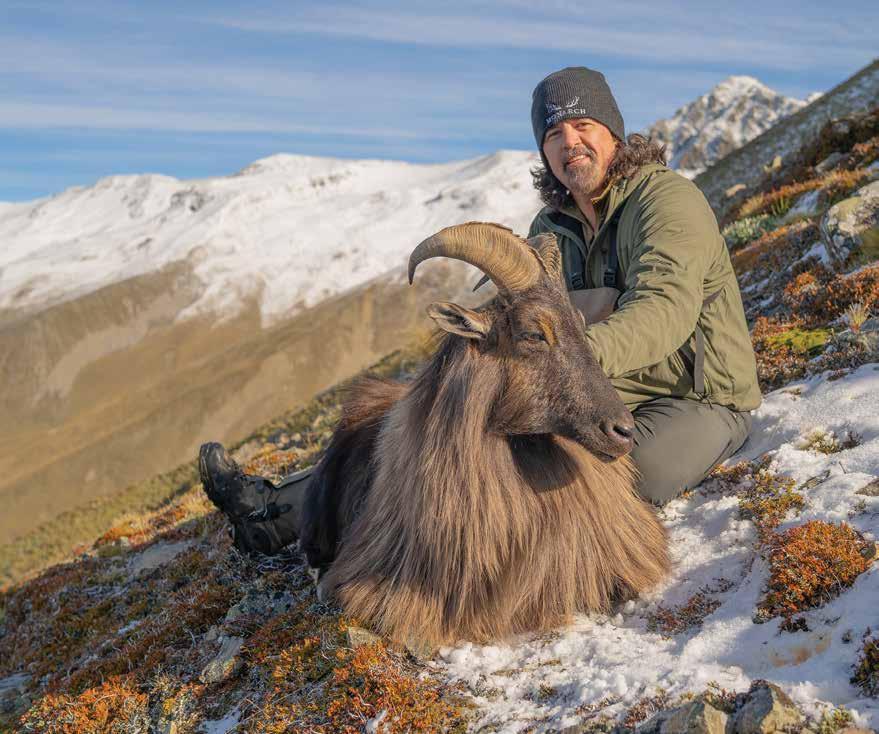
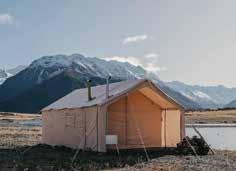
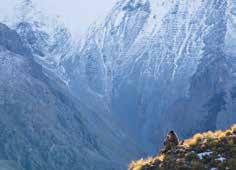

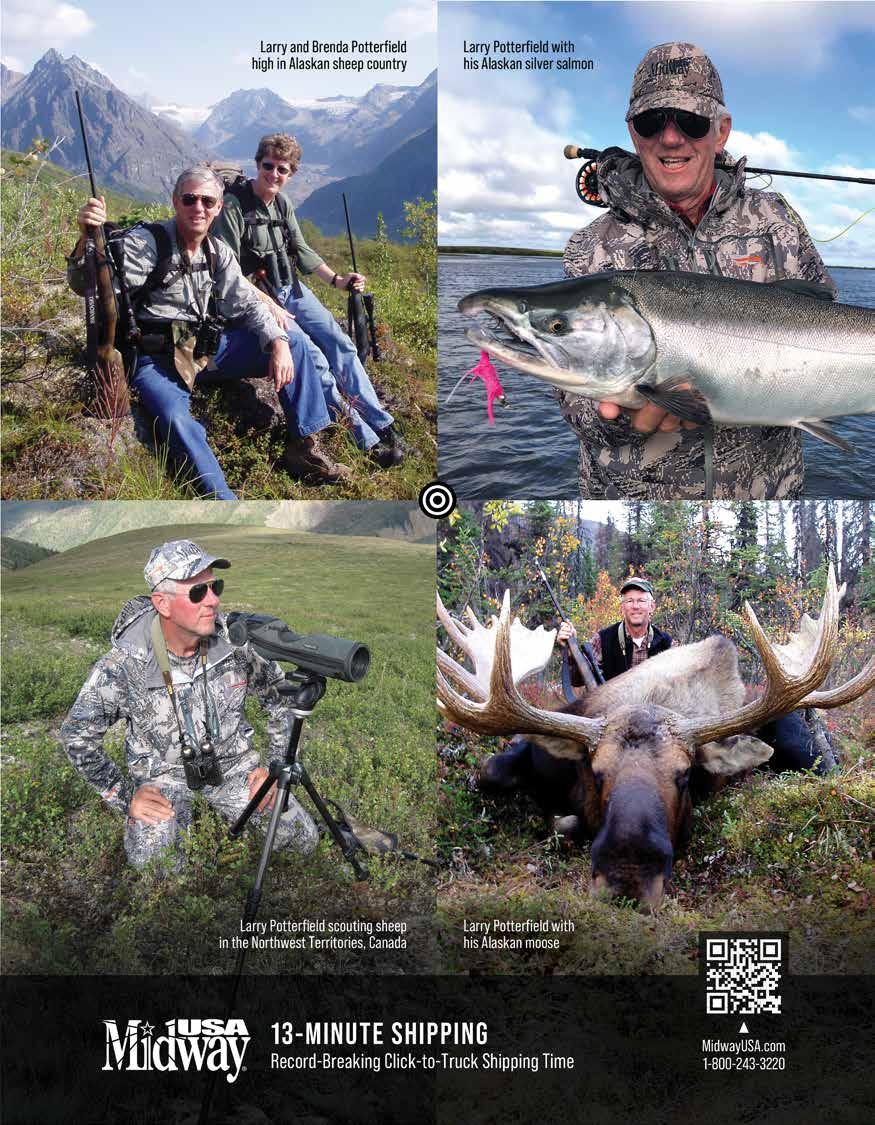
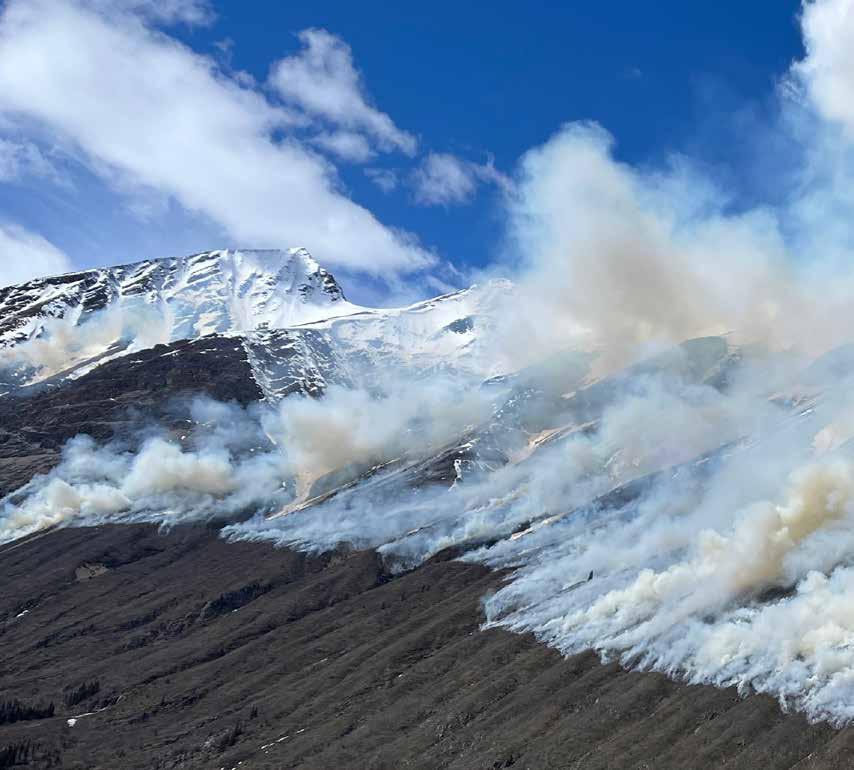
BY CHESTER MOORE
High in the mountains of northeastern British Columbia, the ground still carries the scent of smoke. Charcoal dust darkens the rock, evidence of a recent prescribed (controlled) burn set by biologists to revive the slope.
The hillside looks quiet now, but renewal has already begun.
Tiny green shoots press through the ash. A few feet away, a ewe and her lamb pick across the blackened ground, nibbling at the first new
blades of grass.
“Usually within a week of a burn, as soon as that new grass pokes through, sheep are there,” said wildlife biologist Alicia Woods of Ridgeline Wildlife Enhancement Inc.
“I’ve personally even seen lambs standing in the black, eating the little green shoots.”
These are Stone’s sheep, thinhorns found only in British Columbia and a sliver of southern Yukon. Their survival depends on
open, sun-warmed slopes where they can graze and quickly spot danger. When shrubs and young trees move uphill, they block that visibility.
Prescribed fire gives it back. It clears encroaching brush, restores nutrients to the soil, and sparks new growth that draws sheep within days.
“It’s habitat rejuvenation you can literally watch happen,”
Woods said.
With support from the Wild
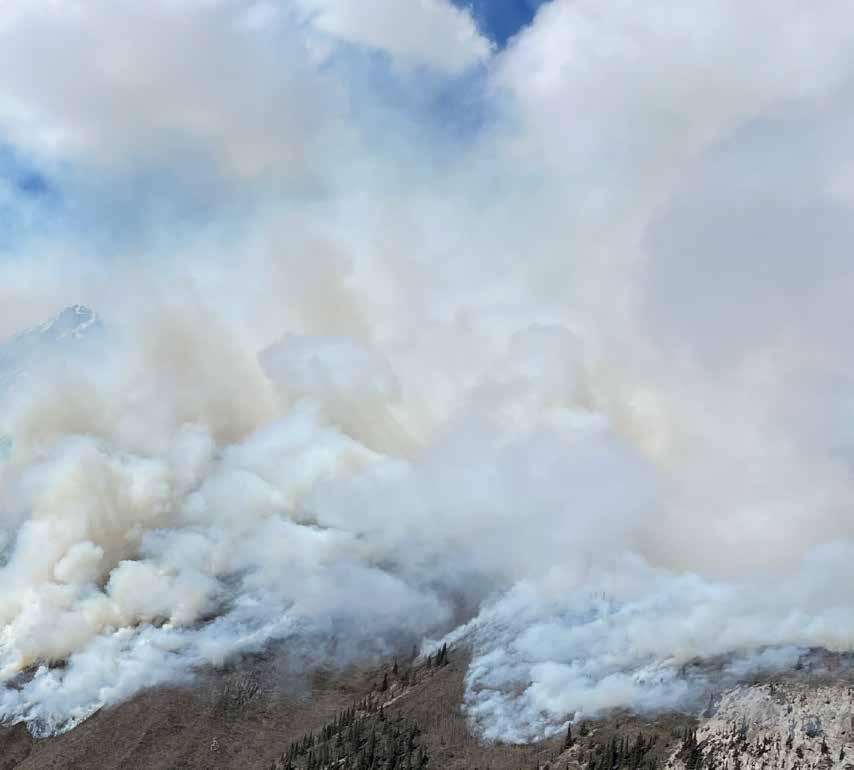
Sheep Foundation (WSF) and the Wild Sheep Society of British Columbia, more than 1,200 hectares of range have been restored through carefully planned burns, each one mapped, timed, and executed with precision in Wood’s study area.
Across wild sheep country, from bighorn canyons to thinhorn peaks, fire can be both a healer and a threat. Used carelessly, it scars; used with focus, it saves. Each burn is planned using forecasts,
humidity checks, and the steady judgment of individuals who are familiar with the land.
Ask Corey Mason, a professional wildlife biologist, what makes prescribed burns so powerful, and he doesn’t hesitate.
“Fire is without a doubt one of the most impactful and constructive wildlife conservation tools we have,” said Mason, Executive Vice President of
Conservation for WSF.
Early in his career, he spent years with the Texas Parks & Wildlife Department, working firsthand with prescribed burns.
“It’s about harnessing a natural process and reintroducing it into systems we’ve altered by suppressing fire for decades,” he said.
For much of the past century, fire was treated as an enemy. Every spark was doused. In its absence, brush thickened, grasses declined, and layers of dead fuel

built up. When ignition finally came, whether by lightning, accident, or arson, the result was a catastrophic wildfire.
“Prescribed burning reduces those fuel loads before disaster hits,” Mason explained.
“It’s proactive, not reactive. You’re preventing the next outof-control wildlife catastrophe by re-creating the small, natural fires that used to happen regularly.”
A well-timed burn does more than reduce risk. It thins encroaching brush, rejuvenates native grasses, and recycles nutrients into the soil. The flames open slopes, reduce invasive plants, and create mosaics of habitat where wildlife can thrive.
For bighorns, thinhorns, elk, deer, and even ground-nesting birds, this new growth means food and open sightlines.
“A healthy fire brings balance back to systems that have been out of sync for generations,” Mason said.
However, achieving that balance requires precision.
“Every decision from temperature and humidity to wind and fuel moisture determines whether you get a slow, creeping fire or one that burns too hot,” he said.
“Outcomes are never totally predictable, but when it’s done right, the benefits can last for years.”
Each burn has its own prescription, a plan dictating the
exact weather, wind, and moisture conditions under which ignition can occur. If the forecast shifts or the humidity drops too low, the fire is postponed.
Across the West, prescribed fire has become a reliable tool for improving bighorn sheep habitat, from desert canyons to mountain basins. In the sage and rimrock country of southwest Idaho, decades of suppression allowed juniper and dense sagebrush to take over slopes that were once open grasslands. As that cover
thickened, sheep lost both forage and the ability to spot predators.
To address this issue, Idaho Fish and Game and the Bureau of Land Management collaborated in the Owyhee Mountains on small, lowintensity burns designed to thin brush and restore native grasses. The goal was simple: restore visibility, improve nutrition, and let the land function naturally again. Sheep and other grazers quickly returned to treated areas.
A similar approach has been used in Wyoming, where the Wyoming Wild Sheep Foundation supported the
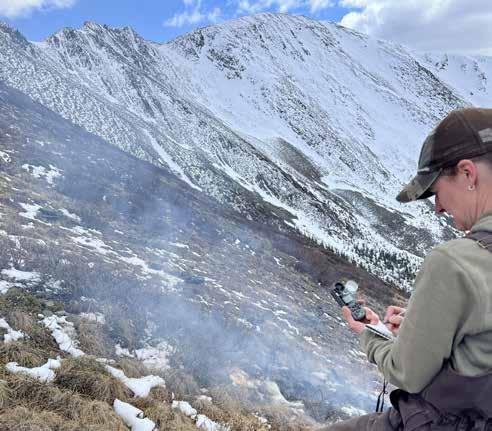
In the end, whether it’s bighorn or thinhorn range, the goal is precision: fire used as a targeted management tool, guided by hard data and experience.
Torrey Rim prescribed burn for the Whiskey Mountain bighorn herd. Led by the U.S. Forest Service and Wyoming Game and Fish Department, the project is opening a key winter range and reducing conifer encroachment on critical slopes.
Together, these efforts show the practical side of what Mason calls “fire as stewardship”.
Bill Jex, Thinhorn Sheep Program Lead for WSF, said fire can have a different impact if not managed
correctly in thinhorn range.
“In the bighorn range, natural fire return intervals can be fifteen to fifty years. Fire keeps slopes open and forages young,” Jex said.
In the dry southern landscapes where bighorns live, periodic burns once maintained that rhythm.
“When we suppress fire, shrubs encroach, visibility declines, and the system gets out of balance.”
In thinhorn country, the rhythm almost disappears.
“For thinhorns, your Stone’s and Dall’s sheep, you’re looking at natural fire return intervals of
roughly one hundred fifty to three hundred years,” Jex said.
“Fire just doesn’t play the same role there. The plant communities recover more slowly, and many species of thinhorn rely on them and don’t come back quickly. They feed on more than a hundred different plants. After a massive burn, you might get a quarter of those back. So, in some areas, fire can do more harm than good.”
Large wildfires in recent years have also changed the equation.
“When you get these broad-scale fires, you create a flush of forage that
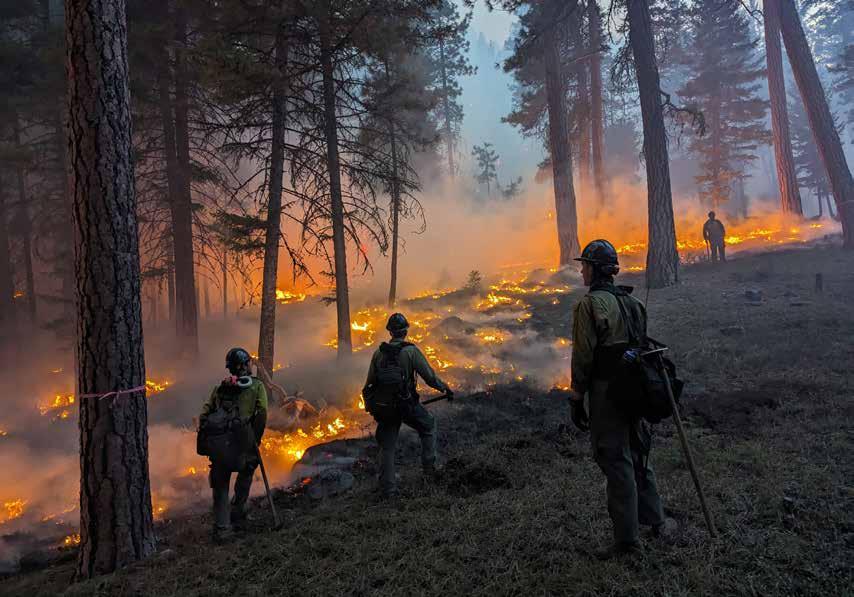
draws in elk and bison,” Jex said.
“And where those go, wolves, bears, and cougars follow. You end up with more predators in sheep country.”
Yet Jex stresses that fire, when handled carefully, remains one of the most valuable tools available.
“Prescribed fire has a place, even in thinhorn country,” he said.
“If you do it on a small scale and in the right locations, like lambing areas or key winter ranges, you can really improve visibility and forage for Stone’s sheep.”
He points to the work of biologist Alicia Woods in the Muskwa region as an example.
“Those burns are small, lowintensity, and focused. They’re opening slopes just enough to bring back that early green grass without changing the alpine system. That’s the kind of fire that helps thinhorns,” Jex said.
Across the West, one thing is clear: when it’s done right, fire brings habitat back to life. For bighorns, prescribed burning opens slopes and renews the grasses they depend on through long winters. For thinhorns, the same is true, but fire must be used carefully, since the alpine range recovers more slowly, and too much heat can do lasting damage.
That balance of knowing where and when to use fire is central to WSF’s conservation work. From Idaho to Wyoming to northern British Columbia, the focus is on combining field experience with solid science to manage habitat that keeps wild sheep healthy and on the mountain.
WSF Grant-In-Aid supported projects like Landon Birch’s Finlay-Russell study show how that approach works. His team tracks Stone’s sheep movements, forage use, and habitat changes to identify where fire can improve range conditions and where it
should be avoided.
By connecting vegetation data to ewe survival and nutrition, Birch’s research provides managers with better information about when fire will be beneficial and when it won’t.
“Ewes are the population drivers,” Birch said.
“If we can understand what’s happening with them, such as their movement, health, and survival, then we get the clearest picture of what’s affecting the herd.”
A prescribed burn using the latest cutting-edge data gleaned from their study is planned there for 2026.
In the end, whether it’s bighorn or thinhorn range, the goal is precision: fire used as a targeted management tool, guided by hard data and experience. Applied with focus, it restores habitat and helps secure the future of wild sheep herds throughout their range. WS
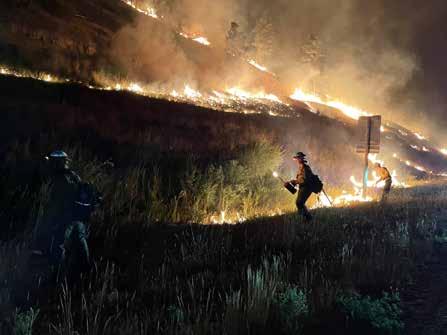
A prescribed fire is a careful, methodical process, and there are several ways crews set the flame.
On the ground, ignition teams move along ridgelines with drip torches, laying slow, deliberate lines of fire that creep uphill and clean the range. In larger, rougher country, helicopters or drones drop small ignition spheres that spark on impact, creating patterned burns that move like natural fire once did.
Crews may also light from ATVs or along roads to build “blacklines,” clearing a safe buffer before the primary ignition begins. In sensitive habitats, they often mix slow, backing fires that burn against the wind with head fires that move with it, controlling heat and direction.
Every burn follows a strict prescription or a plan built on temperature, wind, and humidity that tells crews exactly when and how to light. Done right, the result is healthier habitat less likely to suffer raging infernos during fire season and that benefits wildlife year-round. WS

RPS Bancard LLC is the preferred merchant services provider for the Wild Sheep Foundation, and proud participating partner of the WSF WE GIVE Program.
RPS provides Retail and E-Commerce businesses with ultracompetitive rates for credit/debit card processing.
RPS will help minimize your company’s merchant services fees while maximizing your support of WSF, as RPS donates a percentage of your processing fees to the WSF Conservation Revolving Fund.
Join RPS in supporting the WSF WE GIVE Program, and support our shared passion for “Putting and Keeping Wild Sheep on the Mountain®”.

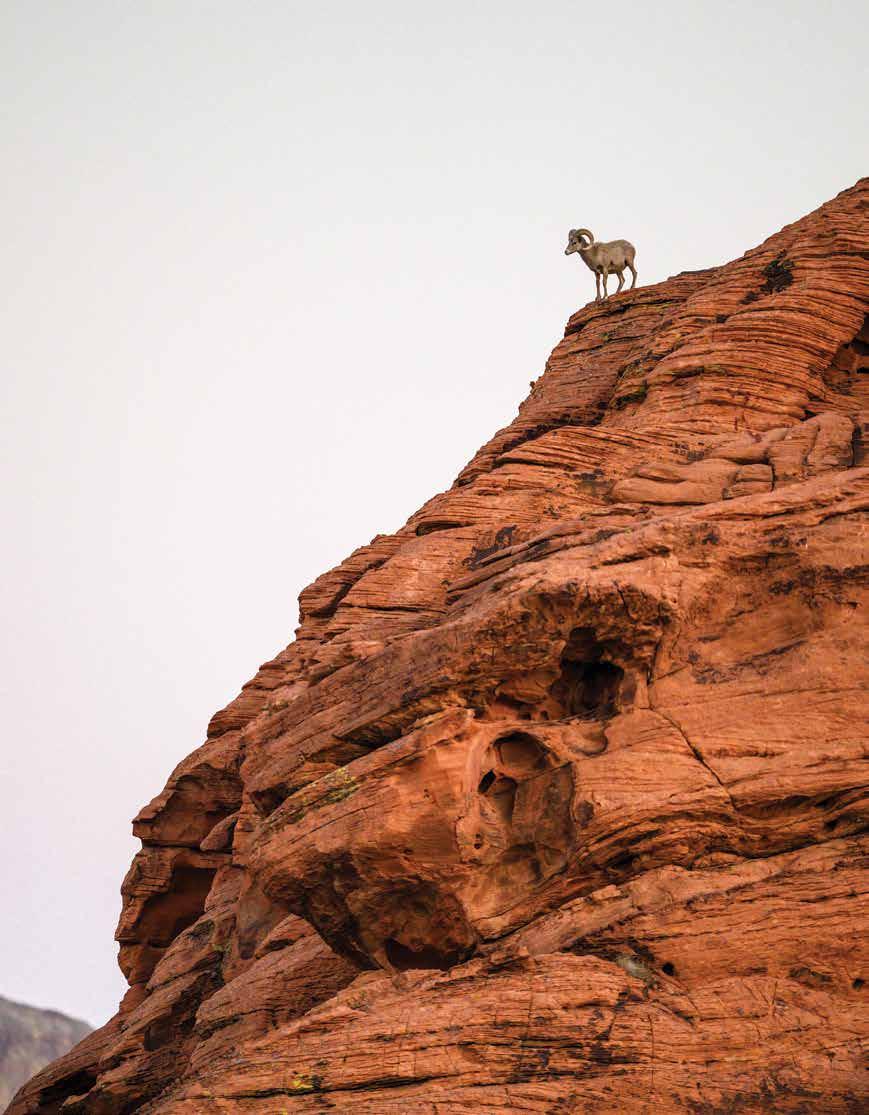

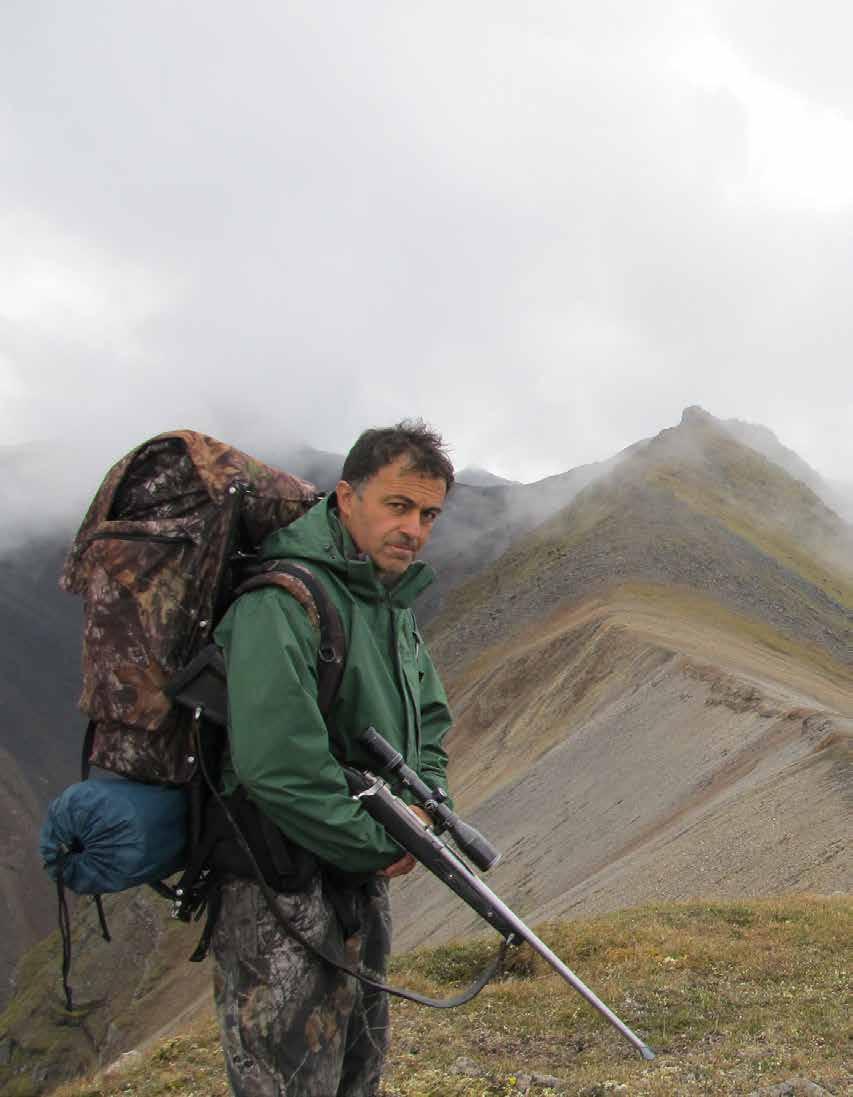
BY ALEXANDER SHARIF
“When they brought back a ram trophy, they were not seeking honor and prestige-they were bringing back memories of icy winds fragments with fir and balsam, of the smell of sheep beds and arctic willow, of tiny, perfect alpine flowers, gray slide rock and velvet sheep pastures”
— Jack O’cOnnOr
What is it that is so special about mountain hunting? Why do we subject ourselves to the rigors, the exhaustion, the biting wind, the deep freeze, the predator dangers and the sheer physical demands of it all? Why are we drawn to such unforgiving terrain, places where mistakes are costly, where game is scarce, and where the hunter is always a visitor and never truly in control? These are questions that have long occupied my mind. And although I may never have a single answer, the pursuit of that
understanding is part of what keeps me returning to the mountains. For many of us, our hunting journey begins in our childhood, most probably introduced to us through family members and at times through friends. We generally start with small game, chasing birds or rabbits and typically accompanied by our peers. These experiences teach us patience, awareness, respect for life, and the importance of earning our success. As we grow older and our physical capabilities expand, so will our ambitions. We typically graduate
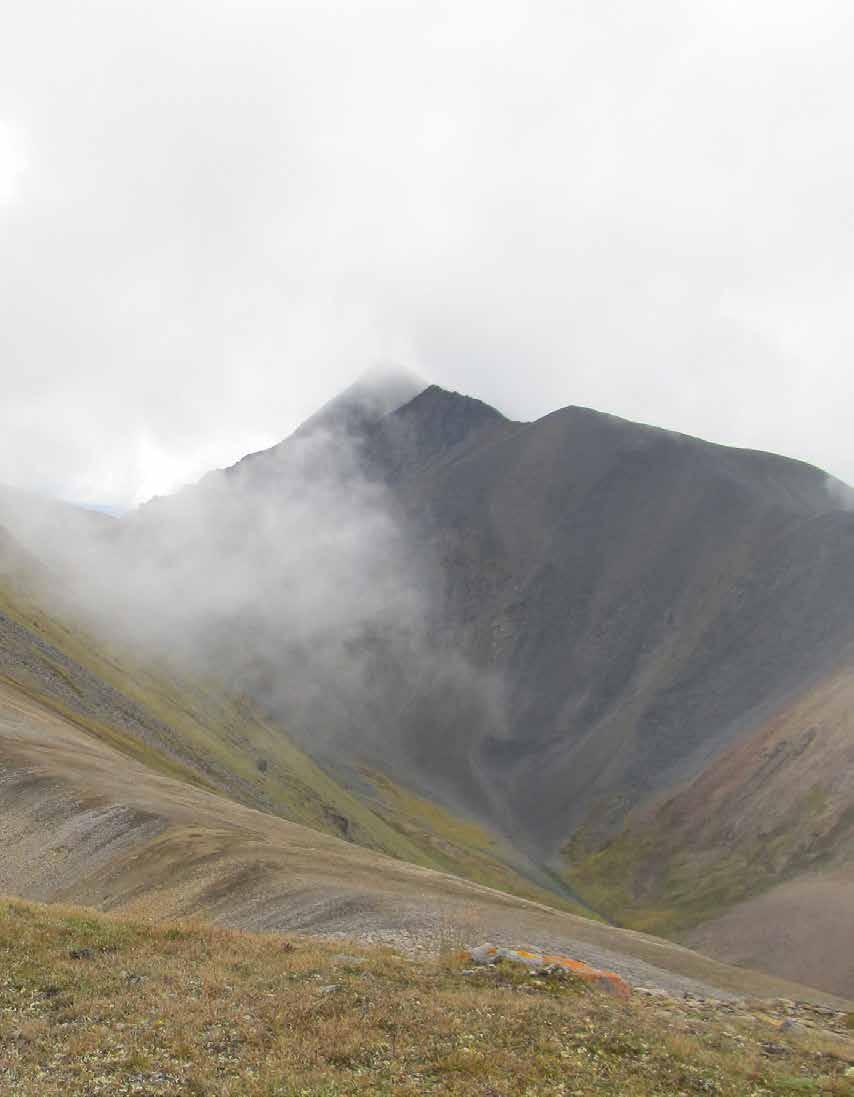
to big game, sometimes driven by the desire for putting meat into the freezer and sometimes for bagging a trophy, but more often, for the sheer challenge.
However, for a particular breed of hunters—those with a love for high places—the call of the mountains becomes irresistible. Whether their backgrounds involve climbing, skiing, scrambling, or alpinism, the marriage between hunting and mountaineering becomes inevitable. Let’s be honest; the raw appeal of mountain sheep and goat
The pride that filled my chest at the moment the bird folded was immense; not because of the kill itself, but because I had finally crossed the threshold.
hunting is not just in the animal itself, but in the arduous process of reaching them and penetrating their comfort zone. The late Jack O’Connor romanticized this phenomenon on several of his books and articles. In this sense, mountain hunting becomes not just an evolution of a skill, but a transformation of the soul. As we mature, our motivations also evolve. It is no longer about simply filling a tag or claiming a trophy. We begin to question as to why we are really out there. Is it about standing over the majestic body of a full curl ram, with his horns sweeping wide and heavy and showing his age
and wisdom in the alpine, or is it about marvelling at that dead, lone, weary Billy goat, whose very presence on a cliff seems to defy gravity and mortality?
The late Mark Hansen, in his excellent book Addicted to Altitude, captured this internal conflict perfectly. Sheep hunting, he said, is merely an excuse to get back into the mountains. And I couldn’t agree more. At some point in our hunting lives, the quarry becomes just a metaphor. The act of pursuing game is simply the structure that allows us to immerse ourselves in wilderness, to push our limits, and to commune with something ancient and unspoiled.
Even when we are not in the mountains, our minds are often there. We study topographical maps as if they’re sacred verses from the Bible. We read the journals of past hunters, their words transporting us to unnamed basins and forgotten ridges. We tune into any conversation, article, or film that speaks of high places. It’s as if some part of us is always scanning the horizon and always aching to return.
The modern Western notion of mountain hunting, though deeply meaningful, is often limited in scope. To truly understand the depth and culture of mountain hunting, one must explore
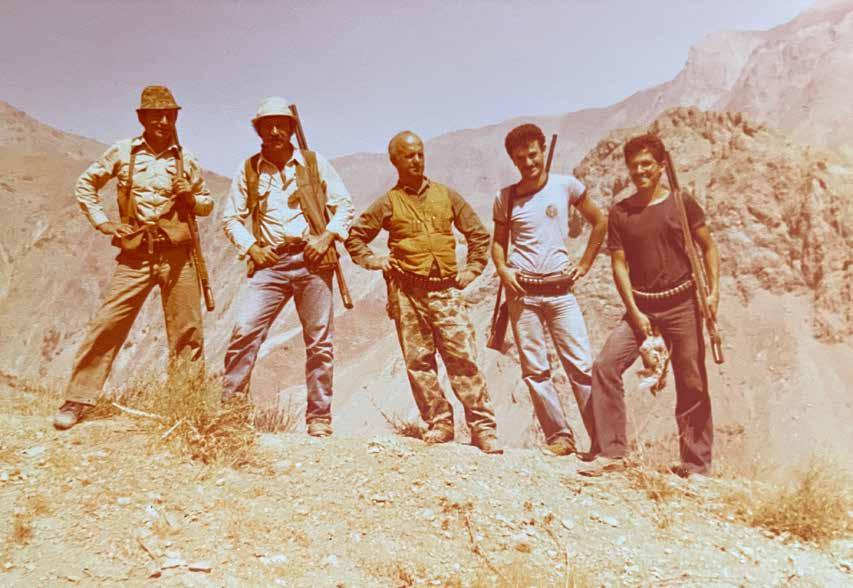
traditions far older and broader than the scene of the North American sheep hunting alone. This brings us to the word Shikar, a concept deeply rooted in the hunting traditions of Central Asia and the Middle East.
There is no direct English equivalent for Shikar. Though some translate it loosely as “the hunt” or “the chase,” these definitions fall short. Shikar is a way of life, an institution and a culture. It embodies not just the act of hunting, but the entire ecosystem of practices that surround it. It includes the preparation, the armament, the planning, the camaraderie of fellow hunters (Shikaris), the storytelling, the knowledge of terrain, the spiritual and the philosophical dimensions of the pursuit.
Colonel Alexander Kinloch, one of the first British sportsmen to spend significant time hunting in the Himalayas, understood this better than most. In his seminal work Large Game Shooting in Thibet, Himalayas, and Northern India, he dedicates entire chapters to the culture of Shikar, offering glimpses into a world where hunting was not recreation, it was art, survival and identity.
For yours truly, Shikar isn’t just an intellectual or historical concept. It’s part of my bloodline, my DNA, and I will explain why. My father and uncle, both from the rugged borderlands of Azerbaijan and Persia, were raised in this tradition. Their stories, their ethics and their techniques all were steeped in a culture where mountain hunting was both necessity and pride. As a child, I
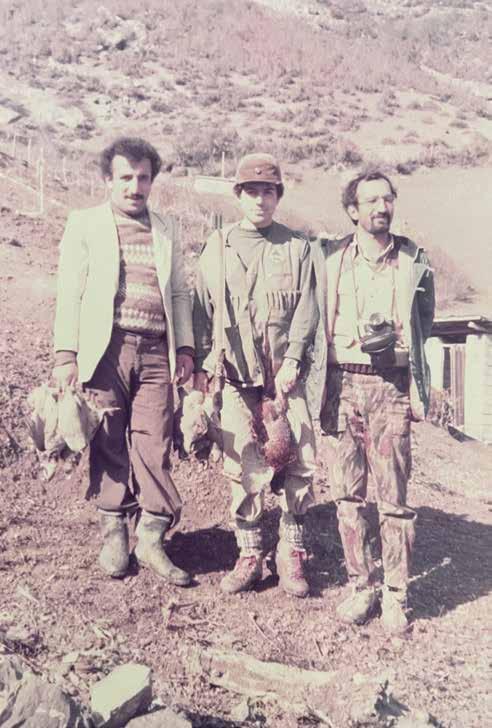
Ten Chukars, a native Pheasant coq, a German double and a “Shikari” to pack my harvest.
remember sitting wide-eyed as they recounted tales of chasing wild sheep (Urial Gooch), Bezoar ibex (Pasang), or the elusive Caspian snowcock (Kabke Dari), a ghostly game bird that haunts the high ridges like a phantom. The king of them all for both of them however was the chukar partridge (Kabk) whose shrill laughter echoes like a taunt across rocky slopes and the rimrocks covered with cheatgrass. It wasn’t long before I was no
longer just a listener. At the age of 10, armed with a 16-gauge sideby-side St. Etienne shotgun and brass-cased, hand-loaded shells my uncle had gifted me and taught me to load, I downed my first chukar in flight. The pride that filled my chest at the moment the bird folded was immense; not because of the kill itself, but because I had finally crossed the threshold. I had become part of something bigger than myself. I had joined a lineage,
a timeless and global brotherhood of mountain hunters.
Mountain hunting is rarely comfortable. In fact, it is often harsh and punishing. You carry everything you need; your shelter, your food, your weapon, your optics, your survival gear and all of it on your back. You fight wind, snow, sleet, scree, and altitude. You go days without seeing game. Your boots blister your feet, your legs scream with fatigue, and the cold creeps into your bones at night. Often, you hunt alone and at times, your mind plays psyche on you. At elevation, finding and even boiling water becomes a chore, and sleep comes in fistful patches. You quickly realize that you need to not only be self sufficient but able to cope with all hardships alone. And with all this hardship, a poorly timed gust of wind or a loose piece of shale that slips under your foot can end your long stalk in an instant, shortening your hunt and a chance at that old monarch.
And yet, it is precisely because of these hardships that mountain hunting becomes so rewarding and addicting. The pain, the endurance, the mental and physical tests all together strip away everything that is superficial. Out there, nothing is guaranteed. Every step is earned. Every decision counts and every success feels like a miracle. As Nietzsche beautifully put it, suffering is a necessary stage to ultimate pleasure.
When you do finally close the distance on a ram or a billy, and when the shot rings true after miles of hiking and hours of glassing
and crawling, you are not just harvesting an animal—you are participating in a ritual that spans millennia and transcends time. In that moment, you are connected to every hunter who ever looked across a windswept basin and felt their pulse quicken.
There’s also something spiritual about being in the mountains. The silence is different; its deeper. The light shifts in ways it doesn’t on the plains or the prairies. Clouds tumble over jagged peaks like smoke, and at times you feel you can see the curvature of the earth. You also get to witness the fragility of life. And if you’re lucky, you come back a little more humble.
The animals that inhabit these wild sanctuaries are also symbols of resilience and adaptation. They thrive in extremes, living out lives of quiet defiance against the elements and their natural predators. Ergo, hunting them, if done with reverence and intention, becomes an act of deep respect. You begin to realize that you are not conquering them. You are just meeting them on their own terms.
Mountain hunting fosters a profound gratitude; for your health, your strength, your access to these wild places, and the creatures that inhabit them. It teaches you that success isn’t measured by inches of horn or pounds of meat, but rather by the depth of the experience, the honesty of the effort, and the memories forged in silence and sweat.
Now that we discussed the philosophical and physical aspects of it all, the big question remains as to why do we do it? Why do we return to the mountains time and again, even after painful failures, hunger, injuries and bitter cold nights? The answer is simple. Mountain hunting feeds something in us that nothing else fulfills. It satisfies our longing for true wilderness, our need for challenge and our hunger for meaning.
It binds us to the past, whether it’s the Victorian Shikaris of the Raj, the Persian shepherd-hunters of the Alborz range, or our own fathers and grandfathers. And it connects us to the land in ways no other pursuit can.
The allure of mountain hunting is not easily explained, because it’s not just about hunting. It’s about longing, endurance, transformation and above all, return. We go to the mountains not just to take, but to become something more.
And so, whether it’s the thunderous silence of dawn in sheep country, or the echo of bootsteps across shale and snow in chukar country, I’ll keep going back. Because the mountains always give more than they take. WS
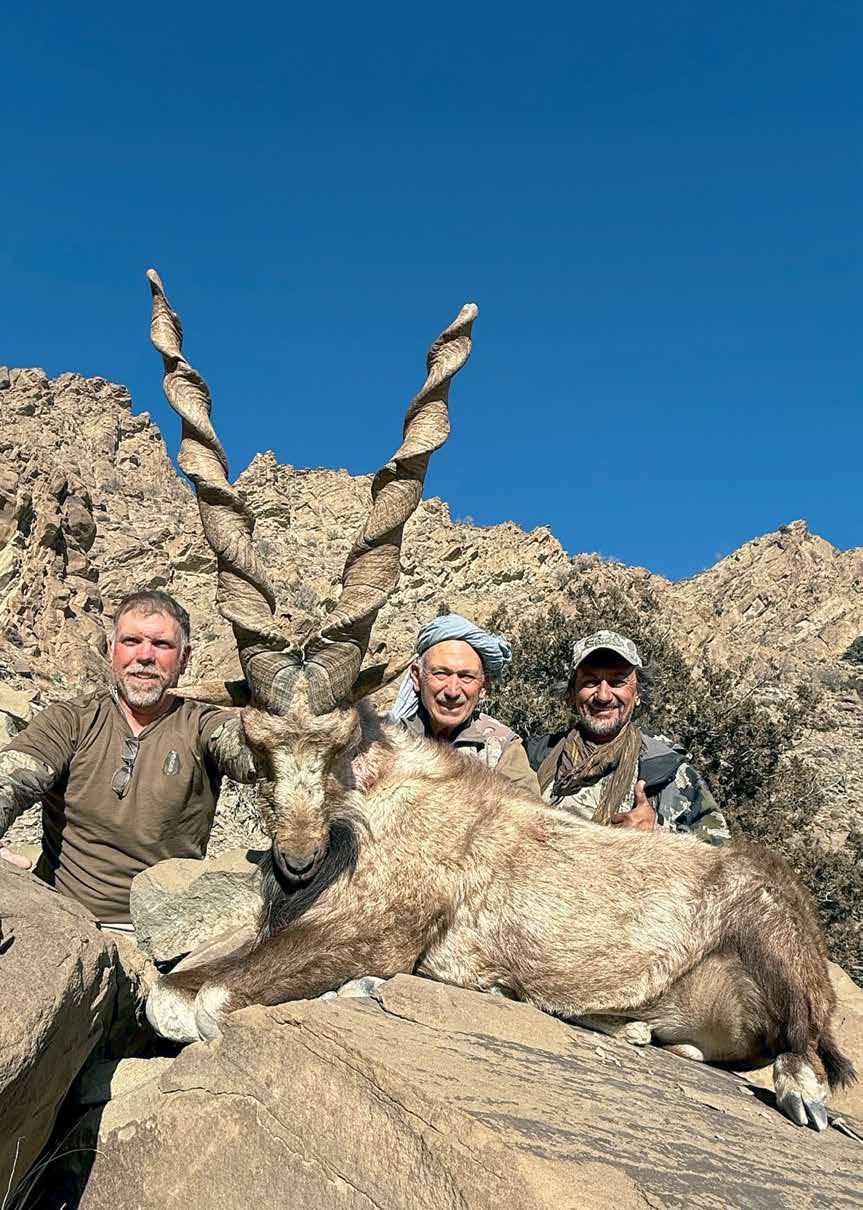
“Record
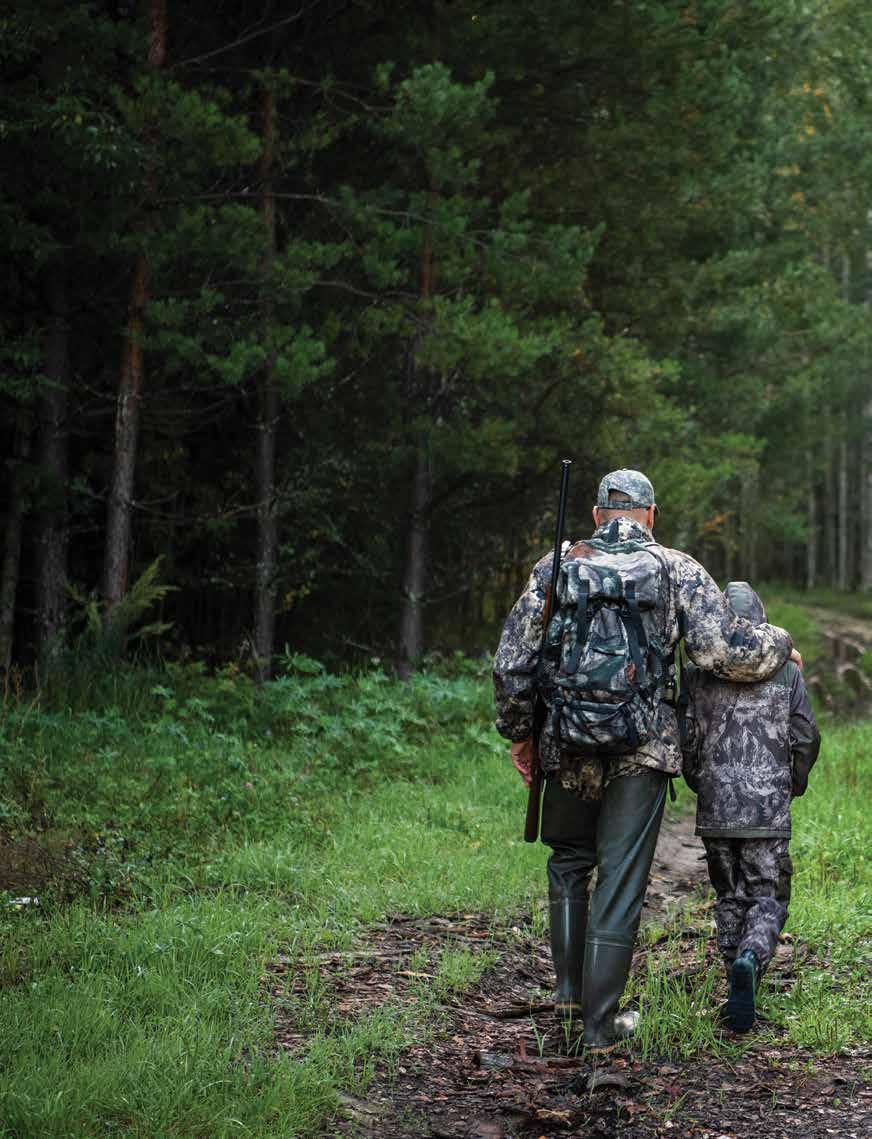
EXPERIENCE ONE OF THE
Start things off with our Conservation Kickoff Banquet & Auction on Thursday, February 5th, then continue the fun at this massive, 3-day expo featuring top outfitters, gear manufacturers and conservation partners – plus banquets, auctions and special events, like the Life Member Appreciation Breakfast and the Ladies Luncheon & Auction . Bring the whole family, 1-Day passes start at just $35 and kids (16 and under) are FREE ! Register now to be a part of the future of hunting and conservation.
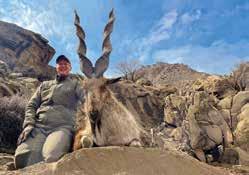
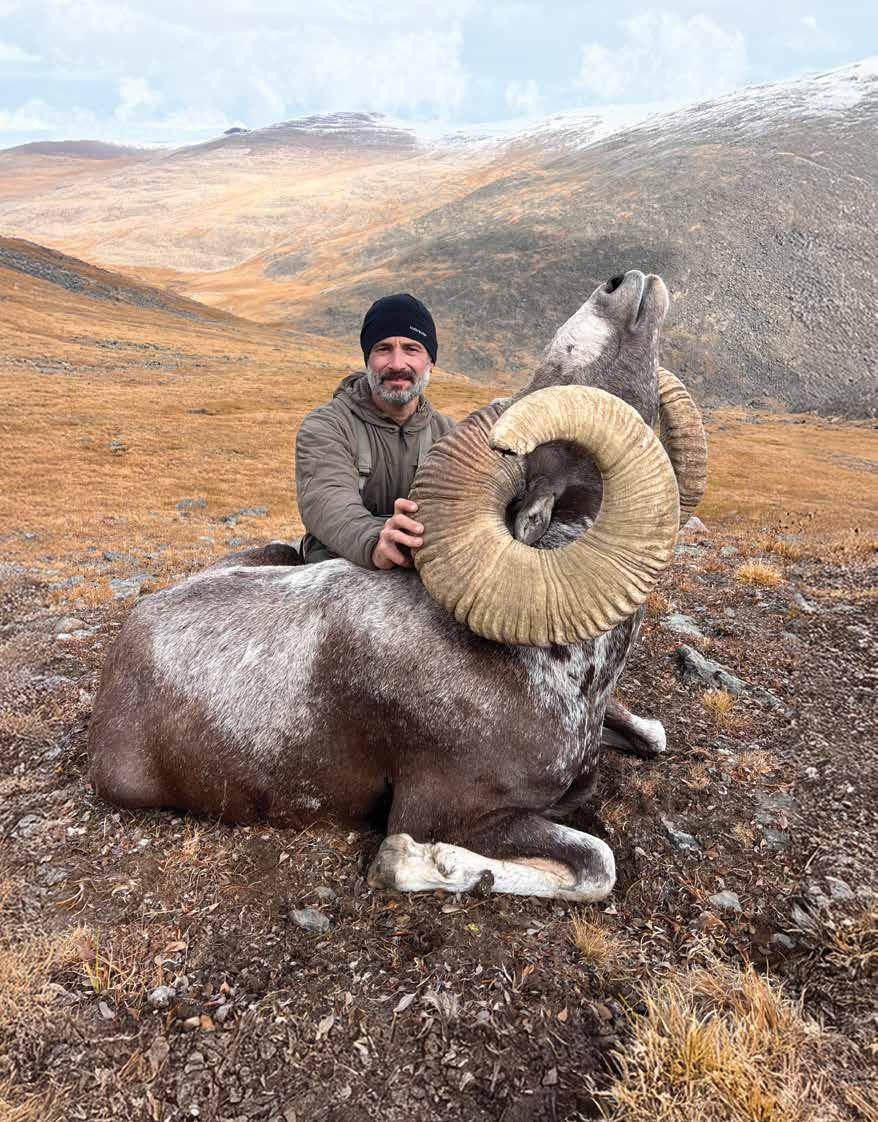
AN ACCURATE BARREL AND FLAT-FLYING BULLET AVAIL NOTHING UNTIL YOU’RE STABLE, THE RIFLE SETTLED ON THE MARK.
BY WAYNE VAN ZWOLL
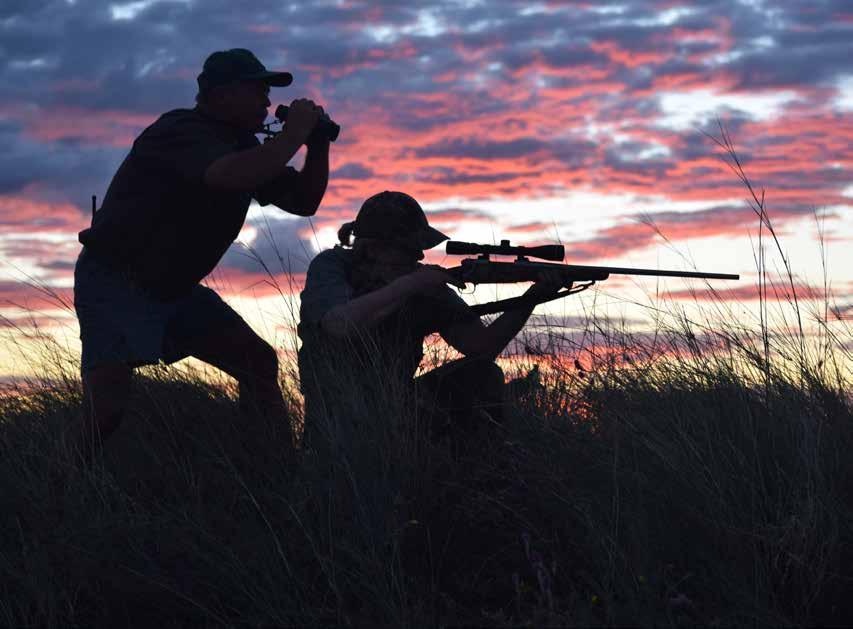
Having shimmied from 3-o’clock with an occasional change in speed, the mirage suddenly boiled.
I saw the let-off too late. Nuts! My 17th shot in a string of 20 wandered into the 9-ring at 4 o’clock. I waited for the pick-up to finish with a 10 and an X. Rolling over on the mat, I swung my spotting scope onto Johnny’s target. With 10 seconds on the clock, he had three shots to go. He’s too late! But he lay still as a stone when the mirage stalled again. It picked up, and his rifle snapped instantly. A blur of thumb and fore-finger ran the bolt: Snick-snick A 10, but now with four seconds
left. Bang. X. Snick-snick. His last X came at the buzzer. He rolled over and with a handkerchief dabbed sweat from his brow. “A bit tricky, those pauses,” he grinned. “Hard to wait ‘em out.” I didn’t look happy. Besides showing himself a master of marksmanship, not to be out-done by devious wind, Johnny Moschkau taught me about patience. “You don’t need motionless air,” he said. “Just consistent drift. But the rifle has to be still. Shoot into a change or if the rifle is still aquiver, and you’ll miss.”
That’s as true now as it was 45 years ago, when we shared the
line at a prone match. It applies as well on hunts. Big game vitals are bigger than X-rings; but shots afield impose more variables. You’re not on a level shooting mat a precise distance from the target. There’s no clock; you may have lots of time or a heartbeat to loose the bullet. Mountain winds can be capricious, mirage nearly invisible. Shot angles can test your ability to compensate quickly for change in bullet arcs. Short of breath, excited to see game and fearful you’ll muff a hardearned chance, you’re a pulsing, heaving, twitching platform for the rifle. Your salvation: a shooting position that relaxes the rifle onto
A good stock almost thinks for you, bringing your hands forward, steadying the sight on target before aiming is a plan.
the target and any assist that steadies it there.
The lower your center of gravity, the better. Standing, you balance torso and rifle on a tall stack of
wobbly joints and quaking muscles.
Kneeling and sitting, you get an additional point of contact with Mother Earth and bring your center of gravity closer to her.
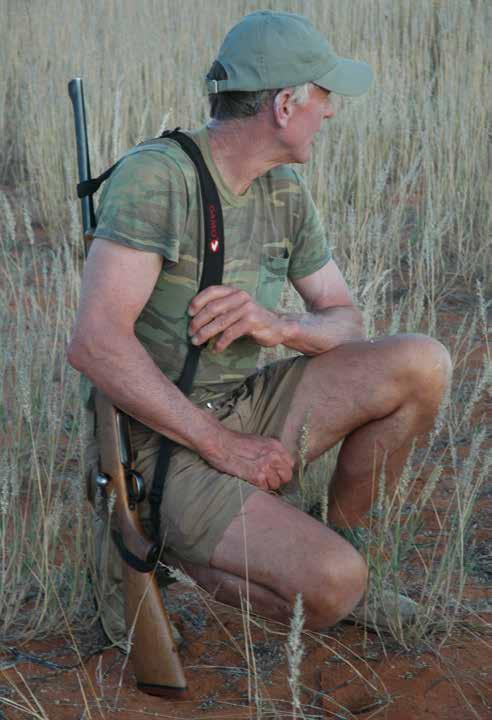
Prone, as low as you’ll go without digging a trench, you profit from almost full body contact.
Practicing your marksmanship offhand (standing) makes sense because a surprise encounter with game may give you no time for a steadier option. Also, game is sometimes hidden by cover or the curve of the earth from lower positions.
Kneeling can be almost as fast as offhand, though dropping to a knee gets no easier with age. For best results, here’s the drill for right-handers: Put your right knee on the ground; keep your left knee up, shin vertical. Sit back on your right foot, tail-bone on your heel, toes and balls of that foot curled under and in contact with the ground. About half your weight rests on your right foot, a third on the left. The flat of your left elbow transfers most of the rifle’s weight to the flat (front) of your left knee. Your back and neck are nearly vertical, head erect on the comb, eyes looking straight ahead.
Your right foot won’t like kneeling; practice will stretch the muscles forced to curl under.
A strip of tightly rolled carpet under your ankle will relieve the sting. Afield, you won’t have that kneeling roll; but as with recoil, you’ll hardly feel brief discomfort at a shot. Another gremlin to battle kneeling: 3-to-9-o’clock wobble. As your left foot points naturally toward the target, that leg can swing. Reduce the swing by turning the left foot in, parallel with your right leg. “Wait!” you bellow. “Isn’t every position properly built on bone, with muscles relaxed? Turning the left foot in puts calf and thigh muscles under tension!”
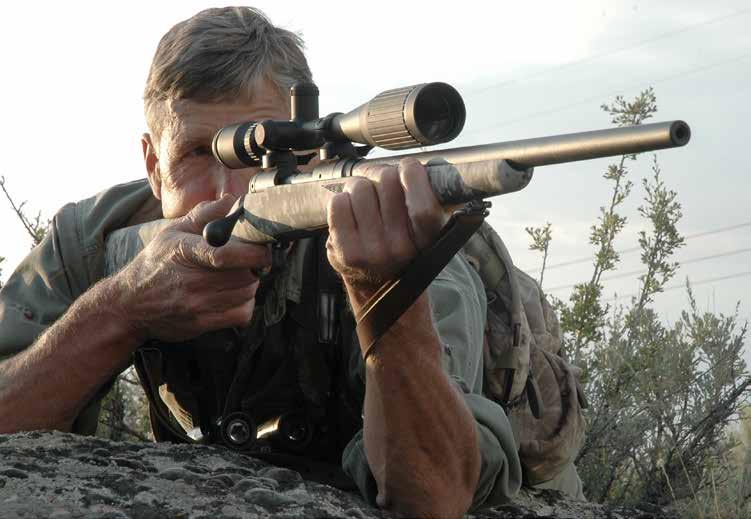
Roger that; but after the turn, the press of your torso and the rifle on your knee maintains the twist of calf and thigh muscles. No effort required. That tension reduces the tendency of your left leg to swing, Lower than kneeling, sitting is steadier. There are three basic variations: open, crossed-ankle and crossed-leg. The open position is most versatile afield. Tush down, knees up in front of you and heels set comfortably apart, you have tripod contact with the earth. At some point over your left foot (for me, over the little toe), the rifle will point naturally at the target. Lean well forward—far enough that the backs of your elbows are held by lumbar tension against the faces of your knees. Resting elbows on knees, with no back tension to lock the position, does little to steady the rifle. Moving your feet to adjust elevation, shift point of aim
or level your position on uneven ground is easy.
Much steadier than offhand, the open sit is as fast as you can fall on your fanny. On the volcanic rock of an Alaska slope I had no other option. A quick if uncomfortable sit steadied the front bead of my ’03 Springfield as a Dall’s ram bounded from behind a spire. Two jumps after the shot, its legs gave way.
The crossed-ankle position is fast too, the option of choice on the 200-yard rapid-fire stage of the National Match course, in which shooters drop to sitting from standing. Again, the rifle is best steadied a steep forward lean, elbows in front of knees. Your core and lumbar muscles might need some training to comply. Essentially useless for uphill shots, the crossedankle option is also of limited help across slopes, as your feet are close together in front, not spread to
form a triangular base.
Crossing your legs to sit, easy for youngsters, loses appeal as quad muscles and hamstrings lose stretch. But it’s a low, stable shooting position, most useful on level ground. Your calves rest on opposite insteps, the backs of your elbows against or just inside your knees. Torso weight and lumbar muscles hold all in place. If you plan to use this sit on a hunt, commit plenty of time to practice. Shooting competitively in college, I conditioned leg and back muscles by reading or watching television from the sit, 11-pound match rifle in hand.
There’s more to shooting prone than lying on your belly. In fact, that approach adds pulse bounce to the rifle. Tradition has your legs spread behind, knees straight, toes out, instep down. I prefer different geometry. Bending the right knee




















































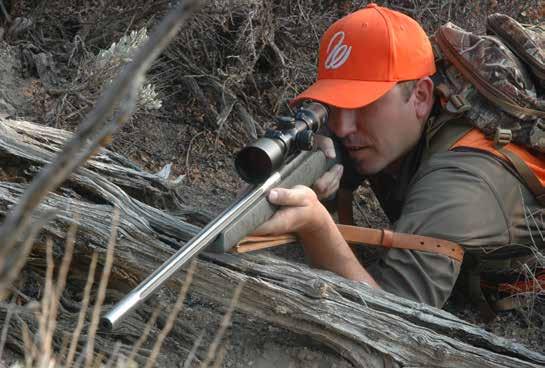
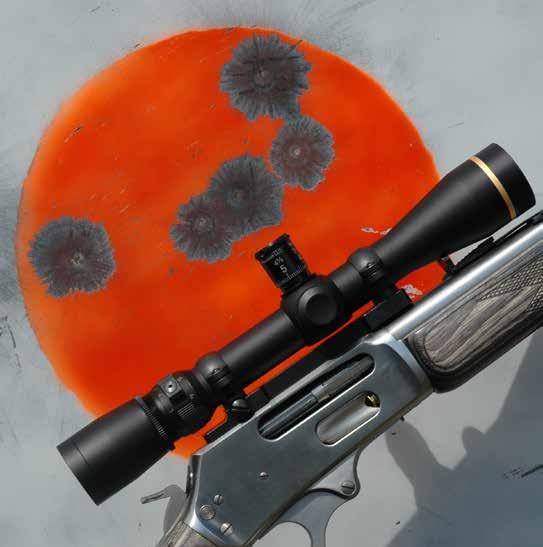
about 120 degrees rolls mid-section mass off the belly onto the left hip. There’s no pulse through bone. As in other positions, the rifle should point where you wish when you’re relaxed. Muscled onto the target, it will spring toward its natural point of aim at the shot. Of all positions, prone is least pliable; you can’t easily tweak it without re-establishing all boneto-ground contact. In other words, accurate prone shooting follows a well-planned “fall” to earth, the rifle slightly to the right of the left elbow. You can adjust elbow angle or hand placement on the forestock to refine elevation. Practice dropping into prone to aim at a mark, placing feet, then knees so as your elbows meet the ground the sight pegs the target.
Not the fastest position, prone can save time by steadying the rifle sooner than might a “quicker” option. Even when conditions begged a right-now shot, my insistence on prone has paid off in lethal hits.
Prone has benefits beyond stability. On hands and knees or your belly you can slip toward game where cover is sparse. If the animal does see you, it may not recognize you. Once, caught flat-footed by a buck, I could only watch him scoot to the next horizon. Speculating that he would bed there, I followed, cresting the ridge on my belly. When antler tips appeared above sage 20 yards ahead, I thumped my foot against the ground. He stood, then fell to my iron-sighted .300 Savage.
The wiggles and wobbles of the human platform, even in relatively stable positions, spur sales of supports to steady the rifle. The simplest is a carrying strap, anchored at the stock’s to and forend (or, up front, to the barrel or magazine tube). Poking your
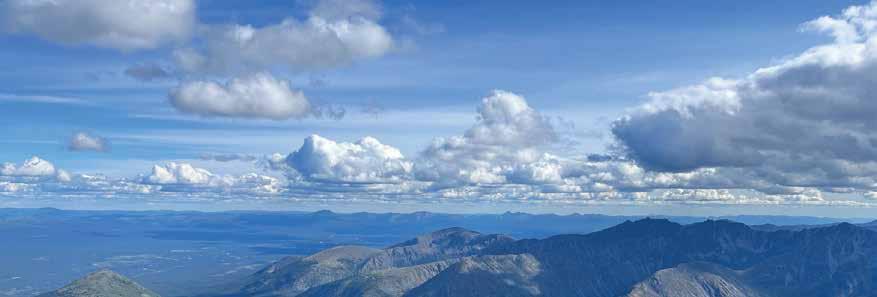
























of one day using




my Boswell Custom to complete my North American Grand Slam. After applying for years I won the lottery and drew a California Bighorn tag in Oregon as a nonresident! My Boswell rifle was dependable and exceptionally accurate on this hunt of a lifetime. Steve is the best. His customer service is unmatched and









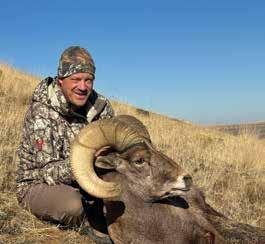





left arm between strap and rifle, then tossing that hand over the strap and tugging it tight with your triceps, you bring some tension on the rifle, quelling random sway and hops. Called a “hasty sling,” this is really a technique, not a sling design. A 1-inch or 1¼-inch leather strap works best, as the leather can grab the jacket sleeve over your triceps better than does nylon.
A so-called “cobra strap,” tapered from a broad, sometimes padded front that babies your shoulder on the carry, is awkward for hasty-sling use and can hang up when you slip the rifle into or draw the rifle from a scabbard. Such a strap cost a friend his shot at a big buck that jumped from cover short yards away. As he threw the rifle to cheek, the strap’s wide, heavy front section flipped atop the barrel in front of the scope. The deer was gone before he could shake it loose.
A proper sling, or shooting sling, is of uniform width (1 to 1¼ inch) with a loop that’s adjustable independent of sling length. Jack O’Connor hailed a one-piece sling favored by and named for Townsend Whelen. A two-pronged claw adjusts length. The U.S. Army’s two-piece sling, standard on infantry rifles through both world wars has a pair of double-pronged claws. My enduring choice—now for 40-odd years—is the Latigo Sling from Brownells, the gunsmith supply company. Listed with or without QD® swivels, it’s lighter than a two-piece military sling and has no brass hooks to bang against the rifle. A small brass button and a square ring at the base of the shooting loop (and shielded by it) are the only hardware.
Adjusting the Latigo Sling is easy and takes just a few minutes. When it’s on the rifle, shake out the loop, then, before inserting your arm, give it a half-turn out. This way, after your hand comes

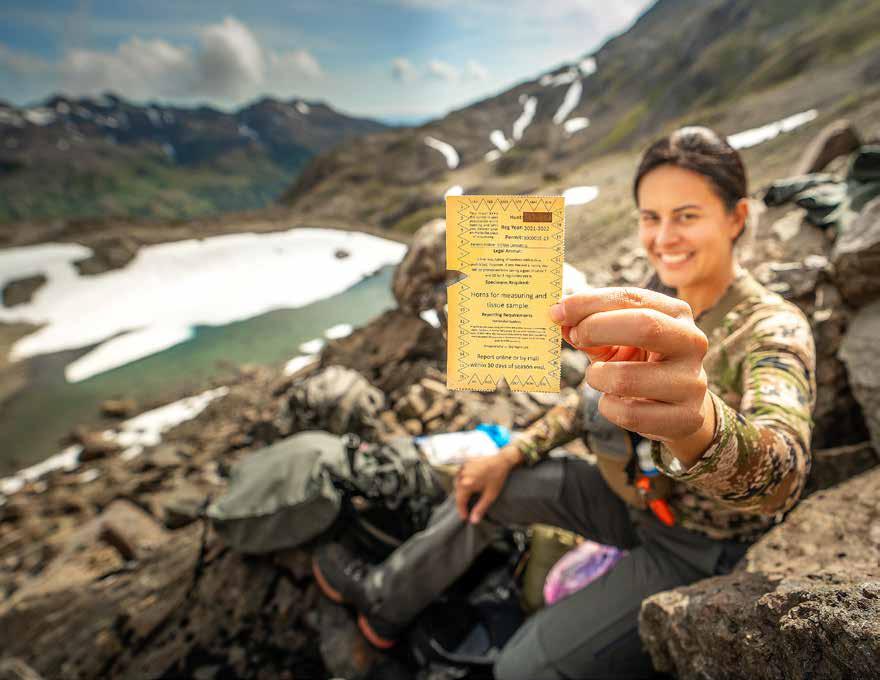

$55 per
$10 per species
EXAMPLES:
If you want to apply for Sheep in three states, your fee is $195. If you want to apply for Sheep, Mtn Goat, Elk, Deer, and Antelope in one state, your fee is $105.
$10 per drawing regardless of the amount of tickets purchased
As an added bonus, we will also apply your children under 18 for FREE in the states that you’re applying in as well as offer 50% off rates for your spouse and your children over 18.


Those with flexible legs are little if any more effective than a sling for steadying a rifle, and they’re not as handy. Bipods don’t endear itself to me on the carry. Most dig into my shoulder. Legs bobbing and rattling about behind my ear draw the attention of game. Still, as hunters fire farther to kill, bipods are increasingly popular afield. An item winning over the PRS crowd and now popping up on hunting rifles is the ARCA-Swiss or ARCA rail. Developed in the 1990s to join heavy cameras to their tripods, it adds stability to bipod and tripod unions on rifles. Flat- and smooth-faced, thin and lightweight, an ARCA rail is an inch and a half wide. Longitudinal, 45-degree grooves accept accessory clamps. Unlike a 1913 Picatinny rail, it does not change the stock’s side profile or add protrusions that savage your hand. Generous surfaces make ARCA stronger and more stable than Pic-rail attachment of bipods and tripods. Shooters also like the one-thumb-screw speed and simplicity of mating ARCA components.
After-market ARCA rails,
quarter-inch thick, are available in a range of lengths. Some fit specific rifles, like Ruger’s American Gen 2. Some include sling swivel studs or cups. Some mate with M-LOK slots on the handguards of AR-style rifles. For “not-flat” forend bellies, SRS (Salmon River Solutions) lists a 7075 alloy rail with 2 inches for Picatinny attachments, 1.7 inch for ARCA. It weighs just 1 ounce.
Any ARCA clamp will fit any ARCA rail. “Serrated” rails by Area 419 mate with a bipod clamp whose three pins engage the serrations to locate and secure the clamp (65 stations in a 14-inch rail). The pins can be removed for fitting to standard smooth-edged ARCA rails. As with most things ARCA, Area 419’s don’t come cheap. A 2-ounce 6-inch rail lists at $70. Cost is one reason ARCA rails haven’t caught on in some circles. Another: ARCA clamps are bulkier than those for Pic rails and M-LOK slots —though ARCA’s allure has brought appealing devices to match. MDT’s Mountain Bipod, of titanium, aluminum and carbon fiber, weighs just 5.6 ounces, extends to 15.8 inches and splays almost flat.
the cost of a sheep hunt.
Long-range shooters figure heavily among ARCA disciples, and some rifles for LR competition are factory-fitted with ARCA rails. My Gunwerks Nexus in 7mm PRC came with a forend-length ARCA rail. In a clever nod to versatility, the front end is reduced in width to form a 2.5-inch Pic rail.
However you attach a bipod, you’re smart to “load it” with pressure forward as you aim. Pushing with your shoulder ensures the bipod feet will take a firm bite. It limits rifle movement in recoil, speeding a second shot. It helps make your hold on the rifle—and rifle vibrations at the shot—consistent.
A sling or bipod can extend your effective range and bring bullets closer to center at any distance. But denied the chance to use either, a stump or stone, a termite mound or mountain lip can hand you the kill. These are as useful to secure your position as support the rifle. Perhaps more so. Position directs the shot. What’s hanging on the rifle just takes out some wiggle. WS



Pacific Islands
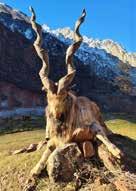
Savannah elephant Botswana 101 and 77 pounds
Robert Fortier
European roe deer
United Kingdom
Total score 6613/16
Mikkel V. Olesen
Rocky Mountain elk Arizona, USA
Total score 421
Rick Warren
The Rowland Ward Fair-Chase Hunting & Conservation Award is a solid silver medal given once a year by Dallas Safari Club and the Rowland Ward Foundation for an outstanding animal hunted under free-range, fair-chase conditions. One award is given for each of four regions: Africa, Americas, Asia and the Pacific Islands, and Europe.
To qualify, the animals must have been hunted in accordance with Rowland Ward’s Guiding Principles on Hunting and Conservation. The winner must be a strong supporter of conservation and sustainable hunting and exhibit exemplary ethics in the field.
For more details visit
Our annual Guide and Outfitter Recognition Special Section features ads from our members who wanted to say “thank you” to the professional hunters, guides and outfitters they took to the mountains with this year. The dedicated professionals featured here made their dreams come true!
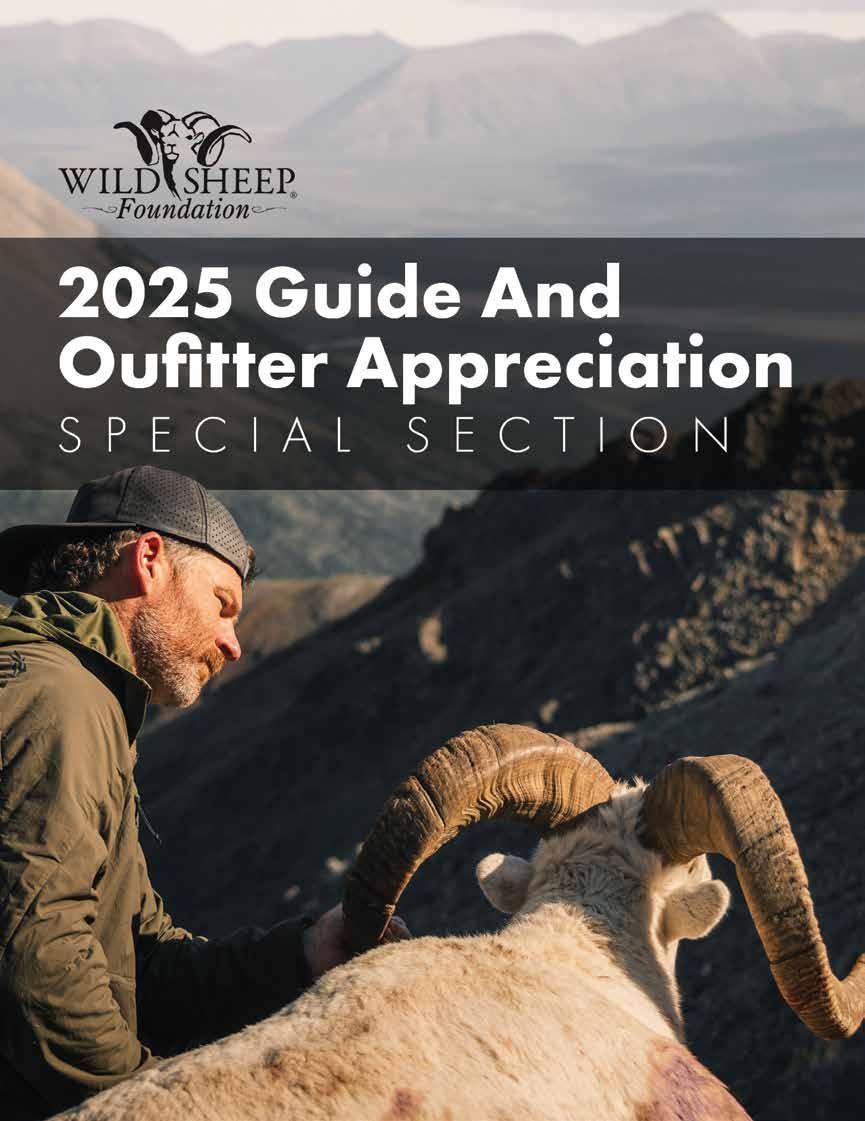
For more information visit wildsheepfoundation.org/About-WSF/WILD-SHEEP-Magazine
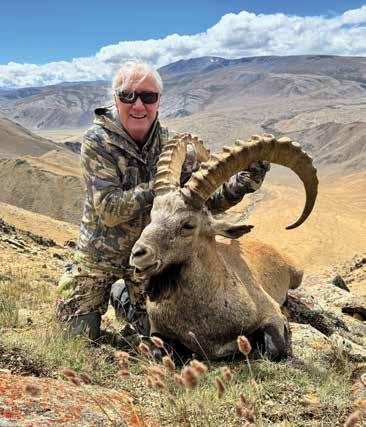
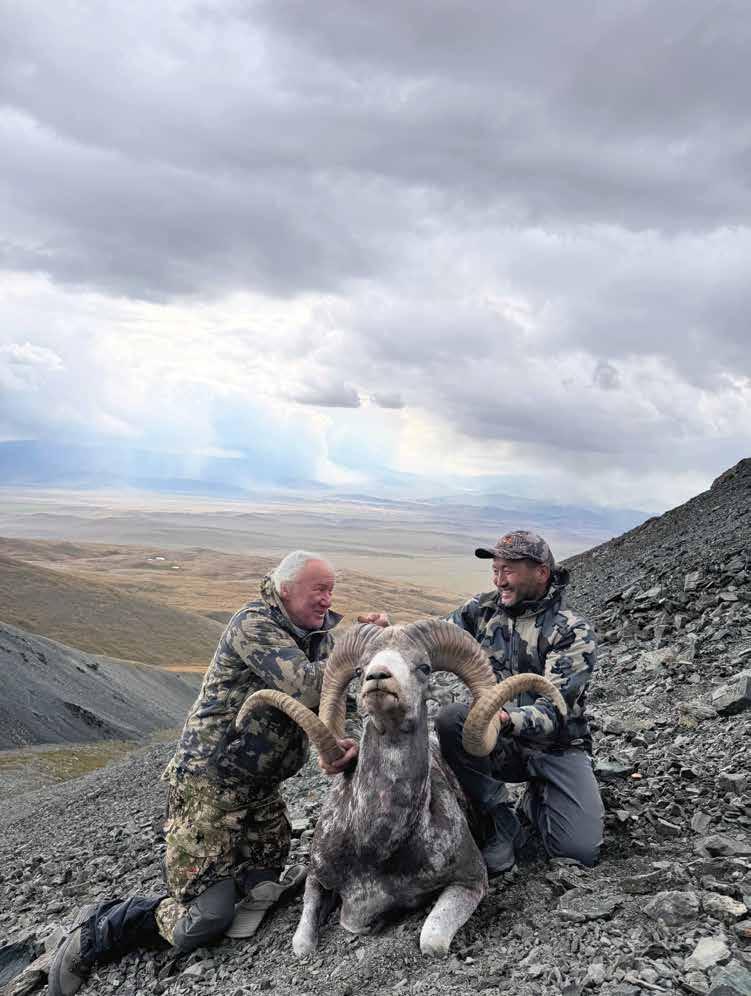
Thank you Battulga, Naran, and the rest of the crew at Look Mongolia Hunting for your hard work and patience that went into making my Altai hunts a success.
-Hugh Curry, Grenada, West Indies
I want to thank Jim and Clay at Nahanni Butte Outfitters for a great hunt. They were able to put me in a great spot with perfect stalking routes for an old bow hunter like me. I especially want to thank my guide, Brett. It is always better to hunt smarter, not just harder. Brett put us in the perfect position to intercept the sheep when it left the cliffs to feed. My shot was 9 yards. You might say we were lucky, but his sheep experience is why we were waiting on that rocky ridge.
-Jeff Furstenau
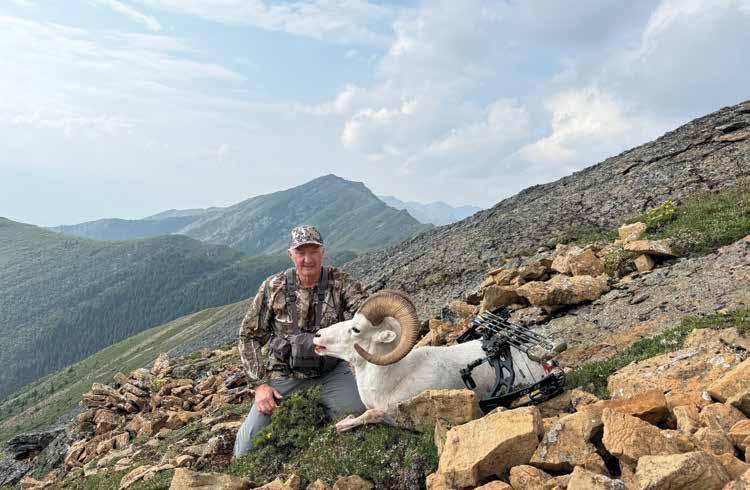
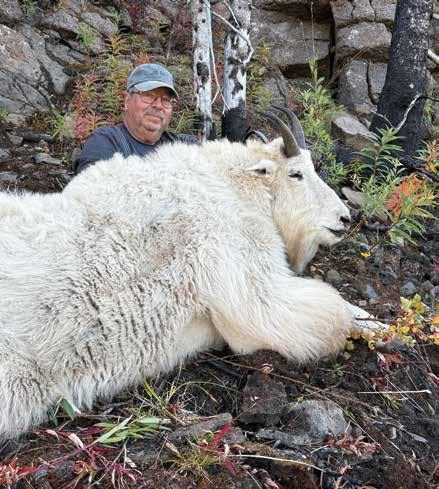
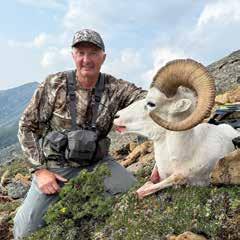
to
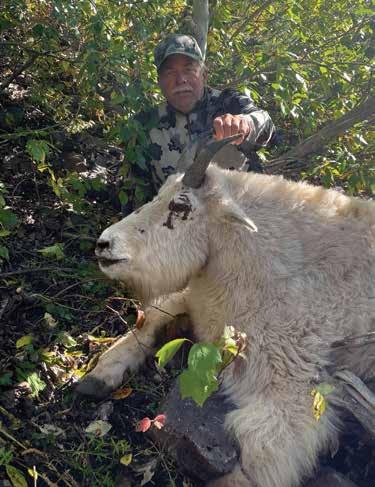
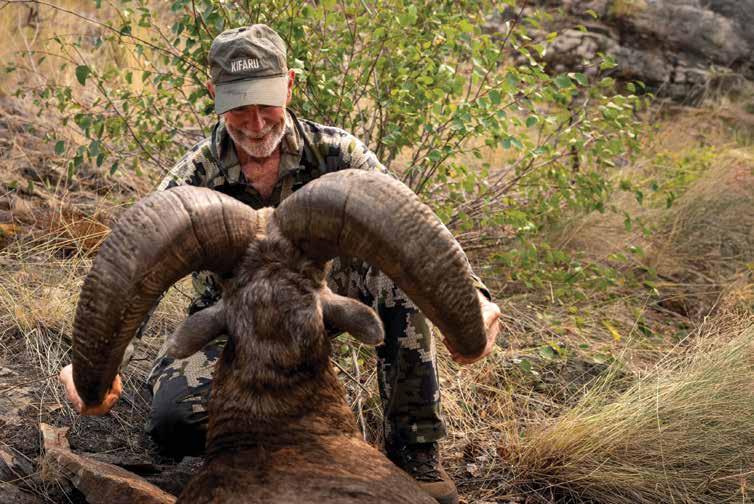
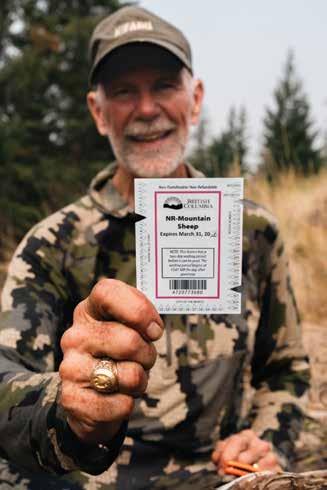
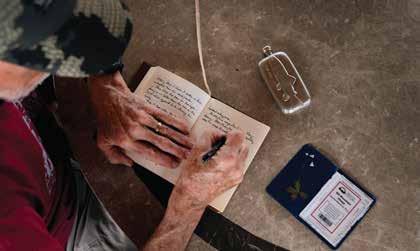
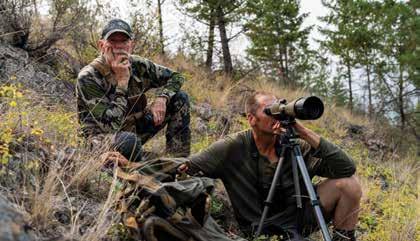
“It’s not often that my expectations are not only met, but far exceeded my wildest hopes. Kursat and Temir Ekenler of Wild Hunting in Turkey and Asia have consistently done so. I’ve traveled and hunted in eight different countries with them and my experiences have been world class. My recent hunt in Mongolia was the absolute pinnacle of my hunting career and I can’t thank them and their great guides enough for giving me the opportunity to harvest the right trophies and fulfill my dream hunts.”
– TIM PASK
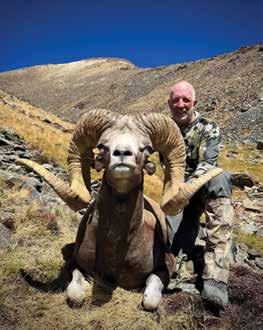
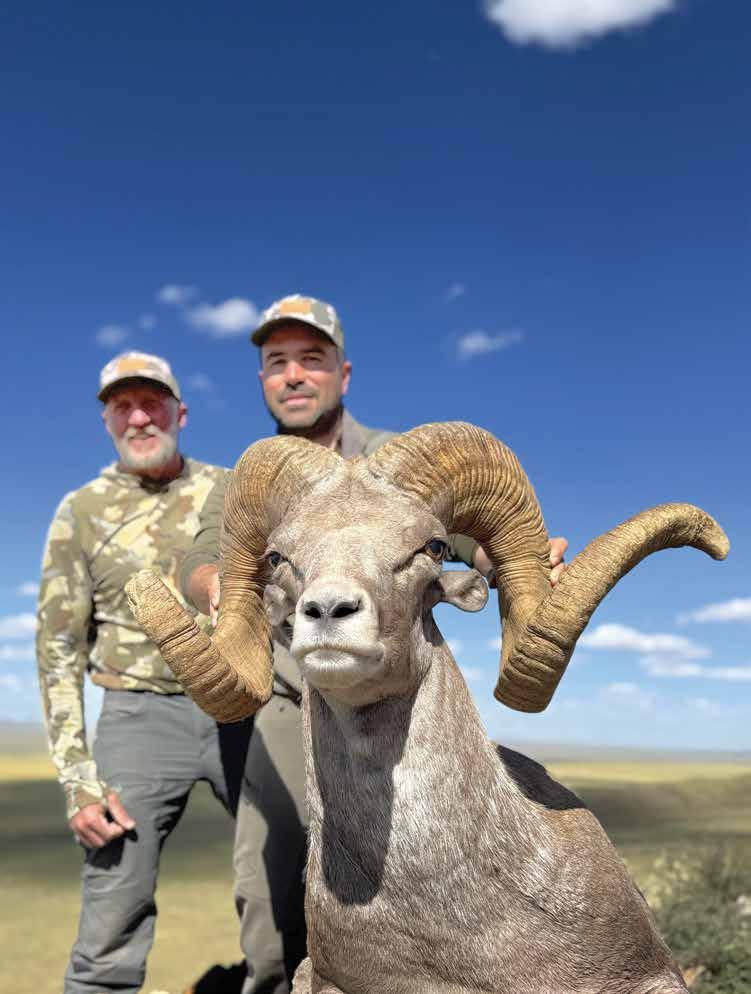
Dave Marsh of Big Game
Big Country and guides
Brian Hallberg and Mike Reynolds for guiding me through storms, mountains, and miles of Brooks Range Wilderness to a once-in-a-lifetime
Dall’s sheep hunt I will never forget.
— TONY DUBAS
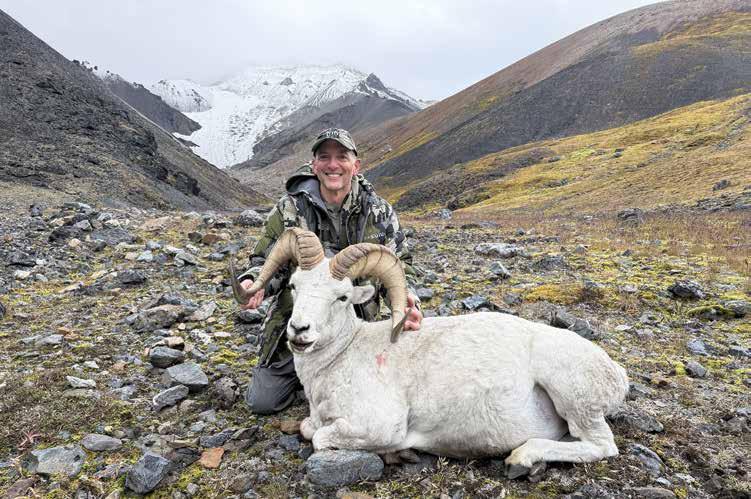
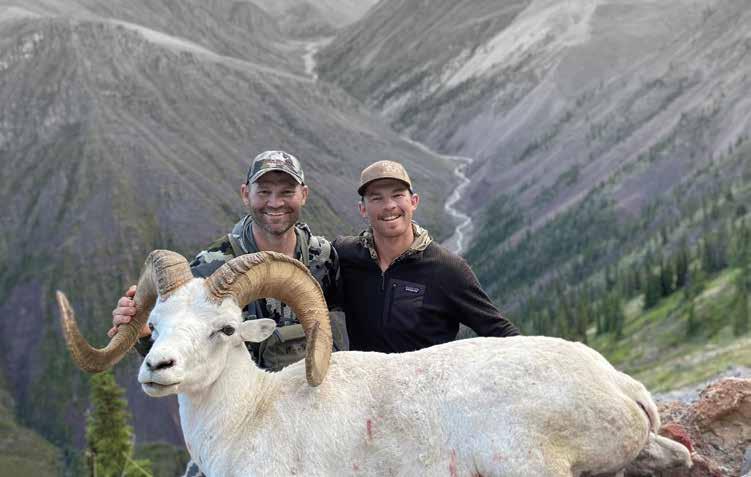
It’s never too early to book your 2026 Guide and Outfitter Appreciation Ad! This special section appears in every Winter issue of Wild Sheep Magazine. THIS GENERATES BUSINESS FOR THEM AND SHOWS HOW APPRECIATIVE YOU ARE!
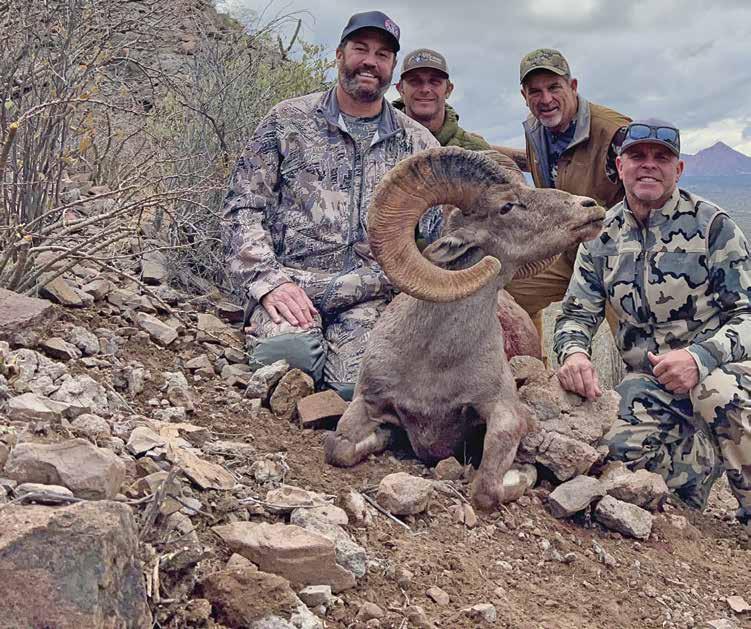
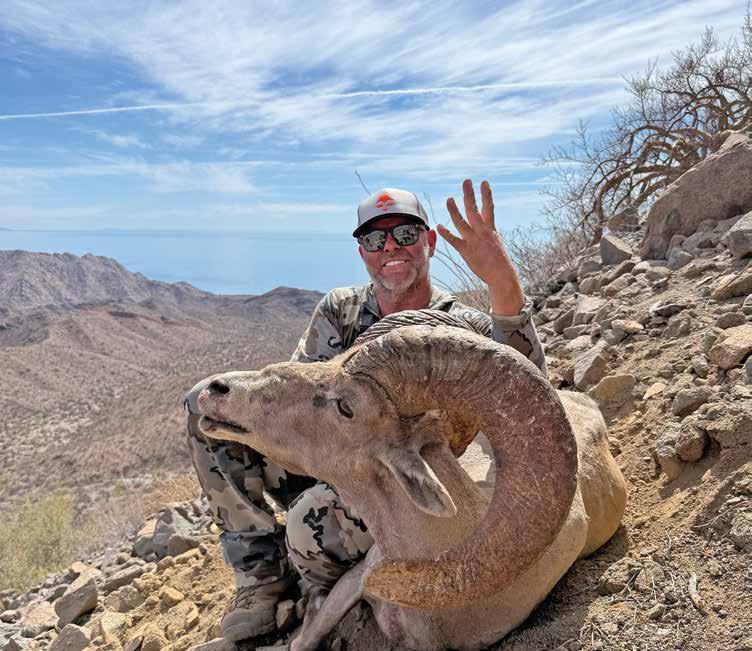
Thank you Todd Rice of Sonoran Outfitters for the great hunts! Mike Frings & Joey Vander Poel
Ray Aderholt
Raymond Andrews
Jon Belozer
Jeremiah Bowe
David Cain Jr
Laura Carter
Mark Cathey
Adam Cote
Jon-Paul Dafonte
Calen Davis
Gered De Hoogh
Clayton Delong
Mark Dodge
Paul Dorsch, Jr.
David Douglas
Anthony Dubas
Mary Ann Fernandez
Staley
Kim Flatow
Colby Flint
Eli Garcia
Jacob Gentry
Rew Goodenow
Justin Greene
Richard Guenzel
Janet Amos Holcomb
Jeremiah Bowe
Mark Dodge
Curtis Green
John Green
Tyler Halm
Russell Ingram Nathan Klatt
Rodney Leavitt
Florence AL Bunnell FL
Maupin OR Altoona WI
Mobile AL
Elizabeth CO
Newburgh IN Midland MI
Pinehurst TX
Dayton NV
Sheldon IA Boise ID
McLean VA
Finleyville PA Richland WA Westminster MD Severance CO Helena MT Everson WA Spring creek NV St. Joseph MO Reno NV
ID Laramie WY Sahuarita AZ
Garrett Ham
Daryl Harwell
Hayden Haught
Parker Hodges
Kurtis Howard
Rochelle Howie
Mark Kerr
Chuck Kerr
Erik Knutson
John Law
Donavan Layton
Josh Leininger
Ted Little
Justin Marinkov
Ryan McHugh
Shannon Meadors
Daniel Melody
Doug Mesara
Jana Morton
Stephanie Musil
Barry Musil
Katie Oldenkamp
Shayne Olsen
Cindy Papac
County AB
MT
AZ
TX
Tye Pedersen
Richard Perry
John Rosa
Bethany Rosa
Mayon Sargeant
Steve Scholler
James Shank
Chase Simpson
Colleen Smith
Matthew Sordoni
Patrick Soria
Thomas Soucek
Benjamin Spies
Anton Stewart
Rhys Strasia
Joel Swan
Bart Taylor
Kevin Timothy
Curtis Vanden Berge
Dimitri Vardakastanis
Don Walker
Chris Wenman
Greg Wiggins
Jonathan Wood
Carson City NV Bozeman MT Bozeman MT
Eagle Mountain UT Adell WI
Honolulu HI
Claresholm AB
Mineral VA
Harveys Lake PA
Chardon OH
Cody WY Fort Pierre SD
Big Valley AB
Verona WI
Brady TX St. George UT Woodland CA
Bakersfield CA San Francisco CA
Big Sky MT Farmington NM Charleston SC North Charleston SC
At the request of WSF supporters and consistent with the 2% for Conservation program of which WSF is a Founding Partner, we have launched the WSF Conservation Revolving Fund “We Give” campaign. Watch for WSF “We Give” partners who proudly include the “We Give” logo in their advertisements and/or promotions as those advertisers, exhibitors and businesses give a percentage or portion of their sales to the WSF Conservation Revolving Fund. 100% of WSF Conservation Revolving Fund contributions are directed to initiatives benefiting wild sheep and the habitat they call home.
Participants to date include:
Proceeds are tax deductible to the full extent allowed by law and are directed to Grant In Aid and other specific conservation projects to Put and Keep Wild Sheep on the Mountain. 1. Jack Atcheson & Sons 2. The Journal of Mountain Hunting 3. The Wildlife Gallery 4. Backcountry BC and Beyond, Ltd. 5. Stone Glacier 6. RPS Bancard, LLC 7. YETI
8. SITKA Gear 9. Benchmade Knives 10. Kenetrek
11. Full Curl Spirits 12. RMP Rifles
13. 5.11 Tactical
14. Best of the West/Huskemaw Optics
15. Clarke—“1% For Tomorrow”
16. Brown Precision
17. Diamond Outfitters of Arizona
18. Black Rifle Coffee
19. Eventgroove
20. iHunt Apparel

or gthornton@ wildsheepfoundation.org

Notice is hereby given for the 2026 Wild Sheep Foundation Annual Membership Meeting to be held Friday, January 23, 2026 from 9:00 a.m. to 10:30 a.m. in Room A1 of the Reno-Sparks Convention Center in Reno, Nevada. All members are welcome and encouraged to attend.



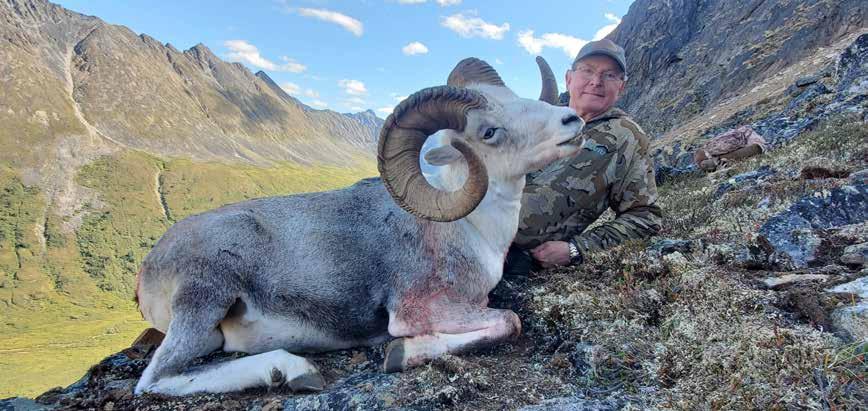




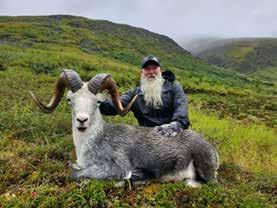
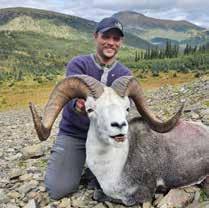

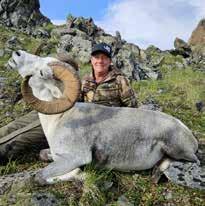




Includes: 10 Day Free-Range Desert Sheep Guide services, Lodging, Meals, Trophy Care, Ground Transportation from/to Hermosillo Intl. Airport, Sierra El Álamo & Translator. Hunt Dates: 2026-27 Season (Dec. – Mar.)
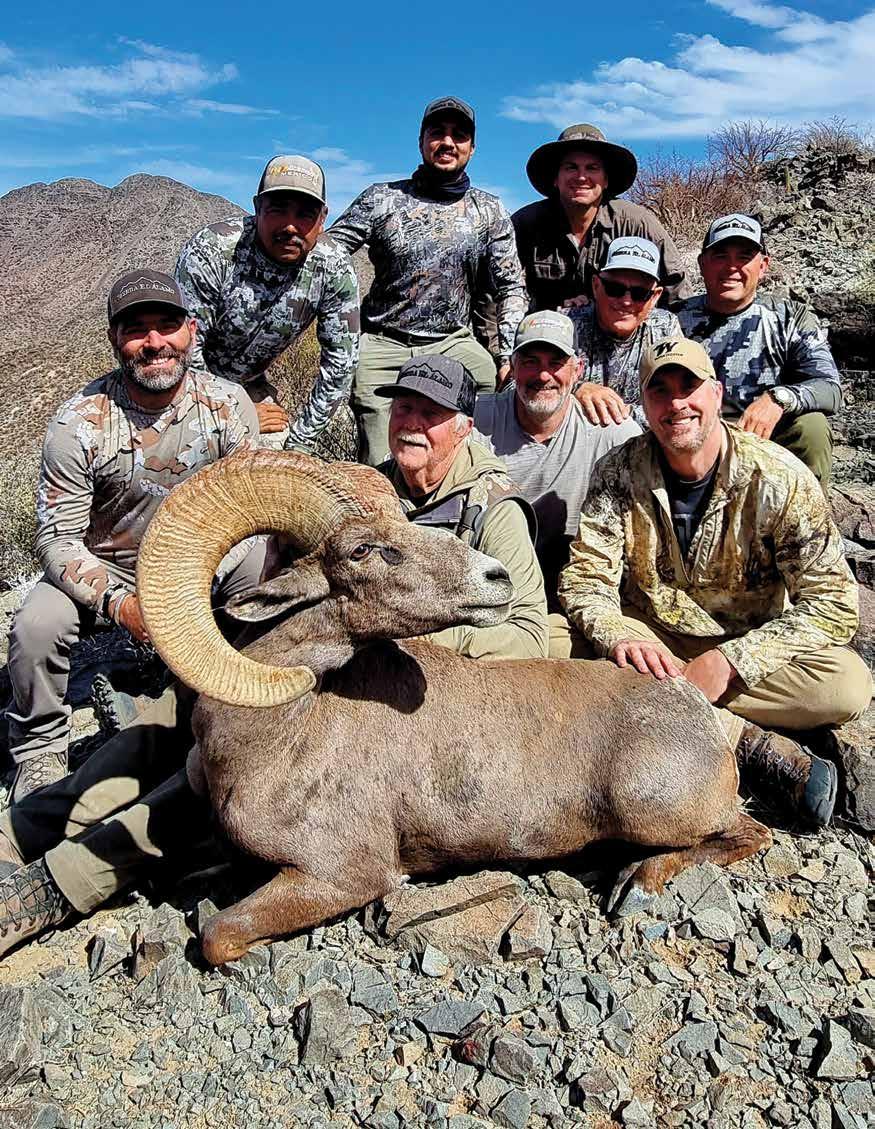


NOTE: bold/italics font denotes a joint WSF membership Chapter/Affiliate. Membership in these chapters and affiliates include membership in Wild Sheep
FOR COMPLETE CONTACT INFORMATION GO TO: www.wildsheepfoundation.org/memberships/chapters-and-affiliates
ALASKA WSF
Kevin Kehoe, President 907-441-6323 president@akwildsheep.org
Molly McCarthy-Cunfer, Executive Director 907-615-2104 executivedirector@akwildsheep.org
WSF ALBERTA
Mike Smith tel:403-700-7746 mike@wsfab.org www.wsfab.org
WSF ALBERTA Chapter Office
Deena Arychuk, Chapter Staff info@wsfab.org 403-845-5544
CALIFORNIA WSF
Donald C. Martin, President 310-766-3921 Don-martin@earthlink.net
CALIFORNIA WSF Chapter Office
Beverly Valdez, Chapter Staff 650-472-3889 forthesheep@gmail.com www.cawsf.org
EASTERN CHAPTER WSF
Henry Noss, President Noss-s.mt.redbones@olive.com 610-223-8798
EASTERN CHAPTER WSF
Chapter Office
Bill Carter, Office Manager info@ecwsf.org and bill@ecwsf.org 814-656-1831 www.ecwsf.org
IDAHO WSF
Triston Warner, President Live2hunt13@hotmail.com 208-604-2244
Tracy Rowley, Chapter Staff 208-345-6171 tracy@rtmmagt.com www.idahowildsheep.org
IOWA FNAWS
Craig Nakamoto, President 402-650-1383 nakamoto01@sbcglobal.net iowafnaws@gmail.com www.iowafnaws.org
WSF—MIDWEST CHAPTER Al Holland, President 651-492-2985 caholl@msn.com www.midwestwildsheep.com
WSF—MIDWEST CHAPTER
Mike Bouton, Executive Director 612-940-1979 mikeboutonmidwestwsf@gmail.com www.midwestwildsheep.com
MONTANA WSF
D.J. Berg, President 406-366-1849 dj@montanawsf.org Ty Stubblefield, Executive Director 406-696-3003 ty@montanawsf.org www.montanawsf.org
MONTANA STATE UNIVERSITY
STUDENT CHAPTER OF WSF
Janessa Kluth, Chapter contact 208-420-4240 montanastatewsf@gmail.com facebook.com/MSUWSF
NEW MEXICO WSF
Bryan Bartlett, President (575) 635-3499 BartleBC@yahoo.com newmexicowildsheep@gmail.com
OREGON WSF
Kevin Martin, President (541)969-6744 Kevindmartin63@gmail.com www.oregonfnaws.org
SOUTHEASTERN WSF
Jesse Riggleman, President 919-358-4483 jlriggleman4@gmail.com
UTAH WSF
Travis Jenson, President 801-641-5453 tjenson@xmission.com www.utahwsf.org
UTAH WSF Admin
Hadli Sorenson, Executive Director 435-840-0786 hadlisorenson@gmail.com www.utahwsf.org
WASHINGTON WSF
Garrett Grant, President grant16garrett@hotmail.com www.washingtonwsf.org
WYOMING WSF
Bralli Clifford, President 307-438-2043 bralli@wyomingwildsheep.org
Wyoming WSF Chapter Office
Katie Cheesbrough, Executive Director 307-399-4383 katie@wyomingwildsheep.org www.wyomingwildsheep.org
YUKON WSF
Spencer Wallace, President 867-689-2074 yukonws@gmail.com www.yukonwsf.com
2% For Conservation
Jared Frasier, Executive Director 406-221-3102 contact@fishandwildlife.org www.fishandwildlife.org
Alaska Professional Hunters Association
Deb Moore, Executive Director 907-929-0619 Deb@alaskaprohunter.org www.alaskaprohunter.org
Alberta Outfitters Association Kevin Stanton, President 403-762-5454 aoa@albertaoutfitters.com www.albertaoutfitters.com
Alberta Professional Outfitters Society Jeana Schuurmaan, Executive Director 780-414-0588 jeana@@apos.ab.ca www.apos.ab.ca
Argali Wildlife Research Center Bamgalanbaatar Sukh, Game Biologist and head of “Argali Wildlife Research Center” +976-99176580 amgalanbaatarsukh@gmail.com
Arizona Desert Bighorn Sheep Society, Inc. Sam Gorton, President 480-285-7155 Samgoar15@hotmail.com admin@adbss.org
Association of Mackenzie Mountain Outfitters Tavis Molnar, President 867-633-4934 info@arcticred-nwt.com Bear Trust International Logan Young, Executive Director 406-595-6583 logan@beartrust.org www.beartrust.org
Blackfeet Fish & Wildlife
Gerald “Buzz” Cobell, Director 406-338-7207 gcobell@blackfeetnation.com http://blackfeetfishandwildlife.net/ Cody Country Outfitters and Guides Association Lee Livingston 307-527-7416 Livingston@tctwest.net
Colorado Outfitters Association
Kelly Nottingham, Office Manager 970-824-2468 office@coloradooutfitters.com www.coloradooutffiters.org
Custodians of Professional Hunting & Conservation—South Africa Adri Kitshoff-Botha +27 0 83 6500442 ceo@cphc-sa.co.za www.thecustodians.co.za
Elko Bighorns Unlimited Cory Mahan, Vice President 775-397-4465 cmahan@ram-enterprise.com
European Federation for Hunting and Conservation (FACE) David Scallan 00353-879504563 David.scallan@face.eu www.face.eu
Fraternity of the Desert Bighorn Patrick Cummings, President Patrickcummings1002@gmail.com www.fraternityofthedesertbighorn.com
Fundacion De Vida Silvestre En Sonora, A.C Jacobo Artee, President 011-52-662-212-5510, 011-52-662-217-4119 jacoboartee@prodigy.net.mx
Grand Slam Club/Ovis Jason Price, Executive Director 903-466-2195 gsco@wildsheep.org www.wildsheep.org
Guide Outfitter Association of BC Scott Ellis, CEO 604-541-6332 ellis@goabc.org www.goabc.org
Ilbirs Fund
Zairbek Kubanjchbekov, Director +996 558271081 zkubanychbekov@ilbirs.com www.ilbirs.org
International Caribou Foundation
Cheryl Lind, Executive Director 406-404-1297 cheryl@internationalcariboufoundation.org www.internationalcariboufoundation.org
International Professional Hunters’ Association Rob Kern, President 540-336-6359 rob@huntcon.com https://internationalprohunters.com/ Lubbock Sportsmans Club, Inc. Dan Boone, President 806-733-0590 dfb@sonoramfg.com
Mongolia Wildlife Association Magsarjac Erdenebat, Executive Director mongolwildlife@gmail.com
Montana Outfitter & Guides Association
Will Israel, Executive Director 406-449-3578 info@mogamt.org www.montanaoutfitters.org
National Bighorn Sheep Center Amanda Verheul, Executive Director 307-455-3429 amanda@bighorn.org www.bighorn.org
Navajo Nation Department of Fish & Wildlife Jeff Cole, Wildlife Manager jcole@nndfw.org 928-871-6595
Nebraska Big Game Society Jim King (402) 430-6566 jim@glsbinc.com www.nebiggame.org
Nevada Bighorns Unlimited Evan McQuirk, DVM, President 775-224-5264 emcquirk@hotmail.com www.nevadabighornsunlimited.org
Nevada Bighorns Unlimited, Fallon Jay Lingenfelter, President jay.lingenfelter@cccomm.co 775-427-1254
Northern BC Guides Association Craig Kiselbach, President terminusmtn@gmail.com 250-442-7103
Northern Nevada SCI Chapter Gavin Chodera, President 916-960-8518 gchodera@nnsci.com www.nnsci.com
Northwest Guides & Outfitters Association
Colin Niemeyer, President 250-306-8624 hunting@kawdyoutfitters.com
Northwest Sportsman’s Club Nate Perrenoud 509-994-6795 www.northwestsportsmansclub.com
Purkersdorfer Jagdklub Gunther Tschabuschnig, Vice President 011-43-676-496-6691 info@jagdklub.eu www.jagdklub.eu
Pyramid Lake Paiute Tribe
Donna Noel, Director of Natural Resources 775-574-0101 Ext: 17 www.plpt.nsn.us
Rocky Mountain Bighorn Society Ben Ramaker (785)760-1374 benramaker@hotmail.com www.bighornsheep.org
Terry Meyers, Executive Director 970-640-6892 meyers.terry@gmail.com
Rocky Mountain Goat Alliance Marvin Kwiatkowski, Chairman marvin@goatalliance.org www.goatalliance.org
Contact: Kendrick Chittock, Fundraising Coordinator kendrick@goatalliance.org info@goatalliance.org
Safari Club International 520-620-1220 info@safariclub.org www.safariclub.org
Sheep Hunters of the World (SHOW) Billi Carey, Administrator 480-292-1674 www.sheephunters.com
Shoshone & Arapaho Fish and Game
Arthur Lawson, Director lawson@windriverfishandgame.com www.windriverfishandgame.com
Society for the Conservation of Bighorn Sheep Steve Marschke, President 310-339-4677 info@sheepsociety.com www.desertbighorn.org
Spanish Professional Hunters Association Bruno Rosich 346-559-01611 Bruno@TrophyHuntingSpain.com www.spanishprofessionalhunters.com
Tahltan Guide Outfitters Association Rudy Day, President 250-235-3395 Dayrudy84@gmail.com
Taos Pueblo
Michael Martinez, Hunt Manager 575-758-7410 hunting@taospueblo.com
Texas Bighorn Society Clay Brewer, President 325-792-4177 Claybrewer1@outlook.com www.texasbighornsociety.org
TBS Administrator Kathy Boone, Office Admin O: 806-745-7783 C: 806-438-3939 kboone@sonoramfg.com
The Confederated Tribes of the Warm Springs Reservation of Oregon (CTWS) Camille Brooks 541-553-2029
Camille.brooks@ctwsbnr.org https://warmsprings-nsn.gov
The International Council of Game and Wildlife Conservation (CIC) Sebastian Winkler office@cic-wildlife.org https://www.cic-wildlife.org/ Wildlife Stewardship Council John Henderson, President sirjohn55@gmail.com wildlifestewarship@gmail.com www.wildlifestewardshipcouncil.com
Wild Sheep Society of British Columbia Greg Rensmaag, President 604-209-4543 Rensmaag_greg@hotmail.com
Wild Sheep Society of British Columbia Office & Staff
Kyle Stelter, CEO 250-619-8415 kylestelter@gmail.com www.wildsheepsociety.com
Hana Erikson, Executive Assistant 604-690-9555 exec@wildsheepsociety.com
Wyoming Outfitters & Guides Association Jeff Smith, President 307-265-2376 wyoga@wyoga.org www.wyoga.org
Yukon Outfitters Association Mac Watson, President 867-668-4118 (Office) info@yukonoutfitters.net www.yukonoutfitters.net
Yukon Outfitters Association Staff Shawn Wasel, Executive Director 780-213-4301 (Cell) swasel@mcsnet.ca Brenda Stehelin, Office Manager info@yukonoutfitters.net
Northern Wild Sheep and Goat Council
Kevin Hurley, Executive Director 307-899-9375 info@nwsgc.org www.nwsgc.org
Desert Bighorn Council
Patrick Cummings, Chair Nevada Department of Wildlife (Retired) (702) 486-5127 patrickcummings1002@gmail.com www.desertbighorncouncil.com
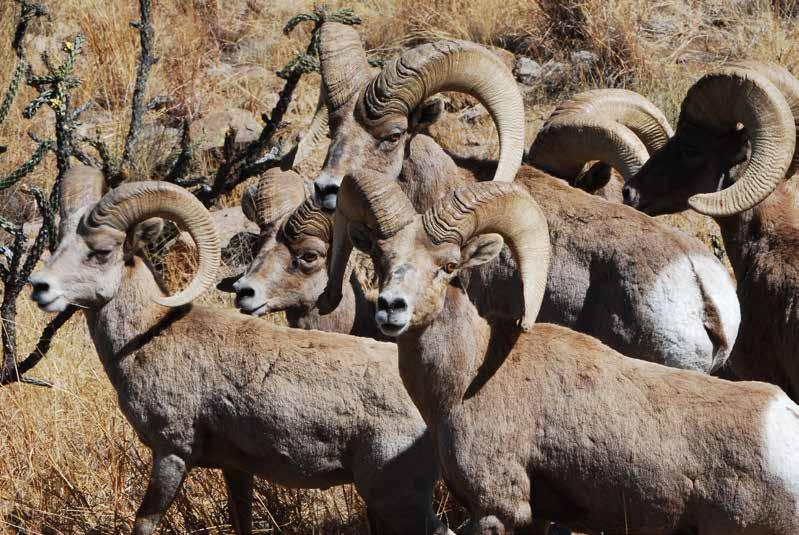






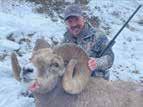
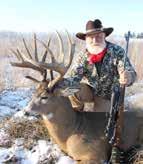
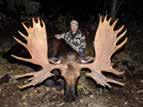
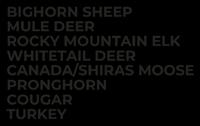

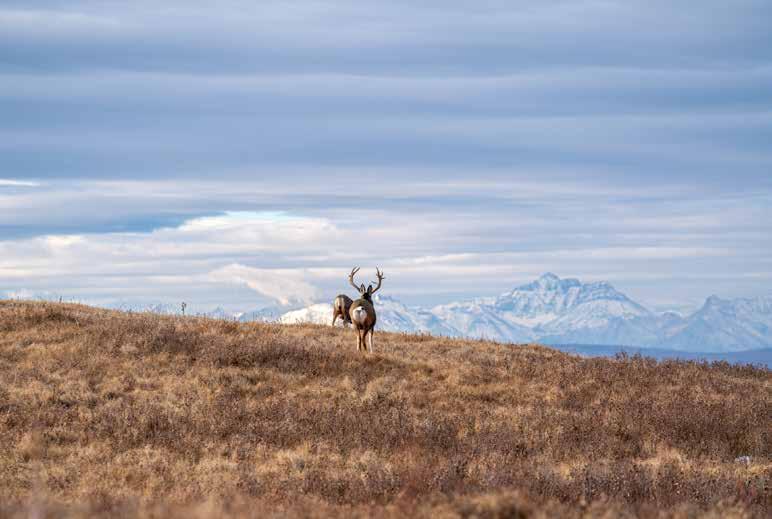

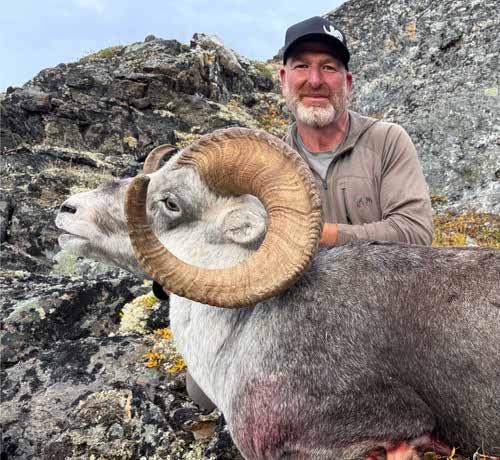


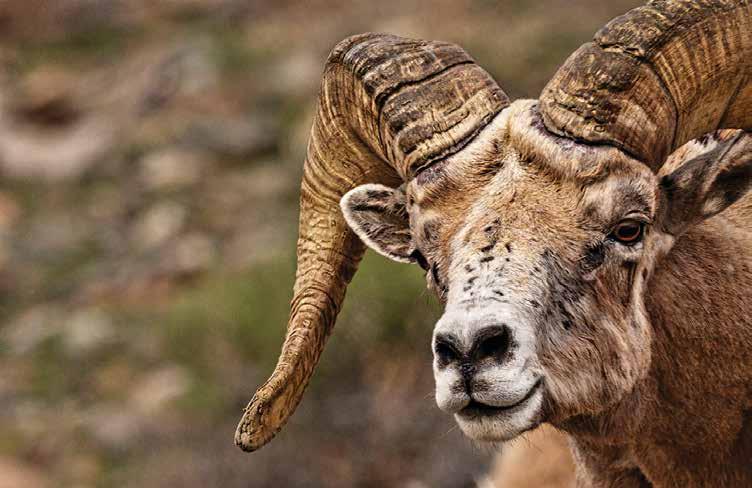










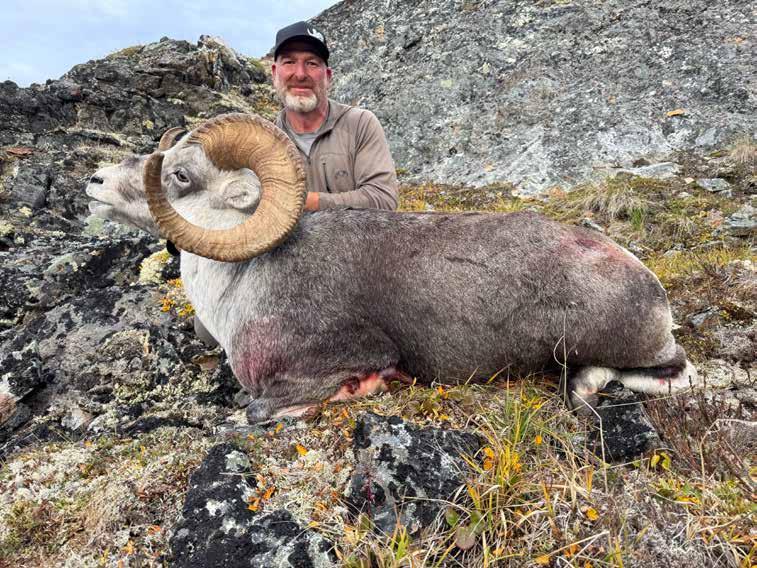
What a remarkable 14-day guided hunt FOR YOU! One-on-one with a great guide, in the breathtaking Pelly Mountains of Yukon, Canada. Does not include costs of commercial or charter flights, tag and preservation fees, government harvest fees, 5% GST, or tips.





Find peace of mind when hunting with an African Dawn Outfitter
















If you are serious about hunting in Africa, SIGN UP to Africa’s Greatest Hunting Magazine.









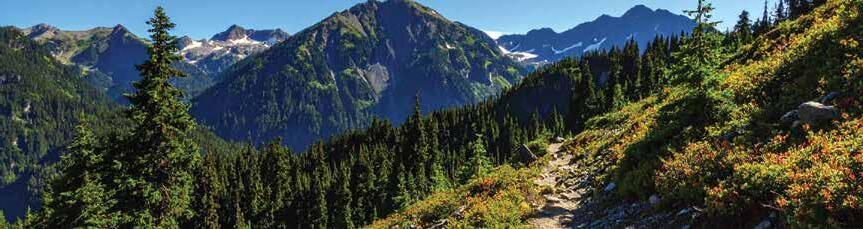
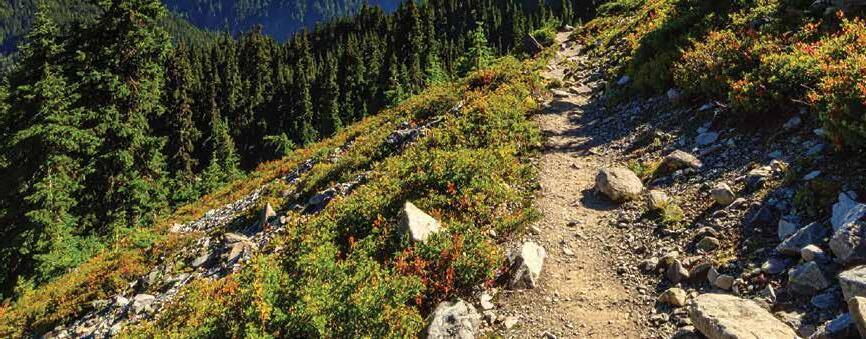
NOTE: Dates noted are as of press time. Please check C&A websites for updates.
Sheep Week® .................................January 19-24 ...................... Reno, NV
Sheep Show®..................................January 21-24
Icons of Conservation Gala ...... April 29-May 1 ........ New Orleans, LA Roosevelt Hotel
WSF Thinhorn Summit IV May 5-7 Prince George, BC WSF C&A Summit XVIII .................. May 14-16 ... Grand Junction, CO
WSSBC Jurassic Classic ..................... Aug 21-23 ............. Chilliwack, BC
Chapter
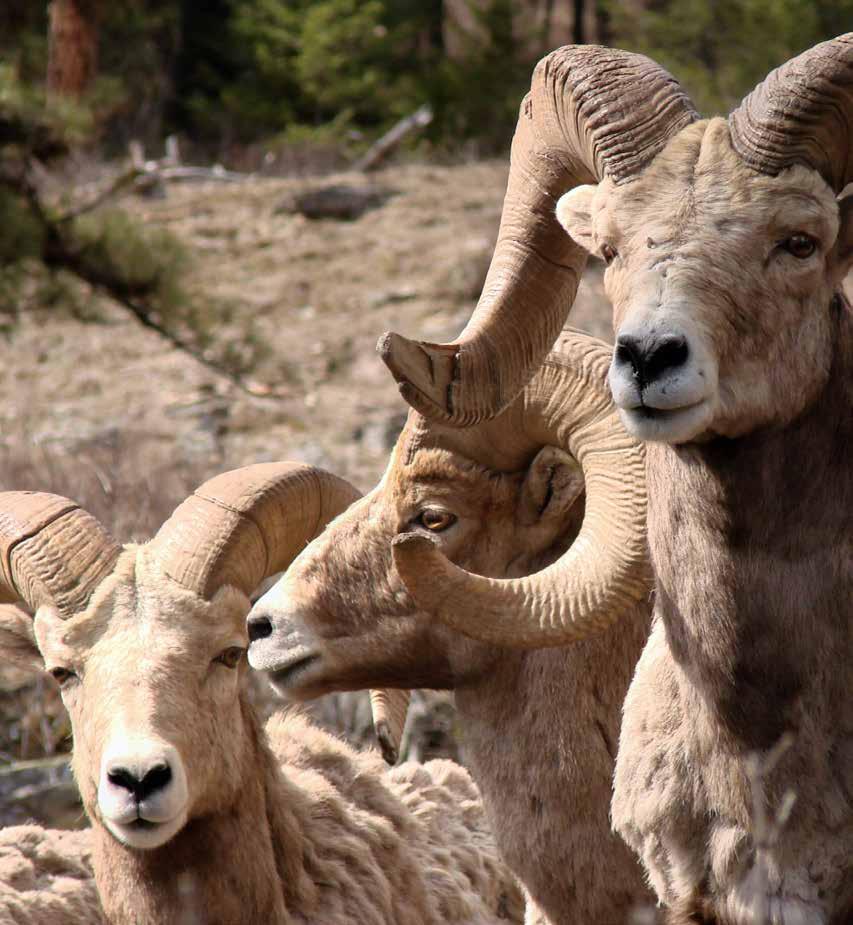
Date
Location
Alaska WSF April 10-11 Anchorage, AK
California WSF April 25 TBD
Eastern Chapter WSF ....................................... Feb 27-28 ............................... Lancaster, PA
Idaho WSF ............................................................ March 21 ....................................... Boise, ID
Iowa FNAWS March 20-21 Des Moines, IA
Midwest Chapter WSF March 20-21 Minnetonka, MN
Montana WSF March 6-7 Bozeman, MT
New Mexico WSF .......................................... Raffle Only
Oregon WSF.......................................................... April 25 ...................................... Bend, OR
Southeastern Chapter WSF TBD TBD
Utah WSF March 21 Salt Lake City, UT
Washington WSF ................................................ March 14 ................................ Tacoma, WA
WSF Alberta ...................................................... March 6-7 ............................... Red Deer, AB
WSF Alberta—Yellowhead April Edson, AB
Wyoming WSF June 5-6 Casper, WY
Yukon WSF................................................................... TBD
Affiliate
Arizona Desert Bighorn Sheep Society May 9 Scottsdale, AZ
Elko Bighorns Unlimited ............................................ TBD
Fraternity of the Desert Bighorn .............. May 17 TBD ............................. Las Vegas, NV
National Bighorn Sheep Center July 3 - Anniversary Dubois, WY Nov 1—Big Horn Bash
Nebraska Big Game Society ............................ March 20 ................................. Lincoln, NE
Nevada Bighorns Unlimited .................................. April 3 .....................................Reno, NV
Nevada Bighorns Unlimited - Fallon TBD Fallon, NV
Nevada Bighorns Unlimited - Midas TBD Midas, NV
Northern Nevada SCI Chapter ............................... TBD .....................................Reno, NV
Rocky Mountain Bighorn Society ................ April 17-18 ............................. Loveland, CO
Rocky Mountain Goat Alliance
Society for the Consv. of Bighorn Sheep N/A
Texas Bighorn Society June 6 San Antonio, TX
Wild Sheep Society of BC—Northern ............... Jan 31 ................... Dawson Creek, BC
WS Society of BC – Salute to Conservation... Feb 27-28.................................. Penticton, BC
NOTE: No date listed = Date not yet determined or provided by C&A














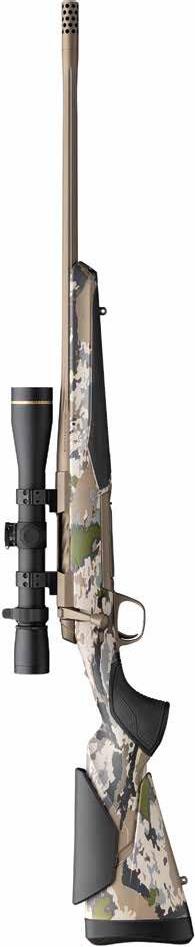



Browning redefines Total Accuracy yet again with the new X-Bolt 2 and Vari-Tech stock. This new stock design is engineered with three-way adjustment that allows you to customize the fit of the rifle to meet your specific needs, helping you achieve consistent, tack-driving performance while retaining the silhouette of a traditional rifle stock.
























LENgth of pull
Internal spacers lock in length of pull. Adjustable from 13-5/8" to 14-5/8" right from the box, this system is sturdy and rattle free.


Two interchangable grip modules are available for the Vari-Tech stock: The traditional Sporter profile and the Vertical profile. Both let you optimize finger-to-trigger reach and control.


























Achieve consistent eye-to-scope alignment and a rock-solid cheek weld even with large objective lens optics. Six height positions offer 1" of height adjustment. COMB HEIGHT




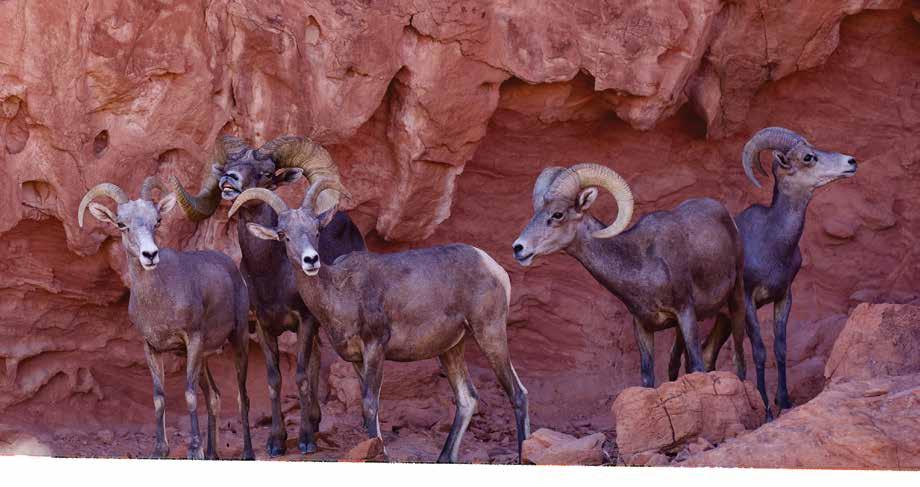
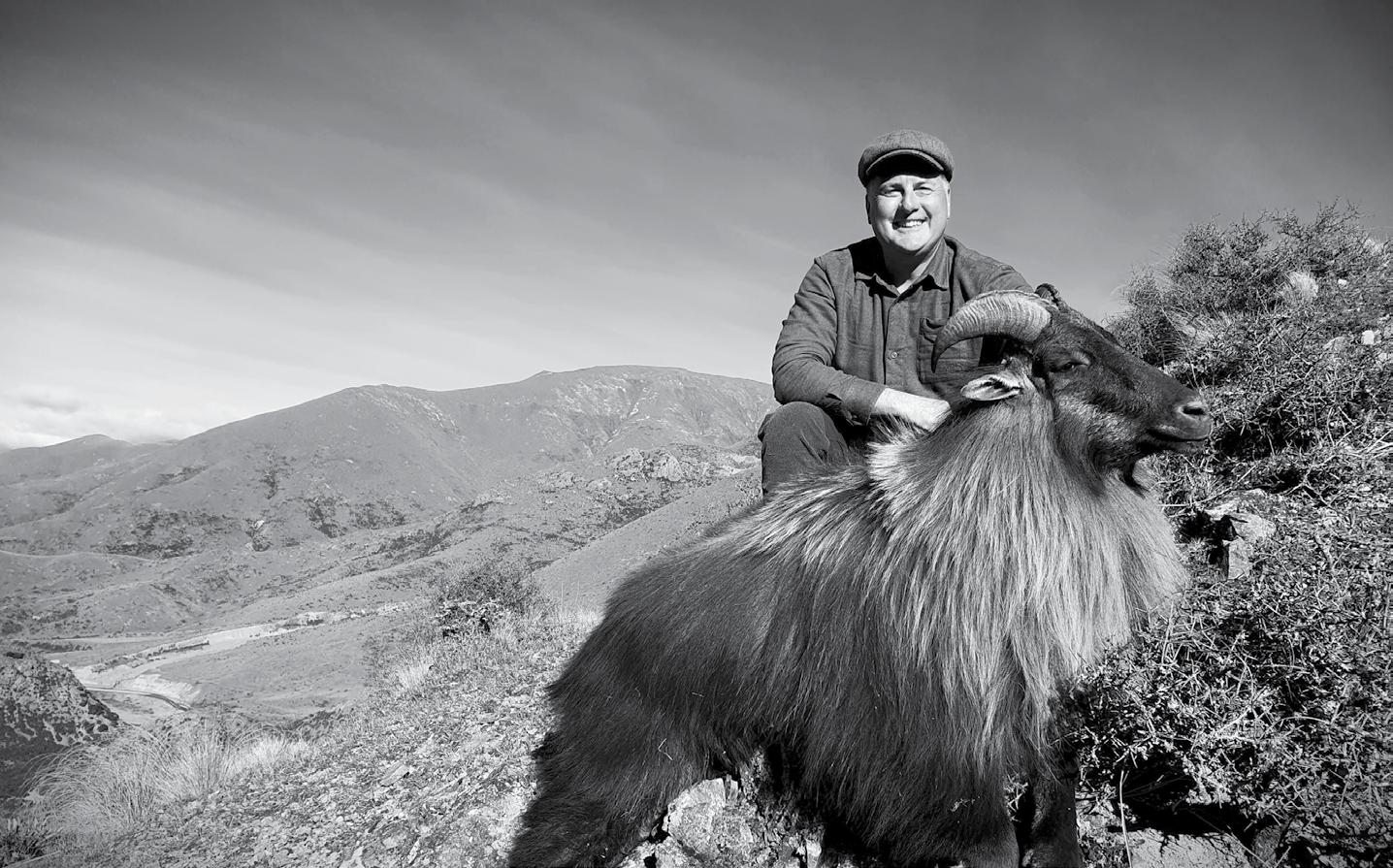




by Rachel Ahtila Women Hunt® Committee Member
Have you ever watched someone’s face light up when you share something you are truly passionate about? It’s enchanting to listen to passionate people talk. When they can breathe life into their stories, it naturally draws you in. Such conversations around the vision and mission behind Women Hunt are among my favourite to share about. From watching someone take in the story of how we came to be, to talking about the lives that we have been able to impact, describing our growth, and how we are constantly moving to improve and expand our programs; the recognition that something like this would benefit them or someone they know fills the souls of those of us who love what we do.
The cool part? We are not only able to talk about it on our grander scale, but we get to share in our upcoming events, extending an offer for that person, or someone they know, to join in on our ever-growing community. Whether through an organic conversation or on a professional stage—it truly excites me to share in all things that make our vision at Women Hunt so special.
This year has been nothing short of extraordinary. As we dove into the calendar year and rallied through our application process, we looked beyond our current programs to meet the needs and demands of our growing community. This year our applicants wrote some of the most thoughtful and emotionally provoking testimonials, and it’s
a truly difficult task to select the top submissions when everyone is deserving. This need stimulated us and brought us back to the drawing board on how we could include more women beyond our current opportunities. We saw this as a challenge, and we are pleased to announce that, not only did we kick off a few more opportunities this fall, we will be showcasing other fantastic programs and events in the coming year. Be sure to keep in the know by following us on our social platforms as we begin to reveal such opportunities and events.
Most recently in October, the Wild Sheep Foundation and Women Hunt returned as Gold Sponsors in support of The Wildlife Society’s Annual Conference, hosted this year in beautiful downtown Edmonton, Alberta, Canada. The Wild Sheep Foundations’ Chief Operating Officer and Executive Vice President of Conservation, Mr. Corey Mason, delivered a session regarding NGO Conservation Funding and Delivery on behalf of WSF to a packed audience. Our very own Women Hunt Committee Members, Brandi Love and I, had a unique opportunity to host an interactive seminar for the TWS’ membership, An Introduction to Horse Packing and Backcountry Gear 101. It was a fantastic venue that accommodated a space for all the gear and hands-on application. Between seminars and social events, the WSF and WH team was able to promote the good work done through our organizations, and welcome conversations with
a mix of academic and industry professionals that geographically represented multiple continents, and a cross section of past, present and future industry professionals. We’d love to extend a big shout out to our friends at Wild Sheep Foundation Alberta, to President Mike Smith, director Chuck Priestly and Yellowhead Chapter Affiliate President Jordan Jakubow, for hauling up ‘Lucky’, our manikin horse used during the demonstration. Teamwork made the dream work, and I dare say it was one of the more unique seminars this year!
The TWS was also a kickoff opportunity to introduce a new face on the Women Hunt team, Dana Dykema. Conservation and conversations come handin-hand in the modern world. Now, more than ever, we have a plethora of options to showcase ideas, engage with audiences outside of our normal circles, and invite opportunities to grow together. Women Hunt is very proud to announce that we will be working with Dana to bring you the Women Hunt Ignite Podcast. The podcast will connect outdoor enthusiasts through authentic and bold conversations. This show will dive deep into exploring topics with adventurers, conservationists, hunters, leaders, storytellers, and trailblazers. We couldn’t be more thrilled to have Dana hosting the podcast, where we hope to ignite your passions, expand your horizons, and allow


yourself to be inspired by voices from around the world!
Kicking off this November, we are so thrilled to see our fifth round of successful applicants heading to Texas for the Field to Fork New Hunter and Rifle Training course at the FTW Ranch with this year’s Women Hunt Class of 2025. In the spirit of creating new opportunities, Class of 2024 graduate, Emily Richett author of Mama Bear Survival, is set to host a coveted event ‘Women Hunt’s Mama Bear Field Camp’ December 15-18 at the renowned Legends Ranch in Bitely, Michigan. This new collaborative combines hands-on training, mentorship, and a guided hunting experience in a beautiful and safe setting for pairs of women and girls. This course will allow participants to receive hunter education training, firearms safety and rifle training, conservation education, and allow for other shared experiences to help equip and encourage the next generation of outdoorswomen.

Speaking of encouraging the next generation, did you make it to our inaugural Beer and Bubbly Event on Thursday night this past January? This event was knocked OUT OF THE PARK!!! Not only did we give back to over 1,000+ of our Sheep Show® family by offering a selection of beer and bubbly before the banquet, generously sponsored by the New Mexico Wild Sheep Foundation, but we celebrated our greater Women in Hunting community by hosting a photo & story-driven giveaway! We are thrilled to host this event again in 2026 and gratefully recognize the NMWSF for sponsoring it for the second year in a row. The campaign for submissions started this October and ends December 8, and we look forward to seeing this year’s submissions. Stories and images are encouraged from women of all ages highlighting what they love to do most in the outdoors. Every person who makes a submission will be automatically entered into free drawings for fabulous prizes
from our partners at Weatherby, Mathews, Alaska Fur, Twisted North Design, the Peppermill, and Nocoma. We continue to celebrate the previous year by showcasing our community’s submissions on Instagram and Facebook every #womenhuntwednesday!
We strive to be innovative, to make the WSF Sheep Week® an unforgettable experience for not only the time-honored patrons of the show and our community, but those that find themselves walking through the doors for perhaps the very first time. With the hustle and bustle of the events, seminars and stimulating tradeshow floor, we decided to do something different this coming year. Our growth over the last year saw us move into a larger space on the show floor for the Women Hunt booth, and we couldn’t be happier to be neighbors beside the Culinary Corner, hosted this year by Chef Joshua Schwencke and Chef Joseph Bonavita. To help accommodate a busy floor schedule, and to keep true to our very successful seminar series that we annually host, we are excited to announce that each day we will be campaigning a new topic and series of guests answering popular topics that we see throughout the year! Join us each day for our Outdoors Unscripted Sessions—introducing a whole new way of inspiring conversations covering such topics as ‘Hunting with Children’ Thursday January 22 from 2-3pm, ‘Expedition: Africa’ Friday January 23 2-3pm , and ‘Trailblazing Women: Young Guns’ on Saturday 24th 1- 2pm. Be sure to come by and shop the exclusive
Women Hunt merchandise, chat with one of our graduates or committee members, and enter to win our Sheep Week® Giveaways!
Each year, the WSF Ladies Luncheon transforms into one of the most exciting and vibrant opportunities for the women to get dressed up and unite in support of conservation, enjoy a few cocktails, and a curated auction just for the women in the room. This past year, Jann Demaske, the Ladies Luncheon Chair shared that we
will be kicking down the doors and have you looking through your costume or tickle trunk to put together your version of ‘Artemis’, a theme chosen by Sue Slough. Be sure to keep an eye on her table… they’ve been known to take an idea and run with it!
As always, our Women Hunt graduates, delegates and committee will be supporting Wild Sheep Foundation in the different areas identified by the WSF staff. Our community can be spotted in
popular places like the WSF Official Store, registration, aiding in banquet seating, <1 Club® raffle tickets sales, and helping curate the various roles around convention. They are here to help you and give back to our organization that makes this all possible.
Whether it is your first time in attendance at the Wild Sheep Foundation’s hugely anticipated Sheep Week®, or you are a seasoned patron and member—be sure to stop by the Women Hunt booth this coming convention. We look forward to seeing you there! WS
Enter now! Open to women of all ages, and to the men who want to brag on the ladies in their lives!
Join the Women in Hunting community by uploading your photos and short story doing what you love in the outdoors (hunting, shooting, scouting, fishing, camping, hiking, cooking game meat, working on a wildlife conservation
project, anything that aligns with our shared love of wildlife and the wild places they inhabit!)
Deadline is December 8, 2025, to be entered to win one of our spectacular prizes and have your photos featured at the 2026 Sheep Show® on the big screens outside the Tuscany Ballroom foyer during our Beer & Bubbly Social Hour, held Thursday evening from 5-6 pm.WS

Meet the Wild Sheep Foundation’s Women Hunt® and RMBLF Committees: Bios and photos at: www.wildsheepfoundation.org/about/ women-hunt-committee
• Weatherby Rifle (must be present to win)
• Weatherby Shotgun (need not be present to win)
• Mathews Bow (must be present to win)
• Fur, Jewelry, Handbag and Spa Package (need not be present to win)
Women Hunt® wants to hear from you!


https://www.wildsheepfoundation.org/ What-We-Do/Women-Hunt womenhunt@wildsheepfoundation.org @womenhunt @women_hunt
Thursday 2-3pm
Hunting with Children
Panelists: Julie Chapman, Maddie Richards
Friday 2-3pm
Expedition: Africa
Panelists: Donna Boddington, Danene van der Westhuyzen, Sylvia Greeff
Saturday 1-2pm
Trailblazing Women: Young Guns
Panelists: Madie Demaske, Jen Loree
in collaboration with


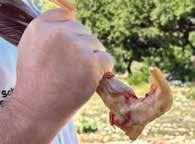
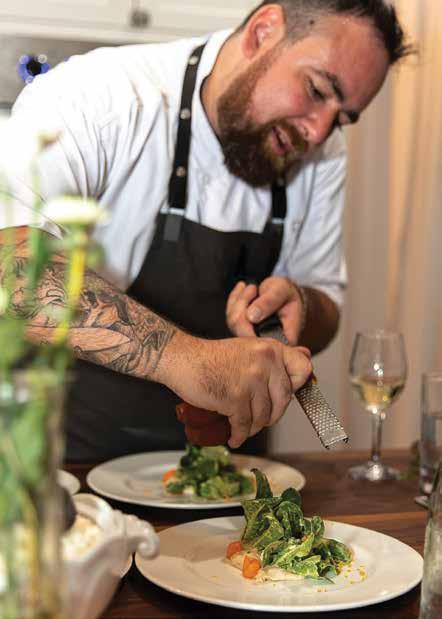
THURSDAY • FRIDAY • SATURDAY
HALL 3 • RENO-SPARKS CONVENTION CENTER SCHEDULE ANNOUNCEMENTS COMING SOON!
Join Chef Joshua Schwencke and Chef Joseph Bonavita in the Culinary Corner for a wide array of wild game culinary instruction at the 2026 Sheep Show®!


by Joshua Schwencke WSF & Women Hunt® Executive Chef in Residence
The blending of salt and sugar offers a kind of culinary magic. Together, they form both a sciencedriven solution for preservation and a flavorful way to serve the spoils of your hunt without letting your hunt spoil.
Using salt to preserve food is nothing new. Long before refrigeration, salting was the standard method for keeping proteins safe to eat. Ancient Egyptians used natron (a naturally occurring salt mixture) not only in mummification but also in preserving fish and fowl, a practice echoed in cultures across the globe.
Homemade charcuterie is always a welcome sight at the table, but wild game adds layers of texture and flavor that farmed meats can’t replicate. Preparing cured proteins is remarkably simple. All it requires is a basic understanding of the science, patience, and a sharp knife.
Salt preserves through osmosis, preventing the growth of harmful pathogens that would otherwise ruin your protein—and your week. High salinity alters the “activity” of water in the meat, forcing microbes into plasmolysis, a process that halts their survival. That’s exactly what we want.
Salt curing also transforms texture and flavor. Proteins take on salinity, which can be balanced by pairing them with cheese or other fatty accompaniments. The fat present in wild game, though limited, becomes more delicate and refined through curing.

Due to most wild game being naturally lean, finding cuts with some fat is ideal. Hindquarters and shoulders, where fat is more likely to occur, often yield the best results. Patience is essential. Time allows salt to penetrate fully and gives flavor room to develop. Size matters here: the larger the cut, the longer the cure.
A good reference is species and cut size. A duck, dove, or quail breast cures in 4–24 hours, while a
venison back strap or wild sheep loin may take up to a week. As a rule of thumb, thickness is more important than weight, but you can estimate roughly one day of curing per pound of meat. Bone-in cuts require longer because the bone and marrow slow salt penetration. Brown sugar balances salt while lending a soft molasses note. Aromatics such as dried herbs and spices contribute flavor and help temper the “gamey” undertones
Ingredients:
• 12 dove breasts, skinless, cleaned, and patted dry
• 1 cup kosher salt
• ½ cup light brown sugar
• 1 Tbsp freshly cracked black pepper
• 1 Tbsp smoked paprika (or chipotle powder for added heat)
• 2 tsp ground cumin
• 2 tsp ground coriander
• 2 tsp Mexican oregano, dried and crumbled
• 1 tsp ground cinnamon
• 1 tsp ancho chili powder
• Zest of one orange
that some wild proteins carry. Use only dried seasonings—juniper berries, caraway, or red pepper flakes are excellent choices. During osmosis, these flavors subtly permeate the meat.
Be cautious not to over-cure. Too much time in salt will make the protein excessively firm and overly salty. Properly cured game should be firm and dry, but still pliable. The final step is just as important as the cure itself. Always slice thinly against the grain. This shortens

Scan here for the Mountain to Plate Video Series with Chef Josh Schwencke
1. Prepare the Cure
Combine salt, sugar, and all spices in a bowl.
2. Coat the Breasts
Spread a layer of cure in a shallow dish. Place dove breasts on top in a single layer, then cover completely with the remaining cure.
3. Curing Stage
Cover tightly and refrigerate for 8–12 hours. Small birds should not exceed 12 hours.
4. Rinse & Dry
Rinse under cold water and pat dry.
5. Air Dry
Wrap each breast in cheesecloth. Hang in a cool, ventilated place for 4–5 days, or place uncovered on a rack in the refrigerator for 7–10 days, until firm.
6. Serve
Slice thinly against the grain. Pairs well with queso fresco, charred peppers, and fruit preserves like fig, guava, or prickly pear.
7. Prepare the Cure
Keep properly cured proteins in an air tight container or food saver bag for months or up to a year.
Creating your own cured proteins takes time and patience, but the reward is well worth it. The process connects you to an ancient tradition while offering a wild, flavorful twist to your game cooking. Think of it as a cure not only for meat—but for the ordinary.
muscle fibers, producing tenderness and highlighting the rich, salty depth created during curing. Thin slices ensure balance, allowing the meat to play well with cheeses, breads, and accompaniments. Preserving your protein offers multiple applications beyond the dinner table. If kept dry in an airtight container or vacuum-sealed bag, your cured meat will last for up to a year ready for next season’s hunt or a summertime picnic. Paired with a good bottle of Grenache or
Pinto Noir and an aged Manchego cheese is a pro move.
For a recent game dinner in South Texas, I served Mexican Dove Prosciutto atop a spring salad with roasted corn, grilled nopales (cactus), queso fresco, and a tequila-lime buttermilk dressing. It celebrated dove season while highlighting the bird’s terroir in my home state. Above is the recipe, which can also be adapted for quail, duck, or similar small game birds. WS

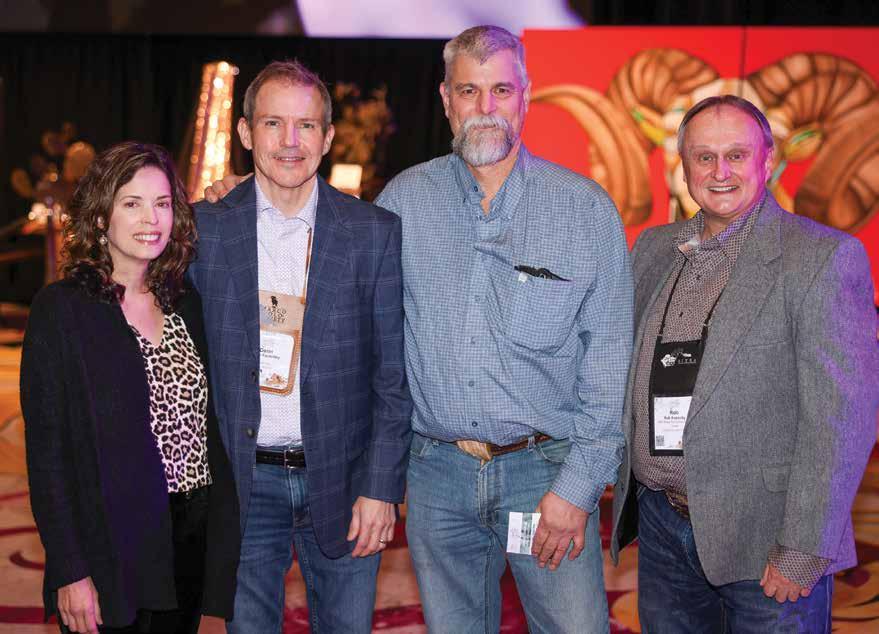
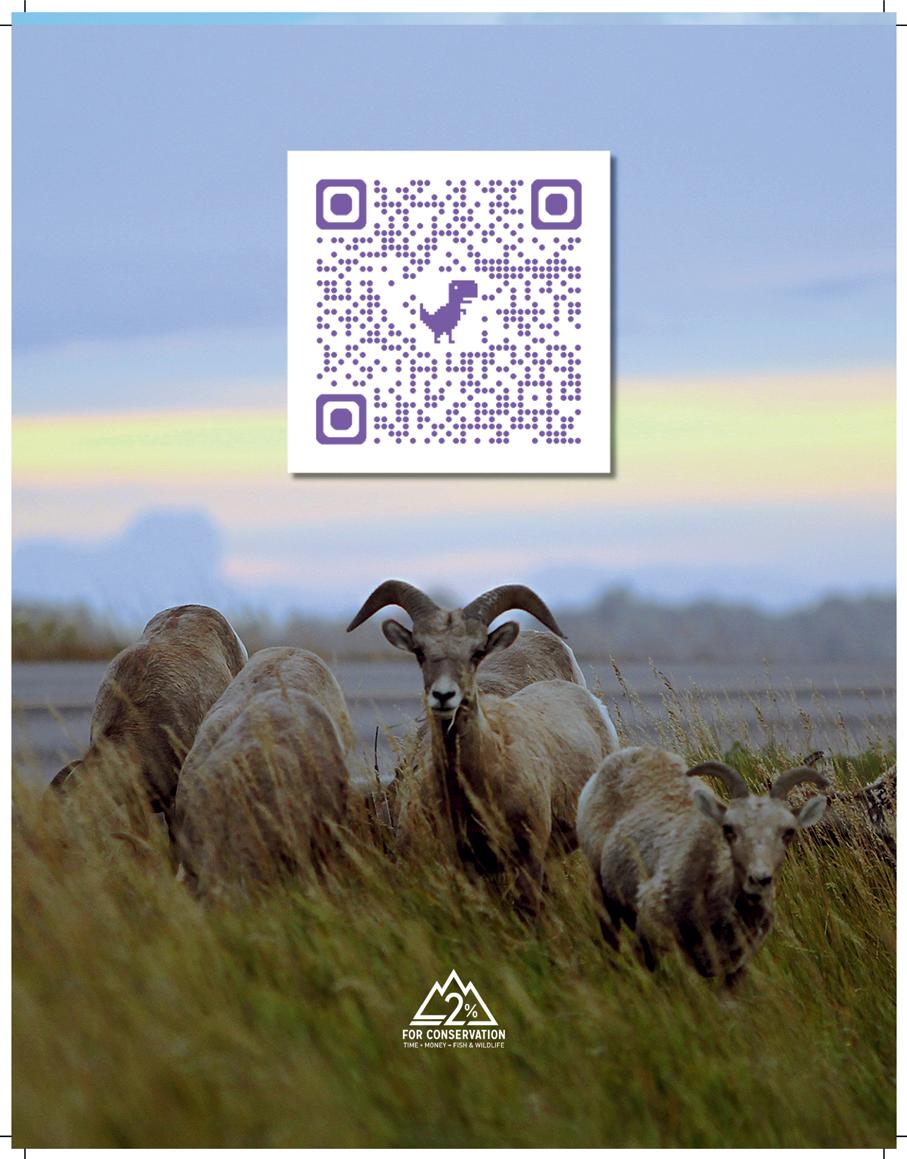

by Ryan Brock, Ph.D. WSF Youth Education Coordinator
“As you grow older, you will discover that you have two hands—one for helping yourself, and the other for helping others.”
This quote, often attributed to Audrey Hepburn, suggests that wisdom and compassion come with age—that only as we grow older do we begin to look beyond ourselves to help others. Yet, a recent Women in Wildlife Conservation & Sportswomen Event hosted by the Nevada Wildlife Federation proved that generosity of spirit and leadership can appear well before adulthood.
Back in early May, the federation reached out to the Wild Sheep Foundation’s (WSF) youth program with an idea: to create an event that would help women connect with mentors and organizations active in hunting, fishing, and outdoor recreation. Word had spread about the young women on WSF’s youth archery team, and it seemed a good fit to discuss how we were getting young women involved. We quickly confirmed and even suggested a few other organizations in the area that could be a good fit for the event.
Fast forward to September, when nine organizations—including WSF, Women Hunt®, Nevada Bighorns Unlimited, Ducks Unlimited, Trout Unlimited, and the Nevada Department of
Wildlife—came together for a special mentorship event at the Patagonia store in Reno, Nevada. Over a hundred participants filled the store, eager to hear personal stories of connection, confidence, and conservation.
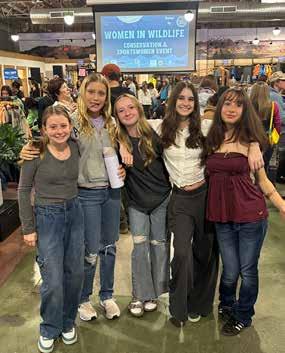
Each organization was given five minutes to present. After several other presentations, I quickly realized I was the only male speaker that evening—but fortunately, I had brought along a team of inspiring young women who could speak for themselves. Five eighth graders, all veterans of WSF youth programs, joined me to share their personal outdoor journeys.
Ella recounted her experience
traveling to Valley of Fire State Park to assist with a wild sheep capture. Emery described building a wild sheep guzzler in the heart of Nevada. Sophia captivated the audience with tales of her Texas feral pig hunt—where she successfully harvested two pigs in one night. Finja shared how she first picked up a bow at a WSF introductory archery clinic, later joined the WSF archery team, and then asked for her own bow that Christmas. The following year, she requested a .30-06 rifle for a pig hunt—on which she not only hunted but also caught her first fish. Finally, Rilee spoke about her first bird hunt, a chukar and pheasant event. All these experiences where directly related to WSF’s youth program.
Our allotted five minutes stretched longer as I introduced the Shooting, Hunting & Ethics Education Program (S.H.E.E.P.) and the girls each told their stories. But no one seemed to mind. When the applause came, it appeared to be the loudest of the night. These young ladies inspired a room full of women—many twice or three times their age. In doing so, they turned Hepburn’s quote on its head. While they may still be growing up, they’ve already discovered how to use both hands—one for themselves, and one to lift others.
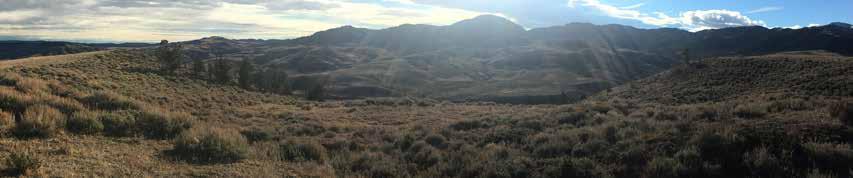
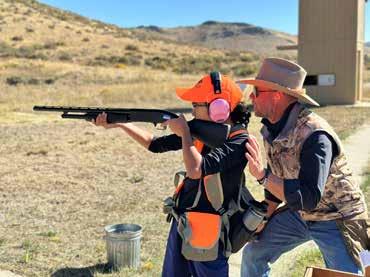
On Saturday, September 27th, twenty-five eager young hunters gathered at Green Gulch Ranch near Vinton, California, for a day they won’t soon forget. Hosted by the Chukar Chasers Foundation, in partnership with the Wild Sheep Foundation’s Shooting, Hunting & Ethics Education Program, the annual Youth Chukar and Pheasant Hunt introduced new youth to the excitement, responsibility, and ethics of hunting.
The day began bright and early with check-in, a light breakfast, and a comprehensive safety talk. The owner of the ranch gave a brief background of his family’s ranch and spoke a little about the ethics one should give while visiting a ranch, as most of these families were from the city. By 9:00 a.m., the ranch echoed with the sound of shotguns as participants shot on the trap range with oneon-one coaching and practice. After honing their aim, groups of five to six youth were paired with experienced guides and skilled bird dogs to pursue planted chukar
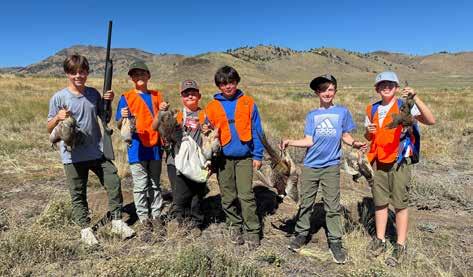
and pheasant across the rolling terrain. Each young hunter had the opportunity to harvest up to five birds—a thrilling and educational experience that combined skill, patience, and teamwork.
Following the hunts, participants returned to the ranch headquarters and learned how to properly clean and care for their birds, gaining valuable lessons in respect for wildlife and the field-to-table process. The event wrapped up with lunch, a fun raffle, and plenty of smiles all around.
Through programs like this, WSF’s S.H.E.E.P. and the Chukar Chasers Foundation continue to inspire the next generation of ethical hunters and conservationminded outdoorsmen and women —ensuring that the traditions of hunting and stewardship thrive for years to come.
In mid-October, laughter, excitement, and the twang of bowstrings filled the air during the Mother and Daughter/Mother
and Son Archery Clinic hosted by the Wild Sheep Foundation’s youth program. The event aimed to do more than just introduce families to the sport of archery—it created an opportunity for mothers and their children to learn, laugh, and bond through a new outdoor skill.
The clinic was inspired by the Women in Wildlife Conservation & Sportswomen Event that took place in September. The goal was to create an experience these women could sign up for that would take place in the future. Something that went beyond just a presentation about how the youth program of WSF was getting young ladies involved in the outdoors. Instead, a future “learn to shoot archery” clinic was offered where a woman could bring a son or daughter, nephew or niece, or even a neighbor kid and learn the sport of archery.
A month later, the clinic occurred. Using Genesis compound bows, participants began with a short introduction to equipment, safety, and shooting fundamentals before stepping onto the range.
At first, the youth seemed to have a natural edge, with moms
carefully finding their footing. But before long, with a bit of coaching and growing confidence, arrows began clustering closer to the center. By the end of the hour, several mothers were consistently hitting the red and yellow—proof of determination and focus.
Beyond the bullseyes, the real success was in the smiles and teamwork between parent and child. And perhaps the day’s greatest takeaway is what comes next—several young participants showed strong interest in continuing with the sport, possibly joining the Wild Sheep Foundation Archery Team in the future. Afterall, it is that time of year the team begins to recruit a few new members.
For many families, this event wasn’t just about learning archery—it was about hitting the target on what truly matters—shared experiences and lasting connections.
Inspiring the Next Generation: 15 Years of the Youth Wildlife Conservation Experience
It’s hard to believe, but this year marks the 15th anniversary of the Youth Wildlife Conservation Experience (YWCE)—the youth component of the Sheep Show®.
organization puts on.
Over the past fourteen years, an incredible 19,863 youth have participated in the YWCE. What began as a small educational outreach has evolved into a vibrant, hands-on celebration of conservation—so much so that it’s often described as “a convention
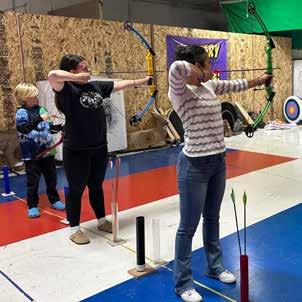
in wildlife led them to pursue degrees in conservation and biology. Afterward, students will rotate through a variety of hands-on learning stations—an experience that turns curiosity into inspiration before they return to school for the day.
Then comes the main event: Saturday, January 24th, when the YWCE opens to the public, free of charge. Families are invited to spend the day exploring dozens of interactive stations and trying out activities designed to ignite a love for wildlife and the outdoors. Kids can enter free raffles throughout the day for a chance to win outdoor gear like tents, sleeping bags, bows, BB guns, and field guides.
The YWCE was first envisioned by Larry and Brenda Potterfield of the MidwayUSA Foundation, who wanted to help conservation organizations connect youth with wildlife, conservation, and the shooting sports. Their investment sparked an idea that has since grown into one of the premier youth conservation events that our
within a convention.”
Last year’s event featured 45 different interactive stations, ranging from rock climbing walls, duck calling, a kayaking pool, archery, shooting ranges, and so much more. This year, the YWCE will once again run for three exciting days alongside the Sheep Show®.
Thursday and Friday are reserved for school groups, offering a unique educational experience that brings classroom lessons to life. Students will hear from keynote speakers on topics such as wild sheep conservation, the North American Model of Wildlife Conservation, and even current college students who share how their early interest
For older youth (ages 12–17), the Tracks Program offers an exciting twist. Participants pick up a “Tracks Program” punch card and follow sheep track stickers on the floor through the exhibit hall, visiting participating vendors who share knowledge relevant to their age group. Once completed, the punch card doubles as a raffle ticket for high-end prizes from generous sponsors such as Leica.
So, whether you’re traveling to Reno for the Sheep Show® or you’re a local family looking for an unforgettable day of wildlife learning and outdoor adventure, make plans to attend the Youth Wildlife Conservation Experience on Saturday, January 24th, from 10:00 a.m. to 4:00 p.m.
Come be part of a legacy that’s inspiring the next generation of conservationists—one wild experience at a time. WS

by Janet Holcomb

Cheers erupted across the room and many eyes welled with tears the morning of the 2024 Sheep Show® Life Member Breakfast. It was the drawing for the La Palmosa desert bighorn hunt. The first two names were followed by the familiar refrain, “sucks to be you,” the would-be recipients not in attendance. Now holding the third slip of paper, WSF President & CEO Gray Thornton said from the stage, “Well, I know this guy, and I know he’s here. He’s a good friend of Jim Craig”. He then read the name, Reg Collingwood.
Reg’s hat sailed through the
air as he bounded for the stage. For four decades, this legend of the sheep community guided successful Stone’s sheep hunts by the hundreds through the mountains and plateaus of the Spatsizi Wilderness of northern British Columbia. Dispatching only some cripples over the years, Reg refused to harvest a ram for himself. Even when drawn for a BC tag, his unwavering love of the species won out—he chose to pick up a skull from a wolf kill, tag it with his tag, rather than pulling the trigger.
The tears in the room that January morning were joyous, because Reg
would finally be going on his first sheep hunt—and because many knew he was battling cancer.
As Reg recalled, “I was ecstatic! I had traveled to Sheep Show® during my cancer treatment, and now, in this moment, I truly had something to look forward to. When I met Gray on the stage and exchanged a manly hug, I could not have been happier.” A plan emerged when it was confirmed La Palmosa could accommodate a second sheep hunter at the same time. Reg would be accompanied by his partner Anita Fleischlin, longtime friends Jim and Leann Craig, fellow
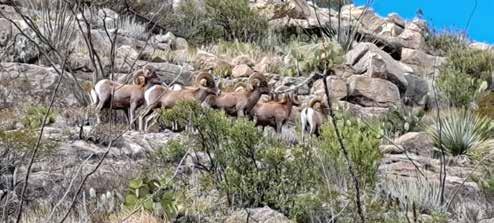
hunter Janet Holcomb, and her husband Eric.
Twelve months later, and well on the road to restored health, Reg and the group journeyed south with excitement, thrilled to be sharing this experience together. Arriving in Monterrey, they were warmly welcomed by Emilio Rangel, Sr., setting the stage for a week of unparalleled hospitality. La Palmosa is not your everyday hunting camp. The accommodations are luxurious, and the cuisine is spectacular. Meticulously detailed, the lodge and casita-style cabins carve out an oasis which blends beautifully with the rugged desert terrain. Curated antiques and artwork reflect the storied soul of this special place.
But this is sheep hunting, “No easy hikes here”, noted Reg.
The challenge of the mountain terrain proved the equalizer, and contrasted starkly with the luxury accommodations. As the two hunting parties ascended the mountain on the first morning, they
quickly discovered they were quite literally facing an uphill battle. Led by their guides, they would grind their way through the unwelcoming Chihauhaun desert landscape of Coahuila, where the parched earth is studded with loose, jagged rock, and punctuated with something Reg was most certainly not accustomed to: cactus. In absolute abundance, every variety of needled plant is eagerly determined to assault the passerby, gouging any skin, clothing, or gear within reach. Adding another level of disparity and contrast to this land hell-bent on pointed attack, is the stunning beauty of this place.
A vision for restoring the natural species in abundance, prompted decades of Emilio Rangels’ efforts. The result is impressive numbers of sheep, including sightings of many of the youngest animals as it was lambing season. Herds of mule deer and elk, groups of whitetail and pronghorn also inhabit the mesas.
Day one of hunting brought
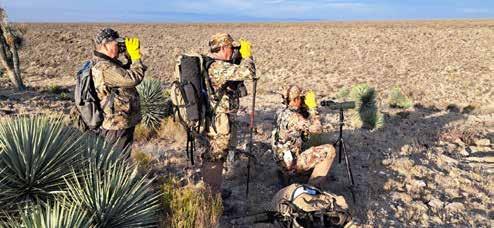
a stalk cut short on a ram Reg decided to pass up, while day two provided large numbers of lambs and ewes, but not the mature curled horns he was looking for. On day three, his luck would change. Scouting as they climbed a ridge, the keen eyes of the guides spotted a lone ram bedded in the shadows below the rotating sun.
Too old to maintain his status as a member of a herd, he now faced a life of solitude, and the perils befalling this solo existence. Lacking safety in numbers and many sets of eyes, these solo matured males become easier prey. Several sun-bleached skulls back at the lodge reveal the scars and fate of these majestic desert bighorn rams who become a meal for mountain lion.
A tough stalk brought the group into range. Reg crawled the final distance to a rest, alongside Emilio Rangel Jr., and with his rifle angled
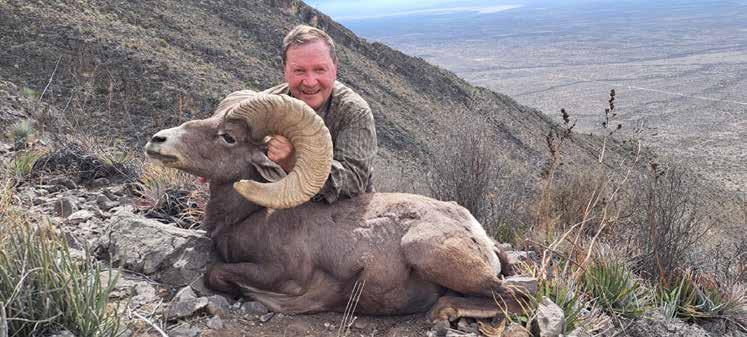
sharply downward, his scope revealed the old ram 270 yards below. Facing toward their perch, the bedded 12-year-old Mexicana bighorn was positioned overlooking a steep ravine, with eyes cast downward and head turned slightly away. Steadying his nerves, he found his hold at the base of the animal’s neck. “OK, Reg. Don’t screw this up”, he thought to himself. BOOM, the rifle rang out. Indisputably the world’s most experienced first-time sheep hunter, Reg had pulled the trigger, and the ram’s head immediately dropped. “Good shot. He’s done”, confirmed Emilio.
Tears welling in his eyes, Reg thought back to the Life Member breakfast where this journey began. A round of hugs, hand shakes, and congratulations cemented the moment, and what this hunt had meant over the previous year. It was a shining goal to work toward, and a finish line to cross during the darkness and uncertainty of cancer treatment. It was also a tremendous milestone in a legendary career devoted to putting and keeping sheep on the mountains of North America. Reg hugged Anita, and said, “Now we have some work to do”.
The remainder of the week at La
Palmosa was filled with friendship, relaxation, evening glassing across the ranch, and marvelous food and hospitality. I also harvested a beautiful ram following a rather grueling six-and-a-half-hour stalk, and Jim Craig enthralled everyone with tales of hunting adventures. Reg recounted wilderness stories of his own, and provided laughter
with his trademark wit.
Tremendous gratitude and thanks are extended to the Rangel and La Palmosa family for their years of generosity and unwavering commitment, and to the Wild Sheep Foundation for making this dream a reality.
Reg Collingwood can finally call himself a sheep hunter. WS
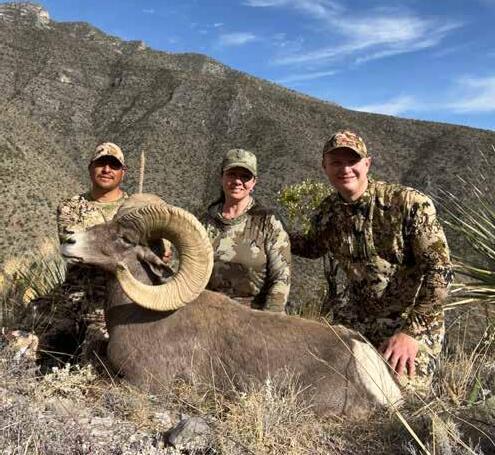

SATURDAY GRAND FINALE BANQUET LIVE AUCTION
by Waylon Vipond
We first saw Houdini the day before opener—a Stone’s ram so massive his horns looked like they were the size of car tires. In nearly two decades of sheep hunting together, Chase and I had never seen anything like him.
July 27, the day after my oldest daughter’s birthday, we headed north with the truck bed loaded and our minds set on the 2025 Stone’s sheep season. The drive was a familiar ritual: coffee too hot to drink, talk of old hunts, the silent hope that this year would bring something special.
By July 30, we’d reached our camp spot—a high knob tucked into the timber with a commanding view of the hills. From here, we could watch miles of country without giving away our position. That first night, we glassed hard, turning up only one young three- or four-year-old ram. Still, we went to bed with high hopes for our own version of Christmas Eve—sheep opener.
Morning broke, and we glassed every inch of our range. Nothing. Early afternoon, a lone figure appeared on the skyline, walking openly for an incredible distance.
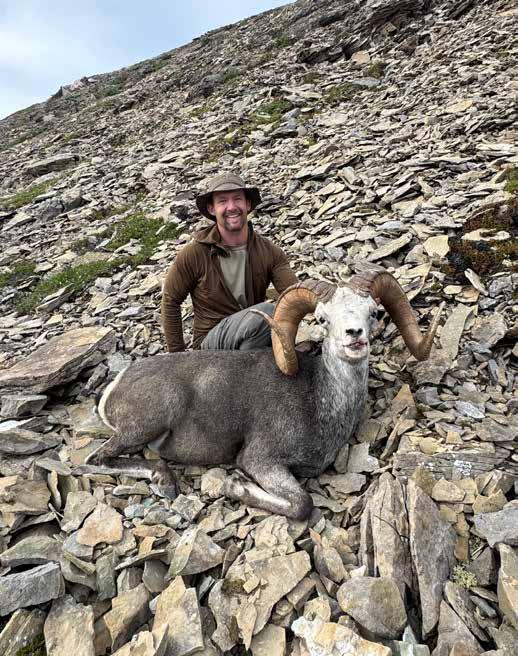
Chase and I stared at each other: What the flip is he doing?
Minutes after the stranger dropped off the ridge, three rams appeared, moving out but not in full panic. Among them was the biggest ram we’d ever laid eyes on —thick horns sweeping low and deep. Our target. Houdini.
The stranger had unknowingly pushed him, but we marked the direction and prayed he wouldn’t leave the country. That night, I lay awake replaying every second, picturing those massive horns over and over.
We were up at 4 a.m. on opener. The sheep weren’t in their previous spot, so we decided to keep glassing until 10 a.m., then move during the quiet part of the day.
By early afternoon, the land paid
us back. At two miles out, I spotted two ewes, a lamb, two young rams —and Houdini himself. We set up to watch. When he finally bedded, it looked like he was there for the long haul. Time to move.
The stalk would be brutal: down the mountain, through a tangle of buckbrush and prickly undergrowth, then clawing up the far side into position. Four hours of sweat, bruises, and constant windchecking. Every step could undo everything.
The last ridge was the worst— steep, loose, and silent as a church. I crept around the mountain’s shoulder, knowing one wrong move would send him vanishing for good.
At 110 yards, I glassed him again. Eight years old—legal and then some. My heart pounded in my ears.
Breath steady. Crosshairs settled. The shot broke clean.
When I walked up, Houdini somehow looked bigger than through the glass. No ground shrinkage here—he had grown in my mind and grown again in my hands. The weight of the hunt hit me all at once, and I let the emotion go.
Chase and I hugged like brothers. Two decades of sheep hunting together lucky enough to harvest over a dozen respectable rams together, and we both knew this was the hardest, most satisfying one yet.
Houdini had lived up to his name the outfitters gave him—always just barely slipping away, right until the end—but this time, the escape artist didn’t get away. WS



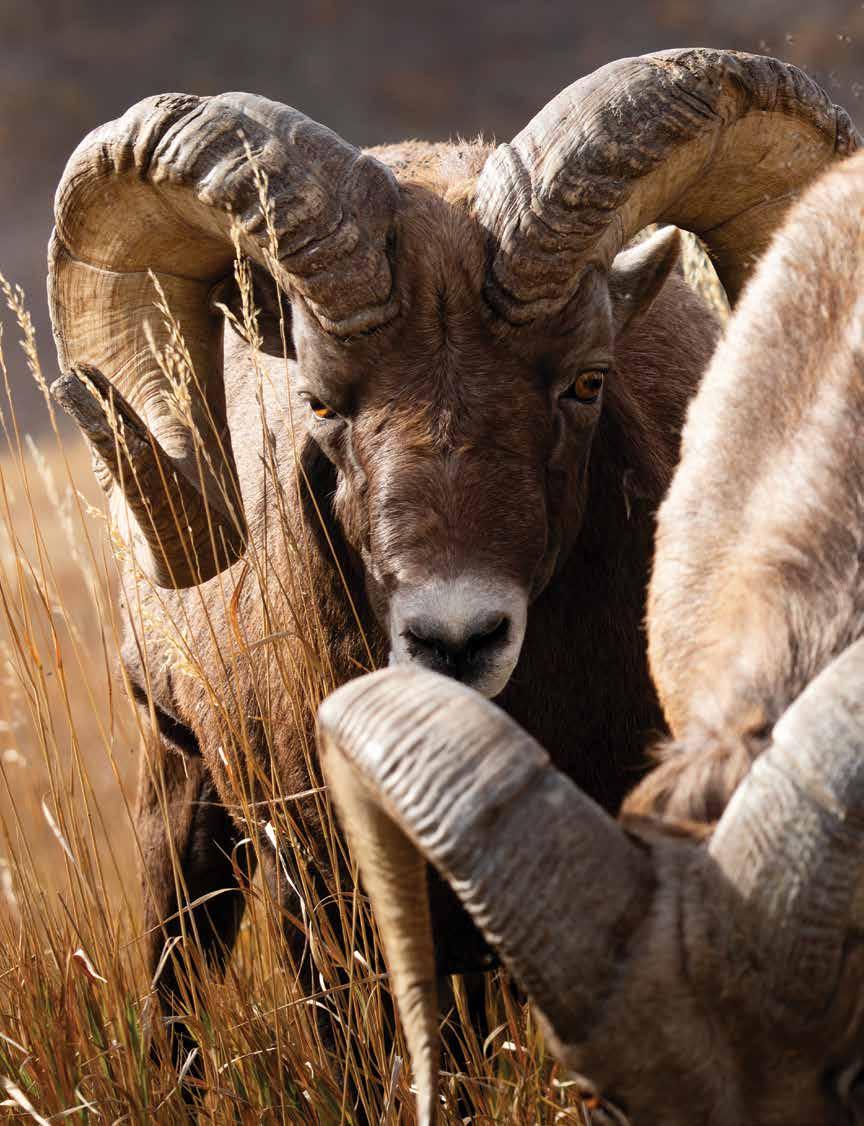
SPONSORS ARE CURRENT AS OF PRESS TIME
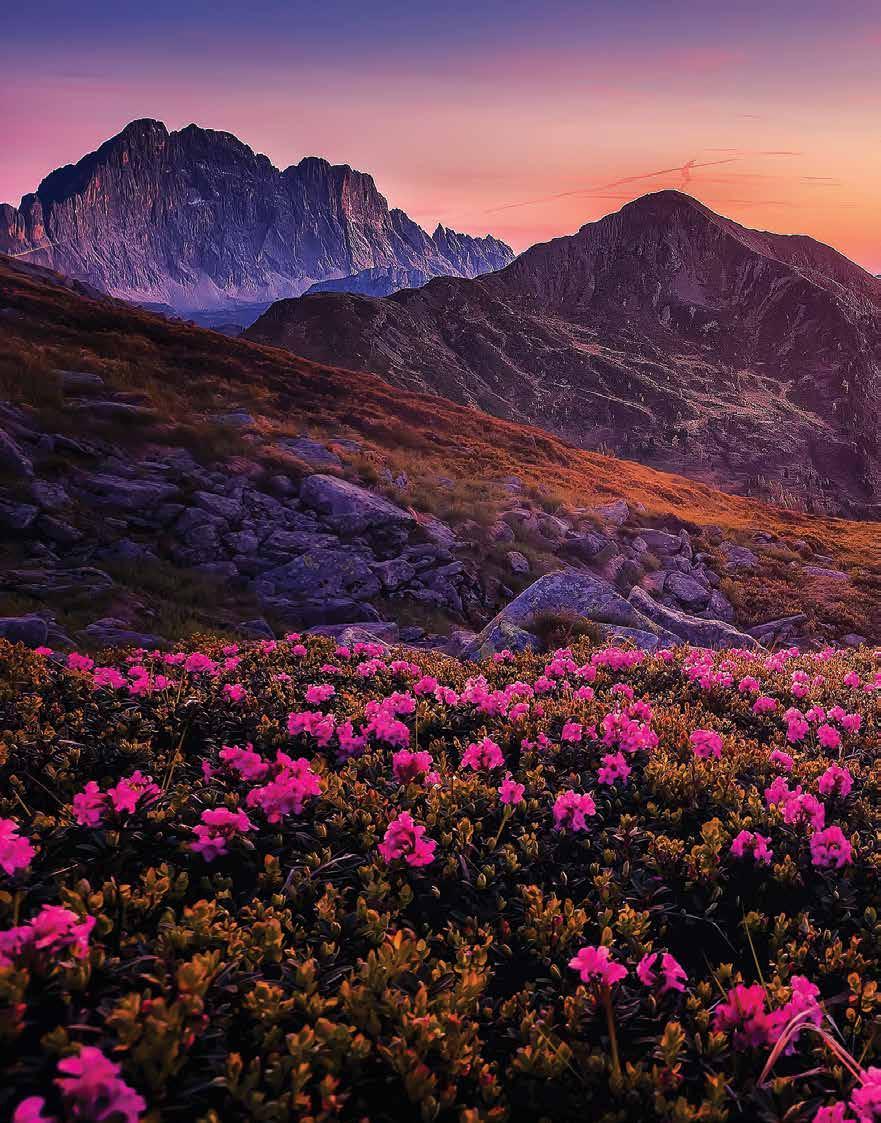
WSF SALUTES OUR 2026 CONVENTION
WE ENCOURAGE YOU TO PATRONIZE THOSE WHO SUPPORT THE WILD SHEEP FOUNDATION
PRESENTING SPONSORS

DIAMOND SPONSORS

Jean & Daniel Smith, Jr. & Cheryl & Daniel Smith, III







Kevin & Tuesdy Small
Jeff & Jann Demaske
Wayne Lennington
Doug & Shelly Sayer
GOLD SPONSORS



SILVER SPONSORS

Family Foundation

Rathert
Vlach
Mike Borel
Peter Burchfield
Jeff & Jann Demaske
Sandra Fields
Marcus Gores & Shay
Shad & April Hulse
Kevin Hurley
Larry
Kris Kohloff
Terry
Steve & Sue Skold
Kip & Sue Slaugh


Gray & Renée Thornton Jim Manley
Gray & Renée Thornton Stacey Hunt Justin & Dakota Phillips
André Van Hilten - Willow Creek Outfitters
Jessica Braunstein
3CS
Dave & Joanne Turchanski James Lines RAM AWARD BUCKLE SPONSORS
Dan
Martin & Jeanne Hendrix
Don and Dannette Perrien Jim Wilson

Sheep Show Shuttles run between Peppermill and RS-CC daily beginning Tuesday, January 20
TIMES EVENT DESCRIPTION LOCATION
TUESDAY – JANUARY 20
8:00 am – 5:00 pm Exhibitor Registration Open RS-CC
1:00 pm – 5:00 pm WAFWA Wild Sheep Initiative Meeting RS-CC – Room A8
WEDNESDAY – JANUARY 21
8:00 am – 5:00 pm Exhibitor & Attendee Registration Open RS-CC
8:00 am – 7:00 pm Exhibitor Move-In RS-CC
8:00 am – Noon WAFWA Wild Sheep Initiative Meeting RS-CC – Room A8
1:00 pm – 4:30 pm Wildlife Professionals Meeting RS-CC – Room A8
5:00 pm – 6:00 pm Pint Hour – Complimentary Beer Reception | Sponsored by: Stone Glacier
6:00 pm – 7:00 pm Hosted Bar | Sponsored by: Peppermill Hotel, Resort, & Casino
Tuscany Foyer
Tuscany Ballroom
6:00 pm – 9:30 pm Grand Opening Banquet & Auction Tuscany Ballroom Sponsored by: 1 Shot Gear, Boone and Crockett Club, Global Rescue, and Stone Glacier Award Presentations: WSF Exhibitor & Donor Recognition, Gordon Eastman’s Grass Roots Award, Wild Sheep Biologist’s Wall of Fame Award, Tommy Caruthers Outstanding Chapter & Affiliate Award
9:30 pm – 11:00 pm Sheep Camp Hospitality
THURSDAY – JANUARY 22
8:00 am – 5:00 pm Exhibitor & Attendee Registration Open
Tuscany Ballroom
RS-CC
8:00 am – 9:30 am Exhibitor Welcome Breakfast RS-CC - Mt. Rose Ballroom
9:00 am – 3:00 pm Youth Wildlife Conservation Experience | Sponsored by: MidwayUSA Foundation RS-CC – F1-10 & Hall 4
10:00 am – 5:00 pm Exhibit Halls Open
RS-CC Silent Online Auctions Open | Sponsored by: Wyoming WSF
10:00 am – 4:00 pm Book Signings | Dream Rams of the North – Bill Pastorek AND Tracks on a Mountain – Jim Manley
RS-CC
RS-CC Hall 3 - WSF
10:30 am – XX pm Full Curl Cinema & Seminars RS-CC – Room A1
10:30 am – XX pm Camp Chef Culinary Corner with Chefs Joshua Schwencke & Joe Bonavita Hall 3
10:30 am – 10:45 am RSCVA Press Conference – Show Opening Hall 1 Entrance
12:00 pm - 2:00 pm Ram/FNAWS/Mountain Monarchs Awards Lunch
RS-CC - Mt. Rose Ballroom Sponsored by: Boone and Crockett Club, Terminus Mountain Outfitters, Wild Hunting in Turkey & Asia, Pope and Young Club, Safari Club International, Safaris International Macedonia, Guide and Outfitters Association of British Columbia, Super Patrons, 1 Shot Gear and Montana Knife Company
2:00 pm – 3:00 pm Women Hunt® Outdoors Unscripted
RS-CC – Booth #1705 Take Your Kids Hunting – Julie Chapman & Maddie Richards
2:00 pm – 3:15 pm Idaho-Oregon-Nevada (ION) Partnership Meeting
3:30 pm 5x $1,000 Floor Credit Drawings – Need not be present to win
RS-CC – Room A9
RS-CC - Raffle Area Sponsored by: New Mexico WSF, Northern Nevada SCI, Utah WSF, & WSF Alberta
4:30 pm – 6:00 pm Today, Tomorrow, & Forever for Wild Sheep & Past President’s/Chairman’s Reception Peppermill EDGE Nightclub Full Curl Brands Tasting | Tasting Sponsored by: Full Curl Brands By Invitation Only
5:00 pm – 6:00 pm Beer & Bubbly - Complimentary Reception | Sponsored by: New Mexico WSF
Tuscany Foyer Hosted by: Women Hunt®, Women in Hunting®, and Rubye MayflowerBlake Legacy Fund™
6:00 pm – 10:00 pm Conservation Night – Banquet & Auction
Sponsored by: Alaska WSF, SITKA Gear Southeastern Chapter WSF, Vortex, & YETI Award Presentations: Outstanding Achievement Award, Outstanding Conservationist Award. Jack O’Connor Writers Award, Townsend Youth Conservation Award
10:00 pm – 2:00 am Sheep Camp Hospitality
FRIDAY – JANUARY 23
Tuscany Ballroom
Tuscany Foyer Horse Packing Competition | Sponsored by: Midnight Sun Outfitters, Sherwood Outfitters & Custom Pack Rigging
8:00 am – 10:00 am Exhibitor Breakfast RS-CC – Hall 2
8:00 am – Noon TOUGH SHEEP Hunt Giveaway Workout | Sponsored by: MTN Tough & Tough Sheep Wave Sponsors RS-CC – Rooms A10-20
8:00 am – 5:00 pm Exhibitor & Attendee Registration Open RS-CC
9:00 am – 10:30 am WSF Annual Membership Meeting RS-CC – Room A1
9:00 am – 3:00 pm Beretta Clay Shoot Capitol City Gun Club
Sponsored by: Beretta USA (Title Sponsor), Lumos & Associates, Nevada Bighorns Unlimited, Northern Nevada SCI, & Fiocchi
9:00 am – 3:00 pm Youth Wildlife Conservation Experience | Sponsored by: MidwayUSA Foundation RS-CC – F1-10 & Hall 4
9:00 am – 10:30 am WSF Annual Membership Meeting
RS-CC – Room A1
JAN . 22 - 24 RENO, NV ‘26
10:00 am – 5:00 pm
10:00 am – 4:00 pm
10:30 am – XX pm
10:30 am – XX pm
11:30 am – 1:00 pm
10:30 am – 1:00 pm
2:00 pm – 3:00 pm
3:30 pm
EVENT
Exhibit Halls Open
Silent Online Auction Open | Sponsored by: Wyoming WSF
Book Signings | Dream Rams of the North – Bill Pastorek AND Tracks on a Mountain – Jim Manley
Full Curl Cinema & Seminars
Scan for the most current schedule.
LOCATION
RS-CC
RS-CC
RS-CC – Room A1
Camp Chef Culinary Corner with Chefs Joshua Schwencke & Joe Bonavita Hall 3
WSLF Board of Trustees Meeting
Ladies Brunch | Sponsored By: Bass Pro Shops/Cabela’s & Super Patrons
Women Hunt® Outdoors Unscripted
Expedition: Africa – Donna Boddington, Sylvia Greff, & Danene van der Westhuyzen
2x $2,500 Floor Credit Drawings. Need not be present to win
Sponsored by: Fraternity of the Desert Bighorn & Texas Bighorn Society
4:00 pm – 6:00 pm <1 Club & <1 iClub Reception & Drawings
5:00 pm Hunt Drawings Begin
Sponsored by: Bridger Watch, Jeff & Jann Demaske, Wayne Lennighton, Kevin & Tuesdy Small, Blue Moon Brewing Company, New West Distributors, Leupold, Montana Knife Company, Wyoming WSF, & Super Patrons
6:00 pm – 10:00 pm Legacy Night – Banquet, Conklin Award & Auction
RS-CC – Room A9
Theme: “Artemis” Tuscany Ballroom
RS-CC – Booth #1705
RS-CC - Raffle Area
RS-CC – Mt. Rose Ballroom
Tuscany Ballroom
Sponsored by: Alaska Outfitters Unlimited, Azyre, Bergara, Montana WSF, Midway USA, Rohrer Bear Camp, & Wild Sheep Society of British Columbia Award Presentations: State/Provincial Statesman Award, Federal Statesman Award, WSF Awards of Excellence, Conklin Award Presentation, Chair’s Award Drawings: (Immediately prior to Auction) Full Registration (by January 1st) Ultimate Gear Package
10:00 pm – 1:00 am Sheep Camp Hospitality
Entertainment: Backpack Races | Sponsored & Hosted by: Stone Glacier Outer Circle Club Initiation
SATURDAY – JANUARY 24
7:00 am – 9:00 am Exhibitor Breakfast
7:30 am – 10:00 am Life Member Breakfast & La Palmosa Desert Bighorn Drawing
8:00 am
Program Begins | Sponsored by: Super Patrons & Life Member Patrons
Keynote Address: Nick Hoffman
8:00 am – 11:00 am TOUGH SHEEP Pro Division
8:00 am – 5:00 pm Exhibitor & Attendee Registration Open
8:00 am – 5:00 pm
9:00 am – 5:00 pm
9:00 am – 2:30 pm
Nevada Hunter Safety Course
Exhibit Halls Open
Silent Online Auction Open | Sponsored by: Wyoming WSF
10:00 am – XX pm Full Curl Cinema & Seminars
Tuscany Foyer
Tuscany Foyer
RS-CC Hall 2
Tuscany Ballroom
RS-CC – Rooms A10-20
RS-CC
RS-CC – Room A4
RS-CC
RS-CC
RS-CC – Room A1
10:00 am – XX pm Camp Chef Culinary Corner with Chefs Joshua Schwencke & Joe Bonavita Hall 3
10:00 am – 4:00 pm
10:00 am – 4:00 pm
1:00 pm – 2:00 pm
Youth Wildlife Conservation Experience | Sponsored by: MidwayUSA Foundation
Book Signings | Dream Rams of the North – Bill Pastorek AND Tracks on a Mountain – Jim Manley
Women Hunt® Outdoors Unscripted
Trailblazing Women – Madie Demaske & Jen Loree
2:30 pm Silent Online Auction Closes
2:30 pm
3:00 pm
4:30 pm – 6:00 pm
$5,000 Floor Credit Drawing | Sponsored by: Rocky Mountain Bighorn Society
Raffles Close - Drawings Held
Marco Polo & Mountain Royalty, Legends & Pinnacle Societies
RS-CC – F1-10 & Hall 4
RS-CC Hall 3 - WSF
RS-CC – Booth #1705
RS-CC
RS-CC - Raffle Area
RS-CC - Raffle Area
Peppermill EDGE Nightclub
Reception & Full Curl Spirits Tasting | Tasting Sponsored by: Full Curl Brands By Invitation Only
5:00 pm – 10:00 pm Exhibitor Move Out
6:00 pm Cocktails Tuscany Ballroom
7:00 pm – 11:00 pm Grand Finale Banquet & Auction
Sponsored by: Freelance Outdoor Adventures, Leica Sport Optics, Montana Knife Company, Shikar Safaris, Silencer Central, & Weatherby Award Presentations: Annuli Photo Contest People’s Choice Award, G.C.F. Dalziel Outstanding Guide Award, Frank Golata Outstanding Outfitter Award, Artemis Outstanding Woman Conservationist Award, Chris Klineburger Mountain Hunter Hall of Fame Award Drawings: (Immediately prior to Auction) Sheep Show 50/50 Drawing 1 More For 4 Drawing
11:00 pm – 2:00 am Sheep Camp Hospitality Tuscany Foyer & Circle Bar
SUNDAY – JANUARY 25
8:00 am – 12:00 pm Exhibitor Move Out
Make Plans for the 50th Anniversary of Wild Sheep Foundation’s Sheep Show® Convention! February 5-9, 2027 in Reno, Nevada
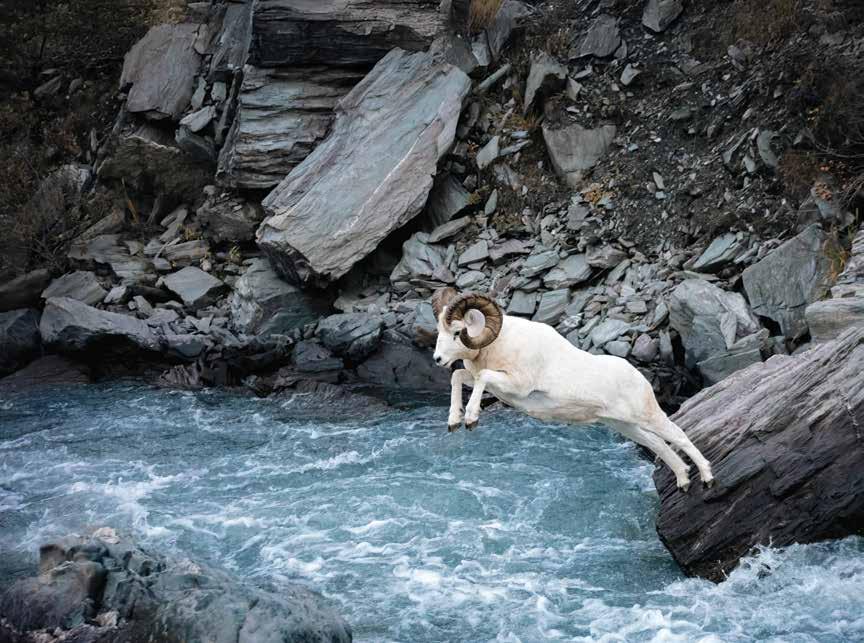

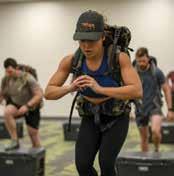
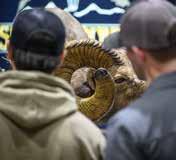
•Expo Hall, over 70,000 sq. ft. of wall-to-wall exhibitors featuring the finest guides and outfitters from North America and wherever mountain game hunting is found, plus the best in gear for all outdoor adventures, artwork, gift items, and more.
•$15,000 in Floor Credit drawings for all attendees
•Sheep Show® Mega Raffle
•Entertaining and inspiring nightly receptions, socials, banquets & auctions
•<1Club & <1iClub hunt giveaways and beer reception
•RAM Awards and Ladies Luncheons
•Life Member Breakfast and sheep hunt giveaway
•Horse Packing Competition & Backpack Races
•Free Seminars from industry experts and the latest films
•Sheep Show Sporting Clays shoot
•TOUGHSHEEP workout and sheep hunt drawing
•Youth Wildlife Conservation Experience
•More ways to win a sheep hunt than anywhere on the planet!

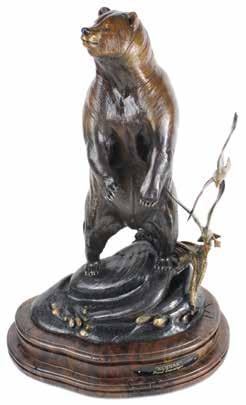
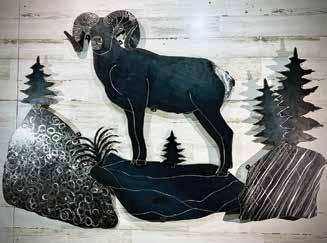

A1
ONE OF A KIND LOST WAX ORIGINAL BRONZE OF THE BUYER’S CHOICE (100% FULLY DONATED)
JUSTIN YOUNG FINE ARTS
Justin Young
P: 719.688.9110
E: jyoungfineart@hotmail.com W: www.justiniyoung.com
A2
“KODIAK” BROWN BEAR WILDLIFE BRONZE ARTIST
Frank Entsminger
P: 907.883.2833
E: bronzeart@aptalaska.net
W: www.frankentsminger.com
A3
“A LEAGUE OF EXTRAORDINARY GENTLEMEN” DALL’S SHEEP BRONZE KARL LANSING STUDIO - WILDERNESS IMAGES
Karl & Louise Lansing
P: 250.428.8614
E: klansing@shaw.ca
W: www.karllansing.com
A4
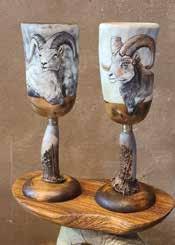
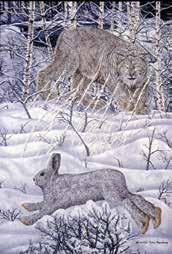
METAL MOUNTAIN (100% FULLY DONATED) MONTANA PLAQUES
Peter Ryman P: 605.380.5659
E: psryman@gmail.com
W: www.montanaplaques.com
A5
TWO HORN GOBLETS - ORIGINAL ART ANTLERED MUGWORKS
Todd Strupp P: 715.642.3937
E: toddstrupp@gmail.com
W: www.antleredmugworks.com
A6
FNAWS HORN HIGHBALL MUGS - ORIGINAL ART ANTLERED MUGWORKS
Todd Strupp
P: 715.642.3937
E: toddstrupp@gmail.com
W: www.antleredmugworks.com
A7
“HARE RAISING EXPERIENCE” WILDLIFE PAINTING THE DEVINE GALLERY
Dan Devine
P: 905.560.1653
E: dan@dandevine.net
W: www.dandevine.net
A8
20" REPLICA OF THE LIFE-SIZE EAGLE " PURSUIT" WILDLIFE BRONZE ARTIST
Frank Entsminger
P: 907.883.2833
E: bronzeart@aptalaska.net
W: www.frankentsminger.com
A9
HANDCRAFTED METAL BIGHORN SHEEP SCULPTURE WELDSWORTH, LLC
Russ Ellsworth
P: 906.360.8409
E: weldsworth@gmail.com
W: www.weldsworthdesign.com
A10
“THE WISEMAN” LIMITED EDITION 8/35 - ORIGINAL BRONZE (100% FULLY DONATED)
DEVIN ROWE’S BRONZE INC.
Devin Rowe
P: 541.979.9435
E: rowebronz@aol.com
W: www.devinrowe.com
A11
"CROWN ROYAL" RED STAG BRONZE 1/36 EDITION WILDLIFE BRONZE ARTIST
FRANK ENTSMINGER
P: 907.883.2833
E: bronzeart@aptalaska.net
W: www.frankentsminger.com
A12
“HIGH LIFE RAM” ORIGINAL DRAWING DEREK STEVENSON ART
Derek Stevenson
P: 775.287.8022
E: dereksdrawing@gmail.com
W: www.derekstevenson.art
A13
“KING OF THE NORTH” OIL ON CANVAS FRAMED PAINTING 30”X30” (100% FULLY DONATED) INGRAM & SCHANTZ WILDLIFE ART
Connor Schantz
P: 812.381.4693
E: ingramschantzart@gmail.com
Julie Chapman
A14 ORIGINAL OIL PAINTING
JOSHUA SPIES
E: spies@joshuaspies.com

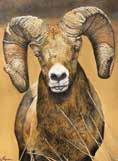



A15
"SPIRIT OF THE PLAINS” STEEL HEADDRESS SCULPTURE
THE OUTPOST GALLERY
Jennifer Loree P: 780.914.0312
E: contact@theoutpostgallery.com W: www.theoutpostgallery.com
A16
“MIST OF THE THINHORN LEGACY”ORIGINAL ART (100% FULLY DONATED)
LASHA FINE ART
Lasha Barbosa P: 780.972.1976 (Chris/Husband/Caregiver)
E: lasha.barbosa@outlook.com W: www.lashfineart.com
A17
“SEEKIN COVER” LIMITED EDITION 5/12 - ORIGINAL BRONZE (100% FULLY DONATED)
CRAIG PHILLIPS ORIGINALS
Craig Phillips
P: 406.827.3702
W: www.phillipsbronze.com
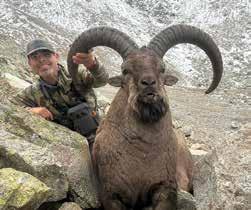
3 - DAY SINDH IBEX (up to 39”) HUNT IN PAKISTAN FOR 1 HUNTER - (Trophy Fee up to 39” is Included -$1,000 per inch over 39) CAPRINAE SAFARIS OF TURKEY Mehmet Alkan & Riza Gozluk P: +90.532.583.9108
E: info@caprinae.com W: www.caprinae.com AS2 5- DAY MID-CAUCASIAN TUR HUNT FOR 1 HUNTER IN RUSSIA (Trophy Fee Included for 1 Mid-Caucasian Tur) PROFIHUNT LTD
Vladimir Melnikov- Dennis Shadow P: 007.926.375.6346 E: hunt@profihunt.com W: www.profihunt.com
8-DAY MARAL STAG OR IBEX HUNT IN KAZAKHSTAN
(Hunter's choice, trophy fee for Maral stag or ibex is included) (100% FULLY DONATED) SAFARI OUTFITTERS
Fernando San Pio
P: 34.69.154.3538
E: fernando@safariout.com
W: www.safari1.com THE CONKLIN FOUNDATION
Dr. Bradford Black
P: 330.802.2711
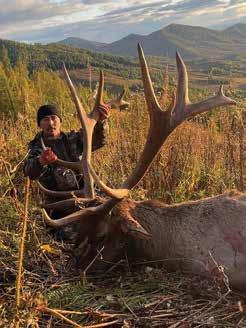
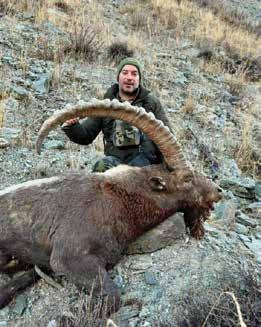
B1
5-DAY/5-NIGHT RIO GRANDE WILD TURKEY HUNT FOR 2 HUNTERS & 4 NON-HUNTERS (CROSSBOW/BOW HUNT ONLY) (Trophy fees for 2 turkeys are included)
PUERTA LAS HAYAS RANCH
Luis H Salinas
P: 844.419.2832
E: info@puertalashayas.com
W: www.puertalashayas.com
B2
3-DAY WATERFOWL HUNT & 2-DAY WINE TASTING FOR 2 IN NEW ZEALAND BLACKSTONE OUTFITTERS NZ
Corry & Sarah Walker
P: 64.27.488.6601
E: info@blackstoneoutfitters.nz W: www.blackstoneoutfitters.nz
B3
3-DAY WATERFOWL & SAND HILL CRANE HUNT IN ALBERTA CANADA FOR 1 HUNTER (100% FULLY DONATED) AMERI-CANA EXPEDITIONS INC.
Nick & Dan Frederick
P: 780.469.0579
E: ameri.cana@shaw.ca W: www.ameri-cana.com
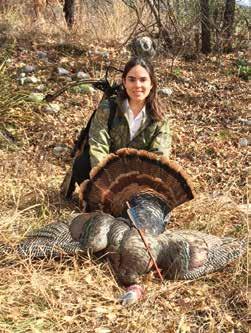
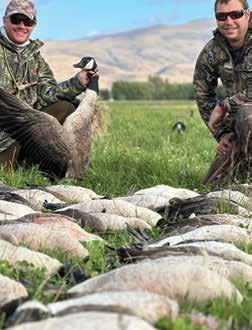
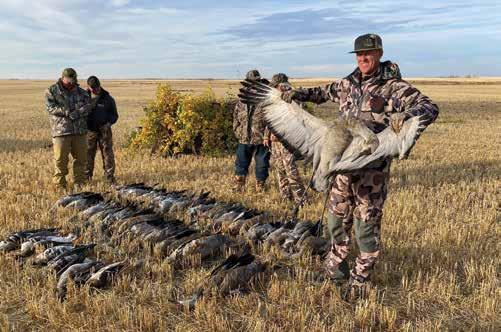
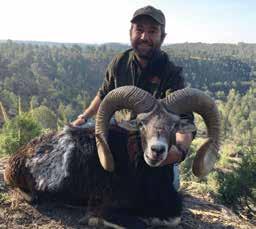

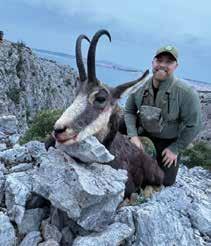
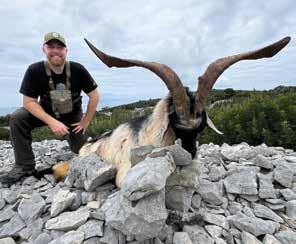
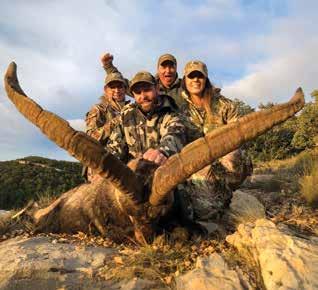
E1
3- DAY IBERIAN MOUFLON HUNT FOR 1 HUNTER
FERNANDO SAIZ - SPAIN
(Trophy fee for 1 Iberian mouflon included)
Juan Mitjans & Beltran Cotoner
P: 34.629017589
E: info@fernandosaizspain.com W: www.fernandosaizspain.com
E2
4-DAY SOUTHEASTERN IBEX HUNT FOR 1 HUNTER (Includes trophy fee for 1 Southeastern ibex up to 63 SCI) (100% FULLY DONATED)
SMC SPAIN HUNTING IBEX
Salva Monforte
P: +34.670.765.336
E: info@spainhuntingibex.com W: www.spainhuntingibex.com
E3
3 - DAY FREE-RANGE BALKAN CHAMOIS OR EUROPEAN GRAY WOLF HUNT IN MACEDONA FOR 1 HUNTER
(Trophy fee for Balkan chamois or European gray wolf included, hunters’ choice)
THE HUNTING CONSORTIUM LTD.
Robert Kern
P: 540.955.0090
E: hunt@huntcon.com
W: www.huntingconsortium.com
E4
5-DAY ALPINE CHAMOIS, BALKAN CHAMOIS & HYBRID KRI-KRI IBEX HUNT FOR 1 HUNTER (Trophy fees included for 1 bronze Alpine chamois, bronze Balkan chamois, and Kri-Kri Hybrid ibex)
(100% FULLY DONATED)
IBERHUNTING SPAIN
Antonio Teruel Farrugello
P: +34 664.283.512
E: iberhunting@iberhunting.com
W: www.iberhunting.com
E5
10-DAY MULTIPLE SPECIES COMBINATION HUNT FOR 1 HUNTER AND 1 NON-HUNTER ($11,300 credit for daily rates)
CAZATUR
Eduardo de Araoz
P: 011.34.91.442.3775
E: spain@cazatur.com
W: www.cazatur.com
E6
4-DAY HUNT FOR IBERIAN RED STAG OR ROE DEER FOR 1 HUNTER (Hunter’s choice) (Trophy fees included for 1 red stag up to bronze or 1 unlimited roe deer)
ESPACAZA JOSE MALLO - SPAIN
Jose Mallo
P: 34.91.575.76.29
E: jose@espacaza.com
W: www.espacaza.com
E7
4-DAY CANTABRIAN CHAMOIS HUNT FOR 1 HUNTER CANTABRIAN MOUNTAINS OF SPAIN
IBERIAN HUNTERS
Luis Ruiz Del Olmo
P: +34.620.28.3418
E: luisruizdelolmo@outlook.es
W: [www.iberianhunters.com]www. iberianhunters.com
THE CONKLIN FOUNDATION
P: 330.802.2711
E8
4 - DAY PYRENEAN CHAMOIS OR MOUFLON HUNT FOR 2 HUNTERS AND 2 NON-HUNTERS (Hunters’ Choice)
THE IBERIAN HUNTING EXPERIENCE
Fernando Diaz
P: 972.994.6924
E: contact@theiberianhuntingexperience.com
W: www.theiberianhuntingexperience.com
E9
3-DAY BALEARIAN GOAT AND ROE DEER HUNT FOR 1 HUNTER AND 1 NON-HUNTER (Trophy for CIC gold medal balearian boc balearn goat and one roe deer) (100% FULLY DONATED)
ATP HUNT
Andres Torrico Peña
P: 0034.600.440.962
E: atp@atphunt.com
W: www.atphunt.com
E10
4-DAY MOUFLON OR FALLON DEER FOR 1 HUNTER & 1 NON-HUNTER (Trophy fee included for mouflon or fallon deer)
HUNT IN SPAIN & ALFONSO FABRES
Alfonso Fabres
P: +34.923.380001
E: info@huntinspain.com
W: www.huntinspain.com
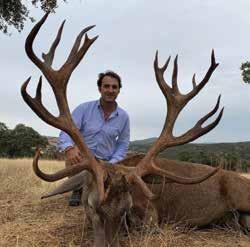
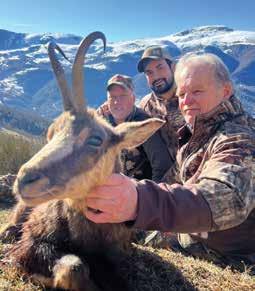

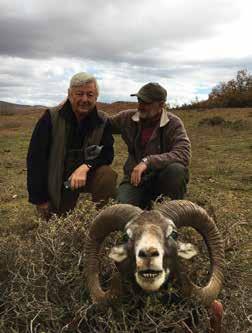
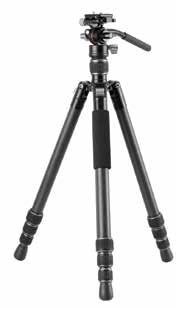

E11
3-DAY IBERIAN MOUFLON SHEEP
HUNT FOR 2 HUNTERS IN SPAIN (Trophy Fee included for 2 Iberian mouflons)
GIUSEPPE & CURRO
CARRIZOSA - SPAIN
Curro Carrizosa
P: +34.607.585.224
E: giuseppecarrizosa@gmail.com
W: www.giuseppecarrizosa.com
E12
5 - DAY HYBRID KRI KRI IBEX HUNT IN MACEDONIA! (Trophy fee for 1 Kri-Kri ibex any size and daily rates for hunter and non-hunter is included)
SAFARI INTERNATIONAL MACEDONIA
(100% FULLY DONATED)
Zlatko Sokolik
P: +389.71.346.994 or US 239.331.1611
E: safariinternacional@gmail.com W: www.interhunts.com
E13
5 - DAY EUROPEAN MOUFLON HUNT FOR 2 HUNTERS IN MACEDONIA (Trophy fee for 2 European mouflon) (100% FULLY DONATED) SAFARI INTERNATIONAL MACEDONIA
Zlatko & Toma Sokolik
P: +389.71.346.994 or US 239.331.1611
E: safariinternacional@gmail.com W: www.interhunts.com
F1
TSN-55A FLUORITE CRYSTAL SPOTTING SCOPE & TRIPOD (100% FULLY DONATED) KOWA SPORTING OPTICS
Paul Kardos
E: pjkardos@kowa.com
W: www.kowa-usa.com
F2
CUSTOM BUILT SHEEP SHOW
EDITION 7 PRC RIFLE (100% FULLY DONATE)
HIGH VOLTAGE ARMORY
Troy Sturgill
P: 541.260.1751
E: hvarmory@aol.com W: www.hvarmory.com
F3
FIOCCHI USA AMMO (100% FULLY DONATION)
FIOCCHI USA
Aaron Glass
P: 417.725.4118
E: h.hammond@fiocchiusa.com W: www.fiocchiusa.com
F4
HOWA M1500 SUPERLITE .243 WIN IN KRYPTEK ALTITUDE CERAKOTE (100% FULLY DONATED)
LEGACY SPORTS INTERNATIONAL
Chad J. Peters
P: 775.221.7363
E: cpeters@legacysports.com W: www.legacysports.com
F5
CUSTOM 6.5 PRC ULTIMATE SHEEP RIFLE - WITH A SWAROVSKI RIFLE SCOPE
ARROWHEAD RIFLES
Luke Horak
P: 319.558.8621
E: sales@arrowheadrifles.com W: www.arrowheadrifles.com
F6
BROWNING 7PRC
X-BOLT 2 SPEED SPR (100% FULLY DONATED)
BROWNING
P: 801.876.2711
E: shaundi.campbell@browning.com W: www.browning.com
F7
GUNWERKS CUSTOM CALIBUR FIREARM W/TRAINING SCHOOL (100% FULLY DONATED)
GUNWERKS
Anita Rodriguez
P: 307.290.7289
E: a.rodriguez@gunwerks.com W: www.gunwerks.com


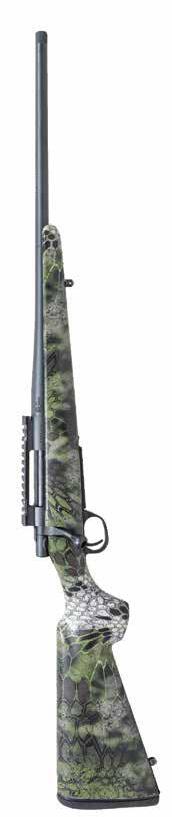








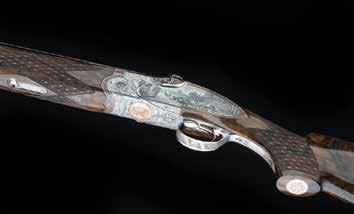
F8 A LEGACY OF EXPLORATION - A TESTAMENT TO THE WILD BERETTA GIVES YOU"MARCO POLO"
BERETTA GALLERY & PIETRO BERETTA
Travis Haglin P: 212.319.3235
E: thaglin@berettausa.com W: www.berettagalleryusa.com
F9
SIG SAUER - CROSS-MAGNUM
SAWTOOTH 7 PRC WITH TANGO -DMR RIFLESCOPE (100% FULLY DONATED)
SIG SAUER P: 603.418.8102
E: samantha.knight@sigsauer.com W: www.sigsauer.com
F10
AUTO ORDNANCE 1911 45 ACP W/CUSTOM LEATHER HOLSTER (100% FULLY DONATED)
SKULL BOUND
Jana Waller Bair P: 920.222.1136
E: wallerjana@gmails.com W: www.skullboundchronicles.com
F11
GRIFFIN & HOWE HIGHLANDER LITE RIFLE AND HUDSON FARM STAY (Buyer's choice of caliber and optifade pattern) (100% FULLY DONATED)
GRIFFIN & HOWE
Steve Polanish P: 908.581.2035
E: polanish@griffinhowe.com W: www.griffinhowe.com
F12

GRIFFIN & HOWE HIGHLANDER LITE RIFLE PACKAGE W/ SWAROVSKI SCOPE AND HUDSON FARM STAY (Buyer's choice of caliber and optifade pattern) (100% FULLY DONATED)
GRIFFIN & HOWE
Steve Polanish P: 908.581.2035
E: polanish@griffinhowe.com W: www.griffinhowe.com
F13
MARK V 80TH ANNIVERSARY COMMEMORATIVE .300 WBY WEATHERBY P: 308.675.7800
E: info@weatherby.com W: www.weatherby.com
FISH 1
3-DAY NORTHERN PIKE & WALLEYE FISHING TRIP FOR 2 ANGLERS (100% FULLY DONATED)
GREAT WHITE HOLDINGS, LTD
Jon McMahon
P: 780.818.6201
E: greatwhiteholdings.com W: www.greatwhiteholdings.com
FISH 2
3-DAY/4-NIGHT FISHING TRIP FOR 1 WHEELCHAIR BOUND ANGLER & 1 CAREGIVER CAMERON RIDGE BUNGALOWS/ SWEET SIN FISHING ADVENTURES
Chris Franke/Lawrence Dunkley
P: 780.817.4349/250.855.9178
E: info@cameronridge.com W: www.cameronridge.com
FISH 3
4-DAY FISHING TRIP IN NORTHERN YUKON 2 ANGLERS & 2 NONANGLERS (Fish include grayling, Arctic char, and lake trout)
MIDNIGHT SUN OUTFITTING
Logan & Jesse Young
P: 403.813.8589
E: midnightsunoutfitting@gmail.com
W: www.midghtsunoutfitting.com
FISH 4
2-DAY COMBINATION ALLIGATOR HUNT AND ARAPAIMA FISHING TRIP FOR 1 ANGLER (100% FULLY DONATED) BIENVENUE OUTDOORS
Camille Bienvenue
P: 941.806.8062
E: bienvenueoutdoors@outlook.com
W: www.bienvenueoutdoors.com

FUR 1
NATURAL LUNARAINE MINK LONG GILET VEST. SLEEK AND ELEGANT. SIZE M
WILLIAM FURS
Caline Asmar
P: 775.870.1180
E: williamsfurs@yahoo.com
W: www.williamfurs.com
FUR 2
FORREST GREEN SHEARED BEAVER
JACKET WITH SPOTTED RABBIT COLLAR SIZE S.
WILLIAM FURS
Caline Asmar
P: 775.870.1180
E: williamsfurs@yahoo.com
W: www.williamfurs.com
FUR 3
BLACK AND GOLD SPOTTED SHEARED MINK STROLLER REVERSIBLE TO TAFFETA RAINCOAT. PERFECT FOR TRAVELING SIZE L/XL
WILLIAM FURS
Caline Asmar
P: 775.870.1180
E: williamsfurs@yahoo.com
W: www.williamfurs.com
FUR 4
DARK BROWN LAMBSKIN LEATHER STROLLER WITH NATURAL MINK TRIM AND SHEARED MINK LINER SIZE M/L
WILLIAM FURS
Caline Asmar
P: 775.870.1180
E: williamsfurs@yahoo.com
W: www.williamfurs.com
FUR 5
TANNED COW ELK HIDE (100% FULLY DONATED)
SUMMIT LIFE MEMBER: KEVIN HURLEY
FUR 6
TANNED BUFFALO HIDE ROBE (100% FULLY DONATED)
SUMMIT LIFE MEMBER: KEVIN HURLEY
FUR 7
BC LYNX PELT
BC TRAPPERS ASSOCIATION
Stan Troyer
P: 250.263.4999
E: bcfarmer@gmail.com
W. www.bctrappers.ca
FUR 8
BC GRAY WOLF PELT
BC TRAPPERS ASSOCIATION
Stan Troyer
J1
THE PEARLS OF ORHID (100% FULLY DONATED)
SAFARI INTERNATIONAL MACEDONIA
Zlatko Sokolik
P: +389.70.219.080
E: safariinternacional@gmail.com
W: www.interhunts.com
J2
TANZANITE & DIAMOND RING
(Accompanied by a GIA Certificate & 3rd party appraisal) BRILLIANT STARS
P: 516.365.9000
E: nicole@brilliantstars.com
W: www.brilliantstars.com
THE CONKLIN FOUNDATION
Bradford Black
P: 330.802.2711
J3
“THE RAM HEAD” 14K GOLD MEN’S RING BY WYLD THE JEWELER
WYLD JEWELRY
P: 435.512.1019
E: rob@rockymountaincasting.com
W: www.wyldjewelry.com
J4
“THE RAM HEAD” 14K GOLD WOMEN’S RING BY WYLD THE JEWELER
WYLD JEWELRY
P: 435.512.1019
E: rob@rockymountaincasting.com
W: www.wyldjewelry.com
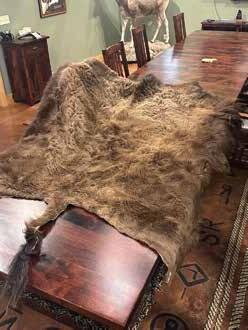

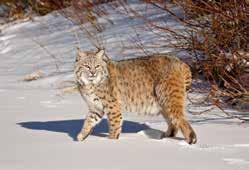
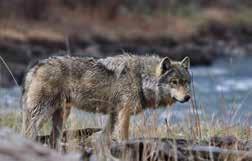



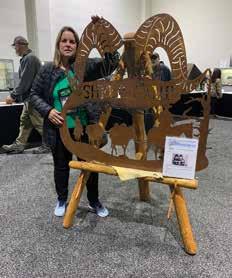


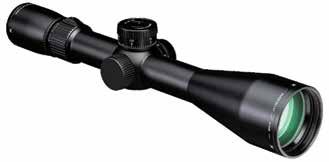
M1
FLY WAY 4X4 180X
AUTOMATIC TRAP THROWER (100% FULLY DONATED)
DO ALL OUTDOORS
Mike Winkler
P: 615.775.8298
E: mike@doalloutdoors.com
W: www.doalloutdoors.com
M2
CUSTOM FELT HAT (100% FULLY DONATED)
CHAZ MITCHELL CUSTOM HATS
P: 435.559.1917
E: chaz@chazhatz.com
W: www.chazhatz.com
M3
SHEEP CAMP - LASER CUT
WALL HANGING (100% FULLY DONATED)
SCOTT KELLY
P: 602.725.3025
E: azsheepguy@gmail.com
M4
STEEL OUTDOOR FIREPIT (100% FULLY DONATED)
SCOTT KELLY
P: 602.725.3025
E: azsheepguy@gmail.com
M5
AMERICAN FLAG FLOWN OVER "THE GULF OF AMERICA" (100% FULLY DONATED)
DOGWATCH OF MONTANA
Larry Johnson
P: 406.548.1599
E: dogwatchofmontana@gmail.com
W: www.dogwatchofmontana.com
M6
ELK & FALLOW DEER ANTLER CIGAR TABLE
TERRY WILSON ANTLER DESIGNS
Terry & Melinda Wilson
P: 214.460.4287
E: meljul70@aol.com
W: www.wilsonantlers.com

M7
VORTEX RAZOR HD LHT 3-15X42
RIFLESCOPE & VORTEX RAZOR HD 13-39X56 ANGLED SPOTTING SCOPE W/LIMITED-EDITION
SHEEP SHOW 2026 BELT BUCKLE (100% FULLY DONATED)
VORTEX
Sawyer Briel
P: 608.662.1067
E: sbriel@vortexoptics.com
W: www.vortexoptics.com
M8
CUSTOM COLOR PACK
HORSE PACKAGE
(100% FULLY DONATED)
CUSTOM PACK RIGGING LTD.
Tysen Bjorn
P: 250.256.7858
E: tysen@custompackrigging.com
M9
THE TACTICAL - T-4-16-HD CUSTOM SERIES
TACTICAL HEARING
Tim Sparks
P: 801.822.6888
E: tim@tacticalhearing.com
W: www.tacticalhearing.com
M10
WYO BACKCOUNTRY CUSTOM
REPLICA OF YOUR NA WILD SHEEP
WYO BACKCOUNTRY DECOR
Josh & Jenny Taylor
P: 307.899.4553 or 4645
E: wyobackcountrydecor@gmail.com
W: www.wyobackcountrydecor.com
M11
DALL SHEEP HORN
VASE ON A ROCK BASE
WYO BACKCOUNTRY DECOR
Josh & Jenny Taylor
P: 307.899.4553 or 4645
E: wyobackcountrydecor@gmail.com
W: www.wyobackcountrydecor.com
M12
SINGLE SHEEP HEAD
JUNIPER CHANDELIER
WYO BACKCOUNTRY DECOR
Josh & Jenny Taylor
P: 307.899.4553 or 4645
E: wyobackcountrydecor@gmail.com
W: www.wyobackcountrydecor.com
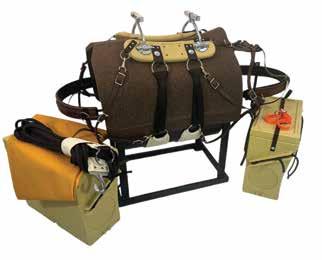
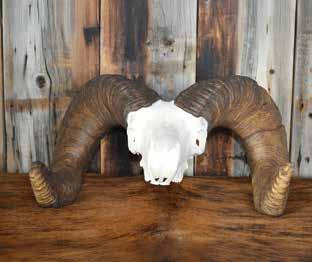
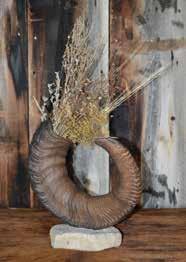

NA 1
5-DAY COLUMBIA BLACKTAIL DEER AND BLACK BEAR COMBO HUNT IN OREGON FOR 1 HUNTER
(100% FULLY DONATED)
EDEN RIDGE OUTFITTERS
John McCollum
P: 541.290.2671
E: edenridgehunts@gmail.com
W: EdenRidgeOutfitters.com
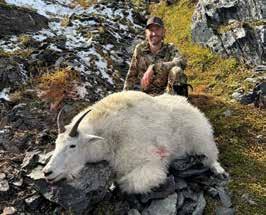
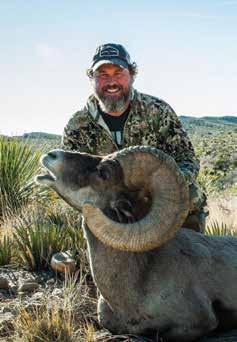
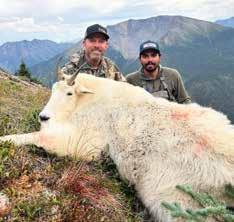
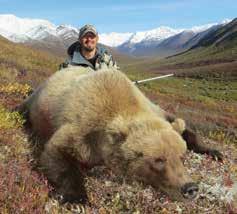
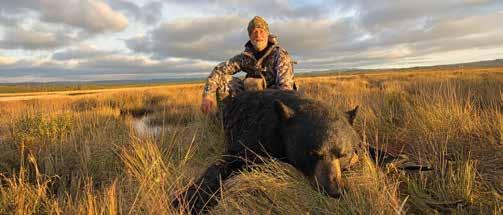
NA 2
5 - DAY COUES DEER HUNT FOR 1 HUNTER IN ARIZONA LET’ER RIP OUTFITTER & GUIDE SERVICE
Bill Babiash
P: 520.370.5457
E: badbullz@aol.com
NA 3
10-DAY CHIHUAHUA DESERT BIGHORN SHEEP HUNT RANCHO LA GUARIDA
Jose Antonio Vallina Laguera
P: 011.52.1614.427.0840
E: jav@laguaridaranch.com
W: www.laguaridaranch.com
NA 4
5-DAY TROPHY BISON HUNT FOR 1 HUNTER IN CALIFORNIA CONSERVATIVE GAME MANAGEMENT
Chase Morisoli
P: 805.610.3624
E: cmorisoli@gmail.com
W: www.huntcgm.com
NA 5
11-DAY TROPHY MOUNTAIN GOAT HUNT FOR 1 HUNTER IN REMOTE BRITISH COLUMBIA (100% FULLY DONATED) TERMINUS MOUNTAIN OUTFITTERS
Craig Kiselbach
P: 250.442.7103
E: terminusmtn@gmail.com
W: www.terminusmountain.com
NA 6
9 - DAY ALASKAN HUNT FOR 2 MOUNTAIN GOATS AND 1 SITKA BLACKTAIL DEER FOR 1 HUNTER & 1 NON-HUNTER KODIAK OUTDOOR ADVENTURES
Paul Chervenak
P: 907.486.3008
E: paul@kodiakoutdoors.com
W: www.kodiakoutdoors.com
NA 7
10-DAY SPRING GRIZZLY BEAR & WOLF HUNT FOR 1 HUNTER MIDNIGHT SUN SAFARIS
Coke Wallace
P: 907.978.0929
E: info@midnightsunsafaris.com
W: www.midnightsunsafaris.com
NA 8
5-DAY TWO BLACK BEAR HUNT FOR 1 HUNTER (100% FULLY DONATED) DEEP COUNTRY LODGE
Dean Crocker
P: 709.685.2463
E: deancrocker@exitrealtynl.com
W: www.deepcountrylodge.com
NA 9
10-DAY LA PALMOSA DESERT
SHEEP HUNT FOR 1 HUNTER AND 2 NON-HUNTERS
(100% FULLY DONATED)
LA PALMOSA - HUNTING OUTFITTER
Emilio Espino
P: +521.811.916.4668
E: info@lapalmosa.com
NA 10
10-DAY FALL MOUNTAIN
GOAT HUNT FOR 1 HUNTER KILDALA ADVENTURES, LTD.
Todagin Hodson
P: 250.877.2407
E: kildalaadventures@gmail.com
W: www.kildalaadventures.com
NA 11
5-DAY BULL ELK HUNT IN NEW MEXICO FOR 1 HUNTER AND 1 NON-HUNTER
(PROCEEDS OF THIS HUNT WILL GO TO BENEFIT THE RANCHITOS DE LOS NINOS CHILDRENS HOME IN NEW MEXICO) FOUR DAUGHTERS RANCH
Mike Mechenbier
P: 505.388.2902
E: accounting@4dcattle.com
W: www.elranchitonm.org
NA 12
10-DAY ALASKA YUKON MOOSE BACKPACK HUNT FOR 1 HUNTER NWT OUTFITTERS
NAHANNI BUTTE OUTFITTERS
Jim & Nadine Lancaster/Clay Lancaster
P: 250.847.1855
E: jladventures@xplornet.com
W: www.lancasterfamilyhunting.com
NA 13
12-DAY SPRING KODIAK ISLAND BROWN BEAR HUNT FOR 1 HUNTER ROHRER BEAR CAMP
Sam Rohrer
P: 907.486.4074
C: 907.539.1828
E: sam@kodiakbearcamp.com
W: kodiakbearcamp.com
NA 14
12-DAY STONES’ SHEEP HUNT IN NORTHERN BRITISH COLUMBIA
(100% PROCEEDS TO SUPPORT NW BC STONE’S SHEEP INITIATIVES) SPATSIZI RIVER OUTFITTERS
Mike Gilson
P: 250.847.9692
E: mike_gilson@bcsafaris.com
E: admin@spatsizi.com
W: www.spatsizi.com
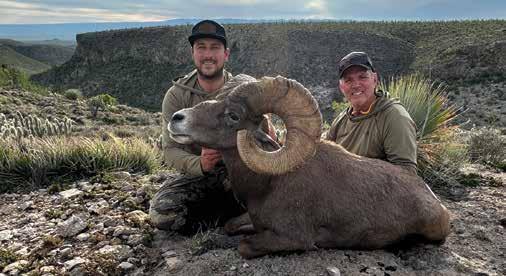
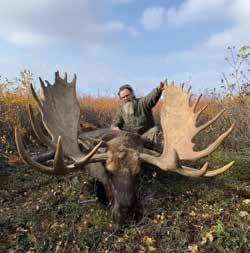
JAN . 22 - 24
Have you registered for the 2026 Sheep Show®? If not, do so today...You won’t want to miss this!
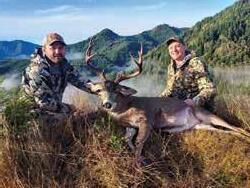
NA 16
5-DAY MULE DEER HUNT IN NEW MEXICO FOR 1 HUNTER (100% FULLY DONATED) FRONTIER OUTFITTING
GT Nunn
P: 505.350.9775
E: gtnunn@aol.com
W: www.frontieroutfitting.com
NA 17
3-DAY MEXICAN FERAL FIGHTING BULL & EXOTIC GAME HUNT FOR 1 HUNTER & 1 NON-HUNTER (100% FULLY DONATED) EL MILAGRO RANCH
Jaime Gonzalez Hinojosa
P: 52.811.243.1356
E: jaime087@gmail.com
NA 18
HELICOPTER HOG HUNT PACKAGE FOR TWO HELIBACON
Chris Britt
P: 281.802.0397
E: chris.britt@helibacon.com
W: www.helibacon.com
NA 19
5-DAY COLUMBIA BLACK TAIL
DEER & COASTAL BLACK BEAR HUNT FOR 1 HUNTER (100% FULLY DONATED) SPOON CREEK OUTFITTERS
Ken Wilson
P: 541.396.2726
E: spooncreek13@gmail.com
NA 20
5-DAY/6-NIGHT KODIAK SITKA BLACK-TAILED DEER, SEA DUCK AND FOX COMBO HUNT FOR 2 HUNTERS (100% FULLY DONATED)
MIKE ODIN’S ALASKA ADVENTURES, LLC
Mike Odin
P: 907.644.4868
E: mike@mikeodin.com
W: www.mikeodin.com
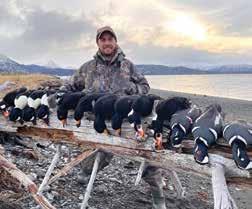
NA 21
10-DAY ALASKA-YUKON
MOOSE HUNT FOR 1 HUNTER IN NORTHWEST ALASKA FREELANCE OUDOOR ADVENTURES
Lance Kronberger
P: 907.854.2822
E: freelanceOA@mac.com
W: www.freelanceoutdooradventures.com
NA 22
NEVADA UNIT 231 PRIVATE LANDOWNER ELK TAG FOR 1 HUNTER (100% FULLY DONATED)
PEPPERMILL CASINO & GEYSER RANCH
Albert D. Seeno Jr. & Blue Mountain Ranches of Nevada LLC
P: 925.671.7711
NA 23
7-DAY LATE SEASON MOUNTAIN GOAT HUNT IN ALASKA FOR 1 HUNTER - SHEEP SHOW RAFFLE 2026 (100% FULLY DONATED)
ULTIMA THULE OUTFITTERS
Paul & Donna Claus
E: logan@ultimathulelodge.com
W: www.ultimathulelodge.com
NA 24
12 - DAY DALL’S SHEEP/WOLF/ WOLVERINE HUNT IN THE NORTHWEST TERRITORIES FOR 1 HUNTER & 1 NON-HUNTER
GANA RIVER OUTFITTERS LTD.
Harold Grinde
P: 403.357.8414
E: ganariver@pentnet.net W: www.ganariver.com
NA 25
5-DAY COUES DEER HUNT FOR 4 HUNTERS (WITH FREE MOUNTAIN LION BONUS) IN ARIZONA DIAMOND OUTFITTERS
Dan and Terri Adler
P: 520.730.8147
E: Info@DiamondOutfitters.com
W: www.DiamondOutfitters.com and www. ZeroOutfitterFees.com
NA 26
3-DAY/2-NIGHTS AMERICAN ALLIGATOR HUNT FOR 1 HUNTER AND 1 NON-HUNTER (100% FULLY DONATED)
GOD’S COUNTRY OUTFITTERS
Charles & Natalie Herrington
P: 386.972.0100
E: hunt@godscountryoutfitters.net
W: www.godscountryoutfitters.net
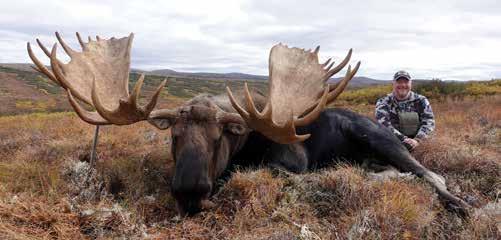
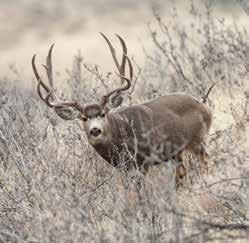
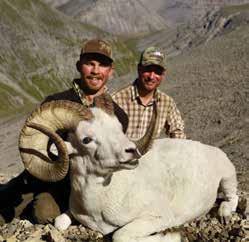

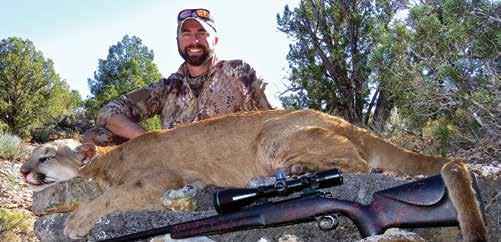
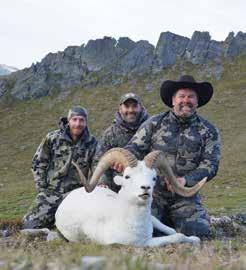
NA 27
5-DAY TROPHY WHITETAIL DEER HUNT IN KANSAS FOR 2 HUNTERSARCHERY ONLY
DIRT NAP OUTDOORS, LLC
Paul Davis
P: 870.243.9491
E: dirtnapoutdoorsllc@gmail.com
W: www.dirtmapoutdoorsllc.com
NA 28
10-DAY COASTAL BROWN BEAR HUNT FOR 1 HUNTER AND 1 NON-HUNTER
BUSHWHACK ALASKA
Kip Fulks
P: 443.442.7085
E: kip@bshwak.com
W: www.bushwhackalaska.com
NA 29
6-DAY MOUNTAIN LION HUNT IN ARIZONA FOR 1 HUNTER DIERINGER OUTFITTERS LLC
Sam Dieringer
P: 928.322.2627
E: sam@dieringeroutfitters.com
W: www.dieringeroutfitters.com
NA 30
7-DAY SITKA BLACKTAIL DEER AND SEA DUCK HUNT FOR 4 HUNTERS ON KODIAK ISLAND
DEREK BLAKE - ENCHANTRESS EXPED.
Derek Blake
P: 907.830.8528
E: akderek@gmail.com
NA 31
5-DAY ARIZONA MOUNTAIN LION HUNT WITH HOUNDS FOR 1 HUNTER
DIAMOND OUTFITTERS
Dan and Terri Adler
P: 520.730.8147
E: Info@DiamondOutfitters.com
W: www.DiamondOutfitters.com
W: www.ZeroOutfitterFees.com
NA 32
10 - DAY DALL’S SHEEP/ ARCTIC GRIZZLY/BARREN GROUND/ CARIBOU HUNT FOR 1 HUNTER IN ALASKA’S ARCTIC NATIONAL WILDLIFE REFUGE OR (HUNTER’S CHOICE) 10 DAY DALL’S SHEEP/ BROWN BEAR/BLACK BEAR IN THE LEGENDARY SOUTH WRANGELLS (WRANGELL ST. ELIAS PRESERVE) ALASKA OUTFITTERS UNLIMITED
Aaron Bloomquist
P: 907.982.2471
E: bloomya@hotmail.com
W: www.alaskaoutfittersunlimited.com
NA 33
5-DAY/4-NIGHT BLACK BEAR AND SHRIMP EXPEDITION FOR 4 HUNTERS
DEREK BLAKE - ENCHANTRESS EXPEDITIONS
Derek Blake
P: 907.830.8528
E: akderek@gmail.com
NA 34
7-DAY THERMAL PREDATOR HUNT IN ALASKA MIDNIGHT SUN SAFARIS
Coke Wallace P: 907.978.0929
E: info@midnightsunsafaris.com
W: www.midnightsunsafaris.com
NA 35
7-DAY WALRUS ARCTIC ADVENTURE HUNT FOR 1 HUNTER (Tag and license are included) CANADA NORTH OUTFITTING
Tony Mudd
P: 775.690.6300
E: Tmudd@canadanorthoutfitting.com
W: www.canadanorthoutfitting.com THE CONKLIN FOUNDATION
Bradford Black
330.802.2711
NA 36
2-DAY HUNT FOR HYBRID EUROPEAN MOUFLON/HAWAIIAN SHEEP FOR 1 HUNTER AND 1 DAY DEEP SEA FISHING FOR UP TO 3 PEOPLE (100% FULLY DONATED) MAUNA LOA OUTFITTERS
Colin Onaka - WSF Life Member
Steven Onaka P: 808.960.7373
E: MaunaLoaOutfitters@gmail.com
Capt. Mark Bartell of the Ambush P: 808.366.4808
NA 37
10-DAY ROCKY MTN GOAT, BLACK BEAR & WOLF HUNT FOR 1 HUNTER AND 1 NON-HUNTER YOHETTA OUTFITTERS
Tyler Camille
P: 250.267.5383
E: tcamille@xeni-gwetin.ca
W: yohettalodge.com

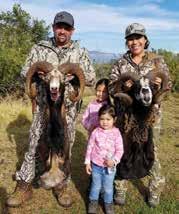
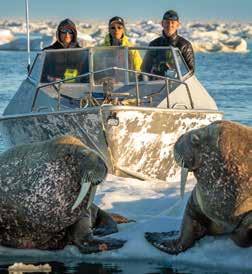
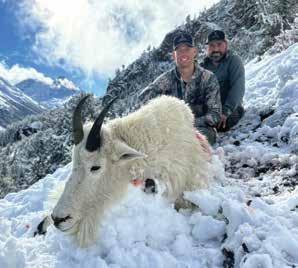



S 1
TROPHY ROOM CLEANING (100% FULLY DONATED)
HEADHUNTER TROPHY CARE LLC
Wade West P: 817.988.2312
E: trophycare@rocketmail.com
S 2
2027 WSF 50TH ANNIVERSARY VIP TABLE (ONLY 5 TABLES AVAILABLE)
S 4
WINE TASTING FOR 50 PEOPLE ANYWHERE IN THE CONTINENTAL USA AFRICAN TRADITION
Clive Botha P: 561.379.8243
E: blksem7@aol.com W: www.sabestwine.com
SA 1
5 - DAY HUNT FOR ZEBRA, IMPALA, BLESBUCK, WARTHOG, MT REEDBUCK AND KLIPSPRINGER FOR 3 HUNTERS (Trophy Fees for 6 mentioned species to be split between 3 hunters)
SUPERIOR AFRICAN HUNTING SAFARIS
Eli Van Der Walt/Jeffrey Austin P: 830.313.8724
E: rancho1024@yahoo.com W: www.superiorsafaris.com
SA 2
3-DAY BLACK WILDEBEEST AND BLESBUCK HUNT FOR 1 HUNTER IN SOUTH AFRICA (100% FULLY DONATED) CHASSEURS DE MOCAMBIQUE
Juan Pace P: +27.820.798.765
E: safari.cdm@outlook.com
W: www.mozhunters-cdm.com
SA 3
3-DAY ROOSEVELT SABLE HUNT FOR 1 HUNTER IN MOZAMBIQUE (100% FULLY DONATED) CHASSEURS DE MOCAMBIQUE
Juan Pace P: +27.820.798.765
E: safari.cdm@outlook.com W: www.mozhunters-cdm.com
SA 4
7-DAY SABLE BULL OR ROAN
ANTELOPE HUNT FOR 1 HUNTER
($3,000 credit towards trophy fee, towards sable bull or roan antelope)
IBAMBA SAFARIS
Johan & Zelda Pretorius
P: +27832261690
E: johan@ibambasafaris.com
W: www.ibambasafaris.com
SA 5
7-DAY/6-NIGHT IMPALA & ZEBRA HUNT FOR 4 HUNTERS AND 4 NON-HUNTERS
(2 impala and 2 zebra to be shared between hunters are included)
(100% FULLY DONATED)
DEKO SAFARIS
Gerhard Van Blerle
P: 27.82.855.0168
E: gerhard@dekosafaris.com
W: www.dekosafaris.com
SA 6
7-DAY/6-NIGHT IMPALA & BLESBUCK HUNT FOR 4 HUNTERS
(2 impala and 2 blesbuck to be shared between hunters are included)
(100% FULLY DONATED)
DEKO SAFARIS
Gerhard Van Blerle
P: 27.82.855.0168
E: gerhard@dekosafaris.com
W: www.dekosafaris.com
SA 7
5 - DAY/5 NIGHT EXCLUSIVE “BIG 5” PHOTO SAFARI FOR 2 PEOPLE WITH LUXURY LODGING MATTHEW GREEFF SAFARIS
Matthew & Sylvia Greeff
P: +27.83.265.2824
E: mgsafari@iafrica.com
W: www.matthewgreeffsafaris.com
SA 8
7-DAY SOUTH AFRICAN SAFARI FOR 4 HUNTERS FOR 1 WHITE RHINO DART, 1 KUDU, 1 ROAN AND 1 ELAND HUNT FOR 4 HUNTERS (Trophy fees included: 1 Rhino Management Dart (>30”, 1 roan (<27”), 1 kudu (<46”), and 1 Eland for the 4 hunters to share ) GAME TRACKERS AFRICA
ROCKWOOD CONSERVATION
Jaco and Piet Oosthuizen/ Wicus Diedericks
P: +27.832.962.523/ +270828055667
E: piet@gametrackersafrica.com
W: www.gametrackersafrica.ca.com
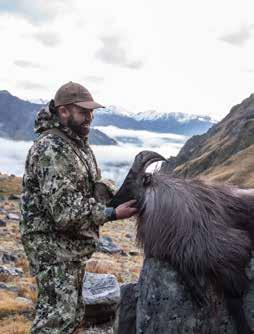
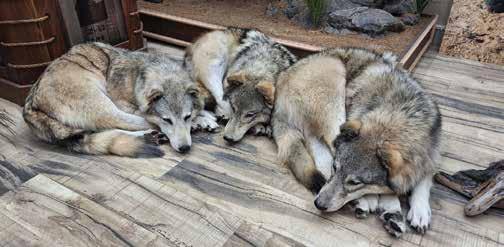

SP 1
5-DAY NEW ZEALAND RED STAG HUNT FOR 2 HUNTERS AND 2 NONHUNTERS (Trophy fee for 2 red stag scoring up to 425" SCI included) SPEY CREEK TROPHY HUNTING
Wyatt McBride
P: 830.444.2128
E: hunt@sctrophyhunting.com W: www.sctrophyhunting.com
SP 2
10-DAY HIMALAYAN BULL TAHR HUNT FOR 2 HUNTERS METANOIA VENTURES
Tomas Jacques P: 64.210.255.4411
E: tj@metanoiaventures.com W: www.metanoiaventures.com
TAX 1 SOFT MOUNTED WOLF FOUNDATION FOR WILDLIFE MANAGEMENT (F4WM) Justin Webb - Executive Director P: 208.610.4455
E: info@f4wm.org
TAX 2 LIFE-SIZE WILD SHEEP MOUNT WITH BASE ZIMMERMAN WILDLIFE
Marcus & Ken Zimmerman P: 814.793.2821
E: ken@zimmermanwildlife.net W: www.zimmermanwildlife.net TAX 2
TAX 3
LIFE-SIZE WILD SHEEP MOUNT WITH HABITAT AND BASE
DEER CREEK WILDLIFE STUDIO
Josh Hunt
P: 307.272.3718
E: deercreekwildlife@icloud.com
W: www.deercreekwildlifestudio.com
TAX 4
LIFE-SIZE NORTH AMERICAN SHEEP MOUNT
(100% FULLY DONATED) THE WILDLIFE GALLERY
Dan & Charlotte Catlin
P: 989.561.5369
E: dan@thewildlifegallery.com
W: www.thewildlifegallery.com
TAX 5
LIFE-SIZE WILD SHEEP MOUNT W/ HABITAT AND WOOD BASE
(100% FULLY DONATED)
CEDAR MOUNTAIN TAXIDERMY
Donny & Rachel Paul
P: 307.250.8918
E: cedarmountaintaxidermy@gmail.com
TAX 6
TROPHY CLEANING FOR HOME OR OFFICE
(100% FULLY DONATED)
OLD WOLF TAXIDERMY CLEANING & REPAIR
Fritz Richards
P: 775.303.2969
E: oldwolfcleaning@att.net
W: www.oldwolftaxidermycleaning.com
T 1
5-DAY/4-NIGHT GLACIER TOUR FOR 4 PEOPLE ON PRINCE WILLIAMS SOUND
DEREK BLAKE - ENCHANTRESS EXPEDITIONS
Derek Blake
P: 907.830.8528
E: akderek@gmail.com
T 2
$3,800 CREDIT FOR TWO PEOPLE FOR A RAFTING TRIP IN IDAHO (credit can be used for 4 days or buyer can upgrade for 6-7 days)
(100% FULLY DONATED)
BARKER TROPHY HUNTS / BARKER RIVER EXPEDITIONS
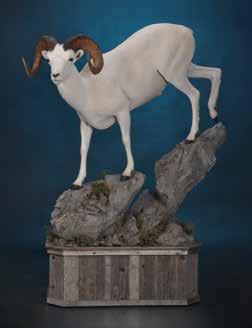
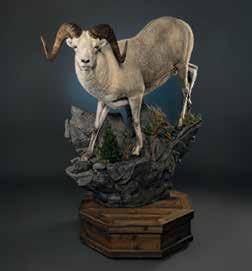
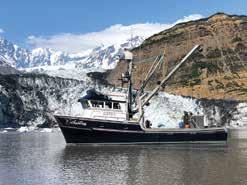
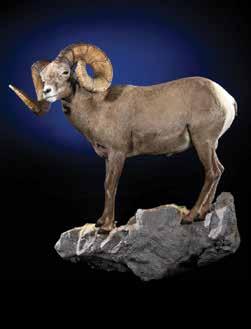
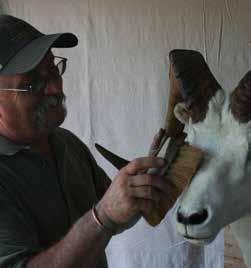
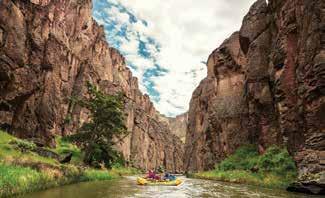

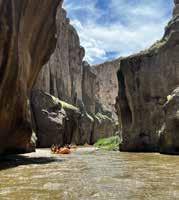
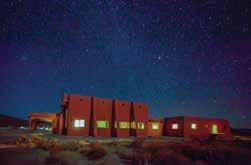
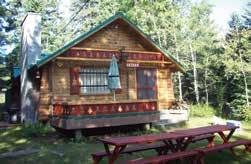
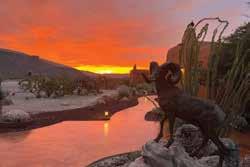








T 3
4-DAY/3-NIGHT EXCLUSIVE ADVENTURE AT LA PALMOSA FOR 6 PEOPLE (Culinary experience, wildlife viewing, spa and much more!)
100% FULLY DONATED LA PALMOSA
Emilio Espino
P: 52.818.181.2924
E: info@lapalmosa.com
W: www.lapalmosa.com
T 4
ONE WEEK STAY IN A MOUNTAIN CABIN IN THE BEAUTIFUL BIGHORN MOUNTAINS OF WYOMING (100% FULLY DONATED)
Jeff Geiger P: 614.668.8222
E: jeffrey_geiger@ml.com
T 5 6 - NIGHT ALL-INCLUSIVE VACATION ON THE 7D RANCH IN WYOMING WILDERNESS FOR 2 PEOPLE (100% FULLY DONATED) 7D RANCH
Meade & Andrea Dominick
P: 307.587.9885
E: ranch7d@gmail.com
W: www.7dranch.com
T 6 3-DAY BC TRAPLINE ADVENTURE W/KENT MAITLAND BC TRAPPERS ASSOCIATION
Stan Troyer
T 7
RCHARD CHILDRESS RACING PACKAGE FOR TWO RICHARD CHILDRESS RACING C/O Taylor Hulsey P: 336.731.3334
E: taylor@rcrracing.com
WYOMING ROCKY MOUNTAIN
BIGHORN SHEEP LICENSE
WYOMING GAME & FISH DEPARTMENT
Daryl Lutz - WGFD
P: 307.332.2688
E: daryl.lutz@wyo.gov
Kurt Eisenach - WY-WSF
P: 307.751.6251
E: keyes555@msn.com
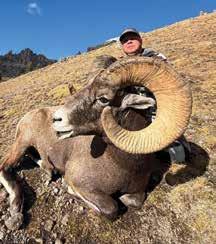
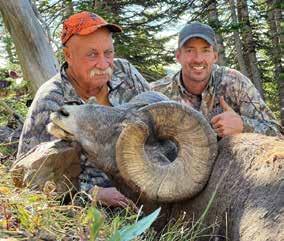
BLACKFEET NATION
BIGHORN SHEEP TAG
BLACKFEET FISH & WILDLIFE DEPT.
Contact: Brandon Kittson
P: 406.830.7118
E: b.kittson@blackfeetnation.com
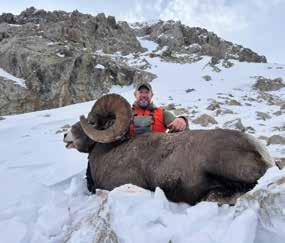
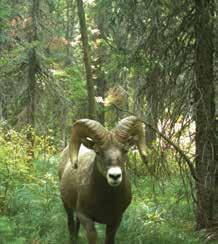
BLACKFEET NATION
MULE DEER TAG
BLACKFEET FISH & WILDLIFE DEPT.
Contact: Brandon Kittson
P: 406.830.7118
E: b.kittson@blackfeetnation.com
BLACKFEET NATION BISON/ PRONGHORN
BLACKFEET FISH & WILDLIFE DEPT.
Contact: Brandon Kittson
P: 406.830.7118
E: b.kittson@blackfeetnation.com
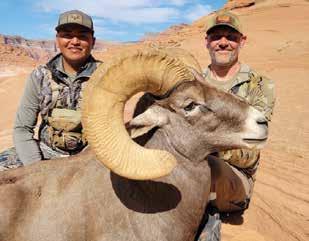
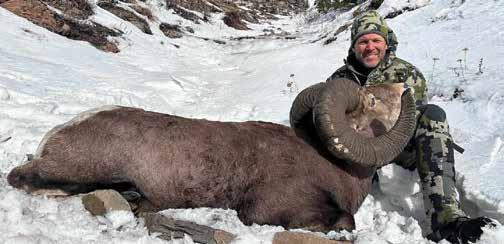
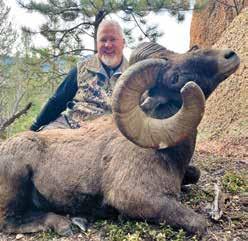
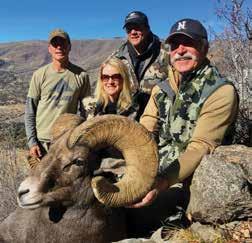
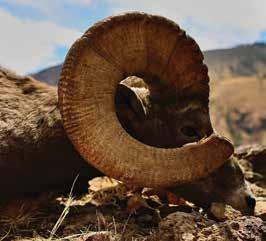
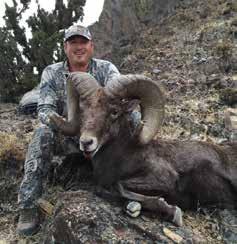
NAVAJO NATION DESERT
BIGHORN (2 AVAILABLE)
NAVAJO NATION DEPARTMENT OF FISH & WILDLIFE
Jeff Cole P: 928.871.6595
E: jcole@nndfw.org
BRITISH COLUMBIA MOUNTAIN SHEEP SPECIAL HUNTING PERMIT
BC FISH & WILDLIFE BRANCH, MINISTRY OF FORESTS AND THE HABITAT CONSERVATION TRUST FOUNDATION
Alicia Bates P: 250.739.8683
COLORADO ROCKY MOUNTAIN
BIGHORN SHEEP LICENSE
ROCKY MOUNTAIN BIGHORN SOCIETY
Terry Meyers, Executive Director - RMBS
E: meyers.terry@gmail.com P: 970.640.6892
CONFEDERATED TRIBES OF WARM SPRINGS BRANCH OF NATURA RESOURCES - CA
BIGHORN SHEEP PERMIT
CONFEDERATED TRIBES OF WARM SPRINGS BRANCH OF NATURAL RESOURCES
Austin Smith Jr - Branch of Natural Resources General Manager P: 541.553.2046
E: wildlifetags@ctwsbnr.org
STATE OF MONTANA BIGHORN SHEEP LICENSE
MONTANA FISH
WILDLIFE & PARKS
Emily Cooper
P: 406.444.2663
E: Emily.Cooper@mt.gov
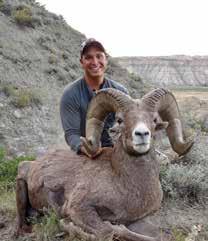
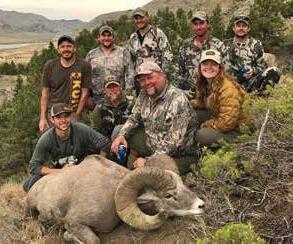
STATE OF NEVADA
NELSON DESERT BIGHORN SHEEP TAG 2025
STATE OF NEVADA
DEPARTMENT OF WILDLIFE
P: 775.688.1556 – Mike Cox
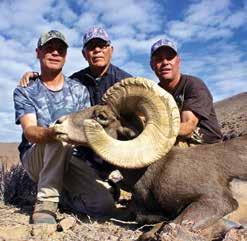
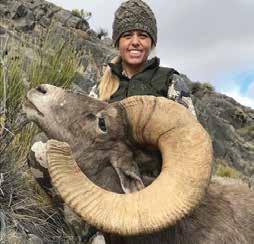
STATE OF NEVADA
PRONGHORN TAG
STATE OF NEVADA
DEPARTMENT OF WILDLIFE
P: 775.688.1659 – Cody Schroeder
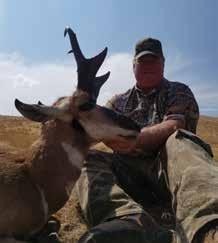
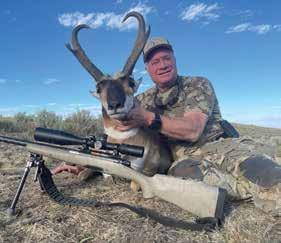
ALBERTA MINISTER’S SPECIAL LICENCE, ROCKY MOUNTAIN BIGHORN SHEEP
ALBERTA PROFESSIONAL OUTFITTERS
Michele Aasgard
Interim Managing Director
P: 780.404.0588
E: actingmd@apos.ab.ca
W: www.apos.ab.ca.com
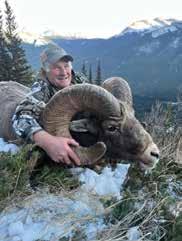
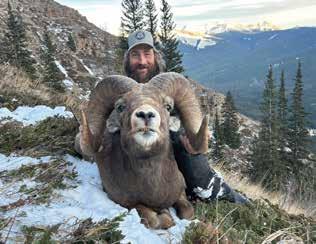
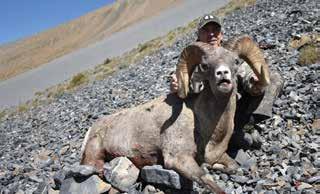
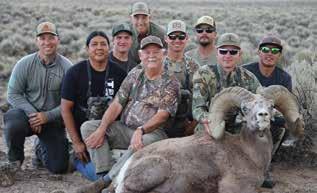
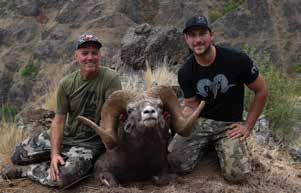
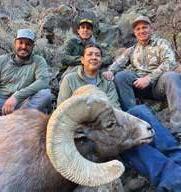
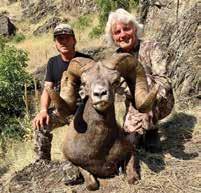
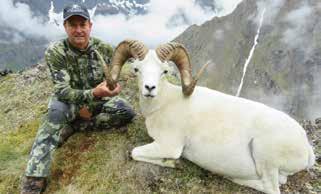
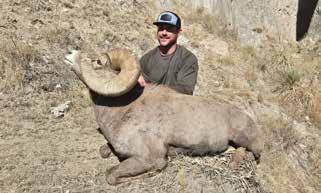
IDAHO BIGHORN SHEEP (Non-Hells Canyon Year)
IDAHO DEPARTMENT OF FISH AND GAME
Shane Roberts - Wildlife Bureau Chief P: 208.334.2920
TAOS PUEBLO ROCKY MOUNTAIN BIGHORN SHEEP PERMIT
TAOS PUEBLO DIVISION OF NATURAL RESOURCES
Michael A. Martinez- Hunt Manager P: 575.779.4105
E: hunting@taospueblo.com
OREGON BIGHORN SHEEP TAG
OREGON DEPARTMENT OF FISH & WILDLIFE
Don Whittaker P: 503.947.6325
don.whittaker@state.or.us
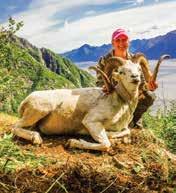
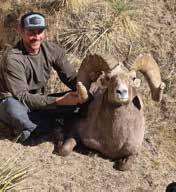
ALASKAN CHUGACH
DALL’S SHEEP TAG
ALASKA DEPARTMENT OF FISH & GAME
Thomas Lohuis P: 907.267.2412
E: thomas.lohuis@alaska.gov
NEBRASKA GAME AND PARKS COMMISSION
BIGHORN SHEEP PERMIT
NEBRASKA GAME AND PARKS COMMISSION
Todd Nordeen P: 308.763.2940
WYOMING GOVERNOR’S
SHIRAS MOOSE LICENSE
WYOMING GAME & FISH DEPARTMENT
Tim Thomas (WGFD)
P: 307.752.0659
E: tim.thomas@wyo.gov
Kurt Eisenach (WY-WSF)
P: 307.751.6251
E: keyes555@msn.com
NEW MEXICO DESERT BIGHORN SHEEP
NEW MEXICO DEPARTMENT OF GAME & FISH - WILDLIFE MANAGEMENT DIVISION
Nicole Tatman
C: 505.469.3966
Katie Piecora
C: 505.538.0825
Tom Batter
C: 505.394.3894
NEW MEXICO BIG GAME ENHANCEMENT PACKAGE
NEW MEXICO DEPARTMENT OF GAME & FISH
Wildlife Management Division
Nicole Tatman
C: 505.469.3966
Katie Piecora
C: 505.538.0825
Tom Batter
C: 505.394.3894
NEW MEXICO ROCKY MOUNTAIN BIGHORN SHEEP PERMIT NEW MEXICO DEPARTMENT OF GAME & FISH WILDLIFE MANAGEMENT DIVISION
Nicole Tatman
C: 505.469.3966
Katie Piecora
C: 505.538.0825
Tom Batter
C: 505.394.3894
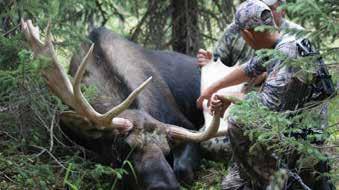
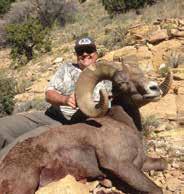
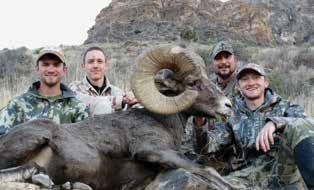
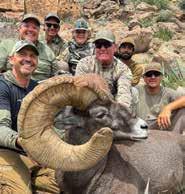
COLORADO ROCKY MOUNTAIN GOAT LICENSE
ROCKY MOUNTAIN GOAT ALLIANCE
Kendrick Chittock
E: kendrick@goatalliance.org


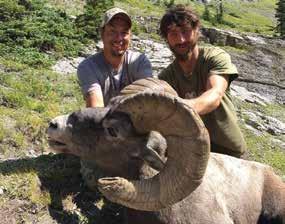
JAN . 22 - 24

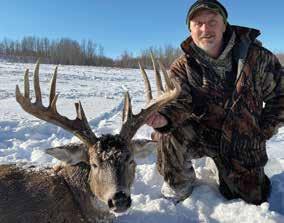
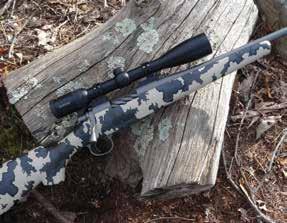
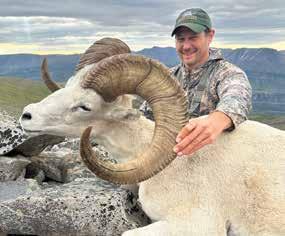


$500 PER TICKET
500 TICKETS SOLD
12-DAY STONES' SHEEP HUNT IN NORTHERN BRITISH COLUMBIA
SPATSIZI RIVER OUTFITTERS IN PERSON SALES AT SHEEP SHOW ONLY
$200 PER TICKET
1,000 TICKETS SOLD
•10-DAY BIGHORN SHEEP HUNT GARRETT BROS. OUTFITTING
•10-DAY DESERT SHEEP HUNT
SIERRA El ALAMO
•12-DAY DALL’S SHEEP HUNT GANA RIVER OUTFITTERS LTD.

$100 PER TICKET
1,000 TICKETS SOLD
10-DAY MOOSE HUNT
MIDNIGHT SUN SAFARIS
$100 PER TICKET
200 TICKETS SOLD
WEATHERBY ORION SXS SHOTGUN PACKAGE
(.410, .28, .20, .12)
$50 PER TICKET
1,000 TICKETS SOLD
6-DAY ALBERTA WHITETAIL DEER HUNT CARTER OUTFITTING

$40 = 1 TICKET
$100 = 3 TICKETS
$300 = 12 TICKETS
$500 = 25 TICKET
$1,000 = 65 TICKETS
13-DAY BROWN BEAR HUNT
KODIAK OUTDOOR ADVENTURES
5-DAY ALASKAN CARIBOU HUNT
ALASKA HUNTING EXPEDITIONS
7-DAY COUGAR HUNT
KIFARU OUTFITTERS
7-DAY LATE SEASON
MOUNTAIN GOAT HUNT
ULTIMA THULE OUTFITTERS
2-DAY COMBINATION
ALLIGATOR HUNT & ARAPAIMA FISHING TRIP FOR 1 BIENVENUE OUTDOORS
BOSWELL CUSTOM
7MM PRC RIFLE
BOSWELL CUSTOM RIFLES
8-DAY MUSKOX HUNT CANADA NORTH OUTFITTING
LOUIS VUITTON LADIES PACKAGE
i Hunt & WSF
WEATHERBY WALL OF GUNS
• .410 Gauge Orion SxS Shotgun
• .28 Gauge Orion SxS Shotgun
• .20 Gauge Orion SxS Shotgun
• .12 Gauge Orion SxS Shotgun
• Mark V Backcountry 7mm PRC
• 307 Alpine MDT Carbon 7mm PRC
• 307 Alpine MDT 6.5 CM


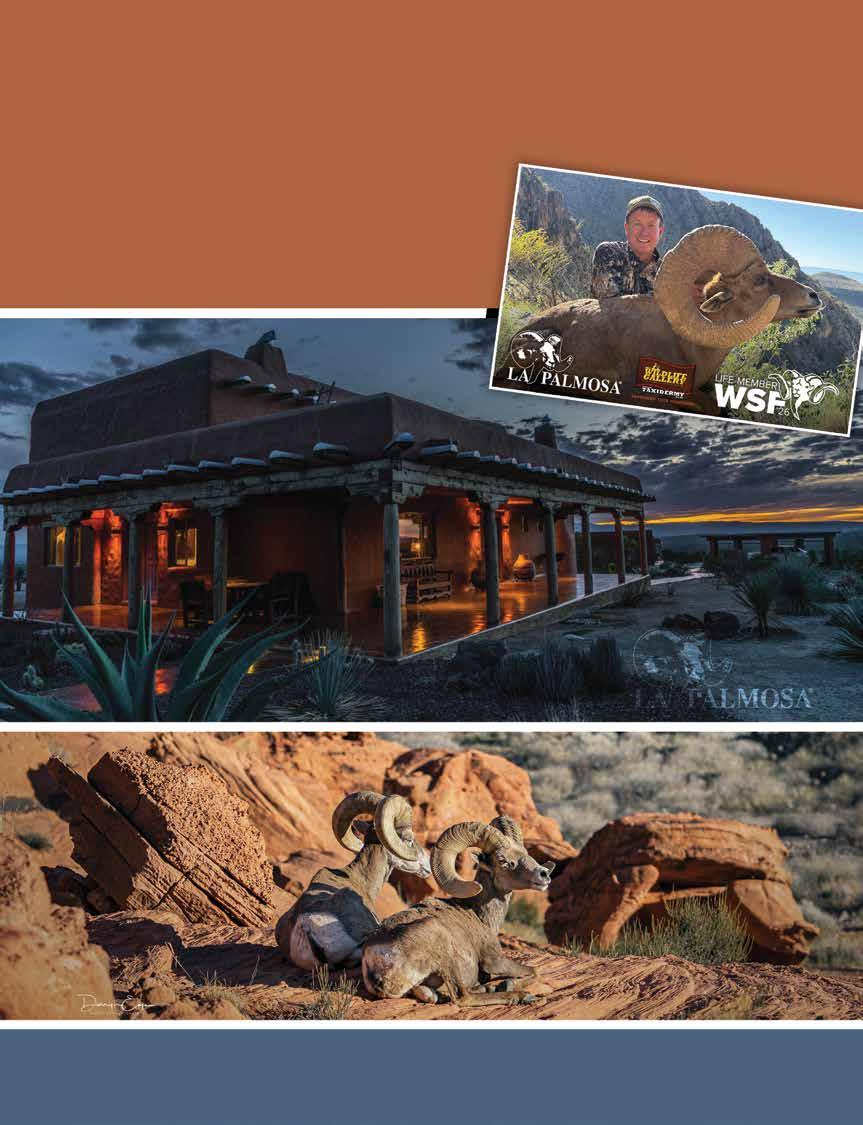
A 7-Day Desert Sheep Hunt with La Palmosa and a custom pedestal mount from Wildlife Gallery! In recognition of the exceptional support of our Life Members and Summit Life Members, we are pleased to announce the 2025 - 2026 Life & Summit Life Members-Only Desert Bighorn Sheep Hunt and Custom Pedestal Mount Drawing! All current Life Members and Summit Life Members are entered into the drawing. New Life Members and New Summit Life Members joining on or before the January 24, 2026 deadline are also entered into the drawing. FOR DETAILS VISIT wildsheepfoundation.org/Memberships/Life-Memberships
38th ANNUAL DUNCAN GILCHRIST PHOTO CONTEST
PHOTOS JUDGED AT THE 2026 SHEEP SHOW
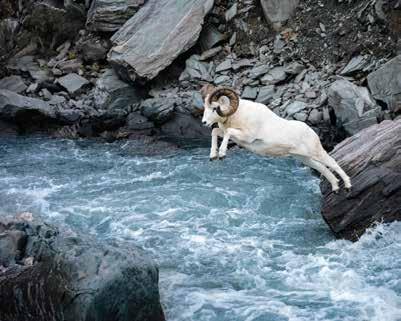
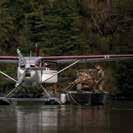
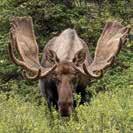
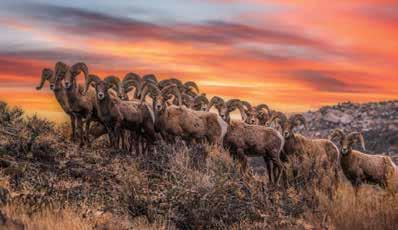
Prizes for the People’s Choice Award and first-place images for Live Sheep, Hunter in the Field, Hunter with Trophy, and Open categories provided by Leica Sport Optics.
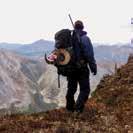
ENTER NOW
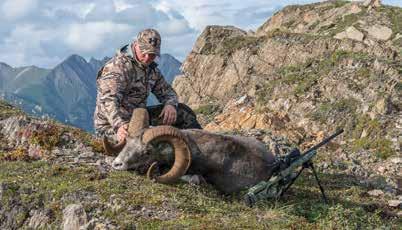

Brunch • Auctions • Raffles
Friday, January 23 • 10:30 - 12:30 • Tuscany Ballroom • Peppermill
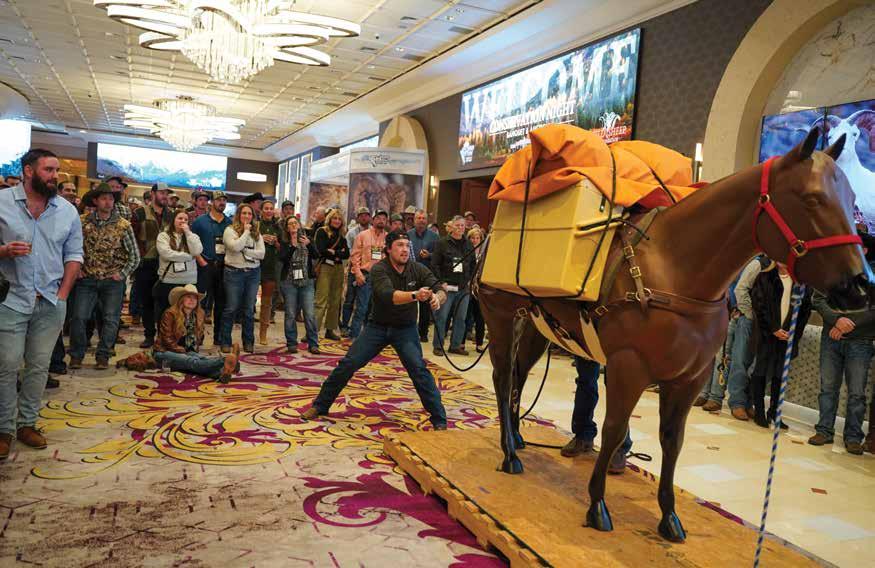
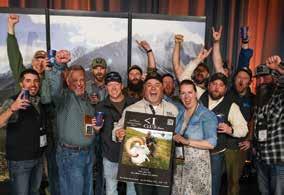
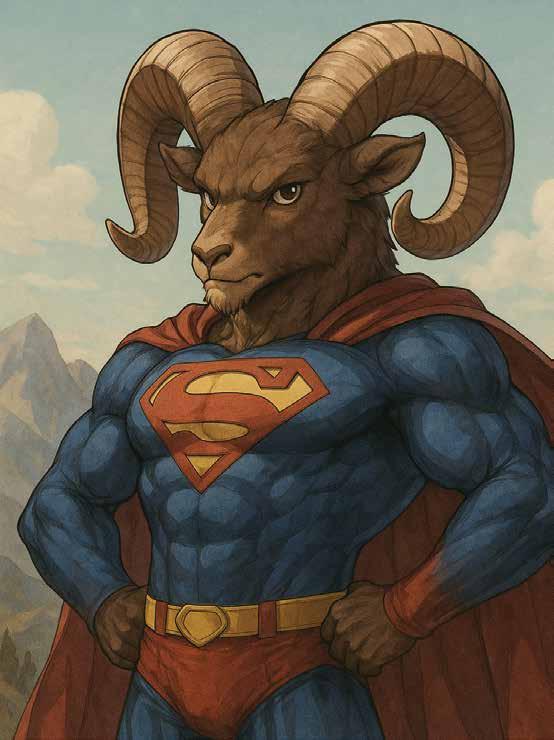
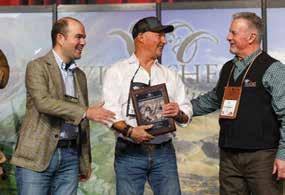


One of the many things that makes the Sheep Show® so special is the number of our members who not only attend but want to actively contribute to first-class events.
Who doesn’t enjoy witnessing the excitement of one of our brothers and sisters winning their first sheep hunt at the <1Club reception or having their name called at the Life Member Breakfast for a desert sheep hunt, or seeing world-class animals recognized at the RAM Awards, or the Wild Sheep Ladies making their own noise and memories at the Ladies Luncheon? If you’ve attended any of these events, you know the vibe is contagious. Now you can be more than an attendee and help WSF make these events even more special for everyone.
As a Super Patron ($3,000), you’ll be supporting all four events:
• Life Member Breakfast and desert sheep hunt drawing
• RAM Awards buckle sponsor
• < 1 Clubs Reception and hunt giveaways
• Ladies Luncheon Patron
PLUS, Super Patrons receive an exclusive Super Patron gold lapel pin, a custom YETI M20 soft backpack cooler, recognition at the events, and are eligible for the Life Member Breakfast Patron’s raffle drawings. Life Members receive an extra chance in the desert sheep hunt drawing.
Or, you can choose to be a part of individual events.
• Like Member Breakfast ($1,000)
• RAM Awards Buckle Sponsor ($1,000)
• < 1 Club ($500)
• Ladies Luncheon ($500)
Individual Patrons also receive special recognition and chances to win.
If you’re interested in becoming a Super Patron or sponsoring any of the individual events, please contact: Maddie Richards
Membership Manager & <1 Clubs Manager 406.404.8750 mrichards@wildsheepfoundation.org
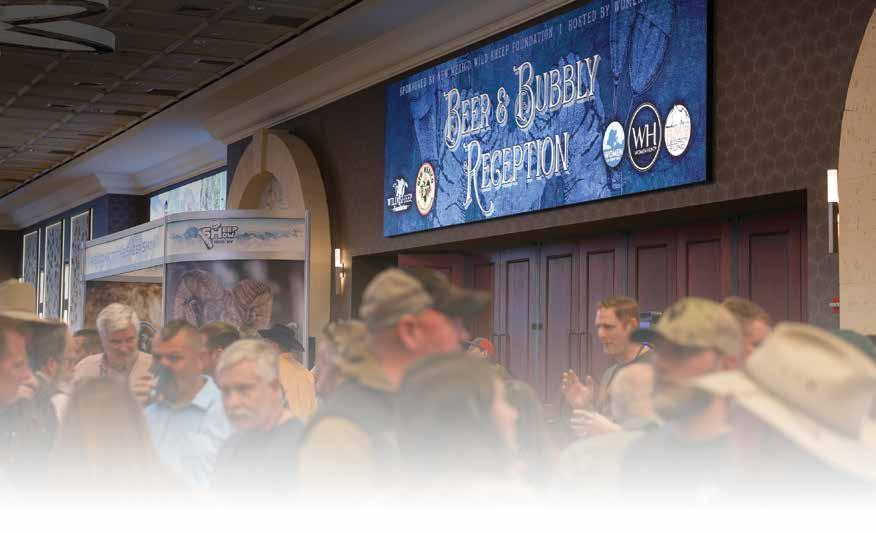
“Enjoy a Drink on us!”

5-6 PM• THURSDAY, JANUARY 22, 2026•TUSCANY FOYER
Join us at Sheep Show in Reno for our FREE Beer & Bubbly Social on Thursday, January 22.
The Women in Hunting community is an exciting and vibrant component of the Women Hunt program where women who embrace wildlife conservation and the critical role hunters play in it engage with each other. Join us to build relationships, access resources, develop strength and knowledge, and celebrate and support one another.
Enjoy free drinks, socialize and view hundreds of photos submitted by women throughout the world showcasing their love of the outdoor. Everyone who submits photos will be entered into free drawings for fabulous prizes from Weatherby Rifle (must be present to win), Weatherby Shotgun (need not be present to win), Mathews Bow (must be present to win), Fur, Jewellery, Handbag and Spa Package (need not be present to win).
DEADLINE DECEMBER 8, 2025. FREE & OPEN TO
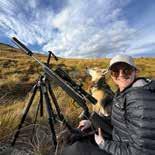
Women of all ages please submit your photos and short story by scanning the QR code for chances at some great prizes!
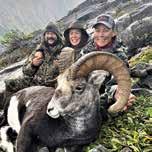
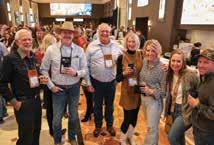
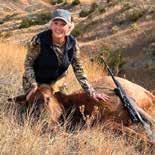
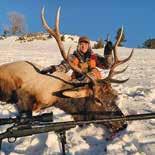
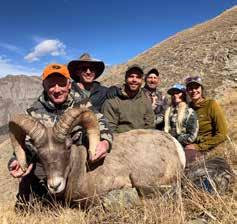
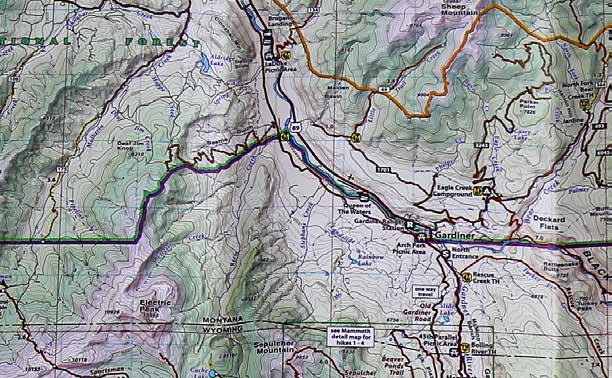
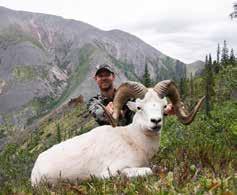
SPECIES: Dall’s sheep
OUTFITTER: Gana River Outfitters
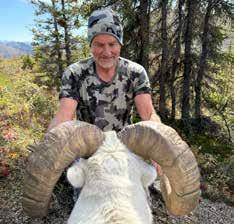
SPECIES: Rocky Mountain bighorn
OUTFITTER: 7D Ranch
GUIDE: Meade Dominick
LOCATION: Wyoming
I hunted in spectacular sheep country alongside a great crew from 7D Ranch. The outfitter brought his 10-year-old daughter along to experience her first sheep hunt. I was thankful to share the experience! WS
GUIDE: Scott Kennedy
LOCATION: Stone Knife River, NWT
We found this ram on day six after backpacking 52 miles with Gana River Outfitters. He eluded us for two days until we were able to setup on the watering side of a green hillside. He made his move for water and we were in place for a 300-yard shot on this beautiful 163-4/8 B&C ram. WS

SPECIES: Stone’s sheep
OUTFITTER: Stone & Folding Mountain Outfitters
GUIDE: Ben Heuser and Tom Hansen
LOCATION: British Columbia
This was my fourth ram taken to complete my FNAWS. I am grateful to share these hunting experiences with my son Jake, who was on all four sheep hunts! I used a Winchester Jack O’Conner .270 for three out of the four sheep hunts! WS
SPECIES: Dall’s sheep
OUTFITTER: Stan Stevens
GUIDE: Elijah Anderson
LOCATION: Northwest Territories
DALL’S SHEEP DOWN!! All smiles (and sore legs) after one of the toughest hunts of my life. This is the kind of country that pushes you to the edge— brutal super steep climbs, unforgiving terrain with heavy packs, sore backs, and no room for mistakes.
Every step was earned. Every climb tested me. No shortcuts, no excuses.
In the end, praise Jesus, I was blessed to get my shot on this big heavy bruiser —a clean execution with the 300 PRC after a brutal climb.
It was definitely a very hard-earned, once-in-a-lifetime, gold medal Dall’s sheep, and a memory I’ll never forget. Much respect for my guide, Elijah Anderson—and to this solid ram, a true warrior of the Mackenzie Mountains of Canada’s Northwest Territories.
With this one in the salt, my quest for the FNAWS is halfway done—next month the journey continues, chasing Stone’s Sheep in British Columbia. WS

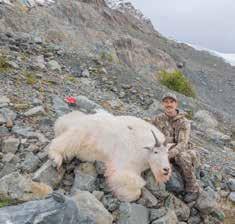
SPECIES: Rocky Mountain goat
SELF-GUIDED
LOCATION: Kenai Peninsula, Alaska
After returning from my moose hunt I was carefully watching the weather in my goat area for at least a three-day weather window. It appeared it wouldn’t happen and I’d just have to go anyways, but at the last minute a window appeared. I was already packed and ready! After a full day of bushwhacking and climbing from sea level to the alpine, I was ready to hunt the following day. As luck would have it, first thing the next morning I spotted a good billy in a very “benchy” area of rock below a hanging glacier. I had scouted that area prior and hoped to find a goat there in this hunt! The route to get to that rock was way more challenging than I anticipated and I didn’t get above the goat until the afternoon. After relocating him and verifying he was the goat I wanted, I was able to slowly creep into position for a 42-yard shot when he stood from his bed. Thankfully the weather held as it took me three full days to get the goat and camp packed out! WS
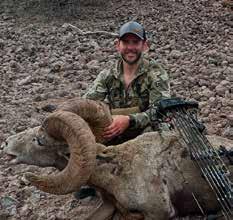
SPECIES: Desert bighorn sheep
OUTFITTER: Mexico Hunts
GUIDE: Gaspar Bautista
LOCATION: Carmen Island, Mexico
We had strong winds which kept rams hunkered down for three days of the six-day hunt. Although the conditions weren’t ideal, we still saw rams every day and spending time on the mountain with the guide Gaspar was a great experience. I happened to know the group that was coming in after me so I was fortunate to be able to hunt one extra day as we couldn’t get it done in the six days.
No luck on day seven, so we headed back and I started to pack up for the boat ride back to the mainland. One of the helpers ran over and said, “Ram, ram, ram!” He had spotted a good ram in the distance coming down the mountain. I gathered enough stuff to run up the mountain and put a stalk on the ram. We were able to make a move and get within 32 yards of the ram and as I started to draw he bedded. After a 20-minute freeze with tension on the string he got up and I put a well-placed arrow through the ram as the sun was starting to set. I’m very grateful for the last-minute ram! Carmen Island is truly a special place. To top it off, my wife and two kids were able to join on the recovery. WS
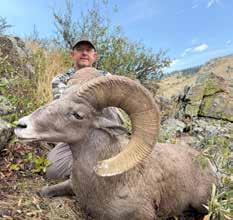
SPECIES: Rocky Mountain bighorn
OUTFITTER: Capra Guides
GUIDE: Trey Milhoan
LOCATION: Colorado
I needed this Rocky Mountain bighorn to finish my FNAWS. I decided to put in for an archery-only tag in Colorado to increase my draw odds and I was lucky enough to draw the tag. I hunted very steep and cliffy country that held several legal rams. I was able to get close to the ram I eventually harvested multiple times with it all coming together on day four with a 19-yard shot. The best part of the trip was the people I hunted with. My guide was Trey Milhoan. Mike Duplan and John Legnard also helped for the full duration of the hunt. All three were very experienced but, more importantly, great people, fun to hunt with, and dedicated to wild sheep. Most importantly, my dad, Dan Johnson, was there to watch it unfold. He has been with me on three of my successful sheep hunts and I am grateful he was with me as I finished the FNAWS. WS
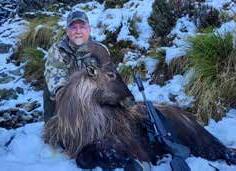
SPECIES: Himalayan tahr
OUTFITTER: Croc Adams
GUIDE: Dion West
LOCATION: South Island, New Zealand
My wife Ashley and I booked this hunt with Croc Adams upon the recommendation of Lora Young, who had guided many years for Croc and who since had been diagnosed with an aggressive form of breast cancer. We wanted Lora to go with us on this hunt, but she was physically unable to because of chemotherapy treatments. Ashley and I both harvested beautiful bull tahr with Croc and made a film about the New Zealand journey in Lora’s honor. Within a few weeks of us posting the video on YouTube, Lora passed away. This hunt was for her. WS
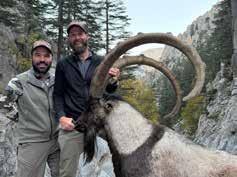
SPECIES: Bezoar ibex
OUTFITTER: Wild Hunting in Turkey
GUIDE: Kursat Ekenler
LOCATION: Mersin,Turkey
I had amazing trip with Kursat and his team with Wild Hunting Turkey. The local guides were amazing and their ability to find this big old billy was very impressive. I was fortunate enough to harvest a nice Anatolian chamois as well on the same trip. The country is beautiful and the mountains where we hunted was typical ibex terrain. The professionalism, organization and accommodations were top notch. I look forward to returning to hunt some of the other species in 2027. WS
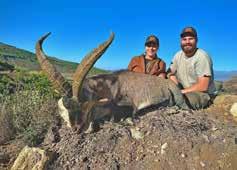
SPECIES: Hispanic ibex (Southeastern)
OUTFITTER: EuroHunts Spain
GUIDE: Juan Pablo
LOCATION: Almeria Spain
The last of the four ibex needed for the “Spanish Slam”. My journey for the Spanish Slam started in 2019 with my father and I got to complete it in 2024 with my spouse, Shay. Hunting in Spain is one of the best experiences I have had hunting internationally. I completed all four ibex in Spain with Alvaro from EuroHunts and I would highly suggest booking with him to get your Spanish hunting in. He is a top notch outfitter and it was a great experience hunting and taking in the Spanish culture. WS
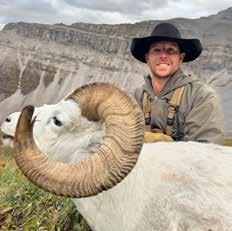
SPECIES: Dall’s sheep
OUTFITTER: Bonnet Plume Outfitters
GUIDE: Wyatt Sheardown
LOCATION: Yukon Territory
I took this amazing ram at 6:30 p.m. on August 24, the day after my 37th birthday. I made a 510-yard shot at a steep uphill angle. We caped out the sheep and boned out the meat and walked down the mountain in a torrential downpour just after midnight. We packed the entire sheep and camp out two days later for a grueling 14.5 miles. This hunt was one of the hardest but greatest experiences of my life. WS
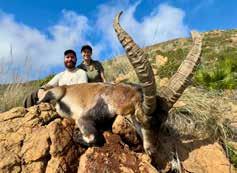
SPECIES: Ronda Ibex
OUTFITTER: EuroHunts Spain
GUIDE: Juan Pablo
LOCATION: Malaga Spain
My second time visiting Almeria. The first was with my father as he hunted for Ronda ibex. Going back now with Shay, my spouse, added even more to the memories made in those mountains. We had a great time and I made a fantastic shot to add to the success of our Spanish hunting trip. Thank you EuroHunts! WS
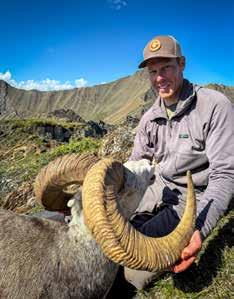
SPECIES: Stone’s sheep
OUTFITTER: Stone and Folding
Mountain Outfitters
GUIDE: Kirk O’Donnell
LOCATION: British Columbia
My trip was truly a once-in-alifetime experience with me harvesting a truly once-in-a-lifetime ram. My guide, Kirk O’Donnell was amazing and efficient in every way. To top it off, I was able to harvest a great, nineyear-old ram that had it all, which was a dream ram for me! WS
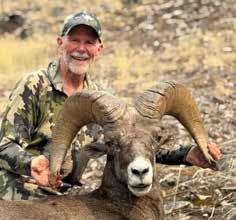
SPECIES: California bighorn
OUTFITTER: Kifaru Outfitting
GUIDE: Steve Zednai
LOCATION: British Columbia
The only sheep remaining to complete my second FNAWS was a California bighorn. The hunt had been booked years ago, with a pause included for Covid. My training was complete—I wasn’t going to be “that guy” that couldn’t go somewhere after a ram because of conditioning. Temperatures in the Okanagan valley set record highs during the hunt surpassing 100 degrees Fahrenheit several days. Water was the heaviest thing in our packs. On day five, we found a band of eight rams bedded in an unapproachable place and left them to return the following day. Starting our climb at daylight, Steve lifted pleas to the ram gods. Shortly after reaching our planned glassing perch, Jess found the band as they went over the ridge. Steve lead a great stalk, and my second FNAWS ram was down at noon.
A few days prior—on a record high temperature day in the Okanagan (104 degrees F), the outfitter received a call asking if he knew anyone who had a bear tag. I had two! Sheep sightings were rare, so we abandoned the nonproductive scouting and went on a bear hunt. The problem bear was napping in a pine tree just outside the vineyard fence. We needed to wait until it entered the property for a legal removal. While waiting, I found a four leaf clover and tucked it in my license portfolio.
Luck of the Irish this week?
From the Okangan Valley, British Columbia, Canada. WS
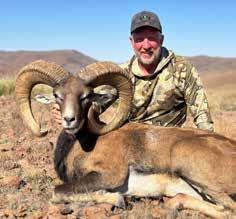
SPECIES: Red sheep
OUTFITTER: Rowdy McBride Outftting Services
GUIDE: Bonner Wallace
LOCATION: Texas
From the lowest of lows to the highest of highs. Bonner Wallace and I made a stalk on a great red sheep, while Rowdy McBride stayed back and tried to video what we’d hoped would put an end to my red sheep hunt. To this day I’ll never understand what exactly happened, but I missed what I normally consider a fairly easy shot. And to make matters worse, Rowdy had indeed captured it on video. I’ve never dealt well with failure, and it was eating me up inside and extremely embarrassing at the same time.
Bonner and Rowdy took it all in stride, and we quickly put a plan together to stalk another group around the mountain. Bonner and I basically crawled for the last 100 yards, and we were soon close to the group of sheep. The largest ram was bedded on the far side, so we actually crawled a bit further and I got in a solid prone position. The waiting game was on, but soon the ram stood up from his bed and the hunt was over.
Bonner and Rowdy just sorta stared at him for a minute. He looked big to me, but honestly I didn’t really understand what had just happened. They both told me I might want to get him scored, so a few months later it actually came together. Nobody was more shocked than me, to find out he shattered the existing world record. And it’s not lost on me, that I played a small part in this, and without the great ranch management, guiding and lucky missed shot, it would have never happened. WS
SPECIES: Waterfowl
OUTFITTERS: Cloud 9 Outfitters / Ameri-Cana Expeditions
LOCATION: Alberta
Anxious to get a jump on the 2025 waterfowl season, member Lou Rupp, his lab Al, and a hunting buddy traveled to northeastern Alberta, Canada, the first week of September for the season opener. The hunting was unbelievable with a wide variety of both duck and geese species limits taken daily. Next the pair traveled to South Central Alberta for the second week of the season, hunting in the Coronation, Alberta area with Ameri-Cana Expeditions. Again, we experienced a wide variety of duck and geese species. There were lots of young birds indicating a good hatch in 2025. Nothing like hunting waterfowl in the WATERFOWL FACTORY of North America! Al really got a workout!
One major surprise of the trip, was upon arrival in Coronation to be greeted by none other than long-time friend and supporter of the Wild Sheep Foundation, Patrick Frederick. It was great seeing Pat and reliving old stories. WS




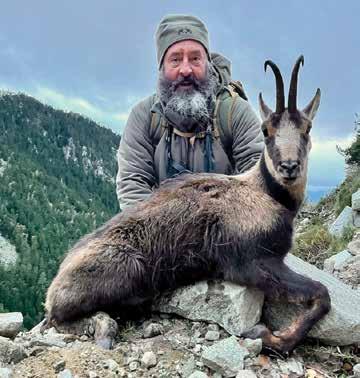




1. <1 Club “Membership” is open ONLY to those aspiring sheep hunters who have not yet taken a North American or international wild sheep ram*.
2. Annual membership in the <1 Club is only $35. New <1 Club Members receive a <1 Club T-shirt, club decal, and one (1) entry into the annual sheep hunts and gear package drawing. Renewing <1 Club Members receive an entry into the annual drawing. ONE ENTRY PER MEMBER ONLY!
3. <1 Club Members must be a member of WSF in good standing on the drawing date (Jan. 23, 2026) to be entered into drawing. Family Membership in WSF qualifies. You may sign up each family member in the <1 Club for $35 per person if each family member enlisted satisfies Rule #1 above. Winner must be of legal hunting age within the state/prov. at the time of the hunt. Alaska = 10 years old • NWT = 12 years old. If not, another name will be drawn.
4. Three sheep hunts and (3) prize packages will be given away! <1 Club Members will be entered into a drawing for Dall’s sheep hunt with Gana River Outfitters, a Dall’s sheep with Kusawa Lake/North Curl Outfitters or a third hunt (TBD). The hunt winners will also receive a SAAM’s Precision Level One Rifle Training program with FTW Outfitters in Texas. To ensure that each hunt is fully equipped with the best, each hunt winner will also receive a clothing and gear package including an optics package from Leupold, head to toe Sitka Gear clothing, Kenetrek boots, a Mystery Ranch backpack, Bridger Watch, Montana Knife Co. knife, and OnXMaps mobile device maps. Look for new information in the Winter issue of Wild Sheep Magazine as well as the <1 Clubs’ Facebook page.
5. First drawn NEED NOT BE PRESENT TO WIN. The next two winners must be present. Winners are eligible for one prize per year only. Travel to and from sheep hunts and shooting school is responsibility of the winners.
6. Drawing will be held Friday, January 23, 2026 during the 4-6 pm <1 Club/<1 iClub Reception at the 2026 Sheep Show® in the Mount Rose Ballroom of the Reno-Sparks Convention Center.
NOTE: Membership in the <1 Club does not include entry into the <1 Club/<1iClub Beer Reception. A $40 Reception ticket is required for entry.
7. Hunts are to be taken only in the year specified by the donors. Exceptions are subject to donor’s approval. Hunts MAY ONLY be transferred to another <1 Club Member in good standing & MAY NOT BE SOLD.
8. 8. By joining you certify that you have not yet taken a wild sheep ram* in North America (free range California bighorn, Dall’s, desert bighorn, fannin, Rocky Mountain bighorn or Stone’s sheep) and that you have read and understand the Rules and Regulations set forth by WSF for the <1 Club.
*A wild sheep ram is considered a California bighorn, Dall’s, desert bighorn, fannin, Rocky Mountain bighorn or Stone’s sheep in North America or a non-North American wild sheep taken outside of North America and recognized under WSF’s Mountain Monarchs Award Program.
The <1 Club is for those aspiring sheep hunters who have not taken a wild sheep ram under free range/fair chase conditions in North America or an indigenous ram outside of North America.

4. <1 iClub Members will be entered into a drawing for an Iberian mouflon from Herederos Hunting Co., a bull tahr with Blackstone Outfitters NZ, or a Pyrenean chamois with Spain Safaris. To ensure that each hunt is fully equipped with the best, each hunt winner will receive a Leupold optics package, pair of Schnee boots, backpack from Stone Glacier, Montana Knife Co. knife, Bridger Watch, and OnXMaps mobile device maps. Look for new information in the Winter issue of Wild Sheep Magazine as well as the <1 Clubs’ Facebook page.
1. <1 iClub “Membership” is open ONLY to those mountain hunters who have not yet taken an international wild sheep ram or goat under free range/fair chase conditions*.
2. Annual Membership in the <1 iClub is only $35. New <1 iClub Members receive a <1 iClub T-shirt, club decal, and one (1) entry into the sheep and goat hunts and gear package drawing.
3. <1 iClub Members must be a member of WSF in good standing on the drawing date (Jan. 23, 2026) to be entered into drawing. Family Membership in WSF qualifies. You may sign up each family member in the <1 iClub for $35 per person if each family member enlisted satisfies Rule #1 above.
5. First drawn NEEDS NOT BE PRESENT TO WIN. All other winners must be present to win. Winners are eligible for one prize per year only. Travel to and from sheep/ goat hunts is responsibility of the winners.
6. Drawing will be held Friday, January 23, 2026 during the 4-6 pm <1 Club/<1 iClub Reception at the 2026 Sheep Show® in the Mount Rose Ballroom of the RenoSparks Convention Center.
NOTE: Membership in the <1 iClub does not include entry into the <1 Club/<1iClub Beer Reception. A $40 Reception ticket is required for entry.
7. Hunts are to be taken only in the year specified by the donors. Exceptions are subject to donor’s approval. Hunts may only be transferred to another <1 iClub Member in good standing and MAY NOT BE SOLD.
8. By joining you certify that you have not yet taken an international (non-North American) wild sheep ram or wild goat* and that you have read and understand the Rules and Regulations set forth by WSF for the <1 iClub.
*NOTES: As recognized as a wild sheep ram or goat in the CIC Phenotype List Caprinae (available on WSF website) and under the rules of the WSF Ram and Mountain Monarchs Award Programs.
The <1 iClub is for those who have not taken a free range wild sheep or goat outside of North America. Accordingly, a free range Armenian sheep, aoudad, mouflon, red sheep, or wild feral goat taken in North America does not exclude you from membership in the <1 iClub.
NOON, JAN. 23, 2026
DRAWINGS FOR BOTH CLUBS:

$25entry (includes T-shirt) MUST join or be a current member of WSF & NEVER harvested a wild Ram
(includesT-shirt)MUSTjoinorbeacurrent
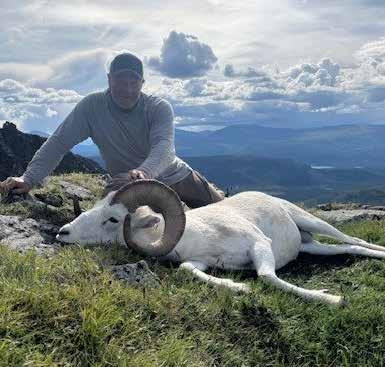
David Downey — Dall’s sheep
I harvested my first Dall’s sheep August 3, 2025, in the Yukon Territory on day three of a 10-day hunt. After 13 grueling miles, we glassed the ram laying in the landing cliffs 300 yards away. I got my OMR 300WSM with MDT HNT-26 stock with ARCA rail setup on my Tricer BC tripod to take the shot. After 10 minutes— which felt like eternity—the ram stood up, I squeezed the trigger, and the ram was down. What an awesome feeling to take my first ram at 60 years old—who would have ever thought? I’ll be heading to Mexico on a desert sheep cancelation hunt January 20th, 2026, so I will miss the Sheep Show® for good reason. WS Well done David! But you are Kicked Out!
The following <1 Club® or <1iClub® members have LOST their membership status by taking their first wild sheep rams! Congratulations!
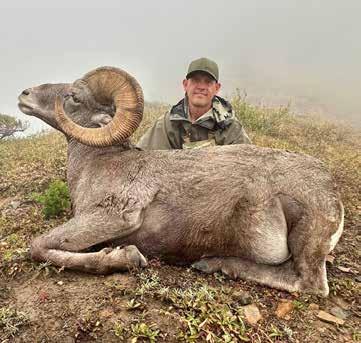
Danny Sanders — Rocky Mtn. bighorn
I was very lucky and fortunate to have won this hunt with Baldy Mountain Outfitters in British Columbia while I was attending the 2025 Wild Sheep Foundation Sheep Show® in Reno Nevada. After over seven months of training and eight days of very difficult hunting, I was able to harvest this beautiful, full-curl ram. I could not have done this without the incredible guides as well as the Wild Sheep Foundation. I have applied for sheep for over 20 years. It was an incredible feeling putting my hands on my first ram after a lifetime of dreaming about hunting one someday. Thank you to all my friends for the all support on this journey. Thank you Wild Sheep Foundation and Baldy Mountain Outfitters for the experience and hunt-of-a-lifetime! WS Glad you got the opportunity to be Kicked Out Danny!

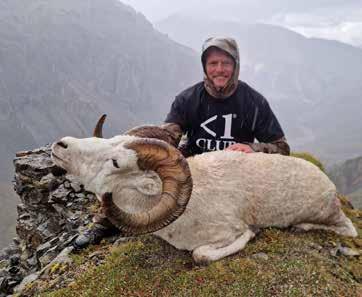
Lasse Vinding — Dall’s sheep
It all started at the Sheep Show®, where I was lucky enough to win MTNTOUGH’s Tough Sheep event — which meant I was going on my number-one bucket list hunt: Dall’s sheep in the Mackenzie Mountains, with Stan Stevens of Mackenzie Mountain Outfitters.
Fast forward to August 13th—we arrived at base camp, got our gear and food sorted, and later that evening flew out into the mountains. We set up camp and got some much-needed sleep after some long travel days all the way from Denmark.
We started hunting early the next morning and quickly spotted the first group of rams. Unfortunately, there were no shooters among them. We continued hiking and eventually found a good glassing point. After a couple of hours, we spotted two mature rams—one was missing a horn, but the other looked promising.
Unfortunately, they were in a position where we couldn’t do much except wait for them to move to a better spot for a stalk. So we waited...and waited. But they stayed high up in the rocks, where they had a full view of the valley. That made it nearly impossible for us to make a move without being seen.
The first four days were long. We found the rams every day pretty quickly, but each time they were in inaccessible locations. We couldn’t get within shooting range without being spotted, and the one time they did come down to feed, the wind was completely wrong.
But, on our way back to camp on day four, we saw two new rams that had entered the valley. We looked at them through the spotting scope and could see that both were mature.
On day five, we decided to go after the new rams we had seen the night before. But when we woke up, the valley was socked in with fog, and we couldn’t see a thing. We waited patiently, and eventually the fog lifted—revealing the two rams bedded 700 yards away in the rocks. They had us pinned, and any movement
on our part would have spooked them. So we stayed still and waited.
Hours passed. Finally, after five hours, the rams got up and moved down a drainage. We got ready, hoping this might finally be our chance. I got behind the rifle and waited—but once again, they stayed high in the rocks, out of reach.
On day six, we spotted both pairs of rams again— still up in the rocks. However, two of them were in a location where we might be able to get above them if we made a big loop and a serious climb. So we went for it. We made the long hike, got above them, and thought this might finally be the moment.
But when we reached the spot where they should have been, they were nowhere to be seen. We waited to see if they’d come out, but then the rain hit, followed by thunder. We got soaked and cold, and the wind shifted against us. We stuck it out for a few more hours before heading down as darkness set in. A tough day—physically and mentally.
By day seven, we were feeling the pressure. We hadn’t had a single shot opportunity, and there were only three days left. We woke up to more fog, so we spent the first few hours in the tent. Then Elijah, our guide, spotted the two rams from day four—just 900 yards from our camp. He told us to stay in the tent while he kept an eye on them to see where they would go.
After a few hours, we were told to grab our gear and head down the creek to hide until he joined us. When he came down, the first thing he said was, “There’s a very small chance this will work...but we’ll try.”
We started climbing to get above them. Once we gained some height, we had to sidehill about 250 yards across loose slate rock. It was incredibly noisy and slow going—it took us 40 minutes to cover that distance.
Finally, we reached a spot where we could look down the drainage. We spotted the ram—340 yards away. We crept into position, quietly got the rifle set up, and I lay down, steady. I took a deep breath and squeezed the trigger.
The ram took the shot and dropped.
After seven hard days, it finally happened. It was a huge relief for all of us. When we got over to him, we saw he was a beautiful, 11-year-old ram—everything I had dreamed of.
We took some amazing photos, and when we got back to camp, we celebrated with Dall’s sheep backstraps cooked on a rock—the best wild game I’ve ever tasted.
The next day, we packed up camp and headed back to the pickup point. My first sheep hunt had come to an end—and what an experience it was. It’s given me a whole new level of motivation for future adventures. WS
You are Kicked Out Lasse! Even in Denmark!
The Wild Sheep Foundation is excited to announce the launch of a brand-new Sheep Fever podcast miniseries, “Kicked Out.”
Hosted by WSF Membership Manager, Maddie Richards, Kicked Out spotlights members of the <1 Club® who have officially been “kicked out” after harvesting their first wild sheep ram. These intimate and inspiring conversations dive deep into what it means to chase a dream that often takes years, or even decades, to achieve.
Each episode offers a front-row seat to the trials and triumphs that define a sheep hunt. From the first spark of inspiration to the moment a hunter lays hands on their first ram, Kicked Out captures the emotion, determination, and respect that makes sheep hunting unlike any other mountain pursuit.
Listeners will hear firsthand how preparation and perseverance come together on the mountain and how these stories fuel the passion that drives our conservation mission forward. The series also shines a light on the strength of the <1 Club® community and the shared bond that connects every sheep hunter, whether they’re still chasing their first tag or celebrating a lifelong dream fulfilled.
Through Kicked Out, WSF continues its mission to inspire, educate, and celebrate the people who make wild sheep conservation possible - one story, one hunter, and one mountain at a time.
$25entry(includesT-shirt)MUSTjoinorbeacurrent memberofWSF&NEVER harvestedawildRam signuptowinyourFIRSTsheephunt! ADall’sandFanninsheephuntwillbegiventotwo<1Clubmembers
Listen to Kicked Out on the Sheep Fever podcast: available on Apple Podcasts, Spotify, and wherever you get your podcasts.

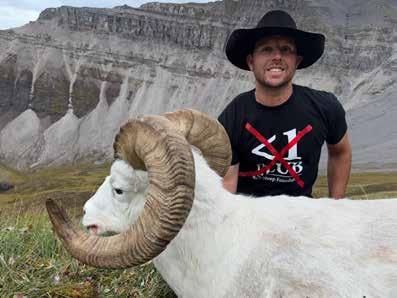
My journey to my first sheep was somewhat of a long time coming. I grew up hunting whitetail deer in South Texas. My great grandfather shot a mountain goat in Montana in the 1957 and actually broke his leg coming off of the mountain. He used his broken rifle stock as a crutch of sorts to get down from what I understand. That mountain goat was shoulder-mounted in the living room of our ranch house and was always something I gravitated to from a young age. I did my first mountain hunt when I was 30. My dad took me and my brotherin-law on a Mountain Caribou hunt in NWT in 2018. I didn’t know it until we arrived but there was a group of sheep hunters in camp. I had never handled or even seen a sheep skull in person up to that moment. Two of those sheep hunters in camp (Bobby Theiss and Kemp Copeland) had multiple FNAWS completed already and I started asking questions about how to continue my mountain hunting and who to go with. They suggested Sam Medcalf (Elk Valley Bighorn) for my goat hunt. I
booked immediately upon returning home and took my goat in 2021 after the whole Covid fiasco tried to derail my hunt. I had been emailing Sharron and Chris McKinnon prior to that hunt about availability but they couldn’t guarantee anything until they sorted out all of their postponed hunts due to Covid. When I was actually sitting in camp, Sharron emailed me and confirmed my dates in 2025. From then on, all I could do was wait and try to get myself into the best physical shape possible.
Fast forward four years and I was getting ready to board the Tintina Air flight to Bonnet Plume’s basecamp in the Yukon.
After six days of hunting, we woke to fog and rain. walked around into a bowl and were immediately into sheep. We crawled up a knob and found that we had found a band of 12 rams. Initially, we didn’t think that there were any older rams but suddenly spotted two that looked really good. One was long and tipped and the other was older and broomed. I got on my rifle and we watched them for almost eight hours before deciding on the older broomed ram. At about 6:30 p.m., I looked at my guide and said “Are you ready? Because I’m ready.” He replied with a subtle, “I’m ready.” I squeezed off a shot at 510 yds and the ram folded and rolled down the mountain about 15 yds. I still couldn’t believe what had just happened up to that point. I was absolutely floored by the body size and just how big and beautiful these sheep are in person. I called my family from a sat phone I brought and was nearly in tears over the whole experience. It was truly the experience of a lifetime and am officially kicked out of the <1 Club®! I cannot wait do my next sheep hunt. I ABSOLUTELY HAVE THE SHEEP BUG! WS
Your great grandfather would be proud, John, but you are Kicked Out!
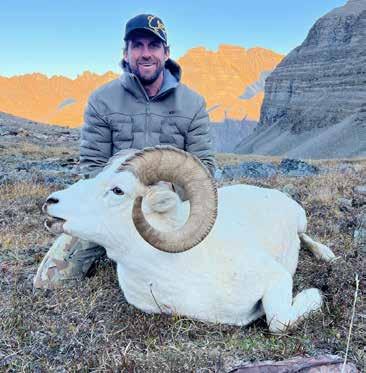
Ryan McHugh — Dall’s sheep
I grew up in Reno, NV, and attended my first Wild Sheep event in the mid-1990s while in high school. After gazing at photos of pure white Dall’s sheep displayed at the outfitter’s booths, I was hooked and knew I needed to hunt one of those high mountain sheep of the North country. After mentally saving for almost 30 years, more stability in my career, and my three children in high school, I started looking at Canada for hunt options in the Yukon and Northwest Territories. Unexpectedly, I was contacted by Werner with South Nahanni Outfitters early in 2025 with a Dall’s sheep combination hunt cancellation opportunity. I decided the time was right and was flying to NW Territories on August 30, 2025.
I was flown out with my guide to backpack hunt Dall’s sheep in a remote valley of their 9,000-squaremile hunting area.
In the early afternoon on day three, I hiked into a shale slide about 400 yards above where we had last seen sheep bed below a rock ledge. I had a questionable rest sitting in the rocky shale slide with my gun rested over a 6000L backpack wedged upright with boulders for stability. We waited all afternoon for the sheep to get up and continuing feeding. They fed away from us initially in the valley, but within a few hours changed course and crossed a stream grazing to under 400 yds. I harvested a beautiful 9-year-old, mature ram with a pure white summer/fall coat and full belly. The remaining days of the hunt allowed me to also harvest a huge mountain caribou and a black bear with an 18”-19” skull weighing over 300 lbs. WS
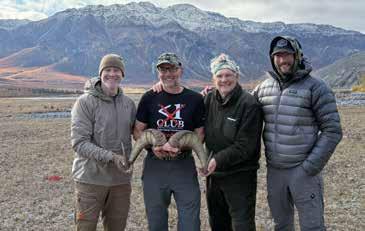
After years of dreaming about Dall’s sheep, my journey finally began in Alaska’s Brooks Range on August 18, 2025, with Dave Marsh’s Big Game Big Country Outfitters. Guided by Brian Hallberg and assisted by Mike Reynolds, we loaded 70–80 pounds of gear into our packs and hiked 15 miles into some of the most demanding—and breathtaking—country I have ever seen.
No one said it would be easy to be Kicked Out Tony! Chris they of actually my and basecamp We
You are Kicked Out Ryan! Let’s hope it’s not another 30 years before your next hunt!
The Brooks Range greeted us the only way it knows how: with weather that tested our limits every single day. Rain fell on ten of our thirteen days in the mountains. One Arctic storm pinned us down for eighteen straight hours with 50-plus mile-per-hour winds and sheets of rain that felt like they could cut through steel. When the storm finally broke, the fog rolled in. When the fog lifted, the cold set in. It was wild sheep country in every sense of the word.
On day four of the hunt, we clawed our way up a razor-thin ridge with sheer drops on both sides—the kind of place that makes you keep your eyes forward and your footing sure. Then we saw him—a mature Dall’s ram across the valley, heavy horns curling back against the gray sky. The rangefinder read 400 yards.
The Weatherby .270 Magnum cracked once. When the echo faded, the ram lay still. He was nine years old, his few remaining teeth worn down to nothing, a survivor of the high country until that day.
The celebration was short-lived because the hardest part was still ahead. We packed out the full body hide, the head, and every ounce of our camp gear back through those mountains. It was the most punishing physical effort of my life, shoulders aching, legs trembling, but it was fueled by something far stronger than fatigue: the knowledge that I was finally taking home the ram I had dreamed about for years.
On August 30, I left the Brooks Range for the last time—exhausted, grateful, and proud. The dream had come true, but it came with a bittersweet price— membership in the <1 Club® no longer applies. I wouldn’t trade it for anything in the world. WS
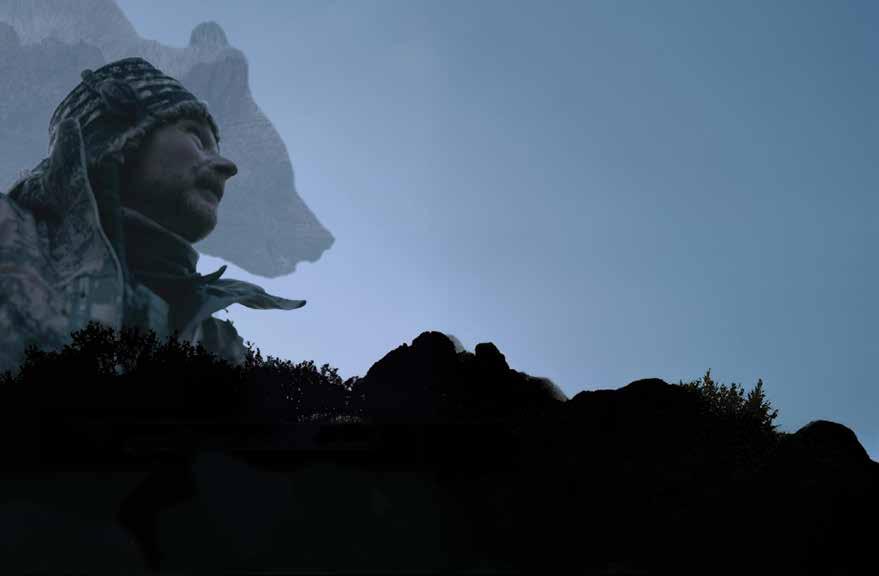

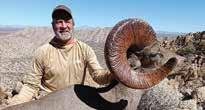
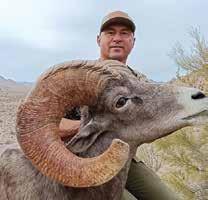
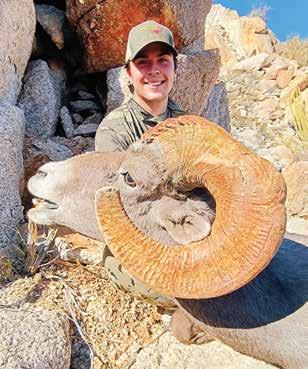
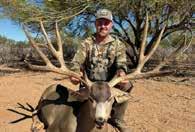




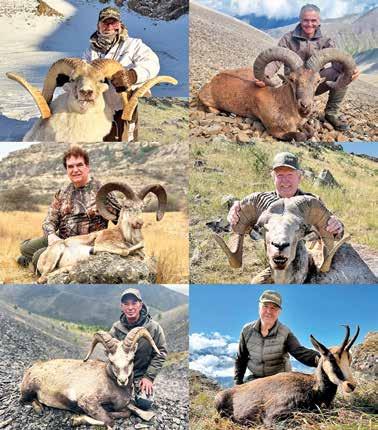
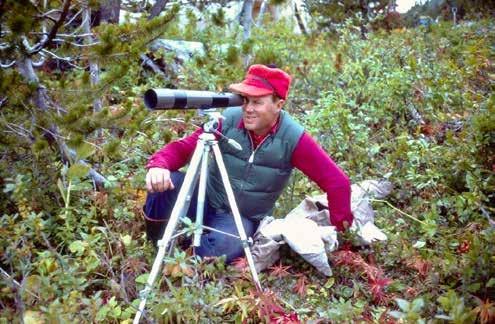
Dave Simpson
David Donald Simpson passed away on September 5, 2025, at the age of 92 with his wife of 50 years, Carol, by his side.
Born on October 14, 1932, on a ranch close to the mountains of southern Alberta, Dave grew up ranching,but at an early age,knew that he wanted to be an outfitter.
In 1950 he started working for outfitter Andy Russell,horse wrangling,and guiding.
In 1954 Dave bought out the business from Andy and took trail
rides as well as big game hunts in the fall. Over the next 40 years, Dave outfitted in Southern British Columbia, SouthernAlberta and the Willmore Wilderness Area on the Big Smokey River.
He spent time guiding and hunting in Alaska, NWT, Yukon, Mexico as well as a few states in the lower 48. Dave personally guided clients and friends to 99 bighorn rams.
Dave started a legacy of sheep hunters, mentoring many young guides as well as raising his sons in
the sheep hunting world, all who later became outfitters: Stan and Deb Simpson (Ramhead Outfitters), Frank and Cindy Simpson (Simpson Stone Sheep), and Flint Simpson (Canmore Bighorn’s) .
Dave now has three grandchildren in the outfitting business: Chase and Brittany Simpson (Simpson Outfitting), Meghan and Landen Collings (Keele River Outfitters), and Michael Simpson (Canmore Archery Bighorn’s).
Dave spent most of his career on the board of directors or as president of the Alberta outfitter association. He worked with the Alberta government on the wildlife regulation committee. Dave attended the first annual convention for the Foundation for North American Wild Sheep in Memphis Tennessee in 1978. Dave was a big supporter of the WSF, and every year since 1978, Dave or one of his sons have attended the convention.
Dave will be missed but always remembered,especially around a campfire out on a mountain,toasting a sandwich on the fire, binoculars around his neck and his walking stick nearby. WS
Jimmie C. Rosenbruch
Alaska Master Guide #61, Outfitter, and Steward of Wild places: my Dad, Jimmie C. Rosenbruch, a legendary figure in Alaska hunting and guiding and a devoted family man, passed away peacefully on September 21, 2025, in St. George, Utah. Jimmie departed
Tommy Carruthers, Sr.
Tommy Lee Caruthers, 85 of Denton, Texas, passed away Monday, September 1, 2025. He was born on October 2, 1939, in Denton to TL and Pauline Caruthers. He attended Denton local schools and North Texas State University, now University of north Texas.
He married Patricia Ann Bickley on May 5, 1963. They have been members of St. David’s Episcopal Church in Denton for the past 56 years.
Tommy operated Caruthers Oil Company in Denton. He and Pat were active in many community
this world just as he lived it—with quiet strength, unyielding passion for the untamed outdoors, and a deep appreciation for the adventures that defined his extraordinary adventurous life. He was the founder of Glacier Guides Inc., a missionary for The Church of Jesus Christ of Latter Day Saints, founder of the Rosenbruch Wildlife Museum in St. George UT, a pilot, a U.S. Coast Guard Maritime Captain 200-ton, surveyor, SCI Professional Hunter of the Year 2005, and received the Weatherby Award —the Oscar of Hunting. These are just a few things that made my dad who he was, and just a little of what he did with his eight-plus decades here on earth.
organizations including the Chamber of Commerce, several City of Denton Committees, Denton Benefit League, and St. David’s Episcopal Church.
Hunting was his passion and conservation his avocation. He was a life member of the Dallas Safari club where he served as director, convention chairman and co-chairman, and active with conventions for many years. The Dallas Ecological Foundation was a favorite organization of Tommy’s, where he served as president several times, treasurer, secretary, and vice- chairman and

WSF was notified of the passing of past board of director Virginia Frehner, Las Vegas, NV. Virginia brought a lot of flare to
Most of all, he was my best friend (until Zach came along) and taught me to believe in myself and that I could accomplish ANYTHING I put my mind to. We hunted together all over this planet from Alaska to Africa, China, Turkey, and beyond. What we didn’t get done together, Zach and I have continued doing together, thinking of the boot tracks he left on the mountain before us. We could “talk” to each other without words…just a look or a hand signal was enough. We coined the “Three I’s of hunting”: Instinct, Imagination, and most of all, Inspiration.
I shall miss him until we meet again. WS
chairman. Tommy was a founding member of the Texas Bighorn Society, which started in 1981. He served various roles within the foundation and sat on the board of directors. Tommy was also a lifetime member of The Foundation of North American Wild Sheep with which he was deeply involved in the direction of conventions in various states. Lastly, he was a member of the Boone and Crockett Club since its founding in 1989, and served as the first president and various other roles during his membership. WS
the board and a lot of fun to the conventions. She was noted for being at the Ladies Luncheon having fun bidding wars against the late Vivi Crandall. Those ladies loved to rule the room and entertain the crowds.
There is no official obituary for Virginia, but WSF wants to acknowledge and thank her for her contributions to WSF (FNAWS) during her time on the board. She will always be remembered for her red hair and spirit! WSF sends our condolences to her family and friends. WS
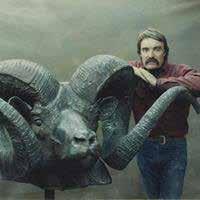
Bill Feeley, or Grubb as he was known to his friends, 81, of Cody, passed away on December 10, 2024, at home with his loving wife of 56 years by his side.
Bill was born in Powell, Wyoming on July 16, 1943, to William J. Feeley and Marie Ries Feeley. “Billy” was joined shortly thereafter by brothers Johnny and Teddy. The second generation of the notorious Feeley brothers was born. Bill and his brothers spent most of their childhood working and playing around the Feeley Brothers Reading Mix plant, located on the land that is now Canyon Meadows subdivision in Cody.
Bill’s father and uncles fostered a great love of the outdoors in Bill from an early age. Bill loved being in the mountains. He was passionate about hunting and fishing from the moment he learned to cast a line or aim his Red Ryder BB gun. Nothing brought him more joy, however, than spotting and watching bighorn sheep in the mountains and valleys of the Shoshone River.
Bill was a natural-born athlete and exhibited amazing athleticism throughout his life. In high school, he was tight end for the Cody Bronc football team, and catcher and clean-up hitter for his American Legion baseball
team. One of his proudest sporting achievements came his senior year, 1961, with being part of the state champion track team. Bill won first place in all four of his events and broke records which still stand to this day in the low and high hurdles. Upon graduation, Bill was awarded a full-ride track scholarship to the University of Kansas. After a year, Bill returned to his beloved Wyoming. He attended Northwest College where he played football for two years. He later transferred to the University of Wyoming.
It was at his brother John’s graduation party in 1965 where Bill met the love of his life Joyce Ellis. Three years later in June of 1968, Bill and Joyce were married and settled in Cody. Shortly after the wedding, their daughter Tiffani was born, and in 1972, their son Cortney joined the family. Of all of Bill’s triumphs, first and foremost were his two amazing children. He instilled in them his love of the outdoors, creativity, his sense of humour, and skipping school for a good powder day.
In the mid-seventies, Bill and his brothers took over the Feeley family concrete business, Feeley Brothers Ready Mix, and ran the company together for several years. Upon realizing he was more passionate about art, welding, and fabrication, he and his brothers sold the concrete business and branched out on their own. Bill worked as a welder and did odd welding jobs for years. In 1989 he finished his greatest artistic accomplishment, the creation of a twice-life-size steel sculpture of the Chadwick Ram. Bill sculpted this piece entirely out of steel, welding on rods, piece by piece, one at a time, a truly remarkable feat. The sculpture stands on Sunset Blvd in Cody. Bill fabricated many steel sculptures, chandeliers, lamps, and
fireplace screens as well as bronze sculptures cast using the lost wax casting method. Bill was a gifted self-taught artist and sculptor. He understood the hurt and humor of the west and portrayed that in his art. His work is all over the country, and he sculpted until the day he passed.
Bill started putting in for a sheep tag when he was fourteen. It was Joyce who drew the first sheep tag of the family in 1980. Bill spotted all summer and found Joyce’s ram for her which they bagged together on the last day of the season. It wasn’t until 2005 that Bill drew his sheep tag. At this point in time, his son, Cort, was running Ram’s Horn Outfitters, and father and son shared the hunt-of-a-lifetime. Cort helping his dad bag the oldest and biggest ram of the herd somewhere up around Needle Creek. Father and son shared another ram hunt when Cort drew a tag in 2007. Having the opportunity to hunt sheep with his son was the greatest and most treasured gift of Bill’s life. The three Feeley rams are housed in a trophy room at Bill and Joyce’s home in Cody.
It was after he and Joyces’ ram hunt in 1980 that Bill realized life was better without a Coors beer in his hand, and on New Years Day, 1980, Bill took his last drink. He would have celebrated 45 years of sobriety January 1st, 2025. He is one of the good old timers of Cody group AA and has helped countless people with his story of recovery.
Although at times Bill could be gruff and rough around the edges, he was a fair and kind man with a tender heart of gold the size of Wyoming. He had a sly sense of humor that made his wife laugh every day. He adored his grandchildren and loved his pets. WS
John P. Poston, Sr.
John P. Poston, Sr., passed away at his residence near Helena on June 3 at the age of 85. A lifelong resident of Montana, John was born in Anaconda where he grew up with his three older brothers and three older sisters. A high school honor roll student and a member of the chemistry and social studies clubs, he went on to earn his bachelor’s
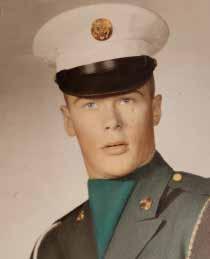
David B. Tucker
David B. Tucker, 77, beloved husband of Sandra (Zumwalt) Tucker, passed away on Sunday, March 2, 2025, at Baystate Medical Center.
David was born on February
degree at the University of Montana as well as his Juris Doctor diploma. He was a member of the Montana State Bar for decades and an avid UM Grizzly supporter. John was the first member of his family to attend college and receive a graduate degree. John then moved to Helena and worked at the highway department before setting up his own firm with two friends from law school, Tom Harrison and Jerry Loendorf. In the early 1980s, John, along with his first wife, Joan Stenger Poston, helped found the Valley Bank of Helena. He served as the bank’s chairman for several years.
John was a highly respected member of several national conservation organizations, including Ducks Unlimited, where he served in many leadership roles at the national level, and the Boone and Crockett Club, where he was elected an Honorary Life Member. An enthusiastic fisherman and hunter, he proudly displayed his FNAWS of mounted sheep. John
15, 1948, in Toronto, Ontario, Canada, to the late Rex and Sarah (Hamilton) Tucker. He moved to Boston for a short period before settling in Enfield, where he grew up and graduated from Enfield High School with the class of 1967.
After high school, David proudly served in the U.S. Army during the Vietnam War, stationed in Korea. Upon his honorable discharge, he married Sandra in a small ceremony at Fort Dix, New Jersey, and together they raised their family in Suffield.
A man of deep patriotism, David enjoyed a wide range of interests and hobbies. He had a passion for fishing and hunting and was an avid collector, with items ranging from knives to valuable Barbie dolls. David also raised cattle, forging connections with people from all over the world through his
was a high school weightlifter and took up distance running later in life. He ran the Governor’s Cup Marathon, both individually and on relay teams, and served as a member of the organizing committee for the cup for many years.
In 1998, John married a second time, his high school sweetheart, Joan Duffy. They were together until Joan’s passing in 2022. John enjoyed the later years of his life at his home at Hauser Lake with his dogs and cats.
He is survived by his two daughters, Kaye and Sandy, and his son, John; his step-daughter Helen, his four grandchildren, Sandra, Sean, Katka, and Max; his step-grandchildren Bo, Josie, Ellie, Charles, and Angus; his step-great grandchildren Rainier, Penelope, and Oliver; numerous nieces, nephews, grandnieces and grandnephews; his three dogs, Duffy, Purl,and Elway; and his two cats, Conrad and Knot-tail. WS
years of showing cattle. His love for sports was evident, particularly his devotion to the Green Bay Packers. He also made a lasting impact as a coach for the Enfield football teams, the Lancers and Ramblers.
David’s generosity, his love for his family, and his strong sense of community will be missed by all who knew him.
He is survived by his wife, Sandra, and their two children: Travis Tucker and his wife Suzanne, and Brandy Tucker. He was also the proud grandfather of five grandchildren: Taylor Hunter Tucker and her Fiancé Graham, David Paul Phaiah and his wife Brianna, Harrison Leonard Tucker, James Travis Tucker, and Greta Catherine Tucker. He was predeceased by his brother, Keith Tucker. WS
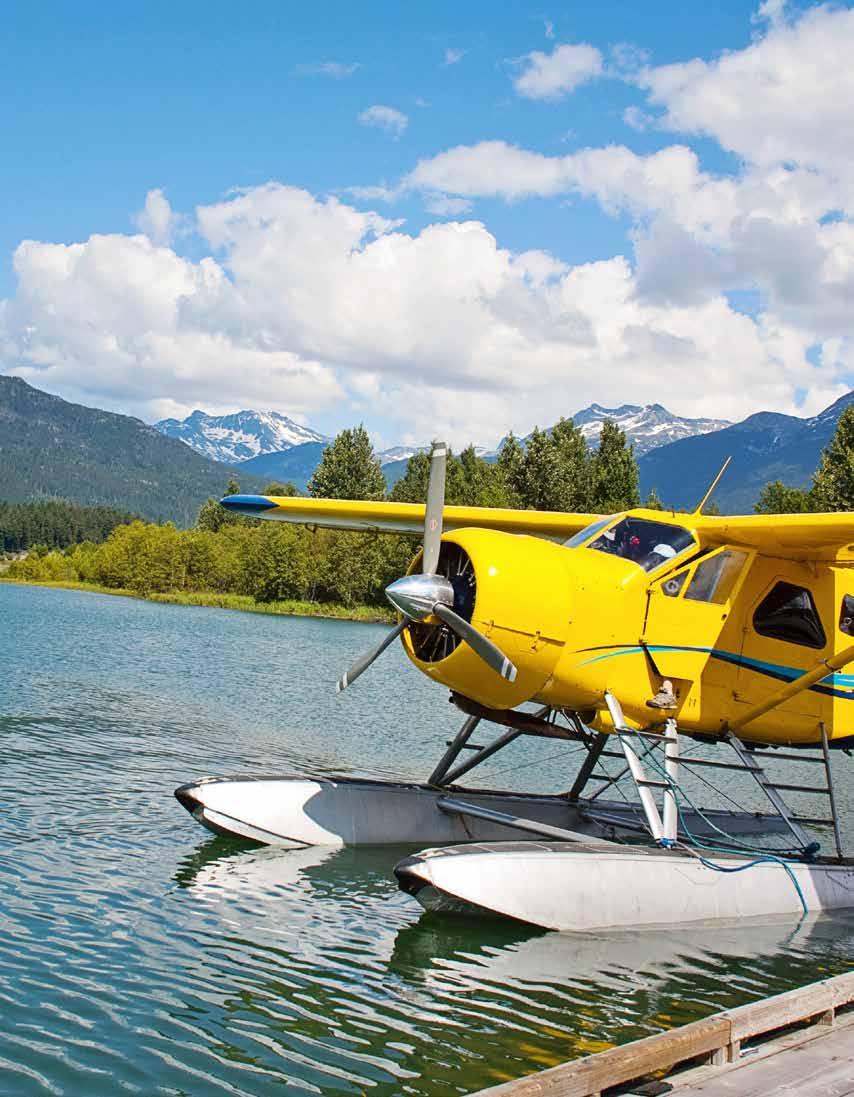

•
•
•
•


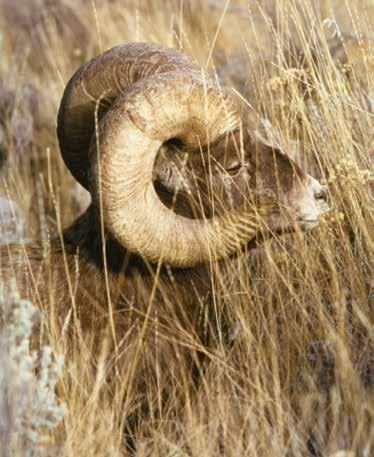
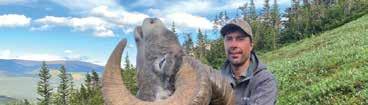







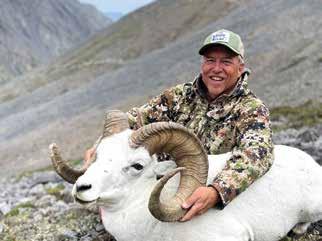
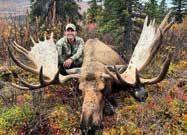
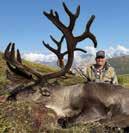
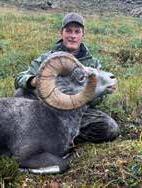

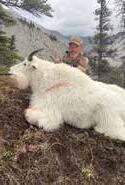

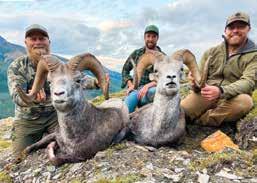















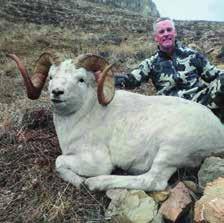

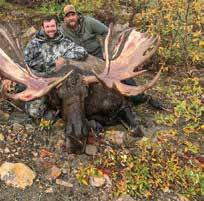















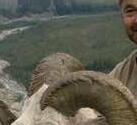


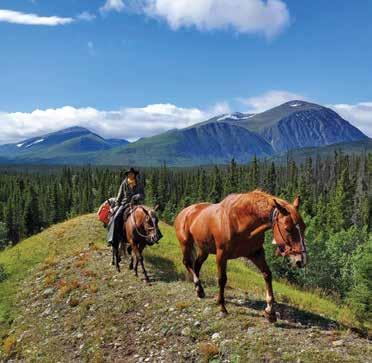


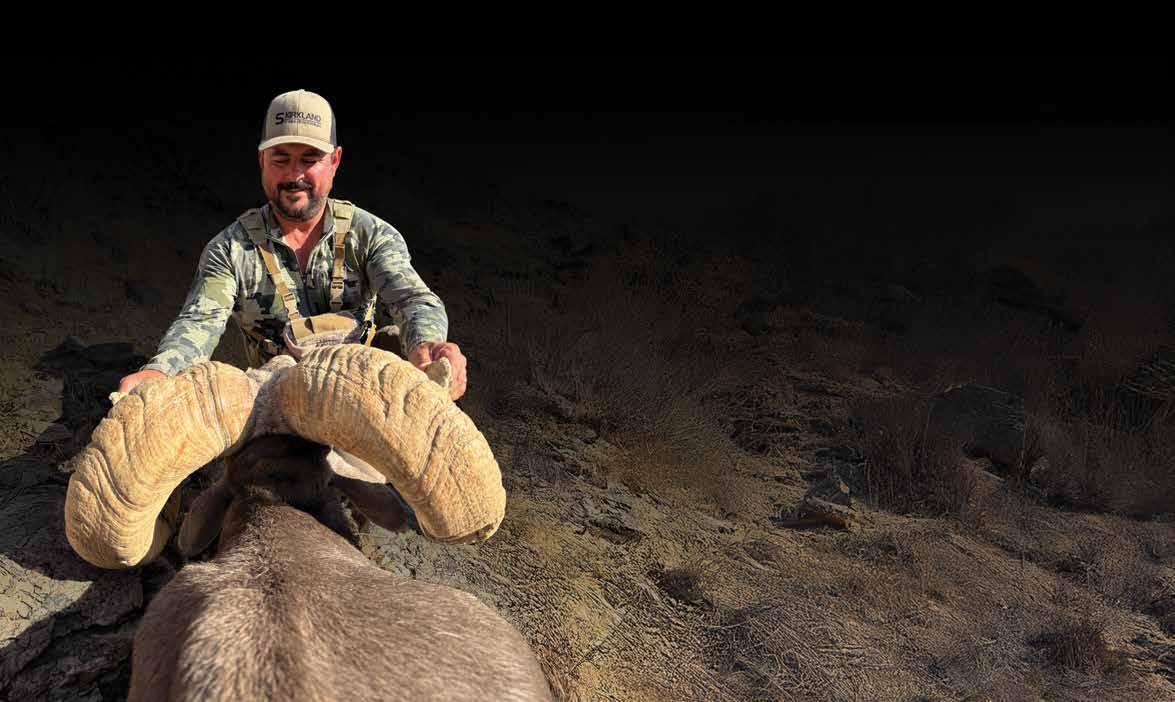
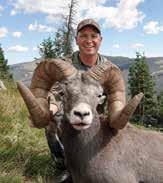
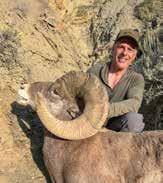
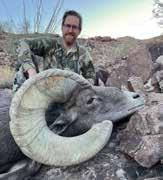
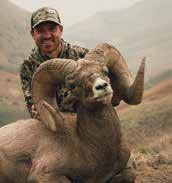
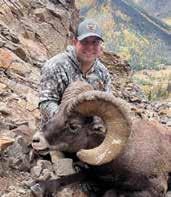
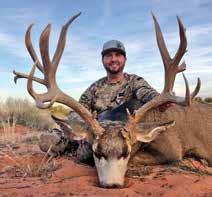
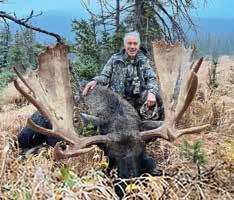
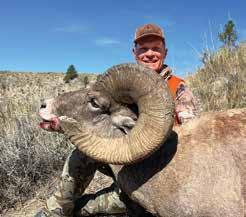

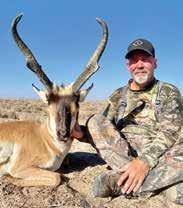
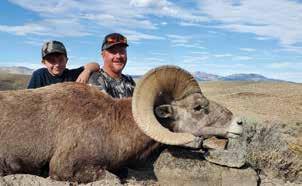
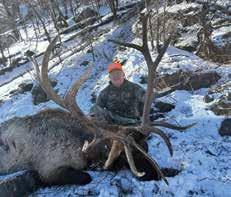
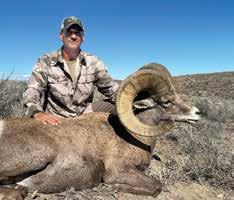



by Ken Nowicki
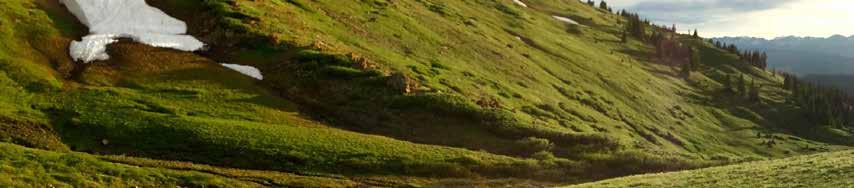
You don’t know how it feels, Until it happens to you...*
*Madonna
Idrove down to Ruby’s Café.
There is a bright blue painted handicap stall but I knew that only Blind Pete was allowed to use it. The regulars see to that.
The regulars on any given day include a bunch of ranchers, farmers, burley loggers, houndsmen, and outfitters and guides. They come in both of the two sexes and the common denominator is an affection for good chew and coffee and pie. At each table there are little dispensers for napkins. These are for the used wads of chew. It is also not a good idea to put your fingers under the tables. You never know what might stick.
I was feeling pretty self-conscious clicking down the street and I paused and looked through the window before steeling myself to go in. Ruby’s Café usually feels like home and I always sit with Packtrain MacNammee and Lead-On Highfee, legendary outfitters for sheep all over the West and North.
“Here comes Hop-a-long,” hollered Packtrain when I stick handled the crutches through the door. Nobody jumped up to help me.
“Come pull up a stool, if you can,” giggled Lead-On. “I heard you was using a walker.”
“I’ll never hunt sheep again,” I wailed. A wave of emotion swept over me. I was red faced and sweating. I had to tell my friends. “I
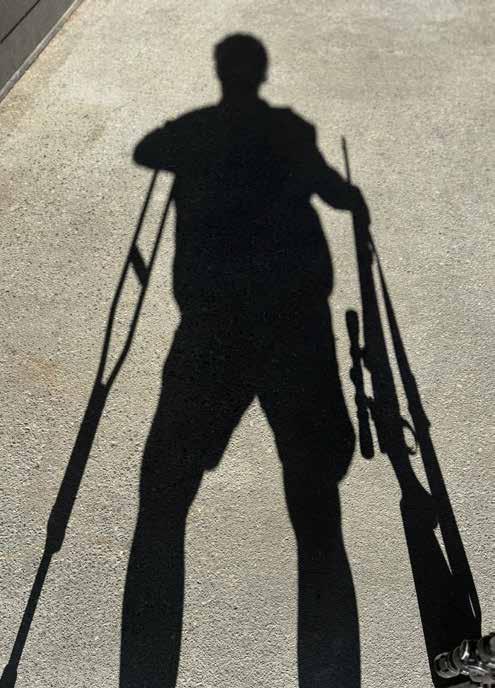
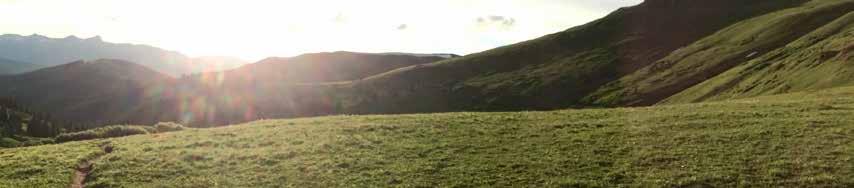
got my knee done. It was bone on bone and Doctor Skybucks told me I had to put in new parts.”
“I’ll be danged.” Packtrain poked my leg. “Sure looks swolled up.”
“Stop that, cripes, it hurts. Can’t you see the staples? I’m healing. Oucch.”
I must be a sucker for abuse to think these guys would care. They started talking about themselves and ignored me.
“Remember that year I bust my hip falling off the bronc,” said Packtrain. “That sure hurt.”
I remember you was in the hospital and came out with a nurse for a new wife,” snarked Lead-On. “Serves you right for keeping those wildies in your string.”
“I did like the attention. But I did have the best outfit in the country. My horses and crew was the very best.”
“Sure and why’d one kick you in the face? And I think I got more rams than you,” bristled Lead-On.
“Why don’t I kick you in the face?” These old outfitters like to taunt each other and they never let up on me. But to them it’s just joshing and all in good fun. “Boy,” he turned to me and said. “You got lots to learn.”
“You don’t know pain until a gorilla lands on your chest,” mused Lead-On. “The heart attack was worse than the kidney stones.” I hadn’t ever heard him complain. “I got all kinds of afflictions,” he said. But back to me. I wanted to tell my story. “Guys, guys. My sheep hunting is finished. I’m so bummed out. The doctor says I ground down my knees by carrying backpacks.”
“Oh don’t be so dramatic,” gurned Packtrain. He grabbed me and gave me a hug, and I felt better until he
wormed his bony finger into my side and he smirked as I squealed. “You wouldn’t have wrecked yourself if you’d done some work all your life. You got a belly pack here.”
“Lead-On added, “Next thing they is going to put in a couple new hips in you. I had a dog got dysplasia from packing. He was fat too.”
Lead-On made his reputation as a first class outfitter and he never used horses. He preferred his old Trapper Nelson and exceptional powers of suggestion to get clients into rams.
“See, that’s why I used horses,” sneered Packtrain. “You backpack hunters got blisters and hammertoes. And I didn’t get bucked off. Truth is I got pushed off a barstool is how I bust my leg.”
“I heard you was Highland Dancing at one of your many weddings,” giggled Lead-On. Both these guys had Scottish ancestry.
“I recall you got the gout the next day and had a hunter coming for rams.”
“I did, but he was a dough-boy like this one and I took it slow,” He patted me on my leg and I shrieked.”
“I left that big fellow sitting by a rock no more than a thousand yards from the airstrip and I told him the rams like to cross the valley and to watch close. I went for a nap, and came back and he was setting with a 40 incher. It were a miracle.”
“I’m sad I finished hunting rams with this leg,” I pouted. “Doctor Skybucks said I had to take it easy for a year.”
“Now you listen and listen good,” snorted Packtrain. “You book a hunt with an outfitter with good horses. And you look over there at those guys in here because one of them will likely be guiding you.”
I swiveled and gawked. There
were a bunch of reprobates swilling coffee and chowing pie.
“Crazy Pat, he’s got a plate in his head. Big Marty, he’s had a couple heart attacks. Bobbi-Jo, she’s got the fibbermalgia. Not sure what that is, but she’s cranky at times. Flathead Johnson, see the chain saw tracks on his face?”
“You see Blinky Sigurtson, he got the molecular degeneration. He still hunts sheep. I hired a guy with that before. They can see out of the corner of their eyes.”
“And Red,” he said, whispering it quietly and pointing, “They say he’s got the cancer.” Lead-On was absently scratching at his arm. I kind of leaned back when I saw that.
Packtrain was gazing at the patrons in the room. “I know Pinky lost his thumb when his gun blowed up. That didn’t hurt as much as the slapping he took from the bear. And just about all them guys with cowboy hats been cracked and broke a bone or two or more. Boy, you don’t quit hunting because you got some breaks and bruises.”
“Hunting is the safest sport there is, you can’t let this gimpy leg stop you.”
“Look at all those guys in the Wild Sheep® magazine puffed up with the hero shots. They all look alike, with the frosty goatee beard and the mustache. That’s the style these days for middle-aged men.”
“That and a shaved head to hide the grey,” Lead-On shook his tangled mane. He always sported a wild look and two or three days of growth on his face.
“When I was a young man I had a Dempsey Pomp,” said Packtrain. “I see that style is coming back.” These old guys do get distracted once in a while.
“Maybe you just hated to spend the money cutting your hair,” chided Lead-On. I knew there was truth in that. Neither of these old goats liked to spend an extra dime.
“See Boy, I grant you that sheep hunting is expensive and by the time you can afford to do it, you has worn a tooth or two down to the gum line. But look around, just about anyone getting silver in the hair has had a health scare or two.”
“Remember that most of those older guys never used walking sticks. I never heard of such a thing when I started guiding. In fact, it was kind of sissy to use a ski-pole to hike and climb. But they work, Boy. If you had been using poles when you was young, you wouldn’t be on crutches with bad knees today.”
“Yup, Boy, you got to suck it up and go hunting no matter how
much it hurts. Remember, it could be worse.”
“Too right, one day you cross the street and WHACK!, you is on the pavement flopping like a fish out of water. Or you wake up and start scratching and it turns out you need to give a skin sample at the lab.” I noticed Lead-On was still digging at a brown spot on his arm.
“Get out there and hunt, Boy. And get a horse and hire a top outfitter with a tough guide who can baby you up and down the mountains. Or if youse are hunting alone, lke you do because you are cheap, then you got to be smart and figure out the best place to look for sheep.”
“Do you think so? Maybe you guys know where I can find a ram that would be accessible for someone in my condition. Like a
place where I could get to without a lot of climbing?” Maybe, I thought, I could actually get a tip from these old codgers on where to find a ram. Packtrain and Lead-On both looked surprised. “Boy you got to shuck those crutches first.”
So I had to go and I struggled up and thumped over to pay for the coffee and pie as usual and left to go to physiotherapy. I was sure I heard Lead-On say, “He looks kind of funny don’t he? Kind of like a crab.” WS
‘ Editors Note
• Nowicki reports that his surgery on the left knee was performed by Dr. Duffy at a private clinic and cost roughly the same as a Dall’s sheep hunt. He is booking his next operation for March so that he can get rehabilitated before opening day of sheep season. The price for the second surgery will be more like the cost of a bighorn sheep hunt as the scarcity of rare earth minerals has inflated titanium used in the implants. His alternative to private surgery was a threeto five-year wait for a place in the line-up created by the Canadian health care system. Nowicki says he will religiously pursue his exercises, and also for good measure, he is flying to Mexico to visit the fountain at Guadalupe. He also reports that he has canvassed numerous outfitters from Mexico to Alaska to see if they will take him hunting with his limited ability to perambulate and universally they have answered No Hay Problema! This has excited him for the possibility that he may heal up and get a ram in the next couple of years and join the pantheon of the successful showcased in Wild Sheep® magazine.
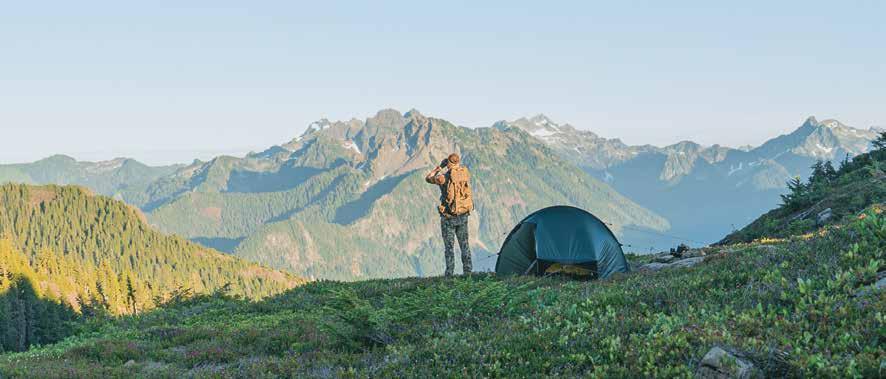
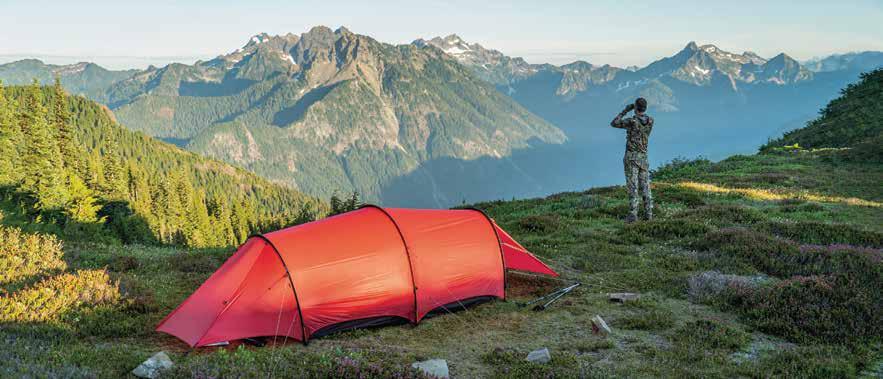
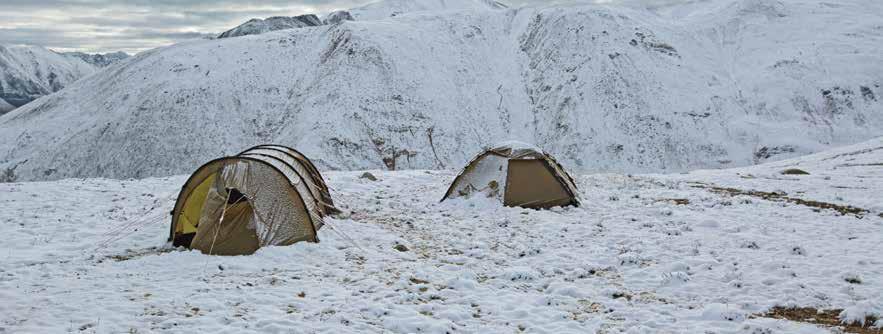
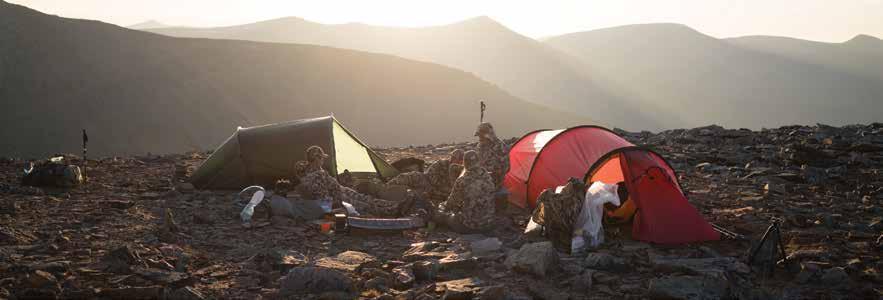

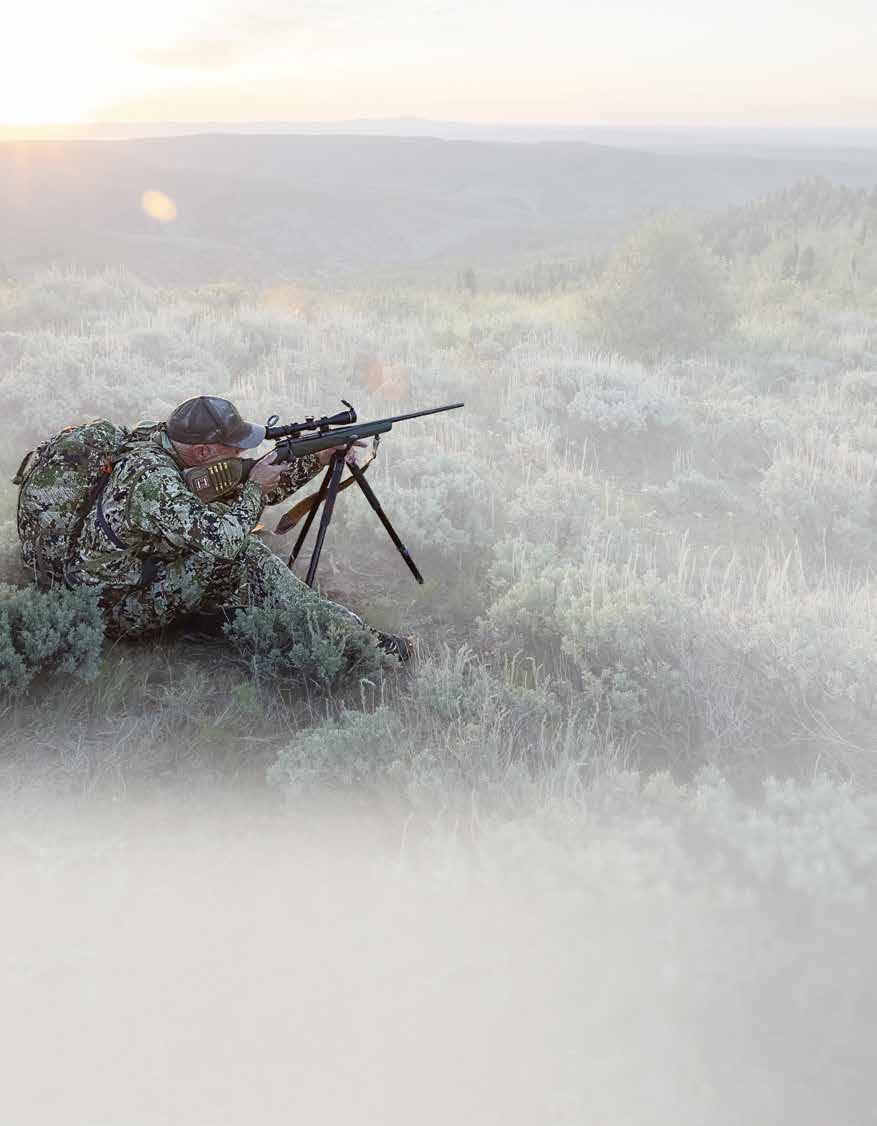

When you set out to exceed the limits of what is expected of hunting ammunition, you don’t do it by guessing what should happen. You test, evaluate and refine until you arrive at Hornady ® Precision Hunter ® ammunition, loaded with our ballistically advanced ELD-X® bullet with Heat Shield® tip. Engineered specifically to deliver match accuracy and lethality at all practical ranges, Hornady ® Precision Hunter ® ammunition is the best ALL-RANGE hunting ammunition.