COMMUNICATION PLAN
HEARING & COMMUNICATION GUIDE
Better hearing is more than just a hearing aid... Hearing is only one aspect of communication. COMMUNICATION
HEARING provides access to sound
LISTENING
COMPREHENSION
is the effective
and paying
is the correct
use and shaping
attention to what
understanding of
of information
is important
what is being said
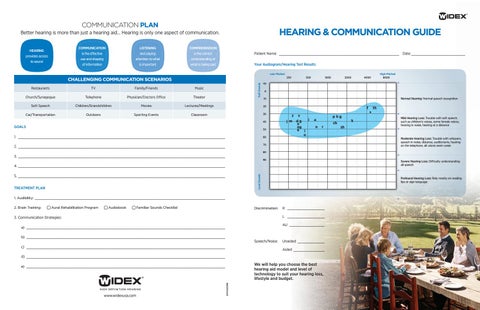
Patient Name: __________________________________________________________ Date: __________________________ Your Audiogram/Hearing Test Results Low Pitched 250 Soft Sounds
CHALLENGING COMMUNICATION SCENARIOS TV
Family/Friends
Music
Church/Synagogue
Telephone
Physician/Doctors Office
Theater
Soft Speech
Children/Grandchildren
Movies
Lectures/Meetings
20
Classroom
30
Outdoors
Sporting Events
2000
High Pitched 8000
4000
0
Normal Hearing: Normal speech recognition
10
40
GOALS
1000
-10
Restaurants
Car/Transportation
500
50
1. ____________________________________________________________________________________________________
60
2. ____________________________________________________________________________________________________
70
f z v i j m dg n ng e l u
p hg
a o
r
ch
sh
k
s
th Mild Hearing Loss: Trouble with soft speech, such as children’s voices, some female voices, hearing in noise, hearing at a distance
Moderate Hearing Loss: Trouble with whispers, speech in noise, distance, auditoriums, hearing on the telephone, all voices seem weak
80
3. ____________________________________________________________________________________________________
90
Severe Hearing Loss: Difficulty understanding all speech
4. ____________________________________________________________________________________________________ Loud Sounds
5. ____________________________________________________________________________________________________ TREATMENT PLAN
Profound Hearing Loss: Rely mostly on reading lips or sign language
1. Audibility: ____________________________________________________________________________________________ 2. Brain Training:
Aural Rehabilitation Program
Audiobook
Familiar Sounds Checklist
Discrimination:
R __________________ L __________________
3. Communication Strategies:
AU _________________
a) ________________________________________________________________________________________________ b) ________________________________________________________________________________________________
Speech/Noise:
c) ________________________________________________________________________________________________
Unaided _____________ Aided _______________
d) ________________________________________________________________________________________________
We will help you choose the best hearing aid model and level of technology to suit your hearing loss, lifestyle and budget.
www.widexusa.com
DRM261_0516.indd 1-2
DRM261/0918
e) ________________________________________________________________________________________________
5/3/16 3:17 PM
LISTENING ASSESSMENT
IMPORTANT HEARING FACTS 1
What brought you to our office today? ____________________________________________________________________ __________________________________________________________________________________________________
2 out of 3 people age 70 and older have hearing loss Inner Ear
2 Please check the appropriate circles below that apply to your current hearing abilities in various environments.
Select one:
with hearing aids
without hearing aids HOW WELL DO YOU CURRENTLY HEAR IN THIS ENVIRONMENT?
LISTENING ENVIRONMENTS
WELL
FAIR
POOR
Outer Ear
HOW FREQUENTLY ARE YOU IN THIS LISTENING ENVIRONMENT? OFTEN
SOMETIMES
WHICH 3 LISTENING ENVIRONMENTS DO YOU STRUGGLE IN THE MOST? (ONLY SELECT 3 SITUATIONS)
RARELY
Quiet Room (1 to 2 people)
Large Social Gatherings
Amplification is only part of the rehabilitative process
EFFECTIVE COMMUNICATION STRATEGIES
Use your eyes as much as possible. Hearing is easier when you can see your communication partner. Get close and make sure you can see their face.
At the Work Place Watching Television
Be prepared for noise! If you’re going to a noisy restaurant, try to go at less busy times to avoid large, noisy crowds. If you’re going to a lecture or religious service, get there early and sit up front. You will always hear better when you are closer to the individuals speaking.
During Religious Services Meetings / Lectures
Keep track of the conversation. Repeat back what you heard to make sure you are on track with the conversation. Try to be specific about what you missed during a conversation. Instead of saying, “huh” or “what”, repeat back what you did hear. One example, “You’re going out at what time?” This strategy helps the speaker not have to repeat everything he/she said.
In the Car Outdoors On the Telephone What is your experience with hearing aids? (check all that apply) I have never used a hearing aid(s) or visited a Hearing Healthcare Professional to inquire about a hearing aid(s). I have been to another Hearing Healthcare Professional to gather information regarding my hearing difficulties, but have not tried or purchased. I have tried a hearing aid(s) but returned the instrument(s). I have a hearing aid(s) but only wear it occasionally or not at all. I have a hearing aid and wear it regularly on the
right ear,
left ear.
Be patient. Be patient with yourself and your communication partners. You will not always understand everything, but by using these ideas you should get the most important information. Improved communication can lead to a better quality of life. People with a hearing impairment often wait more than 7 years before actually doing something about their hearing loss. Don’t wait that long. The sooner you take care of your hearing loss, the sooner you can enjoy a better quality of life through better communication with your family, friends and loved ones.
Please rank the following features (or qualities) in terms of their importance in a hearing aid. (1 through 4, with 1 being the most important): _____ Overall Sound Quality
5
An untreated MILD hearing loss may result in a 6-year age decline in cognitive performance
Dine with smaller, more intimate groups. This will make it easier to follow dinner conversations.
Small Groups (4 to 6 people)
4
Older adults with hearing loss have a 24% higher risk of cognitive impairment
Address your loved one by name. Before starting a conversation, call or say the person’s name. This will direct their attention to you.
One-to-One Conversations
3
Hearing is a complex system involving the ear, the 8th nerve and the brain
Middle Ear
_____ Reliability
_____ Style/Appearance
_____ Cost
On a scale of 1-10, how motivated are you regarding doing something about your hearing loss? (Please select one)
1
2 NOT MOTIVATED
DRM261_0516.indd 3-4
3
4 SOMEWHAT MOTIVATED
5
6 MOTIVATED
7
8 VERY MOTIVATED
9
10 EXTREMELY MOTIVATED
5/3/16 3:17 PM