
WORKING TOGETHER TO SIMPLIFY FINANCIAL AID OUR INVESTMENT.
WORKING TOGETHER TO SIMPLIFY FINANCIAL AID OUR INVESTMENT.

Your potential is unlimited. That’s why investing in a Widener education is a critical step toward accomplishing your biggest, boldest goals. As your investment partner, we’re here to support you throughout your journey— that includes navigating financial aid.
This booklet details the financial aid process. From terms you’ll encounter to a timeline of your financial aid journey—complete with action items, tools, and resources—you’ll find everything you need to bring your education within reach.
QUESTIONS? We’re happy to help! Widener Student Financial Services provides a one-stop, centralized location on campus—inside Lipka Hall—for you and your family to ask questions about financial aid, payment options, registration, and more.
|
Learning about financial aid can feel like tackling an unfamiliar language! Before your journey begins, let’s demystify the vocabulary and processes you’ll encounter along the way.
This online application, which you’ll submit annually as an undergraduate, determines your eligibility for grants, loans, and other forms of financial aid. Be sure to use Widener’s school code: 003313 and complete the application at studentaid.gov.
A form of financial assistance that does not require repayment or employment.
■ Institutional scholarships: Widener offers several scholarship opportunities based on academic performance in high school or at a previous college or university. These forms of merit aid for incoming first-year students are awarded for a total of eight full-time semesters. Transfer students will have a different length of time during which they will be eligible for this funding. You may also be awarded additional scholarships—view the full list at
■ Private scholarships: You can also seek financial assistance from sources outside the university. Find additional scholarship opportunities via websites for the College Board, Fastweb, the U.S. Department of Education, FinAid, and Scholarships America.
Grants—which you do not have to repay—are awarded to full-time, enrolled undergraduate students (12 or more credits per semester) who are pursuing a first bachelor’s degree and demonstrate financial need. Widener offers grants for incoming first-year students that can be
awarded for a maximum of eight full-time semesters, as long as financial need continues to be demonstrated. Transfer students will have a different length of time during which they may be eligible for this funding.
■ Federal Pell Grant: Awarded to enrolled undergraduate students who are pursuing their first bachelor’s degree. Federal Pell Grant eligibility is determined by the Student Aid Index (SAI) that is calculated when you submit the FAFSA. You may receive Federal Pell Grant funding for 12 full-time semesters (or fractional equivalents for less than full-time enrollment) while pursuing a first bachelor’s degree.
■ Federal SEOG Grant: A supplemental grant award with priority given to Federal Pell Grant recipients.
■ Pennsylvania State Grant: Awarded to undergraduate Pennsylvania residents who are pursuing a first bachelor’s degree. To maintain eligibility, you must make academic progress by completing at least 24 new credits for full-time and at least 12 new credits for half-time enrollment each year. The PHEAA Grant Division determines award amounts. Learn more at pheaa.org
■ Widener Grant-In-Aid: Need-based aid provided directly by Widener on the basis of your financial circumstances. widener.edu/ugscholarships

Loans are a helpful resource that countless families utilize to bring the cost of education within reach. Consider loans—which must be paid back with interest—after exploring other gift aid, such as scholarships and grants.
■ Federal Direct Subsidized Loan: Awarded to students who have filed the FAFSA and qualify based on need. Federal subsidized loans range from $3,500 to $5,500 annually depending on grade level and enrollment, meaning the annual loan limit will vary. Interest is paid by the Department of Education while students are enrolled at least half time.
■ Federal Direct Unsubsidized Loan: Awarded to students who have filed the FAFSA. Amounts range from $2,000 to $9,500 for first-year students annually, depending on grade level and enrollment, meaning the annual loan limit will vary. Interest accrues as soon as the loan is disbursed.
■ Federal Direct PLUS Loan: Can be borrowed by a parent of a dependent student. The borrowing party must qualify based on a credit check and can borrow up to $20,000 per academic year after all other aid sources have been considered. Federal Direct Parent Plus loans have a lifetime cap of $65,000. Dependent students whose parent applies for and is denied a Federal PLUS loan will have eligibility for additional Federal Unsubsidized Loan funds.
■ Private Education Loans: Private education loan funding may be an option if you need additional assistance after all other sources have been used. Non-need-based private education loan programs are offered by a variety of lenders and organizations, including banks and credit unions. Loan details and requirements vary depending on lender.
The financial aid noted as “pending” on your bill is estimated and provided for planning purposes. Financial aid awards are finalized and credited to your university account after eligibility is confirmed, as early as the start of each semester.
You must be registered full time in one of our traditional undergraduate programs to be eligible for Widener funding and for the full amount of certain federal and state grant funds. For undergraduate students, a minimum of 12 credit hours per semester constitutes full-time enrollment. If you’re registered less than full time, financial aid will be adjusted to part-time levels.
Access the Widener Financial Aid Handbook at under Financial Aid Links and Forms.
sites.widener.edu/financialaidmc
Student Financial Services may be required to make recalculation adjustments to your charges and financial aid when you add, drop, or withdraw from a course, change residence hall status, or cease enrollment at the university.
Widener was my first choice for many reasons, and affordability was an important factor in my college decision. Financial aid made it possible for me to thrive as a student, pursue my interests, and get involved in the campus community.
— Krysta Lynn Bernold ‘24


11-to-1
undergraduate student-faculty ratio
consisting of faculty and peer mentors, a student affairs liaison, and a librarian
66% of Widener students complete an internship, a practicum, or similar hands-on experience. That’s 14% higher than the national average.*
*Per the National Survey of Student Engagement.
100% of Widener students who complete a co-op graduate in four years. Most peer institutions require a fifth year of study.
$50 million+ in scholarships and grants
including advising, coaching, tutoring, and math & writing centers at no additional cost
$70,300
early-career salary for Widener alumni with a bachelor’s degree*
$116,100
mid-career salary for Widener alumni with a bachelor’s degree*
*Average salaries are as reported by PayScale in its 2024 College Salary Report. Salaries can vary widely based on field, geography, and years of experience.

95% OF THE CLASS OF 2024 achieved career goals within 6 months of graduation, per Widener University research.
A timeline of when to complete important steps—and when to seize opportunities that maximize your income and financial aid— throughout your Widener experience.
Complete your FAFSA now, if you haven’t done so. Get started at studentaid.gov
Contact Student Financial Services in early summer to review your anticipated aid and charges based on your enrollment and where you plan to live during the academic year. Use the enclosed worksheet with your offer letter to estimate direct costs minus aid. This is a great time to discuss direct and indirect costs and aid, options for payment, and any loans.
Explore scholarship opportunities through Widener and elsewhere.
Stay on top of your grant eligibility. While you are automatically considered for state and federal grants by submitting the FAFSA, you may be prompted to provide additional information before decisions are finalized.
Financing a portion of your education through private educational loans? Gain approval for your loan by submitting an application to the lender of your choice.
Parent or guardian financing a portion of your education? If you are a dependent undergraduate student and your parent or guardian will be financing your education with a loan, make sure they have completed the application for the loan of their choice. They also need to complete all necessary steps in the loan process. Contact Student Financial Services with questions.

Borrowing a Federal Direct Subsidized and/or Unsubsidized Loan? Complete the Loan Agreement/ Master Promissory Note (MPN) at studentaid.gov.
Complete entrance counseling. Learn the terms and conditions of borrowing a federal loan during this session at studentaid.gov
This step is needed before the loan is disbursed.

As fall approaches, your admissions portal (widener.edu/portal) will be the place to complete critical onboarding tasks, including:
■ Family Education Rights and Privacy Act (FERPA) waiver release
■ Tax form 1098-T electronic delivery consent
■ Emergency contact information
■ Direct deposit setup (for refunds and work-study checks, if applicable)
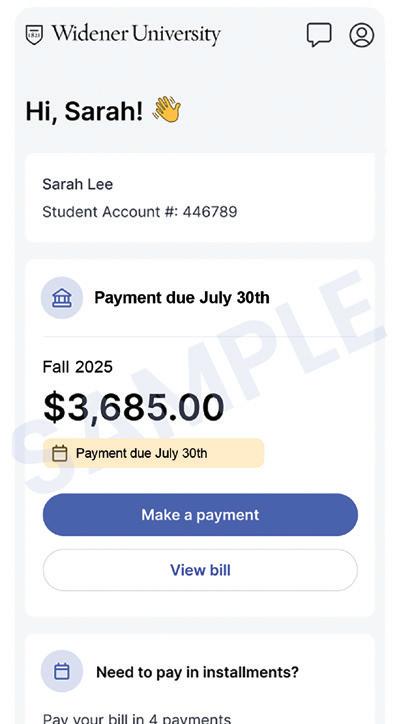
■ Activate your student billing account—and add an ally account to share bills with those helping you pay—at
■ Consider enrolling in a payment plan, which allows you to pay an installment of your tuition each month of the semester.
■ Keep an eye out for billing alerts, arriving via text or email.
■ Pay your bill, or set up a payment plan, via Meadow Pay, our mobile-friendly payment platform, at


Contact the Office of Financial Aid to determine your eligibility for Federal Work-Study. Choose from numerous available positions, where you’ll gain skills and experience relevant to your future career—and earn income while doing it. You’ll work up to 20 hours a week during any week in which classes are held and receive biweekly pay at the rate of at least the current minimum wage.
Not eligible for Federal Work-Study? Seek direct university employment instead. You’ll experience the same career-shaping benefits and still get paid at least the rate of minimum wage.

Earn up to one year of income and on-the-job experience through our co-op program. Available to business, engineering, and computer science students, the program allows you to work full time at an employer relevant to your major—and still graduate in four years.



Complete exit counseling. Widener provides personalized exit counseling, where you’ll meet with

Grow your Widener alumni network. The Office of Alumni Engagement offers opportunities to connect with Widener grads who share similar interests or reside in your region—opening doors to mentorship, professional development, or even job opportunities.
Start your career strong with
Development. Alumni have access to career guidance including personal
professional skills workshops,
Consider loan deferment for graduate study. If you’re enrolled at least half time in graduate school or a graduate fellowship, you may be able to defer loan repayment during that period. Interest may still accrue.
As you navigate your college decision, take advantage of opportunities to gain deeper insight into what your life could look like here—and all you can achieve.
■ Reserve your spot at Admitted Student Day, a high-energy preview of life in the Pride where you’ll introduce yourself to your new community. Register in the admissions portal.
■ Explore campus. Shadow a current student, schedule a private or group visit, take a weekend tour, or create your own itinerary during a personalized visit.
■ Zoom with an admissions counselor. Have all your questions answered and learn more about the aspects of college that are meaningful to you.