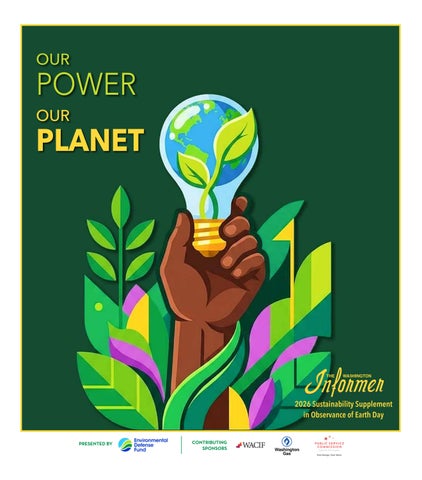
2026 Sustainability Supplement : Final

Page 1


THE WASHINGTON INFORMER NEWSPAPER (ISSN#0741-9414) is pub-

lished weekly on each Thursday. Periodicals postage paid at Washington, D.C. and additional mailing offices. News and advertising deadline is Monday prior to publication. Announcements must be received two weeks prior to event. Copyright 2016 by The Washington Informer. All rights reserved. POSTMASTER: Send change of addresses to The Washington Informer, 3117 Martin Luther King, Jr. Ave., S.E. Washington, D.C. 20032. No part of this publication may be reproduced without written permission from the publisher. The Informer Newspaper cannot guarantee the return of photographs. Subscription rates are $96 per year, two years $168. Papers will be received not more than a week after publication. Make checks payable to:

THE WASHINGTON INFORMER

3117 Martin Luther King, Jr. Ave., S.E Washington, D.C. 20032

Phone: 202 561-4100

Fax: 202 574-3785

news@washingtoninformer.com

www.washingtoninformer.com

In

Memoriam Dr. Calvin W. Rolark, Sr. Wilhelmina J. Rolark

PUBLISHER

Denise Rolark Barnes

STAFF

Micha Green, Managing Editor

Ron Burke, Advertising/Marketing Director

Shevry Lassiter, WIN-TV Producer

Ra-Jah Kelly, Digital Asset Manager

Lafayette Barnes, IV, Editor, WI Bridge DC

Desmond Barnes, WIN Daily Editor

Anthony Tilghman, Social Media Strategist

ZebraDesigns.net, Graphic Design

Mable Neville, Bookkeeper

Angie Johnson, Office/Circulation Manager

Jada Ingleton, Content Editor

REPORTERS

Stacy Brown, National Reporter

Sam Plo Kwia Collins, Jr., Political/Education Reporter

Brenda Siler, Lifestyle Reporter

Ed Hill, Sports Reporter

Richard Elliott, Reporter

Skylar Nelson, Sports Reporter

Mya Trujillo, Environmental and International Reporter

PHOTOGRAPHERS

Shevry Lassiter, Photo Editor

Ja Mon Jackson, Asst. Photo Editor

Roy Lewis, Jr.

Robert R. Roberts

Anthony Tilghman

Abdullah Konte

Cleveland Nelson

INTERNS

Keith Golden Jr., Spring Intern

Kree Anderson, Spring Intern

Sumaya Abdel-Motagaly, Spring Intern

‘Our Power, Our Planet’: The Importance of United Work in Sustaining ‘Our Earth’

Happy April and Earth Month!

While environmental advocates promote the importance of sustainable practices all year long, this month people and organizations around the world are celebrating dedicated efforts to make Earth cleaner, safer and healthier for all.

In the nation’s capital, people such as Mayor Muriel Bowser are working to honor those who work to uplift the District through sustainability efforts.

“Washington, D.C. is a beautiful, clean city, but that doesn’t just happen,” said Bowser, “it’s because of the teams of public servants who keep our city clean and the many members of our community who make it a priority to take care of their neighborhoods.”

Further, local organizations and institutions are fostering environmental consciousness, such as Nemas Gardens, which teaches people how to grow their own food, and DC Greens, To Go Green, and American University, three of seven 2026 District Sustainability Award honorees. This edition not only highlights their work, but provides guidance and offers a call to action for all people to practice more climate conscious habits.

This year’s global Earth Month theme, “Our Power, Our Planet,” is a reminder that it takes a united effort to combat worldwide challenges and ensure a more environmentally friendly future.

Year round, The Washington Informer’s “Our Earth” section features stories of environmental injustices people face and those around the District and nationwide who are combating these challenges and working to educate, raise awareness and uplift through sustainability practices and programming. As the 2026 theme emphasizes all have a responsibility in caring for the Earth, this special edition includes resources and information about ways to get involved in local environmental efforts in April and beyond.

“The Earth doesn’t need a few people doing everything perfectly; it needs millions of us showing up, caring and taking action together,” Enock Mustapha, CEO of Global Alliance on Environment, located in Ghana, told EarthDay.org. “When a community unites for the planet, small steps become powerful waves of change.” n

5 Washington Informer Managing Editor (Courtesy Photo)
3 Environmental advocates during a rally in March 2023. (WI File Photo/ Robert R. Roberts)

We deliver bold solutions that cut harmful pollution and strengthen the ability of people and nature to thrive — even with the changes to the climate we feel right now. We’re working with communities, companies and governments to ensure a healthier future — one where the water we drink and the air we breathe are clean, the food we eat is abundant and healthy, and the products we use are safe.

This Earth Day, Local Action is Powering People-Centered Solutions

As we celebrate our world this Earth Day, it’s no secret it’s been a challenging year for the planet and its people. We have watched the federal government step back from protecting people and the environment, express hostility towards efforts to address injustices and racism, and throw their support behind old, tired fossil fuel technologies that harm our health and cost us money. The sharp shift this presidential administration has taken from its predecessor can make the path toward a cleaner, healthier and more affordable world feel uncertain and, at times, hopeless.

In the face of this pressure, I have been amazed time and time again by the power of strong, organized communities of people who care deeply about their futures. Local leaders and residents have shown that they won’t back down from efforts to make their communities stronger, healthier and more just. Whether it’s the city of Detroit working with residents to build solar gardens that beautify their neighborhoods, cut their energy bills, and power municipal buildings with clean electricity, or Long Beach, California reducing the pollution impacts of the shipping industry on Black and brown residents while boosting local businesses, cities and towns keep making the case for a healthier, more affordable way of doing things.

SMALL-SCALE, BIG IMPACTS

I’ve been particularly inspired by mayors in small towns across the South taking action to mitigate the impacts of extreme weather and channel the economic benefits of clean energy to

their residents. I was thrilled to support the Mayors Climate Action Training Program, a joint effort with the Environmental Defense Fund, ICLEI USA - Local Governments for Sustainability, and the African American Mayors Association, as it equipped nine mayors

“with new skills and resources to take home. Representing Arkansas, Florida, Georgia, Louisiana, Missouri, and Virginia, these mayors spent the better part of a year sharing their cities’ experiences, exchanging best practices, and building a toolkit for facing any challenge.

Their hard work is already showing big results. In Beverly Hills, Missouri, their city hall is the first–and to date, only–municipal building in the state to be fully powered by solar energy. In Marianna, Arkansas, a major stormwater project is bringing green spaces to city squares while mitigating the impacts of big rainstorms that are occurring with increasing frequency. And just down the Chesapeake Bay, Mayor Derrick Wood is helping Dumfries, Virginia reduce flooding along Quantico Creek and repurpose former landfill sites into a retail and entertain-

Communities have always been a source of strength, committed to collective solutions.
Tonya

Tap into our resources for communities

ment area. This is just a sampling of the progress being made in cities and towns across the country towards a future where the health and wellbeing of communities and their local environment advance hand-in-hand.

For communities balancing a host of challenges, the choice does not have to be between taking climate action and bolstering the local economy. Instead, the two can go hand-in-hand. When cities invest in infrastructure that can withstand flooding or heat waves, they protect their residents’ health—and their pocketbooks. When coal plants close to make way for solar energy, emergency room visits go down and asthma rates decline. Investing in clean energy and switching away from fossil fuels produces tangible financial and public health benefits. Many local leaders are already working hard to build a more sustainable future in their

cities, and folks looking for climate solutions can step up to be a part of that transformation.

Investing in solutions can also be joyful! In Wrightsville, Arkansas, part of their community sustainability work includes creating a space for bird watching and conservation. Back in Long Beach, the city is reclaiming an area occupied by a decommissioned freeway to create new parks and trails. In so many places, spaces that were used for highways, industry or dumping are being remediated and reoriented to prioritize the health and wellbeing of people—not profits.

This Earth Day, I find it useful to take a step back and remember what all this work is really about. It is about supporting people who are disproportionately impacted by climate change and environmental injustice. It is about empowering families who want their children and grandchildren to have full, healthy lives. And it is about lifting up neighbors who care deeply about one another and are committed to collective solutions. At a moment when so much institutional power is being redirected away from climate action, communities remain a source of strength that have always been present, and are ready to be activated. Get involved in your local elections where you can make a big impact, and remain involved in the day-to-day decision-making of your city. It takes fewer voices than you think to influence the decisions that shape your community. Let your voice be one that advocates for a healthier, brighter future for you and those around you. n

For generations, Black communities have lived with the health consequences of decisions we did not make — from toxic industrial sites placed near our neighborhoods to contaminated water systems, polluted air, and unsafe consumer products. These exposures don’t just harm us in the moment. They accumulate across lifetimes and generations, shaping everything from chronic disease rates to pregnancy outcomes. A new analysis from the Environmental Defense Fund (EDF) underscores just how deeply this problem reaches: the Food and Drug Administration (FDA) currently allows 25 chemicals linked to cancer to be used in the U.S. food system.

These chemicals can get into foods throughout the supply chain — in ingredients, processing aids, packaging, and manufacturing materials. EDF identified 8 chemicals known to cause cancer in humans and 17 chemicals classified as probable carcinogens that FDA still permits, even though every one of them is recognized for having cancer-causing potential by the National Institutes of Health and the World Health Organization.

For Black families, this is not just a regulatory failure. It is a direct threat to our health, our children, and our future.

A HIDDEN DRIVER OF BLACK MATERNAL HEALTH DISPARITIES

Black women in the United States face a maternal mortality rate nearly three times higher than white women. Environmental exposures — including toxic chemicals in food, water, and household products are a major but often overlooked threat. Research shows that reducing exposure to harmful chemicals can lower the risk of preterm birth, low birth weight, fibroids, infertility and pregnancy complications that disproportionately affect Black mothers.

Cleaning up the chemicals around us is not just about preventing cancer. It is about protecting Black motherhood, supporting healthy

We Deserve More Protections From Toxic Chemicals, Not More Risk

pregnancies, and ensuring that Black babies enter the world with the strongest possible start.

THE CHEMICALS FDA STILL ALLOWS — AND WHY THAT MATTERS

Some of the carcinogens still permitted by the FDA include:

• Formaldehyde, used in food contact surfaces and defoaming agents, which can contaminate food and increase cancer risk.

• Methylene chloride, used in decaffeination and spice extraction, linked to cancer, liver damage, neurological harm, and even death at high exposures.

• Trichloroethylene (TCE), associated with cancer and fetal heart defects.

• Asbestos, still allowed in certain food-related manufacturing materials despite its deadly legacy.

These chemicals don’t just threaten consumers. They endanger farmworkers, food processing workers, and warehouse workers — jobs disproportionately held by Black and Brown people.

BLACK COMMUNITIES FACE HIGHER EXPOSURE

Environmental injustice is not acceptable or an accident. Black Americans are 75% more likely to live near facilities that produce hazardous waste. We are more likely to have contaminated drinking water systems. We are more likely to live in neighborhoods with higher levels of air pollution, which increases cancer risk and worsens pregnancy outcomes. Black children experience higher exposure to endocrine-disrupting chemicals found in plastics,

packaging, and household products.

These exposures don’t happen in isolation. Everyone is exposed repeatedly to many chemicals through the food, water, air and products they use every day. For example, a child who drinks water with elevated lead levels, breathes air near an industrial facility, and eats food with harmful additives is likely to face cumulative harms from all of these exposures that no one agency fully keeps track of or regulates. When the FDA fails to remove carcinogens from our food, it leaves open another exposure pathway that can add to cumulative risk for illness or disease.

THE LAW IS CLEAR — BUT WHERE IS FDA?

The 1958 Food Additives Amendment explicitly prohibits adding carcinogens to food. The Delaney Clause leaves no room for interpretation: cancer-causing chemicals do not belong in our food, period.

Yet FDA has continued to allow them for decades. The agency has kept approvals in place for chemicals long known to cause cancer, even when safer alternatives exist.

EDF and other organizations have petitioned the FDA to remove several of these substances, including methylene chloride. More than a year later, the agency has not responded.

When the FDA finally banned Red No. 3 in 2025 — a carcinogenic dye used for decades — about 35 years after the FDA had already prohibited its use in cosmetics

ENVIRONMENTAL JUSTICE REQUIRES CHEMICAL JUSTICE

Removing carcinogens from our food system is one of the most direct ways to reduce health disparities, especially for Black mothers and babies. It is also one of the clearest opportunities for the federal government to uphold its responsibility to protect public health.

The FDA already has the authority to revoke approvals for carcinogens. It does not need to wait for petitions, lawsuits, or public pressure. It simply needs to enforce the law as written. Black communities deserve

food that nourishes us, not chemicals that harm us.

AND HERE’S THE TRUTH WE MUST HOLD ONTO:

Individual choices are powerful, but the biggest wins come when safety is built in. Consumers shouldn’t need a Ph.D. in chemistry to find safe products, water, or food. Communities across the nation rely on policies from our government’s Food and Drug Administration and Environmental Protection Agency to ensure our food, water, and household products are safe. When we can meaningfully address chemical and environmental injustice with better standards, we can move the needle towards healthier homes and better protect the health and environment for generations to come. n

Removing cancer-causing ingredients from our food system is one of the most direct ways to reduce health disparities, especially for Black mothers and babies.

Methylene chloride

Allowed in decaffeinating coffee, extract hops, spices, adhesives and industrial products

Trichloroethylene

Allowed in hops, spice extracts and to decaffeinte coffee

Formaldehyde

Allowed in contact surfaces, such as melamine kitchenware, as well as defoaming agents

Asbestos

Allowed in adhesives, rubber articles and polyester resins in food-related manufacturing

Sowing Sustainability: Nemas Gardens Brings Earth Day Values to Urban Communities

As communities across the country look for ways to live healthier and more sustainably this Earth Month, organizations like Nemas Gardens are planting seeds of change, literally.

Founded by urban gardening enthusiast Kevin Alsop, Nemas Gardens is helping schools and communities in the DMV learn about urban agriculture and self-sufficiency. Through hands-on programs, workshops and community engagement, the group is focused on teaching people not just how to grow food, but why it matters.

For team member Kevette Minor Kane, the mission connects to a larger conversation about control and access.

“Whoever controls your food source, in a sense controls you,” she told The Informer. “We have to understand that these major farming corporations really are in control of what’s going on with our food.”

Kane’s concerns reflect broader patterns in the U.S. food system, where fresh fruits and vegetables are heavily integrated into global supply chains. According to the USDA, about 60% of fruits and 35% of vegetables consumed domestically are imported, underscoring the country’s reliance on large-scale agribusiness and international production networks.

The Nemas Gardens employee emphasized that growing food is not just a hobby, but a form of independence, especially in underserved communities.

“We have to shift from a place where we’re looking for dependency for someone to take care of us,” she said. “Being able to grow your own food is critical for people [in the DMV] so that they can [regulate] what’s going into their bodies, especially in areas like Wards 7 and 8 where they’re considered food deserts.”

Nemas Gardens is working to empower residents through learning to

grow their own food.

“What we do as a company is focus on self-sufficiency and helping people say, ‘You know what? We can do this for ourselves,’” Kane said.

Through community programs, the initiative is also reaching beginners, like Bernice Panga, a tech support specialist who found a new appreciation for gardening through the organization.

“With prices getting so high, learning how to grow your own food at home really helps with everything; health wise, bill wise, and it’s a fun, nice hobby,” Panga told The Informer.

While the learning curve can be steep, Panga emphasized that the persistence pays off.

“It takes a lot of patience [when you start out], it’s a lot of trying and trying and trying,” she said.

Despite having what she described as a “black thumb,” Panga said her experience has been transformative.

“Before joining Nemas Gardens, I had no garden experience,” she said,

“[but now] I’ve grown cilantro at home by myself and I enjoy it a lot.”

Beyond the practical benefits, Panga said the work fosters a deeper appreciation for the planet.

“With this initiative, you just learn to cherish the earth that we have

around us. There’s a lot going on right now but the one thing that’ll never change is that the earth will always take care of us.” n

5 Environmental advocates during a rally in March 2023. (WI File Photo/ Robert R. Roberts)

Our Progress and Our Promise

On Earth Day, we reflect on our commitment to the river that defines our region. We know that recent events have tested that commitment. Following the collapse of the Potomac Interceptor earlier this year, DC Water dedicated every resource to containing the overflow.

The Progress – Within three weeks, our crews prevented nearly two billion gallons of wastewater from reaching the river. Repairs were successfully completed on March 14, and daily sampling shows bacteria levels have returned to normal.

The Future – Our work isn’t finished. We have broken ground on the Potomac River Tunnel. This centerpiece of our $3 billion Clean Rivers Project will capture 93% of combined sewage and stormwater during heavy rains— ensuring a cleaner, healthier Potomac for generations to enjoy.

Building a More Inclusive Green Economy in the Nation’s Capital

Climate change doesn’t impact all communities equally. Across our nation, the burdens of flooding, heat, and poor air quality often fall hardest on low- to moderate-income (LMI) neighborhoods and communities of color.

In Washington, D.C., residents of Wards 7 and 8—majority Black communities east of the Anacostia River—experience some of the region’s most severe climate threats. These residents face increasing flood risks, poor air quality, and limited access to adequate cooling, while historically receiving fewer environmental protections and investments than wealthier areas.

At the Washington Area Community Investment Fund (WACIF), we believe that addressing these inequities means equipping the entrepreneurs who call these communities home to be drivers of climate resilience. For nearly four decades, WACIF has supported small business owners excluded from traditional financial institutions, with a focus on Wards 7 and 8 communities. Today, we are deepening that commitment by connecting climate action with economic opportunity through our sustainable entrepreneurship initiatives.

RESEARCH AND PURPOSE

WACIF’s sustainability work began by listening—through community conversations, partner research, and data that revealed both the disproportionate climate risks to LMI communities and the

untapped potential of their entrepreneurs to be part of the solution. By examining how public, private, and nonprofit investments could align around environmental innovation, WACIF identified an opportunity to pair flexible capital with tailored advisory services. The goal: help small business owners not only “go green” but also generate income and build wealth while improving local environmental conditions.

This research led to the launch of Sustainable DC, WACIF’s flagship initiative at the intersection of climate justice and inclusive entrepreneurship.

THE LAUNCH AND IMPACT OF SUSTAINABLE DC

Since its launch in 2024, the Sustainable DC Project has become a cornerstone of WACIF’s mission to embed sustainability

into community economic development. Through the Green Growth Fund, WACIF deployed nearly $1 million to LMI entrepreneurs pursuing green upgrades or scaling in green industries, in addition to awarding $170,000 in grants. Fifteen businesses have undergone detailed sustainability assessments, while more than 150 entrepreneurs received individualized support and trainings on topics such as green certifications, clean energy procurement, and climate-aligned business strategies. WACIF also partners with the Coalition, formerly CNHED, to advocate for and connect small businesses to sustainability contracting opportunities at regional anchor institutions, including universities and hospitals.

These investments are creating real change. Small business owners across industries are reducing operating costs and carbon footprints, unlocking new contract opportunities, and improving air and water quality in their neighborhoods. By prioritizing outreach in underinvested areas, the Sustainable DC Project ensures that the financial and environmental benefits of the green transition reach those historically excluded from both capital and climate investment.

EXPANDING THE VISION: TOWARD A SUSTAINABLE DMV

As we look to the future, WACIF aims to scale this work into a Sustainable DMV program, bringing this inclusive green economy model to the broader metropolitan region. The expansion will target high-need and high-impact sectors—such as construction, food services, and retail—where sustainable upgrades can yield substantial environmental and economic returns.

At the same time, WACIF continues to serve as a regional thought leader on equitable climate solutions, engaging in events like DC Climate Week to highlight economic justice within sustainability dialogues.

Our vision is simple, yet transformative: a thriving, inclusive economy where every entrepreneur—regardless of ZIP code—can access the opportunities of the green transition. The Sustainable DC Project demonstrates that environmental progress and economic equity are not competing goals but mutually reinforcing ones.

By investing in entrepreneurs on the frontlines of climate change, we can build a more resilient, sustainable, and just future for the entire region. n

Our Shared Vision for a Greener Ward 8

For the past three years, Therme DC has been hard at work meeting with District residents, with a special focus on Ward 8. We’ve heard from thousands of you about the need for more parks and natural spaces. Together, we’re working to transform a huge swathe of unused land into a leading wellness destination, all while protecting local ecosystems and connecting the community to the Anacostia River.

Poplar Point is a generational opportunity to make this vision a reality. This is one of the District’s great untapped spaces: a stretch of waterfront land with enormous promise but limited public access and a long history of environmental neglect. Therme DC can be the catalyst for this revitalization, helping to unlock 70 acres of green space along the banks of the Anacostia. The site will transform into a greener and more welcoming public space that expands access to

nature and supports environmental restoration, all while creating lasting economic benefits for Ward 8 and the entire District.

How does Therme DC fit into this vision? Our innovative facilities combine thermal baths, saunas, pools, year-round indoor gardens, food and cultural programming in a setting intended to promote well-being. They are also designed with sustainability in mind. We plan to use technologies already deployed at our European facilities, including ozone-based water treatment, water-saving filtration systems and bird-safe glass. Our approach is always focused on reducing waste, optimizing water and energy use and integrating architecture with nature.

Beyond delivering an immersive, restorative and eco-friendly space, a project like this has to offer real value for its neighbors. That means expanding public access to the waterfront, supporting local hiring and ensuring Ward 8 families can benefit from new

Ready to reimagine wellbeing?

amenities, jobs, programming and investment. We are committed to continuing to listen, show up and build in partnership with the community.

We also believe Therme DC can help redefine what environmental restoration looks like in the District. With the right investment and long-term stewardship, Poplar Point can become a model for how cities restore damaged land, reconnect residents to nature and create

healthier public spaces for future generations.

We have the opportunity to unlock one of DC’s most promising waterfront spaces and return it to the public in a way that is greener, more accessible and more connected

to the community than ever before. Therme DC is proud to be part of this movement, and we look forward to continuing the conversation with District residents as this vision moves forward.

Visit us at https://www.therme.us/dc n

District Sustainability Award Winners Encourage Extensive Environmental Action D.C. Organizations Leading the Fight for a Healthier Environment

Across Washington’s eight wards, businesses, organizations and individuals are making strides toward a cleaner and more sustainable city, prioritizing their commitment to safeguarding an already vulnerable Earth.

Just ahead of Earth Month, D.C. Mayor Muriel Bowser presented the 2026 District Sustainability Awards, celebrating the dedicated work of seven local organizations and institutions, while urging community members and leaders to remain resilient in the fight toward a greener, healthier city.

The honorees— Embassy Suites by Hilton Washington DC Convention Center, To Go Green, VMDO DC, DC Greens, Washington Area Community Investment Fund, Erin Palmer and American University (AU)— are taking innovation to the next level, broadening the scope of sustainable practices and promoting the collective power of environmental conservation.

“No matter who you are, we all benefit from the many resources that our planet has,” Megan Litke, AU director of sustainability, told The Informer. “We can all enjoy time outdoors and community

with the people around us… so I think the more we can do to recognize those places of community and the ways that we all benefit from the natural environment, the more we can make collective and shared decisions.”

With the 2026 Earth Day

“Waste is something that impacts everybody’s lives, and reducing the amount… we generate can only enhance our lives,” Harrison told The Informer. “We hope policymakers take a look at what we’re doing and realize that adding policy just backs up our cause.”

theme, “Our Power, Our Planet,” reflecting a need for collective efforts and shared commitments to safeguard the climate, the awards came as globally, environmental advocates encourage all people to work toward a cleaner world.

As environmental initiatives and organizations have been enduring major setbacks since early 2025, being federally defunded, dissolved and struck down, raising awareness is crucial to keeping the work alive and instilling a sense of worldwide environmental consciousness.

“It’s about the people,” Charles Rominiyi, manager at the DC Greens’ The Well at Oxon Run, told The Informer. “If you identify a problem in your community, you can’t wait. You have to partner with your community… [and] with your businesses, and you have to call it out.”

BUILDING A DURABLE FOOD SYSTEM

For Rominiyi and the team at DC Greens, the identified prob-

lems were the food access and health equity gaps for vulnerable communities throughout the city.

The Well at Oxon Run provides communities east of the Anacostia River, which only have four full-service grocery stores in total, with 20,000 square feet of farming space that encourages visitors to connect with the Earth.

“The food system can be fragile, and the work that DC Greens is doing really helps create that continuity, and we help highlight where the gaps are in our food system, where we need more support and where we need more advocacy,” Rominiyi explained.

According to the Capital Area Food Bank’s 2025 Hunger Report, 40% of households in the District experienced food insecurity. Actively tackling that disparity, The Well distributed 7,261 pounds of fresh produce that same year.

Produce Rx, a program by DC Greens, also makes strides toward narrowing that gap by providing health care professionals with fresh fruits and vegetables they can prescribe to DC Medicaid-en-

rolled patients facing diet-related chronic illnesses. In 2025, 1,017 households across the city enrolled in this program.

While the non-profit tirelessly works to strengthen the District’s food system, it also empowers community members and their ability to acquire and maintain food independence.

“Things are going to happen, but organizations like DC Greens help ensure that we can weather these storms and be resilient in our efforts to make sure that no one goes hungry [and] that everybody in the city has access to nutritious meals and nutritious food,” Rominiyi told The Informer.

REUSE TAKEOUT CONTAINERS AND REDUCE WASTE

While DC Greens and its programs are expanding food access and security, To Go Green is combating single-use packaging waste in the restaurant industry through its reusable takeout service– the first to launch in the District. Brothers and co-founders Harrison and Kevin Kay describe themselves as “eco-conscious vegans,” and admit to frequently ordering takeout, but began feeling guilty about the amounts of waste single-use takeout containers produce. Their desire to make an environmentally friendly change, not only within themselves but also in ways that could have a positive impact on the rest of the city, pushed the brothers to launch To Go Green in August 2024.

“We hope that not only our service inspires people to use fewer disposable carryout containers, but also to really critically think about the small daily choices in their lives that can really add up

ACTION Page S-16

3D.C. Mayor Muriel Bowser and community members gather for a celebration at The Well at Oxon Run in Ward 8 in 2022. (WI File Photo/ Jacques Benovil)

Empowering the Next Generation of Environmental Advocates

The Office of the People’s Counsel for the District of Columbia, the statutory advocate for DC utility consumers, is excited to recognize Earth Day 2026 under this year’s theme, “Our Power, Our Planet.” For OPC, that theme is local, personal, and rooted in the belief that the future of energy in the District should be shaped by the communities we serve. OPC takes that commitment seriously and has developed an Adopt-a-School partnership with Anacostia High School in Southeast Washington to exemplify that belief. Throughout this academic year, OPC has been working directly with high school students to demystify the utilities, empower environmental advocacy in communities, and highlight career paths that can drive change. These efforts are grounded in the basic premise that the next generation of advocates, leaders, and activists are already here in our neighborhoods; they only need education, access, and opportunity to rise to the occasion.

Over the past year, OPC has hosted two interactive sessions with Anacostia students, each designed to meet the youth where they are, while connecting everyday experiences to larger societal scenarios. In one session, students participated in a “Generation Simulation,” an exercise that simulated real-life situations involving income, essential expenses, and unexpected costs. This exercise was not solely about budgeting; it also was about understanding how utility bills, early adult obligations, and the realities of the cost-of-living after high school mesh.

In a second session, OPC introduced students to the fundamentals of the electric system: how power is generated, delivered, and regulated, and how those processes relate directly to climate change and the environment. Rather than presenting this as a distant or overly technical issue, staff focused close to home, teaching students how to read a Pepco bill and engage in utility regulatory matters before the Public Service Commission and legislative action before the DC Council that affect their bottom lines.

To bring these concepts to life, students also participated in a hands-on exercise by building a miniature solar-powered model home and car. This allowed students to see, quite literally, how renewable energy works, how it is installed, how it can be deployed locally, and what the real limitations of solar energy can be. It was their first time connecting the abstract idea of renewable energy with something they could build, understand, and potentially pursue further in real life.

Equally important has been our conversations around careers. OPC informed students about a wide range of opportunities in the utility and environmental sectors, including engineering, law, and technical trades. These are careers that may offer not only personal and professional stability, but also the chance to shape the future of energy in a way that

5People’s Counsel Sandra Mattavous-Frye and staff from the Office of the People’s Counsel on the steps of Anacostia High School, where OPC launched an Adopt-a School Program on December 4, 2025. The kickoff lesson included “Generation Simulation,” an interactive exercise teaching students about budgeting and real-life adult responsibilities, including paying utility bills.

is more just, more sustainable, and more responsive to community needs.

The Anacostia program continues OPC’s efforts to educate the District’s youth on the nexus between utility service and the environment. This follows OPC’s April 2023 Youth Climate Summit hosted at Catholic University, which saw hundreds of young adults come to learn from community leaders and advocates; and our October 2024 2-day Youth Advocacy Workshop, where OPC hosted high school students from across the District to learn about utilities and community advocacy.

Our goal is not just to inform our youth but also to empow-

er them. The District is already transitioning to a cleaner energy system, but it should be guided by voices that reflect the full breadth of the city’s lived experience. By engaging students at Anacostia High School, OPC is investing in a future where local voices are not only heard, but lead. This Earth Day, we are reminded that power is not just something distributed through electrical lines; it can be a valuable tool in the hands of our own communities, even from early ages. When young people are equipped with the right tools, knowledge, and opportunities, they become powerful agents of change for decades to come. At the Office of the People’s Counsel, we are committed to ensuring that the next generation is ready to lead when given that opportunity. n

3OPC staff and students from across the District at an October 2024 Youth Advocacy Workshop OPC hosted to provide information about utilities and community advocacy.

5People’s Counsel Sandra Mattavous-Frye (retired) and Paralegal Tamika Dodson give students tips on making a budget.
3Supervisory Trial Attorney Sheila Ruffin created the Generation Simulation, designed to teach students the importance of balancing college, social life, bills, and unexpected occurrences like power outages, after high school.

Prince George’s County Department of the Environment Earth Day 2026: Our Power, Our Planet Powering a Healthier, More Sustainable Prince George’s County

This Earth Day, Prince George’s County is proud to stand at the forefront of building a cleaner, more resilient future. Delete one powered by innovation, community partnership, and a shared commitment to protecting our environment.

At the Prince George’s County Department of the Environment (DoE), our work is rooted in a simple but powerful idea: sustainability is about ensuring that every resident—today and for generations to come—has access to clean air, safe water, reliable energy, and healthy communities. In alignment with the theme “Our Power, Our Planet,” we are investing in programs and services that empower residents, strengthen neighborhoods, and position our County as a leader in environmental stewardship.

CLEAN ENERGY & CLIMATE ACTION

Prince George’s County is leading the way in clean energy adoption across Maryland. Over the past decade, the County has seen extraordinary growth in solar energy, with more than 26,000 solar projects installed and solar capacity increasing more than 300-fold.

Programs like Solarize Prince George’s are making renewable energy more accessible and affordable for residents and businesses. By connecting participants to vetted installers, offering competitive pricing, and providing financial incentives, the program helps more households participate in the clean energy transition.

The County continues to advance its Climate Action Plan, with bold goals of achieving 100% renewable energy by 2040 and carbon neutrality by 2050. This work reduces greenhouse gas emissions, strengthens energy resilience, and supports new economic opportunities.

In 2025, the County hosted the

inaugural Braveboy Climate Leadership Summit, establishing an annual convening that brings together leaders from government, business, academia, and community organizations to accelerate climate solutions. The Summit creates space to share best practices, strengthen collaboration, and inspire action across sectors—reinforcing Prince George’s County’s role as a regional leader in climate innovation and implementation.

CLEAN, SUSTAINABLE COMMUNITIES

Residents rely on the Department’s essential services every day to help keep communities clean, healthy, and sustainable.

Waste management and recycling programs divert thousands of tons of material from landfills each year, while expanded composting and food scrap collection efforts help reduce waste and support more sustainable habits.

Litter reduction and community beautification initiatives play an equally important role. In partnership with residents, schools, and local organizations, these efforts help keep neighborhoods clean and vibrant while protecting local waterways and ecosystems.

Residents can also take advantage of the County’s Residential Convenience Drop-Off Centers and special collection programs, which make it easier to dispose of bulky items, electronics, and household hazardous waste responsibly.

PROTECTING WATER & BUILDING RESILIENCE

As climate impacts become more visible, Prince George’s County is investing in solutions that protect both residents and infrastructure.

Stormwater management and flood mitigation efforts are helping reduce flooding, improve water quality, and safeguard communities from the effects of extreme weather. From green infrastructure projects to watershed restoration, this work is designed to ensure that natural systems can support a growing and changing County.

The Department is also advancing resilience planning, including the development of Resilience Hubs that will serve as trusted community anchors during emergencies—providing resources, support, and safe spaces when residents need them most.

ANIMAL WELFARE & PUBLIC HEALTH

Environmental stewardship also includes caring for the animals and ecosystems that are part of our community.

Through animal services, the County provides shelter, adoption services, and humane education programs that promote responsible pet ownership and protect animal welfare. These services play an important

role in supporting both public health and community well-being.

JOBS & OPPORTUNITY

The transition to a clean energy economy is creating new pathways for employment and workforce development.

With more than 1,200 solar jobs in Prince George’s County, clean energy remains one of the fastest-growing sectors in the region. The County is committed to ensuring residents can access these opportunities through partnerships, training programs, and equitable workforce initiatives.

POWER IN OUR PEOPLE

The progress we’ve made is only possible because of the residents, businesses, and community partners who are committed to building a more sustainable future.

This Earth Day, we invite you to be part of the solution:

• Explore clean energy options for your home

• Participate in recycling and composting programs

• Join local beautification efforts

• Support sustainability initiatives in your community

Together, we have the power to shape a healthier environment and a stronger future for Prince George’s County.

LEARN MORE

Visit environment.mypgc.us to explore DoE programs, services, and opportunities n

This Earth Day, Environmental Justice Must Mean Action for Prince George’s County

This Earth Day, many of us will plant trees, clean up neighborhoods, and recommit ourselves to protecting our planet. But in Prince George’s County, environmental justice cannot just be symbolic, it must be urgent, tangible, and rooted in the reality that too many families are struggling to breathe.

According to the American Lung Association, Prince George’s County has received an F grade for air quality. That is not just a statistic, it is a public health crisis. Poor air quality is directly linked to higher rates of asthma, heart disease, and emergency room visits. It means more children missing school, more seniors fighting preventable illnesses, and more families burdened by rising healthcare costs.

Environmental injustice does not happen by accident. For decades, communities like ours have been disproportionately exposed to pollution, from highways cutting through neighborhoods to industrial facilities placed near homes and schools. The result is clear: predominantly Black and Brown communities, like many in Prince George’s County, bear the heaviest burden of environmental harm.

This is not just an environmental issue. It is a matter of equity, public health, and economic jus-

tice.

I believe we must move beyond acknowledging these disparities and start fixing them. That begins with stronger oversight of polluters and real accountability for those who violate environmental standards. We need to invest in clean energy solutions that reduce emissions while creating good-paying jobs and cultivate cutting edge industries right here in our community. And we must ensure that every family, regardless of zip code, has access to clean air, clean water, and green spaces.

This Earth Day, we should also recognize that environmental justice is about the future we are building for our children. When air quality is poor, it limits opportunity. Children with asthma are more likely to miss school and fall behind. Families facing chronic health issues have fewer economic opportunities. Clean air is not a luxury; it is foundational to a

thriving community.

Prince George’s County is full of resilient, vibrant neighborhoods. But resilience should not mean enduring preventable harm. It should mean having the resources, protection, and investments needed to thrive. Indeed, with the right plan and execution, Prince George’s County can become the green innovative capital of the Greater Washington Region.

We have a choice. We can con-

tinue to accept environmental inequities as the status quo, or we can take bold action to correct them. This Earth Day must be a turning point, a moment when we commit not just to protecting the environment, but to protecting the people who call this community home.

Because environmental justice is not just about the earth. It’s about us.

Antoine M. Thompson is the CEO & Executive Director of Greater Washington Region Clean Cities Coalition, a leading clean energy and transportation and environmental organization, serving DC, Maryland and Virginia.  He is nationally recognized for his work on the environment and housing policy.  He is a former NYS Senator, and the first African American to Chair the NYS Senate Standing Committee on Environmental Conservation.

over time,” Kevin told The Informer.

According to packaging plastic distributor Divan Packaging, carryout containers account for approximately 50 billion pieces of garbage in the United States annually and are not always recycled. Even if they were, some aren’t recycled properly, causing extra waste in landfills that may take hundreds of years to decompose. Other takeout ware that is compostable does not always decompose quickly and can require vast amounts of energy to break down.

For the company to truly be considered sustainable, the brothers deduced that reusable containers were the best route to take. Customers can order through To Go Green’s platform, which includes its various restaurant partners, then either pick up their order or get delivery via Uber, the company’s courier partner. Once finished, customers have three weeks to return the takeout ware by requesting that they be picked up or dropping them off at a partner restaurant.

The brothers are working toward evolving To Go Green to be integrated into one of the major food delivery platforms in order to increase the restaurant adoption and consumer accessibility of their services.

“To get the masses to do the right and sustainable thing means making that option extreme-

ly convenient,” Harrison told The Informer. “That’s where our views… have maybe evolved over the course of this company into making returning… [and] accessing packaging extremely accessible and frictionless to the customer, but also to the restaurant.”

While enforcing the use of reusable packaging may sometimes feel like a punishment or burden to some, the Kay brothers hope their company, its increasing convenience, and the containers’ benefit to the environment can encourage decision-makers to push for legislation prioritizing reuse systems.

“Waste is something that impacts everybody’s lives, and reducing the amount… we generate can only enhance our lives,” Harrison told The Informer. “We hope policymakers take a look at what we’re doing and realize that adding policy just backs up our cause.”

A SUSTAINABLE LEADER HOPING TO INSPIRE

As To Go Green is reimagining what ordering carryout can look

4Mayor Muriel Bowser presents To Go Green with a District Sustainability Award. Brother co-founders Harrison and Kevin Kay hope to add their services to popular food delivery services, expanding access to sustainable options. (Courtesy Photo/To Go Green, Instagram)

like, and DC Greens is showing the District that fresh food is medicine, AU is a leading example for what extensive sustainability looks like through championing green buildings powered by renewable energy sources. The university is the first in the U.S. to achieve carbon neutrality.

In January, AU opened the Alan and Amy Meltzer Center for Athletic Performance and the attached Sports Center Annex (SCAN)– the first net-zero building on campus. Through its array of solar panels, geothermal heating and cooling systems and its water-use reduction practices, the facility attained Leadership in Energy and Environmental Design (LEED) v4 Platinum status,

the highest possible sustainability rating.

Litke told The Informer that planning and design teams weren’t necessarily banking on accomplishing such a feat.

“I want to make sure that’s part of what we share out about this project– that other places can probably get farther than they think they can by just expanding the way they’re having these conversations,” Litke said, “and integrating technologies and features into their spaces that make sense for them beyond just sustainability.”

She believes that achieving clean energy and zero waste goals across the District and beyond is a team effort– a commitment

3American University’s Alan and Amy Meltzer Center for Athletic Performance and the attached Sports Center Annex (SCAN) is the first building on campus to reach LEED v4 Platinum status, with 100% of its energy supplied by immediate renewable sources and requiring no onsite combustion. (Mya Trujillo/The Washington Informer)

that is reflected across AU’s campus. Apart from green buildings, the university also prioritizes rain gardens, green roofs, composting, green transportation and more.

The director of sustainability hopes that AU continues to pave the way for others to integrate environmentally conscious practices into their daily lives and operations, excited to see how students and faculty apply this dedication to a greener Earth, nurtured by the university, into all fields of work. She looks forward to seeing how such a commitment can be extended across campus, its neighbors and community partners.

“I think it’s important… that we’re having conversations that are open to exploring new possibilities and give everyone at the table a chance to integrate sustainable thinking into whatever project we might be working on,” Litke told The Informer, “because I think that’s where you can find progress, even in places where you weren’t anticipating it.” n

ACTION from Page S-12

BUILD A CAREER

For eligible Prince George’s County residents. Limited seats are available. Hands-on training. Industry-recognized certifications. Real job connections.

For more information scan the QR code or visit www.pgcc.edu/sewdp

At the Public Service Commission of the District of Columbia (Commission), we serve the public interest by ensuring residents receive safe, reliable, and affordable utility service while advancing the District’s clean energy goals. The push toward sustainability is transforming how we generate and consume power, which naturally prompts a very practical question from residents: How does clean energy impact my electricity bill?

To answer that, it helps to understand exactly what makes up a monthly utility bill and where the Commission exercises its authority. A typical electric bill includes four main components: generation (supply), transmission, distribution, and taxes and surcharges.

Generation is the actual cost of producing electricity at a traditional power plant or from a renewable generator, like a solar panel. Transmission covers the massive high-voltage towers and lines that move power across our region. Distribution, which makes up about 27% of the average bill, is the local network of neighborhood poles, wires, and transformers delivering electricity directly to your home or business. Finally, taxes and surcharg-

Clean Energy, Electricity Rates, and the Balance That Matters

es reflect specific policy decisions and programs established through District legislation.

As the utility regulator, the Commission primarily oversees that 27% distribution portion. We operate much like a court, functioning as an independent, quasi-judicial body. When a utility proposes a rate change or a major infrastructure project, we do not simply rubber-stamp it. We rigorously review the proposal, weigh technical evidence, evaluate expert testimony, and gather crucial public input. Our mandate is to ensure every approved investment is justified, necessary, and ultimately benefits the public.

The remaining 73% of your bill falls largely outside our direct control, driven instead by regional wholesale energy market prices and legislative mandates.

Understanding this distinction is essential when discussing the financial

realities of clean energy.

Transitioning to a clean energy economy requires upfront investment. The traditional power grid was built for a one-way flow of electricity— from large, centralized power plants to consumers. Today, we are modernizing that system to handle a dynamic, twoway flow of energy, integrating localized renewable resources like rooftop solar and battery storage. Deploying these new technologies affects the distribution portion of your bill. However, these infrastructure upgrades are deliberately designed to reduce longterm costs.

Historically, electricity costs (particularly generation) have been linked to fluctuating fossil fuel prices. Coal and natural gas are subject to severe price swings driven by supply chain disruptions, extreme weather events, and global geopolitical conditions. Renewable energy fundamentally changes this dynamic. A solar panel or wind turbine has zero fuel cost. Once the infrastructure is built, these resources generate power with highly stable and predictable pricing over decades. Strategic investments in grid modernization today can shield consumers from the unpredictable price shocks of tomorrow.

To achieve this, the Commission insists on planning that is both forward-looking and heavily scrutinized for cost-effectiveness. Through our

Electric Integrated Distribution System Planning (IDSP) process, we require utilities to ensure that grid investments are coordinated, highly efficient, and accurately matched to future energy demand. We cannot afford to build infrastructure blindly; it must be data-driven.

Additionally, our PowerPath DC Governance Board recommends pilot projects to test innovative energy solutions in real-world scenarios before scaling them up. We are actively exploring community heat pumps, solar aggregation, microgrids, and virtual power plants. By piloting these concepts first, we identify exactly which technologies deliver the highest return on investment and the most reliable service

for District residents and businesses.

Expanding direct access to clean energy is another major priority. We have streamlined the solar interconnection process, leading to measurable local progress. In 2025 alone, the Commission certified more than 4,200 new solar facilities within the District. These installations allow residents and businesses to generate their own power, lower their individual bills, and ease the overall burden on the grid. For readers interested in tracking this transformation, we encourage you to review our annual Renewable Energy Portfolio Standard (RPS) Report at https://bit. ly/RPSreports to get details on the District’s steady progress toward achieving 100% renewable energy by 2032 and other climate goals.

Through all of these initiatives, protecting the ratepayer remains our primary goal. We continuously evaluate investments in existing, aging infrastructure to guarantee that safety and reliability are never compromised, while ensuring every dollar is spent wisely. We know that energy bills place a real strain on many household budgets, making transparency, public accountability, and careful regulation more critical than ever.

Building a sustainable grid requires navigating complex economic and technical realities. Our responsibility at the Commission is to manage this transition so that the energy system of the future is stable, accessible, and affordable for everyone in the District. n

Energy Efficiency Works: Savings Grow in Maryland and Virginia While D.C. Waits

Energy efficiency is one of the most immediate and effective tools available to lower utility bills, reduce overall energy use, and reduce emissions.

Across Maryland and Virginia, energy efficiency programs offered by Washington Gas are already delivering meaningful results by helping customers save money and

reduce overall energy demand.

In 2025 alone, nearly 200,000 Washington Gas customers in Maryland and 200,000 more in Virginia benefited from lower energy bills through energy efficiency initiatives.

Our Maryland and Virginia programs have been successful in reducing emissions.

In Maryland, our approved energy efficiency programs are

projected to reduce over 475,000 metric tons of GHG emissions from 2024 to 2026, equivalent to talking 109,000 cars off the road for one year.

In Virginia, our programs are projected to reduce over 222,000 metric tons of GHG emissions from 2025 to 2028. That’s the same as taking 51,000 cars off the road for one year.

Energy efficiency programs also

strengthen local economies and create jobs. According to the latest state data, the energy efficiency industry supports 69,000 jobs in Maryland and 79,000 jobs in Virginia.

Bill savings, reduced energy use, and job creation help maximize benefits for our customers and communities.

Unfortunately, not all customers in the region have equal access to these opportunities.

While Maryland and Virginia residents are seeing real savings and emissions reductions, customers in Washington, D.C. remain on the sidelines. Washington Gas filed its proposal for an expanded energy efficiency program in the District in 2023. Unfortunately, the Public Service Commission of the District of Columbia has not taken any action.

This delay has real consequences. Continued inaction means lost savings for families, as well as fewer tools to manage energy costs.

For comparison, since 2023, Washington Gas customers who have taken advantage of our energy efficiency programs in Maryland have enjoyed $6.6 million in savings. The figures are similar in

Virginia, where customers have saved $4.9 million.

At a time when affordability is a top priority for many households, access to proven energy efficiency programs is more important than ever.

For our Maryland and Virginia customers, you can get started on your energy efficiency options for your home or business by visiting wgsmartsavings.com/. Among the most popular offerings is the nocost Home Energy Conservation Kit, which includes tools like spray foam sealant and faucet aerators to help reduce energy use right away.

For more than 175 years, Washington Gas has provided reliable and affordable energy across the region. Today, that commitment extends to helping customers make smarter energy choices that benefit both their wallets and by making meaningful reductions in emissions.

The progress in Maryland and Virginia shows what is possible when energy efficiency programs are put into action.

Expanding access to these programs across the entire region would ensure that all customers can share the benefits. n

Raising temperatures

Limiting snowpack

Straining water supplies

Increasing insurance premiums

Intensifying billion-dollar diasters

edf.org/endangerment-map

Turn static files into dynamic content formats.

Create a flipbook
2026 Sustainability Supplement : Final by The Washington Informer - Issuu