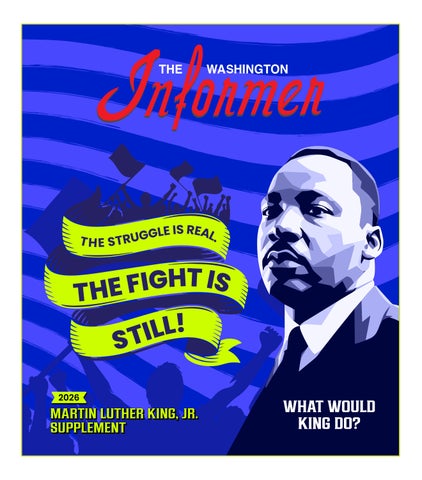
THE FIGHT IS
2026
MARTIN LUTHER KING, JR.
SUPPLEMENT
SUPPLEMENT
WHAT WOULD KING DO?


THE WASHINGTON INFORMER NEWSPAPER (ISSN#0741-9414) is published weekly on each Thursday. Periodicals postage paid at Washington, D.C. and additional mailing offices. News and advertising deadline is Monday prior to publication. Announcements must be received two weeks prior to event. Copyright 2016 by The Washington Informer. All rights reserved. POSTMASTER: Send change of addresses to The Washington Informer, 3117 Martin Luther King, Jr. Ave., S.E. Washington, D.C. 20032. No part of this publication may be reproduced without written permission from the publisher. The Informer Newspaper cannot guarantee the return of photographs. Subscription rates are $55 per year, two years $70. Papers will be received not more than a week after publication. Make checks payable to:
THE WASHINGTON INFORMER
3117 Martin Luther King, Jr. Ave., S.E
Washington, D.C. 20032
Phone: 202 561-4100
Fax: 202 574-3785
news@washingtoninformer.com
www.washingtoninformer.com
In Memoriam Dr. Calvin W. Rolark, Sr. Wilhelmina J. Rolark
PUBLISHER
Denise Rolark Barnes
STAFF
Micha Green, Managing Editor
Ron Burke, Advertising/Marketing Director
Shevry Lassiter, WIN-TV Producer
Ra-Jah Kelly, Digital Asset Manager
Lafayette Barnes, IV, Editor, WI Bridge DC
Desmond Barnes, WIN Daily Editor
Anthony Tilghman, Social Media Strategist
ZebraDesigns.net, Graphic Design
Mable Neville, Bookkeeper
Angie Johnson, Office/Circulation Manager
Jada Ingleton, Content Editor
REPORTERS
Stacy Brown, National Reporter
Sam Plo Kwia Collins, Jr., Political/Education Reporter
Brenda Siler, Lifestyle Reporter
Ed Hill, Sports Reporter
Richard Elliott, Reporter
Skylar Nelson, Sports Reporter
Mya Trujillo, Environmental and International Reporter
PHOTOGRAPHERS
Shevry Lassiter, Photo Editor
Ja Mon Jackson, Asst. Photo Editor
Roy Lewis, Jr.
Robert R. Roberts
Anthony Tilghman
Abdullah Konte
Cleveland Nelson
INTERNS
Keith Golden Jr., Fall Intern


THE STRUGGLE IS REAL. THE FIGHT
IS STILL!: KING CALLS ON US TO CONTINUE
THE FIGHT
BY MICHA GREEN WI MANAGING EDITOR
It’s been 70 years, one month and some change since the start of the Montgomery Bus Boycott in December 1955, the launch to the modern Civil Rights Movement. However in January 2026, 69 years and one month since the end of the historic 382-day boycott, and more than six decades since the historic Civil Rights Act (1964) and the Voting Rights Act (1965) were passed, people are still fighting across the United States for justice and equity for all.
When the Rev. Dr. Martin Luther King Jr. shared his dream of a more just society on the steps of The Lincoln Memorial in August 1963, he knew that achieving that goal took sustained, intentional work. Nearly five years later, when King took to Memphis, Tennessee to help the sanitation workers before being assassinated, he also knew equality required constant work and action.
“We've got to give ourselves to this struggle until the end. Nothing would be more tragic than to stop at this point, in Memphis. We've got to see it through,” King said on April 3, 1968, in his famous “I’ve Been to the Mountaintop” speech.
Even after the signing of the landmark legislations in 1964 and 1965 towards civil and voting rights, King’s commitment to combating inequities never wavered.
“Let us keep the issues where they are. The issue is injustice,” he said in his final address.
With the Immigration and Customs Enforcement (ICE) officer involved killings of Keith Porter Jr. on New Year’s Eve and Renee Nicole Good on Jan. 7; the major health, economic, and educational disparities
facing Black communities; and the federal attacks on the LGBTQIA community, people with disabilities, diversity, equity and inclusion (DEI) and Black history, “the struggle” King talked about remains. The issue is still injustice.
This year’s MLK Holiday DC theme, “The Struggle is Real. The Fight is Still,” is a reminder that the justice work King emphasized nearly 58 years ago, must continue.
“Dr. King taught us the struggle is not a moment, it is a movement,” said the Rev. Thomas Bowen, Earl L. Harrison minister of Social Justice at Shiloh Baptist Church in Northwest, D.C. “The work is not finished.”
As the nation celebrates King’s life and legacy, this year’s theme— and all that’s happening in the world— offers a call to further the civil rights marty’s fight.
This MLK special edition is filled with people working to combat inequities and rally others to push toward justice for all. From activists taking to the streets and halls of Congress, to faith leaders speaking truth to power from the pulpit, and students considering a more just tomorrow, there are many people still walking in King’s legacy and working to achieve his dream.
Use the stories in this special edition to not only be informed, but inspired and join the justice fight, remembering King’s charge to see the struggle “through.”
“As Ella Baker said, ‘We who believe in freedom cannot rest until it comes,’” Bowen told The Informer. “Today we are called not just to commemorate or remember, but to respond, to show up, speak out, and carry the fight for justice forward.”
WI

3 People march in the 2026 MLK Holiday DC Peace Walk on Jan. 19, under the theme “The Struggle is Real. The Fight is Still!” (Ja’Mon Jackson/The Washington Informer)
A DIVE INTO MLK’S UNFULFILLED PROMISELAND FROM 1960S TO 2026: WHAT OF KING’S DREAM TODAY?
BY JADA INGLETON WI CONTENT EDITOR
Reminiscent of his early days in civil rights advocacy, the Rev. Gerald Durley admits he didn’t expect a rebirth of the movement that sparked a dream in the Rev. Dr. Martin Luther King Jr. (MLK).
As Jan. 19 marked national recognition of the fallen freedom fighter, a day ahead of the first anniversary of President Donald Trump’s second inauguration, Durley is moving with a reimagined take of his comrade’s mission in 2026.
“If he were alive today, I don't know how many people would listen to him. King was at the right time,” said Durley, pastor emeritus of Providence Missionary Baptist Church in Atlanta, Georgia. “Everything is around time–– Barack [Obama] was at the right time…Sojourner Truth was at the right time. It's time for that other kind of leader, [and] I think that’s what [he] would [focus on].”
For Durley, passing that baton means laying a path for action rooted in the same “great humility” that defined King’s life.
“Two [questions] made us strong as a people: ‘What are you willing to sacrifice and what are you willing to risk?’” said the international civil rights activist. “[King] never saw his four children do the things that many of us see now, but he gave that up for something he believed in. Now, our cause is: how do we strengthen one another? [How do] we do that with our young people?”
Answering that question while demonstrating King’s commitment to justice is the status quo of the annual MLK Holiday DC, which hosted events of celebration and remembrance throughout Ward 8 from Jan. 12-19.
As hundreds were activated in the theme: “The Struggle is Real. The Fight is Still,” this year’s commemoration set the stage for a yearlong mission to champion the “cause of King’s life” – while honoring a holistic, generational influence that shaped African American liberation.
“It isn't just history – it's a blueprint,” said Kita Williams, a member of MLK Holiday DC committee. “The question is do you not only know his dream, but what are you doing with it?”
Continued on Page 5


Charlene Crowell is a senior fellow with the Center for Responsible Lending. She can be reached at Charlene. crowell@responsiblelending. org.
DR. KING’S POOR PEOPLE’S CAMPAIGN FORETOLD AMERICA’S AFFORDABILITY CRISIS
BY CHARLENE CROWELL
As 2026 unfolds, affordability, which emerged as a critical issue last year, will become a more pressing concern for most people in America.
A comment by a respondent to a recent student loan borrower survey by The Institute for College Access & Support (TICAS) summarized the complexity of the affordability problem for striving workers:
“With how the economy is, I can barely afford to live. I have to choose between rent, loans, or putting food on the table. There’s no help and it feels like [the] government doesn’t care,” said the consumer.
The feeling that economic realities are suffocating the aspirations of hard-working people provides a poignant backdrop leading to the January 19 official celebrations to honor the life, leadership and contributions of Dr. Martin Luther King Jr.
This year’s observance of the MLK holiday begs a key question: What would Dr. King do about an unsustainable economic crisis?
After riots in many urban areas in the summer of 1967, MLK planned the Poor People’s Campaign, a multi-racial effort to use mass civil disobedience as a constructive, rather than destructive, force.
On December 7, 1967, Dr. King announced the economic justice effort at a news conference at Atlanta’s Ebenezer Baptist Church. Although the cities of Detroit and Newark are
often noted as the worst hotbeds of the nation’s summer riots in 1967, 158 riots erupted across America that year, resulting in 83 deaths and 17,000 arrests, according to a 2007 analysis of the landmark Kerner Commission report by The Journal of Economic History.
In the wake of King’s April 1968 assassination, plans proceeded under the joint leadership of his widow, Coretta and the Southern Christian Leadership Conference’s Ralph Abernathy. Their collaborative efforts led to weeks of demonstrations on the National Mall and meetings with policymakers in Washington, DC. The organizers demanded economic justice and inclusion for Americans of all backgrounds, including well-paying jobs with living wages, as well as financial rights and fairness, full employment, guaranteed annual income, and more housing affordable to low-income people.
“All of our cities are potentially powder kegs,” King said in a speech at Stanford University that was titled, The Other America. “I think America must see that riots do not develop out of thin air…All of these things have brought about a great deal of despair and a great deal of desperation, a great deal of disappointment and even bitterness in the Negro communities.”
For Dr. King, the nation’s lengthy and violent outrage was a clear signal that Black America would no longer tolerate its history of racial resentments and economic injustices. He also appealed for the Black community to cast aside class divisions.

But today, nearly 60 years later, many of the issues championed by the Poor People’s campaign remain or have worsened.
In late October, the DCbased Urban Institute released The American Affordability Tracker, which found that:
• More than half of American families – 52 percent – lack the resources to cover what it really costs to live securely in their community;
• Since 2019, the average monthly cost of groceries has increased 32 percent increase while annual income increased 29 percent; and
• Since 2017, annual childcare costs for two young children have risen by 40 percent, rents by 50 percent, home sale prices by 80 percent, and the lowest-priced "Silver" health care plan on the Affordable Care Act Marketplace has risen 41 percent.
Trump administration changes taking effect in January 2026 will add to the ongoing financial challenges facing working people.
Beginning January 7, the Trump administration will start sending notices to millions of student loan borrowers who are in default - 270 days past due on their payments. Those who do not or are unable to begin regular repayments face having their paychecks garnished.
The Department of Education stated last April that of the nation's 42.7 million student loan borrowers, only 38 percent are in repayment and current on their loans.
“At a time when families across the country are struggling with stagnant wages and an affordability crisis, this Administration’s decision to garnish wages from defaulted student loan borrowers is cruel, unnecessary, and irresponsible,” noted Persis Yu, Deputy Executive Director and Managing Counsel with the Student Borrower Protection Center.
Further, if Congress does not enact spending bills for the current fiscal year by January 30, another federal government shutdown will occur. Central to the budgeting crisis is whether to extend expired tax credits for the Affordable Care Act. Without these credits, many consumers will see their health insurance costs double, or even triple.
According to December 2025 poll by the KFF Foundation, 58 percent of respondents said an increase of just $300 per year in health insurance payments would significantly disrupt their household finances. An additional 20 percent say a $1,000 per year increase in health insurance payments would disrupt their finances.
While King’s lifelong quest for civil rights and economic justice deserves an annual observance, his Dream of a nation that fulfills its promises for all of its people still needs a diligent and ongoing effort. Lawmakers should heed the concerns expressed by its people, especially when ample research documents how people are suffering.
As Dr. King stated in his autobiography, “[T]here comes a time when one must take a position that is neither safe, nor politic, nor popular, but he must do it because Conscience tells him it is right.”
Charlene Crowell is a senior fellow with the Center for Responsible Lending. She can be reached at Charlene.crowell@responsiblelending.org.
WI

5 MLK speaking at a protest
3 People marching and carrying signs at Connecticut Avenue and L Street, N.W., Washington, D.C. on June 18, 1968
MLK HOLIDAY
DC BEGS THE QUESTION: ‘WHAT ARE YOU WILLING TO DO?’
Across a series of activations, MLK Holiday DC–– co-chaired by Stuart Anderson and Washington Informer Publisher Denise Rolark Barnes–– highlighted the breadth of King’s dedication to challenging systems and bettering communities.
From the kickoff at Southwest’s Living Word Church to the culminating 21st Annual MLK Peace Walk and Parade on Jan. 19, local religious leaders, activists, officials, and advocates across all walks of life convened in a mission to continue what King started–– particularly in the name of faith, passion, and collective resilience.
“Dr. King reminds us that justice…happens when people show up, speak up, and stand together,” Williams emphasized. “He wasn't just dreaming–– he was organizing, challenging systems, pushing for real change in real time…and that’s exactly what we do.”
During the Eighth Annual Prayer Breakfast –– held at Covenant Baptist United Church of Christ (UCC) on Saturday, Jan. 17–– keynote speaker, the Rt. Rev. Mariann Edgar Budde, bishop of Episcopal Diocese of Washington, spoke to the sustaining power of hope and prayer in confronting adversity.
Meanwhile, Monday’s Com-
munity Clean-Up Project, hosted in conjunction with the Seventh Annual Health and Wellness Fair, served as the backdrop to the hundreds rallying across Southeast, D.C., as they marched to the beat of generational resistance.
“It really does remind you of the sacrifices made, and that we're still making,” DeJuan Mason, cochair of the Peace Rally told The Informer. “It's not about just sitting at the dinner table and talking about what Dr. King did…the John Lewis's [and] the Stokely Carmichaels of the world. It’s about what we as a community need to move forward.”
Durley says, beyond the third Monday of January, King’s legacy lives in a deeper understanding of the man behind the impact – the one whose contribution to America extends beyond the history books.
“I would paint him as a human being, and…you are a human being,” he continued. “You [have] to understand who you are, what you're about, what you're willing to give.”
When it comes to carrying that mantle through 2026, the longtime faith leader and freedom fighter offered a candid response: it’s been done before, and it’s time to do it again.
“I never thought that we'd be fighting for civil rights, voting rights, human rights again, 60 years later…but I feel more hopeful now than I did, sometimes, in the old days,” Durley told The Informer. “[Young people now have] all of the tools, the resources. What are you willing to do?” WI


ASALH


BLACK HISTORY MONTH


MLK HOLIDAY DC ESSAY COMPETITION COMBATS
MISINFORMATION, INSPIRES CIVIC ENGAGEMENT
ESSAYS ALLOW FOR CONSTRUCTIVE EXPRESSION: ‘PEOPLE COULD GET THE POINT I WAS MAKING’
BY JEWEL PAIGE WI INTERN
As people across the nation celebrated the Rev. Dr. Martin Luther King Jr., the MLK Holiday DC Student Essay Competition returned to not only honor the late activist, but empower District youth by helping them: cultivate literacy excellence, combat misinformation, promote civic engagement, and ensure their voices are heard.
“I don't think we as adults have done a great job of making young people see themselves in the picture of being a part of the solution or equation to help change society,” Norman Nixon, president of Mayor’s Youth Leadership Institute Alumni Association (MYLIAA), a sponsor of the annual competition, told The Informer.
While social media is a popular outlet for youth expression, Nixon said the essays offer young people a constructive route to articulate their thoughts and learn along the way.
“The process of actually doing research, and putting together essays, which is going to follow them all the way through their work and college, is writing and structuring your work. That's going to be very important,” he

said. “But then also, we hope that it opens their minds up to want to explore when they hear a topic.”
The annual competition, which emerged in 2014 and has been hosted in partnership with MYLIAA and MLK Holiday DC since 2015, challenges students to write pieces inspired by Dr. King's legacy.
This year, in collaboration with the 2026 MLK Holiday DC annual theme— “The Struggle is Real. The Fight is Still!” — elementary students were tasked with writing about the importance of voting and middle and high schoolers were charged with producing pieces about D.C. statehood.
Further, the essays encouraged young people to think of action needed to achieve King’s dream of a just society in the District and nationwide.
“We said we have to start getting our young people to start thinking about D.C. statehood,” Nixon said, “and the fact that they're going to have to carry the fight to stay here, possibly into their adult years.”
For 14-year-old Hans Spritzer, the essay competition was the perfect platform to formulate and share his thoughts with others.
“The idea that people would be able to hear the message I was spreading, if I did well, was a reason I entered,” he said, “so people could get the point I was making.”
COMPETITION HELPS COMBAT MISINFORMATION
With one in three youth ages 1317 almost constantly active on social media, according to Pew Research Center, the MLK Holiday DC Student Essay Competition works to empower students through learning how to research facts and detect misinformation.
“I've seen social media…determine

many young people's stances on some political situations without much bearing on how serious things are,” Hans, a freshman at BASIS Washington, D.C. in Northwest, told The Informer.
Although he is an avid social media user, Hans said he has learned to take things he sees on the Internet “with a grain of salt,” until doing further research on the topic.
Pamela Johnson, founder of the youth voter advocacy program Your Voice Matters, noted challenges young people face in being able to dissect facts from misinformation, particularly when it comes to conversations about politics and civic engagement.
“It's very difficult to rely on what is on social media, and it may be that young people don't know enough about a particular topic to make those judgments,” Johnson said. “But, it's clearly influential and is an incredibly important way for young people to communicate with each other and for people who are trying to influence them to communicate.”
For Nixon, the essay competition is one way to help local youth further combat misinformation and improve research and writing skills.
“There's a lot of gaslighting that happens,” he said. “People put things out there and we’ve got to teach young people to research and fact check stuff before you jump out there with it.”
However there’s more to learn from the annual programming than just being able to write a good essay and
distinguish facts from fiction.
“I learned more about the diversity of D.C., and how large the population [is], and just how deep the movement to turn D.C. to a state goes,” the ninth grader explained. “Like just how many people have fought for it and it [still has] not been successful.”
PROMOTING THE POWER YOUTH CIVIC ENGAGEMENT, CONTINUED JUSTICE WORK
In remembering King’s efforts toward voting rights and amid an election year, this year’s essay competition emphasized getting young people active in civics.
“I don't think we've found a way to effectively communicate with young people to get them engaged or interested in politics, government, or community stuff,” Nixon said.
The voter registration and turnout rate among voters 18-29 was lower than 50% in the 2024 presidential elections, according to the Civics Center and Tufts Circle.
Johnson, who also serves as president of the National Women's Foundation in D.C., underscored the power of promoting voting among high school students.
“It's interesting that college students today, most of them are registered to vote… but high school students are registered at a much lower level. So [some high school] students
turn 18 and they have the opportunity to participate in democracy, but most of them don't actually register and don't vote. I got interested in that problem and how you change that,” Johnson told The Informer. “The interesting thing is with high school students, if they are registered, they actually vote.”
For Nixon, this year’s essay competition offered insight about how today’s youth are civically engaged and offered them a platform to share their viewpoints.
“We're very encouraged by the responses that the young people give us in these essays,” the MYLIAA president continued. “Sometimes you can think young people aren’t really deep thinkers about things. But when we go through these essays, it opens our eyes and says that a lot of these young people really have some great ideas and things on their mind.”
Hans said the prompt about D.C. statehood put a lot into perspective about challenges today and what it could mean for the future.
“The importance of addressing these problems is to make our society better overall by allowing for fairness for the people who live inside it,” he declared.
The winners of the 2026 12th Annual DC Dr. Martin Luther King Jr. Student Essay Contest were: Clara Maga (elementary school division), Daniel Robinson Jr. (middle school division), and Jakera Watson (high school division). WI


HBCU Welcome Sunday
February 15, 2026 11:15 AM
MODERN FREEDOM FIGHTING FROM THE PULPIT FAITH LEADERS ACROSS THE NATION SPEAK TO KING’S LEGACY IN 2026

As the nation honors the life and legacy of the Rev. Dr. Martin Luther King Jr., religious figures – from Decatur, Georgia, to churches in the metropolitan region – are amplifying their vision to carry forward his mantle. Whether advocating for constitutional and civil rights or molding the minds of future freedom fighters, the theme for 2026 remains: ‘How can faith leaders continue King’s mission?’

The Rt. Rev. Mariann Edgar Budde, bishop of the Episcopal Diocese of Washington, and keynote speaker of MLK Holiday DC’s Eighth Annual Prayer Breakfast on Saturday, Jan. 17
The Rt. Rev. Mariann Edgar Budde, bishop of the Episcopal Diocese of Washington, celebrates the compassion and unshakable faith of the Rev. Dr. Martin Luther King Jr., as the keynote speaker of the Eighth Annual Prayer Breakfast in Southwest, D.C. on Jan. 17. (Courtesy Photo/Maurice Fitzgerald)
“The theme for [MLK Holiday DC 2026]: [‘The Struggle Is Real. The Fight is Still.’] is just a sober acknowledgement that we are now up against the unseemingly unrestrained power of the federal government, in the hands of those whose vision of America is antithetical to everything King stood for. But we are not without resources. King would be the first to remind us…not to give up on each other, that truth pressed to the ground will rise again because no lie can live forever, and that God has a way of ringing good out of evil. God is the source of our strength, and He is the strength of our lives.”

The Rev. Tony Lee, founder and senior pastor of Community of Hope A.M.E Church in Temple Hills, Maryland
The Rev. Tony Lee, pastor of Community of Hope A.M.E Church in Temple Hills, Maryland, defines his fight in 2026 on an episode of The Washington Informer’s “Let’s Talk.” (WI File Photo/Screenshot)
“The reality is everybody's talking about Dr. King's dream, but folks don't talk about his stand against the war in Vietnam and how unpopular he was at the time of his death. He was dealing with the fact that, in the same way that we need to be standing for Palestine, in the same way that we need to understand the connection with what's happening in Venezuela, in the same way that we need to understand the connection with our brothers and sisters who are immigrants – it's this whole question of fighting for each other in this interconnectedness of oppression, and being able to fight that.”
Continued on Page 12


MARTIN LUTHER KING JR ESSAY CONTEST WINNERS!


Elementary School Clara Maga
Washington Latin Public Charter School - 5th Grade
Ward 6 Resident
WHY IS VOTING IMPORTANT?
Voting is an essential part of what makes a democracy, a democracy. Many other countries use democracy and voting, and that is because it is a very good way of self expression. A voter can help decide on who will do a certain thing, whether it be the next president of the United States, or what movie you will watch during your fifth grade science class free time.
The US began voting quite early in our history, in 1788, for our first president, George Washington. Back then, voting was very unfair, excluding over 50% of the population. That has changed, with women's rights and black rights cam-
Daniel Robinson, Jr.
Ingenuity Prep PCS - 6th Grade Ward 8 Resident
On the issue of the District of Columbia’s Statehood,I cannot support it due to the national level issues it creates.If a 51st state was ever to be added to the United states,it would be better it was a American territory,as many of the issues of DC statehood are not shared with any United States territory. Alongside this if DC was ever made a state due to its constant support of the Democratic party,with no Republican or any other party getting over 20% of DC votes since 1972,this would cause for the addition of an extra state alongside DC setting a bad precedent,and deepening further partisan divides.All of these Issues are the core reasons why i can not in good judgement support DC statehood in the current Electoral system.
The benefits of making a US territory, like Puerto Rico a state, are more impactful than DC’s benefits, due to the change and liberties it could offer. 3.2 Million Puerto Ricans despite being the 33 most populated state and territory, cannot vote for the President and have no form of representation in congress, Statehood could be better used to enfranchise the people of Puerto Rico and other territories. Puerto Rico would also vote for its own regional parties in the event of statehood this could help provide people nationwide the assurance they need that third parties could win Electoral votes. Alongside this a majority of Americans are in favor of Puerto Rician statehood, this is the opposite
paigns so the other 50% of the population could vote. The full population of America got the chance to vote later. The first vote where everyone could have the option to vote was in 1965, so not very long ago. This time between 1788 and 1965 really shows all the time and struggle put into the right to vote by campaigners. It also shows how important it was to these people that they are allowed to vote.
Voting can help everyone get what they want. For example, when the people in a city vote for a mayor, everyone in that city has a chance to count toward deciding who the mayor is, even if not everyone got exactly what they wanted. Voting is an excellent strategy to keep things fair when deciding on something, as long as everyone is allowed to help in the decision. The rules of voting are very simple, there are a few options, you pick one, you show that you picked that in some way, then your vote counts toward the final decision.
In conclusion, voting is an amazing way to show your feelings about something. Who knows, maybe it will be your vote that ends up making the final decision. Your vote makes a difference. So get out there and vote for Home Alone 2 instead of Phineas and Ferb, because that's your opinion, and your opinion counts.
of DC where majority of people across all of america would not like to see DC as the 51st state. In articles by the Washingtonian, and MiamiHerald We can truly see this divide in opinions when it says”out of 7,200 US adults surveyed 59% said they would support Puerto Rico’s statehood”while in the case of DC statehood” 55 percent of respondents said they were against DC statehood”. these Results show that the American public is against DC statehood,if the government supported DC statehood would create heavy distrust of the government in the American populous setting the grounds for extremism.
Alongside this the heavy partisan issues statehood could cause must be noticed, before any real government action occurs. If federal action was used to enforce DC statehood it would not only be unpopular with a majority of the national population, but only further deepen the current Polarization and extremism the United States faces. DC’s long history of supporting the democratic party are a huge issue when discussing statehood, as with DC’s addition a rep safe or likely republican would have to be added causing for potential bad precedents and additions of states to keep a balance. These issues can be seen by looking at previous election results and an article by Matthew Spicer and several others from Boston university where it is said”many political leaders exploit narratives like Trump does, that the opposition is an enemy, and supporting them is a problem. This is aligned with the “Us VS them” disparity, and moreover, I think that this kind of rhetoric is connected with negative campaigning as well. Nowadays, attacking opponents rather than promoting oneself has become quite a common feature of political communication”, and alongside this recent polarization an increase of democratic support in DC with no Democratic candidate since 2008 getting less than 90%.This all shows increasing political divides, and polarization.
In conclusion we can see that due to an overwhelming group of issues we as a nation cannot in good faith make DC a state any time soon. Political polarization stands as 1 of the key issues to DC statehood, DC’s addition would only deepen the current political divides in the country,at a time with one of the kr things we need is unity. If we as a nation would ever to add a new state DC faces greater competition and more just causes in the case of the US territories,who have no enfranchisement and cannot vote for the president who rules their nation and our little impacted by the current national polarization.In current situations like these we must find unity,we must not act blindly and press on issues that benefit DC,and ignore the woes of the disenfranchised as a nation we must be better and DC statehood would not serve our nation any better in our current political climate.

Jakera Watson
Digital Pioneer Academy - 12th Grade
Ward 8 Resident
Imagine living in the heart of the nation’s capital, paying federal taxes, following national laws, and doing everything expected of an American citizen, yet having no real voice in Congress. This is the everyday reality for more than 700,000 residents of Washington, D.C. As someone who was born and raised in D.C., and as a youth senator in a government internship, I see this injustice clearly. For these reasons, I strongly believe that Washington, D.C. should become the 51st state of the United States.
D.C. statehood is about representation. Residents of Washington, D.C. pay federal taxes, serve in the military, and follow federal laws just like people in every other state. However, D.C. does not have voting senators and only has one non-voting delegate in the House of Representatives. This means laws that affect our schools, housing, safety, and future are passed without our voices being fully heard. Congress can also overturn laws passed by D.C. voters and control the city’s budget, even though residents still pay taxes. This lack of representation goes against the core principles of democracy.
Another important reason D.C. should become a state is local control. Even though residents vote for a mayor and city council, Congress can step in at any time and cancel local laws or limit funding. People who do not live in D.C. are making decisions for the city without understanding the unique culture (like go-go music)
history, or struggles of the communities here. D.C. is more than just government buildings—it is a city with deep traditions, strong neighborhoods, and residents who care about their home. Decisions should be made by the people who actually live here and experience the effects of those decisions every day.
The unfair treatment of D.C. residents becomes even clearer when population is considered. Washington, D.C. has more residents than several states that already have full representation in Congress. Those states have senators and voting representatives, while D.C. residents do not. This means that the voices of people in smaller states matter more than the voices of hundreds of thousands of people living in D.C. That is not equal or fair. All Americans’ voices should matter the same, no matter where they live.
Economically, Washington, D.C. already functions like a state. The city manages public transportation, schools, courts, and social services. D.C. residents contribute billions of dollars in federal taxes each year, often paying more per person than residents of many states. Denying representation to such a large and contributing population is unjust. A government that accepts taxes should also provide representation.
Many neighborhoods are being left behind. While luxury apartments and new developments continue to get built, some communities lack playgrounds, safe recreational spaces, and properly funded schools. This is our future, the next generations of children are going to grow up without places to play, people making federal law decisions on how they are going to be living in the next couple years, places to play, and families struggling to access basic resources. Development too often benefits a small group while ignoring the residents who have called this city home for decades. The community is asking for help, but without statehood, D.C. lacks the full authority to respond.
ESSAY WINNERS!


Continued from Page 8

The Rev. Gerald Durley, international civil rights activist and pastor emeritus of Providence Baptist Church of Atlanta, Georgia
Despite the current challenges facing Black Americans, the Rev. Gerald Durley says today’s youth hold the blueprint for justice. (Courtesy Photo)
“Let’s come back to our roots.’ How do we come together to understand the collective body of our mutual experiences that made us strong, that will make us strong, that we can face anything, and then ask the question – in order to achieve that, what do you need to do? What are you willing to sacrifice, and what are you willing to risk?”

The Rev. Wanda Thompson, pastor of Ambassador Baptist Church in Frederick, Maryland
The Rev. Wanda Thompson speaks at the 2023 MLK Holiday DC Prayer Breakfast. (WI File Photo/Shevry Lassiter)
“[Dr. King once said], ‘Injustice anywhere is [a threat to] justice everywhere.’ It's up to the Black Church to set an example – to be on the front lines to really fight injustice. [Making] sure that the citizens in this country, that we all receive due process, that we all receive the things we need, that we learn how to show love and mercy and compassion towards our neighbors. We have to speak truth to power when those in power are wrong…are doing things that hurt the community. That's what we're called to do.”

The Rev. Dr. Henry P. Davis, pastor of First Baptist Church of Highland Park in Summerfield, Maryland
The Rev. Dr. Henry P. Davis prays at the funeral for the barrier-breaking Maryland State Sen. Tommie Broadwater in August 2023. (WI File Photo/Robert R. Roberts)
“We have gone to the things that Dr. King feared and made it the new norm. His message is as relevant as it was when he spoke. The Black Church today needs to speak as boldly as possible, and this same message needs to be spoken in every pulpit – Black and white.”

The Rev. Jerry Black, pastor of Beulah Missionary Baptist Church in Decatur, Georgia
The Rev. Jerry Black, pastor of Beulah Missionary Baptist Church in Decatur, Georgia, touts the importance of seeking truth and justice as leaders of faith. (Courtesy Photo/Beaulah Missionary Baptist Church, Facebook)
“It is so important as pastors to follow King’s example, so that his dream will not perish. I’m celebrating my 34th pastoral anniversary next month; The Rev. Dr. Jasper Williams Jr. (pastor emeritus of Atlanta’s Salem Bible Church) will be preaching, [and] I told him just to proclaim the importance of pastors standing up for the truth. The church is supposed to be the bride of Christ, but we must be careful that we are handling another man’s bride.”

MLK CELEBRATIONS AROUND THE CITY
With the national holiday often considered a “day on,” people united across the District on Monday, Jan. 19 to celebrate the life of the Rev. Dr. Martin Luther King Jr. (MLK) and work to further his vision of a just society.
From the annual MLK Holiday DC Peace Walk, Rally and Parade, held in Southeast along the street named in King’s honor, to the National Action Network breakfast and wreath laying at the MLK Memorial both in Southwest, thousands across the city gathered to not only honor the civil rights leader, but also encourage others to push toward justice.
(Ja’Mon Jackson, Cleveland Nelson, Robert R. Roberts/The Washington Informer)


What You Can’t See, You Can’t Wrestle With
As we honor Dr. Martin Luther King Jr., progress begins with awareness. In a recent Leadership Greater Washington class, I heard a phrase that stayed with me: what you can’t see, you can’t wrestle with.
In today’s economy, misalignment often exists beneath the surface. Capital may be available but not reaching the right businesses. Talent may be present but disconnected from opportunity. These gaps are systemic, like groundwater shaping outcomes.
Dr. King challenged us to confront systems, not symptoms. The Chamber plays a role in surfacing what’s unseen—aligning capital, workforce, and opportunity through data, relationships, and advocacy.
Progress starts when we see clearly and act together.
Join the Prince George’s Chamber of Commerce at www.pgcoc.org.
Sincerely,
Alexander K. Austin President & CEO
Prince George's Chamber of Commerce