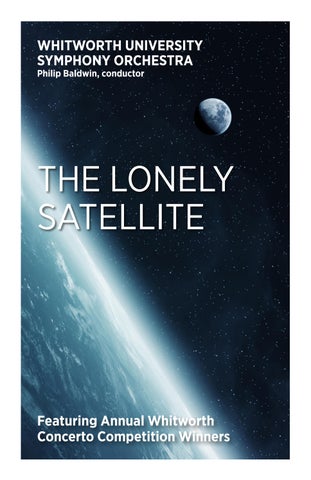
Symphony Orchestra Concert Program: Spring 2026

Page 1


WHITWORTH UNIVERSITY SYMPHONY ORCHESTRA

THE LONELY SATELLITE

WHITWORTH SYMPHONY ORCHESTRA

The Lonely Satellite

Philip Baldwin, director

Saturday, March 7, 2026, 3 p.m.

St. Luke Lutheran Church PROGRAM

Oboe Concerto No. 1 in D minor Ludwig August Leburn 1. Allegro 1752-1790

Samarra Salcido, oboe

“Hai già vinta la causa!” from The Marriage of Figaro W. A. Mozart 1756-91

Ezekiel O’Donnell, baritone

Piano Concerto No. 23 in A major W. A. Mozart 1. Allegro 1756-91

Karissa Nakamura, piano — INTERMISSION —

Violin Concerto in D minor, Op. 47 Jean Sibelius 1. Allegro moderato 1865-1957

Elizabeth Stubblefield, violin

The Lonely Satellite Melody Hough b. 2006

Melody Hough, composer

We ask that you refrain from using cameras or recording devices during the program. Please turn off any electronic beeping devices (watches, pagers, cellphones).

PERSONNEL

FLUTE

Rachelle Austin, ‘28

Alyssa Brown, ‘29

OBOE/ENGLISH HORN

Isaac Ojennus, ‘29

Melody Hough, ‘28

CLARINET

Psychology

Undeclared

Chemistry

Biology

Spokane

Spokane

Spokane

Spokane

Bar Rozenhaimer, ’27 History, Philosophy, Theology West Linn, Ore.

James Fischer, ’28 Music Education and Performance Spokane

Teresa Johnson, ’29 French and Secondary Education Cheney

BASSOON

Zoë Johnson, ’27

Jacob Campbell, guest artist

HORN

Isaac Crawford-Heim, ‘26

Music Performance and Education Spokane

Health Science Spokane

Bjorn Peterson, ’29 Engineering Missoula, Mont.

Kelsey Swenland, ’29 Music Education Spokane

Hannah Marcoe, ’27

Ariana Gamero, ’29

Carolyn Rose, ’29

Isaac Dorcy, ’26

TRUMPET

Alexis Hochberg, ’28

Anthony Cao, ’27

TROMBONE

Meg Zwiers, ’29

Conor Waller, guest artist

TUBA

Julian Crandell, ’27

PERCUSSION

EJ Preuschoff, ’29

Loren Lenhe, ’27

Math Education

Secondary Education and Art

Health Science

Music Composition

Music Education and Performance

Music

Psychology and Music

Music Composition

Music Education.

Biochemistry.

Moscow, Idaho

Spokane

Liberty Lake

Shelton

Liberty Lake

Spokane

Gallup, New Mexico

Deer Park

Spokane

Damascus, Oregon

VIOLIN 1

Samarah Heggestad, ’27. . . . . . Music Perf. and Pedagogy .

Jin Yue Trousil, ’26

William Farley, ’28 .

Joshua Rivera, ’26

Jacob Luciano, ’26

Michaila Caine, ’28

. Applied Mathematics

. Music Performance and Education

. . Spokane

Juneau, Alaska

Spokane

Computer Science Liberty Lake

Political Science and Theology Spokane

Music and Pedagogy Enterprise, Ore.

Michaela Smith, ’28 Music and Pedagogy Spokane

Ava Lynn Goins, ’28

Elizabeth Stubblefield, ’26 .

Samarra Salcido, ’26

VIOLIN 2

Gabrielle Ukrainetz, ’25

Lori Petroske, ’27

Micah Smith, ’29

Psychology

Music Perf. and Pedagogy

Music

Music Education.

Biochemistry.

English and History

Richland

Spokane

Spokane

Spokane Valley

Spokane

Spokane Valley

Joslin Hagen, ’28 Computer Science Spokane

Cher Knyaw, ’29 Neuroscience Richland

Davian Calbert, ’29 Physics Greenacres

Halley Walter, ’27

Lucas Mai, ’29

Nathan Wilson, ’29

VIOLA

Sam Parker, ’28

Shellbe Nelson, ’26

William Burger, ’29

Biology

Chemistry and Pre-Pharmacy.

Physics and Math

Engineering

Marketing

Music Education.

Liberty Lake

Spokane

Spokane

Spokane

Spokane Valley

Gilbert, Arizona

Noah Williams, ’29 Music Education Spokane

CELLO

Emma Szymarek, ’29

History

Mead

Lance Coppo, ’28 Psychology Olympia

Sarah Palmer, ’27 Neuroscience and Pre-Medicine Spokane

Calla Sicilia, ’29 Music Education Spokane

BASS

Nate Moody, ’26 Music Composition Medical Lake

Henry Klesch, guest artist

Corey Hodges, guest artist

PROGRAM NOTES

Ludwig August Leburn: Oboe Concerto No. 1 in D minor

Composer and oboist Ludwig August Lebrun specialized in writing concerti in the style of the Mannheim School. While current versions of the score do not include mannerisms of Mannheim school, many performers add them. These include a grand pause before the recapitulation of the first movement, and melodic sighs (where the first note of a slur has more weight than the second) in descending note sections. The Mannheim school also influenced major composers like Beethoven, Haydn, and Mozart. The first movement of this concerto, felt in a moderate cut-time, tests endurance and speed of the performer, especially as the theme transitions from a playful melody to quickly played notes with leaps of wide intervals.

~Program note by Samarra Salcido

W. A. Mozart: “Hai già vinta la causa!” from The Marriage of Figaro

Composed in 1785 during one of Mozart’s most productive years in Vienna, The Marriage of Figaro reflects his mastery of opera and his close collaboration with librettist Lorenzo Da Ponte. The events of the recitative and aria “Hai già vinta la causa!…Vedrò, mentr’io sospiro” occur at a crucial dramatic moment when Count Almaviva realizes that his authority and carefully laid plans are being undermined by his own servants, Figaro and Susanna. Mozart sets this revelation within a recitative, a technique he favored for moments of heightened drama, allowing the orchestra to mirror the Count’s sudden rage and humiliation. By blending refined musical beauty with sharp psychological insight, Mozart not only deepens the character’s complexity, but also underscores the opera’s larger themes of power and class, marking a definitive turning point in the opera’s dramatic trajectory. The aria which follows is notable its expressive drama and formal clarity. The aristocratic musical language contrasts sharply with the Count’s barely contained fury and desire for revenge.

~Program note by Ezekiel O’Donnell

W. A. Mozart: Piano Concerto No. 23

Wolfgang Amadeus Mozart (1756-1791) was one of the most influential and prolific composers of the classical period. Showing rare talent at a young age, Mozart and his sister toured across Europe with their father, who was also a composer and violinist. Even at a young age, he gained recognition for his musical genius as a performer and composer. In 1781 he moved from Salzburg to Vienna, where he spent the rest of his life. Despite his fame, he often lived beyond his means and faced frequent financial difficulties. The exact cause of his death is disputed, but in 1791 he fell ill and died at the end of the year. Over the course of his short life, Mozart wrote over 600 works, among them The Marriage of Figaro, Requiem in D minor, 41 symphonies, and 27 piano concertos.

Mozart’s Piano Concerto No. 23 in A Major, K.488, composed in 1786, was the one of three piano concertos he wrote that year. Compared to the other two, the instrumentation for this work is smaller, including only a select number of wind and brass instruments. One of his mid-to-late period works, the piece as a whole captures Mozart’s elegance, melancholy, and playfulness. The first movement, Allegro, features two elegant and lyrical themes. The graceful exchanges between the piano and orchestra create an intimate listening experience, making it one of Mozart’s most well-known and beloved works.

~Program note by Karissa Nakamura

Jean Sibelius, Violin Concerto in D minor

Jean Sibelius was a Finnish composer who helped create a national voice for his country during the 19th and 20th centuries. His Violin Concerto elegantly combines Western compositional structures with folk harmonies and melodies, particularly those from his Karelia Suite. This was done to establish a progressive and unique Finnish sound. For instance, Sibelius noted that the oldest Finnish folk songs were built on D, E, F, G, and A. The chorale-like harmonic structures that can be created when using these notes together may have influenced the concerto’s slow D-minor opening, which evokes images of snowfall on sparse Finnish landscapes. Keeping other Western European influences in mind, Sibelius included familiar sounding 16th-note passages, reminiscent of Mendelssohn’s Violin Concerto. Sibelius’ concerto also contains slowly ascending octave-arpeggios, which remind listeners of the opening of Beethoven’s Violin Concerto in D major. When the piece was premiered in 1904 by violinist Victor Nováček, it was barely finished in time and contained overwhelming technical challenges for the soloist. This caused the premiere to not be well received. After many revisions and simplifications, the edition of Sibelius’ Violin Concerto we hear today was championed by Jascha Heifetz in 1930.

~Program note by Elizabeth Stubblefield

Hough: The Lonely Satellite

The Lonely Satellite is a narrative personification of the relationship between the Earth and its moon. The Earth, being the only known planet that contains life, is represented by the playful melody introduced by the violas. From a scientific standpoint, the moon has a vital impact on the continuing existence of life on Earth. However, from a more human perspective, the moon is often characterized as lonely or distant, often being used as a symbol for sadness. The melancholic flugelhorn melody is my musical representation of the moon. However, throughout the piece, this theme slowly gets brighter and brighter, eventually joining the Earth in jubilant celebration as the moon realizes the importance of its influence on our lives. The piece ends with an intertwined passage in which both themes play at once, complementing and reassuring each other before reaching a bright and joyous ending.

~Program note by Melody Hough

PERFORMER BIOGRAPHIES

Samarra Salcido started her music journey on violin when she was seven years old. A few years later, after fifth grade, she started playing oboe with her friends in her elementary school band. While she played violin in the Spokane Youth Symphony Orchestra, she played oboe in school through middle and high school. Occasionally, Samarra performed in local competitions like MusicFest, where she performed various solo pieces and duets. Since coming to Whitworth, she has performed with the wind symphony for all four years and practiced under Symphony oboist Keith Thomas. After completing her music degree at Whitworth, she plans to study audio engineering at Spokane Falls Community College and pursue a career in audio recording and editing.

Ezekiel “Zeke” O’Donnell, baritone, hails from Ephrata, WA. He is a junior choral music education major and a voice student of Dr. Scott Miller. In 2024, he performed the role of Jack in Stephen Sondheim’s Into the Woods with the Whitworth Theatre and Music Departments for which he was nominated for the Irene Ryan Award by The Kennedy Center American College Theater Festival. Zeke is a member of and a section leader for the Whitworth Choir, and he guest conducted the Whitworth Bell Choir at the 2025 Whitworth Christmas Festival Concert. He has been heard as a soloist with both the Whitworth Choir and the Ponderosa Tenor/Bass Choir, as well as being a guest soloist at Sacred Heart Catholic Church in Spokane. Zeke and his family regularly lead worship at their home church in Moses Lake where his father is the Director of Music. Zeke plans to pursue a career in choral music education as well as continuing to expand his performance resumé as a soloist in multiple genres.

Karissa Nakamura is a second-year student at Whitworth University, where she is pursuing degrees in applied mathematics and music. Originally from Richland, WA, Karissa began studying piano at age five with Holly Harty. Over the years, she has come to appreciate the beauty and craftsmanship of playing the piano, and today, she continues to study piano with Dr. Ivana Cojbasic. In addition to private lessons, Karissa performs with the Whitworth Community Chorale, Ponderosa Choir, Chapel worship team, and piano ensemble.

Elizabeth Stubblefield is a violin performance and string pedagogy major. As the first violinist of the American Quartet, a group of local musicians, she performed with the Festival Musica in Le Mans, France in the summer of 2025. Other notable performances include the Sandpoint Orchestra, the Spokane Symphony, Eastern Washington University’s Evergreen Trio and a radio performance on KPBX. While in the Spokane Youth Symphony, Elizabeth received the Angela Armstrong Inspirational Award. Elizabeth is also a private violin instructor in the Spokane area.

Melody Hough is a sophomore in her third semester at Whitworth University. She is a passionate composer, arranger, and lover of all things related to music. She has been surrounded by music her whole life, and started composing at just fifteen years of age. Having won first place in a regional music composition competition in high school, she is currently studying at Whitworth University with Brent Edstrom and Brian Schappals.

ABOUT THE WHITWORTH SYMPHONY ORCHESTRA

The Whitworth Symphony Orchestra performs the standard orchestral repertoire, repertoire by underrepresented composers, and modern and commissioned works, including a premiere of Gwyneth Walker’s Let America Be America Again. The orchestra also performs with guest soloists and winners of its annual concerto competition and has enjoyed side-by-side concerts with the Coeur d’Alene Symphony. The orchestra has performed at the WMEA regional and All-Northwest conferences and was the featured collegiate orchestra in 2022. As part of its outreach, recruiting and cultural exchange goals, the orchestra tours biannually, most recently to Taiwan. Previous tours have included Italy, Hawaii, New York City, San Francisco and Salt Lake City. The orchestra is open to all qualified string musicians, regardless of major. The top wind and brass musicians of the Whitworth Wind Symphony are selected for membership in the Whitworth Orchestra. Our students benefit from outstanding opportunities including performance classes, chamber music, master classes (from such notable teachers and violinists as James Buswell and Charles Castleman), and clinics with principal players and conductors of the Spokane Symphony. The string chamber orchestra provides additional performance opportunities for the most ambitious players.

Philip Baldwin is the violin professor at Whitworth University and conductor of the Whitworth University Symphony Orchestra, as well as artistic director and conductor of the Spokane Youth Symphony. Baldwin earned a DMA at The Ohio State University, receiving the Distinguished Dissertation Award for work on the violin sonatas of William Bolcom. As a fellowship recipient, he attended the Conductor’s Institute of South Carolina and studied under distinguished teachers Paul Vermel, Kate Tamarkin and Donald Portnoy and trained with Wayne Toews at the Saito International Conducting School.

Baldwin serves as the concertmaster and assistant conductor of the Coeur d’Alene Symphony, is a former member of the Spokane Symphony, and has performed with the Tacoma, Canton and Columbus symphonies. As a guest conductor, he has appeared with the members of the Spokane Symphony, conducted the WMEA Junior All-State Orchestra, and twice directed the Hong Kong Youth Music Camp.

He is the past president of the Washington chapter of the American String Teachers and director of the Birch Bay String Teachers Workshop. Baldwin has presented lectures at eight ASTA national conventions, the Texas and Arkansas Music Educators Association conventions, and two International Short Story conferences on the intersection of music and literature.

WHITWORTH UNIVERSITY

Since 1890, Whitworth has held fast to its founding mission to provide “an education of mind and heart” through rigorous intellectual inquiry guided by dedicated Christian scholars. Recognized as one of the top regional colleges and universities in the West, Whitworth University has an enrollment of about 2,500 students and offers more than 100 undergraduate and graduate degree programs. Whitworth University’s 200-acre campus of red-brick buildings and tall pines offers a beautiful, inviting and secure learning environment. More than $135 million in campus improvements have been made in recent years, including an expanded music center, a renovated auditorium stage, an expanded dining hall, a rec center, a science hall, an athletics leadership center and a graduate health sciences building. In all of its endeavors, Whitworth seeks to advance its founder’s mission of equipping students to “honor God, follow Christ and serve humanity.”

For application information:

Office of Admissions

Whitworth University

300 W. Hawthorne Road Spokane, WA 99251

509.777.3212

admissions@whitworth.edu whitworth.edu/admissions

MUSIC AT WHITWORTH

The Whitworth University Music Department, accredited by the National Association of Schools of Music, provides superb training in music as well as a thorough introduction to this essential element of the liberal arts. Whitworth music majors have gone on to prestigious graduate schools, fulfilling performance careers and successful teaching positions. Also, many non-music majors participate in the university’s renowned touring ensembles and enroll in private lessons through the music department. Whitworth University offers bachelor of arts degrees in composition, music production & songwriting, instrumental performance, jazz performance, string pedagogy, voice performance, and music education. Music scholarships are available to both music majors and non-majors.

facebook.com/whitworthmusic

instagram.com/whitworthmusic

youtube.com/whitworthuniversitymusicdepartment

SPECIAL THANKS

Scan to learn about Whitworth’s music program.

Ben Brody, Whitworth Music Department Chair

Melissa Halverson, Whitworth Music Department Program Coordinator

The Whitworth Music Faculty

Whitworth Orchestra Leadership Team

Pastors Jim Johnson and Taran Denning, St. Luke Lutheran Church

Charles Reinmuth, Worship Coordinator, St. Luke Lutheran Church

Turn static files into dynamic content formats.

Create a flipbook