
47 INSPIRATIONAL SCIENTISTS CHANGING THE WORLD, AND HOW YOU CAN JOIN THEM BY DR


![]()

47 INSPIRATIONAL SCIENTISTS CHANGING THE WORLD, AND HOW YOU CAN JOIN THEM BY DR


Behind the scenes in hospitals there are many different machines and pieces of equipment that allow healthcare professionals to investigate illnesses, administer medications and treat wounds. And behind the machines there are scientists and technicians finding new and exciting ways to help the doctors help their patients.
Dr Hamied Haroon is a research scientist at the University of Manchester. He researches how different forms of MRI (magnetic resonance imaging) can spot subtle changes in the brain. These changes can indicate the first signs of dementia, stroke or other brain conditions. By facilitating the study of these changes, Dr Haroon is helping to find more effective treatments and improve the lives of people living with these conditions.
How did you end up bringing physics and medicine together?
When I was young, I wanted to go into medicine and cure people. I was inspired by science programmes like Tomorrow’s World and sci-fi shows like Star Trek, where Dr McCoy would use a probe to detect why someone was unwell and cure them with a pill – just like that!
My school’s careers service told me there was no way I could be a doctor with my disability. I have Charcot-Marie-Tooth disease, a hereditary condition in which the body’s nerves deteriorate. I was very disappointed but vowed to study sciences anyway.
I did A-levels in physics, maths and biology, which I loved. I enjoyed dissecting rats and looking inside their bodies to see how they worked. But it was my physics teacher’s bookshelf that changed my life. I spotted a book called Medical Physics and it was like being struck by a bolt of lightning... being a doctor wasn’t the only way to work in medicine. Medical physics seemed even more exciting!

“To me, science explains so much. It opens our imagination, allowing us to explore things that we could never even dream of. This is what can inspire us to make discoveries and innovate.”
Dr Hamied Haroon

Our planet has gone through numerous periods of climate change throughout its history. While many species struggle to survive these changing conditions, some others thrive! Sophia Cunningham is a PhD student at the University of Sheffield and UK Centre for Ecology and Hydrology (UKCEH) who studies how urban trees respond to climate change, and which species have the best chance of enduring the increasing temperatures. Sheffield is an ideal place for this because it’s a city that has more trees than people!
Why did you choose to study Environmental Science?
I’ve always enjoyed being out in nature – I feel at home there. When I was at college I worked with horses, but I realised that wasn’t what I wanted to do full-time. After college I went travelling and while snorkelling in Indonesia I was shocked and saddened to see how much plastic there was in the ocean. I realised that if I wanted to help protect the environment I would have to do something bigger than just recycling my rubbish. I chose to study Environmental Science because I wanted to make a difference. The course at the University of Sheffield included a lot of Physical Geography and Climate Change, but also Biology and Ecology.

This tree is part of the Urban Tree Observatory Network and has been fitted with a TOMST point dendrometer (the green tube), which measures changes in stem diameter. A tree will contract and expand depending on how much water is in its vessels. In the background you can also see a device that measures how much carbon dioxide the tree takes in, as well as how much oxygen and water it releases.
Yes, I initially got into botany while I was researching rewilding as part of my undergraduate degree. I was surprised by how complicated it is to identify plants – you have to look for such tiny details. I realised that the more you look, the more you find. And it opened my eyes to a whole new world. Living in Sheffield I started to notice that there was just as much biodiversity in the city as there was in the surrounding countryside.
I went on to do a master’s degree and that’s when I started looking at urban trees. My supervisor set up the Urban Tree Observatory Network – a network of sensors on trees across Sheffield that monitor how the trees respond to their surrounding environment – and I got involved in this. My master’s degree project was about how certain species of tree are affected by droughts or heatwaves, and whether we can monitor it from space.
Most fun thing about your job: The fieldwork. I work with a variety of different sensors, get to explore the city of Sheffield and meet interesting people.
1. Teaching the next generation of scientists how to identify plants and classify habitats at Knepp Wildland with Operation Wallacea.
2. Joining another PhD student in northern Norway in 2024 to survey the Arctic tree line and monitor the height of the tree canopies there.
3. Presenting my master’s degree research at the European Geoscience Union Conference.


Trees are so important. They help reduce the effects of flooding and improve air quality. They also have cooling properties, which is especially useful in urban areas because they tend to be hotter than rural areas. Some species of tree are at risk from climate change, but others might even benefit from it: if there is more carbon dioxide in the atmosphere, they have more food! We don’t currently know which trees are likely to survive as the climate changes, and therefore which species we should plant. My research helps us find out which trees to plant so that we can continue benefitting from them and protect our urban environments for the future.

The first exoplanet was discovered in 1992, and in 1995 astronomers discovered the first planet orbiting another star like our Sun. An exoplanet is a planet that orbits a star outside our Solar System. It is estimated that there are more exoplanets than there are stars in the Universe, with some of them even able to support life. It would take many thousands – even millions – of years to fly into space to explore even one of these planets. Luckily there are other ways to investigate expolanets while keeping our feet firmly on the Earth.
When an exoplanet passes in front of its star, we are able to detect a slight dimming of the star’s light. This slight change can just be detected by specialist telescopes, and it produces a transit light curve. A shallow light curve means the starlight has dimmed only slightly, meaning the planet in front of the star is small. A deep light curve tells astronomers that the planet is large.
The time it takes for a planet to go all the way around its star is the length of its year. Earth’s year is 365 days long, but many exoplanets have been found that orbit their star much faster than this, with some whizzing around their parent sun in a matter of hours.


When an exoplanet pulls its star slightly towards the Earth, the wavelengths of light coming from the star are compressed. This makes the star look blue to us. When the exoplanet wobbles the star away from the Earth, the star looks red.
More than 400 years ago, the German astronomer Johannes Kepler figured out how to calculate a planet’s distance from its sun. He was looking only at the planets in our Solar System, but Kepler’s laws also work for exoplanets, too! If an astronomer knows the length of an exoplanet’s year and how big the exoplanet is, they can calculate how far away the planet is from its star. This measurement will tell them whether life could possibly exist on the exoplanet. If it’s too close to the star, the planet will be too hot; too far and the planet will be too cold. The sweet spot for a planet to be capable of supporting life is called the habitable zone.

A star’s gravity keeps the planets around it in orbit. But a planet has its own gravity, which pulls at the star just a little bit, making the star wobble. We can detect this wobble by looking at the light from the star, which appears either bluer or redder depending on the direction the star is being pulled in. The intensity of the colour tells us how much the star is wobbling, and therefore how big the planet is.

Kepler-452b is an exoplanet that has been discovered in the habitable zone of its star.
The habitable zone around a star is the area in which the temperature is just right for water to exist as a liquid on any of the planets found there. Many exoplanets seem to fit this description, and astronomers want to take a closer look at them. Once it is up and running, the Extremely Large Telescope in Chile will be big enough to look at the light coming from the planets themselves (not just the light from their stars). The colour of the light will show if a planet’s air contains oxygen and other gases that are important to support life.


Author: Dr Shini Somara
Illustrator: Manuel Šumberac
and Adam Allsuch Boardman
Age: 12+ years
Price: £18.99
Format: Hardback
Extent: 224 pages
Trim size: 236 x 186 mm
Pub date: 10/09/2026

ISBN: 9781804661895
Are you always asking ‘why’ and ‘how’?
Do you enjoy experimenting?
Do you notice things that other people don’t?
If you answered ‘yes’ to any of these questions, then release your inner investigator and pursue a career in science!
What do scientists do and why do they do it? In Scientists Making a Difference, Dr Shini Somara goes straight to the scientists themselves to find out. You’ll meet apprentices and technicians, as well as professors and entrepreneurs. They’ll tell you in their own words about their work: growing human cells to test medicines, building the quantum computers of the future, tracking and protecting African wild dogs, searching for life beyond our solar system, and so much more.
These are some of the world’s most amazing changemakers, who combine their passions with their work to make the world a better place. Why not become one of them to help answer the big questions of the future!
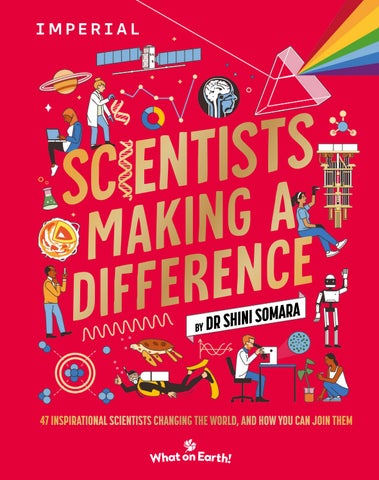
• Published in collaboration with Imperial College London, a world-leading university in the sciences.
• Strong focus on STEM subjects, encouraging young people to consider a career in science, including through apprenticeships.
• Written by mechanical engineer, broadcaster, producer, podcaster and author Dr Shini Somara.
• Features 15 video interviews with scientists from the book, accessible via QR codes.
• Supported by a nationwide marketing campaign with a school pack including two copies of the book, a teachers’ guide and timeline, sent to every state secondary school in the UK.
• The first title in the series, Engineers Making a Difference, was shortlisted for the Royal Society Young People’s Book Prize 2024.

ISBN: 9781804660270
BOUNCE SALES & MARKETING – 320 City Road, London EC1V 2NZ | Tel: 020 7138 3650 | Fax: 020 7138 3658 | sales@bouncemarketing.co.uk
ORDERS –Macmillan Distribution Ltd, Cromwell Place, International Business Park, Lime Tree Way, Basingstoke, Hampshire, RG24 8YJ orders@macmillan.co.uk Tel: (+44) 1256 302692
@What on Earth!
@whatonearth_books
@whatonearth_books
@whatonearthbook
@WhatonEarthPublishing @whatonearth.bsky.social
ISBN 978-1-80466-189-5

9 781804 661895
whatonearthbooks.com