67 Four years of war
Four years of war
66
Searching for a name
First Battle of Ypres (Ieper)
(19 October - 22 November 1914) After the German advance through Belgium and Northern France was halted in September 1914, the centre of the fighting shifted to the Westhoek.The Belgian Army halted the German attacks by flooding the IJzer plain (27-29 October 1914). To the south, the British and the French fought with great determination to prevent a German breakthrough at Ypres. This was the First Battle of Ypres, which raged from 22 October to 22 November 1914. When the battle was over, the Germans held the ring of high ground which overlooked the city. Both armies dug in and the famous Ypres Salient was born.
Second Battle of Ypres (Ieper)
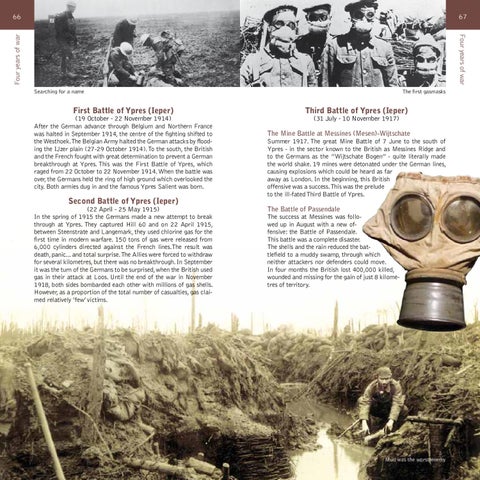
(22 April - 25 May 1915) In the spring of 1915 the Germans made a new attempt to break through at Ypres. They captured Hill 60 and on 22 April 1915, between Steenstrate and Langemark, they used chlorine gas for the first time in modern warfare. 150 tons of gas were released from 6,000 cylinders directed against the French lines.The result was death, panic... and total surprise. The Allies were forced to withdraw for several kilometres, but there was no breakthrough. In September it was the turn of the Germans to be surprised, when the British used gas in their attack at Loos. Until the end of the war in November 1918, both sides bombarded each other with millions of gas shells. However, as a proportion of the total number of casualties, gas claimed relatively ’few’ victims.
The first gasmasks
Third Battle of Ypres (Ieper) (31 July - 10 November 1917)
The Mine Battle at Messines (Mesen)-Wijtschate Summer 1917. The great Mine Battle of 7 June to the south of Ypres - in the sector known to the British as Messines Ridge and to the Germans as the ”Wijtschate Bogen” - quite literally made the world shake. 19 mines were detonated under the German lines, causing explosions which could be heard as far away as London. In the beginning, this British offensive was a success. This was the prelude to the ill-fated Third Battle of Ypres. The Battle of Passendale The success at Messines was followed up in August with a new offensive: the Battle of Passendale. This battle was a complete disaster. The shells and the rain reduced the battlefield to a muddy swamp, through which neither attackers nor defenders could move. In four months the British lost 400,000 killed, wounded and missing for the gain of just 8 kilometres of territory.
Mud was the worst enemy