




By Nina Culver Stream contributor
Growing up as a preacher’s kid, Medical Lake High School principal Jeremy Vincent always thought he would go into ministry as well. His heart, however, had a different road in mind.
After realizing that ministry wasn’t for him, he spent the next 22 years working in schools in Spokane and Western Washington, dedicating his life to educating students.
Vincent grew up in the Mt. Lake Terrace area north of Seattle. After high school, he took a gap year and worked at a lumber mill before enrolling in Calvary Chapel Bible College. During his two years at the college, he realized that becoming a minister wasn’t for him. He wanted a career, and through his time working with the Young Life organization, he knew he wanted to work with kids.
He transferred to Northwest University and got his bachelor’s degree in secondary education. His first teaching jobs were at private schools in Western Washington and the Spokane area, but after a few years he put his sights on working in public schools, convinced he could be more impactful and effective there.
After he and his wife moved to Spokane, he earned his master’s degree in curriculum and instruction from Eastern Washington University. He started working as a football coach at Rogers High School and then began teaching English at the high school when a position opened up. “I loved being at Rogers,” Vincent said of his three years there.
He and his family moved back to the west side to be closer to extended family as their family grew. Vincent taught for four more years before making the shift to administration, serving as the assistant principal at Ferndale High School for two years before advancing to principal for five years.
But once again, his heart had other
to Spokane. It gave them the ability to still be close to family while coming back to Spokane, so he started looking for positions in the area. “Ever since we left Spokane we were looking for a way to come back,” he said.
He took a job as principal of North Pines Middle School, where he stayed for four years before being hired as Medical Lake’s principal this year. Vincent said he enjoyed his time at North Pines and wasn’t planning to leave the school. “I wasn’t looking for anything,” he said.
Vincent was familiar with Medical Lake High School because his son’s baseball team had played at the school. Vincent said he was impressed with the community and thought it would be a great place to be a principal one day. When he got a notification on LinkedIn that the principal position was opening up, he decided he couldn’t pass up the opportunity.
Vincent said he was attracted to working in Medical Lake because it
high school town and what it means to the community. It’s a really special thing as principal. That high school, it’s the heart of the community.”
Vincent was selected for the job last spring, which allowed him plenty of time to transition. He said he’s grateful that his former superintendent, Central Valley’s John Parker, gave him the flexibility to start on that transition while finishing the year at North Pines.
“Before the end of the school year I spent about 40 hours here,” he said. “I met with nearly half the staff in oneon-one’s. That helped so much with the transition. I appreciate Dr. Parker releasing me to do that.”
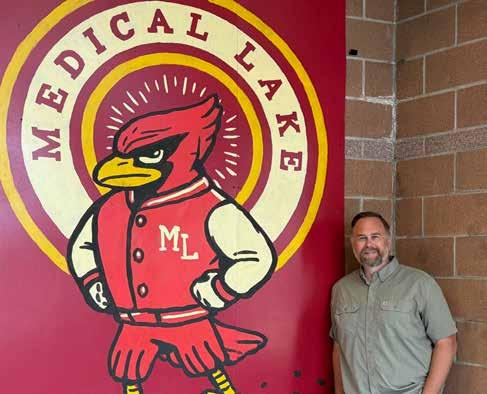
Vincent has spent the summer getting ready to greet students on the first day of school and getting settled into his office. A stuffed cardinal, the school’s mascot, sits on one of his shelves.
Vincent said he’s looking forward to his time at Medical Lake High School. “I think there’s a lot of good
with a few organizations that work with youth, and I knew that I wanted to make a career of it and teaching was a great way to make a meaningful impact.
Q: What is the best lesson you learned during your time as a teacher?
A: Leave my ego in the car. Taking negative comments personally or engaging in a battle of wills rarely ends well for the adult. Students are navigating a range of changes during these years, and when something negative surfaces, the root cause is often unrelated to me.
Q: What made you decide to get on the administrative path and become a principal?
A: Schools are built around a network of systems, and like anything, those systems can sometimes make school harder for certain students. I want to be someone who helps make those systems work better—for students, families, and staff. I became a leader to be a force for positive change.
Q: What is your favorite part of your job?
A: Graduation—I don’t think I’ve had a dry eye at a ceremony since becoming a principal. It’s more than just a celebration; it’s a powerful milestone that honors everything a student—and their family—has worked through and overcome to get here. It’s monumental, and I’m deeply aware of how much it means for their future.
Q: What are you most looking forward to at Medical Lake High School?
A: Medical Lake is such a unique and special community, and I’m truly grateful to be a part of it. There’s something powerful about the way small communities come together to support their students and schools. Being part of that brings me deep joy and a strong sense of purpose.
Q: What advice do you like to give your students?
A: Take healthy risks. High school is the perfect time to try something new or different—experiences that can have a lasting impact on who you’re becoming











By John McCallum Stream contributor
The Airway Heights City Council unanimously approved staff pursuit of public works infrastructure grant funding while also approving receipt of just over $1.77 million law enforcement program grants at meetings in mid-July and early August.
Public works projects grant applications approved
At its Aug. 4 meeting, the council approved a request by the Public Works Department to pursue over $4 million in infrastructure funding from the state’s Public Works Board during their annual funding cycle. The board has made over $100 million available for construction funding and $7.5 million in preconstruction grants funding in 2026.
Public Works Director Katherine Miller said both categories are very competitive. To help the city against other competing municipalities, Miller said they whittled the projects down to six and divided them into two categories: Roundabouts and Phase 1 of improvements to the U.S. / State Route 2 corridor.
“Those are the ones we have the most funding for right now, and the most imminent to go forward we felt that was the most competitive application,” Miller said.
Under the roundabouts category, Public Works listed two projects: the first being replacing the existing waterline crossing at Craig Road and State Route 2 as part of the Craig Road roundabout project. The other project is construction of a new crossing at Garfield Road and SR2 as part of the Garfield roundabout project.
Three projects were identified for the Highway 2 corridor. The first is replacing the existing waterline crossing at Lawson Street and SR2 while a second is extending the sewer along SR2 from W. 16th Avenue to Loffler.
A third installs a reclaimed waterline along SR2 from Lundstrom to Lawson. A stand-alone project to replace existing steel waterline on 15th Avenue from Lundstrom to Lawson
is also included in the requests.
Both applications are for a little over $2 million each.
“We’ll see how we do for the competitive nature of those projects,” Miller said.
City to conduct water rate analysis
Also, at the Aug. 4 meeting, council approved a $61,600 contract with the city’s financial consultant, FCS which is based in Redmond, Wash., to conduct an analysis of utility rates as well as general facility charges.
The scope of work includes five bullet points the city wishes FCS to address. The first is revisiting “the classification of customers under the City’s water rate structure to determine whether the existing classes are adequate or if there are changes that would enable the City to recover costs more equitably” while the second will “Develop a discounted rate for interruptible irrigation service that could apply to the City’s parks irrigation accounts and potentially other users.”
“Expand the number of tiers in the residential volume charge structure and introducing a tiered water rate structure for non-residential users” is the third task while the fourth is evaluating the “financial and rate impacts of expanding the City’s discount options for low-income residents.”
The fifth task is revisiting “the water utility financial plan to incorporate the impacts of several material changes that have occurred since last year’s study, including an updated supply strategy (not using Well 9 to provide 200 – 300 million gallons of water per year), the anticipated phasing out of roughly $900,000 per year in mitigation payments from Fairchild Air Force Base, and the need to support other maintenance and facility priorities.”
Public Works Director Katherine Miller told council she added a “last bullet point” to consider alternatives for advising the city’s commercial pretreatment rates to reduce impacts on local businesses to promote economic development, a topic discussed at the council’s July 28 study session.
“That’s an item we felt we could work with FCS in terms of assessing the discussion we had last week,” Miller said.
Funding for the analysis is slated to come from the city’s settlement with Dupont regarding PFAS manufacturers and contamination of the city’s water supply.
Law enforcement jail alternatives, mental health field grants
At its July 21 meeting, the City Council unanimously approved receipt of a pair of grants for the Airway Heights Police Department totaling more than $1.77 million.
The largest was a $1,256,441.04, two-year Mental Health Field Response grant from the Washington Association of Sheriffs & Police
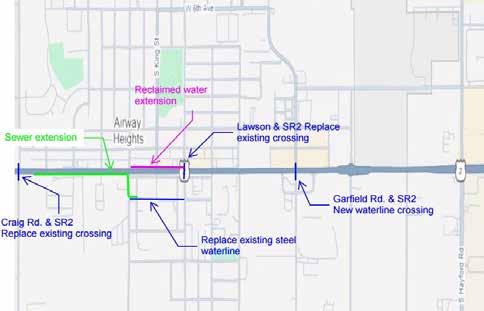
Map courtesy of the city of Airway Heights
The map above indicates the location of the six projects proposed for state grant funding by the Airway Heights Public Works Department. The total amount applied for tops $4 million.
Chiefs (WASPC) that will allow the department to continue funding two full-time mental health professionals and two full-time police officers in Airway Heights and Cheney as part of the West Plains Response Team. The team responds to calls on the West Plains involving behavioral health concerns “such as someone experiencing a mental health crisis, suicidal ideation or needing drug or alcohol treatment.”
The grant will be paid in two annual installments, $637,473.46 the first year and $618,447.47 in the second. Airway Heights grant administrator Alise Mnati will be the project manager for the program, serving as primary contact and charged with a number of tasks including data collection and submitting grant reports – with 28% of her salary covered by the grant.
The grant will also provide the city a 15% indirect cost rate to cover all program-related expenses.
Finally, the council approved a $517,945.65 Arrest and Jail Alternatives grant, also from WASPC. The two-year grant pays $264,521.09 in year one and 253,424.56 in year two.
The grant provides the department funding to continue to employ a full-time case manager to oversee the West Plains Law Enforcement Assisted Diversion (LEAD) program, currently filled by Ashley Martinez. Martinez is a licensed clinical social worker with a “caseload of 30 clients referred by the West Plains Crisis Response Team, prosecutors, officers, and other community partners.”
Mnati will also serve in the same role for this program as she does for the Mental Health Field Response program, with 45% of her salary and benefits covered by the grant. The grant also provides the city a 15% in-direct cost rate to cover other program-related expenses related to client services and resources provided at the Hope Center, a collaboration between the West Plains Response Team and the Women’s Healing and Empowerment Network that opened this past spring.
Also at the July 21 meeting, council approved a $15,000 funding request enabling the Public Works Department to contract with consultant Century West on possible concepts for an updated Public Works building. The contract is paid for with $10,000 from sewer and water revenues and $5,000 from the Street Current Expense fund.
By Ben Wick Stream Publisher
Glen Horton, Parks and Recreation Director gave an update to the City Council on the Cities Commercial Kitchen Construction Project.
Horton noted that the project costs have increased significantly. “Construction and plumbing costs have gone up 40% based upon our building conditions and labor went up 15% due to needing to pay prevailing wage.”
The revised estimate from the project is $418,231.09 vs the budget of $305,000. The original $305,000 is the last of the cities ARPA funds received from the Federal Government due to COVID Relief.
Mayor Cooper, highlighted the vision for the commercial / test Kitchen is to help bolster economic development and bring in new revenue. “We have received interest from food trucks and restaurant owners in utilizing this facility. The Farmers market expressed interest in Food Prep and Food Preservation Classes. We also have an agreement from Avista in cases of PSPS outages that this is the place we can prepare meals for people. We can also use this as a place to keep people warm in inclement weather.”
Councilmember Tony Hardbolt, asked about the current status is “how far along is the project,?” Mr Horton reported that the area is currently demolished and has spent $64,684 of the current $305,000 budget.
Councilmember Pritchard asked where the additional money would come from. Mayor Cooper noted that her proposal is to use the Cities reserves to cover the additional $118,231.09
City Finance Director Koss Ronholt, added “the projection is that the city will have around $1,000,000 in reserves at the end of the year.”
Mayor Cooper, advocated for the council to approve the additional funds. “The more we delay, costs will only continue to go up”
Councilmember Keli Shaffer expressed interest in moving forward but getting a fixed cost contract to get the project completed.
The Council unanimously provided consensus to move forward and bring back a contract to complete the project utilizing the cities reserves.
The City Council included $75,000 for a new Parks and Rec Vehicle in the 2025 budget. Glen Horton, Parks and Recreation Director brought forward a request to change the allocation from purchasing a truck for parks maintenance to purchasing a UTV as well as a towable boom lift.
Noting the costs as “Kubota UTV is approximately $33,000 and the Genie Lift $34,070 - $38,447.19,” said Horton. “The pull behind boom lift, is more of a priority with the addition of the Flower Baskets and street lighting along Lefevre Street.”
The proposed change in equipment would spend $65,000 of the $75,000 budget and is expected to save the city money in the long run.
“Currently we have to call the County every time we need to change a light or banner,” explained Horton citing the expense for calling the County or renting equipment to perform maintenance activities.
City Planner Elisa Rodriguez advised council that “Due to the significance and the number of [state] legislative changes that must be addressed in the upcoming amendments to the municipal code, workshops will be scheduled throughout the next 12 months.”
The first of which was focused on the changes around Accessory Dwelling Units or ADUs. Ms Rodriguez shared “The Washington State Legislature passed House Bill 1337, to address affordable housing and the state’s growing housing crisis.”
“While our current code does not allow accessory dwelling units,” added Rodriguez “Not only are cities mandated to allow ADUs, but there are several standards that must be adhered to.”
The states definition of an accessory dwelling unit is a dwelling unit located on the same lot as a single family housing unit, duplex, triplex, townhome or other
housing unit. With the distinction of a dwelling unit being based upon the number of kitchens or specifically the number of ranges within a structure noted Rodriguez.
The main requirement under the new state law states that every jurisdiction “must allow 2 accessory dwelling units per lot in our single family zones” said Rodriguez.
Mayor Cooper asked how that would impact the cities current regulations around the maximum lot coverage (the maximum percentage of a lot that is allowed to be covered in by structures).
City Planner Rodriguez responded that the city will have to evaluate and consider changes to the lot coverage specifications in order accommodate the additional dwelling units. “Our single family zone limits building coverage to 35%, if we knew that lets say in Fox Hollow that the lots are typically already close to the 35% coverage limit we will need to find a middle ground to allow accessory dwelling units.”
Mayor Cooper noted that this new requirement will complicate the cities building codes “how do we provide separate infrastructure such as sewer, water, electricity, and how do we address them.”
It was highlighted that even though the state is requiring the city to allow accessory dwelling units, it is up to the landowner to determine if this is something they want to do.
Ms. Rodriguez noted that “While people can rent ADUs to strangers but more often people are renting to family members or friends who are looking for a smaller housing opportunity.”
Councilmember Pritchard asked “how does this impact people buying houses and using them for air-b and b’s, now everyone has three air-b and b’s?”
“We don’t currently have a short term rental regulations, but will be something that we consider,” responded Rodriguez.
Other requirements approved by the state legislature around the accessory dwelling units that the city must include: Cannot require owner occupancy, with some exceptions around short term rentals; must allow separate sale of ADU’s, cannot require more than one parking space on a lot smaller than 6,000 square feet and cannot require more than two parking spaces on lots 6,000 square feet or larger; must allow a maximum unit size of 1,000 square, must allow zero setbacks adjacent to alleys, cannot have design standards that are more restrictive than what is required for the main residence; must allow ADU’s to be at least 24 feet in high (which could be higher than the house), impact fees must be no more than 50% of the fee of the principal unit, cannot require street improvements as part of permit.
The deadline for compliance with this state law is December of 2026.
Mayor Cooper added “we need to prepare ourselves for how we can accommodate these changes but I don’t foresee a large demand for these types of units.”
Approved the revised interlocal agreement with Spokane County adding the Spokane Tribe of Indians and the Kalispel Tribe of Indians to the Steering Committee of Elected Officials’ membership and voting structure.
After reviewing four different software packages, the City Council approved a service agreement with Pagefreezer for social media and website archive services. The agreement included $800 of one-time costs for configuration and training and an annual recurring cost of $5,844
Council approved a one year contract renewal with Gordon Thomas Honeywell Government Relations for state lobbying and advocacy activities. The contract had no escalation from the previous year and totaled $36,000 plus travel expenses associated with visiting the City of Medical Lake.

By Nina Culver Stream contributor
The Cheney School District spent the summer busily making improvements to nearly every school in the district after voters approved a $72 million bond in November 2024 to pay for a long list of improvements to existing facilities and an entirely new elementary school.
“It’s been a good, fun summer with all the projects,” said Superintendent Ben Ferney.
First up was to put in bus loops at Salnave and Windsor Elementaries. The loops keep the buses and the children getting off them separate from the staff parking areas and the parent pick-up and drop-off area. “They needed upgrades based on the traffic flow,” Ferney said. “They’re able to drop off and get right to that sidewalk and get into the school.”
Also at Windsor Elementary, the corridors got new paint and carpet, said Jonathan Miller, program manager at Turner & Townsend Heery, who helps oversee the district’s projects. Windsor was built in 1959 and updated in 2003, but
additions were made in 1994 and 2019. “Nothing matched,” Miller said of the mishmash of paint and carpet colors. “Now the building has a cohesive feel. It looks so much better with fresh carpet.”
Sunset Elementary, also built in 1959 and updated in 2003, received new interior paint and carpet as well.
Maintaining proper heating and cooling at several of the district’s schools was a challenge, with parts no longer available for decades old equipment. “Those systems were well beyond their useful life,” Miller said.
Salnave Elementary got new boilers as well as a new chiller for the air conditioning system. New chillers were also installed at Windsor Elementary and Betz Elementary, which was built in 1956.
Ferney said the district’s maintenance staff worked miracles as long as they could to keep the aging equipment running, but it was simply too expensive to have spare parts made whenever something broke or wore out. “Some of the gear in those chillers and boilers was so old that they didn’t make the parts anymore and they had to be manufactured,” he said.
It’s important for classrooms to be kept at a reasonable temperature, Ferney said. “Being in a room that’s the proper temperature is so important to student learning,” he said.
Crews also upgraded the main
entry at Snowden Elementary, Cheney Middle School and Westwood Middle School to include locking doors and a video intercom system. All school visitors must now be buzzed in by school staff. Miller said those three schools were the last in the district to have a secure entry area installed. “Now all the schools in the district have the same access system,” he said.
The district also plans to install laminated glass in all school entries this fall as an added security measure, Miller said. The work is low key and can be done while school is in session, he said. The laminated glass does not shatter if hit or punctured. “It buys time,” Miller said.
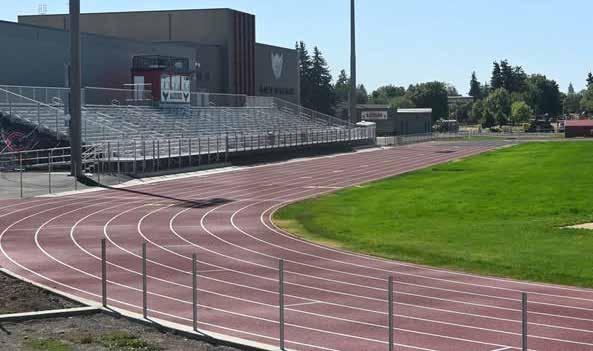
Several projects were underway this summer at Cheney High School, including upgrades to the school’s stadium. The 60-year old bleachers on the visitor’s side of the field were demolished and replaced with bleachers that doubled the capacity. Additional bleachers were also added to the home side of the field.
“As we continued to grow, we did not have enough seating on the visitor’s side,” Ferney said. “On the home side, the band had to stand on the track because there wasn’t enough room in the bleachers.”
The high school track was also showing its age and was replaced. The school used to have to rent security fencing for certain events and has now installed permanent fencing instead. A pedestrian pathway and more landscaping were also added.

Inside the school, the lockers were upgraded in the varsity locker rooms and the floors were resurfaced, Miller said. “Those lockers were from the early 90’s,” he said. “They were beat up, didn’t work and smelled really bad.”
Ferney said he’s pleased with the improvements at the high school stadium. “It looks awesome,” he said. “I’m excited for our kids to go play on it and our parents to come watch.”
Another project completed this summer, improvements at Crunk’s Complex, was done using funds from the capital levy approved by voters in February 2024. The high school needed more field space and decided to move boys and girls soccer to the complex, Ferney said.
Most comprehensive high schools need between 50 and 60 acres for the school, athletic fields and parking, Ferney said. Cheney High School sits on less than 30 acres, leading to crowding and overuse of the fields. The grass was being damaged due to constant use. “We don’t have as many fields as we need,” Ferney said.
The decision was made to make the Crunk’s Complex, which was officially dedicated in 2014, the permanent home of the varsity and junior varsity soccer teams. The boys teams play in the spring and the girls teams play in the fall. Moving soccer practices and games should give the fields at the high school time to recover and make them easier to maintain, Ferney said.
This summer Crunk’s Complex was fenced off to limit access. People in the community had been using it as a place to walk their dogs, some of whom dug holes in the fields. “I think there was a perception that it was a public park,” he said.
Now that the fencing is up, Ferney is hopeful that the fields can be maintained in playable condition. “We need to have a high-quality field for our athletes,” he said. “We want to make sure the location is good and it’s secure.”
All soccer practices and daytime games will be held at Crunk’s Complex, Ferney said. Night games that require lighting, which the complex does not have, will be played at the high school.
The district is already making plans for additional bond projects slated for next year. Salnave Elementary is due for an upgraded electrical system and those parts are being ordered now, Miller said.
By Nina Culver Stream contributor
Students, parents and teachers are making final preparations to go back to school, buying school supplies and new sneakers while marking back to school events on the calendar. As schools open this fall, there are some changes to schedules, programs and policies in the Medical Lake and Cheney school districts.
Elementary for the last three years, Headrick said, and those students had better skills and were more ready for kindergarten than those who attended half-day programs. “Our primary responsibility is that those students are kindergarten ready,” she said.
The district is also launching its Home Connections program, which provides access to curriculum and teachers for homeschooling families. “We have a selection of curriculum we will provide them access to,” Headrick said.
Design work is moving forward for a kitchen expansion next summer at Windsor Elementary, which is much too small to easily serve the number of students at the school, Miller said. The kitchen at Salnave Elementary is also slated for expansion next year. “It was designed to be a warming kitchen and now they’re cooking from scratch,” he said.
One of the biggest bond funded projects, however, will not be complete for two years. In early 2020, the district paid just over $626,000 for 11.5 acres on Craig Road near First Avenue in Airway Heights to build a new elementary school. There are now enough students to warrant building the new school, Ferney said. Windsor, Sunset, Snowden and Betz Elementaries are all housing more students than they were designed for and each has three portable classrooms to handle the overflow.
“That was a big piece from our facilities planning team,” he said.
Planning for the new school, which has not yet been named, has been moving forward. The district had public meetings to get input from parents and community members about the features the new school should have. The district also put together a design advisory committee that includes parents, staff members and school board members. The committee has been making monthly reports to the school board, Ferney said.
“We’re being as transparent as possible,” he said.
It has already been decided that the new school will be a community resource as much as possible, Ferney said. “It’s going to have a larger
gym and open area available for community use,” he said.
The new school will be designed to house 500 students. The district is just now starting to look at how the elementary school boundaries should be adjusted to accommodate the new school, Ferney said. That process will also be open to public input.
“The goal is to get all students out of portables and I think we’re going to be able to do that,” he said.
Garco Construction has been selected as the general contractor for the project, which is planned to open in the fall of 2027. Miller said the grading permit is expected to be granted at the end of August with site work to begin the first week of September. Utilities work and putting in the foundation of the new school will begin in the Spring, Miller said.
The design work for the new school was completed in February. The district has already identified where the bus loop and parking will be, Miller said. “We have a general layout of the building,” he said.
Ferney said he’s grateful for the community’s support in passing the bond in November, which was the district’s second attempt. The first attempt, in February 2024, failed with 54.5 percent approval. A bond requires 60 percent supermajority to pass. Several other school districts also on the February 2024 ballot saw their bonds fail as well.
“We’re super excited for it,” Ferney said of the upcoming projects, including the new elementary school. “There’s not too many districts that were able to pass bonds.”
The Medical Lake School District is relocating and expanding its after school program offered in partnership with the Medical Lake Parks and Recreation Department. The expanded program will be held at Hallett Elementary, located at 524 S. Hallett Street.
Medical Lake Superintendent Kim Headrick said the district has been interested in expanding the after school program because child care options are limited in Medical Lake. “They were running a small program at City Hall,” she said. “We knew there was a need.”
The program provides video games, arts and crafts, board games, homework help and more. “This is more of a child care type program,” Headrick said.
The program is similar to the after school program Fairchild Air Force Base offers at their youth center for students at Michael Anderson Elementary, Headrick said. “This basically mirrors that,” she said.
The program accepts students in grades K-5 and costs parents $7 per day. However, the need for more slots was so great, the program is already full. The city does have a waitlist for interested families. The city can be reached via email at recreation@ medical-lake.org.
Headrick said she’s not surprised that the expanded program filled quickly. “That’s kind of what we were expecting,” she said.
The Medical Lake School District has also used a combination of state and federal funds as well as money from its levy to expand its Early Childhood Education program for children ages 3-5 to a full day program. Previously, preschoolers only attended for a half day. “Now everyone is full-day,” she said.
The district has offered a full-day transitional kindergarten at Anderson
Families can also have access to credentialed teachers to make sure the students are on track. Students in Home Connections also have the option to participate in district sports, music, art or after school activities. The program also offers monthly field trips and regular activities for homeschooling families.
Medical Lake High School principal Jeremy Vincent said he plans to meet with the parents of incoming freshmen to pitch the school’s College in the High School program, which is now partnering with Eastern Washington University. The program is similar to Running Start in that students can earn college credits for classes, but those classes are taught at the high school by high school staff, though some classes are available online.
Vincent said the program allows students to earn an associate’s degree without ever setting foot on a college campus. “We’re really going to talk about why stay at Medical Lake all four years,” he said. “It’s a great program.”
Historically some students have decided not to participate in Running Start because they don’t want to take classes on a college campus and miss out on the traditional high school experience, Vincent said. The College in the High School program allows for that experience, he said, including sports and clubs.
“You still have your counselor,” he said. “You still have all the support. You still have that high school experience.”
The high school is also starting a new competitive cheerleading program and the new shop teacher has plans to partner with the Future Farmers of America program, Vincent said. He hopes to provide opportunities to appeal to every student and said he encourages students to get involved in at least one school activity.
“That’s how you plug them in,” he said. “That’s how you keep them here.”
The Medical Lake School District will welcome students back with a








By Nina Culver Stream contributor
Drivers heading west through Airway Heights have spent the last few weeks watching a brightly colored mural take shape on the wall of Billie’s Diner at 13008 W. Sunset Highway.
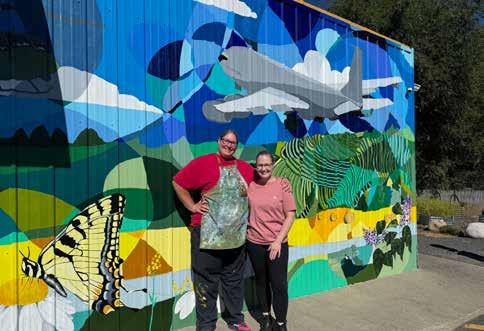
The mural, which has an aviation theme, ties together the local landscape with nearby Fairchild Air Force Base, celebrating all things flight. Artist Missy Kupka featured not only airplanes that locals have commonly seen flying near the base, but also various flying creatures, including a bee and a dragonfly. Kupka said the insects she featured are “natural aviators.”
Kupka was moved to include the local landscape and insects because she knows that Billie’s Diner is a farm to table restaurant, serving food from local farms whenever possible. “I had come to the soft opening of Billie’s and loved it,” she said. “I knew they worked with local farmers.”
Billie’s Diner owner McKenzie DonTigny said the city approached her last year after they received a grant to pay for local art as part of their downtown revitalization effort, wanting to put a mural on the side of her building. DonTigny said her diner is located in one of the original Airway Heights buildings that were built shortly after the nearby Air Force base opened. Those core buildings are considered the downtown area.
“I know they were focused on the two blocks between Lawson and Lundstrum,” she said. “We’re very focused on community. I felt very honored the city was considering a mural for us. I thought it was a good way to connect to the community and tell the story of this area.”
DonTigney said she was willing
to have a mural installed and the city put out a call for artists, which Kupka responded to. DonTigney helped review the two dozen applications, and selected Kupka’s. “I liked Missy’s take on blending technology and nature,” she said. “That really symbolizes Airway Heights’ combination of agriculture and technology.”
Kupka has been interested in art nearly for as long as she can remember. “I had an amazing elementary school art teacher,” she said. “He was just so enthusiastic about art.”
When she was in first grade, her art teacher submitted one of her drawings into a local competition. Kupka was pleased and encouraged when she took third place in a contest that included much older students. “I got third place in the whole county,” she said.
She took art classes all through school and originally was studying art in college. However, she thought she didn’t fit in with the other art students and second guessed her choice. “I switched my major halfway through to advertising,” she said.
Though she did minor in art and art history, Kupka worked for a printing company after college. She met and married her husband, a computer animator. The couple
If you would like to sponsor this section call 509-242-7752
moved to Airway Heights nine years ago.
Kupka is now a stay at home mom who considers art her side job. She’s helped on a couple of outdoor murals in Toronto and has done smaller indoor murals by herself, but the mural on Billie’s Diner is her first solo outdoor mural.
Kupka started working on the mural the first week of July. She used a virtual reality headset to trace her mural on the wall, then spent hours and hours carefully bringing her vision to life with the paintbrush in her hand. A lot of that time was spent on a ladder, but Kupka said she often didn’t notice how far off the ground she was.
“Once you’re up there, you’re just in the zone of painting,” she said.
She often painted early in the morning and in the evening to avoid the worst of the summer heat. Hot temperatures make the paint sticky, Kupka said. “The paint brush will stick to the wall,” she said. “It has happened.”
Customers would often stop to chat with Kupka on their way in or out. Some, thinking she worked there, asked about the menu. Others commented that the mural was looking great. “’You missed a spot’ is a big favorite,” Kupka said. “Interacting with the public has been
very fun.”
In addition to a bee and a dragonfly in the bottom corners, there are also flowers, a large butterfly and a red ladybug. Flying above it all is a Huey helicopter FAFB uses for rescue missions, a KC-135 tanker often seen in the skies overhead and a B-29, a propeller-driven bomber that was heavily used during World War II.
Bright colors are used throughout the mural, including in geometric shapes and lines meant to represent the patchwork of farmland seen in the West Plains.
Kupka said she’s enjoyed her time spent painting the side of Billie’s Diner. After the mural gets final approval from the city, she’ll apply a clear coat to the building to help protect the colors from fading. “I’ve enjoyed being at this location,” she said. “It’s easy to be inspired because I’d been here before and knew the vibe.”
Kupka is just one of the regulars who visit the diner, known for its fluffy pancakes. Those pancakes come in seasonal flavors depending on what’s in season at local farms. In the spring, the pancakes are lavender lemon flavored. In the summer, blueberries make an appearance. In the fall, apple and pumpkin flavors dot the menu.
In addition to the menu, what sets Billie’s Diner apart from other restaurants is their use of a Giving Wall, where diners can prepay a meal for someone else. If someone is in need of a meal, they simply go to the wall, pull down a paid receipt and get a meal. Sometimes the people who get a free meal are homeless or in need and sometimes it’s someone who forgot their wallet that day and come back later to replace the meal they used by buying a new prepaid meal, DonTigney said.
She said that about five people a day use the wall to get a free meal and she knows that for some, it might be their only meal that day. “It’s one of my favorite things that we do here,” DonTigny said.
Customers have reacted positively to the mural taking shape, DonTigny said. “They think it’s so cool,” she said. “Every time you look at it you see something new.”
I want everyone to have access to the healthcare they need.
Rural health care has been a priority of mine for a long time. This year, I worked to ensure the One Big Beautiful Bill included funding to keep local, rural clinics open.
The new law’s Medicaid provisions will not take effect until the end of 2026. In the meantime, the state government can apply for Washington’s share of a $50 billion rural health fund, meant to rush money to farm and forest communities.
After 2026, able-bodied individuals who want Medicaid will be required to work, be in school, or volunteer, (something supported by 80% of Americans*). This is how it should be; our tax dollars must go to supporting the most vulnerable.




We’re here to help. Contact my office to get help with any federal agency or concern. www.baumgartner.house.gov








By Erin Dodge Stream Guest Contributor
Your library card from Spokane County Library District (SCLD) offers you access to hundreds of thousands of eBooks and audiobooks through the OverDrive site and the Libby app. There you’ll find lists curated by librarians on a medley of topics. Here, we’re taking a look at four lists about the outdoors, starting with titles focused on the region where we live. The Pacific Northwest has a plethora of natural wonders to see and other things to experience. The booklist “Out & About in the PNW” shares hiking and walking guides, nonfiction accounts and diaries of historic happenings in the region,
By Erin Dodge Stream Guest Correspondent
Cheney Library is offering several programs for gardeners and aspiring green thumbs in September, just in time for late summer and fall harvests.
If your garden has produced a bumper crop, you can share it with others in the community at the “Produce Swap” at Cheney Library each day during open hours in September and October. Bring your extra produce—fresh only—to the library and take home something different from another garden. This swap is for gardeners of all ages, and any leftovers will be delivered to a local community food bank.
During the “Seed Saving” class, you can learn about the time-
outdoor activities for kids and adults, compilations of animals, insects, trees, and plants, some edible, found in the area, and even cookbooks for foragers and outdoor enthusiasts. Discover awesome things in the Pacific Northwest at scld.org/bookspnw-outdoors.
Whether you’re getting ready for an outdoorsy summer or want to read about the outdoors while camping, the “Let’s Go Camping” list of digital reads are ready to hit the road with you. Create the perfect camp cookout. Discover ways to minimize your footprint on your outdoor adventures. Learn how to bird watch. Find activities to bust outdoor boredom. Prepare for bears and other wildlife. So many ideas and helpful information are in this booklist at scld.org/books-go-camping.
Nature has a lot to offer us, including adventuring, hiking, gardening, and relaxing. “The Great Outdoors” booklist includes books about finding great hiking, adventuring, and camping across North America. If hiking and camping aren’t in your future, you can still enjoy titles about gardening and relaxing in nature. Find books about beekeeping, seed saving, vertical gardening,
honored tradition of gardeners worldwide and techniques to identify, harvest, and store seeds. This class is for adults and presented by Steve Nokes, WSU Extension Spokane County Master Gardener Volunteer, at Cheney Library (610 First St) on Wednesday, September 3, at 6:30 pm. Stop by to grow your knowledge.
Did you know that Cheney Library is home to a seed library?
The Take-and-Give Seed Libraries throughout Spokane County offer heirloom seeds for vegetables, herbs, and flowers that you can borrow and plant in your garden to grow something delicious and beautiful.
All seeds are offered while supplies last, so the “give” part of the title is important for keeping the seed library going. When it is time to harvest, plan on letting some plants go to seed so you can save them for replanting as well as sharing. Once you’ve saved some heirloom seeds, the library asks you to bring your extras, separated and clearly labeled, to any of the county libraries for next season’s planting and for other gardeners to enjoy.
When you bring seeds to the
composting, and more. There are titles for kids to gain outdoor skills, books about a wide range of animals found in nature, including the ocean, and tree and plant identification. There is so much to discover about “The Great Outdoors.” Get started at scld.org/ books-great-outdoors.
If you’re interested in expanding and exploring your creativity, consider immersing yourself in nature while you create. Grab your paints, journal, camera, or other creative tools and head outdoors. The “Inspired by Nature” booklist has over a hundred titles to spark your creativity, including ideas for watercolor painting, collaging, soap making, basket weaving, herb gardening, Zen gardening, photography, journaling, and more. Engage with these titles at scld.org/books-nature-art.
These eBooks and audiobooks are great for downloading to your mobile device for on-the-go reading. If you need help accessing titles from these booklists, you can talk to SCLD staff when visiting your library or use SCLD’s Book-a-Librarian service, scld.org/book-a-librarian, to get oneon-one help with OverDrive, the Libby app, and downloading digital books.
library, it is important to hand them to staff at the service desk and not place seed donations in any of the book drops where they will get damaged, crushed, and likely create a mess. Library staff also ask that you don’t put seeds directly into the seed library bins so that they can get an accurate tally of donated seeds. You can learn more about our seed libraries and find gardening resources at scld.org/seed-libraries.
If you need assistance identifying a garden pest or determining why a plant is not thriving, then “WSU Extension Master Gardeners Plant Clinic” is for you. Master Gardener volunteers can help with a wide variety of horticulture issues, including plant selection, installation, and maintenance; plant problem diagnosis and treatment; environmentally sound gardening practices; pest identification and management; and effective landscaping practices. Stop by Cheney Library any time between 1–5pm on September 5 and 19 and October 3 and 17 to get help and discuss options. This program is for all ages, and young gardeners are encouraged to stop by to discuss their planting ideas.







Explore techniques to identify, harvest, and store seeds for next planting season and to share with the seed library.
CHENEY LIBRARY 610 First St Wednesday, Sep 3 6:30–7:30pm

Get assistance identifying garden pests, plant problems, and more.

CHENEY LIBRARY 1st & 3rd Fridays, Aug–Oct 1–5pm

The Stream is committed to serving the West Plains area through excellent community journalism. We can’t do it at all without you, our readers, and we can’t do it for long without support from our advertisers. Please thank our business partners and look to them when offering your patronage.
Our sincere appreciation to the following businesses for their foundational partnerships withThe Stream and its partner publications:







Continued from page 7
free Back to School event from 9 a.m. to 6 p.m. Aug. 21 at the Wellness Center, 317 N. Broad Street. There will be free school supplies while supplies last and free hot dogs at noon and 4 p.m. while supplies last.
That same day the district will also offer free haircuts to students from noon to 4 p.m. in the Medical Lake High School cafeteria, 200 E. Barker. The haircuts will be provided by students at the Paul Mitchell school. No appointment is necessary.
Headrick said the haircuts had to be moved to the high school, which is across the street from the Wellness Center, because they are so popular. Overall, the annual Back to School day has been popular with families, she said.
“It’s a community building event,” she said. “It builds excitement. It’s also one less stressor for our families.”
Like several other school districts in the area, both the Medical Lake and Cheney districts upgraded their online parent portal from Skyward to Skyward Qmlativ. The same program is also used to manage payroll and human resources in the districts.
The program should be fairly easy for parents to use, Headrick said. “For the most part, it is very similar to what we’ve had in the past,” she said. “They don’t need new logins or new accounts."
The program interface looks a bit different, but there aren’t really any new features, Headrick said. “It’s just a little bit more intuitive,” she said.
Cheney Superintendent Ben Ferney said that while the switch took extensive planning for nearly a year on the district’s part, parents shouldn’t notice much difference. “It’s still Skyward,” he said. “It is more user friendly.”
One of the biggest changes in the Cheney School District is the alteration of the start and end times at four elementary schools by 10 minutes. Classes will begin at 9 a.m. and end at 3:30 p.m. at Sunset, Snowden, Windsor and Betz elementaries.
The times were changed to accommodate bus routes, Ferney said. The middle schools, high school and Salnave Elementary all start at 7:50 a.m. The buses would have to complete those routes before leaving for routes at the four elementary schools and there simply wasn’t enough time, Ferney said.
“It was hard to make that happen in the morning,” he said. “It was just a traffic issue trying to get back in time.”
If it was difficult to pull off in the morning, when the buses had an hour to make the turnaround, it was even harder in the afternoon. The upper schools and
Salnave released students at 2:30 p.m. while the four elementary schools ended at 3:20, leaving only 50 minutes. Buses were routinely late to pick the elementary students up, Ferney said.
“Our goal is to have the buses there when kids get out, but kids were waiting 12 minutes,” he said.
Running each route four times a day is a massive undertaking in a district that goes almost as far as Rosalia, Ferney said. “Our geographical footprint is 380 square miles and our buses travel over 5,000 miles a day,” he said.
The new start times will be in effect Monday through Thursday. Fridays are a late start day and those times will also be adjusted by 10 minutes at the four elementary schools. “We hope it’s not too much of an impact,” Ferney said.
“Hopefully that 10 minutes is enough.”
The school board voted at the end of June to alter the district’s cell phone policy after receiving input from parents and students. “We had one, but there was no procedure in it,” Ferney said. “We needed to get more specific in a few areas.”
In general, cell phone use will not be allowed during the school day at the elementary and middle schools. At the high school, students will be allowed to use their phones during passing periods and during lunch.
Ferney said he hopes students will take the opportunity to engage in more conversations with each other instead of being engrossed by their phones. “I think there will be some adjustments,” he said. “I think in the end, most of the time, it’s been met with success.”
Medical Lake School District back to school events
August 18 – noon to 2 p.m., sixth grade sneak peek, Medical Lake Middle School
August 20 – 9 to 11:30 a.m., freshmen sneak peek, Medical Lake High School
August 25 – 5 to 7 p.m., open house, Hallett Elementary
August 26 – 3 to 5 p.m, open house, Michael Anderson Elementary
September 4 – 5:30 to 7 p.m., open house, Medical Lake Middle School
Cheney School District back to school events
August 25 – 5 to 6:30 p.m., open houses at Betz Elementary, Cheney Middle School, Snowdon Elementary and Westwood Middle School.
August 25 – 4:30 to 5:30 p.m., open houses at Salnave Elementary, Sunset Elementary and Windsor Elementary.
September 3 – 4:30 to 7 p.m., welcome back barbecue and Market Night, Three Springs High School.
September 5 – 5 to 6:30 p.m., open house, Cheney High School.


EDITOR/PUBLISHER Ben Wick
ben@westplainsstream.com
CO OWNER Danica Wick
danica@westplainsstream.com
CONTRIBUTORS
Nina Culver, John McCallum
The West Plains Stream P.O. Box 363
Liberty Lake, WA 99019
Phone: 509-242-7752
www.westplainsstream.com
The Stream is published monthly by or near the 15th of each month. It is distributed free of charge to every business and home in Airway Heights, Fairchild Airforce Base, and Medical Lake area. Copies are located at drop-off locations in Airway Heights, Medical Lake and the surrounding area.
The Stream is brought to you by
Publishing House
Submitted materials
Announcements, obituaries, letters to the editor and story ideas are encouraged. Submit them in writing to publisher@westplainsstream.com. Submissions should be received by the 1st of the month for best chance of publication in the following month’s Stream.
Subscriptions
Subscriptions for U.S. postal addresses cost $20 for 12 issues. Send a check and subscription address to P.O. Box 363, Liberty Lake, WA 99019. Subscriptions must be received by the 1st of the month in order for the subscription to begin with the issue printed the end of that month.
Correction policy
The Stream strives for accuracy in all content. Errors should be reported immediately to 509-2427752 or by email to editor@westplainsstream.com. Confirmed factual errors will be corrected on this page in the issue following their discovery.
Advertising information
Display ad copy and camera-ready ads are due by 5 p.m. on the 1st of the month for the following month’s issue. Call 509-242-7752 for more information.
Advertising integrity
Inaccurate or deceptive advertising is never knowingly accepted. Complaints about advertisers should be made in writing to the Better Business Bureau and to advertise@westplainsstream.com. The Stream is not responsible for the content of or claims made in ads.
Copyright © 2025
All rights reserved. All contents of The Stream may not be reproduced without written permission of the publisher.
By Tech. Sgt. Heather Ley Stream news sources
For more than 25 years, Candie Dibble has worn many hats: attorney, mom, and military spouse. Each role came with its own challenges, but it was her experience navigating military life that has shaped her and inspired her to become a fierce advocate for the families who serve behind the scenes.
Now, after decades of permanent change of station moves, Dibble holds a new title: Spokane County Superior Court judge, appointed by Washington Gov. Bob Ferguson.
“It’s been a rough road,” she said. “But every move, every challenge made me who I am today and gave me a voice to speak for others who feel unseen.”
Her journey began in 1999, when she met her husband Bryce, then a seven-year Airman. At the time, Dibble was finishing law school and preparing to take the South Carolina bar exam. When the two realized they were in it for the long haul, they had tough conversations about what that commitment meant.
“As the daughter of a retired lieutenant colonel in the Army, I understood the benefits of a 20-year retirement, especially when someone retires young and has time for a second career,” she said. “We figured 13 more years? Not a problem.”
That was more than 25 years ago.
Like many military spouses, Dibble soon found herself putting her husband’s career first. “We both understood that as a military spouse, I’d have to not prioritize my career,” she said. “His career would often take priority.”
And it did. For years, she faced the same struggles many military spouses know too well, leaving behind jobs she loved, navigating state-specific licensures and being passed over by employers who didn’t want to invest in someone who might move again in two or three years.
Military spouses can find state-specific information about occupational license requirements, including new federal support for cross-state licensure, by visiting https://www.dol.gov/agencies/ vets/veterans/military-spouses/licenserecognition. The site includes license names, descriptions of covered occupations, and contact information for state licensing agencies.
“There were a lot of times I was told I was more than qualified, but they wouldn’t hire me because I was a military spouse and they knew I’d be gone in a few years,” she said. “It was frustrating, especially when
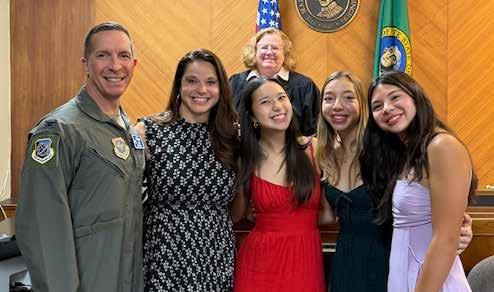
Spokane County Superior Court Judge Candie Dibble and her family gathered for a photo after being sworn in at the Spokane County Courthouse in Spokane, Washington, July 16, 2025. Dibble joins the Spokane County bench following a nearly 25-year legal career, including 15 years with the Washington State Attorney General’s Office in Spokane.
the average person stays in a job for about three years anyway.”
Rather than give up, Dibble leaned in. Determined to stay in the field, she took long commutes just to find work. “In Dover, I drove over an hour to Newark,” she said. “At McChord, I commuted down to Olympia. The farther I got from base, the more likely I was to find employers who didn’t have biases against military spouses.”
She built a career in public service and began working for the Washington State Attorney General’s Office starting in 2010. A few years later, her family had the opportunity to move again.
“Bryce asked me, ‘Where do you want to go?’ And I said, ‘Is Fairchild an option?” she said. “Spokane might not have sounded exciting at the time, but I knew we had an AG office there, and I thought I could make a case for them to let me stay on.”
Her first time at Fairchild Air Force Base wasn’t just about career continuity, it was about giving back. She stayed involved in the base community, supported other spouses, and spoke openly about the challenges unique to military families.
It was also the first of three times the Dibbles would be assigned to Fairchild. Col. Dibble would first be at Fairchild as an instructor pilot and then a squadron commander before coming back for his third time to serve as the deputy commander of the 92nd Air Refueling Wing. Through each of those roles, Mrs. Dibble remained a steady presence, supporting her husband through every leadership role and standing alongside fellow spouses as a pillar of strength, connection and shared understanding.
“I’ve experienced the isolation, the uncertainty, the constant starting over,” she said. “That’s why I’ve always made
an effort to show up and be present for other spouses, to help them feel seen and supported.”
Even while telecommuting through overseas assignments in Italy and London, she found ways to stay connected to both her professional work and the military community. Now that their family is back in the Spokane area, where Mrs. Dibble had previously established professional connections, she finally has the chance to move her career forward.
“I could look at possible advancements for my own career,” she said. “And we’ve always made those decisions as a family. Every time he decided to take another assignment, we sat down together and talked through what it meant for us and for our kids. That’s how we’ve always been, either all in or we wouldn’t make that move.”
Her appointment to the bench earlier this year marked not just a professional milestone, but a personal one, too. As a military spouse on the bench, she carries with her a deep empathy for those navigating upheaval, transition and systemic barriers.
And she hasn’t stopped advocating. Now back at Fairchild for a third time, Dibble continues to uplift other military spouses, sharing her story, mentoring newcomers and advocating for greater awareness and support.
“We talk a lot about the service member’s sacrifice,” she said. “But there are entire families behind that uniform, spouses who give up careers, kids who move every few years and communities that constantly change.”
Her message is clear: military families aren’t just supporting the mission; they are part of it.