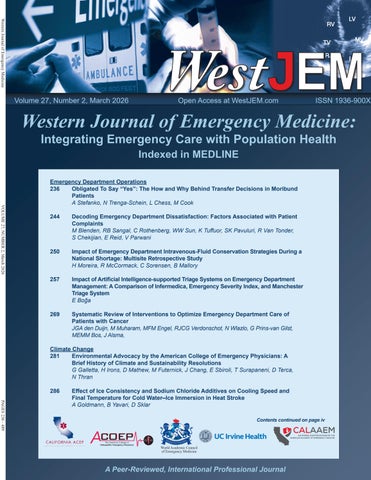
Volume 27 Issue 2

Page 1


Western Journal of Emergency Medicine: Integrating Emergency Care with Population Health

Emergency Department Operations

236 Obligated To Say “Yes”: The How and Why Behind Transfer Decisions in Moribund Patients

A Stefanko, N Trenga-Schein, L Chess, M Cook

244 Decoding Emergency Department Dissatisfaction: Factors Associated with Patient Complaints

M Blenden, RB Sangal, C Rothenberg, WW Sun, K Tuffuor, SK Pavuluri, R Van Tonder, S Chekijian, E Reid, V Parwani

250 Impact of Emergency Department Intravenous-Fluid Conservation Strategies During a National Shortage: Multisite Retrospective Study H Moreira, R McCormack, C Sorensen, B Mallory

257 Impact of Artificial Intelligence-supported Triage Systems on Emergency Department Management: A Comparison of Infermedica, Emergency Severity Index, and Manchester Triage System E Boğa

269 Systematic Review of Interventions to Optimize Emergency Department Care of Patients with Cancer

JGA den Duijn, M Muharam, MFM Engel, RJCG Verdonschot, N Wlazlo, G Prins-van Gilst, MEMM Bos, J Alsma,

Climate Change

281 Environmental Advocacy by the American College of Emergency Physicians: A Brief History of Climate and Sustainability Resolutions G Galletta, H Irons, D Mathew, M Futernick, J Chang, E Sbiroli, T Surapaneni, D Terca, N Thran

286 Effect of Ice Consistency and Sodium Chloride Additives on Cooling Speed and Final Temperature for Cold Water–Ice Immersion in Heat Stroke

A Goldmann, B Yavari, D Sklar

Penn State Health Emergency Medicine

About Us: Penn State Health is a multi-hospital health system serving patients and communities across central Pennsylvania. We are the only medical facility in Pennsylvania to be accredited as a Level I pediatric trauma center and Level I adult trauma center. The system includes Penn State Health Milton S. Hershey Medical Center, Penn State Health Children’s Hospital and Penn State Cancer Institute based in Hershey, Pa.; Penn State Health Hampden Medical Center in Enola, Pa.; Penn State Health Holy Spirit Medical Center in Camp Hill, Pa.; Penn State Health Lancaster Medical Center in Lancaster, Pa.; Penn State Health St. Joseph Medical Center in Reading, Pa.; Pennsylvania Psychiatric Institute, a specialty provider of inpatient and outpatient behavioral health services, in Harrisburg, Pa.; and 2,450+ physicians and direct care providers at 225 outpatient practices. Additionally, the system jointly operates various healthcare providers, including Penn State Health Rehabilitation Hospital, Hershey Outpatient Surgery Center and Hershey Endoscopy Center.

We foster a collaborative environment rich with diversity, share a passion for patient care, and have a space for those who share our spark of innovative research interests. Our health system is expanding and we have opportunities in both academic hospital as well community hospital settings.

Benefit highlights include:

• Competitive salary with sign-on bonus

• Comprehensive benefits and retirement package

• Relocation assistance & CME allowance

• Attractive neighborhoods in scenic central Pennsylvania

Western Journal of Emergency Medicine:

Integrating Emergency Care with Population Health

Indexed in MEDLINE, PubMed, and Clarivate Web of Science, Science Citation Index Expanded

Andrew W. Phillips, MD, Associate Editor DHR Health-Edinburg, Texas

Edward Michelson, MD, Associate Editor Texas Tech University- El Paso, Texas

Dan Mayer, MD, Associate Editor Retired from Albany Medical College- Niskayuna, New York

Gayle Galletta, MD, Associate Editor University of Massachusetts Medical SchoolWorcester, Massachusetts

Yanina Purim-Shem-Tov, MD, MS, Associate Editor Rush University Medical Center-Chicago, Illinois

Section Editors

Behavioral Emergencies

Bradford Brobin, MD, MBA Chicago Medical School

Marc L. Martel, MD Hennepin County Medical Center

Ryan Ley, MD

Hennepin County Medical Center

Cardiac Care

Sam S. Torbati, MD Cedars-Sinai Medical Center

Rohit Menon, MD University of Maryland

Elif Yucebay, MD Rush University Medical Center

Mary McLean, MD

AdventHealth

Climate Change

Gary Gaddis, MD, PhD University of California, Irvine School of Medicine- Irvine, California

Clinical Practice

Casey Clements, MD, PhD Mayo Clinic

Murat Cetin, MD

Behçet Uz Child Disease and Pediatric Surgery Training and Research Hospital

Carmine Nasta, MD Università degli Studi della Campania “Luigi Vanvitelli”

David Thompson, MD University of California, San Francisco

Tom Benzoni, DO Des Moines University of Medicine and Health Sciences

Critical Care

Christopher “Kit” Tainter, MD University of California, San Diego

Joseph Shiber, MD University of Florida-College of Medicine

David Page, MD University of Alabama

Antonio Esquinas, MD, PhD, FCCP, FNIV Hospital Morales Meseguer

Mark I. Langdorf, MD, MHPE, Editor-in-Chief University of California, Irvine School of MedicineIrvine, California

Shahram Lotfipour, MD, MPH, Managing Editor University of California, Irvine School of MedicineIrvine, California

Gary Gaddis, MD, PhD, Associate Editor University of California, Irvine School of Medicine- Irvine, California

Rick A. McPheeters, DO, Associate Editor Kern Medical- Bakersfield, California

R. Gentry Wilkerson, MD, Associate Editor University of Maryland

Dell Simmons, MD Geisinger Health

Disaster Medicine

Andrew Milsten, MD, MS UMass Chan Medical Center

John Broach, MD, MPH, MBA, FACEP University of Massachusetts Medical School

Christopher Kang, MD Madigan Army Medical Center

Scott Goldstein, MD

Temple Health

Education

Danya Khoujah, MBBS University of Maryland School of Medicine

Jeffrey Druck, MD University of Colorado

Asit Misra, MD University of Miami

Cameron Hanson, MD The University of Kansas Medical Center

ED Administration, Quality, Safety

Gary Johnson, MD Upstate Medical University

Brian J. Yun, MD, MBA, MPH Harvard Medical School

Laura Walker, MD Mayo Clinic

León D. Sánchez, MD, MPH Beth Israel Deaconess Medical Center

Robert Derlet, MD

Founding Editor, California Journal of Emergency Medicine University of California, Davis

Tehreem Rehman, MD, MPH, MBA Beth Israel Deaconess Medical Center

Anthony Rosania, MD, MHA, MSHI Rutgers University

Neil Dasgupta, MD, FACEP, FAAEM Nassau University Medical Center

Emergency Medical Services

Daniel Joseph, MD Yale University

Joshua B. Gaither, MD University of Arizona, Tuscon

Brian Yun, MD, MPH, MBA, Associate Editor Boston Medical Center-Boston, Massachusetts

Michael Pulia, MD, PhD, Associate Editor University of Wisconsins Hospitals and Clinics- Madison, Wisconsin

Patrick Joseph Maher, MD, MS, Associate Editor Ichan School of Medicine at Mount Sinai- New York, New York

Donna Mendez, MD, EdD, Associate Editor University of Texas-Houston/McGovern Medical School- Houston Texas

Danya Khoujah, MBBS, Associate Editor University of Maryland School of Medicine- Baltimore, Maryland

Julian Mapp, MD University of Texas, San Antonio

Shira A. Schlesinger, MD, MPH Harbor-UCLA Medical Center

Tiffany Abramson, MD University of Southern California

Jason Pickett, MD University of Utah Health Geriatrics

Stephen Meldon, MD Cleveland Clinic

Luna Ragsdale, MD, MPH Duke University

Health Equity

Cortlyn W. Brown, MD Carolinas Medical Center

Faith Quenzer, DO, MPH Temecula Valley Hospital San Ysidro Health Center

Victor Cisneros, MD MPH Eisenhower Health

Sara Heinert, PhD, MPH Rutgers University

Naomi George, MD, MPH University of Mexico

Sarah Aly, DO Yale School of Medicine

Lauren Walter, MD University of Alabama

Infectious Disease

Elissa Schechter-Perkins, MD, MPH Boston University School of Medicine

Ioannis Koutroulis, MD, MBA, PhD George Washington University School of Medicine and Health Sciences

Stephen Liang, MD, MPHS Washington University School of Medicine

Injury Prevention

Mark Faul, PhD, MA Centers for Disease Control and Prevention

Wirachin Hoonpongsimanont, MD, MSBATS Eisenhower Medical Center

International Medicine

Heather A. Brown, MD, MPH Prisma Health Richland

Taylor Burkholder, MD, MPH Keck School of Medicine of USC

Christopher Greene, MD, MPH University of Alabama

Chris Mills, MD, MPH Santa Clara Valley Medical Center

Shada Rouhani, MD Brigham and Women’s Hospital

Legal Medicine

Melanie S. Heniff, MD, JD Indiana University School of Medicine

Statistics and Methodology

Shu B. Chan, MD, MS Resurrection Medical Center

Soheil Saadat, MD, MPH, PhD University of California, Irvine

James A. Meltzer, MD, MS Albert Einstein College of Medicine

Monica Gaddis, PhD University of Missouri, Kansas City School of Medicine

Emad Awad, PhD University of Utah Health

Musculoskeletal

Juan F. Acosta, DO, MS Pacific Northwest University

Neurosciences

Rick Lucarelli, MD Medical City Dallas Hospital

William D. Whetstone, MD University of California, San Francisco

Antonio Siniscalchi, MD Annunziata Hospital, Cosenza, Italy

Pediatric Emergency Medicine

Muhammad Waseem, MD Lincoln Medical & Mental Health Center

Cristina M. Zeretzke-Bien, MD University of Florida Jabeen Fayyaz, MD The Hospital for Sick Children

Reshvinder Dhillon, MD University of Southern Alabama

Kathleen Stephanos, MD University of Mississippi Medical Center

Official Journal of the California Chapter of the American College of Emergency Physicians, the American College of Osteopathic Emergency Physicians, the California Chapter of the American Academy of Emergency Medicine, and Official International Journal of the World Academic Council of Emergency Medicine (WACEM)

Available in MEDLINE, PubMed, PubMed Central, CINAHL, SCOPUS, Google Scholar, eScholarship, Melvyl, DOAJ, EBSCO, EMBASE, Medscape, HINARI, and MDLinx Emergency Med. Members of OASPA.

March 2026

Quincy Tran, MD, Deputy Editor University of Maryland School of Medicine- Baltimore, Maryland World Academic Council of Emergency Medicine

Editorial and Publishing Office: WestJEM/Depatment of Emergency Medicine, UC Irvine Health, 3800 W. Chapman Ave. Suite 3200, Orange, CA 92868, USA Office: 1-714-456-6389; Email: Editor@westjem.org

Western Journal of Emergency Medicine:

Integrating Emergency Care with Population Health

Indexed in MEDLINE, PubMed, and Clarivate Web of Science, Science Citation Index Expanded

Section Editors (Continued)

Public Health

John Ashurst, DO, MSc, EdD Lehigh Valley Health Network

Tony Zitek, MD Kendall Regional Medical Center

Erik S. Anderson, MD Alameda Health System-Highland Hospital

Toxicology

Jeffrey R. Suchard, MD University of California, Irvine

Howard Greller, MD Rutgers University

Trauma

Pierre Borczuk, MD Massachusetts General Hospital/Havard Medical School

Lesley Osborn, MD University of Colorado Anschutz Medical Campus

Ultrasound

J. Matthew Fields, MD Thomas Jefferson University

Chris Baker, MD University of California, San Francisco

Shane Summers, MD Brooke Army Medical Center

Robert R. Ehrman, MD, MS Wayne State University

Ryan C. Gibbons, MD Temple Health

Robert Allen, MD Keck Medicine of USC

Women’s Health

Elisabeth Calhoun, MD, MPH Trinity Health

Marianne Haughtey, MD Zucker School of Medicne at Hofstra/Northwell

Official Journal of the California Chapter of the American College of Emergency Physicians, the American College of Osteopathic Emergency Physicians, the California Chapter of the American Academy of Emergency Medicine, and Official International Journal of the World Academic Council of Emergency Medicine (WACEM)

World Academic Council of Emergency Medicine

Available in MEDLINE, PubMed, PubMed Central, CINAHL, SCOPUS, Google Scholar, eScholarship, Melvyl, DOAJ, EBSCO, EMBASE, Medscape, HINARI, and MDLinx Emergency Med. Members of OASPA.

Editorial and Publishing Office: WestJEM/Depatment of Emergency Medicine, UC Irvine Health, 3800 W. Chapman Ave. Suite 3200, Orange, CA 92868, USA Office: 1-714-456-6389; Email: Editor@westjem.org

Emergency

Western Journal of Emergency Medicine:

Integrating Emergency Care with Population Health

Indexed in MEDLINE, PubMed, and Clarivate Web of Science, Science Citation Index Expanded

Amin A. Kazzi, MD, MAAEM

The American University of Beirut, Beirut, Lebanon

Anwar Al-Awadhi, MD

Mubarak Al-Kabeer Hospital, Jabriya, Kuwait

Arif A. Cevik, MD United Arab Emirates University College of Medicine and Health Sciences, Al Ain, United Arab Emirates

Brent King, MD, MMM University of Texas, Houston

Christopher E. San Miguel, MD Ohio State University Wexner Medical Center

Daniel J. Dire, MD University of Texas Health Sciences Center San Antonio

David F.M. Brown, MD Massachusetts General Hospital/ Harvard Medical School

Douglas Ander, MD Emory University

Edward Michelson, MD Texas Tech University

Edward Panacek, MD, MPH University of South Alabama

Editorial Board

Francesco Della Corte, MD

Azienda Ospedaliera Universitaria “Maggiore della Carità,” Novara, Italy

Hoon Chin Steven Lim, MBBS, MRCSEd Changi General Hospital

Gayle Galleta, MD

Sørlandet Sykehus HF, Akershus Universitetssykehus, Lorenskog, Norway

Jaqueline Le, MD Desert Regional Medical Center

Jeffrey Love, MD

The George Washington University School of Medicine and Health Sciences

Jonathan Olshaker, MD Boston University

Katsuhiro Kanemaru, MD University of Miyazaki Hospital, Miyazaki, Japan

Kenneth V. Iserson, MD, MBA University of Arizona, Tucson

Khrongwong Musikatavorn, MD

King Chulalongkorn Memorial Hospital, Chulalongkorn University, Bangkok, Thailand

Leslie Zun, MD, MBA Chicago Medical School

Advisory Board

Kimberly Ang, MBA

UC Irvine Health School of Medicine

Elena Lopez-Gusman, JD

California ACEP

American College of Emergency Physicians

Amanda Mahan, Executive Director

American College of Osteopathic Emergency Physicians

John B. Christensen, MD California Chapter Division of AAEM

Randy Young, MD California ACEP

American College of Emergency Physicians

Mark I. Langdorf, MD, MHPE UC Irvine Health School of Medicine

Jorge Fernandez, MD

California ACEP

American College of Emergency Physicians University of California, San Diego

Peter A. Bell, DO, MBA

American College of Osteopathic Emergency Physicians Baptist Health Science University

Robert Suter, DO, MHA American College of Osteopathic Emergency Physicians UT Southwestern Medical Center

Shahram Lotfipour, MD, MPH UC Irvine Health School of Medicine

Brian Potts, MD, MBA California Chapter Division of AAEM Alta Bates Summit-Berkeley Campus

Linda S. Murphy, MLIS University of California, Irvine School of Medicine Librarian

Pablo Aguilera Fuenzalida, MD Pontificia Universidad Catolica de Chile, Región Metropolitana, Chile

Peter A. Bell, DO, MBA Baptist Health Sciences University

Peter Sokolove, MD University of California, San Francisco

Rachel A. Lindor, MD, JD Mayo Clinic

Robert M. Rodriguez, MD University of California, Riverside

Robert Suter, DO, MHA UT Southwestern Medical Center

Robert W. Derlet, MD University of California, Davis

Samuel J. Stratton, MD, MPH Orange County, CA, EMS Agency

Scott Rudkin, MD, MBA University of California, Irvine

Scott Zeller, MD University of California, Riverside

Terry Mulligan, DO, MPH, FIFEM ACEP Ambassador to the Netherlands Society of Emergency Physicians

Wirachin Hoonpongsimanont, MD, MSBATS

Siriraj Hospital, Mahidol University, Bangkok, Thailand

Editorial Staff

Ian Olliffe, BS Executive Editorial Director

Sheyda Aquino, BS WestJEM Editorial Director

Tran Nguyen, BS CPC-EM Editorial Director

Stephanie Burmeister, MLIS WestJEM Staff Liaison

Cassandra Saucedo, MS Executive Publishing Director

Isabella Choi, BS WestJEM Publishing Director

Alyson Tsai CPC-EM Publishing Director

June Casey, BA Copy Editor

Official Journal of the California Chapter of the American College of Emergency Physicians, the American College of Osteopathic Emergency Physicians, the California Chapter of the American Academy of Emergency Medicine, and Official International Journal of the World Academic Council of Emergency Medicine (WACEM)

World Academic Council of Emergency Medicine

Available in MEDLINE, PubMed, PubMed Central, Europe PubMed Central, PubMed Central Canada, CINAHL, SCOPUS, Google Scholar, eScholarship, Melvyl, DOAJ, EBSCO, EMBASE, Medscape, HINARI, and MDLinx Emergency Med. Members of OASPA. Editorial and Publishing Office: WestJEM/Depatment of Emergency Medicine, UC Irvine Health, 3800 W. Chapman Ave. Suite 3200, Orange, CA 92868, USA Email: Editor@westjem.org

Western Journal of Emergency Medicine:

Integrating Emergency Care with Population Health

Indexed in MEDLINE, PubMed, and Clarivate Web of Science, Science Citation Index Expanded

JOURNAL FOCUS

Emergency medicine is a specialty which closely reflects societal challenges and consequences of public policy decisions. The emergency department specifically deals with social injustice, health and economic disparities, violence, substance abuse, and disaster preparedness and response. This journal focuses on how emergency care affects the health of the community and population, and conversely, how these societal challenges affect the composition of the patient population who seek care in the emergency department. The development of better systems to provide emergency care, including technology solutions, is critical to enhancing population health.

Table of Contents

291 12-Year Case Series of Patients with Heat Illness from an Urban Hospital System in the American Southwest

M McElhinny, L Garr, T Chen, B Garcia, B Bhattarai, L Kraynov, G Comp

Neurology

298 Clinical Predictors of Intracranial Pathology in Emergency Department Patients with Non traumatic Headache and No Neurological Deficits: Prospective Study

M Serinken, C Eken, F Güngör, Ö Akdağ, V Citisli

304 Use of D-dimer to Screen for Cerebral Pathology in ED Patients with Non-traumatic Headache and Normal Neurological Exam

C Eken, M Serinken, F Güngör, Ö Akdağ

Women’s Health

311 Comparison of Emergency Department Patients with Salpingitis and Oophoritis with and without Documented Social Determinants of Health

C Farber, P Devanarayan, G Schaefer-Hood, H Stancliff, C Marco

321 Epidemiology and Outcomes of Patients Presenting to United States Emergency Departments with Vaginal Bleeding

J Mooney, E Shearer, S Strauss, C Xu, J Baird, S Amanullah

Clinical Practice

330 Isolated Distal Radius Fracture Reductions in Adult Emergency Department Patients in a Large Healthcare System

SC Mahnke, VH Newburn, CD Hooper, AF Mullan, F Bellolio, DF Molinari

337 Physician Gestalt for Anemia Detection in the Emergency Department: A Prospective Study

Y-C Chen, S-S Hsu, CQ Liew, C-W Sung, C-H Ko, C-H Huang, M-T Cheng, C-L Tsai

Behavioral Health

345 Cross-Sectional Examination of Hospital Visits in the Year Prior to Suicide Death in Illinois

M Mason, Y Liu, K Patel, K Kanwar, U Alexander, A Lundberg

351 Feasibility of Implementing Evidence-based Practices for Suicidality Management in the Emergency Department

A Burns, L O’Reilly, E Linhart-Espino, K LeFevre, Z Adams, R Yoder, P Musey, C Pederson

Policies for peer review, author instructions, conflicts of interest and human and animal subjects protections can be found online at www.westjem.com.

Western Journal of Emergency Medicine:

Integrating Emergency Care with Population Health

Indexed in MEDLINE, PubMed, and Clarivate Web of Science, Science Citation Index Expanded

Endemic Infections

Table of Contents continued

363 Modified SIRS Criteria for Patients ≥ 65 Years with Addition of Altered Mental Status and Reduced Heart Rate for Atrioventricular Nodal Blockers

L Gould, E Crowsey, T Sahadeo, R Gillespie

373 COVID-19 and Emergency Department Visits: An Interrupted Time Series Analysis of Ontario and Alberta, Canada

C Liu, É Lavigne, A Hicks, R Lim, A Gunz, P Wilk

Cardiology

381 Accuracy of Emergency Physicians in Grading Diastolic Dysfunction Using Visual Estimation of Waveforms

DL Puebla, E Lopez, T Kheradia, T Zitek, A Catapano, RA Farrow II, DH Kinas

387 Association of Electrocardiogram Abnormalities with Clinical Outcomes in Emergency Department Sepsis

P Kotruchin, M Chuehongthong, T Tangpaisarn, N Serewiwattana, P Phungoen, T Mitsungnern, M Buranasakda,

Medical Education

396 From Evaluation to Elevation: Standardized Letter of Evaluation Domains Tied to Future Emergency Medicine Chief Residents

A Bierowski, Z Tayyem, C Morrone, C Rodriguez, C Laoteppitaks, P Tomaselli, D Papanagnou, XC Zhang

402 Model Resuscitation Leadership Curriculum for Emergency Medicine Residents: Modified Delphi Study

M Sobin, P Prescott, D Berger, D Turner-Lawrence, B Todd

Technology in Emergency Medicine

413 Fascia Iliaca vs. Combined Iliaca Blocks for Proximal Hip Fractures in the Emergency Department

J Betcher, A Glogoza, A Poulson, O Snyder, B Black

Disaster Medicine

419 US Emergency Department Use and Operations Amid Natural Disasters: A Narrative Review

A Patel, AA Foster, EY Popovsky, A Fawcett, JA Hoffmann

Emergency Medical Services

431 Advances in Patient Monitoring Systems for Prehospital and Resource-Limited Settings

JE Markel, T Smida, B Price, J Bardes

Emergency Department Access

445 A Cost Analysis of Mobile Integrated Health for Acute Care

L O’Connor, O Dunn, S Merolle, Salaun, B Valentiner, J Rowe, A Ulintz, T Boardman, JM Otero, M Reznek, SA Goldberg, R Konrad

Emergency Department Administration

452 Interdepartmental Commensality: A Strategy for Increased Interdepartmental Collaboration

J Druck, G Brant-Zawadzki, M Morgan, J Jones, S Raju, H Wagstaff, E Awad

Medical Decision Making

457 Reducing Emergency Diagnostic Uncertainty with TRACE: Triage and Risk Assessment via Cost Estimation

KD Samadian, P Chong, B Peng, A Hassan, K Shannon, A Coleska, A Badih el Ariss, N Kijpaisalratana, P Safari, E Chua, D Hwang, S He

Western Journal of Emergency Medicine:

Integrating Emergency Care with Population Health

Indexed in MEDLINE, PubMed, and Clarivate Web of Science, Science Citation Index Expanded

Table of Contents continued

Population Health Research Design

465 Gender- and Sex-equitable Submission Guidelines in Emergency Medicine Journals Are Associated with Enhanced Publication Metrics

A Manes, MD Lall, S Knight, AS Raja, F Khosa

Health Equity

471 Association Between Socioeconomic Status and Emergency Department Use for Non-traumatic Dental Conditions

H Taylor, P Musey, A Hirsh, T Thyvalikakath, JR Vest

Critical Care

483 Perceived Strengths and Gaps of Critical Care Fellows Across Emergency Medicine and Other Specialties

LI Losonczy, J Feltes, JB Richards A Odolil, J Sun, A Kavuri, M Hafez, Alisa Dewald, N Seam

Western Journal of Emergency Medicine:

This open access publication would not be possible without the generous and continual financial support of our society sponsors, department and chapter subscribers.

Professional Society Sponsors

American College of Osteopathic Emergency Physicians

California American College of Emergency Physicians

Academic

Department of Emergency Medicine Subscriber

Alameda Health System-Highland Hospital Oakland, CA

Ascension Resurrection Chicago, IL

Atrium Health Wake Forest Baptist Winston-Salem, NC

Baylor College of Medicine Houson, TX

Baystate Medical Center Springfield, MA

Beth Israel Deaconess Medical Center Boston, MA

Brigham and Women’s Hospital Boston, MA

Brown University Providence, RI

Capital Health Regional Medical Center Trenton, NJ

Carilion Clinica-Virginia Tech Carilion School of Medicine Roanoke, VA

Carolinas Medical Center Charlotte, NC

Cedars-Sinai Medical Center Los Angeles. CA

Cleveland Clinic Cleveland, OH

Corewell Health William Beaumont University Hospital Los Angeles, CA

Denver Health Medical Center Denver, CO

Desert Regional Medical Center

Palm Springs, CA

Detroit Medical Center/Wayne State University Detroit, MI

Duke University Hospital Durham, NC

Eisenhower Health

Rancho Mirage, CA

Emory University Atlanta, GA

Florida International University of Herbert Westchester, FL

Franciscan Health Olympia Fields

Olympia Fields, IL

Geisinger Health System Danville, PA

State Chapter Subscriber

Arizona Chapter Division of the American Academy of Emergency Medicine

California Chapter Division of the American Academy of Emergency Medicine

Florida Chapter Division of the American Academy of Emergency Medicine

International Society Partners

George Washing University Washington, DC

HealthPartners - Regions Hospital St Paul, MN

Hennepin County Medical Center Minneapolis, MN

Henry Ford Hospital Detroit, MI

Henry Ford Wyandotte Hospital Wyandotte, MI

INTEGRIS Health

Oklahoma City, OK

Kaweah Delta Health Care District Visalia, CA

Kern Medical Bakersfield, CA

Lehigh Valley Hospital and Health Network Allentown, PA

Loma Linda University Medical Center (Adult)

Loma Linda, CA

Loma Linda University Medical Center (Peds) Loma Linda, CA

Louisiana State University Shreveport Shreveport, LA

Loyola University Medical Center

Cook County, IL

Maimonides Medical Center

Brooklyn, NY

Massachusetts General Hospital Boston, MA

Mayo Clinic College of Medicine Rochester Rochester, MN

Mayo Clinic College in Arizona Phoenix, AZ

Mayo Clinic College in Florida Jacksonville, FL

Medical College of Wisconsin Affiliated Hospitals Milwaukee, WI

Morristown Medical Center Morristown, NJ

Mount Sinai Medical Center Miami Beach Miami Beach, FL

Mount Sinai Morningside (West) New York, NY

New York - Presbyterian Queens Queens, NY

Niagara Health - South Niagara Group Niagara Falls, ON

Emergency Medicine

To become a WestJEM departmental sponsor, waive article processing fee, receive electronic

please go to http://westjem.com/subscribe or contact:

Stephanie Burmeister

WestJEM Staff Liaison

Phone: 1-800-884-2236

Email: sales@westjem.org

North Shore University Hospital Manhasset, NY

California Chapter Division of American Academy of Emergency Medicine

Northwestern University Feinberg School of Medicine

Chicago, IL

NYU Langone Health - Bellevue Hospital New York, NY

Ohio State University Wexner Medical Center Columbus, oH

Oregon Health and Science University Portland, OR

Orlando College of Osteopathic Medicine Orlando, FL

Penn State Milton S. Hershey Medical Center Hershey, PA

Riverside Regional Medical Center Newport News, VA

Rutgers Robert Wood Johnson Medical School New Brunswick, NJ

Saint Louis University School of Medicine St Louis, MO

Sarasota Memorial Hospital Sarasota, FL

Seattle Children’s Hospital Seattle, WA

Southern Illinois University School of Medicine Springfield, IL

Summa Health System Akron, OH

SUNY Upstate Medical University Syracuse, NY

Swedish Hospital Part of NorthShore Chicago, IL

Temple University Philadelphia, PA

Texas Tech University Health Sciences Center El Paso, TX

The University of Texas Medical Branch Galveston, TX

Thomas Jefferson University Philadelphia, PA

Trinity Health Muskegon Hospital Muskegon, MI

UMass Memorial Health Worcester, MA

University Services University of the Health Sciences Bethesda, MD

University of Alabama Medical Center

Birmingham, AL

University of Alberta Edmonton, AB

University of Arizona College of MedicineTuscon Tucson, AZ

University of California, Davis Medical Center

Sacramento, CA

University of California, San Francisco Fresno Fresno, CA

University of California, San Francisco General Hospital San Francisco, CA

University of Chicago, Chicago, IL

University of Florida, Jacksonville Jacksonville, FL

University of Illinois at Chicago Chicago, IL

University of Iowa Hospitals and Clinics Iowa City, IA

University of Kansas Health System Kansas City, KS

University of Louisville Louisville, KY

University of Maryland School of Medicine Baltimore, MD

University of Michigan Ann Arbor, MI

University of Missouri Columbia Columbia, MO

University of Nebraska Lincoln, NE

University of North Dakota School of Medicine and Health Sciences Grand Forks, ND

University of Ottawa Ottawa, ON

University of Pennsylvania Health System Philadelphia, PA

University of South Alabama Mobile, AL

University of South Florida Tampa, FL

University of Southern California - Los Angeles General Medical Center Los Angeles, CA

Western Journal of Emergency Medicine:

Integrating Emergency Care with Population Health

Indexed in MEDLINE, PubMed, and Clarivate Web of Science, Science Citation Index Expanded

This open access publication would not be possible without the generous and continual financial support of our society sponsors, department and chapter subscribers.

Academic Department of Emergency Medicine Subscriber (Continued)

University of Tennessee Knoxville, TN

University of Utah School of Medicine

Salt Lake City, UT

University of Vermont Medical Center Burlington, VT

University of Washington - Harborview Medical Center Seattle, WA

University of Wisconsin Hospitals and Clinics Madison, WI

Valleywise Health Medical Center Phoenix, AZ

Valleywise Health Medical CenterPediatrics Phoenix, AZ

Wellspan York Hospital York, PA

State Chapter Subscriber

Arizona Chapter Division of the American Academy of Emergency Medicine

California Chapter Division of the American Academy of Emergency Medicine

Florida Chapter Division of the American Academy of Emergency Medicine Great Lakes Chapter Division of the

International Society Partners

Emergency Medicine Association of Turkey

Lebanese Academy of Emergency Medicine

Mediterranean Academy of Emergency Medicine

Wright State University Boonshoft School of Medicine Dayton, OH

Yale School of Medicine New Haven, CT

Virginia

To become a WestJEM departmental sponsor, waive article processing fee, receive electronic copies for all faculty and residents, and free CME and faculty/fellow position advertisement space, please go to http://westjem.com/subscribe or contact:

Stephanie Burmeister

WestJEM Staff Liaison

Phone: 1-800-884-2236

Email: sales@westjem.org

of Emergency

Sociedad

Original Research

Obligated To Say “Yes”: The How and Why Behind Transfer Decisions in Moribund Patients

Section Editor: Andrew Windsor, MD

Oregon Health and Sciences University, Division of Trauma, Critical Care and Acute Care Surgery, Portland, Oregon University of Vermont, Department of Emergency Medicine, Burlington, Vermont Oregon Health and Sciences University, Department of Emergency Medicine, Portland, Oregon

Submission history: Submitted July 21, 2025; Revision received November 11, 2025; Accepted November 26, 2025

Electronically published March 2, 2026

Full text available through open access at http://escholarship.org/uc/uciem_westjem DOI 10.5811/westjem.48985

Introduction: A core principle of emergency care is the rapid transport of severely injured patients to hospitals capable of providing definitive care. Although the social, financial, and emotional factors associated with transfers, and their impact on hospital crowding, may necessitate a more nuanced approach, little has been published on how physicians actually make the decision to transfer a potentially moribund patient. We, therefore, sought to better understand these factors as the next step toward optimizing transfer flow and patient care.

Methods: We conducted one-hour, semi-structured interviews with 16 emergency physicians at referring and referral centers, including eight accepting physicians at a quaternary-care center and eight transferring physicians at community hospitals. Interviews focused on decision-making regarding interhospital transfers for moribund patients, defined as those with injuries or disease processes judged likely to be non-survivable. Interviews were transcribed and analyzed using reflexive thematic analysis to identify common themes and decision-making factors.

Results: We identified four emerging themes that underpinned a decision to transfer or accept a potentially moribund trauma patient: 1) the accepting physician’s perceived obligation to hospitals with fewer resources; 2) the difficulty of prognostication; 3) the imperfection and limitations of current advanced care planning documents; and 4) the impact of family and patient preferences.

Conclusion: The rationale behind initiating and accepting transfers of moribund trauma patients is multifaceted. This study is the first to our knowledge that explores physician decision-making in this domain. Physicians feel an obligation to patients, families, and other hospitals, which leads to almost universally initiating or accepting transfers even in cases with limited hope of survival. These interviews offer insight into opportunities to improve statewide trauma operations and highlight avenues for promoting transfer-decision heuristics and pre-transfer goals-of-care conversations without compromising patient care. [West J Emerg Med. 2026;27(2)236–243.]

INTRODUCTION

A core principle of emergency care is the rapid transport of severely injured or ill patients to hospitals capable of providing definitive care. As the emergency department (ED) is often the first point of contact for critically ill and injured patients, emergency physicians must rapidly assess appropriate disposition within the constraints posed by time, incomplete clinical picture, and competing demand for hospital resources.

Although transfer is often pursued with the goal of providing higher level care, regardless of available resources, the benefits of transfer become less clear in cases where survival is unlikely. Transfers can expose patients and families to substantial burdens, including emotional distress, social displacement, and financial strain, particularly on rural families.1-3

Transfers also rely on limited and valuable transportation resources such as fixed-wing aircraft and helicopters, which

are unavailable for other rural emergency medical services while they are in use for a transfer. Prior research has found that 1.1-1.5% of interhospital transfers may be considered futile—defined as a hospital length of stay after transfer < 48 hours—and an interhospital transfer is estimated to cost approximately US $56,396.4,5 These challenges necessitate reexamining default transfer practices, particularly when aggressive intervention may not meaningfully alter outcomes. Despite the clinical, ethical, and logistical implications of transferring patients with poor prognoses, little is known about how emergency physicians navigate these decisions. Prior work has shown that explicit goals-of-care conversations occurred in only 10% of cases when trauma surgeons considered transferring moribund patients.6 However, limited information exists about the individual thought processes, concerns, and values that underlie decisions to initiate a potentially non-beneficial transfer.

With essentially no published literature on physician decision-making with regard to potentially non-beneficial transfers, we started with a qualitative, hypothesis-generating approach. We were specifically interested in the decisionmaking of emergency physicians when considering transfers for potentially moribund trauma patients. Our objective was to use semi-structured interviews to identify the common themes, challenges, and thought processes that influence emergency physicians’ decisions to transfer potentially moribund trauma patients.

METHODS

Study Design

Given the limited literature on this topic, we began with a qualitative approach that incorporated elements of phenomenology and the lived experiences of emergency physicians. The study underwent review by the institutional review board and was deemed to be exempt.

Recruitment of Participants

A purposive sample of 87 potential participants—all of whom were emergency physicians practicing primarily in Oregon—were contacted via email; one-hour virtual interviews were arranged with those who consented to participate. We aimed to conduct a total of 16 interviews, split evenly between physicians at our quaternary-care center (accepting physicians), and physicians at community hospitals who transferred to our center (referring physicians). All but one of the community hospitals in our study operate independently and are not affiliated with the quaternary-care center. Our center prioritizes transfers from the hospital it owns. While six referring physicians also serve (or have served) as accepting physicians, we asked them to respond in their capacity as referring physicians only. We selected a target of eight participants per group based on prior research indicating that 6-12 interviews are typically sufficient to identify major themes in relatively homogenous populations.7

Population Health Research Capsule

What do we already know about this issue?

Futile transfers occur in 1.1–1.5% of cases and strain resources, yet little is known about how physicians decide on moribund transfers.

What was the research question?

What factors do emergency physicians consider when deciding to transfer moribund patients?

What was the major finding of the study?

Four themes guide transfer decisions: obligation to hospitals with fewer resources; difficulty of prognostication; limitations of advance care planning documents; and family preferences.

How does this improve population health?

Understanding these decision drivers can support goals-of-care discussions and align transfer decisions with patient values.

Once eight interviewees from each subgroup were enrolled, no further invitations were issued. Interviews took place between February–October 2023. Interviewees were not compensated for their participation.

Data Collection

The semi-structured interview guides (appendices A and B) focused on the transfer decision-making process for moribund patients and perspectives on implementing statewide guidance for those making transfer decisions. Moribund was defined as having injuries or disease processes that were likely non-survivable, acknowledging inherent uncertainty in prognostication. After discussion with senior authors MC and LC, AS and NT drafted the interview guide based on clinical questions arising from their experience with interhospital transfers. After a final draft was prepared, a pilot interview was conducted, and minor adjustments were subsequently made to the draft for clarity.

Multiple authors (NT, AS, LC) initially participated in the interview process to calibrate the interviews. Neither author who participated in conducting interviews had a pre-existing relationship as colleagues or supervisors with any of the interviewees. Interviewers introduced themselves briefly at the beginning of each interview by stating their name and professional background. All interviewers were from the quaternary-care center. After completing three interviews as a team, AS transcribed and then coded the rest of the interviews.

Analysis

Interviews were anonymized and uploaded to Dedoose analytic software (Sociocultural Research Consultants, LLC, Manhattan Beach, CA). Two researchers (AS, NT) independently conducted reflexive thematic analysis8 on two interviews, using an iterative approach to capture emergent themes. Subsequent interviews were conducted and coded by one researcher (AS). Coded interviews were discussed between multiple authors (AS, NT), discrepancies were addressed, and sub-codes were created. Areas of contradiction between interviewees were highlighted by notes and memos and then resolved during meetings. Thematic analysis proceeded according to Braun and Clarke’s six-phase framework: 1) familiarization with the data; 2) initial code generation; 3) theme generation; 4) theme review; 5) theme definition and naming; and 6) writing and interpretation.8

We considered thematic analysis to be complete when no new codes or concepts emerged from the interviews. Transcripts were not returned to the participants for comment. Researcher positionality was explicitly acknowledged: MC is a White, male allopathic physician and clerkship director; AS is a White, female medical student; NT is a White, female medical student, and LC is a White, female allopathic physician and an ED medical director. We used the Consolidated Criteria for Reporting Qualitative Research guidelines to ensure proper reporting of methods, results, and discussion.

RESULTS

A total of 16 interviews were conducted: eight with emergency physicians at our quaternary-care center who receive transfers (accepting physicians) and eight with community emergency physicians who initiate transfers to higher levels of care (referring physicians). One accepting physician was primarily a pediatric emergency physician; the other seven accepting physicians saw primarily adults. All referring physicians saw both adults and children. Five interviewees were

women, and six were men. Years of practice ranged from 2-36 years, with a mean of 16 years. Four of the community emergency physicians practiced outside the Portland metro area at the time of interview, and three worked at critical access hospitals. All practiced at trauma centers: three at Level II; three at Level III; and two at Level IV facilities.

All transfer calls were coordinated through a central transfer center. Trauma surgeons and neurosurgeons were rarely directly involved in transfer calls; instead, referring physicians usually communicated with accepting emergency physicians rather than subspecialists. Patients were almost always transferred to another ED for further workup, rather than the intensive care unit (ICU). The decision for a patient to be transferred to the ED vs directly to the ICU was driven by need for further evaluation, bed availability, and institutional capacity.

Key themes included the following: 1) “accepting physicians’ perceived obligation to hospitals with fewer resources”; 2) “difficulties with prognostication”; 3) “the limitations of current advance care planning documents”; and (4) “the impact of family and patient preferences” (Table). There was no disagreement regarding code application between the author who coded the interviews (AS) and the author who then reviewed those codes (NT). Each of these themes is described in the sections below with relevant quotes from interviewees.

Accepting Physicians’ Perceived Obligation to Hospitals with Fewer Resources

Accepting physicians commonly reported feeling a sense of obligation toward referring hospitals within their region. They emphasized that larger centers were better equipped, both in staffing and technological resources, to handle complex cases. Accepting physicians saw their center as occupying a certain role in the state’s hospital ecosystem; quaternary-care centers are referral centers by nature and a resource for referring physicians at community hospitals who

Accepting physician’s perceived obligation to hospitals with fewer resources Resource availability and the role of accepting hospitals within the state’s hospital ecosystem 8/8 (100%) NA

Difficulty of prognosticating outcomes

Limitations of current advance care planning documents

Uncertainty about prognosis even in severe injury or illness predisposed physicians to transfer 6/8 (75%) 7/8 (88%)

Existing advance care planning documents were insufficient during major status changes or when family preferences or assertions diverged from what had been written. 6/8 (75%) 6/8 (75%)

Impact of patient and family preferences Family wishes influenced transfer decisions.

Table. Summary of themes in a qualitative study of the considerations of physicians transferring moribund patients from a community hospital and physicians accepting transfers to their quarternary-care center.

have reached the limits of their scope, resources, or expertise.

(Accepting physician 8)

For the most part, being where we are, we try to accept whatever comes, because we know what it is like to be the one that’s trying to do what’s right for the patient. And in the modern era, where capacity is truly an issue, that is challenging. But I still think it’s the right thing that if someone can’t handle something, to send it to us because we are supposed to be the hospital that can handle those things.

Accepting physicians also endorsed a fear of breaking trust between referring hospitals and accepting centers. They opted to accept transfers to maintain the trust of referring physicians and the flow of patients through escalating care centers.

(Accepting physician 5)

When you’ve got a physician at the other end and you say no... then, next time they have a transfer they want to send to you, they won’t send it to you. They’ll send it to somebody that didn’t say no. And that’s the reality. So, my philosophy is, I try to put myself in the person’s shoes... Blocking that transfer is not going to help them.

Difficulties with Prognostication

Patient status and mortality risk are subjective and can fluctuate significantly in emergent situations, making prognostication challenging for participating clinicians. In the absence of a definitive outcome for a patient, accepting clinicians preferred to accept transfers to evaluate the patient for themselves, using the specialist and technological capabilities of their hospital. This was especially true when there was disagreement between referring and accepting physicians. Accepting physicians usually opted to err on the side of caution and accept such transfers, rather than risk a critically ill patient’s access to life-saving care.

(Accepting physician 5)

I think that the definition of non-survivable is difficult to determine because it’s a judgment call that’s made. You have to put yourself in the position of someone who is taken to a small hospital in the state, and then basically needs to go to a higher level of care. The issue of survivability is not easily determined initially.

(Accepting physician 6)

It’s hard to tell what is going to be non-survivable when you’re on the phone. We get the call when the patient is still alive. From a high-level view, I generally assume the person calling me recognizes that a) this person could be super sick or is very sick, b) regardless of severity they just might not

be comfortable managing that patient, c) even if they’re not critically ill and that individual provider is comfortable, they just might not have the resources ... In the past, and still generally, I accept these calls with the default that I’ll accept the patient.

Referring physicians similarly endorsed the difficulty associated with prognostication, particularly in a resourcelimited context that might have minimal support from other physicians or specialists.

(Referring physician 5)

There are a couple things that you have to think about, and one is the confidence that it is indeed non-survivable. And without any specialist, that can be difficult, because you don’t have anyone that can come down and give their thoughts. You’re usually the only person at bedside with that patient.

The Limitations of Current Advance Care Planning Documents

Although increased use of advance care planning documents, such as physician orders for life-sustaining treatment (POLST) forms, is often discussed as a strategy to reduce futile interventions, both accepting and referring physicians described significant limitations. Participants noted that advance care documents frequently failed to anticipate unexpected clinical deterioration and were often not nuanced enough to guide complex transfer decisions.

(Accepting physician 5)

A POLST can be changed at any time ... You might have someone who has underlying dementia and has been in a care facility for the last four years. Today, they trip and fall and hit their head and now have a head bleed. Does that mean that nothing should be done? I don’t think so. I think that’s a misinterpretation of the POLST

(Accepting physician 3)

[A patient] had underlying Parkinson’s disease. She had a POLST form, and then she choked. She suddenly couldn’t breathe, and then he tried to do the Heimlich, and he tried to do CPR, and then we arrived. And he said, “I want you to do everything to save her.” We basically threw out the POLST form and did what we could to try to resuscitate her.

Uncertainty also arose when healthcare proxies were unaware of the patient’s documented wishes and attempted to make decisions for an ill family member in unanticipated circumstances.

(Referring physician 4)

With POLSTS, a) you need to make sure it’s valid, b) we need to make sure the family knows it exists

and where it came from and what’s going on with it. I frequently find that POLSTs get really mushy and flexible when people are under extreme decisionmaking capacity for an ill family member.

The Impact of Patient and Family Preferences

Patient and family preferences played a major role in transfer decision-making. Both accepting and referring physicians described deferring to family wishes, even when the clinical team believed transfer might not substantially alter the patient’s outcome.

(Referring physician 2)

Ultimately, I’ll let the family make whatever decision is right for them and act on that. If a family demands transfer, if they demand the full court press, then I’ll try and get there.

Physicians, particularly those in more resource-limited areas, emphasized the importance of transparency around hospital capabilities and the likelihood of recovery. Occasionally, this led families to decline a transfer.

(Referring physician 4)

And the family said, “The most important thing for us is to keep him comfortable; can you keep him here?” .... We try to be really honest with what we can do and what’s available. I’m often surprised at how understanding and resourceful families are with the limitations that we’re stuck with.

The above theme regarding the limitations of advance care documents intersected with family preferences in meaningful ways. Physician motivations for considering patient preferences varied. Some emphasized the importance of creating a good death experience for the family, or expressed concern over litigation should the physician prioritize the planning document over the family’s preferences.

(Accepting physician 3)

That is an example of something where you could have said, “I’m not going to do anything.” Had you done that...it would have created a very negative death experience. And I think that—like the birth experience needs to be a valuable experience—I think the death experience needs to be one in which there is some closure.

(Referring physician 3)

You have to defer to the people that are alive and there and with it. You have to ignore that form. Because whether mom lives or dies, the person who’s gonna sue you is the one sitting next to you. And if they’re not happy and mom’s dead, and they blame

you for not doing everything you could, even if you had the form, it would be a hard case to sell.

Statewide Guidelines

All the participating physicians were asked for their perspectives on statewide guidelines to assist with transfer decision-making. While most (13/16) were in favor of such guidelines, many expressed caution in creating overly prescriptive tools designed to replace physician decisionmaking. One physician was explicitly opposed to such guidelines for this reason.

(Accepting physician 7)

I think having guidelines is great. However, the reality is that a lot of the patients you see don’t fit neatly into the guidelines that are created. So, it’s important that anything like that will always be a framework in which to work, allowing for clinician judgment for the patient in front of you.

(Referring physician 5)

I find that protocols in this type of thing are spectacular, because then the book doesn’t have to be re-written every time it happens … with the understanding that guidelines are guidelines, and it’s impossible to make a protocol that covers every single situation. So, there will at times be situations that diverge from protocols. But yes, it’s nice to have some standardization.

(Accepting physician 4)

This is like “we’re going to try to standardize care,” which I think is b******. I don’t think it’s meaningful. People want to try and introduce a level of predictability to medical care that is simply not going to happen. They want to try and introduce this idea that data will tell us how to manage individuals.

DISCUSSION

This qualitative study provides insight into how emergency physicians navigate transfer decision-making for patients who may be moribund or have an exceedingly poor prognosis. A 2020 gap analysis conducted by the Critical Care Committee of the American Association for the Surgery of Trauma highlighted improving goals-of-care conversations within acute care settings as a top priority for future research.9 Notably, the analysis also found that end-of-life and goals-ofcare discussions were among the least studied areas in critical care. Our findings contribute to this literature by indicating that, due to clinical uncertainty and the impact of factors such as family preferences, transfers are near-universally initiated and accepted, even when there is a mutual understanding that transfer is unlikely to significantly alter the patient’s medical trajectory. This extends prior work that demonstrates that even

when the severity of the medical situation is known, physicians rarely discuss goals of care or code status.

While this decision appears to be driven by a desire to provide patients with access to potentially lifesaving care, it can expose patients and families to emotional, financial, and logistical burdens with the potential of not altering treatment outcomes. There is an opportunity to improve pre-transfer communication, particularly around goals of care, to ensure that transfer decisions are informed by likely clinical outcomes and patient and family values, considering those potential outcomes. However, we do not suggest that reducing transfers should be the sole aim; in fact, this study highlights the potential harm that a blanket restriction could cause to professional relationships, hospital referral networks, and clinicians’ moral compasses. Prior research has found that while inter-hospital transfer is associated with higher costs and longer length of stay, it also reduces the likelihood of 30-day mortality depending on the eventual diagnosis.10 Clinical uncertainty is often unavoidable, and transfer is often an appropriate course of action. When considering the decision to transfer, the goal is to better support clinicians in making these transfer determinations by offering frameworks and resources that augment clinical judgment.

Accepting Physicians’ Perceived Obligation to Hospitals with Fewer Resources

Accepting physicians expressed that they felt an obligation to support clinicians and patients at referring hospitals, viewing transfer acceptance as central to their role as clinicians in a quaternary-care center. Some physicians were also concerned that declining a transfer could damage relationships between hospitals. This dynamic invokes prior findings that informal arrangements were more likely to dictate which hospital a patient was transferred to, rather than which hospital would necessarily fit the patient’s needs.11 It also reflects perceived and actual resource limitations in rural hospitals; for example, only 49% of critical access hospitals were found to have palliative care support, compared to 85% of non-critical access hospitals.12 Further investigation into these resource limitations, and whether transfer might be appropriate to secure a peaceful death, is warranted.

Additionally, what it means to be a good partner and quaternary-care center might benefit from reframing. Rather than defaulting to physical transfer, accepting hospitals could emphasize their role as clinical partners: supporting referring physicians through real-time consultations; providing guidance on prognostication; and, particularly, assisting with goals-of-care conversations.

Difficulties with Prognostication

Both referring and accepting physicians described prognostication as a factor that contributed to the default to transfer. In the face of clinical uncertainty, physicians tended to favor accepting transfers to avoid denying potentially

lifesaving care. Improving timely access to consultations may help clinicians navigate this uncertainty. Prior studies have emphasized the value of incorporating palliative care consults in the ED,13 and some centers reported positive results from including embedded palliative-care teams in the ED during the COVID-19 pandemic.14 Our findings suggest two complementary areas for improvement. First, improved access to telemedicine consultations and real-time data sharing could strengthen prognostic confidence by allowing emergency physicians to obtain timely second opinions or consults. This could be particularly useful for consulting palliative care remotely, which was employed to good effect in EDs during the COVID-19 pandemic.15 Second, clinicians can engage families in more structured discussions about goals of care and likely clinical trajectories while acknowledging uncertainty.

Limitations of Current Advance Care Planning Documents

Physicians reported that existing advance care planning tools, such as POLST forms, were sometimes insufficient in the context of emergent transfer decisions, as they lacked nuance in situations that represented a significant change in a patient’s clinical state. This aligns with existing research that indicates POLST-discordant care is more common in the acute care setting16 and that fewer than half of POLST forms were concordant with current patient preferences.17 Addressing transfer preferences explicitly on these tools and ensuring that emergency physicians revisit goals-of-care conversations to account for a patient’s current condition may better inform transfer decisions in acute settings.

Impact of Patient and Family Preferences

Physicians reported that the patient’s and family’s wishes significantly influenced transfer decisions, sometimes overriding concerns about the futility of a transfer. Physicians prioritized family autonomy, even when transfer was unlikely to change health outcomes. Clarifying family preferences is essential, as physicians otherwise may interpret a situation through their own biases. For example, a prior study of rural families during inter-hospital transfer found that physicians overestimated the importance of receiving care near a patient’s home and underestimated the patient’s desire to receive treatment in a comprehensive medical center.18

In our study, physicians appeared to recognize the patient’s and family’s desires to access definitive treatment above all else, facilitating transfers even when they questioned the likely clinical benefit, to honor those wishes. Early goals-of-care conversations can help ensure that treatment decisions are guided by patient- and familycentered values, rather than assumptions about proximity or intervention. These conversations must be approached carefully to avoid signaling that the care team is overly focused on end-of-life care. Embedding palliative-care teams in the ED to lead these discussions has shown promise in supporting both patients and physicians.19, 20

Stefanko

LIMITATIONS

This study has several limitations. First, although our sample included physicians from both a quaternary-care center and several community hospitals, all participants practiced within a single, geographically expansive, and relatively lightly populated state where most of the population resides in a single urban area. This limits generalizability to geographic regions with large catchment areas for quaternary- care centers, where inter-hospital transport times may vary significantly. Because most community hospitals in our study were independent, our findings may not apply to systems where hospitals share ownership. While rural EDs were represented, EDs in frontier regions of the state, which may face even greater resource constraints, were not.

Additionally, participation was voluntary, introducing potential selection bias if individuals with stronger opinions were more likely to participate. All interviewers came from the quaternary-care center. While this may have introduced bias among referring physicians, we do not have data to determine its direction or magnitude. Finally, as this was a qualitative study, there was a risk of researcher interpretation bias. Efforts were made to mitigate this potential bias by involving multiple analysts and reconciling discrepancies during coding and thematic analysis. Researcher positionality was included to frame potential bias.

CONCLUSION

This study provides a foundation for further work examining transfer decisions for potentially moribund patients. To improve the generalizability of these findings, further studies should re-create this study in other regions and other hospital systems. Future research should prospectively evaluate how structured pre-transfer goals-of-care discussions impact patient health outcomes, family satisfaction, and system resource use. Additionally, pilot-testing and evaluation of statewide guidelines and decision-support tools that assist with transfer decisions while preserving clinical judgment and flexibility may also provide value. However, as one participant noted, standardization may not always be the appropriate goal and could be counterproductive in certain circumstances.

It is also important to note that the patient’s and family’s voices are missing from this research; proactively incorporating input from patients and their families at all points (pre-transfer, immediate post-transfer, long-term follow-up) will be essential. Integrating these strategies into practice could help improve transfer practices for critically ill patients across diverse healthcare settings.

Conflicts of Interest: By the WestJEM article submission agreement, all authors are required to disclose all affiliations, funding sources and financial or management relationships that could be perceived as potential sources of bias. No author has professional or financial relationships with any companies that are relevant to this study. There are no conflicts of interest or sources of funding to declare.

Copyright: © 2026 Stefanko et al. This is an open access article distributed in accordance with the terms of the Creative Commons Attribution (CC BY 4.0) License. See: http://creativecommons.org/ licenses/by/4.0/

REFERENCES

1. Burns M, Petrucka P. Inter-facility transfers for advanced critical care services: impacts on rural families. Nurs Crit Care. 2020;25(3):179-91.

2. Johnson P. Rural people’s experience of critical illness involving inter-hospital transportation: a qualitative study. Aust Crit Care 1999;12(1):12-6.

3. Mackie B, Kellett U, Mitchell M, et al. The experiences of rural and remote families involved in an inter-hospital transfer to a tertiary ICU: a hermeneutic study. Aust Crit Care. 2014;27(4):177-82.

4. Follette C, Halimeh B, Chaparro A, et al. Futile trauma transfers: an infrequent but costly component of regionalized trauma care. J Trauma Acute Care Surg. 2021;91(1):72-6.

5. Amato S, Vogt A, Sarathy A, et al. Frequency and predictors of trauma transfer futility to a rural Level I trauma center. J Surg Res 2022;279:1-7.

6. Trenga-Schein N, Zonies D, Cook M. Goals of care are rarely discussed prior to potentially futile trauma transfer: Is it okay to say “no”? J Trauma Acute Care Surg. 2024;96(4):583-8.

7. Guest G, Bunce A, Johnson L. How many interviews are enough? An experiment with data saturation and variability. Field Methods 2006;18(1):59-82.

8. Braun V, Clarke V. Using thematic analysis in psychology. Qual Res Psychol. 2006;3(2):77-101.

9. Kim DY, Lissauer M, Martin N, et al. Defining the surgical critical care research agenda: results of a gaps analysis from the Critical Care Committee of the American Association for the Surgery of Trauma. J Trauma Acute Care Surg. 2020;88(2):320-9.

10. Mueller S, Zheng J, Orav EJ, et al. Inter-hospital transfer and patient outcomes: a retrospective cohort study. BMJ Qual Saf 2019;28(11):e1.

11. Bosk EA, Veinot T, Iwashyna TJ. Which patients and where. Med Care. 2011;49(6):592-8.

Address for Correspondence: Alexa M. Stefanko, BS, Oregon Health & Sciences University, Division of Trauma, Critical Care and Acute Surgery, 6755 SW 155th Avenue, Beaverton, OR 97007. Email: stefanka@ohsu.edu

12. Barclay R, Lahr M, MacDougall H, et al. Provision of hospice services by critical access hospitals: strengths and challenges. 2023. Available at: https://www.flexmonitoring.org/sites/flexmonitoring.umn.edu/files/ media/Provision_of_hospice_services_by_CAHs_2025.pdf. Accessed June 25, 2026.

13. Loffredo AJ, Chan GK, Wang DH, et al. United States best practice guidelines for primary palliative care in the emergency department.

Ann Emerg Med. 2021;78(5):658-69.

14. Bowman JK, Aaronson EL, Petrillo LA, et al. Goals of care conversations documented by an embedded emergency department–palliative care team during COVID. J Palliat Med. 2023;26(5):662-6.

15. Flores S, Abrukin L, Jiang L, et al. Novel use of telepalliative care in a New York City emergency department during the COVID-19 pandemic. J Emerg Med. 2020;59(5):714-6.

16. Vranas KC, Plinke W, Bourne D, et al. The influence of POLST on treatment intensity at the end of life: a systematic review. J Am Geriatr Soc. 2021;69(12):3661-74.

17. Hickman SE, Torke AM, Sachs GA, et al. Factors associated with

concordance between POLST orders and current treatment preferences. J Am Geriatr Soc. 2021;69(7):1865-76.

18. Mohr NM, Wong TS, Faine B, et al. Discordance between patient and clinician experiences and priorities in rural interhospital transfer: a mixed methods study. J Rural Health. 2016;32(1):25-34.

19. Wang DH, Heidt R. Emergency department embedded palliative care service creates value for health systems. J Palliat Med 2023;26(5):646-52.

20. Neugarten C, Stanley M, Erickson S, et al. Emergency department clinician experience with embedded palliative care. J Palliat Med 2023;26(2):191-8.

Decoding Emergency Department Dissatisfaction: Factors Associated with Patient Complaints

Mitchell Blenden, MD

Rohit B. Sangal, MD, MBA

Craig Rothenberg, MPH

Wendy W. Sun, MD, MBA

Kwame Tuffuor, MD, MBA

Suresh K. Pavuluri, MD, MPH

Reinier Van Tonder, MBChB, RDMS

Sharon Chekijian, MD, MPH

Eleanor Reid, MD, PhD

Vivek Parwani, MD

Section Editor: Tehreem Rehman, MD, MPH

Yale University School of Medicine, Department of Emergency Medicine, New Haven, Connecticut

Submission history: Submitted July 2, 2025; Revision received December 5, 2025; Accepted November 26, 2025

Electronically published February 22, 2026

Full text available through open access at http://escholarship.org/uc/uciem_westjem DOI 10.5811/westjem.48866

Introduction: Patient experience has important implications for hospitals and patient care including its ties to reputation, reimbursement, and clinical outcomes. Despite its importance, little is known about how operational factors in the emergency department (ED) impact formal complaints. In this study we aimed to identify encounter-level operational characteristics associated with the risk of formal patient complaints.

Methods: We conducted a retrospective matched-cohort study of ED encounters between October 2023–December 2024 at three EDs affiliated with a large academic health system. Each complaint case was matched to three non-complaint cases (3:1 matching) based on age, sex, race/ethnicity, acuity score, and chief complaint. We used logistic regression to assess the associations between operational factors and the likelihood of submitting a formal complaint. A Bonferroni correction was applied for multiple comparisons with statistical significance set at P < .005.

Results: Of 246,983 ED visits, 476 (0.19%) formal complaints were submitted. These were matched with 1,428 non-complaint cases. Baseline characteristics, which included age, sex, race/ethnicity, primary insurance, and chief complaint, did not differ, by design, between groups. Analysis revealed that ED length of stay ≥ 12 hours (odds ratio OR 3.12; 95% CI, 2.34-4.18) and an average of more than one ED visit per month (2.00; 1.45-2.73) were significantly associated with increased odds of filing a complaint. In contrast, any imaging performed during the visit (0.43; 0.35-0.54), hospital admission (0.72; 0.57-0.90), and presenting to the ED during a high-volume time (0.47; 0.33-0.67) were significantly associated with decreased odds of filing a complaint.

Conclusion: Length of stay > 12 hours and frequent ED visits were associated with a significantly increased complaint risk. Any form of diagnostic imaging, admission to the hospital, and presenting to the ED during a high-volume period were associated with fewer complaints. These findings offer ED and hospital leadership insights on the patient experience and highlight that improving capacity constraints for all patients can have downstream benefits for those who submit formal complaints. [West J Emerg Med. 2026;27(2)244–249.]

INTRODUCTION

Patient experience is important for hospital performance and is tied to reimbursement, public perception, and clinical outcomes. Programs such as Medicare’s Value-Based

Purchasing initiative and private payor contracts link financial incentives to patient experience metrics, underscoring their importance both operationally and financially.1,2 Improved patient satisfaction has also been linked to better clinical

outcomes.1,3 In contrast, dissatisfied patients are more likely to leave negative reviews, file complaints, or pursue legal action, further impacting hospital operations and reputation.4,5

Given that many hospital admissions come through the emergency department (ED),6-8 understanding which operational aspects of ED care are most strongly associated with dissatisfaction is essential for improving patient experience, optimizing ED workflows, and mitigating financial risk. Emergency departments are increasingly strained by high patient volumes, prolonged boarding times, and frequent use of hallway beds, all of which can negatively affect environment and set the tone for a poor patient experience.9,10 Several prior qualitative studies of ED complaints describe recurring themes including wait times, respect, and communication.11,12 These studies, however, rarely link themes to encounter-level operational measures. Our study addresses this gap by quantifying which specific operational-level characteristics of an ED visit are associated with the submission of a formal complaint.

We focus on formal written complaints rather than general satisfaction as these are high-impact events that trigger institutional review and may carry regulatory reporting obligations. Unlike deidentified satisfaction surveys, formal complaints are identifiable and auditable, allowing linkage to encounter-level operations and targeted quality improvement interventions. In this study we aimed to identify encounterlevel drivers of patient dissatisfaction by examining which ED characteristics are most associated with formal complaints.

METHODS

Study Design and Setting

We conducted a retrospective matched cohort study of ED patients within a single, academic health system in the Northeast United States with 200,000 annual patient encounters. The study was conducted between October 2023–December 2024.

Data Collection

We extracted data from the enterprise data warehouse (Epic Systems Corporation, Verona, WI) on all ED visits during the study period, including operational variables and complaint data. Operational variables included the following: ED length of stay; time from arrival to being seen by a clinician; time from arrival to being placed in a room; disposition status (admission or discharge); boarding time (duration from admission order to ED departure with a threshold of ≥ 4 hours); hallway bed placement; frequent ED utilization (more than one visit per month); return visits within 72 hours: arrival time (day time, 7 am-6 pm; or nighttime 6 pm-7 am); whether any imaging (radiograph, computed tomography, ultrasound or magnetic resonance imaging) was performed; the proportion of each patient’s stay that overlapped with high-volume hours (top 30% of occupancy for the site); and the patient’s primary insurance status.

Population Health Research Capsule

What do we already know about this issue?

Patient complaints reflect gaps in patient experience, but the specific (ED) operational factors that drive complaints are unclear.

What was the research question?

What operational factors are associated with ED complaints?

What was the major finding of the study?

Length of stay ≥ 12 hours was associated with 3-fold higher complaint odds (odds ratio 3.12, 95% CI 2.34-4.18; P < .001).

How does this improve population health?

Identifying which ED operational factors drive complaints helps target system improvements that reduce dissatisfaction, improve care experiences, and supports equity.

Complaints were extracted as formal complaints made through the patient relations department and formally logged in the tracking system (Situational Awareness for Emergency Response (SAFER), Press Ganey). Visits associated with complaints were considered “complaint cases.” Noncomplaint visits were also drawn from the same time frame and used for matching as controls.

Statistical Analysis

Each complaint case was matched to three control visits without a complaint (3:1 matching ratio). Matching was based on age, sex, race/ethnicity, acuity, and chief complaint. Chief complaints were characterized based on a previously validated classification scheme.13 To avoid self-matching, patients with a complaint visit were excluded from the control pool if they had another non-complaint ED visit. We conducted an unadjusted logistic regression to evaluate the association between each operational variable and the likelihood of a patient filing a complaint. A Bonferroni correction was applied to adjust for multiple comparisons, with a statistical significance set at P < .005. All analyses were conducted using R v4.2.2 (R Foundation for Statistical Computing, Vienna, Austria).

RESULTS

Sample Characteristics

A total of 246,983 patients were seen during the study period, of whom 476 (0.19%) submitted a complaint. These 476 complaints were matched to 1,428 non-complaint cases (Table 1). Baseline demographics between groups

Table 1. Baseline demographic and operational characteristics of complaint and non-complaint emergency department visits after matching in a study of patient-submitted complaints at three hospitals across a large academic health system.

After matching

interval, ED arrival to ED departure in minutes bins

1Median (interquartile range; n (%).

Definition of thresholds: 70th/80th/90th percentile refers to hours when real-time ED census exceeded the corresponding percentile of all hourly censuses during the study period. “Proportion of hours during high volume” refers to the fraction of each patient’s ED stay occurring during those high-volume times. AMA, against medical advice; ED, emergency department.

were similar, with no significant differences in age, sex, race/ethnicity, or chief complaint (Supplemental Table 1). Full pre-matching baseline characteristics are listed in Supplemental Table 2.

Regression analysis identified several operational factors that were significantly associated with the likelihood of a formal complaint. Patients with an ED LOS ≥ 12 hours had a 3.12 (2.34-4.18) increased odds of filing a complaint and frequent ED users had a 2.00 (1.45-2.73) increased odds of filing a complaint. Factors associated with decreased odds of filing a complaint included undergoing imaging during an ED visit (odds ratio [OR] 0.43; 95% CI, 0.35-0.54), admission to the hospital (0.72; 0.57-0.90) and greater exposure to highvolume hours during the ED (0.47; 0.33-0.67]). Boarding (> 4 hours) was not statistically significant. These findings are summarized in Figure 1 and detailed in Supplemental Table 3.

Figure 1. Odds ratios (OR) and 95% confidence intervals in a study of factors associated with patient-submitted complaints in the emergency department. The ORs were developed from a multivariate logistic regression of 476 complaints matched to 1,428 non-complaints. The vertical line denotes an OR of 1.

DISCUSSION

In this study we examined the relationship between ED operational factors and the likelihood of patients to submit formal complaints. Over our study period, there were almost 247,000 ED visits from which we identified 476 complaints. We found that prolonged LOS in the ED (≥ 12 hours) and frequent ED users (> 1 visit per month) significantly increased the likelihood of a complaint, while admission to the hospital, diagnostic imaging, and arrival during high-volume periods were associated with a decreased likelihood of filing a complaint.

This study adds to the existing body of literature on the patient experience by focusing on formal complaints rather

than survey-based satisfaction scores, which has been the primary focus of much prior ED satisfaction research. While earlier studies have linked ED operational factors to the patient experience, they typically relied on survey data.1417 In contrast, ours is the first study to our knowledge to use a matched cohort design and patient-level operational metrics to identify factors associated with formally submitted complaints, providing a novel, quantifiable, and actionable approach to patient dissatisfaction in the ED.

Prolonged ED stays, particularly those > 12 hours, were among the factors most strongly associated with the filing of a formal complaint. This is consistent with prior research linking operational delays, particularly longer wait times and longer ED LOS, to worse patient experience measures.18-20 These findings support constant administrative efforts to streamline throughput. Since time spent boarding for an inpatient bed beyond four hours was not independently associated with complaints, the prolonged ED stays we captured (> 12 hours) likely reflect a different subset of patients, ie, those still awaiting final disposition. Often these patients are in ED observation status awaiting specialty consultations or advanced imaging. These encounters involve multiple hand-offs and infrequent updates, which may heighten frustration and prompt complaints.21

Frequent ED users were also more likely to file a complaint. Frequent users may have more complex or unmet needs, potentially predisposing them to file complaints. Their repeated visits may stem from a variety of reasons, including chronic conditions, care fragmentation, or social issues, all of which can lead to increased dissatisfaction. Targeted care coordination, enhanced linkages to outpatient resources, and improved communication may help reduce dissatisfaction in this group.22

Conversely, undergoing any form of imaging during an ED visit, was associated with a significantly lower likelihood of submitting a complaint. This may reflect the reassuring effect of diagnostic testing, as patients may perceive testing as indicative of their concerns being taken seriously; and when they are brought for an imaging study they may feel that this is an escalation of evaluation. Imaging also provides a tangible product in the form of a result that can reduce feelings of diagnostic uncertainty. Alternative explanations merit consideration, however, as those who do not undergo imaging may disproportionally present with less straightforward issues that are common among repeat presenters (ie, systemic frustrations or social needs) or may include encounters in which a diagnosis was missed due to imaging not being performed. As our variable included any imaging regardless of indication or result, this association likely serves as a proxy for evaluation thoroughness.

Although prolonged ED LOS was associated with higher odds of a complaint being filed and imaging was associated with lower odds these findings are not necessarily contradictory. Prolonged stays often reflect downstream

operational factors rather than the diagnostic workup itself that likely drive dissatisfaction. In encounters with both imaging and prolonged stays these operational factors plausibly outweigh reassurance from testing. Future work should examine whether this association persists within similar chief complaints and complaint types and explore interactions between LOS and imaging.

Along these same lines, hospital admission was protective against a complaint, further supporting the role of perceived thoroughness in shaping patient experience. Similarly, being in the ED during a high-volume period was also associated with fewer complaints. This suggests that when patients witness a busy department, their expectations adjust accordingly, and they are more tolerant of delays and longer stays in the ED. This is consistent with attribution theory, which posits that individuals are less likely to blame service providers when delays appear uncontrollable23 and with prior ED research demonstrating that satisfaction hinges on perception.24 With this in mind, the “proportion of hours during high volume” variable measures the proportion of each encounter overlapping with peak census. Very long ED stays inevitably span both peak and off-peak periods, which lowers this proportion and may partly explain the observed protective association with high-volume periods.

Our findings offer several actionable insights for ED leadership. Interventions aimed at improving patient flow and addressing factors driving frequent ED utilization may help reduce dissatisfaction and its downstream consequences. As patient experience increasingly influences reimbursement, institutional reputation, and quality metrics, systematically identifying and addressing operational drivers of dissatisfaction remains a critical component of ED quality improvement initiatives.

LIMITATIONS

These findings should be interpreted within the context of several limitations. First, this study only captured those who formally submitted complaints, which does not capture all patients who were dissatisfied and could under-represent or exclude certain populations. Second, complaint narrative text was not available for research use. Consequently, we could quantify associations between operational factors and the occurrence of a formal complaint, but we could not determine whether the content of the complaint explicitly pertained to those factors. Additionally, this study was limited to a single health system, which may affect generalizability. Finally, although we performed multivariable regression after matching, residual confounding cannot be excluded.

CONCLUSION

Operational factors significantly shape the ED experience. Prolonged stays and frequent users were associated with an increased risk of formal complaints, while imaging, admission to the hospital, and exposure to high-volume times

were protective against complaints. These findings highlight opportunities for quality improvement and to improve the patient experience with efforts focused on throughput and address care issues for frequent ED users. Future work should test targeted interventions and explore the protective associations observed with imaging, hospital admission, and high-volume periods.

ACKNOWLEDGMENTS

We thank Cheryl Handy, Emma Stratton, the Patient Relations team, Arjun Venkatesh, and the Emergency Department Operations team for their dedication and ongoing efforts to improve the patient experience.

Address for Correspondence: Mitchell Blenden, MD, Yale School of Medicine, Department of Emergency Medicine, 464 Congress Avenue, Suite 260, New Haven, CT 06519. Email: Mitchell. Blenden@yale.edu.

Conflicts of Interest: By the WestJEM article submission agreement, all authors are required to disclose all affiliations, funding sources and financial or management relationships that could be perceived as potential sources of bias. No author has professional or financial relationships with any companies that are relevant to this study. There are no conflicts of interest or sources of funding to declare.

Copyright: © 2026 Blenden et al. This is an open access article distributed in accordance with the terms of the Creative Commons Attribution (CC BY 4.0) License. See: http://creativecommons.org/ licenses/by/4.0/

REFERENCES

1. Aleksandrovskiy I, Ganti L, Simmons S. The emergency department patient experience: in their own words. J Patient Exp 2022;9:23743735221102455.

2. NEJM Catalyst. “What is pay for performance in healthcare?” 2018. Avalable at: catalyst.nejm.org/doi/full/10.1056/CAT.18.0245. Accessed June 16, 2025.

3. Kelley JM, Kraft-Todd G, Schapira L, et al. The influence of the patient-clinician relationship on healthcare outcomes: a systematic review and meta-analysis of randomized controlled trials. PLoS One 2014;9(4):e94207.

4. Stelfox HT, Gandhi TK, Orav EJ, et al. The relation of patient satisfaction with complaints against physicians and malpractice lawsuits. Am J Med. 2005;118(10):1126-1133.

5. Farley H, Enguidanos ER, Coletti CM, et al. Patient satisfaction surveys and quality of care: an information paper. Ann Emerg Med. 2014;64(4):351-357.

6. Peterson SM, Harbertson CA, Scheulen JJ, et al. Trends and characterization of academic emergency department patient visits: a five-year review. Acad Emerg Med. 2019;26(4):410-419.

7. Pitts SR, Carrier ER, Rich EC, et al. Where Americans get acute care: Increasingly, it’s not at their doctor’s office. Health Aff

(Millwood). 2010;29(9):1620-1629.

8. Weiss AJ, Wier LM, Stocks C, et al. Overview of Emergency Department Visits in the United States, 2011. In: Healthcare Cost and Utilization Project (HCUP) Statistical Briefs. Rockville (MD): Agency for Healthcare Research and Quality, 2014

9. Kuhn D, Pang PS, Mazurenko O, et al. Use of hallway beds, radiology studies, and patients in pain on arrival to the emergency department are associated with patient experience. Ann Emerg Med. 2025;86(2):150-157.

10. Stiffler KA, Wilber ST. Hallway patients reduce overall emergency department satisfaction. J Emerg Med. 2015;49(2):211-216.

11. Salazar A, Ortiga B, Escarrabill J, et al. Emergency department complaints: a 12-year study in a university hospital. Ann Emerg Med. 2004;44(4 Suppl):S20.

12. Lawrence P, Jarugula R, Hazelwood S, et al. Wait times are not the problem! Detailed analysis of unsolicited patient complaints from a metropolitan Australian emergency department. Emerg Med Australas. 2018;30(5):672-677.

13. Sangal RB, Su H, Khidir H, et al. Sociodemographic disparities in queue jumping for emergency department care. JAMA Netw Open. 2023;6(7):e2326338.

14. King DM, Vakkalanka JP, Junker C, et al. Emergency department overcrowding lowers patient satisfaction scores. Acad Emerg Med. 2021;28(3):363-366.

15. Nyce A, Gandhi S, Freeze B, et al. Association of emergency department waiting times with patient experience in admitted and discharged patients. J Patient Exp. 2021;8:23743735211011404.

16. Schwartz TM, Tai M, Babu KM, et al. Lack of association between

Press Ganey emergency department patient satisfaction scores and emergency department administration of analgesic medications. Ann Emerg Med. 2014;64(5):469-481.

17. Reznek MA, Larkin CM, Scheulen JJ, et al. Operational factors associated with emergency department patient satisfaction: analysis of the AAAEM/AACEM national survey. Acad Emerg Med. 2021;28(7):753-760.

18. Lardaro T, Kuhn D, Pollard K, et al. Length of stay is associated with lower patient experience ratings for emergency clinicians [abstract]. Ann Emerg Med. 2023;82(4 Suppl):S77.

19. Kuhn D, Pang PS, Hunter BR, et al. Patient comments and patient experience ratings are strongly correlated with emergency department wait times. Qual Manag Health Care. 2024;33(3):192-199.

20. Chang AM, Lin A, Fu R, et al. Associations of emergency department length of stay with publicly reported quality-of-care measures. Acad Emerg Med. 2017;24(2):246-250.

21. Taylor DM, Wolfe R, Cameron PA. Complaints from emergency department patients largely result from treatment and communication problems. Emerg Med (Fremantle). 2002 Mar;14(1):43-9.

22. Sun BC, Burstin HR, Brennan TA. Predictors and outcomes of frequent emergency department users. Acad Emerg Med. 2003;10(4):320-328.

23. Folkes VS. Consumer reactions to product failure: an attributional approach. J Consum Res. 1984;10(4):398-409.

24. Thompson DA, Yarnold PR, Williams DR, et al. Effects of actual waiting time, perceived waiting time, information delivery, and expressive quality on patient satisfaction in the emergency department. Ann Emerg Med. 1996;28(6):657-665.

Impact of Emergency Department Intravenous-Fluid Conservation Strategies During a National Shortage: Multisite Retrospective Study

Hannah Moreira, MD, MPH*

Ross McCormack, MD*

Cecilia Sorensen, MD*†

Brandon Mallory, MD*

Section Editor: Gary Gaddis, MD, PhD

New York Presbyterian/Columbia University Irving Medical Center, Department of Emergency Medicine, New York, New York

Columbia University, Mailman School of Public Health, Department of Environmental Health Sciences, New York, New York * †

Submission history: Submitted July 17, 2025; Revision received October 17, 2025; Accepted October 28, 2025

Electronically published January 26, 2026

Full text available through open access at http://escholarship.org/uc/uciem_westjem DOI 10.5811/westjem.49038

Introduction: Effective disaster response in healthcare depends on coordinated strategies that maintain access to critical supplies across institutions. During Hurricane Helene in September 2024, a major intravenous (IV) fluid shortage caused by the destruction of a manufacturing plant exposed the vulnerability of centralized supply chains. Our objective in this study was to evaluate the impact of a multisite IV fluid conservation initiative on ordering patterns, cost, and environmental outcomes across three emergency departments (ED).

Methods: We conducted a retrospective study evaluating large-volume, IV fluid-bolus orders placed before, during, and after the critical shortage. Interventions included an interruptive alert in the electronic health record, clinician education, and workflow adjustments. Our primary outcome measure was the number of IV fluid-bolus orders placed during each period. Secondary outcomes included total fluid volume administered, total cost of fluids, estimated carbon dioxide emissions, and the proportion of ED encounters involving fluid administration.

Results: During the pre-shortage period, 24,251 IV fluid-bolus orders were placed across 41,752 ED encounters (41.8%). Orders dropped to 18,692 during the critical shortage across 39,840 encounters (30.8%), reflecting a 22.9% relative reduction. In the post-shortage period, 23,911 orders were placed across 40,967 encounters (39.6%), remaining slightly below baseline. Estimated cost savings during the shortage period totaled $27,202, with a projected annual savings of $108,808. Carbon dioxide emissions dropped by 3.1 metric tons—the equivalent of avoiding the use of over 349 gallons of gasoline.

Conclusion: Emergency department-based conservation strategies were associated with measurable reductions in IV fluid use, cost, and environmental impact. Further validation is needed to understand their impact on clinical outcomes and healthcare system resilience. [West J Emerg Med. 2026;27(2)250–256.]

INTRODUCTION

The stability of the United States’ healthcare supply chain is essential for effective emergency medical response, yet it faces mounting pressure from escalating climaterelated disasters. Extreme weather events are becoming more frequent and severe due to climate change, with hurricanes, wildfires, flooding, and compound climate shocks posing

increasing threats to critical infrastructure.1 The American College of Physicians has recommended that the healthcare community throughout the world engage in environmentally sustainable practices and support efforts to mitigate and adapt to the effects of climate change.2 There are projections that the increased trajectory of climate change can lead to increased morbidity and mortality, along with decreased

worker productivity.3 These climate-driven disruptions can also rapidly compromise the medical supply network, creating dangerous shortages of vital resources, such as intravenous (IV) fluids, that healthcare clinicians depend on for patient treatment across various medical settings. In response to the increasing intensity of climate disasters, healthcare systems must strengthen supply chain resilience to safeguard uninterrupted access to essential medical supplies.4

In response to mounting climate challenges, global and national health authorities are developing frameworks to strengthen healthcare system resilience. The World Health Organization has established a comprehensive operational framework with 10 key components for building climateresilient health systems, emphasizing the dual responsibility to both prepare for climate impacts while reducing healthcare’s carbon footprint, which currently accounts for approximately 5% of global greenhouse gas emissions (GHG), and nearly 10% of all GHG emissions in the US.5,6 Complementing these international efforts, the US Department of Health and Human Services (HHS) has developed its own climate resilience initiatives through the Administration for Strategic Preparedness and Response, including guidance for healthcare organizations on developing climate resilience plans that address infrastructure vulnerabilities, community partnerships, and protection of at-risk populations.7

Central to both frameworks is the recognition that healthcare supply chains are integral components of resilient health systems. As part of its CARES (Climate Action, Resilience, and Equity Solutions) Pledge, HHS asked healthcare organizations to conduct an inventory of their supply chain emissions by the end of 2024 and collaborate with international partners on mitigation strategies. This reflects a broader shift toward a multidisciplinary approach to healthcare resilience—one that extends beyond emergency preparedness to include proactive climate risk assessment, supply chain diversification, and community-wide adaptation to maintain access to essential medical supplies during climate-related disruptions. These climate resilience frameworks have become increasingly urgent as real-world events demonstrate the vulnerability of healthcare supply chains to extreme weather.

Two recent disasters—Hurricane Maria in September 2017 and Hurricane Helene in September 2024, both Category 4 storms—led to critical nationwide shortages of IV fluids, exemplifying the risks of a highly centralized medical supply chain. When Hurricane Maria struck Puerto Rico, it caused severe damage to Baxter International’s manufacturing facilities, which supplied a significant share of the smallvolume saline bags used in the US. This disruption led to widespread shortages across US hospitals, prompting the adoption of emergency conservation measures such as administering IV push antibiotics and oral rehydration strategies.8,9 In 2024, Hurricane Helene severely damaged Baxter International’s North Cove facility in North Carolina—

Population Health Research Capsule

What do we already know about this issue?

Intravenous (IV) fluid shortages disrupt emergency care. Conservation strategies can preserve supply and reduce waste during national crises.

What was the research question?

Did large-volume IV fluid use decrease during the national shortage following implementation of communication strategies to reduce unnecessary IV fluid-bolus orders?

What was the major finding of the study?

Large-volume IV fluid-bolus orders fell from 41.8% of ED visits before, to 30.8% during the IV fluid shortage, potentially saving $109,000 per year 3.1 metric tons of CO2 emissions.

How does this improve population health?

System-level conservation reduces resource use and emissions, improving health system sustainability and preparedness for future shortages.

the largest manufacturer of IV fluids in the US, which produces about 60% of IV fluids used by US hospitals,10 leading to an immediate nationwide shortage.11 In response, the US Centers for Disease Control and Prevention issued a Health Alert Network advisory to encourage IV fluid conservation.12 The American Society of Health-System Pharmacists published clinical guidance to help hospitals manage IV fluid shortages.13

Hospitals around the country quickly pivoted to create reduction protocols. Through the creation of an incident command structure, tiered communication huddles, and service line clinical practice guidelines, Intermountain Health achieved a 32% reduction across 34 sites within five weeks.14 University hospitals in Cleveland cut IV fluid use by 65%, surpassing a 40% reduction target.15 Our institution published a critical shortage alert, highlighting the need to reduce IV fluid use by 50% and provided several mitigation strategies (Figure 1). In this paper we focus on the ED and one mitigation strategy, minimizing bolus fluids, a common intervention in the ED. Conservation efforts focused on clinical decision-making and electronic health record (EHR) behavior. An interruptive alert was launched in our EHR (Epic Systems Corporation, Verona, WI) on October 17, 2024, requiring acknowledgment before proceeding with IV fluid-bolus orders. There were also frequent reminders during morning huddles to avoid unnecessary IV fluid use and

Limit continuous IV fluids

Change IV medications to oral

Give medications as an IV push

Minimize bolus fluids

Use oral hydration

Use oral electrolyte repletion

Assess the need to initiate “keep vein open” (KVO) orders and the need to continue those orders at every shift change, as well as reduce the KVO fluid rate to the lowest rate.

Figure 1. Mitigation strategies to limit intravenous fluid conservation when clinically appropriate during the national IV fluid shortage in October 2024. IV, intravenous.

consider oral rehydration when patients are able to tolerate it.

METHODS

We conducted a retrospective analysis of large-volume IV bolus orders placed for adult patients (> 18 years) in three EDs between July 19, 2024–April 14, 2025. We included all patient encounters with large-volume (500 mL or 1,000 mL) bolus orders of either normal saline or lactated Ringer solution. Clinical orders placed during the ED visit were extracted from the Epic Clarity database. Distinct encounters were identified by contact serial numbers. We used descriptive statistics to compare the volume of IV fluids, associated costs, and estimated emissions across three time periods. Changes in proportions were expressed as relative percentage change, weighted by site-level patient encounter volumes.

The study period was divided into three time frames:

- Pre-shortage: July 19–October 16, 2024

- Critical shortage: October 17, 2024–January 14, 2025 (defined by initiation of the interruptive alert)

- Post-shortage: January 15–April 14, 2025 (defined by the

deactivation of the interruptive alert)

We conducted a chi-square test of independence to assess whether the proportion of ED encounters involving large-volume IV fluid orders differed significantly across the study periods. The primary outcome was a binary measure: the presence or absence of a large-volume IV fluid order, defined as 500 mL or 1,000 mL of normal saline or lactated Ringer solution. All statistical analyses were performed using GraphPad Prism v10.5.0 (GraphPad Software, San Diego, CA), with statistical significance defined as P < .05.

The interruptive alert (Figure 2) required clinicians to confirm the necessity of IV fluids before ordering them and encouraged oral hydration when clinically appropriate. This intervention was paired with enterprise and department-wide communications, including email updates and clinical huddles. We identified orders for an oral hydration order introduced during the shortage period. Volume administered was not recorded in the EHR.

Cost Analysis: We estimated unit costs using the wholesale acquisition costs (WAC) obtained through a search

Figure 2. Interruptive alert in the electronic health record, prompting clinicians to justify intravenous fluid use based on a defined list of clinical indications.

on Micromedex RED BOOK (Merative, Ann Arbor, MI).16

The WAC was used as a proxy for estimated market cost because institutional negotiated prices are proprietary and could not be disclosed. The WAC for 0.9% sodium chloride was $4.22 per 500-mL bag and $4.92 per 1,000-mL bag. For lactated Ringer, the WAC was $4.61 per 500-mL bag and $5.16 per 1,000-mL bag. To simplify the cost analysis, we averaged the WAC values for sodium chloride and lactated Ringer solution by volume and rounded to the nearest whole dollar. A unit cost of $4 was used for 500-mL bags, and $5 for 1,000-mL bags.

Environmental impact: We used life-cycle estimates of greenhouse gas emissions to calculate environmental burden: 390 grams (g) carbon dioxide (CO₂) per 500-mL bag and 580 g CO₂ per 1,000-mL bag. These values were obtained using published life-cycle data.17 No differences in emissions were assumed between lactated Ringer solution and normal saline. We incorporated relevant methodological principles described by Worster and Bledsoe (2005),18 including the use of clear inclusion and exclusion criteria, a consistent case definition for eligible encounters, and standardized data abstraction from the EHR. This study was reviewed and approved by the Columbia University Irving Medical Center Institutional Review Board (IRB# AAAV7300) and was conducted in accordance with ethical standards for human subjects research. All data were de-identified before analysis.

RESULTS

During the pre-shortage period, 24,251 IV fluid-bolus orders were placed across the three EDs. Orders dropped to 18,692 during the critical shortage, reflecting a 22.9% reduction. In the post-shortage period, orders rebounded to 23,911 but remained slightly below baseline (Figure 3). The reduction in IV fluid use was more pronounced among 1,000-mL bolus orders (-26.3%) compared with 500-mL bolus orders (-11.0%) during the shortage period, indicating that conservation efforts primarily affected larger volume infusions.

Large-volume IV fluids were ordered in 41.8% of ED encounters during the pre-shortage period, declining to 30.8% during the shortage period, and increasing to 39.6% in the post-shortage period (Table 1). The variation in ordering rates across these periods was statistically significant (χ² = 1,181.0, P < .001). This relative reduction of 26.3% indicates a marked change in clinician behavior during the shortage. Following the resolution of the IV fluid shortage, this proportion rose to 39.7%, partially rebounding toward baseline. Compared to the pre-shortage period, the post-shortage proportion reflects a sustained relative reduction of 5.5%. These findings suggest a substantial and immediate shift in clinician behavior during the crisis, with evidence of some changes persisting after the acute intervention period.

Use of the oral hydration order was limited: 0 orders in the pre-shortage period; 30 during the shortage; and 23 in the post-

Figure 3. Total intravenous fluid orders by period and volume, reflecting changes in emergency physicians’ ordering behavior in response to shortages.

shortage period. The total volume administered was not captured. Cost dropped from $115,873 in the pre-shortage period to $88,671 during the shortage, reflecting decreased IV fluid use and yielding a short-term savings of $27,202 (Figure 4). If sustained, this reduction would project to approximately $108,808 in annual cost savings.

Environmental impact decreased correspondingly. Intravenous fluid-related CO₂ emissions fell from 13 metric tons in the pre-shortage period to 9.9 metric tons during the critical shortage, a 3.1 metric ton reduction (Figure 5). This is equivalent to eliminating the emissions of more than 349 gallons of gasoline.19

DISCUSSION

Our goal in this study was to assess the impact of an EHR-based interruptive alert and related interventions on IV fluid use, cost, and environmental emissions during and after a national shortage triggered by Hurricane Helene. Our findings also explore how these conservation strategies might support long-term improvements in healthcare sustainability and climate resilience. This study demonstrates that targeted conservation interventions are associated with rapid and substantial reductions in IV fluid use. The 22.9% drop in large-volume IV bolus orders observed during the critical shortage period, along with a sustained 5.5% relative reduction post-shortage, suggests that even shortterm behavioral nudges, validated here through statistically significant changes, can have a durable impact on clinical practice.

Conservation strategies during a critical shortage may offer guidance for long-term change. Typically, conservation strategies prioritize critical care environments, including the ED. Our findings show that communication prompting clinicians to evaluate the clinical necessity of IV fluids,

orders by study period.

was associated with a meaningful reduction in use, even in emergency settings; however, the clinical impact of these reductions remains unknown. Reflexive reliance on IV hydration remains widespread and can contribute to fluid overload, electrolyte imbalances, unnecessary resource utilization, prolonged length of stay, and increased nursing workload—without improving patient outcomes.20-22 Reducing inappropriate use can improve both patient safety and departmental efficiency.

Recent IV fluid shortages have exposed the fragility of centralized medical supply chains, particularly when production is concentrated in a limited number of domestic or offshore sites. Improving resilience requires strategies such as diversifying suppliers, expanding production capacity, and strengthening public-private coordination.23 Our findings build on this effort by highlighting the importance of in-hospital conservation strategies, which can support broader efforts to prepare for and manage future supply disruptions.

LIMITATIONS

Our cost analysis uses the WAC, which is set by the manufacturer and generally exceeds the actual cost hospitals pay after contract negotiations. However, this approach does not reflect the full cost of IV fluid use, which extends beyond product pricing. A national review of hospital pricing data found that a single 1,000-mL bag of normal saline could carry

negotiated insurance prices around $70, and uninsured cash rates near $114.24 Adding this perspective makes the potential impact of reduced utilization even more economically relevant, particularly for health systems and patients navigating high-cost care environments. Moreover, although outside the scope of this analysis, IV fluid administration also affects nursing workload, requires additional supplies, and may impact length of stay.

Our statistical approach was partially limited to descriptive analyses, including relative percentage changes across predefined time periods. The absence of a control group limits our ability to isolate the effects of the interruptive alert and associated interventions from other concurrent system-wide changes. We cannot exclude the possibility that clinicians had already begun conserving IV fluids before the interruptive alert. Additionally, our reliance on EHR data may under-represent fluid orders that were discontinued or not administered. Moreover, we did not adjust for potential confounders, including seasonal variation or patient acuity, all of which could influence ordering patterns.

This analysis did not evaluate associations between IV fluid use and patient outcomes, as defining, extracting, and interpreting such data retrospectively was beyond the scope of this study. The focus instead was on system-level resource metrics. As a result, we could not determine whether the reduction in IV fluid use affected clinical outcomes, either

Table 1. Proportion of emergency department encounters involving large-volume intravenous fluid
Figure 4. Total cost of intravenous fluids by period and volume across the study period.
Figure 5. Carbon dioxide emissions from intravenous fluid use by period and volume.

Table 2. Intravenous fluid usage, cost, and environmental impact by study period.

CO2, carbon dioxide.

positively or negatively. Notably, there was no intervention requiring IV fluid administration to deviate from standard clinical indications, and all treatment decisions were made at the discretion of the treating clinician.

While an oral hydration order was introduced during the shortage it was used infrequently, and volume administered was not recorded. Oral rehydration was encouraged in the interruptive alert, but it did not direct the clinician to place an oral rehydration order. We were, therefore, unable to evaluate whether oral rehydration served as a meaningful clinical substitute for IV fluids.

CONCLUSION

Conservation strategies implemented during a crisis can drive measurable and sustained reductions in IV fluid use. Future work should explore how such approaches can be extended beyond acute periods and applied to other resource-intensive areas of hospital operations. Further studies should assess the impact of IV fluid conservation on patient outcomes, including need for admission, length of stay, return visits, symptom improvement, and adverse events such as pulmonary edema and electrolyte abnormalities.

ACKNOWLEDGMENTS

We would like to thank the Columbia University Emergency Department Informatics team for their vital support in extracting IV fluid-bolus order data from the EHR system. We also acknowledge the contributions of the New York-Presbyterian clinical leadership and operations teams

who developed and implemented the EHR-based interruptive alert and hospital-wide mitigation strategies during the critical IV fluid shortage period. Their coordinated response enabled timely and effective conservation efforts across our sites.

Address for Correspondence: Hannah Moreira,MD, Columbia University Irving Medical Center, Department of Emergency Medicine 622 West 168th Street, VC-260 New York, NY 10032 Email: hm2660@cumc.columbia.edu.

Conflicts of Interest: By the WestJEM article submission agreement, all authors are required to disclose all affiliations, funding sources and financial or management relationships that could be perceived as potential sources of bias. No author has professional or financial relationships with any companies that are relevant to this study. There are no conflicts of interest or sources of funding to declare.

Copyright: © 2026 Moreira et al. This is an open access article distributed in accordance with the terms of the Creative Commons Attribution (CC BY 4.0) License. See: http://creativecommons.org/ licenses/by/4.0/

REFERENCES

1. National Oceanic and Atmospheric Administration (NOAA), National Centers for Environmental Information. 2024: an active year of U.S. billion-dollar weather and climate disasters. 2025. Available at: https://www.climate.gov/news-features/blogs/beyond-data/2024active-year-us-billion-dollar-weather-and-climate-disasters. Accessed

Moreira

Impact of ED IV-Fluid Conservation Strategies During a National Shortage

June 16, 2025.

2. Crowley RA. Climate change and health: a position paper of the American College of Physicians. Ann Intern Med. 2016;164(9):608.

3. Haines A, Ebi K. The imperative for climate action to protect health. N Engl J Med. 2019;380(3):263-73.

4. Core Writing Team, Lee H, Romero J. Climate Change 2023: Synthesis Report. Contribution of Working Groups I, II and III to the Sixth Assessment Report of the Intergovernmental Panel on Climate Change. 2023. Available at: https://www.ipcc.ch/report/ar6/syr/. Accessed July 9, 2025.

5. World Health Organization. Operational Framework for Building Climate Resilient and Low Carbon Health Systems. 2023. Available at: https://www.who.int/publications/i/item/9789240081888. Accessed June 16, 2025.

6. World Health Organization. WHO unveils framework for climate resilient and low carbon health systems. 2023. Available at: https://www.who.int/ news/item/09-11-2023-who-unveils-framework-for-climate-resilient-andlow-carbon-health-systems. Accessed June 16, 2025.

7. U.S. Department of Health and Human Services. Developing a Climate Resilience Plan for Healthcare Organizations: Key Considerations. 2023. Available at: https://www.hhs.gov/climatechange-health-equity-environmental-justice/climate-change-healthequity/climate-resilience-plan/index.html. Accessed January 11, 2025.

8. Yagnik KJ, Brown LS, Saad HA, et al. Implementation of IV push antibiotics for outpatients during a national fluid shortage following Hurricane Maria. Open Forum Infect Dis. 2022;9(5):ofac117.

9. Patiño AM, Marsh RH, Nilles EJ, et al. Facing the shortage of IV fluids—a hospital-based oral rehydration strategy. N Engl J Med 2018;378(16):1475-7.

10. Garcia A. IV shortage update: Baxter facility damage after hurricane in North Carolina 2024. 2024. Available at: https://www.ama-assn. org/delivering-care/public-health/iv-shortage-update-baxter-facilitydamage-after-hurricane-north. Accessed January 11, 2025.

11. US Centers for Disease Control and Prevention. Disruptions in availability of peritoneal dialysis and intravenous solutions from Baxter International facility. 2024. Available at: https://emergency.cdc. gov/han/2024/pdf/CDC_HAN_518-IV_Shortage.pdf. Accessed June 16, 2025.

12. US Centers for Disease Control and Prevention. Health Alert Network Advisory: IV fluid shortage. 2024. Available at: https://emergency.cdc. gov/han/. Accessed June 16, 2025.

13. American Society of Health-System Pharmacists. Small- and Large-Volume Fluid Shortages: Suggestions for Management and Conservation. 2024. Available at: https://www.ashp.org/-/media/

assets/drug-shortages/docs/iv-fluid-shortages-managementconservation.ashx. Accessed June 16, 2025.

14. Blagev DP, Shakespeare W, Grissom CK, et al. Intermountain Health’s IV fluid reduction in response to Hurricane Helene. 2025. Available at: https://catalyst.nejm.org/doi/full/10.1056/CAT.24.0434. Accessed June 16, 2025.

15. Becker’s Hospital Review. University hospitals achieved a 65% IV fluid reduction during national shortage. 2024. Available at: https:// www.beckershospitalreview.com/supply-chain/university-hospitalsachieved-a-65-iv-fluid-reduction-during-national-shortage.html. Accessed June 16, 2025.

16. IBM Corporation. IBM Micromedex RED BOOK [Internet database]. 2025. Available at: https://www.micromedexsolutions.com. Accessed July 9, 2025.

17. Eckelman MJ, Huang K, Lagasse R, et al. Health care pollution and public health damage in the United States: an update. Health Aff (Millwood). 2020;39(12):2071-9.

18. Worster A, Bledsoe RD, Cleve P, et al. Reassessing the methods of medical record review studies in emergency medicine research. Ann Emerg Med. 2005;45(4):448-51.

19. United States Environmental Protection Agency. Greenhouse Gas Equivalencies Calculator. 2024. Available at: https://www.epa.gov/ energy/greenhouse-gas-equivalencies-calculator. Accessed June 16, 2025.

20. Cerceo EA, Deitelzweig SB, Sherman BM, et al. The impact of climate change–induced natural disasters on healthcare: rethinking intravenous fluids. J Hosp Med. 2024;19(3):137-41.

21. National Institute for Health and Care Excellence. Intravenous Fluid Therapy in Adults in Hospital. NICE guideline [CG174]. 2023. Available at: https://www.nice.org.uk/guidance/cg174. Accessed June 16, 2025.

22. O’Connor ME, Prowle JR, Kirwan CJ, et al. Fluid overload is associated with increased mortality in critically ill patients. Nat Rev Nephrol. 2016;12(10):732-45.

23. Davis AP. Enhancing resilience in the healthcare supply chain: lessons from IV fluid shortages in the wake of natural disasters. Institute for Homeland Security; 2025 Feb. Report No. 2025-1006. Available at: https://ihsonline.org/Portals/0/Tech%20Papers/2025/ Davis-Enhancing-Resilience-in-the-Healthcare-Supply-ChainLessons-from-IV.pdf?ver=lzY_uA5BMQ9mu9gN3uAhUQ%3D%3D. Accessed January 23, 2026.

24. Goodbill. Is a hospital really charging $26,667 for a bag of saltwater? 2022. Available at: https://www.goodbill.com/hospital-price-of-saline. Accessed June 16, 2025.

Impact of Artificial Intelligence-supported Triage Systems on Emergency Department Management: A Comparison of Infermedica, Emergency Severity

Index, and Manchester

Triage System

Section Editor: Anthony Rosania, MD, MHA, MSHI

Submission history: Submitted July 13, 2025; Revision received November 25, 2025; Accepted November 21, 2025

Electronically published February 27, 2026

Full text available through open access at http://escholarship.org/uc/uciem_westjem DOI 10.5811/westjem.48989

Objective: The surge in the number of emergency department (ED) visits due to a growing population, aging society, and easier access to healthcare highlights the need for an effective triage process. Our goal in this study was to compare the clinical and operational performance of a triage system supported by artificial intelligence (AI) with two traditional methods—the Emergency Severity Index and the Manchester Triage System—in a high-volume ED.

Methods: In this prospective study, 18,000 adult patients were randomized equally to one of the three triage systems. Primary and secondary outcomes included patient wait time, complication and mortality rates, resource utilization, medical errors, legal issues, and patient satisfaction.

Results: Compared with the Manchester Triage System, the AI-supported system was associated with significantly lower in-ED mortality (OR 0.39, 95% CI, 0.32–0.47; P < .001) and lower complication rates (4.42% vs 10.25%), as well as higher patient satisfaction scores (9.0 vs 7.0; P < .001). Resource utilization was also more balanced in the AI-supported triage cohort.

Conclusion: The AI-assisted triage system showed favorable clinical and operational patterns relative to traditional methods. However, the single-center design and short observation period limit generalizability, and causal inferences could not be firmly established. [West J Emerg Med. 2026;27(2)257–268.]

INTRODUCTION

Emergency departments (ED) are among the busiest and most dynamic units of the healthcare system. They are the primary service point where the care and treatment of patients requiring urgent intervention due to sudden illnesses, traumas, and acute health problems are carried out. In recent years, the growing population, aging society, and easier access to healthcare services have led to a significant increase in the number of patients visiting EDs.¹ This surge in demand makes it challenging for healthcare personnel, working with limited resources and under time pressure, to quickly and accurately assess the urgency of patients, highlighting the necessity of an effective triage process.²

Triage is the process of classifying patients based on

the severity of their conditions to manage the patient load in EDs and ensure efficient use of resources.³ An effective triage system ensures that critically ill patients are quickly identified and prioritized for intervention, while also contributing to the efficient use of resources in managing emergency cases. Although traditional triage systems fulfill this purpose, they are criticized for occasionally being ineffective and for disrupting patient care due to the increasing patient load and the complex structure of EDs.⁴,⁵ It is argued that these systems, operating under limited resources, may fail to assess patients’ conditions quickly and accurately, potentially leading to delays in diagnosing or prioritizing critical patients for intervention.

The development of artificial intelligence (AI)-

Esenyurt Necmi Kadıoğlu State Hospital, Emergency Medicine Service, Istanbul, Türkiye

based triage systems offers a pathway to optimize patient management in the ED and enhance the accuracy of the triage process. These systems have the capability to systematically analyze patient data such as patient symptoms, vital signs, and medical history to support risk assessment. Infermedica (Infermedica, LLC, Wroclaw, Poland) is one of several AI-based triage systems designed to assist clinicians in risk assessment, serving as an example of the integration of AI algorithms into healthcare services in evaluating the urgent need for care based on the patient’s symptoms.⁶,⁷

When a patient presents to the ED, their age, sex, and current symptoms are entered into the Infermedica system. Although the exact number of symptoms required to generate an assessment has not been strictly defined, one to three welldefined symptoms are considered sufficient. These symptoms can be categorized into groups such as pain, fever, or shortness of breath. The system also allows for the inclusion of past medical history and risk factors to be considered during the evaluation. In some implementations, vital signs may also be integrated, depending on how the system is configured.

Infermedica’s AI algorithms analyze the entered symptoms using a comprehensive medical knowledge base to evaluate potential conditions. The system calculates how urgently the patient needs intervention by assessing the severity and nature of the reported symptoms. It then provides a risk score that reflects the patient’s overall condition and urgency level.⁸,⁹ This score helps determine whether the patient requires immediate treatment or it is safe for them to wait for treatment. Based on this assessment, the system advises healthcare personnel which triage category the patient should be placed in.

Infermedica typically “aligns”—meaning it is designed to correspond—with the color-coded triage systems commonly used in EDs (eg, red for emergency, yellow for moderate urgency, green for non-urgent cases). However, this does not mean it is limited to three categories. Infermedica can support more nuanced prioritization levels if the clinical workflow requires it, and its output can be adapted to match the specific triage model used in each healthcare facility.

The Emergency Severity Index (ESI) and the Manchester Triage System are traditional triage methods widely used in EDs, both playing a critical role in managing patient flow in these settings.¹⁰ The ESI is a five-level scoring system commonly used in the United States, by which the triage nurse categorizes patients based on the urgency of their condition and the number of medical resources anticipated to be needed. It is considered an effective tool for expediting patient prioritization.¹¹ Although the ESI supports rapid decision-making mechanisms and contributes to the reduction of mortality and morbidity rates, it may be inadequate in cases involving complex or ambiguous symptoms.¹²

On the other hand, the Manchester Triage System used in Europe classifies patients into five urgency levels using color codes—red (immediate); orange (very urgent); yellow

Population Health Research Capsule

What do we already know about this issue?

Demand for emergency care places stress on triage systems.

What was the research question?

How would an ED triage system supported by artificial intelligence (AI) perform compared to traditional triage systems in clinical, operational, and safety outcomes?

What was the major finding of the study?

The AI-supported triage system was associated with lower mortality rates vs the Manchester Triage System (OR 0.39, 95% CI, 0.32-0.47, P < .001).

How does this improve population health?

Triage supported by AI may reduce delays, errors, complications, and mortality, and may improve safety, resource use, and overall emergency care quality.

(urgent); green (standard); and blue (non-urgent)—based on their clinical symptoms.¹³ While the system facilitates structured decision-making, it can be time-consuming under high patient volumes due to the detailed decision trees and symptom flowcharts that must be navigated for each presenting complaint. This complexity may delay triage decisions, especially when symptoms are atypical or overlap multiple diagnostic pathways, ultimately limiting the system’s efficiency in the fast-paced emergency setting.¹⁴

In this study we evaluated the ED performance of Infermedica, the ESI, and the Manchester Triage System through clinical results, patient wait times, and incidence of reported complications, mortality and medical errors, as well as resource consumption, legal issues, risk management, and patient satisfaction. This research provides selection guidance for appropriate triage methods and AI technology implementation in ED clinical workflows. These findings help assess how AI-supported triage systems can enhance patient care while improving ED management.

METHODS

This prospective, comparative study included 18,000 adult patients who presented between October 10–November 1, 2024 to the ED of Esenyurt Necmi Kadıoğlu State Hospital, a secondary-level, public healthcare facility with a high patient volume, receiving an average of 3,000 ED visits per day and

over 1,000,000 visits annually. During this 23-day period, the hospital received approximately 69,000 ED visits according to the electronic health record (EHR). From these visits, all adult patients meeting inclusion criteria were identified through the EHR system.

Under routine ED workflow conditions, patients are registered by the central admissions unit and ED nurses subsequently perform triage assessment using a threelevel, color-code triage system (red, yellow, green), which is the standard triage model in Türkiye. For the duration of this study, 18,000 eligible patients were randomly selected (after applying exclusion criteria) via a computer-generated sampling algorithm. These patients were then allocated among the three triage systems, controlling for age and sex distributions. This ensured unbiased selection and prevented over-representation of any clinical subgroup within the ED population. We chose this approach to enhance statistical power and enable direct comparison of outcomes across groups. Nurses in the ED triaged 6,000 patients using Infermedica; 6,000 using the ESI; and 6,000 using the Manchester Triage System. All triage methods were applied independently, and nurses were directed to use the system assigned to them.

Patients who presented with unstable vital signs or required immediate life-saving intervention (“red zone”) were excluded from the study to ensure patient safety and avoid interference with emergent clinical care. We also excluded pregnant patients, individuals with multiple ED visits during the study period, transfers to other facilities after stabilization, and cases requiring psychiatric evaluation. These patients were excluded to prevent confounding effects that could have resulted from different clinical pathways. The ED workflows for psychiatric and pregnant patients differ from standard procedures, while repeat visits and inter-facility transfers could have created biases in outcome tracking.

The data-collection process began at the moment of each patient’s arrival to the ED and continued systematically throughout the study period. Data were collected through direct observations by trained healthcare personnel, as well as through the hospital’s EHR system and patient admission records. Specifically, for the Infermedica system, triage data inputs included the patient’s age, sex, one to three clearly defined symptoms (such as pain, fever, or shortness of breath), past medical history and, when available, vital signs. This information enabled the AI-powered system to generate a risk score and recommend an appropriate triage category. Patients were classified into three risk groups based on their clinical condition: good, moderate, and poor. The categorization system enabled researchers to establish a common framework for evaluating all triage methods.

Standardized definitions based on vital signs and clinical presentation replaced system-specific labels such as “emergent” or “non-urgent.” The standardized approach maintained uniform classification throughout both AI-based

and traditional triage systems. This classification was made by considering the patient’s vital signs recorded at admission, reported symptoms, and preliminary diagnoses. Patients in the “good risk” group had vital signs within normal limits, exhibited mild symptoms, and did not require urgent medical intervention. Patients in the “moderate risk” group had moderate symptoms and showed borderline abnormalities in some vital signs. These patients required medical evaluation but were not in a life-threatening condition. Patients in the “poor risk” group had one or more severely impaired vital signs, exhibited life-threatening symptoms, or required immediate medical intervention. This classification was standardized and applied across all three triage methods— Infermedica, ESI, and the Manchester Triage System.

We defined the study’s primary variables as 1) clinical outcomes, which included mortality and the development of complications, both assessed during the patient’s stay in the ED; and 2) outcome measures, primarily patient wait time, which we defined as the interval from the patient’s arrival and ED registration to initial clinical evaluation by a physician. This measure included the triage assessment period but excluded any additional delays caused by bed assignment or transfer processes after the initial evaluation. Treatment duration was calculated from the time of arrival to the point of discharge or the decision to admit the patient to an inpatient unit. The timing data were extracted from the EHR, which automatically timestamped patient arrival and first physician contact. We analyzed these primary variables to compare the effects of the three triage methods on ED operations and patient outcomes.

Secondary outcome measures included clinical complications and in-ED mortality. For the purposes of this study, we defined “recovered” as patients who either were treated and discharged directly from the ED without requiring admission to the intensive care unit (ICU) or patients who died in the ED. (General ward patients who did not need ICU care were not categorized as “recovered” because they were admitted to the hospital for observation.) We defined mortality as death occurring during the ED visit, based on discharge or death records in the hospital information system. Longterm mortality (eg, 30-day or post-discharge outcomes) was not included in the analysis. Additional secondary outcome measures included resource utilization, patient satisfaction scores, and medicolegal issues together with medical error rates.

We defined resource utilization as the total use of medications, procedures, medical supplies, and staff time during the ED stay. For the measurement of resource use, we obtained data from hospital accounting records and billing data, which included all procedures, materials, and treatments performed in the ED. Through EHR review we obtained the costs of medications and equipment used during the triage process. Additionally, we conducted a total cost analysis by combining the costs of procedures, medications, materials,

and personnel to calculate the average costs for patients triaged according to each system. In this way, we determined the financial impacts of ED triage management strategies on resource use.

We measured patient satisfaction using a standardized 10-point Likert-scale survey (1 = not satisfied at all, 10 = very satisfied), and analysis was conducted using average scores. The response rate was 71.1%, with 12,800 of 18,000 patients completing the survey after discharge. The survey included questions assessing satisfaction with wait time, clarity of communication by staff, and perceived fairness of prioritization. Satisfaction scores were analyzed as continuous variables and compared between triage systems. The mode of survey administration (face-to-face or phone) may have contributed to the high response rate, although this effect was not formally analyzed. This methodology ensured that satisfaction measurements were both representative and systematically collected.

Assessment of Medicolegal Issues

We assessed medicolegal issues associated with triage practices through hospital legal records and the institutional risk-management database. We defined medical error as incorrect triage categorizations that led to delayed or inappropriate treatment choices. Medical error analysis was based on a structured chart review of a representative sample rather than all enrolled patients. A systematic chart review process was established to maintain both objectivity and consistency in error identification. Two board-certified emergency physicians with expertise in clinical audits and error detection performed a structured chart review to identify such errors. The review process evaluated clinical documentation together with treatment timelines and the match between assigned triage categories and subsequent diagnosis or interventions. They reviewed a randomly selected sample of 300 cases from each triage system cohort (900 total) to evaluate triage-related medical errors.

These cases were used for error rate calculation, and do not represent the full 18,000-patient cohort. The reviewers evaluated the appropriateness of triage categorization through assessment of clinical presentation and outcomes. A third senior reviewer intervened to achieve consensus when reviewers disagreed about a case. Inter-rater reliability reached 0.81 according to the Cohen kappa statistic, which indicates strong agreement.

We compared the rates of medical errors across the three triage systems using multivariable logistic regression analysis, controlling for patient age, sex, triage category, initial vital signs, and comorbidities. While we acknowledge that multiple factors may influence patient outcomes in the ED, this analytical model was designed to isolate the independent impact of the triage method on error rates as rigorously as possible.

Each of the three triage methods was applied strictly in

accordance with its protocol during the clinical evaluation of the study population. We performed data analysis using SPSS 28.0 statistical software (SPSS Statistics, IBM Corp, Armonk, NY). The normality of data distributions was assessed using the Kolmogorov-Smirnov test. We compared continuous variables using independent sample t-tests, and categorical variables with chi-square tests.

While the clinical data covered a three-week period (October 10–November 1, 2024), follow-up for legal claims and complaints extended to six months post-visit, which is a commonly observed window for the filing of preliminary complaints or malpractice claims in Türkiye. Although civil litigation may occur beyond this period, the six-month timeframe allowed for identification of immediate or early legal repercussions, such as formal complaints, internal investigations, and legal consultations initiated by patients or families.

Nurse Training for Each Triage System

This study entailed a comprehensive training program to ensure that nurses accurately implemented the triage system assigned to them. The 24 hours of training were delivered over three days. Nurses received structured and equal training for all three triage systems. The theoretical component introduced the fundamental principles, decision-making algorithms, and clinical application protocols for each system. The simulation phase included 30 case-based scenarios (10 per system) and 15 high-fidelity simulations designed to enhance nurses’ ability to assess complex and high-pressure patient situations. The practical training involved five supervised sessions per nurse for each triage system. During these sessions, nurses applied the triage protocols to 10 real patients per system, under the direct observation of expert trainers. Their performance was assessed using standardized evaluation rubrics.

To become certified in each triage system, nurses were required to score at least 80% on a standardized theoretical exam and achieve a minimum of 90% accuracy in scenariobased and live clinical assessments. Certification was granted separately for each system and was based on objective performance criteria. To support the training process, detailed educational materials and guidelines tailored to each triage system were provided to the participating nurses. These materials included structured scenario libraries, decision algorithms, and expected clinical responses for each system to ensure nurses were adequately prepared to manage a wide range of patient conditions. Following the training program, nurses’ performance was evaluated through a standardized written test consisting of 30 multiple-choice questions and 15 case-based analysis scenarios, equally distributed across the three triage systems.

Infermedica is an AI-powered decision-support tool that analyzes patient information to assist triage nurses in classifying emergency cases. At the start of triage, the patient’s age, sex, and one to three primary symptoms are entered into

the system; additional medical history, risk factors, and vital signs can also be included. The system uses a structured and adaptive question flow, dynamically refining its queries to clarify symptom severity and clinical context. Its underlying algorithm references a large, curated medical knowledge base to generate a risk score and recommend an urgency category aligned with standard triage color codes (red for immediate, yellow for urgent, green for non-urgent).

Real-time data processing and automated riskstratification may help reduce delays caused by manual decision-making and extensive flowcharts, while standardized scoring can decrease inter-observer variability and potential errors. Additionally, the system’s broad medical database supports recognition of atypical or overlapping symptoms. These potential benefits should be interpreted with caution because real-world performance depends on training, workflow integration, and input quality. Further multicenter research is needed to confirm these observations.

Regular feedback was delivered weekly during the twoweek post-training period through follow-up meetings and digital communication platforms. This feedback was designed to reinforce protocol adherence and address individual knowledge gaps. In addition, post-training support included the assignment of clinical supervisors, available on site during each shift, to answer questions and assist nurses as they applied triage systems in real-time patient settings. This structured mentoring was designed to promote consistency, minimize variance in protocol implementation, and reduce the risk of medical errors during the data collection phase.

We analyzed and compared these parameters across the three triage methods using independent sample t-tests and logistic regression analyses. All models were adjusted for potential confounding variables, including age, sex, triage category, initial vital signs (heart rate, blood pressure, respiratory rate, oxygen saturation, temperature), and past medical history (eg, diabetes, cardiovascular disease, immunosuppression). Mean durations, odds ratios (OR), and 95% confidence intervals were calculated, and statistical significance was set at P < .05. Through these measurements, we evaluated the differences between Infermedica, the ESI, and the Manchester Triage System for their effects on clinical outcomes and risk management.

We used multivariable logistic regression models to determine the independent effects of the three triage method on binary outcomes, including complication rates, in-ED mortality, high resource utilization, and occurrence of legal issues. These models were adjusted for confounding variables such as age, sex, triage level, initial vital signs (heart rate, blood pressure, respiratory rate, temperature, SpO₂), and comorbidities (eg, diabetes, cardiovascular disease, immunosuppression). Odds ratios (OR) and 95% confidence intervals were calculated. A p-value of < .05 was considered statistically significant for all analyses. No formal correction for multiple comparisons (eg, Bonferroni) was applied;

therefore, the statistical findings should be interpreted with caution due to the increased risk of type I error.

A structured chart review was conducted using the methodology described by Worster and Bledsoe (2005). Two independent emergency physicians reviewed a random sample of 300 cases from each triage group. Inter-rater reliability was assessed using the Cohen kappa coefficient, which was calculated at 0.81, indicating strong agreement. Legal issues were identified through follow-up of institutional risk-management records and hospital legal databases for a six-month period after each patient’s ED visit—an appropriate timeframe in the Turkish healthcare system for the reporting and filing of complaints or legal actions.

This study evaluated short-term mortality, defined as death occurring within the ED visit among patients who presented during the one-month study period. Mortality data were extracted directly from the EHR and confirmed by discharge or death summaries. Long-term mortality (ie, 30day or post-discharge outcomes) was not within the scope of this study.

All patient data were anonymized and handled in accordance with standard data protection protocols. Access was limited to authorized research team members. We conducted the study independently, with no financial or professional ties to the companies or developers of the evaluated triage systems.

Ethics Approval

This study was approved by the Non-Interventional Clinical Research Ethics Committee of Istanbul Medipol University (Approval No: 289; June 3, 2025). The research was conducted in accordance with the ethical principles stated in the Declaration of Helsinki. Because the study involved analysis of routinely collected anonymized ED data and no direct interventions beyond standard care, the requirement for individual informed consent was waived by the ethics committee. Approval for this study was obtained from the Non-Interventional Clinical Research Ethics Committee of Istanbul Medipol University (Approval No: 289; June 3, 2025). We cobducted all procedures in accordance with the Declaration of Helsinki; the ethics committee waived the requirement for individual informed consent due to the use of anonymized clinical data.

RESULTS

Demographic characteristics were balanced across the three triage cohorts, ensuring comparability (Table 1). The categorization of patients into “good,” “moderate,” and “poor” risk groups was based on predefined clinical criteria, as described in the Methods section. These definitions consider clinical presentation, vital signs, and initial triage assessment parameters (Figure 1, Table 2).

The risk-stratification system of Infermedica placed most patients in the “good risk” group, which corresponded to lower complication and mortality rates (Tables X–Y). The

risk-stratification system of Infermedica demonstrated better clinical severity assessment, which led to safer patient care practices.

Clinical outcomes of the three triage methods are presented in Figure 2. As shown in the table, Infermedica had the highest proportion of patients categorized as “recovered,” while the Manchester Triage System showed the highest ICU transfer and mortality rates.

The results indicate that patients triaged using the Infermedica method had the highest recovery rate, along with the lowest rates of ICU transfer and in-ED mortality. Infermedica yielded the highest recovery and lowest ICU admission and mortality rates among all systems, indicating favorable clinical outcomes. While these findings suggest that Infermedica may be associated with improved clinical outcomes, it is important to interpret these results with caution. The observed differences cannot be solely attributed to the triage method itself, and further investigation is needed to determine causality. This limitation is acknowledged in the Discussion section.

The observed differences in risk-group distribution could indicate different levels of triage accuracy, but it is important to consider the possibility of residual imbalance even after stratified randomization. Therefore, causality should be inferred without caution.

Patient satisfaction outcomes for all three triage methods

are summarized in Table 3. The AI-supported Infermedica triage achieved the highest average satisfaction score, indicating improved patient experience. The ESI method achieved moderate satisfaction, while the Manchester Triage System showed the lowest performance in terms of patient satisfaction.

Overall, Infermedica triage was associated with the lowest complication rate followed by ESI, while the Manchester Triage System showed the highest complication rate. Of 6,000 patients triaged with Infermedica, 265 experienced complications (4.42%), compared to 429 patients (7.15%) triaged using the ESI and 615 patients (10.25%) with the Manchester Triage System. Complication outcomes for all triage methods are summarized in Figure 3.

Complication rates were lowest with Infermedica, further supporting its safety profile. The Manchester Triage System had the highest complication rate and was, therefore, riskier. The results consistently show differences across the three triage methods; Infermedica was associated with more favorable values in several metrics, although causality cannot be inferred (eg, clinical outcomes, patient satisfaction, error rates), and these findings should be interpreted with caution. The observational study design prevents drawing causal relationships from the data because observed differences could stem from staff adaptation and patient flow patterns and institutional excitement about the new AI system during

Table 1. Age and sex distribution of 18,000 patients in a study assessing the effectiveness of three triage methods in the emergency department.

Stratified randomization was used to ensure demographic comparability between triage groups. Subgroup analyses confirmed no significant differences in age or sex distributions among the three triage groups (data not shown).

Table 2. Risk-management analysis by triage method.

These results align with the goal of evaluating the safety and precision of triage methods. ESI, Emergency Severity Index; MTS, Manchester Triage System.

1. Risk category distribution by triage method.

Emergency Severity Index; MTS, Manchester Triage System.

2. Comparison across three triage cohorts of the percentages of patients who recovered, were admitted to the intensive care unit, or died.

ESI, Emergency Severity Index; ICU, intensive care unit; MTS, Manchester Triage System.

The reported P-values should be considered exploratory rather than confirmatory because no formal correction for multiple comparisons was applied. In terms of patient wait times, Infermedica showed the shortest average and median durations, followed by ESI, while the Manchester Triage System was associated with the longest wait times.

Emergency department resource utilization across the three triage methods is summarized in Table 5. According to the analysis, Infermedica was associated with the lowest proportion of patients requiring high-level resources, followed by the ESI, while the Manchester Triage System had the highest proportion. Patients in the Infermedica group were less likely to require high levels of ED resources compared to those in the Manchester Triage System group (OR 0.51, 95% CI, 0.45-0.58, P < .001). These results show differences in resource utilization among the triage methods, with Infermedica associated with a lower proportion of high-level use, while the ESI and Manchester Triage System tended to show a higher inclination toward high resource utilization.

Medical error rates across the three triage methods are summarized in Table 6. We defined medical errors as incorrect triage category assignments that resulted in delayed or inappropriate treatment. The structured chart reviews performed by two independent emergency physicians using Worster and Bledsoe methodology identified these errors. The inter-rater reliability reached a strong level according to the Cohen kappa coefficient of 0.81. The established framework enabled standardized and objective assessment of triagerelated errors across different systems. The analysis indicates that the Infermedica triage method was associated with the lowest rate of medical errors, while higher error rates were observed in both the ESI and Manchester Triage System methods.

its initial deployment. The balanced randomization method did not eliminate all operational variance, which could have impacted real-time triage accuracy.

The patients who received Infermedica triage spent less time waiting on average than patients who were triaged using the ESI or the Manchester Triage System. The observational nature of the study prevents us from establishing causality. Average patientwait times are shown in Table 4, and Figure 4 demonstrates how wait times impact ED workflow. While the statistical models controlled for important confounding variables they lacked a formal multiple comparison adjustment, which increases the chance of type I errors.

Table 6 presents medical error analysis. The medical error rates were determined through a structured chart review of 900 randomly selected cases (300 per triage group) rather than the entire cohort of 18,000 patients. According to the analysis, Infermedica demonstrated the lowest mortality rate, followed by ESI, while the Manchester Triage System had the highest mortality rate. Adjusted logistic regression analysis showed that the likelihood of mortality was significantly lower in the Infermedica group compared to the Manchester Triage System (OR 0.39, 95% CI, 0.32-0.47, P < .001) and ESI (OR 0.61, 95% CI, 0.51-0.74, P < .001).

Legal issue outcomes for the three triage methods are summarized in Table 7. The analysis shows that Infermedica was associated with the lowest rate of medicolegal issues, while the ESI and Manchester Triage System had higher rates. The odds of encountering legal issues were significantly lower in patients triaged with Infermedica than with the Manchester Triage System (OR 0.28, 95% CI, 0.20–0.40, P < .001) and the ESI (OR 0.42, 95% CI, 0.30-0.59, P < .001).The inter-rater reliability for medical error assessment was strong (Cohen kappa 0.81). These results indicate that

Figure
ESI,
Figure

ESI, Emergency Severity Index; MTS, Manchester Triage System.

Infermedica had the lowest rate of medicolegal issues, while the Manchester Triage System had the highest rate of legal issues.

DISCUSSION

This study demonstrated that an AI-assisted triage system was associated with reduced patient wait times, and fewer medical errors and medicolegal issues compared to the ESI and Manchester Triage System; however, the observational design precludes firm conclusions about causality, with no definitive relationship established between triage processes and clinical outcomes, resource utilization, medical error rates, and legal issues.¹⁵,¹⁶ The findings show that each triage method had distinctly different impacts on ED dynamics, and especially highlight the significant advantages of the AIassisted triage method in this context.

In this study, each triage cohort contained exactly 6,000 patients. This was achieved by using a computer-generated stratified randomization algorithm rather than relying on simple randomization. Patients were first identified from the pool of all eligible ED visits during the study period. The algorithm assigned patients to one of the three triage methods (Infermedica, ESI, the Manchester Triage System) in a

balanced way while controlling for age and sex distributions to avoid baseline demographic imbalances. This stratified approach ensured equal sample sizes across cohorts, thereby improving the statistical power of comparisons and maintaining comparability of clinical and operational outcomes. Such stratified randomization is a standard and intentional design method when exact cohort sizes are needed and is not the result of random chance.

Infermedica was associated with shorter patient wait times compared to ESI and the Manchester Triage System. These findings should be interpreted cautiously as other operational factors could influence patient wait times.¹⁷,¹⁸ The observed reduction in wait time with the AI-assisted triage system primarily reflects its ability to automate and accelerate the initial risk assessment and categorization process. Because Infermedica integrates patient-reported symptoms, vital signs, and medical history in real time, it decreases the time nurses spend navigating manual flowcharts or subjective decisionmaking. Although our wait-time metric measures the interval up to first physician evaluation (not just the triage process itself), faster triage decisions likely improved overall patient flow, enabling physicians to see patients sooner. Additionally, standardized recommendations and reduced misclassification may have minimized the need for re-triage or reassessment, indirectly shortening the path to physician contact.

One potential explanation for the shorter wait times and lower number of error rates observed with the AI-assisted system is the automated data processing and risk stratification it performs. Unlike ESI and the Manchester Triage System , which rely on manual navigation of flowcharts and nurse judgment, the AI algorithm integrates patient-reported symptoms, vital signs, and medical history into a standardized risk score in real time. This reduces delays caused by subjective decision-making and the need to consult complex manual protocols. Additionally, AI-supported triage can process large amounts of clinical information simultaneously and present recommendations within seconds. Because these models are built on extensive medical knowledge bases and pattern recognition, they may reduce human error and misclassification, especially with atypical or overlapping symptoms.

In contrast, ESI and the Manchester Triage System depend heavily on nurse experience and can vary between users, while

Table 3. Patient satisfaction analysis by triage method.
Figure 3. Complication rates by triage method. ESI, Emergency Severity Index, MTS, Manchester Triage System.

ESI, Emergency Severity Index; MTS, Manchester Triage System.

AI-assisted systems provide more consistent outputs. Despite its structured algorithms, an AI-driven triage system may produce inaccurate, or “hallucinated,” recommendations when faced with atypical or incomplete data. This phenomenon— known as algorithmic hallucination—has been documented in several AI-based clinical support systems and represents a key operational risk. Such errors may occur when models extrapolate beyond their training distributions, misinterpret rare symptom combinations, or produce overconfident recommendations without acknowledging uncertainty. Emergency departments implementing AI-assisted triage should, therefore, incorporate real-time monitoring tools, failsafe alerts, and clinician override mechanisms to mitigate the impact of potentially unsafe outputs. Such errors may arise from limitations in the training dataset or model drift over time. These safeguards, including continuous monitoring, feedback loops, and clinician override capability, would enable clinicians to detect and correct unsafe outputs before they affect patient care. However, these potential advantages should be interpreted cautiously because staff enthusiasm,

Emergency

initial workflow adjustments, and the single-center design could have influenced performance differences.

The algorithm-based system helped decrease manual delays in triage, which led to shorter patient wait times. The outcome could have been influenced by other factors such as staff engagement with new technology and workflow optimizations. The algorithmic triage process led to shorter wait times because it performs assessments automatically without delays related to human judgment. The advantage of shorter wait times might have been influenced by confounding factors, which include the level of familiarity of triage nurses with each system, the complexity of patient symptoms, and the workflow adjustments made during the initial implementation phase.¹⁹,²⁰ The models included adjustments for key confounding variables (eg, age, sex, vital signs, comorbidities), yet unmeasured factors such as staff enthusiasm for new technology or inherent system efficiency may still have contributed to observed differences. Infermedica’s ability to rapidly and accurately evaluate patients’ clinical conditions facilitated faster triage decisions and enhanced patient flow within the ED. In contrast, the longer wait times observed with ESI—and particularly with the Manchester Triage System—suggest that the manual and less time-sensitive structure of these methods may be insufficient in managing growing patient volumes. This inefficiency may negatively impact both patient satisfaction and clinical outcomes.²¹

In terms of resource utilization, Infermedica was found to allow for more balanced and efficient resource use. Resource utilization is a critical parameter for efficiency and cost effectiveness in the ED, and this study shows that the AIassisted Infermedica triage method provided a more optimal distribution of resources. In contrast, the ESI and Manchester Triage System triage methods were associated with higher resource utilization rates. This suggests that traditional triage methods may require more resources, potentially reducing ED efficiency. These findings also suggest that AI-assisted triage systems could be advantageous in terms of cost effectiveness.

When analyzing medical error rates, it was observed that the AI-supported triage method had the lowest rate of medical errors. Although the observed medical error rates were lowest with Infermedica, even a seemingly small percentage of triage misclassification may have meaningful clinical consequences in a high-volume ED. In high-acuity emergency settings, even

Table 4. Average patient wait times by triage method (mean ± SD).
Figure 4. Average patient wait times by triage method (mean ± SD) with findings reflecting how triage systems affect emergency department flow.
ESI,
Severity Index; MTS, Manchester Triage System; min, minutes.

Table 5. Resource utilization analysis by triage method in a study of system-level resource impacts depending on triage system in use.

ESI, Emergency Severity Index; MTS, Manchester Triage System.

Table 6. Medical error analysis by emergency department triage method (based on random sample of 300 patients per cohort).

Triage method No

(%) (n)

ESI, Emergency Severity Index; MTS, Manchester Triage System.

Table 7. Incidence of medicolegal issues reported in association with each triage system.

Triage method No legal issues (%) (n) Medicolegal issue present (%) (n)

ESI, Emergency Severity Index; MTS, Manchester Triage System.

minor misclassification can translate into delayed recognition of life-threatening conditions, unnecessary resource allocation, or inappropriate patient flow. Small deviations in initial triage accuracy may produce cascading clinical effects, including prolonged treatment times, increased morbidity, and heightened operational strain. Therefore, understanding the clinical implications of error patterns is crucial for evaluating the real-world safety profile of AI-supported triage.

Incorrect urgency assignment can delay life-saving interventions, prolong patient suffering, and increase morbidity. Our analysis highlights that AI-based systems may help reduce this risk; however, error reduction does not mean elimination. A single mis-triaged unstable patient could lead to rapid deterioration and medicolegal exposure, underscoring the importance of continuous human oversight and ongoing validation of AI recommendations. Since medical errors can have serious impacts on patient safety and clinical outcomes, this finding highlights that AI-assisted triage systems may play a key role in enhancing patient safety.

The higher medical error rates of the ESI and Manchester Triage System triage methods could have been attributed to their reliance on manual evaluation processes and increased susceptibility to human error. These findings strongly suggest that AI-assisted systems can provide a safer triage process by minimizing the risk of errors. From a clinical standpoint,

the relatively lower error rates associated with Infermedica suggest a potential reduction in downstream adverse events, particularly for patients whose conditions may deteriorate rapidly without timely intervention. Conversely, higher error rates in manual triage systems underscore the vulnerability of human-dependent decision pathways, especially in crowded and high-pressure conditions.

In terms of medicolegal issues, Infermedica was found to have the lowest rate of legal complications. While our findings show reduced legal events with AI-assisted triage, introducing algorithmic decision support also creates new questions. Furthermore, the legal frameworks governing AI-assisted clinical decisions remain underdeveloped in many healthcare systems. Questions regarding shared liability between clinicians, healthcare institutions, and commercial developers are unresolved. In cases where AI output contributes to an adverse outcome, determining the extent of clinician reliance vs algorithmic responsibility becomes complex. Clear legal guidelines, standardized auditing systems, and transparent documentation of AI recommendations are essential to reduce medicolegal ambiguity and ensure defensible clinical practice.

Determining liability in cases where AI advice contributes to patient harm remains legally complex, and current regulations may not fully address shared responsibility between clinicians and developers. Institutions deploying

AI triage should ensure clear protocols for accountability, maintain audit trails of AI outputs, and provide clinicians with final decision-making authority. Legal issues are critically important for the quality and safety of healthcare services and represent a significant risk factor for both healthcare professionals and institutions. The low rate of legal issues in Infermedica suggests that AI-assisted triage systems may reduce medicolegal risks by making more consistent and accurate decisions. In contrast, the higher rates of legal issues with the ESI and Manchester Triage System triage methods indicate that these systems may be more prone to errors in patient assessments, leading to a greater likelihood of legal complications.²²,²³

These findings suggest that AI-powered triage systems may reduce legal risks and enhance patient safety. In this study, Infermedica was associated with more favorable outcomes across several domains, but these findings should be interpreted in light of potential biases and the single-center design. Additionally, these findings require additional interpretation because they seem unexpected. Several mechanisms could explain these findings. The AIsupported system delivered faster and more reliable patient data processing than manual triage approaches, which minimized delays and human mistakes. The new AI system implementation during its initial phase likely improved staff performance through better engagement and protocol compliance. The system’s standardized interface helped reduce the variability among triage nurses, which resulted in uniform decision-making. While this study used stratified randomization and confounder adjustment, potential biases and contextual elements might still have affected the results. The promising results need cautious interpretation. Additional multicenter studies are needed to validate their general applicability.

Our study’s findings reveal that the AI-assisted triage method offers significant advantages in patient triage within EDs. Several studies published in 2025 further support and contextualize our results.²⁴ Those studies, which evaluated deep learning-based triage systems, multimodal ED riskprediction models, and AI-enhanced decision support, demonstrated substantial improvements in patient flow, early deterioration detection, and clinical prioritization accuracy. These studies consistently highlight that AI models outperform manual triage in identifying high-risk patients and reducing time to evaluation, aligning closely with the patterns observed in our findings. However, they also emphasize the necessity of continuous model validation, transparent uncertainty quantification, and robust governance structures to prevent unsafe reliance on algorithmic outputs. Integrating these insights strengthens the scientific context of our study and underscores the relevance of our results within the rapidly evolving ED-AI literature.

New large-scale evaluations of AI-driven triage in emergency care reported consistent reductions in patient wait

times and improved risk stratification; they also emphasized the need for robust clinical oversight to manage algorithmic uncertainty and ethical implications.²⁵ Integrating these findings with our data suggests that AI-supported triage can enhance safety and efficiency but must be deployed along with clear governance frameworks, real-time performance auditing, and clinician education to maintain patient trust and minimize harm.²¹ The association of Infermedica with shorter wait times, balanced resource utilization, and lower rates of medical errors and legal issues suggests that this method could be a more effective and safer option for ED management. Although ESI and the Manchester Triage System still have a wide range of use, it is clear that these traditional methods have notable disadvantages when compared to AI-based systems.²⁶

LIMITATIONS

This study has several important limitations that should be considered when interpreting the findings. First, the research was conducted at a single, high-volume ED, which may limit the generalizability of the results to other institutions with different patient populations, resources, and operational structures. Second, the relatively short observation period could have introduced novelty bias, as staff may have been more engaged and motivated during the initial implementation of the AI-assisted system. Third, patient satisfaction was measured through self-reported surveys, which are subject to response bias and may not fully capture objective experience; additionally, differences in survey administration methods (face-to-face vs phone) were not formally controlled. Fourth, the assessment of medical errors was based on a structured review of a representative sample of cases rather than the entire cohort, which could have led to sampling bias despite high inter-rater reliability.

Moreover, although the statistical models adjusted for key confounding variables, residual and unmeasured confounders may still have existed and could have influenced the observed differences. Importantly, no formal a priori sample size or power calculation was performed, which limits the ability to determine whether the study was adequately powered to detect smaller but clinically meaningful differences. In addition, no correction for multiple comparisons was applied; therefore, P-values should be interpreted with caution due to the increased risk of type I error.

Finally, the study evaluated only short-term outcomes within a single-center setting. Long-term patient outcomes, system-wide cost impacts, and broader workflow effects were not assessed. Future multicenter studies with extended follow-up are needed to validate these findings and explore the generalizability and sustainability of AI-assisted triage performance across diverse healthcare environments.

CONCLUSION

The integration of AI-assisted triage systems in the ED

has the potential to improve patient safety, ensure resource efficiency, and elevate the overall quality of healthcare services.

Address for Correspondence: Erkan Boğa, MD, Esenyurt Necmi Kadıoğlu State Hospital, Emergency Medicine Service Fatih Mahallesi, 19 Mayis Bulvari No:59, Esenyurt. Email: drerkanboga@gmail.com.

Conflicts of Interest: By the WestJEM article submission agreement, all authors are required to disclose all affiliations, funding sources and financial or management relationships that could be perceived as potential sources of bias. No author has professional or financial relationships with any companies that are relevant to this study. There are no conflicts of interest or sources of funding to declare.

Copyright: © 2026 Boğa. This is an open access article distributed in accordance with the terms of the Creative Commons Attribution (CC BY 4.0) License. See: http://creativecommons.org/licenses/ by/4.0/

REFERENCES

1. Robertson-Steel I. Evolution of triage systems. Emerg Med J. 2006;23(2):154-155.

2. Travers DA, Waller AE, Bowling JM, et al. Five-level triage system more effective than three-level in tertiary emergency department. J Emerg Nurs. 2002;28(5):395-400.

3. Göransson KE, Ehnfors M, Fonteyn ME, et al. Thinking strategies used by registered nurses during emergency department triage. J Adv Nurs. 2008;61(2):163-172.

4. Challen K, Goodacre S, Wilson R, et al. Evaluation of triage methods used to select patients with suspected pandemic influenza for hospital admission: cohort study. PLoS One. 2012;7(5):e36696.

5. Rahmanti AR, Mulyono G, Lee J, et al. Artificial intelligence in emergency medicine: focus on triage applications. Medicina (Kaunas). 2020;56(11):593.

6. Ebrahimi M, Mirhaghi A, Mazlom R, et al. The reliability of the Manchester Triage System (MTS): a meta-analysis. J Evid Based Med. 2015;8(4):234–240.

7. McHugh M, Tanabe P, McClelland M, et al. More patients are triaged using the Emergency Severity Index than any other triage acuity system in the United States. Acad Emerg Med. 2012;19(1):106-109.

8. Levin S, Toerper M, Hamrock E, et al. Machine-learning-based electronic triage more accurately differentiates patients with respect to clinical outcomes compared with the Emergency Severity Index. Ann Emerg Med. 2018;71(5):565–574.e2.

9. Wiler JL, Gentle C, Halfpenny JM, et al. Optimizing emergency department front-end operations. Ann Emerg Med. 2010;55(2):142-160.

10. Guler EC, Top M. Evaluation of artificial intelligence applications in

health care management and decision-making: a systematic review. J Med Syst. 2021;45(6):54.

11. Yuksel S, Yucel N, Dogan N. Triage applications and their importance in emergency departments. Turk J Emerg Med. 2011;11(3):123–128.

12. Karakilic ME, Aslan A, Cevik E, et al. Evaluation of triage systems applied in emergency departments in Turkey. Ulus Travma Acil Cerrahi Derg. 2015;21(2):85–92.

13. Demircan A, Keles A, Bildik F, et al. Triage systems used in emergency departments in Turkey and the problems encountered. Int J Emerg Med. 2018;18(1):45–51.

14. Atilla O, Kocatas A, Akbaba M. The impact of artificial intelligence applications on triage processes in emergency departments. J Health Sci Res. 2020;9(4):304–311.

15. Dhillon G, Zhang Z, Grewal H, et al. Clinical application of artificial intelligence in emergency and critical care medicine, volume IV. Front Med (Lausanne). 2024;10:1346070.

16. Yao LH, Leung KC, Tsai CL, et al. A novel deep learning-based system for triage in the emergency department using electronic medical records: retrospective cohort study. J Med Internet Res. 2021;23(12):e27008.

17. Kwon JM, Kim KH, Jeon KH, et al. Artificial intelligence algorithm for predicting cardiac arrest using electrocardiography. Scand J Trauma Resusc Emerg Med. 2020;28(1):98.

18. Piliuk K, Tomforde S. Artificial intelligence in emergency medicine: a systematic literature review. Int J Med Inform. 2023;180:105274.

19. Alimiri DH, Khoshgard K. Revolutionizing emergency care: an overview of the transformative role of artificial intelligence in diagnosis, triage, and patient management. Int J Emerg Med. 2025;18(1):242.

20. Enhancing emergency department triage equity with artificial intelligence. Ann Emerg Med. 2024.

21. Kim S, Nam S, Lee J. Artificial intelligence in emergency department triage: a scoping review on workload reduction and patient safety enhancement. J Korean Biol Nurs Sci. 2025;27(3):333-342.

22. Da’Costa A, Teke J, Origbo J, et al. AI-driven triage in emergency departments: a review of benefits, challenges, and future directions. Int J Med Inform. 2025;197:105838.

23. Sutton RT, Pincock D, Baumgart DC, et al. An overview of clinical decision support systems: benefits, risks, and strategies for success. NPJ Digit Med. 2020;3:17.

24. Khosravi M, Zare Z, Mojtabaeian SM, et al. Artificial intelligence and decision-making in healthcare: a thematic analysis of a systematic review of reviews. Health Serv Res Manag Epidemiol. 2024;11:23333928241234863.

25. Abdar M, Reddy GT, Mehrabi N, et al. A review of uncertainty quantification in deep learning: techniques, applications and challenges. Knowl Based Syst. 2021;229:107199.

26. Bohr A, Memarzadeh K. The rise of artificial intelligence in healthcare applications. Artif Intell Healthc. 2020;1:25–60.

Systematic Review of Interventions to Optimize Emergency Department Care of Patients with Cancer

Jason G.A. den Duijn, MSc*

Monica Muharam, MD, MSc*

Maarten F.M. Engel, PhD†

Rob J.C.G. Verdonschot, MD, PhD‡

Nick Wlazlo, MD, PhD§

Gerrie Prins-van Gilst, MD||

Monique E.M.M. Bos, MD, PhD*

Jelmer Alsma, MD, PhD||

Section Editor: Laura Walker, MD

Erasmus MC Cancer Institute, University Medical Center Rotterdam, Department of Medical Oncology, Rotterdam, The Netherlands

Erasmus MC Cancer Institute, University Medical Center Rotterdam, Medical Library, Rotterdam, The Netherlands

Erasmus MC, University Medical Center Rotterdam, Department of Emergency Medicine, Rotterdam, The Netherlands

Erasmus MC Cancer Institute, Erasmus University Medical Center, Department of Hematology, Rotterdam, The Netherlands

Erasmus MC, University Medical Center Rotterdam, Department of Internal Medicine, Rotterdam, The Netherlands

Submission history: Submitted July 15, 2025; Revision received November 7, 2025; Accepted November 29, 2025

Electronically published February 22, 2026

Full text available through open access at http://escholarship.org/uc/uciem_westjem DOI 10.5811/westjem.49006

Introduction: Approximately 12% of patients with cancer annually visit the emergency department (ED) for disease- or treatment-related issues. These patients often face delays in care, including prolonged wait times and extended length of stay (LOS), contributing to ED crowding, delayed treatment, and increased mortality. Numerous studies have investigated interventions to reduce LOS and prevent ED visits for patients with cancer. However, a systematic overview of these interventions is currently lacking. In this review we aimed to present interventions that optimize input, throughput and output in ED care by reducing ED LOS or ED visits for patients with cancer.

Methods: We searched five electronic library databases: Medline ALL via Ovid; Embase.com; Web of Science Core Collection; the Cochrane Central Register of Controlled Trials via Wiley; and Google Scholar. Inclusion criteria for this review were as follows: 1) research on (a subset of) patients with cancer; 2) conducted in or in collaboration with the ED; 3) the introduction of an intervention aimed at optimizing ED input, throughput, and output; and 4) performance of the intervention was measured using outcomes, such as ED LOS, number of ED visits or hospitalizations, use of acute-care services, or time to antibiotics.

Results: The literature search yielded 11,357 articles. After removing duplicates, 7,315 unique articles remained for screening. Of these, 109 were selected for detailed abstract review. Following this second screening, 35 articles underwent full-text analysis, and 16 articles met all inclusion criteria. These studies identified four categories of interventions: scoring systems (n=5); dedicated cancer urgent care facilities (n=5); protocolized care (n=3); and staffing optimization (n=3). Among scoring systems, use of the Edmonton Symptom Assessment Scale reduced ED visits (relative rate (RR) = 0.92) and hospitalizations (RR = 0.86), while the Clinical Index of Stable Febrile Neutropenia score showed higher specificity (98.3%) than the Multinational Association for Supportive Care in Cancer score (54.2%) for identifying low-risk febrile neutropenia.

Conclusion: We identified four categories of intervention that could potentially reduce ED visits and ED LOS, of which scoring systems showed the most potential. Rather than developing new tools, future efforts should prioritize the implementation, validation, and refinement of these existing strategies to optimize treatment of cancer patients in the emergency department. [West J Emerg Med. 2026;27(2)269–280.]

INTRODUCTION

Annually, 10-12% of patients with cancer present to the emergency department (ED) with complaints directly related to their disease or treatment.1 Of all patients who visit the ED, 5.4% are undergoing cancer treatment.2,3 In this group, ED length of stay (LOS) is typically prolonged.4 This can be attributed to delays in throughput and output, which result from waiting for test results and a more complex decisionmaking process. A prolonged LOS combined with increased patient volume contributes to crowding, defined as a situation in which the demand for emergency services exceeds the available resources in the ED.5 Crowding also contributes to delayed treatment, poorer patient outcomes, and increased mortality rates.4,6,7 Consequently, several strategies have been developed to improve input, throughput, and output for patients requiring acute care.

Given these challenges, numerous studies have investigated interventions designed to reduce ED LOS or to prevent ED visits from patients with cancer. In this systematic review we aimed to provide an overview of interventions that optimize ED input, throughput and output (optimizing intervention) by reducing ED LOS or ED visits in patients with cancer.

METHODS

This systematic review followed the Preferred Reporting Items for Systematic reviews and Meta-Analyses (PRISMA) checklist and the PRISMA-S extension to the PRISMA Statement for Reporting Literature Searches in Systematic Reviews.8,9 This study was prospectively registered at PROSPERO (ID: CRD42023434667).

Search Strategy

An information specialist (ME) and the lead author (JD) designed an Embase.com search optimized for sensitivity and translated to other databases using the method described by Bramer et al.10 We searched Medline ALL via Ovid (1946 to Daily Update), Embase.com (1971–present), Web of Science Core Collection (Science Citation Index Expanded (1975–present); Social Sciences Citation Index (1975–present); Arts & Humanities Citation Index (1975–present); Conference Proceedings Citation Index–Science (1990–present); Conference Proceedings Citation Index–Social Science & Humanities (1990–present) and Emerging Sources Citation Index (2015–present), and the Cochrane Central Register of Controlled Trials via Wiley (1992–present). Google Scholar was also searched, and we downloaded the top 200 results using Publish or Perish software (Herzing.com).11,12 The first search was conducted on 29 June 2023 and last updated on 12 July 2024.

MEDLINE and Embase strategies incorporated Medical Subject Headings and Emtree terms, respectively. Across all databases, papers were searched by title, abstract, and keywords. The search contained terms for 1) emergency department/acute care; 2) patients with cancer; 3) utilization of healthcare/waiting time. We linked terms with Boolean

Population Health Research Capsule

What do we already know about this issue?

Cancer patients frequently visit the ED, facing prolonged stays, delays in care, and increased mortality, with various interventions tested but no systematic overview.

What was the research question?

What ED interventions reduce cancer patient ED length of stay or visits, and improve care efficiency?

What was the major finding of the study?

This review identifies four categories of research that could potentially reduce emergency department visits and length of stay for patients with cancer.

How does this improve population health?

Prioritizing existing ED interventions, like scoring systems, can reduce avoidable visits, ED crowding, and improve timeliness and safety of cancer care.

operators (AND, OR) and proximity operators to form phrases. Complete search strategies are available in Appendix 1. Searches excluded conference papers and non-English language papers in every database. We did not search trial registries. However, Cochrane CENTRAL retrieves contents of ClinicalTrials.gov and the World Health Organization’s International Clinical Trials Registry Platform. We screened reference lists of non-included but relevant reviews, included studies, and citing articles for additional records using the methods described by Bramer et al.13,14 We did not contact authors or experts, nor did we hand-search unindexed journals. An information specialist (ME) imported all references into EndNote and deduplicated them using the method as per Bramer et al.15

Inclusion and Exclusion Criteria

We included articles if they met the following criteria: 1) research on (a subset of) patients with cancer; 2) conducted in or in collaboration with the ED; 3) the introduction of an intervention aimed at optimizing ED input, throughput, and output; and 4) performance of the intervention was measured using outcomes such as ED LOS, number of ED visits or hospitalizations, use of acute care services, or time to antibiotics. We excluded abstracts that were published alone as well as full papers that were not publicly available

or peer-reviewed, or were published in a language other than English. Also excluded were literature reviews or research that focused on economic, pharmacological, surgical, pediatric, and palliative interventions.

Screening Process

We managed and screened citations using the artificial intelligence-powered screening application Rayyan (Qatar Computing Research Institute, Ar-Rayyan, Qatar).16 Screening involved four steps: 1) titles and abstract were screened for keywords; 2) abstracts were assessed against inclusion criteria; 3) full texts were reviewed for final inclusion or exclusion; and 4) data were extracted from included papers. Two independent researchers (JD/MM) conducted the screening. A third researcher (JA) resolved any disagreements.

Data Extraction and Synthesis

From each selected paper, we extracted the following elements: author; publication year; country; patient group; population size; study design; the intervention introduced; aim; primary (and secondary) outcome(s); outcome-related results; and level of evidence (I to V, per Elsevier criteria17). Given the heterogeneity of study designs, populations, and outcome measures, a quantitative synthesis (meta-analysis) was not feasible. Therefore, we used a narrative synthesis approach, grouping findings by intervention category.

Quality Assessment

Two reviewers (JD/MM) assessed the included articles using the Quality Assessment with Diverse Studies (QuADS) criteria.18 This method evaluates studies with different designs across 13 criteria, each scored from zero to three. It does not include a cut-off score for high or low quality, as it is not intended for that purpose.18

RESULTS

The initial search yielded 11,357 papers (1977–2023). After removing duplicates, 7,315 unique papers remained for screening by title, abstract and keyword. From these, 109 papers were selected for a detailed abstract review. After this second screening, 35 papers underwent full-text analysis, of which 16 met all inclusion criteria (Figure 1). We identified four categories after data abstraction: 1) scoring systems (five studies introduced or validated tools to stratify patients with cancer by their risk of requiring emergency care, either before ED presentation or after triage); 2) dedicated cancer urgent care facilities (five studies described the establishment of separate EDs dedicated to patients with cancer); 3) protocolized care (three studies evaluated standardized care through treatment protocols for febrile neutropenia); 4) staffing optimization. (three studies focused on staff-targeted interventions). Table 1 summarizes the study characteristics and outcomes. Table 2 presents the QuADS quality scores, which range from 18-32.

Figure 1. Flow chart of study inclusion in a review of the literature on interventions that optimize input, throughput, and output in emergency department care by reducing length of stay or number of visits for patients with cancer.

Scoring Systems

Five studies evaluated scoring systems that stratified patients with cancer by risk of ED visit or hospital admission.19-23 Barbera et al introduced the Edmonton Symptom Assessment Scale (ESAS), which assesses nine common cancer-related symptoms, enabling earlier symptom identification and management in the outpatient setting. This scoring system was associated with reduced ED visit rates (relative rate [RR] = 0.92; 95% CI, 0.910.93) and hospitalization rates (RR = 0.86; 95% CI, 0.850.87).19 Chaftari et al used procalcitonin (PCT) and lactate levels to identify febrile neutropenia patients at high risk of bloodstream infection. Procalcitonin demonstrated superior predictive performance (area under the receiver operator characteristic curve [AUC] = 0.76) compared to lactate (AUC =. 0.56; P = < .001) or the Multinational Association for Supportive Care in Cancer (MASCC) score (AUC = 0.65; P = .03).20 Coyne et al compared the MASCC score with the Clinical Index of Stable Febrile Neutropenia (CISNE) score for risk stratification of patients with febrile neutropenia. The CISNE score demonstrated higher specificity (98.3%) than the MASCC score (54.2%) in identifying low-risk febrile neutropenia patients.21

Daly et al implemented an artificial intelligence (AI)-

den Duijn et al.

Table 1. Overview of Included studies, divided per category, on interventions designed to optimize emergency department input, throughput, and output for patients with cancer.

Level of evidence

Results

Outcome(s)

Exposed vs unexposed: ED visits 0.92

RR of ED visits

Aim

Intervention

Study type

Patient group (Sample size)

Country

III

Exposed vs unexposed: hospitalizations 0.86

RR of hospitalizations

Evaluate the effect of ESAS on ED visits and hospitalizations

Edmonton Symptom Assessment Scale (ESAS)

Retrospective matched cohort study

All adult patients with cancer (257,789)

PCT level was a significantly better predictor of BSI than MASCC score (P = <.001) or lactate level (P = <.001) III

Diagnostic performance of PCT levels, lactate levels, MASCC scores for the prediction of various outcomes

Predict high-risk bloodstream infection

CISNE score vs MASCC score: 98.3% vs 54.2% specific III

Specificity in identifying low-risk FN patients

Compare predictive accuracy of MASCC and CISNE

Intervention group vs control group: 0.27 vs 0.47 (P = .01)

Cumulative incidence of ED visits

Intervention group vs control group: 0.23 vs 0.41 (P = .02)

Cumulative incidence of hospitalizations

Evaluate a digital platform that identifies and monitors high-risk patients with the goal of preventing acute care use

Prevs post-intervention: 13.7 vs 11.5 (no P-values reported) II

Monthly ED visit rate per hundred unique patients

Prevs post-intervention: 19.5 vs 17.1 (no P-values reported)

Quarterly unplanned admissions per hundred patients

Reduce acute care use using an augmented intelligence tool

Prevs post-intervention: 31.6 hours vs 33.7 hours (P = .15)

ED LOS

Evaluate the benefits of the cancer emergency care unit

Author (Year)

Scoring systems

Canada

Barbera (2020)

PCT

level with or without lactate to predict bloodstream infection

Retrospective review

Patients with FN attending the ED (550)

United States

Chaftari (2021)

MASCC and CISNE risk-stratification scores

Retrospective cohort study

Patients with FN attending the ED (230)

United States

Coyne (2016)

A RPM intervention, designed to identify and monitor patients at high risk for an acute care visit.

Cohort quality improvement study

Patients with high risk of need for acute care (81)

United States

Daly (2022)

An augmented intelligence tool, designed to predict risk of preventable harm and generate patient-specific recommendations

Cohort quality improvement study

Patients with ED visits or hospitalizations (28,578)

United States

Gajra (2023)

Dedicated cancer urgent care facilities

Retrospective review Cancer emergency care unit

Cancer patients attending the ED (5502)

South Korea

Ahn (2012)

BSI, bloodstream infection; CISNE , Clinical Index of Stable Febrile Neutropenia; ED , emergency department; FN , febrile neutropenia; LOS , length of stay; MASCC ,

Multinational Association of Supportive Care in Cancer; PCT , procalcitonin; RR , relative rate.

Level of evidence

Results

III

Prevs post-intervention: 1.07 (P = .07)

Prevs post-intervention: 0.96 (P = .51)

Prevs post-intervention: 1.03 (P = .58)

Prevs post-intervention: decrease of 4.6 ED visits per hundred patients (P = .04)

Outcome(s)

RR of hospitalizations

RR of ED visits

Aim

RR of ED visits during clinic hours

Examine the impact of the urgent cancer care clinic

Intervention

Study type

Patient group (Sample size)

Urgent cancer care clinic

Interrupted time series analysis

Patients with cancer and serious blood disorders (18800)

ED visits per hundred patients

II

Prevs post-intervention: Decrease of 3.29 hospitalizations per hundred patients (P = .04)

Hospitalizations per hundred patients

Decrease acute care use using an oncology extended care clinic

Oncology extended care clinic

Quasi- experimental study

Patients on active therapy (2188)

Prevs post-intervention: 0.43 vs 0.19 (P = < .001)

Increase in weekday ED visit rate per month

III

Prevs post-intervention: 0.08 vs 0.05 (P = .53)

Increase in weekend ED visit rate per month

Reduce ED visit rates using an urgent care clinic

An urgent care clinic specifically for patients with cancer

Interrupted time series analysis

ED vs Rapid Assessment Clinic: 40 vs 28.5 min (P = .12)

ED vs Rapid Assessment Clinic: AC: 9.7 vs 3.1 hrs. (P = < .001)

Prevs post-intervention: 235 min vs 81 min (P = < .001) II

Intervention vs control group: 47 min vs 300 min (P = < .05) IV

Intervention vs control group: 76 min vs 105 min (P = .46)

Prevs post-intervention: 197.6 vs 97.7 min (P = <.001) II

Table 1. Continued. BSI, bloodstream infection; CISNE , Clinical Index of Stable Febrile Neutropenia; ED , emergency department; FN , febrile neutropenia; LOS , length of stay; MASCC ,

Country

Author (Year)

Galloway (2023) Canada

United States

Gould Rothberg (2021)

Hong (2019) United States Cancer patients (33316)

Waiting time to medical review

Total time spent for review

Evaluate the improvement from a Rapid Assessment Clinic

Retrospective review Rapid Assessment Clinic

Patients receiving chemotherapy attending the Rapid Assessment Clinic (217)

Kuo (2016) Australia

Time-to-antibiotics

Reduce antibiotic delays using a FN pathway

A FN pathway

Prospective cohort study

Patients attending the ED with fever (386)

Protocolized care

Keng (2015) Singapore

Mean door-to- antibiotics time

Mean ED LOS

Evaluate the outcomes of the implemented treatment protocol

Case series with internal comparison A treatment protocol for FN patients

FN patients attending the ED receiving chemotherapy within one month of ED visit (69)

Ko (2014) Canada

Time to initial antibiotic treatment

To reduce time to initial antibiotic treatment

An ED intervention protocol

Observational cohort study

Seltzer (2022) United States Adult ED FN patients (121)

Multinational Association of Supportive Care in Cancer; PCT , procalcitonin; RR , relative rate.

Level

Table 1. Continued.

Results

Outcome(s)

Aim

Pre-intervention vs intervention period: 70% vs 69% (P = .62) II

Proportion of eligible oncology patients admitted within two calendar days of ED presentation

Pre-intervention vs intervention period: 77% vs 67 % (P = .08)

Proportion of nonadmitted patients who received additional acute care within 5 days of the index ED presentation.

To reduce hospitalizations among patient with solid tumors

Intervention

II

Intervention group reported fewer ED visits than the control group (P = .05)

Prevs post-intervention: 70% vs 41 % (P = <.001)

Prevs post-intervention: 58 vs 42 hours (P = .03)

Prevs post-intervention: 15.5 vs 6.5 days (P = <.001)

Patient group (Sample size)

Country

Author (Year)

Staffing optimization

An evening-shift medical oncologist (5 PM11 PM, SundayFriday)

Pilot intervention

Patients under active outpatient management (158)

United States

Brooks (2016)

ED visits

To reduce ED, hospital, and physician services

A symptom control intervention: a 10-contact (5 in person, 5 by telephone) 20-week nursing intervention

Randomized controlled trial

Patients currently undergoing chemotherapy (220)

United States

Kurtz (2006)

Inpatient admission

ED LOS

Inpatient LOS

Analyze the impact of the ED cancer pathway

A dedicated ED cancer pathway

Prospective cohort study

Patients attending the ED (250)

United States

Legramante (2018)

BSI, bloodstream infection; CISNE , Clinical Index of Stable Febrile Neutropenia; ED , emergency department; FN , febrile neutropenia; LOS , length of stay; MASCC ,

Multinational Association of Supportive Care in Cancer; PCT , procalcitonin; RR , relative rate.

supported monitoring system that stratified patients at therapy initiation into high- or low-risk groups for acute care needs. High-risk patients received more intensive support, which reduced ED visit rates from 0.47 to 0.27 (P = .01).22 Gajra et al developed an augmented-intelligence tool using continuous machine-learning to predict avoidable use of acute care and generate nurse-implemented, patient-specific recommendations. Monthly ED visit rate per 100 unique patients dropped from 13.7 to 11.5, and quarterly unplanned admissions from 19.7 to 17.1, although no statistical testing was reported.23

Dedicated Cancer Urgent Care Facilities

Five studies evaluated dedicated cancer urgent care facilities.24-28 Ahn et al evaluated the implementation of an inhouse cancer ED separate from the main ED. This intervention did not significantly affect ED LOS (31.6 to 33.7 hours [P = .15]).24 Galloway et al reported on the introduction of an urgent cancer care clinic located separately from the ED and staffed by primary care physicians. It did not significantly affect ED visits or hospitalizations.25 Gould Rothberg et al reported that the establishment of an oncology extended care clinic within the hospital reduced ED visits by 4.6 per 100 patients per four months (P = .04).26 Hong et al examined the implementation of an urgent care clinic for oncology patients. Weekday ED visit rate decreased (0.43 to 0.19 per 1,000 patient-months (P = < .001)), whereas weekend visits were unchanged (0.08 to 0.05, P = .53).27 Kuo et al assessed an off-site rapid assessment clinic functioning as an outpatient unit. It reduced median time to medical review from 40 to 28.5 minutes (P = .12) and significantly shortened total review time from 9.7 to 3.1 hours (P = < .001).28

Protocolized Care

Three studies assessed protocolized care for patients with cancer, focusing on earlier antibiotic delivery in febrile neutropenia patients undergoing active cancer treatment visiting the ED.29-31 All studies measured time from ED arrival to antibiotic administration, reporting significant reductions (235 to 81 minutes (P = < .001),29 300 to 47 minutes (P = < .05),30 and 198 to 98 minutes (P = < .001).31 Emergency department LOS decreased in two studies (6.0 to 4.4 hours (P = < .001),29 105 to 76 minutes (P = .46)30 but increased in one (402.6 to 460.8 minutes (P = .13).31

Staffing Optimization

Three studies evaluated the use of staff-focused interventions. Brooks et al reported on the effect of adding an evening-shift medical oncologist (5 pm - 11 pm, Sunday–Friday) The proportions of oncology patients admitted within two days of ED presentation and non-admitted patients requiring acute care within five days did not differ between the pre- and postintervention periods.32 Kurtz et al evaluated the implementation of a symptom-control program involving 10 nurse contacts (five in person, five by telephone) over a 20-week chemotherapy

period, compared to five contacts in usual care. Intervention patients had fewer ED visits at all time points: 0.37 vs 0.21 (baseline); 0.53 vs 0.33 (10 weeks), and 0.57 vs 0.18 (20 weeks) (ED visit coefficient: 0.254, P = .05).33 Largamente et al evaluated the introduction of an ED pathway that included a medical oncology resident and direct admission to the medical oncology department. This significantly reduced inpatient ED LOS (58 to 42 hours [P = .03]), inpatient LOS (15.5 to 6.5 days [P = < .001]), and admission rate (70 to 41% [P = <.001]), although ED LOS remained nearly two days.34

DISCUSSION

This systematic review provides an overview of interventions aimed at optimizing ED input, throughput and output for patients with cancer. We included 16 articles (2006–2020) categorized into four research areas: scoring systems; dedicated urgent cancer care facilities; protocolized care; and staffing optimization.

Scoring Systems

Scoring systems are mathematical models designed to support clinical decision-making at various points in the patient care pathway. The goal in using a scoring system is to reduce ED input by identifying low-risk patients suitable for outpatient management or to prevent hospitalization following an ED visit. Although most scoring systems demonstrated good predictive performance, few have been integrated into routine clinical practice. Three scoring systems used patient-reported outcomes to monitor symptoms remotely. The ESAS reduces ED visits by earlier symptom identification and outpatient management of emerging issues.35 A follow-up study confirmed that ESAS also predicts overall survival in patients with cancer.36 The ESAS is currently used to assess and manage symptom burden in palliative care settings.37

Several studies evaluated remote patient monitoring programs combining symptom tracking and risk scores to identify high-risk patients early and deliver timely follow-up to reduce acute care use.22,23,38-40 Only Daly et al22 and Gajra et al23 described the actual implementation of remote patient monitoring models in clinical practice and reported outcomes, showing reductions in ED visits and hospitalization rates. No subsequent studies have re-examined the effect of remote patient monitoring on ED use, although a separate study by Daly et al did show that patient engagement was high and that a daily electronic remote patient monitoring program based on patient-reported outcomes was feasible.41

While these findings underscore the promise of symptombased remote monitoring, effective ED triage depends on risk scores grounded in objective physiological signs. Several scoring systems that use such signs exist for febrile neutropenia. Of these, CISNE is the most promising, having been validated and applied in multiple studies.42-44 Despite CISNE’s strong performance, MASCC score remains the clinical gold standard. Nonetheless, CISNE has been included along with MASCC in

den Duijn et al.

Table 2. Using the Quality Assessment with Diverse Studies criteria to evaluate studies with different designs across 13 criteria, each scored from zero (not mentioned) to three (extensively mentioned in the paper).

Theoretical or conceptual underpinning to the research

Statement of research aim/s

Clear description of research setting and target population The study design is appropriate to address the stated research aim/s Appropriate sampling to address the research aim/s

Rationale for choice of data collection tool/s

The format and content of data collection tool is appropriate to address the stated research aim/s

Description of data collection procedure

Recruitment data provided

Justification for analytic method selected

The method of analysis was appropriate to answer the research aim/s

Evidence that the research stakeholders have been considered in research design or conduct Strengths and limitations critically discussed

certain guidelines.45,46 However, risk stratification is not limited to patient-reported data; biochemical markers provide an additional layer of prognostic insight.

Procalcitonin is a known predictor of adverse outcomes (eg, death, intensive care unit admission) and shows a strong negative predictive value for bloodstream infection. It performs comparably with the MASCC score. Incorporating procalcitonin to established tools (MASCC, CISNE, or Early Warning Scores) improves detection of high-risk febrile neutropenia patients. However, procalcitonin has not yet been developed into a standalone scoring system, and most febrile neutropenia guidelines continue to rely exclusively on clinical criteria.45-48

Overall, scoring systems show strong potential to reduce

ED visits and enable safe outpatient management. They offer validated, easy-to-apply metrics and are widely available, facilitating integration into clinical workflows. Across studies, these tools consistently outperformed alternative approaches, even when evaluated using diverse ED metrics.49,50 Ongoing advances in AI, including large-language models and natural language processing, are expected to further enhance scoring systems.51-54

Dedicated Cancer Urgent Care Facilities

We defined a dedicated cancer urgent care facility as a specialized unit integrated within emergency care, designed to serve cancer patients with acute care needs. They reduce ED

Each point was assigned a color for clarity: 0 = red, 1 = orange, 2 = yellow, 3 = green.

Systematic Review of ED Interventions to Care for Patients with Cancer

input by diverting patients and improve throughput by offering post-triage care in a focused setting. Implementation is rare— only one additional study has reported their use.55 Evidence remains inconclusive, with no long-term data. Although hospitals can tailor these units to local needs, they require significant investment in staff, space, and equipment.

Protocolized Care

Protocolized care aims to shorten ED LOS and improve ED throughput by delivering structured, timely care. While all three studies reported positive outcomes, they focused exclusively on febrile neutropenia, even though patients with cancer often present with a broader range of acute symptoms.56,57 Symptomspecific protocols (eg, for pain crises or acute dyspnea) may offer similar benefits but remain untested. Moreover, no study published follow-up data, and only one study described actual protocol implementation.58

Staffing Optimization

Staffing optimization is focused on optimizing ED throughput by specialized staffing strategies. The “nocturnal oncologist,” a senior physician working night shifts in the ED, had no significant effect, leaving its effectiveness uncertain.32 Two reviews noted similar strategies on reducing unplanned acute care through specialized staffing, both suggesting that such approaches often fail to achieve their intended goals.59,60 An exception appears to be the study by Legramante et al that demonstrated significant reductions in all outcomes after introducing an ED pathway with a resident and direct admission.34 However, ED LOS remained notably long at 42 hours, highlighting ongoing systemic challenges. Kurtz et al described the implementation of a symptom-control program that increased nurse-patient contact.33 Although ED visits declined, ED LOS was not measured, leaving the intervention’s direct effect on ED processes unclear. Similar nurse-led models have lowered acute-care use elsewhere, but convincing evidence for sustained improvements in ED efficiency is still lacking.61,62

Recommendations

Future research should build on three themes. First, the rapid expansion of remote patient monitoring reflects a broader shift from clinic- to home-based surveillance. Many of the studies we reviewed described some form of remote patient monitoring, and this trend may accelerate further with the integration of vital sign monitoring into existing frameworks. Second, several promising tools remain at the prototype stage and await implementation (eg, the predictive model by Csik et al).40 These partially developed interventions warrant prospective validation. In addition, the socioeconomic outcomes reported in a subset of studies also merit further investigation and validation. Third, research must be paired with implementation. New solutions alone will not improve ED care for patients with cancer unless hospitals adopt them. The intervention categories mapped in this review can guide

sites in selecting and rolling out the most suitable options. In our view, scoring systems are best suited to reduce ED input, while protocolized care addresses ED throughput. Implementing both—scoring systems for triage and protocolized care management—could provide the greatest benefit to patients with cancer.

LIMITATIONS

This review summarizes interventions aimed at optimizing the input, throughput, and output in ED care for patients with cancer. To our knowledge, it is the first to focus specifically on intervention strategies tailored to this population. Previous reviews in emergency care have primarily mapped challenges, general strategies, patient characteristics, or ED-related outcomes.63-65 Oncology-focused reviews, on the other hand, mainly described presenting complaints or outcome patterns rather than concrete interventions.66,67

Several limitations should be noted. First, a meta-analysis was impossible because the included studies differed widely in design, intervention category, outcome measures, and sample size. Second, although we identified four broad intervention categories, others may have been missed. Third, limiting the review to a single-study design could have yielded a more homogeneous dataset, and would have allowed for stronger comparison between studies, but doing so would have conflicted with our exploratory objective. Finally, as the QuADS tool lacks a cut-off for the quality of a research paper, we could not assess the overall quality of included studies.

CONCLUSION

We identified four categories of interventions to improve acute care in the emergency department for patients with cancer: scoring systems; dedicated cancer urgent care facilities; protocolized care; and staffing optimization. Rather than developing new tools, future efforts should prioritize the implementation, validation, and refinement of these existing strategies, of which scoring systems show the most potential.

Address for Correspondence: Jason G.A. den Duijn, MSc, NT558, Department of Medical Oncology, Erasmus MC Cancer Institute, 3015 AA, Rotterdam, The Netherlands Email: j.denduijn@ erasmusmc.nl.

Conflicts of Interest: By the WestJEM article submission agreement, all authors are required to disclose all affiliations, funding sources and financial or management relationships that could be perceived as potential sources of bias. This project was funded by the Erasmus MC Foundation, project number: 11510. There are no conflicts of interest to declare.

Copyright: © 2026 den Duijn et al. This is an open access article distributed in accordance with the terms of the Creative Commons Attribution (CC BY 4.0) License. See: http://creativecommons.org/ licenses/by/4.0/

den Duijn et al.

REFERENCES

1. Lash RS, Bell JF, Reed SC, et al. A systematic review of emergency department use among cancer patients. Cancer Nurs. 2017;40(2):135-44.

2. Services EA. Levels of evidence in research. 2024. Available at: https://scientific-publishing.webshop.elsevier.com/research-process/ levels-of-evidence-in-research. Accessed October 30, 2024.

3. Alishahi Tabriz A, Turner K, Hong YR, et al. Trends and characteristics of potentially preventable emergency department visits among patients with cancer in the US. JAMA Netw Open. 2023;6(1):e2250423.

4. Morley C, Unwin M, Peterson GM, et al. Emergency department crowding: a systematic review of causes, consequences and solutions. PLoS One. 2018;13(8):e0203316.

5. Asplin BR, Magid DJ, Rhodes KV, et al. A conceptual model of emergency department crowding. Ann Emerg Med. 2003;42(2):173-80.

6. Gallaway MS, Idaikkadar N, Tai E, et al. Emergency department visits among people with cancer: frequency, symptoms, and characteristics. J Am Coll Emerg Physicians Open. 2021;2(3):e12438.

7. Sartini M, Carbone A, Demartini A, et al. Overcrowding in emergency department: causes, consequences, and solutions-a narrative review. Healthcare (Basel). 2022;10(9).

8. Moher D, Liberati A, Tetzlaff J, et al. Preferred Reporting Items for Systematic Reviews and Meta-analyses: the PRISMA statement. J Clin Epidemiol. 2009;62(10):1006-12.

9. Rethlefsen ML, Kirtley S, Waffenschmidt S, et al. PRISMA-S: an extension to the PRISMA statement for reporting literature searches in systematic reviews. Syst Rev. 2021;10(1):39.

10. Bramer WM, de Jonge GB, Rethlefsen ML, et al. A systematic approach to searching: an efficient and complete method to develop literature searches. J Med Libr Assoc. 2018;106(4):531-541.

11. Harzing AW. Publish or Perish. 2023. Available at: https://harzing. com/resources/publish-or-perish. Accessed October 30, 2024.

12. Bramer WM, Rethlefsen ML, Kleijnen J, et al. Optimal database combinations for literature searches in systematic reviews: a prospective exploratory study. Syst Rev. 2017;6(1):245.

13. Bramer W. Reference checking for systematic reviews using Endnote. J Med Libr Assoc. 2018;106(4):542-6.

14. Bramer W, Bain P. Updating search strategies for systematic reviews using EndNote. J Med Libr Assoc. 2017;105(3):285-289.

15. Bramer WM, Giustini D, de Jonge GB, et al. De-duplication of database search results for systematic reviews in EndNote. J Med Libr Assoc. 2016;104(3):240-3.

16. Ouzzani M, Hammady H, Fedorowicz Z, et al. Rayyan—a web and mobile app for systematic reviews. Systematic Reviews. 2016;5(1):210.

17. Services EA. Levels of evidence in research. Available at: https:// scientific-publishing.webshop.elsevier.com/research-process/levels-ofevidence-in-research. Accessed October 30, 2024.

18. Harrison R, Jones B, Gardner P, et al. Quality Assessment with Diverse Studies (QuADS): an appraisal tool for methodological and reporting quality in systematic reviews of mixed- or multi-method

studies. BMC Health Services Research. 2021;21(1):144.

19. Barbera L, Sutradhar R, Seow H, et al. Impact of standardized Edmonton Symptom Assessment System use on emergency department visits and hospitalization: results of a populationbased retrospective matched cohort analysis. JCO Oncol Pract. 2020;16(9):e958-65.

20. Chaftari P, Chaftari AM, Hachem R, et al. The role of procalcitonin in identifying high-risk cancer patients with febrile neutropenia: a useful alternative to the multinational association for supportive care in cancer score. Cancer Med. 2021;10(23):8475-8482.

21. Coyne CJ, Le V, Brennan JJ, et al. Application of the MASCC and CISNE risk-stratification scores to identify low-risk febrile neutropenic patients in the emergency department. Ann Emerg Med. 2017;69(6):755-764.

22. Daly B, Nicholas KJ, Flynn J, et al. Association between remote monitoring and acute care visits in high-risk patients initiating intravenous antineoplastic therapy. JCO Oncol Pract. 2022;18(12):e1935-42.

23. Gajra A, Jeune-Smith Y, Balanean A, et al. Reducing avoidable emergency visits and hospitalizations with patient risk-based prescriptive analytics: a quality improvement project at an oncology care model practice. JCO Oncol Pract. 2023;19(5):e725-31.

24. Ahn S, Lee YS, Lim KS, et al. Emergency department cancer unit and management of oncologic emergencies: experience in Asan medical center. Support Care Cancer. 2012;20(9):2205-10.

25. Galloway K, Lambert P, Bow EJ, et al. Evaluation of the impact of the urgent cancer care clinic on emergency department visits, primary care clinician visits, and hospitalizations in Winnipeg, Manitoba. Curr Oncol. 2023;30(7):6771-85.

26. Gould Rothberg BE, Canavan ME, Mun S, et al. Impact of a dedicated cancer urgent care center on acute care utilization. JCO Oncol Pract. 2022;18(1):e129-36.

27. Hong AS, Froehlich T, Clayton Hobbs S, et al. Impact of a cancer urgent care clinic on regional emergency department visits. J Oncol Pract. 2019;15(6):e501-9.

28. Kuo JC, De Silva M, Diwakarla C, et al. A rapid access clinic to improve delivery of ambulatory care to cancer patients. Asia Pac J Clin Oncol. 2017;13(3):179-84.

29. Keng MK, Thallner EA, Elson P, et al. Reducing time to antibiotic administration for febrile neutropenia in the emergency department. J Oncol Pract. 2015;11(6):450-5.

30. Ko HF, Tsui SS, Tse JW, et al. Improving the emergency department management of post-chemotherapy sepsis in haematological malignancy patients. Hong Kong Med J. 2015;21(1):10-5.

31. Seltzer JA, Frankfurt O, Kyriacou DN. Association of an emergency department febrile neutropenia intervention protocol with time to initial antibiotic treatment. Acad Emerg Med. 2022;29(1):73-82.

32. Brooks GA, Chen EJ, Murakami MA, et al. An ED pilot intervention to facilitate outpatient acute care for cancer patients. Am J Emerg Med. 2016;34(10):1934-8.

33. Kurtz ME, Kurtz JC, Given CW, et al. Effects of a symptom control intervention on utilization of health care services among cancer

den Duijn et al.

Systematic Review of ED Interventions to Care for Patients with Cancer patients. Med Sci Monit. 2006;12(7):CR319-24.

34. Legramante JM, Pellicori S, Magrini A, et al. Cancer patients in the emergency department: a “nightmare” that might become a virtuous clinical pathway. Anticancer Res. 2018;38(11):6387-6391.

35. Caissie A, Olson R, Barbera L, et al. Striving to fill in gaps between clinical practice and standards: the evolution of a PanCanadian approach to patient-reported outcomes use. Curr Oncol. 2022;29(5):3698-707.

36. Barbera L, Sutradhar R, Seow H, et al. The impact of routine Edmonton Symptom Assessment System (ESAS) use on overall survival in cancer patients: results of a populationbased retrospective matched cohort analysis. Cancer Med. 2020;9(19):7107-15.

37. Alsuliman HR, Alsaigh SA, Habib FA, et al. Exploring the influence of the Edmonton Symptom Assessment System implementation in palliative care patients: a systematic review. Cureus. 2024;16(10):e70914.

38. Grant RC, Moineddin R, Yao Z, et al. Development and validation of a score to predict acute care use after initiation of systemic therapy for cancer. JAMA Netw Open. 2019;2(10):e1912823.

39. Peterson DJ, Ostberg NP, Blayney DW, et al. Machine learning applied to electronic health records: identification of chemotherapy patients at high risk for preventable emergency department visits and hospital admissions. JCO Clin Cancer Inform. 2021;5:1106-26.

40. Csik VP, Li M, Binder AF, et al. Development of an oncology acute care risk prediction model. JCO Clinical Cancer Informatics. 2021;(5):266-71.

41. Daly B, Nicholas K, Flynn J, et al. Analysis of a remote monitoring program for symptoms among adults with cancer receiving antineoplastic therapy. JAMA Netw Open. 2022;5(3):e221078.

42. Monuszko KA, Albright B, Montes De Oca MK, et al. Evaluation of the Clinical Index of Stable Febrile Neutropenia risk stratification system for management of febrile neutropenia in gynecologic oncology patients. Gynecol Oncol Rep. 2021;37:100853.

43. Moon H, Choi YJ, Sim SH. Validation of the Clinical Index of Stable Febrile Neutropenia (CISNE) model in febrile neutropenia patients visiting the emergency department. Can it guide emergency physicians to a reasonable decision on outpatient vs. inpatient treatment? PLoS One. 2018;13(12):e0210019.

44. Ono Y, Hayama N, Hattori S, et al. Can MASCC and CISNE scores predict delays of lung cancer chemotherapy after febrile neutropenia? Thorac Cancer. 2022;13(24):3504-9.

45. Taplitz RA, Kennedy EB, Bow EJ, et al. Outpatient management of fever and neutropenia in adults treated for malignancy: American Society of Clinical Oncology and Infectious Diseases Society of America Clinical Practice Guideline update. J Clin Oncol. 2018;36(14):1443-53.

46. Coyne CJ, Castillo EM, Shatsky RA, et al. Procalcitonin as a predictive tool for death and ICU admission among febrile neutropenic patients visiting the emergency department. Medicina (Kaunas). 2022;58(8):985.

47. Garcia de Guadiana-Romualdo L, Cerezuela-Fuentes P,

Espanol-Morales I, et al. Prognostic value of procalcitonin and lipopolysaccharide binding protein in cancer patients with chemotherapy-associated febrile neutropenia presenting to an emergency department. Biochem Med (Zagreb). 2019;29(1):010702.

48. Coyne CJ, Castillo EM, Shatsky RA, et al. Procalcitonin as a predictive tool for death and ICU admission among febrile neutropenic patients visiting the emergency department. Medicina (Kaunas). 2022;58(8).

49. Lu SC, Knafl M, Turin A, et al. Machine learning models using routinely collected clinical data offer robust and interpretable predictions of 90-day unplanned acute care use for cancer immunotherapy patients. JCO Clin Cancer Inform. 2023;7:e2200123.

50. Grant RC, He JC, Khan F, et al. Machine learning-based early warning systems for acute care utilization during systemic therapy for cancer. J Natl Compr Canc Netw. 2023;21(10):1029-37 e21.

51. Liefers B. The impact of artificial intelligence on predictive modeling in clinical trials. J Evol Med. 2025;12(9).

52. Meijerink LM, Dunias ZS, Leeuwenberg AM, et al. Updating methods for artificial intelligence-based clinical prediction models: a scoping review. J Clin Epidemiol. 2025;178:111636.

53. Brann F, Sterling NW, Frisch SO, et al. Sepsis prediction at emergency department triage using natural language processing: retrospective cohort study. JMIR AI. 2024;3:e49784.

54. Lyman GH, Kuderer NM. Artificial intelligence and cancer clinical research: III risk prediction models for febrile neutropenia in patients receiving cancer chemotherapy. Cancer Invest. 2024;42(7):539-543.

55. Carlson LC, Raja AS, Dworkis DA, et al. Impact of urgent care openings on emergency department visits to two academic medical centers within an integrated health care system. Ann Emerg Med. 2020;75(3):382-391.

56. Koenig C, Schneider C, Morgan JE, et al. Interventions aiming to reduce time to antibiotics (TTA) in patients with fever and neutropenia during chemotherapy for cancer (FN), a systematic review. Support Care Cancer. 2020;28(5):2369-2380.

57. Casanovas Blanco M. Critical review of emergency department management of chemotherapy complications in cancer patients. Eur J Cancer Care (Engl). 2019;28(2):e12974.

58. Melikian L, Bullington S, Harris B, et al. Implementation of a protocol for management of febrile neutropenia in the emergency department at Veteran Health Indiana. Fed Pract. 2023;40(Suppl 3):S42-S45.

59. Handley NR, Schuchter LM, Bekelman JE. Best practices for reducing unplanned acute care for patients with cancer. J Oncol Pract. 2018;14(5):306-13.

60. Cooksley T, Rice T. Emergency oncology: development, current position and future direction in the USA and UK. Support Care Cancer. 2017;25(1):3-7.

61. Bischof JJ, Bush M, Shams RB, et al. A hybrid model of acute unscheduled cancer care provided by a hospital-based acute care clinic and the emergency department: a descriptive study. Support Care Cancer. 2021;29(12):7479-85.

62. Krzyzanowska MK, MacKay C, Han H, et al. Ambulatory Toxicity Management (AToM) pilot: results of a pilot study of a pro-active,

telephone-based intervention to improve toxicity management during chemotherapy for breast cancer. Pilot Feasibility Stud. 2019;5:39.

63. Austin EE, Blakely B, Tufanaru C, et al. Strategies to measure and improve emergency department performance: a scoping review. Scand J Trauma Resusc Emerg Med. 2020;28(1):55.

64. Burgess L, Ray-Barruel G, Kynoch K. Association between emergency department length of stay and patient outcomes: a systematic review. Res Nurs Health. 2022;45(1):59-93.

65. Berg E, Weightman AT, Druga DA. Emergency department operations II: patient flow. Emerg Med Clin North Am. 2020;38(2):323-337.

66. Nene RV, Brennan JJ, Castillo EM, et al. Cancer-related emergency department visits: comparing characteristics and outcomes. West J Emerg Med. 2021;22(5):1117-23.

67. Gould Rothberg BE, Quest TE, Yeung SJ, et al. Oncologic emergencies and urgencies: a comprehensive review. CA Cancer J Clin. 2022;72(6):570-93.

Environmental Advocacy by the American College of Emergency Physicians: A Brief History of Climate and Sustainability Resolutions

Gayle Galletta, MD*

Hillary Irons, MD*

Dana Mathew, MD†

Marc Futernick, MD‡

Juliana Chang, MD§

Emily Sbiroli, MD||

Tushara Surapaneni, MD#

David Terca, MD¶

Niki Thran, MD**

Section Editor: Mark I. Langdorf, MD, MPHE

University of Massachusetts, Department of Emergency Medicine, Worcester, Massachusetts

Burrell College of Osteopathic Medicine, Melbourne, Florida

US Acute Care Solutions LLC, Canton, Ohio

Northwell Health, Department of Emergency Medicine, Summit, New Jersey

University of Colorado, Department of Emergency Medicine, Boulder, Colorado

Yale College of Medicine, Department of Emergency Medicine, New Haven, Connecticut

Royal Hobart Hospital, Department of Emergency Medicine, Tasmania, Australia

Gifford Hospital, Department of Emergency Medicine, Randolph, Vermont

Submission history: Submitted October 11, 2025; Accepted November 3, 2025

Electronically published February 27, 2026

Full text available through open access at http://escholarship.org/uc/uciem_westjem DOI 10.5811/westjem.53126

Emergency physicians are on the front lines of climate-driven illness and disaster. Reducing healthcare’s carbon footprint and increasing sustainability can improve planetary and patient health, lower healthcare costs, and boost healthcare job satisfaction. Over the last decade, the American College of Emergency Physicians (ACEP) progressed from early recognition of climate impacts on health to actionable sustainability advocacy. Council resolutions—ACEP’s formal mechanism for policy development—reflects this trajectory, beginning with requests to study climate effects, advancing to coalition engagement, and culminating in operational guidance for reducing emergency department waste and carbon emissions. This paper summarizes the climate and sustainability resolutions presented to the ACEP Council, including brief descriptions and their outcomes. It provides emergency physicians and health system leaders a framework to track and implement ACEP’s sustainability advocacy, with the goal of reducing healthcare’s carbon footprint and improving both planetary and patient health. [West J Emerg Med. 2026;27(2)281–285.]

I NTRODUCTION

The American College of Emergency Physicians (ACEP) develops policy through its governing body of representatives from state chapters, sections, and affiliated organizations. As of 2025, the ACEP Council is comprised of 436 councilors from 53 state and territorial chapters (based on each chapter’s membership), 40 sections, and representatives from the Emergency Medicine Residents’ Association, the Association of Academic Chairs of Emergency Medicine, the Council of Residency Directors in Emergency Medicine, and the Society for Academic Emergency Medicine.

Any two or more members, chapter, or section can write a resolution that is then presented to the Council. When the

Council meets during the two days leading up to the annual ACEP Scientific Assembly, the Council decides to either adopt the resolution, adopt an amended version, not adopt it, or to refer it to the Board of Directors for consideration by a relevant committee, the Council Steering Committee, or the Bylaws Interpretation Committee.

Resolutions adopted by the Council and ratified by the Board become official ACEP policy and guide staff and committee work, educational initiatives, and external advocacy. From 2017–2025, there has been an increasing number of resolutions focused on climate change, environmental stewardship, and sustainability in emergency care. Council resolutions that are explicitly climate- or

sustainability-related are listed below with resolution number (and year), title, a summary, the resolved statements, the Council/Board outcome, and actionable items. All resolutions are available on ACEP.org.1

CLIMATE AND SUSTAINABILITY-RELATED ACEP COUNCIL RESOLUTIONS

Resolution 46 (2017) Impact of Climate Change on Patient Health and Implications for Emergency Medicine

Summary

The American College of Emergency Physicians was requested by this resolution to research and develop a new policy statement regarding the impacts of climate change on training, advocacy, preparedness, and patient care in emergency medicine.

Resolved

That ACEP research and develop a policy that addresses the impact of climate change on the health and well-being of our patients and use the policy statement to guide future research, training, advocacy preparedness, mitigation practices, and patient care.

Outcome

This resolution was initially referred to the Board. After further consideration by that Board, a new policy statement was adopted by ACEP (approved June 2018). It was subsequently revised in September 2024.2

Actions

Committed ACEP to collaborate with public health agencies and other stakeholders to do the following:

• Raise awareness of the short- and long-term implications of climate change on population health and its effect in the practice of emergency medicine including enhanced patient awareness of medical conditions that may be exacerbated due to weather-related events, applicable mitigation strategies, and early recognition and management of exacerbations.

• Advocate for policies and practices to mitigate and address the effects of climate change on human health, healthcare system preparedness, and public health infrastructure.

• Expand and improve regional surveillance systems of healthcare utilization and emerging diseases associated with climate change, and natural disaster-related injury.

• Collaborate with local government authorities to develop and improve emergency preparedness protocols to coordinate prehospital, intrahospital, and hospital-based emergency services during weather- or natural disaster-related events.

• Advocate for and engage in research examining the effects of climate change on human health, healthcare system access and capabilities, and public health infrastructure as, well as identification of and mitigation for specific vulnerable groups.

• Advocate for research to understand the uneven impact of climate change across different topographies and geographies and create solutions that equitably address gaps in surveillance systems, public health infrastructures, and emergency care response capabilities.

• Encourage cooperation with stakeholders to identify local and regional disaster vulnerabilities and develop specific, regional collaborative action plans, including redundant contingency planning, distribution of resources, and interhospital and interagency cooperation.

• Encourage physician training, independent expertise, and certification in disaster medicine for collaboration with local and regional public health and safety services and other relevant government agencies tasked to address extreme weather events or other natural disasters.

Resolution 21 (2020): Medical Society Consortium on Climate & Health Summary

• Advocate for initiatives to reduce the carbon footprint of emergency departments (ED) and their affiliated institutions through energy conservation, healthcare waste reduction and/or recycling, carbon capture initiatives, and purchase contract negotiations that encourage environmental responsibility in the medical product manufacturing and supply chain.

Directed ACEP to join the Medical Society Consortium on Climate & Health and support one ACEP representative’s attendance at the annual meeting.

Resolved

That ACEP become an official member of the Medical Society Consortium on Climate & Health.

That ACEP support one ACEP member representative by paying registration and travel expenses to attend the Medical Society Consortium on Climate & Health annual meeting starting in 2021.

Outcome

Adopted Actions

ACEP became a member of the Consortium and aligned with other medical societies on climate-health advocacy and messaging. 3

ACEP sends a representative to the annual Consortium meeting. ACEP disseminates Consortium toolkits and patientfacing materials.

Board policy action (2018, revised 2024): Impact of Climate Change on Public Health and Implications for Emergency Medicine Summary

Developed in response to Council activity, this policy

Galletta et al. Environmental Advocacy by the ACEP statement addressed climate impacts on public health and their implications for emergency medicine.3

Outcome

Approved by the Board.

Actions

Provide authoritative language for advocacy at state/ federal levels.

Encourage residency programs to include climate health. Support hospital disaster planning for climate events.

Resolution 45 (2024) Climate Change Research and Edu-

cation

in Emergency Medicine Summary

Called upon ACEP to encourage and support research on the effects of climate change on health, facilitate data collection on climate-related health emergencies, and support the introduction of climate change curricula in medical schools and residency programs.

Resolved

That ACEP encourage and support comprehensive research efforts on the health effects of climate change and the pivotal role of emergency medicine in mitigating and responding to these effects.

That ACEP call for and promote initiatives to facilitate data collection on climate-related health emergencies, such as heatrelated illnesses, vector-borne diseases, and extreme weather events, to inform evidence-based interventions, strengthen disaster preparedness, and enhance the capacity to respond effectively to climate change-induced health challenges.

That ACEP support the introduction of curricula that address climate change in medical schools and residency programs.

Outcome

Approved. The ACEP policy statement “Impact of Climate Change on Public Health and Implications for Emergency Medicine” partially addressed the resolution.

The Public Health Committee was asked to determine whether changes to the policy statement were needed and any information needed to be included as an adjunct to the policy statement. The third resolution was assigned to the Academic Affairs Committee to recommend that the American Board of Emergency Medicine (ABEM) include climate change in the updated “Model of the Clinical Practice of Emergency Medicine,” which ABEM is in the process of reviewing, as it does every three years.4 ACEP selected two representatives to serve on the EM Model Review Task Force.

Actions

Research the effects of climate change on health. Collect data on climate-related health emergencies. Include climate change and its effect on human health in

medical school and curricula.

Resolution 58 (2024) Reducing Waste in Our Emergency Departments Summary

Called on ACEP to support research and stakeholder collaboration to reduce ED energy consumption, minimize use of disposables, improve recycling and waste segregation, and promote sustainable alternatives when clinically appropriate. This resolution emphasized both environmental stewardship and cost savings.

Resolved

That ACEP encourage and support comprehensive research efforts to facilitate data collection of the measurements of ED waste and energy consumption.

That ACEP work with stakeholders, such as hospital administrations, to decrease energy consumption and decrease the amount of hospital waste such as general trash, unused disposables, true plastics, microplastics, and non-recycled glass, as well as biohazard/ medical waste.

Outcome

Adopted. Assigned to the Public Health Committee to review existing resources and develop a policy statement with input from other stakeholders as identified in second resolved.

Actions

Conduct ED waste audits. Implement recycling/segregation systems. Partner with vendors for reusable/recyclable products. Support research on life-cycle analysis and ED waste metrics.

Resolution 59 (2024) Tap Water Is Sufficient Treatment Summary

Advocated the use of tap water instead of sterile water or saline for wound irrigation, citing evidence that infection rates were comparable.5 The resolution aimed to reduce single-use plastic and lower the ED’s carbon footprint.

Resolved

That ACEP advocate to transition to hospital tap water in the United States (US) for wound irrigation to decrease the carbon footprint of EDs contributing to global efforts to combat climate change.

That ACEP emphasize the importance of research and education within the emergency medicine community, and to raise awareness of the financial and environmental benefits of tap water for wound irrigation in the United States, highlighting its safety, efficacy, and potential for cost savings.

That ACEP urge policymakers and healthcare administrators to support initiatives that promote sustainable healthcare practices and to advocate for the adoption of tap water for wound irrigation

in US emergency settings, aligning with broader efforts to enhance environmental sustainability in healthcare.

Outcome

Adopted. ACEP highlighted the timeliness of this resolution following Hurricane Helene, which disrupted sterile water and saline supply chains, and emphasized its potential for significant reductions in plastic waste and carbon emissions.6 The first and second resolutions were assigned to the Public Health Committee to review existing resources and consider developing a policy statement. The third resolution was assigned to Advocacy & Practice Affairs staff for advocacy initiatives.

Actions

Replace bottled sterile saline and water with potable tap water. Educate clinicians on evidence base for irrigation. Track reductions in single-use bottles purchased. Publicize cost and carbon savings.

Resolution 61 (2025) Acknowledging and Mitigating the Environmental Impact of Metered-dose Inhalers Summary

Directed ACEP to acknowledge the environmental impact of metered-dose inhalers (MDI), which contain a potent greenhouse gas propellant, and to support efforts to reduce environmental impact through sustainable practices such as advocating for the switch to dry powder inhalers and encouraging proper disposal of MDIs.

Resolved

That ACEP acknowledge the environmental impact of MDIs and support efforts to reduce their carbon footprint through sustainable practices.

Outcome Adopted.

Actions

Educate clinicians and patients on the high global warming power of hydrofluoroalkane propellants that are used in metered-dose inhalers.7

Consider using dry powdered inhalers instead of MDIs when clinically appropriate.

Resist urge to prescribe MDIs to patients without asthma or chronic obstructive pulmonary disease.

Work with health insurers to cover MDI preparations that use a smaller amount of propellant or dry powdered inhalers. Advocate for manufacturer innovation toward low-global warming power propellants.

Develop recycling programs to incinerate used MDIs, which still contain a large amount of the propellant, even after the medication actuations are empty.

Resolution 62 (2025) Promoting Environmental Sustainability and Waste Reduction in the ED Summary

This was a broader, chapter-submitted resolution that overlaps with 58 (2024) and called for ACEP to support ED sustainability initiatives including waste reduction, recycling, minimizing low-value interventions, and reducing carbon emissions.

Resolved

That ACEP encourage hospitals to implement environmentally responsible practices, including but not limited to proper waste segregation, development of recycling programs, reduction of low-value medical interventions, and the use of sustainable alternatives when clinically appropriate.

Outcome Adopted.

Actions

Create an ACEP toolkit for ED sustainability (checklists, best practices).

Develop standardized ED sustainability metrics (waste per patient, carbon per visit).

Share successful models across chapters/sections. Advocate for federal/state incentives for hospital sustainability programs.

Resolution 64 (2025) Endorsement of Electronic Discharge Instructions for Patients with Electronic Medical Records Summary

Directed ACEP to encourage EDs to adopt electronic discharge instructions that are Health Insurance Portability and Accountability Act (HIPAA) compliant, patient centered, and environmentally responsible.

Resolved

That ACEP endorse the use of electronic discharge instructions for patients with access to electronic medical records and electronic communication capabilities.

That ACEP encourage EDs to adopt policies and technologies that support patient-centered, secure, timely, and environmentally responsible electronic delivery of discharge instructions in compliance with HIPAA regulations.

Outcome Adopted.

Actions

Encourage patients to sign up for applications and portals to access their electronic medical records.

Allow patient the option of receiving their discharge instructions electronically, rather than on paper.

DISCUSSION

The ACEP Council moved from an initial phase of evidence gathering and policy development (2017) to coalition participation (2020), and then to concrete operational interventions at the ED level (2024–2025). This evolution paralleled broader trends in medicine: transitioning from awareness to collaboration and finally to pragmatic, systemlevel action.

Once adopted and ratified by the Board, resolutions guide ACEP staff and committees in creating policies, educational materials, and advocacy resources. Examples include ACEP’s participation in the Medical Society Consortium on Climate & Health, policy updates, and committee-led initiatives on ED waste reduction and sustainability practices.

Several 2025 submissions built upon or expanded the work initiated in 2024, demonstrating growing member engagement and interest in scaling up ACEP’s sustainability efforts into implementable toolkits, research, and actionable guidance.

Recommendations for emergency physicians, researchers, and advocates:

• Evaluate implementation impact. Track quantifiable outcomes such as ED adoption of tap water irrigation, reductions in single-use plastics, and measurable carbon savings.

• Standardize metrics. Establish common ED sustainability indicators (eg, waste per patient, energy per visit, device lifecycle emissions) to enable benchmarking and aggregated reporting.

• Translate policy into practice. Develop clinical guidance, procurement checklists, and patient communication tools to implement sustainability measures without compromising safety.

• Advance research. Support comparative effectiveness and implementation studies (eg, metered-dose vs dry powder inhalers, electronic discharge instructions adoption rates).

• Join ACEP’s Climate and Sustainability Member Interest Group (MIG). Once the MIG reaches 100 members, it can transition into a Committee with Council representation.

• Engage with your state ACEP chapter. Collaborate with state councilors to strengthen climate-friendly policy initiatives, because grassroots advocacy begins locally.

• Prioritize disaster preparedness. Recognize that EDs act as community safety nets during extreme weather events and support a proactive approach toward procuring resources in anticipation.

CONCLUSION

Engagement of the American College of Emergency Physicians with climate and sustainability has matured from study and policy formulation to actionable clinical and institutional advocacy. Council resolutions created a roadmap for ACEP to serve as both specialty society and a healthcare-

sector leader in climate action. Emergency physicians can advance this work by joining the Climate and Sustainability Member Interest Group, supporting chapter-level advocacy, and contributing research and implementation data. While ACEP does not yet have a formal Climate and Sustainability Committee, the Member Interest Group provides a pathway toward establishing one, ensuring future ACEP climate policy is grounded in both evidence and broad member participation.

Address for Correspondence : Gayle M. Galletta, MD, University of Massachusetts, Department of Emergency Medicine, 55 Lake Avenue North, Worcester, MA 01655. Email: gayle. galletta@gmail.com.

Conflicts of Interest: By the WestJEM article submission agreement, all authors are required to disclose all affiliations, funding sources and financial or management relationships that could be perceived as potential sources of bias. No author has professional or financial relationships with any companies that are relevant to this study. There are no conflicts of interest or sources of funding to declare.

Copyright: © 2026 Galletta et al. This is an open access article distributed in accordance with the terms of the Creative Commons Attribution (CC BY 4.0) License. See: http://creativecommons.org/ licenses/by/4.0/

REFERENCES

1. American College of Emergency Physicians. Actions on Council Resolutions. Available at: https://www.acep.org/what-we-believe/ actions-on-council-resolutions. Accessed September 1, 2025.

2. No authors listed. Impact of climate change on public health and implications for emergency medicine. Ann Emerg Med. 2018;72(4):e49.

3. The Medical Society Consortium on Climate & Health. The Medical Society Consortium on Climate & Health. Available at: www. Medsocietiesforclimatehealth.org. Accessed September 1, 2025.

4. Beeson M, Bhat R, Broder JS, et al. The 2022 Model of the Clinical Practice of Emergency Medicine. J Emerg Med. 2023;64(6):659-95.

5. Holman M. Using tap water compared with normal saline for cleansing wounds in adults: a literature review of the evidence. J Wound Care. 2023;32(8):507-12.

6. American College of Emergency Physicians. Timely Council resolution encourages using tap water for wound irrigation. 2024. Available at: https://www.acep.org/news/acep-newsroom-articles/timely-councilresolution-encourages-using-tap-water-for-woundirrigation#:~:text=Resolution%2059%20calls%20for%20health,tap%20 water%20for%20wound%20irrigation. Accessed September 1, 2025.

7. Woodcock A, Beeh KM, Sagara H, et al. The environmental impact of inhaled therapy: making informed treatment choices. Eur Respir J. 2022;60(1):2102106.

Galletta et al.

Effect

of Ice Consistency and Sodium Chloride Additives on Cooling Speed and Final Temperature for Cold Water–Ice Immersion in Heat Stroke

Andrew Goldmann, MD*

Bryan Yavari, BS†‡

David Sklar, MD*†‡

Section Editor: Gary Gaddis, MD, PhD

Creighton University School of Medicine, Emergency Medicine Residency, Phoenix, Arizona

Arizona State University, College of Health Solutions, Phoenix, Arizona University of Arizona College of Medicine–Phoenix, Phoenix, Arizona

Submission history: Submitted June 27, 2025; Revision received November 3, 2025; Accepted November 11, 2025

Electronically published February 22, 2026

Full text available through open access at http://escholarship.org/uc/uciem_westjem DOI 10.5811/westjem.48490

Introduction: Heat stroke can rapidly progress to end organ damage and death if not promptly treated. The diagnosis is characterized by core body temperature > 40.5 °C. In this study we evaluate how the form of ice (crushed vs cubed), the addition of sodium chloride, and the initial temperature of water together affect the rate of cooling for standardized cooling bath mixtures used to treat patients experiencing heat stroke.

Methods: We prepared four cold water immersion mixtures using 12 quarts of ice and 12 quarts of water (11.36 liters) under different conditions:

Test Case 1: Cubed ice with trauma bay tap water (~35 °C);

Test Case 2: Crushed ice with cold tap water (~24 °C);

Test Case 3: Crushed ice with cold tap water plus four pounds of rock salt;

Test Case 4: Cubed ice with cold tap water,

After each mixture was poured into a 40-quart bucket and mixed thoroughly, we recorded the temperature at 20-second intervals over a total duration of 300 seconds using a food-grade thermometer. Room temperature during the experiment was 25.0 °C.

Results: After 100 seconds, water from the trauma bay with cubed ice reached 6.2 °C, while cold tap water with cubed ice cooled to a slightly lower temperature of 5.5 °C. Crushed ice in cold tap water reached an even lower temperature of 3.6 °C. The coldest mixture was made with crushed ice with salt, which rapidly reduced the water temperature to 2.2 °C. It took approximately 300 seconds for all test groups to approach equilibrium, with final temperatures of 2.4 °C for cubed ice in trauma bay water, 1.4 °C for cubed ice in cold tap water, 1.2 °C for crushed ice in cold tap water, and 0.2 °C for crushed ice with salt in cold tap water.

Conclusion: A mixture of cold tap water, crushed ice, and sodium chloride achieved a lower equilibrium temperature and cooled more rapidly than mixtures lacking salt, using cubed ice, or prepared with warmer initial water temperature. These findings suggest that optimizing cold water immersion protocols with crushed ice, added salt, and the coolest available tap water may enhance cooling speed in simulated mixtures. Whether these differences translate into improved patient outcomes remains to be determined. [West J Emerg Med. 2025;27(2)286–290.]

INTRODUCTION

Heat stroke is a medical emergency that will rapidly progress to irreversible end organ damage and death if not

promptly treated. The diagnosis is characterized by core body temperature > 40.5 °C and altered mental status, often with hemodynamic collapse, and a severe inflammatory response;1

mortality can exceed 50% within the first 28 days.2 With rising global temperatures, urbanization, and amphetamine epidemics the rates of heat stroke are steadily climbing. In Maricopa County, Arizona, for instance, heat-related deaths doubled between 2020 and 2023 and have increased by eight times over the previous 10 years.3 Given that 2024 was the hottest year recorded globally, optimizing the speed of cooling for heat stroke patients by quickly obtaining the lowest possible water bath temperature is a variable that merits attention.4

Once heat stroke is recognized, the core modality of treatment is rapid cooling as every minute with core body temperature sustained above 40 °C leads to increased mortality and morbidity.5 Expert recommendations target normothermia within 30 minutes from recognition of heat stroke symptoms.6 Cold water immersion is the most effective treatment, achieving cooling rates of 0.20 to 0.35 °C per minute.7 This method involves submerging the patient in a bath of ice and water. Although simple in concept, the logistics of implementing cold water immersion can be challenging. In an ideal scenario one can imagine a tub of ice and water premixed to a target water temperature ready for use at a moment’s notice. This setup may be available at major sporting events or military training centers where exertional heat stroke may be anticipated; however, it is not feasible in emergency departments (ED), emergency medical services vehicles, and other settings where heatstroke is less routine. In these settings it is necessary to create the optimal ice water mixture from scratch.

A 2025 paper in the Annals of Emergency Medicine describes a comprehensive protocol for cold water immersion that uses a body bag filled with 44 quarts of ice and 22-44 quarts of room temperature water to create a slurry.8 From a practical standpoint, this general guideline will suffice for implementation of the protocol in the ED setting. However, there is limited research into key variables such as the initial temperatures of the water and ice , the optimal ice-to-water ratio, the impact of ice shape (crushed, shaved, or cubed), and whether additives like salt can enhance cooling efficiency. The optimal components and technique of creating a cold-water immersion mixture remain undetermined, especially when considering real-world resource constraints.

When cold water immersion is performed the primary conduit for heat transfer from the patient is the water component, which has far greater surface area contact with the patient than the ice component. The purpose of adding ice is not to directly cool the patient but to cool the water, which in turn cools the patient. Since water rather than ice is the primary medium for heat transfer, there is an inevitable delay in cooling as the mixture reaches equilibrium. In this study we aimed to systematically evaluate key factors influencing the rapid creation of an effective ice-water mixture. Specifically, we examined the role of tap water temperature, ice temperature, ice shape, and the potential benefit of adding salt to the mixture.

Population Health Research Capsule

What do we already know about this issue?

Heat stroke has high morbidity and mortality and requires rapid cooling for best outcomes, which is most effectively achieved with ice water immersion protocols.

What was the research question?

Is there potentially a way to improve ice water immersion protocols by adjusting ice form, water temperature, and adding salt?

What was the major finding of the study?

Crushed ice with salt cooled water to 0.2 °C, 2.2 °C colder than unsalted mixtures with cubed ice, reaching equilibrium faster.

How does this improve population health?

Improvements to cold water immersion protocols may combat rising rates of heat-related deaths in vulnerable populations.

METHODS

We identified several potential sources of water for cold water immersion therapy in our ED. These sources included faucets located in each of our three trauma bays, a handwashing station across from the trauma bay, and a bathroom down the hall from the trauma bay. Faucets were set to cold and allowed to run for two minutes, at which point the temperature of the water was measured and recorded. Significant discrepancies in temperature were noted between the trauma bay faucets and hallway or bathroom faucets. This observation guided the design of four cold water immersion mixtures.

We tested four mixtures of tap water and ice, with one mixture also containing sodium chloride (salt): 1) cubed ice (store bought, -1.11 °C) mixed with cold tap water from the hallway sink; 2) crushed ice (from the hospital café, -1.11 °C) with cold tap water from the hallway sink; 3) crushed ice (from the hospital cafe, -1.11 °C) with cold tap water from the hallway sink and salt; and 4) cubed ice (from the trauma bay freezer, -14.22 °C) with tap water from trauma bay 1. Each experiment was conducted with 12 quarts of ice and 12 quarts of water (11.36 liters) with four pounds of rock salt added to the crushed ice in the salt experiment. For each scenario the sourced ice originated from tap water without significant saline concentration.

Figure. Line chart depicts the change in water temperature of four ice-water mixtures using different ice forms, water sources, and the addition of salt. Temperature measurements are shown in degrees Celsius on a logarithmic axis. ED, emergency department.

Table. Measurements of water temperature from faucets in our emergency department in a study designed to determine the quickest way to lower water temperature for treating heatstroke patients.

Faucet temperature set to cold after 2 minutes of running water (°C)

Trauma bay 1 35.00

Trauma bay 2 35.56

Trauma bay 3 35.00

Bathroom sink 23.89

Hallway sink 23.89

DISCUSSION

At the start of each experiment we set a timer, and all components specified were poured into a 40-quart bucket. As the mixture was briefly agitated to ensure even distribution of components, we measured the initial temperature. Subsequently, the temperature of each mixture was measured at 20-second intervals for a total duration of 300 seconds (five minutes). We used a standard food-grade thermometer inserted at random locations to a depth of approximately two inches below the waterline. Data were recorded and graphed on a logarithmic axis for improved pattern visualization.

RESULTS

Faucet water temperature varied significantly at different locations around the ED. The water source in the resuscitation/ trauma bay, where most heat stroke patients are treated, was found to be 35 °C (95 °F) on the cold setting even after running for two minutes. In contrast, nearby hallway and bathroom sinks ran at 24 °C (75 °F) (Table). Room temperature during the experiment was 25.0 °C.

The data compiled from our experiments measuring the temperature of cooling mixtures (ice cubes in tap water, crushed ice in tap water, crushed ice with salt in tap water, and ice cubes in trauma bay water) revealed substantial differences in the rate of cooling and achieving depth of equilibrium temperature. After 100 seconds, water from the trauma bay with cubed ice was the warmest, reaching 6.2 °C. Tap water with cubed ice ended slightly cooler at 5.5 °C, while crushed ice in tap water reached a lower temperature of 3.6 °C. The coldest mixture was crushed ice with salt in tap water, which rapidly reduced the water temperature to 2.2 °C. By 300 seconds all test groups approached equilibrium with final temperatures of 2.4 °C for cubed ice in trauma bay water, 1.4 °C for cubed ice in tap water, 1.2 °C for crushed ice in tap water, and 0.2 °C for crushed ice with salt in tap water (Figure).

Our experiments demonstrated that a mixture of crushed ice with salt and cold tap water can reach a lower equilibrium temperature and do so more quickly than variations of other mixtures commonly used for cold water immersion. Additionally, the water obtained from the trauma bay was warmer than expected and took longer to achieve an adequate equilibrium temperature for cold water immersion, which highlighted the importance of lower initial water temperature in cold-water immersion protocols. We did not study whether these differences would be impactful when cooling heat-stroke patients. However, it is logical and mathematically consistent to conclude that a colder cold-water immersion mixture would yield faster cooling rates in hyperthermic patients.

For example, cooling during cold water immersion approximately follows Newton’s law of cooling: dT/dt = k(Tbody – Tbath). With a relatively small absolute change in Tbody the formula can be simplified to a linear relationship in which the rate of decline in core body temperature is proportional to the temperature gradient between the body and the water bath. Empirical data and reasonable derivations suggest k values between 0.005–0.013 minutes⁻¹.7,9,10 Using a representative k = 0.013 minutes⁻¹, reducing bath temperature from 2.4 °C to 0.2 °C would increase the gradient from 39.6 °C to 41.8 °C, and the predicted average cooling rate from 0.51°C/minutes to 0.54 °C/minutes, shortening cooling time by roughly 0.41 minutes for a 4 °C reduction in core temperature. These findings could have significant clinical implications and should guide additional investigation into the effectiveness of hyperthermic treatment protocols. While establishing ideal ice, water, and salt additive ratios would require high-fidelity modeling or clinical trials, several key generalizable principles can still be identified based on our experiments and fundamental physical properties.

Mathematically, the transfer of heat by convection from water to ice is proportional to the amount of surface area of contact between the two mediums. Thus, heat transfer is substantially greater with crushed or shaved ice in comparison to larger ice cubes. This effect was reflected in our

Implications for Cold-Water Immersion in the Treatment of Heat Stroke

experiments, with crushed ice producing a more rapid drop in water temperature than cubed ice. When possible crushed or shaved ice should be used in cold-water immersion protocols. Alternatively, if only ice cubes are available, physically breaking up the ice before use in a cold-water immersion mixture may improve cooling efficiency.

It should again be emphasized that the fluid component of cold-water immersion therapy is the primary medium for heat exchange; therefore, it stands to reason that the starting water temperature may be one of the most critical factors for a successful cold-water immersion mixture. When implementing a cold- water immersion protocol the selection of water source should be determined with the temperature of the water in mind. Our measurements of water temperature across the ED revealed that trauma bay faucets, while conveniently located, provided unacceptably warm water and could cause delays in cooling if used as the water source for cold water immersion. Alternative sources of water proved much more effective. Any medical facility seeking to implement a cold-water immersion protocol should make note of where water will be sourced and measure water temperature to ensure that the faucet temperature is in line with the goals of cold water immersion. If cold faucet water is not readily available, storing several gallons of refrigerated water at approximately 4 °C may provide a practical solution. Future studies could investigate whether ice is even necessary when the initial water temperature is sufficiently low.

Although not previously considered or studied for use in cold water immersion, the addition of salt to an ice water mixture can facilitate more rapid cooling. By disrupting intermolecular bonds in water, salt lowers the freezing point and accelerates the phase transition of ice from solid to liquid. This results in a lower latent heat of fusion and a decreased freezing point, offering two potential advantages for cold water immersion. First, converting solid ice to liquid increases surface area contact with the patient, enhancing convective cooling. Second, the liquid component of the mixture can reach lower temperatures without freezing, theoretically as low as −21.1 °C in a saturated salt solution.

From our experimentation we found that the addition of salt to an ice water mixture did produce a more rapid and profound drop in temperature. Salt is lightweight, inexpensive, easy to transport, and in theory could increase the efficiency of cold water immersion. However, prior to adopting the use of salt in cold water immersion clinically it will be important to further investigate the effect of dissolved salt on electrical monitoring equipment and defibrillation. While pure water has low electrical conductivity and previous case studies and simulations suggest defibrillation is safe in submerged patients, salt dissociates into ions that significantly increase conductivity and could increase the risk of redirecting electrical conduction pathways.11

LIMITATIONS

While recording during our experiments it is likely that the temperature probe made intermittent contact with ice rather than the surrounding water mixture. This may have led to an artificially low reading of 0.1° C at 20 seconds for the crushed ice and tap water test case. A perfectly mixed icewater slurry in which temperature equilibrates more evenly would not have this problem, but in real-world testing a probe in contact with a solid ice particle may register an exceptionally low temperature. This discrepancy was not observed in the crushed ice with salt condition where the rapid dissolution of salt facilitates uniform cooling and prevents localized cold spots. Repeating our experiment in a controlled environment could help clarify outliers and provide statistical significance to the differences we observed.

An additional limitation is the absence of clinical testing of our cooling mixtures on patients with heat stroke or volunteer subjects, which prevents direct assessment of their performance in humans. While it is reasonable to expect that colder cold-water immersion mixtures would cool hyperthermic patients more rapidly and prior studies have shown that water temperatures of 1-5 °C cool more effectively than 20-26 °C, differences in cooling rates within the 1-17. °C range have not yet been shown to be statistically significant.12

Future studies should evaluate the feasibility of implementing these recommendations in clinical settings and assess their impact on patient outcomes. Developing standardized guidelines based on these findings could improve the efficiency of heat stroke treatment protocols.

CONCLUSION

The results of this study support the adoption of standardized cold-water immersion protocols that incorporate ice shape considerations and optimal water selection, ensuring more consistent and potentially effective treatment for heat stroke patients. Our study highlights several key findings that could enhance the efficiency of cold water immersion for heat stroke treatment in the emergency care setting. We found that crushed ice cools water more rapidly than ice cubes, likely due to increased surface area, and that the addition of salt further accelerates the cooling process by lowering the freezing point of water. We identified important variability between faucet temperature in the ED and, therefore, advise that medical staff monitor faucet temperatures to ensure that the water source for cold water immersion is as cold as possible. While our results suggest meaningful improvements to current practices, further research is needed to assess the clinical significance and feasibility of incorporating salt into cold water immersion, especially regarding its impact on electrical safety and medical monitoring equipment. Implementing these findings could improve the speed and effectiveness of heat stroke management, ultimately reducing morbidity and mortality associated with severe hyperthermia.

Goldmann et al.

Implications for Cold-Water Immersion in the Treatment of Heat Stroke

Address for Correspondence: Andrew Goldmann, MD, Arizona State University College of Health Solutions, Health North Building, 550 N 3rd Street, Phoenix, Arizona,85004, Mail code 9020. Email: agoldmann@outlook.com

Conflicts of Interest: By the WestJEM article submission agreement, all authors are required to disclose all affiliations, funding sources and financial or management relationships that could be perceived as potential sources of bias. No author has professional or financial relationships with any companies that are relevant to this study. There are no conflicts of interest or sources of funding to declare.

Copyright: © 2026 Goldmann et al. This is an open access article distributed in accordance with the terms of the Creative Commons Attribution (CC BY 4.0) License. See: http://creativecommons.org/ licenses/by/4.0/

REFERENCES

1. Epstein Y, Yanovich R. Heatstroke. N Engl J Med. 2019;380(25):2449-59.

2. Argaud L, Ferry T, Le QH, et al. Short- and long-term outcomes of heatstroke following the 2003 heat wave in Lyon, France. Arch Intern Med. 2007;167(20):2177-83.

3. Maricopa County, Department of Public Health, Division of Epidemiology and Informatics. 2023 Heat Related Deaths Report. 2024. Available at: https://www.maricopa.gov/ArchiveCenter/ViewFile/ Item/5820. Accessed October 10, 2024.

4. National Oceanic and Atmospheric Administration (NOAA). 2024 was

the world’s warmest year on record. 2025. Available at: https://www. noaa.gov/news/2024-was-worlds-warmest-year-on-record. Accessed Accessed May 1, 2025.

5. Patel J, Boyer N, Mensah K, et al. Critical illness aspects of heatstroke: a hot topic. J Intensive Care Soc. 2023;24(2):206-14.

6. Barletta JF, Palmieri TL, Toomey SA, et al. Society of Critical Care Medicine guidelines for the treatment of heat stroke. Crit Care Med 2025;53(2):e490-500.

7. Casa DJ, McDermott BP, Lee EC, et al. Cold water immersion: the gold standard for exertional heatstroke treatment. Exerc Sport Sci Rev. 2007;35(3):141-9.

8. Comp G, Pugsley P, Sklar D, et al. Heat stroke management updates: a description of the development of a novel in-emergency department cold-water immersion protocol and guide for implementation. Ann Emerg Med. 2025;85(1):43-52.

9. Yang Z, Davis JK, Casa DJ, et al. Optimizing cold water immersion for exercise-induced hyperthermia: a meta-analysis. Med Sci Sports Exerc. 2015;47(11):2464-72.

10. Proulx CI, Ducharme MB, Kenny GP. Effect of water temperature on cooling efficiency during hyperthermia in humans. J Appl Physiol. 2003;94(4):1317-23.

11. Lyster T, Jorgenson D, Morgan C. The safe use of automated external defibrillators in a wet environment. Prehosp Emerg Care 2003;7(3):307-11.

12. Douma MJ, Aves T, Allan KS, et al. First aid cooling techniques for heat stroke and exertional hyperthermia: a systematic review and meta-analysis. Resuscitation. 2020:148:173-90.x

12-Year Case Series of Patients with Heat Illness from an Urban Hospital System in the American Southwest

Megan McElhinny, MD, MPH*†‡

Logan Garr, BS*

Tristan Chen, BS†

Brandon Garcia, MD†

Bikash Bhattarai, BVSc, MVSc, PhD‡

Liliya Kraynov, MD, MCR*‡

Geoff Comp, DO*†‡

Section Editor: Gary Gaddis, MD, PhD

Creighton University School of Medicine-Phoenix, Department of Emergency Medicine, Phoenix, Arizona

University of Arizona, College of Medicine-Phoenix, Department of Emergency Medicine, Phoenix, Arizona

Valleywise Medical Center, Department of Emergency Medicine, Phoenix, Arizona

Submission history: Submitted July 14, 2025; Revision received October 28, 2025; Accepted November 18, 2025

Electronically published February 3, 2026

Full text available through open access at http://escholarship.org/uc/uciem_westjem DOI 10.5811/westjem.49002

Objectives: Climate change has led to more frequent and intense heat events with dramatic increases in heat illness and heat-related deaths. We compared demographic characteristics such as age, sheltering status, and underlying health conditions that contribute to susceptibility to extreme heat. We described the clinical course of these patients, presenting over a 12-year span, who were diagnosed with heatrelated illness, to inform local risk stratification.

Methods: We conducted retrospective chart abstraction of encounters between January 1, 2012–December 31, 2023, which included adults 18-89 years of age, presenting to a single hospital system’s emergency department (ED), with an International Classification of Diseases, 10th Revision, discharge diagnosis within the T67 heat-related diagnosis code family. We compared demographic characteristics to baseline ED presentations and summarized clinical characteristics in frequencies. Trends were described over time juxtaposed with temperature data.

Results: The 141 patients with a heat illness diagnosis were older, with a mean age of 53, and were more likely to be male (81.6%), White (51.8%), or Native American (7.8%) as compared to adult (1889 years of age) all-comer ED presentations. Patients with a heat illness often carried co-occurring diagnoses of contact burns (38.3%) or rhabdomyolysis (25.5%). Common chronic comorbid conditions included cardiovascular disease (33.3%) and substance use disorder (22.0%). Antipsychotics (22.0%), laxatives (24.1%), and beta blockers (15.6%) were frequent home medications among heat-affected patients. Of the patients who were the most critically ill from heat illness, 35.5% required ED intubation and 95.7% were admitted, with 45.9% of those requiring intensive care. While most were discharged to self-care (59.3%), 26.7% required skilled nursing care at discharge.

Conclusion: This review describes the characteristics and clinical course of patients diagnosed with heat illness over more than a decade of increasingly frequent and extreme heat in Phoenix, AZ. It provides a unique and sizeable cohort that can guide the surveillance and treatment of heat illness. We highlight clinical trends and gaps in clinical heat illness data to identify vulnerabilities and protective factors among our patients. [West J Emerg Med. 2026;27(2)291–297.]

INTRODUCTION

Background

Climate change has led to a surge in extreme heat events, with rising temperatures posing significant threats to public health.1 Phoenix, Arizona, stands at the forefront of this climatic challenge, experiencing an increasing frequency and intensity of extreme heat events.2 The Maricopa County Public Health Department recorded 645 heat-related

deaths in 2023, nearly double the deaths recorded just two years prior.3 In 2023 Phoenix experienced 133 days with a temperature greater than 100 ˚F and 55 days greater than 110 ˚F.4 Seasonal highs are increasingly more extreme and prolonged, particularly in the southwest United States (US). California, Arizona, and Texas, with similar hot climates, represent only 23% of the US population but accounted for a disproportionate 37% of heat deaths between 2004–2018.5

Of US climate-related fatality rates in 2023, extreme heat events were the deadliest.6 Factors such as demographics and underlying health conditions may contribute to an increased susceptibility to the adverse effects of extreme heat.7 In 2023, unsheltered people experienced an estimated 500-fold increased risk of death from a heat-related cause,8 representing 45% of heat-related deaths.3 In Maricopa County 75% of heatrelated deaths occurred outdoors in 2023, and unsheltered people using alcohol or illicit substances experience disproportionate consequences of extreme heat.9 Of the 419 deaths in 2023, 65% were associated with substance use, and 62% occurred among those experiencing homelessness.3

Importance

The implications of extreme heat on healthcare are farreaching.3 The increasing incidence of heat-related disease imposes a growing and resource-intensive demand on clinicians and healthcare systems. Emergency medicine stands at the forefront of recognizing, resuscitating, and contributing to risk reduction of populations especially vulnerable to heat illness. An examination of patient characteristics and clinical course is vital to inform focused interventions and improve risk stratification.

Goals of This Investigation

In this retrospective chart review we compiled a sizeable case series to describe the multifaceted nature of heat illnesses in Phoenix. Our aim in this study was to better understand how the demographics of this cohort vary from the general ED population, to observe the frequency of documented heatillness risk factors and to identfiy the resources required to care for these patients, informing clinical heat idenfication and treatment strategies.

METHODS

Study Design

In this observational study we used a retrospective chart review to describe and analyze patient demographics, patient characteristics, and clinical course among those diagnosed with a heat-related illness. Programmed data extraction by our electronic health record (Epic Systems Incorporated, Verona, WI) data analysts was used to identify cases over the study period and to compile an a priori list of patient characteristic variables for each encounter. These data were cleaned by ordering and grouping by unique clinical identifier. Duplicate records were removed. We manually sorted home medications

Population Health Research Capsule

What do we already know about this issue?

Among US climate-related fatalities, extreme heat events were the deadliest in 2023, including 419 heat-related deaths in Maricopa County, Arizona.

What was the research question?

We described the clinical course of patients diagnosed with heat-related illness over 12 years at a safety-net hospital system.

What was the major finding of the study?

Patients were predominantly White (52%) males (82%) with a mean age of 53; 96% were admitted, and 27% were discharged to skilled nursing.

How does this improve population health?

These new clinical data, among a sizable cohort, highlight fundamental gaps in identifying and collecting data in affected populations and inform surveillance and risk stratification.

based on a priori categories of high-risk medications (Appendix 3).7 Comparison ED all-comer data among adults (18-89 years of age) over the same study period were collected using Epic Slicer Dicer, a reporting and data visualization tool. Retrospective review included programmed extraction by data analysts for clinical characteristics and a two-reviewer manual chart review for clinical course outcomes. Outcomes data were collected by two trained reviewers (LG, BG) who reviewed encounters independently using a standard data collection form. Reviewers were trained using cohorts of 5-10 patients with review and comparison of variables in Research Electronic Data Capture, hosted at Valleywise Health, for consistency and agreement. Variations in abstraction were adjudicated by consensus among the reviewers and a senior author (MM). We modeled chart review methods using Strengthening the Reporting of Observational Studies in Epidemiology guidelines, including clear eligibility criteria, an a priori data-collection form, and trained reviewers with regular reassessment consistent with best practices in emergency medicine observational research and chart review.8-10 This study was reviewed by the local institutional review board (IRB) and deemed exempt.

Setting and Selection of Participants

We reviewed patient records from an urban, safetynet hospital system that included two adult emergency

McElhinny et al.

12 Year Case Series of Patients Diagnosed with Heat Illness in the Southwest

departments (ED) and a burn center ED in Phoenix, AZ. Adults 18-89 year of age with an ED visit between January 1, 2012–December 31, 2023, were included. We included patients if they had any ED disposition diagnosis of heatrelated illness from the International Classification of Diseases 10th Revision (ICD-10) diagnosis class T67 family (Appendix A). Pediatric patients were excluded from this study. The IRB stipulated that patients >89 years of age be excluded as they were identifiable within our health system.

Outcomes

Our primary objective was to describe the characteristics and clinical course of patients diagnosed with heat illness in the ED. Variable selection was based on literature citing risk factors for heat illness, including comorbid conditions, medications, and social demographics.7,13 A priori demographic characteristics included age, sex, race, ethnicity, ZIP code, and payor source, with employment status and housing status inadequately captured. Clinical characteristics extracted included comorbidities previously identified as risk factors (based on available diagnostic groupers in Appendix B), commonly co-occurring clinical diagnoses, and home medications known to predispose patients to heat illness.7,11 We also assessed return ED visits within 30, 60, and 90 days from the index visit. Manual, two-reviewer chart review assessed outcomes that were difficult to obtain with programmed extraction alone. These variables included ED length of stay (LOS), whether ED intubation was performed, ED disposition, admission level of care, admission LOS, admission disposition, and gross neurological status on discharge. Secondary outcomes included publicly available climate data from the National Weather Service, including maximum and minimum temperatures in the Phoenix area over the study period.14

Analysis

We summarized demographics, clinical characteristics and clinical course using descriptive data, including frequencies and percentages. The number of patient visits with an ICD-10 heat-related diagnosis per year was represented visually over time, juxtaposed against daily temperature highs and lows.14 Given the nature of this descriptive analysis among a case series, no causal inference or other hypothesis testing analysis was appropriate.

RESULTS

Patient Demographic Characteristics

Patients with an ED discharge diagnosis related to heat illness were older, with a mean age of 53 years (2384), compared to a mean age of 41 (18-89) among all ED presentations for adults aged 18-89. Among the studied patients, 115 (81.6%) were male compared to 50.1% (n=349,829) in the comparison population.

White (51.8%, n = 73) and Native American (7.8%, n =

11) patients were represented at a greater rate in our study population as compared to the all-comer adult population, 20.2% (n = 141,176) and 3.6% (n = 25,293), respectively. In contrast, fewer Blacks were represented in our study population at 10.6% (n = 15) compared to 15.3% (n = 106,894). Hispanic or Latino ethnic groups were represented at a lower rate at 25.5% (n = 36) compared to 48.9% (n = 341,575). More common in our study sample were patients with a documented primary payor source of Medicaid at 57.4% (n = 81) vs 45.8% (n = 319,540), or commercial insurance at 16.3% (n = 23) vs 1.3% (n = 9,011). Fewer patients without insurance at 7.8% (n = 11) vs 27.8% (n = 193,999) were represented in our study population.

Patients’ occupations and housing status were not reliably documented in either population. Documented housing status and occupation were absent in all charts electronically reviewed. Of the study population, 34.8% (n = 49) vs 16.3% (n =. 113,854) claimed 85008 as their home ZIP code, which includes our primary medical center. The second and third most common ZIP codes among the study population resided adjacent to our medical center, including 85007 at 7.1% (n = 10) vs 3.2% (n = 22,258) and 85006 at 5.0% (n = 7) vs 3.9% (n = 27,342), respectively. The next most represented ZIP codes were 85040 (5.0% [n = 7] vs 4.9% [n = 34,314]), which is not directly adjacent to the primary medical center, and 85018 (2.8% [n = 4] vs 1.6% [n = 11,322]), which is adjacent to a secondary medical center opened in 2019 (Table 1).

Patient Clinical Characteristics

A large segment of the study population was given a diagnosis code of contact burns (38.3%, n = 54) or rhabdomyolysis (25.5%, n = 36), but fewer received a diagnosis of altered mental status (5.7%, n = 8). Notably, our main adult ED remains a regional burn referral center. Frequency of comorbidities included cardiovascular disease (33.3%, n = 47), substance use disorder (22.0%, n = 31), respiratory disease (8.5%, n = 12), diabetes (8.5%, n = 13), and obesity (8.5%, n = 12).

Typical blood pressure agents on patient home medication lists included beta blockers (15.6% n = 22) and calcium channel blockers (15.6% n = 22). Laxatives were a common medication among the study population (24.1%, n = 34). While we did not collect information on mental illness among our study population, antipsychotics (22.0%, n = 31) were common, as was lithium (11.3%, n = 16). Additionally, 7.8% (n = 11) of study patients had a benzodiazepine on their home medication list. The broad category of anticholinergics, including everything from breathing treatments (ipratropium) to allergy medication (diphenhydramine), was included in the home medications of 18 study participants (12.8%). Antihistamine medications were also prevalent at 17.0% (n = 24) (Table 2).

This cohort represents a high-acuity group, likely those with the most severe forms of heat illness. Most patients dispositioned from the ED with a diagnosis of heat-related

(% [n])

Primary ZIP Code

and heat-related deaths in Phoenix, Arizona.

ED, emergency department.

(n = 49)

(n = 10)

(n = 7)

illness were admitted (95.7%, n = 135), with 4.3% (n = 6) discharged to home. No patients were deceased at ED disposition. While in the ED, 35.5% (n = 50) required intubation. Of those who were admitted to the hospital, 45.9% (n = 62) were admitted to the intensive care unit (ICU), 25.9% (n = 35) were admitted to progressive/step-down units and 28.1% (n = 38) to medical/surgical units. The median time to admission was 5 hours 19 minutes (1hour 22 minutes-22 hours 16 minutes) while the median hospital LOS was 2 days 18 hours 42 minutes (9 hours 54 minutes-63 days 18 hours 30 minutes). Of all patients alive at ED or hospital disposition, 94% (n = 125) were grossly neurologically intact at discharge based on the exam detailed at discharge. Patients were most commonly discharged from hospital admission to self-care (59.3%, n = 80) followed by skilled nursing facility (SNF) (26.7%, n = 36), inpatient behavioral health (5.7%, n = 8), and legal custody (2.2%, n = 3). Eight patients (5.9% of admitted patients) died during their inpatient hospitalization (Table 3).

Climate Trends and Frequency of Heat-related Illness

Most study patients presented within the meteorological summer months of June–August, with a few outliers presenting in the shoulder seasons of May and September. Over the study period, the number of cases per year gradually

increased in synchrony with the increasing number of yearly days equal to or above 105 °F. We observed a notable uptick in the number of days equal to or above 105 °F, which corresponded with an increase in total cases per year between 2018–2023.

LIMITATIONS

This study has several limitations that must be acknowledged to contextualize the findings and guide future research. This study was a retrospective chart abstraction and depended on existing medical records. The quality of clinical data, including the home medication list, was limited by programmed EHR extraction. Reliance on diagnostic codes to identify heat illness underestimates its incidence due to variability in physician coding. We suspect that recency bias also plays a role in the number of cases presenting and identified over time, with increasing average temperatures over the study period and the introduction of a cold-water immersion protocol in 2018. Given the large number of heatrelated deaths reported in Maricopa County, and with recent emergency medical services collaboration, we understand that our medical center treats, at most, approximately one-third of the patients being transported in the downtown metro area of Phoenix. In addition, subsequent efforts to identify heat

Table 1. Patient demographics in a study of heat illness

Table 2. Comorbid conditions and medications of patients in a study of of heat illness and heat-related deaths.

Comorbid conditions

Past medical history

Cardiovascular

Respiratory

Diabetes

Obesity

Substance use

Co-occurring diagnoses

Altered mental status

33.3% (n = 47)

8.5% (n = 12)

8.5% (n = 12)

8.5% (n = 12)

22.0% (n = 31)

5.7% (n = 8)

Contact burns 38.3% (n = 54)

Rhabdomyolysis 25.5% (n = 36)

Medications

Anticholinergic

Antihistamine

Antipsychotic

Benzodiazepines

Beta blockers

Calcium channel blockers

Diuretics

12.8% (n = 18)

17.0% (n = 24)

22.0% (n = 31)

7.8% (n = 11)

15.6% (n = 22)

15.6% (n = 22)

10.6% (n = 15)

Laxatives 24.1% (n = 34)

Lithium 11.3% (n = 16)

SSRI 1.4% (n = 2)

TCA

Weight loss medication

1.4% (n = 2)

0.7% (n = 1)

SSRI, selective serotonin reuptake inhibitor; TCA, tricyclic antidepressant.

illness cases by other methods or parameters suggest that identification by diagnostic code significantly underestimates the burden of disease at our medical center. Finally, including burn ED presentations and excluding the extremes of age (< 18 and > 89 years of age) under-represents the full spectrum of susceptibility and response to heat illnesses across all age groups and limits generalizability.

DISCUSSION

This observational study reviews a sizeable cohort of 141 patients with heat-related illness who were most acutely and severely ill over a 12-year period, which represents a unique perspective. Male and non-Hispanic patients comprised a higher proportion of our study population than the general ED population. Specifically, Native American patients were over-represented in our heat-illness cohort. Disparities among subgroups are hypothesis-generating and require further investigation by delineating whether this subgroup successfully employs tactics to avoid heat injury, does not present to the ED when they experience a heat

Table 3. Clinical course of patients in study of relationship between rising temperatures and heat-related illnesses.

Required ED intubation 35.5% (n = 50)

ED disposition

Discharged 4.3% (n = 6)

Admitted 95.7% (n = 135)

Deceased 0% (n = 0)

Time to admission if admitted (median, IQR) 5 hours 19 minutes (1hr 22min-22hr 16min)

Hospital admission level of care 95.7% (n =135)

Med/Surg 28.1% (n = 38)

Progressive/Step down 25.9% (n = 35)

ICU 45.9% (n = 62)

Length of hospital admission

Median (range) 2 days 18hr 42min (9hr 54 min-63d 18hr 30min)

Neuro status if alive on disposition

Neuro intact 94.0% (n = 125)

Hospital disposition

Self-care 59.3% (n = 80)

Behavioral health

Custody

Rehab

SNF

(n = 8)

(n = 3)

(n = 0)

(n = 36)

Deceased 5.9% (n = 8)

Return ED visits

0-30 days

31-60 days

6.4 (n = 9)

3.6 (n = 5)

61-90 days 0% (n = 0)

ED, emergency department; ICU, intensive care unit; SNF, skilled nursing facility; IQR, interquartile range.

illness, or physicians are less likely to code this population as experiencing a heat illness. Heat injury patterns such as occupational exposure, unsheltered status, concomitant use of mind-altering substances, the use of stimulants that increase metabolic heat, as well as housing vulnerabilities such as the use of prefabricated homes or unstable access to adequate utilities, may contribute, as highlighted in the annual Maricopa County Heat Death reporting.3 Similar investigations among local universities, including a white paper in 2024 from the University of Arizona, highlight homelessness, drugs, social isolation, and lack of air conditioning as significant vulnerabilities.15 To the extent that risk factors could be reliably measured among this cohort, demographics among those affected by heat illness are comparable to population data published by Maricopa Public Health. There is consistency between this cohort regarding

indicators of substance use disorder. Additional cross-sectional detail is available from this cohort on the co-occurrence of the prescription of medications typically used in the treatment of mental health.

The most reported home ZIP codes for patients affected by heat illness represent areas spatially adjacent to our medical centers, with even greater representation of the local ZIP codes than in the comparator population. Further investigation of local climate and demographic data, along with multicenter expansion of the study, would further clarify whether these observations relate to higher incidence or risk vs more frequent presentation or identification bias.

The T67 ICD-10 diagnosis code family is diverse; this cohort is a high-acuity representation, with most (95.7%) requiring admission, and more than a third (45.9%) of admitted patients requiring intensive care level of service. Despite the acuity, the mortality in this heterogeneous group of 5.9% falls behind cited heat stroke mortality rates between 15-71%, and is more comparable to specific mortality rates for rapidly treated exertional heat stroke.13 Heat-related illness is typically described with significant morbidity, and 26.7% of patients in our cohort required skilled nursing care after their hospital discharge. Our cohort also required significant resources while in the ED, spending on average 5 hours and 19 minutes in the ED before being admitted, with 35.5% requiring ED intubation. Our cohort suggests encouraging functional outcomes, with 67.4% surviving their hospitalization and not requiring SNF placement. While our chart review reports 94% were neurologically intact at the time of disposition, more detailed and accurate measures of functional status are likely necessary, as close to one-fourth of patients with heat stroke (34.4%) suffered long-standing neurological deficits in a 2018 Australian case series.17

The total number of patients captured by diagnostic code data is likely to be lower than the total number of patients facing heat illness. Given that climate change continues to intensify, clinicians and public health officials need to find more reliable ways to monitor heat illness. We are aware of a limited and growing number of sizeable cohorts described with heat illness, most of which have limited clinical data. This study provides a unique perspective with demographic detail and outcome measures and is more nuanced than prior studies.18,19 This cohort largely corroborates observational data previously published on heat-illness risk factors.20,21 While vulnerable populations are more predisposed to heat illness due to multifactorial reasons, further investigation into social risk factors of patients affected by heat illness should be a focus for public health surveillance and population outreach to both patients and clinicians.

CONCLUSION

As extreme heat events become more frequent and intense, our patients, practitioners, and healthcare systems must anticipate, adapt, and act swiftly. Our cohort, collected

over 12 years, including patients presenting to the emergency department and found to have a heat-related illness, provides new clinical details among this sizable cohort. It highlights fundamental gaps in identifying and collecting of data in affected populations. This review provides a new perspective on previously published population data and provides limited clinical detail from the emergency medicine perspective, with the ED often serving as a social safety net.

Address for Correspondence: Megan McElhinny MD MPH, Valleywise Health Center, 2601 E Roosevelt Street 262-627-0038, Phoenix, AZ zip. meganlmcelhinny@gmail.com.

Conflicts of Interest: By the WestJEM article submission agreement, all authors are required to disclose all affiliations, funding sources and financial or management relationships that could be perceived as potential sources of bias. No author has professional or financial relationships with any companies that are relevant to this study. There are no conflicts of interest or sources of funding to declare.

Copyright: © 2026 McElhinny et al. This is an open access article distributed in accordance with the terms of the Creative Commons Attribution (CC BY 4.0) License. See: http://creativecommons.org/ licenses/by/4.0/

REFERENCES

1. Davidson O. Warming world, deadly problem: Heat-related deaths are surging » Yale climate connections. 2024. Available at: http:// yaleclimateconnections.org/2024/10/warming-world-deadly-problemheat-related-deaths-are-surging/. Accessed Jun 17, 2025.

2. Iverson SA, Gettel A, Bezold C, et al. Heat-associated mortality in a hot climate: Maricopa County, Arizona, 2006-2016. Public Health Rep. 2020;135(5):631–639.

3. Batchelor M. 2023 Heat Related Deaths Report. 2024. Available at: https://www.maricopa.gov/ArchiveCenter/ViewFile/Item/5820 Accessed July 2025.

4. National Weather Service. 2022 climate year in review for Phoenix, Yuma, and El Centro. Weather.gov 2022. Available at: https://www. weather.gov/psr/yearinreview2022. Accessed Jul 11, 2024.

5. Vaidyanathan A, Malilay J, Schramm P, et al. Heat-related deathsUnited States, 2004-2018. Morb Mortal Wkly Rep. 2020;69(24):729–734.

6. US Department of Commerce. Weather related fatality and injury statistics. Available at: https://www.weather.gov/hazstat/. Accessed Aug 2, 2024.

7. Sorensen C, Hess J. Treatment and prevention of heat-related illness. N Engl J Med. 2022;387(15):1404–1413.

8. Gilbert EH, Lowenstein SR, Koziol-McLain J, et. al. Chart reviews in emergency medicine research: Where are the methods? Ann Emerg Med. 1996;27(3):305-308.

9. von Elm E, Altman DG, Egger M, et al. The Strengthening the Reporting of Observational Studies in Epidemiology (STROBE) statement: guidelines for reporting observational studies. J Clin Epidemiol. 2008;61(4):344-349.

10. Kaji AH, Schriger D, Green S. Looking through the retrospectoscope: reducing bias in emergency medicine chart review studies. Ann Emerg Med. 2014;64(3):292-298.

11. Arizona Public Health Association. Maricopa County heat deaths in 2023: a crisis for the homeless & a call for housing reform –AZ Public Health Association. 2024. Available at: https://azpha. org/2024/06/27/maricopa-county-heat-deaths-in-2023-a-crisis-for-thehomeless-a-call-for-housing-reform/. Accessed Aug 2, 2024.

12. Kenny GP, Yardley J, Brown C, et al. Heat stress in older individuals and patients with common chronic diseases. CMAJ. 2010;182(10):1053–1060.

13. Romanello M, McGushin A, Di Napoli C, et al. The 2021 report of the Lancet countdown on health and climate change: code red for a healthy future. Lancet. 2021;398(10311):1619–1662.

14. US Department of Commerce. Climate. Available at: https://www. weather.gov/wrh/climate?wfo=psr. 2023. Accessed Aug 2, 2024.

15. Smith S, Goff K, Kaufman S. Arizona’s heat-related death white paper: full report | MAP AZ dashboard. 2024. Available at: https://

mapazdashboard.arizona.edu/article/arizonas-heat-related-deathwhite-paper-full-report. Accessed Jun 20, 2025.

16. Vicario SJ, Okabajue R, Haltom T. Rapid cooling in classic heatstroke: effect on mortality rates. Am J Emerg Med. 1986;4(5):394–398.

17. Lawton EM, Pearce H, Gabb GM. Review article: Environmental heatstroke and long-term clinical neurological outcomes: a literature review of case reports and case series 2000-2016. Emerg Med Australas. 2019;31(2):163–173.

18. Conaty SJ, Ghosh S, Ashraf K, et al. Heat illness presentations to emergency departments in Western Sydney: surveillance for environmental, personal and behavioural risk factors. Public Health Res Pract. 2023;33(4):3342331.

19. Rublee C, Dresser C, Giudice C, et al. Evidence-based heatstroke management in the emergency department. West J Emerg Med. 2021;22(2):186–195.

20. Duthie DJ. Heat-related illness. Lancet. 1998;352(9137):1329–1330.

21. Bouchama A, Knochel JP. Heat stroke. N Engl J Med. 2002;346(25):1978–1988.

22. Harduar Morano L, Watkins S. Evaluation of diagnostic codes in morbidity and mortality data sources for heat-related illness surveillance. Public Health Rep. 2017;132(3):326–335.

Clinical Predictors of Intracranial Pathology in Emergency Department Patients with Non-traumatic Headache and No Neurological Deficits: Prospective Study

Mustafa Serinken, MD*

Cenker Eken, MD*

Faruk Güngör, MD†

Ömer Akdağ, MD‡

Veli Citisli, MD§

Section Editor: Rick Lucarelli, MD

Denipollife Hospital, Department of Emergency Medicine, Denizli, Türkiye

ASV Yaşam Hospital, Department of Emergency Medicine, Antalya, Türkiye

Isparta State Hospital, Department of Emergency Medicine, Isparta, Türkiye

Pamukkale University, Department of Neurosurgery, Denizli, Türkiye

Submission history: Submitted June 18, 2025; Revision received October 8, 2025; Accepted October 30, 2025

Electronically published January 27, 2026

Full text available through open access at http://escholarship.org/uc/uciem_westjem DOI 10.5811/westjem.48670

Introduction: Non-traumatic headache is a common emergency department (ED) presentation, yet identifying intracranial causes remains challenging in the absence of neurological deficits. In this study we aimed to evaluate the incidence and predictive ability of clinical red flag signs and symptoms for intracranial pathology.

Methods: We conducted a prospective, multicenter, cross-sectional study across six academic EDs with residency programs in Türkiye. We enrolled consecutive adult patients with non-traumatic headache and no neurological deficits who had cranial computed tomography (CT) at the discretion of the treating attending physician. Exclusion criteria were recent trauma, pregnancy, fever, hematologic conditions, and known intracranial pathology. We recorded clinical features using standardized forms. The primary outcome was the presence of intracranial pathology confirmed by CT or subsequent diagnosis within a one-month follow-up.

Results: Of 1,522 patients, 57 (3.7%, 95% CI, 2.8-4.8) had intracranial pathology; 104 (6.8%) patients could not be reached during the one-month follow-up. The most common diagnoses were subarachnoid hemorrhage (SAH) (n = 20, 35.1%); ischemic stroke (n = 16, 28.1%); subdural hemorrhage (n = 6, 10.5%); and sinus vein thrombosis (n = 6, 10.5%). Both univariate and multivariate analyses identified that headache aggravated by physical activity (OR 5.98; 95% CI, 2.3-15.2) and age > 50 years (OR 3; 95% CI, 1.65-5.5) independently predicted the cause of the headache. For SAH, headache exacerbated by physical activity (OR 18.6; 95% CI, 5.6-62.3), and syncope (OR 5.7; 95% CI, 1.4-24.3) were independent risk factors. Notably, “sudden onset” and “worst headache ever” were not significant predictors of intracranial pathology in this cohort. The prevalence of sudden-onset headache (45%, n = 9, vs 50.3%, n = 753; P = .64) and “worst headache ever” (55%, n = 11, vs 59.4%, n = 890; P = .69) did not differ significantly between patients with and those without SAH. The odds ratios from the multivariable analyses for sudden onset (OR 1.13, 95% CI, 0.4-3.0) and “worst headache ever” (OR 1.38, 95% CI, 0.47-4.0) were not statistically significant for SAH.

Conclusion: In ED patients presenting with non-traumatic headache and no focal neurological deficits, headache aggravated by physical activity is a significant indicator for any intracranial pathology causing headache and, specifically, for subarachnoid hemorrhage. While age > 50 years was associated with intracranial pathology causing headache, syncope was specifically linked to subarachnoid hemorrhage. These findings may help refine clinical decision-making for neuroimaging in this patient population. [West J Emerg Med. 2025;27(2)298–303.]

INTRODUCTION

Headache is the fifth most common reason for presentation to the emergency department (ED), while migraine headache ranks as the sixth leading cause of disability globally, according to the Global Burden of Disease Report.1,2 The International Headache Society classifies headaches into two categories: primary and secondary.3 Primary headaches typically require symptomatic management, whereas secondary headaches necessitate further diagnostic evaluation, including imaging modalities such as computed tomography (CT) and procedures such as lumbar puncture (LP) in the ED setting.

Although not all secondary headache disorders demand immediate neuroimaging, certain life-threatening conditions— such as subarachnoid hemorrhage (SAH)—require urgent investigation. Most headache presentations in the ED are due to primary headache disorders, and the incidence of serious pathological diagnoses is relatively low, estimated at 2%.

Despite this, 14% of patients presenting with headache undergo imaging, predominantly CT, yet the diagnostic yield remains limited, with only 5.5% of these studies revealing clinically significant findings.4

Patients presenting with primary headaches similar to their previous episodes, or those with neurological deficits, generally do not pose a diagnostic dilemma when deciding to perform a CT. However, patients who do not fall into these categories still present a challenge when considering CT imaging to identify potential intracranial cause. Moreover, CT is not without risk, as it exposes patients to ionizing radiation associated with an increased risk of cancer. In 2023, 93 million CTs were performed in the United States, which was projected to result in approximately 103,000 future cancer cases, according to a recent study published in the Journal of the American Medical Association. 5 Nevertheless, selecting patients for CT imaging more judiciously could help prevent unnecessary exposure to radiation-related risks and reduce the associated economic burden.

In this study we aimed to identify clinical red flags indicative of intracranial causes in patients presenting with non-traumatic headache in the absence of neurological deficits, thereby addressing the diagnostic challenge of determining the necessity for CT.

METHODS

Study Setting

We conducted this prospective, multicenter, crosssectional study within an 18-month period in four EDs of six tertiary-care hospitals in Türkiye. Each ED had an annual patient volume of 50,000, and the remaining two had 180,000. Ethical approval was obtained from the relevant institutional review boards prior to study initiation.

Selection of Participants

Patients presenting with non-traumatic headache and no

Population Health Research Capsule

What do we already know about this issue?

Identifying intracranial causes of nontraumatic headache in patients without neurological deficit often leads to unnecessary computed tomography (CT).

What was the research question?

What clinical red flags predict intracranial pathology in patients presenting with nontraumatic headache and no neurological deficits?

What was the major finding of the study?

Headache aggravated by physical activity is related to an intracranial cause (OR, 5.98; 95% CI, 2.3-15.2) and subarachnoid hemorrhage (OR 18.6; 95% CI, 5.6-62.3).

How does this improve population health?

Awareness of headache aggravated by physical activity as a predictor of intracranial pathology in patients with non-traumatic headache could lessen unnecessary CT.

neurological deficits who were deemed eligible for cranial CT due to a suspected intracranial cause were prospectively included in the study. In this context, secondary headache was operationally defined as a headache attributable to an intracranial cause, given its more urgent and critical clinical implications compared to extracranial causes such as sinusitis or glaucoma. Furthermore, since the study patients had to be without neurological deficits, all demonstrated normal mental status and normal findings on neurological examination. The neurological examination included assessment of mental status, lateralizing motor or sensory deficits, speech abnormalities, cranial nerve function, and cerebellar function. All patients presented to the ED were seen by residents under the supervision of an attending emergency physician. The decision to perform a CT was made by the attending physician before the resident ordered the study based on clinical judgment and adherence to inclusion and exclusion criteria, reflecting pragmatic, real-world ED practice. However, the study was not limited to a single diagnostic tool; the use of additional diagnostic methods was left to the discretion of the emergency physician. Patient recruitment occurred continuously, 24 hours a day, seven days a week.

Exclusion Criteria

Exclusion criteria included the following: recent head trauma within the prior week; < 18 years of age; presence of neurological deficits; pregnancy; fever; a known diagnosis of primary brain tumor or metastatic brain lesions; and hematologic conditions such as aplastic anemia, lymphoma, or idiopathic thrombocytopenic purpura. Patients with a history of recent neurosurgery or hydrocephalus, as well as those who declined to provide informed consent, were also excluded. Additionally, due to a planned secondary analysis exploring the association between D-dimer levels and intracranial causes, we excluded from participation individuals with a history of deep vein thrombosis or pulmonary embolism.

Data Collection

Data were collected by emergency medicine residents using a structured study form. This form captured patients’ demographic characteristics, confirmation of inclusion and exclusion criteria, and specific clinical features of the headache, including sudden onset, history of similar prior episodes, whether the current headache was the most severe ever experienced, associated symptoms such as vomiting or syncope, and response to analgesic treatment. Analgesic use was documented; however, the choice of medication and dosing regimen were not standardized and left to the discretion of the attending physician.

Radiologists interpreted all cranial CT in the respective institutions’ radiology departments. The emergency physicians ordered the CT without contrast, which has been shown to be cost-saving in patients presented to the ED with acute nontraumatic symptoms referable to the brain.6 The decision to perform contrast-enhanced CT was made by radiologists based on clinical findings, non-contrast CT results, and differential diagnoses such as tumors or venous thrombosis.

Primary Outcome

The primary outcome of the study was the identification of intracranial causes of headache, including intracranial hemorrhage, cerebral venous thrombosis, brain tumors, and acute ischemic stroke. Extracranial etiologies such as sinusitis or mastoiditis—although occasionally visualized on CT— were not considered primary outcomes due to their lesser clinical urgency. To ensure comprehensive outcome assessment, a follow-up telephone interview was conducted one month after the initial ED visit to ascertain whether any alternative or delayed diagnosis had been established.

Statistical Analysis

We analyzed study data using SPSS v23.0 (SPSS Statistics, IBM Corp, Armonk, NY )and MedCalc for Windows, v23.2.6 (MedCalc Software, Ostend, Belgium). The numeric data were expressed as mean ± standard deviation and the frequency data as rates. We performed a comparison of two independent groups with categorical variables by Pearson chi-square test and Fisher

exact test. Logistic regression analysis was performed to establish the independent risk factors in suggesting intracranial causes of headache in the study patients. The hypothesis was constructed as two-tailed, and an alpha critical value of .05 was accepted as significant.

RESULTS

Of 3,279 patients eligible for the study, we excluded 1,757 for various reasons. A total of 1,522 patients were included in the final analysis (Figure 1). Moreover, 104 (6.8%) patients could not be reached during the one-month telephone followup. The mean age of the study patients was 47.6±16.8, and 643 (42.2%) were male.

Of all patients included in the final analysis, 762 (50.1%) reported sudden-onset headache pain, 545 (35.9%) reported similar previous headaches, 92 patients (6.1%) reported headache with syncope, 71 (4.7%) with aggravation with physical activity, and 276 (18.1%) had an analgesic response to headache (Table 1). Fifty-seven patients (3.7%) were diagnosed with an intracranial pathology. The most prevalent intracranial causes among the study patients were as follows: 20 (35.1%) had SAH; 16 (28.1%) had ischemic stroke; six (10.5%) had subdural hemorrhage; six (10.5%) had sinus venous thrombosis; and five patients (8.8%) had a brain mass (Table 1).

No feature related to the patient’s present history was significant in predicting an intracranial cause with the exception of headache aggravated by physical activity and age

Figure 1. Patient flow chart in study of predictors of intracranial hemorrhage. PTE, pulmonary thromboendarterectomy; DVT, deep vein thrombosis.

Table 1. Demographic features and intracranial causes detected in study patients.

Variable N = 1,522

Age, mean±SD

Sex (Male)

Sudden onset of pain

47.6±16.8

643 (42.2)

762 (50.1)

Alleviated with analgesic 276 (18.1)

History of similar headaches

Syncope

Aggravated by physical activity

Vomiting

Worst headache ever

(35.8)

(6)

(4.7)

(28)

(59.2)

Intracranial causes^ 57 (3.7)

Subarachnoid hemorrhage 20 (35.1)

Subdural hemorrhage 6 (10.5)

Brain mass 5 (8.8)

Ischemic stroke 16 (28.1)

Sinus venous thrombosis 6 (10.5)

Intraparenchymal hemorrhage 2 (3.5)

Meningitis 1 (1.8)

Encephalitis 1 (1.8)

*All data presented as frequencies and rates, unless stated otherwise. ^Intracranial causes detected in study patients during the study period.

> 50 years . More patients with an intracranial cause were > 50 years of age (68.4%, n = 39 vs 43.8%, n = 641; P = <.001) and stated their headache intensified by physical activity compared to patients without an intracranial cause (12.3%, n = 7 vs 4.4%, n = 64; P = .01) (Table 2).

Sudden onset of headache pain (28.1%, n = 16 vs 51.1%, n=746; P = <.001) and worst headache ever (42.1%, n = 24 vs 60%, n = 877; P = <.001) were significantly more prevalent in patients without intracranial pathology. Multivariate analysis also confirmed that age > 50 years (OR 3, 95% CI, 1.65-5.5) and headache intensified by physical activity (OR 5.98, 95% CI, 2.3-15.2) were independent risk factors in suggesting an intracranial cause.

Similar to any intracranial pathology, no identifying feature emerged in patients with SAH, except for headache aggravated by physical activity (25%, n = 5 vs 4.4%, n = 66; P = < .001). However, syncope was more prevalent in patients with SAH along with a borderline P-value that was not significant (15%, n = 3 vs 5.9%, n = 89; P = .09). The prevalence of sudden-onset (45%, n = 9 vs 50.3%, n = 753; P = .64) and “worst headache ever” (55%, n = 11 vs 59.4%, n = 890; P = .69) did not differ significantly between patients with SAH and those without SAH (Table 3).

Multivariate analysis confirmed the results of the univariate analysis that headache aggravated by physical activity (OR, 18.6, 95% CI, 5.6-62.3) is an independent risk factor in suggesting SAH. However, syncope (OR 5.7, 95%

Table 2. Univariate analysis of variables related to patient’s present illness history in the prediction of intracranial pathology.

(10.5)

Aggravated by physical activity 7 (12.3)

Vomiting 14 (24.6)

(5.9) .15

(4.4) .01^

(28.1) .55 Worst headache ever 24 (42.1)

(60.0) <.001^

*All data presented as frequencies and rates, unless stated otherwise. ^Variables determined to be statistically significant.

CI, 1.4-24.3) is also established as an independent variable as well as aggravation of headache by physical activity in multivariate analysis. Of note, the odds ratios from the multivariable analyses for sudden-onset headache (OR 1.13, 95% CI, 0.4–3.0) and “worst headache ever” (OR 1.38, 95% CI, 0.47-4.0) were not statistically significant for SAH.

DISCUSSION

In the present study, no specific historical feature was found to be significantly more prevalent in patients with an intracranial cause of headache compared to the control group, except for headache aggravated by physical activity and age > 50 years, among those presenting with non-traumatic headache and no neurological deficits. There is limited evidence regarding red-flag indicators in the specific patient population assessed in this study—namely, individuals presenting with non-traumatic headache and no neurological deficits. Most prior studies have included patients with neurological abnormalities, which may have confounded the identification of more subtle clinical predictors. A small study by Muñoz-Cerón et al investigated patients > 18 years of age presenting with non-traumatic headache and found that age > 50 was associated with an increased risk of intracranial cause. However, no significant association was observed for suddenonset headache or headache occurring during sleep.7

A retrospective cohort study evaluating patients presenting to the ED with non-traumatic headache who underwent magnetic resonance imaging identified age > 40 years and smoking as independent risk factors in multivariate analysis.8 Moreover, a secondary subgroup analysis by Chu et al,9 which combined data from the HEAD and Headache in Emergency Departments (HEAD)-Columbia studies,10,11 included 4,489 patients with non-traumatic headache and no neurological findings. This analysis identified age > 50 years,

Table 3. Univariate analysis of variables related to the patient’s present illness history in the prediction of subarachnoid hemorrhage.

Variable

Subarachnoid hemorrhage (+) n = 20 (%)

Subarachnoid hemorrhage (-) n = 1,502 (%) P-value

Age > 50 years 10 (50) 670 (44.6) .63

Sudden onset 9 (45) 753 (50.3) .64

Analgesic response 2 (10) 274 (18.3) .56

Similar headaches in past 6 (30) 539 (36) .58

Syncope 3 (15) 89 (5.9) .09

Aggravated by physical activity 5 (25) 66 (4.4) <.001#

Vomiting 2 (10) 424 (28.2) .07

Worst headache ever 11 (55) 890 (59.4) .69

*All data presented as frequencies and rates, unless stated otherwise.

#Variables detected to be statistically significant.

presence of neoplasm, and fever (> 38 °C) as independent predictors of serious intracranial etiologies such as SAH, intracranial hemorrhage, meningitis, hydrocephalus, and vascular dissection. However, in contrast to our findings, the study by Chu et al did not find headache exacerbated by physical activity to be a significant predictor. This discrepancy may be attributed to differences in study populations. Specifically, our study examined a narrower cohort by excluding patients with fever or known intracranial masses.

Subgroup analysis of patients diagnosed with SAH showed that headache aggravated by physical activity is significantly related to SAH, and that syncope is more prevalent in those patients but without a borderline statistical insignificance. However, syncope was also found to be significant in the logistic regression analysis. As generally accepted in the literature, “worst headache ever” and suddenonset headache does not differ between patients with and without SAH. A recent reanalysis of the HEAD study reported the prevalence of SAH in patients presenting with thunderclap headache as 3.7%, compared to 0.3% in patients without thunderclap headache (P = .55).12

Contrary to common belief, no single risk factor in a patient’s history exhibits robust diagnostic accuracy for SAH in the ED. A meta-analysis by Carpenter et al investigated the diagnostic accuracy of historical features in patients with suspected SAH. Their findings indicated the following pooled sensitivities and specificities: sudden-onset headache (58% and 50%); loss of consciousness (16% and 95%); vomiting (65% and 72%); and “worst headache of life” (89% and 26%), respectively. However, significant heterogeneity exists across the included studies.13

The US Centers for Disease Control and Prevention reported that headache constituted 2.3% of ED visits

among female patients and 1.1% among male patients 15-64 years of age; across all age groups, the proportion was 2.7%.14

A recent analysis of ED presentations in Türkiye, encompassing more than 5,000,000 patient visits over a period exceeding five years, reported that headache accounted for 4% of all ED presentations among females across all age groups. No male-specific estimate was provided; however, the proportion is likely lower in males and lower when analyses are restricted to adults.15 Use of CT for non-traumatic headache varies across countries and is lower in Türkiye (28.9%) than in Europe (46%), Australia/New Zealand (40%), and Hong Kong/Singapore (38%).16

Across the six participating centers, approximately 550,000 ED visits occur annually. Assuming headaches account for 3-4% of all presentations, an estimated 24,750 headache visits would be expected over the 18-month study period. Applying an observed ~29% CT use, this corresponds to roughly 7,200 head CT examinations. Notably, the present cohort is a selected subset of non-traumatic headaches particularly focused on a group with greater diagnostic complexity. Therefore, the above calculations might not strictly match to the present cohort.

Beyond overall CT use, non-contrast head CT served as the primary imaging method in our study cohort. Shuaib et al reported only one case with an abnormal contrast-enhanced head CT despite a normal non-contrast head CT among 379 ED patients presenting with non-traumatic headache.6 Accordingly, a non-contrast head CT as a first strategy is cost-conscious and may be safer, given the potential adverse effects of iodinated contrast. Consistent with this, non-contrast head CT-first remains common practice across EDs in multiple countries. In a secondary analysis of the HEAD study, Chu et al evaluated CT use for non-traumatic headache with 5,281 patients across Australia, New Zealand, Colombia, France, the United Kingdom, Hong Kong, Singapore, and Türkiye. The imaging modality for head CT in their study included imaging comprised of non-contrast head CT and CT angiography ordered primarily by emergency clinicians,16 which is similar to our findings.

LIMITATIONS

This study had several limitations. A total of 104 (6.8%) patients could not be reached for follow up by telephone at the one-month mark. Consequently, we cannot definitively ascertain whether any intracranial cause was missed within this cohort. Additionally, we intentionally recruited a narrow range of patients to specifically address the diagnostic challenges encountered by emergency physicians in identifying intracranial causes of non-traumatic headaches with no neurological deficits. While this focused approach provides valuable insights into a complex diagnostic area, it may limit the generalizability of the findings to a broader headache population.

The exclusion of febrile patients warrants consideration,

Serinken et al. Predictors of Intracranial Pathology in ED Patients with Non-trauma H/A and Normal Neuro Exam

given that intracranial infections such as meningitis and encephalitis often present with fever. However, in such cases the clinical presentation typically includes additional neurological findings that necessitate neuroimaging. Furthermore, upper respiratory tract infections are a common cause of ED presentations and frequently involve fever, which generally allows for their distinction from more serious intracranial pathologies.

The study included patients without neurological deficits. However, ensuring consistency in every aspect of the neurological examination is challenging in a multicenter study. In addition, attending physicians tended to be selective in repeating the neurological examination. Finally, despite the relatively large number of study patients, no sample size calculation was performed, which may have resulted in the analyses being underpowered.

CONCLUSION

In patients presenting to the emergency department with non-traumatic headache and no neurological deficits, headache aggravated by physical activity is a significant indicator for detecting an intracranial cause and subarachnoid hemorrhage alike. Additionally, while age > 50 years is associated with any form of intracranial cause, syncope is specifically linked to subarachnoid hemorrhage within this patient cohort.

Address for Correspondence: Mustafa Serinken, MD, Denipollife Hospital, Department of Emergency Medicine, Merkezefendi mah., 29 Ekim Blv., No: 156, Merkezefedni/ DENİZLİ, 20010, TÜRKİYE. Email: aserinken@hotmail.com.

Conflicts of Interest: By the WestJEM article submission agreement, all authors are required to disclose all affiliations, funding sources and financial or management relationships that could be perceived as potential sources of bias. No author has professional or financial relationships with any companies that are relevant to this study. There are no conflicts of interest or sources of funding to declare.

Copyright: © 2026 Serinken et al. This is an open access article distributed in accordance with the terms of the Creative Commons Attribution (CC BY 4.0) License. See: http://creativecommons.org/ licenses/by/4.0/

REFERENCES

1. McCaig LF, Nawar EW. National Hospital Ambulatory Medical Care Survey: 2004 Emergency Department Summary. Adv Data 2006;(372):1-29.

2. Global Burden of Disease Study 2013 Collaborators. Global, regional, and national incidence, prevalence, and years lived with disability for 301 acute and chronic diseases and injuries in 188 countries, 1990–2013: a systematic analysis for the Global Burden of

Disease Study 2013. Lancet. 2015;386(9995):743-800

3. Headache Classification Committee of the International Headache Society. The International Classification of Headache Disorders, 3rd edition (beta version). Cephalalgia. 2013;33(9):629-808.

4. Goldstein JN, Camargo Jr CA, Pelletier AJ, et al. Headache in the United States emergency departments: demographics, work-up and frequency of pathological diagnosis. Cephalalgia. 2006; 26:684-90.

5. Smith-Bindman R, Chu PW, Azman Firdaus H, et al. Projected lifetime cancer risks from current computed tomography imaging. JAMA Intern Med. 2025;185(6):710-9.

6. Shuaib W, Tiwana MH, Chokshi FH, et al. Utility of CT head in the acute setting: value of contrast and non-contrast studies. Ir J Med Sci. 2015;184(3):631-5.

7. Munoz-Ceron J, Marin-Careaga V, Peña L, et al. Headache at the emergency room: etiologies, diagnostic usefulness of the ICHD 3 criteria, red and green flags. PLoS One. 2019;14(1):e0208728.

8. Happonen T, Nyman M, Ylikotila P, et al. Diagnostic yield of emergency MRI in non-traumatic headache. Neuroradiology 2023;65(1):89-96.

9. Chu K, Kelly AM, Kuan WS, et al. Predictive performance of the common red flags in emergency department headache patients: a HEAD and HEAD-Colombia study. Emerg Med J. 2024;41(6):368-75

10. Kelly AM, Kuan WS, Chu KH, et al. Epidemiology, investigation, management, and outcome of Headache in Emergency Departments (HEAD study)-A multinational observational study. Headache 2021;61(10):1539-52

11. Cardozo A, Jaramillo V, Parra P, et al. Epidemiology of headache in a neurological emergency department in Medellin, Colombia. Headache Med. 2023;14:43–8

12. Roberts T, Horner DE, Chu K, et al. Thunderclap headache syndrome presenting to the emergency department: an international multicentre observational cohort study. Emerg Med J. 2022;39(11):803-9.

13. Carpenter CR, Hussain AM, Ward MJ, et al. Spontaneous subarachnoid hemorrhage: a systematic review and meta-analysis describing the diagnostic accuracy of history, physical examination, imaging, and lumbar puncture with an exploration of test thresholds. Acad Emerg Med. 2016;23(9):963-1003.

14. Cairns C, Kang K. National Hospital Ambulatory Medical Care Survey: 2022 Emergency Department Summary Tables. 2024. Available at: https://www.cdc.gov/nchs/data/nhamcs/web_ tables/2022-nhamcs-ed-web-tables.pdf. Accessed October 5, 2025.

15. Eriten S. Retrospective analysis of admissions to the emergency department of an urban state hospital: a cross-sectional study of 5,279,630 patient visits (2019-2024). Medicine (Baltimore) 2025;104(9):e41669.

16. Chu K, Kelly AM, Keijzers G, et al, on behalf of the HEAD study investigators. Computed tomography brain scan utilization in patients with headache presenting to emergency departments: a multinational study. Eur J Emerg Med. 2023;30(5):356-64

Use of D-dimer to Screen for Cerebral Pathology in ED

Patients with Non-traumatic Headache and Normal Neurological Exam

Cenker Eken, MD*

Mustafa Serinken, MD*

Faruk Güngör, MD†

Ömer Akdağ, MD‡

Section Editor: William D. Whetstone, MD

Denipollife Hospital, Department of Emergency Medicine, Denizli, Türkiye

ASV Yaşam Hospital, Department of Emergency Medicine, Antalya, Türkiye

Isparta State Hospital, Department of Emergency Medicine, Isparta, Türkiye

Submission history: Submitted June 16, 2025; Revision received October 29, 2025; Accepted November 6, 2025

Electronically published February 22, 2026

Full text available through open access at http://escholarship.org/uc/uciem_westjem DOI 10.5811/westjem.48604

Introduction: Our goal in this study was to evaluate the diagnostic utility of bedside D-dimer testing for identifying secondary headache due to intracranial pathology among patients presenting to the emergency department (ED) with non-traumatic headache and no neurological deficits.

Methods: We conducted this prospective, multicenter, cross-sectional study across six tertiary care EDs in Türkiye. Adult patients presenting with non-traumatic headache and no neurological deficits who underwent cranial computed tomography (CT) based on clinical suspicion for intracranial pathology were enrolled. Exclusion criteria were recent trauma, pregnancy, fever, hematologic conditions, and known intracranial pathology. We measured bedside D-dimer using a D-dimer assay with a predefined threshold of 500 nanograms per milliliter. The primary outcome was secondary headache related to intracranial pathologies as determined on the index CT and additional tests as needed or during one-month follow-up.

Results: Of the 3,279 patients screened, 1,522 were included in the final analysis. Secondary headache due to intracranial pathology was identified in 57 patients (3.7%). The most common etiologies were subarachnoid hemorrhage (n = 20, 35.1%), ischemic stroke (n = 16, 28.1%), cerebral vein thrombosis (n = 6, 10.5%), and subdural hemorrhage (n=6, 10.5%). Bedside D-dimer demonstrated a sensitivity of 82.5% (95% CI, 70-91%) and specificity of 89.2% (95% CI, 87-91%) for identifying intracranial pathology, with a positive likelihood ratio of 7.6 (95% CI, 6.3-9.2) and negative likelihood ratio of 0.2 (95% CI, 0.1-0.35). Diagnostic accuracy was highest for cerebral venous thrombosis: sensitivity was 100% with a wide CI (95% CI, 54-100%), specificity was 86.8% (95% CI, 85-88%), and positive likelihood ratio was 7.6 (95% CI, 6.7-8.6). For subarachnoid hemorrhage, where sensitivity reached 90% (95% CI, 68-99%), specificity was 87.5% (95% CI, 8689%), the positive likelihood ratio was 7.2 (95% CI: 5.9–8.8), and the negative likelihood ratio was 0.1 (95% CI: 0.03-0.4).

Conclusion: Bedside D-dimer testing showed moderate performance as a screening adjunct in ruling out secondary headache due to intracranial causes in ED patients with non-traumatic headache and no neurological findings. [West J Emerg Med. 2025;27(2)304–310.]

INTRODUCTION

Headache is the fifth most common reason for emergency department (ED) presentations and a leading neurological

cause worldwide, according to the Global Burden of Disease report.1,2 The International Headache Society classifies headache as primary and secondary.3 Patients diagnosed

with primary headache generally require symptomatic management, whereas those with suspected secondary headache, particularly due to intracranial pathology, warrant further diagnostic evaluation in the ED, including cranial computed tomography (CT) and lumbar puncture when indicated. Although not all secondary headache disorders require urgent neuroimaging in the ED, pathologies such as subarachnoid hemorrhage (SAH) warrant urgent evaluation. Most ED patients with non-traumatic headache are ultimately diagnosed with primary headache; while the prevalence of serious secondary causes highly varies across regions, it is relatively low (overall 9.9%).

A secondary analysis of the multinational observational study, Headache in Emergency Departments, (N = 5,281) demonstrated substantial inter-regional variation in ED use of head CT for non-traumatic headache (28.9-46.6%), with even greater heterogeneity across hospitals within the same region Diagnostic yield showed a similar pattern, ranging from 5.4% in Europe to 11.2% in Australia/New Zealand (and 9.1% in Colombia; 10.6% in Türkiye).4 Given the low prevalence but high clinical stakes of missing a secondary headache, clinicians face the challenge of safely and efficiently identifying which patients require urgent neuroimaging. A rapid, bedside biomarker with high sensitivity could assist in this decisionmaking process. Computed tomography entails exposure to ionizing radiation and, consequently, a non-trivial cancer risk. A recent JAMA study estimated that the 93 million CTs performed in the US in 2023 may lead to approximately 103,000 future cancers.5 Prudent imaging stewardship can reduce unnecessary radiation and downstream costs.

D-dimer is a protein degradation product generated by the breakdown of fibrinogen and fibrin during fibrinolysis. It is primarily used to rule out thromboembolic diseases, notably pulmonary embolism and deep vein thrombosis.6 Quantitative D-dimer assays exhibit high sensitivity for ruling out pulmonary embolism in appropriately selected ED patients; however, specificity is low because levels are frequently elevated in diverse conditions (eg, malignancy, bleeding disorders, pregnancy, and trauma), leading to false positives. The majority of secondary headache disorders are attributable to intracranial bleeding, tumors, or thrombotic processes, all of which are associated with elevated D-dimer levels. Therefore, D-dimer could function as an adjunctive screening tool, guiding the appropriate selection of patients for head CT. However, evidence evaluating this approach in patients presenting with non-traumatic headache is limited.

Our objective in this study was to evaluate the diagnostic performance of bedside D-dimer testing in identifying intracranial secondary causes of headache in ED patients presenting with non-traumatic headache and no neurological deficits.

METHODS

Study Setting

This was a secondary analysis of a prospective,

Population Health Research Capsule

What do we already know about this issue?

Detecting intracranial causes of non-traumatic headache in patients who have no neurological deficits is difficult and frequently results in unnecessary CT.

What was the research question?

Can bedside D-dimer detect intracranial causes in non-traumatic headache without neurologic deficit in the emergency department?

What was the major finding of the study?

D-dimer has a sensitivity of 82.5% (95% CI, 70-91%) and specificity of 89.2% (95% CI, 8791%) for identifying any intracranial pathology.

How does this improve population health?

D-dimer has a moderate diagnostic performance for intracranial pathologies in nontraumatic headache without neurologic deficit that may result in unnecessary CT use.

multicenter cross-sectional study. which was conducted within an 18-month period in the EDs of six tertiary care hospitals in Türkiye. Each of the four EDs had an annual patient volume of 50,000, whereas the remaining two had 180,000. We obtained local ethical committee approval prior to the commencement of the study, and inform consent was provided by the study patients prior to recruitment.

Selection of Participants

Patients presenting with non-traumatic headache who were deemed eligible for cranial CT due to suspected intracranial pathology were prospectively included in this study. For this study, secondary headache was operationally defined as a headache directly attributable to intracranial pathology. This definition prioritizes the more urgent and critical clinical implications of intracranial causes over extracranial etiologies such as sinusitis or glaucoma. Furthermore, since the study patients had to be without neurological deficits, all demonstrated normal mental status and normal findings on neurological examination. The neurological examination included assessment of mental status, lateralizing motor or sensory deficits, speech abnormalities, cranial nerve function, and cerebellar function. The decision to perform a CT was made by the attending

D-dimer Use for Screening for Cerebral Pathology in Headache and Normal Neuro Exam

physician based on their clinical judgment and adherence to the study’s inclusion and exclusion criteria, thereby reflecting pragmatic, real-world ED practice. Patient recruitment was conducted continuously, 24 hours a day, seven days a week.

Exclusion Criteria

We excluded patients who met any of the following criteria:

• Recent head trauma (within the prior week)

• < 18 years of age

• Presence of neurological deficits

• Pregnancy

• Fever

• A known diagnosis of primary brain tumor or metastatic brain lesions

• Hematologic conditions, including aplastic anemia, lymphoma, or idiopathic thrombocytopenic purpura

• History of recent neurosurgery or hydrocephalus

• Refusal to provide informed consent

• History of deep vein thrombosis or pulmonary embolism.

Data Collection

Emergency medicine residents collected the data by completing a standardized study form. This form included demographic characteristics of the patients, inclusion and exclusion criteria, and several headache-related features, such as sudden onset, history of similar headaches, “worst-ever” headache, associated vomiting, and syncope. The patient’s response to analgesics was also recorded. However, the analgesics administered were not standardized; both the choice of agent and the dosing regimen were determined at the discretion of the attending physician. The chart abstractors were not blinded to the study hypothesis.

Emergency physicians ordered CT without contrast, which has been shown to be cost saving in patients presented to the ED with acute non-traumatic symptoms referable to the brain. The decision to perform contrast-enhanced CT was made by radiologists based on clinical findings, non-contrast CT results, and differential diagnoses such as tumors or venous thrombosis. This was also true for performing a CT angiography. The CTs were reviewed by the radiology department either by an attending physician or a senior resident. Treating physicians were not restricted to perform additional tests such as lumber puncture for the final diagnosis.

D-dimer Measurement

Whole blood D-dimer levels were quantitatively assessed using the Triage D-dimer test device (Biosite Diagnostics Inc., San Diego, CA). This diagnostic tool employs microcapillary fluidics and a fluorescence immunoassay (using the 3B6 antibody) to determine D-dimer concentrations in whole blood or plasma samples. The analysis is fully automated and performed on a portable fluorometer. Results were reported in nanograms per milliliter (ng/mL) (D-dimer calibrated), with a predefined cutoff value of 500 ng/mL. Measurements and

interpretation of the D-dimer levels were performed by the physicians who recruited the study patients and were also responsible for treating them. Thus, the treating physicians were not blinded to the D-dimer levels. It should be noted that measurements of D-dimer levels were done before a decision was made to perform CT. The radiologists who interpreted the images were blinded to the D-dimer levels.

Primary Outcome

The primary outcome of this study was defined as the presence of any intracranial cause of headache, including intracranial hemorrhages such as SAH, subdural hemorrhage and intraparenchymal hemorrhage, cerebral venous thrombosis, brain tumors, ischemic stroke, meningitis, and encephalitis. Extracranial causes of headache, such as sinusitis or mastoiditis, even if detected on head CT, were not considered primary outcomes. In addition to the final diagnosis made through CT findings (instant findings) and additional tests in the ED, a one-month telephone follow-up was conducted with patients after their ED visit to identify any alternative diagnoses made during that period. At each participating center, a study physician conducted the follow-up calls.

Statistical Analysis

We analyzed study data using SPSS 23.0 (IBM Corporation, Armonk, NY) 23.0 and MedCalc for Windows, v23.3.7 (MedCalc Software, Ostend, Belgium). The numeric data were expressed by mean and standard deviation and frequent data as rates. We reported the diagnostic value of bedside D-dimer levels by sensitivity, specificity, and likelihood ratios along with 95% confidence intervals, which we used to present the confidence estimates of each finding. Receiver operating characteristic (ROC) curve analysis was performed to calculate the area under the curve (AUC). All hypotheses were constructed as two tailed, and a critical value of 0.05 was accepted as significant.

RESULTS

Of 3,279 eligible patients, 1,757 were excluded, resulting in 1,522 patients included in the final analysis (see Figure 1). A total of 104 (6.8%) patients could not be reached at onemonth telephone follow-up. The mean age of the study participants was 47.6±16.8years, and 643 (42.2%) were male. Regarding headache characteristics, 762 patients (50.1%) reported an abrupt onset of pain, 545 (35.9%) experienced similar previous headaches, 92 (6.1%) presented with syncope, and 71(4.7%) noted aggravation with physical activity. Additionally, 276 patients (18.1%) reported an analgesic response to their headache (Table 1).

Secondary Headache Diagnoses

A total of 57 patients (3.7%) were diagnosed with an intracranial pathology. The most prevalent causes of secondary headache were SAH in 20 patients (35.1%), ischemic stroke in

16 patients (28.1%), six patients with subdural hemorrhage (10.5%), six with cerebral venous thrombosis (10.5%), and five with brain mass (8.8%) (Table 2).

While D-dimer had a sensitivity of 82.5% (95% CI, 70-91%) and specificity of 89.2% (95% CI, 87-91%) for predicting any kind of secondary headache, it performed better in patients with intracranial bleeding (sensitivity: 89.3%, 95% CI, 72-98%; specificity: 87.9%, 95% CI, 86-90%) and SAH (sensitivity: 90%, 95% CI: 68-99%; specificity: 87.5%, 95% CI, 86-89%,) and cerebral venous thrombosis (sensitivity: 100%, 95% CI, 54-100%; specificity: 86.8%, 95% CI, 8588%) (Table 3). The patient with encephalitis had a D-dimer value of 860 ng/mL, while the patient with meningitis had a value of 100 ng/mL.

tomography.

Variable N = 1,522

ROC analysis revealed an AUC value of 0.901 (95% CI: 0.885 to 0.915), indicating good diagnostic validity.

DISCUSSION

This study suggests that D-dimer possesses moderate diagnostic utility in predicting intracranial pathology among headache patients classified as low risk for a secondary cause. Diagnostic performance was highest for cerebral venous thrombosis and, to a lesser extent, for intracranial hemorrhage, including SAH.

There remains a scarcity of high-quality studies supporting the use of biomarkers for risk stratification in patients presenting with headache.7

A systematic review and meta-analysis by Dentali et al8 investigated the diagnostic utility of D-dimer in cerebral venous thrombosis, reporting a bivariate weighted mean sensitivity and specificity of 93.9% and 89.7%, respectively. However, only six of the included studies were prospective and involved patients specifically suspected of having cerebral venous thrombosis, and the studies were generally characterized by small sample sizes. A recent meta-analysis by Alons et al9 pooled three studies of patients with isolated headache, which is similar to our study, and combined them with the authors’ own dataset. The pooled diagnostic accuracy of D-dimer for identifying cerebral venous thrombosis was 97.8% sensitivity and 84.9% specificity. In the present study, while sensitivity for detecting cerebral venous thrombosis was 100% the 95% CI was wide, reflecting the small number of events and limiting the precision of this estimate. By contrast, specificity was moderate but more precisely estimated at 86.8% (95% CI, 85-88%). These findings should be considered hypothesis-generating and warrant confirmation in larger, independent cohorts.

D-dimer has a moderate diagnostic utility in patients with ischemic stroke with a sensitivity and specificity of 81.3% and 87.2%, respectively, according to our study results. A systematic review by Haapaniemi et al reported on studies with regard to D-dimer levels and ischemic stroke.10 The studies had small sample sizes and were, thus, prone to

Age, mean±SD

Sex (Male)

Abrupt onset of pain

Alleviated with analgesic

History of similar headaches

Syncope

Aggravated by physical activity

Vomiting

Worst headache ever

47.6±16.8

643 (42.2)

762 (50.1)

276 (18.1)

545 (35.8)

92 (6)

71 (4.7)

426 (28)

901 (59.2)

*All data presented as frequencies and rates, unless stated otherwise. CT, computed tomography; ED, emergency department.

Table 2. Prevalence of pathologies related to secondary headache in study patients.

Variable

Subarachnoid hemorrhage

Subdural hemorrhage

Brain mass

Ischemic stroke

Cerebral venous thrombosis

Intraparenchymal hemorrhage

Meningitis

Encephalitis

= 57

20 (35.1)

6 (10.5)

5 (8.8)

16 (28.1)

6 (10.5)

2 (3.5)

1 (1.8)

1 (1.8)

*All data presented as frequencies and rates, unless stated otherwise.

Figure 1. Patient flowchart in study evaluating the diagnostic utility of bedside D-dimer testing for intercranial causes of nontraumatic headache.
Table 1. Demographic features of study patients who presented to the emergency department with non-traumatic headache and underwent head computed

Table 3. Diagnostic value of bedside D-dimer in various kinds of secondary headaches in the emergency department.

(70 to 91)

(68 to 99)

Ischemic stroke

Cerebral venous thrombosis

(54 to 96)

(54 to 100)

Brain mass 40 (5 to 85)

*Including SAH, subdural hemorrhage, and intraparenchymal hemorrhage

SAH, subarachnoid hemorrhage.

random error. Although D-dimer levels were higher than in the healthy controls in these studies, D-dimer was within normal limits (< 500 ng/ml) in most studies, thereby preventing an exact conclusion concerning the issue. A more recent metaanalysis reported higher D-dimer levels in stroke patients but with significant heterogeneity.11

According to the results of our study, D-dimer exhibits a sensitivity of 89.3% and a specificity of 87.9% in diagnosing intracranial hemorrhage. These values are largely consistent for SAH, with a sensitivity of 90% and a specificity of 87.5%. These findings align with previous research by Fujii et al12 and Delgado et al,13 who also reported elevated D-dimer levels in patients with intracranial hemorrhage compared to healthy controls. Peltonen et al14 observed elevated D-dimer levels in a small cohort of 25 SAH patients compared to seven healthy controls. Similarly, a meta-analysis by Zhou et al,15 comprising 13 studies, reported higher D-dimer levels in patients with intracerebral hemorrhages than in control groups. However, this meta-analysis was limited by small sample sizes and significant heterogeneity among the included studies. As a product of the coagulation system, D-dimer levels are expected to rise in patients experiencing bleeding. Despite D-dimer demonstrating relatively good sensitivity and specificity in the context of intracranial hemorrhage, false- negative and false-positive results can occur, potentially influenced by the volume and size of the bleeding. In line with this, Fujii et al reported a direct correlation between increases in D-dimer levels and the severity of both intracranial hematoma and SAH.

Overall, the medical literature provides limited highquality evidence supporting the use of D-dimer as a screening adjunct in patients presenting to the ED with non-traumatic headache. Non-traumatic headache patients without neurological deficits are of particular concern, as they pose a notable diagnostic challenge for emergency clinicians. D-dimer may offer adjunctive value in this population; however, further studies are needed to determine whether its use reduces unnecessary cranial CT and improves patient-centered outcomes.

Receiver operating characteristic analysis revealed an area under the curve value of 0.901 (95% CI, 0.885-0.915), which indicates a good diagnostic validity.

(87 to 91)

(86 to 89)

(85 to 89)

(85 to 88)

(0.08 to 0.6)

(6.7 to 8.6) 0

(85 to 88) 3 (1 to 9) 0.7 (0.3 to 1.4)

LIMITATIONS

We used a point-of-care D-dimer assay with a prespecified cutoff of 500 ng/mL, consistent with a widely adopted clinical threshold. Although the manufacturer recommends 400 ng/ mL, prior evaluation of the Triage assay reported no clinically meaningful difference in diagnostic performance when using a 500 ng/mL cut-off. However, the overall concordance of the D-dimer test was 89.3% when compared to the AxSYM D-dimer (Abbott Diagnostics, Abbott Park, IL), with a kappa value of 0.68.16 This finding suggests the need for replication of the present study’s findings using alternative D-dimer measurement methodologies. In addition to the measurement technique of D-dimer, these measurements were conducted by the recruiting physician who were not blinded to the D-dimer levels. Hence, it may have led to observer bias. Moreover, the chart abstractors were not blinded to the study hypothesis or to the D-dimer levels.

In this study we could not infer the validity of D-dimer for diagnosing potential intracranial infectious causes of secondary headache, primarily due to the exclusion of patients presenting with fever and altered mental status. Notably, two patients diagnosed with meningitis and encephalitis were identified through one-month telephone follow-up. The utility of D-dimer in the context of infectious etiologies of headache warrants further investigation in future research.

Another limitation to this study was the absence of a standardized workflow for the enrolled patients. Although this approach was more pragmatic and reflected real-world clinical practice, it may have led to selection bias and may have resulted in missed intracranial pathologies compared to a structured workflow. Nevertheless, this limitation was likely mitigated by the one-month telephone follow-up. Additionally, to precisely determine the diagnostic value of D-dimer in our study population, we opted to exclude patients with conditions known to increase D-dimer levels, with the exception of extracranial solid malignancies without intracranial metastasis. Although 12 patients had extracranial solid malignancies, a re-analysis conducted after their exclusion yielded only minimal changes in the results, which were insignificant. The stringent exclusion of numerous pathologies related to elevated D-dimer levels may

Figure 2. Receiver operating characteristic curve displaying the diagnostic value of D-dimer in any intracranial pathology. AUC, area under the curve

intracranial pathology. However, its diagnostic performance is particularly superior in ruling out cerebral venous thrombosis, followed by subarachnoid hemorrhage. The diagnostic validity of D-dimer in specific subgroups with non-traumatic headache should be a focus of future investigation.

Address for Correspondence: Mustafa Serinken, MD, Denipollife Hospital, Department of Emergency Medicine, Denipollife Hastanesi Merkezefendi Mahallesi 226/21 sokak No:156, 20010, Merkezefendi, Denizli, TURKİYE. Email: aserinken@hotmail.com.

Conflicts of Interest: By the WestJEM article submission agreement, all authors are required to disclose all affiliations, funding sources and financial or management relationships that could be perceived as potential sources of bias. No author has professional or financial relationships with any companies that are relevant to this study. There are no conflicts of interest or sources of funding to declare.

Copyright: © 2026 Eken et al. This is an open access article distributed in accordance with the terms of the Creative Commons Attribution (CC BY 4.0) License. See: http://creativecommons.org/ licenses/by/4.0/

restrict the applicability of these findings in real-world ED settings. Consequently, future research should focus on more pragmatic trials including pathologies related to increased D-dimer levels to enhance the generalizability of these results.

A total of 104 (6.8%) patients could not be reached for telephone follow-up at the one-month mark. Consequently, we could not definitively ascertain whether any secondary headache diagnoses were missed within this specific cohort, which represents an additional potential limitation of the study.

Furthermore, we did not conduct an a priori sample size calculation before the study, which may have resulted in insufficient power, limiting the precision of estimates and the strength of inferences. Nonetheless, the relatively large sample size strengthens the stability of the estimates and lends credibility to the results.

Another limitation is the heterogeneity of analgesic regiments, which may have influenced symptom-based clinical assessment and, in turn, head CT use. Another limitation that may have influenced the decision to perform a CT is that D-dimer levels were measured prior to the imaging decision. Although the emergency physicians enrolling the patients were not accustomed to using D-dimer as an ancillary marker for CT indication in headache patients, its availability could still have influenced their clinical judgment.

CONCLUSION

In patients presenting with non-traumatic headache and no concomitant neurological deficits, D-dimer provides a moderate level of diagnostic utility for detecting any

REFERENCES

1. McCaig LF, Nawar EW. National Hospital Ambulatory Medical Care Survey: 2004 Emergency Department Summary. Adv Data 2006;(372):1-29.

2. Global Burden of Disease Study 2013 Collaborators. Global, regional, and national incidence, prevalence, and years lived with disability for 301 acute and chronic diseases and injuries in 188 countries, 1990–2013: a systematic analysis for the Global Burden of Disease Study 2013. Lancet. 2015; 386:743-800.

3. Headache Classification Committee of the International Headache Society. The International Classification of Headache Disorders, 3rd edition (beta version). Cephalalgia. 2013;33(9):629-808.

4. Chu K, Kelly AM, Keijzers G, et al. Computed tomography brain scan utilization in patients with headache presenting to emergency departments: a multinational study. Eur J Emerg Med 2023;30(5):356-64.

5. Smith-Bindman R, Chu PW, Azman Firdaus H, et al. Projected lifetime cancer risks from current computed tomography imaging. JAMA Intern Med. 2025;185(6):710-9.

6. Brown MD, Lau J, Nelson RD, et al. Turbidimetric D-dimer test in the diagnosis of pulmonary embolism: a meta-analysis. Clin Chem 2003;49(11):1846-53.

7. Godwin SA, Cherkas DS, Panagos PD, et al. Clinical policy: critical issues in the evaluation and management of adult patients presenting to the emergency department with acute headache. Ann Emerg Med 2019;74(4):e41-74.

8. Dentali F, Squizzato A, Marchesi C, et al. D-dimer testing in the

D-dimer Use for Screening for Cerebral Pathology in Headache and Normal Neuro Exam

spontaneous intracerebral hemorrhage. Stroke. 2001;32(4):883-90.

Eken et al. diagnosis of cerebral vein thrombosis: a systematic review and a meta-analysis of the literature. J Thromb Haemost. 2012;10(4):582-9.

9. Alons IM, Jellema K, Wermer MJ, et al. D-dimer for the exclusion of cerebral venous thrombosis: a meta-analysis of low-risk patients with isolated headache. BMC Neurol. 2015;15:118.

10. Haapaniemi E, Tatlisumak T. Is D-dimer helpful in evaluating stroke patients? A systematic review. Acta Neurol Scand 2009;119(3):141-50.

11. Ahmad A, Islam Z, Manzoor et al. The correlation of D-dimer to stroke diagnosis within 24 hours: a meta-analysis. J Clin Lab Anal 2022;36(3):e24271.

12. Fujii Y, Takeuchi S, Harada A, et al. Hemostatic activation in

13. Delgado P, Alvarez-Sabín J, Abilleira S, et al. Plasma D-dimer predicts poor outcome after acute intracerebral hemorrhage. Neurology. 2006;67(1):94-8.

14. Peltonen S, Juvela S, Kaste M, et al. Hemostasis and fibrinolysis activation after subarachnoid hemorrhage. J Neurosurg 1997;87(2):207-14.

15. Zhou Z, Liang Y, Zhang X, et al. Plasma D-dimer concentrations and risk of intracerebral hemorrhage: a systematic review and metaanalysis. Front Neurol. 2018;9:1114.

16. La’ulu SL, Dominguez CM, Roberts WL. Performance characteristics of the AxSYM D-dimer assay. Clin Chim Acta. 2008;390(1-2):148-51.

Comparison of Emergency Department Patients with Salpingitis and Oophoritis with and without Documented Social Determinants of Health

Cassandra Farber, BA*

Priya Devanarayan, BS*

Gavin Schaefer-Hood, BA*

Hayes Stancliff, BA*

Catherine Marco, MD, MPH*†

Section Editor: Lauren Walter, MD

Penn State College of Medicine, Hershey, Pennsylvania

Penn State Health Milton S. Hershey Medical Center, Department of Emergency Medicine, Hershey, Pennsylvania

Submission history: Submitted July 9, 2025; Revision received December 5, 2025; Accepted December 5, 2025

Electronically published March 1, 2026

Full text available through open access at http://escholarship.org/uc/uciem_westjem DOI 10.5811/westjem.48931

Introduction: Social determinants of health (SDoH) have emerged as a critical focus of research due to their significant impact on clinical outcomes; however, there is a gap in research specific to women’s health. Understanding the factors underlying trends in gynecologic emergency diagnoses requires a more comprehensive examination of SDoH. In this study we characterize the demographic and clinical profile of patients with documented SDoH International Classification of Diseases, 10th revision (ICD-10), Z codes (Z55-Z65) who presented to the emergency department (ED) with salpingitis and oophoritis, and explore patterns of healthcare utilization and management.

Methods: In this retrospective cohort study we used TriNetX Research Network data to compare adult females (18-49 years of age) presenting to the ED with diagnosed salpingitis and oophoritis between January 1, 2000–January 1, 2024, by presence or absence of SDoH Z codes. Propensity score matching balanced baseline demographics and comorbidities. The outcomes assessed one year from ED presentation included surgical intervention, hospital admission, ED revisits, utilization of critical care service, analgesic use, and new mental health diagnoses such as anxiety, post-traumatic stress disorder, and depression. Risk analyses compared outcome proportions between cohorts, reported as risk ratios (RR) with 95% confidence intervals.

Results: Before propensity score matching, the proportion of the initial cohort that had at least one SDoH Z code was 11.9%. Following propensity score matching, we analyzed 5,570 patients, 50% of whom had documented SDoH Z codes. We found that 10.2% of patients with documented SDoH Z codes received surgery compared to 15.0% of patients without (RR, 0.679; 95% CI, 0.577-0.799, P < .001). On the contrary, 45.7% of patients with Z codes were hospitalized compared to 34.3% without (RR, 1.333; 95% CI, 1.248-1.423, P < .001). Of patients with SDoH Z codes, 58.1% revisited the ED compared to 45.2% without (RR, 1.287; 95% CI, 1.222-1.355, P < .001). 4.4% of patients with Z codes required critical care services compared to 2.5% without (RR, 1.757; 95% CI, 1.317-2.345, P < .001). Lastly, patients with SDoH Z codes experienced new mental health diagnoses. This included 8.4% with Z codes diagnosed with depression (RR, 1.890; 95% CI, 1.432-2.495, P < .001) compared to 4.6% without, 11.1% with Z codes diagnosed with anxiety (RR, 1.565; 95% CI, 1.241-1.973, P < .001) compared to 7.1% without, and 2.7% with Z codes diagnosed with post-traumatic stress disorder (RR, 3.026; 95% CI, 1.897-4.826, P < .001) compared to 0.9% in patients without documented Z codes.

Conclusion: Patients with documented ICD-10 Z codes for social determinants of health were less likely to receive surgery but were associated with increased ED repeat visits, hospitalization, need for critical care, and mental health conditions. These findings highlight the clinical relevance of SDoH in acute care utilization and patient outcomes, underscoring the importance of routine screening and documentation of SDoH in electronic health records. Addressing underlying social needs may be a key strategy in reducing healthcare burden and improving long-term outcomes for vulnerable populations. [West J Emerg Med. 2026;27(2)311–320.]

INTRODUCTION

Social determinants of health (SDoH) have emerged as a critical focus of research due to their significant impact on clinical outcomes. The World Health Organization (WHO) defines SDoH as the conditions in which an individual’s access to money, power, and resources influences health equity.1 These conditions include place of residence, work, age, sex, race, and ethnicity.1 In general, lower socioeconomic status is associated with worse health outcomes such as a higher risk of illness and death.1 When it comes to disparities related to sex, there remains a gap in research specific to women’s health, including research dedicated to conditions that disproportionately impact women.2 Emerging evidence highlights how socioeconomic position, insurance status, education level, and violence exposure are associated with poor health outcomes for women.3 Understanding the factors underlying trends in gynecologic emergency diagnoses requires a more comprehensive examination of SDoH.

Pelvic inflammatory disorder is a broad group of inflammatory conditions of the female genital tract and the surrounding tissues, typically caused by an ascending infection from the endocervix. Approximately 85% of ascending gynecologic infections are due to sexually transmitted infections (STI), most commonly Neisseria gonorrhoeae or Chlamydia trachomatis 4 Infection may be localized to the cervix (cervicitis) or uterus (endometritis), or it can ascend the reproductive tract to the fallopian tubes (salpingitis) or the ovaries (oophoritis). These infections can lead to complications such as the development of tubo-ovarian abscesses or adhesive disease, including partial or total obstruction of the fallopian tubes, which may require surgical intervention. We used the International Classification of Diseases, 10th Revision (ICD-10) code N70 representing salpingitis and oophoritis for analysis, as patients with identified ascending reproductive infections are higher acuity and often require more intensive treatment through hospitalization or surgery, compared to cervicitis (N72) or endometritis (N71). Salpingitis and oophoritis can also lead to lasting reproductive harm, including chronic pelvic pain, infertility, and increased risk of ectopic pregnancy.5,6 Using code N70 enabled us to focus on higher acuity, ascending infections that may otherwise have been missed by analysis of the broader spectrum of pelvic inflammatory disorder (N73.9). Previous research has examined how race influences salpingitis and oophoritis outcomes and has shown that Black women 20-39 years of age have the highest hospitalization rates compared to other racial groups for salpingitis and oophoritis.7 Within the same study, Black women had the lowest proportion of hospitalizations associated with hysterectomy, suggesting potential differences in treatment approaches or access to care between racial groups.7 Moreover, in addition to Black race, low socioeconomic status and poor income status have also been identified as risk factors for C trachomatis infection, a primary cause of salpingitis.8,9

Population Health Research Capsule

What do we already know about this issue? Numerous studies have shown the negative impact of social determinants of health (SDoH) on women’s health and their respective clinical trajectory.

What was the research question?

Can ICD-10 Z codes be used to study future clinical outcomes following an initial emergency department (ED) encounter for severe pelvic inflammatory disease?

What was the major finding of the study? 58% of patients with SDoH Z codes revisited the ED compared to 45% without (P < .001, 95% CI, 1.222-1.355).

How does this improve population health? With more consistent documentation, ICD-10 Z codes could be used to study discrepancies in clinical care, which can help underserved populations.

Many patients with salpingitis and oophoritis initially present to the emergency department (ED), particularly those with limited access to regular primary or reproductive healthcare.10 Despite this, existing literature primarily focuses on inpatient hospitalizations and is limited in its discussion of how SDoH disparities impact early diagnostic and management decisions among ED patients.10 The ICD-10 Z codes (Z55-Z65), which document adverse SDoH in the electronic health record (EHR), are becoming more accessible and present an opportunity to recognize patients experiencing social risk, particularly within emergency care settings.11 As they currently stand, however, these codes are underused and lack widespread incorporation despite the potential benefits of identifying SDoH in preventing adverse healthcare outcomes,12 even though they offer a standardized way to document important social risk factors that are otherwise challenging to measure.12-15 Furthermore, the use of SDoH codes enables the identification of modifiable risk factors and supports the development of interventions to reduce disparities in salpingitis and oophoritis outcomes, particularly among under-represented and high-risk groups.16

By leveraging SDoH Z codes, our research aligns with national priorities to improve SDoH data infrastructure and supports the broader movement toward integrating social context into risk stratification and outcome assessment in the

Farber et al. Comparison of ED Patients with Salpingitis and Oophoritis with and Without Documented

female population.13,15,17 Our primary outcome in this study was to evaluate whether the presence or absence of documented SDoH Z codes during an initial ED visit for salpingitis and oophoritis was associated with differences in subsequent healthcare utilization, management, and clinical outcomes following that encounter. We sought to quantify these associations by calculating relative risks (RR).

METHODS

Study Design

We used de-identified EHR data from the TriNetX Research Network database in this retrospective, propensitymatched cohort study. TriNetX is a federated health research platform that aggregates clinical data from 106 healthcare organizations; the data available through this platform include standardized records of diagnoses, procedures, medications, laboratory results, and demographics, all encoded using ICD-10, Current Procedural Terminology (CPT), and RXNorm coding systems.

Study Participants

The study population included female patients 18-49 years of age who presented to an ED between January 1, 2000–January 1, 2024, and were subsequently diagnosed with salpingitis and oophoritis (ICD-10 code N70). This age group was selected based on the WHO definition of reproductive-age females.1 We extracted data on May 29, 2025, and constructed two distinct cohorts. Cohort 1 consisted of patients who presented to the ED (CPT code 1013711) and were subsequently diagnosed with salpingitis and oophoritis while having at least one SDoH-related ICD-10 Z code (Table 1). Cohort 2 consisted of patients who presented to the ED with salpingitis and oophoritis without any SDoH Z code documentation (Table 1).

All patients were required to have had at least one subsequent clinical encounter within five years of the index ED visit to ensure the patient had an active medical record. We defined the index event as the day the patient presented to the ED and was diagnosed with salpingitis and oophoritis. Study outcomes were analyzed over the one-year period following the index event, beginning on the day after the index ED visit. We began assessing outcomes starting the day after the ED visit to allow sufficient time for diagnostic confirmation and initiation of treatment, thereby minimizing misclassification of outcomes that may have occurred during the initial encounter.

Outcome Measurements

Our primary outcome measure was the relative risk of variables involving subsequent healthcare utilization, management, and clinical outcomes as documented in future encounters, following the index encounter for salpingitis and oophoritis. Outcome variables encompassed clinical, procedural, pharmacologic, and psychosocial domains, with a

Table 1. International Classification of Diseases, 10th Revision, Z codes, and their descriptions, used in a study comparing female patients with and without documented social determinants of health who presented to the emergency department with salpingitis and oophoritis.

ICD-10 Description

Z55

Z56

Problems related to education and literacy

Problems related to employment and unemployment

Z57 Occupational exposure to risk factors

Z58 Problems related to physical environment

Z59

Z60

Z62

Problems related to housing and economic circumstances

Problems related to social environment

Problems related to upbringing

Z63 Other problems related to primary support group, including family circumstances

Z64

Z65

Problems related to certain psychosocial circumstances

Problems related to other psychosocial circumstances

ICD-10, International Classification of Diseases, 10th revision.

critical differentiation between outcomes evaluated as incident cases vs those considered regardless of patient medical history. For new outcomes, we excluded from these analyses patients with prior documentation of the diagnosis or procedure before the index ED visit. These outcomes included surgical procedures commonly associated with salpingitis and oophoritis: laparoscopic procedures (CPT 1008895); drainage of ovarian abscess (CPT 1008919); oophorectomy (CPT 1014213); ovarian and fallopian tube excisions (CPT 1008905, ICD-10-PCS 0UB0-0UB2, 0UB5-0UB7); resection (ICD-10-PCS 0UT0-0UT2, 0UT5-0UT7); and drainage (ICD-10-PCS 0U90-0U902, 0U905-0U907); and acquired absence of ovaries (Z90.72).

Additionally, we analyzed as new outcomes any psychiatric and behavioral health diagnoses that emerged post-index event, including depressive episodes (F32), post-traumatic stress disorder (PTSD) (F43.1), anxiety and stress-related disorders (F40-F48), opioid use-related disorders (F11), and nicotine dependence (F17). Additional post-index diagnostic outcomes examined under this criterion were irregular menstruation (N92.6); labeling of the patient as “medically noncompliant” (Z91.1); follow-up for sterilization care (Z30.2); fertility testing (Z31.41); and infertility (N97.0, N97.1, N97.9). Outcomes not limited to new occurrences included prescription of specific medications, such as acetaminophen (RxNorm 161), ibuprofen (RxNorm 5640), ketorolac (RxNorm 35827), opioid analgesics (VA code CN101), other analgesics and antipyretics (VA code N02B), antiemetics (VA code GA605), and glucocorticoids (VA code HS051). Additional outcomes in this category included clinical complications such as sepsis (A41 or A40), postprocedural infections (T81.4), peritonitis (K65), and acute parametritis and pelvic cellulitis (N73.0).

Comparison of ED Patients with Salpingitis and Oophoritis with and Without Documented SDOH

We also captured measures of healthcare without restricting to first-time events. These included hospital admissions (inpatient encounter code “Visit:Inpatient Encounter” or CPT 1013659); return visits to the ED (EMER code “Visit: Emergency Department” or CPT 1013711); critical care services (CPT 1013729); gynecologic follow-up (ICD-10 Z01.4); follow-up for contraception care (ICD-10 Z30.01 or Z30.430); and STI screening (Z11.3).

Statistical Analysis

We performed all analyses using built-in statistical capabilities of the TriNetX platform. For each outcome, risk-based comparisons were made to evaluate the proportion of affected individuals across the two cohorts. We reported findings as risk estimates with corresponding risk differences, risk ratios, and 95% confidence intervals. Where clinically appropriate, patients with a documented history of the outcome prior to the index event were excluded to focus on incident presentations. Each outcome was evaluated over the one-year follow-up period at the following intervals: 1 day - 1 month; 1 month - 6 months; 6 months - 1 year; and 1 day - 1 year. To address potential confounding, we used propensity score matching. Matching was completed in a 1:1 ratio using logistic regression-derived propensity scores based on baseline characteristics including age, race, ethnicity, and comorbidities including hypertensive diseases (I10-I1A), diabetes mellitus (E08-E13), obesity (E65-E68), mental health disorders (F01-F99), and tobacco use (Z72.0).

Ethical Considerations

The study protocol was reviewed and approved as exempt research by the Penn State Institutional Review Board (STUDY00027222), and all data handling complied with Health Insurance Portability and Accountability Act research standards.

RESULTS

Baseline Patient Characteristics

Before matching, Cohort 1 consisted of 2,793 patients and Cohort 2 included 20,633 patients. The proportion of this initial cohort that had at least one SDoH Z code was 11.9%.

Table 2 demonstrates how, compared to the non-SDoH cohort, patients in the SDoH group were more frequently identified as Black, American Indian or Alaskan Native, not Hispanic or Latino, and had a higher prevalence of all comorbid conditions included in this analysis (all P < .001). Following propensity score matching, we included in the analysis 5,570 patients (50% with documented Z codes and 50% without). Postmatching baseline characteristics demonstrated strong covariate balance with no statistically significant differences in age, race, ethnicity, or comorbidity burden between the groups (all P-values > .1), indicating successful matching. All reported relative risk ratios in the subsequent analysis reflect the relative likelihood of outcomes among patients with SDoH

Z code documentation, as compared to their matched counterparts without such documentation.

Outcomes From 1 Day To 1 Month Post-Index Visit

During the first 30 days following the index ED visit, patients with SDoH Z code documentation were significantly less likely to undergo surgical intervention (RR, 0.589; 95% CI, 0.454-0.765, P < .001), receive analgesic medications including acetaminophen (RR, 0.915; 95% CI, 0.851-0.983, P = .02), opioids (RR, 0.874; 95% CI, 0.814-0.938, P < .001), ibuprofen (RR 0.849; 95% CI, 0.768-0.938, P = .001), and ketorolac (RR, 0.773, 95% CI, 0.681-0.876, P < .001). They were also less likely to be diagnosed with peritonitis (RR, 0.432; 95% CI, 0.232-0.805, P = .007) relative to patients without documented SDoH Z codes.

Furthermore, patients with documented SDoH Z codes were significantly more likely to revisit the ED (RR, 1.228; 95% CI, 1.097-1.376, P < .001); require hospital admission (RR, 1.252; 95% CI, 1.145-1.368, P < .001); receive a new diagnosis of anxiety (RR, 1.873; 95% CI, 1.130-3.103, P = 0.01); use critical care services (RR, 1.846; 95% CI, 1.1492.967, P = .01); and undergo STI screening (RR, 2.857; 95% CI, 1.743-4.683, P < .001) compared to patients without any recorded SDoH Z codes (Table 3).

Outcomes From 1 Month To 6 Months Post-Index Visit

Between one and six months following the index ED visit, patients with documented SDoH Z codes exhibited a significantly increased likelihood of returning to the ED (RR, 1.498; 95% CI, 1.379-1.627, P < .001); being admitted to the hospital (RR, 1.421; 95% CI, 1.258-1.605, P < .001); and developing sepsis (RR, 1.759, 95% CI, 1.118-2.766, P = .01). This group was also more frequently prescribed analgesic medications such as acetaminophen (RR, 1.234; 95% CI, 1.124-1.356, P < .001), opioids (RR, 1.143; 95% CI, 1.043-1.252, P = .004), ketorolac (RR, 1.209; 95% CI, 1.062-1.377, P = .004), and other analgesics (RR, 1.293; 95% CI, 1.185-1.412, P < .001). Likewise, this group showed a higher rate of being prescribed antiemetics (RR, 1.181; 95% CI, 1.073-1.299, P < .001).

Mental and behavioral health diagnoses also occurred at greater incidence among the SDOH group, with higher rates of anxiety (RR, 1.524, 95% CI, 1.070-2.169, P = .02); depressive episodes (RR, 1.670, 95% CI, 1.116-2.500, P = .01); PTSD (RR, 2.779, 95% CI, 1.332-5.799, P = .004); follow-up for sterilization (RR, 2.620, 95% CI, 1.261-5.444, P = .007), and medical noncompliance (RR, 2.557, 95% CI, 1.261-5.185, P = .007). Additionally, patients with documentation of SDoH Z codes showed higher frequency of STI screening compared to patients without documented SDoH Z codes (RR, 1.816; 95% CI, 1.428-2.311, P < .001). In contrast, patients with documented SDoH Z codes were less likely to undergo surgical procedures (RR, 0.619; 95% CI, 0.477-0.805, P < .001) in this timeframe compared to patients without documented SDoH Z codes.

Farber et al. Comparison of ED Patients with Salpingitis and Oophoritis with and Without Documented SDOH

Table 2. Baseline characteristics before and after propensity score matching in a study comparing female emergency department patients diagnosed with salpingitis and oophoritis with and without documented social determinants of health. Cohort 1: Patients who had a documentation of both salpingitis and oophoritis and one or more SDoH ICD-10 codes. Cohort 2: Patients with salpingitis and oophoritis and no documentation of an SDoH ICD-10 code.

ICD-10, International Classification of Diseases, 10th Revision; SDoH, social determinants of health.

Outcomes From 6 Months To 1 Year Post-Index Visit

From six months to one year post-index visit, patients with documented SDoH Z codes continued to exhibit higher rates of ED returns (RR, 1.488; 95% CI, 1.373-1.614, P < .001); hospital admissions (RR, 1.597; 95% CI, 1.396-1.828, P < .001); sepsis diagnosis (RR, 2.722; 95% CI, 1.590-4.660, P < .001); and use of critical care services (RR, 2.13; 95% CI, 1.30-3.487, P = .002) compared to those without SDoH Z

code documentation. Analgesic use also remained elevated, including acetaminophen (RR, 1.357, 95% CI, 1.225- 1.503, P < .001), opioids (RR, 1.286; 95% CI, 1.163-1.422, P < .001), ibuprofen (RR, 1.319, 95% CI, 1.140- 1.526, P < .001), ketorolac (RR, 1.301; 95% CI, 1.125-1.506, P < .001), and other analgesics (RR, 1.379; 95% CI, 1.254-1.516, P < .001). This cohort also showed higher likelihood of receiving antiemetic medications (RR, 1.424, 95% CI, 1.282-1.582, P <

Comparison of ED Patients with Salpingitis and Oophoritis with and Without Documented SDOH

Table 3. Outcomes from 1 day to 1 month post-index visit in a study comparing female emergency department patients with salpingitis and oophoritis with and without documented social determinants of health.

(19.7%)

GYN, gynecologic; PTSD, post-traumatic stress disorder.

.001), glucocorticoids (RR, 1.424; 95% CI, 1.267-1.600, P < .001), and STI screening (RR, 1.541; 95% CI, 1.235-1.924, P < .001). Patients with SDoH Z codes also remained at higher risk of experiencing depressive episodes (RR, 2.291; 95% CI, 1.484-3.535, P < .001) and PTSD (RR, 2.682, 95% CI, 1.279-5.624, P = .007) compared to those without SDoH Z code. No statistically significant increases in any outcomes were observed among patients lacking documented SDoH Z codes during this timeframe.

Outcomes From 1 Day To 1 Year Post-Index Visit

Across the full one-year period, cumulative outcomes further highlighted disparities between cohorts. Patients with

SDoH Z codes demonstrated a significantly higher likelihood of ED revisits (RR, 1.287; 95% CI, 1.222-1.355, P < .001); hospital admissions (RR, 1.333; 95% CI, 1.248-1.423, P < .001); and use of critical care services (RR, 1.757; 95% CI, 1.317-2.345, P < .001) compared to patients without SDoH Z code documentation. They were also more frequently screened for STIs (RR, 1.657; 95% CI, 1.410-1.948, P < .001).

Regarding medication use, patients with SDOH Z codes were more likely to receive prescriptions for acetaminophen (RR, 1.048, 95% CI, 1.000-1.099, P = .05), antiemetics (RR, 1.083, 95% CI, 1.030-1.140, P = .002), glucocorticoids (RR, 1.114; 95% CI, 1.041-1.192, P = .002), and other analgesics (RR, 1.078; 95% CI, 1.031-1.127, P < .001).

Farber et al. Comparison of ED Patients with Salpingitis and Oophoritis with and Without Documented

Table 4. Outcomes from one day to one year post-index visit in a study comparing emergency department patients with salpingitis and oophoritis with and without documented social departments of health.

GYN, gynecologic; PTSD, post-traumatic stress disorder; SDOH, social determinants of health; STI, sexually transmitted infection. peritonitis (RR, 0.602; 95% CI, 0.390-0.943, P = .03); and have an encounter or fertility testing (RR, 0.416; 95% CI, 0.212-0.812, P = .008) during the same period (Table 4).

Mental health and behavioral outcomes remained elevated within this population, with significantly increased risks of depressive episodes (RR, 1.890; 95% CI, 1.432-2.495, P < .001); PTSD (RR, 3.026; 95% CI, 1.897-4.826, P < .001); follow-up for sterilization (RR, 3.420; 95% CI, 1.923-6.084, P < .001); and medical noncompliance (RR, 1.741; 95% CI, 1.175-2.581, P = .005). Likewise, rates of opioid use-related disorders (RR, 2.533; 95% CI, 1.440-4.456, P < .001) and anxiety (RR, 1.565; 95% CI, 1.241-1.973, P < .001) were significantly higher compared to patients without SDoH Z codes. On the contrary, patients with SDoH Z codes were significantly less likely to undergo surgical procedures (RR, 0.679; 95% CI, 0.577-0.799, P < .001); be diagnosed with

DISCUSSION

This study found that among patients presenting to the ED with salpingitis and oophoritis, those with documented SDoH ICD-10 Z codes exhibited increased healthcare utilization compared to patients without documented SDoH Z codes. Before propensity score matching, the SDoH cohort was more likely to be Black, American Indian or Alaska Native, not Hispanic or Latino, and had a higher prevalence of all comorbid conditions used for propensity score matching in

Comparison of ED Patients with Salpingitis and Oophoritis with and Without Documented SDOH

this analysis. Although both groups were matched by demographics and key comorbidities, patients with documented SDoH Z codes experienced increased hospital admissions and ED utilization during the year following their index visit, were less likely to undergo surgical intervention, had unequal analgesic patterns, and showed elevated incidence of new mental and behavioral health diagnoses. Given the known underuse of SDoH ICD-10 Z codes in clinical practice, the true magnitude of disparities is likely underestimated in this study’s findings.

Our results showing increased repeat ED visits and hospitalizations, as well as increased requirement for critical care services in patients with documented SDoH Z codes, are consistent with prior studies highlighting disparities in healthcare access and usage among socioeconomically disadvantaged groups.18,19 Patients facing challenges such as a lack of health insurance, unstable housing and transportation, inadequate health literacy, or lower social support have more difficulty maintaining follow-up care, which increases the likelihood of returning to the ED.18,20,21 The increased rates of hospital admissions and critical care services among the SDoH cohort likely indicate that they are more likely to present to the ED with more severe pathology when compared to those without SDoH Z codes, possibly due to disparities related to lack of access to primary care.18 This lack of access to primary care services in the outpatient setting may also explain the increased prevalence of STI testing in patients with documented SDoH Z codes in the ED.22-24 Moreover, our results showed that patients with SDoH Z codes were less likely to have an encounter for fertility testing following their ED visit, which further illustrates discrepancies in access to specialized care and the influence of SDoH on women’s health as a whole.

Another key finding demonstrated that patients with SDoH Z codes were less likely to receive surgery. This may indicate financial or insurance-related concerns, which have previously been shown to limit access to surgical care.25,26 This may also represent a different threshold for hospital admission or timeliness of seeking medical care. Additionally, a physician’s implicit bias in treatment of individuals with SDoH may lead them to underestimate the severity of disease presentation and progression.27-29

An important finding of this study was the difference in pain medication administration between patients with and without recorded SDoH Z codes. Patients with SDoH Z code documentation were less frequently prescribed pain medications within the first month after their index visit. Thus, SDoH factors could be a contributing force driving inequitable treatment across patient populations in the ED. This finding is consistent with prior studies describing how emergency physicians minimize pain in individuals from marginalized or high-risk populations, contributing to overall disparities in pain management of gynecologic conditions.30,31 After one month, patients with recorded SDoH codes became more

frequently prescribed analgesics than the non-SDoH cohort. Although difficult to definitively conclude, this may represent inadequate management of gynecologic concerns at the index visit, leading to prolonged discomfort and increased morbidity in the SDoH positive population.

This study also underscores the unequal burden of newly diagnosed mental health conditions among patients with documented SDoH Z codes. Results showed that patients with documented SDoH Z codes were at higher risk of developing anxiety, depressive episodes, and PTSD in the next year following their initial ED visit. This finding aligns with previous evidence describing how individuals experiencing SDoH were associated with higher odds of being diagnosed with major depression and anxiety disorders than their non-SDoH counterparts.32,33

Overall, this paper shows that research analysis based on documented ICD-10 Z codes for SDoH factors mirrors existing literature in illustrating the negative relationship between women’s health and SDoH. These ICD-10 Z codes provide standardized documentation for important social risk factors and should be given additional consideration in physician’s documentation efforts to accurately record the elements that may contribute to worse outcomes. The ED environment is often overburdened due to boarding and a high volume of acute patients. As a result, adequate time may not be taken to properly document relevant SDoH Z codes at discharge. Clinicians understandably prioritize their clinical duties, and less attention may be invested into properly documenting SDoH Z codes compared to diagnosis codes. Many clinicians may lack understanding or knowledge of SDoH Z codes and additionally may lack the training to incorporate these codes into their clinical practice. Unfortunately, clinicians and hospital systems are currently not incentivized to properly document these SDoH Z codes as they minimally impact reimbursement. However, with improved utilization, ICD-10 Z codes may give physicians additional data points, allowing them to incorporate social context into management of their patients. Further investigation into the utility of ICD-10 codes as a research tool is warranted, given the broad applicability of their use in statistical analysis to help elucidate relationships which may be driving adverse health outcomes.

LIMITATIONS

This research drew on a pre-existing dataset, which may contain incomplete or inaccurate entries. One limitation lies in the dependence on ICD-10 Z codes to identify individuals with documented SDoH. The SDoH codes are inconsistently and infrequently recorded across healthcare systems. This may contribute to misclassification, an under-representation of the true SDoH burden, and potential selection bias in the analysis. In this paper, the absence of documented SDoH codes is assumed to correspond with the lack of patient SDoH factors. However, this absence could be explained by the lack of

et al. Comparison of ED Patients with Salpingitis and Oophoritis with and Without Documented

proper documentation. Moreover, the accuracy and thoroughness of SDoH data are influenced by variations in screening protocols, differences in clinician practices, and institutional discrepancies. These factors can lead to nonrandom data omissions and limit generalizability.

The less frequent use of SDoH Z codes may represent significant limitations to this study. Within the cohort structure of this study, the control group without documented SDoH Z codes is assumed not to have SDoH factors present. However, there is a significant possibility that SDoH factors were present but not documented among this cohort simply due to a lack of Z code use, which may impact the associations observed. Prior research shows that SDoH codes are used in < 2% of inpatient discharges, despite a much higher estimated prevalence of adverse social conditions among hospitalized patients.13,35 Ultimately, the low uptake of SDoH Z codes in clinical documentation introduces potential bias into EHRbased studies in general and may limit the generalizability of the results of this paper. Underuse of these diagnostic codes may lead to underestimation of the impact of SDoH in this patient population.

While propensity score matching was used to balance all covariables, unmeasured influences may still confound the observed relationships. These factors may include patient health literacy, individual preferences, or the presence of community support services. Additionally, due to the use of a de-identified dataset compiled from various healthcare institutions, it was not possible to adjust for site-specific variations in SDoH documentation, ED staffing models, or local referral systems.

CONCLUSION

This study demonstrated that patients presenting to EDs with salpingitis and oophoritis with documented Z codes for social determinants of health experience increased healthcare use compared to patients without these documented codes. Documented SDoH Z codes were associated with increased risk of ED repeat visits, hospitalization, need for critical care, and higher incidence of new mental health conditions. These findings highlight the clinical relevance of SDoH in influencing acute care utilization and patient outcomes, underscoring the importance of routine screening and documentation of SDoH in electronic health records. Addressing underlying social needs may be a key strategy in reducing healthcare burden and improving long-term outcomes for vulnerable populations.

Conflicts of Interest: By the WestJEM article submission agreement, all authors are required to disclose all affiliations, funding sources and financial or management relationships that could be perceived as potential sources of bias. No author has professional or financial relationships with any companies that are relevant to this study. There are no conflicts of interest or sources of funding to declare.

Copyright: © 2026 Farber et al. This is an open access article distributed in accordance with the terms of the Creative Commons Attribution (CC BY 4.0) License. See: http://creativecommons.org/ licenses/by/4.0/

REFERENCES

1. World Health Organization. Geneva: World Health Organization [Internet]. Social determinants of health. 2025. Available at: https:// www.who.int/health-topics/social-determinants-of-health. Accessed June 8, 2025.

2. Short SE, Zacher M. Women’s health: population patterns and social determinants. Annu Rev Sociol. 2022;48:277-98.

3. Wang E, Glazer KB, Howell EA, et al. Social determinants of pregnancy-related mortality and morbidity in the United States: a systematic review. Obstet Gynecol. 2020;135(4):896.

4. Jennings LK, Krywko DM. Pelvic inflammatory disease. 2023. Available at: http://www.ncbi.nlm.nih.gov/books/NBK499959. Accessed June 8, 2025.

5. Price MJ, Ades AE, Welton NJ, et al. Pelvic inflammatory disease and salpingitis: incidence of primary and repeat episodes in England. Epidemiol Infect. 2017;145(1):208-15.

6. He D, Wang T, Ren W. Global burden of pelvic inflammatory disease and ectopic pregnancy from 1990 to 2019. BMC Public Health. 2023;23(1):1894.

7. Paik CK, Waetjen LE, Xing G, et al. Hospitalizations for pelvic inflammatory disease and tuboovarian abscess. Obstet Gynecol. 2006;107(3):611.

8. Crichton J, Hickman M, Campbell R, et al. Socioeconomic factors and other sources of variation in the prevalence of genital chlamydia infections: A systematic review and meta-analysis. BMC Public Health. 2015;15:729.

9. Sharma V, Khan MM. Current progress and future perspective of Chlamydia trachomatis infection: a rising threat to women health. Curr Microbiol. 2025;82(7):1-14.

10. Goyal M, Hersh A, Luan X, et al. Are emergency departments appropriately treating adolescent pelvic inflammatory disease? JAMA Pediatr. 2013;167(7):672-3..

11. McCarthy ML, Zheng Z, Wilder ME, et al. The influence of social determinants of health on emergency departments visits in a Medicaid sample. Ann Emerg Med. 2021;77(5):511-22.

Address for Correspondence: Cassandra Farber, BA, Penn State College of Medicine, Department of Emergency Medicine, 500 University Dr, Hershey, PA 17033. Email: cfarber@ pennstatehealth.psu.edu.

12. Guo Y, Chen Z, Xu K, et al. International Classification of Diseases, Tenth Revision, Clinical Modification social determinants of health codes are poorly used in electronic health records. Medicine (Baltimore). 2020;99(52):e23818.

Farber

13. Mehta LS, Sharma G, Creanga AA, et al. American Heart Association Advocacy Coordinating Committee. Call to Action: Maternal Health and Saving Mothers: A Policy Statement from the American Heart Association. Circulation. 2021;144(15):e251-69.

14. McQuistion K, Stokes S, Allard B, et al. Social determinants of health ICD-10 code use in inpatient pediatrics. Pediatrics. 2023;152(2):e2022059319.

15. Llamocca EN, Ahmedani BK, Lockhart E, et al. Use of ICD-10-CM codes for adverse social determinants of health across health systems. Psychiatr Serv. 2025;76(1):22-9.

16. Girardi G, Longo M, Bremer AA. Social determinants of health in pregnant individuals from underrepresented, understudied, and underreported populations in the United States. Int J Equity Health. 2023;22(1):186.

17. Neerland C, Slaughter-Acey J, Behrens K, et al. An evidence map for social and structural determinants for maternal morbidity and mortality: a systematic review. Obstet Gynecol. 2024;143(3):383.

18. Davis CI, Montgomery AE, Dichter ME, et al. Social determinants and emergency department utilization: findings from the Veterans Health Administration. Am J Emerg Med. 2020;38(9):1904-9.

19. Unwin M, Crisp E, Stankovich J, et al. Socioeconomic disadvantage as a driver of non-urgent emergency department presentations: a retrospective data analysis. PloS One. 2020;15(4):e0231429.

20. Schnegelsberg A, Mackenhauer J, Nibro HL, et al. Impact of socioeconomic status on mortality and unplanned readmission in septic intensive care unit patients. Acta Anaesthesiol Scand. 2016;60(4):465-75.

21. Graham LA, Hawn MT, Dasinger EA, et al. Psychosocial determinants of readmission after surgery. Med Care. 2021;59(10):864-71.

22. Jenks JD, Nipp E, Tadikonda A, et al. Relationship between sexually transmitted infections and social determinants of health in Durham County, North Carolina, United States. Open Forum Infect Dis. 2023;10(7):ofad368.

23. Goyal MK, Teach SJ, Badolato GM, et al. Universal screening for sexually transmitted infections among asymptomatic adolescents in an urban emergency department: high acceptance but low prevalence of infection. J Pediatr. 2016;171:128-32.

24. Stanford KA, Mason JA, Friedman EE. Trends in STI testing and diagnosis rates during the COVID-19 pandemic at a large urban tertiary care center, and the role of the emergency department in STI care. Front Reprod Health. 2023 ;5:1082429.

25. Yu Z, Peng C, Yang X, et al. Identifying social determinants of health from clinical narratives: a study of performance, documentation ratio, and potential bias. J Biomed Inform. 2024;153:104642.

26. Nabi J, Tully KH, Cole AP, et al. Access denied: the relationship between patient insurance status and access to high-volume hospitals. Cancer. 2021;127(4):577-85.

27. Al Hamid A, Beckett R, Wilson M, et al. Gender bias in diagnosis, prevention, and treatment of cardiovascular diseases: a systematic review. Cureus. 2024;16(2):e54264.

28. Blumenthal SR, Fryhofer GW, Serra-Lopez V, et al. Bias in care: impact of ethnicity on time to emergent surgery varies between subspecialties. J Am Acad Orthop Surg Glob Res Rev. 2023;7(6):e23.00060.

29. Devin CL, Shaffer VO. Social determinants of health and impact in perioperative space. Clin Colon Rectal Surg. 2023;36(3):206-9.

30. Joynt M, Train MK, Robbins BW, et al. The impact of neighborhood socioeconomic status and race on the prescribing of opioids in emergency departments throughout the United States. J Gen Intern Med. 2013;28(12):1604-10.

31. Keister LA, Stecher C, Aronson B, et al. Provider bias in prescribing opioid analgesics: a study of electronic medical records at a hospital emergency department. BMC Public Health. 2021;21(1):1518.

32. Alon N, Macrynikola N, Jester DJ, et al. Social determinants of mental health in major depressive disorder: umbrella review of 26 meta-analyses and systematic reviews. Psychiatry Res. 2024;335:115854.

33. Tanarsuwongkul S, Liu J, Spaulding M, et al. Associations between social determinants of health and mental health disorders among U.S. population: a cross-sectional study. Epidemiol Psychiatr Sci. 2025;34:e4.

34. Truong HP, Luke AA, Hammond G, Wadhera RK, Reidhead M, Joynt Maddox KE. Utilization of social determinants of health ICD-10 Z-codes among hospitalized patients in the United States, 2016–2017. Med Care. 2020;58(12):1037-43.

Epidemiology and Outcomes of Patients Presenting to United States Emergency Departments with Vaginal Bleeding

Jake Mooney, MD*

Emily Shearer, MD, MPP, MSc*†

Shay Strauss, MD‡

Chuyun Xu, MS*

Janette Baird, PhD*

Siraj Amanullah, MD, MPH*

Section Editor: Elisabeth Calhoun, MD, MPH

Alpert School of Medicine at Brown University, Department of Emergency Medicine, Providence, Rhode Island

Brown School of Public Health, Providence, Rhode Island

Central Oregon Emergency Physicians, Bend, Oregon

Submission history: Submitted July 15, 2025; Revision received October 9, 2025; Accepted October 30, 2025

Electronically published February 3, 2026

Full text available through open access at http://escholarship.org/uc/uciem_westjem DOI 10.5811/westjem.49015

Introduction: There are significant gaps in knowledge regarding the epidemiology, management, and outcomes of patients presenting to the emergency department (ED) with vaginal bleeding.

Methods: This was a retrospective, successional cross-sectional study using data from the National Hospital Ambulatory Medical Care Survey (NHAMCS) examining all adult patients presenting to EDs with vaginal bleeding from 2011–2019. Patients were stratified by age, race/ethnicity, and pregnancy status. Main outcomes were ultimate outcome severity, presenting vital signs, and diagnostic tests performed. We defined high-severity outcome as any patient who was dead on arrival, died in the ED, or during that hospitalization; any patient admitted to the intensive care or stepdown units or to the cardiac catheterization lab or the operating room; or patients transferred to a non-psychiatric hospital. Moderate severity was defined as any patient admitted to floor-level care, held in observation, or transferred to a psychiatric hospital. We defined low-severity outcome as any patient discharged home.

Results: Patients presenting with a chief complaint of vaginal bleeding comprised 1.3% (95% CI, 1.21.4%,) of all ED visits, representing 14,620,933 total encounters. Of these patients, 53.0% (95% CI, 49.4-56.7%) were identified as pregnant. There was a lower prevalence of White patients presenting with this complaint compared to White patients presenting with any chief complaint (45.6% [95% CI, 41.949.4] vs 60.3% [95% CI, 57.7-62.8%]), with a reciprocal higher prevalence of Hispanic patients (21.1% [95% CI,17.7-24.5%] vs 13.2% [95% CI, 11.7-14.8%]). The majority of patients (88.1%, 95% CI, 86.190%) were classified as having a low-severity outcome, 10.3% (95% CI, 8.5-12.1%) were classified as moderate-severity, and 1.6% (95% CI,1.0-2.2%) as high-severity. Patients who were ultimately classified with high-severity outcomes had significantly higher shock indices at presentation and shorter wait times than patients with low-severity outcomes (0.75 [95% CI, 0.72-0.78] vs 0.68 [95% CI, 0.67-0.69], and 23.4 minutes [95% CI, 17.1-29.8] vs 41.7 minutes [95% CI, 37.1-46.4], respectively), despite no difference in median Emergency Severity Index triage score (2.5 [IQR 2.1-2.8] v 2.6 [IQR 2.2-2.9]). A quarter of patients (24.3% [95% CI, 20.8-27.7%]) received a pelvic exam: there were no significant differences in pelvic exam rate by age, pregnancy status, race/ethnicity, or ultimate outcome severity.

Conclusion: Although most patients presenting to EDs with vaginal bleeding are discharged home, current triage models do not appear to appropriately risk-stratify higher risk patients. Disparities in presentation exist. [West J Emerg Med. 2025;27(2)321–329.]

INTRODUCTION

Vaginal bleeding is a common presenting chief complaint in the emergency department (ED), sometimes requiring

stabilization or resuscitation. It has been estimated that 5% of ED visits are for a chief complaint of vaginal bleeding;1 however, the true rate is unknown. Some studies have quantified

the number of patients presenting with chief complaints related to vaginal bleeding; however, these studies have focused on subsets of this chief complaint (eg, vaginal bleeding in early pregnancy or abnormal uterine bleeding in specific age groups).2-6 These studies do not consider all-comers presenting with vaginal bleeding but rather stratify this group based on clinical information not always available at time of triage (eg, the results of a pregnancy test). This distinction is important because if emergency physicians do not have this information at time of initial presentation, they cannot rely on these distinctions for initial triaging, risk-stratification, or workflow.

In addition, apart from one study examining characteristics associated with inpatient hospitalization in the abnormal uterine bleeding population,2 no study has examined characteristics associated with severe outcomes for patients who presented tn the ED for vaginal bleeding. Today, with increasing wait times and increased reliance on effective triage models, it is necessary to examine this group as a whole and identify factors associated with poor outcomes prior to testing. Moreover, as restrictions on safe abortion care increase across the United States (US),7 more patients with concerns about vaginal bleeding may turn to EDs as a place of care. Understanding the epidemiology of this common chief complaint, as well as who is at risk for severe outcomes, is more important than ever.

Our primary objective in this study was to describe the demographics of patients presenting to US EDs with a chief complaint related to vaginal bleeding. The secondary objective was to further stratify this group by pregnancy status, age, race/ethnicity, and outcome severity. The tertiary objective was to evaluate initial Emergency Severity Index (ESI) score, initial Shock Index (SI), use of specific diagnostic tests (computed tomography [CT], ultrasound, and pelvic exam), and final disposition, by pregnancy status, age, race/ethnicity, and outcome severity.

METHODS

Study Design

This was a retrospective successional cross-sectional study using the National Hospital Ambulatory Medical Care Survey (NHAMCS) from the years 2011–2019. The NHAMCS uses a cross-sectional, three-stage probability sampling design and is based on a national sample of visits to EDs in non-institutional general and short-stay hospitals, exclusive of federal, military and Veterans Administration hospitals. The NHAMCS has been conducted annually since 1992.8 We purposefully excluded the year 2020 in our study due to known changes in ED volume during the COVID-19 pandemic, which are not thought to be due to true changes in patient need.9,10 Patients and/or the public were not involved in the design of this study.

As a retrospective observational study, we adhered to the joint statement on Strengthening the Reporting of Observational Studies in Epidemiology (STROBE statement), including the

Population Health Research Capsule

What do we already know about this issue?

Vaginal bleeding is a common presenting chief complaint to United States emergency departments (EDs).

What was the research question?

What are the epidemiology and outcomes of patients presenting to the ED with vaginal bleeding, and what factors are associated with high-severity outcomes?

What was the major finding of the study?

Vaginal bleeding comprised 1.3% (95% CI, 1.2-1.4%,) of all ED visits; 1.6% (95% CI, 1.0-2.2%,) had a high-severity outcome.

How does this improve population health?

This is the first study to examine the incidence, demographics, and outcomes of all adult patients presenting to United States EDs with vaginal bleeding.

STROBE checklist for method reporting.11 This study was deemed exempt by our institution’s institutional review board.

Study Participants

Patients ≥18 years of age presenting to the ED with a chief complaint of vaginal bleeding were included. Specifically, this study included the population of patients experiencing an increase in frequency or quantity of vaginal bleeding. Rather than using retrospective International Classification of Diseases, Revisions 9 and 10, (ICD) diagnostic codes,we used the presenting complaint, which is coded in the NHAMCS dataset, to identify inclusion criteria. This enabled us to examine clinically practical implications for triage in the emergency setting. (Included NHAMCS codes are available in Appendix I.)

Not all patients who present with a chief complaint related to vaginal bleeding may identify as female. The NHAMCS dataset does not allow for a selection of patient sex other than male or female. No patient listed as “male” in the dataset met inclusion criteria described above; regardless, we used the non-binary term “patient” in this paper.

Term and Variable Definitions

Age Stratification

Due to the clinical importance of menopausal status in evaluating vaginal bleeding, we stratified patients by age

et al.

Epidemiology and Outcomes of Patients Presenting with Vaginal Bleeding

based on guidelines from the American College of Obstetricians and Gynecologists (ACOG): pre-menopause (18-44); peri-menopause (ages 45-55); and post-menopause (≥ 56 years of age).12

Race/Ethnicity

Race/ethnicity was determined using NHAMCS categories: White (non-Hispanic); Black (non-Hispanic); Hispanic; and other (non-Hispanic).

Pregnancy Status

Pregnancy status is not documented in the NHAMCS data, and no data on pregnancy testing at the time of ED visit was available. Therefore, patients were identified as pregnant if either any of their reasons for the visit were specifically related to pregnancy, or if any of their retrospective ICD diagnostic codes were related to pregnancy, childbirth, or the puerperium. The transition from ICD-9 to ICD-10 in 2015 was considered and accounted for. See Appendix I for inclusion codes.

Outcome Severity Stratification

We further stratified patients by their outcomes to identify their risk status on presentation to the ED. Patients with high-severity outcomes were those who met any of the following criteria: dead on arrival; died in the ED; died during that hospitalization; admitted to the intensive care or stepdown units; admitted directly to the cardiac catheterization lab or the operating room; or transferred to a non-psychiatric hospital. Patients with moderate-severity outcomes were admitted to a floor level of care or mental health/detox unit, were held in an observation unit (regardless of whether they were then admitted or discharged), or were transferred to a psychiatric hospital. Patients with low-severity outcomes were those discharged home directly from the ED.

Shock Index

The Shock Index is the heart rate divided by the systolic blood pressure. This is a validated metric for increased mortality13 and the need for blood products, fluids and vasopressors,14,15 as well as increased incidence of periintubation cardiac arrest.16 A SI ≥ 0.9 is generally considered abnormal and is used as the cutoff in the literature.

Pelvic Exam

We determined whether a patient received a documented pelvic exam using NHAMCS data, which contains a field indicating whether this test was performed by any clinician at any point during the patient’s ED encounter.

Data Analysis

All eligible patient encounters from the study years were included for analysis. We reported demographics as proportions and stratified them by the previously described

traits. We determined 95% confidence intervals and significance using an ultimate cluster model for variance estimation. All analysis was done in Matlab R2022b (MathWorks, Natick, MA) as well as SAS v 9.4 (SAS Institute, Inc, Cary, NC).

RESULTS

General Characteristics, Demographics and Diagnostics of Patients Presenting with Vaginal Bleeding

From 2011-2019, the NHAMCS published data representative of 1,241,074,996 ED encounters, of which 14,620,933 were for adult visits related to vaginal bleeding (1.3% [95% CI, 1.2-1.4%] of all encounters, and 2.7% [95% CI, 2.4-2.9%] of all adult female encounters). Approximately half of these encounters (53.0% [95% CI, 49.4-56.7%]) were identified as encounters of pregnant patients, and over 90% (90.9% [95% CI, 89.2-92.7%]) were for patients in the premenopausal age cohort (between 18-44 years of age). Among all patients, there was a lower prevalence of White patients presenting with this complaint compared to White patients presenting with any chief complaint (45.6% [95% CI, 41.949.4] vs 60.3% [95% CI, 57.7-62.8%]), with a reciprocal higher prevalence of Hispanic (21.1% [95% CI, 17.7-24.5%] vs 13.2% [95% CI, 11.7-14.8%,]) and Black patients (30.2% [95% CI, 25.9-34.5] vs 23.5% [95% CI, 20.9-26.2%]) (Table 1).

In general, pregnant patients were significantly younger (27.2 years [95% CI, 26.7-27.8)] compared to non-pregnant patients (33.4 years [95% CI, 32.3-34.5]). There were no significant differences or trends appreciated in ESI scores by pregnancy status, age cohort, or race/ethnicity. There was a

Race/ethnicity

Weighted frequency

3.1 (1.9, 4.3)

Mooney
Table 1. Baseline characteristics of patients presenting to the emergency department with vaginal bleeding.

Epidemiology and Outcomes of Patients Presenting with Vaginal Bleeding

general trend without significance toward shorter wait times for pregnant (39.6 minutes [95% CI, 34.0-45.2] vs 41.3 [95% CI, 35.4-47.2] in non-pregnant), post-menopausal age cohort (28.7 minutes [95% CI, 13.9-43.5] vs 44.7 minutes [95% CI, 30.7-58.7] in peri- and 40.5 minutes [95% CI, 25.9-45.1, 95] in pre-menopausal), and White patients (35.8 minutes [95% CI, 30.4-41.2] vs 45.1 minutes [95% CI, 35.8-54.3] in Black and 44.1 minutes [95% CI, 34.4-53.8] in Hispanic patients) (Table 2). Overall, 88.1% (95% CI, 86.1-90.0) of patients were discharged home directly from the ED and, thus, met criteria for low-severity outcome; 10.3% (95% CI, 8.5-12.1) met criteria for moderate-severity outcome; and 1.6% (95% CI, 1.0-2.2) met criteria for having a high-severity outcome (Table 2).

Encounters classified as resulting in high-severity outcomes, as compared to low-severity outcomes, were found to have significantly shorter wait times (23.4 minutes [95% CI, 17.1-29.8] vs 41.7 [95% CI, 37.1-46.4[]), lower diastolic blood pressures (71.8 mm Hg [95% CI, 8.5-75.1] vs 76.4 [95% CI, 75.6-77.3]), higher heart rates (92.6 beats per minute

[95% CI, 87.5-97.6] vs 85.4 [95% CI, 84.5-86.4]), and higher shock indices (0.75 [95% CI, 0.72-0.78] vs 0.68 [95% CI, 0.67-0.69]) (Table 3). There was no difference in median ESI score or use of imaging diagnostics by ultimate outcome severity.

Stratifications by Subgroup

Patients were further stratified by estimated pregnancy status, age cohort, and race/ethnicity. This was done to identify how presenting demographics might be associated with clinical characteristics such as vitals, diagnostic pathways such as imaging and pelvic exams and, most importantly, ultimate outcomes and dispositions (Tables 4 and 5).

Stratification by pregnancy status demonstrated a small but statistically significant difference in SI (0.71 [95% CI, 0.69-0.72, 95% CI] in pregnant patients vs 0.67 [95% CI, 0.66-0.68] in non-pregnant patients), a significantly lower rate of CT imaging (0.9% [95% CI, 0-2.1%] vs 7.1% [95% CI, 5.0-9.2%,), and a significantly higher rate of ultrasound (64.4% [95% CI, 60.0-68.7%] vs 26.7% [95% CI, 22.6-

2. Emergency Severity Index scores, wait times, and outcome severity of emergency department patients presenting with vaginal bleeding. Percentage Outcome Severity (95% CI)*

with vaginal bleeding

Pregnancy status

Hispanic)

*High-severity outcome was defined as any patient who was dead on arrival, died in the ED or during that hospitalization, was admitted to the intensive care or stepdown units, to the cardiac catheterization lab or the operating room, or transferred to a non-psychiatric hospital. Moderate severity was defined as any patient admitted to floor level care, held in observation, or transferred to a psychiatric hospital. Low-severity outcome was defined as any patient discharged home. Bolded values represent significant results with p<0.05 (for this and all table legends) ED, emergency department; ESI, emergency severity index.

Table

Table 3. Demographics and diagnostics of emergency department patients presenting with vaginal bleeding, by ultimate outcome severity. Outcome severity*

ESI, mode 3 3 3

Vitals Heart rate, mean (95% CI), beats/min

rate, mean (95% CI), breaths/min

(95% CI), mm Hg

Diastolic blood pressure, mean (95% CI), mm Hg

Pulse oximetry, mean (95% CI), percentage oxygen saturation

mean (95% CI), degrees Fahrenheit

Shock Index, mean (95% CI)

Diagnostic exams

percentage (95% CI)

exam, percentage (95% CI)

(98.1,

(0.67, 0.69)

*High severity outcome was defined as any patient who was dead on arrival, died in the ED or during that hospitalization, was admitted to the intensive care or stepdown units, to the cardiac catheterization lab or the operating room, or transferred to a non-psychiatric hospital. Moderate severity was defined as any patient admitted to floor level care, held in observation, or transferred to a psychiatric hospital. Low severity outcome was defined as any patient discharged home. CT, computed tomography; ESI, Emergency Severity Index.; mm Hg, millimeters of mercury.

30.9%]). No significant variations in pelvic exams or outcome disposition by pregnancy status were found (Table 4).

Patients in the post-menopausal age cohort were significantly more hypertensive than patients in the premenopausal cohort (147.1 mm Hg [95% CI, 140.2-154.0] vs 126.3 mm Hg [95% CI, 125.2-127.5]), with a resulting decrease in SI (0.58 [95% CI, 0.53-0.62] vs 0.70 [95% CI, 0.69-0.71]). Patients in the pre-menopausal cohort were significantly more likely to undergo ultrasound imaging (48.3% [95% CI, 44.8-51.8%] vs 32.0% [95% CI, 21.442.6%] in peri- and 28.0% [95% CI, 14.6-41.5%] in postmenopausal age cohorts). Age cohort was not associated with differences in high-severity outcome (Table 4).

Stratification by race/ethnicity produced no clinically meaningful differences in triage vitals, diagnostic testing, or ultimate outcome severity. Hispanic patients were significantly more likely to be pregnant (65.4% [95% CI, 58.8-72.0%]) as compared to White (50.8% [95% CI, 45.7-55.9%]) or Black patients (47.6% [95% CI, 41.2-54.0%) and to undergo ultrasound imaging (58.7% [95% CI, 51.6-65.8%]) than any other group (44.8% [95% CI, 40.2-49.5%] in White and 41.4% [95% CI, 35.7-47.0%] in Black patients) (Table 5).

DISCUSSION

This study represents the largest analysis to date of all

patients presenting to US EDs with a chief complaint related to vaginal bleeding. It is the first to estimate ED utilization by initial chief complaint of vaginal bleeding and to evaluate factors associated with poor outcomes from initial presenting characteristics. As restrictions on safe pregnancy terminations increase across the country, understanding who presents to EDs with this chief complaint and which characteristics are associated with poor outcomes is more important now than ever.

We found that most patients presenting to EDs for vaginal bleeding were in the pre-menopausal age cohort (18-44 years of age). Despite representing approximately half of the total ED population, this cohort makes up > 90% of the population presenting with vaginal bleeding. Moreover, within this age group, most of these patients were identified as pregnant. This confirms what most emergency physicians likely expect from experience—that the largest group of patients presenting with vaginal bleeding in the emergent setting are young and pregnant.

Worrisomely, we found discrepancies in presentation for vaginal bleeding by race/ethnicity. We found a significantly lower proportion of White patients presenting with vaginal bleeding as a chief complaint compared to the general population representation, a significantly higher proportion of Hispanic patients, and a trend without significance toward a higher proportion of Black patients. The initial inclination

Table 4. Vital signs, diagnostics, and outcome severity of emergency department patients presenting with vaginal bleeding, by pregnancy status and age cohort.

Pregnancy status Age cohort

Pregnant Not pregnant

Pre-menopausal (18-44 years)

Peri-menopausal (45-55 years)

Vitals

Heart

CI), beats/min

Respiratory rate, mean (95% CI), breaths/min 17.7 (17.5, 17.8) 17.9 (17.6, 18.2) 17.7 (17.6,

Systolic blood pressure, mean (95% CI), mm Hg

Diastolic blood pressure, mean (95% CI), mm Hg

(95% CI), percentage oxygen saturation

(95% CI), °F

Diagnostic exams

(77.2,

Outcome severity*

(95% CI)

High,

(95% CI)

*High-severity outcome was defined as any patient who was dead on arrival, died in the ED or during that hospitalization, was admitted to the intensive care or stepdown units, to the cardiac catheterization lab or the operating room, or transferred to a non-psychiatric hospital. Moderate severity was defined as any patient admitted to floor level care, held in observation, or transferred to a psychiatric hospital. Low-severity outcome was defined as any patient discharged home. CT, computed tomography; mm Hg, millimeters of mercury.

might be to postulate that Black and Hispanic patients use the ED more for primary care needs due to discrepancies in primary care access; however, we found no difference in outcome severity by race/ethnicity, suggesting these groups were not accessing emergency care for lower acuity needs. Additionally, there were no significant differences in the presenting vitals, assigned ESI, or wait times of these groups to suggest one cohort might be more or less sick than another. The factors influencing a patient’s decision to seek and the need for emergent care, particularly in the setting of racial differences, warrants further investigation.

When examining what presenting characteristics were

associated with ultimate outcome severity, we found statistically significant higher heart rates and SI in those who were ultimately classified as having high-severity outcomes. This finding fits with clinical expectations, as the primary concern in severe vaginal bleeding is hemorrhagic shock, which would first present as elevations in heart rate and SI. Despite no significant difference in triage scores, there was a significant trend in patients being seen faster who were later classified as having high-severity outcomes, on average nearly twice as fast as those ultimately classified as having lowseverity outcomes. This is a hopeful finding, as it suggests triage staff are appropriately taking clinical context into

Heart rate, mean (95% CI), beats/min

oximetry, mean (95% CI), percent oxygen saturation

(95% CI), °Fahrenheit

Index, mean (95% CI)

Diagnostic exams

CT abdomen/pelvis, percentage (95% CI)

Outcome severity*

percentage (95% CI)

(2.1, 4.7)

(1.2, 3.4)

(0.3, 1.6)

(0.3, 2.4)

(0, 2)

*High-severity outcome was defined as any patient who was dead on arrival, died in the ED or during that hospitalization, was admitted to the intensive care or stepdown units, to the cardiac catheterization lab or the operating room, or transferred to a non-psychiatric hospital. Moderate severity was defined as any patient admitted to floor level care, held in observation, or transferred to a psychiatric hospital. Low-severity outcome was defined as any patient discharged home. CT, computed tomography; mm Hg, millimeters of mercury.

account when assigning rooms despite triage scores being insensitive to these differences.

In evaluating what diagnostic tests are performed for patients with vaginal bleeding, we found the most common imaging modality across every subgroup was ultrasound, with some notable patterns. As expected, pregnant patients were more than twice as likely to undergo ultrasound imaging than their non-pregnant counterparts. Computed tomography was a relatively rare imaging modality across cohorts, with a trend without significance toward higher use in post-menopausal patients. Hispanic patients were marginally more likely to undergo ultrasound; however, this may have been attributable to statistically higher rate of pregnancy in Hispanic patients presenting with vaginal bleeding.

We found that less than a quarter of the patients presenting with vaginal bleeding received a documented pelvic exam, and that this rate remained approximately the same without significant differences regardless of stratification of patients by pregnancy status, age cohort, race/ethnicity, or outcome severity. This warrants further discussion, as whether to perform a pelvic exam is likely influenced by many factors. The ACOG acknowledges that routine screening pelvic exams are likely not evidence based17 but recommends that they be

performed when indicated by medical history or symptoms, citing abnormal bleeding as one reason why an exam should be performed.18 The popular clinical guide UpToDate recommends pelvic exams in any examination of a patient with vaginal bleeding, with some exception given to bleeding later in pregnancy.19 The American College of Emergency Physicians currently has no clinical recommendation on this issue. In our study, the rate of pelvic exams remained stable across patient subgroups. This would suggest that the decision to perform a pelvic exam in these patients was driven less by patient characteristics and more by individual practice patterns of clinicians.

Finally, in terms of ultimate disposition, we found that most patients presenting with vaginal bleeding were discharged home, with only a small percentage meeting criteria for high-severity outcomes. There were no significant differences in these rates across any of the subgroups, a somewhat unexpected result since this complaint represents likely vastly different physiologic processes across pregnancy status and age cohorts. A clinically meaningful takeaway from these numbers would be that approximately 10% of these patients are admitted or held in observation, with 1-2% requiring more emergent attention.

Mooney
Table 5. Vital signs, diagnostics, and outcome severity of emergency department patients presenting with vaginal bleeding, by race/ ethnicity.
White (non-Hispanic) Black (non-Hispanic) Hispanic Other (non-Hispanic) Vitals

LIMITATIONS

There are several limitations to this study that warrant discussion. Specifically, as a cross-sectional study, only information regarding one hospital encounter was captured. Patients were not followed over the longitudinal course of their illness: future adverse events warranting additional ED visits or hospitalizations were not captured. Additionally, some data elements not specifically collected must be inferred, such as pregnancy status and estimated menopausal status.

Although the use of a national sample strengthens the generalizability of our findings, it is important to note that our results may underestimate the prevalence of vaginal bleeding in the emergent setting. Due to an array of societal and cultural elements, some patients may still feel the need to conceal initial concerns regarding vaginal bleeding. Since this study design identifies cases by initial chief complaint, it may miss encounters later identified to have a concern for vaginal bleeding.

Finally, the structure and compilation of the dataset itself is a limitation. The NHAMCS dataset comes in the form of a raw undelimited text file, with variable structure year to year, requiring manual extraction and parsing. Combining multiple years of NHAMCS data introduces further limitations, as variable data collection limits which variables can be reliably used. As a down-sampled representative survey sample, rare events can be missed or inappropriately represented by chance, even despite following NHAMCS best practice guidelines. For instance, there were no documented instances of mortality in this cohort of patients presenting with vaginal bleeding. Finally, as in any dataset, there were missing data, and some data fields were likely more prone to missing data than others. Procedures, such as pelvic exams, likely underestimate true incidence as they may well be performed without specific documentation capturing that event.

CONCLUSION

This study affirms what many emergency physicians experience anecdotally: that most patients with vaginal bleeding are young, pregnant, and discharged home. Patients who have severe outcomes are seen faster, despite no differences in their initial triage scores. It raises alarming questions regarding the disproportionate representation of patients from minority groups, without a reciprocal difference in admission or severity outcomes. Future research is needed to examine disparities in presentation and factors associated with poor outcomes, in particular, racial/ethnic differences in access to primary obstetric care and its impact on adverse outcomes. Finally, this study identifies that although most patients undergo ultrasound imaging, only about one quarter of patients presenting with vaginal bleeding undergo a pelvic examination, with no significant differences by subgroup. These findings suggest that guidance on which patients presenting to the ED setting with vaginal bleeding would benefit from a pelvic exam may be warranted.

Address for Correspondence: Jake Mooney, MD, Alpert School of Medicine at Brown University, Department of Emergency Medicine 55 Claverick, 2nd Floor, Providence, RI 02903. Email: mooney. jake@gmail.com.

Conflicts of Interest: By the WestJEM article submission agreement, all authors are required to disclose all affiliations, funding sources and financial or management relationships that could be perceived as potential sources of bias. No author has professional or financial relationships with any companies that are relevant to this study. There are no conflicts of interest or sources of funding to declare.

Copyright: © 2026 Mooney et al. This is an open access article distributed in accordance with the terms of the Creative Commons Attribution (CC BY 4.0) License. See: http://creativecommons.org/ licenses/by/4.0/

REFERENCES

1. Borhart J. Emergency Department management of vaginal bleeding in the non-pregnant patient. Emerg Med Pract. 2013;15(8):1-20.

2. Grubman J, Hawkins M, Whetsone S, et al. Emergency department visits and emergency-to-inpatient admissions for abnormal uterine bleeding in the USA nationwide. Emerg Med J. 2022;40(5):326-32.

3. Wittels KA, Pelletier AJ, Brown DF, et al. United States emergency department visits for vaginal bleeding during early pregnancy, 1993-2003. Am J of Obstet and Gynecol. 2008;198(5):523.

4. Rosen MW, Giuliani E, Marsh EE, et al. Trends in emergency department visits among adolescents with abnormal uterine bleeding. J Pediatr Adolesc Gynecol. 2020;33(3):484-8.

5. Kendel NE, Stanek JR, Haamid FW, et al. Emergency department evaluation of abnormal uterine bleeding in US children’s hospitals. J Pediatr Adolesc Gynecol. 2022;35(3):288-93.

6. Rosen MW, Weyand AC, Pennesi CM, et al. Adolescents presenting to emergency department with heavy menstrual bleeding. J Pediatr Adolesc Gynecol. 2022;33(2):139-43.

7. American College of Obstetricians and Gynecologists’ Committee on Health Care for Underserved Women, American College of Obstetricians and Gynecologists’ Abortion Access and Training Expert Work Group.Increasing Access to Abortion: ACOG Committee Opinion Summary, Number 815. Obstet Gynecol. 2020;136(6):1240-1241.

8. National Center for Health Statistics. About the Ambulatory Health Care Surveys. 2024. Available at: https://www.cdc.gov/nchs/namcs/ about/?CDC_AAref_Val=https://www.cdc.gov/nchs/ahcd/about_ahcd. htm. Accessed February 2, 2024.

9. Oseran AS, Nash D, Kim C, et al. Changes in hospital admissions for urgent conditions during COVID-19 pandemic. Am J Manag Care. 2020;26(8):327-8.

10. Smith AR, DeVies J, Carey K, et al. COVID-19 pandemic-associated changes in overall emergency department visits by age group, race, and ethnicity - United States, January 2019-April 2022. Am J of Emerg Med. 2023;69:121-6..

11. STROBE. Strengthening the reporting of observational studies in epidemiology: STROBE Checklists. 2023. Available at: https://www.

Mooney et al.

Epidemiology and Outcomes of Patients Presenting with Vaginal Bleeding

strobe-statement.org/checklists/. Accessed November 24, 2023.

12. American College of Obstetricians and Gynecologists’ Committee on Practice Bulletins. Practice Bulletin No. 141: Management of Menopausal Symptoms. Obstet Gynecol. 2014;123(1):202-16.

13. Cannon C, Braxton C, Kling-Smith M, et al. Utility of the shock index in predicting mortality in traumatically injured patients. J Trauma 2009;67(6):1426-30.

14. Mutschler M, Nienaber U, Münzberg M, et al. The Shock Index revisited – a fast guide to transfusion requirement? A retrospective analysis on 21,853 patients derived from the TraumaRegister DGU. Crit Care. 2013;17(4):17.

15. Vandromme M, Griffin R, Kerby J, et al. Identifying risk for massive transfusion in the relatively normotensive patient: utility of the prehospital Shock Index. J Trauma. 2011;70(2):384-8.

16. Heffner A, Swords D, Neale M, et al. Incidence and factors associated with cardiac arrest complicating emergency airway management. Resuscitation. 2013;84(11):1500-4.

17. Nguyen GT, Cronholm PF. The annual pelvic examination: preventive time not well spent. Am Fam Physician. 2013;87(1):8-9.

18. American College of Obstetricians and Gynecologists. ACOG Committee Opinion No. 754: The utility of and indications for routine pelvic examination. Obstet Gynecol. 2018;132(4):e174-80.

19. Borhart JC. Approach to the adult with vaginal bleeding in the emergency department. 2024. Available at: https://www.uptodate. com/contents/approach-to-the-adult-with-vaginal-bleeding-in-theemergency-department?search=vaginal%20 bleeding&source=search_result&selectedTitle=1~150&usage_ type=default&display_rank=1#. Accessed February 2, 2024.

Isolated Distal Radius Fracture Reductions in Adult Emergency Department Patients in a Large Healthcare System

Steven C. Mahnke, MD

Vanessa H. Newburn, MD, MS

Carolina D. Hooper, MD

Aidan F. Mullan, MA

Fernanda Bellolio, MD, MS

Daniel Fiterman Molinari, MD

Section Editor: Juan F. Acosta, DO, MS

Mayo Clinic, Department of Emergency Medicine, Rochester, Minnesota

Submission history: Submitted June 26, 2025; Revision received October 31, 2025; Accepted November 2, 2025

Electronically published February 10, 2026

Full text available through open access at http://escholarship.org/uc/uciem_westjem DOI 10.5811/westjem.48817

Introduction: Distal radius fractures account for up to 18% of fractures in older adults and up to 20% of all fractures treated in the emergency department (ED). These fractures often require reduction and immobilization, with different modalities to provide analgesia. Our objective in this study was to summarize the management for distal radius fracture reductions in the real world of community and academic EDs.

Methods: We identified adult visits for isolated distal radius fractures over a four-year period across three academic and 18 community hospital EDs from more than 490,000 per annum total visits. Visits were grouped by whether they were reduced, or not, in the ED. Reductions were further categorized by use of ultrasound-guided nerve block (UGNB), procedural sedation, or hematoma block. We recorded patient demographics, age, sex, race and ethnicity, and Emergency Severity Index scores. Our primary outcome was patient-reported pain scores (0-10 scale) at presentation and prior to disposition. Secondary outcomes were total milligrams of morphine equivalents administered, ED length of stay and 30-day ED return rates.

Results: There were 3,642 total patients with distal radius fractures, and 2,608 (71.6%) met inclusion criteria. Of these, 695 (26.6%) had fracture reduction. Of the reductions, 522 (75.1%) were hematoma blocks, 151 (21.7%) procedural sedation, and 22 (3.2%) UGNB. The majority of UGNB (72.7%, n = 16), procedural sedation (64.2%, n = 97), and hematoma block reductions (51.3%, n = 268) were performed in community hospital EDs. Patient age was greatest for the hematoma block (median 67 [57, 76]), followed by no ED reduction (65 [51, 77]), UGNB (65 [51, 68]), and procedural sedation (62 [43, 72]) (P < .01 for the four-group comparison). Most patients (93.7%) were White and not Hispanic or Latino (94.5%). There was no difference in treatment type by race or ethnicity. Pain score reduction between arrival and last score reported in the ED was statistically greatest for the procedural sedation group (8 to 4, difference of -4 [-6, -2]), followed by UGNB (8 to 5, difference of -3 [-5, 0]), hematoma block (8 to 5, difference of -3 [-5, 0]) and no reduction (7 to 5, difference of -2 [-4, 0]), (P < .001). Median total milligrams of morphine equivalents was higher for UGNB (7.5 [6.8, 13.9]) and procedural sedation (7.5 [2.0, 14.0]), as compared to hematoma block (6.7 [0, 13.0]) and no ED reduction (4.0 [0.0, 7.5]) (P < .001). Length of stay was longest for the UGNB group (314 minutes [226, 432]) compared to hematoma block (275 minutes [204, 370]), procedural sedation (258 minutes [192, 350]) (P = .08), and no reduction (190 [127, 290]) (P < .001 for the four-group comparison). Thirty-day return rates were 16.6% for procedural sedation, 15.1% for hematoma block, 12.3% for no reduction, and 9.1% for UGNB (P = .18).

Conclusion: Most distal radius fracture reductions were done with a hematoma block. Ultrasoundguided nerve block was a less common than procedural sedation, and done predominantly in the community EDs. Procedural sedation and UGNB were most effective to reduce pain. Triage severity scores, milligrams of morphine equivalents, and length of stay were similar between UGNB and procedural sedation. [West J Emerg Med. 2025;27(2)330–336.]

INTRODUCTION

Distal radius fractures are one of the most common fractures,1 accounting for up to 18% of all fractures in the older adult population and up to 20% of all fractures treated in the emergency department (ED).2-4 Initial treatment consists of reduction and immobilization, but there is a lack of sufficient evidence to establish the relative effectiveness of different methods of anesthesia used for reduction5 and to determine whether care choices vary across racial and ethnic subgroups.6 Pain during fracture reduction is high, even when hematoma block and pre-procedural analgesia are administered.

Procedural sedation is an alternative for management of distal radius fractures, but it demands staff and resource allocation.5 Sedation has the advantage of muscle relaxation but requires more time, resources, knowledge, and experience to avoid complications,7 including apnea and hypotension. This is especially true in the geriatric population and in patients with significant comorbidities. Moreover, sedation requires monitoring and post-procedure observation, although serious adverse events such as intubation or aspiration remain low.8,9

Ultrasound-guided nerve block (UGNB), such as supraclavicular or brachial plexus block, has advantages when compared to procedural sedation.5 The UGNB can be performed using interscalene, supraclavicular, infraclavicular, or axillary approaches,5 with some evidence to suggest that axillary nerve blocks significantly reduce pain when compared to hematoma blocks,10 and the UGNB has a low complication rate.11 In 2021, the American College of Emergency Physicians issued a statement that performing UGNB is considered a core skill in emergency medicine training.12

Our objective in this study was to describe the real-world use of various anesthetic management techniques used to assist with distal radius fracture reductions in community and academic EDs.

METHODS

This was a retrospective, observational cohort study that followed Strengthening the Reporting of Observational Studies in Epidemiology (STROBE)13 and retrospective chart review14 guidelines for reporting. Following approval by our institutional review board, all ED visits for distal radius fractures between January 1, 2020–April 15, 2024 across our health system were identified, including academic hospitals (annual visit volume of 300,000) in Minnesota, Arizona, and Florida, as well as a network of 18 community EDs in the upper Midwest (Minnesota and Wisconsin; annual visit volume of 190,000). We did no manual data abstraction. All data were retrieved electronically from the electronic health record (Epic Systems Corporation, Verona, WI). Missing data were reported as “unknown” in our results. Eligible patients consisted of adults with isolated distal radius fractures. Patient encounters were categorized based on pain management modality: UGNB; procedural sedation; and hematoma block (for ED reductions); and no ED reduction using anesthesia procedure notes.

Population Health Research Capsule

What do we already know about this issue?

Ultrasound-guided nerve block (UGNB) is a growing alternative to procedural sedation used for pain control during distal radius fracture reduction in the ED.

What was the research question?

Our goal was to summarize the management, pain scores, and opioid use for distal radius fracture reductions in the ED.

What was the major finding of the study?

Most fracture reductions were done with hematoma blocks; however, UGNB and procedural sedation lowered pain levels by 3-4 points on a 0-10 scale (P < .001).

How does this improve population health?

These real-world data for management of isolated distal radius fractures may encourage greater use of ultrasound-guided nerve blocks.

Procedural sedation includes procedural, moderate, or deep sedation (with or without lidocaine administered in the ED). The hematoma block category includes hematoma block, local infiltration, or lidocaine administered in the ED (not in combination with UGNB or procedural sedation). Hematoma block was recorded within the clinician note. Cases with no reduction performed did not receive anesthesia or lidocaine for fracture management in the ED.

Patient demographics (including age, sex, race and ethnicity) and triage Emergency Severity Index (ESI) were recorded. The primary outcome was pain score (rated 0-10) reported at ED presentation and again prior to disposition. Secondary outcomes included total milligrams morphine equivalents administered during the encounter, ED waiting time and time in treatment room, disposition from the ED, ED length of stay (LOS) and 30-day returns. We compared characteristics and outcomes between patient groups using two-sided KruskalWallis tests (numeric) and chi-squared or Fisher exact tests (categorical). P-values < 0.05 were considered significant.

RESULTS

We identified a total of 3,642 ED visits for the study. After excluding 865 pediatric patients, 165 adult patients with polytrauma, and four with isolated ulnar fracture, 2,608 visits were included in the analysis. Of those included, 695 patients received fracture reduction in the ED (26.6%). Of those

Distal Radius Fracture Reductions in Adult ED Patients

fractures reduced in the ED, 22 patients (3.2%) received UGNB, 151 (21.7%) received procedural sedation, and 522 (75.1%) received hematoma block. Of those fractures not reduced in the ED, 27 (1.5%) patients were sent to the operating room. The majority of UGNB (72.7%, N = 16), procedural sedation (64.2%, N = 97), and hematoma block reductions (51.3%, N = 268) were performed in community EDs.

Table 1 provides a summary of patient and ED visit characteristics for these four groups. The median age for the hematoma block, no reduction, UGNB and procedural groups was 67, 65, 65, and 62 years of age, respectively (P < .01), with ≥ 72% of each group female. Most patients (93.7%, n = 2,444) were White, with 1.9% (n = 49) Black, 1.7% ( n = 45)

Asian, 0.8% (N=20) of other/mixed race, 0.5% (n = 14) American Indian or Alaskan native, and 0.1% (n = 3) native Hawaiian or Pacific Islander. Most (94.5%, n = 2,465) were not Hispanic or Latino. There were no differences in sex, race, or ethnicity across treatment groups. Triage ESI was different among the groups, with 13.9% of the procedural sedation group, 9.8% of the hematoma block group, 9.1% of patients in the UGNB group, and 8.5% of the no reduction group receiving high-severity ESI scores of Level 1 or 2 (P < .001 across all groups

Initial pain scores were lowest in the no reduction group (median 7, IQR 5-9), when compared to UGNB (median 8, IQR 5-10), hematoma block (median 8, IQR 5-9) and

Table 1. Patient demographics, pain scores, and emergency department-visit parameters for patients with distal radius fractures who received ultrasound-guided nerve block, procedural sedation, hematoma block, or no reduction.

Ultrasound- guided nerve block (UGNB) (n = 22)

Procedural sedation (PS) (n = 151)

(Q1, Q3)

n (%)

(n = 522)

Table 1. Continued.

Pain Score, 0-10

First score in the ED

Median (Q1, Q3)

Score 2 hours post-arrival Median (Q1, Q3)

Ultrasound- guided nerve block (UGNB) (n = 22)

Procedural sedation (PS) (n = 151) Hematoma block (n = 522)

(n = 1,913)

(4 groups)

(6, 8)

Difference from arrival -2 (-4, 0) -2 (-5, 0) -1

Last score in the ED

(Q1, Q3)

(3,

Median (Q1, Q3) 7.5 (6.8, 13.9)

procedural sedation (median 8, IQR 6-10) (P < .001), with no difference between the UGNB and procedural sedation groups (P = .97). The reduction in pain scores between arrival and last report in the ED were different among the groups, with a decrease of 3 points, 4 points, 3 points and 2 points for UGNB, procedural sedation, hematoma block, and no reduction, respectively (P < .001; Figure 1). There was no difference between the UGNB and procedural sedation groups (P = .18). Percentage of available pain scores varied, ranging

from 98-100% available at presentation to 94% (procedural sedation), 85% (hematoma block), 77% (UGNB), and 69% (no reduction) available as a last score in the ED. Total milligrams of morphine equivalents administered was lowest in the no reduction group (4.0, IQR 0.0-7.5), followed by hematoma block (6.7, IQR 0.0-13.0) (P < .001), UGNB (7.5, IQR [6.8, 13.9]) and procedural sedation (7.5, IQR [2.0, 14.0]). (P < .001). There was no difference in milligrams of morphine equivalents administered between the UGNB and

LOS, length of stay; MME, milligrams morphine equivalents.

Figure 1. Change in reported pain score from arrival in the emergency department to last recorded pain score among patients with distal radius fractures receiving ultrasound-guided nerve block (median change -3, IQR Q1, Q3 [-5, 0]), procedural sedation (-4, [-6, -2]), hematoma block (-3, [-5, 0]), or no reduction (-2, [-4, 0]).

scores on presentation, lowest milligrams of morphine equivalents needed for pain management and the shortest ED LOS, while patients with the highest levels of intervention (UGNB and procedural sedation) had similar severity of triage scores, milligrams of morphine equivalents administered, and ED LOS. Procedural sedation resulted in the largest decrease in reported pain score across the ED visit timeline, although not statistically less than for UGNB. Type of clinician doing the reduction was not uniformly available. Given that pain score reporting was highest for procedural sedation and UGNB post-procedure and least for no reduction, pain reduction scores may have been a focus for the care teams in those cases, potentially influencing results. Future studies involving prospective collection of pain score data would improve comparisons.

procedural sedation groups (P = .21).

The ED LOS was longest for the UGNB group (median 314 minutes), when compared to procedural sedation (258 minutes), hematoma block (275 minutes), and no reduction (190 minutes) (P < .001 for four-group comparison), although there was no difference in LOS between UGNB and procedural sedation (P = .08). Emergency department disposition was similar across groups, with 72.7-83.9% of all patients discharged home. Few patients required immediate admission to the operating room (0%, 0%, 0%, and 1.4%) for UGNB, procedural sedation, hematoma block, and no reduction groups, respectively. Finally, 30-day ED return rates were similar across groups, ranging from 9.1% for UGNB, 16.6% for procedural sedation, 15.1% for hematoma block, to 12.3% for no reduction.

DISCUSSION

This study describes the real-world experience of distal radius fracture reductions in the ED across a large health system of community and academic EDs. We found that a small percentage were managed with UGNB or procedural sedation for reduction, with a very low number of patients requiring immediate surgery, and there were similar ED return rates across groups. We found no differences in procedure type by sex, race or ethnicity.

The majority of patients either did not receive fracture reduction in the ED or required hematoma block for fracture reduction. The no reduction group had the least severe triage

Within the hematoma block group, which consisted of the oldest patient population, some may not have been candidates for procedural sedation because of their underlying comorbidities. These patients may still have been candidates for UGNB to provide pain relief. The UGNB has many advantages over procedural sedation and hematoma block, including increased relaxation of targeted muscle groups, allowing for better quality reduction without the risks10 of procedural sedation.15 There is a low complication rate reported, with pneumothorax15 and hemi-diaphragmatic paresis the most common.17 The UGNB was performed most frequently in our community sites, with 73% of all UGNB procedures performed in community hospitals. This demonstrated good uptake of the procedure in sites with appropriately trained staff and available resources. While financial incentives may be a consideration for relative value unit-based hospital reimbursement systems, all our academic teaching hospitals and affiliated community sites operate on a salary compensation model.

The UGNB procedures performed in our sample population resulted in longer ED stays when compared to both procedural sedation and hematoma block groups. Longer ED stays may have been the result of longer waiting room times and times in the treatment room when compared to procedural sedation. The skills and time needed to prepare for UGNB may have also influenced the duration, along with clinical decision factors. In a previous small prospective trial of 12 patients,3 UGNB was shown to shorten ED LOS and decrease resource use. Results from that study may have been influenced by the unblinded study design and operator experience. Yet the time reported to initiation of block was also shorter than for procedural sedation in that study. Length of time to procedure in our study was not available.

Procedural knowledge and training remain barriers to implementation, as care models and resource use likely vary across institutions. This is true for our institution, as procedural sedation requires the presence and coordination of the physician, nursing staff, respiratory therapist, and a proceduralist performing the reduction, with an additional

need for post-sedation monitoring. This can become problematic, since reductions may be delayed until the appropriate resources are available.

The past 15 years have seen a shift in approach to analgesia in EDs, with UGNB becoming more commonplace among academic centers.18,19 In fact, a recent survey of 108 academic EDs with active ultrasound fellowship programs indicated that all used UGNB in some capacity, representing a 16% increase in use over the prior five years, with 28% of fellowships performing supraclavicular UGNB.20 In this study, we demonstrated that, despite low overall use, most UGNBs took place in affiliated community hospital ED settings. This suggests the availability of equipment, tools, and knowledge expertise outside major academic centers. One explanation is that several residency graduates from our program staffed the community hospitals, and during their training they gained proficiency in performing nerve blocks, which they have continued to apply in their current community practice.

LIMITATIONS

Our study is limited by the retrospective and descriptive nature of the analyses due to low numbers of UGNBs. Limitations for pain score data exist. Pain score is routinely recorded at triage with vital signs but is less consistently recorded post-procedure and prior to disposition. Outgoing narcotics prescriptions at discharge and outpatient follow-up could better inform pain outcomes data. Additionally, our study is based on medical record review, and information was limited to the medical record content. Procedure notes were not typically created for hematoma block and patients who had procedural sedation (with or without lidocaine administered in the ED) were classified as procedural sedation. Rescue anesthesia was not further delineated. Finally, description of clinician type and skill level (attending, resident, nurse practitioner, physician assistant) for reductions was not possible, which may limit interpretability of pain score data. Academic center reductions were performed by orthopedic residents in conjunction with faculty oversight; UGNB and procedural sedation were performed by faculty directly or by residents under the close supervision by faculty. At community sites UGNB was performed almost exclusively by attending physicians. Our findings may not be reproducible in other facilities or populations with different characteristics, although external validity is improved given the multicenter design. As a cohort study, effect sizes and power calculations were not performed. Future research is necessary to evaluate the quality of reduction and longer. term outcomes.

CONCLUSION

Across academic and affiliated community hospital EDs in our large healthcare system, hematoma block was the most common method for distal radius fracture reduction, especially in older patients. Procedural sedation and ultrasound-guided nerve blocks were performed on patients

with the highest triage severity scores. These techniques achieved the greatest reduction in pain scores reported and required the greatest administration of milligrams of morphine equivalents for pain. The UGNB, although uncommon for distal radius fracture reduction in our sample, was performed mostly in the community ED setting and resulted in longer ED lengths of stay. Newer policy initiatives are encouraging training on UGNB techniques, which may increase uptake and use of this procedure.

Address for Correspondence: Vanessa Helen Newburn, MD, MS, Mayo Clinic, Department of Emergency Medicine, 200 1st St SW, Rochester, MN 55905. Email: Newburn.Vanessa@mayo.edu.

Conflicts of Interest: By the WestJEM article submission agreement, all authors are required to disclose all affiliations, funding sources and financial or management relationships that could be perceived as potential sources of bias. No author has professional or financial relationships with any companies that are relevant to this study. There are no conflicts of interest or sources of funding to declare.

Copyright: © 2026 Mahnke et al. This is an open access article distributed in accordance with the terms of the Creative Commons Attribution (CC BY 4.0) License. See: http://creativecommons.org/ licenses/by/4.0/

REFERENCES

1. Candela V, Di Lucia P, Carnevali C, et al. Epidemiology of distal radius fractures: a detailed survey on a large sample of patients in a suburban area. J Orthop Traumatol. 2022;23(1):43.

2. MacIntyre NJ, Dewan N. Epidemiology of distal radius fractures and factors predicting risk and prognosis. J Hand Ther 2016;29(2):136-145.

3. Meena S, Sharma P, Sambharia AK, et al. Fractures of distal radius: an overview. J Family Med Prim Care. 2014;3(4):325-332.

4. Nellans KW, Kowalski E, Chung KC. The epidemiology of distal radius fractures. Hand Clin. 2012;28(2):113-125.

5. Stone MB, Wang R, Price DD. Ultrasound-guided supraclavicular brachial plexus nerve block vs procedural sedation for the treatment of upper extremity emergencies. Am J Emerg Med. 2008;26(6):706-710.

6. Chary AN, Suh M, Ordoñez E, et al. A scoping review of geriatric emergency medicine research transparency in diversity, equity, and inclusion reporting. J Am Geriatr Soc. 2024;72(11):3,551-3,566.

7. Koren L, Ginesin E, Elias S, et al. The radiographic quality of distal radius fracture reduction using sedation versus hematoma block. Plast Surg (Oakv). 2018;26(2):99-103.

8. Bellolio MF, Gilani WI, Barrionuevo P, et al. Incidence of adverse events in adults undergoing procedural sedation in the emergency department: a systematic review and meta-analysis. Acad Emerg Med. 2016;23(2):119-134.

9. Bellolio MF, Puls HA, Anderson JL, et al. Incidence of adverse events in paediatric procedural sedation in the emergency department: a

Mahnke

systematic review and meta-analysis. BMJ Open. 2016;6(6):e011384.

10. Bhoi S, Sinha TP, Rodha M, et. al. Feasibility and safety of ultrasoundguided nerve block for management of limb injuries by emergency care physicians. J Emerg Trauma Shock. 2012;5(1):28-32.

11. Casas-Arroyave FD, Ramírez-Mendoza E, Ocampo-Agudelo AF. Complications associated with three brachial plexus blocking techniques: systematic review and meta-analysis. Rev Esp Anestesiol Reanim (Engl Ed). 2021;68(7):392-407.

12. American College of Emergency Physicians. Ultrasound-Guided Nerve Blocks. Available at: https://www.acep.org/patient-care/ policy-statements/ultrasound-guided-nerve-blocks. Accessed November 2025.

13. Cuschieri S. The STROBE guidelines. Saudi J Anaesth. 2019 Apr;13(Suppl 1):S31-S34.

14. Worster A, Bledsoe RD, Cleve P, et al. Reassessing the methods of medical record review studies in emergency medicine research. Ann Emerg Med. 2005 Apr;45(4):448-51.

15. Shalaby M, Sahni R. Supraclavicular brachial plexus block: the

unsung hero of emergency department regional anesthesia. Clin Exp Emerg Med. 2023 Sep;10(3):342-344.

16. Perlas A, Lobo G, Lo N, et al. Ultrasound-guided supraclavicular block: outcome of 510 consecutive cases. Reg Anesth Pain Med 2009;34(2):171-176.

17. Bergmann L, Martini S, Kesselmeier M, et al. Phrenic nerve block caused by interscalene brachia plexus block: breathing effects of different sites of injection. BMC Anesthesiol 2016;16(1):45.

18. Amini R, Karchner JZ, Nagdev A, et al. Ultrasound-guided nerve blocks in emergency medicine practice. J Ultrasound Med. 2016;35(4):731-736.

19. Stickles SP, Shipley-Kane D, Kraus CK, et al. Adverse events related to ultrasound-guided regional anesthesia performed by emergency physicians: systematic review protocol. PLoS One 2022;17(6):e0269697.

20. Goldsmith AJ, Brown J, Duggan NM, et al. Ultrasound-guided nerve blocks in emergency medicine practice: 2022 updates. Am J Emerg Med. 2024;78:112-119.

Physician Gestalt for Anemia Detection in the Emergency Department: A Prospective Study

Yun-Chang Chen, MD*°

Shu-Shien Hsu, MD, MPH†‡°

Chiat Qiao Liew, MD†‡

Chih-Wei Sung, MD, PhD‡§

Chia-Hsin Ko, BS†

Chien-Hua Huang, MD, PhD†‡

Ming-Tai Cheng, MD, MPH*‡

Chu-Lin Tsai, MD, ScD†‡

Section Editor: Tom Benzoni, DO

National Taiwan University Hospital Yun-Lin Branch, Department of Emergency Medicine, Yunlin, Taiwan

National Taiwan University Hospital, Department of Emergency Medicine, Taipei, Taiwan

National Taiwan University, College of Medicine, Department of Emergency Medicine, Taipei, Taiwan

National Taiwan University Hospital Hsin-Chu Branch, Department of Emergency Medicine, Hsinchu, Taiwan

Co-first authors

Submission history: Submitted June 21, 2025; Revision received October 6, 2025; Accepted October 27, 2025

Electronically published January 26, 2026

Full text available through open access at http://escholarship.org/uc/uciem_westjem DOI 10.5811/westjem.48717

Introduction: Anemia is common in the emergency department (ED). Physicians often rely on inspecting conjunctival pallor or other body parts for gestalt estimates. We aimed to evaluate the validity and reliability of physician gestalt for anemia detection and examine the impact of clinical experience and incorporating images of multiple body parts on physician gestalt-based anemia detection.

Methods: Prospective observational study in the ED at an academic medical center between January–November 2023. Using convenience sampling, we included patients ≥ 18 years with recent laboratory hemoglobin (Hgb) measurements. We used a smartphone to capture the images of the patient’s conjunctiva, palm, and fingernails. Five board-certified attending emergency physicians (two junior, two mid-level, and one senior) reviewed the patient images and provided gestalt predictions of Hgb levels and anemia likelihood on a 1-10 scale. Two pairs of physicians evaluated the same set of patient images to assess reliability. Anemia was defined as Hgb < 13.1 grams per deciliter (g/dL) for men and < 11.0 g/dL for women, according to our laboratory standard.

Results: We enrolled a total of 100 patients (mean age 67 years; 45% male). Of these, 59 (59%) had anemia and 41 (41%) did not. The correlation coefficients between physicians’ predicted Hgb levels and actual Hgb levels were only moderate (0.31, 0.41, and 0.40 for junior, mid-level, and senior physicians, respectively; P < .05 for all). Although not statistically significant, the mid-level physicians’ gestalt had the highest area under the receiver operating characteristic curve (0.78), followed by senior- (0.74) and junior physicians (0.72). The impact of incrementally adding images of other body parts to conjunctiva was small (mean changes in anemia likelihood <1 on a 1-10 scale). The agreement on predicted Hgb levels between the paired physicians was high (0.71 for junior physicians, 0.67 for mid-level physicians, P < .001 for both).

Conclusion: Physician gestalt demonstrated moderate validity and moderate-to-high reliability for anemia detection. Adding images other than conjunctiva did not improve the performance of physician gestalt. However, the clinical experience did matter slightly in detecting anemia. [West J Emerg Med. 2025;27(2)337–344.]

INTRODUCTION

Anemia is a common medical problem worldwide, affecting about two billion people or one-third of the world’s population.1,2 The prevalence of anemia in the emergency department (ED) is 28-47%, with a higher prevalence in children, women, and the elderly.3,4 Acute anemia may be traumatic or due to gastrointestinal (GI) bleeding, while chronic anemia is due to cancer or blood disorders.5 Early detection of anemia may facilitate blood preparation for transfusion as needed and may have an impact on patient outcomes.6-8 For example, receipt of a whole-blood transfusion earlier at any time point within the first 24 hours of ED arrival was associated with improved survival in patients presenting with severe traumatic hemorrhage.7 On the contrary, a longer time to red blood cell transfusion was associated with an increased risk of 30-day and in-hospital mortality of patients with GI bleeding.8

The gold standard for diagnosing anemia requires blood sampling to determine hemoglobin levels. However, this procedure may be unavailable in resource-limited settings (eg, rural EDs or ED in developing countries without a laboratory)9 or may cause delay in ED management. To quickly screen for anemia, clinicians often resort to inspecting conjunctival pallor, although the performance of this method is quite variable.10-12 Studies in African general populations have demonstrated its effectiveness in identifying severe anemia in children12,13 and pregnant women.14 In the outpatient setting, the presence of conjunctival pallor, without other information suggesting anemia, is reason enough to perform a hemoglobin determination.15

The inspection of conjunctival pallor is a simple form of physician gestalt, defined as the formulation of first impressions through clinical intuition, knowledge, and experience.16,17 The term “gestalt,” derived from German, means “pattern” or “shape.” Rooted in psychology, it is commonly associated with the idea that “the whole is greater than the sum of its parts.”18 Early gestalt research often emphasized visual inspection, as it was straightforward.18

To the best of our knowledge, there has been only one ED study (in Africa) addressing the validity of physician gestalt for determining the presence and severity of anemia.19 In that study, physicians provided a gestalt estimate of the presence and severity of anemia considering the pallor of the conjunctiva, nail beds, lips, oral mucosa, and palmar creases. These tissues have fewer or no melanocytes20 and, thus, are less affected by various skin colors (ie, Fitzpatrick skin types).21 The study reported a moderate correlation (Kendall’s tau of 0.63) between physician gestalt and the measured Hgb categorizations.19 Whether the results can be generalized to other ED populations (eg, non-African populations with less color contrast between skin color and melanocyte-free regions) remains unclear.

To better understand the role of gestalt-based anemia detection, we aimed to 1) evaluate the validity and reliability

Population Health Research Capsule

What do we already know about this issue?

Clinicians often visually assess conjunctival pallor to diagnose anemia, but its diagnostic validity and reliability remain uncertain.

What was the research question?

How valid and reliable is physician gestalt for anemia detection in emergency department (ED) patients using body part images?

What was the major finding of the study?

Gestalt had moderate validity (correlation = 0.31-0.41; P <.05) and high reliability (correlation = 0.67-0.71, P < .001).

How does this improve population health?

Identifying the limits of visual anemia assessment helps guide training and promotes computer vision-assisted rapid anemia screening in the ED.

of physician gestalt, and 2) study the impact of clinical experience and incorporating multiple body parts images of tissue and mucous membranes. We hypothesized that physician gestalt for anemia detection was valid and reliable and improved with clinical experience and additional imaging.

METHODS

Study Design, Setting, and Population

This was a prospective observational study conducted in the ED of the National Taiwan University Hospital (NTUH) from January–November 2023. The NTUH is a tertiary academic medical center with approximately 2,400 beds and 100,000 ED visits annually. Patients presenting to the ED were prospectively enrolled by trained research personnel following a standardized protocol. By using convenience sampling, patients > 18 years of age with recent laboratory hemoglobin (Hgb) measurement (within 24 hours) before enrollment were included. The exclusion criteria were as follows: 1) active eye diseases; 2) hypoxemia (SpO2 < 90%) at triage; 3) inability or unwillingness to provide written consent; 4) receiving transfusion between the time of Hgb measurement and the time photos were taken.

Using an iPhone 13 (Apple Inc., Cupertino, CA), we captured images of the patient’s conjunctiva, palm, and fingernails under ambient lighting. A trained research assistant who was blinded to the patients’ Hgb levels captured all images. Prior to imaging, the assistant tapped the screen to

focus on the tissue of interest. To ensure consistent images, each image was taken at approximately 20 cm from the patient’s conjunctiva or palm/fingernails. Patients were asked to gently curl their fingers inward with palms facing upward to avoid blanching caused by excessive extension or flexion or to gently place their fingers on a white clipboard. Photographs were taken without flash for conjunctiva to avoid bright conjunctival reflections and with flash for palm/fingernails.

Each image was visually assessed by a research associate for quality assurance. In cases of potential quality issues, the image was referred to the principal investigator to determine whether it should be excluded. Basic ED data were collected, including demographics, triage level, mode of arrival, structured chief complaints, ED disposition, and ED length of stay. Data were directly extracted via structured items in the Taiwan Triage and Acuity Scale (TTAS) embedded in our electronic health records system. The TTAS, a computerized triage software adapted from the Canadian Triage and Acuity Scale (CTAS), has been used for ED triage in Taiwan since 2010.17

This study was approved by the NTUH Institutional Review Board, and informed consent was obtained from all participants or their surrogates.

Physician Gestalt for Anemia Detection

with anemia (Patient A) and without anemia (Patient B). The corresponding hemoglobin levels are 7.1 grams per deciliter (g/dL) and 14.6 g/dL, respectively. g/dL, grams per deciliter.

Outcome Measure

We recruited five emergency medicine board-certified attending physicians with superior clinical skills via voluntary participation and introduced them to the study through research meetings. We divided the physicians into three groups based on their years of attending experience: two junior (attending physician year 3 [APY-3]), two mid-level (APY-7), and one senior (AP16) physician. Only images of patients and patients’ age and sex were provided to the reviewers. All physicians were blinded to the study hypothesis and test results. Two sets of representative images along with the Hgb levels are shown in Figure 1.

Physician reviewers were asked to evaluate the likelihood of anemia based on a Likert scale from 1-10, with higher values indicating an increased likelihood of anemia. This scale can be thought of as the rating of the physician’s pre-test probability of anemia based on the patient’s information (image, age, and sex). This approach would better quantify the incremental effects of adding additional tissue and membrane images and facilitate the receiver operating characteristic (ROC) curve analysis. They were also asked to provide integer-based predicted Hgb levels. Conjunctiva images were the primary tissues used to assess anemia. To assess the impact of adding images from other tissues (ie, palm and fingernails) on anemia detection, one physician from the junior, mid-level, and senior groups re-evaluated the anemia likelihood in an incremental manner of adding images of palm and fingernails (n = 100). To assess the reliability of physician gestalt, a pair of physicians from the same experience group (junior and mid-level) evaluated the same first half set of conjunctiva images (n = 50).

Venous Hgb levels in the study were measured by the EDlaboratory, which is considered the gold standard. The normal Hgb level for the hospital’s laboratory was 13.1-17.2 grams per deciliter (g/dL) for men and 11.0-15.2 g/dL for women. Any levels below these cutoff points were considered indicative of anemia (dichotomous).

Statistical Analysis

Summary statistics are presented as proportions (with 95% confidence intervals), means (with standard deviations), or medians (with interquartile ranges). The overview of the analysis plan is shown in the supplementary figure. We assessed the predictive accuracy (validity) of physician gestalt by calculating Spearman correlation coefficients between physicians’ predicted Hgb levels (based on conjunctiva images alone) and actual Hgb levels measured by the lab. We also evaluated the discriminatory ability of physicians’ predictions of likelihood of anemia using the area under the receiver operating characteristic (ROC) curve (AUC) against the true dichotomized anemia status.

The AUC analysis was further stratified by physician experience group and tissue combinations. The DeLong test was used for the comparison between AUCs. A subgroup AUC analysis of GI bleeding (eg, acute anemia) was performed. A sensitivity analysis of an alternative cutoff point for anemia (Hgb < 10 g/dL) regardless of sex was performed to assess the impact of different anemia criteria. Another sensitivity analysis removed mild anemia cases (anemic patients with Hgb > 10 g/dL) from the analysis to see whether physician gestalt’s discriminatory ability improved.

We calculated the mean changes in anemia likelihood to assess the impact of incrementally adding tissue/membrane other than the conjunctiva. For the reliability analysis, the kappa statistic was used to measure the categorical agreement

Physician Gestalt for Anemia Detection in the Emergency Department Chen

between the anemia likelihood (> 5 on a scale of -10) provided by the pairs of physicians. We also used the Spearman correlation coefficients and Bland-Altman plots to evaluate the agreement between the paired physicians’ predictions of Hgb levels in junior and mid-level physician groups.

All analyses were performed using Stata 16.0 software (StataCorp, College Station, TX). All P-values are two-sided, with P < .05 considered statistically significant.

RESULTS

Figure 2 illustrates the participant flow. A total of 108 individuals were approached for the study, with 103 enrolled and five excluded due to refusal. Of the enrolled, three were later excluded from the analysis: two for wearing nail polish and one due to reflection issues in photos taken. A total of 100 participants were included in the final analysis.

The baseline characteristics of the enrolled patients are shown in Table 1. The average age of the participants was 67.3 years, with females comprising 55% (n=55) of the cohort. A small proportion (7%) of patients arrived at the ED by ambulance. The most common chief complaints were fever (17%), followed by abdominal pain (12%) and shortness of breath (9%). Triage assessments indicated that most patients (84%) were classified as urgent (Level 3). Anemia was present in 59% of the patients, with an average Hgb level of 11.3 g/ dL. The distribution of Hgb is shown in Figure 3. Of them, 37 patients had an Hgb level < 10.0 g/dL; only two had an Hgb level < 7.0 g/dL; 11% of patients received a transfusion of packed red blood cells. Approximately 59% of the patients were hospitalized after their ED visit. The median ED stay was 45.4 hours for the entire cohort.

Regarding the predictive validity, the correlation coefficients between physicians’ predicted Hgb levels (based on conjunctiva images) and actual Hgb levels were only moderate. The correlation coefficients were 0.31 (95% CI, 0.13-0.48), 0.41 (95% CI, 0.24-0.57), and 0.40 (95% CI, 0.22-0.56) for junior, mid-level, and senior attending

Age, mean (SD), yr

Female sex, n (%)

Arrival by ambulance, n (%) 7 (7.0)

Most common chief complaint, n (%) Fever

Abdominal pain

Shortness of breath 9 (9.0)

Triage level, n (%) 1 (Resuscitation) 1 (1.0)

2 (Emergent)

(15.0) 3 (Urgent)

4 (Less urgent) 0 (0)

5 (Non-urgent) 0 (0)

Anemia, n (%)

(59.0)

Hgb level, mean (SD), g/dL 11.3 (2.8)

Transfusion of packed red blood cells, n (%) 11 (11.0)

Hospital admission, n (%) 59 (59.0)

ED length of stay, median (IQR), hr 45.4 (26.3-71.7)

ED, emergency department; g/dL, grams per deciliter.

physicians, respectively (P < .05 for all).

Table 2 shows the discriminatory ability of physician gestalt for anemia detection stratified by physician experience and tissue/membrane combinations. Based on conjunctiva images alone, the mid-level physician’s gestalt had the highest discriminatory power, with the highest AUC (0.78). The senior physician’s gestalt had the second-highest AUC (0.74), followed by the junior physician’s gestalt (0.72). Adding

Figure 2. Participant flow diagram
Table 1. Baseline clinical characteristics of emergency department patients.
Figure 3. The distribution of hemoglobin levels in this study.

Table 2. The area under the receiving operating curve by attending physician experience.

Junior (APY3) Mid-level (APY7) Senior (APY16)

Conjunctiva 0.7216 0.7809 0.7383

Conjunctiva + palm 0.7621 0.7187 0.7354

Conjunctiva + palm + fingernails 0.8138 0.7857 0.7199

APY, attending physician’s years of experience.

images for other tissue/membranes appeared to have a different impact among these three experience groups. The addition of images improved the AUC for the junior physician (from 0.72 to 0.81) but not for mid-level and senior physicians. The ROC curves in Figure 4 visually corroborated the numerical AUC findings. The AUC appeared to be highest for the mid-level physician, followed by the senior and junior physicians; however, the differences in AUCs were not statistically significant (P = .35).

The impact of incrementally adding tissue/membranes other than the conjunctiva on the assessment of anemia likelihood is shown in Supplementary Table 1. The mean changes in anemia likelihood appeared to be small, with changes < one (on a scale of 1-10) across all physician experience groups.

The agreement between predicted Hgb levels by the paired physicians from the same experience group is shown in Figure 5. For both panels, the analysis demonstrated high agreement, as most observations were confined within the shaded box (the statistical limits of agreement). Similarly, the

Figure 4. Receiver operating characteristic curves for anemia detection with conjunctiva images alone across three physician experience groups.

AP, attending physician years in practice; ROC, receiver operating characteristic.

Figure 5. The Bland-Altman plots of the agreement of hemoglobin levels by paired physicians of the same experience group (junior physicians on the left panel; mid-level physicians on the right panel). The green dashed line represents the mean difference between the two physician groups’ predicted levels. The shaded box is bounded by the statistical limits of agreement, which are defined as the mean difference ± 1.96 SD of differences. The sizes of circles are proportional to the number of observations.

correlation coefficients between were high for the junior physicians (0.71, P < .001) and the mid-level physicians (0.67, P < .001). The kappa statistic showed a strong agreement (0.80) between the junior physicians and a fair agreement (0.37) between the mid-level physicians.

The Hgb levels for the subgroup of GI bleeding (n=14) ranged from 6.4-15.5 g/dL. The AUC analysis of this subgroup (eg, acute anemia) was variable, ranging from 0.58-1.00 across the physician experience groups. A sensitivity analysis of an alternative cutoff point for anemia (Hgb < 10 g/ dL), regardless of sex, showed largely acceptable AUCs across the physician experience groups (Supplementary Table 2). Removing mild anemia cases (anemic patients with Hgb > 10 g/dL) from analysis improved physician gestalt’s discriminatory ability (increased AUCs), as shown in Supplementary Table 3. The test characteristics of mid-level physician gestalt for anemia detection (anemia likelihood) via conjunctiva are shown in Supplementary Table 4.

DISCUSSION

In this prospective ED observational study, five attending emergency physicians provided gestalt estimates of Hgb levels and anemia likelihood based on 100 images from each of the conjunctiva, palm, and fingernails. Three major themes emerged from the analysis: 1) the predictive validity was only moderate, while the discriminatory validity was acceptable and improved with clinical experience; 2) the incremental discriminatory value of additional tissue/membrane images was variable, with minimal changes in anemia likelihood; and 3) the agreement on predicted Hgb levels between the paired physicians was moderate to high.

The moderate correlation between physicians’ predicted Hgb levels and the actual Hgb levels was disappointing but not surprising. Limited “image samples” are acquired during emergency medicine residency training, and often these samples’ labels (Hgb levels) are not remembered in the long

Physician Gestalt for Anemia Detection in the Emergency Department

term. This moderate correlation (or accuracy) has been reported in previous studies.10,11 In contrast, physicians seemed to be able to rank the likelihood of anemia well, as supported by acceptable discriminatory validity (AUCs of 0.7-0.8). It seems that by retrieving information from each physician’s “image bank,” the physician can still sort out and differentiate anemia from non-anemia.

In addition, clinical experience appears to contribute to slightly higher discriminatory performance. In our study, the mid-level physician’s gestalt had the highest AUC, outperforming the junior and senior physicians, although the differences were not statistically significant. Similar “experience effects” have been observed in physician gestalt for predicting pulmonary embolism and acute appendicitis, where there was a trend toward increasing accuracy with increasing experience.22,23 In our study, the slightly decreased AUC in the senior physician might result from less frequent patient care and more administrative/research responsibility in senior physicians, resulting in less sharp clinical skills. This “middle-age-performs-best” phenomenon has also been observed in surgical fields. For example, in a study of the performance of thyroid surgeons, which found higher complication rates for senior surgeons, the authors speculated that the decline in performance in senior surgeons might have been due to physiologic factors and/or not keeping up with new techniques.24

We also found that the incremental value of additional tissue/membrane images was variable, with minimal changes in anemia likelihood. Previous studies have shown that areas with fewer or no melanocytes, such as conjunctiva, tongue, lips, fingernails, and palm, are more suitable for observing anemia10,11,25; however, there is no consensus on which tissue or membrane is most useful. A study in India found that tongue pallor outperformed other pallor sites (conjunctiva, palm, and nailbed) and was the best discriminator of anemia at hemoglobin thresholds of 7 and 9 g/dL.11 Another study in Pakistan showed that all pallor sites of the conjunctiva, nailbed, and palm were equally useful for detecting severe anemia.10 To our knowledge, our study is the first to investigate the incremental values of tissue/membrane images in anemia detection. The results, however, were quite variable, probably due to the variable experience of inspecting palms and fingernails among physicians.

Regarding reliability, physicians of the same experience levels demonstrated moderate to high agreement in predicting Hgb levels. Although some studies have shown significant differences in consistency among observers,10,11 other studies have yielding results similar to ours.19,26,27 The ones showing more consistency were single-centered studies, including ours, with similar training among physicians. Given the moderate validity, it is also possible that physicians made the same mistakes because of the atypical presentation of conjunctiva images. Subtle conjunctiva vascularity missed by the human

eyes may be captured by machine or deep learning techniques, a promising non-invasive approach to detecting anemia either in the ED or at home.28-31

Researchers in future studies may consider including more critically ill patients triaged at level 1 or 2 or with Hgb levels <n7 g/dL, as early detection of anemia via physician gestalt may have more impact on the outcomes of these patients requiring emergent blood. Our study included mostly triage level 3 patients who were often boarders in the ED awaiting inpatient beds, as reflected by their prolonged ED length of stay. Further research may also consider face-to-face assessments to generate physician gestalt estimates of anemia, not just photos of specific tissue or membrane. A variety of physical clues could contribute to gestalt estimates of anemia, such as facial expression and verbal communication, prior to blood work. A previous study has shown decreased facial expression variability in patients with serious cardiopulmonary disease in the ED.32 The interaction of the physician and the patient may provide more information for physician gestalt, as well as more distracting factors. The overall effect of added information on the accuracy of physician gestalt of anemia detection would require further study.

LIMITATIONS

The study has several limitations. First, the images were collected in the ED under ambient lighting, and some variations in lighting may have affected the interpretation. Second, physicians were provided with patients’ images, age, and sex for estimation. The physicians might have performed differently if they had seen and examined the patients themselves. Third, because our study was comprised of a convenience sample rather than a consecutive ED sample, this approach may have introduced some bias with respect to the spectrum of anemic patients in the ED. Specifically, this study did not include critically ill patients requiring emergent blood. Finally, we excluded patients < 18 years of age, because their normal Hgb levels are different from those of adults. Therefore, our results would not be generalizable to children.

CONCLUSION

In this prospective ED study, physician gestalt demonstrated moderate validity and moderate-to-high reliability for anemia detection. Adding images other than conjunctiva did not seem to improve the performance of physician gestalt. However, the clinical experience did matter slightly in detecting anemia. To improve gestalt detection of anemia, physicians need more training (or experience) to build their own bank of tissue and membrane images with Hgb labels. Similar learning principles can be applied to machines using computer vision algorithms for anemia detection, which may aid physicians with limited experience in the ED and expedite blood preparation, potentially improving patient care.

Chen et al.

Physician Gestalt for Anemia Detection in the Emergency Department

Address for Correspondence: Ming-Tai Cheng, MD, MPH, National Taiwan University Hospital, Department of Emergency Medicine, 7 Zhongshan S. Rd, Taipei 100, Taiwan. Email: jengmt1976@gmail. com; Chu-Lin Tsai, MD, ScD, National Taiwan University Hospital, Department of Emergency Medicine, 7 Zhongshan S. Rd, Taipei 100, Taiwan. Email: chulintsai@ntu.edu.tw.

Conflicts of Interest: By the WestJEM article submission agreement, all authors are required to disclose all affiliations, funding sources and financial or management relationships that could be perceived as potential sources of bias. This project was supported by grants from the National Health Research Institutes (NHRI-EX115-11332PI), the National Science and Technology Council (NSTC 112-2314B-002-264 and 114-2314-B-002-221) and the National Taiwan University Hospital (115-SS-0003 and 113-UN0017). There are no other conflicts of interest or sources of funding to declare.

Copyright: © 2026 Chen et al. This is an open access article distributed in accordance with the terms of the Creative Commons Attribution (CC BY 4.0) License. See: http://creativecommons.org/ licenses/by/4.0/

REFERENCES

1. Kassebaum NJ. The global burden of anemia. Hematol Oncol Clin North Am. 2016;30:247-308.

2. Pasricha SR, Moir-Meyer G. Measuring the global burden of anaemia. Lancet Haematol. 2023;10:e696-e7.

3. Beverina I, Brando B. Prevalence of anemia and therapeutic behavior in the emergency department at a tertiary care Hospital: Are patient blood management principles applied? Transfus Apher Sci. 2019;58:688-92.

4. Lanier JB, Park JJ, Callahan RC. Anemia in older adults. Am Fam Physician. 2018;98:437-42.

5. Vieth JT, Lane DR. Anemia. Emerg Med Clin North Am. 2014;32:613-28.

6. Moore LJ, Wade CE, Vincent L, et al. Evaluation of noninvasive hemoglobin measurements in trauma patients. Am J Surg. 2013;206:1041-7.

7. Torres CM, Kenzik KM, Saillant NN, et al. Timing to first whole blood transfusion and survival following severe hemorrhage in trauma patients. JAMA Surg. 2024;159:374-81.

8. Choi SJ, Koo YK, Kim S, et al. Association of time to red blood cell transfusion on outcomes in patients with gastrointestinal bleeding. Ann Med. 2025;57:2474858.

9. McLean E, Cogswell M, Egli I, et al. Worldwide prevalence of anaemia, WHO Vitamin and Mineral Nutrition Information System, 1993-2005. Public Health Nutr. 2009;12:444-54.

10. Butt Z, Ashfaq U, Sherazi SF, et al. Diagnostic accuracy of “pallor” for detecting mild and severe anaemia in hospitalized patients. J Pak Med Assoc. 2010;60:762-5.

11. Kalantri A, Karambelkar M, Joshi R, et al. Accuracy and reliability of pallor for detecting anaemia: a hospital-based diagnostic accuracy study. PLoS One. 2010;5:e8545.

12. Luby SP, Kazembe PN, Redd SC, et al. Using clinical signs to

diagnose anaemia in African children. Bull World Health Organ. 1995;73:477-82.

13. Weber MW, Kellingray SD, Palmer A, et al. Pallor as a clinical sign of severe anaemia in children: an investigation in the Gambia. Bull World Health Organ. 1997;75 Suppl 1:113-8.

14. Meda N, Dao Y, Touré B, et al. [Assessing severe maternal anemia and its consequences: the value of a simple examination of the coloration of palpebral conjunctiva]. Sante. 1999;9:12-7.

15. Sheth TN, Choudhry NK, Bowes M, et al. The relation of conjunctival pallor to the presence of anemia. J Gen Intern Med. 1997;12:102-6.

16. Cervellin G, Borghi L, Lippi G. Do clinicians decide relying primarily on Bayesian principles or on gestalt perception? Some pearls and pitfalls of gestalt perception in medicine. Intern Emerg Med. 2014;9:513-9.

17. Cheng MT, Sung CW, Ko CH, et al. Physician gestalt for emergency department triage: a prospective videotaped study. Acad Emerg Med. 2022;29:1050-6.

18. Rock I, Palmer S. The legacy of Gestalt psychology. Sci Am 1990;263:84-90.

19. Sawe HR, Mfinanga JA, Mwafongo V, et al. The test characteristics of physician clinical gestalt for determining the presence and severity of anaemia in patients seen at the emergency department of a tertiary referral hospital in Tanzania. Emerg Med J. 2016;33:338-44.

20. Castellano-Pellicena I, Morrison CG, Bell M, et al. Melanin distribution in human skin: influence of cytoskeletal, polarity, and centrosome-related machinery of stratum basale keratinocytes. Int J Mol Sci. 2021;22(6):3143.

21. Gupta V, Sharma VK. Skin typing: Fitzpatrick grading and others. Clin Dermatol. 2019;37:430-6.

22. Kabrhel C, Camargo CA, Jr., Goldhaber SZ. Clinical gestalt and the diagnosis of pulmonary embolism: Does experience matter? Chest. 2005;127:1627-30.

23. Simon LE, Kene MV, Warton EM, et al. Diagnostic performance of emergency physician gestalt for predicting acute appendicitis in patients age 5 to 20 years. Acad Emerg Med. 2020;27:821-31.

24. Duclos A, Peix JL, Colin C, et al. Influence of experience on performance of individual surgeons in thyroid surgery: prospective cross sectional multicentre study. BMJ.2012;344:d8041.

25. Nardone DA, Roth KM, Mazur DJ, et al. Usefulness of physical examination in detecting the presence or absence of anemia. Arch Intern Med. 1990;150:201-4.

26. Sawe HR, Haeffele C, Mfinanga JA, et al. Predicting fluid responsiveness using bedside ultrasound measurements of the inferior vena cava and physician gestalt in the emergency department of an urban public hospital in Sub-Saharan Africa. PLoS One. 2016;11:e0162772.

27. Stoltzfus RJ, Edward-Raj A, Dreyfuss ML, et al. Clinical pallor is useful to detect severe anemia in populations where anemia is prevalent and severe. J Nutr. 1999;129:1675-81.

28. Chen Y, Hu X, Zhu Y, et al. Real-time non-invasive hemoglobin prediction using deep learning-enabled smartphone imaging. BMC Med Inform Decis Mak. 2024;24:187.

29. Dimauro G, Griseta ME, Camporeale MG, et al. An intelligent non-invasive system for automated diagnosis of anemia exploiting a novel dataset. Artif Intell Med. 2023;136:102477.

30. Mannino RG, Myers DR, Tyburski EA, et al. Smartphone app for non-invasive detection of anemia using only patient-sourced photos. Nat Commun. 2018;9:4924.

31. Suner S, Rayner J, Ozturan IU, et al. Prediction of anemia and estimation of hemoglobin concentration using a smartphone camera. PLoS One. 2021;16:e0253495.

32. Kline JA, Neumann D, Haug MA, et al. Decreased facial expression variability in patients with serious cardiopulmonary disease in the emergency care setting. Emerg Med J. 2015;32:3-8.

Cross-Sectional Examination of Hospital Visits in the Year Prior to Suicide Death in Illinois

Maryann Mason, PhD*†

Yingxuan Liu, MS†

Krina Patel, BS‡

Kunal Kanwar, BS*

Ursula Alexander, MPH†

Alexander Lundberg, PhD*†

Section Editor: Ryan Ley, MD

Northwestern University Feinberg School of Medicine, Department of Emergency Medicine, Chicago, Illinois

Northwestern University, Buehler Center for Health Policy and Economics, Chicago, Illinois

Nova Southeastern University College of Allopathic Medicine, Davie, Florida

Submission history: Submitted July 24, 2025; Revision received December 3, 2025; Accepted December 6, 2025

Electronically published March 2, 2026

Full text available through open access at http://escholarship.org/uc/uciem_westjem

DOI 10.5811/westjem.49106

Introduction: Suicide is a growing public health issue in the United States. Healthcare visits in the year prior to suicide death, including those to emergency departments (ED) and inpatient settings, may be missed opportunities for risk-screening and intervention delivery. Our objective in this study was to evaluate the distribution of hospital visits of suicide decedents in the year prior to death by setting (ED and inpatient), last visit proximity to death, and presence of suicide risk factors, and to consider each setting’s potential for reaching those at risk of suicide.

Methods: Using linked data from the Illinois Hospital Discharge Data Set and the Illinois Violent Death Reporting System, we examined suicide decedent hospital visits 365 days prior to suicide death. We described the distribution of visits by setting (ED vs inpatient), timing of the last visit prior to death, and groupings of visit primary diagnosis codes, as per the International Classification of Diseases, 10th Revision, reflecting suicide risk (deliberate self-harm, suicidal ideation, mental health disorders, and substance use disorder). The study was conducted between 2022–2025.

Results: Of the 2,562 suicide decedents, 960 (37.4%) had a visit in the year preceding their death. The 960 decedents had a total of 3,131 visits, an average of 3.3. per person. Of those visits, 2,002 (63.9%) were to the ED. However, there was a greater proportion of last visits to an inpatient unit (687, 60.9%) that occurred under 180 days of death compared to last ED visits (1,060, 52.1%), P < .05).

Inpatient visits also had higher percentages of visits for each of the suicide risk-diagnosis code groups compared to ED visits; deliberate self-harm, 22.2% (n = 251) vs 6.8% (n = 136); suicidal ideation 29% (n = 327) vs 8.6% (n = 173); mental health disorders, 5.7% (n = 64) vs 3.1% (n = 62); and substance use disorder, 75.1% (n = 848) vs 35.3% (n = 706), P < .05. Among both inpatient and ED visits, substance use was the most prevalent of the primary diagnosis suicide risk-factor groups endorsed, although inpatient visits had a statistically significant higher proportion of primary diagnosis codes for substance use than ED visits, 75.1% (n = 848) and 35.3% (n = 706), respectively, all P < .05.

Conclusion: We found the proportion of suicide decedents with a hospital visit in the year prior to death was lower than other studies found for primary care settings. However, this does not mean that broad-based suicide screening and interventions would not be of value in hospital settings.7,14 Inpatient visits were fewer in number but a greater proportion of visits in closer proximity to suicide death and with suicide risk factors. This suggests that EDs may be better suited to broad-based screening and inpatient settings to targeted intervention efforts. Inpatient visits involving primary diagnosis suicide-risk factors may offer more easily identifiable opportunities for suicide prevention compared to those in ED settings, based on prevalence and temporal and logistical factors. Future interventions could consider how to systemically integrate risk screenings in both settings, particularly for patients with a diagnosis of substance use disorder. [West J Emerg Med. 2026;27(2)345–350.]

INTRODUCTION

Suicide is a significant and growing public health problem in the United States.1 In Illinois, suicide rates have been increasing

since 2018, and suicide deaths now outnumber homicide deaths.2 The prevention of suicide is a public health priority, and progress is needed to target scarce resources to reach those most at risk.

The US Centers for Disease Control and Prevention (CDC) describe suicide risk and protective factors at the individual, relationship, community, and societal levels, noting that in most cases there is no singular cause of suicide.1

Suicidal ideation, self-harm, presence of a mental health disorder, and substance use are among the known risk factors at the individual level. These are also conditions for which a patient may present for treatment by a clinician. Most suicide decedents have healthcare encounters (hospital visits, primary, and specialty care) in the year prior to their death. A large national study found that nearly half (49.9%) of decedents had a primary care clinician contact in the month prior to their death.2 An earlier systematic review found very similar rates, with 45% of suicide decedents having visited a primary care clinician in the month prior to their death.3

A separate study conducted in Utah estimated that 39% of suicide decedents had visited an emergency department (ED) in the year prior to their death.4 With the exception of the study from Utah,4 most studies do not address the reasons for these visits prior to death by suicide. Emergency departments in particular have a high volume of mental health crisis visits and may be a place where at-risk persons can be reached.4-7 In hospital settings, suicide risk screening can help identify those in need of support and services to mitigate suicidal behaviors. Healthcare visits prior to suicide death represent missed opportunities for intervention and ultimately suicide prevention. However, resources including clinician time are scarce, and details about these missed opportunity visits could inform more efficient deployment of suicide prevention resources.

Our objective in this study was to evaluate the distribution of ED and inpatient hospital visits of suicide decedents in the year prior to their death. We considered the number of visits by setting, last visit proximity to death, and presence of suicide risk factors as noted in the visit primary diagnosis to weigh each setting’s potential for reaching those at risk of suicide. We hypothesized that the ED setting would have more missed opportunity visits, more last visits in closer proximity to death, and more visits with suicide risk factors present than visits in inpatient settings. Findings can help guide resource allocation and increase intervention reach to those at risk.

METHODS

Study Design

This was a retrospective cross-sectional study of hospital visits in the year prior to death for suicide decedents in Illinois. The Northwestern University Institutional Review Board designated this project as non-human subjects research (study number STU00216939). The study follows Strengthening the Reporting of Observational Studies in Epidemiology guidelines for cross-sectional studies.

Data Sources

Hospital visit data come from the Illinois Hospital Discharge Data (IHDD). These data are entered by hospital

Population Health Research Capsule

What do we already know about this issue? Suicide is a complex issue and difficult to prevent. Healthcare visits prior to suicide may be missed opportunities for prevention.

What was the research question?

Do emergency department (ED) or inpatient settings offer better opportunities for suicide risk screening and intervention?

What was the major finding of the study?

A greater share of inpatient visits occurred within 30 days of death (13.3% vs 9.3%) and involved suicide risk factors (85.7% vs 41.7% ) compared to ED visits (P < .005).

How does this improve population health?

Findings suggest that inpatient settings may offer slight advantages over ED settings to convert missed- opportunity visits to suicide intervention opportunities.

staff into an administrative dataset on site at the hospital setting. Data entry processes are standardized across sites. Most states maintain hospital discharge datasets, and they are commonly used in research because they contain useful core variables about hospital visits.5 The IHDD variables used in this study include admission/discharge dates, visit type (ED and inpatient), admit source, hospital name, and primary diagnosis based on the International Classification of Diseases, 10th Revision, (ICD-10) codes. Visits to an ED are defined as a visit to an ED that does not result in hospital admission or stay. Inpatient visits are defined as an inpatient stay in an inpatient hospital unit ≥ 24 hours for a medical reason. Primary diagnosis codes are the conditions established after examination that are responsible for the admission for hospital care. Each visit can contain up to 25 primary diagnosis codes, although most have fewer. Due to datasharing constraints, we were able to obtain only IHDD for cases that matched with a suicide death. See below for a description of the data linkage process. We determined whether a hospital was a psychiatric facility or other type by checking hospital names against the IDPH hospital directory and coding “1” for psychiatric and “0” for all other types. Suicide decedent data come from the Illinois Violent Death Reporting System (IVDRS). The IVDRS, which is part of the CDC’s National Violent Death Reporting System, is a state-based

public health surveillance system recording data on homicide, suicide, legal intervention, unintentional firearm, and undetermined deaths. Data for IVDRS come from death certificates and coroner/medical examiner, law enforcement, autopsy, and toxicology reports. Data abstractors review original reports and enter the data into the CDC’s online system using standardized procedures and coding guidance. For analyses we used the following IVDRS variables: date of death; sex; and race/ ethnicity. Sex and race/ethnicity are determined by the coroner/ medical examiner at the time of the death investigation based on physical examination and next-of-kin interviews.

Data Linkage

To capture hospital visits in the year prior to death we used IHDD data from 2017–2018 and IVDRS data from 2018–2019. We followed a five-step process to link IHDD and IVDRS datasets. Step 1 entailed merging the CDC-certified IVDRS dataset with a master death certificate file using incident number, victim number, and incident year as keys. This process created a dataset with state file numbers, which were needed to match with the IHDD. In Step 2 we sent a limited IVDRS dataset including date of birth, sex, residence ZIP code, first and last name, state file number, last four digits of the death certificate number, and last four digits of the Social Security number to the Illinois Department of Public Health (IDPH) to conduct the IHDD linkage. In Step 3, the IDPH matched IVDRS records to hospital IHDD using the limited IVDRS dataset and returned a linked dataset including state file number, last four digits of the death certificate number, sex, admission date, discharge date, admit source, primary diagnosis codes 1-25, and hospital name variables. We then performed a final merger linking the full set of IVDRS variables to each hospital visit record, using state file number as the matching key. The result was a dataset that included a row for each hospital visit with matched IVDRS data. There were no missing data for the variables used in our analysis (ie, all hospital visits cases have at least one primary diagnosis code assigned).

Inclusion Criteria

Hospital visits occurring > 7 and < 365 days from the date of death among persons who died by suicide in Illinois between January 1, 2017–December 31, 2019 were included in the final dataset. We excluded visits within seven days of death because these could have been due to the fatal injury.

Variable Calculation

To determine the number of related ED and inpatient visits, we compared ED discharge and inpatient admit dates and counted these as related if the ED discharge date was within one day of the inpatient admit date. We calculated the inpatient length of stay by subtracting the discharge date from the admit date for inpatient visits. The number of days between last admit date and death by suicide was calculated by subtracting the death date from last admit date and then categorized using

benchmarks from prior published research studies 4 as < 30 days, 30-59 days, 60-179 days, and ≥ 180 days.

We examined the distribution of suicide risk-related visit primary diagnosis ICD-10 codes related to four risk factors: Deliberate Self Harm,8 Suicidal Ideation,9 Mental Health Disorders (not including self-harm and suicidal ideation),10 and Substance Use.11 The ICD-10 code groupings follow those from previously published studies.6 See the supplemental table for a list of ICD-10 codes included under each of the four groups. A visit may have more than one primary diagnosis code assigne; therefore, a single visit can fall into more than one of the four groupings.

We performed analyses using Python 3.10.7 (Python Software Foundation, Beaverton, OR). We determined statistically significant differences between ED and inpatient visits using chi-square tests of significance with significance set at < 0.05.

RESULTS

Study Sample

There were 1,186 suicide deaths recorded in the IVDRS in 2018 and 1,376 suicide deaths recorded in 2019 for a total of 2,562 suicide decedents recorded in the IVDRS with a date of death between January 1, 2018–December 31, 2019. Of the 2,562 decedents, 960 (37.4%) suicide decedents had a hospital visit > 7 and < 365 days prior to their death.

Decedent Demographics by Visit Type

As seen in Table 1, just over two-thirds of visits were made by men. We found no statistically significant sex differences in the proportions of ED vs inpatient visits. The majority of ED and inpatient visits were made by non-Hispanic White persons, followed by non-Hispanic Black persons and persons of Hispanic descent. While differences in the proportion of visits by race were relatively small across ED and inpatient visit types, the differences were statistically significant.

Hospital Visits

The 960 decedents had a total of 3,131 hospital visits, or 3.3 per person. Of the 3,131 visits, 2,002 (63.9%) were to the ED; slightly more than one-third (1,129, 36.1%) were inpatient visits. Overall, the number of ED visits per decedent (mean 2.1 [SD 4.1]) was higher than that for inpatient visits (1.2 [2.4]). The number of visits ranged from 0-84 to the ED and 0-40 to inpatient units. For inpatient visits, the average stay was 6.49 days (SD 8.29). The number of days per visit ranged from < 1 to 139.

Most of the 1,637 ED visits (81.8%) were independent of an ED visit as were most inpatient visits (859, 74.5%). Nearly half (441, 45.9%) of decedents had only ED visits. Less than one-fifth (166, 17.3%) had only inpatient visits. Slightly over one-third (36.8%, 353) had both ED and inpatient visits. Of those 353 decedents with both ED and inpatient visits, less than half (42.7%, 150) had an ED visit that led directly to an inpatient visit,

Table 1. In a cross-sectional study of Illinois hospital visits by patients in the year prior to their death by suicide, patient characteristics varied slightly by visit type (2017-2019).

ED (%[n]) Inpatient (%[n])

Table 2. In a cross-sectional study of Illinois hospital visits by patients in the year prior to their death by suicide, admission sources varied by visit type, (2017-2019).

Sex

Male 69.1% (1,383) 69.2% (781) Female

Race

Non-Hispanic White*

Non-Hispanic Black*

(619)

(1,429)

(348)

(781)

(327) 14.5% (164)

Hispanic* 5.7% (115) 4.9% (55)

Asian non-Hispanic* 1.2% (24) 2.1% (24)

American Indian/Native Alaskan, non-Hispanic * ^ < 5

Other* 4.8% (97) 9.1% (103)

^n < 5 suppressed due to privacy protections.

*P < .05.

ED, emergency department.

meaning there was a temporal separation between the ED and inpatient visit, making it likely they did not occur for the same incident. A small proportion (5.1%, 161) of visits were to psychiatric hospitals. Among the psychiatric hospital visits, 49 (30.4%) were to the ED and 112 (69.5%) were inpatient.

Admission Source

Most visits were initiated from non-healthcare facilities for both ED and inpatient. About one-fifth (20.7%, 222) of inpatient visits were transferred from healthcare facilities other than the one to which they were admitted. The differences in the distribution of ED and inpatient visit admission sources were statistically significant. For psychiatric hospitals, the pattern was different. Over half (55.5%, 60) of psychiatric hospital inpatient visits were by patients admitted as a transfer from another healthcare facility, whereas (95.9%, 47) of psychiatric hospital ED visits came from non-healthcare facilities.

Visit Timing

We examined the timing of the last hospital visit recorded prior to death. For both ED and inpatient, the largest proportion of last visits occurred < 180 days prior to death (52.1%, 1,060, and 60.9%, 687, respectively). Almost onesixth, (14.3%, 161) of last inpatient visits occurred < 30 days prior to death, whereas less than one-tenth (9.3%, 186) of ED visits occurred in that time range. In general, inpatient last visits were in closer proximity to death compared to ED visits. Differences in timing of last visit by setting were statistically significant (Table 3).

Primary Diagnosis Codes

The number of primary diagnosis codes per visit ranged from 1-25. The average number of diagnosis codes per visit was 7.17. We examined only primary diagnoses codes reflective of

Transfer from a differ facility* ^ <5

(736)

(50)

(222) Transfer from SNF/ICF*

Transfer from another health care facility*

(6)

(9)

(18)

(28)

Court/Law enforcement* 0.8% (16) ^ <5

Information not available* 0.9% (17) 1.4% (15)

^n < 5 suppressed due to privacy protections.

*P < .05.

ED, emergency department; ICF, intermediate care facility; SNF, skilled nursing facility.

known suicide risk factors—deliberate self-harm, suicidal ideation, mental health disorders, and substance use. Less than half (41.7%, 835) of ED visits had at least one ICD-10 code that fell within one of these four risk groups, while the majority of inpatient visits (85.7%, 968) had a diagnosis code that fell within one or more of the four risk factor groups.

Table 4 indicates that the risk factor group present in the largest proportion of both ED and inpatient visits was substance use. Over three-quarters (75.1%, 848) of inpatient visits had substance use diagnosis codes while only slightly over a third (35.3%, 706) of ED visits had this designation. Mental health disorders had the lowest prevalence of any risk factor group examined for both ED and inpatient visits. The differences in the proportions of visits by primary diagnosis group and setting type were statistically significant across all diagnosis groups.

Table 3. In a cross-sectional study of Illinois hospital visits by patients in the year prior to death by suicide, more than half of emergency department and inpatient visits occurred < 180 days prior to death (2017-2019).

ED visits (% [n]) Inpatient visits (% [n]) < 30 days* 9.3% (186) 14.3% (161)

30-59 days* 10.8% (216) 12.9% (146)

60-179 days* 32.9% (658) 33.7% (380) ≥ 180 days* 47.1% (942) 39.1% (442)

*P < 0.05.

ED, emergency department.

DISCUSSION

Numerous studies have documented that most persons who die by suicide have healthcare visits in the year prior to their death, although rates vary by setting. We examined ED and inpatient hospital visits as specific forms of healthcare contacts in the year prior to death by suicide and used hospital discharge data points to evaluate the potential of these settings to reach those at risk of suicide.

In our study, just over one-third of all Illinois suicide decedents who died over a two-year period (2018–2019) had a hospital visit recorded in the year prior to their death, a significantly lower proportion than other studies found when considering all types of healthcare visits including hospital visits, primary, and specialty care.4,5 Studies focusing on primary care visits found much higher visit rates than we found for hospital visits. This suggests that while hospital settings are a vital part of the care networks used by people in the year prior to their death by suicide, there are likely other settings where a larger proportion of these individuals seek and receive care.

Overall, over half of last hospital visits occurred < 6 months prior to suicide death. Last visits closer in proximity to suicide death may present more opportunities for intervention, especially for acute problems contributing to suicide.6 Visits in an inpatient setting had a larger proportion of last visits occurring < 30, between 30-59, and 60-179 days prior to death compared to those in ED settings. This finding may indicate that inpatient settings have a slight advantage over ED settings in reaching those at a critical time preceding suicide.

Visits with primary diagnoses codes related to known suicide risk factors offer opportunities for suicide risk screening and, for those who screen positive, intervention delivery. Inpatient visits had a greater proportion of primary diagnoses codes related to suicide risk factors compared to ED visits, suggesting that the inpatient environment may have more potential to reach individuals at higher risk levels.

The prevalence of primary diagnosis codes for substance use among both ED and inpatient visits may bring additional

challenges for delivery of suicide prevention interventions in these settings. People under the influence of substances may not be amenable to or able to participate fully in screenings.12 Given the higher proportion of visits related to substance use in inpatient settings, inpatient visits may offer more opportunity to reach those at risk of suicide. Furthermore, the inpatient setting may be preferable to the ED for incorporating suicide risk screening for patients with substance- and alcohol use disorders as they may be held long enough for intoxication to wear off and be more amenable to screening services, whereas in the ED these patients are released as soon as they are determined to be “clinically sober” (ie, to have reached a blood alcohol level of < 80 mg per deciliter but not be completely sober). In the context of the ED setting, this may result in a temporary risk reduction.13 However, as suicide risk is strongly associated with intoxication, elevated risk may reemerge upon a return to intoxication after release, creating a cycle of short-term intervention that is unable to address longer term risk. While this limitation is not unique to the ED, the shorter duration of care compared to inpatient settings may introduce additional challenges for sustained risk mitigation. Known suicide risk factors are imperfect for predicting suicide, and many suicides occur without any risk factors present.7 However, this does not mean suicides without identified risk factors are not preventable. There is new and growing evidence that a sub-group of suicides may involve suicide crisis syndrome and this diagnosis may be more accurate in detecting risk for a sub-group of suicides than well-known risk factors such as histories of prior attempts and suicidal ideation.8 Suicide crisis syndrome is still emerging as a diagnosis; while information regarding it continues to develop we encourage exploration of this approach, as it may improve upon suicide prevention practice in healthcare.

LIMITATIONS

Table 4. In a cross-sectional study of Illinois hospital visits by patients in the year prior to their death by suicide, the highest proportion of visits involving suicide risk factors were substance use-related (2017-2019).

ICD-10 code group

[n]) Deliberate self-harm* 6.8% (136)

(251) Suicidal ideation* 8.6% (173)

(327) Mental health disorders* 3.1% (62) 5.7% (64) Substance use* 35.3% (706)

*P < 0.05.

(848)

ED, emergency department; ICD-10, International Classification of Diseases, 10th Rev.

The retrospective study design presents limitations including potential bias and lack of ability to control for potentially confounding variables requiring careful interpretation of findings. Furthermore, this study only included information on individuals who died by suicide; due to data agreement limitations we were unable to obtain IHDD for persons who did not die by suicide. Because the IVDRS data include only fatalities, we could not capture suicide attempts that did not result in death. Another limitation was the lack of ability to control local variation in hospital admission practices. Indications about visit content in addition to primary diagnosis code could provide additional insight into these visits, but those data were unavailable. Analysis of all primary diagnosis codes, not just those reflecting suicide risk, could provide additional insights beyond the scope of this study, which we plan to pursue in future work. Comparisons between patients who did and did not have a hospital visit within a year of their death may add additional insight; however, those data were not available to the research team. While it would have been helpful to know whether the

Hospital and ED Visits in the Year Prior to Suicide Death

recorded IHDD visits included suicide risk screenings, this information was not included in the IHDD. Finally, the data for this study are from the state of Illinois, which may differ from other settings in terms of hospital visit behaviors.

CONCLUSION

We found that the proportion of suicide decedents who visited a hospital in the year prior to death was lower than what has been reported in other studies with regard to primary care settings. However, this result does not mean that broad-based suicide screening and interventions would not be of value in these settings.7, 14 When considering the possibility of converting missed-opportunity visits to intervention opportunities, it appears that inpatient settings may offer slight advantages over the ED. Comparing ED and inpatient visits in the year prior to suicide death, we found that visits to the ED comprised the larger share of visits, but that inpatient settings had a greater proportion of visits in closer proximity to death by suicide and a greater proportion of visits associated with suicide risk factors. This suggests that in terms of expanding the reach of suicide prevention in hospital settings, EDs may be better suited to broad-based screening operations and inpatient settings to targeted efforts.

ACKNOWLEDGMENTS

We wish to thank the Illinois Department of Public Health for their assistance in matching the Illinois Violent Death Reporting System and the IDDH dataset.

REFERENCES

1. Centers for Disease Control and Prevention. Data from the Multiple Cause of Death Files, 2018-2023 , as compiled from data provided by the 57 vital statistics jurisdictions through the Vital Statistics Cooperative Program. 2025. Available at: http://wonder. cdc.gov/ucd-icd10-expanded.html. Accessed July 22, 2025.

2. Centers for Disease Control and Prevention. National Vital Statistics System, Mortality 2018-2023 on CDC WONDER Online Database. 2024. Available at: https://wonder.cdc.gov/. Accessed September 17, 2024.

3. Centers for Disease Control and Prevention. Risk and Protective Factors for Suicide. 2024. Available at: https://www.cdc.gov/suicide/ risk-factors/index.html. Accessed July 10, 2025.

4. Ahmedani BK, Westphal J, Autio K, et al. Variation in patterns of health care before suicide: a population case-control study. Prev Med. 2019;127:105796.

5. Kammer J, Rahman M, Finnerty M, et al. Most individuals are seen in outpatient medical settings prior to intentional self-harm and suicide attempts treated in a hospital setting. J Behav Health Serv Res. 2021;48(2):306-19.

6. Berrigan J, Miller M, Zhang W, et al. Hospital visit histories of suicide decedents: a study in Utah. Inj Prev. 2022;28(3):259-62.

7. Jensen MV, Gallagher K, O’Driscoll M, et al. Suicide prevention interventions in the emergency department: a scoping review. J Emerg Nurs. 2025;51(6):1097-113.e3.

8. Geulayov G, Casey D, Bale L, et al. Suicide following presentation to hospital for non-fatal self-harm in the Multicentre Study of Self-harm: a long-term follow-up study. Lancet Psychiatry. 2019;6(12):1021-30.

9. Harmer B, Lee S, Rizvi A, et al. Suicidal Ideation. 2025. Available at: https://www.ncbi.nlm.nih.gov/sites/books/NBK565877/. Accessed July 10, 2025.

Address for Correspondence: Maryann Mason, PhD, Northwestern University Feinberg School of Medicine, Department of Emergency Medicine, 420 E. Superior Street, 9th floor, Chicago, IL 60611. Email: maryann-mason@northwestern.edu

Conflicts of Interest: By the WestJEM article submission agreement, all authors are required to disclose all affiliations, funding sources and financial or management relationships that could be perceived as potential sources of bias. This work was partially funded by a grant, “Linking IVDRS and SUDORS to hospital discharge data in Illinois” from the Council on State and Territorial Epidemiologists Injury Data Science. Award # 7618/5 NU38OT000297. There are no conflicts of interest to declare.

Copyright: © 2026 Mason et al. This is an open access article distributed in accordance with the terms of the Creative Commons Attribution (CC BY 4.0) License. See: http://creativecommons.org/ licenses/by/4.0/

10. Brådvik L. Suicide risk and mental disorders. Int J Environ Res Public Health. 2018;15(9).

11. Athey A, Shaff J, Kahn G, et al. Association of substance use with suicide mortality: an updated systematic review and meta-analysis. Drug Alcohol Depend Rep. 2025;14:100310.

12. Petrik ML, Gutierrez PM, Berlin JS, et al. Barriers and facilitators of suicide risk assessment in emergency departments: a qualitative study of provider perspectives. Gen Hosp Psychiatry. 2015;37(6):581-6.

13. Kaplan MS, McFarland BH, Huguet N, et al. Acute alcohol intoxication and suicide: a gender-stratified analysis of the National Violent Death Reporting System Injury Prevention 2013;19:38-43.

14. Horowitz LM, Ryan PC, Wei AX, et al. Screening and assessing suicide risk in medical settings: feasible strategies for early detection. Focus. 2023;21(2):145-51.

Feasibility of Implementing Evidence-based Practices for Suicidality Management in the Emergency Department

Ashlyn Burns, PhD*

Lauren O’Reilly, PhD†

Elizabeth Linhart-Espino, CCRP* Katherine LeFevre*

Zachary Adams, PhD*

Rachel Yoder, MD* Paul Musey, MD‡

Casey Pederson, PhD*

Section Editor: Patrick Meloy, MD

Indiana University School of Medicine, Department of Psychiatry, Indianapolis, Indiana

Indiana University School of Medicine, Department of Pediatrics, Indianapolis, Indiana

Indiana University School of Medicine, Department of Emergency Medicine, Indianapolis, Indiana

Submission history: Submitted August 6, 2025; Revision received November 30, 2025; Accepted December 6, 2025

Electronically published March 13, 2026

Full text available through open access at http://escholarship.org/uc/uciem_westjem DOI 10.5811/westjem.50581

Introduction: Best practice recommendations and guidelines for the assessment and management of suicidality within the emergency department (ED) have recently been updated. Despite national efforts to improve the management of suicidality in the ED, evidence-based practices remain underused with varied uptake among EDs and clinical team members. Given that the ED is a common point of entry for many people with suicidality, implementation of evidence-based strategies are needed to increase access to these strategies and improve patient outcomes.

Methods: To generate insights about the feasibility of implementing evidence-based practices for suicidality management, we developed a semi-structured interview guide focused on factors expected to influence the implementation process using a novel application of the Organizational Readiness for Innovation Implementation Framework. Working from a list or 80 EDs in the state of Indiana, we recruited emergency physicians, nurses, physician assistants, and social workers to participate in interviews. Interviews lasted approximately 45-60 minutes and were recorded, transcribed, and qualitatively analyzed using a multistage thematic analysis process.

Results: We conducted 11 interviews with ED clinical team members from eight EDs in Indiana, representing 10% of the 80 EDs invited to participate in our study. Identified barriers to effective implementation included a general lack of resources, resistance to change among clinical team members, and competing demands in the ED setting. Facilitators included openness to attending training, openness to implementing change in the ED, and leadership support. Openness to change and commitment to change appeared to be driven by discontent with current processes and a desire to improve patient experiences.

Conclusion: Considering mixed attitudes toward suicidality management and questions about whether these services are within the scope of clinicians who work in the ED, efforts to increase uptake of evidence-based practices may involve a multifaceted approach that involves identifying and training team members who are open and ready for change, while simultaneously establishing stronger relationships between ED clinical team members and behavioral health clinicians with specialized training who can provide consultative services in the ED. [West J Emerg Med. 2026;27(2)351–362.]

INTRODUCTION

Suicide is a growing national health emergency in the United States (US). As of 2023, suicide was the 11th leading cause of death in the US, with over 49,000 deaths by suicide.1 When asked about the past year, nearly 13 million adults reported suicidal ideation, four million reported having a suicide plan, and 1.5 million reported attempting suicide.2 The emergency department (ED) is an important part of the care continuum for suicidal crises.3-6 Between 2008–2020, ED visits for suicidality (ie, suicidal ideation, suicidal intent, suicide planning, and suicide attempts) increased among all age groups.3,4 As a unique and integral setting within healthcare systems that provides 24/7 care to anyone in need, regardless of condition, background, or status,7 EDs are often the first point of contact for people seeking suicide-related care. Emergency clinicians may assess suicide risk, provide acute stabilization, and connect people to appropriate followup care. Numerous studies have shown that most people who died by suicide had at least one healthcare visit in the year prior to suicide, typically in an outpatient or ED setting.3-6 More specifically, one retrospective review of people who died by suicide after an ED visit found that only 50% were identified as having a mental health need during their visit, indicating gaps in screening.5

Furthermore, while one-third of all ED visits are primarily paid by Medicaid or disability-related Medicare, more than half of all ED visits for suicidality are covered by these payors.6 Compared to people with private insurance, people with Medicaid or disability-related Medicare are less likely to have access to mental health services due to social and economic barriers and more likely to have comorbid psychiatric disorders,6 which may contribute to the disproportionately high rate of ED visits for suicidality among this population. Thus, there is an urgent need to understand how emergency clinicians can most effectively manage suicidality, especially when it comes to the most vulnerable people who are not otherwise accessing or engaging in care.

Best practice recommendations and guidelines for the assessment and management of suicidality within the ED have been updated in the past several years.8-12 In 2020, the American College of Emergency Physicians recommended the following evidence-based practices (in addition to stabilization and assessment for environmental safety): suicide screening; suicide risk assessment; safety planning (eg, lethal means counseling); and discharge planning (eg, inpatient and outpatient care).10 The Health Resources and Services Administration and Joint Commission also recommend universal suicide screening.8,9

To improve hospital performance and increase accountability for follow-up care, the National Committee for Quality Assurance has established quality measures focused on the receipt of follow-up care after an ED visit related to selfharm.13,14 Yet despite national efforts to improve the management of suicidality in the ED, evidence-based practices

Population Health Research Capsule

What do we already know about this issue? Despite national efforts to improve the management of suicidality in the emergency department (ED), evidence-based practices remain underused.

What was the research question? What factors might influence the implementation of evidence-based practices for managing suicidality in the ED?

What was the major finding of the study? Limited resources, resistance to change, and competing demands may act as barriers to evidence-based suicidality management.

How does this improve population health? Organizational leaders looking to improve care and reduce deaths by suicide can use our findings to develop strategies for overcoming implementation barriers.

remain underused with varied uptake among EDs and clinical team members.4,15 In one multisite study across seven states implementing universal suicide screening, only 36% of nurses and 8% of physicians reported performing suicide screening at baseline.15 Another study estimated that only 16% of patients with suicidal presentations received an assessment from a mental health professional at their point of contact.4 Even when evidence-based practices for suicidality are adopted, the extent to which they are implemented with high fidelity is unclear.16

While implementation science frameworks have been used by researchers to review barriers and facilitators to suicide prevention services,17 this research was not specific to the ED setting. Research examining the implementation of evidencebased practices for suicidality in the ED has primarily been limited to suicide screening. This work has revealed numerous barriers to suicide screening in EDs (eg, limited time, limited privacy, limited mental health training, skepticism or discomfort about evidence-based practices for suicidality, and prioritization of physical health emergencies) and minimal standardization in the management of suicidality, especially post-screening. Indeed, our understanding of barriers and facilitators to implementation of post-screening evidence-based practices for suicidality (eg, assessments, brief interventions, referrals, and follow-up) in the ED remains limited, inhibiting the development of effective strategies for encouraging consistent, committed use of these practices in the ED.

While enhanced upstream prevention and mental health services may decrease ED utilization,18-20 given that the ED is a common point of entry for many people with suicidality, additional research is needed to inform the development of implementation strategies to increase the accessibility of evidence-based practices and improve patient outcomes. Thus, our goal in this study was to assess the feasibility of implementing evidence-based practices for suicidality in the ED. We conducted semi-structured qualitative interviews with ED clinical team members throughout Indiana who were recruited as part of a broader initiative to understand factors influencing the adoption and implementation of evidencebased practices for managing suicidality in emergency settings. Findings from our study offer insights into potential barriers and facilitators of implementation, which can help inform the development of strategies to disseminate these practices for suicidality management in the ED and increase access to life-saving interventions.

METHODS

Interview Guide Development and Theoretical Framework

We developed a semi-structured interview guide to collect information about current practices for suicidality management in the ED and factors that may influence the implementation of evidence-based practices (ie, innovations for suicidality management). All interview questions were designed to generate insights into factors expected to influence implementation feasibility, including organizational readiness and determinants of implementation effectiveness (Figure). We adapted the constructs in the Figure by applying constructs originally proposed by the Weiner (2009) theory of organizational readiness and Klein and Sorra’s (1996) theory of innovation implementation to the context of implementing evidence-based practices for suicidality management.22-25

Given our primary outcome of implementation feasibility, we specifically tailored our guiding framework to focus on constructs related to implementation effectiveness that can be assessed pre-implementation. Based on past research,15-19 we anticipated certain topics such as limited training, discomfort with managing suicidality, competing demands, and limited discharge options to be raised—topics that would be reflected in themes aligned with this framework.22-25

We define implementation effectiveness as the consistency, quality, and appropriateness of an organization’s use of evidence-based practices for suicidality management. The four theoretical constructs expected to influence implementation effectiveness are organizational readiness for change, implementation policies and practices, implementation climate, and innovation-values fit.22-25 Organizational readiness for change is the extent to which employees are prepared to make changes in organizational policies and practices needed to implement evidence-based practices for suicidality management. Implementation policies and practices include plans, activities, structures, and strategies that may influence the implementation of evidence-based practices for suicidality management. Implementation climate refers to perceived rewards, supports, and expectations for suicidality management. Finally, innovation-values fit refers to the alignment of evidence-based practices for suicidality management with ED clinical team members’ individual values.

Participant Recruitment and Interview Procedures

To facilitate recruitment of ED clinical team members, we compiled a list of EDs in Indiana and points of contact by searching online directories (eg, the Indiana Rural Hospital Association) and individual hospital websites. We sent email requests to the leadership of 80 identified EDs and invited them to share our study information with all ED clinical

Figure. Determinants of emergency department readiness to implement evidence-based practices for suicidality management.

team members. Since we were interested in capturing perspectives from team members with various roles in the ED, we defined ED clinical team members to include anyone delivering direct patient care in the ED setting (eg, physicians, physician assistants, nurses, social workers, etc). To encourage participation, we sent two follow-up emails to all non-respondents. All participants were offered a $50 gift card as an incentive. Interviews lasted approximately 45-60 minutes and were conducted, recorded, and transcribed using Microsoft Teams (Microsoft Corporation, Redmond, WA). After all interviews were completed, the transcripts were reviewed, cleaned for accuracy, and de-identified. We then uploaded the clean, de-identified transcripts into NVivo 14 (Lumivero, Denver, CO) for analysis. This study was approved by the Institutional Review Board at Indiana University (IRB: #18122).

Qualitative Coding and Thematic Analysis

We qualitatively analyzed all interviews using a multistage process similar to that used in prior implementation studies.24-26 In the first phase of our analysis, we used a deductive, binned coding approach in which we reviewed all transcripts for the presence of quotes related to any of the theoretical constructs in our codebook (eg, organizational readiness for change, implementation policies and practices, etc).27,28 In addition to categorizing quotes by theoretical construct, we also differentiated whether each coded quote referred to a potential facilitator of or barrier to innovation implementation.24-26 To ensure agreement between coders and test our coding scheme, five members of the research team independently coded the same transcript.

The research team met as a group to review this first transcript, compare coding, and refine the coding framework by clarifying definitions of codes as needed. The remaining transcripts were then divided up with at least two members of the research team assigned to each transcript. During this phase of the coding process, the research team met on a weekly basis to review agreement between coders. In cases where two coders applied different codes to the same excerpt, we discussed these disagreements in depth until a consensus was reached.24-26 The research team reviewed and resolved discrepancies on all transcripts, allowing us to achieve 100% agreement across all codes (kappa = 1.0).

After reaching agreement on all binned codes applied to the full set of transcripts, we conducted a second, inductive analysis on all previously coded excerpts. In this phase, two members of the research team independently reviewed all excerpts within each theoretical construct to uncover deeper insights. In doing so, each researcher generated a list of emergent themes, and then the researchers met to discuss emergent themes and reconcile them into a single list. Finally, to ensure face validity of all identified themes, the research team met to review the reconciled lists of themes and illustrative quotes as a group.

RESULTS Sample

We conducted 11 interviews with ED clinical team members from eight different EDs in the state of Indiana, representing 10% of the 80 total EDs invited to participate in our study. In terms of organizational operation, six (75%) of the EDs represented by our study participants were private nonprofit hospitals and two (25%) were public nonprofit hospitals. In terms of geographic area, three (37.5%) EDs were located in metropolitan counties, three (37.5%) in suburban counties, and two (25%) in rural counties. Additionally, two (25%) EDs were designated as critical access hospitals. As for characteristics of individual clinical team members, our sample included five nurses (45.5%), three physicians (27.3%), two physician assistants (18.2%), and one social worker (9.1%). In terms of education levels, our sample included participants with a mix of bachelors-, masters-, and doctoral-level training. At the time of the interviews, all participants were actively providing clinical care in an ED setting at least part time and two participants were simultaneously holding an administrative position. Below, we summarize emergent themes within each theoretical construct of the Organizational Readiness for Innovation Implementation Framework.

Organizational Readiness for Change

Three themes emerged within the organizational readiness for change construct: resource availability; change efficacy; and change commitment (Table 1). Within the resource availability theme, barriers focused on a lack of resources, while facilitators focused on resources already in place. Within the change efficacy theme, barriers focused on uncertainty about implementing change, while facilitators focused on beliefs that change is possible. Within the change commitment theme, barriers focused on resistance to change while facilitators focused on a desire for change.

Implementation Policies and Practices

Three themes emerged within the implementation policies and practices construct: training; existing policies; and communication structures (Table 2). Within the training theme, barriers focused on challenges to training participation while facilitators focused on training already in place. Within the existing policies theme, barriers focused on policies that inhibit suicidality management while facilitators focused on supportive policies. Within the communication structures theme, barriers focused on gaps in communication while facilitators focused on established communication channels.

Implementation Climate

Three themes emerged within the implementation climate construct: scope of services; behavioral health saliency; and leadership support (Table 3). Within the scope of services theme, barriers focused on suicidality management being seen

Table 1. Organizational readiness for change: the extent to which employees are prepared to change suicidality management. Subthemes that emerged in a study assessing determinants of readiness to implement evidence-based practices for suicidality in the emergency department.

Subtheme: Resource Availability

Barriers: Lack of resources

Limited ED staff: “I honestly think it would just be staffing, just getting the right people hired. Just because, in general, I think places are just struggling to get people.”

Limited psychiatric staff: “We just have had such an increased volume of patients with mental health crises that you know it’s hard to keep up. Sometimes, we might have 6, 8, 10 patients who need an evaluation by the psychiatric team and it doesn’t happen quickly because they’re basically waiting in line.”

Limited time: “There’s a lot of opportunity for education. But I think the problem is time and ability and everybody is stretched thin to begin with. So how do you continue to teach that and keep people engaged?”

Limited funding: “I think just having the resources, I think that’s always the biggest thing is where’s the money going to come from? How are we going to staff it? When is the busiest hours? I think they would support it if we had the funds and the ability to support it and the team.

Lack of private space: “The way our ED is set up our psych rooms are in the middle of other rooms. So, I think it’s very challenging because it’s such a stimulating environment. I know some other EDs have a separate area that’s away from everything else.”

Boarding due to lack of placement: “I think some sort of expanded facility or short-term inpatient stay until they can get placement would be helpful. Especially for pediatrics, like sometimes we will have pediatric patients who need an inpatient psychiatric facility, and it can take days to get them placed. So, then they’re stuck in a room [in the ED] and getting really no treatment. So, you know, placement is really a big issue.”

Barriers: Uncertainty about implementing change

Lack of perceived competency: “I don’t think we’re equipped at all to truly handle that kind of stuff.”

Lack of knowledge about mental health resources: “I didn’t even know who our social work team was until about a month ago when they came down and introduced themselves and they were like, “You have a psych patient, do you want me to go talk to them about the process?” I was like, “Yes.” Because I don’t even know the process of what happens when you get there. So, I think that’s the scary part too, is what are our resources? Because like I said, I don’t even know what our resources are.”

Uncertainty about evidence-based practices for suicidality management /suicide prevention: “I think more current updates or current literature, like what evidence-based evaluation or what tools are most proven as far as evaluating suicide or the likelihood of suicide. What are the tools that are, you know, most relevant to prevention. What options do patients have?”

Facilitators: Resources in place

Existing training offered through organization: “We do like yearly learning e-learning on suicide risk and things like that.” Continuing education credits: “If they’re getting continuing education credits for it, that may also help.”

Perceived lack of barriers: “I feel like if we had training that we could then come and take back and give our providers, I think they would be like, oh, that’s helpful. So, I don’t see any barriers from that standpoint.”

Subtheme: Change Efficacy

Facilitators: Belief that change is possible

Self-efficacy: “It’s talked about more often than like, you know, when it was years ago on the medical floor when [suicide risk] was something that nurses and staff had to assess, that was all new. But I think it, you know, they tend to be more comfortable with it now.”

Openness to collaboration: “I definitely think there could be way more services offered down in our ED because it’s right now like [our behavioral health team] makes the decision. It would be kind of nice if we had more behavioral health people able to come speak with them and chat with them and get a plan going or someone who can set them up outpatient.”

Openness to innovation: “We’re open [to change]. You always have to be careful. You know, it depends on how resource intensive it is… but we have certainly, we certainly have a history of implementing such things.”

Psychological safety with leadership: “I feel like when there is needed to be change, I feel very comfortable actually going to my leaders and suggesting a change and if it’s in regards to patient care, they are very willing to do what it takes to make it happen for to do what’s best for the patient.”

Compassionate clinicians: “I feel like our physicians are really good at dealing with people in a crisis. They’re just very kind and caring, and I think that’s really helpful.”

Foundational knowledge from prior training: “Medical school and residency cover a lot of issues related to safety, de-escalation, and suicidal ideation and all of that.”

Desire for change to improve the patient experience: “I wish that we had a separate area we could put people who were coming in for suicidal ideation or mental health crises so that it wasn’t as embarrassing. This is not ideal, but sometimes these patients are in the hallway because there’s not a room available just so we could observe them closely... I wish that there was a separate area with maybe even a separate team that could really take the time to make these people feel human still and respected.”

Table 1. Continued

Barriers: Resistance to change

Resistance to change/lack of incentives: “I think it’s going to be difficult to get people to do the training unless there’s some sort of incentive behind it. And also I think people kind of like already are kind of set in how they manage these things, so I think that they might be a little resistant to it from that standpoint.”

Closed-mindedness about the need to address mental health concerns: “Mental health is everywhere, and I sometimes think people are closedminded into accepting that. I think people are like oh, I don’t need that class I know how to deal with it. That’s why we have medicine.”

Lack of recognized need: “I think we’re pretty set with what we have in terms of having behavioral health consults.”

ED, emergency department.

Subtheme: Change Commitment

Facilitators: Desire for change

Desire for more behavioral health resources/dedicated staff: “It would be kind of nice if we had more behavioral health people able to come speak with them and chat with them and get a plan going or someone who can set them up outpatient. More people who are trained in therapeutic communication. I wish we could bring in actual nurses that are trained in psychiatric care and mental health and doctors specifically.”

Desire for training on therapeutic communication and suicide prevention: “We’ve had therapeutic communication classes. However, I definitely don’t think it’s done enough. I wish we had them more often. It’s more so in the beginning like when you’re on orientation in the first, like, six months. However, I wish it was continued like every six months to kind of touch up upon that especially therapeutic communication. For sure, suicide prevention, yes, I wish we definitely had more of that.”

Desire for training on prescription medications: “I think it would be nice to better understand... we get a lot of, “Hey, I’m struggling. I can’t get into a mental health provider because it’s booked and we don’t have enough people, so it may be three months before I can get in. I would like to be started on medications.” Since I’ve been in school, I can recognize psychiatric medications... it’d be nice to have a hey, these are a couple drugs that you can start to get the patients through until they can get into someone because a lot of times, if they’re not having active suicidal ideations, it’s people coming in desperate for something. They’re like, I just need help until I can get here.”

Desire to collaborate with behavioral health professionals: “I think our behavior health team could come and chat with us honestly and like have a conversation of like what it looks like because once we send them over they are off somewhere else like we don’t really see them again... so it would be kind of nice to hear from them to see what happens after we send them over there, what their process is, and how we can work with them to make it better.”

as out of scope while facilitators focused on suicidality management being seen as an organizational priority. Within the behavioral health saliency theme, barriers focused on limited awareness of suicidality management while facilitators focused on increased awareness. Within the leadership support theme, barriers focused on leadership not being viewed as supportive of suicidality management while facilitators focused on views that leadership are supportive of / receptive to improving suicidality management.

Innovation-Values Fit

Two themes emerged within the innovation-values fit construct: individual values and individual attitudes (Table 4). Within the individual values theme, barriers focused on being satisfied with current processes while facilitators focused on a desire for better processes. Within the individual attitudes theme, barriers focused on stigmatizing views about suicidality management while facilitators focused on perceived intrinsic value of suicidality management.

DISCUSSION

The purpose of this study was to assess the feasibility of implementing evidence-based practices for suicidality management within the ED. We conducted qualitative interviews with ED clinical team members using an interview

guide designed to assess determinants of ED readiness to implement evidence-based practices for suicidality,22-25 and we then categorized emerging themes within each conceptual domain as a barrier or facilitator. Barriers that may be particularly challenging to overcome include a general lack of resources, resistance to change among clinical team members, and competing demands in the ED setting. Given that resource constraints and competing demands may be outside the ED’s control, we recommend that anyone looking to promote the uptake of evidence-based practices for suicidality management begin by developing strategies for overcoming resistance to change among clinical team members. While additional research is needed to test specific strategies for overcoming resistance to change in the ED setting, those looking to develop such strategies may draw on insights generated by prior studies in other healthcare contexts. For example, persistent and ongoing communication has demonstrated effectiveness in changing team dynamics and processes.29 Thus, future research should assess whether persistent and ongoing communication about the importance of evidencebased practices for suicidality management improve the uptake of EBPs over time.

Unsurprisingly, subthemes related to organizational readiness for change were the most prominent, centering on limited resources both within (eg, limited staff, space) and

Table 2. Implementation policies and practices: plans, activities, structures, and strategies to support suicidality management.

Barriers: Challenges to training participation

Subtheme: Training

Reliance on professionals with specialized training: “If we had like something to follow up that form that we asked everyone like something standardized to see what resources would best help them, I think that would be really helpful because I think a lot of the time it’s like provider discretion or relying really heavily on like social work to provide them resources.”

Existing training not viewed as helpful or applicable: “We maybe take a class on de-escalation or when they’re in orientation, they’re taught what the policies and procedures are behind it. But until it actually is happening, it’s hard to conceptualize what’s going to happen or what might work for each individual patient.”

Training viewed as potentially redundant: “Is it training that’s relevant or is it training that’s sort of redundant based on my practice board certifications?”

Facilitators: Training already in place

Existence of training modules/platform: “We do yearly learning, e-learning on suicide risk and things like that.”

Availability of training credit: “If they’re getting continuing education credits for it, that may also help.”

Opportunities for debriefing after crisis incidents: “I just feel like there should be more talk about it. Like, if there is a situation that maybe doesn’t go so well, debriefing, talking about what we could do better. A lot of times we do those with the more serious things, you know, a cardiac arrest or something like that we will debrief after, but I don’t think we do that, I’ve never done that actually, after a bad incident with someone who is experiencing a crisis... I’ve never had a debrief and I think that would be helpful in making change because that just gets you talking about what went well and not so well.”

Lack of perceived barriers to training: “There’s not necessarily any policies in place that prevents it from happening.”

Subtheme: Existing Policies

Barriers: Policies that inhibit suicidality management

Lack of formalized protocols: “We have the doctor’s chat with them, we have our behavioral team people chat with them and kind of get a plan of care going. We keep a close eye on them. It’s kind of, there’s not a super great plan for that to be honest... they just kind of use your own judgment and the doctor’s judgment to see kind of how you want to go from there.”

Differences in insurance coverage: “That sustaining part is always like trying to figure out, well, how are we going to do this? How much time? How much spending? Like peer recovery now it’s you can bill Medicaid, but then my question is, okay, you can bill Medicaid. What if someone that has commercial insurance needs that service, do they not get billed? You know and then how’s that fair to the person that has Medicaid?”

Inpatient facility policies: “We can have a patient who clearly needs inpatient care, but then they have no insurance or they’re from out of the country and then we can’t find an inpatient facility to accept them. So that’s a logistics barrier.” Controversy around emergency detention policies: “For people who are having imminent thoughts of hurting themselves, we are forced to hold them for safety like they can’t be allowed to leave, which I think is controversial and kind of a barrier to caring for them just because I think it angers people and feels like they’re getting their rights taken away.”

Facilitators: Policies that support suicidality management

Suicide screening policies: “You might have patients that come in that are medical patients and you ask [suicide screening] questions, come to find out there’s more going on. So. we do well in the sense that we ask those questions regardless of why the patient is presenting to the ER.”

Triage/stratification by risk level: “I know we have a policy regarding, depending on the levels of risk and what determines what needs to be done dependent on the level of risk.”

Policies in place to protect safety: “Our structural support in the ED would be security and the monitored rooms and the availability of sitters.”

Community resource guide: “Our hospital has a nice resource guide that they’ve created and I think it’s now posted on our website... It has emergency contacts, clothing assistance, housing, rent, a local food pantry, veterans assistance, mental health, education, pregnancy.” Emergency detention policies: “So the emergency detention order is when the patient has clearly marked that they are a harm to themselves... before to be able to keep someone against their will, I had to get signed documentation from the judge saying you can do this… back in July there was a law that came out that said, “Hey, if you feel like this person is unsafe to themselves or to others, and you feel like if you let them go really bad things are going to happen to themselves or to society or to their family, you have the ability now to make this call without calling the judge.” So, I have the ability for the next 48 hours to keep this patient until I feel like they are safe or until I get them to a safe place.”

Subtheme: Communication Structures

Barriers: Gaps in communication

Lack of communication structures: “I think there’s system barriers, for example, the fact that I have no way to call or speak to the behavioral health provider impacts our ability to implement things because I can’t discuss anything with them.”

Lack of knowledge about behavioral health resources: “I’ve had colleagues go, “What do you put for resources?” and you’re like, I have no idea. I think we’re lagging behind on providing the best care because unfortunately I don’t think we know all the information. The loop of communication isn’t going around as, as easily as it should.”

ED, emergency department.

Facilitators: Established communication channels

Collaboration with behavioral health already in place: “Our social workers are always available to give them resources in addition to seeing our behavioral health team like the psychiatrist. Those are really the two big ones, two big services that I think we offer.”

Communication infrastructure for consultations already in place: “I think [social workers] take care of the entire hospital, but they are just a phone call away and are very responsive to helping us when we need them.”

Table 3. Implementation climate: perceived rewards, support, and expectations related to suicidality management.

Subtheme: Scope of Services

Barriers: Suicidality management seen as out of scope Facilitators: Suicidality management as an organizational priority Focus on stabilization vs treatment: “You know, we aren’t involved in any long-term medications. We’re more in terms of stabilizing the patient, you know using more short-term medications to address the acute crisis.”

Lack of specialized services in the ED: “The problem with the ER is that we’re like that jack of all trades with the master of none, like we have little pieces of everything, and I think there’s a lot of training we could use.”

Focus on other conditions in the ED: “Behavioral health patients are one subset of our many patients, we have patients who are victims of violence, patients who have complicated medical needs, transplant patients, cancer patients, patients with life threatening issues like stroke, myocardial infarction, so those patients or those diagnoses tend to get a lot of resources and effort targeted at them.”

Competing demands/suicidality management is not prioritized: “I feel like it’s valued, but not a lot. It’s valued in the sense that they don’t want someone to go home who was just seen in the hospital and commit suicide, because that would be bad press and bad for us from that standpoint. But it’s also not like this is a priority.”

Limited reimbursement: “I think there’s probably not adequate reimbursement, particularly in pediatrics for mental health diagnoses. I think that limits the system from making it a priority and realizing that we have increased behavioral health patients and directing more resources to that end.

Past organizational history of implementing innovations for suicidality management: “I think [my organization values suicide prevention] because we ask everybody that walks through the door We are always equipped for it, if that makes sense. We’re asking the questions. We’re implementing the things we need to implement.” Prioritization of safety: “Our manager is always on board with prioritizing safety and patient experience and just trying to make sure that people leave feeling cared for.”

Subtheme: Behavioral Health Saliency

Barriers: Limited awareness of suicidality management

Not taking suicidal ideation seriously: “When I worked inpatient psych they used to send people up there all the time. We would send people up there for even small things like if they claimed suicidal ideation once they would be sent up there. And however, I sometimes don’t feel like we take it as seriously down in our ED.”

Minimal presence of social work in the ED: “Social workers have made themselves known recently. Unfortunately, I don’t feel like from the Emergency Department we utilize social work as much [as another ED]. I didn’t even know who our social work team was, probably until about a month ago.”

Lack of knowledge about prescription medications: “What are my safe options, and can I be educated on the top risks and what medications I should prescribe it with, so that way I can at least bridge them until they get into primary care or even a psychiatric provider?”

Lack of knowledge about resources for referral / followup: “A lot is who do we refer these people to because we don’t know. Behavioral health will evaluate, and they’ll say they’ll put resources in their discharge paperwork, but none of them gets relayed to us like we don’t have a list anywhere that we can send these people.”

Facilitators: Awareness of suicidality management

Presence of an organizational champion: “Our certified nurse specialist has really made this a big push on asking those questions, so I do think there’s, they’re working on pushing it. There are people we can talk to, like, hey, I think this might help.”

Supports in place for behavioral health consults in the ED:

“We have [a behavioral health team], social workers, nurses, and psychiatrists available to consult.”

Supports in place for connecting patients with follow-up services: “If someone wants to take the next step and sometimes if they do, social work will help them make the phone calls or, you know, help do an intake. It’s not like, here’s the resources, good luck. You know, somebody’s truly serious about that then you know we can help them kind of call around and make those phone calls and get what they need, and social work will help them with that.”

outside (eg, lack of short-term hospitalization options) the ED. Consistent with prior research,17 there is a clear need for additional resources to support successful implementation of evidence-based practices for suicidality management,

including both ED staff trained in screening for suicidality and community resources to provide follow-up care for patients who screen positive for suicidality.11 While nearly all participants discussed a lack of resources as a barrier, one

Table 3. Continued

Subtheme: Leadership Support

Barriers: Not supportive of suicidality management

Lack of leadership willingness to allocate resources towards behavioral health: “I’m sure they’d be happy for us to do something if it didn’t cost them any money, but you know it depends on what we were asking for them for.”

Motivation of leaders not viewed as intrinsic: “It’s more of a thing that they have to do because they get audited. I don’t know if it’s really something that’s a huge priority in their goals... I don’t think they really necessarily take into account like the therapeutic side of suicidal patients.”

Facilitators: Supportive of suicidality management

Leadership open/receptive to making improvements: “I think they would be supportive of what can we do to improve and get better and make things better for the nursing staff and the patients too. And the, and the docs. I’m sure the docs would be willing to, to as well.”

Leadership support for suicide prevention/management: “I know it’s something [another nurse] has already worked on in the past. It’s just like the safety of our patients and mental health crises and having suicidal thoughts. I think she’d be open to it and probably have a lot of wisdom on it just because it’s something she already has experienced with.”

Support across multiple organizational levels: “It’s a collaborative thing. I know our medical director of medical affairs, he’s also an ER physician. He’s willing to have those discussions. What can we do to streamline a new workflow? What does everybody need? What kind of training do we need? So yeah, they’re pretty open to any concerns... Same as the manager.”

Leadership goals of protecting legal/reputational interests: “It’s valued in the sense that they don’t want someone to go home who was just seen in the hospital and commit suicide, because that would be bad press and bad for us from that standpoint.” ED, emergency department.

individual from an urban ED noted available resources as a facilitator to implementation, and described how existing training infrastructure (eg, availability of continuing education) could serve as a resource to support the implementation of evidence-based practices.

Considering the lack of perceived self-efficacy toward suicidality management and desire for more training expressed by clinical team members, increasing participation in training may be an important strategy for increasing uptake of evidence-based practices. However, this will require overcoming negative attitudes toward training, which also emerged as a subtheme. Importantly, providing training in evidence-based practicess alone may not result in consistent, committed use of these practices.30 Therefore, multipronged strategies that go beyond training are needed are needed to simultaneously address other implementation barriers. More specifically, additional barriers to change commitment centered on a lack of incentives or recognized need to address mental health concerns among patients within the ED. Thus, strategies for increasing individual motivation may be needed, especially in the absence of institutional resources.

Facilitators and barriers related to formal policies and communication structures focused on existing policies that mirrored each other. For example, existing policies that participants reported as facilitators included standardized suicide screening protocols, risk stratification and triage policies, community resource guides, and safety policies (eg, room sitters) in place. On the other hand, participants from EDs where such policies are either lacking or poorly implemented described the lack of formal protocols for suicidality management as a barrier. Notably, recent policy changes related to emergency detention orders in Indiana were

frequently discussed as both a facilitator and a barrier. Clinical team members described the ability to keep patients for 48 hours without judicial approval as helpful for ensuring patient safety; however, clinical team members also expressed concerns about infringing on patient rights by enacting this process, causing patients distress, and perhaps adding to medical distrust. Future research should further examine the role of emergency detention orders, as well as other external policies governing suicidality management in the ED.

Within the implementation climate and innovation-values fit domains, we identified a critical mismatch between the perceived scope of services offered through the ED, personal sense of responsibility for addressing suicide risk, and how patients and other clinical team members use the ED when suicide risk arises. While some clinical team members identified suicidality management as within the scope of the ED and supported by institutional leadership, others clearly indicated that suicidality was not and, perhaps, should not be prioritized within the ED. These clinical team members tended to focus on the competing demand for services within the ED, highlighting that patients experiencing suicidal thoughts and behavior are often “competing” for the attention of limited staff treating patients experiencing emergent issues such as cardiac events, gun violence, broken bones, and a myriad of other “physical health” concerns.

The fast-paced nature of the ED may contribute to stigmatizing beliefs that suicidal patients “take advantage” of ED resources as well as individual beliefs that the ED is already appropriately serving patients experiencing suicidal crises through stabilization.31 Many emergency clinicians felt that they were already doing enough by providing emergency stabilization and that provision of other services for those

Table 4. Innovation values-fit: perceptions of how suicidality management as an innovation fulfills individual values.

Barriers: Satisfied with current processes

Subtheme: Individual Values

Belief that the ED is already providing the best care possible: “I think we do the best that we can in getting them the right, you know, providing them that or sending them into like the mental health area.”

Personal beliefs about scope of ED services: “I don’t think we have the ability to give them that, you know, a lot of that is more of a PCP thing on getting a patient on anxiety meds or depression meds or whatever it may be, and we don’t have the capacity for the follow up. So, it’s hard to make the emergency room an area where that can be handled because I feel like mental health medications or care required continued follow up and that’s not going to happen in the emergency room.”

Belief that change is needed beyond organization: “There’s just a cultural change that needs to happen, not just ERs, society as a whole on how we can help treat mental health care. Unfortunately, I think it’s, more relies on a PCP, and sometimes people don’t have a PCP. So how do you fix that? Like I think there’s a bigger component to it than just the emergency room because we can only do so much in an emergency room.”

Facilitators: Desire for better processes

Personal desire for more resources/better process for emergency detentions: “Why don’t we have more options… a lot of these people I feel like are super angry and scarred and horribly mad at us when we decide to do [detain them], and sometimes it’s not because we decided to take their rights away, but now they’ve agreed to go somewhere, but we’re sending them four hours away from their family. They will never come back to us again if something were to happen because it didn’t go as smoothly as it could have. So, I think if we had these resources, we were able to provide them, not only would we be able to help prevent any things from going forward for them, prevent them from harming themselves or their families, but we would also get their trust back if they were to have another mental health crisis because the process just isn’t smooth at the moment.”

Personal desire to set patients up with additional resources for follow-up care: “It’s kind of difficult because when we get repeat offenders, we kind of just hand them a sheet and it’s like okay, go because I mean, at some point, you gotta want to help yourself. However, with some of those people, I think it would be beneficial to kind of set them up with like offers and transportation and an appointment and send them that way rather than just kind of hand them a sheet of paper.”

Subtheme: Individual Attitudes

Barriers: Stigmatizing views about suicidality management

Beliefs that the ED is being taken advantage of: “There’s some people that abuse the system when it comes to the emergency room and it makes it hard to identify who truly needs help.”

Beliefs that resources are being wasted: “It’s just overly, which I guess a screening test is supposed to be that way, over inclusive. You don’t want to miss anybody who’s even potentially thinking of hurting themselves, but it is truly overinclusive. So, a lot of resources are spent on people who are just sad or upset or angry”

Beliefs about patient vs clinician responsibilities: “I think what they’re doing is probably enough. I just think it’s up to the patient. And if they do get discharged, it’s up to the patient to follow up and it’s up to us to give them appropriate follow up.”

Stigma around seeking mental health services: “I just wish there was a little bit more help, and I wish that it was more advertised that this is something people deal with because I think in a lot of ways it’s stigmatized very much... I feel like we could put up something for mental health to make our patients more willing and open to talk to us.”

Facilitators: Intrinsic value of suicidality management

Recognition of impact of suicide screening: “I had a patient who came in who was there for ankle pain or some sort of thing, and I was asking the ASQ questions and he admitted to me that he had thoughts of recently harming himself and ended up needing a sitter like we would have never found that out and been able to get those resources... he just wouldn’t have gotten the care he needed. However, he was able to do that because of those ASQ questions. When I first saw the questions, I was like, oh, these are very straightforward and might throw a lot of people off, but when I had that happen, I was like oh, these are like actually really important questions. I think these are great and I do appreciate them being straightforward.”

Recognition of potential service impact/beliefs that services could save lives: “Save our patients lives, get them help before they ever get to that point. People, I think after COVID just really things started or, I don’t know maybe it’s always been that people are struggling but maybe it’s now more acceptable for you to talk about it. There’s a lot of people dealing with a lot of stuff mentally at home, at work, and if we can, whether it’s providing them resources of “Hey, I can get you an appointment here. It’s someone we have affiliation with. They can get you an appointment next week. Call them. Get scheduled.” Or here’s a hotline that you would call if you’re feeling this way in the meantime. Or you know what, here is more options.”

ASQ, Ask Suicide-Screening Questions toolkit; ED, emergency department; PCP, primary care physician.

experiencing suicidal thoughts and behavior (eg, initiating brief interventions, coordinating follow-up care) was outside the ED’s scope. However, given that patients who present to the ED with suicidal ideation are at highest risk during the days following discharge from the ED, the coordination of follow-up care is essential for preventing loss of life.11 Guidance for improving access to comprehensive mental

health treatment reinforces the importance of providing guided referrals from the ED and connecting individuals directly to follow-up resources to ensure continuity of care.9

Understandably, clinical team members may be wary of practicing beyond their scope by initiating brief interventions or treatments in the ED, which raises questions about whether people experiencing suicidal thoughts and behavior would be

better served through other treatment delivery models and resources outside of the ED. In addition to seeking to improve access to evidence-based practices in the ED, future research should also explore strategies for shifting the public health response to suicidal thoughts and behavior to ensure rapid connection to life-saving treatment.

LIMITATIONS

This study has limitations. We were able to interview clinical team members representing eight EDs in Indiana, providing insight into current barriers and facilitators to the management of suicidality across multiple settings, including both rural and urban communities. We were also able to capture perspectives from diverse clinical team member types. However, our findings represent individual perspectives only, which may not necessarily be reflective of formal processes and procedures in place if people are not aware of them. Further, the provision of incentives may have introduced participation bias. Consequently, the conclusions of this study may not be widely generalizable.

CONCLUSION

Considering mixed attitudes toward suicidality management and questions about whether these services are within the scope of ED clinical team members in the ED, efforts to increase uptake of evidence-based practices may consider a multifaceted approach that involves identifying and training ED clinical team members who are open and ready for change, while simultaneously establishing stronger relationships between them and behavioral health clinicians with specialized training who can provide consultative services in the ED. Such an approach also requires increasing structures and resources within ED settings to practically facilitate change. Formalizing communication structures, embedding behavioral health clinicians into the ED workflow, and/or increasing access to other consultation options and opportunities may improve and sustain implementation of evidence-based practices for suicidality management within the ED.

Copyright: © 2026 Burns et al. This is an open access article distributed in accordance with the terms of the Creative Commons Attribution (CC BY 4.0) License. See: http://creativecommons.org/ licenses/by/4.0/

REFERENCES

1. Centers for Disease Control and Prevention. National Vital Statistics System, Provisional Mortality on CDC WONDER Online Database. 2025. Available: https://www.cdc.gov/nchs/nvss/index.htm. Accessed May 1, 2025.

2. Centers for Disease Control and Prevention. Suicide Data and Statistics. 2025. Available at: https://www.cdc.gov/suicide/facts/data. html. Accessed May 1, 2025.

3. Owens PL, McDermott KW, Lipari RN, et al. Emergency Department Visits Related to Suicidal Ideation or Suicide Attempt, 2008–2017. In: Healthcare Cost and Utilization Project (HCUP) Statistical Briefs 2006. Available at: http://www.ncbi.nlm.nih.gov/books/NBK563021/. Accessed April 23, 2025.

4. Bommersbach TJ, Olfson M, Rhee TG. National trends in emergency department visits for suicide attempts and intentional self-harm. Am J Psychiatry. 2024;181(8):741-52.

5. Ahmedani BK, Simon GE, Stewart C, et al. Health care contacts in the year before suicide death. J Gen Intern Med. 2014;29(6):870-7.

6. Fontanella CA, Warner LA, Hiance-Steelesmith DL, et al. Service Use in the Month and Year Prior to Suicide Among Adults Enrolled in Ohio Medicaid. Psychiatr Serv. 2017;68(7):674-80.

7. Centers for Medicare & Medicaid Services (CMS). US Department of Health & Human Services. 2019. Available at: https://www.cms.gov/ medicare/provider-enrollment-and-certification/ surveycertificationgeninfo/downloads/qso-19-15-emtala.pdf. Accessed July 7, 2025.

8. The Joint Commission. National Patient Safety Goal for Suicide Prevention. 2018. Available at: https://www.jointcommission.org/ en-us/standards/r3-report/r3-report-18. Accessed December 9, 2025.

9. Health Resources and Services Administration. Critical Crossroads: Pediatric Mental Health Care in the Emergency Department. 2023. Available at: https://www.hrsa.gov/critical-crossroads. Accessed July 7, 2025.

Address for Correspondence: Ashlyn Burns, PhD, Indiana University School of Medicine, Department of Psychiatry, 410 W. 10th Street, Indianapolis, IN, 46202. Email: ashbburn@iu.edu.

Conflicts of Interest: By the WestJEM article submission agreement, all authors are required to disclose all affiliations, funding sources and financial or management relationships that could be perceived as potential sources of bias. This research was supported in part by an R36 grant awarded to Dr. Burns from the Agency for Healthcare Research and Quality (1R36HS029654-01) and start-up funds provided to Dr. Pederson from the Indiana University School of Medicine Department of Psychiatry. There are no other conflicts of interest or sources of funding to declare.

10. American Academy of Pediatrics. Screening for Suicide Risk in Clinical Practice. 2023. Available at: https://www.aap.org/en/ patient-care/blueprint-for-youth-suicide-prevention/strategies-forclinical-settings-for-youth-suicide-prevention/screening-for-suiciderisk-in-clinical-practice/. Accessed December 9, 2025.

11. Wilson MP, Moutier C, Wolf L, et al. ED recommendations for suicide prevention in adults: the ICAR2E mnemonic and a systematic review of the literature. Am J Emerg Med. 2020;38(3):571-81.

12. Cafferty R, Klott A, Dafoe A, et al. A qualitative study exploring adolescent and caregiver perspectives of emergency department response after a positive suicide screen. Ann Emerg Med. 2025;86(4):391-401.

13. National Committee for Quality Assurance (NCQA). Follow-Up After

Practices for Suicidality Management

Emergency Department Visit for Mental Illness (FUM). NCQA. 2023. Available at: https://www.ncqa.org/report-cards/health-plans/ state-of-health-care-quality-report/follow-up-after-emergencydepartment-visit-for-mental-illness-fum. Accessed July 7, 2025.

14. National Committee for Quality Assurance (NCQA). HEDIS Measurement Year 2025: Measure Descriptions. 2024. Available at: https://wpcdn.ncqa.org/www-prod/wp-content/uploads/HEDIS-MY2025-Measure-Description.pdf. Accessed July 7, 2025.

15. Betz ME, Arias SA, Miller M, et al. Change in emergency department providers’ beliefs and practices after use of new protocols for suicidal patients. Psychiatr Serv. 2015;66(6):625-31.

16. Thrasher TW, Rolli M, Redwood RS, et al. “Medical clearance” of patients with acute mental health needs in the emergency department: a literature review and practice recommendations. Wisc Med J. 2019;118(4):156-63.

17. Kasal A, Táborská R, Juríková L, et al. Facilitators and barriers to implementation of suicide prevention interventions: scoping review. Camb Prisms Glob Ment Health. 2023;10:e15.

18. Das A, Singh P, Bruckner T. Continuity of mental health care at community health centers and reduced emergency department visits for suicidal ideation/self-harm. Community Ment Health J. 2021;57(6):1142-50.

19. Barath D, Chen J. Integrating local health departments to reduce suicide-related emergency department visits among people with substance use disorders – evidence from the state of Maryland. Prev Med. 2019;129:105825.

20. Burns A, Vest JR, Menachemi N, et al. Availability of behavioral health crisis care and associated changes in emergency department utilization. Health Serv Res. 2025;60(2):e14368.

21. Nesper AC, Morris BA, Scher LM, et al. Effect of decreasing county mental health services on the emergency department. Ann Emerg Med. 2016;67(4):525-30.

22. Klein KJ, Sorra JS. The challenge of innovation implementation. Acad Manage Rev. 1996;21(4):1055.

23. Weiner BJ. A theory of organizational readiness for change. Implement Sci. 2009;4(1):67.

24. DiMartino LD, Birken SA, Hanson LC, et al. The influence of formal and informal policies and practices on health care innovation implementation: a mixed-methods analysis. Health Care Manage Rev. 2018;43(3):249-60.

25. Burns A, Gutta J, Kooreman H, et al. Strategic use of tobacco treatment specialists as an innovation for tobacco cessation health systems change within health care organizations. Health Care Manage Rev. 2023;48(4):323-33.

26. Carlfjord S, Lindberg M, Bendtsen P, et al. Key factors influencing adoption of an innovation in primary health care: a qualitative study based on implementation theory. BMC Fam Pract. 2010;11:60.

27. Ramanadhan S, Revette AC, Lee RM, et al. Pragmatic approaches to analyzing qualitative data for implementation science: an introduction. Implement Sci Commun. 2021;2(1):70.

28. Hamilton AB, Finley EP. Qualitative methods in implementation research: an introduction. Psychiatry Res. 2019;280:112516.

29. Sullivan JL, Adjognon OL, Engle RL, et al. Identifying and overcoming implementation challenges: Experience of 59 noninstitutional long-term services and support pilot programs in the Veterans Health Administration. Health Care Manage Rev. 2018;43(3):193-205.

30. Valenstein-Mah H, Greer N, McKenzie L, et al. Effectiveness of training methods for delivery of evidence-based psychotherapies: a systematic review. Implement Sci. 2020;15(1):1-17.

31. Clarke D, Usick R, Sanderson A, et al. Emergency department staff attitudes towards mental health consumers: a literature review and thematic content analysis. Int J Ment Health Nurs. 2014;23(3):273-84.

Original Research

Modified SIRS Criteria for Patients ≥ 65 Years with Addition of Altered

Mental Status and Reduced Heart Rate for Atrioventricular Nodal Blockers

Lauren Gould, DO, MS*

Eden Crowsey, MS†

Tzeferaw Sahadeo, MS‡

Rita Gillespie, DO*

Section Editor: Dell Simmons, MD

Lakeland Regional Hospital, Department of Emergency Medicine, Lakeland, Florida

Lakeland Regional Hospital, Department of Research and Sponsored Studies, Lakeland, Florida

Lakeland Regional Hospital, Data Analytics, Lakeland, Florida

Submission history: Submitted August 23, 2025; Revision received December 14, 2025; Accepted January 14, 2026

Electronically published February 27, 2026

Full text available through open access at http://escholarship.org/uc/uciem_westjem DOI 10.5811/westjem.50735

Introduction: Sepsis is a life-threatening condition caused by an exaggerated immune response to infection, causing damage to the body’s own tissues and organ dysfunction. The elderly are at higher risk for mortality from sepsis compared to younger adults. Our objective in this study was to evaluate the use of a modified systemic inflammatory response syndrome (SIRS) criteria for patients ≥ 65 years of age including new criteria of reduced heart rate (> 75 rather than 90 beats per minute [bpm]) for patients taking atrioventricular nodal blocking drugs and altered mental status.

Methods: This was a retrospective observational study sampling patients ≥ 65 years of age diagnosed with sepsis. We compared our proposed modified SIRS criteria to the original criteria (heart rate, white blood cell count, respiratory rate, and temperature). Our primary outcome measure was comparing sensitivity and specificity of each model. We performed a regression analysis to evaluate the relationship of each individual criterion and its association with sepsis. Approximately half (47.1%) of the sampled population were taking an atrioventricular nodal blocking drug.

Results: Based on a 1:1 case-matched dataset, the modified SIRS criteria yielded a higher sensitivity (98.9%; 95% CI, 98.4-99.2%) compared to the original criteria (97.7%; 97.0-98.2%) in diagnosing sepsis and a lower specificity (14.1%, 12.8-15.5%) compared to the original criteria (20.5%; 18.9-22.1%). The modified model demonstrated an area under the curve (AUC) of 0.797 (95% CI, 0.785-0.809; P < .001), outperforming the original model (AUC 0.764; 0.751-0.778; P < .001). Altered mental status had the second highest individual specificity for sepsis (88.4%; 87.1- 89.6%), and third was the reduced heart rate > 75 bpm for patients using atrioventricular nodal blockers criterion (53.9%; 51.9-55.8%). Among 1,164 sepsis patients receiving atrioventricular nodal blockers, 83 additional cases (7.1%; 5.8-8.8%) were identified solely by the modified heart rate ≥ 75 bpm criterion.

Conclusion: The modified SIRS criteria is associated with minimally higher but statistically significant rates of identifying sepsis at the cost of reduced specificity. These new criteria identify an additional 1.21% of septic patients in the vulnerable elderly population with a 6.4% reduction in specificity. Overall, sensitivity increased marginally at the expense of specificity with the modified criteria. However, the new criteria of altered mental status and 75bpm for patients taking atrioventricular nodal blocking medications had the second and third highest individual specificity for sepsis, respectively. [West J Emerg Med. 2026;27(2)363–372.]

INTRODUCTION

Sepsis is a life-threatening condition that occurs when the body has an exaggerated immune response to infection

causing damage to the body’s own tissues and organ dysfunction.1 Sepsis is a global burden with 48.9 million annually documented cases worldwide and 11 million sepsis-

related deaths, representing 20% of deaths globally each year.2,3 At least 1.7 million adults develop sepsis annually in the United States, and at least 350,000 adults who develop sepsis die during hospitalization or are discharged to hospice.4 Sepsis is the number one cause of death in hospitalized patients and is the greatest cost burden of hospitalization in the U.S., accounting for > $53 billion of in-hospital costs each year.5 The elderly population is at much higher risk from sepsis with a mortality rate 1.3-1.5 times higher than that of younger adults. Adults ≥ 65 years of age are 13 times more likely to be hospitalized with sepsis compared with younger patients. Elderly patients ≥ 85 of age have mortality rates five times higher than those 65-74.6,7

Early recognition and treatment of sepsis is vital to increase a patient’s survivability. The mortality risk from sepsis increases by approximately 7-9% each hour that treatment is delayed.8,9 The systemic inflammatory response syndrome (SIRS) criteria is a tool used to identify sepsis early and initiate treatment as soon as possible. The SIRS criteria include white blood cell count, heart rate, respiratory rate, and temperature (Table 1). Two or more positive criteria in addition to an identified source of infection is considered a positive diagnosis for sepsis.

The SIRS criteria have an estimated sensitivity between 84-88% and an estimated specificity between 26-34% indicating that at least 1 in 10 septic patients are not captured using these criteria.11-13 The criteria are intended to be more sensitive than specific to ensure a diagnosis of sepsis due to the high mortality rates associated with delayed recognition and treatment.

Table 1. Comparison of original severe inflammatory response (SIRS) criteria and modified SIRS criteria for patients ≥ 65 years of age.

Original SIRS Criteria Modified SIRS Criteria for Patients ≥ 65

WBC < 4 k or > 12,000 cells/ mm³, or > 10% immature bands

WBC < 4,000 or > 12,000 cells/mm3, or > 10% immature bands

Heart rate > 90 bpm Heart rate > 90 bpm

Tachypnea > 20 breaths/min or PaCO2 < 32 mm Hg

Temperature < 36 ºC or >38 ºC

Tachypnea > 20 breaths/min or PaCO2 < 32 mm Hg

Temperature < 36 ºC or >38 ºC

Heart rate > 75 bpm for patients taking atrioventricular nodal blocking medications

Altered Mental Status

Each criterion is assigned 1 point; 2 points indicate a positive screening. Positive screening with an identified source of infection meets sepsis criteria.

bpm, beats per minute; mm Hg, millimeters of mercury; mm3, cubic millimeter; PaCO2; partial pressure of arterial carbon dioxide; SIRS, systemic inflammatory response syndrome; WBC, white blood cell.

Population Health Research Capsule

What do we already know about this issue?

Sepsis is a life-threatening condition; systemic inflammatory response syndrome (SIRS) criteria is a diagnostic tool for sepsis.

What was the research question?

What is the effect of a modified SIRS criteria with addition of altered mental status and reduced heart rate for atrioventricular nodal blockers?

What was the major finding of the study?

Modified SIRS had an area under the curve (AUC) of 0.797 (95% CI, 0.78-0.809; P < .001), outperforming the original SIRS (AUC 0.7640.751–0.778; P < .001).

How does this improve population health?

In elderly patients with sepsis, altered mental status may indicate end organ dysfunction, and atrioventricular nodal blockers may blunt tachycardia in the setting of infection.

Atrioventricular nodal blocking medications such as beta-blockers and calcium channel blockers are commonly used as therapy to treat cardiovascular disease and dysrhythmias. Cardiovascular disease and dysrhythmias (ie, atrial fibrillation) are highly prevalent among patients ≥ 65 years. These medications may blunt tachycardia in patients with infection possibly leading to missed sepsis cases in this population. A reduced heart rate cutoff of 75 bpm for patients taking atrioventricular nodal blocking medications was chosen based on clinical experience and medical literature review.14-17 Multiple studies evaluating effects of atrioventricular nodal blockers, especially beta blockers, have demonstrated that an average heart rate reduction of 10-30 bpm (with a reduction of at least 15 bpm in several studies) translates into decreased mortality rates. Given this target for heart rate reduction when using these medications, in this study we used a reduced heart rate 15 bpm less than the current SIRS heart rate criterion of 90 bpm.14-17 Altered mental status is present in 20-70% of patients diagnosed with sepsis and was, therefore, chosen as an addition to the modified criteria.18,19 Our goal was to increase the sensitivity of SIRS criteria for patients ≥ 65 years of age by modifying the criteria to include a reduced heart rate for patients taking atrioventricular nodal blocking medications and altered mental status.

METHODS

Study Design and Setting

We conducted this retrospective observational cohort study at an 864-bed academic medical center in Lakeland, Florida. Inclusion criteria were adults ≥ 65 years of age who were admitted between January 1, 2022–August 31, 2023. We performed an a priori sample size calculation using G*Power (University of Düsseldorf, Germany) for binary logistic regression models using a calculated effect size (odds ratio [OR] 1.33), α = .05, with 80% power, and we determined that a minimum of 2,232 records were necessary to power the study. The institutional review board approved the study with a waiver of informed consent.

A total of 4,839 patients met inclusion criteria and were included in the analysis. We applied the abstraction standards of Worster et al, including patients selected through a query of electronic health records grouping patients into two approximately equal cohorts: 2,400 patients diagnosed with sepsis and 2,439 patients admitted for non-sepsis conditions serving as controls. Medical records identified were scrubbed of identifying data in an automated manner, although reviewers were not blinded to the hypothesis.20 The control group was selected from patients who were admitted to the hospital during the same date range but did not receive a sepsis diagnosis and were matched in a 1:1 ratio based on age, sex, race, and ethnicity with the experimental group with an equal number of patients taking atrioventricular nodal blocking medications. We excluded patients with missing data on sepsis status, altered mental status, or heart rate. Ages greater than 89 were masked as a binary variable per institutional data-protection policies. Patients were identified through a structured query by the institution’s analytics team.

Sepsis Definition

Sepsis was identified using International Classification of Diseases, 10th Revision (ICD-10) codes A41.9 (sepsis), R56.20 (severe sepsis), and R65.21 (septic shock), which were combined into a binary variable (sepsis vs non-sepsis).

Systemic Inflammatory Respiratory Syndrome and Modified SIRS Criteria

The study compared traditional SIRS criteria to a modified version that incorporated two additional components: 1) altered mental status; and 2) heart rate > 75 bpm in patients prescribed atrioventricular nodal blocking agents (Table 1). A positive SIRS alert was defined as meeting two or more of the criteria. Altered mental status was determined using ICD-10 codes for altered mental status (R41.82), altered level of consciousness (R41.0), and metabolic encephalopathy (G93.41). For patients on atrioventricular nodal blocking agents (eg, beta-blockers, calcium channel blockers), the modified SIRS criteria included those with a recorded heart rate > 75 bpm during hospitalization.

Statistical Analysis

Our primary aim in the analysis was to evaluate how many additional sepsis patients were identified using the modified SIRS criteria compared to the original criteria and to assess the relative strength of each individual criterion in relation to sepsis diagnosis. We used descriptive statistics to quantify how many additional patients were captured by the modified criteria. Chi-square (χ²) tests were used to examine the bivariate association between each individual SIRS criterion and sepsis diagnosis. To assess the contribution of each individual criterion in the context of the others, we performed two binary logistic regression models. The first model included only the original four SIRS criteria, while the second model included the modified criteria— adding altered mental status and a heart rate > 75 bpm for patients on atrioventricular nodal blocking agents. In the modified SIRS regression model, we converted the original heart rate variable (> 90 bpm) only to patients not taking atrioventricular nodal blockers. These models were not intended to adjust for confounding variables. Rather, the purpose was to evaluate the association between each criterion and the likelihood of sepsis, considering the simultaneous presence of the other criteria, and the overall models’ sensitivity. Sensitivities and specificities for screening for and accurately being associated with sepsis were calculated for each individual criterion.

Model diagnostics included the Hosmer-Lemeshow goodness-of-fit test (with non-significant P-values indicating good model fit), Nagelkerke R² to reflect variance explained, odds ratios, and 95% confidence intervals.21 All analyses were conducted using SPSS Statistics v29 (IBM Corporation, Armonk, NY). We used receiver operator characteristic (ROC) curve and area under the curve (AUC) to examine the sensitivity and specificity characteristics of each model.

RESULTS

Sample Characteristics

Among 4,839 patients included in the study, 51% were male, 87% were White, 92% were non-Hispanic, and 89% were 65-89 years of age. A total of 140 patients experienced a heart rate exceeding 170 bpm, of whom 116 (83%) were in the sepsis group. Most patients met both the original (n = 4,284; 88.5%) and modified SIRS criteria (n = 4,468; 92.3%) as described in Table 2. There were 184 patients who met the modified SIRS criteria but not the original SIRS criteria. Of these, 29 (15.8%) had a sepsis diagnosis, representing more than 1% of the total sepsis cohort. Of these 29 patients, 14 met the altered mental status criterion and 21 met the atrioventricular nodal blocker heart rate criterion, supporting their additive value.

Chi-Square Analysis

We tested each criterion from the original and modified SIRS definitions using chi-square tests for association with a sepsis diagnosis (Table 3). The white blood cell (WBC)

Table 2. Sample description with all criteria in a study comparing systemic inflammatory response syndrome (SIRS) with modified SIRS critiera.

Sample description of patients included with sepsis and non-sepsis diagnoses. Criteria met for original and modified SIRS criteria are included in descriptors. Sensitivity for the original criteria was 97.7% and 98.9% for the modified criteria. AV, atrioventricular; bpm, beats per minute; HR, heart rate; SIRS, systemic inflammatory response syndrome; WBC, white blood cell.

criterion was significantly associated with sepsis (χ² = 858.99, P < .001), as was temperature (χ² = 286.65, P < .001), respiratory rate (χ² = 74.70, P < .001), and heart rate > 90 bpm (χ² = 297.16, P < .001). Altered mental status, a component of the modified SIRS criteria, was also significantly associated with sepsis (χ² = 464.37, P < .001). The heart rate > 75 bpm criterion among patients on AV nodal blockers, when examined alone, was not significantly associated with sepsis (χ² = 1.78, P = .82).

Sensitivity and Specificity of Individual Criteria

Individual criteria demonstrated wide variability in

diagnostic performance with individual sensitivity and specificity (Table 4). Temperature abnormality demonstrated lower sensitivity at 29.1% (95% CI, 27.3-30.9%) but the highest specificity at 90.2% (88.9-91.3%). The respiratory rate criterion exhibited the highest sensitivity at 95.4% (94.5-96.2%) with low specificity at 11.3% (10.1-12.6%). Among patients on atrioventricular nodal blocking agents, the modified heart rate criterion (≥ 75 bpm) showed moderate sensitivity at 48.0% (46.0-50.0%) and moderate specificity at 53.9% (51.9-55.8%). Finally, altered mental status demonstrated lower sensitivity at 38.3% (36.4-40.3%), but high specificity at 88.4% (87.1-89.6%), reflecting its role

Table 3. Individual criterion breakdown from chi-square analysis among sampled population.

White Blood Cell Criterion (P < .001)

Respiratory Rate Criterion (P < .001)

Atrioventricular Nodal Blocker Heart Rate Criterion ≥

Altered Mental Status Criteria (P < .001) Did

Criteria breakdown from chi-square analysis among sampled population. Each criterion demonstrated a significant association with sepsis (P < .001), except for the AV nodal blocker heart rate criteria ≥ 75 bpm, which had a P-value = .18. Altered mental status had the strongest association with sepsis (76.5%), followed by the temperature criterion (74.4%). AV, atrioventricular; HR, heart rate; NB, nodal blocker; WBC, white blood cell.

Table 4. Sensitivity and specificity of individual systemic inflammatory response syndrome (SIRS) criteria and modified SIRS criteria.

Sensitivity and specificity of individual criteria for original SIRS and modified SIRS criteria including 95% CI. Criteria are listed in descending order from highest sensitivity to lowest. Temperature was the most specific criterion for diagnosing sepsis followed by altered mental status and then heart rate > 75 bpm among AV nodal blocker users. Respiratory rate was the most sensitive criterion for screening for sepsis followed by heart rate > 90 bpm and then white blood cell count. AV, atrioventricular; bpm, beats per minute; HR, heart rate; SIRS, systemic inflammatory response syndrome; WBC, white blood cell.

as a more specific but less common indicator among septic patients.

Logistic

Regression Analysis

In the multivariable logistic regression analysis, all individual SIRS and modified SIRS criteria were independently associated with sepsis after adjusting for the presence of the other criteria as described in Table 5. The modified SIRS model, which incorporates altered mental status and stratified heart-rate criteria based on atrioventricular nodal blocker use, demonstrated improved explanatory power (Nagelkerke R² = 0.355 vs 0.304) and a similarly good fit (Hosmer-Lemeshow P = .383). Within this expanded model, abnormal WBC count again remained the strongest predictor (OR 6.17, 95% CI 5.30-7.18, P < .001). Altered mental

status also showed a robust association with sepsis (OR 3.95, 3.34-4.67, P < .001), as did heart rate ≥ 90 bpm among patients not on nodal blockers (OR 3.71, 2.75-4.99, P < .001) and the modified heart rate criterion of >75 bpm among atrioventricular nodal blocker users (OR 3.19, 2.37-4.30, P < .001). Together, these findings show that the modified model provides stronger overall discrimination and that both altered mental status and use of atrioventricular nodal blocker, and adjusted heart rate criterion contribute meaningful, independent predictive information beyond the traditional SIRS variables.

Statistics breakdown comparing average temperature, respiratory rate, heart rate, WBC, and lactic acid level with associated standard deviations and P-values for the sepsis group vs the control (non-sepsis) group are described in Table 6.

Original SIRS Criteria Regression Model

Modified SIRS Criteria Regression Model

Odds ratio was used to determine each individual criterion’s association with a positive sepsis diagnosis. WBC criteria had the highest odds ratio association with sepsis when using the modified criteria with OR of 6.17 followed by altered mental status (OR 3.95) and HR ≥ 90 (OR 3.71).

HR, heart rate; AV, atrioventricular nodal blocking medication; NB, nodal blocker; OR, odds ratio; SIRS, systemic inflammatory response syndrome; WBC, white blood cell.

Table 5. Regression model breakdown comparison.

Table 6. Comparison of vital signs, white blood cell count, and lactic acid level between the

Diagnostic Performance of Systemic Inflammatory Response Syndrome and Modified SIRS Criteria

The original SIRS criteria demonstrated a sensitivity of 97.7% (95% CI, 97.0-98.2%) and specificity of 20.5% (18.922.1%). The modified SIRS criteria improved sensitivity to 98.9% (98.4-99.2%), although specificity decreased to 14.1% (12.8-15.5%) as described in Table 7. The modified criteria identified an additional 29 sepsis cases not captured by the original SIRS criteria, representing 1.21% of the sepsis cohort (0.82-1.75%). Of these patients, 14 met the altered mental status criterion and 21 met the atrioventricular nodal-adjusted heart rate criterion.

Receiver Operating Characteristic Curve and AUC

The modified model demonstrated higher sensitivity (84.5%) compared to the original model and better overall classification accuracy (71.9%; see Figure). The area under the ROC curve for the modified model demonstrated an AUC of 0.797 (95% CI, 0.785-0.809; P < .001), outperforming the original model (AUC 0.764; 0.751-0.778; P < .001).

Sensitivity remained high across practical probability thresholds.

DISCUSSION

Overall, when comparing the application of the current

SIRS criteria with the modified SIRS criteria for the sampled patients ≥ 65 years of age who were diagnosed with sepsis, the current SIRS criteria accurately captured 97.7% (95% CI, 97.0-98.2%) of septic patients and the modified SIRS criteria accurately captured 98.9% (98.4-99.2%) of septic patients. While the modified criteria had a higher sensitivity, the specificity for the modified criteria (14.1%, 12.8-15.5%) was lower compared to the original (20.5%, 18.9-22.1%) as described in Table 2. These criteria are meant to be highly sensitive and, therefore, may lack specificity in an attempt to capture all possible septic patients. Many noninfectious causes can meet SIRS criteria such as trauma, burns, uncontrolled pain, etc; therefore, clinical judgment and identification of an infectious source must be made to confirm a diagnosis of sepsis. While the modified SIRS criteria accurately captured only 1.2% higher number of septic patients than the current SIRS criteria, this represents 1 in every 100 patients ≥ 65 years of age diagnosed with sepsis, which is a large population considering sepsis affects tens of millions of patients each year.2,3

Using a regression analysis, it was determined that white blood cell count criteria was the most highly associated criterion with sepsis (OR 6.17), and altered mental status criterion was the second (OR 3.95) as described in Table 5. Altered mental status was associated with a true

Table 7. Sensitivity and specificity of original systemic inflammatory response syndrome (SIRS) vs modified SIRS criteria.

Specificity = 20.5% (95% CI, 18.9-22.1%)

Sensitivity = 98.9% (95% CI, 98.4-99.2%) Specificity = 14.1% (95% CI, 12.8-15.5%)

SIRS, systemic inflammatory response syndrome.

WBC, white blood cell.

Figure. Receiver operating characteristic curve and area under the curve comparison. ROC curve and AUC comparing model fit of original vs modified systemic inflammatory response syndrome criteria. Modified SIRS had a larger AUC indicating a better model. Note: A good model has a value > 0.5. A value = 0.5 indicates the model is no better than random prediction. AUC, area under the curve; ROC, receiver operating characteristic; SIRS, systemic inflammatory response syndrome.

sepsis diagnosis in 76.5% (95% CI, 74.1-78.8%) of patients (Table 3). Altered mental status is a common finding in sepsis and is an indicator of end-organ damage and increased mortality as described in the quick Sequential Organ Failure Assessment (qSOFA).22 Disturbances in the blood brain barrier allow for the passage of neurotoxic factors caused by infection, resulting in toxic metabolic encephalopathy. Hypoxemia, ischemia, acidemia, oxidative stress, and inflammatory mediators also contribute to encephalopathy.23 Clinicians should recognize altered mental status as an indicator of end-organ dysfunction even if a patient has reassuring vital signs and unremarkable labs (ie, no leukocytosis, normal lactic acid level), possibly indicating sepsis when an infection is identified or suspected. While altered mental status is used in other tools for identifying sepsis and stratifying its severity such as in the qSOFA criteria, no literature until now has suggested the use of a reduced heart rate criterion for patients taking atrioventricular nodal blocking medications. This new criterion for a reduced heart rate affects a large population of the targeted age group of patients ≥ 65 years of age. Nearly half of the sampled population were taking an atrioventricular nodal blocking medication (2,348 of the total sample; 1,164 patients in the septic cohort), and an additional 7% (83 patients) diagnosed with sepsis and taking an atrioventricular nodal blocker were captured by the new criteria of a reduced heart rate of 75 bpm (Table 2). If this were extrapolated to the general population then this new criterion would apply to nearly half of all patients ≥ 65 years of age. It should also be noted that the average heart rate for these patients as described in Table 6 may be skewed due to dysrhythmias. There were 140 patients (116 in the sepsis cohort) with a

heart rate over 170 bpm, which was supraphysiologic for their age. These patients likely experienced a dysrhythmia such as atrial fibrillation/flutter with rapid ventricular response, supraventricular tachycardia, ventricular fibrillation, or ventricular tachycardia.

Temperature was the most specific criterion for diagnosing sepsis with a specificity of 90.2% (95% CI, 88.9-91.3%) followed by altered mental status (88.4%; 87.189.6%) and then heart rate > 75 bpm among patients who used atrioventricular nodal blockers (53.9%; 51.9-55.8%), as described in Table 4. This demonstrates that while the overall modified SIRS criteria had a lower specificity, likely due to more variables being included, the new criteria of altered mental status and reduced heart rate for patients on atrioventricular nodal blocking medications were highly specific independently for sepsis.

The use of modified SIRS criteria that includes altered mental status and a decreased heart rate cutoff for patients using atrioventricular nodal blocking medication has the potential benefit of facilitating a diagnosis of sepsis earlier in a vulnerable elderly population. The proposed modified SIRS criteria had a higher sensitivity although specificity was lower, and the model fit was also improved with a higher sensitivity than the original SIRS when evaluating the ROC and AUC. The modified criteria have the potential to be especially useful in the prehospital setting, as well as when patients are determined to be “sepsis alerts” prior to arrival to the hospital. The SIRS criteria are commonly used by emergency medical services (EMS) to determine whether a patient qualifies as a “sepsis alert,” since first responders do not have the ability to access lab results (eg, WBC or lactic acid) to make this determination. Including a lower heart rate cutoff for patients

taking beta-blockers or non-dihydropyridine calcium channel blockers and an altered mental status may allow for increased recognition of possible septic patients in the prehospital setting by EMS and allow for expedited care and treatment.

While the Third International Consensus Definitions for Sepsis and Septic Shock (Sepsis-3) have moved away from SIRS criteria to focus more on qSOFA, this is not a useful screening tool in the ED and has been validated only to predict mortality.1 The SIRS criteria are still widely used as the primary screening tool for sepsis in the ED due to its high sensitivity and inclusion in hospital sepsis metrics. The SIRS criteria depend heavily on patient vital signs; however, in this study we have shown that depending on an elevated heart rate as a tool for clinicians to guide whether a patient may be septic is not always reliable. This is especially important in patients over > 65 years of age taking atrioventricular node blocking medications, as this study demonstrated that a heart rate of only 75 bpm or higher in these patients was highly associated with sepsis. These patients should have special consideration when being evaluated as they may be more ill than their seemingly reassuring vital signs may indicate.

LIMITATIONS

Given the retrospective nature of this study, it inherently has limitations and is also limited by being a single-center study. The standard for diagnosing sepsis in the emergency setting is the current SIRS criteria; thus, in a retrospective observational study using this standard, it would be expected that many positive sepsis diagnoses meet the SIRS criteria. Patients were determined to have sepsis if they had an admitting diagnosis of sepsis; however, some patients may have met sepsis criteria but did not receive a formal diagnosis. Similarly, altered mental status was determined in this study if patients had a concurrent admitting diagnosis for the condition; however, it is possible that patients may have presented altered but did not receive a formal diagnosis code and, therefore ,would have been captured by the altered mental status criterion but were not in this study. The use of ICD-10 codes may be associated with problems such as inaccurate coding, possibly leading to under-reporting or over-reporting of conditions. Additional limitations include not knowing whether patients were in fact in compliance with their atrioventricular nodal blocking medications. Neither was it clear how many patients met SIRS criteria or lack thereof due to comorbid diagnoses (ie, chronic heart failure, dehydration, gastrointestinal bleeding, etc) as opposed to sepsis.

Further studies with additional measures for determining true sepsis diagnoses such as trending lactic acid levels, creatinine levels for acute kidney injury, or other indicators of end-organ damage are warranted to compare the current SIRS criteria and newly proposed modified SIRS criteria to validate or disprove their use in patients > 65 years of age. Additional studies using data from multiple healthcare centers, such as mining larger datasets using software like COSMOS (Epic

Systems Corporation, Verona,WI) is also warranted to further evaluate the use of this modified SIRS criteria.

CONCLUSION

This study demonstrates that the proposed modified SIRS criteria with the addition of altered mental status criterion and a reduced heart rate criterion for patients taking atrioventricular blocking medications for patients > 65 years of age are associated with a higher sensitivity for sepsis than the current SIRS criteria, although specificity decreased. When evaluating a criterion’s specificity for sepsis, altered mental status and reduced heart rate of > 75 bpm among patients using atrioventricular nodal blocking medications were the second and third most specific individual criterion, respectively. While the proposed modified SIRS criteria may result in higher rates of false-positive screenings with a lower specificity, it also may identify higher rates of septic patients in a vulnerable elderly population, thereby identifying an additional 1.21 in every 100 septic patients in this age group. Future prospective and multicenter studies that better control for confounding effects and evaluate downstream clinical impacts are warranted. Future prospective studies may benefit from additional measures for determining true sepsis diagnoses such as trending lactic acid levels, creatinine levels, or other indicators of end-organ damage to compare the current SIRS criteria and newly proposed modified SIRS criteria to validate or disprove its use in patients > 65 years of age.

Address for Correspondence: Lauren Gould, DO, MS, Department of Emergency Medicine, Lakeland Regional Hospital,1324 Lakeland Hills Blvd., Lakeland, Florida, 33805. Email: lauren.gould@mylrh.org.

Conflicts of Interest: By the WestJEM article submission agreement, all authors are required to disclose all affiliations, funding sources and financial or management relationships that could be perceived as potential sources of bias. No author has professional or financial relationships with any companies that are relevant to this study. There are no conflicts of interest or sources of funding to declare.

Copyright: © 2026 Gould et al. This is an open access article distributed in accordance with the terms of the Creative Commons Attribution (CC BY 4.0) License. See: http://creativecommons.org/ licenses/by/4.0/

REFERENCES

1. Singer M, Deutschman CS, Seymour CW, et al. The Third International Consensus Definitions for Sepsis and Septic Shock (Sepsis-3). JAMA. 2016;315(8):801-10.

2. World Health Organization. Sepsis. 2024. Available at: https://www. who.int/news-room/fact-sheets/detail/sepsis. Accessed May 3, 2024.

3. Rudd KE, Johnson SC, Agesa KM, et al. Global, regional, and national sepsis incidence and mortality, 1990–2017: analysis for the Global Burden of Disease Study. Lancet. 2020;395(10219):200-11.

4. Centers for Disease Control and Prevention. About Sepsis 2024. Available at: https://www.cdc.gov/sepsis/about/index.html. Accessed May 3, 2025.

5. Torio CM, Moore BJ. National inpatient hospital costs: The most expensive conditions by payer, 2013. 2016. Available at: https://www. ncbi.nlm.nih.gov/books/NBK368492/ Accessed May 3, 2025.

6. Kramarow EA. Sepsis-related mortality among adults aged 65 and over: United States, 2019. 2021. Available at: https://www.cdc.gov/ nchs/products/databriefs/db422.htm. Accessed May 3, 2025.

7. Martin GS, Mannino DM, Moss M. The effect of age on the development and outcome of adult sepsis. Crit Care Med 2006;34(1):15-21.

8. Kumar A, Roberts D, Wood KE, et al. Duration of hypotension before initiation of effective antimicrobial therapy is the critical determinant of survival in human septic shock. Crit Care Med. 2006;34(6):1589-96.

9. Liu VX, Fielding-Singh V, Greene JD, et al. The timing of early antibiotics and hospital mortality in sepsis. Am J Respir Crit Care Med. 2017;196(7):856-63.

10. Neviere R. Sepsis syndromes in adults: epidemiology, definitions, clinical presentation, diagnosis, and prognosis. 2024. Available at: https://www.uptodate.com/contents/sepsis-syndromes-in-adultsepidemiology-definitions-clinical-presentation-diagnosis-andprognosis#H4127684. Accessed May 28, 2024.

11. Schertz AR, Lenoir KM, Bertoni AG, et al. Sepsis prediction model for determining sepsis vs SIRS, qSOFA, and SOFA. JAMA Netw Open 2023;6(8):e2329729.

12. Kaukonen KM, Bailey M, Pilcher D, et al. Systemic inflammatory response syndrome criteria in defining severe sepsis. N Engl J Med 2015;372(17):1629-38.

13. Lembke K, Parashar S, Simpson S. Sensitivity and specificity of SIRS, qSOFA, and severe sepsis for mortality of patients presenting

to the emergency department with suspected infection. Chest 2017;152(4):A401.

14. Feldman D, Elton TS, Menachemi DM, et al. Heart rate control with adrenergic blockade: clinical outcomes in cardiovascular medicine. Vasc Health Risk Manag. 2010;6:387-97.

15. Wikstrand J, Hjalmarson A, Waagstein F, et al. MERIT-HF Study Group. Dose of metoprolol CR/XL and clinical outcomes in patients with heart failure. J Am Coll Cardiol. 2002;40(3):491-8.

16. Tuininga YS, Crijns HJ, Brouwer J, et al. Central effects of atenolol and metoprolol measured by heart rate variability. Circulation 1995;92(12):3415-23.

17. Cucherat M. Quantitative relationship between resting heart rate reduction and magnitude of clinical benefits in post–myocardial infarction. Eur Heart J. 2007;28(24):3012-9.

18. Czempik PF, Pluta MP, Krzych ŁJ. Sepsis-associated brain dysfunction: a review of current literature. Int J Environ Res Public Health. 2020;17(16):5852.

19. Chaudhry N, Duggal AK. Sepsis-associated encephalopathy. Adv Med. 2014;2014:762320.

20. Worster A, Bledsoe RD, Cleve P, et al. Reassessing the methods of medical record review studies in emergency medicine research. Ann Emerg Med. 2005;45(4):448-51.

21. Lemeshow S, Hosmer DW. A review of goodness-of-fit statistics for use in the development of logistic regression models. Am J Epidemiol. 1982;115(1):92-106.

22. Gaddis ML, Gaddis GM. Detecting sepsis in an emergency department: SIRS vs qSOFA. Mo Med. 2021;118(3):253-8.

23. Lehman B, Dandache P. Disease management: sepsis. 2020. Available at: https://www.clevelandclinicmeded.com/medicalpubs/ diseasemanagement/infectious-disease/sepsis/. Accessed February 19, 2025.

COVID-19 and Emergency Department Visits: An Interrupted Time Series Analysis of Ontario and Alberta, Canada

Chutong Liu, BMsc*

Éric Lavigne, PhD†‡

Anne Hicks, MD, PhD§

Rodrick Lim, MD||

Anna Gunz, MD||

Piotr Wilk, PhD*||#

Section Editor: Gary Johnson, MD

Western University, Schulich School of Medicine and Dentistry, Department of Epidemiology and Biostatistics, London, Ontario, Canada

Health Canada, Environmental Health Science and Research Bureau, Ottawa, Ontario, Canada

University of Ottawa, School of Epidemiology and Public Health, Ottawa, Ontario, Canada

University of Alberta, Faculty of Medicine and Dentistry, Department of Pediatrics, Edmonton, Alberta, Canada

Western University, Schulich School of Medicine and Dentistry, Department of Paediatrics, London, Ontario, Canada

Jagiellonian University, Institute of Public Health, Department of Epidemiology and Population Studies, Kraków, Poland

Submission history: Submitted July 13, 2025; Revision received November 7, 2025; Accepted November 26, 2025

Electronically published February 27, 2026

Full text available through open access at http://escholarship.org/uc/uciem_westjem DOI 10.5811/westjem.48990

Introduction: Emergency department (ED) use declined drastically in the early stages of the COVID-19 pandemic. While the immediate effects of the pandemic are well-characterized, the longer term recovery patterns in ED use and regional differences in these patterns remain poorly understood. In Canada, provincial differences in public health policy responses may have influenced ED utilization during the pandemic, where Ontario implemented more restrictive and prolonged public health measures compared to Alberta, making Canada an ideal place to examine how regional variation in policy impacted ED use. Our objective in this study was to evaluate the impact of the pandemic on patterns of ED use in Ontario and Alberta and explore the potential differences in these patterns.

Methods: Our primary outcome measure was the monthly count of all-cause ED visits in Ontario and Alberta. We obtained 146 entries of monthly counts of all-cause ED visits from April 2011–May 2023 (73,690,650 ED visits in Ontario and 27,132,554 in Alberta) from 206 EDs in Ontario and 113 EDs in Alberta and conducted a retrospective, interrupted time series analysis. Negative binomial regression models were used to estimate trends before and after the pandemic onset in March 2020 in each province and to test cross-provincial differences.

Results: Ontario and Alberta experienced immediate and statistically significant reductions in monthly ED visits following the pandemic onset by 26.9% and 27.7%, respectively. Pandemic trend showed gradual recovery in both provinces. However, by May 2023 ED volumes in Ontario remained 5.5% below the expected volume, while Alberta’s exceeded it by 2.5%. Relative risk (RR) estimates confirmed significant declines in ED volumes during the pandemic in Ontario (RR = 0.64) and in Alberta (0.72). No statistically significant cross-provincial differences were observed in the immediate reduction and the speed of recovery of the ED utilization during the pandemic.

Conclusion: Ontario experienced a decline in ED visits followed by a steady recovery that did not reach prepandemic projections, raising concern for missed care. Alberta also experienced an immediate decline but demonstrated a slightly faster recovery, eventually surpassing pre-pandemic projections. Model parameters characterizing the ED use patterns in each province were not significantly different, despite differences in provincial public health policies introduced in the pandemic’s early phases. Thus, broader national or individual level factors may have contributed more substantially to healthcare utilization than provincial policies during the COVID-19 pandemic. [West J Emerg Med. 2026;27(2)373–380.]

INTRODUCTION

Emergency departments (EDs) are crucial access points to healthcare, especially during times of crisis.1 Monitoring trends in ED utilization offers valuable insights into the overall performance, accessibility, and equity of a healthcare system.1,2 Assessment of these trends during public health emergencies like the COVID-19 pandemic is critical for informing resource distribution, managing patient flow, and identifying underserved needs.3 By identifying spikes and reductions in patient volume during past public health outbreaks, we can better prepare for future emergencies.3

In December 2019, the COVID-19 pandemic rapidly spread from country to country with the first case in Canada identified in Toronto, Ontario, on January 25, 2020.4

Throughout the next year, beginning in March, every province and territory in Canada entered a state of emergency and implemented public health measures to combat the spread of the SARS-CoV-2 virus. These measures included enforcing lockdowns and shifting healthcare towards virtual health.5

The overall timeline of policy implementation was similar across Canada, as all provinces operated under broad federal guidance on travel restrictions, vaccine procurement and distribution, and public health communication.4,6 These national measures established a common baseline of response across the country. However, notable variations existed in the specific strategies adopted by each province.7 In particular, Ontario and Alberta diverged in the timing and strictness of lockdowns and public health mandates, such as mask requirements and vaccine passports.8 Ontario adopted a more precautionary approach, implementing province-wide lockdowns and mask mandates earlier.8 In contrast, Alberta’s policies focused on individual responsibility, and interventions such as provincial mask mandates were not implemented until December 2020, about two months later than most other provinces.9 Additionally, Alberta had earlier easing of interventions in early February 2021 compared to Ontario (May 2021).10 These policy differences may have contributed to distinct trends in ED use during the pandemic, warranting further investigation.11 We hypothesized that a comparison of the trends in ED utilization between Ontario and Alberta would allow for a better understanding of how varying public health policies influence the use of emergency healthcare services during a public health crisis.11

Our study uniquely leveraged comprehensive ED data from Ontario and Alberta to conduct a cross-provincial comparison of all-cause ED volumes to investigate the impact of the COVID-19 pandemic on the pattern of ED visits and to assess how different public health policies affected ED volumes during the pandemic. We evaluated how the pandemic altered ED volumes by analyzing monthly provincial all-cause ED visit data between April 2011–May 2023. This time frame allowed us to better account for pre-pandemic trends and to assess whether, by the end of the pandemic period, access to emergency healthcare had been restored to its pre-pandemic levels.

Population Health Research Capsule

What do we already know about this issue? Emergency department (ED) visits dropped following COVID-19 pandemic onset, followed by a recovery to pre-pandemic levels. Ontario and Alberta had varying public health policies.

What was the research question?

Did ED visit recovery trends differ between Ontario and Alberta during the COVID-19 pandemic?

What was the major finding of the study? No significant differences in ED decline (P = .41) and recovery (P = .13) were seen between these Canadian provinces.

How does this improve population health? Policy stringency alone does not drive ED use. National factors may shape ED access, and they may be better targets to ensure equitable care in future crises.

To achieve this goal, we used interrupted time series techniques to compare observed ED use during the pandemic with the projected trend that would have been expected had the pandemic not occurred (ie, counterfactual). We expected that generally there would have been an initial decline in ED volumes due to the implementation of lockdowns and virtual care, followed by a gradual increase towards the official end of the pandemic in May 2023, due to factors such as deferred care and loosening of public health restrictions, eventually returning to pre-pandemic levels as the healthcare system stabilized.12 More importantly, we hypothesized that trends in ED utilization differed between Ontario and Alberta due to variations in timing and stringency of public health policies.9 We predicted that Ontario’s earlier and more stringent lockdowns would lead to a faster reduction in ED volumes immediately after the onset of the pandemic, followed by a slower recovery during the pandemic,8,12 and that Alberta’s delayed interventions would result in a smaller initial decline and a more rapid return to pre-pandemic ED use levels.8,11

METHODS Design

We conducted a retrospective, population-based study to analyze trends in the monthly volumes of all-cause ED visits in Ontario and Alberta before and during the COVID-19 pandemic. This analysis aimed to examine whether these

COVID-19 and ED Visits: Interrupted Time Analysis in Ontario and Alberta, Canada

volumes returned to their pre-pandemic levels by the end of the pandemic in May 2023, while accounting for prepandemic trends, seasonality, and population growth.

Data

We used routinely collected administrative health data for 2011–2023 ED visits that were extracted from the National Ambulatory Care Reporting System (NACRS) database administered by the Canadian Institute for Health Information (CIHI). The ED admission data reporting to NACRS is mandated in Ontario and Alberta, and universal healthcare coverage in Canada ensures near-complete data coverage.13 Data were drawn from 206 and 113 EDs in Ontario and Alberta, respectively. In total, our sample consisted of 73,690,650 all-cause ED visits from Ontario and 27,132,554 visits from Alberta. We divided the ED data into two periods: pre-pandemic (April 2011–February 2020) and pandemic (March 2020–May 2023), marked by the onset of the pandemic.

Outcome

Our outcome variable, the volume of all-cause ED visits, was defined as monthly count of these visits in Ontario and Alberta from April 2011–May 2023. To derive this variable, we aggregated the ED visit-level records from NACRS to compute the counts of all-cause ED visits for each month in each province.

Intervention

The intervention point for the onset of the COVID-19 pandemic was March 2020 for both Ontario and Alberta, which is when both provinces declared entry into a state of emergency in response to the pandemic.14,15 We included a binary indicator to represent the onset of the pandemic in all models.

Covariates

To account for the growing population in Ontario and Alberta between 2011–2023, we estimated the population size of each province for each month during our study period. We derived these estimates using linear interpolations based on census population counts for 2011, 2016, and 2021 and on Statistic Canada’s population projection for intercensal years.16 We also included a monthly time variable spanning April 2011– May 2023, which accounts for seasonal variation; seasonality was adjusted for using Fourier terms.17

Statistical Analysis

Our statistical analysis closely followed the methodology outlined by Bernal et al, which has been successfully applied in different studies assessing the effects of the pandemic.18,19 First, we computed the descriptive statistics (ie, total and mean monthly count of ED visits) for ED visits during the prepandemic and pandemic periods, separately for each province.

To estimate the effects of the pandemic on trends in the monthly volume of all-cause ED visits, we used interrupted time series20 segmented regression analysis.17,18 This approach estimates the expected trend (ie, the counterfactual) in the absence of the intervention (ie, the onset of the COVID-19 pandemic) and compares it to the observed trend following the intervention.18 By quantifying differences between these two trends, interrupted time series provides evidence of changes in the monthly count of ED visits likely attributable to the intervention.18

In the preliminary interrupted time series analysis, a Poisson regression model was fitted to test for overdispersion, that is, whether the variance in the monthly count of ED visits significantly exceeded its mean.21 Because of significant overdispersion in this model (dispersion > 1.5), we selected a negative binomial model for our interrupted time series analysis.22 The R code was adapted from the R package provided by Travis-Lumer et al. Specifically, we calculated the intercepts (ie, the immediate baseline level change in the monthly counts of ED visits at the intervention time) and slopes (ie, the trends in ED visit counts over time) to estimate the baseline levels and trends over time in the counts of ED visits in Alberta and Ontario. To assess the effect of the intervention and its statistical significance in each province, we computed relative risks (RR) and their corresponding 95% confidence intervals.

The RR measures the immediate change in the rate of ED visits at the start of the pandemic by comparing the level just after the intervention point to what was expected based on the pre-pandemic trend with adjustments for temporal trends, seasonality, and population size.23 Relative risk < 1 indicates a decrease in the volume of ED visits associated with the intervention. Following this stratified analysis for Ontario and Alberta, we assessed cross-provincial differences in the trends of ED visits using a negative binomial model with an additional interaction term for province to test whether key model parameters (ie, time trends and intervention effects) differed significantly between provinces.24

RESULTS

Descriptive Statistics

The study sample consisted of 146 counts of monthly ED visits in Ontario and Alberta, from April 2011–May 2023. In Ontario, of a total of 73,690,650 ED visits, 55,220,370 (74.9%) visits were observed during the pre-pandemic period and 18,470,280 (25.1%) visits occurred during the pandemic period. In Alberta, a total of 27,132,554 ED visits were recorded during the study period, with 20,640,306 (76.1%) during the pre-pandemic period and 6,492,248 (24.9%) during the pandemic period. On average, there were 516,078.2 ED visits and 473,596.9 visits per month during the pre-pandemic and pandemic periods, respectively, in Ontario and 192,900.1 and 166,467.9 ED visits per month, respectively, in Alberta (Table 1). In addition, as shown in the Figure, there were

COVID-19 and ED Visits: Interrupted Time Analysis in Ontario and Alberta, Canada

Table 1. Descriptive statistics for all-cause emergency department visits in Ontario and Alberta during the pre-pandemic and pandemic periods.

Province Estimate

period (April 2011 – Feb. 2020)

Source: 2011-2023 National Ambulatory Care Reporting System.

seasonal patterns in the volume of ED visits with the dips being the most noticeable in February and November; these results are consistent with patterns reported in ED utilization data across Canada.25

Interrupted Time Series Analysis

Stratified Analysis

We analyzed trends in the monthly counts of ED visits during the pre-pandemic and pandemic periods by fitting negative binomial models, separately in Ontario and Alberta (Table 2). In Ontario, during the pre-pandemic period (April 2011–February 2020), the count of monthly all-cause ED visits was significantly increasing linearly (P < .001) with time by 0.13% visits per month from 481,350 in April 2011 to 553,114 visits in February 2020. At the onset of the pandemic in March 2020, the count decreased to 404,204 visits, representing a 26.9% reduction (Figure 1). Following this initial drop, the volume of ED visits exhibited a consistent monthly increase, with a positive slope indicating a statistically significant (P < .001) increase of 0.82% visits per month, reflecting the rebound in ED utilization after the sharp decline. However, despite the growth in the monthly count of ED visits during the pandemic, the monthly number of ED visits at the end of the pandemic (549,453 visits in May 2023), remained below the estimated number of ED visits per month assuming no interruption (581,234 visits), as predicted by the counterfactual. In terms of the RR, there was a statistically significant (P < .001) decrease in the monthly count in ED visits during the pandemic period (RR = 0.64, 95% CI, 0.590.68). This suggests that, on average, the count of monthly ED visits during the pandemic was 36% lower than the average count of ED visits predicted by the counterfactual, based on the pre-pandemic trend.

Figure 1 illustrates the results for the province of Alberta. The pre-pandemic trend was slightly negative but not statistically significant (-0.01% visits per month, P = .55), indicating that there was neither increase nor decrease in monthly ED visit counts during the pre-pandemic period (Table 2). At the beginning of the study period (April 2011), there were approximately 193,541 all-cause ED visits per month. After the onset of the pandemic, there was a decline from 192,249 visits in February 2020 to 138,936 visits in

(March 2021 – May 2023)

(April 2011 – May 2023)

March, which represents a 27.7% reduction. Following this initial drop, the volume exhibited a statistically significant increase of 0.93% visits per month (P < .001). This recovery

Figure. Monthly all-cause ED visits over time before and after the onset of the COVID-19 pandemic in Ontario and Alberta, Canada. The green vertical dashed line represents the intervention point (the onset of the pandemic in March 2020). The black line represents the observed monthly ED visits. The red line represents the linear trend from a negative binomial regression model adjusting for seasonality and population. The blue dashed line represents the predicted trajectory of ED visits if there was no intervention (the counterfactual). ED, emergency department.

Table 2. Parameter estimates of the linear trend for monthly emergency department visits during the pre-pandemic and pandemic periods in Ontario and Alberta from the interrupted time series stratified analysis.

Source: 2011-2023 National Ambulatory Care Reporting System. ED, emergency department.

reflects a rebound in ED utilization after a sharp decline. By the end of the pandemic period (May 2023), the observed volume of ED visits (196,541 visits per month) exceeded the number of ED visits predicted by the counterfactual (191,786 visits per month). The pandemic period showed a statistically significant (P < .001) decrease in the RR of monthly ED visits (RR = 0.72, 95% CI, 0.660.78), implying that the count of monthly ED visits during the pandemic was 28% lower than the monthly count expected without the intervention. It is important to note that although the counterfactual lines appear straight in Figure 1, minor model adjustments were applied; however, these changes were too small to be visually discernible at this scale.

Differences between Ontario and Alberta

The focus of this analysis was to assess statistical significance of differences between Ontario and Alberta in the key model parameters. First, Ontario’s positive slope for the pre-pandemic trend in the volume of all-cause ED visits (0.13%) was significantly different (P < .001) than Alberta’s slope prior to the onset of the COVID-19 pandemic (-0.01%). The results from the stratified analysis suggest that, after the onset of the pandemic, both Alberta and Ontario experienced a significant immediate decline in the monthly counts of ED visits (27.7% and 26.9%, respectively); however, the crossprovince difference in these declines was not significantly significant (P = .41). Finally, Ontario and Alberta’s pandemic trends showed a statistically significant upward increase in monthly counts of ED visits with Ontario’s recovery trend appearing to be flatter (0.82%) than in Alberta (0.93%); however, the results from the model testing cross-provincial

differences indicated that this difference was not statistically significant (P = .13). Overall, although Ontario had higher and faster growth in the monthly counts of all-cause ED visits before the pandemic, both provinces experienced similarly substantial declines in the volume of ED visits at the onset of the pandemic and similar recovery trends during the pandemic.

DISCUSSION

In this study we explored trends of ED utilization in Ontario and Alberta before and during the COVID-19 pandemic. Results indicate drastic decreases in ED volumes and gradual recoveries following pandemic onset in both provinces, which support our general expectations. However, the magnitude of the decline at the onset of the pandemic and the rates of recovery during the pandemic were not significantly different between the provinces, contrary to our prediction. This indicates that Ontario’s more stringent public health measures did not lead to a larger initial decline and a slower recovery. Thus, the lack of statistically significant differences between the two provinces suggests that differences in policy stringency had a limited impact on ED utilization.

While lacking in statistically significant cross-provincial differences, this study remains important for informing on the trends and components associated with ED utilization. These non-significant findings highlight that additional factors, such as national regulations and public perspectives, may contribute to ED volumes to a greater extent, masking the effects of provincial-level policies. This poses more questions regarding population-level responses during public health interventions,

COVID-19 and ED Visits: Interrupted Time Analysis in Ontario and Alberta, Canada

calling for further research and exploration.

Similar patterns of gradual recovery observed in our analysis were also reported in other studies. As Canadian studies with ED data extending to the end of the pandemic remain limited, studies conducted in the United States may serve as a useful reference for understanding long-term trends in ED use. One of those studies found that following a significant drop in ED volume an overall rebound occurred, but volumes did not return to pre-pandemic levels by May 2023 in some states, which aligns with our estimates for Ontario.26 This may be due to long-term changes in healthcare delivery and utilization such as the establishment of virtual alternatives that reduced the patient’s need to visit the ED. Furthermore, provisional data from NACRS on ED visits and length of stay indicate increasing demand and persistently high wait times in Ontario EDs in 2022 and 2023, suggesting that the emergency care setting is struggling to meet population needs.25,27 These prolonged wait times have worsened post-COVID-19, further reflecting the rising demand for ED services.27 These conditions may deter individuals from using emergency care following pandemic onset.

In contrast, the rebound of Alberta’s ED visits to surpass counterfactual projections, based on the pre-pandemic trends, may indicate less change in the level of demand, potentially due to the less stringent and shorter public health policies implemented during the pandemic. As a result, patterns of ED utilization were less disrupted and individuals were more likely to revert to pre-pandemic behaviours once restrictions were lifted. As mentioned previously, it is also important to point out that Alberta’s monthly pre-pandemic volume of ED visits was not increasing, comparing to a positive trend in Ontario, making it easier for ED volumes to recover to the lower counterfactual levels than to the higher levels observed in Ontario.

Contrary to our findings that differences in timing and stringency of public health policies adopted in Alberta and Ontario did not impact the trends in ED volume recovery, other studies have found a negative association between the stringency of lockdown measures and ED visits.28 While these studies were performed in other countries, they demonstrate how public health stringency policies can influence ED use. A multicentre study in the Netherlands found a significant association between the stringency of lockdown measures and reductions in ED visits across time, with the most substantial declines occurring during periods of high stringency.28 Additionally, a study examining ED visits in 10 countries found that a 10% increase in mean stringency index led to a 3.3% point reduction in relative health service volume, including EDs, during the COVID-19 pandemic.29

Our results suggesting lack of significant differences between Alberta and Ontario may be due to the existence of national-level policies implemented in all provinces across Canada in addition to different provincial-level

regulations, which may have led to more uniform changes in ED utilization and diminished the impact of regional policy differences. Furthermore, national news and publications may have influenced individuals’ behaviours consistently across Canada, regardless of their province of residency.

As the first Canadian study to conduct long-term comparative analysis of all-cause ED visits in Ontario and Alberta, it contributes new insights on healthcare utilization during the COVID-19 pandemic. Using a robust interrupted time series design and assessing the impact of provincial stringency measures on the patterns of ED volumes, we evaluated whether regional differences in public policy during the pandemic affected healthcare use.

LIMITATIONS

Although interrupted time series analysis is a robust quasi-experimental design, it is subject to several limitations. First, we assumed that no other major intervention occurred during the pandemic that might have affected ED volumes. However, various overlapping policy changes were implemented during the pandemic, making it challenging to isolate the effect of the pandemic itself on the volume of ED visits. Consequently, the observed changes in ED utilization may reflect the cumulative impact of the pandemic alongside additional confounding factors. Second, interrupted time series requires a substantial number of time points both before and after the intervention to detect changes in trend. Fewer post-pandemic timepoints were available given the length of the pandemic, limiting the precision of the long-term trend estimates. Future research should address post-pandemic patterns using extended follow-up periods to assess long-term trends in ED utilization.

Third, while we accounted for seasonality and population growth in each province, other confounding variables— such as changes in patient acuity, health-seeking behaviour, and access to alternative care—may have influenced the observed trends. This introduces uncertainty regarding whether the changes in ED utilization were solely due to the pandemic. Incorporating interrupted time series analysis with complementary data sources, such as virtual care utilization and mortality trends, could help separate these effects.

CONCLUSION

Both Ontario and Alberta experienced significant immediate declines and gradual recoveries in ED utilization during the COVID-19 pandemic. At the official end of the pandemic in May 2023, ED volumes in Ontario had not returned to levels projected by pre-pandemic trends; however, they returned and surpassed the predicted levels in Alberta. The observed reduction in ED volumes in Ontario raises the concern that the population is delaying necessary emergency healthcare, causing unmet needs and worse health outcomes. Despite differences in timing and stringency in public health policy introduced during the initial phase of the pandemic, the

Liu et al.

COVID-19 and ED Visits: Interrupted Time Analysis in Ontario and Alberta, Canada

patterns of ED use were not significantly different between Alberta and Ontario, suggesting that broader nationallevel factors and changes in health-seeking behaviour may overshadow provincial policy effects.

Longer term trend analyses beyond the end of the pandemic are necessary to assess whether ED utilization has returned to its pre-pandemic trends or the pandemic has led to a sustained shift in emergency care usage. Population-specific (eg, age, socioeconomic status) and cause-specific assessments should be performed to help identify subgroups disproportionately affected by changes in ED utilization. These studies are critical for informing health system recovery planning to construct more resilient emergency care models for future public health crises.

Address for Correspondence: Piotr Wilk, PhD, Western University, Schulich School of Medicine & Dentistry, Department of Epidemiology and Biostatistics, 1465 Richmond Street, London, ON, Canada N6G 2M1. Email: pwilk3@uwo.ca.

Conflicts of Interest: By the WestJEM article submission agreement, all authors are required to disclose all affiliations, funding sources and financial or management relationships that could be perceived as potential sources of bias. No author has professional or financial relationships with any companies that are relevant to this study. There are no conflicts of interest or sources of funding to declare.

Copyright: © 2026 Liu et al. This is an open access article distributed in accordance with the terms of the Creative Commons Attribution (CC BY 4.0) License. See: http://creativecommons.org/ licenses/by/4.0/

REFERENCES

1. Horvath S, Visekruna S, Kilpatrick K, et al. Models of care with advanced practice nurses in the emergency department: a scoping review. Int J Nurs Stud. 2023;148:104608.

2. Morisod K, Luta X, Marti J, et al. Measuring health equity in emergency care using routinely collected data: a systematic review. Health Equity. 2021;5(1):801-17.

3. Kehoe MacLeod K, Flores KN, Chandra K. Identifying facilitators and barriers to integrated and equitable care for community-dwelling older adults with high emergency department use from historically marginalized groups. Int J Equity Health. 2023;22(1):97.

4. Detsky AS, Bogoch II. COVID-19 in Canada: experience and response. JAMA. 2020;324(8):743-4.

5. Webster P. Virtual health care in the era of COVID-19. Lancet 2020;395(10231):1180-1.

6. Detsky AS, Bogoch II. COVID-19 in Canada: experience and response to waves 2 and 3. JAMA. 2021;326(12):1145.

7. Breton C, Tabbara MD. How the provinces compare in their COVID-19 responses. 2020. Available at: https://policyoptions.irpp.

org/magazines/april-2020/how-the-provinces-compare-in-their-covid19-responses. Accessed May 21, 2025.

8. Karaivanov A, Lu SE, Shigeoka H, et al. Face masks, public policies and slowing the spread of COVID-19: evidence from Canada. J Health Econ. 2021;78:102475.

9. Hahn LM, Manny E, Dhaliwal G, et al. Association of COVID-19 government-instituted mask mandates with incidence of mask use among children in Alberta, Canada. JAMA Netw Open 2023;6(6):e2317358.

10. McConnery JR, Bone JN, Goldman RD, et al. The acute care burden of asthma in children was profoundly reduced during the COVID-19 pandemic: a multi-centre Canadian retrospective study. J Paediatr Child Health. 2024;29(2):98-103.

11. Lee DD, Jung H, Lou W, et al. The Impact of COVID-19 on a large, Canadian community emergency department. West J Emerg Med 2021;22(3):572-9.

12. Public Health Agency of Canada. Update on the COVID-19 Situation in Canada – May 5, 2023. 2023. Available at: https://www.canada.ca/ en/public-health/news/2023/05/update-on-the-covid-19-situation-incanada--may-5-2023.html/. Accessed May 21, 2025.

13. Canadian Institute for Health Information. National Ambulatory Care Reporting System (NACRS). 2023. Available at: https://www.cihi.ca/ en/national-ambulatory-care-reporting-system-metadata. Accessed June 10, 2025.

14. Chipeur G, Frelick K, Sherriff K, et al. COVID-19: The power of the government in a public health emergency. 2020. Available at: https:// www.millerthomson.com/en/insights/health/covid-19-the-power-ofthe-government-in-a-public-health-emergency. Accessed May 21, 2025.

15. Rodrigues G. Ontario government declares state of emergency amid coronavirus pandemic. 2020. Available at: https://globalnews.ca/ news/6688074/ontario-doug-ford-coronavirus-covid-19-march-17. Accessed May 21, 2025.

16. Statistics Canada. Population Projections for Canada (2024 to 2074), Provinces and Territories (2024 to 2049). 2025. Available at: https:// www150.statcan.gc.ca/n1/pub/91-520-x/91-520-x2025001-eng.htm. Accessed June 10, 2025.

17. Bhaskaran K, Gasparrini A, Hajat S, et al. Time series regression studies in environmental epidemiology. Int J Epidemiol 2013;42(4):1187-95.

18. Bernal JL, Cummins S, Gasparrini A. Interrupted time series regression for the evaluation of public health interventions: a tutorial. Int J Epidemiol. 2017;46(1):348-55.

19. Travis-Lumer Y, Kodesh A, Goldberg Y, et al. Attempted suicide rates before and during the COVID-19 pandemic: interrupted time series analysis of a nationally representative sample. Psychol Med 2023;53(6):2485-91.

20. Kontopantelis E, Doran T, Springate DA, et al. Regression based quasi-experimental approach when randomisation is not an option: interrupted time series analysis. BMJ. 2015;350:h2750.

21. Cameron AC, Trivedi PK. Regression-based tests for overdispersion in the Poisson model. J Econom. 1990;46(3):347-64.

22. Gardner W, Mulvey EP, Shaw EC. Regression analyses of counts and rates: Poisson, overdispersed Poisson, and negative binomial models. Psychol Bull. 1995;118(3):392-404.

23. Andrade C. Understanding relative risk, odds ratio, and related terms: as simple as it can get: (clinical and practical psychopharmacology). J Clin Psychiatry. 2015;76(07):e857-61.

24. Lopez Bernal J, Cummins S, Gasparrini A. The use of controls in interrupted time series studies of public health interventions. Int J Epidemiol. 2018;47(6):2082-93.

25. Canadian Institute for Health Information. NACRS Emergency Department Visits and Lengths of Stay. 2025. Available at: https:// www.cihi.ca/en/nacrs-emergency-department-visits-and-lengths-ofstay. Accessed June 18, 2025.

26. Melnick GA, Nguyen K. Post COVID-19 Hospital inpatient and emergency visit utilization in the United States: an update. Front Med Health Res. 2023;5(2):1-5.

27. Bhattacharyya DS, Neiterman E, Mac C, et al. Interventions to reduce wait times in emergency departments in Canadian hospitals: a scoping review. Public Health. 2025;245:105778.

28. Booij-Tromp FM, van Groningen NJ, Vervuurt S, et al. Association between stringency of lockdown measures and emergency department visits during the COVID-19 pandemic: z Dutch multicentre study. PLoS One. 2024;19(5):e0303859.

29. Reddy T, Kapoor NR, Kubota S, et al. Associations between the stringency of COVID-19 containment policies and health service disruptions in 10 countries. BMC Health Serv Res. 2023;23(1):363.

Accuracy of Emergency Physicians in Grading Diastolic Dysfunction Using Visual Estimation of Waveforms

Daniel L. Puebla, MD*†o

Edward Lopez, MD*‡ o

Tarang Kheradia, MBBS MPH*

Tony Zitek, MD*§

Anthony Catapano, DO*†

Robert A. Farrow II, DO*†

David H. Kinas, DO*†

Section Editor: Rohit Menon, MD

Mount Sinai Medical Center, Department of Emergency Medicine, Miami Beach, Florida

Florida International University, Herbert Wertheim College of Medicine, Miami, Florida

Loma Linda University, Department of Emergency Medicine, Loma Linda, California

Kaiser Permanente Modesto Medical Center, Department of Emergency Medicine, Modesto, California Co-authors

Submission history: Submitted July 31, 2025; Revision received November 4, 2025; Accepted November 14, 2025

Electronically published February 22, 2026

Full text available through open access at http://escholarship.org/uc/uciem_westjem DOI 10.5811/westjem.50527

Introduction: Diastolic dysfunction occurs when the ventricular walls of the heart stiffen and fail to relax appropriately. Early recognition in the emergency department (ED) enables identification of heart failure with preserved ejection fraction, guides antihypertensive and diuretic therapy, and facilitates timely cardiology referral to reduce morbidity and readmissions. Prior studies show emergency physicians (EP) can diagnose diastolic dysfunction with point-of-care ultrasound using mitral valve inflow velocities and tissue Doppler indices, although quantitative measurements are time-consuming. This study evaluates whether EPs can accurately diagnose and grade diastolic dysfunction based solely on visualization of mitral valve inflow velocities and tissue Doppler wave forms.

Methods: After a focused training session, EPs (postgraduate year 1-3 residents, ultrasound fellows, and attendings) were randomized to review archived echocardiograms obtained by certified technicians. The EPs visually assessed echocardiograms for diastolic dysfunction (grades I-III) and whether they were considered “severe” (grade III). Their interpretations were then compared with a cardiologist’s gold-standard readings.

Results: Twenty-three EPs interpreted 100 echocardiograms containing 25 of each grade. Overall accuracy for exact grading was 54.8%. Ultrasound attendings scored highest (70.0%), followed by non-ultrasound fellows (55.0%), attendings (54.0%), and residents (52.9%). For identification of any diastolic dysfunction, the EPs had a sensitivity of 84.6% (95% CI, 78.5-89.5%), specificity of 44.8% (95% CI, 31.7-58.5%), positive likelihood ratio (+LR) 1.53 (95% CI, 1.21-1.95), and negative likelihood ratio (-LR) 0.34 (95% CI, 0.22-0.54). For identification of severe diastolic dysfunction, the EPs’ intrepretations had a sensitivity of 59.4% (95% CI, 46.4-71.5%), specificity of 90.3% (95% CI, 85.0-94.3%), +LR 6.15 (95% CI 3.75-10.09), and -LR 0.45 (95% CI, 0.33-0.61).

Conclusion: Emergency physicians can visually estimate diastolic function using mitral valve inflow velocities and tissue Doppler morphology with good sensitivity for detecting dysfunction and high specificity for identifying severe cases. [West J Emerg Med. 2025;27(2)381–386.]

INTRODUCTION

The number of cases of heart failure with preserved ejection fraction is rising every year. To diagnose this

condition certain criteria must be met, among them symptoms of heart failure, an ejection fraction ≥ 50%, and evidence of diastolic dysfunction.1-3 In diastolic dysfunction

the left ventricle is unable to relax and fill in diastole. Heart failure with preserved ejection fraction is diagnosed when the patient is symptomatic as a result of diastolic dysfunction.2 Diastolic dysfunction can provide useful prognostic information in patients with heart failure with reduced ejection fraction as well as in those suffering from sepsis; diastolic dysfunction is one of the strongest predictors of mortality in patients suffering from septic shock.4-7 Worsening diastolic dysfunction in patients with heart failure with preserved ejection fraction is also associated with increased mortality. Diagnosing diastolic dysfunction early provides the opportunity to treat contributory comorbid conditions before it becomes irreversible.8-10

It is hypothesized that diastolic dysfunction occurs due to systemic inflammation from other disease states, such as hypertension, diabetes, renal disease, and obesity, inducing structural and functional changes.11,12 As diastolic dysfunction worsens, the heart begins to remodel with increases in left ventricular thickness, hypertrophy of left ventricular mass, and left atrial enlargement.13 Typical treatments do not confer sufficient benefit when used in patients suffering from heart failure with preserved ejection fraction. However, early intervention and treatment of the comorbid conditions that contribute to heart failure with preserved ejection fraction may improve overall outcomes.14-16

Echocardiography is the most common modality to diagnose diastolic dysfunction. Two-dimensional echocardiography provides information on left atrial volume, left ventricular mass, mitral valve inflow velocity, and tissue Doppler indices, which are measurements used in diastolic evaluation.16 Emergency physicians (EP) can accurately diagnose diastolic dysfunction using point-of-care ultrasound (POCUS).17-19 Typical measurements in EP-performed POCUS include mitral valve inflow velocities measuring early diastolic filling (E) and late diastolic filling (A) velocities, as well as tissue Doppler indices measuring early diastolic mitral annular velocity (e′) and late diastolic mitral annular velocity (a′).14 Emergency physicians can accurately interpret tissue Doppler measurements and mitral valve inflow velocities.18,20 In patients with normal ejection fraction, the 2016 diastology guidelines of the American Society of Echocardiography require measurements of the E/e’ ratio, septal e’ or lateral e’ velocity, and tricuspid regurgitation as well as left atrial volume index. If > 50% of these measurements are positive, it is suggestive of diastolic dysfunction; 50% positive is suggestive of indeterminate dysfunction; and < 50% is suggestive of normal diastolic function.

However, the time needed to perform these studies, obtain measurements, and perform calculations may contribute to lack of adoption by emergency physicians.21,22 Visual estimation of mitral valve inflow velocities and tissue Doppler indices can expedite the time required to make diastolic dysfunction assessments and simplify the process in patients with heart failure with preserved ejection fraction. Prior

Population Health Research Capsule

What do we already know about this issue?

Diastolic dysfunction is rising in prevalence; obtaining the measurements to diagnose this condition can be time-consuming in the emergency department.

What was the research question?

Can emergency physicians reliably grade diastolic dysfunction using solely visual estimation of mitral valve inflow velocities and tissue Doppler indices?

What was the major finding of the study?

Their interpretations had a sensitivity of 84.6% (78.5-89.5%) for identifying diagnostic dysfunction and a specificity of 90.3% (85.094.3%) for severe dysfunction.

How does this improve population health?

Recognition enables identification of heart failure, guides antihypertensive and diuretic therapy, and facilitates early cardiology referral to reduce morbidity.

studies have already demonstrated that emergency physicians can accurately assess cardiac dysfunction via visual estimation alone in left ventricular and right ventricular systolic function. To our knowledge, there have not been any studies evaluating the accuracy of performing diastolic assessment with only visual estimation.

We sought to determine whether EPs can accurately diagnose and grade diastolic dysfunction based solely on visualization of mitral valve inflow velocities and tissue Doppler waveforms. We hypothesized that their visual estimations would enable them to accurately diagnose diastolic dysfunction and grade of dysfunction.

METHODS

This was a diagnostic accuracy study that compared EPs’ ability to visually estimate and grade diastolic cardiac function to that of a comprehensive cardiology echocardiogram. The study was performed in accordance with the Standards for Reporting of Diagnostic Accuracy guidelines. The study population consisted of 23 EPs who work in an academic hospital in Miami, FL, that has over 60,000 annual visits. The EPs had varying levels of training and experience; they included residents, ultrasound fellows who had performed < 1,000 ultrasounds, ultrasound fellowship-trained attendings,

and attendings who were not ultrasound fellowship trained. They all participated voluntarily. The EPs attended a 30-minute didactic teaching session on the following: diastolic cardiac function; use of ultrasound to assess and interpret diastolic cardiac function; how to obtain and estimate these measurements; and how to visually estimate diastolic function based on mitral valve inflow velocities and septal tissue Doppler indices.

Ten tests, each containing 10 echocardiograms were created. Using a random number generator, subjects were then assigned diastolic studies on which they were tested. To ensure testing was standardized the examination was supervised, and participants were not allowed access to reference material. The primary study outcome was the accuracy of EP grading of diastolic dysfunction compared to a cardiologist’s interpretation. The secondary outcome was to identify whether EPs could accurately identify severe diastolic dysfunction (Grade III).

This study was approved by the Mount Sinai Medical Center of Florida Institutional Review Board.

Study investigators identified 1,746 echocardiograms performed by certified echocardiography technicians between February–April 2024 and extracted them from the electronic health record. These comprehensive cardiology studies were obtained from the main hospital and outpatient echocardiogram labs associated with the hospital. A total of 100 echocardiograms were selected for the purposes of testing: 25 contained grade 0 (normal) function; 25 contained grade I (impaired relaxation) dysfunction; 25 contained grade II (pseudo-normal) dysfunction; and 25 contained grade III (restrictive filling) dysfunction. Grade IV was not evaluated as this would have required a dynamic exam requiring that the patient perform the Valsalva maneuver to assess for irreversible restrictive pathology.

Exclusion criteria included ejection fraction < 50%, regional wall motion abnormality, mitral valve regurgitation or stenosis, mitral valve replacement, tachycardia, fusion of E and A waves, presence of pericardial effusion, and ventricular or atrial arrhythmias. With 75 positive and 25 negative cases, the study achieved strong statistical performance at an α = 0.05 significance level and power of 0.80, allowing detection of sensitivity of approximately 0.75. It also provided reasonable precision for estimating a specificity around 0.85, assuming a prevalence of diastolic dysfunction of 34.7%.20

We used cardiologist interpretation of the echocardiogram as the criterion standard. The EPs, who were blinded to the cardiology reports, were shown only images of the mitral valve inflow velocity and septal tissue Doppler waveforms. The EPs’ visual estimation responses were then compared to cardiology’s echocardiogram readings.

The method used for grading diastolic function was in accordance with the American Society for Echocardiography guidelines.19 After the didactics session, EPs were shown echocardiograms with the reports and measurements blinded

to them. Study participants were asked to interpret mitral valve inflow velocities comparing the E wave to the A wave and tissue Doppler measurements and were asked to interpret septal E’ and septal A’. Both interpretations were done visually without measurements. The EPs were then asked to interpret these into their respective diastolic dysfunction grades. After collecting the data, we compared the accuracy of the EPs’ interpretation of the diastolic measurements to cardiology interpretation, which were done with measurements of E, A, septal E’, and septal A’ waves, respectively.

Following is a simplified method for visual estimation of diastolic function of mitral valve inflow peak E velocity and peak A velocity, and septal mitral annular excursion velocities on tissue Doppler indices (E’ and A’) (Figure 1):

• Grade 0 (normal diastolic function): E > 80% of A and septal E’ > septal A’

• Grade I (impaired relaxation): E < 80% of A and septal E’ < septal A’

• Grade II (pseudo-normal): E > 80% of A and septal E’ < septal A’

• Grade III (restrictive filling): E > 2 times A and septal E’ < septal A’.

Measurements were made on spectral Doppler tracings, and a standardized data form was used. This simplified grading method was developed on the patterns noted in the mitral valve inflow velocities and tissue Doppler waveforms noted in the respective diastolic grades (Figure 2).

The primary study outcome was emergency physician’s accuracy in measuring diastolic dysfunction compared to cardiology interpretation. We collected data on SurveyMonkey (Momentive Inc, San Mateo, CA), which we then converted on an Excel spreadsheet v16.98 (Microsoft Corporation, Redmond, WA). Sensitivity and specificity were calculated to measure whether EPs could diagnose diastolic dysfunction (of any grade) and identify grade III diastolic dysfunction.

RESULTS

A total of 1,746 echocardiograms were obtained from the search. Patient demographic information is noted in the Table.

Figure 1. Figurative representation of a simplified grading system using mitral valve inflow velocities and tissue Doppler indices to determine degree of diastolic dysfunction.

Puebla et al.

Table. Characteristics of patients whose echocardiograms were selected for review in a study of emergency physicians’ ability to diagnose and grade diastolic dysfunction based solely on visualization.

Figure 2. Demonstration of the mitral valve inflow velocities (MVI) and tissue Doppler indices (TDI) for respective grades of diastolic dysfunction. Image A and B are the MVI and TDI for a patient with grade 0 (normal diastolic function), image C and D for grade I, Image E and F for grade II, and image G and H for grade III.

In terms of diastolic dysfunction, the results showed that 1,377 echocardiograms (78.9%) demonstrated normal diastolic function; 204 (11.7%), grade I diastolic dysfunction; 134 (7.7%), grade II diastolic dysfunction; and 31 (1.8%) had grade III diastolic dysfunction.

A total of 23 physicians participated in the study, including two ultrasound fellowship-trained attendings, five attendings who were not ultrasound fellowship-trained, two ultrasound fellows, and 14 emergency medicine (EM) residents at different levels of training: three postgraduate year (PGY)-1 residents; six PGY-2; and five PGY-3. Eleven of the 14 EM residents had completed a four-week ultrasound rotation. Each physician assessed 10 echocardiograms for diastolic dysfunction, for a total of 230 assessments (from 100 unique echocardiograms). The overall mean score for identifying the exact grade of diastolic dysfunction was 54.8%, with individual scores ranging from 20%-80%. The scores varied according to the EPs’ level of experience and type of training. Ultrasound fellowship-trained attendings demonstrated a mean score of 70.0%, while nonultrasound attendings had a mean score of 54.0%. Ultrasound fellows achieved a mean score of 55.0%, and EM residents had the lowest average score at 52.9%.

In terms of diagnostic performance for identifying diastolic dysfunction of any grade, the sensitivity was 84.6% (95% CI, 78.5-89.5%), while specificity was 44.8% (95% CI, 31.758.5%). The positive likelihood ratio (+LR) was calculated at 1.53 (95% CI, 1.21-1.95), and the negative likelihood ratio (-LR) was 0.34 (95% CI, 0.22-0.54). For the identification of severe diastolic dysfunction, sensitivity was 59.4% (95% CI, 46.4-71.5%), and specificity was 90.3% (95% CI: 85.0-94.3%). The +LR for severe dysfunction was 6.15 (95% CI, 3.75-10.09); and the -LR was 0.45 (95% CI, 0.33-0.61).

DISCUSSION

Emergency physicians demonstrated varying degrees of accuracy in assessing grades of diastolic dysfunction, which was dependent on their level of ultrasound training. However, EPs demonstrated good sensitivity in diagnosing the presence of diastolic dysfunction and high specificity in identifying

Asian

(18%)

(3.5%)

(1.2%)

American Indian/Alaska Native 1 (0.05%)

Ethnicity

Non-Hispanic

Hispanic

Unknown/decined to state

Diastolic Dysfunction

758 (43.4%)

668 (38.3%)

320 (18.3%)

Normal diastolic function 1,377 (78.9%)

Grade I diastolic dysfunction

204 (11.7%)

Grade II diastolic dysfunction 134 (7.7%)

Grade III diastolic dysfunction

31 (1.8%)

severe diastolic dysfunction using solely visual estimation of the diastolic waveforms.

A prior exploratory study performed by Del Rios et al demonstrated that EPs were able to obtain and identify mitral valve inflow velocities and tissue Doppler indices, achieving a high degree of consistency with cardiologist interpretations.20 Early identification of diastolic dysfunction of any grade in the ED can meaningfully alter a patient’s clinical course. Diastolic dysfunction is a powerful, independent predictor of incident heart failure and mortality. Recognizing it early at bedside enables risk‐stratified disposition, expedited cardiology referral, and earlier disease-modifying care. Once diastolic dysfunction is recognized, aggressively addressing drivers such as hypertension improves outcomes.8 Importantly, left ventricular diastolic dysfunction may emerge before the classic signs are noted on electrocardiograms or blood tests show the troponin elevation associated with myocardial injury in patients presenting with chest pain.23

The range in scores in grading specific portions of diastolic dysfunction can be attributed to the overall lack of knowledge of diastology in EM. The didactic training in this study was 30 minutes, which may have not been enough for a group of EPs who knew very little about diastolic dysfunction assessment on echocardiogram. Therefore, educational interventions to enhance EM residents’ and non-ultrasound fellowship trained attendings’ understanding and diagnostic skills related to diastolic dysfunction would be beneficial in

improving diagnostic accuracy in the ED. Incorporating education on diastolic dysfunction into the ultrasound curriculum during EM residency could help narrow this knowledge gap. In addition to further training, novel use of tools, such as artificial intelligence (AI), can assist with the grading of diastolic dysfunction, although their utility is dependent on the user’s skill and image input.24,25 While newer ultrasound systems incorporate AI-based, image-quality guidance, its impact on the accuracy of diastolic dysfunction grading remains uncertain.

The high sensitivity for identifying diastolic dysfunction and the high specificity for severe cases indicate that focused training could significantly improve diagnostic accuracy in clinical practice. The use of a visual grading system for diastolic dysfunction may prove useful in screening.

LIMITATIONS

There are several limitations to this study. The first is that the echocardiograms were pre-acquired by echocardiography technicians and not the actual physician caring for the patient. Also, echocardiograms were excluded if the patient had any reduced ejection fraction, valvular abnormalities, or regional wall motion abnormalities. While this was done for study control, it could have limited the clinical applicability of this method and the diagnostic accuracy of the results. This study was focused on visual estimation of diastolic waveform patterns, which may be less accurate compared to the cardiologist’s criteria for grading diastolic dysfunction that includes other parameters.21 Our criterion standard comparison was that of cardiology echocardiography interpretation. Cardiology guidelines for this interpretation include measurements such as left atrial area, E/E’ ratio, E/A ratio, and more. Because EPs used only a portion of the current diastology guideline criteria due to the imposed time constraints of the ED, this reduced the accuracy of their overall interpretation compared to cardiology .

Furthermore, the positive likelihood ratio and negative likelihood ratio values for diastolic dysfunction and severe diastolic dysfunction fell short of ideal thresholds (≥ 10 and ≤ 0.1), with the positive likelihood ratio for diastolic dysfunction only 1.53 and the negative likelihood ratio 0.45. Length of training is a limitation as well. While a 30-minute didactic session may suffice as an introduction to this topic, longer training sessions would reinforce learning and improve overall accuracy of EPs’ recognition of diastolic dysfunction. A future study could evaluate retention of the diastology training.

Another potential limitation of this study is case selection bias, as the deliberate inclusion of equal numbers of diastolic dysfunction grades does not reflect real-world prevalence. This may limit generalizability. Additionally, although some echocardiograms were interpreted by multiple physicians, resulting in modest clustering by reader, this degree of correlation was minimal and unlikely to have meaningfully affected confidence intervals or conclusions.

CONCLUSION

This study indicates that visual estimation demonstrates modest accuracy when differentiating between the grades of diastolic dysfunction. Grading of diastolic dysfunction is a useful skill with a myriad of applications in the ED, including for sepsis, heart failure, and fluid resuscitation, and it is important that it is included in the evaluation. Enhancing visual interpretation of diastolic dysfunction with AI measurements of diastolic dysfunction may also improve the emergency physician’s accuracy of this interpretation to safely implement this in the emergency department.

Address for Correspondence: Daniel L. Puebla, MD, MS, Mount Sinai Medical Center, Department of Emergency Medicine, 4300 Alton Rd, Miami Beach, FL 33140. Email: danielluispuebla@ gmail.com.

Conflicts of Interest: By the WestJEM article submission agreement, all authors are required to disclose all affiliations, funding sources and financial or management relationships that could be perceived as potential sources of bias. No author has professional or financial relationships with any companies that are relevant to this study. There are no conflicts of interest or sources of funding to declare.

Copyright: © 2026 Puebla et al. This is an open access article distributed in accordance with the terms of the Creative Commons Attribution (CC BY 4.0) License. See: http://creativecommons.org/ licenses/by/4.0/

REFERENCES

1. Paulus WJ, Tschöpe C, Sanderson JE, et al. How to diagnose diastolic heart failure: a consensus statement on the diagnosis of heart failure with normal left ventricular ejection fraction by the Heart Failure and Echocardiography Associations of the European Society of Cardiology. Eur Heart J. 2007;28(20):2539-50.

2. Zile MR, Baicu CF, Bonnema DD. Diastolic heart failure: definitions and terminology. Prog Cardiovasc Dis. 2005;47(5):307-13.

3. Owan TE, Redfield MM. Epidemiology of diastolic heart failure. Prog Cardiovasc Dis. 2005;47(5):320-32.

4. Landesberg G, Gilon D, Meroz Y, et al. Diastolic dysfunction and mortality in severe sepsis and septic shock. Eur Heart J. 2012;33(7):895-903.

5. Merx MW, Weber C. Sepsis and the heart. Circulation 2007;116(7):793-802.

6. Liu D, Hu K, Lau K, et al. Impact of diastolic dysfunction on outcome in heart failure patients with mid-range or reduced ejection fraction. ESC Heart Fail. 2021;8(4):2802-15.

7. Benfari G, Miller W, Antoine C, et al. Diastolic determinants of excess mortality in heart failure with reduced ejection fraction. J Am Coll Cardiol HF. 2019;7(9):808-17.

8. Piskorz D, Keller L, Citta L, et al. Medium to long term follow-up of treated hypertensive mediated heart disease. High Blood Press

Puebla et al.

Cardiovasc Prev. 2021;28(4):383-91.

9. Fenk S, Fischer M, Strack C, et al. Successful weight reduction improves left ventricular diastolic function and physical performance in severe obesity. Int Heart J. 2015;56(2):196-202.

10. Gopal K, Chahade JJ, Kim R, et al. The impact of antidiabetic therapies on diastolic dysfunction and diabetic cardiomyopathy. Front Physiol. 2020;11:603247.

11. Nayor M, Enserro DM, Xanthakis V, et al. Comorbidities and cardiometabolic disease: relationship with longitudinal changes in diastolic function. JACC Heart Fail. 2018;6(4):317-25.

12. Paulus WJ, Tschöpe C. A novel paradigm for heart failure with preserved ejection fraction: comorbidities drive myocardial dysfunction and remodeling through coronary microvascular endothelial inflammation. J Am Coll Cardiol. 2013;62(4):263-71.

13. O’Meara E, de Denus S, Rouleau J-L, et al. Circulating biomarkers in patients with heart failure and preserved ejection fraction. Curr Heart Fail Rep. 2013;10(4):350-8.

14. Hay I, Rich J, Ferber P, et al.. Role of impaired myocardial relaxation in the production of elevated left ventricular filling pressure. Am J Physiol Heart Circ Physiol. 2005;288(3):H1203-8.

15. Liu M, Fang F, Yu C-M. Noncardiac comorbidities in heart failure with preserved ejection fraction - commonly ignored fact. Circ J. 2015;79(5):954-9.

16. Lo Q, Thomas L. Echocardiographic evaluation of diastolic heart failure. Australas J Ultrasound Med. 2010;13(1):14-26.

17. Unlüer EE, Bayata S, Postaci N, et al. Limited bedside echocardiography by emergency physicians for diagnosis of

diastolic heart failure. Emerg Med J. 2012;29(4):280-3.

18. Ehrman RR, Russell FM, Ansari AH, et al. Can emergency physicians diagnose and correctly classify diastolic dysfunction using bedside echocardiography? Am J Emerg Med 2015;33(9):1178-83.

19. Saul T, Avitabile NC, Berkowitz R, et al. The inter-rater reliability of echocardiographic diastolic function evaluation among emergency physician sonographers. J Emerg Med. 2016;51(4):411-7.

20. Del Rios M, Colla J, Kotini-Shah P, et al. Emergency physician use of tissue Doppler bedside echocardiography in detecting diastolic dysfunction: an exploratory study. Crit Ultrasound J. 2018;10(1):4.

21. Nagueh SF, Smiseth OA, Appleton CP, et al. Recommendations for the evaluation of left ventricular diastolic function by echocardiography: an update from the American Society of Echocardiography and the European Association of Cardiovascular Imaging. J Am Soc Echocardiogr. 2016;29(4):277-314.

22. Zile MR, Brutsaert DL. New concepts in diastolic dysfunction and diastolic heart failure: Part I. Circulation. 2002;105(11):1387-93.

23. Störk T, Möckel M, Danne O, et al. Left ventricular hypertrophy and diastolic dysfunction: their relation to coronary heart disease. Cardiovasc Drugs Ther. 1995:9 Suppl 3:533-7.

24. Tromp J, Seekings PJ, Hung CL, et al. Automated interpretation of systolic and diastolic function on the echocardiogram: a multicohort study. Lancet Digit Health. 2022;4(1):e46-54.

25. Chen X, Yang F, Zhang P, et al. Artificial intelligence-assisted left ventricular diastolic function assessment and grading: multiview versus single view. J Am Soc Echocardiogr. 2023;36(10):1064-78.

Association of Electrocardiogram Abnormalities with Clinical Outcomes in Emergency Department Sepsis Patients

Praew Kotruchin, MD, PhD*

Mingkamon Chuehongthong, MD*

Thanat Tangpaisarn, MD*

Nattapat Serewiwattana, MD†

Pariwat Phungoen, MD*

Thapanawong Mitsungnern, MD*

Marturod Buranasakda, MD*

Section Editor: Stephen Liang, MD

* †

Khon Kaen University, Faculty of Medicine, Department of Emergency Medicine, Khon Kaen, Thailand

Khon Kaen University, Faculty of Medicine, Queen Sirikit Heart Center of the Northeast, Khon Kaen, Thailand

Submission history: Submitted August 28, 2025; Revision received December 4, 2025; Accepted December 5, 2025

Electronically published February 11, 2026

Full text available through open access at http://escholarship.org/uc/uciem_westjem DOI 10.5811/westjem.50775

Introduction: Sepsis, a critical condition caused by dysregulated host responses to infection, frequently involves cardiac complications. Electrocardiogram (ECG) provides valuable insights into the cardiovascular status of sepsis patients and may guide early interventions. However, comprehensive data on ECG patterns in sepsis patients within the emergency department (ED) is limited. In this study we aimed to identify common ECG rhythms and patterns in sepsis patients presenting to the ED and analyze their association with poor clinical outcomes, including intensive care unit (ICU) admission, prolonged hospital stay (> 14 days), and in-hospital mortality.

Methods: We conducted a retrospective observational study using data from 3,598 adult sepsis patients presenting to the ED of Srinagarind Hospital, Khon Kaen, Thailand, between January–December 2023. ECG abnormalities were extracted from the automated ECG interpretation system. Cardiologists reviewed only ECGs flagged as potential acute infarction or ST elevation to confirm acute coronary syndrome patterns. We analyzed associations between ECG abnormalities and clinical outcomes using univariate logistic regression models.

Results: Common ECG rhythms in sepsis patients included sinus rhythm (41.7%), sinus tachycardia (39.0%), and atrial fibrillation/flutter (8.8%). The automated algorithm identified prolonged QT intervals (54.4%) and ST elevation in 10.4% of patients; however, only 1.7% met cardiologist-confirmed criteria for acute coronary syndrome. Compared with patients with better outcomes, those with poor outcomes more frequently had atrial fibrillation/flutter (14.9 vs. 7.5%), new-onset atrial fibrillation/flutter (6.0 vs. 2.8%), QT prolongation (61.6 vs. 52.9%), and abnormal T waves (10.9 vs. 8.4%), corresponding to odds ratios of 2.19 (95% CI, 1.77-2.69), 2.24 (1.50-3.28), 1.43 (1.20-1.70), and 1.34 (1.01-1.76), respectively.

Conclusion: Certain ECG abnormalities in sepsis patients are associated with adverse clinical outcomes. Incorporating ECG assessments into sepsis protocols may enhance the early identification of high-risk patients and improve management strategies in the ED. [West J Emerg Med. 2026;27(2)387–395.]

INTRODUCTION

Sepsis is a life-threatening organ dysfunction caused by a dysregulated host response to infection and remains a significant cause of morbidity and mortality worldwide.1 Rapid identification and management of sepsis are critical to improve patient outcomes. Among the many organs

affected by sepsis, the heart is one of the most frequently impacted.2 Cardiac complications are common in sepsis and can range from transient arrhythmias to severe myocardial dysfunction.2–6 Lin et al conducted a meta-analysis that identified sepsis-induced cardiomyopathy as a condition associated with increased one-month mortality, highlighting

the importance of addressing cardiac dysfunction in sepsis patients.7 Understanding common electrocardiogram (ECG) patterns in sepsis patients can aid clinicians in detecting and promptly managing cardiac complications. This can enhance risk stratification, inform therapeutic decisions, and potentially reduce the incidence of adverse cardiac events and mortality.8ICU or can be discharged. Current risk stratification tools are based on measurements of vital parameters at a single timepoint. Here, we performed a time, frequency, and trend analysis on continuous electrocardiograms (ECG

Electrocardiography is a non-invasive, readily available diagnostic tool that can provide valuable insights into the cardiovascular status of sepsis patients upon presentation to the emergency department (ED). Early recognition of cardiac complications through ECG can guide treatment and improve prognosis. Previous studies have highlighted various ECG abnormalities in sepsis patients, including both rhythm and pattern components, such as sinus tachycardia, supraventricular tachyarrhythmias (eg, atrial fibrillation), abnormal QRS complexes (eg, decreased QRS amplitudes, increased QRS duration), ST-T changes (eg, ST elevation, ST depression, T-wave inversion), prolonged QT intervals, and other patterns such as bundle branch block and Brugada pattern.2–4,6,9–15

Despite these findings, comprehensive data on the prevalence and specific types of ECG patterns observed in sepsis patients during ED presentation are limited.

In this study we aimed to identify and characterize the common ECG rhythms and patterns observed in sepsis patients presenting to the ED. By analyzing the ECG data of these patients, we aimed to clarify the correlation between specific ECG findings and poor clinical outcomes, including the need for intensive care unit (ICU) admission, prolonged hospital stay (> 14 days), and in-hospital mortality.

METHODS

Study Design and Ethical Approval

We conducted this retrospective study at the ED of Srinagarind Hospital, a tertiary-care facility affiliated with Khon Kaen University, and followed the Strengthening the Reporting of Observational Studies in Epidemiology guidelines for observational cohort studies. We focused on sepsis patients who presented in the ED between January 1–December 31, 2023. The study received approval from the Human Research Ethics Committee of Khon Kaen University (HE671521). Informed consent from patients was waived due to the retrospective nature of the data collection, which involved pre-existing data.

Study Population

Adult patients ≥ 18 years of age who presented to the ED with sepsis were included. Sepsis was defined as having a suspected or confirmed infection and meeting at least two criteria from either the Systemic Inflammatory Response Syndrome (SIRS) or the Quick Sequential Organ Failure Assessment (qSOFA).1,16 We identified sepsis cases via structured clinical

Population Health Research Capsule

What do we already know about this issue?

Sepsis commonly affects cardiac function, and electrocardiogram (ECG) abnormalities may signal worse outcomes.

What was the research question?

Which ECG abnormalities in ED sepsis patients are associated with poor clinical outcomes?

What was the major finding of the study?

Atrial fibrillation/flutter (OR 2.19, < .001) and QT prolongation (OR 1.43, < .001) were linked to poor outcomes.

How does this improve population health?

Identifying high-risk sepsis patients early using ECG findings may help guide timely interventions and improve outcomes in resource-limited ED settings.

flags, SIRS-based vital sign triggers, and qSOFA parameters from triage documentation. Patients were excluded if they had incomplete or missing ECG or clinical data. It is important to note that ECGs were not routinely performed for all sepsis patients in the ED, as their acquisition was based on clinical suspicion of cardiac involvement rather than a standardized protocol.

Data Collection

We conducted the data collection process as follows: 1. Pre-defined dataset: A specific dataset was established before extraction, which included the following categories:

- Demographics: sex, age, and underlying comorbidities.

- Vital signs: Body temperature (BT), heart rate (HR), respiratory rate (RR), systolic and diastolic blood pressure (SBP and DBP), and peripheral oxygen saturation (SpO₂).

- Laboratory results: white blood cell count (WBC), serum creatinine, potassium, calcium, magnesium, bicarbonate, and lactate levels.

- ECG findings: Rhythm classification (eg, sinus rhythm, atrial fibrillation/flutter, sinus tachycardia) and specific ECG patterns (eg, QT prolongation, ST-T abnormalities, T-wave abnormalities). Findings were classified into two predefined categories: 1) rhythm abnormalities, including sinus rhythm, sinus tachycardia, and atrial fibrillation/ flutter; and 2) specific ECG pattern abnormalities, including QTc prolongation, ST-T abnormalities, and T-wave abnormalities.

2. Data extraction: Trained data collectors retrieved the specified data set from Srinagarind Hospital’s electronic health record (EHR) database. The ECG data were obtained from the automated ECG interpretations generated by the Philips PageWriter TC20 12-lead ECG machine, which uses the Philips DXL ECG Algorithm (Philips Healthcare, Andover, Massachusetts, USA). QTc intervals were calculated automatically by the Philips DXL system using the Bazett correction formula. No manual QTc rcalculation was performed.

3. Data validation: The extracted data were manually reviewed for validity and accuracy; missing ECG or laboratory data resulted in case exclusion; no imputation was performed; all variables were directly extracted from the EHR.

4. Categorization of ECG findings: Automated ECG interpretations were categorized to match the rhythm classifications and ECG patterns defined in Step 1.

5. Identification of new ECG abnormalities: ECGs requiring assessment for new-onset abnormalities, specifically atrial fibrillation/flutter and left bundle branch block were individually reviewed by a study physician. New-onset atrial fibrillation/flutter was defined as atrial fibrillation or flutter appearing on the first ECG obtained at our hospital without any previously documented arrhythmia in the EHR. Because outside-hospital ECGs were not consistently available, misclassification of pre-existing atrial fibrillation/flutter as new-onset is possible. New-onset atrial fibrillation/flutter was analyzed as a subgroup of the overall atrial fibrillation/ flutter category. Similarly, a left bundle branch block identified on the first hospital ECG without prior documentation was classified as being new.

6. Review of acute infarction or ST elevation: Only ECGs flagged by the Philips DXL automated interpretation system as “acute infarction/ST elevation” were individually reviewed by a cardiologist. The cardiologist (PK) categorized these ECGs using standard acute coronary syndrome criteria. ECGs meeting ST-elevation myocardial infarction (STEMI) criteria were classified as STEMI, while ECGs showing ischemic changes without meeting STEMI thresholds (eg, dynamic ST-T abnormalities or new Q waves) were classified as nonST elevation acute coronary syndrome.17 Thus, acute coronary syndrome in this study includes both STEMI and non-ST elevation acute coronary syndrome.

7. Retrospective chart review framework: This retrospective chart review followed key elements recommended by Worster et al for medical record review studies in emergency medicine research.18 Specifically:

a. We used a clearly defined research objective.

b. Inclusion and exclusion criteria were explicitly described in the Methods section.

c. A standardized and pre-specified data abstraction form was applied to all records.

d. Trained abstractors performed data collection, and data quality was monitored through manual validation.

e. ECGs requiring interpretation were reviewed by clinicians blinded to patient outcomes.

Outcomes

The primary outcome of this study was to evaluate the association between abnormal ECG findings and poor clinical outcomes in adult patients with sepsis presenting to the ED. Poor clinical outcome was defined as a composite of at least one of the following: ICU admission, in-hospital death, or hospital stay >14 days.19–21 This composite endpoint was chosen to capture a broad range of clinically meaningful adverse outcomes that reflect significant resource use and morbidity, a common approach in emergency care and sepsis research for evaluating severe illness. While ICU admission and mortality represent established clinical endpoints, we included prolonged hospitalization as a proxy for severe illness or complications during admission. The secondary outcome was to describe and identify the most common ECG rhythms and patterns observed in sepsis patients presenting to the emergency department.

Statistical Analysis

Patients were categorized into two groups based on clinical outcomes: poor outcome and better outcome. A poor outcome was defined as requiring admission to the ICU, a prolonged hospital stay (> 14 days), or in-hospital mortality. Patients who did not meet these criteria were classified as having a better outcome. Continuous variables were summarized as mean (standard deviation,), based on the central limit theorem, due to the large sample size, which allows the mean to be a reliable estimator regardless of the underlying data distribution. Categorical variables were presented as frequencies and percentages.

Inferential statistics were carried out using either the t-test or the Mann-Whitney U test for continuous variables and the chi-square test or Fisher exact test for categorical variables. Additionally, univariate logistic regression analysis was performed to examine the association between ECG patterns and poor clinical outcomes. A P-value of less than 0.05 was considered statistically significant. All statistical analyses were conducted using R Statistical Software v4.4.2 (R Foundation for Statistical Computing, Vienna, Austria).

RESULTS

Baseline Characteristics

During the study period, a total of 61,919 patients presented to the ED, of whom 8,805 were identified as having sepsis. After excluding 3,447 patients due to no ECG data and 1,760 patients due to missing clinical data, 3,598 patients remained eligible for analysis. (Figure 1) Among the 3,598 sepsis patients included in the final analysis, 3,472 met SIRS criteria, 737 met qSOFA criteria, and 611 met both.

The baseline characteristics of the study population are presented in Table 1. The mean age of patients was 63 years

Kotruchin

Figure. Flow diagram of patient selection in a retrospective study of electrocardiographic findings in ED patients with sepsis. ED, emergency department; ECG, electrocardiogram.

(SD 18), with 55% being male. Patients with poor outcomes were a higher proportion of male (59.9% vs.54.1%, P < .01) and exhibited higher respiratory rates (27 vs. 26 breaths/minute, P < 0.001), but lower systolic blood pressure (129 vs 135 millimeters mercury, P < 0.001). Peripheral oxygen saturation was also notably lower in the poor outcome group (94.2% vs. 95.6%, P = 0.007). Although the differences showed statistically significant differences between groups, the magnitude of difference was minimal and likely not clinically relevant.

Certain comorbidities were significantly associated with poor outcomes, including known atrial fibrillation/flutter (24.0% vs. 12.6%, P < .001), congestive heart failure (15.6% vs. 11.4%, P < .01), pulmonary embolism (6.8% vs. 4.0%, P = .002), liver disease (9.9% vs. 6.5%, P < .01). In terms of laboratory results, the poor outcome group had higher WBC counts (13,738 vs. 12,444 cells/mm³, P < 0.001), potassium levels (4.12 vs. 4.06 mEq/L, P = 0.04), and serum lactate levels (3.1 vs. 2.7 millimoles per liter, P < 0.001). Conversely, they had lower calcium levels (8.5 vs. 8.7 milligrams per deciliter, P < 0.001) and bicarbonate level (20.6 vs 20.9 milliequivalents/L, P < 0.04).

Clinical Outcomes

Due to overlapping criteria, where some patients met multiple poor outcome definitions, the total number of unique patients classified as having poor outcomes was 649 (18.0%) of the study population. This included 142 patients (21.8%) who required ICU admission, 167 patients (25.7%) who experienced in-hospital mortality, and 426 patients (65.6%) who had prolonged hospital stays > 14 days.

Electrocardiograph Rhythms in Sepsis Patients

The ECG rhythm patterns are summarized in Table 2. The most common observed rhythm was sinus rhythm, present in 42% of patients, followed by sinus tachycardia in 39% and atrial fibrillation/flutter in 8.8%. Patients with poor outcomes

were significantly less likely to have sinus rhythm compared to those with better outcomes (34.5% vs. 43.3%, P < 0.001). Conversely, atrial fibrillation/flutter was more common among patients with poor outcomes (14.9% vs. 7.5%, P < 0.001). Further emphasizes these associations, showing that sinus rhythm was protective against poor outcomes (odds ratio (OR) 0.69, 95% CI, 0.58-0.82). In contrast, atrial fibrillation/flutter, especially when new-onset, was associated with adverse outcomes (OR 2.23, 95% CI, 1.50-3.28).

Electrocardiograph Patterns in Sepsis Patients

The ECG patterns are detailed in Table 3. The most prevalent abnormality observed was QT prolongation, found in 54.4% of patients. ST elevation was flagged by the automated ECG interpretations algorithm in 10.4% of cases; however, after cardiologist review, only 1.7% met criteria for acute coronary syndrome. Abnormal T waves were observed in 8.9% of patients and included non-specific repolarization changes such as flattening, inversion, or biphasic T waves. Certain patterns showed a significant association with poorer outcomes, including QT prolongation (61.6% in patients with poor outcomes compared to 52.9% in those without, P < .001), abnormal T waves (10.9% vs. 8.4%, P = 0.04), and right bundle branch block (4.3 vs. 2.8%, P = 0.05). further highlights these associations, with QT prolongation increasing the odds of poor outcomes (OR 1.43, 95% CI: 1.20-1.70) and abnormal T waves showing a similar trend (OR 1.34, 95% CI: 1.01–1.76). Right bundle branch block also demonstrated a potential association with poor outcomes (OR 1.56, 95% CI: 0.99–2.38).

DISCUSSION

Our study demonstrates the significant prevalence and prognostic value of ECG abnormalities in sepsis patients presenting to the ED. We emphasize the importance of ECG as a non-invasive diagnostic and prognostic tool that can aid in early risk stratification and management decisions. The most frequently observed rhythm was sinus rhythm, in 42% of patients. Sinus rhythm was significantly associated with better outcomes, emphasizing its role in maintaining cardiovascular stability during sepsis. Preserving sinus rhythm reflects a more stable autonomic and metabolic state, as sepsis-induced myocardial injury often disrupts normal conduction pathways.8 Recent studies have further supported this finding, with van Wijk et al demonstrating that heart rate variability analysis can identify early clinical deterioration in sepsis, indicating a potential for advanced risk stratification tools.8 ICU or can be discharged. Current risk stratification tools are based on measurements of vital parameters at a single timepoint. Here, we performed a time, frequency, and trend analysis on continuous electrocardiograms (ECG Sinus tachycardia, found in 39% of patients, is a common response to systemic hypoperfusion, fever, or inflammation in sepsis. While not directly correlated with poor outcomes in this study, its presence often signals compensatory mechanisms in the early stages

Table 1. Baseline demographic, clinical, and laboratory characteristics of adult sepsis patients in a retrospective study conducted in the ED, stratified by clinical outcomes.

Age (years)

Underlying disease

Laboratory results

COPD, chronic obstructive pulmonary disease; ED, emergency department; qSOFA, Quick Sequential Organ Failure Assessment; SIRS, Systemic Inflammatory Response Syndrome; TIA, transient ischemic attack.

of sepsis. Persistent or extreme tachycardia may exacerbate myocardial oxygen demand and contribute to cardiac stress.5

Atrial fibrillation/flutter was identified in 8.8% of patients, with new-onset atrial fibrillation/flutter observed in 3.4%.

These arrhythmias, especially when new, were associated with poor outcomes. The pathophysiology involves systemic inflammation, catecholamine surges, hypoxemia, and structural myocardial changes, all of which promote atrial remodeling and electrical instability.4 Previous studies have consistently reported sinus tachycardia and atrial fibrillation as the most common rhythms observed in sepsis. Xue et al identified sinus tachycardia and atrial fibrillation as frequent findings in patients

2. Electrocardiographic rhythm findings in adult sepsis patients presenting to the emergency department.

with septic cardiomyopathy.3 Additionally, Martin et al, Bashar et al, and L’Heureux et al emphasized that atrial fibrillation is a particularly prevalent arrhythmia in septic patients, affecting nearly 20% of cases 2,4,9,22 These arrhythmias are driven by systemic inflammation, autonomic dysregulation, and myocardial stress, all of which are hallmarks of sepsis.

The most prevalent ECG pattern abnormality was QT prolongation, found in 54% of patients. Our findings regarding the high prevalence of QT prolongation are consistent with the study by Liu et al, who reported new-onset QT prolongation in 22.9% of sepsis patients, linking it to increased mortality and tachyarrhythmias.14 This suggests that QT prolongation may serve as both a marker of disease severity and associated with adverse outcomes in sepsis. The pathophysiological basis of QT prolongation in sepsis includes electrolyte imbalances, systemic inflammation, and direct myocardial injury.14,23,24

ST elevation was observed in 10.4% of patients based on automated ECG interpretation. However, after expert review by a cardiologist, only a small fraction (1.7%) were determined to meet the diagnostic criteria for acute coronary syndrome. This discrepancy underscores the limitations of relying solely on automated ECG interpretation algorithms to interpret ECG changes in sepsis, where ST elevation may often reflect non-ischemic etiologies such as myocarditis, sepsis-induced myocardial dysfunction, or early repolarization patterns rather than true STEMI.4,25 Interestingly, patients whose ST elevation was confirmed as ACS by cardiologists demonstrated paradoxically better outcomes. This may be attributed to

prompt recognition, rapid diagnostic workup, and early targeted management, such as empiric treatment for both sepsis and possible coronary syndromes, leading to timely interventions that mitigated further myocardial injury.

In contrast, abnormal T-wave findings, present in 8.9% of patients, were significantly associated with poor clinical outcomes (OR 1.34, 95% CI 1.01-1.76). These abnormalities likely reflect broader myocardial stress or repolarization disturbances, rather than being limited to ischemic T-wave inversion alone. T-wave inversion is indicative of ischemic or metabolic stress.3 We observed significant associations between T-wave abnormalities and poor outcomes, which is consistent with these findings.

A similar rationale could apply to other ECG patterns, such as ST depression and new-onset left bundle branch block. However, definitive conclusions cannot be drawn, as we lacked data on coronary artery disease diagnoses from coronary angiogram reports and cardiac biomarkers. Similar to our results, ST-segment abnormalities are commonly observed in sepsis, as reported by Mehta et al.15 However, ST elevation in sepsis does not always indicate ischemia; it may instead reflect myocarditis or sepsis-induced cardiomyopathy.4,25

LIMITATIONS

This study benefits from a large sample size and a comprehensive analysis of ECG findings in a diverse sepsis population. However, the retrospective design and singlecenter setting may limit the generalizability of the findings. A primary limitation is the high exclusion rate due to missing

Table

changes

ACS, acute coronary syndrome.

ECG data (39.2%), which reflects real-world clinical variability in ordering practices where ECGs were not protocolized for all sepsis patients. This non-systematic data acquisition introduces a potential selection bias, as patients without clinical suspicion of cardiac issues may have been disproportionately excluded. Due to the retrospective nature of the study and reliance on a predefined dataset, we were unable to include additional clinical variables such as ED diagnoses, therapeutic interventions, or baseline functional status. These unmeasured factors could potentially confound the observed associations between ECG abnormalities and poor outcomes in sepsis.

This study did not capture data on specific clinical interventions, such as fluid resuscitation volumes, vasopressor use, or timing of antibiotics, which could independently influence both ECG changes and patient outcomes. Additionally, while chronic comorbidities were recorded, we were unable to account for acute concurrent conditions like myocardial infarction or pulmonary embolism that may have developed during the sepsis episode. Heart rate stratification could not be performed because heart rate values were derived from a single ECG recording rather than continuous monitoring, limiting our ability to categorize tachycardia severity. Future studies should evaluate heart rate trends or severity tiers as prognostic variables.

Additional limitations include the potential for SIRS to over-identify sepsis, while the. SOFA score could not be calculated because several required laboratory elements were not routinely available at ED presentation. Sensitivity analyses restricted to patients with qSOFA ≥ 2 were not performed because qSOFA functions as a mortality risk tool rather than a

diagnostic criterion; relying solely on qSOFA may exclude early sepsis cases detected through SIRS-based triggers. Automated ECG interpretations also carry known inaccuracies, particularly for ST-elevation detection, and QT-interval assessment may be affected by unmeasured QT-prolonging medications. Timing variability in electrolyte testing (eg, potassium, calcium, magnesium) may also introduce misclassification of ECGlaboratory associations. Furthermore, reliance on ED-ordered ECGs introduces unavoidable selection bias, and incomplete outside-hospital ECG or medical history data may contribute to misclassification of new-onset atrial fibrillation or other abnormalities. These factors should be considered when interpreting the findings.

New-onset atrial fibrillation/flutter was identified based on the absence of prior ECGs or documented history in the EHR; however, incomplete outside-hospital ECG records may cause misclassification. This limitation prevents a more granular analysis of how these distinct clinical scenarios might impact outcomes in sepsis. Furthermore, most ECG abnormalities, including QT prolongation and T-wave abnormalities, were derived from automated ECG interpretations without physician adjudication. This may result in misclassification and should be considered when interpreting the results. Additionally, the cardiologist who reviewed ECGs flagged with ST elevation was not blinded to the study and was aware that all patients were diagnosed with sepsis. This lack of blinding may have influenced interpretation, particularly in borderline cases, and represents a potential source of observer bias.

The overall 18% poor-outcome rate observed in our cohort was driven primarily by prolonged hospital LOS (> 14 days)

Table 3. Abnormal electrocardiographic patterns observed in sepsis patients presenting to the emergency department.

rather than ICU admission or in-hospital mortality. This outcome structure may limit interpretability and should be considered when comparing with sepsis cohorts that use mortality-based endpoints. Additionally, LOS can be affected by non-clinical system factors such as bed availability and discharge delays. This may introduce variability that weakens its role as a stand-alone measure of poor outcomes. Additionally, most of the composite events were driven by prolonged hospitalization, which may overestimate clinical deterioration.

Although septic shock cases were included in the cohort, subgroup stratification was not performed because the study aimed to evaluate ECG abnormalities across the full sepsis spectrum rather than outcomes specific to septic shock.

Multivariable regression was not performed because key confounders such as illness severity, intervention timing, and QT-prolonging medications were incompletely captured, and adjusted estimates under these conditions could be unreliable. Therefore, there is a need for prospective multicenter studies to validate these findings and to further explore the mechanisms linking ECG abnormalities to sepsis outcomes.

CONCLUSION

This study highlights the prevalence and prognostic significance of ECG abnormalities in sepsis patients. Atrial fibrillation/flutter and QT prolongation were associated with poor outcomes, while sinus rhythm was more frequently observed among patients with favorable outcomes. These findings show that ECG abnormalities are associated with adverse outcomes and may help identify higher risk sepsis patients early in their ED stay.

ACKNOWLEDGMENTS

We extend our gratitude to the physicians and nurses at the Accident and Emergency Department of Srinagarind Hospital for their support throughout the study. The contributions and efforts of all those involved are deeply appreciated.

REFERENCES

1. Singer M, Deutschman CS, Seymour CW, et al. The Third International Consensus Definitions for Sepsis and Septic Shock (Sepsis-3). JAMA. 2016;315(8):801-10.

2. Martin L, Derwall M, Al Zoubi S, et al. The septic heart: current understanding of molecular mechanisms and clinical implications. Chest. 2019;155(2):427-37.

3. Xue W, Pang J, Liu J, et al. Septic cardiomyopathy: characteristics, evaluation, and mechanism. Emerg Crit Care Med. 2022;2(3):135-47.

4. L’Heureux M, Sternberg M, Brath L, et al. Sepsis-induced cardiomyopathy: a comprehensive review. Curr Cardiol Rep. 2020;22(5):35.

5. Kakihana Y, Ito T, Nakahara M, et al. Sepsis-induced myocardial dysfunction: pathophysiology and management. J Intensive Care. 2016;4:22.

6. Beesley SJ, Weber G, Sarge T, et al. Septic cardiomyopathy. Crit Care Med. 2018;46(4):625-34.

7. Lin YM, Lee MC, Toh HS, et al. Association of sepsis-induced cardiomyopathy and mortality: a systematic review and metaanalysis. Ann Intensive Care. 2022;12(1):112.

8. van Wijk RJ, Quinten VM, van Rossum MC, et al. Predicting deterioration of patients with early sepsis at the emergency department using continuous heart rate variability analysis: a model-based approach. Scand J Trauma Resusc Emerg Med. 2023;31(1):15.

9. Bashar SK, Ding EY, Walkey AJ, et al. Atrial fibrillation prediction from critically ill sepsis patients. Biosensors. 2021;11(8):269.

10. Rich MM, McGarvey ML, Teener JW, et al. ECG changes during septic shock. Cardiology. 2002;97(4):187-96.

11. Ishmael L, Zalocha J. ST-Elevation myocardial infarction in the presence of septic shock. Case Rep Crit Care. 2020;8879878.

12. Sandoval Y, Jaffe AS. Type 2 Myocardial infarction: JACC review topic of the week. J Amer Coll Cardiol. 2019;73(14):1846-60.

13. Kwon JM, Lee YR, Jung MS, et al. Deep-learning model for screening sepsis using electrocardiography. Scand J Trauma Resusc Emerg Med. 2021;29(1):145.

Address for Correspondence: Thanat Tangpaisam, Khon Kaen University, Faculty of Medicine, Department of Emergency Medicine, 123 Mittraphap Rd., Nai-Muang, Muang District, Khon Kaen, Thailand 40002. Email: thantan@kku.ac.th.

Conflicts of Interest: By the WestJEM article submission agreement, all authors are required to disclose all affiliations, funding sources and financial or management relationships that could be perceived as potential sources of bias. This study was funded by the Khon Kaen University Faculty of Medicine in Thailand (Grant Number RG69001). There are no conflicts of interest to declare.

Copyright: © 2026 Kotruchin et al. This is an open access article distributed in accordance with the terms of the Creative Commons Attribution (CC BY 4.0) License. See: http://creativecommons.org/ licenses/by/4.0/

14. Liu W, Shao R, Zhang S, et al. Characteristics, predictors and outcomes of new-onset QT prolongation in sepsis: a multicenter retrospective study. Crit Care. 2024;28(1):115.

15. Mehta S, Granton J, Lapinsky SE, et al. Agreement in electrocardiogram interpretation in patients with septic shock. Crit Care Med. 2011;39(9):2080-6.

16. Bone RC, Balk RA, Cerra FB, et al. Definitions for sepsis and organ failure and guidelines for the use of innovative therapies in sepsis. Chest. 1992;101(6):1644-55.

17. Rao SV, O’Donoghue ML, Ruel M, et al. 2025 ACC/AHA/ACEP/ NAEMSP/SCAI guideline for the management of patients with acute coronary syndromes: a report of the American College of Cardiology/ American Heart Association Joint Committee on Clinical Practice Guidelines. Circulation. 2025;151(13):e771-862.

18. Worster A, Bledsoe RD, Cleve P, et al. Reassessing the methods of medical record review studies in emergency medicine research. Ann

Kotruchin et al.

Emerg Med. 2005;45(4):448-51.

19. Rodrigues AR, Oliveira A, Vieira T, et al. A prolonged intensive care unit stay defines a worse long-term prognosis – Insights from the Critically Ill Mortality by Age (Cimba) study. Aust Crit Care. 2024;37(5):734-9.

20. Cheung Y, Ko S, Wong OF, et al. Clinical experience in management of bloodstream infection in emergency medical ward: A preliminary report. Hong Kong J Emerg Med. 2021;28(4):215-26.

21. Li C, Wong O, Ko S, et al. A preliminary report of clinical experience in managing patients with sepsis and septic shock in emergency medicine ward. Hong Kong J Emerg Med. 2018;26:102490791877931.

22. Klein Klouwenberg PMC, Frencken JF, Kuipers S, et al. Incidence,

predictors, and outcomes of new-onset atrial fibrillation in critically ill patients with sepsis. a cohort study. Am J Respir Crit Care Med. 2017;195(2):205-11.

23. Kim ED, Watt J, Tereshchenko LG, et al. Associations of serum and dialysate electrolytes with QT interval and prolongation in incident hemodialysis: the Predictors of Arrhythmic and Cardiovascular Risk in End-Stage Renal Disease (PACE) study. BMC Nephrol. 2019;20(1):133.

24. Lazzerini PE, Laghi-Pasini F, Bertolozzi I, et al. Systemic inflammation as a novel QT-prolonging risk factor in patients with torsades de pointes. Heart. 2017;103(22):1821-9.

25. Sato R, Nasu M. A review of sepsis-induced cardiomyopathy. J Intensive Care. 2013;3(1):48.

From Evaluation to Elevation: Standardized Letter of Evaluation Domains Tied to Future Emergency Medicine Chief Residents

Abagayle Bierowski, MD, MEHP*†

Zaid Tayyem, MD‡

Casey Morrone, MD, MEHP§||

Carlos Rodriguez, MD#

Chaiya Laoteppitaks, MD*†

Peter Tomaselli, MD*†

Dimitrios Papanagnou, MD, MPH, EdD*†

Xiao Chi Zhang, MD, MS, MHPE*†

Thomas Jefferson University, Department of Emergency Medicine, Philadelphia, Pennsylvania

Sidney Kimmel Medical College, Philadelphia, Pennsylvania

Thomas Jefferson University, Abington Hospital, Department of Emergency Medicine, Philadelphia, Pennsylvania

Wake Forest University, Department of Emergency Medicine, WinstonSalem, North Carolina

Wake Forest University School of Medicine, Winston-Salem, North Carolina

Temple University, Chestnut Hill Hospital, Department of Emergency Medicine, Philadelphia, Pennsylvania

Section Editor: Jeffrey Druck, MD

Submission history: Submitted June 20, 2025; Revision received September 26, 2025; Accepted October 20, 2025

Electronically published January 21, 2026

Full text available through open access at http://escholarship.org/uc/uciem_westjem DOI 10.5811/westjem.48713

Introduction: The Standardized Letter of Evaluation (SLOE) is a core component of emergency medicine (EM) residency applications, designed to assess clinical performance, professionalism, and leadership potential. While its utility in selecting residency candidates is well established, its association with future leadership roles, such as chief resident, remains unclear. Identifying early indicators of leadership potential could inform both recruitment and resident development efforts. In this study we aimed to evaluate whether medical students’ SLOEs are associated with subsequent selection as chief residents, offering insight into the SLOE’s potential to forecast future leadership within EM.

Methods: We conducted a retrospective review of 243 de-identified SLOEs from 101 residents at a single urban, academic EM residency program between 2015–2021; 21 residents (20.8%) went on to hold chief resident roles between 2018–2024. The SLOEs were numerically scored across 10 groups. We excluded SLOEs lacking quantitative ratings or written for non-core EM rotations.

Results: Chief residents scored significantly higher than non-chief residents in three of 10 evaluated domains following Bonferroni correction for multiple comparisons: teamwork (P = .002), overall comparison to EM applicants from prior years (P = .003), and anticipated rank-list placement (P = .004). No significant differences were found in domains such as clinical reasoning, communication skills, or commitment to EM. Sex distribution among chief residents was approximately equal, minimizing concerns for confounding.

Conclusion: The Standardized Letter of Evaluation may offer limited but meaningful insight into future leadership potential in EM. Traits such as teamwork, self-directed learning, and perceived autonomy may distinguish future chief residents even prior to matriculation. However, traditional academic indicators alone may not identify those who ultimately assume leadership roles. These findings underscore the need for structured leadership development opportunities for all residents, regardless of early SLOE evaluations. Future research should explore whether intentional cultivation of leadership competencies throughout training can better support residents in achieving roles such as chief resident and beyond. [West J Emerg Med. 2026;27(2)396–401.]

INTRODUCTION

The emergency medicine (EM) Standardized Letter of Evaluation (SLOE) is a comprehensive assessment tool designed to provide meaningful comparative data to EM residency program directors. Given to EM-bound applicants during their fourth-year sub-internship, the SLOE incorporates both quantitative and qualitative data to evaluate an applicant’s clinical skills, non-cognitive characteristics, and overall competitiveness as an applicant.1 In addition to its role in selection, the SLOE also serves as a form of learner handover, bridging undergraduate and graduate medical education (UME/GME). In light of the call from the Coalition for Physician Accountability to strengthen the undergraduate to graduate medical education transition, the SLOE has the potential to support not only clinical handover but also the transfer of information about leadership-relevant domains.2

Historically, SLOEs have been considered one of the most important aspects of the applicant’s application when making decisions about interview invitations and placement on a program’s rank list.3-7 Despite the pivotal role SLOEs play in the selection process for EM residency programs, there is a notable gap in the literature regarding their ability to predict success in residency. Success can be a nebulous concept, varying significantly between program directors and institutions. Some may prioritize clinical acumen, while others may value leadership or teamwork abilities more highly.8 Research by Burkhardt et al highlights this variability, demonstrating that SLOEs have limited predictive power for residency success, often only relevant in specific scenarios.9

While the predictive power of SLOEs remains a topic of debate, little to no research has explored whether the qualities captured in these evaluations might also signal leadership potential that becomes relevant later in residency. Identifying such traits could help programs select residents who are not only clinically capable but also demonstrate the interpersonal and leadership skills valued in chief residents, such as communication, work ethic, fairness, and the ability to foster a collaborative environment.10,11 Many of the attributes assessed in the SLOE (initiative, teamwork, leadership, and professionalism) are foundational to residency success and may differentiate future leaders in EM.12 If these characteristics observed during fourth-year sub-internships correlate with chief resident selection, programs may gain a valuable framework for cultivating leadership potential earlier in training and making more informed decisions at the time of applicant selection.

Furthermore, understanding whether certain elements of the SLOE are associated with future residency leadership roles could have broad implications for residency recruitment and training. If certain traits assessed in medical students consistently translate into chief resident selection, this may prompt programs to emphasize these qualities more intentionally during both the application review process and resident development initiatives. By shifting the focus

Population Health Research Capsule

What do we already know about this issue?

Standardized Letters of Evaluation (SLOE) are key in emergency medicine (EM) residency selection, but their link to later leadership roles, such as chief resident, is unclear.

What was the research question?

Are early SLOE scores associated with later selection as chief resident?

What was the major finding of the study? Future chief residents scored higher in teamwork (P = .002), overall comparison (P = .003), and rank list (P =.004).

How does this improve population health?

Identifying early leadership traits can guide resident development, promoting stronger physician leaders and healthier healthcare systems.

from short-term clinical competence to long-term leadership potential, programs may be able to better support residents’ professional growth, ensuring that those with leadership aspirations receive mentorship and opportunities to refine their skills. In this study we aim to examine the relationship between medical students’ SLOE evaluations and their likelihood of being selected as chief residents, thereby contributing to a more nuanced understanding of the SLOE’s role in forecasting not just immediate residency performance, but also future leadership in EM.

METHODS

We performed a retrospective review of de-identified SLOEs from former and current EM residents at one large, urban, academic center residency program from 2015–2021. All identifiable elements of the SLOE, including applicant name, Association of American Medical Colleges) ID, and application year, were removed for data analysis. This study was reviewed and exempted by our institution’s institutional review board, and it was conducted and reported in accordance with the Strengthening the Reporting of Observational Studies in Epidemiology (STROBE) guidelines. Each applicant was provided with a randomly generated study identifier, along with de-identified demographic elements (such as age during rotation, letter institution, sex, and whether they were chief or non-chief) linking all SLOEs

collected to each respective resident. The SLOEs from residents who became chief residents were identified and labeled, although the names of those residents were removed from any further analysis of the data. We excluded non-EM letters of evaluation, such as off-service SLOEs, or elective rotation evaluations (ie, two-week ultrasound or emergency medical services electives).

The descriptive grading scales linked to each quantitative SLOE question were converted into numerical scales (Table 1) for data analysis. All data were extracted from previously completed SLOEs. Because the SLOE evaluates multiple distinct domains of performance, we analyzed individual items rather than using a composite score to allow exploration of which specific traits were most associated with eventual chief resident titles.

Each SLOE domain used in this analysis was originally assessed using a descriptive grading scale (eg, “Top 10%,” “Outstanding,” “Pass”). These were then converted to numerical scores for analysis using a predetermined conversion scheme (Table 1). We did not include “Fail” as part of the scale, as no student failed the rotation. The Cronbach alpha was not calculated as each scale was not part of a larger set of items measuring a single construct. However, sensitivity analyses helped validate our choice of numerical scale as our results remained consistent with different numerical conversions.

This retrospective review shares features with medical chart reviews, and we followed applicable best practices as outlined by Worster and Bledsoe.13 Specifically, data abstraction followed a standardized protocol, and numeric conversions were applied uniformly across all records. Reviewers were not blinded to the chief resident status, and

inter-rater reliability was not formally assessed, which we acknowledge as potential sources of bias. Missing responses were excluded on a per-item basis and reported in the results. Additionally, we excluded any SLOEs lacking a descriptive grade or overall comparative rating (top 10%, upper-third, middle-third, or lower-third) from the analysis.

We analyzed data using IBM SPSS Statistics v29 (IBM Corporation, Armonk, NY). Although SLOE scores are ordinal, it is common practice to treat Likert-type scales as interval data when sample size is sufficient and distributions approximate normality.14,15 We confirmed robustness through sensitivity analyses, which yielded consistent results. A two-sided Student t-test for independent samples assuming unequal variance was used to determine mean differences in the quantitative questions for chief and nonchief residents. Additionally, we assessed sex differences between chiefs and non-chiefs using Pearson’s χ² (2×2, Yates-corrected) and, to evaluate potential confounding, fit separate sex-adjusted logistic regressions for each Bonferronisignificant SLOE domain (chief status as the outcome), reporting odds ratios (OR) with 95% confidence intervals.

RESULTS

We analyzed 243 SLOEs from 101 residents over a period of seven years. Overall, chief residents (n = 21; 20.8%) outperformed their non-chief counterparts (n = 80; 79.2%) in multiple domains, with several achieving statistically significant differences (Table 2).

Of the 10 quantitative SLOE questions converted to a numerical scale, three domains remained statistically significant after Bonferroni adjustment (P < .005). Chief

Table 1. Conversion of descriptive grading scales on Standardized Letter of Evaluation to numerical scores in a study examining associations between student evaluations and subsequent chief resident status in emergency medicine.

3:

5:

6:

9: Overall comparison of applicant

10:

Table 2. Comparison of quantitative Standardized Letter of Evaluation ratings between chief and non-chief residents in a study examining associations between student evaluations and subsequent chief resident status in emergency medicine.

1. Commitment to emergency medicine; has carefully thought out this career choice.

2. Work ethic, willingness to assume responsibility.

3. Ability to develop and justify an appropriate differential and cohesive treatment plan.

4. What grade did they receive?

5. Ability to work with a team.

6. Ability to communicate a caring nature to patients.

7. How much guidance do you predict this applicant will need during residency?

8. Given the necessary guidance, what is your prediction of success for the applicant?

9. Compared to other EM residency candidates you have recommended in the last academic year; this candidate is in the:

10. How highly would you estimate the candidate will reside on your rank list?

Multiple-comparison adjustment via Bonferroni across 10 tests (α = 0.05/10 = .005). Results meeting P < .005 prior to adjustment (P < 0.05 following adjustment) are considered statistically significant. SLOE, Standard Letter of Evaluation; EM, emergency medicine.

residents received significantly higher ratings in teamwork ability (mean 2.712 vs 2.476, P = .002), overall ranking among other EM candidates recommended in that academic year (mean 2.904 vs 2.516, P = .003), and estimated final placement on the program’s rank list (mean 2.94 vs 2.541, P = .004). While chief residents had lower scores (mean 2.365 vs 2.136, P = .02) for the predicted amount of guidance they would require in residency, where a lower score was considered more favorable, and had higher ratings of predicted success given necessary guidance (mean 2.442 vs 2.241, P = .02). However, these domains did not meet the Bonferronicorrected threshold following correction for multiple comparisons. Other assessed domains, including clinical reasoning, patient communication, and overall commitment to emergency medicine, did not show statistically significant differences between chief and non-chief residents.

Our program had a nearly even split of male and female chief residents over the study period (Table 3). Sex distribution did not differ between chiefs and non-chiefs (χ²(1, N = 243) = 1.18, P = .28; Yates-corrected). After Bonferroni adjustment across 10 tests, the three SLOE domains remained significant: teamwork (P adj = .02), overall Question

Table 3. Demographic and Standardized Letter of Evaluation characteristics by chief resident status in a study examining associations between student evaluations and subsequent chief resident status in emergency medicine.

SLOE, Standardized Letter of Evaluation.

comparison to prior candidates (P_adj = .03), and estimated rank list placement (P adj = .04). In sex-adjusted simple logistic regressions using row-level scores, higher ratings in each domain were associated with increased odds of chief selection: teamwork OR 2.43 (95% CI, 1.27-4.64; P = .008),

overall comparison OR 1.77 (1.19-2.62; P = 0.004), and rank list OR 1.83 (1.21-2.78; P = .004); the sex covariate was not statistically significant in these models.

Of note, while we report the number of independent vs group SLOEs and mean number of rotations for descriptive and transparency purposes, these variables were not included in our analyses.

DISCUSSION

The SLOE remains one of the most influential components of an EM residency applicant’s portfolio, designed to assess clinical ability, professionalism, and leadership potential. While prior studies have questioned the SLOE’s ability to predict overall success in residency, in our study we sought to extend its value by examining whether SLOE-assessed traits correlate with future chief resident selection. Given the critical role chief residents play in residency programs as leaders, mentors, and administrative liaisons, identifying early indicators of leadership potential could provide valuable insights for both recruitment and resident development.

Our findings revealed that while many core qualities assessed in the SLOE did not show statistically significant differences between future chief and non-chief residents, certain key attributes stood out. Notably, chief residents scored significantly higher in teamwork-related domains, which is unsurprising given the collaborative nature of EM. The ability to effectively engage in team-based decision-making, communicate across disciplines, and balance multiple critical tasks is essential for both clinical success and leadership within an EM program. Given that teamwork is a fundamental component of high-functioning emergency departments, it is logical that those who excel in these areas may later emerge as natural leaders among their peers.

In contrast, traditional markers of individual success, such as work ethic, communication skills, and clinical competency, did not significantly differentiate future chiefs from non-chiefs This finding suggests that chief residents are not necessarily the strongest performers in every domain from the outset of residency but may instead develop and refine leadership qualities over time. Rather than outperforming their peers in isolated areas, they may excel in self-directed learning, professional adaptability, and the ability to support and elevate those around them.

Importantly, these findings underscore the need to foster leadership development throughout residency, not just among those who ultimately become chief residents. While certain individuals may demonstrate leadership potential early in their training, residency programs should ensure that all residents have opportunities to cultivate and refine these skills. Structured leadership training, mentorship programs, and intentional opportunities for residents to take on leadership roles can provide valuable experience for future career growth, regardless of whether an individual is selected as a

chief resident. By broadening leadership development efforts, programs can help all residents, regardless of their initial SLOE scores, enhance their ability to lead, collaborate, and contribute meaningfully to the field of EM.

By identifying early features of leadership potential, our findings highlight the importance of assessing and nurturing leadership qualities from the earliest stages of medical training. Emergency medicine residency programs may benefit from recognizing that leadership development extends beyond clinical acumen and should incorporate mentorship, structured leadership training, and opportunities for residents to cultivate skills in teamwork, adaptability, and self-directed learning. Future research should explore whether targeted interventions, such as early leadership curricula, mentorship initiatives, or self-assessment tools, could further support residents on the path to leadership roles within EM.

LIMITATIONS

This study has several limitations. As a single-site study conducted in a three-year EM residency program, the findings may not be generalizable to programs with different structures or selection processes. Additionally, the study only captures associations between SLOE evaluations and chief resident selection but cannot determine causation. Many factors beyond early faculty assessments, such as mentorship, evolving leadership aspirations, and program-specific selection methods, likely influence chief resident selection. As previously noted in the “Methods” section, SLOE items are ordinal and were converted to numerical scores and analyzed as interval data to permit parametric tests; this assumes approximate equal spacing between categories and could influence effect size estimates.

Furthermore, our study did not assess the long-term leadership trajectory of chief residents beyond residency. It remains unknown whether these individuals pursued administrative roles or became national leaders in the field. Additionally, identifying chief resident predictors could introduce unintended bias if program directors begin selecting and grooming certain interns for leadership roles based on early performance rather than allowing leadership to develop organically. Future research should explore how structured leadership development programs can support all residents, regardless of early SLOE scores, in cultivating the skills necessary for future leadership roles.

Finally, the SLOE was revised in 2022 (eSLOE 2.0); this study used the legacy format. Of the domains that remained significant, teamwork and estimated rank-list placement are retained in the current letter, whereas overall comparison to prior candidates has no direct analogue, and the predicted guidance needs item is conceptually similar to the new anticipated guidance item. Therefore, generalization to eSLOE 2.0 should be cautious, although the core constructs remain applicable.

CONCLUSION

The Standardized Letter of Evaluation offers valuable

Bierowski et al. SLOE Domains Tied to Future EM Chiefs

insights into the overall potential success of residency applicants, although their effectiveness in identifying specific leadership traits and future chief residents is limited. While there is no definitive predictor of who will assume the role of chief resident, our analysis indicates that applicants who demonstrate independence and strong teamwork skills are predicted to rank highly and exhibit overall success during residency and these skills are positively correlated with later selection as chief resident. Despite this association, we believe that programs should provide equal training and mentorship opportunities for all residents to develop and demonstrate these critical skills, so they can ensure that all residents, regardless of their initial SLOE scores, have the opportunity to grow into capable leaders.

org/wp-content/uploads/2021/08/UGRC-Coalition-Report-FINAL.pdf. Accessed September 26, 2025.

3. National Resident Matching Program. Results of the 2021 NRMP Program Director Survey. 2021. Available at: https://www.nrmp.org/ wp-content/uploads/2021/11/2021-PD-Survey-Report-for-WWW.pdf. Accessed May 26, 2024.

4. National Resident Matching Program. Results of the 2020 NRMP Program Director Survey. 2020. Available at: https://www.nrmp.org/ wp-content/uploads/2021/11/2021-PD-Survey-Report-for-WWW.pdf Accessed May 26, 2024.

5. Love JN, Smith J, Weizberg M, et al. Council of Emergency Medicine Residency Directors’ Standardized Letter of Recommendation: the program director’s perspective. Acad Emerg Med. 2014;21:680-7.

6. Negaard M, Assimacopoulos E, et al. Emergency medicine residency selection criteria: an update and comparison. AEM Educ Train 2018;2:146-53.

Address for Correspondence: Abagayle Bierowski, MD, MEHP, Assistant Program Director, Thomas Jefferson University, Department of Emergency Medicine,1020 Sansom Street, 1615 Thompson Building, Philadelphia, PA 19107. Email: abagayle. bierowski@jefferson.edu.

Conflicts of Interest: By the WestJEM article submission agreement, all authors are required to disclose all affiliations, funding sources and financial or management relationships that could be perceived as potential sources of bias. No author has professional or financial relationships with any companies that are relevant to this study. There are no conflicts of interest or sources of funding to declare.

Copyright: © 2026 Bierowski et al. This is an open access article distributed in accordance with the terms of the Creative Commons Attribution (CC BY 4.0) License. See: http://creativecommons.org/ licenses/by/4.0/

REFERENCES

1. Love JN, Deiorio NM, Ronan-Bentle S, et al. Characterization of the Council of Emergency Medicine Residency Directors’ Standardized Letter of Recommendation in 2011-2012. Acad Emerg Med 2013;20(9):926-32.

2. Coalition for Physician Accountability. Recommendations for Comprehensive Improvement of the UME-GME Transition: The UGRC Report. 2021. Available at: https://physicianaccountability.

7. National Resident Matching Program. Data Release and Research Committee: Results of the 2018 NRMP Program Director Survey. 2018. Available at: https://www.nrmp.org/wp-content/ uploads/2018/07/NRMP-2018-Program-Director-Survey-for-WWW. pdf. Accessed May 26, 2024.

8. Yang A, Gilani C, Saadat S, et al. Which applicant factors predict success in emergency medicine training programs? A scoping review. AEM Educ Train. 2020;4(3):191-201.

9. Burkhardt JC, Parekh KP, Gallahue FE, et al. A critical disconnect: residency selection factors lack correlation with intern performance. J Grad Med Educ. 2020;12(6):696-704.

10. Turner J, Litzau M, Mugele J, et al. Qualities important in the selection of chief residents. Cureus. 2020;12(4):e7580.

11. Mirabal SC, Wright SM & O’Rourke P. The selection of chief residents across residency programs at a large academic medical center. BMC Med Educ. 2023;23(1):931.

12. Bhat R, Takenaka K, Levine B, et al. Predictors of a top performer during emergency medicine residency. J Emerg Med 2015;49(4):505-12.

13. Worster A, Bledsoe RD, Cleve P, et al. Reassessing the methods of medical record review studies in emergency medicine research. Ann Emerg Med. 2005;45(4):448-51.

14. Jamieson S. Likert scales: how to (ab)use them. Med Educ 2004;38(12):1217-8.

15. Sullivan GM, Artino AR Jr. Analyzing and interpreting data from Likert-type scales. J Grad Med Educ. 2013;5(4):541-2.

Model Resuscitation Leadership Curriculum for Emergency Medicine Residents: Modified Delphi Study

Michael Sobin, MD,MHPE*

Peter Prescott, MS†

David Berger, MD‡

Danielle Turner-Lawrence, MD‡

Brett Todd, MD‡

Section Editor: Jeffery Druck, MD

Medical College of Wisconsin, Department of Emergency Medicine, Milwaukee, Wisconsin

Oakland University William Beaumont School of Medicine, Rochester, Michigan

Corewell Health William Beaumont University Hospital, Department of Emergency Medicine, Royal Oak, Michigan

Submission history: August 31, 2025; Revision received December 20, 2025; Accepted December 20, 2025

Electronically published March 1, 2026

Full text available through open access at http://escholarship.org/uc/uciem_westjem DOI 10.5811/westjem.50811

Objectives: Effective resuscitation leadership is essential for emergency physicians, yet formal training in this domain remains limited within emergency medicine (EM) residency programs. Generic healthcare teamwork frameworks do not fully address the unique demands of EM resuscitations, including diagnostic uncertainty, time pressure, and frequent interruptions. Without consensus on the key competencies or instructional strategies needed to teach these EM-specific resuscitation leadership skills, residency programs lack clear curricular guidance. We aimed to achieve expert consensus on the learning objectives and educational strategies for a longitudinal model resuscitation leadership curriculum for EM residents using a modified Delphi approach.

Methods: We conducted a three-round modified Delphi study from September 2024–March 2025. Panelists were selected based on expertise in resuscitation leadership education and scholarship. We conducted a PubMed literature review that identified 19 references encompassing 244 skills and synthesized them into 31 initial learning objectives. By consensus, 12 educational strategies were identified. Panelists rated the importance of proposed learning objectives and educational strategies derived from a review of the literature and existing assessments. Additional items were added and refined across rounds based on panelist feedback. Consensus thresholds were predefined as > 75% agreement for inclusion (rated as important/very important or agree/strongly agree).

Results: Twelve experts participated in the study, representing diverse institutions and training backgrounds. By Round 3, consensus was achieved for 28 learning objectives and 13 educational strategies. Items were thematically categorized, and supplemental resources were developed to guide curricular implementation. The final curriculum integrates cognitive, procedural, and non-technical competencies contextualized within resuscitation environments and sequenced to support longitudinal skill development.

Conclusion: This study presents the first expert consensus-derived resuscitation leadership curriculum for EM residents. The resulting framework provides EM residency programs with adaptable, evidenceinformed guidance to support structured, longitudinal resuscitation leadership training and improved resuscitation team performance. [West J Emerg Med. 2026;27(2)402–412.]

INTRODUCTION

Effective resuscitation leadership is a critical competency for emergency physicians, given the frequency and complexity of medical resuscitations encountered in the emergency

department (ED).1 From the outset of residency, emergency medicine (EM) programs expect trainees not only to apply clinical knowledge and perform life-saving procedures but also to lead interdisciplinary teams under pressure,

communicate clearly, and make rapid decisions.2 These responsibilities demand a diverse skillset, including technical expertise, cognitive agility, and interpersonal competence.3 Moreover, leadership during resuscitation has been shown to significantly influence both team performance and patient outcomes.4–6

Despite widespread recognition of its importance, formal training in resuscitation leadership remains limited within EM residency programs. Graduate medical education organizations in EM provide minimal guidance regarding the specific components of resuscitation leadership that educators should teach, with only a few published curricula addressing this need.1,7,8 Although other medical specialties and labor sectors have developed structured approaches to resuscitation and team leadership training, including Crisis Resource Management (CRM) and Team Strategies and Tools to Enhance Performance & Patient Safety (TeamSTEPPS), the applicability of these models to the unique context of EM resuscitations remains unclear.9–11

Resuscitations in the ED differ substantially from those in operating rooms, intensive care units, and inpatient rapid-response environments, where patient information is often more complete, staffing ratios more favorable, and interruptions less frequent. In contrast, resuscitations in the ED occur in an environment characterized by undifferentiated patients, higher cognitive load arising from constant interruptions, boarding pressures, ad hoc team composition, and escalating administrative demands.12 These factors impair the consistent execution of leadership behaviors linked to improved resuscitation performance. For example, stronger leadership performance has been associated with shorter time to defibrillation, reduced hands-off time, faster intubation, and more appropriate allocation of procedural tasks.4,5 Moreover, generic healthcare team-training such as CRM and TeamSTEPPS may overlook the realities of ad hoc EM teams, which cannot rely on pre-established shared mental models and, thus, require context-specific strategies to rapidly establish team understanding.13 Therefore, while CRM and TeamSTEPPS offer valuable foundational principles, neither approach fully addresses the specialized knowledge and skills needed for competent resuscitation leadership in EM. This persistent gap underscores the need for targeted, EM-specific resuscitation leadership training for EM residents.

In practice, residents often report receiving resuscitation and team leadership instruction informally, through observation or the “hidden curriculum” within clinical environments.1,14 This apprenticeship model, while longstanding, may be insufficient in training settings where opportunities for observation, coaching, and debriefing are non-standardized and time limited.8,15 Resuscitation certifications (Advanced Cardiovascular Life Support, Advanced Trauma Life Support, Basic Life Support, and Pediatric Advanced Life Support) focus primarily on algorithmic clinical management and offer limited instruction

Population Health Research Capsule

What do we already know about this issue? Effective resuscitation leadership improves patient outcomes, yet which competencies and learning methods prepare EM residents to lead resuscitation is unclear.

What was the research question? What learning objectives and educational methods should guide a resuscitation leadership curriculum for EM residents?

What was the major finding of the study? Using a modified Delphi process, 12 experts reached consensus on 28 learning objectives and 13 educational strategies.

How does this improve population health? Incorporating this model resuscitation leadership curriculum may improve leader performance, team dynamics, and care for critically ill patients in the emergency department.

in the non-technical leadership competencies essential to effective team performance.4 Likewise, the Accreditation Council for Graduate Medical Education (ACGME) EM Milestones provide a general framework for competencybased progression but lack specificity regarding leadership during resuscitative care.16

To date, no consensus-driven effort has defined the knowledge, skills, and behaviors that constitute effective resuscitation leadership for EM residents. While some resuscitation leadership curricula have been developed, they vary in scope and lack a unified framework for integration into longitudinal residency training.7,8 Given this gap, the next step in curriculum development, as per Kern’s six-step approach, is to define specific learning objectives and determine the ideal instructional strategies for teaching resuscitation leadership.17 This widely used curriculum-development methodology provides a structured, evidence-based framework grounded in the needs of learners, educators, and healthcare systems.

Our objective in this study was to achieve expert consensus on the learning objectives and educational strategies for a model longitudinal resuscitation leadership curriculum for EM residents using a modified Delphi approach.

Sobine

METHODS

Study Design

We used a modified Delphi methodology to achieve consensus on the learning objectives and educational methods for a model resuscitation leadership curriculum for EM residents.18 The Delphi technique is a consensus-building methodology that has been previously applied to develop curricular components in EM graduate medical education and has extensive validity evidence.19–22 Consistent with best practices for Delphi studies, our approach included systematic identification of the problem area, defined criteria for expert panelist selection, iterative discussion with controlled feedback during Delphi rounds, strict anonymity of panel members, and a priori determination of consensus and stopping criteria.18 The institutional review board at Corewell Health William Beaumont University Hospital approved this study under exempt status.

Settings and Participants

We aimed to recruit 15 to 20 resuscitation leadership experts from a diverse range of institutions to serve as expert panelists, a target consistent with previous modified Delphi studies on curriculum development.19–22 Potential panelists were identified using predefined inclusion criteria: 1) at least one peer-reviewed publications related to resuscitation, resuscitation leadership, or resuscitation education; 2) completion of critical care or resuscitation fellowship training; or 3) documented involvement in developing resuscitation educational products, such as curricula, seminars, or coaching programs. We also prioritized a broad variety in practice settings and geographic regions. Panel candidates were identified through a combination of author knowledge of recognized resuscitation leaders, PubMed searches informed by the preliminary review of the literature focused on knowledge and skills, and targeted online searches related to EM resuscitation leadership. After identifying eligible candidates using predefined criteria, we recruited panelists via direct email. All survey distributions and communications with the expert panel were conducted through REDCap, hosted at William Beaumont University Hospital.23,24 The Delphi process was carried out from September 2024–March 2025.

Study Protocol

We developed a definition of resuscitation leadership in EM to ensure clarity and consistency during curriculum development. First, the study team internally defined a resuscitation as “the evaluation and management of lifethreatening medical emergencies requiring immediate stabilization.” Next, we conducted a review of the available literature to inform the definition of resuscitation leadership using a PubMed search with the keywords “resuscitation” and “leadership.” Additionally, to inform the definition we examined the leadership conceptual model proposed by Kozlowski et al and applied to EM teams by Rosenman, Branzetti, and

Fernandez to inform the definition.16,25 Resuscitation leadership was defined as follows: “The act of guiding a team during lifethreatening medical emergencies to optimize patient outcomes.” To ensure validity, this definition was reviewed by two institutional resuscitation experts.

We then identified the initial learning objectives for expert panel review by determining the relevant knowledge and skills expected of a competent resuscitation leader. Given the limited number of published resuscitation leadership curricula, we expanded the search to include available resuscitation leadership assessments. After conducting a PubMed search using the keywords “resuscitation leadership” and “resuscitation leadership assessment,” we included articles that explicitly listed distinct resuscitation leadership knowledge and skills for a specific curriculum, educational offering, or assessment. Additionally, we reviewed bibliographies to identify additional studies meeting the inclusion criteria. This process identified 19 curricula, educational offerings, and assessments, yielding a total of 244 resuscitation leadership knowledge items and skills.4,6,9,10,26–39 We categorized these into similar groups, resulting in an initial list of 31 learning objectives for expert panel consideration. Additionally, we identified 12 initial educational strategies based on internal consensus.

In each Delphi round, expert panelists completed a digital survey that ensured strict anonymity of panelists and their responses. For each round, panelists rated learning objectives on a five-point Likert scale based on its importance in ensuring EM residents become competent resuscitation leaders (1 = Not important, 2 = Slightly important, 3 = Moderately important, 4 = Important, 5 = Very important). Similarly, panelists evaluated educational strategies using a five-point Likert scale to determine its suitability for teaching resuscitation leadership to EM residents (1 = Strongly disagree, 2 = Disagree, 3 = Neither agree nor disagree, 4 = Agree, 5 = Strongly agree). Panelists were also invited to provide narrative comments, suggesting modifications or additions to the proposed learning objectives and educational strategies. We piloted the initial survey with a faculty member at our institution and one of our residency graduates with expertise in medical education research. The wording of the learning objectives, educational strategiessurvey questions, and associated Likert-scale were refined based on pilot feedback.

We designed the study to conclude after three Delphi rounds, with consensus cutoffs determined a priori. Positive consensus was defined as greater than 75% agreement on items rated as very important/strongly agree or important/ agree. Negative consensus was defined as greater than 75% agreement on items rated as not important/strongly disagree or slightly important/disagree. These thresholds align with established Delphi methodology for curriculum development.22 We included items meeting positive consensus in the final curriculum’s learning objectives and educational strategies. Conversely, items meeting negative consensus or failing to reach consensus after the predetermined three rounds were

excluded from consideration.

The expert panel was given eight weeks to complete the initial Delphi survey. After each Delphi round, we compiled results and made additions or modifications to items based on expert panelists’ narrative suggestions. We distributed the results, including anonymized descriptions of panelist voting and comments, to the panelists along with the subsequent Delphi survey. They were given four weeks to complete each subsequent survey. We used descriptive analysis to summarize the findings from each Delphi round.

RESULTS

We recruited 29 resuscitation leadership experts to serve on the expert panel, with 12 (41.4%) agreeing to participate. Panelists represented a range of U.S. geographic regions, with the

develop a

Model Resuscitation Leadership Curriculum for EM Residents

largest proportions from the Midwest and Northeast (Table 1). Panelists represented numerous training backgrounds, including critical care and other advanced fellowship or master’s-level preparation. The group also spanned a wide range of academic seniority and leadership roles. The response rate for the first Delphi round was 100% (12/12), with subsequent rounds maintaining a 92% (11/12) response rate. Results from each

(8)

(8)

(42)

Figure 1. Flow diagram of the model resuscitation leadership curriculum Delphi process for learning objectives (LO) and educational strategies (ES). LO and ES meeting positive consensus (left column) were approved for addition to the final curriculum and removed from further Delphi rounds.

Delphi round are summarized in Figure 1.

After the first round, 21 learning objectives and five educational strategies met the predefined positive consensus threshold and were included in the final curriculum. Based on expert panelist feedback, three additional learning objectives and five educational strategies were introduced in subsequent Delphi rounds (Table S1). Additionally, we refined the wording of three educational strategies to better clarify instructional methodology.

In the second Delphi round, four additional learning objectives and four educational strategies reached the positive consensus threshold and were incorporated into the final curriculum (Figure 1). No further changes or additions were made for subsequent rounds. By the third and final round, three additional learning objectives and four educational strategies were accepted. A total of six learning objectives and four educational strategies did not achieve consensus and were removed from consideration.

(8)

(8) Vice

(8)

Tables 2 and 3 present a detailed breakdown of voting for each learning objective and educational strategy across rounds. At the conclusion of the Delphi process, 28 learning objectives and 13 educational strategies were finalized for inclusion in the proposed curriculum. To support interpretation and practical application, we organized the learning objectives into six thematic domains: communication; team management; decision-making; situational management; clinical knowledge and procedural proficiency; and patient and team safety (Figure 2). We similarly grouped the educational strategies

Sobine
Table 1. Characteristics of expert panelists recruited to
model resuscitation leadership curriculum.

Table 2. Delphi survey voting results for each learning objective.

Describe relevant resuscitation leadership styles and when to apply them

Articulate when to apply relevant resuscitation styles

Describe the characteristics of an effective resuscitation leader

Maintain a global perspective (open mindset to all ongoing activities)

Describe the role of a resuscitation leader

Manage multiple tasks and personnel simultaneously

Demonstrate knowledge of relevant guidelines (ACLS, ATLS, BLS, PALS)

Motivate a resuscitation

Describe resuscitation team roles and responsibilities

Communicate effectively as the resuscitation leader

Articulate

Maintain team and patient safety

Maintain a patient- and family-centered approach

consensus Maintain situational awareness

Understand emotional intelligence and its impact on a resuscitation team

Know when and how to terminate a resuscitation effort

Able to efficiently prepare for incoming resuscitations

Have knowledge of literature on the impact of resuscitation leadership on patient outcomes 2/11 (18.2%) 3/11 (27.3%)

Effectively teach others

Table 2. Continued.

Learning objective

Delphi round in which final status was determined Final status

*Articulate one’s preferred resuscitation leadership style 4/11 (36.4%) 3/11 (27.3%) 3 Did not meet consensus

*Understand the impact of the resuscitation-space physical environment on a resuscitation 8/11 (72.7%) 1/11 (9.1%) 3 Did not meet consensus

*Manage task and procedural prioritization 11/11 (100%) 0/11 (0%) 2 Met consensus

*Item added in second Delphi survey.

Educational strategy

agreement (%) Delphi round in which final status was determined Final status

Didactic lectures 9/11 (81.8%) 0/11 (0%) 2 Met consensus

Small-group discussions 12/12 (100%) 0/12 (0%) 1 Met consensus

Seminars/workshops 10/12 (83.3%) 0/12 (0%) 1 Met consensus Case studies 11/12 (91.7%) 0/12 (0%) 1 Met consensus

Self-directed learning 10/11 (90.9%) 0/11 (0%) 3 Met consensus

On-shift education in the ED 12/12 (100%) 0/12 (0%) 1 Met consensus Mentorship 10/12 (83.3%) 0/12 (0%) 1 Met consensus Journal Club 7/11 (63.6%) 1/11 (9.1%) 3 Did not meet consensus

Critically ill patient encounters in an intensive care setting (formerly Critical Care rotation) 10/11 (90.9%) 0/11 (0%) 3 Wording modified, met Consensus

Critically ill patient encounters in a prehospital setting (formerly EMS rotation) 7/11 (63.6%) 2/11 (18.2%) 3

Wording modified, did not meet Consensus

Critically ill patient encounters in an emergency department setting (formerly Resuscitation rotation) 10/11 (90.9%) 0/11 (0%) 2 Wording modified, met consensus

Reading (textbooks, journals, etc) 7/11 (63.6%) 0/11 (0%) 3 Did not meet consensus

*Simulation lab 10/11 (90.9%) 1/11 (9.1%) 3 Met consensus

*In-situ simulation 9/11 (81.8%) 1/11 (9.1%) 3 Met consensus

*Resuscitation video review 9/11 (81.8%) 0/11 (0%) 2 Met consensus

*Resuscitation case review (M&M, sentinel event reviews) 10/11 (90.9%) 0/11 (0%) 2 Met consensus

*Podcasts/high-quality blogs 6/11 (54.5%) 2/11 (18.2%) 3 Did not meet consensus

*Item added in second Delphi survey. ED, emergency department; EMS, emergency medical services; M&M, morbidity and mortality.

into five overarching instructional approaches: experiential learning; case-based learning; interactive and collaborative learning; didactic or traditional instruction; and self-directed learning (Figure 2).

The study team also developed optional supplemental resources to support programs in implementing this model curriculum, including a proposed longitudinal framework (Table 4), a rationale for the sequencing of learning objectives to progressively build knowledge and skillsets (Figure 3), and suggested educational strategies tailored to each objective type (Table S2). Progression of knowledge and skills was guided

by mapping learning objectives to Bloom’s taxonomy.40 Learning objectives were then categorized by educational domain, and corresponding instructional strategies were selected based on the consensus-derived ideal strategy for each domain.17 Two external medical education experts with curriculum development experience reviewed these materials to ensure clarity, relevance, and usability. Minor revisions to Table S2 were made following expert review.

DISCUSSION

This study represents the first structured effort to develop

Table 3. Delphi survey voting results for each educational strategy.

Phase 1

Communication

Team management

Decision-making

Situational management

Demonstrate closed-loop communication.

Articulate goals for the resuscitation.

Describe the role of a resuscitation leader.

Describe resuscitation team roles and responsibilities.

Demonstrate knowledge of emotional intelligence and its impact on a resuscitation team.

Make appropriate interventions in a timely manner

Identify available resources and how to use them effectively.

Phase 2

Communicate with and use consultants effectively.

Communicate effectively as the resuscitation leader.

Motivate a resuscitation team.

Phase 3

Create a shared mental model.

Lead briefings and debriefings. Manage team conflict. Teach others effectively.

Clinical knowledge and procedural competency

Patient and team safety

Demonstrate knowledge of relevant guidelines.

Demonstrate knowledge of resuscitation pharmacology.

Demonstrate when and how to terminate a resuscitation effort.

Efficiently prepare for incoming resuscitations

Maintain situational awareness.

Maintain team efficiency.

Treat relevant resuscitation pathologies.

Perform relevant resuscitation procedures.

Maintain team and patient safety. Maintain a patient- and familycentered approach.

Problem-solve effectively.

Maintain a global perspective

Manage multiple tasks and personnel simultaneously.

Figure 2. Model resuscitation leadership curriculum for emergency medicine residents.
Table 4. Three-phase implementation framework of the model resuscitation leadership curriculum.

3. Proposed sequencing of learning objectives within the model resuscitation leadership curriculum. Sequencing was informed by Bloom’s taxonomy and shaped by author review.

a model resuscitation leadership curriculum for EM residents based on expert consensus. The curriculum design is to ensure that residents are equipped to competently lead the resuscitation of critically ill patients in the ED. While previous healthcare team training programs provide generic leadership instruction, this curriculum addresses key knowledge and skills that differentiate resuscitation leadership specifically in the ED from other healthcare settings. Additionally, in contrast to previously described resuscitation leadership training approaches,7,8 this model supports the comprehensive development of resuscitation leadership knowledge and skills through a rigorous, validated, consensus-based process. By formally incorporating resuscitation leadership education into residency training, this curriculum attempts to addresses the variability, inconsistency, and potential implicit biases often associated with informal or “hidden” resuscitation leadership curricula.1,14,41 In doing so, it provides residents with the instruction and mentorship they both need and seek.

A central theme that emerged during the review of consensus learning objectives was the expert panel’s prioritization of competencies associated with highperforming team leadership, particularly those demonstrated to be effective in clinical environments.16,42,43 However, in contrast to traditional healthcare team leadership curricula, the consensus objectives also incorporated clinical and procedural resuscitation content. This distinction reflects the unique focus of a resuscitation leadership curriculum, which must integrate both leadership and clinical expertise. The curriculum’s

emphasis on contextualized leadership reflects the reality of EM resuscitations where decision-making, communication, and technical execution must occur in parallel, often under conditions of uncertainty and high stakes.

Additionally, the large number of learning objectives reaching consensus highlights the multifaceted demands of resuscitation leadership and underscores the necessity of a comprehensive curricular framework. Each learning objective included in the final curriculum met a predefined and rigorous consensus threshold, reflecting the expert panel’s collective judgment that all selected competencies are essential for developing effective resuscitation leaders. This parallels the ACGME Milestones, by which EM residents are expected to achieve competence across a wide range of domains before being allowed to graduate.

Interestingly, the expert panel placed relatively little emphasis on including formal leadership theory within the curriculum. The panel may have viewed an in-depth understanding of leadership theory as non-essential for achieving competence in resuscitation leadership. This perspective aligns with existing literature suggesting that empowering leadership, characterized by shared decisionmaking, inclusivity, and collaborative team dynamic, is generally more effective than directive leadership styles in high-acuity healthcare settings.9,44 Several of the consensusderived learning objectives reflect the principles of empowering leadership, including fostering a shared mental model, applying emotional intelligence, and promoting

Figure

psychological safety. Although the initial literature review that informed the Delphi process included objectives related to leadership theories and traits, the expert panel ultimately determined that such theoretical content fell outside the scope of this curriculum. Future research may explore whether integrating formal leadership theoretical knowledge could enhance both the instruction and practical application of resuscitation leadership beyond the foundational competencies established during residency.

In soliciting expert input on a broad range of educational strategies, we aimed to provide programs with a flexible model from which they can select approaches best suited to their context. The panel’s selections reflected deliberate alignment between objectives and strategies. For instance, the panel did not prioritize journal clubs and podcasts due to their focus on literature updates, which the panel de-emphasized. The panel commented that educators must align educational strategies with curricular sequence and content, both of which are dynamic and program-specific. This aligns with Kern’s emphasis on iterative evaluation and continuous refinement to ensure curricular relevance.17 Additionally, the consensus on strategy selection reflects the panel’s collective experience as both learners and educators in resuscitation leadership, offering insights into practical application and current best practices in resuscitation leadership training.

We developed the curriculum using Kern’s six-step approach to curriculum design, a widely recognized and evidence-based framework in health professions education.17 This Delphi study specifically addresses the selection of learning objectives and educational strategies, corresponding to Steps 3 and 4 of Kern’s model. Implementation was intentionally not addressed (Step 5), recognizing the diversity of institutional resources, priorities, and stakeholder involvement that would influence local adaptation. To assist programs with curriculum implementation, we developed sample curriculum timelines (Table 4) and sequencing (Figure 3) to aid local implementation while allowing for personalized adaptation. We also refrained from prescribing specific evaluation and assessment strategies, recognizing the active development of resuscitation leadership assessment tools within the field. Programs may consider using entrustable professional activities to measure resuscitation leadership competency or adopt emerging simulation- and workplacebased assessment tools, depending on local faculty expertise, program priorities, and resource availability.45–48

LIMITATIONS

There are several important limitations of this study that warrant discussion. First, the target panel size of 15-20 experts was not met, which may limit the generalizability of the resulting curriculum. Additionally, the geographic distribution of the expert panel was skewed toward the Midwest and Northeast, which may limit the broader applicability of the consensus. However, it is important to note that there is no

universally accepted standard for Delphi panel size,18 and successful curricula in health professions education have been developed using similarly sized or even smaller expert groups.19–22 Additionally, our panelists represented a diverse range of training backgrounds and institutional affiliations enhancing the external validity and relevance of the consensus achieved. Second, alternative consensus-building methods, such as the nominal group technique, might have yielded different results as they allow for real-time, face-to-face discussion and debate on proposed items.49

We selected a modified Delphi process due to its methodological strengths, particularly its emphasis on anonymity, which minimizes potential biases introduced by group dynamics, professional hierarchies, or interpersonal influences. In addition, the electronic Delphi format enabled participation from a geographically varied group of experts, potentially increasing the breadth of perspectives represented.18 Lastly, as with all modified Delphi studies, the absence of standardized guidelines for methodology introduces potential threats to validity. These risks were mitigated by adhering closely to recently published best practices for Delphi research in health professions education.18 Nevertheless, the inherent limitations of the methodology, including variability in implementation and interpretation, should be acknowledged. Additionally, the literature search used to develop the initial learning objectives was limited to PubMed and did not include other databases. While not intended as a systematic review, this may have limited the breadth of source material considered in the initial objective generation process.

Address for Correspondence: Michael Sobin, MD, MHPE, Medical College of Wisconsin, Department of Emergency Medicine, 8701 W Watertown Plank Rd, Milwaukee, WI. Email: michaelsobin002@gmail.com.

Conflicts of Interest: By the WestJEM article submission agreement, all authors are required to disclose all affiliations, funding sources and financial or management relationships that could be perceived as potential sources of bias. No author has professional or financial relationships with any companies that are relevant to this study. There are no conflicts of interest or sources of funding to declare.

Copyright: © 2026 Sobin et al. This is an open access article distributed in accordance with the terms of the Creative Commons Attribution (CC BY 4.0) License. See: http://creativecommons.org/ licenses/by/4.0/

REFERENCES

1. Lateef F. Grace under pressure: leadership in emergency medicine. J Emerg Trauma Shock. 2018;11(2):73-79.

2. Beeson MS, Carter WA, Christopher, TA et al. The development of the emergency medicine milestones. Acad Emerg Med 2013;20(7):724-729.

3. Jurd C, Barr J. Leadership factors for cardiopulmonary resuscitation for clinicians in-hospital; behaviours, skills and strategies: a systematic review and synthesis without meta-analysis. J Clin Nurs. 2024;33(10):3844-3853.

4. Cooper S, and Wakelam A. Leadership of resuscitation teams: “Lighthouse Leadership”. Resuscitation. 1999;42(1):27-45.

5. Yeung JH, Ong GJ, Davies RP, et al. Factors affecting team leadership skills and their relationship with quality of cardiopulmonary resuscitation. Crit Care Med, 2012;40(9):2617-2621.

6. Gabr AK. The importance of nontechnical skills in leading cardiopulmonary resuscitation teams. J R Coll Physicians Edinb 2019;49(2):112-116.

7. Hegarty C, Barringer K, Nelson J, et al. ABC’s of team leadership in Emergency Medicine. MedEdPORTAL 2013;9:9552.

8. Gartland R, Conlon L, Livingston S, et al. Resuscitation leadership training: a simulation curriculum for emergency medicine residents. MedEdPORTAL. 2022;18:11278.

9. Ford K, Menchine M, Burner E, et al. Leadership and teamwork in trauma and resuscitation. West J Emerg Med. 2016;17(5):549-556.

10. Ziesmann MT, Widder S, Park J, et al. S.T.A.R.T.T.: development of a national, multidisciplinary trauma crisis resource management curriculum-results from the pilot course. J Trauma Acute Care Surg. 2013; 75(5):753-758.

11. Steinbach TC, Adamson R, Carlbom DJ, et al. Crisis leadership education for critical care fellows. a longitudinal curriculum using simulation. ATS Sch. 2020 1(1):11–19.

12. Charan GS, Kalia R, Dular SK, et al. Challenges faced by doctors and nurses in the emergency department: an integrated review. J Educ Health Promot. 2025;14:2.

13. Evans JC, Evans MB, Slack M, et al. Examining non-technical skills for ad hoc resuscitation teams: a scoping review and taxonomy of team-related concepts. Scand J Trauma Resusc Emerg Med 2021;29(1):67.

14. Goldman EF, Plack MM, Roche CN, et al. Learning clinical versus leadership competencies in the emergency department: strategies, challenges, and supports of emergency medicine residents. J Grad Med Educ. 2011;3(3):320-325.

15. Penciner R. Clinical teaching in a busy emergency department: strategies for success. CJEM. 2002;4(4):286-288.

16. Rosenman ED, Branzetti, JB and Fernandez, R. Assessing team leadership in emergency medicine: the Milestones and beyond. J Grad Med Educ. 2016;8(3):332-340.

17. Thomas PA, Kern DE, Hughes MT, Chen BY. (2016). Curriculum Development for Medical Education: A Six-Step Approach. Baltimore, MD: John Hopkins University Press.

18. Nasa P, Jain R, and Juneja D. Delphi methodology in healthcare research: how to decide its appropriateness. World J Methodol 2021;11(4):116-129.

19. Gold D, Levine M, Hsu D, et al, and PEM POCUS Curriculum Task Force (2021). Design of a point-of-care ultrasound curriculum for pediatric emergency medicine fellows: a Delphi study. AEM Educ Train. 2021;5(4):e10700.

20. Hartman N, Jordan J, Gottlieb M, et al, and CORD Academy for Scholarship. A model research curriculum for emergency medicine residency: a modified Delphi consensus. AEM Educ Train. 2020;5(2): e10484.

21. Mitzman J, King A M, Fastle R K, et al. A modified Delphi study for development of a pediatric curriculum for emergency medicine residents. AEM Educ Train. 2017;1(2):140-150.

22. Villa, S., Caretta-Weyer, H., Yarris, L. M., et al. Development of entrustable professional activities for emergency medicine medical education fellowships: a modified Delphi study. AEM Educ Train 2024; 8(1):e10944.

23. Harris PA, Taylor R, Minor BL, et al, and REDCap Consortium. The REDCap consortium: building an international community of software platform partners. J Biomed Inform; 2019;95:103208.

24. Harris PA, Taylor R, Thielke R, et al Research electronic data capture (REDCap)--a metadata-driven methodology and workflow process for providing translational research informatics support. J Biomed Inform; 2019;42(2):377–381.

25. Kozlowski SWJ, Gully SM, Salas E, Cannon-Bowers JA. Teamleadership and development: theory, principles, and Guidelines for Training Leaders and Teams. In: Beyerlein MM, Johnson DA, Beyerlein ST (Eds.). Advances in Interdisciplinary Studies of Work Teams: Team Leadership, Vol. 3.

26. Reid C, Brindley P, Hicks C, et al. Zero point survey: A multidisciplinary idea to STEP UP resuscitation effectiveness. Clin Exp Emerg Med. (2018).5(3):139-143.

27. Blumenthal DM, Bernard K, Bohnen J, Bohmer R. Addressing the leadership gap in medicine. Acad Med. 2012;87(4):513-522.

28. Weersink K, Hall AK, Rich J, et al. Simulation versus real-world performance: a direct comparison of emergency medicine resident resuscitation entrustment scoring. Adv Sim (London, England), 2019;4:9.

29. Mackenzie MJ, Hagel C, Lin Y, et al. The reliability of the Resuscitation Assessment Tool (RAT) in assessing emergency medicine resident competence in pediatric resuscitation scenarios: a prospective observational pilot study. Cureus. 2023;15(3):e35869.

30. Steinemann S, Berg B, Skinner A, et al. In situ, multidisciplinary, simulation-based teamwork training improves early trauma care. J Surg Educ. 2011;68(6):472-477.

31. Zdradzinski MJ, Sanders S, Kazmi Q, et al. A novel leadership curriculum for emergency medicine residents. J Educ Teach Emerg Med. 2024;9(1):C1-C15.

32. Burla M, Sawyer K, Swor R, Berger D. Resuscitation rotation: a novel emergency medicine rotation to augment resuscitative training. J Educ Teach Emerg Med. 2019;4(4):C151-194.

33. Hartwell V, Edmunds K, Elliott L, et al Validity evidence for a teamleading assessment tool in pediatric emergency resuscitations using video review. AEM Educ Train. 2024;8(3):e10985.

34. Capella J, Smith S, Philp A, et al. Teamwork training improves the clinical care of trauma patients. J Surg Educ. 2010;67(6):439-443.

35. Clarke S, Horeczko T, Carlisle M, et al. Emergency medicine resident crisis resource management ability: a simulation-based longitudinal study Med Educ Online. 2014;19,25771.

36. Cooper S, Cant R, Porter J, et al. Rating medical emergency teamwork performance: development of the Team Emergency Assessment Measure (TEAM). Resuscitation, 2010;81(4):446-452.

37. Hall K, Dagnone JD, Lacroix L, Picket W, and Klinger DA. Queen’s simulation assessment tool: development and validation of an assessment tool for resuscitation objective structured clinical examination stations in emergency medicine. Simul Healthc 2015;10(2):98-105.

38. Tschan F, Semmer NK, Hunziker S, Kolbe M, Jenni N, Marsch SU. Leadership in different resuscitation situations. Trends Anaesth Crit Care. 2014;4(1):32-36.

39. Rosenman ED, Vrablik MC, Brolliar SM, Chipman AK, Fernandez R. Targeted simulation-based leadership training for trauma team leaders. West J Emerg Med. 2019;20(3):520-526.

40. Adams NE. Bloom’s taxonomy of cognitive learning objectives. JMLA. 2015;103(3):152-153.

41. Linden JA, Breaud AH, Mathews J, McCabe KK, Schneider JI, et al. The intersection of gender and resuscitation leadership experience in emergency medicine residents: a qualitative study. AEM Educ Train 2018;2(2):162-168.

42. Fernandez, R., Vozenilek, J. A., Hegarty CB, Motola I, Reznek M, Phrampus PE, and Kozlowski W. Developing expert medical teams: toward an evidence-based approach. Acad Emerg Med. 2009;15(11):

1025-1036.

43. Morgeson FP, DeRue DS, Karam EP. Leadership in teams: a functional approach to understanding leadership structures and processes. J Manag. 2010;36(1):5-39.

44. Yun S, Faraj S, and Sims HP, Jr. Contingent leadership and effectiveness of trauma resuscitation teams. J Appl Psychol 2005;90(6):1288-1296.

45. Passoni Lopes LC, Ferrazini VS, et al. Entrustable professional activities, emergency medicine and medical education: a systematic review. Int J Emerg Med. 2024;17(1):112.

46. Caretta-Weyer, H. A., Sebok-Syer, SS, Morris AM, et al. Better together: a multistakeholder approach to developing specialty-wide entrustable professional activities in emergency medicine. AEM Educ Train. 2024;8(2):e10974.

47. Rosenman ED, Bullard MJ, Jones KA, et al. Development and empirical testing of a novel team leadership assessment measure: a pilot study using simulated and live patient encounters. AEM Educ Train, 2019;3(2):163–171.

48. Rosenman ED, Ilgen JS, Shandro JR, et al. A systematic review of tools used to assess team leadership in health care action teams. Acad Med. 2015;90(10):1408-1422.

49. Jones J, Hunter D. Consensus methods for medical and health services research. BMJ. 1995;311(7001):376-380.

Original Research

Fascia Iliaca vs. Combined Iliaca Blocks for Proximal Hip Fractures in the Emergency Department

Joseph Betcher, MD*

Alex Glogoza, DO†

Austin Poulson, DO†

Oliver Snyder, MD†

Benjamin Black, DO†

Section Editor: Robert R. Ehrman, MD

Michigan State University, Lake Michigan Emergency Specialists, Muskegon, Michigan Michigan State University, West Michigan Emergency Medicine Residency, Muskegon, Michigan

Submission history: Submitted June 18, 2025; Revision received November 2, 2025; Accepted November 2, 2025

Electronically published February 1, 2026

Full text available through open access at http://escholarship.org/uc/uciem_westjem DOI 10.5811/westjem.48675

Introduction: Over 335,000 adults are hospitalized annually for proximal hip fractures, with the incidence of these injuries increasing as the population ages. Our objective in this study was to compare pain scores of patients with proximal hip fracture 30 minutes after undergoing a combined fascia iliaca plus femoral nerve block vs standard fascia iliaca block.

Methods: We performed a retrospective cohort study including all isolated proximal hip fracture patients > 18 years of age who underwent regional anesthesia by ultrasound fellowship-trained emergency physicians in a community hospital emergency department between January 1, 2022–September 26, 2024. We excluded patients with distal femur fractures, those who had received additional pain medications within 30 minutes of the block, or those who could not reliably relay a pain score. The primary outcome was subjective pain scores (scale 1-10) after undergoing regional anesthesia.

Results: Of 89 patients who underwent regional anesthesia for proximal hip fracture, 20 were excluded. A total of 31 fascia iliaca blocks and 38 combined blocks were performed. Patient age, weight, and pre-procedure pain scores were similar between the groups. Females were more predominant in the fascia iliaca block group (67.7% vs 42.1%; P = .03). On average, patients who received the combined block rated their post-procedure pain score 1.4 points lower than those who received a fascia block (3.8 vs 5.2/10, P = .01). This finding was consistent when controlling for sex and pre-procedure pain scores (β: 1.5; 95% CI, 0.6-2.4).

Conclusion: Undergoing combined fascia iliaca plus femoral nerve block was associated with lower pain scores after 30 minutes compared to isolated fascia iliaca block in patients with proximal hip fractures. These patients may benefit from using this single-injection procedure for improved pain control. [West J Emerg Med. 2025;27(2)413–418.]

INTRODUCTION

Over 335,000 adults are hospitalized annually for proximal hip fractures, with the incidence of these injuries increasing as the population ages.1,2 Unfortunately, the elderly population that is at increased risk for suffering these injuries is also at increased risk for delirium, decreased postoperative mobility, and lower health-related quality of life.3,4 Regional

anesthesia has demonstrated efficacy in this demographic by providing improved pain control, reducing systemic analgesia requirements, and decreasing the incidence of delirium.4,5 Based on available evidence, clinical practice guidelines from the American Academy of Orthopaedic Surgeons gives a strong recommendation for use of regional anesthesia in patients with proximal hip fractures.6-8

Fascia iliaca blocks, femoral nerve blocks, and pericapsular nerve group (PENG) blocks can be used as regional anesthesia techniques to provide pain relief to these injuries.9,10 Multiple studies have evaluated pain control with PENG blocks vs. fascia iliaca blocks.11-13 Perioperative pain control with fascia iliaca block vs. femoral nerve block has been shown to be equivalent when studied in total hip and knee arthroplasties.14 The two types of nerve blocks are located in a closely related anatomical region, making it feasible for the physician to perform a combined block using a single needle entry within the affected hip.

The fascia iliaca block is administered as a plane block, involving the injection of a high volume of diluted anesthetic beneath the fascia iliaca (Image 1). Given its proximity to the femoral nerve, we theorized that after injecting beneath the fascial sheath, the needle could be advanced directly toward the femoral nerve to perform an additional targeted femoral nerve block (Image 2). This may confirm the benefit of both blocks in a single injection, offering increased pain control for patients. Furthermore, both blocks have been proven safe for patients on anticoagulants, making them a suitable option for the elderly who take these medications.15

There is significant evidence that regional anesthesia can improve pain scores, patient outcomes, and decrease narcotic use for patients who present with proximal hip fractures.4,16,17 Regional anesthesia in proximal femur fractures also decreases fracture-related morbidity, such as delirium and chest infections.16 There is limited knowledge about the effectiveness of performing both blocks together and whether this approach provides greater pain control than an isolated fascia iliaca block in patients with a proximal femur fracture. In this study we aimed to assess whether a combined fascia iliaca and femoral nerve block is associated with increased postoperative pain control compared to the standard fascia iliaca block alone.

Population Health Research Capsule

What do we already know about this issue?

Regional anesthesia for patients has been shown to lead to increased pain control and to decrease overall complications.

What was the research question?

Will a fascia iliaca block combined with a femoral nerve block lead to increased pain control?

What was the major finding of the study?

Patients with the combined block had a pain score 1.4 points lower than those who underwent standard fascia iliaca block (3.8 vs 5.2/10, P = .01).

How does this improve population health?

Use of the combined fascia and femoral block may lead to overall pain control for patients with proximal hip fractures.

METHODS

This retrospective cohort study reviewed all patients who received regional anesthesia after sustaining a proximal hip fracture between January 1, 2022–September 26, 2024. The institutional review board approved the research project before

Image 1. Fascia iliaca block, deposition of anesthetic under fascial plane.
Image 2. Femoral nerve block, deposition of anesthetic lateral to femoral nerve.

any data were collected. We performed this study, which followed the STROBE guidelines for retrospective cohort studies to enhance the transparency and rigor of reporting, at a community-based emergency department (ED) designation Level II trauma center.

Inclusion criteria required that patients be at least 18 years of age at the time of presentation, have sustained a proximal hip fracture, specifically femoral neck and intertrochanteric fractures, and have undergone regional anesthesia performed by an emergency physician within the ED. Exclusion criteria included isolated pelvic fractures, midshaft or distal femur fractures, or cases in which the anesthesia department administered regional anesthesia (Figure 1). We excluded from the analysis patients who were deemed unreliable to give an accurate pain score by the physician administering the block, those who were brought to the operating room for surgical fixation in < 30 minutes post-block, or who had received additional medication for pain control in < 30 minutes post-block.

Patients in this study received regional anesthesia using one of two block techniques: isolated fascia iliaca nerve block; or combined fascia iliaca with femoral nerve block. Patients receiving a fascia iliaca block received 20 cc 0.5% ropivacaine combined with 20 cc sterile saline. Patients who underwent a combined block received 25 cc 0.5% ropivacaine combined with 25 cc sterile saline. The combined block was performed through a single injection site; 30 cc of the solution was first administered for the fascia iliaca block, after which the needle was advanced toward the femoral nerve, and the remaining 20 cc were deposited within 1 cm of the nerve. The volumes of anesthetic were an agreed-upon protocol between the anesthesia and emergency departments prior to initiation of this study. One ultrasound fellowship-trained emergency physician directly supervised and assisted all procedures to ensure consistency in block technique. All blocks were performed under the real-time, in-plane guidance of a Mindray TE7 ultrasound machine (Shenzhen Mindray Bio-Medical Electronics Co, Ltd, Shenzhen, China).

We collected data via retrospective chart review using our ED’s electronic health record; data included pre- and post-

Figure 1. Patient-inclusion flow diagram of a study designed to assess whether a combined fascia iliaca and femoral nerve block is associated with increased post-procedural pain control compared to the standard fascia iliaca block alone.

procedure pain scores, patient age, weight, sex, and which type of block was performed. To perform an optimal chart review, previous literature from Worster and Bledsoe18 was referenced: We used the principles of abstractor training; case selection criteria; variable definition; performance monitoring; medical record identification; sampling methods; missing-data management plan; and institutional review board approval. Our primary measured outcome was patient-rated pain scores (1-10) 30 minutes after performing regional anesthesia.

We calculated summary statistics, and we used the t-test to compare quantitative data, which are expressed as the mean+standard deviation. Results from a linear regression are reported as beta coefficient (β) and 95% confidence interval. Nominal data were analyzed using the chi-square or Fisher exact test and are expressed as a percentage. Significance was assessed at P < .05.

RESULTS

The study sample included 38 patients who received a combined fascia iliaca and femoral nerve block, while 31 patients received a fascia iliaca block alone. Baseline demographics and preoperative pain scores were mostly similar between the two study groups (Table 1). However, there was a significantly higher proportion of female patients in the fascia iliaca-only group (67.7%) compared to the combined fascia iliaca and femoral nerve block group (42.1%).

Average pain scores decreased by four points in the combined fascia iliaca and femoral nerve block and by 2.6 points in the fascia iliaca block-only group. In the primary analysis, patients who received the combined fascia iliaca and femoral nerve block reported significantly lower post-procedure pain scores than those who received the fascia iliaca block alone, mean difference 1.4 points (95% CI, 0.3-2.5) (Table 1). These findings remained consistent when adjusting for sex and pre-procedure pain scores (β: 1.5; 95% CI, 0.6-2.4).

DISCUSSION

Pain control in the ED setting remains a top priority for patients who present with proximal hip fractures. The fascia

Table 1. Patient demographics and outcome comparisons in a retrospective review of fascia iliaca block compared to fascia iliaca + femoral nerve block for pain control † Fascia + Femoral block n = 38 Fascia block

†Quantitative data are shown as mean+SD. kg, kilogram.

Betcher et al. Fascia Iliaca vs. Combined Iliaca Blocks for Proximal Hip Fractures

iliaca nerve block has been proven to be effective at treating fracture pain and has been a mainstay of treatment for decades, but it is often insufficient at providing adequate pain relief in isolation, requiring adjunct treatment with other pain control modalities.10,14 This study demonstrates that a traditional fascia iliaca combined with a femoral nerve block was associated with increased pain control compared to an isolated fascia iliaca block in patients with proximal hip fractures, with an average reported difference of 1.4 points on a subjective (1-10) pain scale.

Nuthep et al had previously trialed a combination of PENG + suprainguinal fascia iliaca block but found no improved pain control with the addition of the PENG block.19 The theory behind blocking the femoral nerve at two separate locations is that it may enhance the analgesic effect, although this was not previously demonstrated by Nuthep.20 Those authors hypothesized that the lack of increased pain control was potentially due to both block types targeting the femoral nerve, as the PENG targets the articular branches, while the fascia iliaca targets closer to the inguinal ligament. They also noted that their small sample size may have led to decreased statistical power, and the inability to show significant differences. Similarly, Zheng et al compared intra-articular injections postoperatively with the addition of a PENG block and found that it did not improve overall pain control as compared to intra-articular blocks alone.21

Seker et al conducted a study comparing PENG block alone with PENG block combined with lateral femoral cutaneous nerve block (LCFN), specifically evaluating postoperative opioid consumption, and reported no significant differences with the addition of the LCFN block. However, their investigation primarily focused on postoperative pain outcomes, whereas in the present study we emphasize preoperative pain scores.22 A recent case series by Duan examined the addition of a pericapsular hip block to the PENG block and reported effective analgesia without complications; however, the Duan series was not conducted as a comparative study.23

To our knowledge, our study is the first to compare a fascia iliaca vs. a fascia iliaca combination approach with femoral nerve block. While the fascia iliaca block may provide coverage to larger distribution—targeting the femoral nerve, lateral cutaneous nerve, and potentially the obturator nerve—it can be overall expectedly less specific to the femoral nerve.24 When using the fascia iliaca block, the anesthetic must traverse a larger fascial compartment and may disperse variably; thus, it may not consistently provide dense or reliable coverage of the femoral nerve.24 Consequently, although the fascia iliaca block offers the advantage of addressing multiple nerve territories, its effectiveness in ensuring precise and sustained femoral nerve blockade can be limited compared to more targeted approaches.

We hypothesized this combined technique would help to ensure adequate coverage of the femoral nerve and that, ideally, the enhanced analgesia provided by the combined

block technique would result in a further reduction in the need for systemic analgesics, particularly in elderly patients who are at increased risk for complications such as postoperative delirium and impaired mobility. This technique was agreed upon by both the anesthesiology and emergency departments and was performed successfully for several years prior to the data collection.

Simultaneous administration of fascia iliaca and femoral nerve blocks offers the advantage of being performed through a single needle-insertion site. After the local anesthetic is injected beneath the fascia iliaca, the needle may be partially withdrawn and subsequently re-advanced toward the inguinal ligament, where the anesthetic is delivered around the femoral nerve. As with all nerve blocks, the femoral nerve block carries inherit risks, including the potential for direct nerve injury; however, the use of slow, in-plane needle advancement under continuous ultrasound guidance can reduce this risk. This technique not only enhances pain management but also minimizes additional patient discomfort and requires minimal effort from the physician. This method, with the observed improvement in pain control, may provide an additional tool for physicians caring for this patient population.

LIMITATIONS

Our study has multiple limitations. First, it was a retrospective review. Although baseline characteristics were similar for each of our treatment groups, the retrospective nature of our study was subject to selection bias and did not allow for randomization. However, we did control for potential confounders in our primary analysis and found consistent results in post-procedure pain scores. Future prospective and randomized trials could reduce any possible impact of these biases.

Assessing primary outcomes using pain scores presents a challenge due to their subjective nature and the potential for high variability among patients. Prior studies have demonstrated the challenge of using subjective pain assessment.25-27 Pain perception is influenced by numerous factors, including individual pain tolerance, psychological state, and even external influences such as environment and medication effects.27,28 Additionally, differences in communication abilities, particularly in elderly patients or those with cognitive impairments, further diminish the reliability of subjective pain assessments. Our study excluded patients who were unable to provide reliable scores upon prompting. The same physician who performed all blocks determined pain score reliability across all patients to maintain consistency in assessment criteria.

An additional confounding variable pertains to the volume of lidocaine administered. Patients who received the combined fascia iliaca and femoral nerve blocks were given a slightly greater total volume of lidocaine compared to those who underwent fascia iliaca block alone. This dosing strategy was predetermined and established through consensus between the

Betcher et al. Fascia Iliaca vs. Combined Iliaca Blocks for Proximal Hip Fractures

emergency and anesthesia departments. The increased volume of local anesthetic in the combined block group may have contributed to the observed differences in pain control. Future research should standardize the dosage of lidocaine to enable more accurate comparisons between treatment groups.

CONCLUSION

The use of a combined fascia iliaca and femoral nerve block for proximal hip fractures was associated with improved pain scores, supporting its role as an effective analgesic strategy for the elderly patient population. Additional randomized controlled trials comparing these techniques could provide further insight into their efficacy in pain management.

Address for Correspondence: Joseph Betcher, MD, Michigan State University, Lake Michigan Emergency Specialists, 1500 E Sherman Blvd, Muskegon, MI 49444. Email: betcherj@lmes-mi.com.

Conflicts of Interest: By the WestJEM article submission agreement, all authors are required to disclose all affiliations, funding sources and financial or management relationships that could be perceived as potential sources of bias. No author has professional or financial relationships with any companies that are relevant to this study. There are no conflicts of interest or sources of funding to declare.

Copyright: © 2025 Betcher et al. This is an open access article distributed in accordance with the terms of the Creative Commons Attribution (CC BY 4.0) License. See: http://creativecommons.org/ licenses/by/4.0/

REFERENCES

1. Remily EA, Mohamed NS, Wilkie WA, et al. Hip fracture trends in America between 2009 and 2016. Geriatr Orthop Surg Rehab. 2020;11.

2. Veronese N, Maggi S. Epidemiology and social costs of hip fracture. Injury. 2018; 49:1458-60.

3. Thompson C, Brienza VJM, Sandre A, et al. Risk factors associated with acute in-hospital delirium for patients diagnosed with a hip fracture in the Emergency Department. CJEM 2018;20:911-919.

4. Hayashi M, Yamamoto N, Kuroda N, et al. Peripheral nerve blocks in the preoperative management of hip fractures: a systematic review and network meta-analysis. Ann Emerg Med. 2024;83(6):522-538.

5. Mouzopoulos, G, Vasiliadis G, Lasanianos N, et al. Fascia iliaca block prophylaxis for hip fracture patients at risk for delirium: a randomized placebo-controlled study. J Orthopaed Traumatol. 2009;10(3):127-133.

6. Brox WT, Roberts KC, Taksali S, et al. The American Academy of Orthopaedic Surgeons evidence-based guideline on management of hip fractures in the elderly. J Bone Joint Surg Am. 2015;97(14):1196-1199.

7. Wennberg P, Norlin R, Herlitz J, et al. Pre-operative pain management with nerve block in patients with hip fractures: a randomized controlled trial. Int J Orthop Trauma Nurs. (2019) 35-43.

8. O’Connor MI, Switzer JA. AAOS clinical practice guideline summary: management of hip fractures in older adults. J Am Acad Orthop Surg 2022;30:e1291-1296.

9. Garip L, Balocco A, Boxstael S. From emergency department to operating room: interventional analgesia techniques for hip fractures. Curr Opin Anesthesiol. 2021, 34:641-647.

10. Gottlieb M, Long B. Peripheral nerve block for hip fracture. Acad Emerg Med. 2021;28:1198-1199.

11. Mosaffa F, Taheri M, Manafi Rasi A, et al. Comparison of pericapsular nerve group (PENG) block with fascia iliaca compartment block (FICB) for pain control in hip fractures: a double-blind prospective randomized controlled clinical trial. Orthop Traumatol Surg Res 2022;108(1):103135.

12. Aliste J, Layera S, Bravo D, et al. Randomized comparison between pericapsular nerve group (PENG) block and suprainguinal fascia iliaca block for total hip arthroplasty. Reg Anesth Pain Med. 2021;46(10):874-878.

13. Marrone F, Graziano G, Paventi S. Analgesic effect of pericapsular nerve group (PENG) block compared with fascia iliaca block (FIB) in the elderly patient with fracture of the proximal femur in the emergency room. A randomised controlled trial. Rev Esp Anesthesiol Reanim (Engl Ed). 2023;70(9):501-508.

14. Fan X, Cao F, Luo A. Femoral nerve block versus fascia iliaca block for pain control in knee and hip arthroplasties: a meta-analysis. Medicine (Baltimore). 2021;100(14):e25450.

15. Sucher J, Barletta J, Shirah G, et al. The safety of continuous fascia iliaca block in patients with hip fracture taking pre-injury anticoagulant and/or antiplatelet medications. Am J Surg. 2022;224(6):1473-1477.

16. Guay J, Kopp S. Peripheral nerve blocks for hip fractures in adults. Cochrane Database Sys Rev. 2020;2020(11):CD001159.

17. Morrison RS, Dickman E, Hwang U, et al. Regional nerve blocks improve pain and functional outcomes in hip fracture: a randomized controlled trial. J Am Geriatr Soc. 2016;64(12):2433-2439.

18. Worster A, Bledsoe RD, Cleve P, et al. Reassessing the methods of medical record review studies in emergency medicine research. Ann Emerg Med. 2005;45(4):448-451.

19. Nuthep L, Klanarong S, Tangwiwat S. The analgesic effect of adding ultrasound-guided pericapsular nerve group block to suprainguinal fascia iliaca compartment block for hip fracture surgery: a prospective randomized controlled trial. Medicine 2023 Nov;102(44):e35649.

20. Raymond SA, Steffensen SC, Gugino LD, et al. The role of length of nerve exposed to local anesthetics in impulse blocking action. Anesth Analg. 1989;68:563-570.

21. Zheng J, Pan D, Zheng B, et al. Preoperative pericapsular nerve group (PENG) block for total hip arthroplasty: a randomized, placebo-controlled trial. Reg Anesth Pain Med. 2022;47:155-160.

22. Şeker DF, Bollucuoğlu K, Baytar Ç, et al. The effect of adding lateral femoral cutaneous nerve block to pericapsular nerve group (PENG) block in hip surgery on postoperative morphine consumption: a randomized controlled trial. Medicine. 2025;104(38):e44588.

23. Duan L, Li J, Chen Z, et al. Posterior hip pericapsular block (PHPB)

with pericapsular nerve group (PENG) block for hip fracture: a case series. BMC Anesthesiol. 2024;24(1):352.

24. Alotaibi M, Aljahany M, Alhamdan Z, et al. Differences in acute pain perception between patients and physicians in the emergency department. Heliyon. 2022;8(11):e11462.

25. Haupt ET, Porter GM, Charlton T, et al. Accuracy of pain tolerance self-assessment versus objective pressure sensitivity. J Am Acad Orthop Surg. 2023;31(9):e465-472.

26. Ueareekul S, Changratanakorn C, Tianwibool P, et al. Accuracy of

pain scales in predicting critical diagnoses in non-traumatic abdominal pain cases; a cross-sectional study. Arch Acad Emerg Med. 2023;11(1):e68.

27. Boring BL, Walsh KT, Nanavaty N, et al. How and why patient concerns influence pain reporting: a qualitative analysis of personal accounts and perceptions of others’ use of numerical pain scales. Front Psychol. 2021;12:663890.

28. de Williams AC, Davies HTO, Chadury Y. Simple pain rating scales hide complex idiosyncratic meanings. Pain. 2000;85(3):457-463.

US Emergency Department Use and Operations Amid Natural Disasters: A Narrative Review

Atrik Patel, MPH*

Ashley A. Foster, MD†

Erica Y. Popovsky, MD‡

Andrea Fawcett, MLIS§

Jennifer A. Hoffmann, MD, MS‡

Northwestern University Feinberg School of Medicine, Chicago, Illinois University of California, San Francisco, Department of Emergency Medicine, San Francisco, California

Northwestern University Feinberg School of Medicine, Ann & Robert H. Lurie Children’s Hospital of Chicago, Division of Emergency Medicine, Department of Pediatrics, Chicago, Illinois

Ann & Robert H. Lurie Children’s Hospital of Chicago, Department of Clinical and Organizational Development, Chicago, Illinois

Section Editor: Mark I. Langdorf, MD, MPHE

Submission history: Submitted July 25, 2025; Revision received November 25, 2025; Accepted November 16, 2025

Electronically published February 22, 2026

Full text available through open access at http://escholarship.org/uc/uciem_westjem DOI 10.5811/westjem.49118

In the United States from 2014-2024, an average of 18.2 national disasters per year caused over a billion dollars in inflation-adjusted damage, compared with 3.3 national disasters per year during the 1980s. The increased frequency and intensity of severe weather phenomena—attributed by climate science experts to climate change—have raised concerns about national emergency preparedness. One aspect of emergency preparedness is the functioning of emergency departments (ED). In this narrative review, we examine patterns of ED use and operations amid natural disasters in the US, with a special focus on vulnerable populations. The review highlights studies comparing ED use patterns between periods of disaster and non-disaster for specific disaster types, including hurricanes, wildfires, floods, winter storms, and earthquakes, as well as studies that identify disaster-mediated changes in ED visits among specific populations, including the elderly, individuals experiencing homelessness, children and youth with special health care needs, and individuals with chronic medical and psychiatric conditions. Finally, we highlight the challenges posed to EDs by these disasters, including crowding, resource scarcity, and operational strain, and proposed steps to strengthen ED preparedness for climate-related disasters. [West J Emerg Med. 2026;27(2)419–430.]

INTRODUCTION

When reflecting on major challenges posed to communities in the 21st century, climate change stands out as a significant existential concern.1 The Intergovernmental Panel on Climate Change Sixth Assessment Report found that worsening climate conditions have increased the frequency and intensity of many weather- and climate-related extremes worldwide.2 Specifically in the United States, the number of natural disasters causing over a billion dollars in inflationadjusted damage has averaged 18.2 per year between 2014–2024, as compared to the average of 3.3 per year during the 1980s.3 The devastating impacts of consecutive occurrences of natural disasters on a nation’s economic and social well-being

have led to advocacy for more attention to be placed on disaster risk management.4 Following these extreme weather events, questions have arisen regarding societal readiness to mitigate the damaging effects of disasters on human health. In the US, recent trends in emergency responses have revealed concerning metrics related to the nation’s ability to handle immediate, crisis-based health challenges posed by similar surge events. During the COVID-19 pandemic, for example, many emergency departments (ED) reported issues of crowding and resource shortages that strained their ability to provide high-quality patient care.5

Given these challenges to emergency health preparedness and infrastructure due to climate-related disasters, our goal

was to examine current patterns of ED utilization and operations in the US during natural disasters. In this review we discuss these patterns, stratified by disaster type, with particular attention to the types and timing of ED presentation that were directly linked to these natural disasters or resulted in exacerbation of existing health conditions. We describe specific population groups that may face increased susceptibility to health-related challenges requiring emergency attention due to these disasters. Additionally, we consider gaps in emergency health preparedness and response that may impact disaster management and identify steps that can be taken to fill these gaps.

METHODS

We developed the literature search in consultation with a medical librarian (AF). Searches were performed in the following databases: PubMed; Google Scholar; Cochrane Library; CINAHL; Embase; and PsycINFO. Search queries used combinations of keywords (including “emergency department,” “climate change,” “natural disaster,” “extreme weather,” “health care delivery,” and “operations”), as well as controlled vocabulary terms. Searches were restricted to studies published in English and were not limited by publication date. For each study identified, key information was extracted, including disaster type, study characteristics, affected populations, and ED outcomes. Data extraction and inclusion decisions were conducted by the lead author, who was aware of the project hypothesis. We included studies based on relevance to US ED utilization or operations in the context of natural disasters, rather than according to prespecified inclusion or exclusion criteria.

RESULTS

Natural Disasters

Hurricanes

Due to the impact of climate change, the severity of US hurricanes has increased over the past three decades,6 raising risks of injury. In 29 counties in Eastern North Carolina, the week following Hurricane Irene (2011) saw 2,252 injuryrelated ED visits, a 22.3% increase from a 2010 reference week.7 In New Jersey, ED visits for tree-related injuries increased in the three months after Superstorm Sandy (2012) when compared to the same period during the prior year (incidence rate ratio [IRR] 1.67; 95% CI, 1.13-2.47) and subsequent year (IRR 2.47; 95% CI, 1.62-3.78).8 In the two days after the 1989 landfall of Hurricane Hugo, a daily average of 1,146 ED visits was noted in several inland North Carolina counties, a rise from the averages of two weeks prior (821 visits) and 3-14 days after (833 visits).9 Of the visit totals specific to hurricane-related concerns (comprising 30% of total ED patients in the two days after the hurricane and 10% of total patients across the rest of the study period), 88% involved injuries, with nearly half of the total disaster-related cases stemming from insect stings and wounds.9

Increases in the number of injuries amid hurricanes, however, are not the only impacts noted. In Long Island, a 4% increase in respiratory disease-related ED visits occurred in the days after Superstorm Sandy (October 30–November 1, 2012) when compared to preceding days (October 1–October 28) (P < .001).10 At a South Florida children’s hospital, ED visits increased 3.2% for gastroenteritis and 0.9% for cellulitis in the first and second weeks after Hurricane Andrew (1992), respectively, when compared to the week before (P < .05).11 Among New York City adults ≥ 65 years of age, EDs noted visit increases during the first week after Superstorm Sandy for cardiovascular disease (relative risk [RR] 1.10; 95% CI, 1.02-1.19); injuries and poisoning (RR 1.19, 95% CI, 1.101.28); renal disease (RR 1.44; 95% CI, 1.22-1.72); respiratory disease (RR 1.35; 95% CI, 1.21-1.49); and skin and soft tissue infections (RR 1.20; 95% CI, 1.03-1.39) compared to all other days between 2005–2014.12

Patterns of hurricane-related ED use reflect spatial differences. In 344 US counties affected by seven hurricanes (2005–2016), the magnitude of changes identified in population rates of weekly, post-hurricane ED visits by age and disease category were generally larger for counties in closer geographic proximity to the hurricane path.13 Furthermore, temporal differences in ED use patterns are noted. Compared to pre- and post-hurricane data, studies have found decreased ED use during a hurricane, likely due to individuals sheltering in place.10,14 In coastal Southeastern Virginia, six EDs experienced a 46% decline in daily visit volume on the day of Hurricane Isabel’s 2003 landfall compared to the prior six months’ daily average.15 A consequence of sheltering in place, however, is a rapid influx of ED visits immediately post-hurricane. Notably, in the five days after Hurricane Isabel’s landfall, the daily visit volume in the six studied EDs increased by 25% when compared to the same pre-hurricane daily average.15

Wildfires

Climate change has intensified US wildfire seasons, which pose distinct health concerns.16 Unlike hurricanes, which elevate ED visits for injuries and other medical issues,7-12 wildfires mainly increase ED visits for respiratory and cardiovascular concerns due to smoke exposure, particularly among those with pre-existing conditions, individuals < 5 years of age, and individuals > 65 years of age.17 Visits to the ED for a range of respiratory conditions increase following wildfire smoke exposure.

In June 2008, after wildfires in Eastern North Carolina, the number of ED visits rose for acute bronchitis and pneumonia (cumulative RR 1.59; 95% CI, 1.07-2.34), asthma (cumulative RR 1.65; 95% CI, 1.25-2.10), and chronic obstructive pulmonary disease (COPD) (cumulative RR 1.73; 95% CI, 1.06-2.83) in affected counties compared to referent counties.18 Because wildfire smoke can travel long distances, it represents a broad-reaching health hazard. The

2023 Canadian wildfires, for instance, led to increases in ED visits for chief complaints related to asthma, COPD, or wheezing in New York City during the resulting smoke wave (June 6-8) when compared to adjacent reference days (IRR 1.44; 95% CI, 1.31-1.58).19

Studies analyzing ED usage patterns demonstrate that wildfire smoke most severely affects young children’s respiratory health.20,21 In Southern California, during the days of the 2007 wildfires, ED visits rose for dyspnea (3.2 excess visits per day; P = .01) and asthma (1.5 excess visits per day; P = .02) compared to two weeks prior.22 These fires, however, were particularly detrimental to the respiratory health of children 0-4 years of age, who presented to EDs for respiratory diagnoses at a higher rate during the peak exposure period (October 22-26) when compared to prior reference days (RR 1.70; 95% CI, 1.32-2.19).20 Similarly, during the 2017 Lilac Fire in San Diego, children 0-5 years of age had 7.3 excess daily respiratory ED visits during the fire compared to reference days from the prior year (95% CI, 3.0-11.7).21

In contrast to respiratory conditions, ED visits for cardiovascular complaints increase predominantly among the elderly,23 with delayed presentations.24 In California, wildfire smoke exposure in 2015 increased ED visits for cardiovascular diagnoses among individuals ≥ 65 years of age when compared to reference days without smoke (RR 1.15; 95% CI, 1.09-1.22).23 Furthermore, while respiratory complaints presented more immediately to EDs after California wildfire smoke events between 2016–2019, cardiovascular complications were delayed in presentation by several days.2 Wildfires may also alter care-seeking behavior for non-cardiorespiratory concerns. In California, when comparing non-federal hospital ED visits to wildfire smoke concentration estimates between 2006–2017, ED visit rates were estimated to decline for accidental injuries by 19% on high-smoke intensity days when compared to smoke-free days within the same ZIP code (95% CI, 9-30%).25 A likely contributor to this decrease may have been avoidance of care for non-urgent concerns amid poor air quality.25

Floods, Winter Storms, and Earthquakes

While fewer studies have examined impacts on US EDs from floods, winter storms, and earthquakes, these events may also affect ED use patterns. In Massachusetts between 2003–2007, analysis of ED and outpatient visits found that males had an increased risk for Clostridium difficile infection in the 7-to-13 days after coastal and flash flood events compared to reference days from four weeks before and/or after the events (odds ratio [OR] 3.21; 95% CI, 1.01-10.19).26 Flood events due to heavy precipitation have been associated with ED visit increases in affected ZIP code tabulation areas (ZCTA), as noted during the 2019 Texas flood events, which led to a 37% increase in dehydration-related visits among children 0-5 years of age (95% CI, 8%-73%) and a 45% increase among children 6-17 years of age (95% CI, 9%-92%) compared to

control ZCTAs.27 Study of flood-exposed ZCTAs in the continental US from 2008–2017 revealed increases in number of ED visits for metabolic and kidney conditions (IRR 1.08; 95% CI, 1.06-1.11) and injuries (IRR 1.05; CI, 1.04-1.06) among individuals ≥ 65 years of age when compared to ED visits occurring four weeks prior to the events.28

After winter storms, an increase in ED visits for carbon monoxide (CO) poisoning has been observed. During the 2009 Kentucky ice storm, 202 ED visits for CO poisoning were noted, a nearly 18-fold increase from the 11 ED visits noted during the same period in the prior year.29 Increased risk for CO poisoning likely stems from exposure sources such as portable generators used during storm-related power outages.29,30 Additional concerns include potential ED visits for fall-related injuries from icy conditions,31 as well as injuries sustained from storm-associated damage.32

Earthquakes can pose challenges to EDs due to their destructive nature and unpredictable timing. Immediately following the 1994 Northridge earthquake in Southern California, ED visits to Northridge Hospital tripled (343 visits) relative to prior average daily patient volumes (110 visits), with chief presenting complaints including lacerations, contusions, and obstetric/gynecological health concerns.33 Following the 1989 Loma Prieta earthquake in Northern California, 51 hospitals in six affected counties logged 12,407 ED visits over three days, a 15% increase compared to the prior week’s baseline ED census.34 Common presenting injuries included contusions, fractures, and open wounds (Table 1).34

Vulnerable Population Elderly

The elderly face disproportionate impacts from natural disasters, reflected in higher ED use. In the month following Superstorm Sandy in New Jersey, ED cases for both physical and mental health concerns for patients ≥ 65 years of age surged compared to the same reference month two years before and one year after (P < .001).35 Notably, trauma-related injuries showed the greatest rise (+ 880 cases), followed by mental illness (+ 169 cases).35 Similarly, during the three weeks after Superstorm Sandy in New York City, ED use increased by 2% in patients ≥ 85 years of age when compared to prior reference weeks (P < .01), with increased presentations of dementia (+ 1.7%), homelessness (+ 2.2%), general non-specific symptoms (+ 1.7%), and malnutrition (+ 1.3%).36 In Lower Manhattan, Superstorm Sandy resulted in a 114% increase in ED use by patients ≥ 80 years of age immediately post-disaster when compared to a pre-storm baseline visit average (P < .01), with increased presentations for dialysis, respiratory device failure, and social causes such as needing food and water (P < .05).37 After Hurricane Irma (2017), assisted living residents in Florida ≥ 65 years of age who evacuated had higher odds of ED visitation at the 30-day mark post-disaster when compared to a reference group of

Table 1. Summary of studies related to impacts of natural disasters on emergency department volumes in the United States Study description Population Outcomes and Effect Size

Hurricanes

Eastern North Carolina, Hurricane Irene (2011)7

New Jersey, Superstorm Sandy (2012)8

North Carolina, Hurricane Hugo (1989)9

All ED patients

All ED patients

Long Island, Superstorm Sandy (2012)10

South Florida, Hurricane Andrew (1992)11

New York City, Superstorm Sandy (2012)12

All ED patients

Increase in injury-related ED visits (one week after disaster):

• + 22.3% (reference: same week from year before disaster)

Increase in tree injury-related ED visits (three months after disaster):

• IRR 1.67; 95% CI, 1.13-2.47 (reference: same three months from year before disaster)

• IRR 2.47; 95% CI, 1.62-3.78 (reference: same three months from year after disaster)

Increase in average daily ED visits (two days after disaster):

• + 325 visits (reference: two weeks before disaster)

• + 313 visits (reference: 3-14 days after disaster)

Large proportion of ED visits related to disaster, particularly for injuries:

• Disaster-related visits = 30% of total ED volume (two days after disaster)

• Disaster-related visits = 10% of total ED volume (across rest of 2-week study period)

• 88% of disaster-related visits = injuries

• Approximately 50% of disaster-related visits = insect stings and wounds

All ED patients

Pediatric ED patients

ED patients ≥ 65 years

Increase in respiratory disease-related ED visits (three days after disaster):

• + 4%; P < .001 (reference: 28 days before disaster)

Increase in gastroenteritis-related ED visits (one week after disaster):

• + 3.2%; P < .05 (reference: one week before disaster)

Increase in cellulitis-related ED visits (two weeks after disaster):

• + 0.9%; P < .05 (reference: one week before disaster)

Increase in cardiovascular disease-related ED visits (one week after disaster):

• RR 1.10; 95% CI: 1.02-1.19 (reference: all other days between 2005–2014)

Increase in injuries and poisoning-related ED visits (one week after disaster):

• RR 1.19; 95% CI, 1.10-1.28 (reference: all other days between 2005–2014)

Increase in renal disease-related ED visits (one week after disaster):

• RR 1.44; 95% CI, 1.22-1.72 (reference: all other days between 2005–2014)

Increase in respiratory disease-related ED visits (one week after disaster):

• RR 1.35; 95% CI, 1.21-1.49 (reference: all other days between 2005–2014)

Increase in skin and soft tissue infection-related ED visits (one week after disaster):

All ED patients

• RR 1.10; 95% CI, 1.02-1.19 (reference: all other days between 2005–2014) 344 US counties, seven hurricanes (2005–2016)13

Coastal Southeastern Virginia, Hurricane Isabel (2003)15

All ED patients

Larger magnitude of changes in population rates of weekly ED visits for counties closer to path of hurricane (post-hurricane, by age and disease category)

Decrease in daily ED visit volume (day of disaster):

• - 46% (reference: six months before disaster)

Increase in daily average visit volume (five days after disaster):

• + 25% (reference: six months before disaster)

residents who sheltered in place (adjusted OR 1.16; 95% CI, 1.01-1.33).38 This finding raises further questions regarding the vulnerability of the elderly population when considering emergency preparedness and response.

Individuals Experiencing Homelessness

Visits to the ED by individuals experiencing homelessness also rise after severe weather events. In the week following Superstorm Sandy, New York City saw an increase in ED visits for primary and secondary diagnoses of “inadequate housing” or “lack of housing” compared to a prior baseline weekly average (P < .01).39 Visits for primary

diagnoses of “inadequate housing” increased 60-fold (0.2 to 12 visits), while secondary diagnoses increased nearly 40-fold (2.1 to 83 visits).38 Visits for primary diagnoses of “lack of housing” increased approximately 6-fold (2.6 to 15 visits), while secondary diagnoses increased just over 1-fold (261.1 to 289 visits).39 These increases likely reflected both pre-existing conditions of inadequate housing or homelessness and new housing insecurity or loss due to the disaster.39

Children and Youth with Special Healthcare Needs

Across disasters, children and youth with special healthcare needs experience increased health challenges. In

Table 1. Continued.

Study description

Population

Outcomes and Effect Size Wildfires

Eastern North Carolina, 2008 wildfires18

All ED patients

Increase in ED visits for acute bronchitis and pneumonia (affected counties):

• Cumulative RR 1.59; 95% CI, 1.07-2.34 (reference: control counties)

Increase in ED visits for asthma (affected counties):

• Cumulative RR 1.65; 95% CI, 1.25-2.10 (reference: control counties)

Increase in ED visits for chronic obstructive pulmonary disease (affected counties):

• Cumulative RR 1.73; 95% CI, 1.06-2.83 (reference: control counties)

New York City, 2023 Canadian wildfires19

Southern California, 2007 wildfires22

Southern California, 2007 wildfires20

San Diego, 2017 Lilac Fire21

California, 2015 wildfire smoke events23

California, 2016–2019 wildfire smoke events24

California, 2006–2017 wildfire smoke concentration estimates25

Floods

Massachusetts, 2003-2007 coastal and flash flood events26

All ED patients

All ED patients

ED patients 0-4 years of age

ED patients 0-5 years of age

ED patients ≥ 65 years

All ED patients

All ED patients

Increase in ED visits for asthma, chronic obstructive pulmonary disease, or wheezing (days of smoke wave):

• IRR 1.44; 95% CI, 1.31-1.58 (reference: adjacent, non-smoke days)

Increase in daily ED visits for dyspnea (period of disaster):

• + 3.2 excess visits; P = .01 (reference: two weeks before disaster)

Increase in daily ED visits for asthma (period of disaster):

• + 1.5 excess visits; P = .02 (reference: two weeks prior to disaster)

Increase in ED presentations for respiratory diagnoses (period of highest exposure):

• IRR 1.70; 95% CI, 1.32-2.19 (reference: control days before the disaster)

Increase in daily ED visits for respiratory concerns (period of disaster):

• + 7.3 excess visits (reference: control days from year before disaster)

Increase in ED visits for cardiovascular diagnoses (periods of wildfire smoke exposure):

• RR 1.15; 95% CI, 1.09-1.22 (reference: days without smoke)

Delay in ED presentation of cardiovascular complications (periods of wildfire smoke exposure):

• Several days (reference: timing of respiratory complaint presentation)

Decrease in estimated ED visit rates for accidental injuries (days with high smoke intensities):

• - 19%; 95% CI, 9-30% (reference: days without smoke)

Male ED and outpatient patients

Texas, 2019 flood events27 Pediatric ED patients 0-17 years of age

Continental US, 2008–2017 flood events28

ED patients ≥ 65 years of age

Winter Storms

Kentucky, 2009 ice storm29 All ED patients

Earthquakes

California, Northridge earthquake (1994)33 All ED patients

California, Loma Prieta earthquake (1989)34 All ED patients

Increase in risk for Clostridium difficile infection (7-13 days after disaster):

• Odds ratio 3.21; 95% CI, 1.01-10.19 (reference: control days from four weeks before and/or after disaster)

Increase in dehydration-related ED visits among patients 0-5 years of age (affected ZCTAs):

• + 37%; 95% CI, 8-73% (reference: control ZCTAs)

Increase in dehydration-related ED visits among patients 6-17 years of age (affected ZCTAs):

• 45%; 95% CI, 9-92% (reference: control ZCTAs)

Increase in metabolic and kidney conditions-related ED visits (affected ZCTAs):

• IRR 1.08; 95% CI, 1.06-1.11 (reference: four weeks before disaster)

Increase in injury-related ED visits (affected ZCTAs):

• IRR 1.05; 95% CI, 1.04-1.06 (reference: four weeks before disaster)

Increase in carbon monoxide poisoning-related ED visits (period of disaster):

• + 18-fold (reference: control period from year before)

Increase in total ED visits (immediately following disaster):

• + 3-fold (reference: average daily patient volumes before disaster)

• Chief presenting complaints = lacerations, contusions, and obstetric/gynecological health concerns

Increase in total ED visits (day of disaster and two days after disaster):

• + 15% (reference: baseline ED census from week before disaster)

• Common presenting injuries = contusions, fractures, and open wounds

ED, emergency department; IRR, incident rate ratio; RR, risk ratio; ZCTA, ZIP code tabulation area.

the months following Hurricane Katrina in 2005, children with chronic conditions seen in the ED, ambulatory care center, and other healthcare facilities in the New Orleans metropolitan area were more likely than children without these conditions to experience worsening asthma (16.3% vs 1.9%, P < .001), run out of medications (33.9% vs 7.9%, P < .001), and experience at the minimum one disruption in their care (58.4% vs 38.3%, P < .001).40 During disasters, children and youth with special healthcare needs can face issues accessing vital resources, such as medications40 and electrical power for life-sustaining equipment.41 In non-disaster conditions, these children and youth use EDs at a disproportionately higher rate than children without special healthcare needs, with 25.3% of this cohort visiting the ED at least one time over 12 months compared to 14.5% of children without special healthcare needs.42 Consequently, when emergency resources are strained during disasters, children and youth with special healthcare needs face additional vulnerability.41

Individuals with Chronic Health Conditions

A variety of chronic health conditions may lead individuals to visit the ED because of disaster-related disruptions to care. In the weeks following Hurricane Katrina, 58% of the 21,673 total visits across 29 emergency treatment facilities in New Orleans were for illness (12,567 visits).43 Of this proportion of illness-related visits, 24.3% were attributable to chronic disease and related conditions (3,054 visits), among them 1,001 visits for cardiovascular disease, 371 visits for chronic lower-respiratory disease, and 294 visits for obstetric/gynecological conditions43

Superstorm Sandy posed threats to the health and medical needs of patients with diabetes. In the week following the storm, New York City patients with a secondary diagnosis of diabetes visited the ED in increased numbers for chronic bronchitis (+ 8 weekly cases), hypertension (+ 11 weekly cases), hypertensive kidney disease (+ 8 weekly cases), and myocardial infarction (+ 8 weekly cases) when compared to a prior weekly ED visit baseline.44 In New Jersey, an 84% increase in ED visits was noted among patients with a primary diagnosis of type II diabetes seeking acute care during the week of Superstorm Sandy when compared to a reference week from the year before (95% CI, 1.12-3.04; P = .01).45 Increased ED use by individuals with chronic conditions can also occur in the long term following natural disasters. Medicare enrollees with diabetes in Louisiana, Mississippi, Texas, and Alabama impacted by Hurricanes Katrina and Rita in 2005 had an additional 21,583 ED visits three years following the hurricanes when compared to a control group not impacted by the disasters (95% CI, 11,676 - 31,490).46

Individuals with Mental Health Symptoms

Beyond immediate physical health concerns, individuals may also experience or face further exacerbation of mental

health challenges amid natural disasters. When compared to the year prior to Superstorm Sandy, in the year after, psychiatric ED visits at Maimonides Medical Center in New York City increased by close to 32% (P < .001) (Table 2).47 Other operational New York City hospitals noted similar persisting surges in psychiatric ED visits after the storm, likely due to displaced patients from non-operational facilities.48 The consequence of these surges in visits may be longer ED boarding times for individuals seeking inpatient psychiatric care, as noted in EDs across Louisiana after Hurricane Katrina.49 In the months following this hurricane, challenges in mental health service availability were noted in New Orleans, including drops in pre-hurricane totals of practicing psychiatrists (208 to 42) and available mental health beds (487 to 190).50 Resulting strain placed on EDs that were boarding psychiatric patients is likely in part reflected in reported hospital compensation rates, with a New Orleans hospital noting a greater than 140% hurricane-related increase in uncompensated care ($17 million to $41 million), 90% of which was attributable to its ED.50

DISCUSSION

Emergency Care Preparedness and Future Steps

Current Landscape of Emergency Response to Natural Disasters

Natural disasters result in increased strain on emergency healthcare systems nationwide, with high-risk populations such as the elderly, individuals experiencing homelessness, and individuals who may require ongoing medical attention being disproportionately impacted.35-41,43-50 This underscores the importance of ED preparedness strategies to anticipate patient surges without shifting to contingency or crisis standards of care. During natural disasters, EDs act as safety nets to address unmet healthcare needs while simultaneously providing treatment for emergent health conditions.51 Consequent crowding and patient surges, however, may constrain the ED’s ability to meet both needs. 52,53 In response to scarcities in space, staffing, and resources, EDs may, therefore, transition from conventional operating conditions to operating under contingency or crisis standards of care.54

Issues of crowding are further compounded when disasterrelated hospital closures lead to operational challenges for EDs that remain open. During Tropical Storm Allison (2001), severe flooding led to the closure or service curtailment of nine Houston hospitals, reducing capacity by close to 1,700 beds.55 As a result, wait times increased to 18-21 hours in EDs still functioning.55 In this manner, hospital closures may compel individuals to seek care at EDs in place of their typical sources of medical care.56 However, as EDs may not have access to the patients’ prior medical records,57 this may present barriers to their continuity of care. Given that natural disasters exacerbate challenges, they may also affect the ability of ED staff to present to work due to competing obligations, such as addressing the

Table 2. Summary of studies related to impacts of natural disasters on vulnerable populations and their use of emergency departments in the United States

Study description Population

Elderly populations

New Jersey, Superstorm Sandy (2012)35

ED patients ≥ 65 years of age

New York City, Superstorm Sandy (2012)36

ED patients ≥ 85 years of age

Lower Manhattan, Superstorm Sandy (2012)37

Florida, Hurricane Irma (2017)38

ED patients ≥ 80 years of age

Evacuated assisted living residents ≥ 65 years of age

Outcomes and Effect Size

Surge in both physical and mental health concern-related ED cases (one month after disaster):

• P < .001 (reference: averages of control months two years before and one year after disaster)

Largest increase in ED cases related to trauma-related injuries:

• + 880 cases

Second largest increase in ED cases related to mental illness:

• + 169 cases

Increase in overall ED utilization (three weeks after disaster):

• + 2%; P < .01 (reference: control weeks prior to disaster)

Increase in dementia-related ED visits:

• +. 1.7%

Increase in homelessness-related ED visits:

• + 2.2%

Increase in general nonspecific symptoms-related ED visits:

• + 1.7%

Increase in malnutrition-related ED visits:

• + 1.3%

Increase in overall ED utilization (immediately after disaster):

• + 114%; P < .01 (reference: baseline ED visit average before disaster)

Increase in ED presentations for dialysis, respiratory device failure, and social causes (needing food and water):

• P < .05

Increase in odds of ED visitation (30 days after disaster):

• Adjusted odds ratio 1.16; 95% CI, 1.01-1.33 (reference: sheltered assisted living residents)

Individuals Experiencing Homelessness

New York City, Superstorm Sandy (2012)39

All ED patients

Increase in ED visits for primary and secondary diagnoses of “inadequate housing” or “lack of housing” (one week after disaster):

• P < .01 (reference: baseline weekly average before disaster)

Increase in primary diagnoses of “inadequate housing”:

• + 60-fold

Increase in secondary diagnoses of “inadequate housing”:

• Nearly + 40-fold

Increase in primary diagnoses of “lack of housing”:

• Approximately + 6-fold

Increase in secondary diagnoses of “lack of housing”:

• Just over + 1-fold

immediate needs of their dependents.58 Even among staff able to be present, anxieties surrounding their service may remain, including concerns about their own personal safety and the capacity of the workplace to meet their basic human needs.59

Challenges to ED resources imposed by natural disasters may further extend beyond the period during and immediately after these disasters. Disruptions to care and impacts to operations may be prolonged, as noted for EDs in New Orleans after Hurricanes Ida (2021) and Katrina (2005), which faced significant challenges addressing personnel recall and vacancies after the disasters.60,61 The ED staff who serve during and immediately after a disaster

may experience extended personal challenges as well, as noted among ED nurses in New Orleans who faced longitudinal symptoms of post-traumatic stress disorder after responding to Hurricane Katrina.62

Consideration must additionally be given to broader national discourse and directives that may impact emergency care efforts. For instance, the federal government has signaled intentions to downsize or dismantle the Federal Emergency Management Agency (FEMA),63 which could have implications for EDs in disaster scenarios. While FEMA does not directly manage disasters, it supports and coordinates federal resources to local systems upon a state’s request to

Table 2. Continued

Study description Population

Children and Youth with Special Healthcare Needs

New Orleans, Hurricane Katrina (2005)40

Pediatric patients seen in the ED, ambulatory care center, and other healthcare facilities

Outcomes and Effect Size

Greater likelihood of experiencing worsening asthma (months after disaster):

• 16.3% vs 1.9%; P < .001 (reference: percentage of patients without special healthcare needs experiencing same)

Greater likelihood of running out of medications (months after disaster):

• 33.9% vs 7.9%; P < .001 (reference: percentage of patients without special healthcare needs experiencing same)

Greater likelihood of experiencing at the minimum one disruption in their care (months after disaster):

• 58.4% vs 38.3%; P < .001 (reference: percentage of patients without special healthcare needs experiencing same)

Individuals with Chronic Health Conditions

New Orleans, Hurricane Katrina (2005)43

New York City, Superstorm Sandy (2012)44

All emergency treatment facilities patients

ED patients with secondary diagnosis of diabetes

Large proportion of emergency visits for illness (weeks after disaster):

• 58%, 12,567 visits (reference: total emergency visits, 21,673 visits)

Large proportion of illness-related visits for chronic disease and related conditions:

• 24.3%, 2,054 visits (reference: total illness-related visits, 12,567 visits)

Common condition = cardiovascular disease:

• 1,001 visits (reference: chronic disease and related conditions-based visits, 2,054 visits)

Common condition = chronic lower-respiratory disease:

• 371 visits (reference: chronic disease and related conditions-based visits, 2,054 visits)

Common condition = obstetric/gynecological conditions:

• 294 visits (reference: chronic disease and related conditions-based visits, 2,054 visits)

Increase in weekly, chronic bronchitis-related visits (one week after disaster):

• + 8 cases (reference: weekly baseline visits before disaster)

Increase in weekly, hypertension-related visits (one week after disaster):

• + 11 cases (reference: weekly baseline visits before disaster)

Increase in weekly, hypertensive kidney disease-related visits (one week after disaster):

• + 8 cases (reference: weekly baseline visits before disaster)

Increase in weekly, myocardial infarction-related visits (one week after disaster):

• + 8 cases (reference: weekly baseline visits before disaster)

New Jersey, Superstorm Sandy (2012)45

Louisiana, Mississippi, Texas, and Alabama, Hurricanes Katrina and Rita (2005)46

ED patients with a primary diagnosis of diabetes

Medicare enrollees with diabetes

Increase in acute care-related ED visits (week of disaster):

• + 84%; 95% CI, 1.12-3.04; P = .01 (reference: control week from year before disaster)

Increase in total ED visits (three years after disaster):

• + 21,583 visits; 95% CI, 11,676-31,490 (reference: unaffected control group)

Individuals with Mental Health Symptoms

New York City, Superstorm Sandy (2005)47

ED patients presenting with psychiatric concerns

ED, emergency department.

Increase in psychiatry-related ED visits (year after disaster):

• Close to + 32%; P < .001 (reference: year before disaster)

bolster local response capacity. Although the scope and implementation of this proposed downsizing remain uncertain, if enacted these changes could increase the operational burden on local systems by limiting their access to critical federal assistance, potentially exacerbating existing strain on EDs during disasters.

Future Steps to Improve Emergency Care Delivery During and After Natural Disasters

As the frequency and severity of natural disasters in the United States increase, ED disaster preparedness will be crucial. Emergency planners can use ED surveillance data to understand how previous natural disasters impacted regional

EDs to prepare for future severe weather events.64 Specific attention should further be given to creating syndromic surveillance tools that consider the impacts of natural disasters on ED visits related to mental health and psychological trauma.65 Additionally, clinical frameworks that outline how to efficiently and effectively assess and manage climate- and disaster-related health challenges can be created and distributed to ED teams.66

To better address crowding, local government and regional healthcare coalitions can make more non-ED locations available to the public and inform them about where they can receive medical treatment at these locations during disasters. For example, offering non-urgent medical screening and treatment in evacuee evaluation centers can reduce strain on local EDs.52 Official messaging regarding the utility of these spaces can be relayed to the public through social media, emergency calls, and other mechanisms of contact. In conjunction, telehealth models can be developed to connect emergency medical services (EMS) with ED staff to enhance on-scene patient assessment and intervention,67 thereby improving triage and potentially limiting unnecessary ED transports. Adequate funding to support EMS and train EMS personnel to respond to disasters is critical to the success of this model.

A well-coordinated disaster response is not limited to immediate emergency response needs; it also addresses the long-term consequences of natural disasters. To rebuild emergency care capacity after disasters, for example, medical operations coordination centers can be formed to monitor patient volumes and balance the load across functioning EDs by directing patient transports based on resource availability.68 To support ED staff preparedness, ED disaster planners must account for personal concerns and staff needs that may impede their ability to respond to a disaster.58 Accordingly, emergency planning should clearly delineate the expected duties of ED staff during natural disasters, while also addressing personal or professional obstacles for staff to engage in their work.69 Furthermore, hospital administrators should offer ED staff short-term and long-term treatment options for emotional difficulties faced while handling health crises caused by natural disasters.62 Ultimately, the responsibility for ensuring that emergency health services can meet increased demands during and after natural disasters rests not solely on ED stakeholders but also on broader health systems, public health, and public service representatives. A concerted effort must be made by all groups in tandem to address the impacts of the disaster cycle through leadership in public policy and intervention,70 further research and education,70 and advocacy for greater investment in disaster readiness. Such operational, political, and academic considerations should both bolster emergency preparedness and address explicit contributors to the noted rise in the force and frequency of natural disasters, namely the worsening effects of climate change.71

LIMITATIONS

This narrative review has several limitations. The studies were heterogeneous in design, data source, and regional focus, limiting direct comparisons. Many studies further relied on matched cohorts or retrospective designs, which may not have accounted for all confounding variables and could not rule out multifactorial influences on observed outcomes. Data on certain disasters, such as floods, winter storms, and earthquakes, as well as vulnerable populations, including rural or uninsured patients, remain sparse. Access to standardized patient-level and operational data, such as ED visit timing, acuity, resource use, and staffing, would have enhanced the discussion by enabling more detailed comparisons and clearer identification of factors associated with ED surges and care disruptions. Future multicenter, prospective, and mixed-methods studies could clarify these patterns while capturing insights from both patients and clinicians.

CONCLUSION

As critical access points to care, emergency departments serve as a cornerstone of disaster response and recovery. Amid the growing frequency and severity of climate-related natural disasters, it is imperative that EDs take steps to ensure they remain well-positioned to deliver operationally efficient care to meet community needs. Notably, climate-based challenges can compromise health equity. As has been detailed, a large body of data shows that the most socially and medically vulnerable are especially likely to suffer adverse outcomes and face barriers to healthcare during natural disasters. Consequently, in the face of climate change, health justice must remain the guiding compass for strengthening ED resilience and emergency care preparedness.

ACKNOWLEDGMENT

We gratefully acknowledge the financial support of the Grainger Research Program in Emergency Medicine at Lurie Children’s Hospital in Chicago, IL, for this work.

Address for Correspondence: Atrik Patel, MPH, Northwestern University Feinberg School of Medicine, 420 E. Superior St., Chicago, IL 60611. Email: atrik.patel@northwestern.edu

Conflicts of Interest: By the WestJEM article submission agreement, all authors are required to disclose all affiliations, funding sources and financial or management relationships that could be perceived as potential sources of bias. No author has professional or financial relationships with any companies that are relevant to this study. There are no conflicts of interest to declare.

Copyright: © 2026 Patel et al. This is an open access article distributed in accordance with the terms of the Creative Commons Attribution (CC BY 4.0) License. See: http://creativecommons.org/ licenses/by/4.0/

REFERENCES

1. Dietz T, Shwom RL, Whitley CT. Climate change and society. Annu Rev Sociol. 2020;46(1):135-158.

2. Intergovernmental Panel on Climate Change. Summary for Policymakers. In: Masson-Delmotte V, Zhai P, Pirani A, et al, eds. Climate Change 2021: The Physical Science Basis: Contribution of Working Group I to the Sixth Assessment Report of the Intergovernmental Panel on Climate Change. Cambridge University Press; 2021:3-32.

3. NOAA National Centers for Environmental Information. U.S. BillionDollar Weather and Climate Disasters. 2025. Available at: https://www. ncei.noaa.gov/access/billions/. Accessed October 26, 2025.

4. de Ruiter MC, Couasnon A, van den Homberg MJC, et al. Why we can no longer ignore consecutive disasters. Earths Future. 2020;8(3).

5. Sandhu P, Shah AB, Ahmad FB, et al. Emergency department and intensive care unit overcrowding and ventilator shortages in US hospitals during the COVID-19 pandemic, 2020-2021. Public Health Rep. 2022;137(4):796-802.

6. Chambers K, Husain I, Chathampally Y, et al. Impact of Hurricane Harvey on healthcare utilization and emergency department operations. West J Emerg Med. 2020;21(3):586-594.

7. Miller JA, Kearney GD, Proescholdbell SK. Surveillance of injuries in eastern North Carolina following Hurricane Irene using emergency department data. N C Med J. 2013;74(4):272-278.

8. Marshall EG, Lu SE, Williams AO, et al. Tree-related injuries associated with response and recovery from Hurricane Sandy, New Jersey, 2011-2014. Public Health Rep. 2018;133(3):266-273.

9. Brewer RD, Morris PD, Cole TB. Hurricane-related emergency department visits in an inland area: an analysis of the public health impact of Hurricane Hugo in North Carolina. Ann Emerg Med 1994;23(4):731-736.

10. Kim H, Schwartz RM, Hirsch J, et al. Effect of Hurricane Sandy on Long Island emergency departments visits. Disaster Med Public Health Prep. 2016;10(3):344-350.

11. Quinn B, Baker R, Pratt J. Hurricane Andrew and a pediatric emergency department. Ann Emerg Med. 1994;23(4):737-741.

12. Weinberger KR, Kulick ER, Boehme AK, et al. Association between Hurricane Sandy and emergency department visits in New York City by age and cause. Am J Epidemiol. 2021;190(10):2138-2147.

13. Heslin KC, Barrett ML, Hensche M, et al. Effects of hurricanes on emergency department utilization: an analysis across 7 US storms. Disaster Med Public Health Prep. 2020;15(6):762-769.

14. Sheppa CM, Stevens J, Philbrick JT, et al. The effect of a class IV hurricane on emergency department operations. Am J Emerg Med 1993;11(5):464-467.

15. Smith CM, Graffeo CS. Regional impact of Hurricane Isabel on emergency departments in coastal southeastern Virginia. Acad Emerg Med. 2005;12(12):1201-1205.

16. Liu JC, Mickley LJ, Sulprizio MP, et al. Particulate air pollution from wildfires in the Western US under climate change. Clim Change 2016;138(3-4):655-666.

17. Skinner R, Luther M, Hertelendy AJ, et al. A literature review on the impact of wildfires on emergency departments: enhancing disaster preparedness. Prehosp Disaster Med. 2022;37(5):657-664.

18. Rappold AG, Stone SL, Cascio WE, et al. Peat bog wildfire smoke exposure in rural North Carolina is associated with cardiopulmonary emergency department visits assessed through syndromic surveillance. Environ Health Perspect. 2011;119(10):1415-1420.

19. Chen K, Ma Y, Bell ML, et al. Canadian wildfire smoke and asthma syndrome emergency department visits in New York City. JAMA 2023;330(14):1385-1387.

20. Hutchinson JA, Vargo J, Milet M, et al. The San Diego 2007 wildfires and Medi-Cal emergency department presentations, inpatient hospitalizations, and outpatient visits: an observational study of smoke exposure periods and a bidirectional case-crossover analysis. PLoS Med. 2018;15(7):e1002601.

21. Leibel S, Nguyen M, Brick W, et al. Increase in pediatric respiratory visits associated with Santa Ana wind–driven wildfire smoke and PM2.5 levels in San Diego County. Ann Am Thorac Soc 2020;17(3):313-320.

22. Dohrenwend P, Le M, Bush J, et al. The impact on emergency department visits for respiratory illness during the Southern California wildfires. West J Emerg Med. 2013;14(2):79-84.

23. Wettstein ZS, Hoshiko S, Fahimi J, Harrison RJ, et al. Cardiovascular and cerebrovascular emergency department visits associated with wildfire smoke exposure in California in 2015. J Am Heart Assoc 2018;7(8):e007492.

24. Chen AI, Ebisu K, Benmarhnia T, et al. Emergency department visits associated with wildfire smoke events in California, 2016–2019. Environ Res. 2023;238:117154.

25. Heft-Neal S, Gould CF, Childs ML, et al. Emergency department visits respond nonlinearly to wildfire smoke. Proc Natl Acad Sci U S A. 2023;120(39):e2303409120.

26. Lin C, Wade T, Hilborn E. Flooding and Clostridium difficile infection: a case-crossover analysis. Int J Environ Res Public Health 2015;12(6):6948-6964.

27. Ramesh B, Jagger MA, Zaitchik BF, et al. Estimating changes in emergency department visits associated with floods caused by Tropical Storm Imelda using satellite observations and syndromic surveillance. Health Place. 2022;74:102757.

28. Wettstein ZS, Parrish C, Sabbatini AK, et al. Emergency care, hospitalization rates, and floods. JAMA Netw Open 2025;8(3):e250371.

29. Lutterloh EC, Iqbal S, Clower JH, et al. Carbon monoxide poisoning after an ice storm in Kentucky, 2009. Public Health Rep. 2011;126(1 Suppl):108-115.

30. Muscatiello NA, Babcock G, Jones R, et al. Hospital emergency department visits for carbon monoxide poisoning following an October 2006 snowstorm in western New York. J Environ Health 2010;72(6):43-48.

31. Smith RW, Nelson DR. Fractures and other injuries from falls after an ice storm. Am J Emerg Med. 1998;16(1):52-55.

32. Broder J, Mehrotra A, Tintinalli J. Injuries from the 2002 North Carolina ice storm, and strategies for prevention. Injury 2005;36(1):21-26.

33. Salinas C, Salinas C, Kurata J. The effects of the Northridge earthquake on the pattern of emergency department care. Am J Emerg Med. 1998;16(3):254-256.

34. Pointer JE, Michaelis J, Saunders C, et al. The 1989 Loma Prieta earthquake: impact on hospital patient care. Ann Emerg Med 1992;21(10):1228-1233.

35. McQuade L, Merriman B, Lyford M, et al. Emergency department and inpatient health care services utilization by the elderly population: Hurricane Sandy in the state of New Jersey. Disaster Med Public Health Prep. 2018;12(6):730-738.

36. Malik S, Lee DC, Doran KM, et al. Vulnerability of older adults in disasters: emergency department utilization by geriatric patients after Hurricane Sandy. Disaster Med Public Health Prep. 2017;12(2):184-193.

37. Gotanda H, Fogel J, Husk G, et al. Hurricane Sandy: impact on emergency department and hospital utilization by older adults in Lower Manhattan, New York (USA). Prehosp Disaster Med 2015;30(5):496-502.

38. Hua CL, Thomas KS, Peterson LJ, et al. Emergency department use among assisted living residents after Hurricane Irma. J Am Med Dir Assoc. 2021;22(4):918-922.e1.

39. Doran KM, McCormack RP, Johns EL, et al. Emergency department visits for homelessness or inadequate housing in New York City before and after Hurricane Sandy. J Urban Health. 2016;93(2):331-344.

40. Rath B, Donato J, Duggan A, et al. Adverse health outcomes after Hurricane Katrina among children and adolescents with chronic conditions. J Health Care Poor Underserved. 2007;18(2):405-417.

41. Drayna PC, Hansen A, Boggs R, et al. Disaster management and emergency preparedness for children and youth with special health care needs. Clin Pediatr Emerg Med. 2012;13(2):125-132.

42. Lillvis DF, Harmon B, Osei H, et al. Interpersonal factors in the emergency care of injured children and youth with special healthcare needs. Acad Pediatr. 2025;25(8)102796.

43. Sharma AJ, Weiss EC, Young SL, et al. Chronic disease and related conditions at emergency treatment facilities in the New Orleans area after Hurricane Katrina. Disaster Med Public Health Prep 2008;2(1):27-32.

44. Lee DC, Gupta VK, Carr BG, et al. Acute post-disaster medical needs of patients with diabetes: emergency department use in New York City by diabetic adults after Hurricane Sandy. BMJ Open Diabetes Res Care. 2016;4(1):e000248.

45. Velez-Valle EM, Shendell D, Echeverria S, et al. Type II diabetes emergency room visits associated with Hurricane Sandy in New Jersey: implications for preparedness. J Environ Health 2016;79(2):30-37.

46. Quast T. Emergency department visits by and hospitalizations of senior diabetics in the three years following Hurricanes Katrina and Rita. Econ Disasters Clim Chang. 2019;3(2):151-160.

47. Licciardi K, Bodic M, Taub A, et al. Rising to the challenge: the

response to Hurricane Sandy in a psychiatric emergency room. J Psychiatr Pract. 2016;22(2):141-148.

48. He FT, Lundy De La Cruz N, Olson D, et al. Temporal and spatial patterns in utilization of mental health services during and after Hurricane Sandy: emergency department and inpatient hospitalizations in New York City. Disaster Med Public Health Prep 2016;10(3):512-517.

49. Griffies WS, Collins WJ, Adams AE. The Louisiana emergency department behavioral health challenge. J La State Med Soc 2007;159(5):268-275.

50. Potash MN. The struggle for mental healthcare in New Orleans – one case at a time. Psychiatry (Edgmont). 2008;5(7):32-41.

51. Sorensen CJ, Salas RN, Rublee C, et al. Clinical implications of climate change on US emergency medicine: challenges and opportunities. Ann Emerg Med. 2020;76(2):168-178.

52. Irvin CB, Atas JG. Management of evacuee surge from a disaster area: solutions to avoid non-emergent, emergency department visits. Prehosp Disaster Med. 2007;22(3):220-223.

53. Love JS, Karp D, Delgado MK, et al. National differences in regional emergency department boarding times: Are US emergency departments prepared for a public health emergency? Disaster Med Public Health Prep. 2016;10(4):576-582.

54. Hick JL, Hanfling D, Cantrill SV. Allocating scarce resources in disasters: emergency department principles. Ann Emerg Med 2012;59(3):177-187.

55. D’Amore AR, Hardin CK. Air Force expeditionary medical support unit at the Houston floods: use of a military model in civilian disaster response. Mil Med. 2005;170(2):103-108.

56. Lee DC, Smith SW, Carr BG, et al. Geographic distribution of disaster-specific emergency department use after Hurricane Sandy in New York City. Disaster Med Public Health Prep. 2016;10(3):351-361.

57. Lee DC, Smith SW, Carr BG, et al. Redistribution of emergency department patients after disaster-related closures of a public versus private hospital in New York City. Disaster Med Public Health Prep 2015;9(3):256-264.

58. Mercer MP, Ancock B, Levis JT, et al. Ready or not: Does household preparedness prevent absenteeism among emergency department staff during a disaster? Am J Disaster Med. 2014;9(3):221-232.

59. French ED, Sole ML, Byers JF. A comparison of nurses’ needs/ concerns and hospital disaster plans following Florida’s Hurricane Floyd. J Emerg Nurs. 2002;28(2):111-117.

60. Fenton R, Flitter B, Kessler R, et al. Hurricane Ida emergency medicine resident disaster response. Prehosp Disaster Med 2022;37(4):558-560.

61. McKenna M. Two years later, every day is Monday in New Orleans emergency departments. Ann Emerg Med. 2008;51(1):66-69.

62. Battles ED. An exploration of post-traumatic stress disorder in emergency nurses following Hurricane Katrina. J Emerg Nurs 2007;33(4):314-318.

63. Ellison T, Salinas V. Shrinking or abolishing FEMA is a grave risk to US national security. Briefer, Center for Climate and Security; May

1, 2025. Council on Strategic Risks. Available at: https:// councilonstrategicrisks.org/2025/05/01/shrinking-or-abolishingfema-is-a-grave-risk-to-us-national-security/. Accessed August 20, 2025.

64. Tsai S, Hamby T, Chu A, et al. Development and application of syndromic surveillance for severe weather events following Hurricane Sandy. Disaster Med Public Health Prep. 2016;10(3):463-471.

65. Lauper U, Chen JH, Lin S. Window of opportunity for new disease surveillance: developing keyword lists for monitoring mental health and injury through syndromic surveillance. Disaster Med Public Health Prep. 2016;11(2):173-178.

66. Nicholas PK, Breakey S, McKinnon S, et al. A CLIMATE: a tool for assessment of climate-change–related health consequences in the emergency department. J Emerg Nurs. 2021;47(4):532-542.e1.

67. French DM, Hall GA, McGeorge T, et al. Hurricane impact on

emergency services and use of telehealth to support prehospital care. Disaster Med Public Health Prep. 2019;14(1):39-43.

68. Mitchell SH, Taylor MJ, Paulsen M, et al. The statewide patient load balancing work of Washington State’s Medical Operations Coordination Center. Disaster Med Public Health Prep 2023;17:e556.

69. Santinha G, Forte T, Gomes A. Willingness to work during public health emergencies: a systematic literature review. Healthcare 2022;10(8):1500.

70. Hess JJ, Heilpern KL, Davis TE, et al. Climate change and emergency medicine: impacts and opportunities. Acad Emerg Med 2009;16(8):782-794.

71. McNeilly BP, Lawner BJ, Chizmar TP. The chronicity of emergency department crowding and rethinking the temporal boundaries of disaster medicine. Ann Emerg Med. 2023;81(3):282-285.

Advances in Patient Monitoring Systems for Prehospital and Resource-Limited Settings

Justin E. Markel, MD, PhD*

Tanner Smida, BS†

Brad Price, PhD‡

James Bardes, MD†

Huntington Hospital, Department of General Surgery, Pasadena, California West Virginia University School of Medicine, Department of Trauma and Acute Care Surgery, Morgantown, West Virginia West Virginia University, Department of Business and Economics, Morgantown, West Virginia

Section Editor: Shira A. Schlesinger, MD, MPH

Submission history: Submitted April 15, 2025; Revision received November 25, 2025; Accepted November 20, 2025

Electronically published February 10, 2026

Full text available through open access at http://escholarship.org/uc/uciem_westjem DOI 10.5811/westjem.47239

Introduction: Vital sign monitoring is essential to the management of critically ill and injured patients. Recent advances in patient monitoring systems have the potential to improve outcomes by providing real-time data and predictive insights, which are particularly valuable in prehospital and resource-limited settings. We conducted a systematic review of the literature to assess the capabilities, performance, and clinical impact of patient monitoring technologies designed for these environments.

Methods: In accordance with Preferred Reporting Items for Systematic Reviews and Meta-Analyses guidelines, we conducted a systematic review using PubMed and Scopus search engines on studies published between 2018-2022 that proposed or tested novel patient monitorint systems with utility in prehospital or resource-limited settings. Two reviewers independently screened studies, and discrepancies were resolved by a senior author. Of 217 studies identified in the search, 40 met the proposed inclusion criteria.

Results: Compared to standard platforms, wearable and contactless systems for patient monitoring demonstrated high accuracy but with delayed responsiveness and less reliable temperature measurements. Artificial intelligence (AI)-based platforms consistently outperformed well-accepted scoring systems in predicting outcomes such as mortality, intensive care unit (ICU) admission, and clinical decompensation. In this review we summarize proposals for prototypes of integrated patient monitoring systems that combine biosensors, AI algorithms, global positioning system, and wireless communication designed to facilitate triage in prehospital settings, and we then compare their components. Various platforms were piloted and demonstrated minimal disruption to workflow and positive user feedback, although most lacked comprehensive cost analyses.

Conclusions: Emerging patient monitoring system technologies may enhance remote triage and care delivery, particularly in resource-limited settings. However, significant barriers remain, including cost, limited testing in real-world environments, and the lack of higher tiers of evidence. Future efforts should prioritize field-based testing, usability in low-resource settings, and cost-effectiveness analyses to guide clinical adoption.[West J Emerg Med. 2026;27(2)431–444.]

INTRODUCTION

Effective triage in prehospital settings hinges on accurate physiologic assessment.1-3 Vital signs (heart rate [HR], blood pressure [BP], pulse oximetry [SpO2], body temperature, respiratory rate [RR], and end-tidal carbon dioxide (ETCO2]) are crucial in managing critically ill patients. While they are routinely used to guide clinical decision-making in the hospital, emerging evidence suggests additional utility in the prehospital setting. For patients in hemorrhagic shock, studies have shown that targeting lower systolic BP and mean arterial

pressure leads to improved survival, and routing patients to trauma centers based on specific vital sign parameters improves outcomes.4-7 Similarly, an association between worse outcomes and prehospital hypotension, hypoxia, and hyperventilation has been found in patients with traumatic brain injuries.8-13 In 2019 Spaite et al published some of the first evidence that regimented management of SBP, SpO2, and ETCO2 in the prehospital setting could improve outcomes in patients with severe traumatic brain injuries.14,15 Similar findings have since emerged regarding systolic BP16-20 and SpO218,21,22 in out-of-hospital cardiac arrest patients. Beyond traditional vital signs, other novel objective physiologic metrics have shown promise in predicting post-arrest and post-traumatic injury outcomes, including the need for life-saving interventions.23-28 As time is a critical factor in efficient triage and transfer, these findings underscore the utility of using objective patient measurements from first contact with patients.

Due to constraints in equipment, personnel, and time, the prehospital environment is often resource-limited; however, it is not the only context in which patient monitoring poses challenges. Rural and under-resourced health systems also face infrastructural and logistical barriers that limit the application of traditional hospital-based monitoring technologies. Therefore, this review includes studies proposing or evaluating patient monitoring systems in both prehospital and resource-limited settings, including rural, remote, or underserved regions. Our aim in this review was to synthesize innovations published between 2018–2022 that may be adaptable across these overlapping domains, where rapid triage and early physiologic assessment can improve outcomes despite constrained resources.

METHODS

This review was conducted in accordance with the Preferred Reporting Items for Systematic Reviews and MetaAnalyses 2020 guidelines.29 We systematically reviewed all abstracts published between 2018–2022 in PubMed and Scopus. Papers were screened by titles and/or abstracts by two blinded, independent researchers and co-authors. Conflicts were resolved by consensus with the principal investigator. Search terms included the following: prehospital or EMS or emergency medical services or ambulance or retrieval, vital sign, waveform measure, vital metric, blood pressure, pulse rate, heart rate, respiratory rate, SpO2 pulse oximetry, oximetry, plethysmograph, electrocardiogram, ECG, arterial pressure, pulse pressure, systolic, diastolic, electroencephalogram, EEG, end tidal carbon dioxide, ETCO2, waveform capnography, temperature, thermometer, heart rate variability, time domain, frequency domain, SDNN, continuous waveform measure, HF, LF, HF/LF, cerebral oximetry, cerebral tissue oximetry, near infrared spectroscopy, NIRS, rSO2, impedance, ohms, electrical impedance. We identified additional studies by reviewing references cited. For repeated cohorts, data are reported from the article with the latest publication date. Continuous variables are reported as mean +/- standard deviation for parametric

variables and medians with interquartile range for non-parametric variables. Categorical variables are reported as percentages.

Inclusion criteria were studies published in English from 2018–2022 of any design that proposed or tested a novel patient monitoring system in prehospital, hospital, or resourcelimited settings. The population included adults (≥ 18 years of age) in transit to the hospital or in the emergency department (ED). Interventions assessed were the patient monitoring systems themselves, and the primary endpoint of the study was measurement accuracy (defined as the agreement between experimental patient monitoring system-derived outputs and a validated reference platform). Secondary endpoints included clinical utility (eg, impact on decision-making and time to diagnosis or intervention), predictive capacity, feasibility (eg, ease of use, interference with workflow), and prototype design. We excluded studies if they lacked original data, described theoretical systems without evaluation of practicality, lacked essential components of scientific writing, or were not applicable to prehospital settings.

The above search criteria produced 59 and 158 hits from PubMed and Scopus online databases, respectively. After the removal of 59 duplicates, we screened 158 abstracts and/ or titles for relevance to the proposed objective. Of the 158 abstracts and/or titles, 118 were excluded. The remaining 49 were read in their entirety, with 40 of them meeting inclusion criteria and included in the final review. The flow diagram of the study selection process is shown in Figure 1. A visual summary of the discussed concepts is shown in Figure 2.

Figure 1. Flow diagram that summarizes the process by which studies were identified, screened, and ultimately selected for inclusion in this systematic review.

PRISMA, Preferred Reporting Items for Systematic Reviews and Meta-Analyses.

Figure 2. Overview of key concepts in remote patient monitoring systems with applicability in prehospital and resource-limited settings. HR, heart rate; RR respiratory rate; SpO2, oxygen saturation; SBP, systolic blood pressure; DBP, diastolic blood pressure; CO, cardiac output; CI, cardiac index; HRV, heart rate variability; BT, body temperature; StO2, tissue oximetry; TFC, thoracic fluid content, CRM, compensatory reserve metric; ETCO2, end-tidal carbon dioxide.

RESULTS

Validation

Understanding the quality of the data produced by novel patient monitoring systems is essential before they can used to guide clinical decision-making. Validation studies evaluate whether experimental patient monitoring systems produce accurate data by comparing their results to trusted clinical benchmarks. Four studies assessed the accuracy of contactdependent vital signs monitoring platforms. Glasin et al (2018) found good correspondence between vital sign measurements taken by the RespiHeart platform, a photoplethysmographic (PPG)-based sensor placed on the sternum, and the Phillips IntelliVue MP30 standard bedside monitor in 50 ED patients. However, the PPG-based sternal sensor was significantly slower at detecting rapid changes in RR.30 Tayfur and Afacam (2019) found good correspondence with standard monitors for HR and SpO2 measured by the Samsung Galaxy S8 in 101 ED patients.31 The compact, multiparameter handheld vital sign-monitoring device, the PICO monitor, was tested in 226 ED patients and showed high correspondence for all variables except temperature, which was consistently lower than the standard by 0.3 °C.32 In 2020, Sheridan et al introduced the Flowsense platform, a device that is intended to standardize capillary refill measurements across different users; however, its utility remains untested in prehospital settings.33

Four studies investigated the accuracy of contactless methods of vital sign monitoring. Zeng et al (2020) used ultra-wideband microwave imaging to estimate HR and RR. Here, accuracy was increased by processing more slow-time signals; however, simultaneous detection of both vital signs

simultaneously remained poor.34 In 2022, Capraro et al used video PPG-motion analysis to approximate HR and RR in 475 ED patients, observing moderate agreement but with the requirement for exposed skin of the face and upper torso.35 Takahashi et al (2021) and Achermann et al (2019) used deep learning algorithms to estimate RR from thermal and video imaging data. In the former, a mean error of 0.66 breaths per minute was observed in seven healthy subjects; however, the platform could not detect apneic events.36 In the latter, camerabased prototype application-based detection achieved high sensitivity and specificity for the detection of tachypnea but required 60 seconds of continuous measurements and exposed skin.37 The main outcomes of studies validating patient monitoring systems are summarized in Table 1.

Predictive Capacity

Platforms that accurately predict patient outcomes have important implications for early triage, risk- stratification, and identifying the need for lifesaving and often invasive interventions. Fourteen observational studies investigated the predictive capacity of various patient monitoring systems. Four studies used artificial intelligence (AI) to predict clinical outcomes. In 2018 Kim et al compared the revised trauma score to three machine-learning algorithms applied to a dataset of 460,865 trauma patients. The revised trauma score, a verified scoring system for trauma survival, includes systolic BP, Glasgow Coma Score (GCS), and RR. The study also introduced a simplified consciousness score, calculated automatically via a wearable monitor, as an alternative to the GCS. The machine-learning algorithms using simplified

Table 1. Summaries of eight studies that validate the accuracy of patient monitoring systems, including those providing continuous or intermittent vital sign measurements.

Study

Primary outcome(s)

(Glasin et al, 2018) Agreement between RespiHeart- and reference-generated HR, RR, and SpO2 measurements

(Tayfur and Afacan, 2019) Agreement between smartphone- and reference-generated HR and SpO2 measurements

(Takahashi et al, 2021) Agreement between thermography- and reference-generated RR measurements

(Capraro et al, 2022) Agreement of HR and RR measurements made via vPPG and PIT devices, respectively, and reference measurements

(Zeng et al, 2020) Agreement between UWB biosensorand reference-generated RR measurements

(Achermann et al, 2019) Sensitivity and specificity to detect tachypnea (RR > 20)

(Sheridan et al, 2020) N/A

(Renier et al., 2019) Analytical accuracy of PICO monitorgenerated SpO2, HR, RR, T, and 7-lead ECG tracings

Main finding(s)

The RespiHeart is a wearable, continuous vital signmonitoring device that uses dual wavelength PPG to detect HR, RR, and SpO2; measurements produced with the RespiHeart are in good agreement with those derived from reference monitors.

HR and SpO2 obtained via the Samsung Health app on the Samsung Galaxy S8 and showed excellent correlation with reference measurements.

Contactless RR approximations can be made using thermal imaging of the face and deep machined learning data analysis via YOLO v3, with a mean absolute error of 0.66 breaths per minute versus reference measurements

Contactless vPPG and PIT-derived HR and RR measurements demonstrated good agreement with contact-based reference measurements in a live ED triage setting.

A low-profile, low-cost UWB biosensor is designed and tested; by using microwaves to measure the millimeter displacement of the chest wall, the device can accurately detect HR and RR in real time.

Tachypnea can be accurately detected using contactless CBPA with test sensitivity and specificity of 97.4% and 87.8%, respectively.

The Flowsense is a capillary refill-measuring device that attempts to standardize capillary refill assessment across users and may assist in the early diagnosis of sepsis.

The handheld PICO monitor is a wireless and lightweight monitoring device equipped with Bluetooth capabilities that accurately measures SpO2 HR, RR, T, and 7-lead ECG tracings in real time.

HR, heart rate; RR, respiratory rate; SpO2, oxygen saturation; PPG, photoplethysmography; vPPG, video photoplethysmography; PIT, passive infrared thermometry; ED, emergency department; UWB, ultra-wideband; CBPA, camera-based prototype application; T, temperature; ECG, electrocardiography.

consciousness score and vital signs had the highest predictive power for survival (area under the receiver operating characteristic curve [AUROC] = 0.89; 95% CI, 0.882-0.890), outperforming the revised trauma score (AUROC = 0.78).38

A similar 2020 study showed that AI algorithms could make triage classifications of patients using continuous vital sign measurements with high fidelity.39

Paydar et al (2020) compared the accuracy of five AI modeling systems to predict prognosis in trauma patients after resuscitation within the first 24 hours after admission based on various clinical and paraclinical factors. Levels 1 and 2 blunt trauma patients were classified as critically ill or noncritically ill based on intensive care unit (ICU) admission, death, and need for emergency surgery. The AI systems were then retrospectively applied to the dataset, and the support vector machine and bagging algorithms classified patients as critical or non-critical with 99% precision. Clinical and

paraclinical factors after resuscitation were also ranked by order of importance to the algorithm: GCS; hematocrit, diastolic BP; base excess; pH; SpO2; and bicarbonate. Of note, all these parameters except for diastolic BP were statistically different between the two patient groups prior to resuscitation.40 To predict patient decompensation at varying rates of resuscitation, Gupta et al (2022) trained a gradientboosted regression tree machine-learning algorithm on arterial waveform patterns collected from 13 subjects during a simulated model of hemorrhage resuscitation. The authors found that training the algorithm on a single parameter, the half-rise to dicrotic notch, achieved a root mean square error of 13%, an R2 of 0.82, and AUROC of 0.97 for detecting decompensation.41

Two studies tested the predictive capacity of new scoring systems. Viglino et al (2020) developed the Early Warning Score O2 (EWS.O2) based on vital signs derived

et al. Patient Monitoring Advances in Prehospital and Resource-Limited Setting

from continuous non-invasive monitoring. In 1,729 patients presenting to the ED with chief complaint of dyspnea, the EWS.O2 score predicted a composite outcome of non-invasive ventilation, ICU admission, and death with an AUROC of 0.704 (95% CI, 0.672-0.736); its predictive capacity was comparable to that of the SpO2/FiO2 ratio (AUROC = 0.695, P = .46) and increased vs the New Early Warning Score (NEWS) (AUROC 0.662, P < .01) and NEWS2 (AUROC = 0.672, P = .02) scores.42 In 2019, Prabhakar et al found that combining heart rate variability (with the quick Sequential Organ Failure Assessment (qSOFA) score produced a greater c-statistic than qSOFA alone for the prediction of 30-day mortality in 343 septic ED patients.43

Six studies evaluated the predictive capacity of various physiologic parameters that can be measured non-invasively and continuously, including cardiac output, cardiac index, thoracic fluid content, compensatory reserve metric (CRM, retrospectively determined from the PPG waveform algorithmically), pulse character (estimated as SBP < 100), SpO2, ETCO2, SBP, tissue oximetry, and heart rate variability (specifically the low-frequency/high-frequency [LF/HF] ratio). Gho et al (2021) used electrical cardiometry to monitor thoracic fluid content of 368 pneumonia patients with a presenting chief complaint of dyspnea; the AUROCs for 28day mortality and ICU admission were 0.72 (95% CI, 0.710.74) and 0.73 (95% CI, 0.62-0.82), respectively.44

Javaudin et al (2018) evaluated the capacity of SpO2, ETCO2, and systolic BP to predict 30-day neurologic outcomes in patients who arrested and achieved return of spontaneous circulation (ROSC) in the prehospital setting; significant relative risks of worse outcomes were observed for SpO2 < 94% (RR 1.108, 95% CI, 1.069-1.147), ETCO2 < 30 or > 40 (< 20 RR 1.191 (95% CI, 1.143-1.229); 20-29, RR 1.092 (95% CI, 1.061-1.123); 41-50, RR 1.075 (95% CI, 1.039-1.110); > 50, RR 1.136 (1.085-1.179), and SBP < 100 or > 130 mm Hg.18 In 300 trauma patients, the combination of CRM and PC predicted need for life-saving intervention (defined as need for transfusion, intubation tube thoracostomy, or operative/angiographic hemorrhage control) with an odds ratio (OR) of 9.91 (95% CI, 4.08-24.09; P < .001).45

In another study, handheld tissue oximetry (StO2) was performed en route in 88 trauma patients transported to the hospital via helicopter; no clinically useful correlations were found between StO2 and occult hemorrhagic shock prediction (r = -0.17; 95% CI, -0.33-1.0, P = .94) or need for lifesaving interventions (OR 1.03, 95% CI, 0.96-1.1, P = .46).46 Chukwulebe et al (2021) showed that the admission rate from the ED was better predicted by serum lactate (AUROC = 0.83, 95% CI, 0.64-0.92) than cardiac output (AUROC = 0.59, 95% CI, 0.41-0.73) and cardiac index (AUROC = 0.63, 95% CI, 0.36-0.80) in 50 ED patients at risk for sepsis.47 In another prospective observation study of 466 patients presenting to the ED with signs of sepsis, the LF/HF of heart rate variability showed poor reliability as a clinical predictor of critical illness

and death, both as a single variable and alongside SOFA scoring.48

Two studies investigated physiological changes during prehospital care. Walker et al (2018) analyzed continuous vital signs collected during paramedic-performed rapid sequence intubation in the field, noting a 95% intubation success rate, with desaturation events occurring primarily during the first intubation attempt.49 In a cohort of 477 traumatic brain injury patients transported by air, Davis et al (2022) found no correlation between hemodynamic events and phases of air transport.50 The key outcomes of these predictive capacity studies are summarized in Table 2.

Clinical Utility and Feasibility

For the purposes of this review, clinical utility refers to the ability of a patient monitoring system to generate timely, actionable data with the potential to inform decision-making and impact outcomes, while feasibility reflects the system’s ease of use and its ability to integrate into existing workflows without impeding care. Nine papers studied the clinical utility and feasibility of various patient monitoring systems in prehospital and hospital settings, including one randomized clinical trial (RCT) and eight observational studies. Reed et al (2018) evaluated the utility of continuous smartphone-based event recording for the timely diagnosis of symptomatic arrythmias not initially captured upon initial presentation to the ED in patients with palpitations and presyncope. In this RCT of 243 patients, the smartphone app achieved a 90-day detection rate of 55.6% compared to 9.5% in the control group discharged without the app (P < .001).51

Hansen et al (2019) showed that continuous noninvasive arterial pressure monitoring was feasible to employ during emergency scenarios, delivering accurate readings in prehospital settings with no adverse events or obstruction of normal emergency care protocols.52 A subsequent study published in 2020 proposed a more comprehensive system that combined continuous non-invasive vital-sign monitoring with an integrated “e-triage” system, allowing for quick determination of patient priority status and immediate data transmission to receiving hospitals via Bluetooth connectivity. The prototype was presented to 30 emergency physicians and EMS personnel and evaluated as per the technology acceptance model; it was found that the path coefficients between perceived usefulness and rural environment, urban environment, patient status, and behavioral intention displayed statistical significance.53

Poncette et al (2022) determined that the utility of a patient monitoring system could be improved by implementing human-centered design approaches. Here, the authors tested the prototype before (prototype A) and after (prototype B) incorporating changes in accordance with feedback from five ICU attendings. They found that, through modification of the prototype with user-based feedback (particularly feedback involving the user interface),

Markel

Table 2. Summaries of 14 studies that assessed the predictive capacity of patient monitoring systems, novel scoring tools, and other quantifiable physiologic parameters to predict clinical outcomes, including mortality, intensive care unit admission, clinical decompensation, and the need for life-saving interventions.

Research study

Primary outcome(s)

(Viglino et al, 2020) Poor outcome

(Chukwulebe et al, 2021) Hospital admission

(Paydar et al, 2021) Critical illness

(Gupta et al, 2022)

Hemodynamic decompensation

(Davis et al, 2022) Hemodynamic events for each phase of flight experienced by critically injured combat casualties with TBIs transported by plane

(Ciaraglia et al, 2022) Blood transfusion within 24 hours of triage

Life-saving intervention N/A

Composite outcome

The combination of abnormal pulse character (defined as SBP < 100 mm Hg and measured in the prehospital setting) with abnormal CRM (defined as CRM < 60% and measured upon arrival to the hospital) significantly increased predictive capacity for clinical outcomes vs either parameter alone.

(Gho et al, 2021) Mortality within 28 days of initial presentation to ED

(Naemi et al, 2020) Clinical severity of patient condition

(Radowsky et al, 2019) Occult shock

Main finding(s)

The EWS.O2 score, a new automatable monitoring tool incorporating RR, HR, SpO2, and FiO2, predicts poor outcome with increased predictive accuracy compared to NEWS and NEWS2 scoring systems in patients presenting to the ED with a chief complaint of dyspnea.

Serial non-invasive hemodynamic monitoring of CO, CI, SV, and HR (as measured via the NICOM has inferior capacity to predict hospital admission) in ED patients with 2 of 3 SIRS criteria compared to serum lactate.

The Bagging and SVM methods of CRISP-DM could predict the development of critical illness in trauma patients after resuscitation with 99% accuracy using GCS, base excess, and SBP as the most-fitted variables.

The half-rise to dicrotic notch, an arterial blood pressure waveform measured non-invasively via the Finapres technology Finometer, can be used to train a gradientboosted regression machine-learning algorithm to accurately detect decompensation in a simulated, lower body pressure model of hemorrhage and whole blood resuscitation.

No significant correlation was found between hemodynamic events and phase of flight in critically injured combat casualties with TBIs transported by plane.

Tachypnea can be accurately detected using contactless CBPA with test sensitivity and specificity of 97.4% and 87.8%, respectively.

The Flowsense is a capillary refill-measuring device that attempts to standardize capillary refill assessment across users and may assist in the early diagnosis of sepsis.

The handheld PICO monitor is a wireless and lightweight monitoring device equipped with Bluetooth capabilities that accurately measures SpO2, HR, RR, T, and 7-lead ECG tracings in real time.

Thoracic fluid content, as measured via a portable and noninvasive electrical cardiometry monitoring device, accurately predicted mortality of patients with PNA at 28 days after initial ED visit.

Trained on continuously monitored and individualized patient vital signs (HR, RR, SpO2, and SBP), the LSTM neural network more accurately predicted real-time fluctuations in illness severity compared to the MLP neural network.

Tissue oxygenation, as measured via a handheld nearinfrared spectroscopy-based oximeter, showed no significant predictive capacity to identify occult shock in trauma patients requiring air ambulance transport.

Table 2. Continued.

Research study

Primary outcome(s)

(Prabhakar et al., 2019) All-cause 30-day mortality

(Javaudin et al., 2018) Patient neurological status 30 days after initial cardiac arrest

Main finding(s)

The predictive capacity of the qSOFA score to distinguish sepsis survivors vs non-survivors is enhanced by the addition of detrended fluctuation analysis α2, a heart rate variability assessed by electrocardiography monitoring.

In patients who suffered cardiac arrest and achieved ROSC in the field, prehospital vital parameters including SpO2 ≥ 94%, ETCO2 of 30−40 mm Hg, and SBP of 100130 mm Hg were associated with better neurological status 30 days post-arrest.

(Walker et al., 2018) Recorded survival after discharge into the ED Injury survivability can be accurately predicted by machine-learning algorithms trained on variables that are easily measured in the prehospital setting (including age, SBP, HR, RR, and consciousness score); these predictions have special applicability to mass casualty scenarios when resources are severely limited.

(Barnaby et al, 2018) Alterations in SpO2, HR, and SBP during prehospital RSI

(KIm et al, 2018) Need for endotracheal intubation

Need for NIVS for ≥ 1 hour

HD support for ≥ 1 hour

ICU admission with LOS ≥ 24 hours

Death within 72 hours after presentation

Most physiological alterations associated with prehospital RSI occurred during the first attempt, which was successful in 82% of cases.

The low-frequency/high-frequency ratio of HRV was 34% sensitive in identifying patients who required ICU admission or died within 72 hours from time of presentation; its capacity to predict short-term clinical deterioration was not significantly augmented by the inclusion of the qSOFA score.

EWS, Early Warning Score; HR, heart rate; RR, respiratory rate; SpO2, oxygen saturation; FiO2, oxygen flow rate derivative; NICOM, non-invasive cardiac output monitoring; ED, emergency department; SIRS, systemic inflammatory response syndrome; SVM, support vector machine; CRISP-DM, cross-industry standard process for data mining; GCS, Glasgow Coma Scale; SBP, systolic blood pressure; CRM, compensatory reserve metric; TBI, traumatic brain injury; PNA, pneumonia; LSTM, long short-term memory; ROSC, return of spontaneous circulation; ETCO2, end-tidal carbon dioxide; RSI, rapid-sequence intubation; qSOFA, quick sequential organ failure assessment; ICU, intensive care unit; HRV, heart rate variability.

perceived usability (mean[A] = 68.5, mean[B] = 89, P = .03), performance efficiency (normative path deviation [NPD] mean[A] = 8.8, NPD mean[B] = 3.2, P = .01) and effectiveness (task completion rate [TCR] A = 61%, TCR[B] = 100%) were significantly increased.54 The importance of a streamlined, user-friendly interface was redemonstrated in a 2022 study of Israeli military rescue operations. In that study, a low-profile wearable patient monitoring system device (the Bladeshield 101) with a digital user interface was shown to significantly increase documentation of vital signs and life-saving interventions in 221 combat casualties compared to standard paper casualty cards requiring handwritten recordkeeping.55

Three studies evaluated the feasibility and utility of implementing various patient monitoring systems to improve care for critical trauma and cardiac arrest patients. Two observational studies from 2019 and 2020 evaluated the feasibility of implementing non-invasive cardiac output and cerebral blood oxygenation monitoring devices in emergent settings (specifically Level 1 trauma and cardiac arrest

patients, respectively). Kuster et al (2019) trialed the ICON non-invasive cardiac output monitoring (NICOM) device in 20 Level 1 trauma patients following transfer to the ED. Application of the device involved placement of four small electrodes on the skin across the left hemithorax. The authors found no observable adverse effects on standard-of-care ED practices and minimal disruptions in continuous signal transmission over 60 minutes of monitoring.56

Yagi et al (2020) evaluated the feasibility of employing the low-profile and easily transportable near-infrared spectroscopy device for real-time cerebral blood oxygenation monitoring in cardiac arrest patients actively undergoing resuscitative measures; the authors found no obstruction to standard-of-care practices and noted consistent synchrony between chest compressions and waveforms in a small cohort of 20 patients. Notably, due to the device’s small size, it was amenable to use in the prehospital setting including ambulance and air transport.57 Zanatta et al (2020) showed that ultrasound could be used to improve cardiopulmonary resuscitation quality in real time by guiding hand placement

Patient Monitoring Advances in Prehospital and Resource-Limited Setting Markel et al. and compression depths that maximize cardiac squeeze.58

While most studies in this subsection focused on continuous monitoring platforms, Kim and Jin (2022) sought to maximize the utility of a fixed number of data points by determining the optimal temporal distribution of registered nurse (RN)-mediated vital sign checks. They performed a cross-sectional study on 25,751 monitored adult ED visits over

a year. To compare different charting strategies objectively, they described two separate quantities: coverage and capture. Coverage was defined as the proportion of monitor-derived vital sign measurements that fell within the bounds of RNcharted values, and capture was defined as the documentation of a vital sign abnormality (ie, HR > 100 or < 60, mean arterial pressure < 65, and SpO2 < 95) detected by bedside

Table 3. Summary of nine studies evaluating the utility and feasibility of patient monitoring systems in emergency and prehospital settings and results demonstrating that these platforms are generally feasible to implement, non-obstructive to typical hospital workflows, and associated with improved documentation, clinician workflow, and early detection of clinical deterioration.

Study

(Kim and Jin, 2022) Coverage Capture

Primary outcome(s)

(Koceska et al, 2020) Perceived usefulness/ease of use

Attitude toward usage

Intention to use the system

Patient status

Environment

(Poncette et al, 2022) Effectiveness Efficiency

Perceived usability

(Kuster et al, 2019) Device safety Device reliability

Device user-friendliness

(Yagi et al, 2020) Synchrony of chest compression to cerebral blood flow waveform

TOI following CPB

NIRO-CCR1 pulse rate (tempo) detection

(Reed et al., 2019) Symptomatic rhythm detection at 90 days

(Sorkin et al, 2022) Time from injury to transfer of data to trauma registry

Documentation of vital signs, timing, and treatment provided

(Zanatta et al. 2020) Ability to assess and improve CPR quality in real-time via POCUS

Thorax location that produces the best hemodynamic effect of CPR

(Hansen et al, 2019) Feasibility of CNAP use in prehospital settings

Main finding(s)

The prompt recognition of clinical deterioration from intermittent vital sign documentation is improved by specific strategies without increasing overall workload.

Paramedics and emergency physicians perceive a mobile monitoring system that uses non-intrusive wireless sensors to continuously measure vital parameters as useful in both urban and rural environments.

Patient safety in hospital settings is improved by the continuous monitoring of vital signs, and technological platforms developed with basic human-centered design methods and principles have a higher likelihood to positively affect clinical decision-making.

Continuous non-invasive cardiac output monitoring via the NICOM device is feasible and safe for the initial hemodynamic evaluation of trauma patients and can be implemented without interfering with standard trauma patient protocols.

The quality of CPR may be improved using the NIROCCR1, a small and easy-to-transport device that can detect pulse rate (CPR tempo) and monitor CBO in real time.

The use of personal cell-phone event recorders significantly increased the rate of detection of symptomatic cardiac rhythms at 90 days in patients presenting to the ED with palpitations and normal ECGs.

The BladeShield 101 digital wearable combat card provides continuous vital sign monitoring and increases the completion percentage of medical record keeping compared to standard paper casualty cards.

POCUS can be used to improve the quality of prehospital CPR in real time by guiding hand placement to the location on the thorax that maximizes left ventricular squeeze.

The CNAP is a feasible method of prehospital BP monitoring requiring only 30 minutes of training and providing continuous readings after a median of 164.5 seconds.

EM, emergency medicine; NICOM, non-invasive cardiac output monitoring; CPR, cardiopulmonary resuscitation; CBP, cardiopulmonary bypass; TOI, tissue oxygenation index; ED, emergency department; POCUS, point-of-care ultrasound; CNAP, continuous noninvasive arterial pressure; BP, blood pressure; CBO, cerebral blood oxygenation.

monitor. Across all the charting strategies evaluated, capture and coverage were significantly increased with strategies that contained an increased frequency of charting events toward the start of the encounter, ultimately increasing deterioration events in a timely fashion.59 Although this study was not performed in prehospital settings, it is reasonable to speculate that increasing vital sign charting at an earlier time point (ie, first patient contact) would yield more pronounced benefits; the outcomes of studies evaluating the utility and feasibility of patient monitoring systems are summarized in Table 3.

Design

Nine descriptive studies described the design of a theoretical patient monitoring system for use in remote settings. Each prototype contained three general components that facilitated the flow of patient data: biosensors, interfaces, and communications systems. Two studies focused on the design of a novel composite biosensor prototype. Phan et al (2022) proposed a wearable biosensor patch that continuously measures body temperature, BP, and ECG tracings. In addition to biosensors, the patch was embedded with a microcontroller, GPS, and Bluetooth module. Temperature and ECGs were measured directly, and BP was estimated through its correlation with the pulse arrival time (determined with AI processing of PPG and ECG data). The patch was tested on five healthy subjects, and the BP estimation algorithm displayed high correlations for SBP and DBP prediction (R = 0.86 and 0.84, respectively).60 Walinjkar (2018) proposed a similar prototype but expanded upon the use of filters and algorithms to increase the accuracy of vital sign measurements. The author proposed an additional feature of determining the shortest path to the nearest hospital through network analysis of GPS coordinates.61

The remaining seven studies focused on systems of data integration and transmission to receiving hospitals. Various biosensors, microcontrollers, and communications systems were proposed to relay continuous vital sign measurements to receiving hospitals. While most systems included monitoring of vital signs only (ie, BP, SpO2, body temperature, HR, and RR), additional features were included in some studies. Notably, Naregalkar and Krishna (2019) proposed an ambulance-based, vital sign monitoring system, which included a portable camera for real-time videomonitoring, spirometry for lung function analysis, and a handheld dynamometer to assess muscle fatigue.62 Zainuddin et al (2020) used portable cameras along with deep-learning algorithms to determine the real-time emotional status of patients with seven identifiable emotional states.63 Nagayo et al (2021) described a remote patient monitoring system equipped with a drone capable of delivering a 500-gram medical kit across a football field,64 and Billis et al (2019) included additional discussions about the utility of intelligent bio-monitoring sensors and AI algorithms to stratify parents based on the acuity level of care

required.65 Components of the proposed patient monitoring systems are included in Table 4.

DISCUSSION

Consistent with prior reviews, limited data and lower levels of evidence currently preclude the creation of evidencebased guidelines.66 Many devices remain in validation phases, and no biomarker or novel vital sign has convincingly shaped outcomes. Moreover, cost remains a key limitation across nearly all technologies described. Many proposed systems incorporate advanced biosensors, proprietary components, or cellular services that may be unaffordable or unsustainable in resource-limited settings. Even devices that are relatively inexpensive at baseline often require regular maintenance, calibration, or technical support, which may exceed the capacity of under-resourced health systems. Therefore, financial and operational sustainability represent significant barriers to widespread implementation. Despite this, many promising platforms are currently under investigation and may lead to more rigorous studies, including RCTs. We excluded from this review surgically implantable sensors, which are less applicable to emergency triage and are discussed elsewhere.67 For devices in validation phases, several practical and contextual limitations warrant further discussion. Multiparameter, handheld, vital sign monitoring devices, which record vital signs and ECG in real time, require seven contact points, limiting scalability in mass casualty scenarios. While PPG-based sternal sensors require only a single contact point and allow for rapid triage, they provide limited physiologic data and depend on an external display device for interpretation. Smartphone-based systems, while inexpensive and widely available, require precise finger positioning, limiting their practicality in remote triage scenarios with low clinicianpatient ratios.68 Moreover, most studies in validation phases were conducted in idealized or hospital-based settings, not field settings, and often with healthy patients. Thus, generalizability to settings where cost, environmental factors, low staff-topatient ratios, and poor healthcare infrastructure, is limited.

Other patient factors (eg, hemodynamics, comorbidities), transport conditions (eg, terrain, altitude), and logistical challenges (eg, device setup) remained underexplored. Further research is needed to test these devices in prehospital and remote conditions. Technical barriers also persist; these include unreliable skin-based temperature readings and failure to detect low apnea, a key predictor of clinical deterioration.66,69,70 Considering the crucial role of BP monitoring in hemodynamics and resuscitation, its absence limits its use in emergency response.

The COVID-19 pandemic has driven interest in contactless vital sign monitoring platforms.71 However, these systems often require increased equipment and processing power, which may make them more suitable for isolation rooms in resource-rich hospitals rather than remote triage. Moreover, prehospital triage typically involves direct patient

Markel

Table 4. Summary of nine descriptive studies that proposed theoretical patient monitoring systems tailored for use in rural and/or resource-limited prehospital environments.

Manuscript Parameter(s)

(Phan et al, 2022) BP ECGT T BM HR

(Habib et al, 2022) T SpO2 HR

(Valdez et al, 2022) T SpO2 HR

(Merza and Qudra, 2022)

ECGT T HR

(Nagayo et al, 2021) BP T SpO2 RR LOC

(Zainuddin et al, 2020) T HR ES

(Billis et al, 2019) SpO2 HR RR Patient Location

(Naregalkar and Krishna, 2019)

(Walinjkar, 2018)

ECGT BP HR T MF PF

ECGT SpO2 BM RR SBP

Biosensor(s)

ADS1293

MAX30205

BNO055/9-axis accelerometer

DS18B20

MAX30102 AD8232

MAX30100

DS18B20

AD8232 Pulsesensor

MAX6675

MAX30100

MLX90614

DS18B20

SUNROM 1437 Passive infrared motion sensor

Raspberry pi camera Heart rate sensor Thermal sensor

HR sensor RR sensor SpO2 sensor Tracking device

Oscillometer 3-lead ECG

Dynamometer

Spirometry

Hand-grip HR sensor

Thermistor

AD8232 MAX30101 3-axis accelerometer

Microcontroller(s)

PIC16LF19186

Device communication Comments

CC2560 low-energy

Bluetooth module

PAM-7Q GPS antenna module

Firebase cloud network

IoT

Includes an SMS alert system that provides real-time updates on patient status

Arduino Uno HC-05 (Bluetooth) Uses an algorithm to calculate HR from ECG tracing

NodeMCU IoT Cloud server

Arduino IoT Sim800l cellular module 3G network Raspberry pi server

Includes an SMS alert system on doctor’s mobile phones

Not specified Not specified Also confirmed the ability of the prototype drone to successfully carry a 500-gram medical kit across a football field

NodeMCU Raspberry pi Thingsboard IoT cloud Trained using FER2013 dataset

Not specified RESTful web services Does not specify which sensors are used

NI USB-6281 Data Acquisition board

AM335x-based Beaglebone Black

Internet Toolkit and Web Publishing Toolkit of LabVIEW 3G network

NEO-6 series GPS module Indirectly calculated, not directly measured

BP, blood pressure; ECGT, ECG tracing; ES, emotional state; T, temperature; BM, body movement; HR, heart rate; IoT, internet of things; SpO2, pulse oxygenation.

contact, often within confined spaces such as ambulances, helicopters, or planes. Studies found no disruption to standard care practices with integration of these platforms. Worker efficiency and satisfaction were increased by streamlining protocols, and platforms were well-received by emergency

and hospital personnel. Notably, CNAP showed good accuracy for BP measurement in the field and during transport, although it was unreliable in patients with SBP < 90 mm Hg, raising concerns about its reliability in hemorrhagic trauma.52, 72 Smart health platforms, which combine machine learning-

driven AI technologies with the Internet of Things-enabled medical devices, offer potential for remote triage by providing real-time data and personalized predictions.73 However, these systems require training on large datasets, and further validation will be needed to assess their performance in diverse patient populations under non-ideal conditions. Costbenefit analyses for these platforms are under investigation.74 Moreover, while these platforms hold potential for chronic disease monitoring, their role in triage remains unclear.75

Driven by advancements in the Internet of Things, recent trends in patient monitoring system research have shifted toward specific applications and system architecture.76 The increasing accessibility of instilling devices with internet connectivity leads to heterogenous networks that are largely unregulated from the standpoints of quality and security .77 Many of these studies were conducted out of necessity in regions with limited internet access; however, dead zones are becoming increasingly scarce across the US.78 Nevertheless, these studies describe the various components that can be used to design monitoring systems with specific, customizable purposes. However, to ensure reliable data transfer of protected health information, continued centralization and standardization of these platforms are essential as technology advances.79

LIMITATIONS

Many included studies were conducted in controlled settings and healthy participants, thus greatly limiting external validity. Study designs were very heterogeneous, and there is a lack of standardized outcomes measures. Further, the wide range of technical variabilities limited our ability to synthesize and group data accordingly. There is also potential publication bias, as research on techniques that did not produce positive outcomes was likely not published. Our review may also be limited by the scope of the literature search, which included only two English-language databases and did not involve contacting authors. Therefore, relevant unpublished data or studies indexed elsewhere may have been missed. In addition, because of the considerable heterogeneity in study designs, outcome measures, and the early-stage nature of many technologies, we were unable to perform formal risk-of-bias assessments or evidence grading. Further highquality research, including RCTs, is needed before the data can be meaningfully synthesized or used to support clinical guidelines. The available literature is not mature enough to support broad clinical recommendations.

CONCLUSION

Many remote patient-monitoring platforms are progressing beyond validation but remain in early stages of clinical utility evaluation. Rigorous randomized studies are needed to assess their impact on outcomes. Cost-benefit analyses during prehospital transport are notably lacking but are essential for guiding adoption in clinical settings.

Address for Correspondence: Justin Markel, MD, PhD, Huntington Hospital, Department of General Surgery, 100 W. California Blvd. Suite 2165, Pasadena, CA 91105. Email: justin.markel@ huntingtonhealth.org.

Conflicts of Interest: By the WestJEM article submission agreement, all authors are required to disclose all affiliations, funding sources and financial or management relationships that could be perceived as potential sources of bias. No author has professional or financial relationships with any companies that are relevant to this study. Research reported in this publication was supported by the National Institute of General Medical Sciences of the National Institutes of Health under Award Number 5U54GM104942-08. The content is solely the responsibility of the authors and does not necessarily represent the official views of the National Institutes of Health. There are no conflicts of interest to declare.

Copyright: © 2026 Markel et al. This is an open access article distributed in accordance with the terms of the Creative Commons Attribution (CC BY 4.0) License. See: http://creativecommons.org/ licenses/by/4.0/

REFERENCES

1. MacKenzie EJ, Rivara FP, Jurkovich GJ, et al. A national evaluation of the effect of trauma-center care on mortality. N Engl J Med 2006;354(4):366-378.

2. Celso B, Tepas J, Langland-Orban B, et al. A systematic review and meta-analysis comparing outcome of severely injured patients treated in trauma centers following the establishment of trauma systems. J Trauma. 2006;60(2):371-378.

3. Newgard CD, Schmicker RH, Hedges JR, et al. A multisite assessment of the American College of Surgeons Committee on Trauma field triage decision scheme for identifying seriously injured children and adults. J Am Coll Surg. 2011;213(6):709-721.

4. Tran A, Nguyen P, Mahmood I. Permissive hypotension versus conventional resuscitation strategies in adult trauma patients with hemorrhagic shock: a systematic review and meta-analysis of randomized controlled trials. J Trauma Acute Care Surg. 2018;84(5):802-808.

5. Newgard CD, Fu R, Bulger EM, et al. National guideline for the field triage of injured patients: recommendations of the National Expert Panel on Field Triage, 2021. J Trauma Acute Care Surg 2022;93(2):e49-e60.

6. Newgard CD, Gorman JD, Foresman BH, et al. A critical assessment of the out-of-hospital trauma triage guidelines for physiologic abnormality. J Trauma. 2010;68(2):452-462.

7. Krieger AR, Ruzek E, Nasr I, et al. Efficacy of anatomic and physiologic indicators versus mechanism of injury criteria for trauma activation in pediatric emergencies. J Trauma Acute Care Surg 2012;73(6):1471-1477.

8. Barton CW, Hemphill JC, Morabito DJ. A novel method of evaluating the impact of secondary brain insults on functional outcomes in traumatic brain-injured patients. Acad Emerg Med. 2005;12(1):1-6.

9. Manley G, Knudson MM, Morabito D. Hypotension, hypoxia, and

Markel

head injury: frequency, duration, and consequences. Arch Surg 2001;136(10):1118-1123.

10. Spaite DW, Bobrow BJ, Keim SM, et al. Optimal out-of-hospital blood pressure in major traumatic brain injury: a challenge to the current understanding of hypotension Ann Emerg Med. 2022;80(1):46-59.

11. Spaite DW, Hu C, Bobrow BJ, et al. Association of out-of-hospital hypotension depth and duration with traumatic brain injury mortality. Ann Emerg Med. 2017;70(4):522-530.e1.

12. Spaite DW, Hu C, Bobrow BJ, et al. The effect of combined out-ofhospital hypotension and hypoxia on mortality in major traumatic brain injury. Ann Emerg Med. 2017;69(1):62-72.

13. Spaite DW, Hu C, Bobrow BJ, et al. Mortality and prehospital blood pressure in patients with major traumatic brain injury: implications for the hypotension threshold. JAMA Surg. 2017;152(4):360-368.

14. Spaite DW, Hu C, Bobrow BJ, et al. Association of statewide implementation of the prehospital traumatic brain injury treatment guidelines with patient survival following traumatic brain injury: the Excellence in Prehospital Injury Care (EPIC) study. JAMA Surg 2019;154(7):e191152.

15. Gaither JB, Spaite DW, Hu C, et al. Effect of implementing the out-ofhospital traumatic brain injury treatment guidelines: the Excellence in Prehospital Injury Care for Children study (EPIC4Kids). Ann Emerg Med. 2021;77(2):139-153.

16. Bray JE, Stub D, Bloom JE. The association between systolic blood pressure on arrival at hospital and outcome in adults surviving from out-of-hospital cardiac arrests of presumed cardiac aetiology. Resuscitation. 2014;85(4):509-515.

17. Chiu YK, Lui CT, Tsui KL. Impact of hypotension after return of spontaneous circulation on survival in patients of out-of-hospital cardiac arrest. Am J Emerg Med. 2018;36(1):79-83.

18. Javaudin F, Lavaille L, Leclere B, et al. Impact of prehospital vital parameters on the neurological outcome of out-of-hospital cardiac arrest: results from the French National Cardiac Arrest Registry. Resuscitation. 2018;133:5-11.

19. Smida T, Lavrentieva A, Giannakopoulos G, et al. Association of prehospital hypotension depth and dose with survival following outof-hospital cardiac arrest. Resuscitation. 2022;180:99-107.

20. Lacocque J, Siegel L, Sporer KA. Prehospital, post-ROSC blood pressure and associated neurologic outcome. Am J Emerg Med 2021;49:195-199.

21. Smida T, Lavrentieva A, Giannakopoulos G, et al. The association of combined prehospital hypotension and hypoxia with outcomes following out-of-hospital cardiac arrest resuscitation. Prehosp Emerg Care. 2024;28(1):154-159.

22. Smida T, Lavrentieva A, Giannakopoulos G, et al. Association of prehospital post-resuscitation peripheral oxygen saturation with survival following out-of-hospital cardiac arrest. Resuscitation 2022;181:28-36.

23. Chen WL, Liu CY, Yang SP, et al. Heart rate variability predicts short-term outcome for successfully resuscitated patients with out-ofhospital cardiac arrest Resuscitation. 2009;80(10):1114-1118.

25. Riordan WP, Copes WS, Shafi S, et al. Early loss of heart rate complexity predicts mortality regardless of mechanism, anatomic location, or severity of injury in 2178 trauma patients. J Surg Res 2009;156(2):283-289.

26. Ryan ML, Thorson CM, Otero CA, et al. Heart rate variability is an independent predictor of morbidity and mortality in hemodynamically stable trauma patients J Trauma. 2011;70(6):1371-1380.

27. Liu NT, Holcomb JB, Wade CE, et al. Utility of vital signs, heart rate variability and complexity, and machine learning for identifying the need for lifesaving interventions in trauma patients. Shock 2014;42(2):108-114.

28. Liu NT, Holcomb JB, Wade CE, et al. Improving the prediction of mortality and the need for life-saving interventions in trauma patients using standard vital signs with heart-rate variability and complexity. Shock. 2015;43(6):549-555.

29. Page MJ, McKenzie JE, Bossuyt PM, et al. The PRISMA 2020 statement: an updated guideline for reporting systematic reviews. BMJ. 2021;372:n71.

30. Glasin J, Henricson J, Lindberg LG, et al. Wireless vitals—proof of concept for wireless patient monitoring in an emergency department setting. J Biophotonics. 2018;11(7):e201700348.

31. Tayfur I, Afacan MA. Reliability of smartphone measurements of vital parameters: a prospective study using a reference method. Am J Emerg Med. 2019;37(5):963-967.

32. Renier WS, Lammers RL, Padeken D, et al. Analytical accuracy of the handheld PICO monitoring device during emergencies. BMJ Innov. 2019;5(3):122-127.

33. Sheridan DC, Spiro DM, Hemphill NM, et al. Cutting-edge technology for rapid bedside assessment of capillary refill time for early diagnosis and resuscitation of sepsis. Front Med (Lausanne). 2020;7:612303.

34. Zeng X, Zhang Y, Huang Y, et al. Investigation of an ultra wideband noise sensor for health monitoring. Sensors (Basel) 2020;20(4):1124.

35. Capraro GA, Balmaekers B, Den Brinker AC, et al. Contactless vital signs acquisition using video photoplethysmography, motion analysis and passive infrared thermography devices during emergency department walk-in triage in pandemic conditions. J Emerg Med 2022;63(1):115-129.

36. Takahashi Y, Gu Y, Nakada T, et al. Estimation of respiratory rate from thermography using respiratory likelihood index. Sensors (Basel). 2021;21(13):4447.

37. Achermann S, Greif R, Wirthmüller U, et al. Contact-free monitoring of respiratory rates for triage of patients presenting to the emergency department. Resuscitation. 2019;137:154-155.

38. Kim D, Jin BT, Song KJ, et al. A data-driven artificial intelligence model for remote triage in the prehospital environment. PLoS One 2018;13(10):e0206006.

39. Naemi A, Najafi B, Boulton AJM, et al. Personalized predictive models for identifying clinical deterioration using LSTM in emergency departments. Stud Health Technol Inform. 2020;275:152-156.

24. Cooke WH, Salinas J, Convertino VA, et al. Heart rate variability and its association with mortality in prehospital trauma patients. J Trauma 2006;60(2):363-370.

40. Paydar S, Abounoori M, Dehbozorgi A, et al. Do clinical and paraclinical findings have the power to predict critical conditions of injured patients after traumatic injury resuscitation? Using data mining artificial intelligence. Chin J Traumatol. 2021;24(6):323-329.

41. Gupta JF, Rathore A, Chatterjee R, et al. Noninvasive monitoring of simulated hemorrhage and whole blood resuscitation. Biosensors (Basel). 2022;12(12):1081.

42. Viglino D, L’her E, Maltais F. Evaluation of a new respiratory monitoring tool “Early Warning ScoreO₂” for patients admitted at the emergency department with dyspnea. Resuscitation. 2020;151:85-90.

43. Prabhakar SM, Thomas M, George J, et al. Combining quick sequential organ failure assessment score with heart rate variability may improve predictive ability for mortality in septic patients at the emergency department. PLoS One. 2019;14(6):e0218172.

44. Gho K, Yoon SY, Kim HJ, et al. Predictive and prognostic roles of electrical cardiometry in noninvasive assessments of communityacquired pneumonia patients with dyspnea. Hong Kong J Emerg Med. 2021;28(6):358-366.

45. Ciaraglia AV, de la Fuente M, Baez AA, et al. Compensatory reserve and pulse character: enhanced potential to predict urgency for transfusion and other life-saving interventions after traumatic injury. Transfusion. 2022;62(Suppl 1):S130-S138.

46. Radowsky JS, Frakes MA, Thomas SH. Handheld tissue oximetry for the prehospital detection of shock and need for lifesaving interventions: technology in search of an indication? Air Med J 2019;38(4):276-280.

47. Chukwulebe SB, Walsh BT, Isaacson AE, et al. Early hemodynamic assessment using NICOM in patients at risk of developing sepsis immediately after emergency department triage. Scand J Trauma Resusc Emerg Med. 2021;29(1):41.

48. Barnaby DP, Ferrick K, Kaplan DT, et al. Use of the low-frequency/ high-frequency ratio of heart rate variability to predict short-term deterioration in emergency department patients with sepsis. Emerg Med J. 2018;35(2):96-102.

49. Walker RG, Johnson MA, Culley LL, et al. Evaluation of physiologic alterations during prehospital paramedic-performed rapid sequence intubation. Prehosp Emerg Care. 2018;22(3):300-311.

50. Davis WT, Thomas SH, Frakes MA, et al. Hemodynamic events during en route critical care for patients with traumatic brain injury. J Trauma Acute Care Surg. 2022;93(2S Suppl 1):S41-S48.

51. Reed MJ, Grubb NR, Lang CC, et al. Multi-centre randomized controlled trial of a smartphone-based event recorder alongside standard care versus standard care for patients presenting to the emergency department with palpitations and pre-syncope—the IPED (Investigation of Palpitations in the ED) study. EClinicalMedicine 2019;8:37-46.

52. Hansen LH, Ettrup-Christensen A, Bulow K. Feasibility of continuous noninvasive arterial pressure monitoring in a prehospital setting: measurements during emergency transfer. Eur J Emerg Med 2019;26(5):334-339.

53. Koceska N, Koceski S, Kitanovski V, et al. Mobile wireless monitoring system for prehospital emergency care. Eur J Trauma Emerg Surg 2020;46(6):1301-1308.

54. Poncette AS, Spies CD, Mosch L, et al. A remote patient-monitoring system for intensive care medicine: mixed methods humancentered design and usability evaluation. JMIR Hum Factors 2022;9(1):e30655.

55. Sorkin A, Tsur AM, Nadler R, et al. BladeShield 101: a novel prehospital digital wearable combat casualty card. Isr Med Assoc J. 2022;24(9):602-605.

56. Kuster M, Exadaktylos AK, Haberkern M, et al. Non-invasive cardiac output monitoring device “ICON” in trauma patients: a feasibility study. Eur J Trauma Emerg Surg. 2019;45(6):1069-1076.

57. Yagi T, Nakamura M, Ishikawa T, et al. Usefulness of a new device to monitor cerebral blood oxygenation using NIRS during cardiopulmonary resuscitation in patients with cardiac arrest: a pilot study. Adv Exp Med Biol. 2020;1232:323-329.

58. Zanatta M, Borsato L, Manara R, et al. Ultrasound-guided chest compressions in out-of-hospital cardiac arrests. J Emerg Med 2020;59(6):e225-e233.

59. Kim D, Jin BT. Development and comparative performance of physiologic monitoring strategies in the emergency department. JAMA Netw Open. 2022;5(9):e2233712.

60. Phan DT, Lee KH, Park HJ, et al. A flexible, wearable, and wireless biosensor patch with Internet of Medical Things applications. Biosensors (Basel). 2022;12(3):238.

61. Walinjkar A. A composite and wearable sensor kit for location-aware healthcare monitoring and real-time trauma scoring for survival prediction. Appl Syst Innov. 2018;1(4):40.

62. Naregalkar A, Krishna GV. Bio-signal system design for real-time ambulatory patient monitoring and abnormalities detection system. In: Proceedings of the 6th International Conference on Innovations in Electronics and Communication Engineering (ICIECE 2017). Hyderabad, India: Springer; 2019:331–339.

63. Zainuddin AA, Ismail W, Sulaiman N, et al. Patient monitoring system using computer vision for emotional recognition and vital signs detection. In: Proceedings of the 2020 IEEE Student Conference on Research and Development (SCOReD). Piscataway, NJ: IEEE; 2020:371–376.

64. Nagayo AM, Garcia CC, Dadios EP. An unmanned aerial robot and physiological data monitoring system integrated into a patient transport vehicle for emergency medical services and telehealth. In: Proceedings of the 2021 5th International Conference on Information Systems and Computer Networks (ISCON). Piscataway, NJ: IEEE; 2021:190–195.

65. Billis A, Koutras C, Sioulas N, et al. Towards the definition of an intelligent triage and continuous monitoring system for hospital emergency departments and clinics. In: Proceedings of MEDINFO 2019: Health and Wellbeing e-Networks for All. Amsterdam, Netherlands: IOS Press; 2019:375–379.

66. Leenen JPL, Leerentveld C, van Dijk JD, et al. Current evidence for continuous vital signs monitoring by wearable wireless devices in hospitalized adults: systematic review. J Med Internet Res 2020;22(6):e18636.

67. Rebelo RAIB, Correlo VM, Reis RL. An outlook on implantable biosensors for personalized medicine. Engineering. 2021;7(12):16961699.

68. Totuk A, Bayramoglu B, Tayfur I. Reliability of smartphone measurements of peripheral oxygen saturation and heart rate in hypotensive patients: measurement of vital signs with smartphones. Heliyon. 2023;9(2):e13145.

69. Childs C, Barrow YM, Byers WF. A systematic review on the role of extremity skin temperature as a non-invasive marker for hypoperfusion in critically ill adults in the intensive care setting. JBI Evid Synth. 2012;10(26):1504-1548.

70. Kellett J, Rasool S, Green GC, et al. Comparison of the heart and breathing rate of acutely ill medical patients recorded by nursing staff with those measured over 5 minutes by a piezoelectric belt and ECG monitor at the time of admission to hospital. Resuscitation 2011;82(4):446-452.

71. Kumar SS, Dashtipour K, Abbasi QH, et al. A review on wearable and contactless sensing for COVID-19 with policy challenges. Front Commun Netw. 2021;2:636293.

72. Eastridge BJ, Holcomb JB, Shackelford S. Outcomes of traumatic hemorrhagic shock and the epidemiology of preventable death from injury. Transfusion. 2019;59(S2):1423-1428.

73. Mohammed BG, Hasan DS. Smart healthcare monitoring system using IoT. Int J Interact Mob Technol. 2023;17(1):141-152.

74. Ramalingam GP, Pandian D, Batcha CFS. IntelliCare: integrating IoT and machine learning for remote patient monitoring in healthcare: a comprehensive framework. J Cogn Hum Comput Interact 2024;7(2):50-59.

75. Kalasin S, Surareungchai W. Challenges of emerging wearable sensors for remote monitoring toward telemedicine healthcare. Anal Chem. 2023;95(4):2054-2065.

76. Boikanyo K, Zungeru AM, Sigweni B, et al. Remote patient monitoring systems: applications, architecture, and challenges. Sci Afr. 2023;20:e01638.

77. Tseng L, Wong L, Otoum S, et al. Blockchain for managing heterogeneous internet of things: a perspective architecture. IEEE Netw. 2020;34(1):16-23.

78. Kokez HADF. On terrestrial and satellite communications for telecommunication future. In: Proceedings of the 2020 2nd Annual International Conference on Information and Sciences (AiCIS). Piscataway, NJ: IEEE; 2020:58–67.

79. Aghdam ZN, Rahmani AM, Hosseinzadeh M. The role of the Internet of Things in healthcare: future trends and challenges. Comput Methods Programs Biomed. 2021;199:105903.

A Cost Analysis of Mobile Integrated Health for Acute Care

Laurel O’Connor, MD, MSc*

Olivia Dunn, BS†

Sophia Merolle, BS†

Cosette Salaun, BS†

Bettina Valentiner, BS†

Joel Rowe, MD‡

Alexander Ulintz, MD§

Timothy Boardman, MD, MBA*

Jan M Otero, EMPT-P||

Martin Reznek, MD, MBA*

Scott A Goldberg, MD, MPH#

Renata Konrad, PhD†

University of Massachusetts Chan Medical School, Department of Emergency Medicine, Worcester, Massachusetts

Worcester Polytechnic Institute, School of Business, Worcester, Massachusetts

University of Florida, Department of Emergency Medicine, Gainesville, Florida

The Ohio State University College of Medicine, Department of Emergency Medicine, Columbus, Ohio

Fire Division, Lake County Board of County Commissioners, Mascotte, Florida

Brigham and Women’s Hospital, Department of Emergency Medicine, Boston, Massachusetts

Section Editor: Tehreem Rehman, MD, MPH

Submission history: Submitted June 10, 2025; Revision received November 25, 2025; Accepted November 20, 2025

Electronically published February 12, 2026

Full text available through open access at http://escholarship.org/uc/uciem_westjem DOI 10.5811/westjem.48521

Objectives: Mobile integrated health programs have emerged as a means to reduce avoidable emergency department (ED) visits and optimize healthcare resource utilization. Such models are estimated to cost less than ED encounters but may be more costly than traditional ambulatory services. However, mobile integrated health is not reimbursed by most payors, and its operational costs are poorly understood. Our objective if this study was to estimate the costs of delivering acute care services through a mobile integrated health program.

Methods: This study was performed at an urban academic tertiary care center with a hospitalaffiliated emergency medical services agency in which a mobile integrated health program is embedded. Home visits are conducted by paramedics who collaborate with a remotely located, actively engaged physician to evaluate and treat patients. We compiled cost data derived from real-world mobile integrated health patient encounters to account for all the resources needed to perform acute care visits. Mobile integrated health visits were categorized as basic, involving lower complexity evaluations with limited diagnostics, or advanced, which include higher acuity care with intravenous medications and multiple diagnostic studies. We used Monte Carlo simulations to provide probabilistic estimates of the cost per visit of mobile integrated health-facilitated care.

Results: Using a Monte Carlo simulation with 1,000 iterations, we established cost estimates for basic and advanced service categories of mobile integrated health services. The median cost of a basic call is $550 (90% CI [$512–$676]), and $1400.00 for an advanced call (90% CI [$810–$1,813]).

Conclusion: This project, which generated real-world cost estimates for mobile integrated health programs delivering acute care services, offers essential context for policymakers and payors evaluating sustainable reimbursement models. We estimate that mobile integrated health services cost more than the mean cost of most outpatient clinic visits ($160) but remain substantially less expensive than emergency department visits ($2,715) or inpatient admissions ($24,680). These findings should be interpreted with caution, given the limitations of simulation-based estimates in a single system. They highlight the ongoing need to prospectively and rigorously assess the costeffectiveness of mobile integrated health models. [West J Emerg Med. 2026;27(2)445–451.]

INTRODUCTION

As health systems face increasing pressure to mitigate limited ambulatory access, hospital crowding, and rising costs, mobile integrated health programs have emerged as a promising model for delivering high-value, community-based care.1-4 Defined broadly as the use of traditional out-of-hospital personnel and resources in novel ways, typically in a nontransport capacity, mobile integrated health programs provide a coordinated spectrum of health services, spanning preventative, acute, and transitional care, directly in community settings.2, 5-7 They aim to reduce avoidable emergency department (ED) visits and hospitalizations by expanding access to timely, patient-centered care, particularly for high-risk populations with chronic or complex medical needs.2, 5-7 Mobile integrated health programs can improve clinical outcomes, enhance satisfaction among patients and clinicians, and consolidate acute-care resource use within healthcare systems.8-10

Despite growing evidence of clinical benefit, mobile integrated health programs face inconsistent reimbursement, which challenges their sustainability and scalability.11-13 Unlike hospital- and clinic-based care, mobile integrated health lacks standardized billing codes for services, forcing programs to rely on institutional or municipal support, grant funding, or individually negotiated contracts.11,12 Consequently, despite demonstrated clinical effectiveness, many of these programs fail due to financial instability or even fail to successfully launch.14 The economic value of mobile integrated health programs has not been rigorously described, making it difficult to advocate for policymakers to recognize the need for consistent payment structures.11 Mobile integrated health programs require specialized personnel, transportation, equipment, and logistical coordination, making them relatively resource-intensive compared to those required for ambulatory clinic-based care. However, they also have the potential to reduce the need for expensive brick-and-mortar acute care settings like EDs.15 To date, most economic analyses of mobile integrated health have been retrospective, observational studies that may not fully capture programs’ financial and operational complexities or directly measure them.4,6,16

Simulation modeling offers a powerful alternative, allowing researchers to evaluate the cost of mobile integrated health under various real-world scenarios.17,18 By modeling patient trajectories, resource utilization, and clinical outcomes, simulation-based analyses can provide actionable insights into financial sustainability and potential return on investment of mobile integrated health programs.18 Our objective in this study was to estimate the operational costs of an urban mobile integrated health program. By applying simulation-based methods, we sought to provide economic data to inform future funding models and help guide policy decisions on the role of mobile healthcare in health systems.

METHODS

We performed this study at an urban, academic, tertiary-

Population Health Research Capsule

What do we already know about this issue?

Mobile integrated health programs can reduce emergency department (ED) use but lack reimbursement frameworks and sufficiently characterized operational costs.

What was the research question? What are the real-world costs of delivering acute mobile integrated health services?

What was the major finding of the study?

Using Monte Carlo simulation models, we found that mobile integrated health visits cost $512-$676 for basic care and $810-$1,813 for complex care,.

How does this improve population health?

By clarifying mobile integrated health costs, this study supports reimbursement models that expand access to home-based acute care and reduce costly ED use.

care medical center with a hospital-owned emergency medical services (EMS) agency and an embedded mobile integrated health program. The program of interest performs approximately 800 annual visits to 12 cities and towns in the service area, with six full-time community paramedics and four medical directors.8,19 In this model, mobile paramedics perform all home visits equipped with mobile diagnostics and a portable formulary, supported in real time by a remotely located on-call medical director through a secure telehealth platform. This cost evaluation is limited to the analysis of acute care services from 2022–2024. This project was deemed “not human subjects research” by the affiliated institutional review board.

We defined “basic” mobile integrated health visits as lower complexity evaluations requiring a single type of diagnostic test (laboratory or radiology study) and no intravenous (IV) medications, and “advanced” mobile integrated health visits as those involving two or more diagnostic modalities and/or IV therapies. These definitions were selected to align mobile integrated health visit complexity with established care bundles used in emergency department settings.20 Mobile integrated health visit volumes and the proportion of each visit complexity category were based on data from the study period. In practice, approximately 60% of encounters were classified as basic, consisting of a bedside paramedic evaluation, a

telehealth physician consultation, and referral for appropriate follow-up. These visits often included one diagnostic study (laboratory or radiologic), administration of oral medications, or prescription of a new medication. The remaining 40% of visits were classified as advanced, encompassing all elements of basic care along with higher acuity interventions such as administering IV medications or fluids and both laboratory and radiologic testing.

We employed a cost-analysis Monte Carlo simulation to estimate the cost per mobile integrated health visit based on existing clinical and operational data. A priori power analysis was not performed because this was an economic modeling study rather than a hypothesis-driven investigation. To address the multifaceted variables that influence healthcare costs during discrete encounters, we employed repeated random simulations to estimate outcomes, exploring diverse variable combinations.21,22 Simulations were run 1,000 times to establish a 90% probabilistic confidence interval around cost estimates. Simulations were performed using Palisade @Risk (Lumivero, Denver, CO).23 We abstractred deidentified clinical data from the electronic health record using Web Intelligence v4 (SAP BusinessObjects, Walldorf, Germany) reporting. We abstracted operational data in aggregate from RescueNet (Zoll Medical Corporation, Chelmsford, MA). Administrative financial data (eg, staff salaries) were reported manually. Supplemental Table 1 summarizes the costing elements incorporated into the model. Supplemental Table 2 describes cost elements in detail.

Program operating costs were aggregated and classified as fixed or variable. To account for inherent variability in each cost estimate, we applied a program evaluation and review technique (PERT) probability distribution to both fixed and variable costs.24 Distributions using PERT are a validated approach in economic modeling, providing a natural representation of uncertainty by emphasizing the most likely estimate while allowing realistic variation. Compared to triangular distributions, PERT provides a more natural representation of uncertainty by reducing the influence of extreme values.24 The PERT distribution uses the minimum, most likely, and maximum values, producing a bell-shaped curve that places greater weight on the most probable estimate while allowing for variation within a defined realistic range. Table 1 characterizes each variable. We analyzed cost patterns for each category, including the number of visits, diagnostic tests, medications, and clinical supplies per visit.

Subsequently, we performed a structured cost allocation incorporating fixed and variable expenses. Fixed costs were calculated as a total sum, proportionally allocated based on the distribution of basic vs advanced visits. We calculated variable costs by multiplying the unit costs of diagnostic tests and medications by the volume of each visit type. The fixed and variable costs were summed and then divided by the number of visits to estimate the cost per visit for basic and advanced calls separately. As radiology studies and lab analyses are

already reimbursed by payors, we elected to perform an additional cost analysis, excluding laboratory analysis and radiology interpretation, to model total unreimbursed mobile integrated health costs. The primary study outcomes were the estimated costs of basic and advanced mobile integrated health visits. This study was reported in accordance with the Consolidated Health Economic Evaluation Reporting Standards guidelines.25

RESULTS

The estimated median total cost per basic MIH visit was $550 (90% CI [$512–$676]). For advanced calls, the estimated median total cost per visit was $1400 (90% CI [$810–$1,813]). When excluding lab and radiology costs, the estimated median unreimbursed cost per basic visit was $489 (90% CI [$461-$516]) and the estimated median unreimbursed cost per advanced visit was $557 (90% CI [$536-$591]). The figure summarizes the distribution of all costs associated with basic and advanced calls, demonstrating the probabilistic nature of the analysis.

DISCUSSION

Establishing a standardized reimbursement structure is essential in assessing and advancing the sustainability of mobile integrated health programs.11-13 Many of these programs rely on institutional or municipal funding or grants, limiting scalability and sustainability. This study provides estimates of the cost per encounter for mobile integrated health when used to provide acute care. By analyzing the distribution of simulated outcomes, we were able to quantify uncertainty levels and identify the most influential factors affecting costs across various scenarios.

Compared with the mean cost of an outpatient clinic visit ($160), ED visit ($2,715), and inpatient admission ($24,680), mobile integrated health services are more costly than a typical outpatient encounter but substantially less expensive than ED visits and hospitalizations.26,27 Framing these operational expenditures in relation to potential downstream utilization highlights their role as inputs for formal cost-effectiveness analyses. Mobile integrated health should, therefore, be considered not only in terms of absolute operating costs but also in terms of the incremental value it provides relative to usual care. Our estimates offer foundational data for future cost-effectiveness modeling, which will be essential to inform payors and policymakers about the value proposition of mobile integrated health programs. Prospective cost-effectiveness evaluations are needed to validate these preliminary findings. Demonstrated downstream savings, such as avoided hospitalizations, reductions in iatrogenic complications, and mitigation of delays in care, may further accentuate the perceived cost advantages of mobile integrated health. Finally, we note that this pilot program was shaped by available funding and staffing. With greater investment, economies of scale may be

Table 1. Description of fixed and variable costs used to estimate the per-visit cost of a mobile integrated health program, Visits were categorized as “basic” or “advanced” based on the complexity of the resources needed to perform the visit.

Cost type

Cost category Components

Fixed Personnel salaries with fringe*

Administrative costs*

Non-disposal clinical equipment

Paramedics (6.5 full-time effort)

Program administrator (1 full-time equivalent)

Physician medical direction (0.5 full-time equivalent)

State license fees

Paramedic certification fees

Continuing education courses

Operational software

Cardiac monitors

Point-of-care blood machine

Laptop computers

Portable printers

Radios

WIFI Hotspot

Clinical software

Variable

Total annual number of encounters*

Fuel*

Vehicle maintenance*

Laboratory analysis*

Radiology studies and interpretation*

Visit complexity*

Basic (60% of visits)

Advanced (40% of visits)

Bedside paramedic evaluation

Telehealth physician evaluation

Referral for appropriate follow-up

Plus, any of the following:

One type of diagnostic study (lab tests or radiology)

Administration of oral medications (one or more)

Prescription for a medication that is not over the counter

Basic services as above

Plus, any of the following:

One or more intravenous medications including fluids

Two types of diagnostics studies (lab test and radiology study)

* Program evaluation and review technique was applied to account for variability and uncertainty in costs over time for fixed costs.

achieved, further reducing per capita costs.

There are also non-economic advantages of mobile integrated health: Addressing healthcare needs at home may increase ED capacity and improve throughput, allowing ED and EMS assets to focus care on the highest acuity patients, thereby decreasing ED wait times and left-without-being-seen rates, and decreasing ED boarding, which are quality drivers

within health systems.28-31 Finally, mobile integrated health provides dignified care at home in a way that aligns with patient preferences.2,32,33

Despite its benefits, the mobile integrated health delivery model requires specialized personnel, mobile infrastructure, and coordination with existing healthcare entities, which renders it resource-intensive. Operational leaders should

target their resources toward patients most at risk of high-cost healthcare use patterns. This targeted approach is necessary to optimize resources and ensure that mobile integrated health models are acceptable to payors, who may be concerned about overutilization.11 As healthcare systems shift toward valuebased care, mobile integrated health represents a strategic opportunity to align financial incentives with improved patient outcomes, particularly for high-risk populations with chronic complex conditions, if it can be shown to be cost effective.11

LIMITATIONS

This study had limitations. The analysis considers a single mobile integrated health model focusing on acute care, limiting its generalizability. The structure and resources of the program may differ from those of other services. Overhead and training costs, including taxes, utilities, and vehicle purchases, were not included in estimates. This project was limited to cost estimation; cost-effectiveness analysis, an important measure of program sustainability, was beyond the study’s scope. The findings presented rely on simulated data and not a prospective evaluation of real mobile integrated health visits. We did not perform additional one-way or multi-way sensitivity analyses; however, the use of Monte Carlo simulation with PERT distributions provided a probabilistic sensitivity analysis that

partially addresses robustness. This study reports per-visit costs rather than total annual or per-capita program costs; while the methodology could be extended to produce such estimates, this was outside the scope of the present analysis.

This study was based on a single, urban, academic mobile integrated health program and may not be generalizable to other health systems, geographic regions, or organizational models. While our uncertainty analysis used validated methods, simulation-based estimates rely on assumptions about input costs, visit complexity, and program operations, which may not fully reflect the heterogeneity of real-world mobile integrated health implementation. These assumptions, while grounded in observed program data, should be considered when interpreting the findings. Future research should include prospective cost-effectiveness analysis in real clinical practice using a validated costing approach, such as time-driven, task-based activity costing.33

Mobile integrated health may offer a solution for managing acute care in the community. As payors and health systems seek solutions to rising healthcare expenditures and capacity constraints, efforts to prospectively measure costeffectiveness will help assess the value of mobile integrated health in balancing the competing priorities of access, quality, and cost in modern health care delivery.

Figure. Estimated mobile integrated healthcare cost per visit using Monte Carlo simulations.

ACKNOWLEDGMENTS

The authors would like to thank Mr. Amir Jamali from Worcester Polytechnic Institute, for his invaluable feedback on this project.

Address for Correspondence: Laurel O’Connor, MD, MSc. University of Massachusetts Chan Medical School, Department of Emergency Medicine. 55 Lake Avenue North, Worcester MA, 01655, United States Email: laurel.oconnor@umassmed.edu.

Conflicts of Interest: By the WestJEM article submission agreement, all authors are required to disclose all affiliations, funding sources and financial or management relationships that could be perceived as potential sources of bias. No author has professional or financial relationships with any companies that are relevant to this study. This project was supported by the National Center for Advancing Translational Sciences, National Institutes of Health, through Grant KL2TR001454 and the National Heart, Lung, and Blood Institute, National Institutes of Health, through grant 1K23HL174454-01A1. The content is solely the responsibility of the authors and does not necessarily represent the official views of the NIH. There are no conflicts of interest to declare.

Copyright: © 2026 O’Connor et al. This is an open access article distributed in accordance with the terms of the Creative Commons Attribution (CC BY 4.0) License. See: http://creativecommons.org/ licenses/by/4.0/

REFERENCES

1. Louras N, Reading Turchioe M, Shafran Topaz L, et al. Mobile integrated health interventions for older adults: A systematic review. Innov Aging. 2023;7:igad017.

2. Gregg A, Tutek J, Leatherwood MD, et al. Systematic review of community paramedicine and EMS mobile integrated health care interventions in the United States. Popul Health Manag. 2019;22:213-222.

3. Sokan O, Stryckman B, Liang Y, et al. Impact of a mobile integrated healthcare and community paramedicine program on improving medication adherence in patients with heart failure and chronic obstructive pulmonary disease after hospital discharge: A pilot study. Explor Res Clin Soc Pharm. 2022;8:100201.

4. Xie F, Yan J, Agarwal G, et al. Economic analysis of mobile integrated health care delivered by emergency medical services paramedic teams. JAMA Netw Open. 2021;4:e210055.

5. Ulintz AJ, Quatman CE. Beyond flashing lights and sirens: community paramedicine as health safety nets for older adults. J Am Geriatr Soc. 2024;72:2640-2643.

6. Roeper B, Mocko J, O’Connor LM, et al. Mobile Integrated healthcare intervention and impact analysis with a medicare advantage population. Popul Health Manag. 2018;21:349-356.

7. Lurie T, Adibhatla S, Betz G, et al. Mobile integrated healthcommunity paramedicine programs’ effect on emergency department

visits: an exploratory meta-analysis. Am J Emerg Med. 2023;66:1-10.

8. O’Connor L, Sison S, Eisenstock K, et al. Paramedic-Assisted Community Evaluation After Discharge: the PACED Intervention. J Am Med Dir Assoc. 2024;25:105165.

9. van Vuuren J, Thomas B, Agarwal G, et al. Reshaping healthcare delivery for elderly patients: the role of community paramedicine; a systematic review. BMC Health Serv Res. 2021;21:29.

10. Bourdages S, Olaf M, Schoenwetter D, et al. Mobile integrated health and hospital utilization for congestive heart failure in a rural setting. Prehosp Emerg Care. 2024;28:186-191.

11. O’Connor L, Behar S, Refuerzo J, et al. Incorporating systems-level stakeholder perspectives into the design of mobile integrated health programs. Prehosp Emerg Care. 2025:1-10.

12. Coffman J. Left Behind in California: Comparing Community Paramedicine Policies Across States: California Health Care Foundation. 2019. Available at: https://www.chcf.org/resource/left-behind-californiacommunity-paramedicine-policies/. Accessed April 12, 2024.

13. Choi BY, Blumberg C, Williams K. Mobile Integrated health care and community paramedicine: an emerging emergency medical services concept. Ann Emerg Med. 2016;67:361-366.

14. Zavadsky M, McGinnis K, Bourn S et al. (2015). Mobile integrated healthcare and community paramedicine (MIH-CP): Insights on the development and characteristics of these innovative healthcare initiatives, based on national survey data. Vol 2023: National Association of Emergency Medical Technicians; 2015.

15. Huang B, De Vore D, Chirinos C, et al. Strategies for recruitment and retention of underrepresented populations with chronic obstructive pulmonary disease for a clinical trial. BMC Med Res Methodol. 2019;19:39.

16. Camp K, Murphy S, Pate B. Integrating fall prevention strategies into EMS services to reduce falls and associated healthcare costs for older adults. Clin Interv Aging. 2024;19:561-569.

17. Brent RJ. (2004). Cost-benefit analysis and health care evaluations (p. 185-204). Cheltenham, United Kingdom: Edward Elgar Publishing.

18. Ramsey SD, McIntosh M, Etzioni R, et al. Simulation modeling of outcomes and cost effectiveness. Hematol Oncol Clin North Am. 2000;14:925-938.

19. O’Connor L, Reznek M, Hall M, et al. A mobile integrated health program for the management of undifferentiated acute complaints in older adults is safe and feasible. Acad Emerg Med. 2023;30:1110-1116.

20. Services CfMM. Evaluation and management services guide. U.S. Department of Health & Human Services. 2025.

21. Briggs AH, Mooney CZ, Wonderling DE. Constructing confidence intervals for cost-effectiveness ratios: an evaluation of parametric and non-parametric techniques using Monte Carlo simulation. Stat Med. 1999;18:3245-3262.

22. Harrison RL. Introduction to Monte Carlo simulation. AIP Conf Proc. 2010;1204:17-21.

23. Palisade C. Guide to Using@ RISK-risk analysis and simulation addin for Microsoft Excel: Version; 2010.

24. Cottrell Wayne D. Simplified program evaluation and review

technique (PERT). J Constr Eng Manag. 1999;125:16-22.

25. Husereau D, Drummond M, Augustovski F, et al. Consolidated Health Economic Evaluation Reporting Standards 2022 (CHEERS 2022) Statement: updated reporting guidance for health economic evaluations. Value Health. 2022;25(1):3-9.

26. Roemer M. Cost of Treat-and-Release Emergency Department Visits in the United States, 2021 (Statistical Brief #311). 2024 Agency for Healthcare Research and Quality 2021 Available at: chrome-extension:// efaidnbmnnnibpcajpcglclefindmkaj/https://hcup-us.ahrq.gov/reports/ statbriefs/sb311-ED-visit-costs-2021.pdf. Accessed March 3, 2024.

27. McDermott D, Hudman J, Cotliar D, et al. Tracker P-KHS. How costly are common health services in the United States? Vol 20252023.

28. Foley M, Kifaieh N, Mallon WK. Financial impact of emergency department crowding. West J Emerg Med. 2011;12:192-197.

29. Smalley CM, Meldon SW, Simon EL, et al. Emergency department

patients who leave before treatment is complete. West J Emerg Med. 2021;22:148-155.

30. Straube S, Peabody C, Stark N, et al. 392 The waiting game: emergency department boarding and its financial costs for patients, hospitals, and clinicians. Ann Emerg Med. 2022;80:S168.

31. Agarwal G, Keenan A, Pirrie M, et al. Integrating community paramedicine with primary health care: a qualitative study of community paramedic views. CMAJ Open. 2022;10:E331-e337.

32. Dainty KN, Seaton MB, Drennan I, et al. Home visit-based community paramedicine and its potential role in improving patient-centered primary care: a grounded theory study and framework. Health Serv Res. 2018;53:3455-3470.

33. Canellas MM, Jewell M, Edwards JL, et al. Measurement of cost of boarding in the emergency department using time-driven activitybased costing. Ann Emerg Med. 2024;84:376-385.

Original Research

Interdepartmental Commensality: A Strategy for Increased Interdepartmental Collaboration

Jeff Druck, MD

Graham Brant-Zawadzki, MD

Mike Morgan, MD

Jamal Jones, MD

Shilpa Raju, MD

Holden Wagstaff, MD

Emad Awad, PhD

University of Utah Spencer Fox Eccles School of Medicine, Department of Emergency Medicine, Salt Lake City, Utah

Section Editor: James A. Meltzer, MD, MS

Submission history: Submitted June 30, 2025; Revision received October 29, 2025; Accepted November 4, 2025

Electronically published January 24, 2026

Full text available through open access at http://escholarship.org/uc/uciem_westjem DOI 10.5811/westjem.48852

Introduction: The concept of commensality, the act of eating together, is as old as humanity and has been extensively explored in the social sciences and humanities. We sought to assess whether an interdepartmental commensality program would improve cross-departmental familiarity, willingness to engage in scholarly discussions, and enhance collaborative efforts.

Methods: A program was established to arrange dinners for emergency department (ED) faculty with six other departments, after which participants were surveyed about their thoughts on the dinner’s impact. Our primary outcome measure was change in perceived familiarity with interdepartmental colleagues. Secondary outcomes included willingness to engage in academic discussion and perceived likelihood of future collaboration. A program was established to arrange dinners between the ED and six other departments (obstetrics and gynecology, neurology, psychiatry, internal medicine, otolaryngology, and ophthalmology), followed by a post-event survey.

Results: A total of 55 of 81 participants responded to the survey (response rate 67.9%). We found significant increases in familiarity with colleagues (2 pre- to 4/5 post-intervention, P < .001), willingness to discuss academic issues (4 to 5/5, P < .001), and anticipated collaborations (2 to 5/5, P < .001).

Conclusion: An interdepartmental commensality program initiated by an institution’s department of emergency medicine can potentially improve interdepartmental collaboration, familiarity, and discussions. [West J Emerg Med. 2026;27(2)452–456.]

INTRODUCTION

The concept of commensality, the act of eating together, is as old as humanity and has been extensively explored in both social science and the humanities.1,2 However, its potential benefit as a form of relationship-building across disparate medical specialties is relatively uncharted territory. Given the daily interactions of emergency clinicians with multiple specialties, the potential impact of strategies to strengthen interprofessional relationships is significant. This study explores whether something as simple and cost effective

as commensality dinners could affect interprofessional relationships and lead to increased collaboration and projectbuilding among colleagues. Although emergency medicine (EM) is not unique in its interactions with multiple specialties, the frequency, timeliness, and nature of these interactions may make it less likely that camaraderie exists within the EM space.

Commensality has been shown to benefit relationship development.3,4 In this study we explore that concept and examine the potential benefits of commensality dinners

between emergency physicians and physicians from other medical specialties. The primary objective was to assess changes in attitudes and perceptions regarding interdepartmental collaboration and communication pre- and post-intervention.

METHODS

Study Design

In this study we used a pre-post single-survey experimental design to evaluate the impact of commensality dinners on interdepartmental collaboration and communication with eligible participants, specifically attendees of the scheduled commensality dinners. Participants were selected via a member of each department asking for participants to attend, limited to faculty and fellows; seven members from each department were subsequently scheduled for each dinner. The University of Utah Department of Emergency Medicine (DEM) hosted this series of dinners with various clinical academic departments within our institution, including obstetrics and gynecology, neurology, psychiatry, internal medicine, otolaryngology, and ophthalmology. The food at all dinners was funded by a University of Utah Health Meaningful Use Grant, and the participants’ responsibility was the cost of all beverages. Food choices were limited to a prix fixe menu with accommodations for allergies and sensitivities. There was no preset agenda and no specific topic of conversation that was encouraged for any of the dinners. We developed a survey instrument using the cognitive response model5 and pilot-tested it among EM faculty. It included quantitative and qualitative items to comprehensively understand participants’ attitudes and perceptions. The survey included the following sections:

• Demographics: Primary role in the department (attending/fellow), length of time in the department (1-5 years, 6-10 years, …, 20+ years), and prior involvement in commensality dinners (Yes/No).

• Interdepartmental Collaboration: Assessed using a 5-point Likert scale (1 = Strongly Disagree, 5 = Strongly Agree) to measure perceptions of collaboration, communication, and teamwork between departments.

• Qualitative Feedback: Open-ended questions to gather detailed feedback on participants’ experiences and suggestions for improvement.

Thirty minutes following each dinner, a single survey invitation was sent to participants using standard email, with the responses sent through an anonymous link from Qualtrics (Qualtrics International, Inc, Provo, UT). We performed all data analyses using SPSS v29 (IBM Corporation, Armonk, NY). Descriptive statistics were summarized for baseline characteristics in the entire cohort. We summarized continuous variables as mean, standard deviation, median, and

Population Health Research Capsule

What do we already know about this issue?

Interdepartmental collaboration improves care and scholarship, but structured, low-cost strategies to build cross-specialty relationships are limited.

What was the research question?

Does an interdepartmental commensality program improve familiarity, academic discussion, and collaboration among faculty?

What was the major finding of the study?

Median familiarity increased from 2 to 4 post-intervention (Δ=2, P<.001); expected collaborations rose from 2 to 5 (Δ=3, P<.001).

How does this improve population health?

Stronger interdepartmental relationships may enhance coordinated care, interdisciplinary scholarship, and systems-level improvements across healthcare settings.

interquartile range based on their distributions. Categorical variables were summarized as frequencies and relative frequencies.

We assessed participants’ familiarity with their colleagues by calculating median scores for pre- and post-intervention periods. The Wilcoxon signed-rank test was used to determine the statistical significance and magnitude of the differences in median scores. Similarly, we computed the median scores for “willingness to discuss academic issues” and “collaborations” before and after the intervention, and the Wilcoxon signedrank test was used to evaluate potential statistically significant differences in these medians. We also analyzed secondary outcomes of participant satisfaction, anecdotal reports of actual collaborative activities, gender and departmental roles, and faculty status via the Wilcoxon signed-rank test.

Participants

Participants included attending physicians and fellows from the DEM and other participating departments. Each departmental contact, who was also a dinner participant, selected the participants, with availability and desire as the two most significant elements that focused on participation.

Declaration: Ethics, Consent to Participate, and Consent to Publish Declarations

The institutional review board (IRB) at the University of Utah deemed this study as a process improvement project and not specifically research; therefore, it was exempt from IRB review (University of Utah IRB# 00182694). Participation in the survey was voluntary, and informed consent was implied from all participants before data collection via survey completion. We. maintained the participants’ confidentiality and anonymity throughout the study via use of the Qualtrics server database, and the survey was deployed through Qualtrics. This study has not been published in any other form. Data available by request.

RESULTS

Study Population

The study included faculty participants from several departments within a central medical school and academic medical center in the United States. Overall participation included 84 faculty members who committed to coming to the dinners; actual attendance was 81, with four people unable to attend due to illness and one additional person attending the dinner unexpectedly. Fifty-five participants responded to the survey, yielding a response rate of 67.9%. As the host department, the DEM was the most represented, with 22 survey respondents, accounting for 40.0% of the respondents. The remainder of the survey respondents were faculty from internal medicine (5 participants, 9.1%), neurology (4 participants, 7.2%), ophthalmology (8 participants, 14.5%), psychiatry (6 participants, 10.9%), and both obstetrics/ gynecology and otolaryngology (5 participants each, 9.1%). Regarding the primary roles of the participants, clinical care was the most common role, represented by 26 participants (47.3%). Other roles included education, 15 participants (23.3%); administration, 8 participants (14.5%); and research, 6 participants (10.9%). The mean participant satisfaction score, measured on a scale from 0-100, was notably high at 94.91 ± 8.4. The characteristics of the participants are detailed in Table 1.

Attendance by Department and Sex

We analyzed attendance at the commensality dinners by department and sex to assess the level of engagement across different fields and to identify any sex-based patterns in participation. Each dinner had participants from the DEM (host department) and one of the guest departments. As previously stated, participants were selected by home departments based on interest and availability. Overall, the sex breakdown in EM was 52% male and 48% female. The breakdown was 74% female and 26% male for all other specialties combined.

Association of the Commensality Dinners Program and Connection and Collaboration Participants reported increased familiarity with their

Table 1. Descriptive statistics of respondents at interdepartmental commensality dinners.

colleagues, as evidenced by the Wilcoxon signed-rank test results, which showed a significant median score increase from 2 (disagree) (IQR 1-4) pre-intervention to 4 (agree) (IQR 3-4) post-intervention (median difference = 2, P < .001). The willingness to discuss academic issues also saw an improvement from 4 (agree) (IQR 3-4) before the intervention to 5 (strongly agree) (IQR 4-5) afterward (median difference = 1, P < .001). Finally, there was a significant association in the number of expected collaborations. The median score for collaborations increased from 2 (disagree) (IQR 1-4) preintervention to 5 (strongly agree) (IQR 4-5) post-intervention (median difference = 3, P < .001). The association between the commensality dinners program and the study outcomes is summarized in Table 2.

Interestingly, there was no correlation in any variation of response in terms of time as faculty or fellow status, or in terms of role within each department. Similarly, there was no substantial difference in response percentages between the DEM and other departments.

DISCUSSION

The primary purpose of this study was to evaluate the influence of interdepartmental commensality dinners on fostering collaboration and communication among various clinical academic departments at the University of Utah. The analysis yielded three key outcomes: a marked increase in cross-departmental familiarity; an enhanced willingness to engage in scholarly discussions; and improved collaborative

Table 2. Effect of the commensality dinners program on the study outcomes.

efforts. These findings highlight the potential of informal social events, such as commensality dinners, in cultivating a more cohesive and cooperative work environment in academic medical institutions.

This result highlights the program’s effectiveness in encouraging interdisciplinary collaborations, which is crucial for advancing research and educational outcomes within an academic medical center. Overall, the commensality dinners program positively impacted key metrics of connection, cohesion, and knowledge- sharing among the departments involved. The significant improvements in familiarity, willingness to discuss academic issues, and collaboration underscore the value of such initiatives in fostering a collaborative and cohesive academic community.

As a result of these dinners, a retina camera was purchased, setting up a joint ophthalmology/EM collaborative study. Additionally, a change in staffing for an ED psychiatrist came about, along with cross-collaboration for resident education in a number of the departments. Of note, the provision of funded meals may have influenced participation, as the benefit of a complimentary dinner could have served as a motivating factor for attendance. This study has not yet been replicated under conditions in which participants are responsible for their own meal costs. Our findings align with existing literature highlighting the benefits of informal social interactions in professional settings.6-8 Previous studies have shown that such interactions can enhance team cohesion, improve communication, and promote collaborative problem-solving.

Despite the small scale of our research, we observed significant statistical improvements across all measured outcomes. These results underscore the importance of investing in social initiatives to bridge interdepartmental divides for policymakers, researchers, and clinicians. By addressing the gap in structured interdepartmental interaction opportunities, this study contributes to the growing body of evidence supporting the role of socialization in professional development and collaboration.

LIMITATIONS

Despite its positive findings, the study has limitations, including small sample size and potential biases introduced by self-reported data. There was the possibility of reporting bias, in that only respondents who felt the dinner was significant for them may have replied to the survey. Participant attendance

may have been influenced by several factors, among them availability during a weeknight dinner, selection by the departmental liaison, and desire to be involved in a group activity. There may have been selection bias, as people more likely to enjoy the event volunteered to be there, or the organizer may have been more persistent with faculty they thought would enjoy the experience more. Another possible source of bias is related to the Hawthorne effect, wherein the fact of being studied varies the participant behavior. Similarly, all the results are from self-reported feelings, which may not correlate into action. Lastly, as this was a retrospective prepost single survey, there is the possibility of recall bias, with the improvement overemphasized due to the recency of the intervention affecting both the pre- and post-survey results (response-shift bias).

Additionally, the short-term assessment does not necessarily correlate with the long-term sustainability of the program’s benefits, which warrants further investigation. Similarly, the sex findings in this study are striking, although the small sample size and selection method limit the significance of the difference in sex attendance. Possible conclusions may be that the desire for community may be different by specialty or sex, or the makeup of departments may be disparate in their sex makeup. It is difficult to abstract the impact of sex roles from such a small study, but the female sex predominance in non-EM participation deserves further investigation.9

The findings of this study are likely to be most applicable to clinical academic staff members, particularly those working in large, multidisciplinary medical centers. The results may not be generalizable to smaller or non-academic institutions where interdepartmental dynamics may differ. Adaptations may be necessary for other settings, especially those with different logistical and financial constraints, to effectively implement similar initiatives. Compared to other interventions to improve interdepartmental collaboration, such as formal team-building workshops or joint academic projects, commensality dinners offer a more relaxed and natural environment for fostering relationships and collaboration.10,11 The outcomes measured in this study, including familiarity, willingness to discuss academic issues, and collaborations, will likely reflect real-world improvements in interdepartmental relations. These outcomes are measurable in clinical practice and can be replicated in further research to validate the findings.

Interdepartmental Dinners Increase Collaboration

Based on this study’s findings, future research should focus on assessing the long-term effects of commensality dinners on interdepartmental collaboration and communication. Additionally, investigating the scalability of such programs in different institutional settings could provide insights into their broader applicability.11 Examining the impact of similar interventions on patient care outcomes and departmental efficiency could further validate the benefits of fostering social interactions among medical professionals. Finally, developing structured guidelines for implementing commensality programs could help other institutions adopt this strategy to enhance interdepartmental collaboration.

CONCLUSION

An interdepartmental commensality program between a department of emergency medicine and other departments improved perceived cross-departmental familiarity, willingness to engage in scholarly discussions, and collaborative efforts.

REFERENCES

1. Jönsson H, Michaud M, Neuman N. What is commensality? A critical discussion of an expanding research field. Int J Environ Res Public Health. 2021;18(12):6235.

2. Scander H, Lennernäs Wiklund M, Yngve A. Assessing time of eating in commensality research. Int J Environ Res Public Health 2021;18(6):2941.

3. Kniffin KM, Wansink B, Devine CM, et al. Eating together at the firehouse: how workplace commensality relates to the performance of firefighters. Hum Perform. 2015;28(4):281-306.

4. Van Der Heijden A, Wiggins S. Interaction as the foundation for eating practices in shared mealtimes. Appetite. 2025:205:107585.

5. Tourangeau R, Rips LJ, Rasinski K. The Psychology of Survey Response. Cambridge, United Kingdom: Cambridge University Press; 2000:1–3, 313–316.

6. Loving VA. Collaborative interdepartmental teams: benefits, challenges, alternatives, and the ingredients for team success. Clin Imaging 2021;69:301-4.

Address for Correspondence: Jeff Druck, MD, University of Utah Spencer Fox Eccles School of Medicine, Department of Emergency Medicine, Helix Bldg 5050, 30 N Mario Capecchi Level 2, South, Salt Lake City, Utah 84112 84132. Email: jeff. druck@utah.edu.

Conflicts of Interest: By the WestJEM article submission agreement, all authors are required to disclose all affiliations, funding sources and financial or management relationships that could be perceived as potential sources of bias. No author has professional or financial relationships with any companies that are relevant to this study. There are no conflicts of interest or sources of funding to declare.

Copyright: © 2026 Druck et al. This is an open access article distributed in accordance with the terms of the Creative Commons Attribution (CC BY 4.0) License. See: http://creativecommons.org/ licenses/by/4.0/

7. Barzegar R, Martin B, Fleming G, et al. Implementation of the ‘PicNic’ handover huddle: a quality improvement project to improve the transition of infants between paediatric and neonatal intensive care units. J Paediatrics Child Health. 2022;58(11):2016-2022.

8. Scander H, Yngve A, Lennernäs Wiklund M. Assessing commensality in research. Int J Environ Res Public Health. 2021;18(5):2632.

9. Mathis MR, Schonberger RB, Whitlock EL, et al. Opportunities beyond the anesthesiology department: broader impact through broader thinking. Anesth Analg. 2022;134(2):242-252.

10. Hu A, Chaudhury AS, Fisher T, et al. Barriers and facilitators of CT scan reduction in the workup of pediatric appendicitis: a pediatric surgical quality collaborative qualitative study. J Pediatr Surg. 2022;57(11):582-8.

11. Chartier LB, Mondoux SE, Stang AS, et al. How do emergency departments and emergency leaders catalyze positive change through quality improvement collaborations? CJEM. 2019;21(4):542-9.

12. Wang C, Wan X. Alone but together: Cloud‐based commensality benefits physical and mental health. Appl Psychol Health Well Being. 2023;15(4):1490-1506.

Reducing Emergency Diagnostic Uncertainty with TRACE: Triage and Risk Assessment via Cost Estimation

Kian D. Samadian, MD*

Paul Chong, DO†

Boyu Peng, MS‡

Ahmad Hassan, MD*

Kevin Shannon, BS§

Adriana Coleska, MD, MBA*

Abdel Badih el Ariss, MD*

Norawit Kijpaisalratana, MD*

Pedram Safari, PhD‡

Emma Chua, BS||

Daerin Hwang, BA#

Shuhan He, MD*

Section Editor: David Thompson, MD

Harvard Medical School, Massachusetts General Hospital, Department of Emergency Medicine, Boston, Massachusetts

Walter Reed National Military Medical Center, Department of Ophthalmology, Bethesda, Maryland

Massachusetts General Institute of Health Professions, Boston, Massachusetts

University of Virginia School of Medicine, Charlottesville, Virigina Pasadena City College, Pasadena, California Williams College, Williamstown, Massachusetts

Submission history: Submitted July 29, 2025; Revision received December 4, 2025; Accepted December 10, 2025

Electronically published February 27, 2026

Full text available through open access at http://escholarship.org/uc/uciem_westjem DOI 10.5811/westjem.50511

Introduction: Diagnostic uncertainty significantly impacts patient safety in emergency medicine, leading to missed diagnoses and severe harm. Current predictive models primarily emphasize diagnostic likelihood without explicitly addressing potential clinical harm from errors. We propose Triage and Risk Assessment via Cost Estimation (TRACE), a machine-learning framework that incorporates expected-value calculations, defined as the probability-weighted estimate of clinical harm, and patient similarity metrics to address both diagnostic accuracy and risk assessment.

Methods: Using the Medical Information Mart for Intensive Care IV - Emergency Department dataset, we developed TRACE, comprising two modules: the expected value-powered triage index (TRACE-T), which calculates expected patient acuity from vital signs and chief complaints, and the patient similarity diagnosis engine (TRACE-Dx), which predicts diagnoses by identifying historically similar patients and weighing their outcomes by clinical harm. We assessed TRACE-T’s predictive performance, our primary outcome, using decision trees, random forests, and Lasso (least absolute shrinkage and selection operator) regression. The TRACE-Dx predictions, our secondary outcome, were evaluated through string matching (comparing diagnostic text) and sentence embedding similarity (comparing diagnostic phrases).

Results: Our final analysis included a total of 2,501 patients from the dataset, due to requirements for diagnosis-string cleaning and computational demands of similarity calculations. Within this subset, TRACE-T significantly improved triage prediction accuracy, with the random forest classifier’s accuracy increasing from 0.605 to 0.705 (P = .04) and demonstrating a notable reduction in root mean square error from 0.635 to 0.541 (P < .001). The decision tree model improved from 0.467 to 0.593 (P = .78) but did not reach statistical significance. The TRACE-Dx generated five expected value-ranked predicted diagnoses per encounter (12,505 predictions across 2,501 patients) and achieved average sentence embedding and string match similarities of 93.3% (95% CI, 92.7-94.0%) and 92.5% (95% CI, 90.7-94.3%), respectively, indicating strong alignment with actual outcomes.

Conclusion: Expected value-based clinical harm modeling with patient similarity scoring enhances triage accuracy and diagnostic prediction in emergency care. Triage and Risk Assessment via Cost Estimation provides interpretable, actionable insights that could be incorporated into real-time clinical workflows as decision-support tools to reduce diagnostic uncertainty and improve patient outcomes. [West J Emerg Med. 2026;27(2)457–464.]

INTRODUCTION

Diagnostic uncertainty remains a major challenge in acute care, where missed diagnoses can lead to serious or even fatal outcomes. Despite improvements in testing and imaging, about 5.7% of emergency department (ED) patients are misdiagnosed, and nearly 39% of serious harm involves critical conditions such as stroke, myocardial infarction, aortic aneurysm, spinal cord injury, or pulmonary embolism.1 These risks highlight the need for decision tools that account for both the likelihood of disease and the clinical consequences of missing it.

Machine learning (ML) and probabilistic approaches like Bayesian inference, fuzzy logic, and Monte Carlo simulations have been explored to manage uncertainty in complex clinical data.2-5 While effective at capturing intricate variable interactions, these models often fall short in translating predictions into clear, real-world clinical guidance. This gap is especially important in emergency medicine, where clinicians must distinguish between high-stakes conditions and more benign ones. Many current protocols still treat these presentations too uniformly.

Several risk-stratification models have been developed for acute care (eg, logistic regression, random forests with class weighting, and cost-sensitive classification methods), but these approaches often focus on improving classification accuracy rather than explicitly modeling the consequences of a misdiagnosis.6-9 Logistic regression provides probabilities but often requires manual thresholding to emphasize rare, highrisk outcomes. Random forests can adjust for class imbalance but may not reflect the true harm of missing a diagnosis such as stroke. Cost-sensitive methods adjust penalties for wrong classifications, but this often comes at the expense of transparency, which limits their use in frontline care.

Expected value analysis provides a more intuitive framework. By combining the probability of an outcome with the clinical harm associated with missing it or delaying treatment, expected value highlights which clinical risks matter most. Expected value is already widely used in finance, economics, and health policy, and has been applied in clinical areas such as cardiology, oncology, and medical decisionmaking.10-12 Incorporating expected value into predictive models could lead to more nuanced, risk-sensitive clinical guidelines, representing better how emergency physicians already think when weighing false positives against missed diagnoses.

Despite the promise of expected value-based models, few studies have systematically demonstrated how to integrate such an approach into a data-driven framework for guideline development. In the ED, clinicians face two core decisionmaking steps: first, estimating how urgently a patient needs care and, second, determining what the likely diagnosis is based on limited initial information. These steps (triage risk stratification and early differential diagnosis) require fast, high-stakes judgments that balance uncertainty, risk, and

Population Health Research Capsule

What do we already know about this issue?

Diagnostic uncertainty contributes to missed high-risk conditions in the emergency department (ED); most prediction models focus on probability rather than clinical harm.

What was the research question?

Can expected value and patient similarity modeling improve ED triage and early diagnostic prediction?

What was the major finding of the study?

Classification accuracy improved (0.61 to 0.71 [P = .04]), and regression error fell (0.64 to 0.54 [P < .001]).

How does this improve population health?

More accurate, interpretable triage and diagnosis support may reduce missed high-risk conditions, improve patient flow, and promote safer ED care at scale.

limited data. Both processes are fundamental to ED workflows and have direct implications for safety, resource use, and timely treatment. A single unified score can obscure the distinct cognitive tasks involved in triage vs diagnosis.

To address this, we developed Triage and Risk Assessment via Cost Estimation (TRACE), a tool that helps clinicians make rapid, informed decisions by aligning with this two-step workflow. The TRACE tool comprises two distinct yet complementary modules:

1. TRACE-T: expected value-powered triage index

2. TRACE-Dx: patient similarity diagnosis engine.

By keeping triage and diagnosis separate, TRACE preserves interpretability while addressing both core clinical decisions. By demonstrating an expected value-driven approach in both domains, our framework aims to provide a proof of concept for more rigorous, data-grounded guidelines that address the realities of emergency medicine. Moreover, the black-box nature of many ML tools limits clinician trust and adoption, making interpretability a central requirement. Our objective in this study was to evaluate whether integrating expected value-based clinical harm modeling and patient similarity analytics improves early triage prediction and differential diagnosis generation in the ED.

METHODS

Study Design

This study was a retrospective data analysis using the publicly available, de-identified Medical Information Mart for Intensive Care IV - Emergency Department (MIMICIV-ED) database. The study did not include interaction with human subjects or identifiable patient data and was, therefore, exempt from institutional review board approval. All analyses were performed in accordance with established guidelines for retrospective chart review methodologies and with the Strengthening the Reporting of Observational Studies in Epidemiology reporting standards to ensure completeness and transparency.13,14

Study Setting and Population

The MIMIC-IV-ED database was derived from ED encounters at the Beth Israel Deaconess Medical Center recorded between 2011–2019. We extracted patient vital signs, laboratory results, and chief complaints from electronic health records. For this study, we derived a curated subset of 2,501 encounters. This subset was required due to cleaning inconsistencies in diagnosis strings (from mixed International Classification of Diseases, 9th and 10th revisions [ICD-9/10]) formats, computational constraints for similarity calculations, and the need for high-quality inputs for the TRACE framework.

Study Protocol

Diagnoses were drawn from both structured ICD-9/10 codes and unstructured diagnosis strings. The TRACE framework included two primary modules: TRACE-T (triage prediction) and TRACE-Dx (diagnostic prediction). The TRACE-T module (Figure 1) uses patient vital signs and chief complaint to calculate expected acuity scores; TRACE-

Dx (Figure 2) treats each patient as a new case and matches them to all remaining encounters in the analytic subset, using composite similarity metrics to generate potential diagnoses. The workflow was organized to reflect the stepwise clinical use of the system: 1) initial data pre-processing; 2) patient similarity matching; 3) expected value computation; 4) acuity prediction via TRACE-T; and 5) differential diagnoses via TRACE-Dx.

Key Outcome Measures

Our primary and secondary outcomes were predictions of acuity level (TRACE-T) and diagnoses (TRACE-Dx), respectively, from presentation data. To calculate patient similarity, we applied two techniques: 1) cosine similarity to compare vital signs represented as numerical vectors; and 2) Levenshtein distance to compare chief complaint text. We normalized text and distances and averaged these two metrics to produce a composite similarity score. Each new patient was matched to historical cases using this score. Expected values were then calculated based on outcomes in the top-ranked similar cases using the formula, E(X) = ∑n i=1 xi P(xi), where E(X) is the expected value, P(xi) represents the frequency of an outcome in the top matches and xi represents either an urgency score for a diagnosis or a triage level.

Data Analysis

For TRACE-T, we used the expected acuity value (either rounded or continuous) to predict ED triage levels. To accomplish this, we evaluated three model types commonly used in ML algorithms. Decision trees were included for interpretability because they create simple “if/then” decision pathways that resemble clinical reasoning. Random forests expand on this idea by generating many decision trees and averaging their results, which reduces the likelihood that any

Figure 1. Depiction of the step-by-step process used by TRACE-T to generate an expected value-based acuity estimate based on a patient’s initial vital signs and chief complaint. Values indicate presentations with greater potential severity and higher triage priority. TRACE-T, Triage and Risk Assessment via Cost Estimation (triage prediction).

Samadian

Figure 2. Depiction of how a patient-similarity diagnosis engine (TRACE-Dx) identifies the top five predicted diagnoses for a new patient based on the patient’s initial vital signs and chief complaint.

TRACE-Dx, Triage and Risk Assessment via Cost Estimation (diagnosis prediction).

single tree leads to an unstable or misleading prediction. We used Lasso (least absolute shrinkage and selection operator) regression to estimate a continuous acuity score while automatically removing variables that did not meaningfully contribute to the prediction, which keeps the model focused and reduces overfitting. Model performance was assessed using accuracy, which reflects how often the predicted triage level matched the true level, and root mean square error (RMSE), which captures how far off the predictions were on average. We also calculated feature importance to determine which inputs contributed most strongly to each model’s output.

For TRACE-Dx, urgency scores for diagnoses were assigned using natural language processing of ICD 9/10 descriptions. These scores provide an approximate sense of how serious a diagnosis may be based on its wording, rather than a precise measure of clinical severity. The model then identified each patient’s closest historical matches and selected the five diagnoses with the highest expected value. To evaluate how well these predicted diagnoses aligned with actual clinician-documented diagnoses (Table 1), we used two comparison techniques. The first was string matching, which measures overlap in the words used between the predicted and final diagnoses. The second was sentence-embedding similarity, which uses a pretrained language model to assess how close two diagnostic phrases are in meaning, even when the wording differs. These methods are well-established in clinical informatics research for evaluating diagnostic semantic similarity.15

To demonstrate how TRACE functions in practice, we provide a representative clinical example. A 54-year-old patient presents with chest pain and shortness of breath, and vital signs including a heart rate of 118 beats per minute and a respiratory rate of 24 respirations per minute. When processed through TRACE-T, the patient is matched to historical

encounters that include presentations of both acute coronary syndrome and pulmonary embolism. Because these conditions carry a higher harm score if missed, the patient’s expected value-derived acuity score is elevated, and TRACE-T classifies the case as high acuity. The TRACE-Dx tool then uses the patient’s clinical presentation and similarity to prior encounters to generate five diagnoses ranked by expected value: pulmonary embolism; acute coronary syndrome; pericarditis; pneumonia; and anxiety-related chest pain. This illustrates how TRACE could support clinical decisionmaking at the time of presentation.

RESULTS

In TRACE-T, the use of raw expected value scores alone yielded a classification accuracy of 0.690 (Figure 3).

Table 1. Distribution of final diagnoses among 2,501 encounters included in a study of a machine-learning framework that incorporates expected-value calculations and patient similarity metrics to address both diagnostic accuracy and risk.

Figure 3. Prediction accuracy of TRACE-T using rounded expected values to estimate triage acuity levels. This confusion matrix compares predicted acuity levels (columns) with actual triage levels (rows). Darker cells represent correct predictions while lighter cells represent misclassifications. ESI, Emergency Severity Index; TRACE-T, Triage and Risk Assessment via Cost Estimation (triage prediction).

When incorporated into machine learning models, predictive performance improved substantially. The random forest classifier improved from 0.605 to 0.705 (P = .04), representing an increase in the predictive performance in the context of triage modeling (Figure 4), where even modest improvements can meaningfully affect patient flow and early risk identification. Lasso regression models showed the strongest gains, with raw expected value scores yielding an RMSE of 0.541 compared to 0.635 from the model alone (P < .001), indicating that it produced the most accurate continuous acuity estimates among the tested models. Because RMSE captures the average magnitude of prediction error, the lower value reflects better calibration and closer alignment with true triage levels.

Although the decision tree classifier improved from 0.467 to 0.593 when expected value features were added, this result did not reach statistical significance (P = .78). This reflects limited predictive reliability, which is expected for binary decision models that are more prone to overfitting and lack the stabilizing benefit of ensemble averaging. Notably, in all models the raw expected value score consistently ranked as the most important feature, (Figure 5), demonstrating the relative importance of vital signs on triaging patients and underscoring its value in predicting acuity even within simplified or interpretable frameworks.

Following initial triage, clinicians must rapidly generate a working differential diagnosis, often with limited data. The TRACE-Dx tool is designed to augment their diagnostic reasoning by identifying the top potential diagnoses based on historical patient similarity and urgency. We analyzed 2,501 patient records and generated five expected value-predicted

Figure 4. Performance of the random forest classifier with (4a) and without (4b) expected values in predicting triage acuity levels. Panels (a) and (b) display confusion matrices showing predicted vs actual acuity levels for models with and without expected value included. The greater value in the dark cell indicates improved accuracy and reduced spread of errors, highlighting the synergistic effect of expected value calculation in predicting acuity level of patients upon presentation.

ESI, Emergency Severity Index.

diagnoses per patient (yielding 12,505 total predictions). Among the top 1,000 results, string match similarity averaged 92.49% (SD 28.75%) and sentence embedding similarity averaged 93.32% (10.14%), indicating strong alignment between model predictions and actual clinical outcomes.

DISCUSSION

This study introduces TRACE, a decision support framework that enhances both triage and diagnostic reasoning in emergency medicine. Through two distinct modules, TRACE-T and TRACE-Dx, we demonstrate how expected value calculations, combined with patient similarity metrics, can produce risk-adjusted, interpretable outputs aligned with clinical workflows.

The TRACE-T model targets one of the most critical decisions in emergency care: determining how urgently a patient needs evaluation. Using only vital signs and chief complaints, the system generates a continuous expected value score that reflects both the likelihood of serious illness and the clinical harm of missing it. When used in isolation, this score

(4a)
(4b)

Figure 5. Feature importance analysis for the random forest classifier with (5a) and without (5b) expected values. These panels show the relative contribution of each input variable to the model’s prediction of acuity level. When expected value is included (a), it emerges as the dominant predictor, indicating that expected value captures critical information about patient severity that is not fully represented by individual vital signs. Without expected value (b), importance is distributed across several physiologic variables, but overall predictive performance is lower. This demonstrates the interpretability and predictive utility of integrating expected value into the triage model.

Expected acuity rounded = rounded, whole-number calculated expected value for acuity level. Expected acuity = exact, raw calculated expected value for acuity level. O2, oxygen saturation; resp, respiration rate; temp, temperature; DBP, diastolic blood pressure; heart, heart rate; SBP, systolic blood pressure.

predicted triage levels more accurately than baseline models. When expected value was incorporated into machine-learning models, accuracy improved further across all classifiers.

Lasso regression models yielded the strongest performance improvements (P < .001), demonstrating the potential of expected value scores as dynamic, real-time indicators of patient acuity. The random forest model also showed significant gains (P = .04), reinforcing the value of combining expected value insights with more complex models, particularly useful in high-volume or high-variance ED settings. Although the decision tree model did not achieve statistical significance (P = .78), accuracy still improved from 0.467 to 0.593, suggesting a promising trend. More importantly, in all models, raw expected value consistently ranked as the top predictor, reinforcing its clinical utility, even in simpler, transparent models.

These improvements are not only statistically significant but also clinically meaningful. An approximate 10% gain in

triage accuracy could lead to earlier identification of highrisk patients, more efficient resource use, and fewer delays for time-sensitive care. Feature importance analyses further support the value of expected-value modeling. Raw expectedvalue acuity consistently ranked as the most predictive variable, ahead of conventional inputs like heart rate or systolic blood pressure. Additionally, the raw expected value scores yielded a lower RMSE (0.541) compared to Lasso regression without expected value scores (0.635), indicating that even as a continuous variable, expected value captures nuance in triage prediction more effectively than standard modeling alone. Thus, raw expected value scores alone often matched or exceeded the predictive accuracy of certain machine-learning models.

Emergency physicians may, therefore, question the necessity of more complex modeling if a straightforward expected value approach already produces strong results. We suggest that expected value modeling and machine learning

(5a)
(5b)

are complementary rather than competing. A simple expected value score (derived from just vital signs and chief complaint) can act as a fast, intuitive first-pass estimate that reflects how emergency physicians already think. Machine learning adds value by processing more variables (such as comorbidities or trends over time) to refine estimates when cases are less clear.16-18 This raises the question of whether more complex modeling is always necessary. In practice, expected value modeling and machine learning may be best viewed as complementary: simple expected value scoring provides an intuitive, rapid first-pass estimate of harm, while machinelearning architecture can integrate additional variables such as comorbidities or time-series data. This supports the core claim that expected value-augmented triage can enhance realtime risk stratification. By quantifying both the likelihood and potential consequences of serious illness, the expected value score translates complex patient data into a single, actionable estimate, aligned with how emergency physicians naturally prioritize care under diagnostic uncertainty.

Furthermore, the high similarity scores indicate that the TRACE-Dx model generates clinically plausible diagnostic impressions that align with clinician judgment These predictions were based only on the initial presentation, underscoring the strength of this expected value- and similarity-based approach. The model also showed low variability in similarity scores (SD 10.14%), suggesting consistent performance across diverse clinical cases. Prior work has validated the use of embedding and string-based methods in diagnostic prediction, and our findings support their continued use in acute care modeling. By highlighting high-risk, high-likelihood conditions early, TRACE-Dx may help reduce missed diagnoses especially in the case of timesensitive conditions such as acute coronary syndrome or stroke or when senior support isn’t immediately available.

By maintaining separate models for triage and diagnostic reasoning, TRACE reflects the clinician’s actual workflow. Rather than collapsing both processes into a composite score, the modular design enables specific, actionable insights tailored to each decision point. Each module improved model performance with the addition of expected value scores and produced results that aligned with real-world decision-making. Importantly, our work builds on rapidly expanding literature demonstrating the utility of artificial intelligence in emergency care. Advanced machine learning and large language modelenabled systems have shown increasing promise in early identification of high-risk conditions, automated differential diagnosis generation, and real-time triage support.19,20 These tools illustrate the potential of artificial intelligence to augment clinician judgment in high-stakes settings. The TRACE tool contributes to this landscape by offering an interpretable, expected value-based approach that embeds clinical harm directly into predictive reasoning, differentiating it from probability-only or black-box systems. Taken together, our findings show that TRACE is a practical and effective

framework for early decision support in emergency medicine. The integration of expected value provides interpretable, risk-adjusted predictions that enhance accuracy without diminishing transparency. The TRACE tool could be incorporated into electronic health record systems via realtime triage widgets displaying expected value-based acuity scores, automated similarity-matching modules that refresh as new vitals or lab results arrive, and risk alerts embedded within existing ED tracking boards. For example, expectedvalue acuity scores could appear next to the triage nurse’s assignment of Emergency Severity Index, and TRACE-Dx differential suggestions could appear in the clinician’s initial assessment view as soon as chief complaint and vital signs are entered. These features would allow TRACE to enhance clinician judgment in real time. With further validation and integration into ED workflows, these tools could help reduce diagnostic error, improve patient flow, and support smarter, data-driven guideline development.

LIMITATIONS

This study has several limitations. First, it relies on a single, retrospective dataset (MIMIC-IV-ED), which may have introduced bias and limits generalizability to other patient populations and healthcare settings. Furthermore, although this dataset includes over 420,000 encounters, our analysis consisted of 2,501 patients due to requirements for diagnosisstring cleaning and the computational demands of similarity calculations. Using optimized architectures or distributing computing would allow for a larger dataset, greater diagnostic diversity, and refinement of expected value-based urgency scoring. Additionally, validation in more diverse clinical environments and the inclusion of variables such as social determinants of health, will be essential in future work.

Specific limitations apply to the TRACE-Dx module. Although performance was strong, ICD code inconsistencies (eg, mixed ICD-9/10 formats, variable capitalization, and incomplete labels) limited our ability to reliably cluster or organize diagnoses into a hierarchical structure. Cleaner, standardized coding in future datasets could enable more advanced similarity modeling. Moreover, many records lacked clear primary diagnoses or included vague entries like “fever, unspecified” or “pain, other.” We removed nonspecific terms to improve model validity, but this necessarily reduced diagnostic granularity and may have influenced overall similarity scores. Attempts to apply sentiment analysis to ICD titles for urgency scoring were also limited by the lack of domain-specific expertise in available sentiment models. Future work would benefit from datasets with explicit, consistently labeled diagnoses.

Implementing expected value-based tools like TRACE in real-time ED workflows will also require further study, including assessment of data availability, clinician training, and system integration. Future work will expand TRACE beyond triage and early diagnosis to include final diagnosis

Samadian

Reducing Emergency Diagnostic Uncertainty with TRACE

and treatment planning. By incorporating labs, imaging, and specialist input, we aim to test how initial expected value estimates align with final outcomes and to support more personalized care planning. This will help create a seamless continuum of care, spanning the entire patient journey from initial triage to definitive treatment.

CONCLUSION

Expected value modeling, when integrated with patient similarity scoring, offers a powerful framework for early ED decision support. The TRACE system enhances both triage and diagnosis through interpretable, risk-adjusted modeling. By mirroring real clinical processes and supporting context-specific decision points, these capabilities could be incorporated into real-time clinical workflows as decisionsupport tools, offering clinicians triage guidance and diagnostic evaluation considerations informed by historical patient data to support evidence-based decision-making in emergency departments. Ultimately, TRACE may serve as the foundation for a new generation of data-driven, equitable emergency care systems.

Address for Correspondence: Kian D. Samadian, MD, Massachusetts General Hospital, Department of Emergency Medicine, 55 Fruit St, Boston, MA 02114. Email: ksamadian@ mgb.org.

Conflicts of Interest: By the WestJEM article submission agreement, all authors are required to disclose all affiliations, funding sources and financial or management relationships that could be perceived as potential sources of bias. No author has professional or financial relationships with any companies that are relevant to this study. There are no conflicts of interest or sources of funding to declare.

Copyright: © 2026 Samadian et al. This is an open access article distributed in accordance with the terms of the Creative Commons Attribution (CC BY 4.0) License. See: http://creativecommons.org/ licenses/by/4.0/

REFERENCES

1. Newman-Toker DE, Peterson SM, Badihian S, et al. Diagnostic errors in the emergency department: a systematic review. Comparative Effectiveness Review No. 258. Rockville, MD: Agency for Healthcare Research and Quality; 2022.

2. Alizadehsani R, Roshanzamir M, Hussain S, et al. Handling of uncertainty in medical data using machine learning and probability theory techniques: a review of 30 years (1991–2020). Ann Oper Res 2021;1-42.

3. Acharya UR, Oh SL, Hagiwara Y, et al. Deep convolutional neural network for the automated detection and diagnosis of seizure using EEG signals. Comput Biol Med. 2018;100:270-8.

Samadian et al.

4. Akkoyun E, Kwon ST, Acar AC, et al. Predicting abdominal aortic aneurysm growth using patient-oriented growth models with two-step Bayesian inference. Comput Biol Med. 2020;117:103620.

5. Fidele B, Cheeneebash J, Gopaul A, et al. Artificial neural network as a clinical decision-supporting tool to predict cardiovascular disease. Trends Appl Sci Res. 2009;4:36-46.

6. Johnson A, Bulgarelli L, Pollard T, et al. MIMIC-IV-ED. 2023. Available at: https://physionet.org/content/mimic-iv-ed/2.2/. Accessed November 2, 2024.

7. Cronin RM, VanHouten JP, Siew ED, et al. National Veterans Health Administration inpatient risk stratification models for hospital-acquired acute kidney injury. J Am Med Inform Assoc. 2015;22(5):1054-71.

8. Greenwald S, Chamoun GF, Chamoun NG, et al. Risk stratification index 3.0, a broad set of models for predicting adverse events during and after hospital admission. Anesthesiology. 2022;137(6):673-86.

9. Haas LR, Takahashi PY, Shah ND, et al. Risk-stratification methods for identifying patients for care coordination. Am J Manag Care 2013;19(9):725-32.

10. Willan AR. Clinical decision making and the expected value of information. Clin Trials. 2007;4(3):279-85.

11. Nadeau SE. The use of expected value as an aid to decisions regarding anticoagulation in patients with atrial fibrillation. Stroke 1993;24(12):2128-34.

12. Ades AE, Lu G, Claxton K. Expected value of sample information calculations in medical decision modeling. Med Decis Making 2004;24(2):207-27.

13. Worster A, Haines T. Advanced statistics: understanding medical record review (MRR) studies. Acad Emerg Med. 2004;11(2):187-92.

14. von Elm E, Altman DG, Egger M, et al. Strengthening the Reporting of Observational Studies in Epidemiology (STROBE) statement: guidelines for reporting observational studies. BMJ 2007;335(7624):806-8.

15. Fang HSA, Tan NC, Tan WY, et al. Patient similarity analytics for explainable clinical risk prediction. BMC Med Inform Decis Mak 2021;21(1):207.

16. Kane MJ, King C, Esserman D, et al. A compressed language model embedding dataset of ICD-10-CM descriptions. medRxiv 2023:2023.04.24.23289046. Published May 15, 2023.

17. Abhyankar S, Demner-Fushman D. A simple method to extract key maternal data from neonatal clinical notes. AMIA Annu Symp Proc 2013;2013:2-9.

18. El Ariss AB, Kijpaisalratana N, Ahmed S, et al. Development and validation of a machine learning framework for improved resource allocation in the emergency department. Am J Emerg Med 2024;84:141-8.

19. Tyler S, Olis M, Aust N, et al. Use of artificial intelligence in triage in hospital emergency departments: a scoping review. Cureus 2024;16(5):e59906.

20. Aityan SK, Mosaddegh A, Herrero R, et al. Integrated AI medical emergency diagnostics advising system. Electronics 2024;13(22):4389.

Gender- and Sex-equitable Submission Guidelines in Emergency Medicine Journals Are Associated with Enhanced Publication Metrics

Akash Manes, BSc*

Michelle D. Lall, MD, MHS†

Starr Knight, MD‡

Ali S. Raja, MD, DBA, MPH§ Faisal Khosa, MD, MBA*

Section Editor: Monica Gaddis, PhD

* † ‡

Emory University School of Medicine, Department of Emergency Medicine, Atlanta, Georgia

University of California, San Francisco, Department of Emergency Medicine, San Francisco, California

§ University of British Columbia, Faculty of Medicine, Vancouver, British Columbia, Canada

Harvard Medical School and Mass General Brigham, Department of Emergency Medicine, Boston, Massachusetts

Submission history: Submitted June 10, 2025; Revision received October 12, 2025; Accepted October 12, 2025

Electronically published January 16, 2026

Full text available through open access at http://escholarship.org/uc/uciem_westjem DOI 10.5811/westjem.48527

Introduction: Gender and sex equity-promoting (GSEP) clinical research is essential to improving diversity and inclusivity in medicine. In this study we aimed to compare journal impact metrics in emergency medicine (EM) between journals that integrated gender- and sex-based considerations and those that did not.

Methods: We searched the 2023 Journal Citations Report (Clarivate Analytics) for EM journals. Submission guidelines of each EM journal were examined according to the SAGER (Sex and Gender Equity in Research) guidelines and stratified as conforming or non-conforming depending on whether at least one SAGER criterion was met. Our primary outcome measure was the journal impact factor. Secondary outcome measures included other citation and influence metrics: total citations; 5-year journal impact factor; journal citation indicator; article influence score, normalized Eigenfactor score; citable items; total articles; and immediacy index.

Results: Based on our classification system informed by the SAGER criteria, most journals (66%, 31/47) were classified as non-compliant. The EM journals that conformed to the sex and gender equity guidelines were rated higher than non-conforming journals across all studied journal metrics. We found that conforming journals had a significantly higher median difference (MD) than non-conforming EM journals in total citations (MD 1,586; GSEP: 3,599 vs non-GSEP: 901); 2023 2-year journal impact factor (MD 0.8; 2.3 vs 1.4); 5-year journal impact factor (MD 0.7; 2.5 vs 1.9); article influence score (MD 0.26; 0.76 vs 0.47); normalized Eigenfactor score (MD 0.79; 1.06 vs 0.26); citable items (MD 37; 103 vs 56), and total articles (MD 41; 87 vs 42). All differences were statistically significant (P < 0.05).

Conclusion: Using criteria informed by the Sex and Gender Equity in Research guidelines, most EM journals (66%) were classified as non-conforming to these guidelines. This indicates a significant gap in the integration of gender- and sex-based considerations in EM research publication practices. [West J Emerg Med. 2026;27(2)465–470.]

INTRODUCTION

Gender and sex equity-promoting (GSEP) approaches aim to

include all individuals, regardless of their sex or gender, while also actively addressing systemic barriers, correcting historical

injustices, and ensuring fair access, participation, and outcomes for people of all gender identities and sexes. For clarity, sex is the karyotype and phenotype a person is born with, whereas gender is encompassed by gender identity, gender role, and gender expression.1 Gender identity is an individual’s internal sense of belonging to a particular gender; gender role is the societal expectation of how an individual should act; and gender expression encompasses the external mannerisms representing a person, which may or may not align with societal gender roles.2

A World Economic Forum study found that gender and sex inequities persist in economic participation and opportunity, education attainment, health and survival, and political empowerment.2 Recent research has highlighted disparities in academic disciplines, training programs, professional societies, editorial boards, awards, grants, and patents.3-10 In clinical research, it is essential to consider sex and gender diversity to provide equitable healthcare.11 However, many studies, including Cochrane reviews, disregard key patient characteristics such as sex and gender.12 Without inclusivity, research further exacerbates ongoing discrimination and disparities faced by those identifying as sex and gender minorities. Carefully designed study methods are necessary to ensure scientific and therapeutic discovery applicable to all sexes and genders. To promote gender and sex equity, medical journals can encourage authors to be more inclusive in their journal submission guidelines.

Previous studies have investigated gender and sex equity among submission guidelines, journal impact factor, and normalized Eigenfactor scores for radiology, ophthalmology, and obstetrics and gynecology journals; however, this research has not been conducted in the context of emergency medicine (EM) journals.13-15 In this study we analyzed the journal impact factor and Eigenfactor score as key metrics for assessing journal quality and influence. The journal impact factor is widely used for its reproducibility, while the normalized Eigenfactor score enables fair comparisons across disciplines by accounting for differences in citation trends.16-21 These metrics were analyzed for differences between EM journals that conform and those that do not conform to gender and sex equity-promoting guidelines.

Because EM is a medical discipline with diverse patient populations, it is essential to incorporate diverse perspectives to ensure gender and sex equity. This can be achieved by establishing submission guidelines that create an inclusive environment for diverse authors to share their research of diverse populations.22 This approach can contribute to gender and sex equity in medical research, ultimately leading to more comprehensive and applicable findings for diverse patient populations. In this cross-sectional study we investigated gender and sex equity in the submission guidelines of EM journals published in the US and internationally. Our aim was to assess whether journal impact factors and citation indices differ between conforming and non-conforming EM journals. We hypothesized that journals conforming to sex- and genderequity guidelines would have higher metric scores than nonGSEP journals in EM.

Population Health Research Capsule

What do we already know about this issue? Many emergency medicine journals lack explicit sex and gender equity guidance. Those that include such policies may achieve stronger citation and impact metrics.

What was the research question? Do emergency medicine journals with sex and gender equity guidelines have higher citation and impact metrics than those without?

What was the major finding of the study?

Gender- and sex-equity–promoting (GSEP) journals had a higher two-year impact factor than non-GSEP journals (median 2.3 vs 1.4; MD 0.8; 95% CI 0.2–1.8; p<0.05).).

How does this improve population health? By ensuring research reflects sex and gender diversity, evidence becomes relevant, equitable, and applicable, leading to fairer and effective population health outcomes.

METHODS

This cross-sectional study is reported using the Strengthening the Reporting of Observational Studies in Epidemiology (STROBE) guideline.23 We employed methodologies similar to those used in previously published studies investigating gender and sex equity in submission guidelines for journals in other disciplines.13,14 Lead author (AM) extracted data from the 2023 Journal Citation Report (Clarivate Analytics) in September 2024 using a standardized extraction form in Microsoft Excel (Microsoft Corporation, Redmond, WA), which conformed to the SAGER (Sex and Gender Equity in Research) guidelines, The senior author (FK) then verified the data. The study size was derived from filtered data in the ‘Emergency Medicine’ subcategory under the ‘Clinical Medicine’ category. We extracted journal name, country of publication, language of publication, publisher name, and journal metrics (impact, normalized, and source metrics) from the database. Studies were eligible for inclusion if required impact metrics, normalized metrics, and source metrics were found in the Journal Citation Report database.

We collected the following impact metrics data: total citations; 2023 journal impact factor; 5-year journal impact factor; and Immediacy Index. The journal impact factor is an approximation of the mean citation rate per citable item. The 5-year journal impact factor reflects the average citations of an article in the prior five years. In contrast, the Immediacy Index is

the average citations of an article in the year of publication. We collected the following normalized metrics data: 2023 Journal Citation Indicator; Journal Citation Indicator rank; and normalized Eigenfactor and article influence scores. The Journal Citation Indicator is a category-normalized average of the citation impact for papers published in the previous three years. The Eigenfactor calculation is the number of times a publication from the prior five years was cited in 2023. In contrast, the article influence score is the Eigenfactor score multiplied by 0.01 and divided by the number of articles in the journal for normalization. For source metrics we extracted data, citable items, cited half-life, and total articles. Citable items are scholarly works that can be cited in other publications, whereas total articles are cited and non-citable. Cited half-life is the number of years that account for 50% of a journal’s total citations.

We assessed each journal’s submission guidelines for sex and gender equity using the SAGER guidelines.24 The SAGER guidelines comprise a comprehensive and objective tool to assess gender and sex equity in research. Among other aspects, the SAGER tool covers whether sex and gender are defined correctly, whether sex and gender differences are used appropriately, and whether sex and gender considerations for study design are explained. Although SAGER guidelines were originally developed for researchers and authors, we used it as a reference framework to assess journal submission guidelines for language that conformed to gender and sex equity. A journal was deemed GSEP if its submission guidelines satisfied any one criterion on the SAGER checklist. The SAGER guidelines are very specific; therefore, we also considered journals with editorial policies, scope statements, or guidance that aligned with at least one SAGER criterion to be GSEP. If none of the SAGER criteria were satisfied, a journal was deemed nonGSEP. Journal submission guidelines posted in languages other than English were translated using Google Translate. We excluded journals without publicly available metrics.

We used the Shapiro-Wilk test to assess normality. Since most variables were non-normally distributed, we applied quantile regression with bootstrap resampling to estimate median differences (MD) between GSEP and non-GSEP journals. This method is robust for non-normal data, provides a direct estimate of the MD, and uses bootstrapping to generate 95% confidence intervals as a measure of variability. We analyzed each covariate independently in separate quantile regression models. We assessed MD with 95% CIs for total citations, 2023 journal impact factor, 2023 Journal Citation Indicator, 5-year journal impact factor, Immediacy Index, article influence, normalized Eigenfactor score, citable items, cited half-life, and total articles. We used an alpha value of 5% to denote statistical significance. Statistical analyses were conducted in RStudio v 2024.09.0+375 (Posit PBC, Boston, MA).

RESULTS

Of 54 journals we examined for inclusion in this study, seven were found to be ineligible. The reasons for exclusion were

unavailable data on cited half-life (n = 6) and 5-year journal impact factor (n = 1). We examined submission guidelines of 47 journals and stratified them into GSEP and non-GSEP (Table 1).

Most (66%) journals did not meet one criterion of the SAGER guidelines and hence were found to be non-GSEP (31/47). Only 34% of journals were found to GSEP (16/47), as displayed in Table 1. Examples of inclusive content meeting SAGER criteria were “data should be routinely presented disaggregated by sex and gender,” “the terms sex and gender should be used correctly,” and “report how sex and/or gender were accounted for in the design of the study.”

The impact metrics data for the 47 emergency medicine journals were as follows: median total citations was 1,327 (IQR 664-3445); median 2023 journal impact factor was 1.8 (1.22.5); median 5-year journal impact factor was 2.0 (IQR 1.2-

Table 1. Distribution of gender- and sex-equity promoting and non-GSEP promoting emergency medicine journals by publisher and country (N = 47) where GSEP journals were defined as meeting at least one sex and gender equity in research criterion.

Journals (N = 47)

1‘Others’ include Pediatric Emergency Care, Western Journal of Emergency Medicine, Prehospital and Disaster Medicine, Burns & Trauma, European Journal of Trauma and Emergency Medicine, Ulusal Travma Ve Acil Cerrahi Dergisi – Turkish Journal of Trauma & Emergency Surgery, Emergencias, World Journal of Emergency Medicine, Emergency Medicine International, Archives of Academic Emergency Medicine, Open Access Emergency Medicine, Signa Vitae, Trauma Monthly, International Journal of Burns and Trauma, Emergency Medicine Journal, Trauma – England, Journal of Acute Medicine, Prehospital Emergency Care, Eurasian Journal of Emergency Medicine, Notarzt, Clinical and Experimental Emergency Medicine GSEP, gender and sex-equity promoting; SAGER, sex and gender equity in research.

Gender- and Sex-equitable Guidelines in EM Journals Manes

2.6); and median Immediacy Index was 0.5 (IQR 0.2-0.6). The normalized metrics data were as follows: median 2023 Journal Citation Indicator was 0.77 (IQR 0.47-1.07), median article influence score was 0.61 (IQR 0.31-0.78), and median normalized Eigenfactor score was 0.38 (IQR 0.18-1.02). The source metrics data were as follows: median cited items was 74 (IQR 45-120); median cited half-life 5.6 (IQR 3.8-7.0); and median total article was 73 (IQR 37-110). The median and IQR for these variables are summarized in Table 2.

Journals that conformed to gender- and sex-equity criteria outperformed non-GSEP journals across every metric: median total citations (3,599 vs 901); 2023 journal impact factor (2.3 vs 1.4); 2023 Journal Citation Indicator (1.07 vs. 0.61); 5-year outperformed non-GSEP journals across every metric: median total citations (3,599 vs 901); 2023 journal impact factor (2.50 vs 1.90), Immediacy Index (0.5 vs 0.3); article influence score (0.76 vs 0.47); normalized Eigenfactor score (1.06 vs 0.26); citable items (103 vs 56), cited half-life (5.9 vs 5.5); and total articles (87 vs 42), as summarized in Table 3. Furthermore, GSEP and non-GSEP EM journals had a significant median difference for total citations (MD: 1,586, 95% CI, 162-5,837], P < .05), 2023 journal impact factor (MD: 0.8, 95% CI, 0.2-1.8], P < .05), 5-year journal impact factor (MD: 0.7, 95% CI, 0.1-2.0, P < .05), article influence (MD: 0.26, CI, 0.05-0.77, P < .05), normalized Eigenfactor score (MD: 0.79, 95% CI (0.11, 1.32], P < .05), citable items (MD: 37, CI [2, 110], P < .05), total articles (MD: 41, 95% CI [5.0, 88.1], P = .11). There was no significant MD in 2023 JCI (MD: 0.41, 95% CI, -0.01, 0.88], P = .08), Immediacy Index (MD: 0.2, 95% CI, 0.0-0.5], P = .13), and cited half-life (MD: 0.4, 95% CI, -1.0, 3.7], P = .73) as displayed in Table 3. The reported MDs are model-based estimates derived from quantile regression with bootstrap resampling.

DISCUSSION

Of the 47 EM journals analyzed, only 34.1% had GSEP

submission guidelines. There were no journals that met all the criteria of the SAGER guidelines. The median for every assessed journal metric (total itations, 2023 journal impact factor, 2023 Journal Citation Indicator; 5-year journal impact factor, Immediacy Index, article influence, normalized Eigenfactor score, citable items, cited half-life, and total articles) was greater in GSEP journals compared to non-GSEP journals. Similarly, in ophthalmology, radiology and obstetrics and gynecology, 30%, 40% and 34% of journals, respectively, were inclusive.13-15 Furthermore, inclusive journals in these disciplines all demonstrated higher impact and influence metrics compared with their non-inclusive counterparts. 13-15

Although research into journal impact factors among GSEP and non-GSEP journals in medicine is limited, based on this work in EM and previous work in radiology, ophthalmology, and obstetrics and gynecology,13-15 these trends are expected to be generalizable across many medical disciplines. The submission guidelines of many non-GSEP journals, as defined by the SAGER criteria, across every discipline need to be re-evaluated for inclusive content. Examples of inclusive content in journal guidelines are as follows: require submitting authors to use sex/gender terminology appropriately; describe how sex/gender was considered in the study design; describe and present study populations in a sex/gender breakdown; and discuss the implications of findings and their generalizability to sex and gender minority populations.

Although GSEP journals demonstrated higher journal impact factors and normalized Eigenfactor scores, this study does not establish a causal relationship between the implementation of inclusive submission guidelines and journal impact metrics. However, our findings have significant implications for the future of medical research as they could promote a culture shift in academic medicine, encouraging journals to adopt more inclusivity in publishing practices, peer review processes, editorial policies, and institutional decisionmaking roles. However, it is first important to acknowledge that sex and gender inequities in academic medicine leadership continue to exist.25 Although these inequities cannot be resolved quickly, a significant culture shift could start if medical journals were to review their submission guidelines for inclusivity, which, in addition to ethical considerations, were motivated by the results of this study showing that GSEP journals exhibit higher journal metrics. This may significantly improve data reporting, allowing physicians to reference patient-specific data, leading to more informed and personalized healthcare decisions. Incorporating sex and gender experts into editorial boards or as reviewers is another step toward achieving this goal.

Citable items

Cited

Total

EI, Eigenfactor ; JIF, journal impact factor; JCI, Journal Citation Indicator.

Furthermore, a broader adoption of GSEP research would also improve the overall inclusivity of academic medicine. Although women remain under-represented in senior-level academic positions even after accounting for publication-related productivity,26 inclusive submission guidelines may begin to address upstream inequities in recognition, authorship, and research dissemination. These improvements could support a

Table 2. Median and IQR for journal metrics of 47 emergency medicine journals included in a study of their adherence to gender- and equity-promoting criteria.
for Included Journals (N = 47)

Table 3. Median journal metrics (raw observed medians and interquartile ranges) for journals that conformed and did not conform to gender- and sex-equity promoting criteria.

Median (IQR) for GSEP Journals (n = 16)

Median (IQR) for Non-GSEP Journals (n = 31)

Bootstrapped Median Difference (MD) [95% CI]

Total Citations 3,599 (982, 10,786) 901 (397, ,2041) 1,586 [162, 5,837]*

2023 JIF 2.3 (1.8, 3.2)

2023 JCI

(0.70, 1.51)

5-year JIF 2.50 (1.95, 3.50)

Immediacy Index

Article Influence

(0.3, 0.8)

(0.56, 1.19)

Normalized EI 1.06 (0.44, 1.84)

Citable Items 103 (64.5, 170.5)

(0.8, 2.4)

(0.41, 0.93)

(0.8, 2.4)

(0.1, 0.5)

(0.20, 0.66)

(0.09, 0.55)

[0.2, 1.8]*

[-0.01, 0.88]

[0.1, 2.0]*

[0.0, 0.5]

[0.05, 0.77]*

[0.11, 1.32]*

(40, 107) 37 [2, 110]*

Cited Half-life 5.9 (4.7, 9.3) 5.5 (3.8, 6.7) 0.4 [-1.0, 3.7]

Total Articles 87 (60, 145) 42 (33, 95) 41 [5.0, 88.1]*

* Statistically significant differences (P < .05).

GSEP, gender- and sex-equity promoting; JIF, journal impact factor; JCI, Journal Citation Indicator; MD, median difference; EI, Eigenfactor.

more equitable pipeline to leadership over time, although further research is needed to confirm such long-term effects. Additionally, medicine could set a precedent for enforcing gender and sex equity in submission guidelines, hopefully followed by other fields where gender and sex equity are also critical, such as law, economics, education, and public policy research.27 However, since over half (63%) of GSEP EM journals were published by two publishers, Elsevier and BioMed Central, it could be suggested that publishers, in addition to journal editorial boards, influence whether submission guidelines are GSEP. Therefore, publishers and journal editorial boards are vital in creating inclusive future research practices.

A strength of this study is the comprehensive inclusion of all EM journals that report journal metrics in the Journal Citation Report database. This approach allowed for the use of normalized metrics across different journals and helped to mitigate bias.28 Another strength of this study is using the clear, unambiguous SAGER guidelines, which are shown to generate accurate and relevant findings to inform equitable practices.29

LIMITATIONS

While there are several strengths to this study, several limitations are acknowledged. A limitation of this study is that it reviews the submission guidelines of EM journals rather than articles from each journal. Another limitation is that it only requires journals to meet one criterion of the SAGER checklist to be categorized as GSEP. Basing inclusiveness on a single, unweighted criterion makes determining the extent of a journal’s inclusiveness challenging. Furthermore, given the small sample sizes for some publishers, proportions of GSEP journals should be interpreted with caution.

Future research policies should require reputable journals to review submission guidelines in the context of gender and sex equity. Medical journals are the most reliable and utilized method to transmit, validate, and disseminate medical

knowledge.30 Therefore, they are also primarily responsible for creating an inclusive environment conducive to continuous innovation. Without inclusive guidelines, many reports often exclude people of diverse identities, which indirectly hinders scientific discovery for people of all sexes and genders.30,31

CONCLUSION

In this study we identified a significant lack of gender and sex inclusivity in submission guidelines for emergency medicine journals. We also found that journals promoting gender and sex equity have higher metrics than non-GSEP journals. Therefore, we recommend that the editors of EM journals review and revise submission guidelines to assist in capturing diverse research perspectives and improving journal metrics.

Address for Correspondence: Faisal Khosa, MD, MBA, Vancouver General Hospital, Department of Radiology, 899 W 12th Avenue, Vancouver, British Columbia, Canada, V5Z 1M9. Email: fkhosa@gmail.com.

Conflicts of Interest: By the WestJEM article submission agreement, all authors are required to disclose all affiliations, funding sources and financial or management relationships that could be perceived as potential sources of bias. Faisal Khosa is the recipient of the Michael Smith Health Research BC Health Professional-Investigator Award (2023-2028) and University of British Columbia - Excellence in Mentoring Early Career Faculty 2025. The funding source had no role in the collection, analysis, and interpretation of data or preparation of the manuscript. There are no conflicts of interest or other sources of funding to declare.

Copyright: © 2026 Manes et al. This is an open access article distributed in accordance with the terms of the Creative Commons Attribution (CC BY 4.0) License. See: http://creativecommons.org/ licenses/by/4.0/

REFERENCES

1. Ngun TC, Ghahramani N, Sánchez FJ, et al. The genetics of sex differences in brain and behavior. Front Neuroendocrinol. 2011;32(2):227-46.

2. Hazel KL, Kleyman KS. Gender and sex inequalities: Implications and resistance. 2019. Available at: https://www.tandfonline.com/doi/ full/10.1080/10852352.2019.1627079#abstract. Accessed October 10, 2024.

3. Azizi H, Abdellatif W, Nasrullah M, et al. Leadership gender disparity in the fifty highest ranking North American universities: thematic analysis under a theoretical lens. Postgrad Med J. 2022;98(1163):705-9.

4. Abdellatif W, Ding J, Jalal S, et al. Leadership gender disparity within research-intensive medical schools: a transcontinental thematic analysis. J Contin Educ Health Prof. 2019;39(4):243-50.

5. Shaikh AT, Lall MD, Jalal S, et al. Trends in racial and gender profiles of United States academic emergency medicine faculty: crosssectional survey from 2007 to 2018. J Emerg Med. 2022;63(5):617-28.

6. Hutchinson D, Das P, Lall MD, et al. Emergency medicine journal editorial boards: analysis of gender, H-index, publications, academic rank, and leadership roles. West J Emerg Med. 2021;22(2):353-9.

7. Maddu K, Amin P, Jalal S, et al. Gender disparity in Radiology Society committees and leadership in North America and comparison with other continents. Curr Probl Diagn Radiol. 2021;50(6):835-41.

8. Chaudhary A, Naveed S, Safdar B, et al. Gender differences in research project grants and R01 grants at the National Institutes of Health. Cureus. 2021;13(5):e14930.

9. Shunmugam M, Friesen S, Kipfer S, et al. Gender distribution of North American professional radiology society award recipients. Clin Imaging. 2024;108:110096.

10. Booth LE, Lo FJ, Davis MA, et al. Gender disparity in surgical device patents: a five-year trend from Canada and the United States. J Surg Res. 2022;280:248-57.

11. Subramaniapillai S, Galea LAM, Einstein G, et al. Sex and gender in health research: intersectionality matters. Frontiers Neuroendocrinol. 2024;72:101104.

12. Thomas YT, Jarman AF, Faynshtayn NG, et al. Achieving equity in emergency medicine quality measures requires a sex and gender lens. J Emerg Med. 2023;65(1):e60-5.

13. Stewart M, Liu L, Ding J, et al. Assessing sex and gender equity in submission guidelines of radiology journals: a cross-sectional study. Eur J Radiol. 2024;178:111628.

14. Tao BK, Xie JS, Leong R, et al. Gender inclusivity of ophthalmology journal submission guidelines and associated research metrics. Eur J Ophthalmol. 2024;35(1):126-32.

15. Dunn MC, Rosenfeld EB, Ananth CV, et al. Gender-inclusive research instructions in author submission guidelines: results of a cross-sectional study of obstetrics and gynecology journals. Am J Obstet Gynecol MFM. 2023;5(6):100911.

16. Leydesdorff L, Bornmann L & Adams J. The integrated impact

indicator revisited (I3*): a non-parametric alternative to the journal impact factor. Scientometrics. 2019;119:1669-94.

17. Hegarty P, Walton Z. The consequences of predicting scientific impact in psychology using journal impact factors. Perspect Psychol Sci. 2012;7(1):72-8.

18. de Leon, J. Young researchers and young clinicians should not pay much attention to the journal impact factor when selecting a journal for publishing articles. J Clin Psychopharmacol 2018;38(1):86-7/

19. Mech E, Ahmed MM, Tamale E, et al. Evaluating journal impact factor: a systematic survey of the pros and cons, and overview of alternative measures. J Venom Anim Toxins Incl Trop Dis. 2020;26:e20190082.

20. Ali A, Phillips KM, Sedaghat AR. Determinants of impact factor and Eigenfactor score in otolaryngology journals. Laryngoscope Investig Otolaryngol. 2023;8(2):380-93.

21. Fraumann G, D’Souza J, Holmberg K. 4.7 Eigenfactor. In: Ball R (ed.) Handbook Bibliometrics. Berlin, Boston: De Gruyter Saur; 2021:245-54.

22. Charpignon ML, Matos J, Nakayama LF, et al. Diversity in the medical research ecosystem: a descriptive scientometric analysis of over 49 000 studies and 150 000 authors published in high-impact medical journals between 2007 and 2022. BMJ Open 2025;15(1):e086982.

23. Von Elm E, Altman DG, Egger M, et al. Strengthening the Reporting of Observational Studies in Epidemiology (STROBE) statement: guidelines for reporting observational studies. BMJ 2007;335(7624):806-8.

24. Heidari S, Babor TF, De Castro P, et al. Sex and Gender Equity in Research: rationale for the SAGER guidelines and recommended use. Res Integr Peer Rev 1, 2. 2016;1(2):1-9.

25. Tricco AC, Bourgeault I, Moore A, et al. Advancing gender equity in medicine. CMAJ. 2021;193(7):E244-E250.

26. Carr PL, Raj A, Kaplan SE, et al. Gender differences in academic medicine: retention, rank, and leadership comparisons from the National Faculty Survey. Acad Med. 2018;93(11):1694-9.

27. Hervías Parejo V, Radulović B. (2023). Public policies on gender equality. In: Vujadinović D, Fröhlich M, Giegerich T, eds. GenderCompetent Legal Education (p. 405-28). Cham, Switzerland: Springer International Publishing AG.

28. Wang Y, Gassman PW, Wang Y, et al. Analysis of journal content characteristics and metrics reported in the Clarivate Analytics Journal Citation Reports and Web of Science Core Collection Agricultural Engineering categories. Int J Agri Biol Eng. 2018;11(5):1-26.

29. Heidari S, Fernandez DGE, Coates A, et al. WHO’s adoption of SAGER guidelines and GATHER: setting standards for better science with sex and gender in mind. The Lancet. 2024;403(10423):226-8.

30. DeMaria AN. The role of a medical journal. Struct Heart. 2022;6(4):100079.

31. Rich-Edwards JW, Kaiser UB, Chen GL, et al. Sex and gender differences research design for basic, clinical, and population studies: essentials for investigators. Endocr Rev. 2018;39(4):424-39.

Association Between Socioeconomic Status and Emergency Department Use for Non-traumatic Dental Conditions

Heather Taylor, PhD, MPH*

Paul Musey, MPH†

Adam Hirsh, PhD‡

Thankam Thyvalikakath, DMD, PhD§||

Joshua R. Vest, PhD, MPH*§

Indiana University Richard M. Fairbanks of Public Health, Department of Health Policy and Management, Indianapolis, Indiana

Indiana University School of Medicine, Department of Emergency Medicine, Indianapolis, Indiana

Indiana University School of Science, Department of Psychology, Indianapolis, Indiana

Regenstrief Institute, Center for Biomedical Informatics, Indianapolis, Indiana

Indiana University School of Dentistry, Department of Dental Public Health & Dental Informatics, Indianapolis, Indiana

Section Editor: Anthony Rosania, MD, MHA, MSHI

Submission history: Submitted April 29, 2025; Revision received October 15, 2025; Accepted October 27, 2025

Electronically published January 21, 2026

Full text available through open access at http://escholarship.org/uc/uciem_westjem DOI 10.5811/westjem.47316

Introduction: Among ED visits, presentation for a non-traumatic dental condition represents one of the most preventable, as 79% of these visits are considered avoidable. Our goal was to investigate the association between individual-level socioeconomic status (SES) and emergency department (ED) use for non-traumatic dental conditions.

Methods: In this retrospective, pooled cross-sectional analysis we used data from a database of administrative health claims for members of large commercial and Medicare Advantage health plans. The sample included adults (≥ 18) who presented to the ED between 2017-2021 and had complete data on SES indicators (ie, income, education level, net worth, homeownership, and low-income subsidy status). The primary outcome was ED use for non-traumatic dental conditions, identified via International Classification of Diseases diagnosis codes. We used multivariate logistic regression models with marginal effects to examine the relationship between SES and ED visits, adjusted for demographics, geographic region, and disease burden.

Results: Among 3,894,785 individuals, 74,685 (1.9%) had an ED visit related to non-traumatic dental conditions. Lower SES was significantly associated with increased ED visits for these conditions, with income exhibiting the strongest effect. Compared to individuals earning > $100,000 annually, those earning < $40,000 were 0.7 percentage points (1.5% vs 2.2%) more likely to visit the ED for non-traumatic dental conditions (P < .001). A dose-dependent effect was observed for the composite SES score, with individuals in the lowest SES quartile 1.3 percentage points (1.3% vs 2.6%) more likely to visit the ED compared to the highest quartile (P < .001).

Conclusion: Lower socioeconomic status is associated with higher ED use for non-traumatic dental conditions, underscoring disparities in oral healthcare access. Targeted policy interventions and better integration of oral and medical healthcare systems are needed to reduce preventable ED visits. [West J Emerg Med. 2026;27(2)471–482.]

INTRODUCTION

Socioeconomic status (SES) reflects an individual’s access to resources such as goods, money, social networks, healthcare, and education, all of which influence the ability to prosper and thrive.1 Because access to these resources also affects one’s capacity to manage stress, afford healthcare, and make healthy choices, SES has a greater influence on health outcomes than clinical care or health behaviors.2–5 Those with low SES not only experience higher rates of morbidity and mortality than their high SES counterparts, but are also 2.5

times more likely to visit the emergency department (ED) for preventable reasons.6–9 Given the high costs associated with preventable ED visits, understanding individual SES is particularly useful for health systems that wish to reduce avoidable ED visits, minimize costs, and identify vulnerable populations.

Among the types of ED visits, non-traumatic dental conditions represent one of the most preventable, as 79% of these visits are considered avoidable.10,11 Because EDs are not equipped to provide definitive dental care, patients often receive suboptimal treatment, contributing to clinicians’ frustration, crowded EDs, and elevated healthcare costs.11–17

Adults who are socially vulnerable disproportionately drive these visits, reflecting broader issues of poor oral health among underserved populations.18–20 The reliance on EDs for treatment of non-traumatic dental conditions among these individuals is multifaceted, stemming from the intersection of unmet dental needs and socioeconomic challenges. For example, adults with low SES face higher rates of oral diseases (such as caries, periodontal disease, and oral cancer) compared to those with higher SES.21–25 These conditions are exacerbated and frequently go untreated due to barriers like limited access to dental care and underuse of preventive services among low-SES groups.19,26 Despite these clear connections, research has yet to empirically examine how individual-level SES factors—such as income, education, and housing—influence ED use for non-traumatic dental conditions. Instead, prior studies have primarily focused on broader social determinants of health, such as communitylevel poverty and median income, leaving critical individuallevel SES factors unexplored.13,27–35

To address this gap in the literature, this study investigates the association between an individual’s SES and preventable ED use for non-traumatic dental conditions. Using national claims data enriched with patient-level socioeconomic indicators—including education-level, income-level, net worth, and homeownership—we examine how SES-related factors are associated with ED use for non-emergent dental care. Given that SES represents access to several resources, we also examine how a composite score of SES is related to ED use for non-traumatic dental conditions. Our analysis also accounts for individual-level demographics and disease burden, acknowledging the established relationship between poor oral health and age, race, sex, and chronic diseases.19,36–39 By shedding light on the role of individual-level SES1 in this study we aim to help inform clinicians and healthcare administrators in developing strategies to reduce avoidable ED visits for non-traumatic dental conditions. The findings are also valuable to health systems and payors that are increasingly collecting health-related social need factors to more accurately model outcomes and strategically allocate resources in the ED. Finally, this study demonstrates the value of leveraging health and social data to better understand and identify oral health disparities.

Population Health Research Capsule

What do we already know about this issue?

Lower socioeconomic status is linked to poorer oral health and higher use of emergency departments (ED) for preventable conditions.

What was the research question?

Are individual-level socioeconomic factors associated with ED visits for nontraumatic dental conditions?

What was the major finding of the study?

The lowest socioeconomic quartile was 1.3% more likely (2.6% vs. 1.3%, 95% CI, 1.3- 1.3; P < .001) to visit the ED for nontraumatic dental conditions.

How does this improve population health?

Findings highlight how socioeconomic disparities are associated with preventable dental ED visits and inform policies to improve oral healthcare access.

METHODS

The study adhered to the Strengthening the Reporting of Observational Studies in Epidemiology (STROBE) reporting guidelines39 and was deemed exempt by the Indiana University Institutional Review Board (No. 2011541510) because it did not involve human subjects as defined in 45 CFR 46.102(f).

Study Design and Data Source

We conducted a retrospective pooled crosssectional analysis study using data derived from Optum’s Clininformatics® Data Mart (CDM). The database comprises administrative health claims from a large, national, managed care company and Medicare Advantage health plan members.40 It contains de-identified health claims for members (who reside in all 50 states) with both medical and prescription drug coverage. We restricted our analysis to continuously enrolled adults (≥ 18 years of age) who had a minimum of 12 months of coverage and who had visited an ED between the calendar years 2017-2021 (N = 7,613,265). In addition to administrative claims data, Optum’s CDM contains a separate dataset (“CDM SES data”) with information on member’s socioeconomic characteristics, including home ownership, net worth, income level, low-income subsidy status, and education level. These data were linked to each member identified as having an ED visit during the study time frame using Optum’s synthetic patient identifiers.

Measurements

Outcome

For the main dependent variable, we generated a binary indicator as to whether the adult had any ED visit related to a non-traumatic dental condition during the study timeframe. To determine whether an ED visit was related to a non-traumatic dental condition, we examined all diagnoses codes reported in each individual ED claim. If the claim contained one of the International Classification of Diseases, 10th Revision (ICD-10) diagnoses codes indicative of non-traumatic dental conditions (see Appendix), then this visit was considered an ED visit related to a non-traumatic dental condition.41

Individual Socioeconomic Indicators

For each individual included in this study, we extracted the following indicators of SES: education level (high school degree or less, less than a bachelors’ degree, bachelors degree of higher); home ownership status (homeowner, renter); income level (< $40,000; $40,000-$49,000; $50,000-$59,000; $60,000-$74,000; $75,000-$99,000; and ≥ $100,000); net worth (< $25,000 $25,000-$149,000; $150,000-$249,000, $250,000- $499,000, ≥ $500,000); and low-income subsidy status (ie, whether the individual was dually eligible for Medicaid and Medicare) (yes, no). To generate a composite SES score, we encoded each SES indicator into numeric values. For example, education levels were assigned values such that “high school degree or less” was coded as 1, “less than a bachelor’s degree” as 2, and “bachelor’s degree or higher” as 3. Similarly, the lowest category of each indicator was encoded as 1, with subsequent categories assigned incrementally higher values.

To ensure equal weighting of each SES indicator in the composite score, the numeric values were normalized by dividing each observed value by the maximum possible value for that variable. This normalization scaled all SES indicators to a consistent range between 0-1, where the highest category of each indicator was assigned a normalized value of 1. For each individual, the normalized values of all SES indicators were summed to calculate the composite SES score. This approach ensured that each indicator contributed equally to the total SES score, regardless of its original number of categories. Finally, we transformed the composite SES score into a categorical variable by grouping it into quartiles, with the highest quartile representing those with higher SES.

Independent Variables

We included individual-level demographic factors such as race and ethnicity (Asian, Black, Hispanic, White), sex (female, male), age (18-34 years of age, 35-54, 55-64, 65-74, 75-84, and ≥ 85 years of age), and geographic census region of residence (New England, Middle Atlantic, East North Central, West North Central, South Atlantic, East South Central, West South Central, Mountain, and Pacific). To capture each individual’s overall disease burden, we used the Elixhauser Comorbidity

Index (ECI) to quantify each individual’s burden of comorbid conditions. To control for an individual’s overall level of healthcare use, we calculated the total number of ED visits for all individuals across the five-year study period. We also calculated the number of years each individual was represented in our analytic dataset for use as a control variable.

Analysis

We restricted analyses to those individuals who had no missing values (n = 3,894,785; 52.2%) for any of the SES indicators. We employed descriptive statistics, including frequencies and means, to characterize the demographic, socioeconomic, and disease burden profiles of the study sample. Bivariate relationships between ED use for nontraumatic dental conditions and demographic, socioeconomic, and disease burden factors were analyzed using chi-square tests. Because odds ratios cannot be compared across different population samples or interpreted as absolute effects,43 we chose to estimate marginal effects of each SES indicator— education, income, net worth, and homeownership—adjusted for all demographic and disease burden factors included in the multivariate logistic regression model. Additionally, we estimated the marginal effects of each individual’s composite SES score (categorized) while accounting for demographic and disease burden characteristics.

We performed checks for multicollinearity to ensure that explanatory variables in the regression models did not exhibit significant correlation. Marginal effects were interpreted as the absolute risk differences attributable to each factor, with all other covariates held at their mean values. We conducted data cleaning and management in SAS 9 (SAS Institute Inc, Cary, NC), while all statistical analyses were performed using Stata 18.0 (StataCorp, LLC, College Station, TX). Confidence intervals were set at the 95% level, and statistical significance was determined at P < .05. Robustness checks included re-estimating regression models with the composite SES score as a continuous variable and incorporating individual comorbidities measured within the ECI score framework.

RESULTS

A total of 3,894,785 individuals were included in this analysis, of whom 74,685 (1.9%) had at least one ED visit related to a non-traumatic dental condition during the study period. Sample descriptive statistics are presented in Table 1. The majority of the sample identified as White (67.8%) and female (55.0%). The most represented age group was 35-54 years of age (29.5%). Regarding socioeconomic indicators, most individuals reported owning a home (82.5%) and were not dual-eligible for Medicare and Medicaid (85.8%). Over one-quarter of the sample reported an annual income < $40,000 (26.6%) and a net worth of < $25,000 (29.6%). Fewer than one in five individuals had attained education beyond a bachelor’s degree (17.9%). On average, individuals in the sample had 2.3 ED visits during the study period.

Table 1. Sample characteristics of individuals who presented to the emergency department between 2017–2021, including demographics, socioeconomic indicators, regional distribution, and disease burden measures (N = 3,894,785).

Table 1. Continued.

Sample derived from a database comprising administrative health claims from a large, national, managed care company and Medicare Advantage health plan members (2017–2021). ED, emergency department; K, thousand; SES, socioeconomic status.

Bivariate relationships are presented in Table 2. Nearly all demographic characteristics were statistically different between individuals who had an ED visit for a non-traumatic dental condition compared to those who visited the ED for other reasons, with the exception of sex (P = .92). For instance, a higher percentage of Black individuals had an ED visit related to a non-traumatic dental condition than for other reasons (19.7% vs. 13.6%; P < .001). With regards to socioeconomic indicators, those who had an ED visit related to a non-traumatic dental conditions were more likely to have a high school degree or less (34.9% vs 27.5%), rent

Table 2. Bivariate comparisons of demographic, socioeconomic, and disease burden characteristics by whether individuals had an emergency department visit with or without a diagnosis for a non-traumatic dental condition between 2017–2021 (N = 3,894,785).

Demographic factors Race/Ethnicity

Indicators

$60K – $74K 6,995 (9.4)

$75K - $99K 9,303 (12.5)

(10.1)

(14.6)

$100K+ 16,388 (21.9) 1,266,821 (33.1)

Table 2. Continued.

$25K – $149K

(18.7) $150K – $249K

Composite SES score (categorical)

Disease burden indicators Total

Source: Sample derived from a database comprising administrative health claims from a large, national, managed care company and Medicare Advantage health plan members (2017–2021). ED, emergency department; K, thousand; SES, socioeconomic status.

their home (26.4% vs 17.3%), income < $40,000 (38.6% vs 26.4%), net worth < $25,000 (43.1% vs 29.4%), and were on a low-income subsidy (22.1% vs 14.0%) (all P-values < .001). Overall, a larger proportion of individuals with a composite SES score in the lowest quartile visited the ED for a nontraumatic dental condition than for other reasons (37.6% vs 24.0%). Those who visited the ED for non-traumatic dental conditions also had a higher overall ECI score (2.4 vs 1.6).

The marginal effects of socioeconomic indicators on ED visits related to non-traumatic dental conditions, controlling for individual demographic and disease burden characteristics, are summarized in Table 3. Among the indicators assessed, income demonstrated the strongest association with ED visits for nontraumatic dental conditions, followed by homeownership status, net worth, low-income subsidy status, and education level. Compared to individuals earning > $100,000 annually, those with lower incomes showed an increased likelihood of ED visits for non-traumatic dental conditions: < $40,000 (0.7 percentage points [pp], 95% CI, 0.6-0.7); $40,000–$59,999 (0.5 pp, 95% CI, 0.4-0.6); $60,000-$74,999 (0.4 pp, 95% CI, 0.3-0.4), and $75,000–$99,999 (0.3 pp, 95% CI, 0.2-0.3). Similarly, renters were 0.4 pp (95% CI, 0.3-0.4) more likely than homeowners to visit the ED for non-traumatic dental conditions. Those with a

net worth < $25,000 or receiving a low-income subsidy were also significantly more likely to have non-traumatic dental condition-related ED visits (P < .001). Additionally, individuals with less than a bachelor’s degree were 0.2 pp (95% CI, 0.1-0.2) more likely to use the ED for non-traumatic dental conditions compared to those with higher education. Race, sex, age, and disease burden (measured by ECI score) were also significantly associated with ED use for non-traumatic dental conditions. For example, compared to Whites, Blacks were 0.1 pp (95% CI, 0.1-0.1) more likely, whereas Hispanics were 0.4 pp (95% CI, -0.4 to -0.3) less likely, to visit the ED for a non-traumatic dental condition.

The effects of the composite SES score, adjusted for demographic and disease burden characteristics, are shown in Table 4. Compared to individuals in the highest SES quartile, those in the lowest quartile were 1.3 pp (95% CI, 1.3-1.3) more likely, those in the second quartile were 0.7 pp (95% CI, 0.6-0.7) more likely, and those in the third quartile were 0.3 pp (95% CI, 0.3-0.3) more likely to visit the ED for a nontraumatic dental condition. Marginal effects for demographic and disease burden characteristics in this model remained consistent with those in the model that accounted for each individual SES indicator.

Table 3. Marginal effects from a multivariable logistic regression model estimating the association between individual-level demographic, socioeconomic, and disease burden characteristics and the likelihood of an emergency department visit for a nontraumatic dental condition diagnosis (N = 3,894,785).

visit with non-traumatic dental conditions diagnosis

Demographic factors

Race/Ethnicity

White Reference Reference Reference

Sex

Reference Reference Reference Age

85 Reference Reference Reference

Geographic Location (Census Region)

Socioeconomic Indicators Education

$40K – $49K

$50K - $59K

$60K – $74K

$75K - $99K

$100K+ Reference Reference Reference

Table 3. Continued.

Net worth < $25K

$25K – $149K

$150K – $249K

$250K - $499K

$500K+ Reference Reference Reference

Low-income subsidy/dual-eligible indicator

Low-income subsidy

No low-income subsidy Reference Reference Reference Disease Burden Indicators

Total

Total

Overall Elixhauser Comorbidity Index score

Source: Sample derived from a database comprising administrative health claims from a large, national ,managed care company and Medicare Advantage health plan members (2017–2021).

ady/dx reports the marginal effect: the change in the expected value of the dependent variable associated with a one-unit increase in the covariate, holding other variables constant.

bConfidence interval calculated as β ± (1.96 x standard error). ED, emergency department; K, thousand.

DISCUSSION

In this study we examined the association between individual-level SES and preventable ED use for nontraumatic dental conditions. To our knowledge, this is the first study to analyze the association between SES at the individual level and ED use for non-traumatic dental conditions. Our findings indicate that all SES factors examined were significantly related to non-traumatic dental conditions or poor oral health, with a composite SES score demonstrating a dose-dependent effect. Notably, individuals in the lowest composite SES score quartile had a 68% higher likelihood of visiting an ED for a non-traumatic dental condition compared to the general population, underscoring the profound impact of socioeconomic disparities even within a medically insured cohort. Given these results among those who have health insurance, we hypothesize that this trend would be magnified in the uninsured population, further reinforcing the need for policy interventions to address upstream social determinants of health and modifiable barriers to care.

While this is the first study to directly link individual-level SES factors to ED use for non-traumatic dental conditions, it aligns with a growing body of research demonstrating that patients with low SES have a higher likelihood of using the ED for preventable conditions.44–46 Given that pain is a common reason individuals seek emergency care,47,48 it is likely that non-traumatic dental conditions associated with acute pain, such as dental abscesses or severe caries, are disproportionately represented among ED visits.15,49/ Moreover, pain conditions are

known to be more prevalent among lower SES individuals,50T raising the possibility that the observed SES disparities in ED use for non-traumatic dental conditions may be partially mediated by comorbid pain conditions. Future research should explore whether underlying pain burden contributes to disparities in ED use for non-traumatic dental conditions and whether integrated pain management strategies could mitigate the need for emergency dental care.

Among individual SES factors, income showed the strongest association with poor oral health, reinforcing the well-established link between financial hardship and barriers to accessing dental care.51 Our results align with previous research, including the work of Amen et al, which examined ED use for non-traumatic dental conditions in the privately insured population.50 Notably, while Amen et al50 provided foundational insights into ED use for non-traumatic dental conditions for those with private medical insurance, their study was subject to administrative data limitations that precluded an analysis of SES and race/ethnicity. In contrast, our study extends knowledge by examining ED use at the individual level while controlling for race/ethnicity and offering a more nuanced understanding of how SES influences oral health outcomes are relevant to healthcare delivery systems.

Our understanding of how individual-level SES influences ED use for non-traumatic dental conditions has been largely constrained by the fragmentation between oral and medical care delivery, which continues to limit our ability to fully explore the oral-systemic health connection and expand the

Table 4. Marginal effects from a logistic regression model estimating the association between individual composite socioeconomic status and an emergency department visit with a non-traumatic dental condition diagnosis, adjusting for demographic, geographic, and disease burden factors (N = 3,894,785).

visit with non-traumatic dental conditions diagnosis

Demographic factors

Race/Ethnicity

White Reference Reference Reference

Sex

85 Reference Reference Reference

(Census Region)

Socioeconomic Status

Composite SES score

Disease Burden Indicators Total

Overall Elixhauser Comorbidity Index score

Source: Sample derived from a database comprising of administrative health claims from a large, national, managed care company and Medicare Advantage health plan members (2017–2021).

ady/dx reports the marginal effect: the change in the expected value of the dependent variable associated with a one-unit increase in the covariate, holding other variables constant.

bConfidence interval calculated as β ± (1.96 x standard error).

ED, emergency department; SES, socioeconomic status.

evidence base in this field.19,52 Due to the structural separation of these two systems, research using secondary data that spans both domains has historically relied on administrative claims data—datasets that, while useful, lack detailed information on SES at the patient level. However, bridging the gap between dental and medical data through advanced informatics approaches, such as integrating electronic health record (EHR) data with electronic dental record data and claims data, could provide a more nuanced understanding of the relationship between SES and oral health, opening new pathways for addressing disparities and improving healthcare.53

Our findings, which leverage a unique administrative claims dataset linked to individual-level SES information, underscore the vast potential of EHRs, which capture more granular demographic variables, disease-related symptoms, and increasingly, health-related social needs. Recent policy efforts, such as the push by the Centers for Medicare & Medicaid Services for standardized health-related social needs data collection,54–56 further highlight the growing recognition of the need for more comprehensive data sources to inform care delivery research, particularly for ED use. By integrating these data sources with machine-learning approaches, researchers and policymakers can develop a deeper understanding of how SES factors contribute to oral health disparities, ultimately informing more effective, targeted interventions. Overall, more research is warranted, including both retrospective studies leveraging diverse datasets and prospective investigations that enable real-time enrollment and assessment of individual-level SES among patients presenting with non-emergent dental pain. Such work will be critical for generating actionable insights to guide policy, improve care delivery, and reduce persistent oral health disparities.

LIMITATIONS

This study has several limitations that should be considered when interpreting the findings. First, because this was an observational study, we could not establish causal relationships between SES and ED use for nontraumatic dental conditions. Second, the dataset does not include information on uninsured individuals, limiting the generalizability of the findings to populations with medical insurance coverage. For instance, the proportion of homeowners in our sample is higher than the national average and likely reflects underlying differences between insured and general populations, as those with private or Medicare Advantage coverage tend to have greater financial stability and higher rates of homeownership. Thus, our findings may not generalize to broader populations not captured in the Optum database. Third, the study was constrained by Optum’s data use agreement, which prohibits linking SES data to ZIPcode-level indicators, making it impossible to account for neighborhood-level factors that may also influence poor oral health outcomes and ED use.

Additionally, the dataset lacked information on dental

insurance status, a critical factor influencing access to preventive dental care. Lastly, given that we did not have granular geographic data on those included in the study, we could not account for variations in state Medicaid policies, which may significantly impact low-income beneficiaries’ access to dental care and their likelihood of seeking treatment in EDs. These limitations highlight the need for future research that integrates broader datasets and considers additional contextual factors to provide a more comprehensive understanding of the determinants of non-traumatic dental conditions-related ED use. Despite these limitations, the study has notable strengths, including its use of a large, nationally representative sample encompassing all 50 states. Furthermore, to our knowledge, this study is the first to examine individuallevel SES data in relation to ED use for non-traumatic dental conditions, offering novel insights into how SES influences healthcare utilization at the individual level.

CONCLUSION

Overall, our findings reinforce that ED visits for nontraumatic dental conditions extend beyond dental conditions alone, reflecting broader systemic barriers in health quality, efficiency, and accessibility.57,58 The association between SES and oral health disparities underscores the urgent need for policy interventions that address upstream social determinants of health. Furthermore, our work suggests that medical systems, despite the existing oral-medical divide in healthcare delivery, capture valuable health-related data that could be leveraged to better understand and mitigate oral health disparities. Integrating these insights across healthcare sectors could play a crucial role in reducing preventable ED visits and improving oral health outcomes, particularly for socioeconomically vulnerable populations.

Address for Correspondence: Heather Taylor, PhD, MPH, Indiana University Richard M. Fairbanks of Public Health, Department of Health Policy and Management, 1050 Wishard Blvd. Suite 6130, Indianapolis, IN 46202. Email: hhavens@iu.edu.

Conflicts of Interest: By the WestJEM article submission agreement, all authors are required to disclose all affiliations, funding sources and financial or management relationships that could be perceived as potential sources of bias. Research reported in this manuscript was supported by the National Institute of Dental and Craniofacial Research of the National Institutes of Health under award number K01DE033998-01. The content is solely the responsibility of the authors and does not necessarily represent the official views of the National Institutes of Health or the National Institute of Dental and Craniofacial Research. There are no conflicts of interest to declare.

Copyright: © 2026 Taylor et al. This is an open access article distributed in accordance with the terms of the Creative Commons Attribution (CC BY 4.0) License. See: http://creativecommons.org/ licenses/by/4.0/

REFERENCES

1. Oakes JM, Kaufman JS, eds. Methods in Social Epidemiology. 2nd ed. Indianapolis, IN: John Wiley & Sons; 2017.

2. CDC. Socioeconomic Factors. Centers for Disease Control and Prevention. 2023. Available at: https://www.cdc.gov/dhdsp/health_ equity/socioeconomic.htm. Accessed November 21, 2024.

3. Hood CM, Gennuso KP, Swain GR, et al. CountyhHealth rankings: relationships between determinant factors and health outcomes. Am J Prev Med. 2016;50(2):129-35.

4. Addressing Health-Related Social Needs in Communities Across the Nation. U.S. Department of Health and Human Services (HHS); 2023. Available at: https://aspe.hhs.gov/sites/default/files/documen ts/3e2f6140d0087435cc6832bf8cf32618/hhs-call-to-action-healthrelated-social-needs.pdf. Accessed April 11, 2025.

5. Coverage of Health-Related Social Needs (HRSN) Services in Medicaid and the Children’s Health Insurance Program (CHIP) Medicaid.gov. 2023. Available at: https://www.medicaid.gov/healthrelated-social-needs/downloads/hrsn-coverage-table.pdf. Accessed April 11, 2025.

6. Seabrook JA, Avison WR. Socioeconomic status and cumulative disadvantage processes across the life course: implications for health outcomes: socioeconomic status and cumulative disadvantage. Can Rev Sociol. 2012;49(1):50-68.

7. Stringhini S, Carmeli C, Jokela M, et al. Socioeconomic status and the 25 × 25 risk factors as determinants of premature mortality: a multicohort study and meta-analysis of 1·7 million men and women. Lancet. 2017;389(10075):1229-37.

8. Stringhini S, Sabia SV, Shipley M, et al. Association of socioeconomic position with health behaviors and mortality. JAMA 2010;303(12):1159-66.

9. Udalova V, Powers D, Robinson S, and Notter I. Most vulnerable more likely to depend on emergency rooms for preventable care. Census.gov. Available at https://www.census.gov/library/ stories/2022/01/who-makes-more-preventable-visits-to-emergencyrooms.html. Accessed February 15, 2025.

10. Wall T, Nasseh K, Vujicic M. Majority of dental-related emergency department visits lack urgency and can be diverted to dental offices. Health Policy Institute Research Brief American Dental. 2014. Available at https://www.ada.org/~/media/ADA/Science%20and%20Research/ HPI/Files/HPIBrief_0814_1.ashx. Accessed January 1, 2020.

11. Hugo FN, da Cunha AR, Dieleman JL, et al. Spending on emergency care due to nontraumatic dental conditions in the United States, 1996 through 2016. J Am Dent Assoc. 2022;153(9):859-67.

12. Recent trends in hospital emergency department visits for nontraumatic dental conditions. CareQuest Institute for Oral Health. Available at: https://www.carequest.org/resource-library/recenttrends-hospital-emergency-department-visits-non-traumatic-dentalconditions. Accessed March 2, 2023.

13. Ranade A, Young GJ, Garcia R, et al. Emergency department revisits for nontraumatic dental conditions in Massachusetts. J Am Dent Assoc. 2019;150(8):656-63.

14. Zhou W, Kim P, Shen JJ, et al. Preventable emergency department

visits for nontraumatic dental conditions: trends and disparities in Nevada, 2009-2015. Am J Public Health. 2018;108(3):369-71.

15. Akinlotan MA, Ferdinand AO. Emergency department visits for nontraumatic dental conditions: a systematic literature review. J Public Health Dent. 2020;80(4):313-26.

16. Cothron A, Diep VK, Shah S, et al. A systematic review of dentalrelated emergency department among Medicaid beneficiaries. J Public Health Dent. 2021;81(4):280-9.

17. Owens PL, Manski RJ, Weiss AJ. Emergency Department Visits Involving Dental Conditions, 2018. Healthcare Cost and Utilization Project. 2021. Available at: https://www.hcup-us.ahrq.gov/reports/ statbriefs/sb280-Dental-ED-Visits-2018.pdf. Accessed January 7, 2025.

18. Simon L, Cardenas V, Davila-Parrilla L, et al. Challenges connecting emergency department patients with oral health care: a qualitative analysis of patients, emergency department clinicians, and dentists. J Am Dent Assoc. 2023;154(12):1087-96.e4.

19. Northridge ME, Kumar A, Kaur R. Disparities in access to oral health care. Annu Rev Public Health. 2020;41:513-35.

20. Vujicic M, Fosse C. Time for dental care to be considered essential in US health care policy. AMA J Ethics. 2022;24(1):E57-63.

21. Peres MA, Macpherson LMD, Weyant RJ, et al. Oral diseases: a global public health challenge. Lancet. 2019;394(10194):249-60.

22. Costa SM, Martins CC, Pinto MQC, Vasconcelos M, Abreu MHNG. Socioeconomic factors and caries in people between 19 and 60 years of age: an update of a systematic review and metaanalysis of observational studies. Int J Environ Res Public Health 2018;15(8):1775.

23. Schwendicke F, Dörfer CE, Schlattmann P, et al. Socioeconomic inequality and caries: a systematic review and meta-analysis. J Dent Res. 2015;94(1):10-18.

24. Conway DI, Petticrew M, Marlborough H, et al. Socioeconomic inequalities and oral cancer risk: a systematic review and metaanalysis of case-control studies. Int J Cancer. 2008;122(12):2811-9.

25. Muallah D, Matschke J, Muallah S, et al. Socioeconomic disparities between oral cavity cancer patients in Germany. Front Public Health 2022;10:831479.

26. Hinton E, Paradise J. Access to dental care in Medicaid: spotlight on nonelderly adults. The Henry J. Kaiser Family Foundation. March 17, 2016. Available at: https://www.kff.org/medicaid/issue-brief/accessto-dental-care-in-medicaid-spotlight-on-nonelderly-adults/. Accessed April 12, 2020.

27. DeLia D, Lloyd K, Feldman CA, et al. Patterns of emergency department use for dental and oral health care: implications for dental and medical care coordination. J Public Health Dent. 2016;76(1):1-8.

28. Allareddy V, Rampa S, Lee MK, et al. Hospital-based emergency department visits involving dental conditions: profile and predictors of poor outcomes and resource utilization. J Am Dent Assoc 2014;145(4):331-7.

29. Fingar KR, Smith MW, Davies S, et al. Medicaid dental coverage alone may not lower rates of dental emergency department visits. Health Aff . 2015;34(8):1349-57.

30. Darling BG, Singhal A, Kanellis MJ. Emergency department visits and

Socioeconomic Status and ED Use for Non-traumatic Dental Conditions

revisits for nontraumatic dental conditions in Iowa. J Public Health Dent. 2016;76(2):122-8.

31. Hong L, Liu Y, Hottel TL, et al. Neighborhood socio-economic context and emergency department visits for dental care in a U.S. Midwestern metropolis. Public Health. 2015;129(3):252-7.

32. Sun BC, Chi DL, Schwarz E, et al. Emergency department visits for nontraumatic dental problems: a mixed-methods study. Am J Public Health. 2015;105(5):947-55.

33. Kim PC, Zhou W, McCoy SJ, et al. Factors associated with preventable emergency department visits for nontraumatic dental conditions in the U.S. Int J Environ Res Public Health. 2019;16(19

34. Nalliah RP, Allareddy V, Elangovan S, et al. Hospital based emergency department visits attributed to dental caries in the United States in 2006. J Evid Based Dent Pract. 2010;10(4):212-22.

35. Amen TB, Kim I, Peters G, et al. Emergency department visits for dental problems among adults with private dental insurance: A national observational study. Am J Emerg Med. 2021;44:166-70

36. Liccardo D, Cannavo A, Spagnuolo G, et al. Periodontal disease: a risk factor for diabetes and cardiovascular disease. Int J Mol Sci. 2019;20(6).

37. Monsarrat P, Blaizot A, Kémoun P, et al. Clinical research activity in periodontal medicine: a systematic mapping of trial registers. J Clin Periodontol. 2016;43(5):390-400.

38. Lipsky MS, Su S, Crespo CJ, Hung M. Men and oral health: a review of sex and gender differences. Am J Mens Health 2021;15(3):15579883211016360.

39. Petersen PE, Kandelman D, Arpin S, et al. Global oral health of older people--call for public health action. Community Dent Health 2010;27(4 Suppl 2):257-67.

40. The Strengthening the Reporting of Observational Studies in Epidemiology (STROBE) Statement: guidelines for reporting observational studies. Available at: https://www.equator-network.org/ reporting-guidelines/strobe/. Accessed June 10, 2023.

41. Optum. Clinformatics Data Mart User Manual. OptumInsight; 2019. Accessed February 12, 2025.

42. Manz M. Recommended guidelines for surveillance of non-traumatic dental care in emergency departments. 2022. Available at: https:// www.astdd.org/docs/recommended-guidelines-for-surveillance-ofntdc-in-eds.pdf. Accessed September 13, 2021.

43. Norton EC, Dowd BE. Log odds and the interpretation of logit models. Health Serv Res. 2018;53(2):859-78.

44. McCarthy ML, Zheng Z, Wilder ME, et al. The influence of social determinants of health on emergency departments visits in a Medicaid sample. Ann Emerg Med. 2021;77(5):511-22.

45. Lee SY, Lee SR, Choi EK, et al. Impact of socioeconomic status on emergency department visits in patients with atrial fibrillation:

a nationwide population-based cohort study. J Am Heart Assoc 2022;11(24):e027192.

46. Dawson LP, Andrew E, Nehme Z, et al. Association of socioeconomic status with outcomes and care quality in patients presenting with undifferentiated chest pain in the setting of universal health care coverage. J Am Heart Assoc. 2022;11(7):e024923.

47. Tanabe P, Buschmann M. A prospective study of ED pain management practices and the patient’s perspective. J Emerg Nurs 1999;25(3):171-7.

48. Downey LVA, Zun LS. Pain management in the emergency department and its relationship to patient satisfaction. J Emerg Trauma Shock. 2010;3(4):326-30.

49. Schroeder S, Beck J, Medalen N, et al. Emergency department and dental clinic perceptions of appropriate, and preventable, use of the ED for non-traumatic dental conditions in hot-spot counties: a mixed methods study. J Prim Care Community Health. 2024;15:1-9.

50. Prego-Domínguez J, Khazaeipour Z, Mallah N, et al. Socioeconomic status and occurrence of chronic pain: a meta-analysis. Rheumatology (Oxford). 2021;60(3):1091-105.

51. Vujicic M, Buchmueller T, Klein R. Dental care presents the highest level of financial barriers, compared to other types of health care services. Health Aff . 2016;35(12):2176-82.

52. Mertz EA. The dental-medical divide. Health Aff. 2016;35(12):2168-75.

53. Simon L, Obadan-Udoh E, Yansane AI, et al. Improving oralsystemic healthcare through the interoperability of electronic medical and dental records: an exploratory study. Appl Clin Inform 2019;10(3):367-76.

54. Remington L. 2023 Providers are responsible for social determinants of health quality measures. Available at: https://remingtonreport.com/ intelligence-resources/home-health/2023-providers-are-responsiblefor-social-determinants-of-health-quality-measures/. Accessed August 7, 2023.

55. Heilman E. An intro to CMS’s SDOH measures. 2022. Available at: https://blog.medisolv.com/articles/intro-cms-sdoh-measures. Accessed August 7, 2023.

56. Gliadkovskaya A. CMS approves first measures to track social determinants at federal level. 2022. Available at: https://www. fiercehealthcare.com/regulatory/cms-approves-first-ever-measurestrack-sdoh-federal-level. Accessed August 7, 2023.

57. Curt A, Samuels-Kalow M. Case and commentary: peer-reviewed article. Available at: https://journalofethics.ama-assn.org/sites/ journalofethics.ama-assn.org/files/2021-12/cscm2-peer-2201.pdf. Accessed February 28, 2023.

58. Simon L. Inequity Along the medical-dental divide. AMA J Ethics 2022;24(1):3-5.

Perceived Strengths and Gaps of Critical Care Fellows Across Emergency Medicine and Other Specialties

Lia Ilona Losonczy, MD, MPH*†

Jordan Feltes, MD*

Jeremy B. Richards MD, MA§||

Adam Odolil‡

Junfeng Sun, PhD#

Aryana Kavuri‡

Mariam Hafez‡

Alisa Dewald†

Nitin Seam, MD#

George Washington University, Department of Emergency Medicine, Washinton, DC

George Washington University, Department of Anesthesia and Critical Care, Washington, DC

George Washington University School of Medicine and Health Sciences, Washington, DC

Harvard Medical School, Office of External Education, Boston, Massachusetts

Western Atlantic University School of Medicine, Department of Medical Education, Freeport, The Bahamas

National Institutes of Health Clinical Center, Critical Care Medicine Department, Bethesda, Maryland

Section Editor: Antonio Esquinas, MD, PhD, FCCP, FNIV.

Submission history: Submitted July 2, 2025; Revision received December 12, 2025; Accepted December 12, 2025

Electronically published March 2, 2026

Full text available through open access at http://escholarship.org/uc/uciem_westjem DOI 10.5811/westjem.48854

Introduction: Emergency physicians pursuing critical care training must enter fellowships designed for internal medicine, anesthesiology, or surgery trainees. In this study we aimed to assess how emergency medicine (EM)-trained fellows are perceived by critical care fellowship leadership compared to their peers and to identify specialty-specific strengths and gaps that may inform targeted educational approaches.

Methods: We conducted a national, cross-sectional survey of program directors and associate/ assistant directors of Accreditation Council of Graduate Medical Education-accredited critical care fellowships. Respondents rated the baseline competence of incoming fellows across 11 core critical care domains using a 5-point Likert scale. We compared competency ratings across residency training backgrounds using linear mixed models, accounting for clustering and adjusting for rater specialty where appropriate.

Results: Of 429 distributed surveys, 118 (27.5%) were completed. Our respondents represented internal medicine-based fellowships (63, 53%), surgical fellowships (32, 27%), and anesthesia fellowships (23, 20%). On a 5-point Likert scale ranging from 1 = “Not competent” to 5 = “Very competent,” EM-trained fellows were rated significantly higher than their internal medicine-trained peers in intubation (3.93 vs 1.86, P < .01); vascular access (3.72 vs 2.52, P < .01); point-of-care ultrasound (3.80 vs 2.52, P < .01 ); surgical critical care (2.39 vs 1.99, P < .01); and neurologic emergencies (2.59 vs 2.10, P < .01). Fellows trained in internal medicine were rated higher in ventilator management (2.54 vs 2.06, P < .01); palliation (3.05 vs 2.08, P < .01); and renal physiology/acid-base disturbances (3.18 vs 2.40, P < .01). Slightly different patterns emerged when comparing EM to surgery and anesthesiology trainees, where EM-trained fellows were rated similarly or lower in procedural domains but demonstrated more robust competence in organ-specific physiology and ultrasonography. These patterns remained largely consistent in sensitivity analyses adjusting for rater specialty.

Conclusion: Critical care fellows who trained in EM bring distinct strengths in diagnostics and resuscitation to critical care training, but their educational needs may differ from those of peers within specialty-specific fellowships. Tailoring curricula to address these differences can help ensure all trainees achieve proficiency across core domains. [West J Emerg Med. 2026;27(2)483–489.]

INTRODUCTION

Training in emergency medicine (EM) and critical care both require development of expertise in technical and cognitive skills in managing critically ill patients with diverse pathophysiology. Despite these commonalities, emergency physicians were ineligible to obtain board certification in critical care until 2011—decades after pathways for internal medicine, anesthesiology, and general surgery were established in the 1980s.1-3 As of 2024, 705 emergency physicians have completed fellowship programs and are board-certified in critical care, with many practicing as intensivists in academic institutions.4-6 However, there is no EM-specific pathway to critical care fellowship. Instead, EM residents seeking critical care training must choose from internal medicine, anesthesiology, or surgery fellowship programs. Because critical care training is designed for trainees from those backgrounds, these fellowships may emphasize skill development that does not fully align with the competencies of EM-trained fellows. Many EM-trained intensivists also split their time between the emergency department and the intensive care unit, which presents unique career challenges.5

While all critical care fellows must develop proficiency in core competencies to provide safe care,7-9 the emphasis on specific skills varies by specialty. Incoming fellows may have different strengths and weaknesses, necessitating individualized training approaches. Understanding how EMtrained intensivists compare with their peers in key domains upon entering fellowship is critical for refining training pathways and addressing potential gaps within current fellowship structures for these trainees.

Importance

Identifying differences in competencies between EMtrained fellows and their colleagues trained in internal medicine, anesthesiology and surgery is essential for optimizing critical care curricula to train intensivists. Existing data do not suggest that EM-trained fellows in critical care medicine have lower graduation or board pass rates than their peers10; on the contrary, the data indicate comparable or even superior performance on standardized critical care exams. Thus, in this study our aim was not to remediate failure but to use these baseline differences in competency to advocate for fellowship curricula more thoughtfully tailored to the specific educational needs of EM trainees.

Prior literature has hypothesized what some of these differences in skillsets may be,11 but empirical evidence to date is lacking. Historically, EM representation in critical care was limited: only 12 emergency physicians completed critical care fellowships from 1974–1989; 15 from 1990–1999; and 43 from 2000–2007.5 But this number rose sharply to 190 between 2012–2016,12 reflecting substantial growth that began before, and accelerated after, the formal approval of EM eligibility for critical care medicine board certification in

Population Health Research Capsule

What do we already know about this issue?

Critical care fellows enter training from diverse residency backgrounds, but data comparing baseline competencies across specialties are limited.

What was the research question?

How do program leaders perceive baseline critical care competencies of emergency medicine (EM)-trained fellows compared with other specialties?

What was the major finding of the study?

The EM-trained fellows were rated more competent in point-of-care ultrasound and neurocritical care than all specialties, with other domains varying by specialty.

How does this improve population health?

Identifying baseline competency differences can inform targeted fellowship training, improving workforce readiness and quality of critical care delivery.

2012. Given the increasing number of EM-trained intensivists and the ongoing intensivist shortage,13-15 understanding the educational needs of these trainees is essential. In this study we sought to understand program directors’ (PD) perceptions of baseline competence at fellowship entry rather than to determine whether current training structures fully meet those needs. Identifying these baseline differences can help fellowship programs tailor curricula more thoughtfully to the specific strengths and gaps of incoming EM fellows, ultimately supporting more effective training and patient care.

Goals of This Investigation

This is the first study to evaluate the baseline competence of incoming critical care fellows trained in EM compared to their counterparts in internal medicine, anesthesiology, and surgery. By surveying program leadership, we were better able to assess perceived strengths and weaknesses across key domains of critical care medicine in fellows from varied specialty backgrounds.

METHODS

Study Design and Setting

We distributed a cross-sectional survey to PDs and associate/assistant PDs of internal medicine-, anesthesiology-,

and surgery-accredited critical care fellowships across the United States. Respondents assessed competency levels of their incoming fellows based on their primary residency training background (internal medicine, surgery, EM, and anesthesiology). We reiteratively reviewed the survey language until consensus was achieved on each specific question and how it was presented. Then, we pretested the survey with a cohort of representative respondents and subsequently modified it based on their feedback. It was then pilot-tested on the survey platform to review technical issues. The survey was then piloted with four academic intensivists from different clinical backgrounds, revised based on their feedback, and then re-piloted with an additional four academic intensivists who supervise trainees across multiple specialties. We obtained institutional review board approval from The George Washington University and informed consent from all respondents at the time of survey administration.

Selection of Survey Participants

Eligible participants included PDs and associate/ assistant PDs of critical care fellowships accredited by the Accreditation Council for Graduate Medical Education (ACGME). Inclusion criteria required respondents to have direct oversight of fellowship training. We obtained the list of programs that potentially accept EM applicants from the Emergency Medicine Residents Association Critical Care Fellowship database (https://www.emra.org/fellowships/ critical-care-fellowships) and contacted PDs and associate PDs/program coordinators via an initial email followed by two reminder emails. Surveys were distributed electronically between Fall 2023–Spring 2024. Participation was voluntary, and data were collected anonymously to encourage candid responses.

Measurements

Survey participants rated their incoming fellows’ competence in aggregate by specialty in 11 core areas of critical care based on ACGME-defined competencies that are standard across all specialty-specific intensive care fellowships. These domains include intubation, ventilator management, vascular access, sedation and analgesia, critical vasoactive medications, point-of-care ultrasound (POCUS), palliative care, perioperative critical illness, cardiovascular disease, renal failure/metabolic derangement, and neurologic emergencies. We instructed the respondents to select the level of competence they believed their incoming fellows to have in the 11 described domains. They were asked to rank each specialty in each domain on a 5- point Likert scale from “Not at all competent,” “Slightly competent,” and “Competent” to “Very competent and “Extremely competent.”

We calculated our response rate using the American Association of Public Opinion Research response rate 1 definition, which assumes all non-respondents are eligible and includes only fully completed surveys.16 Participants

were not compensated for their time. See Appendix 1 for a copy of the survey.

Outcomes

The primary outcome measure was PD-perceived competence of incoming fellows in the 11 predefined clinical domains. Secondary outcomes included comparisons between residency backgrounds and the influence of the program’s accrediting body (American Board of Anesthesiology [ABA], American Board of Internal Medicine [ABIM] American board of Surgery [ABS], or Standards Council of Canada) on competency ratings.

Analysis

We analyzed data using linear mixed models to account for clustering of ratings from the same rater. Group means and differences of means were reported along with standard error. We adjusted multiple comparisons using the Dunnett method. Sensitivity analyses were conducted to assess the influence of respondent specialty on ratings. Reporting of this survey study was guided by the Consensus-Based Checklist for Reporting of Survey Studies.

RESULTS

Of 429 surveys distributed, 118 (27.5%) were completed. Respondents included 93 (78%) PDs, 10 (8%) associate/ assistant PDs, and 15 (13%) individuals in other program leadership roles. Programs were accredited through ABIM (63, 53%), ABS (32, 27%), and ABA (23, 20%). Sixtythree (53%) trained EM residents, 91 (77%) trained internal medicine residents, 65 (55%) trained surgery residents, and 49 (41%) trained anesthesiology residents (Table 1). The majority of the respondents supervised multiple different categories of incoming fellows; 50% supervised at least EM and internal medicine trainees, 32% at least EM and surgery, and 30% at least EM and anesthesia trainees, although there were a number who supervised trainees from three or even all four categories.

The PDs rated internal medicine-trained fellows lower than their EM-trained counterparts in intubation (1.86 vs 3.93, P < .01), vascular access (2.52 vs 3.72, P < .01), POCUS (2.52 vs 3.80, P< .01), surgical critical care (1.99 vs 2.39, P < .01), and neurologic emergencies (2.10 vs 2.59, P < .01). However, PDs rated IM-trained fellows higher in ventilator management (2.54 vs 2.06, P < .01), palliation (3.05 vs 2.08, P < .01), and renal physiology/acid-base disturbances (3.18 vs 2.40, P < .01). Slightly different patterns emerged when comparing EM trainees to surgery and anesthesiology trainees, where EMtrained physicians demonstrated less or similar competence in procedural skills but more robust competence in organ-specific physiology and in ultrasonography (Table 2).

As PDs may hold implicit biases that favor trainees from their own specialty—eg, anesthesiology PDs perceiving anesthesiology trainees as stronger in airway management

Losonczy

1.

Specialties of Incoming

ABIM, American Board of Internal Medicine; ABS, American Board of Surgery; ABA, American Board of Anesthesiology.

pathways, the findings should be interpreted as opportunities for early curricular adaptation.

Physicians trained in EM were consistently rated higher in POCUS and neurocritical care, compared to all specialties. They also demonstrated substantially greater perceived competence in airway management compared to internal medicine and surgical trainees. Differences of this magnitude on a 5-point Likert scale likely reflect meaningful variation in prior exposure and expected levels of supervision. For example, PDs rated incoming EM trainees as 3.93 in intubation—approaching “very competent”—compared with 1.86 for internal medicine trainees, falling between “not competent” and “slightly competent.” The insights of these PDs and supervisors suggest that EM and internal medicine fellows may require different levels of training in airway management when both are completing a critical care medicine fellowship, which is not currently the standard approach.

than other PDs or internal medicine PDs viewing internal medicine trainees as more proficient in certain cognitive domains—we conducted a sensitivity analysis to examine whether such specialty-specific bias could meaningfully influence our findings. While the specialty of the evaluating PDs was found to be a statistically significant predictor (P < .05) in most domains, it did not qualitatively alter the competency comparisons between residency training backgrounds, other than to eliminate statistical significance of only a few of the differences where EM was noted to be marginally inferior. When accounting for the specialty of the respondent, there was no longer a statistically significant difference between internal medicine and EM trainees in ventilator management, or between EM trainees and either surgery or anesthesia trainees in vascular access. In all areas where EM trainees were considered more competent statistically, accounting for the respondent’s specialty did not modify that. Overall, this suggests that the observed differences in perceived competency are robust across different institutional perspectives.

DISCUSSION

Our results indicate that EM-trained critical care fellows enter fellowship with a distinct skillset compared with their surgery, internal medicine, and anesthesiology-trained peers. Because this survey reflects perceived baseline competence at fellowship entry rather than the adequacy of existing training

In contrast, EM trainees were rated lower in ventilator management, palliative care, and renal physiology—domains in which their peers from other specialties were perceived to have stronger baseline preparation. These findings complement the previously described predictions of EMto-critical care medicine educational transitions, which also highlight differing baseline strengths and gaps across training backgrounds.11 Importantly, these patterns varied by comparison group, with EM trainees outperforming some specialties in selected domains while requiring more support in other domains when compared to others. The absence of a single consistent trend suggests that fellowship programs may benefit from recognizing residency-specific starting points rather than assuming uniform early proficiency across all incoming fellows.

Specialty-specific sensitivity analysis demonstrated that the PD’s own training background was a significant predictor of how they rated incoming fellows. Adjusting for the rater’s specialty eliminated statistical differences in a small subset of comparisons—such as ventilator management between internal medicine and EM trainees and vascular access between EM and surgery/anesthesiology trainees—while leaving most of the observed differences unchanged. Because the statistically significant differences favoring EM trainees persisted after adjustment, the pattern may suggest a modest bias in which EM trainees are viewed less favorably when rated by PDs trained in other disciplines. Nonetheless, most competency differences appear robust across institutional and specialty perspectives.

In addition to adjusting clinical rotations or didactic emphasis based on residency background, another potential strategy is the use of individualized, competency-focused assessments early in fellowship. Such assessments could help identify each fellow’s specific strengths and deficits at the beginning of training and enable fellowship programs to create truly individualized learning plans—an approach increasingly

Table 2. Perceived competence differences of incoming critical care fellows by residency background.

Medications

Point-of-care Ultrasound

Palliation

Surgical Critical Care

Least square mean differences on 5-point Likert scale: 1 = “Not at all competent”, 5 = “Extremely competent.” EM, emergency medicine; SE, standard error.

Table 2. Continued.

Cardiac Critical Care

Renal Physiology/Acid-Base Disturbances

Neurocritical Care

Least square mean differences on 5-point Likert scale: 1 = “Not at all competent”, 5 = “Extremely competent.” EM, emergency medicine; SE, standard error.

used in undergraduate and graduate medical education.18-20

Objective evaluations of procedural skills, diagnostic reasoning, ventilator management, and palliative care could also reduce the influence of specialty-related perceptual biases suggested by our sensitivity analysis.

Future research should evaluate whether individualized assessments improve educational efficiency, whether residency-specific curricular adjustments meaningfully close baseline gaps during fellowship, and how early competency differences correlate with performance outcomes, progression to independent practice, and standardized examination results. As the number of EM-trained intensivists continues to grow, especially within academic centers, this study raises an important question: Should an American Board of Emergency Medicine-specific critical care pathway be developed? Establishing a direct route for EM-trained physicians into critical care could ensure that training is tailored to their strengths while addressing gaps in their preparation. Further work would be needed to assess the feasibility, educational impact, and workforce implications of such a model.

LIMITATIONS

This study has several limitations. First, we relied on subjective assessments from program leadership, which may have introduced bias based on preconceived notions of competency across training backgrounds. Respondents were not asked to directly compare trainees across residency backgrounds but instead rated the perceived baseline competence of the trainee groups they supervised.

Comparisons across specialties were subsequently derived from these ratings. Program directors who did not train EM fellows were, therefore, unable to assess EM trainees directly; but they were able to provide assessments of the competence of their own incoming fellows. Second, the response rate was 27.5%, which, while inclusive of an appropriate distribution of critical care fellowships among the different specialties, may limit generalizability. Although 27.5% is below the median for single-institution trainee surveys, it falls within the published range (26-100%) for health professions-trainee surveys, of which multi-institution studies tended to have lower response rates. 17

Additionally, we used the minimum response rate definition, which is the most conservative estimate of the response rate.16 Because we specifically asked for a single respondent from an institution, we assumed that there would be few duplicates; however, since the data are deidentified, we cannot be 100% certain that there were not two respondents from the same institution in a small number of cases. Importantly, respondents were asked to report on their institution’s experience with trainees from different specialties rather than to evaluate individual trainees.

To address potential bias, we conducted a sensitivity analysis, which demonstrated that while the specialty of the program leadership influenced perceptions of fellow competencies, the overall trends in competency differences remained consistent, with the very specific exception that perhaps there was a bias toward EM residents appearing less competent when specialty bias was not adjusted for. Future

Losonczy et al.

Strengths and Gaps of Critical Care Fellows from EM and Other

studies incorporating objective competency assessments may help validate these results. Finally, because this study assessed perceived baseline competence rather than longitudinal learning outcomes, we could not determine whether existing critical care medicine fellowship curricula adequately meet EM trainees’ educational needs.

CONCLUSION

Our findings underscore the unique skillset that EMtrained fellows bring to critical care training and highlight the areas where they may need additional support. While EM-trained physicians excel in some procedural skills such as intubation and point-of-care ultrasound, they also have the most competence in caring for neurological critical care patients; yet they require more training in areas such as ventilator management and palliative care. These differences do not easily fall into one category of needs, which suggests that critical care fellowship programs should consider implementing targeted, individualized learning strategies to optimize trainee development.

Address for Correspondence: Lia Losonczy, MD MPH, Associate Professor of Emergency Medicine and Anesthesia and Critical Care Medicine, George Washington University Hospital, 900 23rd Street Northwest, Washington, DC 20037. Email: llosonczy@mfa. gwu.edu

Conflicts of Interest: By the WestJEM article submission agreement, all authors are required to disclose all affiliations, funding sources and financial or management relationships that could be perceived as potential sources of bias. No author has professional or financial relationships with any companies that are relevant to this study. There are no conflicts of interest or sources of funding to declare.

Copyright: © 2026 Losonczy et al. This is an open access article distributed in accordance with the terms of the Creative Commons Attribution (CC BY 4.0) License. See: http://creativecommons.org/ licenses/by/4.0/

REFERENCES

1. Kidd B, Kaur S, Kumar PA. Sustainability of the subspecialty of anesthesiology critical care. J Cardiothorac Vasc Anesth 2024;38(10):267-72.

2. Norcini JJ, Shea JA, Langdon LO, et al. First American Board of Internal Medicine critical care examination: process and results. Crit Care Med. 1989;17(7):695-8.

3. Collins JA, Ballinger WF. Surgical critical care. JAMA Surg 1969;99(6):847-8.

4. Strickler SS, Choi DJ, Singer DJ, et al. Emergency physicians in critical care: Where are we now? J Am Coll Emerg Physicians Open 2020;1(5):1062-70.

5. Mayglothling JA, Gunnerson KJ, Huang DT. Current practice,

demographics, and trends of critical care–trained emergency physicians in the United States. Acad Emerg Med. 2010;17(3):325-9.

6. American Board of Emergency Medicine. Exam and Certification Statistics. 2024. Available at: https://www.abem.org/resources/examand-certification-statistics/. Accessed March 11, 2025.

7. Accreditation Council for Graduate Medical Education. Program Requirements for Critical Care Medicine. 2024. Available at: https:// www.acgme.org/globalassets/pfassets/programrequirements/2024prs/142_criticalcaremedicine_2024.pdf. Accessed November 3, 2024.

8. Accreditation Council for Graduate Medical Education. Program Requirements for Anesthesiology Critical Care Medicine. 2024. Available at: https://www.acgme.org/ globalassets/pfassets/programrequirements/2024-prs/045_ anesthesiologycriticalcaremedicine_2024.pdf. Accessed November 3, 2024

9. Accreditation Council for Graduate Medical Education. Program Requirements for Surgical Critical Care. 2023. Available at: https:// www.acgme.org/globalassets/pfassets/programrequirements/442_ surgicalcriticalcare_2023.pdf. Accessed November 3, 2024.

10. Wessman BT, Page D, Greer M, et al. EM/CCM trainees’ performance on standardized critical care medicine examinations: a ten-year review. J Emerg Med. 2020;58(3):473-80.

11. Johnson NJ, Maher PJ, Badulak J, et al. The transition from emergency medicine resident to critical care fellow: a road map. AEM Educ Train. 2017;1(2):116-23.

12. Napolitano LM, Rajajee V, Gunnerson KJ, et al. Physician training in critical care in the United States: update 2018. J Trauma Acute Care Surg. 2018;84(6):963-71.

13. Hussain RS, Kataria TC. Adequacy of workforce—are there enough critical care doctors in the US post–COVID? Curr Opin Anaesthesiol 2021;34(2):149-53.

14. Angus DC, Kelley MA, Schmitz RJ, et al. COMPACCS. Caring for the critically ill patient: workforce requirements. JAMA 2000;284(21):2762-70.

15. Huang DT, Osborn TM, Gunnerson KJ, et al. Critical care medicine training and certification for emergency physicians. Crit Care Med 2005;33(9):2104-9.

16. Phillips AW, Friedman BT, Durning SJ. How to calculate a survey response rate: best practices. Acad Med. 2017;92(2):269.

17. Phillips AW, Friedman BT, Utrankar A, et al. Surveys of health professions trainees: prevalence, response rates, and predictive factors. Acad Med. 2017;92(2):222-8.

18. Santen SA, Lomis K, Richardson J, et al. Precision education in medicine: a necessary transformation. AEM Educ Train 2024;8(6):e11041.

19. Pincavage AT, Gandhi A, Falk E, et al. Evaluation of an individualized learning plan template for the transition to residency. J Grad Med Educ. 2023;15(5):597-601.

20. Reed S, Lockspeiser TM, Burke AE, et al. Practical suggestions for the creation and use of meaningful learning goals in graduate medical education. Acad Pediatr. 2016;16(1):20-4.

Turn static files into dynamic content formats.

Create a flipbook