10 minute read
Down to earth


BEACHCOMBING with JO BELASCO BA Hons History of Architecture and Design
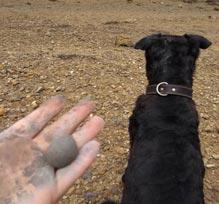
I will never forget the painting I saw at a friend’s house in Wyke Regis many years ago. The bleached bark and tangled white glowed in the sun and I was hooked on driftwood from then on. I suppose it already had associations of good times and hot summers as I had lived on the east coast of the US for a few years as a teenager. In the States, driftwood design is much more mainstream, being used in houses and swanky hotels a lot more than in the UK. A few years ago we found some fossilised wood at West Bexington. It has hung around since then but galvanised by writing this article I decided to see how easy it would be to turn it into a lamp! As Bridport Lighting is doing a 10% off offer for customers who mention The WDM that was my first and only port of call. Ann talked me through the various ways I could attempt to go about it but in the end I opted for the easiest solution – a switched bottle lamp adaptor, flex and plug. A bargain at less than £10 in white. My creative skills were rather curtailed by an unwelcome visit by Covid. But still, here it is – a driftwood beach lamp. A few years ago I framed a bit of old mirror in a found wheel hub. With rays of driftwood and some everlasting flowers it looked rather romantic. In truth it was just a slither of broken mirror I used and so not that practical if you wanted to see your whole face but useful to reflect more light into a room. If you are looking for more ideas for how to use driftwood I recommend the group Driftwood Collectors Worldwide on Facebook. Driftwood is often used as a sales display for a variety of treasures and especially well utilised I think at Earth Design at Redlands Yard in Broadwindsor. There are a quite a few large pieces of driftwood around Weymouth and along the Chesil beach where we sit, rest and take in the view. One such is at Pirates Cove where you can see Zelda keeping an eye on the crows while I roll clay beads. But I get ahead of myself… clay is for another time.
Advertisement
WOOD YOU BELIEVE IT? Driftwood framing a view of the sea, making a driftwood mirror and, right, a first attempt at a driftwood lamp
YOU NEED HANDS: A helping hand at Bridport Lighting and, right, Zelda at Pirates Cove Feel washed up & damaged? You’ll enjoy driftwood craft
No stone unturned in solving mystery of the Chesil pebbles
BY JUDITH STANTON
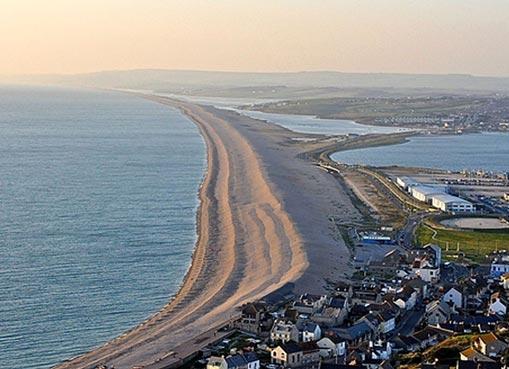
The phenomenon which is Chesil Beach stretches for some 16 miles along the Dorset coast. Although it is a wellknown landmark, this shingle bank remains a mysterious and lonely place. A curious place, which has given rise to many tales and theories – some of them more scientific than others. It is now believed that the beach was created some ten thousand years ago, at the end of the last Ice Age, when rock debris from the hill-tops was washed down into the empty bay by the melting ice, eventually filling the whole basin. The debris was driven back to the shore by the force of the waves which swept diagonally across the bay from the southwest, sorting the pebbles as it went. The heavier the pebble, the further it will travel; as the lighter pebbles drop behind. There are other – perhaps more appealing –explanations of the beach’s creation. One legend claims that it appeared overnight after a storm, providing unexpected shelter for a medieval pirate, who was escaping from the king’s men. Or maybe the beach was the work of the Devil, who wished to travel to Portland without wetting his feet, and so threw up a chain of stones to keep them dry. And then there’s the oftrepeated claim that a shipwrecked mariner would be able to tell where he had landed on the beach by the size of the pebbles on that part of the shore . This makes for a beguiling story – which might even be true.. It’s recently been announced that 1,200 radio-tagged pebbles have been planted at the end of Chesil Beach between West Bay and Freshwater in order to track their movement and that of the sediment around them. The information provided by the pebbles will help in the planning of new sea and flood defences. Just how many other pebbles are there along the beach? Google confidently states that there are 180 billion, but offers no explanation as to how this figure has been calculated. It’s yet another of the mysteries of Chesil Beach.
n Judith Stinton’s Chesil Beach: A Peopled Solitude is published by Harlequin Press and is available from sales@ harlequinpress.net and from Abebooks and Amazon.
Make a date for start of harvesting
PAGAN VIEWS by JO BELASCO
From under the duvet on the settee I noticed on the news a feature about the grain ships leaving the Ukraine. This sparked a family spat (granted, covid-fuelled) about whether it was really autumn in August as the harvesting had started? Every summer on the longest day of the year, my husband loves to inform us that: “The days start getting shorter now!” As usual it’s all a matter of definition and specialism. By this I mean the sun being at its highest point in the northern hemisphere on June 21 is what we call the beginning of summer! Surely it would make more sense to call it the height of summer as this part of the planet then has its maximum amount of sunlight. (Okay, glad to have got that technical bit out of the way). To me as a child and all children I believe real summer is the school holidays. Try to tell me that those August days on holiday were autumn and I would have laughed in your face as everyone knows autumn is when you go back to school! From a Pagan point of view the beginning of August is seen as the first harvest. A harvest of grain and apples called Lughasadh after Lugh, one of the Pagan Gods of harvest and the sun. Our ancestors would have seen the shortening days as a reminder to start storing and preparing for when food was less plentiful. Paganism and the outside nature of farming life are intrinsically linked, I don’t think I would have become a Pagan if I had stayed living in a town. Just as we have mentioned ancient Pagan sites being commandeered for Christian worship the same thing happened with Pagan Festivals. Lugh became Lammas and was woven into the ecclesiastical year. Some of the mismatch of the beginning of summer having the longest day can be laid at the pompous feet of Julius and Augustus Caesar. These two Roman Emperors decided the calendar would benefit from a month named after themselves. This would be rather on a par with Donald Trump adding a 13th month in between May and June – perhaps calling it Trumpust!

FIELDS OF GOLD: Grain ready for harvesting
HARVEST TIME: The first rose hip syrup, blackberries ready for picking and grab a hazelnut before the squirrels get them
The West Dorset Magazine, August 12, 2022 43 Down to earth Hey grass snake! Have I got newts for you
Sally Cooke lives in Tolpuddle with her husband, two grown up sons and her spotty rescue dog. You can follow Sally on Instagram at Sparrows in a Puddle
I was pegging out the washing in the midday sun one day last summer when I was surprised to see a snake slither purposefully past my feet and head down the lawn to our pond. It swam straight across the surface and disappeared among the plants in the margins. Greenish brown in colour with a yellow and black collar I recognised it as our largest native reptile, the grass snake. I saw it again several times last summer, always around the same time of day and I’ve been watching it hunting in the pond again this year. As well as its distinctive markings and larger size the grass snake differs from the slow worm that I also see in my garden, in that it has no eyelids and has a marked neck region. The slow worm’s skin is smoother and shinier too. Although quite snake-like in appearance, the slow worm is actually a legless lizard. Both species of reptile are attracted to rural gardens like mine with ponds, compost heaps and some rather untidy areas! The grass snake’s main diet is amphibians (although they can take fish, small birds and mammals) so my resident newts and frogs will be what they’re after! They have no venom so rely on surprise to strike out and grab their prey and swallow it whole, sometimes still alive. They are strong swimmers, keeping their head out as they glide across the water, though if disturbed they can hold their breath under the surface for half an hour or more. Our tiny garden pond doesn’t really challenge a grass snake’s swimming skills as it is capable of long, fast swims across open water. You might be lucky to see a snake in action if you take one of my favourite summer walks through the beautiful Thorncombe Wood nature reserve, attached to writer Thomas Hardy’s cottage. If you sit quietly by Rushy Pond up by Black Heath you may see one swimming in the water. Thomas Hardy was very much inspired by the beautiful countryside and its wildlife around his birthplace. Apparently, his mother found a snake curled up in his crib when he was a baby, an event which the author liked to attribute to his lifelong love of nature.
Alien invasion from the kingdom of Protista
JOHN WRIGHT is a naturalist and forager who lives in rural West Dorset. He has written eight books, four of which were for River Cottage. He wrote the award-winning Forager’s Calendar and in 2021 his Spotter’s Guide to Countryside Mysteries was published.
My first Dorset encounter with a slime mould was forty years ago when I found several creeping (very slowly) across some pasture near the isolated, hilltop farmhouse in which I lived. They were up to a fifteen inches across and looked to me like pale scrambled egg. It was Mucilago crustacea. Such a name is not to everyone’s taste, and on a British Mycological Society fungus foray back in the early 1980s, it was referred to by slime mould specialist, Professor Bruce Ing, as the ‘Dog-sick’ fungus, due to its appearance. The name has stuck. M. crustacea is one of our largest slime moulds, but certain species can weigh in at twenty kilos. Slime moulds, it should be noted, are not fungi, plant or animal, but in another kingdom – the Protista - a ragbag of organisms that don’t seem to fit anywhere else. Slime moulds feed by crawling across grass, leaf-litter or deciduous wood where they consume bacteria, yeasts and other microorganisms. While feeding, they consist of billions of motile amoebae, and/or tadpole-like ‘cells’, plus slime. The ‘tadpoles’, incidentally, have two tails. Once satisfied, they settle down to fruit. In M. crustacea, it forms a mass of spores in the grass that looks like compacted cocoa powder, all crusted over by a membrane of dried mucilage. Another species, Enteridium lycoperdon, forms neat, white and rounded sporemasses on trees that look like small puffballs. Some, however, form almost unbelievably complex structures – the ‘lollipop’ form being the most common. Hundreds of spherical or cylindrical spore-bearing structures will cluster together, each on the end of a thin stem. Slime moulds, both when feeding (the plasmoidial stage, don’t you know) and in the fruiting stage, are often and inexplicably brightly coloured, with oranges, yellows, reds and purples predominating. The largest and most notorious of the slime moulds is the common Fuligo septica, which gained the title of the ‘Texas Blob’ when large masses of pulsating (slowly, again), radiating and brilliant orange slime were found in several back yards in Dallas. The householders, not unreasonably, feared an alien invasion and the authorities called in. Eventually it was identified as a particularly large occurrence of the slime mould, Fuligo septica, a species I see every year. You will not need to call in the military should you find a slime mould – they are utterly harmless. But do be careful if you collect a specimen of the Dog-sick Fungus – sometimes it is dog sick.
Left, Leucogala species and right, Maturing Texas Blob


