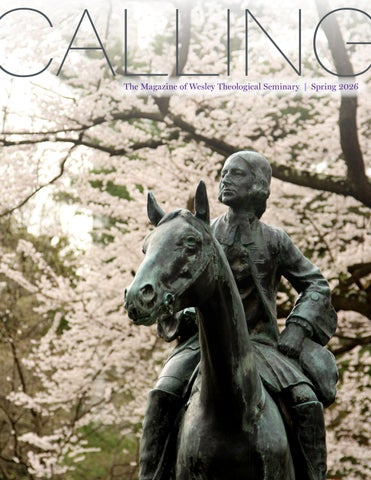
The Magazine of Wesley Theological Seminary | Spring 2026
On the cover: Statue of John Wesley amongst the cherry blossoms
Calling is published by the Office of Development twice a year for alumni, donors, and friends of Wesley DC.
Wesley Theological Seminary 4500 Massachusetts Avenue, NW Washington, DC 20016
202.885.8600
www.wesleyseminary.edu
David McAllister-Wilson President
Monica Hargrove Chair, Board of Governors
David C. Shank Vice President of Development
Chip Aldridge Director of Alumni Engagement
Jan Phillips Director of Major Gifts
Nick Works Director of Donor Relations
Shirelle Dixon Data Manager
Jeremy D. Birch Managing Editor
Lyvonne Briggs Editor
Dana Cassell Feature Writer
Julie Babler and Stephanie Drietz Designers
Lisa Helfert
Donovan Marks
Hilary Schwab Contributing Photographers
Printed with zero VOC ink on paper containing postconsumer content, and/or manufactured with hydroelectric power, acid free/alkaline, elemental chlorine free, mixed credit or certified sourcing.
CORRECTION FROM LAST ISSUE: Rev. Timothy Chon’s son Timothy is not his first child. His daughter Erin is his firstborn. 5 14
5
14
20
24
25
29
Climbing Higher: A Presidential Era Retrospective
President David McAllister-Wilson’s tenure was one of sustained ascent
Voices of Influence
Clergy, alumni, and others share the impact of Wesley DC
Alumni as Guides on the Climb Alum Jennie Murray credits Wesley’s influence on her immigration work
Faculty on the Summit: Dr. Youtha Hardman-Cromwell How Wesley DC expanded its reach in the city
Formed Here, Called to the World Alumni reflect on the impact of Wesley DC
Learning Community, Living the Call Rev. Dr. Jonathan Baker exemplifies following the call
4 From the President Faithful to the Call: Toward the Next Summit
26 Forty-Five Hundred Life on Campus
Faithful to the Call: Toward the Next Summit
In Calling, we try to present the amazing array of programs and experiments that is Wesley. I know it can be confusing. But I hope Eugene Peterson’s phrase describing Christian discipleship fits all we do: “A long obedience in the same direction.”
The reason for our dynamic diversity of centers, stories, and images is found in the title of this publication: Calling. We seek to be shaped by God’s call, which is expressed in wonderful variety by our community of faculty, staff, students, and donors. And so, we are more like a jazz ensemble than a brass band.
What keeps it all moving in the right direction are the people whose specific calling is to serve. I think of them as I prepare my last message; in particular, those I have worked with who have passed away, including: faculty secretary Virginia Hamner, registrar Jack Bevan, cook Miss Shirley, librarian Lash Gwynn, janitor Simmie Washington, Louise Preston in the Development Office, Doug Cooney and John Breckenridge in the Business Office, Raymond Washington in the mailroom, Lee Brown in Community Life, and Chief Financial Officer June Stowe. For these and so many others, I thank God for calling them to Wesley.
What follows in this, the final issue of Calling in my tenure, are testaments and reflections of alumni, faculty, students, and other members of the faith community on the impact of Wesley DC and its continued upward trajectory toward the next summit.
By Lyvonne Briggs
Climbing Higher: A Presidential Era Retrospective
PRESIDENT DAVID MCALLISTER-WILSON AND WESLEY’S FAITHFUL ASCENT
When The Rev. David McAllister-Wilson assumed the presidency of Wesley Theological Seminary (Wesley DC) in 2002, the institution stood on solid ground—but the terrain ahead was changing rapidly. Thankfully, McAllister-Wilson already had 20 years of experience leading at Wesley DC in other roles, and he was well prepared to face the changes ahead. Over the next 24 years, his leadership guided Wesley DC through expansion, globalization, innovation, and unprecedented disruption, shaping a seminary prepared not only to endure change but to lead within it.
1980s
FOUNDATIONS AND IDENTITY
The 1980s solidified Wesley DC’s theological identity as a seminary deeply rooted in the Wesleyan tradition and committed to the life of the church. Academic standards strengthened, faculty governance matured, and Wesley clarified its vocation as a school forming leaders for both pulpit and public life. A program in arts and religion began as the gallery and studio were established. President G. Douglass Lewis became a leader in globalizing theological education.
KEY MILESTONES
Return to balanced budgets after many years of deficit
Strengthening Wesleyan theological identity and academic rigor
Expansion of field education and integration of theology and practice
Deepened alignment with the mission of the United Methodist Church
David Wilson meets Drema McAllister. Drema becomes a pastor. 43 years later, 4 children, 7 grandchildren
This presidency was not defined by a single initiative or moment, but by sustained ascent: steady growth in academic reach, global engagement, faculty distinction, institutional resilience, and public theological witness. During his tenure as president, donors gave more than $157 million dollars. He also handed out 3,281 diplomas (44% of all Wesley DC alumni). What follows is a decade-by-decade timeline tracing how Wesley DC climbed higher—faithful to its mission and ready for the call ahead—throughout his time at the helm.
“Wesley DC began to understand Washington not just as a location, but as a classroom.”
1990s
EXPANSION AND INSTITUTIONAL MATURITY
During the 1990s, Wesley DC entered a season of expansion marked by increased enrollment, broader denominational reach, and growing ecumenical partnerships. Degree programs diversified, including expanded offerings in pastoral care, social justice, and contextual ministry.
This decade also saw Wesley DC deepen its relationship with Washington, DC, understanding the city not simply as a location, but as a theological classroom that would increasingly shape its identity. McAllister-Wilson developed the Culture of Call initiative, the first major Lilly Endowment, Inc., grant, to recruit students by recognizing ministry not as a job but as an answer to Christ’s call.
KEY MILESTONES
Growth in enrollment and degree offerings
Increased ecumenical partnerships and denominational trust
Washington, DC, framed as a formative context for theological education
The Korean Wesley Foundation established
2000s
NEW CHALLENGES, GLOBAL AND CONTEXTUAL ENGAGEMENT
In May 2001, the Board of Governors chose McAllister-Wilson as President-Elect to serve a year in transition with President Lewis. In the aftermath of September 11, Wesley’s Dean Bruce Birch was invited by the White House to offer spiritual guidance. Many people advised the seminary to downplay its location, thinking prospective students would be afraid to come. Instead, Lewis and McAllister-Wilson increased the seminary’s emphasis on its presence in the nation’s capital, and McAllister-Wilson reached out to both the military and intelligence communities to offer Wesley as a resource. Enrollment grew. McAllister-Wilson worked with Board members to secretly raise $1 million to establish a leadership center in Doug Lewis’ name, surprising him at retirement.
KEY MILESTONES
2003: Lewis Center for Church Leadership established to produce research and resources to strengthen clergy and lay leadership in the local church
2006: First Global Doctor of Ministry (DMin) program launched
2007: Annual Report announced “The New Church Campaign,” signaling renewed investment in institutional vitality
Sundo Kim Chair in World Christianity established
International partnerships across Africa, Asia, Latin America, and the Caribbean expanded
International student enrollment grew to represent more than 40 countries over the course of the presidency
2008 : McAllister-Wilson opened dialog with leadership of the Church of Jesus Christ of Latter Day Saints, beginning a long-standing relationship to include their president
October 2008: Wesley celebrated 50 years in Washington, DC, marking the first semester on the 4500 Massachusetts Avenue campus in 1958
2009: Wesley DC expanded by opening an intentional living community and sharing classroom and office space with Mt. Vernon Place United Methodist Church in downtown DC as part of the dramatic renovation of the church instigated by President McAllister-Wilson
“Innovation is not a departure from tradition— it is one way tradition remains alive.”
2010s
INNOVATION AND CENTERS OF EXCELLENCE
The 2010s were defined by creativity, collaboration, and national influence, with Wesley DC emerging as a hub for applied and public theology. President McAllister-Wilson’s book, The New Church and the New Seminary: Theological Education Is the Answer, was published as a response to the challenges to the Mainline Protestant Church. The book describes the need for comprehensive theological education beyond the graduate school model, which became a template for the growth of non-degree programs. McAllister-Wilson also named Chair of the Board of Campus Compact MidAtlantic, a consortium of colleges and universities engaged in service learning, with Wesley the only seminary.
KEY MILESTONES
2010: Oxnam Chapel renovated
2011: Library renovated
Relationship building with The People’s Republic of China brought China’s Bible Ministry Exhibit to Wesley Downtown and opened the door to Chinese students studying at Wesley DC
Military Chaplains Doctor of Ministry track launched. More than 200 chaplains have graduated since
2013: The Heal the Sick Initiative began as a response to the pressing health issues plaguing many communities in, around, and beyond the DC area
New residence hall opened
2014: Center for Public Theology (CPT) established, building on courses offered for more than 40 years
2015: Community Engagement Institute established to expand faith-based community leadership and public service in Washington, DC, building on urban ministry programs offered since 1960
Wesley Asia and Central South American Councils established with the help of Korean pastors to expand Wesley’s global footprint
2017: The Hub for (Re)imagining Ministry established, with the first of six major Lilly Endowment grants to support congregational innovation and engagement with emerging generations
Board member Robert Kettler, standing in the parking lot with McAllister-Wilson, launched a vision that became a new Campus Master Plan entitled “Thriving in Place” (which was later approved by the Zoning Commission)
2020-2025
RESILIENCE, TRANSFORMATION, AND RENEWAL
KEY MILESTONES
March 13, 2020: On-campus classes were suspended as the COVID-19 pandemic reshapes education worldwide. Wesley DC rapidly transitioned to online and hybrid learning, sustaining academic continuity and community formation
2023: Inaugural Yu–Lee Lecture
2023 : Celebration of The Last Supper installation by Catherine Kapikian in the Refectory
December 2025: The Board of Governors announced the appointment of Dr. Carla Works, Dean and Woodrow and Mildred Miller Professor of Biblical Theology and a distinguished New Testament scholar, educator, and church-centered theologian, as the next President of Wesley Theological Seminary
APPROACHING THE NEXT SUMMIT
KEY MILESTONES
February 2026: The Board of Governors announced that Dr. Veronice Miles, the Mary Elizabeth McGehee Joyce Professor of Preaching and the Director of African American Church Studies at Wesley DC and a respected voice in the classroom, pulpit, and broader church, was appointed as Interim Dean of Wesley DC for a two-year term, effective July 1, 2026
Commencement 2026: This May, it is expected that 3281 degrees will have been awarded during President David McAllisterWilson tenure representing 44% of all Wesley Theological Seminary awarded degrees
“The summit ahead is not the end of the climb—it is an invitation to keep going.”
“The church is global— and theological education should be, too.”
“Faithfulness requires both deep roots and the courage to move forward"
Voices Influence OF Wesley DC: A Distinctive Summit:
“Voices of Influence” is where the living story of Wesley Theological Seminary comes into focus—where vocation meets context, and faith takes public shape. In this Spring 2026 issue of Calling, we gather these voices at a particular moment on the climb.
The theme of this issue, Climbing Higher: The Next Summit, invites us to pause— not to rest, but to take stock of the terrain already covered and the horizon now coming into view. For more than a century, Wesley DC has been shaped by faithful risk-takers: pastors and scholars, organizers and chaplains, artists and advocates, all formed here and sent out to meet the world as it is—and as it could be. Each generation has climbed in its own way, navigating new questions, widening the circle of ministry, and responding to God’s call with courage and imagination.
This season also marks a time of transition and renewal in the life of the Seminary. Leadership evolves. Contexts shift. The call, however, remains steady. What changes is how we answer it—together. The voices gathered in this section reflect that shared ascent. From local communities to global movements, from pulpits to public policy, these contributors speak to how Wesley DC has shaped their witness and how that formation continues to bear fruit in places of challenge and possibility.
As you read these reflections, we invite you to hear them not as a retrospective alone, but as a summons. Faithful to the climb. Ready for the call. The next summit is not behind us. It is ahead—and we are still rising.
When people ask me what makes Wesley Theological Seminary uniquely formative, I don’t begin with curriculum or credentials. I begin with place—and with the way Wesley understands formation as something that happens at the intersection of faith, public life, and lived human complexity.
Terry Bradfield
MDIV ’78, DMIN ’03
Wesley is not simply located in Washington, DC; it is shaped by it. Early in President David McAllister-Wilson’s tenure, the Seminary committed itself to making intentional use of its location. That commitment proved formative in ways that went well beyond geography. Wesley’s fenceless, gateless campus quietly teaches that ministry does not retreat from the world’s hardest questions, but engages them with theological depth and moral seriousness.
My own formation at Wesley was inseparable from my vocation in military chaplaincy. I served in spaces where moral clarity is often demanded under conditions of ambiguity; where pluralism is not theoretical, but embodied; and where the costs of public decisions are carried in private lives. Wesley prepared me for that work not by resolving tension too quickly, but by teaching me how to live faithfully within it.
In classrooms shaped by diverse traditions and perspectives, I learned that conviction and humility are not opposites. In public forums and partnerships that bridged theology, policy, and civic life, I learned that religious leadership must be both grounded and permeable—rooted in faith, yet attentive to the lived realities of others. That proved essential preparation for chaplaincy in a multi-faith military environment, where one must represent one’s own tradition with integrity while safeguarding the dignity and free exercise of all.
Wesley’s engagement with military chaplaincy reflects this posture. The Seminary holds a principled wariness toward violence while recognizing the deep spiritual and moral needs of those who serve. Its Doctor of Ministry program in Military Chaplaincy, shaped around religious leadership in complex, multi-faith settings, has formed hundreds of chaplains who now serve across the armed forces, many in senior leadership roles. That influence is durable and widely respected.
What makes Wesley formative is not that public engagement or chaplaincy appear as electives at the margins. They are understood as integral to Christian formation itself. In the spirit of John Wesley’s conviction that “the world is my parish,” Wesley forms leaders who can carry faith into contested spaces—not to dominate them, but to serve them faithfully.
That vision shaped my ministry. It continues to shape the Church’s presence in the world. And it remains one of Wesley’s enduring gifts.
Bishop LaTrelle Miller Easterling
THE PENINSULA-DELAWARE AND BALTIMOREWASHINGTON CONFERENCES OF THE UNITED METHODIST CHURCH
Wesley Theological Seminary in Washington, DC, forms excellent servant leaders because it refuses to separate theological education from the lived realities of the world God so loves. Rooted in the Wesleyan tradition of presence and shaped by its location at the crossroads of power, policy, and profound human need, Wesley forms leaders who embody a faith that is intellectually rigorous, spiritually grounded, and publicly engaged. Formation at Wesley is not confined to the classroom. Instead, it seamlessly moves from theory to practice, weaving a tapestry of theological reflection, spiritual practice, and embodied engagement with communities.
This integrated approach is evident in the lives and ministries of Wesley graduates serving in the BaltimoreWashington and Peninsula-Delaware Area. These leaders understand their appointment not only as a call to a congregation, but also as a call to the communities in which those congregations are situated. They take seriously the church’s mission to make disciples of Jesus Christ while remaining equally committed to the Methodist conviction that discipleship is always for the transformation of the world. Wherever Wesley graduates are appointed, the gospel comes alive, and lives are changed.
As the episcopal servant leader of these two conferences, I have witnessed Wesley graduates firmly rooted where the gospel meets human suffering and hope. They are addressing hunger insecurity through food ministries and advocacy, welcoming the stranger with courage and compassion,
standing with immigrants and refugees, and working tirelessly for justice in systems that too often marginalize the poor and vulnerable. Their ministries reflect a faith that takes seriously the ethos that it is hypocritical to pray about a problem one is unwilling to resolve.
In this way, graduates of Wesley evidence John Wesley’s enduring commitment to both personal and social holiness. Their lives and ministries testify that faith is not merely professed or believed; rather, it is practiced and embodied. Wesley Theological Seminary forms leaders who understand that the credibility of the church depends on its willingness to show up faithfully, humbly, and persistently to do justice, love mercy, and walk humbly with our God.
Bishop
Effective pastors are life-long learners and need excellent resources. That was an early discovery when I served the local church, and something that I still find true today. Whether a two-point rural charge, a very small-town congregation in the Shenandoah Valley or a large church in northern Virginia, learning was essential to understand my context and ways to help people grow in their discipleship to Jesus Christ. My desire was to lead well so that the church would be healthy for its members and contribute to its community.
I found the Lewis Center for Church Leadership to be a consistent source of insight and encouragement. This was my doorway to the larger Wesley Seminary community where I found a seminary that was focused on the vitality of the local church. I participated in a clergy cohort through the Lewis Center and built relationships with Dr. Lovett Weems and Dr. Doug Powe. I met other faculty members whose lectures
on biblical studies, ethics, theology, and preaching in the public square I attended while at conference events, Wesley seminars, and district meetings. I found that they were willing to answer my occasional questions if I was working on a project or a sermon series and wanted to go deeper with the help of a scholar. I invited Wesley professors to teach and speak at Floris United Methodist Church and found that our laity loved hearing from people who were experts in their field and able communicators. I have found the faculty and staff of the Wesley Theological Seminary community to be generative, centered on our shared faith in Christ, and committed to scholarship and research that expanded my horizons.
I was asked to serve on the Wesley Board of Governors and later serve as its chairperson. Here I found another remarkable aspect of the Wesley community. Because the Board works behind the scenes, many are unaware of the remarkable array of laypersons and clergy who give their time, talent, and resources to the Seminary. These individuals have been leaders in business, government, education, the military, non-profit organizations, and in the church. They share the values of the Wesley community and understand the importance of sound theological education to the church and to the world. While few have gone to seminary, all are concerned about the life of Wesley’s students, the impact of Wesley’s program, and the global reach of its ministry.
We live in a time when so many in the church are looking for ways to respond to a rapidly changing nation and world. Pastors and laity alike often feel overwhelmed and want to help people find the joy of the Christian life, offer compassion to the needs of their communities, and call for justice in a time when the topics of injustice seem endless. Wesley Theological Seminary continues to be a community that centers the church. It nurtures clergy and laity. It continues to give us insights about the Bible and Christian theology that we need. It helps us understand the world in which the church exists. It continues to be a light of hope for the future in a time when many fear the absence of light will prevail. I am remarkably grateful for the ways Wesley has supported my ministry, and continues to offer me insight now that I serve as a bishop in The United Methodist Church.
What makes Wesley Theological Seminary a uniquely formative and sacred place for me is not simply the education I am receiving, but the permission I have been given to show up fully, vulnerably, and truthfully. Wesley has been a place where I do not have to fragment myself: my faith, my leadership, my questions and curiosity, my cultural identity, and my lived experience can all sit at the same table.
Tom Berlin
THE FLORIDA CONFERENCE OF THE UNITED METHODIST CHURCH
In my work supporting communities facing real, urgent needs, Wesley has helped me integrate faith and action in ways that feel honest and sustainable. As someone actively engaged in diocesan leadership, parish ministry, and public witness, I did not come to Wesley looking for abstractions. I came seeking a community that could help me think theologically about the work I am engaged in, while at the same time challenging me to slow down, listen more deeply and intently, and lead more faithfully. In the classroom, both online and in person, which is formed by scripture, ethics, and church leadership, I have found space to wrestle honestly with God, with tradition, and with the complexities of ministry in a divided world. Wesley has not asked me to perform certainty; Wesley has invited me into continuous discernment.
Wesley’s ecumenical context has been especially formative. Around the table, I have learned alongside siblings whose traditions, politics, and life stories differ from my own. Rather than asking us to smooth over differences, Wesley has and is creating room for them, holding indifference with care and curiosity. In that space, I am learning that faithful leadership does not require sameness, but integrity, humility, and the willingness to stay in conversation. Being formed in the Washington, DC, area has deepened this awareness, as questions of policy, power, and public witness are never far from our theological reflection.
Equally important has been Wesley’s quiet insistence that formation is not about striving for worth, but remembering it. In a culture, both secular and ecclesial, that frequently equates value with productivity, Wesley has allowed me to bring my tiredness, my doubts, and my unfinishedness
into the room. Again and again, I am drawn back to the theological truth that I am created in the imago Dei. From that grounding, I could stop proving myself and begin leading from a place of belovedness. Wesley is shaping me not by telling me who to be, but by making space for who I am becoming through and with Christ.
“Form” is a simple word with deep meaning. It defines the shape or structure of a thing from its material; a body (of a person) by its external appearance, including the face; modes of existence, action, or manifestation of a thing or substance. It can refer to established methods of expression; to proceeding according to rules or conditioning; to customs, etiquette, or manners; or to the orderly arrangement of ideas, artistic production, and the course of reasoning.
“Form” describes Wesley Theological Seminary and its transformative experience through study, connection, calling, and sending forth.
In the Sermon on the Mount, Jesus calls to and calls out conditions: those who are poor, those who mourn and are sorrowful, the lowly, those who hunger and thirst for righteousness, the merciful, the pure in heart, the peacemakers, and those persecuted because of righteousness. He pronounces the cure—blessings: their place in the Kingdom, comfort, inheritance of the earth, fulfillment, mercy, seeing God, being called children of God, and the Kingdom of heaven as theirs. Jesus gave us the structure, material, appearance, mode of existence, and the established method of proceeding according to the rule, realm, and reign of the Kingdom.”
In my first class, Dr. Lucila Crena shared that we are called to “promote the flourishing of neighbors (strangers, the
Mildred J. Reyes
MDIV CANDIDATE, CLASS OF 2028
Stephanie Thomas-Gordon
MDIV CANDIDATE, CLASS OF 2026
friendless, and enemies) through shared life… engage with religious ‘strangers,’ respecting their particular beliefs and remaining true to ours, and reshape the structures of power, the formal and informal norms of public discourse, so more people can speak for themselves and be heard.” It is in this spiritual and academic community, the local and universal Church, in Washington, DC, and in all the places and among all the people where God’s love is shed abroad, that our call takes shape and finds its grounding; where it is felt, held, fed, protected, preserved, advocated for, and where people can stand in their human dignity.
At Wesley, I was (re)formed to understand, as Dr. Rick Elgendy taught, that “God’s agency, not ours, is the foundation of Christian ethics. Practices of Christian ministry are for people called, not a possibility that lies within their power if they only try hard enough or study the right books. The clarity of vision and singleness of heart that keeps ministers on the path is the work of the Holy Spirit.” The multifaceted concept of “form” is not theoretical or mere pedagogy. At Wesley, it is lived and continually forming who we are and how we minister.
My full-time job is a public interest attorney, so I’m also thankful that Wesley allows students to work at the pace that works for them. I started at Wesley in 2020, and my body, mind, and soul are grateful that I was not forced into a big course load while working full-time. I’ve also had long COVID for the last 3.5 years, which has slowed down my pace and been a drastic change from my previous workaholic days. I’m grateful that from my first day at Wesley, Dr. Asa Lee and countless others have reiterated the importance of honoring the Sabbath. When we take time to rest, we better equip ourselves for ministry with others.
Lastly, Wesley’s Practice in Ministry and Mission (PM&M) program offers a flexible approach that allows students from all backgrounds to intern in a church or nonprofit setting. With my full-time day job, I could only fulfill the PM&M requirement because of the evening colloquy option. I work for a justice non-profit, so I decided to intern at a United Methodist Church near where I live. I gained valuable first-hand experience in worship leadership, church administration, leading classes, and forming small groups. Wesley is preparing me for ministry in both the church and society.
I’m eternally grateful for the opportunity to study at Wesley Theological Seminary. I’m a candidate for deacon in the United Methodist Church, helping serve as a bridge between the church and society. Wesley’s specialization in public theology is forming me for better ministry in local communities and the broader society. Wesley’s location in Washington, DC, offers valuable opportunities for public theology, such as the hybrid Faith, Politics, and the Public Square course, which gives students from all over a chance to study where they live and to gather for a week of public theology activities on Capitol Hill and around DC.
My experience at Wesley has been enriching, challenging, and inspiring, much more than I imagined it would be when I moved from Brazil with my wife and infant daughter to study in DC.
I believe that Wesley has a unique combination of elements that make academic and ministerial training unique. It is situated right in the nation's capital, which is one of the reasons why I chose the seminary. With such
Sarah Hassmer
MDIV CANDIDATE, CLASS OF 2028
Rodrigo Dacri
MDIV CANDIDATE, CLASS OF 2027
a location, Wesley, directly and indirectly, exudes the importance of theological engagement in the public realm.
Since the beginning of my studies, I have been inspired and challenged to reflect on the role of the church and theological education in promoting justice and human formation. In addition, Wesley has a richly diverse community that includes people from different parts of the United States and the world, fostering theological and social dialogue that extends beyond classrooms and textbooks. In my daily life with classmates and teachers, I have found a place for growth and reflection that further enriches my academic experience.
This combination of geography, sociocultural elements, and a strong emphasis on the role of Christian leadership in the public realm affirms my personal experience of growth beyond my comfort zone regarding the relevance of Christian leadership in the church.
I believe that Wesley Theological Seminary is a unique place for the training of ministers and religious leaders of various traditions due to its strategic location, strong theological teaching, and, above all, integrating these elements in daily practice with people from different parts of the world and religious traditions.
Ben Townsend
MDIV CANDIDATE, CLASS OF 2027
Ben Townsend is a West Virginia-based musician, educator, and interdisciplinary artist whose work is rooted in Appalachian old-time traditions while remaining actively engaged with contemporary creative practice. As a member of The Fox Hunt, Old Sledge, the Iron Leg Boys, and the Hackensaw Boys, and now as a solo artist, he has toured extensively across the United States and internationally, sharing his distinctive approach to Appalachian music in a wide range of cultural contexts.
Townsend learned directly from master tradition bearers, including Dave Bing, Gerry Milnes, John Harrod, and John Morris. While his playing is deeply rooted in the musical lineages of West Virginia and Kentucky, his work consistently seeks new contexts and forms, keeping oldtime music living, responsive, and relevant.
In addition to performing, Townsend is an accomplished educator known for his ability to break down tunes into their essential mechanics and melodic structures. He has taught banjo and fiddle.
Currently, Townsend is exploring the intersection of faith, art, and community life as a student artist-inresidence at the Luce Center. His present work engages music, technology, and storytelling as tools for reflection, connection, and renewal.
Situated in the heart of the nation’s capital, Wesley Theological Seminary has an enviable track record for drawing upon the resources, people, and places within the greater Washington area to enrich seminary students’ understanding of and engagement with the intersection of faith and the public square. It has been our good fortune at Washington National Cathedral to partner with Wesley on several collaborations during my tenure as dean, working closely with my friend, David McAllister-Wilson. Most recently, our work together in national forums that demonstrate the possibility and power of civil discourse despite disparate political views has resonated with a country longing for a better way to be in community and conversation with one another.
David has been a wonderful thought partner as we have both looked into the future on how best to position our respective institutions to serve an ever-changing and evolving world. His leadership of Wesley over the course of the past four decades has well prepared the seminary to continue to be a leader in theological education for decades to come.
The Very Rev. Randolph Marshall Hollerith
DEAN, WASHINGTON NATIONAL CATHEDRAL
Alumni as Guides
on the Climb
Before her time at Wesley, Jennie Murray never would have guessed that following a call to ministry might mean working on immigration policy solutions to protect vulnerable people with the presidential administration. But that is exactly the kind of work the 2012 Master of Divinity alum
finds herself doing day in and day out as President and CEO of the National Immigration Forum.
Murray has more than 20 years of experience in immigration work. She began as a volunteer, providing direct service with refugee and newcomer resettlement while she was a student at Wesley, and eventually discerned a call toward immigration policy work. Federal policy advocacy
for immigration and immigrants is not a traditional form of Christian ministry, but Murray says her Wesley theological education is invaluable for the work of showing up to these hard conversations. Her path to seminary and church leadership was anything but straight, however.
Murray moved to Nashville from California when she was a teenager, and it was there that high school friends began evangelizing her and inviting her to go to church with them. God was also at work in her own heart, opening up the possibility of both a deeper relationship with Jesus and— though she didn’t have language for it yet—some kind of leadership in the church.
She started attending the Southern Baptist congregation because of its thriving youth group, not realizing that the church’s theology and practice would prove to be a roadblock to her burgeoning sense of call. Even as pastors told her she couldn’t be a church leader because she was a woman, Murray kept feeling the tug toward ministry. She chose to attend a small Christian college, where her study of ethics only deepened her sense of call.
One professor in particular supported her, sharing resources for women in ministry and pointing her toward the United Methodist Church as a place where she might be able to fulfill her calling. When she returned home from school, Murray and her parents began attending the tiny UMC congregation in their neighborhood, where the pastor happened to be a woman. The whole family found a spiritual home.
Eventually, Murray began working with the UMC’s General Board of Discipleship in Nashville, where she met her husband, Max Kostryukov,
Jennie Murray
a Russian immigrant working for another UMC ministry there. Growing up in Moscow, Kostryukov had joined a Methodist underground church plant, and he eventually became a leader of the Russian Methodist youth movement. That role brought him back and forth to the United States, where he eventually decided to stay and work. Newly married, Jennie and Max were both feeling called to seminary coursework. They considered several different Methodist schools, but Max felt a strong pull to Wesley. Several Wesley professors, including Dr. Bruce Birch and Dr. Doug Strong, had traveled to Moscow to visit and resource his growing congregation, which eventually became both the seat of the bishop and a seminary. That connection drew the couple to Wesley, where they immediately connected with the international community, particularly the Korean and Korean American faculty and students, many of whom had been connected to the Russian church through missionary activity.
At Wesley, Murray continued her exploration of Christian ethics and her work with refugees and immigrants. She moved from volunteering for local nonprofits to becoming a staff member with refugee resettlement organizations, working directly with newcomers to connect them with homes, jobs, and communities. The work and study led to an expanded sense of call, and folks at Wesley supported her continued exploration.
Murray can name the specific experience that shifted her vocation from direct service with refugees and newcomers to a broader call of working to change immigration policy. While a student at Wesley, she was connected with Eritrean refugee families in the process of arriving and reuniting their
By Dana Cassell
families. Because refugee families are often settled in stages, some family members arrive months or even years after their parents or siblings.
Murray had been working with several families who were awaiting the arrival of their older children, many of whom were military-aged young men forced to flee Eritrea to Libya and then, when conflict erupted in Libya, compete for passage on small, overcrowded boats crossing the Mediterranean. Many of those young men drowned and were never able to reunite with their families in the States.
That experience, of walking with newly arrived families who were suddenly grieving the loss of their child, parents and siblings weeping openly in her office, families who had been joyfully expecting to be reunited with their sons having their hopes crushed, changed the course of Murray’s work. She knew that she needed to do more to understand and influence the policies surrounding immigration, to learn how and why people were being hurt and what might be possible to fix. She committed to staying close to people, but began shifting to work in both programmatic and policy spaces.
That move took Murray to the National Immigration Forum, where she worked for eight years building job skills programs and working with corporate partners to share best practices for integrating immigrants at the worksite. After a stint at Upwardly Global, where she supported the United States’ effort to resettle 90,000 Afghan refugees and Poland’s work to resettle more than three million Ukrainians, Murray returned to the National Immigration Forum as its President and CEO in 2022.
These days, Murray works with the Forum to bring together moderate
and conservative stakeholders in support of commonsense immigration policies. The Forum focuses on what it calls “Bibles, Badges, and Business,” connecting faith leaders, law enforcement, national security, and business leaders to form a new consensus on the value of immigrants and immigration in America.
This work means showing up, day in and day out, for hard conversations. Murray says she will agree to any conversation to which she’s invited, which means she often finds herself working alongside people of vastly different perspectives, trying to find solutions to very difficult problems. Her Wesley education serves her well in these moments. Theological education, she says, includes learning how to hold space for hard conversations and differing opinions. Murray remembers a conversation in one of Dr. Sondra Wheeler’s ethics classes in particular, about deciding between multiple options that all include the possibility that someone will be disadvantaged. How do you even begin to decide between those kinds of options?
For Murray, the answer lies in what she says are the simplest Sunday School maxims: love the Lord your God and love your neighbor as yourself, and a commitment to honoring the dignity of every human. “At the end of the day,” she says, “when I’m really wrestling, I just keep asking myself, ‘Are you focused on the dignity of every human?’”
It might be easy to ask ourselves that question about the most vulnerable people we’re working to serve and protect, but Murray insists that it’s equally important to remember the humanity and dignity of those with whom we disagree, those who might be acting out of fear, or lost in their
power. She sees her role as offering grace and welcome, even when she is in a room where no one expects grace and welcome to be present.
Loving our neighbors and respecting the dignity of all people might be a simple Sunday School maxim, but when practiced this way, it is also a high-level spiritual discipline, one that Jennie Murray engages in every day in her work, and one that she learned during her time as a student at Wesley Theological Seminary.
IMMIGRATION RESOURCES FOR CHURCH LEADERS AND MEMBERS
The National Forum on Immigration offers a host of resources for faith leaders and congregations to engage with issues around immigration in the United States. The Evangelical Immigration Table (evangelicalimmigrationtable.com) is a network of more than 11,000 organizations, congregations, and groups working together for common-sense immigration reform. They offer preaching and teaching resources, small group study guides, and education for Christians who want to engage. Women of Welcome (www. womenofwelcome.com) and We Choose Welcome (www. wechoosewelcome.com/) are two networks of more than 600,000 Christian women mobilized to add courage to their convictions around hospitality toward immigrants, and Students of Welcome (forumtogether. org/students-of-welcome) are shifting the conversation around immigration on the campuses of Christian colleges and universities.
Ironically, I am writing about Help By Phone Ltd. just after a severe winter storm, with more belowaverage cold weather ahead. We are a 501(C) non-profit, founded by a ministry of First United Methodist Church of Hyattsville after a homeless man tragically froze to death in Langley Park, MD. Diaconal Minister Lois Jones led the creation of the organization and served as executive director until her passing in August 2023. In January 2024, I took the reins as director.
The organization has supported vulnerable neighbors in Prince George’s County for over 50 years. During the winter months, affiliate churches hosted and fed 15–20 men nightly through our then Safe Haven program, which COVID-19 forced us to pause. Today, our four food pantries continue to provide for individuals and families, though financial challenges persist. Some churches have closed or lost funding, and major sources like FEMA have dried up. State and county grants were also unavailable in 2025, so we had to seek funding from other sources.
Despite these setbacks, churches with pantries have rallied to keep services running. Our first fundraiser in October was successful, raising much-needed funds. We are grateful to Wesley Theological Seminary for sponsoring the event and for donating food in December 2025.
Investing in the next generation is the most strategic way to impact the kingdom of God. Currently at Deer Park UMC in Westminster, Maryland, we continue to focus on our children and youth by offering tailored ministry programs during worship services and by building relationships with local families through community events. When I came into ministry, I felt a calling to equip and empower the next generation leaders by actively mentoring them, praying for and with them, and encouraging them to participate in worship services, church events, and mission trips.
Last year, it was my privilege and honor to have six confirmands in our Confirmation Class! How exciting it would be if there were more confirmands! For 2026, as a Connecting Pastor, I look forward to working with the churches in my HUB (an organized group of churches that connects congregations for mission, ministry, and disaster response) to drive greater success by hosting more joint events for the next generation and helping them navigate life with wisdom to make godly decisions. I pray that every HUB will reach the next generation by equipping, empowering, and helping them understand love, grace, and forgiveness with conviction. Thanks to Wesley Theological Seminary for playing a foundational role in equipping me for congregational ministry!
Pamela Miller, MDIV ’25
Pastor Jean Lee, MDIV ’16
Faculty on the Summit: Dr. Youtha Hardman-Cromwell
In 1955, Westminster Seminary relocated from its namesake town in rural Maryland to the affluent northwestern area of DC and renamed itself Wesley
Theological Seminary. Some questioned whether the location adequately supported the mission and vision to meet the needs of ministry leadership and education in urban settings. This issue continually raised its head as the mission of the Seminary sought to equip persons for Christian ministry and leadership in rural, suburban, and urban settings across the world.
Under President David McAllister-Wilson’s leadership, an opportunity to address this long-held concern emerged around 2005. He was stimulated by his long connection to Mount Vernon United Methodist Church in downtown DC at 9th Street and Massachusetts Avenue, and by the BaltimoreWashington UMC Conference’s concern about this formerly Methodist Church South’s decline in ministry and its historic property. Its 50 members decided to sell part of its property, used for educational programs, to fund improvements to the historic facility and restore its suitability for revitalizing its mission on the southern edge of the Shaw neighborhood, a traditional African American community. That decision led
to the construction of a building housing offices, classrooms, and other spaces suitable for ministry in the 21st century. Additionally, Asbury United Methodist Church, a historic African Congregation at 11th and K streets, had program and ministry ideas that could benefit from additional ministry space, particularly a credit union for its members. Additionally, Asbury United Methodist Church, a historic African American congregation a few blocks away, was committed to partnership with Wesley DC.
The two congregations and the Seminary each embraced the opportunity, and Wesley Downtown began to take shape. I was selected in 2008 to be the dean of Wesley Downtown, leaving my position as Director of PMM, Wesley’s current field education program. The first duties were to guide the move and the preparation of the space our offices would occupy, and the third-floor area that would house a community of about 18 students interested in living in a faith-based cooperative housing community. In October 2009, the first cohort of students took residence, and Wesley organized an opening event to celebrate the focus on urban ministry at that location, and the cooperative decision for the two congregations and Wesley to be in ministry together. In January 2010, Frenika Mudd became my administrative assistant. We were later joined by Dr. Samuel Marullo for programming.
The real work of ministry was underway. A new downtown presence existed, a center of faithful learning, as classes began in that setting and at Asbury UMC. These learning opportunities included an emphasis on urban ministry for degree credit, as well as other opportunities open to anyone who needed support in various areas of their ministries, both lay and clergy.
Parking issues were addressed as the city changed regulations. Asbury provided access to its parking garage to facilitate students coming to classes. When the old head of racism reared its head, these were addressed. (When the issues of slavery split the Methodist Church in 1844, Mount Vernon Place embraced the proslavery stance.) The residential floor was named to honor Dean Bruce Birch, and residents were guided in forming their faith-based residential community.
In 2012, my administrative support was no longer needed, and I returned to the 4500 campus to continue teaching and filling various administrative positions as needed. It was my privilege and joy to be involved in this exciting effort to focus on the less affluent areas of our city with effective ministry.
Formed Here, Called to the World
RACHEL LUNA, MTS ’17
Project Transformation DC started as my fellowship project with the Community Engagement Institute. When we launched, I had no clue how my theological education would be used as the Executive Director. Dr. Powe and Dr. Marullo helped make sure our vision for PTDC launched on a solid theological foundation. The lessons from Dr. Mitchell’s Theology of Human Rights and Dr. Cho’s Exegesis: Job classes prepared me to work with young adults and children during hard times in their lives and the world. These are just a few examples of how Wesley Theological Seminary and its faculty shaped PTDC and my personal ministry over the past decade.
REV. KRISTOPHER R. SLEDGE, MDIV ’17
My undergraduate years helped me begin to discover who I was as a person and as a Christian. Wesley Theological Seminary helped me discover something deeper. It helped me name the call, gifting, and passion God had placed in me for the sake of the Kingdom of God, for community healing, and for human flourishing. At Wesley, I was invited to examine the assumptions I carried about God, the church, leadership, and Scripture. I learned that faithful ministry is not about protecting institutions but about participating in God’s healing work in the world. Through courses in biblical interpretation, public theology, and church innovation, I encountered a liberating and faithful way of reading Scripture that reshaped both my theology and my imagination for the church. I learned how faith, ethics, and public life truly intersect, and how pastoral leadership can engage real systems, policies, and suffering without losing its spiritual center. Those experiences also helped me imagine new forms of Christian community rooted in mission and people, not nostalgia.
Just as formative were the people. Mentoring relationships with faculty and countless late-night conversations with friends like Yvonne, Carlos, Ellen, Danny, Scott, Daniel, and others gave me honesty and a deeper courage in God’s call on my life.
That formation now lives in my leadership at The Journey Church in Harrisburg, PA, in the Susquehanna Conference. The Journey is a diverse and innovative faith community where about 65 percent of our people are under 40 and where we are beautifully mixed across race, background, and experience. We are both deeply Christian and deeply honest about doubt. What holds us together is a shared desire to love and serve as Jesus did.
Wesley gave me the language and permission to pursue a beautiful and redeeming vision of the church and the world. It shaped me into a pastor who seeks healing, inclusion, and justice as central to the Christian story. I am deeply grateful for Wesley’s investment in my life and in the future of the church and community leaders we are becoming.
REV. ISAIAH PARK, MDIV ’22
Creation and life begin with the goodness of God, and end with the goodness of God. Our stories are held within that truth. This is the theological transformation I experienced at Wesley. New life was breathed into how I believed, lived, and served. A deep passion burst forth and forever changed my approach to ministry, preaching, evangelism, and relationships.
My understanding deepened through Dr. Carla Works’s New Testament courses, where Scripture became a living witness to the good news of what God is doing in Christ through the power of the Holy Spirit. Dr. F. Douglas Powe Jr.'s course on missional leadership explored the intersection of theology and practice. He taught us to see our communities with new eyes and to focus on how we love and reach them.
My formation at Wesley shaped my vocation, and God opened doors for me to serve with Path 1 New Church Starts at Discipleship Ministries as Director of Church Planting, Innovation, and Diversity. I develop resources and equip leaders. I am involved in the Fresh Expressions United Methodist movement and help cultivate new faith communities to reach new people in new ways and in new places.
Life on Campus
At 4500 Massachusetts Avenue, NW, the climb into a new academic year began with purpose—and it has not slowed since.
From the opening days of the Fall 2025 semester through the heart of winter, Wesley Theological Seminary has been marked by momentum, gratitude, and renewal. Together, these months trace a community faithful to the climb and preparing for the next summit ahead.
SETTING THE COURSE: FALL BEGINS
September opened with the return of students to campus and online classrooms, bringing renewed energy to the Seminary.
Convocation marked the formal beginning of the academic year, gathering the Wesley DC community in worship to ground the work ahead in prayer, vocation, and shared purpose. New and returning students alike were welcomed into a learning environment shaped by intellectual rigor, spiritual formation, and public engagement.
Early fall also provided space to honor the people who make Wesley DC’s mission possible. Faculty promotions recognized excellence in teaching, scholarship, and service, while retirements were marked with deep gratitude for careers that have shaped generations of leaders. These milestones reminded the community that the climb is sustained across decades—by those who have gone before and those stepping forward now.
Faculty Promotions
• Dr. Lorena Parrish promoted to Professor of Urban Ministries
• Dr. Lucila Crena promoted to Director of the Center for Public Theology
•
LEARNING IN MOTION
October and November were filled with lively academic and communal life. Courses across disciplines engaged urgent theological and pastoral questions, while public lectures and special events drew students, alumni, and community partners into conversation. Wesley DC continued to model learning that speaks directly to the realities of ministry, leadership, and public witness in a complex world.
• October 27, 2025: Film Night: Jeronimo. Hosted by Bishop Hee-Soo Jung. Jeronimo, a film directed by Joseph Juhn, follows the life of Jerónimo Lim Kim, and explores his Korean Diaspora identity during the Cuban Revolution. Students, faculty, and friends gathered for both the documentary screening and a delicious meal. Bishop Jung also delivered the 2025 Yu-Lee Lecture the next morning in Chapel.
• November 11, 2025: Retirement Celebration of Rev. Dr. Sathianathan “Sathi” Clarke, the Bishop Sundo Kim Chair of World Christianity. For more than 20 years, Dr. Clarke has guided generations of students, colleagues, and church leaders to higher ground, challenging the Church to widen its theological lens and embrace the richness of global voices, interfaith dialogue, and justicecentered discipleship.
A SEASON OF GRATITUDE AND TRANSITION
As the semester moved toward its close, the community paused to give thanks for significant leadership in Wesley DC’s recent chapter. Moments of reflection and celebration marked a season of transition— not as an ending, but as part of a longer ascent. With gratitude for the path behind and confidence in what lies ahead, Wesley DC prepared for institutional renewal under new presidential leadership.
The Henry Luce III Center for the Arts & Religion hosted the Drawing Hope exhibition in Dadian Gallery December 4–January 30. Drawing Hope celebrates artwork generated through a global peace-building project for children. The exhibit, previously on view at the United Nations, highlights how art can foster dialogue, understanding, and peace.
With some great music, food, and fellowship, members of the Epworth House, a Mission Project of the BaltimoreWashington Conference United Women in Faith, gathered at Wesley for their annual mission meeting last month. A supporter of Wesley DC's mission and ministry since 1965, the Epworth House convenes each year in Elderdice Hall to plan their yearly missional work and to plan out their provision of scholarship and housing support for Wesley DC students. A special thank you from Wesley DC to our wonderful scholarship donors, like the Epworth House, for all the prayers and financial support of our students.
ADVENT ON THE HILL
December brought Advent to campus and with it a quieter, deeper rhythm. Candlelit worship, music, and prayer created space for reflection amid a demanding academic calendar. End-of-semester celebrations honored student achievements and faculty milestones, reinforcing the steady perseverance required for the climb—and the hope that sustains it. Most notably, the Board of Governors of Wesley DC announced that Dean Carla Works has been appointed the next president of the Seminary.
RESILIENCE IN THE WINTER MONTHS
Doctor of Ministry intensives in January reminded the community that formation continues even when conditions change. Winter weather required employees to work remotely and classes to meet virtually, yet learning and connection endured. Wesley DC’s hybrid community adapted with ease, demonstrating that the Seminary’s mission extends well beyond physical walls.
CALLING US HIGHER
February offered a defining moment with the annual Rev. Dr. Martin Luther King Jr. Service in Oxnam Chapel on February 3. Guest preacher Rev. Dr. Howard-John Wesley, Senior Pastor of Alfred Street Baptist Church, delivered a powerful word that called the community to courage, justice, and faithful public witness. Music, prayer, and proclamation renewed a shared sense of calling—for Wesley DC and for the leaders it forms. The Luce Center launched the Noah: A Future Hope, 3 Faiths, 3 Artists, 1 Story exhibit, running February 5–April 1. Contemporary artists Yona Verwer, Brian Whelan, and Hady Boraey bring their perspectives on the Noah story from Jewish, Christian, and Islamic points of view. The Wesley DC community also celebrated its 3rd Annual Winter Ball, dressed to the nines and dancing the night away!
THE EVERYDAY CLIMB
Between these anchor moments were the daily practices that define life at 4500: chapel services that shaped the week, advising meetings that clarified vocational paths, shared meals that deepened community, and ongoing planning for future campus improvements. Together, these efforts signaled confidence in Wesley DC’s future and commitment to the next generation of leaders.
TOWARD THE NEXT SUMMIT
From Fall 2025 to Spring 2026, Wesley Theological Seminary has lived into a season of ascent—honoring its history, engaging the present moment, and preparing for what comes next. These months reflect a Seminary attentive to its calling, strengthened by transition, and ready for the summit ahead. Whether welcoming Rev. Tony Tian-Ren Lin, PhD, for the 2026 Oscar Romero Lecture or celebrating our newly published colleagues at the 2026 Faculty Book Celebration, Wesley DC is ever-increasing and ever-growing. At 4500 Massachusetts Avenue, the climb continues— and so does the call.
UPCOMING EVENTS
Tuesday, April 14 • 11 a.m.
Dr. Josiah Young Retirement Celebration Oxnam Chapel
Tuesday, April 28 • 11 a.m.
President David McAllister-Wilson
Retirement Celebration
National United Methodist Church
Thursday, May 7 • 5–8 p.m.
Master's Graduate Eucharist and Reception Oxnam Chapel
Monday, May 11 • 2 p.m.
Commencement Ceremony
The National Cathedral
Sunday, May 31–Monday, June 1 Retirement Celebration for
President David McAllister-Wilson
KwangLim Methodist Church in Seoul, Korea
By Dana Cassell
Learning Community, Living the Call
For Rev. Dr. Jonathan Baker, community is essential to ministry—and he is quick to tell you that this is something he learned during his time at Wesley. The retired UMC minister and missionary has spent decades in various congregational, connectional, and international mission roles, and he says that having an understanding of community and the ability to think theologically—skills he learned at Wesley—have been essential in every context.
Baker grew up the son of a UMC pastor in Delaware, formed deeply by the Peninsula-Delaware Conference. He chose to attend Albright College in Reading, Pennsylvania, because of its connection to the Evangelical United Brethren church and its inclusive, ecumenical environment rich in diversity. It didn’t hurt that his soon-to-be wife, Donna, was also studying nursing in Reading. When the couple finished their studies, they moved to D.C., where Donna worked as a nurse at Sibley Hospital, and Jonathan began his master’s coursework at Wesley—a choice he made because he knew that Wesley would be a place where he could continue enjoying an open, diverse, multicultural environment.
Once he graduated from Wesley, Baker began serving as a congregational pastor in the Peninsula-Delaware Conference. He served Epworth UMC in Rehoboth Beach, Delaware, from 1982 until 1996. The congregation was amazing, Baker says, but also conflicted. It was during the height of the AIDS crisis, and he was trying to lead the congregation into a stance of being welcoming to everyone— neighbors suffering with AIDS, people of varying sexual orientations, and the poor. It was good work, but stressful. During a moment of devotion, Baker heard God telling him that he needed to get back into community—that it was the only way God could help sustain him to do the work he’d been called to do. He heeded God’s call and joined Wesley’s International Studies Doctor of Ministry program. His cohort, which gathered on campus twice each year for three weeks over three years, included twelve people from around the globe. Only he and one other student were from the United States. That group became, for him, Baker says, a microcosm of community and dialogue. There was much love and joy shared, but the deep differences also led to inevitable conflict.
“Wesley taught me to see people and places through a theological lens—encountering each person as a beloved child of God.”
Learning how to navigate differences and participate in the genuine community of that DMin cohort shaped Baker’s life and ministry. He returned to Epworth UMC, resourced and energized to continue the work of community building, inviting the congregation to exist not only for themselves but to serve the neighborhood. “My calling,” he says, “was to serve the community, not just the church. The church becomes a resource to serve the community in incredible ways.”
After 14 years at Epworth, Baker was called to a position on the Conference staff. He worked with Bishop Peter Weaver to implement Hope for the Children of Africa, a denominational mission program designed to provide relief and reconciliation to innocent child victims of wars, famines, and the destruction of schools and hospitals across the continent. That was the beginning of Baker’s connection with Methodists in the Democratic Republic of the Congo, a connection that would eventually lead to him living and serving in the country for years.
After three years on the Conference staff, Baker returned to congregational ministry, serving Aldersgate UMC and then returning to Epworth for five more years. After he retired in 2013, Global Ministries approached him about serving as a full-time missionary in the Democratic Republic of the Congo. Baker agreed, as did his wife, Donna, who left her work as an advanced practice nurse to join him. The couple spent three years as full-time missionaries in the DRC.
When the Bakers arrived, the country was still in the end of its civil war, a conflict that killed 3.5 million people. They first connected with a medical center outside Kinshasa, an area that was hosting 6 million refugees and displaced people. Being in that context, Baker says, completely rocked his worldview. Jonathan and Donna spent most of their time in the Congo in the interior, where there was no infrastructure—no roads, no running water—but where the people took incredible care of them.
Part of the missionaries’ work was to visit the upcountry, the heart of the DRC. The UMC had established mission sites there, but because of the civil war, no one had visited in six years. When the plane flew over the area, the destruction on view was incredible. But the joy of the people was palpable. “From that moment on,” Baker said, “I knew that these people had a lot to teach me about how joy comes from a deeper source than what you have. These are deep, deep people of faith.”
Being in the Congo was an incredible blessing for the Bakers. It changed their lives. They continue to be connected with the Congolese people, a decade after living there. And Rev. Baker continues building community both at home and around the world. These days, he serves as co-pastor of a small congregation, Coleman UMC, and remains active in international mission work. He supports Zoe Empowers, and led his fourth trip to India with their ministries in February. For Baker, ministry in any setting boils down to seeing the place and the people with a theological lens: encountering each person as a beloved child of God and entering into work and conversation with humility, things he learned in his time at Wesley. He and Donna are committed to continuing their support for Wesley to pay that blessing forward. Baker served for a period on Wesley’s Board of Governors, and during that time, he got to see the life of the seminary from the perspective of what’s needed to keep all of the Seminary’s good work going. Wesley, he is sure, will continue to form Christian leaders into people who can create community and see situations with theological vision, but much is needed to sustain that process. “I am indebted to Wesley,” Baker says, and he intends to do what he can to make sure other people find community—and communitybuilding skills—through Wesley, too.
At Wesley, we develop resilient, confident leaders who are prepared to answer the call of service and lead lives of purpose and impact in churches and communities.
ANNUAL CONTRIBUTIONS HAVE A LASTING IMPACT ON OUR ENTIRE COMMUNITY!
4500 Massachusetts Ave, NW
Washington, DC 20016
Always Climbing, Ascending Together invites Wesley DC’s alumni and friends to honor the legacy of President David McAllister-Wilson as he concludes his distinguished service to Wesley Theological Seminary. Through gifts made in his honor—whether annual, planned, or updated commitments—supporters help strengthen the unrestricted endowment, ensuring longterm stability and expanding access for future generations called to lead and serve.