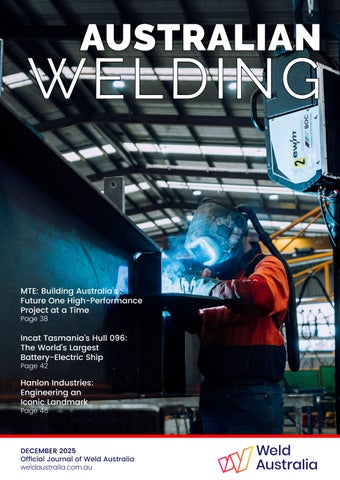
AUSTRALIAN
WELDING
MTE: Building Australia’s Future One High-Performance Project at a Time Page 38
Incat Tasmania’s Hull 096: The World’s Largest Battery-Electric Ship Page 42
Hanlon Industries: Engineering an Iconic Landmark Page 46
DECEMBER 2025 Official Journal of Weld Australia weldaustralia.com.au
December 2025
1
CONTENTS
IN THIS ISSUE FEATURES
2
23
Delivering Australia’s Most Advanced Telecommunications and Power Infrastructure For more than three decades, Roam Engineering has been building an unrivalled reputation for engineering excellence, innovation, and reliability.
26
Uneek’s New Laser Welding Capability Uneek has built its reputation on precision metal forming, rolling, bending and welding for sectors like power, transport, rolling stock, defence and mining. Today, Uneek is writing a new chapter; one that is illuminated by the glow of laser light.
30
NEACH Celebrates 50 Years in Business Reaching 50 years in business is a remarkable achievement, and for NEACH, it’s a milestone that speaks to endurance, innovation, and a proud legacy of Queensland craftsmanship.
36
Magnetism in Armoured Steel: Welding and Fabrication Challenges This article presents findings from multiple recent consultancy projects where Weld Australia worked with clients experiencing magnetism related welding issues in armoured steel fabrication.
38
MTE: Building Australia’s Future MTE has grown from a modest two-person operation into one of the most capable, technically advanced, and people-centred manufacturing companies. With 200 employees across four facilities, MTE delivers complex, large-scale fabrication.
46
Engineering an Iconic Landmark: Iesha Swan, Hanlon Industries Hanlon Industries has spent more than 25 years delivering high-quality structural steel solutions. These capabilities were brought to full force on the ICON digital screen at St Kilda Junction in Melbourne.
Australian Welding
32
Member Q&A: Brianna Page, Apprentice Boilermaker at Williams Metal Fabrication
42
Incat Tasmania’s Hull 096: The World’s Largest Battery-Electric Ship and a Defining Moment for Maritime Innovation
WELD AUSTRALIA CONTACTS National Office PO Box 197 Macquarie Park BC NSW 1670 1800 189 900 office@weldaustralia.com.au weldaustralia.com.au Chief Executive Officer Geoff Crittenden 1800 189 900 office@weldaustralia.com.au
REGULAR COLUMNS A Message From Weld Australia’s Chair A Message From Weld Australia’s CEO
04 06
Inside the Industry Breaking News 14 Unleash Your Steel Cutting and Heating Potential with H2Cut Oxyfuel Technology 18 Welding Traceability is Transforming Welding Production 20 The Changing Face of Standards 50 Inside Weld Australia Introducing Weld Australia’s New Membership Packages 10 2025: A Year in Review 12 Upcoming Training Courses 58
ENGINEERING Simon Doe, Director, Engineering 0490 384 406 engineering@weldaustralia.com.au TRAINING Guy Brooks, General Manager Training Operations 0488 743 322 training@weldaustralia.com.au MARKETING Michelle Tagliapietra, Executive General Manager, Sales & Marketing 0437 106 726 events@weldaustralia.com.au MEMBERSHIP David Choudry, Membership Manager 0417 878 104 membership@weldaustralia.com.au QUALIFICATION & CERTIFICATION Luke Nicholls, General Manager, Qualification & Certification 0487 487 985 qnc@weldaustralia.com.au
BECOME A MEMBER
Cover: NEACH Celebrates 50 Years in Business. Story on page 30.
All rights reserved. No part of this publication may be reproduced or copied in any form without the written permission of Weld Australia. Weld Australia and its agents are not responsible for statements or opinions expressed by contributors in this publication, which are not necessarily those of Weld Australia. Publication of any advertisement does not constitute endorsement by Weld Australia of any product, nor warrant its suitability.
December 2025
3
FROM THE CHAIR
2025: A YEAR IN REVIEW to cobot welding, stainless steels, and our always popular industry drinks nights. We hosted the National Manufacturing Summit in Sydney on 23 and 24 July. With the theme of Manufacturing Australia’s Future: Local Strength, Global Impact, the event was a great success. We hosted the much expanded program of Welding Excellence Awards. This year, five awards ceremonies were held across the country throughout October, November and December with more than 800 people coming together to acknowledge the incredible calibre of work achieved over the past 12 months. A huge congratulations to all of this years’ winners.
Madeleine du Toit (Chair, Weld Australia)
As 2025 draws to a close, I thought it pertinent to reflect on Weld Australia’s key achievements this year. At all times, the Weld Australia team focused on providing the resources and services that members needed most. Our primary goal is to ensure that the Australian welding industry remains locally and globally competitive, both now and into the future. Weld Australia members continue to lead the way in innovation, environmental sustainability, diversity and inclusion, and health and safety. We are extremely proud to be your peak body. Preparing our annual Year in Review, it was such a positive feeling to look back over all of the successes our industry has had this year. We’ve been busy behind the scenes at Weld Australia too. Advocacy Our advocacy work paid dividends this year. Focused on issues such as skill shortages, onshoring and local content procurement, renewable energy and adherence to quality standards, we generated significant media coverage and political interest. Events More than 2,100 people attended our 25 member events, representing a 17% increase on last year. Our events focused on topics as diverse as a welding standards update, welding fume mitigation and navigating insurance pitfalls in fabrication, through
4
Australian Welding
Training and Skills In 2025, our team of expert trainers facilitated more than 30 courses. We saw an uplift of 4.3% in the number of people completing courses, for a total of 509 people this year. The IWI-B course proved particularly popular, with a 32% increase in enrolments year-on-year. Weld Australia trained and qualified 18 new International Welding Engineers (IWE), 94 Welding Inspectors, 155 Welding Supervisors, and 20 International Welding Specialists (IWS). Our work on the Manufacturing and Engineering (MEM) Learning Resources project continued. This year, Weld Australia focused on the implementation of the resources by more TAFEs and RTOs nationally, ensuring that welders receive the same high quality standard of training, regardless of their location. Engineering Services In 2024–2025, Weld Australia’s engineering team experienced significant growth. Consultancy project volume rose by approximately 62% year-on-year, with the team delivering 102 consultancy projects for 61 clients. This points to the team’s growing capacity to deliver: more work won, more delivered, and more organisations choosing to partner with us. New business growth was particularly strong, with new projects secured across a diverse range of sectors right across Australia, including rail, water, piping, defence, legal, and mining. Weld Australia’s engineering team also launched a new expert witness service. This service is grounded in decades of real-world industry experience and a deep understanding of compliance frameworks. Qualification and Certification Our qualification and certification services remained as popular as ever in 2024, with 29 newly certified
by Böhler Welding
companies. In March 2025, Weld Australia launched an innovative combined certification service for AS/ NZS ISO 3834 and AS/NZS 5131. This offering streamlines the certification process for fabricators and structural steel manufacturers, reducing time, cost, and administrative burden while ensuring compliance with both critical standards. Weld Australia took over both the In-Service Inspector (ISI) and Senior In-Service Inspector (SISI) certifications and examinations previously performed by the Australian Institute for the Certification of Inspection Personnel (AICIP). Weld Australia rolled out the new WeldQ site for the AICIP examinations, which were held online in May and again in October. The Australian Welder Certification Register (AWCR) and WeldQ platform also continued to grow. Over 100 users registered this year, taking the total number of users well over 14,400. For more details, see the article on page 12. Season’s Greetings I would like to take this opportunity to thank the Weld Australia Directors for not only volunteering their time throughout 2025, but for their true commitment and hard work. On behalf of the entire Board, I would also like to thank Geoff Crittenden, our CEO, and his team for their dedication and work throughout the year. Lastly, I would like to thank all of our members for their ongoing support, particularly all those members who regularly contribute to our success, such as the hard-working members of our local committees. It’s the ongoing support from members like you that allows us to continue advocating for the welding industry in Australia, and we wholeheartedly thank you for your role in that this year. We hope you will continue your support in 2026. I wish everyone a joyful festive season and a happy new year.
Madeleine du Toit
DIAMONDSPARK SEAMLESS CORED WIRES brilliance established in 1967
Your ultimate goal must be diamondspark. A cored wire of highest quality and performance. Designed by the leading pioneers in filler materials, diamondspark wires are tailored to match the highest requirements for demanding applications. diamondspark seamless cored wires – brilliance established in 1967.
Scan for more information
Chair, Weld Australia
voestalpine Böhler Welding www.voestalpine.com/welding
FROM THE CEO
BUILDING A STRONGER FUTURE FOR AUSTRALIAN WELDING Why We’ve Redesigned Membership
Geoff Crittenden (CEO, Weld Australia)
Australian manufacturing is at a turning point. The pipeline of critical infrastructure, energy transition and defence projects is expanding, while local capability, skills, quality and safety are under more scrutiny than ever. As the peak body for welding, Weld Australia exists for a simple purpose: to lift capability, quality and safety across the entire sector so Australian fabrication and manufacturing can compete, grow and thrive. To serve that purpose, we have launched a new Weld Australia membership model; one that is clearer, more flexible and built for how the industry really works. It recognises the different roles played by fabricators and contractors, primes and asset owners, suppliers, engineers, inspectors, educators and the next generation of apprentices and students. It maps benefits to real-world needs, so members see practical value from day one, and compound that value over time. Built Around Real Needs, Not One-Size-Fits-All In speaking with members across the country, a few themes came through loudly and consistently. First, value must be tangible.
6
Australian Welding
Members want immediate savings on training and events, timely technical guidance, access to standards and certification support, and pathways to develop people and lift quality. Second, influence matters. The industry needs a strong, unified voice engaging government, standards bodies and major procurers on local content, safety and compliance. Third, connection drives outcomes. When fabricators, suppliers, educators and end-users collaborate, we see faster adoption of best practice, smoother project delivery and better careers. Our new membership structure responds to those realities. It offers three primary pathways: Corporate, Industry Supplier and Individual. These are supported by free Apprentice and Student, TAFE, and Reciprocal options. Each pathway has clearly defined tiers so organisations can choose the level of engagement and enablement that matches their goals. The Value You Can Bank Today Regardless of pathway, membership delivers both immediate and longterm value.
•
•
Immediate value: credit notes for some Weld Australia services; member pricing on training, seminars and events; access to technical resources and guidance notes; and curated opportunities to promote capability, recruit talent and connect with decisionmakers. Compounding value: recognition and credibility from aligning with the peak body; a community that shares knowledge and solves problems; and advocacy that lifts standards, strengthens local content and builds a resilient, sovereign manufacturing base.
The combination of practical wins today and momentum that grows over time is what our members asked for. It’s what this redesign delivers. Corporate Membership: Lead, Deliver, Influence Corporate Membership is designed for fabricators and manufacturers, asset owners, primes and contractors delivering Australia’s most critical projects. It aligns Weld Australia’s full capability with the realities of production schedules, compliance obligations and workforce pressure. At its core, Corporate Membership
focuses on capability, compliance and influence. Members gain access to practical guidance on Australian Standards and regulations; certification readiness support and continuing professional development; and best-practice resources that help teams do the job right the first time. They also gain a stronger voice in the settings that shape our industry, through industry groups, policy roundtables and coordinated input to advocacy activities and standards. Tiers allow organisations to scale their engagement: • Gold prioritises national reach and strategic enablement. It’s geared to multi-site teams requiring broad event access, deeper visibility, additional staff licences and dedicated advocacy touchpoints, including structured sessions to plan how membership will accelerate quality, delivery and workforce outcomes across the year. • Silver provides a balanced mix of access and influence for growing mid-sized teams, including strong event allocations, opportunities to contribute thought leadership and participate in technical forums, and regular check-ins to ensure benefits are fully utilised. • Bronze offers an effective entry point for single-site fabricators and specialist contractors
seeking essential access, recognition and a clear path to scale.
•
Across all tiers, the intent is the same: de-risk delivery, lift quality and safety, and build the capability pipeline, while giving corporate members a credible platform to showcase excellence to project owners and partners. Industry Supplier Membership: Connect, Showcase, Grow Suppliers of equipment, consumables, software and services are essential to industry performance. Our new Industry Supplier pathway provides trusted, permissioned access to the market, with a focus on targeted reach, brand trust and demand generation. Members can align their solutions with technical education and standards leadership, ensuring messages are credible and relevant. They can activate at national and state events, host technical showcases and webinars, and feature in editorial and digital channels that reach specifiers, buyers and endusers. Directory listings and job boards help buyers find the right partners quickly, while curated offers drive measurable uptake. Again, tiers allow suppliers to choose their level of activation:
•
•
Gold suits market leaders running national campaigns or large sales teams. It offers the widest event inventory across states, priority activation rights, the ability to host flagship technical showcases, a substantial editorial footprint and awardsnight exposure, all designed to accelerate brand leadership and pipeline. Silver is ideal for growth-stage suppliers seeking strong multistate reach and balanced ROI, with solid editorial and event inclusions, opportunities to present at awards, and structured consults to align marketing activity with demand. Bronze provides a credible, costeffective entry point for focused or regional suppliers, including core event access, foundational editorial presence and a clear path to upgrade as momentum builds.
The aim is simple: shorten sales cycles by meeting the market where it learns and decides, while reinforcing the industry’s commitment to safety, quality and innovation. Individual Membership: Learn, Connect, Advance People are the backbone of industry capability. Individual Membership supports welders, inspectors,
“
Weld Australia exists for a simple purpose: to lift capability, quality and safety across the entire sector so Australian fabrication and manufacturing can compete, grow and thrive. To serve that purpose, we have launched a new Weld Australia membership model.”
December 2025
7
FROM THE CEO supervisors, engineers and educators to stay recognised, stay current and stay connected.
training and real-world requirements, and between standards and daily practice in workshops and on site.
help you make it happen. Together, we can build a stronger future for Australian welding.
Members access training and seminar discounts, structured CPD and technical guidance aligned to Australian Standards. They plug into free technical nights and Q&A forums, national webinars and a professional network that spans the supply chain. For individuals building a career or sharpening a specialist focus, the combination of education, recognition and community delivers real momentum.
Our redesigned membership is an investment in that alignment. It helps members bank value today through discounts, offers and visibility, and compound value through recognition, advocacy and community. It provides a framework to coordinate effort: transferring technology, lifting performance and solving common problems together rather than in silos.
Learn more and join: weldaustralia.com.au/membership/ or membership@weldaustralia.com.au
For those just starting out, Apprentice and Student membership is free. It opens the door to events, mentors and career pathways from the outset, because attracting and retaining talent is as important as upskilling the workforce we already have. Why This Matters Now The projects ahead demand more from all of us: more qualified welders and inspectors, tighter process control, better documentation and traceability, safer workplaces and faster adoption of best practice. They also demand alignment: between buyers and suppliers, between
A Collective Effort Membership is more than a set of entitlements. It is a commitment to the collective; to sharing knowledge generously, to championing safe, high-quality work, and to strengthening Australia’s sovereign manufacturing capability. When members participate in working groups, contribute to standards and open their doors for technology demonstrations, the entire ecosystem benefits. Whatever your ambitions might be, if you want to grow your business, develop your people, or deliver to the highest standards, we’re here to
Season’s Greetings &
Happy Holidays from Weld Australia
On behalf of everyone at Weld Australia, we would like to thank our members and clients for their continued support throughout 2025, and to extend our warmest wishes for the holiday season. Our National Office will be closed over Christmas and the New Year, from Monday 22 December 2025, reopening on Monday 5 January 2026.
8
Australian Welding
THANK YOU AND WARM WISHES I would like to take this opportunity to thank all those members who have contributed to Weld Australia this year. In particular, my thanks go to the hard-working members of all our local committees. I would also like to thank the Weld Australia Directors who commit a significant proportion of their free time to Board matters. I thank them for their advice throughout 2025. Finally, I would like to thank the entire Weld Australia team for their hard work, enthusiasm and dedication. I wish everyone a safe and happy festive season and a prosperous new year.
Geoff Crit enden CEO, Weld Australia
Advertising
TRANSFORMING QUEENSLAND MANUFACTURING. TOGETHER.
From local excellence to export readiness, we’re making Queensland manufacturing productive, innovative and globally competitive.
FIND OUT HOW
Authorised by the Queensland Government, William Street, Brisbane.
10
Australian Welding
December 2025
11
2025: A YEAR IN REVIEW
Welcome to Weld Australia’s 2025 Year In Review – a look at our successes, projects and programs over the last 12 months, as well as that of our members. Throughout the year, we continued to strengthen our advocacy work, facilitated a host of member events, and were involved in a range of industry events. We hosted the National Manufacturing Summit in Sydney, as well as the 2025 Welding Excellence Awards. And, we did all this while continuing to reinforce our membership offering, and providing high-quality training courses and certification services. It really is an exciting time to be a Weld Australia member. We are committed to using our extensive experience, combined with an innovative new approach, to achieve our primary goal, ensuring that the Australian welding industry remains locally and globally competitive, both now and into the future. The entire Weld Australia team is looking forward to a busy, successful 2026.
14,454
Welders Registered on the Australian Welder Certification Register (AWCR)
10,223
People in the Weld Australia Community
2,114 People Attended Events
READ THE FULL YEAR IN REVIEW
12
Australian Welding
509
People Completed Training Courses
18
25 Member Events
Newly Qualified IWEs & IWTs
94 155
Newly Qualified Welding Inspectors
35
State Committee Meetings
102
Projects Delivered by the Engineering Team
Welding Supervisor Students
61
Clients Helped by the Engineering Team
29
Newly Certified Companies
December 2025
13
INSIDE THE INDUSTRY
BREAKING NEWS Australian Government Unveils New Tools to Support Rail Manufacturing The Australian Government has launched new digital tools designed to improve visibility and support growth in the nation’s rail manufacturing sector, announcing the release of an expanded Rolling Stock Capability Index and updates to the National Rolling Stock Procurement Pipeline. The government said the enhanced Rolling Stock Capability Index is intended to strengthen Australia’s rail manufacturing landscape by mapping businesses that manufacture, refurbish or supply components for the rolling stock industry. The index will help increase visibility of the national rolling stock manufacturing supply chain. The interactive index includes an online map, graphs and a searchable data table that can be filtered by product, location and service type. It contains data on 32 components used in heavy and light rail, with users able to access information on company size, location, contact details and product types, including bogies, couplers, braking systems and glass.
14
Australian Welding
ASC and Austal Partner to Boost Naval Capability
New Headquarters Boosts Automotive Manufacturing Jobs
ASC and Austal have signed a memorandum of understanding to accelerate the use of additive manufacturing technologies in Australia’s naval shipbuilding and submarine sustainment programs, marking a significant development for the nation’s sovereign maritime capability.
Australia’s automotive manufacturing capability has received a significant lift with the Walkinshaw Group opening a $114 million state-of-the-art headquarters and production facility in Melbourne’s southeast.
The agreement was formalised at the 2025 Indo Pacific International Maritime Exposition in Sydney and will focus on expanding the use of advanced 3D printing in support of the Collins Class and US-built Virginia Class submarines. The collaboration is also expected to strengthen Australia’s domestic additive manufacturing supply chain and bolster workforce training across emerging production technologies. According to ASC chief capability officer Danielle Bull, “Additive manufacturing offers transformative potential for Australia’s maritime industry, enabling faster production, improved part performance, and greater flexibility in shipbuilding, maintenance and sustainment.”
The expansion marks one of the most substantial automotive investments in Victoria in recent years and is set to strengthen the state’s supply chain and engineering ecosystem. Located in Dandenong South, the new 100,000-square-metre site (equivalent to five MCGs) brings together operations previously spread across three separate locations. The consolidated facility will manufacture more than 10,000 units annually for the Australian market and will create 155 new roles across production, engineering and administration. Walkinshaw Group is Australia’s largest automotive remanufacturing business and a key partner for major global companies like General Motors, Toyota, Volkswagen and Isuzu.
Are you planning or in the early stages of a major project with: Capital expenditure of $500 million or more? Your project may have to comply with requirements, under the Australian Jobs Act 2013 (Jobs Act). The Australian Industry Participation Authority can help you comply with the Jobs Act requirements to ensure Australian industry has opportunities to compete for work in major public and private sector projects in Australia.
An Australian Government procurement, grant, investment, or payment of $20 million or more? Your project may have to comply with requirements under the Commonwealth Australian Industry Participation (CAIP) policy. CAIP policy ensures that Australian industry has full, fair and reasonable opportunity to bid for work on Australian Government funded projects.
Capital expenditure over $20m? Project developers can get help navigating regulatory approvals through the Major Projects Facilitation Agency. To find out how we can support you, visit the DISR website.
December 2025
15
INSIDE THE INDUSTRY
EQUIPPED TO INNOVATE
How A Newcastle Engineer is Taking Up the Opportunities of Advanced Manufacturing As Australia’s advanced manufacturing sector continues to rapidly grow, skilled professionals like Newcastlebased mechanical engineer Vijaya Pandi are leading the charge, as they upskill to take advantage of emerging opportunities, completing cuttingedge, online training through the TAFE NSW Manufacturing Centres of Excellence. Vijaya is one of the 875,000 manufacturing employees across Australia – one of the largest industries in the country – and currently works at UGL Rail. He recently completed the TAFE NSW Generative Design and Analysis microcredential, an eight-week, teacher-led online course, which equips students with the skills to use advanced algorithmic features that are now found within CAD design software. “The course was a real eye-opener,” Vijaya said. “Advanced generative algorithms in CAD are a powerful tool, and I can already see how it’s improving my work with rolling stock. Lighter components mean better fuel
16
Australian Welding
efficiency and easier installation.” A key part of the course is hands-on skill development by tackling real-world design challenges. Vijaya chose to redesign furniture, using the generative algorithm to make stronger and lighter components with less material. “The software suggested designs I’d never have imagined. In my industry, it’s a game-changer,” he said. Advances in manufacturing are increasingly driven by technologies like AI, robotics, and simulation-based design, creating a need for courses designed to meet these emerging skills areas. The Generative Design and Analysis microcredential is one of the many fully-subsidised online courses on offer for NSW residents to complete, whether new to the manufacturing industry or looking to upskill. Whether you’re designing rolling stock, medical devices, or aerospace components, the ability to create smarter, more efficient solutions is becoming essential. The TAFE NSW
Manufacturing Centres of Excellence are helping build the workforce to meet that challenge - one graduate at a time. To learn more about the fully-subsided microcredentials and microskills, visit the TAFE NSW website. The TAFE NSW Manufacturing Centres of Excellence are a joint initiative between the Australian Government and NSW Government under the National Skills Agreement. This article was supplied as part of a paid sponsorship package.
X5 FASTMIG PULSE + WELDEYE PUT YOU IN CONTROL Optimise your welding operations with the X5 FastMig Pulse workhorse and optional WeldEye software solution. Together they deliver faster, quality welds that can be managed in real-time. WeldEye lets you effectively oversee your welding production. It fits any size and type of organisation that performs welding within the requirements of international welding standards like ISO, ASME, and AWS. WeldEye provides control in all processes - including welding procedures, welder and inspector qualifications, documentation, reporting, and administration. Most importantly, you get 100% traceability to any weld you ever make. Knowledge is power. Insight creates value. Find out more at www.weldeye.com Call: (02) 8785 2000
DESIGNED FOR WELDERS
www.kemppi.com December 2025
17
INSIDE THE INDUSTRY
UNLEASH YOUR STEEL CUTTING AND HEATING POTENTIAL WITH H2CUT OXYFUEL TECHNOLOGY Since 1974, Coregas has been at the forefront of manufacturing and supplying industrial, medical, and specialty gases in Australia. As part of Nippon Sanso, one of the world’s largest industrial gas companies, Coregas will continue delivering innovative solutions to benefit Australian and New Zealand industry. Coregas’ latest innovation, H2CUT Oxyfuel Technology, is transforming the steel cutting and heating industry by leveraging the unique properties of hydrogen to deliver a faster, cleaner and easier steel cutting solution.
FASTER CUTTING REDUCES LABOUR COSTS H2CUT has demonstrated significant advantages in productivity. The unique heat transfer properties of hydrogen enable much faster heating and cutting, resulting in less labour required and faster job completion. This translates to lower overall production costs and increased efficiency. CLEANER FOR YOU AND YOUR EQUIPMENT The low heat impact on equipment extends the lifespan of consumables, such as cutting tips, leading to longterm cost savings. Additionally, the cleaner, more precise cuts reduce the time and labour needed for post-cut finishing, further enhancing productivity and reducing abrasive spend along with the dust levels that go with it. Hydrogen, known for its clean-burning properties, offers several environmental and health benefits. H2CUT is clean burning so there are no carbon dioxide (CO₂) emissions compared to traditional LPG and acetylene gases, contributing to a cleaner environment. This technology also significantly reduces NOX emissions, radiant heat, dust, and light, improving operator wellness.
Data per 60s, Source: Leibnitz University Hanover.
18
Australian Welding
SAFE AND EASY Hydrogen’s rapid dispersion in air reduces the risk of accumulation in the workspace, making it safer to use compared to other fuel gases. Coregas has designed the H2CUT cylinder with a unique type 22 outlet, to eliminate the risk of cross connection with existing fuel gas equipment and to further increase safer handling and ease of use. CONCLUSION Coregas, in collaboration with Messer Cutting Systems, is excited to introduce H2CUT to the Australian and New Zealand markets. This exciting partnership solution not only supports productivity and cost savings but also aligns with the industry’s decarbonising efforts and improvements to workers health and wellbeing. For more information or to schedule an onsite demonstration, scan the QR code or contact: https://www.coregas.com.au/contact This article was supplied as part of a paid sponsorship package.
H2CUT OXYFUEL TECHNOLOGY
CLEAN FAST EASY Coregas’s H2Cut utilises Coregas hydrogen and oxygen products, in collaboration with Messer Cutting Systems and their dedicated hydrogen equipment solution HyCut, to deliver significant benefits to your steel cutting and heating requirements.
coregas.com
1800 807 203
WELDING TRACEABILITY IS TRANSFORMING WELDING PRODUCTION
Worldwide, welding traceability is gaining traction for ensuring safety, quality and compliance. Organisations in energy, offshore and subsea, ship-building, construction, defence, petrochemical, manufacturing and piping projects rely on robust welding traceability systems to ensure structural integrity, meet strict standards and minimise risk. The practice is also on the rise in Australia where companies involved in mining, manufacturing, fabrication, defence and other industries are implementing welding traceability systems to ensure they meet rigorous requirements.
“If you are constructing a bridge that relies on welding for structural integrity, welding traceability helps ensure it is built to the required standards and can withstand the intended loads.
Welding traceability is the process of documenting and tracking a weld including who performed the weld, details of the Welding Procedure Specification (WPS) undertaken, the welding consumables used, weld location, and date and time.
“Ultimately, welding traceability enhances weld quality, productivity and the efficiency of your welding processes,” says Mike Burt, Automation Specialist, Kemppi Australia.
It provides a transparent and verifiable record of every weld, offering both the contractor and client the ability to trace, confirm and validate welding processes. THE IMPORTANCE OF WELDING TRACEABILITY Without precise traceability and documented welding data, defects may go unnoticed, leading to product flaws, structural failures, costly rework or, worse, substantial legal and safety risks. The end-to-end capability of welding traceability helps mitigate such issues. It ensures welds meet engineering and safety standards, and regulatory compliance. Welding traceability also helps facilitate audits from authorities or clients and, in the case of a weld failure, it can help quickly identify the root cause and early rectification.
20
Australian Welding
“This is also true for other industry sectors. If you are manufacturing critical metal parts for defence, welding traceability can confirm that each weld in a component complies to their stringent requirements to ensure longterm performance. What’s more, the system provides you with the necessary documentation confirming compliance.
INTRODUCING WELDEYE: A COMPREHENSIVE WELDING DATA MANAGEMENT TOOL Kemppi’s WeldEye is a cloud/local-based welding management system designed to eliminate manual documentation errors and streamline traceability. It automatically collects and stores critical welding data, ensuring weld quality in real-time and compliance with industry standards. WeldEye provides: • Complete tracking of who performed the welds, down to the individual weld seam level. • Documentation of WPS used. • Monitoring of essential parameters such as welding voltage, current, and heat input. • Traceability of materials, including filler and shielding gas batch numbers.
BENEFITS OF WELDEYE WeldEye is a scalable, powerful and intuitive software solution that enhances compliance, quality, and operational efficiency. Specifically, it offers: Digital workflow and documentation: WeldEye eliminates paperwork by providing a cloud-based platform accessible directly via welding machine interfaces, mobile applications, or a PC/laptop. Seamless integration: The software is compatible with almost all welding equipment, fits any size organisation and can be integrated with enterprise resource planning (ERP) systems, as well as other production and manufacturing control systems (e.g., MES), HR platforms, documentation tools, and KPI analytics software. Real-time data collection: Welding data is captured in real-time and stored securely, allowing for instant traceability and quality verification. Accurate and comprehensive data collection: WeldEye collects a range of metrics including arc time data, monitoring welding duration, current, and voltage to ensure each weld complies. Automatic welding deviation alerts: WeldEye delivers alerts both before and after welding if a deviation occurs so that it can be rectified in real-time and cost-effectively. For example, if an issue is identified in a specific batch of filler material, all affected welds can be accurately located and evaluated. This targeted approach prevents unnecessary rework and costs.
Quality control: As WeldEye monitors essential welding parameters, it verifies welding quality compliance and helps professionals maintain quality control. Enhanced productivity: WeldEye lets welding professionals focus on production quality and efficiency. “WeldEye makes welding faster, easier and gives you peace of mind,” said Mike. “It lets you effectively manage all aspects of the welding process including critical factors such as heat input. Deviations in heat input can lead to grain growth, cracking, residual stresses, distortion, or weak weld joints which can compromise quality. However, WeldEye continuously records and analyses heat input to ensure the weld complies.” As industry standards grow more demanding, digital solutions such as WeldEye are transforming how companies record, oversee and verify their welding processes - making comprehensive traceability not just achievable, but practical and accessible for all. This article was supplied as part of a paid sponsorship package.
FURTHER INFORMATION WeldEye is a universal solution for managing welding production. Streamline your welding operations today. For further details, visit: weldeye.com
December November 2025
21
Safety starts with FLOSAFE Protect your welders and your process with FLOSAFETM. By stabilising gas flow, FLOSAFETM reduces spatter, lowers clean-up time, and improves weld quality.
Safer, smarter, more efficient welding starts here.
Discover FLOSAFETM with Air Liquide
au.airliquide.com 22
Australian Welding
TM
FEATURE STORY
DELIVERING AUSTRALIA’S MOST ADVANCED TELECOMMUNICATIONS AND POWER INFRASTRUCTURE For more than three decades, Roam Engineering has stood at the forefront of Australia’s telecommunications and power transmission sectors, building an unrivalled reputation for engineering excellence, innovation, and reliability. Established in 1994, the company specialises in the design, supply and installation of steel towers, monopoles, power transmission structures, guyed masts, antenna headframes and complete turnkey infrastructure solutions. Its portfolio spans thousands of installations across metropolitan, regional, remote and offshore environments, each one engineered for strength, longevity, and performance. Roam’s mission has always been clear: to deliver practical, costeffective, technically robust solutions that meet the evolving needs of critical infrastructure networks. Over the past five years alone, the company has designed and delivered
more than 500 steel structures, a reflection of both its scale and its commitment to customer service. Roam has become an indispensable partner in the nation’s connectivity and energy landscape. Engineering Expertise Built Over 30 Years What sets Roam Engineering apart is the depth and breadth of its technical capability. Its highly qualified engineering team brings decades of combined experience, delivering practical solutions for complex challenges across telecommunications, utilities, mining and government sectors. This expertise is supported by longstanding relationships with major industry leaders, including BHP, Rio Tinto, Roy Hill, Arc Infrastructure, ElectraNet, Western Power, Tas Networks and multiple state and federal agencies. Roam’s engineering capabilities cover the full lifecycle of infrastructure development:
COMPREHENSIVE PRODUCTS AND SOLUTIONS Roam’s product range is one of the most extensive and technically advanced in the Australian market: Self-supporting towers, in both 3-leg triangular and 4-leg square configurations, capable of supporting heavy loads in extreme environments. Steel monopoles, designed for urban and metropolitan sites where aesthetics, small footprints and ease of installation are critical. Power transmission structures, including monopoles, lattice towers and custom solutions engineered for conductor loads, clearance requirements and long-term operational reliability. Guyed masts up to 200 metres, offering highly economical height solutions with carefully engineered anchoring and stability systems. Rooftop structures, custom-designed to integrate telecommunications hardware into existing buildings with minimal visual impact and optimised load distribution. Antenna headframes and mounts in a wide range of configurations (circular, hexagonal, radial, lattice turret and more) providing carriers with flexibility. Strengthening solutions, including direct attachment systems, shell reinforcement, exoskeletons, grouted tubes and foundation modifications, extending the lifespan of ageing infrastructure without full replacement.
Photo: Roam’s rooftop structures maximise urban coverage.
Photo: One of Roam’s transmission poles.
Rapid deployment solutions, one of Roam’s most significant innovations. These structures require no civil works or excavation, enabling fast, cost-efficient installation. December 2025
23
PREVENTION LINE™ Shielding Gases Manage welding fume emissions at their source; in the welding arc.
BOC’s Prevention Line gases are specifically engineered to help reduce emission rates across your processes — supporting cleaner operations and a safer working environment. By well informed shielding gas selection for cleaner, more stable arcs, our Prevention Line products not only improves air quality in the workplace, but also enhances weld quality, productivity, and worker safety. A 100% CO₂
B Argoshield 52
C Argoshield Universal C Argoshield Heavy
D Argoshield 10 D Argoshield 54
12
C Argoshield 52
D Argoshield Heavy
E Argoshield 10
35 B B
8 6
Welding arc FER (mg/s)
Welding arc FER (mg/s)
A 100% CO₂
B FCAW-S (Self-shielded)
40
10 A
C
4
D
2 0
KEY
Fume Emission Rates for FCAW welding carbon steel 12m/min, using 1.2 mm FCAW wire. Data source: Linde Technology Arc Welding Laboratory Fume emission measurement according to EN ISO 15011-1
KEY
Fume Emission Rates for GMAW/MAG welding carbon steel 10 m/min, using 1.2 mm GMAW/MAG wire. Data source: Linde Technology Arc Welding Laboratory Fume emission measurement according to EN ISO 15011-1.
0
10
20
30
40
50
60
70
80
90
100
30 25 20 15 10 A
C
5 0
0
10
Argon content in shielding gas (%)
20
30
40
50
60
70
D
80
E
90
Argon content in shielding gas (%)
Fume Emission Rates for MCAW KEY A 100% CO₂ welding carbon steel 12m/min, using 1.2 mm MCAW wire. Data source: Linde B Argoshield 52 C Argoshield Heavy Technology Arc Welding Laboratory D Argoshield 10 Fume emission measurement according to EN ISO 15011-1. 12 A
Welding arc FER (mg/s)
10
B
8
C D Argoshield 52 with 25% CO₂ Balance Argon
6 4 2 0
0
10
20
30
40
50
60
70
Argon content in shielding gas (%)
80
90
100
Argoshield 10 with 10% CO₂ Balance Argon
Make prevention part of your strategy. boc.com.au
24
Australian Welding
contact@boc.com
131 262
100
FEATURE STORY concept design, structural analysis, custom engineering, fabrication, installation, geotechnical services, strengthening assessments and ongoing maintenance. Whether dealing with a small structural modification or managing an end-to-end rollout of a new telecommunications network, the company provides a cohesive, highly efficient service model. At the core of Roam’s approach is an understanding that every site is unique. All structures are engineered for specific wind conditions, load requirements, terrain complexity and operational needs. This ensures optimised performance, reduced maintenance demands and longterm structural integrity. A Commitment to Quality, Safety and Sustainability Quality is central to Roam Engineering’s operational philosophy. The company maintains strict quality management systems covering fabrication tolerances, coating systems, material traceability, structural certification, and pre-delivery assembly testing. Roam maintains a robust supply chain to ensure consistency, compliance and availability, an approach that underpins the reliability of every structure that leaves the workshop.
Photo: Roam’s self-supporting towers combine structural efficiency with practicality.
Safety and sustainability are equally integral. Roam’s occupational health, safety and environmental management systems guide every project, embedding hazard identification and risk management through its safety-in-design principles. Designs consider full lifecycle impacts, from fabrication through to installation, maintenance and end-of-life considerations, ensuring long-term sustainability for clients and communities. By integrating environmental awareness with engineering rigour, Roam supports infrastructure that operates reliably, demands minimal intervention and reduces long-term resource consumption. This focus on whole-of-life performance is especially critical as networks expand into harsher environments and as utilities and carriers prioritise resilience and sustainability. Engineering for Tomorrow Since 1994, Roam Engineering has evolved with the industry, embracing advanced computer modelling, refined structural analysis and continuous innovation across all product lines. Yet its mission remains constant: to deliver robust, reliable and future-ready infrastructure that keeps communities connected and energy systems operating safely. With technical expertise, industry-leading innovation and a proven history of delivering thousands of structures across Australia and beyond, Roam Engineering remains one of the most respected and trusted names in critical network infrastructure.
Photo: Roam’s steel monopoles provide aesthetically pleasing, space-efficient infrastructure.
Further Information For further information about Roam Engineering, visit: roameng.com.au December 2025
25
FEATURE STORY
UNEEK’S NEW LASER WELDING CAPABILITY Setting a New Benchmark for Australian Manufacturing
For more than six decades, Uneek Bending Co. has been a quiet but powerful force shaping Australian heavy industry. Founded in 1964 and headquartered in Dandenong South, Victoria, the company has built its reputation on precision metal forming, rolling, bending and welding for sectors including power generation, transport, rolling stock, defence, mining and advanced manufacturing. Today, Uneek is writing a new chapter; one that is illuminated by the unmistakable glow of laser light.
With the commissioning of its stateof-the-art TRUMPF TruLaser Weld 5000 robotic welding cell, Uneek has cemented itself as one of Australia’s most advanced welding facilities, offering capability previously found only in high-technology centres in Europe and Asia. This move isn’t simply about adding a new machine. It’s about redefining what is possible for local manufacturing. A Strategic Leap into Advanced Automation Uneek’s investment in the TruLaser Weld 5000 is the result of a clear strategy: to meet rising customer demands for precision, speed and repeatability while positioning the business at the forefront of Industry 4.0. The company sent two staff members to Germany for intensive training in robotic programming and fixture design, ensuring that the new capability is supported by deep inhouse expertise. According to Uneek’s Welding Coordinator and Quality Manager, Mathew Billman, “This capability
26
Australian Welding
is already reshaping how Uneek approaches fabrication challenges across rolling stock, defence, and the power sectors.” The system, which is supported by features like FusionLine, BrightLine Scan, TeachLine and TruTops Weld offline programming, enables highspeed, high-accuracy welding that dramatically reduces post-processing and achieves consistent, repeatable results that traditional processes cannot match. The performance metrics speak for themselves. Uneek’s laser welding system delivers welding speeds of up to 18m per minute on 1mm stainless steel, a remarkable throughput that opens the door to competitive local manufacturing in parts traditionally offshored. A Capability That Enables Onshoring One of the strongest success stories emerging from Uneek’s new laser welding capability is the onshoring of critical components for Victoria’s major rolling stock programs.
Uneek’s TruLaser Weld 5000 has been instrumental in enabling the local manufacture of roof structure components for Melbourne’s new X’Trapolis 2.0 trains. These assemblies, previously manufactured overseas, demand extremely tight tolerances, repeatability and weld integrity—ideal conditions for laser welding. “As a result of our new capability, the production of these components, which was previously conducted offshore, has now been successfully onshored, making Uneek Bending a key local supplier for this major Victorian transport infrastructure project. This shift supports local industry, reduces supply chain risk, and promotes domestic manufacturing excellence,” said Billman. Parallel investments in specialised welding equipment have also supported the onshoring of structural wall pillar components for Victoria’s V’Locity trains. These components require consistently uniform weld quality
throughout extended production runs—something Uneek is now uniquely positioned to deliver thanks to its combination of skilled welding personnel and laser automation. “Through strategic investment in advanced robotic laser welding systems and process development, Uneek Bending has demonstrated a strong commitment to innovation and local industry growth. These initiatives have directly led to the commercialization and domestic production of complex components for two of Victoria’s major rail programs, X’Trapolis 2.0 and V’Locity trains, highlighting Uneek’s role in revitalising Australian manufacturing through innovation,” said Billman. Laser Welding in Action: Large Format Capability While the laser’s precision is impressive, its scale is equally noteworthy. Uneek’s TruLaser Weld 5000 XXL extends this capability to large components, with a working envelope of 9,400mm x 6,000mm. This allows Uneek to handle major structural
parts for rolling stock, defence equipment and heavy industrial applications. Laser welding is now integrated into Uneek’s broader suite of advanced welding processes, which includes GTAW, orbital welding, synergic GMAW, STT, MMAW and weld overlay. The company also maintains an extraordinary library of almost 200 qualified welding procedures covering Australian, international and aerospace standards. A Deeply Qualified Workforce The strength of Uneek’s laser welding capability does not lie in technology alone; it is propelled by one of the most highly qualified welding teams in Australia. The company’s workforce includes IIW-qualified International Welding Technologists, Welding Specialists and Inspectors, and supervisors certified under AS1796 Certificate 10 and 11. Their expertise is supported by ISO 9712 Level 2 personnel in visual and penetrant testing, along with a team of certified welders qualified to AS 1796, ISO 9606 and the aerospace-grade AWS D17.1 standard.
“
This shift supports local industry, reduces supply chain risk, and promotes domestic manufacturing excellence, highlighting Uneek’s role in revitalising Australian manufacturing through innovation.”
Photos (clockwise from top): Mathew Billman and Simon Doe at Uneek’s Dandenong facilities; Uneek’s TruLaser Weld 5000 XL; welded output from the TruLaser.
December 2025
27
Photos: Some of Uneek’s projects.
Photo: Members of the Uneek Bending team.
This technical depth is reinforced by a comprehensive management system certified to ISO 3834.2, the global benchmark for fusion welding quality. Uneek’s broader certification framework includes ISO 9001 for quality management, ISO 45001 for safety, ISO 14001 for environmental performance, AS 9100D for aerospace manufacturing, EN 15085 CL1 for rail welding, and DIN 2303 Q2/BK2 for defence-related fabrication. R&D in Materials and Advanced Processes While Uneek’s laser welding system underpins major production work, it is also an engine for research, innovation and process development. The company has recently conducted extensive Inconel laser cladding trials for the power industry, achieving exceptionally smooth fusion profiles when compared to traditional GTAW cladding. Testing has shown highly controlled penetration and impressive circumferential weld consistency, with sample images revealing clean, uniform, repeatable bead profiles. These results highlight the stability and precision delivered by the TRUMPF laser system and point to strong potential in applications such as high-temperature tubing, boiler components and mineral processing equipment. Commitment to Industry, Community and Sustainability Uneek’s achievements in laser welding sit within a broader culture of responsibility and long-term industry engagement. The business places strong emphasis on inclusive employment and actively supports the development of future tradespeople through apprenticeships and graduate internship programs. Its staff contribute to community wellbeing through initiatives such as youth sports coaching, while senior team members play influential roles in industry bodies including SEMMA and the Weld Australia Victorian Committee.
28
Australian Welding
Sustainability is also central to Uneek’s operations. The company maintains a significant focus on Waste-toEnergy technology, contributing to the circular economy and helping reduce landfill through cleaner energy solutions. This blend of advanced technical capability, community involvement and environmental leadership strengthens Uneek’s reputation as a manufacturer committed not just to production excellence, but to broader social and industry outcomes. Laser Welding as a Catalyst for a New Manufacturing Era For Uneek, adopting robotic laser welding represents far more than a technological upgrade. It marks the beginning of a new era in Australian manufacturing. The capability enables precise, high-quality welding of complex geometries, ensures repeatability for demanding applications, and dramatically reduces postweld finishing. It supports competitive production lead times, facilitates the onshoring of components once sourced overseas, and expands Uneek’s capacity to serve sectors such as defence, rolling stock, and energy with greater efficiency and confidence. By pairing world-leading automation with a deeply qualified workforce, Uneek is setting a new benchmark for welding excellence in Australia. As the nation continues to invest in sovereign capability and advanced manufacturing, Uneek’s laser welding system stands as a powerful example of what can be achieved when technical mastery, strategic investment, and a commitment to local industry align.
Further Information For further information about Uneek Bending, visit: uneek.com.au
AUTOMATE YOUR WELDING WITH COBOTS Designed for automating repetitive and time-consuming tasks, allowing your skilled welders to focus on intricate and specialised work. Enhance efficiency and productivity, perfect for high-mix, short-run welding applications.
WELDMATE 355
WELDMATE REACT
Precision and Productivity at an Entry-Level Price
Premium Performance for the Next Level of Efficiency
CONTACT US TODAY TO FIND OUT MORE! E | info@diverseco.com.au T | 1300 069 970 W | diverseco.com.au December 2025
29
FEATURE STORY
NEACH CELEBRATES 50 YEARS IN BUSINESS Reaching 50 years in business is a remarkable achievement, and for NEACH, it’s a milestone that speaks to endurance, innovation, and a proud legacy of Queensland craftsmanship. From a small Noosaville workshop to a trusted structural steel partner for tier one and tier two contractors, the company’s journey over five decades is a story of vision, family determination, and continual evolution. The company’s journey began when Henry Garbacz, the son of Polish migrants, set up Noosa Marine and General Engineering on the Sunshine Coast. Armed with grit, craftsmanship and an unwavering work ethic, Henry laid the foundations for a business built on integrity and technical excellence. By the 1990s and 2000s, the business—then known as Noosa Engineering and Crane Hire—had expanded significantly, moving into structural steel fabrication and installation as the region’s industrial landscape accelerated. In 2012, Henry’s son Ryza (who grew up sweeping floors and learning the trade in the factory before establishing a successful civil engineering career) returned home to lead the company. He brought with him corporate experience, strong systems knowledge, and a clear vision. “For a regional business, we’ve come a long way in terms of our capabilities,” said Ryza Garbacz, now Managing Director. “We’re helping large global companies deliver complex projects, and we have the accreditation, knowledge, and experience to do that.”
30
Australian Welding
Members of the NEACH team hard at work in their facility in Noosaville, Queensland
Ryza’s first task was to strengthen the company’s foundations. He expanded the factory, upgraded equipment, improved workflow efficiencies, and implemented new technologies to give NEACH a competitive edge. Under his leadership, NEACH sharpened its focus on high-complexity, high-risk, large-scale government and infrastructure projects. Today, NEACH’s factory is equipped with advanced processing systems and robotic welding technology, enabling the business to tackle mission-critical work with precision and agility. “The moment something becomes leading edge, we pick it up—we’re not shy about change,” Ryza said. This capability, combined with the company’s ability to scale quickly for challenging installation windows, has earned NEACH a 90% rate of repeat business. Sustainability has also become a core pillar of operations. Solar installations, electric vehicles, hybrid fleet upgrades, and a 100kW battery project all reflect Ryza’s determination to reduce the company’s environmental impact. At the same time, NEACH is tackling the skills shortage head-on, doubling its apprenticeship intake and investing heavily in in-house training, including welding inspector qualifications for project and production staff. As NEACH marks its 50th anniversary, it stands as a testament to innovation, resilience, and family legacy. For further information about NEACH, visit: neach.com.au
THE NEW BENCHMARK IN INDUSTRIAL WELDING.
Lorch has the solution with the new iQS, future-proof platform that will set the new benchmark in industrial welding. A smart iQ, Industry 4.0, game changing welding platform with wifi connectivity and leading new welding processes to drive quality, efficiency and productivity improvements. To arrange a product demonstration contact: david.wilton@lorch.eu
December 2025
31
FEATURE STORY
MEMBER Q&A
Brianna Page, Apprentice Boilermaker at Williams Metal Fabrications As a third-year boilermaker apprentice at Williams Metal Fabrications, Brianna Page is carving out a strong future in one of Australia’s most in-demand trades. After starting as a trade assistant, Brianna quickly proved her capability and was offered an apprenticeship that has allowed her to develop skills across structural, civil, marine and defence projects. Her journey into welding was driven by passion, curiosity and resilience, and it has already taken her further than she expected. Today, Brianna is embracing every challenge, from working with robotic welding systems to building her expertise through a Cert III at TAFE.
Can you describe your job? I am currently a third-year boilermaker apprentice at Williams Metal Fabrications. I work in our Elizabeth South workshop, where we manufacture a wide range of structural, civil, marine and defence infrastructure. I joined the team at Williams as a trade assistant, gaining hands-on experience on site and in the workshop. Despite being new to the trade, I was soon offered an apprenticeship. Since then, I’ve been committed to developing my skills in welding and fabrication while studying my Cert III in heavy metal fabrication and engineering at TAFE. What inspired you to choose a career in welding? My path into welding was a bit unconventional. I used a process of elimination to figure out what really suited me. I started working in retail and hospitality from a young age but quickly realised those roles didn’t align with my interests or personality. In high school, I discovered a passion for hands-on work, particularly in trades, and chose metalwork and woodwork as electives. I found the practical, creative side of these
32
Australian Welding
Photo: Brianna Page hard at work
subjects really fulfilling. I especially enjoyed designing and fabricating my own complex projects, which allowed me to express creativity beyond the standard curriculum. This experience sparked a genuine interest in welding. Just before turning 18, I took a leap and started my apprenticeship, even though I had limited experience outside of school. It turned out to be the best decision I’ve made for my career. What is the most interesting project you have worked on and why? I’ve been fortunate to work on a wide range of challenging and complex projects during my time at Williams, but the most interesting, in the difficulty sense, has been working with our robotic welder. This project has pushed me out of my comfort zone and allowed me to gain handson experience in automated welding technology and robotic programming. Being trusted with such an advanced task not only helped develop my technical skills but also gave me insight into the future of welding, which has been incredibly rewarding and motivating.
“
Welding is an amazing career path for women who thrive in handson, practical work, it offers the chance to build real world skills. With dedication, persistence and a strong work ethic, there’s no limit to how far you can go in your trade. It’s a career where your growth and success are defined by your skills and drive, not your gender.”
What do you enjoy most about your job? What I enjoy most is that no matter how long you’ve been in the trade, there’s always something new to learn. The constant growth in skills, techniques, and knowledge keeps
the job exciting and engaging. Everyday presents a new challenge, and I love that there’s never a dull moment. Another key part of what I enjoy is the environment at Williams. Starting a trade career with zero experience —and as the first female apprentice hired—was definitely daunting, but the team has always been encouraging and more than willing to share their knowledge. Being offered multiple opportunities to gain qualifications relevant to the trade has made me feel genuinely valued and accepted as part of the Williams team.
RAPID FIRE ROUND What is your favourite… • Food? Chocolate brownies • Song? I have too many to name one, but probably any Hozier or Billie Eilish song • Sport? MMA If you could be famous, what would it be for? An invention, worth millions. But I’d settle for a Pamela Anderson sort of discovery. If you could meet anyone—alive or dead—who would it be? Jane Austen, I have lots of questions. What is your pet peeve? When someone doesn’t replace the empty oxygen bottle on the oxy set (we all do it).
Who has inspired you professionally? I’ve been incredibly independent from a young age, ambitious and driven to carve out my own path in any career path I chose. While that mindset has pushed me to pursue every opportunity, I have to credit my mum for always encouraging me to take chances. I’ve also been fortunate to work alongside some truly talented individuals with diverse skillsets and deep industry knowledge. Their guidance has been invaluable, but ultimately, everything I’ve achieved has been the result of my own hard work and determination. Why do you think women should consider a career in welding? Welding is an amazing career path for women who thrive in hands-on, practical work, it offers the chance to build real world skills. With dedication, persistence and a strong work ethic, there’s no limit to how far you can go in your trade. It’s a career where your growth and success are defined by your skills and drive, not your gender. What advice would you give someone considering a career in welding? My advice is to stay resilient. Keep your head high when you make mistakes, they’re part of the process, and stay committed to learning and refining your craft. There’s always room to grow, and countless
Photo: Brianna Page
December 2025
33
FEATURE STORY opportunities to succeed. That said, welding is still a largely male-dominated field, so its important to be confident in setting your boundaries and standing firm on what is and isn’t acceptable behaviour. Fortunately, those negative experiences are becoming less common, but being aware and prepared ensures you can navigate the industry with strength and professionalism. What do you believe is the biggest challenge for the industry at the moment? One of the biggest challenges facing the industry right now is the supply and demand imbalance of qualified tradespeople with specialised skills. This is particularly difficult for smaller, family run businesses like Williams, who could struggle to compete with larger commercial operations when it comes to attracting and retaining skilled workers. From my experience, and from conversations with others in the industry, the changes in training (particularly through TAFE) have had a significant impact. The training curriculum has evolved over the years, and instead of giving young people a well-rounded education across various aspects of the trade, the focus has shifted to teaching specific skills, such as either welding or fabrication, rather than both. While this approach may suit some, it risks limiting the versatility and availability of future tradespeople. This narrowing of skill sets could create longer term challenges in meeting the demand for experienced,
adaptable workers in the industry. Its something that deserves deeper consideration and perhaps a more holistic approach to training. What about the biggest opportunity for the industry? The welding industry is experiencing exciting growth across multiple fronts. One of the most significant opportunities lies in the increasing emphasis on diversity within the trades, which is creating space for broader representation and innovation. In recent years, there’s also been a remarkable rise in the integration of advanced technologies like robotic welding, which is not only streamlining production but also elevating the precision and scope of what we can achieve. These developments are shifting public perception – trades are getting the recognition and respect they deserve. The industry is now poised to go beyond simply meeting demand; we have the opportunity to proactively shape the future and make a lasting impact in our communities through innovation, education and inclusion. What is your top tip for welding excellence? Strive to give your absolute best in every task, no matter how small. If something doesn’t work out the first time, don’t be discouraged- keep going. Excellence in welding comes from consistent effort, attention to detail, and a willingness to learn from your mistakes. Its not a skill you’re born with, its one that can be refined, honed and ultimately mastered through practice and persistence. Every weld is an opportunity to improve.
Photo: Williams Metal Fabrications new robotic welder that Brianna has been working with
34
Australian Welding
We create bright sparks right across engineering. Specialised skill sets ✓ Advanced Hydraulics ✓ Pneumatics
✓ Air Conditioning
✓ CAD & CAM Engineering ✓ Fabrication & Welding
✓ Mechanical Fitting & Machining ✓ Fluid Power ✓ Drafting ✓ CNC
✓ Maintenance
✓ Refrigeration & Air Conditioning ✓ Instrumentation Automotive ✓ Automotive Electrical Technology
✓ Mobile Plant Technology
✓ Heavy Commercial Vehicle Mechanical Technology
Welding ✓ Welding Supervision
✓ Welding Certificates
O UT S O UR C E
®
I N S T I T U T E (A U S)
At Outsource Institute we offer much more than just
efficiency and ensure your team gains the high-level skills
advanced welding training. From apprenticeships and short
needed to grow and compete in today’s market.
courses to qualifications ranging from Certificate II through
Our nationally recognised and fully accredited courses
to Advanced Diploma and clear pathways to university, we
provide access to state and federal funding in most regions*,
provide comprehensive training solutions.
along with flexible payment plans.
Our expert trainers come directly to your site, combining
Contact us today or visit our website for course details, and
hands-on instruction with online components to maximise
start unlocking your team’s potential with Outsource Institute.
t: 1300 136 904 w: outsourceinstitute.edu.au e: TDS@outsourceinstitute.edu.au
RTO 31560 CRICOS 03713J
*Eligibility criteria applies.
December 2025
35
FEATURE STORY
MAGNETISM IN ARMOURED STEEL: WELDING AND FABRICATION CHALLENGES By Victor Blain General Manager Engineering (VIC, TAS, SA, WA), Weld Australia
This article presents findings from multiple recent consultancy projects where Weld Australia worked with clients experiencing magnetism related welding issues in armoured steel fabrication. These first-hand experiences highlight the challenges faced by welders and fabricators working with high strength materials, where residual magnetism can cause arc blow during welding operations, compromising both productivity and weld quality. This issue is particularly challenging when working with defence grade materials, where both metallurgical properties and fabrication precision are critical.
Steel susceptibility to residual magnetism comes down to metallurgical composition and microstructural characteristics. Quenched and tempered steels including Bisalloy 80, 400, 500, and 600 series demonstrate high magnetic susceptibility, as do abrasion resistant grades AR400, AR500, and AR600. These materials, along with MIL-DTL-46100 compliant armour steels and high carbon tool steels above 0.4% carbon content, are at the highest risk. Moderate susceptibility can also happen in thermally processed structural steels, weathering steels, and martensitic stainless steels.
Metal dust accumulation along armoured steel plate edge
36
Australian Welding
The magnetism originates from ferromagnetic crystal structures, with quenching processes creating magnetic domains that retain residual magnetism. To obtain good magnetism measurement the gaussmeter is to be positioned at the plate corners and edges where magnetic field concentration peaks. The probe should be placed perpendicular to the surface, 6mm from the edge, with readings taken at all corners, edge mid-points, around cut-outs, and adjacent to weld zones. Some industry common limits specify general fabrication below 20 gausses, critical welding below 10 gausses, and precision work below 5 gausses. Magnetism exceeding 50 gausses is never recommended as it causes severe arc blow, making quality welding almost impossible without remedial actions. Material handling can significantly contribute to magnetism accumulation. Magnetic lifting equipment induces 200-500 gausses to steel plates, electromagnetic cranes leave residual fields after disconnection, and flame cutting creates thermal stress induced magnetic domains. Cold working processes and proximity to magnetic equipment during storage or
HOW WE CAN HELP Weld Australia has the largest team of International Welding Engineers (IWE) in Australia. Issued by the IIW, this qualification is the highest post-graduate professional welding qualification available. All IWEs have advanced knowledge and a critical understanding of welding technology and can: • Solve complex and unpredictable welding engineering problems • Manage projects related to a wide range of welding applications • Demonstrate mastery and innovation in materials and welding technology • Manage welding coordination activities
transportation can also cause the problem. Demagnetisation solutions include AC demagnetising using portable units with capacity to reduce magnetism to below 5 gausses within 30-60 seconds per location, representing the most effective permanent solution. Heat treatment at 600-650°C can eliminate magnetic domains but is usually not practical and requires careful consideration as it can alter the mechanical properties. Arc blow prevention requires consideration of preparation, parameter adjustment, and equipment modification. Copper backing strips can provide alternative current paths, while multiple ground clamps positioned close to weld zones reduce magnetic interference. Centre-outward welding sequences can also help balance magnetic forces. Parameter adjustments include maintaining shorter arc lengths, and switching to AC welding, when possible, which can reduce magnetic effects by 60-80%. Advanced techniques include wraparound ground cable routing, step-back welding, and mechanical peening between passes.
Quality control procedures should mandate magnetism measurement as standard practice before doing critical welds on armoured steel, especially for plates exceeding 25mm. Regular monitoring can prevent costly rework and ensures consistent weld quality. Material handling best practices such as vacuum or mechanical lifting systems, storage away from magnetic interference, and immediate post cutting demagnetisation are recommended. The investment in proper demagnetisation equipment and training can reduce welding time, and weld defects caused by arc blow, making it essential for armoured steel fabrication operations.
NEED HELP? If you are experiencing magnetism related welding issues or would like expert advice on managing fabrication challenges with armoured or high strength steels, please don’t hesitate to contact us. Weld Australia is here to support industry with practical solutions and technical expertise: engineering@weldaustralia.com.au
All solutions delivered by our Engineering team are reviewed by another Senior Welding Engineer. Our solutions include: • Analysis and resolution of complex welding, materials and fabrication problems • Design, development and project management of fabrication solutions • Design and qualification of welded connections • Advice on safety practices for welding, cutting and joining • Review of requirements and technical review • Weld failure investigation • Drafting and review of fabrication specifications • Welding inspection and supervision • Writing and review of welding procedures • Optimisation of maintenance for risk mitigation • Welder qualifications • Supply chain assessment and development • Weld maps and quality documentation • Comprehensive failure investigations and engineering critical assessments • Expert evidence and witness • Pipeline in-service welding, repairs, hot tapping • Burn through calculation
December 2025
37
FEATURE STORY
MTE: BUILDING AUSTRALIA’S FUTURE One High-Performance Project at a Time
In just over a decade, MTE has grown from a modest two-person operation in remote South Australia into one of the nation’s most capable, technically advanced, and people-centred manufacturing companies. Today, with more than 200 employees across four operational facilities, MTE delivers complex, large-scale fabrication, SMP construction, coatings, pressure vessels, HDPE welding, machining, transport services, and full turnkey solutions to Australia’s most demanding sectors, including mining, oil and gas, defence, renewables, and industrial infrastructure.
While MTE’s capabilities continue to expand in every direction, it is the company’s culture—its unwavering focus on quality tradecraft, safety, continuous growth, and teamwork— that truly sets MTE apart. These values come to life in every project the business completes. Few projects demonstrate this more clearly than their recent fabrication of a 90m Acid Plant Tail Gas Stack, a technically challenging, high-risk, and high-precision undertaking that showcases the full breadth of MTE’s capability, innovation, and commitment to world-class Australian manufacturing. A Project Defined by Scale, Precision, and Harsh Operating Conditions MTE was engaged by its client, KAEFER, to fabricate, weld, test, coat, and transport the new Tail Gas Stack, which would be delivered in seven oversized segments for handling and installation flexibility. The project required the replacement of an existing stack that had reached the end of its operational life after years of exposure to high concentrations of sulphur dioxide and moisture. Inside the stack, these components condense to form corrosive acidic liquid; a severe
38
Australian Welding
service environment that had driven deterioration of the original structure. The new stack needed to match the original height and diameter but incorporate targeted improvements to extend service life and withstand these corrosive conditions. MTE delivered exactly that: a meticulous like-for-like replacement that integrates intelligent design enhancements, high-performance materials, and fully compliant fabrication. The shell of the stack was constructed from AS/NZS 3678 Grade 350 carbon steel, with plate thicknesses transitioning from 16mm to 12mm to 8mm to optimise both structural integrity and overall weight. All rolling of the carbon steel can sections was completed in-house, capitalising on MTE’s heavy plate capabilities and allowing complete quality control throughout production. The stack’s uppermost section was finished with an 8mm 316L stainless steel cone, complementing the overall corrosion-resistant design. Design Improvements That Solve the Root Cause of Failure One of the most compelling aspects of the project is the way MTE enhanced the original stack design
to directly address the corrosion mechanisms that had led to premature failure. Rather than simply replicate the previous structure, the team introduced a 3mm stainless steel liner in the lower segment, together with a false floor designed to prevent corrosive condensate from pooling on the shell wall. This liner extended into the lower inlet duct area, which included a 45° stainlesssteel nozzle fabricated by MTE. These solutions significantly increase the durability and reliability of the final installation. It demonstrates MTE’s ability to look beyond fabrication and contribute meaningful engineering improvements that enhance equipment life and reduce maintenance requirements. This stainless steel improvement directly addressed the root cause of corrosion and increased the safety and longevity of the asset. Craftsmanship and Advanced Welding on a Massive Scale Constructing a 90m tall, 2.8m diameter stack is no small feat. Achieving dimensional precision across such scale, especially maintaining tight tolerances, ovality, and linear deflection, required exceptional craftsmanship and technical discipline.
MTE relied on submerged arc welding (SAW) for all wall sections. This high-deposition, deep-penetration process ensured consistent weld profiles across both longitudinal and circumferential seams, an essential requirement given the thickness transitions and the stack’s extreme service conditions. SAW also enabled MTE to maintain production efficiency without compromising accuracy or quality, demonstrating both skill and advanced process application. To support this, all Welding Procedure Specifications (WPS) were developed in-house by MTE’s technical team, covering the entire range of carbon steel, stainless steel, and fatiguerated welds required for the project. These procedures ensured weld integrity across carbon-to-stainless transitions, demanding geometries, and the fatigue-rated inlet duct nozzle joint. In doing so, MTE demonstrated deep internal capability and reduced reliance on external specialists, directly benefitting scheduling, cost, and consistency.
December 2025
39
Assuring Quality Through Standards, Control, and Verification The Acid Stack project was delivered under MTE’s Integrated Management System, certified to ISO 9001, ISO 14001, ISO 45001, ISO 3834.2 and AS/NZS 5131. Every stage of fabrication, from material arrival to final coating, was governed by strict inspection and verification processes that ensured full alignment with Australian Standards and client specifications. Protective coating was applied at MTE’s refurbished blasting and coating facility, accredited under PCCP, AS/NZS 5131 PC2, and DIT certification. All coating activities were monitored for environmental and process compliance and verified by a NACE CIP2 inspector, with further third-party validation for adhesion and thickness requirements. Safety as a Core Value, Not a Compliance Obligation MTE’s Look After Each Other philosophy was embedded throughout the project. Safety was managed through a robust Risk
40
Australian Welding
Management Program, aligned with ISO 45001 and AS/NZS ISO 31000. High-risk activities, including lifting operations and confined space work, were governed by SWMS, continuous atmospheric monitoring, and a strict permit-to-work system. Daily pre-starts, toolbox talks, the STAR behavioural safety program, and extensive workforce consultation ensured active engagement. Subcontractors were held to identical standards through prequalification and competency validation. The result was a project completed with disciplined control and a culture of shared responsibility. Sustainability Through Intelligent Design and Energy Management Sustainability was embedded from planning through execution. Guided by the company’s ISO 14001 certified Environmental Management System, the project incorporated: strict containment of blasting residues; fume and particulate control; recycling of scrap steel through certified recyclers; reclamation and reuse of blasting media; and recycling and reuse of inbound packaging
materials. MTE’s upgraded facilities feature sensor lighting, highefficiency compressors, optimised dust extraction, diesel particulate filters across the fleet, and staged installation of rooftop solar arrays. The blasting and painting upgrades also reused major components, reducing embodied carbon and landfill waste while ensuring technical reliability. A Project That Embodies MTE The Acid Plant Tail Gas Stack project is more than an impressive fabrication achievement. It is a showcase of everything MTE stands for. It reflects the company’s commitment to engineering excellence, its capacity to deliver turn-key solutions at scale, and its deeply rooted belief that people, safety, and quality form the foundation of long-term success.
FURTHER INFORMATION For further information about MTE, visit: mte.com.au
DRIVING EXCELLENCE IN QUALITY With 25+ years in construction, ProQM offers NATA-accredited and ISO 9001certified services for quality management, inspection, and surveillance, guaranteeing adherence to industry standards.
WELDING SUPERVISION & INSPECTION STRUCTURAL STEEL ERECTION & BOLTING SURVEILLANCE PRECAST CONCRETE INSPECTION PROTECTIVE COATINGS INSPECTION CIVIL SURVEILLANCE
INFRASTRUCTURE
CONSTRUCTION
GOVERNMENT
ENERGY
OIL & GAS
RENEWABLES
LET’S TALK 1800 467 767 ENQUIRIES@PROQM.COM.AU
PROQM.COM.AU December 2025
41
FEATURE STORY
INCAT TASMANIA’S HULL 096
THE WORLD’S LARGEST BATTERY-ELECTRIC SHIP AND A DEFINING MOMENT FOR MARITIME INNOVATION
Incat Tasmania has built its global reputation on doing what no other shipbuilder has attempted, and then doing it at scale. From pioneering wave-piercing catamarans in the 1980s to delivering the world’s fastest commercial passenger vessels through the 1990s and 2000s, Incat has spent nearly five decades pushing the boundaries of aluminium ship design. Now, the Tasmanian shipyard has entered its most significant era yet: large-scale electric shipbuilding.
At the centre of that transformation is Hull 096, launched in May 2025: the world’s largest battery-electric ship and one of the most consequential sustainable transport projects ever undertaken. Built for South American operator Buquebus, the 130m vessel represents a generational leap in zero-emission maritime capability, setting a new benchmark not just for ferries, but for commercial shipping globally. A Vessel of Unprecedented Scale and Purpose Hull 096 is a ship defined by superlatives. At 130m long, designed to carry 2,100 passengers and 225 vehicles, it is the largest batteryelectric vessel ever constructed anywhere in the world.
Once it enters service between Argentina and Uruguay in early 2026, it will operate entirely on battery power, running one of the busiest ferry routes in the region without a single tonne of CO₂ emissions. Its technical specifications underscore just how advanced the vessel is. Hull 096 carries over 250 tonnes of batteries, supported by an energy storage system exceeding 40 MWh. This is a capacity more than four times larger than any previous maritime installation. Propulsion is delivered through eight 2,400 kW electric motors driving eight Wärtsilä WXJ 1100 waterjets, allowing the vessel to maintain a 25 knot operating speed without fossil fuels.
Photo: Incat Tasmania’s Hull 096
42
Australian Welding
INSIDE ONE OF THE WORLD’S LARGEST BATTERY ROOMS At Incat Tasmania’s Hobart shipyard, work continues on Hull 096 – the world’s largest electric ferry – with one of the vessel’s four battery rooms now receiving electrical charge ahead of sea trials later this year. Each of the ship’s four battery rooms houses a portion of the 5,016 battery units being installed across the vessel; a total of around 250 tonnes of batteries. The ship’s Energy Storage System (ESS) delivers an installed capacity of more than 40 megawatt-hours, making it four times larger than any previous maritime installation in the world. The ESS is supplied and integrated through Incat’s technology partners Wartsila and Corvus Energy, and connected to eight electric-driven waterjets, setting a new global benchmark for sustainable ship propulsion. “To stand inside one of these battery rooms really brings home the scale of what’s being achieved here,” said Incat CEO Stephen Casey. “This vessel represents a step change for the global ferry industry – proof that large-scale, sustainable vessels are not only possible, but practical and commercially viable. It’s a project that shows what Tasmanian innovation can contribute to the future of maritime transport.” Each of the four battery rooms has been purpose-designed and precision-engineered to house advanced energy storage modules, which will supply clean, reliable power to the vessel’s propulsion and onboard systems.
Its shore-charging system illustrates the scale of the vessel’s electrical architecture, designed to deliver rapid turnaround on one of the world’s most demanding ferry schedules. This is more than a ferry. It is a statement that large-capacity, highspeed, zero-emission shipping is no longer theoretical. Fabrication on a Global Scale The fabrication of Hull 096 is one of the most complex aluminium shipbuilding projects ever attempted. More than 900 tonnes of marinegrade aluminium plate and extrusion were cut, formed, welded, and assembled into hundreds of prefabricated modules, each aligned
and joined with millimetre precision to create the vessel’s massive hull and superstructure. Incat deployed a hybrid approach to welding: • Automated seam welding for long, high-integrity joints, and • TIG/MIG welding for complex areas and high-stress sections, ensuring optimal strength while maintaining the vessel’s lightweight efficiency. This combination reflects decades of Incat refinement in building large aluminium structures at scale. The precision required for a ship of this size cannot be overstated; minor
deviations over long distances could have introduced unacceptable structural distortions. The final build quality speaks to the craftsmanship of Incat’s 500-plus tradespeople and the rigor of its modular construction methodology. A Shipyard Built for the Future Incat’s capacity to deliver such a vessel stems from its unique position in the global shipbuilding industry. Founded in 1977, the company now operates one of the largest aluminium fabrication halls in the Southern Hemisphere. With more than 500 staff, including naval architects, fabricators, apprentices, and engineers, the company delivers December 2025
43
FEATURE STORY Leading the Global Shift to Sustainable Shipping Hull 096 is part of a larger transformation underway at Incat. Construction has also begun on Hulls 100 and 101, 78m hybrid-electric ferries with flexible propulsion options, and two massive 129m battery-electric ferries for Danish operator Molslinjen, which are set to become Europe’s largest zero-emission ferries. This backlog positions Incat as the only shipyard in the world with five large battery-electric or hybrid-electric aluminium vessels under construction simultaneously, underscoring its leadership in the global shift toward decarbonised maritime transport.
design, fabrication, fit-out, and systems integration all inhouse. This is an advantage few shipyards can match. Incat has delivered over 100 high-speed craft to 24 countries, consistently proving the reliability, efficiency, and performance of its aluminium catamaran designs. This record provides the foundation from which the company now leads the global transition to electric and hybrid-electric vessels. Crucially, Incat builds in Tasmania—a state powered entirely by renewable energy and net-zero for nine consecutive years. Hull 096 is therefore not just a zero-emission vessel in operation; its construction also carries a significantly lower embodied carbon footprint compared with steel-based shipyards overseas.
Hull 096 is both the flagship and the proof point. It demonstrates that high-speed, long-range, largecapacity electric ferries are not part of a distant future; they are ready now. For operators seeking to meet tightening environmental regulations, reduce lifecycle costs, and deliver cleaner services to passengers, Incat is already delivering the vessels that many competitors are still conceptualising. A Milestone for Australia and for the World Hull 096 is an achievement of engineering, fabrication, innovation, and environmental leadership. It showcases Australian capability at its best: solving complex problems, building at world scale, and leading the industry into a future defined by zero-emission transport. For Incat, it is the next chapter in a long history of doing what others believed impossible. For the maritime world, it is a turning point, and a powerful signal that the electric era of large commercial shipping has arrived.
FURTHER INFORMATION
For further information about Incat Tasmania, visit: incat.com.au
44
Australian Welding
December 2025
45
INSIDE THE FEATURE STORY INDUSTRY
Photo: Hanlon Industries Victoria site
ENGINEERING AN ICONIC LANDMARK
Hanlon Industries has spent more than 25 years delivering high-quality structural steel solutions across Australasia, earning a reputation for technical precision, collaborative delivery, and an unwavering commitment to excellence. The company’s expertise spans design, fabrication, surface treatment, and installation, backed by major workshop facilities in Geelong, Sydney, and Narangba, and certified under ISO 3834 and AS 5131 CC3. These capabilities were brought to full force on one of Australia’s most ambitious Out-of-Home advertising structures: the ICON digital screen at St Kilda Junction in Melbourne.
Stretching nearly 100m along One Wellington apartments and reaching three storeys high, ICON has rapidly become a defining feature of Melbourne’s urban landscape. Featuring four curved digital faces recessed seamlessly into the building façade, it is a world-class integration of architecture, structural steel, and advanced digital technology. Hanlon Industries played a central role in bringing it to life. A Complex Build in a Live HighRise Environment Unlike standard Out-of-Home (OOH) installations, ICON required its entire structural steel framework to be constructed within the constraints of an active high-rise building site. Working alongside client JCDecaux, builder Crema, LED specialist BSV, and engineering consultants,
46
Australian Welding
Hanlon delivered a complete turnkey solution, from early-stage design and modelling to fabrication, logistics, and installation. Approximately 50 tonnes of structural steel were fabricated to form 40 separate three-dimensional frames, each with unique geometry. Many of these frames incorporated curved steel at varying angles, and no two units were identical. Achieving the seamless cascading curvature that defines ICON required absolute precision. The steelwork was engineered not only for structural integrity but also for perfect architectural integration. The screen faces had to align to within two millimetres over the entire 100m span, an extremely demanding tolerance for any multi-frame
installation, let alone on the façade of a high-rise under construction. Craftsmanship Supported by Innovation The fabrication process combined traditional steel craftsmanship with advanced tooling and automated equipment. Coping and weld preparation were completed on Hanlon’s Voortman automated processing line, ensuring consistent accuracy across hundreds of components. This technical foundation was essential for constructing the highly complex, nonrepeatable frames that comprised the ICON structure. To achieve millimetre-accurate geometry, fabricators assembled each frame within adjustable jigs, allowing steel members to be
Stronger Together: A Layered Approach to Fume Control. Welding fumes are best controlled through a combination of targeted solutions. Each layer, extraction, ventilation, PPE, and more, plays a vital role on its own, but together they form a more effective, adaptable defence. Tailor protection to your needs while maximising safety and compliance.
RIGHT: Fume Emission Rates for GMAW/ MAG welding carbon steel 10 m/min, using 1.2 mm GMAW/MAG wire. Data source: Linde Technology Arc Welding Laboratory Fume emission measurement according to EN ISO 15011-1.
Welding arc FER (mg/s)
12
KEY
10 A B
8 6
C
4
D
2 0 0
A 100% CO₂
10
20
30
40
50
60
70
80
90
100
Argon content in shielding gas (%)
B Argoshield 52 C Argoshield Universal C Argoshield Heavy
A. B. C. D.
Argoshield 10 Argoshield 54
PPE EXTRACTION AUTOMATION FILLER MACHINES GASES PROCESS
100% CO₂ Argoshield 52 Argoshield Universal/Argoshield Heavy Argoshield 10/Argoshield 54
7
Use disposable welding respirators and air-supplied welding helmets.
6
Overhead, downdraft, and on-torch extraction can help eliminate fumes at the source.
5
Consider automated welding systems, such as robots and cobots, which can help limit employee exposure to welding fume.
4
Use low-fume wires, such as those coated with bronze and copper-free materials.
3
Machines with patented waveform controls such as EWMs coldArc, forceArc, and forceArc puls significantly reduce MIG/MAG fume generation.
2
Select BOC’s Prevention Line welding gases that can reduce Fume Emission Rates (FER) at the source.
1
Consider a low-fume welding process, such as MIG/MAG, instead of flux/metal cored welding.
Local Specialists. Leading Brands. For your nearest SPW location please visit
spwgroup.com.au
December 2025
47
FEATURE STORY
positioned precisely to the required radii and angles. This approach not only improved efficiency but enabled Hanlon to achieve the architectural curvature and structural performance demanded by the design. The installation phase required even more ingenuity. Hanlon engineered a custom lifting jig that interfaced with the tower crane, allowing each oversized frame to be rotated, positioned, and fixed safely within the tightly managed site. This bespoke lifting system significantly improved safety, reduced installation time, and allowed Hanlon to work efficiently alongside multiple other contractors in a congested environment.
48
Australian Welding
Digital integration also played an important role. Hanlon’s workforce recorded progress data directly from the workshop floor using tablets linked to the company’s internal app and Powerfab software. This real-time traceability improved coordination between fabrication and installation, reduced delays, and ensured consistent control across the project’s 18-month delivery program. Quality and Safety at the Highest Level Quality assurance on ICON was rigorous. Every assembly model underwent detailed review before any fabrication commenced. Where possible, Hanlon pre-assembled
“
ICON is just one example of what Hanlon delivers: not just structural steel, but standout results that shape cities, strengthen communities, and elevate what is possible in Australian fabrication.”
frames in the workshop to verify fitup and alignment before transport. Material traceability was maintained from mill certification through to final installation. The company’s CC3 qualification under AS 5131, combined with ISO 3834 welding accreditation, ensured all welding processes and personnel met the highest standards. Welders were qualified to project-specific procedures, and inspections were carried out at every stage by trained supervisors and quality personnel. Safety was equally paramount. The integration of curved steel frames into a high-rise façade required strict sequencing of lifts, clear communication, and daily
coordination with site management. Hanlon’s ISO 45001-aligned safety system guided all risk management activities, including lift planning, confined-space controls, pre-start checks, and ongoing toolbox meetings. Despite the project’s complexity and the highrisk environment, the work was completed without major incidents. Embedding Sustainability into Delivery Sustainability was incorporated from material selection through to on-site execution. All structural steel was locally sourced in Australia, reducing transportation emissions and supporting domestic manufacturing. Steel offcuts were segregated and recycled, and the company’s automated Voortman line optimised material usage to minimise waste. On site, the use of the custom lifting jig helped reduce crane time and energy consumption, while the longterm digital technology embedded in the ICON installation offers far greater lifecycle efficiency compared with static billboard replacements.
Hanlon also used this flagship project as an opportunity to develop industry talent. Up to ten boilermakers and apprentices worked on site during the installation phase, gaining invaluable hands-on experience in advanced steel fabrication, sequencing, and digital integration. This workforce investment ensures capability and skills are passed to the next generation. A Landmark Project The ICON structure has quickly become a Melbourne landmark, commanding visibility at one of the city’s busiest intersections and redefining the scale of OOH media integration in Australia. ICON is just one example of what Hanlon delivers: not just structural steel, but standout results that shape cities, strengthen communities, and elevate what is possible in Australian fabrication.
FURTHER INFORMATION For more information Hanlon Industries, visit: hanlonindustries.com.au
December 2025
49
INSIDE THE INDUSTRY
THE CHANGING FACE OF STANDARDS Australian Standards are living documents. They reflect progress in science, technology and systems. To maintain their relevancy, all Standards are periodically reviewed, with amendments and revised editions published. The last few months have seen several developments, including ongoing reviews into Standards related to welding safety and consumables, pressure equipment, bridges and steel structures. Pressure Equipment Public comment on the revision of AS 4343 Pressure equipment — Hazard levels is well underway and closed on 3 December. The revision of AS 3992 Pressure equipment — Welding and brazing qualification is also well advanced. The draft is open for public comment until 30 January 2026. At the request of New Zealand stakeholders, AS 3788 Pressure equipment - In-service inspection, has been amended and was republished as AS/NZS 3788 in October. The content of the standard remains unchanged from that originally published. Welding Consumables The revision of AS 2576 Welding consumables for build-up and wear resistance is well advanced with public comment received being resolved. The committee WD-002 are currently obtaining updated microstructural images and once obtained, the revised standard will be published. Welding Safety As previously reported, the revised edition of AS 1674.1 Safety in Welding and allied processes—Part 1 Fire precautions was published in January 2025. Discussions are currently underway with a view to amending the standard to include requirements for hand-held laser welders, cleaners and cutting machines. Committee SF-006 has advised that they are also revising the AS 1338 series Filters for eye protectors covering and are proposing to replace it with a modified ISO
50
Australian Welding
adoption as part of the AS 16321 series. Public comment has been resolved and the draft is currently at the committee ballot stage. A reminder that Committee SF-010 has advised that the PPE respiratory protection standards AS/NZS 1715 and AS/NZS 1716 respiratory protection is now transitioning to their AS/NZS ISO equivalents over the next five years. AS/NZS 1715 will transition to the ISO 16975 series, and AS/NZS 1716 will transition to a range of ISO standards as direct text adoptions. Limited product conforming to the new standards is available in the market. Steel Structures Standards Australia commenced a major revision of AS 4100 Steel structures in May 2024. Committee BD-001 is managing the project. The revision is well advanced and preparation for public comment will commence shortly. Cognisance has been taken on the recent relevant amendments to AS/NZS 5100.6. Committee WD-003 is also revising AS 1101.3 Graphical symbols for general engineering Part 3: Welding and non-destructive examination. Public comment closes at the end of January 2026. Whist the revision of AS 1101.3 is minor in nature to correct known errors, the opportunity has been taken to remove some anomalies, and in general clarify requirements known to cause confusion in industry. The revision of AS/NZS 1665 Welding of aluminium structures is advancing well with the project being on schedule. Being a major revision, release for public comment is not expected before Spring 2026.
Testing Committee MT-007 has now completed the revision of AS 3978 Non–destructive testing—Visual inspection of metal products and components with public comment closing in November. The draft is now being prepared for committee ballot. The revision has removed welding–related items from the current standard and in lieu, refers to AS/NZS ISO 17637 for the visual examination of welds. ISO Update ISO TC44/SC10 has commenced the revision of ISO 14731 Welding coordination — Tasks and responsibilities. This standard forms an integral part of the AS/NZS ISO 3834 series. TC44/SC10 has also been revising ISO 17660 Welding — Welding of reinforcing steel. Whilst initially it was planned to combine the two existing parts into a single document, sufficient objections were received to maintain both parts. Work is ongoing. Similarly, ISO TC44/SC11 has been revising ISO 9606-1 Qualification testing of welders—Fusion welding— Part 1: Steels to combine all five parts into the one standard. This will simplify the ongoing maintenance and review requirements for the standards currently published as Parts 2 to 5 of ISO 9606-1. Extensive comments were received on the draft international standard (DIS) are these are continuing to be resolved. Due to the extensive nature of changes made to date, it is anticipated that a second DIS ballot will be required.
IIW INTERNATIONAL WELDING SPECIALIST (IWS)
IIW INTERNATIONAL WELDING INSPECTOR - BASIC (IWI-B)
IIW INTERNATIONAL WELDING ENGINEER (IWE)
Starts 11 February 2026 As an IWS, you can perform, supervise, and oversee all company welding activities. You will have responsibility for the quality welding activities, like ensuring the correct material and weld procedure is used. You may also be authorised to verify that your company has complied with all relevant quality considerations.
Starts 11 February 2026 The IWI-B course is a globally recognised International Institute of Welding (IIW) qualification. You will gain comprehensive knowledge in non-destructive testing, mechanical and visual inspection techniques, Inspection procedures and acceptance criteria and identification of weld imperfections.
Starts 5 March 2026 This course provides you with a detailed understanding of welding technology to enable you to apply your knowledge as an International Welding Engineer (IWE). Comprehensively manage, perform, supervise, and oversee all company welding and welding-related activities.
ENROL NOW
ENROL NOW
ENROL NOW
FACE-TO-FACE IIW IWI-B IN PERTH
ONLINE AS 2214 WELDING SUPERVISOR
WELDING SUPERVISOR AS1796 CERTIFICATE 10
Starts 23 March 2026 The IWI-B course is a globally recognised International Institute of Welding (IIW) qualification. You will gain comprehensive knowledge in non-destructive testing, mechanical and visual inspection techniques, Inspection procedures and acceptance criteria and identification of weld imperfections.
Starts 29 April 2026 Welding Supervisors play a vital role in industry. They understand the factors that influence welding quality, how to oversee welders effectively, and the variables that help maximise productivity. This course is the next step in your professional welding career. Enrol now to learn new skills you can apply straight away.
Starts 29 April 2026 A Welding Supervisor qualification can help you improve your company’s bottom line. Welding Supervisors often make valuable contributions to four of the most important metrics in welding operations: quality, cost, productivity and safety. Enrol now to take your next career step.
ENROL NOW
ENROL NOW
ENROL NOW
Need help? Contact our Training team via training@weldaustralia.com.au
December 2025
51
Weld Connect | May 2025
52
Australian Welding