�����
����������
®
Celebra�ng The Equestrian Lifestyle
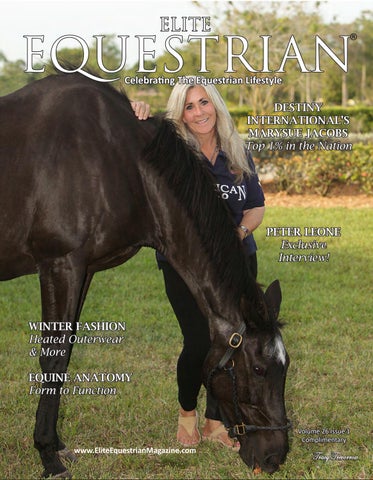
DESTINY INTERNATIONAL’S MARYSUE JACOBS Top 1% in the Nation
PETER LEONE Exclusive Interview!
WINTER FASHION Heated Outerwear & More EQUINE ANATOMY Form to Function
Volume 26 Issue 1 Complimentary
www.EliteEquestrianMagazine.com
Saddle Trail Wellington Exquisite 2.42 acre farm short hacking distance to the show grounds. Stunning tradi�onal 5 bedroom , 6.1 bath home with over 6000 sg � under air, soaring ceiling with an amazing gourmet kitchen and all impact glass. Lovely 7 stall barn with grooms apt and brand new ring. Pool and pa�o area include a fireplace, summer kitchen and water falls. This is one of the nicest farms in Wellington. Priced to sell at $4,900,000.
Wellington Paddock Park Totally remodel home on over 1 acre with brand new metal roof, generator, modern open floor plan with all new kitchen and bathrooms, beau�ful screened in pool area with fenced in back yard in the A school district , priced reasonably at $2,599,000.
Wellington Paddock Park 2 Large 7000 sq � home on 2 acres with 6 bedrooms and 4 full baths. Tall ceilings with plenty of room for a barn and ring. Hacking distance to horse show. This house would make a great Equestrian farm, AirBNB or assisted living home. Priced at $3,599,000 it has tons of poten�al.
Wellington Saddle Trail This charming farm is just under 2 acres, with a super cute 5 stall barn, ring and grooms qtrs.. Just a short hack to the horse show . The main house is a 4 bedroom 3.1 bath home, with pool and impact glass, full fenced and gated priced $3,725,000.
12
www.EliteEquestrianMagazine.com
www.EliteEquestrianMagazine.com
13
����
������� ���� ������ ���������������������
�
������������� �������������
�������������������������������������������������
��������������������������������������������������������� �����������������������������������������������
������������������������������������������������������������� �������������������������
������������������������������������������������
�������������
����������������������������������������� ����������������������������������
����������������������������
������g ����������������������������
255 Professional Way | Suite 100 Wellington, Florida 33414 Tel 561.753.5996 | Fax 561.828.2852 http://chapmanlawgroup.net www.equinelawgroup.com STATE, FEDERAL, AND INTERNATIONAL MATTERS
14
www.EliteEquestrianMagazine.com
www.EliteEquestrianMagazine.com
15
CONTENTS
POLO PARADISE
January/February 2026
40
Fashion • Home • Art 20 MUST HAVE 24 WINTER READY FASHION Equetech 26 HEATED OUTERWEAR Equetech 28 WINNING LOOKS Espoire 30 EQUINE ART 32 IYEKUDO ART 34 HIS & HERS Peter Leone 36 Art & An�ques with Dr. Lori Tough Love Declu�ering 38 A ROUND EQUESTRIANS New Year’s Resolu�ons
Photo by Paws & Rewind
30 Health 44 FORM TO FUNCTION Anatomy Of A Winning Spine 48 THE LOVE HORMONE Oxytocin
Training, Tack & Showing 56 DIVERTIMENTOS & DRESSAGE Brooke USA 62 RACEHORSES A New Life 60 WESTERN DRESSAGE Lynn Palm Level 3 New Requirements 71 TRAILERS Tricky Situa�ons
More 54 EQUINE THERAPY Nihi Part 2 61 EQUESTRIAN REALTOR Specialists 66 LEGAL: Accept or Reject A Horse 72 TACK BOX Your source for services & great retail finds! 16
54 www.EliteEquestrianMagazine.com
26
www.EliteEquestrianMagazine.com
17
�����
����������
®
Celebra�ng The Equestrian Lifestyle
#1
EQUESTRIAN LIFESTYLE MAGAZINE IN THE U.S.A. According To Feedspot blog #5 IN THE WORLD
Published since 2008 www.EliteEquestrianMagazine.com info@EliteEquestrian.us • Main Office, Ocala, Florida PUBLISHER Bill Vander Brink Bill@EliteEquestrian.us
Riding a horse is not a gentle hobby, to be picked up and laid down like a game of solitaire. It is a grand passion.
Ralph Waldo Emerson
EDITORIAL STAFF Editor-in-Chief: Noelle Vander Brink Art & Antiques Editor: Dr. Lori Verderame Equine Art Editor: Jeanne Chisholm Fashion Editor: LA Berry Legal Editor: Avery S. Chapman,Esquire Show Jumping Editor at Large: Peter Leone CONTRIBUTING WRITERS A Round Equestrians- Shereen Fuqua Alessandra Deerinck Kat Fuqua Lynn Trenery Freeman Dr. Bill Ormstrom Lynn Palm Tom Scheve
ADVERTISING Advertising Sales Kathy Dress 610-420-9964 kdress@ptd.net Advertising Free Lancer: Diane Holt 713-408-8114 diane@eliteequestrian.us CONTRIBUTING PHOTOGRAPHERS Lynne Trenery Freeman Paws and Rewind Staff of Dr. Lori
GRAPHICS Fran Sherman
�����
����������
®
Celebra�ng The Equestrian Lifestyle
DESTINY INTERNATIONAL’S MARYSUE JACOBS Top 1% in the Nation
On the cover... Destiny International’s Marysue Jacobs. Wellington FL Real Estate Professional specializing in equestrian properties.
PETER LEONE Exclusive Interview!
WINTER FASHION Heated Outerwear & More EQUINE ANATOMY Form to Function
Volume 26 Issue 1 Complimentary
www.EliteEquestrianMagazine.com
Copyright © 2026 Elite Equestrian is a registered trademark owned by Elite Equestrian LLC. No article, photo, or part of this publication may be reproduced wholly or in part without written permission of the publisher. Management reserves the right to approve or refuse any advertiser or contribution for any reason. EE does not endorse any product or advertiser and is not responsible for accuracy of info/opinions provided by advertisers or article content. Photographs are submitted by writers of each article who assume responsibility for usage approval.
18
www.EliteEquestrianMagazine.com
www.EliteEquestrianMagazine.com
19
Must HAVES GUMBITS 100% FEI legal. See our ad on page 79
www.GumBits.com
EZ SIGNS Free shipping! 1-800-640-8180 See our ad on page 31 www.EZSignsOnline.com
EQUINE HEALTH PRODUCTS Liniment, Hoof Care, Hoof Soak See our ad page 18 www.Vetericyn.com
Saddler’s Preserva�ve Protect and restore your valuable leather for years to come. See our ad page 27 www.jmsaddler.com EQUINE CONSIGNMENTS! Great selec�on of saddles, tack, boots,home items and more. Free trial on saddles. See our ad on page 72 www.GoodAppleEquine.com
BEST ON-THE-GO Hay Feeding System! Less waste, be�er diges�on for your horse. See our ad page 45 www.NibbleNet.com
Mounts to cart or vehicle. ATV trailer cart assembly available. Proudly made in the USA by our team of cra�smen! See our ad page 49 BigSprinkler.com
LAY-FLAT HOSE QUICKREEL
ONE-APPLICATION-DOES-IT-ALL SOLUTION Urad leather cream is easy and natural. Clean, polish, protect, condi�on and extend the beauty and life of all your leather goods. See our tall boots “Before /A�er” on our web site. See our ad pg 37 URAD.com DYNAMIC SADDLES Engineered for fit in mo�on. See our ad and feature on page 52
UNDER HELMET HEADBANDS By myMareCo The myMareCo signature Under Helmet Headband blends comfort, style and performance to secure your ride. See our ad on page 72 Amazon.com/mymareco mymareco.com 20
TOOLS EVERYONE NEEDS! EQUINE Full line of S�hl power tools CONSIGNMENTS! at Gilbert’s Hardware, Great selec�on of saddles, tack, Ocala FL. boots, home items and more.Free See trialour ad on page 31 on saddles.See our ad on page www.GoodAppleEquine EQUINE THEMED GIFT BASKETS! Perfect for any occaision for any and all equestrians in your life! See our ad and on page 72 www.EliteEquestrianMagazine.com
EQUESTRIAN JEWELRY! Riding Boot pendant, Sterling silver and 14K Gold See our ad on page 31 www.ashleyhorsejewelry.com
A Piece Of Your Favorite HorseCan Go With You Everywhere! Quality fashionable jewerly made with your horse’s hair. See our ad page 25 ponylocks.com
TREKKER BOOT SOCK Extra heavyweight boot sock, extremely thick, so�, and well built. Created with ultra-so� bison fiber for all day comfort. See our ad on page 29 thebuffalowoolco.com Communicate Clearly & Privately Lightweight Cyber headsets with flexible back band provide simultaneous talk, hands free, two-way communica�on See our ad on page 37 www.eartec.com
WARM COMFORT on cold days for your horse! See our ad on page 47 KALGLO.COM/HORSEHTR
FOCUS HF (HOOF) The most effec�ve nutrient building blocks to help support superior hoof condi�on. Contains a daily serving of the unique SOURCE micronutrients to maximize the u�liza�on and benefit of the addi�onal ingredients in FOCUS HF. 800-232-2365 See our ad page 6 www.4source.com
Upland & Downstream Collars and Leashes designed for the adventurous lifestyle! Exclusive “Tail-Snap” designkeeps the leather tail from s�cking out and collec�ng brush. Available in leather or Biothane and with or without a center ring. See our ad page 27 h�ps://auburndirect.com/product-category/brands/ upland-and-downstream CBD Healthy Horse Calm Plus A premium full-spectrum CBD and CBG formula. Helps horses stay relaxed, focused & comfortable. Supports emo�onal steadiness in sensi�ve or anxious horses, promotes calm behavior during training, trailering, and compe��on. Helps maintain physical comfort for hardworking or senior horses. See our ad page 49 www.PeakTherapeu�cs.net
FREE CONSULTATION when you scan our QR code, see our ad on page 73 Immune Builder Helps the Following Issues – • Allergy Response • An�-Inflammatory • An�-Viral • Supports kidney & liver • Gastric Ulcers • Lamini�s & Founder • Pre & Post Vaccine Support • Detox See our ad on page 73 www.balancedecosolu�ons.com
LADY SLIM Eggplant skinny jeans. A trendy high-waist skinny jean with a gorgeous light purple wash that’s fashionable and feminine for every season. They are Made in USA. See our ad on page 27 BulletBluesCa.com
“Derma��s Goes Away!” Vet Recommended, Owner Referred, Horse Approved Worldwide See our ad on page 49
See our ad for a coupon code!
www.EliteEquestrianMagazine.com
21
22
www.EliteEquestrianMagazine.com
www.EliteEquestrianMagazine.com
23
WINTER WEATHER
Ready
Award-winning waterproofs to beat the winter weather, cosy thermal layers, toasty accessories to beat the chill and a heated clothing range they’ll appreciate all winter long!
Equetech Inferno Asymmetrical Heated Gilet £107.95
Equetech Utopia Luxe Waterproof Riding Coat £219.95
To Explore The Full Collection: www.equetech.com
EQUINE Fashion
Equetech Storm Waterproof Riding Gloves £41.95
EE 24
www.EliteEquestrianMagazine.com
Your Favorite HorseWith You Always!
CUSTOM HORSE HAIR JEWELRY Keep a piece of your beloved friend with you always with a custom piece of horse hair jewelry made from your own horse’s tail. There are many styles and price ranges to choose from including pieces adorned with silver engraveable tubing.
E-Gift Cards Available • Call or Text 919-961-1841 Inquiries welcome at ponylocks@yahoo.com
www.ponylocks.com Ad Design by Elite Equestrian® magazine
The Attention You Deserve OCALA’S TRUE CUSTOM HOME BUILDER
Making one of the biggest purchases of your lifetime calls for choosing the best!
352-861-2300 LoveYourBuilder.com www.EliteEquestrianMagazine.com
Jim & Pal Bennett
Lic# CBC060122 25
KeepWARM
This Winter
EQUETECH HEATED CLOTHING Stay Warm with Innovative Equestrian Technology Keep the cold at bay with Equetech Heated Clothing, designed to deliver warmth, comfort, and performance during chilly rides and long winter days at the yard. Perfect for riders who brave the elements, this innova�ve collec�on uses advanced hea�ng technology to provide targeted warmth without bulk. From heated gloves and gilets to base layers and accessories, each item is cra�ed with technical fabrics and adjustable heat se�ngs to keep you warm where you need it most. Lightweight, breathable, and rechargeable, these garments are ideal for cold-weather riding, stable work, and outdoor events. Stay cosy and ride on through winter with Equetech Heated Clothing – cu�ngedge comfort for dedicated equestrians.
EQUINE Fashion
Inferno Long Heated Waterproof Riding Coat, £224.95 Powerbank Ba�ery - For Heated Coat & Gilet £17.50 (see page 24 for Aysmmetrical Gilet)
Inferno Waterproof Heated Riding Gloves (inc. 2 x ba�eries) £139.95
Inferno Heated Waterproof Over Breeches £89.95 26
To Explore The Full Collection: www.equetech.com
www.EliteEquestrianMagazine.com
EE
www.EliteEquestrianMagazine.com
27
F W
or the inning Look
www.espoirequestrian.com 28
www.EliteEquestrianMagazine.com
www.EliteEquestrianMagazine.com
29
Equine
“
Alecia Barry Underhill
A graduate of Rhode Island School of Design - “I like to paint close-up views that arrest the viewer and perhaps makes you see something that you wouldn’t already no�ce.”
The Mustang and The Mare by Alecia Barry Underhill. 20x20” oil on gallery wrap canvas. $1500.00
“
30
Art
Flight by Alecia Barry Underhill. Framed 36x24” oil on canvas. $2500.00
Kate Dardine
It is not my inten�on in my work, to give you the answers, but rather to spark in you the desire to ask the ques�ons. I am always seeking, exploring, pushing myself to dig deeper, to find clearer, more powerful ways to visually express my feelings of connec�vity to all living beings.
Through the Hoop by Kate Dardine, 12×12, acrylic on cradled panel, $550.00
”
Sublime by Kate Dardine. 12×12″ acrylic on cradeled panel. $550.00
www.equisart.com
www.EliteEquestrianMagazine.com
EE
Voted Best Hardware Store
www.EliteEquestrianMagazine.com
31
Art by iyekudo
“Lunch Date”; oil on canvas; 16x12” “Walking the Path”; acrylic on canvas; 16 x 20”
“Peacock 1”; mixed media; 4x6” “Gesture of Friendship”; oil in canvas; 18 x 12” “Lucky”; mixed media; 8.25 x 5.75”
EQUINE Art
iyekudo art h�ps://www.iyekudo.com instagram: @iyekudo_art h�ps://www.facebook.com/iyekudo.art/
EE 32
www.EliteEquestrianMagazine.com
We offer direct service door to door from Ocala (HITS and WEC) to and from Orlando, Tampa, Gainesville, and Sandford airport and Central Florida FBO’S
$10 OFF Every $100
you spend when you mention this ad!
352-427-2942 24 Hours 7 Days A Week Any Occasions Limos, Party Buses & More www.prontolimos.com www.EliteEquestrianMagazine.com
33
HIS
&
HERS
Peter Leone: ������������������������������� with L.A. Berry, Equinista It’s not every day that a landmark birthday coincides with a silver medal in team show jumping at the 1996 Olympics at the Georgia Interna�onal Horse Park outside of Atlanta. But that’s how I’ll always see Peter Leone: At the top of his game on that first day of August and (who’s complaining?) forever straddling that sweet spot betwixt ages 39 and 40. Even superseding his arrival on the show jumping stage as an 18-year-old closing his junior career by winning the World Cup Grand Prix of New York at Madison Square Garden. Peter started riding for a then-U.S. Equestrian Team a year later, ul�mately represen�ng our country in the 1982 World Championships, 1996 Olympics, six World Cup Finals (pinning every �me) and more than 30 Na�ons Cups. Time has only ripened his horsemanship and expanded his field of influence, and his in�mate understanding of the sport has cemented his reputa�on as an instructor, author, DVD producer, clinician and broadcaster. His book, Peter Leone’s Show Jumping Clinic: Success Strategies for Equestrian Compe�tors, and DVD, Ride the Body: Select Insights of Peter Leone, belong on every shelf. His good horse sense o�en joins the WVHH-TV team for the Hampton Classic Horse Show and now Elite Equestrian readers have the benefit of his exper�se as this Olympic show jumping medalist joins the editorial stable as a featured contributor. So get those New Year – and new show season -- resolu�ons ready. HERS: Do you remember your first horse/ pony? HIS: Pro Picolino
EQUESTRIAN Lifestyle
HERS: What did they teach you that may still apply for you today? HIS: How to groom handle prepare put away load and begin to understand horses
34
HERS: What qualities do you like best in a horse? HIS: Two answers: Riding horse: Sweet character, natural balance, generous attitude in riding and jumping, brave and confident. Competition horse (jumper): Athletic, quick-type. Careful. Brave. With natural balance and a good canter. Smart. Agile. HERS: What qualities do you like best in a person? HIS: Honest. Dedicated. Love and respect for the horse and a sincere commitment to learning. Conservative when it comes to managing horses. Respect for people and horses at a barn; supportive of other riders and horses. HERS: What was your first job? HIS: Nonpaying? The care and maintenance of my pony and my dog. Paying? Citibank, management Associate.
HERS: If you didn’t work with horses, what would you be doing? HIS: Probably be a high school or college lacrosse coach. HERS: Favorite quote? HIS: Three: It’s a great day for show jumping! Show me a good loser and I will show you a real loser. You miss all the shots you don’t take. HERS: If you could spend a day with any horseman/ horse in history, who would it be & why? HIS: I have been so fortunate to train with great masters in the sport - one I never did train with was Hugo Simon. He’s the definition of a gritty winner, and trains and competes out of a high impulsion gallop. HERS: Where/how would you like to see our horse world evolve over the next decade? HIS: Continue to prioritize the well being of the horse via footing, competition demands, supervision, and quantity of completions any one horse can jump in a given time period HERS: Words of encouragement you can offer young riders dreaming their Olympic dream?
www.EliteEquestrianMagazine.com
Elite Equestrian magazine is proud to welcome Peter Leone as our new Show Jumping Editor!
Peter Leone competing in the Bedford Cup, 2019. Photo by Paws and Rewind.
HIS: Commitment to applying the correct principles of riding and jumping as one matures. Work harder than everyone else. Know that you don’t know everything. And keep a never-ending obsession with learning and becoming a better horseman.
“
HERS: You can invite three guests (past or present, real or fictional) to dinner. Who joins you and what’s on the menu? HIS: Vince Lombardi. Bill Walsh. Phil Jackson. Whatever they want. Peter and Lionshare Farm are accep�ng new clients for the 2026 Wellington, Florida show season. Ship-in lessons and meet-at-the-ring coaching services are also available, peterleoneusa.com.
Suggest a guest for His & Hers, latheequinista@gmail.com E E
Photos by Paws and Rewind.
I am privileged to be the new Editor-at-Large for Show Jumping for Elite Equestrian Magazine. In the coming issues, I look forward to giving you an inside look at fascinating and hot topics in the world of both Interna�onal and Na�onal Jumping. What are the most challenging events everybody wants to watch and why, the 2028 Olympics – will it be the last Games for equestrian sport, what kind of horses make the best showjumpers, how the sport has changed and where is it going, the rider’s mental strength – the difference between good and great, jumping at the town fair versus jumping in front of the Eiffel Tower - why are both wonderful, The 2026 World Cup Finals are in Dallas TX this April – who are the favorite horses and riders and why is it important to win. Have a ques�on on showjumping horses, riders, or the sport? Contact me directly at peter@lionsharefarm.com. Peter Leone is available for in-person and online show jumping coaching. Learn more at: h�ps://www.peterleoneusa.com
www.EliteEquestrianMagazine.com
35
ART
& ANTIQUES By Dr. Lori
Tough Love
when Decluttering By Dr. Lori Verderame
Get ready for some tough love. When it comes to declu�ering, you have to forget the sen�ment and get serious. Don’t procras�nate and be relentless as you part with unnecessary stuff. Once you start the process, you’ll be glad that you took the bull by the horns. How do you start? Start with the easiest decisions that declu�ering demands. What’s easy is to decide what to keep. The hard decisions come when you are deciding what to give up. Clutter On Countertop Photo by Staff of www.DrLoriV.com
The KEEP pile
EQUINE Lifestyle
Decluttering starts with what items to keep even though most people want to see a box full of stuff headed for the curb. First, make a KEEP pile. Everyone knows what to keep. Make a KEEP pile for each room in your home. The KEEP pile should include any item that couldn’t possibly leave the family for whatever good reason. You should keep an heirloom if it is part of family history or if you are not willing to part with it for some good reason. The KEEP pile may have things in it that someone has always coveted like grandma’s wedding ring, a favorite piece of furniture, or jewelry box. Items like Grandpa’s coffee mug, prized hunting rifle, or autographed football may warrant a place in the KEEP pile. The KEEP pile is the easiest thing to deal with when decluttering. Each room should have a KEEP pile. The trick to the KEEP pile is you must limit yourself. That’s right, for every item you keep, you must rid yourself of two items. You may not have expected such rigidity or tough love in this process, but it’s necessary. Decluttering means parting with items and it doesn’t mean reorganizing stuff so you can keep all of it.
Other tips for decluttering include: Choose one room to house the emotional stuff. As you uncover these items in the process, place them in that room. When you have time and emotional support, deal with the items in that room. Give them careful consideration but realize that some of these items will have to go. 36
If you can’t deal with certain emotional items, put them aside and deal with them later. Another option is to take photos of the emotional items. The photograph will help you remember the object when you must rid yourself of the actual item. Do not tackle the attic or the basement first. Start small in a guest bedroom or closet. Make a staging area such as a screen porch or garage for large scale items like sofas, dressers, tables and chairs that will be part of the decluttering process. Don’t invite people to help you declutter your home who are not going to be helpful. Don’t seek the aid of those who are just interested in joining you on a trip down memory lane. The objective is to declutter, not to reminisce. Don’t engage helpers who will slow down the process. Don’t expect to downsize a houseful of stuff in one weekend. It took a lifetime to accumulate all this stuff, it will take time to dispose of and decide what to do with all of the stuff. ����������������������������������������������������������������� ���������������������������������������������������������������������� ������������������������������������������������������������������� ��������������������������������������������������������������� ����������������������� ����������������������������������������������
www.EliteEquestrianMagazine.com
EE
www.EliteEquestrianMagazine.com
37
38
www.EliteEquestrianMagazine.com
www.EliteEquestrianMagazine.com
Con�nued on page 58
39
����������������������������� Wellington Florida is the Equestrian Capital of the World and was originally created for POLO. It has a record amount of Polo Fields, a deep history in the sport and now the home to the New U.S. Na�onal POLO Center. A great part of that history is a�ributed to Tim Gannon the Patron of the famous OUTBACK POLO TEAM. Tim led his team to five U.S. OPEN Championships and broke a record for having 3 consecu�ve wins in a row in 1999, 2000 and 2001, a feat no other team has ever been able to accomplish. He played along side many of the most famous POLO players including Adolfo Cambiaso and contributed to helping women in the sport by invi�ng the late Sunny Hale to play on his winning team.
40
www.EliteEquestrianMagazine.com
His stunning POLO estate overlooking the Grand Champions POLO fields has recently gone on the market and is truly a beau�ful home with spectacular views of the many POLO tournaments played throughout the year. This highly sought a�er exclusive enclave of Palm Beach POLO is gated with only 5 residents, perfect for any serious POLO enthusiast looking for privacy and lots of POLO!
Tim Gannon one of the original owners of the OUTBACK Steakhouse Restaurants created the infamous Blooming Onion and is consider one of the most famous Chef’s in the world, recently Tim updated his lovely home with a gourmet kitchen designed for entertaining, a full-size media room and new pool. The 2-acre estate also has a brand-new full size separate 3-bedroom 3 bath guest home providing over 10,000 total square feet of housing with a 5 car garage, impact glass and lots of room for horses or a sports court. Please feel welcome to visit this amazing property any�me by appointment by calling the Broker of Des�ny Interna�onal Proper�es, Marysue Jacobs 561-758-5212. This rare property is offered for sale reasonably for $6,899,000.
www.EliteEquestrianMagazine.com
41
������������������������������ Aiding Horses And Riders Through The Art Of Riding Equine Performance Partnership’s new headquarters is NOW OPEN in Ocala, where our 40 acre equestrian paradise boasts a majestic and well rounded facility for top tier training for the competitive dressage or jumping arena.
What We Do: Come train among the best in the business and experience our dynamic training program. Our main focuses are developing horse and rider pairs and building up training horses the right way; using a combina�on of classical and modern cross training modali�es, including groundwork, trail riding and especially providing space for the horses to open up and be themselves. Our method is a whole horse approach, each horse receives an individualized program based on their needs and to strengthen their confidence in themselves. We believe in happy, healthy horses and aiding riders to be the best versions of themselves they can be for their horses.
Our Facility: • Our facility is gated with on-site owners, and located 10 minutes from World Equestrian Center, Ocala • Renovated 12 stall barn equipped with grooming/wash stalls, air condi�oned tack room and feed room • Spacious 14 x 16’ ma�ed stalls with fans and automa�c waterers • Round pen • New fencing, gorgeous fields with shade trees and run-in barns • Group and single turnout • Grass dressage and jumping arenas • Tranquil open spaces for trail riding and work outside the arena • Coming soon- an oversized covered arena with GGT Foo�ng
Rental Facilities: Our property also has two fully renovated 3 bedroom 2 bathroom homes available for season rental. They have fenced yards with wire perfect for dogs, beau�ful landscaping and trees, and are very private. There are small two stall barns on the property available for rental with pasture.
EQUINE PERFORMANCE PARTNERSHIP QUALITY. EXCELLENCE. CONNECTION. FALK PETER, FN/FEI, Competitor/Trainer VICTORIA DE BENEDICTY, FEI Competitor/Trainer www.equineperformancepartnership.com Located in Ocala, Florida, 10 minutes from World Equestrian Center. Email FalkPeter@me.com or call 352-409-6616 42
www.EliteEquestrianMagazine.com
����������������������������
Wether you have a young FEI prospect, a stallion you would like to campaign, a “problem horse” or you want to enhance your partnership with yourself and your horse, we are here to support horses and riders to be their very best.
www..com www.EliteEquestrianMagazine.com
43
TO
Form
Function
The Anatomy of a Winning Spine
By Dr. Bill Ormstrom
Every rider knows that peak performance isn’t just about strength—it’s about precision, suppleness, and connec�on. Horses who move with power and fluidity aren’t just well-muscled; they’re biomechanically efficient. At the center of that efficiency lies a structure o�en overlooked but absolutely vital: the spine. The equine spine isn’t just a support column. It’s the conductor of mo�on, the protector of the nervous system, and the interface between rider and horse. Understanding how the spine func�ons—and how spinal health affects every stride—can change the way we train, ride, and care for our equine partners. This is where equine chiroprac�c enters the conversa�on. Far from a trendy therapy, chiroprac�c care addresses the very founda�on of equine performance by ensuring the spine moves as it should—freely, symmetrically, and without interference.
The Spine: More Than Just a Back The horse’s spine runs from poll to tail, composed of approximately 50 vertebrae: 7 cervical (neck), 18 thoracic (mid-back), 6 lumbar (lower back), 5 fused sacral (pelvis), and 15–21 coccygeal (tail). Each vertebra connects to the next through joints, ligaments, and muscles. Between the vertebrae exit spinal nerves, which control every part of the body—muscles, organs, skin, and proprioception. The spine provides: • Structural support for the entire body • Protection for the spinal cord and nerves • Attachment sites for powerful muscles and ligaments • A conduit for communication between brain and body When the spine is mobile and symmetrical, it allows for coordinated, athletic motion. When it’s restricted, distorted, or compensating, performance suffers—and so does the horse’s comfort.
How Movement Happens Every collected stride, every rollback, every flying change begins with spinal movement. The back is not a rigid platform; it’s a dynamic system that must flex, extend, rotate, and laterally bend with precision.
EQUINE Health
Here’s what happens when the spine moves correctly: • The cervical spine guides head and neck movement, balance, and the ability to lift the base of the neck during collection. • The thoracic spine accommodates the ribcage and influences wither mobility—critical for rein contact and lateral work. • The lumbar spine controls the ability to round the back, engage the core, and carry weight from behind. • The sacrum and pelvis are key to power generation, thrust, and stride length. When one region of the spine is restricted, other areas must compensate—leading to uneven muscle development, shortened stride, or misbehavior under saddle.
Structure Shapes Performance Consider these common examples of form influencing function: • A horse with restricted poll mobility may evade contact or toss its head. • A stiff thoracic spine may cause poor saddle fit, shortness in front limbs, or trouble lifting through the withers.
44
• A locked lumbar spine can reduce impulsion, cause reluctance to round, or make transitions feel “sticky.” • A restricted sacroiliac joint can lead to inconsistent leads, dragging toes, or resistance to collection. The rider may notice these issues as training problems or attitude problems. In reality, they’re often signs of a biomechanical bottleneck.
Compensation: The Hidden Cost of Adaptation
Horses are masters of compensation. If a joint or muscle group isn’t working properly, they’ll shift the load elsewhere. But over time, this creates patterns of imbalance that are hard to undo. A small restriction in the cervical spine may eventually affect the opposite hind leg. A sore SI joint may cause bracing in the shoulder. These compensations wear down performance and increase the risk of injury. Equine chiropractic identifies and corrects these subtle imbalances before they become major problems. The goal is not to force the horse into an artificial shape, but to restore normal motion to the spine—so the horse can move the way nature intended.
Posture and Proprioception
Proper spinal function does more than improve motion—it sharpens awareness. The spinal cord isn’t just a highway for motor commands; it’s also the source of proprioceptive input—the body’s ability to sense its position in space. A healthy spine gives the brain clean, accurate information about limb placement, balance, and timing. Horses with spinal dysfunction often appear uncoordinated, disconnected, or delayed in their reactions. They may knock rails, trip, or struggle with lead changes. After a chiropractic adjustment, many owners notice better coordination and body awareness—evidence of improved neurological communication.
Saddle Fit and Spinal Health
The saddle is the most direct point of contact between the rider and the spine. Even a slightly ill-fitting saddle can create pressure points that limit motion in the thoracic and lumbar spine. Over time, this can lead to soreness, postural changes, and even behavioral resistance. Chiropractic care helps correct the effects of poor saddle fit and works hand-in-hand with saddle fitters. After restoring spinal motion, the horse may carry the saddle differently, often requiring adjustments in pad or tree size. Many top practitioners recommend evaluating spinal health before investing in a new saddle.
www.EliteEquestrianMagazine.com
Therapeutic & Holistic Care For Your Horse’s Well-Being • Acupressure • BEMER-PEMF • CranioSacral • Cryo Therapy • Kinesiology Taping • Light & Laser • Microcurrent • Myofascial Release • Nebulizer • Raindrop Treatment • Sports Massage • SureFoot • Tens unit • Thermal Imaging
Based In Ocala, FL
Mireille Doffegnies C.E.S.M.T. / F.E.I. Therapist
md-equine.com
Independent Bemer Distributor
352-844-1417
10% OFF!
Use Code EE2025 www.EliteEquestrianMagazine.com
45
Continued from page What Chiropractors Feel That Riders See A trained equine chiropractor doesn’t need x-rays to detect problems—they use their hands. Through skilled palpation, they assess joint motion, tissue tone, symmetry, and subtle signs of restriction. They feel what most of us can’t see: vertebrae that are locked, stuck, or moving improperly. After an adjustment, riders may notice: • Longer, more fluid strides • Improved bend and softness in both directions • Easier transitions and lateral work • Calmer attitude and better focus • More balanced contact and frame These changes often happen quickly, though some horses may need a series of sessions to fully unwind long-standing patterns.
Maintaining a Balanced Spine Elite equine athletes benefit from regular chiropractic care—not just when issues arise. Just like we schedule dental work, hoof trims, and vaccinations, spinal care should be part of the routine. Some horses do well with monthly adjustments; others may need more frequent care during intense competition seasons or after travel. Chiropractic works best as preventative medicine, not crisis management. By catching restrictions early, we avoid compensatory injuries, behavioral frustration, and lost training time.
Conclusion: Form Unlocks Function
Equine Hospital 24/7 Emergency Care
Our large animal doctors are also available Mon-Fri for routine on-site or in hospital calls.
215-536-2726
2250 N. Old Bethlehem Pike, Quakertown, PA 18951
www.quakertownvetclinic.com
The saying goes, “No hoof, no horse.” But we might just as accurately say, “No spine, no stride.” The spine is the axis of athleticism—the platform upon which all movement is built. When it’s restricted, performance is capped. When it’s free, the horse can rise to its full potential. By understanding the structure of the spine and how it shapes function, we empower ourselves to be better partners, better riders, and better caretakers. Equine chiropractic isn’t just for horses with problems—it’s for horses with potential.
����������������������������� ������������������������������� ����������������������������������������������������������������������������������� ��������������������������������������������������������������������������������� �������������������������������������������������������������������������������������� ���������������������������������������������������������������������������������� ��������������������������������������������������������������������������������������� ����������������������������������������������������������������������������������� ����������������������������������������������������������������������������������� ����������������������������������������������������������������������������� ����������� ��������������������� �������������������������������������������������������� ���������������������������������������������������������������
Elite Equestrian does not endorse or confirm content suggestions in any articles. See credit page for disclaimer.
46
EE
www.EliteEquestrianMagazine.com
www.EliteEquestrianMagazine.com
47
The Love Hormone: Oxytocin and the Horse-Human Bond Story and Photos By Lynne Trenery Freeman
This is the first in a two-part series. From foaling stalls to quiet grooming sessions, oxytocin fuels the bond that makes horses feel safe and connected. Lynne Trenery Freeman shares science-backed insights and hands-on practices for building lasting partnerships with foals and adult horses alike. We ask a lot of our horses. We want them to live comfortably in a human world, becoming partners, performers, and companions. Yet one of the most powerful tools for helping them succeed often goes unnoticed — the hormone oxytocin, sometimes called the “love drug.” Oxytocin is a neuropeptide most abundant around birth, released in surges during labor, nursing, and early bonding. Its name comes from the Greek oxytokion, meaning “swift birth.” But while its strongest release happens at foaling, oxytocin is also produced during quiet moments of touch, stroking, and social closeness. It reduces stress, lowers anxiety, and strengthens trust — all qualities we hope to nurture in our horses.
EQUINE Health
Why Bonding Matters The ultimate goal of every horse-human relationship is a willing, confident partner who is relaxed, eager to participate, and safe to be around. Research across species shows that oxytocin enhances social motivation and learning, particularly in contexts of trust, safety, and overall psychological stability. In horses, this means that intentional bonding — especially in early life — sets the stage for cooperative, resilient equine partners. Anyone who has bred or raised foals knows that early handling can make all the difference. But it’s not just 48
about exposure — it’s about creating positive associations during the critical bonding window. When a foal experiences human touch and voice alongside its dam’s nurturing presence, oxytocin helps encode those interactions as safe and rewarding. These associations last far into adulthood.
The Coach’s Role
I like to use the word coach rather than trainer or handler, because true partnership involves more than teaching skills. Coaching encompasses guidance, support, and encouragement for the horse’s mind, body, and spirit. For mares and foals, this means the same person should ideally be present throughout pregnancy, foaling, and early handling. Familiarity matters. The more genuine affection and positive history the coach has with horses, the stronger the chemistry works. Too often, broodmares are put “on the back burner” until foaling. In reality, they benefit from more fre-
www.EliteEquestrianMagazine.com
Continued...
EE2025
www.EliteEquestrianMagazine.com
49
quent, calm interaction during pregnancy. Grooming sessions should go beyond the brush — using hands in long, slow strokes along the neck, withers, and back. Stroking the forehead or gently running fingers through the mane mimics maternal licking. Horses are remarkably perceptive: the mare will soften, lick her lips, or close her eyes. And you, too, may feel calmer. That’s oxytocin at work on both sides.
In the Foaling Stall
When foaling approaches, every stall should be equipped with a camera so the coach can be present at birth. A maiden mare, especially, may be nervous. A calm voice, reassuring strokes, and steady presence during labor help both mare and foal. Once the foal arrives, the coach should join in the process — sitting with the mare and foal, speaking softly, gently stroking the mare and foal, reinforcing the dam’s natural behaviors without interfering. I use repeated phrases like, “You’re okay,” or “Nice job.” Horses are masters of association with excellent memory, and foals will carry these words into adulthood. Over time, the words alone can elicit calmness and trust. I call this the Association Plus (A+)™ coaching method: pairing voice, intentional touch, and oxytocin-fueled bonding to create deep-rooted associations.
Beyond Birth
Of course, not every horse owner is present from foaling, but oxytocin isn’t limited to that moment. Simple, intentional bonding continues throughout a horse’s life. Quiet grooming, hand-stroking, or even standing together in calm companionship all release smaller but repeated pulses of oxytocin. Over time, these build trust and security.
This year I had a Hackney colt who, despite all sanitary precautions, developed an umbilical infection and required surgery. He spent over a month stallbound, needing bandage changes and frequent oral medications. Because of our strong bond, he trusted me so fully that he often didn’t bother to rise when I administered his medications. At just four months old, he led, tied, groomed, trailered, and went to his first show — where he proudly brought home a blue ribbon.
Lasting Impact
Oxytocin isn’t just a scientific curiosity. It’s the biological underpinning of the trust we all seek with our horses. By being intentional with touch, voice, and presence, we set the stage for lasting partnership. Whether with foals, broodmares, or seasoned adults, oxytocin provides a pathway to deeper connection. It’s important to remember that oxytocin isn’t just a ‘feel-good’ idea we project onto horses — it’s a welldocumented mammalian hormone with measurable effects across species, including humans, dogs, and livestock. The calming responses we see in horses during touch aren’t imagined; they’re rooted in biology. So the next time you’re with your horse, set aside time for quiet stroking, soft words, and shared calm. Science backs it up: a hug, a stroke, or simply standing together isn’t just sentimental — it’s chemistry building a stronger bond. Key takeaway: Every interaction is a chance to strengthen the oxytocin connection. With intention and consistency, you’ll create a partner who trusts you not just in training, but in every aspect of life.
References: Aydin, E., et al. (2020). The effect of human interac�on on horses’ oxytocin and cor�sol levels. Animals. Beetz, A., et al. (2012). Psychosocial and psychophysiological effects of human–animal interac�ons: The possible role of oxytocin. Fron�ers in Psychology. Boivin, X., et al. (1992). Influence of early handling and social rearing condi�ons on calf–human rela�onships. Applied Animal Behaviour Science.
EQUINE Health
Coulon, M., et al. (2015). Influence of early human handling on the subsequent social behavior of lambs. Applied Animal Behaviour Science. Kendrick, K. M. (2000). Oxytocin, motherhood and bonding. Experimental Physiology. McDonnell, S. (2000). Reproduc�ve behavior of stallions and mares: Comparison of free-running and domes�c in-hand breeding. Animal Reproduc�on Science. Nagasawa, M., et al. (2015). Oxytocin-gaze posi�ve loop and the coevolu�on of human–dog bonds. Science. Nowak, R., et al. (2000). Mother–young rela�onships in sheep: A model for understanding the neurobiology of a�achment. Journal of Neuroendocrinology. Yarnell, K., et al. (2015). Domes�cated horses differ in their behavioural and physiological responses to different handling techniques. Physiology & Behavior 50
www.EliteEquestrianMagazine.com
EE
Southern Palm BED & BREAKFAST
Loxahatchee Groves, FL 561-790-1413 www.southernpalmbandb.com • Licensed inn • Close to WEF • Full breakfast • Weddings • ���������������������������� ���������������������������� ���������������������������
Our Farm- Your Fun Enjoy 100 acres of beautiful rolling hills located just north of Ocala, in Reddick, Florida. Immaculate equestrian facility with great amenities.
2025 2026 SHOW SEASON USEA Horse Trials Jan 9-11, 2026 March 20-22, 2026 May 2, 2026 November 7, 2026
3-Phase Schooling Shows December 13, 2025 Jan 28, 2026 Feb 18, 2026 April 11, 2026 August 8, 2026 September 12, 2026 October 17, 2026 December 12, 2026 Cross Country Course • Dressage Rings • 2 Fiber Footing Arenas 559-917-3046 • 17500 North U.S. Highway 441 • Reddick, FL www.EliteEquestrianMagazine.com
51
������������������������������������������� ������������������������������������������������������������������������������������������������������� �������������������������������������������������������������������������������������������������������� ��������������������������������������������������������������������������������������������������������� ���������������������������������������������������������������������������������������������������������
Built On Dynamic Self Adjusting Tree™ Fits In Motion
����������� ����������� Seeking Sales Reps
www.dynamicsaddles.com www.competitionsaddlefit.com 52
www.EliteEquestrianMagazine.com
352-757-0167
Why The Dynamic Saddles™? The Dynamic Saddle is engineered to fit in mo�on, and it does not have any seat pressure points and does not fla�en/collapse while under the rider’s weight. In fact, the weight of the rider along with special billet system is what loads and adjusts the saddle to the horse’s anatomy. This simplifies the saddle-fi�ng adventure! There’s no need for narrow or wide trees for most horses, and these saddles do not need to be reflocked. Correct fit is achieved on majority of horses right out of the box! Dynamic Saddles feature close contact panels, bringing you closer to the horse to improve communica�on and add subtlety to your weight aids. We are free to avoid the bulky panels of other manufacturers because there are no pressure points from the tree that must be heavily padded. This allows our saddles to be ultra light, only 12 pound to handle. Only the best quality leathers are used in making the saddles. Our experienced team of professionals delivers the highest standard of cra�smanship. We are a bou�que saddlery, with genera�onal saddlers that produce a limited number of saddles to our exac�ng specifica�ons. Our customer service is unmatched! Special order saddles are available for truly hard to fit equines and riders.
Every detail of saddle construc�on is designed to make the ride enjoyable for both the horses and riders: • The saddle is designed to posi�on itself further back on the horse to reach a dynamic equilibrium and give maximum freedom of movement to the shoulders. • Dynamic Saddles™ front billet system is designed to allow the front panels to move away from pressure of working muscles, allowing the shoulders to swing freely. • Dynamic Saddles™ allows the rider to loosen the pelvis which makes si�ng on the horse much easier and helps the rider feel more connected to the horse. • The flaps and thigh rolls are angled to accommodate the anatomical structures of the human body. • The s�rrup bars are posi�oned to help the rider to achieve correct body alignment. • If you ever struggled to thread a s�rrup leather through the s�rrup bar, you will appreciate that our bars are slightly angled, to allow for easy inser�on of s�rrup leathers. Small details that make a world of difference! • The overall design provides unmatched security to ride correctly and helps secure a rider in place even when faced with a young horse’s an�cs.
EE www.EliteEquestrianMagazine.com
53
EQUINE
Therapy
Part 2
Photo by Rhia Suawas�ka
Susi Cheshire, continues telling about her experience at Equine Intuitive Retreat in NIHI Sumba, and how it transformed her life. Read Part 1 in the September/October 2025 issue of Elite Equestrian, free to read on our web site;
EQUINE Lifestyle
Photo by Rhia Suawas�ka
Carol Sharpe, the original horse whisperer of NIHI, plays a central role in these retreats. What stood out to you about her approach, both as a facilitator and as someone who understands horses on an intuitive level? I have already touched on Carol’s intuitive nature and sense of spirituality. Carol’s depth of knowledge about horses is extensive. She knows the whole Nihi Sumba herd, how they interact and communicate with each other. She has spent years with them all, has rescued them, nurtured them, developed the Sandalwood stables at Nihi which she set up over 10 years ago, trained the staff to continue her great work. She knows what is best for the welfare of the horses and has set up the stables to provide the herd (many of them rescued) with a great life where they are well looked after as well as being able to roam and graze, in as near a wild and natural situation as possible while still being nurtured by humans. So Carol brings a lifetime of horsemanship having grown up with horses in her native Australia and combined with her intuition with both humans and horses, she is able to facilitate the work that we all took part in on the retreat - she makes it all possible. Many of the horses at NIHI were once rescued, and now they seem to help heal humans. How did learning about their past influence your experience and connection with them? On a personal level, I know that I have always loved horses for exactly what they are - majestic, powerful, graceful and hugely intelligent (intuitive) creatures. I am in awe of horses. And when you are surrounded by gorgeous horses which are being nurtured and well looked after, loved by all the staff, and you hear about their stories and journeys to Carol’s stables, your heart leaps out to them, just as 54
your heart melts when you hear of or see human suffering. We were also very lucky to meet some local Sumbanese in their traditional village, and to watch as the stable staff and Carol gave food and medicines to the villagers for their two horses. This was a rare privilege and an insight into the life on the island. How would you describe the energy of the retreat space at NIHI Spa — the atmosphere, the land, the pace of each day? You really have to see it for yourself - the magic, the beauty, the raw nature and to hear and see the waves. Whilst in the midst of my treatments in the open air treatment hut, wrapped in banana leaves with a soothing skin balm, after reflexology and a full body massage, I felt blissed out and incredibly lucky. It was as if each day brought more miracles and once-in-a-lifetime experiences. We bonded so well as a group and all fed of each other’s individual and our shared experiences and the pace was perfect. We experienced so much, but still had time to ourselves to roam freely and find more beauty, just like the horses. Nihi Spa taps into the wild healing nature on the island, the smiles of the local island people just add to the icing on the cake. They are so beautiful. They have been trained to be able to work at the resort, so it is giving back to the community and respecting their life and livelihood. The sun, bright light, ocean breeze, powerful waves, plants, palm trees, flowers, scents, all the natural beauty, the wildlife (occasionally you can spot a dolphin or turtle in the waves)... All make such a magical paradise setting, that you are already on a high before even interacting with the horses or having your spa treatments. It is out of this world. No words can do it justice, you have to experience it.
www.EliteEquestrianMagazine.com
Photo by Rhia Suawas�ka
Photo by Rhia Suawas�ka
Looking back, how would you describe the overall impact of the retreat on your life today — emotionally, spiritually, or even physically? I would say that it is just the tonic I needed to kickstart my future. I feel more connected to my true self, something I had only read I could do, but now i am actually doing it. I found a true spiritual calling to heal others through nature and nurture, through horses and gardening, and this is the path I am pursuing. Being with the horses helped me to finally unlock my potential, believe in myself. To stop overthinking and to just ‘do’. Spiritually I know that I can connect with horses and since knowing that this is the path I wish to pursue, since being on the retreat, things just seem to fall into place. It is very serendipitous, but I have met the right people, made the right choices - and I am learning to ride with the mind, a technique which benefits the horses, learning at stables very local to me, so I am physically benefitting as well. What would you say to someone silently carrying grief or trauma who might be unsure about trying the NIHI equine intuitive retreat? You are in the best hands. And the horses are very loving and caring. If you are calm and open to energy exchange, magic can happen. Allow yourself to be guided - and the setting is beyond your wildest imagination, it is just paradise. So in itself, it is a tremendously healing place. I would just say, go for it. Join a retreat, it is magical, don’t go with any expectations, but allow yourself to just say yes and do it - take part, make to happen for you and the results will be more than you could have ever hoped. I truly believe horses can help us overcome blocked emotions
Photo by Joe Kelly
and fears, it’s ok to have silent fears or grief, but it is a heavy burden and the horses can help in you lightening that load, they show you it’s ok to let go. It is all about mutual trust, and energy exchange. Feel their huge energy field, be calm and open, and magic will happen. Trust me. Lastly, what stood out to you about the way the horses are cared for at NIHI, and how would you describe their daily life on the island? The horses are very loved, nurtured, cared for, the team of experts can administer medications as needed. The herd can roam free on the hill, grazing, interacting, and their route there is along the sand of the most beautiful beach. They roam free as the herd, and can return to the stables for shade and rest. After a ride or work in the arena, they are given a cool hose shower and a feed, with carrot treats, followed by a rest in the stables which are open onto a mud paddock. They can roll in the sand and swim in the sea, which they regularly do, and all seem playful and content. The intuitive expert team check them daily and can detect any issues or needs they may have. They are living the best life.
www.nihi.com
www.EliteEquestrianMagazine.com
EE 55
Brooke USA’s (Brooke USA) mission is to significantly improve the health, welfare, and produc�vity of working horses, donkeys, and mules, as well as the lives of the people who depend on them for survival worldwide. We are commi�ed to sustainable economic development by reducing poverty, increasing food security, providing access to water, and raising basic standards of living through improved equine health and welfare. We strive to alleviate the suffering and vulnerability of developing communi�es by funding and implemen�ng programs that improve the quality of life and health of working equines and thereby posi�vely impacting the economic sustainability of equine owners worldwide. Brooke USA wants healthy, happy people and equines that work in partnership to achieve sustainable local economies.
On Thursday, January 29th, at Goldmark Farm in Ocala, FL, Brooke USA is hos�ng an evening of classical music and freestyle dressage. The event features the Ocala Symphony Orchestra performing live alongside Grand Prix dressage horses and their accomplished riders. Brooke USA’s Diver�mentos & Dressage, which sold out last year, combines the ar�stry of live orchestral music and freestyle dressage. The evening begins at 5:30 pm with a recep�on featuring cocktails and hors d’oeuvres, followed at 7:00 pm with a one-hour program of freestyle dressage choreographed to the Ocala Symphony Orchestra. The night concludes with dessert and coffee at 8:00 pm, offering a chance to meet the riders and the orchestra’s music director.
For Tickets Contact 803 207-0499 or Kim.shipp@BrookeUSA.org
www.BrookeUSA.org 56
www.EliteEquestrianMagazine.com
EE
www.EliteEquestrianMagazine.com
57
Con�nued from page 38
58
www.EliteEquestrianMagazine.com
www.EliteEquestrianMagazine.com
59
Palm Equestrian Academy™ Building a Partnership with your Horse
Western Dressage Level 3 New Requirements Let’s get ready to show & grow!
Story and Photos By Lynn Palm
Once you have explored the gaits and definitions for Level 3, it is time to explore the new requirements for this Level. These are many and varied as we advance the training of both horse and rider. ( Read about Level 3 in the November/December 2025 issue of Elite Equestrian, read it free at www.EliteEquestrainMagazine.com)
Pivot from turn on the forehand- T.O.F. Smooth transition from walk; square, straight halt; immobility; willing movement of the haunches around the front legs with consistent tempo and inside flexion -- PIVOT— Response to rider’s leg with forward intention and correct bend; turn on the inside hind; willing, smooth transition after turn. This is the most controversial maneuver of Western Dressage. I personally teach a horse both. First with the Turn on the Haunches, where the inside hind leg moves up and down as the turn is done. The pivot leg, the inside hind leg, is stationary unless he moves it to rebalance. If the turn is calling for more than a 180 degree turn, I do a pivot. If it is a 180 degree turn, I will do what my horse does best. Make sure you do the same turn each way, or you will get deductions if in one direction the turn is a pivot, and the other is a Turn on the Haunches.
TRAINING & Showing
Half pass at collected jog- Balance and bend on the half circle into collected half pass. Alignment with soft willing bend; engagement; freedom of shoulders; fluidity. Half pass at the collected jog is my favorite movement! When you are developing your horse to have more suppleness through bending and straightness the Half Pass is such a wonderful feeling of your horse moving laterally! Make sure that the forehand is slightly in front of the hind quarters in this movement allowing the horse to move with a longer, uphill lateral step. Enjoy the ride! Renvers-Fluid; show change of bend if after shoulderin. Consistent angle, bend, and tempo. Remember this maneuver is on 4 tracks, and the horse must show bend and straightness; on the outside rein/leg. Tempo is maintained, as most commonly the horse will slow if the rider is using too much inside rein aid, thus making the horse bend the neck and making him crooked in this movement. Also, keeping the horse going with the seat and leg aids has to be
60
maintained. This is a great movement to develop the suppleness and flexibility of your horse necessary for correct collection. Don’t skip mastering this maneuver as you will need it for collection and the higher levels. Counter lope serpentine- Engagement; uphill balance; correct and symmetrical placement of serpentine loops; consistent tempo, uphill balance and engagement I love this movement because it is a great feeling of your horse’s athleticism as your horse gets more agile and can maintain the lope with the 20 meter half circle. At the same time, keep the bend to the lead that you are on and keep them even straighter to maintain the uphill balance. 20 & 15 Meter circle with rein release — Clear release of contact of both reins self-carriage; consistent rhythm and tempo. I love this maneuver for all the right reasons! If you hurry your training and have to get your horse “collected by head set” your horse will lose his balance in this task and hurry and quicken his steps because he will fall to his forehand with his balance! If you keep developing the balance from the hind legs and have an uphill connection with your outline, when you release the reins you horse should, “self carry”, and stay the same speed and outline without the reins! When done correctly it is a great feeling of accomplishment that you have done your best for your horse to be balanced! Continued on page 70
www.EliteEquestrianMagazine.com
EQUESTRIAN REAL ESTATE SPECIALISTS George DeBenedicty
Cricket Bedford Thomas & Talbot Estate Properties Middleburg, VA C: 540-229-3201 O: 540-687-6500 thomasandtalbot.com
Mary Sue Jacobs Destiny International Properties Wellington, FL 561-758-5212 www.destinyinter.com See My Ad Back Cover
Pegasus Realty & Asso Ocala, FL 352-895-8900 ocalaranches@gmail.com
Kristy Peixoto
Legacy Realty & Associates SERVING THE BAY AREA, CA. Contra Costa & Alameda Counties, CA 510-909-4286 kpeixoto@legacyrea.com
Joan Pletcher Real Estate Network Ocala, FL 352-804-8989 • 352-266-9100 Joan@joanpletcher.com Joanpletcher.com
David Welles P.A. Equestrian Sotheby’s Wellington, FL 561-313-9123 WellesProperties.com David.Welles@Sothebys.Realty Sophia Ayers, USA, on Conthinder at Live Oak International 2025, Photo by Elite Equestrian www.EliteEquestrianMagazine.com
61
GIVING RACEHORSES a new life By Alessandra Deerinck
Welcoming a racehorse at the end of its career is not easy, to succeed we must know its history and choose the right approach. From the moment it is born, for its gene�c value and athle�c and economic poten�al, the racehorse is treated with great care. At the end of its compe��ve career, a percentage of racehorses enter breeding, while the rest are directed to other disciplines. Alessandra riding with the ex race horse in endurance Top: Alessandra riding the ex racehorse in dressage Lower:Alessandra riding the ex race horse with no tack
TRAINING & Showing
On The Horse’s Side Knowing the real daily activity of the racehorse is essential to simplify the work of those who have the concrete possibility of giving racehorses a ‘second life’. In addition to this, however, there is also a lack of culture of spontaneous communication with the horse, something that is lacking even among the majority of those who practice horse riding. What we must do, especially with a former racehorse, is to face its existential problems from a new perspective, its own, which after all is the protagonist of this story. The Burden Of Experience To have a future after racing, it is not enough for the horse to be healthy and lucky enough to find a new owner. In this case, in fact, the horse often finds itself struggling with the stereotype of having a difficult personality and bad ‘vices’. This fact, linked to its past training for racing, in which its already natural instinct to escape was accentuated, is not compatible with other equestrian disciplines. Unfortunately, like all other living beings, horses also always carry the burden of lived experience and those who are not familiar with the world of racing, even if equipped with the best intentions, can have great difficulty understanding the behavior of a racehorse. In fact, even if the new reality in which it lives is different from the one in the past in the world of racing, it can still contain some stimuli that invite the horse to behave as in the past, for example: taking the hand while escaping from the rider’s control, holding its head high, sprinting forward if something moves in the visual angle in which it is used to seeing the jockey’s whip. In this regard, it is necessary to make a distinction for a moment between innate behavior and learned behavior, even if in reality the two are always closely intertwined. The first is typical of all horses, wild or domestic, and manifests itself the first time the animal receives a certain stimulus. Learned behavior, on the other hand, derives from the 62
experience of the individual with all its environmental components. A part of learned responses can be described as adaptation that is induced by certain stimuli and implemented by the horse, unconsciously or consciously, in harmony with the situation. Another part of responses, on the other hand, is caused by situations in which the horse reacts only out of fear, in a disharmonious way and therefore with behavioral responses that can also be dangerous and difficult to control. Unfortunately, if the situations in which the horse acts out of fear are repeated, the negative response that it manifests ends up reinforcing itself and deeply imprinting itself in its memory. A traumatic experience, if repeated several times, can also condition the horse to a constant refusal to collaborate with humans, and if the latter is not aware of this, he could mistakenly attribute this behavior to his nature and not to a specific traumatic event, as unfortunately often happens. Therefore, if we want to introduce the horse to a new environment and use him in a new discipline, we must know in detail his ‘induced’ personality, that is, the one that was formed in his past, and take it into account during his new training. A Natural Approach Horses that have raced need special attention and knowing their past life it is possible to assist them better in the transition to their new reality, thus obtaining great advantages from the other precious qualities that make the racehorse an excellent partner in other disciplines as well. Often these are young, well-bred, tamed, in excellent physical shape and with minimal or no formal training. To recondition former racehorses, you need to establish open communication with them, without misunderstandings, and the most effective way to do this is to do it freely using the horse’s instincts. This system allows the horse to understand what we want to communicate without training it and without the horse remembering behaviors learned in the past. In every
www.EliteEquestrianMagazine.com
www.EliteEquestrianMagazine.com
63
Alessandra working at liberty to retrain an ex-race horse.
domestic horse, instincts are unchanged and constitute a code that we can use at any time in its life and in any situation, regardless of its personal experience, which may be unknown to us. Many try to quickly eliminate the bad habits of the racehorse by force, often producing inconsistent results and ending up with horses that carry the past with them. Assuming that the horse is in good physical health, you can start taking care of the mental health of your horse. Some recommend leaving it in the meadow for a certain period of time, which is certainly positive, but which does not allow you to build a cooperative relationship with it that could be useful for when you ride it. The racehorse is kept in limited spaces, such as its box, for a long time, generally it is not used to being free to move in an open space, unless it is mounted. Do not suddenly leave it free in a space that is too large, help it to discover the space and freedom that it will be able to enjoy with your guidance and with the lead rope initially, then introducing it to progressively larger spaces, but always in your company. Sharing the space must be slightly modified to adapt to the personality of the racehorse, which left immediately free in a large space could also hurt itself. Keep in mind that very often the racehorse is not used to moving on uneven terrain, since the terrain where it has lived up to now is like covered by a “red carpet”, whether it is the track or its box or the rounds. When you take this horse to spaces where the terrain is uneven it is good practice to let it explore them under our guidance. In the relationship between us and our horse, food plays a very important role that is unknown to many. Furthermore, the level of exercise that horses are subjected to in training and their diet, in the transition phase from the track to a new career, undergo marked changes that should be introduced gradually for both physiological and psychological reasons. The racehorse is used to interacting with many different human beings and to interpreting their disposition and different roles, from the trainer, to the groomer, to the veterinarian and so on. When it has a single owner who will perform many different functions, but in a certain sense similar to those that belonged to different characters, its personality could appear changeable and even unreliable to the new owner. In reality, we must realize that these differences are linked once again to its lived experience, and that it is up to us to help it correct its behavior by allowing it to have new positive experiences. This approach, which does not only concern the so-called problems, but which takes into account the individual horse in its entirety, is ideal for obtaining immediate results in retraining horses that have a difficult past, such as racing horses, or even just to start correctly from the beginning. Sometimes certain bad habits are very ingrained so it is necessary to change them one at a time, but this will only be possible if we can first establish an open and correct dialogue with the horse, thus gaining its will to collaborate, while it will be impossible if we try to do so by resorting to force. 64
Why are racehorses difficult? There are some key points to understand what forms the “difficult personality” of racehorses at the end of their career. • Lack of physical contact with their peers. In many countries, racehorses, as well as many domestic horses, live without close contact with other horses for fear that they might hurt each other together and to be able to manage them more easily, and this fact has a very marked impact on their mental health. • Breeding not in a family group, but in groups of peers. Contact with other individuals has a strong influence on their personality. In nature, among horses, it is the mother and the older subjects that socially educate the young, forming their character in a balanced way. In many breeding farms, however, horses are put in the paddock only among peers. In this case, due to the lack of older elements, the young may have difficulty learning to relate socially with other horses since they have only had experience in this matter with other inexperienced individuals. • Rigidity and functional asymmetry of movement. The movement that racehorses perform when ridden occurs mainly forward, in a straight line and at high speeds. In some countries, however, racehorses show a functional asymmetry of movement at the gallop due to training and running on oval tracks with a fixed direction (always with the same hand); in practice in these horses the right gallop is very different from the left one. • Contact with many human beings. Racehorses are used to having contact with many different human beings, who often act in dissonant ways. For example, a racehorse first comes into contact with the breeding staff and the veterinarians, then, when he lives in the stables, with the grooms, trainers, jockeys and owners. Each of these performs different functions towards him and often behaves in discordant ways, but which the horse learns to discern and deal with because they are often in contrast with his nature. • Environment unsuitable for his nature. The racehorse is subjected to a very high level of physical and psychological stress at every moment of his life. He must adapt to living in an environment and carrying out an activity that is completely in conflict with his nature. In fact, it is not uncommon for him to have stress ulcers in addition to damage to the locomotor system due to inadequate physical activity. • Former racehorses are ‘young old men’. At the same age in which the saddle horse is at the beginning of its relationship with its human partner, racehorses are already at the end of their career, still at a very young age (usually between three and six years old) and with a very heavy burden of experience. ������������������������������������������� ��������������������������������������������������������������������������� ����������������������������������������������������������������������������� ������������������������������������������������������������������������ �������������������������������������������������������������������������������� ������������������������������������������������������������������������� ��������������������������������������������������������������� ������������������������������������������������������������������������ ���������������������������������������������������������������������������� ����������������������������������������������������������������������������� ��������������������������������������������������������������������������������� ���������������������������������������������������������������������� ������������������������������������������������������������������������������ �������������������������������������������������������������������������� �����������������������������������������������
www.EliteEquestrianMagazine.com
EE
www.EliteEquestrianMagazine.com
65
A
ccepting and
Story By Avery S. Chapman, Esq. © 2025
a
R
ejecting
HORSE
Buyer’s remorse, changed circumstances, newly-discovered issues – there are a myriad of reasons why a buyer might want to reject a horse he or she already accepted. This also leads to the related issue as to what the seller is obligated to do if the buyer rejects the horse after the transaction closes. The question thus surfaces: when and under what circumstances can you reject a horse that has already been accepted? To unpack the concepts here, consider the following:
Have you accepted the horse? Under the law of every state, acceptance of a horse is governed by the laws covering goods, in this case, the Uniform Commercial Code (“UCC”). The UCC has been adopted by all 50 states, U.S. territories, and the District of Columbia, and each state and territory and district has its own version of the UCC. The UCC provides a standard for considering commercial transactions and relationships. Within the UCC, Chapter 2 covers the purchase and sale of goods. The UCC applies to horses because the common law (think legal case decisions) of many states has determined that horses, and other forms of livestock and their offspring, are considered “goods” as defined by the UCC.
EQUINE Lifestyle
What is considered “acceptance” of a horse?
66
To answer that question, the obvious first place to look is within the provisions of the relevant contract, such as a Bill of Sale or Purchase and Sale Agreement. Contractual language such as “buyer accepts the horse after having been afforded sufficient time to inspect” indicate the parties’ intent and may completely answer and resolve a question as to whether there has been acceptance. The next place to look is the conduct of the buyer, which is also very persuasive in establishing whether buyer has acted in a manner indicating he or she has accepted the horse. Because the conduct of the buyer is so relevant to determining whether the
horse was accepted, the UCC has incorporated descriptions in the UCC’s provisions addressing the question of whether the buyer accepted the horse For example, the UCC provides that the following events, considered apart and together, indicate acceptance of the horse by the buyer: • When buyer, after a reasonable opportunity to inspect the horse tells the seller that the horse is conforming to the contract, or • Buyer tells the seller that the buyer will take or retain the horse despite any issues with nonconformity; • When buyer pays for the horse; • When buyer signs the bill of sale or purchase contract; • When buyer accepts delivery or tender of the horse; • Also, any acts by the buyer that are inconsistent with the seller’s ownership also indicate acceptance by the buyer. Such acts might take the form such as: the buyer training on and competing the horse for a significant period of time, or the buyer reselling the horse; and the buyer signing a bill of sale as the seller of that horse. State and federal courts routinely apply these UCC concepts when determining acceptance of other types of goods (remember, a horse is a “good”). See, e.g.: BP Dev. & Mgmt. Corp. v. P. LAFER ENT., INC., 538 So. 2d 1379, (Fla. 5th DCA 1989) (“Here, the record clearly establishes that B.P. kept the delivered goods, used them as the mall’s decorations and, at most, www.EliteEquestrianMagazine.com
wanted a lower price because of their alleged nonconformity. Thus B.P. ‘accepted’ the goods within the meaning of the code [UCC]. Once goods are accepted, the buyer must pay at the contract rate for any goods accepted.” [emphasis added]. See also Euroworld of California, Inc. v. Blakey, 613 F. Supp. 129, 134 (S.D. Fla. 1985) (“Blakey failed to make an effective rejection of the engines as required under the [UCC] (requiring “seasonable” notification of rejection), by waiting until the summer of 1980 to advise Euroworld of any problems with said engines. His failure to make an effective rejection also constituted acceptance of the goods.”). [emphasis added].
So how do I reject a horse I have accepted? The burden is on the buyer to establish any breach with respect to the horse which buyer has already accepted. For a buyer to make an effective rejection or revocation of acceptance of a horse already accepted, first, the buyer must attempt to do so in a timely manner. A fair amount of time to reject a horse is generally considered to be 30 days from purchase, or when a buyer knew or should have known through due diligence about any nonconformity. Once acceptance of the horse has occurred, the UCC provides that the buyer must pay for the horse accepted at the contract price. It is not easy, nor should it be, to reject a horse after the fact of closing, because it were so easy to unwind
business contracts, then no transacWhat can I do in in a dispute about tion could ever be considered final. Of acceptance and rejection of a horse? course there may be circumstances which prompt you to reject a horse If the seller believes the rejection or already accepted, and which may later revocation of acceptance by be fair for you to do so. That is called buyer was wrongful, the seller can: stop revocation of acceptance under the delivery, resell the horse after notificalaw. Under certain, limited circumtion to the buyer, or bring an action stances, it is possible to revoke your for the contract price for the horse if acceptance; however (and again) the that price has not yet been fully paid, buyer is responsible for timely giving as well as for any related damages notice and proving buyer has a legally incurred on account of the buyer’s sufficient reason to revoke acceptance rejection or revocation of acceptance. of the horse. If the seller resells the horse for more To make a cogent case for revocathan the contract price with the first tion of acceptance of a horse (which buyer, the seller need not remit any may or may not actually carry the day further profit to the original buyer. in court), at a minimum, to revoke acWhen the buyer has accepted ceptance a buyer must: goods and given timely and proper • timely notify the seller of revocation notification to the seller of rejection or and the specific reasons why revocarevocation, the buyer may recover as tion is being made (the 30 day period is damages for any nonconformity of the used as a reasonable measuring stick); reasonable losses arising out of the “or• identify to seller specific dinary course of events from the seller’s nonconformity(ies) that could not have breach” as determined in any manner been discovered with the exercise of which is reasonable. If the buyer claims due diligence by buyer prior to purthere was a warranty about the horse chase; having some ability or characteristic • identify to seller specific statements (and keeping in mind that expressions by the seller which made the nonconof opinion or indications of potential formity difficult to discover by buyer; or for future performance are not warran• identify specific facts which made ties, but only opinions), buyer is limited the nonconformity difficult to discover to seeking to recover the, for the time by buyer. and place of acceptance, difference A buyer revoking acceptance of a between the value of the horse as horse must notify seller before there accepted and the value of the horse have been any other changes in the which the horse would have had if the condition of the horse not caused by horse was delivered as was warranted, the deficiencies of which buyer is complus related damages. plaining. Consequently, a buyer rejecting or later revoking acceptance must estabWhat is recission? lish: That is a form of revocation of ac• warranties were made at time or acceptance where the buyer offers to ceptance (not just opinions or promises return the horse to seller and seeks a of future performance or ability) which full refund from seller of the purchase were not disclaimed in the contract; price. This is a remedy available only and in a limited set of circumstances. The • the value of the horse at time and concept is that recission puts the parplace of acceptance, with the alleged ties back in the same position as if the non-conformity(ies); and transaction did not occur. Sometime • the amount of incidental and conbuyer and seller will amicably agree to sequential damages caused by the that resolution, which is fine. However, non-conformity(ies). keep in mind that recission is not availWhen claiming damages, a buyer able if the parties cannot agree, or if it cannot simply resell to a third party a is not possible to put the parties back horse previously accepted months or in the same position. For example, if years ago, allege that a defect existed many months or years have gone by at the time of buyer’s original pursince the initial acceptance, or if the chase, and then point to the difference horse has sustained injury while with between the buyer’s original purchase buyer, or the horse has been resold by price and the later resale price to the buyer, then the horse is of a different third party. The issue here is that the age, condition, and marketability, so purchase and resale prices of the horse an unwinding back to the start is not are too far apart in time and the condipossible. As well, the relevant contract tion of the horse at a later point in time may specifically preclude rescission. is not the same. www.EliteEquestrianMagazine.com
As well, a buyer who claims misrepresentations by the seller must: • identify the specific misrepresentation by seller; • establish that the statements were more than mere opinion; • establish that warranties were not disclaimed in the contract; • for any statements made outside the contract, that the contract allows statements outside of the contract to be part of the contract; and • that the specific misrepresentations complained of actually caused buyer’s damages.
Consult The Right Counsel If a question or dispute arises postsale concerning these issues, buyers and sellers should discuss these issues with competent counsel. This article is not legal advice, but provides general information, which will give you an understanding of the issues to then discuss with that counsel you interview. When deciding which equine counsel to select, take a moment to research which lawyers have been contributing to the public through writing and speaking on equine law topics, as well as assessing for how long that counsel has been involved in the equine law space. Hire the most experienced counsel, because these issues are not easy to navigate, and experienced counsel will appreciate the nuances and complexities, whether or not you proceed to negotiate or bring the matter to court.
������������������������������������������� ������������������������������������������� ����������������������������������������� ��������������������������������������������� ������������������������������������������������� ����������������������������������������������� ������������������������������������������������� ���������������������������������������������� ������������������������������������������������� ��������������������������������������������������� ���������������������������������������������� ���������������������������������������� ������������������������������������������� ��������������������������������������������� ����������������������������������������� �������������������������������������
EE
67
68
www.EliteEquestrianMagazine.com
Trailers 2025
508-359-7300 www.EliteEquestrianMagazine.com
69
Continued from page 60 Lope from the rein back pivot 360 degrees- Smooth transitions; square, immobile halt; straight back with diagonal pairs; uphill balance & engagement in lope. This is where the “Western “comes in! I don’t believe you have this in traditional Dressage; however, it is a great maneuver! As long as during the back your horse has the freedom with a connection from leg aid to the hand aids. Lope to halt is difficult and not easy to do without jog steps. Take your time to develop straightness in the rein back to have straight even steps, then when you pivot 360 degrees, let your horse step forward before your pivot for correctness of movement, without any backing steps, then ask for the lope departure as you complete the turn. The pivot to the lope departure the horse is in the correct body position to take the lope from the pivot, so ask for the lope in the last quarter of the turn, ask for the lope as you maintain the bend and straightness during the transition, and you will get positive results to the lope with the correct lead and smoothness. Half pass at the lope- Engagement, uphill balance; alignment with soft willing bend; freedom of shoulders; fluidity. This maneuver is even more fun than the jog!! Again, you must have the correct bend for the direction of travel with the shoulders slightly leading for balance from the horse to do it correctly and fluidity! Lope from half pivot- Response to rider’s leg with forward intention and correct bend; turn on inside hind; smooth transition; engagement; uphill balance. Again, a Western movement that works very balanced for the horse and rider! Same intent to do it correctly, you must keep the correct bend during the pivot and it is the same body position that the horse needs for the lope departure. When done in balance, it is a fun maneuver, like the “Roll back” in reining.
The Only Self Adjusting Saddle In The World
Next up in our series will be the gaits and definitions for Level 4. It has been great sharing tips and guidelines for understanding the simplicity of learning (in written format, at least) Western Dressage training from Level 1 to Level 3. Join me on the Journey as we continue!
EE For More Information, Contact Palm Equestrian Academy generalinfo@lynnpalm.com 352-362-7847 Cyril and Lynn offer clinics throughout the country and abroad as well as online coaching. Join them on their tea ching tours or their Palm Equestrian Academy European Journeys. 70
Now Hiring Sales Representatives Call For Information 352-757-0167 www.dynamicsaddles.com
www.EliteEquestrianMagazine.com
Tricky
������������������ Story and Illustra�ons By Tom Scheve No matter how much you prepare your horse trailer for a trip, annoying situations are going to pop up, and you’re going to have to solve them. When they do, it’s wise to take a slow, deep breath and contemplate the possible solutions before reacting to the first thoughts that come to mind. By reacting rather than responding, you may find your first choice worsening the problem rather than solving it. The following is an example of one of those unanticipated, vexing situations that can unexpectedly arise.
PROBLEM. It’s a beautiful morning. You’re excited because you’re heading out to spend a long-awaited day out with your horse. You’re jacking your trailer up and before it raises high enough to drop it on the ball, the crank handle abruptly stops. Your immediate thought is it’s stuck, but don’t keep cranking the handle. If you do, you will hear a “pop,” your jack handle will start turning freely, and your jack is shot and so is your anticipated day with your horses. Generally speaking, when something on your trailer quits doing what it’s supposed to do, something is wrong. In this case, the jack had reached its limit. Before you read the solution, take a moment to test yourself. What would you do to fix the problem? SOLUTION. You need to get the trailer weight off the jack so you can retract the jack stand to place blocks underneath it. But how?
TRAINING & Showing
Near the coupler, stack enough wood or concrete blocks under the trailer frame until it almost reaches it. Slowly crank the jack down until the nose of the trailer frame is resting on the blocks. Keep cranking the jack until the jack shank lifts off the ground high enough to place one to two blocks underneath it. If your bumper pull jack has a detachable wheel instead of a sand foot, remove the wheel and crank it down onto blocks without it. Now crank the trailer up off the blocks under the frame, remove them, hitch up, and enjoy your long-awaited day with your horses. See top illustration TIPS • Bumper pull trailer jacks come with a detachable wheel or a sand foot. A sand foot is safer. With a jack wheel supporting the trailer nose, and four wheels in the rear supporting the body, you might find yourself chasing it if unhitched on uneven ground. • Always place blocks under your bumper pull jack before unhitching your trailer for extra height. Four-byfour wood posts cut in twelve-inch lengths make good jack supports. Or you can buy pre-maid support blocks on Amazon or RV sites.
Blocks Blocks
PROBLEM. The same problem could arise with a gooseneck jack, especially if the jack is on soft ground. The overall solution is the same as for bumper pulls; you have to free up the jack from the trailer weight to place blocks under it. Again, take a moment and consider how you might respond before reading the solution. SOLUTION: Start by lowering the truck tailgate. Back the truck under the Gooseneck coupler until the coupler is over the rear of the truck bed. Crank the front of the trailer slowly down until the coupler (trailer weight) is almost resting on the back of the truck bed. Place a rubber mat, cardboard, or other protective material under the coupler to protect the truck bed. Lower the coupler down until the weight of the trailer nose is resting on the bed instead of the jack. Now you can wind the jack up off the ground and place blocks under it.
Trailer weight on rear of bed. Raise jack. Put blocks underneath it.
TIPS • Always place blocks under the gooseneck coupler before unhitching it from the truck. • There are two basic styles of gooseneck couplers. One that you have to hitch at the coupler in the truck bed and one that you can secure outside the bed with a quick-release wire. If you don’t like the coupler you have, you can replace it by loosening the bolts and sliding it down and out the coupler sleeve. FINAL TIP Situations will arise, both small and large when you have horses. The way your mind interprets the situation can either help or hinder your ability to solve it. My advice is to take a moment, be present, assess and accept the situation, then do what your gut tells you. Tom Scheve, with wife Neva have been advoca�ng horse trailer safety since 1984. Both have given safety clinics at many hose expos around the country and have wri�en numerous ar�cles for ar�cles for na�onal magazines, bout horse trailer safety. Their na�onally acclaimed textbook, The Complete Guide to Buying, Maintaining and Servicing a Horse Trailer and Equine Emergencies on the Road (with Jim Hamilton DVM have been adopted by most Na�onal Horse organiza�ons. Tom is also owner of EquiSpirit Trailer Company with corporate offices in Southern Pines, NC. For more informa�on on horse trailer safety, visit their website equispirit.com or email Tom at tom@equispirit.com. Toll Free number is 1-877-575-1771.
EE
www.EliteEquestrianMagazine.com
71
Tack Box Business Showcase
more...
Volunteers Needed �������������������������������� ��������������������������� Volunteers are needed to lead horses, sidewalk with disabled riders, care of horses, office work and ground maintenance. Riding and carriage driving sessions are Tues., Wed., Thurs. & Sat. mornings and Tues. evenings. Volunteers need to be 14 or older, experience is not required.
For information call Lorraine Simon: 352-857-1421 or Betty Gray: 252-427-3569
386.232.8022 Serving FL: Will serve other states, call for travel fees.
We are a collaborative expert witness, appraisal and consulting services firm specializing in equine related lawsuits worldwide. We service both Plaintiffs and Defendants regarding liability, fraud, appraisals, accident reconstruction, sales and standards in the industry.
www.theequineexpert.com Bridget R. Brandon 817-454-4537 bridget@theequineexpert.com
72
www.EliteEquestrianMagazine.com
Just $125 per issue, or...BEST VALUE... Prepay $1000 for the year (9 issues) Zmunity Mushrooms
The Food and Drug Administration has not evaluated this product, which is not intended to diagnose, treat, cure or prevent any disease.
A natural supplement comprised of micronized, activated zeolite (clinoptilolite) and a micronized blend of seven certified organic, non-GMO medicinal mushrooms. www.AviniHealth.com/CleanCells
WHY SHOULD YOU HAVE A PROFESSIONAL CERTIFIED EQUINE APPRAISAL?
• Pre-purchase or sale evaluation • Bankruptcy • Insurance Policies • Estate Planning • Divorce
• Settlements • I.R.S.- Tax Donations • Tax Audit • Lending Institution (collateral) • Litigation Expert Witness
Christine Rolando,Certified Senior Equine Appraiser
Call 845-494-6257 For Free Consultation
www.equineappraiser.net or horses@warwick.net
Founder?
�������� ���������� ������
The Leading Equine Appraisal Service Worldwide Since 1980
• Stops the pain quickly • Painless application • Realigns the hoof wall to the coffin bone • Works with or without shoeing • Easy to apply
855-44CINCH www.hoofcinch.com
www.EliteEquestrianMagazine.com
Victoria De Benedicty Specializing In Equestrian Properties As an Ocala na�ve, Victoria is your source for Ocala real estate. She specializes in farms and acreage. Call her to find your dream farm!
352-620-5558 Pegasus Realty & Associates www.ocalaranches.com
73
74
www.EliteEquestrianMagazine.com
www.EliteEquestrianMagazine.com
75
76
www.EliteEquestrianMagazine.com
www.EliteEquestrianMagazine.com
77
78
www.EliteEquestrianMagazine.com
18
www.EliteEquestrianMagazine.com
www.EliteEquestrianMagazine.com
79
561.758.5212 destinyinter.com
TOP 1% OF THE NATION IN SALES -24 hours a day - 7 days a week Top producing professionals selling Equestrian luxury homes in Florida
Add Your Property To Our SOLD List for only 4.5% commission!
37
80
37
www.EliteEquestrianMagazine.com