
Photo:

By GREGG VOSS Contributing Reporter
How the proposed developer of a villageowned parcel at 7620 W. Madison St. was selected is a topic of concern among some village residents. And the developer’s link to an eviction fight years back at Lake and Lathrop for a small business he owned has led those same critics to raise doubts about the village’s vetting process
Over the last year the village considered seven development proposals for the site. It was a process that started when JLL, the village’s real estate consultant, sent a request for proposals to nearly 12,000 developers in its database. JLL also did direct outreach to some developers. Twelve firms ultimately signed non-disclosure agreements to move forward in the process, with seven submitting proposals
The village selected two finalists before the village board ultimately chose Chicago-based Five Thirty-one Partners, to move forward in its process. That firm submitted a plan for a five-story mixed-use building. The development would feature 72 highend apartments and first-floor retail space, along with 87 parking spaces
vide the names of the other developers nor the project types they proposed
“There is confidentiality that has been promised to those developers until the end of this process,” Spencer said.
Among resident concerns is that Five Thirty-one Partners is co-owned by Viktor Jakovljevic, a River Forest resident who owned Cigar Oasis at 7619 Lake St. That business was forced to move from its longtime home after Lake and Lathrop LLC closed on the property in October 2017 and planned to raze the block and build a five-story, mixed-use development.
Cigar Oasis fought eviction efforts before ultimately moving to Oak Park Jakovljevic did not espond to a request for omment fo
staff felt it “has no bearing” on this development effort
“There were a lot of conversations regarding the background of the two finalists that were discussed with the whole board,” she said.
But Megan Keskitalo, a village trustee, said Monday that “I had not been as aware as some of the other trustees were at Lake and Lathrop. I wasn’t aware something had occurred.”
At the March 9 village board meeting, trustee Erika Bachner indicated she was bothered to learn of Jakovljevic’s involvement with Cigar Oasis and the related issues at Lake and Lathrop. Another trustee, Katie Brennan, said she didn’t want to learn things about the development from residents. Bachner did not respond to a request for comment for this story; Brennan referred a reporter to her March 9 meeting remarks.

But what the other six development proposals entailed, including that of the other finalist firm, are unclear as the village said it signed confidentiality agreements with those firms. A Freedom of Information Act (FOIA) request from a resident requesting that information was denied on the basis of the confidentiality pacts, said the village.
Preliminar y concept rendering of the proposed Madison Street project.
“I would like to know what the other bids were and why they weren’t chosen,” said resident Greg Abacarian, who said he is “100% against” the chosen proposal. “I don’t know the logic. We’re your constituents. You’re here for us.
“I just want to know why. And nobody can tell you. Or nobody wants to.”
In an earlier interview with Wednesday Journal, Village President Cathy Adduci said the other proposals received were all for mixed use projects and varied somewhat in height and density.
Jessica Spencer, assistant village administrator, said Monday that she could not pro-
this story. He is scheduled to appear before the village board March 23 to discuss the project, based on questions that came up at the previous board meeting March 9.
“With regard to Lake and Lathrop and the redevelopment, there was obviously some concer n with all of the tenants that were trying to vacate that place, and the village was interested in moving forward with the development,” Spencer said. “The village’s interaction at that point was limited because this was a private matter between the property owner and the landlord.”
Spencer said village staff who vetted the proposals were aware of Jakovljevic’s history with Cigar Oasis and the Lake and Lathrop eviction process. She said the village board was briefed on that matter and that
“I don’t know what to say regarding the personal memories of certain trustees,” Spencer said.
At that same meeting Adduci said the developer would be asked to attend a village board meeting to answer questions from trustees.
In a February interview with Wednesday Journal, Adduci said, “I didn’t know Viktor.”
Spencer said Monday she believed Adduci was speaking to a personal knowledge of or a relationship with Jakovljevic. Adduci did not respond to a clarification request for this story.
“There are no personal ties with Viktor with any of the trustees,” Spencer said.
Abcarian said the vetting process requires explanation.
“How are we so far into this process and we didn’t know about any of this?” he said. “If you’re on a board, just do a Google search. I did a Google search and saw this stuff weeks ago. What criteria was used to whittle down all the various developers coming forward?”
For mer village trustee Patty Henek, who spoke at the March 9 board meeting – four days after a resident meeting regarding the development – has similar concer ns “There are so many red flags to me with this developer,” she said.
By BOB SKOLNIK Contributing Reporter
This time Oak Park and River Forest High School has decided to hire its equity director from within.
Dr. Lee Williams has been named the executive director of equity and student success for OPRF after serving as the interim executive director for the past six months The school veteran replaced Latonya Applewhite who was forced to resign after posting an inappropriate social media post from her office at the school.
“We are very excited for Dr Williams to move into this posi tion on a permanent basis,” said OPRF Superintendent Dr. Greg Johnson. “Over the past several months he has brought a thoughtful, persistent focus on equity and excellence to our district, and we are eager to continue to benefit from his leadership in the months and years ahead.”
special education helping prepare special education students for life after high school. He also served as a leader of the district’s professional development work around equity for several years prior to becoming the interim equity director.
Williams becomes the fourth person to hold the equity director job since the job was created in 2019 and the first who was hired from within. Johnson was so sure that Williams was the right person for the job he didn’t even conduct a for mal search for a new equity director.
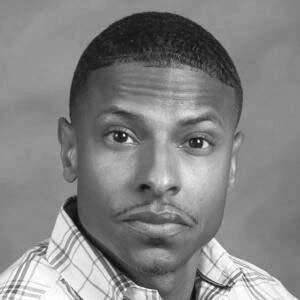
“We did not post this position this time,” Johnson said. “Dr. Williams actually applied for this job a few years back. He’s a really highly regarded member of our team here at OPRF and has been for a long time.”
Johnson, who is looking for stability in this position, said that it is highly advantageous that Williams knows the school well.
of roles for several years and he has done an outstanding job.”
In a press release announcing his hire, Williams said his work as the interim equity director over the last six months has been gratifying.
“It has been gratifying to see how this work reaches into our daily interactions and practices within our various learning spaces throughout the institution,” Williams said. “The challenge has been in creating and finding the time to visit all of the various spaces where great learning experiences are being cultivated. This is a work in progress!”
Williams has worked at OPRF since 2008 when he was hired to be a teaching assistant. In 2015 he became a transition specialist in
“It absolutely played an enormous part of the thinking,” Johnson said. “It was an enormous factor that he knows this building. He has been in this district in a variety
was quoted as saying. “It has been gratifying to eng age with colleagues through equity-focused conversation, planning, and reflection that enables us to consider how we can position ourselves for personal and professional growth that has positive impacts upon each and every student.”
“I have a passion for assisting people to develop into their best selves.”
LEE
WILLIAMS Executive director of equity and student success
According to the press release Williams’s goals include focusing on the transition of middle school students to the high school, expanding equity-focused professional development and practices for all staf f, and developing a more intentional approach to parent engagement.
“I have a passion for assisting people to develop into their best selves,” Williams
Williams earned a doctorate of education, organizational leadership, and development from Cornerstone University, which is a Christian university located in Grand Rapids, Michigan. His dissertation, based on his interest in professional practice and human engagement, is entitled “Professional Practice Engineering: An Investigation Into the Critical Factors of Professional Instruction That Influence Employee Engagement.” He also has an MBA and a Master’s of Education in Instructional Design from Wester n Gover nors University which is an online university. Williams earned his bachelor’s degree in human resource management and development from Michigan State.
By BRENDAN HEFFERNAN Staff Reporter
Oak Park leaders voted to provide over $70,000 in village funds to three charities which declined to accept federal community development grants over a new immigrationrelated provision.
Each year, Oak Park disperses U.S. Department of Housing and Urban Development Community Development Block Grant funds to local community organizations. The village identified nine local charities supporting a variety of causes for 2025’s round of grant funding, but three service organizations ul-
timately refused to accept the funds because of new federal grant program rules related to immigration, according to village documents
Federal guidelines now require that individual clients benefiting from the CDBG funds be verified as U.S. Citizens with the Department of Homeland Security’s SAVE immigration status verification tool.
On Jan. 15, Oak Park officials reportedly met with local grant recipient organizations to go over the new federal requirements before the grant agreements were signed. Following that meeting, three groups — youth mentoring charity YEMBA, Hephzibah Chil-
dren’s Association and the Infant Welfare Society Children’s Clinic —opted not to sign the grant agreements over the immigration rule, according to village staff.
“They were not aware when they applied for those agreements and when we awarded those funds that those requirements would be in place,” said Jonathan Burch, Oak Park’s neighborhood services director. “We envision this as a one-time allocation, because grantees should be aware of this going into next year.”
In lieu of the charities signing the federal grant agreements, the village is providing the three charities with grants straight from Oak
Park’s existing fund balance. Oak Park’s village board approved the alternative funding approach unanimously, voting on it nearly five hours into a March 10 board meeting Hephzibah Children’s Association will receive $30,000 in village funds, while YEMBA will receive $20,000 and the Infant Welfare Society Children’s Clinic will receive $20,161, according to village documents.
Trustee Brian Straw criticized the federal change as an “overstep” meant to put more pressure on immigrant communities amid DHS’ ongoing mass deportation efforts. He said the village should look to use village funds to support service organizations like


Oak Park Trustee Brian Straw is set to go before a jury on federal conspiracy charges on May 27, without two of his original codefendants
By BRENDAN HEFFERNAN Staff Reporter
Oak Park Village Trustee Brian Straw will go to trial on federal conspiracy charges in May, but now as one of four defendants, rather than the so-called “Broadview Six.”
Federal prosecutors filed a motion Thursday afternoon dropping charges against two of Straw’s five co-defendants in the federal felony conspiracy case stemming from alle ged illegal actions at a protest at the Broadview ICE detention facility last September. The morning after, counsel for Straw and the remaining defendants filed a motion seeking to compel prosecutors to provide discovery materials that could show “improper influence” on the prosecution from federal officials, arguing that the defendants were targeted for their public criticism of President Donald Trump’s administration.
The government dropped the conspiracy charges against Catherine “Cat” Shar p, a Chicago aldermanic staffer who dropped her bid for the Cook County board citing the stress of the prosecution, and Joselyn Walsh, a local musician who was the only defendant in the case that doesn’t have a job in local progressive politics. On Friday morning, defense counsel filed a motion asking Judge Perry to compel the prosecutors to provide discovery materials to support the defense’s motion to have the case thrown out on first amendment and selective prosecution grounds. In addition to asking for discovery related to agent training, the defense is asking for “records and communications relating to any improper
influence exerted upon the U.S. Attorney’s Office in the Northern District of Illinois” that could have contributed to the defendants being charged.
“The public record is re plete with public admissions re garding the weaponization of the Department of Justice and federal courts to retaliate against perceived political enemies and those that oppose its agendas, as reflected in federal cour t dockets, from administration officials’ own mouths,” attor ney’s wrote in the motion. “Since Watergate, there had been a strong norm that the White House would not and did not direct specific targets, investigations or criminal cases. T here is prima facie evidence that the Trump White House has re peatedly crossed that line and that it did so in this case in going after its ‘enemies.’”
“The one commonality among these four defendants is that via social media platfor ms and public statements they were all outspoken critics of the Trump Administration. They all specifically vocalized their criticism of Operation Midway Blitz and the violence perpetrated by federal agents at the Broadview Facility and elsewhere. Perhaps most salient, all four defendants who remain charged in this case are Democrats who either hold public of fice, is a candidate for public office, or works for the Democratic Congressional campaign.”
The defense’s motion included an image of a large banner recently hung over the DOJ headquarters in Washington D.C. that features Trump’s face and the phrase “Make America Safe Again,” according to court records.
The indictment alle ged that the six were among a crowd of protestors who blocked, pushed against and banged on a vehicle being driven by a federal agent into ICE’s Broadview Detention Facility the morning of Sept. 26. The prosecution said a side mirror and a windshield wiper on the agent’s vehicle was damaged in the incident and the car was vandalized, but none of the indicted individuals are alle ged to have directly caused the damage

Prosecutors recently ag reed to drop a part of the indictment that alle ged that Straw and the others had plans to injure a federal officer.
Assistant U.S. Attorney William Hogan wrote in Thursday’s motion dropping charges against Sharp and Walsh that, “as the United States attorney’s office does in every case, the government has continued to evaluate new facts, evidence, and information to ensure that the interests of justice are served.
“Accordingly, the United States hereby moves to dismiss with prejudice the indictment against Catherine Sharp and Joselyn Walsh, in the interests of justice,” he wrote
These moves come after the original lead prosecutor in the case, Sheri Mecklenburg, withdrew from the prosecution on Feb. 13, according to court records. The next hearing in the case is set for March 31.
It also follows targeted challenges by defense counsel over recent months about validity of the prosecution’s conspiracy alle gation and evidence, as prosecutors have acknowledged they do not have evidence that the codefendants coordinated prior to the protest or that they knew each other prior to the day. The prosecution is alleging that they broke the law by way of a “spontaneous conspiracy.”
Still charged are Straw, 9th District U.S. Congressional hopeful Katherine “Kat” Abughazaleh, 45th ward Democratic committeeman Michael Rabbit and Andre Martin, who works on Abughazaleh’s campaign staf f. The trial is set for Tuesday, May
26 before U.S. Judge April Perry. Straw’s attorney Chris Parente commented on Sharp and Walsh being dropped from the case Thursday evening, saying that the move puts the entire case into further doubt.
“By continuing this baseless prosecution, the government is heading down a dangerous path towards upending the First Amendment and severely limiting the constitutionally protected freedoms of expression and assembly,” Parente said in a statement provided to Wednesday Journal. “If after six months of investigation, the government cannot be sure who is an actual co-conspirator of this alle ged mythical ‘spontaneous conspiracy,’ how can they expect to ultimately convince a jury of these ridiculous charges?”
“I am gravely concerned by what appears to be an intensification of the government’s desire to selectively prosecute public officials and political figures in this case. The remaining co-defendants all have publicly known government and political positions. My client did nothing wrong. And while I am confident we will prevail in court, we all should be troubled by the potential chilling effect this prosecution has on public servants nationwide.”
The so-called “Broadview Six” are among 32 known defendants to have been charged with nonimmigration crimes tied to Operation Midway Blitz in Chicago’s federal court. Many of those cases fell apar t before reaching trial and the lone case which has reached a jury trial ended with an acquittal, according to the Chicago Sun-Times.
By BOB SKOLNIK Contributing Reporter
After deciding he was no longer needed Grif f Powell has resigned his $1,500 a day position as co-interim superintendent at Oak Park’s District 97 elementary schools. Powell had been working only one day a week since January after for mer co-interim superintendent Patricia Wer net resigned because of health reasons and Patrick Robinson, the district’s assistant superintendent of elementary schools, was appointed co-interim superintendent.
Now that District 97 has hired its new permanent superintendent, Terri Bresnahan, who will officially begin work in the district on July 1, Powell, 79, decided his role was no longer necessary.
“Once I met with her and did some transition I thought it was time to leave. They don’t need three superintendents,” Powell told Wednesday Jour nal in a telephone interview. “She’s going to be spending time in the district. I don’t believe in taking money from a district unless they really need me. I also feel very comfortable with Patrick Robinson be-
Concern over spending
from page 1
the March 24 school board meeting
Although 15 to 27 positions will be eliminated, Assistant Superintendent for Human Resources and Equity Natacia Campbell Tominov told the school board at its March 10 meeting that ultimately only three to 15 staff members will be laid off.
“We’re trying to staff as efficiently as possible,” Tominov told the school board.
ing there to me it
not needed anymore; it was just that simple Robinson will ser perintendent until Bresnahan takes July 1.
Robinson said him. “It was definitely a or to ha and just to be him in different situations
Amanda Siegfried, the district’s communi cation person, said of Powell, “I think for me Griff was just very steady and that, I think, came from more than 50 years of experience. He made things easier to navigate.”

Gri Powell at a D97 school board meeting in September.
Powell’s resignation appears to mark the end of a 58-year career in education which began when he was hired to be a math teacher and wrestling coach at Lake Zurich High School in January 1968. He went on to teach math at North Niles High School before becoming a dean at Niles West High School and then a principal at Stevenson High School. Powell later served as a superintendent in five school districts, four in the Chicago suburbs and one in New York, before retiring as
Reductions in force, known as RIF’s, are common in school districts but have not been done in District 97 in more than a decade. Ultimately many teachers who receive a RIF notice are ultimately rehired as other teachers leave and staffing decisions and enrollment numbers are finalized.
“It’s something that most districts do almost every year because, again, they are reviewing their staffing needs based on their students,” Tominov said.
Some classes in the two middle schools have been r unning with single digit enrollments, some with three, or five or six students
“This would allow us to balance out our
during the 2021-2022 school y
But Powell said that this is it for him.
“I don’t think there is anybody in their 80’s doing what I’m doing,” Powell said. “To me I have to give 100% at all times and I’m worn out after a long day in the district. To me it feels like the right time to say goodbye to an enjoyable career.”
Powell said he waited to leave until he completed evaluations all of District 97’s central office staf f. He said he believed he and Wernet brought some stability to the district after for mer superintendent Ushma Shah abruptly and unexpectedly resigned in August just one week before the start of the new school year.
class sizes across all of our areas including our specials and electives,” Tominov said.
Tominov said the district would increase staffing in special education but a few sections in elementary schools would be eliminated next year
“Over the last five years we have been allocating staff based on the needs of our elementary schools,” Tominov told the school board. “However in our middle schools we have been rolling over staff from year to year even with schedule changes.”
Tominov said the layoffs would distance the district from projected deficit spending in fiscal year 2029.
Tominov said staffing cuts could also in-
the community members, people felt comfortable,” Powell said. “We provided some stability during the transition.”
In a statement sent to parents the District 97 school board thanked Powell for his service.
“The board is deeply grateful that he chose to serve District 97 not once, but twice, during pivotal moments for our schools and community,” the statement said. “We are equally grateful to Dr. Patricia Wer net, who worked with Dr. Powell to support the district during important periods of transition. Their steady leadership, experience, and care helped guide our work and support continued progress across the district.”
clude administrators.
“It also includes admin because we are not just looking at our staff in our buildings, but we’re also looking at the organization as a whole,” Tominov said.
RIF notices are required by law to be sent out at least 45 days before the end of the school year. Teachers are called back after being RIF’ed in order of seniority. Tominov said many teachers who receive RIF notices will be eventually called back and offered new positions
Enrollment has declined by nearly 10 percent over the last decade in District 97. In 2017 6,146 students were enrolled in District 97 compared to approximately 5,560 this year.


from page 1
blocks that also have single-family homes
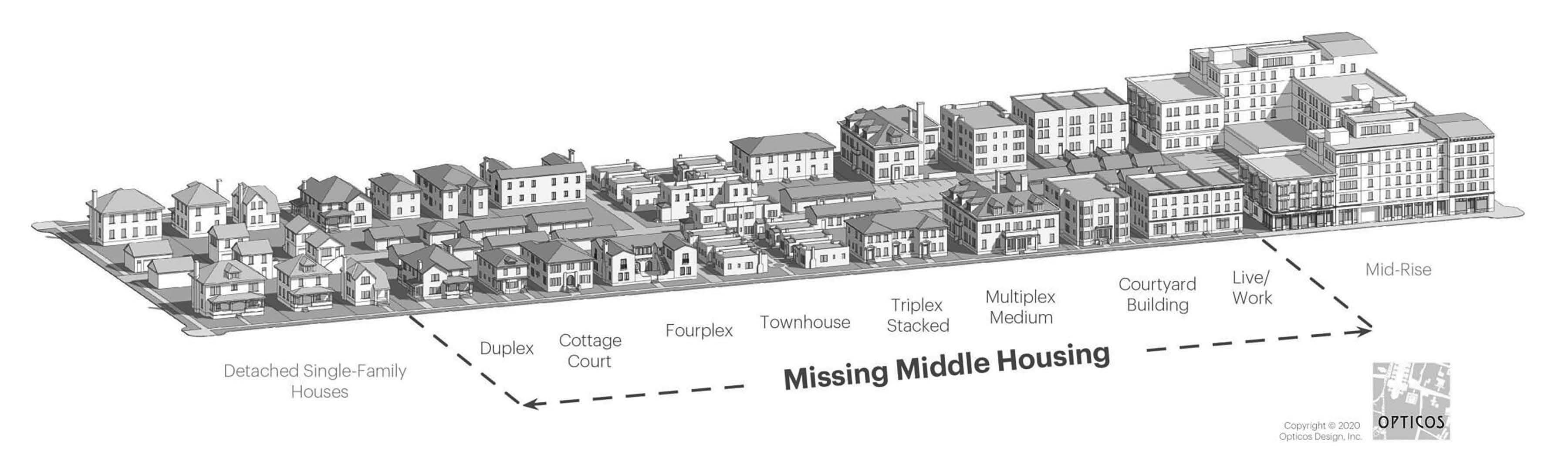
Oak Park’s village board voted last August to award a contract to Opticos Design, an architectural firm specialized in zoning reform, to study eliminating Oak Park’s singlefamily zones from the code.
“Right now, the zoning is very clearly working against your affordability goals,” said Opticos’ Jennifer Settle, herself an Oak Park resident. “So, while zoning can’t solve all of those issues, it is setting the stage, and it is moving in the right direction of all those other goals and work that needs to be done.”
The village board is expected to vote on accepting a final version of the report in June. If accepted, the report would guide how Oak Park goes about the zoning reform
The consultant group’s plan for the “Shape Oak Park” report project has included a community-wide education and awareness campaign with surveys, engagement with a “steering committee” of 12 village residents, community education events and an analysis of resident feedback and existing housing stock.
These local efforts come amid a statewide push for housing reform, with major potential changes to local zoning control teased by Gov. JB Pritzker during his State of the State address last month. Pritzker’s plan, dubbed Building Up Illinois Developments or “BUILD,” calls for relaxed restrictions on the development of multi-unit housing and cutting other for ms of local red tape that have
slowed homebuilding in recent years, according to Capitol News Illinois.
A study published last year by the University of Illinois found that the state is about 142,000 units of housing short and would need to build 227,000 over the next five years to keep up with demand, nearly double the five-year average of about 19,000 built annually between 2019 and 2024, according to Capitol News Illinois.
Trustee Derek Eder voiced support for the rezoning efforts saying the refor ms are necessary for Oak Park to keep new families moving into the village. If the village lacks housing that’s in reach for young families, the strong schools that the village prides itself on will struggle, he said.
“There’s the cost of doing nothing that people oftentimes don’t really account for in the same way as they think about the cost of acting,” Eder said. “If we don’t make housing more affordable, one of the most important parts of this community, the schools and the kids and the new families that keep moving here starts to slow down and come to a halt.”
Trustee Cory Wesely, among the most outspoken advocates for getting rid of the singlefamily zones on the village board, said that the plan for reforming the code needs to get more focused to be effective.
“If this is a change without a North Star, it’s a change that will have no impact,” he said. “We need to figure out what we’re actually trying to do. Are we trying to encourage more housing units? If that’s the case, right, that will obviously encourage more affordable housing units, right? Because supply creates affordability. If we’re just trying to do an equity fix, that’s fine, but then show what this change does to actually create the impact that creates the equity fix. What I’m feeling
right now is that we’re painting the existing zoning code with different colors.”
Trustee Jim Taglia stood out as a cautious voice on the planned zoning reform altogether. He expressed concern that the refor ms could endanger the availability of affordable single-family homes in the village as developers look to convert single-family residences into multifamily rentals
“I don’t know what the answer is, or how you address this, if it is addressable, but my concern is that we are depleting that entry level housing stock for the first time home buyers,” he said. “Part of the American landscape is the ability to buy a house, build equity and over time and reap the benefits of that. That is just part of our fabric
“I don’t see how this doesn’t increase the value of those homes. We already have AirBnbs coming in, buying up homes, now we’ve got another tier of potential buyers that are competing against first time homeowners, and that’s a concer n for me.”
Oak Park Village President Vicki Scaman was the only mayor present for a roundtable discussion with Pritzker about the plan shortly after the State of the State address
She said she’s strongly in favor of the statewide development reform Tuesday night. The ef for ts that Oak Park is making to address the perceived flaws in its zoning code could serve as an example of how Illinois communities can approach making ambitious housing refor ms that still make sense in their local contexts, Scaman said.
“I am a full proponent of the BUILD act, while some of my colleagues might think that it takes power away from mayors, village presidents and communities, I think it provides the tools so that they can actually have a vision for their communities,” she
said. “This report represents us truly understanding the decisions we’re eventually going to make. We might make decisions to make the zoning even more brave, more intentional to our board goals than what (Opticos) present, but you’re going to help us understand what we can reasonably accomplish and the potential consequences without thoughtful patience. If we make the decision to go broader, that’s on us.”
Oak Park would be le gally required to hold public hearings about the zoning changes before actually amending the code. In addition to the use restrictions in the zoning code itself, the consultants identified existing village rules around building and lot sizes, accessory dwelling units, parking and landscaping requirements and design standards as barriers to missing middle housing development in Oak Park, according to the consultant’s re port
While plenty of examples of missing middle housing can already be found in Oak Park neighborhoods, particularly on the south side of the village where duplexes are common, many of those buildings wouldn’t be allowed to be built today under the current code. A zoning reform would allow, likely over a long period of time, for many more small multi-family housing types to be built where they’ll fit the “character and context” of Oak Park’s leafy residential streets, said Settle.
Market factors also discourage missing middle housing development, Settle said. The village would likely need to offer incentives to developers to see small multi-family developments built in-place of large singlefamily homes in Oak Park neighborhoods.
“They are hard to make pencil in today’s market,” Settle said.











By BRENDAN HEFFERNAN Staff Reporter
Oak Park police made arrests in connection with several battery incidents last week.




Oak Park police are investigating re ports that a man was robbed at gun point last week.


Police arrested a 27-year-old Chicago man on aggravated battery charges for alle gedly attacking a nurse at West Suburban Medical Center just after 11:40 p.m. on Tuesday, March 10, according to police




A Chicago man was walking in the 700 block ofMadison Street at 10:20 a.m. Friday, March 13 when a man approached him, pulled a handgun and demanded the victim’s phone and money. The victim turned over his property, and the suspect fled on foot, according to police.
The stolen property is valued at $800, according to police.
Oak Park police are investigating a violent incident re ported at a restaurant in the 700 block ofNorth Harlem Avenue at 10:10 p.m. Friday, March 13, according to police.
A man and a woman re por tedly entered a restaurant together before the man began yelling at restaurant staf f about getting his order right and “threatened to shoot the place up.” The man then approached a restaurant worker and slapped them across the face, according to police.
The man and woman then fled south on Harlem Avenue away from the restaurant.
Police arrested a 44-year-old Northlake man on two counts of domestic battery on Friday, March 13. in connection with reported attacks on two Oak Park residents, according to police.
Police also arrested a 26-year-old Chicago man on battery charges at 7 p.m. Tuesday, March 10 in connection with a re ported attack on another Chicago resident in the 7100 block ofNorth Avenue, according to police.
These items were obtained from Oak Park’s Police Department reports dated March 10–15 and represent a portion ofthe incidents to which police responded. Anyone named in these reports has only been charged with a crime and cases have not yet been adjudicated. We report the race ofa suspect only when a serious crime has been committed, the suspect is still at large, and police have provided us with a detailed a description of the suspect as they seek the public’s help in making an arrest.
By RISÉ SANDERS-WEIR Eats Reporter
Maywood resident and Sugar Fixe baker Edgar Ki has loved baking and cakes for as long as he can remember.
“My grandma used to make an orange cake, and I really fell in love with it,” Ki said. “I loved watching her go through the process. It spur red my own dreams of wanting to bake cakes and design them myself.”
And there was something else that struck a chord with Ki and baking.
Then Ki spotted T he Greatest Baker contest.
“I saw an advertisement about it on social media and I ke pt seeing it. It was saying you could win $10,000,” Ki said.
He investigated to make sure it was legit.
He also saw that the owner of Carlo’s Bakery, Buddy Valastro was involved.

“The thing that’s really inspirational for me, as a deaf person, is that communication can sometimes be hard because I feel like I can’t connect with the hearing world in the same way that others do,” he said. “But when I’m baking, it’s something that I can just do with my hands, and it doesn’t require communication. I can express myself through my baking, and th at ’s wh at I really love about it.”
Ki g ot his professional start at Oak Pa rk ’s Su ga r Fixé ba ke ry. He was hired as a dishwasher, but he let his desire to work as a baker be known early on.
“I quickly realized that he is passionate about decorative work,” Sugar Fixé Chef Emma Marvel Petergal said. “He has an artistic eye.”
“When I was a kid, I used to watch TV and videos about cake design and stuf f like that. And Valastro is a very well-known person in that field,” Ki said. “I saw that he was a part of it and you’d get to meet him and take a picture with him. I was so excited.”
The online competition involved cooking items that were voted on. His instructors, fellow students and community got behind him.
“I thought he was going to win,” Marvel Petergal. “He has an incredible work ethic and he’s just like kind of the sweetest pride to be around.”

To reach that g oal, Ki also enrolled in T riton C olle ge ’s Hospitality Industry Administration pr ogr am. He excelled there too
“It’s never just the class assignment for him,” department chair Christoper Clem said. “He’s not gonna just settle for anything, he’s always looking for the next element of excellence.”
Ki made it to the quarter finals.
“And then I found out that he didn’t share with us that he placed so high, because I think he felt that wasn’t good enough,” Clem said.
“I was like, come on, it was against 300 people.”
Even though he didn’t win the cash or meet with cake boss Valastro, Ki is still pursuing his passion. Among other things at Sugar Fixé, he makes the decorated sugar cookies.
“For Christmas, for Halloween, for Valentine’s Day, I’m the one who does the designs,” Ki said. “I like to put funny little designs on them as well. That’s something I really enjoy.”
“I just like let him have the reins,” said Petergal. “Whatever cookies he wants to bake, whatever shapes, whatever designs.


He knocks them out of the park every time.”
As for his future, Ki said, “I wanted to travel to France to learn more skills at École Nationale Supérieure de Pâtisserie
and the Asian area to learn my skills. Travel to any country to learn their new desserts, bread, etc. from famous dessert shops all over the world.”





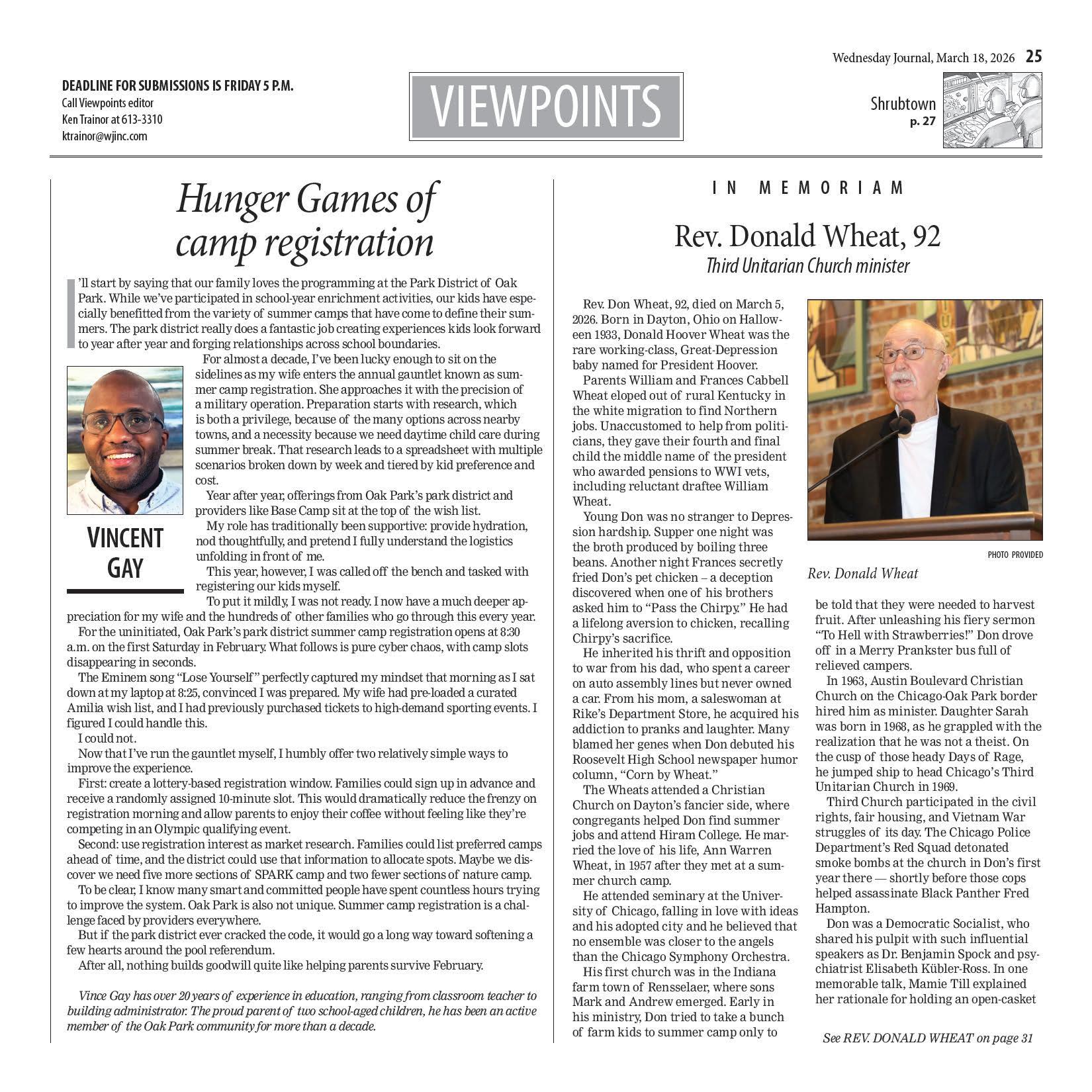
he mix of housing stock in Oak Park has always been one of its strengths. Beyond there being big houses and smaller houses, when you get south of Chicago Avenue there is a long-built mix of single-family homes and concentrations of multi-family buildings on Austin, Harlem, Lake, Washington, Harrison and Roosevelt. More than that though are the sprinklings of two-flats and four-unit apartment buildings you find on many or most blocks across the village
Long-accepted, heck, they were built a century ago, these structures are fully integrated into Oak Park’s built view. They add housing options at a more affordable cost and give the village what is left of its economic diversity and add to its character. For us that is the starting point for the worthy conversation now underway to reshape Oak Park’s zoning code to effectively eliminate our exclusionary single-family zoning
This is a positive and necessary change but it is not in any way a full reimagining of what the village will look like going forward. It opens up new possibilities of gradually adding more “missing middle” housing options whether those are townhouses, two-flats, coach houses or somewhat more dense additions such as a five-story apartment building on a commercial corner such as Ridgeland and Chicago. That solid project was inexplicably turned away by the village recently.
Yes, we’re all in on the housing theories that exclusively single-family zoning is an effective and destructive way to limit racial diversity. Face it, virtually all housing dictums in America were designed to limit where Black and Brown people could buy and feel welcomed Oak Park, through the thoughtful SHAPE process being led by Village President Vicki Scaman, is moving steadily toward a bold change in our zoning. We’re ready.
Oak Park and River Forest High School has made a conscious effort over the past decade to nurture a crop of “homegrown” teachers. These are young people who came up through OPRF and chose to become teachers. The school has kept its lines of communication open for these early career teachers and worked to bring them home to OPRF.
The theory is that these young teachers already have a sense of the culture and complexities of the school and will adapt and lead successfully, stay longer and bring in more recruits
That theory, which we’ve long admired, is now wisely being applied to the promotion of Dr. Lee Williams to be the school’s new top equity and student success leader. Here’s a person who came into OPRF in 2008 and has steadily earned respect, made connections through a wide range of posts, often related to equity.
Since the equity post was created just a few years ago, the revolving door has spun with seemingly qualified outside experts. Williams’ promotion is an opportunity to find out just what this job can accomplish if someone stayed for more than a year
We wish him great success
In honor of Rev. Donald Wheat, who died on March 5 at the age of 92 I thought I would reprint a column I wrote about him in December of 2020:
Ijust finished a remarkable book, Why Not Me? Finessing Life and Ar rows, a collection of sermons by Rev. Donald Wheat, who presided and preached at Third Unitarian Church in Chicago’s Austin neighbo hood from 1969 to 1996. His sermons will challenge you if you believ God, but that didn’t prevent him from quoting the Bible on a re gular basi

In fact, he confesses to being “a Christian from the neck down.” He describes himself as a “religious humanist,” and if you think that’s a contradiction in terms, read this book. In an indifferent universe, he insists, we have that much more incentive to come together, bear each other’s burdens, live a happy life, and strive to create a better world. He believes in human agency.
His sermons take aim at illusions. He is funny, provocative, informative, but never ar ro gant, preaching without being “preachy.” He doesn’t expect everyone — or anyone — to ag ree with him, except perhaps in his contention that none of us should take refuge in comfort faith and call it “truth.” He wants us, in other words, to follow the biblical injunction to “separate the wheat from the chaf f.” As a preacher, Don Wheat was aptly named. In fact, he missed a golden opportunity for the perfect promotional blurb on the back cover of his book: “All Wheat, No Chaf f.”
In one sermon, delivered in 1987, titled, “A Famine of the Worst Kind,” he quotes the Old Testament prophet Amos, famous for the line cited by Martin Luther King Jr.: “Let justice roll down like waters and righteousness like an ever-flowing stream.”
But Wheat is more interested in a different Amos prophecy:
“Behold the days are coming that I will send a famine on the land. Not a famine of bread, nor a thirst for water, but of hearing the words of the Lord. They shall wander from sea to sea, and from north to east; they shall run to and fro, seeking the word of the Lord, but shall not find it.”
That predicament, he said, afflicted America in 1987. It applies even more to America today Wheat defines “the word of the Lord” as “whatever inspires you, whatever gives you sustenance,” whether you find it in the Bible, poetry and song, great speeches from the past, even newspaper opinion columns.
His quote from Chicago-born playwright David Mamet is especially relevant: “Who is going to
speak for the American spirit? For the human spirit? Who is capable of being heard, of being accepted, of being d? Only that person who speaks without ulterior motive, without hope in, without even the desire to with only the desire to create.”
He also quotes Flora Lewis from a rk Times op-ed piece: “Faith is necessary and ir re pressible. But without a message of wisdom and humility in human af fairs, it can turn vicious.” It certainly has turned vicious. What need, therefore, going forward, is not “truth” so much as wisdom, tempered by humility.
At this juncture, we would do well to turn to a secular saint and truth seeker, Abraham Lincoln, for guidance. I recently engaged in a lengthy back-and-forth with a conservative friend via email and the only thing we could ag ree on was Lincoln, in particular: “malice toward none, charity toward all” and “the better angels of our nature.” This is our common ground, dialogue’s starting point.
Lincoln reached out to his polarized opposites in 1861. They did not reciprocate, yet reaching out was the right thing — “with malice toward none, with charity for all, with firmness in our ability to see the right,” recognizing the limitations of our grasp of “the truth.” Wisdom, balanced by humility.
We will succeed only if our exchanges with one another pass the “angels” test: Does it reflect “the better angels of our nature” or our “lesser” angels?
A large percentage of Trump supporters identify as followers of Jesus Christ, who said, “Love your enemies. Do good to those who hate you.”
We need to say to one another: “If I am your enemy, then love me, and I will try to do the same.” What we need now is wisdom, not “truth;” charity, not malice. With those Lincolnesque notions in hand, we can move forward, rehumanizing those we have dehumanized.
Every day, I try to ask myself four questions: Am I living on the side of malice or of charity toward all?
Are my better angels or my lesser angels showing?
Am I humanizing those with whom I disagree?
How will I love my enemy?
In his 1987 sermon, Don Wheat put the challenge to his cong re gation this way: “Let us be carriers of the word that speaks to the needs and condition of others. And let us hope — no, let us pray — that someone shall bring us that word in our hour of need.”


When people ask why I volunteer to help immig rant clients through Oak Park’s Pro Bono Network, the answer is simple: helping others is why I became an attorney in the first place. Giving my professional time to immigrant clients not only helps a vulnerable population, but the work is incredibly impactful and rewarding. Working with immigrant clients is about meeting people where they are in life, in moments of deep uncertainty, and helping them navigate complex leg al requirements so they are able to move forward with more confidence and support.
The individuals and families I meet are part of the fabric of our communities. They are parents working hard to support their children, neighbors building new lives, and people who care deeply about stability and oppor tunity. Sitting down with them, hearing their stories, and helping them navigate a system that can be difficult to understand is both humbling and inspiring.
What strikes me most is my clients’ resilience. Many of the people seeking help are balancing work, family responsibilities, and the challenge of lear ning a new system all at
once. Yet they show an incredible determination to create a better future for themselves and their loved ones.
Volunteering in this space also reminds me how powerful a small act of support can be. Often the most meaningful thing an attorney can offer is time: listening carefully, answering questions, and helping someone feel seen during a stressful and uncertain process.
If you are interested in lear ning more about the experiences of volunteer attorneys and the ways in which our community supports access to justice, I invite you to join Pro Bono Network’s Justice Talks Lunch & Learn on March 26, from 12 to 1:30 p.m. This event will be held at the Oak Park Public Library’s Main Branch on Lake Street, and we will hear from four Pro Bono Network volunteer attorneys, sharing their stories firsthand and explaining how people across our community are coming together to help one another. The event includes lunch and is free of charge, but does require an RSVP: https://www.pbnetwork.org/ justice-talks
Laura Hardwicke River Forest
I’m writing in support of Beverly Tuck’s stand on school vouchers for the local chapter of the League of Women Voters. She quotes the Illinois League president’s warning: “School vouchers will spend our public dollars in ways that are not transparent, and voucher programs lack the accountability and oversight provided by public schools.” Bravo for emphasizing transparency because that point often gets lost in the broader debate.
My concerns come from personal experience. When my children were young and we lived in Chicago, I volunteered for my daughter’s Protestant parochial school finance committee. I was the first non-church member included — and probably the last. I served when the state was close to passing a voucher law. On that committee I watched an unnecessary tuition increase being planned to take advantage of the expected new funding. The additional revenue was also intended to offset the church’s traditional support for the school so that the saved money could be redirected to the pastor’s pet mission of printing tracts to distribute to children and neighbors condemning and ostracizing Mor mons
In an unusual moment of religious cooperation, our school also worked with neighboring
Catholic schools to ensure that all would raise tuition by the same amount, minimizing student transfers between them. My objections were brushed aside by the rest of the committee, but the experience left a lasting impression: religious institutions need as much oversight — if not more — as gover nment. Price fixing, gouging, creative accounting — surely not from religious institutions? I was amazed that no one seemed to see the problem. Yet I could clearly see how my taxes might soon help finance actions I strongly disagreed with.
Private schools and churches are still run by humans, so no one should be surprised that there can be misuse of funds, anti-competitive behavior, and troubling outcomes. Education is already struggling with tax accountability; let’s not make it worse. I doubt many voucher advocates would support the level of re gulation necessary to protect taxpayer money. If people object to gover nment regulating churches or private schools, that’s understandable — but in retur n, those institutions should remain truly private and not receive direct or indirect public funding.
Kurt Hedlund Oak Park
I am writing in response to the ar ticle titled “Oak Park considers down payment assistance for firsttime home buyers,” published in your newspaper on March 4. There are many reasons this should be adopted in Oak Park and River Forest. First, it could help the younger crowd get into the Oak Park and River Forest area. The median age in Oak Park is around 40 years old, according to the U.S. Census Bureau. The Oak Park and River Forest area needs to find a way to welcome younger residents, as the towns continue to develop and appeal to younger folks with downtown additions and park district grants and additions
The Oak Pa rk and River Forest High School newspaper, “The Trape ze,” ran “A Case for Re parations.” While this would not be re parations per se, it would be a chance to help those who have been historically disadvantaged get a place to live in Oak Park or River Forest. As the article states, the median house costs $550,000 in the neighborhood where a younger crowd might live
It’s known that white folks are given more money on the dollar for the same job compared to those of color, so down-payment assistance would help younger couples and individuals with their first home.
The Oak Pa rk community thrives from the diverse community it holds within, from Lincoln Elementary School and its Spanish Immersion Program to the numerous murals painted throughout the community. From Al’s Grill in Oak Park, which seems to have been there forever, to the new Pure Green juice shop on Lake Street, there is something for everyone, old and young in Oak Park and River Forest, allowing more people to experience it. This community could thrive even louder with more additions to its population, including young and old, Black and white, English-speaking and non-English-speaking. What keeps us together is the community that Oak Park and River Forest builds
Small villages are not noted for effective government. We in River Forest are a happy exception, with an obviously energetic Village President Cathy Adduci. The village has a green alley program, mostly funded by the Metropolitan Water District that uses per meable pavers to help stop storm water runof f. The pavers are bricks that sink over the years particularly in alleys like ours that service many apartment buildings. When the sinking bricks produced a 3-inch gap, I dropped a note to Cathy, who I got to know (only by email) during the COVID crisis. I was pleased but not surprised to get a response in an hour or two, as I had years ago in a more serious context. What did surprise me was a response from Jack Bielak, director Public Works giving a many-page engineering discussion of the issue! What was beyond surprising was the

arrival of a work crew a few days later to actually do the work! We in River Forest are blessed with the best.
Bob Eisenberg River Forest
Response to “Development, tax relief in River Forest” (Viewpoints, March 3):
Jessica Spencer’s letter presents the proposed River Forest Madison Street development as a meaningful tool for reducing residents’ tax burden. Those claims warrant scrutiny before the community accepts the project as fiscally prudent or beneficial.
While expanding the tax base is theoretically helpful, the letter omits the substantial sunk costs already invested in this parcel: acquisition, demolition, remediation, and years of marketing by multiple real estate and PR firms. Without a transparent accounting of those expenditures, residents cannot assess whether the projected $600,000 in annual revenue meaningfully offsets prior taxpayer investment.
The letter also notes that the village levy represents only 12% of a property tax bill yet suggests this development will “moderate” taxes. If the village controls such a small portion of the overall bill, even optimistic projections would have minimal impact on homeowners’ actual tax payment. The largest taxing bodies, the school districts, will continue to determine the majority of residents’ tax burden.
The argument that development opportunities are rare should invite greater scrutiny, not less. Because parcels like the for mer LCFS site are limited, the village must ensure the project represents the best possible use, not merely an acceptable one. Residents have consistently
As a longtime advocate of capping the Ike, which sadly never came to fruition, I’m pleased to see Ike-spanning proposals that include an element of partially using the airspace. Because the park system is so stressed, it would be great to have some adult-oriented recreation opportunities so that, for example, softball isn’t rele gated to the wee hours in order not to diminish youth programming. Maybe a little adult-oriented food and beverage could be worked into the mix. Federal approval would be a piece of cake – just name it after our beloved President. The Donald J. Trump Bellyacher and Whine Bar comes to mind.
Bob Stigger Oak Park
raised legitimate concerns about density, traffic, parking spillover, infrastructure capacity, and neighborhood impact.
While the Sheridan (now Sunrise) project in River Forest eventually exceeded early projections, one favorable example does not guarantee future results. In fact, Sunrise’s net tax contribution has declined following reassessment and tax appeals (https://www.cookcountyassessoril.gov/riverforest-2023-commercial). Market conditions, Cook County assessments, and longter m occupancy trends remain unpredictable. Revenue projections offered without methodology, assumptions, or risk analysis should not be treated as settled fact.
Finally, the repeated suggestion that this project will ease the long-term tax burden is unrealistic. Even if the $600,000 estimate proves accurate, that revenue would be distributed across multiple taxing bodies. No homeowner will see a perceptible reduction in their bill. What residents will experience are the permanent physical and infrastructure impacts of the development itself.
River Forest residents are not anti-development; we are pro-smart development. Before moving forward, the village owes the community a full cost-benefit analysis, comparison of alternatives, and genuine two-way engagement, not cursory open-house style drop-in sessions.
Deborah Borman River Forest
I have given some thought to whether I should comment on the proposed tower planned for the rear of the Boulevard Arcade building on South Boulevard (The Boulevard Arcade Homes).
My hesitation is that my wife and I moved from Oak Park last year after 38 years. We still love the village, maintain many friendships there, and continue to visit frequently. However, I recognize that decisions about its future belong primarily to current residents and their elected officials. For context, I served as an architectural design consultant to the village for 20 years, helping provide design guidance on many development projects. Some of those projects were surely liked by some residents and disliked by others — that is the nature of civic development.
Developers naturally seek to maximize the value of their projects, which is entirely reasonable. But successful developments usually balance financial goals with compatibility for neighboring properties and the broader community
A building of this size, located across a narrow 20-foot alley from single-family homes seems dif ficult to reconcile with that balance. I just think it is wrong.
If Oak Park wishes to continue allowing projects that exceed existing zoning parameters, it may be worthwhile for the village to undertake a comprehensive review of its zoning framework with broad community input. Clear, updated guidelines applied consistently could help provide both predictability for developers and reassurance for residents
Oak Park will always hold a special place for me and my family. It remains a vibrant and remarkable community, and I wish the village continued success in balancing growth with the qualities that make it unique.
Floyd
Anderson, AIA, NCARB Elmwood Park
My concern with the Boulevard proposal is primarily one of scale and location. Zoning re gulations governing height and density exist to balance different types of development and to soften transitions between larger buildings and nearby single-family homes. Taller buildings can be appropriate in certain locations, but they are typically stepped down as they approach lower-density neighborhoods.
I was stirred to write a letter by reading a newsletter from James Carville that I received in the mail, reinforced by a YouGov poll I participated in, both titled, “Are things better for you than a year ago?”
Life feels harder than before Trump. Groceries are more expensive. Energy for home heating and for industries and business up. Health care premiums rising, especially for retirees and people on fixed incomes. Obamacare price supports egre giously cut, affecting people’s health coverage Byron de la Beckwith, murderer of Medgar Evers erased from history and colonizer of the West Indies Christopher Columbus to get a statue on the White House lawn. Half of the White House torn down for a gilded ballroom. A New Jersey Tunnel rebuild held hostage to naming the Pennsylvania Train Station and Dulles Airport for Trump. Consumer protections weakened. Elimination of half of the disease-prevention, life-preserving inoculations from the recommended inoculation list that health insurances companies used to pay for. Disease epidemics, child hungers
and a new AIDS epidemic in Africa with the destruction of USAID. Seventy percent of Americans say the economy is getting worse. The undermining of the one organization that has kept peace in Europe, NATO, leading to massive cancellations of U.S. ar ms, including F-35 and F-15 EX fighters by NATO countries. Weakening of Ukranian defense against Russia and Russian threats against Poland and Finland. Powerful interests gaining influence while we little guys lose ground. A well regarded VA ICU nurse killed by ICE forces. Threats that the federal gover nment will abrogate the Constitution by ending birthright citizenship and the managing of elections by the states. This is not spin, this is what you see on ABC, NBC, CBS, and in the Chicago Tribune. And once these policies become the norm and the guardrails come down, no matter how hard we Americans work and every family doing its part, this could last for decades. What are we doing to stop this?

By MELVIN TATE
Contributing Reporter
Under the guidance of veteran coach Beth Perez, the Oak Park and River Forest High School girls’ water polo team has been consistently solid. Despite returning just five varsity players from last season’s 16-11-1 squad that lost the sectional final to York, Perez is optimistic about this spring’s fortunes
“We feel confident for the start of this season. We know that we have strong returning starters,” she said.
The returnees for the Huskies, who are 1-0 following a 15-8 victory over visiting St. Charles East, March 12, are seniors Abi Ago, Evie Hasenbalg, and Avaa Ruffer, and juniors Claire McFarlin and Yulie Wnorowska. A couple of newcomers looking to contribute are sophomore Naomi Schubkegel, a transfer from St. Ignatius, and junior Yeojun Kim who is in her second year playing the sport.
Some highlights of OPRF’s schedule are Hersey’s Girl Boss Tournament, April 11, in which all the coaches and officials of the participating schools are female; an invitational in Hudsonville, Michigan, May 1-2; and the Lincoln-Way East Quad, May 9.
Moreover, the West Suburban Silver is one of the best water polo conferences in the state, which should help OPRF prepare for the state tournament.
“Our main conference competitors are Lyons and York,” Perez said. “Both teams have been Top 10 in state in the past few years and I expect them to be strong again.”
With the lineup still a work in progress, OPRF is likely to have a few early struggles But Perez is confident the Huskies will be much better in May than they are now.
“I hope that we will grow as a team. We have
fensive zone.”
With 20.5 seconds to go in the first period, what would have been a power-play goal from the front of the net by Mulvihill to get her team back within one was waived off by the officials.
“That definitely rattled us a bit and shifted the momentum,” Mulvihill said. “But I think we showed them that we could switch the momentum back in the third period by scoring those two goals.”
“I told the team that we can only worry about things we can control,” said head coach
many solid returning players to varsity who have the capability of teaching the younger, newer players and teaching them well,” she said. “I anticipate us having a lot of fun and hopefully surprising our competition.”
The first season of Jack Wagner’s second tour of duty as head coach was rough as the Friars finished with a 3-17 record. But senior goalkeeper Regan McDonald believes things are heading in the right direction this year.
“I am feeling really confident about this season. Even though it is early, we are starting to see real progress,” she said. “Our new players are adjusting well, and the team is beginning to build strong chemistry. Everyone is working hard and we’re starting to play as a team, which makes me confident about what we can accomplish this season.”
McDonald added that practices are going more smoothly than they did at this point last year, describing it as “night and day.” She cites an increased player turnout as an important factor
“We are able to scrimmage at practice, allowing us to work on game situations and continue building our chemistry,” McDonald said. “Since it’s our second season with Coach Jack, we’re already familiar with his style of coaching and have confidence in him. This year, we’re also doing a better job of meeting his expectations.”
Fenwick is 1-1 thus far this season. The Friars defeated Whitney Young 15-11, March 10, and lost at Lyons 17-8, March 11.
Senior Valeria Monroy is back to provide leadership alongside McDonald. Newcomers looking to make an impact are juniors
Lauren Cheronis, Rose Gutier re z, and Nyah Norman, and freshmen Maya Chlo-
Mason Strom. “I’m really proud of the team that we put up a good fight and handled the momentum swings that didn’t go our way.”
Even after a slow start for the Friars, Mulvihill and Boveri saw the team continue to perform well throughout the game to keep them in it.
“The game obviously did not go as planned,” Mulvihill said. “I think the whole team is frustrated with the turnout, but we played until the end and I’m really proud of us.”
“I think we weren’ t as prepared in the

pek and Alana Diaz.
Befitting its’ status as a traditional power, the Friars generally have a tough schedule each season, and this year is no different. Non-conference matches include Stevenson, March 19; Naperville North, March 25; Whitney Young, April 4; the annual East Avenue Showdown with OPRF, April 13; and York, April 15.
Matches with Metro Catholic Aquatic Conference rivals Loyola (April 1), St. Ignatius (April 6), and Mother McAuley (April 24)
first period,” Boveri added. “They came out a little stronger and we weren’ t fully ready yet, but eventually we came together and were more prepared.”
Two of Fenwick’s four losses in the re gular season were also to New Trier, and Strom knows that they are a talented squad
will also present challenges for Fenwick. But McDonald feels she and her teammates are ready.
“The key to a successful season will be working as a team, especially on the defensive side,” McDonald said. “Our defensive strategy relies heavily on communication and trust, so it’s important that we continue building this and holding each other accountable at practice. If we are successful on defense, it will give us more opportunities to counter, get set up, and succeed on offense.”
“We talked before the game about where New Trier was going to attack us in the offensive zone, and that’s exactly what they did,” he said. “Even after we shifted our defensive plan and accounted for that, they were still able to put 4 goals in through that method.”
Fenwick, which almost couldn’t field a team this season due to not having enough players, had a very successful season overall.
“It’s a really special thing,” Mulvihill said. “Every single person on our team worked hard to be there despite our short bench every game. Even when we only had nine or 10 players, everyone still gave it their all. Everyone came together as a team all year and made it a family, and we all just worked together.”
PUBLIC NOTICE
Notice is hereby given, pursuant to “An Act in relation to the use of an Assumed Business Name in the conduct or transaction of Business in the State,” as amended, that a certification was registered by the undersigned with the County Clerk of Cook County. Registration Number: M26001367 on February 24, 2026 Under the Assumed Business Name of EFW ASSOCIATION with the business located at: 167 LINDEN AVE, OAK PARK, IL 60302. The true and real full name(s) and residence address of the owner(s)/partner(s) is: JOSHUA D. WOOD 167 LINDEN AVE OAK PARK, IL 60302, USA
Published in Wednesday Journal
March 4, 11, 18, 2026
The Board of Education, Riverside Brookfield Township School District 208, will receive sealed bids for: Bus Transportation Services (Field Trips and Athletics) for RIVERSIDE BROOKFIELD TOWNSHIP SCHOOL DISTRICT 208 160 Ridgewood Road Riverside, Illinois 60546-2408

NOTICE OF PUBLIC INFORMATION MEETING
LEGAL NOTICE
Village of Oak Park
NOTICE OF PUBLIC INFORMATION MEETING
Number: M26001358 on February 23, 2026 Under the Assumed Business Name of NEXTGEN SOCIAL with the business located at: 2312 NORTH CLIFTON AVENUE, CHICAGO, IL 60614. The true and real full name(s) and residence address of the owner(s)/partner(s) is: ANTHONY RIVECCO 2312 NORTH CLIFTON AVENUE, CHICAGO, IL 60614
Published in Wednesday Journal March 4, 11, 18, 2026
PUBLIC NOTICE
Notice is hereby given, pursuant to “An Act in relation to the use of an Assumed Business Name in the conduct or transaction of Business in the State,” as amended, that a certification was registered by the undersigned with the County Clerk of Cook County. Registration Number: M26001433 on March 6, 2026
Under the Assumed Business Name of VARGAS BLUE LINE ELEC with the business located at: 1545 S. 56TH CT., CICERO, IL 60804. The true and real full name(s) and residence address of the owner(s)/ partner(s) is: ORLANDO VARGAS SOTO 1545 S. 56TH CT. CICERO, IL 60804, USA
Published in RB Landmark
March 11, 28, 25, 2026
The Bid Opening will be on Wednesday, April 15, 2026 at 10:30 A.M. at the Business Office, 160 Ridgewood Road, Riverside, IL 60546-2408. At this time the Bids will be publicly opened and read. It is the policy of Riverside Brookfield Township School District 208 to provide equal opportunity to all qualified businesses in the awarding of contracts and accordingly promotes the utilization of diversified businesses to the maximum extent feasible in any contract issued against this solicitation to bid. Bid Documents can be obtained at the Riverside Brookfield Township School District 208 Business Office or by visiting www.rbhs208.net/bids
One original and one copy of executed Bid Form(s), and all other documents required by this Bid Package for Bid submittal, shall be enclosed in a sealed, opaque envelope, and clearly addressed as follows: SEALED BID FOR STUDENT TRANSPORTATION SERVICES
Attn: Dr. Kristin Smetana, Assistant Superintendent Riverside Brookfield Township School District 208 160 Ridgewood Road Riverside, Illinois 60546-2408
The District reserves the right to reject any or all bids, to waive irregularities in the bidding procedure, or accept the Bid that in its opinion will serve its best interest. Any such decision shall be considered final.
Published in RB Landmark March 18, 2026






All real estate advertising in this newspaper is subject to the Fair Housing Act, which makes it illegal to advertise any preference, limitation or discrimination based on age, race, color, religion, sex, handicap, familial status or national origin, or intention to make any such preferences, limitations or discrimination.
The Illinois Human Rights Act prohibits discrimination in the sale, rental or advertising of real estate based on factors in addition to those protected under federal law.
This newspaper will not knowingly accept any advertising for real estate which is in violation of the law. All persons are hereby informed that all dwellings advertised are available on an equal opportunity basis.
Restrictions or prohibitions of pets do not apply to service animals.
To complain of discrimination, call HUD toll free at: 1-800-669-9777. GROWING COMMUNITY MEDIA
Notice is hereby given that the Village of Oak Park will hold a Public Information Meeting #1 in an open house format welcoming all community members to learn about the Bridging the Ike study and participate in the planning process. During the meeting, officials will discuss opportunities for expanded bridge decking over I-290, which could yield new development, public plazas and park spaces over the expressway.
Date: Tuesday April 7, 2026 Time: 6:00-8:00 p.m. Location: Oak Park Conservatory, Rubinstein Community Room, 615 Garfield St, Oak Park, Illinois.
The Bridging the Ike study aims to examine community needs including safety, roadway improvements, mobility and connectivity and the best uses for any newly created spaces on expanded bridge decks. This initial meeting serves as an opportunity to introduce the project and solicit resident feedback to understand the important issues that will help develop and refine the improvement opportunities at these bridges. For more information about the public information meeting and ways residents can share their priorities for future bridge crossing improvements, visit https://engageoakpark.com/
Published in Wednesday Journal March 18, 2026
RIVER FOREST TOWNSHIP
NOTICE OF ANNUAL TOWN MEETING CONDUCTED IN PERSON AND ELECTRONICALLY TUESDAY, APRIL 14, 2026
PUBLIC NOTICE IS HEREBY GIVEN to the legal voters, residents of the Township of River Forest in the County of Cook and State of Illinois, that the Annual Town Meeting of the RIVER FOREST
TOWNSHIP will take place on Tuesday, April 14, 2026, being the second Tuesday of said month, at 6 P.M. at the River Forest Civic Center at 8020 Madison Street, 2nd Floor, River Forest, Illinois 60305. If you would like to participate via zoom, please contact clerk@RiverForestTownship.org for the information.
The Electors present at the Annual Town Meeting, are meeting for the transaction of the miscellaneous business of the said Township; and after a Moderator having been elected, will proceed to hear and consider reports of officers, and decide on such measures as may, in pursuance of law, come before the meeting; and especially to consider and decide the following agenda:
1. Call to Order
2. Pledge of Allegiance
3. Clerk to Note Public Notice and Availability of Financial Statements and Posting Thereof
4. Execution of Affidavits of Standing as Electors
5. Selection of Moderator and Administration of Moderator Oath by Township Clerk
6. Approval of the Minutes of last Annual Town Meeting on April 8, 2025
7. Reports of Township Year In Review
a. General Assistance Administrator
b. Township Youth and Family Services
c. Township Senior Services
d. River Forest Senior Outreach Coordinator
e. River Forest Mental Health Committee
f. Township Supervisor
g. Township Assessor
h. River Forest Civic Center Authority Building
8. Resolutions to come before the Electors - None Submitted
9. Public Comments (limit to 3 minutes each)
10. Proposed Date, Hour, and Place of 2027 Annual Town Meeting:
a. April 13, 2027, being the second Tuesday, at 6:00 P.M.
b. River Forest Civic Center2nd Floor - 8020 Madison Street, River Forest
11. Adjournment
All interested citizens, groups and organizations representing the interests of senior citizens, youth & family services, mental health, and intellectual/developmental disabilities are encouraged to attend. River Forest Township does not discriminate on the basis of handicapped status; those needing special accommodations are asked to provide 48 hours notice to Clerk@RiverForestTownship. org. Given under my hand in the Village of River Forest, County of Cook, State of Illinois, this 10th day of March, 2026. MARK HOSTY, River Forest Township Clerk
Published in Wednesday Journal March 18, 2026