B1
February 26, 2020
SAINTANGELA.ORG
St. Angela School | At 100
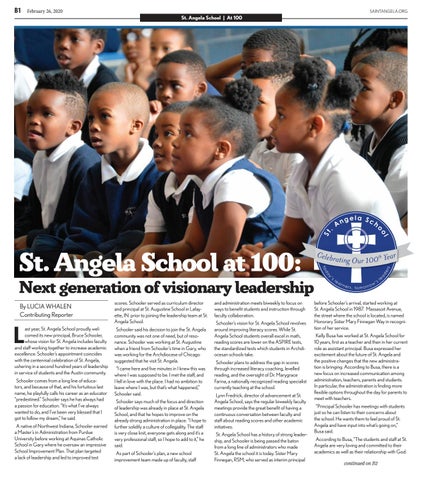
St. Angela School at 100:
Next generation of visionary leadership By LUCIA WHALEN Contributing Reporter
L
ast year, St. Angela School proudly welcomed its new principal, Bruce Schooler, whose vision for St. Angela includes faculty and staff working together to increase academic excellence. Schooler’s appointment coincides with the centennial celebration of St. Angela, ushering in a second hundred years of leadership in service of students and the Austin community. Schooler comes from a long line of educators, and because of that, and his fortuitous last name, he playfully calls his career as an educator “predestined.” Schooler says he has always had a passion for education. “It’s what I’ve always wanted to do, and I’ve been very blessed that I got to follow my dream,” he said. A native of Northwest Indiana, Schooler earned a Master’s in Administration from Purdue University before working at Aquinas Catholic School in Gary where he oversaw an impressive School Improvement Plan. That plan targeted a lack of leadership and led to improved test
scores. Schooler served as curriculum director and principal at St. Augustine School in Lafayette, IN. prior to joining the leadership team at St. Angela School. Schooler said his decision to join the St. Angela community was not one of need, but of resonance. Schooler was working at St. Augustine when a friend from Schooler’s time in Gary, who was working for the Archdiocese of Chicago suggested that he visit St. Angela. “I came here and five minutes in I knew this was where I was supposed to be. I met the staff, and I fell in love with the place. I had no ambition to leave where I was, but that’s what happened,” Schooler said. Schooler says much of the focus and direction of leadership was already in place at St. Angela School, and that he hopes to improve on the already strong administration in place. “I hope to further solidify a culture of collegiality. The staff is very close knit, everyone gets along and it’s a very professional staff, so I hope to add to it,” he said. As part of Schooler’s plan, a new school improvement team made up of faculty, staff
and administration meets biweekly to focus on ways to benefit students and instruction through faculty collaboration. Schooler’s vision for St. Angela School revolves around improving literacy scores. While St. Angela School students overall excel in math, reading scores are lower on the ASPIRE tests, the standardized tests which students in Archdiocesan schools take. Schooler plans to address the gap in scores through increased literacy coaching, levelled reading, and the oversight of Dr. Marygrace Farina, a nationally recognized reading specialist currently teaching at the school. Lynn Fredrick, director of advancement at St. Angela School, says the regular biweekly faculty meetings provide the great benefit of having a continuous conversation between faculty and staff about reading scores and other academic initiatives. St. Angela School has a history of strong leadership, and Schooler is being passed the baton from a long line of administrators who made St. Angela the school it is today. Sister Mary Finnegan, RSM, who served as interim principal
before Schooler’s arrival, started working at St. Angela School in 1987. Massasoit Avenue, the street where the school is located, is named Honorary Sister Mary Finnegan Way in recognition of her service. Kelly Busa has worked at St. Angela School for 10 years, first as a teacher and then in her current role as assistant principal. Busa expressed her excitement about the future of St. Angela and the positive changes that the new administration is bringing. According to Busa, there is a new focus on increased communication among administration, teachers, parents and students. In particular, the administration is finding more flexible options throughout the day for parents to meet with teachers. “Principal Schooler has meetings with students just so he can listen to their concerns about the school. He wants them to feel proud of St. Angela and have input into what’s going on,” Busa said. According to Busa, “The students and staff at St. Angela are very loving and committed to their academics as well as their relationship with God. continued on B2
B2
February 26, 2020
SAINTANGELA.ORG
St. Angela School | At 100
St. Angela’s Green Dream comes true An oasis for students and Austin neighbors By LUCIA WHALEN Contributing Reporter
T
hree years ago St. Angela School went through a radical facelift and is now home to one of the biggest green park spaces in the North Austin neighborhood. Up until 2006, St. Angela was part of an active parish, on a traditional Catholic campus including the church, school, convent and rectory. For decades, priests and nuns lived on campus and served a robust Catholic parish community, including the families of over 1,200 children enrolled in the school. Over the years, though, the neighborhood evolved and most Catholic families moved out of Austin. The parish population began to dwindle, eventually leading to the decision to close the church. The church was shuttered in 2006 and sat vacant until 2017 when the Archdiocese of Chicago decided to demolish the empty parish buildings. The demolition opened up nearly an acre of open space, which was turned over to the school for an outdoor recreational area where students could safely play and learn. Prior to the creation of St. Angela School’s “Green Dreams,” as the project was named, older students were only able to play on a portion of the parking lot; younger students had a small playground. Wittenberg was principal of St. Angela during the demolition and was instrumental in the development of the campus. “In a sense, it transformed the school and it transformed the neighborhood. Our kids love it. The neighbors love it. To a large degree, it is the only green space in the area,” he said. Once the unused buildings were demolished, landscape designer Tari Delisi joined the project to beautify the newly open space next to the school and bring the “Green Dreams” plan to
life. The plan included laying new sod on the open field, creating multiple outdoor classroom areas, a garden, fitness area, and lining the garden with bricks with engraved dedications to former faculty, staff and classmates. Delisi, whose focus is environmentally sustainable landscape design, said that she felt a responsibility to do the project from an ecological perspective while honoring the history of St. Angela Parish. “I wanted to tell the story of the buildings that were once there, along with what the land is going to become for the community, the students, the faculty, and the school space itself. I wanted to reuse and repurpose anything and everything possible and hold onto some historic relics to tell the history of the space,” she said. Delisi did just that, and parts of the former church are integrated into the landscape design. Limestone slabs offer bench space near one of the outdoor classroom areas, the cornerstone from the church has been incorporated into a newly tuckpointed school wall, and a statue of Saint Angela, a relic saved from the church demolition, stands in a garden. According to Delisi, green space is crucial for students, as “it provides the framework for further development, learning and connection to the natural environment.” Time in nature provides students a break from long hours sitting indoors and offers the opportunity for them to develop respect for the environment. While most of the “Green Dreams” renovations are complete, plans are in place to include a large mural on the school wall which was previously hidden by the enormous church; shade for outdoor classrooms and outdoor fitness equipment. One of the highlights of the new outdoor space is the introduction of a memorial brick program. Friends of St. Angela -- alumni, donors, teachers,
neighbors -- can purchase bricks in various sizes and inscribe them with their names, graduation years or other messages that convey the message of what St Angela has meant to them. The bricks are “planted” twice per year, and according to Lynn Fredrick, director of advancement at St. Angela, the bricks “give alumni the opportunity to be involved in a way that is meaningful to them, so they can buy their own little piece of our campus—their message literally ‘carved in stone’.” While the demolition of St. Angela church was not easy for many alumni and former parishioners, many of whom remember St. Angela Church as an important part of their childhood, Fredrick sees the renovations as the next life of St. Angela and as an opportunity to focus on the current mission of the school.
“The only ministry left to the St. Angela community is this school and these children, so we have a new narrative now as to our purpose. Why not build something equally new and beautiful for these kids and for the neighborhood?”
St. Angela School at 100: continued from B1 I also think that our teachers are determined to set an example of what it’s like to be part of a community; I don’t think you find that at every school. When people come here they feel that sense of belonging, that sense of camaraderie.” Schooler is working with a Patrons Board at St. Angela School, a diverse group of alumni and community members working to keep the school prospering into the future. Rich Murphy serves as president of the board, and voiced his enthusiasm about advising and supporting the new administration: “[Schooler] has done a really nice job of taking the vision for the curriculum and saying ‘how do we take this to the next level?’,” he said. Murphy said that because the board serves in an advisory position, he hopes to continue
to bring new voices to the table to reflect the diversity of St. Angela. “Everybody wants the same thing. We want St. Angela to be a tremendous resource for the North Austin community. We want wonderful outcomes for the children and families who made the decision to attend. And when you bring really well intentioned, smart people to the table, you can really get awesome results,” Murphy said. One of the biggest changes this coming year will be a collaboration between the Big Shoulders Fund and St. Angela School. The fund has an incredible track record for supporting Catholic schools throughout Chicago by investing in scholarship support, leadership development, academic programs and more.
February 26, 2020
SAINTANGELA.ORG
B3
St. Angela School | At 100
Alumni are advocates and supporters of St. Angela
O
ne of the best ways to understand the history and significance of St. Angela is through the stories of alumni. The history of St. Angela is a history of faculty and staff who provide a loving and nurturing environment, preparing students to thrive in the world and eventually return to support their alma mater. The proof of St. Angela School’s positive impact on the world can be seen through the huge network of alumni who stay connected to the school due to their warm memories of life at St. Angela. The Jordan Family name has now become a part of St. Angela School itself, with the newly renovated gym named after Jack Jordan. Jack Jordan graduated from St. Angela School in 1938, and after later marrying and moving back to his childhood home, he sent all 10 of his children to St. Angela. Their graduation dates range from 1964 to 1979. Jack Jordan was a star basketball player, and in the mid 1900’s there was a Catholic basketball league specifically for boys under 5-feet, 9-inches. Jordan attended high school
at St. Philip’s High School on the West Side, where he played in that league. Jordan remained involved with St. Angela School, and in the 1960’s when he noticed the lack of athletic programs at the school, he got involved and organized football and basketball teams. Jordan served as the volunteer athletic director at St. Angela for close to 15 years between the late sixties and early eighties.
Jack Jordan worked tirelessly to raise money for the St. Angela athletic program, ensuring that there was adequate funding for uniforms and equipment, along with trophies, awards and end-of-season banquets.
“For me personally, it’s just a natural extension of what my dad did and what my brother did,” Dan said. Dan’s brother Marty Jordan, who organized St. Angela’s yearly Bowling Bash for charity, died 10 years ago. His legacy lives on through the continued Marty Jordan Bowling Bash. The school currently provides the Jack and Marty Jordan fund, which primarily supports the athletic programs at St. Angela. Dan also attributes his continued involvement in St. Angela to a larger pattern of alumni staying in close contact with the school.
According to Dan Jordan, one of Jack Jordan’s seven sons, his father was a kind of legendary figure at St. Angela School.
“All the families that were there in the 50’s, 60’s, 70’s and 80’s moved out. And yet, the camaraderie, friendship and closeness of many of the classes has stayed extremely strong. All of us have kids now, and our kids roll their eyes because everywhere we go, we run into someone who has a connection with St. Angela,” he said.
“He was a surrogate father for literally thousands of boys that went through that school over the years,” Dan said.
Joan Gibbons graduated from St. Angela School in 1943, and she attributes her career in the Foreign Service to her time at the school.
While Jack Jordan passed away 25 years ago, his legacy lives on, and the newly renovated gymnasium was named the Jack Jordan Gym in his honor.
“The Providence Nuns had hospitals and schools in China and frequently referred to their mission there, especially rescuing abandoned girl babies. This stimulated my curiosity about the rest of the world outside of North Austin and resulted in my joining the U.S. Foreign Service in my early twenties,” Gibbons said.
The Jordan family has stayed intimately involved with St. Angela School throughout the years, and Dan Jordan serves on the Patrons Board. According to Dan, the family’s continued involvement can be attributed to his father, who worked tirelessly to make St. Angela the school that it is.
Many young and not so young athletes love to relive their years of glory in the gym, or on the field, or on the court. Jack Jordan provided St. Angela alumni with many years of great memories and, since the gym was named for him in 2016 he will be part of the memories of hundreds more St. Angela alumni. Jack’s ten children, including Marty (Class of 1977) pictured here as a toddler, were part of all those gym memories.
Gibbons was accepted into the Foreign Service in 1952, where she served in Japan, Hong Kong, Malaysia, Egypt, and Hungary. She was also assigned to U.S. Consulates in South Africa, Indonesia, and Senegal, among others.
Gibbons eventually returned to the United States, where she currently lives. And in 2012, she volunteered as a teacher’s aide in a firstgrade class at St. Angela. Tom Gull graduated from St. Angela in 1974 and remains involved with the community as an alumni and donor. The youngest of seven, all the Gull children attended St. Angela School, starting with his eldest sister in 1950. He calls his entire eight-year education at St. Angela School impactful. The presence of the Sisters of Providence, who taught his mother when she was in high school, made a particular impact on Gull. “Their life of faith and service was evident to us. As I continued to attend Mass through high school, it was nice to continue to see my teachers at Sunday Mass,” he said. Gull went on to attend Holy Cross High School in River Grove and earned his MBA from Dominican University. According to Gull, he would recommend a Catholic education to anyone: “Catholic education is incomparable. In a Catholic school, the teachers and administration are able to teach the children in ways that public schools cannot: teaching through faith. As Saint Mother Theodore Guerin, founder of the Sisters of Providence who staffed the school said, “Love the children first, and then teach them.” Lucia Whalen
B4
February 26, 2020
SAINTANGELA.ORG
St. Angela School | At 100
Students’ learning styles inform literacy efforts By LUCIA WHALEN Contributing Reporter
A
sk any teacher in any classroom at any school around the United States what their greatest challenges are, and more likely than not, addressing every student’s unique needs will be somewhere on that list. Teachers at St. Angela School are no exception, as they work with a diverse range of learners in each classroom. Luckily, St. Angela is fortunate to have an array of in and out of classroom resources to provide students with a holistic education that addresses their individual needs.
St. Angela welcomed a new literacy specialist who is working with faculty and administration to increase literacy scores across the school. Dr. Marygrace Farina earned her master’s in reading education and a doctorate in leadership in Florida before joining the staff at St. Angela. While in Florida, she worked with all classroom levels, from elementary to community college, teaching students to read effectively and be engaged learners. While math scores at St. Angela currently exceed expectations, reading scores overall need work. Farina joined the team at St. Angela in 2019 as a reading specialist and sees low reading scores as being symptomatic of students’ need for better test prep, and literacy education that caters to unique learning styles. All of this, says Farina, leads to engaged learning. “Literacy is much more of a cognitive skill than schools in half of the United States have seen math, as far as we know. Math reading scores decline. has a format and a definite Bruce Schooler, the new structure. You follow step one, principal, has set raising literacy two and three. But reading scores as a top priority for the starts earlier. It starts with oral “We try to find what school, which Farina says will language. You have to take benefit all areas of study for information, process it, and the student might be students. The school also plans come up with ideas and a to hire more literacy specialists conclusion on your own, not to provide assistance to more deficient in and why just passively. It’s engagement,” students. Farina said. “It’s [Schooler’s] number and then address the Because of the difference one priority because math in processing required for scores will go up if literacy reading, Farina says that math challenge.” goes up. You have to read the and literacy skills must be math problem, you need to taught in very different ways. Adrian Brown understand what data they’re And while a newfound push for giving you and what is not STEM education has started important,” Farina said. to dominate the educational
And there’s extra help, too Along with literacy coaching, St. Angela School has a strong team of resource specialists who assist teachers and students. Mary Darnell is a retired occupational therapist who started volunteering at St. Angela School after selling Kids Unlimited, her business in Oak Park. Darnell works with students from all grade levels twice per week on handwriting, while also incorporating exercises and practices that engage students sensory processing and fine motor skills.
discourse across the country, the “nation’s report card” revealed in 2019 that
Farina is approaching literacy education at St. Angela with a holistic lens, one
Darnell’s classroom is called the Life Skills Center, and younger students join Darnell in her classroom to work on basic life skills necessary for developing brains, such as shoe tying, buttoning, and scissor use.
on what teachers notice their students need support with.
“It might seem basic, but all younger children need to learn the skills that adults take for granted as automatic activities, like grabbing a pair of scissors off the table and cutting a piece of paper,” said Darnell. Darnell also uses “theraputty” with younger students to strengthen their hands and aid in coordination development for daily activities. According to Darnell, all the work she does with students is teacher directed and based
Students who need extra support to gain academic strength can also meet with Adrian Brown, the Title 1 academic coach. Along with academic development, Brown works with students on internal regulation such as selfesteem, anger management and organizational skills. Teachers who identify students with special needs can call on Brown and the Title 1 team for extra help. “We try to find what the student might be deficient in and why and then address the challenge,” Brown said.
not solely targeting test-taking. She also focuses on learning styles, so that students can adjust their education to their unique and preferred style of learning, such as visual or kinesthetic. Students are tested with the ACT Aspire Assessment System in the fall, winter and spring. According to Schooler, the data from the first administration of Aspire to the second last year shows positive growth. When discussing improved test scores, Farina says test scores will not change immediately, nor should they. “There’s no magic potion,” she said, “It is not going to go from 30th to 90th percentile [overnight]. We want to show growth, and if we can show growth, the kids have moved. It’s gradual.”
According to Lynn Fredrick, director of advancement at St. Angela, out of classroom resources are crucial for tackling the diverse needs of students. “Inside the classroom, it can be difficult to provide a group of kids with diverse needs everything they need,” Fredrick said. “That’s where the incredible resources at St. Angela come in. Teachers alone cannot provide for all of the needs of an entire classroom. Resources like Mr. Brown and Mary Darnell provide one-onone support, which is crucial in any school.”
February 26, 2020
SAINTANGELA.ORG
St. Angela School | At 100
Young artists at work
St. Angela School believes in the importance of the inclusion of art in education and has made it a priority to maintain it, and all “specials,” (music, Spanish and gym) in the curriculum. Among other projects this year students in several grade levels produced self-portraits using creative and age appropriate methods.
B5
B6
February 26, 2020
SAINTANGELA.ORG
St. Angela School | At 100
Friends and family are St. Angela’s generous donors By LUCIA WHALEN Contributing Reporter
S
t. Angela Merici, a 17th century Italian woman who founded a teaching order of religious sisters, is the Patron Saint of St. Angela School. She is known for bringing education to the children of rural communities of Italy, saying to the women in her order, “Build community wherever you go.” The strength and resilience of St. Angela School depends upon community, in this case the one built in Austin by the Sisters of Providence and then sustained by the Sisters of Mercy. The generous support of this community, and their faith in St. Angela School’s mission to provide a highquality, faith-based education for all students and prepare them for a life of leadership, is what keeps the school alive and thriving. No Catholic school is able to fund everything they need with tuition. To give you an idea, the stated tuition at St. Angela school for one child in 2020-21 is $4,100, which is $2,000 less than the actual cost of educating that child. So, from the beginning, even if parents are paying full tuition, St. Angela School must find a way to subsidize that tuition with an additional $2,000. St. Angela depends on donors for that subsidy,
Big Shoulders Fund lifts St. Angela School
and the school is extremely fortunate to have donors who are generous enough that the school is also able make improvements to its campus and strengthen programs for the boys and girls of St. Angela School. The St. Angela community spirit is alive, showing up at extended family gatherings throughout the Northwest suburbs, in St. Martin de Porres Parish when many former St. Angela parishioners still worship, in the second and third generations of alumni still enrolled at St. Angela, and in social events designed for the purpose, events like The Marty Jordan Bowling Bash. The “Bash” honors the late Marty Jordan, who organized a yearly bowling event at Circle Lanes in Forest Park to raise money for charity. The event, now run by Marty’s widow, Maureen, his brother Dan, and Dan’s wife, Mary Ann Conrick Jordan, lives on in his name. All proceeds go to St. Angela School. The powerful and positive effect of donors can be seen at St. Angela through the recent “Green Dreams” renovations on the exterior of the building and inside the school in the recently upgraded gymnasium. Donor gifts allow St. Angela School to continue working in service of students and the Austin community, carrying on the legacy for another 100 years.
St. Angela among 30 Catholic schools to receive Big Shoulders Fund support
S
t. Angela is among 30 Catholic schools in the Chicago area to share in a $47.5 million commitment over 10 years from the Big Shoulders Fund, an independent charitable organization that supports inner-city Catholic schools. St. Angela School will receive “significantly increased” funding for operations, explained Big Shoulders Fund officials in their statement. In addition, the organization will “take on an expanded leadership role with principals in these schools to help them manage their schools toward specific goals in key operating areas of academics, enrollment, development and finances,” the statement explains. “We are honored to be able to provide this
historic level of investment to help strengthen communities throughout the greater-Chicago area,” said James J. O’Connor, the founding chairman and current co-chairman of the Big Shoulders Fund. “Our own research has shown that alumni of our schools go on to vote, study, work, and volunteer at rates higher than their peers, becoming the citizens and neighbors that make our communities and Chicago a better place for all of us,” O’Connor said. Josh Hale, president and CEO of Big Shoulders Fund, said the $50 million commitment is a “natural next step” for the organization and builds on 15 years of providing operational and academic assistance for 75 Catholic schools in the Chicago area and Northwest Indiana. St. Angela, which has been without a parish since 2005 and is the only Catholic school in Austin, is heavily dependent on resources from the archdiocese and Big Shoulders but also donations from alumni — all of whom “have supported our mission over the years,” Fredrick said. “The new commitment of Big Shoulders for operating expenses means the contributions of our alumni and friends can help the children more directly. Big Shoulders will not replace the investment of donors – it will help their gifts go further,” she said. Michael Romain
Engraved bricks line the “green” on St. Angela’s new campus, and alumni (including Tom Gull, Class of 1974) helped “plant” the bricks. The bricks tell the stories of the people who have made the school their home, including dear friends, teachers, pastors and neighborhood friends. The brick program continues; the next brick order will be placed early in March, 2020.
Why I Give: Tom Gull: I donate to St. Angela because I want to give the current students the opportunities to succeed that they might not otherwise have without their St. Angela experience. My generation and those before me benefitted from ridiculously low tuition that make Catholic education available to everyone who wanted it. I contribute to St. Angela in honor of my parents and the many wonderful sisters and lay teachers who helped form me into the person I am.
Dennis LaLiberty: I give to St. Angela School because I see how the scholars thrive through the dedication of the teachers and staff, because I believe families should have the opportunity to choose a school, and because I have personally benefitted from my education in the Catholic school system and am convinced that the combination of academic excellence and emphasis on morals and discipline produces well-rounded adults who are a credit to their community.
Patty Henek: To see that St. Angela School is still thriving at a time when other schools are closing and that there are people who care about the community and are investing in the community, I think is a great sign for Austin and I try to do what I can. Going to St Angela shaped the person I am today, and I want to help these same students that are there today thrive and have the same great experience that we did growing up.
February 26, 2020
SAINTANGELA.ORG
B7
St. Angela School | At 100
Powerful allies step up for St. Angela By LUCIA WHALEN Contributing Reporter
C
elebrating 100 years of existence is no small deal. Through major historic events like the Great Depression and World War II, the arrivals and departures of neighbors of diverse backgrounds and the closure of St. Angela Parish, St. Angela School has remained a staple of the Austin community and a seminal institution offering high-quality faith-based education to all students regardless of financial status. Austin, like every Chicago neighborhood, has gone through many transformations. In the early days of St. Angela Parish, North Austin was a heavily Catholic mix of Irish, Italian and German. By the mid-1970s those white families left Austin and, in their place, came African Americans and, in more recent years, a growing number of Hispanic residents. State Rep. LaShawn Ford, who currently serves on the Patrons Board of St. Angela, grew up in the Austin neighborhood in the mid-1970’s and
Schools, and, according to Ford, witnessing the attended Our Lady Help of Christians Catholic disparity in school quality in different neighborElementary School, where he played St. Angela hoods led to his eventual desire to work as School in basketball. Later, while training to be a state representative. Ford a teacher, Ford worked as a watched his students on the student teacher at St. Angela. West side travel all the way By that point in 1994, Austin “ St. Angela has from Austin to the North side was predominantly African to find a safe and higher-quality American, and most studedicated teachers education. “It made me want to dents were Baptist instead of and they are educating be a strong advocate for public Catholic. However, according education,” he said. to Ford, the Catholic education students so they at St. Angela School provided White flight, a result of racist can become better something that neighboring real estate practices and segrepublic schools could not. gationist fear in the late 1960’s, people”
caused resources to drain from “St. Angela is a faith-based Austin, as in most neighborinstitution. At public schools, hoods impacted by the pheprayer is not an option. [During Christine Riley nomenon. Ford recalls multiple my time at St. Angela], whether banks and grocery stores from they were Catholic or not, the his childhood leaving once the advantage was that most of the demographics shifted. However, Ford expects families in the neighborhood were families that the Austin community to continue to diversify, as prayed. And it allowed children, whether they were Baptist or Catholic, an opportunity to learn real estate in the community is attractive with the draw of quality schools like St. Angela. in a faith-based setting,” said Ford. Ford went on to teach in Chicago Public
According to Ford, throughout all of the
changes in Austin, St. Angela school has remained an anchor in the community, continuing to offer a high-quality education to all students. Much of that continued stability is due to the support of alumni, the board and the surrounding community. In 2005, when St. Angela Catholic Church closed, many parishioners joined St. Martin de Porres Catholic Church in Austin, where current board member Christine Riley serves as Director of Religious Education. Riley, who grew up in West Garfield Park, attended St. Thomas Aquinas Catholic School. According to Riley, St. Angela School adds important value to Austin as the only remaining Catholic grammar school in the neighborhood. “Having that strong Catholic education is so important in the Austin area. When I was growing up, there were so many more Catholic schools in the area. St. Angela has dedicated teachers and they are educating students so they can become better people. I think it’s a staple in the community,” she said. Riley says family values in the community are strong.
Volunteer driven The transformation of St. Angela campus would not have been possible without the help of four volunteer groups who helped us realize our “green dreams.” Big Shoulders Fund produces thousands of volunteers annually for the schools of the Archdiocese of Chicago and they sent us three wonderful teams. The fourth was the Appalachian Service Project teens of Ascension Parish in Oak Park who, with adult volunteers in tow, built a boulder wall and benches, and removed demolition debris from planting beds.
B8
February 26, 2020
SAINTANGELA.ORG
St. Angela School | At 100
how to give You can make a difference for our scholars with an investment in their future! St. Angela School accepts gifts of all sizes; gifts in honor or memory of someone; gifts made in person, or online, or sent in the mail. We accept gifts for specific projects and gifts for our general unspecified use: gifts for scholarship; for technology; for athletics; for the development of our campus; for professional development for our staff. We accept gifts of cash, checks or credit cards, and we accept gifts of stock. To learn more about the ways you can support the people and programs of St. Angela visit our website: www.saintangela.org/giving or call our Advancement Office, 773.626.2655 ext. 103.
come and visit! Whether you attended St. Angela or are looking for a new school home for your children, please, come visit! Our regular school day hours are 7:50 to 2:50 but please call if those hours are not ideal for you. Prospective school families: You, too, are invited to join us for our Picnic on the Green, May 16 from 11:00 am to 1:30 pm. or visit during our Open House Week March 23 to 27 • 8:30 to 11:30 daily Take a tour, meet the Principal and learn more about what St. Angela has to offer your child from preschool through eighth grade.
how to enroll Enrollment for the 2020-21 school year will open for new families on April 1. (We will accept your registration before that, but will not process it until that date.) The enrollment fee is $150 per family. All families are required to apply for tuition assistance; 95% of our families receive significant aid. The application fee for aid is $25 per family. To arrange for a visit, please call Ms. Petrice Sanderson, Registrar during regular school hours (7:50 am to 2:50 pm) or email her at psanderson@saintangela.org. For the tuition schedule and registration forms, please visit our website, www.saintangela.org/registration. Check us out!
CALL US : 773-626-2655 | VISIT US : 1332 N. Massasoit Ave, Chicago, IL 60651 | ON LINE at: SaintAngela.org
St. Angela School Green Dreams III Our Picnic on the Green
Saturday, May 16
11:00 am to 1:30 pm featuring a picnic lunch prepared by Blue Plate Catering Music, games, raffles, school tours, garden blessing, food, fun and fellowship.
All are welcome! Please join us as we celebrate our 100th Spring! 332 N Massasoit Avenue Chicago 60651 For more information: www.saintangela.org.