SAY CONNECTS
Wednesday Journal, April 24, 2019
SAYOPRF.ORG | OAKPARK.COM | RIVERFOREST.COM W E D N E S D A Y
JOURNAL
1
A YEAR-LONG SERIES FOCUSING ON COMMUNICATING OUR PRIORITIES FOR CHILDREN
Arts can open the lens on how we see equity Who gets to tell the story? Not just white men
By LACEY SIKORA
Contributing Reporter
O
ur public institutions are working to formulate and implement equity policies. But what about equity in cultural institutions? Elizabeth Chadri, program director for the Oak Park River Forest Community Foundation, plainly states, “Arts and cultural organizations have the potential to bring about social change and should therefore reflect the diversity of the community. The arts play a significant role in engaging our community, and they need to reflect our community’s diversity.” Camille Wilson White, executive director of the Oak Park Area Arts Council, agrees and sees a two-pronged approach to making this a reality. First, she touts the benefits to all from having a diverse range of arts organizations at work together in the community. She then says that the community needs to broaden access to the arts as a way of creating a more equitable landscape. Wilson White praises the wealth of arts-related non-profits at work in Oak Park including numerous theater groups, choruses, visual art organizations, dance and musical groups. “There truly is a diverse group of organizations here that we help carry on the impact of their work.” That said, she points out, “Thirty-two organizations applied to OPAAC for funding. How many were organizations headed by people of color? Not many. How many heads of arts institutions here are people of color? Not many?” Maui Jones, founder and artistic director of Oak Park’s Echo Theater Collective, is pushing that narrative and stresses the important role the arts play in conversations about equity. “We’ve been conditioned to see the world through a singular lens -- that of the straight, white male because that’s who was in charge. The arts convey more than words. They convey emotion and allow you to see the world
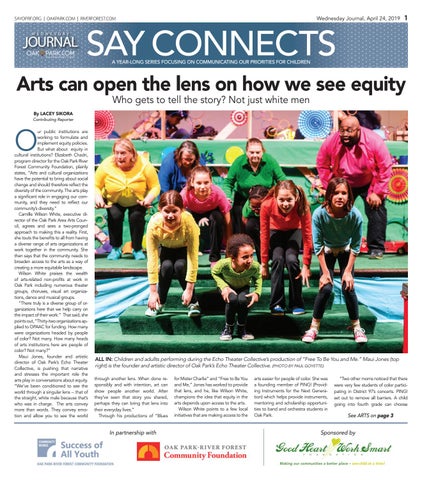
ALL IN: Children and adullts performing during the Echo Theater Collective’s production of “Free To Be You and Me.” Maui Jones (top right) is the founder and artistic director of Oak Park’s Echo Theater Collective. (PHOTO BY PAUL GOYETTE) ALEXA ROGALS/STAFF PHOTOGRAPHER through another lens. When done responsibly and with intention, art can show people another world. After they’ve seen that story you shared, perhaps they can bring that lens into their everyday lives.” Through his productions of “Blues
In partnership with
for Mister Charlie” and “Free to Be You and Me,” Jones has worked to provide that lens, and he, like Wilson White, champions the idea that equity in the arts depends upon access to the arts. Wilson White points to a few local initiatives that are making access to the
arts easier for people of color. She was a founding member of PING! (Providing Instruments for the Next Generation) which helps provide instruments, mentoring and scholarship opportunities to band and orchestra students in Oak Park.
“Two other moms noticed that there were very few students of color participating in District 97’s concerts. PING! set out to remove all barriers. A child going into fourth grade can choose
See ARTS on page 3
Sponsored by
2
Wednesday Journal, April 24, 2019
SAYOPRF.ORG | OAKPARK.COM | RIVERFOREST.COM
‘Not good white people vs. bad white people’ Race Conscious Dialogues help white people unpack their biases
awareness of identity, power and privilege, and then develop tools for antiContributing Reporter racism work. Each RCD is set up as a series conlmost two years ago, Dot sisting of four sessions, each lasting Lambshead Roche, an Oak three hours, held in space donated Parker, decided to start talk- by Academia in Oak Park. Each sesing about racism among her sion is preceded with light readings to white peers in the community. The for- be done at home and is facilitated in mer high school social studies teacher, partnership with the Nova Collective. now home with her kids, was among a The series is framed around unpacking multi-racial group of residents wonder- and understanding Whiteness, what ing how to approach the topic. “We Roche and Hovde call: “our own racial landed on the idea of small cohorts as identities, the historical and current a way to deepen our understanding.” harm being caused by whiteness and Roche says the groups were inten- guided discovery of what we can do tionally kept small and intentionally to disrupt racism and dismantle white limited to white people. “Participants supremacy.” are more likely to be honest with themHovde says while the framework of selves when truths can be shared and each series is the same, there is an people of color should not be put in evolution to the program. “The curharm’s way as we riculum is definitely do the work.” i informed by some At first, the o our work outside of groups were pri“As a community, o RCD and our of marily dialogues t thought partners, we have to say, between Roche b as it evolves, it but and community is also responding there’s no amount members, but she t what’s going on to of racial inequity quickly realized h here in Oak Park that the group a in communities and that is acceptable.” needed a facilitaa around Oak Park.” — Brynne Hovde tor. She turned She points to to friend Brynne c changing terms as Hovde, who a bellwether of a three years ago changing commuwas among the founding members of nity focus. “We were talking about NOVA Collective, a woman and black- diversity and inclusion. Now we’re talkowned business that offers programs, ing about equity and justice.” products and consulting services that Roche says that while sessions might build a more diverse, equitable, and address pressing issues playing out inclusive workforce. locally, they intentionally keep the foHovde says with NOVA, the desire cus local and not national. “We’re not was to, “change how organizations talking about Charlottesville. We keep think, specifically around the tenets turning the lens on ourselves, talking of white supremacy.” She and Roche about the racism that’s happening in formed Race Conscious Dialogues progressive, liberal communities like (RCD) as a volunteer and grassroots ours.” community effort to challenge those Roche also sees value in these contenets at home. versations among parents raising kids For them RCD is aimed at white in the village. “When we as adults enpeople who want to deepen their gage in this personal work, we are able By LACEY SIKORA
A
ALEXA ROGALS/STAFF PHOTOGRAPHER
REAL TALK: Dot Lambshead Roche and Brynne Hovde lead Race Conscious Dialogues. to talk more easily with our children about race, and learn and grow together.” For Hovde, RCD brings home the really important question: “How am I, as a white person, perpetuating racism? “We need to realize there’s harm to undo in every white person. In our society, calling something racist is like the worst thing in the world.” Roche chimes in, “I think that the important thing people glean from participating [in RCD] is separating things out. You can be a good neighbor and a good friend and still perpetuate racism. It’s not bad white people vs. good white people.” Both women stress that the RCD sessions are merely a jumping off point in a long journey. They point to Oak Park’s 37 equity efforts currently underway and says there’s no need to reinvent the wheel. Hovde says, “If people can leave these sessions and start to support and amplify the voices for equity already out there, that can lead to change.” Most of their participants tend to
How to connect
Find out more about Race Conscious Dialogues or register for an upcoming session by visiting raceconsciousdialogues.org or email RaceConsciousDialogues@ gmail.com be women, but men also attend, and the age of the average RDC participant varies. While many participants are parents of kids currently in Oak Park schools, Hovde says that an older generation, who intentionally moved to the community decades ago because of racial inclusion, is also interested. “All ages are interested in this. This space is conducive to wherever we are on the journey.” As they tackle issues such as white privilege, gifted and talented programs in schools, policing, safety and feminism, RCD can be eye opening. Roche says, “Seeing whiteness for what it is is something that people are doing for the first time here.”
She sees a real need for white people to join in. “With this work, neutrality perpetuates the status quo. This requires plugging in, not checking out.” Hovde says it is about making time to make a change. “I’m a working mom in Oak Park, and I know how real it is to be so busy. Every time you make space for this, you see what you can do. Don’t be too busy to do this important work. It is an act of selfcare. I call on white women to take part in this crucial mission.” “As a community, we have to say, ‘there’s no amount of racial inequity that is acceptable.”
Distribution of information by a community group in accordance with District 97 policy does not imply, directly or indirectly, that the group’s program(s), event(s) and/or service(s) is sanctioned, sponsored or endorsed by the district, the Board of Education or the superintendent.
Wednesday Journal, April 24, 2019
SAYOPRF.ORG | OAKPARK.COM | RIVERFOREST.COM
3
WONDER: Volunteers (above) work on finishing up the aquatic mural on Aug. 2, 2018, at Wonder Works on North Avenue in Oak Park. (Right) From left, Zaria Gilmore, 21, Jenn Eisner, 18, and Julia Cuneen, 19, all of Oak Park, finish up a new mural on Aug. 2, 2017 at the corner of Lake Street and Central in Chicago. (Top right) Judah Morgan, 18, of Bolingbrook, cleans off tile for a new mural. (Photos by ALEXA ROGALS/Staff Photographer)
Arts continued from page 1 any instrument, sign a contract and get a PING! mentor. A lot of kids who participate happen to be children of color whose parents don’t have the means to purchase or rent instruments. We are able to level the playing field. PING! also works to provide scholarships to music camps such as Blue Lake and Interlochen, and Wilson White notes that many former PING! recipi-
ents go on to be PING! mentors. She’s also proud of OPACC’s Off the Wall program, which provides summer arts employment to youth aged 16 to 24. They create murals in Oak Park and the surrounding communities, are paid and are mentored by professional artists. Off the Wall has expanded programming into Austin, and youth from Oak Park are working side-by-side with youth from Austin. “We always talk about what bridges can we build between the two communities? The arts
PHOTO BY PAUL GOYETTE
STORY TELLING: Children performing during the Echo Theater Collective’s production of “Free To Be You and Me.”
“If we tell the stories through art, maybe people will wake up.” — Maui Jones Artistic Director of Oak Park’s Echo Theater Collective
build that bridge,” says Wilson White. Jones knows firsthand that access to the arts is key. As a child growing up in California and the Oak Park area with a mother who struggled with addiction, he was always interested in arts and theater but did not have the means to pursue artistic endeavors. Later in life, he acted in a small production of “Guys and Dolls,” which he said reignited his passion for theater and led him to question who was telling the stories. “I came up with three tenets for what I want to do: education, information and empowerment. With the first, you need to use authentic voices. If you’re talking about race in America, whoever’s telling the story has to understand it. Information means it has to be responsible storytelling. How do we approach the material and cast-
ing so it’s not exploitive? Third, we are continuing the story. If people are inspired by what they see on stage, we can plug them into local, grassroots organizations.” To that end, Jones has a dream of creating a cultural center in Oak Park that would serve children in need and provide a different perspective to the community, “If we have the space, my hope is that it can become an engine for social change. Giving people tools to see the world through a multitude of lenses rather than shutting down on certain situations is the answer.”
While acknowledging that we might be relatively comfortable in Oak Park, he points out that our neighbors are hurting and there are those in the community who also feel marginalized. “If we believe that there is a clear and present danger; if we believe all of these things are dire, why aren’t we sacrificing anything or investing our money in things that will move the needle? Everyday that we don’t do something, another black kid gets shot or another immigrant gets detained. If we tell the stories through art, maybe people will wake up.”
4
Wednesday Journal, April 24, 2019
SAYOPRF.ORG | OAKPARK.COM | RIVERFOREST.COM
School supt.’s get frank about race and education By MICHAEL ROMAIN Staff Reporter
O
n April 11, Success of All Youth collaborated with Wednesday Journal and the Good Heart Work Smart Foundation to convene a first-of-itskind videotaped conversation with the superintendents of the three public school districts in Oak Park and River Forest. The talk focused on race and equity, but those subjects were portals to much deeper, sometimes personal, reflections on the human experience. Below are excerpts from just a few minutes of that more than hour-long conversation, which you can find at: www.oakpark.com The superintendents’ on-camera comments have been edited and slightly modified for print. Wednesday Journal: Each superintendent shared personal experiences that helped inform their current racial equity work. District 90 River Forest elementary school Supt. Edward J. Condon: My first experience with racial equity was as a principal in a school district not far from here. It was highly diverse and, admittedly, a very affluent school district with not much income inequality. More importantly, though, students, regardless of their racial or ethnic backgrounds, were showing high performance across the board. That was my first experience seeing that this does not have to be. There was no significant [academic performance] gap. That’s the aspiration we’re striving toward.
schools can totally change the trajectory of a student’s life. So while neither one of my parents graduated from high school … I was afforded that opportunity. District 200 Oak Park and River Forest High I feel like Joylynn and I can be sisters, because School Supt. Joylynn Pruitt-Adams: College so- we had the same home experience (of living with lidified why I got into education in the first place parents who had high expectations for them). — and that was to remove barriers for black and When I was in high school, I wasn’t allowed to brown children. I wanted to remove the percep- take home economics or things of that nature, tion that because of the but I was also blessed to color of my skin, I can’t rise have teachers in elemenh to the same level. tary school who helped t I once had a professor my m mother. WATCH THE VIDEO in my master’s degree proPhiladelphia did a deSee the the full conversation gram ask me why I wanted segregation order when I s a doctorate. That professor was w in elementary school. at www.oakpark.com would say things like, ‘You Now, Brown v. Board of N have a master’s, isn’t that Education was in 1945, E good enough?’ or ‘How did so s even 25 years later, you learn that?’ I once had schools were still very sega counselor tell me I should have been a file clerk regated by where you live. I had teachers who instead of a teacher. It was my mom telling me would take us to various sites in Philadelphia that that, as a black female, I had to work harder than we would never get to outside of our neighboreveryone else. hood. I had teachers who did not look like me One of the things that drew me to Oak Park was who helped my mom and really advocated on my that race was a key factor in every single meeting behalf. I think all students should have that. Unthat I was in. It was about removing those barriers. fortunately, that’s not the norm yet, but I definitely feel that it’s possible. District 97 Oak Park elementary school Supt. Wednesday Journal: Some people see the Carol Kelley: I’m a product of public schools. I grew up in the inner city of Philadelphia. Public measures that the districts have taken to deal with
ALEXA ROGALS/STAFF PHOTOGRAPHER
DIALOGUE: Superintendents Carol Kelley and Ed Condon join the Journal’s Michael Romain and Supt. Joylynn PruittAdams (left) to talk about equity.
racial inequity and institutional racism and dismiss them as wrongheaded or as attempts to arouse ‘white guilt.’ How do you respond to those people and their concerns? Supt: Pruitt-Adams: I don’t know if we’ll ever persuade them. There are some people who are so set in their ways that, for them, everything we do must be wrong. For me, it’s about transparency and having them sit at the table. Every single committee we have, there’s community and student voice at the table. Supt. Edward J. Condon: It is challenging to have conversations in America, certainly in this day and age, around race and ethnicity. It’s chal-
lenging, of course, in different ways for different people based on their experiences and how they’re walking through this world. But there’s a lot of research that indicates that two concepts in particular are really powerful and need to be acknowledged: stereotype threat and implicit bias. This is heavy stuff probably for all of us, in different ways, and it should be. But I’d encourage people to take solace in the idea that implicit bias exists in all of us. While it’s not something we should embrace, we should at least have an awareness that we all carry with us these biases and that should be, in some ways, liberating. Supt. Carol Kelley: I believe that when a lot of people sometimes hear terms like institutional racism or systemic racism, they take it personally. But it’s really not about the people, it’s about the system that has historically helped to produce the inequitable results we see. This applies to the adults and the students. It’s not about fixing the students (I believe that all students can learn) — it’s about fixing the system. As system leaders, we have to really critically examine the systems we lead.