CONTINUE #GivingNewsDay. Double your donation. FREE
■
Details on page 12
Austin native creates grant to shine light on Black-owned businesses,
Vol. 34 No. 49
■
December 2, 2020
■
austinweeklynews.com
■
Also serving Garfield Park
@AustinWeeklyChi
@AustinWeeklyNews
PAGE 7
Shop h Black l k website b launches, PAGE 7
Disinvested
A half-century after Chicago’s uprisings in 1968, a once-thriving retail strip in East Garfield Park still suffers from broken promises, bad policy and neglect. By TONY BRISCOE, HARU CORYNE & MICK DUMKE ProPublica Illinois
Growing up in Chicago’s East Garfield Park neighborhood in the 1960s, Annette Britton spent a lot of time on Madison Street. She picked up produce for her mother at N&S Certified Food Mart, skated at the Albany roller rink and went to movies at the Imperial Theatre. A neighborhood pharmacy, Sacramento Drugs, not only filled prescriptions but served customers ice cream at a diner in back. Durham’s, an appliance store, sold washing machines and refrigerators. Back then, stores, often with apartments above them, lined Madison Street from downtown west to the city limits. The east-west axis of Chicago’s grid system, the street once thrived as a commercial beltway known as the “Equator of Chicago” and the “Heart of the West Side.” But when Britton drives along Madison Street now, she sees vacant lots. Britton moved back to her childhood home about 10 years ago, and the places she once visited, along with scores of others, are gone. These days, she has to leave the neighborhood to get groceries, buy tools at a hardware store or eat at a sit-down restaurant. “This was a working-class community with businesses,” said Britton, 62 and the vice president of a community group called the Garfield Park Neighborhood Network. “All of that has been stripped away.” Like many commercial corridors in Black neighborhoods around the country, Madison Street has suffered the devastating consequences of generations of government and private sector neglect. For decades, many Chicagoans have attribSee DISINVESTED on page 8
ALEX ROGALS/Staff Photographer
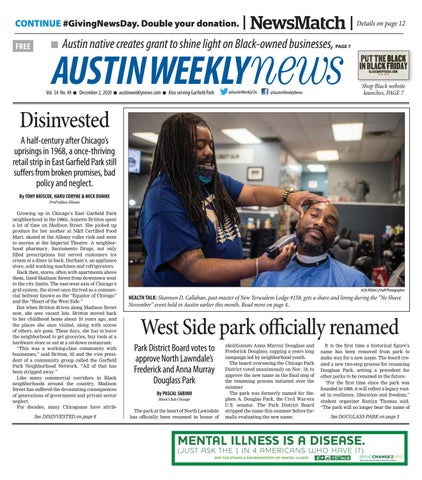
HEALTH TALK: Shannon D. Callahan, past master of New Yerusalem Lodge #158, gets a shave and lining during the “No Shave November” event held in Austin earlier this month. Read more on page 4..
West Side park officially renamed
Park District Board votes to approve North Lawndale’s Frederick and Anna Murray Douglass Park By PASCAL SABINO Block Club Chicago
The park at the heart of North Lawndale has officially been renamed in honor of
abolitionists Anna Murray Douglass and Frederick Douglass, capping a years long campaign led by neighborhood youth. The board overseeing the Chicago Park District voted unanimously on Nov. 18, to approve the new name as the final step of the renaming process initiated over the summer. The park was formerly named for Stephen A. Douglas Park, the Civil War-era U.S. senator. The Park District Board stripped the name this summer before formally evaluating the new name.
It is the first time a historical figure’s name has been removed from park to make way for a new name. The board created a new two-step process for renaming Douglass Park, setting a precedent for other parks to be renamed in the future. “For the first time since the park was founded in 1869, it will reflect a legacy rooted in resilience, liberation and freedom,” student organizer Raniya Thomas said. “The park will no longer bear the name of See DOUGLASS PARK on page 3
2
Austin Weekly News, December 2, 2020
presents
A Wednesday Journal & A Tribe Called Aging Production
wabi sabi F I L M F E S T I V A L
Our Covid-19 free gift to the community watch it free on ZOOM in your own home
Appreciating the beauty of impermanence, a quarterly Film Series encouraging everyone to embrace and respect our aging population and the transformation of our society.
Olympia Friday, December 4 • 10am This sublimely intimate, fly-on-the-wall verité documentary tells a poignant story of a woman finding her own voice on her own terms to assert a gigantic creative force into the world. Throughout an engrossing story that seamlessly blends past and present, Olympia Dukakis opens her heart and exposes her truest self to Harry Mavromichalis’ unobtrusive camera. Exhibiting both candor and vulnerability, we see her deal with age, grief and sexuality while opening up about her struggles with motherhood, depression, suicide and drug addiction. Through her brutal honesty and sincerity, Olympia compels us to confront our own shortcomings and differences by letting go and moving forward with defiant conviction. This intimate portrait of a working-class professional, a scholar actor of intense intuitive power, and a woman beloved around the world, culminates on the steps of the Dukakis’ humble ancestral home in Lesbos, Greece. Here we see Olympia’s life come full circle, both personally and professionally. Joining us for Q+A/discussion is the film’s Director Harry Mavromichalis, moderated by Elizabeth White.
Signature Sponsors
Non Profit Patron Sponsors
Oak Park Township/River Forest Township
Learn more and register at: wabi-sabi-olympia.eventbrite.com
Austin Weekly News, December 2, 2020
AUSTIN WEEKLY
news Editor Michael Romain
Senior Editor Bob Uphues Contributing Reporters Bonni McKeown, Igor Studenkov Reporting Partners Block Club, Austin Talks Columnist Arlene Jones Staff Photographer Alex Rogals Design/Production Manager Andrew Mead Designer Debbie Becker Sales & Marketing Representavies Lourdes Nicholls, Marc Stopeck Sales & Development Mary Ellen Nelligan Photos by Pascal Sabino and Wikimedia Commons
CHANGE-MAKERS: Top, Village Leadership Academy students and teachers behind the campaign to rename Douglas Park. Bottom left, Frederick Douglass and Anna Murray Douglass. Bottom right, an anonymous artist changed the signs around the park with an added “s” earlier this year. Now the Douglass Park name is official.
Circulation Manager Jill Wagner ≈ Publisher Dan Haley Business Manager Joyce Minich ≈ GROWING COMMUNITY MEDIA Board of Directors Chair Judy Greffin Treasurer Nile Wendorf Deb Abrahamson , Gary Collins, Darnell Shields, Sheila Solomon, Eric Weinheimer
DOUGLASS PARK New name’s official from page 1 a slaveholder or white supremacist.” The students began their campaign in 2017 after learning the largest park in the predominantly Black neighborhood of North Lawndale did not honor the famed abolitionist, as many of them assumed, but rather one of the country’s most notorious slavery advocates. Douglas famously debated Abraham Lincoln in 1858 in support of allowing expanded slavery across U.S. territories. Douglas’s wife is known to have owned at least 100 slaves, and by supporting a state’s right to decide to uphold slavery, Douglas is considered to have de facto endorsed it. In stark contrast to the park’s previous
namesake, Douglass was a thought leader, an orator and statesman who was born into slavery. He escaped bondage with the help of abolitionist Murray Douglass, who gave him money and a disguise. The pair later married and operated a station on the Underground Railroad from their home in Rochester, N.Y. Throughout the renaming process, student organizers expressed frustration that their campaign, led by Black women and girls, went unacknowledged for years by Park District leaders. Organizers saw their own feelings of being overlooked reflected in the often unseen legacy of Murray Douglass, which strengthened their wishes to have her honored by the renamed park. “Women’s work and historical contributions aren’t acknowledged as much as men’s,” student Zahir Mbengue said. “We know this is especially true of Black women, who have been the foundation… of many social and political movements.”
In the three years since the campaign began, students canvassed the neighborhood to raise awareness and launched a political education series to teach residents about the history of the Douglasses. Their petition demanding the park be renamed collected more than 10,000 signatures. They also collected letters of support from county commissioners and Ald. Michael Scott Jr. (24th), who had been trying to get the name changed since he served as the park supervisor. Earlier this year, an anonymous artist grew tired of waiting on the city to right the historical wrong and painted an extra “S” on all signs on the park. Pascal Sabino is a Report for America corps member covering Austin, North Lawndale and Garfield Park for Block Club Chicago.
CONTACT: pascal@blockclubchi.org
≈ HOW TO REACH US 141 S. Oak Park Ave., Oak Park, IL 60302 PHONE 773-626-6332 FAX 708-467-9066 CIRCULATION Jill@oakpark.com ONLINE www.AustinWeeklyNews.com TWITTER @AustinWeeklyChi Austin Weekly News is published digitally and in print by Growing Community Media NFP. It is distributed free of charge at locations across Austin and Garfield Park. Our hours are Monday through Friday 9 a.m. to 5 p.m. Advertising rates are available by calling our office. Printed entirely on recycled paper. © 2020 Growing Community Media NFP.
3
4
Austin Weekly News, December 2, 2020
Men grow their hair to spread cancer awareness
Members of New Yerusalem Lodge #158 put on ‘No Shave November’ event on Nov. 22 By SHELBY E. HAWKINS AustinTalks
Members of the New Yerusalem Lodge #158 are spreading cancer awareness by growing out their facial hair this month. During a “No Shave November” event, which took place Nov. 22, at AJ Styles Beauty & Barber Salon, 6624 W. North Ave., lodge members partnered with no-shave.org to encourage men to get a haircut, share in fellowship, and learn about health and wellness. The men are growing their hair in solidarity with those who have lost theirs because of cancer. Donations to no-shave.org will go to fight colorectal cancer, St. Jude’s Research Hospital and the Prevent Cancer Foundation. One of the organizers, Markell L. Mooney, got the idea for this event when he realized it was time for him to get a prostate exam. Many of the members at the lodge are in their mid-30s to late 50s, around the age men are suggested to get a rectal exam. Mooney thought it was the perfect opportunity to talk about health and wellness as a community. “There are so many deaths within the African-American community because of cancers like colon, prostate and pancreatic,” Mooney said. “We need to know what to do to be able to stay strong and maintain our positive spirits.” Black men are 2.2 times more likely to die from prostate cancer than white men. There are several reasons for the higher mortality rate in Black men, according to Dr. Adam B. Murphy, an assistant professor of urology at Northwestern University. Some of the factors include genetics, lack of access to healthcare and disparities in healthcare due to medical bias. Dr. Murphy said it’s important to take preventive measures such as having regular prostate screenings starting at age 40, maintaining a balanced diet and decreasing alcohol intake.
Part of the issue is also medical mistrust or fear, which prevents people from going to see a doctor even when they feel sick. “There’s something called John Henryism where people would prefer to think of themselves as strong and able-bodied and don’t want to be bogged down with the stress of being sick or unhealthy.” Uninsured and underinsured Austin residents were encouraged to get a free prostate screening at Loretto Hospital throughout the month of November.
CONTACT: austintalks.org@gmail.com
“The” Friendship BAPTIST CHURCH Rev. Dr. Reginald E. Bachus, Pastor
5200 W. Jackson Blvd., Chicago, IL 60644 773-378-6600
fbcchicago.org • facebook.com/friendshipbcchicago SUNDAY SCHEDULE 8:30AM 1st Sunday Communion 8:30AM Morning Worship Service 9:30AM Sunday Church School 11:00AM Mid-Morning Worship Service MIDWEEK SERVICES (Wednesday) 12:00PM Noon Bible Study 6:00PM Bible Study 7:00PM Prayer Meeting
ALEX ROGALS/Staff Photographer
GATHERING FOR HEALTH: Members New Yerusalem Lodge #158 of the Most Worshipful Prince Hall Grand Lodge of Illinois, with Anthony Jones, the owner of AJ Styles Beauty & Barber Shop, 6624 W. North Ave. The members hosted a ‘No Shave November’ event at the business on Nov. 22.
Austin Weekly News, December 2, 2020
5
8th detainee dies from COVID-19 at Cook County Jail Jail population swelling again amid resurgence of virus By PASCAL SABINO Block Club Chicago
An eighth Cook County Jail detainee has died of coronavirus, the Sheriff’s Office confirmed. Harold Graszer, 85, died on Nov. 16, at Stroger Hospital after contracting coronavirus at the jail, according to the Sheriff’s Office. His cause of death is still being determined. Graszer was facing charges, including predatory criminal sexual assault, in two cases, according to Chicago Police. He was accused of sexually assaulting two people under the age of 13, police said. Graszer’s bond was set at $150,000, and he was denied a bond reduction Sept. 30, Sheriff’s Office officials said. He is the first jail detainee to die of coronavirus since May. Meanwhile, Cook County Jail’s population has swelled to pre-pandemic levels, causing concern that another coronavirus outbreak could hit the jail hard as Chicago’s grapples with its second wave. In April, nearly 700 detainees and corrections officers connected to the jail tested positive for the virus, making the jail home to one of the largest outbreaks in the U.S. at the time. When the coronavirus outbreak hit the jail this spring, the sheriff’s office, state’s attorney’s office, defender’s office and judges worked to reduce the jail population so detainees who weren’t a deemed a threat to public safety could await trial from their homes. But the population has been slowly growing again since then. Now, cases in the jail have grown from a few dozen at the beginning of the month to 190 cases connected to the jail — 144 detainees and 46 correctional officers as of Nov. 17. Without an overhaul of the pretrial bond process and a dramatic increase in the number of bail-eligible detainees being released, Cook County Jail is poised for a second, potentially deadlier series of outbreaks, said Alexa Van Brunt, director of the MacArthur Justice Center Clinic at Northwestern. “It’s life and death,” Van Brunt said. “The numbers are scary, and we’ve got to get out ahead of this … to get people out of that jail.” The courts began an emergency bail review process in March that reduced the jail population by about 25 percent. The courts worked with the sheriff, state’s attorney and public defender’s offices to identify which detainees would be considered for release, such as those vulnerable to COVID-19 and those who weren’t a public safety risk but couldn’t afford bail. The result was a historic low in the jail population of about 4,000 detainees, which freed up space and resources to facilitate more social distancing behind bars, Van Brunt said. “The problem is, that was very temporary measure. And I think it’s pretty clear that judges have reverted back to business as usual in considering bond decisions,” she said. Despite the reductions in the spring, coronavirus
tore through the jail population. More than 1,000 detained people and correctional offi cers have gotten sick with COVID-19 and recovered, and eight detainees and four officers have died, according to data from the Sheriff’s Office. As of Tuesday, there were 5,518 detainees in the jail. On March 1, just before the pandemic hit, the jail housed 5,604 detainees. An appeals court in September overturned part of an earlier ruling that directed the sheriff to increase social distancing by eliminating double cells and group sleeping arrangements. Jail reform advocates worry this could put detainees further at risk, Van Brunt said. The jail implemented social distancing efforts even before the earlier court order, said Matt Walberg, Sheriff Tom Dart’s spokesman. The appeals court upheld the order that required the sheriff to improve other safety measures “relating to the protection of detainees,” Van Brunt said. The jail is conducting broad testing of detainees, Walberg said, and it has expanded its use of singleperson cells to promote social distancing. The jail also implemented heightened cleaning practices and mask requirements, he said. “All the things you’d want an institution to do, they’ve been done,” and most new cases are coming from new detainees, Dart said at a news conference. “If the virus is proliferating outside of the jail walls, it is going to eventually get through even the best defenses, either from staff who must go about their lives outside of work or through incoming detainees.” The increased jail population can be attributed to typical increases in crime over the summer, which has been compounded by social issues like unemployment aggravated by the pandemic, creating conditions ripe for crime, Van Brunt said. “That’s complicated by the fact that there just aren’t the same pretrial releases now that we saw in the spring,” she said. The office of Chief Judge Timothy Evans was not available to comment. A spokesperson for State’s Attorney Kim Foxx said prosecutors are committed to working with other agencies to minimize the number of pre-trial detainees incarcerated at the jail who are not a risk to public safety. During bond proceedings, prosecutors will recommend judges set accessible bond rates whether the person charged is “awaiting trial during COVID times, or awaiting trial during normal times,” the spokesperson said. “We are working with our law enforcement partners to assess who should be in jail. That means, who is at risk to public safety,” the spokesperson said. “If their only reason for staying in jail is because they can’t afford the bail the judge gave them … that means they shouldn’t be in jail … when they could be sitting at home awaiting trial and providing for their families.”
Photo provided
GRAND OPENING: Ald. Emma Mitts, second from left, helps to cut the ribbon on Buddy Bear Car Wash, 4936 W. North Ave.
West Side car wash opens with hopes on North Avenue
Buddy Bear Car Wash opened in the North Avenue commercial corridor. By PASCAL SABINO Block Club Chicago
A car wash business has opened on the West Side, joining an area local leaders say is critical to the economic rejuvenation of the neighborhood. Buddy Bear Car Wash opened their newest location at 4936 W. North Ave along one of North Austin’s main commercial corridors. The company has two other locations on the West Side. Owner Philip DeGeratto lived in Austin in the ’70s and ’80s, and the DeGeratto has been doing business on the West Side for generations. His grandfather ran a group of grocery stores on the West Side called Big Bear Foods. DeGeratto’s father also owned three grocery stores on the West Side called Buddy Bear Food Centers. He said he hopes his business in North Austin will help continue the revitalization of the neighborhood driven by the North Avenue commercial corridor. “The neighborhood’s been underserved,” DeGeratto said. “We are hoping with the development of the carwash, the traffic that we’re going to help draw will help other local businesses in the area.” Buddy Bear gave away 10,000 free car washes to celebrate their grand opening, DeGeratto said. DeGratto previously sought to open a car wash on the South Side but his proposal was blocked by Ald. Patrick Thompson (11th). DeGratto described the rezoning of the land he’d purchased to develop the business as “aldermanic privilege,” while Thompson said a car wash didn’t fit into the development plans for the area. But in Austin, Ald. Emma Mitts (37th) threw her support behind the new car wash as an opportunity to bring new jobs to the neighborhood and draw more businesses to local commercial areas. “These strong partnerships are critical, and they’re bringing a muchwelcomed economic stimulus to the North Avenue commercial business corridor,” Mitts said.
Pascal Sabino is a Report for America corps member covering Austin, North Lawndale and Garfield Park for Block Club Chicago.
Pascal Sabino is a Report for America corps member covering Austin, North Lawndale and Garfield Park for Block Club Chicago.
CONTACT: pascal@blockclubchi.org
CONTACT: pascal@blockclubchi.org
6
Austin Weekly News, December 2, 2020
We are OPEN Christmas Eve!
RibFest Every Day! Mickey’s is the place!
Mickey’s Rib Special
B.B.Q. RIBS & CHICKEN BURGERS & HOT DOGS
1/2 Slab Dinner
$11.99
Full Slab Dinner
$17.99
includes fries or baked potato, coleslaw and garlic bread
525 N Harlem Ave, Oak Park (708) 848-3333 11am - 9pm Daily
3 Vienna Hot Dogs w/ Fries $ .49
8
Italian Beef Sandwich w/ Fries $ .49
8
Wednesday
Gyros Plate Dinner 1 lb meat, 2 pita breads, fries & 3 cups sauce $10.99
Every day Special!
Gyros with fries $7.99
1/4 Lb Double Cheeseburger
Big Mickey! $ .99
2
Proud to partner with Austin Talks
austintalks.org INTERESTED IN ADVERTISING? Contact Lourdes Nicholls 708.613.3329 Lourdes@oakpark.com
A
Old, but sturdy
t some point in the past, I joined Angie’s List. It is a place where you can find contractors and is now a free service. I’ve never used them, but I know the website has a great reputation. To encourage finding more customers, they are promoting projects to homeowners. I received this picture as part of an email. My house, my beloved bungalow, my little abode where I reign as Queen Supreme, is going to be 100 years old! And if my house is that old, there are a plethora of houses in Austin that are just as old or older. Which brings about a reality. The houses can’t keep functioning through heat, snow, rain and wind, without upkeep. I need a new roof. Although I had qualified for the city’s free roof program, I chose not to go for it. I want what I want, and the city’s program didn’t seem conducive to giving me it. The contractor’s grade roof that I got with my second story addition was supposed to last 25 years. It’s lasting a little over 20. But roofs are the first line of defense to the brunt of the weather. From the hot summer’s heat, to Chicago’s notorious wind, to snow and below zero temperatures, a roof has to withstand it all. I updated my electricity over 20 years ago. I brought in 200 amp service so that I would have enough power to cover modern appliances. I also had my house rewired. When my bungalow was built, the most people had happening in a room, was probably a lamp and a radio. Now we have gigantic refrigerators, computers, televisions, microwaves, and who knows what else plugged in consuming power. The electrician I utilized hadn’t planned on me having knowledge about electricity. His version of an upgraded service was just to change my outlets from two prong to three prong ones. But that’s not what I was paying for. In the end, he had to pull all new wires throughout my home. My project list for 2021 is going to hurt my pocketbook. But at the same time, I am investing in where I live. Money
spent on a house’s upkeep is rarely wasted. I don’t need fancy furniture if the windows are falling apart and allow the weather to come through to ruin it. I don’t need a big screen television, if the front steps look like they’ll crumble trying to bring it through the door. And that fancy French door refrigerator still needs the power to operate. Lastly, without tuck-pointing, these 100-year-old bricks will start to crumble and fall apart. I know Christmas is just a short couple of weeks away and most folks love to buy presents. But don’t forget your house and what it needs, as you spend hundreds of dollars on gifts. These bungalows were built to last. Let’s maintain them, so that the money we’ve been paying for the mortgage, we can get back should we ever have to sell.
ARLENE JONES
Austin Weekly News, December 2, 2020
7
Website launches to promote Black-owned businesses
BlackShopFriday.com created to encourage shoppers to buy from Black businesses By AUSTIN TALKS Publishing Partner
Chicagoans and beyond were encouraged to put the Black in Black Friday and shop online or order food to-go at Black-owned businesses. The newly launched website www.BlackShopFriday.com provides a guide to more than 500 local Black-owned businesses – more than 40 of them in Austin – that can be searched by category and/or neighborhood. Black Shop Friday is a partnership of the city of Chicago, the Chicago Urban League and advertising agency O’Keefe Reinhard & Paul (OKRP). In its 2019 State of Black Chicago Report, the Chicago Urban League highlighted U.S.
SUPPORTING BLACK BUSINESS: A screenshot of the new website Black-ShopFriday.com, which provides a guide to more than 500 local Black-owned businesses in the Chicago area. Census data that showed Black-owned businesses in Illinois have smaller sales receipts and fewer employees than other businesses
— contributing to a racial wealth gap that impacts Chicago communities. The Black Shop Friday campaign aims to
help narrow the wealth gap and strengthen neighborhoods across the city. “We know that Black-owned businesses have less access to capital and other resources needed to be successful,” said Urban League President & CEO Karen FreemanWilson. “Black Shop Friday is an important campaign to raise awareness of these challenges, while also providing a mechanism for people who want to be intentional about supporting black businesses.” Mayor Lori Lightfoot said supporting Chicago’s small businesses has been a priority of hers since even before taking office. “This inspiring partnership allows Chicagoans to discover the hundreds of Blackowned businesses in our city, driving the investment dollars that are needed now more than ever, and giving everyone a chance to make this new shopping holiday a huge success,” Lightfoot said.
CONTACT: michael@austinweeklynews.com
Austin native’s grant shines light on Black-owned businesses Reesheda Graham Washington’s $5K Livisible grants went to Forty Acres Market in Austin, Kisakidcare in Oak Park By MICHAEL ROMAIN Editor
Kisa Marx, owner of Kisakidcare Home Day Care, which she runs out of her Oak Park home, has operated her business for 11 years and for all 11 years, she’s been renting, which has left her at the whims of landlords. “We’ve moved several times because a landlord moved out of state or something had to be done to their house, because they had to sell it,” Marx said in a recent interview. “So we don’t want to be renters, anymore.” Marx and her husband came a step closer to purchasing their own property to both
Photos provided
ILLUMINATED: Kisa Marx, left, and Liz Abunaw, right, were the recipients of Reesheda Graham Washington’s (center) Livisible grants that were distributed earlier this year. live in and operate the home daycare business after Kisakidcare was selected as one of two recipients of a $5,000 grant created by Austin native Reesheda Graham Washington, the owner of Live Cafe and RGW Consulting in Oak Park. The grants are the result of Washington’s Livisible initiative, which she created “to support Black-owned small businesses in Oak Park and Austin and connect them with information, resources and community support,” according to a statement. The School of Rock pledged $5,000 in matching funds toward the grants and community members also donated funds. For Liz Abunaw, the owner/operator of Forty Acres Fresh Market, an Austin-based business that delivers fresh fruits and vegetables to customers throughout the West Side and west suburbs, the grant will help
her fund a brick-and-mortar grocery store in Austin. “We’re still a ways from opening, but every dollar matters,” Abunaw said. “The money will go toward helping us acquire a site.” Abunaw said that while she hopes to build a brick-and-mortar grocery store, 40 Acres Market is more than about food. “Yes, I want to turn a profit and I want a sustainable business that employs people and that I can make a living from, but if it was solely about getting food to people we’d never have a store. I’d run this as a nonprofit,” she said. “But I understand what a grocery store means to a community. I’m not saying a grocery store solves every problem, but it builds community infrastructure. It is social infrastructure. It’s a place where people form bonds with neighbors, it increases property
values, it enhances neighborhood walkability, it improves health outcomes. It’s all these things that come along with it,” she said. Marx said that she’s received Paycheck Protection Program funding, which helped keep her business afloat, but the Livisible grant was altogether different. “There are people who are striving and who are growing their businesses who just need a little leeway,” Marx said. “Grants like this are perfect for us,” she added. “We’re already out here doing the work and not trying to look for charity and won’t take from people who need it more than we do, but this will help us continue to climb and flourish. So I’m thankful we had the opportunity to benefit from something like this.”
CONTACT: michael@austinweeklynews.com
8
Austin Weekly News, December 2, 2020
DISINVESTED
A private and public scheme from page 1 uted the community’s struggles to the riots of April 1968, when cities across the nation erupted in property destruction and violence after the assassination of Martin Luther King Jr. In Chicago, the uprising started on Madison Street and spread, leaving nine people dead and 300 injured — reducing stretches of East Garfield Park to rubble. In this narrative, the riots set the West Side on a path of decline. A ProPublica investigation tells a different story. We examined a series of government programs touted as engines for redevelopment, explored the ownership histories of numerous commercial properties over a mile-long stretch of the street, and conducted dozens of interviews with current and former East Garfield Park residents, property owners, local government officials and others. By almost every measure, government efforts have failed, leaving the area open to speculators who have yet to produce lasting development. Now East Garfield Park and the stretch of Madison Street that runs through it are in worse shape than they were following the rioting in 1968. East Garfield Park is one of the poorest communities in Chicago, with high unemployment and among the lowest life expectancy rates in the city. The neighborhood’s population, at about 20,000, is less than half what it was in 1970. Along Madison, a quarter of the land sits vacant. The police killing of George Floyd in Minneapolis in May of this year led to another round of unrest that damaged parts of Madison Street, prompting comparisons to the earlier riots and drawing renewed attention to the persistence of racial and economic inequality in the city. ProPublica uncovered three major explanations for the failure to revitalize Madison Street. First, no government agency led a comprehensive effort to rebuild Madison Street or the surrounding community. Instead, a succession of government programs attempted to lure private investors to this and other disinvested neighborhoods, but commercial development consistently bypassed Madison Street. Then, the city’s main answer to the neighborhood’s decline was to demolish scores of blighted buildings in a bid to improve public safety. But those aggressive clearance efforts left Madison Street with fewer storefronts for potential entrepreneurs and a glut of empty lots. And in the resulting vacuum, vacant properties became commodities for speculators with little connection to the neighborhood and, in many cases, little interest in developing it. Again and again, people and institutions with power, starting with the city government, never made it a priority to rebuild Madison Street. Today, even Mayor Lori Lightfoot’s signature plan to spur development in disadvantaged communities on the
South and West sides doesn’t include East Garfield Park. In an interview, Maurice Cox, the commissioner of the city’s Department of Planning and Development, acknowledged that for years government officials were more focused on clearing out troubled areas, including Madison Street, than rebuilding them, a more challenging task. “This was a policy of urban removal without a companion strategy for the renewal of those neighborhoods,” said Cox, whom Lightfoot tapped to lead the planning department after her election last year. “They were kind of reacting to: ‘How do we clear the blight? How do we eliminate the problem?’ I would dare say they had no solution for how to repopulate the areas. And this has gone on for decades — not only in Chicago but across the country.” Cox and other officials say Chicago, like many other cities, must now generate investment in neighborhoods where businesses have long been reluctant to set up shop — places further isolated by racial and economic segregation. Now, the only reason Britton ventures to East Garfield Park’s stretch of Madison Street is to pick up clothes from a dry cleaners, one of the few remaining businesses in the community. As she drove down the street this summer, she stopped next to a vacant lot speckled with trash and abandoned vehicles. Her gaze fell on a group of children playfully chasing one another. “Their little eyes are absorbing all of this and they think, ‘This is what’s normal,’” she said. “That’s so sad to me.”
Many Programs, Little Help Within days of the riots in 1968, city officials promised to bring Madison Street back to life. And they stressed that the government wouldn’t do it alone: Officials would work with the private sector to reopen businesses and bring new investment. “This will not be a helter-skelter program but one that will involve a number of city agencies and departments, as well as the cooperation of private industry,” announced Lewis Hill, the planning commissioner in the administration of then-Mayor Richard J. Daley. Hill vowed to get federal help as well, according to news reports at the time. But city leaders didn’t address what would happen if those private businesses simply left and never came back. In the following years, the question would be answered repeatedly: Madison Street would grow emptier. During that time, officials from every level of government launched programs to attract business to depressed areas like the West Side. But a ProPublica examination found the efforts turned out to be too scattered, too small and too susceptible to shifting politics to make a lasting impact. Over and over, the government programs failed to bring investment to Madison Street. It’s important to note that the area began losing resources even before the 1968 rioting. Starting after World War II and accelerating in the 1950s and ’60s, the population of Chicago’s West Side turned from almost all white to nearly all Black. Thousands
of Black Southerners and residents of the cramped South Side moved into communities like East Garfield Park, while white West Siders relocated to the suburbs and the city’s North Side. Yet through the 1960s, the Garfield Park area, along with the rest of the West Side, was still dominated by white property owners and politicians. Daley allies ran the wards, though many of them lived elsewhere — an arrangement critics dubbed “plantation politics.” In 1965 and 1966, King and other activists challenged these inequities when his organization, the Southern Christian Leadership Conference, launched a civil rights campaign in Chicago, its first outside the South. King moved into an apartment in the neighboring Lawndale neighborhood for several months. Organizers with King’s movement picketed white-owned businesses on Madison for not hiring enough Black workers or paying them a fair wage. When King was assassinated, the tensions exploded. In the months and then years that followed, as the city’s rebuilding promises stalled, some business owners decided it was time to leave for good. New Black-owned businesses filled in only some of the gaps. In 1970, Daley announced a $1.8 million initiative to help residents open businesses in struggling neighborhoods. It was part of more than $50 million in city redevelopment efforts funded through the federal Model Cities program, first launched four years earlier during President Lyndon Johnson’s War on Poverty. But as the administration of President Richard Nixon curtailed the program, city officials decided to concentrate on four neighborhoods chosen in part to ensure money was dispersed to different sides of the city. On the West Side, the Lawndale neighborhood was included while East Garfield Park was left out almost entirely. Tommie Durham, who owned Durham’s Appliances at 3009 W. Madison St. and headed a local business group, found the federal government’s approach worrisome. Durham wrote an open letter in the Chicago Defender to George Romney, then the secretary of the U.S. Department of Housing and Urban Development. “We Black businessmen and community residents in this area have suffered frustration resulting from unfilled promises,” Durham wrote. It’s unclear if Romney responded. By the early 1970s, city and community leaders had concluded the neighborhood needed more residents to support businesses, so many of their redevelopment plans focused on building additional housing. Still, the population continued to drop. By 1980, it was down to about 32,000, less than half what it had been 20 years earlier. Elected officials did little in response. “When the population base moved away, there was nothing to support a commercial strip on Madison Street,” said U.S. Rep. Danny Davis, who in 1979 became the first independent West Sider to beat the Democratic machine and win a seat on the City Council. Davis was elected to Congress in 1996. “As individuals moved away, much of the economy of these areas went with them, and government really didn’t do much to stop
it — no unit of government,” Davis said. “It just never happened.” With the 1980 election of Ronald Reagan as president, big-government programs fell out of favor from the federal level on down. Two years later, Illinois joined a wave of states creating economic enterprise zones where businesses received incentives to invest in depressed areas. By 1988, the city had six zones; three of them together covered much of the West Side. Although the program’s effectiveness was unclear, officials expanded it rapidly. As of 2018, more than 100 enterprise zones had been established across Illinois, including the six in Chicago. Madison Street falls within two of those zones, but if the program has had any impact there, it’s not readily measurable or evident. By law, the state Department of Commerce and Economic Opportunity is required to produce annual reports on the results of the tax breaks in each zone. Between 2014 and 2019, according to the department, firms produced nearly 1,600 jobs and made more than $200 million in investments in the three zones that include Chicago’s West Side. Those businesses claimed more than $64 million in tax breaks during that time. But much of the information is provided by the companies themselves, and the state’s summary reports provide no analysis of the program’s impact on specific areas within the large, irregularly shaped zones. The reports don’t disclose which firms got tax breaks, where they were located, what kind of jobs they produced or what exactly they invested in. Even though the Enterprise Zone program uses public funds to attract business, state officials say such records detailing tax breaks and job creation have to be kept secret to protect the private tax information of participating companies. The state says it’s up to the city to monitor projects in the zones there. City officials said they had no records of businesses from Madison Street in East Garfield Park participating in the program “recently.”
Trying to Find the Right Incentives In February 1994, Vice President Al Gore visited the West Side to tout the federal government’s newest development program. It had a name similar to the state’s initiative: Empowerment Zones. At a school just blocks from the Madison Street business district, Gore stressed “how urgent the challenge is to rebuild our communities, to rebuild the strength of families in our country, to focus on neighborhoods.” After haggling among Chicago political and community leaders, the city submitted a proposal to the federal government for a zone that included three separate areas on the South, Southwest and West sides. The zone included parts of East Garfield Park, but the stretch of Madison Street that ran through the neighborhood was left out, which meant the city was unlikely to spend program money there. The federal government soon announced that Chicago would get $100 million for projects and grants in the zone that were intended to generate additional private devel-
Austin Weekly News, December 2, 2020 opment. But the news came with a warning from Valerie Jarrett, then Chicago’s planning commissioner. As aldermen and neighborhood groups jockeyed for funds, she said: “A hundred million [dollars] is not a lot of money and it’s not going to cure all the problems we have in these areas.” A decade after the funding dried up, evidence of lasting impact from the program is hard to find in East Garfield Park. Through 2009, records show, the city spent a total of more than $134 million in Empowerment Zone money it received from the federal and state governments. But rather than pursue a focused strategy to jump-start investment in struggling neighborhoods, the city ended up giving money to a grab bag of entities and projects. Government agencies, including the Chicago Park District and Chicago Housing Authority, received funds, as did private social service providers, neighborhood arts groups and at least one charter school. But the funds did not spark an economic revival on Madison Street or elsewhere in East Garfield Park. Wallace Goode Jr., who was executive director of the city’s Empowerment Zone program from 1999 to 2004, said he worked to get funds “to the people it was meant for.” “It’s hard to give money away correctly,” he said. Goode stressed that the Empowerment Zone money helped thousands of people on the West and South sides with child care, affordable housing and job training, while also providing assistance to businesses and community organizations. He acknowledged that the program alone was never capable of saving East Garfield Park or any other area; it did not have the resources or reach to become a Marshall Planstyle rebuilding effort. Revitalizing neighborhoods requires a coordinated strategy of training the workforce, improving housing, recruiting businesses and fighting crime. “The truth is that it’s fingers in a dike,” said Goode, now the executive director of the Hyde Park chamber of commerce on the South Side. “There are multiple holes leaking water and you need to plug them all at the same time.” By 2000, East Garfield Park and other parts of the West Side had “experienced significant physical and economic decline for more than 30 years,” a city analysis concluded. Previous plans had yielded almost no private investment: “They usually focus on specific sites or blocks, and lacked the critical mass needed to effect large-scale physical and economic change in the area.” That assessment was part of yet another plan for the heart of the West Side. It was centered on a tool called tax increment financing. If property values increase in areas designated as TIF districts, the additional tax revenues are directed into TIF accounts. Officials can then dip into the funds for projects they deem helpful for economic development, including agreements with private sector firms. By law, TIFs are only supposed to be used in areas that are “blighted” or in need of “conservation.” But under Mayor Richard M. Daley, Chicago officials created so many TIF districts that they eventually covered
more than a quarter of the properties within the city limits. The Midwest TIF district was drawn to include much of the Lawndale and East and West Garfield Park neighborhoods, including Madison Street. The projects there appear to have been funded on a case-by-case basis, with no consistent, public strategies for using taxpayer money. And none of the redevelopment projects centered on Madison Street. Tax increment financing is “not the greatest incentive program to lift struggling neighborhoods because they’ve already got to be interesting to developers,” said Rachel Weber, an urban planning professor at the University of Illinois at Chicago. “The tools the city has at its disposal are not necessarily oriented to the needs of a neighborhood like East Garfield Park.” By comparison, the section of Madison Street that runs through the West Loop, just a couple miles east of the Garfield Park area, is now thriving. For years, it was known as the city’s skid row. After decades of city and private investment, boosted by its proximity to downtown and accelerated by TIF spending on nearby blocks, the area is lined with trendy restaurants, boutique gyms and upscale apartment buildings. Officials keep hoping the development will spread. “There are smatterings that come further westward, so we’ve kind of got our fingers crossed,” said Davis, the congressman. “But that’s a very slow process.” Lightfoot was elected mayor last year after she promised to bring new development to neighborhoods that had been starved of it. Alderman Walter Burnett Jr. hoped that meant East Garfield Park would get a boost. Burnett’s ward, the 27th, has included that stretch of Madison Street since 2012, and he noted that it’s just blocks from major employers like the United Center stadium and the Illinois Medical District. Still, Burnett acknowledged that he’s received few serious proposals from private developers. “It’s not going to work right now until the city gives them a shot in the arm,” he said. Cox said the city is focused on neighborhoods with access to public transit, viable business districts and a stable population base. “I feel there are some prerequisites to private investment being able to flourish and there are prerequisites to public dollars being used to leverage private investments,” Cox said. “If you look at those traits, you will find East Garfield doesn’t share a lot of those traits.” Last October, Lightfoot unveiled more details of her plan, which she dubbed Invest South/West for the sides of town where the efforts would be concentrated. The initiative would start by concentrating on 10 “underinvested” neighborhoods. East Garfield Park was not one of them.
“Once a Building’s Gone, It’s Gone” As head of the Garfield Park Chamber of Commerce, Siri Hibbler tries to lure businesses to Madison Street. But her job is difficult; she isn’t sure where to direct them. “There’s no place for them to start a business,” Hibbler, 57, said. “All our buildings have been torn down, and we have totally
vacant lots.” Well after the 1968 riots, abandoned buildings fell into disrepair and became magnets for crime. The city demolished those structures in an attempt to improve public safety but gave little thought to filling the spaces. Rather than shoring up communities and making them more inviting places to do business, the demolitions left streets like Madison more barren. What’s more, the demolitions gave developers scant reason to put money in East Garfield Park and other neighborhoods. In 1980, the Chicago Tribune reported that the city had torn down more than 1,600 buildings a year across the city from 1972 to 1979, including a record high 2,675 in 1975. By comparison, roughly 200 buildings were destroyed citywide in the 1968 riots. Demolitions picked up again in the 1990s, as the city undertook more renewal and anticrime campaigns. In 1992, Mayor Richard M. Daley announced that the city aimed to raze 1,200 abandoned buildings that year; Daley called vacant properties “a breeding ground for gangs, a sanctuary for dope dealers and a dark haven for rapists.” Under Daley, Chicago steadily increased spending on demolitions, from $2.5 million in his first full year in office in 1990 to almost $10 million in 1993. He proposed spending $15 million in 1994. David Doig said he remembers many homeowners at community meetings calling for derelict buildings to be demolished because of safety concerns. A former West Side resident, Doig has held a number of high-ranking positions in city government, including deputy commissioner of the city’s abandoned property program in the 1990s. “At that time, the policy was a vacant lot is less dangerous than a vacant building,” said Doig, who now serves as the president of Chicago Neighborhood Initiatives, a development firm aiming to revitalize South and West side neighborhoods. “So there was wholesale demolition. This was more benign neglect than good planning.” It was common practice then for wrecking crews to plow demolition debris into a building’s foundation instead of hauling it away, adding an expense for potential developers. Brent Ryan, who as an assistant professor of urban planning at the University of Illinois at Chicago led a 2007 study into commercial redevelopment in East Garfield Park, said many city leaders come to see building demolitions as a quick and simple solution to social problems and other urban woes. In doing so, they squander the chance to renovate structures that could house new businesses, he said. “Once a building’s gone, it’s gone,” said Ryan, whose study was commissioned by Garfield Park business and community groups. “That was our concern with Madison Street. We said, ‘Let’s not demolish anymore.’ … With so much of the building stock removed instead of mothballed, where it’s closed but remained intact, there was no place for entrepreneurs to open up new stores.” As the lots languished, sometimes for decades, the city collected no property taxes
9
and spent public money for upkeep. One result of the demolitions was that the city became the largest landowner on the West and South sides, acquiring so much property that it hasn’t always been able to keep track of what it owns, according to a 2020 report by the city’s inspector general. Today, the city says it owns close to 11,000 lots across Chicago, including 530 in East Garfield Park. Forty front Madison Street, making up at least a quarter of the vacant lots along the corridor. Because the city lacks a comprehensive list of its vacant lots, potential investors face hurdles trying to buy or redevelop this land. That information gap also hinders city efforts to carry out basic services, such as cutting grass at properties — the kind of maintenance the city cites landowners for failing to perform. As trash accumulates and weeds grow on these properties, urban planning experts including Ryan, who now is at the Massachusetts Institute of Technology, say a “contagion effect” takes hold, scaring off potential developers. This, in turn, can lead to more walk-away property owners and, ultimately, more vacant land. The city has tried to deal with vacant residential land by selling it cheaply. In the 1980s, the city’s Adjacent Neighbors Land Acquisition Program, or ANLAP, allowed property owners to buy a vacant lot next to their property for below-market rates. In 2014, under Mayor Rahm Emanuel, the Large Lots program was launched as an ANLAP replacement of sorts with looser restrictions on buyers. Lots sold for $1. Chosen as pilot communities for the Large Lots program were two neighborhoods where, over the decades, the city had demolished hundreds of properties: Englewood, on the South Side, and East Garfield Park. The city hoped that improving residential areas would, in time, boost population and fuel business development. In 2016, Shacarra Westbrooks purchased a lot through the program. As a West Side native, she recalled hearing stories from her grandparents about the bustling businesses on Madison Street. Her grandparents had moved to Chicago from Mississippi in the late 1950s and bought a three-story graystone in East Garfield Park in the 1980s. Westbrooks, now 35, only saw remnants of the old Madison Street as a child. She remembers visiting a local corner store, sidewalk vendors and a neighborhood woman who sold candy from her garage. Inspired by her grandmother’s memories, she wrote her dissertation for a master’s degree in international business on why her community was never made whole after the 1968 riots. Her research found real estate values on the West Side were influenced by political clout, gentrification, neighborhood income and lending practices. “I still don’t have a conclusion,” Westbrooks said in an interview. “My dissertation feels unfinished. Until the area is thriving again, I don’t think I’ll have an answer.” Westbrooks, who works in corporate marketing and has a real estate license, bought the lot at 3009 W. Madison St., where the old
10
Austin Weekly News, December 2, 2020
DISINVESTED
West Side history from page 9 Durham’s Appliances store used to stand. The building was demolished in 1995. Westbrooks erected a fence around the property and hired neighbors to keep the lawn manicured. She said she hopes to turn the lot into a garden and events space for community gatherings. “I have always been on the West Side. It’s home for me,” Westbrooks said. “I wanted to invest back into the community, because there’s so much history, so much culture and so much love. I drive around sometimes and it’s so desolate — even from when I was growing up — it’s sad. But I said, ‘I’m not going to give up on the West Side of Chicago.’”
Profits but No Development Individual investors also own vacant land along Madison Street. And privately owned lots can go undeveloped for just as long as those in the city’s possession. A representative example is a half-block stretch of Madison Street between California and Francisco avenues. Real estate investors from outside the neighborhood have let the land sit empty for decades, lacking the ability, desire or incentive to build anything on it. Often, they flipped lots for profit and treated them like financial instruments. In 1970, the strip of land from 2810 to 2824 W. Madison St. was still dense with commercial buildings and apartments that had survived the riots, according to property records, newspaper clippings and archival photographs. But over the years, the storefronts were shuttered. Landlords demolished the buildings, or else failed to maintain them, leading the city to tear them down. Gradually, the land became vacant. By the mid-1990s, the lots — seven in all — were in private hands. Since then, they have cycled through multiple owners and have never been developed. The first investor to speculate on that stretch was Louis Wolf. Wolf, who died in 2018, was a longtime real estate investor on the South and West sides; he once landed on a Tribune list of the city’s “top slumlords.”
He was convicted of arson in 1974 and went to prison after setting a fire in another West Side building he owned as part of an insurance fraud. Beginning in 1991, Wolf bought the four adjacent lots at 2814-2820 W. Madison St. at public tax sales. The city had previously taken control of the properties after demolishing the original structures in the 1970s; now the county was auctioning them off. Like many investors, Wolf did not buy the land himself, but rather he acted through a shell corporation controlled by two of his associates, according to deeds, company filings and court records. Property records don’t show what use Wolf got out of the land, or what price he paid, but he did not build on it. Shortly after he acquired the lots, federal prosecutors charged him with racketeering and mail fraud related to a scheme to skip out on hundreds of thousands of dollars in property taxes. In 1993, Wolf pleaded guilty and went to prison again; some of his land ended up back at public auction, property records show. By 1999, Wolf’s land still sat vacant, but a new group of investors had taken over. Like Wolf, they bought some of it at public tax sales. A lawyer for the group, George Marinakis, said his clients were betting on West Side property values rising after the construction of the United Center, about a mile east, in 1994. He declined to name the investors or the price, and records are unclear. For more than four years, Marinakis’ clients sat on the land. “My group was buying properties that were down,” Marinakis said, “and if they made a profit, they sold them to anyone who would come around.” He said that investors who buy land at public auction are “doing a service to the county” by putting unproductive property back into circulation, even if they don’t develop it themselves. In 2004, Marinakis’ clients cashed out. Bill Kokalias and his father paid them $250,000 for the land, which now included a fifth lot next door to the four that Wolf had originally owned. Unlike Wolf and Marinakis and his investors, Kokalias wasn’t a speculator. A developer who lives in Streeterville and owns real estate throughout the West Side, he said in an interview that he wanted to erect either a mixed-use project or a housing develop-
ment. He differentiated developers like himself from investors who acquire land at public auctions and then flip them. “They only build things on paper,” Kokalias said. “We build things in real life.” But Kokalias didn’t end up building anything, either. He said the 2008 collapse of the housing market dashed his plans. In 2016, he sold the lots for $400,000. It was substantially more than he had paid 12 years earlier, although he said that taxes, maintenance and fines from the city ate into his profits. The buyer was Roberto Casimiro, and his use of the land on Madison Street offers a striking example of how an investor can get value out of a property without developing it. The owner of a meatpacking company who lives in west suburban Burr Ridge, Casimiro made his first foray on the block in 2001, when he paid $72,500 for the vacant lot at 2810 W. Madison St. The property once housed Parkside Motors, an auto dealership owned by Joseph Colucci; the business left the neighborhood after the riots in 1968, although the building stood until Colucci died in 2000. Casimiro has never built on the Parkside land; instead, he has used it repeatedly as collateral, borrowing against it at least five times since 2002. The largest of these loans was in 2016, when Casimiro used the lot — along with his Burr Ridge home and a handful of other properties in Cook County — to secure a $6.5 million mortgage. Property records show that the purpose of the loan was for construction. But no work was done on the Parkside lot. Instead, the loan financed the rehabilitation of a warehouse 8 miles away in Archer Heights, on the city’s Southwest Side. The warehouse became the new home of Casimiro’s company, El Cubano Wholesale Meats, which was moving out of its longtime location in Fulton Market, a rapidly gentrifying industrial area just west of downtown. Shortly after the loan closed, Casimiro bought Kokalias’ land. Casimiro’s son Rolando said that the family initially bought the Madison Street land intending to build a strip mall on it. At one point, he said, they were in negotiations with a dollar-store chain. But the Archer Heights project was more important. “That’s something we put on the back burner,” he said, referring to the Madison
Street properties. In 2018, Casimiro bought one more vacant lot on the block for $70,000. Like the other six parcels, it’s still vacant.
A Plan Hibbler spearheaded an ambitious effort to redevelop long-idle land along Madison Street. Hibbler holds an architectural rendering depicting an arts center at Madison and California Avenue. (Taylor Glascock for ProPublica) In 2018, Hibbler, the chamber of commerce head, drafted a plan to reimagine Madison Street. She charted its history, detailing how the 1968 riots had destroyed more than 100 businesses and buildings along a roughly 2-mile stretch from Damen Avenue to Pulaski Boulevard. The plan was bold. It was filled with architectural renderings of shops — a coffeehouse, a grocery store, a hardware shop — with residences above them. She said she lined up a Black-owned development firm for construction and approached city officials about purchasing city-owned land. The city told her it wouldn’t sell any land in the area until the completion of an ongoing analysis of housing trends and opportunities on the Near West Side and East Garfield Park. “You don’t sell land while you’re actively doing a study, so I informally put a pause on that so that we could complete this analysis,” said Cox, the Department of Planning and Development commissioner. Cox said the analysis, which has concluded, will inform the department’s strategy in East Garfield Park. He said the city aims to solicit proposals and bids in the area in 2021 to help grow the population and, in turn, attract commercial development. “It still begs the question, what do you do with all of this vacant land?” Cox said. “And if it takes decades to get housing on all that land, what do you do in the interim?” Hibbler remains frustrated. “I just have to take a couple deep breaths and say it is what it is,” she said. “On one hand, you say you want to make change in our communities. On the other hand you say, ‘No thank you, we don’t want that.’ It’s terrible.”
CONTACT: Tony.briscoe@propubica.org
Your neighborhood. Your ne ws . Your website. www. Austinweeklynews.com
Austin Weekly News, December 2, 2020
11
deadline: 9:30 am Monday office hours: 9:00 am – 5:00 pm Monday – Friday
CLASSIFIEDS TO PLACE AN AD HELP WANTED
CALL: 773-626-6332 | FAX: 708-467-9066 | E-MAIL: classifieds@AustinWeeklyNews.com Place your ad online anytime at AUSTINWEEKLYNEWS.COM/CLASSIFIED HELP WANTED
River Forest Public Schools District 90 is seeking a Part-time School Social Worker (One Day a Week) Qualifications: a) Valid State of Illinois Professional Educator License b) Licensed Clinical Social Work (LCSW) preferred Job Duties: The School Social Worker provides needs-based behavioral and social-emotional services to the students, parents, and faculty/staff of a school. The role includes, but is not limited to, individual and group counseling with students; direct and indirect consultation with students and teachers; assessment, behavior planning and intervention implementation and monitoring; and universal screening/prevention of behavioral & social-emotional concerns. The individual hired for this position will be required to develop ISP goals, monitor progress towards goals and participate in annual reviews and re-evaluations as needed. The School Social Worker hired for this position will work with D90’s team and provide services at one of the private and parochial schools located in River Forest. The social worker will collaborate with parents, faculty and administration at the private and parochial school to meet the needs of students. This individual fulfills the requirements of the role as stated in Rules and Regulations for Special Education. Apply online at district90.org TEACHER AND TEACHER AIDE MINI ME BUNCH seeks teacher and teacher aide to enhance and expand daycare serving children ages 6 weeks to 5 years. Teacher must have at least Associates’ degree in Early Childhood Education. Minimum 1 year experience preferred in each position. Must love children and be outgoing, patient, flexible. Contact 773-521-9499.
ROOMS FOR RENT AUSTIN CLEAN ROOM With fridge, micro. Nr Oak Park, Super Walmart, Food 4 Less, bus, & Metra. $116/wk and up. 773-637-5957
SUBURBAN RENTALS OAK PARK: ROOSEVELT/ OAK PARK AVE. CORRIDOR 2BR 4RMS close to blue line. On site laundry, parking, heat & water incl. $1200/ month 708-383-9223
SUBURBAN RENTALS
ITEMS FOR SALE SMALL CHEST Small plastic chest with six dustproof drawers. Pretty burnt orange color, like new. 33”h x 12”d x 15”w. 708-488-8755 SMALL METAL FILE CABINET 13”W x 30”H x 10”D. 6 skinny drawers. 708-488-8755
WANTED TO BUY WANTED MILITARY ITEMS: Helmets, medals, patches, uniforms, weapons, flags, photos, paperwork, Also toy soldiers – lead or plastic – other misc. toys. Call Uncle Gary 708-522-3400
ELECTRICAL Ceiling Fans Installed
ELECTRICAL
A&A ELECTRIC
Let an American Veteran do your work
We install plugs for battery-operated vehicles We fix any electrical problem and do small jobs We install Surge Protectors • Home Re-wiring • New Plugs & Switches Added • New circuit breaker boxes • Code violations corrected Service upgrades,100-200 amp • Garage & A/C lines installed Fast Emergency Service | Residential • Commercial • Industrial Free Home Evaluations | Lic. • Bonded • Ins. • Low Rates • Free Est.
708-409-0988 • 708-738-3848 Sr. Discounts • 30 Yrs. Exp. Servicing Oak Park • All surrounding suburbs • Chicago area
FIREWOOD
HANDYMAN
FIREWOOD HANDYMAN Roofing Repairs UNLIMITED
Fast Delivery MIXED HARDWOODS CBH & MIX 100% OAK CHERRY OR HICKORY 100% BIRCH
Concrete Repairs • Drywall All types of handiwork Call For Free Estimates
773-637-0692 Ask for John
Seasoned 2 years Stacking Available
PAINTING & DECORATING
Order online:
Fast & Neat Painting/Taping/Plaster Repair Low Cost
847-888-9999
www. suregreen landscape.com
Credit Cards Accepted
CLASSIC PAINTING 708.749.0011
PLASTERING HEATING/ AIR CONDITIONING Selling your home by owner? Make it stand out! Advertise here. Call 708-613-3342 to place your ad.
SUBURBAN RENTALS
Apartment listings updated daily at:
Find your new apartment this Saturday from 10 am – 4pm at 35 Chicago Avenue. Or call us toll free at 1-833-440-0665 for an appointment.
HEATING AND APPLIANCE EXPERT Furnaces, Boilers and Space Heaters Refrigerators Ranges • Ovens Washer • Dryers Rodding Sewers Lic/Bonded 25 yrs experience
FREE SERVICE CALL WITH REPAIR AND SENIOR/VETERAN DISCOUNT.
708-785-2619 or 773-585-5000
McNulty Plastering & Stucco Co.
Small & big work. Free estimates. Complete Plaster, Stucco & Re-Coating Services
708/386-2951 • ANYTIME Work Guaranteed
Licensed, Bonded, Insured, & EPA Certified Expert craftsmanship for over 50 years
Attention HomeImprovement Pros! Reach the people making the decisions – your target demographic. Place an ad in Austin Classified! Call 773/626-6332
To Be Given Away, Items for Sale and Lost & Found classified ads run free in Austin Weekly News! Call 773/626-6332 to place your ad.
PUBLIC NOTICES PUBLIC NOTICE Notice is hereby given, pursuant to “An Act in relation to the use of an Assumed Business Name in the conduct or transaction of Business in the State,” as amended, that a certification was registered by the undersigned with the County Clerk of Cook County. Registration Number: Y20005236 on November 18, 2020 Under the Assumed Business Name of SUMMERS HOUSE with the business located at: 3423 WEST CARROLL AVENUE, CHICAGO, IL 60624. The true and real full name(s) and residence address of the owner(s)/ partner(s) is: ROSALIND E ADAMS 3423 WEST CARROLL AVENUE CHICAGO, IL 60624, USA Published in Austin Weekly News 11/25, 12/2, 12/9/2020
PUBLIC NOTICE Notice is hereby given, pursuant to “An Act in relation to the use of an Assumed Business Name in the conduct or transaction of Business in the State,” as amended, that a certification was registered by the undersigned with the County Clerk of Cook County. Registration Number: Y20005073 on November 4, 2020 Under the Assumed Business Name of 9D1 HUSKIES with the business located at: 6468 W. NORTH AVENUE, CHICAGO, IL 60707. The true and real full name(s) and residence address of the owner(s)/partner(s) is: DARNELL SHIELDS, JR 1815 N. LUNA CHICAGO, IL 60639, USA Published in Austin Weekly News 11/18, 25, 12/2/2020
You have jobs. We have readers! Find the best employees with Austin Classified! Call 773/6266332 to advertise.
STARTING A NEW BUSINESS IN 2021?
Publish Your Assumed Name Legal Notice in Austin Weekly News Call the Experts Before You Place Your Legal Ad! Call 773/626-6332
Illinois Classified Advertising Network EVENTS
GUN SHOW – December 4-5-6, Fountain Hall, 8505 Durand Ave. Sturtevant/Racine, WI Friday 3pm-8pm, Saturday 9am-5pm, Sunday 9am-3pm. Large selection of guns & ammo. More info: 563-608-4401 www.marvkrauspromotions.net
FARM & RANCH FARMERS WANTED ILLINOIS FARMER considering retirement in the next 2 - 3 years? Take 5 minute survey for $10. Call (773) 717-5572
MISCELLANEOUS NEW DISCOVERY ELIMINATES COMMON SEXUAL PROBLEMS! All Natural Male Enhancement Product Increases Staying Power, Performance, & Pleasure. Risk FREE 60 Day Guarantee + FREE SHIPPING 15% Discount with Coupon perform03 Visit: TryProZyte.com
WANTED FREON WANTED: We pay $$$ for cylinders and cans. R12 R500 R11 R113 R114. Convenient. Certified Professionals. Call 312-598-1758 or visit RefrigerantFinders.com
12
Austin Weekly News, December 2, 2020
DOUBLE YOUR IMPACT.
SUPPORT TRUSTED JOURNALISM TODAY Growing Community Media joins other nonprofit news organizations around the country as participants in NewsMatch – a national call-to-action
TO RECOGNIZE THE IMPORTANCE OF LOCAL, ETHICAL, AND FACT-BASED JOURNALISM
Your local, independent newsroom reflects the unique identity of the place where you live and work, whether you read Wednesday Journal, Austin Weekly News, Riverside-Brookfield Landmark or the Forest Park Review. You can count on Growing Community Media to provide news based in verifiable facts. What’s happening with our schools or local elections? Who’s holding government accountable? What local activities are available to help you or your family? A trusted source of local news is more important than ever. Listening to diverse voices and airing opinions in a respected public forum is essential to our thriving communities and to democracy itself. We will be listening hard as we rejuvenate our approach to public service in areas such as equity, the environment and education.
AND TO APPEAL TO OUR READERS TO RAISE THE FUNDS THAT MAKE IT POSSIBLE
Quality local news isn’t guaranteed. Growing Community Media’s successful transition to a nonprofit organization needs your engagement and your financial partnership. From now until Dec. 31 NewsMatch will match your monthly donation 12 x or double your one-time gift up to $5,000. Our newly appointed Board of Directors, have also committed to matching your gifts. There are many reasons to support Growing Community Media. Your donation is a potent way to demonstrate the value we add to your life and your community. With gratitude, Dan Haley
To donate, visit www.austinweeklynews.com/donate