Love the Austin Weekly News? DOUBLE your donation. FREE
■
Vol. 34 No. 46
■
Details on page 2
West Side youth boxing nonprofit wins State Farm grant,
November 11, 2020
■
austinweeklynews.com
■
Also serving Garfield Park
@AustinWeeklyChi
@AustinWeeklyNews
PAGE 8
Gov. Pritzker visits Austin, PAGE 4
Tenants want rent control ban lifted At forum, tenants asked West Side legislators for solutions By PASCAL SABINO Block Club Chicago
Renters called on state legislators to end the ban on rent control amid growing concerns a housing crisis will erupt when the statewide moratorium on evictions expires. Families are up to nine months behind on rent after being left jobless by the pandemic, advocates said. The feared wave of homelessness that may follow an end to the moratorium could fall heavily on the West Side, where many families are overburdened by the cost of rent, elected officials said. West Side legislators invited housing leaders, tenants and landlords to a virtual forum on Nov. 4, to discuss possible solutions to the looming crisis. “The cost of living is simply too high … We’re in the middle of a global pandemic and this still seems to be one of the No. 1 topics where families are distressed,” said State Rep. Lakesia Collins. “We’re looking at thousands of families that are looking at evictions.” State Rep. La Shawn Ford said the legislators want to return to Springfield “with a solution … whether it is a rent control” or lengthening the eviction moratorium, as Gov. JB Pritzker has done throughout the outbreak. Ford and Collins, whose districts include Austin and North Lawndale, supported the campaign to lift the state ban on rent control in the past. Pritzker also campaigned on a promise to repeal the Rent Control Preemption Act passed in 1997, which prohibits local governments from enactSee RENTERS on page 8
AustinTalks
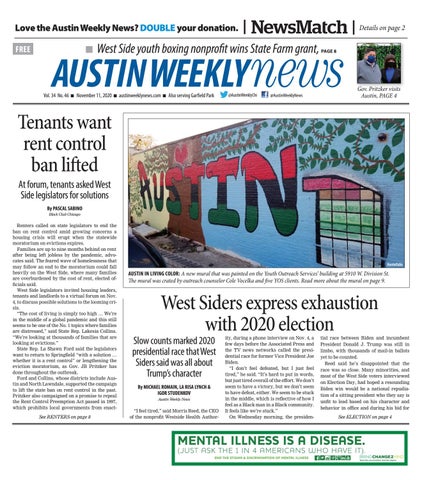
AUSTIN IN LIVING COLOR: A new mural that was painted on the Youth Outreach Services’ building at 5910 W. Division St. The mural was crated by outreach counselor Cole Vocelka and five YOS clients. Read more about the mural on page 9.
West Siders express exhaustion with 2020 election
Slow counts marked 2020 presidential race that West Siders said was all about Trump’s character By MICHAEL ROMAIN, LA RISA LYNCH & IGOR STUDENKOV Austin Weekly News
“I feel tired,” said Morris Reed, the CEO of the nonprofit Westside Health Author-
ity, during a phone interview on Nov. 4, a few days before the Associated Press and the TV news networks called the presidential race for former Vice President Joe Biden. “I don’t feel defeated, but I just feel tired,” he said. “It’s hard to put in words, but just tired overall of the effort. We don’t seem to have a victory, but we don’t seem to have defeat, either. We seem to be stuck in the middle, which is reflective of how I feel as a Black man in a Black community. It feels like we’re stuck.” On Wednesday morning, the presiden-
tial race between Biden and incumbent President Donald J. Trump was still in limbo, with thousands of mail-in ballots yet to be counted. Reed said he’s disappointed that the race was so close. Many minorities, and most of the West Side voters interviewed on Election Day, had hoped a resounding Biden win would be a national repudiation of a sitting president who they say is unfit to lead based on his character and behavior in office and during his bid for See ELECTION on page 4
2
Austin Weekly News, November 11, 2020
Dear Reader, Well that was a heck of an election. In a heck of a year. If there is anything that this year has taught us, it’s that so much of life is uncertain and unpredictable. But it is reportable. Reportable when the news is scary, even disorienting. Reportable when our neighbors rise and build new ways to connect. That reporting – street level, with names and places you know -- is the work we do. Beyond any partisan stance, we’re relieved and gratified to hear a spokesman for President-Elect Joe Biden talk up the essential role of independent reporting in a democracy. While national reporting now turns to the transition between the Trump and Biden administrations, our focus in our seven neighborhoods turns to December filing deadlines, slate building and local candidates figuring out how to campaign in the coming April elections in this rolling COVID pandemic. There are village boards, school boards, park boards, library boards, referendums that will shape the communities we cover. Right now we need your direct help to make sure Growing Community Media has the resources to keep our independent community newsroom thriving. We’re asking for you to join in right now. The early response to our annual NewsMatch campaign has been gratifying. We’re committed to doing the reporting —not just in the weeks to come, but for as long as we can. And you can play a critical role in ensuring that happens with the Austin Weekly News, Forest Park Review, Riverside Brookfield Landmark and Wednesday Journal. Donate to Growing Community Media any time between now and the end of the year and NewsMatch will match your new monthly donation 12x or double your one-time gift, all up to $5,000. Will you do your part to support public service journalism that never stops working for you? You can make a difference. With gratitude, Dan Haley Editor and Publisher 141 S. Oak Park Ave. Oak Park, IL 60302 P.S. Go one step further and share this appeal with someone who will join us in standing up for high-quality, true-seeking journalism. The stakes are high, and you can help.
To donate, visit www.austinweeklynews.com/donate
Austin Weekly News, November 11, 2020
West Side parents protest plans for new STEAM school
Proponents of the new school say proposal is popular among Lawndale residents, but some say closing three schools too high a price By PASCAL SABINO Block Club Chicago
Some West Side parents are pushing back against a proposal to consolidate three underutilized neighborhood schools in favor of a new, high-tech public school in North Lawndale. Parents and community organizers rallied on Nov. 5 outside Sumner Elementary School, one of three schools that would close to support the launch of the North Lawndale STEAM Partnership Academy. Neighborhood leaders have spent years developing the school, which would specialize in science, technology, engineering, arts and mathematics. Sumner, Lawndale Community Academy and Crown Academy all would close, and their pre-K to eighth-grade students would be moved to the new school. All too accustomed to seeing local schools close, opponents said Thursday the proposal doesn’t address the real reason students are leaving Lawndale: existing neighborhood schools are underfunded. “We have schools that are already open, and we are underfunded,” said Shavon Coleman, a parent of two Chicago Public Schools students and a teaching assistant at Lawndale Community Academy. “Take the money that you were going to invest in the new STEAM school and invest that into our existing schools.” Parents said Sumner, Lawndale Community and Crown should be given the funding to have full STEAM programs, improved technology facilities and fulltime social workers, nurses, librarians and speech pathologists. School closures concentrated on the South and West sides have not worked out well, parents and teachers said. Two schools in Lawndale closed in 2013 due to under-enrollment amid the wave of 50 school closures under the administration of former Mayor Rahm Emanuel. Another, Frazier Preparatory Academy, was shut down by the Board of Education this year. Those past consolidations promised to bring more students to the surviving schools, which would translate to more funding, said Stacey Davis Gates, vice president of the Chicago Teachers Union. “There were no savings. There were no discernable academic impacts that would
justify the trauma of shutting down schools in communities that actually need a better deal,” Gates said. “I’m sick of them telling me closing three down and building one means investment.” Parents said they were also concerned that teachers would have to re-apply to teach at the STEAM academy. A new school could mean students will be met with unfamiliar teachers who aren’t from the West Side. “Our parents want to know if there will be people who can relate to our children and their struggles,” Coleman said. State Rep.-elect Lakesia Collins said the proposal is a Band-aid solution for underutilization that will close three schools to boost enrollment at the STEAM academy “without addressing what the parents and teachers truly need.”
Provided
NOT SO FAST: A rendering of the proposed North Lawndale STEAM Partnership Academy. Some parents are protesting the school. Underutilization of Lawndale schools isn’t just about program options, she said; it has more to do with social conditions that have shrunk the neighborhood population, like unemployment, a lack of affordable housing and high crime. “We have to have a place where people want to live and stay,” Collins said. “That’s how you fix the enrollment issues; not by closing our schools.” The North Lawndale Community Coordinating Council, which is spearheading the proposal, have said the school is part of a broader neighborhood Quality of Life Plan to tackle multiple social issues in the area, including public safety, employment and affordable housing. “The quality of life plan is a total program. It’s not just focused on one thing,” said Betty Allen Green, co-chair of the neighborhood’s education committee. “One parent said the problem was housing. Well there’s a housing committee … that’s working on bringing 1,000 new houses to North Lawndale that residents will be able to purchase.” Some parents at the rally felt left out of the decision-making process for the new school, but Green said there has been extensive parent and teacher outreach at every step. Since 2018, the school has been on the
agenda for every monthly education committee meeting, which is attended by principals, local school council members, teachers and parents from many schools in the area. Neighborhood leaders also gathered feedback at North Lawndale Community Coordinating Council quarterly community meetings as well as its annual community meetings, which are attended by about 300 residents. Ald. Michael Scott Jr. (24th) held a town hall meetings to get people involved in the project. “Our goal is to have everybody in the community who is interested in being involved, to have them involved,” Green said. Additionally, school principals notified all parents about nine parent engagement meetings in August, Green said. The proposal has generated overwhelming support among parents, and even among teachers and administrators who would be impacted by the closure. “If this means that the children were going to get a high-quality education, they were fine with it. All three principals said that. When we met with the staff, that was generally what we got from the staff,” Green said. The proposal also gives priority to teachers at the three closing schools when the STEAM Partnership Academy builds its staff. “We don’t want the students entering the school feeling isolated. We want them to feel supported by familiar faces,” Green said. “Not only the teachers, but the staff at those schools will be given first preference.” Parent feedback from the community meetings and a community survey resulted in a parent engagement center being included in the proposal. The center could offer GED and higher education classes, and a fitness center for families. The STEAM school will not only benefit students who are enrolled, but all students and schools in Lawndale, Green said. Partners on the project — including the University of Illinois at Chicago and Aurora University — are committed to developing the school as an anchor for building STEAM programming at other neighborhood schools, and will offer professional development resources for Lawndale teachers, Green said. “What we are suggesting is not just for the new school,” Green said. “We will have a STEAM hub in North Lawndale and get funded to go into all the other schools that are remaining once the STEAM Partnership Academy starts.” Pascal Sabino is a Report for America corps member covering Austin, North Lawndale and Garfield Park for Block Club Chicago.
CONTACT: pascal@blockclubchi.org
AUSTIN WEEKLY
news Editor Michael Romain
Senior Editor Bob Uphues Contributing Reporters Bonni McKeown, Igor Studenkov Reporting Partners Block Club, Austin Talks Columnist Arlene Jones Staff Photographer Alex Rogals Design/Production Manager Andrew Mead Designer Debbie Becker Sales & Marketing Representavies Lourdes Nicholls, Marc Stopeck Sales & Development Mary Ellen Nelligan Circulation Manager Jill Wagner ≈ Publisher Dan Haley Business Manager Joyce Minich ≈ GROWING COMMUNITY MEDIA Board of Directors Chair Judy Greffin Treasurer Nile Wendorf Gary Collins, Darnell Shields, Sheila Solomon, Eric Weinheimer ≈ HOW TO REACH US 141 S. Oak Park Ave., Oak Park, IL 60302 PHONE 773-626-6332 FAX 708-467-9066 CIRCULATION Jill@oakpark.com ONLINE www.AustinWeeklyNews.com TWITTER @AustinWeeklyChi Austin Weekly News is published digitally and in print by Growing Community Media NFP. It is distributed free of charge at locations across Austin and Garfield Park. Our hours are Monday through Friday 9 a.m. to 5 p.m. Advertising rates are available by calling our office. Printed entirely on recycled paper. © 2020 Growing Community Media NFP.
3
4
Austin Weekly News, November 11, 2020
Governor visits Austin business that won state COVID grant
Pritzker stopped by L. May Creations on Oct. 29 to announce Business Interruption Grant recipients By ZACH CUNNING AustinTalks
Gov. J.B. Pritzker visited Austin business L. May Creations on Oct. 29 to announce the release of millions of dollars in emergency relief funds for small businesses and communities across the state. L. May Creations, 5936 W. Chicago Ave., was approved for a $5,000 Business Interruption Grant (BIG). Gov. Pritzker called businesses like L. May Creations “the backbone of Illinois’ economy,” and said the BIG program will help workers and business owners “stay thriving and stay on their feet and working.” Erin Guthrie, director of the state’s Department of Commerce and Economic Opportunity, said 4,000 small businesses have
received grants through the BIG program. Nearly half of those grants have gone to minority-owned businesses. There is still $175 million in funds remaining for the program, and the state is accepting and approving applications on a rolling basis until the funds run out, she said. Guthrie said they’re considering factors – including whether a business operates in a disproportionately impacted community, within an industry that has been hard hit or in a region currently under mitigation measures – to ensure the money goes where it’s needed most. Pritzker said the support the state can offer is not enough to fill “a nationwide gap that only Congress, really, can fill.” State Rep. Camille Lilly agreed the federal government needs to step in. “We need Congress and the president to pass additional relief funding so we can continue to help small business … here in Illinois,” she said. Latrusia May, the owner of L. May Creations, said in an interview after last week’s event that small business owners should be applying for all the funding they can get right now.
“I would definitely say apply, apply, apply. The worst you can hear is no, but if you don’t ask, you definitely can’t receive,” she said. May applied in early October and received the call telling her she’d been approved, as well as the call asking her to host last Thursday’s event with the governor at L. May Creations, a few weeks later. She said the governor visiting her business is good publicity. She has been able to host events at L. May Creations recently, but with smaller capacities and shorter time limits. While many of her clients were willing to work with the city and state’s restrictions, some were nervous and wanted to cancel their events so she refunded their money. “Just having that BIG grant, I can imagine how it would help other businesses … it was definitely a help to mine,” she said. May is also working on developing a mixeduse, commercial and residential building on the site next to L. May Creations. She said in July the site will feature an upscale soul food restaurant, but she is keeping the name under wraps. “Any businesses that are looking for a great place to come to, definitely look into
Austin Talks
GOING BIG: Gov. Pritzker and Rep. Camille Y. Lilly outside of L. May Creations on Oct. 29. The governor was in Austin to announce Business Interruption Grant recipients. coming to Chicago Avenue because something big is about to happen,” May said. Business owners can find resources about the BIG program and apply for a grant online at: https://www2.illinois.gov/dceo/ smallbizassistance/pages/c19disadvantagedbusgrants.aspx
CONTACT: austintalks.org@gmail.com
ELECTION
Tiring for many from page 1
LA RISA LYNCH
GETTING IT OVER WITH: West Side residents stand in line on Nov. 3, to vote at the Westside Learning Center.
re-election. The Trump campaign is currently in court to block the count of a significant number of mail-in ballots that are still outstanding due to the Trump administration’s deliberate slowdown of the U.S. Postal Service. Many of those outstanding ballots are in Democratic strongholds, including predominantly Black and Brown areas of the country. “You have to be concerned that the current president refused to recognize the law and the process that has been in place since the beginning of our country,” Reed said. “If he can do this, then what does that mean for the future of our elections and future presidents? And what does the mean for our voice, when he can just go to the Supreme Court and have them supersede turnout?” Austin resident Karron Williams echoed Reed’s sentiment during an interview on Nov. 3. Williams was on her way to vote at the West Side Learning Center 4624 W. Madison St. “I’m just ready to vote, because I’m tired of what’s going on,” Williams
said. “I can’t have a voice, if I don’t vote. If you don’t like what’s going on, do something about it. That is what our ancestors fought for.” Lou Maheffy, who was on his way to vote at Sayre Elementary Language Academy, 1850 N. Newland Ave., said that he was not particularly enthusiastic about either Biden or Trump, but the president’s behavior was the deciding factor in wh he was “leaning toward” Biden. “It feels like I’m not voting for my political beliefs,” Maheffy said. “I’m voting more for a person, for the behavior of the current president. His behavior overshadows his politics. Whether you agree with his positions or not. You can’t agree with his behavior as a leader.” Carlos Ortega, of Galewood, said that the choice, for him was clear. “It’s a historic election, you know?” I voted Democratic,” he said. “You know what, it’s hard to say good things about the other candidate. Just based on integrity, I had to go with Biden.” “If Kanye was on the ballot, I would have voted for him,” Williams said. “I’d have voted for anybody who is less than the evil we have in office right now.”
CONTACT: michael@austinweeklynews.com
Austin Weekly News, November 11, 2020
West Side Lives Bethany Stannard, on her love of Austin By MICHAEL ROMAIN Editor
Back in December 2016, a month after Donald J. Trump won the presidency, I spoke with Bethany Stannard at the West Side Business Network’s annual holiday party at Columbus Park Refectory, 5701 W. Jackson St. She was 23 at the time. I thought I’d revisit this interview four years later. Stannard talked about her passion for praise dancing and her connection to her hometown of Austin, and the church that helped raise her.
On dancing and God I’ve been dancing for 16 years at Rock of Our Salvation Evangelical Free Church, 118 N. Central. The first time I danced was at my church when I was about 7 or 8 years old. I danced with a few other girls and it just felt right. You know how sometimes things feel right
and you know it in your soul? As my knowledge of God and my relationship with him deepened and grew, I recognized that this was his call on my life.
On living and growing up in Austin The West Side gives me a very unique perspective on the world, because I look at things differently than other Caucasians. I’ve seen families where grandmas are in a house with 18 grandkids. I’ve had people shot in my alley. I’ve seen it all, but I’ve also seen the resilience and strength of African Americans — their passion, their love of God, their pursuit to get the best out of life that they can get. I’ve seen parents work endless hours to get their kids that leg up. So when people say [bad] stuff about Austin, it hurts me personally, because I identify so closely with this place. All the struggles that African Americans feel — I feel them, too. My church is my other family. We’re a relatively mixed congregation, but it’s still predominantly African American. They love me and I love them. It’s a community that we have and I wouldn’t trade it for the world.
“The” Friendship BAPTIST CHURCH Rev. Dr. Reginald E. Bachus, Pastor
5200 W. Jackson Blvd., Chicago, IL 60644 773-378-6600
fbcchicago.org • facebook.com/friendshipbcchicago SUNDAY SCHEDULE 8:30AM 1st Sunday Communion 8:30AM Morning Worship Service 9:30AM Sunday Church School 11:00AM Mid-Morning Worship Service MIDWEEK SERVICES (Wednesday) 12:00PM Noon Bible Study 6:00PM Bible Study 7:00PM Prayer Meeting
Proud to partner with Austin Talks
BETHANY STANNARD
CONTACT: michael@austinweeklynews.com
Loretto offering free prostate cancer screenings in Nov. By STAFF
Loretto Hospital offering free prostate cancer screenings throughout November The hospital is offering walk-in appointments and same-day prostate cancer screenings for those who qualify Loretto Hospital in Austin is offering free prostate cancer screenings for uninsured or underinsured men living in Austin and surrounding communities through the month of November, accordant to a statement the hospital released this month. According to the Centers for Disease Control and Prevention, prostate cancer is the leading cause of cancer deaths among all men in the United States, but Black men die from the diseases at a much higher rate than
men of other race and ethnic groups. “Typically, men are less likely to schedule routine physicals and screenings than women,” said Dr. Ilysa Diamond, who practices gastroenterology at the hospital. “The Loretto Hospital remains committed to ensuring men understand their risk factors and are equipped with the necessary tools, like routine screenings, to protect their health.” The hospital is offering walk-in appointments and same-day prostate cancer screening for area men who qualify. For more information or to schedule a screening, call (833)-TLH-LOVE.
austintalks.org INTERESTED IN ADVERTISING? Contact Lourdes Nicholls 708.613.3329 Lourdes@oakpark.com
CONTACT: michael@austinweeklynews.com
AUSTIN WEEKLY NEWS Letter to the editor – Austin Weekly News, 141 S. Oak Park Ave., Oak Park, IL 60302
ADVERTISE • 773-626-6332 • WWW.AUSTINWEEKLYNEWS.COM
5
6
Austin Weekly News, November 11, 2020
COMMUNITY
NEED TO REACH US?
Call Editor Michael Romain at 773-626-6332 michael@austinweeklynews.com
Why were Black people the face of the fair tax?
I
t is the year of our Lord: 2020. Slavery ended 155 years ago and the struggles of the descendants of those enslaved Africans range the entire 360-degree spectrum. It is because of that wide disparity that we as a group get used by others for their agenda. Such is the case for the recent introduction of the so-called “Fair Tax”. Basically it was a proposition placed on the ballot that allowed the voters to change what is in the Illinois State constitution, which says that everyone in the state from the poorest to the richest pays the same tax rate to the state. I have often used the analogy when arguing against the proposition, that tithing to the church is set at a flat 10 percent; if it’s good enough for God, it should be good enough for the politicians in Springfield. There are not enough millionaires and billionaires in the state to tax to cover the millions upon millions of people who don’t make that kind of money. Plus,
just like with any other household, if the expenditures are more than the income, you have to cut your budget. Springfield does not appear to even want to consider that notion. And until they truly address the pension fund issues, this state will forever be in chaos when it comes to money. What really bothered me though was a piece of political literature I got in the mail. Three black faces are used to advocate the passage of the fair tax. How, and even more so why, are Black people the face of the fair tax? Why were Black people targeted to advocate for it and then super targeted to vote for this proposition? Yet, when I traveled throughout the state to far out western suburbs like Aurora and Naperville, I did not see the same emphasis on signs up and down the road like I did in the Black community where they literally lined the block every 6 feet from the other? Then there were the ads that played over the internet. One was a Black woman
ARLENE JONES
whose job it is to help teen mothers with their babies. She called herself an essential worker. How and when did the emphasis go from advocating birth control and not becoming a teen parent to one where a grown woman’s job is to assist the girl with the baby and because of her job, taxes should now be increased on millionaires and billionaires? I found that extremely racist. Then there was another commercial featuring three business people. Two were white who stated that they were a small business owner. The third person was a Black guy who said he’s been in the coffee business for 15 years. I understand the English language. The man did not say he owned anything, just that he participated in the industry. Hell, for all I know he could have served coffee for the last decade and a half. Thankfully the Fair Tax proposition failed. And now Governor Pritzker is doing what he should have done in the first place. Look at cutting the budget.
CONTACT: michael@oakpark.com
We are OPEN! RibFest Every Day!
Mickey’s is the place!
Mickey’s Rib Special B.B.Q. RIBS & CHICKEN BURGERS & HOT DOGS
1/2 Slab Dinner
$11.99
Full Slab Dinner
$17.99
includes fries or baked potato, coleslaw and garlic bread
525 N Harlem Ave, Oak Park (708) 848-3333 11am - 9pm Daily
3 Vienna Hot Dogs w/ Fries $ .49
8
Italian Beef Sandwich w/ Fries $ .49
8
Wednesday
Gyros Plate Dinner 1 lb meat, 2 pita breads, fries & 3 cups sauce $10.99
Every day Special!
Gyros with fries $7.99
1/4 Lb Double Cheeseburger
Big Mickey! $ .99
2
Austin Weekly News, November 11, 2020 SPONSORED CONTENT
Reconnecting - Neighbors Knowing Neighbors: The Power of Engagement By ATHENA WILLIAMS, Executive Director, Oak Park Regional Housing Center
T
he 2020 election, just over, was one for the ages. Tension and worry have been real. With this said, there were many actions taken in recent months by the federal government, particularly in Athena Williams, Executive Director areas around Fair Housing, that may directly impact OAK PARK REGIONAL HOUSING CENTER the very communities we work, live, play, and pray. With the newly announced administration, we are hopeful better days are ahead on the national front and Oak Park Regional Housing Center will join our National partners to work hard to make that so.
Fast forward to 2020. Did you know that over 40 percent of Oak Parkers are renters? Or, even more so, that over 25 percent of our neighbors live in those lovely old courtyard buildings on Oak Park’s busiest streets? Those are great apartments and so many of them have now been updated due to multiple partnerships with OPRHC. Even though, those apartment residences are not the easiest places to get to know your neighbors.
In 2017 the Housing Center developed an initiative called Neighbors Knowing Neighbors. The initial development of Neighbors Knowing Neighbors was to invite Oak Park apartment rental residents to neighboring block club parties. This served as a purpose for residents of the larger buildings to connect to the homeowners in the community via block parties that were happening just around their corner. It was a great project. We even held our first “On the Table” dinner event, with the Austin Community under the
This year, through the OPRHC Neighbors Knowing Neighbors program, we successfully reached out to over 500 of our rental residents to provide support during the early intense moments of the COVID-19 pandemic. we serve. Through our Neighbors Knowing Neighbors programming, OPRHC is launching the “Power of Engagement,” an initiative which will allow affinity groups — Oak Parkers who identify as white, Black, and people of color, Austinites, and potentially a group of people from the Proviso Township area — to meetup (virtually) to discuss ways our various communities address racial tensions and segregation. It’s important to note these conversations will occur separately and will have a facilitator to promote an honest and open dialogue. Our Community Engagement Specialist, Kamau “Maui” Jones, will be one of the facilitators for the discussions to note key moments in each individual meeting, also facilitating is Lisa Zeigler, our Strategic Initiatives Director.
Maui Jones was recently hired at the Housing Center as its Community Engagement Specialist. Facebook
Meanwhile, there is the groundwork of OPRHC. Back in the late 1960’s Roberta “Bobbie” Raymond, who would go on to found the Housing Center in 1972, talked about why we need to learn to depend on one another as neighbors. While these conversations were directed toward state and federal policies, it was only natural for the community of Oak Park to use this as a way to begin to foster a sense of connection and empowerment. This connection created a “neighborly” neighborhood in Oak Park. This was the beginning of the Village of Oak Park addressing Fair Housing, expansion of housing choices, elimination of “white flight”, and the fight against red lining.
same banner, “Neighbors Knowing Neighbors”. This year, through the OPRHC Neighbors Knowing Neighbors program, we successfully reached out to over 500 of our rental residents to provide support during the early intense moments of the COVID-19 pandemic. During the injustice displayed during nationwide riots, OPRHC took a stand and provided support for many community protests. But, as a Black woman leading such a notable agency, I personally realized that was not enough. Oak Park Regional Housing Center has addressed integration for more than four decades, but 2020 has confirmed that it is time that we move toward racial healing and transformation in the communities
Once each group has had the chance to voice their opinions, Neighbors Knowing Neighbors will bring everyone together for one epic discussion in an effort to further break down barriers. We know there’s a direct cost to segregation, and it needs to be publicly addressed. All of the work we plan to do will hopefully be presented on a grander scale in the spring 2021 during the OPRHC and community “Power of Engagement” diversity conference. I know I felt various and intense emotions tied to the election. Now that it is behind us, we need to come together and speak our minds to actively engage our collective problem-solving mindsets. The OPRHC is working to make it as easy as possible to do just that, but it’s equally as important we have as many different people with wholly unique perspectives willing to participate in the conversations.
Please join the conversations.
7
8
Austin Weekly News, November 11, 2020
W. Side youth boxing nonprofit gets $20K State Farm grant
The Bloc, a boxing nonprofit that provides mentoring and other support for young people, was among 40 organizations in the country to get funding
2,000 nonprofits throughout the United States to apply for the State Farm Neighborhood Assist grant. In the application, Cannon argued that the grant will do more than simply improve the building. “By providing a sense of belonging, supporting youth fitness and promoting the holistic development of our youth, the grant will create a foundation for individual success and community development,”
“State Farm is proud to support the good neighbors who will be implementing the winning projects in their communities,” she said. “We look forward to seeing the impact of these grants.” Cannon didn’t respond to a request for comment by deadline. But, in the organization’s newsletter, he thanked everyone who voted for the nonprofit. “With these resources, we can engage
By IGOR STUDENKOV Contributing Reporter
A West Side nonprofit recently received a $25,000 State Farm Neighborhood Assist grant. The Bloc, a nonprofit based in West Humboldt Park, leverages the sport of boxing to provide mentoring and support services for youth in a variety of West Side neighborhoods. The nonprofit was one of only four in the state to receive the grant. The winners were selected based on the number of votes they garnered. Jamyle Cannon, the Bloc’s executive director, explained in the organization’s newsletter that he founded the nonprofit in 2016, in order to reach “kids who liked to fight” and were less likely to join youth mentoring programs. The Bloc originally operated out of North Lawndale’s Theodore Herzl Elementary School, 3711 W. Douglas Ave. Earlier this year, a foundation requesting anonymity bought the former Mission of Christ Evangelical Lutheran Church building in West Humboldt Park, at 1345 N. Karlov Ave., so that the Bloc could have space for its gym and offices, according to a report by Block Club Chicago. The Bloc postponed its plans to open the space in March due to the pandemic, transitioned to providing online services and took other steps to mitigate any risk of infection. The Bloc pivoted toward virProvided tual training in the spring and a hybrid model — a mix of in-person in- GRATEFUL: Jamyle Cannon, the founder of the Bloc, with some of the young people the nonstruction and virtual instruction — profit supports. The Bloc recently received a $20,000 State Farm grant. during the summer. The nonprofit youth in a program that will impact the he wrote. also launched a food pantry for residents. educational, social, and life outcomes for According to State Farm, the State Farm “In times of uncertainty, it is important for The Bloc to be a consistent source of Review Committee looked at all applica- our entire community,” he wrote. “I am good in our kids’ lives,” Cannon wrote at tions and selected 200 finalists. The 40 win- continually humbled by the strength of our network and your commitment to the time. “We are taking precautions to in- ners were selected based on online votes. driving outcomes for West Side youth. I Winners were announced on Nov. 4. Ancrease spacing between participants, limit can’t thank you enough.” nette Martinez, State Farm’s senior vice contact, and disinfect surfaces so we can remain a safe haven for West Side youth.” president, stated that she looked forward CONTACT: igorst3@hotmail.com In July, the Bloc was among around to seeing the grants bear fruit.
RENTERS
Demanding reform from page 1 ing any regulations on how much a landlord can charge in rent. “It’s not the only thing that will fix the housing crisis 100 percent. But it’s a step towards it, because right now we have a law that leaves no room for us to have this conversation,” Collins said. Rent control policies that would limit annual rent increases could be an important check against large real estate corporations that profit by raising rents and cutting corners on maintenance, tenants said. “People are at risk of homelessness in our communities because they’re vulnerable from years of turning most of their hard-earned income over to people who are significantly more wealthy than them,” said Ivy Abid, a volunteer at a tenant crisis hotline. Activist Nita Bud said too many students are at risk of homelessness. From her own experience with housing insecurity, she knows it has a huge impact on academic attainment. “For half of a school year for high school I was homeless, and that affected my grades tremendously,” she said. ” … The moratorium is just the bare minimum.” Neighborhood landlords at the forum asked elected officials to find a way to help mom-andpop landlords survive the eviction moratorium. Landlord Serethea Reid said she’s been put in a pinch by the moratorium and is at risk of not being able to afford her mortgage since she’s not getting any income from several tenants. “I’m definitely understanding. People need to have housing, I fully understand that. Yet I can’t survive people not paying me for a year,” Reid said. The moratorium has shifted the burden of housing people who can’t afford rent onto landlords, Reid said, but the responsibility should fall on city and state governments to ensure people can pay for housing with programs like housing choice vouchers. “Why is a private person required to house someone for free?” Reid asked. “If the state is asking us to just blanketly keep people who cannot pay, why can’t the state on a blanket basis house people that need housing? Give these vouchers out and so they can go someplace to live.” Some at the forum expressed concern about how rent control may impact small landlords. But Brian Bennett with Democratic Socialists of America and the Lift The Ban coalition said small landlords aren’t the ones driving steep rent increases since they usually align prices with property taxes and utility costs. Rent control could also address some of the factors that drive up costs for landlords, Bennett said. “Any legislation would include significant tax advantages for small landlords,” he said. Pascal Sabino is a Report for America corps member covering Austin, North Lawndale and Garfield Park for Block Club Chicago.
CONTACT: pascal@blockclubchi.org
Austin Weekly News, November 11, 2020
9
Symposium focuses on racial reconciliation
Nov. 5 event streamed live on Facebook and YouTube prompted uncomfortable conversations By SHELBY E. HAWKINS AustinTalks
Musicians, poets, storytellers, politicians and others came together on Nov. 5, to discuss what social equity for Austin should look like. Austin resident and educator Resheeda Graham Washington moderated the fourhour event, which was streamed live on Facebook and YouTube. Presented by the Austin Renaissance Council, the first racial reconciliation symposium was held at the Kehrein Center for the Arts. It prompted uncomfortable conversations, emphasizing the importance of Austin residents sharing stories and taking control of their narratives. One of the presenters, storyteller Kucha Brownlee, shared the story of her family. They moved from Mississippi to Tennessee, then her dad went to Chicago, later sending for the rest of his family to join him. Brown-
lee was born on the West Side, making her a first-generation Chicagoan. Brownlee reminded viewers of the diversity within the Black community, citing her family as a color spectrum of shades. She’s a light-skinned woman with loose curls adorning her head and light-colored eyes. She recalled being part of a protest when a classmate looked at her and questioned her involvement. “Why are you marching? This is not your fight,” the classmate said. “What do you mean?” Brownlee replied. “You could pass,” said the classmate, referring to how her light complexion could allow her to pass for white. Brownlee, however, said she needed to march because she wouldn’t disown her family. She claimed them just as they claimed her. A youth empowerment panel, moderated by Miki Grace, also underscored how important it is to maintain a sense of community. Dearra Williams recalled growing up in Austin and how all of her resources from food access to education were outside of the neighborhood. “Why is it like that?” said Williams, a marketing and development associate with Austin Coming Together. “I should be able to stay in my hood to get the food that I deserve and the school that I deserve.”
Others on the youth panel agreed that building community will result in positive change. Jeremy Mercado of BUILD said: “I think one of the most powerful things we can offer individuals is our presence… We need to give ourselves more opportunities to be with each other.” Themes of unity and solidarity continued throughout the event. The director of New Life K.N.E.W. Solutions, Khiry Johnson, gave a lesson on privilege, and how people can use their privilege to other peoples’ benefit. He recounted going to a restaurant with a diverse group of people where they saw a used noose on the wall displayed next to a rifle. Everyone in the group began taking on different jobs – some asked for the manager, others checked on how the Black people in the group were feeling, and some got the car, urging everyone to leave. Johnson used this story to illustrate how racial reconciliation is a team effort in which everyone plays a part. “Racial reconciliation is the top-tier allyship. I need you to be an ally when it’s not easy. I need you to be an ally when it’s not convenient. I need you to be an ally when no one’s around to watch you be an ally.” He concluded by telling the audience to
“take ownership over how you love yourself.” With unfavorable stereotypes of Black people still part of the mainstream, the symposium sought to answer how those negative perceptions can be undone. State Rep. La Shawn Ford was there as well to talk about social equity. Speaking with Austin Coming Together’s planning and investment manager, Darrel Washington, the Austin lawmaker said equity starts with education. Ford, who used to be a CPS history teacher, advocates for swapping history lessons in public schools for civics classes until the curriculum is changed. “The history lessons we teach our children are biased, they’re racist, and they make one person superior over another … we should put a moratorium on the current teaching of history in our schools.” Organizers say more conversations and events like this will be ongoing throughout the year to highlight more narratives from the community. You can watch the symposium online at: https://www.youtube.com/watch?v=v9rBKQiPgM&feature=emb_err_woyt.
CONTACT: austintalks.org@gmail.com
New mural brightens West Side building
The 62-by-16-foot mural took five months, including two months of planning, to complete By SHELBY E. HAWKINS AustinTalks
A large trunk of a tree with long branches extending out on either side is the centerpiece of a new mural painted on the Youth Outreach Services’ (YOS) building at 5910 W. Division St. Created by outreach counselor Cole Vocelka and five YOS clients, the 62-by-16-foot mural took five months, including two months of planning, to complete. The mural, their biggest project so far, was finished just a few weeks ago. Part of Vocelka’s work focuses on activities to do with the organization’s young clients. Once the pandemic hit, he thought it would be the perfect time to work on the mural since they’d be able to social distance and be outside.
Working with youth ages 12 to 21, the non-profit social services agency specializes in substance abuse treatment, behavioral counseling and crisis intervention, among other services. The YOS building was not easily identifiable before the mural. It’s an older brick building with no windows that doesn’t stand out. Vocelka said he wanted to do something that would brighten up and bring attention to the area. While finding activities for young people can be hard, this project was special for those involved. “It can always be difficult to get clients involved in any activity, but this one was a new experience for all of them. They had fun using paint rollers to fill in the background colors,” Vocelka said. One of YOS’ members, McKinley, was happy he was able to be a part of the project. “There are a lot of blank walls in my neighborhood. I would really like doing more [murals] … The best part is when people would come around and say how good it looks. That felt really good.”
At the center of the tree is a red heart, and across the side of the building the word “Austin” is painted in big red, black and green bubble letters in reference to the Pan-African flag. The tree represents the community’s roots, said program manager David Rodriguez. “We wanted to remind people of the roots of the community. We want to give the people back the power,” Rodriguez said. “A tree will grow the way it grows no matter what’s in its path; it’ll grow around obstacles or grow through it.” Because Austin is a predominantly Black neighborhood, they wanted to represent that culture in the mural. Rodriquez recalls growing up in Pilsen and how different it feels now since it’s been gentrified. He says the predominantly Mexican area has lost its roots. The mural is also to send a reminder of support to the neighborhood. “We want the kids to know that we’re here if they need something. We want to break the stigma of asking for help.”
CONTACT: austintalks.org@gmail.com
Austin Talks
BEAUTIFYING: Young people with Youth Outreach Services outside of the mural they helped pain at 5190 W. Division St.
12
Austin Weekly News, November 11, 2020