






By HECTOR CERVANTES Contributing Reporter
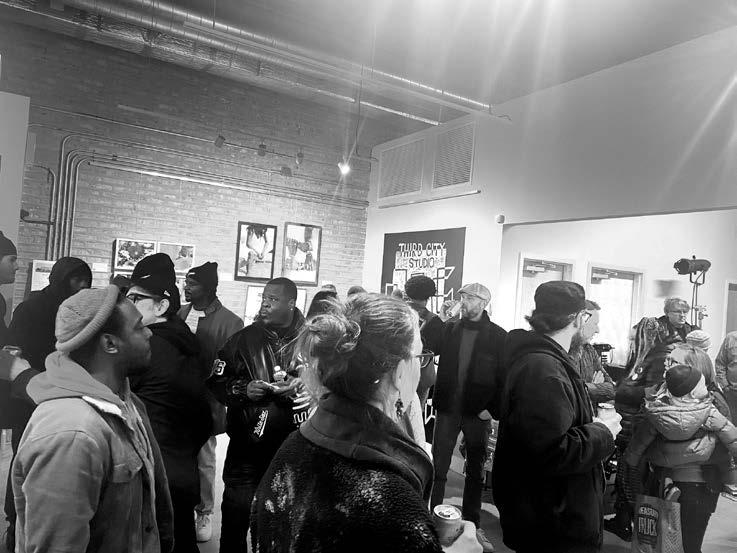
“In the wintertime there will be flowers, sang Angel Bat Dawid, moving through the gallery at Third City Studio as layers of music filled the space, bringing Third City Studio’s first 2026 exhibit Winter Florals to life with color, sound and energy.
Exhibiting artists include Jessica Du Preez, Aquarius E. Alegria, Rebecca Grant, Ca leb Guider, Naomi Johnson, Jennifer Hoef Nagle, Hailey Rodden, Brent Showalter and Jayla Trenyce.
The exhibit opened Feb. 6 and runs through March 7 at the gallery at 5538 W. North Ave.
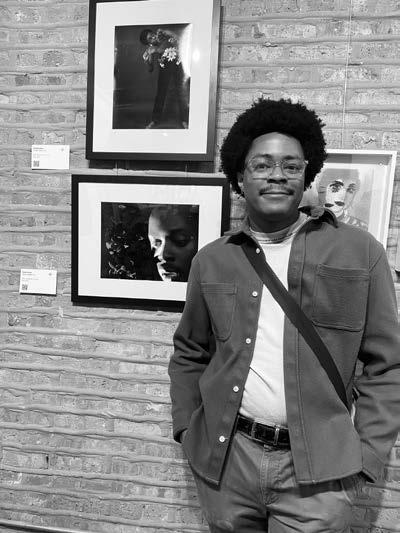
Chicago-based composer and multi-instrumentalist Angel Bat Dawid visited Third City Studio on opening night to explore the space and its community programs, emphasizing the importance of giving back as a Black woman in the arts
“‘I’ve had a lot of success playing music nationally and internationally, but as a Black woman artist, it’s important that whenever we succeed, we make sure to give back to our community. I was very interested in the initiatives here, like bringing the
arts to areas where you don’t usually see them, which is a sign of systemic inequity. There’s this misconception that people on the West and South Sides don’t want arts, galleries, orchestras, or jazz, but of course we do, every human does,” Dawid said.
Dawid describes her shows not as performances, but as services. For her, music is about connection, not just performing or recording.
“The theme for tonight, with the beautiful show up here right now, is called Winter Florals. The idea is that even in winter, there are these beautiful blooming florals,”


Dawid said.
Guider is a Chicago based photographer and filmmaker who grew up in East Garfield Park and now lives in Austin, using selfportraiture and experimental techniques to document moments of stress, creative exploration.
“I actually just saw Third City one day while walking, because I li neighborhood. I’m about a three-minute walk away,” Guider said.
Guider was in London and attending school outside the city when Third City Studio opened
“So I didn’t see the development of Third City Studio at all. When I came back, I thought, ‘Oh, look!’ Whenever I would leave, it felt like something brand new was always popping up in the area, and that was something I loved,” Guider said.
that was meant for a disco ball, and I grabbed a garland from our door to use as a prop. It was just random pieces I pulled to g ether around 11 o’clock at night in my basement,” Guider said.

In one of his pictures, Guider showcased a selfportrait of him holding flowers, taken on film that had expired in 2001, turned out unexpectedly beautiful, with colors he loved.
“It’s very, very brown and has a kind of robotic, dramatic feel to it,” Guider said.
T he second self-portrait, taken in a basement with a bright disco light, features rich hues of blue and purple.
“We had this super bright disco light
multifaceted artist and educator from Austin, creating work that spans floral design, photography, and fashion, ile teaching preschool through eighthgrade students at Nash Elementary School.
“The first pair I designed at Fleurotica at Garfield Park Conservatory and my model actually wore them in the show in October. I wanted to create something for that outfit using real flowers, so all the flowers are hand-pressed, dried, and applied to the shoe,” Rodden said. “After I shared that pair, I received interest from people who wanted their own. The rose pair was a custom order I made for someone, and they’ll receive them after the show.” Rodden became involved with Third City Studios shortly after it opened in October, as she was looking for a space where her students could showcase their work
“I hope (Winter Florals) lightens things up. It’s been so cold and wintry that maybe it can lift the mood a little, inspire people and just feel a bit warmer and brighter,” Rodden said.
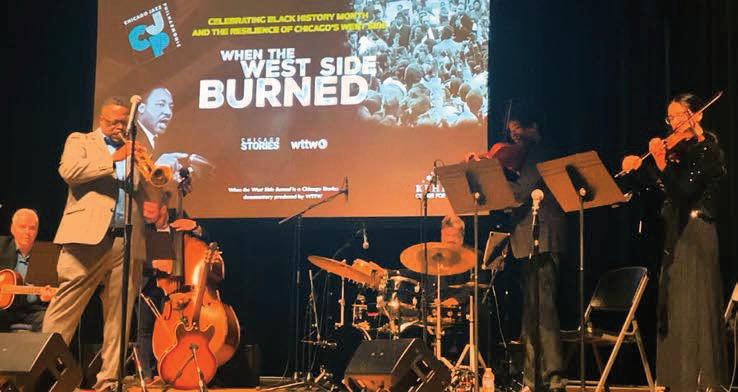
visit to Soldier Field. He said King’s presence created a pressure for the city to confront change, and his approach to nonviolent civil disobedience was both critical and effective
“Today, with what’s going on with ICE and our response as people who often forget the significance of what Dr. King gave us on a moral level, it’s important to remember his message. Dr. King said very clearly that you don’t judge a person by the color of their skin, but by the content of
“Another thing we do is engage, empower, and educate people about tree planting. Many people don’t realize how important trees are in our neighborhoods, but they really are.”
us to truly reco gnize the humanity embodied in Martin Luther King,” Brooks said. The documentary highlights a moment of profound grief while also focusing on the people who lived through it, emphasizing the ongoing work in the community. Reshorna Fitzpatrick discussed programs at Stone Temple, including a three-day-aweek food distribution that provides groceries and cooked meals. She said these ef for ts help community members not just survive, but thrive, allowing them to pay bills while still having enough to eat.
RESHORNA FITZPATRICK
“Another thing we do is engage, empower, and educate people about tree planting. Many people don’t realize how important trees are in our neighborhoods, but they really are, they build wealth in the community, improve health
plant trees,” Reshorna Fitzpatrick said.
Berry noted that the Kehrein Center for the Arts exists because of Glen Kehrein, a West Side activist and ally, who championed asset-based community develop-
“Kehrein Center for the Arts is named to honor Glen’s le gacy, but if Glen were here, he would likely have preferred the building not be named after him. More than the brick and mortar, I want to celebrate the









For more information about your Chicago Park District, visit www.ChicagoParkDistrict.com or call 312.742.7529.
from February 1st to 15th, 2026. | Board of Commissioners | Carlos Ramirez-Rosa, General Superintendent & CEO

MOVE & MINGLE
Kehrein Center for the Arts | 5628 W. Washington Boulevard February 13 | 11:00 a.m.–1:30 p.m.
VIVA LA VIDA
National Museum of Mexican Art | 1852 W. 19th Street February 26 | 10:00 a.m.–12:00 p.m. or 1:30–3:30 p.m.
WALKING & WELLNESS CLUB
Salvation Army Freedom Center | 825 N. Christiana Avenue Fridays | 8:30–10:00 a.m.
Register today! Anyone 55+ is welcome to join for our

from page 1
“We are one such hospital and, if recall, were to be permanently December 2022 until it and keep it operational,” “Now three years later, welcome all patients from the who we observe are sick plex, due to not being early due to funding ment cuts.”
Resilience Healthcare bought West Su along with its sister hospital rial in Chicago’s Uptown neighborhood, from Pipeline Health for $92 million in 2022. Before selling the hospitals, Pipeline filed for bankruptcy, reporting nearly $70 million of net losses between West Sub and Weiss from Aug. 2021 to 2022 alone.
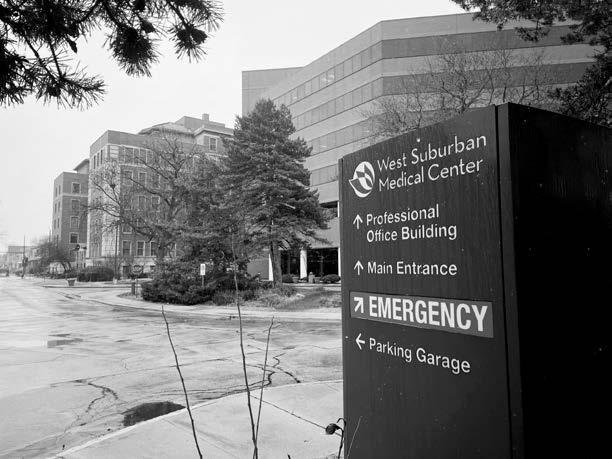
December. As of Feb. 3, 2026, West Suburban owed $51.8 million to the department in assessment fees and late penalties.
In the 2023 fiscal year alone, West Sub incur red $10.5 million of debt to the IDHFS for not paying the monthly assessment fees, nearly $1 million of which were late penalties. The hospital racked up another $13.5 million in missed assessment fees the following fiscal year and $18.5 million in the 2025 fiscal year.
According to documents provided to Growing Community Media by the Illinois Department of Healthcare and Family Services under a Freedom of Information Act request, in Jan. 2023, the department gave West Suburban a $20 million advance pay-
ment to help get Resilience Healthcare out of some of the debt it inherited, but the hospital hasn’t paid any of it back FOIA documents also show that West Sub hasn’t paid any assessment payments — which are state fees that help cover the cost of patients with Medicaid or who are uninsured — since August 2022. The state approved the sale to Resilience Healthcare that June and ownership officially changed
In Jan. 2023, the Illinois Department of Healthcare and Family Services gave a $20 million advance payment to Resilience Healthcare for both West Suburban and Weiss.
Resilience requested the payment from the IDHFS after it bought the two hospitals from Pipeline Health. According to the payment plan ag reement, Pipeline accrued nearly $60 million of debt to vendors in 2022 alone, which Resilience inherited and needed help paying of f in order to make the hospital financially stable.
In the 18-month payment plan, Resilience was expected to pay $1.1 million monthly in 2024 and for half of 2025.
To date, the IDHFS has not received any scheduled advance payments and is establishing measures to ensure West Sub’s compliance with advance repayment agreements.
According to the ag reement, if Resilience fails to pay, the IDHFS will immediately start taking collection action to recover the outstanding balance, including penalties. And Resilience wouldn’t be
able to get approval for another advance payment until it pays of f the first.
West Suburban has not been without financial assistance from the state, receiving about $19 million since 2022. The Illinois Department of Public Health (and some federal funding) has provided the following grant ag reements between the department and West Suburban:
■ $4.2 million, one-year grant starting July 2022
■ $4.8 million federal, one-year grant starting July 2022
■ $3.45 million, one-year grant starting July 2023
■ $4 million, one-year starting July 2024
■ $2.4 million, one-year grant starting July 2024
Prasad told GCM that each grant has requirements for what it must be spent on, like hiring more staf f or buying equipment.
“We are required to provide evidence of completing those actions or activities that we have consistently and timely done,” Prasad said.
The IDHFS told Prasad in October that it would enter into a payment plan ag reement of 36 monthly installments, Jan. 2026 through Dec. 2028. The hospital was instructed to pay $50,000 or $100,000 monththrough this year, $200,000 or $300,000 monthly next year, $600,000 monthly the first half of 2028, and over $5 million a month through the rest of the year. While on the payment plan, West Sub would still have to pay subsequent hospital assessment payments.
If West Sub doesn’t comply with the agreement, the IDHFS can either: deduct 25% of total payments to the hospital for services rendered from future payments; recoup the remaining amount of the outstanding assessment balance; or withhold increases in payment upon federal approval of updated hospital assessment payments beginning last year.
To date, the IDHFS has recouped $2,600,353 from West Sub in outstanding debt.
In December, Prasad submitted a request for an administrative hearing with the IDHFS. According to the request, Prasad is “challenging HFS’ recovery of unpaid assessments because it is against the public interest, more specifically, the public residing in the Austin and surrounding neighborhoods, for whom West Suburban Medical Center, a safety net hospital, provides critically needed acute healthcare services almost exclusively,” Prasad said in the request.
“HFS is aware that for the past eight months, West Suburban Medical Center has been struggling with a forced transition to a new Electronic Medical Record System that has crippled our billing and collection capabilities, forcing the hospital to survive on a small fraction of its normal revenues while continuing to provide needed services to the impoverished neighborhoods,” Prasad said in the request. “This enforced recovery, on top of severely diminished revenues, will most likely force the hospital to end services, creating a healthcare desert in the region, negatively impacting the community’s health, the very thing that HFS is charged with improving.”
During a press conference in August, Prasad said, since before Resilience
The last week of January, the Illinois Department of Public Health visited West Suburban Medical Center. An IDPH public information officer told Growing Community Media that the department’s visit to West Suburban last month “is a pending matter, and therefore we are unable to comment.”
West Suburban CEO Manoj Prasad said the visit wasn’t unusual, and that the IDPH was at other hospitals in the area in prior weeks.
“They typically investigate complaints and monitor care delivery, which they also did for us,” Prasad told Growing Community Media. “There was nothing newsworthy that came out of it. We were pleased with their approval of our care delivery and operations that they reviewed at length.”
The phone lines at West Suburban Medical Center have been restored. After days in which calls to the hospital’s main line received a “The number you have reached is out of service” message calls are now answered by an automated attendant after a welcoming message
Healthcare bought the two hospitals, they have averaged a loss of $20-50 million annually. The press conference was the same day Weiss closed, after the federal government cut its Medicare program because of violations relating to emergency protocols, nursing services and the hospital’s physical condition.
“HFS is aware that a number of hospitals are facing financial difficulties that will be exacerbated by changes implemented by HR 1,” or the Trump Administration’s Big Beautiful Bill, Melissa Kula, a media relations officer for the IDHFS, told Growing Community Media in an email. “HFS is currently considering steps to ensure a sustainable healthcare safety net for the State of Illinois.”
By JESSICA MORDACQ Staff Reporter
Editor’s note: Ahead of the March 17 primary, Growing Community Media is profiling the candidates running in the 7th congressional district in Illinois. Whoever wins the November election will succeed Rep. Danny Davis, who is retiring after nearly 30 years in the position. This week, GCM reported on Melissa Conyears-Ervin.
After running against Cong. Danny Davis in 2024, City Treasurer Melissa Conyears-Ervin has once again thrown her hat in the ring for 7th district Congress, this time, to fight the Trump administration.
“I plan to show Donald Trump that we are not going to take him lying down. What he is doing to everyday citizens is un-American, and it is unacceptable,” Conyears-Ervin said.
As treasurer for the City of Chicago since 2019, ConyearsErvin made “a decision with the mindset of the residents of Chicago that elected me, that we will not invest in the authoritarian regime of Donald Trump.” So, as of last November, Chicago no longer invests in any U.S. treasuries, which help raise the money needed to operate the federal government.
purchase their own homes, and access capital to start their own businesses.
“We have firsthand experiences where people are walking away from our community events with pre-approvals, the ability to increase their credit scores, to be able to start saving and learning how to save so that they can open their own business, so that they can purchase their own home, so that they can think about retirement,” she said.
Conyears-Ervin said she’d continue advocating for financial empowerment in Congress by expanding pathways for small business growth, apprenticeships, local manufacturing, lower costs, higher wages, and home ownership.
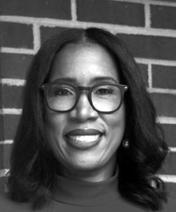
“I watched my single mother move her three kids from staying with family in Englewood to purchasing her own home in Austin,” she said, “and how purchasing her own home really changed the trajectory for our family.”
Conyears-Ervin grew up in Englewood and was raised on the West Side. She went to Chicago Public Schools and was the first in her family to go to colle ge, getting her MBA from Roosevelt University.
“It is very difficult to pass meaningful legislation, especially being a freshman legislator,” Conyears-Ervin said. She also helped start the Democratic Women’s Caucus, which she said is primarily made up of white women, and was one of its first co-chairs.
“I’ve always been a person who builds bridges. I’m a person who unifies,” Conyears-Ervin said. The caucus helped pass legislation that created a lactation room at the state capital, said Conyears-Ervin, who was a nursing mother at the time If elected, Conyears-Ervin said she would fight for legislation that protects Medicaid and Medicare, lowers drug prices, expands mental health care and community clinics, and invests in equitable maternal and reproductive care
“I plan to go to Washington, D.C. to fight — not only for my sister, who is disabled and a senior who relies on government Medicare, Medicaid and SNAP — but for all the seniors, children and the disabled, those who are less fortunate, who need and deserve this representation,” said Conyears-Ervin, who plans to restore such funding if elected When it comes to affordability and taxes, Conyears-Ervin said she’ll close loopholes to restore income tax rates.
across this district. I am the one person in this race that has a history with my support that I’ve received in the past from labor, from business, all across this district. It is that unity that we’re going to need to really build up our communities in this district.”
Conyears-Ervin said she’d represent the array of voices in the wide-ranging 7th district by continuing the work she’s already done: “It’s who I am. It’s easy for me. It’s what I do now.”
Conyears-Ervin also mentioned the OpEd she wrote for the Chicago Sun-Times about being a victim of domestic violence.
“I want to help someone else, and I want women to know they’re not alone in this,” Conyears-Ervin said. “I plan on making certain that, whatever the loopholes are, we need to make sure that we’re fighting to protect domestic violence survivors.”
Conyears-Ervin has been endorsed by Aldermen Monique Scott of the 24th Ward and Chris Taliaferro of the 29th Ward, Cook County Commissioner Michael Scott, Jr., and about 75 faith leaders.
Within the first year or so as treasurer, Conyears-Ervin divested from fossil fuel companies — one of her goals if she’s elected to Congress. In her current role, she’s also ensured that over half of Chicago’s trades go through minority-owned firms and prioritizes building generational wealth for Chicagoans.
“No other treasurer — not only in Chicago, but we believe anywhere across the country — has done a financial empowerment program like I have,” Conyears-Ervin said. “We’re bringing this to the people. I’m out in the community bringing these resources.”
One of these programs is Building Wealth Today for Tomor row, a free financial literacy program. About 7,000 people came to the program’s annual summit last year to learn how to invest in themselves,
For nearly 20 years, Conyears-Ervin worked at management and executive levels at Allstate, where she catered to the customer experience. Allstate also sparked Conyears-Ervin’s interest in public service, as it offered a program where its executives spent time helping with a nonprofit. For ConyearsErvin, that was Breakthrough Urban Ministries in Garfield Park, where she now lives.
“That experience was very life changing,” she said of working with the nonprofit that helps impoverished locals. “And when the opportunity came about for me to run for Illinois State Representative, I made one of the best decisions I could have made, to leave corporate America to work for my community.”
As state representative, Conyears-Ervin helped pass bills to provide funding for Chicago Public Schools and affordable childcare. She was chief sponsor of the legislation that restored child care assistance that was cut for 15,000 families when Bruce Rauner was Illinois gover nor
“Rich people, unfortunately, they cheat. The rich need to pay their fair share,” Conyears-Ervin said. “We have so much work to do for equity, to break the systemic racism, the barriers that exist for our residents
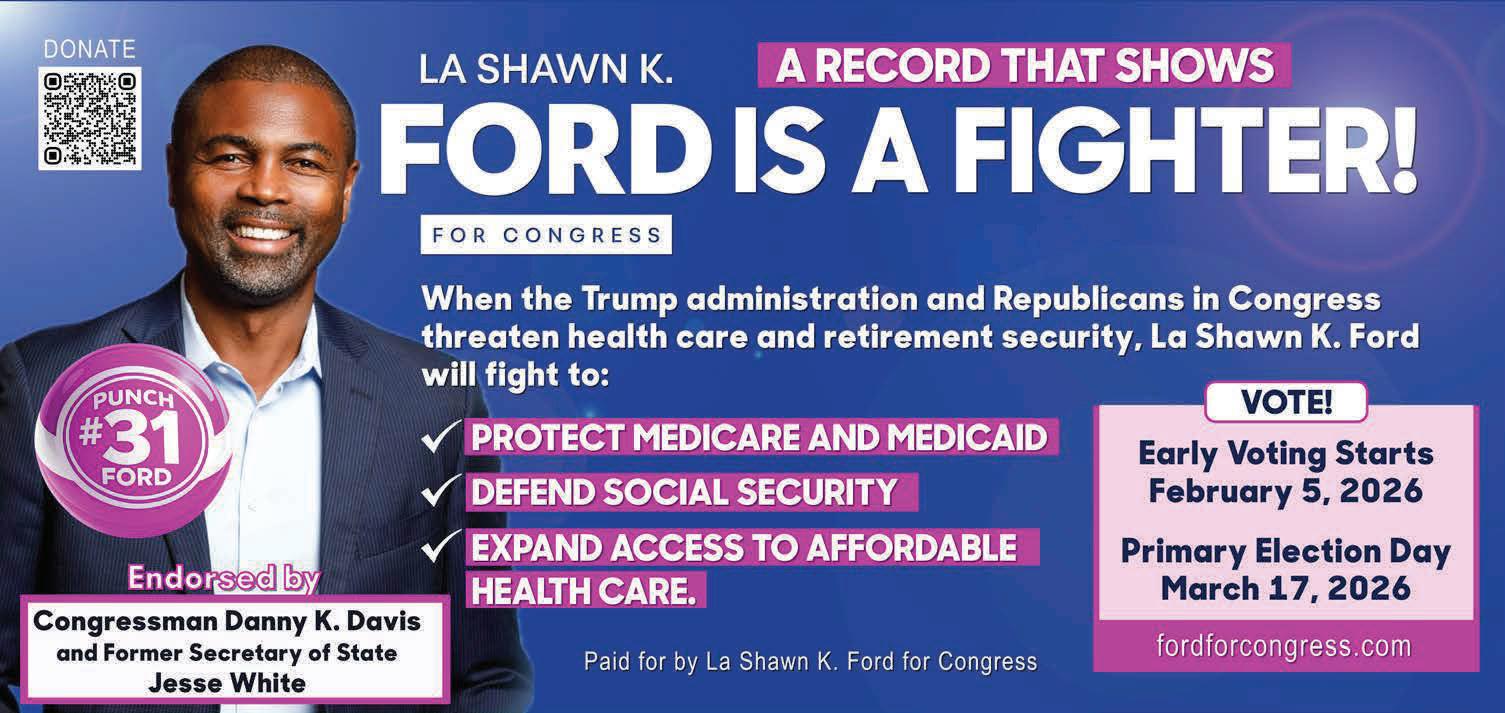
Other Democratic candidates who have thrown their hats in the ring for Davis’s seat include Richard Boykin, Kina Collins, David Elrich, Anthony Driver Jr., Dr. Thomas Fisher, La Shawn Ford, Jason Friedman, Rory Hoskins, Anabel Mendoza, Jazmin Robinson, Reed Showalter, and Felix Tello. Republican candidates are Chad Koppie and Patricia Easley.
In 2024, the Chicago Board of Ethics fined Melissa Conyears-Ervin $70,000 for over a dozen violations of the city’s ethics ordinance, including unauthorized use of city property and prohibited political activity. The fine was alle gedly because Conyears-Ervin hosted prayer services with city resources.
“Those alle gations that were frivolous. At the end of the day, what the Board of Ethics found is that I was attending church. They fined me for attending church as a political figure,” ConyearsErvin said. She said she would’ve beat
the case but didn’t have the resources to pay legal fees. “From a monetary perspective, it was easier for me to just settle and get it behind me.”
In 2020, a city lawsuit was settled involving two employees whom ConyearsErvin fired. They alle ged she used her assistant to run personal errands and that she asked BMO Harris Bank to offer a mortgage to the owner of a church where her husband, Ald. Jason Ervin of the 28th Ward, rented office space. Conyears-Ervin has publicly denied any wrongdoing.


IN THE CIRCUIT COURT OF COOK COUNTY, ILLINOIS COUNTY DEPARTMENT � CHANCERY
DIVISION
LAKEVIEW LOAN SERVICING, LLC
Plaintiff, -v.ISAIAS RODRIGUEZ, RUTH RODIGUEZ, UNITED STATES OF AMERICA � SECRETARY OF HOUSING AND URBAN DEVELOPMENT
Defendants 2025CH03149
1011 N. KEELER AVENUE
CHICAGO, IL 60651
NOTICE OF SALE
PUBLIC NOTICE IS HEREBY GIVEN
that pursuant to a Judgment of Foreclosure and Sale entered in the above cause on August 29, 2025, an agent for The Judicial Sales Corporation, will at 10�30 AM on March 9, 2026, at The Judicial Sales Corporation, One South Wacker, 1st Floor Suite 35R, Chicago, IL, 60606, sell at public in-person sale to the highest bidder, as set forth below, the following described real estate: Commonly known as 1011 N. KEELER AVENUE, CHICAGO, IL 60651
Property Index No. 16�03�412�017� 0000
The real estate is improved with a residence.
Sale terms: If sold to anyone other than the Plaintiff, 25% down of the highest bid by certified funds at the close of the sale payable to The Judicial Sales Corporation. No third party checks will be accepted. The balance, in certified funds/or wire transfer, is due within twenty-four �24� hours. The subject property is subject to general real estate taxes, special assessments, or special taxes levied against said real estate and is offered for sale without any representation as to quality or quantity of title and without recourse to Plaintiff and in ‘’AS IS’’ condition. The sale is further subject to confirmation by the court. Upon payment in full of the amount bid, the purchaser will receive a Certificate of Sale that will entitle the purchaser to a deed to the real estate after confirmation of the sale.
Where a sale of real estate is made to satisfy a lien prior to that of the United States, the United States shall have one year from the date of sale within which to redeem, except that with respect to a lien arising under the internal revenue laws the period shall be 120 days or the period allowable for redemption under State law, whichever is longer, and in any case in which, under the provisions of section 505 of the Housing Act of 1950, as amended �12 U.S.C. 1701k), and subsection (d) of section 3720 of title 38 of the United States Code, the right to redeem does not arise, there shall be no right of redemption. The property will NOT be open for inspection and plaintiff makes no representation as to the condition of the property. Prospective bidders are admonished to check the court file to verify all information.
If this property is a condominium unit, the purchaser of the unit at the foreclosure sale, other than a mortgagee, shall pay the assessments and the legal fees required by The Condominium Property Act, 765 ILCS 605/9(g)(1) and (g)(4). If this property is a condominium unit which is part of a common interest community, the

purchaser of the unit at the foreclosure sale other than a mortgagee shall pay the assessments required by The Condominium Property Act, 765 ILCS 605/18.5(g-1).
IF YOU ARE THE MORTGAGOR �HOMEOWNER�, YOU HAVE THE RIGHT TO REMAIN IN POSSESSION FOR 30 DAYS AFTER ENTRY OF AN ORDER OF POSSESSION, IN ACCORDANCE WITH SECTION 15�1701�C� OF THE ILLINOIS MORTGAGE FORECLOSURE LAW.
You will need a photo identification issued by a government agency (driver’s license, passport, etc.) in order to gain entry into our building and the foreclosure sale room in Cook County and the same identification for sales held at other county venues where The Judicial Sales Corporation conducts foreclosure sales.
For information, examine the court file, CODILIS & ASSOCIATES, P.C. Plaintiff’s Attorneys, 15W030 NORTH FRONTAGE ROAD, SUITE 100, BURR RIDGE, IL, 60527 �630� 794�9876 THE JUDICIAL SALES CORPORATION One South Wacker Drive, 24th Floor, Chicago, IL 60606�4650 �312� 236� SALE
You can also visit The Judicial Sales Corporation at www.tjsc.com for a 7 day status report of pending sales.
CODILIS & ASSOCIATES, P.C. 15W030 NORTH FRONTAGE ROAD, SUITE 100 BURR RIDGE IL, 60527
630�794�5300
E�Mail: pleadings@il.cslegal.com
Attorney File No. 14�25�01806
Attorney ARDC No. 00468002
Attorney Code. 21762
Case Number: 2025CH03149
TJSC#� 46�203
NOTE� Pursuant to the Fair Debt Collection Practices Act, you are advised that Plaintiff’s attorney is deemed to be a debt collector attempting to collect a debt and any information obtained will be used for that purpose.
Case # 2025CH03149 I3281347

from page 1
Firehouse Community Arts Center of Chicago, and the Street Vendors Association of Chicago — have commercial kitchens where they prepare hot food with ingredients grown in the gardens, hosting dinners to further foster community
“It’s really a collaborative effort. Instead of having one site here, one site there, siloed, we have five sites, five sets of trucks, five sets of staff,” said Kimberly George, Garden 2 Table Pipeline coordinator and the community asset manager for YMEN, which offers academic, spiritual and emotional support services in North Lawndale.
Before the Garden 2 Table Pipeline officially started, another member organization, North Lawndale Greening Committee, tended nine community gardens — where today, as a part of the Pipeline, passersby are welcome to harvest the produce. The organization built additional gardens with funding from North Lawndale Fresh.
In early 2024, The Garden 2 Table Pipeline started growing food in its ag pod, a climatecontrolled, hydroponic farm inside a repurposed shipping container. In its first year, the ag pod produced nearly one ton of leafy greens and herbs, plus involved 70 young people in urban agriculture practices
ComEd and the Electric Power Research Institute provided the ag pod and trained recipients on how to use them. From there, Dr. Shemuel Israel — lead gardener of the ag pod and president of the North Lawndale Greening Committee — worked to make the ag pod’s produce the best it can be
For example, Israel uses a refractometer to measure the concentration of sugars and proteins in the ag pod’s produce. He harvests plants when they have optimal nutrients.
“One of the long-term goals that we have is affecting the health of people,” Israel said. “What I’ve heard back from the community is that our food tastes really good.”
“The produce is extra big,” George said of the refractometer-checked plants. She added that some locals “didn’t want to kind of use those practices in part of the gardens too And you could tell the difference. You could see a big difference.”
The Pipeline also considers community input when deciding what kind of produce to plant, both inside the year-round ag pod and seasonal community gardens
For example, in the last two years, Israel and his two part-time employees started planting kale and greens in the ag pod in
October so that people could have locally sourced collard greens for their Thanksgiving dinners.
Israel said the goal is to, one day, sell about 20% of the greens to cover expenses associated with the ag pod. He also wants to sell seed starts and market-ready products, like seasonings made with Garden 2 Table Pipeline’s herbs or hot sauce that young entrepreneurs create from garden peppers.
Part of North Lawndale Fresh’s grants have funded commercial kitchens at four of Garden 2 Table Pipeline’s distribution hubs. The hubs host culinary and nutrition programs in their kitchens, as well as cook fresh produce from the gardens and other ingredients to organize free, hot meals every day of the week.
Recently, cooks have used the garden’s offerings to make sweet potato cheesecake, potato salad and collard greens, served alongside roast beef or ham.
George said Garden 2 Table organizations were already giving out hot meals four days of the week, and to prepare for cuts to federal SNAP benefits, they amped it up to every day. And late last year, Garden 2 Table Pipeline added four more food hubs to its ranks to increase distribution during anticipated SNAP cuts.
“We can make sure everybody knows at least where their next meal is coming from,” George said.
Every Saturday morning, YMEN hosts a big breakfast, where attendees share hot, prepared meals and food rescued from a restaurant or eatery.
“One of the things that I heard is that different people from different parts of the neighborhood who didn’t like each other are now sitting down and talking to each other at a meal,” Israel said of feedback from YMEN breakfasts.
“This is kind of like the breakfast meeting spot for a lot of people now,” George added. Attendees can also partake in YMEN’s clothes giveaway, free haircuts, and sometimes a shower truck.
George said one of the best for ms of feedback she’s gotten is how people who once came to get a hot meal for themselves are now volunteering to serve others.
“Sometimes we’ll have a second meal or bag lunch or something for people to take,” George said. “They’ll take it and they’re like, ‘I don’t need it, but I’m going to give it to soand-so.’ So we’re kind of changing people’s mindsets a little bit as far as looking out for other people.”