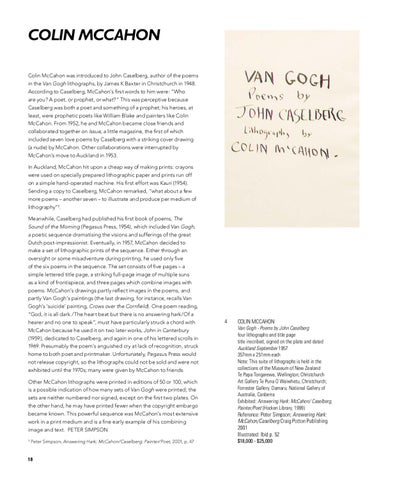
COLIN MCCAHON Colin McCahon was introduced to John Caselberg, author of the poems in the Van Gogh lithographs, by James K Baxter in Christchurch in 1948. According to Caselberg, McCahon’s first words to him were: “Who are you? A poet, or prophet, or what?” This was perceptive because Caselberg was both a poet and something of a prophet; his heroes, at least, were prophetic poets like William Blake and painters like Colin McCahon. From 1952, he and McCahon became close friends and collaborated together on Issue, a little magazine, the first of which included seven love poems by Caselberg with a striking cover drawing (a nude) by McCahon. Other collaborations were interrupted by McCahon’s move to Auckland in 1953. In Auckland, McCahon hit upon a cheap way of making prints: crayons were used on specially prepared lithographic paper and prints run off on a simple hand-operated machine. His first effort was Kauri (1954). Sending a copy to Caselberg, McCahon remarked, “what about a few more poems – another seven – to illustrate and produce per medium of lithography”¹. Meanwhile, Caselberg had published his first book of poems, The Sound of the Morning (Pegasus Press, 1954), which included Van Gogh, a poetic sequence dramatising the visions and sufferings of the great Dutch post-impressionist. Eventually, in 1957, McCahon decided to make a set of lithographic prints of the sequence. Either through an oversight or some misadventure during printing, he used only five of the six poems in the sequence. The set consists of five pages – a simple lettered title page, a striking full-page image of multiple suns as a kind of frontispiece, and three pages which combine images with poems. McCahon’s drawings partly reflect images in the poems, and partly Van Gogh’s paintings (the last drawing, for instance, recalls Van Gogh’s ‘suicide’ painting, Crows over the Cornfield). One poem reading, “God, it is all dark./The heart beat but there is no answering hark/Of a hearer and no one to speak”, must have particularly struck a chord with McCahon because he used it on two later works, John in Canterbury (1959), dedicated to Caselberg, and again in one of his lettered scrolls in 1969. Presumably the poem’s anguished cry at lack of recognition, struck home to both poet and printmaker. Unfortunately, Pegasus Press would not release copyright, so the lithographs could not be sold and were not exhibited until the 1970s; many were given by McCahon to friends.
4
COLIN MCCAHON
Van Gogh - Poems by John Caselberg four lithographs and title page title inscribed, signed on the plate and dated Auckland September 1957 357mm x 251mm each Note: This suite of lithographs is held in the collections of the Museum of New Zealand Te Papa Tongarewa, Wellington; Christchurch Art Gallery Te Puna O Waiwhetu, Christchurch; Forrester Gallery, Oamaru; National Gallery of Australia, Canberra Exhibited: Answering Hark: McCahon/ Caselberg, Painter/Poet (Hocken Library, 1999)
Other McCahon lithographs were printed in editions of 50 or 100, which is a possible indication of how many sets of Van Gogh were printed; the sets are neither numbered nor signed, except on the first two plates. On the other hand, he may have printed fewer when the copyright embargo became known. This powerful sequence was McCahon’s most extensive work in a print medium and is a fine early example of his combining image and text. PETER SIMPSON ¹ Peter Simpson, Answering Hark: McCahon/Caselberg: Painter/Poet, 2001, p. 47
18
Reference: Peter Simpson; Answering Hark: McCahon/Caselberg Craig Potton Publishing 2001 Illustrated: Ibid p. 52 $18,000 - $25,000