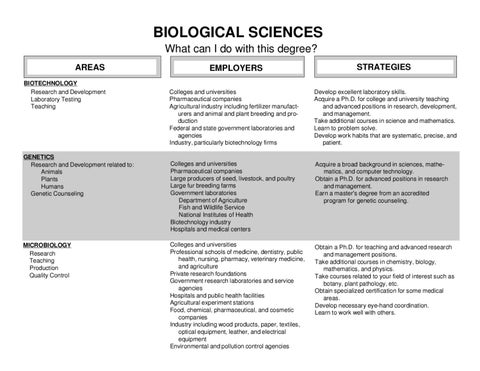
BIOLOGICAL SCIENCES What can I do with this degree? AREAS BIOTECHNOLOGY Research and Development Laboratory Testing Teaching
GENETICS Research and Development related to: Animals Plants Humans Genetic Counseling
MICROBIOLOGY Research Teaching Production Quality Control
EMPLOYERS
STRATEGIES
Colleges and universities Pharmaceutical companies Agricultural industry including fertilizer manufacturers and animal and plant breeding and production Federal and state government laboratories and agencies Industry, particularly biotechnology firms
Develop excellent laboratory skills. Acquire a Ph.D. for college and university teaching and advanced positions in research, development, and management. Take additional courses in science and mathematics. Learn to problem solve. Develop work habits that are systematic, precise, and patient.
Colleges and universities Pharmaceutical companies Large producers of seed, livestock, and poultry Large fur breeding farms Government laboratories Department of Agriculture Fish and Wildlife Service National Institutes of Health Biotechnology industry Hospitals and medical centers
Acquire a broad background in sciences, mathematics, and computer technology. Obtain a Ph.D. for advanced positions in research and management. Earn a master's degree from an accredited program for genetic counseling.
Colleges and universities Professional schools of medicine, dentistry, public health, nursing, pharmacy, veterinary medicine, and agriculture Private research foundations Government research laboratories and service agencies Hospitals and public health facilities Agricultural experiment stations Food, chemical, pharmaceutical, and cosmetic companies Industry including wood products, paper, textiles, optical equipment, leather, and electrical equipment Environmental and pollution control agencies
Obtain a Ph.D. for teaching and advanced research and management positions. Take additional courses in chemistry, biology, mathematics, and physics. Take courses related to your field of interest such as botany, plant pathology, etc. Obtain specialized certification for some medical areas. Develop necessary eye-hand coordination. Learn to work well with others.
Biological Sciences, Page 2
AREAS MYCOLOGY Teaching Research
SYSTEMATIC BIOLOGY Teaching Research Field and Laboratory Taxonomy Toxicology Consulting Medicine
ENTOMOLOGY Teaching Research Biological Control Toxicology Biological Survey Extension Inspection
EMPLOYERS
STRATEGIES
Colleges and universities Professional schools of medicine, forestry, and agriculture Medical research laboratories Private research institutes Pharmaceutical industry Public Health Service Industries and laboratories involved in production of food, leather, textiles, and forestry products Chemical manufacturers State and federal government laboratories
Acquire knowledge and skills in specialized areas; knowledge of industrial chemistry is especially helpful. Take courses in organic chemistry, biochemistry, and physics. Acquire a graduate degree for more opportunities. Obtain a Ph.D. for teaching and advanced positions in research and management.
Private and public schools Colleges, universities, and agricultural colleges Federal agencies including Departments of Agriculture and Interior Private research foundations Museums Botanical gardens and arboretums Zoos and aquariums State and local agencies Public health laboratories Hospitals Oil companies Organizations involved in ecological studies National and international environmental research programs
Become certified/licensed for public school teaching. Earn a Ph.D. for college and university teaching and advanced research and management positions. Develop excellent laboratory skills.
Colleges and universities, especially colleges of agriculture and veterinary medicine Industry including food producers and processors, chemicals for insect control, and lumber and pulp Chemical companies Pest control companies Federal and state government Health agencies Agricultural experiment stations Inspection agencies and control boards Conservation agencies Museums
Acquire a Ph.D. for college and university teaching and advanced research and management positions. Specialize in a particular area.
Develop foreign language abilities for international opportunities.
Biological Sciences, Page 3
AREAS MARINE AND AQUATIC BIOLOGY Food Research Inspection Teaching
ZOOLOGY Animal Care/Training Animal Behavior Research Curator Teaching
BIOMEDICAL Physiology Biophysics Biochemistry Pharmacology Nutrition Immunology Pathology Research Teaching Quality Control Engineering
EMPLOYERS
STRATEGIES
Federal, state, and local agencies International agencies Inspection organizations Private recreation organizations Research laboratories Colleges and universities Zoos Armed services Shipping industry Manufacturing Fish hatcheries and organizations raising fish
Develop a good foundation in mathematics, computer science, statistics, and humanities. Acquire a Ph.D. for college and university teaching and advanced research and management positions. Obtain experience related to fishing and boating. Specialize in fisheries science.
Wildlife preserves and parks Zoos, aquariums, and other collections of animals Museums Research organizations Pharmaceutical, chemical, and agricultural service industries Federal and state agencies Colleges and universities
Acquire excellent communication skills. Obtain experience working with animals and various related laboratory equipment. Develop a broad background in biology and other related subjects such as chemistry, physics, mathematics, and statistics. Acquire a graduate degree for advancement and specialized positions. Obtain a Ph.D. for teaching and advanced research and management positions. Complete a related internship at a zoo or aquarium.
Colleges and universities Professional schools including colleges of pharmacy, dentistry, medicine, veterinary medicine, and agriculture Clinics and hospitals Private research foundations Drug companies Federal laboratories and regulatory agencies Independent testing laboratories Public health departments Agricultural experiment stations Industrial laboratories including chemical, petroleum, food processing, drug, and cosmetic manufacturers Armed services
Obtain a Ph.D. for college and university teaching and advanced research positions. Acquire a background in physics, organic and physical chemistry, mathematics, and anatomy. Take courses in area(s) of specialization. Acquire advanced degrees in areas of specialization; some may require an M.D.
Obtain a degree in biomedical engineering or engineering technology.
Biological Sciences, Page 4
AREAS BIOINFORMATICS
EMPLOYERS
STRATEGIES
Biotechnology industry Pharmaceutical companies Government research laboratories Universities
Double major or minor in computer science. Learn to work well in teams and acquire the ability to interface with scientists. Develop in-depth programming and relational database skills. Learn molecular biology packages, web design, and programming skills.
Public and private schools, K-12 Museums Zoos Nature centers Parks
Certification is required for public school teaching positions. Gain experience working with students through tutoring or volunteering. Learn to work well with all types of people. Develop excellent interpersonal and public speaking skills.
TECHNICAL WRITING Editing Writing
Newspapers Publishing companies including scientific magazines, professional journals, periodicals, textbooks, and online publishers
Take technical writing classes or minor in it. Develop strong writing skills and command of the English language. Minor in journalism. Acquire word processing and desktop publishing skills.
ILLUSTRATION
Publishing companies of textbooks and scientific magazines or books Medical and veterinary colleges
Double major or minor in graphic illustration. Find a part-time, summer, co-op or internship position with a publisher.
Manufacturing firms including pharmaceuticals, animal pharmaceuticals, laboratory equipment, medical supplies and prostheses
Develop excellent communication and interpersonal skills. Take courses in anatomy, pharmacology, and chemistry. Obtain retail or sales experience. Acquire a minor in business. Hold leadership positions in campus organizations. Join the student American Marketing Association.
EDUCATION Teaching Non-classroom education
TECHNICAL AND PHARMACEUTICAL SALES
Biological Sciences, Page 5
AREAS BIOLOGICAL PHOTOGRAPHY
LEGISLATION/LAW Lobbying Regulatory Affairs Science Policy Congressional Fellows Patent Law Environmental Law
EMPLOYERS
STRATEGIES
Major medical, dental and veterinary schools Research centers Federal government Museums Zoological societies Publishing houses Free-lance
Acquire thorough knowledge of photographic procedures and technology. Become skilled with medical and scientific instruments including microscopes. Take specific courses in biological, medical and ophthalmic photography; courses in illustration and printing are also helpful.
Federal and state government
Acquire internships in federal or state government. Develop excellent communication and interpersonal skills. Acquire a Ph.D for more opportunities.
Law firms Large corporations
Earn a law degree.
GENERAL INFORMATION
• A bachelor's degree will qualify one for work as a laboratory assistant, technician, technologist, or research assistant. These individuals work as part of a team • • • • • • • • • • • • •
performing practical operations, e.g., operating laboratory equipment, designing and constructing new equipment, making drawings, building models and assisting in the interpretation of results. The biological sciences are good preparation for a career in healthcare including medicine, dentistry, nursing, etc. An undergraduate degree can be used for nontechnical work in writing, illustration, sales, photography, and legislation. Graduate degrees allow for more responsibility and advancement. Some work environments, particularly medical, require special certification. Learn laboratory procedures and become familiar with equipment. Obtain summer, part-time, volunteer, co-op, or internship experience. Complete various training courses working with laboratory equipment and procedures to enhance job skills and abilities. Join professional associations and community organizations to enhance knowledge, abilities and contacts in the field. Read scientific journals. Maintain a high grade point average to improve chances of graduate school admission. Complete an undergraduate research project. Secure strong personal recommendations from professors or employers. Plan on completing a post doctoral experience after graduate school. Learn federal, state, and local government job application process. The federal government is the largest employer of biologists. Prepared by the Career Planning staff of Career Services at The University of Tennessee, Knoxville. (1995, Revised 2000) UTK is an EEO/AA/Title VI/Title IX/Section 504/ADA/ADEA Employer