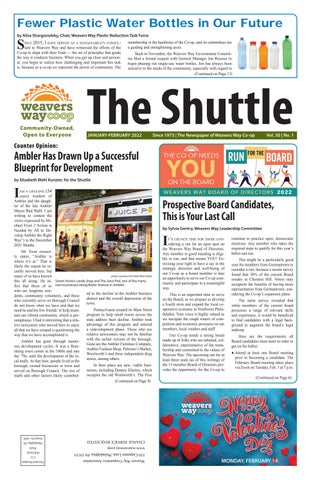
Fewer Plastic Water Bottles in Our Future by Alisa Shargorodsky, Chair, Weavers Way Plastic Reduction Task Force
S
ince
2015, I have served as a sustainability consul-
tant to Weavers Way and have witnessed the efforts of the Co-op to align with their Ends — the set of principles that guide the way it conducts business. When you get up close and personal, you begin to realize how challenging and important this task is, because as a co-op we represent the power of community. The
Community-Owned, Open to Everyone
membership is the backbone of the Co-op, and its committees are a guiding and strengthening asset. Back in November, the Weavers Way Environment Committee filed a formal request with General Manager Jon Roesser to begin phasing out single-use water bottles. Jon has always been sensitive to the needs of the community, especially with regard to (Continued on Page 13)
The Shuttle JANUARY-FEBRUARY 2022
Counter Opinion:
Ambler Has Drawn Up a Successful Blueprint for Development am a lifelong
YOU
RUN
THE CO-OP NEEDS
Vol. 50 | No. 1
for the
BOARD
ON THE BOARD
by Elizabeth Wahl Kunzier, for the Shuttle
I
Since 1973 | The Newspaper of Weavers Way Co-op
(54
WE AVE RS WAY BOA R D O F D I R E CTO R S 2 0 2 2
years) resident of Ambler and the daughter of the late Ambler Mayor Bud Wahl. I am writing to contest the views expressed by Michael Frost (“Action is Needed by All to Develop Ambler the Right Way”) in the December 2021 Shuttle.
Prospective Board Candidates, This is Your Last Call by Sylvia Gentry, Weavers Way Leadership Committee
Mr. Frost correctly states, “Ambler is where it’s at.” That is likely the reason he recently moved here, but photo courtesy of Ambler Main Street many of us have known this all along. He in- Sweet Annie’s candy shop and The Juice Pod, two of the many fers that those of us new businesses along Butler Avenue in Ambler. who are longtime resied to the decline in the Ambler business dents, community volunteers, and those district and the overall depression of the who currently serve on Borough Council town. do not know what we have and that we Pennsylvania created its Main Street need he and his few friends’ to help mainprogram to help small towns across the tain our vibrant community, which is prestate address their decline. Ambler took sumptuous. I find it interesting that a relaadvantage of this program and entered tive newcomer who moved here to enjoy a redevelopment phase. Those who are all that we have created is questioning the relative newcomers may not be familiar way that we have accomplished it. with the earlier version of the borough. Ambler has gone through numerGone are the Ambler Furniture Company, ous development cycles. It was a flourAmbler Fashion Shop, Palermo’s Market, ishing town center in the 1960s and into Woolworth’s and three independent drug the ‘70s, until the development of the lostores, among others. cal malls. At that time, people lived in the In their place are new, viable busiborough, owned businesses in town and nesses, including Denney Electric, which served on Borough Council. The rise of occupies the old Woolworth’s. The Free malls and other factors likely contribut(Continued on Page 8)
I
t’s crunch time for those con-
sidering a run for an open spot on the Weavers Way Board of Directors. Any member in good standing is eligible to run, and that means YOU! Exercising your right to have a say in the strategic direction and well-being of our Co-op as a board member is also an opportunity to serve our Co-op community and participate in a meaningful way. This is an important time to serve on the Board, as we prepare to develop a fourth store and expand the local cooperative economy in Northwest Philadelphia. Your voice is highly valued as we navigate the rough waters of competition and economic pressures on our members, local vendors and staff. Our Co-op needs a strong board made up of folks who are talented, collaborative, representative of the membership and committed to the values of Weavers Way. The upcoming run for at least three seats (as of this writing) of the 11-member Board of Directors provides the opportunity for the Co-op to
continue to practice open, democratic elections. Any member who takes the required steps to qualify for this year’s ballot can run. This might be a particularly good year for members from Germantown to consider a run, because a recent survey found that 50% of the current Board resides in Chestnut Hill. Voters may recognize the benefits of having more representation from Germantown, considering the Co-op’s expansion plans. The same survey revealed that while members of the current board possesses a range of relevant skills and experience, it would be beneficial to find candidates with a legal background to augment the board’s legal makeup. Here are the requirements all Board candidates must meet in order to get on the ballot: ● Attend at least one Board meeting prior to becoming a candidate. The February Board meeting takes place via Zoom on Tuesday, Feb. 1 at 7 p.m. (Continued on Page 6)
CHANGE SERVICE REQUESTED www.weaversway.coop
MONDAY, FEBRUARY 14
559 Carpenter Lane, Philadelphia, PA 19119 Weavers Way Cooperative Association
Presorted Standard U.S. POSTAGE PAID Philadelphia, PA Permit No. 2658
2
THE SHUTTLE
January-February 2022
Editor’s Note by Karen Plourde, Editor, Weavers Way Shuttle
F
rom the inventive minds of
Shuttle readers come two new features that we hope will engage fellow readers. In fact, the success of both depends on your participation. “Village Medicine”, a column suggested and shepherded by member and occasional contributor Lindsay Stolkey, aims to share favorite home remedies from the community, along with a little background on them; you can find it on p.8. The Co-op’s Wellness Team has disbanded, so we hope this segment will help to fill some of the wellness void currently missing from the paper. Check it out and contribute your own favorite tonic, technique, etc.; info on how to do that is at the end of this month’s column. The second is actually an item-within-an-item: A poetry contest suggested by Kathy Salisbury, director of the Ambler Arboretum at Temple University. She’s come up with a poetry form she calls a “naturette” — an eight-line verse that describes a tiny detail of nature. Her naturette, “Success(ion)” appears in this month’s “Weavers Words” (p. 21). Those inspired to do so can email their own naturette to me at editor@ weaversway.coop; Kathy will do the judging. The writer of the best one will win a membership to the Arboretum, where you’ll likely be inspired to write more. You’ll also be published in the Shuttle and in the Arboretum’s newsletter, so the stakes are high and the payoff pretty generous. Back when we launched “Weavers Words” in the spring of 2020, I had some doubts as to how long it would hang around. I figured if it died a quick death, no one would notice. Was it helped by the arrival of COVID? Maybe. Nevertheless, almost two years later, it’s still around and gets a decent number of responses. Basically, you folks make it happen! I’d call that a success. Keep up the creativity — it certainly makes my job easier. And catch you in the pages in March.
The Shuttle is published by Weavers Way Cooperative Association. Statement of Policy The purpose of the Shuttle is to provide information about co-ops, healthful food and other matters of interest to Weavers Way members as consumers and citizens. Weavers Way members are welcome to submit articles (about 500 words) and letters to the editor (200 words) on subjects of interest to the Co-op community. No anonymous material will be published; all submissions must include an email or phone number for verification. The Shuttle retains the right to edit or refuse any article or letter. Submit to editor@weaversway.coop. Articles and letters express the views of the writers and not those of the Shuttle, the Co-op or its Board, unless identified as such.
Advertising Advertising for each issue is due the 1st of the preceding month, e.g., Dec. 1 for January. Ad rates are online at www. weaversway.coop/shuttle, or call 215843-2350, ext. 314, or email advertising@ weaversway.coop. Advertised products or services may not be construed as endorsed by Weavers Way Co-op.
Say “I Love You” with a Custom-Made Crepe
by Chris Mattingly, for the Shuttle
M
aybe
Valentine’s
Day
calls for crêpes because they’re often filled with reds and sweets, like raspberry sauce, whipped cream and Nutella. But for all their indulgence, a sweet treat doesn’t impress the way a complex, savory, nutritious and satisfying meal does. Like those Birds-of-Paradise with their elaborate displays of color and dancing, I need to hop, twirl and contort myself to appear attractive. So I prepare a meal with a dazzling flourish. That’s how I landed on doing savory crêpes for Valentine’s Day, a tradition that has lasted for a few years. I might fall off the branch while doing my dance, or my crêpe might fall on the floor while I attempt to “air flip” it on the pan. But it’s the spectacle that counts! For the crêpe (wrapper) recipe, credit goes to “Joy of Cooking”, a book which has been a staple in my family for generations, and was gifted to me when I first moved out on my own. The savory filling is a combination of a New York Times recipe for sauteed wild mushrooms, along with my own additions. Crêpe batter can be made up to two days ahead, then covered and refrigerated. Let refrigerated batter sit at room temperature for 30 minutes before using. Cooked crêpes can be refrigerated for up to 24 hours, if stacked on a wax paper-covered plate and tightly wrapped with plastic wrap.
If you want to do crêpes, but just for breakfast or dessert, slight modifications to the ingredient list are included. For sweet crêpe fillings, keep it simple: Consider jam, whipped cream, poached fruits and/or Nutella. Chris Mattingly is the founder of Backyard Eats, a full-service food gardening business with an array of offerings in the greater Philadelphia area. Email him at chris@backyard-eats.com or visit www.backyard-eats.com.
Savory Spinach and Mushroom Crêpes
Ingredients for the crêpes: • 1 cup all-purpose flour • 1 cup milk • ½ cup lukewarm water • 4 large eggs • ¼ cup (½ stick butter), melted • ½ tsp. salt (for sweet crêpes, use 1⁄8 tsp.) • For sweet crêpes, add 3 Tbsp. sugar Directions for crêpes: Combine the crêpe ingredients in a bowl and mix until smooth. Place a small amount of butter on a nonstick pan; the temperature is right when the butter begins to brown, but not smoke. Ladle just enough batter on the pan to thinly coat the bottom of the whole pan; pour off any excess batter. Cook until crêpe bottom is lightly browned, 1-11⁄2 minutes. Turn with a spatula or by lifting the corner and flipping with your fingers. If you’re up for losing a crêpe or two, try flipping it in the air! Cook the second side until browned, then slide onto a wax papercovered plate. Continue to cook until the batter is used up, stacking the crêpes when done. Ingredients for the savory filling: • 1 lb. mushrooms, rinsed, trimmed and thinly sliced • 2 Tbsp. olive oil • Salt & pepper to taste • 1 Tbsp. butter • 2 Tbsp. bread crumbs • 1 Tbsp. finely chopped shallots • 1 tsp. finely chopped garlic • 2 Tbsp. finely chopped flat leaf parsley • 1 Tbsp. fresh thyme leaves • 12 oz. any combination of greens: spinach, arugula, mustard, mizuna, bok choy, and/or tatsoi • Cooked, thinly-sliced marinated steak, chicken or vegetable protein (optional) • 4 oz. cheese. Gruyere, gouda, comte, fontina/parmesan and goat cheese are good options; shredded or crumbled • 3 Tbsp. melted butter
Directions for the savory filling (and finishing the crêpes): Preheat the oven to 4000. Heat a large skillet over medium-high heat, and add olive oil. When it is hot and almost smoking, add mushrooms, salt and pepper. Cook over high heat, shaking and tossing the skillet so that the mushrooms cook evenly until they are browned and crisp. They should be almost mahogany in color. Add the butter, and quickly sprinkle in the bread crumbs, shallots, garlic and parsley. Toss well for 10 seconds. Reduce heat to medium and stir in the greens. Cover and cook until just wilted, about two minutes. Remove cover and add optional protein and cheese, stirring to combine. Lightly butter a 13x9 baking dish. Note: For this step, we decided to cater to unique preferences in the family by wrapping each custom-filled crepe individually in foil. Scoop 3-4 tablespoons of filling into the center of each crêpe and spread out, leaving a one-inch border around the edges of the crêpe. Roll up the crêpes and place into the dish. If your filling is coarse, (owing to some protein, for example), you may need to treat your crêpes more like burritos than wraps. Arrange crêpes seam-side down in a single layer in the baking dish and brush the tops with three tablespoons melted butter. Optional: Sprinkle with shredded parmesan or mozzarella cheese. Bake until thoroughly heated and lightly browned, about 20 minutes. Serve and enjoy!
January-February 2022
THE SHUTTLE 3
Hey Poets —Try Your Hand at writing a ‘Naturette’
I
t’s no secret that
Weavers Way
shoppers are a creative bunch.
Thanks to them, the Shuttle now has sections devoted to artists and poets in our community. And have you checked out the work of our member cartoonist, Alli Katz?
by Kieran McCourt, Weavers Way Ambler These pop-in-your-mouth, olive-sized citrus fruits originated in Southeast Asia; the earliest written records of their existence dates back to 12th century China. Their English name derives from the Cantonese word for “golden mandarin orange.”
Kumquats
Recently, Kathleen Salisbury, director of the Ambler Arboretum at Temple University, emailed me an example of a poem form she developed that she hoped would appear in Weavers Words, our own poetry corner. As a way of encouraging others to try it out, she’s offering a free membership to the Arboretum to the poet who can come up with the best version of a “naturette” poem — an eight-line verse that describes a tiny detail of nature. Here’s the poem form’s syllable count and rhyme scheme: 6AA 8B
Options: • The thin skin is edible, and, unlike oranges or lemons, is not overly bitter. In fact, it’s often the sweetest part of the fruit. It makes for a juicy and chewy treat — nature’s original sour, then sweet, candy. •U ncooked, kumquats make a wonderful addition to a winter salad with bitter greens and sweet root vegetables. You can also add them to a mixed fruit salad or make them part of the fruit topping for a wintery pavlova. • They can be cooked into a chutney, marmalade or relish. They cut through the richness of a wintertime beef or lamb roast, and add a burst of citrus joy to toast on a dreary morning. • They bring sweetness and acidity to stews and soups, especially those that feature plant-based proteins like lentils.
6CC 8B 6DD 8B 6EE 8B For an example of the form, see “Success(ion),” Kathleen’s submission in this month’s Weavers Words (p. 21). The winning entry will be published in a future Shuttle and in the Arboretum’s newsletter. Email your entries to editor@weaversway.coop, and put “Naturette poem for contest” in the subject line. Kathleen will judge the entries. There’s no deadline as of yet, but why delay? Let’s see how you can bend your words! —Karen Plourde
•K umquats can hold up to several preservation applications. You can lean savory with salt-brined or fermented ones and use them like preserved lemons. See the March 2019 Shuttle online for ideas. They can also be candied and preserved in a sugary syrup and used in baking or to top ice cream or other sweet treats. • For cocktails, the syrup can be used as a sweetener or as an out-of-the-box addition to a whiskey or other sour. And though I’ve yet to try this, I have no doubt that a salt- brined or even fresh kumquat would make a lovely substitute for an olive garnish for a martini.
we our
members
Love is in Bloom at the Co-op
Surprise Your Valentine with Fresh Flowers!
...and don’t forget the chocolate!
4
THE SHUTTLE
January-February 2022
Annual Maple Sugar Fest is a Pregame for Spring’s Arrival by Kristy Morley, Senior Naturalist, Wissahickon Trails
J
oin
Wissahickon Trails for the
annual Maple Sugar Festival on Sunday, March 6 at Penllyn Woods, 1227 E. Township Line Rd., Penllyn. This guided event is great for all ages. Participants are invited to hang out afterward and enjoy tasty treats from Philly Waffle Cabin food truck. Visit www.wissahickontrails. org for more information and to register.
Here are some fun facts about maple syrup to impress your friends and family: ● It takes 40 gallons of sap to make one gallon of syrup. To put that in perspective, that’s as much liquid as it takes to fill an average bathtub, boiled down to the equivalent of a gallon of milk. ● The average sugar maple tree produces anywhere from five to 15 gallons of sap, which means the sap from two and a half trees needs to be combined to make a single gallon of syrup. ● A maple tree must be around 45 years old before it is tapped for syrup making, and a maple tree can yield sap for 100 years. ● Syrup’s flavor depends on when the sap runs. Early season sap tends to be lighter in color and flavor. Later in the season, when temperatures are warmer, the sap darkens; the darker the color, the stronger the maple flavor. ● There are 13 species of maple trees thriving in Canada and the United States, but only three types are tapped for syrup: sugar maple, black maple and red maple. ● Getting the sap to flow involves the right mix of frosty nights and warm, sunny days. Maple trees are tapped between late February and early April; once buds appear on the trees, the sap turns bitter in flavor.
Visitors at the 2018 Maple Sugar Fest learn how to operate a hand drill.
photo by Bernie Wilson
Instructor John Ferro shows a group at the 2019 Fest sap from a tree that has been boiled down for syrup.
Nurturing Confidence. Realizing Potential.
Currently accepting applications for 21-22 school year.
LET'S GET YOU MOVING!
C: 610.308.0802 | O: 610.520.0100
Over 30 years of successfully educating children who learn differently. Schedule your tour today! Grades 1-8 215.657.2200 www.centerschoolpa.org
January-February 2022
THE SHUTTLE 5
photo by Jamie Stewart
Wissahickon Trails Environmental Educator Suzanne Smith-Oscilowski shows a group the different types of maple leaves at the 2020 Fest.
Did you know that Awbury Arboretum is a birding hotspot?
Year of Birds
2022
Over 150 bird species have been recorded at the Arboretum over the past five years alone. Join us in 2022 for a year of programming devoted to celebrating our feathered friends, shining a spotlight on the challenges they face, and learning about ways to help them survive and thrive in our changing world. Each month we will highlight a different bird on our blog visit www.awbury.org to read up and boost your bird knowledge!
JANUARY - Dark-Eyed Junco
APRIL - Palm Warbler
(29th) Ornitherapy: Birds, Wellness and You with Holly Merker
(16th) Bird Hike with the In Color Birding Club (ICBC)
FEBRUARY - Yellow-Bellied Sapsucker (26th) Planting Natives for the Birds with Cindy Ahern
MARCH - White-Throated Sparrow
Art Exhibition - Watercolor Birds by Julie Zahn
MAY - Blackburnian Warbler (1st) Bluebirds and the Trail at Awbury with the Bluebird Society of PA (14th) Bird Walk with Awbury’s resident birder Bill Reaume
(12th) Bird Hike with The Feminist Bird Club of Philadelphia
JUNE - Baltimore Oriole
(22nd) Women in Birding - a Force beyond Feathers with Debbie Beer
(4th) Black Birders Week 2022 Bird Hike with the In Color Birding Club (Date TBD) Bird Tile Workshop with Karen Singer
Visit awbury.org for more information and registration
THE SHUTTLE
6
January-February 2022
Prospective Board Candidates, This is Your Last Call
L•E•T•T•E•R•S Cheers for “Slice It, Dice It” Conduct Hearings on Council Budget
T
he
“Slice It, Dice It, Serve It”
Shuttle column by Kieran McCourt is consistently terrific. I’m always eager to find out more about food, learn how to improve my culinary skills and discover new ideas. Kieran’s columns help me achieve those goals. There are occasions when he is working in customer service at the checkout/front end of the Ambler store and I can thank him in person for his columns. Recently, I went through the Ambler checkout line and asked what he’s been cooking lately. He said he’d cleaned out the freezer and spent the prior weekend cooking stock. I told him I wanted to hear more about that! Thank you, Kieran, for your excellent columns and consider this a formal request to please write an upcoming article on how you make stock. Martha Fuller
CORRECTION
I
n the article
“Co-op Member
Pens Novel of Life in Palestine During the Intifada” in the December Shuttle, Karen Plourde wrote that Alison Glick workshopped an essay at a writing class in Washington, DC in 2010, and that the essay focused on her time in Israel and at a refugee camp in Syria during the first Palestinian Intifada, which began in the late 1980s. The workshop actually took place in Bethesda, MD in 2011, and the essay only focused on Glick’s time living in Gaza during the first Intifada. The Shuttle regrets the error.
SHUTTLE LETTERS POLIC Y The Shuttle welcomes letters of interest to the Weavers Way community. Send to editor@ weaversway.coop. The deadline is the 10th of the month prior to publication. Include a name and email address or phone number for verification; no anonymous letters will be published. Letters should be 200 words or fewer and may be edited. The Shuttle reserves the right to decline to publish any letter.
Editor’s Note: The following letter was originally sent to Philadelphia City Council President Darrell Clarke, and forwarded by the author to the Shuttle and other area publications.
O
ur city is experiencing many
difficult problems during this time of the pandemic. The number of homicides eclipsed 500 last year; crime is on the rise and our homeless population is growing. Many vacant tax-delinquent houses continue to blight our neighborhoods. Debate in City Council is necessary to resolve these citywide issues, but is lacking while our elected officials cast blame on each other and state government. Taxpayers deserve better. It’s safe to say that our democracy needs work. I suggest we look to why this necessary debate is not happening. Philadelphia city government includes our City Council, which is charged with scheduling annual public hearings on the city’s capital and operating budgets. Each department of city government — with the exception of City Council, the very department that conducts these hearings —welcomes public input into how its budget is spent. The 10 district council members, who are different from the seven council members-at- large, receive tax dollars in the budget without input from the public
or the council members-at-large. These dollars are referred to in the city’s capital budget as the “Improvement to Existing Facilities Fund.”How and where this additional money is spent is unknown by council members-at-large or the public. This process has led to council prerogative, with district council members having greater standing than council members-at-large. Council members-atlarge have become subordinate, and this weighted environment discourages the seven council members-at-large and taxpayers from having the necessary public debate needed to resolve citywide issues such as crime, vacant housing, blight, etc. Unless taxpayers know how their district council member is spending their allotted Improvement to Existing Facilities funds and all 17 council members can participate at the same level in budget hearings, citywide issues will not get appropriately debated. As a result, needed strategies and policies to resolve these important issues go unresolved. In the best interest of democracy and the health and welfare of our great city. I ask Darrell Clarke, president of City Council, to conduct public hearings on City Council’s budget. By doing so, the debate necessary for democracy to prevail and city government to empower Philadelphia citizens can begin.
hile
Michael Frost’s De-
cember Shuttle article “Action is Needed by All to Develop Ambler the Right Way” mentioned several ways of “limit[ing] the scope and scale of major development,” it neglected to mention ways the community can support appropriate development and expansion of our community. Certainly, property values have increased in the eight years my husband and I have lived in the borough, as more people of our generation are attracted to the walkable downtown, historic charm and local schools. However, several of my friends have also been priced out of Ambler while looking for their first home, even before inventory plummeted during the pandemic. The solution is a
● Attend the final Run for the Board Information Session Saturday, Jan. 29 at 10 a.m.; you’ll receive working member credit for attending. RSVP to leadershipcommittee@weaversway. coop. ● Submit a candidate application by Monday, Feb. 28. Candidate packages will be available after interested members attend a Board information session. Please join us. While there is no monetary compensation for serving on the Board, doing so will fulfill your household’s working member hours. And the satisfaction of contributing to the greater Co-op community is immeasurable.
shop bulk
save money & reduce waste
—Greg Paulmier
Did you know?
Smart Development Is Possible in Ambler
W
(Continued from page 1)
balance of ensuring enough new housing to attract young homeowners and renters while preserving green space and historic buildings. To ensure Ambler’s walkability, housing density should be considered, especially in transit-oriented developments like The Crossings at Ambler Station. Where else but mere yards from our historic train station does a dense housing project make sense? Millennials who commute to Center City or enjoy taking SEPTA into Philly for theater, sports, restaurants and museums will be able to envision a home in Ambler as a real possibility. Surely, the answer is “smart development” rather than none at all. Meredith MacVittie
You can read the
Shuttle ONLINE.
www.weaversway.coop/ shuttle-online
Advertise
in the
Shuttle
n Targeted readership n Extended Internet presence n Affordable and effective advertising@weaversway.coop
Secret Valentine...
Adopt.
THE SHUTTLE 7
C O GM R ’S N ER
January-February 2022
As the Days Fly By, Our Discussions about a Germantown Store Continue
by Jon Roesser, Weavers Way General Manager ake it from me
—
if you work at the
“
Co-
op, you’re never bored or lonely. We move at a frenetic pace, and as we do, it’s easy for days to turn into weeks, and weeks into months, and before long it will be spring. As I write this update on our proposed store in Germantown, I am struck by how quickly the time has raced by since I last wrote you on this subject. The last few months have been eventful: record sales during the holidays; the surging (and for now, ebbing) omicron variant; renewed supply chain woes; staffing shortages; a broken compressor in Mt. Airy; a wonky backup generator in Chestnut Hill; even a surprise visit from Mayor Kenney and Congressman Dwight Evans. Never bored, never lonely.
Directors for their review and consideration before any final decision can be made.
…Things should
While feedback from almost all members, and from members of the Germantown community currently not associated with Weavers Way, has been overwhelmingly positive, I have heard from some who question why we are moving forward with such a large project at this time. After all, with the pandemic still raging and our business strained by supply chain and staffing shortages, isn’t our plate already full?
become clearer, one way or the
The counsels of despair would say now is a bad time. And I’m not free of reservations. But I am mindful that we have been talking about opening a store in Germantown for at least the 13 years I’ve worked at the Co-op. And I’m sure those conversations were happening well before I came along.
other, in the next
Meanwhile, we continue to work on the possible Germantown store. While I regret not being able to report anything definite, progress has been made and continues to be made, and things should become clearer, one way or the other, in the next couple of months.
couple months.
Active discussions are taking place with the property owner on a long-term lease agreement. We are negotiating in good faith, and a spirit of cooperation and optimism is evident to all who are involved. The building under consideration has the bones of a grocery store, but it hasn’t served that function for many decades, so there’s much work that needs to be done. Which party is responsible for what elements of the project is only one of the items that need to be negotiated and resolved.
“
T
As I’ve written about before, we get approached about expansion all of the time. Places like Lansdale, Narberth, Fairmount and Old City have all expressed interest in a Weavers Way store of their own.
need to move forward. These discussions are also proceeding apace, and we are fortunate that there appears to be much excitement around the prospect of Weavers Way opening a store in Germantown. So we are increasingly confident we will be able to secure favorable, advantageous financing terms.
A store like we are proposing for Germantown needs about $1 million in equipment: refrigerated cases, cash registers, deli slicers, walk-in coolers, telephones etc. Anticipating the precise cost of this equipment is only part of our dilemma. In an era when it’s hard to find a reliable supply of everything from pasta sauce to potato chips, can we be assured that the equipment we will need can be delivered in time? And can we pay for it all?
While active negotiations with the property owner and potential lenders require me to be uncharacteristically vague, from my vantage point all is proceeding well, and I’m optimistic about the outcome. Still, these things are never done until they’re done, and there’s still plenty that could derail our progress. A comprehensive business plan, one that carefully and accurately details the project’s costs and outlines the new store’s anticipated performance (revenue, operating expenses, net income, etc.) must be developed by management and presented to the Co-op’s Board of
While lease negotiations are ongoing, so are discussions with various potential lenders as we work on putting together our “capital stack,” the money we’d
We could expand to any of these terrific communities and probably be a runaway success. But in Germantown, we already have more than 1,100 members. Furthermore, we have an opportunity to become part of a community rich in history, abundantly diverse, and crackling with energy. How fortunate we would be to be part of such an extraordinary neighborhood! Next year, we will celebrate Weavers Way’s 50th anniversary. As we prepare to celebrate this momentous milestone, we should think about how we can best position ourselves for the next generation, the people who will shop at and steward the Co-op for the next 10, 25 and 50 years. It is that future generation of cooperators that we must keep in our minds as we consider this opportunity. See you around the Co-op.
WEAVERS WAY
A General Store of Local & Unique Finds
Being separated from inner peace is a terrible life sentence.
We’re looking for mid-century furniture and decorative items
WILL BUY OR CONSIGN Contact bethany@weaversway.coop Feel free to send images of your items
NO DROP-OFFS PLEASE!
Saturday & Sunday 10am - 5pm 542 Carpenter Lane www.weaversway.coop/mercantile
@weaverswaymerc
www.premrawat.com
8
THE SHUTTLE
January-February 2022
Village Medicine
Village Medicine: Home Remedies for Holistic Health
T
by Lindsay Stolkey, for the Shuttle
his new column creates a space
for folks to share the sometimes lost or forgotten ways of natural medicine. As an extended village, we can share this knowledge and wisdom with one another to boost our immune systems and support our body’s healing abilities. Readers are invited to submit their favorite recipes (details on how to do that are below). For our purposes, let’s consider that health is personal and different things work for different people. We do not offer medical advice; rather, we present examples of what people feel has helped them. We seek to spark interest and curiosity by exchanging these wellness-based ideas. To get things started, I turned to my friend Joy, an artist living in Germantown. Her mother, a doctor of internal medicine, recently recommended the recipe (see right). According to Joy, “Each time I feel a scratchy throat coming on, I mix together and drink this concoction before bed. I wake up feeling exponentially better the next morning. I recommend drinking this
before bed and brushing directly after because of the garlic.” Garlic is a powerful antiviral and antibacterial ingredient, and ginger is an anti-inflammatory. Joy suggests drinking it quickly and adding as much honey as you want. Not too long after getting this recipe, I myself got sick. I simmered the garlic and ginger first, and at the end, added fresh thyme, which can be good for the lungs. It was delicious. Joy later posted her recipe on Facebook and people commented with all sorts of variations—adding apple cider vinegar, turmeric or cinnamon. To each their own! If you have a home remedy that you like, please share. It could be a soup, a bath mix, a tincture, a ferment, etc. Submissions can be emailed to editor@ weaversway.coop or snail mailed to Weavers Way Co-op, 559 Carpenter Ln. Philadelphia, PA 19119 (note on the envelope it’s for the Shuttle). Please include your remedy/recipe, and whether it has any significance to you, or the history of the remedy.
GARLIC TONIC • • • • •
1 garlic clove Juice from 1/2 squeezed lemon Minced ginger 1 Tbs. honey Hot water
photo by Lindsay Stolkey
Combine all ingredients in a mug and let sit for a few minutes.
Ambler Has Drawn Up a Successful Blueprint For Business and Housing Development (Continued from page 1)
Shop inhabits the old Brenaman & Brady drug store. Most of the businesses from that era have gone, and new businesses are thriving.
highest bidder. It has been their family legacy, and they should not be hindered by some arbitrary committee’s vision of “historic.”
and none of the character, either. The existence of an historical commission in Upper Dublin did not prevent the development of the old Mattison Estate.
The Ambler Theater was completely renovated inside to make it the attraction it is today. Gone is the cavernous auditorium with its huge plaster dome; in its place are three smaller theaters that make sense today. The owner of Gypsy Blu has kept the iconic façade of the building while renovating it to serve his needs. Both renovations were accomplished within the current borough government structure.
The properties in the unit block of North Main Street and the unit block of West Butler Avenue that include the Pizza Box are in terrible disrepair; the new owners’ plan to renovate them will improve this area tremendously. Their proposed “mixed-use” is not something new in the borough; many of the beloved storefronts on Butler Avenue have the same designation.
The development of and vitality in Ambler has been on a steady rise under the stewardship of Borough Manager Mary Aversa and borough council. There is virtually no available home inventory in the borough. Almost all the storefronts on Butler Avenue are occupied. The old bank building at 1 West Butler Avenue, which has been vacant for decades, will soon house Harry’s Taproom of Blue Bell — all of this without creating new committees or new regulations.
Deck’s Hardware is an absolute treasure, but the building is not; it is made up of multiple buildings cobbled together, something today’s building codes would not allow. When the owners decide it is time to close shop, they should be able to sell the property to the
The suggestion that Ambler needs a new historical committee to maintain our character and viability is offensive to me and insulting to all who have helped make the borough the vibrant community that it is. The suggestion that we look to North Wales as an example is humorous. I see none of the vitality of Ambler in North Wales,
Ambler has a planning commission and a code enforcement office. The borough will face many challenges in the future but, the current development path is not one of them.
The Resiliency Center is your place in Greater Philadelphia for Healing, Education, and Community.
Join us for counseling and community programs to
Laugh, write, meditate and connect FIND US ONLINE www.TheResiliencyCenter.com TheResiliencyCenter ResiliencyCntr resiliencygatherings
FIND US IN FLOURTOWN Flourtown Commons 1811 Bethlehem Pike Suite 212-213 (215) 233-2002
January-February 2022
THE SHUTTLE 9
Residents Play an Important Role In Keeping Neighborhoods Green by Natalie Sloane, West Mt. Airy Neighbors Board Member
I
was delighted when
I
received
my free street tree from Mt. Airy Tree Tenders. No more than two months later, six healthy trees were cut down within view of my house and I began to panic. Obviously, trees take time to grow, and I was seeing more established trees come down around me than new trees going in the ground. I began to worry that this lush urban neighborhood I moved into would become more barren and even hotter in the future. So I did what lots of Mt. Airy folks do: I connected and took action, and I’m hoping you’ll join me. Keep Mt. Airy Green is an initiative combining two staples of Mt. Airy — trees and active community members. With the support of West and East Mt. Airy Neighbors, we’re working to keep
our neighborhood filled with trees for future generations. Funds for free trees come from the Pennsylvania Horticultural Society and Philadelphia Parks and Recreation. Both organizations are committed to tree equity and focus on less-green areas of our city. Our fundraising helps pay it forward while also ensuring tree development in Mt. Airy. In the last decade, Philadelphia has lost 6% of its cooling tree canopy, according to the city’s 2019 Tree Canopy Assessment. Trees provide numerous benefits, including better health for humans, cooler temperatures, habitats for animals, flood reduction, play spaces for children, and food sources, to name a few.
Here are a few ways you can take action: 1. Join me in becoming a tree tender — they help plant street trees and are vital to the efforts to plant more. Sign up at: https://phsonline.org/programs/tree-programs/get-involved 2. Apply for your own free street tree - https://pg-cloud.com/phs/?openform=request-a-tree 3. Plant a yard tree - https://treephilly.org/yard-trees-2/ 4. Plant it forward — donate funds to support our local tree tenders and future yard tree giveaways at www.wman.net. These funds directly correlate to trees going into the ground in Mt. Airy) 5. Volunteer with us to help spread the word — email me for more details: nssloane@gmail.com It will take all of us to keep Mt. Airy green. What part will you play?
Help build communities, and societies, that support all people and the planet. Find simple ways to take action for a humane future and support peacebuilding worldwide at
afsc.org
Quaker action for a just world Photos (top to bottom): Luis Ochoa (Guatemala), Adam Barkan (Florida), Core-Visual (New Mexico), Abdel Kareem Al Reefi (Gaza)
10
THE SHUTTLE
January-February 2022
Heat Pumps Offer a Greener, Cleaner Way to Keep a Home Comfy by Betsy Teutsch, for the Shuttle
T
What does this mean for our neighborhoods, where old houses and cold winters are the norm? Most of our homes are heated with boilers connected to interior piping.
his is my second of three columns
about electrifying our homes to eliminate our fossil fuel emissions. The first described electric induction cooktops, a fairly straightforward appliance.
At my daughter Nomi and son-in-law Micah’s duplex in West Philadelphia, which is roughly the same age as a typical Mt. Airy home, they installed electric mini-splits for heating and cooling. They provide them with zones, allowing them to keep one floor or even one room cooler or warmer. Thus, they are not wasting energy heating or cooling empty rooms. However, the mini-splits do not provide enough heat for the coldest months.
Electrifying home heating systems is way more complicated. Traditionally, we heated our mid-Atlantic homes with coal and then moved on to oil; over time, many households have switched to natural gas. Of course, these are all fossil fuels that we must phase out. Our air conditioning is already powered by electricity. However, at present most of our electricity is generated at power plants fueled by coal or fracked gas. (Increasingly, coal is being abandoned. Yay!) At this point, renewable sources of energy for power plants, chiefly solar and electric, are competitive and getting ever cheaper. Renewable portfolio standards, along with economics, will drive the greening of our electrical grid. Not long ago, geothermal was the gold standard for green, efficient heating and cooling, but those systems were way too pricey to be practical. Fortunately, we have a new, more affordable technology to accomplish the task. Meet the heat pump — a single unit that cools rooms in summer and heats them in winter. “Heat pump” is not an accurate description; they are really “heating/cooling” pumps. Heat pumps have taken off due to their high level of efficiency; they are becoming the norm for new construction, except in very cold climates. To heat, they pull in air from outdoors — even on frigid days, they can extract enough heat to comfortably warm a home’s interior. When it’s hot in the summer, they reverse the process and pull heat out, a process similar to air conditioning and refrigeration, with which we are all more familiar. The basic thermodynamic concept behind heat pumps is that when gas is compressed, it heats up. When gas expands, it loses heat and cools down. By now, you’ve probably seen household heat
To heat their home in deep winter, they replaced their ancient oil-burning furnace with a high-efficiency gas-powered unit and preserved their radiators. In the colder seasons, their minisplits provide enough heat for comfortable indoor temperatures. Thus, while their hybrid system is not fully electrified, it uses far less fossil fuel, and uses it far more efficiently, than their previous oil boiler.
pumps. Nicknamed “mini-splits”, they are mounted up high on walls, and are connected to (or split from) their outdoor compressor units. We first encountered them on trips abroad (see photo). Say goodbye to window AC units that block your view; mini-splits are usually ductless, and so don’t require a hidden, embedded infrastructure. This makes them less complicated to add to an existing structure, provided they can be sized correctly for the space. When a household goes electric, the electricity consumed might be generated by fossil fuel for now. But according to the Sierra Club, “electricity grids are already using significant amounts of renewable energy and will continue to get cleaner over the lifetime of a new electric appliance.”
member benefit all weavers way branded merchandise
Adopting new types of heating and cooling is always challenging. Vendors and installers need to learn new skills. Homeowners are reluctant to be guinea pigs for unfamiliar systems, worrying they may be hard to maintain or repair. Until demand grows, these new systems may be more expensive than conventional old technologies, even if their efficiencies save money in the long run. Heat pumps are the future for efficient, electrified home cooling and heating. Most of us will not be candidates for full home retrofits anytime soon. But it’s useful to know this technology is out there and increasingly available to supplement or replace our present systems. (Note: PECO offers rebates due to the high efficiency of heat pumps). If you want to share your personal experience with switching to a heat pump in your home, please contact the Shuttle via editor@weaversway.coop. Next up: Dryers and hot water heaters.
IMMUNE CENTRAL It’s cold outside — work on your well-being before you get caught!
Ambler Across the Way Next Door
notary service BY APPOINTMENT: 215-843-2350 x119 or notary@weaversway.coop
MEMBER BENEFIT
Fair Trade & Equal Exchange Packaged Coffees • Crafted with care • Sourced directly from smallscale farmers equalexchange.coop
A N OT H E R G R E AT R E A S O N TO J O I N .
215-247-9560 8220 Germantown Avenue www.chestnuthillcatclinic.com Taking care of cats and their people for over 35 years.
January-February 2022
THE SHUTTLE 11
WEAVERS WAY EVENTS
ALL SESSIONS ARE VIRTUAL Energizing and Easy Breakfast Ideas Saturday, January 29 10 -11 a.m. Nicole Schillinger, R.D. Are you interested to learn about easy ways to incorporate healthy and nutritious breakfast recipes to your morning routine? Join our host Nicole Schillinger and learn about new ways to make the first meal of your day tasty! Nicole will share several seasonal breakfast ideas and explain the benefits of starting the day with a fresh, hearty food.
Virtual Valentine “Make-in” Sunday, February 6 4:30 - 5:30 p.m. Mindy Flexer Join teaching artist Mindy Flexer to celebrate our wonderful community by making valentines for all the special people in our lives! We’ll get to enjoy each other’s company while we create valentines that can be as simple or elaborate as we would like, using whatever materials we have at home. Mindy can share ideas for using holiday leftovers, like old gift wrap and last year’s calendar, and for making special cards and envelopes. All ages are welcome.
Learn How to Make Healthy Chocolates
Meditation and Gentle Yoga
Saturday, February 12 10 - 11 a.m. Nicole Schillinger, R.D. In this free, virtual workshop led by dietitian Nicole Schillinger RD, LDN, we will make some healthy chocolates. You’ll learn how easy it is to make your own instead of buying chocolates with added milk, sugar, and soy. A perfect gift for Mother’s Day — or to keep for yourself! We will chocolate-cover some of your favorite items with this healthy chocolate. Learning how to eat your sweets but not feel shame and guilt is key, so come join in the fun. Kids are welcome!
February 17, 24 and March 3 6:30 - 7:30 p.m. Kara Lehman Sponsored by Weavers Way Co-op and led by Mindful Educator and Instructor Kara Lehman, these sessions will be held on Zoom. Join for one or many sessions. The sessions will be appropriate all experience levels. Everyone welcome!
New Member Orientations Thursday, February 10 7:00 p.m. - 8:15 p.m. Friday, February 25 12:30 p.m. - 1:45 p.m.
For more info: www.weaversway.coop/events
MALT Winter Term Options Include Dance, Drinks and Crafts
J
ust in time for
Valentine’s Day, Mt. Airy
Learning Tree has put together a lineup of engaging classes to keep participants warm and cozy — everything from dance lessons to candy and cocktail making. Those looking to add new moves to their dance repertoire may want to check out “Date Night Dances at Flaco’s Dance Factory” in Jenkintown. For something a bit more formal, take your dance partner to one of Debra Klinger’s ballroom classes, which are geared to every experience level. Then there’s chocolate. The cooking section offers classes on how to make truffles and chocolates. Meanwhile, the over-21 set may want to check out “Shaken, Stirred and Strained: Gin 101” or going Behind the Scenes at Germantown’s Attic Brewery. Those wanting to go the extra mile for their love can learn how to make papercut or other types of unique valentines at those classes. Or they can make their own works of art in one of the many arts and crafts offerings.
Still looking for love, but need guidance on how to take that next step? Consider registering for All About Online Dating, presented by dating expert Sandra Wade. Most of the more than 230 classes scheduled for the winter term will take place in-person, with approximately 30% held online. Some classes have already begun. Selections run through the end of March. For the winter term, fully-vaccinated students and
JEREMY FRANK
& Associates
Emotional and Psychological Support and Wellness Certified Alcohol and Drug Counselor and Clinical Psychologist
Zoom and Teletherapy available Phone: 215-356-8061 Email: jfrankphd@gmail.com
www.JeremyFrankAssociates.com
teachers will be able to participate in indoor adult classes and activities; unvaccinated students are invited to participate in online and outdoor classes. Details on MALT’s COVID policy are available at mtairylearningtree.org/covid-policy. Visit www.mtairylearningtree.org to view classes and register. Gift certificates are also available for purchase online.
Alternative Healthcare for Women
Good Deals Every Day. Holistic Gynecology Natural Menopause Counseling Fertility/Pregnancy Consultations
Energy/Sound Healing Arts Therapeutic Touch Tibetan Bowls Shamanic Drums and Journeying
DON’T MISS OUT ON BREAKING NEWS!
lris S. Wolfson, CNM, CRNP
SIGN UP: WWW.WEAVERSWAY.COOP
133 W. Phil-Ellena Street Philadelphia, PA 19119 (215) 842-1657 iriswolfson.com
eNe
eNews eNe
eNe
12
THE SHUTTLE
January-February 2022
A New Year Full of New and Continuing Projects for Wissahickon Valley Park by Ruffian Tittmann, Executive Director, Friends of the Wissahickon
W
issahickon
Valley Park is an 1,800-acre
urban forest with over 50 miles of hiking trails — a lot of ground to take care of. As stewards, Friends of the Wissahickon helps to keep it clean and accessible for more than one million annual visitors, and environmentally sound for the flora and fauna that call the park home. Last year alone, FOW staff and volunteers completed over 10 miles of trail improvements, planting more than 1,800 native trees, shrubs and herbaceous species while removing invasive plants; and clearing more than 13.7 tons of litter. At the core of this work is stormwater management – slowing stormwater runoff, encouraging water infiltration into the ground, and controlling erosion. While it’s hard to miss construction and other improvement work being done in the park, there’s even more going on behind the scenes — everything from planning, fundraising and acquiring permits to working with engineers, architects, designers and others on large scale, long-term projects. That’s why at the start of every year we hold our Public Projects meeting to review the previous year’s conservation efforts and preview what’s on deck for the current year. At the 2022 meeting earlier this month, we recapped for our neighbors and visitors the significant work we were able to accomplish (despite weather and COVIDrelated delays) and highlighted major capital investment projects that are ongoing, in the planning stages, or are scheduled to begin or finish this year. We also welcomed our partners from the Philadelphia Water Department to discuss work they’re undertaking on infrastructure they maintain in the park. If you missed the meeting, you can watch the recording at fow.org. Here are some highlights of strategic improvement projects FOW is working on in 2022: Lower Valley Green Run Restoration and Pedestrian Bridge Years of worsening erosion at this site caused the natural trail to collapse and the ground under the wooden footbridge to give way, which necessitated the area’s closure to traffic. FOW is investing more than $1 million in two simultaneous projects to stabilize the streambank and restore an essential trailhead link along Valley Green Road. This complex project, on the scale of the Forbidden Drive streambank stabilization, will feature a new pedestrian bridge that will move visitor foot traffic off the road as people head down to this central area of the park. While designs are still being finalized, beautiful black locust wood has been selected for the decking, with galvanized steel chosen for the main structure due to its longterm durability. The walkway will gently undulate across the newly restored stream and feature an added viewing platform, allowing park visitors a better view of the Wissahickon’s signature schist outcrops and the historic Valley Green Bridge. When it’s completed, sometime next fall or winter, the bridge will become another iconic park feature, like Valley Green Inn or the Red Covered Bridge. In the future, FOW will announce ways the community can contribute to the bridge and boardwalk project through fundraising and recognition opportunities.
Rendering developed by Krieger + Associates based on designs by CVMNEXT Construction and Skelly & Loy, a Terracon Company.
Harvey Street Project This project will focus on rehabilitating 1,600 linear feet of crumbling sidewalk on Harvey Street along the edge of Wissahickon Valley Park. It will create safe pedestrian access to the park for neighborhood residents without them having to cross heavily trafficked Lincoln Drive. In addition, it will improve access to the mainstem of the park through an expanded trail network and newly defined signage and wayfinding. New plantings will also be added. FOW and park neighbors believe these amenities will beautify the area, discourage illegal dumping and ultimately encourage more recreation. PWD Works in the Wissahickon Infrastructure improvements in the park have a direct impact on the quality of the Wissahickon Creek, a source of drinking water for one in three Philadelphians. For more than a decade, PWD has taken a leadership role in restoring the Wissahickon and other city watersheds from the harmful impacts of uncontrolled stormwater through its groundbreaking Green City, Clean Waters initiative, which uses green infrastructure solutions to restore Philadelphia’s more than 200-year-old water systems. Increasing impacts of climate change, such as more frequent, heavier storms and flooding, are exacerbating the problem. When these storms overwhelm this infrastructure, treatment plants can reach capacity and combined sewers may overflow, releasing sewage and stormwater into local rivers and creeks. Construction is scheduled to begin in February to patch damage to a brick culvert on the White Trail at Park Line Drive that brings water to a small tributary, and to repair a concrete stormwater chute on Gorgas Run.
Restroom Facilities Master Plan The ongoing Restroom Facilities Master Plan, developed to provide accessible restroom facilities to the growing number of visitors to the park, is one of FOW’s major strategic projects. In partnership with Philadelphia Parks and Recreation, the plan is the initial step in a longer process that will responsibly guide any future development of restrooms in the park. When it comes to restroom facility locations and preferences, no one size fits all but, everyone wants them to be clean, open and accessible. Public meetings are a key component of this pilot project and will help guide its development. Join us for the next meeting on Wednesday, Feb. 16 with our consultants from NV5 to hear plan updates and share your opinions about the proposed locations and facility types. This free Zoom event begins at 6 p.m. Register at: https://fow.org/event/ restroom-master-plan-public-meeting-2/. In the meantime, help determine the location of new restroom facilities by selecting from a list of options on the public input form on our website: https://wikimapping.com/Park-Master-Plan-Public-Input.html.
Why shop the Co-op? LET’S COUNT THE WAYS.
CATERING.
January-February 2022
Fewer Plastic Water Bottles in Our Future (Continued from page 1)
the environment, and he understands the deeper issues associated with single-use plastic. He agreed to the phaseout. As chair of the Plastic Reduction Task Force, I cannot emphasize enough the importance of this action. The world is becoming more aware of plastic waste and what it means for our future, and taking this step signifies the values the Coop is adopting and our ability to adapt. In the article “How Bad Are Plastics Really?”, which appeared in the Jan. 3 edition of The Atlantic, author Rebecca Altman explains the often hidden dangers of polymers and the cumulative effects of a fossil fuel economy. She writes: “For decades, the industry has created the illusion that its problems are well under control, all while intensifying production and promotion. More plastics have been made over the past two decades than during the second half of the 20th century. Today, recycling is a flailing, failing system—and yet it is still touted as plastic panacea. No end-of-the-pipe fix can manage mass plastic’s volume, complex toxicity, or legacy of pollution, and the industry’s long-standing infractions against human health and rights.” Weavers Way has been taking the issue of plastics seriously. And while there are many products packaged in plastic at the Co-op that can’t be modified, where that is possible, they are planning to do so. A primary example of this is the recent rollout and expansion of Container Refund Program items, which have now circulated nearly 2,500 reusables. That’s nearly 3,000 single-use containers that never entered the waste or recycling streams. According to Jon, the Co-op’s initial focus in eliminating single-use water bottles is on still water in individual plastic bottles only — no sparkling water or seltzer, no water sold in aluminum cans or coated paperboard containers, and no plastic gallons of water.
Member Benefits.
THE SHUTTLE 13
Online Series Takes a Deep Dive Into Philly’s Many Trash Issues by Victoria Valadao Napier, Weavers Way Plastic Reduction Task Force
A
monthly online program co-
sponsored by the Co-op’s Plastic Reduction Task Force that began in late January is intended to educate and inspire everyone to participate in the shift toward zero waste that will replace our throwaway culture and help slow climate change.
Plastic Reduction Task Force “We see this as just a first step,” he said. “Once we get through this, we can begin targeting other products packaged in plastic. I’d say top priorities for 2022 are removing polystyrene foam meat trays and the expansion of the returnable container programs. In 2023, we will execute whatever plan we come up with for the elimination of single-use plastic seltzer bottles.”
“Philly Talks Trash: A Virtual Series on Waste” is a collaboration between the Philadelphia Neighborhood Network’s Environment Action Committee and the PRTF. It continues through July 21 and will feature representatives from nonprofits, government programs and businesses who are working to reduce waste and increase reuse and recycling in the Greater Philadelphia region.
Beginning Feb. 1, these items will be on the chopping block, and by April they will no longer be on the Co-op’s shelves:
Topics will include single-use plastics; food waste and recovery; packaging; recycling; incineration; and litter and dumping. Each program will take place on the third Thursday of the month from 6:30-8 p.m. Zoom links will be provided at the time of registration.
● Fox Ledge: spring water (16.9 oz. and 50.7 oz.); sports top spring water (33.8 oz.) ● Penta purified drinking water (16.9 oz. and 33.8 oz.) ● Essentia electrolyte water (33.8 oz. and 50.7 oz.) ● Alkalife Spring Ten water (33.8 oz.) ● Core Hydration Perfect pH nutrient enhanced water (30.4 oz.) ● H Factor hydration infused honeydew flavored water (11 oz.) ● Hint unsweetened pineapple, blueberry lemon and strawberry kiwi water (all 16 oz.) We apologize for any inconvenience to those who frequently purchased these items. If you have any questions or comments, please contact the task force at prtf@weaversway.coop.
BULK FOODS.
The first program of the series included a discussion of “The Story of Plastic,” a 2019 Emmy Award-winning documentary that participants watched individually ahead of time. In addition, the group watched a film on the circular economy. A discussion followed, led by Maurice Sampson, chair of PNN’s Environmental Action Committee, and Alisa Shargorodsky, PRTF chair. In advance of the first event, I watched the 2021 Channel News Asia series “Climate for Change: Closing the Loop.” Even though the problem of plastic waste, and waste in general, can be daunting, the series provides much needed hope through interviews with entrepreneurs, engineers and innovators who are finding new approaches to the current
CO-OP BASICS.
linear approach to consumption in which we produce, use and dispose. Instead, forward-thinking folks are finding ways to create loops where waste can go back into production while being economically fruitful, thus creating a circular economy. Whether you went to or missed the first program of the series, you can still watch this hopeful two-part documentary online as well as “The Story of Plastic.” To sign up for one or all of the series, go to the events page of the Co-op’s website: weaversway.coop/events. Here are the future topics in the “Philly Talks Trash” series: ● Feb. 17 - Food: Waste Reduction and Recovery. ● March 17 - Incineration: Why Philly Needs to Stop Sending Our Trash to Chester. ● April 21 - Growing Circular Reuse Models in Food Service and Grocery ● May 19 - Managing Food Waste at Home. ● June 16 - Litter and Dumping (Fugitive Waste). ● July 21 - Philly’s Trash and Recycling Crisis. Topics per date are subject to change. You will be notified in advance if you registered for a topic that is rescheduled.
Sustainable Meat & Seafood.
PRODUCE.
14
THE SHUTTLE
January-February 2022
Stagecrafters Kicks Off 2022 With “Skeleton Crew” Feb. 4
S
tagecrafters Theater in
Heni’s Sculptures for Sale
Chest-
nut Hill will once again delve into the work of Dominique Morisseau with its production of her 2016 play “Skeleton Crew” Feb. 4-20. “Skeleton Crew,” the third in Morisseau’s three-play Detroit Project Cycle, is set in the winter of 2008-2009, as the Great Recession was reaching its lowest ebb. The remaining handful of workers at the last auto stamping plant in hard-hit Detroit are wondering how soon they’ll lose their jobs and be left without a means of support. Bonded by long years together in the workplace, they continue to share their everyday joys, pains, hopes and despair. Much of their time together focuses on their intersecting life stories, which are overlaid with heartache and bitterness. The play had its world premiere in 2016 with the Atlantic Theatre Company at the Off-Broadway Linda Gross Theater in New York City. It has since been produced widely throughout the country at many regional playhouses. “Detroit ‘67”, the first play in the Detroit Cycle, was produced at Stagecrafters in 2017. Tickets are $21 online (no service charge) and $25 at the door. Thursday evening performances are two for $32 online and two for $35 at the door. Dis-
counts are available for students with a valid ID, seniors and groups of 15 or more. The box office opens 45 minutes before each performance. For information call 215-247-8881; for reservations, 215-247-9913. The theater is located in the heart of Chestnut Hill at 8130 Germantown Ave. Visit the theater’s website for details, including current COVID-19 restrictions: www. thestagecrafters.org.
The sculptures of Henrietta Edelschein, whose work was featured in the December 2021 “Artist in Our Aisles” in the Shuttle, are available for purchase through her friend Alice Farber, who is a collector of her work. Contact Alice at alicefarber1@gmail.com.
January-February 2022
THE SHUTTLE 15
Ambler “Art in the Storefront” Series Features Photos from Local Artist
A
n Ambler art exhibition series
curated by two local businesspeople and housed in the display windows of a former department store is showcasing the work of a local photographer through March 10. “Art in the Storefront”, hosted courtesy of Denney Electric Supply, has been running continuously since 1998 at 41 E. Butler Avenue, the former site of the Ambler Department Store. The series currently houses work by George R. Johnson, a fine art photographer originally from Maryland and now based in the borough. His portfolio also includes event, food and large format photography. The series has been voluntarily cocurated for 20 years by Karen Kieser,
owner of Immersion Studios, and Mark Elliot, owner of No Bare Walls Framing Studio, both located in Ambler. Denney Electric owns the building and lights the windows at no charge. Artists do not pay a fee to exhibit or a commission percentage on sales. Prospective artists are required to live in Montgomery County, and the wait list for exhibiting is 18 months to two years long. For details on current and past exhibits, go to the “Art in the Storefront” Facebook page. To see more of Johnson’s work, check out his website: www. georgejohnsonphotography.com. For information on exhibiting, contact Elliott at 215-654-9106.
photography rights reserved
Above left, George Johnson’s self portrait. Top, Johnson with longtime “Art in the Storefront” co-curators Mark Elliott and Karen Kieser. Middle, a few of Johnson’s pieces displayed in the storefront. Bottom, Johnson’s photo of SEPTA’s Ambler train station.
EASYPAY EasyPay house accounts
are an EASY way to PAY at Weavers Way!
AND WHAT A DEAL: Get $102 when you deposit $100 (cash or check only) •••••••••••••••••••••••••••••••••••••••••••••••••••••••••••••••••••••••••••••••••••••••••••••••••••••••••••••••••••••••••••••••••••••••••••••••••••••••••••••••••••
16
THE SHUTTLE
January-February 2022
BLACK HISTORY MONTH TUESDAY, FEBRUARY 1
Philly’s Hidden History of Interracial Co-op Organizing Collective Courage details the history of Black Cooperatives by Caitlin Quigley Reprinted from Generocity Newsletter
R
ecently,
Drexel University
professor
Dr.
Andrew Zitcer and I embarked on a research project to uncover the largely unknown history of the Philadelphia Area Cooperative Federation, an association of 18 consumer food co-ops, many of them black-owned, which was active from roughly 1943 to 1952. It’s a fascinating history that still matters today. In honor of Black History Month, here’s a piece of what I’ve learned. The Federation had extensive educational programs, including study clubs that were meant to prepare groups of neighbors to open their own food cooperatives. Under the leadership of Federation staff member Samuel Evans, these programs spanned many neighborhoods in and around the city and included both Blacks and Whites. A July 1947 article in The Philadelphia Inquirer titled “Negroes [sic] in Area Plan 3 More Cooperatives” documents the accomplishments and plans for cooperative development in Black communities in the region. At the time, there were 50 study clubs comprised of only Black members as well as 20 racially-mixed study clubs. As the title suggests, plans were underway to open food cooperatives in North (at 1126 W. Jefferson St.), South, (“somewhere near 18th and Christian Sts.”), and West Philadelphia (“‘half a dozen good spots’ under consideration”). Why, exactly, was this moment in history so successful for captivating interest in cooperatives among both Whites and Blacks? In the article, a quote from Samuel Evans offers one answer: “There is a growing tenden-
cy in the minds of the American people toward self-help and self-initiative. The Negro [sic] is no exception; and in Philadelphia the progressive Negro [sic] leadership is choosing the alternative of cooperation as against the use of force to lift the overall economy of the group and to cement better relations among all peoples.” Language like “cooperation as against the use of force” might make you wonder how the cooperative movement and the Civil Rights movement intersected. Luckily, last year Dr. Jessica Gordon Nembhard published a landmark book detailing the history of black cooperatives and situating them in the larger historical context. “Collective Courage: A History of African American Cooperative Economic Thought and Practice,” is the only attempt to compile a chronicle of this important history in the last hundred years or so. You might be surprised at how many big names in the Civil Rights movement participated in and even spearheaded co-op organizing initiatives. According to the book’s synopsis, “Many of the players are well known in the history of the African American experience: Du Bois, A. Philip Randolph and the Ladies’ Auxiliary to the Brotherhood of Sleeping Car Porters, Nannie Helen Burroughs, Fannie Lou Hamer, Ella Jo Baker, George Schuyler and the Young Negroes’ Co-operative League, the Nation of Islam, and the Black Panther Party.” Collective Courage is tremendously inspiring and frequently heartbreaking. Dr. Gordon Nembhard found
photo by Mo Manklang
evidence of many ambitious cooperative enterprise projects in Black communities. These cooperatives were too often short-lived—usually because they were terrorized, sabotaged, or destroyed by racist people and institutions. Caitlin Quigley is a proud co-op fanatic. She helped launch the Philadelphia Area Cooperative Alliance and is a member-owner of Mariposa Food Co-op, The Energy Co-op, and Philadelphia Federal Credit Union. In her work, Caitlin has focused on organizing to strengthen local economies and fundraising for social justice movements. Caitlin lives in West Philly and is a dedicated but slow-moving bike commuter. You can follow Caitlin on Twitter at @cequigley.
Spend money on food NOT on plastic packaging.
Weigh It Weekend The first weekend of every month friday, saturday & sunday
& Shooupr OBwun Clonktainer Use Y
Save 10%
Math Tutor Level II, Pennsylvania Certified Teacher Middle School Math, Geometry, Algebra, Trigonometry, Pre-Calculus, Calculus I, and Test Prep
$55
per hour
Available during + after school hours! • Over 15 years of instructional experience. • In person instruction at your house or mine. • Mt. Airy resident since 2007. • Middle school parent. • References available.
contact: Heather Cohen heather.24.cohen@gmail.com 215.908.4173
Following Covid-19 Protocols
January-February 2022
THE SHUTTLE 17
How Opting to Eat Less Meat Can Do a World of Good by Sandra Folzer, Weavers Way Environment Committee
I
was inspired to write about meat
after reading Ezra Klein’s article “We Will Look Back on This Age of Cruelty to Animals in Horror,” in the Dec. 16, 2021 edition of the New York Times. According to Klein, about 80 billion animals and 51-160 billion fish are killed each year for food. Most livestock live their entire lives in horrible conditions, which he believes is immoral. Factoryfarmed animals in particular endure cruel conditions that are unknown to the public, thanks in part to “ag-gag” legislation in several states, which punishes those who film animal abuse on farms without the owner’s consent. While humans have always hunted and bred animals for food, those animals were treated with some respect. Today, with the aid of antibiotics and other chemicals, we can crowd animals into tiny spaces. For instance, guidelines from the United Egg Producers specify that each hen requires 67-86 inches of space. In comparison, a sheet of paper is 90 square inches. How Meat Harms the Environment Animal products are the third greatest source of greenhouse gas globally, after the energy and industrial sectors, according to a study published by the University of Illinois and reported in the Sept. 13 issue of The Guardian. The same study found that the use of cows, pigs and other animals for food, as well as livestock feed, is responsible for 57% of all food production emissions, with beef alone counting for a quarter of emissions produced by raising and growing food. The need for grazing land for animals leads to deforestation, which releases billions of tons of carbon dioxide when trees are cut or burned; this is especially important because forests sequester carbon. Raising livestock accounts for about 80% of current deforestation, according to World Wildlife Fund. Deforestation could create a wasteland out of the Amazon, changing climate patterns there as well as throughout the rest of the world. Furthermore, as forests are destroyed, wildlife comes more in contact with humans, increasing the risk of infectious diseases. Factory farms are vulnerable because when crowded together, animals are more likely to spread disease. Overdosing them with antibiotics reduces the effectiveness of those drugs, including among humans. Worldwide, 80% of agricultural land is used to raise animals and produces 20% of the world’s calories, according to an October 2017 article from Our World in Data. In an average day, cattle consume
100 pounds of vegetation and drink 30 gallons of water, according to the Food Empowerment Project. And according to the website One Green Planet, one calorie of animal protein requires 10 times the input of fossil fuel energy of one calorie of plant protein. Pollution, Public Health and Climate Change The largest meat and dairy companies have spent millions campaigning against climate change and creating doubt about its link to their industries. The five largest livestock producers — JBS of Brazil, Fonterra of New Zealand, Dairy Farmers of America, Tyson Foods, and Cargill — emit more greenhouse gas than Exxon-Mobil, Shell and BP, according to a 2018 study released by the Institute for Agriculture and Trade Policy and the international nonprofit GRAIN. Meat and dairy producers have lobbied extensively to distract the public from their carbon footprint. According to a May 14 article in The Washington Post, all 10 of the largest U.S. meat and dairy companies have lobbied against environment and climate policies. Poultry giant Tyson spent double what Exxon did relative to their revenue and a third more on lobbying. And while there is a lot of information on how the fossil fuel industry tried to downplay their role in climate change, there is sparse research on similar attempts by the meat industry. Eating meat, especially processed and red meat, increases our risk for cardiovascular disease, diabetes and some cancers, according to reports from the World Cancer Research Forum, Science Daily and the British Heart Foundation, among others. The World Health Organization listed processed meat as a carcinogen in 2015. The meat industry has traditionally resisted efforts to link eating meat with health problems. In 1994, after researcher Susan Preston-Martin and others published findings that linked nitrites and nitrates in processed foods to leukemia in children, her results were attacked by Multinational Business Services, the same lobby used by the tobacco industry. It is no surprise because Oscar Mayer is owned by Kraft, which in turn was owned by Philip Morris. (Full disclosure: My best friend in elementary school was Kate Mayer, granddaughter of the original Oscar Mayer.) Propping Up Meat and Dairy While Prices Skyrocket Our government currently spends up to $38 million a year to subsidize the meat and dairy industries, according to a
Environment Committee February 2020 online article published by the Columbia University’s Journal of International Affairs. Of that amount, less than one percent is allocated to promoting the production of fruits and vegetables. With that disparity in funding, it’s no wonder we don’t enthusiastically promote vegetarian or vegan eating. Furthermore, our subsidies harm poorer farmers in developing nations who can’t compete, according to the Food and Agriculture Organization of the United Nations. The FAO says that millions of people around the world would be lifted out of poverty if our subsidies were eliminated. Beef prices increased by 20.1% last year, according to information released last fall by the Bureau of Labor Statistics, while overall food prices increased by 6.4% between November 2020 to December 2021, according to the Economic Research Service of the U.S. Department of Agriculture. Earlier this month, President Biden announced he was giving $1 billion from the American Rescue Plan to independent meat and poultry producers to boost competition and thus lower prices. He wants to reinstate the Packers and Stockyards Act, which former President Trump had weakened. The law is designed to combat abuses by meatpackers and processors, according to agweb.com. Going Vegan for Earth’s Sake A study from the University of Oxford published last November reported that choosing a vegan diet is the best way to reduce one’s impact on the earth, more important than buying an electric car or reducing air travel. In addition, it can slash an individual food bill by up to one third. Furthermore, choosing a vegetarian diet would mean 75% less farmland is needed, an area equivalent to the United States, China, Europe and Australia combined.
Cut Down on Showering to Save Water and Your Skin by Marsha Low, Weavers Way Environment Committee The daily shower that many of us take is a modern phenomenon that was virtually unheard of 100 years ago. Most of us don’t even question the societal norm of showering daily, but there are clear benefits to cutting back. First, you’ll save water. In an average home, showering is typically the thirdlargest use of water after flushing toilets and washing clothes. The average length of a shower in the United States is 8.2 minutes. At an average flow rate of 2.1 gallons per minute, that’s 17.2 gallons per shower, and 120.5 gallons per week if you take a daily shower. (Bathing uses even more water --about 30 gallons per bath.) Secondly, if you shower or bathe less, you’ll protect your skin from damage. Human skin is teeming with beneficial bacteria that support immune and barrier functions. Showering too often washes away good bacteria and disturbs your skin’s microbial balance. Excess showering can also strip your skin of beneficial lipids (oils), leading to dryness and cracks. How often should we shower? Dermatologists don’t universally agree. Some say every other day, while others say two times a week. And, of course, the frequency may vary from person to person, depending on your amount of daily activity and environment. That said, there’s a pretty clear dermatological consensus that showering or bathing every day isn’t necessary or recommended for most people. So shower less often. You’ll cut down on your water usage, save on your water bill and end up with healthier skin.
Reducing our consumption of animal-derived foods would also benefit the soil, improve our health, reduce mass hunger and end much animal cruelty. Hopefully, we can ignore the industry’s lobbyists, and move toward a healthier way of eating for ourselves and the planet.
Community Grants Available through Weavers Way Once again, the Environment Committee of Weavers Way is offering small grants to community groups. This year we are giving preference to those grants which attempt to counteract climate change, such as planting trees and replacing lawn and/or turf with native plants, which benefits pollinators and birds.
environmental improvement for the community. Funds may be used for planting native trees and herbaceous plants, garden equipment, and enhancement of parks. Some environmentallybased education programs, especially those focused on climate change, may also be funded through this program.
Local community groups are invited to apply, with preference given to those close to Co-op stores and in underserved neighborhoods.
Grant amounts range from $100 to $500, depending upon the available funds and the number of qualified applicants. The Environment Committee hosts electronics recycling events to raise funds for these grants. Since electronics recycling is our main source of income, the committee is grateful to those who have contributed to these events.
Grant funds are awarded each year for clearly identifiable education and/or gardening projects that result in a tangible
Applications may be downloaded and printed from the Weavers Way website at weaversway.coop (scroll down the home page for the link). Applications may be put in the Environment Committee mailbox on the second floor of Mt. Airy store or sent to Environment Committee, Weavers Way Co-op, 559 Carpenter Lane, Philadelphia, PA 19119. Applications must be received by Tuesday, March 1, 2022. Anyone requesting a grant will be informed within a month of the deadline if they have been selected. Grantees are then obliged to submit a report with receipts describing how the money was spent by November 1, 2022.
18
THE SHUTTLE
January-February 2022
LOCKSMITH Suggestions
FRED’S MOBILE LOCK SHOP
• ON TIME AND RELIABLE • OWNER OPERATED
“A COMPLETE LOCK SHOP ON WHEELS”
Since 1975
EMERGENCY SERVICE SECURITY LOCK INSTALLATION • COMBINATION CHANGES ELECTRONIC LOCKS • DECORATIVE HARDWARE SAFES SOLD AND SERVICED
Bonded & Insured Ask about our One-Key Convenience for all your locks!
215-483-1302
215-628-4540
610-525-2257
Serving all of Chestnut Hill & Northwest Phila.
Serving all Montgomery County
Serving the Main Line, Conshocken & Lafayette Hill.
COMPLETE MASONRY SERVICE Flagstone, Brick & Stone Pointing JAMES G. CARDAMONE • Concrete Work • Basement Wall Plastering & Waterproofing
• Chimney Repairs • Walkways & Patios • Retaining Walls
• Stucco • Glass Block Windows • Ceramic Tile
jamescardamonemasonry.com Over 25 Years Experience • Clean Work Area • Fully Insured & Free Estimates
PA# 060401
215-887-9323
All Calls Returned
Computer Service and Repair
GLENSIDE
Not a Working Member?
Call Ed “The Tech Guy” For All WindoWs PC ComPuter serviCes in-Home or remote AssistAnCe
That’ll cost you. Don’t make the mistake.
5%
LOW RATES
G
reetings and thanks for writ-
WE ACCEPT
BONDED & INSURED
by Norman Weiss, Weavers Way Purchasing Manager
ing. Email suggestions to suggestions4norman@weaversway.coop. As usual, suggestions and responses may have been edited for brevity, clarity, and or comedy. In addition, no idea, concept, issue, remark, phrase, description of event, word or word string should be taken seriously. This also applies to the previous sentence. Dominating the news is COVID and its impact on our daily lives. We are working from home, going to school at home, doing more home hobbies, seeing friends and family at home, having our food and supplies delivered to our home, being entertained more at home and exercising more at home. Seems like we’re not leaving home much anymore. Is the next species of human homo stayhomicus? What will be the evolutionary effects? Will there be changes to our vision, enhancing short-distance vision at the expense of long-distance vision? Since other people can now be seen as more of a threat to getting the virus than in the past, will we develop more paranoia about being around others? Will all this masking lead to us to become more sensitive to other cues for identification of others like ear shape, sound of voice, gait, smell, etc.? Maybe we can develop technology so our masks can show our name, but only to people we already know. Of course, dogs and cats don’t seem to have this problem; they rely on smell, anyway. Maybe COVID is nature’s way of pushing humans to develop an enhanced sense of smell, and in the future, it will be the survival of the olfactorest.
www.edttg.com
Deliveries from our main natural foods supplier have been more erratic than ever. While any supplier can suffer truck breakdowns, traffic issues, callouts from drivers and warehouse workers, etc., the last few weeks have been especially bad. Usually, we can call dispatch to get ETA updates (since we have staff scheduled in advance to receive deliveries, we like to know). But this week we got a message that there was no ETA on the ETA, setting a new low bar for delivery status accuracy. Freight in general seems to be something of a free for all — tracking is off (Continued on Next Page)
Sign up at members.weaversway.coop
cell 719-964-9538
The other big thing in the news is inflation. For a while there, it was a rare week we were notified almost every week by vendors that they were raising prices for the common COVID reasons — mostly labor and supply chain cost increases. I think the biggest increase percentwise was for our glass soup container lids, which basically doubled from 45 cents to 90 cents each. Meanwhile, the glass jars themselves went up a little and then went back down, so now the lids are now twothirds the price of the jars. We’re trying to keep up, so don’t be surprised to see prices go up and down multiple times in a three-month period.
Email your suggestions to suggestions4norman@weaversway.coop
Norman Says:
HOUSE AT POOH CORNER
where learning comes naturally
International Co-op Principles
Teri DiCesare, M.Ed.
INFANTS • TODDLERS • PRE-K 215-843-0815
Read SUGGESTIONS by Purchasing Manager Norman Weiss every month in the Shuttle.
Over 40 years of quality care
Visit our website: www.houseatpoohcornerdaycare.com
Wissahickon Landscape Design
Brian Ames, Certified Horticulturalist & Arborist
Complete Garden Design/Build/Maintain. Creative Solutions. Tree Care.
215-681-2436, wissatree.com
11 221 1 323 2 3344 4455 6 655 776 6 77
Voluntary and Open Membership Voluntary and Open Membership Voluntary and Open Open Membership Voluntary and Membership Democratic Member Owner Control Control Voluntary and Open Membership Democratic Member-Owner Voluntary and Open Membership Democratic Member Owner Control Control Voluntary and Open Membership Democratic Member Owner Voluntary and Open Membership Member Owner Economic Participation Democratic Member Owner Control Democratic Member Owner Control Member-Owner Economic Member Owner Economic Participation Democratic Member Owner Member Owner Economic Participation Democratic Member Owner Control Control Autonomy and Independence Participation Member Owner Economic Participation Member Owner Economic Participation Autonomy and Independence Independence Member Economic Autonomy and Member Owner Owner Economic Participation Participation Education, Training and Information Autonomy and Independence Autonomy andand Independence Autonomy and Independence Education, Training and Information Autonomy Independence Education, Training Information Autonomy and and Independence Cooperation Amongand Cooperatives Education, Training Information Education, Training and Information Cooperation Among Cooperatives Education, Training and Information Cooperation Among Cooperatives Education, Training and Education, Training and Information Information Concern for Community Cooperation Among Cooperatives Cooperation Among Cooperatives Concern for Community Community Cooperation Among Cooperatives Concern for Cooperation Among Cooperatives Cooperation Among Cooperatives Concern for Community Concern for Community Concern for Concern for Community Concern for Community Community
January-February 2022
about a third of the time, and shipping rates from one vendor can be half that of another vendor for exact same load and similar distance. It will be interesting to see if this is the new normal or if it calms down as COVID calms down. The freight industry was already in a weird spot, with not enough younger drivers going into the industry and older drivers retiring. A further complication comes from the companies working on developing driverless trucks. So future demand for drivers could decline, even though there will be a short-term spike in demand for next few years or so.
suggestions and responses: s: “I’m trying to avoid products not using RSPO (Roundtable on Sustainable Palm Oil), and there are way too many that need to be RSPO certified. Please let me know you share my concern that the Co-op is not contributing to the death of our planet, the rainforests and our future by using non-certified palm oil. Thank you.” r: (Norman) Thanks for your concern. Non-RSPO palm oil is a concern of ours, although over the years I’m not sure our buyers have screened every ingredient of every product they’ve brought in. There is no master database of ingredients that can be easily checked. We do what we can, but ultimately the best screening is done by educated shoppers with ingredient concerns who read labels and contact manufacturers, many of whom are eager to hear from consumers directly. Especially for food that’s eaten frequently and in quantity, ingredients matter to personal and environmental health. Regarding RSPO palm oil in general, there is a lot of controversy around it. Some think there is no such thing as non-exploitative, sustainably-produced palm oil, while other people think it can be produced and provide the industry with decent jobs and environmental stewardship. s: “How many different items did Weavers Way sell in 2021? r: (Norman) Looks like about 30,365. The top-selling item in dollars and quantity is organic bananas: We sold 250,000 pounds (and every bunch passed through produce and cashier hands). The next highest selling items by quantity are lemons and avocados. Apparently, Co-op shoppers are sweet and sour. s: “I enjoyed shopping at the Farm Market last year — the quality, selection and displays were exquisite. Can it be open more? Thanks.”
“
outside, at all three locations. I was especially fond of the green Weavers Way tents. Will we ever see this kind of activity again?”
This week, we got
r: (Norman) Hopefully, as the pandemic recedes and it becomes safe to get up close and personal again, we can resume some of the events and activities people liked so much. However, tents are now a problem.
a message that there was no ETA on the ETA.
“
(Continued from previous page)
THE SHUTTLE 19
r: (Norman) Funny you should ask. Let’s answer a question with a question: When is a farmers market not a farmers market? If a market is open seasonally as local farmers harvest local produce and the market sells that produce to the public under a Farmers Market permit, you’d think it’s a farmers market. But that’s not the case if the farmers market is in a building. The future of our Farm Market at Henry Got Crops, which has been operating under a city Farmers Market permit for years (ironically, out of a city-owned building on what is Philadelphia Department of Parks & Recreation land used by Saul High School) is uncertain right now. We recently found out from the city that a farmer’s market cannot be in a building; it has to be outside. Tents and such are ok. Our two choices appear to be to move the market outside, or to get the Farm Market licensed as a “retail food establishment” like our other stores. If we did that, there is some question if we could accept the U.S. Department of Agriculture Farmers Market Nutrition Program vouchers, which are an important part of the role our Farm Market plays in some shoppers’ lives. As with so much of life these days, we have options to research and consider, decisions to make and resulting actions to implement. s: “Pre-pandemic, Weavers Way used to have lots of programs and events going on, some in-store and some
In dealing with our above-mentioned issues at the Farm Market, one question that kept bothering us is the regulation that if you sell locally-grown vegetables off displays in a tent outside it’s a farmers market, but if you do it 10 feet away in a room it’s a “retail food establishment.” Same products, same displays, same people, same location, same hours, same food safety measures, same everything except it’s outside vs. inside. It turns out after some pretty intense investigation, we have uncovered yet another conspiracy plaguing our country, this one run by people who make and sell tents. They have lobbied local governments all over the country to regulate farmers markets so that they can’t be in a building, thereby increasing the demand for tents. While food co-ops traditionally avoid getting involved in local politics, due to the egregiousness of the tent lobby actions, we are searching for local politicians who have the courage to push back against the powerful and secretive tent lobby, and will offer our support, including the rights to glean our fields at any time as a way to provide our friendly politicians with sustenance. (Attention, politicians: Beware of deer if you glean at night; they are attractive to look at but not polite when it comes to sharing food in our fields). In the meantime, we are not buying any more Weavers Way logo tents until this issue is resolved. s: “Can we stock ready to eat borscht? My naturopath told me I need to eat more dark red foods to balance my chi (which was too pink) and beets take too long to cook. Cherries are only around for a month in summer. Help!” r: (Norman) We can’t stock ready-to-eat borscht for political reasons. Borscht is of Ukrainian origin and we want to remain neutral and avoid becoming the precipitating force for the next major war by favoring one side’s cuisine. Once there is world peace, we’ll stock borscht. Meanwhile, your chi may benefit from exercising the patience required for cooking.
WEAVERS WAY ENDS Weavers Way Cooperative Association exists to provide commercial and community services for the greater good of its members and community, to champion the cooperative model and to strengthen the local economy.
AS A RESULT OF ALL WE DO: END 1 There will be a thriving and sustainable local economy providing meaningful jobs, goods and services to our members and the community. END 2 Our community will have access to high quality, reasonably priced food, with an emphasis on local, minimally processed and ethically produced goods. END 3 There will be active collaborative relationships with a wide variety of organizations in the community to achieve common goals.
END 4 Members and shoppers will be informed about cooperative principles and values; relevant environmental, food and consumer issues; and the Co-op’s long-term vision. END 5 Members and shoppers will actively participate in the life of the Co-op and community. END 6 The local environment will be protected and restored. END 7 Weavers Way will have a welcoming culture that values diversity, inclusiveness, and respect.
20
THE SHUTTLE
January-February 2022
How a Member’s Pre-Retirement Project Led to a Book About Prison Visitors
Member’s Book Examines Co-ops and How They Can Expand Their Influence
W
by Karen Plourde, Editor, Weavers Way Shuttle
E
ric
Corson
eavers
“I had worked with Prisoner Visitation Support for 40 years…[and] in deciding to retire, I knew that I was going to have a hard time disengaging, mostly because of the people,” he recalled. “And that’s when I decided to do the farewell tour.”
PVS, a nationwide, interfaith visitation program for federal and military prisoners, is the only group authorized by the Federal Bureau of Prisons and the Department of Defense to visit all prisoners in the federal and military systems. The program is made up of over 400 volunteers across the country who go into prisons once a month to spend time with prisoners who typically don’t receive visits. During his tour, Corson met with individual visitors and groups of up to 20. Many of the volunteers talk about what they learned about why people end up in prison through their visits, and some former prisoners also talk about what the visits meant to them. “It’s a fine line between [the visitors] wanting to be supportive and yet not condoning what people did,” he said.
Eric Corson
The process of going over the interview transcripts with his editors and choosing content for the book took about five months. “And once we actually had all of it done, we still went back three or four times to look for stuff,” Corson said. “And it was great, because they would find things, I would look again and find things.” He estimates the project took four years from start to finish. Corson, who lives with his wife, Jean Prestas, in Germantown, hopes that anyone who reads the book might be inspired to volunteer as a prison visitor. He includes his personal email address in the book as well as the PVS website (www. prisonervisitation.org) for those who want more information. Even though “Reaching Beyond Prison Walls” is now complete, Corson continues to maintain contact with a good number of the visitors, whom he considers “amazing.” “I still tell them…that they’re unique people, that not everybody does this,” he said. The book is available to order from Barnes & Noble and any independent bookstore.
Interior/Exterior Painting
33 Years of Professional Experience Lead Paint Certified Contractor.
Locally owned and operated Schedule your free estimate
Visit us online: planetpaintsolutions.com
215.948.3747
G r a n t Fo x Contracting Custom Renovations • Fine Cabinetry Old House Renovations and Repairs Kitchens • Baths • Additions Over 25 Years of Experience Co-op Member
215-771-2713
Grant@GrantFox.biz
Hansell Contractors, Inc. Builders - Historical Restoration - Fine Carpentry Energy Conservation - Architectural Design Services HansellContractors.com
Lic.# PA022176
Office: 215-277-1540
has
again been immortalized in book form — this time by member and Drexel University Professor of Urban Strategy Andrew Zitcer in “Practicing Cooperation: Mutual Aid Beyond Capitalism”, published late last year by the University of Minnesota Press.
didn’t intend to write a
book about the experiences of the 100-plus volunteers he worked with as executive director of a Philadelphia-based volunteer visitation program for prisoners throughout the United States. He just wanted a project that would help him ease into retirement.
The tour took two and a half years, with Corson, a longtime Weavers Way member, traveling mostly by train all over the country. Sometime in the middle, he decided he might have enough material for a book. With the help of a court reporter from Houston and two editor friends, “Reaching Beyond Prison Walls: Stories of Volunteer Visitors and the Prisoners They See,” was transcribed and written. Corson self-published it last November through Ingram Spark distributors.
Way
Fax: 215-277-1390
EPA Lead Certified
In addition to Weavers Way, the book profiles West Philly’s Mariposa Co-op; Headlong Dance Theater, a South Philly arts cooperative; and the People’s Organization of Community Acupuncture, based in Portland, OR. “Practicing Cooperation” goes on to examine the benefits of and challenges faced by co-ops and makes the case that expanding their footprint can lead to a more sustainable economy and a more just society. In an email, Zitcer noted that in doing his research, he was struck by the amount of work cooperation takes. “It requires cooperators to constantly deliberate, adjust, negotiate and adapt,” he wrote. “That’s why in my book I call it a ‘practice’ — something that you can pursue and improve, but never achieve perfection, because circumstances are always changing.” In his research, Zitcer was struck by the “energy, tenacity and flexibility” of those who were involved in getting co-ops off the ground and helping them to grow.
DID YOU KNOW?
You can read the Shuttle online.
“Many were volunteers, giving so much of themselves in] trying to build a more cooperative world,” he wrote. “I am in awe of their work, even as I offer my own loving critiques, derived from my research.” Zitcer will discuss the book online on Sunday, Feb. 6 at 7 p.m.; the event is sponsored by Germantown Jewish Centre. Learn more and register at www.germantownjewishcentre.org/practicing-cooperation/. And see p.16 of this issue to learn about Zitcer’s collaboration with Caitlin Quigley on a research project to document the mostly unknown history of the Philadelphia Area Cooperative Federation, an association of 18 consumer food co-ops, many of which were Black-owned. The federation was active from about 1943 to 1952. —Karen Plourde
The Shuttle
www.weaversway.coop/shuttle-online
Locally Grown
llustration by Alli Katz
THE SHUTTLE 21
January-February 2022
Artists in Our Aisles Sally Benton
For the last five years, Sally has exhibited many of her paintings at a number of juried shows, including several times at the renowned Philadelphia Sketch Club’s “Small Paintings” and “Art of the Flower” events. In March 2020, she won first prize for Best Still Life at The Gallery on the Avenue in Chestnut Hill. Artist Statement
For as long as I can remember, I have loved art and have always made it a part of my life.
I consider my style to be a representational depiction of ordinary things — a luscious slice of melon, the way the light reflects on a silver spoon or a rose freshly cut from a trellis. These are things whose light, form and color make them irresistible to ignore. I find painting to be a meditation that allows me to focus. And I believe that it keeps me grounded and in touch with my evolving creativity. www.sallybentonart.com
We want to feature your art in the Shuttle! Please submit the following to Richard Metz (thembones2@hotmail.com): (Two) 4” x 6” high-resolution images (300 dpi) A short statement about the work • A short bio A head shot • A link to a website if you have one
Weavers Words
My Bottomless Pit
Success(ion)
what I want
My bottomless pit has no end,
A seed lands, crack expands
the only you
I eat so much but can still bend,
Roots making life from hard rock
I wanna know
My metabolism is so darn fast,
Water feeds new plant needs
is the me
Almost nothing that enters can last,
In the shade of a great hemlock
you don’t want
So this is why I’m glad to say:
Boulder becomes mineral crumbs
anyone to see
Thank you for the food I eat every day!
Roots, rock, rain in wedlock
Because I will be happy to pay,
Through sun and storms new soil forms
As long as it comes from Weavers Way!
The tale of a forest epoch.
—Lev Weisenberg, age 13
We’re in need of more poems from new voices — take the plunge!
—Heather Cohen
—Kathy Salisbury
Feeling Inspired? Here Are Our Guidelines: 1. Poems must be written by you and can contain no more than eight lines. 2. The Shuttle editor has the final say as to whether a poem is suitable for publication. 3. The number of poems in an issue is determined by the amount of space available. 4. Members and nonmembers are welcome to submit. 5. Email your submissions to editor@weaversway.coop and put “Poetry submission for Shuttle” in the subject line. 6. Preference for publishing will be given to those whose work has yet to appear in the paper.
22
THE SHUTTLE
January-February 2022
A Pandemic Pivot Helps UUH Get Food to Elderly for the Holidays
U
UH
Outreach’s
annual
Holiday Food Drive, which celebrated its 20th year last December, was able to once again provide food assistance to needy elderly residents in Northwest Philly this past holiday season in spite of the pandemic, thanks to a nifty pivot between the organization and Weavers Way. Since 2016, the Co-op’s Philadelphia locations have served as collection sites for the drive. But with that no longer an option due to COVID, the group was made a “Giving Twosday” recipient in late 2020 with the help of Development Manager Kathleen Casey so they could purchase food for their recipients. That collection raised $1,675, and UUH returned the favor to the Coop by asking for and receiving an organizational Easy Pay account, which they used to purchase part of what they
needed for the drive. UUH also made use of the Co-op’s home delivery program to get food to their clients. Last fall, the group decided to use their remaining funds for the 2021 drive. The items they purchased at the Ambler store were discounted by Purchasing Manager Norman Weiss, and Executive Chef Bonnie Shuman made it possible for them to receive three consecutive weekly pickups of chef-made chicken pot pies. Bonnie also came up with different packaging so the pot pies could be easily microwaved by their recipients. In all, UUH put together nearly 185 bags of food and essentials that they and their volunteers delivered to 100 older adults across the Northwest. For more information on UUH Outreach, check out their website: www.uuhoutreach.org.
Community member Caroline Mallory receiving her delivery of Weavers Way items
UUH Outreach staff member and Weavers Way member Erika Wallace picking up chicken pot pies from Weavers Way Ambler Deli Buyer Alex Lavelle.
shop bulk save money & reduce waste
UUH Outreach volunteer and Weavers Way member Andrea Parry and UUH Outreach volunteer Gale Gibbons on their way to make deliveries.
Give your feathered friends a winter break!
Pick up a Weavers Way sandwich loyalty card from the cashier. PEACE
Buy 10 and the 11th is on the Co-op!
See card for details.
LOVE
SA
NDWICH 1 2 3 4 5 6 7 8 9 10 FREE
Buy 10 Weavers Way deli
sandwiches and get the 11t
h free!
PET SUPPLIES • 610 Carpenter Lane
THE SHUTTLE 23
January-February 2022
BUY ONE FOR THE
COMMUNITY FRIDGE! HELP STOCK OUR COMMUNITY FRIDGE IN AMBLER! On the right side of our building lives a fridge and pantry that is used by many community members in need. Please help keep the fridge filled by buying products where you see a “Buy one for the community fridge” sign and place them in the fridge or pantry. Or donate funds via Venmo (@wwcommuityfridge), or at the checkout; our cashiers can help you. Thank you for your support!
pet supplies
What’s What & Who’s Who at Weavers Way HOW TO REACH US
Weavers Way Board The Weavers Way Board of Directors represents members’ interests in the operation of the stores and the broader vision of the Co-op. The Board’s regular monthly meeting is held on the first Tuesday of the month. Meetings are taking place online during the COVID-19 crisis. Check the Co-op’s Calendar of Events for the date of the next meeting. For more information about Board governance and policies, visit www.weaversway.coop/board. Board members’ email addresses are at www.weaversway.coop/board-directors, or contact the Board Administrator at boardadmin@ weaversway.coop or 215-843-2350, ext. 118. 2021-2022 Weavers Way Board President: Esther Wyss-Flamm Vice President: Cheryl Croxton Treasurer: Michael Hogan Secretary: De’Janiera B. Little At-Large: Danielle Duckett, Jason Henschen, Gail McFaddenRoberts, Sarah Mitteldorf, Frank Torrisi.
The Shuttle Editor: Karen Plourde editor@weaversway.coop, 215-843-2350, ext. 135 Art Director: Annette Aloe annette@weaversway.coop, 215-843-2350, ext. 130 Advertising Coordinator: Karen Plourde advertising@weaversway.coop, 215-843-2350, ext. 135 Proofreaders this issue: Mike Dunn, Hunter McCorkel, Lewis Goodman, Melanie Goodman. Contributors this issue: Alisa Shargorodsky, Elizabeth Wahl Kunzier, Sylvia Gentry, Chris Mattingly, Kieran McCourt, Kristy Morley, Jon Roesser, Lindsay Stolkey, Natalie Sloane, Betsy Teutsch, Ruffian Tittmann, Victoria Valadao Napier, Caitlyn Quigley, Sandra Folzer, Marsha Low, Norman Weiss, Alli Katz.
DID YOU KNOW?
The Shuttle
You can read the Shuttle online. www.weaversway.coop/shuttle-online
www.weaversway.coop Admin 215-843-2350 General Manager Jon Roesser, ext. 131 jroesser@weaversway.coop Finance Director Susan Beetle, ext. 110 sbeetle@weaversway.coop Purchasing Director Norman Weiss, ext. 133 normanb@weaversway.coop HR Director Lauren Wright, ext. 132 hr@weaversway.coop IT Director David Chaplin-Loebell, ext. 127 IT@weaversway.coop Membership Manager Kirsten Bernal, ext. 119 member@weaversway.coop Comm. Programs Coordinator Nima Koliwad, ext. 121 nkoliwad@weaversway.coop Farm Manager Nina Berryman, ext. 325 nberryman@weaversway.coop Facilities Manager Doug Keener, ext. 128 dkeener@weaversway.coop Admin (Ambler) 215-302-5550 Development Director Kathleen Casey, ext. 347 kcasey@weaversway.coop Executive Chef Bonnie Shuman, ext. 374 bonnie@weaversway.coop
contact@weaversway.coop
Ambler
Chestnut Hill
Mt. Airy
215-302-5550
215-866-9150
215-843-2350
217 E. Butler Ave. 8 a.m.-8 p.m. Store Manager Heather Carb, ext. 300 hcarb@weaversway.coop Grocery Nancy Timmons Melley, ext. 373 nmelley@weaversway.coop Front End Manager Jax Arnold, ext. 375 jarnold@weaversway.coop Produce Erik Fagerstrom, ext. 377 efagerstrom@weaversway.coop Prepared Foods Alisa Consorto, ext. 374 aconsorto@weaversway.coop Deli Courtney Acton, ext. 359 cacton@weaversway.coop Meat, Poultry and Seafood Mark Baker, ext. 361 mbaker@weaversway.coop Floral Buyer Mira Kilpatrick, ext. 377 mkilpatrick@weaversway.coop Bulk Ken Kolasinski, ext. 379 kkolasinski@weaversway.coop Bakery Chris Smith, ext. 376 csmith@weaversway.coop Wellness Andrea Houlihan, ext. 378 ahoulihan@weaversway.coop
8424 Germantown Ave. 8 a.m.-8 p.m.
559 Carpenter Lane 8 a.m.-8 p.m.
Store Manager Dean Stefano, ext. 212 dstefano@weaversway.coop Assistant Store Manager Valerie Baker, ext. 215 vbaker@weaversway.coop Front End Manager Ashley Hammock, ext. 215 ahammock@weaversway.coop Grocery James Mitchell, ext. 217 jmitchell@weaversway.coop Produce Seth Murley, ext. 211 smurley@weaversway.coop Deli Ann Marie Arment, ext. 208 aarment@weaversway.coop Prepared Foods John Adams, ext. 218 jadams@weaversway.coop Meat, Poultry and Seafood Ron Moore, ext. 205 rmoore@weaversway.coop Bakery Kriss Walker, ext. 217 kwalker@weaversway.coop
Store Manager Rick Spalek, ext. 101 rick@weaversway.coop Grocery Matt Hart, ext. 140 matt@weaversway.coop Produce Jonathon Sawicki, ext. 107 jsawicki@weaversway.coop Deli Shawn O’Connell, ext. 134 soconnell@weaversway.coop Prepared Foods John McAliley, ext. 102 jmcaliley@weaversway.coop Meat, Poultry and Seafood Mike Lawrence, ext. 104 mlawrence@weaversway.coop Bulk Cheryl Shipman, ext. 142 cshipman@weaversway.coop Bakery Moises Iavarone, ext. 305 mIavarone@weaversway.coop Floral Buyer Ginger Arthur, ext. 317 floral@weaversway.coop
Next Door
Across the Way
215-866-9150, ext. 221/220
215-843-2350, ext. 6
8426 Germantown Ave. 9 a.m.-8 p.m.
Wellness Manager Chris Mallam, ext. 221 cmallam@weaversway.coop
Catering: cateringMA@weaversway.coop, cateringAB@weaversway.coop, cateringCH@weaversway.coop Preorders: MApreorder@weaversway.coop, CHpreorder@weaversway.coop, ABpreorder@weaversway.coop
VIRTUAL NEW MEMBER ORIENTATIONS New Member Orientations Thursday, February, 10, 7-8:15 p.m. Friday, February 25, 12:30-1:45 p.m. To register visit: www.weaversway.coop/events
608 - 610 Carpenter Lane 8 a.m.-8 p.m. Wellness Manager Sarah Risinger, ext. 114 srisinger@weaversway.coop Pet Department Manager Anton Goldschneider, ext. 276 petstore@weaversway.coop
Become a Member
Want to play a role in shaping your grocery store? Just complete a membership form in any store or online, make an equity investment, and you’re good to go! We ask new members to attend an orientation meeting to learn about our cooperative model. You’ll receive two hours of work credit for attending. We look forward to meeting you!
Members get an extra 5% off! Pick a shop at a main store, the Mercantile, Across the Way and Next Door during the 2-week period and get an
extra 5% off (on top of your other member discounts)
February 15 - March 1, 2022