SPARK Insider Magazine | Spring 2026 Issue

Page 1


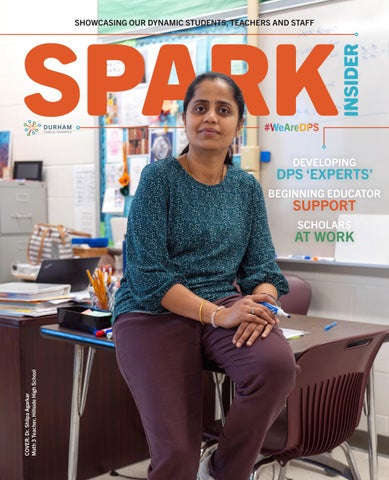
SHOWCASING OUR DYNAMIC STUDENTS, TEACHERS AND

SPARK

DEVELOPING DPS ‘EXPERTS’ BEGINNING EDUCATOR SUPPORT SCHOLARS AT WORK

MESSAGE FROM THE SUPERINTENDENT

o matter your age, I can wager a guess that you can name at least one teacher who’s made a difference in your life. It’s often said, and it’s true: teachers make a difference. They move the needle in the classroom, and they’re the foundation of our work in Durham Public Schools. But let’s not stop there. To teach our scholars, our transportation professionals must bring them safely to our school doorsteps. Once they arrive, they’re greeted by a number of caring adults, including custodians who keep our facilities clean and safe, instructional assistants who help teachers in the classroom, administrative personnel, and school nutrition professionals who provide the sustenance they need to stay fueled for learning.

Families and community ambassadors are an essential part of our coalition of support for scholars. As Durham Public Schools continues its mission of igniting limitless potential, I invite you to lend your support. We’ve established a new S.P.A.R.K. Academy (Supporting Parents and Advocates through Resources and Knowledge) that consists of five monthly sessions that provide parents and community supporters with interesting and pertinent information about the district. Strengthened communication and engagement among schools and community supporters is the goal. Participants who complete the program receive a certificate as a “DPS Expert.”

I also encourage you to consider becoming a DPS Parent Ambassador.

Parents are an essential component of strengthening the Durham Public Schools community. They are champions of

our schools, programs, and staff, and can advocate for DPS among families in a way that the district cannot. DPS is looking for parents, guardians and adult family members of enrolled students who are interested in volunteering to engage current and prospective families in dialogue about the district, the families’ schools, and the benefits of a DPS education. Parent ambassadors should be passionate not only about their individual schools but also about the district and be willing to share information about DPS both in their personal circles and through districtwide events and initiatives.

Through the Parent Ambassador program, parents will have the opportunity to strengthen their skills, knowledge, and confidence to better serve and advocate for students.

Parents will also have the opportunity to develop and build relationships with other parent and community leaders.

We must keep in mind that our students’ voices must remain at the forefront if we are to serve them with authenticity and accountability. This year, the Office of Public Affairs launched Pixel and Pen to provide our high school creatives with meaningful opportunities to build skills, collaborate with professionals, and contribute original work that tells the story of Durham Public Schools. The high school students who apply and are accepted take part in creative projects and play a crucial role in shaping the Durham Public Schools narrative.

Public education is collaborative work that requires synergy. Join us in further strengthening our DPS community.

SPARKING CONNECTION

New Community Academy Creates DPS Experts

mmy Renquist is a Jordan High School graduate, a current Durham Public Schools parent, and a school choice consultant.

One might think that Renquist would know just about everything there is to know about DPS, but she says there’s always more to learn. So she is taking advantage of a new program designed to give greater insight into the district’s mission and operations, as well as how the community can be more engaged in supporting student success.

Renquist is one of 25 members of the inaugural cohort of the S.P.A.R.K. Academy (Supporting Parents and Advocates through Resources and Knowledge), which kicked off in January.

Participants attend five monthly sessions that provide a deep dive into how the district operates, with a goal of greater awareness and engagement in the community.

Participants who complete the program will become certified DPS Experts.

“In my job, I spend a lot of time touring schools, and I think the value is to connect with community members and to get accurate information,” she said. “I think it’s important to hear from DPS what’s actually happening in the schools and how decisions are made. Plus, it’s a great community building effort.”

‘FOR THE LEARNERS BEHIND EVERY LEARNER’

SPARKING CONNECTION

better advocates for our public schools, said Maria Bajgain, the director of marketing for DPS.

“We started this program as a way to deepen our connections with community members and to help empower them with knowledge about the inner workings of the school system and the many resources that are available,” Bajgain said. “Our schools aren’t just for parents; they’re for the entire community.”

Participants can include current and prospective DPS families, real estate professionals, human resources professionals, local business leaders, school district employees, education advocates, and journalists.

The five-part learning series includes a combination of guest speakers, hands-on activities, and plenty of opportunities for participants to ask questions.

“We want to make the Academy a meaningful and authentic experience for everyone,”

Bajgain said.

NEVER TOO LATE TO GET INVOLVED IN DPS!

Shantell Thomas has spent 25 years as a DPS parent, and her last of three sons will graduate from Hillside High School in June. But Thomas says it’s never too late to learn about how people can support their public schools.

Thomas is a participant in the S.P.A.R.K. Academy, and she is looking forward to learning as much as she can about DPS and how she can stay engaged as a community supporter.

The tagline for S.P.A.R.K. Academy is “For the learners behind every learner.” This signifies the importance of community members familiarizing themselves with the district in order to be

“I feel a debt of gratitude to DPS, even though I am phasing out as a parent,” Thomas said. “I feel like a beneficiary of the great work that’s being done in our school system, and I want to figure out how to stay involved.”

For more information about the next S.P.A.R.K. Academy cohort, contact Bajgain at Maria_Bajgain@dpsnc.net.

Emmy Renquist (left) and Courtney Brown engage in a S.P.A.R.K. Academy session.

RUN TIME

oon after meeting Curtis Berzofsky, you can readily tell that he is a true visionary.

Not only does he have a passion for filmmaking, but he also has a strong desire to build community. That’s why the Jordan High School senior is the perfect fit to lead planning for the second annual Running Bull Film Festival, which will feature filmmaking talent from most Durham Public Schools high schools at The Carolina Theatre on April 7.

Festival Showcases Student Filmmakers at The Carolina Theatre

“The festival creates opportunities for a lot of students and displays their work for everyone in the community to enjoy,” Berzofsky said.

Students from all DPS high schools who have an interest in filmmaking were encouraged to submit their short films for the festival. The films were vetted for showing to audiences of all ages, and they were judged by a panel that included Carolina Theatre officials and local filmmakers and educators.

“The Running Bull Film Festival is a great opportunity for students to get together with their peers from other schools whom they wouldn’t normally get to meet,” said Laurie Siegel, Carolina Theatre’s senior director of education and community engagement. “It’s just a great time for them to connect and network with students of similar interests.”

STUDENT-LED, GROWTH-ORIENTED

Siegel oversees the festival from the theatre side of things, including programming, outreach, and sponsorships, but she leaves a lot of the planning and vision up to Berzofsky and his fellow students. This gives them the experience of working collaboratively to plan an event that features their talents and will entertain and educate diverse members of the Durham community.

“It’s really student-led, and I’m just helping them create their dreams here,” said Siegel, herself a former DPS teacher. Festival participation is growing fast. The festival was launched in April 2024 by students and teachers from Jordan High School’s Innovation Lab, where students learn about working with a variety of media, including filmmaking, book publishing, podcasting, scriptwriting, and newswriting, to name a few.

Last year’s films were mostly produced by Jordan students. This year’s goal is for all DPS high schools to have a presence, with five having already signed on. A high school does not need to offer a filmmaking course for students to participate.

ACCESS TO LOCAL FILMMAKERS

The Running Bull Film Festival offers students a fun day full of activities and opportunities to meet and interact with local filmmakers, including through workshops. Participants rotate through sessions during the day.

One session will feature last year’s Overall Jury Choice Award winner Pete Vines, whose prize was to work with

Running Bull participant Reem Abazid offers remarks as she accepts the Audience Choice Award for her film.

a local filmmaker and to reimagine a portion of his film. Vines and the filmmaker will be on hand to discuss the professional editing process with students.

Another session is titled “How to Talk to Strangers,” in which local filmmaker Nicole Triche will share her expertise in interviewing subjects for documentary films and how to work collaboratively with a variety of personality types during the production process.

Student films chosen by the juried panel will be screened at the theatre the evening of April 7. Categories include Documentary, Narrative, Animated, Music, and an “Other” category to allow students flexibility in their choices of topics. Siegel said that all films screened at the festival are appropriate for viewers of all ages, without stifling creativity in the production of the films.

Awards are presented in several categories for student entries. The Running Bull Film Festival is open to high school students.

“Being involved in the festival has made me think about the importance of a really diverse community and the experiences that everyone has,” he said.

“We want to err on the side of creativity and expression within reason,” Siegel said. “We don’t want to limit the students.”

Films will also be judged by a jury of Carolina Theatre officials, local filmmakers, and DPS educators. There will be awards for editing, an Overall Jury Choice Award and an Audience Choice Award, for which audience members can vote the night of the festival via a QR code.

BUILDING COMMUNITY THROUGH THE ARTS

Berzofsky is interested in pursuing a career involving urban sociology and policy, and this experience has piqued his interest in being a community leader someday.

He hasn’t decided on which college or university he will attend, but he knows that he wants to work in nonprofit organizations that bring people together through the arts and other creative activities that will ‘raise people up.’ The festival, he said, has underscored his desire to pursue a career that will fulfill this dream.

“What I hope for the festival is that it continues to interest new students in DPS who may not have had an opportunity such as this before and really see this as something that can be some sort of passion project or deep dive into working on something bigger than themselves,” he said. “This is more than just the festival… It’s very much about youth in Durham and what is possible.”

RISING STARS

Summer Internships Give Students

Meaningful Career Experiences

hat if a summer job not only paid a decent wage, but also provided the student with reallife experience in a career area of interest while also satisfying a requirement for high school graduation? That is exactly what awaits some 40 Durham Public Schools rising high school juniors and seniors who are taking part in the Rising Stars Summer Internship Program this summer.

DPS Rising Stars IT interns visit Lenovo’s headquarters for a behind-the-scenes look at the company and the products it builds.

The program is in its fourth year, and it is an evolution of a partnership that began with the City of Durham’s YouthWorks program.

Rising Stars pairs students with a host business or organization based on their career interests so they can gain meaningful work experience in addition to compensation. Students who successfully complete the Rising Stars program will meet the North Carolina Department of Public Instruction’s (NCDPI) internship course requirement, and will earn credit.

Dr. Jameya Jones is a workforce development coordinator in the DPS Career and Technical Education (CTE) Department, and she oversees Rising Stars. She said she enjoys helping students pursue their dreams by gaining experience that will help them as they plan for higher education or the working world after graduation.

“For me, it’s personal, having been born and raised in Durham and seeing all these opportunities we have for our students and the different career pathways they can take,” Jones said. “Having these programs means they get some type of early exposure via opportunities in their own backyard.”

RECRUITING STUDENTS AND ORGANIZATIONS

CTE staff spend the first part of the second semester each year spreading the word about Rising Stars to current high school sophomores and juniors. At the same time, they reach out to businesses and nonprofits to seek viable internship opportunities for the students.

The application deadline for both students and employers who are interested in this year’s program is April 24. From the applicant pool, students who meet the appropriate criteria are invited to interview for the program. Interviews take place at the applicants’ schools, with potential employers sometimes sitting in. Students will then be notified if they have been accepted, and orientation begins in mid-June.

STRUCTURED CAREER EXPERIENCE

All Rising Stars are required to work at least 120 hours between mid-June and the first week or so of August. The program culminates with a celebration where students give presentations about their experiences for their employers, their families, and DPS staff.

Students receive stipends of $1,800 for the summer. In most cases, the host employer provides

funding, but for some organizations, particularly nonprofits, the DPS Education Workforce Innovation Fund and Community Education will step in and supplement what the employer cannot pay.

Rising Stars employers often will provide flexible schedules for students who would still like to work an additional summer job, when possible. Rising Stars employers for this year will include GSK, GO Triangle, the Duke Lemur Center, and Alternative Career Pathways.

Carlos Espinosa is the talent acquisition manager for GO Triangle. His organization hosted six Rising Stars students last summer and plans to accommodate at least 10 students this summer.

“We recognize the importance of early, meaningful exposure to career pathways and the value of strong partnerships between public education and public service organizations,” Espinosa said. “[These opportunities] help students connect academic learning to real-world application while developing critical professional skills, confidence, and civic awareness that will serve them throughout their careers.”

CONNECTING PEOPLE, EXPERIENCES

Darian Harris, the director of CTE Programs, said he is proud of the Rising Stars program because it engages students with opportunities to which they might not normally have access.

“The phrase ‘work-based learning’ kind of becomes [clichéd] after a while,” he said. “Rising Stars is much more than that. It’s really a bridge for our students, connecting them to their next steps in life. It connects them to people, to experiences, and to their community.”

In many cases, Harris added, Rising Stars serves to “engage the disengaged” by making the connection between what students learn in the classroom with what they face in the working world.

Rosalind Garmon, the equity and career development coordinator, said her daughter enjoyed a fulfilling experience as a Rising Star. She said that the program has been “raising the bar” higher each year in providing real-world working opportunities.

LEARN MORE

For more information on applying for the Rising Stars program or hosting a student, contact Jones at Jameya Jones@dpsnc.net.

“Every student has the right to be exposed to what he or she may want to do as a career, and they all deserve an opportunity to receive a decent wage… regardless of their zip code,” Garmon said.

“I feel like we do a wonderful job showing students traditional and non-traditional careers.”

SUMMER SCHOLARS

Students Learn Rigor, Equity Focus at Duke Research Insitute

eople often toss around the word “research” when they’re simply referring to a few facts they’ve googled. Students turn to “sources” like Wikipedia and YouTube, and more and more people have trouble parsing the real news from the fake.

Durham Public Schools teaches strong research skills through its core curriculum and advanced course catalog, and students have the opportunity to enhance or continue their studies through a variety of programs made possible through community partnerships. One such program is the Hank & Billye Suber Aaron Young Scholars Summer Research Institute, which gives students the opportunity to learn strong research skills while also studying equity issues that affect our society.

The summer program, a partnership with DPS and Duke University’s Samuel DuBois Cook Center on Social Equity, immerses high school

students in meaningful studies that hone their research, writing, and presentation skills.

“[The students] dive straight into their work. They are learning protocols for engaging in research and expectations for writing assignments,” said Dr. Iwinosa Idahor, the executive director of equity affairs at DPS. “They are learning about primary, secondary, and tertiary sources, and with AI now being a thing, they’re learning the difference between what is real and what is ‘fake news,’ and citing sources, and finding credible sources for their work.”

INTENSIVE STUDY WITH AN EQUITY FOCUS

The Young Scholars program is an intensive summer offering for students in grades 9-12. Participants select topics related to social equity and develop research projects around them.

“The students choose topics that are really important to them,” Idahor said. “Being able to watch them grow and truly learn more about their topics is really wonderful to watch.”

Recent topics have included redlining (racism in lending practices), police brutality, maternal health for Black women, perpetuating

Jordan Vereen, a graduate of Durham School of Technology, presents his final project at the summer capstone event.

BUILDING CONFIDENCE, PREPARING FOR COLLEGE AND CAREERS

stereotypes among minority groups, equity issues around college admissions, and access to advanced academics courses.

During the program, students attend sessions at the Cook Center on Duke’s campus every weekday from 9 a.m. to 4 p.m. during a three-week period in July. They meet with Duke instructors and DPS teachers who guide them in developing their projects.

Students who are selected for the program typically participate for two consecutive summers:

During the first summer session (Cohort 1), students create academic research posters that display a problem, thesis statement, research methodology, results, conclusion, and summary.

The following summer (Cohort 2), students who are able to return write a 10-page research paper about their chosen topic, and they have the flexibility to change topics. They then present their findings at a culminating “capstone” event for family members, teachers, principals, and friends.

Established 10 years ago, the program has grown from serving a dozen or so students in its first year or two to approximately 50 student participants this past summer.

Idahor said that in addition to the skills that students develop in the Young Scholars program, the experience provides them with a great opportunity to immerse themselves in a college environment.

“Thinking in terms of college and career readiness, this exposes our students to the opportunity to be on a college campus, to the rigor of college-level work, and it gets them to think of postsecondary opportunities,” Idahor said.

She added that the students can apply the skills that they develop in Young Scholars to their classes back at their respective schools.

“They can transfer these skills back to English I and II classes,” Idahor said. “Public speaking, research skills, writing skills – they can use these at any point in their high school careers and beyond.”

In addition, what they learn in the program is “a great confidence booster in terms of building student efficacy and agency around researching topics that are of interest to them,” she said.

Read more about the Hank & Billye Suber Aaron Young Scholars Summer Research Institute at https://bit.ly/4q19wSq. For more information about the program and how to apply, you can also contact Idahor at Iwinosa_Idahor@dpsnc.net.

DPS scholar Maya Lewis executes a poster presentation at the summer capstone event.

SLAM DUNK

Library Partnership Improves Access to Resources for DPS Students

urham students and families are incredibly fortunate to have a wealth of resources that support learning at little to no cost. For decades, the Durham County Library has been a powerful partner in the effort among Durham Public Schools students, staff, and families to ensure that access to these resources is easy and barrier free.

One of the most successful examples of the library’s collaboration with Durham Public Schools is Bull City SLAM (Schools and

Libraries Achieving More), which launched in 2018. Through this program, students can explore books, digital materials, and other educational tools to their hearts’ content, using their DPS student IDs to seamlessly connect with the library to supplement the resources available to them at home and in school media centers. Those resources even include free, live online tutoring services.

The initiative launched in the wake of President Obama’s ConnectED Library Challenge.

“It’s just a great collaboration,” said Ron Wahlen, the director of digital teaching and learning at DPS. “We saw this wave happening in the United States with the President’s Library Challenge, and we said, ‘We need to get on top of this,’ and it’s been a great partnership.”

He added, “What makes this really nice is that it eliminates the transportation issue, where if mom or dad can’t take their child to the Durham County Library, students can still have digital access to the library resources.”

LEFT A young reader explores the shelves — one of thousands of print and digital resources available to DPS students through Bull City SLAM, which provides automatic library access with a student ID.

RIGHT A Durham County Library card represents the partnership that gives every DPS student automatic access to books, digital resources, and free tutoring through Bull City SLAM.

AUTOMATIC ACCESS TO SUPPORT LEARNING

The way Bull City SLAM works is quite simple: DPS students are automatically members of the Durham County Library system with their student identification numbers. DPS shares students’ names and ID numbers with the library. The information exchange is safe and secure, but families can opt out if they prefer.

“We want everyone to know that all the information we share with the library is private,” Wahlen said. “Librarians cannot look up personal or private information about individual students.”

Once in the system, students are able to do the following:

• Check out up to five print items at a time;

• Have access to all of the library’s online resources, from home or from school;

• Log in to a public computer at any Durham County Library location if they need access to one;

• Gain access to free tutoring sessions through the BrainFuse feature, with trained tutors on hand for various subjects from 2 to 10 p.m. weekdays.

DPS teachers and staff members also have access to the Durham County Library through a staff account. They can access all materials the library has to offer, just not through the Bull City SLAM program.

Heidi Perez, the secondary literacy integration specialist, said that this level of access is especially useful for high school students who have papers and projects that require a deeper level of research than might be readily available at school.

“We have many students who participate in dualenrollment classes, and the research and inquiry databases available through Durham County Library are often the best and sometimes the only source that students can access with the support of their high school community,” Perez said.

THOUGHTFUL ALLOCATION OF RESOURCES

Families should rest assured that the resources to which students have access via the library are age appropriate.

“Our library media coordinators set the age levels that students can access,” said Perez, adding that students can use the Sora app, which links DPS, Durham County Libraries, and the North Carolina Department of Public Instruction.

“Students can go to the Sora app and literally have access to thousands of age-appropriate texts, books, e-books, audiobooks, graphic novels, and magazines.”

The connection to the Durham County Library also serves as a significant cost saver for Durham County taxpayers, as it limits the amount of duplicate materials ordered by DPS libraries and the county libraries.

“If Durham County purchases a product, DPS doesn’t have to, so we’re able to strategically decide if the library is buying something and we don’t have to buy it,” Wahlen said. “Altogether, we’ve got one big database in Durham.”

By removing barriers to access and placing high-quality library resources directly in the hands of students and staff, Bull City SLAM strengthens classrooms, supports families, and fosters learning beyond the school day. Bull City SLAM ensures that every DPS learner is empowered to explore, discover, and grow – at school, at home, and throughout the Durham community.

Families and students explored the wide range of programs and pathways available across DPS at the annual Showcase of Schools. The event offered a chance to connect with educators, explore schools, and find the right fit for every learner.

GLOBAL CREDENTIALS

‘Seal

of Biliteracy’ Broadens

Opportunities

After High School

n an increasingly interconnected world, the ability to communicate in more than one language is a powerful asset. Bilingual and multilingual students often demonstrate adaptability, strong communication skills, and creative thinking. Colleges, employers, and even the military recognize these qualities, often giving bilingual and multilingual candidates a competitive edge as they pursue higher education and career opportunities.

For the last decade, students in Durham Public Schools have had the opportunity to receive an N.C. Global Language Endorsement (GLE), or “Seal of Biliteracy” (SoBL) certificate, that indicates that they have mastered at least two languages. Nearly 1,500 DPS students have taken advantage of this opportunity since its inception, but educators want more students to know about it, pursue it, and take advantage of its benefits.

The SoBL is one of seven High School Diploma Endorsements that high school students in North Carolina can earn by completing specific course concentrations.

“The SoBL allows students to showcase their language learning in a way that

indicates how well they can learn in the future. In fact, it’s something they take into their lives, their community, and their postsecondary work,” said Dr. Ann Marie Gunter, a world languages consultant with the N.C. Department of Public Instruction. “It’s also a way in which they might be able to achieve college credit or placement, and it’s a way for their biliteracy to be recognized in a career field or job – even the military – where they can put it to good use.”

EARNING CERTIFICATION

The SoBL offers two pathways for different students: Those who are learning English and those who are learning another language.

Students and families who are interested in achieving a GLE/ Seal of Biliteracy certification an contact their school counselor, Sashi Rayasam, the ESL Director of K-12 ESL Services, at Sashi Rayasam@dpsnc.net, or Laura Parrott, the director of advanced academics at DPS, at Laura Parrott@ dpsnc.net.

ENGLISH

Students must fulfill ONE of the following requirements to demonstrate mastery of English:

• Complete English IV or an equivalent dual-enrollment college course and earn a cumulative, unweighted grade point average of at least 2.5 for all English coursework required for graduation;

• Use the Credit by Demonstrated Mastery (CDM) process to complete the English IV course required for graduation; or

• Achieve a satisfactory score on a nationally norm-referenced external exam approved by NCDPI.

WORLD LANGUAGES

To demonstrate mastery of a world language, the student must fulfill ONE of the following:

• Complete a Level IV or higher world language course (or an equivalent dual-enrollment college course) and earn a cumulative, unweighted grade point average of at least 2.5 for all coursework in that language;

• Use the Credit by Demonstrated Mastery (CDM) process to complete a Level IV or higher course in a world language; or

• Achieve a score of “Intermediate Mid” or higher on a nationally norm-referenced external exam approved by NCDPI.

Students who participate in dual-language immersion programs have a head start in achieving the Seal of Biliteracy certification by the time they graduate. DPS now offers duallanguage immersion programs at seven elementary schools (with entry in kindergarten) and one middle school.

The Seal of Biliteracy isn’t limited to world language courses taught in DPS. Students are able to show proficiency in many other languages through the norm-referenced external exams approved by NCDPI.

GLOBAL CREDENTIALS

A DPS student works toward the N.C. Seal of Biliteracy — a diploma endorsement recognizing proficiency in two or more languages and opening doors after high school.

These exams can sometimes be taken through foreign embassies in the United States.

Students may also receive an endorsement for mastering more than two languages.

In the decade since the Seal of Biliteracy has been available, students have earned certification in American Sign Language (ASL), Arabic, Chinese, French, German, Greek, Hebrew, Italian, Japanese, Latin, Persian, Pohnpeian, Russian, Spanish, Swahili, Tamil, and Ukrainian.

BENEFITS OF BILITERACY

In addition to college credit and better job offers, there are numerous benefits to knowing more than one language, including:

• Increased intellectual ability

• Delay of cognitive decline and the onset of dementiarelated illnesses

• Higher levels of abstract thought and reasoning

• Better understanding of world cultures and global awareness

“Multilingualism goes beyond communication; it enriches how students experience the world by blending language and culture with their own thoughts, values, and identities,” said Sashi Rayasam, the director of K-12 ESL services at Durham Public Schools. “The SoBL celebrates bilingualism as a strength, creating equity through recognition. It empowers multilingual students to build on their cultural identities while encouraging English-only students to step beyond linguistic boundaries and see the world through a broader lens.”

NURTURING CAREERS

DPS Invests in New Teachers with Data-Driven Support

he recruitment and retention of good teachers is a bit more complicated than it used to be. Classroom challenges have become increasingly complex, and the pay remains lower than many other jobs that lie within reach of a new college graduate or even a teacher with a few years of experience.

Durham Public Schools has long recognized the value of supporting new teachers to help grow a larger, long-term pool of tenured educators. The Beginning Teacher Support and Development Program offers new teachers a substantial and meaningful amount of support for the first three years of their tenure.

Jordan Halliday, 2024-2025 Beginning Teacher of the Year

The beginning teacher support team uses data from various sources to help new teachers pinpoint areas of improvement, not only for their classrooms as a whole, but also for specific students. Anecdotal observations are critical to the improvement process, but discussions backed with data can help new teachers pinpoint where specific students need help.

The Education Value-Added Assessment System (EVAAS) is widely used to help teachers – new and experienced alike –learn about how they can reach students who need extra help.

“We triangulate EVAAS data with new teachers – not only for them to read and understand the data, but also to

see what stories the data tell about their students,” said Liz Agoranas, a beginning teacher mentor at DPS.

Rhonda Sinquefield, another beginning teacher mentor, added that teachers receive EVAAS data that can indicate how students might be expected to perform on assessments, such as end-of-grade tests. The EVAAS data isn’t used to preset expectations, but instead to zero in early on what students need to learn not just to score high on tests, but also to retain what they learn.

“Teachers have a general idea of what levels their students are performing with, so they’re not totally blind to their students’ needs,” Sinquefield said. 

English teacher Diana Chapman connects with a student during class reading.

Additional evaluative tools that mentors use when consulting with their new teachers include:

• mClass (metrics for Classroom Assessment of Student Success). This literacy assessment for grades K-2 tests word fluency and generates reports and specific activities for building literacy skills.

• i-Ready. The district uses i-Ready in grades 3-5 for math and reading assessments and to help pinpoint where individual students need to improve.

• End-of-Grade (EOG) and End-of-Course (EOC) tests. These are standardized tests required by the state of North Carolina. EOGs assess reading and math in grades 3-8 and add science for 5th- and 8th-graders. EOCs assess mastery of specific high school courses such as biology, English, and math.

• Career and Technical Education (CTE) postassessments. The district offers numerous

ABOVE Exceptional Children’s teacher Augustine Sanu reviews the lunch menu with his class before they leave for lunch. BELOW Arts and photography teacher Veronica Ochoa-Castillo works alongside her students on a collaborative art project, adding her own piece to the shared work.

CTE courses that prepare students for careers in such fields as IT, health sciences, engineering, and culinary arts. These assessments determine what students have learned and can lead to certification in some cases.

• Assessments that teachers create themselves, with assurances that students are aligned with other assessments that are administered.

“What’s nice is to put that data in front of teachers, and let it sit with them for a moment. Then we hear what they are getting from it, and we have those conversations,” said Kim Wallace, a beginning teacher mentor. She added that it is also important to assess teachers’ performance through the NC Educator Effectiveness System (NCEES), which includes educator evaluation and professional development components.

“Teachers have a general idea of what levels their students are performing with, so they’re not totally blind to their students’ needs.

“We need to get specific data from the very beginning … to get that baseline around how teachers are feeling about how they are performing in the classroom so we can track their growth,” Wallace said. “From this, we can see how they are growing, and we use that data to see some of their impacts on students along the way.”

It is important to note that among the hundreds of teachers with whom beginning teacher mentors work, many have chosen to become teachers after having had other careers, according to mentor Steven Gupton. He said that these new teachers need the same kind of support and

feedback as teachers who are fresh out of college in order to obtain their teaching licenses.

“We have a lot of alternative licensed teachers,” Gupton said.

“A lot of folks were bankers, bus drivers, or – like me –paramedics before they decided to become teachers. We have to make sure that we’re facilitating the support they need.”

Data-driven support for teachers is crucial, not simply with regard to what students are learning in class, but also how teachers are working with them around social-emotional and cultural issues.

“Giving teachers a safe space to be honest about their views, about their biases, and what they bring to the table is important,” Agoranas said. “We ask teachers, ‘Do you know who feels safe in your classroom and why? What are your beliefs about equity, about classroom culture?’” she said. “Teaching is a really personal job; we like to find a safe space of trust so we can have those conversations with teachers.”

CTE Business teacher Vickie Weeks works one-on-one with a student during class, providing guidance and support as they tackle coursework.

CREATIVE MENTORS

Duke and DPS Students Learn from Each Other in Arts Fellows Program

he Durham School of the Arts (DSA) has a theme each year around which students and staff model their work and activities. This year’s theme is “Community,” and it is the perfect fit for the inaugural year of the Duke Arts Fellows Program with Durham Public Schools, as Duke’s many great partnerships with DPS exemplify what community is all about.

Duke Arts Fellows pairs Duke undergraduate students who have an interest in the arts with Duke arts professors as mentors. Then they are assigned to a school to shadow teachers and pay it forward by mentoring DPS students. The program is funded by the Mary Duke Biddle Foundation.

The goal is for the Duke fellows to gain experience working with Duke mentors, DPS teachers and students. It is an arts immersion experience intended to support the Durham community while simultaneously enriching their tenure as Duke students.

BUILDING CONNECTIONS THROUGH THE ARTS

“It’s nice to have our high school students working with college students so they can see someone who’s at a college setting, ask them questions, and share stories,” said Allen Amos, who teaches band and AP Music Theory at DSA.

LEFT Duke University student Jackie Park (right) and Hillside High School educator Tiffany Agerston.

MIDDLE Duke University student Julia Libhaber (left) and Northern High School educator Lori Madl.

BELOW Duke University student Olatomi Gabriel (right) and Northern High School educator Myra Stotesbury.

“It’s a nice way to bridge some gaps for students who are thinking about their futures. The personal connection component is very powerful, too.”

For the inaugural year, five Duke students have been placed at four DPS schools to shadow teachers with expertise in the fellows’ chosen areas of focus. The schools participating this year are DSA (music focus), Northern High School (visual art focus and dance focus), Carrington Middle School (creative writing focus), and Hillside High School (theater focus).

The plan is to expand the program to other DPS schools in the future.

“Duke Arts has been a vital community partner for our arts education department throughout DPS,” said Les Turner, the director of arts education at DPS. “The Duke Arts Fellows program is yet another exemplary opportunity allowing our DPS young artists [and] arts educators to have direct connections to the Duke arts students and staff.”

He added, “This partnership exemplifies the Duke Arts commitment to their community and the DPS commitment to making connections.”

APPLICATION AND COMMITMENT

Duke students who are interested in the Duke Arts Fellows program must go through an application process. Once selected, they must commit at least 20 hours of their time to the program per month. The majority of those hours are spent at their assigned school, with a few hours each with their Duke mentors and with each other, sharing what they have learned at their respective schools.

Amos said his Duke Fellow, Michael Albert, is a music enthusiast who plays saxophone in Duke’s marching band and also with a jazz group there. However, he is a biomedical engineering major. Albert visits DSA once a week and works with the band’s saxophone quartet.

“It allows [the DSA band members] to practice and put to use the skills they’re building,” Amos said. “They do instruction with him on style and detail, and think about how to tie it into the overall theme.”

“They do look forward to their time with Michael,” Amos said. “It’s an opportunity for getting new ideas, and getting a different perspective from a college student is always welcome for our students.”

SHARING TALENTS WITH OTHERS

Jackie Park is a junior who is pursuing a double major in psychology and pre-med studies at Duke. But she has been involved in theater since childhood, and she says that becoming a Duke Arts Fellow was an opportunity that was too good to pass up. She works with theater teacher Tiffany Agerston and some of her students at Hillside High School.

“I was very intrigued by this process, and so when I was offered this role, I was really excited to be able to bring some of my joy and love for the theater to high school students,” Park said. “It’s been so much fun!”

Hillside’s theme is “Family,” so Park is working with theater students there to incorporate family themes into the original scripts that students are writing for short plays with one to three scenes.

All the fellows and many of their students will come together for a single event that will showcase their talents in March 2026. Park said her group is working together to create a “devised piece” for the event. This includes all of the participating Hillside students being on stage at once to deliver different tableaux and monologues.

Amos will also have some of his band students perform at the event. The DSA Community theme will be reflected in the performances they develop.

Duke Arts Fellows bring creativity to life alongside DPS educators, inspiring illustrations such as the one above that reflect the power of collaboration and artistic mentorship.

Bus Drivers Learn Spanish to Strengthen Connection with Students and Families COMMUNICATING SAFETY

urham Public Schools bus driver Wyvondalynn Onley noticed that a high school student on her bus appeared troubled.

English was not the student’s first language, and after a few minutes of attempting to communicate with him, Onley was finally able to figure out that he was worried that he had boarded the wrong bus.

“I couldn’t easily communicate with him that it was okay, and that he was on the right bus, just a different route, and that I would get him to school safely,”

Onley said. She used a translation service on her phone to navigate the situation and successfully reassure the student.

Good communication is non-negotiable in public education, and it’s especially critical when it comes to transportation.

School bus drivers must have a clear way to communicate with students and families to ensure they transport students safely to and from school each day.

To do this, Onley and other DPS transportation workers began taking Spanish classes at Durham Technical Community College in January.

A PARTNERSHIP FOR IMPROVED COMMUNICATION

The partnership with Durham Tech was spearheaded by Anthony White, the executive director of auxiliary services at DPS.

Shortly after he started the job, many bus drivers shared concerns with him about language barriers with students and families, including being able to convey bus schedules and delays; giving directions that students and families could understand; and communicating safety instructions and emergency phrases.

“I have a passion for making sure we are inclusive. From my time as a principal, that was important to me – having everyone feel welcome when they walked through the doors of our school,”

said White, who led Brogden Middle School for five years. “It’s the same thing for when students board the bus for the first time. They want to feel welcome, and their families want to feel comfortable that they are going to be safe and well taken care of.”

Through the partnership, drivers can now take Spanish classes during their breaks between their morning and afternoon bus routes at Durham Tech. Courses will be provided free of cost, thanks to funding from a Magnet Schools Assistance Program grant.

Nineteen bus drivers and other transportation professionals started with the first cohort of classes in January. White hopes to see that number grow in the future.

BEYOND BASIC TRANSLATION

Onley said she welcomes the opportunity to form stronger connections with her bus riders and their families.

“Trust. That’s a good way to put it,” she said. “To be able to say to students and families, ‘I’m your bus driver, and I’m going to make sure you get to and from school safely.’”

DPS bus drivers learning Spanish demonstrates our commitment to clear communication, inclusivity, and serving every student with care.

STUDENT SOUND OFF

We asked three students, “What do you like to do in your free time outside of school?”

I like to play tag outside with my friends!”

KANE HUNTER 5th Grade

R.N. Harris Elementary School

I like writing stories and drawing characters that would match those stories. I also like to play the guitar.”

MARYSA JOHNSON

8th Grade

Neal Middle School

ACKNOWLEDGMENTS

Spark Insider Spring 2026

Volume 6 Issue 2

CONTRIBUTING WRITERS

Sheena Cooper

Crystal Roberts

Maria Bajgain

Michael Yarbrough

I love to read and chill out in my spare time.”

BROOKLYN COOPER 12th Grade

Durham School of Technology

CONTRIBUTING PHOTOGRAPHER

Tony Cunningham, Jr.

GRAPHIC DESIGN

Kevin Brown

Lindsay Scott

Durham Public Schools Board of Education

Bettina Umstead, Chair

Millicent Rogers, Vice Chair

Natalie Beyer

Jessica Carda-Auten

Durham Public Schools

Emily Chávez

Joy Harrell Goff

Wendell Tabb

A BOUT THESPARKINSIDER

The DPS Spark Insider is a publication produced by Durham Public Schools in partnership with Durham Magazine. The Spark Insider shares the stories of DPS students, teachers, and staff with the larger Durham community.

dpsnc.net

Turn static files into dynamic content formats.

Create a flipbook